The Spartacus League
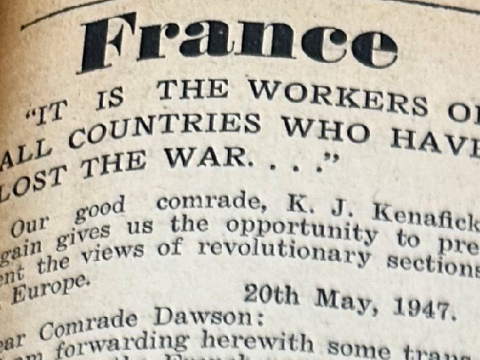
We are in contact with the above group, who issue a weekly Spartacus, which we receive regularly. Our good comrade, K. J. Kenafick, M.A., has willingly co-operated in reading through the printed (in Dutch) material received, and we have received the following report and translations:
[We have taken the editorial liberty to emphasise certain sentences in italics.]
Dear Comrade Dawson:
I am forwarding herewith a translation of some of the documents from Holland that you have sent me.
They are publications of the "Spartacus" League, a socialist group, with its headquarters in Amsterdam.
The first publication I shall deal with is a circular letter, dated January, 1947, to "Our readers and friends." It goes on to say:
"We have entered upon a new year. The old one lies behind us, a year of practical and theoretical activity of our class towards the discovery of new forms of struggle and of organisation, insofar as they are required for this new period in which we are living.
In the old year Spartacus also has continually propagated its ideas. Spartacus is a relatively small group of active workers supporting our weekly paper.
Its ideas can well be expressed in one slogan, The workers must do it themselves!
No people with social feelings, no leaders, no parties, and no adventurers will free the workers from the hell of capitalism.
The emancipation of the workers must be the act of the working class itself.
In the new year Spartacus will make these ideas further known. But the carrying out of this into wider spheres must first and foremost be the work of those workers themselves who are reaching political consciousness. Spartacus can never be anything more or less than words addressed to them. We workers must do the job ourselves, through the paper, and with the paper. But, always, we must do it ourselves.
This is on the assumption that we make use of the opportunity, that you devote yourselves to establishing the necessity of supporting with full strength the still weak and new beginning:
The workers must do it themselves!
All must help in it! But in what way? There are various ways in which that can be done, and you can best judge your own cases. Consider the possible methods, and act accordingly, every day and every hour."
The letter goes on to ask questions of the readers as to how far they have obtained subscribers, etc., gathered material, distributed copies, etc.
A New Communist Manifesto
The second publication in this collection is the Inaugural Address of the League. It is sub-titled "An Open Letter to the Brain and Hand Workers of All Countries." It says:
"For the second time in 25 years the ruling class has seized upon the latest and most fearful means wherewith to defend its possessions. Twice in a quarter of a century the world has been turned into a ruin, in order that it shall still be serviceable to a social order of which the continuance signifies calamity, misery and destruction.
"At the end of the first world war the opposition to war, hunger, and misery in all countries turned in Eastern Europe, in Russia, Austria, Hungary, and also in Germany to the material force of proletarian revolution. Workers, peasants, soldiers, and sailors broke the shackles of constitutionality and seized on power. They did this by their own direct action under leadership chosen by themselves, in those forms of power which the struggle for power had itself formed. In the form of councils (soviets) there then arose (not for the first time in history, but for the first time on such a scale) the organs of the direct exercise of power, as chosen by the workers, and no longer restrained by bourgeois constitution. This world offensive begun on the ruins and the mass-graves of the first world war collapsed. It broke to pieces against the still unshattered power, which not only the capitalists' control of the means of production and of labour still conferred, but also against the power which still held men's minds fettered to the ideas of the bourgeois world.
In Western and Central Europe, and in America, the workers were still confronted by the unregimented Liberal Capitalist system. The disastrous workings of this capitalistic system still appeared to them to be primarily the consequences of defects of national and international organisation. Unbridled exploitation must be tempered by the intervention of the State. The irresponsible "bloody International," driving to armament and war must be placed under State control, and the different States must come together in a world organisation, a world League. These and similar ideas had become the content of Social Democratic propaganda; they also now appeared on the programmes of the bourgeois parties. It appeared as if the curbing of capitalism and the gradual growth towards socialism was possible under the leadership of the State, after its functions were taken possession of by socialists.
On this defect of insight among the greater part of the workers, the revolutionary struggle of the more clearsighted minority came to grief, and, on the defeat of the Spartacus uprising there followed the Weimar Republic. The Social Democratic Party came to the head of the government, and had to remain, in this position, what it had already been throughout the war: the direct servant of capital, without any power to accede to the workers' most basic demands, and to carry through the nationalisation of monopoly capital.
In Russia, where the internal organisation of capital was weak, and this really half-colonial country was ruled by foreign capital, the revolution took a partly "national" character. The fight against capitalism and the fight for national liberation was here two sides of the same task. While the peasants achieved the downfall of landed property, the workers made themselves masters of the trades and industries. Here also there came to rule the Social Democratic Party (the later Communist Party calling itself Bolshevik), which here, however, by the absence of a powerful national bourgeoisie, gained complete control of economic life after the yoks of foreign capital had been thrown off. So Russia was the first and only country where—by means of and after crushing of the power of the soviets (workers' councils), the Social Democratic programme of the control of the whole social life by the State was brought to realisation in its most radical form.
The limited national character of the Russian Revolution prevented its spreading over Central and Western Europe. Workers' Councils, the nationalisation of industry, the expropriation of big landed properties, had arisen here in a struggle for the overthrow of a regime at home which actually stood for an almost colonial dependency towards foreign capital. The revolution broke through the old feudal and private capital relations. But, nevertheless, this still did not signify an overthrow of exploitation. For the means of production came into the possession of the State. And now it was shown that the control of economic life through the State and the conversion of the means of production into State property, at the same time signified the complete control of production by the power of the State. The carrying out and the establishment of this system prevented the development towards a control of the social system through the responsible producers (workers) themselves – whereby the national limitations of the Revolution could have been broken through.
In the period between the two world wars there was also carried out, outside Russia, this process of the national organisation of capital by means of the State–above all, in those countries where a policy of the speeding-up of industrialisation was carried out, namely, Italy and Japan. This industrialisation could only be paid for by a sharpened exploitation of the proletariat of those countries. Here the State stepped in to organise the exploitation, and also the internal and foreign trade. Through special mediums of propaganda it was sought to arouse the enthusiasm of the working class for the carrying out of national planning. In all these cases the power of the State grew irresistibly, so that this organisation became supreme over the whole of economic life, whilst the working class was wholly subjected materially, and where it completely succeeded, also ideologically, to these national-capitalistic interests.
But also in other countries which already knew a high capitalist development, this tendency towards a growth of State-power is clearly observable. Above all, in Germany, which, through its need for raw materials was compelled to have a strong organisation of its economy. The impossibility of getting raw materials through direct purchase on the world market, and also the impossibility of competing with low prices on this market, forced on this sharpened exploitation and this organisation of foreign trade through the State. In the bilateral agreements the German bourgeoisie sought to make itself independent of the gold system; at the same time it extended its political system over other countries in this manner, through the control exercised over internal and foreign production. The German bourgeoisie knew how to bind different European countries to itself, politically and economically. Thus it forced the Western Powers out of their positions in these countries. The same tendency was notable with regard to various countries notable with regard to various countries overseas. In this way the Second World War became inevitable.
At the outbreak of the war the working class stood powerless. In Germany this powerlessness had been prepared years before the war by the Nationalist propaganda of all parties from the Communists to the Nazis. This propaganda depicted Germany as a country which was exploited by victorious foreign capital on the basis of the Versailles Treaty stipulations, and it proclaimed emancipation from these oppressive bonds as a primary demand. Thus the proletariat was inveigled into a community of interests with the national bourgeoisie, whereby, at the outbreak of war, resistance from the side of the workers was formidably weakened, whilst the war gave the Western Powers the opportunity by means of their propaganda and their bombings to make known in so unambiguous a manner that the "German people" must be punished in its most fearful manner for "its" crimes, that any international fraternisation was impossible. Also, through this means, the German working class could not attain a unity powerful enough to break through the veritable terrorism of their ruling class. The Western proletariat swept up into a hatred against the "German people," which, in the propaganda of the bourgeois parties, was represented as responsible for the atrocities of Fascism, could just as little come to a unanimous struggle against their own bourgeoisie.
The only force which could have done something against the mass-slaughter, a united world proletariat, did not exist and could not be formed. Much deeper than in the First World War was the cleavage which had been created between the proletariat of the different countries, much more impossible had fraternisation become. And so the Second World War ended, not in revolution, but in a military victory of the Western Powers and of Russia, and so there was lacking also the unity formed through a common struggle for communism, and so the proletariat remained split into different mutually hostile groups.
But the temporary impotence working class lies still deeper. Now that through crisis and war the capitalist State in all countries is coming to the complete control of the social economy, the old Social Democratic programme has lost every semblance of a fighting character. So we see how the workers are turning, in mass strikes, against the Labour Government they they themselves had elected in England. It shows also that the so-called Socialist State cannot bridge over the class conflicts, let alone dissolve them. The class conflict is not outmoded by the new developments, but in accordance with these changed social relations it has got new forms, and is leading to the growth of a changed class-consciousness on the part of the workers.
We are standing at the beginning of this development. Only now that in all countries the State has become the instrument of an economy based on capitalism, has the problem of the working class struggle been correctly presented. This new element in the situation explains the present absence of great activity. Indeed, the fight is only possible in much more massed forms than it was waged earlier, and indeed it can only exist if it digs much deeper into social relations. In the present minor activities we hear the rumbling of the volcano, activities which presently, in a world-wide eruption, will tear the capitalist world asunder.
But so far that has not happened.
We are still standing at the beginning of the quest for new ways.
The power of capital is still unthreatened by the workers.
Still, the preparations for the Third, and most destructive, World War, can uninterruptedly take place.
Everyone knows that capitalistic antagonisms in the present situation must drive on to war if the actions of the workers cannot prevent this development.
The Great Powers to-day cannot live peacefully side by side, for already the existence of one constitutes a [real] threat to the others.
Peace can only be maintained while they are each too weak to crush their opponents. on this shaky foundation rests the present capitalist peace.
Therefore the overthrow of the capitalist system is more than ever a task of life or death for the working class.
The new organisation of the workers can only be international. The Russian Revolution was stifled through its national isolation. The same was the case in the Spanish "Civil War." More than ever there stands to the fore, "Proletarians of all lands, unite!"
But also the content of the struggle is different from what is was formerly. The struggle is no longer directed against the arbitrariness of a particular capital; it is principally turned now against the existence of the capitalist system itself.
The dissolution of war industries and the liberation of production to provide for the needs of men, the rule of labour through the abolition of capitalist property rights, equality of participation in the total social product of labour, for all producers, instead of unequal distribution on the basis of capitalist possession; the necessity to carry out this programme strikes the capitalist system a blow right in the heart. For these objectives the fight must be carried on, and for this aim the working class must organise itself anew.
In this mighty movement, in these times of fighting preparations for the attack, or seeking for the most suitable forms of organisation, for the sharpest insight into social relations, and the necessary theories, the proletariat has its task.
This task does not consist in giving commands to the working class, which must unresistingly obey this tutelage of organs placed above it.
This task lies solely in the elucidation, which the parties give with respect to the great problems of the workers' struggle. This Marxist insight makes possible a clearer perception of social possibilities and necessities. This conscious assembling of the experiences of the different activities of the workers sharpens the insight into new possibilities, and also makes it possible to recognise which of the future interesting forms of struggle were already present here in germ.
The revolutionaries of the whole world have a task to exchange their experiences reciprocally in alliance with each other and to unite these in a general programme of the workers' struggle.
In the present highly developed capitalistic world the working class can no longer fight on the bases of the old organisation of sections and parties, which are the expression of its economic, political, ideological, and national disunity. The development of capitalism has torn away from their former economic and political isolation all spheres of production, where this isolation had not already been removed, and has made the world powers entirely dependent on each other, though they are often so in a negative sense, since they are deadly enemies of each other.
The proletariat must develop the unity of the whole earth in a positive sense, whereby through its unity on a wholly new basis it can shape an economic and political world-system.
This unity can only be brought to fruition, and the struggle for it can only be advanced in an organisational union in which there is given expression to the dictum that the labour of free and equal producers is the basis of the new community.
The germs of this organisation are already existing in the fight everywhere against monopoly-capital, where the workers spontaneously come into opposition to it, and organise themselves on an industrial basis under their own leadership. We have already seen their most developed forms in the industrial organisations and workers' councils.
In this new development the revolutionary party that must come has a task whereby in every struggle, everywhere, it must propagandise for this independent advance of the workers, and must support it with all its might.
Always, and again, it will set the workers' class objectives clearly before their eyes, continually it will fight against endeavours on the side of the bourgeoisie and of the so-called workers' leaders to bring the working class to their way and under the tutelage of the official political parties or of other organisations belonging to the capitalist world.
It will do this, not by making the workers followers of its policy, without a will of their own, but by behaving inwardly and outwardly in a revolutionary way, fighting against every belief in authority, against every weak assumption, against all unthinking subjection, against all desertions from class unity, for the sake of pursuing objectives which are outside the content of the proletarian struggle for emancipation. It will strive to give the workers the highest insight that it can itself reach, and in this way endeavour to make the party organisation itself superfluous. It must never rest till this development has reached its consummation in the organisation of the new communist society.
The struggle of the working class can only reach its highest expansion of it spreads out across all frontiers. The organisation of the communists must therefore also be international. It, however, is not possible, and also not advisable to force on the establishment of a new International; the similarity of views, which is necessary for this must grow in the struggle, and be put to the test anew at every moment in the struggle and be developed into higher forms. Therefore the Communist League Spartacus calls on the Communists of all countries to put to the proof, in the mass movements developed in their own countries, the ideas laid down in this manifesto.
Only as in the struggle itself similarity of views and of objectives appear, so does a common convergence towards a Communist International become possible and fruitful.
Workers, Communists! There is no time to be lost. The fight of the working class for the overthrow of the capitalist system and the organisation of a communist society requires that we stake all our strength. Our common enemy is the might possessor of the productive apparatus of the whole earth and shrinks back from no means when it is a question of the preservation of its property. The power of capital is international and organised; so, too, the working class must rise against it, united and organised over the whole world.
PROLETARIANS OF ALL LANDS, UNITE!"
---
This is the conclusion of the Inaugural Address. I have also received the copies of the Spartacus weekly paper, and will look these through and forward any extracts that are likely to be interesting to your readers.
Yours fraternally, K. J. Kenafick.





Comments