
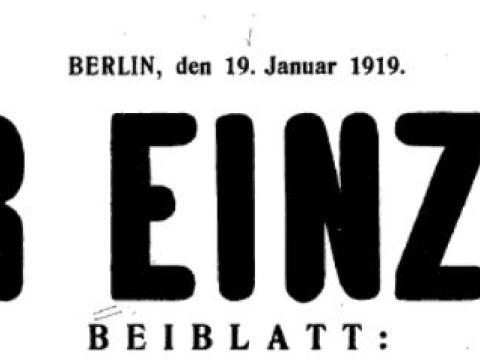
An article taken from the Magazine ,,Der Einzige"

Where there is complete victory, there is complete serenity. The work of art that has gained absolute mastery over its material is nothing but triumph and joy. Comedy spreads delight not through amusing content or buffoonery, but through graceful, charming transcendence; and thus the much-invoked “pleasure in tragic subjects” is surely only that pleasure which reflects the omnipotence of the poet-conqueror. (Expansion of a feeling)
So deeply had Nietzsche’s original insight into art penetrated—he, who by nature may have been merely a most refined connoisseur and feeler of aesthetic sensations, and who had written “The Birth of Tragedy from the Spirit of Music.” Then he found in Stirner the sentence:
"All truths beneath me are dear to me: I am master even of the truths."
To Nietzsche, it seemed as though even the perfect philosopher (the perfect knower) had, in relation to truth, only to win and assert a stance—just as the most powerful artist does toward his object and material. That is, he must simply strive to triumph, to become powerful, to seize truth—and that meant nothing less than: to grasp the Archimedean point of the world (Stirner)—in order then, of course, to bring a blissful joy to the world. This was truly a grand continuation and (unconscious) connection to that fruitful Baconian idea which already dominated the gateway to modern philosophy: “Knowledge is power.”
Nietzsche’s consistently upheld ideal image was likely that of the artist—based precisely on his profound insight into the artist’s essence. That one might similarly balance and suspend the true, truth itself, so that it would no longer carry anything oppressive, painful, or undigested—! That one must learn to dance with truth, to float with it—so as to partake in that whole heavenly nourishment, that deep eternity of joy, of which the bliss of art is at least a foretaste—! All of this may have flashed upon him suddenly as a kind of amalgamation of his own thoughts and those of Stirner.
Previously, to him—the great aesthete—truth may have appeared only as something that could be represented through a perfect work of art. And indeed: not the content, the plot, or the moral—but rather the product entirely unlike the sum of its parts, the final release from a Shakespearean tragedy, resembles a kind of insight, a permeation with something utterly luminous, delicate, and clear. It is victory, transcendence—serenity—triumph.
Here, then, may lie the deepest point of contact between Stirner and Nietzsche: everything else that has been said—about similarities in the emphasis on the ego, individualism, the principle of power—concerns already subordinate, very distantly derived, and thus incomparable factors. But one of them had opened up a perspective in which even “truth” in its abstract, proudly unapproachable, personless form became more human; and the other now opposed to all that usually weighs heavily upon souls—dark, oppressive, enigmatic—the unique inner ideal form of his triumph over this entire world-enigma that pulls downward.
Only the philosopher (he tells himself) who knows how to master this darkness playfully, powerfully, godlike—just as artists do with their material—only he may flatter himself with truly “having” truth wholly and not in fragments, with being the actual “master” of truth. But the final touchstone of this truth is: infinite serenity and joy in the world; for the deepest discerner and overcomer of darkness can only ever be luminous and blissful again and again; the true triumphator can only ever dance and float—can thus always draw others again and again into this divine dance above the abyss.
Nietzsche thereby, strictly speaking, transfers an initial insight from the aesthetic realm onto the entire field of philosophy, or the doctrine of truth. With what right or wrong — —
A. R.




Comments