
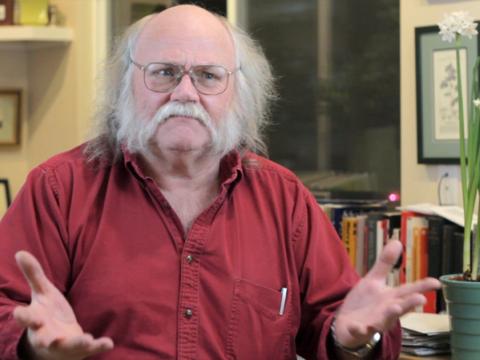
This is a transcript of a talk by Barry Pateman at the Bay Area Anarchist Bookfair in San Francisco. It shows something of his approach to anarchism, and the history of anarchism, and mentions some of the important people and experiences in his life. Barry spoke with passion and a greater concern for people than abstract ideas. As you’ll see, his humour (and swearing) were always self-deprecating: ‘Thank you for your time. I’m really sorry that you’ve got nothing else to do.’

Tensions in Anarchism
I just want to talk about some tensions I think that us as anarchists or people sympathetic to anarchism need to try and consider. ’Cause… I suddenly realised last night when I was laying in bed and just looking at the ceiling that I’m tending to become a bookfair groupie. There’s a bookfair in London. I go to a bookfair in London. It’s an anarchist bookfair, I sell anarchist books. I come to San Francisco. And I’m really talking, I guess, about how we as each other, as a group, as an organisation, as people who share a similar – what Galleani called the ideal, the dream – How we gonna make that real? And so, there are some tensions I think we have to face.
The first tension is ourselves and our history. There is a history of anarchism. But within that history of anarchism, there are things and people who have been forgotten. Now, with the Kate Sharpley Library, we have two reasons to exist. One is, yes, flowers for the fallen. We printed a pamphlet called Anarchists against Franco1 where there were twenty anarchists who’d been killed between 1942 and 1960 in guerrilla warfare against Franco. And Frank Torres who wrote it in Spanish says – and I couldn’t agree more – it doesn’t matter whether you think libertarian communism, anarchism will happen, it doesn’t matter whether you think it’s silly, it doesn’t even matter if you think you’re cleverer than those anarchists who went out there. What matters is how dare we forget them? How dare you and I sitting in this room not know about them? How dare we forget their bravery and their courage when they went over the mountains against stupidly impossible odds for that dream? So, any anarchist, any person sympathetic to us has to be aware of our history, not the history of ideas, that’s something I’ll talk about in a second, but simply the people who have suffered physically and emotionally for our belief. You’ll know some of them, nah? But we’ll also not know a lot of them and one of the things we must do is to revise history, to give them that dignity of that memory.
And the second thing of course is that if we’re canny we learn from history. We have to learn. Look, I’ve been an anarchist for thirty years, so you’re not going to learn much from me because we haven’t got that far. But I do know what’ve we done wrong. I do think I’ve got an idea that what we’ve done has gone wrong. But we have to learn from our history. We can’t just pretend that we exist now and that really that those people were a bit strange or not like us because they spoke a different language. If we’re not guided by our history, we have no foundation, nothing, except living on our wits. So that I think is the first tension, how we discover and make our history come alive for all of us.
The second tension is, is between us as anarchists or sympathetic who are clever buggers ’cause we are… and ordinary people… who aren’t. I don’t mean racist, nasty people, I mean ordinary people who get up every morning, go to work, watch telly, watch baseball, go to bed… yeah? I mean those people. And you know what, there’s a lot more of them than us.
OK, so one of the things that’s disturbed me lately is there’s been a trend in anarchism to think that ordinary people are sort of fucking stupid. Yeah? They’re not clever or, really, they’re the problem. No, they’re not the problem. Look, every time there’s been some type of thing kicking off, starting, some insurrection, its come from dispossessed, poor people, ordinary people. And if we’re not there, if we don’t know them, if we’ve got no relationship with them… what’re we? Who are we? Just somebody else. It means nothing. Our relationship, surely, is with ordinary people. How we get to them. If our belief, if our dream is something that we believe in and live by and suffer by… then we have to go out there somehow. That tension is a critical one. You know, I could sit down all night and convince myself that anarchism’s tomorrow. But actually anarchism’s nothing… it’s something up here. Anarchism’s out there.
Let me give you some examples, two examples. Sixteen years ago in England there was the most brutal strike there’s ever been in the history of the country in many ways. It was a coal strike. One year it took. All my family as a result of that have, now have no jobs. They do not work. Secure, safe communities have become riddled with drugs and riddled with fear as a result of that huge defeat. But let’s look at the problem that we have.
Sixteen years ago you could get up in Markham Main, Armthorpe Village where my family lived, and worked. They were on strike. Mutual aid, not in a fucking book, but in everyday existence was happening, yeah? None of those people had read Kropotkin, they didn’t know what it meant but it was happening. Alright? You went out, seven o’clock in the morning. ‘Who’s gonna have the wood? It’s bitter winter, it’s November. Who’s gonna have the wood? Well, those people with kids have the wood and the old people have the wood.’ That decision’s made. That decision’s made at a mass meeting a week before.
So if you’ve got no kids and you’re on your own with your wife or your partner, you don’t have the wood. That – you’ve agreed on that. You’ve made that decision. You go through there – ‘who’s gonna get the food? The people – old people, kids.’ Again, that’s voted on. ‘Who’s gonna go on the picket lines today?’ ‘Well, I tell you who’s going to go on the picket lines today,’ says Brenda, ‘the women are going on the picket lines today because the fucking Metropolitan Police are here today and they’re out to get the strike leaders. So, we’ll put the women on the picket line today, so if they start swinging the truncheons at least they won’t get the men they’re looking for. We’ll protect them.’ You may disagree with that decision, we all can. I did. That didn’t matter. You had it alive. You had it living. You had something actually happening in your hand, yeah?
But here’s the downside. The tension between ourselves and ordinary people. At that time I was in a group called the Direct Action Movement, yeah? It was an anarcho-syndicalist group. And… we were very lucky. Direct Action Movement had international links and we were sending miners to Italy – to France – to Greece – to get money to support their people. They respected us. There’s lovely stories that’ve come through – you may have read David Douglass,2 a lovely anarchist miner, who talks about all the Trotskyist groups and the Communist groups at various picket lines and as the miners are running past ’cause the police are chasing them with their great big fucking great batons – the old groups are saying ‘Socialist Worker, buy your Socialist Worker…’ and the miners are running through the lines. Not so the anarchists. Respect was given to them.
A lot of anarchists did very well, were superb and courageous in many ways themselves. And a lot of the young miners’ apprentices from the Yorkshire coalfield said ‘Hey, can I join your group? Can I join the Direct Action Movement?’ And all of a sudden they went, ‘Fuckin’ ’ell, er, I dunno. I dunno really. I dunno what we’re gonna do with like twenty-five young miners’ apprentices from Markham Main Colliery.’ ’Cause like they’re not fully formed, they’re not full, full anarchists, they haven’t gone through the… Problems. No, it begs the question why there was an anarchist organisation. And so no, they never joined. But at the same time, some of those young lads are now heroin addicts, some of those young lads are into drink, and some are in prison. We couldn’t provide a platform, we couldn’t sort that tension out between joining an anarchist organisation, organising yourselves. It’s the most critical question of all.
I want to say something now which I hope is not too contentious. I think there is a problem, a tension, between middle class people who’re anarchists and working class people who’re anarchists. I said to you when I came up here this is the first time I’ve spoken at this for seventeen years when I spoke with my father on a platform to support the miners. Middle class people – and this is not an insult so please don’t say I’m insulting middle class people because I’m not – they tend to be far more fluent, articulate and they can write well. And they have more importance in a movement than maybe they deserve. And that’s not to denigrate their efforts or the superb work they do. But working class people, do not, often. Some do. And some will. But others are frankly intimidated – I’ve seen grown, fifty-year old miners intimidated at political meetings and they’ve walked away.
It also means that the comrades amongst us who are fluent in terms of writing, and in terms of oracy, tend to have far more power than maybe they should have. Again, that doesn’t denigrate them. It means that if we don’t have leaders, we have to work out ourselves about how we deal with people who are fluent and articulate who are good comrades and those comrades who aren’t. Those comrades who haven’t got that confidence and that ability. It doesn’t mean they’re worse, mebbe even the opposite I don’t know. But that problem seems to me a running one that’s been going through anarchist circles for thirty years since I’ve been involved.
It shows itself I’ve often thought about violence. I had the misfortune to grow up in an extremely violent area and I have – for whatever sins I’ve had – I’ve used violence – not for political reasons either. I find violence very messy and unpleasant and there’s nothing glorified or attractive about it. Most people I’ve known who’ve used it have had to use it reluctantly and they’ve got it over with. … We have to be careful. We have to be careful about making sure that everyone in our movement has got a say. If we ourselves – because, see, anarchism isn’t just the end, it’s the process, in’t it? We’ve got to draw people in. We’ve got to draw people in with us and play to each other’s strengths.
Miguel Garcia3 who was a, I think a very great man, he’d been in prison for eighteen years – he was with Sabate who some of you may have read about.4 He was actually working with Sabate and Sabate was going into Spain in the 1940s and 1950s. Miguel was imprisoned in the late ’forties because Miguel’s job was the forger. He counterfeited cards so Sabate and the others would have them. He was based in Barcelona and they’d come across the French border, down across the Pyrenees and they’d see Miguel and they’d get their cards and their identity papers. Now, Miguel would say to me quite seriously he’d never ever picked a gun up in his life. Never. He served eighteen years for it – but he never picked a gun up in his life. But people like Sabate who used the gun gave him as much respect as if he had’ve. We play to each other’s strengths, we encourage each other’s strengths. We don’t idolise anything except in some ways mebbe the future.
I think as well another tension, is between the whole idea of theory and practice. You can’t be a theoretical anarchist. You can’t. Well, you can I suppose. You can, you can make anarchism into an intellectual idea and play games. And fuck me, some of the magazines I’ve read, you know, I sit down with a thesaurus and try and make sense of them. (laughter) It’s like… Albert Meltzer who’s now dead once said to me ‘You know, one of the problems with anarchists is if they put their heads up their arses far enough they will talk utter shite.’ Right? And at the moment comrades, some of our, some of our heads are very near our tonsils, yeah? (laughter) Because we’re in our own world making things up. We’re making ideas up. And those ideas look great. Have you done it? I’ve woken up at four in the morning and thought ‘Fucking ’ell, yeah, that’s great. Oh yes, Descartes – we’ll put a bit of Descartes…’ Fuck off! Look – one of the problems with that is that anarchism is how you are, right? It’s a bastard. I said to you I’ve been an anarchist for thirty years. I’ve often at times wished I hadn’t been. Never mind people think you’re about to… you know… sexually intimidate their animals or something.
More importantly if you’re an anarchist you try and live by some morality that’s different. Alfredo Bonanno in his book that’s being sold round here, The Anarchist Tension,5 says you wake up and you try. You try not to be fucking selfish. You try to listen. I’ve got a ten year old son and I have a go at him awful sometimes and I fucking hate myself. I hate myself. Now I think most anarchists have been in that situation, where you actually sit there and you writhe about how you’ve been. I tell you what, you can be a Marxist and be an utter bast– well, they have been haven’t they to all of us? But we can’t be. We can’t do that. We live in practice. You can’t say ‘Ah, I’m an anarchist.’ ‘Oh, yeah? Well fucking prove it then.’ And by the way you are with people, how you talk to people and how you operate with people. And (applause) – we’ll have less of that for a start, alright – Look, what I’m saying I guess is that we all know that and sometimes all of us criticise ourselves too much… yeah?
It’s hard. It’s hard. But it is important, that link between theory and practice. No-one here demeans intellectual ideas… but what we do, is we reduce them. What does an idea mean in practice? What does it mean then, if you actually put it into practice what does it mean? And if it means shite, you don’t put it into practice. If it means turning on someone, or demeaning someone, or not thinking it through and ending up in shit, so be it. You don’t put it into practice. Any idea is clever, people tend to be difficult, yeah? They’ve got emotions and feelings. You live with people, not ideas.
I should also, I guess, say as well that my final point, mmm, second to final point, would be there ought to be ways that we discourse with each other and in the language that we use. I’ve been interested in the American term called Ranting, yeah? Where you have a rant. I don’t think we rant. You don’t rant with anybody. Anarchism isn’t about me. It’s about us, right? That’s all. It’s about us. And I’m quite important, thank you, I’d like to say that, but it’s also about how I become We. Because one of the problems that maybe I should’ve mentioned is that we need to consider our relationship to capitalism. Some of us are leading a nice life, thank you. We’re doing alright. We’re getting on alright, eh? Look at us – it’s nice, nice day, San Francisco, County State Building, here we are … it’s alright. Some of us can live, and not be challenged. But you can’t live – I mean Debs6 said it years ago, Until everybody’s free you’re not and I’m not. And ranting at me or me ranting at you gets nowhere. I’ll talk and I’ll listen and I’ll try and mebbe we ought to learn how to speak to each in a comradely fashion instead of being fuckin’ egoistic and stupid.
Final point is this, I guess, that I’m intrigued about anarchist bookfairs. I’ve noticed, and mebbe you have, that there seems to be almost a cadre of professional speakers who do the circuits. You know, like, ‘Hey, where you going the next year? I’m going to Montreal and…’ I’d like maybe to see people who aren’t like that. I like to see people who are working through things. I like to see the language of an anarchist bookfair talk being one of confusion, sometimes. As people who people who are actually doing activities, events try and work things out. I don’t really come here to be entertained, I come here to learn, I guess… whatever. Thank you for your time. I’m really sorry that you’ve got nothing else to do. (laughter)
And I would say this. Erm, for thirty years now I’ve wanted it to happen. I dunno. All I do is say, what Malatesta says, you know, what matters is that whatever we do, we judge it whether it brings anarchism closer. And we can argue forever about what anarchism is and the way to do it. But you know, and so, whatever we do, we judge it in those ways. Thanks for your time. (applause)
‘Anarchist Tension #1-#4’ From Mob action against the state: collected speeches from the Bay Area Anarchist Book Fair (AK Press, 2002), ISBN 1902593510. Recorded by DJ Slo-Mo and Rad, compiled, edited and produced by DJ Slo-Mo of Entartete Kunst with assistance from RK of AK Press. Now out of print. https://web.archive.org/web/20221129074326/https://www.akpress.org/mobactionagainstthestate.html
- 1We printed a pamphlet called Anarchists against Franco – The anarchist resistance to Franco by Antonio Téllez and Francesc Torres (Kate Sharpley Library 1994).
- 2David Douglass – ‘“Workers Power!” he cried, as we ran past, bleeding, sweating and laughing. Then the cavalry rode past him, to the left and right as bombards of bricks hit them from all sides. We retreated into the trees and waited till they rode back, bloody and hot. Then we crept out to dare again and found the man still unmoved in his central position. “Workers Power!” he cried.’ From 'Charge of the Left Brigade: The Left, Working Class Trade Unionism and the Experience of the Miners.’ in The Heavy Stuff, no.5 (1992). Tell us lies about the miners (1985, 1987) and Come and wet this truncheon (1986) are online: http://libcom.org/tags/dave-douglass. See also volume 3 of his autobiography Ghost dancers: the miners’ last generation (2010).
- 3Miguel Garcia – See Looking back after twenty years of jail (1970, 1975, 2002), Franco’s prisoner (1972), and Unknown Heroes: Biographies of Anarchist Resistance Fighters (2005).
- 4Francisco Sabate – see Sabaté: guerrilla extraordinary by Antonio Téllez (1974, 1985, 1998)
- 5Alfredo Bonanno – The anarchist tension was published (translated to English) in 1998.
- 6Debs – Eugene V. Debs: American socialist.


Comments
This is great, thank you - I…
This is great, thank you - I have done a bit of formatting.
Ta. bit more done (italics…
Ta. bit more done (italics from original posting at https://www.katesharpleylibrary.net/h44m7w )