Selected articles from this issue of the journal.
In This Issue
With our twelfth issue, Insurgent Notes returns to the fray. We do so in the further development of the atmosphere which has developed in fits and starts from the 2008 meltdown to Occupy to Black Lives Matter to today when, as our editorial analyzes, the center-right and center-left blocs of the two dominant American parties are seriously fraying at the edges, with promise of more to come, above all (hopefully) when the elections are out of the way.
Matthew Quest has given us a further installment of his work on C.L.R. James, dealing with James’s relationship with Cuba, an historical article which was suddenly made topical by the recent US-Cuban rapprochement.
Jason Rhodes gives us a profound update and elaboration of his contribution to IN No. 1, (“Capitalism is a Waste of Time”), showing how, for 150 years, political economy from Malthus to Keynes (as distinct from Marx’s critique of political economy), bourgeois theoreticians were consciously attempting to divert attention from the huge costs of the consumption of the unproductive classes (those who consume and do not produce, Rosa Luxemburg’s lapidary “King–Ministers–Civil Servants–Professors–Whores”) and the potential—a shorter work week and greater wealth for all—if such resources and labor power were put to useful activity.
Loren Goldner turns our view to the global proletariat in articles on the struggles of immigrant logistics workers in Italy and on the class struggle in China.
Finally, in our book review section, John Garvey reviews the very interesting graphic biography of Rosa Luxemburg, Red Rosa by Kate Evans, featuring an artful use of graphics and of little-known quotes from Luxemburg’s life and letters, an excellent introduction to this woman who is one of the great inspirations of Insurgent Notes. Noel Ignatiev replies to John on the national question, as debated between Luxemburg and Lenin. And then John responds to Noel. More to come, for sure!
Finally, Loren Goldner reviews Beth Macy’s Factory Man, a book portraying the fate of wood furniture workers in Virginia and North Carolina, where the industry was largely wiped out by imports from China, Vietnam and Indonesia, another book made topical by the emergence of the “angry white male” as the apparent key to the 2016 election.
We anticipate that there will be much more to say and much more to do in the days to come.
Editorial from Insurgent Notes #12, April 2016.
Insurgent Notes doesn’t have much use for electoral politics as such. In our mind, they are useful mainly to take the temperature of society, especially to keep track with trends that emerge from the actions of the majority party of nonvoters. But American party politics have been dominated for so long by the “same old, same old” that with months to go until November, 2016 already stands out as an exception. Missing (so far) are the assassinations and nationwide urban riots that marked that last exceptional year, 1968. Most clearly in the case of the Republicans, but palpable as well with the Democrats, the “center-right” and “center-left” elites, who have graciously taken turns administering year-in, year-out misery for more than forty years, have lost control. It appears that Washington and Wall Street are loathed by a majority of people across the spectrum.
What interests us is not so much who will win—barring some as yet unforeseen upheaval, by no means excluded, it will be Clinton—as what will become of the huge bases of Trump and Sanders, once their leaders are defeated. The hard right within the Republican Party (typified by the Tea Party) and the far-right forces that operate within the party primarily for the purpose of seeking new recruits, having been newly legitimized by Trump, will not be going away. Our best guess is that the grass-roots activists in both camps will simply renew their pursuits of recruits. It may appear that there is little to do about it in either version. However, a friend of Insurgent Notes based in the Midwest, who has been closely watching the right wings at gun shows and elsewhere for years, tells us that some of Trump’s base could be attracted by a vision of a radically new society—if one were to exist in tangible forms.
Of course, what we’re mostly interested in is what might happen with the Sanders supporters. The moderate left, typified by the Democratic Socialists of America, has apparently enjoyed a bit of a renaissance. A review of the organization’s web page reveals the existence of a handful of high school chapters—we’re a bit jealous. Nonetheless, what they offer cannot possibly sustain the development of an anti-capitalist movement. We anticipate that many of Sanders’s supporters, having been drawn into a new world of anti-capitalist sentiments, will be looking for deeper understandings of the workings of the capitalist system and the ways in which more fundamental challenges might be organized against it.
Commentary across the board seems to see “angry white men” as the most contested terrain. We are aware of the recently publicized research findings about the rising death rates among white men between the ages of 24 and 59, while death rates among other groups, although still higher than those for white men, have been declining and the presumed relationship between their declining fortunes and their more or less self-inflicted misery. We suggest that it would be wise not to be distracted. Let’s instead ask a different question. For all the decades (more than four of them, and counting) during which American workers, white, black and brown, have been downsized, outsourced and deindustrialized, who has been talking to them? Not the elites of either party. Not the denizens of the cool “campuses” of high-tech firms in Silicon Valley. Surely not the middle-class left, which has been busy twisting itself into knots about various forms of identity politics.
Who, precisely, has been speaking to the hundreds of thousands of ex-workers and their extended families in ravaged ex-industrial cities such as Detroit or Youngstown or Pittsburgh or Buffalo or Rochester? Or to similar hundreds of thousands of working-class retirees and their families seeing their often-miserable pensions cut or eliminated? Or to the former furniture workers (there used to be a million of them) and their families in the forgotten small cities of North Carolina or Virginia? And who is speaking to such people today? Donald Trump and Bernie Sanders.
Let’s emphasize that we are more than aware of the pain and suffering (in injuries, chronic illnesses and early death) experienced by workers in industries like steel, auto, rubber, mining, textiles and furniture manufacturing, and we have no interest in seeing the pain and suffering of reindustrialization imposed as the price of progress. Nonetheless, we are acutely aware of the ways in which concentrated industrial production made possible remarkable forms of camaraderie on the shop floor and, beyond the workplaces, the establishment of towns and small and large cities where working-class families were able to create communities that came quite close to the kinds of communities we might imagine desirable in a postcapitalist society—communities where forms of mutual support were all but universally present and opportunities for children to pursue expanded horizons were real rather than advertising slogans. We need a restoration of the advantages of industrial civilization of the last half of the twentieth century without the reimposition of the pain and suffering associated with it. For the moment, we’ll hold off on the matter of the deep satisfaction involved with cooperative labor in industrial production—other than to say that we imagine a return of that satisfaction at a higher level. We should note in passing, to dispense with any America-centric lenses, Trump’s counterparts—a newly vocal hard and extreme right, anti-immigrant, anti-Muslim, anti-elite, and anti-globalist politics—that exist as well in a large swath of northern and eastern Europe, drawing support in part from the same downwardly mobile and ex–working class strata produced by the post-1970s crisis. This is the “bill” come due for all the intervening decades of invisibility enforced by the globalist “Davos”1 bourgeoisie, its captive media and professoriate, and, most importantly, by a left that accommodated itself to every twist of what we refer to as devalorization.2 A good segment of the world is moving to the right, in western and eastern Europe and in Latin America (with Argentina and ugly mass demonstrations in Brazil in the lead); for that, we can in part thank the moderate left managers of capital—the Clintons, the Obamas, the Blairs in the UK, the Hollandes in France and the Lulas and Rousseffs in Brazil. But that is not all that is happening.
A mere ten years ago, at the height of the “subprime” bubble and phony “wealth effect” of debt-fueled expansion, to imagine a self-declared “socialist” calling for “political revolution” attracting millions of people, and especially young people, would have been a bad joke. That 50 percent or more of Americans today define themselves as “socialists” or claim an interest in “socialism,” or that “socialist” is the most searched word in Merriam-Webster’s online dictionary: all of this is rather mind-bending for anyone who lived through the long, glacial winter from the 1970s until a few years ago. Occupy, Black Lives Matter and the Sanders campaign were and are all different responses to the same deteriorating situation.
It has taken a while, but the real toll of decades of economic decline culminating (so far) in the 2008 crash is finally emerging to the visible surface of social and political debate. We imagine that the Obama years will be remembered as a parenthesis in which a calm, well-spoken Harvard Law School graduate and first black president, with his predictable economic advisors (Tim Geithner, Robert Rubin, Larry Summers) restored, for a while, the appearances of normalcy, at least for Wall Street. Meanwhile, seven million families lost their homes and were ground down in every aspect of their lives; record numbers of undocumented immigrants were deported; one-third of young people, into their 30s, have been forced to move back in with their parents; the electronic police state, revealed (for any remaining skeptics) by Edward Snowden, was further consolidated; the militarization of daily life continued apace; 4,700 killer drone attacks were authorized by the White House, and the United States (with military installations in 110 countries and with a budget equal to those of the seven next largest armed forces combined) continues to play with fire with potential major wars in the Middle East, Ukraine and the South China Sea.
The Obama years may well be remembered as a parallel to the 1929–37 period, during which a lame state-sponsored recovery from the crash ran out of steam and gave way to preparations for war, and then to war itself. We know very well that Bernie Sanders still mainly operates inside the “white bubble” of American politics. While it seems remarkable to hear any major candidate call for free higher education and free healthcare and to consistently denounce the role of big money in politics, there is also a “clean Gene” element to Sanders’s appeal that avoids any head-on confrontation with the American blind spot of race. Who is this Brooklyn-born man who, after working with CORE (the Congress on Racial Equality) in Chicago in the mid-1960s, joined (consciously or not) the post-1960s white flight to the counter-culture paradise of Vermont to make his political career? He enlists himself in the long tradition of socialists, including his otherwise honorable role model, Eugene Debs, who said that socialism had nothing special to offer to black people. While nominally an independent for most of his decades in Congress, he has voted 95 percent of the time with the Democrats, including for Bill Clinton’s Omnibus Crime Bill of 1994.
Hillary Clinton, for her part, dominates in the black middle class, based on both their calculation that she alone can stop Trump and on rose-tinted memories of the Bill Clinton years, memories which somehow do not include the latter’s law-and-order rhetoric, the above-mentioned Omnibus Crime Bill leading to the incarceration of further hundreds of thousands of black and brown youth, or the abolition of welfare, forcing still further hundreds of thousands of single mothers to take minimum-wage jobs.
Polls show Sanders defeating Trump more decisively than Clinton could. Hillary Clinton will never shake her obvious association with the highest levels of Wall Street and Washington, not to mention her association with the sleaze that has dogged her and Bill Clinton and, more recently, the Clinton Foundation. Even her immediate natural base of middle-class feminists seems to prefer Sanders.
We ourselves cannot suppress a smile watching him make it hot for Hillary Clinton, who a year ago seemed on her way to a coronation and who responds to his lacerating comments about her Wall Street ties with a lame “let’s stick to the issues,” as if those moneyed ties of the political class across the board are not one of the issues. Trump himself has every chance of making mincemeat of her, if not for the chattering classes, more importantly for a significant part of the downsized white population, which already loathes her anyway. On the contrary, Sanders has been politically consistent since he was mayor of Burlington, Vermont, and subsequently elected to Congress from Vermont. There is no sleaze or waffling in his background. We acknowledge that the libertarian or far-left, in which we situate ourselves, have little or no contact with, not to say influence on, the working people, of any color, who are supporting Sanders, Clinton or Trump. Nevertheless, we have some ideas to offer. We begin our critique of Sanders with the old adage: the Democratic Party is a political roach motel: reformers check in, they don’t check out. Let’s explore why the adage applies. Sanders does not have much to say about extricating the United States from the disaster inflicted on Iraq and the ensuing whirlwind in the Middle East. He would be, willy-nilly, the commander-in-chief of US imperialism, and all that entails. When considering left-wing Democrats, it is sobering to recall that Woodrow Wilson (World War I), Franklin Roosevelt (World War II), Harry Truman (the Korean War) and Lyndon Johnson (Vietnam) were all (with the exception of Truman) on the left wing of the party. Republicans have historically been the party of wealth, Democrats the party of war. It is remarkable how apologists for this lineage focus entirely on the (already problematic) domestic agenda, and rarely venture into foreign policy, which, in a superpower where foreign policy is central, is hardly an afterthought. Barring a social and political earthquake even larger than the erosion of the two parties’ elites, a hypothetical President Sanders will be even more isolated and handcuffed before a hostile Congress than Barack Obama has been.
Sanders, his supporters will say, is different. Let’s stretch the envelope a bit and concede for the sake of argument: yes, Sanders is the most left-wing major candidate for president of the United States since Eugene Debs. But immediately we see that historical context, if not everything, is almost everything. Debs was the product of decades of sharp class struggle in the United States going back to the 1870s, and lasting to the 1930s. He himself had led some of those struggles and in 1912 got 5 percent of the vote as a socialist, at the peak of influence of the old Socialist Party, whose considerable left wing (Debs included) opposed American entry into World War I. He had emerged in an era marked by mass strikes and by the upsurge of the IWW. Imprisoned during World War I for sedition, he ran again from jail in 1920 and still got 1 million votes. Rosa Luxemburg he was not, but radical, especially in American terms, he was. Sanders only recently joined the Democratic Party in anticipation of running. We can hardly criticize him for not having the class struggle profile of a Debs, since the long empty decades prior to 2011 were no kinder to him than they were to us.
Enough, though, of elections! Let’s get back to where we began. What will become of Sanders’s considerable base when, as we anticipate, his not-quite-so-quixotic campaign ends? The current period reminds us, in a bizarre way and in much more dire circumstances, of the early 1960s. Then as now, an idealistic new generation was awakening to politics. Then as now, in both the nascent New Left and early civil rights movement (both deeply interconnected in the Jim Crow South) and today after Occupy and Black Lives Matter, something got out of the bottle that will not easily be put back in. We insist above all, where the potential role of our marginal milieu as conscious communists is concerned, that small groups do not shape consciousness, events do. Events for the 1960s were the later years of the Southern civil rights movement, the war in Vietnam, the radicalization of black people after the civil rights movement hit a wall, and the rank-and-file and wildcat upsurge in the United States working class. By the late 1960s, some many thousands of young people coming out of the New Left and the Black Liberation Movement had declared for revolution, and many joined groups organizing for it. It did not end well, for reasons that we cannot do justice to here. For the most part, the emerging revolutionary movement was dominated by either Stalinist/Maoist/Trotskyist sects or by groups well on the way to embracing an all-purpose, and hardly anti-capitalist, “progressive” politics. A not insignificant part of the black left turned towards nationalism. And a small part of what might be considered the middle-class white left was drawn into the substitution of terrorist violence for politics. Little of consequence is left of all of it although, to be fair, Sanders’s current vision has more than a little in common with the above-cited progressive politics.
For this new generation as well, events there will be, events that will demonstrate the dead end of electoral politics and, in short, of anything except mass struggle, a struggle which has already begun. There is no end in sight to economic crisis and decline: workers’ wages and pensions and the threadbare social safety net will continue to be cut; the threat of war on several fronts will remain serious; terrorist attacks will continue and probably increase (and will be used to intimidate the emerging mass movement); and black and brown people, immigrants and Muslims will be again be targeted. Our task, in those circumstances, is to intersect the fallout from Bernie, and contribute to the convergence of a consciously anti-capitalist movement that will say at last: “Hic Rhodus, hic salta! Here is the rose; here we dance.”
To be successful, a new movement will have to be armed with a theory of capitalism’s evolution up to the present moment, and a program that communicates a concrete vision of a world beyond capital, not one that merely seeks to paint the world green. This program is not “pie in the sky” but the conscious expression of what existing social forces on a world scale can already do, forces whose potential is the actual force undermining capitalist social relations everywhere. We are the opposite of utopians: we draw our force from a worldwide practice of working people and potential working people whose unwilling collusion with the dominant social relationships is what actually drives the world. “Material conditions” today begin with the huge productive power that is squandered and destroyed by these relationships; we might mention for starters the 2 billion people around the world consigned to the planetary social parking lots named Palestine or Pakistan or Congo or the Brazilian favelas, or to the suburban rings around Paris or Brussels, or the 270 million migrant workers in China, a permanent floating population in search of casualized work.
We continue with the hundreds of millions of wage-labor proletarians in North America, Europe and East Asia that modern ideology and mainstream media and academia have “disappeared.” On the other hand, we’d point to the emerging struggles in logistics (shipping, trucking, railroads, warehouse work, delivery services) where some of the most interesting struggles of recent years (such as the immigrants in the IKEA warehouses in Italy3 or the Hong Kong dockers’ strike) have made visible a vulnerability of capital in the heartland in some ways as acute as that provided by the old assembly line. In previous issues of Insurgent Notes, (above all issue No. 1), we have begun to sketch out the kind of program we mean. It includes an equalization of conditions upward around the world, taking the wealth currently wasted in the enormous “FIRE” (finance–insurance–real estate) and military sectors and putting it and the labor trapped in them to useful activity. We propose the large-scale reduction of the individual automobile culture whose ramifications probably make up half the “economy” in the United States, from fossil fuel consumption to the dispersion of population in suburbia and exurbia, all of this implying a complete reconfiguration of people’s living environments to overcome what Marx long ago called the alienation of city from countryside. When we consider the abolition of the military, police, prisons, state and corporate bureaucracy, along with the cashiers and customer service representatives of daily life—all sectors which consume social wealth and destroy it while producing nothing useful—untold horizons of possibility unfold from all the aspects of current social life which exist merely toenforce capitalist social relations. (See, for example, the Jason Rhodes article in the current issue.) We will have to deal with the emerging crisis of global warming, which itself alone implies a fundamental break with the way humanity produces and reproduces itself. Without this programmatic perspective, only minimally sketched here, the coming explosions will be doomed to dissipate themselves. Most people instinctively understand how absurd and meaningless much contemporary “work” is. Our task, or one of them, is to show, from the future struggles that will emerge, the “beach under the pavement” (to borrow a wall slogan from the French May 1968): how what is already possible can be made both conscious and practical.
A new movement will demand new forms of communications, language, education, political debate, cultural production and organization. We hope to contribute to the development all of those spheres.
- 1Davos is a resort town in Switzerland and is the site of the annual meetings of the World Economic Forum—effectively a gathering of the representatives of the world’s ruling classes and their favored advisors.
- 2In 1981, Loren Goldner, one of IN’s editors, addressed this issue directly. See The Remaking of the American Working Class: The Restructuring of Global Capital and the Recomposition of Class Terrain.
- 3See “Struggles in Logistics In Italy (2015).”
Comments
Matthew Quest in Insurgent Notes #12, April 2016.
Introduction
Many are the imperial crimes that can be detailed against oppressed nations’ sovereignty, and Cuba specifically. Given the recent visit of President Obama to Cuba, and the expression of his desire to end the United States embargo, these have again become common currency. And yet discussion of these impositions often paper over unresolved historical problems in the development of the anti-imperialist movement.
C.L.R. James’s “critical support” of Fidel Castro’s Cuba is little understood among scholars of his life and work. This essay explores James’s 1967–1968 visit to Cuba and reconstructs private debates and discussion on Cuba within his revolutionary organizations, based in Detroit, in the 1950s and 1960s, and among anti-imperialist movements. Many of James’s commentaries and disputes were consistent with his attempts to reconcile anti-colonialism with direct democracy and workers self-management.[1] If what it means to oppose empire appears fairly straightforward on the surface, the meaning of critical support of oppressed nations and the content of socialism, as a measure of evaluating radical developments in oppressed nations, is often obscure.
Empire is the military domination, economic exploitation, and cultural subordination of one nation by a foreign power. The search for identity of colonized people and the pursuit of self-government denied is not necessarily synonymous with rejection of the empire of capital or affirmation of labor’s self-emancipation. Support for national liberation struggles need not mean support for its aspiring leaders, in contrast to solidarity with an oppressed nation’s commoners. This only makes sense if we understand that there are conflicting tendencies within all freedom movements and to discuss them does not undermine but can enhance solidarity. James’s historical and political legacies, regarding Cuba, are dynamic measures for learning about these contours.
Critical Support and Workers’ Self-Management
How can we criticize a regime in a formerly colonized society, especially where it appears to embody a strong resistance to racism, empire, and genuine aspirations toward a socialist revolution? Still, what does Cuba solidarity mean when we find the Cuban Revolution has been at times neither socialist nor democratic, and has been repressive to Blacks’ and workers,’ gender and sexual autonomy? We cannot simply assume that James, anti-imperialist and revolutionary socialist, saw Cuba as the uncritical embodiment of the search for a new identity for the Caribbean—though this was at times his public stance.
“Critical support” of a former colonized nation that appears to be on a non-capitalist path requires a stance of “no blank checks.” This means the offer of solidarity is not simply evaluated by what imperialists think of the peripheral government it is seeking to subordinate. Nor can it be conceived only by what those governments claiming to resist empire might ask of anti-colonialists abroad. Rather, it is crucial what those offering solidarity also believe about the content of socialism and democracy. This may more easily be expressed at a distance than when visiting a foreign land as an official guest of the aspiring peripheral capitalist or socialist government resisting empire. Nevertheless, historically, this is something radicals have had to negotiate if we wish to offer solidarity to ordinary people, not primarily the governments above them. We should wish to learn about the actual social relations in that society, so we may return to educate our own people in what has been found abroad, not simply confirming everything we may have already believed in theory.
When we speak of direct democracy and workers’ self-management as measures of a future socialist society, there are some anti-capitalist thinkers of differing schools of thought who inquire if this emphasis obscures important tasks of the future or evolving socialist economy? For those who believe socialism is primarily a state plan above society not labor’s self-emancipation, that the market will be constrained by the state for the better, but not the wage-system or labor laws that discipline the working class in the name of national unity, their objection to direct self-government or popular self-management reveals “thin” conceptions of socialism and democracy. There may even be present autocratic tendencies in the name of national unity against the external imperialist enemy.
Still, there are others who speak of labor’s self-emancipation and workers’ self-management but who have more genuine concerns. For example, a self-managing socialist economy may find workers without bosses in water and sewage plants, steel mills, and farming bananas. But it might also find autoworkers in factories voting to abolish their jobs, deciding, for example, that luxury cars are no longer needed. With a commitment to social ecology and the expansion of public transportation, even modest cars may no longer be desired. Self-managing workers and farmers may wish to create cooperatives, as they directly plan a socialist economy. Cooperative relations can appear to overturn the thin idea of “jobs and justice.” Yet wage labor and capital relations may or may not be sustained. Self-managing farmers may reject the cash-crop culture of state-run marketing boards, even as the state claims to be concerned about the ravages of the market only to have an aspiring monopoly on foreign trade. How can statesmen from above society, or more decentralized cooperatives, claim to be eliminating market activities, if they accept in fact, that the market is essential to their own conception of political economy? Socialist transitions may be complex economically but this should not be an argument for less self-directed liberating activity.
Toilers may wish to abolish national boundaries, forging new federations, and eliminating job categories, like police. Some of these decisions authentically exist in tension, at least as conversations unfold, with decisions about national defense for a country such as Cuba, that has been subject to imperialist invasion and subversion. However, successful national defense need not mean a professional army with all the hierarchy and privileges this implies, centralization of spying and show trials, or neighborhood committees that only snitch but don’t actually govern.
Popular assemblies, workplace councils, or neighborhood committees, if they exist side by side with a nation-state for a time, should be able to maintain a record of policy disagreement (and independent initiative) with politicians above society, without finding themselves in prison or the subject of abuse. A self-directed decentralized government in embryo need not revel in proof of “reforms”—the taking off of restrictions the state had placed on their activities—for this type of surveillance should not be happening at all.
Working people who actually govern directly will be more confident in making decisions knowing that the necessities of life are not simply guaranteed to them as the subjects of welfare (or protected by the voice of a politician above society), but that these are the priorities of economic and social reproduction they make and fulfill themselves. But some can speak of labor’s self-emancipation and still have a very restricted sense of the content of socialism. This has something to do with a limited notion of democracy.
In view of the fact that American imperialists call their project of empire “spreading democracy,” many socialists mistakenly discard the idea altogether. Or some see it as defense of civil liberties under the state, which makes freedom of speech and assembly subordinate to the state, legitimizing the state as a permissive guardian of “rights.” Certainly, we cannot take seriously a “democratic socialism” that complains about “totalitarianism” where such advocates are “State Department socialists.” And yet, many supporters of Cuba have, in fact, been State Department socialists, for they have been concerned to mobilize the State Department for Cuba solidarity equally (if not more so) to mobilizing the American working people. Anti-imperialism should not be falsified as diplomatic history, or quibbling over comparative human rights and development standards—solidarity must be expressed by direct workers’ sanctions. To laugh at the latter as absurd is to accept that “socialism” and “democracy” are activities of professional administrators.
A direct democracy of popular assemblies, in addition to workplace councils, must mean pursuit of not simply self-managed economic planning, but also judicial affairs, foreign relations, education, and cultural matters. Direct democracy is not simply a process or an idea (“let the people decide”). Beyond a process or an idea about a form of government, it should also be a political program. There must be a striving for the abolition of professional intellectuals as the embodiment of culture and government. Those with specialized knowledge (military experience, technological know-how, ability in a foreign language, knowledge of history or political philosophy) can be delegated to facilitate a discussion or project but this should not make them a condescending savior. But even this proposition is not as precise as it could be. Should a vanguard be humble in the pursuit of the redemption of others otherwise seen as damaged or underdeveloped? The content of socialism, not simply its democratic substance but its equality, must be advanced in the future as well. Socialism is not affirmative action or equal opportunity to enter the rules of hierarchy, diversifying who gets to manage our lives from above (among the conqueror and the colonized). It should be the project of the abolition of hierarchy and domination.
We must pay closer attention to the elements and complexity of socialism in world politics, state power, political economy, and popular self-management as guided by C.L.R. James’s legacies, some of which are still obscure without primary and archival research. With these sources in play, James’s viewpoints on Castro’s Cuba, and that of his movement associates pursuing labor’s self-emancipation and colonial freedom, begin to have many more nuances than only surface readings of James’s books and essays in print may have led us to believe. James’s approach is not perfect or even consistent, though he cultivates illuminating moments and exhibits heroic acts at times in his own fashion. Rather, what James’s engagement with Cuba offers us, its strengths and limitations, is a series of questions we should be asking.
Direct Democracy and the Colonized Nation’s Search for Identity
C.L.R. James saw Fidel Castro’s Cuba primarily through the prism of a search for national identity and purpose for Caribbean people. But he also was part of conversations that insisted that socialist revolution, that Castro’s Cuba claimed to embody, must be distinguished by workers’ self-management. James is vaguely remembered for a critical discourse on Cuba begun as a report back from the Havana Cultural Congress of 1967–1968. Even as we record James’s attempt to retain an anti-Stalinist outlook that was his hallmark, we must keep in mind his ambiguities on Black autonomy and workers’ control in Cuba. We must also inquire what contributed to the muted aspects of James’s “critical support” of Cuba? While James was a very original political thinker and contributed to a sense of national purpose for Caribbean people against racial and colonial degradation, he always understood that popular self-government and radical democracy (majority rule) had to be the taking of power away from the minority, regardless of their racial or national identity, who ruled above society. Power to “the people” meant nothing if it was not an empowerment of the common people, not the professionals and elites who oversaw the Caribbean.
Cuba and the Double Value of State Capitalism
In Caribbean politics one must engage, oppose, or embrace C.L.R. James’s ideas when choosing one’s loyalties. An assessment of the Cuban Revolution as part of the Caribbean search for national identity, but also socialism, must overcome preoccupation with ideas originating from Moscow or Washington and London. Grappling with James’s analysis of state capitalism, developed within and later independently of the American Trotskyist movement, is part of making such an evaluation.[2] Given the dual character of James’s analysis of state capitalism, however, it is difficult to assert what that meant for his approach to Cuba. In contrast to his opposition to Stalinist Russia, James had “a less strident” and at times subtle opposition to Castro’s Cuba.[3] In a Cold War environment, critiques of state capitalism, as opposed to simplistic binaries of free market democracies and totalitarian one party states, could have many meanings. Castro’s Cuba has been condemned as a one party state dictatorship but also commended as a radical democratic experiment—could it be both these things? Many post-colonial moderates in the Caribbean Fabian tradition (as embodied by Grantley Adams, Eric Williams and Norman Manley) saw “socialism” as a welfare state that could be accomplished without blood, wearisome struggles, and disturbing empire. Clearly, Cuba had disturbed empire and the United States had attempted to topple Castro’s government many times during the Cold War—including trying to kill Castro by a poisoned milkshake, bacteria laced scuba gear, and exploding cigars.
Most, who have visited Cuba after the Cold War in the last three decades from the United States and expressed solidarity, speak of its education and healthcare programs, and return to the United States to vote for the Democratic Party. Is it not a peculiar disposition toward “a socialist revolution” to visit it, as a vacation abroad, while supporting bodyguards of capital at home? Did this contradiction in solidarity only emerge after the Cold War came to an end or was it rooted in how many people understood socialism? And what of these education and healthcare programs in Cuba? Is this the content of a social revolution? Does public housing, social security, and food stamps/debit cards make the United States “socialist?”
By the historical moment of the Cuban Revolution in 1959, James had developed an original body of political theory. Books like The Invading Socialist Society and State Capitalism & World Revolution explained how state capitalism (whether the one party state or welfare state) was an obstruction to direct democracy and workers self-management on a global scale.[4] Yet, he also began in the late 1950s and 1960s to also see state capitalist regimes in the Third World as the project of a progressive statesman who was aspiring to break up the former plantation economy and colonial order toward an economics of national sovereignty within the capitalist world system. This outlook could be found in his speeches about Caribbean federation and his address to Kwame Nkrumah’s Convention People’s Party in Ghana.[5] “Self-determination,” in the latter conception, was the push for the relative independence of local politicians and aspiring capitalists in Third World societies (in dialogue with the former and perennial colonizer as an aspiring peer). Negotiations with the IMF, World Bank, the terms of trade, loans, and debt were really negotiations about who would be the sovereign administrators of degraded toilers’ lives. Once state power was accomplished, the Third World statesmen, regardless of their relatively moderate or radical ideas, did not wish to encourage insurgency against themselves. We cannot forget this commonality between socialist and nationalist paradigms.
Simplistic discussions that compare the merits of “race first” and “class first” frameworks never capture the full contours of James, the Pan African and independent socialist. The peculiarity of seeking a genuine autonomy by negotiation and compromise, and not social revolution, for the colonized under empire is rarely challenged in Caribbean studies. Often insurrectionary tendencies and corporatist welfare state visions are conflated under one discussion of Caribbean Marxism.[6] Any discussion of James’s Cuba cannot submit to the notion that there is a singular “Marxist” paradigm. While it is true that a historical outlook on James can see his politics either retreating from previously stated political ideals or being strategic in different contexts as he moved between the Caribbean Diaspora and his native land and region, this awareness can still obscure much. Certain interpretations of Marxism do support the search for national identity among the colonized. But these same interpretations, especially by those affiliated with Moscow during the Cold War, could peculiarly divide the world between “fascist” and “democratic” imperialists—something James ridiculed in his first sojourns in Britain and the United States in a most entertaining fashion.
Neglected in most scholarly analyses thus far is how bewildering it is to promote a discourse of how capitalism undermined the development of peripheral or formerly colonized sectors of the globe while having no interest in pushing for the abolition of wage labor and capital relations. Capital, Karl Marx asserted without secrecy, actually is not produced by “nations” but by “labor.” All businessmen and statesmen, no matter their propaganda seeking to deceive their own people, in fact know this, and understand profits are something extracted from subordinate toilers. This is not to reduce a Caribbean anti-imperialist outlook to a “class first” position or deny the racial side of capitalism. But African, Indian, Amerindian, or Chinese autonomy in the Caribbean will not be a product of the world turned upside down if the content of independence, self-government, and socialism is perennially mystified.
Where James desired to cultivate the popular will in his politics, we must be alert when he is doing this essentially to advise and defend politicians to retain state power versus educating and agitating for ordinary people to topple hierarchy and domination. James’s viewpoints on Cuba emerged not merely from visiting that island nation. His debates and discussions within solidarity movements and his small revolutionary organizations helped shape his perspectives and critically inform his public stances. The 1959 Cuban Revolution allowed him to confidently break away from more compromised commitments, such as editing The Nation for Eric Williams’s People’s National Movement in Trinidad. His Correspondence group in the United States heralded the Cuban Revolution as “a turning point.” But James Boggs’s and Grace Lee’s emphasis on national liberation struggles in the Third World as increasingly beyond public criticism, exemplified by how they saw Cuba and their loss of faith in the self-managing capacities of the working class in the United States under the burden of what they saw as imperial and consumer privilege, compelled C.L.R. James and Marty Glaberman to break with them. The latter formed the Facing Reality group in 1962.
Organizational Debates during the Bay of Pigs and Cuban Missile Crisis
The Cuban Missile Crisis of 1962 immediately provoked contentious debate among the membership of the new Facing Reality group. Cold War media portrayals of Cuba’s subordination to, and dependence on, the Soviet Union, left Frank Monico, an actor by profession who had been visiting Cuba, unconvinced. Monico preferred to believe that Cuba was in control of the Russian missile bases on their soil. In contrast, Seymour Faber, a labor activist from Windsor, Canada, felt that Cuba is too corrupted by Stalinist influences to be worthy of the group’s support.[7]
The FBI, at the same time, harassed group members such as Constance Webb, James’s second wife, at her workplace. In a letter of November 11 1962, she revealed security concerns for the group as a result of Frank Monico’s travels in Latin America and the group’s public support of Fidel Castro. Webb’s letter also communicated the fact that the James circle had previously played a crucial role in arranging Castro’s reception and stay at the Hotel Theresa in Harlem, where he had the now-famous meeting with Malcolm X.[8] The owner of that hotel, at the time of the encounter between Fidel and Malcolm, was Love B. Woods, who ended that building’s practice of racial segregation around 1940. Woods, while recorded elsewhere as an African-American, may have also been a Caribbean sojourner.[9]
From the very beginning, James was very invested in the fortunes of the Cuban Revolution. He advised the group what their approach must be: each member would be permitted different positions on Cuba. We have previously delineated the contours of what these may have been. But similar to his past “blind eye” toward some members “burning up” to have a dispute about Israel, he advised Glaberman to make sure the debate did not rip the group apart.[10] James confessed, at the time of the Cuban Missile Crisis, that he was unclear about the actual penetration of Stalinist Russia over Cuba. Nevertheless, “as Marxists” he asserted, “we have to be the last to abandon Cuba either practically or theoretically.”[11]
From 1961 to 1963, associates of C.L.R. James, including James Boggs, Grace Lee, Constance Webb, Kathleen Gough, and Selma James were in constant correspondence with Robert Williams, who was in exile in Cuba, and Conrad Lynn his attorney. Conrad Lynn was coordinating a defense campaign for Williams, a North Carolina NAACP leader who had organized a militia to repel the Ku Klux Klan. Williams, who had visited Cuba in 1960 with the first African American delegation to travel there, was granted asylum to avoid an FBI frame up at the end of 1961. Nonetheless, Williams ultimately came into conflict with the Cuban authorities and by 1963 he left Cuba for Mao Tse Tung’s China. His perception was, that, after the Bay of Pigs and the Cuban Missile Crisis, the Castro regime, if not Castro as a singular personality, was becoming conservative.[12]
The James circles of influence had been involved with Robert Williams and Monroe, North Carolina since the famous “kissing case” (October 1958), where two little African American boys were jailed and placed on trial under Jim Crow laws, accused of kissing a white girl on the cheek. Lynn, earlier a friend but not a member of the Johnson-Forest Tendency, when he was a participant in the Leon Trotsky movement, received vital assistance from all his former comrades despite their factional disputes.
Selma James re-routed some of the Williams-Lynn correspondence past the American feds through her residence with C.L.R. in London. Constance Webb, a white woman born in California but who was raised in the southern United States, in daring and understated fashion, helped Williams and Lynn by taking a trip to Monroe to gather intelligence for the defense case. She flirted with the Monroe police chief, who had direct ties to the KKK. And, while in London, Webb sent Lynn contacts for a potential speaking tour and fund raising.
James Boggs and Grace Lee helped produce a major Correspondence pamphlet called “Turning Point in American History,” which contained two of Lynn’s speeches. Kathleen Gough, among the most personally friendly with Lynn, discussed and mailed her pamphlet “The Decline of the State and the Coming of World Society” to Williams in Cuba. These are all major reasons why the Correspondence and Facing Reality groups in this period were under surveillance in relation to the Cuban Revolution.[13]
Kathleen Gough’s Cuba Speech at Brandeis University
David M. Price’s Threatening Anthropology locates Kathleen Gough as among radical scholars in her field in the twentieth century who was under government surveillance from the time she visited with C.L.R. James in Trinidad in 1960 to after her rupture with him in 1961–1962, staying with the Correspondence group and taking the side of the circle led by the Boggses. The FBI obtained a copy of a speech Gough gave at Brandeis University to a student protest in 1962 leading to her repression in her workplace. Price offers the transcription in full. This speech tells us something about the perspective developed among James, his comrades and rupturing former comrades. Gough explained she was “not a liberal” but more radical than that, an “internationalist.” She agreed with the sentiment “Viva Fidel, Kennedy to Hell” expressed by protesters during the period of the Bay of Pigs Invasion and the Cuban Missile Crisis. Herbert Marcuse, who taught at Brandeis, and was later Angela Davis’s graduate school advisor, complimented Gough for having more courage than him to say difficult things.
Gough argued she was against war and nuclear war in particular. But in the event that extensive war emerged between Castro’s government and the United States, she hoped the Cubans would win. Gough explained that she admired Castro for putting down the Batista government, implementing agrarian reform, taking up attempts at literacy, building schools and hospitals, while ending corruption and prostitution. She was proud that Castro “sent the rich away empty to Miami” and that he supported the African American freedom fighter, Robert F. Williams. Yet Gough in characteristic Jamesian fashion also argued that she was disturbed by the summary executions during the Cuban Revolution, and those that followed with no justification. While she acknowledged that the United States threatened the safety of the Cuban regime, Gough was not sure that mass killings were necessary to establish its security. She argued that the mass killings that accompanied the Cuban Revolution were unfortunate and had been seen in every historical revolution, but it still disturbed her. She also found Cuba’s growing affiliation with Moscow, especially given her organization’s memory and concern with Stalinism, troubling. But this alliance with the Soviet Union had become inevitable with the Bay of Pigs invasion. Gough made it clear that she “does not support any nation” equipping themselves with nuclear weapons even as she supported the national sovereignty of Cuba.[14] What is remarkable are the similarities and differences of approach with that which James would take in his Cuba Report of 1967–1968.
The C.L.R. James and James Boggs Dispute
Stephen M. Ward raises some interesting issues for the conflicting tendencies we have been surveying in C.L.R.’s politics on Cuba. He explains that in 1956–1957, James Boggs debated C.L.R. about the merits of the spontaneous revolt of workers councils in the Hungarian Revolution in contrast to the emerging Bandung nation-states and what he saw as their aspiring progressive rulers such as Ghana’s Nkrumah, China’s Mao Tse Tung, and Egypt’s Gamal Nasser—especially because the Suez crisis happened at the same historical moment as Hungary. This was two years before the Cuban Revolution but foreshadowed the diverging conceptual frameworks that would soon emerge around socialism and national liberation. While Boggs professed to be equally excited about rebellions in all parts of the world, he began to make a distinction between labor revolts in Europe and the United States among white workers, and colonial revolts. He believed the latter should be more central in the Correspondence group’s approach. Boggs believed the colonial revolts disturbed the Western world whereas Hungary was used by Cold War logic in imperial foreign policy to create a false democratic discourse. These same white supremacists and imperialists who cried false tears for Hungary showed deeper fear of colonial revolt. Boggs also saw the movement up to colonial dependence for Nkrumah’s Ghana being strangely neglected by C.L.R., which was also occurring at the same historical time as the Hungarian revolt of 1956 and its aftermath. James was seeking to sustain labor’s self-emancipation as part of his conception of the Ghana anti-colonial revolution, and while going further than James Boggs, ultimately failed.[15]
However, Ward could have clarified better, in his overwhelmingly insightful approach to Boggs, C.L.R.’s emphasis on Hungary at this historical moment. He favors Boggs’s view as mirroring an unfolding historical consensus while mystifying whether Boggs, in contrast to C.L.R., had the sharper political analysis for both the colonized, and modern industrial nations’ toilers.
This mystification is part of a simplification. C.L.R. in 1961–1962, and in the earlier conflict with Boggs, did underscore that “the real issue” was the American working class’s capacities for self-emancipation—for this was the location where they were collaborating to build an American revolutionary organization. For many at this juncture, inside and outside their organization, the real issue was racism and opposition to empire in an increasingly vulgar materialist analysis of modes of production, not the struggle of social classes. The latter of course had to be propagated not just observed, as did opposition to racism, sexism, and empire. When combined with his valuing of worker’s self-management in Hungary, C.L.R. could appear to be flat footed, when contrasted with Boggs, in the transition from the Age of the CIO to the Third World national liberation epoch. But Boggs, as many anti-colonial thinkers before and since despite their Marxist analysis, was not prepared to see labor revolt within post-colonial societies as crucial to socialist revolution. Ward’s Boggs fails to inquire why and instead saw the American working class as increasingly a signifier for the white racist working class (this had not been so in their earlier collective work of 1957–1958). C.L.R. and Boggs agreed the Age of the CIO was declining and coming to an end. But C.L.R. did not see the American working class—which was not only white and racist—declining because of racism’s relationship to undermining the class struggle. He certainly was militantly opposed to racism and colonialism and was not forgetting himself. Instead, C.L.R. was challenging Boggs and the Correspondence group that their special brand of Marxism was not a fusion of a flat historical materialism and a critique of racism and empire. A paramount thread was the direct self-government and autonomy of all oppressed sectors of American, Western and the colonized spheres. Further, one does not simply observe social movement realities at each historical moment but speculates about their meanings for the future.
In Facing Reality (1958), initially a book by the Correspondence group that emerged a year before the Cuban Revolution, Boggs and C.L.R.’s dispute was reconciled in an ambiguous tension. On the first page Facing Reality declared, “the whole world lives in the shadow of state power.” This was a thread that declared the content of socialism as direct democracy and workers self-management. In contrast, it argued in another chapter “the new society” and “new people” could be ushered in by nationalist politicians of the Third World where labor did not especially hold the reins of those movements.[16] This is obscured by Ward and many observers before him. Boggs could not understand why behind the scenes in private organizational correspondence, and despite being associated with Kwame Nkrumah, why C.L.R. was not excited about the emerging “independence” of Ghana in 1956–1957. Instead of dividing the world into “the white world” (which was how the Bandung conference was speaking) and the global victims of the colonizer, C.L.R. was seeking to reconcile together the search for national identity of the colonized and workers’ self-management one year before the Cuban Revolution emerged.[17]
Ward recognizes this tension between workers’ self-management and national liberation in the second major dispute between James Boggs and C.L.R. James in 1961–1962. But Ward’s Boggs sees the Correspondence group’s analysis of bureaucratic state planners as not equally applicable to the American working class and the colonized toilers abroad. This is why a careful approach to the contours of C.L.R. James’s shifting approaches to state capitalism is crucial. Boggs at this historical moment did not have a nuanced valuing of state capitalist analysis and instead abruptly discarded it for peripheral nations—at least where it was seen as repression of workers self-management.
How should the Correspondence newspaper have responded to the early Cuban revolution? Boggs wished to defend the Cuban revolution in an array of propaganda primarily centered on struggles for civil rights and anti-colonialism. C.L.R. James’s and Marty Glaberman’s approach in this dispute was that the Cuban Revolution had to be explained to “the American workers” (not the American “white racist” workers in any permanently damaged and psychotic sense) from the perspective of workers self-management. Ward is correct that while C.L.R., Glaberman, and Boggs agreed that that the Cuban revolution deserved “unqualified support,” nationalist autonomy meant for Boggs that Cuba, seeing their identity as equivalent to the Castro regime only, could “arrange their revolution as they wished.” C.L.R. and Glaberman, in contrast wished for a strategy for agitation and propaganda to the multi-racial American working class that searched for in Cuba radical “non-party” political forms and the efforts at labor’s self-emancipation through workers “self-organization” in Cuba.[18] As we shall discuss subsequently, these forms and efforts existed before and after the early Cuban Revolution of 1959.
Toussaint L’Ouverture, Fidel Castro’s Cuba, and Hungary
In 1963, the second edition of The Black Jacobins was printed with a new appendix that linked Toussaint and Castro as part of the Caribbean search for national identity. Perhaps more scholars of James’s life and work are familiar with this treatment of Cuba by him more than any other. The essay by C.L.R. elides class conflicts within the Haitian Revolution and raises no critical perspective on the Cuban Revolution. “The Gathering Forces” manuscript of 1967, written for the Facing Reality group but unpublished, presented the Third World as completing the Russian Revolution. On one level, it suggested that Russia had completed the struggle for socialist revolution. But James’s Lenin, based on the latter’s last writings on literacy education, peasant cooperatives, and the workers’ and peasants’ inspection, that insisted that there could never be a complete socialism in a preliterate culture distinguished by fragmented productivity, appeared. There is a tension between the Hungarian Revolution, which embodied direct democracy and revolution in modern industrial nations, and Cuba, an underdeveloped country which is also depicted as partially distinguished by direct democracy. While the Cuban Revolution is said to be a product of a series of general strikes, “The Gathering Forces” argued that it completed the Russian Revolution not so much by independent labor action, but rather, by seeking to humanely abolish value production in economic planning in contrast to harsher and insensitive Stalinist visions.[19] Some of the tensions in James’s comrades’ interpretation of Cuban political economy are a product of the tensions between direct democracy and national liberation in his own politics. Yet we must also be alert to shifts in James’s analysis and inquire what are the merits of looking at labor and colonial revolts as distinct movements on separate terms—for many historically view these separately from a vulgar historical materialist lens. The revolt against surplus value production (wage labor and capital relations) initially a self-emancipating rebellion of labor, could subtly be recast as an act of certain state capitalist planners in peripheral nations, where labor did not hold the reins of society. This would be consistent with Boggs’s earlier dispute with C.L.R. James.
The Hector-Roberts Debate and Ken Lawrence’s Critique
The influence of Alfie Roberts’s Caribbean International Service Bureau (CISB), based in Montreal, was at its height within the Facing Reality Group in 1967–1968, as is clear in the Cuba section of “The Gathering Forces.” The CISB also included Tim Hector, who later led the Antigua Caribbean Liberation Movement, and Franklyn Harvey, later a major leader of the Trinidad based New Beginning Movement and mentor of the Movement for Assemblies of the People, a forerunner of Maurice Bishop’s New Jewel Movement in his native Grenada. James’s study circles with these Caribbean youth illuminate his take on Cuba at this historical moment and aspects of what he taught the Caribbean New Left generation.
C.L.R. James had initial disagreements with Alfie Roberts on the proper interpretation of Cuba. The Cuban Revolution, as a part of the search for Caribbean autonomy, while certainly an influential framework for the Montreal circle, cannot easily be said to overshadow a sympathy for direct democracy among certain members. In 1967, among activists like Harvey and Hector, the affirmation of direct democracy was sometimes greater than James’s own emphasis at that juncture. This is especially so when compared to James’s comparatively lesser faith that such ideas could be applied to peripheral nations five years after the heated debate with Boggs and shortly after his only electoral campaign, with the Workers and Farmers Party, in Trinidad one year before.
David Austin, the major scholar of this Caribbean Black Power circle in Canada influenced by James, reminds us of a little known “Hector-Roberts debate” that lends light to contextualizing the conversations James was having about Cuba with Caribbean activists in Canada. Both argued within two evolving frameworks. Hector argued the Cuban Revolution was not distinguished by mass participation; it was a nationalist revolution not a socialist one. The Cuban state was vanguardist and did not meet the criteria for a socialist future as outlined by James in his original political theory. Roberts, in contrast, always more sympathetic to the Soviet Union, argued that Castro’s pronouncements on state power suggested that the society would soon go in a socialist direction, as led by Castro from above.[20]
In a February 18, 1967, letter, in response to internal debate about “The Gathering Forces” manuscript, Ken Lawrence shared with his comrades his dissatisfaction with the section on Cuba. Because Lawrence was reading the work in an earlier draft, we cannot be sure how the Cuba section appeared at that time. Nevertheless, Lawrence’s discussion revealed other questions in James’s circle.
Lawrence’s contentions about the diverse forces that overthrew Batista show that before James visited Cuba, he had access to critiques of Castro that could not lead easily to the conclusion that Castro was the most radical or democratic force in the Cuban Revolution. Batista, in Lawrence’s view, was overthrown primarily through sabotage and armed conflict in Havana not the rural campaign of Castro’s July 26th Movement (J26M). The urban movement led by workers in the Labor Unity (LU) group and the Revolutionary Directorate (RD) took the major brunt of the casualties in the conflict. J26M had ten times fewer casualties and probably lost comparatively few leading cadres. It was significant to Lawrence that LU and RD were disarmed and their leadership replaced by choices handpicked by Castro. The circle around the journal Vos Proletario was also smashed. Many left wing critics of Castro, not merely counter revolutionaries, were known to be “rotting in his prisons.”
Lawrence argued that while all of this may not be enough to indict the Cuban regime “in full,” the James group should not speak so vibrantly of the personalities of Fidel Castro and Che Guevara as making immortal contributions to civilization, “particularly, when they say things which we are so eager to believe.” Lawrence here is influenced by C.L.R. and Glaberman’s position in contrast to Boggs’s approach. Lawrence argued, “I will be a lot more interested in them when they tell us something we didn’t already know” about socialism, “or better still when they have proved us wrong about something.”[21]
Marty Glaberman: From “Critical Support” to “Genuine Exchange?”
Thus the discussion in James’s group exposed him to critical outlooks on Castro’s Cuba before he actually had a chance to visit. We must keep this in mind, even as James, in published remarks on Ernesto “Che” Guevara from a 1967 memorial meeting in London, perceived him as the embodiment of world revolution, the heroic guerilla, and the Cuban Revolution.[22] Rarely, save for the defense of the Mau Mau of Kenya, did James place guerilla warfare as central to his radical vistas. Marty Glaberman’s statement on the Cuban Revolution in May 1968 tells us something about the outlook James was bringing to his visit to Cuba and what he would have shared with his comrades upon his return:
A genuine exchange exists between those who are leading Cuban society and those who make up the basis for the society, and within that framework, it is not a matter of saying Cuba is a socialist society, or is not a socialist society. It is possible to say Cuba is developing in a direction, to the extent that it can, of building a socialist society, but the building of that society is only possible in the framework of the industrialized world.[23]
Glaberman’s perspective on Cuba is very informative for how James’s organization was thinking about socialism for peripheral nations after the split with James Boggs and Grace Lee. First, what is “a genuine exchange” between leaders and led in a socialist society? Second, what does it mean that those who do not lead are “the basis” of that society which aspires to approximate socialism? Third, a capitalist society must be rooted in the framework of an industrial economy but why also in a “socialist” society? Glaberman, like C.L.R., who wished to avoid assessing whether Cuba was a socialist society or not in public, did not seem to have a valid criteria for distinguishing between national liberation (resistance against empire) and a socialist future as equal to workers’ self-management.
This was remarkable because Marty Glaberman often tried to sustain the state capitalist analysis he shared with C.L.R. from the late 1940s through the late1950s that used one vision of a critique of political economy to measure labor’s self-emancipation for the whole world. In the initial argument with James Boggs in 1961, Glaberman agreed with C.L.R., that critical support of Cuba should be framed with an emphasis on the self-organization of Cuban labor. Yet by 1968, Glaberman was recasting Castro as cultivating the popular will with muted public criticism.
Anton Allahar and Nelson P. Valdes see in Glaberman’s and James’s perspective that social revolution is about “contradiction, change, advances, and reversals, and even periodic stagnation.” But is it the Cuban state or the Cuban people who are advancing, retreating, or stagnating? There is a critical tension in how Allahar and Valdes marshal Marx’s Capital and Lenin’s political economy while being alert to James’s critique of bureaucracy.
In certain respects Castro was aware that without the masses increasingly solving problems themselves the revolution would become bureaucratized. From another vantage point though, Castro’s state can critique problems of bureaucracy while obscuring that it was the Castro regime which was the force of hierarchy and domination. It is not merely that Cuba needs external allies to facilitate a different type of economy in a hostile world.[24] Direct democracy is something which can be organized even under scarcity in peripheral nations. If this is not plausible than equally a peripheral nation-state’s claim to critique bureaucracy should also be seen as inauthentic. For the critique of bureaucracy than becomes a challenge of one sector of state or party hierarchy against another.
James’s Cuba Report
James visited Cuba for more than four months from late 1967 until the early spring of 1968. His “Cuba Report,” a transcript of a public lecture given in London, suggested problems in evaluating the revolutionary content of societies after a short visit as a guest of the state. “You know, I have listened to a lot of people who went to Russia in 1936, and they came back and said all they had seen, the number of people…getting on well and doing well…backward, but in reality full of hope and prospects.” After the visitor’s return, however, within a few months, Stalin created show trials and shot many of the people the visitors had met.
Carrying the burden of anti-Stalinists in the 1930s and perhaps more subtly in his 1968 analysis of Cuba, C.L.R. James made a public challenge to those aligned with Moscow and perhaps their influence on and interpretation of Cuba. James reminded his colleagues that he questioned past assessments by those who visited Stalinist Russia and thought what they saw was a progressive society. James’s opponents dismissed his criticisms as that of a treacherous Trotskyite traitor. “So,” he explained, “they went back in 1937 and said ‘Well this time, the folks we have met, I mean these are the real people.’ They were scarcely back when Stalin shot more than he shot the time before.”
James introduced his “Cuba Report” with a cautionary tale perhaps hinting at his own concerns about: “How wrong you can be, on an estimate it is difficult to say.” He appeared to allude to evidence of show trials, political prisoners, and summary executions under the Castro regime but never clarified the nature of what he may have been aware or made this central to any public statements on Cuba.[25] A historical approach to James’s “critical support” of Fidel Castro’s Cuba must make a clear distinction between the production of agitation and propaganda for public exchanges and private internal organizational discussions where more complex nuances may be expressed in internal debate.[26] James insisted that the achievements of Russia could not be reported by discussing the supposed economic and welfare achievements of the Five Year Plans. Here is a reference to his state capitalist analysis not merely of Russia but of all nation-states on a world scale. Though he wished Nkrumah in Ghana well, he knew that discussion of all the factories and roads Nkrumah had built, and his Volta River project (the Akomsombo Dam) didn’t explain properly his society either. Just because an ex-Trotskyist (Michel “Pablo” Raptis) had advised Ben Bella on economic planning in Algeria, James asserted, his view on the problems of state planning there had not changed.
James’s perspective desired not to get lost as a witness to a society based on a few days or months. His “Cuba Report” purposely did not emphasize how many roads had been built or how many children had been sent to school. His vision of socialist revolution was not one that was concerned with increasing material welfare alone, but rather as a revolt against value production itself. Further, James contended, the great number of professional people trained in Cuba—a surprisingly large number of doctors, engineers, and economists—were in fact a liability, and not the much promoted advance. These newly formed elites would only create a bureaucracy who would imagine themselves, at best, as society’s guardians.[27]
After examining the historical legacies of Jose Marti, Maximo Gomez, and Antonio Maceo and the anti-colonial struggle of 1898, and Fidel Castro’s initial defeat at the Moncada Garrison in 1953 after which he gave his famous speech while on trial, “History Will Absolve Me,” James explained that Castro’s call for a greater democracy and justice for the peasantry captured the spirit of national purpose making inevitable his success in 1959.[28] But James explained, that unlike in the Russian Revolution where the appearance of soviets (workers’ councils) preceded Bolshevik seizure of state power, and unlike the great Putney Debates in Cromwell’s Puritan Revolution about the validity of a standing army, the Cuban Revolution, if not a mere coup, did not follow upon mass direct action initiating a challenge to bureaucratic conceptions. Without overstating the forces on the ground in Cuba fighting for a libertarian or romantic socialist revolution in 1959 distinguished by a self-managing autonomy, one could get the mistaken idea from James’s analysis in this transcript that such forces were not present at all.[29]
James asks in his “Cuba Report”: “Is it a one party state? Is Castro’s party the one party and other parties prohibited, prevented or sat upon in the same way as we have seen in Eastern Europe and which the world today is beginning to understand is the surest way to tyranny of the worst kind?” James suggests, rather, that Fidel Castro’s Cuba was faced with the challenge of initiating a democratic revolution after seizing state power with an army.[30] The necessary socialist content, he asserts, only became clear to Castro after the 1961 Bay of Pigs invasion by John F. Kennedy’s United States.
James, inspired by the writings of Lenin, who he insisted: “absolutely refused to be a dictator,” argued that coercion applied to the middle strata of the peasantry does “great harm.” Facilitators of socialism needed to avoid trying to control this class and must become masterful communicators in their cultural idioms winning them to their side. James argued that Castro’s revolution had not only put an end to sharecropping and granted the peasantry ownership of the land but had also allowed small family owned businesses not to be nationalized so long as they didn’t employ new wage earners.
Castro had ended the control of landlords, who lived by collecting rent, over many houses, but had generously, in James’s view, not seized the homes of old Creole nobility. Castro’s state capitalism, in James’s eyes, had the tendency of sensitive compromise—unlike Stalin’s approach. Shortly after the purging of Anibal Escalante, C.L.R. saw the Cuban Communist Party members he had met as, from “head to toe, superior people in morality and general behavior.”
On the Isle of the Pines, Cuba experimented with a program educating young leaders to become “the new men,” by seeking to stamp out consumerist and capitalist instincts, in exchange for financial arrangements taking care of their families’ needs. James suggested that the Cubans were hoping to develop skills, make these youth “heroes in production,” and internationalists like Ernesto “Che” Guevara, who had been killed in Bolivia shortly before James’s visit.[31]
James also saw in Cuba an effort at the reconciliation of mental and manual labor. Encouragement of quality and quantity in production, and participation in economic planning were happening, but still elusive was self-government at the point of production. However, as James also explained in his “Cuba Report,” just because the Cubans had the goal of socialism, one could not assume that they, themselves, were clear on how they would get there. But, they were attempting to innovate as an underdeveloped peripheral nation in the world economy, which, James attests, is very difficult.
At the Cultural Congress at Casa de Las Americas, James had found Cuba’s conception of the role of intellectuals in the Third World and the proletariat in advanced nations to be entirely wrong. Guests were taken to see Cuban popular art, music, dance, and theater, but James wondered why there were no ordinary Cuban workers and farmers participating in this cultural congress? They should, he says, have been part of the discussion and debate as to how to prepare this conference, not excluded and reported to in the newspapers after the fact. James goes even a step further: Why was there so much concern over shortages of food and oil in Cuba, yet the visitors were treated like royalty, driven around in cars, put up in a hotel with a cornucopia to eat?
Race and Cuba
James contested Stokley Carmichael (later Kwame Ture), who had told Cubans about how the American white working class was racist and privileged following the evolving analysis of Boggs. Instead, C.L.R. maintained the white workers of imperialist countries had revolutionary potential. To say they do not, he protests, is not Marxist, since, as Marx himself says in Capital (Volume One), the proletariat is united and disciplined, be their payment high or low, by the very contradictions of capitalist production itself. Whether this was an accurate approach to Karl Marx’s theory by C.L.R., the French workers shortly appeared to prove him right, despite being from an imperial nation, in their rebellion of 1968.[32]
C.L.R. has some interesting anecdotes to share about what has by now become a perennial debate: the extent to which the Cuban Revolution has eradicated racism. James, after a few weeks visiting, shares what he observed about where that struggle had developed after nine years of the Cuban Revolution. To great laughter, he claimed, “Number one, the African influence, the African religion, the African art, have an enormous influence on Cuba and are still powerful to the present day. You know that is not so in Barbados.”[33]
Second, James did not see many dark-skinned people around the hotels in Havana where they stayed, but he saw a disproportionate amount at a public demonstration celebrating independence. While there weren’t many Black people among the teaching fraternity and professional intellectual classes, they seemed to be fairly represented in every other profession. “But elsewhere they couldn’t move a yard without the support of Black people. If Black people were dissatisfied the thing would fall apart especially around Havana.”[34] James observed in the Cuban newspapers that Black people were doing well in track and field, in tennis, and in other sports. He inquired to Cubans of fairer skin what they thought the meaning was of these disproportionate achievements in sports, in contrast to their comparative absence in government jobs and limited pursuit of formal education? He was impressed that their responses “didn’t fool around.” Appearing to be sincere, those whom C.L.R. was in dialogue with made clear they felt there was no problem that could not be overcome.
James’s counterparts weren’t anxious when faced with the proposition that Blacks appeared to achieve so much in sports and not in some other sectors of Cuban society. James recalled their reply, but was perhaps partially embellishing his presentation with his own style. Blacks had lived “a hard life.” They disproportionately had come from the peasantry and ex-slave populations. If Blacks were given the same educational opportunities, they would be better represented in the upper echelons of Cuban society. James said, in contrast: “in America,” distinguished by white supremacist doctrine, “they fool around and pretend” the problem “doesn’t exist.” “But the people I spoke to in Cuba, some intellectual, were very firm about it and that is something rather unusual.”[35]
In another discussion on race and public housing, James explains the Cuban state had resettled many Black slum dwellers into brand new apartments. But in a year or two, those dwellings were “in a tremendous mess.” James suggests to his audience that they may have heard a similar story before from other societies in response to this perennial social dilemma. “You see you can’t do anything for them, you give them the house and look at what they do to it,” James suggested, sarcastically, but also addressing a controversial matter. This is often what is heard in response to urban problems of public housing. But the Cubans “didn’t tell you that. They said what is to be done.” “Facing the problem squarely,” the Cubans mixed different races and social classes and folks with different living experiences in the new development without preaching to anyone.
The Cubans were aware that marginal Black toilers and the unemployed “were not what they should be” as a result of racism and colonialism, and the Cuban state planners still haven’t been “able to get it quite right up to now, but…have it in mind.”[36] James effectively offered support for the Cuban bureaucracy, not the self-organization of ordinary Black people. James attested that he had never heard any middle class people or intellectuals, especially from the Caribbean, speak about poor people in that fashion. In a common formulation in James’s writings and speeches, there is a tension between critically observing the quality of what the middle classes or intellectuals are saying, and subtly retaining a false weighting of what they believe and do. If housing administrators don’t behave like condescending saviors it does not mean that a stance of being humble around people assessed as damaged or underdeveloped negates indirect processes of government or elitism. Further, James, in this anecdote does not suggest, as he does elsewhere in his Caribbean literature (Beyond A Boundary and Minty Alley), what the purported underdeveloped have to teach those who aspire to be Caribbean or Cuban leaders about their own self-government. Planning the lives of others, however apparently successfully, may be subsumed under the Cuban nation’s self-determination but not credibly as popular self-emancipation. Listen again: “They have a lot of problems to get fixed, they will still have problems, [and] that is understood by everybody.” But James felt that the Cuban leadership was seeing “with clear eyes” “and that to me is so profoundly important.” There is a conflation by James of ordinary people’s pathologies (it is not a blemish to acknowledge these) that appear relatively permanent, and will be around for many years, and the matter that this is a public policy challenge for elites to deal with, and the aspiring elite’s own pathologies don’t appear to obstruct good government. James’s formulations would be more distinguished elsewhere in this sojourn.
There is another aspect to James’s discourse that needs clarification. James’s approach to the cultivation of the popular will need not be carried out only by workers (whether from colonized or imperial countries). Here he appears to be primarily testing the overwhelmingly white Cuban elites in authority as to their approach to race matters. Without a desire to emphasize elevation of more people of color into hierarchical positions in Cuba such as Juan Almeida (and that is a good instinct about the limits of certain types of empowerment), James does not seem to register in the public record many conversations with those few Black people in such positions on his trip, or Black thinkers otherwise left obscure by official history.
James’s Secret Meeting in Cuba with Afro-Cuban Artists Placed Under Surveillance
In fact, James, who referenced his concerns about Black people and the African heritage’s presence in his “Cuba Report,” left a crucial experience out of his public presentation. Pedro Perez Sarduy, a Cuban poet and journalist and partisan of Afro-Cuban culture, recalls that the Cultural Congress that James attended was controversial for the climate of exclusion of many significant Afro-Cuban intellectuals. Those Afro-Cuban writers, filmmakers, and sociologists who looked to the broader Afro-Caribbean heritage were not invited. Some were sought out in a special forum to give their opinions to the state before the Congress took place. John La Rose and Andrew Salkey, both of whom accompanied James, sought out this circle of thinkers, and that was why they rightly felt their visiting delegation was placed under surveillance. This was so even though C.L.R. was feted on his birthday by the Cuban cultural apparatus as a great man of the Caribbean and the Third World.
La Rose had organized an informal session in a downtown Havana theater and this disturbed the Cuban authorities. James and Aime Cesaire, the famous Negritude poet of Martinique, were part of this initiative and met with young Cubans such as Rogelio Martinez Fure and Nancy Morejon.[37] There is no record that the globally revered Afro-Cuban poet Nicolas Guillen, who was also a communist, attended the informal and subversive gathering. Guillen was the only prominent Afro-Cuban in attendance at the Havana Cultural Congress. What are we to make of this? Again, we will make a false start if we imagine a unitary “Marxist” paradigm.
Clement White in a comparative treatment of Nicolas Guillen and C.L.R. James notes that Guillen embraced the Yoruba heritage for the Caribbean where James in his Pan-African outlooks kept a subtle distance. Yet White, fond of James’s anti-Stalinism, underscores that while both Guillen and James were animated by Ethiopia Solidarity and the Spanish Civil War in the 1930s, Guillen didn’t understand the importance of anti-Stalinism. White recognizes that James’s rejection of Stalin’s politics meant that he could see in Spain that the impulse to revolutionary socialism repressed in the name of “anti-fascism” and “democracy” was a betrayal by a certain type of bourgeois nationalism which claimed to be radical. However, this was not irrelevant for the silences and subtleties around Guillen’s and James’s engagement with Castro’s state which White doesn’t directly explore.[38]
Clearly there are conflicting tendencies among Afro-Cuban cultural thought in regard to Castro’s Cuba. There may be many (and these may have shifted over time), just as James’s, and the perspectives of some of his circles of influence, have transformed. The matter of Stalinism and how one views social revolution and state power is not irrelevant for the search for national identity even where the aesthetics of race and the African heritage are at issue. Guillen’s Stalinism kept his Afro-Cuban poetics within the bounds of Castro’s regime.[39] Carlos Moore’s interest in Afro-Cuban culture he has used to damn the Castro regime in a manner that many find in alliance with American empire. Moore was also an early activist critic of Marx’s and Engels’ blind spots on India and Algeria. Nancy Morejon over time has evolved as an Afro-Cuban poet who previously in tension with the Cuban state in 1967–1968 now has become an approved cultural figure by the regime despite having an ambiguous relation to the meaning of Marxism in her public statements. James’s triangulation on Cuba’s role in the Caribbean’s search for national identity can partially be explained by this antagonism in radical traditions, not just in Cuban or Caribbean, but world politics.
Nelson P. Valdes, by asking, “Who is Obatala?,” has highlighted how both Fidel and Raul Castro were embraced by some through the popular religiosity of Santeria.[40] Castro’s state is aware of this and has tried to cultivate this linkage to some extent, first with the assistance of figures like Guillen, and later with Morejon. While right wing Cubans in Miami condemn this flirting with Santeria as un-Christian and reveal their racism, there is opportunism and manipulation on both sides. For regardless of Carlos Moore’s motivations, there has truly been an intermittent repression of Black autonomy by the Cuban state. In the Caribbean and African Diaspora, Cuba solidarity activists often deny this.
Mark Q. Sawyer and Samuel Farber have documented these attacks on the Afro-Cuban movement, especially during the period when C.L.R. James was visiting Cuba in 1967–1968. The Cuban state explained it did not want race to be permitted to divide Cuban society. However, ultimately the state and the Cuban Communist Party, had the sole authority to publicly theorize on matters of “culture.” So long as cultural discussions were subordinated to their state power, the Cuban government would be the patron of conversations. In 1968, this was a damning reality for what Glaberman termed “a quality of exchange” between the Cuban leaders and masses.
In particular the Cuban minister Jose Llanusa Gobels was instrumental in criminalizing the Afro-Cuban movement as seditious. It appears that Llanusa was the figure who ominously met with banned members of the Afro-Caribbean movement before the Havana Cultural Congress, such as Walterio Carbonell, leading to their arrest, physical, and mental abuse. The only Afro-Cuban allowed to attend the Cultural Congress was Nicolas Guillen. Shortly afterward, in 1968–1969, a “Movement of National Liberation” was organized by Blacks who were not members of the intellectual elite and who were willing to resort to violent action. It was later broken up and members were given long prison sentences. Remarkable among this movement was their ties to Black dockworkers, their organization of a one-day strike at the port of Havana, and their linkages to the secret society of Abakua, an association of Cuban men whose music, dance, and spirituality harken back to southeastern Nigeria and southwestern Cameroon.[41]
Affirming and Undermining the Cuban State? James’s Discourse On Workers and Intellectuals
C.L.R. James was treated with great respect in Cuba. The regime’s publishing house eventually came out with a Spanish language edition of his The Black Jacobins, encouraging the widespread reading in the Caribbean region of his classic history of the Haitian Revolution for the first time. But James explained, for those who would listen, that there had been a misunderstanding if he was to report back properly to Europe and the United States on the great achievements Cuba represented. The Cubans misapprehended his own historical and cultural achievements in these metropolitan centers, and what that said about the potential of the working class in imperial nations.
Highlighting E.P. Thompson’s famous quote of 1967 that James was among the most far-sighted revolutionary critics of the morass that Marxist political thought had fallen during the twentieth century, C.L.R. did not mean to arrogantly blow his own horn. Rather, he told the Cubans that they falsely imagined he was merely a cultured man of the Third World. In fact his ideas, C.L.R. attested, receive a “tremendous response” in the centers of empire, not merely among people of color. James meant not that he was simply a revered Pan African or anti-colonial activist in the United States and Britain, but that he was recognized for his original vision of a socialist future as distinguished by direct democracy and workers’ self-management. This suggested that James did not have a thin conception of anti-colonial nationalism and self-determination where the democratic content of national liberation struggles claiming to be socialist didn’t matter.
In a discussion with Armando Hart about the Cuban Communist Party, James was confronted with the matter that it might be wrong for visitors from imperialist nations to question whether Cuba was democratic. James heard protests that the question of democracy had not been solved worldwide, thus it was not fair to place that burden on Cuba alone. One curious aspect of James’s discourse, at least its public iterations, on his visit to Cuba was obviously that he did not appear to speak about direct democracy with anyone but somehow compelled Hart to talk about the content of radical democracy in an aspiring socialist society to the latter’s chagrin. Clearly aspects of James’s discourse on direct democracy were in fact raised.
Cuba’s concept of mass democracy might be conceptualized in James’s eyes as not unlike that of the classical Athenian assemblies with Fidel as orator and cultivator of the popular will. James saw the popular assemblies in Athens in varying interpretations as both a condemnation of representative government and the substance of a society where an elite cultivates the popular will toward self-government—suggesting an exceptional national character.[42]
What is to be done about fuel shortages, about fighting bureaucracy in the political party or trade union, even naming the theme that should distinguish the year? Those conversations, in a certain respect, were begun by Fidel’s charismatic lectures to the masses. Similar to Pericles’s Funeral Oration, Castro implied that there was self-reliance in the national character of Cuba—even if the avenues where all citizens might express it were overstated.
Andrew Salkey, a Jamaican creative writer based in London, who traveled with James to Cuba, criticized Cuba’s treatment of homosexuals and the large number of political prisoners in that society.[43] James does not mention these problems in public, though we can be sure, given our awareness of his archive, that he is concerned about them. Salkey viewed Fidel’s “tribune style” as no different than Eric Williams’s style of mass rallies in Trinidad. From his perspective, in both cases it was an illusion that ordinary people directly govern.[44] This may have informed C.L.R. James’s quip to John La Rose, a native of Trinidad based in London who also traveled with James, that their sojourn was something of a “homecoming.” James, however, on the surface was not so critical of Castro’s model of mass meetings, but was largely taken in by them. Evaluating Castro as among the greatest orators of all time, James did not make clear the merit of this accomplishment for national liberation or socialism.
James Discusses with Cuban Philosophy Students and Critiques Fidel Castro
In discussions with philosophy students at the University of Havana, James came to believe that Cubans had a model of propaganda rooted in Marxism, but no contemporary tradition of studying philosophy as a discipline. Many who perhaps once taught these subjects left the country after Castro’s revolution. James’s capacity to discuss Rousseau, Kant, Hegel, and Locke impressed the young students who confided in him their dissatisfaction with their education.[45]
At the grassroots level, James perceived an over-reliance on Fidel Castro as a progressive guardian. Arguing with students about the journal Pensamiento Critical, after confirming that its content and outlook were approved by the Central Committee of the Cuban Communist Party, James quarreled with them about the nature of freedom. The students believed that the perspectives in the journal, and its editorial freedom, were revolutionary but strictly within the same project and terms of the Cuban state. The students insisted that Fidel wanted them to have freedom. C.L.R. contested their arguments:
The thing that I must say I deeply regret is Fidel’s insistence on telling the people, over and over again, that the democratic freedom of the vacillating Cubans will not be taken away from them. This insistence of constantly reassuring these people and the vast majority of the others of their democratic rights is unnecessary and, I would think symptomatic of the Revolution’s uncertainty about its own position of strength in the people’s estimation of the Government.[46]
James showed awareness that a statesman who postures like Pericles might well be obscuring limitations on freedom that citizens and subjects below him experience. When one Cuban student argued that Fidel hadn’t spoken about student’s freedom of speech since 1966, James said “I didn’t say the point is still being stressed. That it should have been stressed any at all is something I regret a great deal.”[47]
Fidel Castro as Cultivator of the Popular Will
However, at the Cultural Congress, a state sponsored event, James presented a paper that suggested a different critical maneuver. Castro’s personality is re-cast as the cultivator of the Caribbean popular will through James’s optics. James could not denounce the Cuban state explicitly as he was their guest. Still, he argued that this Congress, sponsored by Cuba, mistakenly saw professional intellectuals as the embodiment of national culture. While complimenting Castro as part of a pantheon of national purpose for the Caribbean, James in a curious and cryptic argument with the global delegations in attendance, appeared on some level to condemn the Cuban state as well.
“The world ushered in by Christopher Columbus and Martin Luther no longer exists. Lenin, Gandhi, Nehru, Mao Tse Tung, Nkrumah, and Fidel Castro have shattered its foundations,” James proclaimed. The Caribbean, which had produced so many of the delegates at this congress, has produced historical actors who played “a highly significant role in the destruction” of imperial control of Africa.
“The history of Western civilization,” James insisted, “cannot be written without Bellay, Dumas…Leconte de Lisle, Jose de Heredia, St. John Perse, Aime Cesaire, and the present group of West Indian novelists [including] Alejo Carpentier and Wilson Harris, and the American revolutionary leader Stokely Carmichael, who was born in Trinidad.” The colonial situation, slavery, and underdevelopment in the Caribbean had produced, “using highly developed modern languages,” a great number of formidable intellectuals and political thinkers culminating in the Cuban Revolution and “the work and personality of Fidel Castro.” One of James’s blind spots, besides occasionally making too much of heroic personalities above society, was the fact that he cannot easily imagine a dynamic cultural literacy for people of color except through modern print culture in European languages. This reveals partial limitations in how he receives Cuba’s embrace of African cultural retentions in art, music, dance, and religion.
“You have not invited the socialist workers of Cuba to take part.”
James underscores his belief that the Cuban Revolution should remind Caribbean and Third World intellectuals that their contributions abroad, or on the broader world stage, had not come to an end. Yet, these efforts must now be “secondary” to finding the substance of self-government in their own homelands and populations. James insisted that everyday people in Cuba are not thought of as “intellectuals” who must take a central role in any cultural congress, where they are in fact absent (except perhaps as servants of hospitality), is a grave mistake. The origins of Caribbean and world development, James underlined is not merely the potential of the masses. Rather, the self-organization and political thought of industrial workers and farmers, not merely professional teachers and writers, must be central to a radical analysis of society. This was not an abstract criticism at a cultural gathering. Though it may have been veiled, James fingered the role (or lack of place) of the working class in political and cultural discussions in this supposed revolutionary society. This 1968 tactic by C.L.R., as protean as his politics of direct democracy and national liberation could be, was not the type of criticism James Boggs and Grace Lee would ever offer a Third World regime in public. We know C.L.R. also broke with Nkrumah’s Ghana as a result of that regime’s evolving authoritarian tendencies.
All historical achievement, James told the Cuban Congress, literally grows out of everyday people’s peculiarly advanced insights and abilities. Ordinary people should not be thought of as symbols of socialism or democracy but as the direct source of all intellectual and political capacity. Thus, James said, the function of such a Cultural Congress in a revolutionary society is to “prepare the way for the abolition of intellectuals” as a social class above society and “as an embodiment of culture.”[48] This statement by James should make it abundantly clear that, at his best, “critical support” of Cuba meant the attempt to fuse direct democracy and workers self-management with colonial freedom movements. That he was inconsistent in this effort is a contradiction worth highlighting in our studies of the Caribbean radical tradition.
Further research makes clear James couldn’t make his point as explicit as he wished at the Cuban Cultural Congress. A few years later, in an address to the Caribbean Unity Conference, an anti-imperialist solidarity circle of Caribbean students in Washington, D.C., he retold the tale of his experience in Cuba:
I complained bitterly. I said this is a socialist society. We are having a body of intellectuals talking about culture. You have not invited here the socialist workers of Cuba to take part. [James’s emphasis][49]
In reply, Lajpat Rai, the famous delegate from India present at the Congress, looked doubtful. Recalling critically the memory of his two countrymen, Nehru and Gandhi, Rai asked, “could it really be true that the Third World intellectuals and statesmen really shattered the foundations of the imperialist world?” James told Rai it was necessary to “overstate his case,” to proclaim “a warning to the dying enemy,” in the hope that his declarations might shape his audience’s mind toward the immediate future where such realities may emerge as true.[50] This was exemplary of how James could ask questions about the colonial freedom struggle in a manner revealing many have a false idea of which social class leads these movements at their best.
It was very difficult for James to project serious and consistent public criticisms of Cuba. For as his appendix to The Black Jacobins, “From Toussaint L’Ouverture to Fidel Castro,” suggested, he hoped that Cuba would be a model of national purpose for Caribbean peoples in the present and future. Under attack by the forces of empire, James felt it was his duty to give Cuba critical support, and at times to even mute his public criticisms.
Cuba’s material and military aid to African and Caribbean nations was crucial. James was of course aware of Cuban assistance, at times in underground fashion, to heroic individuals, such as the African American Robert F Williams.[51] James was certainly aware of and impressed with Cuba solidarity with Angola in the 1970s and 1980s.[52] Still James, at his best, never placed the symbolic or practical value of solidarity by an aspiring socialist or post-colonial regime in the international arena above the reality of whether the everyday people of that nation directly governed.
Hiding in Plain Sight: James’s Warning to the Cubans in The Black Jacobins
How wrong C.L.R. James was in his varying tactical estimates of Cuba it is difficult to say. Yet it must not be forgotten that his “From Toussaint L’Ouverture to Fidel Castro” was also a reminder that not only the promise but also the historical obstacles to the pursuit of direct Caribbean self-government had also reappeared over the centuries. Despite the Cuban state’s decision to publish James’s The Black Jacobins in Spanish, the coupling of Toussaint with Castro may be read not merely as a panoramic celebration but a warning hiding in plain sight.
While James’s critical commentary on the repression of direct democratic expressions within the Haitian Revolution was present in The Black Jacobins, in the second 1963 edition a sharper critique is to be found in the footnotes. Especially the one discussing the historian of the French Revolution Georges Lefebvre’s condemnation of Robespierre’s Jacobins as basically authoritarian in outlook where James asserts Toussaint was not much different in his attitude toward Black labor.[53] How many have placed Toussaint L’Ouverture and Fidel Castro in conversation for their repressive attitude toward Black labor? Perhaps James’s criticism of Castro’s Cuba also was heard, if not stated as boldly as was necessary. In James’s final analysis, “whatever its ultimate fate the Cuban Revolution marks the ultimate stage of a Caribbean quest for national identity.”[54] However, if Castro’s Cuba’s achievement is Caribbean national sovereignty, and must be defended as such, the Cuban revolution’s ultimate fate is something else entirely. Implying an ambiguous socialist quality, this cannot be synonymous with Caribbean anti-colonial nationalism alone.
In an interview for Socialist Challenge, with Tarqi Ali, when James was 80 years old, he was remarkably lucid. James argued that though he left the Trostkyist movement in 1951, he had remained an independent socialist—“I do not subordinate myself to any state whatsoever.” James did imply however that he has much more sympathy for Chinese and Cuban developments, than for Russia, but could not explain quite why this was so. When challenged by Ali with the fact of Mao’s sympathy with Stalin, James replied, “These are details” and admitted he didn’t know how to characterize China. But at 80 years old James’s brief assessment of Cuba was more nuanced:
There are two things about the Cuban Revolution. They made the revolution first and the Russians helped them. They were not for the revolution before it was an accomplished fact. But secondly there are things about Fidel which I read that I am not too happy about.[55]
By now we have explored some of the lower frequencies of what James was aware. James also revealed that the Spanish translation of The Black Jacobins sponsored by the Cuban state would have come out sooner. The translation was far along. When the translators came to “sharp attacks” they deemed critical of Russia, the translation stopped. James said “before those pages were reached” the book was to come out in two months.”[56] It was published years later.
As we have suggested, James and his comrades’ engagement with Cuba, placed peripheral nations’ search for national identity among a gathering of forces which also included direct democracy and workers’ self-management among industrial workers in nations distinguished by a comparably greater modernity. Kathleen Gough in the Correspondence Group, Seymour Faber and Ken Lawrence in The Facing Reality Group, and Tim Hector in the Caribbean International Service Bureau, raised concerns about Cuba as a Stalinist society, a state capitalist society, and one which was a nationalist but not a socialist revolution distinguished by popular self-management. These were interpretations influenced by James’s own politics.
This meant, as well, that Fidel Castro had to be defended by James as facilitating a conversation about self-government, even if his cultivation of the popular will could in fact suppress toilers’ self-emancipation, Black autonomy, and queer liberation as a threat to national security. A wooden, and even a critical, Marxism, could justify these historical problems under the premise that “Cuba may not be socialist or democratic but…” For many, this explains what socialism and national liberation had become under a fatalistic and defeatist approach to fighting empire.
Can “Critical Support” of National Liberation Struggles Justify Repression?
Samuel Farber, wielding the premise “Cuba may not be socialist or democratic but.,” has taken up this ambiguity of Cuba solidarity in order to push toward its discarding. Farber argues that Cuban socialism could morally chide Cuba workers to “take responsibility” for their own lives without permitting them social and economic power for direct workers’ control. This created a bifurcated assessment of Cuba where the working class appeared to be a ruling class but was also an exploited class.
Further, Farber, who has recorded many repressed independent labor actions by Castro’s state, has suggested that the Marxist discourse of “critical support” of national liberation struggles was rooted in the premise that there could be progressive aspects of military dictatorships which challenged feudal relations, and enabled the growth and expansion of the working class, through a certain type of capitalist economic development. Yet where labor’s autonomy was threatened by such an authoritarian regime this should be denounced as part of an outlook of “critical support.”[57] Farber’s approach suggests some of the contours in Karl Marx’s thought, which inconsistently defends workers’ democracy, implying that a dictatorship, which is not the proletariat’s own direct expression, can be the authentic friend of popular forces.[58] This illuminates the contours of C.L.R. James’s approach to Cuba but also those outlooks more shortsighted.
Finally, James’s outlook on the Cuban Revolution, like most historical and political observers, was largely synonymous with the Castro government. Despite mistakes that the government made, that James chose publicly to speak about, and some he did not but which he was aware, he believed the Cuban Revolution was doing the best it could to meaningfully cultivate the popular will. Castro’s Cuba was developing in a certain direction, to the extent that it could, to build a socialist society. This disturbed empire. However, to suggest that socialist revolution was only possible to build within frameworks of bureaucratic planning in peripheral nations was absurd. This made a state capitalist regime, not the working class or everyday people, an engine of a future socialist society. This method led James, at times, to be publicly silent on the suppression of Black autonomy and workers’ autonomy, whose expressions proved that independent of the Castro regime, a self-managing society despite the challenges of economic scarcity and external coercion, was possible. James would also have been aware of the Cuban state’s repression of their gay and lesbian community.[59] That James at the 1967–1968 Havana Cultural Congress reminded that the Cubans had not invited the socialist workers to take part in the conversations, and that professional intellectuals should be abolished as the embodiment of culture were profound yet subtle challenges for the historical context he was laboring under. This should not be allowed to obscure the fact that participatory and direct democracy are not the same, and that we cannot finally be sure of all that James kept silent on, and of what he would have been satisfied with.
Toward A Contemporary Conclusion
Is Fidel (and Raul) Castro’s Cuban Revolution still relevant today? Does C.L.R. James’s discourse of “critical support” (as uncovered here using archival and neglected historical sources) still resonate after all these years, as a guide to solidarity with aspiring socialist societies and national liberation struggles? What does it mean when Samuel Farber explains an outlook of “critical support” historically has meant insisting on workers self-management as a measure of socialism, while also finding aspects of dictatorship that break up feudal relations trending toward national capitalist development as progressive?
We cannot say the Cuban Revolution is any more or less relevant today than it was before the Cold War and Third World national liberation epoch largely ended circa 1989–1993. Cuba will always be relevant historically, and in the present, as a case study by the measures of how we see socialism and national liberation. When we speak of Cuba’s evolution as a society, as a nation, undoubtedly it has improved on many past mistakes legally and constitutionally. We can take note of how it has improved on fighting racism, sexism, homophobia, and permitted greater autonomy for labor. Nevertheless, by that measure, what we observe is the reform of a republic. It is remarkable how in both Cuba and the United States observers are preoccupied with equal opportunity to enter the rules of hierarchy and affirmative action without any regard for whether the working people (toiling women and people of color), the democratic majority, actually hold the reins of a society. How many view national liberation struggles abroad is not irrelevant for how they view “black power,” “gender equality,” and “socialist” prospects in the United States
Before the 1961 Bay of Pigs invasion, Castro’s Cuba tried to avoid the question of whether it was aspiring to be a socialist society or not. In June 1975, a Declaration of Havana at the Conference of Communist and Workers Parties of Latin America and the Caribbean, held in Cuba, promoted the idea of “a non-capitalist path.” As Clive Y. Thomas has argued, this path suggested that one could transcend the need for capitalist development with the construction of socialism while at the same time this theory saw the national bourgeoisie as underdeveloped and a partner with the workers and farmers. In short, the national bourgeoisie could have progressive sectors and this class would have to take the lead. The theory of “the non-capitalist path” overdetermined the significance of a progressive foreign policy of a formerly colonized nation claiming to be “socialist.” It was part of a de-linking outlook that saw state capitalism as falsely rupturing with the global market and did not identify with labor’s self-directed liberating activities. This obscured the lack of workers’ democracy domestically.[60] Along with the overthrow of Salvador Allende’s Chile, and the United States destabilization of Michael Manley’s Jamaica, this influential perspective promoted by Cuba, of a non-capitalist path that was in fact pursuing a certain type of state capitalist modernity, began to undermine the direct democratic tendency of the Caribbean New Left in 1973–1975. This faction could also be unclear about the relationship between socialism and national security and thus the demand for and organization of direct democracy could retreat. A close look at Cuba’s development in any historical period will have difficulty finding a socialist experiment based on direct democracy and workers’ self-management. This suggests then that most anti-imperialist perspectives have been enamored with a certain type of Cuban nationalism as equivalent to socialism.
In March 2016, following President Obama’s visit to Cuba, the progressive press reiterated some of the most ridiculous themes of Cuba solidarity recycled over many years. Let us take inventory of a few, for how they illustrate, in contrast to C.L.R. James’s relatively bolder approach, the need for a deeper critical support of peoples who suffer under empire which distinguishes ordinary people from the nation-state and ruling elite. We are told time and again, the vitality of the Cuba revolution is personified by how ordinary people dance in Havana—this is a racial gaze or a projection by people who are uncomfortable (or alternatively too delighted) with dancing. The Cuban state’s innovation’s in science and technology is presented similarly to how the Zionist community press in the United States speaks falsely of “good news from Israel”—there is rarely any bad news, self-created obstacles by the state against the people, for those who support Cuba.[61] Whether within contemporary Cuba there is some ecological innovation in agriculture or performances of gender reassignment surgery (that could not be possible in the past without reformed outlooks) it does not tell us something different about Cuba’s national character, from the point of view of a self-directed social revolution, in contrast to any other nation. Opposition to capitalism cannot be a comparative discussion of human rights and development indicators among nations (where one country’s government ministers to the poor better than others)—that is in fact one means by how empire is justified.
When ordinary Cuban people innovate by fixing old cars, for which they have no parts, and make them efficiently run, this is admirable. But this also can be found in Kenya, which nobody assumes is a socialist society but is a purported underdeveloped society that historically has embraced capitalism. We hear Cuba manages its economy, its healthcare, education, and pension schemes, more efficiently than the neo-liberal United States—if this be so, what does this have to do with a popular self-directed revolution? This is the projection of the welfare state of mind.
We are told strangely and with delight of Cuba’s remarkable low rates of crime—it is rare that one finds among internationalist socialist discourse a priority concern with efficiently policing crime among commoners. The fact that Cuba has less prisoners proportionately than the United States and the proposition that there are no legitimate political prisoners of a leftist variety in Cuba is an absurd propaganda point by supporters of the Cuban Revolution that is over the top anti-revolution. Is the measure of Cuban “socialism” that it polices its people more efficiently than the United States? Besides, why is it so difficult to fathom that there could be socialist and democratic minded people, who do not like empire and desire a social revolution, after living under a one party state that has held power for nearly sixty years? Why do we deny the Cuban working people, not the Miami Cubans who found freedom only in the racist and imperial United States, solidarity for their next revolution?
Cuba solidarity has always been burdened by being torn between racist anti-Castro Cubans in Miami and supporters of Assata Shakur, the Black Panther political prisoner and Cuban exile, and the Congressional Black Carcass in New York City. For too long we have had discussions about a socialist revolution led by people who for years have been allied with half the ruling elite (and the Democratic Party) in the United States. This is made clear in numerous Cuba solidarity newsletters. That the latter doesn’t share the same sector of the State Department with the anti-Castro Cubans doesn’t make this less of a problem. Imagine how this has impacted the quality of the anti-imperialist movement? If Cuba’s foreign policy is so significant, why is there little socialist criticism of Cuba’s diplomatic reconciliation with the United States? Unofficial back-channel communications between Cuba and the United States has existed for decades now (whether the United States has a consulate or embassy), and Obama’s approach is not much different from recent presidents—his visit notwithstanding. This communication has existed side by side with propaganda oriented exchanges by both sides on “human rights” that will continue, just as similar exchanges between China and the United States have continued since President Nixon’s visit to China (that occurred shortly after Huey Newton’s visit).
And, we cannot forget, a more contemporary classic floated out there. How is it remarkable, all of a sudden, that the Cuba state permits or gives incentives to the Cuban people to initiate self-managing cooperatives now? This reveals both the admission (and denial) of historical repression of Cuban labor, a misunderstanding that direct self-government is not allowed without permissions granted under surveillance, and cooperatives need not be ruptures with oppressive market forces.
The Cuban state has not been combating market forces but has been disciplining the Cuban working class to market forces—societies distinguished by nationalized property and a welfare state do this as well, not just those distinguished by neo-liberalism. To the extent new cooperatives are more self-managing and self-directed we should find this encouraging. But it should be peculiar that supporters of a one party state or welfare state should all of a sudden be impressed with expressions of a greater proletarian political autonomy (especially a non-insurgent expression). Most Cuba solidarity activists don’t advocate this for Cubans or those who live in the United States. If we have no records to share of self-managing workers coming in conflict with a one party state, we should reconsider what we know of socialism and democracy—we should be looking for those records, for that would be evidence of a new society striving to be born within the shell of an old. We should desire to identify with ordinary Cubans who are not simply “heroes in production” but also in autonomous politics. But this will not lend itself to revolutionary vacations as guests of the Cuban state.
For many years, Cuba solidarity activists have visited Cuba and found their best questions unanswered and avoided both by the Cuban state and those facilitating Cuba solidarity. Their critical support has been disavowed. Historians would advance the record of anti-imperialism if a selection of those stories were collected. This is not to deny that visits to Cuba have overall enhanced the prospects of identification with a socialist future in the United States. Nevertheless, flashes of the distorted anti-imperialist spirit reveal that the Cuban Revolution is celebrated by people who often have a capitalist mentality, who confuse socialism with nationalism, who are nationalists of both Cuba and the United States, and who do not know the difference between a people’s history and a state history. Most Cuba solidarity activists have been uncritical supporters of President Obama who now inform us that, even as Obama visits the Cuban state, we should watch for his administration’s desire to destabilize the Cuban Revolution. Is “the Cuban Revolution” a national security discourse? Why is anti-imperialism not a conversation about labor’s self-emancipation?[62]
Many might conclude that the Cuba Revolution is a victory, whether socialist, democratic or not, as a project of national liberation, exactly because it has not been sponsored as a frontline of empire by the United States (as Israel has). It has survived despite being 90 miles from the United States. Further, Fidel Castro is the living personification of resistance. Besides the Bay of Pigs and the Cuban Missile Crisis, declassified government documents reveal the United States tried to kill Castro in a myriad of ways—that he has had more lives than a cat and has lived deep into old age cannot but be admired. Still we have to resist becoming enchanted followers. Both Castro’s very body has been placed in the shadow of imperial state power, even as he has been the personification of Cuban one-party state power.
We cannot fail to reassess where charisma often comes from, and how this affects what we term nationalism and socialism. Charisma is a product of enchanted representative government where ordinary people are not permitted or discouraged from direct self-government—and sometimes symbols can contribute to such mystification. If we can grasp it in one country, we can do so in any country.
Arnold August argues that Fidel and Obama represent two living symbols. For many Fidel is perhaps the greatest personality of the twentieth century, the symbol of resisting empire, the pursuit of social justice and equality. In contrast, President Obama represents, despite great mystification, the most efficient face of American empire for the twenty first century.[63] Taken together, whether the United States embargo of Cuba is finally dismantled or not, this makes Obama’s visit to Castro’s Cuba a historic event, for it was an encounter of two very different worldviews. But is this really believed by all who express it? The fact is, despite radical individuals and small groups, President Obama represents great historical change to many just as much as Fidel Castro does—and this is filtered through a mesmerizing cult of personality. Among the most prominent Cuba solidarity activists, Alice Walker sees Obama as both like John F Kennedy and Fidel Castro. Apparently both the man responsible for invading Cuba and the man who led resistance to it can have a progressive shine. Walker explains she always wished for the United States to have a leader like Fidel Castro and believes Obama was the United States’ best chance. Obama is assessed by Walker as “not perfect but humanly stunning” and “rare and necessary to our planetary survival.”[64] How could a longtime advocate of socialism and opponent of racism and empire come to such a conclusion about President Obama? In the Age of Obama, many who appeared to have such a social activist pedigree gave critical support to the emperor of the world and called him “brother.” There was difficulty distinguishing between President Obama’s electoral campaigns funded by Wall Street, a social revolution, and Black self-determination. Alice Walker, like so many cultural luminaries, revealed what happens when one cannot distinguish between socialism, national liberation, and a loyal opposition to a sector of the ruling class in the United States—especially when an individual of a historically oppressed group ascends to power. Walker, like so many progressives, gave critical support to a statesman, as if he personified popular self-management.
Fidel Castro’s criticism of “Brother Obama” shortly after the President’s March 2016 visit also reveals much is wrong with what people term social justice, self-determination, and equality in the world.[65] Despite criticizing Obama for his false human rights talk, and offers of aid in imperial tones, Fidel Castro felt the need to capitulate to the most disgusting political evaluation of the new century and call him “brother.” This ghastly assessment is in strong competition with another political dilemma for most people—Obama as emperor of the world is subjected to racist insults by sectors of his own nation—and the latter one has the upper hand, but not among the more consistent radical thinkers (regardless of racial or gender identity) in the United States.
In a more militant period the Cuban state may have exposed Obama as not their brother for how he contributed to the repression of the Ferguson or Baltimore rebellions or his drone wars in Africa in the Middle East that have killed thousands without trial. But the Castro state’s approach was muted. More militant rhetoric would not have redefined wage labor/capital relations in Cuba, but the absence of this reveals what nationalism and self-determination can mean. It can be a privilege discourse that places one’s own interests—that of one’s own nation—over consistent solidarity with the most oppressed. This is not a development only found among imperial nations (though supporters of President Obama did this). Cuba’s solidarity foreign policy, from Robert Williams to the Grenada Revolution, has holes in it—if one knows where to look.
Castro’s “Brother Obama” discourse could be read as an offer of solidarity to African Americans but it really reveals something else as well. A failure of anti-imperialist and anti-racist political thought. Fidel Castro, as undoubtedly crafty as he is, should not be following behind Alice Walker, Cornel West, and Louis Farrakhan in the “brother” triangulation.
Historical race vindication has been permitted to trump anti-imperialism in the Age of Obama. But it also undermined socialism in the Third World national liberation epoch. Undoubtedly anti-colonial middle class intellectuals and politicians who aspired to state power in Africa, Asia, Latin America and among the Arab and Muslim world contributed to how we understand ourselves in the world in which we live. They deepened anti-racist and anti-imperialist understanding and taught the working people even in imperial centers something about how even they might better pursue self-government.
However, most socialists still believe the content of socialism is the one party state or welfare state. That democracy is only necessary as a thin participatory discourse subordinate to the state that will purportedly redistribute wealth but not who actually governs. Most socialists are burdened with the psychology of improvers of humanity, who believe the masses are damaged or underdeveloped under hegemony, and argue for a democratic content to economic justice that simply does not exist (degrading both).
The discourse of “critical support” can be valuable when it asks tough questions animated by direct democracy and workers’ self-management. It may not be enough when it allows for a statesmen or philosopher-king to cultivate the popular will toward a society where there will be no socialism and no democracy, while calling them “brother” (or “sister”). Statesmen are not, in the old Wobbly sense, our “fellow workers.” Whatever the differences may be between Fidel and Obama as historical symbols, the substance of how we should evaluate politics should be based on one standard on a world scale. Just as supporters of Hugo Chavez’s Venezuela have argued, “we [the ordinary people] created Chavez,” it is undoubtedly true that everyday people have created and sustained the legitimacy of Fidel Castro and President Obama far beyond any credible justification for doing so. Individual heroism can be necessary and historical symbols may have their place for a time. But the multitudes have sustained these leaders above society, on their own, beyond the crimes of imperial and autocratic statesmen, and that should not be ignored. Nevertheless, to say “we created” Castro, Chavez or Obama is only significant, when as part of discourses of “critical support” and “solidarity” we acknowledge not just institutionalized oppression, but obstacles the working people and democratic forces place in their own path toward liberation. The point in “letting the people decide” and recognizing popular self-governing creativity is not to justify away our own direct self-government, while enraptured with charismatic personalities, but to bring it closer.
- [1]See Matthew Quest. “ ‘Every Cook Can Govern’: Direct Democracy, Workers Self-Management and the Creative Foundations of C.L.R. James’ Political Thought.” The C.L.R. James Journal. 19.1&2 (2013) 374–391.↩
- [2]Ken Lawrence. “Interview [with Darcus Howe].” Urgent Tasks. Special Issue on “C.L.R. James: His Life and Work.” No. 12. Chicago: Sojourner Truth, 1981. 68.↩
- [3]James Millette. “C.L.R. James and the Politics of Trinidad and Tobago, 1938–1970.” In C.L.R. James: His Intellectual Legacies. Selwyn Cudjoe and William E. Cain eds. Amhert, MA: University of Massachusetts, 1995. 337.↩
- [4]See C.L.R. James. (1947) With Raya Dunayevskaya and Grace Lee. The Invading Socialist Society. Detroit: Bewick, 1972; C.L.R. James (1950) With Raya Dunayevskaya and Grace Lee. State Capitalism & World Revolution. Chicago: Charles H Kerr, 1986.↩
- [5]See C.L.R. James. Party Politics in the West Indies. San Juan, Trinidad: Vedic, 1962; C.L.R. James. Nkrumah and the Ghana Revolution. Westport, CT: Lawrence Hill, 1977.↩
- [6]In Caribbean studies of political economy there is an acceptance that even after the post-independence moment there are “people’s planners” who seek to challenge the empire of capital. In the Anglophone Caribbean these professional economists were known as the New World Group (ex. Lloyd Best, George Beckford, James Milette, Norman Girvan) and could also express important currents of anti-colonial cultural nationalism. Most often these were a loyal opposition to what were essentially capitalist politicians (ex. Eric Williams, Michael Manley). Scholars are aware that while many accept these figures as “socialist” thinkers they were not a part of the insurrectionist or direct democratic tendency of the Caribbean New Left (1968–1983). These groups included Trinidad’s New Beginning Movement (NBM) and National Joint Action Committee (NJAC), Guyana’s Working People’s Alliance (WPA), the Antigua Caribbean Liberation Movement (ACLM), and the New Jewel Movement of Grenada. It can be said that economist Clive Thomas existed on the border as he was a member of both New World and the WPA. St. Lucia’s FORUM group, and later the St. Lucia Labor Party, led by George Odlum and Peter Josie, was for a time populist and insurrectionary without necessarily advocating direct democracy. Nevertheless, it is fair to say that most often the insurrectionist tendency while having political quarrels with some New World members, often relied on their economic studies as authoritative. For a discussion that accepts New World Group as challenging the empire of capital but others as “insurrectionary” see Paget Henry. Caliban’s Reason: An Introduction to Afro-Caribbean Philosophy. New York: Routledge, 2000. 223–224.↩
- [7]Martin Glaberman. Letter to C.L.R. James (Dear “J”). November 4, 1962. Martin Glaberman Collection, Walter Reuther Archives, Wayne State University, Detroit, MI.↩
- [8]Constance Webb. Letter to Martin Glaberman. November 11, 1962. Martin Glaberman Collection, Walter Reuther Archives, Wayne State University, Detroit, MI.↩
- [9]We know for sure that an array of political meetings was held at what was for many years the tallest building in Harlem. The home office of A. Phillip Randolph’s first March on Washington movement could be found there for at least two decades before the meeting with Malcolm and Fidel. James and his New York based comrades, would have encountered many political activists at the Hotel Theresa and on this basis would have known to a greater or lesser degree Woods.↩
- [10]Constance Webb. Letter to Martin Glaberman. November 11, 1962. Martin Glaberman Collection, Walter Reuther Archives, Wayne State University, Detroit, MI.↩
- [11]C.L.R. James. Letter To Martin Glaberman. November 8, 1962. . Martin Glaberman Collection, Walter Reuther Archives, Wayne State University, Detroit, MI.↩
- [12]See Robert F. Williams. Negroes With Guns. New York: Marzani & Munzell, 1962; Tim Tyson. Radio Free Dixie: Robert F. Williams and the Roots of Black Power. Chapel Hill: UNC Press, 1999; Robert Carl Cohen. Black Crusader. Secaucus, NJ: Lyle Stuart, 1972.↩
- [13]Conrad Lynn, an African American and one of the first freedom riders who fought to desegregate interstate travel, earlier became a Trotskyist and a friend of C.L.R. James partially because his support of the Trinidad Oil Strike of 1936 compelled him to break with the American Communist Party who did not support it. In Lynn’s correspondence at the dawn of the Nikita Khruschev era in the Soviet Union, after the Cuban Missile Crisis, Russia encourages its satellite party in the United States to work with the American state to label Robert Williams a renegade. The Communist International puts pressure on Cuba to extradite him back to the United States. This is a major reason Williams leaves to continue his exile in China and Tanzania. Robert F Williams. Letter to Constance Webb. December 19, 1961; Constance Webb. Letter to Robert and Mabel Williams. March 28, 1962; Kathleen Gough Aberle. Letter to Robert F. Williams. June 10, 1962; The Black Power Movement Part 2: Papers of Robert F Williams; Lexis-Nexis Microfilm. Conrad Lynn. Letters to C.L.R. James. May 20, 1960, June 14, 1960; Constance Webb. Letters to Conrad Lynn. October 30, 1961, November 16 1961; Grace Lee Boggs. Letters to Constance Webb. December 9, 1961, December 11, 1961; Grace Lee Boggs. Letters to Conrad Lynn. April 6, 1962, May 1 1962; Kathleen Gough. Letter to Robert Williams (Fwd by Conrad Lynn). Aporil 19, 1962; Conrad Lynn. Letter to James Boggs. October 20, 1962; Kathleen Gough. Letter to Conrad Lynn. April 7, 1963; Conrad Lynn. Letter to James Boggs. April 28, 1963; Grace Lee Boggs. Letter to Conrad Lynn. May 15, 1963; Conrad Lynn. Letter to Kathleen Gough. Dec 14, 1963. Conrad Lynn Papers. Howard Gottlieb Archival Research Center, Boston University, Boston, MA.See Conrad Lynn. Monroe, North Carolina… Turning Point in American History: Two Speeches By Conrad Lynn. Foreword by James Boggs. Detroit: Correspondence, 1962 and Kathleen Gough. The Decline of the State and the Coming of World Society. Detroit: Correspondence, 1962.↩
- [14]David Price. Threatening Anthropology: McCarthyism and the FBI’s Surveillance of Activist Anthropologists, Durham: Duke UP, 2004, pp. 307–315.↩
- [15]C.L.R. James’s silences about independent labor’s general strike of 1961, and Pobee Biney’s leadership in particular of principled protest against Nkrumah’s regime, undermined Nkrumah and the Ghana Revolution (1977) becoming an equal classic history to The Black Jacobins.Nkrumah and the Ghana Revolution as a manuscript was substantially written by 1964. Biney was the missing “Moise” in the Ghana narrative. This will be the subject of one of my forthcoming articles.↩
- [16]C.L.R. James. (1958) With Grace Lee and Cornelius Castoriadis. Facing Reality. Detroit: Bewick, 1974.↩
- [17]Stephen M. Ward. “An Ending and a Beginning: James Boggs, C.L.R. James, and The American Revolution.” Souls. (July-September 2011) 286–296. Ward, a scholar of the life and work of James Boggs and Grace Lee Boggs, is alert to evolving political differences between James Boggs and C.L.R. James, both before and after the Cuban Revolution of 1959. While I disagree with aspects of his historical interpretation, he has made an original contribution to historical research we must respect.↩
- [18]Ibid, 296–298.↩
- [19]C.L.R. James. With Martin Glaberman, Willie Gorman, and George Rawick. “The Gathering Forces.” Detroit: Facing Reality, 1967. 1–2, 9, 57–62. Unpublished Manuscript in George Rawick Papers, Western Manuscripts Archive, University of Missouri at St. Louis.↩
- [20]C.L.R. James. You Don’t Play With Revolution: The Montreal Lectures of C.L.R. James. David Austin ed. Oakland, CA: AK Press, 2009. 185, 281–282. fn 51; David Austin: Correspondence with Author, Winter 2010; For mention of this debate on Cuba see David Austin. “An Embarrassment of Omissions, or Re-Writing the Sixties: The Case of the Caribbean Conference Committee.” In New World Coming. Karen Dubinsky et al. eds. Montreal, Canada: Between The Lines, 2009. 368–370.↩
- [21]Ken Burg. Letter to “Dear Comrades.” February 18, 1967. George P. Rawick Papers. Western Manuscript Archive, University of Missouri at St. Louis. Ken Burg had not yet adopted the pseudonym “Ken Lawrence” under which he was a perennial political journalist for many years. Ken became more sympathetic to the progressive character of the Cuban state as years passed. For an old pamphlet and two books that ask similar questions to Ken Lawrence and document the more urban based labor movement in the Cuban Revolution see the following: Sergio Junco and Nicolas Howard. Yanqui No! Castro No! Cuba S i! New York: YPSL, 1962; Samuel Farber. The Origins of the Cuban Revolution Reconsidered. Chapel Hill: UNC Press, 2006; Steve Cushion. A Hidden History of the Cuban Revolution: How the Working Class Shaped the Guerilla’s Victory. New York: Monthly Review, 2016.↩
- [22]C.L.R. James. “Che Guevara.” Speak Out. June 1967. 17–18.↩
- [23]Martin Glaberman. “Theory and Practice.” Appendix to Marxism for Our Times: C.L.R. James on Revolutionary Organization. By C.L.R. James. M. Glaberman ed. Jackson, MS: University of Mississippi Press, 1999. 190.↩
- [24]Anton L. Allahar and Nelson P. Valdes. “The Bureaucratic Imperative: Economic and Political Challenges to Cuban Socialism in the Early 21st Century.” The C.L.R. James Journal. 19.1&2 (Fall 2013) 393–395.↩
- [25]C.L.R. James. “Cuba Report” March 1968. Unpublished Transcript. Martin Glaberman Collection, Walter Reuther Library, Wayne State University, Detroit, MI.↩
- [26]One must transcend the simple minded approach which assumes in Castro’s Cuba the only political prisoners have been advocates of capitalism or agents of the CIA. There have been many genuine socialist, anarchist, and democratic minded thinkers and activists who have been political prisoners and victims of political executions under that regime.↩
- [27]Ibid, 1–2.↩
- [28]Ibid, 3–11↩
- [29]For a record of anarchists and libertarian leftists participation in the Cuban Revolution see Frank Fernandez. Cuban Anarchism: The History of A Movement. Tucson, AZ: See Sharp Press, 2000; Sam Dolgoff. The Cuban Revolution: A Critical Perspective. Montreal: Black Rose, 1976.↩
- [30]C.L.R. James. “First Symposium on Cultural Congress in Havana.” London, April 5, 1968. 14.↩
- [31]C.L.R. James. “Cuba Report.” Unpublished Transcript. Track One, Tape Two. Martin Glaberman Collection. Walter Reuther Archive. Wayne State University, Detroit, MI. 4–7.↩
- [32]Ibid, 12.↩
- [33]C.L.R. James. “First Symposium on Cultural Congress in Havana.” London, April 5, 1968. 31. CAM 5/6/4. Caribbean Artist Movement Papers, George Padmore Institute, London, UK.↩
- [34]Ibid, 31–32.↩
- [35]Ibid, 32.↩
- [36]Ibid, 32–33.↩
- [37]Anne Walmsley. The Caribbean Artists Movement, 1966–1972. London: New Beacon, 1992. 138. See Pedro Perez Sarduy and Jean Stubbs eds. AfroCuba. Australia: Ocean Press, 2002.↩
- [38]Clement White. “Silencing Prospero: Social and Political Conscience Raising and Anti-Imperial Initiatives in C.L.R. James and Nicolas Guillen.” The CLR James Journal. 19.1&2 (Fall 2013) 61–101. See especially footnotes 33 and 34.↩
- [39]For an example of an essay by Nicholas Guillen which subordinated the Cuban artistic sensibility to national liberation against American empire and is silent about, and justifies the repression of, insurgent Black workers in Cuba, who had risen up at the time of his writing of this essay See Nicholas Guillen. (1969) “Art, Revolution, and Cuba.” Free Press. February 18, 1971. This was the “Black Spark Edition” of Montreal’s McGill University student newspaper. It was especially edited by the Caribbean International Service Bureau and gave pride of place to C.L.R. James’s writings on Black autonomy, labor’s self-emancipation, with Athenian, Eastern European, Caribbean, and Marxist themes mixed in with Black Power political thought. The inclusion of Guillen’s essay along with the Haitian Negritude intellectual Rene Depestre’s essay on “Fidel and the Cuban Race Question” framed the issue of racism in Cuba as synonymous with what the Cuban statesman’s pronouncements on the problem of racism had been not how the Cuban state actually treated expressions of Black cultural and political autonomy.↩
- [40]Nelson P. Valdes. “Cuba’s Fidel Castro: Charisma and Santeria—Max Weber Revisited.” In Caribbean Charisma. Anton Allahar ed. Kingston, Jamaica: Ian Randle, 2001. 212–241.↩
- [41]Mark Q. Sawyer. Racial Politics in Post-Revolutionary Cuba. New York: Cambridge University Press, 2006. 66–69; Samuel Farber. Cuba Since the Revolution of 1959. Chicago: Haymarket, 2011. 180–183. See also Carlos Moore. Castro, the Blacks, and Africa. Los Angeles: CAAS, UCLA, 1988. 304–316.↩
- [42]See C.L.R. James. (1956) Every Cook Can Govern. Detroit: Bewick, 1992.↩
- [43]Andrew Salkey. Havana Journal. London: Penguin, 1971. 135–137. For those interested in Salkey’s other political discourses relevant to the Caribbean New Left generation see his Georgetown Journal, that illustrates Guyana role for a time as an internationalist mecca, and Joey Tyson, a thinly veiled story of Walter Rodney (Joey Tyson) in the Jamaica of 1968 suitable for children and adults.↩
- [44]Andrew Salkey, Havana Journal, 72–74.↩
- [45]C.L.R. James. “Cuba Report.” Unpublished Transcript. Track Two, Tape Two. 9.↩
- [46]Andrew Salkey, Havana Journal, 58.↩
- [47]Ibid, 59.↩
- [48]Ibid, 115–116↩
- [49]C.L.R. James. “The Revolutionary…” In The Commonwealth Caribbean Into the 1970s. A.W. Singham ed. Montreal: McGill, 1975. 184.↩
- [50]Andrew Salkey, Havana Journal, 117.↩
- [51]For discussions of Cuba’s foreign policy of solidarity see Carlos Moore. Castro, the Blacks, and Africa. Los Angeles: UCLA (CAAS), 1988; Ruth Reitan. The Rise and Decline of An Alliance: Cuba and African American Leaders in the 1960s. Lansing, MI: Michigan State, 1999; Piero Gleijeses. Conflicting Missions: Havana, Washington, and Africa,1959–1976. Chapel Hill: UNC Press, 2002.↩
- [52]Tariq Ali. “A Conversation with C.L.R. James.” Socialist Challenge. July 30, 1980. Pp 8–9.↩
- [53]C.L.R. James. (1938) The Black Jacobins. New York: Vintage, 1963. 276. Fn. 6.↩
- [54]C.L.R. James. “Appendix: From Toussaint L’Ouverture to Fidel Castro.” In The Black Jacobins. Second Edition. New York: Vintage, 1963. 321.↩
- [55]Tariq Ali. “A Conversation with C.L.R. James.” Socialist Challenge. July 30, 1980. Pp 8–9.↩
- [56]Ibid. See C.L.R. James. Los Jacobinos Negros. Havana: Casa de Las Americas, 2010.↩
- [57]Samuel Farber. Cuba Since the Revolution of 1959. Chicago: Haymarket, 2011. 131–157 and 268–276↩
- [58]One of the difficulties in making a political or historical assessment of Karl Marx and “Marxism,” in short form and in relation to a broader discussion, is that the criteria for debate are always shifting, often with a desire to preserve either Marx’s good or evolving intentions, the limitations of the historical epoch he lived (what epoch has not had its limitations?), or the consistency of something called the “Marxist method” for the present and future. We can accept that the struggle for a new society or a socialist future was contributed to by many with good intentions. But this doesn’t create the need to preserve a coherent system or theory, beyond criticism and challenges, out of the thoughts of any one human’s life. Therefore discussions of “the truth” of either Marx or Marxism may include Marx’s unpublished writings and letters, or emphasize his earlier or later writings to suit any purpose. It appears that Marx’s focus on Bismarck, Bolivar, Bonaparte, and Lincoln was pretty straight forward, as was his approach to India. There was a transparent desire to see the one party state or welfare state or a progressive ruling class (not workers,’ peasants,’ and slaves’ self-organization) as central in many instances. This reality undermines the view that Marx always placed as central workers’ self-emancipation or self-organization. A major blind spot of Marx’s that is still with us is the dangerous idea that progressive aspects of capitalism, or aspiring capitalist rulers, can challenge feudal relations and thus advance the lives of working people. This generalized inclination is why many “progressives” give “critical support” to the terror war in the Middle East today. Ordinary people, the ebbs and flows (but really the repression of their struggles) push aspiring rulers from behind toward at times meaningful reform. But to recognize that is not to legitimate those aspiring rulers above society. This is often the view of people who forget that feudal (and pastoral relations) are still the actual cultural life (as is the striving for autonomy through their self-emancipation and self-organization within these modes of production) of millions of people. Further, many “scientific socialists” are still transparently working to establish a capitalist modernity at the expense of labor. What is often being attacked, with contempt and lack of grace, is not simply a feudal aristocracy but the autonomous expressions of toilers’ themselves. So long as someone is not trafficking in Cold War anti-communism or Stalinism, there is no need to preserve the life and work of Karl Marx from these concerns being raised. Further we might reconsider that sometimes the politics of “autonomous Marxism” may be admirable but the historical roots may be tediously and unnecessarily manufactured. Or in contrast, the historical insight can be penetrating and the actual contemporary political practice can be less than precise or admirable. It would be odd if there was a historical justification from 150 years ago for every necessary and contemporary contribution to radical democratic breakthroughs. Some of these conclusions must come from establishing our own legacies and not just combing through those of others.↩
- [59]James may have been aware of other contradictions and oppressive aspects of the Cuban Revolution. His emphasis given his own public and private archive reflects issues of socialism and democracy that impacted Blacks and workers. His travels to Cuba with Andrew Salkey, and his Havana Cultural Congress speech, being partially recorded in Salkey’s Havana Journal (1971) makes clear, through Salkey’s commentary, James was aware of discrimination in Cuba against gay and lesbian people.↩
- [60]Clive Y Thomas. “ ‘The Non-Capitalist Path’ As Theory and Practice of Decolonization and Socialist Transformation.” Latin American Perspectives. 5.2 (Spring 1978) 10–28.↩
- [61]Many lamented Cuba’s economic dependence on the Soviet Union only after the latter retreated before its collapse. Much was made of Cuba’s independent initiative until it became dependent on Hugo Chavez’s Venezuela. Cuba is now behaving independently again—but what observers are speaking about is not Cuban workers but the planners of the Cuban state.↩
- [62]Some critics would say the AFL-CIO has worked with the State Department and CIA in various countries to destabilize progressive nation-states by promoting false insurgent labor movements. This should not lead us to accept uncritically the peripheral nation-state’s claim that all strike activity that is not loyal to the government must be encouraged by the CIA. If more anti-imperialist solidarity movements were organizing solidarity for ordinary people instead of the governments above them, they would be in a better position to make such an evaluation.↩
- [63]Arnold August. “Fidel and Obama in Cuba—Now That’s Historic!” Counterpunch. April 4, 2016. Online: http://www.counterpunch.org/2016–04/04/fidel-and-obama-in-cuba-now-thats-historic/.↩
- [64]See my discussion of Alice Walker’s approach to Cuba, Kennedy, and Obama in “Not the Dilemma of Alice Walker, but Palestine Solidarity.” In Lenni Brenner and Matthew Quest. Black Liberation and Palestine Solidarity. Atlanta: OOOA, 2013. 149–160; Walker expresses these views in The Cushion in the Road (2013).↩
- [65]Fidel Castro Ruz. “Fidel’s Letter to ‘Brother Obama.’ ” Black Agenda Report. March 29, 2016. Online: http://www.blackagendareport.com/blog/13156?page=2.↩
Comments
From Insurgent Notes #12, April 2016.
Preface
While the left has had little success in developing a critique of capitalist value capable of informing either radical organizing strategies or an anti-capitalist narrative which reaches a popular audience, the conventional assumption that manifestations of economic value are reflections of social utility has escaped critical examination.This essay argues that exploring the roots and subsequent development of capitalist value theory over the course of the nineteenth century reveals a Janus-faced project:on the one hand, the development of a popular narrative which insists upon the “natural” inevitability of the scarcity which both backs value and precludes socialism, and on the other, an esoteric discussion of the need to channel the labor-power of society in directions that maintain the scarcity of the goods for which the majority exchange their time.Both the popular and the esoteric discussion had as their common enemy the nineteenth century socialists who argued that both the folly of capitalism and the potential of socialism could be readily seen, and explained, by way of a critical examination of the uses to which the collective labor-power of society were being put.What follows is intended to suggest the contemporary relevance of such an approach as radicals seek to develop narratives about imagined possibilities—which the discourses of value, both popular and esoteric, are deliberately designed to foreclose.
Introduction
The anti-capitalist left is in need of a coherent, popularly accessible critique of capitalist value.We live in a time in which well-researched exposés of capitalist crimes are common—think Monsanto, or the numerous studies that trace everyday objects to the labor and environmental horror stories at the production end of their supply chains—but do little, if anything, to explain the systemic logic that produces the conditions under discussion, much less spark subversive dialogue about possible alternatives to capitalism.Indeed, both elites and the public seem to be held in thrall by a “market populism” that suggests that freedom is found in the marketplace, and “radical” critiques of the systems that produce our food, clothing or electronics frequently conclude by urging us to “revolutionize” the market via a redirection of our purchasing power.
What’s missing, of course, is any critique of the institution of capitalist value, an understanding of which is obviously necessary for any attempt to analyze and explain what drives the allocation of time and resources in our society, or to provide a clear and comprehensible answer to the question, what are we chasing, or being compelled to chase, in this rat race?Being able to answer this question seems crucial to any effort to make a convincing case that the race be scrapped, or to projects animated by a desire to scrap it, or at leastprovide exits and resting points from it along the way.
Value theory is implicit in any attempt to explain the rat race.We’re familiar with the conventional wisdom.Money is the measure of value, and we express our own desires when we part with it, while fulfillingor attempting to fulfill, those of others as we chase it.In aggregate, this is the market, a map of our collective desires, and everyone knows, or is supposed to know, that it would be impossible to imagine a more efficient mechanism for channeling resources in what amounts to a non-stop process of voting on the market to inform the collectivity of our individual wants and needs.Calling it a rat race betrays a bad attitude, though if the characterization happens to be on target, it’s only because, at the end of the day, we are, by our very nature, all rats.
Marxist value theory, of course, is supposed to make short work of this nonsense.Marx tells us that value is the necessary labor-time embodied in the products and services that produce profit for capitalists, and thus serves capital in its inexorable drive for expansion.Workers are exploited in the capitalist production process because the time they spend producing the value equivalent of their subsistence, which they receive in wages, is exceeded by the time they spend working for the capitalist.This is the source of capitalist profit, which is the same thing as the exploitation of labor, and Marx’s value theory makes it possible to read capitalism as the insanity of a society that devotes its time to the pursuit of representations of that very time.
It’s all very heady, seemingly quite powerful stuff.Why, then, is there an apparent disconnect between Marxist value theory and a popular critique of the rat race capable of not just doing battle with, but destroying the banalities of someone like Thomas Friedman?Why is it so hard to draw direct connections between Marx’s account of capitalist value and political projects that inspire us with their potential for transformative change?
Perhaps it’s because by the time we get finished explaining (or attempting to explain) the discrepancy between the value embodied in an iPhone, measured in units of necessary labor time, and its price, the audience has left the room, and they’ve done so not simply because of the obscurity of the discussion, but because it has seemingly taken them so far afield from the concerns that brought them to the discussion in the first place.There is, undoubtedly, a solution to this problem, to be had if only we arrive at the correct reading and presentation of Capital, but I’d like to suggest an alternative route to a subversive critique of capitalist value, one that just might be capable of reaching and engaging a broad popular audience, and serve as a complement to, rather than replacement for, what we’ve learned about capitalism from Marx.
If we can think about political economy as a discourse of governance, not as a contest to see who can come up with the manual which most accurately describes “how the economy works,” it should be obvious enough that as radicals we should take a vital interest in the conception, or conceptions, of value which inform the projects of governance which are inscribed in our landscapes and do so much to structure our lives.In Capital, Marx did just that by taking the economic categories of David Ricardo, the then-reigning champion of bourgeois economics, and demonstrating that they exploded on their own assumptions.The principles of Ricardian economics have long since been decisively rejected by elites, however, specifically on the grounds of their uselessness for the development of tools of governance, with Keynes declaring that the teaching of Ricardo and his followers “is misleading and disastrous if we try to apply it to the facts of experience” (Keynes 1936).In what follows I’ll explore the history and implications of the value theory which triumphed over Ricardo’s precisely for its perceived superiority as a tool of governance, and argue that a plain-spoken indictment of capitalism as a colossal misapplication of time and resources, which has as its intention and effect the exchange of lifetimes of obedience for goods which require comparatively infinitesimal quantities of human labor for their production, can be derived directly from bourgeois value theory itself.
In rejecting the Ricardian conception that capitalist value is embodied labor time, Keynes embraced an alternative definition, that of Thomas Malthus, which defined capitalist value not as the quantity of labor embodied in a particular good, but rather the quantity of labor a good is capable of commanding.The implications of viewing the underlying logic of capitalism in this way are significant, but the historical context out of which the theory came is equally so.We’re familiar with Malthus, of course, not for his theory of value but for his theory of population.Entirely forgotten is that the Essay on Population was both written and used to stifle a radical critique of the channeling of human effort in British society, and it’s necessary to briefly examine it, because it represents the antithesis of the value theory of Malthus and Keynes.
Coming from the pen of William Godwin, the argument went that the scarcity which compelled lifetimes of obedience in exchange for mere subsistence was entirely artificial, the product of a system of private property which had as its essence the restriction of access to the land and tools with which the wants and needs of the community could be produced in abundance.The resulting compulsion to toil away at tasks and projects which contributed nothing to the fulfillment of one’s own desires was the essence of injustice, they argued.Their innovation, however, was to consider the macro-implications of such a system of exploitation.Dividing the population into those engaged in producing the subsistence needs of the nation, and those whose efforts produced nothing for which the majority exchanged their time, the radicals argued that the staggering quantity of human effort consumed by activity in the latter category made clear that the mass poverty surrounding them was no more than a society-wide demonstration of the truth of the age-old adage, “you reap what you sow.”The scarcity that compelled obedience, they argued, was in fact a product of that obedience itself.Given the productivity of human labor, a conscious redirection of social effort was all that was needed to usher in a society of comfort, cooperation, and leisure.
The story of capitalist value reveals it as the antithesis of this vision, at levels both popular and esoteric. The ideological response to the radicals came in the form of Thomas Malthus’s Essay on Population (1798), which provided a popularly broadcast assurance that the scarcity of the means of subsistence was natural and permanent, and would only be exacerbated by any attempt to cheat Nature by increasing the quantity of social effort devoted to their production. Malthus’s insistence that the roots of poverty could be traced to the soils, rather than the institutions of society, was then incorporated at the foundations of the economic system of David Ricardo, which was to dominate the “science” of political economy, in the English-speaking world, for the better part of the nineteenth century.Ricardo made Nature the sole source of the scarcity which conferred value on goods (Ricardo 1973).Goods were scarce, and hence valuable, he argued, to the extent that they were difficult to produce, or pry from Nature’s hands.This difficulty could be measured by the quantity of labor time required for production, and Ricardo made this his definition and measurement of value.
By this definition, as the quantity of labor-time engaged in the production of goods for the market increased, the value of those goods should only go up—Ricardo’s theory denied the possibility of a value-destroying general glut of overproduction.Such a state of affairs, however, was precisely what political economy would be asked to explain, and Ricardian value theory, based on a set of assumptions that did its best work in the service of anti-socialist propaganda, was ultimately rejected as having little correspondence with reality.Ironically, it was Malthus himself who pioneered the attempt to place value theory on a more realistic footing.Value, he argued, was not determined by the quantity of labor required to produce a good, but rather the quantity of labor a good could command in exchange.Profit was the difference between the two categories, i.e., profit is maximized to the extent that the quantity of work required to produce goods is exceeded by the quantity of work required to obtain them.
The macro-implications of Malthus’s “value vision” mirrored what the radicals portrayed as a colossal misapplication of human effort:a dynamic capitalism required a large, and growing, class of “unproductive consumers” to maintain a profitable ratio between the quantity of labor expended in production and that which it commanded in exchange. Malthus’s “value,” or “commanded labor,” was nothing other than the radicals’ “servile dependence,” and when he wasn’t battling socialism, it turns out that he wasn’t even Malthusian:the value of goods, reflected in prices, was not determined by the state of the soils, or difficulty of production, but rather by a proper “proportioning” of effort in society, such that the quantity of labor engaged in the production of goods for the market always set a much larger quantity of labor in motion in exchange for it.This was a “political and moral” project, said Malthus (Malthus 1968, 1), and not a matter of mathematics.
Unlike Ricardo, Malthus was capable of explaining and offering a remedy for capitalist crisis.If we consider Malthus’s definition of profit as a fraction, with the quantity of labor-power offered in exchange for goods on the market as the numerator,[1] and that engaged in the production of goods as the denominator, it’s clear that the rate of profit declines if capitalists continue to increase investment in the production of goods for the market absent any simultaneous increase in the quantity of labor to be exchanged for them.This is how Malthus explained the crisis which followed the end of the Napoleonic Wars:the sudden shift of soldiers and others from the numerator of war-related consumption to the denominator of production for the market increased the quantity of goods on the market at the same time that the quantity of labor exchanging for those goods declined.Contrary to the conventional wisdom, which held that economic growth resulted from capitalist saving, i.e., adding to the denominator, Malthus argued that opportunities for profitable saving resulted from additions to the numerator, in the form of workers whose efforts produced nothing for which anyone exchanged their time.This was why war always resulted in a boom.Despite the nearly religious reverence with which “saving” was held in the field of economic thought, Malthus argued that excessive saving, i.e., increasing the quantity of labor devoted to producing goods for the market, absent any increase in the quantity of labor that would exchange for them, not only led to disaster, but was the essence of capitalist crisis.
The value story is the story of Malthus’s triumph.For while Ricardo’s contentions, that scarcity is rooted in Nature, and that omniscient “market forces” optimize the aggregate channeling of effort in society, were ideally suited as intellectual antidotes to the radical challenge, the three decades of economic depression that marked the end of the nineteenth century resulted in an elite consensus that ongoing revolutions in the productivity of labor threatened to destroy value, if not subjected to regulatory controls.Ricardo’s contention, which Malthus had disputed, that capitalists brought goods to market for the sole purpose of exchanging them with other goods they desired to consume, was no longer given serious consideration, and it was recognized that the “grand prize” of the capitalist game was what Malthus called “leisure with dignity” (Malthus 1968, 216), i.e., an ongoing claim on a portion of the aggregate labor-power of society.Value, then, was not yesterday’s labor congealed in today’s goods, but the obedience today’s production would compel tomorrow.
This conception of value found expression in the “marginalist revolution” within the realm of economic theory, which found value not in the world of production, but rather at the intersections of scarcity and desire, measured in terms of the intensity of effort required to meet one’s perceived needs.In Principles of Economics, marginalist pioneer Carl Menger brilliantly fused the popular Malthus of An Essay on the Principle of Population with the esoteric Malthus of Principles of Political Economy, making Malthus’s “scarcity ratio” safe for college textbooks by assuming up front that the scarcity which compels human effort is natural and eternal before arguing that the poverty of unmet needs, and “fear” of losing access to the means of subsistence were crucial spurs to the human effort that is, in fact, the essence of value (Menger 1950).
Late nineteenth century industrial capitalists required little assistance from economic theory to come to the conclusion that, contrary to Ricardo, the demand for goods was not unlimited, and value was not determined by the quantity of labor expended in production.As they successfully pursued strategies of merger and collusion, designed to restrict output and restore the scarcity, and hence value, of their goods, they discovered that a privileged market position—the ability to restrict output and control prices through the elimination of competition—had more value than their tangible assets of land and machinery.These strategies, pursued out of necessity by crisis-driven capitalists, would be justified in the realm of economic theory by a group of influential economists advising the McKinley and Roosevelt Administrations at the turn of the twentieth century.Marrying a marginalist theory of value to an “overproduction” account of the ongoing crisis, they would offer an inverted echo of the early nineteenth century socialists inspired by Godwin, arguing that the scarcity which backed value was impossible to maintain outside of a regulatory framework explicitly designed to place artificial limits on production (Sklar 1987).
This value story is crucial because the value revolution which took place at the turn of the twentieth century, providing the solution to the late nineteenth century crisis by making value the reward for the maintenance of relative scarcities, rather than a compulsion to engage in self-defeating attempts to increase production by competing with rivals on the basis of price, would form the backdrop for contemporaneous efforts to regulate markets in labor and land, also driven by the pursuit of value.The central regulatory lesson of the late nineteenth century crisis was not only that the maintenance of value required the deliberate creation of artificial scarcities, but that these scarcities were to be effected by the exclusion of competitors from markets.When transferred to attempts to regulate early twentieth century land and labor markets, the pursuit of value would be racialized, as those targeted for exclusion would be identified on the basis of skin color and nationality.
The discussion is also crucial because what quickly becomes apparent is that far from being a neutral measuring stick, external to ourselves, value is a reflection of our own obedience, offered up in exchange for tickets which grant access to the goods which meet our wants and needs.While the pursuit of these tickets is often equated with materialism, the irony is that their value, in fact, depends upon limiting the quantity of goods for which they will be exchanged. If we about the overall social impact of the social institution of value, our immediate attention might be drawn to the explicit tension between value and material abundance so central to the story of value, not just in the realm of theory, but in terms of the institutional strategies pursued for the purpose of maintaining the scarcity of goods—i.e., their ability to compel our time and effort – regardless of the facility of their production.This, indeed, is a crucial part of the value story, and deliberate restriction of material output in the face of a world characterized by such crushing material need would certainly require a place in any attempted reckoning of value’s impact on human well-being.But just as the rejection of Ricardo entailed a recognition that the “prize” of capitalism was not goods, but rather the obedience they compelled, perhaps we should consider the possibility that the true cost of value lies not in the restriction of material output required for its protection, but rather in all the things we give up doing—and becoming—by consenting to lives of obedience in exchange for goods which in fact require very little human effort for their production.The true costs of value, in fact, are opportunity costs, and perhaps what makes value so dangerous to us is our apparent inability to even ask whether the institution of value represents a fundamental barrier to individual and social development.Modern capitalist value theory took shape, in fact, out of an attempt to foreclose that very question.
The Radical Challenge
In 1793, with the publication of Enquiry Concerning Political Justice, anarchist William Godwin helped launch a profoundly subversive social conversation in England regarding the proper allocation of the labor power in the society as a whole.[2] Godwin argued that the mass poverty which characterized British society was the result of an egregious misapplication of human effort, and part of what made his critique so dangerous was the ease with which it could be understood:there was a shortage of food, clothing, and shelter for the masses for the simple reason that such a small portion of the total effort of society was channeled in the direction of producing them.The earth was bountiful, said Godwin, and labor was productive—he estimated that the typical peasant produced enough food for twenty (Godwin 1996).Should all the efforts currently channeled in the direction of “unnecessary employments,” such as church, state, and the “manufacture of trinkets and luxuries” for the rich be directed toward the production of necessities, “the necessity for the greater part of the manual industry of mankind would be superseded” (Godwin 1992, 806) and it was possible to imagine a society of universally shared comfort, cooperation, and leisure.
Godwin thus “zoned” the population into two sections—those engaged in the “necessary” labor of producing the subsistence needs of society, and all “unnecessary laborers” supported by the fruit of those efforts, for the purpose of creating a visualization of social labor in aggregate, examining its consequences, and imagining the possibilities associated with channeling it in alternate directions.[3]For Godwin, however, the misdirected social effort of which he spoke was not a matter of poor organization, but rather one of injustice.The essential feature of the system of private property, Godwin argued, is that it blocks the poor from directly accessing the means of subsistence.[4] The first injustice which results is the state of servile dependence in which the poor find themselves in relation to those offering employment, and the second is that they are compelled to labor for the benefit of others. It is, in fact, the command over labor-power itself which is, for Godwin, the true prize offered by this class-bound economic system:“What is misnamed wealth, is merely a power vested in certain individuals by the institutions of society, to compel others to labour for their benefit Godwin 1996, 38).”[5] As more commanded labor means more of this “misnamed wealth,” Godwin concludes that “the object in the present state of society is to multiply labor; in another state it will be to simplify it” (Godwin 1992, 823).
Godwin’s formulation that the “wealth” of the rich was in fact not represented by their possession of tangible goods, but rather their command over society’s labor-power, meant that the poverty of the many, which compelled them to exchange a lifetime of obedience in exchange for subsistence, was the obverse of the “wealth” of the few.He thus sets up a tension between “what has been misnamed wealth,” i.e., the power to compel labor, and the channeling of labor in directions that will produce comfort and leisure for all.The distinction between a society of class exploitation and one of justice could be visualized by imagining the “zones” into which its aggregate labor-power was channeled:in the first case a zone of hyper-exploited workers engaged in producing the subsistence needs of the entire society is dwarfed by one in which workers exchange their time for those subsistence goods, while producing little or nothing for their own benefit, and in the second, all members of society share in the production of its necessities, with the result that everyone’s “share of labour would be light, and [their] portion of leisure would be ample”(Godwin 1996, 132).
Godwin’s framework became that of the nascentnineteenth century socialist movement in England,[6] though his standpoint of speculative, egalitarian ethics gave way to attempts to empirically ground the assertion that only a fraction of society’s effort was of any benefit to the majority.The central message, however, was that as only human labor could produce the necessaries and conveniences to be consumed by society, “wealth is power over the labour of the poor,” and as “the rich can direct their labour in any line they please,” the result is not only the stockpiling of luxuries on one side, but the maintenance of scarcity on the other, on which the continued command over labor depends (Hall 1965, 346–7, emphasis added).Were the poor able to place land and tools in the service of directly fulfilling their material needs, as opposed to obtaining them indirectly, through service on projects that typically produced nothing intended for their own consumption, the means of subsistence would be so plentiful that no one could compel obedience in exchange for them.[7]Indeed, far from portraying capitalism as an orgy of materialist excess, they argued that the maintenance of class relations required artificial limits to production.The productivity of the labor at the disposal of the rich went far beyond the requirements of even the most lavish consumption of luxury, such that “ingenuity has been on the stretch to find out ways in which it may be expended (Godwin 1992, 823),” with the result that vast quantities of labor were endlessly being channeled into “wild projects of calamity, oppression, war and conquest” (Godwin 1992, 33).
The vast quantities of squandered, “unnecessary” labor in the exploitative present represented the potential wealth of the society of cooperation, and thus creating visualizations of the use of society’s labor-power, in aggregate, was a crucial tool of propaganda, simultaneously acting as both indictment and inspiration.When conservative merchant Patrick Colquhoun undertook an economic census of the British Empire which divided its workers, according to the categories of Adam Smith, into “a productive class whose labor increased the national income and a ‘diminishing class’ which produced ‘no new property’ ” (Briggs, 1985:7), he provided the socialists with “the weapon par excellence for an attack on classical political economy” (Coontz 1966, 60).The socialists used the tables to create what they called a “map of civil society” (Foxwell, in Introduction to Menger 1962), a portrait of social effort in aggregate, for the purpose of awakening subversive imaginations as to the extraordinary potential of their collective labor-power, if channeled in alternate directions.The table provides a numeric breakdown, by class (e.g., royalty, nobility, etc.) or trade, of all those with a claim on the national income, as well as the amount of income accruing to each (see Fig. 1).Using the Smithian logic on which the table was based, i.e., the distinction between “productive” and “unproductive” labor, the socialists were able to argue that not only could it be conservatively estimated that one-third of those drawing an income were “useless members of society,” in terms of making a contribution to the material well-being of the community (Gray 1971, 18), but that these “useless” classes, and the institutions they served, absorbed the lion’s share of the national income.While many of the “productive laborers” listed in the table were undoubtedly engaged in the production of luxuries, they numbered less than half of all income recipients, and received but a fifth of the national income, the remainder being siphoned off in support of “unproductive activity.”The table was “constantly referred to” in the socialist literature of the day (Foxwell in Introduction to Menger 1962, xliii), and became “the statistical foundation of the socialist movement” (Coontz 1965, 62).For the socialists, given the productivity of labor, there was but one conclusion to be drawn from such a “mapping” of the usage of society’s labor-power:
And we think it must be plain to all, that they, who are now supporting themselves in poverty; the middling classes in decency; and the higher classes in luxury; may, by much less labour applied exclusively to their own advantage, surround themselves with every comfort, and forever bid adieu, even to the most distant apprehension of want or poverty; as it is certain that by thus acting, they will not only be gainers of all that is now appropriated to the use of those who do nothing towards the production of that which they consume, but that they will be enabled to removed the greatest of all human errors, the limit of production. (Gray 1971, 58, emphasis in original).
Godwin and his socialist progeny didn’t speak of “economic value,” but their impact on the subsequent nineteenth century value discussion was enormous.The “command over labor” which they referred to as “wealth,” or “misnamed wealth,” would reappear as “value” in later discussions among capitalist economists, along with the same tension posited between this “command over labor” and the “real wealth” of “necessaries and conveniences” so emphasized by these early radicals.Implicit in their analysis was the argument that prices depended on scarcity, but that scarcity, particularly for the crucial items of food, clothes and shelter, had no natural foundation, but rather reflected a distribution of effort in society which, they argued, was the product of class exploitation.[8]This argument would loom large in subsequent attempts to theorize capitalist value.Perhaps most crucially, the socialist practice of “zoning” the population into the categories of those who produce the goods which command labor, and those who work in exchange for those goods, anticipates the subsequent value discussion amongst capitalist economists, who also utilized these categories, though in the service of a social project antithetical to that of the socialists.Most directly, however, these socialists influenced the value discussion by way of the response they elicited, in the form of Malthus’s Essay on Population, as the scarcity assumptions at the heart of his argument would be incorporated at the foundations of Ricardo’s value theory, which would dominate the “science” of economics in the English-speaking world for the better part of the nineteenth century.
Table 1. The socialist “map of civil society.”
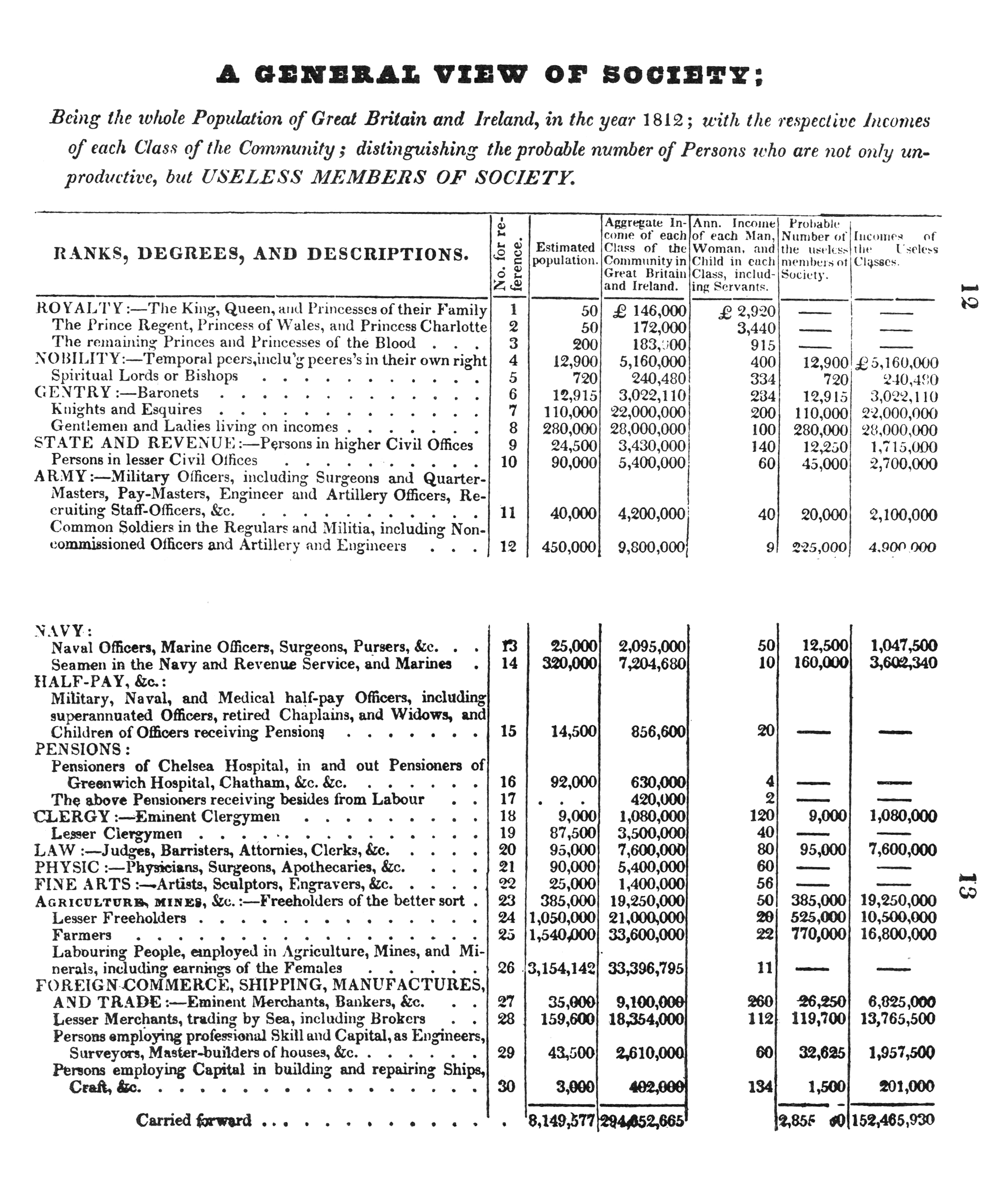
Scarcity to the Rescue
British conservatives had a persuasive reply to the Godwin-inspired notion that poverty, and the obedience it compelled, was both cause and consequence of the directions down which the efforts of society were being channeled, and it came in the form of Thomas Malthus’s Essay on Population (1798). Malthus announced Godwin as his target in the opening sentence of the preface, and proceeded to argue that the scarcity thatGodwin traced to the human institution of private property, and the resulting claims it gave on the right to direct the efforts of the entire society, in fact had its roots in “Nature” itself. Malthus’s argument is familiar, of course, though it’s rarely remembered that it was written as a broadside against socialism.His argument is ruthless in its simplistic efficiency, and he requires only a handful of sentences in order to fashion a club with which to beat back the radical challenge:
I think I may fairly make two postulata.First, that food is necessary to the existence of man.Secondly, that the passion between the sexes is necessary and will remain nearly in its present state…Assuming, then, my postulata as granted, I say, that the power of population is indefinitely greater than the power in the earth to produce subsistence for man.Population, when unchecked, increases in a geometrical ratio.Subsistence increases only in an arithmetical ratio.A slight acquaintance with numbers will shew the immensity of the first power in comparison of the second…This implies a strong and constantly operating check on population from the difficulty of subsistence.This difficulty must fall some where [sic] and must necessarily be severely felt by a large portion of mankind…No fancied equality…could remove the pressure of it for even a single century.And it appears, therefore, to be decisive against the possible existence of a society, all the members of which should live in ease, happiness, and comparative leisure; and feel no anxiety about providing the means of subsistence for themselves and their families (Malthus 1996, 4–5).
Scarcity, then, was natural and permanent, and the “close habitations and insufficient food of many of the poor,” along with “war,” and “periodical pestilence or famines” (ibid, 44–45) in fact, were all part of an “imperious all pervading law of nature” designed to restrain population “within the prescribed bounds” (ibid, 5).Not only was it impervious to any radical attempt at a redirection of social effort in the interest of the vast majority, but efforts in such direction, to the extent that they removed the “difficulty of subsistence” which acted as the chief “positive check” to population, would precipitate disaster.Malthus readily acknowledged that channeling social effort in the directions envisioned by Godwin “would tend greatly to augment the produce of the country” (ibid, 65).But therein lay the problem:Were Godwin’s vision actually realized, such that “every house is clean, airy, sufficiently roomy, and in a healthy situation,” “all men are equal,” “and the necessary labours of agriculture are shared amicably among all,” these “extraordinary encouragements to population” would result in a rate of population growth “faster than in any society that has ever yet been known” (ibid, 64–65).Though Malthus begins his essay with the apology that “a long and almost total interruption from very particular business…prevented the Author from giving to the subject an undivided attention” (ibid, 1), he feels confident in estimating that a century-long Godwinian attempt at universal comfort and leisure would result in the population of England mushrooming from 7 to 112 million, with food sufficient for less than a fourth of these.[9] Long before such a state of affairs had ever been reached, Malthus argues, it was almost certain that “an administration of property, not very different from that which prevails in civilized States at present, would be established as the best, though inadequate, remedy, for the evils which were pressing on the society” (ibid, 69).
Not just the poverty of the poor, then, but the property of the rich, were mere manifestations of an “impervious all pervading law of nature.”In less celebrated passages, however, Malthus indicated that comfort for the majority was undesirable regardless of its presumed effects upon population.In considering the effects of an increase in the purchasing power of the poor, Malthus restates, in his own words, the linkage thatGodwin had sought to establish between “the power to compel others to labour” and the poverty of the majority:
The receipt of five shillings a day, instead of eighteen pence, would make every man fancy himself comparatively rich and able to indulge himself in many hours or days of leisure.This would give a strong and immediate check to productive industry, and in a short time, not only the nation would be poorer, but the lower classes themselves would be much more distressed than when they received only eighteen pence a day (ibid, 27).[10]
Malthus was against lessening the compulsion to work, regardless of its impact on population.The intent of the Essay On Population, however, was to naturalize this compulsion, and the class relations which accompanied them, thus rendering moot any subversive speculations as to the human potential that might be achieved were the poor to channel their efforts in directions of their own choosing, and sever the tethers that bound them to people and projects inimical to the fulfillment of their wants and needs.[11]In this, he was enormously successful.Godwin admitted that Malthus’s essay converted many of his own supporters, and the new theory of population, which “scientifically proved” the impossibility of socialism, became the weapon of choice in a “torrent of scurrilous abuse spat [at Godwin] from the pulpit and in the lecture theatre, and smeared across pamphlets, novels and verse” (Marshall, in Godwin, 1985:20).Crucially for the nineteenth century value discussion, Malthusian assumptions regarding the natural permanence of scarcity, and the ineluctable relationship posited between population and resources, were incorporated at the foundation of the new “science” of political economy, and the categories it erected in its attempts to theorize “economic value.” These attempts similarly required an ideological project of “zoning” the population into groups defined by the activities of their members, and the perceived relationship between these activities and the theorized conception of “value.”
Don’t Get High on Your Own Supply
What had proven so effective as an ideological battering ram against Godwin and the socialists, however, proved to be of less obvious merit to the nascent “science” of political economy, which would ultimately be asked to explain glutted markets, rather than predict exhausted soils.David Ricardo, whose economic system would stand supreme in the English-speaking world until the second half of the nineteenth century, placed Malthus’s scarcity assumptions at the heart of his theory of value, and made society out to be a sort of Malthusian wind-up doll, with his key categories of wages, profit and rent all varying in accordance with the extent to which population growth had pushed the pursuit of means of subsistence onto increasingly less fertile ground.
If the Malthusian world was one of human struggle against a stingy earth for the fulfillment of wants and needs, Ricardo’s standard of value was its unit of measurement, as it measured, in quantities of human labor-time, the difficulty with which humanity procured the articles it sought to consume.Ricardo’s was an “embodied labor” theory of value (McCracken 1933, 17), as he argued that the value of a good was determined by the amount of labor required to produce it – literally, by the quantity of human labor-time congealed, or “embodied” within the good itself.As the efficiency of producing a good increased, i.e., as it required less labor-time to produce, its value declined commensurately.Ricardo thus naturalized value, as for him it traced back, not to human institutions and class relations, but to an eternal condition of human struggle against nature, as operative in an “early state” of society featuring exchange of deer and beavers as it was in his own day.Actual market prices did not always reflect values, but they were always headed in their direction, and it was reasonable to assume that the price of a product with ten hours of labor “embodied” in it would be double that of a product produced in half the time (Ricardo 1973).
Ricardo’s value theory, and the theoretical system which it supported, ironically erected an ideological fortress against the socialist challenge while simultaneously presenting an account of the channeling of human effort in capitalism thatmirrored that of his radical contemporaries, down to the most minute details.For while the socialists were busy with their Colquhoun tables, attempting to lift the veil on the forces directing the labor-power of society and expose them as products of exploitative human institutions, the upshot of Ricardo’s theory was that omniscient, omnipotent forces beyond human control had the beneficent effect of putting everyone in their proper place, even if that place was a large and growing “zone” of Godwin’s “unnecessary labor,” producing “trinkets and luxuries” for the rich.
The promise that there was a secular tendency for the productivity of agricultural labor to decline as it was pushed onto less fertile soil foreclosed socialist visions of the “productive powers” that might be unleashed were the artificial “limits to production” required by the system of private property removed, but Ricardo’s theory also precluded the possibility that a fundamental misdirection of effort, manifesting itself in a glut of oversupply, could result from positive revolutions in the productivity of labor.His “embodied labor” theory of value meant that the purchasing power required to purchase the goods on the market was congealed, as value, in those goods themselves, i.e., if all the goods on the market represented 1 million hours of labor, this was also the quantity of labor, or value, required for all the goods on the market to be purchased and the market to clear.To this he added the assumption that there was no other reason to take the trouble to engage in production other than a “view to consume or sell,” and that the producer “never sells but with an intention to purchase some other commodity, which may be immediately useful to him, or which may contribute to further production” (Ricardo 1973, 192).[12] Thus, not only did all the purchasing power required to purchase the goods on the market exactly match the value of those goods (for it was the same thing), but it was also, and always, an exact measurement of the desire to consume, for the shoe manufacturer only brings $1000 worth of shoes to market with the intent of exchanging them for $1000 worth of other goods.It was certainly possible that particular producers would misjudge the market, resulting in a temporary over-or under-supply of certain goods, but this was what the price system was for, and short-term prices which exceeded or fell short of a good’s “natural value” were all that was needed to nudge the efforts of society back in the direction of their optimal deployment.Markets, then, had a built-in tendency to clear, and general gluts of overproduction were impossible (ibid).
As if to render the fortress he’d erected in defense of these “omniscient” forces directing the labor-power of society truly impenetrable, Ricardo added to all this the further assumption that the demand for goods knows no limit, i.e., that there was no need to worry that revolutions in productivity might result in capital without an outlet for profitable production, much less the possibility of workers receiving their means of subsistence in exchange for less working time.The latter concern was dispensed with by the class relations of capitalism.Labor itself was a commodity, with its value determined by the quantity of labor required to produce the goods for which it exchanged its time, i.e., by the proportion of the total number of workers in society laboring in Godwin’s zone of “necessary labor,” producing their means of subsistence.If the quantity of labor required to produce the food, clothes, and shelter consumed by workers declined, the “value” of labor also declined, precisely to that extent, thus reducing the size of labor’s share of the total social product, even as the quantity of goods they consumed remained the same.Such a reduction in the “value” of labor redounded immediately to the benefit of the capitalists, who would always, according to Ricardo’s assumption, set the labor no longer necessary for the production of worker subsistence to work producing luxuries for themselves:
The poor, in order to obtain food, exert themselves to gratify those fancies of the rich; and to obtain it more certainly, they vie with one another in the cheapness and perfection of their work.The number of workmen increases with the increasing quantity of food, or with the growing improvement and cultivation of lands; and as the nature of their business admits of the utmost subdivisions of labours, the quantity of materials they can work up increases in a much greater proportion than their numbers.Hence arises a demand for every sort of material which human invention can employ, either usefully or ornamentally, in building, dress, equipage, or household furniture; for the fossils and minerals contained in the bowels of the earth, the precious metals, and the precious stones (Adam Smith, cited with approval by Ricardo in Ricardo 1973, 197).[13]
This endless appetite for luxury on the part of the rich meant that “no accumulation of capital will permanently lower profits unless there be some permanent cause for the rise of wages” (Ricardo 1973, 192), i.e., the only limit to the profitable deployment of capital for the purpose of the production and consumption of luxuries was “that which bounds our power to maintain the workmen who are to produce them” (ibid, 195).Tragically, however, “that which bounds our power” was none other than Malthus’s iron law of population, which manifested itself in rent.Godwin may have imagined that a single peasant could produce food for twenty people, but there was less fertile land on which he would not be so productive.As population grew, agriculture would be pushed onto this less fertile soil, and this was the source of the landlord’s rent.Since the market price of agricultural goods was determined by the cost of its production on the least fertile soil, a bonus, in the form of rent, accrued to every owner of land more fertile than the worst land that population growth had pushed into cultivation, and rent’s share of the total social product grew along with the difference in fertility between the best and worst lands producing food for the market.[14] Since the cost of food essentially determined the cost of labor, the value of the wage increased along with rent, as it would take an increasing number of workers to produce a given quantity of subsistence, thus reducing the size of the capitalist’s claim on the total social product:“The natural tendency of profits is thus to fall; for, in the progress of society and wealth, the additional quantity of food required is obtained by the sacrifice of more and more labour” (Ricardo 1973, 71).
Perhaps worst of all is that capital brings this state of affairs onto itself.For Ricardo, capital was literally that which set “productive” workers in motion—the means of subsistence thatthey would consume, along with the tools, machinery and materials they would use in producing goods for the market.As capital increased, it required more labor, and when labor was in short supply vis a vis capital’s demand for it, wages would rise, temporarily, above labor’s “natural” subsistence-level price.Capital’s demand for labor would then be satisfied by the increased production of working-class children,[15] who would not only eventually restore the “natural price” of labor by ending the shortage of workers, but also raise rents and reduce profits by increasing population and pushing farmers onto less fertile soil.Thus, capital, population, and rent increased in lock-step together, as Godwin’s peasant, producing food for twenty, was relentlessly pushed in the direction of land on which his efforts would furnish food only for himself.Long before this state was reached, however, “the very low rate of profits will have arrested all accumulation, and almost the whole produce of the country, after paying the labourers, will be the property of the owners of land and the receivers of tithes and taxes” (Ricardo 1973, 71–72).
By incorporating at the heart of his economic theory a dogma that did its best work as the stuff of anti-socialist propaganda, Ricardo reduced the entire trajectory of human history, at least in the “civilized” states, to a twist of the Malthusian knob.Turn it in the direction of facility in the production of means of subsistence, and the efforts of labor were channeled in the direction of Godwin’s “unnecessary labor,” producing luxuries for the rich, while the inevitable turn in the opposite direction required increased effort in the production of subsistence, the decline of profits, and ultimately social stagnation.What would prove problematic for Ricardo’s theory, in terms of its persuasiveness, was not simply that Godwin’s peasant would soon be producing enough food for at least one-hundred, rather than twenty.[16] Even more, it was that precisely by rendering the forces channeling labor-power in capitalist society immune to attack that he also rendered economic theory powerless to explain value-destroying economic crises, which were increasingly associated with revolutions in the productivity of labor and gluts of overproduction.Indeed, even as he wrote in 1817, amidst the depression following the end of the Napoleonic Wars, the iron-clad logic which flowed from his dubious assumptions was at a loss to provide explanations for any scenario other than those in which markets happily cleared, though with a Malthusian clock ticking ominously in the background.Having explained the manner in which prices and profits gently prodded capital down the proper, market-clearing channels, Ricardo takes a short break from his totalizing theory with the comment that:
The present time appears to be one of the exceptions to the justness of this remark.The termination of the war has so deranged the division which before existed of employments in Europe, that every capitalist has not yet found his place in the new division which has now become necessary (Ricardo 1973, 50).
Ricardo’s theory, and the Malthusianism on which it was based, were ideal as an antidote to the socialist challenge, but the “abstract and unreal character of the assumptions on which [it was] founded” rendered it useless as a tool of governance, particularly in the face of economic crisis (Foxwell, Introduction to Menger 1962, xli).[17]His market-clearing assumptions, along with his theory of value, which naturalized the scarcity reflected in prices, would be challenged, and ultimately discarded, at least for practical purposes, in an attempt to place economics on a more realistic footing.
Ironically, it was Malthus himself who pioneered this attack on the Ricardian system, arguing that the scarcity which backed value, and the obedience it compelled, could not be left up to the “imperious all pervading law of nature” with which he had so successfully battled Godwin.Value, rather, was a project of governance, and was to be maintained, not by “Nature,” and the unyielding law of population, but by maintaining, interestingly enough, an adequate “proportion” of none other than “the unproductive laborers of Adam Smith” (Malthus 1968, 406).
When Nature Fails to Cooperate
While the lessons of the Essay on Population were popularized in sermons and story-books aimed at the working class (Marshall, in Godwin 1996, 20–21), Malthus’s Principles of Political Economy (Malthus 1968) reached a far more limited audience.In it, he attacked Ricardo’s mechanistic system arguing that: “the science of political economy bears a nearer resemblance to the science of morals and politics than to that of mathematics” (Malthus 1968, 1).Ricardo, Malthus claimed, had erred in his fundamental assumptions, with the result that his theory offered very little in the way of practical application.[18]Malthus rejected the Ricardian notion that value was determined by “embodied labor-time,” as well as his presumption that demand was infinite, a “doctrine” which, he told him by letter, “flies in the face of all experience” (Ricardo 1951, 326). Ricardo’s presumption of unlimited demand was based on the belief that the end of capitalist production was the consumption of goods, i.e., that capitalists brought goods to market for the purpose of essentially bartering them for goods of equal value.With this, Malthus, argued, Ricardo had misjudged the entire purpose of capitalist production.Capitalists were not producing in order to satisfy an unlimited desire to consume, but rather in order to “save a fortune” (Malthus 1968, 400), i.e., to secure for themselves an ongoing claim on a portion of the aggregate labor-power of society.[19]By severing the Ricardian connection between production and consumption, Malthus not only raised the possibility of a general glut, which Ricardo’s system was bound to deny, but suggested an alternate definition of value, consistent with what capitalists were actually pursuing:a good’s value, he argued, was determined not by the quantity of labor required to produce it, but rather by the quantity of labor which it could command in exchange. Malthus’s alternate conception of value caused him to ground it, not in “nature,” but rather in a proper “proportioning” of the labor engaged in production for the market with the labor that would be exchanged for those goods.With this, he ironically joined the socialists he’d so effectively battled with the Essay on Population by arguing that the scarcity which backs value, and commands human effort, has no natural foundation, but rather is a reflection of the directions in which the aggregate labor-power of society is channeled.
Malthus begins his critique of Ricardo by stating that the “embodied labor” theory of value simply has no basis in reality:
It is not merely what should be the definition and the measure of value in exchange, but a question of fact, whether the labour worked up in commodities either determines or measures the rate at which they exchange with each other; and in no stage of society with we are acquainted does it do this (Malthus 1968, 85).
Ricardo is correct in assuming that it is the difficulty of obtaining a desired good which confers value upon it, says Malthus, but the reason the quantity of labor “embodied” in a commodity never bears any meaningful relation to the rate at which it exchanges with other goods is that there are so many sources of this scarcity besides the labor-time required for production.The mere difficulty of acquiring capital often causes the products of the capital in existence to exchange at a rate far higher than would be expected by Ricardo’s standard of measurement, and “natural and artificial monopolies, and temporary deficiencies of supply” all have the same effect (ibid, 83).Value is increased by “every circumstance which contributes in any degree to enhance the difficulty of obtaining” desired goods (ibid), and as Ricardo’s standard reduces the source of value to one solitary factor, it will always be wide of the mark.
Having thus rejected Ricardo’s definition of value, Malthus argues that the standard of “commanded” labor-time brings the measurement of value into line with what capitalists are actually pursuing.He proposes the price of unskilled manual labor as the unit of measurement, and argues that the value of a good, as well as its rate of exchange with other goods, can be determined by dividing its market price by that of, say, a day’s worth of “common agricultural labour,” in order to determine the quantity of labor which it will command in exchange (ibid, 96).It’s not just that such a method of measurement will reflect a good’s value regardless of whether it stems from Ricardo’s difficulty of production, or any other factor.The unit of “common labour” is crucial because it actually indicates the quantity of human effort that will be given in exchange for a particular good at a given point in time, and this effort is the essence of value itself—a good that compels no effort has no value.The maintenance and enhancement of value depends upon limiting access to the things which people want and need, and anything which serves to do this, not simply difficulty of production, measured by Ricardo’s embodied labor-time, is a source of value.In discussing “the distinction between wealth and value,” Malthus makes this quite clear:
It has been justly stated by Adam Smith that a man is rich or poor according to the degree in which he can afford to enjoy the necessaries, conveniences, and luxuries of human life.And it follows from this definition that, if the bounty of nature furnished all the necessaries, conveniences, and luxuries of life to every inhabitant of a country in the fullest measure of proportion to his wishes, such a country would be in the highest degree wealthy, without possessing any thing which would have exchangeable value, or could command a single hour’s labour (ibid, 299).[20]
Malthus then considers the macro-implications of such a conception of value.He defines “demand” as “the sacrifice which the demanders must make” in order to obtain the desired quantity of a good, a “sacrifice” which, he goes on to argue, is best measured in units of “common labour,” i.e., “demand” is none other than “value” (ibid, 82).What is crucial for capitalists is the extent to which “demand,” reduced to units of “common labor,” exceeds the cost of production, expressed in the same unit of measurement.Put another way, the more labor will exchange for the product of the “productive labor” producing goods for the market, the greater the value of those goods.
For Malthus, this had two crucial implications.The first was that, contrary to Ricardo, a value-destroying excess of capital[21] was not only entirely possible, but in constant danger of actual occurrence.For according to his conception of value, if the quantity of labor engaged in bringing goods to market increases without a simultaneous increase in the quantity of labor that will exchange for it, the rate of profit, determined by “demand” minus “cost of production,” will by definition decline.This, for Malthus, was exactly what had occurred with the end of the Napoleonic Wars, and explained the glut of overproduction that so befuddled Ricardo:as the “demand” of soldiers and others whose efforts on behalf of the war produced nothing for the market became “costs” in the production of goods, the crucial gap between the quantity of labor exchanging for goods and that engaged in their production narrowed to the point of a crisis of profitability.Value was a matter of proportions, and could only be contemplated in terms of the efforts of the society as a whole.[22]“If you were at once to employ all our soldiers, sailors and menial servants in productive labor,” Malthus told Ricardo, “the price of produce would fall more than ten percent, and the encouragement to employ the same quantity of capital would cease” (Ricardo 1951, 168).
The second macro-implication is implicit in the first. Malthus’s conception of value meant that the demand for the product of those workers producing goods for the market could not come from these workers themselves, for their labor-time represented the denominator in the value fraction, the size of which he sought to maximize:
It is indeed most important to observe that no power of consumption on the part of the labouring classes [producing for the market] can ever…alone furnish an encouragement to the employment of capital.No one will ever employ capital merely for the sake of the demand occasioned by those who work for him.Unless they produce an excess of value above what they consume…it is quite obvious that his capital will not be employed in maintaining them…The very existence of a profit upon any commodity presupposes a demand exterior to that of the labour which has produced it (Malthus, 1968, 404–5; the final sentence was written by the editor).
Maximizing the size of this “exterior” demand meant that the number of workers employed in the zone of “productive labor,” producing goods for the market, had to be properly proportioned with those members of the population outside this zone, in order for the goods they produced to have any value.Echoing Godwin’s argument that the productive powers of human labor were so vast that they dwarfed the capacity of the rich to consume luxuries, Malthus similarly argued that an excessive channeling of labor-power into production for the market would “inevitably lead to a supply of commodities beyond what the structure and habits of such a society will permit to be profitably consumed” (ibid, 325).
While Malthus had battled the socialists with promises of famine, he now argued that given “the fertility of the soil,” and “the powers of man to apply machinery as a substitute for labour” (ibid, 398), “there must therefore be a considerable class of persons who have both the will and power to consume more material wealth than they produce, or the mercantile classes could not continue profitably to produce so much more than they consume” (ibid, 400).[23] With this, Malthus zones the non-rich into two distinct categories:the productive laborers producing goods for the market, and the “unproductive consumers” whose chief role, in terms of the value project, was to add to the quantity of labor exchanging for the product of those producing goods for the market, and thus increase “the exchangeable value of the whole produce” (ibid, 398).For Malthus, the two groups form utterly separate classes:
And it is to be further remarked, that all personal services paid voluntarily, whether of a menial or intellectual kind, are essentially distinct from the labour necessary to production.They are paid from revenue, not capital.They have no tendency to increase costs and lower profits.On the contrary, while they leave the cost of production, as far as regards the quantities of labour required to obtain any particular commodities the same as before, they increase profits by occasioning a more brisk demand for material products, as compared with the supply for them (ibid, 408–409).
“Unproductive consumers” could be comfortable, as their level of effort in exchange for a wage is immaterial, with respect to value, and profits aren’t dependent on their low wages.“Productive labourers,” of course, are not so fortunate, and Malthus is heartened by the fact that with ongoing revolutions in productivity, the proportion of the population living off “revenue” can increase relatively to that engaged in productive labor:
Another most desirable benefit belonging to a fertile soil is, that states so endowed are not obliged to pay so much attention to that most distressing and disheartening of all cries of all cries to every man of humanity—the cry of the master manufacturers and merchants for low wages, to enable them to find a market for their exports.If a country can only be rich by running a successful race for low wages, I should be disposed to say at once, perish such riches! (ibid, 214).
While steady increases in productivity can democratize comfort, as soldiers, clerks, and teachers increase in proportion to the workers producing the goods for which they exchange their time, Malthus takes care to emphasize that no wage should ever be so high as to permit withdrawal from the labor market:“And whatever may be the state of the effectual demand for labor, it is obvious that the money price of labor must, on an average, be so proportioned to the price of funds for its maintenance, as to effectuate the desired supply” (ibid, 218).Measured in terms of value, a society in which the masses of people were able to live in comfort by working only two days per week would be a very poor society indeed:“the man who can procure the necessary food for him family, by two days labour in the week, has the physical power of working much longer to procure conveniences and luxuries, than the man who must employ four days in procuring food; but if the facility of getting food creates habits of indolence, this indolence may make him prefer the luxury of doing little or nothing, to the luxury of possessing conveniences and comforts; and in this case, he may devote less time to the working for conveniences and comforts, and may be more scantily provided with them than if he had been obliged to employ more industry in procuring food” (ibid, 336).This state of poverty exists throughout Latin America, he asserts, where “the banana is cultivated with a trifling amount of labor,” while in “the town of Mexico,” the situation is so dire that “the very dregs of the people are, according to Humboldt, able to earn their maintenance by only one or two days labour in the week” (ibid, 339).These problems were institutional, Malthus argued, and while such societies certainly suffered from a dearth of capital, economists were wrong to assume that a mere influx of investment would result in a ready supply of willing laborers.In a society in which the typical commoner’s “wants are few, and these wants he is in the habit of supplying principally at home” (ibid, 349), it is not only necessary for the prices of necessities to be raised to the point that he is “obliged to employ industry in producing food,” but that a willingness to work is effected through the cultivation of a desire to consume “conveniences and luxuries” (ibid, 348). Towards this end, he suggested the cultivation in the poor of a desire for the consumption of “ribands, lace, and velvet” (ibid, 321).
It is ironic that while the Malthus who insisted upon the natural permanence of scarcity earned a word in the dictionary for his efforts, the Malthus of Principles of Political Economy, who argued that the maintenance of scarcity required the erection of a regulatory lightning rod for the productive powers of humanity, is almost entirely unknown.It is not as if the latter Malthus has been without influence.John Maynard Keynes, who took his own ideas for channeling human effort in scarcity-inducing directions directly from Malthus (McCracken 1961), called Malthus’s insistence that an inadequate amount of “unproductive consumption [on the part] of the landlords and the capitalists” was chiefly responsible for the crisis following the Napoleonic Wars “the best economic analysis ever written of the events of 1815–20,” and summarized Malthus’s futile attempts to persuade Ricardo by letter of the crucial role of “unproductive consumption” in the maintenance of value by stating that:
“Time after time in these letters Malthus is talking plain sense, the force of which Ricardo with his head in the clouds wholly fails to comprehend.Time after time a crushing refutation by Malthus is met by a mind so completely closed that Ricardo does not even see what Malthus is saying…If only Malthus, instead of Ricardo, had been the parent stem from which nineteenth-century economics proceeded, what a much wiser and richer place the world would be today!…I have long claimed Robert Malthus as the first of the Cambridge economists; and we can do so, after the publication of these letters [between Malthus and Ricardo] with increased sympathy and admiration. (Keynes 1951, 117–118; 120–121).
The turn toward Malthus, however, would not have to wait until the Depression decade of the 1930s.It would come with the global economic crisis which began in 1873, an economic slump which lasted, with occasional intermission, over a period of nearly 25 years.
If We Only Had a Crop Failure
Malthus would not defeat Ricardo in the realm of theoretical discussion.Rather, it was the “mild but chronic state of depression” which was the predominant state of business in the capitalist world for the last decades of the nineteenth century (Veblen 1932, 184) that would cause economic theory to increasingly abandon the happy, Ricardian postulates that there was no limit to profitable production, and that markets always cleared.Writing in 1889, before the panic and depression of the 1890s, American economist D.A. Wells characterized economic conditions this way:
The existence of a most curious and, in many respects, unprecedented disturbance and depression of trade, commerce, and industry, which, first manifesting itself in a marked degree in 1873, has prevailed with fluctuations up to the present time (1889), is an economic and social phenomenon that has been everywhere recognized.Its most noteworthy peculiarity has been its universality…the maximum of economic disturbance has been experienced in those countries in which the employment of machinery, the efficiency of labor, the cost and the standard of living, and the extent of popular education are the greatest…and the minimum…where the opposite conditions prevail (Wells 1889, 1;3).[24]
Given its dogmas, conventional economic theory was at a loss to explain the ongoing slump, which gave rise to “a greater number of conflicting economical theories than any other occurrence of ancient or modern time…The result, we need hardly say, has not been to raise the reputation of political economy as a science” (The Nation, May, 1879, cited by Wells 1889, 16).A Dutch committee of 1886 located an important cause of the crisis in “the low price of German vinegar,” while in Germany at the same time, partial blame was laid at the feet of the “immigration of Polish Jews” (ibid, 21).The winner of the “Oxford Prize Essay” of 1879 concluded that “the whole world is consuming more than it has produced, and is consequently in a state of impoverishment, and can not buy our wares” (ibid, 22).
As the slump persisted, however, its source was increasingly identified as “industrial overproduction.”[25]The excess was not in terms of the number “of useful or desirable commodities in excess of what is wanted” for human consumption, but rather, “an excess of demand at remunerative prices, or, what is substantially the same thing, an excess capacity for production” (ibid, 25–26).This, of course, was what Malthus had referred to as “a supply of commodities beyond what the structure and habits of such a society will permit to be profitably consumed” (Malthus 1968, 325), and what Ricardo had insisted was impossible.
In Recent Economic Changes, it was Wells’s task to trace the roots of the ongoing crisis, and in painstaking detail, he lays the blame at the feet of price-destroying revolutions in the productivity of labor which had the effect of glutting markets and eliminating profits.While Ricardo would have predicted a higher rate of profit to accompany rising productivity, assuming the gains included industries producing goods for worker consumption, in fact profits evaporated because the high cost of plant and equipment made it cheaper to continue running them with no profit, or even at a loss, than to shut down entirely and risk losing the entire investment.[26]
Wells begins by stating that:
When the historian of the future writes the history of the nineteenth century he will doubtless assign to the period embraced by the life of the generation terminating in 1885, a place of importance, considered in its relations to the interests of humanity, second to but very few, and perhaps to none, of the many similar epochs of time in any of the centuries that have preceded it; inasmuch as all economists who have specially studied this matter are substantially agreed that, within the period named, man in general has attained such a greater control over the forces of Nature, and has so compassed their use, that he has been able to do far more work in a given time, produce far more product, measured by quantity in ratio to a given amount of labor, and reduce the effort necessary to insure a comfortable subsistence in a far greater measure than it was possible for him to accomplish twenty or thirty years anterior to the time of the present writing (1889) (Wells 1889, 27).
Wells then takes the reader on a grand tour of the productivity revolution of the preceding twenty-five years, in which the major lines of industry featured productivity gains ranging from 200–500 percent (ibid, 28).Some of the highlights include a 250 percent increase in the productivity of steel manufacture over a ten-year period (ibid, 43), a 500 percent increase in the productivity of shoe-making (ibid, 28), and such a revolution in the technology in place in US cotton mills that “one operative, working one year, in the best mills of the United States, will now…supply the annual wants of 1600 fully-clothed Chinese, or 3000 partially-clothed East Indians” (ibid, 50).Ricardo might have been particularly interested in puzzling over the theoretical implications of the fact that the revolution in agriculture had been so great that after all the labor “embodied” in the bread of urban workers had been accounted for, including that required for fuel and transportation, “our final result is that ten men working one year serve bread to one thousand” (Atkinson, cited in ibid, 58).
The problem was that this was bad for business.It wasn’t the revolutions in labor productivity per se.Malthus had argued that the production of all commodities could be entirely automated, leaving no labor content whatsoever, and that prices would remain the same so long as the supply coming to market, and the quantity of labor given in exchange for it, remained unchanged (Malthus 1968, 72).Wells similarly argued that the problem was that production wasn’t being sufficiently “restricted or suspended” in the face of these quantum leaps in the human capacity to produce Adam Smith’s “necessaries and conveniences of life,” with the result being a rate of production which “far exceeds any concurrent market demand” (ibid, 73; Smith 1948, 315).Wells argued that capital had spent the greater part of the nineteenth century “fully equipping the civilized countries of the world” with the fundamental economic infrastructure of ports, railways, merchant fleets, and telegraph lines (Wells, 1889, 63–64).Now, with “the equipment having at last been made ready, the work of using it for production has in turn begun, and has been prosecuted so efficiently, that the world has within recent years, and for the first time, become saturated, as it were, under existing conditions for use and consumption, with the results of these modern improvements” (ibid, 63).
The aforementioned cost of shuttering plant and equipment provided the perverse incentive to continue production, and the financial means of the large capitalists producing goods for the market meant that bankruptcy no longer played its vital role in ensuring that capital remained in proper proportion to the means of profitably employing it (ibid, 73).Now commonly organized as joint-stock companies, and no longer dependent on the financial resources of a single individual or small group, it was not out of the ordinary for such firms to make “no profit” and pay “no dividends for years, and yet continue active operations” (ibid).The result was that “since 1873,” “the prices of nearly all the great staple commodities of commerce and consumption have declined…in manner altogether without precedent in all former commercial history” (ibid, 78).[27] Capitalists complained that they were tired of “working for the public” (Sklar 1987, 56), i.e., producing without a profit, and that the current conditions of “large output” and “keen competition” “threatens our property with virtual confiscation” (Wells 1889, 79).
The tension these capitalists felt between their interests and those of the “public” was none other than that between “wealth,” measured in terms of ease of access to the “necessaries and conveniences of life,” and “value,” which required relative scarcity for its maintenance and preservation.For despite the “unprecedented disturbance and depression of trade, commerce, and industry” of which Wells complained, if measured in terms of quantities of goods bought, sold, and consumed, particularly by the working class, business was booming.“In fact,” said Wells, “the volume of trade, or the quantities of commodities produced, moved and exchanged, has never been so great in the history of the world as during the past ten or fifteen years; and the so-called depression of trade during this time has been mainly due to a reduction of profits, to such an extent that, as the expression goes, ‘it has not paid to do business’ ” (ibid, 206).Prices and profits had fallen catastrophically, said Wells, but wages, in general, had not, with the result that in this period of “unprecedented” depression, “the purchasing power of wages has risen, and this has given to the wage-earning class a greater command over the necessaries and comforts of life” (ibid, 86).
Nowhere was this tension more in evidence than in the matter of the food supply of this apparently coddled “public.”An upturn in economic conditions beginning in 1878 had led many observers to pronounce an end to the crisis which had commenced five years earlier, but time would reveal that this was “only an ‘interruption,’ occasioned by extraordinary causes” (ibid, 6).The “extraordinary causes” Wells referred to were a series of failures “of the cereal crops of Europe and most other countries of the world, with the exception of the United States,” “a failure for which, in respect to duration and extent, there had been no parallel in four centuries,” resulting in “a remarkable demand on the latter country for all the food-products it could supply, at extraordinary prices” (ibid).The skyrocketing prices not only “went far to alleviate the distress of [even] the foreign agriculturalist,” but the receipts of American farmers were spent largely on the products of industry, domestic and foreign, which resulted in a “boom,” temporarily ending the slump (ibid, 7).
Predictably, the high prices stimulated “the occupation and utilization of new and immense areas of cheap and fertile wheat-growing land” in the United States and around the world (ibid, 89).These areas continued producing despite the recovery of areas hit by crop failure, with the result that wheat prices soon crashed to levels far below their previously depressed state (ibid, 90).Wells notes the tension between price and plenty this way:
In short, it would seem as if the world in general, for the first time in its history, has now good and sufficient reasons for feeling free from all apprehensions of a scarcity or dearness of bread.But, while from a strictly humanitarian point of view this is certainly a matter for congratulation, the results, viewed from the standpoint of the interests involved, which embraces a large part of the world’s population, appear widely different.The effect of the extensive fall in prices of agricultural products during the last decade has been most disastrous to the agricultural interests and population of Europe.It has reduced farming in England and in most of the states of the Continent to the lowest stage of vitality; and, by reason of the complaints of their agriculturalists, the customs duties of many countries have been largely increased, and the conditions of consumers modified.In France, the position has been taken…that the only possible means of salvation…will be for France, Germany, Austria and Italy to sink all political antipathies and jealousies and form an international customs union to exclude all food-products from Russia, Australia, and America (ibid, 177).
In 1888, when expectations of crop failure in the United States, Australia, Canada, and the Argentine Republic were realized, but the existence of such enormous reserve stocks of grain prevented prices from rising, Bradstreet’s Journal found the turn of events “disheartening” (ibid, 175).
The circumstances described by Wells, and their implications, put a practical end to many of the theoretical issues so vigorously debated by Ricardo and Malthus.Ricardo’s earnest contention that if capitalists had no desire to consume the products of other capitalists they wouldn’t be bringing their own goods to market (Ricardo 1951, 98) no longer seemed worthy of serious discussion.The “great prize” of the system, as Malthus had put it, was “leisure with dignity,”[28] or as Wells put it, the conversion of wealth “into the form of negotiable securities” which allow their owner “to live without personal exertion or risk of the principle” (Malthus 1968, 216; Wells 1889, 75).It was the endless striving for this, rather than the products of industry, which knew no limit, and caused capitalists to throw quantities of goods on the market which far exceeded their desire to consume (ibid, 75).Once this plank in Ricardo’s system was removed, i.e., once there no longer existed any Providential guarantee that the demand for goods always equaled their supply, there was equally no reason to suppose that the prices of goods, even in Ricardo’s all-forgiving “long-run,” would ever reflect their cost of production, measured in labor-time.Rather, any factor that served to push up price by limiting supply in the face of a given demand must be acknowledged as a source of value.As Malthus made clear, this was not just a matter of theory, but also crucial for purposes of “practical application,” for if the quantity of capital engaged in producing goods for the market was out of proportion to the means of profitably employing it (Ricardo 1951, 361), value-enhancing strategies should be actively pursued.The “artificial monopolies,” which Malthus had noted as an important source of value, had now become absolutely necessary, said Wells, in the form of “syndicates” and “trusts,” for while “they are regarded to some extent as evils,” “there is apparently no other way in which the work of production and distribution, in accordance with the requirements of the age, can be prosecuted” (Wells 1889, 92–93).
Wells’s account represented the new conventional wisdom, “a revulsion against the unregulated market” by capitalists and farmers desperate for measures which would restrict competition “to an extent sufficient to prevent its injurious excesses” (Sklar 1897, 53; Wells 1889, 75). The field of economic theory experienced a similar reaction against Ricardo.William Jevons, British pioneer of the “marginalist revolution,” reflected the mood with the statement that, “I am beginning to think very strongly that the true line of economic science descends from Smith through Malthus to Senior, while another branch through Ricardo to Mill has put as much error into the science as they have truth” (Jevons, cited in Keynes, 291).The marginalist revolution represented a savvy blend of popular and esoteric, as it took from the Malthus of Principles of Political Economy the notion that the value of desired goods derived from their scarcity, whatever the source, while assuming from “population Malthus” the mantle of legitimizing the belief that such scarcity was permanent.
Scarcity vs. Utopia
In 1871, Austrian Carl Menger, with the publication of Principles of Economics, helped launch the “marginalist revolution,” which was to bury Ricardo’s “embodied labor” theory of value “beyond recall” (McCracken 1933, 142–3).[29] Menger synthesized crucial aspects of both Malthuses, holding that scarcity, or the fact that there were always infinitely more human needs than the goods available to meet them, was in “the nature of things,” while also arguing that “value” was manifested in the intensity of human “struggle” for scarce goods (Menger 1950, 97).For Menger, the tension between value and abundance was made explicit, as only scarce goods could have value, and value increased as the needs which depended upon accessing an additional unit of the good in question increased in importance to the individual—Menger’s value discussion means placing Robinson Crusoe on an island, and imagining how the value of water will change for him as you gradually cut off his water supply.His innovation is his focus on individual psychology in the determination of value—Ricardo’s attempt to “objectify” value in labor-time, Menger argues, “contributed very greatly to confusion about the basic principles of our science” (ibid, 121).Value is subjective, says Menger, for perceived needs and their intensity are the only things which can attach value to goods.The intensity of perceived need for a good is subjective, but varies according to the quantity of the good actually available, as consideration of a thirsty Crusoe will suggest.Just as with Malthus, Menger’s argument is that absolutely irrespective of embodied labor-time or cost of production, when the number or intensity of human needs pressing up against a given supply of desired goods increases, value rises, while when the quantity of desired goods increases against a given number and intensity of needs, value falls.The human effort, or competitive struggle, in pursuit of scarce goods, waxes and wanes with the rise and fall of value, and is, in fact, its essence.
Menger’s value theory stands at the intersection of individual psychology and scarcity on a social scale.He defines a “good” as anything which has been subjectively determined by individuals to be capable of meeting a perceived need, and posits a distinction between “economic” and “non-economic goods,” with implications universally valid for all times and places (ibid, 295).“Economic goods” are scarce, i.e., they exist, in any given society, in a quantity exceeded by the total quantity desired for consumption, while “non-economic goods” exist in abundance, in quantities in excess of the maximum possible desired (ibid, 94–95).Menger’s examples are timeless abstractions from class relations:to illustrate a “non-economic good,” he asks the reader to imagine a village, with maximum water requirements of 300 pails each day, situated on a mountain stream with a minimum flow of 100,000 pails (ibid, 98).What happens when water becomes “economic,” i.e., when the total available quantity is reduced to fewer than 300 pails, is that a social “struggle” for water ensues, as individuals become aware that their ability to satisfy perceived needs for water depends upon laying sole claim on certain quantities of it “to the exclusion of all other economizing individuals” (ibid, 99–100).A good’s scarcity, i.e., its economic character, is a prerequisite for value, for “non-economic goods” fail to stimulate any “provident activity” for the purpose of achieving exclusive “command” of them, and “value” requires the realization that a perceived need will go unmet if we fail to lay exclusive claim to a desired quantity of a particular good.
While a good must be scarce to have value, scarcity alone is no predictor of value. Contrary to Ricardo’s formulation that value issues from the production process, distributing itself evenly across all goods produced in the same batch, Menger argues that value is conferred by the intensity of our desires, subjectively determined.Means of subsistence are assigned a special role in his value theory, for the threatened lack of them triggers a “fear” associated with no other type of commodity, inspiring the “effort” and “provident activity” without which value does not exist (ibid, 123).Thus, if water is available to us in exactly the quantity needed for survival, the value attached to it is equivalent to that placed upon life itself.As the quantity of water available to us increases, the level of importance assigned to the needs it is used to fulfill declines.For purposes of illustration, Menger suggests a scale of importance for subsistence goods ranging from 10 to 0, with 10 indicating the importance attached to the quantity of the good on which life depends, and 0 the point reached where additional units of the good yield no satisfaction, and quite likely become burdensome.To determine the value of, say, water to a particular individual, it is necessary to determine the level of importance attached to the need met by the last unit of water consumed.This “marginal unit” determines the value, to that individual, of all units of the good consumed.
The significance of the marginal unit is easier to see if considered in macro.To take Menger’s mountain village, water becomes an “economic good” when its total available supply is less than 300 pails per day, but if 290 pails are available, the foregone needs may be deemed trivial, perhaps valued at 1 on Menger’s scale.As the water supply is gradually cut off, however, the significance of the needs it is impossible to meet will increase, and the competition for water will become frenetic as its value rises.[30]As water becomes more scarce, the “marginal unit” of water consumed satisfies needs of increasing importance to the individual, until finally the need represented by the last unit of water consumed assumes the importance attributed to the maintenance of life itself.Despite the quaint examples, Menger tells us, they accurately describe the forces at work behind prices in a capitalist economy, which reflect the intersection between the scarcity of goods and the intensity of the perceived need for them, subjectively determined.
The fear-inspired “energetic economizing activity” induced by the scarcity of means of subsistence is, of course, none other than the command over labor denounced by the socialists and made the definition of value by Malthus.Menger goes further in mirroring the socialists, however, in stating that the line between economic and non-economic goods represents the line between “civilization” and “communism”:
…we can actually observe a picture of communism with respect to all goods standing in the relationship causing non-economic character; for men are communists whenever possible under existing natural conditions.In towns situated on rivers with more water than is wanted by the inhabitants for the satisfaction of their needs, everyone goes to the river to draw any desired quantity of water…This communism is as naturally founded upon a non-economic relationship as property is founded upon one that is economic (ibid, 100–1).
Both the institution of property itself, and the “present legal order” designed to protect it, are the necessary result of the fact that the vast majority of goods are economic, the result being that not only is it “impossible…for the respective needs of all individuals composing the society to be completely satisfied,” but “nothing is more certain than that the needs of some members of this society will be satisfied either not at all or….only in an incomplete fashion” (ibid, 96–97).Those whose needs go unmet will “have interests opposed to those of the present possessors,” and it thus “becomes necessary for society to protect the various individuals in the possession of goods subject to this relationship against all possible acts of force” (ibid, 97).Just as Malthus argued that a Godwinian experiment would trigger such unprecedented scarcity that the institution of property would by necessity be quickly reinstated, Menger argues that it is the economic nature of goods, i.e., it is their scarcity with regard to the quantity actually desired for consumption, that represents the “economic origin of our present legal order, and especially of the so-called protection of ownership, the basis of property” (ibid, 97, emphasis in original).The only way to abolish property, says Menger, is to establish a new “equilibrium between requirements and available amounts” (ibid).Otherwise the result will be merely to change the identities of the haves and have-nots.
Such an elimination of scarcity, and the abolition of property that would result, is, of course, impossible, as Menger argues that the “transition of mankind from lower to higher levels of civilization” is none other than the story of previously “non-economic” goods becoming economic, as population growth, the spiraling increase of perceived needs and the means of satisfying them, and the occasional “powerful individual”[31] who “excludes” others from free access to otherwise plentiful goods all contribute to changing the crucial equation relating “quantity desired” to “quantity available” in the direction of general scarcity (ibid, 102, 104).Indeed, “civilization” has made such progress that the vast majority of goods are now scarce with respect to the desire to consume them, not just “articles of luxury,” but “even the coarsest pieces of clothing, the most ordinary living accommodations and furnishings, the most common foods, etc.” (ibid, 95).
While Menger cites population growth and “growth of human needs” as explanation of the fact that “even the coarsest pieces of clothing” are scarce with respect to the existing desire to consume them, it might seem that even despite these factors, a society capable of outfitting “3000 partially-clothed East Indians” with the annual labor of one person might have within its reach the possibility of eliminating this scarcity, and establishing “communism,” at least with respect to articles of “the coarsest pieces of clothing,” if it really so desired.Menger is happy to explain the scarcity of even the crudest means of subsistence with vague references to “population” and the “nature of things,” but his theory of value, applied to the class relations of capitalism, makes clear that the social structure alone is enough to account for the scarcity of such items, and hence their value—their ability to compel human effort – without reference to these additional factors.
Both between and within societies, Menger draws a line separating those who spend all their time meeting their most immediate subsistence needs, and those with both the luxury and the foresight to direct their present efforts to the satisfaction of needs anticipated for “ever more distant time periods” (ibid, 153).This line is what distinguishes “primitives” from “civilized peoples,” and history chronicles the tale of traversing the continuum between them (ibid). “Capital” represents the tools of civilization, as Menger defines it as representing those “economic goods that are available to us in the present for future periods of time” (ibid, 303).Possessed of capital, “the quantities of consumption goods at human disposal are limited only by the extent of human knowledge of the causal connections between things, and the extent of human control over these things” (ibid, 74).The benefits of this extraordinary productive power, however—indeed, the benefits of civilization itself—accrue exclusively to those most civilized among us, those in the possession of capital (155).[32]Those who have been successfully excluded from possession of this scarce good will find that the satisfaction of their needs begins where those of their social superiors end, as the value of labor is determined like that of any other good, i.e., by the “magnitude of the satisfactions” represented by the last unit consumed (ibid, 171). The implication is that unless labor can find a way to make itself scarce, the value of the last unit of labor consumed by capitalists is likely to be “next to nothing” on Menger’s scale, which is why “each individual can participate in the economic gains connected with employment of goods of higher order [capital] in contrast to purely collecting activity…only if he possesses capital” (Menger, 155, emphasis in original).While marginalism, with its focus on individual psychology, is ideal for presenting economics in such a way that the macro-channeling of effort in society need not be envisioned, its theory of value implies a distribution of effort in capitalist society in which the majority of people spend their time in Godwin’s zone of “unnecessary labor,” engaged in activities which do little, if anything, to augment the quantity of goods available for them to consume.[33]
Questioning the “morality” of the benefits derived from property ownership, for Menger, represents “one of the strangest questions ever made the subject of scientific debate,” and is “beyond the sphere of our science” (ibid, 173).Value, and the prices which reflect it, are “the necessary products of the economic situation under which they arise,” though apparently not all questions of morality are beyond the sphere of economics, for these prices “will be more certainly obtained the more developed the legal system of a people and the more upright its public morals” (ibid, 173–4).Paying workers above their value for the purpose of “providing them with a more comfortable standard of living” is not tenable under the current economic situation, says Menger (ibid, 174).Any attempt to do so “would undoubtedly require a complete transformation of our social order” (ibid, 174).
The Value of Artificial Scarcity
Like Malthus’s Essay on Population, marginalism offered an economic doctrine suitable for popular consumption by insisting that existing social relations were rooted in scarcity, the source of which could be traced to “the nature of things.” It was the marginalist theory of value, however, which followed the esoteric Malthus in making value a “scarcity-ratio” between quantity available and quantity desired (Commons 2009, 363, 379), that would provide a group of influential American economists with the theoretical basis for grappling with the economic crisis of the late nineteenth century.While Menger and his British counterparts assumed that, absent distorting influences, marginal units of supply and demand would find one another in market-clearing equilibrium, a group of economists advising the McKinley and Roosevelt Administrations at the turn of the twentieth century combined an “overproduction” analysis of the crisis with marginalism’s emphasis on the inverse relationship between value and quantity supplied to provide theoretical justification for corporate strategies designed to restrict output and minimize what they called the “waste of competition” (Sklark 1987; quote is from Jenks 1903, 36).[34]
The problem was not simply that competition forced capitalists to endlessly adopt improvements in equipment and technique for the purpose of keeping up with rivals, regardless of any increase in the demand for goods, such that the story of the final three decades of the nineteenth century was one of vast redundancy of plant and equipment.It was that for industrial capitalists, the only route to value was in production for the market, and that growth meant only one thing—increased production and sales.The incentive structure was Ricardian while the results could have been predicted by Malthus.These economists—Jeremiah Jenks of Columbia, Arthur Hadley of Yale, and renowned financial journalist Charles Conant—used marginalist theory to justify what industrial capitalists, through non-competitive output and price agreements with rivals, and ultimately through mass merger, were actually trying to achieve:the replacement of competitive with “administered” markets (Sklar 1987, 70), characterized by firms with the market power necessary to chase value not through futile attempts to increase production and force the goods of rival capitalists from already glutted markets, but rather by regulating the denominator in the “scarcity ratio,” allowing them to adjust output to meet demand in the pursuit of optimal prices.[35]
In “Crises and Their Management” (1901), McKinley and Roosevelt advisor Charles Conant offers an analysis of the late nineteenth century crisis which in many respects echoes that of D.A. Wells, whose Recent Economic Changes had appeared twelve years earlier.Noting that, “in a practical sense, if not in theory, over-production in respect to effective demand is not only possible, but has been the actual history of many leading commodities during the last three decades” (Conant 1903, 31), Conant diagnoses the problem as one of “misdirection of productive power” (ibid):
Overproduction of consumable goods takes place because so large a part of the purchasing power of the community is saved for investment.A better equilibrium would be established between the production of finished goods and the demand for them if the community devoted a larger portion of its purchasing power to obtaining such goods…Too much of the product of labor has been devoted to the creation of new equipment of doubtful or at least postponed utility, and too little to the purchase of the products of existing equipment (ibid).
Translated, Conant is arguing that “a better equilibrium would be reached,” i.e., profitability might be restored, if capitalists devoted a greater share of their “purchasing power” to the acquisition of goods for their own consumption, and less adding to the capacity to produce goods they did not consume.Put another way, a greater portion of the labor-power of society should be channeled into Godwin’s zone of “unnecessary labor,” satisfying the wants of the rich, and effectively shifting labor-power from production to consumption, and restoring the profitability of the “scarcity-ratio.”Fellow American marginalist, John Bates Clark, whom Conant cites, was more blunt in stating that, “Production does not need to try to over-feed and over-clothe the poor for lack of other consumers to cater to…Let the mills turn out food and coarse goods for labourers, and luxuries and also more mills for the capitalists, and the problem is solved” (Clark, Introduction to Rodbertus 1969, 15–17).
Conant, however, did not share Clark’s hope that the rich could be cured of their habits of excessive frugality, the effects of which were to channel “excessive” quantities of human effort into the production of goods for the market.The problem was structural:competition made investment in “new labor-saving plant with greater efficiency” compulsory for capitalists, and “translated into the secular trend of declining prices and declining rates of profit characteristic of the last quarter of the nineteenth century” (Sklar, summarizing Conant in Sklar 1987, 64–65).Writing almost exactly 100 years after Malthus’s Essay on Population, Conant finds his own source of fear in a “geometric” rate of increase, only for him, what threatened society with its powers of multiplication was not people, but capital, the exponential growth of which “threatened to paralyze enterprise and result in a long period of depression” (Conant 1903, 26).[36]
The solution to the problem of over-production, which Conant traced to the structural flaws of competitive markets, was the “consolidation of industry and the restriction of production” (Conant 1903, 35).The former was required to effect the latter, the purpose of which was to match supply with demand at the optimal price-point in terms of profit (Sklar 1987, 70).Not only would the restriction of output raise prices, but rising prices themselves would reduce the quantity of labor-power being channeled into production for the market, by “absorb[ing] a portion of disposable income that might otherwise go into savings free of centralized [i.e., output-restricting] control” (ibid, 70).
In The Trust Problem (1903), fellow McKinley and Roosevelt advisor and Columbia University economist Jeremiah Jenks provides this illustration of the “waste” for which competition is responsible, as well as its possible remedy:
Before the formation of the old Whiskey Trust, the capacity of the existing distilleries was far more than necessary to supply the normal demand of the country at profitable prices.In consequence, agreements were made from time to time among nearly all the leading distillers to restrict the output.One year each distiller pledged himself to run his plant at only 40 percent of its full capacity.Another year the agreement limited the output to only 28 percent of the full capacity.After the formation of the Trust, out of more than 80 distilleries which joined, all were closed with the exception of 12 of the largest, best located, and best equipped, which ran at their full capacity; and the output of these was equal during the first one or two years to the entire output of all the distilleries which had been running before…no other source of saving was so great as that which came from running the best distilleries to their full capacity and all the time (Jenks 1903, 33).
The goal, however, was not merely to bring productive capacity into alignment with market demand.It was to “put prices higher than former competitive rates while still excluding nearly all competitors” (ibid, 64, emphasis added).According to Ricardo, and the classical theory of competitive markets, such a strategy should have been impossible:absent legal restrictions, price and profit levels higher than what would prevail under competitive conditions were precisely what invited competition.This was how supply, supposedly, met demand, and markets cleared.The problem, of course, was that in the words of Conant, “the intensity of competition in modern industry has so reduced profits that it requires the most careful calculation to guard against loss” (Conant 1893, 37).These economists found the solution in what D.A. Wells had located as the problem—the high cost of plant and equipment, and the deep pockets of capitalists, which combined to make it both rational and possible to continue production over long periods despite the absence of profits.If the field could be cleared of competitors, Jenks argued, it should be possible to deter future rivals with the threat that if “competition of that kind [i.e., on the basis of price] is tried, prices will be forced down not merely to the normal competitive rates among small manufacturers, but far below that, and those investing their capital for purposes of competition are certain to make, instead of the high profits of the existing combination, very low profits or none at all” (Jenks 1903, 65–66).The problem was that “so far most combinations have overreached and have paid the penalty of trying to secure exorbitant profits.More experience is needed to teach most of them the art of permanent monopoly[37]—an art that, when learned, will need to be kept under careful control by society” (ibid, 72–73).
Aside from his admonition against “overreach,” in stating the case for “combination” and “monopoly” as the solution to the evils which accompanied the “waste of competition,” Jenks was not offering a proposal, but rather a justification for strategies that were already well underway.The entire crisis period, beginning in the 1870s, was characterized by capitalists in “ ‘nearly every industry employing fixed capital on a large scale’ entering into “a pool or other noncompetitive arrangement” for the purpose of achieving a price-restoring restriction of output (Hadley, cited in Sklar 1987, 59).These pools and output-and price-agreements amongst firms, however, were notoriously difficult to maintain (Kolko 1970, 8), and it was not until the mass merger movement at the turn of the century that Jenks’ vision was largely realized.In the space of six short years, from 1897 to 1903, the “giant modern corporation” was born in the United States, coming into the world by way of the “consolidation of almost 5,300 individual plants” (Mitchell 2007, 9, 12) into industrial behemoths, and establishing, in the words of Jenks, “monopoly in nearly all the leading lines of industry” (Sklar 1987, 279).
The capitalists called before the Senate’s United States Industrial Commission (1900) to explain the “tidal wave” crashing over the American economy were blunt in locating the impetus for the mergers in the need to eliminate competition too vigorous to leave a margin for profit (ibid; quote is from Mitchell 2007, 12).The stock valuations of these new firms soared, in spite of the fact that the merger wave “did not even create new factories” (ibid)—indeed, as Jenks detailed, industrial combination typically entailed junking significant quantities of “excess” productive capacity.In wryly noting that mergers and incorporation offered the “benefit” of allowing a “community” to increase its “nominal wealth” absent any increase in production, Thorstein Veblen suggested that the merger movement had perhaps doubled the capitalized value of the nation’s industrial equipment (Veblen 1932, 150).[38]
As Veblen’s estimate suggests, the market power to exclude competitors, control output and raise prices had enormous economic value.It was an intangible value, “grounded on the principle of scarcity” (Commons 2009, 788), and it was reflected in the value structure of the firms themselves, which were capitalized on the basis of projected earnings. Merging capitalists referred to the value in excess of that of tangible assets as “intangible property” (ibid, 650).It was represented by common stock, while preferred stockholders would receive the proceeds of the sale of tangible assets in the event of liquidation (Veblen 1932, 143–4).It was typical for merging firms to issue equal amounts of both types of stock (Mitchell 2007, 71–72), and not uncommon for the value of the common stock to then soar far beyond that of the preferred (Veblen 1932, 145–6), becoming “the most important asset of modern business” (Commons 2009, 788).
What is significant about these seemingly trivial details of stock valuation is that the common stock represented the value of a privileged market position, protected from competition (Commons 1939, 194, 268–9). The late nineteenth century “crisis era” of competition was characterized by firms desperate to simply make their tangible assets pay for themselves, while in the “era of monopoly,” successful firms found themselves capable of paying attractive rates of return on capitalizations that exceeded by multiple times their investments in plant and equipment.Jenks readily acknowledged that under ordinary circumstances, such a state of affairs would be sure to invite competition, which was why he took such pains to detail how it could be deterred (Jenks 1903, 65–66).[39]The purpose of deterrence, of course, was to confer the power to restrict output – to maintain the scarcity on which value is based – such that it is possible to view the common stock of the newly merged firms as the capitalized value of artificial scarcity.[40]
The structural changes advocated by the McKinley-Roosevelt economists, and effected by the mass consolidation of industrial firms at the turn of the twentieth century, amounted to a value revolution, making value the reward for the effective maintenance of “relative scarcities” (Sklar 1987, 70) rather than the compulsion to engage in the all-to-often self-defeating attempt to increase production by competing with rivals on the basis of price.They also amounted, on the supply side at least, to the solution to the crisis of the late nineteenth century.[41]Once Menger’s assumption that markets clear is dispensed with, the value project explicitly becomes a matter of regulating the supply of water on Robinson Crusoe’s island, which was the essence of the calls to eliminate the “waste of competition” for the purpose of restricting output, and underneath any economic jargon, always amounts to a concern with the channeling of the aggregate labor-power of society.Both the late nineteenth century crisis, and its solution, would appear to vindicate Malthus’s contention against Ricardo that value is to be measured not by the quantity of human effort expended in production, but rather the activity elicited in exchange.Ricardo would have recognized the “intangible property” which represented the power of the newly merged firms to regulate output and set prices as the rewards of monopoly, enriching their owners while impoverishing the community,”[42] while Malthus would have argued that as the size of the gap between “demand” and “supply” is what determines the incentive to invest, deliberately widening it is actually what facilitates increased investment in the production of goods for the market.He was interested in “absolute scarcity” only for its usefulness as a weapon against socialism—it was the maintenance of “relative scarcities,” which provided the spur to the ongoing expenditure of human effort he called “value,” which was crucial, under capitalism, to effect the production of tangible “wealth.”
Godwin’s claim that given the productivity of labor, “ingenuity has been on the stretch to find out ways in which it may be expended (Godwin 1992, 823)” seems more relevant, 100 years later, in light of the calls for the deliberate restriction of output in order to augment value, than Malthus’s bleak formula regarding population and soils. The old socialists, mocked for failing to acknowledge “population Malthus’s “imperious all pervading law of nature” might have felt vindicated to find descendants of the esoteric Malthus fretting over the “geometric” rate of increase of “capital,” which represented instruments for the production of wealth.These socialists also realized that the “scarcity-ratio,” representing the relationship between quantities available and desired, derived not from Nature, but rather reflected the aggregate channeling of the labor-power of society.In arguing that the value project required artificial limits to production, they appear to have been ahead of their time:
“That whilst the inhabitants of this and other countries are wanting those necessaries and comforts of life, the liberal possession of which constitutes what we call wealth; whilst many obtain them very scantily, and with great difficulty, toil, and anxiety; and whilst others are in the constant fear by circumstances beyond their control; still it is undeniable, that those very inhabitants, aided by the great mechanic power of which they are possessed, are capable of creating, by their own labor, all those necessaries and comforts of life to an almost unlimited extent; certainly to an extent amply sufficient to supply the wants of every member of their respective communities!…The reason why so many are poor, must therefore be sought for in the institutions of society, and this leads us to the important truth of which we have spoken, which is, that there now exists, AN UNNATURAL LIMIT TO PRODUCTION… Take away the limits to production and every thing deserving the name wealth would instantly become accessible to all (Gray 1971, 49, 18, emphasis and capitals in original).
The turn-of-the-twentieth century value revolution, which replaced a Ricardian competition in the field of productive investment with a Malthusian project of managing relative scarcities, would shape early twentieth twentieth century efforts to regulate markets in land and labor, and the racialized discourses with which they were justified.The lesson learned from the late nineteenth century crisis, that the preservation of value required a regulatory project designed to effect and maintain artificial scarcities, to be achieved through the exclusion of competitors from markets, would be easily grafted onto racialized categories of privilege and exclusion in attempts to protect the value of labor and real estate in early twentieth century America.
That value narratives are easily racialized should come as no surprise, for as the foregoing discussion makes clear, any esoteric treatment of value requires a visualization of the population as a whole, and a subsequent “zoning” of its members into categories with respect to their perceived relation to value.For Ricardo, there was the “zone” of workers producing subsistence for other workers, on which all else rested; Malthus divided those exchanging time for subsistence into the categories of productive and unproductive labor, and made maintaining a proper balance between the two essential; and for Menger, there were those who would have their needs met under the value scheme, and those that would be excluded, with the need to protect the former from the latter both explaining the origin and representing the chief function of the state.
Popular explanations of value which seek to defend the institution have as essential features the presumptions that the scarcity which backs value is natural and permanent, and that an omniscient, omnipotent force, which we attempt to disturb at our peril, is constantly at work channeling human effort in optimal directions.Absent from these explanations is any discussion of the “zones” which are both created and required by the value project, and which distribute comfort and misery, and privilege and exclusion, on the basis of ones placement in them.The existence of social zones, however, and the starkly differing treatment and conditions of life meted out within each, is obvious enough.In popular accounts, emphasis is placed upon creating justifications, based upon the personal characteristics of those residing in them, of the existence of these zones, and the chasms of social treatment and experience which exist between them.Throughout most of capitalist history, of course, this project of justification was undertaken largely on the basis of nationality and skin pigmentation, though it seems plain that any construct which performs the service, whether legal status, measurements of performance, or any other device, can be made amenable to the task.Replacing a blunt discussion of the social requirements of the value project with the fiction that the zones reflect the characteristics of those placed within them would appear to be the essence of modern racism.
The question of whether or not the social institution of value stands as a fundamental barrier to our development, as individuals and as a society, is subversive on its face, because the foreclosure of that question, accomplished when the popular narratives of value and race achieve their aim, is an essential feature of the regulatory project of maintaining value.Questioning the opportunity costs of the activities performed in the social zones of privilege and exclusion is essential to puncturing the myth of natural scarcity which provides ideological justification for popular value narratives, and a first step in the direction of a social discussion which might conclude that it is the performance of these activities, and not the people within them, that both forms and maintains these zones.Indeed, it is our own obedience—our own identity-forming personal projects of fashioning our wills into shapes amenable to being channeled in the directions dictated by value—that sits at the foundation of value as a social institution, and is in fact its essence.A social conversation which forms around the question of what we want, rather than what value needs, might just be the first act of disobedience which charts a course leading beyond the institution of value, and the categories of race on which it depends.
References
Briggs, Asa. (1985). The Collected Essays of Asa Briggs. Urbana and Chicago: University of Illinois Press.
Commons, J. R. (1939). Legal foundations of capitalism. New York: The Macmillan Company.
Commons, John. (2009). Institutional Economics: Its Place in Political Economy. New Brunswick, New Jersey: Transaction Publishers.
Conant, Charles. Crises and Their Management. Yale Review. February, 1901.
Coontz, S. H., & Wright, D. M. (1966). Productive labour and effective demand: Including a critique of Keynesian economics. London: Routledge & K. Paul.
Godwin, W., & Wordsworth, J. (1992). Political justice, 1793. Oxford ; New York : Rutherford, N.J.: Woodstock Books.
Godwin, William. The Anarchist Writings of William Godwin. London. Freedom Press,
1996.
Gray, John. A Lecture on Human Happiness. New York, New York. A.M. Kelley, 1971.
Hadley, A. T. (1899). Economics: An account of the relations between private property and public welfare. New York: G.P. Putnam’s Sons.
Hall, C. (1965). The effects of civilization on the people in European states. New York: A. M. Kelley.
Jenks, J. W. (1903). The trust problem (Rev. ed.). New York: Doubleday, Page & Company.
Keynes, J. M. (1964). The general theory of employment, interest, and money: By John Maynard Keynes. New York: Harcourt, Brace & World.
Keynes, John Maynard. 1951. Essays in Biography. New York: Horizon Press.
Kolko, G. (1970). Railroads and regulation, 1877–1916. New York: NortonKuhn, C., Joye, H., West, B., & Radio Free Georgia Broadcasting Foundation. (1990). Living Atlanta: An oral history of the city, 1914–1948. Atlanta : Athens: Atlanta Historical Society.
Malthus, T. R. (1968). Principles of political economy: Considered with a view to their practical application (2d ed., 1836.). New York: A.M. Kelley.
Malthus, Thomas. (1996). Essay on Population. United States of America: The University of Michigan Press.
Marx, Karl. Capital: A Critique of Political Economy, Volume One. London, England: Penguin Books.
McCracken, H. L. (1933). Value theory and business cycles. [New York]: Falcon Press.
McCracken, H. L. (1961). Keynesian economics in the stream of economic thought. [Baton Rouge]: Louisiana State University Press.
Menger, C. (1950). Principles of economics: First, general part. Glencoe, Ill.: Free Press.
Menger, A., Tanner, M. E., & Foxwell, H. S. (1962). The right to the whole produce of labour. New York: A.M. Kelley.
Mitchell, L. E. (2007). The speculation economy: How finance triumphed over industry. San Francisco, CA: Berrett-Koehler Publishers.
Ricardo, D. (1911). Principles of political economy and taxation. London: G. Bell.
Ricardo, D. (1951). Works and correspondence. Cambridge [Eng.]: University Press for the Royal Economic Society.
Ricardo, David. (1973). The Principles of Political Economy and Taxation. London: Guernsey Press
Rodbertus, Karl. (1969). Overproduction and Crisis. New York: A.M. Kelley.
Sklar, M. J. (1987). The corporate reconstruction of American capitalism, 1890–1916: The market, the law, and politics. Cambridge [Cambridgeshire] ; New York: Cambridge University Press.
Smith, A., & Jenkins, A. H. (1948). Adam Smith today: An inquiry into the nature and causes of the wealth of nations. New York: R.R. Smith.
Veblen, T. (1932). The theory of business enterprise. New York: C. Scribner’s sons.
Veblen, T. (1940). The engineers and the price system. New York: The Viking Press.
Wells, D. A. (1899). Recent economic changes: And their effect on the production and distribution of wealth and the well-being of society. New York: D. Appleton.
- [1]This is his “value.”↩
- [2]“The Political Justice appeared in 1793, at the height of the Reaction and the Terror, and no book even of that perturbed period was more profoundly subversive and revolutionary in its teaching” (Foxwell, in Introduction to Menger 1970, xxxi).↩
- [3]In asking his reader to divide the population of England into those working to produce subsistence, and those who contributed nothing to the subsistence needs of the nation, Godwin was actually working within the conventional economic wisdom of the day.In TheWealth of Nations (1776), Adam Smith had similarly divided the population into those laborers engaged in producing the “necessaries and conveniences of life” and those who would be “maintained” by this “fund” while contributing nothing to it.For Smith, both the material comfort of the society as a whole, as well as the weight of the burden on those engaged in the production of “necessaries and conveniences” for the entire society, depended on the number of “unproductive hands” to be supported by “productive labor”:“According, therefore, as a smaller or greater proportion of it [the annual produce] is in any one year employed in maintaining unproductive hands, the more in the one case and the less in the other will remain for the productive, and the next year’s produce will be greater or smaller accordingly; the whole annual produce, if we except the spontaneous productions of the earth, being the effect of productive labor” (Smith 1948, 315).For Smith, the upshot of all this was that “A man grows rich by employing a multitude of manufacturers:he grows poor, by maintaining a multitude of menial servants” (Smith 1948, 314).↩
- [4]For Godwin, “poor” described anyone who was forced to trade labor in exchange for subsistence:“Poverty is an enormous evil.By poverty I understand the state of a man possessing no permanent property, in a country where wealth and luxury have already gained a secure establishment” (Godwin 1996, 126).This was the standard definition of poverty of Godwin’s day, e.g.: “The characteristic of poverty seems to be, to live from hand to mouth” (Malthus 1968, 46).↩
- [5]Godwin’s “misnamed wealth” is Adam Smith’s “value”:“The real value of all the different component parts of price, it must be observed, is measured by the quantity of labor which they can, each of them, purchase or command” (Smith 1948, 276).↩
- [6]“Godwin may be regarded as the first scientific socialist of modern times, possessed of the seeds of all the ideas of recent Socialism and Anarchism.He exerted a very marked influence on Hall, Owen, and Thompson, and through them on the development of Socialism” (Menger 1962, 40).↩
- [7]This statement by William Thompson is typical: “The mass of real accumulated wealth, in point of multitude…is so utterly insignificant when compared with the powers of production of the same society in whatever state of civilization…that the great attention of legislators and political economists should be directed to “productive powers” and their future free development, and not, as hitherto, to the mere accumulated wealth that strikes the eye…By means of the possession of this fixed, permanent, or slowly consumed part of national wealth, of the land and materials to work upon, the tools to work with, the houses to shelter whilst working, the holders of these articles command for their own benefit the yearly productive powers of all the really efficient productive laborers of society, though these articles may bear ever so small a proportion to the recurring products of that labor”(cited in Marx 1990, 397).↩
- [8]This was occasionally made quite explicit:“Nothing occasions dearness but scarcity; and nothing occasions scarcity that is permanent, but there being too few hands employed in agriculture” (Hall 1965, 311).↩
- [9]He arrives at this estimate by assuming that England’s population of 7 million doubles every twenty-five years in “geometric” progression, while its agricultural productivity increases only “arithmetically,” such that with each quarter century it is only able to provide for an additional 7 million people.↩
- [10]Similarly, in spite of seeing hunger, war, plague, pestilence, and famine as direct results of the collision between the “geometric” increase of population and the “arithmetic” increase of the food supply, Malthus provided the same reason for his opposition to birth control:“I should always particularly reprobate any artificial and unnatural modes of checking population, both on account of their immorality and their tendency to remove the necessary stimulus to industry.If it were possible for each married couple to limit by a wish the number of their children, there is certainly reason to fear that the indolence of the human race would be greatly increased…” (Ely 1940, 3–4).↩
- [11]“The Malthusian argument…had a practical purpose.Its purpose was the disillusionment of the Age of Reason and a justification of existing institutions” (Commons 2009, 245).↩
- [12]This contrasts with the socialist critique, which argued that while the desire for goods ultimately was finite, the pursuit of claims on labor-power itself had no end:“They do not long continue to buy commodities, before they begin to buy men” (Godwin 1992, 811).↩
- [13]Godwin also cites Smith to make precisely the same point, from the other side of the class divide:“It has been found that ten persons can make two hundred forty times as many pins in a day as one person (Smith, Book I, Chapter I).This refinement is the growth of luxury—the object is to see how vast a surface the industry of the lower classes may be beaten, the more completely to gild over the indolent and the proud” (Godwin 1992, 859).↩
- [14]According to Ricardo, if the cost of wheat production on the least fertile ground dictated a market price of $6 a bushel, and wheat on the best land could be produced for just $2 a bushel, the rent of the best land would be $4 times the number of bushels produced (Ricardo 1973).↩
- [15]“The amended position of the labourer, in consequence of the increased value which is paid him, does not necessarily oblige him to marry and take upon himself the charge of a family…yet so great are the delights of domestic society, that, in practice, it is invariably found that an increase of population follows the amended condition of the labourer; and it is only because it does so, that, with the trifling exception already mentioned, a new and increased demand arises for food” (Ricardo 1973, 277–278).↩
- [16]American economist D.A. Wells, writing in 1889:“In respect to no other one article has change in the conditions of production and distribution been productive of such momentous consequence as the case of wheat.On the great wheat-fields of the State of Dakota, where machinery is applied to agriculture to such an extent that the requirement for manual labor has been reduced to a minimum, the annual product of one man’s labor, working to the best advantage, is understood to be now equivalent to the production of 5500 bushels of wheat…our final result is that ten men working one year serve bread to one thousand” (Wells 1889, 58–59).↩
- [17]“Ricardo, and still more those who popularized him, may stand as an example for all time of the extreme danger which may arise from the unscientific use of hypothesis in social speculations, from the failure to appreciate the limited application to actual affairs of a highly artificial and arbitrary analysis.His ingenious, though perhaps over-elaborated reasonings became positively mischievous and misleading when they were unhesitatingly applied to determine grave practical issues without the smallest sense of the thoroughly abstract and unreal character of the assumptions on which they were founded.Thus, as Jevons has observed, Ricardo gave the whole course of English economics a wrong twist.It became unhistorical and unrealistic; it lost its scientific independence and became the tool of a political party.At one time indeed it went very near to losing its rightful authority in legislation and affairs…”(Foxwell, Introduction to Menger 1962, xli).↩
- [18]“A writer may, to be sure, make any hypothesis he pleases,” he wrote to Ricardo in an 1817 letter, “but if he supposes what is not at all true practically, he precludes himself from drawing any practical inferences from his hypothesis” (Ricardo 1951, 239).↩
- [19]This was Godwin’s take on such “fortunes:”“It is a gross imposition that men are accustomed to put upon themselves when they talk of the property bequeathed to them by their ancestors.The property is produced by the daily labour of men who are now in existence.All that their ancestors bequeathed to them was a mouldy patent which they show as a title to extort from their neighbors what the labour of those neighbors has produced” (Godwin 1996, 134).↩
- [20]And: “It is the want of necessaries which mainly stimulates the labouring classes to produce luxuries; and were this stimulus removed or greatly weakened, so that the necessaries of life could be obtained with very little labour, instead of more time being devoted to the production of conveniences, there is every reason to think that less time would be so devoted” (ibid, 334, emphasis in original).↩
- [21]For both Ricardo and Malthus, “capital” was that which set in motion the “productive labor” engaged in production for the market.Malthus states that “the chief ingredients of capital, and frequently by far the largest, are food and clothing” (Malthus 1968, 319), i.e., the wages of these workers.Thus, an “excess of capital” occurs when the number of workers engaged in production for the market exceeds that which would result in maximum profit.Continue increasing the number of “productive workers” beyond this point, and profits will disappear, or production will result in a loss.↩
- [22]This was where Malthus, for all practical purposes, abandoned his Malthusianism.For while Ricardo saw the pressures of population on the soil, and its effect on the costs of labor, as the sole long-term regulator of the rate of profit, Malthus argued that the rate of profit was determined by the ratio between the demand for goods and the cost of producing them, estimated in labor-time (or, the quantity of labor exchanged for products minus the quantity required to produce them).Attempting to determine the rate of profit in light of his own “law of population,” he argued, would “lead to the greatest practical errors,” for while this law was “proceeding with scarcely perceptible steps to its final destination, the second cause [the ratio between the demand for goods and the cost of producing them, estimated in labor-time] is producing effects which entirely overcome it, and often for twenty or thirty, or even 100 years together, make the rate of profits take a course absolutely different from what it ought to be according to the first cause [the law of population]” (Malthus, 282).↩
- [23]And:“But if the master-producers [the capitalists], from the laudable desire they feel of bettering their condition, and providing for a family, do not consume their revenue sufficiently to give an adequate stimulus to the increase of wealth; if the working producers, by increasing their consumption, would impede the growth of wealth more by diminishing the power of production, than they could encourage it by increasing the demand for produce; and if the expenditure of the landlords, in addition to the expenditure of the two preceding classes, be found insufficient to keep up and increase the value of that which is produced, where are we to look for the consumption required but among the unproductive laborers of Adam Smith?” (ibid, 406, emphasis added).↩
- [24]The influence of Wells Recent Economic Changes (1889) was enormous, and is indicated by Richard T. Ely, founder of the American Economic Association, and author of the most widely used university economic textbooks in the United States for the first decades of the twentieth century (Dorfman 1946, 211), writing in the midst of the Great Depression of the 1930s that: “It is as instructive as it is interesting to see how in our present panic and Hard Times we are following along, step by step, what happened in 1873 and the following years of Hard Times as described by Mr. Wells” (Ely 1931, 18).↩
- [25]“By the mid-1890s, in the midst of the third long depression in three successive decades, a revulsion against the unregulated market spread amongst the bourgeoisie in all major sectors of the economy.Whatever their programmatic differences, farmers, manufacturers, bankers, and merchants, in addition to already disenchanted railway capitalists, found a common ground in the idea that unregulated competitive market activity resulted in production of goods and services in excess of effective demand at prices that returned reasonable earnings to producers of normal efficiency.The watchword was ‘overproduction.’ ”(Sklar 1987, 53–54.The reference is to conditions in the United States).↩
- [26]“Large fixed investment put a premium on economies of scale, and, as Andrew Carnegie explained in what came to be known as ‘Carnegie’s law of surplus,’ every manufacturer preferred to lose one dollar by running full and holding markets through selling at lower prices than to lose two dollars by running less than full or close down, and incur the risk of losing markets, defaulting on interest payments, and falling into bankruptcy” (Sklar 1987, 58).↩
- [27]Wells cites price surveys which estimate that the average prices of “thirty-eight leading articles of raw produce” were 18 percent lower for the period of 1878–1885 than for that of 1867–77.If just the price level of 1885 was compared with the average of the earlier period, the decline was 31 percent.(Wells 1898, 116).↩
- [28]He used the Latin phrase, “otium cum dignitate.”↩
- [29]“No sooner than we think of the Austrian School than immediately there comes to our minds the names of Jevons, Wieser, Walras, Menger, and Bohm-Bawerk, and the principle of marginal utility.The development of the marginal utility theory of value marks very definitely a return in economic theory to the Malthusian trail of Commanded Value, with its approach to value in exchange from the demand side.Embodied value theory seems to be finally exploded and buried beyond recall” (McCracken 1933, 142–3, emphasis added).↩
- [30]“…the more pressing one’s need for a good the more energetic will be one’s economizing activity whenever it is necessary to procure the good in question” (Menger 1950, 300–1).↩
- [31]Such individuals also figure prominently in Godwin’s conception of the history of “civilization”: “To consider merely the present order of human society, it is evident that the first offense must have been his who began a monopoly, and took advantage of the weakness of his neighbors to secure certain exclusive privileges to himself” (Godwin 1992, 808).↩
- [32]“Meanwhile, with the continuous development of civilization and with progress in the employment of further quantities of goods of higher order [i.e., capital, so long as they have become scarce, or “economic” goods] by economizing men, a large part of the other, previously non-economic goods of higher order (land, limestone, sand, timber, etc., for example) attains economic character.When this occurs, each individual can participate in the economic gains connected with employment of goods of higher order in contrast to purely collecting activity only if he already has command of quantities of economic goods of higher order in the present for future periods of time—in other words, only if he possesses capital.(Menger 1950, 155, emphasis in original; two parenthetical phrases have been eliminated)↩
- [33]Such augmentation would, by Menger’s theory, immediately undermine the value of the goods in question, and ultimately, if carried too far, threaten “civilization” with “communism.”↩
- [34]“A new theory of the capitalist market, one focusing upon disequilibrium, began to emerge in the 1880s, and took substantial form in the 1890s, among American economists…From 1896 to 1901, well before Veblen’s Theory of Business Enterprise (1904), Arthur Twining Hadley of Yale University, Jeremiah Whipple Jenks of Cornell University, and Charles Arthur Conant, the nonacademic scholar and financial journalist, took a leading role among those with senior policy-making influence in laying the theoretical foundations for the break with the classical model of the competitive market…[These economists] embraced the language and concepts of marginal utility, but not the equilibrium theory of the Austrian school and its British counterparts” (Sklar, 1987, 57, 68).↩
- [35]Superficially, of course, we refer to the integers in the “scarcity-ratio” as “supply and demand.” Taking the class relations which produced it for granted, Menger assumed the scarcity of supply, and made demand a matter of individual psychology, rendering the “scarcity-ratio” safe for college textbooks, while still useful to elites, who seemingly had no difficulty in dispensing with that part of marginalism which borrowed from the Essay on Population.Menger’s formula reduces to that of the esoteric Malthus, for assuming a given level of technique, quantity supplied essentially corresponds to the quantity of human effort engaged in production, while both Malthus and Menger measure demand in terms of the human effort a given supply elicits in the world of exchange.In Malthus’s conception, adding to the “denominator” of supply absent any increase in the “numerator” of demand results in a decline of profit, which can be determined by subtracting the denominator from the numerator.Uncontrolled expansion of the “denominator” absent corresponding increases in the “numerator” was apparently the problem of the late nineteenth century.↩
- [36]“…the increase of railway equipment and the employment of labor-saving machinery in farming and manufacturing has promoted saving almost in a geometrical ratio from year to year” (Conant 1903, 29, emphasis added).With regard to the threatened “capital explosion,” Conant goes on to say that it had been averted by finding “an outlet in the undeveloped countries, and this outlet has contributed to the increased sale of manufactured goods, larger earnings for invested capital, and the revival of industry which began all over the world about 1897” (Conant 1903, ibid).↩
- [37]For Jenks, it was a firm’s power to set prices, whether singly or part of a group, that defined monopoly.It did not mean exclusive control by one firm over an entire industry (Sklar, 61).↩
- [38]Veblen’s take on the desirability of “monopoly” and “combination” was slightly different than that of Conant and Jenks.In Engineers and the Price System, for example, he dared American engineers to explain to the public just how vast the country’s productive capacity actually was, and how the “price system” required its throttling (Veblen 1940).His take on the impetus for the merger movement, however, was the same.In The Theory of Business Enterprise (1904), he notes the “dogma” of “overproduction” that prevailed among the businessmen of his day, and states that“ ‘excessive competition’ is an alternative phrase” to describe the same state of affairs, which for Veblen amounts to “an excess of goods above what is expedient on pecuniary grounds” (Vebeln 1932, 217).He also notes the conventional wisdom regarding the solution to the difficulty:“Any proposed remedy…to offset the disastrous cheapening of products through mechanical improvements, has been found in business coalitions and working arrangements of one kind and another, looking to the ‘regulation’ of prices and output…[Their] tangible, direct, and unequivocal efficiency in correcting this main infirmity of modern business is well-recognized.So much so that its urgent advisability has been formulated in the maxim that ‘Where combination is possible competition is impossible.’What is required is a business coalition on such a scale as to regulate the output and eliminate competitive sales and competitive investment within a field large enough to make up a self-balanced, passably independent industrial system—such a coalition of business enterprises as is loosely called a ‘trust’ ”(Veblen 1932, 241–2).↩
- [39]“In effect, marginal utility provided the theoretical ground for the pro-capitalist break with the competitive mechanism as the regulator of the market.Its supply and demand curves offered a model with which the firm might plan as a price-maker—instead of merely as a price-taker—virtually inconceivable on the basis of the classical competitive model… It converted an economic reality productive of unmanageable abundances into an economic calculus suited to the restoration and management of relative scarcities” (Sklar 1987, 70).↩
- [40]Contemporary economist John Commons bluntly defined such intangible property as representing “the right to fix prices by withholding from others what they need but do not own” (Commons 2009, 3) and “the power to restrict abundance in order to maintain prices” (ibid, 5, emphasis in original).For Commons, this was not a criticism.In his view, the “cutthroat competition” and “periodic and general oversupplies of commodities” associated with the nineteenth century “period of abundance” required precisely the sort of “stabilization” strategies advocated by Conant and Jenks (ibid, 779–780).In The Theory of Business Enterprise, Veblen notes that the fact that an asset is intangible “signifies among other things that these assets are not serviceable to the community, but only to their owners” (Veblen 1932, 139).↩
- [41]The demand-side solution, according to Veblen, came in the form of “demand for supplies caused by the Spanish American War” (Veblen 1932, 194).Veblen refers to the “era of prosperity 1897–1902” (ibid, 97), and it is interesting to note that 1897 marks the start of both the corporate merger movement as well as the increase in military spending in preparation for war.↩
- [42]Ricardo bluntly criticized schemes to boost value through the creation of artificial scarcity: “Let water become scarce, says Lord Lauderdale, and be exclusively possessed by an individual, and you will increase his riches, because water will then have value; and if wealth be the aggregate of individual riches, you will by the same means also increase wealth.You undoubtedly will increase the riches of this individual, but inasmuch as the farmer must sell a part of his corn, the shoemaker a part of his shoes, and all men give up a portion of their possessions for the sole purpose of supplying themselves with water, which they before had for nothing, they are poorer by the whole quantity of commodities which they are obliged to devote to this purpose, and the proprietor of water is benefited by precisely the amount of their loss” (Ricardo 1973, 184). Malthus’s entire point against Ricardo was that in a system in which investment takes place only for profit, maintaining the scarcities that keep investment profitable will result in more productive investment for the entire society, and hence actually more tangible wealth, than a situation of minimal profit margins offering no incentive to invest in productive activity.John Commons refers to the apparent “paradox” that while an abundance of goods often leads to profit-destroying reductions in price, and high prices resulting from actual scarcity is poverty itself, economic prosperity is always associated with the combination of both high prices and abundant quantities of goods.He follows this with the simple explanation that “This is not a paradox if nature is bountiful and if scarcity is the artificial scarcity imposed by the government” (Commons 2009, 131–2).This is the essence of what Ricardo failed to understand in Malthus’s letters to him.↩
Comments
From Insurgent Notes #12.
The following sketch is based on conversations in October 2015 with militants in and around the small Italian union SI Cobas (Sindicato Interprofessionale/Comites di Base), which has carried out and won militant strikes over the past few years with mainly immigrant logistics and warehouse workers.
About fifteen or twenty years ago, “cooperatives” became, in Italy, a major form of recruitment used by big logistics companies in the hiring of truckers and warehouse workers (facchini).
They are not to be confused with earlier forms of cooperatives, organized by workers for purposes of solidarity. These cooperatives are labor brokers, often literally Mafia, which arose when the major Italian unions (CGIL, CSIL, UIL) went into decline. They are intermediaries between workers and large firms, and compete among themselves to contract their members at the lowest price. Large companies such as IKEA, the Swedish furniture and appliance retailer, do not hire workers directly, but tell them to join a cooperative. Unlike slave owners, who have a certain interest in keeping their slaves alive and able to work, the cooperatives draw on an enormous revolving labor pool of immigrant workers to be sucked dry and discarded. The formal illegality of such practices is ignored; the law becomes involved only to crack heads of strikers and to lock them up. The big unions look the other way. A fired foreign worker risks losing residence papers and being forced underground. Workers are called in to work on an “as needed” basis, and troublemakers can be left at home for weeks or months, or transferred to another distant warehouse. The shop floor bosses control the labor shapeup, deny bathroom breaks and otherwise do everything to dehumanize the workers. Speaking little or no Italian, these so-called “worker entrepreneurs” are kept totally unaware of their rights to public assistance and health care, however minimal.
One of the most prominent organizations to organize workers to oppose the cooperatives and the companies employing them is the small SI Cobas (Sindicato Interprofessionale/Comites di Base, roughly Interprofessional Union/Rank and File Committees). SI Cobas was born in logistics in 2005. Their first important struggles began ca. 2011. The big strikes in Bologna in 2012 and 2013 stripped away the pretensions of the widely-touted “Emilia” myth of small productive firms with well-paid workers.1
One of the SI Cobas’s first major actions was, at the request of the workers, a demonstration at the IKEA outlet in Casalecchio, in solidarity with the warehouse workers of Piazenza.
A first national strike in logistics took place in March 2013. Pre-strike meetings all over Italy were connected by video conferencing so that workers could see the depth and reach of their movement. When they struck on March 22, the pickets were attacked by the carabinieri (the national police force), leading to a day-long pitched battle involving hundreds of workers and cops. The warehouse, however, stayed closed. The success was announced all over Italy by Twitter. In a day, years of fear and isolation had vanished.
As one account of the March general strike in logistics reported:
[I]n Bologna, the movement constituted a first giant step after which nothing would be as before, either in the warehouses or in the daily lives of the workers. New general strikes, pickets, blockages, demonstrations in the downtown and throughout Italy, assemblies and boycotts became the daily reality of dozens and dozens of warehouse workers, of militants and trade unionists, who rode on the energy unleashed on March 22 to build an uninterrupted series of actions, attracting first the attention and then the participation of new exploited elements in a rebellion against the effects of the crisis and the politics of austerity. Wherever the warehouse workers succeeded in overturning the balance of forces inside the warehouse, they got better pay and erupted politically into view. The practice and narrative of the struggles as expressions of despair and defeat were overcome. The workers no longer cut their veins to win a few months of unemployment insurance and no longer fled to the rooftops of the companies in hopes of attracting the attention of the mass media. On the contrary, they organized to “put their hands into the bosses’ pockets” and to promote their own interests against management…. This little army of Spartacus had broken the chains, showing its weight in the global economy as well. When they fold their arms, millions of euros go up in smoke.2
SI Cobas extended the struggles to Granarola (dairy products), TNT (international transport), to BRT (the Bartolini trucking company) and the Italian post office. Pickets appeared at IKEA stores throughout Italy. IKEA responded in part by negotiating national contracts with the three big unions, specifically excluding small ones such as SI Cobas, but these contracts meant little since few logistics workers belonged to the CGIL, CSIL or UIL. (This is a pattern on the part of the declining big unions, which also signed a national agreement in 2012 with Confindustria, the Italian employers association, again excluding all small unions, including the FIOM, the separate union of metal workers, from recognized collective bargaining.)
IKEA and other large companies had occasionally signed agreements with the cooperatives, but they were generally dead letter. Once again, in violation of national labor law, the cooperatives provide no sick leave. Like flight-by-night firms, the cooperatives appear and reappear with different names; they form a seamless web with the Mafia, banks, and some bureaucrats from the CGIL and the CSIL. They close up shop and sell their contracted members to another cooperative, making it impossible for workers to build up any seniority. By these methods, with no outlays for vacation, sick leave, or bonuses, it is estimated that the cooperative pockets 15,000 euros a year per worker, while the workers earn 700 euros ($675) a month. The companies naturally take no responsibility for what the cooperatives do with their work force.
The logistics struggles have been met with serious repression. The government has used the Rocco Code (Codice Rocco), still on the books from the fascist era, to attack them for violating “public order.” The national labor code specifically prohibits firing workers for striking, but this is enforced only at large companies. The small companies work in an informal labor market, and many militants have been fired. In May 2013, 150 police from the Ministry of the Interior were sent to occupy workplaces. The Italian secret services have warned that the logistics struggles were the most serious problem in Italy. The press did its part in portraying the immigrant workers as criminals. Militants’ cars were were set on fire. But this repression only led to an expansion of the strikes, picket lines and demonstrations.
These struggles also extended to broader struggles against the “Jobs Act” (the English name is used in Italy), which was decreed by the “left” Renzi government in February 2015. The Jobs Act basically shredded existing laws on layoffs, making them much easier, and also restricted access to unemployment insurance in the event of layoffs. In the run-up to the final version of the Jobs Act, the resistance was strongest in Bologna, including in schools at every level. These struggles involved immigrant workers from South Asia (India, Pakistan, Bangladesh), Egypt, North Africa, Ukraine, Eastern Europe and South America. Ninety percent of workers in SI Cobas are immigrants. At the same time many bosses in the cooperatives are themselves immigrants.
In Bologna in particular, SI Cobas extended the struggle to housing and to steep price increases in utilities. This ultimately forced the local governments (commune) to pay for utilities. Major demonstrations were also rather successful in stopping evictions. The “social centers” also became involved. In Piacenza, SI Cobas waged a three-month struggle at IKEA to force hiring of workers without the mediation of the cooperatives. The social centers helped the struggle at Baseano, the trucking company, by blocking deliveries. In December 2014, these struggles led to an agreement between SI Cobas and some big firms. These agreements forced the cooperatives to grant wage increases and sick leave to 2000–3000 workers and to respect national labor law. The union itself provides health care. At the same time, it attempts to avoid “aziendalismo,” or strictly workplace-centered organizing. It also faces the problem of losing members once a struggle, with pay increases and normalization of papers, has been won.
In conclusion, a note of caution comes from some libertarian comrades. They argue that many of the struggles were initiated by the workers themselves who then asked for help from SI Cobas. They also readily acknowledge that the struggles in logistics in Italy are important, and indeed have been the only victorious struggles there in recent years. SI Cobas, undoubtedly, has played an important role in them.
But workers in logistics, these comrades point out, have exceptional power when they disrupt the supply chain. Not, of course, that it is easy to organize strikes, given the criminal networks that control the work force, using violence. But we should not underestimate the fact (as was pointed out above) that these strikes are immediately effective, and that this efficacy is a highly relevant stimulus to action. They also point out that the logistics workers are organized by the structure of the work itself, and by informal networks of ethnicity, as much as they are organized by SI Cobas.
Finally, these comradely critics also warn against a certain mythology that has grown up around the union, promoted by people who do not do the hard work of organizing, while at the same time taking nothing away from the dozens of youth from the social centers who have definitely played a positive role in confrontations with the Mafiosi bosses and aggressive cops. Finally, these comrades question SI Cobas’s own self-conception on the centrality of struggles in logistics and on the possibility of extending their organizing model to other sectors.
- 1The “Emilia” model refers to decades-old propaganda about small “flexible” firms using new technologies, paying high wages and generally pointing a way beyond declining mass industries.
- 2Translated from Fulvio Massarelli, Scarichiamo I padroni. Lo sciopero dei facchini a Bologna [Let’s get the bosses off our backs. The Bologna warehouse workers’ strike], Agenzia X, 2014, p. 19.
Comments
From Insurgent Notes #12.
全球资本主义危机下的中国工人阶级:
革命性的群众罢工或新官僚主义的遏制政策
王实味
论题
一、
1949年由中国共产党所建立的政权并不是一种「国家资本主义」,更不是一个「工人国家」。如同苏联以及它在1945年之后的东欧附属国一样,这个政权是一个「朝向资本主义的过渡阶段」、一个「打着红旗的资产阶级革命」,是为了能够全面进入世界市场所作的准备,当情况允许或者需要的时候。这种从苏联移植过来的斯大林模式,包含了封闭的经济体、国有财产、技术官僚的规划、国家控制对外贸易与货币、以及对于农村人口(一开始占全国人口的百分之八十)往城市移动的严格控制。这些控制就如同「玩偶盒」(jack in the box)一样,目的在于压制资本主义价值规律的运作,既对外部的世界市场、亦对内部企业之间竞争的「无政府」状态;而这种企业竞争,如同在苏联一样,主要在地下经济中运作。浮现中的资产阶级就在国家官僚体制的「缝隙」中生存着。
二、
自1978年以来,朝向「具有中国特色的社会主义市场」的演化,意味着以慢动作的速度打开「玩偶盒」,允许此前被压抑的资本主义面向能够渐渐地浮出水面。依旧存在的既有限制,包括国家垄断对外贸易与货币流通、国家控制外国投资、显著的政府部门继续在银行与企业中扮演角色、以及对于城乡人口流动的持续管制。
三、
中国对西方的开放,特别是对西方贸易与投资的开放,同时服务了中国以及西方资本主义世界。1976年,当毛泽东过世以及毛派的「四人帮」倒台的时候,中国正陷入僵局:先前的「大跃进」(1958~1961)和大饥荒造成了两千万至四千万人死亡;接踵而来的「文化大革命」(1965~1976)及其混乱又再让成千上万的人死于非命、数百万人的生活被摧毁,其中包含了一千七百万的学生被「下放」到农村,经常为期十年以上。1978年的人均农业产量非但不比1949年的时候高,可能还要更低。而西方,此刻正深陷于1970年后的危机之中,并且尚未从中复苏。接续「亚洲四小龙」(韩国、台湾、香港、新加坡)的发展策略,中国能够提供廉价的消费产品来抵销愈来愈困扰西方劳工的财务紧缩状况。中国还具有能够为西方国家提供大量进口与投资的潜力。
四、
成功的快速工业化始终依赖着农村所提供的廉价粮食,并以消灭前资本主义时期的所有制为必要条件。在中国,自1949年到1952年所进行的,就是要消灭这种所有制。然而,无论是在国家控制价格下的小农生产或是1960年代的「人民公社」,伴随着前面所提到的「大跃进」所造成的灾难,中国的农业生产基本上是失败的。因此,邓小平及其技术官僚(由苏联培训)所推动的改革计划的第一步(邓在文化大革命期间被批评为「走资本主义道路的当权派」并下台,后来在1978年重新掌权),乃是一种在农业生产方面的严肃实验,(一开始)在特定地点设置利伯维尔场,并很快产生了作物收成增加五倍的一些实例。
五、
为了体制的重整,中国参考了许多的先行者。该政权及其智库仔细地研究了苏联与其经济互助委员会(Comecon)阵营的垮台,把它们当作必须要避免的一种典范。中国共产党目睹了前面所提到的亚洲四小龙的经验,机敏地利用着自身在国际劳动分工下的位置、以傲人的经济成长率前行;而与前述失败的斯大林模式或独裁专制伴以进口替代的第三世界模式,呈现出极大的反差。它也参考了日本的历史,那是亚洲四小龙的共同模板。中国的智库不断地研究德国在1870年之后的兴起,他们认为德国经验提供了成功挑战国际体系的最佳范例;当时的国际体系由英法所支配,在今天,则是美国。唯一被他们所忽略的,乃是1914年之后的、在全球范围下的资本主义生产模式的衰颓;相较于1815到1914年,在这个阶段,一个区域的成长(如中国、亚洲四小龙)会被另一个区域的紧缩所抵销(如欧美的经济掏空、俄罗斯与东欧的严重衰退、许多中东和前第三世界国家的衰退等)。
六、
过去三十年来,中国的经济成长率平均可达每年百分之十,这在历史上是空前的,虽然这个纪录当然是奠基在两个世纪以来其他地区的工业发展的基础上。(同样毋庸置疑的,这种经济成长率必然会被几乎没有被计算的、巨额的环境破坏成本所抵销。)在过去一、两年内,中国的都市人口比例(如同全球人口一样)已经达到百分之五十,但我们必须注意,大约仍有二点七亿的农民工无法获得城市户口,使他们无法在都市地区定居,并享有住宅、教育、与健康保险等基本权利。在十三亿的人口总数中,我们可以估计至少有两亿人属于城市无产阶级。
七、
2008年的世界经济危机与随之而来的「衰退」(绝非已经结束)严重打击着中国,因为先前资本密集型的出口模式已变得不可行,危机的蔓延更影响了它在亚洲其他地方、在拉丁美洲和非洲的原料供货商。这个政权,尤其是在镇压了1989年在北京与其他地方所发生的、广泛的工人和学生运动之后,致力于与中国社会进行一种含蓄的交易:快速增长、扩大就业机会、增加个人消费、以及放宽日常生活的国家管制,以此来交易政治上的沉默。增长的严重放缓意味着将对这种交易造成威胁。对于危机的初步反应是国家主导的投资大幅增加,尤其是在基础建设方面,不论是在新的城乡发展项目或是交通建设上。在过去几年中,这种暂时的策略已经清楚地达到了它的极限。先前的「中国价格」的低工资优势已被劳动力成本仍然较低的竞争者所取代,如在东南亚的越南与柬埔寨、南亚的孟加拉国、甚至是非洲的乌干达、肯尼亚等国家。虽然中国少有「世界级」的企业组织,几十年来的发展已造就了好几千万接受过科技教育的人才,他们有能力把中国推往「价值链」的顶端,超越劳力密集的大规模生产──中国占世界霸主地位的太阳能板产业就是个很好的例子。
八、
到2012年,每年有超过十万起的「群体性事件」,从罢工到暴动到针对地方当局恣意在农村征地与地产开发所进行的抗争。2014年的罢工次数达到最高纪录(一万两千起),几乎皆在中华全国总工会的掌控之外发生,此名声扫地的总工会乃是官方所支持的唯一全国性工会联合会。迄今为止,这个政权能够成功地将这些抗争分散化和局部化,使其仅针对地方当局而非中央政府。环境破坏、污染、以及有损健康的公害也日益成为争论的焦点。尽管存在着政府机构对网络全面性的监控、对特定网站的屏蔽、以及「中国防火长城」对于访问全球网际网路的限制等等,在官方渠道之外,未受控制的群众讨论已经成为在公众意见形塑上不可忽视的一股力量,这对共产党此前对于信息的垄断构成了一项前所未有的挑战。尽管受到监视与镇压,一个不受正式国家工会所掌控的工人阶级激进份子的网络已经形成。中国显然已经耗尽了柔顺听话的农村劳动力的供给;同时,一个更成熟、受过更好教育、更具备信息能力的工人阶级正在形成,这些因素在沿海工业地带(如广东省)造成工资上涨的压力,并促使资本迁移到劳动力更廉价的西部内陆地区。
九、
因此,中国政权以及整个中国社会已走到了十字路口。前述的阻碍不过是资本主义在世界范围内的普遍障碍的一部分。现在所需要的,正是发生在1914到1945年之间所进行的,大规模的「贬值」(devalorization)措施,也就是一场「大震荡」(shakeout),就如同自19世纪以来所发生的、能够结束每一场大萧条的那些大震荡一样,尽管这次所需要的规模还要更大:不可行的过剩产能必须贬值、丢弃、或摧毁;工资水平(整体社会工资,而不仅仅是薪水)必须下降,那些非生产性的(白领、「服务业」)劳工大军也必须随之减少;尖端科技(相当于先前危机中的电子与汽车技术)必须从压制其发展的束缚中释放出来,复元到在全球尺度下可行的系统性获利率。自1970年代以来,这场危机的「受管理的萧条」(managed depression)的版本已在进行;但,这是不够的。更大规模地对生产力的摧毁是必要的。根本的问题是,在全球尺度下,要在资本主义(「价值」)的框架内扩大社会再生产,仅仅对全体人类中的一小部份才是有可能的。眼前的选择很清楚:全世界的工人阶级必须摧毁资本主义的生产模式,或者部份地被它摧毁。「社会主义或野蛮状态」并不是什么浪漫的口号,而是从最「科学的」思想中所提炼出来的精髓。
十、
让我们来想象一下,假设经过了这样的大震荡之后,发生了一场世界性的「重建」过程,并且假设没有工人革命的重大突破,那么重组之后的中国会是什么样子?首先,最重要的工作乃是对于工人阶级遏制政策的更新形式,这意味着中华全国总工会可能会被一些不那么直接依赖于国家的工会所取代,而情况也很可能以1980年代末期合法化之后的波兰团结工联模式为典范。但是,这种合法化意味着(就像在波兰所发生的)打破党对社会整体的垄断,而中国共产党的国家权力正建立在这样的垄断之上,它自己也十分清楚。中国的智库不断地研究第二次世界大战之后德国的「工场委员会」(works councils)不是没有道理的,这种工场委员会(勿与真正的工人委员会和真正的苏维埃相混淆)给予工人在某些企业中共同管理的权力。一个最有远见的人必须认识到,如同那句老话所说的:「为了使情况保持不变,所有的事物都必须改变。」官僚体制必须跨越自身的阴影──即,认识到自身的权力乃是社会阻碍的关键部份──对今天的中国来说仍然是真正的问题,如同对1980年代苏联的戈尔巴乔夫来说一样。
第二个需要的是世界金融体系的重整,以能够充分地反映自1940年代以来现存的国际金融体系(国际货币基金、世界银行、世界贸易组织(前关税暨贸易总协议)、美元本位等)被创造出来之后,全球产能在区位上的变化。在1960年,东亚仅占世界总生产量的5 percent ;而今天,大约占35 percent 左右。当世界金融体系经过较为公正的重组以反映此种变化之后,美国的霸权地位将难以维系,而美国也不太可能静静地接受这种降级。
第三,需要在中国社会整体创造出一个更广泛的权力基础,以认同并协助促成这样的重组,如同美国产业工会联合会(CIO)在新政与第二次世界大战期间所扮演的角色一样(不罢工承诺,no strike pledge)。毋庸置疑的是,非政府组织也会在这个过程中发挥作用。在我们的思想实验里,在这些变化背后快速来临的,将会是一个多党制的资产阶级民主;而就如同在俄罗斯与东欧所发生的那样,这种资产阶级民主在进一步摧毁官僚限制保护中国社会不遭受世界市场的全面影响上,将具有根本的重要性。那些努力维持东欧社会免于经济困境的工具,如推动其古城缙绅化的资本流动、大规模的输出受过教育的青年人口、以及一些外国直接投资等,在中国这样的尺度上将难以发挥作用。
Comments

John Garvey reviews "Red Rosa" for Insurgent Notes #12.
Red Rosa does not aspire to be an authoritative biography but, perhaps as a result, it is a more compelling book.[1] What’s compelling about it? The graphics have a lot to do with it; it’s an extended comic strip (although the author might take offense with that characterization). The events, both intimate and very public, of Luxemburg’s life and the words and deeds of her political activity are portrayed in vivid graphics. When reading the book, it’s impossible to feel detached from them. At the same time, those events, words and deeds are presented seriously, without trivialization. This is no “Rosa Luxemburg for Dummies.”
When I was young more than fifty years ago, I used to devour comic books by the dozens each month. Then I knew how to read them. It is likely true that my Superman and Batman and Justice League of America favorites were not all that demanding. In any case, now, there were times when the graphics in Red Rosa forced me to stop and think about which frame came next. Doubting my judgment about the graphic quality, I asked a friend, who I thought was wise about aspects of graphic design since he had had a graphic novel published, what he thought about the quality of the graphics. He said that he hadn’t seen the book but that he also didn’t really know much about graphic design. Fortuitously enough, a day or so later, his partner (who does illustrations) handed him the book and said she thought it was ugly—leaving me to my own very inexpert opinion about the graphics.
In spite of at least one reasonably expert opinion to the contrary, I’d argue that the graphics are powerful, funny, intimate, revealing and often surrealistic (in ways that enhance the meaning of the text). Perhaps the central example of the last description is the frame from the book that also provides the cover illustration. The graphic is on pages 124–125 (un-numbered in the text). It depicts soldiers marching up into and then almost crawling through the downcast Rosa’s hair, lifted in a bun, and facing certain death as they explode from the top of her head. Most of the two pages are white, focusing our attention on the murderous realities. Two small airplanes fly away in a cloud-filled sky after having dropped their bombs. The age of “modern” warfare had arrived and it tormented Luxemburg’s thoughts and broke her heart.
Rosa Luxemburg’s Life in Brief
Rosa Luxemburg was born in rural Poland in 1871, the year of the Paris Commune.[2] Her family moved to Warsaw when she was a young child. As she grew up, she wanted more than her family could provide her and became involved in political activity. In the early 1890s, she moved to Zurich to pursue both further education and expanded fields of politics. Soon enough, she obtained a doctoral degree—having written a dissertation on “The Industrial Development of Poland.” She then left Poland to go to Germany—where she all but immediately immersed herself into the affairs of the German SPD. More specifically, she became well-known as an active and effective participant in the party’s left-wing. She remained in the left wing of the movement until her assassination on January 15, 1919—at the hands of Freikorps dispatched to do so by an ostensibly socialist government.
Evans’s book illuminates Rosa Luxemburg’s deep commitment to the cause of human liberation and her all but unbelievable courage in the face of the repression of reactionary states (specifically, Russia and Germany) and the miserable betrayals of official Social Democracy. It also shines light on her brilliance as a thinker, her whimsical appreciation of nature and human personalities and, perhaps most specially, her power with words, both spoken and written. Indeed, I’d like to suggest that the author shows that Luxemburg developed a distinctive idiom for the condemnation of capitalist depravity, the articulation of the need for revolt and the expression of a reason for the endurance of hope.
By way of example, here’s an excerpt, included in the book, from an article that she wrote in 1902 about a devastating volcanic eruption in Martinique, in the West Indies. She’s trying to place the hypocrisy of the world powers’ expressions of concern for the victims of the eruption in the context of what those same world powers had done to the peoples of the world:
In Madagascar, French artillery fire swept thousands of flowering human lives from the face of the earth… a free people lay prostrate on the ground… the brown queen of the “savages” was dragged off as a trophy.
The sugar cartel American Senate (sic) sent cannon upon cannon, warship upon warship, golden dollars millions upon millions to Cuba… to sow death and devastation… Far off in the African south, where a tranquil people lived by their labour and in peace, there we saw how the English wreak havoc… we saw them stamp on human bodies, on children’s corpses with brutal soldiers’ boots… wading in pools of blood, death and misery before them and behind…We have seen you Russians on your dusty highways, in ruined villages eye to eye with the ragged, wildly agitated, grumbling mob; gunfire rattled, gasping muzhiks fell to the earth, red peasant blood mixed with the dust of the highway. They must die, doubled up with hunger, because they cried out for bread, for bread.
And all of you—whether French and English, Russian and Germans, Italians and Americans—we have seen you united in a great league of nations. It was in China you forgot all quarrels among yourselves, you made a peace of peoples—for mutual murder and the torch. Ha, how the pigtails fell in rows before your bullets, like a ripe grainfield lashed by the hail! Ha, how the wailing women plunged into the water, their dead in their cold arms.[3]
Unfortunately, that idiom of condemnation, revolt and hope was all but completely overwhelmed by the triumph of authoritarian state capitalism in the Soviet Union and of fascism in Germany, the country where, for a relatively brief period of time in the first third of the twentieth century, it seemed that the fate of the world would be determined. And indeed it was. Luxemburg’s death in Germany in January of 1919 removed from the political stage one of the few individuals who might, let me stress might, have enabled humanity to avoid the terrible outcomes associated with official communism and fascism. Had she lived, what we came to know as communism could have been entirely different and what we now know as German fascism might have been prevented.
In 1919, the alternative would have been revolution across many different lands. But both the Soviet and the German reaction made sure that revolution would not happen. (Truth be known, we don’t know if revolution would have taken place; we simply know that it didn’t and that events conspired to make that possibility into an impossibility.) We live still with the consequences of those outcomes. Rosa Luxemburg might have been able to stop both reactions—hard claim to make for one individual, but perhaps not such a hard claim to make for one remarkable individual—especially in light of the cataclysmic horrors launched by two other “individuals”—Joseph Stalin and Adolph Hitler. Insert text about individuals and plutonic forces!
But, for me, the most important parts of this book are not the graphics but the events and texts embodied within those graphics and especially the texts that highlight Luxemburg’s own words.
The essentials of Luxemburg’s life, ideas and work are revealed in her responses to the circumstances of her life and the issues and work of revolutionary politics.
The Circumstances of Her Life
Let me try not to be fancy. What I mean by the circumstances of life are simply the everyday realities within which most of us live out our lives. I’d argue that Rosa was a perceptive observer of and an especially enlightened participant in those circumstances.
She remembered her childhood yearnings:
I used to sneak across to the window—it was strictly forbidden to get up before Father was up—I would open it quietly and peek out at the big courtyard. There was certainly not much to see there. Everything was still asleep … a pair of sparrows were having a fight with a lot of cheeky chirping. A cat crept by on its soft paws … Antoni stood alone, deep reflection etched on his sleepy, unwashed face. The solemn stillness of the morning hour spread above the triviality of the courtyard’s paved surface … the window panes glittered with the early morning gold of the young sun … and way up high swam sweet-smelling clouds with a touch of pink, before dissolving into the grey sky over the metropolis. I firmly believed that “life,” that is, “real life,” was somewhere far away off beyond the rooftops.[4]
We can appreciate some of her most revealing sentiments when she is talking about the men she loved. When she was living in Paris, she wrote to Leo Jogiches, her first lover:
My only one, my Bobo, when will I see you? I miss you so much my soul is simply thirsting. Today I saw the Arc de Triomphe, the Eiffel Tower and the Grand Opera. I’m deafened by the noise…. and how many beautiful women there are! Really all of them are beautiful, or at least they seem to be … No! Under no circumstances will you come here! You stay in Zurich.[5]
Once, in the graphic version, while Leo was telling her about the ways in which she was being portrayed as a mortal danger to civilization in the mainstream newspapers, she becomes preoccupied with freeing a wasp—a wasp that most of us would have only been concerned about killing. Her reason: “With every fly that one carelessly swats and crushes, the entire world comes to an end. In the refracting eye of the little fly, it is the same as if the end of the world had destroyed all life.”
Years later, writing to Kostya Zetkin (the son of her close friend Clara) and, at the time, her young lover, she wrote:
Oh Dudu, if only I had two years to do nothing but paint—it would absorb me completely. I wouldn’t go to any painter for lessons or instructions, nor would I ask anyone about anything, but just learn on my own by painting, and asking you! But those are crazy dreams. I can’t let myself do it, because there isn’t even a dog who needs my wretched paintings. However, people do need the articles I write.[6]
Upon her realization that Kostya no longer loved her, she wrote: “If you no longer love me, say it to me openly. You can’t help it. It must come out some day.” When he said, “I truly am sorry,” she responded: “No! You needn’t be. You felt trapped when a word could have freed you. In reality, I was the trapped one… my heart was held by a chain of iron.” Still later, reflecting on the moment, she wrote: “I cleave to the idea that a woman’s character doesn’t show itself when love begins but when it ends.”[7]
In a letter from prison during World War I to Hans Diefenbach, a lover whom she had become involved with on the eve of the war then serving as a medic in the German army, she’s alternately needy and determined:
I need company. I’m sad, and I want to make a confession. The last few days I’ve been angry and therefore unhappy and therefore sick. Or was I sick and therefore unhappy and hence angry? I don’t know any more. Now I’m well again, and I vow never, ever again to lend an ear to my inner demons.[8]
Diefenbach’s later death on the front lines weighed heavily on her when she got the news:
I received the dreadful black envelope. My hands and heart were already trembling when I saw the handwriting and the postmark but I still hoped the worst would not be true. How can this be possible? To me it is like a word cut short in mid-sentence.[9]
But not only love inspired her. Birds seemed to have had a special place in her feelings. From prison, she wrote:
Good lord, don’t I have reason enough to feel grateful and joyful, since the sun is shining down on me so and the birds are singing their age-old song.
The one who has done the most to restore me to reason is a small friend whose image I am sending you. This comrade with the jauntily held beak, steeply rising forehead, and eye of a know-it-all is called the arbour bird. You have surely heard him somewhere because he likes to nest in the thickets of gardens or parks everywhere, you simply haven’t noticed him, just as people for the most part pass by the loveliest things in life without paying attention.
And she goes on talking about the bird (but perhaps, she was really talking about the bird watcher):
This bird is quite an oddball. He doesn’t sing just one song, one melody, like other birds, but he is a public speaker, he holds forth, making his speeches to the garden, and does so with a very loud voice full of dramatic excitement, leaping transitions, and passages of heightened pathos. He brings up the most impossible questions, then hurries to answer them himself, with nonsense, makes the most daring assertions, heatedly refuting views that no one has stated, charges through wide open doors, then suddenly exclaims in triumph: “Didn’t I say so? Didn’t I say so?” Immediately after that he solemnly warns everyone who’s willing or not willing to listen: “You’ll see! You’ll see!” (He has the clever habit of repeating each witty remark twice.)
He never grows tired of filling the garden with the most blatant nonsense, and during the stillness that reigns while he’s giving his speeches, one can almost see the other birds exchanging glances and shrugging their shoulders.
I don’t shrug mine. I laugh every time with joy. You see, I know that his foolish chatter is actually the deepest wisdom and that he’s right about everything.[10]
On the Issues and the Work of Politics
Luxemburg was all but always looking for signs that revolt was breaking out and then urging upon all who would listen the urgent need for support and joint action.
At an SPD Congress in Jena on September 17, 1905, she pleaded:
Are we really living in the year of the glorious Russian revolution? Daily, we read news of it, but some of us don’t have eyes to see or ears to hear. The final words of the Communist Manifesto are not merely a pretty phrase. We are in deadly earnest when we say: Workers! We have a world to win!
Later, she wrote more analytically about the mass strike:
The overthrow of absolutism is a long, continuous social process. The mass strike is not one act, one isolated action. It is a whole period of class struggle. Economic and political factors are intertwined. Cause and effect continuously change places. In the revolution, any political class action can arouse in a few hours whole sections of the working class from their passive condition. The mass strike does not produce the revolution: the revolution produces the mass strike. The mass strike cannot be made, planned or decided. So many factors intersect: economic, political and social, general and local, material and psychical.[11]
But, for her, analysis must remain alive:
The mass strike. A bit of pulsating life of flesh and blood…which is connected with all parts of the revolution…with a thousand veins. If sophisticated theory purposes to make a clever dissection of it, it will not perceive the phenomenon in its living essence…but kill it altogether.[12]
These last two comments are somewhat hilariously presented in a series of frames showing Rosa and Leo Jogiches making love.
She was impatient with, if not outraged by, the deeply rooted caution of the German party’s leadership. In 1910, she complained to Louise Kautsky, after her husband, Karl, refused to publish her call for a republic:
It’s “not the party line”—the very idea is banned! Pfui! To quote Marx: our government is “nothing but military despotism embellished with parliamentary forms.” Yet it has the support of Karl Kautsky! Who needs the police to call us into line? Herr Kautsky will police us himself!
All Germany is ready for industrial action yet Karl is not. He says a mass strike is “unthinkable.” Here! We have the strongest socialist movement in the world yet our proletariat is apparently the most powerless.[13]
Kautsky would rewrite the Communist Manifesto itself! “Proletarians of all countries unite in peacetime, but slit one another’s throats in war!”
Luxemburg was no feminist. She told Clara Zetkin: “I’m sorry Clara. You do so much for the fight for women’s emancipation. I couldn’t do it. I can’t pretend to make common cause with the ladies of the capitalist class. They are parasites upon parasites”[14] Just once, she had doubts about her course of action in that regard. In 1914, after all of the SPD representatives voted for war credits in the Reichstag, she told Clara Zetkin: “For once, I wish I’d dedicated my life to getting women the right to vote. Dammit, Clara. I wish we were in there right now.”[15]
But she was an indisputable champion of women’s liberation in action. She faced a rogues’ gallery of male supremacists. At one point, Dr. Wurm, the husband of Rosa’s friend Mathilde, is quoted as saying:
The poisonous bitch will yet do a lot of damage. She is as clever as a monkey, yet her sense of responsibility is totally lacking. Her only motive is an almost perverse desire for self-justification.[16]
That inspired August Bebel to tell Kautsky:
It’s an odd thing about women. If their partialities or passions or vanities come into question, then even the most intelligent of them flies off the handle and becomes hostile to the point of absurdity. Love and hate lie side by side; a regulating reason does not exist.[17]
Evans follows the war graphic described above with the only pages of non-graphic text in the book—an extended excerpt from The Junius Pamphlet, authored by Luxemburg in 1916, in the midst of the slaughter. She pulls no punches: “Mass murder has become a monotonous task, and yet the final solution is not one step nearer. Capitalist rule is caught in its own trap, and cannot ban the spirit it has invoked.”[18]
But capital was not alone:
Gone is the first mad delirium. Gone are the private street demonstrations, the singing throngs, the violent mobs. The show is over. The curtain has fallen on trains filled with reservists, as they pull out amidst the joyous cries of enthusiastic maidens. We no longer see their laughing faces, smiling cheerily from the train windows, upon a war-mad population. Quietly, they trot through the streets, with their sacks upon their shoulders. And the public, with a fretful face, goes about its daily task.[19]
Who else has captured the grim consequences of dumb support for war so well?
In that same pamphlet, she wrote in some precise detail about she had in mind when she invoked the possibility of barbarism:
What does a ‘‘reversion to barbarism’’ mean at the present stage of European civilisation? We have read and repeated these words thoughtlessly without a conception of their terrible import. At this moment one glance about us will show us what a reversion to barbarism in capitalist society means. This world war means a reversion to barbarism. The triumph of imperialism leads to the destruction of culture, sporadically during a modern war, and forever, if the period of world wars that has just begun is allowed to take its damnable course to the last ultimate consequence. Thus we stand today, as Friedrich Engels prophesied more than a generation ago, before the awful proposition: the destruction of all culture and, as in ancient Rome, depopulation, desolation, degeneration, a vast cemetery; or the victory of socialism, that is, the conscious struggle of the international proletariat against imperialism, against its methods, against war. This is the dilemma of world history, its inevitable choice, whose scales are trembling in the balance.[20]
Luxemburg was both an innovative analyst and determined opponent of imperialism—the domination of the world by a handful of powerful or would-be powerful nations, but she had no sympathy for national self-determination as a political strategy—even, and perhaps especially when it concerned Poland, the country of her birth. She succinctly explained why: “Why speak of national self-determination? Under capitalism the nation does not exist! Instead we have classes with antagonistic interests and rights. The ruling class and the enlightened proletariat can never form one undifferentiated national whole.”
Perhaps her most original theoretical work concerned what she saw as an unresolved issue in Karl Marx’s arguments regarding the accumulation of capital. She formulated the challenge this way: “In a world formed purely of capitalists and workers there is just no way that the capitalists, viewed in their entirety, can get rid of the surplus goods, change the surplus value into money, and accumulate capital.”[21]
Earlier, she had anticipated the essential role that the expansion of credit would play in the perpetuation of accumulation and in the return of inevitable crisis:
When the tendency of capitalist production to expand limitlessly strikes against the limited size of private capital, credit steps in to surmount those limits.… Credit aggravates the inevitable crisis.… It accelerates the exchange of commodities.…it provokes overproduction…and then, at the first symptom of stagnation, credit melts away. It abandons the exchange process just when it is indispensable. Credit stimulates bold and unscrupulous utilization of the property of others…it leads to reckless speculation… It helps to bring on and extend the crisis by transforming all exchange into an extremely complex and artificial mechanism which, having a minimum of metallic money as a real base, is easily disarranged at the slightest occasion.[22]
Not so bad as an analysis of what happened in 2008—except that Luxemburg wrote it more than a hundred years earlier.
For Luxemburg, the Russian Revolution of 1917 was one of the great events of world history and she desired nothing as much as its success and insisted on the need for German workers to defend it and defend it most of all by launching their own assault against capitalist despotism. At the same time, she was severely critical of her Bolshevik comrades. Early in 1919, indeed in her last public speech, Luxemburg warned:
The proletarian revolution requires no terror for its aims; it hates and despises killing. It does not need these weapons because it does not combat individuals, but institutions, because it does not enter the arena with naïve illusions whose disappointment it would seek to revenge. It is not the desperate attempt of a minority to mold the world forcibly according to its ideal, but the action of the great massive millions of the people, destined to fulfill a historic mission and to transform historical necessity into reality.[23]
Evans incorporates an appreciation of Luxemburg’s intense commitments to the development of her skills and talents. By way of example, soon after arriving in Zurich, barely more than twenty years old, she mounted a public stage. Emil Vandervelde recalled her 1893 speech:
Rosa, 23 years old at the time, was quite unknown outside one or two socialist groups in Germany and Poland…but her opponents had their hands full to hold their ground against her… She rose from the delegates at the back and stood on a chair to make herself better heard. Small and looking very frail in a summer dress…she advocated her cause with such magnetism and such appealing words…[24]
It seems evident that she had great natural talents but she worked hard to become as good as she could. Truth be known, she also enjoyed it:
The time when I was writing the Accumulation of Capital is the happiest of my life. Really I was loving as though in euphoria, “on a high,” saw and heard nothing else, day or night, but this one question, which unfolded before me so beautifully, and I don’t know what to say about which gave me the greater pleasure: the process of thinking, when I was turning a complicated problem over and over in my mind, pacing slowly back and forth, through the room, under the close and attentive observation of Mimi [her cat], who lay on the red plush tablecloth with her little paws curled under her and kept turning her wise head back and forth to follow my movements; or the process of giving shape and literary form to my thoughts with pen in hand. Do you know, at that time I wrote the whole 30 signatures [sections of the manuscript] all at one go in four months’ time—an unprecedented event!—and without rereading the brouillon [the first draft], not even once, I sent it off to be printed.[25]
She had great advice for those who want to write to convince: “The secret is to live the subject-matter fully in one’s heart. Then one finds words that are fresh, rather than the old familiar phrases.”[26]
The End
Luxemburg was freed from prison in the middle of November of 1918. In spite of serious misgivings about the wisdom of the Spartacist Uprising, she threw herself into supporting it. She would have only two months to live before her murder.
She had thought about her death and made clear how she wanted to be remembered. Not surprisingly, it involves a bird singing:
On my grave, as in my life, there will be no pompous phrases. Only two syllables will be allowed to appear on my gravestone: “Tsvee-tsvee.” That is the call made by the large blue titmouse, which I can imitate so well that they all immediately come running. And just think, in this call, which is usually quite clear and thin, sparkling like a steel needle, in the last few days there has been quite a low, little trill, a tiny chesty sound. And do you know what that means, Miss Jacob? That is the first soft stirring of the coming spring.
We are still waiting for the coming of that spring. There is no need for us to turn Rosa Luxemburg into a source of all wisdom. Nonetheless, although she has been dead for almost a century, much that she wrote and argued for remains of great value. I hope that Red Rosa attracts many readers into a deep encounter with her ideas and her inspiration.
- [1]The author describes her approach as follows: “The following is a fictional representation of factual events. Photographic source material has been used to create the characters and settings. …[M]any of the conversations between the characters have been created using Luxemburg’s actual words.… In order to compress a life as rich as Rosa’s into 179 pages, minor events have been omitted, some peripheral characters have been conflated, and in a few cases the chronology of events has been reversed for dramatic effect.”↩
- [2]One of the few errors about matters of history in the text comes at the very beginning. In an illustration on the first page, intended to capture the moment of the Paris Commune, a banner is inscribed with the slogan of “Liberté, Égalité, Fraternité.” But that was not the rallying cry of the Commune. Instead, it was the “Universal Republic.” For much more about that matter, see Kristin Ross, Communal Luxury.↩
- [3]Evans, pp. 59–60. The number(s) within parentheses indicate the page in the graphic text; those page numbers have been used by the author to organize the materials in the Notes section at the end of the book, which provides source information, additional details about the context and explanations of any liberties the author has taken with the source materials. In some cases, the Note also includes fuller excerpts from the original text. In a few instances, I have drawn on the Notes for Luxemburg’s words that were not included in the graphic text. The full article on Martinique is worth reading in its entirety.↩
- [4]Evans, pp. 24–25.↩
- [5]Evans, p. 39.↩
- [6]Evans, p. 86.↩
- [7]Evans, p. 102.↩
- [8]Evans, p. 128.↩
- [9]Evans, p. 138.↩
- [10]Evans, pp. 128–9.↩
- [11]Evans, p. 74.↩
- [12]Evans, p. 75.↩
- [13]Evans, p. 104.↩
- [14]Evans, p. 64.↩
- [15]Evans, p. 153.↩
- [16]The words attributed to Wurm were really from Victor Adler. This is one of the occasions when Evans changes facts for dramatic purposes.↩
- [17]Evans, p. 106.↩
- [18]Evans, p. 126.↩
- [19]Evans, p. 106.↩
- [20]These sentences from The Junius Pamphlet are not cited by Evans. It was not Engels who coined the phrase “socialism or barbarism.”↩
- [21]Evans, pp. 107–9.↩
- [22]Evans, p. 56.↩
- [23]Evans, p. 126–7.↩
- [24]Evans, p. 41.↩
- [25]Evans, p. 108.↩
- [26]Evans, p. 59.↩
Comments
From Insurgent Notes #12.
Thank you for this review. The reviewer and so far as I can tell the book seem to have captured both the great spirit and political importance of a figure but for whose tragic death the entire history of the twentieth century might (reviewer’s emphasis) have been different. I hope the book is widely read.
One passage in the review cries out for discussion. Since it occupies only one paragraph—indeed, less than a paragraph—in a long review, it may seem unfair to attach too much importance to it. But because it addresses a crucial issue of politics, one that has been subject to a lot of controversy, and also one on which there is reason to believe Luxemburg was mistaken, I think it worth calling attention to it. Here is the passage:
Luxemburg was both an innovative analyst and determined opponent of imperialism—the domination of the world by a handful of powerful or would-be powerful nations, but she had no sympathy for national self-determination as a political strategy—even, and perhaps especially when it concerned Poland, the country of her birth. She succinctly explained why: “Why speak of national self-determination? Under capitalism the nation does not exist! Instead we have classes with antagonistic interests and rights. The ruling class and the enlightened proletariat can never form one undifferentiated national whole.”
Luxemburg’s assertion that “under capitalism the nation does not exist,” while it may be true today when a truly global economy and global capitalist class has emerged, was not true a hundred years ago when she wrote it, at a time when a handful of imperialist powers not merely exploited the workers of the world but determined the fate of local and dependent elites who were denied the god-given right of every bourgeoisie to exploit its “own” populace.
More important, however is her “lack of sympathy for national self-determination as a political strategy.” (From the text it is not clear who is speaking, Luxemburg, the writer of the book, or the reviewer.) In the first place, the point at issue was not national self-determination, but the right of nations to self-determination. To defend a right is not to call for its exercise: case in point, the right of divorce, or the right to terminate unwanted pregnancies. Lenin emphasized that the right of self-determination was a slogan addressed to the workers of the oppressor nation, on the grounds that no people that oppresses another can itself be free. (“Labor in the white skin cannot be free where in the black is branded.” Also, see Marx on the relation of English and Irish workers.) At the same time he emphasized that the duty of communists of the oppressed nation was to argue for the closest possible ties with the workers of the oppressor nation, and to oppose attempts by the bourgeoisie in the former to promote notions of unified national interests. (For Lenin’s side of the argument with Luxemburg, see https://www.marxists.org/archive/lenin/works/1914/self-det/)
I am aware that Lenin’s slogan was sometimes interpreted to justify support for the bourgeoisie of “backward” nations, the most notorious cases being the Comintern’s alliance with Mustafa Kemal (during Lenin’s lifetime) and later with Chiang Kai-shek (after Lenin’s death). But it didn’t have to. (I am also aware that the issue has been muddied almost beyond the possibility of clarification by the cynical maneuvers of the Stalinists, but that should not stop us from trying to understand the actual debate between Lenin and Luxemburg.) And the opposite error could also prove disastrous, as the Bolsheviks discovered to their sorrow in 1920 at the gates of Warsaw when, having temporarily abandoned the “Leninist” for the “Luxemburgist” position, and viewing as reactionary any concessions to Polish national aspirations, they found themselves opposed by the entire Polish nation, including its proletariat.
We communists do not believe in God. But we also know that attempts to suppress religion do not work, and that the demand for freedom of religion (and freedom for antireligious propaganda) is the only way to win the masses away from superstition.
Comments
John Garvey responds to Noel Ignatiev in Insurgent Notes #12.
A short while ago, I published a very favorable review of Red Rosa by Kate Evans. That review is now being re-published in the new issue of Insurgent Notes. In the meantime, a longtime comrade and friend, Noel Ignatiev, posted a comment that challenged my apparent endorsement of Luxemburg’s views on national liberation.
This is a partial response.
I am mostly sympathetic to Rosa Luxemburg’s views on the national question. I don’t think that those views are adequate—in large part because they do not fully acknowledge the ways in which, and the reasons why, workers in imperialist nations fail to meet the obligations of proletarian internationalism with workers and peasants in oppressed nations. She was, in retrospect, I think too persuaded by what she saw as the inevitability of the growth of social democracy (mostly evident in the growing number of voters for social democratic parties, especially the German one) and its developing powers to defeat all obstacles to the international solidarity of the working class. She never quite acknowledged the ways in which the workers of the imperialist nations could become complicit in the deeds that their nations engaged in across the globe and, more likely than not, lose a bit of their revolutionary edge. At the same time, however, she was remarkably aware of the ways in which the victories of national liberation movements would lead to dismal outcomes—over and over again. I don’t think we can name one national liberation movement (by way of examples—not Algeria, not Vietnam, not Mozambique) in the last half of the twentieth century that did not end horribly.
For the moment, I’m more interested in challenging the fundamental bases of the Leninist alternative to Luxemburg’s anti-nationalist position. It often appears to me that the revolutionary pedigrees of Leninist orthodoxy have largely been assumed rather than confirmed. I’d suggest that the Leninist formulations of policy on the national question do not deserve to be taken seriously as poles of debate on the matter. More precisely, they should be viewed as all but completely hypocritical. As one author recently described them, they are an example of revolutionary “give and take-away.”1
To support this claim, I rely a great deal on a pamphlet, “The Russian Social Democrats and the National Question,” by Lev Yurkevych (writing under the pseudonym of Lev Rybalka) published in January 1917.2 Yurkevych was a left-wing leader of the Ukrainian Social Democratic Workers Party. Somewhat paradoxically, as will become clear below, he was a strong defender of Ukrainian national liberation.
Yurkevych began by citing the formal views of the Russian Social Democrats, as expressed in theses titled Socialist Revolution and the Right of Nations to Self-Determination (October 1916):
The right of nations to self-determination means the exclusive right to independence in the political sense, to free political secession from the oppressor nation. Concretely, this demand for political democracy means complete freedom of agitation for secession and the resolution of the question of secession by a referendum of the seceding nation. Accordingly, this demand is not at all equivalent to a demand for secession, fragmentation, or the creation of small states. It signifies only the consistent expression of struggle against all national oppression. The nearer a democratic system to complete freedom of secession, the less frequent and weaker will be strivings toward secession in practice, for the advantages of large states both from the point of view of economic progress and from that of the interests of the masses are indubitable; moreover, they increase steadily with the growth of capitalism.
The goal of socialism is not only the elimination of the fragmentation of humanity into small states and of all segregation of nations, not only the drawing together of nations, but also their merging. And precisely in order to attain this goal, we must demand the liberation of nations not in general, nebulous phrases, not in empty declamations, not in the form of ‘‘postponing” the question until the achievement of socialism, but in a clearly and precisely formulated political program, taking particular account of the hypocrisy and cowardice of socialists in the oppressor nations.
Yurkevych comments: “This quotation defines the basic views of the editors of the RSDRP’s (Russian Social Democratic Workers Party) central organ on the national question. What is astonishing and glaring, however, is the contradictoriness of these views.” He goes on:
Thus, for example, the recognition of the “right of nations to self-determination,” which is understood in the exclusive sense of the right “of secession from the oppressor nation,” is followed immediately by the assertion that “the advantages of large states from the point of view of economic progress and from that of the interests of the masses are indubitable.”
These two propositions are mutually exclusive. For, if we grant that “with the development of capitalism” large states increasingly serve the interests of the masses and of progress, then our defence of “the right of nations to self-determination,” whose realization breaks up “large states,” would act as an obstacle to the development of “large states” and to capitalist progress in general. With this in mind and as if to confuse the issue once and for all, the authors of the “theses” note that in actual fact “the demand for free secession from the oppressor nation” “is not at all equivalent to a demand for secession, fragmentation or the creation of small states.”
Yurkevych is unsparing in his critique:
It follows from this that the program of the central organ of the RSDRP on the national question, consisting in the recognition of the “right of nations to self-determination” and in its simultaneous denial—equals zero.
But, if in mathematics zeroes mean nothing, the zeroes contained in political programs are often exhibited as large political figures, and the defenders of such zeroes, as has happened, for example, in our case, come forward with the “demand for liberation of nations not in general, nebulous phrases, not in empty declamations, not in the form of ‘postponing’ the question until the achievement of socialism, but in a clearly and precisely formulated political program, taking particular account of the hypocrisy and cowardice of socialists in the oppressor nations.”
However strange this “demand” may seem when proclaimed by people whose program on the national question equals zero, we nevertheless gladly admit the indispensability for socialists of a program on the national question that is “clearly and precisely formulated, taking particular account of the hypocrisy and cowardice of socialists in the oppressor nations.”
For it is only by taking this hypocrisy into account that we shall comprehend the “right of nations to self-determination” as it is defended by the Russian social democrats.
Yurkevych knew that Lenin was the architect of the policy that he hated:
[I]n issue 44 of Iskra there appeared, incidentally, a lead article by Lenin entitled “The National Question in Our Program.” This article is devoted to the question of the “right of nations to self-determination,” and in it…Lenin, while coming out in defence of the “right to self-determination,” hastens immediately to add that “the unconditional recognition of the struggle for freedom of self-determination in no way obliges us to support every demand for national self-determination.”
Going on to polemicise with the PPS [Polish Socialist Party], Lenin notes the difference between the former insurgent and democratic Poland and the present bourgeois Poland; that then (in Marx’s time) “the complete victory of democracy in Europe was indeed impossible without the restoration of Poland,” and that now “St. Petersburg has become a far more important revolutionary centre than Warsaw; the Russian revolutionary movement already has greater international significance that the Polish.”
Proceeding from this, he comes out decisively against “the break-up of Russia, toward which the Polish Socialist Party is striving, as distinct from our goal of overthrowing autocracy,” and declares at the end of the article that “we shall always say to the Polish workers: only the fullest union with the Russian proletariat can satisfy the demands of the present, actual political struggle against autocracy; only such a union will provide a guarantee of political and economic emancipation.”
And still more, Lenin concluded, “What we have said concerning the Polish question may also be applied to every other national question.”
Thus, Lenin, having declared in 1903 that he recognized the right of secession of nations, came out with utter frankness in the same article against the “break-up of Russia” and, consequently, against the “self-determination” not only of the Poles, but of all the other oppressed nations of Russia, as is entirely clear from his final words, which we have underlined.
Yurkevych considered the Bolshevik position to be “a criminal and conscious deception”—except that he acknowledged that they might not really know what they were doing because of their “idealization of democratic Russia”:
We would be right to consider the Russian social democrats’ promise to “guarantee” the “right of secession” in a Russian republic a criminal and conscious deception of the democratic forces of the oppressed peoples if we did not recall, in their extenuation, their idealization of a democratic Russia, of the Russian “toiling masses,” and of political revolution, which they often identify with social revolution.
Lenin, for example, does not doubt that his party will manage to seize power in the present war, and that then “we would,” he promises,
offer peace to all belligerents on condition of the liberation of colonies and all dependent, oppressed and underprivileged peoples. Neither Germany nor England and France, under their present governments, would accept this condition. Then we would have to prepare and wage a revolutionary war, that is, not only carry out all of our minimum program completely with the most decisive measures, but also systematically rouse to revolt all the peoples now oppressed by the Russians, all the colonies and dependent countries of Asia (India, China, Persia, and so on), and—in the first place—we would rouse to revolt the socialist proletariat of Europe against its governments and in defiance of its social chauvinists. There can be no doubt whatever that the victory of the proletariat in Russia would present uncommonly auspicious conditions for the development of revolution in Asia and Europe (Sotsial demokrat, no. 17, 13 October 1915).
Yurkevych considered this to be nothing more than “revolutionary nonsense.” He invokes the influence of Alexander Herzen on Lenin:
This blind faith in the democratic and socialist virtues of Russia, from our point of view, is not at all an expression, as is generally believed, of the exceptional revolutionariness and internationalist impeccability of Russian socialism. On the contrary, if we take into account the development of Russian liberal ideas of the last century in their relation to the national question, we shall see that the national program of the revolutionary Russian social democrats is nothing but a reiteration of the Russian liberal patriotic program formulated in the age of the emancipation of the peasants.
The most prominent exponent and, one might say, the creator of that program was, as is well known, Herzen, the “ruler of men’s minds” during the l860s. At that time the Polish question was extremely acute in view of the Polish uprising, which coincided with the Russian liberation movement of the 1860s.
In an open letter titled “Russia and Poland,” Herzen had written:
Poland, like Italy or Hungary, has the full, inalienable right to exist as a state independent of Russia. Whether we want a free Poland to break away from a free Russia is another question. No, we do not want this, and can one desire such a thing at a time when exclusive nationalities and international enmities constitute one of the main obstacles restraining free social development?
Yurkevych insists that Herzen and Lenin are “national twins, and their views on the national question are generally identical.” He goes on:
They both recognize that nations have “the full, inalienable right to exist as states independent of Russia,” but if you ask them whether they actually want the secession of the nations oppressed by Russia, they will answer you cordially and with one voice: “No, we do not want it!” They are opponents of the “break up of Russia,” and, recognizing the “right of self-determination” only for the sake of appearances, they are actually fervent defenders of her unity. Herzen, because he proceeds from the assumption that “exclusive nationalities and international enmities constitute one of the main obstacles restraining free human development,” and Lenin, because “the advantages of large states both from the point of view of economic progress and from that of the interests of the masses are indubitable.”
Both these public men—the liberal and the socialist—are also united by their obeisance before Russia’s greatness, and both of them regard her with equal enthusiasm as the Messiah who will save humanity from social injustice. Herzen bases his hopes in this regard on the Russian “commune” and Lenin on the “Russian proletariat,” and they are both convinced that it is not Europe, “an old relic” and “going off to her rest,” but Russia that will be the first to achieve socialism, while Lenin even imagines that during the present war the Russian socialist proletariat, seizing power in its own hands and declaring war on Western Europe “will rouse to revolt the socialist proletariat of Europe against its governments and in defiance of its social chauvinists.”
He concluded: “Class struggle against all national oppression” is “the only principle on which a truly internationalist socialist program on the national question can be constructed.” He made clear what the implications of a class struggle perspective were:
We shall make no secret of the fact that we, for our part, prefer barricade warfare. That is, political revolution, to trench warfare, that is, war. The difference between the autonomist movement and the separatist movement consists precisely in the fact that the first leads democrats of all nations oppressed by a “large state” onto the path of struggle for political liberation, for only in a free political order is it possible to achieve democratic autonomy, while the second—the separatist, which is the concern of a single oppressed nation struggling not against the order that oppresses it but the state that oppresses it—cannot fail, in the present strained atmosphere of antagonism between “large states,” to turn into an imperialist war combination.
Yurkevych aligned his views with those of the second Zimmerwald Conference (held in Kienthal, Switzerland in April 1916):
“[T]he proletariat combats annexations not because it recognizes the world map as it was before the war as corresponding to the interests of the people and which, therefore, should not be changed! Socialism itself aspires to the elimination of all national oppression by means of the economic and political unification of peoples, which is unrealizable with the existence of capitalist boundaries.”
We, on the contrary, insist upon the necessity of struggle against the consequences of old annexations, against the oppression of annexed nations, and upon the conquest of democratic and autonomous rights for them as the only possible guarantee of their free national existence and development under a capitalist order. The shifting of boundaries is the task of imperialism our task is the struggle for the decentralization and democratization of “large states.” Moreover, the proletariat of the oppressor nation, at least that section whose attitude is truly internationalist, is obliged to help us in our struggle by its pressure on the central government.
Yurkevych then turned to an examination of the actual practice of the Russian Social Democrats in Ukraine:
When Ukrainian social democracy, which took definitive shape in programmatic and organizational respects at its constituent conference in 1905, declared itself in favour of unification with Russian social democracy on the basis of autonomy, the Russian social democrats, in the course of prolonged negotiations with us that were renewed several times, refused unification in decisive fashion, offering us “fusion’’ which we of course, rejected and to which we will never agree.
Lenin wrote to us that, “I am profoundly outraged by the advocacy of the segregation of Ukrainian workers into a separate s d [social democratic] organization.”
After citing some of the cruelties imposed on Ukraine by Russia, Yyrkevych emphasized the difference between the approach of the socialists from that of more or less simple nationalists in the country:
Ukrainian social democracy has recognized the struggle for the liberation of its people as its responsibility. It has opposed to Ukrainian bourgeois politics, which consist in the exclusive effort to “make peace with the government” at the price of a few tiny concessions, a political program of democratic autonomy and a tactic of revolutionary class struggle, together with the proletariat of all the nations of Russia, against the tsarist order and for political and national freedom. Separate, but linked autonomously with Russian social democracy, the Ukrainian organization is indispensable for the realization of the distinct political demand of autonomy for Ukraine.
The Russian social democrats were apparently not impressed:
We have been treated as “chauvinists” and “separatists,” regardless of the fact that the Russian social democrats, following in the footsteps of governmental assimilation and utilizing its results, organized the proletariat in Ukrainian cities as a Russian proletariat and thus estranged it culturally from the rural proletariat, whereby, of course, they violated the unity of the workers’ movement in Ukraine and retarded its development.
…
If they are sincere in saying that they wish to protest against old annexations, as a result of which Russia harshly oppresses Ukraine, then let them at least refrain from hindering the Ukrainian proletariat in its struggle for its own national liberation.
To return to Rosa Luxemburg, thus far I have found no evidence indicating that she and Yurkevych knew each other or each other’s views. Yurkevych died early in 1917 while Luxemburg was in prison. On the face of it, they appear to be attacking the Bolsheviks from the opposite sides of a shooting range. But, I’d suggest that there is something connecting the two.
Let’s look at a long excerpt from Luxemburg’s chapter on “The Nationalities Question” in her 1917 book on The Russian Revolution. The book was written in prison:
One is immediately struck with the obstinacy and rigid consistency with which Lenin and his comrades stuck to this slogan, a slogan which is in sharp contradiction to their otherwise outspoken centralism in politics as well as to the attitude they have assumed towards other democratic principles. While they showed a quite cool contempt for the Constituent Assembly, universal suffrage, freedom of press and assemblage, in short, for the whole apparatus of the basic democratic liberties of the people which, taken all together, constituted the “right of self-determination” inside Russia, they treated the right of self-determination of peoples as a jewel of democratic policy for the sake of which all practical considerations of real criticism had to be stilled. While they did not permit themselves to be imposed upon in the slightest by the plebiscite for the Constituent Assembly in Russia, a plebiscite on the basis of the most democratic suffrage in the world, carried out in the full freedom of a popular republic, and while they simply declared this plebiscite null and void on the basis of a very sober evaluation of its results, still they championed the “popular vote” of the foreign nationalities of Russia on the question of which land they wanted to belong to, as the true palladium of all freedom and democracy, the unadulterated quintessence of the will of the peoples and as the court of last resort in questions of the political fate of nations.
The contradiction that is so obvious here is all the harder to understand since the democratic forms of political life in each land, as we shall see, actually involve the most valuable and even indispensable foundations of socialist policy, whereas the famous “right of self-determination of nations” is nothing but hollow, petty-bourgeois phraseology and humbug.
Indeed, what is this right supposed to signify? It belongs to the ABC of socialist policy that socialism opposes every form of oppression, including also that of one nation by another.
If, despite all this, such generally sober and critical politicians as Lenin and Trotsky and their friends, who have nothing but an ironical shrug for every sort of utopian phrase such as disarmament, league of nations, etc., have in this case made a hollow phrase of exactly the same kind into their special hobby, this arose, it seems to us, as a result of some kind of policy made to order for the occasion. Lenin and his comrades clearly calculated that there was no surer method of binding the many foreign peoples within the Russian Empire to the cause of the revolution, to the cause of the socialist proletariat, than that of offering them, in the name of the revolution and of socialism, the most extreme and most unlimited freedom to determine their own fate.
…
While Lenin and his comrades clearly expected that, as champions of national freedom even to the extent of “separation,” they would turn Finland, the Ukraine, Poland, Lithuania, the Baltic countries, the Caucasus, etc., into so many faithful allies of the Russian Revolution, we have instead witnessed the opposite spectacle. One after another, these “nations” used the freshly granted freedom to ally themselves with German imperialism against the Russian Revolution as its mortal enemy, and, under German protection, to carry the banner of counter-revolution into Russia itself. The little game with the Ukraine at Brest, which caused a decisive turn of affairs in those negotiations and brought about the entire inner and outer political situation at present prevailing for the Bolsheviks, is a perfect case in point. The conduct of Finland, Poland, Lithuania, the Baltic lands, the peoples of the Caucasus, shows most convincingly that we are not dealing here with an exceptional case, but with a typical phenomenon.
To be sure, in all these cases, it was really not the “people” who engaged in these reactionary policies, but only the bourgeois and petty-bourgeois classes, who—in sharpest opposition to their own proletarian masses—perverted the “national right of self-determination” into an instrument of their counter-revolutionary class politics. But—and here we come to the very heart of the question—it is in this that the utopian, petty-bourgeois character of this nationalistic slogan resides: that in the midst of the crude realities of class society and when class antagonisms are sharpened to the uttermost, it is simply converted into a means of bourgeois class rule. The Bolsheviks were to be taught to their own great hurt and that of the revolution, that under the rule of capitalism there is no self-determination of peoples, that in a class society each class of the nation strives to “determine itself” in a different fashion, and that, for the bourgeois classes, the standpoint of national freedom is fully subordinated to that of class rule. The Finnish bourgeoisie, like the Ukrainian bourgeoisie, were unanimous in preferring the violent rule of Germany to national freedom, if the latter should be bound up with Bolshevism.
The hope of transforming these actual class relationships somehow into their opposite and of getting a majority vote for union with the Russian Revolution by depending on the revolutionary masses—if it was seriously meant by Lenin and Trotsky—represented an incomprehensible degree of optimism. And if it was only meant as a tactical flourish in the duel with the German politics of force, then it represented dangerous playing with fire. Even without German military occupation, the famous “popular plebiscite,” supposing that it had come to that in the border states, would have yielded a result, in all probability, which would have given the Bolsheviks little cause for rejoicing; for we must take into consideration the psychology of the peasant masses and of great sections of the petty bourgeoisie, and the thousand ways in which the bourgeoisie could have influenced the vote. Indeed, it can be taken as an unbreakable rule in these matters of plebiscites on the national question that the ruling class will either know how to prevent them where it doesn’t suit their purpose, or where they somehow occur, will know how to influence their results by all sorts of means, big and little, the same means which make it impossible to introduce socialism by a popular vote.
The mere fact that the question of national aspirations and tendencies towards separation were injected at all into the midst of the revolutionary struggle, and were even pushed into the foreground and made into the shibboleth of socialist and revolutionary policy as a result of the Brest peace, has served to bring the greatest confusion into socialist ranks and has actually destroyed the position of the proletariat in the border countries.
In Finland, so long as the socialist proletariat fought as a part of the closed Russian revolutionary phalanx, it possessed a position of dominant power: it had the majority in the Finnish parliament, in the army; it had reduced its own bourgeoisie to complete impotence, and was master of the situation within its borders.
Or take the Ukraine. At the beginning of the century, before the tomfoolery of “Ukrainian nationalism” with its silver rubles and its “Universals” and Lenin’s hobby of an “independent Ukraine” had been invented, the Ukraine was the stronghold of the Russian revolutionary movement. From there, from Rostov, from Odessa, from the Donetz region, flowed out the first lava-streams of the revolution (as early as 1902–04) which kindled all South Russia into a sea of flame, thereby preparing the uprising of 1905. The same thing was repeated in the present revolution, in which the South Russian proletariat supplied the picked troops of the proletarian phalanx. Poland and the Baltic lands have been since 1905 the mightiest and most dependable hearths of revolution, and in them the socialist proletariat has played an outstanding role.
How does it happen then that in all these lands the counter-revolution suddenly triumphs? The nationalist movement, just because it tore the proletariat loose from Russia, crippled it thereby, and delivered it into the hands of the bourgeoisie of the border countries.
Instead of acting in the same spirit of genuine international class policy which they represented in other matters, instead of working for the most compact union of the revolutionary forces throughout the area of the Empire, instead of defending tooth and nail the integrity of the Russian Empire as an area of revolution and opposing to all forms of separatism the solidarity and inseparability of the proletarians in all lands within the sphere of the Russian Revolution as the highest command of politics, the Bolsheviks, by their hollow nationalistic phraseology concerning the “right of self-determination to the point of separation,” have accomplished quite the contrary and supplied the bourgeoisie in all border states with the finest, the most desirable pretext, the very banner of the counter-revolutionary efforts. Instead of warning the proletariat in the border countries against all forms of separatism as mere bourgeois traps, they did nothing but confuse the masses in all the border countries by their slogan and delivered them up to the demagogy of the bourgeois classes. By this nationalistic demand they brought on the disintegration of Russia itself, pressed into the enemy’s hand the knife which it was to thrust into the heart of the Russian Revolution.
It would be better, by far, for us to side with Yurkevych and Luxemburg and to work through their differences than to succumb to Leninism.
- 1See Olga Bryukhovetska, “Everything You Always Wanted to Know About (Ukrainian) Nationalism, But Were Afraid to Ask Lenin.”
- 2The article was published in Russian and, according to Chris Kane, was aimed chiefly at the Russian left. Lenin never responded to Yurkevych’s pamphlet—because of the press of other events—either the furthering of the revolution or its suppression—depending on how you think about it.
Comments

Loren Goldner reviews "Factory Man: How One Furniture Maker Battled Offshoring, Stayed Local—and Helped Save an American Town" (2014) by Beth Macy for Insurgent Notes #12.
Should I hate people for the shade of their skin
Or the shape of their eyes or the shape I’m in.
Should I hate ’em for having our jobs today
No I hate the men sent the jobs away.—James McMurtry, “We Can’t Make It Here Anymore”
This is not at first glance a likely book for an Insurgent Notes review. Its central figure is a small-town capitalist, John Bassett III of Bassett, Virginia, who decides to buck globalization, save the family furniture company, Bassett Furniture Industries and, in the process, also saves some hundreds of working-class jobs. (Factory Man has been made all the more timely since its appearance in 2014 by new attention in the United States electoral season to the millions of small-town and rural workers passed over in the retooling of the globalized high-tech economy.) Macy’s book is not chauvinist or even particularly protectionist nor, apparently, are many of the workers she interviews, who came from independent mountain folk with speech filled with colorful metaphors.
In the 1950s, three-fourths of all United States furniture was produced by three family-run firms in North Carolina and Virginia. In the background of their decline is a sense of inevitability: North Carolina and Virginia had themselves, in the nineteenth century, wiped out the furniture town of Grand Rapids, Michigan, which in turn had, decades before, crippled the furniture industry in England. As Macy tells it, the virtual elimination of United States furniture production by Chinese imports was just one further step in the process, and as certain anti-dumping measures threw up barriers, some of the Chinese firms themselves moved to Vietnam where labor costs were, in turn, 50 percent lower, and from Vietnam to Indonesia. In short, the famous race to the bottom.
John Bassett III (JB III in much of the narrative, grandson of the company founder) did not have to deal with unions. Black workers are second-tier in his factories, though historically small-town furniture production was one of the few sectors in the area that hired blacks at all. Macy does not dwell on the paternalism in Bassett’s management style (“Union? Tell the workers to talk to me if there’s a problem!”), a Southern particularity unforgettably presented in W.J. Cash’s classic Mind of the South.
Speaking of classics, Factory Man often reads like a Faulkner or Thomas Mann novel, with an almost anthropological account of the rise and fall of furniture in the mid-Atlantic states, intertwined with family histories and feuds and marriages going back to the eighteenth century, as well as portraits of workers’ lives. Macy takes a long time—a bit too long, in this reviewer’s opinion—to bring the story to the 1990s, when it was still possible to walk out of one factory job in the morning and have another one by the afternoon, and when Asian imports first began to undermine Bassett’s world. As early as the 1980s, it was clear that production costs in Taiwan and South Korea—above all plentiful cheap labor just off the farm, and cheap lumber—combined with ever-larger container ships, could produce and deliver furniture at a cost no American firm could match. At the time, Bassett industries was the world’s largest wooden furniture company, with 1981 sales of $301 million and $25.1 million in profits. The company was of course no charity; six infants died in Bassett cribs from a design flaw, leading to huge payouts, fines and nationwide bad publicity.
Three Taiwanese, educated in the United States, headed by Wharton School graduate Larry Moh, started the Asian import surge in the mid-1970s, beginning in free-trade, low-wage Hong Kong, where workers earned $0.76 an hour compared to $6.76 in the United States. By the 1980s, their company, Universal Furniture, had factories in Hong Kong, Singapore and Taiwan. By 1986, 17 American furniture companies had closed. Some fought back with “lean” manufacturing. Bassett Industry made the Fortune 500 in 1987 but the tide had already turned. Northern venture capitalists bought up a lot of the Southern factories going broke but as one interviewee put it: “They didn’t have sawdust in their veins, they had sawdust in their brains.” Not much came of their acquisitions. As another local put it, talking about how homegrown managers got swept up in big-time consolidation but neglected strategies for modernizing and retooling production, “they forgot who brung ’em to the dance.” JB III had fallen out with managers in the company he was born to manage, headed by his brother-in-law, and set himself up in a little, stagnating factory named Vaughan-Bassett in the foothills in Galax, Virginia. He sweated the workforce while also raising wages. He tried to bring in more competent managers, filching them and their best workers from other companies in the area. He aimed at the low end of the furniture market, embracing Henry Ford’s maxim “Sell to the classes, eat with the masses. Sell to the masses, eat with the classes.” He bought up newer factories that he, unlike the Northern interlopers, knew how to run. Bassett described the experience: “This wasn’t some hypothetical case at Harvard Business School. My feet were in the stirrups!” He phoned managers to bark orders on a 24/7 basis. He threatened to close the plant if the workers unionized, again invoking the paternalist tradition of the region. “We can help you better than some union organizer who lives off in Timbuktu.” The factory turned around.
In 1993, Bill Clinton signed the North American Free Trade Agreement (NAFTA) into law. The corporate media and talking heads played down the negative impact on US workers, and debate has continued ever since in the fine print of academic and trade journals, with the general consensus that NAFTA probably cost American workers hundreds of thousands of jobs, while it also, with cheap US agricultural exports, destroyed the Mexican cooperative farm, the ejido, forcing hundreds of thousands more into migration to low-wage jobs in el Norte, and still others into the arms of the narcotraficantes. (This was followed by CAFTA, with Central America, and a failed George W. Bush initiative for a free-trade zone throughout the Americas; by the time Barack Obama floated his anti-China forty-nation Trans-Pacific Partnership (TPP) and his proposed free trade area with Europe (both still pending), no worker in America believed that these deals would benefit anyone except the corporate elites. Free trade deals, starting with NAFTA, are more like corporate mergers where two managements consolidate and redundant staffs in both companies are downsized. American unions, led by the Teamsters and later the United Steel Workers (USW), opposed NAFTA and subsequent free trade proposals with nationalist, protectionist and anti-Chinese rhetoric about “American” jobs.)
NAFTA was preceded by the 1989–92 recession, which forced Bassett to lay off forty workers. “By 1998,” writes Macy, “furniture imports accounted for a third of all wood furniture sold in the United States, up from 21 percent five years earlier.” The company adopted a strategy of selling to middle and upper-middle income customers. It began pulling back from the small-town mom-and-pop furniture stores that had sustained it. Laid-off workers signed up for Trade Adjustment Assistance (TAA), for ostensible “retraining.” One woman had been laid off six times in eighteen years. According to Macy, half of the workers who went through the TAA program wound up earning a fraction of their former pay, and cannot find work in the fields they have retrained for.
Tension rose in 2001 when Bassett learned of a Louis Philippe bedroom suite coming from Dalian, China, near Siberia, that was selling at half ($400) the cheapest price that Vaughan-Bassett could manage. Sales declined. China joined the World Trade Organization in the same year. One sales rep summed up the mood:
You already had friends whose plants were shutting down. It was a house of cards, one plant closing at a time. And it was like a whole culture was being wiped out, people who had known each other and their families for three, four generations.
Furniture imports from China jumped 121 percent from 2000 to 2002, taking 50 percent of the United States market: “by 2003, seventy-three thousand jobs had already evaporated” in furniture factories.
Vaughan-Bassett adopted a seven-day factory-to-store delivery model, whereas the furniture coming out of Dalian took six weeks to arrive. Inventory was expanded so it never ran low. As late as 2012, Bassett had spent $40 million on new equipment, while letting attrition, instead of layoffs, reduce staffing. (On online check shows that Vaughan-Bassett is still in business.)
Bassett sent representatives, including a Taiwanese woman, to Dalian to find the competitor that was killing his company. They found it is the small nearby rundown city of Zhuanghe. The workers lived ten to a room in a dormitory and even earned 20 percent less than wages in Guangdong province in southern China. Nearby was a huge new factory called American Furniture Industrial Park, slated to ship 100,000 bedroom suites to the United States every month, “more than the top four or five United States producers combined.” In fact, between 2000 and 2002, sixty-nine bedroom furniture plants had closed.
Bassett then turned to the United States Department of Commerce. Under the WTO, companies or workers could request an investigation of other countries for dumping. “The practice of selling exported goods at artificially low prices designed to drive domestic producers out of business, dumping can also occur when exporters sell products cheaper in foreign countries than in their own.” Under WTO rules, companies have to show that dumping has led to factory closings and higher rates of unemployment to win a case. Legal fees were high for such an action, which would require “at least 51 percent of (Bassett’s) industry” to pursue a case against China. This was problematic since many companies were already importing heavily and directly, without intermediaries, and were reluctant to alienate the Chinese government.
Bassett accompanied his two colleagues on another trip to Dalian, ostensibly to see furniture samples they might order, but in reality to case out the production process. There he met a Communist Party official who told him calmly how the Dalian firm was going to become the world’s biggest furniture maker, and suggested that Bassett close his factories and turn the business over to him.
Bassett founded the American Furniture Manufacturers Committee for Legal Trade. He gambled on the “Byrd Amendment,” the Continued Dumping and Subsidy Offset Act (CDSOA) of 2000, which provided for compensation to companies hurt by dumping. The act was denounced by most economists, “globalist” politicians, and by the trading companies already established in Asia by American firms. The main beneficiaries to date had been “makers of ball bearings, candles, and electronics, and the United States steel industry.” Lobbyists and lawyers from fifty-three firms formed the Furniture Retailers of America with companies ranging from J.C. Penney to Crate and Barrel to oppose Bassett, the companies which “had already gone to a pure import model.” It was the most contentious case ever brought before the International Trade Commission up to that time. Thirty-one firms signed on with Bassett, calculating that they stood to gain prohibitive tariffs ranging from 158 to 440 percent. Bassett’s opponents, such as Sam Walton, argued the party line that cheap imports would benefit far more people than they would hurt; the workers and towns hit by dumping were roughly 8 percent of the United States population. Bassett’s high-powered Washington attorney, Joe Dorn, had already won anti-dumping cases involving paintbrushes, cookware and apple-juice concentrate. Bassett played the card of patriotism (not to use stronger terms), placing a giant American flag behind him when he spoke publicly. He argued that if the Federal government had cracked down on tax-evading Appalachian moonshine, it could damn well crack down on dumping. Fifty-seven percent of the bedroom furniture industry joined Bassett’s coalition. By fall 2003, when the coalition’s petition was filed with the ITC, 28 percent of the domestic furniture workforce had been laid off in the previous two years. Factory closings had become so common that a trade journal likened them covering “a murder in New York City.” The ultimate legal source for Bassett’s case came from the (notorious) Tariff Act of 1930. Matters were further complicated by the lack of “transparency” in China itself, making impossible a precise determination of profits, with “no SEC (Securities Exchange Commission), no public reporting or disclosure rules, or financial statements” for the public. By projections made in 2003, China’s biggest export to the United States by 2006 would be furniture.
The confrontation over furniture imports before the United States International Trade Commission, between Bassett’s coalition and the Chinese companies and American retailers resisting it, was one of the most heated ever. With top Washington lawyers on both sides, legal fees in the case overall were estimated at between $5 and $7 million. The first ITC ruling in 2004 supported Bassett and his allies, but the duties slapped on the Chinese imports were only 14 percent. The first round of duties was dispersed in 2006, but as one CEO said “I felt like the horse was already out of the barn by the time they arrived.” John Bassett III poured most of the $21 million he received into new equipment. Retailers angered by his case dropped Vaughan-Bassett entirely. Layoffs continued around the country. Bedroom imports from Vietnam tripled in early 2004. Many retailers and former producers who imported directly from China mounted a PR campaign against Bassett. Both Milton Friedman and Thomas L. “The World Is Flat” Friedman were invoked on their side; Bassett underscored the part the Friedmans ignored: “the thousands of displaced workers who were too broke to benefit from globalization’s consumer deals.” The infamous right-wing Cato Institute said the case was “the poster child for anti-dumping reform.”
“Between 2001 and 2012,” wrote Macy, “63,300 American factories closed their doors and five million American [sic] factory jobs went away. During the same time, China’s manufacturing base ballooned to the tune of 14.1 million new jobs.” The media were bored by the story and the laws on trade were so complicated “that most reporters don’t really understand it, but it’s hugely important,” according to Richard McCormack, author and editor of the trade publication Manufacturing and Technology News. “Or they write about outsourcing one time and think they’ve covered it.” Wall Street and retail advertisers “allowed the narrative of globalization to be hijacked by multinational corporations and mainstream economists…these people have stayed on their theoretical high horse while the country’s gone completely bankrupt because we make so little here of what we actually purchase.” Macy continues: “[S]mall-town stories rarely made their way into the New YorkTimes or the Washington Post…smaller media never had the authority or the scope, to say nothing of the resources, to follow what happens at the WTO.” By the time she arrived in the Virginia–North Carolina region to research this book, half a century after Henry County (the main factory center) had had 1 percent unemployment and a labor shortage, “the region that had once boasted 42,560 jobs now had just 24,733. Nearly half the workforce had been axed by globalization. While most of the vanished jobs had been related to furniture or textiles, gone with these factories were dozens of diners, industry suppliers, and mom-and-pop shops. Replacements tended to come in the form of Dollar Trees, Family Dollars, and check-cashing stores. Worse, sometimes there were no replacements at all, just empty storefronts…. One in three families in Martinsville received food stamps…”
Growing numbers are on disability. Half the region’s employed workers drive to jobs outside the area. The ones with money to relocate, those with middle-class skills, had left. “The remaining population is smaller, poorer, grayer and more diverse.” “People seem to disappear, like scrap lumber tossed into a factory hog.” Churches and homes are burgled for copper pipes to support habits in opiates and anti-anxiety drugs. A call center “supposed to reemploy hundreds of the displaced workers” shut down, and moved offshore to the Philippines. Bassett, North Carolina, (where the family saga began before JB III moved to Galax) was still a company town, but “it was no longer a factory town.” Not all workers were as philosophical about what had happened as James McMurtry’s song or some that Macy interviewed. They blamed the “fucking Chi-Comms” as well as “the federal government for not being more like Japan and Germany, with policies that protect industry and encourage jobs.” (In this reviewer’s opinion, the latter statement is somewhat dated, but that would be another article.) Children and grandchildren move away to find work, or join the military.
Five years after the first ITC ruling, results were mixed, and both sides no closer. The suppliers who had lined up with China against Bassett’s coalition pointed out that many companies had taken the awarded money and had closed anyway. They also pointed to the shift to Vietnam and Indonesia as proof of the futility of the anti-dumping suit. They called the ruling “clever shakedowns” and an “extortion racket.” Some Chinese companies wrote seven-figure checks to have their names removed from the list of dumping offenders. Small firms in China that could not pay such sums were also hurt. One admirer of Bassett’s fight who was nonetheless pro-globalization said “all those North Carolina hillbillies just don’t realize that it’s a global world, that free trade helps people, and that isolationism hurts both the country and the consumer.” Such people saw the lawyers as the main beneficiaries of the whole process. One economist drily said: “[W]e shouldn’t be making bedroom furniture anymore in the United States. Shouldn’t we instead be trying to educate these workers’ kids to get them into high-skilled jobs and away from what’s basically an archaic industry?” Another from the notorious right-wing Peterson Institute for International Economics argued that it had cost $800,000 for every factory job saved, with the money paid by the consumer in higher prices and winding up with the company, not the workers. But Macy points out that where the companies use the money to reinvest, it does keep the workers employed. American companies have also lost their ability to make some high-tech products. In 2012, there were 1.75 billion cellphones in the world, none of them made in the United States. Not too many economists trace the cost borne in terms of unemployment benefits, food stamps, and disability. Imports lead to slightly cheaper goods, but “the benefits of trade are shallow and widespread, while the disadvantages are concentrated and long term for those displaced.” Social Security is now a “de facto insurance program for many of the long-term jobless who suffer from hard-to-verify ailments such as back pain and mental-health disorders.” “Although manufacturing had taken the biggest hit in the history of the country, with five million jobs eliminated in a single decade, very few articles connected off-shoring to the decline of the working class. Or to the number of people receiving food stamps—which had tripled between 2000 and 2012.” Meanwhile, the case has generated $50–60 million for lawyers on both sides of the dispute. All in all, the companies had received $292 million in anti-dumping duties. Bassett replied to the economists and Chinese owners:
Our critics have never had to stand in front of five hundred people, like I have, and tell ’em they’re not gonna have a job. And watch women cry because they don’t know what’s gonna happen to their families or how they’re gonna feed their children. This is not like picking up a telephone from your office on Wall Street and saying, “Close factory number thirty-six down in Alabama.” These are people we look in the eye every day!
“Among the displaced thirteen hundred furniture workers in Galax, those in their fifties and sixties had the toughest time recovering from the closings…. [Some] mow grass, clean homes, wash cars, and make crafts and foodstuffs—anything to manage until their Social Security kicks in.” Some are camping out in the woods. “[Forty] percent of Galax residents qualify for food stamps…and nearly a quarter of the population lives in poverty.” All in all, 300,000 American furniture workers lost their jobs to offshoring. After China, and then Vietnam, the jobs migrated to Indonesia.
Conclusion1
It is now time to step back and examine Macy’s book and the story of John Bassett III critically, which means from an internationalist working-class perspective.
The question for us is how workers caught in the “race to the bottom” can respond without, as often occurs, forging alliances with “their” capitalist, “their” government, and “their” country. “Workers have no fatherland,” as Marx wrote long ago. There are no “American” jobs; only jobs in America. The plight of workers such as those at Vaughan-Bassett is no different from workers since the nineteenth century who found themselves “undersold” elsewhere in the capitalist labor market. They themselves recognize that they benefitted from the demise of Grand Rapids, and some workers in China have already seen their jobs migrate to Vietnam, and beyond. As the steel industry in the Mon Valley in northeastern Ohio and western Pennsylvania shut down, there were attempts at “worker buyouts,” as in Weirton, Pennsylvania, where workers in the 1980s took over the aging plants and inherited the debt structures left by their former employers, agreeing to exploit themselves, and then to laying off some of their own number, before ultimately going bankrupt, as a “collective capitalist.” (This was known at the time as the biggest ESOP, or Employee Stock Ownership Plan.)
History since the 1970s provides few meaningful cases of a practical solidarity within a class framework, either within a country (as when US textile production shifted from New England to the South) or internationally, in a legion of examples we might cite.
Efforts like those of John Bassett III, while they might produce an isolated success such as Vaughan-Bassett, could hardly have been applied to American wood furniture as a whole, not to mention on a larger scale. Macy’s book suffers from a lack of attention to this larger context.
There have of course been attempts, since the 1970s, to confront the problem more globally. Movements arose against NAFTA, prior to its final adoption in 1993; there was the 1999 Seattle demonstration against the World Trade Organization, which succeeded for the first time, in a highly visible and militant way, in cutting through the political, business and media chatter about the benefits of free trade for all. Seattle put the anti-globalization movement squarely on the map, and led to further mass mobilizations over the next few years in Quebec City, Genoa (Italy), and elsewhere, and at the Washington headquarters of the IMF (International Monetary Fund). By then, it had become impossible for these “globalist” conferences to take place in or near major cities without further mass confrontations, so they were moved to remote wilderness or desert venues, still protected by ramped up police and military presence. The 9/11 attacks on the United States conveniently (for the capitalists) broke the movement’s momentum. The dot.com crash of 2000 and ensuing larger stock market contraction, then recession of 2000–03, finally deflated the 1990s euphoria about the “new economy” and “surpluses as far as the eye can see” as the sleazy crowd of Bill Clinton, Robert Rubin and Larry Summers quietly left office just before the full bankruptcy of the “roaring 1990s” became apparent.
The unions were hardly better in promoting any practical international solidarity, mobilized as they were behind nationalistic “America First” slogans and lobbying. “International solidarity conferences” by such unions are generally nothing but meetings of top-level bureaucrats with no practical meaning for workers. The notorious Andy Stern of SEIU actually led such a delegation to China, where they met with people from the state-controlled rubber-stamp All China Federation of Trade Unions (ACFTU).
Capitalism was moving into a new stage of global accumulation marked by a newfound flexibility to break up the production process into pieces finding lowest cost solutions in new ways. The transportation and generally “logistics sector” innovations were key. New process technologies that made large assembly lines obsolete came on stream, connected to vastly increased telecommunications and hugely expanded international containerized shipping at a fraction of previous costs. At the same time they created new vulnerabilities for working-class counterattack, as for instance in global logistics, where some of the most interesting struggles of recent decades have taken place.2 The “just-in-time” production chains were one example of a new possibility for worker disruption. Attempts to organize Walmart, the major outlet for (above all, Chinese) exports in the United States, have thus far been fiercely resisted, but some attempts to move wage struggles from the workplace to entire cities, as with recent boosts in the minimum wage in Seattle, San Francisco or Los Angeles, have been more successful. Campus movements against the global sweatshop pressured companies such as Nike and some upscale producers of women’s apparel to make pious statements about their outsourced production sites, if little else.
Through all this, capitalism continued its globalist propaganda barrage, with its paid valets in academia for the most part continuing to argue that free trade is largely beneficial but in recent years the growing revulsion against the “Davos” elites by both left-and right-wing populism shows, in country after country, that they have lost the ideological battle, even if their patrons still control the commanding heights. Some small delegations of rank-and-file workers have actually made contact with their counterparts, and not the trade union officials, in other countries, but to my knowledge little or no practical joint action has resulted. Thus, in conclusion, while books like Beth Macy’s present often moving detail about how one sector in the United States, once employing directly or indirectly a million people, was ground down by globalization, they hardly begins to pose the practical problems for those of us who wish to do something about it, beyond any local or national framework, on a class basis.
- 1I thank Dave Ranney for helpful suggestions in this section; his book Global Decisions, Local Collisions grapples with the same problematic presented here.
- 2See as one example my article on immigrant workers’ struggles against IKEA’s warehouses in Italy.
Comments