Complete contents from this issue of the journal.
Insurgent Notes No. 13 presents an array of articles reflecting the rising curve of revolt and political turmoil in the United States and abroad. We begin with our editorial “President Trump?” on the current, fast-evolving situation of the strangest political year in the United States since 1968. We follow with Michael Hough’s historically rich article on the evolution of labor racketeering trials in the United States, culminating in the little-noticed conviction and sentencing of a Philadelphia Ironworkers’ president in 2015. John Garvey’s “Notes on a Future Politics (Part One)” offers a detailed account of the forces, over several decades, which have converged in the Trump phenomenon. Jarrod Shanahan recounts the recent revolt in the commissary at the notorious Riker’s Island prison in New York City this past summer. Following on this, and presenting a larger historical perspective, culminating in the organizing for a nationwide prison strike, Amiri Barksdale traces a history of little-known prison revolts in recent years, as well as those by immigrant detainees.
For an international perspective, our Southeast Asian correspondent Art Meen’s “Strike Wave and Worker Victories in Cambodia” offers a concise overview of a militant working class in motion in struggles largely off the radar in the west.
For historical perspective, Mitch Abidor writes up his recent interviews with 40-odd veterans, from across the political spectrum, of the May―June general strike in France in 1968, followed by two critical comments. Last but not least, Jason Rhodes discusses Ashwin Desai’s remarkable book Reading for Revolution.
Insurgent Notes editorial from issue 13, October 2016.
President Trump?
It just might happen. What seemed, a year ago, like a laughingstock candidacy is now a plausible winner in the wildest political year (and there is still the forthcoming “October surprise”) since 1968. No matter what happens, the old US party system is broken. Donald Trump is like no major candidate in living memory. Just as one had to reach back to Eugene Debs to find a candidate as seemingly radical as Bernie Sanders, finding a serious precursor to Trump is even more difficult. The quiet eclipse of Sanders in August guaranteed that many of his ex-supporters will stay home or vote for the Green Party. Respectable official society, including a good swath of the Republican establishment and even the normally “apolitical” military, is either in withdrawal or openly supporting Clinton. Generals, diplomats, foreign policy wonks and the New York Times all agree that a Trump presidency will be a disaster. The Financial Times sheds tears over the possible demise of the “internationalist” (read: US-dominated) world order in place since 1945. Such declarations make no difference; if anything, they only add to Trump’s “anti-establishment” credentials and panache.
The situation shows important parallels to the Brexit vote in Britain in June; there, the entire political and academic establishment, “left” or “right,” came out to “remain” in the European Union, and something like a class vote (albeit mixed with other less savory elements) came back with a big middle finger. That is what is brewing in the United States. What is occurring is nothing less than a (very) skewed referendum on the past 45 years of American politics and society, and those who feel they got the short end of “free trade” and “globalization” think they have finally found a voice, even as Trump’s economic program, such as it is, is a chimera. Just as in France or in Britain, the new right-wing populism does not make its inroads in the wired yuppie metropolitan centers of Paris or London, but rather in the passed-over middle and small towns, including towns where gentrification has forced the former urban working class to relocate. So it is in the United States, where Trump does not play well in the San Francisco Bay Area or in New York City, but in the medium, small-town and rural preserves of the “unnecessariat.” We might also see the rise of Trump-style authoritarian populism in a disturbing global context, one that includes the ongoing advances of the far right in western Europe (France, Scandinavia, Austria and now Germany), in eastern Europe led by Hungary and Poland, along with Putin’s Russia, Erdogan’s Turkey and, most recently, Duterte in the Philippines.
It is perhaps remarkable that, in America’s supposedly “middle class” society, the white working class is being discussed and catered to as the ultimate arbiter of this election. So unprecedented are the politics of 2016 that mainstream ideology suddenly feels the need to talk openly about the working class it previously disappeared or took for granted. UAW bureaucrats and AFL-CIO blowhard president Richard Trumka scurry hither and thither to convince the union rank and file not to vote for Trump.
Trump, for his part, when able to stay “on message,” has made disarmingly lucid speeches about what has happened to workers in the decimated former heartland of mass industry, the key “swing states” of the Midwest. The hard-scrabble white working class of the former mass furniture industry in Virginia and North Carolina is also easy pickings for Trump, not to mention the West Virginia miners and ex-miners turned off by Clinton’s “green” agenda. And why should we be surprised, when the main surprising thing is that for the first time a candidate of a major party has bothered to talk directly to such workers about what has happened to them in the past decades, in contrast to the feel-good rhetoric of the Walter Mondales and Bill Clintons and now of Hillary Clinton? Saying “America never stopped being great,” as Hillary Clinton and the Democrats do, is already ideology run amok, and is even colder comfort to ex-industrial workers in the heartland, to a large swath of black people north and south, or to poor whites in Appalachia and elsewhere, currently subject to the highest death rates in the country by suicide, drugs and alcohol. We should not overlook, when identifying the class fractures at work, the role of identity politics, so rife in the metropolitan centers, in fueling the rise of Trump. Identity politics always had and has an explicit or implicit “suspicion” of workers qua workers, just as they have been supremely indifferent to the dismantling of the old industrial heartlands, which ravaged communities of white, black and brown workers alike. The rise of Trump is in part payback for the decades of condescension and barely concealed contempt for, or at best indifference to, the fate of ordinary working people rife in elite academia, the corporate media and the higher-end publishing world of the New York Times and posh journals of the chattering classes. Trump is a racist, you say? A misogynist? An immigrant and China basher? Yes, he is all those things, but these accusations from the garden-variety left and liberals do not get to the heart of his appeal as an “anti-establishment” figure. His apparent base does also have the highest per capita income of the major candidates and ex-candidates (Clinton and Sanders), indicating that he has forged a coalition of middle-and upper-class whites with some white workers and poor whites, itself rather unprecedented. All these groups have in common a conviction that the older America they knew is being replaced by an America with a blacker and browner working class, and multiple immigrant groups from East and South Asia, and from Latin America. Last but not least, Trump has indeed brought many elements of the far right, the David Dukes and gun-show crowd, into broad daylight, allowing them to emerge from the dark corners of the alt-right, and “freed their tongues,” as one of them put it, from the dominant “politically correct” atmosphere. Whether Trump wins or loses, such forces will not be going quietly back into their previous relative obscurity. To conclude, these advances of the far right and authoritarian populism around the world are the mirror of the failure of the moderate “left” which has collapsed into the happy family of center-right/center-left consensus of the past 45 years, led by the Tony Blairs, Francois Mitterands and Gerhard Schroeders in Europe and by the Jimmy Carters, Bill Clintons and Barack Obamas in the United States, and now joined by Hillary Clinton. Such forces are no stop-gap barrier, as many “lesser evil” theorists would have us believe, to the ascending right, but rather feed it, making it and not a serious left, of the type Insurgent Notes aims to help bring into existence, the apparent “anti-establishment” alternative to the status quo.
Comments
From Insurgent Notes #13, October 2016.
12 Men of Local 401
It’s fitting that the return of the trade union conspiracy trial would take place in Philadelphia, the city of the infamous Philadelphia Cordwainers Trial of 1805, the first known trade union conspiracy case in America. Beginning with the genesis of the first combinations of wage laborers in eighteenth-century England, trade unionism has been perceived and prosecuted as a conspiracy against private property—and rightly so. What is a trade union but a permanent conspiracy against private property and the inviolable right to private property? Engels designated trade unions as schools of war in The Condition of the Working-Class in England in 1845, and the processes underlying workers’ control and workers’ power made manifest in trade unionism then remain in operation today.
A car bomb erupts in the parking lot of the Pittston Coal Group’s Lebanon, Virginia headquarters in 1989. A scab UPS driver in Florida is stabbed multiple times with an icepick when he attempts to defend a delivery truck from having its tires punctured in 1997. Ten thousand tons of grain in Longview, Washington, are dumped from hoppers onto railroad tracks and rail cars have their brake lines cut by longshoremen in 2011. While the various sections of the political left were enamored with the promise of the September 2012 Chicago Teachers Union strike and its dissident rank-and-file leadership, community coalition-building and grassroots mobilizations, three months later over Christmas 2012, members of Ironworkers Local 401 in Philadelphia were sabotaging the active construction site for a Quaker Meeting House that was being built with non-union labor by cutting steel beams and bolts, setting fire to a crane and carving up set concrete with an acetylene torch.
Lacking all of the ideological pretenses of the Chicago teachers’ strike, the actions and fate of the Philadelphia ironworkers were ignored by all but labor’s enemies. According to the FBI, “the indictment charges RICO conspiracy, violent crime in aid of racketeering, three counts of arson, two counts of use of fire to commit a felony, and conspiracy to commit arson. Eight of the 10 individuals named in the indictment are charged with conspiring to use Ironworkers Local 401 as an enterprise to commit criminal acts. Joseph Dougherty, 72, of Philadelphia, the financial secretary/business manager of Local 401, was one of the eight individuals charged with racketeering conspiracy.”1 One night of sabotage in December 2012 garnered the full attention of the Federal government’s repressive apparatus.
Tools like wiretaps set in the union hall and bugging union officers’ phones, and the investigative resources of multiple Federal agencies were deployed against Local 401 of the International Association of Bridge, Structural, Ornamental and Reinforcing Ironworkers. Incidents of organized force and illegal tactics by the union going back to 2008 were documented, compiled and used to arrest two more men, for a total of 12 members and officers of Local 401 facing indictments. Conspiracy and racketeering were the centerpieces of the Federal prosecutor’s list of charges, which marked an epochal shift in America’s labor relations regime. Eleven of the 12 men took plea deals; seven agreed to turn state’s evidence and testify against the lone union member who refused to plead guilty: then–72-year-old Joseph Dougherty, Financial Secretary and former President of Local 401. Dougherty was tried and convicted on all six counts against him in Federal court and received a sentence of 19 years in prison and half a million dollars of restitution in July 2015.
While the acts of sabotage and arson against the Quaker Meeting House construction site was the catalyst for Federal intervention, the full menu of illegal tactics utilized by Local 401 over the years in pursuit of union objectives was necessary to use RICO in a novel, but predictable, way. The case against the 12 members and officers of Local 401 and the trial of Dougherty marks the final evolution of the narrative of labor racketeering. From focusing on the predatory schemes of organized crime and exposing organized crime infiltration of trade unions, to the illegal tactics of organized labor and the return of the trade union conspiracy trial.
The Clayton Act and Labor Racketeering
Exemption of trade unions from conspiracy laws was a demand featured in the original platform of the American Federation of Labor’s predecessor and precursor, the Federation of Organized Trades and Labor Unions of North America, at its founding convention in 1881. It wasn’t until the passage of the Clayton Antitrust Act in 1914 that juridical normalization of trade unionism was accomplished. This was the ascension of trade unions from clandestine to legal status in America, where they would no longer be persecuted and prosecuted as illegal conspiracies against private property and wage cartels obstructing commerce.
But a creeping problem emerged with the introduction of the word “racketeering” to the vocabularies of business and government. The word itself as it is used today is said to have originated with the Employers’ Association of Chicago as a means to describe the International Brotherhood of Teamsters in 1927. Accusations of racketeering became a functional doppelganger to redbaiting. Politicized trade unions were redbaited, while less politicized trade unions were charged with being dominated by gangsters. After the CIO purged its communist-led affiliates and amalgamated with the AFL in 1955, racketeering overtook redbaiting as the preferred ideological weapon against labor in the United States.
Beginning with the passage of the 1973 Racketeer Influenced and Corrupt Organizations Act (RICO), ostensibly non-partisan police search and destroy missions against organized crime routinely led to Federal judges installing puppet regimes in labor organizations in the form of Federal trusteeships and consent decrees, regardless of whether existing union officers were targets of criminal indictments, with union financial transactions, contract negotiations, the contents of union constitutions and even the ability to strike or engage in any form of concerted action all taken over by a government-appointed trustee. All of the expenses for anti-racketeering trusteeships (which often last for years) are paid for by union members. In the 1980s and 1990s, civil RICO suits and/or Federal trusteeships were deployed against nearly 20 labor organizations, the most important being the three International unions targeted by the Federal government: the International Brotherhood of Teamsters (1989), Laborers’ International Union of North America (1995), and Hotel Employees and Restaurant Employees International Union (1995). But in 2013–14 the police infrastructure built up and empowered to dismantle La Cosa Nostra was deployed against a local union without any connection to organized crime: the members and leaders of Ironworkers Local 401.
US v. Enmons
Congress passed the Anti-Racketeering Act, also known as the Hobbs Act, in 1934 to combat labor racketeering. It was worded in such a way as to give law enforcement the ability to arrest and prosecute gangsters who had infiltrated trade unions while explicitly preventing the Act from becoming a union-busting tool. Supreme Court interpretations of the Act exempted trade union demands from prosecution, even if such demands are objectively unreasonable and openly obstruct commerce. A 1973 Supreme Court case, US v. Enmons, expanded these exemptions for organized labor when it ruled that the Hobbs Act could not be used to prosecute union members and officers on Federal charges of extortion when they pursued lawful union objectives through illegal means. The case originated with members of International Brotherhood of Electrical Workers Local 2286 who were on strike against the Gulf States Utilities Company. A group of union members were hit with Hobbs Act charges for “firing high-powered rifles at three Company transformers, draining the oil from a Company transformer, and blowing up a transformer substation owned by the Company. In short, the indictment charged that the appellees had conspired to use and did in fact use violence to obtain for the striking employees higher wages and other employment benefits from the Company.”2 The Supreme Court ruled in favor of the workers, noting that collective bargaining is not considered an act of extortion under Federal law and thus does not present a predicate crime for prosecution under the Hobbs Act.
The underlying acts which prompted the recent spectacle in Philadelphia included filling locks with superglue, cutting steel beams and bolts, setting fire to a crane, beating non-union workers with baseball bats, slashing tires, verbally threatening sweatshop contractors and sabotaging construction equipment. In other words, the arrested ironworkers were using utterly vanilla expressions of organized force that were not unique to their organization, trade, industry or city. Collective bargaining by violence does not meet the definition of extortion under the Hobbs Act and falls within the US v. Enmons exemptions, leaving such illegal tactics to be prosecuted at the local level as isolated incidents, but episodes of organized force over a six-year period were documented and used to show a pattern of “racketeering” activity in Local 401 under the RICO Act, leading Federal agents and prosecutors to define the local union as a criminal enterprise even though the objectives pursued with illegal tactics were lawful collective bargaining objectives rather than the personal enrichment of union officers (the cornerstone of labor racketeering prosecutions under RICO). According to the Department of Justice, racketeering is not a necessary element for prosecution of Hobbs Act violations, but Hobbs Act violations can be used to demonstrate a pattern of racketeering activity for prosecution under the RICO Act. Dougherty’s trial was a racketeering case without racketeers, an extortion case without using anti-extortion statutes and a conspiracy case where the objectives and actions in question were explicitly exempted from the statutory definition of conspiracy.
Philadelphia Building Trades
As of 2012, the estimated composition of the local building trades unions was 99 percent male, 76 percent white and 67 percent who did not live in the city limits. When members of the laborers’ union (LIUNA) are removed from the sample, the racial composition skews further to 81 percent white.3 Affirmative action in the building trades unions originated in Philadelphia with the 1969 “Philadelphia Plan,” Lyndon Johnson’s executive order 11246—which established mandatory hiring guidelines for minority workers on government funded construction projects in the city through a quota system. It was a test case and later marketed as a model for the rest of the country to bring black workers into the skilled trades, primarily in metropolitan areas.
It was bitterly fought in court by the Contractors Association of Eastern Pennsylvania. At the 29th Convention of the International Union of Operating Engineers, General President Wharton reported, “Without the training provisions, the Philadelphia Plan was doomed to failure… The hard fact remains that there has been no significant increase in minority membership in the local unions covered by the Philadelphia Plan. Simplistic formulas are no substitute for trained mechanics and an equitable dispatching system.”4 Under his direction, the IUOE developed its own “Affirmative Action Plan” for its local unions in the Pennsylvania region which established an alternative means for increasing minority membership in the building trades and thus more skilled minority workers on construction projects: a change in union policy to drastically increase the number of minority apprentices. IUOE Local 542 in Philadelphia won Federal exemption from the Philadelphia Plan quotas on the basis of its internal plan, which largely became the model for the other building trades unions.
In a report on minority membership in the skilled trades in Philadelphia and specifically in Ironworkers Local 401 in 1995, a New York Times reporter inadvertently outlined the role of contractors in perpetuating white hegemony in construction: they are merely required to make a “good faith effort” to hire minority tradesmen, which often means simply making formal inquiries to the building trades unions who are responsible for supplying the labor pool. This situation was noted by an officer of a carpenters’ union district council:
Pulling a folder of letters from contractors out of the clutter on his desk, he says they all make the same request—that he refer qualified minority workers for possible employment in future projects.
“I have my secretary call them and ask how many minorities they want tomorrow and where to send them,” Mr. Coryell says. Do they ever request any?
In reply, Mr. Coryell summons his secretary, Maureen McGovern. “They all say, ‘Thank you, we’ll make a note of it,’ she said. “None has ever called back, and I have been doing this since 1981.”5
The same article gives the impression that IUOE Local 542 challenged the Philadelphia Plan in court as a kind of white resistance to black entry to the trade, when in reality the union was put in the position of being mandated to supply minority operating engineers who largely did not exist—leaving the union to formulate concrete means by which to change this. By the 1990s, Local 542 had a 21 percent minority membership; twp black members had been elected to the nine-member Executive Board and 30 percent of members dispatched to jobs from the hiring hall were minorities. Marc Halpern, a court appointed “outside expert” whose job it was to oversee the IUOE “Affirmative Action Plan” in Philadelphia in the 1980s–90s, concluded that the problem of minority tradesmen maintaining equal employment opportunity with their white fellow union members was a creation of the employers, the contractors, rather than the unions. This was the experience of a black member of Ironworkers Local 401, who noted that he would be dispatched from the hiring hall relatively often, but would be routinely laid off.
Another aspect of the problem was noted by the then-president of the AFL-CIO Building and Construction Trades Department Robert Georgine: “Minorities have been trying to enter the skilled trades just as opportunities have shrunk.” Apprenticeship programs administered by local building trades unions have been the practical means by which minority workers join the skilled trades. As economic recession or open crisis reduces the number, size and duration of available jobs, the labor pool controlled by the trade unions necessarily tightens to protect the integrity of the existing membership. Without apprenticeship opportunities, which require several years to complete, the racial composition of the unions becomes static. Ironworkers Local 401 is a product of this environment. A 2008 article from the Philadelphia Inquirer profiles the demographic history of Ironworkers Local 401 under Joseph Dougherty’s leadership:
Not only was this union nearly 100 percent white, but it was nearly 100 percent Irish, too – and not just any Irish either. Most members were descendants of immigrants from Newfoundland.
Now, the 804-member still-primarily-Irish local is one of the most diverse of the Philadelphia building trades. Now, 96 of the members are black and 19 Hispanic. Overall, nearly one in five members is from a minority group, according to data given to City Council.
Joseph Dougherty joined Local 401 in the 1960s, became local president in 1982 and has served in a variety of leadership positions ever since. Like IUOE Local 542, Local 401 signed a consent decree to increase minority membership by reaching out to minority communities to fill apprenticeship positions after facing the identical problem of having an all-white membership unable to dispatch minority tradesmen to construction jobs. But the ironworkers’ trade has a long established heritage of Native American workers entering the trade going back to the turn of the twentieth century—however, they are often highly mobile and follow large jobs around the country, taking out union traveling cards or local union work permits when entering another local’s jurisdiction (as of 2015 Local 401 charged $5.00/week for a work permit and $50.00 per transfer). One such ironworkers’ union member was a chief of the Onondaga tribe in New York, who Dougherty reached out to in an effort to convince mobile Native American ironworkers to relocate permanently to Philadelphia as members of Local 401 while simultaneously opening apprenticeships in the local to young Native American men. As of 2008, Local 401 had 36 Native American members. Like the experience of the carpenters and operating engineers, contractors shifted the blame for low minority participation to Ironworkers Local 401, and like the other trades the ironworkers, through Dougherty, were able to demonstrate that the low minority participation on publicly funded construction projects was due largely to contractor resistance, not union foot-dragging:
Applicants started by taking a test. Those who passed were put to work immediately. If they impressed the foremen and supervisors, they would be admitted to the apprentice program, when there was enough work to build an apprentice class.
The best got in—the rest had to wait, even if they were sons and brothers.
He said that he managed to increase minority numbers in the apprenticeship programs, but that it took additional nudging from the court to get contractors to hire the minority ironworkers his union produced.
The contractors told the judge that Dougherty wasn’t supplying minority workers. They didn’t know Dougherty kept daily records of available workers, noting whether contractors had requested minority workers. They also didn’t know Dougherty had shown the records to Judge Green.
“They were caught lying,” he said. “After that, I got more cooperation.”6
None of this denies the existence of racism among white members of the building trades, or the existence of structural racism in the systems running between union hiring halls, Project Labor Agreements (“checker boarding” where minority members are dispatched to PLA projects while white members work on projects without racial quotas), union and non-union contractors and construction employment itself. Local 401, like IUOE Local 542 and many other building trades unions, opted to replace the exclusive hiring hall system to allow contractors to directly hire union tradesmen when work was sparse. In practice, this allowed white union foremen to select who would be hired for jobs—generally other white members, often with familial ties. Black members of Local 401 have long struggled to win representation on the local’s executive board. However, Joseph Dougherty’s and Local 401’s record is nonetheless better than most.
Two Labor Movements
In a statement released after it was revealed that union members had sabotaged, vandalized, burned up their project, the local Quakers said, “Chestnut Hill Friends Meeting stands in support of the ideals and achievements of the labor movement, which strongly resonate with our long-held beliefs in the equality of all and the right of all workers to a living wage and safe working conditions, and with our testimonies of peace, integrity, and community,”7 and yet, when it was time to select a contractor to build their $8.5 million project, an opportunity to put this resonance of long-held beliefs into tangible form, they accepted the bid of a non-union contractor to save money.
But the labor movement is not an idea; it’s a social and physical fact. The Philadelphia ironworkers’ union implicitly recognized that the class struggles of wage labor against capital can’t be neutered and domesticated. It comes from a place where trade union discipline is derived from the legitimacy embodied in the local union leadership and where winning new and defending past material gains is not just a social but a physical struggle as well. Their tactics are a reminder that solidarity is not a moral choice but a material necessity, that words and ideas are worthless if they are not anchored in actions.
Three months before the Quaker Meeting House construction site in Philadelphia met an acetylene torch, Chicago teachers went on strike for eight days. The Chicago Teachers Union and its strike action represent all of the things that the socialist and progressive left finds appealing in the labor movement. Its leadership comes from a dissident reform and rank-and-file group called the “Caucus of Rank and File Educators” (CORE); it’s committed to a social justice or social movement program and emphasizes grassroots community partnerships through a diverse alliance of teachers, students, parents, taxpayers, politicians and others in a general defense of public education and delivering professional excellence. This is the kind of labor movement that groups like the Quakers in Philadelphia support. It’s the kind of labor movement that the government has been trying to foster with the carrot of legal protections and the stick of Federal regulations and law enforcement for decades.
But a trade unionism, which exists through government fiat, is not capable of standing on its own when precarious legal protections are removed. We came extremely close to witnessing the Wisconsinization of American public employee unionism nationwide with the recent Friedrichs v. California Teachers Association stalemate; a narrow miss due only to the unexpected expiration of Supreme Court Justice Antonin Scalia before he could render a vote on the case.
The reaction of Philadelphia’s trade unionists to the charges and Dougherty’s trial were mixed. Pat Gillespie, longtime Business Manager of the Philadelphia Building and Construction Trades Council AFL-CIO, was quoted in October 2014 as saying, “I’m saddened that people are in such a desperate state of mind that this kind of thing would be done… It’s kind of ironic. Do you know how many schools and churches the trades have built pro bono? It’s hard to count… And then they have a place of worship that’s desecrated before it’s even done? That’s just sad.”8 But after Dougherty’s conviction in July 2015 when local union members organized a support rally, Gillespie said he would, “be at the rally despite the image it may portray. If the rally is a rally to support Joe, then never mind the consequences.” The organizer of the rally, Jim Moran, an old timer in the Philadelphia labor movement, called Dougherty’s trial, “part of a corporate attack on unions.” These words became fodder for labor’s progressive allies at the media outlet Daily Kos, who had this to say about Dougherty, Local 401 and their supporters:
LABOR MEMBERS HOLDING SOLIDARITY RALLY FOR DOUGHERTY ON MONDAY! WHAT POLITICALLY – DUMB IDIOTS!
Is there anyone dumber than Jim Moran?
For union members to rally around such criminals as the 12 convicted members of the Ironworkers union aids and abets the right wing’s attacks on unions.
What is it about arson, violence, extortion, vandalism and threats to 8 and 11 year old children and a woman that union leaders Jim Moran and Patrick Gillespie find worthy of a public rally?
These idiots are handing ammunition to every right wing Republican opponent of unions.
Joseph Dougherty and the other 11 union convicted criminals should be condemned and shunned by anyone who truly supports all of the good things that come from unions.9
Daily Kos, it should be noted, routinely publishes exceedingly generous articles on the Chicago Teachers Union and has done so for years. Gillespie’s mixed public statements to the media are representative of a labor movement at war with itself. Since the dissident movements of the 1960s–70s like Steel Workers Fightback and Miners for Democracy, the AFL-CIO has moved further away from the workplace and sought to dilute labor’s ultimate leadership role to one in which labor has abdicated into just another constituent voice of the 99 percent, The People, and transparently accountable to liberal, progressive and community allies. The condemnations published by Daily Kos speak to the same impulse which led the AFL-CIO 2013 Convention to bring the Sierra Club, NAACP, National Council of La Raza, Mom’s Rising and United Students Against Sweatshops into more formal partnership with the labor movement while programs like Union Summer create a transmission belt for college and university student activists to become union staff members, replacing union structures derived from within union memberships.
Local 401 and the Chicago Teachers Union each represent the two combatants within every American labor organization: creating, building and maintaining organizations capable of extracting new and protecting past material gains extracted from employers, forming centers of resistance of labor against capital—and the contemporary pressures of non-violent passive resistance and civil disobedience, community partnerships and alliances based on the values of democratic-civil society at the foundation of social movements.
If the agency shop is banned, if the scope of bargaining is legislatively limited to wage increases, if public sector collective bargaining agreements are statutorily limited to 1 year terms—will there be another Chicago teachers’ strike, will there be a Chicago Teachers Union, will there be such gushing displays of social justice, community activism? With Wisconsin public sector unions as a guide, and their overnight starvation of two-thirds or more of their members and overnight evaporation of their basic functionality, the answer is a simple no.
The kind of labor movement we need won’t be hurt by legislative or judicial curtailment of bargaining rights, won’t be afraid to lose allies who give only verbal and not material support to organized workers, and won’t wilt under adverse political climates. That kind of labor movement, the kind we had when the Clayton Act was force fed to Congress, was dealt a major blow in a Federal courtroom in 2015. It’s terribly revealing that no one noticed. Something very fundamental to the socialist movement is in the hand that held the torch, swung the bat, slashed the tires, dumped the grain, blew up the car, stabbed the scab: the legitimacy of the officers who gave the order or led the union, the discipline to carry out any task or the initiative to take sides and to hell with the consequences, the genetically anti-democratic content of workers’ control and workers’ power, class discipline and class violence. Aside from questions of theory and practice, our conceptions of labor’s class struggles, trade unionism and the revolutionary movement, Joseph Dougherty deserves the same support as was given Mooney and Billings, Sacco and Vanzetti, Haywood, Pettibone and Moyer and the McNamara brothers. As much as this case reminds us what kind of labor movement we used to have, it equally reminds us what kind of socialist movement we used to have as well.
- 1Racketeering and Arson Charges Filed Against Members of Ironworkers Union, FBI press release, February 2, 2014, FBI archives.
- 2US v. Enmons, 410 US 396 (1973).
- 3“Despite pledges to diversify, building trades still mostly white males,” Axis Philly, June 10, 2013.
- 4Mangum and Walsh, Union Resilience in Troubled Times: The Story of the Operating Engineers, AFL-CIO 1960–1993, M.E. Sharpe: New York (1994).
- 5Louis Uchitelle, “Union Goal of Equality Fails the Test of Time,” New York Times, July 9, 1995.
- 6Jane M. Von Bergen, “One trade union’s road to diversity: How ironworkers surpassed other building trades,” philly.com, February 7, 2008.
- 7Simon Van Zuylen-Wood, “After Arson, Chestnut Hill Quakers Defend Labor Movement,” Philadelphia Magazine, January 23, 2013.
- 8MaryClair Dale, “Indictment: Pa. Ironworker Union ‘Goon Squad’ Committed Arsons, Intimidation,” NBC Philadelphia, October 5, 2014.
- 9“Why would Phila labor leaders help anti-labor agenda?” Daily Kos, July 19. 2015.
Comments
From Insurgent Notes #13, October 2016.
I hope this essay makes sense. It’s intended to enable those of us associated with Insurgent Notes and others to imagine how we might contribute to the emergence of an emancipatory, anti-capitalist mass politics in the aftermath of the 2016 presidential election. The most important point that I want to make is that no variety of liberalism, progressivism or social democracy will be adequate for addressing the multiple global crises of capitalist society nor will they be adequate for providing a genuine alternative to the many millions of people who are drawn to varieties of populist or fascist politics. Put simply, only a large, international, anti-capitalist and socialist movement can provide the alternative to capitalism the people of the world need and an alternative that can defeat the challenge of what I’d call revolutionary reaction.
A central task in the development of that movement is the expansion of people’s understandings of politics beyond participation in electoral politics. Such an expanded understanding would have few limits and would include sustained engagement with all of the aspects of people’s daily lives at work, in their communities, and in their personal lives. But it cannot allow that engagement to result in a subordination of a commitment to a revolutionary transformation for all to the amelioration of the conditions of some. In that context, international solidarity will be indispensable.
It will also require some new ways of thinking and acting about what it means to “do politics.” At the end, this essay explores some aspects of what such new ways might look like.
In spite of hours of work on it, the essay is not complete and it needs the ideas of others to make it so. More than anything, it’s an invitation to others to respond. I would welcome the opportunity to talk with individuals or groups about the document—to answer questions, to clarify confusions and to push beyond where I leave off.
These are its parts:
- Setting the Stage for 2016
- On Trump and His Supporters[1]
- On Sanders and, by contrast, Rosa Luxemburg’s Opposition to “War as Such”
- Resemblances to the Past
- The Almost Fifty Years’ Assault on the Working Class
- The Moment and a Response
- Core Principles of a Strategy
- A New Start for Revolutionary Political Organization
- An Earlier Conjuncture
- Doing Politics: Notes from an Earlier Moment
- What Insurgent Notes Could Contribute
Setting the Stage for 2016
We need to make our own distinctive sense of the reasons for and the significance of the breaking apart of the United States electoral system that Dave Ranney described as a “vehicle to keep American common sense intact and unchallenged.” In 2014, Ranney wrote: “A system of perpetual and increasingly expensive elections, two dominant parties that have programs well within the New World Order system, and a media that channels all political discourse into the confines of electoral issues combine to eliminate any serious challenge to the system itself. As a result, elections, far from being an exercise of democracy, are a form of thought control.”[2]
Later in his book, Ranney anticipated how this well-developed system of thought control might begin to unravel under the threat of a fascist movement. The potential for such a movement would be characterized by the following:
- Situated in context of new world disorder
- Total rejection of the current system
- Right-wing and conservative labels are not helpful
- Mass popular movement composed of a number of different classes
- Unification around notions of “superior people” and “living space”
- Exclusion of “inferior peoples”
- Mobilization around some imagined glorious past
- Order and discipline imposed by a powerful leader
- Belief in the use of violence by armed forces and police.[3]
Ranney commented:
Today’s crisis is a toxic stew that leaves society susceptible to fascist movements. That stew includes: paralysis of both capitalist private enterprise and governments; the inability of the new world disorder to generate enough value to keep the global system going; and an inability of the system to even sustain the people who live in it. These elements could breed a fascist movement capable of overthrowing and replacing the new world disorder. Increasingly, there are masses of unemployed and disaffected peoples around the world who will find considerable appeal in finding their identity as a part of a “special people” who need “living space,” and a life grounded in some glorious if mythical past.[4]
It’s not as if we shouldn’t have seen something like this coming; there have been rehearsals of it for many years. I’d suggest that all of the candidates below were precursors, of sorts, of the Sanders and Trump phenomena of 2016:
1964—Barry Goldwater;
1968—Richard Nixon, George Wallace & Curtis LeMay, Peace & Freedom;
1980—Ronald Reagan, David Koch running for VP on the Libertarian Party line;
1988—Pat Robertson, Ron Paul;
1990—David Duke running for US Senator from Louisiana;
1991—David Duke running for Governor of Louisiana;
1992—Pat Buchanan, Ross Perot;
1996—Ralph Nader, Pat Buchanan, Ross Perot;
2000—Ralph Nader, Donald Trump & Pat Buchanan (Reform Party);
2004—Ralph Nader, Howard Dean, Dennis Kucinich;
2008—Ralph Nader, Dennis Kucinich, Ron Paul;
2012—Ron Paul, Herman Cain.[5]
Looking back at this list, I’d note that the right-wing sparks and spurts have been of much greater consequence than the “left” variants. And, of course, the rise of the Tea Party movement gave clear evidence of something different brewing on the right. But before the Tea Party, and perhaps more significant than the Tea Party, were Pat Buchanan and David Duke.
In 1992, Buchanan ran in the Republican primaries against the sitting president, George H.W. Bush, and won 3 million votes. His platform included restrictions on immigration (and building a border fence) and opposition to abortion and gay rights. Buchanan eventually supported Bush but he used his appearance at the Republican Convention to give what came to be called the “culture war speech.” For him and for many of his supporters, there was “a religious war going on in our country for the soul of America.” On the other side of that war were the Clintons:
The agenda Clinton & Clinton would impose on America—abortion on demand, a litmus test for the Supreme Court, homosexual rights, discrimination against religious schools, women in combat units—that’s change, all right. But it is not the kind of change America needs. It is not the kind of change America wants. And it is not the kind of change we can abide in a nation we still call God’s country.
Like Trump, Buchanan thoroughly enjoyed making fun at the expense of the Democrats. Here’s an especially memorable line:
Like many of you last month, I watched that giant masquerade ball at Madison Square Garden—where 20,000 radicals and liberals came dressed up as moderates and centrists—in the greatest single exhibition of cross-dressing in American political history.
But what galvanized the Buchanan supporters was his fervent opposition to trade. Not long before, he had been a regular garden-variety free trader. But, and I think this is a real but, he saw the devastation being left behind by the abandonment of American industries (especially in the cities), and he seized upon it like a dog upon a bone. His nostalgia for a lost America is, I think, genuine and blinded—black folks never appear in his remembrance of things past; only the hard-working white folks count. But, and this is another real but, his version of what has been destroyed and lost needs to be reckoned with. We’ll get back to Buchanan in a moment when he makes another appearance on the electoral stage in 2000.
For the moment, though, let’s turn to David Duke—who believes he has been given a new lease on life by the success of the Trump campaign thus far; in 2016, he’s now running for Senator from Louisiana. His earlier efforts to win high-level offices (in 1990 and 1991) were beaten back only through an intense mobilization of those who opposed him but revealed the extent of support he had among white voters—at least in Louisiana. Leonard Zeskind of the Institute for Research on Education and Human Rights has described Duke this way:
David Duke has been an ideological national socialist all his adult life. (Remember that the real name of Hitler’s Nazis was the National Socialist German Workers Party.) Before he became a Klansman, he was a junior national socialist, even marching around the LSU campus wearing a brownshirt uniform with a swastika armband once. His Klan…was a “nazi” Klan. He quit his Klan in 1980 and it has been 36 years since David Duke was a Ku Klux Klan member.
….
Mr. Duke is no longer the premier white nationalist movement leader that he once was. Others have emerged to push him into the second-tier ranks. It is a mistake, however, to discount his campaign. In this year of the “angry white male,” a significant stratum of white voters could be available if he asks for it. With 24 candidates in the primary, Mr. Duke needs a relatively small number of voters to push him into the run-off.[6]
Of special importance in this sorry tale is the brief entry of none other than Donald Trump into the primary process of the Reform Party in 1999―2000. The Reform Party was the odd child of Ross Perot’s third party campaign in 1996. By 1999, the party had splintered and, after a long song and dance, there were two possible candidates—Trump and Pat Buchanan (again!). A decade and a half ago, Trump’s powers of political perception were much greater than now and he called Buchanan out for being an anti-Semite and an admirer of Hitler. Truth be known, the Reform Party of that year was a strange creature. Trump kind of got it right when he said: “The Reform Party now includes a Klansman, Mr. Duke, a neo-Nazi, Mr. Buchanan, and a communist, Ms. Fulani.”[7]
Also worth noting in historical perspective is the sustained popularity of right-wing talk radio hosts (like Hannity, Limbaugh, Levin and—hard as it is to believe—the even more repulsive Michael Savage), Fox News and an array of social media news outlets (such as the Drudge Report established in 1995 and Breitbart established in 2007), the continued popularity of opinion makers like Pat Buchanan and Ann Coulter, the arrival of the conspiracy right (exemplified by Alex Jones’s infowars), and so on. My point is that the Trump moment is and continues to be the emergent result of a whole bunch of internally contradictory projects. But, we need to appreciate that they were all political projects—efforts intended to change the way that people thought and acted.
Ironically, perhaps no one can take more satisfaction with how things have worked out than Pat Buchanan—as was headlined in a recent op-ed, “Trump Stole My Playbook.” This turn of events reminds me of the fate of what were called the “anti-Semitic” parties that arose in Germany in the 1870s and gathered considerable support. Their electoral successes were short-lived and they all but disappeared as distinct organizations. At the time, some commentators thought that their views were little more than a brief hallucination. But it was no hallucination. The parties disappeared because there was no longer any need for them by the turn of the century—their views on the Jews had become all but completely accepted by all of the organized political parties, including the leaders of the Social Democrats (with the noteworthy exception of Rosa Luxemburg).[8] The proof of this powerful cultural absorption into the core assumptions of German political culture of what had been a political heresy, if not joke, was the relative ease with which the Nazis’ anti-Semitism became widely accepted after World War I. As I’ll get to below, there’s an even more dangerous version of Buchanan waiting in the wings of the Trump campaign today.
While it makes some sense to link the Trump and Sanders phenomena as a way of estimating the extent of the electoral upheavals in 2016, the differences between their respective campaigns deserve attention. Perhaps most important is the very different relationship between each candidate and his bases of support. While both candidates tapped into what had been a not quite visible level of deep discontent with politics as usual, their campaign activities had little in common. What Sanders more or less did was to put forward a set of rallying cries around a set of progressive measures (progressive especially in comparison to what Clinton was saying through much of the primary season) and enlist supporters in relatively traditional activities—contributing money, attending enthusiastic, but orderly, rallies and serving as campaign workers (making phone calls, knocking on doors, leafleting prospective voters).
On Trump and His Supporters
It was quite different with Trump—for all practical purposes, there has been only one activity for Trump supporters, apart from voting—attending rallies, rallies which often enough could as well be understood as white mobs. See, for example, the video of scenes from a number of different Trump events across the country posted on the web page of The New York Times in early August of 2016.[9] Hard as it is to believe, it seems evident that Trump’s rhetoric from the stage is at times quite tame in comparison to that of some of his supporters. There is more than a little about mob behavior that’s evident among some Trump supporters.
Mobs have loomed large in the ways in which white folks have come together to deprive blacks of their freedom and rights—the nightriders after the Civil War, the lynch mobs of the Jim Crow era, the attackers of students attempting to desegregate high schools in the 1950s and 1960s. During the Civil War, Karl Marx had noted “the abject character” of the poor whites and that characterization proved true long after the war was done.
But lest we miss something important, while the attractions of the mob have won out far too often, there were exceptions. By way of example, the recently released movie titled The Free State of Jones shines light on an all but completely forgotten moment during the United States Civil War—when miserably poor whites in Mississippi made common cause with runaway slaves to defy the Confederate and Northern powers and began to build a free state.[10] What in the world happened? I’m not going to answer the question. Watch the movie, and maybe read the review I’ve referenced, and then we can talk. I will say that while people are seldom talked into changing their minds, new circumstances can create new possibilities. In that context, it would be very helpful to develop ways of thinking that can become practical truths that drive what people might do—given the right set of circumstances.[11]
We need to appreciate the complexity of the support for Trump so we can avoid rather simple-minded notions that what we have to do, for example, is to “Stop hate!” Over the last couple of months, I have read plausible accounts of the characteristics of Trump supporters that are all but completely contradictory. His supporters are, variously, mostly people out for the entertainment value of a spectacular event; people who have seen their towns and small cities all but disappear as companies left; people who see no place for themselves, ever, in the world around them; and men who still aspire to the Hugh Hefner Playboy life style and are stuck with what they consider to be a bad substitute. I’m sure that there are other equally useful and limited characterizations.
I suggest that we assume that they’re all right. Each captures a slice of the complex composition of the Trump alliance. It would be helpful to get to some understanding of what holds them all together. Tentatively, and not so terribly originally (not surprising in a year when there are dozens, if not hundreds, of Trump interpretations offered everyday in newspapers and on cable TV), I’d argue that his supporters are:
- worried about the security of their relative well-being because they don’t have the credentials or family connections that would allow them to survive another 2008 meltdown of the economy;
- worried about their own personal and family safety because of a steady diet of warnings about terrorist threats (see, for example, this security-system TV ad) and deep-seated fears of the dangers posed by real or imagined criminal elements;
- inclined to be very respectful of the authority and authoritative views of law enforcement personnel of all sorts (if they are not law enforcement officers themselves or family members of those officers);[12]
- significantly influenced by the sense-making of right-wing talk radio, web-based news media and Fox News;
- in the case of the men, more than a little bit influenced by a notion that “we’re not going to allow them to kick us around any more.”
But at the end of all that, they still come in many different flavors—some will vote for the remnants of a conservative platform that Trump barely espouses (Paul Ryan kinds of people); some feel that they have no choice in light of a Hillary Clinton campaign that all but completely represents the continuation of business as usual; many are really angry about what has been going on and want someone to do something to stop it; some are convinced that the blacks “are getting everything,” and some are self-conscious reactionary revolutionaries.[13]
There may be others still.
There seems to be little evidence that Trump’s supporters are overwhelmingly people who have been victimized by industrial downsizing (although they exist).[14] There may very well be people who think that they should be doing better than they are—as do most of us. There also seems to be a lot of evidence that he has many more men backing him than women and that is a fact worth reckoning with.[15] And then, most important of all, there are the whites—cutting across virtually every other category of support for Trump. If nothing else, Trump is a white movement—notwithstanding his small assortment of black supporters.[16]
In the background of the Trump campaign, there are two developments related to the white character of his campaign worth recognition for the dangers they portend. On the one hand, there is the coalescence of a fairly broad variety of white nationalist leaders who have made common cause in their support of the Trump campaign. A main vehicle for that coalescence is the American Freedom Party. Its very up to date web page includes articles by a who’s who of white nationalists and re-postings of columns by Pat Buchanan and Ann Coulter. At the same time, The Occidental Observer, a white nationalist intellectual site edited by Kevin McDonald, a retired professor from the California State University system, has emerged as a significant source of analysis of the influence of white nationalists on the Trump campaign and on the development of a self-conscious strategy to see beyond the election.
At the end of August, Clinton delivered a harsh attack on the involvement of the alt-right in Trump’s campaign; she didn’t go very far. Specifically, she completely left out any explanation for why it was that “fringe elements” were gaining a growing audience. She did not acknowledge the possibility or likelihood that steadily worsening material conditions, and the threats they appear to pose to lots of people, might have anything to do with the development of far-right movements. It’s not surprising since, after all is said and done, the economic policies advanced by Clinton I, Obama, or Clinton II are more or less the same—advance the advanced economy (meaning technology plus finance) and figure out how to control the rest (by carrot or stick). By way of comparison, Trump’s policies promise a return of good jobs for the millions of ordinary folks who can’t really touch high-paying job sectors.
Truth be known, neither Clinton nor Trump will be able to do terribly much to affect where investment capital goes or who will benefit. They can grease some wheels rather than other ones but they will not get to pick the wheels. On the other hand, either one of them will have a great deal of political and military power—power that is more or less awful for the people of the world. Those on the left who are enamored with Clinton’s more polished explanation of how she would wield that power, as opposed to Trump’s blundering, will all but certainly be terribly disappointed (but maybe not) with what she will do. She, like Obama, will launch murderous drone attacks across the global war-scape and continue his all too willing arming of Israel and other supposed allies in the Middle East. The results will very well be more Gaza’s and Syria’s, more deaths, more maimed children, and more refugees (who, like the European Jews of the late 1930s and 1940s, will search the world for places that will let them in).
More importantly, Clinton’s approach is opposed to an insurgency from the left as much as it is to one from the right. It is our terrible failing that, by way of comparison, we on the radical left pose no threat at all and we don’t even merit a mention in her attack. For too long, the mainstream left has been preoccupied with making its politics agreeable—with virtually no real uptake—until the Sanders campaign. Meanwhile, a radical left has barely existed outside of the sectarian groups that use a vocabulary that is all but meaningless for most ordinary people (for examples across the sectarian spectrum, see the Spartacist League, the Revolutionary Communist Party, and endnotes, or is understandable only when it effectively represents a betrayal of principle (see, for example, the International Socialist Organization (ISO)).[17]
Through all this, there has been both deep continuity and substantial change on the right. It may be that the changes (around matters such as defense of homosexual rights against Islamic attacks) have made the realization of aspects of the continuity (such as the establishment of the legitimacy of a European or “white” people with legitimate group rights within the US) more politically feasible.
In spite of the crazy ups and downs of the Trump campaign thus far (end of September), I think that it’s possible, and maybe even likely, that a crystallization of Trump’s messages might still be articulated and will meet with a positive response (especially in the context of the ongoing miseries of the Clinton campaign, grounded, as they are, on the essential truth of the matter—that Hillary and those she represents benefit from virtually every aspect of the current state of affairs and want to maintain it, while pretending otherwise). The headlines of Trump’s messages would be:
- Unfair trade is ruining America
- Uncontrolled immigration is also ruining America
- Terrorism is a danger that must be obliterated
- Law and order must be preserved
- America is weak
- America is over-engaged overseas
- The political and media elites control the country
- Those elites rely on hypocrisy and corruption for their continued power.
And truth be known, as a friend pointed out, there is a small spot in the back of all of our revolutionary brains that wants Trump to win—in part because he makes mincemeat of all those who defend the “consensuses” that result in:
- trillions of dollars wasted on wars, in thousands of members of the American armed forces dead and many more wounded—including those who wind up in TV ads for the “Wounded Warrior Project” scam[18] or as props for politicians seeking votes by insisting on how much they care about Veterans’ Administrations hospitals—and, worst by far, in many hundreds of thousands of people from other countries who have been killed or maimed and millions more forced into fleeing from the killing fields that their countries have become during more than thirty years of continuous war;
- the inevitable elimination of jobs and the destruction of communities, small and large, by the all powerful movement of the markets and the inevitable forward march of technological innovation (made tangible by containerization and robotization).
On Sanders and, by Way of Contrast, Rosa Luxemburg’s Opposition to “War as Such”
The Sanders phenomenon clearly represents something much more hopeful. More than twelve million votes for someone prepared to be identified as a socialist in a one-on-one against arguably the most powerful Democratic Party politician in recent times hint at the possibility of a mass socialist movement that might overcome capitalism. Needless to say, changing votes into mass political activity beyond voting will be no easy task.
At the same time, the fairly obvious weaknesses of the Sanders campaign when it comes to US world domination and military engagements pose additional obstacles to the transformation of the genuine accomplishments of the Sanders moment into something that goes beyond it. To be more precise about this matter, it is more or less obvious why Sanders steered his campaign the way that he did (systematically avoiding any substantive engagement with the realities of the American empire); he wanted the votes of those who wouldn’t be willing to do the same. What’s less clear is the extent to which Sanders supporters themselves share their candidate’s reluctance. If they, like many more before them, are willing to embark on a “political revolution” that’s built upon the defense of the interests of American workers and the broader population at the expense of people around the world, their “revolution” will prove to be an empty one—one that will only harden the chains that keep people within the system that imprisons them.
In the wake of Sanders’s endorsement of Clinton and the months since (with Sanders’s quite limited participation in the Clinton campaign—either because of his preferences or, more likely, hers, as she “pivots,” in that memorable word from the 2016 campaign, to the right), it is not at all clear what will be left of that Sanders moment. The political organization intended to carry the Sanders movement forward, Our Revolution, appears to have gone off the rails before it got on them (read about the staff revolt within the new organization, and for an overly friendly criticism, see Michael Albert’s open letter).
What is clear is that the Clinton campaign is making every effort to consolidate the Democratic Party as the one real capitalist party—by which I mean a party with an unequivocal commitment to serving and preserving the national and global interests of the owners of capital and of the nation state that remains the most powerful guarantor of the existing state of affairs. (Those are the interests that she presumably addressed in her speeches to Goldman Sachs.) Let me be clear—this does not mean that Clinton will offer no programs designed to win the support and the votes of many millions of poor and working class people. In order to win and to rule, a central task of those seeking election to positions of great power remains the cultivation of the confidence and hopefulness of large numbers of those being ruled. In spite of the rightward turn of her campaign messages, Clinton will continue to make much of her support for a party platform that incorporates many of the demands of the Sanders campaign for various domestic reforms.
At the same time, though, she will be attempting to secure broad support for continued aggressive US military involvements across the globe—most importantly, in southwest Asia, the Middle East, North Africa, Eastern Europe and the Far East. These involvements pose a great danger of more prolonged and more explosive wars. This is the light within which we should view the celebratory patriotism of the Democratic Convention and especially the staging of the much-heralded speech of Khzir Khan attacking Trump’s anti-Muslim stances resulting in widespread applause for him and his wife as “Gold Star” parents (parents who have lost a son or daughter in combat)—both at the Convention and beyond it.[19]
The speech was orchestrated so well that it seemed inconceivable that Trump would not be cowed. Needless to say, he was not and he came up with ways of attacking the couple’s integrity. However, perhaps more significant than Trump’s own response was the curious response of Trump supporters to a mother of a current soldier who spoke at a campaign event for Mike Pence. They cheered when she said that she was a mother of a serving soldier but jeered when she challenged Pence to distance himself from Trump. This suggests that some Trump supporters retain a strong sense of affection for people in the armed forces and veterans but are not willing to allow that support to drag them into support for the military adventures launched by the country’s political and military leaders. The John McCain option of unqualified support for the warriors and the wars may be becoming obsolete among a population that was long assumed to be endlessly available for both purposes.
All this confirms the need for a consistent anti-war and anti―world domination position as an essential element of a challenge to Clinton and the Democrats. There was an encouraging moment at the Democratic Convention when chants of “No more war!” erupted from Sanders supporters during the speech of Leon Panetta (the former Director of the CIA and Secretary of Defense), where he was praising Hillary’s determination and willingness to pursue military options.
In 2015, the United States deployed its military forces in at least 135 countries—ranging from specific targeted missions to long-term engagements. Recently, the Pentagon confirmed that the United States had 662 military bases of one kind or another in 38 nations (a good number of them encircling what are at times portrayed to be its most serious adversaries—Russia, China and Iran). Its warships and warplanes patrol the oceans and the skies and add emphasis to the warnings that are embedded in its military bases. It is a monstrous force, bearing comparison with one or another of the great armed nations in George Orwell’s 1984 or, perhaps of greater relevance to an audience in 2016, the empire in the Star Wars movies. The only defensible thing to do is to tear it down and make it impossible for it to be built again anywhere. But alas, many will say that such a move will enable some really bad folks to take advantage. Truth be known, none of us should be inclined to think that a defense of the Russian, Chinese or Iranian regimes is a good starting place for thinking about how to fight against the United States military monster. We have an unusual claim to make and we challenge those who dismiss it to make a better one.[20]
What’s needed is not “America First!,” but rather international solidarity with all of those who are exploited or oppressed by the current state of affairs. A writer at the Tampa Bay Communist League has brought the wisdom of Rosa Luxemburg to our attention:
Rosa Luxemburg, three times a minority as a Jewish-Polish woman in Germany, rose to international prominence by issuing the definitive Marxist statement regarding the war [World War I] from prison:
This war’s most important lesson for the policy of the proletariat is the unassailable fact that it cannot parrot the slogan Victory or Defeat, not in Germany or in France, not in England or in Russia. Only from the standpoint of imperialism does this slogan have any real content. For every Great Power it is identical to the question of gain or loss of political standing, of annexations, colonies, and military predominance. From the standpoint of class for the European proletariat as a whole the victory and defeat of any of the warring camps is equally disastrous.
It is war as such, no matter how it ends militarily, that signifies the greatest defeat for Europe’s proletariat. It is only the overcoming of war and the speediest possible enforcement of peace by the international militancy of the proletariat that can bring victory to the workers’ cause. …Proletarian policy knows no retreat; it can only struggle forward. It must always go beyond the existing and the newly created. In this sense alone, it is legitimate for the proletariat to confront both camps of imperialists in the world war with a policy of its own.
…But to push ahead to the victory of socialism we need a strong, activist, educated proletariat, and masses whose power lies in intellectual culture as well as numbers. These masses are being decimated by the world war. …The fruits of decades of sacrifice and the efforts of generations are destroyed in a few weeks. The key troops of the international proletariat are torn up by the roots.
…This blood-letting threatens to bleed the European workers’ movement to death. Another such world war and the outlook for socialism will be buried beneath the rubble heaped up by imperialist barbarism. …This is an assault, not on the bourgeois culture of the past, but on the socialist culture of the future, a lethal blow against that force which carries the future of humanity within itself and which alone can bear the precious treasures of the past into a better society. Here capitalism lays bear its death’s head; here it betrays the fact that its historical rationale is used up; its continued domination is no longer reconcilable to the progress of humanity.
The world war today is demonstrably not only murder on a grand scale; it is also suicide of the working classes of Europe. The soldiers of socialism, the proletarians of England, France, Germany, Russia, and Belgium have for months been killing one another at the behest of capital. They are driving the cold steel of murder into each other’s hearts. Locked in the embrace of death, they tumble into a common grave.
We need to stop comparing Bernie Sanders to Hillary Clinton. Instead, we need to compare him and ourselves to revolutionaries like Rosa Luxemburg or, closer to home, Wendell Phillips. At the same time, we need to recall and reclaim a mostly lost legacy of class struggle as the road to world peace:
The political meaning of the concept of exploitation is the most radical denial of capitalist legitimacy. This forced the workers’ movement to adopt internationalism as its main political doctrine which—in modern conditions—is also a denial of institutionalized political power (the nation-state) as well as a rejection of property and of the (patriarchal) family. It tends to be forgotten, but it was quite clear to everybody around 1900 that internationalism was a radicalization of the idea of perpetual peace, as it tends to be forgotten, too, that perpetual peace was a revolutionary idea. The official teaching was that civil war (revolution) was illegitimate, but war legitimate. Socialism had taught the opposite of that. Global class struggle would create perpetual peace, as the agent of war (the supreme coercion), the state, will be dead. Even today, if there would be tens of millions of people believing this, the powers-that-be would be frightened. One needs to have a little historical imagination to picture how this kind of “godless communism” affected those stable, conservative, puritanical, diligent, respectful, hat-raising societies of the late nineteenth century.[21]
Resemblances to the Past
In recent discussions, Loren Goldner has suggested that the period we are entering might resemble the early 1960s—exemplified by the interconnection between the Southern Civil Rights movement and the nascent New Left. I suggested, a bit differently, that a comparison might be made with the moment after the election of Lyndon Johnson in 1964 and the almost immediate escalation of the war in Vietnam—leading dramatically and, incredibly quickly, to an explosive growth in the numbers of people in SDS and other groups and to their radicalization (including a break with the Democratic Party and, more broadly, with an orientation to electoral politics).
We synthesized our views in a recent Insurgent Notes editorial:
The current period reminds us, in a bizarre way and in much more dire circumstances, of the early 1960s. Then as now, an idealistic new generation was awakening to politics. Then as now, in both the nascent New Left and early civil rights movement (both deeply interconnected in the Jim Crow South) and today after Occupy and Black Lives Matter, something got out of the bottle that will not easily be put back in. We insist above all, where the potential role of our marginal milieu as conscious communists is concerned, that small groups do not shape consciousness, events do. Events for the 1960s were the later years of the southern civil rights movement, the war in Vietnam, the radicalization of black people after the civil rights movement hit a wall, and the rank-and-file and wildcat upsurge in the United States working class. By the late 1960s, some many thousands of young people coming out of the New Left and the Black Liberation Movement had declared for revolution, and many joined groups organizing for it. It did not end well, for reasons that we cannot do justice to here.[22] For the most part, the emerging revolutionary movement was dominated by either Stalinist/Maoist/Trotskyist sects or by groups well on the way to embracing an all-purpose, and hardly anti-capitalist, “progressive” politics. A not insignificant part of the black left turned towards nationalism. And a small part of what might be considered the middle-class white left was drawn into the substitution of terrorist violence for politics. Little of consequence is left of all of it although, to be fair, Sanders’s current vision has more than a little in common with the above-cited progressive politics.
Let me be explicit. What was missing as the 1960s ended was a substantial and self-conscious revolutionary and emancipatory bloc that rejected Leninism-Stalinism-Trotskyism-Maoism. What might have provided the basis for such a bloc was a new synthesis of libertarian communism (opposed to all of the miseries of supposed socialism in the Soviet Union and its copycats in places like eastern Europe, China, North Korea and Cuba and grounded in a “new reading” of the works of Karl Marx) and anarchism. The remnants of the earlier small groups that might have provided the basis for the development of such a bloc were not ready for the challenge. I’m thinking of groups such as the Johnson-Forest Tendency, News and Letters, Root and Branch, the people around Murray Bookchin, the League of Revolutionary Black Workers, etc. It didn’t help much that individuals in these groups were inclined to spend more time competing with each other than seeking common ground with those in other groups.[23]
As I look back at the period, what seems evident is that the turn to the working class by a good number of ex-student radicals as the potential driver of revolution was not accompanied by an equally serious turn to the work needed to understand exactly what capitalism was up to. By way of a small personal recollection, when the study groups of the Taxi Rank & File Coalition, that I was active in for the better part of the 1970s, were initiated in the early 1970s, the readings of Marx were almost entirely limited to Value, Price and Profit and selected excerpts from some of his other works. Recently, I have come to realize that Value, Price and Profit was a better work than I thought at the time but it remains the case that the engagement with Marx was quite limited for many genuine radicals (see more about my re-reading below).
Keep in mind that, at the time, the Monthly Review folks were quite hegemonic in advancing their Marxism for modern times and the Maoist Guardian newspaper was arguably the most influential voice of supposed revolutionary politics. But it was not completely dreary—this was also a time when Radical America, Liberation, New Left Review, Race and Class, the first New Politics, as well as perhaps hundreds of local radical newspapers, supported by a remarkable national news service (Liberation News Service), provided some balance and alternative interpretations.
To back up a bit, in 1968, with the war in Viet Nam raging and, unlike now, scenes of dying US soldiers and Vietnamese soldiers and civilians filling the TV screens night after night, the energy of great numbers of young people was drawn into the campaigns of the peace candidate, Eugene McCarthy, and a bit later, Robert Kennedy. (I should know—I was one of them and think I might even be able to dig out the articles I wrote for my college newspaper about why). What I want to emphasize is the very uneven and relatively long-term processes of radicalization that were in play even in the context of a quite explosive historical context. I think it’s likely that the same pattern will be evident now—although the background context of profound world economic crisis and increasingly murderous conflicts across the globe, as compared to a somewhat localized imperialist war, could make a difference.
Therefore, I suggest that we take a longer look from the mid-1950s emergence of the Civil Rights movement in the 1955 Montgomery Bus Boycott (and perhaps even earlier) up until the late ’60s/early to mid-’70s, to try to imagine/understand how radical/revolutionary movements might emerge and, more important, how they might avoid the fates of the movements of the ’60s. I have been reading what I think is a pretty good book by Howard Brick and Christopher Phelps titled Radicals in America: The US Left Since the Second World War. It provides a comprehensive and quite detailed account of the multiple layers of activity that characterized sixty plus years of American radicalism. It documents what was an extraordinary range of forms of activism—journals, arts, protests, found and lost causes of all sorts—and highlights the ways in which continuities mattered even when they were not at all obvious at the time.
To balance out this account, let me note two other developments. First, in the halls of the universities, there was a serious turn to Marx—a turn all but completely divorced from practical radical politics. By way of example, read Moishe Postone’s accounts of what he and his friends did at the University of Chicago at the end of the ’60s.[24] Their approach might be summarized as: “Read critically and vote for the liberal Democrats!” Their serious engagement with Marx was squandered by their refusal to think or act politically.[25]
Second, as has been noted often enough, the Civil Rights movement had given rise to the student, anti-war and black liberation movements and, in turn, to the emergence of women’s liberation and gay liberation movements and had a deep and broad influence on music and popular culture. In other words, something quite significant had occurred because of the impulse of a black freedom movement.[26] It remains to be seen if the contemporary black freedom movement has the same potential. For a hopeful view, see Jim Murray’s blog on Hard Crackers. What deserves more attention than it has received is the significant number of so-called “white folks” in the protests against police violence. In recent days, this has been especially noticeable in the protests that erupted in the South—Baton Rouge and Charlotte—places where all but no white folks joined in the Civil Rights movements of the 1950s and 1960s.
In the backdrop of all this is what might be considered the domestication of the left that was left behind by the ’60s. Part of that domestication was the result of what David Graeber has termed a “grand bargain” wherein ex-radicals were granted significant autonomy within their professional niches, especially the academy, substantial material benefits (including early entry into the developing gentry economy in the context of re-shaped urban environments and consistently appreciating real estate values), and an inside track of sorts when it came to the education of their children into the next generation of those who could afford to be altruistic.[27]
The Almost Fifty Years’ Assault Against the Working Class
The emergence of this new stratum was soon accompanied by a devastating attack on the American working class. Each year since has witnessed advancement for the one sector and retrogression for the other. I enumerated some aspects of the retrogression in my first Insurgent Notes education article (“Rethinking Educational Failure and reimagining an Educational Future”) in May 2011:
Canary in a Coal Mine
Let me begin with the big picture. In an illuminating book, Global Decisions, Local Collisions, Dave Ranney has examined the fairly devastating impacts of the collapse of manufacturing in Chicago starting at the end of the 1970s:
In the late 1970s, I lived and worked in Southeast Chicago. At the time, the neighborhood was a vibrant, mixed-race, working class community of solid single-family homes and manicured lawns. Its economic anchor was the steel industry. US Steel Southworks, Wisconsin Steel, Republic Steel and Acme Steel employed over 25,000 workers. Southeast Chicago was also teeming with businesses that used steel or that sold products to the steel mills: steel fabrication shops, industrial machinery factories, plants that made farm equipment, and railroad cars. There were also firms that sold the mills industrial gloves, shoes, tools, nuts and bolts and welding equipment. The commercial strip had retail stores, bars and restaurants. Many of these, like the steel mills, were open twenty-four hours a day, seven days a week.
……
During the 1980s, the Chicago steel industry collapsed and took down with it much of the related industrial and service economy that depended on it. Both Wisconsin Steel and US Southworks eventually closed. Republic Steel was bought out by a conglomerate and was greatly downsized. Steel jobs in Southeast Chicago declined from about 25,000 workers to less than 5,000 in a decade. And the decline in manufacturing extended far beyond steel. The Chicago metropolitan area suffered a net loss of 150,000 manufacturing jobs during the 1980s. People’s lives were torn asunder in the wake of massive layoffs. Divorces, alcoholism, even suicides were on the rise. Industrial unions were decimated and union membership declined throughout the United States. The new jobs created in the wake of this decline paid far less than the jobs that had been lost. Many were temporary or part-time and usually lacked benefits like health care. Workers taking these jobs no longer made enough to live on. So they worked two or sometimes three jobs to make what they had previously made at one. Many of the dislocated workers never worked again. The struggle over civil rights in the workplace and within the union was over because the workplace itself no longer existed.[28]
Although Ranney modulates his nostalgia for Chicago’s lost world by acknowledging the historical significance of racial discrimination (that resulted in constricted job opportunities and lower wages for Hispanics and African-Americans) and the struggles against those discriminatory practices in workplaces and unions, he suggests that something very important had been lost:
Not only were the community and its economy vibrant, there was a system in place that looked to future generations. The mills and many of the related firms had strong unions. Through the union you could get your children into the steel mills to learn a trade or get a well-paying job that would allow them to save and go on to college.
In passing, I’d suggest that this notion of a link to the future is a very important one and that its frequent absence in contemporary life, as a result of the devastation visited upon the productive workforce and the long painful decline in working class living standards, has a good deal to do with what I interpret as a withdrawal from both intellectual and political engagement on the part of many. At the same time, as evidenced by the recent events in Northern Africa and the Middle East, the return of people who thought that they had no future to the stage of history should not be discounted.
Fast forward to the middle of the 1990s and listen to the words of Ms. Sparks, a sixth-grade teacher who had grown up in Chicago, in all likelihood in the same neighborhood that Ranney described, and had returned to teach in the elementary school she had attended:
I am from streets with buildings
that used to look pretty.
From safe walking trips to
Mr. Ivan’s family grocery store,
where now stands a criminal sanctuary.
I am from a home and a garage
Illustrated with crowns, diamonds,
upside-down pitchforks, squiggly
names and death threats.
I am from a once busy, prosperous
and productive community;
where the fathers and mothers
earned a living at the steel mills,
And the children played
Kick the Can and Hide and Go Seek
Until they could play no more.
I am from here.
[reprinted from Organizing Schools for Improvement: Lessons from Chicago]
The destruction of the world that Ranney and Ms. Sparks remember and its consequences have not received the attention they deserved. Indeed, it seems like we have simultaneously managed to lose the past and the future.
The wave of Chicago factory closings was a canary in the coalmine moment.[29] It signaled the emergence of a new era in American (and world-wide) social and economic life—an era characterized by:
- factory closures and plant transfers to lower-waged locations;
- outsourcing;
- the development of finance as a major source of profits (even for industrial firms);
- the elimination of millions of jobs;
- a rise in part-time or temporary jobs as primary employment;
- the depopulation and physical destruction of cities (such as Detroit and Baltimore);
- gentrification in many urban neighborhoods and the rise in political importance of the social groups formed by that gentrification;
- severe decreases in unionization rates in the private sector;
- lowered wages and benefits in the private sector;
- extensive technical innovation in communication, transportation and production—resulting in still more job losses;
- the increasing commodification of the satisfaction of all sorts of human needs (such as care for the elderly and the very young and the maintenance of households) and an accompanying proliferation of low-waged, on or off-the-books, service jobs; and
- the establishment of credit (at either normal or usury rates) as an indispensable way of life for many members of the middle and working classes.
And perhaps, as a result of it all, it was characterized by the sucking out of the life blood of the collective spirit of the American working class.[30]
The losses are painful ones. Once again from the IN editorial:
Let’s emphasize that we are more than aware of the pain and suffering (in injuries, chronic illnesses and early death) experienced by workers in industries like steel, auto, rubber, mining, textiles and furniture manufacturing, and we have no interest in seeing the pain and suffering of reindustrialization imposed as the price of progress. Nonetheless, we are acutely aware of the ways in which concentrated industrial production made possible remarkable forms of camaraderie on the shop floor and, beyond the workplaces, the establishment of towns and small and large cities where working-class families were able to create communities that came quite close to the kinds of communities we might imagine desirable in a postcapitalist society—communities where forms of mutual support were all but universally present and opportunities for children to pursue expanded horizons were real rather than advertising slogans. We need a restoration of the advantages of industrial civilization of the last half of the twentieth century without the reimposition of the pain and suffering associated with it. For the moment, we’ll hold off on the matter of the deep satisfaction involved with cooperative labor in industrial production—other than to say that we imagine a return of that satisfaction at a higher level.[31]
These events were the foundation for the rise of the recently described “unneccessariat.” The advancement of the other professional sector is almost always understood as something separate and apart but the two developments need to be understood together as a fundamental structuring element of contemporary popular politics.
Let me note in passing the stark geographic character of the locations of the unnecessariat across the United States.
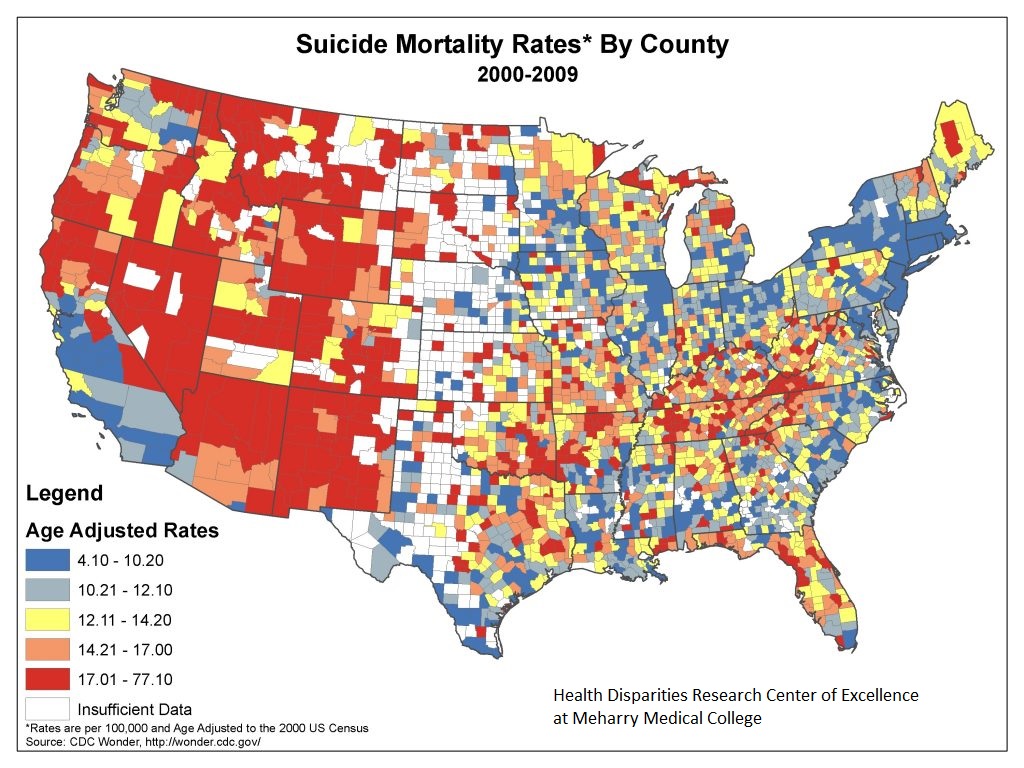

And also let me note the possibility of drawing other maps which would highlight the locations of the super-rich, very rich, rich and well-off populations in hyper-inflated metropolitan real estate markets (places like Boston, New York City and San Francisco). If we looked closer still, we could also observe the juxtaposition of urban populations facing displacement with those populations reaping the benefits. By way of illustration of what this looks like on the ground today, see the Guardian on gentrification in San Francisco and Los Angeles. The cruel worsening of life circumstances has occurred more or less simultaneously for almost all of the people who lived in many small and mid-sized towns and cities across rural America and a not insignificant number of larger cities (places like Baltimore, Detroit, Gary, and Newark), and for substantial numbers of people who lived in cities and the surrounding areas that presented a prosperous smile to the world (places like New York, Boston, Chicago, San Francisco and Seattle).
The Moment and a Response
At the current moment, what a revolutionary left is prepared and able to communicate to large numbers of people could make a difference—in the context of unresolved economic crisis and political upheaval—not only in the United States but around the world (more about that to come). As we think about how we might contribute to a substantial expansion of the capacities that a revolutionary left needs to do so, we would be well advised to avoid chasing after notions of close-at-hand ruptures[32] and, instead, to take sober measures of those forces that might be marshaled in support of an emancipatory breakthrough and the forces arrayed against the prospect of such a breakthrough.
On the other hand, the opposed forces include a state with almost unimaginable police and military resources, a not-yet-dead mainstream constellation of corporations, foundations, politicians, non-governmental organizations and a variety of media (at its most left version, think Rachel Maddow and Chris Hayes on MSNBC), and what might best be characterized as resurgent ethnic/racial nationalist movements. In the backdrop of these intentional forces, I’d make mention of an oftentimes passive and absent-minded population whose absent-mindedness is endlessly nourished by a dream world of perpetual ads, in every imaginable format, that cultivate a state of “stupefaction.”[33]
I’d supplement that quick characterization by borrowing an analysis from Leonard Zeskind, who argues that the vertices of the “three-way fight” among the politically engaged are the globalists, the nationalists and the internationalists. The first vertex is pretty much a world-wide project of the very wealthy and their accomplices in governments, corporations, financial institutions, commercial enterprises, think tanks, the academy and foundations. Those accomplices have few or no autonomous interests within the social bloc.
The nationalist vertex is distinguished by its cross-class composition and the clear inclusion of forces that have autonomous, if not antagonistic, interests. Examples of the nationalist vertex would include the various European far-right parties, a broad spectrum of Trump supporters in the United States, perhaps most of the “leave” voters in the Brexit referendum, and the “fascist” Islamists.[34]
On the internationalist vertex, there are four somewhat discrete forces:
- a small number of committed internationalists and anti-fascists;
- very well-meaning human rights activists who defend those without rights;
- “unvoiced” workers and others in the metropolitan countries and elsewhere who simply cannot imagine being against solidarity with their fellow human beings,[35] and
- very practical internationalist migrants and refugees who move their bodies and those of their kids across borders that otherwise seem so formidable.
Unfortunately, these constituencies have no coherent politics as compared to those of the globalists and the nationalists.
Our internationalist, anti-nationalist and anti-globalist engagements need to become much more integrated, explicit and activist. One obligation that we should embrace is the adoption of a comprehensive and long-term political strategy to break up the social blocs that constitute the working class grounded sub-groups of the nationalist movements. In that context, the re-articulation of class as fundamentally internationalist is central.
I’ll pick up the argument from there in the next part.
- [1]Let me say at the start that I don’t want to contribute to any notion that Donald Trump as a person should be taken seriously. He is a clown, apparently a rich one. He’s like another clown with orange hair—Clarabell. For those who are not old enough to remember, Clarabell was a character on the Howdy Doody show that was popular in the 1950s. It was a time when what was on TV was quite innocent by comparison with now. But clowns are clowns. Unfortunately, I was not the first person to think of the Clarabell comparison. On the other hand, I think the significance of his candidacy and popularity deserves the most serious consideration in light to the potentially terrible dangers they pose.↩
- [2]David Ranney, The New World Disorder: The Decline of US Power, p. 118.↩
- [3]Ibid., pp. 219―221.↩
- [4]Ibid., p. 222.↩
- [5]It’s worth keeping in mind that all of the national developments were accompanied by state and local level developments that reinforced or exaggerated the national ones.↩
- [6]See Leonard Zeskind, “David Duke Is More Than a Former Klansman,” August 2, 2016, Institute for Research and Education on Human Rights. In a similar manner, while not underestimating the significance of Trump’s primary victories, we should keep in mind that, almost until the end, his triumphs were the result of the distribution of opposition votes among numerous other candidates.↩
- [7]In spite of my appreciation for the cleverness of Trump’s dismissal, it’s important to note that Lenora Fulani was no “communist.” Fulani was a member of what can only be described as the cultish New Alliance Party that had joined the New York Independence Party (the New York State branch of the Reform Party) for its own reasons. For an analysis of the strange history of the New Alliance Party, see the Political Research Associates’ page.↩
- [8]See Lars Fischer, The Socialist Response to Anti-Semitism in Imperial Germany and Shulamit Volkov, Germans, Jews, and Antisemites: Trials in Emancipation.↩
- [9]I do not believe that the Times has ever before published or posted anything with language such as “Fuck Islam,” “Fuck the nigger,” or “Trump the bitch.”↩
- [10]There’s a really fine review of the movie by the Labor and Working-Class History Association. And a very moving song about the same events. I’d also recommend Dave Roediger’s recent book about the moment of almost unimaginable freedom that was the last part of the Civil War and the twelve years of Reconstruction, Seizing Freedom: Slave Emancipation and Liberty for All. Roediger emphasizes the ways in which the abolition of slavery by the United States Army’s command was often an acknowledgment of the practical abolition that had occurred on the ground when Union soldiers simply refused to treat runaway slaves as slaves and, instead, recognized them as fellow human beings. As a very wise revolutionary, Marty Glaberman, once wrote, changes in what people do often come before changes in what people think, let alone changes in what people say. See Martin Glaberman, Wartime Strikes: The Struggle Against the No-Strike Pledge In the UAW During World War II.↩
- [11]The history of American abolitionism, the movement to abolish slavery, is the premier example of this potential. See Noel Ignatiev’s Introduction to The Lesson of the Hour: Wendell Phillips on Abolition and Strategy. As Loren Goldner has recently pointed out to me, the characteristic that both Phillips and Rosa Luxemburg embodied was intransigence.↩
- [12]There is significant evidence of the ongoing autonomization of the police—by which I mean that the cops are not necessarily always doing the bidding of those in charge of the governments and departments they are employed by. This is most evident in the decades long history of police rebellions, most often galvanized by police unions, to challenge the authority of elected officials; for a recent example, consider the arrest strike in NYC in 2015. Although it’s hard to come by really accurate numbers, there are a lot of cops in the United States. See, for example, Daniel Bier’s “By The Numbers: How Many Cops Are There In the USA,” The Skeptical Libertarian, August 26, 2014, in which the author argues that there are over 1 million. He also points out that the rate of fatalities among police officers is quite low. In mid-September of 2016, the Fraternal Order of Police, with over 300,000 members nationally, formally endorsed Trump. When you add in family members and other relatives, let alone friends, neighbors and fellow residents of communities with relatively high numbers of police residents, you wind up with a sizeable group of people under the influence of the views of police officers. See my article on the events in Ferguson, Missouri.↩
- [13]It bears repetition that there are people on the far right who are as determined as some on the far left to overthrow the existing society and not simply to make it more conservative.↩
- [14]In May 2016, a New York Times article reported that Trump voters in the primaries up to that point had average family incomes of $72,000. See Nate Silver, “The Mythology of Trump’s ‘Working Class’ Support,” FiveThirtyEight, May 3, 2016.↩
- [15]See Donald Parkinson, “Reaction Today: Who Are the Alternative-Right and Do They Matter?” Communist League of Tampa for World Revolution, August 11, 2016.↩
- [16]Lest we lose sight of this important reality, it’s worth emphasizing that among today’s white folks are the children, grandchildren and great-grandchildren of people who were not considered white. In spite of all evidence to the contrary, “white” is not a biological category; it’s a historical-political one. It potentially includes all those who are not considered to be black. Unlike previous periods of US history, however, to be black, in and of itself, does not necessarily mean that one is subject to significant disadvantage. And to be white means less than ever that you’ll be spared some of life’s hardships. But, in spite of everything, whiteness endures. See John Garvey and Noel Ignatiev, “Beyond the Spectacle,” CounterPunch, June 22, 2015.↩
- [17]As has been said before, the ISO is a socialist organization that is pretending to be liberal that is pretending to be socialist. Its chameleon-like character is especially conducive to attracting new members.↩
- [18]See Fox News, “Wounded Warrior Project’s Top Execs Fired Amid Lavish Spending Scandal,” March 10, 2016.↩
- [19]For some additional insight into the complexity and ambiguity of the Khan family’s perspectives, see Ben Norton, “Khizr Khan: US Wars ‘Have Created a Chaos’ in Muslim-Majority Countries,” Salon, August 2, 2016.↩
- [20]There are still handfuls of people in the United States and around the world who believe that Russia is worthy of defense as a nation that continues to embody, in a more or less distorted form, the emancipatory potentials of the Russian Bolshevik Revolution of 1917. Although I recognize that the Bolshevik Revolution was carried on in the name of socialist revolution, I insist that it was nothing but a false start. Worse still, it quickly became a monstrous tyranny, arguably worse than anything other than the Nazi death machine, that poisoned the seeds of revolutionary opposition to capitalism for almost a hundred years.↩
- [21]GM Tamas, “Ethnicism After Nationalism: The Roots of the New European Right,” Socialist Register, 2016.↩
- [22]See below for a bit more of an analysis.↩
- [23]I would not want to underestimate the difficulties involved in such a cross-group approach. In the early 1980s, I helped organize a No Easy Answers Left conference in New York City that was an attempt to bring together people from a wide variety of groups and perspectives who the organizers thought should have good reasons to be connected with each other. Very little came of it. For a brief account, see Michael Staudenmaier, Truth and Revolution.↩
- [24]Postone is the author of Time, Labor and Social Domination.↩
- [25]At the risk of being charged with partisanship (because of my connections with the group), I’d highlight the example of the Sojourner Truth Organization as a real alternative to the various dead-ends. See, for example, the Insurgent Notes Symposium on Truth and Revolution.↩
- [26]Much that happened confirmed the remarkably prescient views of CLR James in his 1948 report, “The Revolutionary Answer to the Negro Problem in the United States,” at the 13th convention of the Socialist Workers Party.↩
- [27]The recent debate on the City University of New York―Professional Staff Congress contract illuminates the consequences of this development—even within the academy. The contract improved the position of full-time faculty at the expense of part-time adjunct faculty. My guess is that no group voted more consistently in favor of the retrograde contract than the full-time “left” faculty.↩
- [28]David Ranney, Global Decisions, Local Collisions.↩
- [29]An allusion to caged canaries (birds) that miners would carry down into the mine tunnels with them. If dangerous gases such as carbon monoxide collected in the mine, the gases would kill the canary before killing the miners, thus providing a warning to exit the tunnels immediately.↩
- [30]For an updated view of Ranney’s perceptive understanding of the nature of the current capitalist crisis, see his previously cited New World Disorder.↩
- [31]Lest we be mistaken, the same kinds of developments occurred across Western Europe and parts of South America.↩
- [32]See the section below on Guerilla Wars.↩
- [33]See Keston Sutherland, “What’s The Ugliest Part of Your Market-Researched Anaclitic Affect Repertoire?”↩
- [34]Here I am referring to the argument made by Alain Badiou in his speech of November 2016. Much more about that below.↩
- [35]I would recommend that we not jump to conclusions about the backwardness of the working class and, instead, to imagine that there are more than a few people who hold on to sentiments of freedom and solidarity, even when those commitments are not expressed in explicit terms. In that context, I’d cite Heinrich Haine’s recent article, “Notes From Non-Existence,” Mute, June 28, 2016, that highlighted the fact of significant majorities voting to “remain” in a number of predominantly working-class cities and neighborhoods across the United Kingdom.↩
Comments
From Insurgent Notes #13, October 2016.
In mid-June of 2016, tension between workers and their boss in a small New York City retail shop reached the boiling point. Even on a normal week these workers would have toiled under the insults of their overseer for sub-minimum wage, sweltering in the summer heat, and abused by customers and managers alike as they hustled merchandise at a rapid pace. But in the preceding days they had been subjected to an especially breakneck speedup, open wage theft, taunts that they were “privileged” and “should be happy to have their job,” and threats of replacement by “a bunch of Mexicans.” They pleaded their case to the boss, demanding to be treated as human beings worthy of respect, but these entreaties met deaf ears. As labor conditions worsened and employer retaliation escalated, the workers met behind the boss’s back and planned to stop work in a dramatic fashion, by all quitting at once. The action was designed to paralyze the shop at a moment calculated to cause maximum havoc for the boss, to send a clear message that they were more powerful than he had judged, and to walk away with a little bit of dignity intact. True to their word, about two thirds of the staff quit at once, right before the busiest day of the week. The result was chaos for a hated overseer, and the sweet aftertaste of an assertion of people power all too rare in their line of work.
For the workplace organizer, a mass quitting is usually an option of last resort. If your aim is to build collective power in your shop, the last thing you want is the most militant, or even belligerent workers to leave without a fight, which they usually do anyway, one by one, without anyone organizing it. But this is no ordinary shop. It is a commissary in the Eric M. Taylor Center (EMTC, formerly known as C-76) at New York City’s notorious Rikers Island correctional facility, where inmates shop for basic necessities not provided by the jail. These workers are themselves inmates, and their boss was a corrections officer with nearly unbridled power over their lives. At work or back at home in their dormitories, inmates at EMTC are carefully monitored for being “influential,” for their alleged gang affiliations, and for being a bit too quick to stand up for themselves. They are routinely moved around the facility both deliberately and randomly, with no appeal possible. They are kept silent in the hallways and deliberately segregated from other prisoners as a means of limiting communication. No matter what kinship defies these strictures, the average stay for a prisoner is just under two months, so the turnover in Rikers dorms is even higher than the most unbearable retail or fast food job on the outside.
Taken together, these factors drastically undermine any possibility that inmates will join together and build any kind of collective resistance against the well-documented daily indignities of life at Rikers. And the fear of retaliation that plagues the typical precarious worker is multiplied in the face of seemingly boundless power by a notoriously abusive prison staff. The dour sentiment that no organized resistance is possible, which we encounter in daily life outside of prison, is amplified considerably by these repressive conditions. By all accounts, this work stoppage was rare. And limited though it was in scope and efficacy, it certainly contradicted the general sentiment among inmates at Rikers that collective resistance is impossible, and pointed toward the possibility for coordinated resistance within what is perhaps New York City’s most dense concentration of exploitation, oppression, and proletarian misery.
As an inmate myself during this time, I spoke to one of the militant commissary workers on the day of their action, and dozens of inmates working numerous occupations over the course of my own month-long incarceration on the island. Thankfully, like most of the inmates I met, I was not held long enough to be considered for most jobs, and thanks to some great friends on the outside, I had enough cash in my account to use the phone and shop in the commissary. Nonetheless, though duly limited to a small sample of discussions and observations at EMTC, I received an illustrative glimpse into the daily lives and attitudes of inmate workers in this facility.
My observations must be situated in the particular context that there is little compulsion to work at Rikers in the sense that many imagine prison workers as forced to work. The state of New York retains the right to impose labor on all “able-bodied” men at EMTC, but this compulsion is rarely if ever exercised. Jobs can be switched, or simply quit, with a quitting inmate having little trouble finding employment elsewhere. I met only one inmate who had been assigned a job that he did not want, and who was weighing whether to refuse. To refuse would be to possibly risk losing “good time,” potentially prolonging his stay, and to risk being moved from a relatively calm and peaceful “working dorm” into what could be a more hectic and violent living situation. These are certainly serious threats for inmates trying to get out in one piece as quickly as possible. But by all accounts, these penalties are rarely if ever imposed. Besides this one man, every other assigned worker I spoke with either wanted his job, wanted a second job, or wanted a better job. This is a place where inmates want to work. And the reason is scarcely reducible to their pitiful wages.
Inmate workers are notoriously underpaid and more often than not labor under conditions hidden from public sight by mortar and razor wire. At Rikers, full-time workers can expect anywhere between $80 and $112 per week for working well beyond 40 hours. Besides commissary, inmates work in the cafeteria, laundry, clinic, law library, carwash for corrections buses (and unofficially, I was told, the guards’ cars), general building maintenance including painting, construction, and janitorial services, and perhaps the oddest job I learned of, burying the city’s unclaimed bodies in New York’s potter’s field. The most basic janitorial upkeep of EMTC’s minimum security dorms, where upwards of sixty inmates live in one open room, is maintained by “house detail” inmates, who then become responsible for, often quite aggressively, enforcing the rules of hygiene and cleanliness on those around them. Sometimes house detail work is even done for free as a means of buttering up the guards to get on the rolls officially. It is not uncommon for inmates in the hallway or dining hall to make a quick break away from the guard escorting them to give their name and number to an official they believe can get them a coveted job. Inmates allowed to work outside the facility walls are dressed in bright orange stripes, kept starched and impeccably clean compared to the grubby greens of the homebody inmate worker. This clear marking of the relatively privileged inmate workers cuts to the core of the incentive for inmate workers: mobility across the facility and outside of it, escape from the boredom and brutality of life in the dorms, and most generally, an increased control over daily life.
Wages are of course important to Rikers inmates, especially low-income inmates with no commissary funds and dependents on the outside. But one need not understate the value of the wages in order to appreciate the extra-monetary incentives for inmate labor. First of all, it is not as if the most enthusiastic inmate workers don’t realize they are being egregiously exploited by wages far below even the pitiful minimum wage. I spoke to one inmate who worked well over 40 hours per week, as a painter, for $112. He didn’t even bother keeping track of his hours. He would half-heartedly brag about the money, but he didn’t seem to believe his own bluster, and everyone knew that deep down he knew that the money was nothing to brag about. His compensation was of a different sort. As a worker with outside clearance, he was able to leave the often chaotic dorms for a good part of the day and night. He sometimes traveled across the seemingly endless bridge leading off the island into a vanishing point of flashing sirens—an occasion about which most inmates must be content to fantasize for the tenure of their incarceration. He was able to eat food from the outside, the topic of endless hours of wanful reminiscences over sparse plates of bland prison fare. He could relate to his co-workers not as fellow victims of a debased situation, but as part of a cooperative project. And the impatient, aggravated way he related to his free time on days off from work suggested what is perhaps the principal motivation for him and many inmate workers: escaping boredom, making time go by faster, and getting out of the dormitories for as long as possible.
An inmate, with outside clearance, worked all day and well into the night in the kitchen at another jail. He rolled his eyes at the money, and anyway had enough support on the outside to do without it. So why did he look forward to his job? He wasn’t in jail, he told me, when he was there. A chef by training, he worked at his own pace in the kitchen, under his own direction, and could get lost in his work. The guards at his worksite treated him as more of a colleague than a prisoner, even helping him correct a clerical error that had extended his sentence beyond his release date. He had freedom to prepare his own food, and even eat food from outside. And for a few hours each day he had some down time to watch TV or otherwise enjoy the indescribably rare privilege of solitude, far from the imposed stupidity of dormitory life. Back at Rikers he winced at the constant shrieking of the house guards, the hostilities of the inmates, and the countless indignities built into even the smoothest day at EMTC. He was happy to rise before the sun and get away from all this.
A fellow new arrival I spent my first week with in the intake dormitory had been to Rikers dozens of times and couldn’t wait to get a job. But he wasn’t really thinking about the pitiful salary, and he seemed to somehow have everything he needed already. What he was after was the excuse to move around freely. One day he left with a pass for the clinic and came back having shopped at the commissary by himself, which to the average inmate would be completely impossible, and the mere attempt would probably lead to disciplinary action. This man knew the island inside out, and only needed the privilege of circulation throughout the institution to run in different social circles, to nourish mutually beneficial quid pro quo relationships with powerful guards, and most of all, to circulate items. Beyond the items everyone would guess, like tobacco, it is just as common for a tightly rationed commodity as banal as jelly or matzo bread to be wildly popular, giving whoever has access to these items an upper hand in informal economies, social hierarchies, or simply being a mensch. Some items seemed to only circulate through this sort of gray market, such as “two piece” inmate uniforms. Inmates are given ill-fitting, uncomfortable jumpsuits upon arrival, but there are shirts and pants of the same color which circulate through back channels, and mark the wearer as someone who knows their way around the place. In my month-long incarceration I saw no legitimate channels through which to secure these garments, and their informal circulation occurred unhampered by any authorities. Needless to say this also applies to less innocuous contraband, but I’ll leave the snitching to someone else.
The oddest character I met actually cleaned the grimy bathroom for free, when he wasn’t on the schedule, just for something to do. A Russian friend who had served time back home assured me that doing this there would place you at the bottom rung of the prison hierarchy, with the untouchables. But to the Americans, it lacked any kind of stigma or even appearance of abnormality. Better than sitting around, doing nothing. With food and shelter guaranteed, there is almost nothing to do all day besides watch garbage TV, listen to the same increasingly boring war stories from those around you, play repetitive games, or steal some reading over the incessant shouting of inmates and guards. There is scarcely any access to education, exercise, quiet reflection, any kind of creative outlet, or source of personal fulfillment, to say nothing of escape from physical confinement within a small and overcrowded space. The basic necessities of life like eating, showering, shaving, even clipping your nails, though guaranteed, are regulated by the whims of capricious guards, and subject to draconian restrictions with no appeal. Necessary items are paltry and scarce, for no good reason. Meaningful activity is even rarer to come by than the kosher meal matzo crackers everyone seems to desperately want. (“We don’t even really eat those,” a puzzled Jewish friend told me.) In sum, prisoner work cannot be understood without reference to this totalizing environment. It is possible the actual labor is the least important element of the complex relationship between inmate workers and the most basic activities of their daily lives. Cast in this light, the struggle over conditions of labor becomes the struggle over the nature of free time.
This brings us back to mid June, when a critical mass of commissary workers joined together and lit their boss’s hair on fire, figuratively speaking of course. The commissary in question is akin to when a bodega stays open after midnight but conducts all business through a plexiglass window, making communication a bit difficult, and the line slow-moving and impatient. Shopping, as it is called, is done on a designated day and hour, with upwards of fifty shoppers lined up to be served, called one by one by name to rattle off a shopping list as quickly as possible through muted slots in dingy plexiglass. The workers behind the plexiglass fill buckets on a kind of assembly line amidst shouts, accusations of theft, gossip conducted loudly between men who don’t see each other often, names ringing out mispronounced over and over, and in this general environment of confusion, violence lurking just below the surface, and sometimes above it. When not attending to shoppers, these workers are also responsible for unloading trucks and stocking the storerooms, which requires climbing a ladder with boxes of goods in tow. The guards decline this work, and stick to running the final tally at checkout, and delegating responsibility.
Work in the commissary is unique in this facility in that it comes with the bonus of “tips,” items which the commissary worker rather firmly suggests each shopper donate in exchange for their hard work. And it really is the least we can do. Tips usually consist of tiny bags of chips, cookies, or sweets ranging in price from $.50 to $2. Such items, unremarkably common on the outside, assume an inflated importance in the prison environment of enforced scarcity, and serve as the cornerstone of the informal economy which brings licit and illicit items into one market with a generally agreed rate of exchange. This is to say that what is immensely valuable to commissary workers is almost worthless to the guards, who have no shortage of access to miniature bags of Doritos or little strudel cookies in their daily lives. However this does not stop the guards who run the commissary from extorting their share of the tips from the workers (when not outright campaigning to end the practice of tips, which the more righteous among them consider to be itself a form of extortion). Theft of petty commissary by staff, a commonly reported indignity suffered by inmates, seems mostly to be a raw display of power, though looking at these guards gives one the sense that the cookies and Doritos are not going to waste. “Render unto Caesar what is Caesar’s,” one guard told a comrade, charitable enough at least to quote Jesus Christ while ripping him off. Meanwhile the same guard reserved the right to leave pay slips unsigned, as a punitive measure, a show of power, or simply an expression of apathy, which could result in a worker not getting paid on time. This had become common practice by the time these workers took action.
The always simmering labor relations of this particular shop came to a head after a day-long building-wide lockdown backed up the commissary even further than usual. The commonly accepted story ran that one inmate was cut by another in the dorm upstairs from mine, and what followed was a small scale rebellion. When the riot squad showed up in response to the stabbing, the men of the dorm came alive. They defied orders to disperse by the riot gear clad “turtles,” and were sprayed with the powerful chemical weapon MK9. A noxious breeze wafted through our windows below as we rushed to screw them shut, amidst defiant chanting and singing ringing out throughout the courtyard, spreading to other dorms. A disembodied voice upstairs excitedly shouted play by play out his window to a man in our dorm who was broadcasting the news live to the rest of us. Soon the hubbub died down, and the reaction of the island’s veterans told me this was not an uncommon occurrence.
Predictably enough, inmates throughout the building were placed on lockdown the following day, subjected to an invasive and humiliating search (during which a different class of workers, those who clean up during shakedowns, were roundly accused of theft, for which they are rightly or wrongly well known—my own experience suggesting the former), denied basic services, and above all, denied our trip to commissary. A lockdown responds to a particular act of violence, limited to a specific time and place, by creating a general atmosphere of violence throughout the entire facility. While logically justified to prevent repercussions from the original act, they far more resemble what one friend of mine called “some revenge shit.” Inmates are kept home from work, packed in close quarters, disallowed to shower or use the dayroom, invasively searched, bullied in the hallway by guards, denied access to the phone, denied hot water to make food while meals operate on an unpredictable schedule, and sometimes kept on their beds. In this environment, heated arguments break out between inmates or with guards, and individual loudmouth inmates (and guards) deliver angry soliloquies which ramp up the tension. The guards who try to be “cool” with the inmates by flirting or talking about basketball or allowing special privileges have no choice but to enforce these rules, participate in shakedowns, and defend the most overzealous of their peers, the foremost of whom boast of a military background and act accordingly. In short, the reality of daily life, sometimes buried beneath pleasantries and fringe benefits, is brought into the sharpest relief at these moments.
Already agitated by the lockdown and quickly approaching point zero, these commissary workers returned to work the following day to be met with a breakneck speedup and a dramatic extension of their work hours meant to quickly fill the gap left by a missed day of service. In short, they were forced to bear the brunt of the very lockdown which had debased them the day prior. Slowly they began to openly rebel, egging each other on, picking fights with the guard in charge and antagonizing him whenever possible. “Your soul is required in Hell!” one worker bellowed over and over to the laughter and approval of others. At the end of a long, stressful day playing catch-up after the lockdown, the guard in question confiscated half of the tips for the day, totalling a hundred or more dollars each in Rikers currency. To make matters worse, he had caught wind that the inmate workers were planning to quit, so he refused to sign all their pay slips for the day, meaning they would have no choice but to come back. He knew that the following workday, a Monday, was to be “bag day,” when items are delivered to the houses instead of the inmates coming to shop. This is quite labor intensive compared with regular shopping, and yields no tips. A shortfall on a Monday would hit the boss hardest. If the wage theft was provocation, this was a clear challenge: if they wanted their back wages, they’d have to come back to work. But he underestimated the dependence of his workers on this wage. He thought he had them beaten by the threat of withdrawing their checks. But in the end, they said pay slips be damned, lockdowns be damned, daily life at Rikers Island be god-fucking-damned, we’re quitting anyway. And they did.
Comments
From Insurgent Notes #13, October 2016.
The ultimate expression of law is not order—it is prison.
George Jackson, Blood In My Eye (1971)
There was a time in the United States when it was not only common knowledge, but commonly reported, legislated, and adjudicated that crime is a function of poverty. This went out sometime during the Carter Administration, its demise heralded by the appearance in 1975 of James Q. Wilson’s Thinking About Crime, where he first aired the broken-windows theory,[1] which holds that punishment has to be harsh for minor violations of public order to incentivize criminals against larger violations. It’s all about economics, really, and rising crime rates, busted budgets, city bankruptcies, stagflation, wildcat strikes, and outrageous youth were all that Johnson’s Great Society had to show for itself.
The liberals were disarmed, which should have been a good thing, considering their war record. But it was a double-edged sword (pun intended): all that remained of their decades-old reform portfolio was Moynihan’s “tangle of pathologies,” which, when combined with the punitiveness of the Reagan Administration’s rejuvenated war on drugs, left no room for social critique of the old 1960s–early 1970s style. The dregs of this already disgusting mixture has by now fermented into a toxic eugenicist mead of evolutionary psychology, epigenetics, and behavioral economics, with a reform brief of its own:
- the reinstatement of the death penalty in 1976 after four years of unconstitutionality[2];
- New York State Governor Nelson Rockefeller’s innovation of mandatory-minimum sentences for drug possession in 1973,[3] which were the model for the 1986 us Anti–Drug Abuse Act and its infamous 100:1 crack–powder cocaine ratio;
- Bill Clinton’s 1994 omnibus crime bill, which contributed a great deal to the near-doubling of the us prison population since 1992;[4]
- Bill Clinton’s term limits on public assistance via Temporary Assistance to Needy Families;[5]
- Reagan’s, Bush’s and Clinton’s harsh conditions for obtaining and keeping public housing;[6]
- prison-like charter schools for the children of poor blacks and Latinos;[7]
- nonprofit, nonunion, charity-oriented teacher militias, fresh out of college and ready to “give back to the community” by undermining teacher’s unions and public employees generally;[8]
- the brutal policing created by the war on drugs;
- tank-driving and grenade-launcher and M16–wielding police officers in public schools.[9]
There has been a fight over the last item: Students in the Los Angeles Unified School District found out that their school district’s police force, the Los Angeles School Police Department, had received those weapons from the Pentagon, and have recently forced the laspd to give it all back to the Department of Defense, and to formally disenroll from the dod’s “Excess Military Equipment” program 1033![10]
Someone once said that prison is the most important and least understood subculture in the United States. It may have been George Jackson, who ended up with a life sentence for robbing a gas station of $70, but I don’t remember. It comes to mind because back in the days before rehabilitation was taken off the agenda, prisoners had more opportunities to educate themselves in order to be able to write and speak for themselves, and people listened to what they had to say. For instance, in June 1971 convicts at Attica State Prison in upstate New York started a peer-led sociology class, and this led to the creation of a political group called the Attica Liberation Faction. One month later, in July 1971, this group was making demands of Governor Nelson Rockefeller and the New York Department of Corrections. They did this in the spirit of a similar list of demands presented by Folsom State Penitentiary convicts in 1970. The warden responded by increasing harassment, cutting privileges, and refusing to meet with the convicts.[11] The famous Stanford Prison Experiment, dramatized in the 2001 Moritz Bleibtreu film Das Experiment, was completed on August 20, 1971, and one day later, on August 21, George Jackson was killed by San Quentin prison guards in an escape attempt. There were work stoppages in prisons across the country, and there was also a daylong hunger strike and an interracial silent demonstration at Attica on August 22. Because of their newfound solidarity in demonstrating over Jackson’s death, the convicts at Attica were ready to go on the offensive against the warden’s refusal to address their demands. They occupied the hospital wing of the prison, and after attempts by guards to repress them, they extended their occupation to a full-scale five-day seizure of the entire facility. Rockefeller sent the National Guard to take the prison back by force, and to kill 10 guard-hostages and 29 convicts.
It’s not over. And it’s not only about “crime” and cultures of pathology. It’s all about economics, really, and always has been. Consider nafta, another of Bill Clinton’s noxious legacies, which flooded Latin America with cheap agricultural products, incentivizing former farmers to seek economic opportunity in El Norte, or in the cultivation of more lucrative and less legal crops. Those tired, poor, huddled masses who manage to cross the border find not only construction, meatpacking, landscaping, janitorial and all other manner of work, but also La Migra: Immigration and Customs Enforcement. Sometimes La Migra shows up just when workers start demanding better treatment and higher wages, as has occured more than once in meatpacking, for instance.[12]
In many states, Texas and Arizona among them, these workers find that ice has deputized local law-enforcement agencies, from sheriff’s departments to city police, in the enforcement of immigration laws.[13] Arizona took this to another level in its own legislature.[14] When caught, these workers are thrown into special prisons where they are treated like common criminals; not unlike how common criminals were treated as unskilled labor on the chain gangs of yore, or the way they are still treated as agricultural labor on Parchman Farm in Mississippi and Angola in Louisiana, or as service workers in various industrial jobs where they take airline reservations and do other call-center work, or make textiles and license plates, or clean and administer state buildings like penitentiaries, or corporate facilities like private prisons.
Not only is it not over, but a new chapter is beginning. The ongoing struggle of us convicts to preserve and enhance their humanity has been taking on an explicit labor aspect, connected to and conscious of such struggles outside the prison walls, and it appears to be intensifying hand in hand with the convicts’ traditional struggles for human dignity. A short chronology[15] follows.
1. The “Motin” Insurrection, December 2008
The first of the recent wave of prison strikes and prison riots began in December 2008 in the town of Pecos, Texas, 60 miles from the Chihuahua border, at the Reeves County Detention Center, a federal immigrant-labor prison operated by a company called the geo Group. An epileptic detainee named Jesus Manuel Galindo died from a seizure while in solitary confinement, after he and friends had pled for him to be taken out of solitary, and after having been refused medical attention. Detainees rioted and burned down a small part of the facility after he died. geo blamed its medical subcontractor for the death. Detainees rioted again for five days in January 2009, causing $20 million in damage.[16]
2. Georgia and the United Nations Against the Machine, December 2010
An interracial coalition of Crips, Bloods, Muslims, Aryan Nation, and Latino convicts staged the largest prison strike in us history, refusing to leave their cells or work, with ten of Georgia’s 78 (!) prisons participating. Their grievance was that their forced labor was unpaid. Not poorly paid, but unpaid. They demanded wages for their work and among the other demands was an end to solitary confinement.[17] The unam was a result of the strike.
3. Jackson State Hunger Strike, June 2012
Some unam leaders were punished by reassignment to Georgia’s Diagnostic and Classification State Prison, known as Jackson State, the prison at which Troy Davis was executed. Some of them held a hunger strike there to protest their solitary confinement, family restrictions, attorney restrictions, and lack of medical attention, many having been injured after the statewide strike.[18] The hunger strikers called it quits after 44 days, but a telephone denial-of-service attack, a march on the state Department of Corrections, and a demonstration at the doc commissioner’s office showed the strikers they were not alone.
4. Pelican Bay shu, June 2011
Pelican Bay, opened in 1989, is California’s only super-maximum prison, and it makes heavy use of its Solitary Housing Unit (shu), which means 23-hour cell time and corraled, individual yard activity. California has had people in the shu for decades at a time. Hugo Pinelli, one of the original San Quentin Six accused of actions in the furtherance of George Jackson’s escape attempt, served the longest, with 23 years in the shu. Convicts were assigned to the shu on the basis of mere suspicion or allegation of gang affiliation, and could be held there until they informed on other convicts. After almost three decades of this, there were more than 1,100 convicts in the Pelican Bay shu, and more in other California shus. Half had been in the shu for more than a decade, and 78 had been in the shu for two decades or more.[19] So the Pelican Bay “Short Corridor Collective,” an interracial group of convicts, undertook a three-week-long hunger strike in June 2011. The strike grew to more than 6,000 convicts across California. Their demands were to end group punishment, abolish the snitching requirement to leave the shu, change the gang-affiliation criteria, follow federal solitary-confinement guidelines,[20] better food, and better programming for long-term shu convicts.[21] This drew international attention, and the state legislature held hearings in August. They didn’t do anything, so convicts went on hunger strike again in September. In 2011, the California doc undertook a study of its policies. The upshot of this study is that with virtually any standards for shu assignment at all, the state could not justify its sentences to solitary confinment. A wardens’ group announced the creation of a step-down program to transition convicts back into general population in March 2012, and set actual behavioral standards for shu assignment.[22] The step-down program provided a path out of solitary other than snitching on fellow convicts. The step-down program required case-by-case review of all shu assignments, which were interrupted by a third hunger strike in July 2013: “At the outset on 8 July, more than 30,000 inmates in two-thirds of the state’s jails joined the strike, the biggest in California history, to protest extended solitary confinement.”[23] Among the accomplishments of this series of hunger strikes and the class-action lawsuit accompanying them[24] are the release into general population of the vast majority of reviewed shu cases (910 out of 1,274 in June 2015[25]), a ban on indeterminate shu sentences, behavior-only sentencing, and a 5-year maximum Pelican Bay shu sentence.[26]
5. Free Alabama Movement, January 2014
Inspired by the United Nations Against the Machine movement in Georgia, the Free Alabama Movement started in St. Clair Prison and spread to Holman as well. The main spokesman for this first wave of the fam was Melvin Ray, who was explicit and adamant about the strike as a labor action against economic exploitation per se.[27] The economic impact of the strike is the weapon convicts need, not only to achieve the human dignity under constant attack in prison, but to end mass incarceration itself. Demands were an end to free labor; better living conditions; the abolition of capital punishment and life-without-parole; an end to price-gouging in prison services like J-Pay, commissary, phone companies, and medical co-payments; and sentencing reform to end racial discrimination.[28] fam established a relationship with the iww[29] after a second, abortive strike attempt in April,[30] and has since established links to unam, the Free Mississippi Movement United, the New Underground Movement (in California), Kansas state prisoners, and the Lucasville 5 in Ohio.
6. Stewart Detention Center, Lumpkin, Georgia, June 2014
Detainees at the Stewart Detention Center in Lumpkin, Georgia, began their hunger strike on June 12, 2014. Among their demands were…better food. “The same water used to boil eggs was reportedly being used to make coffee and maggots were found in the food. Immigrants working in the kitchen have stated that food preparation facilities were unsanitary and had a roach infestation. Two or three-day-old food was often served, even though it had gone bad.”[31] Demands also included due process before lockdown and solitary confinement, hot water, air conditioning (imagine a Georgia summer with no air conditioning), Spanish-speaking staff, and better medical care. Please remember that these are detainees held for violating immigration law.
7. Northwest Detention Center, Tacoma, Washington, March 2014
About 750 out of 1,300 detainees waged both a hunger strike and a work stoppage at geo Group’s Tacoma, Washington, facility on March 7, 2014. Items on their list of complaints were the $1 per day wages, the lack of adequate food, and Obama’s immigration policies more broadly, i.e., the mandatory detention without bail of immigration-law violators, and the perverse incentive structure of immigration enforcement: the Department of Homeland Security must detain a certain number of undocumented immigrants every year in order to get its full budget![32] Hunger strikers were punished with solitary confinement.[33]
8. Joe Corley Detention Center, Conroe, Texas, March 2014
Word of the Northwest struggles reached the Gulf Coast quickly, and detainees at another geo Group facility about 40 miles north of Houston went on hunger strike themselves. Their demands were an end to deportation and detention altogether![34] Seventy-five to 100 supporters, in a National Day of Action to defend the Tacoma hunger strikers, stormed the Harris County (Houston metro area) sheriff’s offices in April, demanding the end of 287(g), the law deputizing local law enforcement for ice, requiring them to check the immigration status of arrestees. Meanwhile, the geo Group increased solitary confinements and the ice sped up deportations to quash the action. There was a single stab at a labor strike in the last days of the Corley hunger strike, but it was not sustained.[35]
9. Willacy County Detention Center, Raymondville, Texas, February 2015
Detainees at this border-town immigration prison got fed up with the medical care, rotten food, and inadequate plumbing and toilets. They armed themselves with broomsticks and kitchen knives, and took control of the facility. After the FBI arrived to put down the rebellion, they burned down half the tents, and damaged all the others, totally destroying the facility. It no longer exists. Four hundred of the town’s inhabitants (21,921 total inhabitants) lost their jobs, and the county’s debt was reduced to junk, prison revenues having dried up.[36]
10. Karnes City, Texas, April 2015
A group of 10 mothers, confined with their children in this geo Group detention facility, refused both to eat and to perform their $3 per day labors. They did this twice that month. The Obama administration had helpfully increased the number of family-detention centers after the “unaccompanied minors” immigration crisis in 2014. Prison officials threatened to take their children away, and punished some strikers with solitary confinement.[37]
11. Tecumseh State Prison, Tecumseh, Nebraska, May 2015
In May 2015, an interracial group of around 400 convicts wanted to tell the warden that they were planning to strike to protest arbitrary solitary confinement and the yearslong (since 2012) “managed-yards model,” which restricted their access to physical exercise and yard time, and a list of other indignities.[38] A prison guard refused to physically accept the demands, written on a piece of paper for transmission to the warden, and instead started macing the convicts. At this point, the situation turned into what the media call a riot, but which was actually an occupation of two of the three housing units. They held these units for about 10 hours, injuring only 2 of 20 guards in all that time.[39] A Wobbly was there, incarcerated, and wrote the story up.[40]
12. Eloy Detention Center, Eloy, Arizona, June 2015
In June 2015, around 200 detainees organized a hunger strike at this Corrections Corporation of America–owned immigrant prison outside Phoenix after guards beat a detainee and then threw him in solitary, where he died. This was the catalyst. Of course, among their grievances were the $1 per day wages at forced labor, and the lack of medical treatment.[41] They also demanded an end to detention and deportation per se: “no more criminalization, detention and deportations.”[42]
13. Holman Prison, Atmore, Alabama, March 2016
At the same Holman prison activated in the 2014 fam strike, two convicts had a fight. First a guard tried to intervene and got stabbed, and then the much-hated warden, a cruel man who had increased levels of violence (both staff and convict) and cut back on popular programs, tried to break up the fight himself, and he also got stabbed.[43] Convicts occupied that wing of the prison and tried to burn it down.[44] fam began talking statewide strike, and sent a list of demands to the state department of corrections calling for federal intervention and repeal of repeat-offender laws.[45]
14. fam and the Statewide Alabama Prison Strike, May 2016
fam continues to wield the strike weapon. The fam led a labor stoppage, started on May 1, which was scheduled to last 30 days. The strike activated St. Clair, Holman, and Staton, the same prisons involved in the 2014 fam strike.[46] When they got wind of this, officials started “bird-feeding” the convicts and restricting their commissary purchases. All striking Alabama prisons were put on lockdown, which means confinement to cells for 23 hours a day. Convicts refused to work both unpaid prison jobs and waged industry jobs: the industry jobs at Holman, for instance, are license plates, sheetmaking, canning, recycling, vehicle restoration, and chemicals manufacturing. Alabama prisoners have to pay, out of their own pockets, for such things as prison identification cards and armbands, drug tests, and court petitions to file complaints of any kind. Demands include the abolition of unpaid labor, based on 13th Amendment considerations, better sanitation and water, and the creation of a grievance procedure. The emergency-call buttons in the solitary confinement units have never worked.[47]
15. Incarcerated Wobblies and the Nationwide General Prison Strike, Texas, April 2016
Beginning on April 4, 2016, back in Texas, some incarcerated Wobblies (part of the union’s Incarcerated Workers Organizing Committee) organized a strike that spread to 7 Texas prisons: Lynaugh in Fort Stockton, Mountain View in Gatesville, Polunksy in Livingston, Roach in Childress, Robertson in Abilene, Torres in Hondo, and Wynne in Hunstville. Authorities at the first unit to strike, Robertson, placed the facility on lockdown the night before, in an attempt to quash the strike, but the next morning, the only people to go to work were the trustees, a tiny minority of convicts. Among the demands are an end to unpaid labor, parole at the earliest possible date, a repeal of $100 medical co-payments, an impartial grievance procedure, and air conditioning. Again, no air conditioning in Texas prisons![48] If you’ve ever been to Texas, you know this is a serious problem. Authorities kept Robertson on lockdown for three weeks.
Like I said, a new chapter is beginning. The fam, the Free Virginia Movement, and the iwoc, which has members in prisons all over the country, are planning for a September 9, 2016, nationwide general prisoner strike to commemmorate the Attica rebellion, 45 years ago that day.[49]
- [1]See George L. Kelling and James Q. Wilson, “Broken Windows,” The Atlantic, March 1982, http://www.theatlantic.com/magazine/archive/1982–03/broken-windows/304465/?single_page=true.↩
- [2]Gregg v. Georgia, 428 us 153 (1976), https://en.wikipedia.org/wiki/Gregg_v._Georgia.↩
- [3]The “Rockefeller Drug Laws,” https://en.wikipedia.org/wiki/Rockefeller_Drug_Laws.↩
- [4]According to “Prisoners in 1992,” Bureau of Justice Statistics Bulletin, http://www.bjs.gov/content/pub/pdf/p92.pdf, the number of state and federal prisoners was in 883,593 in 1992, not including jails. “Prisoners in 2014,” http://www.bjs.gov/content/pub/pdf/p14.pdf, reports that there were 1,561,500 state and federal prisoners in 2014, again not including jails.↩
- [5]You can only receive benefits for 60 months, and states can have lower limits if they like; see https://en.wikipedia.org/wiki/Temporary_Assistance_for_Needy_Families.↩
- [6]See “Alcohol, Drug, and Criminal History Restrictions in Public Housing,” Cityscape 3, vol. 15 (2013), https://www.huduser.gov/portal/periodicals/cityscpe/vol15num3/ch2.pdf.↩
- [7]See “KIPP: The Kids in Prison Program,” an article at Weapons of Mass Deception, https://weaponsofmassdeception.org/3-charter-school-kid-prisons/3-4-kipp-the-kids-in-prison-program. KIPP has literally based its pedagogy on an actual CIA torture technique applied at Guantanamo, and this is not an exaggeration.↩
- [8]Chad Sommer, “Teach For America’s Pro-Corporate, Union-Busting Agenda,” Salon, January 13, 2014, http://www.salon.com/2014–01/13/teach_for_americas_pro_corporate_union_busting_agenda_partner/. It just so happens that Wendy Kopp, the head of TFA, is married to the head of the KIPP foundation, Richard Barth. KIPP uses TFA teachers very heavily.↩
- [9]Adrian Kudler, “Why Does the LAUSD Have 3 Grenade Launchers and a Tank?” Curbed LA, September 15, 2014, http://la.curbed.com/2014/9/15–10047594/why-does-the-lausd-have-3-grenade-launchers-and-a-tank-1.↩
- [10]Eric Mann, “How We Got the Tanks and M16s Out of LA Schools,” Counterpunch, May 20, 2016, http://www.counterpunch.org/2016–05/20/how-we-got-the-tanks-and-m-16s-out-of-la-schools/.↩
- [11]“Attica 1971: Setting the Stage for a Prison Revolt,” us Prison Culture, July 27, 2011, http://www.usprisonculture.com/blog/2011–07/27/attica-1971-setting-the-stage-for-a-prison-revolt/.↩
- [12]See the overview of the 2006 meatpacking raids in Daily Kos, “Immigration raids more about union-busting than law enforcement?” which contains lots of links to many articles about the six-state “Homeland Security” raid, http://www.dailykos.com/story/2006–12/15–281211/-.↩
- [13]See “Delegation of Immigration Authority,” Section 287(g), Immigration and Nationality Act. This section was added in 1996. It “authorizes the Director of ice to enter into agreements with state and local law enforcement agencies, permitting designated officers to perform immigration law enforcement functions…,” us Immigrations and Customs Enforcement, https://www.ice.gov/factsheets/287g.↩
- [14]Arizona passed SB 1070, the “Support Our Law Enforcement and Safe Neighborhoods Act,” in 2010.↩
- [15]This chronology is given in Tyler Zee’s “Incarcerated Workers Take the Lead: Prison Struggles in the United States, 2008–2016,” http://unityandstruggle.org/2016–05/05/incarcerated-workers-take-the-lead-prison-struggles-in-the-united-states-2008–2016–3/. This is an elaboration.↩
- [16]Forrest Wilder, “The Pecos Insurrection,” Texas Observer, October 8, 2009, https://www.texasobserver.org/the-pecos-insurrection/.↩
- [17]Naomi Spencer, “US: Georgia Prison Inmates Strike,” World Socialist Web Site, December 13, 2010, https://www.wsws.org/en/articles/2010–12/geor-d13.html.↩
- [18]Bruce Dixon, “Starving For Change: Hunger Strike Underway In Georgia’s Jackson State Prison, Day 15,” Black Agenda Report, June 26, 2012, http://www.blackagendareport.com/georgia-jackson-state-prisoners-hunger-strike-day15.↩
- [19]Sal Rodriguez, “In California Prisons, Hundreds Removed from Solitary Confinement—and Thousands Remain,” Solitary Watch, January 27, 2015, http://solitarywatch.com/2015–01/27/in-california-hundreds-have-been-removed-from-solitary-confinement-and-thousands-remain/.↩
- [20]Unbelievably, it appears that the state doc did not consider that it needed to follow federal solitary-confinement guidelines because it held itself not to be imposing solitary confinement: “ ‘We don’t have solitary confinement,’ CDCR spokesperson Terry Thornton told Solitary Watch. ‘We segregate. Inmates are segregated from inmates for specific reasons: they may be administratively placed there or they may be placed there if they killed their cellmate for example.’ ” Sal Rodriguez, “After Hunger Strikes, Solitary Reforms Come to California’s Prisons—and Leave Thousands Behind,” Solitary Watch, July 1, 2015, http://solitarywatch.com/2015–07/01/four-years-after-the-first-hunger-strike-reforms-have-come-to-californias-prisons-and-left-thousands-behind/.↩
- [21]Sal Rodriguez, “After Hunger Strikes…,” July 1, 2015.↩
- [22]Ibid.↩
- [23]Rory Carroll, “California prisoners end hunger strike against the use of solitary confinement,” The Guardian, September 5, 2013, http://www.theguardian.com/world/2013/sep/05/california-prisoners-end-hunger-strike.↩
- [24]See Ashker v. Brown (2013), outlined at the Center for Constitutional Rights, http://ccrjustice.org/home/what-we-do/our-cases/ashker-v-brown.↩
- [25]Sal Rodriguez, “After Hunger Strikes…,” July 1, 2015.↩
- [26]Ibid.↩
- [27]Annabelle Parker, “ ‘Let’s just shut down’: an interview with Spokesperson Ray of the Free Alabama Movement,” San Francisco Bay View, December 2, 2014, http://sfbayview.com/2014–12/lets-just-shut-down-an-interview-with-spokesperson-ray-of-the-free-alabama-movement/.↩
- [28]Free Alabama–Mississippi Movement United, Free Alabama Movement (2014) https://freealabamamovement.files.wordpress.com/2014–11/pamphlet-fam-fmm-uspapersize.pdf.↩
- [29]International Workers of the World, “Solidarity with the Incarcerated Workers of the Free Alabama Movement!” April 18, 2014, http://www.iww.org/content/solidarity-incarcerated-workers-free-alabama-movement.↩
- [30]Josh Eidelson, “Exclusive: Inmates to strike in Alabama, declare prison is ‘running a slave empire,’ ” Salon, April 18, 2014, http://www.salon.com/2014–04/18/exclusive_prison_inmates_to_strike_in_alabama_declare_they percent E2 percent 80 percent 99re_running_a_slave_empire/.↩
- [31]Georgia ACLU press release, “Worsened Conditions at Stewart Led to Hunger Strike Last Week,” http://www.georgiadetentionwatch.com/news/.↩
- [32]Alex Altman, “Prison Hunger Strike Puts Spotlight on Immigration Detention,” Time, March 17, 2014, http://time.com/27663/prison-hunger-strike-spotlights-on-immigration-detention/.↩
- [33]“Breaking: Hunger Strikes Spread to Texas Detention Center,” Not One More Deportation, March 17, 2014, http://www.notonemoredeportation.com/2014–03/17/breaking-hunger-strikes-spread-to-texas-detention-center/.↩
- [34]Adelita, “The Conroe Detention Center Strike—Reflections of a Houston Militant and Wob,” Unity and Struggle, August 18, 2015, http://unityandstruggle.org/2015–08/18/the-conroe-detention-center-strike-reflections-of-a-houston-militant-and-wob/. Adelita, the author, was at some of the events recounted.↩
- [35]Ibid.↩
- [36]Daniel Blue Tyx, “Goodbye to Tent City: After a riot destroys a for-profit prison, Willacy County ponders its economic future,” Texas Observer, March 26, 2015, https://www.texasobserver.org/south-texas-prison-riot-willacy-county-economic-future/.↩
- [37]Roque Planas, “Mothers Launch a Second Hunger Strike at Karnes City Family Detention Center,” Huffington Post, April 14, 2015, http://www.huffingtonpost.com/2015–04/14/detention-center-hunger-strike_n_7064532.html.↩
- [38]JoAnne Young, “Ombudsman: Tecumseh Riot Had Reasons,” Lincoln Journal-Star, November 3, 2015, http://journalstar.com/news/state-and-regional/nebraska/ombudsman-tecumseh-riot-had-reasons/article_d52f39c3-1d43–5656–8a0b-ac9e851ca2c3.html.↩
- [39]Paul Hammel, “Report on Tecumseh Prison Riot Finds Too Few Staff, Ineffective Weapons,” Omaha.com, http://www.omaha.com/news/crime/report-on-tecumseh-prison-riot-finds-too-few-staff-ineffective/article_2ac5404d-b24c-5f60–9fef-e5ae0b98246f.html.↩
- [40]F.W. Chadrick, “Incarcerated Workers’ Uprising in Nebraska,” It’s Going Down: Daily News of Revolt Across the US, Canada, and Mexico, https://itsgoingdown.org/incarcerated-workers-uprising-in-nebraska/.↩
- [41]“Hunger Strike at Arizona Detention Center After Immigrant’s Mysterious Death,” Huffington Post, June 13, 2015, http://www.huffingtonpost.com/2015–06/13/eloy-hunger-strike_n_7577154.html.↩
- [42]Phil Benson, “200 Detainees Stage Hunger Strike at Eloy Detention Center,” CBS 5 Arizona, http://www.cbs5az.com/story/29312788–200-detainees-stage-hunger-strike-at-eloy-detention-center.↩
- [43]Kenneth Lipp, “Alabama Prisoners Use Secret Cellphones to Protest—and Riot,” The Daily Beast, March 20, 2016, http://www.thedailybeast.com/articles/2016–03/21/alabama-prisoners-use-secret-cell-phones-to-protest-and-riot.html.↩
- [44]Carol Robinson, “Alabama Prison Riot: Warden, Guard Stabbed in Uprising at Holman Correctional Facility,” March 12, 2016, http://www.al.com/news/birmingham/index.ssf/2016–03/reported_riot_fires_at_holman.html.↩
- [45]Kenneth Lipp, “Alabama Prisoners Use Secret Cellphones to Protest—and Riot.”↩
- [46]Rashad Snell, “More Prisoners Across Alabama Join Prison Strike,” Alabama News, May 11, 2016, http://www.alabamanews.net/2016–05/11/more-prisoners-across-alabama-join-prison-strike/.↩
- [47]Jack Denton, “Prison Labor Strike in Alabama: ‘We Will No Longer Contribute to Our Own Oppression.’ ”↩
- [48]Cameron Langford, “Texas Disputes Claims of Inmate Strikes,” Courthouse News Service, April 22, 2016, http://www.courthousenews.com/2016–04/22/texas-disputes-claims-of-inmate-strikes.htm.↩
- [49]“IWW Endorses the Nationally Coordinated Prisoner Work Stoppage on September 9, 2016,” IWW Incarcerated Workers Organizing Committee, May 25, 2016, https://iwoc.noblogs.org/post/2016–05/25/iww-endorses-the-nationally-coordinated-prisoner-work-stoppage-on-september-9th-2016/.↩
Comments
From Insurgent Notes #13, October 2016.
Although there have been a few major actions in the past few years, it is no secret that strikes have been few and far between in the United States over the past three decades. This even led one bourgeois researcher to lament: “as strike rates in the United States have plummeted to historic low levels, the demand for strike management firms has also declined.” In other words, the lack of strikes even put strikebreakers out of work!
The United Kingdom’s Office of National Statistics recently reported that 2015 had the lowest number of strikes in that country since 1893. Until this news was released, 2005 had the lowest number of strikes on record.
It would be difficult to overestimate the impact that this superficial “labor peace” has had on today’s militants. Many in their twenties and thirties have never witnessed a major upsurge of worker struggles in the entire lives. They have only stories and history books to turn to.
The absence of open class struggle in most of the developed English-speaking world is likely one of the reasons most of the left and even some genuine anti-capitalists have all but abandoned a perspective that views the working class as the only real possible motor for a transition out of capitalism.
A lack of widespread English-language coverage has made it easy for these individuals and groups to overlook the frequent and open class struggles that have been occurring in many of the so-called developing countries. Not coincidentally these parts of the world are where much of the mass industrialized production work has been sent over the past decades. What would surprise many militants in the English-speaking world more than the occurrence of such battles is that many of the workers have actually won the fights.
China is perhaps the best-known center of strike activity. Thousands of strikes have broken out across the country in recent years. Last year set a record for the number of strikes. As the economic decline continues, this year may set another. More than a few workers have been jailed for their activity but this hasn’t stopped the spread of strikes. It hasn’t stopped them from succeeding either. A plan to fire nearly 2 million steel and coal workers will most likely lead to more struggles.
At least 1,000 strikes have broken out in Vietnam in the past few years. Most of the strikes have occurred in the area around Ho Chi Minh City, where garment and furniture production is centered. Many of the strikes have resulted in victories.
One researcher found that 80 percent of the strikes in a province she worked in over the past few years were partially or completely successful. In early 2015, an 80,000-strong wildcat in one of the largest shoe factories in the country protesting a change in the national retirement laws caused the government to almost immediately backtrack. While information is sometimes difficult to find, it appears that results have been relatively similar across the country.
The Vietnamese government enacted new laws in April 2016 intended to curb strike actions. In practice strikes have long been illegal but the new rules codify that by making local government declare this officially in full collaboration with the state union. These regulations are unlikely to be very effective, however, since many strikes there are unofficial and illegal wildcat walkouts that sometimes include already-outlawed forms of sabotage.
Next door in Cambodia the class struggle is just as fierce. It has also resulted in the enactment of a major anti-union labor law this year. Yet more is reported in the media on the long-gone Khmer Rouge than the frequent strikes that occur in the country. Still, the strikes are happening. And more often than not, they are winning.
Dozens of strikes have hit this small country every year since at least 2010. With a population smaller than the city of New York, this has had a very serious effect. Many rural families are connected to the struggles with relatives sent off to toil in factories to supplement their meager earnings that often amount to just a few hundred dollars per year.
The large garment sector which accounts for $5 billion of the country’s $16 billion GDP has seen the most strikes. The mostly female workers are often joined by male lovers and relatives when they walk off the job. Many strikes have led to violence, more often than not kicked off by the heavyhanded state enforcers. While the Barney Fife–like civilian police presence has long been low around the country, well-armed military and special police forces seem to appear out of nowhere when industrial action takes place.
The most notorious attack on a strike came in 2014. Special armed forces attacked a strike of thousands outside of the Canadia Industrial Park in Phnom Penh where clothing and shoes are made for international corporations like Puma, Adidas and H&M. Four were killed by the attacks. Dozens more were wounded. The strikers were joined and emboldened by an influx of protesters fighting against elections earlier in the year that were largely seen as a rigged game meant to keep the prime minister of three decades in power longer. (The strikers were protesting a South Korean owned factory. Incidentally, the South Korean government was one of the first to officially congratulate the prime minister on his election.)
This attack and other repression against the protest movement put a damper on things for a short time. But workers’ struggles soon broke out again even without the added support. This led to further repression. In 2015, thousands of garment workers were attacked in a special economic zone near the Vietnamese border. They went out on a wildcat strike after promised wage increases failed to materialize. Union leaders voiced an inability to prevent the unauthorized action. The police attack that followed came soon after the Garment Manufacturers’ Association wrote a letter to the prime minister claiming that strikes “severely affect investors’ sentiment and their long-term investment vision.”
Still the struggles continue and the victories keep coming.
In 2010, the national minimum wage for garment workers was US $50 per month. Some 60,000 struck for an increase to $93 that year. Their ranks soon swelled to 200,000. The minimum wage was raised to $80. After further struggles, including large strikes that spread across factories, in 2013 and 2014 the minimum wage was raised again, and again. It grew to $100 in 2014 and $128 in 2015. In early 2016 it was raised yet again to $140. Workers continued to fight and demanded a garment industry minimum wage of $171. On September 29, the government agreed to raise it nearly 10 percent to $153.
This increase of more than 300 percent in six years has vastly outpaced the rate of inflation that hovered between nearly nothing and eight percent over the same period.
From the garment sector the spirit and style of strikes have spread to many other sectors. Workers in tourism, transportation, refuse collection and even refueling stations have gone on strike with some frequency. The under-equipped “garbage men” employed by a Canadian outfit with an exclusive and secretive 50-year contract for trash pickups in the capital city of Phnom Penh have developed a particular reputation. They strike often and completely, leaving huge piles of stinking waste in the red hot streets. This normally leads to complaints by the Canadian company that it would be unable to make a profit with the wage requests. That is usually followed by a collapse of the bosses and an agreement to raise wages. Drivers for the company struck twice in 2014 alone. One of the walkouts lasted only two days before the workers were promised a pay raise and went back to work.
The labor movement is largely splintered in Cambodia. Single workplaces are often home to several unions. Some strike the same place simultaneously. Some strike only to have other unions at the same workplace cross their lines. Wildcat action also occurs with regularity, especially when some of the more conservative or reactionary unions get in the way. Things are fractured—and union bureaucrats, opposition politicians and NGOs often interfere—but raw class battles are still won by the sheer force of the workers.
This past July a manager and a union leader of a company union were forced out of a garment factory by 700 workers who demanded their departure. The union leader was ratting out workers to the manager who then showed them the door.
Hundreds of workers walked off the job at the country’s largest brewery this past August. This was enough to shut down production in a factory that employs more than a thousand. With part of the process closed the rest could not function. Yet workers in other parts of the factory were not involved in the walk off. They stayed away after the bosses shut the place down for inability to function.
Workers at the same factory struck in 2014 and won a raise in wages. Union spokespeople pointed to this and the factory shutdown as reason to believe that the 2016 strike would win. This is reminiscent of unions in the United States in years past. Before “working with management to make the company profitable and save jobs” became the motto of the American labor tops, workers looked to previous struggles as a guide to victory.
The result of this collaboration with the bosses to “save American jobs” was that US-based companies and other multinationals sent production work overseas to be done by workers forced by conditions to work for lower wages, benefits, and protections. The corporations happily used the union-supported divide created between American and Asian workers as a wedge to drive down solidarity and wages in both regions.
Now production work is largely concentrated in countries like Cambodia where workers have not yet been “educated” in the ways of proper, civilized labor relations. Attempts have been made. Cambodian garment workers are constantly warned that production will be moved to Bangladesh or Vietnam if they ask for “too much.” So far they haven’t been fooled. Like US workers in the period when industrial production was on the rise in that country, they take to the picket lines when they have taken all they can take on the factory floor.
We must look to these workers and work with them to avoid the same pitfalls that sunk the American and British labor movements. This, combined with international solidarity based on shared interests and enemies, has the power to rejuvenate the international working class and strike at the heart of capital.
Comments
From Insurgent Notes #13, October 2016.
Editors’ Preface
Our friend and comrade Mitch Abidor recently spent weeks in France tracking down people who came of age politically in May 1968, to ask them how they viewed that experience, then and now. He went out of his way (with 1–2 exceptions) to talk to people “unknown,” in contrast to the “stars” who feature in so many accounts of May. He talked with anarchists, Trotskyists, Stalinists, and even anarchists who had become Stalinists later. We publish this short summary of his results in Insurgent Notes because we like his direct, unvarnished access to participants, while taking our distance from some of his interpretations, which are subject to debate. We (the editors of Insurgent Notes) found Mitch’s results sobering, if not downright deflating, because his subjects across the board say that the French working class in May 1968 was not revolutionary. Mitch “tells it like it is,” or as his subjects tell it, which is what we strive for (“the truth is always revolutionary”). Our disappointment is not in itself a criticism. May ’68, which has been called the “longest wildcat general strike in history,” was at the very least a mass strike in Rosa Luxemburg’s sense.
May has always been one (but only one) cornerstone of our belief that one day the international working class will “do it,” as for example the tens of millions of proletarians and sub-proletarians who are striking and rioting today in China, Vietnam, Cambodia and elsewhere. The proletariat is after all from the beginning an international class. “Socialism or barbarism” is still the order of the day. We disagree with what Mitch says about the French Communist Party (pcf), i.e., that the French working class “lost its home” with its decline. The downsizing of the pcf was part of an international deflation of Stalinism. That means that the revolutionary project, of which the pcf became the negation, will have to be re-invented, and is being reinvented. There is nothing to lament about the weakening of one major obstacle to that. We welcome readers’ responses and criticisms.
In May 2018 we will be fifty years from the events of May ’68 in France, as far from May as May was from the trenches of World War I. May ’68 seemed to portend the beginning of a revolutionary period in Europe, but it didn’t. Even so, in France and in so much of the world, it remains a marker, a moment when it was forbidden to forbid, when it seemed the imagination was about to seize power.
Deeply influenced by the events in Paris, I thought now was the time to speak to the veterans of the events before they were too old and to produce a book of the interviews, which will appear in early 2018, published by Pluto Press. I’d read much material on the events and a common refrain in criticism of books on that spring was the tendency to focus on Paris and, more particularly, student, intellectual Paris. And so I set out to interview people from cities around France, and to find workers as well as that most accursed breed of participants in May: Communists, considered the arch-traitors of the piece.
In the end I interviewed over thirty people, not a single one of whom regretted his or her participation. Not a one of whom had repented or profited by their taking part. It was a tribute to the impact of May on them personally that everyone I interviewed was still active in one way or another, though less as members of political parties than activists in support of refugees, or aids sufferers, or in educating immigrants. Every person I spoke to viewed May as a positive time, both for themselves and for France.
Suzanne Borde, who would live on a commune and eventually become a nuclear physicist, told me of how she was a girl in pleated skirts before the events, but as soon as the events kicked off she went home and made herself a miniskirt, around the hem of which she wrote in magic maker: “The problem is not with the length of my skirt, but with your gaze.” People discovered the thrill of speaking in public and inspiring others to action, of sharing ideas on the streets with total strangers.
Life would never be the same.
And yet in most ways it was.
There is another side to any recounting of May, and that is its failure to overturn the state and establish the working class in power. To make a revolution. To change class relations. This is far less cheery a subject, and yet it became clear from my conversations that it too has haunted the minds of those who took part. Almost all found positive results flowing from the events, in their bringing about greater openness, greater individual freedom, in their smashing of the Gaullist myth and the complacency of the “trente glorieuses,” the three decades of prosperity that followed World War II.
But other questions nagged at me, which I would like to address here. It should be noted that these are preliminary thoughts and that I am still working on clarifying them. The ideas of two writers on May hover over this, both of whom I read after conducting my interviews: Pierre LeGoff and Cornelius Castoriadis. I used neither to develop my ideas, but both served to give them greater form. I welcome comments.
The first question May raises, indeed the central one it raises, is whether revolution in the West is possible. But even before addressing that larger question, it raises that of how to name the period. Was May ’68 a revolution? If we were to say that a revolution is an uprising that results in the overturning of the power structure and a change in the ownership of the means of production, then May obviously wasn’t one, not only because it failed to accomplish either of these things, but there is no indication that the seizure of power was ever even seriously considered. In fact, it was in many ways scrupulously avoided. And further, when the period drew to a close the Gaullist state was more firmly entrenched than it was at the beginning, sweeping the elections in late June with a greater majority than that it held before. And as for a change in ownership of the means of production, those who could have posed that question—the workers—never considered asking it. Quantitative demands were the order of the day for the workers. In fact, the nearest thing to specific qualitative demands were the ones emanating from the students, calling for a université critique.
Also standing in the way of calling it a revolution is the lack of intentionality: when the events began it was a call for the liberation of students arrested for their involvement in an anti–Vietnam war demonstration at an American Express office. On May 3, 1968, the day of the disciplinary council that would determine their academic fate, students spontaneously exploded against the police. It grew and grew from that, but though many I spoke to admitted that at some point during the six weeks they thought that revolution would be the end result, it was not a stated goal.
But if the fact that it didn’t succeed in changing power disqualifies May from being defined as a revolution, then no mass activity that fails to change society to its foundations can be called one.
What then is the proper word for an event which sees virtually every factory in France on strike and occupied; schools shut down and occupied and end of year exams cancelled; daily demonstrations all over the country; barricades set up in the hearts of cities; the police and the forces of order confronted violently; unions taking over the distribution of food and gas; people organizing in their neighborhoods and schools; and strangers engaging each other in conversation, breaking the barriers that had formerly stood between them, all while the authorities are helpless to put a stop to it? “Events,” which is the word most often used, seems to be a pale reflection of what was occurring.
Is avoiding the word “revolution,” which is what the veterans of the event do today, simply another way of conjuring away the fact that it ended so poorly? Was May a revolution that failed, or was it really something else entirely, something sui generis?
Several people I interviewed described May as their 1905, the preparation for 1917 (a 1917 it must be pointed out, that never occurred). Indeed, Henri Weber and Daniel Bensaid, then leaders of the Trotskyist Jeunesse Communiste Révolutionnaire (jcr), wrote a book titled Mai 68: Une Répétiton Générale—a Dress Rehearsal—positing precisely the notion that May was never anything but the precursor of the grand soir: the violent, rapid, and total overturning of the old order. This was the opinion as well of several of the people I interviewed: they were active in May as a way of pushing things as far as the circumstances allowed, and—in the case of the most Bolshevik among them—in the hope that a united revolutionary working class party taking in all tendencies would be a result.
Viewing May as 1905 has a serious flaw. In 1905 the Russians thought they were living 1917, i.e., they were engaged in a fight that was not the preparation for something greater that would occur later: they intended to seize power in that moment. In fact, the soviets, the organs of dual power, date from that revolution (and it is worthy of note that despite its failure the events are called precisely that: The Revolution of 1905). The hope of the Trotskys of the day was that this would be the end of Tsarism, and Trotsky wrote unambiguously at the time, “The Revolution has come.”1 In the heat of the struggle they had no thought of laying the groundwork for a second attempt. They intended to win in 1905. That there were second and third chapters was the result of the revolutionaries’ defeat of 1905 and later of an event no one would base their strategy on: a world war.
And if many of my interview subjects said they didn’t think this was the grand soir, many admitted that at the time they did, so the notion of a dress rehearsal has no validity: no one takes to the streets and confronts the crs having in mind a hypothetical victory in some indefinite future.
But that leads to a further question, one that is essential: if you have a situation such as that in France in May–June 68 and power is not taken, and it is denied the name “revolution,” what would or could a revolutionary situation look like? An entire country on strike, normal life brought to a halt, hundreds of thousands of people marching daily throughout the Hexagon… It was a situation totally unlike that of the Paris Commune (in many ways), where it was Paris against the rest of France, but in May all of France was a field of struggle: if all this is the case and power was not shaken and taken, what possibility is there for it to occur? No western country has had a situation remotely like May, except perhaps Portugal in 1974, though that was significantly different due to the involvement of the armed forces in overthrowing the government and advancing working class power (and even so the revolution failed to overthrow capitalism). There could be no more propitious circumstances for the overthrow of capital, yet it didn’t occur. That being the case, can it ever occur?
There were many of my subjects who spoke of the lack of interest in attacking the seats of power, as if it was an irrelevancy. Alain Krivine leader of the jcr, spoke to me of how there were only three guards in front of the Senate building, yet it never occurred to anyone to steer the march into it and seize it, even for symbolic reasons. As I was told by one of its organizers, Jean-Jacques Lebel, the Stock Exchange, as the obvious stand-in for capitalism was attacked and set on fire on May 24, as a symbolic gesture. Prefectures were attacked in a couple of cities, yet the main seat of power never was.
Some of the explanation for this can be marked down to the spirit of the March 22 Movement, founded at the University of Nanterre and led by the anarchists Daniel Cohn-Bendit and Jean-Pierre Duteuil. All of their actions during the six weeks of struggle would be aimed at disorganizing centralized power and re-locating it to the base. “Self-organization” was their goal, as I was told, with committees in universities, in high schools, in neighborhoods; committees uniting workers and students, intellectuals and workers: their new society would be from the bottom up, so a seizing of power as represented by its buildings with the new authority emanating from a single locus would have been anathema to them. This explains the anarchists’ non-action in this regard, but what of the rest of the left?
The role of the French Communist Party (pcf) in the failure to pose the question of power is key. The pcf looked askance at the movement from the start, and if the strikes that started about a week into the events were inspired in part by the students (one interviewee told me that for the workers the thought was “if the students can do it, why can’t we?”) the fact remains that the pcf and its allied union, the Confédération Générale du Travail (cgt) did all they could to put a brake on the movement, to ensure that the utopian demands of the students didn’t penetrate to the working class.
Some of those who were students in ’68 spoke of warm receptions from workers when they went to the factories to meet with them, to distribute tracts. But far more spoke of being ignored by the workers, some placing the blame on the cgt, others on the simple observation that the workers were just not interested.
The workers I interviewed, in Paris and the provinces, presented a uniform picture, and it was of a working class that was anything but militant. All of them said that their first act upon declaring a strike was to sweep the floors and clean their machines and tools, so they wouldn’t be looked on as destructive, so they’d be seen as “responsible,” as “serious.” The late nineteenth and early twentieth century tradition of sabotage had completely vanished. This attitude set the tone for the rest.
For the workers it was not the qualitative demands of the students that mattered, but their own quantitative, bread and butter issues. I spoke to workers from factories in several cities, all of whom occupied their workplaces, none of whom said they had any interest in the students. In fact, the cgt official at the naval shipyards in Saint-Nazaire, a hotbed of working class activity, spoke with pride of kicking in the ass those students who came to speak to the workers: “We didn’t need them to organize a strike.”
The ouvrierisme so strong on the French left led the students to think the workers were the motor of any revolution, which left the vehicle immobile because the engine was dead. (An alternative way of looking at things is that the students, whose demands and actions were infinitely more radical than anything the workers did, who aspired at the very least to fundamentally changing their corner of the world, i.e., the high schools and universities of France, were Marxist in words and Marcusean in deeds. They spoke and wrote ad nauseuam of the need for worker-student unity, for the workers to lead the way to a new France, yet had no hesitation about throwing paving stones, building barricades, placing society in question without the assistance of the workers. Despite their outdated rhetoric, they acted as if they were the revolutionary class. And if they weren’t a revolutionary class, they were unquestionably revolutionary actors. In fact, “actors” is what the Communists accused them of being, playing at revolution. And what some of the then-young admitted to.)
The image we have carried in our heads for decades has been that of workers and students standing united, but it was Alain Krivine who perhaps put it best when he explained that in the jcr they had about twenty workers who they trotted out whenever they could, but that in reality they had no real base in the working class. (This syndrome could also be found in the late, lamented Socialisme ou Barbarie [S ou B], whose token worker, D. Mothé, served as proof of their working class attachments. Mothé, though a worker, was not a simple factory hand who saw the light when he read Cornelius Castoriadis. He had been a Trotskyist militant prior to S ou B, so his consciousness had already been raised.) But even more significantly, Krivine explained to me that at the monster worker-student demonstration of May 13, the beginning of the general strike, the workers and the students occupied nothing more than the physical space: mentally and politically they remained miles apart. The correctness of this analysis was borne out by events.
The harmful influence for decades of the pcf cannot be underestimated here, but the Communists’ profound reformism should not be seen as the sole cause of the working class not being as revolutionary as the students hoped and as the Marxist vulgate demands. France was not the ussr: there were no social benefits accruing to membership in the Communist Party. No one forced a worker to join the pcf or back its line: they did so in full awareness of what they were doing, and viewing the pcf as their true voice: there is no reason to believe that workers to any large extent disagreed with them. When workers attended student General Assemblies it was always specified that they were “young workers” who were not representative of the class as a whole. Cornelius Castoriadis, wrote of how “In France in May ’68 the industrial proletariat was not the revolutionary vanguard of society, but rather its ponderous rear guard. If the student movement attacked the heavens, what stuck society to earth…was the attitude of the proletariat, its passivity in regard to its leadership and the regime, its inertia, its indifference to everything that was not an economic demand.”2
So when Communists explained to me that they knew the working class and that the working class was not ready for more than bread and butter demands, the fault was partly theirs for failing in their role as a communist party in encouraging revolutionary ideas. But whatever the cause, the workers were, indeed, not ready or interested in the overthrow of capitalism. There is thus no surprise that when the Grenelle Accords were signed, the workers voted to return to work almost everywhere.
There were of course instances of the workers refusing to accept the bosses’ offers, of their rejecting the Grenelle Accords that were aimed at ending the strikes, and these are now held up as the example of what could have been had the Communists not acted as a brake. But though it’s true that the workers at factories like Flins (where Gilles Tautin died) and Renault at Billancourt (where the Maoist Pierre Overney would be murdered in 1972) drove out cgt secretary Seguy and refused the contract three times, that doesn’t necessarily mean the workers’ opposition to what they considered a poor settlement meant they wanted to take the strike to the next level and use the general strike as a means of bringing down capitalism (which, incidentally, appears in the cgt’s historic Charter of Amiens, dating to 1906). In fact, perhaps the most militant worker in all of France was the young woman captured in the classic documentary La Reprise du Travail aux Usines Wonder. This anonymous woman (later attempts to locate her were futile) refuses under any circumstances to return to the vile job she had and is outraged that everyone else is ready to do so. This is working class rage in its most primal form. It is not, however, a desire to establish socialism.
Self-management, an important intellectual current for decades in France, would not make an appearance in France in practice until the occupation of the Lip factory in Besancon in 1972. However, forms of auto-distribution were developed, particularly in Nantes and Saint-Nazaire, where food, vegetables, and milk passed directly from farmers to striking workers, bypassing the normal distribution networks. Here we truly had the hammer and sickle joined. But as the revolutionary farmer Joseph Potiron of La Chapelle-sur Erdre told me, “this worked fine for milk, but it wouldn’t work so well for cars.”
Nothing better testifies to the worker indifference to their student supporters than the fact that when Gilles Tautin, a Maoist high school student died when he drowned fleeing the police at Flins, the workers did not go on strike for a second. And among the most optimistic of my subjects, May continued until 1972 and ended when the member of the Mao-spontex Gauche Prolétarienne Pierre Overney was shot at point blank range by a Renault security guard and again the workers didn’t move.
So in May we see clearly limned the historical dilemma: students, certain from their reading and from the strong French ouvrierist tradition that it is the working class that must guide the revolution, seek an alliance with the workers, recognizing that on their own they could not bring down capitalism and its state. But for all the student advocacy and boasting of a worker-student alliance, in the first instance it was more apparent than real, and in the second instance, the revolutionary class was not revolutionary, not viewing either itself as such or the situation as being one propitious for revolution. The trente glorieuses had been very good to them, and they weren’t going to risk losing all their material gains.
An anarchist I interviewed told me that the most positive lasting effect on France of May was the beginning of the end of the pcf. And in the long run that might indeed be true, though it was only one factor. Oddly, several people I met with told me that though they hated the role of the pcf in May, they joined the party afterwards because, after the failure of the utopian dreams of May, they felt a need to do something concrete, and concrete in France in the ’60s and ’70s meant the pcf. The filmmaker Pascal Aubier told me of attending a meeting of S ou B, seeing it was a room full of intellectuals, and joining the pcf; for him, whatever its failings, it was where the workers were. However despicable the pcf might have been, however restricting a role it played in the events of May (and in 1936 and in 1944 and in 1947 and during the war in Algeria…), the death of the pcf, which the far left is fond of painting positively, was, ironically, a disaster for the left.
The death of the pcf would have been a fine thing if there had been something to take its place as the representative of the working class, but there was no one to assume this role. The working class lost its home and discontent lost a place where it could be expressed. Yes, for we on the left the pcf was exemplary of all that was wrong with the Communist movement. But you can know a party by its enemies, and no party was as hated by the French right, by the bourgeoisie, as the pcf. And it is difficult to maintain that the most radical sections of the working class thought any other party represented its interests. But more importantly, however attenuated a voice of discontent it was, it was nevertheless a voice. Its diminishment leaves the field free to the bourgeoisie. As Alain Badiou wrote: “What we suffer from on a world-wide scale is a politics disjoined from any interiority to capitalism… Our affliction comes from the historic failure of communism.”3
Violence is part of the image of the revolutionary process, and there was no shortage of that: buildings set aflame in Paris and Lyon, barricades in too many cities to count (those in Nantes denigrated by a Communist I spoke to as being “constructed of vegetable crates”), paving stones thrown, cars overturned and set on fire, tear gas launched…. And yet, many of those I spoke to spoke of how relatively relaxed their experiences were with the police when they were arrested, and despite millions of people taking to the streets, the number of deaths was amazingly small. Gilles Tautin died drowned, and one policeman in Lyon died, as well as two workers at Sochaux, and one right-wing student in Paris. But these numbers are debated: I was told by one of the leaders of the March 22 Movement in Lyon that the two workers killed at Sochaux were bystanders, not strikers, and the cop in Lyon died, not as was thought at the time, when hit by a truck driven by a demonstrator, but of a heart attack. To put this in perspective, on May 4 and May 14, 1970, more students were killed at Kent State University and Jackson State College than in France in the six weeks that events lasted. And of course in the same year of 1968 student demonstrators—somewhere from the dozens to the hundreds—were killed in Mexico City. What explains the relative moderation of the violence in France?
Not that there were not those who felt violence on the part of the students wouldn’t be salutary. Pierre Goldman, veteran of the student left, son of Jewish Communist Resistance fighters, and a man who spent his life trying to act like the members of the Manouchian Group, had nothing but scorn for the students, describing their actions as “joyful and masturbatory,” “collective onanism.”4 He had other ideas than mass demos “spreading on the streets and in the Sorbonne the unhealthy tide of a hysterical symptom.” He went to see a leader of March 22 “and proposed an armed action to him. I told him that the peace in which the situation was frozen had to be blown up. It sufficed to resort to serious, real violence, to open fire on the forces of order… The government would oppose a military response to this surprising violence and the situation would be beneficially worsened and radicalized. In this way the possibility of communication with the workers would be created… The people had to be given a guarantee in blood.”5 And in fact Michel Andrieu, a filmmaker who knew Goldman told me that one day, as he was at a demonstration, a man pulled a gun, a man he recognized as Goldman. But the fact remains that with the exception of the night of May 24, when the Stock Exchange was ignited, and when in Lyon, during fights with the police, a policeman died, violence on the part of the students was spontaneous and restricted to stone throwing and barricade building. Alain Krivine, leader of the jcr, told me with a certain pride that he was thanked by the prefect of police for his role in ensuring that violence was no worse than it was, and Krivine doesn’t deny that he and the other leaders, did not push for attacks.
Needless to say the state had all the means of repression at hand, yet they never fired into crowds, limiting themselves to arrests, tear gas and truncheons. Perhaps Goldman is right and a few dead students would have set off a wave of revolutionary violence, outside student ranks and outside Paris. It’s far more likely that such a suicidal tactic would have led to a quick end to the events as well. I was frequently told that police prefect Grimaud handled the affairs with great deftness, allowing the demonstrators a certain leeway in their violence without a murderous riposte, which certainly would have reflected poorly on him. But as Jean-Michel Rabaté, who experienced May in Bordeaux explained to me, he and his comrades never really feared being fired at: the government knew that among the student demonstrators were the sons of lawyers, professors, functionaries, perhaps even ministers. In a sense those on the streets, despite their rebellion against their parents’ world, were still protected by their families. Goldman diagnosed the situation perfectly: “The regime’s art was that of maintaining the confrontation within peaceful limits, from which the use of arms was banned, while the rebels imagined themselves in the midst of an insurrection and in this way fictionally fulfilled their dreams of revolution.”6
Several of my subjects spoke of the fear that the army—whose support de Gaulle had ensured himself of during a visit to General Massu in Baden-Baden—was preparing to repeat the feats of the army in 1871 in crushing the Paris Commune. And there is some basis to this belief. However—and we see here again the ambiguity of the pcf’s position in France at the time and how little convinced the bourgeoisie was that it was the reformist party it in reality was—it was only preparing to move when the workers went out on strike, convinced that the pcf was preparing to seize power!
Everyone who took part in the events in May and June speaks of how speech was freed, how it was democracy in action. But was it? There can be no question that the movement had leaders, Jacques Sauvageot, Alain Geismar, Daniel Cohn-Bendit, and to a lesser extent men like Alain Krivine and Jean-Jacques Duteuil and Jean-Jacques Lebel. Who appointed them? The answer, of course, is no one; they simply rose to the top almost immediately. Cohn-Bendit in particular became a symbol of the period thanks to his gift for provocation and his willingness to confront anyone of any title at any time and any place. No one voted him the head of the March 22 Movement, and yet he played a vital role in animating the events (an early book about May, published a month after it ended, was a collection of interviews called “Les Animateurs Parlent,” the leaders speak). They were not interested in exercising any kind of control over the movement or the events, but there is equally no question that they led and gave the movement a face and a voice and direction. How? Again, though our image of May is the General Assemblies at the Sorbonne and the Odeon, in fact there was a smaller group that met every evening to review the day’s events and prepare the next day’s.
In today’s frenzy for horizontality, where the notions of majority rule and representation are anathema, a situation like that in May would be considered reactionary. And yet, it was thanks to the strong presence and voices of the leaders that May was able to leave the Sorbonne, the Latin Quarter, and Nanterre and insert itself into every sector of French life. Action Committees in the neighborhoods and workplaces and high schools were formed, enabling activity in every corner of France. These committees were in many ways the outgrowth of previously existing committees dedicated to opposing the Vietnam war, but there is no reason to believe that the creation of these committees grew out of discussions: a leaflet went out calling for their creation and the call was taken up.
As for the General Assemblies, far from being action groups or deliberative bodies, they were rather a forum for the tearing apart and remaking of the world.
Finally, when asked what May brought that was lasting, the answer was always the same: it freed up French life, removed sexual and social constraints, opened the door to feminism and gay rights. The question I had to ask was, since all of these appeared in the United States without a May (though certainly in the wake of the Civil Rights and anti-war movements), might this not have reached France a little later anyway, as a part of the normal modernization of capitalism.
Though many I spoke with agreed this was a possibility, for Jean-Jacques Lebel, a cultural as well as political revolutionary, this was not necessarily the case: France and Europe are far more hierarchically structured than the United States, so an explosion like May was needed to clear the way.
But though May opened the road to these movements, and led to a loosening of society’s constraints, to changes in the educational system, to greater union fights, in the end it paradoxically served to strengthen capitalism.
May serves to prove the flexibility of capital, its ability to absorb shocks, to adapt itself to new situations, and then move on. Greater rights for women? Fine. A less mandarin ruled education? Fine as well. Even a certain change in relations at the work place was perfectly acceptable. As long as the fundamental matter isn’t touched: the ownership of the means of production.
May ’68 was another step in the modernization of French capitalism. It goes without saying that this is not what the people on the streets wanted. But it was perhaps Prisca Bachelet, a veteran of the fight against the War in Algeria who joined the student struggle from the beginning, on March 22, who expressed it best, describing the years after May: “Many of us worked at our workplaces at transforming things; we acted as if we’d seized power and were post-revolution. But while we were doing this, while we assumed intellectual hegemony, we didn’t notice that the bosses were reorganizing… We missed the central axes.”
But capital didn’t.
- 1Leon Trotsky, “The Events in Petersburg,” https://www.marxists.org/archive/trotsky/1918/ourrevo/ch03.htm.
- 2Cornelius Castoriadis, La Societé Francaise, Union Générale d’Editions. Paris, 1979, p. 193.
- 3Alain Badiou, Notre Mal Vient de Loin, Fayard, Paris, 2016, pp. 60–61.
- 4The Manouchian Group was a group of Armenian immigrants living in France at the time of the German invasion and occupation.
- 5Pierre Goldman, Souvenirs obscurs d’un juif polonais né en France, Seuil, Paris, 1975, Editions Points, pp. 70–71.
- 6Pierre Goldman, op. cit., p. 70.
Comments
"The role of the French Communist Party (pcf) in the failure to pose the question of power is key. The pcf looked askance at the movement from the start, and if the strikes that started about a week into the events were inspired in part by the students (one interviewee told me that for the workers the thought was “if the students can do it, why can’t we?”) the fact remains that the pcf and its allied union, the Confédération Générale du Travail (cgt) did all they could to put a brake on the movement, to ensure that the utopian demands of the students didn’t penetrate to the working class."
ASN: Not quite from what I have read - after it mushroomed - the PCF sent a feeler from its polit bureau to meet up with the radical students re working with them - but he received a cool reception from radical students - but the Soviet Communist Party bosses got worried that it would lead to a Czech 1968 situation and harm the De Gaulle Govt which was anti- NATO so they put pressure on the PCF to derail the movement.
There was some cunning manipulation by the PCF/CGT bosses to head off any revolutionary push and get workers back to work - via the General Strike called the officials outlawed commercial shops which printed various leftist groups publications from working so stopping them putting out their journals and mass production of flyers but the PCF and Corporate media Daily press was allowed to continue.
Workers were heavily manipulated to go along with the union boss deal to return to work -
as the deal was presented very rapidly preventing opponents/leftist groups from producing flyers in time to critique it and provoke debate and also re the above preventing the printing of the mass print runs needed.
From Insurgent Notes #13, October 2016.
Dear Mitch,
Very many thanks for letting me see this. It is a very useful and thoughtful piece. A full response to all the questions you raise would need something much longer than the original article, so just a few points more or less in the order I noted them, some quite trivial points mixed in with some much more fundamental ones.
On your basic question as to whether it was a revolutionary situation, I think the only answer can be “yes and no” (dialectical?). True that most workers were prepared to settle for purely economic gains, but true also that the experience of the biggest general strike in human history was a transforming experience which laid foundations which in other circumstances could have been built on.
Do you know this piece by my old comrade Peter Sedgwick? Some sharp comments on Castoriadis, and he poses the question neatly: “The pamphlet’s listing of the sins of the Communist Party and the other ‘Left’ groups imply that for the revolution to have taken place there would have to have been a different leadership. The evidence, however, indicates that there would also have to have been a different working class.”
On the question of the analogy with 1905 I think you’re right, but it raises the whole question of revolutionary models. Every revolution (or semi-revolution) is a surprise, it has new and unprecedented features; but those involved can only make sense of what they are doing by drawing historical parallels, even where those parallels are very dubious. Thus the Russian revolutionaries of 1917 were preoccupied with Thermidor and the Paris Commune.
“There could be no more propitious circumstances for the overthrow of capital, yet it didn’t occur. That being the case, can it ever occur?” The only possible answer here is “we don’t know.” But what I am much more certain of is that if it doesn’t, then we’ll get barbarism—within a couple of generations.
The pcf and cgt “did all they could to put a brake on the movement.” Not quite as simple as that. When it was clear the strike was spreading rapidly the pcf/cgt encouraged it in order to ensure that they kept a tight control on it. Here there are a couple of points you don’t mention which seem to me very important.
- Where the cgt/pcf was in control, the normal pattern was to send most of the workers home (to watch state-controlled television). It was the union activists who occupied the factories, not the mass of workers (as happened rather more in the much smaller strike of 1936). The wonderful opportunity for radicalisation/political education that participation in a mass occupation would have offered was lost. There could have been programmes of political/cultural activity and families could have been brought into the factory rather than sending workers back to the isolation of their own families.
- Of the ten million strikers at least seven million (probably more, since most unionisation figures are rather optimistic) were not union members. For the strikes to be union-controlled rather than worker-controlled meant losing an enormous opportunity for the politicisation of the non-unionised.
I think on the worker-student relationship you’re largely right, but perhaps you somewhat underestimate the sympathy there was for the students. After all the massive Paris demonstration of 13 May was inspired by the student demonstrations and against police violence. The fact that the students had stood up and fought and had not been defeated was clearly an inspiration to workers even if they didn’t admit it. Doubtless the pcf did put up barriers, doubtless many workers distrusted students (a generation later, with university expansion, almost all workers would have a student in the family), doubtless some students were arrogant and tactless. But perhaps you are a bit too pessimistic about the possibilities of link-up.
Mothé, whom I met briefly in 1968, was an interesting figure—but certainly not a typical worker. He had before 1968 published two books—the second with a reputable publisher Seuil—probably the only worker in Renault to have done so. Even before 1968 he had been cited by historians and sociologists all over the place. So he was hardly typical of anything. What I find interesting is that in reading the accounts by Mothé and by Henri Benoîts of their activity at Renault during the Algerian war, they both seem to have acted very creditably—but they seem to have been scarcely aware of each other’s existence.
“France was not the ussr: there were no social benefits accruing to membership in the Communist Party.” Here I think you are plain wrong. (I’m basing myself on what comrades from the Lutte ouvrière tendency repeatedly argued.) The cgt in many factories controlled the comité d’entreprise, which ran canteens, children’s holiday camps, etc. The pcf controlled many municipalities, in the Paris banlieue and elsewhere. They were major employers. I don’t know the figures, but many thousands of pcf members must have been effectively employed by the party or the union. Now the jobs may not have been sinecures, or particularly well-paid, but working for comrades may be more agreeable than working for a capitalist, and this factor almost certainly explains why the pcf hung on to its membership so well and kept it under control.
I think Pascal Aubier must be misremembering, since SouB was dissolved two or three years before 1968, though various fragments, including Pouvoir ouvrier survived.
Whether the death of the pcf was a “disaster” I’m not sure. The same could be said of the German spd after 1914, which represented the same kind of “counter-society” within capitalism. Its collapse opened up the opportunity for revolution—but the opportunity was not taken. In any case the factors undermining the pcf, both nationally and in terms of the role of the ussr internationally, were already under way before 1968—1968 just accelerated the process.
On the low level of violence Rabaté has a point. I think it’s a general feature of political confrontations that the ruling class rarely uses all the resources of violence it has in its possession. The negative impact of outraging “liberal” opinion would be much more harmful than the short-term advantage of gaining control of the streets. But the other factor you don’t really deal with is the army. France had a conscript army. Quite a few soldiers would have recently been students, or were about to become students. Many more would have had family members involved in the strike. Could the government have depended on the army if it had been used against the students/strikers? I don’t know if you have interviewed anyone who was in the army in 1968; it would be interesting to know what the mood was in the barracks.
“The night of May 24, when the Stock Exchange was ignited.” I’d like to know more about this. I remember hearing reports of this at the time and feeling rather excited. When I got to Paris in July, I made a point of going to the Stock Exchange to inspect the damage. I walked right round the building and couldn’t find so much as a scorch mark. It would be interesting to establish what really happened.
So what was the legacy of 1968. This is a huge subject. First of all, it got rid of de Gaulle. He won the elections in 1968, but within a year his political friends had stabbed him in the back. And while you’re quite right that most workers didn’t want a seizure of power, a lot of them wanted to see the back of de Gaulle. The Fifth Republic has survived, but nobody has used its constitution in quite the autocratic fashion that de Gaulle did.
Then there was a huge expansion of the revolutionary left. The membership of the various groupuscules and the circulation of their press affected many thousands. Krivine and Laguiller ran impressive election campaigns. Up to about 1975 it was possible to believe the revolutionary left was growing steadily and could be a real factor in the future.
And finally there was Mitterrand. It is easy to forget just how radical Mitterrand seemed up to his election victory in 1981—and indeed for a few months after it. Mitterrand could not have come to power except on the basis of the impetus from 1968, and it was he who, from the “left,” finally killed the legacy of the movement.
Yet the heritage does survive in various ways, which suggest that we were not wholly deluded when we believed that there were alternatives in the seventies, and that the achievements of 1968 could have been built on to establish a left alternative; the reasons that didn’t happen are many and various.
Firstly, the influence of the revolutionary left in the 1970s affected a whole generation, which is why so many leading figures in political life and in the media have a revolutionary past. Thus Jean-Christophe Cambadélis, leader of the Socialist Party who has just congratulated the police on their firm treatment of football supporters, is a former Lambertist.
Secondly, the way an image of 1968 which is not entirely negative has been preserved. I remember visiting Paris in 2008 at the time of the fortieth anniversary. In front of the Sorbonne were three enormous cubes (obviously placed there by some official body) on each face of which were pictures of students hurling cobblestones at the police, etc. Now if that happened in Britain, say celebrating the Poll Tax riot of 1991, there would have been a massive outcry; in France nobody seemed to bother.
Thirdly, a very trivial anecdote which has always lodged in my memory. In around 2000 I was having dinner in a Paris restaurant. At the next table were a couple, a little younger than myself, celebrating their wedding anniversary and I could overhear their conversation. She was some sort of office worker and was complaining about her boss. So far a scene that must take place every day in the uk and the us. Then the woman remarked: “Mais quoi! C’est l’idéologie dominante.” I can’t conceive her counterpart in the uk or the us saying such a thing. I realised she was of the 1968 generation and that there was still a bit of an alternative view of the world inside her brain.
“May ’68 was another step in the modernization of French capitalism.” So was 1789, but it was a lot more too.
Just some random and rather disorganised thoughts. I look forward to seeing more of your work and to discussing this further.
All best wishes,
Ian
Comments
From Insurgent Notes #13, October 2016.
Mitch, I agree with much of your article but not the tone. I am not sure why you choose to present the May Events so negatively. Is it disappointed illusions?
I was there and participated actively in everything, including the riots and general assemblies, marches, and even an attempt to burn down the stock exchange. I was chased by both the police and the CGT but luckily I was a good sprinter. I am sure I shared many of the illusions of the moment although I have a rather skeptical temperament. Still, I did not argue that the working class as a whole was ready for revolution in what I wrote at the time. I was aware that only a minority of workers participated. To reduce that minority, as you seem to, to a dozen members of the JCR is quite wrong. Not many students either wanted to join that organization we considered dogmatic and old fashioned. We dismissed it as a “groupuscule."
I recall hearing workers speak out at the general assembly of the Sorbonne and I met some on the barricades. I believe I sang the Internationale with them, assembled on the roof of the Renault factory at Boulogne Billancourt, although it’s been a long time and perhaps we just yelled back and forth. I recall marching beside many people who looked like workers, including one plump Spanish maid who shouted “De Gaulle Asesino!” while the rest of us shouted “De Gaulle Assassin!” Still, the general conclusion that the workers were not ready for revolution stands and I think I knew that at the time. But of course revolutions are not always made by majorities. To believe that this was what Benjamin called a “messianic moment” you did not have to do a poll. So I dismiss the idea that the demonstrators had no revolutionary intention simply because conditions were unfavorable to success. I don’t believe that many of the people in the streets were thinking this was a dress rehearsal and not the real thing. The comparison with 1905 was the compensatory myth of the failure.
There is something else. Ultimately, the general strike was such a startling event that it is difficult to dismiss it as an ordinary union struggle for higher wages even if in the end that is what it became. Are you perhaps reacting to exaggerations in the evaluation of worker participation? Deflating exaggerated claims is useful but the situation was certainly more complicated. There were sociological studies at the time that confirm that workers’ motivations were related at least partially to non-economic issues, to the humiliation they suffered as a class, to alienation, and traditional socialist aspirations.
You say that France could have modernized without May, like the US. The US did not have a thousand years of aristocratic culture to overcome. Even today the French have not completely overcome it. I don’t think the United States experience is relevant. This is the dispensable revolution argument. De Tocqueville explained that the French Revolution was unnecessary as the monarchy was already modernizing. No doubt we could have done without the American Revolution. After all the Canadians have ended up pretty much like us without a revolution. But this sort of alternative history usually has a conservative agenda behind it which I know is not your case.
The fact that capitalism modernized after the Events is made much of and not only by you. But of course it did! Why wouldn’t a vigorous capitalist system seize on opportunities for ideological renewal and reform? That doesn’t mean that somehow the Events were “co-opted,” whatever that is supposed to mean. Even my French father-in-law knew how things work and he was completely apolitical. He once told me they had to have revolutions in France because the country was so conservative. To reverse Lampedusa’s witticism, “Everything must remain the same, so that everything can change.”
I am quite skeptical of the notion that the government manipulated the movement by not shooting protesters, or that they were afraid of shooting their own kids. I think it much more plausible that the government was afraid of a backlash. They already got a big one on May 13 (the general strike!) and shooting protesters might really have provoked a revolution.
The government’s problem was to maintain an appearance of legitimacy even though all the ministries and associated institutions were occupied with the exception of the police and army. As for the protesters, you should credit them with intelligence for not killing cops rather than claiming they were just play acting. I had an American friend, an ex-marine, whose wife was injured in one of the first demonstrations. He had a gun and I spent a whole night arguing with him about why he shouldn’t use it. I am sure there were other similar arguments going on throughout the city. Like the government, we did not want to elevate the level of violence since we were all appealing to the same audience, the French population. And we were pretty sure that audience did not like blood in the streets.
I also disagree with your interpretation of the workers sweeping and cleaning the equipment once they occupied their factory. You seem to think this means they lacked the good old anarchist spirit of sabotage. But more plausibly, they too were aware of the audience and wanted to affirm their seriousness and ability to protect resources that serve the whole country. To sabotage the factory would prove that only the bosses were committed to public service, that the workers were irresponsible children having a tantrum.
Once behind the barricades I saw some foreigners breaking the window of a fancy clothing store. Students rushed up from their work on the barricade and drove them off. French students had no desire for their movement to be reduced to a struggle over shirts and pants. They wanted to control its meaning as a political movement. Perhaps all this is hard to believe in an America where burning down your own local grocery store and gas station and carrying off a stolen television have become marks of protest.
Your most important argument is that no one actually prepared or carried out a revolutionary insurrection. This is undoubtedly true. If the students did not occupy the Senate I suspect this is because they realized that they were in no position to overthrow the state and, furthermore, that this was not the real seat of power in any case. Instead they occupied the Odeon Theatre, across the street. Overthrowing the French state would have required seizing control of essential services and the media for that purpose; the strike with occupation was not sufficient. What was required was leadership by armed commandos prepared to destroy civil order and to deprive the authorities of access to services such as the telephone and electricity. A successful appeal to the conscript army, confined to barracks during the Events, would have had to follow. This is what Trotsky did in the October Revolution but there was no Trotsky in France in 1968.
The PCF occupied the place of a revolutionary party capable of organizing an insurrection without actually being such a party. On this I agree with you completely. But keep in mind that many of us feared that such an insurrection would lead precisely where it led in Russia, to a bureaucratic dictatorship. We hoped an alternative way of overthrowing the state would emerge but we had no clear idea what it would be. And of course no such alternative emerged. It is also true as you say that the destruction of the party has been disorienting for workers in France who are now left under the exclusive influence of the mass media. That has had terrible consequences, witness the rise of the FN.
The significance of the May Events is not to be found in the question of state power. Like other recent movements such as Occupy, it changed the discourse in the public sphere. May changed people’s expectations in their social life and their utopian hopes. To the extent that those hopes exist in France today they are no longer identified with a foreign country, a model, as they were before 1968. That represents a huge advance for a country in which the Communist Party came out of World War II as a major ideological and political force. In opposition to Soviet practice, the movement revived the idea of self-management, councils, as a democratic basis for socialism. We can no longer believe that a government can manage socialism the way capitalists manage capitalism. Another striking originality of the Events was the mobilization of the middle strata around a critical perspective on their own work. (I provide documentation on this unfortunately little discussed aspect in the May Events Archive). These things give me hope that human beings are capable of progressive change.
We do agree on one thing: it seems Marcuse was right in denying that workers in advanced capitalism are revolutionary. At least he was right for his time and ours although perhaps too sweeping in his generalization. Some workers surely did have a revolutionary spirit, but not enough. I was with Marcuse at the beginning of the Events. We went together to meet the Vietnamese delegation to the Paris peace talks who had just arrived at the Lutetia hotel. He told the delegate sent to talk with us not to count on the American working class to end the war. The delegate nodded silently. He already knew the score.
Comments
A review by Jason Rhodes for Insurgent Notes #13., October 2016.
A Tribute, and a Call to Action
Reading Revolution: Shakespeare on Robben Island, by Ashwin Desai is a slender volume that contains a gigantic book. Time seems to bend, slow down, expand and contract as we read it, as the eons of suffering packed into decades spent imprisoned on Robben Island are confronted by an individual and collective will to knowledge, dignity and resistance, and as the time of individual biography is swallowed up by world-historic time. It is here that the book is most bittersweet, as the fruits of the prisoners’ passionate commitment to liberatory education profoundly enrich the post-prison lives of the Robben Islanders profiled here, but against the backdrop of a post-apartheid neoliberal state run by their former comrades on the island, who see themselves as hemmed in by global forces beyond their control.
Desai wants us to read Reading Revolution “not only as an act of historical memory but also as a critical examination of the past as a means of responding to challenges in the present. Not to be imprisoned by history but to make it.”1 As the freedom fighters profiled here so profoundly illustrate with their subversive readings of Shakespeare, the act of reading is a transformative process that works upon both reader and text. As such, the appropriate question regarding Reading Revolution probably isn’t what its revolutionary message is, but rather what revolutionary discoveries lie in store for us if we explore even a few of the myriad paths and possibilities encountered on our individual journeys through the text. Our individual readings can coalesce into collective action through critical dialogues about the text, and our experience reading it, that actively seek common ground for action on the basis of challenges and possibilities encountered while reading.
Reading Revolution is nothing if not a testament to the power of the printed word to transport individuals beyond the dismal confines of their immediate environments to a place in which the construction of new spaces, and the forging of new futures, can be imagined, debated, planned and realized. A crucial challenge confronted by the Robben Island prisoners, which certainly faces any meaningful attempt at anti-capitalist organizing today, was the bridging of the gap between the highly educated and the functionally illiterate among them. To me, what is most significant about the painstaking efforts with which education at all levels was systematized by the prisoners on Robben Island was that this was seen as indispensable, revolutionary work. That so many of the revolutionaries profiled here made ongoing work in education central to their post-prison activities speaks to the centrality which a program of “radical literacy” should have on the agenda of any serious, anti-capitalist left, yet the lament of former Robben Island prisoner Stone Phumelele Sizani, made in 2011, would seem to speak far beyond South Africa to the entire screen-infatuated capitalist world: “Intellectual discourse in South Africa is held back because there is no engagement, because very few people read these days, not in a manner in which you will read on Robben Island, you read and engage…Also there is no political education at all taking place now precisely because who is going to do it anyway. Who?”2
Sizani’s question was rhetorical, but it’s up to the reader to determine its effect, to decide whether it will add to the burden of an oppressive defeatism, or serve as a sharp-edged goad to action. At this point in my journey through this incredible book, as I stood in awe of the Robben Island prisoners’ ability to implement a comprehensive program of radical education in the face of overwhelming cruelty and unmitigated repression, the thought came to mind that a possible answer to Sizani’s question of “Who?” was, “Why not us?” As we live through our own period of mass incarceration here in the United States, surely there is a desperate need for books of all kinds in the prisons, especially those needed for revolutionary political studies and programs of basic literacy. One pathway from text to action could lead to participation in a books to prisoners project. But as I deliberately read Sizani’s question as a challenge, as a call to action, I recalled an earlier point in my journey through the book, when former Robben Island prisoner Marcus Solomon described the central place of the education of children in his current (2011) revolutionary work:
[T]he main mission is to build a children’s movement…so for me it is a very important political project. Having children become active participants in creating the environment in which they will grow…children as co-constructors of their own environment…So we say children must become partners, they constitute half the country’s population…so it is a very important constituency and this is where the disaster of our education system is failing us, because we had hoped with the new South Africa there would be a major focus on creating an environment in which children can learn.3
As Sizani’s challenge and Solomon’s mission began a dialogue with one another in my head, I began to imagine a literacy project which linked the children of neighborhoods (or, on my scale, the children of a neighborhood in my city of Atlanta) targeted by the War on Drugs and the state’s program of mass incarceration to prisoners from those neighborhood via books, letters, and visits. This outline of a possible path to follow, from Robben Island to Desai’s text to my own desire to participate in the creation of new spaces of solidarity which undermine the current landscape of economic insecurity and fear, was still in my head as I read Desai’s profile of former prisoner and revolutionary educator Neville Edward Alexander, who exhorts us to “Stop schooling, start educating.”4 While Alexander passed away in 2012, the end of his life found him organizing Saturday reading clubs for children in direct response to what he saw as the complete failure of the ANC government in the sphere of education.5 He describes the effort as an attempt to:
recreate conditions that would stimulate the love of reading and writing amongst young children…This is what we are trying to do. It doesn’t exist in most working class homes even though there is a veneration for education, the conditions simply are not conducive to children organically acquiring the love of reading and writing, and what we are trying to do now is take the most advanced, the most enlightened elements of the community and put them together once or twice a week with children and create that environment. That’s the basic principle of these reading groups.6
One path that I will follow from this text to future action is to learn more about the nuts and bolts of this project, which is being run by a community organization with support from the Project for the Study of Alternative Education in South Africa, as I continue to think of ways to use a radical literacy project as a means of connecting prisoners with the neighborhoods they left behind.
I closed the book saddened by the fact that alumni of “Robben Island University” went on to preside over South Africa’s ongoing austerity program, and that the current political climate, there and here, is one in which Sizani’s deploring of the poverty of current efforts at political education—especially those which bring together the highly educated and functionally illiterate in meaningful dialogue—can only be acknowledged as a sober assessment. Alongside this sadness, however, is a sense of hope, purpose, and responsibility that comes from a recognition of the scale of the Robben Island prisoners’ accomplishment at implementing their program of revolutionary education in the face of such crushing repression. If they were able to pull off such a feat then, there, and in those circumstances, then who might begin new projects of revolutionary education here and now? Who, indeed—why not us?
Comments