
Extracts from the "Special Anti-Patriotic Issue" of the Industrial Worker magazine published in March 1912. The issue was partly a critical response to the flag-waving and other patriotic expressions that characterized both the Lawrence Textile Strike and the San Diego Free Speech Fight, whether coming from the strikers/protesters or their opponents. In Lawrence in particular, many of the striking textile workers had migrant backgrounds and constantly faced the accusation of being un-American, outside troublemakers. Hence many of the strikers waved the American flag to "prove their patriotism and loyalty."

The Flag of the Free.
The American flag has long been called the "Flag of the Free." Admitting that it is the flag of the free does not that stop it from being our flag as workers? No working man is free.
There is a current misconception as to the power of the flag. It is supposed to protect all persons in the country over which it flies. But it protects nothing save the stolen booty of the boss.
In Lawrence it was Colonel Sweetser who ordered the soldiers not to salute the flag when carried by the strikers. In San Diego the police, acting at the behest of the M. and M. aided the fire department in turning the hose upon a man who had wrapped himself in an American flag. And it floats alike over legal jails and illegal bull pens. The flag of the free, bosh!
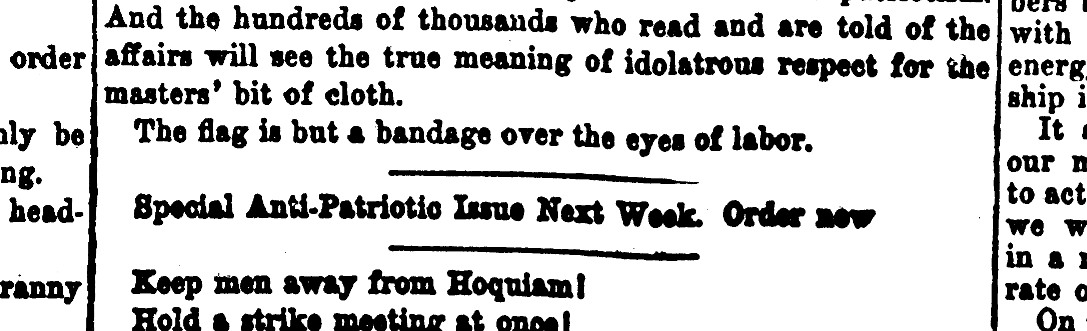
Thousands of Lawrence strikers and hundreds in the crowd at San Diego will have found out that the only patriotism that capitalism recognizes is profit patriotism—dollar patriotism. And the hundreds of thousands who read and are told of the affairs will see the true meaning of idolatrous respect for the masters' bit of cloth.
The flag is but a bandage over the eyes of labor.
---------------------------
Special Anti-Patriotic Issue Next Week. Order now
---------------------------
Text taken from the Industrial Worker, Vol. 3 No. 52, 21 March 1912. Spelling and punctuation have been slightly modified.
---------------------------
To be truly patriotic one should have a country for which to fight. We want the World for the Workers and we are willing to fight for it.
---------------------------
There is nothing inherently sacred about a bedaubed bit of rag hitched to a pole, whether the cloth be striped, barred or star spangled.
---------------------------
Patriot—from the Irish word "Pat" meaning a desire to fight without provocation, and "Riot" meaning frantic; hence, a man who is crazy enough to fight another over a country of which he owns not an inch. Synonym—Plain damn fool.
---------------------------
What Is Treason?
"Treason to the United States shall consist only in levying war against them, adhering to their enemies, giving them aid and comfort."—U. S. Constitution.
We reproduce the above, not that we care a whoop about some musty old moth-eaten parchment written by slave holders in the early days, but just to show that according to capitalism's own words we are not traitors.
The most traitorous act a wage worker could possibly perform in these days is to scab and next to that would be to join the scab herders.
According to the above quotation the bankers are traitors for they loaned money to both parties during the Spanish American War. The Beef Trust heads are traitors because they certainly gave aid to the army's enemies when they killed off thousands with embalmed beef. And the members of the Industrial Oligarchy are all traitors for they used the war as a means of wringing profits from the slaves irrespective of nationality.
The workers are reaching that point where charges of treason do not worry them greatly. They are starving. The only way to effectually stop that starvation is to organize for the purpose of getting the goods.
It is starvation or revolution and the workers must have the means of production and distribution in their own hands. If the Constitution gets in the way of our obtaining that object then we say with Sherman Bell, "To hell with the Constitution."
We are not traitors to the United States for we have just the same disrespect for the political rulers of other countries as we have for greasy Bill,1 the fat office boy of the Plutocracy.
We are mainly concerned in fighting the employing class. Their puppets give us but small concern. Owning no country we owe allegiance to none.
An Effect Without a Cause?
Of all the idiots and perverted ideas accepted by the workers from that class who live upon their misery, patriotism is the worst.
If patriotism is based on love of one's country then a patriotic working stiff is the nearest approach to an effect without a cause that is today known to science.
But to look upon patriotism merely as love of a country or reverence for a flag is to fail to get a glimpse of its deeper and more degrading meaning.
The appeal to all that is animal in human kind so that they sally forth to murder those whom they do not know and from whose hands they have never felt a wrong is but one of the many crimes directly traceable to patriotism.
Patriotism has been the means of lowering wages, of causing mutual hatreds, of engendering distrust and it is one of the most vital factors in keeping the wage slaves in their chains.
The mine owners pit Irish against Welsh, praise each by turns and thus force them to vie one with another in producing wealth for the masters' benefit and for the workers' further degradation.
It is the basis of the race war in the South. Through its agency the employers have forced the dock workers to unremitting hours of toil. The negro is told of his superior strength and asked to demonstrate it by loading or unloading more cotton than the whites. To the whites the same master whispers of "white supremacy" and the whites speed up. Back and forth this process goes until both whites and negroes are worked to the limit of human endurance with no resultant increase in pay.
Building contractors segregate their gangs into nationalities pitting one against another, thereby causing all to throw themselves so forcibly into the work that they hasten the time when they are cast back to starve upon an already over-crowded labor market. One contractor in Chicago by promising the most faithful toilers the privilege of placing the flag of "their" country at the top of the building when completed, was able to cut several weeks from the time and pocket thousands of extra dollars through the credulity of the toilers.
The beef trust places different speaking workers in the various departments and have employees for the purpose of creating distrust and also to cause each section to labor harder to demonstrate their superiority. These departments are constantly being shifted so that the hunger language may not speak louder than the native tongue.
Patriotism has caused certain cities to maintain and accentuate certain vile practices in order to sustain their reputation. Paris, with its worse than beastial prostitutes is a striking example of this practice.
Aristocracy of skilled labor, with its prevention of solidarity, is the result of patriotism. The engineer considers himself better than the fireman; the fireman deems himself better than the brakeman; the brakeman despises the trackwalker; and so on all along the line. Yet all are necessary. Together they are invincible, but separated by patriotism they effectually prevent the solidified effort necessary to achieve emancipation.
Patriotism makes the skilled hate the unskilled and causes the "home guard" to despise the blanket stiff. Nearly every craft organization has leagued itself together against the "boomer" in their own line of work. But analysis shows that the little the crafts are able to retain in this day of master class organization is but the result of the refusal on the part of the boomers and blanket stiffs to accept the conditions the masters desired to impose upon them. There are enough idle, wandering, skilled mechanics today begging [for] handouts rather than [scabbing], to replace every craftsman who is organized upon the basis of skill.
These migratory workers have lost all patriotism—and rightly so.
Love of country? They have no country. Love of flag? None floats for them. Love of birthplace? No one loves the slums. Love of the spot where they were reared? Not when it is a mill and necessity cries ever "move on." Love of mother tongue? They know but the slave drivers' jargon whose every word spells wearisome toil followed by enforced idleness. Love of race? Capitalism has forced them to work with all manner of men and under all climes and the worker has become cosmopolite.
That species of patriotism that masquerades beneath the name of religion cannot snare the feet of the modern proletariat—the propertyless worker. He alone is the true anti-patriot. On him the blighting curse of patriotism does not rest save as it is used upon the balance of the workers to keep him down. Directly, it causes him no concern.
Not until patriotism has been expelled from the minds of our class shall we see reared a society which will be worthy of the name of civilization.
---------------------------
Try wrapping a flag around your belly as a cure for hunger.
---------------------------
Here's to the noble patriot,
Away he'll never roam—
He loudly yells for war and gore,
But safely stays at home.
---------------------------
The working men have no country. We cannot take from them that which they have not. By freedom is meant free buying and selling.—Communist Manifesto
---------------------------
To End Militarism, End Capitalism, Via Industrialism. (By Justus Ebert).
Why should the workers support militarism? Militarism is a means to uphold and perpetuate capitalism. Capitalism is the robbery of the workers for capitalist profit. Armies and navies secure new markets for the profitable sale of the products stolen from labor by the capitalist class. They open up new fields of foreign investment for the capitalist wealth stolen from labor: thereby increasing international competition among the workers. They are used to suppress labor revolts and strikes against capitalism. In brief, labor, without whom militarism cannot exist, sacrifices life and liberty for its own degradation and enslavement: all in the name of patriotism and military glory. This course does not reflect credit on the good sense of labor. It is not the part of wisdom to submit to robbery and then support the agency which rivets it upon us. Better far would it be, since militarism is essential to capitalist robbery, to compel the capitalist robbers to be the military. Since wars and strike suppressions are essential to capitalist civilization, let the civilized capitalists fight their own wars and suppress their own strikes. The results in human advancement will be surprising.
That militarism is capitalism and can only be uprooted with the latter is an idea that is taking hold of the workers. They are weakening capitalism by weakening militarism. The army and navy are encountering difficulties in recruiting. Desertions are on the increase. Anti-militarism, first espoused in this country by the trade unions, is growing among the labor organizations, owing to practical experience in strikes. In England, industrial union action on the railways rendered the military impotent; cavalry horses were only fed by permission of the strikers. Without workers to fight, to make ammunition, and to transport soldiery, militarism is impossible.
The great anti-military force then, is industrial organization. Industrial organization of the workers places not only militarism, but also capitalism in the power of the workers. Industrial unionism destroys the capitalist robbery of labor at the place in which it occurs, the industries of the country. To end militarism, end capitalism. To end capitalism, build up industrial unionism. It erects the framework of the new society in the shell of the old. Join the I. W. W., which is organized with this great end in view. Help along the good time coming!
Patriotism: A Bloody Monster. (By Caroline Nelson).
When Roosevelt sent the fleet around the world the general mass of people didn't know what it was for. To say that the fleet had to be tried to see if it could navigate around the world is an absurdity. But those of us who happened to be in San Francisco when the fleet steamed in through the Golden Gate had no difficulty in finding out what it was for. Men, women and children fought with one another frantically to get a first glimpse of the murder machines. The papers for weeks had been lashing their minds into a fury of excitement, which for want of better name was called patriotism. But perhaps patriotism, which originally meant a protector of the patriarch, the patrician or the lord, is as good a name as any; for it practically means the same today. Patriotism is inseparable from guns, swords and murder machines in general, because all our laws rest upon those "benevolent" tools. That is why they're so sacred to our ruling classes. That is why our histories in schools consist chiefly of scenes of bloody murder frays enacted on a large scale. That is why such butchers as Napoleon and Nelson and Alexander and others of the same tribe are held up before the child mind as the greatest heroes of the world. That is why a gun and a sword are the dearest things to a boy. That is why the workers' boys consider it an honor to parade in a uniform with a knife stuck at the end of a gun. That is why they don't hesitate to join the army and the militia, never realizing that any moment they may be called upon to stick that knife in the heart of their own father and brother.
When the militia boys in Lawrence were asked if they were not ashamed of their jobs. They said, yes. But when they enlisted they had not thought of what they would be called upon to do. And when they were called to Lawrence they had to go or get court-martialed. At Lawrence they had to act as snarling dogs to their fellow worker to carry out the orders of their superior officers.
Of course, patriotism is holy. Holy to whom? To the man that gets the lead and steel inside his guts; or to the man who sends it there; or to the wife and children left behind; or to the mother that gave birth to the murdered or the murderer. Don't answer all at once, boys.
But here comes Johnny Simpleton. Listen to his solemn voice. "Patriotism protects the home and our country, and there is nothing holier than that." Where are our homes? And, pray tell, where is our country? Are the houses we live in ours? No, not as a rule. A good many of us can't afford to live in houses any more. We're like "the Son of man." We have not that to which we can lean our heads. And the powers that be have no more use for us than they had for the Son of man. Like him we are always agitating and saying mean things about the white-washed sepulchers full of rotten bones. As for our country? Whose country do we live in? All we have to do to find out is to ask our boss all in a bunch for a little more wages, and he'll speedily show us whose country we live in. He'll show us who own the police, the judge, the militia and all the other patriotic implements.
Now aren't we proud to raise our sons and daughters ready to stab us in the name of patriotism? Aren't we proud to fight for the protection of a set of highway robbers such as the Carnegies, Morgans, Rockefeller et al?
In England the revolutionary sentiment is far ahead of us in America. In their open air meetings thousands upon thousands of people assemble, where they make it hot for the police. Sometimes they cut down the horses under them. In the government paper with its millions of subscribers, the striking miners have inserted a circular letter, addressed to the soldiers of Britain, asking them not to shoot down the miners, because they are battling for bread, and are their own fathers and brothers.
This letter is headed by an explosion to show that it is treason against the government. In other words it is treason against the government of Britain for the soldiers not to kill the workers who are battling for bread. This is correct. It is so in every country. That is what patriotism means.
Now, don't you think, fellow workers, that you had better let your bosses do the patriotic stunt? Let them practice patriotism among themselves. Let them kill each other if they like. If it is patriotism for the workers to kill each other officially, why doesn't the same rule hold good for the parasites. They have nothing else to do anyhow. It might arouse and ennoble their jaded spirit, and bring out their manhood of which they're so fond of speaking. No, you needn't be afraid. In the wars past they have been busy fishing in the muddy waters for profit with embalmed beef, paper shoes, decayed transport vessels, shoddy uniforms and everything else. All this while they strung bunting in front of their houses and hollered for patriotism. In the last war it was only Teddy the terrible who had the courage to come out to shoot a fleeing Spaniard in the back. This supreme courage was backed up by an uncontrollable hunger for office.
But patriotism is not alone good for official murdering of the workers. It is a splendid means of keeping them separated. The workers of each nation are taught that they're superior; that they're a select brand compared to those of all other nations. It's used here as a play upon human egotism and credulity. The upper class the world over associate together and inter-marry. They make fun of the, to them, lower classes with their narrow prejudice.
Well, you have perhaps heard about the peace movement. You have been invited to lectures where some highly respected professor talks about peace as against war. Andy Carnegie has given millions to this peace fund. But have you heard about any abatement in the luring of young men into the army? Have you seen the alluring posters taken down that picture a soldier as a uniformed dandy? Also it promises him a compensation for life after so many year's service. It tells him what a small chance he has to better himself outside the army. Have you heard about the different governments refusing to build any more murder machines? No. On the contrary you have heard of every one of them wanting to get money to increase the army and navy. What sincerity is there then in this peace movement? Simply this—the capitalists have found that they have to unite against the international rising working class. They begin to see that the workers the world over are getting on to the job. They therefore want an international army and navy to protect their international interest.
We workers, on the contrary, want an international working class who will refuse to offer themselves up as food for cannons, who will fight to get homes for their families. Who will realize that every dollar is simply a check on their labor power and nothing more; that when they organize that labor power these checks become only ornamental in the hands of the financiers, because the workers can refuse to yield that power to make them valuable and use their product themselves.
Text taken from the Industrial Worker, Vol. 4 No. 1, 28 March 1912. Spelling and punctuation have been slightly modified. Text has also been curated (in particular the short pithy statements); see the issue for the complete writings and the order in which they actually appear.
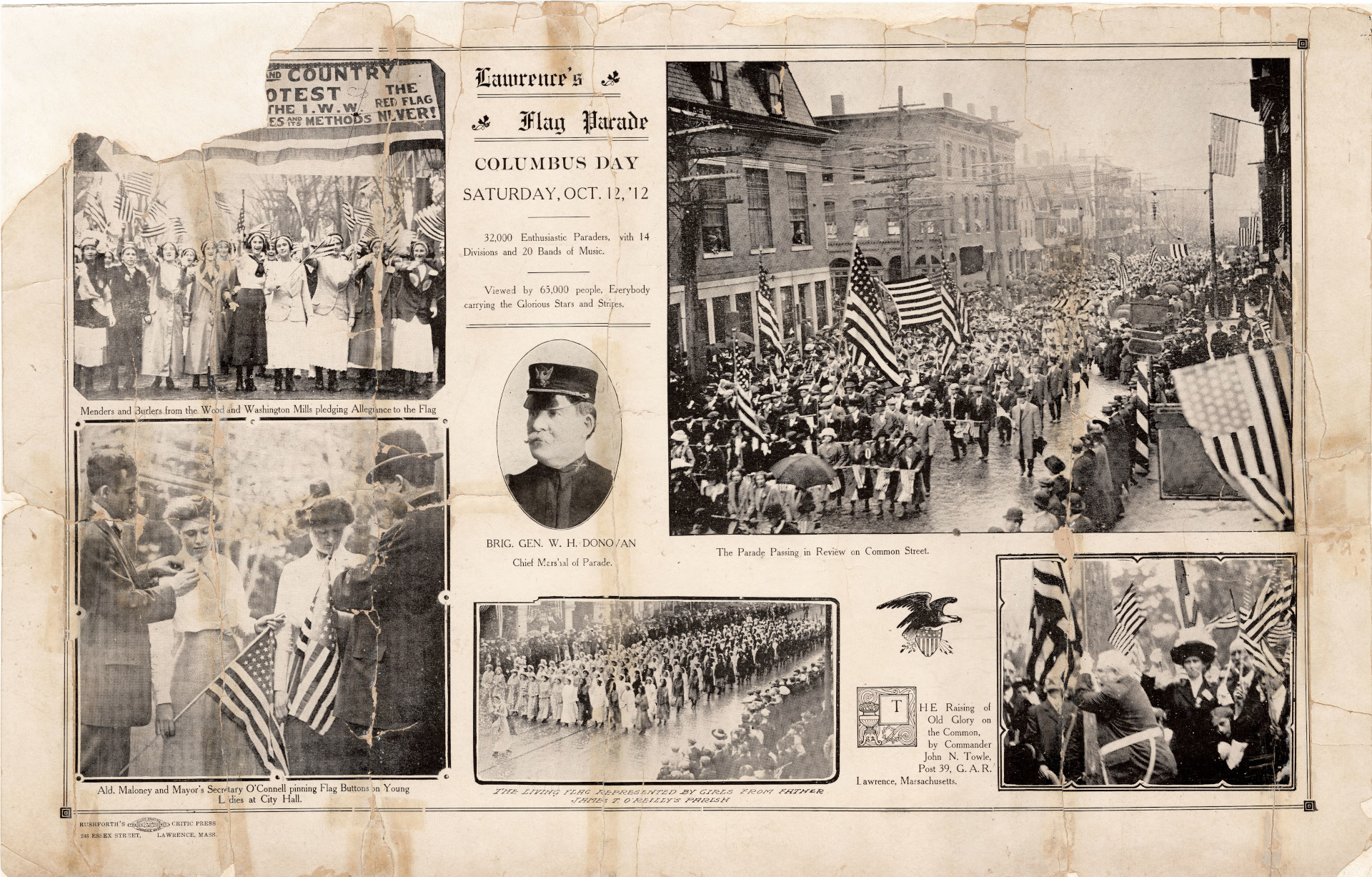
Various photos from the "For God and Country" parade that occurred in October 1912 after the Lawrence Textile Strike had ended earlier in March. As illustrated by the banner, the parade-goers explicitly attacked the IWW and its major involvement in the strike, while also affirming their patriotism.
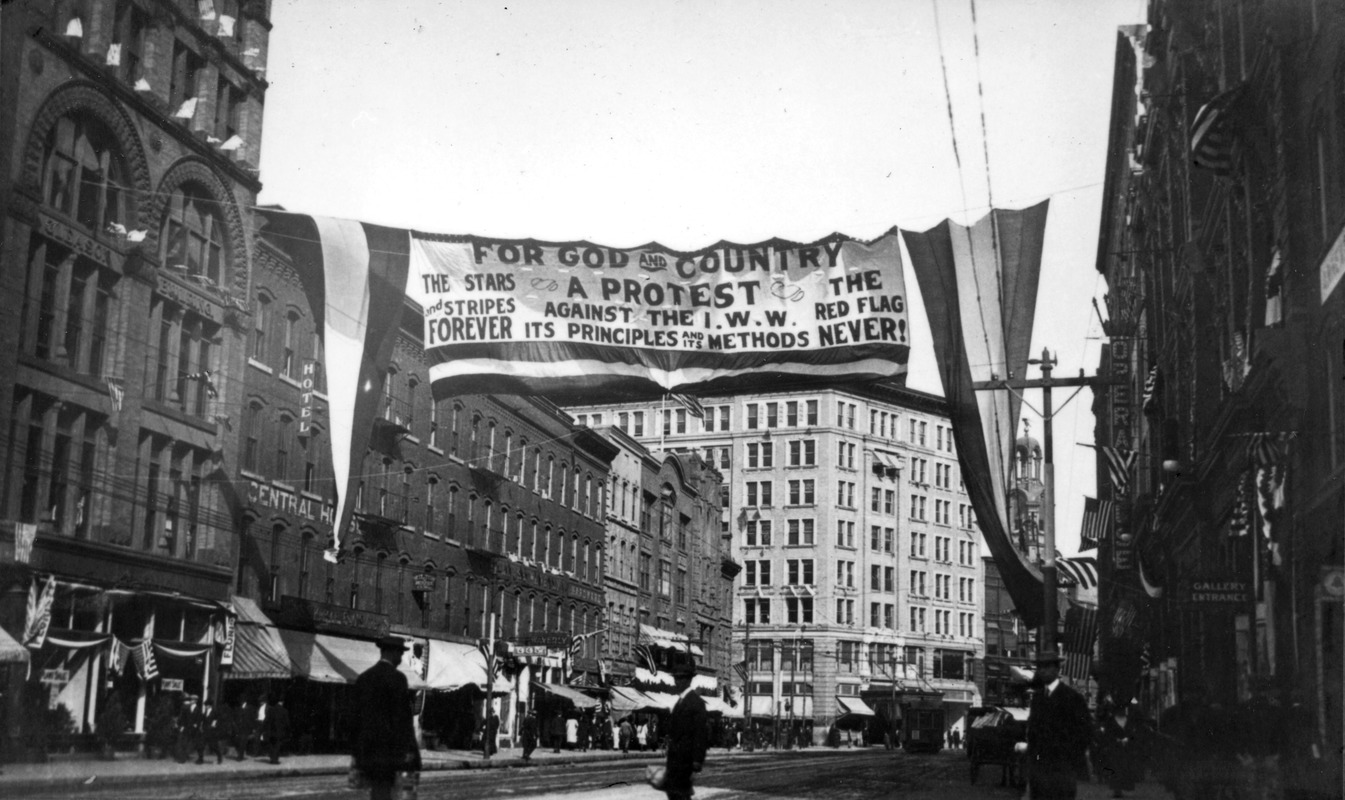
Banner which attacked the IWW.
- 1President William ("Bill") Taft—adri


Comments
We are not traitors to the…
Allegedly Taft kept getting stuck in the bath and had to be greased out with butter. Here's an illustration that explains everything. I am not entirely sure if that is what the author was referring to when they used the word "greasy" or if this story is only something that emerged later. (Please let me know if you're an expert on Taft or know in what other ways he might have been greasy.) In any case, I strongly disapprove of making fun of people who are fat... unless they're part of the ruling class. I can't remember where, but I also remember reading somewhere that being fat used to be associated with upper-class status and not needing to exert any effort (compared to the starving masses, etc.), whereas nowadays size does not really convey this sort of upper-class status.
'...being fat used to be…
'...being fat used to be associated with upper-class status...'
Quite the contrary today when many bourgeois pride themselves on their near skeletal appearance. Perhaps we have raised ourselves to the position of ruling class?
Unfortunately, after bulk…
Unfortunately, after bulk searching through various issues for any references to bathtubs or grease, it seems like the butter incident is just an apocryphal story that became popular much later on. I'm guessing the author above was just using the word "greasy" as a word that often goes along with "fat," rather than alluding to any specific Taft bathing mishaps, which sort of makes sense. I did find the Industrial Worker's response to the "For God and Country" parade though (Vol. 4 No. 30). Here's a part of that: