
Encyclopedia of Political Science (2011) entry on Errico Malatesta.

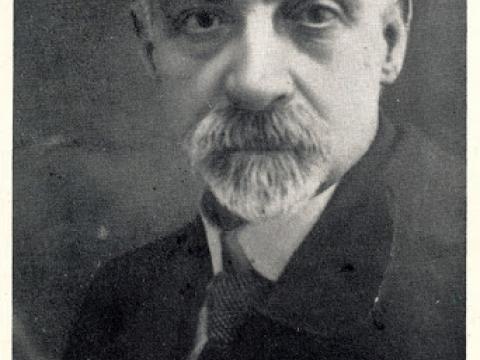
Errico Malatesta was an Italian anarcho-communist whose writings remain influential within contemporary anarchist movements. Initially an advocate of an insurrectionary approach to social change, emphasizing the agitational work of small bands of activists in fomenting uprisings or revolution, Malatesta came to argue that anarchists should be most active mobilizing within working class communities. A writer and theorist, in addition to a militant organizer and revolutionary activist, Malatesta edited several popular anarchist newspapers, presenting his views on unions, revolution, farm work and peace.
Malatesta was born in Santa Maria Capua Vetere in southern Italy. His first arrest came at the age of 14, for writing a letter to King Victor Emmanuel II critical of local injustices. He went on to study medicine at the University of Naples but was expelled in 1871 for participating in a demonstration. A supporter of the Paris Commune, he joined the Naples section of the International Working Men's Association (the First International).
In 1872 he met the great anarchist Mikhail Bakunin, participating in the St. Imier congress of the International. During the following four year period Malatesta was arrested twice for agitational work on behalf of the International.
In 1877 he was forced to flee Italy due to surveillance by authorities, beginning a lengthy period of exile. During this time Malatesta journeyed to Geneva Switzerland, an anarchist centre, where he met leading anarchists Elisee Reclus and Peter Kropotkin, helping in the production of the anarchist newspaper La Revolte. Expelled from Switzerland for his work he made his way to London. Following his involvement in the 1881 congress of the International he helped give rise to the Anarchist International, reflecting the growing split with Marxists in the First International and anarchist rejection of authoritarian socialism.
After a stint fighting British colonial troops in Egypt in 1882, Malatesta returned to Italy founding the anarchist newspaper La Question Sociale. Fleeing a prison sentence he once again left Italy, landing in Argentina in 1885. In Buenos Aires he resumed publication of La Question Sociale and helped to found the first radical labour union in Argentina, the Bakers Union. Malatesta's work with the Bakers Union would help lay the groundwork for a lasting anarchist influence on the union movement and working class organizing in Argentina.
Upon his return to Italy in 1889, he founded the newspaper, L'Associazione before again fleeing to London, where he would live for the next eight years. His significant, and still published, pamphlet L'Anarchia was published during his time in London.
In 1907 Malatesta participated in the International Anarchist Congress of Amsterdam, an anarchist alternative to the Marxist party-dominated Second International, or Social Democratic International. During the congress Malatesta took part in a significant debate with Pierre Monatte on the character of syndicalism and the relationships between anarchism and trade unionism. Monatte, a radical trade unionist, considered syndicalism to be revolutionary, providing the suitable organization for ushering in post-capitalist society.
For Malatesta, syndicalism itself is not sufficient for creating the conditions for social revolution. In his view, unions are typically reformist, seeking bread and butter gains for workers within the constricted framework of capitalist social relations and waged labour. The point is instead to end those relations and abolish the system of waged labour itself.
Even worse, unions were often conservative, working with employers as a low level management layer that served to impose the conditions of contracts and discipline workers between bargaining periods. Unions served to divide workers by trade, workplace or skill set, with some workers using unions to maintain their relative privilege over other workers.
Malatesta advocated the development of explicitly anarchist organizations to sustain a unity of theory and practice that would encourage the revolutionary work of anarchists and support the theoretical and tactical development of anarchism, rather than succumbing to concerns over immediate day-to-day issues that come to dominate trade union work. Malatesta maintained a principled perspective of anarchism as a revolutionary theory and argued that violence, rather than a moral issue, was a necessity of working class efforts to gain emancipation.
With the outbreak of World War I, Malatesta found himself opposing his comrade Peter Kropotkin, who had argued for the victory of French culture over German barbarism. For Malatesta, bourgeois wars were no option for working class people who would be massacred in defence of the interests of one ruling class over another.
Malatesta died in 1932 in fascist Italy. His works have been picked up by activists in the contemporary alternative globalization movements, making him among the most influential anarchist within contemporary anarchist movements.
Further reading
Malatests, Errico. 2005. At the Cafe: Conversations on Anarchism. London: Freedom Press
Malatesta, Errico. 1974. Anarchy. London: Freedom Press
Richards, Vernon. 1965. Errico Malatesta: His Life and Ideas. London: Freedom Press
Shantz, Jeff. 2011. Active Anarchy: Political Practice in Contemporary Movements. New York: Lexington Books


Comments