K. J. Kenafick's DIGEST
Our good comrade, K. J. Kenafick, sends along his translations of overseas views and activities as reported in the language exchange copies received by us.
Dear Comrade Dawson:
The amount of foreign material I now have on hand is so large that I shall not be able to do justice to all of it in detail. There is material from Mexico, Cuba, the United States, France, Belgium, Italy, and Holland.
As I have not previously dealt with the Mexican material in any of my contributions, I shall commence with it here. It consists of copies of two different papers, one of these being the "Lucha Obrera" (Workers' Fight), which has the sub-heading "In Defence of Workers' and Peasants' Interests." It is described as the organ of the Mexican section of the Fourth International. The two copies forwarded are those of January and February of this year. It is apparently a monthly paper. In the January issue the chief article is entitled "The workers must fight against the repression of the oil workers, against its causes, and against its intentions."
It deals with a strike in the petroleum industry over claims for higher wages; and the fact that the Government of President Aleman was prepared to use military force against the strikers. This bourgeois Government, says our article, had therefore come out openly against the workers. In the past, the bourgeois Government in Mexico had been relatively weak, and had relied on the support of the workers and peasants. Such was the case with the Government of President Cardenas. The Trade Unions bosses had acted as instruments for the bourgeois Government in securing this support. But now, under new conditions, the Aleman Cabinet of millionaires felt it could dispense with these Trade Union bosses and their support. These bosses had been like most of the Union bureaucrats—insolent to their comrades, and servile to the capitalist Government. Fifty of them had now been sacked.
In 1938 the bourgeois and its lackeys of the intelligentsia had loudly extolled the "patriotism" of the workers who went on strike against the foreign imperialist oil companies. The Government then supported the strikers, so that the native bourgeois could derive the profit from the workers' victory over the foreign imperialists. But now that the native bourgeois have got control of the oil wells, the workers are "unpatriotic" to strike! In fact, conditions are worse for the workers in the oil industry to-day than they were under the foreign imperialists. Real wages have decreased. Despite increases in wages in the last ten years, real wages have fallen in that period 287 per cent. The capitalist press has, nevertheless, been insisting on the privileged conditions of the oil workers! The flaunted liberty of the press, therefore, appears to consist in the liberty of hiding the truth from the masses.
The Oil Workers' Union proved incapable of rallying the workers against this campaign of lies, and could not even get the active support of the miners, railwaymen, and electricians. The leaders of these unions had neither the idea nor the practice of the class war. What have the workers to hope for from traitorous leaders like these, such as Lombardo Toledano, of the Mexican Confederation of Labor, who will endeavour to placate the Aleman Government and counsel the workers to submission. Lombardo Toledano, who is a Stalinist, is trying to represent the Government as having been unwittingly misled by reactionaries, who were intending to make a breach between it and the working class—as if it were any secret that to-day true reaction is within the Government itself! The Stalinists are thus endeavouring to prevent the workers from defending their own organisations.
The Fourth International, however, pronounces for the organised and fighting defence of the proletariat. Trade Union rights must be maintained, and the dismissed leaders must be reinstated. The working class must resist any attempt by the Government to "clean up" Trade Unions. The "clean up" would only mean that for the present leaders there would be substituted others even more abject. Let us enforce, instead, Trade Union democracy!
The workers must oppose all readjustment of the working personnel in the oil industry and all attempts at lowering the wages. If there is any purging it should be of the bureaucrats and parasites in the offices of the industry. But anything achieved against the workers in this industry will be extended to others: Therefore, working class Trade Union unity is an essential, to defend Trade Union independence against the Government and the Capitalists. The propaganda of the bourgeois Press must be fought, for this has led many workers into supporting the Aleman Government. The fighting spirit of the masses must be revived. If the Trade Unions maintain their unity, if the corrupt and sold leaders are replaced by honest leaders, who are capable and revolutionary, the working masses will be able to fight and conquer.
This is the conclusion of the main article in the January issue of Luba Obrera."
In the February issue the main article is entitled: "Why is Mr. Truman coming here?" and it answers its own question in the following way:
"1. The Third World War is on the oder of the day on the agenda of Imperialism.
As, geographically, Mexico is a port of entry for Imperialism in Latin America, the Government of Wall Street needs to make this port secure for itself.
"2. The 'friendly visitor' will take advantage of his visit to press still more strongly on the Government of Mexico that it should accept the Truman plan for the military organisation of Latin America under the single command of the Yankee General Staff.
"3. Wall Street will extract from the visit of Mr. Truman in his role of commercial traveller all possible advantage for its propaganda in the rest of Latin America. The name of Mexico will not be a factor to be despised.
"4. For the next war, Wall Street need in Latin America strong Governments, not threatened by internal dissensions. Truman's visit will leave no doubt that Aleman has the full support of Washington.
"5. The rich reserves of petroleum, 'which now are ours,' must be suitably secured, in all details, in favour of Washington, to the exclusion of any other competitor.
"6. Diplomatically, Mr. Truman will repeat his good wishes that Mexico should be industrialised, so long as it does it as a country dependent on the industry of Wall Street. Meanwhile, the United States, forging ahead, can well permit that Mexico should go as far as half-way along the road of progress without losing thus its character of a poor and semi-colonial country.
"7. The Mexican market must be opened, without limitations of any kind, to the goods which the Yankee capitalists want to sell; the visit will strengthen the tendencies of the Clayton Plan, shattering the illusions of many of our bourgeois who are dreaming of maintaining and perfecting the system of protective tariffs.
"8. In no circumstances will Mr. Truman forget to advise President Aleman that he should give ample guarantee to the latest Yankee firms established in Mexico, such as Westinghouse, the warehouses of Sears, Roebuck, or the new owners of Sanbor's, who are inaugurating a new commercial aspect of imperialist penetration.
"9. The noble guest will be very pleased to think that his visit serves as a pretext for the President of Mexico to visit Washington for the first time in history, since there will be no reason to fear anything beforehand from the criticism of the mistrustful people of Mexico. For the debt of two 'profitable' visits (Roosevelt's and Truman's) really constitutes a credit which must be liquidated.
"10. In return for all these things Mr. Truman will perhaps agree to a solution of the old problem of Chamizal. One million indemnification to Mexico can well be utilised to fight aphthous fever and to be converted into a patriotic investment, not precisely to protect the poor Mexican cattle industry, but rather to protect the wealthy one of North America.
"Very soon the shop windows of the native bourgeois and of its agents will be adorned with the slogan, 'Welcome, Mr. President!' but the proletariat and the country people of Mexico know well that the anti-imperialist fight is the first watchword written on their own banner."
This concludes the article in the February issue of Lucha Obrera. The same issue reports that four Trotskyists have been elected to the Bolivian Parliament in the recent election following the overthrow of the military dictatorship by the armed revolt of the people. The Trotskyist organisation in Bolivia calls itself the Revolutionary Workers' Party. Its candidates appear to have been elected by the mine workers, the most oppressed section of the Bolivian people. This country is a field for rivalry between different imperialisms. In the recent Presidential election, one candidate represented Anglo-Argentine imperialism, and the other, Yankee imperialism, the latter also being supported by the Stalinists and "Liberals." Despite these rivalries, both, of course, were defending Capitalism. But, in any case, it appears that Yankee imperialism will dominate, whichever candidate were elected.
The other Mexican paper is Tribuna Socialista, which describes itself as "Organ of the Workers' Socialist Group, Mexican section of the Fourth International." The issue in question is that of January, and, like Lucha Obrera, it devotes much space to the crisis in the oil industry. The opening paragraph of its article sums up the situation very neatly:
"Under the pretext of safeguarding the oil interests which 'belong to the Mexican people' (sic), the administration of PEMEX (Mexican Oil Wells) has started the expected Governmental offensive against the working class, choosing the workers in oil industry as its first victims in the establishing before the Federal Court of Conciliation and Arbitration of a dispute of an economic character, with the object of rescinding the award, which clearly means the dismissal of thousands of workers and the reduction of wages for the rest."
The article goes on to say that it was an open secret before the Aleman Government took office that this was going to be done. It is true that magnificent pretexts have been given to the Government in its attacks on Unionism, by the incapacity, mismanagement and corruption of Union leaders themselves. But actually what the Government's actions mean is the beginning of a major attack against the working class and its gains. It is true that the conditions of the oil workers are a little bitter than those of the average workers, but in reality the cost of living is very high, and housing very bad for them also. The administration of PEMEX needs to be cleaned up. It is full of highly paid and loafing bureaucrats, and its contracts with Yank companies for installations need investigation. The Trade Union leaders have been criminally negligent in not exposing all this. The workers themselves must clean up this corrupt Union leadership, and must demand participation in the cleaning up of the administration of the industry itself. The bureaucratic degeneracy and the criminal stupidity of the Trade Union leaders have given the Government its chance to attack the Unions. The Unionists must profit by this hard lesson, and meanwhile the people are led astray, switching their attention toward the situation in the oil industry, and doing absolutely nothing to put a stop to the starvation of the Mexican people, the black marketing and the high cost of living. The workers, however, must understand the treason of their leaders, who only yesterday were bowing before Aleman, supporting him unconditionally and crawling. The working class must learn that only independent Trade Union and political action are the true weapons in the fight against the bourgeois and other exploiters.
The Cuban paper is Antorcha del Laborismo (Torch of Labour), to which I have referred in a previous communication. It is a monthly review, and this is the second number. It describes itself as "Official organ of Labour Youth." From the fact that is refers to the Trotskyist gains in the Bolivian elections, and that it has a reference to Trotsky, conjointly with Lenin, as responsible for the Revolution of November, 1917, I gather that it has Trotskyist tendencies, though this is not expressly stated. The leading article is entitled, "The Problem of the Food Supply." This article says:
"The problem of the increasing cost of living is, without doubt, the most bitter and tragic which to-day confronts the Cuban people. It is in an equal degree, the most noteworthy indication of the ineptitude and limitations of the present Government which has shown itself impotent to solve it. The reign of the black market has reduced the ration of the average citizen to levels previously unknown in the Cuban Republic. The suffering of the masses under the dictatorship of Batista have been increased under the present regime.
"And if it is quite certain that the chaotic state of the problem of the food supply can be partly attributed to the lack of any plans prepared for its solution by the present Government, it is no less certain that the illicit dealings of high functionaries of that Government are decisive factors in the maintenance of the situation.
"Though the participation of members of Dr. Grau's Cabinet in all classes of stock jobbing and speculation is sufficiently well known, the suspension of publication of the index numbers of the cost of living which had been given since 1937 by the Ministry of Agriculture, is the real accusation against those who are trying to hide obvious facts and would have us believe that we are living in the best of all possible worlds.
"The Minister for Commerce, an expert in questions of business, has for months been quibbling with words, trying to prove the non-existence of stock-jobbing, speculation and other beauty spots, and of the black market and the starving of the people. But however much this wealthy Matanzas industrialist might waste his 'dialectic,' every month the cost of living index belied him and demolished all his eloquence. Hence, after a long conference with his Ministerial colleague of Agriculture, he resolved to suppress the publication of the only statistical work which up to the present has been performed by the Cuban State.
But the problem continues to get worse daily. And, in face of it, it is necessary to co-ordinate the action of the whole people to press the Government for an effective solution, which cannot be, of course, merely a change of officials, but which can only be achieved by means of a plan clearly outlined and energetically applied.
We declared in our last number that to apply the funds derived from the differential duties on sugar to the improvement in the food supply position it was necessary to exchange the system of subsidies for that of monopoly of foreign commerce in basic provisions. Otherwise, as experience has proved, such subsidies would only serve to supply the insatiable maws of the sharks of the big import trade.
This monopoly of foreign trade, to supply provisions for the Cuban people, is the only revolutionary and positive solution for the problem, combing distribution with rationing and peoples' peoples' committees of price control in each ward, district and town. And when we have rationing we are not contending for restriction of consumption, but for the equitable distribution of available goods, in such a way that every citizen can obtain what by right he ought to have.
"With the inauguration of the monopoly of foreign commerce there is suppressed the greedy middleman who is the hinge of the black market. And reciprocally, the small trader is allowed to secure a legalised profit without the necessity of becoming an auxiliary of the exploiters of the people. By bringing in such methods the Government could reckon with the extraordinary resources of the differential duties on sugar, and with the streams of money flowing as the ordinary fiscal receipts. What is needed is a decision and a plan. That is enough to ask of a Government characterised by indecision and the most absurd improvisations.
"But it is not sufficient to talk of good proposals. It is necessary that the working class in the first opportunity should launch out into an active fight in favour of this action that cannot be postponed. For this purpose we urge the workers to secure from their Trade Union meetings resolutions in favour of this solution to so basic a problem, to arouse a vast movement of opinion that will force the Government to act with something more than lyrical declamations."
This concludes the leading article of Antorcha del Laborismo on "The Problems of Food."
The principal article otherwise is entitled "Agrarian Reform is a National Necessity." I shall give a translation of this article, as it deals with a subject which does not always receive in Socialist publications the attention it deserves from its really great importance.
[We received a letter from Mr. Integer (New Views) recently in which he expressed the opinion that immediate demands were the necessary task of the working class movement and the only effective method of organising the working class. Backward countries certainly need industry and agriculture to be organised on planned lines before the workers can be effectively organised as a class. Perhaps the advocacy of Communal Co-operatives would be educational in such cases. It would offset such appeals as below for State help.—Editor.]
This article says:
"We have repeated already that the land of Cuba is not, and never has been, in the hands of the defenceless Cuban cultivator; that as regards the greater part of it, the fruits are enjoyed according to their fancy by a small number of great landowners, native and foreign. Of the six hundred thousand agriculturalists comprising the Cuban tillers of the soil, more than half a million lack land of their own from which to extract the necessary sustenance for a countryside population of two millions. To obtain this they work on other people's land, for the benefit of the proprietors. Then there only remains for the unhappy rustic the minimum portion necessary for his subsistence. The result is then, that the land problem and the landless country people is the first that must be solved by any serious attempt at agrarian reform.
"The agrarian reform desired by all the Cuban people will allow the land of Cuba to be given over to those who work it. But it is an obvious result, moreover, that merely the redemption and equitable distribution of landed property will not solve the whole agrarian problem of Cuba, as is claimed. Just as much as the land itself, our farmer needs the official aid of the State and a total transformation of the present methods of cultivation which prevail in our fields.
Financing of Production
"The prosperity of the countryman depends almost always on his getting assistance at the exact moment that he needs it. The lack of a Bank of Agricultural Finance, which would give the countryman, with all the facilities for sufficient payment, the necessary credit for him to buy implements and seeds, would enable him to confront, without fearing anyone, all the fluctuations and chances of the market, which would guarantee the quality and quantity of products; which would give profitable sales in the markets—the lack of this causes him to fall into the hands of the local usurer and traders who, once having got hold of him, never release him. In order to remedy a present evil, the farmers sell up to three and four harvests in advance, without thinking of the future economic slavery that it represents. Agricultural credit, which would permit the toiling countryman to labour without anxieties and to enjoy in absolute security the fruit of his labours, is just as important a thing as to give him the land; for, to give him that and to leave him at the mercy of the usurers, traders and middlemen who lurk around him is the same as to give him nothing at all.
Technification and Mechanisation of Agriculture
"Putting the countryman in possession of his land and giving him official credit assistance makes it imperative to accomplish a total transformation of our present system of cultivation. There is much to be produced, both for ourselves and for others. And with bullocks and ploughs we shall not succeed in cultivating more than very poorly for our scanty home market, and, even this, only with much toil and suffering. It is not possible to continue harvesting, as now, with such high costs and under such insecure and uncomfortable conditions. There are necessary new and more effective systems of cultivation which will not only wonderfully cheapen production and speed it up, making it easier and much larger, but which will greatly alleviate and humanise the conditions of labour of the agriculturalist. Tractors, as substitutes for the primitive plough, fumigators, to exterminate the pests which affect the crops, the huskers and thrashers employed in the cultivation of rice, etc., are all useful apparatus which, in civilised countries, have been successful in raising agriculture to levels never dreamt of and which the Cuban State is under an obligation to acquire for the use of its agriculturalists. With them we shall succeed in raising our agriculture to the level of an industry, as must be our policy; and let us avoid our products, although of superior quality, being dearer in our own markets than foreign stuff as a consequence of a lack of foreign agriculture.
"As the lack of Agricultural Banks and of attention on the part of the State to Cuban agriculture makes it impossible to predict when the countrymen will be able to get these pieces of apparatus, which are extremely costly to acquire individually, it results preferable that the said countryman should obtain them by means of co-operatives of production and consumption, in furtherance of that purpose. These co-operatives have the advantage that they give the opportunity to acquire these pieces of apparatus with only a small individual disbursement. Moreover, in relation to the consumer, the participants in these co-operatives will relieve themselves from the cost, which the middleman represents, by their being able to make use of the difference which the latter would otherwise absorb, in buying other implements for the use of the co-operative.
Selection of Tillage
It is also extremely important to test out a well-studied selection and distribution of crops. For this there is indispensable the scientific analysis of the soil, which would lead us to sow in those places in which, because of their special beneficial properties and characteristics, products would achieve the maximum development and increase, and not to sow where the crop is poor and of inferior quality. This selection of crops would be directed to avoiding that all should be planted at the same time or by whim or fancy, swamping the market with a single product, causing a depreciation of prices, and thus a considerable loss of time and money. Those crops selected must be cheap and easily obtained, as well as being of special acceptation in the market. There must be avoided planless production where each sows as he wishes without taking into account the advantages and disadvantages of the market. There must be a conscientious study of the peculiarities of each product, the facility in cultivation, its acceptability in the market, the quantity which alone must be sown in order not to over-burden the market, etc., and there must be immediate seasonable recommendations to each cultivator.
"Although the products which are put on the market may be of high quality and low in price, it is still indispensable to assure to the cultivator the sale of his crop facilities for reaching the market directly without having recourse to the middleman, for want of a buyer, in the urgency of satisfying some peremptory necessity, or for fear of losses when it is a question of goods which easily deteriorate. But there must be constructed, before anything else, a network of highways and of linking roads, which will make possible rapid and direct communication with adequate markets. Ordinarily, the farmers do not possess these means of communication, and therefore sell their products to the middlemen at the lowest prices for fear of losing them. And as the middlemen are well aware of this fear and this necessity, they abuse their advantages by offering the very lowest prices, which have to be accepted in the end. Equally, the costs of storage, of fumigation, etc., hope destined to preserve the crops in the hope of a better position on the market—costs which the poor farmers cannot even face—still further speed up sales.
"Therefore, the State must, as an indispensable means of protection for the farmer, tend towards the establishment of refrigerators, storages, etc., for collective use, and at reduced cost, which will permit the impoverished country people to enjoy the same advantages, which to-day are impossible for them in contrast to the farmers who are, if not rich, at least well-to-do.
"Security for the crops must be established. To help the country people when they lose their crops by any unavoidable natural phenomenon must be one of the primary preoccupations of the State. The same must be done when low prices on the market are not sufficient to compensate them for costs incurred in cultivation.
"All these methods which are comprised in the proposed agrarian reform, which has been fought for during so many years, will make possible the arising of a liberated class of country people, vigorous and happy, who will serve as a basis of a new Cuban Republic, economically independent, and socially free and sovereign.
"The position of poverty in which up till now the Cuban country people have found themselves—this basic class of our economy, for no one disputes the fact that Cuba is a country of primarily agricultural structure and future—has always been reflected, and will continue to be reflected, in the general position of the Republic. The economic emancipation of the country people will mean for our country days of incalculable prosperity and well-being, for which the heroic fighters of 1868 and 1895 gave up their rest and their blood. Agrarian reform, the establishment of which is approaching, by the common impetus of the masses of the country people and of all the revolutionary sections of the nation, at the head of which marches the Country Confederation of Cuba—this reform will render possible—because its historic role thus determines it—the realisation of this eager desire of ours to see the countryman of Cuba definitely liberated from the exploitation and oppression in which he has been held through all the generations.
"The fight for this agrarian reform is becoming sharper every day. The forces of all anti-imperialist revolutionaries are increasing and uniting, notwithstanding the failure to obtain any results from the present Government, which had once promised to be the incarnate hope of the Cuban people. But this, nevertheless, makes us think more profoundly and distrust very much all the opportunists and self-seekers who are stealing into the Cuban agrarian movement. Illusions and hopes have only our confidence in our own strength to nourish them, and to support us our courage has to keep on going.
"Agrarian reform is a national necessity which it is to the interests of all to satisfy, because with it goes the future and the happiness of all the Cuban Nation."
This concludes the article on Agrarian reform in Antorcha del Laborismo.
I have translated these articles from Trotskyist or semi-Trotskyist publications, not because I support Trotskyism (because I don't), but because of their intrinsic interest. It is very useful for us to observe that in countries like Mexico, Cuba, and Bolivia, so different from us in race, langauge, history, traditions and culture, they very same capitalistic contradictions and problems are facing the workers (town and country) as is the case here. Their problems are ours, and their cause is ours. A recognition of this does much to destroy false "nationalism" and race antagonisms.
As regards the Trotskyist slant on things, it can be seen that the Anarchist contention that they are substantially an Opposition Communist Party is justified; they seem to be much more militant than the Stalinists, but that is because they are in opposition. Actually, they show the same reliance on the State apparatus to solve the workers' problems, and even the same policy of capturing the bourgeois State, and then using it supposedly to advance the workers' interests—an impossible thing, of course, from a Socialist standpoint, but a piece of demagogy which is repeatedly advanced by both Stalinists and Trotskyists. The latter, however, have the merit that, at present as an opposition party, they are taking a militant attitude, and not the collaborationist attitude of the Stalinists. Of course, if they grow stronger, they will, as a Leninist Party, go the same way as the Stalinists, towards authoritarianism and State Capitalism.
In my next communication I hope to deal with the Dutch Socialist material.
Yours fraternally,
K. J. Kenafick






Comments
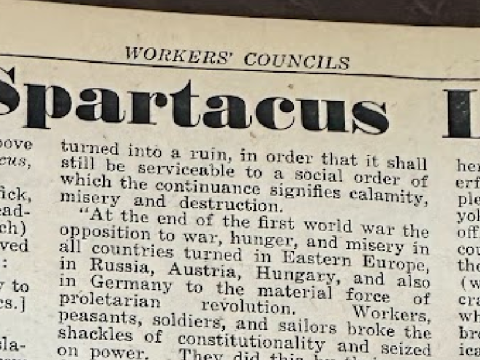
"The Southern Advocate for…
"The Southern Advocate for Workers' Councils and International Digest was an ultra-left magazine published in Melbourne in the mid 1940s by Jim Dawson.
It was later published as the Southern Socialist Review."
https://www.reasoninrevolt.net.au/biogs/E000444b.htm