
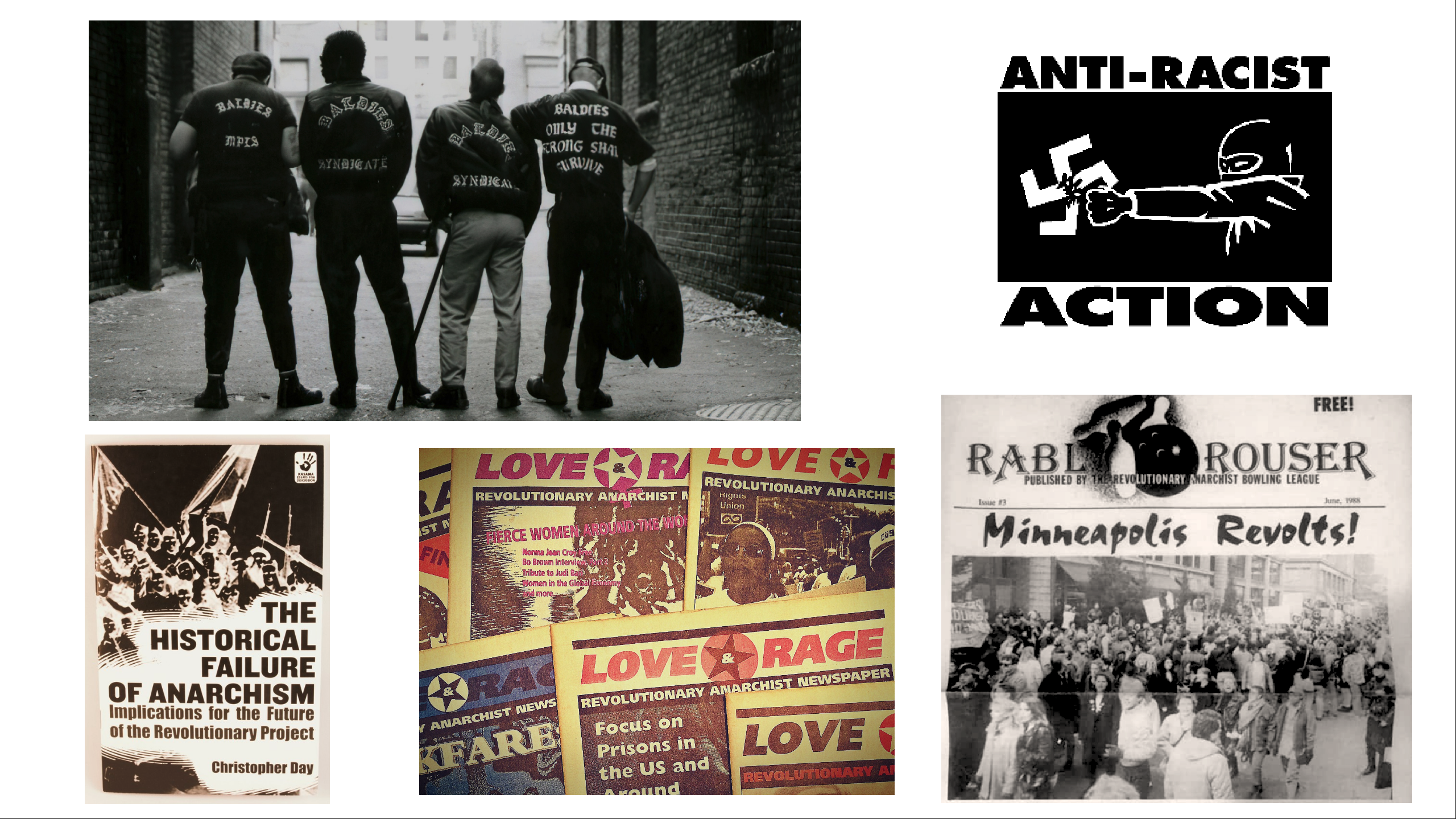
If you’re following any of the news from Minneapolis and seeing the community-organized resistance to ICE (Immigration and Customs Enforcement), Border Patrol, and police coordinated attacks on immigrants, you may have seen statements from Kieran Frazier Knutson. He’s the president of CWA Local 7250. He was also a member of the anti-racist skinhead group “The Baldies” in the 1980s. They formed something called Anti-Racist Action, which is now considered an early forerunner of the modern antifa concept in the United States. On the West Coast of the US, in San Diego, George Matiasz (Lefty Hooligan) formed a first wave chapter of Anti-Racist Action (SDARA) and was in touch with the Minneapolis and other chapters. Matiasz moved to San Francisco in the early 90s and began writing for Maximum RocknRoll. I found this interesting column he wrote in 2003 on a meeting with Minneapolis Anti Racist Action leaders and West Coast activists. He goes into the split between ARA factions, the formation of Love And Rage, and has some biting words for one side in the split.
--Comrade Motopu, 2026

"Lefty” Hooligan” What’s Left?
Maximum RocknRoll #245, October, 2003
It's a common enough experience.
You run into a familiar name, a name from your past, the name of an old friend, enemy or lover.The context might be a hundred and eighty degrees different from that past, as when I came across the name of an old anarchist comrade turned bitter enemy. Noted for his long hair, ultra-left politics and intense drug use over twenty years before at UCSD, he became the mayor of a small coastal town north of San Diego noted for wearing loud Hawaiian shirts with three-piece business suits. Or the context might differ little in spirit from the past, as when I learned that freelance writer and journalist Billie Nessen had been arrested by the Indonesian government for attempting to report on that military's brutal war against insurgents in Aceh from the rebels point-of-view. Billy had already embarrassed the Indonesian government with award winning reporting about East Timor, so they charged him with visa violations, sentenced him to time served and kicked him out of the country. I knew Billy from his Rebel Baker days in San Diego.
Such experiences often trigger bouts of reflection, speculation or analysis on my part. This was the case when I picked up a copy of Freedom Road #3, a publication of the post-Maoist Freedom Road Socialist Organization, at Oakland's excellent Walden Pond Bookstore a couple of weekends ago. There, in a special section dedicated to critiquing Max Elbaum's first-hand history of the New Communist Movement Revolution in the Air: Sixties Radicals Turn to Lenin, Mao and Che is an article authored by Chris Day called "The Fire Last Time."
That's the same Chris Day who, a decade ago, was one of the honcho's behind that revolutionary anarchist newspaper/network/ federation Love and Rage.
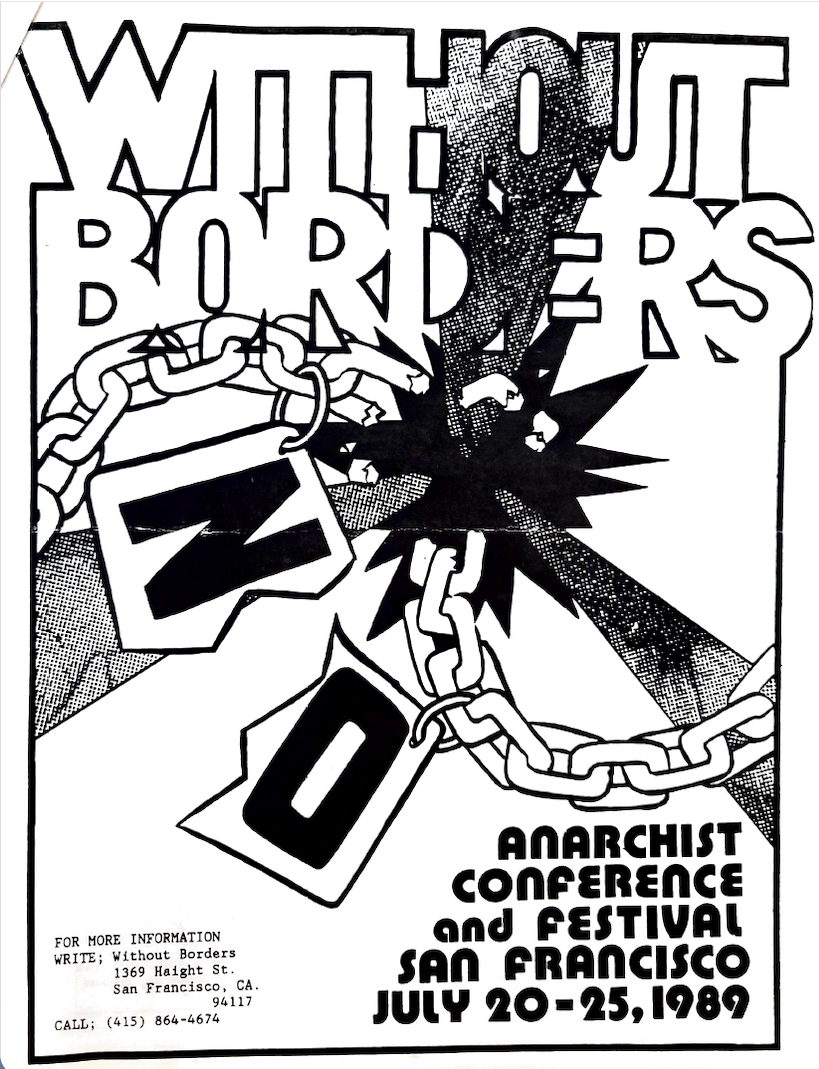
Folks familiar with this column know Chris and I are not exactly chums. I was highly critical of the now deceased Love and Rage, but I've personally liked many of the people involved in the organization. Chris impressed me as slime pretty early. Even before Love and Rage in fact. In the spring of 1989 I was living in San Diego, publishing an anarcho-punk zine called San Diego's Daily Impulse and participating in a pretty lively if short-lived regional network of anarchist and anti-authoritarian individuals and groups called the Borderlands Anti-Authoritarian Community. A number of us were getting ready for the big Continental Anarchist Gathering, scheduled for San Francisco in August, when Chris and a red skin named Kieren dropped in to promote an idea making the rounds of anarchist circles in those days for a continental revolutionary anarchist newspaper.
As it happened, a tiny Trotskyist sect called the Revolutionary Socialist League— noted mainly for publishing (with their own printing press) a quasi-party paper called The Torch — came to the conclusion that Leninism in all its varieties was irredeemably flawed. At least a majority of the RSL's membership did, as well as the conclusion that they were actually anarchists. So they offered their press to the embryonic anarchist movement of the day, inspiring the idea for the above mentioned continental revolutionary anarchist newspaper.
Chris and Kieren made their first sales pitch at a BAAC meeting called for the occasion. Kieren was cool, clearly working class and very self possessed. I later learned he was also a red diaper baby. He talked about his experiences in the Twin Cities scene going steel-toed doc to steel-toed doc with fascist skins to drive them physically out of town. We argued over whether this wasn't just one gang taking on another over turf, in this case an anarchopunk gang taking on a Nazi skinhead one for control of the Twin Cities scene. Chris talked all together too much, and what he said got us locals a bit upset. Essentially, he wanted us to fold our local anarchist work, to include the Daily Impulse, into the continental anarchist newspaper project. Now for someone to call himself an anarchist and not grasp that local work was the very heart and soul of anarchism struck me as more than odd.
I remember them unpacking at the house they were staying over while in San Diego. I watched as Chris fondled a pair of steel-toed docs and gushed about how much skinhead ass he'd kicked with them. I saw the romantic gleam of a revolutionary wannabe in his eyes.
It didn't surprise me to find out later that Chris was middle class. True middle class, as in the son of a doctor or a lawyer, some professional. Chris was slick and glib, but he was also playing at being a bad ass revolutionary.
BAAC kept an open mind on the continental newspaper idea, despite my misgivings. That dimmed a little with the San Francisco Continental Anarchist Gathering, when some of the maneuvering of Chris Day and Co was on display as to who and what was or was not "revolutionary enough" to be a part of their project. Still, Chris proved the consummate politician, and the fallout didn't come until the formative stages of Love and Rage when promises were broken, folks were lied to and my BAAC comrades decided to steer clear of the whole mess. I mean everybody suspected Love and Rage because of the RSL ex-Trot involvement. It didn't help to have manipulative politicos like Chris associated with the project.
I wrote a humorous little pamphlet, "Do You Have Vanguard Envy?," as my critique of L&R in general and Chris Day in particular. In trying to be "more revolutionary than thou" the organization aped some of the worst features of the Leninist Left. The newspaper was virtually indistinguishable in layout, and sometimes even in content from Leftist party papers. They glommed onto the Autonomen black bloc tactic as if to one-up their main competition for "revolutionary youth," that being the RCP's Revolutionary Communist Youth Brigade. The "leadership" could run roughshod over the membership, as happened at the 1993 "Conference of the Long Knives" when L&R became a federation. And of course, L&R split with enough acrimony and deceit to warm the heart of old Trotsky himself.
Surprisingly, the ex-RSL types had very little to do with this vanguard envy. As Chris Day's post-split organization Fire By Night Organizing Committee wrote in their pamphlet "After Winter Must Come Spring," half the former RSL members left within a year and many of the rest became inactive. Of those who stayed active in Love and Rage, virtually all remained anarchists after the split.
Nope, it was folks like Chris Day who gave L&R its vanguard envy. Chris came to anarchism wanting it to replicate the dubious successes of Leninism by insisting that his anarchism was revolutionary, organized and fixated upon race. Indeed, Fire By Night judged the theory and practice of anarchism insufficient because L&R had not adequately come to terms with racism and white skin privilege or revolutionary discipline and organization. This is how ex-L&Rer Wayne Price puts it in "Nine
Years of the Love and Rage Revolutionary Anarchist Federation":
Chris Day , a founder and influential member (that is, a "leader") had concluded that it was time to abandon anarchism. He told people informally that we had reached the limits of the anarchist "milieu" and it was time to move on. He wrote a paper on The Historical Failure of Anarchism, emphasizing the programmatic weaknesses of anarchism. He declared that no revolution could succeed without a centralized, regular army and a revolutionary state. A group formed around him, particularly of people who had never had to choose between anarchism and authoritarian Marxism. Although they suddenly discovered the value of the international working class, their new-found Marxism was not of any of the libertarian or humanistic varieties (autonomes, council communism, CLR James, Eric Fromm, Hal Draper, etc.). It was Maoism — one of the most Stalinist, authoritarian versions. [...] There is a myth in the present anarchist movement that L&R collapsed due to weakness over African-American liberation. This was never a major dispute inside the organization, although perhaps it should have been. It was raised at the last minute, the main supporter of Race Traitor politics blocing with the Maoist faction. But it was never the issue in the faction fight, that being anarchism versus Maoism.
Fire By Night's fawning admiration of the EZLN in particular and enthusiastic approval of "mass line" politics in general made their merger with the post-Maoist Freedom Road Socialist Organization an unsurprising denouement to Love and Rage's checkered history.
Now hold on, you say. Wasn't I, at the very time Chris was visiting San Diego, claiming to be an anarcho-marxist and drifting toward left communism in part because anarchism did not adequately come to terms with issues of power, revolutionary organization and class? Yes, but I actually read Marx. I'd expect Chris to settle for the vulgar Maoist/post-Maoist milieu because it's overarching themes are pretty much what he hoped to instill in anarchism. And let's face it; Maoism is to Marxism what disco is to music, a travesty at best. I'll demonstrate how Maoism plays fast and loose with Marx, and even Lenin, in a moment. First, let's take a look at how sloppy and vague Chris's thinking remains, even as a post-Maoist, with a quote from "The Fire Last Time."
"Thousands of young people, largely from middle-class backgrounds, immersed themselves in the life of the working class by taking jobs in factories and moving into working class communities. They dedicated themselves to organizing for revolution, often sacrificing their own health and well being and risking beatings and arrests in order to build serious organizations of oppressed people, organizations that could really fight. More than any other trend coming out of the '60's, the New Communist Movement sought to build and sometimes succeeded in building genuinely multi-racial organizations."
Aside from salivating over Maoist successes, can you smell the patronizing air to this? Of course, this is actually Chris's own path through life, a young middle-class person who sees himself as joining the oppressed to fight for revolution. It was also his analysis of punk youth when he was with Love and Rage. Not to make too fine a point of it, but Chris wouldn't know class analysis if it bit him on his post-vanguardist ass. All it takes is a little basic Marxism to prove this analysis fundamentally flawed.
Ah, finally, the point of this column, a definition of working class. It has to do with our relationship to the means of production. Do we own and control the means of production, or do we work for those who do? Workers don't own factories, businesses or farms. We own only our own labor, which we sell for a wage to those who do own these things in order to survive.
While this constitutes the basic Marxist definition of the working class, nothing is quite so simple, particularly when it comes to Karl Marx. Marx's general concept of the proletariat, based as it is upon ownership of productive means and wage labor, took on a particular character thanks to Marx's own emphasis upon the industrial proletariat as the vanguard of the working class. Industrial capitalism was the leading edge of economic development in the 19th century, and Marx fully expected the industrial sector of the working class to continue to expand until it made up not only a majority of society but virtually the entire proletariat as well. In addition, the industrial discipline and organization required of the industrial working class by the capitalist class as part of the proletariat's exploitation could be transformed into the revolutionary organization and discipline needed by the working class to overthrow their exploiters, take power and usher in socialism.
Lenin, of course, converted this into dogma with the caveat that the vanguard in turn needs a vanguard. That's why Leninist vanguard parties (and pre-party formations) in the United States continue to require their cadre to take jobs ini factories and move into working class communities, this despite the fact that the industrial proletariat is a minuscule and continually shrinking part of the overall working class in this country. This fetishism of the industrial proletariat by Lenin and his heirs comes with the implication that, if you're not industrial working class you're not working class at all. Even though Marx held onto his revolutionary expectations for the industrial proletariat until his death, he was by no means so rigid in his class analysis. He first regarded the emerging stratum of white-collar workers as actually a part of the petit bourgeoisie, the true middle class. Toward the end of Marx's life, upon seeing both the expansion and proletarianization of this white-collar sector, he included them more and more often in the working class proper.
If the working class is defined in broad Marxist terms, we're talking about 60 to 70% of the population. If the working class is defined in narrow Leninist terms, we're talking about merely 15% (and declining) of the working class. This makes quite a difference in terms of organizing strategy, let alone the power and potential of the class as a class. It also reveals one basic fallacy in Chris Day's sorry excuse for a class analysis. Yes, the sons and daughters of America's professional middle class, even of its bourgeois elite, sought to immerse themselves in the working class in the 1960's (through the NCM, etc.), and to a lesser extent in the 1990's (through L&R, etc.). Just as often, the children of the white-collar working class wound up taking factory jobs and moving into blue-collar working class communities to organize for revolution.
This tendency to see anybody who doesn't work in a factory as middle class or higher in part stems from the complexities of defining the working class in an American context. On the one hand the capitalist class has eroded the basic integrity of the hourly wage as a standard in the definition of the working class. More and more folks are salaried, not because they're management, but because the owning class doesn't want to pay for overtime and other benefits. I'm on salary as an IT worker because my company wants to be able to call me for computer emergencies after hours and on weekends, without having to pay for it. The work remains wage labor, no matter how you cut it. On the other hand, working class folks are able to own their own homes and even invest in the stock market. It's not uncommon for workers to have a little business going on the side or to rent out a converted garage to make ends meet. They remain working class however because they could never make it without their day — e.g. wage labor — jobs. That's what pays the bills.
Couple this with wage disparities ranging from the few dollars a day earned by sweatshop workers to the $100,000 annual income of the highest paid Longshoremen, infuse everything with the American myths of "upward mobility" and the "middle class," and you have the main elements of a bourgeois obfuscation in which even hamburger flippers at McDonalds think of themselves as "middle class." Needless to say, this is intended to obscure a worker's sense of self-interest and to thwart any development of what Marx called class consciousness.
The issue of "false consciousness" is a matter for another column. To continue with the ramifications of defining the working class, a number of factors go into defining someone as working class, first and foremost being their immediate status as a wage slave. Secondary factors can include whether someone comes from a working class background, aspires to rise above their class, or stands politically with the working class. The wild card factor is whether someone is working class and also class conscious. I say wild card because whereas Marx considered class consciousness simultaneously as the subjective made objective in the class struggle and as an essential element in the working class's self-emancipation as a class, it has suffered horrible distortions at the hands of Mao.
Mao led a "proletarian revolution" in a country that was 99% plus peasantry. In order to do so, he detached Marx's concept of working class consciousness from its material roots, called it "proletarian consciousness," and bestowed it upon anyone who accepted his peculiar formulation of Leninism. A peasant, a doctor, a lawyer, even a capitalist all could possess proletarian consciousness so long as they adhered to "Marxism-Leninism-Mao Tse Tung Thought." To have the correct political analysis was tantamount to being working class in Mao's bizarre twist on Leninist vanguardism, leaving Maoists to argue endlessly over the correct party line with a sectarianism that has rivaled Trostskyism. Even the Freedom Road Socialist Organization, known for its principled efforts to unify and incorporate the scattering of Maoist and post-Maoist sects outside the "Mao More Than Ever" Revolutionary CommunistParty, suffered a split in its ranks, with the Fight Back faction also calling itself Freedom Road Socialist Organization.
It can be argued that, by making consciousness paramount in defining one's class. Maoism makes the false "middle class" consciousness of much of the American working class a reality simply because working people believe it, which dovetails nicely with the bourgeois obfuscation I mentioned above. Another column maybe, because I'm so over my word limit at this point I'm in danger of the MRR Central Committee's ruthless axe. I am grateful that Chris Day finally came out after almost 15 years in the Stalinist closet and no longer claims to be anti-authoritarian slash libertarian. And pleased my initial hunch about Chris as he got a revolutionary hard-on stroking his steel-toed docs finally proved on target.
MRR column sourced from: Internet Archive:
https://archive.org/details/mrr_245/page/n27/mode/2up
Further reading:
An interview with Kieran of Anti-Racist Action by Martin Sprouse and Tim Yohannan in Maximum RocknRoll (1989): https://libcom.org/article/interview-anti-racist-action-minneapolis-maximumrocknroll-1989
"Nine Years of the Love and Rage Revolutionary Anarchist Federation"
https://libcom.org/library/nine-years-of-the-love-and-rage-revolutionary-anarchist-federation-1989-1998-wayne-price
“The Fire Last Time” article mentioned above at Freedom Road paper online:
https://www.marxists.org/history/erol/periodicals/freedom-road/fr-3.pdf
Skinheads, Punks Push Anti-Racism Message to Peers By Deanna Bellandi Oct. 8, 1990
https://www.latimes.com/archives/la-xpm-1990-10-08-me-1476-story.html
This includes George Matiasz interviewed for the San Diego Anti-Racist Action chapter.
Lefty Hooligan’s What’s Left column online:
https://leftyhooligan.wordpress.com



Comments
Every form of socialism has…
Every form of socialism has its jargon, but "Mao Speak" is particularly annoying. Thanks for providing a link to Freedom Road so that the reader can savor it in full.
Both Kieran Knudson and Chris Gunderson are online. The reader can check out their FB pages and evaluate their contrasting approaches and styles for themselves.