
Expansive and readable reflections on the Situationist International and the individuals and groups in the USA it influenced in the 1970s and 1980s. Written in 1985 by a former member of the post-situationist Point Blank! group.

Those, in the English-speaking world who know of the Situationist International (henceforth S.I.) generally relegate them to the status of a sixties period piece. Some even admire them as the most fascinating by-product of the international New Left but see them as hopelessly bound to a bygone era.
My own enthusiasm for the S.I., like that of erstwhile collaborators, hit its peak in the early seventies. The more we became aware of these formidable Frenchmen. Their scandalous methods, wicked humor, intriguing graphics—backed up. we learned, with a well stocked theoretical arsenal—rang true in “modem” California and zapped many a jaded veteran of a Movement-gone-stale like piercing light through a dense fog. (St. Paul notwithstanding, this was epiphany.) So the San Francisco Bay Area then witnessed a considerable flurry of S.I.-influenced activity1 , including what were by far the most trenchant post-mortems on the waning New Left and counterculture.
Yet by 1975, largely because of a seemingly old-fashioned economic crisis that was so unlike the S.I.’s prognosis (along with subtler reasons I'll examine later), the effusion of our posters, pamphlets, graffiti, etc, had slowed to a trickle. Since then, faute de mieux (for lack of anything better) would about sum up anyone’s lingering loyalty to those yellowing texts.
Still, if I may leap abruptly into the present, into the social climate of the Reagan/Thatcher backlash, a menacing new Cold War, and the worst worldwide economic quagmire since the thirties, then I can state the case for the S.I.'s continued pertinence more sharply. For if this grim backdrop roughly resembles former times, it is also, in even more ways, so unprecedented as to confound all our inherited analytical frameworks. Up against such a challenge, the foundering responses of the Democratic Party, the U.K.'s Labour Party, and what's left of the Left appear all the more pitiable. Above all. it is the appalling intellectual bankruptcy of so many who haven't had a fresh idea in fifty years—yet who scurry to regroup even as they refuse to rethink—which makes faute de mieux a perfectly excellent reason to start advancing further where the S.I. stopped short, And without delay!
In the essay that follows2 , I address myself to those who want to fight effectively in our nearly paralyzing times. and to those who just as surely do not want what the S.I. so dreaded: “a world where the guarantee of not dying of hunger is purchased at the price of dying of boredom.”
1. Antecedents: Adventures of the Dialectic
To be youthful means being able to forget.
—Benito Mussolini
We Marxists live in traditions, and have not ceased being revolutionists because of it.
—Leon Trotsky
To be sure, only a redeemed mankind receives the fullness of its past... . The historical materialist leaves it to others to be drained by the whore called 'Once upon a time'.
—Walter Benjamin
Too bad it didn’t work.
—Ronald Reagan, after a private screening of Reds
Ms. Susan Sontag, who is to the politics of culture what Gloria Vanderbilt is to jeans, decided, a couple of fashion cycles ago, to
dabble awhile in surrealism, Walter Benjamin, etc. So we got her book On Photography (1977), with its chapter “Melancholy Objects,” that pontifically sets us straight:
“Surrealists, who aspire to be cultural radicals, even revolutionaries, have often been under the well-intentioned illusion that they could be, indeed should be, Marxists. But Surrealist aestheticism is too suffused with irony to be compatible with (Marxism], the twentieth century's most seductive form of moralism."
From this we are to deduce: (1) that surrealism (along with all of modern irony) and dour old Marxism are the twain that ne'er shall meet: (2) that the entire surrealist project was admirable but silly (thus placing Sontag solidly in Reagan's “too bad it didn’t work" camp—not the only ground they share these days), (3) that Marx was a “moralist." (This last is big news to me—have I read too much Marx?) So many misrepresentations to squeeze into two medium-sized sentences! Prizes should be awarded!
I won't make it to the awards ceremony, but let me here extend my gratitude to Sontag for having so condensed two of the oldest and most tiresome traditions of the conformist intelligentsia: the one that wants modern art to be innocuous and cute; and the one that wants Marx to be unattractive and misunderstood. As Benjamin wrote shortly before his suicide:
“In every era the attempt must be made anew to wrest tradition away from a conformism that is about to overpower it... even the dead will not be safe from the enemy if he wins. And this enemy has not ceased to be victorious."3
In other words, it's hard to let sleeping dogs lie when rabid dogs are lying through their teeth.
The S.I. undertook “the correction of the past” by reactivating the dormant potential in two traditions: the (anti)-artistic modernism of the 1910-1925 period, and the libertarian working-class movement that came to maturity—and defeat—around the same time. (This explicit reference to historical antecedents can be easily distinguished from born-yesterday hippies or punks—who acted as if they had invented the derivative postures they recycled—and a Left which fancied itself “New” only because it dared not learn enough history to find out which mistakes it was repeating.) Against the linear, cumulative depiction of history (shared by bourgeois historicists and leftist “progressives”), the S.I. staked all on the forgotten “moments” of interrupted revolutions. Between such moments, history is a drag. held on a virtual freeze-frame, or as the dissident Hungarian film posed it, Time Stands Still.
The S.I. emerged from Europe's radical artist milieu in 1957, as an offshoot from several prior groupings: Lettrists, Imaginist Bauhaus, Cobra group. etc. Though already resolved not to go the way of failed avant-gardes, they moved only gradually beyond these naive origins. Ken Knabb’s superb Situationist International Anthology (1981)4 devotes ample attention to pre-S.I. documents and this formative phase, so I'll concentrate instead on three areas: (1) some core themes of the older avant-garde; (2) why the S.I. is not part of the Left; (3) the inseparable unity of aesthetics and politics in a genuine radical praxis.
Modern Art
Guy Debord, the S.I.’s foremost theoretician, wrote:
“Dadaism and surrealism are the two currents which mark the end of modern art.... Dadaism wanted to suppress art without realizing it, surrealism wanted to realize art without suppressing it... [T]he S.I. has shown that these...are inseparable aspects of a single supercession of art.”5
Quite succinct. Quite true. But such a nutshell summary will do little to help a new generation sense the ambitious scope and political seriousness of the earlier avant-garde. And one fears for callow youths, left at the mercy of popularizers like Tom Wolfe or Robert Hughes.6
The S.I. viewed the old modernism as a set of related, but only partially successful, syntheses: (1) art/politics; (2) art/technology; (3) art/everyday life. Of course, each of these topics has since been discussed to death, such that the great breakthroughs of the European twenties are, by now, terribly commonplace. Still, a few comments are in order:
1. Post-representational art developed in a contemporaneous, semiconscious interaction with post-representational politics (that is, the 1917-1923 movements for proletarian direct democracy). At the time, this connection was made tenuously at best.7 Still, the S.I. saw splendid prospects in such a link, through applying more stringent criteria to both the art and the politics in question.
2. The technological “threat” to Art, and (not quite the same) of mass culture to High Culture, was never so dreaded in the US. as in Europe, where highbrow revulsion from modernity has persisted as an ideology among archaic social classes. More in line with Brecht, Neue Sachlichkeit, Russian Futurism, etc., the S.I.'s strategy was to confront and master the new media, then turn them to advantage. Sensible, for sure, but rather elementary.8 How one does so is the only point of interest (see below).
3. The “realization of art in everyday life” —that is, by ending the separation between the two—was certainly part of the Bauhaus and surrealist projects and, before that, the goal of William Morns, the 1980s Aesthetes, et alia. The S.I. refined on these predecessors only by giving this desideratum pride of place, as well as the most careful exploration it has yet received.
Politics
The S.I. came of age in a Europe where the best and brightest were already bored to tears with “Marxism.” where Communist Parties and unions were as tediously familiar as our Democratic Party and AFL-CIO, and where old men spoke of The New Man like he'd already gone out of style.
Yet some on the Left like to see the S.I. as merely “extremist” or “ultraleft,” in the sense of: an extreme case of what the Left already is. Such people assume that the S.I. criticized others for not going far enough, fast enough; i.e., because the Left
was taking only small steps in the right direction. On the contrary, it had taken long, lumbering steps in the wrong direction, with results that were all too evident. In the East a travesty calling itself "Marxist” had implanted its leaden feet over much of the land area of the globe. In the West, palsied imagination could offer only an infinite horizon of Welfare Statism so dreary it scarcely earned the spittle of contempt.
As Debord wrote:
"The historical moment when Bolshevism triumphed for itself in Russia and when social-democracy fought for the old world marks the inauguration of the state of affairs which is at the heart ot the modern spectacle’s domination."9
Note this well “At the heart” The Left is not a sideshow to be dealt with later, not an insufficient solution. It is “at the heart” of the problem.

Yet, far from joining the anti-Communist Right. the S.I. formulated a critique of capitalism (including its State-managed variants) that went far deeper than the Left's. Where the Left, on pandering to populism (while retreating ever further from the kind of integral analysis that set the standard in the days of Lenin. and Luxembourg) clamored tritely against Big Business, The Rich, imperialism, etc, the S.I. resumed and elaborated on the original Marxian10 critique of a global, generalized system in which everyone, East and West was implicated: consumers, Party bureaucrats. lumpen marginals, leftist professors, and all
So with some validity, one might say that the that the S.I. derived its descriptive method from Marx and its prescriptive vision from anarchism along with utopians like Charles Fourier and artists of social vision). But not quite. First, much of anarchism is moralistic, anti-technological, and so backward-looking that it would subordinate the individual not to the State (which its fuzzy “analysis” abstractly abhors), but to some primitivist or neo-medieval “communitarian" ideal.11 All such anarchism fears and loathes modernity, while the S.I. sought to be "absolutely modern".
As for Marx, the volumes of exegis could now fill up several massive libraries, and most could be shredded at no great loss to humanity. The S.I. was interested only in the lost "unitary" scope of Marx's vision12 but never hesitated to pick apart the corpus of his ideas. The critical notions of "reification" and "commodity fetishism,” along with the positive project of “the total man.” could be updated and reformulated; but Marx's vacillations on the actual form of communist society, and the strategy to get there, were mercilessly reassessed.
Moreover, it was not theory, Marxian or libertarian, which created “the highest reality of the proletarian movements in the first quarter of this century."13 This was an improvised popular form, the workers’ councils, as they emerged in Russia, Germany, Hungary, and elsewhere. But this “spontaneous” form of direct democracy did necessitate drastic rethinking on all sides. Unfortunately, very few rose to it. Only those anarchists who overcame their aversion to urban, industrial reality, and those Marxians who broke with every statist of Party-oriented model or organization, could be counted among the exceptions.14
Towards Synthesis
Yet even those with newly attained insights into the practical form of the new society were usually hobbled by shallow perceptions of its human content. Hence, they were ill-equipped to explain the failure and defeat of so many doomed attempts at proletarian self-organization, and to contend with deeper realities: fear of freedom, masochistic craving for strong leaders, or the simple fact that “the man in the street is... bored with socialism.”15
So we must turn again to the “subjective” side: to psychology, and to what Marcuse called “the aesthetic dimension.”
A friend once whimsically suggested that if Wilhelm Reich, André Breton, and the “council-communists”—all of whom were oontemporaries—had gotten together during the twenties, the S.I’s “project” would have commenced some thirty years sooner. As it was, they worked at cross purposes: Reich a party member, Breton a Trotskyist, while the council-communists relied on a prosaic “political economy” that was faithful only to the narrowest reading of Marx. When Debord observed: “They are contemporaries, though only in a relatively conscious manner."16 he put it much too mildly. How could Dada originators Tzara and Heartfield end up as Stalinists, while the surrealist Aragon became so much of one that he damned the rebels of May ‘68? On the flip side, how did Reich and Karl Korsch come to endorse the Americans in the Cold War?
But now let me place one item on the agenda for the project that still lies ahead of us. I suggest that one key to the needed synthesis of aesthetics and politics could be found in the formulation of a thoroughgoing hedonistic ethics. Of course, like most crucial terms, each of these is heavily laden with the presuppositions and bogus associations that official ideology inculcates in everyone: “politics” as the circumscribed realm of parties, statecraft, macro-political (daily life) and the entire polis {public realm); “aesthetics”17 as a contemplative, antiutilitarian attitude toward art and life—ie., not life-as-art which must be actively realized. And especially so long as “hedonism” is understood through the debased usages of the present commodity-spectacle, then the comprehensive post-Christian ethics I propose will be completely misunderstood.
The dominant images of “pleasure’’ and “play” are the direct outgrowth of our division of labor and strict separation of life activities. Since the time at work demands alienated activity, then off-work time (hardly “leisure”) is devoted to the pursuit of maximum passivity: idle “pleasure” and inconsequential “play.” But the kinds of pleasure and play that the S.I., like great hedonists before them, advocated, require both risk and sustained exertion (not to say “‘sacrifice’’). It is this robust, daring, active pleasure—and this serious play—that characterize the hedonism I refer to here.
Once this clarification of terms is achieved, one can posit radical praxis as: libertarian communist politics subsumed within aesthetics, and both subsumed within hedonistic ethics.
Meanwhile, a subdialectical mind like Sontag's will maintain that the aesthetic sensibility (irony, play, etc.) and political seriousness are eternally incompatible. But in fact, quite contrary to Sontag, André Breton was far more moralistic than Marx ever was,18 which is why Breton's politics were often flaky, and why he succumbed to the duty-bound slogan: “Poetry in the service of revolution!” The S.I. corrected this to read: “Revolution in the service of poetry!” This seems a simple enough reversal, yet it opens up vistas one could take volumes to fill, not to mention the history of the next thousand years...
2. The S.I. Against its Time
Man is most fully human when he plays.
—F. Schiller
To be Stirner than Max without failing Marx.
—B. Black
Birds are singing, and the children are playing
There’s plenty of work, and the bosses are paying
Not a sad word should a young heart be saving
But fun is a bore, and with money I'm poor.
—‘Smokey’ Robinson
It is now capitalist abundance which has failed.
—Guy Debord
The world had come to a pretty pass by the late fifties. Two superpowers, commanded by Eisenhower and Khrushchev (two roly-poly dimwits who even looked like each other), had imprinted their massified image and likeness on the rest of the planet. Humanity had survived the ravages of its Second World War only to consummate the marriage of commodity heaven and neo-Stalinist hell. Oh, there had been some instability until the Marshall Plan got Western Europe back on its industrious bourgeois feet again, and a few militarist loonies in the States had even rumbled about “rolling back” the ‘ Red Army's conquest of Eastern Europe. But that was old news. The balance of terror had stabilized.19 The contrived drama of the Cold War was losing interest. Ike golfed. Nikita loved Disneyland. The Americanization of Europe was in full swing.
And while the Left busied itself with these macropolitical events, or cried “New Depression!” at each miniscule dip in the economic indicators, a new old friend tock center stage: everyday life.
Billboards smiled serenely on commuters snarling their way through rush-hour traffic. An emerging “new class” of gray-collar functionaries could neither work up an honest sweat nor bask in the dubious aura of the faded professional caste. A breathtaking new technological wonder called television entitled everyone to memorize a million haunting jingles they'd rather forget. In all, a small price to pay for the bountiful fruits of progress.
Even the nightly reports of stress and strife in the outlands, that mythic Third World of so many humanitarian appeals, could not shake the suspicion that everyone, eventually, was headed the American Way. De te fabula narratur, Marx had been fond of quoting. “of you the story is told!” And if America was setting the standard for ubiquitous “modernization”, who was to say that the last extant primitive culture wouldn't be stumbled on somewhere near an offramp from the L.A. Freeway?
Enter the Situationist International. Like gangbusters.
“Modern youth has been given the choice between love and the garbage disposal unit. ft has chosen the garbage disposal unit.” Or: “The situationists will execute the judgment that contemporary leisure is pronouncing against itself.” Or: “Ours is the best effort so far toward getting out of the twentieth century.”
Colossally arrogant, boundlessly presumptuous, not at all modest.
Boredom was the burr under their hides, a slow strangulation, a creeping terror that today was a Xerox of yesterday, and infinity would stretch out just like this. “If we are not surrealists it is because we don't want to be bored.”
So they flailed around for something, anything. that would lead them out of this impasse. Maybe putting it that way makes it sound like they weren't terribly bright. On the contrary, they were much too bright to invest hope in Norman Mailer's “hipsters,” C. Wright Mills’ “new left,” Beatnik mysticism, existentialist resignation, senescent surrealism, or Dada’s cul-de-sac. In fact, the S.I. disdained to place hope anywhere. As Raoul Vaneigem was later to write: “Hope is the leash of submission.” Such an extremity of tough-mindedness is only suited for those who can make a career of contemplation, and neither careers nor contemplation held the least interest for the S.I.
The gambits which the S.I. then toyed with (e.g.. “psychogeography”’ and the “dérive”20 ) were not so different from old surrealist pastimes or, for that matter, from the thumb-sucking postures that Laurie Anderson and her crowd so lucratively perpetrate today.
Overall, the S.I.'s most politically fecund “aesthetic” concept, the one that was to outgrow their infancy with them, was that of détournement (literally: “diversion’’). Nowadays among visual artists, “appropriation” seems to be the password on many a lip, though it is often just a poor nephew of détournement. Known by either name, the process is to lift preexisting elements out of their original contexts and, by montage, modification and/or insertion of text, reassemble them into a “new coherence.” In most instances, one also intends thereby to “reveal,” to get to the root of, the latent content—the “real” essence—of those original elements.
So far, so good. But since détournement is, in every sense, a profane21 technique, no one can protect it from inept use or willful abuse. One can only denounce such abominations after they occur, or set forth criteria for judging motives and methods.
Among some trendies on the current art “scene.”” for instance, it seems that the whole thrust of “appropriation” is to entrench even further the insularity of an aesthete subculture. All these chic creatures seem to want is another excuse to snicker at the corny imagery (usually from the fifties) that “straight” people used to produce/consume with heartfelt conviction, thus raising themselves up a notch in smug superiority.22
That ladder leads nowhere.
On the contrary, as a technique of popular agitation, détournement has even now barely tapped its available reservoir which, if not infinite (by its very nature), is still far from depleted. The raw materials for détournement are cheap, commonplace, and enable anyone to (as the matchbook covers advise) “strike anywhere.” Thus the S.I. could conceive of “the critique that feels at home everywhere"—not just on picket lines, at factory gates, or other places to which orthodox militants trek to feel politically engaged.
“In the spectacle,” Debord wrote, “the true is a moment of the false.” This maxim has decisive implications for strategy and tactics.
It's fairly simple, really. The spectacle is a monopoly of appearances.23 Most, people believe what they see because they never have occasion to see anything else. Nothing in the patterns of their daily routines will ever snap them out of the lockgrip of conformist thinking. The whole way that cites are designed, workplaces are structured, traffic is routed —and especially the way that electronic media broadcast from a controlled center to a dispersed, atomized mass- conspires to reinforce this setup. So radical literature collects dust on the bookshelves, radical films are seen only by aficianadas, and so on. No one else even sees such things because they think they already know what to expect—and want no part of it, So there is a perfectly closed circle joining expectation to result to expectation. . .ad infinitum. For instance, most people in the West have received, from the schools and media. an image of socialism; namely, “what they have in Russa” --and, quite rightly, they want no part of it.
The abject, then, is to jolt: to interrupt the continuum of everyday experience and expectation in such a way that people are forced to confront the familiar from an altered perspective (one they'd never otherwise consider)24 . Such is the political purpose of détournement, as illustrated throughout this essay, and as I'll examine in depth in the concluding section.
By 1966, events in the outside world had been heating up: Berkeley's Free Speech Movement, the Watts riot, the putsch in Algeria, escalation in Vietnam, etc. C. Wright Mills’ yearned-for New Left was now visibly on the move, albeit in directions the S.I. found confused, contradictory, or worse. What mattered was that isolated outbursts were reverberating into a kind of chain reaction, and the placid image of permanent stability had been shattered. It was time to get serious. The S.I. intensified its critical study of other political tendencies.25 Not that the S.I. turned its attention away from daily life or its avant-garde experiments, just that priorities couldn't help but shift.
The next two years would see the culmination of their theory and practice. In 1966: the “Strasbourg scandal.” putting them on the map, so to speak. In 1967: the publication of books by Debord and by Vaneigem. the two major works of S.I. theory. Then, the S.I's hour of triumph in May-June 1968: a movement that took a form and raised demands which verified the S.I.’s analysis, while disproving the assumptions of almost everyone else.
In one dizzying decade, the S.I. had evolved from a tiny coterie of suicide-prone existential desperadoes to become the widely acknowledged instigators26 of the most far-reaching social contestation in a Western nation since the Spanish Civil War—yet with almost no numerical increase in membership! And lest I leave the impression that the S.I merely sat around writing, I should stress that at least some of these theoreticians eventually proved themselves to be fierce streetfighters and tireless troublemakers as well.
Yet at the same time, one should avoid mythologizing the S.I -as-organization. Talent and initiative were hardly spread evenly throughout its membership, and some af their most fabled escapades should in fact be credited to persons “in accord with" but outside the group.
The 1966 disruption at the Universiy of Strasbourg, for instance, started when a handful of malcontents got themselves elected, thanks to default-by-apathy, to head the student government. Next, they called on Mustapha Khayati and other S.I. members for advice and aid, then proceeded to stage hashish orgies in the student-center, to close down the psychiatric service (‘a tool for adjusting people to a sick society”), and to (mis)appropriate funds for a subversive comic strip and a scabrous text, “On the Poverty of Student Life.”27
Similarly, the enrages at Nanterre (Gérard Rigorgne, Réne Riesel, et al.) were younger and more “activist” than the S.I.’s own members (though Riesel later joined). These incorrigibles were expelled from the university for the mounting series of disruptions and broadsides that comprised the now- infamous detonator for May ’68. During these preliminary skirmishes, the S.I. mostly theorized from the sidelines (which they did, I should add, with greater cogency than most).28
But once the chips were down, during the May-June upheaval itself, the S.I. members comported themselves about as admirably as could fairly be asked of fallible mortals, They were prolific at a pace only adrenaline could explain and, more important, were consistent with their own announced principles. (Some were arrested, exiled, etc.) At one point of their weightiest influence (viz., Riesel's popularity in the Occupied Sorbonne), they disdained any power play and stayed true to the slogan: “All power to the general assembly." On May 17, once the power plays of others had vitiated the Sorbonne’s democracy, the S.I. merged, on an ad hoc basis, with some thirty other revolutionaries to form the Council for Maintaining the Occupations (CMDO). This CMDO went on to produce and disseminate as many as 200,000 copies of an astounding stream of posters, détourned comics, etc.29
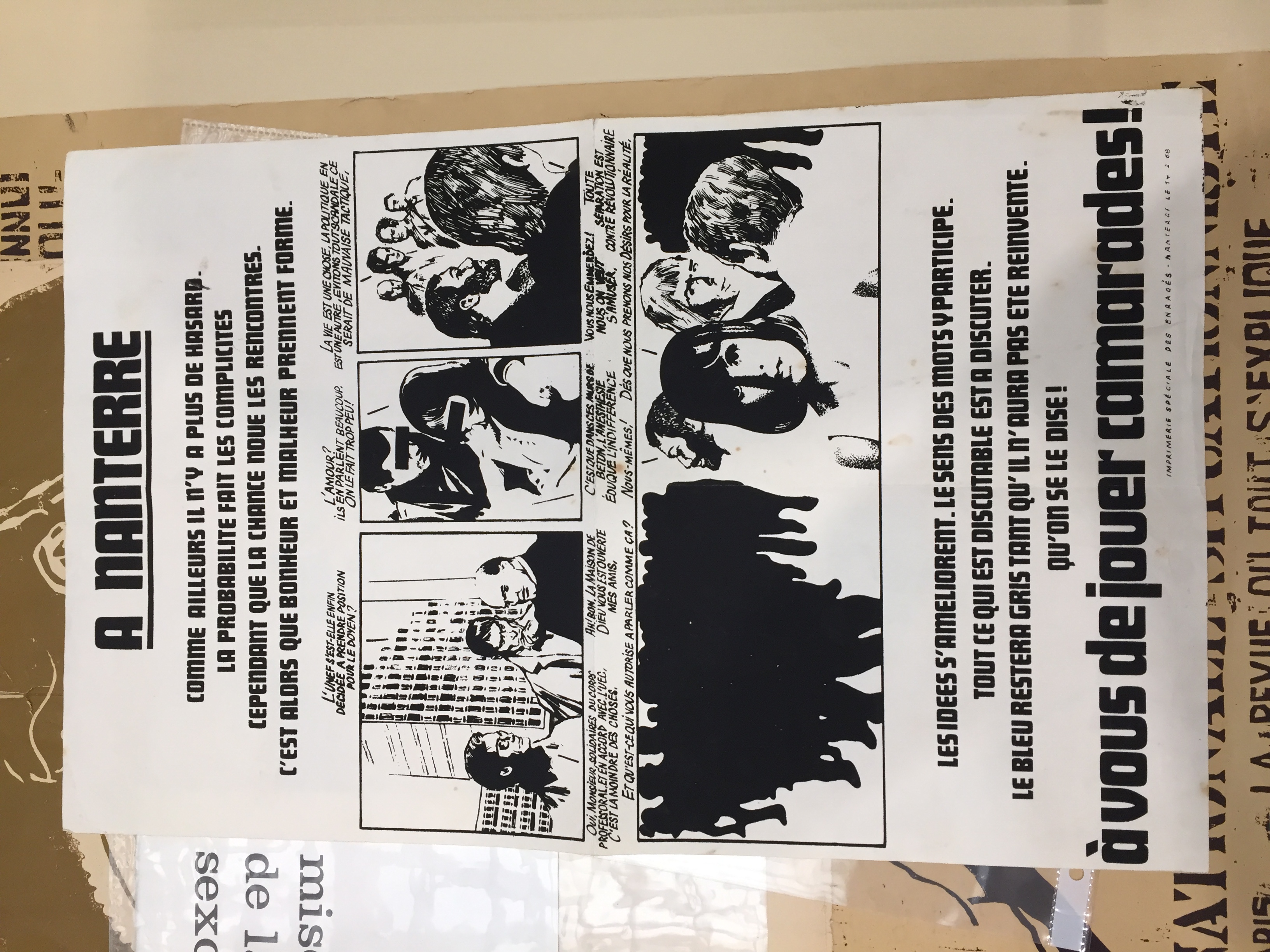
In Nanterre (by André Bertrand of the enragés group)30
That May "68 was, for the S.I, the proverbial “tough act to follow"; that the intoxication of 1968 (“from Prague to Mexico City. . .“) unsettled the group's normal composure; that the S.I. didn’t handle sudden notoriety as ably as it had endured obscurity; that May ‘68 itself has receded in importance: and interest—all of this, with the benefit of hindsight, is obvious enough. What's no less obvious, to me, is that some people would too gladly conceal behind such “knowing” remarks their own failure even to approximate the level of accomplishment the S.I. attained in that hour.
I hesitantly approach the hornets’ nest of the S.I.'s bad reputation. But a number of people have constructed, then circulated, superficial impressions based on rumor, cursory reading, or someone’s jaundiced recollection31 . Such impressions serve to discourage others from making the effort that’s needed now—long after the tempest-in-a-teacup acrimony has subsided—to retrieve the valid distillate from the S.I’s theory and practice.
First, the oft-beard “sectarianism” charge is usually invoked by those who need to play down real differences. Hence. the constant Stalinist ruse of the “popular front,” that notorious foot-in-the-door trick designed to silence criticism until it’s too late to voice it. True, the S.I. was called “sectarian and dogmatic” even by other self-avowed “anarchists.” But the S.I. was alert to the danger of “‘nonsectarian” coalitions in which authoritarians could maneuver with impunity, and the gullibility of libertarians who joined such “action alliances."32 The S.I. also differed from Trotskyists, etc., in that they had no desire to lure people away from coalitions in order to “recruit” them. To quote directly:
We are not a power in society, and thus only “exclusions” only express our freedom to distinguish ourselves from the confusionism around us or even among us... We have never wished to prevent anyone from doing what he/she wants... We merely refuse to be ourselves mixed up with ideas and acts that run contrary to our convictions and our tastes.33
The matter of the S.I.’s insulting arrogance is vastly more complicated. To some extent, the sneering tone is tres French—or at feast in one French tradition—and some degree of sublimated, intellectualized sadomasochism seems undeniable. Regrettably, some of the types who've been attracted to the S.I. find that tone titillating, and strain to mimic it. A chronology of the S.I.’s work even devotes an entire chapter to “an index of insulted names."34
One has to look past all this to determine whether there is substance to a given criticism or insult. Moreover. quite apart from gratuitous sadism, the unpleasantry of ad hominem assault seems inherent in political struggle. In other words, if you confront a well-paid or high-status individual, you can't very well divorce “ideas” from the personal circumstances that largely explain why he/she holds such ideas.
Still, I think that by expending too much energy in dreaming up imaginative insults (admittedly an art form), rather than methodically unraveling opponents’ arguments, the S.I. made the going needlessly rough for itself.
And the going could get rough enough as it was....
3. Applied Theory: Into the American Crucible
To realize radical imagination requires a varied knowledge. but this knowledge is nothing without the style with which it is handled.
—Raoul Vaneigem
The style is the man. And how! The law allows me to write, but on the condition that I write in a style other than my own... I am a humorist, but the law orders me to write seriously. I am bold, but the law orders my style to be modest. Grey and more grey. that is the only authorized color of freedom.
—Karl Marx
The old problem of knowing if men as a whole really love freedom finds itself superseded; because now they are going to be compelled to love it.
—Guy Debord
The centrality of the French-American connection dates back to the two great bourgeois revolutions of the eighteenth century. For then both America’s 1776 and France’s 1789 appeared as two closely aligned moments within the same dawn of an epoch. And yet the splits that wedged in soon thereafter have since widened to where they could now be said to divide the planet into warring camps: Leninists the world over, claiming to carry the torch of the French (via the Russian) Revolution, versus the conservative Americans who behave as if our first Revolution—or rather, the official interpretation of it—were sufficient and valid for all time35 .
I discussed earlier the meaning of Europe's turning-point years (1917-1923). But the decisive juncture for America came right after 1945, as Henry Luce's “American Century” took shape. It was then that the U.S. for the first time could boast all the advantages: a nuclear monopoly, a revved-up economy, four-fifths of the world’s intact industrial plant. a longstanding hegemony in the Western Hemisphere now extending throughout Asia and Africa (as the older colonizers evacuated), and so on. Of course, the U.S. had to reckon with other new extrusions on the geopolitical map—viz., an expanded Soviet sphere, various Third World upstarts, etc. —but, Mother Europe, ravaged and humbled, would come begging for junior-partner status in any reconstruc:
tion scheme.36
Before. 1945, “progressive” people elsewhere looked to America with a mixture of admiration and puzzlement: a beacon of hope, as it were, that sent out conflicting, unreliable signals. (Latin America, of course, had seen our worst ever since the Monroe Doctrine.) But since 1945, the prevalent sentiment everywhere has become more and more that blend of derision and mortal dread you feel toward a clumsy, walleyed giant who wants to win your love, and could crush you in the process. (Feelings toward the U.S.S.R. have become not so different.)
Likewise, before 1945, same radical analysts, both in the U.S. and abroad, stressed the importance of “the American question” but were ultimately exasperated by America’s bewildering knack for eluding old or imported intellectual models. Besides, it was understandable to concentrate on areas of the globe that conformed more recognizably to the set scenarios (Marxian class struggle in Europe, Lenin's anti-imperialism elsewhere) so long as those areas seemed to betoken the impending wave of the future.37
Since 1945, America can no longer be shunted onto radical criticism's back burner. But it’s the U.S. role in the arms race and in Third World counterinsurgency that has riveted the orthodox Left's attention. Only the S.I, Marcuse, and a few others have grappled with subtler, more insidious factors: the new techniques of social control, so dazzling in sophistication, so overwhelming in complexity, as to make the heavy-handed fascisms of Europe between the World Wars seem but crude forerunners in comparison.
In this light, then, S.I. theory was to some extent a French38 response to American-led developments, requiring of its creators an imaginative leap out and “in advance” of the backward French setting that the Gaullist regime, through its web of archaic institutional buttresses, labored stubbornly to hold intact. Bearing in mind these retardant factors, not to mention the self-serving anti-Americanism of the French Stalinist Left, one is all the more impressed by the S.I's degree of advancement—and enabled to measure its limitations.
The S.I's effort to “keep abreast of reality” was, to be sure, not altogether successful. Their analysis of the 1965 Watts riot was, to me, a glaring example of their unfamiliarity with much of the American scene.”39 Still, not unlike Marx despairing of his German compatriots while expecting great things from "advanced” Britain, Debord and friends, at least for a time, were highly intrigued by the potentials of an historical encounter between S.I. theory/praxis and American conditions.
This sanguine trans-Atlantic outlook didn’t last long.
The U.S. New Left fizzled, and the New York section (1968-1970) of the S.I. appeared ineffectual; meanwhile, growing movements throughout Europe (though not, ironically, in France itself were intensifying, maturing, and making appreciable impact among industrial workers.

By 1971, Debord felt no more desire to embellish the facade of an “organization” that had been glutted by sycophants and, finally, superseded by history. Ever since Debord and the Italian G. Sanguinetti announced the S.I.'s “dissolution” in The Veritable Split in the International (1972),40 their gaze has been fixed, almost exclusively on European tendencies: in Spain, Portugal, Poland, but above all, in Italy. “Being for the moment the most advanced country in the slide towards proletarian revolution, Italy is also the most modem laboratory of international counter-revolution.” Thus wrote Debord in 1979; and also: “It is in the factories of Italy that [Society of the Spectacle] has found . . .its best readers."41
So I can proceed no further without a balanced critique of the S.I’s “Euro-centrism.” The latter neologism was coined during the sixties, most notably by Black Power advocates and “Third Worldists,” to expose the cultural narrowness that neglected—and, the argument ran, slighted—a whole range of nonwhite, non-Westem experiences (e.g, the “Great Books of the Western World" approach in university curricula). This line of criticism, like most, has produced better and worse expositors, so I want here to distance myself from the moralizers who merely reciprocate such ignorance (as if there weren’t also long dissident and antiracism traditions in the West, as if liberatory prospects elsewhere wouldn't have gleamed brighter if such tendencies had won out, etc.)
In fact, during the latter half of the sixties, a series of S.I. journal articles thoughtfully analyzed the promising currents in Algeria. China and elsewhere, while taking to task the unthinking long-distance emulators of Mao, Frantz Fanon, Che Guevara, et alia.42 The S.I. then began, but never carried far enough, the kind of clear-eyed, guilt-free assessment of the Third World that is still in such miserably scarce supply among radicals in the West. The trouble is that in the dozen years since the S.I’s break-up, it would seem that its ex-members, and far too many of their epigones, have not kept pace with new developments outside Europe: neither OPEC's oil-rich sector, high-tech “islands” like Taiwan or South Korea, Japan's managerial methods, nor the militant and quite “advanced” actions of workers in Bolivia, Jamaica, and elsewhere.43 For example, the profound turmoil in Portugal (1974-1975) drew inspiration from Italy, Poland, May ‘68, and even a certain “situationist” trace. But it was begun by young soldiers who sympathized with the anticolonial movements they were sent to suppress in Africa, and many Portuguese were acutely aware of the recent bloodbath in Chile when Allende, just two weeks before the September 1973 coup. disarmed the worker and peasant consejos (councils) that had sprung up around—and sometimes against—his wavering socialdemocratic government. Hence the Portuguese watch-words: “Watch out, workers! You have too many friends!"44
Nor am I persuaded that Italy alone has been “the most modem laboratory of international counterrevoiution” (though this may have been true “for the moment" of the Moro kidnapping in 1978). More accurate to say that national elites, East and West, all learn from each other, and that these rulers are light-years ahead of the ruled at the game of transnational coordination. Indeed, for chilling efficiency and thorough planning, what could rival the Jaruzelski coup in Poland in December 1981, as coached by Westem bankers and the KGB?
Still, it is true that guilt-ridden "Third Worldism,” lack of information, or the sense of urgency over nukes, Central America, and the like, have prevented Americans from learning a fraction of what they might about some remarkable currents among European youth and workers.45 Then again, some Eurocentric ex-situationists seem to have lost interest in the last decade of U.S. history—because it doesn’t conform so recognizably to the S.I scenario?—and left us to fend for ourselves...
The American (New York) section was spawned in March 1967, when the S.I. dispatched their roving delegate, the Dutch-born Tony Verlaan, to agitate and make contacts in the US. Since the S.I. always and wisely had insisted on some manifestation of “autonomous activity” before admitting new members into the group, Robert Chasse and Bruce Elwell later that year formed the “Council for the Liberation of Daily Life.” Chasse wrote Hall of Mirrors46 , which was a brief but lucid critique of SDS, SNCC, Black Power, etc. Insofar as Chasse wrote in a clearly American idiom, and didn't mechanically graft S.I. constructs onto these particulars, his texts endure even now—better than much of what followed.
Meanwhile, Verlaan gadded about the States, spreading the Strasbourg legend among SDS activists and prevailing upon “underground” newspapers to reprint S.I. comic strips and “On the Poverty of Student Life” (which, often in bowdlerized form, some were only too happy to do). In the confused delirium of New Left activism's peak years, one found, as in the classroom disruptions of the Radical Action Co-operative, an imagined mimicry of the Nanterre enrages coexisting with all manner of Maoist and “Americong” fantasies.
By June 1969, Verlaan, Chasse, and Elwell, along with Jon Horelick—now S.I. members—published the first and only journal of the American section47 . In it, the critiques of the “modernist ideologues” Marcuse and McLuhan mostly miss the mark. The swipes at assorted Left luminaries, and the chronicle of the New York section's earlier activities, are somewhat better, but of little interest today.
These New Yorkers then suffered the distinct misfortune of meeting their European counterparts on the downslide of disintegration; viz., at the September 1969 Venice conference, of which Debord wrote: “There were fourteen situationists present, but they had the spirit of two.” In any case, the Americans resigned or split from the S.I. in 1970 with a rather sour aftertaste. Verlaan and Chasse have preferred “private” life ever since. while Elwell has done his best work since leaving the S.I. Only Jon Horelick has bothered to continue in a constricted, arcane pamphlet medium of dubious value.48 49
It was out of what Chasse and Elwell had dubbed “the gelatinous sea of Bay Area ‘oppositions’" that the most impassioned efforts to Americanize S.I. theory or tactique next emerged. The New Yorkers weren't wrong. but the slippery nature of ideologies, and of the character-structures that could juggle grotesque inconsistencies inside the same skull, was only most pronounced in California vis-a-vis the more clear-cut sectarian procedures among some East Coast politicos. (Vis-a-vis Europe, such blithe and casual incoherence was all American.)
In The Totalitarian Temptation (1976), the Trilateral Commission publicist Jean-Francois Revel used the terms “pidgin Marxism, or unofficial Stalinism” to describe the mentality that was coming to prevail on the post-1968 European Left: “A mishmash of Marxist-Leninist as well as Marcusean and [ultra-] leftist ideas, accompanied by third-world postulates.”50 My point here is that such “pidgin Marxism” — with some populist, countercultural, and other ingredients tossed in—was always endemic to the U.S. New Left, and persists unclarified to this day. (Rare the American neo-Stalinist who is even aware of being one. much less ready to cop to it.)
The reasons are historical. There was an almost unbroken continuity in the European Left, with each “parent” Stalinist, Trotskyist, and anarchist group sprouting its “youth branch,” while traditional formality (drafting “position paper.” enunciating “program.” and so on) remained the prevalent mode right up until 1968. We might recall that the S.I. was, with certain reservations, quite impressed by the freewheeling style of Berkeley's 1968 Free Speech Movement. and that the “new spirit” they commended in May ‘68 took a longer time bursting through the stodgier European atmosphere.
Back in the U.S.A, the Old Left had virtually vanished after 1948, so that the next crop of young rebels very much had the sense of starting from scratch. Most were too busy in their blind rage against “war, poverty and racism” to scrutinize musty texts. Even for the more serious-minded and the “red diaper babies,” the dim memories of sterile Trotsky-vs.-Stalin disputes just seemed to threaten the freshness, the sweet excitement of those heady days.
Obviously, a deluge of pop sociology and other demeaning crap has been written on that period, the motive often being the envy of older New York literati for sex-crazed California kids (cf. Lasch or the neoconservatives), the result being to trivialize “the children of Mao and Coca-Cola.” My purposes here are quite different. I'd almost argue that the oft-lamented “ignorance of history” was, in the case of the sixties radicals, a blessing in disguise—or at least a neutral phenomenon. If it gave rise to all kinds of ghastly and laughable contradictions, it also unleashed a vitality that most Frankfurt School worshipers—and some S.I-influenced Americans—have yet to fully appreciate.51
In At Dusk (175), David Jacobs and Chris Winks charted two broad courses taken by the S.I.-influenced Americans: “the popularizers,” as against those of “a more theoretical inclination, being involved with a particularization of situationist analysis to the specific context of American capitalism.”52 I heartily agree with much of At Dusk, but the bit just cited could not be more misleading. What they mean to say, as is evident from the rest of the text, is that the “popularizers" proceeded as if S.I. theory were a nicely finished and perfect import, obviating the need for any further homework, Since I was, and shall remain, one of those damnable “popularizers,” I can attest that this insinuation just wasn't true of me, or of any of my favorite collaborators. (There were some unfortunates who produced crude, ill-considered work, but this was mostly due to their personal shortcomings; in principle, they had nothing against “particularizing” or improving on the S.I.)
Besides, it is pointless to use “popularizer” in this pejorative sense. It is a neutral term, while "vulgarizer” is the pejorative one. What's needed are stipulative criteria for determining when and how an attempt at popularization slips into vulgarization. Meanwhile, more serious problems are dilution and recuperation, such as when a “pidgin Marxist" like Stanley Aronowitz borrows a few ill-digested S.I. notions to liven up a soporific book or to modernize the image of his Democratic Socialist Alliance53 . (We will surely see more such monstrosities, if popularizers like myself have greater success.)
On the other hand, At Dusk is closer to the bull’s-eye when it discusses those who began their S.I. apprenticeship in the Bay Area's Contradiction group, for whom "a collapse of theory as social criticism" fed to “theorizing about theorizing,” to a “narrowing of the scope of critical inquiry,” and to “mere commentary on secondary issues in situationist theory.” At Dusk is also close to correct in speaking of a “situationist etiquette ...in the stylized comportment of groups toward each other.” But what's missing there is the fact that my friends and I never played along with such silliness. Even though Ken Knabb, Isaac Cronin, et alia had nary a single gracious word to say about us, we opted to address the wider world, and left it to them to hurl charges of “behindism”54 or “counterfeitism” or the quasi-mandatory “pro-situ” back and forth at one another.55
To be sure, I don’t wish now to resume this hot-so-merry minuet. As I've noted, Knabb performed an invaluable service for English-speaking radicals by publishing his meticulous S.I. Anthology. Also recently, Isaac. Cronin (with Terrel Seltzer) has pioneered the situationist use of videotape in Call It Sleep (1982). I'm not terribly impressed with the result, but I’m sure others will benefit from it.)
What interests me more is the perennial question of the target audience for any agitation. Reading hack over the Knabb/Cronin pamphlet literature of the early seventies, I am most struck by its cloistered feel. To care about it, one would have to accept that being a “pro-situ” is the most grievous sin that any knave could commit, and that being the Rightful Inheritor of the SI. is the summun bonum of life itself. Clearly, some iind of perceptual warp occurs when one assumes that “the burning questions" for one's handful of friends hold the slightest interest for the population at large.
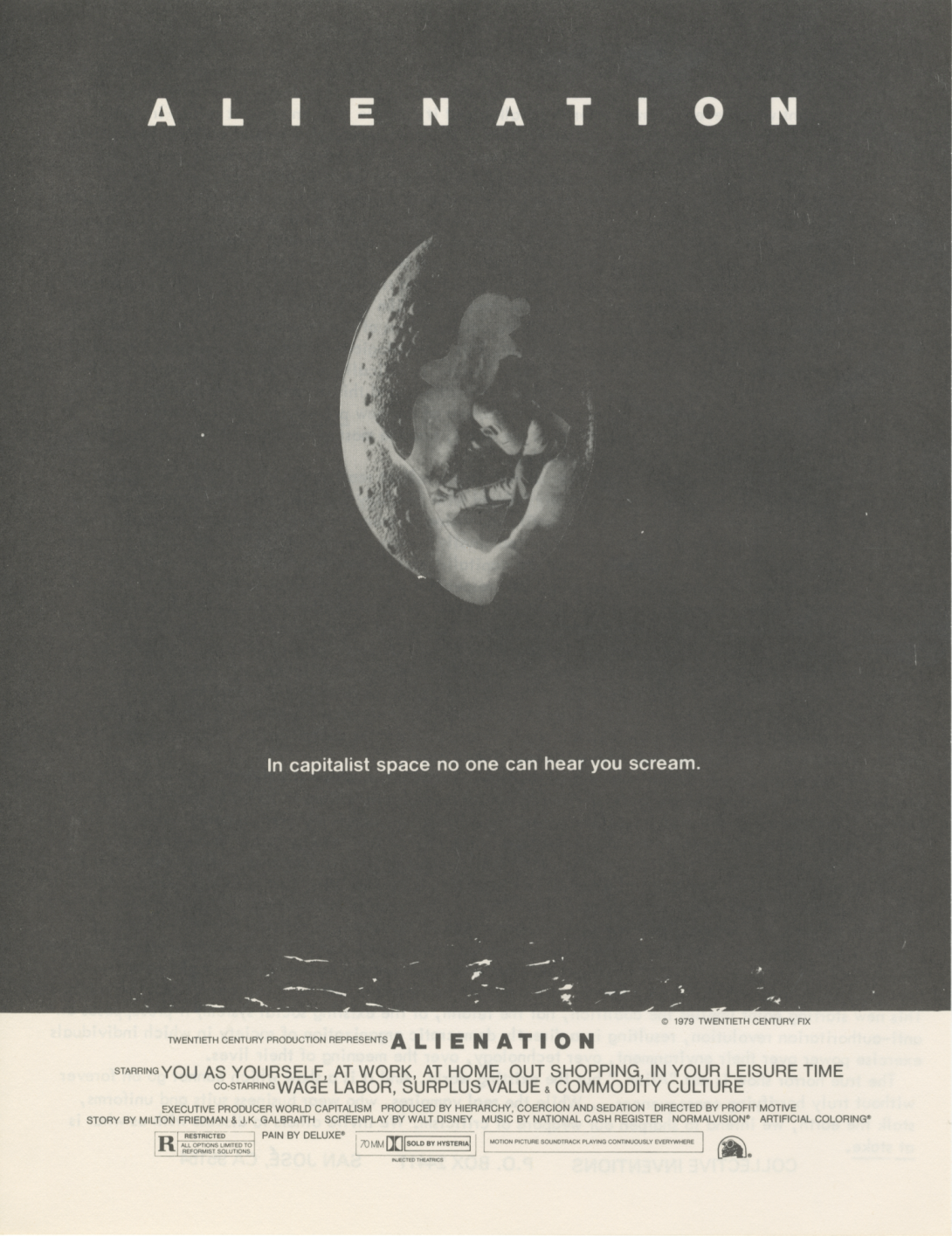
Alienation (by Collective Inventions)
At the same time, I've come up against the limits of public statements which are too “at large.” aimed like scattershot toward a hypothetical Average Person who may or may not exist. At Dusk explores the pitfalls of approaching “the proletariat" as a singular (rather than Plural) entity, and of failing to “explicate the various categories and subdivisions within this class.”
The challenge, then, is to find the means to speak not only to other revolutionaries, nor to an amorphous mass, but to specific groups, or subgroups, with a precision and insight that acquires the resonant power of recognizability. For instance, to the extent that “On the Poverty of Student Life” played effectively on the status-anxiety and self-image of a certain kind of student -viz., one with the “humanist” illusions of a liberal-arts orientation—one can see why it was the most popular S.I. text (half a million copies
in nine languages). So, too, one can grasp why the same text would have far less impact among the more cynical-pragmatic students in the U.S. today.
In the narrative arts, one speaks of a novelist or playwright “having an ear’’—or lacking one—for the nuances of dialect within specific milieus. To bring radical theory from the general clouds back down to particular patches of Earth—or from the margins into the mainstream—one must likewise “have an ear” for whomever one encounters: in one-to-one conversation, in détournement, in local actions, or in the more ambitious “texts.” By this standard, the most telling thing one could say of a poor effort is: “What are they talking about? I've never met anyone like that...” (remarks I've often muttered when reading the worst S.I.-influenced stuff).
To cut through all the bullshit, to make others say: “Yes, this is how it is, how we live"—that's how real dialogue begins. . . .
The At Dusk authors themselves had once been members of Point-Blank, some of whom began as a gang of insolent brats at Palo Alto High School with a lively, if raw, pronunciamento on The End of High School56 . Point-Blank made its mistakes, such as calling for a situationist revolution, whereas the S.I. itself had only set about advancing the social revolution. (Most other Point-Blank errors are adeptly reappraised in At Dusk.)
But Point-Blank, to its credit, also maintained a fairly high level of graphic quality—not for them the excuse that “we haven't got time to make this look better."57 Their détournement of the U.C. Berkeley student paper was, in many respects, exemplary. Several thousand copies of The Last Daily Cal58 were, in May 1972, surreptitiously deposited at all the campus distribution points where somnambulant students routinely picked up the dreary rag it parodied. The front page revealed why this was to be the last issue—complete with a letter from the Chancellor well-behaved liberals—while inside was a scathing assault on some cozy assumptions. of the Berkeley scene. This “intervention” certainly had the desired, disorienting effect. Not only was the paper read with more avid curiosity than usual, but the “real” Daily Cal staff was compelled to make an embarrassed public denial—which, of course. was feeble and too late.
Still, there is a useful lesson here on the limits of détournement. Both the At Dusk authors and Point-Blank ex-member Chris Shutes59 later downplayed the value or impact of this and other would-be “‘scandals."" Yet such disappointment itself is the result of having had an inflated expectation of what might have been accomplished in the first place. My comrades and I later spoke of “The Myth of the Magic Bullet:” ie., the unstated but operative assumption in those days was that if some single Project were just potent enough, just timely enough, then people would run right out and commence the social revolution—or at least a healthy-sized insurrection—the very next day. If détournement doesn't work—Are we being too coy? Is the joke going over everyone's heads?—then we'll try a direct “statement-in-the-positive.”
Obviously, we needed a more sober, deflated set of criteria for how to ascertain whether or not something “worked.” We had read our Debord on ‘‘not expecting miracles from the working class," on approaching our own activity with "a certain fatigue." But it has wo be admitted that, as late as 1975, our youth and our ambivalence toward the Bay Area Left—hating its Maoist, mystical, and reformist deformations, but unready to let go of the presumption that the underlying rebellious impetus could still, somehow, be set right- kept us from taking to heart what we saw perfectly well. Not only did the pursuit of “The Magic Bullet" repeatedly end up in the “postpartum depression" that made so many of us unduly hard on ourselves, it also along with the aforementioned “situationist etiquette”—made all concerned brutally harsh with each other. In surroundings where no one else was about to utter a peep of encouragement, this pins-and-needles bitchiness did nothing for the morale. Only the hard way would we relearn the meaning of comradely consideration, of the senses of proportion and of humor (about ourselves), and of “knowing how to wait.”
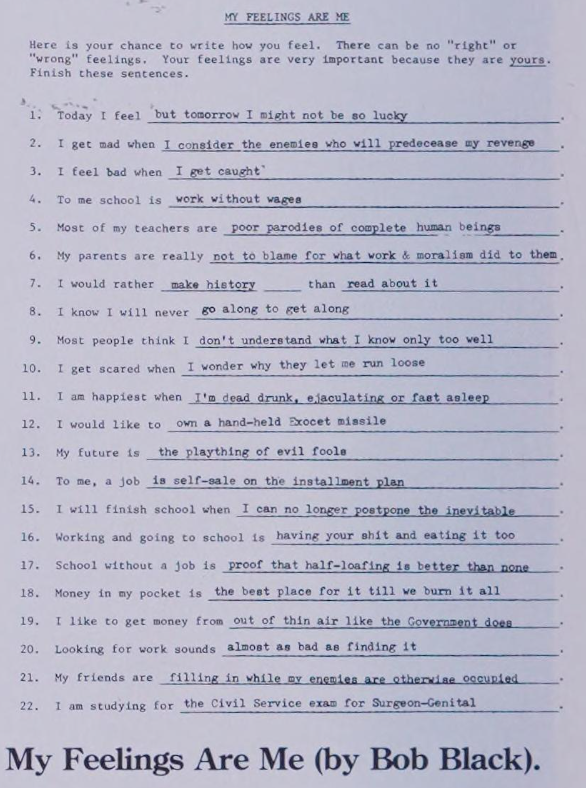
On a happier note, I can report that, by the later 1970s, the more sensible attitude was widely in evidence. For instance, former members of Point-Blank, re-grouped as Collective Inventions, were inclined to collaborate amicably with some of their old adversaries. Indeed, it seemed that no one had much appetite for picayune internecine squabbles; at any rate, the pamphlets stopped.
It was in the summer of 1972 that a rakish fellow named Stephen Duckat began slipping me sundry S.I. materials. Quite an eye-opener. I was twenty-four years old, are enough of a “pidgin” radical to be simultaneously drawn to Wilhelm Reich ard Murray Bookchin, yet swallowing the purportedly “non-doctrinaire” apologetics for Third World Stalinism in Ramparts, Monthly Review, and just about the entire Left press. I was then working with the “eclectic” Berkeley paper New Morning, which was not without its own mild critiques of the more lunatic excesses of the sacrificial and other-directed Left.
From the outset, then, S.I. theory was a bracing tonic for me, but I was dissatisfied with the formulaic transplanting of these ideas into the American setting. I was even more put off by the needlessly precocius and convoluted prose style, yet eager to see the valid core of this perspective reach beyond the hermetic “milieu” where it was festering, to little effect.
I was destined to get it from both sides: the purer situ epigones gave me nothing but shit, while the ostensibly “open” and “nonsectarian” forums were closed off to me tout de suite.
I relied on my political instincts. What was true of France's Stalinist Left was not so readily applicable to U.S. New Left writers like Carl Oglesby; to oller mavericks like Dwight Macdonald, Noam Chomsky or Norman Mailer; or to the “revisionist” historians like William Appleman Williams and his protegés. (Some Europhiles wouldn’t even make time to read anyone who didn't bear the right European pedigree.) Since it was these people that I had previously—and since!—respected, and not cardboard buffoons like Tom Hayden, Jerry Rubin, and Bob Avakian, I always stayed wary of the too hastily adopted French import.
I knew there was a great deal more to the counterculture than the “squalid hippie crash pads" my friends so snootily dismissed in their first “theoretical” pamphlet60 and, for the matter, something far more knotty and elusive about the New Left than a few people joining some preposterous outfit like the Progressive Labor Party. Hence, my participation in “the group" I then met always remained peripheral, guarded, qualified, ad hoc. (Some of them had their doubts about me as well.)
Still, I had a high old time helping Negation (later, For Ourselves) disseminate ingenious posters like “Jesus Loves You—Kill Yourself,” “Don’t Change Life—Change Leaders” (on the 1972 elections). For later episodes, such as to promote his newfound guru, there was not only a leaflet (“Forget Your Life— Contemplate Mine") but an occasion to heckle, disrupt, and generally make a circus of what threatened to be a deathly serious gathering. Such targets were too easy, of course--as a comrade later quipped, “as broad as a preacher's ass”—but dammit, we had fun in those: days. It was no less a pleasure to push the New Morning paper "past the point of no return” by exposing Berkeley’s hippie-Maoist “red Mafia” for what it was. (In retaliation, funding for the paper was promptly terminated.)
No doubt the most exhilarating moments of all were the night-riding graffiti blitzes, a form of adult delinquency so incomparable that I pity anyone who hasn't savored it. (To take up radical critique solely by way of polite forums and lonely perusal of texts just isn’t the same.) At a time when the writing on Berkeley's walls was descending from the trite to the necrophiliac (from “Free Huey” to “Che—or whoever's dead—Lives”), we deemed it quite the public service to grace the shopping districts with “SHUT UP AND BUY!" and “HURRY UP AND PARK! YOUR BOSSES ARE WAITING!” Another popular item was “MURDER THE ORGANIZERS OF YOUR BOREDOM.” There were many others. lsn't it heartwarming how a dozen malcontents can redecorate a city? All it takes is two or three inconspicuous vehicles, a planned itinerary, synchronized watches, and at each stop, two to stand lookout, one to drive the getaway car, and one to inscribe the spray-paint poetry. Billboard modification is a bit trickier, but the resourceful find ways. One brainstorm we never took far enough was the Name the Terrain Game, whereby all public spaces in a given perimeter would have their true identities pinned on them. But “Bureau of Slow Death” on a welfare office and “Museum of Separate Thought" at a university made for a good start. . . .
Above all, it was the intersubjective richness of working/playing with such a remarkable affinity group that is the hardest to convey, and yet made the most vivid impression on me. There were a few dullards hanging around, but nothing—not even subtle peer pressure—was forcing me to befriend them. Moreover, for the first time, I had come across a more or less coherent belief system that enabled me to join in on serious political work while simultaneously indulging my deepest, not-so-secret personal preference: i.e., for sexy intellectuals with a flair for the outrageous. (Not for nothing were we called “elitist”; I'm strongly in favor of any elite that doesn't constrain anyone else, and in which one earns one’s aura of distinction.) Truly, almost every one af the men and women who were dear to me then are dear to me now. There were never enough of “us,” of course, and we never shook the earth as much as we intended to. But we were grand.
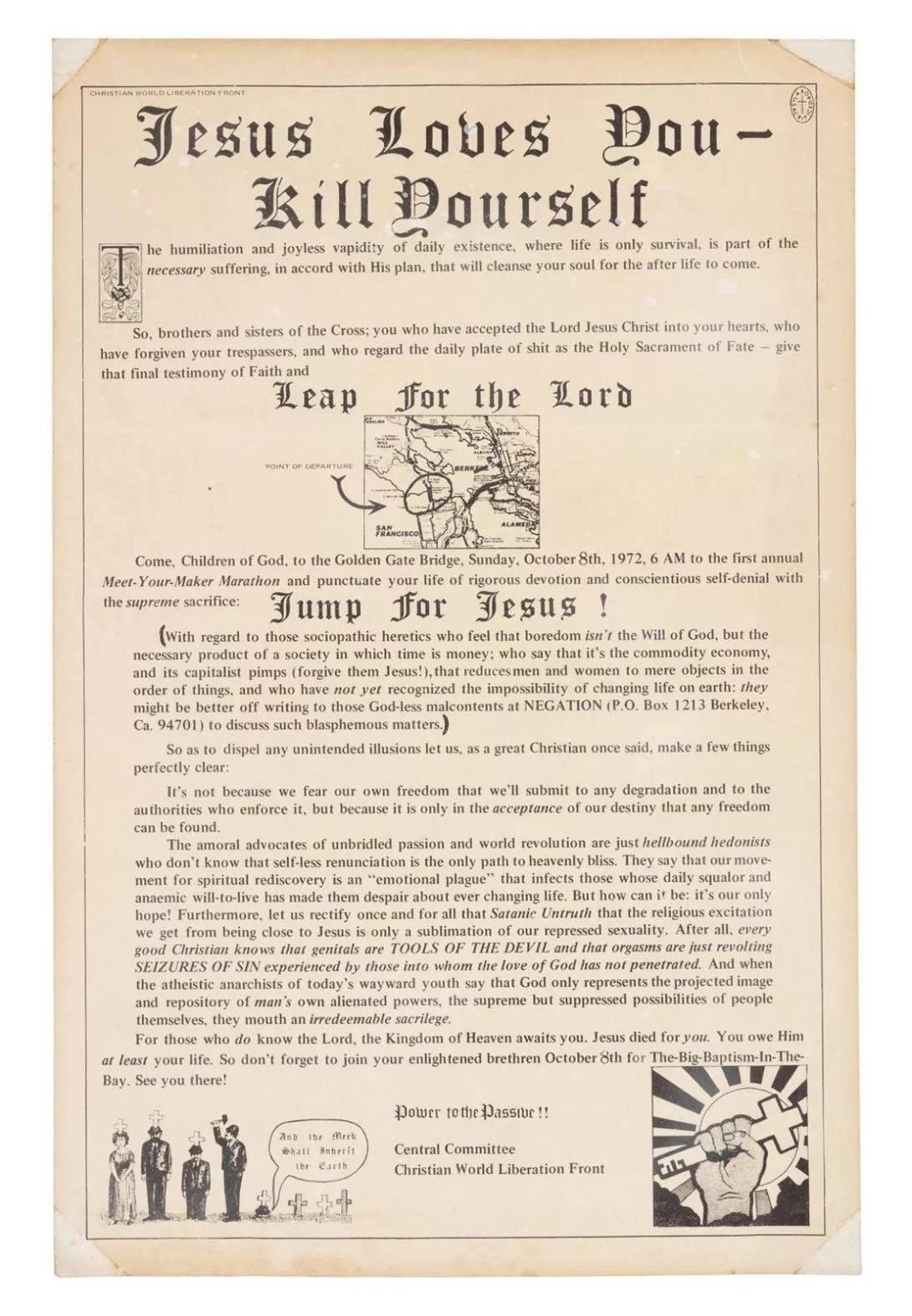
Jesus Loves You - Kill Yourself (by Negation)
The year 1974 brought the “energy crisis,” deep recession, the SLA madness, events in Portugal, plus two very influential texts from Detroit's Black & Red group: Eclipse and Re-emergence of the Communist Movement and Lip and the Self-Managed Counterrevolution.61 At the time, the aggregate impact of these and other factors made certain pet “situ" arguments rattle hollow indeed. It’s now clear enough that the prolonged contraction in the world economy does not signify a “simple return” to the 1930s. Besides, the crux is always how one responds to an economic crisis. Yet there was no denying that S.I. predictions of increasing “abundance” had become somewhat embarrassing. We knew it was time, without succumbing to economism or “workerism,” to resume the critique of political economy.
Likewise, the Black & Red texts of that year made us more hesitant than ever to trumpet “the Councils” and “‘self-management” in the parroting manner of some S.I-influenced people. For the record, it should be added that the S.I. spoke of generalized self-management. and always disdained localized “self-management” of the sort attempted in 1973 by the Lip watch-factory workers. Still, the overall thrust of these new critiques was well taken.
In retrospect, most from our “group” would now concur that we then over reacted to the perceived deficiencies of our 1972-1975 phase. Those of us who could sustain the sense of now-or-never urgency about a revolution that was just around the comer, or had better be there, spent the next few years in Marxist recantations of childish situationism—hence, the journal Red-Eye (1978).62 The rest of us “responded” to the economic crisis in a more bourgeois fashion: i.e., by taking our own job/career prospects seriously for the first time.
Yet before Negation/For Ourselves gave up the ghost, some of the prime movers completed its two major projects: The Right To Be Greedy: Theses on the Practical Necessity of Demanding Everything (1974), and a three-hour radio montage of readings, skits, music, and discussion named The End of Prehistory63 (1975-1976). The Right to Be Greedy was a worthwhile but flawed ouevre on the ethical implications of “communist egoism,” while the radio project was the one in which I was most centrally involved. It is sprawling, disjointed, and of uneven quality, but even now it deserves a listen from anyone interested in the ‘‘situationist" use of electronic media.
Too bad, though, it wasn't The Magic Bullet, either.

In 1979, some of the veterans of Point-Blank, Negation, For Ourselves and related groupings joind forces with some younger anarchists and antinukers to form “The Union of Concerned Commies" (U.C.C.). Preparing for the No Nukes is Not Enough conference, in November of that year, provided the context for libertarian socialists in the antinuke movement to link up with those, like myself, who preferred "the critique of everyday life" to issue-orientated politics.
For those of us with a “situ” past, it was during these meetings that the degree of maturity became obvious (but a playful maturity, nonetheless). We could by then take S.I. theory and tactoque in stride, so to speak, and we were meeting a new “generation” of radicals, who came of age with feminism, punk rock, and antinuke activism, and among whom the moralism, hysteria. and illusions of sixties diehards were not nearly so thick.
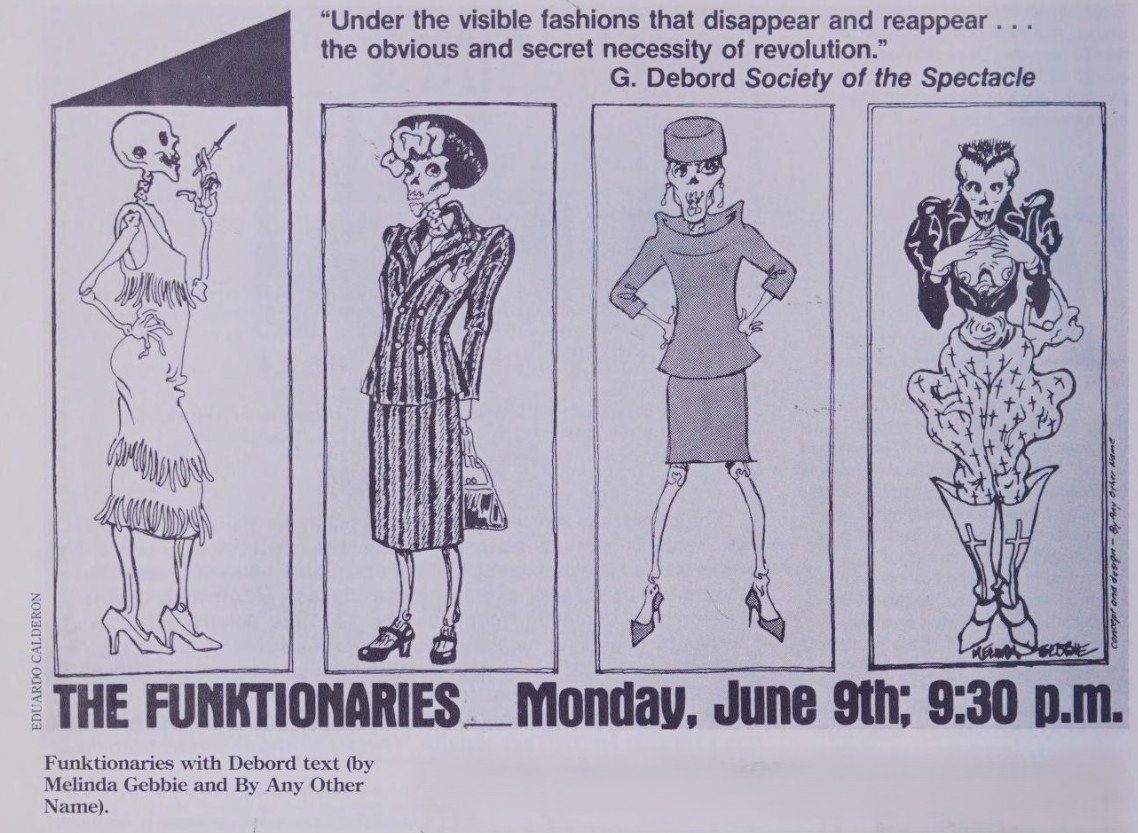
Then, Carter's jittery response to events in Iran and Afghanistan precipitated a brief revival of antidraft and antiwar activities. The U.C.C. donned mock uniforms (as “the John Wayne Peace Institute”) and worked up a series of loosely related street-theater skits that linked macropolitical themes (jingoism, militaria, etc.) to the hierarchy and commodification of daily life, Just to make sure that lefties couldn't applaud too easily, the U.C.C. also lampooned Barry Commoner, bourgeois feminists, vegetarians, Leninists, Jane Fonda’s opportunist husband, and assorted noxious creatures. In April 1980. a spinoff contingent from the U.C.C. (baptized “The Theater of Operations’) shared the stage with my band, The Funktionaries, for an extravaganza called “Blame God It’s Monday!’ (thus ensuring that the club owner wouldn't invite us back, even though we packed the place).
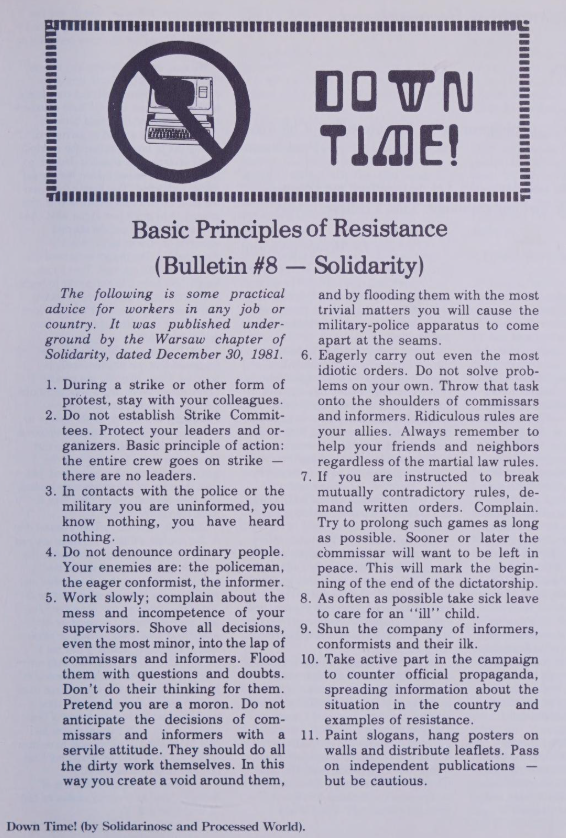
A few of the U.C.C. perpetrators have since been active in the collective that publishes the quarterly Processed World,64 which certainly “has an ear" for the information-handling and clerical-work sector of the proletariat in which most af them happen to find themselves employed. (A vicarious fascination with the shrinking “industrial” sector had always been a weakness of earlier S.I.-modeled efforts.) Processed World is not yet as analytically rigorous as its more experienced detractors would like it to be, but I think it has so far served its limited function adroitly.
4. Conclusion
Every philosopher. . . participates in the impure reality of his age.
—Paul Nizan
We are going to die one day, soon. Let us therefore not be unworthy of our pride and our ambitions, This, I believe, is Guy Debord's message.
—a Le Monde reviewer
The 1980s present a host of novel challenges for radical critique. If one observes Reagan or Thatcher domestic policies, legitimized by recuperation of right-wing “libertarian” populism, one see a pattern of selective economic recovery, favoring high-tech sectors to the detriment of dying “smokestack” industries, resulting in all kinds of dislocations, regional discrepancies, etc. Thus, unlike the 1930s, the hardships do not fall as evenly across the entire labor-selling class—a fact which powerfully impedes classwide solidarity, already undermined by racism, suburbia, and false consciousness. Also, these brave new adjustments in the organic composition of capital are being prettified, for the “hip” young intelligentsia, by variants of Alvin Toffler’s “third wave” ideology. Meanwhile, parts of the Third World enjoy the opulent influx of petrodollars, while a so-called “fourth world” sinks into a wretched abyss of International Monetary Fund indebtedness.
In the “cultural” sphere, ludicrous but not ineffective attempts to resuscitate the most archaic forms of conditioning (patriotism, Cold War paranoia, fundamentalist religion, ad nauseam) manage to coexist with a cocaine-drenched Wall Street and Culture Industry, the flagrant pornification of television, and other completely incongruous phenomena.
In response, the sad little Left seems irretrievably locked in on automatic pilot: the fight against cutbacks, voter registration for black mayors, the rearguard defense of a discredited Welfare State, and an anti-imperialist rhetoric as superannuated as the now-failing U.S. hegemony.
What, if anything, can S.I. theory and tactics contribute to the elucidation of the present situation?
One can begin to answer by recalling that, in terms of program and (lack of) vision, most of the Left is bogged down in even earlier time frames. One can also note that it is only in this decade that competent translations and editions of the major S.I. source texts, along with serious critical discussion of them, are being made widely available in our language.65
But it will probably be up to those who newly “discover” S.I. theory, and who then try their own hands and imaginations at S.I. tactics, to provide any adequate answer.
There is a missing link between theory and tactics, of course. It's known as strategy. The S.I. never really formulated one. For that reason, the S.I. as organisation has little to teach us that we couldn't learn better through devising, our own strategy —and programme. (Questions of “organization” could only be broached further down the road.)
On the brighter side, we can at least feel relieved that many of the obstructions which hobbled previous generations no longer loom so large today. There is no massive, popularly respected Communist Party—nor, in the U.S., even a social-democratic one—to corrupt political discourse and to stand guard as intermediary between radical minorities and the rest of the proletariat. Even the minor nuisances of the sixties and early seventies—white guilt, Third World romanticism, reformist naivete, and the more male-hating and moralizing strains of feminism66 —are not nearly as pervasive as they once were.
We face, then, something like a clear field of, as the S.I.'s Raoul Vaneigem defined it. an “interworld. ..a completely public realm, open to every kind of experiment, an exposed battlefield between creative spontaneity and its corruption.” This is not lo underestimate the enormity of the obstacles still standing. Indeed, so far the proletariat has known nothing but failure and defeat. This means that even the most Promethean efforts of centuries amount to so much piss in the wind. And no one should rule out the alarmist scenarios of nuclear and/or ecocidal Armageddon. But the adventures of the dialectic are still not over. Tom Paine knew: “We have it in our power to begin the world again.” Just as the Wobblies knew that those who work the machines always have the potential to bring them grinding to a halt.
Still, I wouldn't quibble if someone suggested that our situation really is hopeless. Hope. after all, is a treacly Christian sentiment, and a poor substitute for intention, determination, resolve. Ultimately, we need no better answer to the glib pessimists and the unadventurous whiners in our midst than the one that Christopher Columbus gave to a disgruntled crewman who complained, just eight days before the momentous landing, that they were all risking their lives for “a mere speculative opinion.”
Columbus retorted:
So it is, I cannot deny it, But consider a little. If at present you and I, and all or companions, were not in this vessel, in the midst of this sea, in this unknown vessel, in a state as uncertain and perilous as you please; in what other condition of life should we pass these days? Perhaps move cheerfully? Or should we not rather be in some greater trouble or solicitude, or else full of tedium? I care not to mention the glory and utility we shall carry back, if the enterprise: succeeds according to our hope. Should no other fruit come from this navigation, to me it appears most profitable inasmuch as for a time it preserves us free from tedium, makes life dear to us, and makes valuable to us many things that otherwise we would not have considered.67
(Emphasis added.)
Guy Debord completed that line of thought: “And as passivity makes its bed, so shall it be in it"
NOTES [below]
The following notes are far from exhaustive. Highly motivated individuals who wish to know more can direct inquiries to me, c/o The Real Comet Press.
Originally published in Cultures in Contention (The Real Comet Press, 1985)
- 1My use throughout of "S.I.-influenced” is a bit awkward, but to fairly treat non-members of the S.I. I wanted a more neutral, less loaded term than the old “pro-situ” epithet. (On the other hand, “S.I.-inspired’’ would have been too flattering a designation for some awfully uninspired efforts.)
- 2No one should suppose that such a brief introductory survey could exempt them from the rigors of a thoroughgoing scrutiny of the S.I. corpus of theory. After all, there are only half a dozen major texts (i.e., it's not like tackling the complete words of Marx or Freud). These include: Society of the Spectacle by Guy Debord; The Revolution of Everyday Life by Raoul Veneigem; René Viénet’s unpublished (in English) book on May '68; Knabb’s Anthology, The Veritable Split in the International by Debord and G. Sanguinetti. Also, for other evaluations of the S.I-influenced Americans, compare mine with At Dusk (cited below) or The American Situationists by Isaac Cronin.
- 3Walter Benjamin, ‘Theses on the Philosophy of History,” in Illuminations (New York: Schocken Books. 1973), 255.
- 4Situationist International Anthology, edited and translated by Ken Knabb (1981), available from: Bureau of Public Secrets, P.O. Box 1044, Berkeley, CA 94701. Also, on the early S.I. see the Greil Marcus review of Knabb in the Voice Literary Supplement, May 1982.
- 5Thesis #191 from Guy Debord, Society of the Spectacle (1981), the revised 1977 English translation by Black & Red, P.O. Box 02374, Detroit. MI 48202.
- 6I discussed Wolfe/Hughes a bit further in an earlier draft of this “Antecedents” section, which appeared in the San Francisco Review af Books, May-June 1983, as “After Modernism: The End of Politics, the Realization of Art.”
- 7See Marian Kester's reflections on Kandinsky in Passion and Rebellion: The Expressionist Heritage (South Hadley, Mass.: J. F. Bergin, 1982), as well as Charles Jencks on the Bauhaus in relation to the 1918 German Council movement in Modern Movements in Architecture (New York: Anchor/Doubleday, 1983).
- 8The joke here is that the S.I. wrote a Jot of pamphlet/articles about the need to get beyond writing pamphlets/articles. Of these, the best are Debord's “Cinema and Revolution” and Viénet’s “The Situationists and the New forms of Action Against Politics and Art.” Both are in Knabb's Anthology.
- 9Debord, Society of the Spectacle, #100.
- 10I opt to use “Marxian” instead of “Marxist”—a merely semantic distinction, of course, but still a useful one.
- 11See Murray Bookchin, Fredy Perlman, E. F. Schumacher, John Zerzan, or a host of other regressive thinkers which Detroit's Fifth Estate reveres regularly.
- 12See especially Debord, Society of the Spectacle, 479-95.
- 13Ibid. #218.
- 14From the anarchist side, see Daniel Guerin's Anarchism (New York: Monthly Review Press, 1971). Meanwhile, from the recently burgeoning literature on the older council-communist and “libertarian Marxist" currents, ['d suggest: Dick Howard's The Marxian Legacy (New York: Urizen Books, 1977), Richard Gombin's The Radical Tradition (New York: St. Martin's, 1979); Raya Dunayevskaya's Marxism and Freedom (Atlantic Highlands, NJ.: Humanities Press. 1962); and Russell Jacoby’s Dialectic of Defeat (New York: Cambridge University Press. 1981). Each book is flawed—and only Jacoby can write—but the research is substantial.
- 15Reich's books are now widely available, Breton is taught in any decent art school, and Marcuse needs no plug from me. The quote is from Dwight Macdonald's 1946 essay, The Root is Man. For some surprising similarities between the mid-forties Macdonald and some later S.I. themes, see my article, “The Mercurial Mind of Dwight Macdonald” in the Soho Arts Weekly (27 June 1984).
- 16Debord, Society of the Spectacle, #191.
- 17Webster's distinguishes “artistic” as “an urge to create” from “‘aesthetic” as “delight in contemplating that which has been created.”
- 18Consider Breton’s quixotic concern with “honor” and other moralistic sludge, or his gushing, sycophantic tone when describing his meeting with Trotsky. Franklin Rosemont just carries on this tradition, without blinking.
- 19See “The Geopolitics of Hibernation” in Knabb, Anthology, 76-82. (This 1962 critique should be mandatory reading at all nuclear freeze rallies.)
- 20Consult the “Definitions” on page 45 of Knabb, Anthology.
- 21In other words, it is “not sacred” and can also be “‘debased by a wrang, unworthy, or vulgar use.”
- 22As you can gather, I've seen tov much Lower Manhattan “performance art” recently.
- 23Guy Debord uses this one, along with about three chapters worth of other definitions in the opus cited.
- 24Warning: anyone can play this game—Larouche’s loony Labor Party has already done so twice, with counterfeit New York Times supplements—and, at some forseeable point, a glut could have a numbing effect.
- 25Note the qualitative leap in seriousness and sophistication that separates the 1966 S.I. journal from the first nine numbers.
- 26At the time, amusingly enough, the French CP's nightmare was that several “thousands of these situationists” were out to torment them. Therefore I'm amazed that René Viénet's documented history of the May-June events has yet to be published in the U.S. Until it is, glean what you can from Alfred Willener's Action-Image of Society, Vladimir Frsera's Writing on the Wall, Bernard Brown’s Protest in Paris, Richard Gombin's Origins af Modern Leftism, or my own “Fifteen Years After May '68” in The Village Voice, May 1983.
- 27Knabb, Anthology, 319-437. [and https://libcom.org/article/poverty-student-life
- 28See Viénet's own testimony, or “Our Goals and Methods in the Strasbourg Scandal” in Knabb, Anthology, 204-212.
- 29Some of these can still be seen in The Penguin Book of Political Comics (New York: Penguin, 1982). However, the translations are execrable, as is Stef Davison's accompanying text.
- 30Libcom note:
"As everywhere else, chance no longers plays a part
probability makes for accomplices
while luck weaves encounters
it's then that fortune and misfortune take shape.Ideas improve the meaning of words takes part in it
everything disputable is to be disputed
the blue in the sky
will remain grey as long as it is not reinvented
let it be said!!!
YOUR TURN TO PLAY, COMRADES!" - 31For instances of each, see the quotes Knabb compiles in “The Blind Men and the Elephant,” in Anthology, 381-392.
- 32See Viénet on Cohn-Bendit’s March 22nd Movement in Knabb, Anthology, 375.
- 33Ibid., 178.
- 34Jean-Jacques Raspaud and Jean-Pierre Voyer, L Internationale Situationniste: protagonistes, chronologie, bibliographie (Paris: Champ Libre, 1972}.
- 35Compare with the more idiosyncratic conservative view in Hannah Arendt’s On Revolution (New York: Viking. 1963). Disdaining the French Revolution in favor of the American, she links ours to the later Council movement in Europe. Contrarily, see Dunayevskaya, Marxism and Freedom, lauding the direct democracy of the 1793 enrages.
- 36See Gabriel Kolko, The Limits of Power: The World and US. Foreign Policy, 1945-1954 (New York: Harper and Row, 1972).
- 37In retrospect, it's clear that FDR’s New Deal anticipated the Keynesian social-democracies of postwar Europe, inserting a solid center across the Continent's Great Fascist/Communist Divide.
- 38The truth, of course, is that this grand “International” was Paris-centered, class-privileged, and male-dominated to a fault—but not because they preferred to be.
- 39Knabb, Anthology, 153-160.
- 40A wretched translation was published in London by “B. M. Piranha" in 1974.
- 41Guy Debord, Preface to the Fourth Italian Edition of “The Society of the Spectacle” (London: Chronos, 1979). 7.
- 42See the relevant S.I. journal articles from #10 and #11 in Knabb, Anthology, 148-224.
- 43Some recent developments are reported/analyzed in Processed World and in No Middle Ground, 49 Ellis Street, #781, San Francisco, CA 94102. Also, a 1973 “Caribbean Situationist” record album, None Shall Escape. plus a journal, Caribbean Correspondence, can still be obtained c/o: K. Collins, 224 Elsie Street, San Francisco, CA 94110.
- 44See Phil Mailer, Portugal: The Impossible Revolution (New York: Free Life, 1977).
- 45Exceptionally good in this regard are recent Italian and German issues of Semiotext(e), 522 Philosophy Hall, Columbia University, New York, NY 10027—also, the journal Midnight Notes, 12 Parkton Road, Jamaica Plain, MA 02130. Likewise, check the sources cited in my piece on the 1981 U.K. riots, “Broken English: We Have Seen the Future, and It Refuses To Work,” in the Voice Literary Supplement, December 1983. Sorely lacking, by the way, is an adequate history of the British situationist milieu.
- 46Libcom note: see - https://libcom.org/article/hall-mirrors-robert-chasse (on the 1967 urban riots) and then, in April 1968, The Power of Negative Thinking or, Robin Hood Rides Again
Libcom note: see - https://libcom.org/article/power-negative-thinking-or-robin-hood-rides-again-robert-chasse - 47Libcom note: see - https://libcom.org/article/situationist-international-1-review-american-section-si
- 48Horelick’s prose style reads like a stilted translation from the French. Il n'est pas Francais.
- 49Libcom note: see - https://libcom.org/tags/jonathan-horelick
- 50Revel, of course is an utter Ubu, yet even he can make mincemeat out of the common beefs of most leftists. This is one reason I drink to excess.
- 51Norman Mailer’s Armies of the Night still conveys that vitality, remarkably well. You won't find it in Telos.
- 52David Jacobs and Christopher Winks, At Dusk: The Situationist Movement in Historical Perspective (Berkeley: Perspectives, 1975), 60. This out-of-print text ought to be reissued.
- 53See his book False Promises, and see what I mean. More recently, Aronowitz has decided that Samuel Gompers wasn't so bad after all. He should know.
- 54Libcom note - see https://libcom.org/article/behindism-chris-shutes-1974
- 55They denounced and misquoted us but never supplied an address whereby others could inspect our work and form their own judgments. Knabb’s address is given above. Cronin’s is: Suite 270, 1442A Walnut Street, Herkeley, CA 94708.
- 56Libcom note: see - https://libcom.org/article/end-high-school-point-blank
- 57The quote is a lame excuse I used to hear from my comrades. I never liked it.
- 58Libcom note: see https://libcom.org/article/daily-californian-spoof-point-blank
- 59Chris Shutes (with Gina Rosenberg) wrote Disinterest Compounded Daily. More recently, he has written On the Poverty of Berkeley Life. His address: P.O. Box 4502, Berkeley, CA 94704.
- 60The State and Counter-revolution: What Is Not To Be Done (Berkeley: Negation, 1972).
- 61Contact: Black & Red. address above. [Libcom note or see here - Eclipse and Re-emergence of the Communist Movement and Lip and the Self-Managed Counterrevolution]
- 62A copy of this one-shot magazine may still be available c/o Louis Michaclson at Processed World. Jean Barrot’s “critique” of the S.I. is featured therein.
- 63The Right To Be Greedy was recently reprinted by Loompanics Unlimited, a right-wing libertarian outfit at: P.O. Box 1197, Pt. Townsend, WA 98368. (True to caveat emptor principles, they've botched the typesetting and jacked up the price.) The End of Prehistory may still be requested from: D. S. Crafts, c/o Lutra Recordings, 2000 Center Sereet, Box 1200, Berkeley, CA 94704.
- 64The Processed World address is: 55 Satter St., Suite 829, San Francisco, CA 94104.
- 65As we say in my neighborhood: about fucking time.
- 66Women Against Pornography is lately taking a beating from some highly lucid, fun-loving feminist critics in Hermes, Processed World and The Village View.
- 67Columbus is thus quoted on pages 22-23 of the 1925 classic, In the American Grain, by William Carlos Williams (New York: New Directions Paperback, 1956).



Comments