
There is no fascism in Ukraine. There is only a Gestapo, death squads, and a nationwide concentration camp

The activity of our media depends solely on its audience. Please support our work on this fundraising page for further telling the truth of the streets and the trenches that is forbidden or invisible to the pro-capitalist press. Many thanks everyone!
Following the anti-busification protests that took place over the summer in Kiev and cities in Western Ukraine, the flame of unrest has flared up with renewed intensity. Ukrainian masses have tried to strike back at those who, since 2014, had come to view themselves as an untouchable, sacred caste—a "master race" (on a financial leash of the country’s biggest capitalist, Rinat Akhmetov). Those in Ukraine who had arrogated to themselves the right to speak on behalf of its civil society are now gripped by fear and rage toward those who dared to challenge their monopoly.
A new spark of rebellion flared up on November 2 at 7-A Sunny Street in the village of Petropavlovskaya Borshchagovka (Petropavlivska Borshchahivka). A mobilized man named Andriy Kuleshov had escaped from the 52nd International Assault Regiment "Forge" (military unit 3121)—part of the 1st Corpse of the National Guard "Azov"—and, after his recapture, was held in a private house of this village that had been put up for sale by Sense Bank. According to the unit commander, the unrest began following an attempt to free Kuleshov for $7,000. A 49-year-old plastic surgeon, Valentyna Moloda, arrived at the property in a private ambulance, alleging that men were being held illegally and tortured inside the building. Then, on trial, she stated that she had not intended to incite any provocation; instead, she had come to help persons allegedly being held against their will, acting on a request from a woman who had told her about a man being tortured in an undisclosed location. Moloda denies demanding money for the release of the recruits, maintaining that the sum in question was intended to cover the costs of a private medical evacuation.
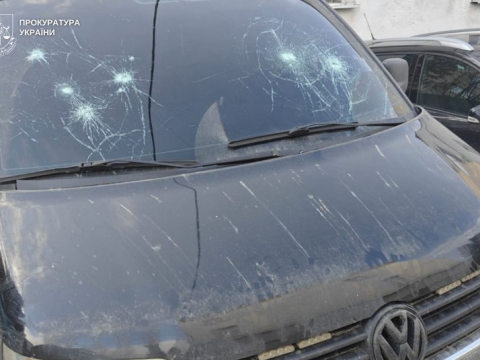
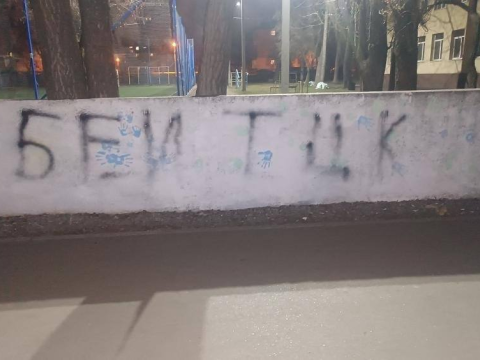
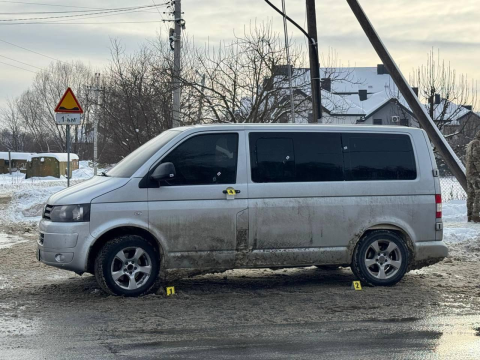
One way or other, the statements from TikTok appear to have triggered an unexpected public reaction. A crowd of over a hundred angry people gathered at an NGU deployment site, demanding the release of the men kept hostage there. Some of the protesters claimed to be relatives of those in detention. Military personnel and police subsequently arrived at the scene, and clashes broke out. The crowd rocked a National Guard bus, attempted to break down the gates of the clandestine detention facility, threw eggs and stones at the building’s windows and at the punishers, chanted "Shame!" and "Faggots!" Their vehicles were smashed; someone even used a sledgehammer for this. Tear gas was used against the people. Later, unknown black-clothed ones, wearing balaclavas and carrying wooden bats, appeared on the scene and used force against the protesters. A reporter of the pro-government media outlet UNIAN was also kicked in the stomach by an unidentified person. One of the victims claimed that he and his son were beaten while simply passing by. The NGU stated about 16 militaries injured during deterrence of the crowd.


Then, announces appeared on social media calling on far-right militants to unite for "restoring order" and "responding to outrages" on an ongoing basis. And compelling video evidence of how this went down that evening: "We form a column, four fighters abreast. The question was raised: what if people are waiting for us up ahead—armed, carrying knives? After all, they were the ones who slashed the tires. Did anyone want to step aside? Everyone said, 'We’re going.' We form up and begin to march forward. And we recite the Prayer of the Ukrainian Nationalist: 'Death to the enemies... You shall win freedom or perish in the struggle. Rest assured—you shall not perish; you shall win freedom. I go into battle.' And so, we march, and this... this crowd—I don’t know, it’s like something straight out of a Bosch painting, you know, just all these characters—and for a split second—well, there are these three stages: freeze, run—but for a split second, this crowd of demons (there were hundreds of them) just freezes." We even know whom they are praying to—to the one who needs to reclaim his coal mines and metallurgical plants annexed by Russia…
National Guard Commander Pivnenko and Head of the Presidential Office Budanov arrived at the scene, after which the clashes decreased and people were allowed into the building. The generals officially confirmed that it was a National Guard facility and that men were being held there. The NGU commander stated that the building was rented by "Azov" as a temporary deployment point. According to him, mobilized personnel are taken there after leaving the territorial recruitment centers (TRC), where they undergo "registration and necessary checks" before being sent to training. Servicemen detained after absence without leave (SZCh in Ukrainian) are also being held there. Budanov stated directly that there are many such facilities across Ukraine, explaining this by the mass exodus into SZCh and the need for secrecy to avoid Russian air attacks. Initially, eyewitnesses reported 40 men detained. A woman who was allowed inside with a cop told reporters that she saw about 25-30 people. Later, Pivnenko spoke of 18 servicemen, and Budanov of 14. The information about four injured inmates was confirmed. The recruits admitted that they were indeed in the building and needed medical attention. After the scandal erupted, they were sent to the NGU medical center. Their faces, images of which were shared around the world, show signs of beatings. National Guard spokesman Ruslan Muzychuk, in a comment on the state television channel, stated that the military personnel were sent to one of the medical centers in Kiev region, so that they could receive medical aid.
Along with Valentyna Moloda, a court in Kiev has remanded Tetyana Kireyeva—identified by investigation as the person who "ordered the provocation"—in custody for two months, with no option for bail. According to the prosecutor's office, Kireyeva reached an agreement with Moloda no later than October 30 to coordinate their actions, after which she shared information regarding the location of a military facility via a Telegram group. The following day, an ambulance driver named Viktor Yena—considered an accomplice by investigators—filmed the site and sent the footage to Moloda. In court, Kireyeva explained that she had reached out to Moloda on the advice of her sister, believing that Valentyna—a public figure who heads several private clinics and NGOs, has previously advocated for peace on social media—might be able to help with her husband’s situation. Kireyeva stated that Moloda had offered a service for the "emergency evacuation" of military personnel from TRCs and military units. She confirmed that she had seen the price for this service—107,000 hryvnias—listed in the application. Kireyeva insisted that she had not incited anyone to protest. Here are these brave women — Valentyna on the left and Tetyana on the right:

From the words of Tetyana, she arrived at the building with her two sisters, seeking to have Kuleshov—who she claimed was in critical condition following a beating—admitted to a hospital. "I saved four people. One of them would certainly have died on the 2nd; he wouldn't have made it through the night, as he had a purulent abscess, was covered in ulcers, and there was a horrific stench of pus." She stated that at the "Azov" facility, Kuleshov was beaten on his legs, back, and the back of his head—deliberately avoiding his face to leave no visible marks. Her lawyer presented photographs of Andrey’s injuries to the court. He noted that he had already contacted the State Bureau of Investigation and the Military Prosecutor's Office regarding the beating as early as October 29. According to him, following that report, one of the military servicemen beat Kuleshov again during the night. Kireyeva adds that she had wanted to open the eyes of the "Azov" leadership to what was happening. "I simply wanted to inform the 'Azov' command that there is a specific group using their name as a cover to engage in highly dishonorable conduct. They are bringing shame upon the army." For the fourth suspect, 22-year-old Valeria Ladyka, the court set bail at 66,000 hryvnias. She is accused of blocking a National Guard bus.
A month earlier, Moloda had also posted calls for a pro-peace rally in downtown Kiev. As for the others identified as participants in the unrest, the police and the Security Service of Ukraine are visiting their homes and forcing them to issue apologies. Reportedly, 130 individuals have been identified: 27 took an active part in "unlawful acts," while 24 "behaved aggressively, incited the public, and deliberately provoked conflicts with law enforcement and military personnel." In the best tradition of the Kadyrov regime in Chechnya—probably, when the dictator of Ukraine apologized to Kadyrov, it left such a deep trauma that, to assert himself, he now feels the need to force his own slaves to do the same (much like what happened in Lviv this year summer). There is no word on any charges against those who set up a torture chamber; in today’s Ukraine, such activities are rather rewarded than prosecuted. Just imagine: if it were ever revealed that the 2022 executions in Bucha were actually carried out by the valiant "Azov" warriors, and that it was TRCs staff who were the ones stealing toilets or washing machines—would you really be surprised?
By the end of the week, the military unit officially confirmed that Kuleshov was present there with a stoma—a condition that renders an individual unfit for military service and necessitates his removal from the military register. It remains unclear whether there was an intention to return him to active duty or if he was being held there just for torture.
Following the suppression of the mutiny, the "war to the last poor man" party—speaking out from Kiev offices, TV studios, and rear-echelon military units—is once again demanding harsher criminal penalties for draft evasion, SZCh, and desertion, demanding the use of lethal force against the very people the army supposedly "protects" from Russia, and everything else in their repertoire. Well, we shall see whose teeth are stronger. On one point, at least, Budanov is right: such torture facilities are indeed numerous—in the Kharkov region alone, our team has revealed at least two much larger death camps run by the 225th and the 425th Assault Regiments of the Armed Forces. Regardless of everything, the chronicle of social war is being replenished, including in places far from the capital. Since the possibility of fleeing the country and even of unauthorized leaving one’s military unit is at its lowest point this year since the start of the war.
On October 11, in Sheptytske (Chervonohrad) of the Lviv region, a 47-year-old local man reportedly launched a sudden knife attack, striking a 43-year-old TRC patrolman in the neck during a check of military registration documents. The serviceman sustained a severe injury, including damage to blood vessels and the airway, and was hospitalized in the intensive care unit. The self-defender fled the scene but was soon tracked down by police. During his arrest, he resisted and fired an air pistol in the direction of an cop, wounding him.
On October 12, in the downtown area of Kropyvnytskyi (Kirovohrad), a 53-year-old former military serviceman barricaded himself in an apartment, opened fire on cops with an automatic weapon, and threw a grenade at them. He is a decorated veteran who sustained numerous wounds and concussions during his service. The weapon was seized, and the man has been placed in custody for 60 days without the possibility of bail. The advocate stated that he does not remember some of the events that took place on that evening, although he had not consumed any alcohol.
On the evening of October 19, the flames of a "people’s war" reached the very doorstep of the government quarter: in the Pechersky District TRC in Kiev, an unemployed man who had been busified after being wanted by the TRC wounded three staff members and three policemen with an unregistered handgun. The shooter, named Alexey Kovalsky, was remanded in custody for 60 days by a court on his 42nd birthday. "Our sources state that the suspect was brought to the hearing in a wheelchair—he was unable to move on his own. Kovalsky’s lawyer, Sergey Osyka, claims his client was brutally beaten following his detention. He also notes that Kovalsky surrendered to law enforcement voluntarily after the shooting. According to sources at the medical facility where he is currently being treated, he has sustained a closed craniocerebral injury, a concussion, and a broken nose. Police sources confirm that he was indeed subjected to a rough arrest after the incident. Following the shooting and his subsequent detention, an entire arsenal of weapons was discovered in Kovalsky’s Kiev apartment. He had been walking the streets wearing a bulletproof vest under his clothes and carrying a loaded SigSauer pistol—a model popular among Western special services. Furthermore, his high level of proficiency with the weapon suggests he may have combat experience," reports one of Ukraine’s major political Telegram channels. During busification, no even cursory search was conducted, which allowed Kovalsky to enter the vehicle while already armed. When an attempt was made to search him in the lobby, he drew his weapon and struck six targets with seven shots. A search of his home uncovered smoothbore and automatic weapons, ammunition, and a grenade; he now faces a potential life sentence.
Incidentally, the preventive measure for Kovalsky was determined by "Maidan judge" Andriy Trubnikov. In 2013, he remanded Valeriy Kadura, a participant in the anti-Yanukovich protests, in custody. According to the investigation, Kadura—along with other protesters—drove a bulldozer into law enforcement line near the Presidential Administration building.


Also, on October 19, it was reported that a Kharkov resident had been detained on suspicion of stabbing two members of a "notification group" (or, more accurately, an abduction group) on June 25. The incident resulted in the death of a TCR soldier, who suffered a penetrating stab wound to the heart, while a senior lieutenant was hospitalized with superficial cuts to his head and torso. The suspect is a 50-year-old unemployed man. He had been living with his mother, who chose not to turn him in; instead, she secretly relocated with him to a new place of residence. Operatives identified the locations of the ATMs where the partisan’s mother withdrew cash. At the prosecutor’s request, the detainee has been remanded in custody without the possibility of bail; he faces a sentence ranging from 10 to 15 years, or life imprisonment. The names of both the murdered and the detainee have not been released—partly due to the widespread public jubilation over the death—and remain unknown even to our sources. This is him:

On the evening of October 20, in the community of Tairovo near Odessa, a 44-year-old man stabbed a TCR employee in the neck during a document check. The self-defender was soon apprehended; he now faces up to 15 years in prison on charges of attempted murder…
Meanwhile, the call issued by the Assembly at the beginning of the summer—urging to gather outside Ukrainian embassies to demand freedom for Vadim Kuzub, Hryhorii Kedruk, Andriy Trush, and others imprisoned for reducing the livestock of meat procurers—has turned out to be a voice crying in the wilderness. In these five months, not a single soul abroad has publicly demanded their release. Even mentioning these names, including within Europe’s most radical anti-militarist circles, seems to be a taboo (in these circles, declaring solidarity "with ALL those who refuse to perform military service"—which includes the very "our" head of state, who dodged four conscription notices during the Donbass war in 2014–2015—is still considered ultra-revolutionary rhetoric). Nevertheless, as demonstrated by the global campaign launched in August by the Socialist Equality Party in support of Bogdan Syrotiuk, even the most widespread response to our appeal would be unlikely to cause their release. Consider the case of a peaceful Trotskyist author who, on August 10, was sentenced to 15 years in prison solely just for expressing internationalist views in his writings: when thousands of people from various countries showed solidarity by signing petitions and sending emails to the court, the response was like "We do as we please; the only opinions that matter to us are those of our leader and the foreign governments that sponsor him." If so, it is all the more difficult to imagine how international solidarity could possibly change the situation for those persecuted by the servants of darkness for leaving physical holes in the bodies of these servants’ colleagues.
It is equally unrealistic to imagine sending money or humanitarian aid to Ukrainian prisons without some corrupt arrangement with the administration; even the relatives of an ordinary prisoner—someone not labeled as an "enemy of the state"—must regularly pay fees just to ensure that a parcel actually reaches the addressee. It is hardly surprising that European Stalinists—who have been holding rallies for several years now to support the Kononovich brothers and other their comrades persecuted by Ukraine—do not really engage in this kind of activity. On the other hand, the mere fact that certain prisoners of social war are known by name abroad, and that their fates are being monitored internationally, can make it significantly more difficult for the dictatorship to kill them in prison or cause irreparable damage to their health. However, given the regime’s drive to a total blackout on any information about such people, it is highly likely that their fate will remain unknown, regardless of what happens to them. And this means that solidarity actions with them will quite possibly have an initially unclear outcome.
So, our role is to provide you with news; how you choose to use it—after weighing all the pros and cons—is entirely up to you. We also recognize that most of our audience consumes our content quite selectively: Ukrainian readers are interested mostly in applied advises, while the foreign public focuses mostly on an ideological agenda, disregarding any reports that do not fit into a black-and-white, "fascist state vs. anti-fascist society" framework. There is no other way to explain why, even in late 2026, some European anarchists continue to declare "solidarity with Ukrainian draft dodgers" as if this is an anti-war political movement with a unified goal—ignoring the reality that, with the tightening of Ukraine’s state policy since 2023–2024, the ranks of those evading the draft have been literally flooded with adherents of various right-wing ideologies, ranging from officious OUN-inspired anti-Russian chauvinism to the more subcultural NS/WP underground. Is not it absurd to stand in political solidarity with those who would likely wish them dead for rejecting Ukraine’s national borders or a transnational brotherhood of white men? While no fan of Bandera, Trump, or Milei is pre-programmed to remain him for life, it is equally obvious to us that blind glorification—based solely on the fact that someone is violating military registration rules—will never lead them to abandon their idols. The only thing capable of achieving that is exposing the contradictions between such positions and daily practice—a task our website carries out on a regular basis. Without this, the rhetoric of the typical Ukrainian regarding why he does not want to serve will remain at the level of "Let someone from another part of Ukraine do this," or "The drug-addicted Jew, acting on orders from globalists, is genociding the native population to replace us with colorful occupiers." Ukraine is currently a laboratory for Western ruling classes, where the most advanced methods for controlling and coercing the working class are being tested. The defeat and abolition of the concentration camp is in the direct interest of everyone abroad who does not wish to have the same system imposed upon them.
It is all so complex, yet at the same time, so simple. For a war that has dragged on for nearly five years—one of the most senseless wars in world history—there are no anarchist solutions other than for soldiers to fraternize in the trenches, then head back—weapons in hand—to the government districts (or at least to their own homes), which first requires loosening up the rear so that the ground burns beneath the feet of the death cult sacrificers. The least you can do to help is to support us for shifting public opinion in this direction. Back half a year ago, the region of Kharkov already led the country in acts of anti-TRC violence—even though our places do not have the largest population, nor the most aggressive mobilization efforts, since we still know nothing about any murders or beatings resulting in death in the TCRs. Your donation (or a donation from other people you tell about us) does more than just keep our online journal running; it saves the lives of thousands upon thousands of people who read our survival guides and pass them on to others.
Stay with us! Hold the line!



Comments