Online archive of Heatwave, a communist magazine founded in the US in 2024. "A better magazine for a worse world."

Heatwave is a multi-media project dedicated to sharing experiences and strategizing together in preparation for the next round of struggles to break free from the infernal prison of capital. As the world burns and the political horizon grows increasingly grim, we seek to connect comrades around the globe and contribute to building a mass movement powerful enough to incinerate that prison. In its ashes, we will build a world based on the classic principle from each according to their ability, to each according to their need — a life worth living on a thriving planet.
As of Heatwave’s founding in late 2024, most of our members are based in the U.S., but we aim to become an international collective that examines struggles globally. In 2025, we are launching our website, a quarterly print magazine, and social media, envisioning a media ecosystem that will also include audio, video, a Discord community, and occasional online or in-person events. The website will provide previews of each new issue of the magazine, information about purchasing print copies, free digital versions of back issues, and printable zines for longer texts. Our content will cover a range of topics and genres, including reports on recent events, theoretical reflections and analysis, interviews with comrades involved in inspiring projects, reviews of books and films, original artwork, and literature.
While there is no shortage of left media, most English-language publications offer only partial critiques and tepid reformism, or regurgitate debates among 20th-century sects whose material foundations disappeared decades ago. We seek to provide more rigor and depth than the average radical blog or podcast, but to avoid the turgid style of traditional communist polemics and academic journals. Politically, we aim to balance inclusivity with coherence: We’ll publish pieces by a broad spectrum of contributors from around the world, attaching editorial prefaces to provide our own perspective. For more on our vision for this project, see The Case for Letting the World Burn: Pre-print Editorial to Issue 1.
Our name “Heatwave” echoes that of an old Situationist magazine (“Britain’s most incandescent journal” of 1966), but with added urgency in an era where every summer is the hottest on record.

Debut issue of Heatwave, a communist magazine founded in the US in 2024. "A better magazine for a worse world."
Contents
05 | Editorial: The Case for Letting the World Burn - Heatwave Collective
10 | On the Trump Blitzkrieg - S. Darby
14 | Class and Disaster in Valencia - prole.info
22 | Dams and Deluge: On Communist Niche Construction - P./Common Ruin
30 | Blocakde Bisalloy: A Report from the ‘Gong - Two Wollongong Friends of Palestine
36 | What was Recession Pop? - Jean Maro
41 | Dispatches from Mae-Sot: A Town on the Thai-Myanmar Border - Wu Qin
48 | A Summer with a Thousand Junes: The Nahel Riots and the Communist Hypothesis - Artifices
56 | Donde La Vida No Vale Nada: Scattered Thoughts on Organized Abandonment & Ideological Retrenchment in Oakland - E14 Distro
62 | Fire to the Prisons - Uprising Support
66 | Reviews - Heatwave Collective
75 | Excerpt from Crocosmia, a Novel - Miranda Mellis
Attachments
Heawave01.pdf
(2.77 MB)
Comments
Heatwave magazine #1:
In its ashes, we will build a world based on the classic principle from each according to their ability, to each according to their need — a life worth living on a thriving planet.
Was the community of the Way in first century Palestine the earliest attempt to resurrect a truly human society—not from the "ashes" of the Old World but "embracing the entire wealth of previous development", not in words but in actions—based on the first principle of communism, from each according to their ability to each according to their need?
And all who shared the faith owned everything in common; they sold their goods and possessions and distributed the proceeds among themselves according to what each one needed.
Second book of Luqa

Online archive of selected articles from issue 2 of Heatwave - a communist magazine founded in the US in 2024.
Contents
- Editorial: Comrades Known and Elsewhere - Heatwave Collective
- Remembering Sher Singh 1951 - 2025 - Friends of FMS
- The Murder of Ayşenur Ezgi Eygi - Anonymous
- Communist Reconstruction and the Limits of the Human Species: On the Concept of the Ecological Council - J. Caurine
- The Red Thread of Black Power: The Case of Abeng - Saul Molcho
- Red May Theses - Jasper Bernes
- A Summer with a Thousand Junes, Part II: Restructuring, Surplus Population, and Riots - Artifices / Trans. Enzo Bodine & otto dix rivers
- Yasuda Redux: A Conversation about Student Movements at Tokyo University in Spring 2024 - May Wren & Tatsuki Kihira
- Poems - Robert Mittenhal
- Tales from the (French) Far Left - Gilles Dauvé
- Hurricane Season - Jean Maro
- “Pumping Up” the Revolt: The Serbian Uprising, Its Roots, and Its Discontents - L.P.
- Dispatches from Mae Sot, Part II: The Town of Exiles - Wu Qin
- The Anti-Imperialist Imperialism Club: On Left Internationalism and Iran - Arya Zahedi
- Treatise for the Youth In Revolt - Colapso y DesvÍo
- Fire to the Prisons
- Reviews
Attachments
Heatwave_issue02.pdf
(5.78 MB)
Comments

A heartfelt tribute to Joshua Clover (1962-2025).
When Joshua passed away in late April, social media was filled with a cornucopia of similar stories from those lucky enough to see him in his element: at the riot, the occupation, the barricade.
for Joshua (1962-2025)
The scene has played out many times in the last few decades. A horrific event takes place—police murder yet another Black man, the state disappears migrants or political opponents, a financial crisis leaves millions without homes or jobs or both—and this time people take to the streets in protest of these immediate events and, perhaps, out of some deeper longing that the world ought not be the way that it is. Property is damaged. Police are called in. The crowd does not disperse but pushes back. Then tear gas. It stings the surface of your eyes and burns at the edges, dripping like acid down the nose and into the throat to pool in the lungs. Maybe this is your first time, maybe you were at the front of the line, maybe you just got unlucky. Regardless, you are overcome, gasping out desperate, burning breaths as your vision blurs. Suddenly, you feel arms around you and you are lifted from the heat of battle, dragged to the sidelines. Then those same arms depart, making quick motions that you can’t quite make out through the blur, rustling through something, and returning with that same gentle touch: pulling open each eye with care, dousing each with water that seems glacier cold. The moment seems almost ritualistic: an intimate baptism of the sight. Suddenly you are pulled back into the profane world. The person makes an awkward joke to ease the tension. Eventually, your vision clears enough for you to reenter the crowd, to blend into the sea of black and then into the night, free to return again tomorrow. Years later you will tell the story of that night: “The first time I met Joshua Clover he washed tear gas out of my eyes.”1
When Joshua passed away in late April, social media was filled with a cornucopia of similar stories from those lucky enough to see him in his element: at the riot, the occupation, the barricade. The flurry of places and dates invoked in these stories—Berkeley, Paris, Seattle, Davis, Mexico City, Ferguson, and Oakland, always Oakland—paint the picture of a man committed to being in the struggle wherever it arose, someone you could count on equally in the street and the quieter moments before and after. It was in the course of class conflict that his work as a teacher and poet achieved its practical truth, alive in the throes of history. Indeed, Joshua took knowledge seriously. Whether we were reading his work, arguing with him on some online forum, studying Capital together, or organizing alongside him, thinking with Joshua felt like nothing so much as being made to see clearly, the rapt vision of eyes blinking through tear gas just rinsed away. For so many young communists, this process of learning to see was our real introduction to Joshua and to the communist movement. The tools of siege are nothing if not instruments of sensory hijack. Amidst the smoke and chaos and pain of the present, he was there, not to show us the way, but to share the arts of clarity and to demonstrate how they could be wielded against the blinding powers of a social order that thrives in obscurity.
Most of the young communists emerging in the U.S. after the turn of the century found themselves unmoored from the history of the communist movement. Previous generations had learned to articulate politics through active mentorship within left-wing institutions built up through decades of struggle. Though such institutions could be stifling, they nonetheless endowed subsequent generations with the practical and theoretical proficiencies that would then allow them to distinguish their own politics from that of their predecessors, even framed as a revolt against this institutional inheritance itself and articulated as a new “revolutionary” position in contrast to the “reformist” remnants of an “old” left—even if that “old” left had, in its heyday, been new and revolutionary in contrast to its own predecessors.
After many decades of defeat, however, this generation was left with nothing but ruin. The institutions of both the old and new lefts were crushed, made historically obsolete by the shifting sands of capitalist production or ripped apart by their own sectarian decay. The brave were killed, the cowards returned to the fold as the romantics fled to the hills, and the swindlers built up their cults in the ashes. In the end, only a spare few remained, scattered and alone. Our communism was therefore not learned but salvaged. Wandering the wilderness of work, wage, and forever wars, we were left to rediscover the fragments of our own history, unearthing the rusted weapons of battles lost. And, lacking a meaningful institutional inheritance (whether “reformist” or “revolutionary”), we were forced to reinvent the basic axioms of the partisan project in our own fight against the status quo.
In these long decades of repression, at least some memory of the collective intelligence of revolutionary history was sequestered in subcultural insignia, in rank-and-file reform caucuses within the shrinking unions, and of course in the academy. Anti-communist purges across the unions, universities, and culture industries had ensured that communist thought could proliferate only at the seemingly harmless margins: in the punk subculture, the breakroom of a dying industry, or the underfunded English department, where it could be left to molder under the gnawing influence of “postmodernity.” And yet these repositories proved invaluable, preserving and even elaborating key aspects of the partisan project as much as possible in the exultant years of liberal victory once thought to be the “End of History” and which proved, in the end, to be merely an intermission.
The process was long and grueling, but new generations of partisans emerged at first slowly and then more quickly in the wake of the world-shaking crisis of 2008 which spawned, on the one hand, a minor renaissance of interest in Marx and, on the other, the sputtering struggles of the 2010s, where new waves of militants would come to see the practical limits of lofty theories tested on the ground. A rising generation of communist thinkers came to reengage with their own sequestered lineage and reappraised old texts in the light of fresh-lit fires burning across the world. In this context, figures like Joshua proved invaluable in first linking young militants to their own history (and encouraging an active, questioning engagement with it), and then linking them to one another, gathering what would otherwise have been scattered sparks.
It is difficult to exaggerate how crucial this work was in the moment. While there were other communists in art scenes, universities, and community centers, many carried with them the baggage of sectarian battles and a salient fear of repression. As a result, when sought out by young radicals, they were reticent, quietist, and sometimes outright hostile. Joshua was, in every respect, the opposite. Even in the vigor of debate, he showed a spirit of open engagement that tended to uplift all involved. At the same time, he was always willing to argue any topic down to the finest points, bluntly pointing out misunderstandings of Marx, rigorously shattering the false or oversimplified historic narratives that served as the ideological bedrock of “the left” for so many years, and always insisting that we return to the original texts, to the real complexities of revolutionary history, and to the world as it actually exists. He never used disagreement as a pretext to tear others down, nor did he accept partisan name calling as a substitute for articulating the real substance of disagreements.
Perhaps most importantly (and in distinction to many so-called Marxist academics), Joshua retained fidelity to both the popular and incendiary dimensions of the communist project. He was not only immensely skilled at interpreting popular sentiment but also demonstrated mastery in the forgotten art of translating high theory into accessible language without oversimplification. Meanwhile, whether in the classroom or a magazine column, he never quavered over the fact that the communist project is a revolutionary one and that revolutions are inherently violent affairs. In an era when many “radical” theorists were seeking out the peaceable expression of politics in “everyday utopias,” Joshua stressed that politics was always, at root, a fiery confrontation with the powers that be. To these ends, he not only helped bring together a new generation of young communists but also pushed them to engage directly with the rising tide of class conflict, understanding full well that the street and the shopfloor are the true classrooms of the partisan.
Heatwave is, in a sense, an attempt to embody this spirit at a larger scale. Like Joshua, we hope to serve as an engine of engagement, linking our readers to their own history and to one another. Like Joshua, we adopt a principle of ecumenicism, refusing the false dividing lines inherited from the long dissolution of the last global communist movement. At the same time, like Joshua, we also insist on a theoretically rigorous approach that invokes the real complexity of revolutionary theory and history, actively seeks evidence for its claims, and engages in good faith with opposing positions. And, like Joshua, we maintain that the partisan project is inherently incendiary, requiring confrontation with the rulers of the world, rather than gradualist compromise or secessionist retreat. Finally, communism requires an unambiguous commitment to internationalism. Although our project is currently anglophone, we recognize that elaborating a partisan politics requires learning from the self-activity of the dispossessed at the global scale.
For all these reasons, we work to ensure that every issue contains material from multiple countries and continents, that this work upholds a vision of revolutionary social transformation, and that it expresses an ecumenical spirit, putting diverse views into conversation with one another rather than elaborating our own editorial “line” by passing content through a sectarian sieve. We apply the same standards of rigor and accessibility that Joshua encouraged. Regardless of the argument, we ask: does this intervention make logical sense on its own? Can its analysis make sense of the real world? And, if so, could it also be explained to most people? In so doing, we hope to develop a collaborative, common language through which to express the partisan project: a vernacular for contemporary communist thought. This is perhaps the simplest summary of our editorial mission.
In this second issue, we bring together perspectives from Serbia, Jamaica, India, France, Iran, Chile, the United States, Palestine, Japan, and the Thailand / Myanmar border. The articles range widely in scope and subject matter, from longer explorations of the conditions surrounding contemporary struggles to reflections on historical movements and their legacies to accounts of the daily work of survival, organizing, and community defense. Many are works in translation, a practice we consider integral to our internationalist ethos, as it allows us to make global perspectives available to an anglophone audience and break through the siloed analysis that often prevails in the U.S., which is so habituated to seeing itself as the center and entirety of the world.
While many of the pieces in this issue think through the conditions in a particular place, others rove over issues of greater breadth. J. Caurine’s theoretical exploration of communism as a form of ecological partisanship will satisfy those looking for more sweeping analysis, while readers interested in larger movement dynamics will find an evaluation of the pressure campaign’s revitalization as a popular strategy. On the cultural front, this issue features poetry as well as multiple essays exploring popular culture, including meditations on country music, pop albums, and the porous boundaries between genres.
The pieces herein are not intended to be read in isolation, but rather shared and discussed. Taking inspiration from the case of the workers’ newspaper Abeng, explored in the contribution from Saul Molcho, we hope that you will take this issue to your comrades, that you will debate and argue and get caught up in the minutiae, as Joshua would have. We hope that you will test the validity of any conclusions in practice, in daily life and in the streets. And we hope that you will bring back your findings to us, so that we can all refine our understanding together.
“I cannot imagine what it must be like to be making one’s way through the current chaos with the knowledge that you will have to navigate its causes and its effects for a sustained time and figure out how to survive and how to act in the world. But it must be some amount of terrifying alongside the infuriating and obscene. I am very much hoping you can find a way to make it and not go mad, and will try to help as best I can.” This message from Joshua, sent to a younger comrade in despair, demonstrates a comradely tenderness, but pulls no punches. Desperation holds primacy. As the world grows ever darker, as the rubble of today’s catastrophes pile atop the last, we do not feign hope or deny the terrors and obscenities that face us. Navigating this chaos often feels impossible, and every departed comrade only adds to the burden. Lost in a dark forest, it often appears that our only guide is the very process of analysis itself, of trying to understand the terrain, and finding our bearings in the long night. In this task we have Joshua’s example, and the example of so many communists who came before us. And we have each other, the connections that Joshua and others helped to forge, those we continue to make for ourselves through correspondence, and those that only exist in brief moments of recognition at a distance, glances through clouds of tear gas. Maybe Joshua put it best: in the end, “it comes down / to comrades known and elsewhere.”
- 1This story was inspired by a comrade and is shared with permission, but there are many such stories.
Comments

Ayşenur Ezgi Eygi was a Palestine liberation activist from Seattle, Washington in the USA who was murdered by the Israeli Occupation Forces at a Palestinian demonstration in the West Bank in late 2024. This is a transcript from an interview with a comrade who travelled to the occupied West Bank with Ayşenur Ezgi Eygi and the International Solidarity Movement. Originally published in Heatwave #2 (2025).
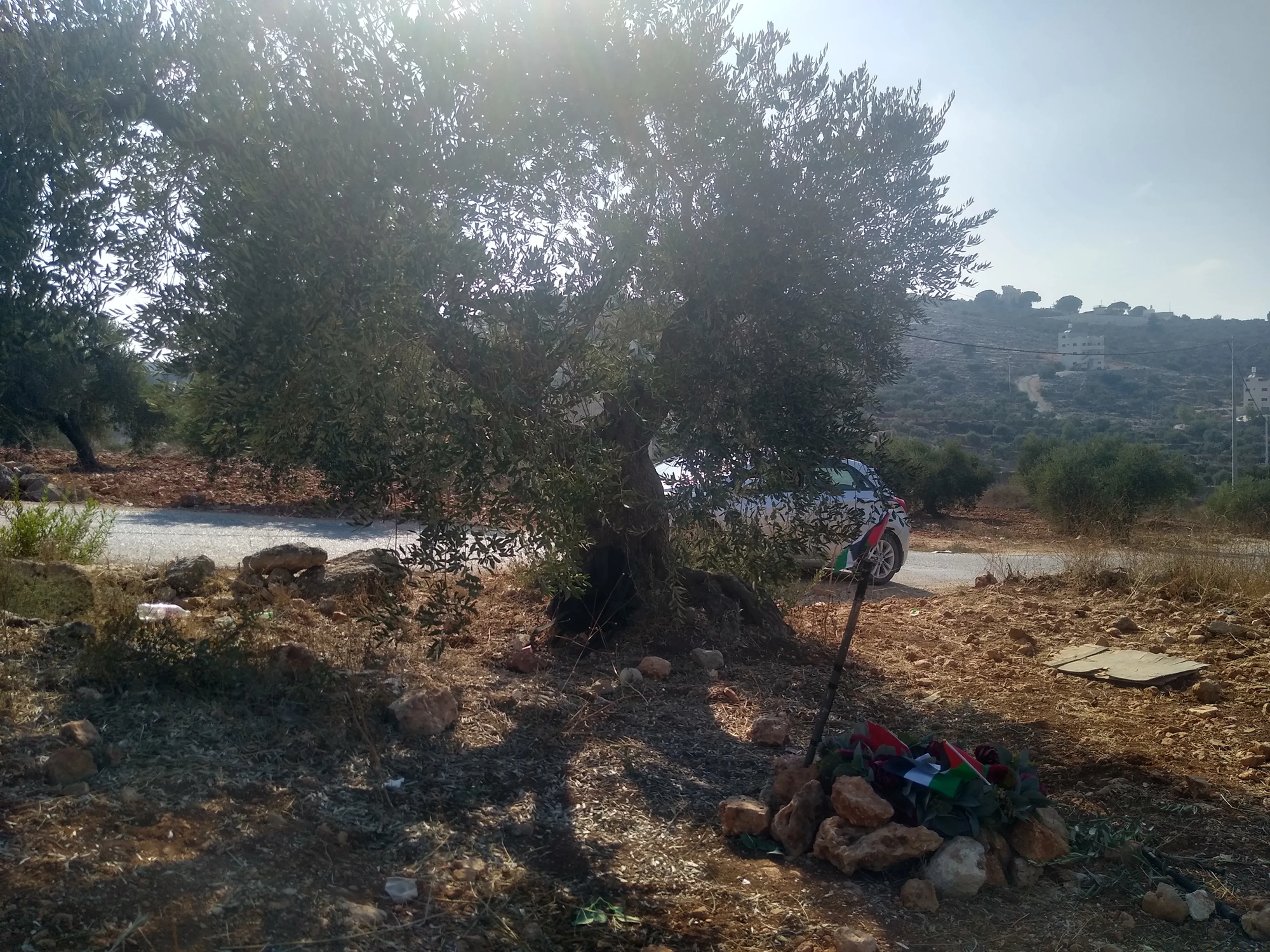
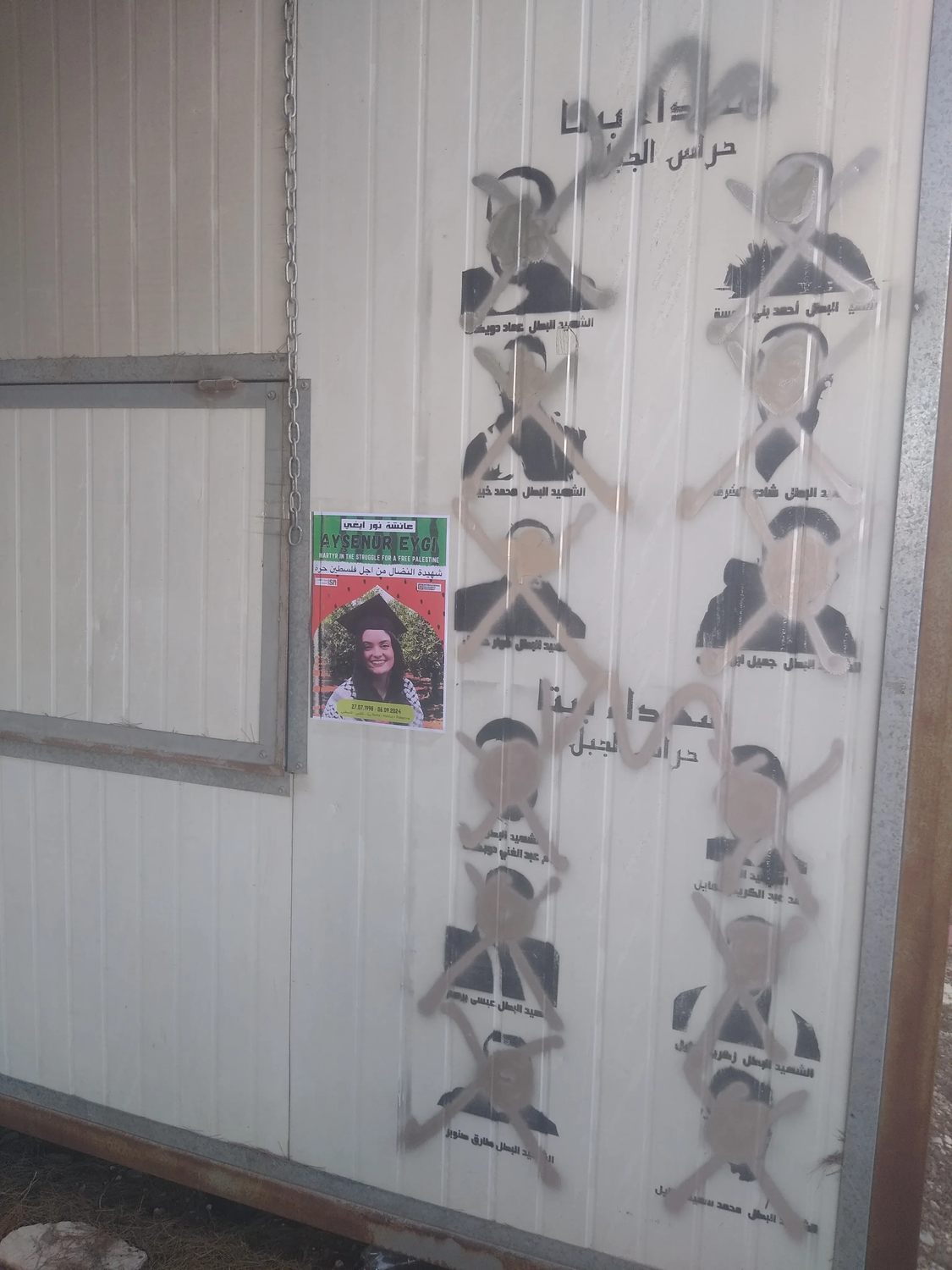
Above: A memorial near where Ayşenur Ezgi Eygi was murdered in Beita, Palestine.
The following is the edited transcript of an interview with a comrade who travelled to the occupied West Bank with Ayşenur Ezgi Eygi and the International Solidarity Movement. Ayşenur Ezgi Eygi was a Palestineliberation activist from Seattle, Washington in the USA who was murderedby Israeli Occupation Forces at a Palestinian demonstration in the West Bank in late 2024. This interview was originally recorded and broadcast on The Beautiful Idea, a podcast from a collective of several anarchist and autonomous media producers scattered around the world. A link to the full episode can be found in the footnotes.1
Could you explain what exactly ISM is and what it does?
It stands for International Solidarity Movement. It was founded in 2001 by some Palestinian activists, a small group of anti-Zionist Israeli activists, and some international activists. They operate along four principles: they’re Palestinian-led; they’re committed to non-violence as a strategy, not necessarily as ideology; they make decisions using consensus; and they use an anti-oppression lens, which includes being explicitly anti-Zionist. Their origin is connected to the Palestinian popular committees that arose during the First and Second Intifadas. ISM’s goal is to participate in and support the popular resistance. They do this through a variety of activities. A big part of what they do is what they call protective presence: international volunteers accompany Palestinians in their daily lives in the hopes that an international presence will lessen or decrease the amount of violence that Palestinians face from both Israeli settlers and the military. Concretely, this includes simple things such as accompanying sheepherders in the field, farmers harvesting their crops, accompanying school children on their way to school, or being present at homes that are threatened with demolition.
What does it mean to be involved in the popular resistance in Palestine? Could you talk a little bit more about ISM’s relationship to different government entities and to armed groups?
First, I should clarify that I volunteered with ISM and travelled to the West Bank, but I actually didn’t do the work with the ISM that I intended to do, because my friend was murdered soon after I arrived. So, I can’t speak in depth about what it looks like in practice. My understanding is that ISM doesn’t have a direct relationship with any specific political entity. The organization doesn’t take a position for or against any of the political parties or groups. I imagine that there are a range of political opinions amongst volunteers, but as an organization, there’s no formal relationship with, for example, the Palestinian Authority, Hamas, or any other party-like formation. The relationship with the Israeli government is very contentious, obviously, because ISM is an explicitly anti-Zionist organization.
Could you share why you decided to work with ISM? I’m also wondering if we could talk a little bit more about this question of the difference between nonviolence as a strategy versus an ideology, and how this ties into your decision to work with ISM.
In my case, I didn’t decide to go to the West Bank because I thought that I personally was going to make any difference in the broader, brutal, colonial dynamic. I wasn’t convinced that being an international doing protective presence was going to change much about the situation either. For me, it was specifically an opportunity to expose myself to dangerous conditions in the hope that the experience would be useful for coming struggles and would give me more courage to act in the future.
What do you think about “protective presence”?
I have complicated views on it. I’m not exactly sure what I think. The phrase itself is a little uncomfortable to me because it reveals that there’s an acceptance of inherent difference between internationals and Palestinians. And, I don’t know that, in the long run, emphasizing or accepting that difference is a sound strategy for liberation. It calls into question what solidarity means in my mind. The underlying assumption of that strategy is that by mobilizing the racial or national privileges of international volunteers, the ruling class and the government of the United States alongside other world powers will suddenly be convinced that they need to stop funding ethnic cleansing and genocide in Palestine. This could be the case, but it seems unlikely. It hasn’t worked yet.
Not purposely, but incidentally, this also accepts the premise that the lives of Americans or other internationals are fundamentally more valuable than, and completely separate from, Palestinian lives. This is probably true in the eyes of the Israeli government and military. But it undermines the concept of solidarity. If we’re truly in solidarity with people, Palestinian or otherwise, don’t we have to see ourselves as no different than them? It doesn’t seem like there can be a tiered struggle in which Palestinians risk their lives as insurgents and internationals only risk their social reputations. And the extent of solidarity is simply supporting or observing the insurgents from a distance rather than participating as an equal. Until large numbers of internationals are willing to see themselves as 100% invested in the struggle, the Palestinian rebels will still effectively be on their own.
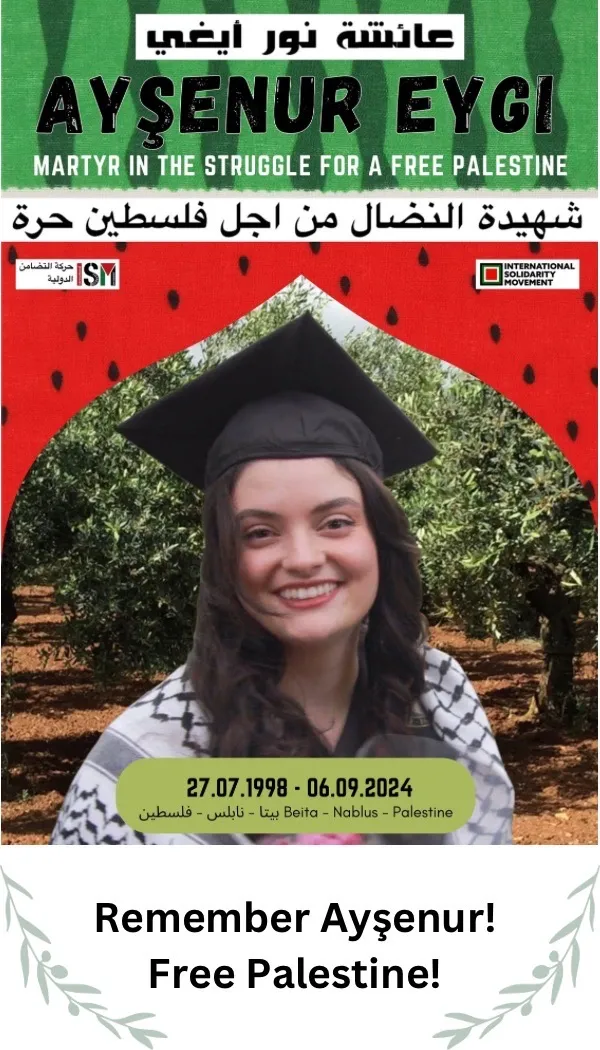
You went to Palestine with Ayşenur. Can you speak on what motivated her?
Since Ayşenur’s murder, there’s been a number of tributes published about her, written by people who knew her, maybe even more so than I did, or in different ways, or at different points in her life. All of those are worth reading. In my case, we became acquainted 4 years ago through her partner, who is my friend. I’ve since learned that she had quite an active political life before I met her. After October 7, we both got re-engaged in Palestine solidarity work—this helped us build a new dynamic in our friendship based around shared political activity.
She was involved in some notable things the year prior to us traveling to the West Bank. For example, she organized a grassroots fundraiser for people in Gaza. She did it seemingly all on her own in a very short period of time and was able to raise something like $40,000 or $50,000 in just a matter of hours. It was 10 or 20 times the amount that she expected to raise. She was a very tenacious organizer—when she set her mind to something, it was pretty admirable.2 Last year, Ayşenur was also heavily involved in organizing the student encampment at the University of Washington, where she was a student.3
She worked tirelessly. The experience of the encampments deepened our political relationship. I’m not positive about this, but it’s my viewthat the disappointment at how the encampment at the University of Washington ended led her to search for a different sort of activity around Palestine. That’s when she approached me about traveling to Palestine. We had previously talked about going to volunteer with ISM, but neither of us had really committed to it. But it was in theaftermath of the deterioration of the UW encampment that seemed to make her more certain about going. Her certainty and resolve motivated me to take that step.
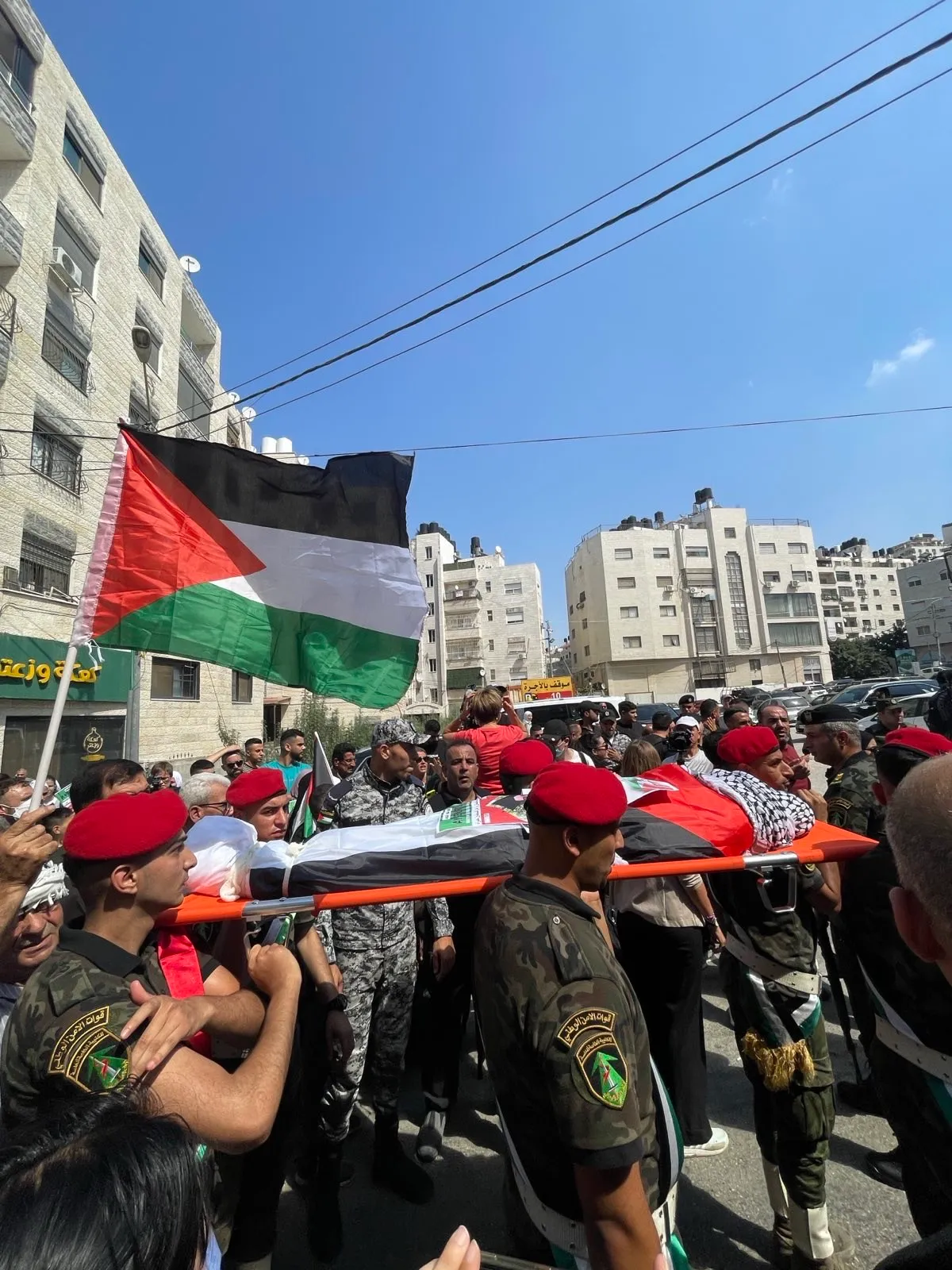
How long did it take to plan that trip? What steps did you take? And what was the situation on the ground when you arrived?
ISM does a vetting process. This was followed by a couple of online informational and training sessions before actually traveling there. The planning took 3-4 months.
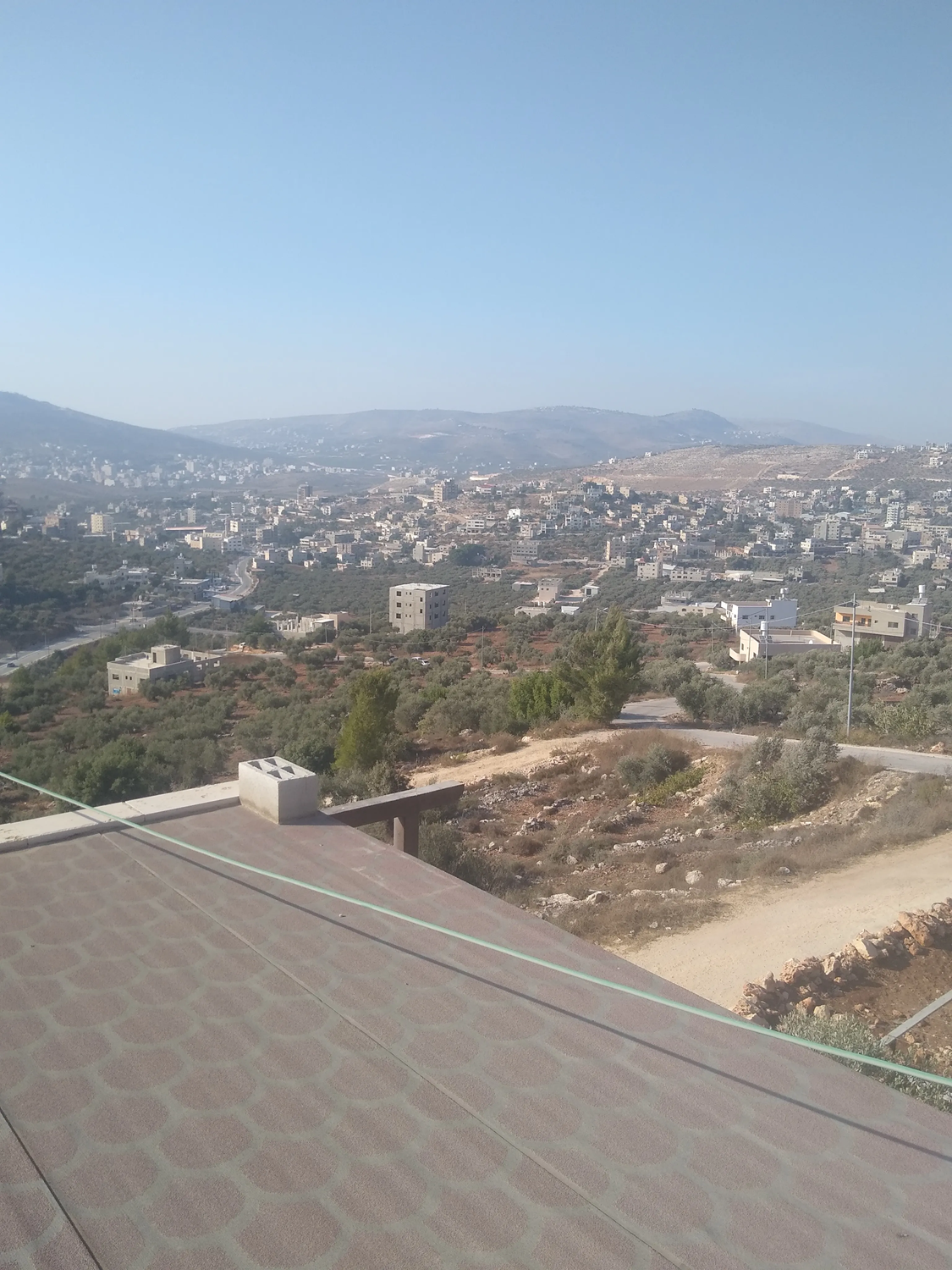
I think that in large part the West Bank is off the international radar because of the ongoing genocide in Gaza. But the reality in the West Bank was also very brutal and had been getting more and more deadly over the course of that year. It’s always been bad. And it had grown significantly worse over the past year. In the West Bank, there’s this very complicated system of governance, and what it all essentially boils down to is Israeli occupation and control, but they call it different things in different areas. There are three areas: A, B and C. It’s quite complicated. The three different areas are the result of the Oslo Accords from 1993-95. Area A is supposed to be controlled by the Palestinian Authority. Area B shares control between Palestinian Authority and the Israeli military. And Area C is exclusively controlled by the Israeli military. In effect, the Israeli military can do whatever it wants in any of those areas, but their presence is less frequent in area A and to an extent, Area B. Area C is often where territory is actively being settled and annexed by Israelis with the help of the Israeli government.4 Some of the larger cities in the West Bank are primarily in Area A. For example, Ramallah, which is where ISM issomewhat based, and Nablus, another major city. But, outside of Nablus is a town called Beita, whose land is defined as a mix of Area B and Area C with an active settler outpost being constructed on it for the last four to five years.
It would be really helpful to hear your reflections on your experience with Ayşenur’s murder.
After two days of training, it was Friday, and we were planning to attend the weekly Friday demonstration in Beita. But then I becameunexpectedly ill. Ayşenur decided to go to the demonstration without me.
I’ll just say that the story has been reported extensively in the media. A lot of people already know the details.5 I wasn’t there but was able to piece together what happened from eyewitness accounts of other ISM volunteers.
She attended the demonstration. As soon as it started, the Israeli soldiers shot tear gas and live ammunition at the demonstrators. This area is on a very steep hill. When the Israeli soldiers begin firing at the crowd, the protesters usually quickly retreat down the hill into olive groves near the village. After this period of retreat, a period of calm followed where it seemed like the demonstration might wrap up. People later said this lasted between 20 to 30 minutes. But what some of the Israeli soldiers regularly do, and they did on this day, is they take over nearby Palestinian homes to use as surveillance points. At the top of the hill, a group of Israeli soldiers took over a rooftop of a Palestinian home, where they had a clear view all the way down the hill. The demonstrators that had retreated were over 200 yards away from where the soldiers were standing on the rooftop. And then suddenly, in the midst of what seemed like the end of the demonstration, two shots of live ammunition rang out. One of them struck something metal, either a pole or a dumpster, ricocheted, and hit a Palestinian youth in his leg. The other one was a direct shot at Ayşenur’s head. She was standing next to an olive tree in one of the olive groves. People tried to stop the bleeding while she was loaded in an ambulance and rushed to the hospital, but she died very shortly after reaching the hospital in Nablus.
Do you want to share how you how you found out and then maybe also some pieces from your journal from that time?
My journal while I was in the West Bank was in the form of somewhat regular reports to a group of friends on a messaging app. I asked friends if they wanted to receive updates from me on this list and I would send reports when I could. I found out that Ayşenur had been shot via text message from other ISM people who were present at the scene in Beita. I was in shock for quite a while. Soon after it was reported that she had died. I can share some of what I wrote that day. It captures where I was at emotionally at the time.
September 6, 2024: I don’t know how to say this. There’s no easy way. I wish I could write something eloquent, but I can’t through my sobbing tears, Ayşenur, my friend, comrade and travel partner to Palestine was just shot in the head and murdered by the Israeli occupation forces. May she rest in power. She is now one of many martyrs in the struggle.
I’m just sitting here all day, tears welling intermittently. I don’t know what to do. So many regrets. I wish it would have been me and not her. I am much older than her and she had so many things she wanted to do with her life. I was the one who came more prepared to die here. I knew the risks. I wrote a will before I came. I don’t think she really considered that much of a possibility. I should have discouraged her from going to the demo. I was asked not to go to it today because I have Covid. So I stayed in Ramallah. I should have asked her to waitanother week for when we could go together. Instead, when she asked me if I was in her shoes, would I go alone, I said I would. This morning, I gave her some supplies to deal with tear gas, advised her to stay alert, to stay away from the front of the demo, out of the line of fire, and to stay close to the more experienced activists. Finally, I told her I thought she would be alright. In fact, I think that may have been the last thing I said to her: “I think you’ll be alright.” Shows that I know absolutely nothing.
At 2:41 p.m. today, I called Hamid, her partner, and delivered the devastating news. We both sobbed and cried. What do you say to your friend whose wife was just murdered on a trip she took with you? What do you say when she traveled from Istanbul to Palestine with you, and yet you didn’t go with her to the demonstration? What do you say when you have known for months that bringing a camera phone to face the US-Israel genocidal machine is completely insufficient, and yet you traveled here with her anyway? To be honest, I thought injury, arrest or death was likely for me. For some reason I didn’t think death would come for Ayşenur. I was not prepared for this moment. It came so suddenly.
Thank you. Do you want to continue sharing from other parts of your journal?
I can read from a few parts of the journal from the following two weeks. Ayşenur was born in Turkey but moved to the US, I think, before she was even one year old. So she grew up in the US, but her family made the decision to have her formal funeral in Turkey and have her buried inTurkey. I decided to travel there for the funeral. This journal entry is from the funeral.
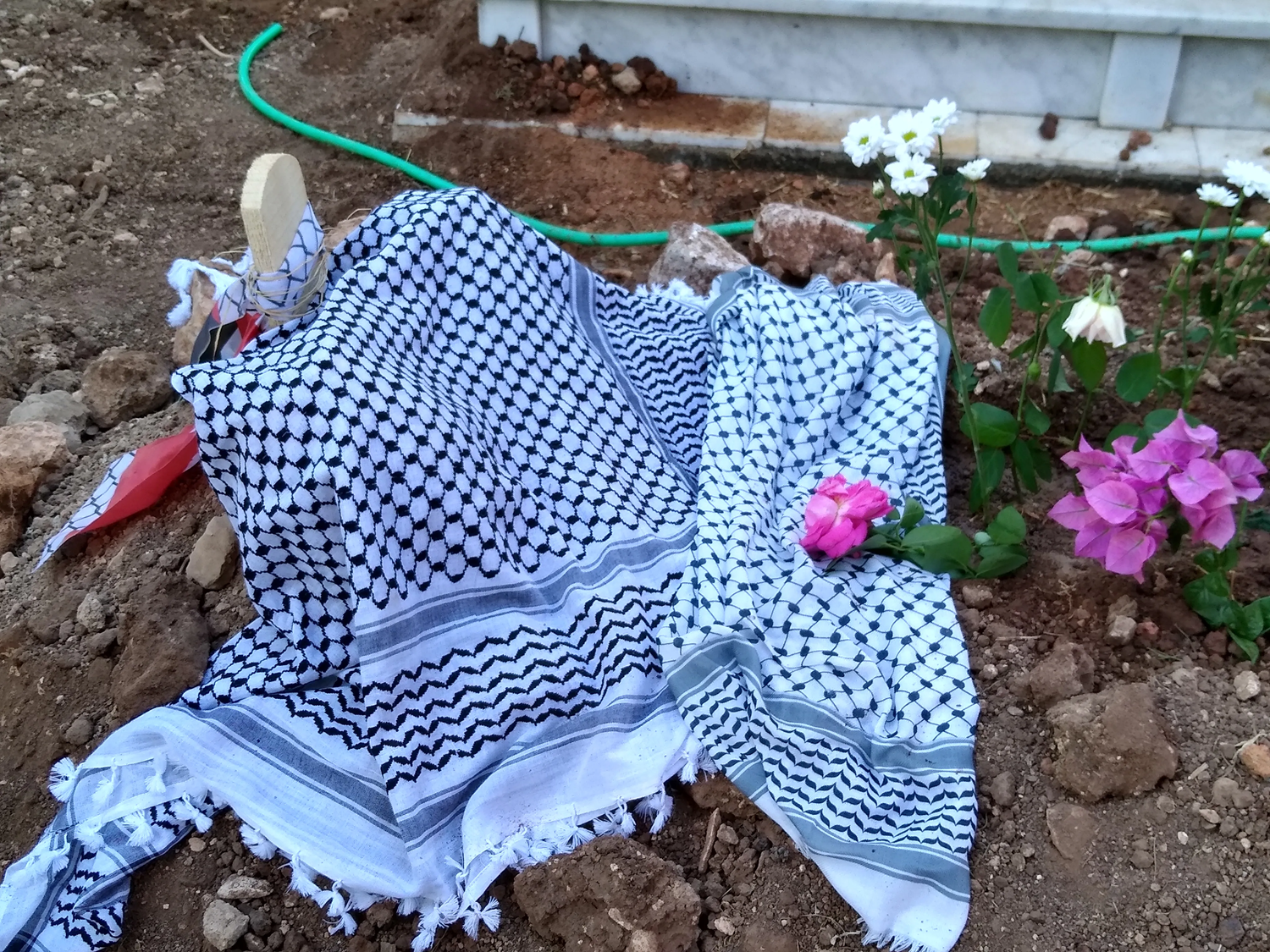
September 14, 2024: A few friends have caught glimpses of me standing off on my own. They acknowledge me with a subtle nod or a slight wave of the hand. A friend comes over and gives me a hug and whispers, “I’m sorry” in my ear. I don’t think Hamid has seen me. After he and others fill her grave with dirt, he sits solemnly next to her for a very long time, just staring at the new mound of dirt dotted with flowers and draped in a kufiyeh and two small flags: one Turkish and one Palestinian. I don’t notice any tears on his face. He appears dry-eyed. I am the same. The tears won’t come in this moment. They feel stuck behind something. Perhaps if I was dead and had no more concerns swirling inside my brain, then this body would know how to cry. Instead, I retreat to a different part of the cemetery, too consumed with worry. Some time passes and everyone else has now left. I sit alone, waiting for the unknown time when this body will be at peace.
Later, I approached Ayşenur’s grave, grateful to have an opportunity to finally get close and not have any cameras or dignitaries present. I touch the soil covering her body, and all I could think to say was, “I’m sorry”, over and over again. As I did this, the tears finally started to flow. This was the moment I needed with her.
A couple weeks after returning home, I wrote this reflection:
Each morning, I spend a few minutes looking at Ayşenur’s face amidst the memorial-in-process that I have been building, contemplating what has happened. On occasion, a few tears drip from my eyelids, down mycheek, sometimes a groan of agony, sometimes a shake of the head. I do not feel weak when my tears bubble to the surface. I only feel weak that my tears don’t translate to effective and decisive action. These are the twists and turns that my grief takes. Undoubtedly, I have not reached the end of this winding road. For now, all I can say is that life is composed of dying and mourning. Yet still we must honor our martyrs. We must destroy what destroys us; what destroys the people of Palestine. We must globalize the intifada.
Since I’ve returned, it’s been really unclear to me what to do, how to honor her, how to remember her, and how to give a report back. The only things I have come up with to share are these journal entries because they just seem like the most honest words.
I wanted to return to the ISM. How did your experience impact your understanding of the role of accompaniment, if at all? And what is your analysis of the work that ISM does?
I will say that the people I’ve met in ISM are some of the bravest andmost dedicated people I’ve ever met. So, I have a tremendous amount of respect for them as individuals and as an organization, and the work that they do. Also, I actually didn’t do the on-the-ground work with ISM. I only had the training, and then the next day, Ayşenur was murdered. The rest of my few days there were spent attending memorials.
There are many ISM volunteers who have anecdotes that their direct presence made a tangible difference in saving lives. I can’t discount those experiences. If we look at the Palestinian context more broadly, however, it does seem that this sort of model of accompaniment or protective presence tends to devolve into a service-oriented framework.
What do you mean by service oriented?
It’s sort of this crisis response model rather than a long-term strategy of resistance. That’s not to say that it’s not important to do that stuff. But I think if we step back and assess whether it’s effective overall at countering Zionist terror, I don’t know that it is. The degree of violence and repression from the Israeli state makes a commitment to non-violence at times seem illogical.
There’s this common idiom, you don’t bring a knife to a gunfight. But with this model, you’re only bringing a smart phone equipped with a camera to a violent conflict with highly armed security forces. It doesn’t seem sufficient.
What resistance strategy do you think would be effective? And what international solidarity do you think is useful in Palestine,specifically?
In the context of Palestine, it seems clear that Israel is not going to stop their settler colonial project and all the brutality that comes along with that unless the US no longer backs them militarily, economically, diplomatically, etc. So I guess that points to the broader strategy for Americans that instead of traveling to Palestine to act as a protective presence, you stay in the US and try to, frankly, destroy the US empire from within.
There was an essay released shortly after October 7, 2023 and its conclusion on what solidarity with Palestine looks like in the US was pretty simple: solidarity with Palestine means destroying the United States.6 The Israeli settler state is a project of empire. But how to do that obviously becomes a much more difficult question.
Yeah. That was my next question to you.
I think it’s pretty unclear. In general, as a movement, there’s not a clear direction. From what I can tell, the most inspiring moments have been direct action campaigns of sabotage and property destruction. Those seem like the most tangible acts of solidarity that I’ve seen. A more specific example might be the Palestine Action campaign of targeting Elbit Systems, one of Israel’s largest weapons manufacturers.7 A lot of their activity has been in the UK, although there have been activities on the east coast of the US as well. Some of their activities have had success in shutting down factories and offices of the arms manufacturer. There have been other small direct actions that are designed to limit the material support for the State of Israel by targeting groups that directly finance its activities.
I also want to hear your thoughts on supporting the Axis of Resistance. For example, there are organized armed groups fighting the Israeli military, who are statist or capitalist in orientation, and do not share left wing or anarchist values. It’s a really challenging nuance that doesn’t necessarily have a clear answer.
For most of my life, the visible Palestine solidarity movement in the US has taken an almost pacifist and liberal approach, publicly. And publicly, none of these groups would talk about supporting Hamas or even acknowledge that armed struggle existed. In this portrayal, Palestinians were only victims. I think that has changed in the past year or so. There is now a sizable chunk of the solidarity movement, the decolonial Left, which actively and publicly supports Hamas and other armed factions in the Palestinian resistance, along with the broader Axis of Resistance in the region. This new solidarity movement views the Axis of Resistance as a kind of vanguard of anti-colonial struggle. In this instance, solidarity with Palestine equates to supporting these movements and political parties without question. I find that a little problematic. But there isn’t space for this discourse because it’s automatically assumed you have some ideological aversion to violence as a form of struggle.
But that’s not where I’m coming from. Personally, I think the only thing that really makes sense in the context of a place like Palestine is armed struggle. I’m not a scholar of Hamas. I only know what they’ve said publicly that’s readily available. My objection to Hamas is that their political vision has nothing to do with abolishing capitalism or a centralized state authority. It’s hard to align my political values with that sort of vision. The objection is not that they have taken up armed struggle.
There’s a lot of pro-Zionist propaganda out there, and its entire purpose is to discredit Palestinian resistance. I think all of this should be acknowledged. And also there should be an honest debate amongst revolutionaries about what the political vision of these organizations that are considered the leaders of anti-colonial struggles is exactly. We should also look at it from a historical perspective—within past anti-colonial struggle, there’s a variety of political orientations and visions involved. Almost always, the authoritarian factions in these struggles succeed in taking over. Once independence is gained, these factions ascend to power and become the ruling party. This usually results in generating the same inequalities and class organization of society for the majority of people that existed under the previous colonial regime. Given the historical examples, we have to approach anti-colonial struggle with a critical lens and a vision for something different, an anti-capitalist and anti-statist vision.
- 1The Beautiful Idea, “The Murder of Ayşenur Ezgi Eygi and theFuture of International Solidarity,” April 5, 2025,https://thebeautifulidea.show/the-murder-of-aysenur-ezgi-eygi-and-the-future-of-international-solidarity-2/
- 2https://www.instagram.com/blaqelephantpartyorg/p/CzM3_34PUkA
- 3Horizend, “The LZ and Death by Negotiation,” The Horizend,https://horizend.substack.com/p/the-lz-and-death-by-negotiation;Julia Park, Susan Fried, and Maeve Smith, “Voices From Inside andOutside the Liberated Zone at the University of Washington,” SouthSeattle Emerald, June 4, 2024,https://southseattleemerald.org/feature/2024/06/05/voices-from-inside-and-outside-the-liberated-zone-at-the-university-of-washington
- 4“What are areas A, B, and C of the occupied West Bank?” AlJazeera, September 11, 2019,https://www.aljazeera.com/news/2019/9/11/what-are-areas-a-b-and-c-of-the-occupied-west-bank
- 5Miriam Berger, Loveday Morris, Meg Kelly, Jarrett Ley and SufianTaha, “New video, witnesses challenge Israel’s account of U.S.activist’s killing,” The Washington Post, September 11, 2024,https://www.washingtonpost.com/world/2024/09/11/american-activist-aysenur-eygi-killed-idf-west-bank
- 6Anonymous, “10 Anarchist Theses on Palestine Solidarity in theUnited States,” Haters Café,https://haters.noblogs.org/files/2024/01/Theses-on-Palestine-Solidarity.pdf
- 7See: palestineaction.org
Attachments
Comments

Abeng, a short-lived newspaper, offers a window into Jamaica's revolutionary currents in the late 60s. Acting as a theoretical nexus between communism and black power, it also served as a means of practical communication between different currents of class struggle on the island. By Saul Molcho for Heatwave #2 (2025).
The ecstatic days of the long 1968 placed social revolution squarely on the agenda for militants around the world. The decades-long entrenchment of parties hamstrung by their ties to the Soviet Union, the bureaucratization of previously militant trade unions, the monological focus on the factory and its downtrodden inhabitants as the sole social base for revolutionary transformation of society—all these calcified forms of class struggle and organization were challenged openly in the various globe-trotting skirmishes that characterized the heady, staccato timeline of the late ’60s.
The specter of ‘68 took on additional valences in the Caribbean against the backdrop of national independence and racial capitalism. The few short years of independence,1 which saw the evacuation of the former colonizing powers, failed to bring about the benefits of national uplift and basic dignity for the majority of Caribbeans that had been promised by the tepid anticolonialism of the national bourgeoisies. Instead, the beneficiaries of the postcolonial state cowered to the reinvigorated demands of imperialism, now devised to recruit the consent of the national elite who, in turn, aimed to manufacture the consent of their respective populaces.
Jamaica’s neocolonial condition was expressed primarily by the island’s continued exploitation by foreign companies for raw materials, particularly in the bauxite, sugar, and banana industries. The bauxite and aluminum mining sectors grew especially quickly in the 1960s, with land devoted to mining overtaking sugar plantations and Jamaica’s bauxite industry becoming the largest in the world.2 The growth of the mining industry contributed to land monopolization, environmental degradation, and poor living conditions, all while the bulk of profits went to the US and the UK where the aluminum was finished. Urban development for tourism caused evictions and segregation as police shielded resort-goers from black Jamaican life. In one politically formative moment in April 1963, known as “the Coral Gardens incident,” a group of Rastafari protesting police violence and segregation burned down a gas station, leading to the death of two police officers.3 Then-Prime Minister Alexander Bustamante ordered those with locks and beards to be “brought in dead or alive,” and in the subsequent repression of the Rastafari movement, Jamaican police killed eight Rastas and sent many more to jail. Jamaica’s political elite in the 1960s, in bed with foreign capital, was at war with its own population, declaring emergency powers for weeks at a time and banning Black Power literature and figures from the island. A Creole middle class—“white-hearted” lackeys of imperialism, in the words of Walter Rodney—came to define the terrain of national politics, capturing and quelling the widespread anticolonial fervor that had contributed to the end of formal colonialism.
In this context, the revolutionary movement in Jamaica had to confront the power of foreign multinational companies and the neocolonial state that facilitated exploitation and inequality. Largely based among the educated middle class, this movement also needed to solve the problem of its isolation from Jamaican workers, peasants, and “the lumpen” while articulating new organizational forms that could replace the political parties and their affiliated unions. This meant bringing together a diverse group of people against the current state of affairs, an unstable mixture of communists, Rastas, black nationalists, unemployed or semi-employed proletarians of the “rude boy” subculture, independent union members, intellectuals, and rural workers.
During his brief eight months lecturing at the University of the West Indies, the Guyanese historian Walter Rodney took up this organizational challenge by holding “groundings” throughout Kingston and its surroundings, talking with Jamaicans at dance halls, football pitches, and slums. Rodney maintained that he had much to learn from these interactions about Jamaica and how to fight for liberation, primarily engaging in conversation about their lives and only occasionally delivering lectures on African and West Indian history. Rodney was successful in catalyzing Black Power consciousness in Jamaica because he eschewed middle-class social conventions while articulating a sharp critique of capitalism and neocolonialism, thus positing a resounding example of how others in a shared position might contribute to the revolutionary movement. Rodney’s own intellectual production articulated the commonalities of emergent Black Power politics with an anticolonial Marxism: “there is nothing,” Rodney asserted, “with which poverty coincides so absolutely as the color black.”4 The result provided an analytical framework that could accommodate multiple forms of revolutionary political articulation that did not otherwise organically find association with one another.
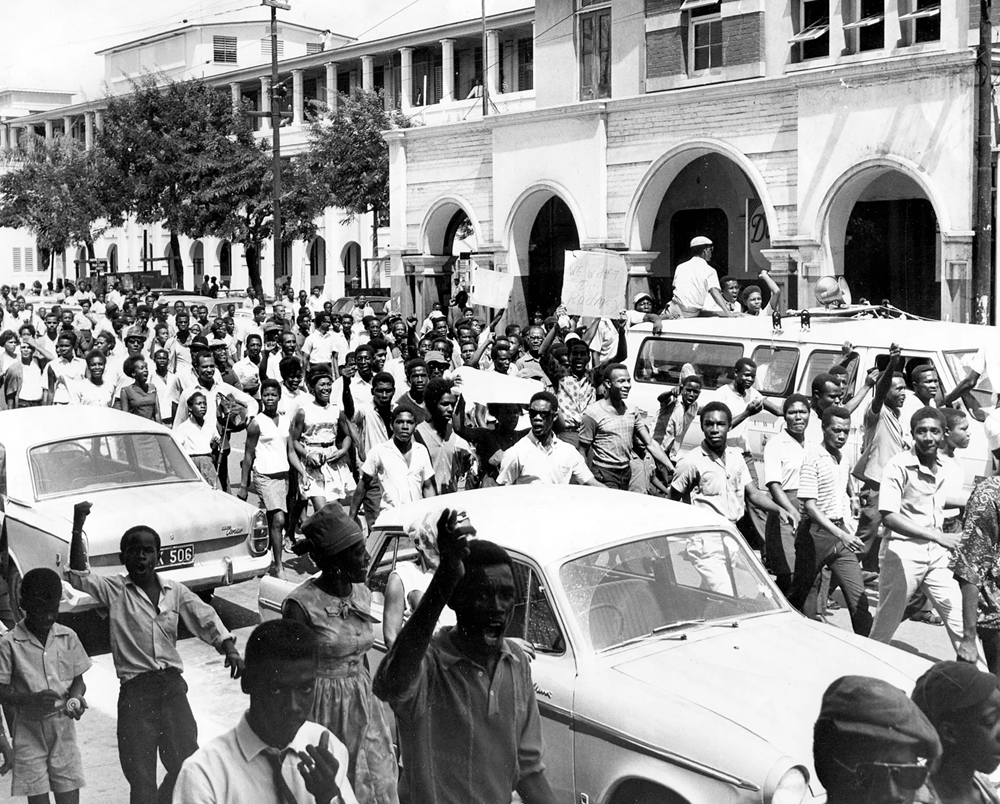
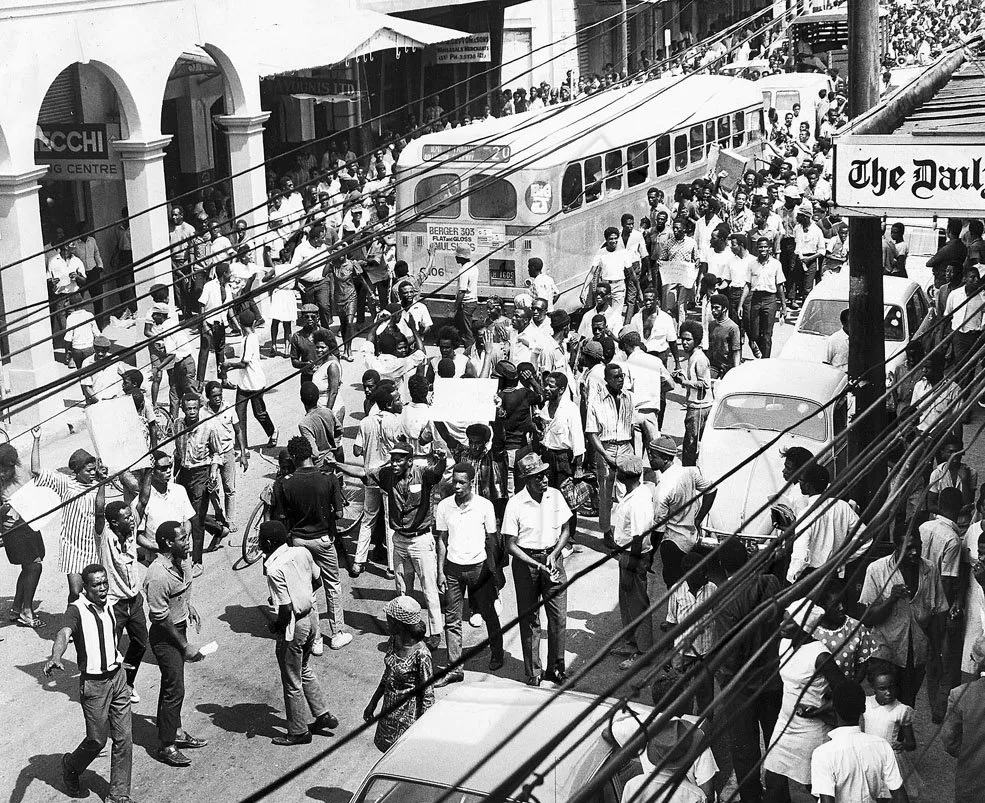
Rodney’s exemplary status in Jamaica did not last long. After he was banned from Jamaica for posing a presumed threat to national security, proletarians and university affiliates alike took to the streets of Kingston to display their frustration at this open act of state repression, and to express a deeper and more pervasive disdain for the dispensations of the neocolonial order. University affiliates, just hours after the news of Rodney’s expulsion was announced, staged a march from the secluded University of the West Indies campus into downtown Kingston, where they were met with attacks from both police and official trade union stalwarts, the latter being just as committed to the neocolonial state as the former. On the heels of the university affiliates’ actions, proletarians—whose domain in Kingston had been confined to the densely concentrated “dungles” (slums)—burst into open revolt, resulting in an estimated $1 million of damage in Kingston alone. The spirit of 1968 had come to manifest in Jamaica.
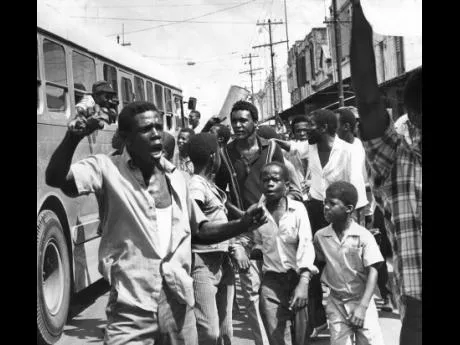
“A riot is not a revolution,” Rodney opined following his expulsion.5 The flashpoint of the “Rodney Riots,” while delivering a significant blow to private property in the heart of Jamaica’s capital, did little in themselves to put in place or build upon organizational capacities that could sustain a revolutionary challenge to capital’s dominion in the Caribbean. However, the riots were seen to be the clearest expression of a popular desire for the reordering of things, expressed through a program of total disorder. For Rodney, “a riot can contribute to revolutionary consciousness,” lending itself to the development of a force capable of confronting the ruling order directly. The Rodney Riots exposed in broad daylight the fault lines of neocolonial society in Jamaica, with the imperial order and their local representations on one side, and the aggregate population of Jamaican proletarians—the chronically unemployed, small farmers, sugar estate workers and bauxite miners, the manifold dangerous classes—on the other. Militants in Jamaica faced the challenge of deepening, clarifying, and codifying the rupture brought to the surface of Jamaican society in the wake of the Rodney Riots while avoiding capture by existing compromised institutions, whether bureaucratic trade unions, national political parties, or Comintern-affiliated organizations.
It is within this context that the Abeng group and its weekly, eponymous newspaper first appeared in January 1969, offering an innovative and popular response to the deepened crisis in Jamaica. Several of Abeng’s key contributors were radicalized by Rodney’s exile, and the group was inspired to cultivate an organic connection to Jamaica’s disaffected classes by Rodney’s grassroots work and the clarifying experience of the riots. Abeng’s short existence until October of the same year was characterized and unified primarily by an opposition to the neocolonial situation in Jamaica and the Third World more broadly, and the belief that a creative response to this situation could be devised only through connection and collaboration with the proletariat in its various formal and informal guises. From our contemporary vantage point, the primary lessons of the Abeng group are to be found in their innovative approach to the relationship between party and class, and to the new forms of organization this approach called for.
Abeng and the Spread of Assemblies
In the wake of Rodney’s banning, disenchanted intellectuals and dispossessed “sufferers” became politically entangled in previously unforeseen ways, presenting a new conjuncture through which to agitate for revolutionary change. To sustain this coalition and to expand its influence, a small group of revolutionaries resolved to establish a national newspaper that could provide a mouthpiece to all disaffected elements of Jamaican society and begin the articulation of a generalized antagonism against the neocolonial state. Contributors to the paper came from diverse ideological backgrounds, including acolytes of C. L. R. James like Robert Hill, proponents of a mixture of vernacular black nationalism with Situationist-inspired council communism such as Fundi (Joseph Edwards), and more orthodox Marxist-Leninists like Trevor Munroe. The Abeng group sought to shatter the dominance of the Jamaica Labour Party (JLP) and the People’s National Party (PNP), and to create new forms of organization which they thought could only come about through collaboration with the working class. They named the newspaper after the maroon word for a sheep’s horn, used during the colonial period to communicate across vast distances and stage attacks on slave society.
If Rodney codified the conjunctural impetus for Abeng’s coherence, Trinidadian historian C. L. R. James in many ways set the foundations for the paper’s manifest philosophy of revolution. For James, the moment of insurrection frequently took the form of a mass, democratic insurgency: rather than the storming of the Winter Palace, James saw the creation of soviets in every workplace as the basis upon which socialism was to take shape. The latter was the political form that would expand the “natural and acquired capacities” of human beings, conjoining the moment of capitalism’s delegitimation with that of the proletariat’s newfound self-legitimation. Revolutionary activity carried for James both a destructive capacity and, perhaps more importantly for him, a pedagogical mandate. The storming of the Winter Palace could teach nothing of the technicalities or intimacies of self-management within the arteries of a democratized mode of production, much less ensure the expanded political power of the proletariat itself to act in a newly self-capacitated manner. It was from the shopfloor that the most intimate knowledge of socialism derived and, in order to thrive, such knowledge needed the broadest dissemination. James, ever the man of letters, regularly emphasized the importance of literary production and, in particular, the creation of newspapers as the basis upon which struggles could be conjoined, knowledge of the productive apparatus could be distributed, and lessons from experiences of proletarian self-organization could be adequately aggregated and publicized. The practices organized around the production and distribution of Abeng saw James’ philosophy play out: the paper aimed to become a mechanism for catalyzing mass, democratic insurgency.
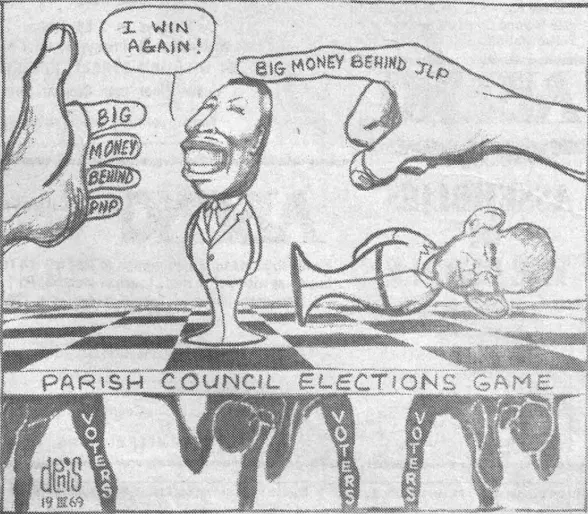
The Abeng newspaper also provided an opportunity to institute a dynamic reciprocity between, on the one hand, the militant core of the paper’s partisans who propelled its production and distribution and, on the other, the nebulous aggrieved and disaffected sufferers who were quick to see the paper as addressing their most prominent concerns and who, in turn, spoke through the newspaper to one another. This reciprocity by and large designated Abeng’s self-conscious approach to revolutionary organization:
The strategy of Abeng is—from the people to the paper, from the paper to the people and back again. At each stage the paper must raise itself and the people to a more solid union. A paper written, edited, financed, produced and distributed by committees of the people must subvert the politics of exploitation, give the people experience in collective action and help form the forces for a national community based on freedom and justice for all.6
The paper was therefore not only to put revolutionary intellectuals in contact with Jamaica’s lower classes, but to do so in the context of “collective action.”7
This reciprocity was largely achieved through “Abeng Assemblies” which would regularly form along the distribution routes of the paper. After printing every Friday, Abeng group members would disperse throughout Jamaica early the next morning, “devoting much time and petrol to the effort” of distributing the paper to rural and urban readers alike.8 Along the way, they would assemble with locals in various urban and rural enclaves across Jamaica’s parishes to discuss the contents of the paper, reflect on their daily lives, and, on occasion, announce the political forms that their struggles against dispossession and impoverishment were already taking. These assemblies varied in scope and scale but commonly provided the foundation for an ever-tightening entanglement between those most regularly producing the newspaper and those who identified most readily with its aims.
While travelling the country to distribute Abeng and conduct assemblies, members dealt with stiff state repression. Multiple issues of the paper recount police harassment of distributors such as Bongo Neville, a young man from Kingston who was arrested on several occasions and even had eviction orders served against his mother in retaliation. Police attention was unsurprising given the banning of Black Power literature in the 1960s, including many of the authors reprinted by Abeng like Stokely Carmichael and Malcolm X.
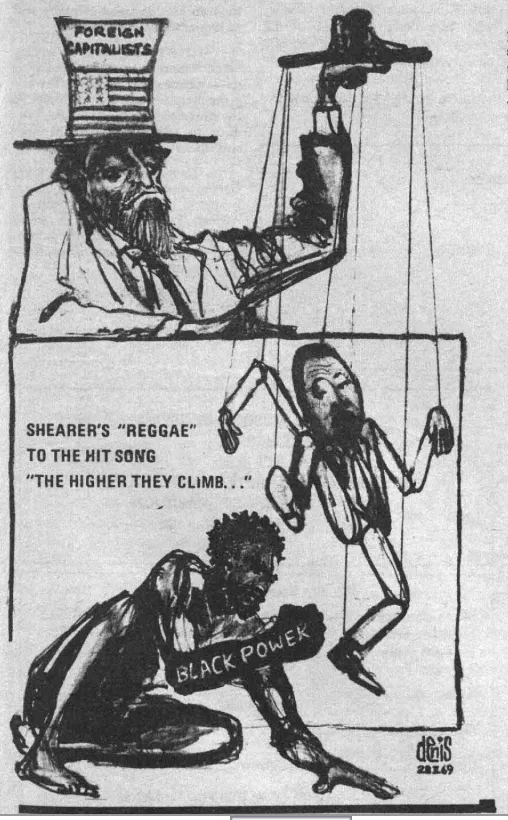
Although they brought increased state scrutiny upon Abeng members, the assemblies allowed them to identify various forms of existing and emergent struggle among proletarians. Most prominently, reports of efforts to form workers’ councils on sugar plantations in Westmoreland clearly demonstrated the independent capacities of Jamaica’s proletariat to innovate forms of collective self-management and resist domination implemented at the point of production. Other areas formed “Citizens Councils,” which would write to Abeng explaining local conditions and their attempts to intervene. The Greenwich Town Citizen’s Council, for example, recounted the pollution of a local river and destruction of subsistence fishing by industry, stating succinctly that the present task was to “link the struggles for the pre-existing immediate needs of the oppressed Black populace with the revolutionary goal of Black liberation and social change.”9 This task was at the center of Abeng’s operation.
In addition to placing Abeng members in direct contact with sufferers throughout the island, the Abeng Assemblies provided the basis upon which an ever-growing readership also became implicated in the production of Abeng: where concerns were raised in the course of an assembly, those concerns would become the basis of reportage or testimony in the following issue. Readers were encouraged to contribute reflections on their daily lives and attendant struggles to the newspaper, or to orally recount them to an Abeng member who would give them written form. These contributions were most commonly implemented under the recurring section “Blow the Horn, Tell the People,” an eclectic combination of brief letters-to-the-editor, commentary on previous Abeng issues, and a myriad of grievances. As the second issue of Abeng insisted, “the reporting of news [and] experiences and distribution of the paper depends on everybody.”10
Such efforts at dispersed production and distribution lent themselves to the softening of positional differences between an educated middle class and a vastly discontented but often illiterate working class, while nevertheless preserving these distinctions in the technical division of labor. The Abeng group, largely drawn from the most militant of the former camp, aimed to displace their own class hierarchies by placing their technical expertise—writing, researching, printing—at the service of an emergent class-for-itself, rather than claiming leadership over the class: “Those of us producing the paper can only go to these assemblies to help discussion, not to lecture and tell people what to do.”11
Of course, Abeng assemblies couldn’t entirely displace class society, and critiques were commonly printed in the paper. Readers often remarked that the group’s connection to the grassroots was incomplete and that the paper expressed itself in a language too elite to be meaningful to most Jamaicans. Another critique held that Abeng needed to develop a strategy and more directly advise workers on what to do rather than simply record and amplify struggles as possible examples. This suggests that belief in the revelatory nature of “groundings” and assemblies wasn’t shared across the movement, and that at the least the strategy being pursued by Abeng had to be more clearly explained within its own pages. Clearer strategizing may have been precluded by the multi-tendency composition of the group.
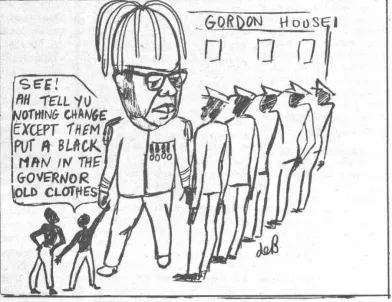
In this context, “readers” is only an approximate and ultimately unsatisfactory term, given the active nature in which proletarians engaged with Abeng. “Reader” suggests a unidirectional relationship where content is provisioned and disseminated by “producers” before being passively consumed by the former. The act of “consuming” Abeng was not so standardized and, in addition to being read by individuals, the paper was often spoken aloud to groups of sufferers gathered together, a practice that then served as an impetus to discuss the contents of the paper. We might consider “correspondent” a more apt term for those who engaged with Abeng from various angles, where readers served as active participants in the creation and circulation of the paper, insofar as they provided critical and instructive feedback within the Abeng Assemblies. As such, we can begin to place Abeng alongside the long history of communist correspondence projects like Marx’s own Communist Correspondence Committee, the International Council Correspondence journal edited by Paul Mattick, Sr., and the Correspondence Publishing Committee around C. L. R. James in Detroit—all of which were committed to a practice of inquiry. This lineage of communist correspondence projects sought to institute an open and inquiry-based form of communication that regularly militated against a staid and all-too-anachronistic party line emanating from Moscow and conveyed by its agents, seeking instead the proletarian reinvention of class struggle. Abeng’s contribution to this tradition of correspondence is its most profound legacy for contemporary politics, demonstrating a comprehensive reworking of the relationship between party—a coherent grouping of individuals dedicated to the task of identifying and extending revolutionary practice—and class—that living force which demonstrates the movement from which communism is rendered possible.
Conclusions
At its peak, Abeng amassed a print run of 20,000 copies which circulated throughout Jamaica and, to a lesser extent, the Caribbean diaspora. Despite this popularity, after just nine short months, Abeng ceased to exist, beset by the ills of interpersonal fallout, the destruction of their printery in a mysterious fire, and the twinned counterstrategies of state repression and recuperation. Legal fees accumulated from staving off repression drained the paper’s finances, and then the more permissive and recuperative environment of the 1970s under Michael Manley’s Prime Ministership further fractured the composition of the group, as some dedicated their activities to electoral politics while others continued to rail against Westminster governance altogether. Abeng saw the continuation and spread of the revolutionary movement in Jamaica to the immediate next stage following a popular uprising, raising for thousands the prospect of sustained antagonism to the neocolonial state—but it left the historical stage having amplified and conjoined grievances without illuminating what might emerge in its wake.
From a contemporary vantage, the lessons of Abeng, considering its shortcomings in practice and in theory, appear more as the promise of Abeng, an orienting idea that nevertheless fell short of its own aspirations. Rather than resolve upon and thus codify an answer to what shape organization for social transformation should take in Jamaica, Abeng refrained from programmatic declarations, hoping to advance a popular discussion around the needs, desires, and afflictions of Jamaica’s sufferers to better clarify a popular social basis for radical transformation. In so doing, Abeng was able to give expression to a number of otherwise competing ideologies within a single textual space, not as so many preferential options to be considered and ranked, but as a practice of articulating across their differences for purposes of popular mobilization. While this composition did not sustain itself for long, Abeng nevertheless posited a complex discursive formation that evaded left factional distinctions, instead reconfiguring the register of the popular within its historical moment and redefining the terms of democratic participation in revolutionary struggle. If we are to distill a particular form from the Abeng experience, it is one that is necessarily flexible and expansive, capable of accounting for the “multiplicity of interests” in a manner not dissimilar from how Marx characterizes the Paris Commune. Abeng did not seek to design and implement any “ready-made utopias,” but rather to “set free the elements of the new society with which old collapsing bourgeois society itself is pregnant.”12
While there is much about Abeng that feels relatively anachronistic 50 years on—a physical newspaper passed hand-to-hand has now largely been displaced by digital communication and impersonal delivery—much of its animating spirit should continue to inform contemporary revolutionary struggles. Abeng demonstrates a central object around which a non-sectarian coterie of partisans could cohere and agitate nation-wide against the independent state. The paper provided a material project that reflected the ideologically diverse social basis that brought it into being and served to highlight discrete tasks. These tasks brought revolutionaries into regular contact with Jamaicans across the country and actively involved them in the project of producing the paper.
The production of Abeng can perhaps most accurately be compared to the operaisti practice of co-research rather than traditional workers’ inquiry, particularly in its relation to struggle and to the types of knowledge it sought to produce. Each assembly held, each paper published, was an attempt to create a greater unity between party and class, and to one day do away with the distinction altogether. Abeng did not separate the paper’s production from the waging of class struggle, seeing research and writing as a way to spread and connect democratic grassroots groups capable of expanding confrontation in the workplace and village. The group sought to uncover not primarily objective technical aspects of production and consumption, but rather subjective experiences of suffering and domination that would spur opposition to neocolonialism and clarify alliances between partisans across sociological and ideological differences. The group’s flexibility and close attention to Jamaica’s specific historical conjuncture allowed it to identify the most salient contradictions in Jamaican society and push to deepen them. If not for its premature end, Abeng might have provided the context for long-term collaboration between revolutionaries and sufferers of disparate social groupings, a prerequisite for expanding struggles towards a rupture with the current order.
As in so many places across the world, the Caribbean left in the 1970s moved towards more bureaucratic and authoritarian forms of communist practice as well as more specialized modes of armed struggle, with few exceptions. In Jamaica, a reinvigorated social democracy fractured the revolutionary movement and, although workers continued to engage in wildcat strikes, independent trade unions never reached the scale or coherence necessary to challenge the state. For a brief moment in 1969, Abeng helped sketch a different future, one without managers and politicians, where reciprocity and equality come to characterize relationships. Their experiment was an essential piece of the communist movement that will bring about a classless world.
Saul Molcho is a communist writer & researcher based in the U.S. Midwest.
- 1Jamaica and Trinidad & Tobago both gained national independence from the United Kingdom in 1962.
- 2Monica Silberberg, “The Jamaican Bauxite Industry and Decolonization,” Caribbean Quilt 2 (2012): 92-106.
- 3Horace G. Campbell, “Coral Gardens 1963: The Rastafari and Jamaican Independence,” Social and Economic Studies 63, no. 1 (2014): 197-214.
- 4Rodney, The Groundings with My Brothers (Verso, 2019), 13.
- 5Walter Rodney, “Africans Abroad in Jamaica,” unpublished manuscript, 36.
- 6Abeng 1, no. 11 (1969): 4.
- 7In this way, Abeng may be seen as a vehicle for what Sartre called the “group-in-fusion,” a social body constituted through a unified orientation toward practice. Jean-Paul Sartre, Critique of Dialectical Reason, vol. 1 (Verso, 2004).
- 8Ken Post, “UWI Mona and the Government of Jamaica, 1967-69,” in Rupert Lewis and the Black Intellectual Tradition, eds. Clinton A. Hutton, Maziki Thame, and Jermaine McCalpin (Ian Randle Publishers, 2018), 26.
- 9Abeng 1, no. 29 (1969): 2.
- 10Abeng 1, no. 2 (1969): 2.
- 11Abeng 1, no. 6 (1969): 2.
- 12Marx, The Civil War in France (1871), marxists.org/archive/marx/works/1871/civil-war-france/ch05.htm.
Attachments
Comments

Originally published in Heatwave Magazine Issue #2.
In “Pumping Up the Revolt: The Serbian Uprising, Its Roots, and Its Discontents,” L.P. charts the possibilities and contradictions of the wave of protests, riots, strikes, and occupations that spread across Serbia beginning in late 2024.
“[A]fter a rain mushrooms appear on the surface of the earth as if from nowhere. Many do so from a sometimes vast underground fungus that remains invisible and largely unknown. What we call mushrooms mycologists call the fruiting body of the larger, less visible fungus. Uprisings and revolutions are often considered to be spontaneous, but less visible long-term organizing and groundwork—or underground work—often laid the foundation.”
—Rebecca Solnit, Hope in the Dark
On November 1, 2024, a recently renovated train station collapsed in Novi Sad, Serbia, killing 16 people. This was perhaps the clearest result of the state policies we have witnessed here in the past decade that prioritize capitalist profit over people’s wellbeing or even survival. The government’s obvious culpability in these deaths led to massive protests breaking out almost immediately.1 By the end of November, students all over the country began occupying their universities and instituting directly democratic student councils to organize the movement.
In the wake of this incident, we have seen massive protests against official corruption, the state, and its violence. The government’s response has been mass arrests and threats of university privatizations. The protests have spread throughout society, involving not only students, but also local citizens’ assemblies, school teachers, trade unions, war veterans, biker gangs, and many other groups organizing against the state. We have seen a proliferation of radically democratic counter-institutions inside the movement, as well as tactics of occupations and strikes—something we have never seen at this scale in Serbia before.
International observers have been following these events closely, inspired by the sight of hundreds of thousands of protestors challenging the right-wing authoritarianism that has been on the rise throughout the world in recent years. However, each has interpreted the movement through their own specific lens: liberal European politicians have seen it as a non-violent mass protest for European values; libertarian leftists as a people’s movement against “neoliberalism” and for radical democracy; far-right and authoritarian leftist groups as merely another “Color Revolution” instigated by the West. Strictly speaking, it hasn’t really been any of those things.
While elements of radical democracy have been present, as well as pro-(Western)-democracy attitudes and tendencies, the movement has also been highly diverse, full of contradictions and without a clearly defined goal. That is probably also why it has grown so popular: it tends to stay away from controversial topics and ideological debates. It does not clearly define its vision for societal change.
Of course, the movement did not emerge in a vacuum. Although the way the uprising has been organized differs considerably from movements we have seen in Serbia before, it still carries their DNA. Various elements of Serbian society and its recent history have come together in a confluence to produce the uprising. If we are to learn anything from these events, we need to understand all of these disparate elements and what their “spontaneous” explosion might be able to tell us about the terrain of future struggles.
While the movement seems to be dying down after being active non-stop for almost a year (as of August 2025), with many universities ending their blockades, and many citizens’ assemblies quietly dissipating, it is still highly unpredictable where things are going. Still, it is useful to reflect on the roots of the movement, current Serbian society, and where the events have led us so far.
Serbia at the End of the 20th Century
Contemporary Serbia is largely defined by the 1990s. It’s a country still reckoning with what remains of Yugoslavia. As Marxist-Leninist regimes across the world went through economic, social, and political crises during the 1980s, political-economic elites in those states looked for ways to retain their positions. In Yugoslavia, this manifested as a rise of nationalist and separatist fervor instigated by influential (current or former) Communist officials, who successfully outmaneuvered their rivals in the party, many of whom advocated more permissive and market-socialist-oriented roads similar to those advocated by Gorbachev or Deng Xiaoping. In Serbia this wave of nationalism was spearheaded by Slobodan Milošević, a man who would soon lead Serbia into war with the other republics. He led a brutally repressive regime, which, while holding nominally democratic elections, would in practice violently repress any attempts at dissent by opposition activists, students, workers, anti-war groups, and ethnic minorities.
It was this period that would come to define the Serbian political climate of today. On one side was a coalition of former hardline Communist officials, organized crime, the state security apparatus, and the far-right; on the other there was a big-tent anti-government movement of liberal democrats (led by the Democratic Party), moderate former Communists, progressive civil society activists, and a sizeable number of right-wing groups who viewed the government as insufficiently nationalistic. These opposing coalitions, formed out of convenience and the logic of “the enemy of my enemy is my friend,” would dominate Serbia’s politics. Even though some of the specific groupings have shifted, the broad strokes have remained the same, with large, “post-ideological” coalitions leading the charge against violent state and parastate repression.
The current president of Serbia, Aleksandar Vučić, along with large swaths of his current party (the Serbian Progressive Party or SNS), also started their careers in the 1990s as members of the neo-fascist Serbian Radical Party. While the Radical Party at the time presented a critical attitude towards the Milošević government, it represented a fundamentally controlled opposition, supporting and propping up many of the government’s repressive and genocidal policies while violently attacking all those who opposed it. This eventually resulted in the party forming a coalition government with the then-ruling Socialist Party of Serbia (SPS). However, while the SPS still maintained some vestiges of the old state, including some social benefits and state control over parts of the economy (though simultaneously privatizing many state-owned enterprises and abolishing the system of workers’ self-management), the Radicals wanted a clear break with the old system. They despised the Communists, identifying themselves with the collaborationist right-wing Chetnik forces of World War Two and advocating an aggressive process of complete privatization of the economy. Despite their populist rhetoric aimed at Serbia’s increasingly dispossessed population, their actual agenda favored large capital and massive cuts to social spending.
At the end of the decade, following years of war, sanctions, and other forms of international pressure, mass protests led by the broad social and political coalition against Milošević overthrew the government and ushered in an era of democratic reform. Cracks in this coalition quickly started to show in debates over how much the existing security apparatus (loyal to the previous government, with ties to organized crime and far-right groups) should be dismantled, what the attitude of the government should be towards the EU, and how to deal with war criminals hiding in Serbia from the ICC. This turbulent period also led to an even more aggressive and rapid privatization of state-owned enterprises, which were sold off to either their previous party-appointed “managers,” people close to the new governing parties, or—more often than not—multinational corporations. These processes were rarely transparent and left large swaths of the workforce unemployed. This led to a sizable but fragmented and defensive movement of workers fighting to keep their jobs, obtain unpaid wages, and resist privatization altogether. However, these movements, while successful in some of their goals, weren’t able to stop the processes of mass privatization and deindustrialization. Because post-communist trade unions have been weak and cozy with the state, contemporary worker organizing has generally been passive and unable to play as significant a role in Serbian politics as other groups like local movements, liberal-democratic parties, or even non-governmental organizations.
By the mid-2000s, after years of unstable governments, snap elections, economic slumps, and violence by organized crime and far-right groups (resulting in the murder of Serbia’s first democratically elected prime minister, Zoran Đinđić, in 2003), it seemed that a consensus was cautiously emerging. More and more people in Serbia supported EU accession and democratic reforms. Civil society groups and independent media outlets formed, and Serbia gradually re-integrated into the global capitalist economy, bringing optimism that the economic situation was starting to improve.
This was complicated, however, by two nearly simultaneous events. The first was the Great Recession following the 2008 economic crash. The second was Kosovo’s 2008 declaration of independence from Serbia (on the basis of its predominantly Albanian population). While the then-ruling Democratic Party managed to retain power by forming a coalition with their former nemesis, Milošević’s SPS, a shift was imminent. Then, the Radical Party’s popularity exploded after a fraction split off to form the SNS as a moderate, pro-European conservative party. This effort was led by Tomislav Nikolić, who had previously served as acting president of the Radicals while its founder and actual leader was on trial for war crimes in the Hague. Nikolić’s second-in-command was the much younger and more charismatic Aleksandar Vučić.
This shift in rhetoric was enough to siphon off much of the Democratic Party’s voting base, attracting conservative nationalists who nevertheless wanted the economic benefits of EU membership, as well as many anti-systemic voters hungry for a change from the status quo. The incumbent government rightly appeared to many voters as inefficient, corrupt, chaotic, and unfair towards the average, working person. The SNS moved to harness this dissatisfaction, and their strategy paid off. After moderate gains in the 2012 elections, which allowed it to form a minority government (in coalition with the SPS) and take over the presidency, the party won a sweeping parliamentary majority in 2014, gaining a grip on power that it has not let go of since.
The Vučić Years
The early years of SNS rule didn’t demonstrate much fundamental change. The new government, despite its far-right past, appeared to align with the direction in which the previous government had been moving. The SNS continued the path of EU accession, complying with the reforms that the EU required of Serbia. In this, the new government initially saw more success than their Democratic predecessors. They started accession talks in 2014 and opened the first chapters in the negotiation process the following year.
Not much appeared to change for civil society, either, though there were some indications of an opening up. The new government allowed the Belgrade Pride march to be held in 2014. Such marches had not taken place since 2010, when the previous government had banned Pride in response to widespread far-right violence. In 2014, no major incidents occurred and the march has been held annually ever since. At the level of media, right-wing and liberal outlets took turns criticizing and praising the government, depending on the issue.
Despite the previous hardline nationalist and expansionist rhetoric of its members, the SNS-led government appeared to be more moderate on the issue of Kosovo. The 2013 Brussels agreement normalized relations between the two de facto independent states of Serbia and Kosovo, yet selective terminology allowed the Serbian government plausible deniability regarding Kosovo’s statehood in order to save face among voters—for whom Kosovan independence has been extremely unpopular.
For Serbians, what we witnessed during the early SNS years was a continuation of the liberal capitalist, moderate nationalist, pro-EU consensus that had come to dominate the Serbian political landscape over the previous decade. This image soon began to crack.
One defining feature of the current government throughout its tenure has been a tendency for massive public–private joint ventures led by foreign firms. These are typically expensive, large-scale construction projects, through which companies close to the government skim money using opaque contracts that exclude citizen participation or consideration of working peoples’ needs. The foreign capital funding these projects comes from many countries including the UAE, Germany, China, the UK, and the US. The first of these major projects to gain notoriety was the Belgrade Waterfront, a massive Dubai-style project of gentrification, aimed at constructing a new neighborhood of skyscrapers for the ultra-rich while demolishing an older, largely proletarian part of town. A massive resistance movement to this arose under the name of Don’t Let Belgrade D(r)own!, which led diverse but largely symbolic protests and petitions against this and other similar projects. This was the first glimpse we caught of the methods of repression this government would be willing to deploy, with masked men (likely tied to organized crime networks) demolishing buildings in the middle of the night in 2016 so that citizens and activists wouldn’t have time to react.
In response, multiple local campaigns of mass resistance confronted these controversial projects funded by foreign capital. For example, there were massive protests, occupations, and acts of sabotage by villagers against a project to build a hydropower dam that would affect all local rivers in the Stara Planina mountain range. There was also a series of protests and occasional encampments in major cities against the demolition of remaining green spaces to make way for new construction. The largest of these campaigns opposed a lithium mine owned by Rio Tinto that would have devastated the livelihoods of local villagers. This movement saw both massive protests and encampments throughout the country, as well as decentralized blockades of major roads.
Many of the oppositional movements that have characterized the previous decade thus ended up being local and grassroots in character, with a focus on the idea that citizens should directly determine the built environment in their own communities. This led to a sizeable presence of local and municipalist political parties, as well as (sometimes successful) community attempts to take over institutions of neighborhood governance left over from the system of worker’s self-management, which are supposed to allow citizens to gather together and have their voices heard in the city government.
Throughout this period, the national government became increasingly repressive and gradually took control over all levels of society—from city councils and public enterprises down to schools, cultural institutions, student parliaments, and media outlets. It got to the point that almost all local governments are now controlled by the SNS or their coalition partners in ethnic minority areas. This trend provoked a new big-tent movement whose protests were generally large, all arising as a response to some form of repression: highly controlled presidential elections in 2017, brutal violence against opposition figures in 2019, manipulated covid statistics before the 2020 elections (in order to lift lockdowns—causing many people to get infected—with the measures restored immediately after the election), and the government’s lackadaisical response to two mass shootings in 2023.
Three features characterized all these protests. First was their top-down approach: they were often organized and controlled by mainstream opposition parties or groups close to them. Second, the protests were usually docile and shied away from civil disobedience, destruction of property, or disruption of economic infrastructure. Finally, they lacked ideological or programmatic coherence, with liberal and far-right groups organizing together, while left-wing groups and progressive civil society organizations would take part on the margins. While largely ineffective in their goals, these movements did lead to new waves of organizing and a restructuring of the political scene, with almost all the currently active major parties emerging from these waves. Many new civil society groups and networks arose as well, from the left-wing housing movement formed in the wake of the 2017 protests, to the youth and student-led pro-democracy activist groups formed in the wake of the 2023 protests. The latter in particular would end up playing an important role in the current movement, at least initially.
On this topic of student activism, one more historical point should be reviewed before we begin our examination of the ongoing wave of protests. Student-led movements played an important role in the opposition to the Milošević government in the 1990s, with many of the student leaders of the time ending up as important political figures after his overthrow. However, the character of such movements shifted after the democratic reforms of the 2000s. In the early 21st century, they usually organized only against capitalist restructuring of higher education, and so were broadly left-wing. Their methods of organizing differed from their predecessors and involved blockades of the universities. These blockades led to directly democratic student assemblies that attempted to give a voice to student grievances. While tactics and organizing strategies were certainly shared between the different generations of student activists (as well as between students from different countries, with the most important connection perhaps being with those from Croatia), what defined the new movements was their lack of continuity. Waves of protests and occupations would appear in response to new market-oriented measures by the universities, then they would explode and eventually die down without forming more permanent structures. Any student organizations that formed in this period tended to not last beyond a single generation, after which a new group would form from scratch.
While still partially dealing with student issues and using the tactics of blockades and building occupations that marked the previous two decades, the student-led groups that formed after the 2023 protests were different. Their primary focus has been resistance to the government and its authoritarian structures, rather than focusing on the commercialization of education or the advocacy of direct democracy and left-wing politics as their predecessors had. In this they more closely resembled the movements of the 1990s, organizing for all sorts of issues outside the universities. It should be noted that these groups were generally small and had limited influence both on the student body and the public at large. However, they were instrumental in organizing many actions against government policies, and this would place them in a key position to channel the public anger after the train station collapsed in 2024.
Train Station Collapse and Its Aftermath
In 2021, the SNS government awarded a sweetheart deal to a consortium of construction companies to rehabilitate a railway station in Novi Sad, Serbia’s second-largest city. Part of China’s Belt and Road Initiative aimed at building transportation infrastructure in Southeast Europe, this project involved all the elements present in the aforementioned cases that have become associated with the regime: inflated costs, lack of transparency, subservient2 cooperation with foreign capital that would allow it to profit massively while disregarding the needs of the community and the workers, and presenting the project as something of great national importance—which the government used as propaganda for its developmentalist image.
On November 1, 2024, in a tragically preventable accident, the canopy in front of the train station collapsed and killed 16 people. Sensing a major image problem, the government went on the defensive. After Vučić had taken personal credit for this project for years, posing for photo-ops and opening ceremonies, the government quickly tried to distance themselves by denying that the faulty portion of the station had even been rebuilt in the first place. This blatant attempt to cover up their role—even as survivors and dead bodies were still being pulled from the rubble—only served to cement the government’s guilt in the eyes of the public. They immediately started pulling all publicly available documentation related to the project, signaling further guilt.
Building on the anger with SNS rule that had been building through the preceding years of smaller protest movements, this event sparked an explosion of revolt on the streets. While initial demonstrations were called by activist groups led by students and other young people, in coordination with some local opposition parties, they immediately expanded beyond their control. These groups had called on people to gather without marking themselves any sort of leaders, but the atmosphere made this precaution seem unnecessary: the demos would probably have erupted even without being called by those particular groups. The marches over the next few days were some of the largest in recent years, involving property destruction and clashes with the police—especially in Novi Sad, where City Hall was breached and painted blood red. While this kind of rioting is rare in Serbian protests and often speculated to be instigated by government agents trying to discredit the movements (since they have rarely been the targets of subsequent police repression), this time many of the people participating saw this kind of response as entirely appropriate—even if it turned out that it had been orchestrated.
The riot in Novi Sad led to a brutal police response against demonstrators, with many people being beaten or arrested, including students. The repression initially led to a somewhat more radical response from the movement, with opposition members of parliament blocking the city’s courthouse to demand the release of arrested protesters. This second round of demonstrations was also somewhat decentralized, with activist groups calling on people to blockade roads every Friday wherever they happen to be for 14 minutes of silence (to signify the 14 people who had died by that point—two more would succumb to their wounds in the coming weeks). These actions were met with new repressive tactics: Thugs close to the government attacked these protests, driving cars into the crowds and using other forms of physical violence. This backfired as well. After students from the university drama school were attacked, they organized a blockade of their school, demanding that the attackers be arrested and that students held in custody be released. In the coming weeks, their fellow students from other campuses and universities would follow in their footsteps. Soon, all campuses of all the public universities throughout Serbia would be blockaded.
In the university blockades, students organized themselves in directly democratic assemblies, inspired by previous movements—although on a much larger scale this time. Many of the students were also supported by university staff (at least initially), with some schools even officially endorsing the demands. The movement would expand greatly over the coming months, with a massive, decentralized base of student activists launching all kinds of innovative actions against the government.
Part 2 will appear in Heatwave issue 3
- 1“Pump it!” (pumpaj) has been a slogan of the movement since its early days. Normally associated with rap music and working out, this term’s connection to protests is more nebulous, implying something like “don’t let the energy drop,” but perhaps also to pump the government full of air until it pops. A related slogan has also come into use, coined by sociologist and left-wing populist Jovo Bakić: “Stew it,” meaning we need to prepare for a long-term struggle.
- 2This subservience takes many forms, such as large subsidies granted to multinational corporations opening factories in Serbia. The government has signed bilateral treaties giving Chinese companies preferential treatment for exports and exempting them from following certain laws, specifying, for example, that Chinese citizens working in Serbia are to be treated according to Chinese laws, leading to terrible conditions for many guest workers. In this and the earlier construction projects, a common tendency has been a lack of public tenders, with backdoor deals predetermining which companies the state will cooperate with.
Comments

History does not repeat, but it often rhymes. Gilles Dauvé draws out the uncanny resemblance between the French electoral left of today and those of yesteryear, with special emphasis on La France Insoumise (LFI). From Heatwave #2.
Fallen Communist Party
In France, up to the 1960s, handing out radical leaflets at factory gates could result in being beaten up by Stalinist heavies of the Confédération Générale du Travail (CGT, the union controlled by the Parti Communiste Français). A young member of the Communist Party’s (CP) student organisation once proudly showed me the truncheon he’d recently used against Trotskyists in his working class suburb. The CP professed to be the party of the working class, or often passed as such, and the top CGT man always served in the party’s political bureau. In the 70s, more than 7 million French people lived in a town with a CP mayor.
Those days are gone. With a membership smaller than that of the more avowedly conciliatory Confédération Française Démocratique du Travail, the CGT is no longer the largest confederation, and no CGT leader has their seat reserved in the CP’s bureau national (polit-buro sounded too Orwellian). Actually, the present CGT general secretary, Sophie Binet, never belonged to the CP, and was a long-time member of the socialist party. In general elections, the CP has fallen from about ¼ of the votes (nearly 30% in 1946) down to less than 3% in 2024. Its leaflets and posters eschew class talk and prefer talking of les gens (people). In the 21st century, a harmless CP appears reasonably moderate, no longer perceived as a threat to national identity, and no-one would think of denouncing it, as a Minister of the Interior did fifty years ago, as “a totalitarian party with fascist leanings.” (In fact, in 1927, another Minister of the Interior exclaimed “Communism, there is the enemy!” Today’s slogan would rather be: Russia is the enemy!)
Hardly Worthy of a Resurrected Red Scare
Contrary to a now respectable Parti Communiste Français, La France Insoumise (LFI) is now regularly typecast in the public eye (meaning the media, social media included) as the villain of the French political scene. In particular, since any serious critique of Zionism is currently equated with anti-Semitism, a widely accepted view is that LFI (not unlike Corbyn in Britain) is inherently anti-Semitic. LFI’s provocative symbolic gestures in parliament (waving Palestinian flags and displaying pictures of children killed in Gaza) are said to prove a hatred of Israel and an acceptance of Hamas terrorism (more on Israel later in this text). Politics feeds off bogey men.
Before its birth in 2016, LFI originated from the Parti de Gauche, founded in 2008 as a split from the Parti Socialiste. A major reason for the left wing of the party to go its separate way was the result of the 2005 referendum. Voters had been asked to decide whether the French government should ratify the proposed constitution of the European Union. The “No” won with 55% of voters rejecting the treaty out of a turnout of 69%. (Even the French Greens were divided on that issue: an internal party vote opted for “Yes” only by 53%). The decision was later overridden by the French parliament. (That same year, a similar process took place in the Netherlands: although 61% did not comply, the European constitution was accepted by the Dutch senate.) Most media and political comments explained away the “No” vote as an expression of ignorant lower-class dissatisfaction and xenophobia, as opposed to the informed “Yes” to Europe from the educated, open-minded middle class. As for the socialist left, it interpreted the event as the opportunity for a political space on the left of the left, with possible rich electoral dividends. In response to the general drift to the right of socialist parties, exemplified by the French 1983 turn to austerity and Blair’s New Labour, a sizeable socialist minority believed it was possible to reverse the course that led to privatisations, labor market flexibility, trade liberalization, banking deregulation, tax cuts for the rich, increased social inequality, etc. To put it shortly, LFI, headed by Jean-Luc Mélenchon, hopes to cure the left parties’ identity crisis by putting forward a credible alternative to social-liberalism.
Now, what’s in a name? And in this day and age, what’s in a logo?
However confused and confusing words can be, when a group or party names itself communist, socialist, labor, anarchist—or conservative, liberal, national—the party at least gives some idea of what it stands for. Emblems also have direct political meaning; the hammer and sickle is a symbol of the working masses which the far left claims to represent.
Insoumis means unbowed, refractory, unsubdued. In French, it also refers to a soldier who deserts their unit or does not show up for mandatory conscription. It conveys no specific political message, let alone program. Besides, LFI’s logo is the Greek letter, φ phi, which in French sounds just like “FI”. “We chose the symbol phi because it begins the word philosophy [and also] out of affection for those who taught us democracy” Mélenchon declared. The letter, however, is redrawn in a special way, so the party leader added: “Some will see a little man making a fist, others the symbolized signal of a feminized gender, others will see what they really want.”
What is it that LFI members and voters want? LFI’s name and symbol emphasize a rebellion inspired by a philosophical love of wisdom, not subversion or direct action; when LFI takes to the street, it is always as a backing to parliamentary lawmaking. And let’s not take insoumission literally: LFI never suggested French soldiers should go AWOL, and when in 2024 dozens of Ukrainian soldiers deserted from the elite Anne of Kiev brigade during their training in France, it was certainly not with LFI’s approval or assistance.
LFI speaks to and for “the people”, defined as those who work and contribute to real wealth, which raises the question of what and who is included and excluded. Jet-setters, stock brokers and high frequency traders of course do not belong. That leaves a people made of nearly 99% of the population. LFI’s inclusiveness, however, concerns the French people, i.e. those within a national framework. Granted, contrary to far right politics, LFI’s nation is multi-ethnic and secular, it encompasses Europeans as well as non-Whites, and does not discriminate against immigrants and undocumented people. But it still thinks in terms of a nation, albeit an open-minded and welcoming one. LFI’s internationalism is limited to what the word says: an association of nations, i.e. national states engaged in an extensive political and economic cooperation. LFI accepts a world where populations are politically structured in national states, which will coexist in peace if they are run by governments truly representative of their people. This replicates the Second International’s politics: fitting into a national system, hoping for the best from nations, and making do with the worst when war breaks out in 1914.
From Class and Disaster in Valencia in Issue One of Heatwave:
The people can be the totality of citizens subject to the rule of a particular government. Or, the people can be defined more narrowly by language, food, traditions, religion, race. Usually both definitions sit on top of each other. In either case, state institutions are the most important element that create the people: either the abstract fact of being subject to a specific government, or more concrete institutions like the school system, immigration enforcement, language laws, subsidies for certain kinds of cultural events. Being a people is, to a large extent, a question of having a state, and states justify their rule by being the state of a particular people.
No wonder LFI’s leaders refer so much to 18th century Enlightenment rationalism, secularism and constitutional law, and a lot more to French Revolution Jacobins than to early communist Babeuf. One of LFI’s main efforts is to build up a broad consensus by proposing the formation of a new Republic, a 6th one after the 5th established by de Gaulle in 1962. In other words, social change backed by constitutional change, thanks to a referendum—a proper one, this time, unlike the 2005 flop.
No harm in adding a touch of vivid red to faded socialist pink.
Yet despite such innocuous politics, red-baiting is back. Though the French ruling elite has nothing to fear from LFI, it has become standard practice for political pundits to portray them as “dangerously extremist,” “a real threat to French Jews,” “pro-terrorism,” “a disaster for the left,” “totalitarian,” etc.
The truth is more down-to-earth.
At the moment in France, the right is too weak, the left too divided, and the far right unacceptable for the time being. The right-of-center is running the show, yet leaning further to the right, with Prime Minister Bayrou saying that immigration is leading to a “feeling of submersion.”1 The absence of a definite majority is no major problem, because a “central bloc” minority government can get support from the far right on law-and-order issues (more police power), and from the right and moderate socialists on anti-social policy (fewer social budgets and unemployment benefits).
Well-minded people search for a “real” left but what are the real and unreal lefts? Before 1914, only a number of anarchists and a few Marxists (notably Anton Pannekoek) had understood that revolution was an “add-on” to the daily reformist activity of nearly all socialist parties. A striking example was the committed Marxist Jules Guesde, die-hard challenger of Jean Jaurès’ reformist approach, leader of the “intransigents,” and a fierce opponent of socialist participation in bourgeois governments. In 1914, national defense against the German invasion turned into Guesde’s absolute priority, and he became a member of government until the end of 1916.
“Moderate socialists” has one word too many.
Popular Front: Reality & Myth
LFI’s remedy is part of the disease. In June 2024, it promoted a Nouveau Front Populaire that associates LFI, the CP, the socialists and the Greens, plus a few small parties. One wonders if LFI really thought its partnership with those who have implemented anti-labor policies for decades could alter the course of events. In fact, no partner seriously believed in this (already breaking up in 2025) electoral alliance, which was only temporarily useful to the participants while they kept jockeying for position. In contemporary parlance, politics is a zero-sum game—some win because others lose.
In that respect, the reference to the 1936 Front Populaire is an imaginative publicity gimmick, together with a historical fallacy. The French Popular Front had its reality, but now also serves as a myth. Its bedrock was three components: the Radical-Socialist Republican Party (the center-left backbone of most governments throughout the 3rd Republic), the socialist party (which for the first time had a majority in parliament), and the CP (which was part of the Popular Front but chose not to have ministers). What really mattered were the May-June 1936 widespread sit-down strikes which were mostly initiated by the rank-and-file and pushed the newly elected government to grant deep social reforms. But the strike wave ebbed off, the socialist party only stayed in command for a year, and by mid-1937 the Front Populaire was over in all but name. The Radical-Socialists came back into office, abolished the 40-hour week, and introduced an anti-foreigner policy. In 1938 an attempted general strike called by the unions was met with severe repression and ended in complete defeat. After France was invaded by Germany in 1940, a huge majority of the radicals and the socialists granted full power to marshal Pétain, who introduced a reactionary and fiercely anti-Jewish puppet regime.
Nearly a century later, the Front Populaire still keeps a positive image but as in 1936, even from a purely pragmatic reformist point of view, any new Popular Front is bound to be hampered by its structural coalition with middle-of-the road socialists. LFI now associates with the party it chose to separate itself from, as if the left was an extensive family where honorable members have to put up with insufferable cousins on special occasions.
The new Popular Front is wide enough to accommodate components as utterly opposed to each other as Trotskyists from the Nouveau Parti Anticapitaliste- L’Anticapitaliste (NPA-A), and left liberals like Raphaël Glucksmann.
Raphaël Glucksmann’s life reads like a 21st century Balzac novel narrating the ascent of a skilful climber perfectly adapted to globalised contemporary politics. In 2007, he supported right-wing candidate Sarkozy in the presidential elections, and between 2005 and 2012, he was an adviser to Saakashvili, the president of Georgia. His then wife, also special adviser to Saakashvili, later became First Deputy Minister of Internal Affairs of Ukraine from 2014 to 2016. Back in France, in 2018, Glucksmann founded the center-left political party Place Publique, and in 2024 his list in the European Parliament won over 13% of the votes (nearly as many as president Macron’s defenders). An oddity and a sign of the times.
How can a Trotskyist NPA-A fraternize with the likes of Raphaël Glucksmann? Mao explained that “contradictions among the people are not antagonistic”—only those “between the people and its enemies” are.2
Leaving aside the meanderings of internal politics, let’s take a look at the far left on foreign affairs issues.
From the River to the Sea
Without delving into the details of the Israeli/Palestinian question, let’s remember that Zionism has the probably unique peculiarity of being born (and remaining) both a national movement and a colonial one, with the result of two peoples having to live on one single land. Though there might be a future way out of this historical contradiction, it is not in the offing.
Israel’s founding fathers did not deny Palestinian Arabs’ right to exist, but never on an equal footing with the Jews. The title of Tom Segev’s informative biography of Ben Gurion, A State at Any Cost, adequately sums up the predicament. Within Israeli territory, Arab citizens (about 20% of the present population) can live, work, benefit from social and political rights, elect their own MPs, etc., providing they accept that Israel is first and foremost the Jewish homeland, i.e. an ethnic democracy. Outside Israeli borders, Arabs have to admit that at best they come second. If they don’t, it is legitimate to force them into submission, or eventually to expel them. A Jew from London or Milan has more right to a home in Israel than a non-Jew whose family has been living there for three centuries. As an Israeli once said, “I don’t want to live any more in a country where I belong to the minority group.” Such is the foundation of Zionist logic, and it can logically be applied—differently, of course—to areas which were not part of Israeli territory in 1948: the West Bank, the Golan Heights, possibly south Lebanon, and Gaza.
It is historically relevant that the phrase “From the [Jordan] River to the sea” can be used both as a Palestinian rallying cry and as an Israeli slogan.
So far, no peaceful and/or violent Palestinian movement has been able to secure a decent place for the Arabs, and whatever number of Arabs it displaces or kills, the Israeli State will not get rid of millions of landless, homeless people. Moreover, in the West Bank, the so-called Palestinian National Authority has never had real authority on its statelet—a series of isolated Bantustans enveloped by Israeli territory and under Israeli military rule. So even before 2023, both the bi-national solution, and the two-state solution (put forward by an array of political forces, right, left and far left, LFI included, and officially by some countries, Britain and France for example) were devoid of reality. In the West Bank, since the time of the Oslo Accords (1993), the number of Jewish settlers has kept going up, and more and more land is being taken over by the Israelis. People have made fun of Trump’s absurdity of a new Riviera in Gaza but the idea of a Palestinian State is just as much a fantasy, bizarrely harboured in unexpected quarters: “The Gaza war will be followed by more violence until Israelis and Palestinians create a state called Isratine where they can live together in peace, Libyan leader Muammar Gaddafi said in remarks published on Thursday.”3 The following year, the Libyan dictator was overthrown and killed.
There simply is no room for either Isratine or for an independent separate Palestinian State.
Demonization
By a sadly ironic twist of history, it is now the far left, above all LFI, which is charged with anti-Semitism, even more so after the October 2023 Hamas-led attack.
For years there has been an anti-Jewish undercurrent in the far-right National Front, and Jean-Marie Le Pen (its leader until he was expelled from his own party in 2015) was repeatedly attacked and convicted for his professed anti-Semitism and genocide denial. However, in March 2024, Jordan Bardella, second-in-command of the Rassemblement National (the National Front renamed itself in 2018) visited Israel, shook hands with the prime minister, met the president of the Knesset and was granted a private tour of the memorial to the victims of the Holocaust. Taking part in a conference on anti-Semitism among a variety of international speakers, he made no reference to his party’s past, but denounced “the deadly honeymoon between Islamism and the extreme left” (read: LFI). A few days before, French left-wing MPs and officials had their visas to Israel cancelled on the grounds that they could act against the state. For the vast majority of the French political class and for all mainstream media, it is now an undisputed fact that LFI is anti-Semitic. As a matter of fact, this is consistent with French law which in 2019 linked anti-Zionism and anti-Semitism.
The far right used to be openly anti-Arab and covertly anti-Jewish; it now is only anti-Arab, while the far left is branded as dangerous pro-terrorism extremists.
Ukraine and the Art of Contradiction
As explained above, the Nouveau Front Populaire is not even a marriage of convenience, but rather a civil partnership. Anyhow, as long as it lasts, the NPF has its own foreign policy. In June 2024, it asserted its desire to “defend Ukraine and peace on the European continent,” and approved “the delivery of necessary weapons.”
Together with the rest of NATO, France is already waging war against Russia by proxy—half warmongering is warmongering all the same. LFI affirms the existence of a consensus within the New Popular Front on the necessity of sending arms to the Ukrainian government, while at the same time LFI rejects further French involvement that would entail a risk of escalation. This is forgetting that Ukraine, in its inevitable effort to break the stalemate, keeps asking for more and better weapons that imply some degree of escalation, therefore more French (and European and American) commitment. If, as Scott Fitzgerald wrote, “the test of a first-rate intelligence is the ability to hold two opposing ideas in mind at the same time and still retain the ability to function,” this is true of all political parties, left, right, soft and hard left.
As for refusing to have “boots on the ground,” i.e. European soldiers in Ukraine, it goes against Macron who does not rule out the possibility of sending forces onto the battlefield, but it does not mean much, since those European Union or US soldiers that might be sent to Ukraine would not be labelled “fighters” but United Nation-style “peace-keepers.” In 1999, NATO planned to send “heavy peace keepers” to Kosovo. After all, NATO already has its Partnership for Peace, a military cooperation program between members and non-member states, including post-Soviet countries, with special interest in central and Eastern Europe. Britain’s war office has been called the Ministry of Defence since 1964. Maybe Ukraine will be blessed with a “reassurance force.” Politics is the art of squaring the circle; it is also the art of words.
When socialist party eminence Olivier Faure said pacifists were in the West, but missiles belong to the East, i.e. Russia, he was echoing President Mitterrand in 1983, at the time of the American Pershing vs. Russian SS-20 crisis, who said “pacifism is in the West and the Euro-missiles are in the East.” The socialist party stood and will always stand for NATO.4
Despite its insistence on “non-alignment,” LFI is the political ally of a party decidedly aligned with one camp against another.
The Trotskyist Way
One would expect a Trotskyist group like the NPA-A to come forward with a very demanding policy. It does. When Russia invaded Ukraine in 2022, the NPA-A recalled that in the 1960s and 70s true revolutionaries called for the USSR to provide Vietnam with arms to defend itself against the US without sending Russian troops on the ground. Likewise the NPA-A has now called for the US to provide Ukraine with arms without sending American soldiers on the ground.
The NPA-A lays claim to solidarity with “the people,” not with Zelensky. The trouble is, “the people” is not a historic player by itself, only acting via the state that rules the population.
Besides, according to the NPA-A, “The war has created new forms of self-organization and politics from below. The mobilization of the people for the war of liberation has strengthened people’s sense of common cause and made them understand that it is thanks to ordinary people, not oligarchs or corporations, that this country exists. The war has radically changed social and political life in Ukraine, and we must prevent these new forms of social organization from being destroyed and, on the contrary, develop them.”5
Who can seriously believe that the Russian invasion has resulted in a new Ukrainian society, where bottom-up forms of organization wage a national liberation war uncontrolled by the government’s regular army? During World War II, anti-German resistance movements in occupied countries, though much larger than Ukrainian grassroots initiatives, were able to harass and weaken the Wehrmacht, not defeat it, until the Allied French, British, American and Russian armies had the final word. Only in Yugoslavia and Albania did the resistance movements win, because they were more than partisans, they were the military arm of a political state structure gradually taking control of the whole country, and nobody will argue that post-1945 Yugoslavia and Albania were ruled bottom-up.
If “the war has radically changed social and political life in Ukraine,” it is unlikely to be the sort of change favored by the NPA-A. Though not as repressive as Putin, Zelensky consistently clamps down on protest, censors the media, bans dissenting political parties and infringes on labor rights (in the name of national interest, needless to say), the exact policy that the NPA-A would denounce as oppressive and dictatorial in any other country. Nothing unusual here—it is standard practice in wartime to curtail civil liberties.
One last quote, from the French Committee of the European Network for Solidarity with Ukraine: “We demand that France, instead of selling arms to dictatorships, seriously help the Ukrainian resistance, without increasing its own military spending.” Simply put, French-made tanks and guns meant to be shipped to Riyadh should be diverted to Kiev instead, with no additional cost to the tax-payer.
The NPA-A supports this committee.
Though it has at most 2,000 members, and barely any political influence, the NPA-A is representative of a disorientation that prevails among the far left, even among some anarcho-communist or more or less Marxist groups.
To avoid being charged with Trot-bashing, let’s add a quick word on parts of the evolving, splitting and merging Trotskyist galaxy. Founded in 2009, the Nouveau Parti Anticapitaliste gave birth in 2022 to the NPA-A (“A” because of its magazine L’Anticapitaliste). Calling the NPA-A “Trotskyist” is a misnomer as the NPA-A prides itself on its openness. It welcomes Marxists and “libertaires,” although not the rightist neo-liberal libertarian kind, but in the anarchist sense of those committed to liberté. Plus, libertaire sounds a lot more palatable than old-school anarchism. Other NPA splits generated the NPA-Révolutionnaire, and Révolution Permanente, which both stay within a Trotskyist framework (zero risk of council communist, Bordigist, anarcho-communist, situationist deviations), but they regard the Ukrainian war as an inter-imperialist conflict and side neither with Moscow nor with Kiev. For its part, Lutte Ouvrière (Worker Struggle), which has never belonged to the 4th International, also does not support Ukraine (and NATO) against Russia.
Why?
Back to reformers, another (minor) illustration of their quandary is the fate of Nouvelle Donne party (“New Deal”, an obvious hint at the US in the 30s), launched in 2013. Advocating a thoroughly ecological policy, public regulation of finance, and innovation in the working world (in particular, a 4-day week), the party gathered a number of progressives dissatisfied with the socialist party. After a modest but promising start, Nouvelle Donne withered, and its small remains have gone back to the fold of the moderate left.
LFI is of course a more forceful competitor than Nouvelle Donne ever was. It might receive more votes, maybe (who knows?) get a foothold in a future left-wing government, but no party can renovate social-democracy at a time when there is no political space for it.
Such a statement sounds counter-intuitive when so many facts point to a looming overall crisis.
Globalization has neither brought prosperity, nor harmony between countries. In this early 21st century, the earth is a multipolar planet where imperialist blocs (the US, China, Russia, Europe as a big market that lacks political unity and military power) face each other, no one knowing who might eventually be allied with whom. In domestic policy, phenomena such as Brexit, the socialists’ ever more determined swing to the right, and the rise of so-called populism are symptoms of imminent upheavals that call for political reshuffling. With the climate catastrophe on top of that, socialist dissidents like Mélenchon were hoping that such unstable times would be propitious for change, opening the door to newcomers on the reformist stage.
Indeed LFI is doing its utmost to become a government party, trying to appear at the same time radical and acceptable. Its leader Mélenchon did rather well in the last two presidential elections (nearly 22% of the votes in 2017 and 22% in 2022), and the number of LFI MPs went up from 17 to 70 (out of a total of 577) between 2017 and 2024. But the party is still restrained by a limited local rooting (it has few mayors, councillors, presidents of regional councils, etc.) and its poor influence in the trade-unions. On the contrary, the much declined CP and the Parti Socialiste still have extensive local bases. It took decades for the old socialist party before 1914, and later for the CP, to build up strongholds wherever they managed to express working class (and sometimes small farming) interests and contributed to a bettering of workers’ lives. They conquered local councils before they got seats in parliament. LFI has not achieved anything comparable, nor is it in a position to do so.
What’s missing? One key factor.
In-depth reform implies a social background of mass strikes and crowds demonstrating in the streets. In contrast, what has been happening since the 1980s is the failure of social movements to do more than try and resist factory closures, casualization, and attacks on welfare. To give just one recent example, in France, a succession of demonstrations against the new pension law (increasing the retirement age from 62 to 64) only succeeded as an exercise in damage limitation. Overall, the bourgeois are winning and the proletarians are fighting back in retreat. Capital is mobile, labor is not—unless it is rootless labor imported by “rich” countries (North America and Western Europe) from the “poor” countries (Eastern Europe, the Middle East and Africa). This prevents parties like LFI from achieving what social-democracy, French and Italian CPs, and British Labour managed to do in the past, when they were well entrenched in workplaces, rooted in local communities, and where family and neighborhood ties contributed to solidarity and unionization.
Reformers now find themselves in the situation of actors out of role, either in France or abroad. Portrayed by The Economist as an outdated reincarnation of Lenin, Jeremy Corbyn has now been safely sidelined, and a Blairite PM is now in office. Spanish Podemos once offered a far-reaching political platform to be put into effect by a broad alliance that inevitably watered down such a program. In Greece, ex-political disruptor Syriza hoped to replace the PASOK as the new mainstream center-left party, until it plummeted in the polls. Die Linke has proved de-radicalized enough to be accepted in coalitions with the socialists and the Greens in several Länder. Bernie Sanders embodied a leftward shift in the Democratic Party, before he realized he could not be nominated for the presidential election and chose to fully support Hillary Clinton. It bears repeating that lesser evilism only succeeds (if it does) by giving up on even mild change and siding with moderate politics that not only achieve nothing, but in fact increase the public appeal of “evil” politics.
Sanders’ program had been compared to Roosevelt’s, but therein lies the problem; the New Deal was backed by wildcat strikes and the CIO’s novel unionization drive of unskilled laborers.
Like its foreign equivalents, LFI must be content with expressing the eternal bad conscience of the left.
In the highly unlikely event of a Nouveau Front Populaire government, its far left wing might be able to impose piecemeal measures, but won’t be strong enough to reverse anti-labor politics.
So what?
However bleak the picture, there is no need to prophesize doom. In any case, nearly two hundred years after Marx and Engels’ Manifesto, communist theory has still not been validated by history—there has been ample time to give up on revolution. Indeed quite a few have.
Proletarians have experienced more counter-revolutions than revolutionary attempts and, possibly worse, they have led themselves into many a political deadlock. Two centuries of capitalism have shown us that utter misery does not automatically pave the way to revolution. Neither does the failure of reform.
There are now more large-scale and lengthy strikes than the bourgeois press cares to report (“bourgeois” sounds old-fashioned, but we do not live in a classless age, especially when 90% of French mainstream daily papers are owned or controlled by millionaires), and not all labor conflicts end in defeat. After a nearly two-year strike in 2019-21, Paris hotel cleaners (mostly women) won a substantial pay rise and better workplace conditions. In the rest of Europe and elsewhere, notably in Asia, struggles go on, and the writers as well as the readers of this text obviously take part when we can—otherwise our communist perspective would only be words, words, words. But we also know that revolution is more than a continuation of the ongoing tug-of-war that capital/labor confrontations happen to be most of the time.
The future will not play to any preordained scenario.
No doubt the “realist” school of politics will dismiss our point of view as uselessly negative: “So what do you propose other than a critique of everyone and everything?!”
In the endless “revolution vs. reform” debate, we can only say that pragmatic reform has failed to prevent war (world wars included), that it has proved incapable since the 1980s of countering anti-welfare policies, that it now cannot put an end to the far-right wave currently sweeping a lot of the Western world, not to mention its helplessness in front of the accelerating catastrophic climate crisis. So, who is a dreamer? Who is a realist?
Expect the worst, prepare for the possible best.
G.D., June 2025
Gilles Dauvé has worked as a translator and a schoolteacher. He is the author of essays and books on Russian, German, and Spanish revolutions, and on democracy, war, morals, crisis, sex, and class. Read more here
Notes
“French PM Bayrou Sparks Outrage with Immigration ‘submersion’ Remark.” Le Monde with AFP. January 28, 2025.
Mao, Zedong. On the correct handling of contradictions among the people. London: Communist Party of Great Britain, 1957.
“Gaddafi refloats one-state idea after Gaza war.” Reuters. January 22, 2009.
“Débat sur L’Ukraine à L’assemblée.” franceinfo, Radio France. March 12, 2024
Sotsialnyi Rukh, “Ukraine : La guerre a créé de nouvelles formes d’auto-organisation et de politique par en bas.”, l’Anticapitaliste n°633, October 18, 2022.
- 1“French PM Bayrou Sparks Outrage with Immigration ‘submersion’ Remark.” Le Monde with AFP. January 28, 2025.
- 2Mao, Zedong. On the correct handling of contradictions among the people. London: Communist Party of Great Britain, 1957.
- 3“Gaddafi refloats one-state idea after Gaza war.” Reuters. January 22, 2009.
- 4“Débat sur L’Ukraine à L’assemblée.” franceinfo, Radio France. March 12, 2024
- 5Sotsialnyi Rukh, “Ukraine : La guerre a créé de nouvelles formes d’auto-organisation et de politique par en bas.”, l’Anticapitaliste n°633, October 18, 2022.
Comments

Originally published in Heatwave Magazine Issue #2
The moment Israel began bombing Iran, US left-wing organizations “wheeled out one regime apologist after another.” In “The Anti-Imperialist Imperialism Club,” Arya Zahedi argues that this “form of anti-imperialism is an incredible obstacle to building a renewed internationalism.”
The recent “12-day war” between Israel and Iran represents the latest manifestation of the rapid descent into generalized barbarism to which the capitalist system has condemned the world. While there is a supposed ceasefire at the moment, every peace under this system is only preparation for the next war. The war between Israel and Iran is not isolated to a conflict between two countries, nor the wider Middle East for that matter, but is part of the expanding wars that are an outcome of capital’s own dynamic.
While recent conflicts have brought to bear the old question of imperialism, many of the confusions and illusions of the past have returned with it. Generally speaking, much of the left takes an approach to anti-imperialism that is ideological, meaning they fail to critique how “common sense” shapes their own presuppositions. In so doing, ideology both disguises and performs the fundamental processes that give rise to it. “Anti-Imperialism” is ideological because it obscures social conflicts taking place within Iran, including but not limited to class struggles, and helps to mystify the place of the Islamic Republic within the broader order of global capitalist production and international trade. No sooner had the first Israeli bombs rained upon Iran than many of the larger left-wing organizations and media in the US-from the Party for Socialism and Liberation (PSL) and Workers World, to Democratic Socialists of America, to Democracy Now!-wheeled out one regime apologist after another.
The conflicting tendencies of global capitalist production occur at a range of scales, but are driven fundamentally by the class relation. They take the form of borders, nation-states, and interstate competition for a variety of reasons, among them the need to maintain a system of international labor arbitrage or to maintain privileged access to raw materials and supply chains. Real national conflicts can take on a fetish character, the form of appearance of the uneven and tumultuous nature of capitalist reproduction. Indeed, the externalization of social conflict-using conflict with an external enemy to maintain social unity-has been a mainstay of the Republic’s domestic policy since the Revolution, critical to maintaining its existence over decades of turbulence. Today, in the aftermath of the recent war, the state is once again using external conflict to establish internal order and social unity. This is the core logic of geopolitics-national realpolitik uncoupled from the social relations that constrain and condition it. These issues are far from just analytical, as the ideological form of anti-imperialism is an incredible obstacle to building a renewed internationalism.
For many on the US left, Iranian history apparently stopped with the overthrow of the Shah in 1979. Closer inspection reveals that the ultimate victory of the Islamic Republic was the result of a counter-revolution, whose objective was to put back in the bottle the social movements that were released during the revolutionary upheaval. Some know better, but they are manipulators, giving partial truths to a naïve young audience. These charlatans have been around long enough, and love to discuss the Iranian communist movement to gain legitimacy, only to rally around their executioners.1 The Islamic Republic repressed the Iranian left as the Shah wished he could. Even before the fall of the Shah, the Khomeinists, as well as the liberal Islamists, were open about their disdain for Marxism and communism. In truth, anti-imperialism was used, and continues to be used, not only as a form of establishing political dominance, but also as a means to further exploit labor. By illuminating the internal relations of Iran and its relation to the imperialist system globally, we can better see how “anti-imperialism” functions as the ideological form of the very social relations that it obscures and therefore reproduces.
Revolution
The Iranian Revolution was one of the great mass revolutions of the twentieth century. Whereas most of the revolutions of the global south had taken place under conditions of underdevelopment, where feudal relations were still dominant, the forces behind the Iranian Revolution were the product of two decades of rapid and uneven capitalist development. Unlike these other revolutions, feudal relations had already been transformed into capitalist relations through the development enacted by the Shah’s regime.
In the early 1960s, under pressure from the US, the Shah began to adopt liberal economic reforms.2 This was the basis for what was titled the “White Revolution.”3 These reforms included the enfranchisement of women, creation of literacy corps, industrialization and development plans, profit-sharing in certain industries, and land reform. The “White Revolution” was also an attempt to build a popular base and advance an image of the regime as a kind of benevolent despot reformer. Yet the reforms didn’t include any check on state power and they solidified the dictatorship even further. The reforms were opposed by the clergy, and the main points of contention were votes for women, the removal of requirements for civil servants, and most importantly land reform. Much of the upper echelons of the clergy had vast land holdings given to them as religious endowments. The dictatorial aspects of the reforms were the target of the secular nationalist and left-wing opposition, whose slogan was “Reforms, yes! Dictatorship, no!” The religious opposition opposed the reforms as a whole.
This opposition broke out into the uprising of June 1963, which was suppressed with extreme violence and dispelled any hope of democratic reforms for a whole generation of activists.4 Until the eve of the revolution, Iran continued on the path of rapid development which superseded people’s needs or redistribution. Most importantly, land reform succeeded in transforming Iran from a semi-feudal agricultural society into a modern capitalist nation. While Iran had been undergoing a process of integration and peripheralization into the capitalist world system since the 19th century, it was really only after the early 1960s that capitalist relations became dominant within the Iranian economy, fully extending throughout the countryside. The biggest aristocrats were able to keep their land if they transformed into capitalist agriculture and hired wage-labor or if they leased their land to multinationals. While there was some limited resistance from the aristocracy, most eventually followed suit and saw that it served their interest. Many from the landed aristocracy were encouraged to invest in industry and given ministerial positions for going along with the program. While they had to surrender their political autonomy in the countryside to the state, they gained substantial social and economic power.
Many of the landless who remained worked as agricultural wage laborers, but the vast majority swelled the ranks of a semi-proletariat who migrated into the cities. Tehran’s population doubled from 1963-1973; many searched for employment within the vast and expanding construction industry. Industrialization begets an industrial proletariat, along with white-collar workers and the professional middle class, expanding the number of students going abroad for education. Migrants flooded the cities and found the alienation of modern urban life; unlike the older generations of peasants and workers, they lacked stable forms of community, institutions, and socialization. Their old forms of community in the countryside were disrupted, and there was no radical alternative in the cities, creating conditions that would play an important role in shaping the revolution and giving the clergy an advantage in the struggle for hegemony. The entire weight of state repression was carried by the left and secular-nationalist opposition. No trade unions, political parties, or other forms of working-class association were permitted. In this environment, the mosque offered a form of community and a space for dissent, one controlled carefully by the clergy. The Shah believed that religion could be used as a way to circumvent the communist movement, giving relative freedom to clerics and religious figures.
As long as the price of oil continued to rise, the state could maintain relative social peace. While there was widespread dissent and frustration, the growing middle-class, white-collar workers, and even many technically-skilled blue collar industrial workers in key industries could be kept in check through the expanding economy. But growth never lasts forever. Unemployment began to rise in the 1970s as the price of oil stabilized and then declined. Inflation spread simultaneously and, in 1977, the government of Premier Amuzegar responded by manufacturing a recession. This compounded growing unemployment, particularly among the new or semi-proletariat. As proletarianization continued to draw former agricultural workers into the cities, the construction industry was the only industry that could absorb these new wage laborers who did not yet have the technical skills for service work or highly-specialized industrial labor. The slowing economy hit the construction sector hard. Increasing stagflation and labor unrest followed.
After 1977, the year inflation more than doubled to a staggering 27.3%,5 demonstrations by various forms of opposition became more frequent and ubiquitous. While industrial workers had orchestrated wildcat strikes since around 1973, it wasn’t until 1978 that these strikes began to generalize, culminating in the mass strike of Fall 1978. The death knell of the regime sounded when oil workers joined the strike and shut off the most important economic resource of the state. The fall of the Shah’s regime would be unthinkable without this mass strike. Over a year of strikes, demonstrations, and riots finally culminated in the general insurrection of February 9-11, 1979. The final nail was pounded into the coffin.
In the course of the mass strike and insurrection, partisan conflict spread and competition for a revolutionary vanguard function intensified. Throughout industry, the proletariat had transformed strike committees into worker’s councils (shora in Persian). Councils, committees, and assemblies were not just limited to factories, but spread to schools, universities, farms, and even military barracks. But while the factory committees were shaped by the involvement of left-wing groups, the neighborhood committees were dominated by the Islamists, as many of them were organized through the mosques. These committees were controlled by a Khomeinist secret central committee. The Revolutionary Guards (Pasdaran) formed out of these committees, purging non-loyalists from their ranks. The RG were also a counterweight to the well-armed left-wing guerrilla groups who increased in numbers and popularity during the course of the revolution, particularly among younger non-religious people.
To firmly establish their hegemony over the revolution, the clergy and petit-bourgeoisie around Khomeini increasingly utilized the language of anti-imperialism and populism, co-opting terms and symbols from the left. In the ideological character of anti-imperialism, the Khomeinists found a ready-made tool of obfuscation and common-sense explanation of their appeal and eventual victory. Anti-imperialism was the midwife by which a new form of bourgeois dictatorship was established. It is not satisfactory to see the revolution in two, easily delineated moments, a heroic revolutionary period followed by a counter-revolution. Rather, the revolution and counter-revolution were, as they often are, intertwined.
The spectacle of anti-imperialism reached a climax with the US embassy hostage crisis. While it is often recalled as a great humbling of American imperialism, the reality had much more to do with domestic conflicts. Taking hostages allowed the Khomeinists to take the lead over their rivals as the vanguard of the anti-imperialist struggle. At a time when social conflicts were raging-with rebellions in the provinces, intensifying student movements, protests against new gender laws and dress codes, and ongoing conflicts in workplaces between management and the workers’ councils-and disappointments with the course of the revolution were becoming more apparent, the hostage crisis unified the nation around an international spectacle that was beamed into their homes daily. The embassy became a spot of constant rally and mobilization. It brought about the fall of the liberal nationalists of the provisional government, and more importantly, it was a way to gain an advantage over the left. It came at an opportune time for the Khomeinists. Frustration was growing among the population over economic issues, but also the increasingly repressive environment. Strikes were increasing, and this was to the benefit of the left-wing groups. All of this was snuffed with the spectacle of the embassy siege.6
While the embassy crisis helped to strengthen its hegemony, it was the war with Iraq that solidified the Islamic Republic, institutionalizing the Revolutionary Guard and ushering in a dark period for class struggle. Strikes were banned and workers who organized any disruptions were accused of being agents of imperialism. Ideological mobilization was accompanied by severe repression, with imprisonment and summary executions becoming the order of the day. Even the left-wing organizations that had firmly supported the regime such as the Tudeh Party and the Fediayan Majority were not spared.7 Three years into the war, Iraq was willing to sue for peace, but Khomeini rejected the offer. He and his supporters understood that, so long as the war continued, they could impose social unity.
The war finally came to an end in the fall of 1988, and along with it, one final bloodletting. Khomeini issued an edict instructing his supporters to purge the prisons of the left-wing opposition, with conservative estimates suggesting 5,000 executions in the summer of 1988 alone. The next year Khomeini died, and the charismatic leader that held together the ruling coalition was no longer there to mediate it.
Republic
The following decade witnessed an unfolding “economy first” policy. The remaining radical populist elements were tempered in favor of economic liberalization. The populist ideologies that valorized the poor and the oppressed were replaced with praise of the honest merchant, the consecration of private property, and the recommendations of the International Monetary Fund. During this period, privatization of Iranian enterprises and services rapidly increased, with struggles arising to protect subsidies for basic commodities such as cooking oil, flour, and gas. With the opposition defeated and the unchallenged rule of the state established, it was really the case that “Locke replaced Habakkuk.”8
The strain of economic liberalization throughout the 1990s came to a head with the student riots of 1999, which kicked off when right-wing thugs attacked students protesting the closure of a liberal newspaper. Despite being framed as a liberal reform movement of recently politicized students, this sequence was the largest demonstration against the government since the immediate post-revolutionary years. It wasn’t long until militant working-class activity returned to the scene.
Increased labor activism began in the mid-2000s and has continued since in many sectors. Beginning in this period, one major struggle has been to form independent unions separate from the state. As economic conditions worsened, populism regained strength and right-wing populist Mahmoud Ahmadinejad was elected in 2005. For all the rhetoric against elites, austerity continued for the working class. Ironically, austerity, in particular the removal of subsidies, was more successful under the populist Ahmadinejad than the liberal Khatami. Ahmadinejad increased repression as well as populist demagoguery. During this time, Ahmadinejad became the darling of the anti-imperialist left, particularly when Hugo Chavez embraced him and called him his “brother.” His second term began with what came to be known as the “Green Movement” claiming that the election was stolen against his reformist rival. While another sequence of protests ensued, this also represented an end for reformism. For Iranian workers and students, it was apparent that neither the reformists nor the conservatives offered any future.
Despite decades of privatization, the Iranian economy is today still heavily tied to the state via nationalized oil and natural gas industries. For example, the National Iranian Oil Company is the largest economic unit in the entire country. Essential to the economy of the Islamic Republic are the bonyads or foundations. Listed as “charitable” organizations, bonyads control about 20% of Iran’s GDP. After the revolution, the Pahlavi Foundation (Bonyad-e Pahlavi) which represented the economic interests and investments of the royal court, hidden from official scrutiny, was taken over and renamed as the Foundation of the Oppressed (Bonyad-e Mostazafin). In reality, Bonyad-e Mostazafin is functionally a holding company-the largest in the Middle East-involved in numerous sectors of the economy. Today, it is the country’s second-largest commercial enterprise after the National Iranian Oil Company. Bonyads are closely affiliated with the revolutionary guard, which in turn is under the control of the office of the Supreme Leader. While US firms may have been kicked out after the revolution, capital from other imperialist powers rushed in quickly to fill the gap. Foreign direct investment continues to flow from British, French, German, Japanese, and increasingly Chinese multinationals, attracted by “Free Economic Zones,” such as the South Pars Energy Zone. These massive complexes employ hundreds of thousands of precarious and poorly paid workers, crammed into dire living conditions to serve foreign capital in one of the hottest areas of the world.9
Over the past decade, austerity and police repression have become focal points of social conflict. Strikes and demonstrations have increased in frequency, periodically erupting into generalized uprisings or insurrections, as in the case of the 2018-2019 general strike or the 2019-2020 protests, which had economic hardship, corruption, or rising energy prices as their proximate causes. Each time, the state has responded with severe repression,10 which only feeds the anti-government sentiment that underwrites the next explosion. Indeed, the cycle of unrest has been characterized by a crescendo motion. The most recent apparent crest was the Jina Uprising of late 2022 and early 2023, sparked by the police murder of Jina Amini.11 While triggered by particular grievances or demands, these protest sequences demonstrate that the issues of class conflict, environmental destruction, state repression, ethnic racism, or gender oppression cannot be cleaved from each other. This becomes more manifest with every explosion. Yet it is precisely this incongruent composition and aspirational unity that exposes contemporary Iranian social movements to the same counterrevolutionary forces that defeated the Revolution of 1979. The specter of national unity creeps in the shadows cast by every failed insurrection. The slogans of the left again become appropriated and devoid of their political content.12
Remains
In recent years, no other sequence of events has done more than the “12 day war” to resurrect what seemed to be a moribund ideology, another “blessing” to the regime.13 Quite predictably, a large section of the populace has rallied around the flag. Today, the ultra-wealthy who make their profits through connections to the state can hide their exploitation behind the external threat of imperialism. While the working classes struggle to pay rent or afford basic commodities, the lavish lifestyles of the northern suburbs of Tehran remain hidden behind this conflict. The war gave the ruling class an opportunity to increase austerity in the name of national sacrifice. The Islamic Republic’s position as a central piece in the “Axis of Resistance”14 makes it even more difficult for many leftists in the west to get a clear picture of how it really operates. Iran maintains certain anti-imperial positions and at the same time facilitates fundamentally reactionary policies and developmental pathways-an anti-imperial imperialism.15 This is in fact the history of capitalist development. Taking these illusory forms at face value cost the Iranian left quite dearly during the Revolution.
Despite the anti-imperialist demagoguery, the Islamic Republic has always been willing to be integrated into the international bourgeois community. The idea that the United States is intransigent in its opposition to the Islamic Republic, and vice versa-that the current Iranian regime is intransigent in its “resistance”-is the stuff of comic books and bad spy movies. Iran has a bourgeoisie, and like all bourgeoisies, it is first and foremost concerned with preserving its interests; this supersedes ideological loyalty to any political power. There is certainly an element of the Iranian bourgeoisie, even those currently loyal to the regime, who would want to maintain the Islamic Republic but without some of the excesses and with a more “rational” administration of capital. Decades of IMF restructuring, liberalization, and austerity have demonstrated the current Iranian administration’s desire to join the global economic order. The capitalist class will work to preserve its interests, perhaps even jettison their fealty to the current regime if it suits them. To suggest otherwise is pure idealism.
With the recent resurgence in nationalism, the fissures within the working class are beginning to re-emerge, primarily along lines of fidelity to the Islamic Republic. The official and ossified organizations-the state-affiliated unions-have dawned the garb of the flag, while autonomous working-class organs continue the uphill battle of militant opposition. Under the cover of national security, Iran has deported over half a million Afghan migrants since the end of the “12 day war”.16 These latest attacks are but the most recent expressions of a well-worn strategy. The fact that both Iran and the United States are engaging in similar attacks against their most vulnerable migrant population is not a coincidence but reveals a general tendency shaping interstate competition and internal national reaction. Meanwhile, demonstrations and confrontations remain frequent occurrences in the face of the day-to-day indignities and miseries that accompany austerity, such as daily energy blackouts and water shut offs which frequently take place during the hottest times of the year. The war may have smothered the threat of revolution for now, but the material conditions that spurred masses of Iranian society to rebellion remain.
We must ask fundamental questions. Who are our comrades in the struggle against capitalism? Is it our fellow workers, teachers, child rights activists, undocumented migrants facing racism and deportation, or is it generals, merchants, clerics, and bureaucrats? What is the social composition of the so-called “resistance” forces that appear on the global stage? To whom or what do they answer? These questions can be asked of every national medium of capital accumulation, not just Iran. We must move beyond a facile allegiance to anti-imperialism, otherwise we risk abandoning our fellow workers and students to their exploiters and executioners.
- 1A prime example is someone like Vijay Prashad, who is knowledgeable about the communist movement in Iran, but uses this knowledge and history to somehow gain support for the very regime that crushed this movement.
- 2The Kennedy administration’s foreign policy plans targeted specific strategic regions which were to undergo certain capitalist reforms from above. Brazil was another nation chosen under the Kennedy plan.
- 3Also known as the “Shah-People Revolution” by the regime.
- 4It was this generation that formed the base of the two main guerrilla groups that would play a central role in the 1979 revolution, the left-Islamist Sazeman-e Mujahideen-e Khalq (The Organization of People’s Mujahideen Guerillas), commonly referred to as the Mujahideen and the Marxist-Leninist Sazeman-e Cherikha-ye Fedaiyan-e Khalq (The Organization of People’s Fedaiyan Geuriallas) more commonly referred to as the Fedaiyan. They were frustrated with the reformism of the older generation of the nationalist National Front and communist Tudeh Party.
- 5World Bank
- 6At the same time that the US embassy was being occupied, the “Labor House,” Khaneh-ye Kar, which served as the de facto ministry of labor, was occupied by unemployed workers. Needless to say, this was just one among many examples of militant worker activity that was lost in the spectacle of the hostage crisis.
- 7The Tudeh and Fedaiyan Majority were tolerated until 1983. After Khomeini rejected the ceasefire, the regime turned against these final remaining Marxist organizations. The central committee of the Tudeh were dragged in front of television cameras to denounce Marxism and confess to being Soviet spies. This was mainly to win the ideological war against Marxism.
- 8Karl Marx, The Eighteenth Brumaire of Louis Bonaparte.
- 9Many of the workers here are on precarious temporary contracts. Indeed, the oil industry has a hierarchy between this floating surplus population and more stable skilled workers with permanent or long-term contracts and who receive much higher pay. The latter are even represented by government affiliated unions. The much larger pool of workers on temporary contracts who deal with poor conditions and precarity have been successful in organizing their own autonomous union and conducted a number of important strikes in recent years. In 2021-2022, they waged a large strike that spread to a number of other cities and even beyond the energy sector.
- 10The worst incident unfolded in late 2019 with “Bloody Aban,” resulting in an untold number of protesters killed or disappeared.
- 11For a balance sheet of the Jina Uprising, see Assareh Assa, “The Jina Rebellion: Elements of an Analysis of the Movement in Iran,” The Brooklyn Rail, May 2023,
- 12The slogan popularized during the Jina Uprising, “Woman, Life, Freedom,” has its origins in the radical feminist wing of the Kurdish movement. It was transformed into a general ideological slogan, an umbrella that includes workers and oppressed nationalities, while at the same time chanted by celebrities and the partisans of the deposed monarchy.
- 13When the war began, Iran was in the third week of a nationwide truckers strike. The strike was gaining momentum at the time and was becoming a concern. Then the bombs fell.
- 14The “Axis of Resistance” is an informal political coalition across the Middle East, formed by Iran and intended to undermine the influence of the US and Israel in the region. Member organizations include Hezbollah, Islamic Resistance in Iraq, the Popular Mobilization Forces (Iraq), Yemeni Houthis, and a range of Palestinian resistance groups, including Hamas.
- 15One thing that distinguishes the Khomenist movement from the Shah’s regime, especially in its early phase, is that it was anti-developmentalist and anti-productivist. It embodies a kind of petit-bourgeois utopian populism that appeals to both the newly arriving migrants, lumpen or semi-proletarians, and the merchants and artisans of the bazaar.
- 16Iran Forcibly Deports Nearly 600,000 Afghan Migrants Amid Post-War Crackdown
Comments
Who are our comrades in the struggle against capitalism? Is it our fellow workers, teachers(?, bit random), child rights activists, undocumented migrants facing racism and deportation or”
“Arya Zahedi is a lecturer for the Master of Liberal Arts program..”


A review of a book by Ben Morea (formerly of Black Mask and Up Against The Wall Motherfucker). By Dan of The Unseen Book Club Podcast and published in Heatwave magazine issue 2.
Ben Morea, for those who have encountered him in New York City in recent years, appears as a figure out of place and time. In his mid 80’s, with a handlebar mustache, cowboy hat, snakeskin boots, and bolo tie, he looks like an aged outlaw biker. Known (and mythologized) as an anarchist tactician, counterculture luminary, painter and graphic designer, propagandist and psychedelic militant, Morea was born in 1941 and raised amid jazz and heroin in Harlem. In the 1960s, he turned toward avant-garde art and revolutionary politics, co-founding the print magazine Black Mask and the anarchist group Up Against the Wall Motherfucker. By the end of the decade, he went underground, disappearing into the Southern Rockies and living off-grid for forty years, eventually immersing himself in ceremonial practice with indigenous communities. He returned to New York in his 70’s to share his experiences and insights.
That narrative sketches the contours of a truly unique life. But to grasp its textures, this story should be traced and retraced carefully. Full Circle guides us well. The book is an extended interview with Morea, drawing from over a dozen conversations spanning several seasons beginning in 2020. These were painstakingly edited by 1000 Voices Collective members Ariel Uesseler and Sabu Kohso in intimate collaboration with Ben Morea himself.
Full Circle presents the full spectrum of Morea’s uncompromising commitment to revolutionary existence. It is full of stories that are alternately inspiring, bewildering, and at times (and by his own admission) nearly unbelievable. Notable incidents include: breaking into the Pentagon; getting expelled from the Situationist International; encounters with Thelonious Monk, H. Rap Brown, Valerie Solanas and Ken Kesey; housing runaway youth in flats paid for by acid and pot sales; eating the still-beating heart of a deer. Such adventures are compelling, but also provide a deep well of insightful thoughts on the relationship between art and politics; theories of organization, freedom and autonomy; and relationships outside the bounds of white-settler supremacy and the nuclear family. Woven into every aspect of Full Circle is Morea’s spiritual wisdom, honed through decades of ceremonial life. And it’s these teachings that distinguish Full Circle, and Ben Morea, as an important voice. Morea is explicit about what he chooses to communicate about this major period of his life.
And slowly I began to articulate what I did, and what I learned during those forty years, that would not pose a threat to where I went. I formulated a conversation around general terms. Like animism. Where I came from, the people were animists. But I didn’t want to identify those people. They had made room for me in their world. In no way would I expose it. But animism is an understanding, I saw it could be introduced.1
Morea’s animism resonates with the teachings of the Buddha, the enlightenment theology of Spinoza, and even with dialectical materialism. But Morea dismisses the impulse to reduce these insights to theory:
I think your idea is a little similar to Buddhism.
I would go the opposite: Buddhism is similar to it. Animism came first. Animism was the original understanding of man. It wasn’t just a thought, it was a way of being… You don’t have to talk about it. The fact that you are alive, you are carrying that energy with, so are part of creation.2
This insistence on interconnectedness and immanence permeates his thinking, and is inseparable from his discussion of revolution and politics.
So striving to live is a sort of resistance?
Yes, it’s a resistance. Resisting the death that’s before it. And that’s what our generation, our culture, our consciousness should be. The will to live.3
My idea was always ‘something has to be done.’ We’re not trying to build a movement forever, we’re trying to accomplish something… Life has to be changed. I don’t know what the future holds… And the conception of the time you need: That could be the mistake. You need energy, correct. But it’s ongoing. It’s perpetual. It’s movement.4
However, analysis can only get you so far, and Morea often expresses the limits of language and categorizations.
…[the elders] don’t tell you. It’s unspoken. You just watch and understand. Western culture is so enamored with words. They think words are so important. But they’re not!5
With Morea’s sparse words, wild past, and interwoven narratives, Full Circle presents itself as a timely document of intergenerational transfer. The 20th century is dead and buried, and its surviving witnesses and visionaries are fewer each year. We are now a full quarter into the 21st, and the landscape of struggle seems to have changed utterly from Morea’s heyday.6 It is not immediately clear what we can learn from this unconventional perspective. What, exactly, is he telling us? A linear account of a pivotal moment in his biography might help us.
Morea’s flight from New York and retreat from confrontational militancy is a vividly-depicted inflection point in his life, and one in which the shape of his personality and psyche are exposed. It reads as a vulnerable, contemplative period, even after 50 years.
I had this gnawing feeling that the political struggle alone was not sufficient. I really did. You can see, if you look at the posters I was making, there’s a consciousness of another entity — I didn’t completely understand it — but I was feeling it out. Before it actually came to be. I had that premonition.7
As the 1960’s came to a close, Morea and others began to grow weary of the constant police surveillance, fragmentation, and conflicts amidst political militants alongside the rapidly changing political climate. They began to worry that the revolution fomenting among disaffected youth, bohemian dropouts, revolutionary students, and a racialized lumpen-proletariat might not take shape.
One of Morea’s recurring secular concepts is something he calls “Pancho Villa syndrome”: the tendencies of militants, partisans of armed struggle, to fail to adapt and renew themselves after the terrain shifts from revolutionary potential to counter-revolution and recuperation. They may lose themselves in fatalism, addicted to the intensity of conflict, and turn to anti-social banditry. Morea watched many of his milieu, especially those like himself who were criminalized as youths, succumb to this very syndrome. Some, including his own brother, did not survive. But Morea did. He went underground, shepherding some of the runaway youths he’d sheltered in New York to safe houses across the country (evading the FBI all the while), and made his way to the mountains of New Mexico to search for something different.
That began Morea’s decades underground and off-grid. But unlike some of his (former) comrades, he was far from alone, alienated, or defeated. For several years, he and his wife survived in the mountains, hunting elk and living in rough shelters, evading law enforcement, and even joining with Chicano ranchers in a land struggle against a National Guard occupation. Eventually, he emerged from the mountains with other like-minded comrades and began homesteading.
It is here that Morea spent the next several decades, sustaining a rich and integrated communal life, practicing ceremony, raising children, and working the land. Morea does not dwell on interpersonal relationships. None of his comrades, companions, or intimates are mentioned by name. But the fundamentals of this commonality are discussed at length:
When you started homesteading, that was before you had become part of the Native communities?
It all happened together. When we were in the mountains on horseback, that was exclusive, we couldn’t do other things as well… But when we homesteaded, we had a car and could go to different reservations, we got involved with different Native communities, we started adopting kids… We raised forty kids! I’m like the old man in the shoe!
On our land, there were three families… Each had their own home, we weren’t a commune. But we all lived on the same land, and shared everything. We did farming, and making crafts together, we did everything together. And we worked together, the three men worked as lumberjacks…8
Morea’s transition and his unlikely survival (both in terms of his very life, but also in his revolutionary, artistic spirit) do indeed provide lessons for us today. Whoever we are, we might ask ourselves: if not Pancho Villa syndrome, what morbid symptoms plague us now? Are we recovering from a period of intensive struggle? Are we battling complacency and alienation? Are we throwing ourselves into the furnace? Morea’s life, for all its flair, adventure, and mystique, instructs us to search for what is missing in our lives and our struggles. Where might we locate it? What wisdom lies beneath the surface of things? And crucially: with whom can we discover it?
Full Circle should be widely read. It will resonate with radicals, weirdos, militants, rejects, lumpens, dropouts, freaks, artists, and others who wonder how to push our creativity, our relationships, our very survival into a revolt against Leviathan. Morea teaches us that to do so, we must learn to pay attention. We must never stop transforming. We should cultivate loving and materially substantive relationships. And we must take risks, and we must never turn back. Ben Morea is in his last years, and Full Circle is his definitive account. We should accept his gift, take the time to sit with him and listen. Another turn in the cosmic spiral. In every apocalypse, a new world is born. (Review by Dan of The Unseen Book Club Podcast)9
- 1Morea, Full Circle, 104
- 2146
- 3121
- 459
- 5149
- 6The years 1968–2025 comprise a greater interval of time than do 1917–1968
- 7165
- 8125
- 9Full Circle stands alone as text, but so much of its meaning is found in between the words. To deepen our understanding of the book, The Unseen Book Club Podcast spoke at length with Ariel Uessler and Sabu Kohso, members of the 1000 Voices collective, who worked intensively with Morea to produce Full Circle: A Life in Rebellion. They were powerfully affected by their relationship with Ben and this process of creation. You can listen to this discussion for free on unseenbookclub.buzzsprout.com.
Comments
getting expelled from the Situationist International
He was never a member, so an expulsion would certainly be worthy of mention. I assume this refers to the falling out with the SI following Vaneigem's visit to New York.
Comments