
This is one of the brief statements issued nearly three weeks ago by the Internationalist Workers' Organization regarding the current situation in Iran. The original text in Farsi can be found here.
Please note that this is not an official translation. Given the events in Iran and the need for a clear explanation, I have translated it with assistance from AI.
Revolutionary Conditions, Reactionary Alternatives
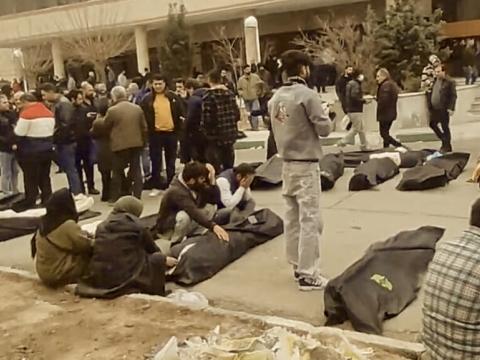
Iran today is in a revolutionary situation, yet this situation has not led to a revolutionary upsurge. This reality cannot be concealed with excitement, denied with the slogan “victory is near,” or postponed through false unities. The uprising that advanced through the violence, sacrifice, and self-sacrifice of the masses is now yielding to reactionary alternatives—alternatives that, on the one hand, coexist with the Islamic Republic through security games and crisis engineering, and on the other hand are nourished by imperialist, neo-fascist, and bourgeois projects dependent on global powers.
A revolutionary situation means the inability of the existing order to reproduce itself; it means the simultaneity of economic, political, and social crises; it means a split within the ruling bloc and the masses’ refusal to accept the status quo. All of these elements are present in Iran today. But a revolutionary upsurge takes shape only when the working class enters the scene as an independent political force, imposes its own horizon, and elevates the question of power from the level of “changing the ruling clique” to the level of “which class rules, and through what relations.” This decisive rupture has not occurred at the present moment.
What dominates the uprising today is not merely the result of “media deception,” but the direct outcome of the absence of independent working-class politics and the historical failure of communism to achieve the durable organization of the working class. In this vacuum, social anger is inevitably poured into forms that are manageable and controllable for capital: monarchism, bourgeois republicanism, transitional government, salvation from above. Despite all their apparent differences, these forms share a single function: preserving the bourgeois state, reproducing capitalist relations, and harnessing labor.
Iranian neo-fascism and its allies today assert itself among sections of the social middle strata under the banner of “national salvation” and “support for the people.” They are not an alternative to the Islamic Republic, but another form of the same class order. At the same time, the centrist and left wings of the bourgeois opposition, with the slogan “for now, everyone together,” in practice call for the unity of all factions of capital against the working class. This policy is the policy of the great defeats of the twentieth century: suspending class independence in the name of unity, and handing power to those whose first act, the day after “victory,” is the reconstruction of the army, the police, the state, and the capitalist labor market.
This defeat must be declared openly—not for surrender, but to clarify the terrain. The working class must not once again become the ladder for others’ ascent. It must not entrust its blood, violence, and suffering to the political capital of forces for whom the preservation of the exploitative order is a red line. Any transfer of power from above, even if adorned with the language of freedom, democracy, and human rights, is nothing but the reproduction of capitalist domination in new attire.
That today’s massive uprising has been handed over to reactionary alternatives expresses the weaknesses and historical defeats of the labor and communist movements. Yet this very defeat renders the boundary of today’s task unprecedentedly clear. Our task is not to join this political game—neither the game of the Islamic Republic’s intelligence services, which seek to contain the uprising through crisis engineering, nor the game of the bourgeois opposition, which, with foreign backing and the unity of all factions of capital, aims to hijack it. This process will inevitably culminate in struggles among reactionary forces over power and in interventions by regional powers to steer the transformation from above.
In all circumstances—whether at the peak of an uprising or during a period of retreat—the central task of the working class and advanced forces is durable political organization and forms of organization capable of becoming a class alternative: an alternative with a program, a horizon of power, and the capacity for independent intervention. Without such a class alternative, any uprising, even the most heroic, will sooner or later end in stalemate or expropriation.
Communism is not the art of riding the wave; it is the art of standing against reactionary waves and building an independent pole in the heart of defeats. If today revolutionary conditions, in the absence of a revolutionary upsurge, have been driven toward defeat, this defeat must become the point of departure for the reconstruction of working-class politics: independent organization, the linkage of livelihood struggles and political struggle, and the renewed posing of the question of class power. Only along this path can revolutionary conditions in the future be transformed into a revolutionary upsurge.
A revolution without the working class as an independent subject is not a revolution.
And victory without the abolition of the domination of capital is nothing but a postponed defeat.
18 Dey 1404
(January 8, 2026)
Internationalist Workers’ Organization


Comments
Class consciousness emerges…
Class consciousness emerges only when proletarian struggle transcends political consciousness—whether expressed through trade unionism, parliamentary activity, or projects to reform the state. Rather than arising from politics, proletarian revolutionary consciousness develops as a form of social consciousness forged through deepening economic crises and recurring class confrontations.
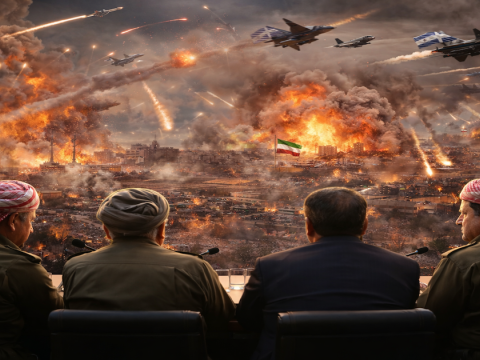
The experience of Iran illustrates this dynamic. Between 1999 and 2022, the proletariat engaged in continuous resistance but failed to develop effective means of advancing its struggle against the state itself. Political consciousness, centered on transforming the state from a religious regime into a secular democratic one, diverted and constrained the development of proletarian consciousness. More recently, however, new forms of direct confrontation with the state have emerged, making the containment of this movement an urgent concern not only for the Iranian state but for the international bourgeoisie as a whole. In this context, the American–Israeli–Iranian war reflected both the deepening economic crisis and efforts to suppress a movement increasingly perceived as a threat to the broader bourgeois order. This movement also faced obstacles from nationalist and reformist currents, particularly the movement associated with Abdullah Öcalan in Türkiye and Syria, which sought to redirect the movement toward feminist slogans, thereby diverting it from its class-based trajectory.
Greetings from Kurdistan Iraq,