
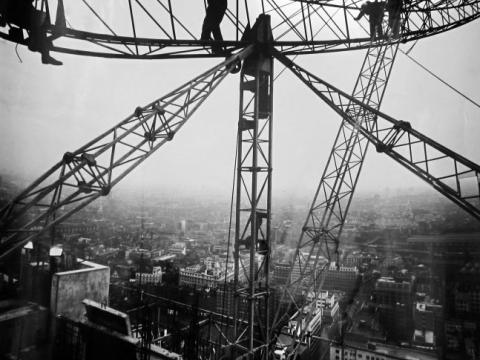
Fantastic pamphlet on the workers' struggles during the construction of the brutalist masterpiece the Barbican in central London. Told largely in the words of the workers themselves.

Workers on the Barbican site, 1965
Published by the University of Westminster and researched by Christine Wall, Linda Clarke, Charlie McGuire and Olivia Muñoz-Rojas, who interviewed former workers Vic Heath, William Milne, Pat Bowen, Michael Houlihan, Noel Clarke, John Steeden, Tony McGing, Richard Organ and Jim Moher.
Taken from http://www.westminster.ac.uk/probe/projects/constructing-post-war-britain
Attachments
Barbican-pamphlet.pdf
(824.6 KB)


Comments
Cool.
Cool.
Rachel wrote: Cool. Yeah, I
Rachel
Yeah, I love the Barbican architecturally, and was there the other day. As well as the stuff about the industrial disputes which are really interesting, I couldn't believe the bit about the covering of the concrete. The Barbican concrete is all really rough, but it was made smooth then a team of workers had to go and manually smashing up to give it the rough look. Thinking about the surface area of visible concrete in the Barbican complex this task is just almost unimaginably huge!
The frontispiece put me in
The frontispiece put me in mind of E.P.Thompson's book on the struggle in the University of Warwick, 'Warwick University Ltd' – the same reconstructionist architecture. A synopsis is here, third down the list:
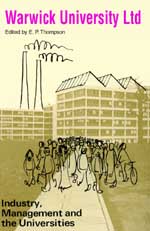
http://www.spokesmanbooks.com/acatalog/Trade_Union_Classics.html#a793
Vic Heath, one of the people…
Vic Heath, one of the people interviewed for the pamphlet passed away in April, aged 92, an obituary written by one of the pamphlet's authors can be found here: https://www.camdennewjournal.co.uk/article/how-building-campaigner-vic-played-a-key-roll-in-making-sights-safer-places
Reading the obituary of Vic…
Reading the obituary of Vic Heath in the Camden Journal puts me in mind of another lifelong Camden resident, Luca Banchero, who also featured in the same newspaper but whose story was pulled from the web records after his passing.
To set the records straight, here is a synopsis of the article with a little background information added.
Luca was employed at the little garage under the arches opposite the Southampton Arms. In passing, he could be seen in white overalls carrying a clipboard. His job was to price up work for the garage. He earned a modest salary but one day his boss told him that that modest remittance would be reduced. He was gutted, carried on at his trade for some time but eventually quit. Further work alluded him in his short life. Thrown on the dole he struggled on. Pressures of idleness built up. When he finally finished the total reconditioning of the Triumph Herald his papa had gifted him his driving licence was revoked by the DVLA due to the perceived thought crimes he was guilty of. Yada, yada, yada... a merchant sold him some adulterated product, he is put in an induced coma and after a few weeks the machines are turned off. The End