
The far-right is stronger than ever in Britain. Reform UK holds some power, Tommy Robinson mobilises 150,000, and the usual antifascist response has failed. This article argues for something different. Drawing on anarchist communist ideas and the lessons of especifismo, it looks at why we need to move beyond reaction and towards building real working-class power.

The summer of 2024 saw far-right riots erupt across English towns and cities. Asylum seeker hostels were attacked, mosques besieged, and racist violence spilled onto the streets. The response from the usual suspects was predictable: Stand Up To Racism called for counter-protests, Labour politicians gave stern lectures about law and order, and the liberal commentariat wrung its hands about the resurgence of fascism. Yet here we are in 2026, and the far-right is stronger than ever. Reform UK now controls over a dozen councils, holds Westminster seats, and consistently polls above 25%. Tommy Robinson recently marshalled 150,000 people to a "free speech" rally in London, the largest far-right mobilisation in British history.
The liberal-left antifascist playbook has failed. It is time for anarchists to articulate a different strategy.
Understanding the terrain: Reform UK as a populist stepping stone
Any credible strategy must begin with a clear analysis. The anarchist communist tradition, particularly the growing global tendency of especifismo, insists on understanding the concrete conditions before proposing interventions. So what are we actually facing?
Reform UK is not the National Front of the 1970s. It is a right-wing populist formation that functions as a "stepping stone" towards more authoritarian outcomes. Its support base is heterogeneous and unstable. Reform attracts very different audiences with a variety of views who overlook policies they dislike while focusing on those that reflect their particular fears. What unites them is not primarily racism, though that is certainly present, but a justifiable loss of confidence in, and contempt for, the political establishment of capitalism.
This is crucial. Polling consistently shows that potential Reform voters are motivated less by "small boats" mythology than by genuine material grievances: stagnant wages, unaffordable housing, crumbling public services, and decades of abandonment by both Tory and Labour governments. The 2008 financial crisis, followed by a decade of austerity that gutted communities, created the conditions for the populist right to flourish. When Labour under Starmer abandons any pretence of representing working-class interests and adopts anti-immigration rhetoric itself, it merely legitimises Reform's framing.
The danger is twofold. Reform's leadership, funded by billionaires, not working people, has a clear agenda: privatise the NHS, scrap environmental protections, attack trade union rights, and impose a benefits system designed to force people into precarious labour. But equally dangerous is the role Reform plays in normalising far-right discourse and creating the political space for explicitly fascist groups to organise.
The limits of liberal antifascism
The dominant antifascist response in Britain has been organised around organisations like Stand Up To Racism and the more recent Together Alliance. This approach has several fatal flaws.
First, it is reactive. It waits for the far-right to move and then responds with counter-demonstrations, petitions, and appeals to the state to protect us. This cedes all initiative and exhausts activists in an endless game of whack-a-mole.
Second, it is politically incoherent. By uniting everyone from Labour Party members to trade union bureaucrats to liberal churchgoers under a "broad front" banner, it deliberately obscures class analysis. The message becomes: defend multicultural Britain, defend liberal democracy, defend the existing order. But the existing order, capitalism, is precisely what created the conditions for the far-right's rise. You cannot defend a system in crisis and expect to defeat those who exploit that crisis.
Third, and most damningly, this approach relies on the state. Stand Up To Racism coordinates with police, welcomes Labour politicians to its platforms, and implicitly trusts that the authorities share its goals. Yet the British state has a long history of accommodating the far-right when useful and repressing the left when necessary. The double standard is stark: Palestine Action activists who damage arms factories face proscription as terrorists, while far-right organisers enjoy relative impunity. The state that prosecutes climate protesters with terrorism legislation finds itself unable to act against violent racists. Anarchists cannot look to this state for protection.
The anarchist tradition of antifascism
Anarchists in Britain have a proud but often hidden history of physical resistance to fascism. From the Battle of Cable Street in 1936, where anarchists and marxists fought side by side against Mosley's Blackshirts, through the 43 Group's direct action against fascist meetings in the 1940s, to Anti-Fascist Action's "no platform" strategy in the 1980s and 90s, anarchists have consistently understood that fascists cannot be argued out of existence, they must be driven from the streets.
This tradition emphasises militant confrontation where necessary, but it has always been more than mere street fighting. The anarchists of the 43 Group combined physical defence with deep involvement in working-class communities. Anti-Fascist Action's strategy was explicitly about "building a mass movement capable of challenging the fascists politically and physically, while simultaneously arguing for revolutionary politics within the working class".
This is the tradition we need to recover and develop.
Towards an especifista anarchist antifascism
The especifismo, potentially articulated by groups like the Anarchist Communist Group, offers a framework for moving beyond both liberal-reformist antifascism and purely militant reaction. Its core insight is the need for a "dual militancy": active involvement in mass movements while maintaining a specifically anarchist organisation capable of strategic analysis and political intervention.
Applied to fighting the far right, this means several things.
First, insertion in our working-class communities and workplaces. The far-right gains ground where people feel abandoned and hopeless. The answer is not to shout "racist" at everyone considering a Reform vote, but to build organisations that actually address material needs. This means tenant unions fighting ruthless landlords. This means union branches that don't just process grievances but become centres of community resistance. This means mutual aid networks that demonstrate solidarity in practice, not just in theory.
Second, taking the ideological fight seriously. The far-right offers scapegoats (immigrants, muslims, trans people) for problems caused by capitalism. We must offer class analysis. This is not about winning arguments on social media, but about patient, face-to-face organising. It means being present in pubs, on neighbours, at school gates, and in workplace canteens. It means listening to grievances and redirecting anger towards the actual enemy: the billionaire class, the landlords, the bosses, the politicians who serve them. Reform UK is funded by billionaires like Nick Candy, who openly boasts of wealthy backers. Every Reform voter should be forced to confront this contradiction.
Third, building organised capacity for self-defence. When fascists take to the streets, communities must be able to defend themselves. But this cannot be left to ad hoc affinity groups alone, nor can it be outsourced to the police. It requires embedded organisation: knowing your neighbours, having communication networks, and being prepared. The model is not the "rent-a-mob" antifa of media caricature, but communities organised for mutual protection. This is what the anarchists of the 1930s understood: working-class self-defence is not terrorism; it is the logical response to a state that will not protect us and a ruling class that actively encourages division.
Fourth, linking all struggles. The especifista approach insists on connecting workplace, community, housing, environmental, and anti-oppression struggles because capitalism integrates them all. Fighting Reform cannot be separated from fighting the housing crisis, because Reform exploits housing insecurity. It cannot be separated from fighting cuts to public services, because Reform blames migrants for NHS failures. It cannot be separated from fighting climate inaction, because Reform denies the crisis entirely. A fragmented movement cannot defeat a system.
Conclusion: Beyond reaction
The liberal-left antifascism of petitions and counter-protests, of relying on Labour politicians and the police, has reached its limits. Reform UK is in government in multiple councils. Tommy Robinson mobilises 150,000. The Overton window has shifted so far that Labour competes with the Tories to sound toughest on immigration.
Anarchists must offer something different: not the defence of a capitalism that has failed, but the vision of a society beyond capitalism. Not reactive antifascism, but proactive class struggle. Not reliance on the state, but construction of autonomous working-class power.
This is harder than signing a petition or attending a march. It requires patient, unglamorous organising. It means being present in communities year after year, not just when the far-right marches. It means building the kind of organisations that can both defend us today and prefigure the liberated society we fight for.
The fascist danger is real and growing. But so is the potential for resistance, if we abandon failed strategies and embrace the hard work of building a revolutionary working-class organisations. Unlike Reform UK, we offer no seductive shortcuts, no comforting lies that someone else will fix your problems while you sit back and watch. The truth we carry is heavier and demands more: real change only comes when ordinary people organise, when we build collective power in our workplaces and communities, when we stop waiting for saviours and start trusting ourselves. It is harder, slower, and infinitely more honest than the false promises of populist millionaires. But it is the only path that leads anywhere worth going.
There is no shortcut. There is only organising.





Comments
But the situation in the UK…
But the situation in the UK today is not like in the 30's.
In the 30's you would have bureaucratic reformist unionism - with an important dimension of member participation via mass meetings not being infrequent and not so pervasive union ballot rigging.
Today you have corporate unionism integrated at the top levels and in certain cases at lower levels in the corporate set up. It can act in a coordinated fashion with agencies of the state/employers to isolate and crush workers struggles or small scale breakaways from the corporate unions.
You don't have anything quite like the BUF of Oswald Mosley or in Germany the SA - used in combating any bureaucratic reformist union activity and ultimately to set up a Fascist Labour Front/Corporate "unions" in the context of the BUF seizing State power. You already have corporate so called unions.
Getting major confrontations involving riots with these rightwing influenced movements
will and are being taken advantage of by the Govt to help build the neo liberal strong state - eg after recent riots over immigration - Starmer was pushing "only workers to have digital ID's. A big threat is more this move to the neo liberal strong state. To tackle that you have to tackle the phenomena of "Corporate Unionism" and pursue the strategic industrial organising which can facilitate eventually transitional steps and then full on anarcho-syndicalist mass break aways from the corporate unions in the context of a strike/direct action wave movement. In this context you can start to significantly build an a-s style alternative mass media reaching ultimately 10's of millions in the UK.
Here from reddit and…
Here from reddit and reposting my comment here:
> the usual antifascist response has failed.
Uhh, speak for yourselves? In some regions the impact of the fash has been significantly reduced thanks to decades of activism that continues to this day
> we need to move beyond reaction and towards building real working-class power
A lot of anarchists and leftists are *already* trying that. And in a lot of ways it's also failing. Sharon Graham of the mainstream union Unite has done more successfully in the past few years than all the anarchist-communists put together
Surely an especifist strategy would be to expand and radicalise the existing class struggle? Get your ass down to the pickets in Birmingham! Start or support your local DPAC group
> It means being present in pubs, on neighbours, at school gates, and in workplace canteens. It means listening to grievances
How will you do that when you come across as perpetually grumpy? I talk to everyone from insurrectionists to union "bureaucrats", and people who've nothing to do with any activism or leftism. There's basic skills here which I don't see in your article (look for examples of people doing things right, for one! That's how you make them do something. There's self help books for this...)
> It requires embedded organisation: knowing your neighbours, having communication networks, and being prepared.
This takes decades, not months. So what do we do in the meantime? When they come for our stalls or pickets or gigs?
The queer community and racialised communities are already facing violence and already having these conversations about how to defend themselves (a couple neighbourhoods I used to live in had their own informal networks and defence and if the EDL had set foot there I doubt they'd of come back out in one piece...) But I don't see any mention of that in your writing?
> The Overton window has shifted so far that Labour competes with the Tories to sound toughest on immigration.
This isn't new I remember it growing up in the 90s and 00s. Everyone was repeating nonsense planted on the papers by Migration Watch. Blair's Labour BUILT most of the immigration detention centres we have today and
Idk. It seems like the author sees class struggle as something "we" do as a formal ritualised action, on behalf of some hypothetical organisation or movement. For me it's something I'm fighting every day. There's a lot of people like me. We're not looking for ideological instruction we're looking for *tools, resources, and tactics*
I don't need instructing about hypothetical stuff. I need to know how to help my friends applying for benefits. How to help my friends through court. How to fill out all these Employment Tribunal forms without a lawyer. How to stop my bills going through the roof. How to help my friend's kids get help from the mental health system which is trying to screw them over. That's the class struggle. What do you have to offer us?
People who you probably turn your nose up at, like Martin Lewis or Unite Community or the union "bureaucrats", get some level of respect because they give people actually useful advice. Stuff they can use to help their friends and families and workmates. If your tendency wants respect in working class communities that's what you have to do - give advice we can actually use. If you can figure out Marx's Capital I'm sure you can figure out the local council tax policy and you could end up helping hundreds of people...
Thanks for taking your time…
Thanks for taking your time to respond. There’s quite a lot here that I actually agree with, so I’ll try to clarify what I was trying to argue rather than defend the article as if it were a finished doctrine.
First, on the point about antifascist organising already having had successes: absolutely. There are regions where decades of organising have pushed fascists to the margins. The history of militant antifascism in Britain demonstrates this clearly. Organisations such as Anti-Fascist Action significantly reduced fascist street presence in the 1990s through a combination of physical confrontation and political work in working-class communities.
The article wasn’t meant to dismiss that history or today's days in some places. Quite the opposite: it was trying to recover some of its lessons. My argument is simply that the dominant model of liberal antifascism today (broad fronts around Labour politicians, counter-protests coordinated with police, and moral appeals to defend liberal democracy) has clear limits. That’s different from saying antifascist activity in general has achieved nothing.
Second, you’re right that many anarchists and other radicals are already trying to build working-class power through workplace organising, tenants’ unions, disability rights campaigns and mutual aid networks. Those efforts matter enormously. If anything, the article assumes they exist.
Where I think we might differ is in how we understand the strategic coherence of those activities. My point was not that class struggle doesn’t already happen every day, it clearly does. People fighting benefit sanctions, helping friends navigate tribunals, resisting landlords or organising at work are engaged in class struggle whether they use that language or not.
The problem is that these struggles are often fragmented and politically disconnected from each other. They exist as isolated survival struggles rather than a coordinated movement capable of challenging power on a larger scale. The role of revolutionary organisation, as I see it, is not to lecture people about theory but to help connect those struggles, share experience between them, and develop strategy.
I should probably also say that I’m speaking about this partly from practical experience. I do workplace/union organising, and anyone who has spent time trying to organise "ordinary workers" in real workplaces knows how difficult and patient that process can be. People come with different experiences, pressures and political views, and building trust takes time. None of this happens through slogans alone. It happens through slow conversations, shared struggles and small collective victories.
On the question of practical tools: I completely agree that people respect organisations that provide concrete help. In fact, the example you give strengthens the argument I was trying to make.
If a figure like Martin Lewis gains credibility because he offers practical advice about bills and consumer rights, that shows something important about how trust is built. People respond to those who help them navigate immediate problems. Revolutionary politics should learn from that rather than dismiss it.
But there is a difference between individual advice and collective organisation. Helping someone fill out a benefits form is valuable. Helping people organise so that the system that produces those forms and sanctions is challenged collectively is something else. The strategic question is how we move from one to the other.
You also raise a fair criticism about tone. If anarchists come across as permanently angry or dismissive of people who aren’t already politically aligned with them, they will isolate themselves. Organising requires patience, listening and humility. Most people do not become radical because someone shouted the correct analysis at them.
On the issue of community self-defence, I should have been clearer. You’re right that many queer communities and racialised communities already have informal defence networks and mutual protection practices. Those experiences are extremely important and we should learn from them rather than pretending the left is starting from zero.
The point I was trying to make is that these forms of defence become much stronger when they are embedded in wider community organisation rather than left to small activist circles.
Finally, on the question of time. You’re right: the kind of embedded organisation I’m talking about does take more than couple of months to build. There is no shortcut. But the fact that something takes time doesn’t mean we shouldn’t start building it deliberately.
In the meantime, we still do the immediate things: defend pickets, protect events, support communities under attack. But if all we ever do is react to crises, we will always remain on the back foot.
So perhaps the real disagreement isn’t about whether the activities you describe matter, they absolutely do, but about how consciously we try to connect them into a long-term strategy.
If the article sparked this kind of discussion, then it’s already doing something useful. I’m very open to hearing more about the kinds of practical organising you mention, because that’s exactly the ground where strategy has to be tested.
On a historical note, was…
On a historical note, was there much anarchist involvement in Cable Street or the 43 group? I suppose there might have been some individuals but definitely didn't think there was much organised anarchist presence, comparable to the level of anarchist involvement in something like AFA or the AFN.
And in passing, fully agree with viva's brief mention of the Birmingham dispute, I think the lack of either serious anarchist analysis of or visible organised involvement in the Birmingham bin strike has been one of the things that's made me feel seriously out of step with "the milieu" of late. The bloody Maoists are pissing all over us on that score, and it's not as if UK Maoism is that much of a serious tendency.
And do broadly agree with the general thrust of the article, but also agree with the criticism that it's very vague, swap around a few specifics and most of the actual proposed strategy could equally well have been written in response to the BNP in 2006 or UKIP and the EDL in 2016. The specifics (no pun intended!) of how we put that general strategy into practice in today's circumstances are where it gets interesting.
R Totale wrote:And in…
I don't think the author it's talking on how we get involved in a industrial action dispute. But for those who doesn't live there... More than share the info in our union branches or get a bunch of economic support. I don't think get some people from London for a couple of days will be make the different.
It's about what they're doing those who live in Birmingham. Is it RAG involved in some capacity as a supporter group? What about SF, IWW? Do they have people there?
Can Birmingham Unions elevate the struggle?
What we can learn from a dispute that is almost have a year now?
Ragnar wrote: R Totale wrote…
I mean, it's maybe not the main point of the article, but I think involvement in industrial disputes is relevant insofar as the article is arguing for an especifista strategy of "insertion" in working-class struggles.
And fwiw, I do think it is worth people from outside Birmingham finding the time to make the trip up for a day or so (or at least it was during the period up until the "persons unknown" injunction was granted, with the second injunction we may have moved into a new phase), cos if we're serious about wanting to see mass industrial direct action that goes beyond what the law will allow then I don't think we can sit on the sidelines when it happens. I also think it's a mistake to think that Birmingham is the only place where direct action could happen - it's a dispute with Birmingham city council, who are run by the Labour Party, and Labour Party targets are everywhere. Similarly, we can think about finding ways to put pressure on Job&Talent agency, who are a multinational company, not just a Birmingham-based one.
But yeah, I agree that the experiences and perspectives of Birmingham-based anarchos are vital here, and it's not a great sign if the national orgs don't have any presence in one of the UK's largest cities. I think that if we had a functioning class-struggle anarchist movement, places like libcom and Freedom could play a really useful role in letting the likes of RAG inform the rest of the movement about their role in the strike, and then in letting critique and reflection from the rest of the UK feed back into their local discussions about how to go forward. The fact that isn't happening doesn't fill me with confidence about the health of the movement.
Maybe this is worth a thread of its own, but I'm not on here this much nowadays, and the mention of the Birmingham pickets above is genuinely one of the only places I've spotted them discussed on here.
Only just read this but I am…
Only just read this but I am in total agreement that the real antidote to the authoritarian right is not to be found in Popular Frontism or telling people to "Don't vote Reform/Restore etc". The other side of the coin to "Don't vote Right" is very obviously the suggestion that "Vote left/progressive/liberal" is the way forward. That is explicit in pantomimes like the Together Alliance.
The erosion of working-class self-awareness and self-confidence will not be overcome quickly or easily.
Nevertheless, working class self-organisation is not only the way forward against racism from either state or non-state thugs.
It also spreads the seeds of an anti-capitalist movement rooted in the working class - the global social force that can save humanity from the slide towards the abyss.
Did you guys have a chance…
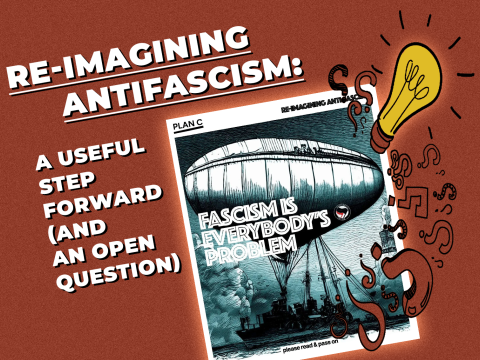
Did you guys have a chance to read the PlanC paper?
I think they talk in the same way that Calder, I think 🤔
https://libcom.org/article/re-imagining-antifascism-useful-step-forward-and-open-question