
A critical account by an early member of the Processed World collective on their time there and eventual sacking. Published September 9th 1986.

Captives of Consciousness
The Elements of a Processed Worldview
This is not a review of Processed World. It is a return of the repressed. I was a member of Processed World in 1981, and I was fired, so to speak, from the PW collective for having a "bad attitude” about the magazine. Just as "repressed," in the Freudian sense, was my own reaction to the events that led up to the “suspicious circumstances” surrounding my departure from PW. I've spent the last four years remaining silent on the matter, even during the several subsequent controversies that sprang up between PW and its critics. But, contrary to the (non) appearances of the past, I still consider myself in radical opposition to the current reigning mode of life, and I don't intend to let PW have the last word, processed or otherwise.
Nor is this an exposé. My side of the story is more than just a “Tale-of- Toil" become tail-of-turmoil. I may reveal some “horrible truths” about the “skeletons” in PW's closet (and my own) but I hope to go beyond such a focus—scandal sheets are never enough. The often overblown story of PW and their critics demonstrates a larger failing of the anti-authoritarian “community” in general. The public “success” of PW, the controversies they were embroiled in a few years ago, and their ability to dominate much of the discussion of social problems are good indicators of what this radical “community” has become. In a sense, PW has become the only game in town, the only arena in which many anti-authoritarians can reaffirm their radicality. As the Processed Worlders (henceforth PWers) say in the introduction to issue #15, this community “helps its members survive a bleak time"—but perhaps in ways unintended by both the “community” and PW. The question of how the “community” does this and whether or not it helps it members confront the failure of their “revolutionary project” is the issue I hope to explore in this text.
It is more than a question of what the anti-authoritarian “community” has become. I don’t believe that PW was somehow ‘really” radical when I was participating in it. The problems were there from the beginning. In this sense, I am as implicated as the PWers are; any criticism of a project that I was once a part of is necessarily a criticism of my own political activity. Having become so disillusioned with activities like PW, how can I now rationalize my once keen interest in it and a host of other similar projects?
I participated in PW because, despite our apparent political differences, I shared the presuppositions of a certain type of radical activity with most members of the group. Like the others in PW, I defined myself as a member of a radical "community;’ and as such it was normal to participate in the various projects that this social grouping undertook (e.g., study groups, article writing, etc.) I might have criticized particular actions, but I wouldn't have questioned the basis and formation of the “community” itself.
I had always felt that my “libertarian socialist", and subsequently “anti-authortarian” political practice revolved around a paradox. I was committed to the idea that people could and would free themselves (i.e., without the help of self-styled vanguards or political parties) from capitalism, yet it was obvious that most people, indeed those who would supposedly benefit most from it, dismissed or rejected my opposition to modern life as utopian or dangerous. And when I looked at those who did agree with me, I found that whatever background we had come from, the act of studying revolution and our rejection of social norms seemed to put us outside the traditional spectrum of social categories. While our pursuits were largely intellectual, we didn't belong to the world of academia, and while we often talked about the working class, none of us could really be considered part of that particular social grouping. In holding certain ideas and in pursuing a type of life that was outside of the norm, we created a sub-culture of our own. No doubt, most members of this marginal, intellectual sub-culture would readily admit to being such. “We want to be unconventional" they might claim. But this sub-culture, like any other, is more than the sum of its participants' desires. It has its own codes and morals, its own history and worldview and its workings can be largely opaque to its own members if no attempts are made to question its premises and existence. It is from this perspective that I hope to interpret PW and the events of the summer of '82.
The Roots of Dissimulation
I joined Processed World in 1981, shortly after issue #1 hit the streets. I became a fairly active member of the staff during the next year and a half, contributing three pieces to the magazine—a photo-novella called “Gidget Goes Binary” in #2; an analysis of the 1981 air traffic controllers’ strike (“Under Control” PW #3); and an article about computer sabotage in #5 (“Sabotage: The Ultimate Video Game”). In addition, I participated in the routine tasks of putting out the magazine (meetings, street corner selling, distribution, layout, collating parties), as well as in the more political aspects (editorial discussions, meeting new people, handing out copies to friends and acquaintances).
To say that I participated in the project for a year and a half, as if nothing came before that, is slightly deceptive. I was not a disgruntled office worker who was “awakened” by the appearance of a magazine that spoke to her concerns. I had previously been involved in other political projects with all of the members of the staff. Processed World came out of a grouping of people who had been working on similar activities for years. The politics of this group (referred to by its members as “the milieu”) ranged from anarchist to left communist to situationist; the commonality that allowed collaboration was a rejection of capitalism and of all forms of authoritarianism, including that of Third World and Soviet states.
The immediate reason for the formation of Processed World was the disintegration of a previous project—The Union of Concerned Commies (UCC). The UCC formed in May of 1979 after the nuclear “accident” at Three Mile Island. It was an attempt on the part of members of a variety of milieu sub-groupings to do something together.People from the Marxist (e.g., the Red-Eye journal collective1 ), non-Marxist (World to Win2 of which I was a participant) and reformist (Abalone Alliance, Community Memory Project, of which I was also a member) wings of the milieu all participated in the UCC, whose main products were leaflets critical of the anti-nuclear power movement for being too reformist and integrated.
The formation of the UCC marked the beginning of an activist phase for the Bay Area milieu. People who had not had much to do with one another because of “theoretical” and “personal” differences found themselves eagerly working together on the latest flyer. People who once spurned the more reformist types of practical activity now set out to criticize and influence groups like the Abalone Alliance and Community Memory. Tired of their own isolation, they hoped to capture projects opposed to one aspect or another of modern life and push them toward a more radical perspective (i.e., opposition to capitalism as a whole rather than to just one of its drawbacks). Those who arrogantly had considered themselves the best and the brightest of the sixties protest era applied their political analysis to whatever current event happened to be making the headlines. This shift toward activism was due in part to a recoginition that the theoretical models of social change held by the different strands of the “community” were somehow inadequate.
The San Francisco/East Bay anarcho-marxist “community” emerged at the ebb of the protest years of the sixties and seventies. Having rejected the traditional organizing approach of the New Left, as well as the dogmatism of the Marxist-Leninist proto-parties, those who formed the milieu had set about studying the works of European theorists (e.g., Guy Debord, Cornelius Castoriadis, Paul Mattick Sr.) and alternative revolutionary traditions (Germany and Italy 1920, Spain 1936, Hungary 1956, France 1968). To their credit, they rejected the simplifications and formulaic analyses put forward by the New Left and Leninist sects in the U.S. The members of this critical wing of the protest upsurge eventually grouped into several different political tendencies. One set of people was influenced by the writings of Cornelius Castoriadis. This group emphasized the autonomy of the working class and a critique of the categories and methods of Marxist analysis. Another grouping consisted of those who considered themselves anarchists. They condemned hierarchy and the State as well as capitalism, and were probably the strongest critics of exploitation within radical political organizations. The third grouping was influenced by the writings of the Situationist International (SI), which had elaborated a cultural critique of modern alienation and commodity fetishism centered around the theory of “the spectacle"
Prior to re-grouping within the UCC, most of the individual groups suffered a disintegration and recombination process on both the organizational and theoretical level. For example, For Ourselves3 , who started out calling themselves post-situationist, disbanded and reformed to study the early writings of Marx. The economic crises of the early 1970s then prompted some of them to adopt Marx’s more materialist theories as well, and this set of people eventually developed into the Marxist journal collective known as Red-Eye.
Not all who were influenced by the Situationists took this path back to a purer brand of Marxism. Some became guardians of situationist theory-cum- ideology, rehashing their analyses of the spectacle ad infinitum. While these people kept themselves apart so as not to tarnish themselves, other “ex-situs”—the ex-members of Point-Blank!, for example, who published the text, “At Dusk"4 —attempted to criticize and go beyond the situationist project. Still others attempted to combine the situationist emphasis on culture and everyday life with a critique of Marx and an analysis of economic development. This ended up in a kind of eclecticism that, along with the breakdown of wide-scale social protest, helped to facilitate a rapprochement among the different strands of the milieu.
At the same time, the limits of these radical theories, the tendency for them to devolve into a set of rehearsed clichés, and the shrinking currency among the “public” of anti-authoritarian ideas of any kind precipitated a move within the milieu against theory, especially on the part of the newer members of the Marxist wing who were eager for “practice; as well as on the part of milieu members who had never demonstrated a facility for theoretical activity prior to this. This rejection of theoretical pursuit dovetailed with:
- the anti-elitism of the anarchists, who had often been burned by the condescension of the Marxist “experts”;
- the workerism of some of the non-Marxists, who held that theory and new forms of social organization developed directly out of the struggles of the working class;
- and the practical approach of the reformists, who wanted to expand the boundaries of the “community”
A kind of mutual aid atmosphere developed, in which the main emphasis was put on pooling resources and developing practical skills in order to undertake a series of political projects. While the same old points of contention were often bickered about, the newly-held belief in activism per se enabled the milieu to lumber along without having to confront its problems, without having to undertake an analysis of itself.
It was at this stage that the UCC formed. Its activities culminated in the “No Nukes’ Is Not Enough” conference in November of 1979, which was put on by the UCC in combination with two other groups, Direct Current (an anarchist affinity group) and Collective Inventions5 (a grouping of, for the most part, ex-Point-Blank! members). The purported goal of the conference was to pose more radical solutions to the problem of opposing nuclear power and to widen the milieu's sphere of influence. The conference attracted about 200 people, most of whom already held some sort of anti-capitalist ideology, and the new contacts made there expanded the “community” momentarily. Subsequent UCC activities disintegrated into study groups, theater groups and leaflet writing on various issues. By March, 1981, the founding members of PW had gone through a number of recombinant UCC grouplets—the Maynard G. Krebbs Foundation, Graphic Intervention, the Nasty Secretaries Liberation Front6 , and America Held Hostage, to name a few. Direct Current and Collective Inventions both went their own ways, Collective Inventions publishing a text on the Iranian crisis, “Defense Mechanisms” (a text which would cause it, in turn, to dissolve, only to re-emerge later with a new line-up).
Captives of Consciousness
After the disintegration of the UCC and the array of projects that it spawned, the founders of Processed World, Chris Carlsson and Caitlin Manning, hoped to continue the political activities of the UCC, but in a different context. Processed World was to be an attempt to “reach out” to the exploited office worker, and to tap into the innate radicalism that the animators of the magazine suspected was to be found in the white collar sector. They wanted to avoid the type of “sterile” political debates found in the pages of other anti-authoritarian journals like Open Road in Vancouver or Fifth Estate in Detroit, which they felt were readable only by insiders. In his unpublished internal “criticism” of PW (1983), staff member Chris Winks termed PW “a project that tried to reach out to others instead of trying to persuade them from the lofty heights of theoretical reason." Aside from the condescension (what does it mean to “reach out” to people? Even A.T.&T. ads urge us to “reach out and touch someone” and the mainstream Left is also familiar with such a concept in the form of “outreach programs.’) and false simplicity of such a statement, is there even any truth in it? Was the purpose of Processed World really to engage “others” in dialogue, or was it simply to rebroadcast the same slogans and clichés, but in a more “modern” and “marketable” way that would not offend the uninitiated?
Despite the trumpeted desire to be open, the first place the two original PWers looked for contributors was among the ranks of the milieu. The word went out that a new magazine was in the works, and in a short while there was enough material for issue #1. The contributors, besides Carlsson and Manning, were Tom Athanasiou (former Bookchinite and UCC member) and Chris Winks, who ironically had disdained activism as a member of Point-Blank! and Collective Inventions. The appearance of the first issue attracted a few more people from the anti-authoritarian left (e.g., me, Jeff Strahl—ex-member of both Red-Eye and the UCC) and from wider left wing circles (e.g., Boni Thoreson, a.k.a. Helen Highwater). Adam Cornford, while not really participating regularly, took up the role of behind-the-scenes editor. Being the milieu’s own Marxist theorist (he had played a dominant role in Red-Eye and the UCC in shaping both groups’ materialist bent), he was given access to all drafts and articles that were submitted for publication. He also contributed heavily to the editorial statements that appeared in the “Talking Heads” column of PW. I don't mean to say here that Cornford was acting sinister or conniving; he was simply acting true to (milieu) form (and format). Everyone acquiesced (although some did so begrudgingly) in this, including me.
The PWers quickly developed a standard style for the magazine that appealed primarily to two groups of people. The fuck-work attitude that comes across in the the humor and graphics gained them readers from leftish, culturally marginal quarters, while their analytical articles got the PWers translated and reprinted in anarchist and left wing publications across the U.S. and Europe, thus tying them into the de-facto publishing syndicate of the “international milieux".
PW had gained new members and contributors from outside of their usual political circles, and thus was judged to be a success, although the criterion on which this assessment was based was skewed in advance. Circulation itself, rather than the quality of the material that circulated, was the only issue that mattered. Ever since then PW had prided itself on its “openness;’ but in another sense their expanding circulation showed that “openness” was not really the point. The idea of being open, rather, was a myth by which the PWers interpreted and validated their own activity. In their schema, workers, once given a nudge, or an opportunity to air their views, would spontaneously develop the same critique of society that the PWers had. Not surprisingly, the PWers had the conceit to imagine that these workers would “intuitively” find PW already in place as a “pole” of rebellion and reflection.
PW's openness can be recognized as hype, but there is something more. To say that PW should have been open implies a privileged status for PW’s political perspective. It presumes that PW theorists hold some kind of key to consciousness and are “reaching out” to bestow it on others. A critique that goes no further than to demand that PW live up to its anti-authoritarian claims of openness ignores the content and premises of PW's ideology, and the fundamental problems surrounding any activity that seeks to put forward a political message.
The PWers play the same game, only their ignorance is feigned. Over the years, their ploy of openness has both obscured the nature of such problems and appeared as a “solution” to the anti-authoritarians’ isolation. They initially attempted to minimize the differences between themselves (radical intellectuals) and regular working people by speaking only to those who shared a similar work situation (the PWers are not so much sectarian as “sectorian”). On the other hand, they have presupposed the necessity of changing all of life—that has always been the real message behind the “bad attitude!’ And, because of their anticapitalist perspective, they consider themselves the only ones who can give real meaning to the actions of ‘rebellious office workers, the only ones who can show how and why such actions must be transformed into “revolution.’ Thus, while apparently limiting the scope of the magazines's content their project remains the same as that of the UCC or Red-Eye before it—to market a particular political point of view.
In fact, the magazine and its message have always been treated much like products by the core staff members. Much of their time and energy goes into promoting the magazine, yelling “check out Processed World” on street corners or posting advertising leaflets. They seem to have internalized many of the elements of advertising that they learned about in Stewart Ewan’s Captains of Consciousness. Put forward in a tongue-in-cheek way, PW ads are considered subversions. Anti-ads, however, when used to promote one more product (though I recognize that any absolute distinction between product and anti-product—or “ideology” and “theory”—is easily blurred, even by those with the best intentions), are simply ads in the final analysis. The manipulation of emotions, the reduction of language to a few catch phrases (“the magazine with a bad attitude”—in truth, the attitude with a bad magazine), the attempt to mold the product into a cultural entity (“read PW—the voice of the San Francisco underground”) are similar to those in mainstream advertising. That the goods are supposed to represent some sort of opposition to the current system does not make much difference, the intent is the same—to make people believe in the product, in this case PW.
The P-double-you-er's sales and marketing approach to politics is underscored by the lengths to which they have gone to be publicized. Mother Jones, Media File, The Columbia Journalism Review, The East Bay Express and The San Francisco Examiner are some of the publications that have done public relations pieces on PW. It should be noted that some of the authors of these reviews were part-time participants in PW (e.g., Marcy Darnovsky in EBR, Laura Fraser in CJR) who chose not to mention their affiliation with the magazine. In these public relations pieces, PW has been presented in a variety of lights. In the Examiner they were seen as wanting to “make big business more human;" in Darnovsky’s East Bay Express article entiled “Brave New World; The PWers come off as sincere radicals who are groping for a utopian alternative to modern capitalism.
The quest for publicity that is pursued by PW, although eschewed as unprincipled by many anti-authoritarians, is an emblem of a more general culture of activism that all anti-authoritarians share. A key tenet of this sub-culture is the belief that its members are more conscious of the true workings of modern society than more socially integrated persons. The continuous production of political tracts and magazines, the ongoing bookstore and community center projects, and the formation and disintegration, ad infinitum, of radical grouplets all stem from an underlying belief that anti-authoritarianism is the most coherent and self-conscious of social theories. The irony is that despite their insistence on clarity and transparency, most anti-authoritarians are amazingly inhibited when it comes to analyzing themselves and their own activity.
For example, in a letter to the July 24, 1985 issue of the Bay Guardian PWer Adam Cornford, writing under his pseudonym of Louis Michaelson, explains society and its supposed divisions. In a populist, “we'reall- proletarians” tone, he delineates the split between “Fordists;” workers who have bought into the “devil's bargain” (i.e., the system), and members of the “Minimum Toil Culture;’ who opt for a kind of marginal existence, in order to “buy free time” to do their “heart-work’ He fails to mention the social sub-division that he belongs to: the Cornfordists. Cornfordists spend their lives rehashing their over-simplified class analysis and trying to find likely converts to their cause. It is telling that Cornford concludes his letter precisely where he should have begun: “In fact, we (proles) make the boat go, and without our toil and obedience, the system would be sunk’ Instead of grappling with the fact that most people willingly (or, at least, pragmatically) cooperate in the functioning of this society—and the “yuppie” phenomenon (which he also mentions in his letter) is a good of example of how work, daily life and conformity with social norms have been reinvested with new meaning and value— he merely claims that such individuals are either bought off or coerced, and then restates his belief that workers will unite and overthrow capitalism. He also, like most of the paraintelligentsia, likes to keep his “theoretical” cards close to his chest, lest he be considered too much the intellectual he really is. He conveniently fails to mention the original source of the “Fordist” argument, The French “regulation” school of Marxo-economics, Aglietta, Palloix, et al., whose texts appear in that favorite of all “proles"7 everywhere, New (sic) Left Review.
In believing the double fiction of their own heightened consciousness and the universal validity of their analyses, anti-authoritarians trap themselves within a closed, self-affirming system. Despite their claims to innovation, experimentation, and anti-dogmatism, they've built anti-authoritarianism into a sub-cultural edifice that functions to reinforce their desires and delusions about the modern world and the possibility of changing it. It provides its participants with the security of structure: formulas and codes for how to behave and think in any given situation. Like any small-scale institution, the structure it provides is inhibiting as well as comforting. Anti-authoritarianism, not so ironically, is highly constraining. Its members, who love to denounce the restraints on their “freedom” imposed by the dominant society, are restricted to rearranging given sets of concepts; they are rarely, if ever, capable of original critical thought, much less thought that brings into question the validity of the house of anti-authoritarianism itself.
Love Will Tear Us Apart
By December of 1981, I had had a variety of disagreements with PW (over Marxism, over the uses of technology, over PW's use of advertising), but those conflicts were not serious enough to lead either side to question my continued participation in the group. In fact, in the time that I had been active in PW, Carlsson, Manning and I had become good friends, although I sensed at times, especially from Carlsson, that the friendship was based on me being actively and enthusiastically involved in PW. It often seemed to me that, for Carlsson, people served no purpose if they were not involved in the magazine. To be honest, there was an element of mutual exploitation in our relationship. Having articles published in PW boosted my status in the milieu, and satisified my avocational desire to be a political writer. The disintegration of my previous political affiliation (the group “A World To Win”), as well as the slow dissolve of an intimate relationship made me not less skeptical, but, rather, more willing to ignore the differences between me and them. Being accepted into this sub-culture made me feel falsely independent. To use the kind of trendy terminology that every writer, from hacks at the Village Voice to Chris Carlsson himself, likes to flaunt, this psychological “subtext” helped set the stage for the upcoming break.
The first indication of more serious cracks in our rapport came after I had a brief sexual liaison with Carlsson. It was quickly and hypocritically snuffed out by Manning, who applies a different standard when it comes to her own sexual freedom. In any case, the ending of this affair put the three of us in a rather awkward position vis-a-vis one another. I didn't feel particularly bitter, but I had been disabused of my illusions about my friendship with them and my participation in the PW group. My application for entry into the incestuous family had been rebuffed. What I once saw as Manning'’s verve now seemed like aggressive territoriality, and I suspected that my role as Carlsson’s potential lover was used (unsuccessfully) by him as a trading chip, as something he could give up in return for fidelity from Manning.
While this subplot was disintegrating, almost as soon as it developed, another was unfolding. I had never intended for PW to be my only political activity. Being part of the milieu’s “old guard;’ I had a commitment to a more general approach to politics; focussing on the office sector alone seemed too restricted. I was, so to speak, politically “available," and dabbled in other projects. One such project was an analysis of the political situation in Poland8 after martial law was declared in December, 1981. I joined when the project was almost completed, the text written and the graphic design sketched out. My contributions were limited to discussion about the text and help in the final composition and distribution of the poster. The other two participants, Greg Dunnington and David Jacobs, were also part of the anti-authoritarian scene. I had been in A World to Win with Dunnington, who himself had been associated with an earlier group of Jacobs’s, Point-Blank! We put out the poster under the name of Collective Inventions, the same name that Jacobs and Dunnington had used in collaborations with Chris Winks and Sue Letsinger a few years earlier.
In the process of working on the Poland project and planning others, a full-blown love relationship developed between me and Jacobs (though I'm sad to say we've recently “parted as friends”). It was at that time, around March of 1982, that my participation in PW began to taper off. I had stopped going to PW meetings regularly, and when I did go there was usually an argument between me and other members of the staff. This was mirrored by disagreements between me and Jacobs, who was highly critical of Processed World and the anti-authoriatiran milieu in general. I found myself defending PW and my participation in it to Jacobs and attempting to critically discuss the project at meetings. Obviously this could not go on indefinitely.
My drift away from PW was pushed to its logical conclusion by a series of events that began with my dismissal from a job as a Systems Analyst at a bank. I had been caught using the bank’s word processor to write my then-in-process article for PW on computer sabotage, published as “Sabotage: The Ultimate Video Game” in PW #5. As far as I know, a co-employee, who had a reputation of being a fink, lifted a copy of it from my desk and delivered it to the Vice-President of the division I worked for. When the big boss called me down and confronted me with it, a rather absurd scene ensued. “It's not very well-written" I proclaimed, in hopes of making it appear trivial and not worth getting excited over. When he confronted me with some of the more inflammatory sections that advocated sabotage, I blurted out in my own defense, “But it's only the first draft!” to which he replied, “Well, can you get me a copy of the second draft?” But, he didn’t wait to see my revisions and put me on suspension (with pay!) for a week while the legal department pondered the matter, and when they gave the go ahead, he ordered me to resign.
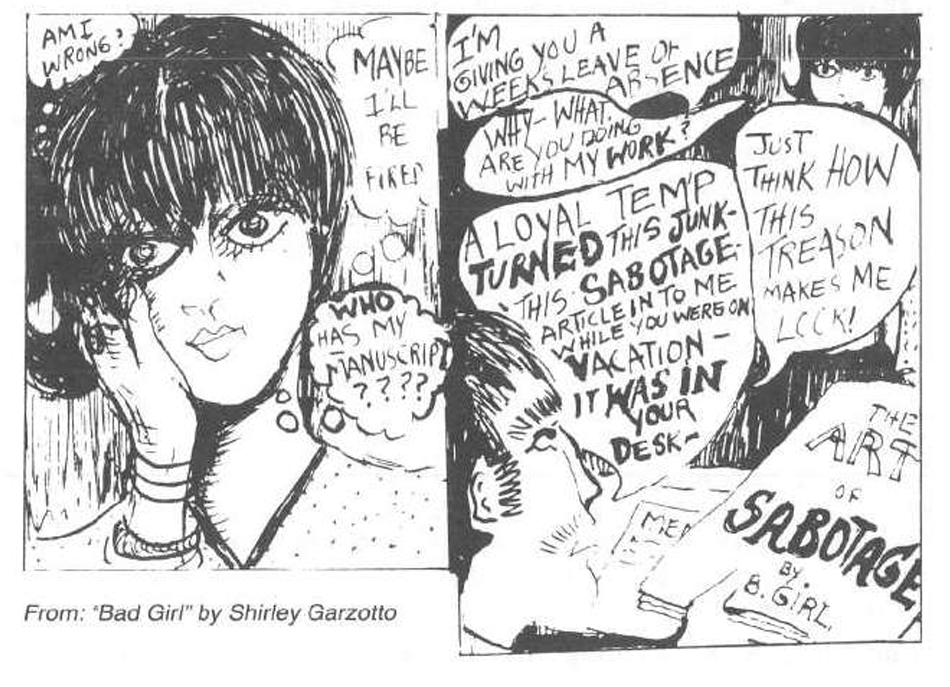
While I was pissed off about being fired, and I didn’t hide my anger from my co-workers or the VP who lowered the boom on me, I was simultaneously relieved that my work-term there was finally over. I had been planning to quit and find another job anyway, so being fired just sped up the process. Of course, even by the codes of liberal capitalism, my dismissal was a violation of my first amendment rights. After all, I had really done nothing more than to pilfer a few thousand bytes of space on the bank’s computer. I could have launched some sort of protest—PW offered to help me set up a picket line in front of the bank—or I could have pursued a lawsuit—Bob Black offered (through Freddie Baer) to help me put together a case—but the more I thought about it, the more rife with ambiguities the whole situation became. To have protested in a way that tried to elicit my co-workers support would have implied that I wanted or needed my job, neither of which was true. Or, I would have had to portray myself as a powerless victim of injustice. I was treated unjustly, but under the circumstances, I wasn't completely without resources. Despite my fears of being blacklisted, I got another, higherpaying job within three weeks.9 Even if I hadn’t gotten the new job, I probably could have gotten unemployment. No matter how I looked at it, my position in the situation always seemed to be one step removed. I had been punished, not for having performed acts of sabotage, but for having interpreted that behavior on the part of others. Any protest action I might have taken would have been for reasons that went beyond the immediate circumstances of my firing. I would have resisted not only to protest an injustice, but to participate in what I considered to be a process with a larger goal (the overturning of capitalism), and to turn my own experience into a demonstration of what was wrong with the system. Realizing the extent to which my possible responses to being canned would have been inspired by ulterior motives made me want to step back and examine the nature of activism itself.
I naively thought that I might be able to pursue this issue, i.e., the ambiguities of our own activity, within Processed World. I began to bring up, and object to, the deceptive way that PW presented itself to the outside world. For example, when prospective readers inquired about our backgrounds (“do you people belong to an organization?”) the pat answer was to say that we were disgruntled office workers who published the magazine “in our own homes.’ This last part was to insure the wary inquirer that we were small-time folks, not members of a big organizational machine. Admittedly, there are innocent reasons for using this type of shorthand approach. Who would want to listen to the in-depth description of the life of a member of the milieu? Besides, it was reasoned, if someone were interested in PW, and began to associate with the members, he or she would learn the “horrible truth” soon enough. While admitting these arguments, I still thought there was something more to be explored: the “logic” of an activity that demands a manipulated presentation of itself.
I insisted on talking about this issue at meetings, proposing that perhaps we could devote an issue of the magazine to exploring who we were (biographical pieces, etc.). But the main members of PW were intent on closing off their past as if it were something they wanted to put out of their minds. Someone suggested that I write the introduction to the next issue and bring up my concerns there. I doubt that it was proposed seriously, and in any case, I lacked the energy to grind out a piece fast enough. The next thing I heard, Adam Cornford had already written the introduction. Carlsson then proposed that I write an introduction to my article, since it was the source of my firing. I agreed to do that, but was aware that what I considered to be a personal upset (i.e., my sudden joblessness) could well be used as a cause célébre by PW (which, in a way, it has been). Instead, I was determined to bring up the issues that were important to me, and determined not to write another tale-oft-oil (or the first tale-of-termination).
In the introduction to the article, I centered on dishonesty as a way to explain the abrupt and rude meeting of my working life and my politics. A more accurate theme might have been manipulation or self-delusion. Predictably enough, because the intro included a critical description of PW activities (i.e., that we were engaged in “subtle dissimulation”), Manning and Carlsson were adamantly opposed to printing the introduction. Aside from a generally defensive attitude, their practical objection to printing it was that the connection between my work experience and my criticism of PW was not clear. This struck me as odd since they'd always assumed a direct and positive connection between their experience in PW and their criticism of work. For them, any exploration of the problems inherent in radical activism was taboo, especially in public! As far as the other members of the staff were concerned, many of them expressed encouragement at my attempt to argue against those who were in charge of the project.
At that time, PW was in a state of flux. There were several new members who were not completely “sold” on the PW mythology. They seemed open to my suggestions and were willing to print my introduction if I would make my argument more coherent. Many of the older members (older in the sense that they had been involved in PW for several months or had been active in the milieu prior to joining PW) agreed with the gist of my critique of PW’s dissimulation of its own past, and were interested in seeing my comments developed further. Many of them also had their own slants on what was fundamentally wrong with PW, and felt a kind of unity with me in opposition to the Carlsson-Manning-Cornford axis.10
The introduction wound up getting into the magazine because of this internal strife. On layout day for issue #5, when I wasn't there, Carlsson was ready to excise all references to PW from the final draft of the intro. Freddie Baer, who was doing the typesetting, didn't feel comfortable in changing what I had written without my consent, so she called me to let me know what was afoot. Carlsson then got on the phone and after several minutes of arguing with him, I agreed to the removal of a couple of sentences. It was only after I threatened to withdraw the sabotage article that he agreed to leave the rest intact.
It was then that I realized the extent of Carlsson’s possessive attitude toward the magazine. The fact that I forced even a partial critique into the open—into the pages of the rag itself—made them mobilize their forces to protect their image. Counter-arguments and a retelling of the events had to be churned out.
Gidget Goes To Hell
Shortly after #5 came out, I stopped going to Processed World meetings completely. I figured that there was no point in continuing to beat my head against the wall. Clearly, PW was no longer a project I could think of as my own. I'm sure Manning and Carlsson breathed a sigh of relief upon seeing the last of me. They must have been glad to be rid of me and my bad attitude; as far as they were concerned, I had gone to hell. The only task that remained for them to accomplish was to deal with the embarrassment of having the persona (Gidget Digit), who inaugurated PW's self-proclaimed “notorious attitude about sabotage;’ leave the group.
Three responses to my criticims of PW appeared in issue #6. Two were in the form of letters to the editor, the other was an article called “The Roots of Disillusionment”’
Shirley Garzotto’s letter was especially convenient for them. It appeared to come from a disinterested reader—a voice from “out there” who disagreed with me and, furthermore, seemed to expose me as a bought-off casualty of the “system.’ I couldn't understand why someone whom I had never met presumed to know so much about my personal life. Then I realized who she was—a neighbor and friend of PW staff member, Chris Winks. I had told him the details of my firing and a distorted version of the events must have been passed on by him to Garzotto, who then mailed them in letter form to PW. Several months later, when I asked Winks about his role in the Garzotto letter, he merely replied that it had been her decision to “call me” on what she saw as hypocritical talk about honesty. He never acknowledged that he was implicated in it in any way, or even that he had been her source of information about me. This shouldn’t have surprised me, since it was completely in keeping with the way Winks had approached his political associations during his participation in PW. He liked to keep his distance, claiming that he was not really a member of PW, but merely an occasional contributor. That way, he was never implicated in PW’s politics, in the analyses (most of which he told me he disagreed with or found crude) that appeared next to his erudite book reviews and rather predictable stories, or in the internal hierarchy of the group. He played the role of the house intellectual, his pieces giving a certain “weight” to the magazine, and despite his claims that he was not a member, he often represented PW in written replies to critical letters (his correspondence with Peter Werbe of the Fifth Estate), and in some of the public relations pieces that appeared in the mainstream media (e.g., in Mother Jones). He never declared his position or opinion on my dispute with PW, a tactic he later repeated during the “purges” of Greg Dunnington and Freddie Baer, preferring to remain “above it all” (or, in the French he knows so well, au-dessus de la mélée). In cases such as these, his silence was tantamount to acquiescence, and in that way, Winks is as responsible as Carlsson, Manning or Cornford for the manipulation and suppression of free inquiry that went on within Processed World.
I was given the opportunity to respond to Garzotto’s letter, but I declined to do so, deciding that her contempt for me deserved no response. I was not given the opportunity to respond to the second letter, that of Adam Cornford, which was much more important to the PWers and the rectification of their image.
Cornford's letter in issue #6 is PWers editorial response to my introduction. It is here that one of their main tactics against critics surfaces for the first time—trivializing the issues involved. An immediate question springs to mind: if the questions I raised were so trivial, why go to such lengths to try to suppress them, and then, failing at that, to refute them with pages and pages of rebuttal over the course of the next three years? The joking way that Cornford passes off the issue of dishonesty (“one or two of us are not even currently office workers! How dishonest can you get!") merely compounds the original distortion of their backgrounds. The idea that Cornford, Manning or Carlsson had no other option but to work in offices is ridiculous. Had they wanted to, all of these people could have succeeded in professional careers. I point this out not because I think that one must possess some sort of working class “credentials” in order to be “truly revolutionary;” but rather to show that their radical consciousness came well before they relegated themselves to drudgery in offices.11 In fact, their radicalism was the reason for their rejection of conventional forms of success.
While they shunned making big careers for themselves, their fall (and my own) into the office world was not entirely of their own making. Economic shifts in the seventies led to a shrinking of the job market in intellectual pursuit, especially in the areas of the arts and social research. Grant money and government subsidies for writing and research projects dwindled and many intellectuals found themselves falling back on lesser skills in order to get by. Manning even says in the Examiner puff piece on Processed World that one of the main reasons behind office workers’ discontent is the fact that “most people in offices are working way beneath their skills”. The PWers found themselves in that situation and one of the underlying motives of their project (and most others like it) is a not-so-hidden desire to revalorize the “worth” of the participants as the intellectuals they really want to be (and are). This explains their focus on the office sector, where many people with the same kind of frustrated intellectual or cultural ambition can be found, and it explains the dominant ideology of the magazine: anti-bossism. The leering, porcine figure of the supervisor makes an easy target as the immediate source of their degraded status and as a symbol of an irrational world in which nincompoops rule. The PW intellectuals may not want to be the kind of success that the boss is, but they don’t analyze and explode the concept of success, they merely displace it. They simultaneously reject success in the traditional realm and attempt to reconstruct it in the anti-authoritarian one. The desire for worthiness is not in itself bad, of course, it is the way the PWers insinuate themselves as the arbiters of what is worthwhile.
In the same letter, Cornford claims that “PW was not conceived by missionary leftists” and that their approach is low key in order to avoid association with the “57 varieties of leftism that pollute the radical working class.” From his leftist language to his proposal for didactic articles that won't confuse the uninitiated, one can see that Cornford is himself an “Apostle;’ like his Cambridge (England) forebears. Similarly, one can see that PW does share something with the other 57 varieties. PW has certainly rejected the dogmatism of the Leninist sects, and it is not adequate to simply call them Stalinists in anti-authoritarian clothing. Rather, in the types of analyses they make and the militant, anti-boss, anti-corporate message they preach it is easy to see how an outside observer would find it hard to distinguish PW from other left-wing agitators. One needs to go through an elaborate and lengthy initiation rite before one can see the subtlety of argument and the differences in perspective. PW, like any other group with an esoteric message, is opaque to those on the outside. In this sense all types of activism— Leninist, libertarian, and anti-authoritarian converge. They also converge in content, not just form: the demonization of the “enemy;’ the lachrymose sentimentality of much PW imagery and prose, all suggest the common ancestry of anti-authoritarians and the left.
The existence of Cornford's letter was conveniently not mentioned to me. I found out about it through the grapevine, and subsequently asked him to send me a copy of it so that I could prepare a response. It was also at this time that I made known my resignation from PW. As I explained to Cornford, the hostility shown to me at meetings by Carlsson and Manning made me think that my attempts to influence the direction of the magazine were futile. I did not want to waste my time participating in a project that I felt was not reponsive to my concerns. In any case, the promised copy was never sent to me, nor was a response solicited from me. In Carlsson's leaflet entitled “Bob Black's Latest Attempt to Intimidate Processed World," he notes that they asked me to develop my criticism into a longer piece, and at the last meeting I attended they did tell me that I was free to lengthen my critical introduction into a longer article that would be considered for publication. Since I never submitted an article, it seemed that the onus was on me, but was their offer genuine? Their hysterical reaction to my initial criticism and the negligence in offering me an opportunity to respond to Cornford’s letter indicated that they were bluffing.
The Public Image
While the letters from Garzotto and Cornford were attempts to discredit me and dismiss my critique, the third reply to Gidget that appeared in issue #6 appeared as a “spontaneous” appraisal of their political pasts. Although “The Roots of Disillusionment” was inspired by my accusations that the PWers hid their political pasts, it has less to do with the members' backgrounds than with their own odd perception of themselves. Innocently labelled as a “broad look at ways in which socioeconomic conditions and cultural practices shaped the experience of the baby-boom generation," it is really an attempt to answer those who had raised the criticism of dishonesty, as well as an attempt by the PWers to situate themselves within a particular social grouping. In “Roots;" Carlsson, Cornford and Manning collapse the development of radical ideas into a 30 year span, thereby forging an identity between their own experiences, education, cultural formation and political development with those of the random, disaffected member of the “baby boom:" We are told that
Somewhere along the Great White American Way the socialization process broke down. The very generation brought up to enjoy the fruits of the new consumer society begain rejecting it in earnest.
This “breakdown” that led a significant number of blacks, youths, women, gays, and Gls to rebel against the real constraints of modern life in the 60s is Carlsson’s, Caitlin’s and Cornford's excuse for ignoring the very peculiar process of their own radicalization. They claim that it was purely the result of the general discontent of the era. Undoubtedly, there is an element of truth in this, but they stretch the comparison too far. Certainly, they were discontented with the conditions of their own lives, but the formulation of their particular set of ideas and their commitment to acting upon them took years of conscious cultivation, and drew upon an intellectual, radical tradition stretching back to the last century.
In “Roots” the three Cs don't identify themselves as office workers, but they feel compelled to include an analysis of the office sector as the locus of the now-adult disaffected baby-boomers. The second half of the article takes a tedious digression about mergers and the growth of the office/information sector. If the boredom of suburbia inspired discontent 20 years ago, now it is the “downgrading” (read: proletarianization) in status and function of most white collar jobs. On the other hand, people are feeling a crunch—recession, automation, lay-offs—that inhibits their will to revolt. Then they tell us that the impetus to revolt will be driven by an economic process, but it is only a select few (the “sixties survivors”) who will have their dissatisfaction increased by the “pressure to knuckle down’’ Presumably others, who similarly find their “work harder and duller, and their pay poorer; will join the “artists” and “activists". This is the three Cs attempt to update PW's essentially Marxist viewpoint. While the working class is still included in their schema of revolution, and the economy plays an important role in motivating the desire for revolution, it is the marginalized intellectuals (i.e., themselves) whose hopes “will reappear, immeasurably strengthened and clarified out of a new social movement both broad and coherent enough to realize them”'
The analysis that Cornford, Carlsson and Caitlin elaborate in “Roots” is a reworking of some themes presented by Andre Gorz in Farewell to the Working Class, a work published in 1980 that claims to go beyond Marx by positing a new social group (marginals) as the subject of revolution. This formulation does not really go beyond Marx, it merely substitutes new actors into the Marxist schematic of class conflict. While “Roots” attempts to answer the charge of dishonesty in as innocuous a way as possible, it inadvertently exposes who the PWers really are. Despite previous claims that PW members are just regular office workers, in “Roots” they clearly identify themselves as members of an avantgarde, whose task it is to “nudge their fellow-workers toward self-organization” And the source of their ideas (Gorz) is another tip-off as to who they are. How many office workers would even recognize the name? Moreover, supposing they did, how many baby boomers even fit into the schema advanced by the three Cs? Their model of interpretation cannot explain why so many members of the same generation have drifted away from experimentation or politics. Additionally, the model— and for this the three Cs cannot be held responsible because they are willfully blind to the issue—cannot get at the more basic issue of why the “conscious activity” of PW has come to resemble outright unconscious careerism.
A corollary to the way they present their political formation is the way that they and others have used my article on sabotage, and the fact that I was fired from a job because of it, as an element of a myth about Processed World.12 Conversely, I've seen my experience used in the making of counter-myths as well. Critics of PW, such as Bob Black, have referred to me as a “real dissident office worker” in “Garbage In, Garbage Out—The Processed World Controversy”. For others, Gidget Digit represents a “purer” radicality compared to PW's more obviously opportunistic manipulation of the idea of sabotage.
The Counter Image
1983 was an extremely bad year for the “inner core” at PW. Internal and external opposition to both their distorted public image and their domination of the magazine reached a peak, and the anti-authoritarian “community” polarized around this issue. About six months after I left PW, Carlsson and Manning had their next bout with their own “dissident office workers;’ i.e., those who were working for them, and other rude critics.
Sometime after issue #7, Greg Dunnington, who worked on that issue and the previous one (after an acrimonious split with me and Jacobs over a Collective Inventions project), presented a written rebuttal to Cornford’s response to me. Dunnington rejected my critique of PW's dishonesty largely because of his literal interpretation of my use of the term “professional revolutionary”’ I actually used the term to give a humorous perspective to the political activities (leaflet writing, studying texts, etc.) that milieu members spend most of their free time pursuing. People who call themselves “anti-authoritarian” gag on the term “professional revolutionary” because it evokes images of Leninist forms of organization. Nonetheless, there is still an aspect of at least the para-professional in the activity and avocation the milieu pursues. He also attacked Cornford and PW for neglecting to clarify their modus operandi as a group committed to social revolution. In wielding this critique Dunnington was attempting to provoke a split within the organization—one that would break off the “radical” wing, so to speak. I would certainly agree that there may be individuals in the milieu worth talking to, but he missed the important necessity of subjecting all current presuppositions of radical thought to a critical process. After all, what would be the good of breaking away the “real” revolutionaries only to erect a new variant of the same ideology? In this sense, there are no “good” versus “bad” sectors of the milieu, as the vast majority of those who consider themselves to be anti-authoritarians engage in the same kind of lifestyle, and the same kind of projection of their own fantasies onto modern life, as do the PWers.
Like me, Dunnington underestimated the power of Manning, Carlsson, and Cornford within the PW collective. While several people voted in favor of printing his written criticism, the chief editors rejected it, claiming that it slandered Cornford and that was that. Shortly after the suppression of his article, both Dunnington and Baer left the group, and some time after that Sally Frye also parted company with PW.13
It is against this group of dissidents that PW uses the labels “purist” and “rabid anti-authoritarian;’ and indeed, much of the thrust of the “purists™ critique is that PW violates some of its own purported principles (such principles as internal democracy, and non-cooperation with authoritarian leftists). This may well be true, but it is not enough to judge PW on principles alone. A less opportunistic Processed World collective would hold many of the same assumptions that PW does now, and be just as opposed to an examination of themselves and the idea of revolution (and revolutionary ideas).
Chris Winks, who originally supported Dunnington’s efforts, passively allowed the suppression of the latter's piece with no protest, as he had in my case. A short time later, Winks wrote his own “critique” of PW. He brought up nothing of substance in it, and one is forced to assume that he felt obliged to appear critical of the project in light of all the dissent that had surfaced at that time. He criticized PW mainly on procedural grounds: hastiness and group mentality were the evils he addressed. His suggestions for a smooth running project were 1) making sure to include all the authors’ names on the contents page, 2) taking a slower approach to putting out the magazine, and 3) conducting conflict in a more “civilized” way.
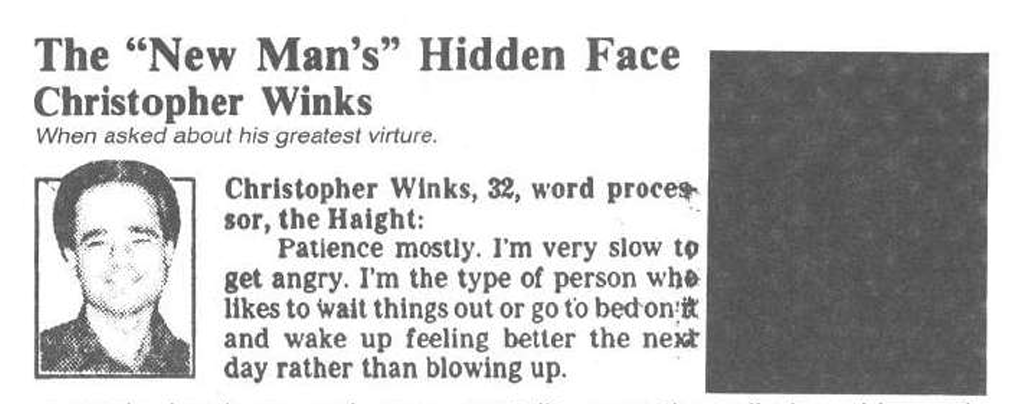
Winks's critique evaded the real issues entirely. It is important to remember that at that time several members had left the group over problems that involved more than just personality conflicts. His “critique” amounted to avuncular counsel, “Come on, kids, play nicely now;” while leaving everyone in the dark as to his own positions. Once again, his silence (silence being, in his own words on quite another subject, “bureaucracy’s most invaluable ally”) on the content of the conflicts, and his inaction conspired with PW's (a group he was a member of) censorship of its critics. It's revealing that what prompted his “critique;’ in the first place, was PW’s unintentional dropping of a copyright notice from Garzotto’s “Bad Girl” comic. Apparently Winks is willing to go to bat for some friends. Too bad it's for the wrong friends and the wrong reasons. He eventually did leave the group later that year (83), but he's recently reappeared in issue #16 with a short story: “The Accomplice," and complicity is a subject about which Chris Winks has firsthand knowledge.
Bob Black, the rogue elephant of anti-authoritarianism, has been the most vocal and prolific in his protests against PW. His “Baby and the Bathwater;” a self-published exposé and report on his protracted conflicts with PW, and his “Circle-A-Deceit” (the article that originally incited PW's fury against him after its appearance in the January ‘83 issue of Appeal to Reason) have many examples of the type of analysis that could be the beginning of a critique of the whole structure of anti-authoritarianism. For example, he points out the inbred quality of the milieu (“Generally, the anti-authoritarians lose in remoteness from ordinary popular experience what they gain by inbreeding with each other”), and he has enough insight to realize that this is true of all the milieu’s ideololgical groupings “from PW to the Lunatic Fringe!' He notes PW's debased use of language and the incestuous, self-absorbed nature of the whole so-called “community.” More recently, he has claimed to have broken completely with the anti-authoritarian milieu, although his letters and articles still regularly appear in anarchist and leftoid publications. But if the PWers and the Lunatic Fringe see the world through anarchomarxist tinted glasses, Black sees through lenses that are only a slightly different shade of black and red.
In his comments on the specific content of PW, Black falls back on other anti-authoritarian myths. He has slammed PW for rejecting antitech and anti-work stances, as if these categories were any less formulaic and ideological. In The Abolition of Work (1985), he puts forward the same rehash of situationist clichés that appears in Processed World. For example, he states that “at present most work is useless or worse and we should simply get rid of it” Most people would reject this type of argument as too simple, while those with a background in radical politics would recognize it as a code for a more complicated proposal. Later, in the same piece, he dredges up another favorite myth of the anti-authoritarian left: that workers are taking part in a “refusal of work”. This stale chant became a mystification almost as soon as it was uttered by John Zerzan in the mid-seventies. While it is undeniable that there was a wave of strikes and absenteeism in industry during the seventies, the anti-authoritarian interpretation of the phenomenon is merely another projection of their fantasy about revolution. In the “refusal of work” argument Zerzan, Black and other holders of this view imply that American workers are intuitively rebelling against all of modern capitalism, thus conveniently ignoring, like most anti-authoritarians, the less-than-rosy prospects for radical change in this country.
Black’s critique of Processed World and the anarchist “community” essentially concerns the internal workings of PW and the milieu. His “Baby and the Bathwater” often reads like the National Enquirer of the Bay Area milieu. He rightly grinds the PWer's noses in their own authoritarian practices (e.g., calling the cops on Black for relentlessy criticizing them, an action to which he responded by becoming a criminal), and he takes the whole milieu to task for putting up with PW. For Black, anarchists themselves are the problem. They are timid failures and are so enslaved by their subcultural mores that they wouldn't know real anarchy if it slapped them in the face. This type of analysis stops short of asking the important quesiton: does anarcho-theory have anything to do with the poverty of anti-authoritarian life? Anarchism, Black says, has already been explained in text books. He is apparently unwilling to entertain the notion that the anarchists’ inherited ideas provide an inadequate way of looking at modern life. For Black, anarchism in the abstract is fine, it's just the bozos who believe in it that pose the problem.
In addition to criticisms made by specific people there was also alot of generalized criticism within the milieu of the magazine. One such popular critique concerned the PWers claim that they were largely office workers. I, Black, Frye and many others have made such arguments. But, the real question does not revolve around the magazine's personnel. While it is true that the vast majority of PW staffers are not office workers, the mere participation of some bonafide “workers” would not in itself change the nature of the project.
Business As Usual
Despite the stream of criticism and hostility (mainly uttered by Black and Zerzan, those of us who had inside knowledge of PW—me, Dunnington, Baer, Frye—all, for the most part, kept our mouths shut after 24 leaving the group) directed at PW over the last three years, PW has dauntlessly plugged away at its magazine project. Interspersed in, and in addition to, the normal fare offered in any issue of PW are the rebuttals to the critics. About a year after I left the group Lucius Cabins (Carlsson) wrote an article that I believe was made available to subscribers. During that year I had not done much in the political arena, but because of growing disagreements with others, PW apparently still felt threatened by me. They reified me to such an extent that they always referred to me as “Gidget," even in personal correspondences.14 In Ex- Processed Worlders: Who and Why, Carlsson distorts my sarcastic use of the term “professional revolutionary;’ (in the intro to the sabotage article) implying that I was using it in the same sense that the authoritarian . left employs it. In other words, he claims that I took the term seriously, that I was striving to be a “professional revolutionary, when, in fact, I was trying to open up the question of both professional and para-professional revolutionaries.
Beyond this distortion, Carlsson claims that, in the last meetings I attended, I argued for absolute political purity. Carlsson states, “Gidget insisted that we hash out our disagreements in great detail, in order to arrive at a group consensus:’ As I recall, the actual argument that I made was that the absence of discussion of theoretical issues (such as the dishonesty-in-advertising problem) allowed an informal, but nonetheless monolithic, political purity to form, one that was beyond the control or influence of most members of the group. On the other hand, I am not simply advocating an empty and formal pluralism. Not all scissions are Stalinist; not all “refusals” to publish are censorship. The problem with PW was that they never wanted to define or make precise their “minimum basis of agreement;’ as that smacked of “theory;’ of the “bad old days” of the situationist milieu, of the Bay Area conferences, of all the baggage they were trying to shed. PW blinded itself to the inevitable problems of this type of pluralism, and got themselves into the bind of rejecting “group consensus” on theoretical issues, while nonetheless pushing the magazine in a definite ideological direction.
Later in the same article, Carlsson attempts to deal with just that problem. His, Manning’s and Cornford's domination of the group is more or less ratified by the clichéd arugument that they did (and do) most of the work. Carlsson goes on to pontificate about power in general, something he thinks is not clearly understood. Until it is, (perhaps it is already now that Manning, after her sojourn in Nicaragua, has shown herself to be one of the “Tourists of the Revolution” that Hans Magnus Enzensberger talked about 12 years ago)15 his advice to those who feel powerless is: don't make waves. The effect of such arguments is to create sympathy for the (self-appointed) leaders, who appear simultaneously as martyrs, willing to sacrifice everything for the cause, and as those most able to do the job competently. In issue #14 of PW Carlsson takes this argument one step further, stating that those who have been in a project the longest have a right to dominate it (see the letter from Lucius Cabins, page 8). Even this rationalization for longterm power mongering doesn't fit the PW situation, for there are PWers who have been active in the organization for almost as long as Carlsson, Manning and Cornford (like Thoreson), but who nonetheless do not really have any power over the editorial policy of the magazine.
The 3 Cs domination of PW is clear from the stultifying sameness of each of the now seventeen issues. PW really is as predetermined and rigid as the computer menu that they parody on the contents page in each issue. One wonders how many more tales-of-toil, how many more Kill-the-boss jokes, how many more Bravermanesque ‘“labor process” articles, or how many more Tom-A.-Talks-High-Tech essays PW can churn out before burning out their audience. Indeed PW's repetitive style and content account for as many image problems as those caused by PW's opponents. Over the last year, in addition to their almost desperate attempts to appear “punk” and youthful (as in their silly reprinting of every space shuttle disaster joke), they've tried to freshen up the magazine's graphic presentation with a larger format, but the most recent issues (14 through 17) demonstrate the extent to which their material is wearing thin. A large percentage of the articles are reprinted from other sources. Apparently, the PWers are running out of ideas for copy and must now resort to printing pieces gleaned from the left press in other countries (e.g., #14's “Motherhood and Politics” by Monica Slade, British Labour Party activist). This also reveals the company PW keeps these days and confirms, in an ironic twist of the “openness” theme, that PW is more and more a part of the mainstream left. They are active participants in a world-wide “network” of anarcho-left, and some just plain left, groups and individuals. To wit, PW showed up at the 1984 Conference of Radical Science Periodicals in West Berlin (a fact that is nowhere mentioned in Processed World but can be read about in the pages of “Alternative Science;’ issue #16), its members contribute to more mainstream publications like the Progressive and in an incredible show of bad judgment or cynicism they wound up endorsing, if only implicitly, the Maoist RCP's “No Business As Usual” street demonstration fiasco of the summer of '85.
This world-wide network also serves to bolster the reputation of PW, or any group participating in it. An example of this can be found in the previously mentioned review of Processed World by Marcy Darnovsky. She never mentioned PW's practice of suppressing certain critical letters to the editor, a practice she herself had objected to in the past. But this doesn't stop her from claiming that the “circles of critical discussion are expanding”’ This article was not so much of a review as a part of the mutal admiration game that goes on between cooperating individuals and organizations within the anti-authoritarian milieu. Another example of this appeared more recently in a piece by Tom Ward in the winter, 1986 issue of Alternative Media. In “Between the Lines;’ a review of Uncovering the Sixties: The Life and Times of the Underground Press by Abe Peck, Ward excoriates Peck as a sixties hack (Ward is simply a different variety of hack) for trying to create myths about the social movements of the sixties. He goes on to talk about the situationists in a way that is similarly mystifying, and then, out of (ultra)-left field puts in a plug for Processed World, as well as Midnight Notes. In a previous article “The Situationists Reconsidered”16 in Cultures In Contention edited by Douglas Kahn and Diane Neumaier, Real Comet Press, 1985., Ward details that he once lived in the Bay Area, and is, in fact, a crony of Cornford. More egregiously, he goes on to present PW as the only reasonable outcome of the convoluted Bay Area libertarian left. So much for the political perspicacity of the house situationist of the Village Voice.
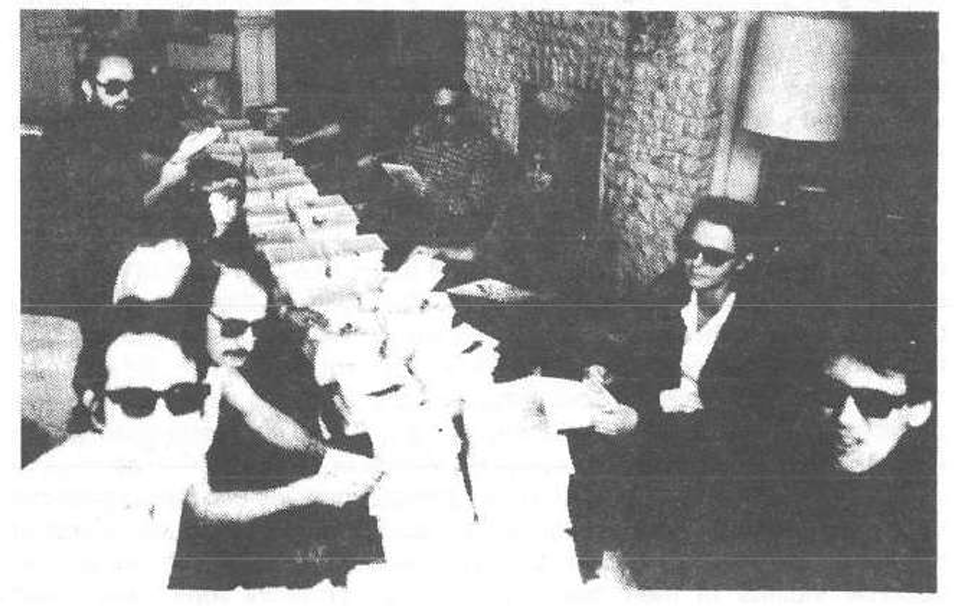
Processed World — Made in Our Living Rooms
PW has also tried to incorporate some of the ideas of its critics. Starting with issue #14, they shortened the introduction, cutting out the editorial parts of it. Instead, PW presents its political ideas in the form of responses to letters, and in collective editorials (though, in issue #17 they don’t seem to have anything analytical to say at all). PW hopes (and perhaps they've succeeded) to respond to and dispense with their opponents’ arguments with this technique. First of all, they want to demonstrate that they are open to outside criticism (maybe it's just inside criticism that they're against?!?) Secondly, they hope to dismiss the widely-known fact that certain members dominate the political content of the magazine. Their new techniques accomplish neither goal. This “open forum” is conducted in the usual PW fashion. It is highly controlled (not just any critical letter will be printed) and the purpose of the “debate,” which immediately becomes part of the PW “institution”, is not to provide a forum for open inquiry. It is another self-produced platform from which the PWers can disseminate their views. If they seem humble in their responses and editorials it is only because they are aware that Marxism, even Libertarian Marxism or even anarchism, does not sell well or wear wll these days. They must assume the language of anti-expertise in order to become expert antis.
Conclusion
Over the past four years, the Bay Area milieu has polarized over the issue of Processed World and its critics. Practically everyone in the anarchist, libertarian-communist or anti-authoritarian “community” has felt obliged to declare her or himself vis-a-vis this controversy, but virtually none of the contenders in the pseudo-debate want to confront its meaning. PWers like Cornford claim that anti-authoritarian ideas do not have a more significant social impact because the milieu has been divided by the irresponsible criticisms of political “purists.’ The critics of PW claim that the problem is due to the betrayal of revolutionary principles by opportunists like PW's editors.
Undoubtedly the anti-authoritarian left is (at least intellectually) in retreat, but the cause of this failure is not to be found in “purism” or “betrayal’ The anti-authoritarians have lost the ability (if they ever had it) to test and dissect their own theories. Once “converted” most members of this “community” simply dig in, remaining entrenched in their “communities” during times of social quiescence, keeping their fragile ideas under wraps. During times of social upheaval, the A-As emerge, hoping to attach themselves to one rebellious sector or another in an attempt to inject it with the proper revolutionary perspective. At the same time the very existence of rebellion serves to validate their particular brand of radicalism. Their goal is to maintain their ideologies. In so doing they become victims of their own ideas, which confront their bewildered originators as machines that must be tended.
It is all too easy to call for a critical reconsideration of all previous radical theory. That in itself has become a cliché. The harder question to ask is: how can any (even the most “self-conscious”) “critical activity” avoid the pitfalls of activism, militantism, opaqueness, and “institutionalization” that PW has fallen prey to? Perhaps it is not possible to avoid these problems completely, but I would maintain that if consciousness is a goal, it can only be attained by engaging in self-conscious activity, activity that is both aware and admitting of its pitfalls, absurdities and limits; theory must be able to withstand a confrontation with itself. It is only by doing this that one can ever hope to have a chance of understanding the relationship between ideas and phenomena of social change. Obviously, this approach has nothing to do with “purism;’ as PW and its friends like to insinuate. Nor does it have much to do with proclaiming allegiance to a set of anti-authoritarian principles, as PW's critics often demand. Am I then rejecting the possibility of a genuinely radical activity aimed at getting to the roots of modern society? No. The world still needs changing, making a lucid interpretation of it, and our own roles in it, all the more necessary.
September 9, 1986
Stephanie Klein
a.k.a. Gidget Digit
P.O. Box 7353
Menlo Park, CA 94025
Thanks to David “Judge” Jacobs for many hours of editorial help on this article and for the four years of belligerent criticism that preceeded it. Thanks also to Brian Kane, Greg Dunnington and Sally Frye for typesetting, layout and production work.
- 1Libcom note: See https://libcom.org/article/red-eye-magazine-1-1979
- 2Not to be confused with the Maoist rag of the same name.
- 3Libcom note: https://libcom.org/tags/ourselves
- 4Libcom note: https://libcom.org/article/dusk-situationist-movement-historical-perspective
- 5Libcom note: https://libcom.org/tags/collective-inventions
- 6Libcom note: https://libcom.org/article/nasty-secretary-liberation-front-gallery
- 7A condescending, inaccurate term even if George Orwell—one of Cornford's and the milieu’s role models—used it, it is even less accurate when applied to paraintellectuals like Cornford, rather than being used to describe blue-collar workers as Orwell intended.
- 8“Order, Order, Order,” “A Consumer's Guide to the Jam,” and other Collective Inventions texts, as well as “At Dusk,” available from Collective Inventions, (New Mutants: the Omphalopsychics), P.O. Box 390512, Mt. View, CA 94039.
- 9This new job started my “career” in the fast-lane of computer industry. To this day I'm a high-paid “data processing professional;” working and living on the San Francisco peninsula—a career situation rife with ambiguities for someone who claims to be radical.
- 10Some of the other criticisms of PW included 1) a critique of the class nature of PW's internal structure—i.e. that the dominating members were from wealthy or upper-middle class backgrounds, while those from less privileged backgrounds played less important roles, 2) dissatisfaction with PW's emphasis on aggressively selling the magazine—many thought this inconsistent with PW's supposed radicalism—and 3) general personality conflicts with Carlsson’s gladhanding salesmanship, Manning's overbearing assertiveness and Cornford’s smarmy condescension.
- 11I might point out that they didn’t stay in corporate office land, as they call it, very long either. Carlsson and Manning are the proud owners of a small business, Typesetting Etc., and Cornford is a “poet and teacher” At least that's how he was described in the bio that accompanied his article, “A Matter of Pride and Principle’ which appeared in the April 1985 Progressive. In this travel guide through the British miners' strike, we see Cornford acting like the “missionary leftist” that he claims not to be, when he proudly recounts the advice he gave some of the union people about how they could form workers' cooperatives as a way to counteract the closing of the mines. He even offered to put them in touch with “experts” in London.
- 12For examples of the mythification process see “Brave New World" by Marcy Darnovsky in the March 25, 1983 issue of The East Bay Express, and the section on PW in David Armstrong's A Trumpet To Arms, Alternative Media in the Eighties South End Press, 1985.
- 13It should be noted that Jacobs and I later formed a study group with Dunnington, Baer, and Frye which was later joined by Donna "Bride of Bobzilla Black” Kossy. It is still ongoing, minus Baer and Kossy, but with newcomer and milieu tyro Jason Keehn.
- 14One can also see Gidget reincarnated in Garzotto's “Bad Girl” series. Bad Girl does the “right” thing, revolutionarily-wise, when her sabotage article is discovered by the boss.
- 15See “No Middle Ground” issue #2. The “true story” of “No Middle Ground" has not yet seen the light of day.
- 16Libcom note: see - https://libcom.org/article/situationists-reconsidered-tom-ward
Attachments
Bizarro-Processed-World.pdf
(4.61 MB)


Comments