
Rezgar Akrawi: As Marxists and leftists, we must approach such issues with scientific rationality. We must study local, regional, and international conditions, assess the balance of class forces and the power of our “enemies,” and realistically consider the means and feasibility of achieving any solutions we propose. Most importantly, we must avoid being drawn into disastrous ethnic or sectarian wars.
Although I do not personally fight for the formation of states based on ethnicity, I do fully support the desire and right of any population group—whether defined by nationality or otherwise—to determine its fate through democratic and peaceful means. This includes the right to secede and form independent states, if that would ensure better rights and living conditions, and more peace and security for the broader population.
While I fully and unconditionally support the Kurdish people’s legitimate right to self-determination, including secession, I do not believe the current conditions in the Kurdistan Region are appropriate for separation, independence, or the declaration of a nation-state.
The working masses in both the Kurdistan Region and Iraq are being drawn into ethnic conflicts and wars, as is already happening. They are facing deepening political and economic crises, all for the sake of a “nation-state” which—if it were to be formed now—would amount to nothing more than another miserable dictatorial example of the failed nationalist states in the region. It would bring no real change to the lives of the working class.

The Left and the Referendum 2017 in the Kurdistan Region- Iraq: What Is to Be Done and What Are the Tasks?
Rezgar Akrawi
Publication Date (Arabic Original): October 14, 2017
1. Introduction
Leftist forces in Iraq were among the first to struggle for the rights of nationalities and minorities and to defend them. They have advocated for the right to self-determination since the formation of the first communist and leftist organizations in the 1930s. These forces maintained a clear internationalist stance, offering a profound humanist example through parties that encompassed all nationalities and minorities in Iraq. Class-based international unity was one of the fundamental bonds within these political organizations.
Although many leftist Iraqi and Kurdish forces and individuals support the Kurdish people's right to self-determination through a democratic referendum, they did not endorse the September 25, 2017 referendum conducted in the Kurdistan Region of Iraq. Their rejection stemmed from numerous reasons, including its lack of the most basic democratic standards as defined by international law and even by the standards of the Third World. The referendum was deemed illegitimate, ill-timed, lacking local consensus, exclusive in its organization, and absent of international supervision and support.
The issue of the referendum and the broader matter of resolving national problems in Iraq may evoke diverse opinions and interpretations among Iraqi and Kurdish leftists. I believe that some comrades, for whom I hold deep respect and with whom I have shared organizational struggle or maintain valued comradely relationships, adopted political stances that may be erroneous or misaligned with the interests of the masses. In some cases, these stances could even inadvertently support one of the nationalist ruling factions in Iraq's bitter national conflict.
In my view, the left should not align with its "national rulers," whether under the banner of "national liberation" in Erbil or "defending the homeland and its unity" in Baghdad. The experiences of the masses under both corrupt and authoritarian regimes have shown these slogans to be mere pretexts for consolidating dictatorial power. In the Kurdistan Region, unconditional support was given to entrench the authority of a dictatorial party and its leader under the guise of a democratic national referendum for a "persecuted" ethnicity. In Iraq, some leftist organizations and comrades supported the chauvinistic actions and decisions of the sectarian Islamist government in Baghdad against the inhabitants of the Kurdistan Region following the referendum. Some even rejected the principle of self-determination via a democratic referendum.
Here, I will attempt to present my perspective—which may be right or wrong—on the positions of the "pro-referendum left" and the "left that rejects the right to self-determination," analyzing the basis of their arguments in light of current realities, and proposing what is to be done to address national problems in Iraq and what the tasks of the left should be.
2. The Pro-Referendum Left
2.1 Kurdish Left and Organizational National Separation
An important case in Iraq deserves reflection and independent analysis. The Kurdish left chose to separate from the Iraqi left even before Kurdish nationalist forces raised the demand for national secession. The Kurdistan Communist Party voluntarily split from the Iraqi Communist Party in 1993, followed by the voluntary split of the Worker-Communist Party of Kurdistan from the Worker-Communist Party of Iraq in 2008. Current realities show that the foundations and reasons the Kurdish left relied upon to form their independent national leftist parties at that time were flawed and did not lead to strengthening their presence among the working masses in the region as hoped. On the contrary, these parties declined and became small entities with very limited influence. This geographic-national split had a significantly negative impact on the left as a whole in Iraq.
In my opinion, these voluntary splits were driven by a kind of administrative-governmental separation between the region and the center, the presence of complex national issues in Iraq, the strength and influence of both Arab and Kurdish nationalist currents and their societal impact including on leftist forces, as well as a tendency in some leftist parties to prioritize national identity over humanist class identity, and the overall decline of the left locally, regionally, and globally due to various reasons.
2.2 Does the Referendum Represent the Will of the Masses?
In my continuous observation, I did not witness any mass protests or significant grassroots mobilization in the Kurdistan Region in recent years demanding a referendum or independence. The referendum was not one of the main demands of the 2011 protests that swept the region's cities following the Arab Spring. Instead, the protests demanded services, salaries, justice, democratic and human rights, and opposed the corruption and authoritarianism of the region's rulers. Most of the leftist forces in Kurdistan played an honorable and notable role in those protests.
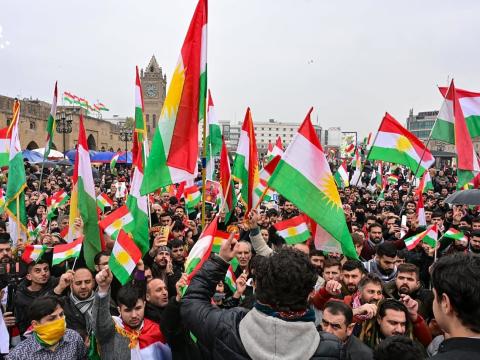
I am unaware of any comrades from the pro-referendum left conducting accurate surveys or opinion polls revealing that a referendum was the primary urgent demand of the working masses in the region. Nor was it a principal demand of most political blocs or parties in the region, regardless of their class orientation. So how did the referendum suddenly emerge without prior warning as an urgent popular demand? Even three weeks after the referendum, there were no mass protests in the region's cities demanding the authorities implement the majority vote for secession. This confirms that the "masses" did not act spontaneously based on their needs before or after the referendum but were mobilized by the ruling party and its allies.
In my view, labeling the referendum as "popular" and representative of the urgent will of the Kurdistan Region's masses lacks any scientific basis and is simply false. The ruling Kurdish nationalist parties, particularly the Kurdistan Democratic Party (KDP), were able to draw in other nationalist parties and a portion of the masses into the referendum issue using both legal and illegal means due to their financial, military, and media resources and their control over most levers of power and wealth in the region. They manipulated "nationalist sentiment" under the guise of the right to self-determination. I believe the referendum was not an urgent demand of the masses in Kurdistan.
2.3 The Thesis of the Oppressor vs. Oppressed Nationality
Unfortunately, the pro-referendum left echoed the same thesis promoted by the ruling nationalist parties, asserting the existence of oppression by the "oppressor nationality" (Arabs) over the "oppressed nationality" (Kurds), and sometimes they were even more royalist than the king! As I have pointed out in previous writings, there was indeed violent and severe national oppression in Iraq before 2003. However, after that date and based on deals between Kurdish nationalist forces and political Islam groups in Iraq, the Kurdistan Region transformed into a de facto national state lacking only formal structures. Thus, national oppression effectively ended.
In my follow-up, I have not encountered any international human rights reports indicating instances of national oppression against Kurds in post-2003 Iraq. On the contrary, there have been numerous documented cases of national discrimination and injustice perpetrated by Kurdish authorities against other national and religious minorities in the region. This includes the widely criticized "Kurdification" policies in the so-called disputed territories, condemned by international human rights organizations such as Amnesty International and Human Rights Watch.
Therefore, I believe that using Marxist texts on "oppressor and oppressed nationalities" as if they are infallible religious scripture suitable for all times and places is inappropriate for the situation in the region and the issue of the referendum. The reality is that Kurdish nationalist parties were one of the main pillars of power in post-2003 Iraq and, in alliance with Islamist parties, have contributed to the destruction, violence, poverty, and corruption plaguing all of Iraq's peoples.
It is no secret that the Kurdistan Democratic Party, one of the dominant bourgeois factions both regionally and in Baghdad, was undergoing a severe internal crisis. The referendum was used to solidify its local, regional, and international position, extend the de facto presidency of Masoud Barzani—who had lost legal legitimacy years ago—and prepare for the post-ISIS phase in Iraq and the wider region. The core conflict is between factions of the ruling bourgeoisie in Iraq—not between an oppressor and an oppressed nationality, nor between an aggressor and a victim. This conflict is entirely detached from the interests of the working masses.
2.4 Solving the National Question or Distracting the Masses and Marginalizing the Class Struggle?
In my opinion, one of the main undeclared objectives of the referendum was to derail or delay any serious, binding, and democratic referendum to determine the fate of the Kurdistan Region's population peacefully and under international supervision involving all stakeholders. Instead, the ruling elite aimed to retain the nationalist card for their own benefit.
How can leftists and progressives, if they truly believe the referendum is a pressing popular demand and that conditions are appropriate, support a non-binding referendum? One without any international recognition or support? What then distinguishes it from the 2005 referendum? Even the leaders of the Kurdistan Democratic Party admitted a day after the vote that it was merely a "survey." Are the voices of the masses just a plaything in their hands?
Clearly, the ruling nationalist parties will use the so-called "popular mandate" solely to consolidate their power, extract more concessions internally and regionally, and prolong Barzani's presidency, while preparing for post-ISIS bargaining. In reality, one outcome of the referendum was the escalation of war rhetoric and ethno-nationalist hostility across Iraq, deepening tensions rather than resolving them.
Sadly, some leftists prioritized nationalist struggle over class and internationalist struggle. Whatever their theoretical justifications for siding with a dictatorial party and its leader against the so-called "national enemy," they are now complicit, albeit indirectly, in pushing the peoples of Iraq and the region into further violence and crisis. The working masses—especially in the Kurdistan Region—are being dragged into deeper political and economic turmoil (as is evident now), and the class struggle is being sidelined, with daily struggles for services, salaries, justice, electricity, water, and livelihoods replaced by nationalistic fervor.
This scenario has been a gift to the ruling sectarian Islamist parties in Baghdad, providing them with an escape from their own deep crises.
Despite international rejection and threats from neighboring countries—threats that could trigger severe political, economic, and even military consequences—the pro-referendum left did not withdraw their support, showing disregard for the potential suffering of the working masses in the region and throughout Iraq.
2.5 The Pro-Referendum Left’s Position on Electoral “Democracy”
The pro-referendum left argues that the majority of Kurdistan’s people voted “Yes,” thereby expressing their will. However, they are well aware—better than anyone else—of the climate of repression, fear, nationalist hysteria, and public intimidation that accompanied the referendum, particularly in areas controlled by the Kurdistan Democratic Party (KDP). The ruling parties controlled all security, military, and administrative apparatuses.
Moreover, the referendum lacked independent and impartial institutions to supervise and administer the vote. Over the years, it has become evident that the ruling parties in the Kurdistan Region and Iraq more broadly have resorted to manipulation, fraud, political bribery, misuse of state resources, and armed intimidation to enforce their control via sham elections. These processes have been overseen by so-called “independent commissions” that are fundamentally rooted in sectarian, nationalist, and partisan division and plagued by rampant corruption, with no credible international oversight.
Despite all this, nearly half the population reportedly boycotted the referendum, according to independent statistics. No credible international body, official or non-official, recognized the referendum’s results as valid or legitimate.
This reality casts a shadow over the democratic integrity of the pro-referendum left’s stance. Their defense of the referendum result—despite clear evidence of irregularities—suggests a double standard and a serious credibility gap. The left should be defending electoral democracy and the integrity of the voting process regardless of whether it aligns with their own positions or with ruling authorities.
The left’s responsibility is to call for democratic and inclusive conditions that allow the public to express their views freely—whether by boycotting, voting “Yes,” or voting “No.” Otherwise, the process cannot be considered democratic and should not be participated in. Unfortunately, the pro-referendum left did not denounce the blatant violations, excessive fraud, and undemocratic practices associated with the vote. Instead, they endorsed it unconditionally and claimed that the result reflected the will of the majority, despite the massive boycott. This was due solely to their support for the referendum and their alignment with the ruling authority’s agenda.
In my view, the high boycott rate and the “No” votes represented a courageous revolutionary stance by the people of Kurdistan against the ruling elite and their oppressive practices.
3. The Left that Opposes the Referendum and the Right to Self-Determination
Some dear comrades from the Iraqi left—both as individuals and organizations—still do not accept the right to self-determination for the residents of the Kurdistan Region as a general principled concept. In fact, they oppose it outright. From this perspective, they sided with the Baghdad government and its chauvinistic measures against the region’s inhabitants, justifying this stance by invoking the need to defend the unity and sovereignty of the Iraqi “homeland” and to oppose its division, calling for adherence to the “constitution.” Generally, their position aligns closely with—or even supports—the views of the Iraqi government and ruling political Islamist forces.
3.1 National Unity and Opposition to Division
One of the key justifications for rejecting the right to self-determination and secession through a democratic referendum is the defense of state sovereignty, the territorial unity of Iraq, national constants, and the fight against division. These actors regard Iraq’s borders as sacred and any deviation from them as tantamount to high treason.
Yet it is known that Iraq was established under the Sykes-Picot Agreement of 1916, in which various national and religious communities were forcibly merged according to colonial interests and power-sharing deals in the Middle East. Therefore, I believe that Iraq’s territorial unity is not sacred and holds little value when weighed against the lives, rights, and safety of the working masses. As Marxists and leftists, we should reject forced unity between peoples and instead support voluntary coexistence and unity based on equal citizenship. At the same time, we should uphold the right to self-determination—including secession and the formation of independent states—if doing so results in greater equality, rights, and better living conditions, or reduces the severity of ethnic, religious, and sectarian conflicts such as those currently afflicting Iraq.
3.2 National Chauvinism and Rejection of the Principle of Self-Determination
Many leftist comrades and organizations in Iraq remain influenced by chauvinistic Arab nationalist thought, which frames any minority group’s demand for national rights or independence in Arab countries as a colonial or Zionist conspiracy aimed at dividing the Arab world. Yet at the same time, they advocate and fight for the Palestinian people’s right to self-determination and an independent state—while denying that same right to non-Arab peoples and minorities within Arab countries.
I believe that leftist forces in Iraq, and in the broader Arab world and Middle East, must fight for voluntary unity among all nationalities based on equal citizenship, the separation of religion from the state, and raising awareness among the working masses about human brotherhood and full national and religious equality. At the same time, we must defend the full and legitimate right of national minorities to self-determination—whether within the current state structures in the form of autonomy, federalism, or confederation, or through secession and the creation of independent states. This applies not only to Iraq, but also to many Arab countries with unresolved national and ethnic issues.
3.3 Calling for Adherence to the Constitution and Supporting the Government and Parliament
Regrettably, some leftist comrades have supported the measures and decisions taken by the sectarian and chauvinistic Islamist government and parliament in Baghdad against the residents of the Kurdistan Region. These institutions are among the most corrupt and dysfunctional in the world. They also supported the Federal Court’s rulings despite knowing that the Iraqi judiciary lacks independence and integrity.
Some of these measures were highly unjust and will have profoundly negative consequences for the working masses and society at large, while the ruling elite in the Kurdistan Region will remain mostly unaffected. Worse still, some of these comrades rejected the principle of self-determination through a peaceful democratic referendum, justifying their stance by appealing to the “Iraqi constitution.” This is a constitution crafted through deals among political Islamists, Kurdish nationalist forces, and their allies. Meanwhile, the right to self-determination is enshrined in international law, international human rights conventions, and Marxist and leftist thought, and is recognized in the United Nations Charter. It should not be subject to local constitutional interpretation.
Unfortunately, these comrades failed to clearly denounce threats of economic blockade, military intervention, and regional interference—particularly from the dictatorial regimes in Iran and Turkey—and Baghdad’s disgraceful and condemned cooperation with them. Nor did they condemn the joint military maneuvers intended to intimidate the region’s inhabitants. Worse yet, some even called on the Baghdad government to escalate its measures, including militarily.
4. What Is the Alternative for Resolving National Issues in Iraq?
To resolve national problems in Iraq, and to determine the nature of the relationship between the Kurdistan Region and the central government, as well as the future of the disputed territories, I support holding peaceful, democratic, and binding referenda for both the central government and the region. These referenda should be conducted with proper preparation and include all stakeholders.
I believe that leftist forces in both Iraq and the Kurdistan Region should advocate for a solution involving the United Nations, calling on all parties to begin peaceful dialogue and negotiations under international supervision to resolve all national issues in Iraq—not just the Kurdish question. We must demand the formation of a permanent UN committee or mission to oversee this process, whose primary role would be to find a peaceful solution in accordance with international law and conventions, and to provide the proper conditions for such a process.
My proposal to involve the United Nations is based on the following considerations:
• It represents the best available option, especially considering the weakness of progressive and leftist forces in both the center and the region. Often, we must choose between the bad and the worse, despite my strong reservations about the UN’s policies and the dominance of major capitalist powers within it.
• The dominance of chauvinistic Arab-Islamic nationalist thinking among most Iraqi political elites intensifies exclusionary tendencies against other national and religious communities in Iraq.
• The ruling elite in the Kurdistan Region exploit the Kurdish national question to consolidate their dictatorship. The two ruling parties monopolize weapons and command all security and military forces as partisan militias, which compromises the credibility of any election held in the region. Without international pressure and oversight, opposing viewpoints cannot operate freely.
• There is significant institutional weakness and no truly democratic and independent electoral commission in either Baghdad or Erbil.
• The judiciary in both the center and the region lacks independence and integrity, and there is no separation of powers.
• The ruling blocs lack the credibility and integrity necessary to solve Iraq’s national issues. Therefore, international supervision and pressure are essential.
• UN involvement may help block or at least reduce negative interference from regional powers.
• The UN has significant experience in addressing national conflicts and can provide support, expertise, and training if all parties agree to hold a democratic referendum under international supervision.
• It is essential to have a strong international role and oversight in determining the future of disputed territories that are ethnically and religiously diverse, such as Kirkuk and the Nineveh Plains. These areas should have their own localized referenda.
5. Tasks of the Left
In the post-referendum period, the masses have been increasingly drawn into nationalist conflicts, which have now deepened significantly. This has greatly distracted them from demanding their rights and seeking solutions to their daily problems throughout Iraq. A climate of anxiety, tension, and fear about the future and potential wars has been created among the general public.
The Kurdish nationalist parties and the ruling political Islamist forces desperately needed such a toxic conflict to divert attention from their corrupt and authoritarian policies and to consolidate their decaying rule. Unfortunately, they succeeded in this. What happened was a “temporary victory” for the ruling elite in the Kurdistan Region and for the political Islamist forces and reactionary governance in Baghdad. Sooner or later, these forces will return to negotiating and dividing power and plunder, forming new alliances once again to continue their joint authoritarian and corrupt rule—one that has brought misery, deprivation, and poverty to all the people of Iraq and the Kurdistan Region.
To confront this, I believe the leftist forces in Iraq and the region must undertake the following:
• Firmly condemn the use of weapons and the imposition of political will by military force, regardless of which side commits it or what justification is offered.
• Stand against the growing language of hatred, fanaticism, and ethnic supremacy—be it Arab, Kurdish, Turkmen, or otherwise—as well as against corrupt governments in Baghdad and Erbil, and against policies of tyranny, looting, and impoverishment.
• Focus on the struggle for a civil state and defend the rights of the working masses, human rights, freedoms, equality, citizenship, and social justice.
• Adopt the United Nations solution to Iraq's national problem, and promote awareness among the masses of voluntary human unity based on equal citizenship for all nationalities and religions in Iraq.
• At the same time, affirm the right of all nationalities residing in Iraq to self-determination, including secession and the formation of independent states.
• Defend the equal human rights of residents in the so-called disputed areas with their rich ethnic and religious diversity. Oppose national oppression policies in any form, whether “Arabization” or “Kurdification.” Until their fate is determined through democratic means, these areas should be placed under international supervision and governed through a shared local administration by their inhabitants.
• Distance themselves from both Barzani’s agenda and his referendum, and from Abadi’s chauvinist punitive measures, recognizing that both sides stand together in opposition to the working class.
• Emphasize our human identity before ethnic identity. Make it clear that the current conflict is not between the peoples of Iraq—especially Arabs and Kurds—but rather a crude and ugly struggle between the ruling classes in Baghdad and Erbil, and their regional and international allies, being waged in our name under a regime based on abhorrent sectarian and ethnic quotas.
• Consider efforts to reunify leftist parties in Iraq and the Kurdistan Region after their organizational split, and work toward creating flexible coordination mechanisms to unify their efforts within a single national framework.
• Leftist and progressive parties in Iraq and the Kurdistan Region are now more than ever required to come closer together and strengthen their joint work toward building a broad leftist-democratic alliance.
• [...]
6. Conclusion
As Marxists and leftists, we must approach such issues with scientific rationality. We must study local, regional, and international conditions, assess the balance of class forces and the power of our “enemies,” and realistically consider the means and feasibility of achieving any solutions we propose. Most importantly, we must avoid being drawn into disastrous ethnic or sectarian wars.
Although I do not personally fight for the formation of states based on ethnicity, I do fully support the desire and right of any population group—whether defined by nationality or otherwise—to determine its fate through democratic and peaceful means. This includes the right to secede and form independent states, if that would ensure better rights and living conditions, and more peace and security for the broader population.
While I fully and unconditionally support the Kurdish people’s legitimate right to self-determination, including secession, I do not believe the current conditions in the Kurdistan Region are appropriate for separation, independence, or the declaration of a nation-state.
The working masses in both the Kurdistan Region and Iraq are being drawn into ethnic conflicts and wars, as is already happening. They are facing deepening political and economic crises, all for the sake of a “nation-state” which—if it were to be formed now—would amount to nothing more than another miserable dictatorial example of the failed nationalist states in the region. It would bring no real change to the lives of the working class.



Comments