
Uprisings that keep the bourgeoisie on tenterhooks.

Uprisings that keep the bourgeoisie on tenterhooks.
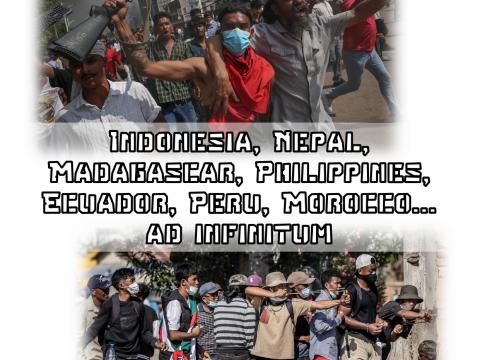
What could have been the title of a film by Luis Buñuel is a recurring expression, a recurring reality against the world of money, against the world of capitalism, and against the order and social peace of the ruling class, written in blood. This expression is mostly carried out by the proletarian youth. From the Philippines to Ecuador, Morocco, Madagascar, Nepal, and Peru, violent clashes are taking place between insurgents and the State’s monopoly on violence, the last bastion of the ruling class.
About the uprising in Morocco, but not only that, and why we must continue to defend uprisings
Since September 27, Morocco has been hit by a wave of demonstrations and clashes in the streets that have taken on an insurrectionary character and dimension.
The straw that broke the camel’s back is widespread impoverishment (35% unemployment among young people), the catastrophic state of the health system (according to the World Health Organization, there are only 7.7 doctors per 10,000 inhabitants in Morocco, compared to 16.6 in neighboring Algeria, 46 in Spain, and 45 in Germany) – which is also related to the uprising, because in August eight pregnant women died in hospital after having a C-section – and in addition the enormous expenditures by the Moroccan State on the 2030 World Cup […] and this year’s Africa Cup of Nations.
Poverty, hopelessness, illiteracy, repression, corruption, and the governance of the country according to the goodwill and interests of the ruling class (as elsewhere) have led to an even larger movement on the streets as it was during the protests of 2011-2012. The lives of young proletarians are sinking into poverty caused by capitalism, while billions are being spent on football stadiums and tourism. The world’s largest football stadium will soon be located in Casablanca, an Arena of Spectacle that will seat 115,000 people.
It would not be the first or last time that enormous sums of money are spent on sporting events, meaning that a capitalist State incurs enormous debt, and as usual, it is clear who will pay it off. In Italy, Greece, and Spain, too, the Olympic Games, Football World Cups, etc. were supposed to bring in big money and modernize the country, but in the end, it’s all about making huge profits at the expense of the proletariat. Huge sports arenas adorn metropoles, standing next to slums, while the latter are cleaned up by the police and army so that tourists are not disturbed by the general poverty.
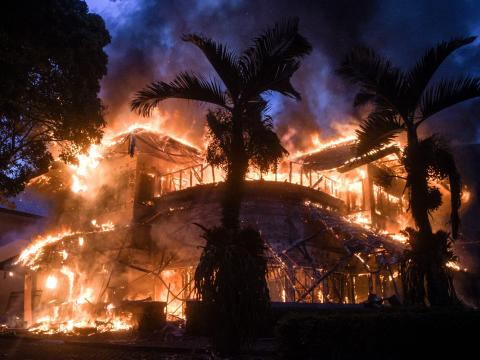
This is one of the reasons why thousands of proletarians in Morocco have been taking to the streets for over two weeks. There have been street battles in almost all cities, shops have been looted, police stations attacked and stormed, portraits of the king burnt, but also thousands of rebellious proletarians have been arrested and tortured, the police are firing live ammunition into the crowd, there are reports of several deaths; in one case a teenager was run over by a police car…
However, it is important to emphasize once again that this is happening simultaneously in several countries all over the world.
On the so-called Generation Z and reformist demands
As in the case of Indonesia, as well as in Nepal, there is talk that it is the so-called “Generation Z” that is currently revolting. We wipe our asses with these absolutely meaningless typifications and categorizations of people, or the so-called characteristics that are imposed on each so-called “generation”.
Even if rebellious and insurgent proletarians are currently adopting these terms for themselves – which once again shows how effective the indoctrination and ideologies of the ruling class are – the majority of the exploited prefer to see themselves in terms of national, subcultural, identitarian, or other identities, and therefore they think in terms of such categories/ideologies. But rarely they think about themselves as what they always are: human beings who are robbed of their lives and the products they produce in the process of creating surplus value (i.e., profit), in order to have to pursue this activity (exploitation) over and over again, because otherwise we would starve, because we have nothing else but the labor power we sell, because we are proletarians. We strictly reject this, because it only serves to distract from the consequences and causes of capitalism (the sole reason for poverty, war, and the destruction of the world and all species living on it). Identities, identitarian categories, etc. are supposed to explain a society that is in reality divided into classes in a completely empty and meaningless way, by shifting the focus away from the irreconcilable antagonism between the classes to other focal points. The conflict is to be explained as one between generations (which are supposed to have certain characteristics) and not between classes. We can only understand society through the conditions imposed and enforced by capitalism, and not through speculations whether this or that generation has or had more or less access to technology, or whatever the difference may be. And these conditions are not only global, but connect all people on the planet and abolish any form of identity (national, for example). The ruling class (the bourgeoisie) wages a daily class war to protect its interests, its position of power, and its property (the means of production), so why shouldn’t those who suffer from it also wage a class war to finally put an end to it all?
Therefore, whether the term is appropriate or not, the rebels and insurgents in Indonesia, Nepal, Morocco or elsewhere are not members of this or that generation. This categorization is intended to deprive them of their ability to act due to the capitalist conditions imposed on them, to prevent them from becoming aware of themselves and realizing that they are exploited, that they are proletarians, and THUS to prevent them from struggling against the prevailing conditions. Because they no longer want to be proletarians. Because the goal is not to become bourgeois themselves, but to abolish once and for all the causes of poverty and wealth (which can only be understood as material conditions of capitalism, both of which exist only because they are conditions of each other). What we can see once again is that all these uprisings are expressions of the negation of our own conditions of survival. Failing to clearly define all these people as proletarians inevitably leads to caricaturing them and emptying their practice of its genuine content.
As we can see […], the demands that are known, and which can never and will never speak for a movement, are reformist in nature. Here we are again faced with several problems and events. As anarchists, we have no demands on the Nation-State, capitalism, and all their institutions except their immediate abolition, but this is neither a demand in the sense of a reform nor in the form of a request. The Nation-State, capitalism, etc., will not abolish themselves.
An uprising is not only a break in social peace, but can be the trigger that turns all prevailing capitalist conditions upside down, namely social revolution. This does not necessarily have to happen, but an extremely important process is taking place at this moment; the proletariat is no longer a class in itself, but a class for itself, which means that through the experience of its own practice, it can become aware of its ability to abolish capitalism and all Nation-States, and that it alone can do so.
Nevertheless, uprisings are rarely monolithic eruptions; there will always be forces and elements that want to control, lead, and direct them. Making demands in the name of the insurgent movement would be a classic example, as would trade unions/syndicates wanting to place themselves at the head of the proletariat using the same tactics, because their task is to represent it and negotiate on its behalf. No matter how radical or even revolutionary the demands may sound, the movement is automatically caught in a trap, because only it alone can articulate its own interests without an intermediary or mediation. But let’s stick with the examples of representation for a little longer. Whether trade unions/syndicates, Marxist-Leninist vanguards/parties, anarchist organizations that crown themselves saviors of the “people”, parties of all stripes – it doesn’t really matter what tendency/current within the (radical) left we’re talking about, because they all fulfill the same function – they understand social change in terms of representing the proletariat, which, in their view, MUST be led; it cannot break its own chains or be the architect of its own liberation. The same applies, of course, to all nationalist, religious fundamentalist groups/organizations, even if their goals may be different; they too can only achieve them through representation. Making demands in the name of the proletariat not only means that the latter cannot have any consciousness, that it must be led, but also that, ultimately, the interests and demands of all organizations are the same as those of the proletariat. That is why they all compete with and against each other. This happens every day, but it comes to a head in uprisings. The (radical) left wing of capital is part of the parties of order; it does not seek the destruction of capital, but its management. Which in the end always means domestication, integration, psychologization, pathologization, infantilization, sociologization, and numbing of all proletarians.
The task of all anarchists who are serious about the goal of a classless society and the abolition of the State is to denounce these parties of order for what they are: i.e. prophets of order and forces of counterrevolution. Any attempt at political representation (which is the task of all parties, unions/syndicates, etc.) must be directly attacked.
We have often seen in insurrectionary situations how in these uncontrollable situations the parties and forces of order repeatedly try to extinguish the fire of uprising, like firefighters. It illustrates one thing above all: they control the insurrectionary movement, which means that they are automatically seen as interlocutors by the ruling class and negotiations (for reforms, for example) can take place. We see the same thing in strikes.
A very good example of that was the revolt in Chile in 2019. When an uprising reaches a certain limit, e.g., having to spread internationally, this contradiction is resolved, or the movement is stifled at this point, and reformist and counterrevolutionary forces capitalize on this hopeless situation. They will praise the democracy (the government should live up to democracy, whatever that means) and they will call for democracy (all injustices in this world will be solved with more democracy). In the case of Chile, the uprising was stifled because the movement could no longer resolve certain contradictions: extending the uprising, taking over the means of production, destroying commodity society, in other words, starting a social revolution. The reformist and counterrevolutionary forces (i.e., the (radical) left wing of capital) shifted the focus of the uprising to the parliamentary level, to the danger of a growing right wing (once again conjuring up the specter of fascism), and then it was not only a matter of crushing the uprising, but also of moving it obediently from the streets to the ballot boxes for the next elections. This meant the final end of the uprising.
These are all questions that we must address very seriously, because defending the autonomy of the proletariat (the liberation of the proletariat can only be the act of the proletariat itself, ergo not of this or that vanguard party or union/syndicate) means supporting one’s own tools of liberation […], as well as constantly recreating self-organization according to one’s own needs and never giving up criticism of the false opposition of capital.
Committee for the Defense of the Insurrectionary Practice of the Proletariat (sometimes known as the Solidarity Group for Prisoners)
English translation: The Friends of the Class War / Die Freunde des Klassenkriegs
Source in German: https://panopticon.noblogs.org/post/2025/10/14/5569/
SOURCE: https://www.autistici.org/tridnivalka/some-thoughts-on-the-role-of-uprisings-in-our-time/



Comments
Good piece, max jazz hands.
Good piece, max jazz hands.
the majority of the…
Never quite sure how these voices on high looking in get into the mind of the "majority" of the proletariat, the insurgents in mortal battle with their mortal enemy?
Yes, it is essential that communists recognise the real movement going on under our noses, but let's leave it at that and not criticise the so-called limitations of our movement.
In case the comrades have forgotten, the movement in Chile was not an isolated sporadic event but constituted one part of a chain reaction of insurgency that was encompassing the globe—until the fierce reaction of 2020. Let us not forget the lesson of the Manifesto that the working class, 'the proletariat must first of all acquire political supremacy, must rise to be the leading class of the nation, must constitute itself the nation, it is so far, itself national, though not in the bourgeois sense of the word.'