Articles and/or issues from the Industrial Worker, the newspaper of the revolutionary union, the Industrial Workers of the World (IWW).

Articles from the January/February 2015 issue of the Industrial Worker, the newspaper of the revolutionary union, the Industrial Workers of the World (IWW).
Contents include:
-Anti-Police Brutality Protest Shakes Things Up At The Mall Of America By X378436
-Strange Encounters: World Meeting Of Popular Movements In Vatican City By Monika Vykoukal
-Windsor Wobblies Build Street Solidarity By X353319
-Introducing The 2015-2016 Industrial Worker Co-Editors
-The Centennial Commemoration Of Joe Hill by Elmore Y, x359525
-Imagining An IWW Branch In Accra by Brad Laird, x374826
-Wobblies Keep Up The Fight In Scotland By FW Keith, West of Scotland Regional Organiser
-Oklahoma IWW Solidarity With Students
-“Red November, Black November” A Success! by Twin Cities GMB
-Nurses Strike Against Ebola Readiness by John Kalwaic
-Austerity, Tax Deals, And Massive Protests In Belgium By Alexis Merlaud
-Railroad Workers United To Co-Sponsor Railroad Conference
-Rapid Progress Being Made With Prisoner Organizing
-Rest In Peace: Mathematician And Ecological Activist, Alexander Grothendieck (1928-2014)
-Review: Doing History from the Bottom Up: On E.P. Thompson, Howard Zinn, and Rebuilding the Labor Movement from Below. by Staughton Lynd
-The F-Word: Why Feminism Matters
-Reasons Why I Admire Upton Sinclair by Raymond Solomon
-Crime And Punishment by Bomani Shakul
-CNT-f Congress Vows To Continue Struggle Against Austerity By Monika Vykoukal
Attachments
Comments

An account by x378436 of an illegal rally at the Mall of America in Bloomington, Minnesota.
On Saturday, Dec. 20, 2014, a protest organized by Black Lives Matter Minneapolis aiming to shut down the Mall of America took place. The demonstration was part of the ongoing movement against police brutality and structural racism in police departments nationwide. Thousands of protesters crowded into the rotunda of the largest shopping mall in North America with banners proclaiming solidarity with Ferguson and “black lives matter.” Chants of “Hands up, don't shoot!” and “No justice, no peace, no racist police!” echoed through the mall and sometimes got loud enough to shake the windows. Protesters who showed up a little late were greeted by members of the Bloomington Police Department dressed in head-to-toe riot gear and plainclothes mall security guards. Several members of the Twin Cities IWW were present and a few were arrested when they tried to break through these police lines set up to block protesters’ access to the rotunda and the other half of the mall. An entire section of the mall was entirely shut down, with all the shops closed. Many food court workers walked off their jobs and stood with their hands up while still wearing their Auntie Anne’s Pretzels or Dairy Queen uniforms. Employees at the animal-friendly cosmetics shop, Lush, stood outside their store with their hands up in solidarity with the protesters. Many employees who were trapped inside their shops by the barricades that mall security guards set up stood by the shop windows looking out at the protests and raised their fists in support.
For a few hours, the Mall of America was partially shut down and the people who worked there seemed totally fine with it, and even supportive in some cases. Whether or not food court workers who abandoned their posts and joined the protest could be called a “wildcat strike” is up for debate, but it certainly speaks volumes that this is an issue that resonates with so many. It resonates enough with people that they are willing to refuse to work and instead take action against a white supremacist police state. Previous Black Lives Matter demonstrations in the Minneapolis-St. Paul area have linked the Service Employee International Union’s (SEIU’s) Fight for 15 and Fast Food Forward campaigns with the movement against police violence. McDonald’s workers, still in their uniforms, blocked highways and led chants of “Hands up, don’t shoot.” Some of them participated in die-ins on the highway or in the middle of busy intersections. The fact that many people of color who experience the brunt of police violence also make up a considerable amount of those who work at low-wage fast food and service jobs speaks volumes about the white supremacist capitalist system that we find ourselves living in today. It is the hope of this Wobbly and many others within the general antipolice movement gaining traction that we can link direct action against bosses who exploit us for our labor and pay us menial compensation with direct action against a State which uses violence to enforce a white supremacist and patriarchal social order.
Actions like “Hands Up Don’t Ship” (a symbolic protest by rank-and-file workers at the United Parcel Service [UPS] hub in Minneapolis in which workers refused to ship packages from Law Enforcement Targets Inc.) and these spontaneous walkouts by food court workers at the Mall of America are just the beginning of what is hopefully a new movement: a movement which can begin to combat both the mistreatment at the hands of the employing class and the mistreatment at the hands of the police; a movement that can bring working-class people together regardless of race, gender, or sexual orientation and fight for its emancipation. The Twitter personality “@zellie,” who has been extremely active in reporting what has been going on in Ferguson and also in New York in response to the murders of Mike Brown and Eric Garner, said “If you ever wondered what you would be doing in the Civil Rights Movement, now is the time to find out.” Let us all find out together. In the face of such blatant disregard for the lives of people of color in this nation by the police, inaction on our part is complacence.
The labor movement of the 21st century cannot avoid the presence of white supremacy or patriarchy in our society. It must combat them as well as combat capitalism. Then and only then will we begin to see a much less miserable world, one in which all of us will be free to carve out our own destinies free from the confines of wage labor, patriarchal subjugation, and white supremacist marginalization. Wobblies of the world, let’s get to work!
Originally appeared in the Industrial Worker (January/February 2015)
Comments
As a partial update:
Mall of America worker trespassed from job after Black Lives Matter protest
http://tcorganizer.com/2015/04/21/mall-of-america-worker-trespassed-from-job-after-black-lives-matter-protest/

A great, short article by Liberté Locke demonstrating the differing experiences one can have at work, based on issues of identity.
Being a woman means knowing mostly women will actually read this column.
As a woman who works in retail, I am making next-to-nothing for serving everyone.
I have always worked with my hands. I have used them to care of other people’s children. I have used them to clean bachelor pads while men I don’t know watch television and occasionally look me up and down when I know that this will not be a reoccurring gig. When men stay home to watch the housekeeper they hired from Craigslist for next-to-nothing, they were hoping to get more than their money’s worth to watch a disenfranchised broke woman clean for them. I’ve been asked why I was wearing so much, asked how much I weigh, asked why anyone would hire me “looking like that.”
I’ve been called every insult, been “offered” paid and unpaid sex work from complete strangers while selling them cups of coffee for barely over the minimum wage. And I have considered it.
I know touching a man’s hand while giving him change makes for a 75 percent chance I’ll get a tip. I know laughing when he asks if I’m on the menu means not being called “bitch.” I’m called “bitch” often.
Being a large woman means that thin rich New York white ladies will almost always change their drink orders after looking me up and down to non-fat, nowhip, and sugar-free.
Being an injured woman worker wearing wrist braces on both hands while making drinks at neck-breaking speeds means undoubtedly that the few people that feign concern mostly want to waste my time telling me how I don’t take care of myself, how losing weight will help my arms. They will make every assumption about me, my class, my life, and assume I somehow did this to myself and not capitalism.
Being a big, injured, openly-queer woman, exhausted, overworked, underpaid, almost bottom-rung worker at a major corporate chain means that I’m on display constantly—for every judgment and every critique. Being confident means customers go out of their way to break me down because shit rolls downhill and their jobs suck too, but differently. Very differently.
I know being a woman organizer is breaking down from all the misogyny I experience daily, the ableism, the homophobia, the transphobia (from openly supporting and loving trans people, and admitting to being a bit fagboi myself), being truly working class—born and bred—that male organizers will hear all that as counter-revolutionary complaining or “identity politics” for those with the time to be all academic about my reality. One such even said I wasted his time with it. Same such said I needed “tougher skin” for this work, meaning unionizing.
Being an injured queer fast food working woman who has always made her money through physical labor and knows homelessness, and knows need, and feels compassion for others’ struggles...I know that means that I embody toughness; even through my tears, and even through my breakdowns. Even through my struggle with daily misogyny, fatphobia, homophobia and ableism, I keep on keeping on. I realize that I can defend my emotional state until I’ve lost my voice and broken my own heart but that true allies, true comrades, true Wobblies would never ask me to do such a thing.
I’m still fighting, I’m still breathing, and that’s in spite of the haters and people who misunderstand me. This life ain’t easy, and it ain’t over. And I’m not giving up.
“Marginalized Workers’ Voices” is a new column for women, gender minorities, and any LGBTQ+ Fellow Worker. It’s for Wobblies of color, workers with disabilities, and any other marginalized voice of the One Big Union. If you’d like to contribute, please send your article to iw[at]iww.org with the subject line “Marginalized Workers’ Voices.”
Originally appeared in the Industrial Worker (January/February 2015)
Comments

A brief article by Monika Vykoukal about her attendance to the CNT-F's 33rd Confederal Congress in December 2014. Originally appeared in the Industrial Worker (January/February 2015).
The IWW was invited to attend the 33rd Confederal Congress of Confédération Nationale du Travail – France (CNTf) in Angers, France, this last December. This three-day delegate meeting takes place every two years. This year around 60 sections were represented. Since I live in Paris, I was able to attend the congress on the Friday afternoon and evening and Saturday morning, Dec. 12 and Dec. 13, 2014—the part of the meeting that covered reports from officers, but I was only present for the beginning of discussions onother items.
Of the over 30 motions submitted by the CNT-f’s sections, several proposed working more closely with other radical unions, political groups and international labor networks, including the French section of the Confederación Nacionaldel Trabajo – Asociación Internacionalde los Trabajadores (CNT-AIT), the International Workers Association (IWA)internationally, the Red and Black Coordination and the IWW.
The context for both was given as the weakness of the Left in France, the creeping growth of the far-right, and the lack of a strong movement against attacks on workers’ rights and social provisions of all kinds. Based on an update I received since, no formal decision was made on those items, but I, for one, personally, would look forward to more cooperationand exchange with the CNT-f and other radical unions in Europe.
The congress passed the following statement:
In the face of austerity, the criminalization of social movements, and the extreme right, the CNT keeps up the fight!
The Confédération nationale du travail held its 33rd confederal congress in Anger, on 12, 13, and 14 December. In a fraternal atmosphere, the numerous sections present could engage in rich discussions on the processes, direction, strategy and development of the structures of the confederation in the coming two years, as well as elect a new confederal team. A new federation of work, employment and professional training will be created, as well as a confederal training institute.
The participation and the contributions of comrades from foreign organizations close to the CNT, such as the German FAU[Freie Arbeiterinnen- und Arbeiter-Union], the Swedish SAC [SverigesArbetares Centralorganisation] and the Algerian CLA [Conseil des Lycéesd’Algérie], was also an opportunity to reaffirm our solidarity and links with workers in struggle against the capitalist system across the whole world.
In a politically and socially difficult situation, dominated by austerity policies, the rise of the far-right and a weakened social and labor movement, which has to face ever stronger violence from the State as well as bosses, the CNT stands more than ever for self-organization and the communist and libertarian social transformation of our society.
The CNT invites all those who can identify with our struggle and our practice, to join us or to contact our sections, to expand our struggle against capitalist oppression.
For class struggle, self-organization,international solidarity and the emancipation of workers: the CNT, a fightingunion!
The CNT
The above statement was translated by Monika Vykoukal, who attended the Congress on behalf of the IWW. More information can be found at http://www.cnt-f.org.
Comments

The March 2015 issue of the Industrial Worker, the newspaper of the revolutionary union, the Industrial Workers of the World (IWW).
Contents include:
-Fired Hospitality Workers Fight Back With The London IWW by the London IWW
-Montreal Wobblies Participate In Disruptive Action At Canada Post by IWW Montreal
-IWW Toronto Harm Reduction Workers Win Pay For Fired Organizer by THRWU
-Why Incarcerated Workers Should Join The IWW by Sean Swain
-Addressing Some Common Objections To The Black Lives Matter Movement by Patrick O'Donohue
-IWW Tackling Wage Theft In London by Jerome Baxter
-Wobblies Help Spread Berry Boycott by x331980
-Wobs Support Striking Refinery Workers by x331980
-Trans-Atlantic Workers Focus On Same Company by FW Bill B
-Portrait Of Penny Pixler, Feminist And Wobbly by Patrick Murfin
-International (Working) Women’s Day by IWW Gender Equity Committee
-The Story of Pearl McGill by Mike Kuhlenbeck
-The Two Troublemaking Idas by Jane LaTour
-Review by Staughton Lynd of American Reckoning: The Vietnam War and Our National Identity.
Attachments
Industrial Worker (March 2015).pdf
(2.36 MB)
Comments

The April 2015 issue of the Industrial Worker, the newspaper of the revolutionary union, the Industrial Workers of the World (IWW).
Contents include:
-Liverpool IWW Demonstrates For Precarious Workers by Liverpool IWW
-Syndicalist Union Protests Migrant Worker Exploitation In Berlin by André Eisenstein
-Welsh Wobbly Facing Deportation by Cymru IWW Wales
-Unlock The Power Of Metrics To Build Effective Organization by Daniel Gross
-Aim High, Fellow Workers! by Colt D. Thundercat
-IWW Organizes First Unionized Bike Shop In D.C. by District Bicycle Workers’ Union
-FairPoint Strike Finally Comes To An End by John Kalwaic
-The Joe Hill Centenary Takes To The Road by Norman Stockwell and George Mann
-IWW Montreal Occupies Government Buildings To Protest Austerity by IWW Montreal
-Regarding Fraternity Culture And Racism In Oklahoma by Kristin Fleming, Oklahoma IWW
-Minimum Wage And Democracy by Jonathan P. Chenjeri
-Killers Of Fellow Worker Frank Teruggi Sentenced In Chile by x331980
-Did Commies Kill Wobblies During The Spanish Civil War? by Raymond S. Solomon
-Labor/Union Challenges In Taiwan: A Delegate’s Perspective by David Temple of the Taiwan IWW
-Building Ties With Comrades in Mexico by x379809
Attachments
Industrial Worker (April 2015).pdf
(2.95 MB)
Comments

A short account of a protest outside a job centre in Liverpool.
Members of Liverpool IWW joined around a dozen activists, including people from the benefits advice group Reclaim, outside West Derby job centre on Eaton Road this lunchtime. This was part of a national day of action in solidarity with Scottish Unemployed Workers Network activist Tony Cox. Tony was arrested on 29th January after Arbroath job centre management called police to stop him representing a vulnerable jobseeker. We protested to drive home the message that ‘advocacy is not a crime’, and aiming to build towards smashing sanctions against unemployed workers.
The G4S ‘security guards’ immediately called the cops when we showed up with our leaflets, placards and banners, which was pretty easy as the police station is right next door! A group of quite a few police went into the job centre and spoke to G4S employees for some time, before coming out and telling us they had no problem with us protesting (neither could they, it’s supposed to be our right!), but asking us to remove our banners from the job centre wall. We refused, as the job centre is funded by tax payers – i.e. all of us – so should be considered public property. The cops didn’t want to push it, and they went back to their station.
Perhaps one reason for their decision to leave us in peace was the fact that the demo was getting MASSIVE public support. Not only were job centre users (if anyone actually ‘uses’ a job centre these days) pleased to get info on their rights, but there was an absolute racket from the number of people passing in cars beeping their horns and shouting their support. Clearly, we’ve now reached a stage where large numbers of working class people are very aware of the horrific damage done by the government’s sanctions regime, and are glad to see people fighting back.
We will be organising more with our friends in Reclaim over the next few months, as we aim to build resistance amongst the most precarious sections of the local working class.
Originally posted: February 25, 2015 at Liverpool IWW
Republished in the Industrial Worker (April 2015)
Comments

Evidently, a construction site is nothing for wet blankets. But besides the hard physical work, exploitation and inhuman treatment of migrant workers from the European Union (EU) seems to be the current practice on many German construction sites. What is new now is that cheated workers are fighting back! In the autumn of 2014, Polish colleagues found support from the Freie Arbeiterinnenund Arbeiter-Union (FAU) Freiburg. By the end of the year and continuing into 2015, Romanian workers—unionized with the FAU since November 2014—are fighting for unpaid wages totaling in 60,000 euros ($67,000).
From July until mid-October 2014, the comrades worked in the center of Germany’s capital to construct the “Mall of Berlin.” For constructing this shopping and apartment complex, which opened solemnly (despite unfinished construction sites and defects in fire safety) at Potsdamer Platz in autumn 2014, hundreds of workers from Romania slaved away for 10 hours a day and received only 6 euros per hour (or approximately $6). Due to problems with the pay and a lack of promised accommodation, workers staged protests and crossed their arms. Finally, in hope for betterment, the workers switched from one subcontractor (Openmallmaster) to another (Metatec). In the end, none of the two subcontractors even paid the agreed-upon wage completely, which—being below the industry’s minimum wage of 11.15 euros ($11.92) per hour—is illegally low.
“They didn’t only not pay our wages,” a comrade explained, “several times, we were treated arbitrarily and menaced (with violence, too). They did withhold written contracts from us, and they gave us no or completely rotten accommodations.” Another comrade stated: “I had two goals when staging the protest: first, I wanted to fight for our dignity and, secondly, for the money.”
“The first goal, we already achieved,” he added.
Before joining FAU Berlin, the comrades had already gone to the publiclyfunded counseling office for posted workers sent to Berlin, situated in the house of the Deutsche Gewerkschaftsbund (German Confederation of Trade Unions, or DGB). The DGB has confirmed the mounting number of workers from Romania and Bulgaria seeking counseling, as does the intercultural association Amaro Foro. Therefore, the comrades’ cases might be considered symptomatic of the increased exploitation and cheating inflicted on workers from EU countries who are hired for the lowest possible wages and, then, are not even fully paid. Still, legal advice and written claims’ assertions do not adequately replace union action.
The latter has been provided quickly and resolutely by FAU Berlin, particularly by its section for migrant workers called the Foreigners Section, as well as by a dedicated FAU working group. Right before Christmas 2014, by means of daily rallies and a noisy demonstration of some 300 people, the grassroots union and its new comrades made the “Mall of Shame” (as they call it), a symbol for the exploitation of migrant workers. By the end of January 2015 a Brandenburg newspaper stated it was “a subject of reporting of all Berlin press.” They’ve been wholeheartedly supported by FAU members from all over the country.
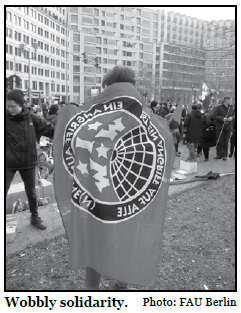
In the meantime, the bosses try to avoid their responsibility and take distance from one another. Customerinvestor Harald Huth (HGHI) told the press: “We have nothing to do with these workers. This is an issue for FCL [Fettchenhauer Controlling & Logistic], which we’ve paid completely for all provided services.” But the executing FCL declared bankruptcy by mid-December, which neither hinders ex-general manager Andreas Fettchenhauer to be continually active in the construction industry with half a dozen other companies nor attempts to silence FAU Berlin by the legal means of a temporary injunction. In the meantime, the subcontractors’ representatives declared they “have never employed Romanian workers” (Metatec) and that they had not gotten any money from FCL (Openmallmaster). The first assertion is refuted by so called “renunciations” that some individual workers signed in order to get at least part of their wages. The latter assertion is vehemently refuted by Fettchenhauer himself. And despite Huth’s claim in mid-December to have broken with Fettchenhauer, an “FCL Fettchenhauer Construction GmbH” is right now working briskly on the renovation site of a new shopping center in Berlin-Lichterfelde—a project of Huth’ian HGHI.
As for FAU Berlin, the union continues its protests in 2015, by leafleting, for example, or hold a rally at the subcontractors’ offices. Additionally, the grassroots union supported its comrades in filing lawsuits against the subcontractors. And the FAU continues to fight back against the use of “temporary injunction” and the restrictions of union liberty. So, this struggle will remain thrilling.
For more up-to-date information, visit https://berlin.fau.org/kaempfe/mall-ofshame. Follow the campaign on Facebook: https://www.facebook.com/mallofshame.
Originally appeared in the Industrial Worker (April 2015)
Attachments
Comments

An article by Colt Thundercat on the problem of 'idling' in a workplace organizing campaign.
I’m writing this to talk about an important issue that I’ve seen crop up in many IWW campaigns, including my own: that of “idling.” This is one of the most disheartening and destructive feelings that seems to happen pretty frequently. Our campaigns seem stuck at a certain low level, where we put a lot of effort into achieving small gains on the shop floor, often successfully, but it never seems to grow the committee or build the campaign. Unsurprisingly, it leads to a massive amount of burnout and to campaigns slowly and depressingly sputtering out.
To me, it seems like one of the core issues at play here is a backwards view of how escalation works and how we get co-workers to join our campaigns and the union. When I say backwards, what I mean is that we wait to escalate until we see our committees grow to a certain level, always tackling low-level shop-floor issues and never expanding beyond a certain work area to a broader level. While we are often successful at improving the quality of our and our co-workers’ lives at work, it rarely seems to build people’s involvement. Unfortunately, I’ve seen more than a few campaigns “idle” under this conservative interpretation of escalation.
I believe one of the reasons that this happens is because Wobblies and our non- IWW co-workers tend to view these types of gains in a very different manner. We often have a tendency to view such things as political and important in a way that our co-workers—even those who participate in shop floor actions—do not. In my own campaign, where we spent a solid year in this phase, we would engage in small marches on the boss, slowdowns, and other actions around various shop-floor grievances. While we viewed these actions as vital union activity, our co-workers tended to view them as “That time we told our supervisor to turn on the fans because it was too hot” or “That time we said ‘fuck it’ and worked slow for a few days.” It was something they were happy to do, but not all that significant.
We need to get out of this pattern of idling if we’re going to grow as a fighting workers’ organization. In our campaign the way we’ve done this is to turn this view of escalation on its head. Instead of waiting until we are a certain size in order to escalate, we have taken a tack of using a particular goal in order to push our organizing to the next level. To me, the key component of this plan is summed up in two words: aim high.
It was aiming high that pushed us to take on the action that most of the IWW, the labor Left, and many of our co-workers, now know us for. After the Ferguson uprising started, about a dozen of us working at the United Parcel Service (UPS) sorting hub here refused to handle cargo from a company making racist shooting range targets for the police in Missouri and elsewhere in an action called “Hands Up, Don’t Ship.” At the time, the action made little sense from the conventional view of escalation: we had only two committee members in the large shop, far fewer than what it would take to pull anything of any significance off. Moreover, it seemed like there was almost no hope of any reasonable success.
And that is almost precisely why it worked. What started as a random shot in the dark caught on quickly. The other organizer and I knew we needed our coworkers’ participation to do it, and so we pushed ourselves to sell the idea to them. We kicked into overdrive and chatted with many of them about the idea and found massive support despite the nearly non-existent expectation of success. As it turned out, the thing that pushed folks to be involved had little to do with whether or not they thought it would succeed, but rather that it was a fight for which they were passionate and with which they had a personal connection. Against all odds, we succeeded and the company rerouted all of their shipments to a different facility for fear of disruptions.
Right now, we’ve gone one further, initiating a campaign to fight for a $5 wage increase at all of the Twin Cities’ locations of our company. It’s the type of struggle everyone knows will take a lot of people to get done. I think that’s exactly why the reaction to it has been so positive. We obtained nearly 100 workers’ signatures on our petition in a two-day period. The petition itself allowed us to follow up with our co-workers who signed it and see what level of engagement they are interested in having with the campaign.
Instead of waiting to take on the issues that our co-workers are more deeply passionate about until they’re already on board, we need to take on fights that will excite them to the point of being active and interested in the IWW. Yes, we need to take care not to overextend ourselves and get people fired. We need to be smart about our actions and make sure our coworkers are on board with any plans we make—and, importantly, that we’re open to modifying them with the help of our coworkers as they get involved. Even when we fail, we often find ourselves better off for it due to bosses making concessions that we couldn’t have won before. More importantly, we end up with many more of our co-workers excited about the prospect of future fights. We shouldn’t be afraid of aiming high and talking big. That big picture is what’s going to get people excited, and excitement is the fuel that propels our campaigns forward.
Originally appeared in the Industrial Worker (April 2015)
Comments

In February 2015, two former Chilean military intelligence officers were convicted of the murder of IWW member Teruggi and another American, Charles Horman. Teruggi and Horman were kidnapped, tortured and murdered during the military coup in Chile in 1973.
Frank Teruggi, an IWW member from Chicago and a native of Des Plaines, Ill., was kidnapped, tortured and murdered during the military coup in Chile in 1973. On Feb. 4, 2015 two Chilean military intelligence officers were convicted of the murder of Fellow Worker (FW) Teruggi and another American, Charles Horman. Brigadier General Pedro Espinoza was sentenced to seven years in the killings of both men. Rafael González, who worked for Chilean Air Force Intelligence as a “civilian counterintelligence agent,” was sentenced to two years in the Horman murder only. Espinoza is currently serving multiple sentences for other human rights crimes as well. A third indicted man, U.S. Naval Captain Ray Davis, head of the U.S. Military Group at the U.S. Embassy in Santiago at the time of the coup, has since died.
Teruggi, 24, and Horman, 31, had gone to Chile to see and experience the new socialist government of President Salvador Allende. FW Terrugi participated in protest marches in Santiago following the unsuccessful June 1973 military attempt referred to as the “Tanquetazo” or “Tancazo.” FBI documents show that the agency monitored him, labeling him a “subversive” due to his anti-Vietnam war activities, and participation in assisting draft evaders. FBI files also list his street address in Santiago. Chilean soldiers later dragged him out of this house when he was arrested.
Judge Jorge Zepeda’s ruling stated that the murders of Horman and Teruggi were part of “a secret U.S. information gathering operation carried out by the U.S. Military Group in Chile on the political activities of American citizens in the United States and in Chile.” Sergio Corvalán, a human rights lawyer working for the Horman and Teruggi families on the case, told reporter Pascale Bonnefoy of the New York Times that he felt the ruling confirmed what the families had long believed— that Chilean military officers would not have acted against them on their own. They must have had an “OK” from U.S. Officials.
The families of Teruggi and Horman were awarded a cash settlement. Under Chilean law, a mandated appeal process must occur before final action is taken. Janis Teruggi Page, Frank Teruggi’s sister, told Costa Rica’s The Tico Times:
“Joyce Horman [Charles Horman’s widow] and I still have an appeals process to get through, which may last six more months. Page said that she and Horman would like the U.S. government to look into these killings more thoroughly. “We are now asking the U.S. Navy, the State Department and the CIA to investigate on the basis of the information (in Judge Zepeda’s ruling) pointing to U.S. officials, especially Captain Ray Davis.”
Documentation published by Peter Kornbluh in his book “The Pinochet File: A Declassified Dossier on Atrocity and Accountability” confirms that Frank and his roommate, David Hathaway, were taken from their home at 9 p.m. on Sept. 20, questioned at a nearby Carabineros station and then delivered to the national stadium, which had become a holding tank, torture chamber and execution site for thousands of activists and others simply caught up in the frenzy of coup. Hathaway survived the ordeal. Chilean journalist Pascale Bonnefoy Miralles, who has covered the Teruggi case for a number of years, in her book “Terrorismo de Estadio,” quotes a Belgian named André Van Lancker, also tortured in the stadium. Van Lancker was told by other detainees that they saw Frank Teruggi during an interrogation in the stadium. He was beaten and tortured with electric shocks, then killed by a machine gun. The torturers realized they had gone “too far,” she reports, and were afraid of having problems with the U.S. government, so they kept Frank’s name off the lists of prisoners. His body was later left in a public street, where it was discovered the following day, Sept. 21, just after 9 p.m., and brought to the morgue.
For days, the Teruggi family did not know what had happened to their son. Steve Brown who covered the story extensively for the Daily Herald Suburban newspapers in Chicago, remembers interviewing FW Teruggi’s father, Frank Teruggi, Sr., who was trying to get more information and help from the U.S. government:
“He was disturbed. . . that there wasn’t more attention being given to this thing (by the Nixon administration).” This should not have been a surprise, however, as just before the coup against the Allende government, National Security Advisor Henry Kissinger declared “I don’t see why we need to stand by and watch a country go communist due to the irresponsibility of its people. The issues are much too important for the Chilean voters to be left to decide for themselves.”
This month’s sentencing followed a ruling last June by Judge Zepeda that found that Teruggi and Horman, in separate incidents, had been killed by Chilean military officials based on information provided to them by U.S. intelligence operatives in Chile. Judge Zepeda’s investigation, which began in 2000, asserted that the targeted killings were part of “a secret United States information-gathering operation carried out by the U.S. MILGROUP in Chile on the political activities of American citizens in the United States and in Chile.”
A report published in September 2000 by the U.S. Intelligence Community report affirmed that the CIA “actively supported the military Junta after the overthrow of Allende.” But, in spite of this admission, much of the specifics of the U.S. role remain obscured.
“After 14 years of investigation, the Chilean courts have provided new details on how and why Charles Horman and Frank Teruggi were targeted and executed by Pinochet’s forces,” said Peter Kornbluh. “But legal evidence and the verdict of history remain elusive on the furtive U.S. role in the aftermath of the military coup.”
Kornbluh is a senior analyst at the National Security Archive, an independent non-governmental research institute and library located at George Washington University in Washington, D.C., that has been collecting and analyzing documents about the U.S. role in the Chilean coup since the mid-1980s. In June 2000, they released electronic documents (http://www2.gwu.edu/~nsarchiv/NSAEBB/NSAEBB33/index.html) relating to the deaths of Teruggi and Horman. These documents and others were part of the evidence reviewed by Judge Zepeda.
In 2011, Zepeda, a Chilean special investigative judge, indicted and attempted to extradite former U.S. Navy Captain Ray Davis. Davis, it was later discovered, had left the United States in 2011 and was living secretly in Chile, where he died at the age of 88 in a nursing home in April 2013—before he could be located by authorities. His death leaves many questions unanswered.
The 1982 film “Missing” portrays Ray Davis (called “Capt. Ray Tower” in the movie) and other U.S. Embassy officials as being much more involved in the coup and its aftermath than the U.S. public was aware. In an attempt to gain more understanding of what had happened to his son, Frank Teruggi, Sr. joined a delegation that traveled to Chile from Feb. 16-23, 1974. The group, called the Chicago Commission of Inquiry into the Status of Human Rights in Chile, stated in its report (excerpted and printed in the New York Review of Books on May 30, 1974): “The Embassy of the United States seems to have made no serious efforts to protect the American citizens present in Chile during and after the military takeover.”
The importance of Judge Zepeda’s ruling, and the fact that it clearly indicts a U.S. official for having a role in these deaths, may help to move the investigations forward, but the full extent of involvement by the U.S. government in these events may never be known. After the sentences were announced in February, Frank Teruggi’s sister, Janis Teruggi Page, told journalist Pascale Bonnefoy in the New York Times, “Frank, a charitable and peace-loving young man, was the victim of a calculated crime by the Chilean military, but the question of U.S. complicity remains yet to be answered.”
Frank Randall Teruggi was buried in a cemetery in Des Plaines, Ill.. According to newspaper reports at the time, more than 100 friends and family members attended, and the late South African exiled activist poet Dennis Brutus wrote this poem for the occasion:
FOR FRANK TERUGGI
(Killed in Chile, Buried in Chicago)
A simple rose
a single candle
a black coffin
a few mourners
weeping;
for the unsung brave
who sing in the dark
who defy the colonels
and who know
a new world stirs.
More about Teruggi, and Horman and the story of their murders can be found at http://www.progressive.org/news/2014/09/187856/other-911-seeking-truth-about-frank-teruggi and http://www.hormantruth.org/ht/ bio_teruggi.
With excerpts from the Associated Press and internet files.
Originally appeared in the Industrial Worker (April 2015)
Attachments
Comments
What about this remarkable statement from the all-powerful, infinitely wise and all-knowing Henry Kissinger?
[/quote] National Security Advisor Henry Kissinger declared “I don’t see why we need to stand by and watch a country go communist due to the irresponsibility of its people. The issues are much too important for the Chilean voters to be left to decide for themselves.” [/quote]
Chile of course wasn't "going communist" at all, just State Capitalist. But the idea that communism arises as a result of people's "irresponsibility" is amusing, as is the notion that communism might ever be the product of a democratic election procedure bourgeois style.

An article by Raymond S. Solomon about Stalinist repression during the Spanish Civil War.
In September 1938, Wobbly Ivan Silverman and “two unidentified Wobblies” were “forced by commies onto a bare field to face fascist machine guns [in] Spain.” This history was cited by Fellow Worker DJ Alperovitz in a Nov. 2013 article in the Industrial Worker that lists murdered Wobblies from 1907 until the present time. The article was titled “In November Who Do We Remember?” (page 6-7). In the right hand column, or sidebar, of this massive listing were small reproductions of parts of newspaper stories involving a large number of these Wobbly deaths. These terrible incidents include Wobblies being shot by thugs, killed by the Ku Klux Klan, dying in Soviet Russia’s Gulag Archipelago, and beaten to death by various company guards. In the bottom righthand corner is a clipping from the Sept. 10, 1938 edition of the Industrial Worker with the headline “IVAN SILVERMAN, TWO OTHERS KILLED IN SPAIN.”
This is typical of a lesser-known aspect of the Spanish Civil War (1936 to 1939)—that is the struggle within the Loyalist side between the communists on one side and the left-wing parties and the anarchists on the other. It was a civil war within a civil war. The communists wanted the Spanish Revolution of workers and peasants stopped or slowed down. It did not want the Spanish Loyalist cause to be seen as a radical cause.
Some of the most consistent reporting on this was in the periodical Spanish Revolution. It was put out by the Vanguard Group, an anarchist youth group, but it had guidance and support from Wobblies, some of whom were integral to the Vanguard Group. These people included Herbert Mahler, Carlo Tresca, Sam Dolgoff (who often wrote under the pen name Sam Weiner) Roman Weinrebe, and Clara Freedman (my mother), who was both an anarchist and a member of the Industrial Workers of the World. My father Sidney Solomon (who wrote under the name S. Morrison) was very involved in both the publication of Vanguard and of Spanish Revolution. He was very sympathetic with the Wobblies. I am therefore going to summarize the reports in Spanish Revolution that cover this conflict within the Loyalist side of The Spanish Civil War. I appreciate the fact that the website libcom.org has made back issues of Spanish Revolution available on the internet. I am going to intersperse this with other sources including the Industrial Worker, George Orwell, Spartacus Educational, and Wikipedia. I have cited Spanish Revolution in “History of Workers’ Revolution In Catalonia” (May 2014 Industrial Worker, page 14). Please keep in mind that Spanish Revolution was monthly and twice monthly, and that communication technology at the time was not what it is now, so there will be some time-lags between the dates of events and their reporting in Spanish Revolution:
The Feb. 8, 1936 issue of Spanish Revolution reported that French communist Andre Marty (1886 - 1956) was a commander in the International Brigade. During the Russian Civil War he led a mutiny on a ship bringing men and arms to fight against the Russian revolution. This was part of an article about the International Brigades, noting their multinational make-up (Spanish Revolution, Vol. 1. No. 11). Wikipedia reported that Marty was quite autocratic and “saw fifth columnists everywhere.” In contrast to this, George Orwell, in “Homage to Catalonia,” reported that while serving in the Partido Obrero de Unificación Marxista (POUM) militia, dissent was greatly tolerated. At that time he expressed agreement with the communist view that the war came before the revolution, which was in contrast to the POUM and anarchist view that the war and the revolution were the same. He changed his views after the May Day conflict of 1937 (see below).
In two items on the front page of Spanish Revolution of March 12, 1937, (Vol. 1, No. 13), the New York Vanguard group joined in and reported on the anarchist defense of the Spanish POUM. The articles were titled “ANARCHISTS AGAINST P.O.U.M. PERSERCUTIONS” and “STOP PARTY STRIFE ANARCHISTS DEMAND.” The Spanish POUM was a Leninist but anti-Stalinist organization. In part, the POUM was an offshoot from the Trotskyites, and was therefore hated by the communists. The above mentioned articles called for an end to the persecution of the POUM and for disseminating lies about it—such as the POUM being agents of Hitler and Mussolini. It also vehemently denied that the anarchists shared the communist view about the POUM, as was claimed by the Communist Party of Spain. The editors of Spanish Revolution pointed out that since the anarchists had sacrificed their ideological purity to form a coalition with other parties in the cause of fighting against fascism, there should not be internal party strife, as manifested by the communist campaign against the POUM.
The essence of the communist demands was that the revolution should be postponed, that collectivization of factories and agricultural land not proceed, and that the defense of Loyalist Spain be changed from the militia system and replaced by a centralized “disciplined” military. One revolutionary response to that appeared in the Feb. 16, 1937 issue of the anarchist publication, Solidaridad Obreva: “Unified command? Yes; but under the control of the proletarian organization.” The communists wanted, in contrast, a government-controlled military. Meanwhile, the Soviet Union directed that the arms it supplied should not go to the Aragon Front, which had many anarchists and POUM troops.
But the plot thickens, and the threat to the revolution increases, as shown in the April 9, 1937 dated edition of Spanish Revolution (Vol.1, No. 15). One headline was titled “TOWARDS A POLITICAL CRISIS IN CATALONIA” (Ibid p. 2). It seems that there was a Stalinist-bourgeois block against the advancement of revolution. In “Homage to Catalonia,” George Orwell summarized the new internal alignment on the Loyalist side as:
1.The anarchists: the POUM and Prime Minister Largo Caballero’s leftwing segment of the socialists within the Unión General de Trabajadores (UGT) were for the revolution; versus
2.The communists: President Manuel Azana’s Republican Party and conservative elements of the socialists (typified by Juan Negrin) against going full speed ahead with the economic and social revolution.
Two popular jokes of that period were, “If you’re too conservative to join the Republican Party, you can always join the Communist Party.” Also, “Save Spain from Marxism! Vote Communist!”
The publishers of Spanish Revolution wanted to explain, among other things, what was happening on the Loyalist side and why it was so important. There was a meeting held on April 4, 1937. The main speakers included Wobblies Carlo Tresca and Sam Weiner (a.k.a. Sam Dolgoff).
In late April, George Orwell was on temporary leave from the POUM militia, where he was fighting on the Aragon Front. As Orwell recorded in “Homage to Catalonia,” he wanted to transfer to the International Column (i.e. the International Brigade) where he felt there was more significant fighting. He needed a recommendation from a communist, and had sought out a communist friend. He sensed the tension. May Day 1937 was approaching. There was talk of the Confederación Nacional del Trabajo (CNT) and UGT marching together. In Catalonia, the past relationships between those two unions had not been good, in contrast to other areas in Spain. Orwell reported that due to this tension, the May Day parade was canceled in Barcelona. Orwell saw an irony in that Red Barcelona was the only major city in non-fascist Europe not to have a May Day parade.
Then, the Barcelona police and the communists demanded that the anarchists surrender the telephone exchange, which the anarchists had been running since the beginning of the Spanish Revolution. This led to a week of fighting with the police, with communists on one side and the anarchists and the POUM on the other side. Orwell was on the side of the anarchists. The fighting, which lasted from May 3-8 1937, was known as “The May Days.” One of the worst atrocities during the 1937 May Days was the murder of Italian anarchist Camillo Berneri by communists in Barcelona. Shortly after the May Days, Largo Caballero (“the Spanish Lenin”) was replaced by the more conservative Juan Negrin. As a result of the May Days, Orwell could not in good faith enlist in the International Brigade.
Orwell did go back to fight again in the POUM militia. During that time, Orwell was shot through his neck in battle. After recovery, he returned to Barcelona about five weeks after the May Days. The police and the communists were arresting POUM members, both Spaniards and foreign volunteers associated with the POUM. Orwell and his wife Eileen Blair escaped to France. Research by Michael Shelden, cited in his book “Orwell: The Authorized Biography,” shows that George Orwell (a.k.a. Eric Blair) and Eileen Blair were going to be arrested and publicly tried by the new communist-dominated government of Barcelona.
The Oct. 22, 1937, issue of Spanish Revolution (Vol. II, No.3, page 2) reported on the murder in Spain of Bob Smillie, a friend of George Orwell. Smillie had been arrested in the crackdown on the POUM and their Independent Labour Party allies. Although it was claimed that Smillie died of complications of an appendicitis operation, he had, in fact, had his appendix out in Britain. According to Spartacus Educational, Smillie had fought against Mosley’s British Union of Fascists.
The same issue of Spanish Revolution reported that General Enrique Lister, a Spanish communist who had received military training in the Soviet Union, despite being popular outside of Spain, was breaking up Spanish peasant collectives in Aragon and Catalonia.
Despite the fact that George Orwell bore witness to the Communist Party’s betrayal of the Spanish Revolution, including the murder and arrests of fellow POUM fighters, he asserted to the great merit of the communists who fought for Loyalist Spain. As Orwell wrote in “Homage to Catalonia,” “Please note that I am saying nothing against the rank-and-file communists, least of all against the thousands of communists who died heroically around Madrid.”
Ernest Hemingway said, “No men ever entered the earth more honorably than those who died in Spain.” These included, as Alperovitz cited, in the November 2013 Industrial Worker, an “Unknown numbers of IWWs…[who] died while fighting fascists while serving with the Republican forces in Spain” and specifically Lou Walsh, who “Died while fighting with the Catalonian Militia, Aragon front, Spain [on] June 16th, 1937.” And, as reported by Matt White in “IWW Members Who Fought in the Spanish Civil War” (Industrial Worker, November, 2013), at least five other Wobblies died in the conflict:
Heinrich Bortz, German anti-Nazi, whose battlefield death was recorded on the Oct. 23, 1937 issue of the Industrial Worker; Ted Dickinson, Wobbly from Australia, who was executed as a prisoner of war after being captured by Franco’s forces; Harry Owens, who fought in the forces of the Abraham Lincoln Battalion, and was killed in the middle of 1937; Louis Rosenberg, who, “According to his death notice from the CNT…was killed in action with the Durruti International Battalion.” He was killed together with an unknown anarchist from Pennsylvania; Harry Schlesinger was killed in the latter part of 1938, when the war was almost lost, while serving in the Lincoln Battalion.
To learn more about the above five heroes, and other Wobblies killed in the Spanish Civil War read Matt White’s most excellent article in the November 2013 Industrial Worker.
Many of the veterans of the Lincoln Battalion and the George Washington Battalion were treated very poorly when they returned to America. Many were accused of disloyalty. Some were called before Congressional Committees during the McCarthy era. A large number were blacklisted. Many could not get adequate medical care for serious wounds acquired during the Spanish Civil War. Leading Wobbly organizer Elizabeth Gurley Flynn said they were discriminated against for “being prematurely antifascist.”
Originally appeared in the Industrial Worker (April 2015)
Attachments
Comments
This article asks a question which it fails adequately to answer. According to Sam Dolgoff in his book Fragments, the anarchist IWW sailor Harry F. Owens was deliberately put in the most dangerous positions in the frontline by the Stalinists in the Lincoln Brigade. , resulting in his death. This was a tactic that had been originally developed by the Bolsheviks within the Red Army to have anarchists and other revolutionaries eliminated.
this article mentions Owens but fails to mention his suspicious death.
Industrial Worker was wrong about the death of Heinrich Bortz
Born in Stettin May 14, 1913,Activist of the anarcho-syndicalist organization FAUD, Heinrich Bortz was active in the 1930s in the naval branch of the IWW in Stettin. During the seizure of power by the Nazis, he was interned in a camp from which he managed to escape and to gain Denmark and Sweden.
In September 1936 he arrived in Barcelona and enlisted as a militiaman in the International Company of the Durruti column until April 1937. He was responsible notably with Mathias Stephanis, Anton Boening, Ernst Fallen and Dirk Rabbelier a Committee Work Committee to prepare meetings and edit newsletters . He was also responsible for the German-language radio section (half an hour daily news) of the Company. In April 1937, after leaving the front without authorization, it was then excluded from the DAS (German Anarcho-syndicalists)for selling a gun belonging to the group. He then went to Belgium.
Arrested during the war, in 1942 he entered the service of the Gestapo as an informerr and was responsible for surveillance of the German anarcho-syndicalists in exile in Sweden.
Battlescarred, I would encourage you to write a letter to the IW about this. The email for the editors is iw[at]iww.org
Spain was actually something I spoke to members of the Vanguard group about. The most interesting stuff was from Sam on the IWW volunteers ... less so from Abe, Clara or Sidney. Sam spoke of the problem in the IWW where the folks in NY were in cooperation with the CNT but Thompson with the Stalinists. So when people where asking about volunteering in Spain, he was sending them in his direction. There was some letter from a wobbly once about how he unwittingly wound up with the Stalinists (but sorry, cannot remember the details, it was ages ago). In any case, what I find important in the whole thing is that those who saw all the volunteer international brigades as the "same thing" or in the "same struggle" were not taking many important thing into account. As a result, people were used as fodder and the question should be not only did commies kill wobbliies, but did wobblies help commies kill anarchists?
I don't see any direct evidence of this, but as we know, Stalinists did kill anarchists. It seems that some of the international brigade people were truly clueless about the extent of the anti-anarchist and anti-POUM operations going on, carried out by the agents of the NKWD and German Communist Party. However, if anybody has actually read any publications of international brigades, it s really hard to understand how lights did not go off.
As we know, in May 1937, the US representative of the Comintern spent hours addressing members of the Lincoln Brigade on how anarchists and Trotskyists were fascist agents. Edwin Rolfe, who edited "Volunteer for Liberty" called for anarchists and Trotskyists to be crushed.
Those who did not follow the Comintern's Popular Front line were to be destroyed. The Butcher of Albacete, Marty, had brigaders whose eyes were opened executed or "re-educated". Non-party brigaders were controlled by the SIM. The executions, however, did not seem to fall often on Americans since they were more interested in those who had had previous contact with "Trotskyist-fascist elements" and these were the ones from Europe. However, some suggest that there was some unofficial executions and some people just disappeared. I remember seeing that only 3 Americans were officially executed.
So, for me this article begs deeper questions. The first is about how the uncritical legacy of some international brigades are formed and another is why wobblies were used as the pawns of the Comintern in the first place.
I read this many years ago.and it had an impact on me. I don't know how the author is now viewed
https://www.akpress.org/jumpingtheline.html
Sleeper: I have William Herrick's Jumping the Line too. I had never seen it mentioned before finding references on line. The Abraham Lincoln Veteran's group (graduates of the stalinist International Brigades) and other CPUSA groups tried to get it hushed up - protests, etc. I don't think Herrick's politics are the same as found on libcom, but interesting book.

The May 2015 issue of the Industrial Worker, the newspaper of the revolutionary union, the Industrial Workers of the World (IWW).
Contents include:
-Harvard workers got the cold shoulder this winter by Geoffrey P. Carens
-May Day: remembering our past, looking toward the future by Staughton Lynd
-NYC IWW: Beverage Plus, pay up!
-Camp counselors of the world unite! by Walter Beck
-The AFL-CIO organizing workshop: a new mask on an old face by FW Martin
-Getting your second five-year card by Brandon Oliver
-Remaking the IWW: broadening our scope and deepening our roots by Martin Zehr
-Review by Staughton Lynd of Elizabeth Gurley Flynn: Modern American Revolutionary
Review by Matt Meister of What Did You Learn At Work Today? The Forbidden Lessons of Labor Education
Review by Roger Karny of The 42nd Parallel / 1919 / The Big Money
-Carl Sandburg, the worker's poet by Steve Thornton
-Looking back at the Vietnam War: building a new anti-war movement by Andy Piascik
Attachments
Industrial Worker (May 2015).pdf
(3.95 MB)
Comments

The June 2015 issue of the Industrial Worker, the newspaper of the revolutionary union, the Industrial Workers of the World (IWW).
Contents include:
-#ResistenciaMovistar: A Strike Of This Century In Spain by Javier Lázaro Sanz, Member of the Confederación General del Trabajo (CGT)
-IWW Statement On Baltimore Uprising And Police Repression
-Amtrak Wreck Could Have Been Prevented by Railroad Workers United (RWU)
-Blood On The Shop Floor by Anonymous
-Whore And Housemaid By Madeira Darlin
-Wobblies Train In The Twin Ports by x372712
-Ein Angriff auf eineN, ist ein Angriff auf alle!
-For A Revolutionary Movement In Education by FW db
-IWW Demonstrates Against Austerity in Montreal
-Wobblies Reclaim May Day In Chicago
-Boston Wobs March All Over Town by Geoff Carens
-Atlanta IWW: Fighting Racism, Connecting Struggles by Jeremy Galloway
-Review by Staughton Lynd of People Power: The Community Organizing Tradition of Saul Alinsky
-Class Bigotry At Washington University In St. Louis: A Resignation by Chris Pepus
Attachments
Industrial Worker (June 2015).pdf
(2.52 MB)
Comments

A description by Javier Lázaro Sanz of a strike at Spanish telecomunications giant Telefónica Movistar. Appeared in the Industrial Worker (June 2015).
One of the main worries we’ve had in the radical labor movement lately is proving (to ourselves in the first place) that the 19th century invention of the labor movement is a thing of the 21st century. Of course, we’ve had to learn the internet. We do social networks, memes, hashtags, and, occasionally, trending topics. It’s taken a lot of effort to master new technologies, but we are now cybernetic, multimedia-oriented, electronic, interconnected, and even cyberpunk if necessary. However, the real challenge of adapting to these mutable, fast-paced times is still there. Apart from many new gadgets (useful gadgets, useless gadgets, hyped up gadgets, gadgets that become obsolete in one week, gadgets that change our whole perception of the world around us), the last decades have brought with them a new capitalism and new forms of working-class oppression. Some things remain: there’s still work to be done, and there’s still a working class that is doing the work while capitalists take the benefits and leave us only the crumbs. (In a world where few things are left unchanged, the fact that some old-fashioned truths are still in place would be rather soothing… if we weren’t talking about exploitation, of course).
Having this in mind, unions should still be useful and necessary in order to fight against social injustice. The question is whether we can adapt to the new economy and its changes. The factory is no longer the place where most of us work; labor laws deteriorate before our eyes as capitalists demand a more flexible workforce (and we wonder how workers could possibly increase their flexibility as they’re already bending over backwards); companies become corporations that become multinational conglomerates; globalization and the growth of the tertiary sector of the economy (the most mobile sector) make relocation of businesses easier than ever, making national labor legislation meaningless in many cases; and outsourcing is becoming more and more ubiquitous. In this context, precariousness is the main obstacle to effective workers’ organization. Many workers feel that strikes are a thing of the past. How can they even think of it? If they went on a strike they’d lose their jobs in no time.
The solution is not easy, but perhaps it’s one of those few reassuring things that haven’t changed so much. The unity of the working class is essential, like it has always been. You’re a precarious worker, and your job is at risk if you strike. But still your job has to be done, and if your boss can’t find a strikebreaker to do it in your place, he has to sit down with you and negotiate. That’s not really new: we’ve always had a problem with scabs, haven’t we?
Let this long introduction serve as an explanation of the importance of something that’s going on in Spain. Something that’s long overdue. For many years we’ve been hearing, “I wish I could fight for my working conditions, but I’m in a precarious situation. If I go on strike, my boss will kick me out.” Among the precarious workers, perhaps the most precarious are the freelancers, those who depend on a company to give them work but don’t have a labor contract with that company, leaving them without the few guarantees that laws still provide other workers. Well, now it is precisely those vulnerable workers who have gone on strike, and they’ve done so against one of the biggest companies in Spain—a company that’s iconic of the new economy: the formerly state-owned telecommunications giant Telefónica Movistar.
The strike by Telefónica’s subcontracted and freelance technicians began in Madrid on March 28, and it quickly spread to the rest of Spain. Reasons for this strike had been building up since the privatization of the company. As outsourcing increased, so did precariousness, and working conditions have been worsening every day. At the same time that the company was in a period of expansion and reaping huge benefits, labor costs had to decrease constantly to please its owners. Since workers directly hired by Telefónica still have some protection, subcontracted workers were the perfect targets for the “necessary” cuts. The strikers organized, as it was decided, horizontally in workers’ assemblies. It is the workers themselves who were running the show.
The big, institutional, bureaucratic unions have had nothing to do with the real mobilization. They called for a make-believe, partial strike in order to try to interfere with the real strike. They engaged in negotiations with the company even though they didn’t have the strikers’ consent. Finally, they reached an agreement (not approved by the workers either) and called off their puny strike. Mass media has silenced the strike even as breakdowns in phone lines proliferated all over the country… and then those same media outlets informed of the illegitimate agreement and the “end” of the strike.
Unions such as the one to which I belong, those that really believe in the struggle of the working class, have supported the strike in many ways. We have given legal coverage to the mobilization by calling officially for a statewide strike. We’ve tried to make the conflict visible (for example, by using the internet and social networks, which is where the hashtag in the title of this article, #ResistenciaMovistar, comes from). We’ve helped raise funds for the workers and their families (this is a very important aspect, as the strike has already lasted for more than a month). We’ve never tried to lead the mobilization; we’ve never wanted to, but also the strikers wouldn’t have let us do it. This strike belongs to them.
Workers’ solidarity has also had a huge importance since the beginning. Thousands have helped raise the funds needed to keep the strike alive. Also, in a turn that’s great news for those who believe in the unity of the working class, workers directly conracted by Telefónica who had been asked to take on tasks that the subcontracted workers used to do, not only refused to do so, but also have denounced the company’s attempt to interfere with the strike.
As of this writing on May 7, the Tele-fónica Movistar contractors, subcontractors and freelance workers’ strike continues. Let’s hope it does so until all their demands are satisfied. For the future of the labor movement: PRECARIOUS WORKERS OF THE WORLD, UNITE! Long live the #ResistenciaMovistar!
Comments

The July/August 2015 issue of the Industrial Worker, the newspaper of the revolutionary union, the Industrial Workers of the World (IWW).
Contents include:
-Incarcerated Workers’ Uprising In Nebraska by FW Chadrick, x385061
-Kansas City IWW Member Released From Prison by Hedy Harden
-Reflections On the Steelworkers’ Strike In Texas by Adelita Kahlo
-Building Workers’ Power In The United Kingdom by New Syndicalist
-Dockworkers Protest Police Brutality by John Kalwaic
-Farewell Fellow Worker Doug Smith by x331980
-Minimum Wage Laws Bring Opportunities For Direct Action by Chelsea
-Review by Brandon Oliver of The Blue Eagle at Work: Reclaiming Democratic Rights in the American Workplace
-Review by Juan Conatz of Always on Strike: Frank Little and the Western Wobblies
-Review by Staughton Lynd of The Wobblies in their Heyday: The Rise and Destruction of the Industrial Workers of the World during the World War I Era
-Review by Greg Giorgio of Udita (Arise)
-Review by Patrick McGuire of Socialist and Labor Songs: An International Revolutionary Songbook
-“Joe Hill 100 Roadshow” East Coast Leg Kicks Off On July 23 In D.C.
-In Spain, Movistar “Total Strike” Is A Social Struggle By CGT Catalunya
-New Austerity Measures To “Liberate” French Workers From Regulations by Monika Vykoukal
-Syndicalists Organize And Win In Berlin!
Attachments
Industrial Worker (July August 2015).pdf
(3.05 MB)
Comments

An article from CGT Catalunya of a strike at Spanish telecomunications giant Telefónica Movistar. Appeared in the Industrial Worker (July/August 2015).
(Editor's note: This article discusses the strike of subcontracted and freelance technicians working for telecommunications giant Telefónica’s Movistar, which began in Madrid on March 28. For background on this strike, see “#ResistenciaMovistar: A Strike Of This Century In Spain” on page 1 of the June Industrial Worker).
“We must favor understanding and collaboration. Not only workers are involved in this conflict. Also, there are collectives interested in creating tension and making it difficult to reach a solution.” – Felip Puig, Counselor for Enterprise and Employment of the Generalitat de Catalunya
The Movistar strike is interesting in many ways. We could look at the joint action of thousands of freelancers and subcontracted workers, the surprising organization in the beginning (based, literally, on thousands of isolated individuals acting together through smartphone messaging systems in order to make information flow instantly) or the fact that the major institutional unions were overwhelmed by the workers.
We could also talk about the company’s many complaints about sabotage or about the thousands of breakdowns that accumulated over time, causing many problems to clients and businesses.
However, we prefer to focus on the concept of “total strike” as opposed to other strikes that are only labor strikes and are closed in on themselves; strikes that don’t go out of the limits of the company, like the eight-month strike at Panrico; strikes with determination but with the handbrake on.
Everyone has witnessed how this is an active strike with a growing presence of workers in the street. Social support has been extending progressively, adding pressure along with the strike itself, which culminated in the last 10 days of May. Paradoxically, when the strike’s following was at its lowest, the company was under the most pressure.
Other territories have looked at what was happening in Catalonia with healthy jealousy at first, then as a spearhead for their own aspirations.
Why has the strike been stronger in Catalonia?
We’ll overlook the cohesion and internal organization of the strike. One thing we could point out is the intelligent use of existing resources in order to deal with the predictable attrition. Sparse objectives were set aside in favor of specific targets where we could hit harder.
However, what made this strike different in Catalonia was the socialization of the conflict. If we look back to strikes that we can remember, they’ll probably have one thing in common: the participation of the common people.
Complying with our own agreements in the Confederación General del Trabajo (CGT), on the first day of the strike we initiated contact with social movements along with strikers. A few days after, a large number of organizations were present at the union’s premises and agreed on the relevance of this strike and the need to join efforts.
Solidarity fundraising events multiplied, up to tens in a week. Money was never enough, but it allowed workers to keep the struggle up without resources. A credit line of €120,000 (or approximately $135,187 [USD]) was set up by Coop57, a credit co-op, in order to advance what would be collected afterwards.
Conferences about the conflict fulfilled the goal of making the strike better known by the general population, promoting awareness and thus preparing the people for participation. Movistar has tried to make the strike invisible through a powerful campaign, which involved the “free press” in the hands of capitalists. This front has been attacked by local events and coordinated work in the social media.
The first demonstration took place on April 20 in Barcelona. After that, almost every action that took place in the streets had some reference to the Movistar conflict. There have been many coordinated occupations and demonstrations in Movistar shops in many locations. These actions have grown in frequency. In the last two weeks, the company knew an action of this kind could take place in any city at any moment. Attacks came from all possible flanks.
Occupations at the Mobile World Centre
Social movements participated in the labor conflict and taught strikers their methods. The first occupation of the Movistar store at Plaza Cataluña (Barcelona) in the Mobile World Centre (MWC), a worldwide mobile technology congress, took place thanks to coordination by strikers and people in solidarity with them. A milestone was achieved since, for the first time, the company showed signs of weakness. An agreement was reached that the occupiers would leave the store and the company committed itself to negotiating with the strikers. Unfortunately it was a trick, since once the strikers left the store, the company returned to its previous inflexible position. This deceit angered protesters and encouraged solidarity.
The fact that some political parties have shown support for this strike since the middle of May is a symptom of the social relevance it has achieved.
Following the motto “one eviction, another occupation,” strikers and those in solidarity with them did what seemed impossible: despite the security measures, which had been reinforced due to the MWC, they occupied the store again in order to hit the company where it hurts. This took place on May 23, the day before the local elections.
The following week witnessed the outbreak of solidarity in the city and the rest of Catalonia. It seemed like a labor 15M (a protest movement similar to the Occupy movement in the United States) had begun: there were actions every day; there was a constant movement of people acting in solidarity; there were many organizations supporting the strike; there were occupations; and there were demonstrations taking place in Movistar stores all over the territory. It became impossible for mass media to hide these facts. Economic losses reached €75,000 ($84,510 [USD]) each day in the MWC store, added to the invaluable damage done to the image of Movistar.
We must take note of many aspects of this strike: is it possible to unite precarious and atomized collectives in order to fight against powerful machineries specialized in destroying workers’ rights? Do the big institutional unions always have the key to the conflicts in places where they have a majority of representatives?
These questions were answered clearly at a state-wide level. Now we want to stress what made the struggle more powerful in Catalonia than it was in other territories: making solidarity from society work actively in a labor conflict.
Transcribed by Juan Conatz
Comments

A review by Staughton Lynd of Eric Chester’s book The Wobblies in their heyday. Originally appeared in Industrial Worker (July/August 2015).
The Wobblies are back. Many young radicals find the Industrial Workers of the World (IWW) the most congenial available platform on which to stand in trying to change the world.
This effort has been handicapped by the lack of a hard-headed history of the IWW in its initial incarnation, from 1905 to just after World War I. The existing literature, for example Franklin Rosemont’s splendid book on Joe Hill, is strong on movement culture and atmosphere. It is weak on why the organization went to pieces in the early 1920s.
Eric Chester’s new book fills this gap. It is indispensable reading for Wobblies and labor historians.
One way to summarize what is between these covers is to say that Chester spells out three tragic mistakes made by the old IWW that the reinvented organization must do its best to avoid.
Macho Posturing
Labor organizing flourished during World War I because of the government’s need for a variety of raw materials. Among these were food, timber and copper. Wobbly organizers made dramatic headway in all three industries. At its peak in August 1917 the IWW had a membership of more than 150,000.
Nine months later, Chester writes, “the union was in total disarray, forced to devote most of its time and resources to raising funds for attorneys and bail bonds.” This sad state of affairs was, of course, partly the result of a calculated decision by the federal government to destroy the IWW. But only partly.
According to Chester, another cause of the government’s successful suppression of the Wobblies was that during and after the Wheatlands strike in California hop fields in 1913 some Wobblies threatened to “burn California’s agricultural fields if two leaders of the strike were not released from jail.”
For years, Wobbly leaders had insisted that sabotage could force employers to make concessions, Chester writes. But what Chester terms “nebulous calls for arson” and “macho bravado” only stiffened the determination of California authorities not to modify jail sentences for Wobbly leaders Richard Ford and Herman Suhr.
Chester finds that there is no credible evidence that any fields were, in fact, burned. But after the United States entered World War I in April 1917, this extravagant rhetoric calling for the destruction of crops apparently helped to convince President Woodrow Wilson to initiate a systematic and coordinated campaign to suppress the Wobblies.
Efforts to Avoid Repression by Discontinuing Discussion of the War and the Draft
International solidarity and militant opposition to war and the draft were central tenets of the IWW. Wobblies who had enrolled in the British Army were expelled from the union. At the union’s 10th general convention in November 1915, the delegates adopted a resolution calling for a “General Strike in all industries” should the United States enter the war.
What actually happened was that General Secretary-Treasurer Bill Haywood and a majority of IWW leaders agreed that the union should desist from any discussion of the war or the draft, in the vain hope that this policy would persuade the federal government to refrain from targeting the union for repression. At the same time, the great majority of rank-and-file members, with support of a few leaders such as Frank Little, insisted that the IWW should be at the forefront of the opposition to the war.
Self-evidently, what Chester terms the IWW’s “diffidence” was the very opposite of Eugene Debs’ defiant opposition to the war. When Wobbly activists “flooded IWW offices with requests for help and pleas for a collective response to the draft,” the usual response was that what to do was up to each individual member. Haywood, Chester writes, “consistently sought to steer the union away from any involvement in the draft resistance movement.”
Debs notwithstanding, however, the national leadership of the Socialist Party like the national leadership of the IWW “scrambled to avoid any confrontation with federal authorities.” Radical activists from both organizations formed ad hoc alliances cutting across organizational boundaries.
The IWW General Executive Board, meeting from June 29 to July 6, 1917, was unable to arrive at a decision about the war and conscription, and a committee including both Haywood and Frank Little, tasked to draft a statement, likewise failed to do so. In the end, Chester says, “the IWW sought to position itself as a purely economic organization concerned solely with short-run gains in wages and working conditions.”
Disunity Among IWW Prisoners Fostered by the Government
The reluctance of the Wobbly leadership to advocate resistance to the war and conscription carried over to a legalistic response when the government indicted IWW leaders. Haywood urged all those named in the indictment to surrender voluntarily and to waive any objection to being extradited to Chicago. In the mass trial that followed, the defendants were represented by a very good trial lawyer who was also an enthusiastic supporter of the war and passed up the opportunity to make a closing statement to the jury. Judge Kenesaw Mountain Landis’ superficial fairness deluded Wobs into hoping for a good outcome.
The jury took less than an hour to find all 100 defendants guilty of all counts in the indictment. Ninety-three received lengthy prison terms. Judge Landis ordered that they be imprisoned at the United States Penitentiary, Leavenworth, described by Chester as “a maximum-security penitentiary designed for hardened, violent criminals.” Forty-six more defendants were found guilty after another mass conspiracy trial in Sacramento, Calif.
Thereafter, Chester writes, the “process of granting a commutation of sentence was manipulated during the administration of Warren Harding to divide and demoralize IWW prisoners.” The ultimate result was “the disastrous split of 1924, leaving the union a shell of what it had been only seven years earlier.”
Executive clemency, like that granted to Debs, was the only hope of the Wobblies in prison for release before the end of their long sentences. President Warren G. Harding rejected any thought of a general amnesty, obliging each prisoner to fill out the form requesting amnesty as an individual. The application form for amnesty contained an implicit admission of guilt. The newly-created American Civil Liberties Union supported this process.
Twenty-four IWW prisoners opted to submit a form requesting amnesty. A substantial majority refused to plead for individual release. More than 70 issued a statement in which they insisted that “all are innocent and all must receive the same consideration.” The government insisted on a case-by-case approach. Fifty-two prisoners responded that they refused to accept the president’s division of the Sacramento prisoners, still alleged to have burned fields, from the Chicago prisoners. Moreover they considered it a “base act” to “sign individual applications and leave the Attorney General’s office to select which of our number should remain in prison and which should go free.”
Initially, the IWW supported those prisoners who refused to seek their freedom individually. Those who had submitted personal requests for presidential clemency were expelled from the union.
In June 1923, the government once again dangled before desperate men the prospect of release, now available for those individual prisoners promising to remain “law-abiding and loyal to the Government.” This time a substantial majority of the remaining prisoners accepted Harding’s offer, and IWW headquarters, in what Chester calls “a sweeping reversal,” gave its approval.
Eleven men at Leavenworth declined this latest government inducement. In addition, those who were tried in California did not receive the same offer.
In December 1923 the remaining IWW prisoners at Leavenworth including 22 who had been convicted in Sacramento, Calif., were released unconditionally. The damage had been done. Those who had held out the longest launched a campaign within the IWW to expel those who had supported a form of conditional release. There were accusations against anyone who had allegedly proved himself “a scab and a rat.” When a convention was held in 1924 both sides claimed the headquarters office and went to court. An organization consisting of the few hundred members who had supported the consistent rejection of all government offers “faded into oblivion by 1931.”
Conclusion
It is not the intent of brother Chester’s book, or of this review, to trash the IWW. This review has dealt with only about half of the material in the book, for example passing by the story of Wobbly organizing in copper, both in Butte, Mont. and Bisbee, Ariz. Moreover, anyone who lived through the disintegration of Students for a Democratic Society, Student Nonviolent Coordinating Committee and the Black Panthers is familiar with tragedies like those described here. The heroism of members of all three groups who were martyrs, such as Frank Little, Fred Hampton, and the Mississippi Three (James Earl Chaney, Andrew Goodman, and Michael “Mickey” Schwerner), remains. The vision of a qualitatively different society, as the Zapatistas say “un otro mundo,” remains also.
What it seems to me we must soberly consider is what practices we can adopt to forestall disintegration when different members of a group make different choices. Hardened secular radicals though we may be, we can learn something from King Lear’s words to his daughter Cordelia: “When you ask me blessing, I’ll kneel down and ask of you forgiveness.”
Transcribed by Juan Conatz
Comments

A review by Juan Conatz of Always on Strike: Frank Little and the Western Wobblies.
Stead, Arnold. Always on Strike: Frank Little and the Western Wobblies. Chicago: Haymarket Books, 2014. Paperback, 220 pages, $16.
Reviewed by Juan Conatz
Among the list of legendary figures of the historical Industrial Workers of the World (IWW), Frank Little stands out as one of its most tragic figures. Although known more than some others, such as Vincent St. John, Matilda Rabinowitz or Frank Cedervall, he didn’t leave behind a cultural legacy like fellow martyr Joe Hill. Nor did he live long enough to write a memoir, like Ralph Chaplin. We remember Little mostly as a victim; a victim of wartime hysteria and anti-union violence. Secondarily, we might remember him for being biracial, the son of a white Quaker husband and Cherokee wife. But his activities as a member and organizer for the IWW are mostly little known.
“Always on Strike: Frank Little and the Western Wobblies” by Arnold Stead aims to change this. Published by the International Socialist Organization-affiliated Haymarket Books, it is the only book-length work on Frank Little. Although relatively short, it does offer some information that is hard to find elsewhere.
Overall a sympathetic account of both Little and the Wobblies, much of the book covers territory previously incorporated in other histories of the IWW. The IWW’s efforts in the Western United States, its mixed opposition to World War I, and the repression it faced during the first Red Scare, are all given ample room.
The author also concerns himself with refuting certain myths about the IWW. Whether from hostile historians, foaming- at-the-mouth-press, or friendly, if condescending, writers, Stead defends the union, its Western sections in particular, from a number of slurs, assumptions of motivation and unhelpful categorizations.
The best part of “Always on Strike” is the information and summary of the nearly forgotten 1913 ore workers strike in Northern Minnesota. Mostly crowded out, for some reason, by the failed 1916 Mesabi Range strike, I had personally never heard of the event. The author acknowledges the strike’s almost ignored status:
In 1913, Frank Little led an ore dockworkers strike that has been all but ignored by history. Even historians of the IWW like Philip S. Foner, Joseph R. Conlin, and Patrick Renshaw make no mention of the 1913 conflict; nor does Big Bill Haywood’s autobiography. Melvyn Dubofsky briefly mentions Little being kidnapped and rescued but does not deal with the strike’s contribution to a major labor offensive in the northern Minnesota, Wisconsin, and Michigan mining area.
There are also some useful accounts of the Agricultural Workers Organization (AWO). The AWO was a hugely important part of the IWW around that period and was arguably its most successful attempt at sustainable organizing. It changed the way the union used delegates and took in dues. It apparently abandoned the prevailing pacifism in the organization in favor of militant self-defense, and brought conflict in the union over what “industrial unionism” meant, or if it was actually important at all. Despite this, there are currently no book-length treatments of the AWO. Most histories that partially focus on the AWO are brief and a bit superficial, so the author’s inclusion of it as a topic is valuable.
Little was vehemently anti-war, and the descriptions of the IWW’s wrangling over whether to oppose and how to oppose World War I are interesting. There are a number of authors, even ones friendly to the IWW like Staughton Lynd and Eric Chester, who have claimed that the IWW did not oppose World War I. This is not true. It passed resolutions against the war and published material that was anti-war and anti-nationalist in nature. The IWW did formally oppose World War I, but never came to an agreement on what it meant to oppose it. There were mixed opinions on this, ranging from “do nothing, wait for the storm to blow over” to “actively oppose and disrupt conscription.” There were Wobblies that participated in antiwar or anti-conscription coalitions and other bodies that encouraged buying war bonds and enlisting.
Despite rejecting some common myths about the IWW, “Always on Strike” nevertheless accepts other myths itself. For example, making the same mistake as many other historians who focus on syndicalism or the IWW, the author matter-of-factly relates the vision and outlook of the early IWW back to French intellectual George Sorel. In reality, there is little evidence that Sorel had even a negligible influence. To the extent that French syndicalism had an influence, people like Confédération générale du travail (CGT) militant Emilie Pouget had a far greater impact. Pouget’s writings were translated, published and distributed in the IWW. He is mentioned dozens of times in the Industrial Worker. Sorel, on the other hand, receives only a passing mention in the same series in the Industrial Worker about French syndicalism. None of his writings seemed to have been translated, published or distributed in the union. As far as I could find, only one article focused on his ideas ever appeared in the IWW press, and not until 1919, a full decade after this influence was supposed to have occurred on the formative IWW. Concepts such as the revolutionary general strike and the “militant minority,” which some historians and writers claim the IWW adopted from Sorel, already existed as concepts and terms within French syndicalism years prior to Sorel writing about them. Furthermore, these terms were used by syndicalists that Wobblies would have been far more familiar with than Sorel.
Why is this important? Well, Sorel’s writings on violence and myth making, his move to the nationalist Right and his influence on fascism have been used in the past to tar syndicalism or revolutionary unionism by association. Other authors have demonstrated how Sorel’s supposed influence on syndicalism was an exaggeration made by early, lazy historians and then repeated over time. Apparently, such is the case with Sorel and the IWW, as well.
Another shortcoming of “Always on Strike” is that there are large parts of the book where the author assumes Little is at an event, such as a strike or a free speech fight. Sometimes the evidence provided for these assumptions is convincing. Other times it is not. The author also, occasionally, “imagines” what Little would say about a situation or event. Maybe Stead felt this was necessary because there is very little information on Little’s activities. While this reason is understandable, it should have been avoided. It is one thing putting words in someone’s mouth based on you knowing and collaborating with them, such as Friedrich Engels finishing the works of Karl Marx. It is another thing altogether when, 100 years after a person’s death, a historian does this in a biography. While well intentioned, it would have been preferable to stick to the evidence, even if that meant shortening the book to pamphlet-length. For an author rightly concerned about inaccurate historical myths, he very well could be creating them by these assumptions and imagined statements.
Lastly, it would be a disservice to readers of the Industrial Worker not to mention the background of the author, Arnold Stead. During the early 1970s in Kansas City, around the time Students For A Democratic Society met its demise and the Weather Underground was established, Stead and some others were arrested and charged in a bomb making case. Stead cooperated with authorities. Although he now claims he was tricked and later went back on his testimony, people spent hard time in prison because of his cooperation. Whatever we may feel about the “urban guerrilla” groups of the 1970s, it is simply reprehensible to cooperate with authorities and send fellow radicals off to the dungeons of the state. While the book is appreciated, our martyrs deserve better historians, better admirers, and better people than Arnold Stead to keep their story alive.
Originally appeared in Industrial Worker (July/August 2015)
Comments
My favorite agit-prop films of all time is Travis Wilkerson's An Injury to One, about the murder of Frank Little. Amazing piece of work, worth checking out if you've not seen it.
https://youtu.be/Dl6546VIPk0
While I appreciate the following at the end of your review, "Lastly, it would be a disservice to readers of the Industrial Worker not to mention the background of the author, Arnold Stead. During the early 1970s in Kansas City, around the time Students For A Democratic Society met its demise and the Weather Underground was established, Stead and some others were arrested and charged in a bomb making case. Stead cooperated with authorities. Although he now claims he was tricked and later went back on his testimony, people spent hard time in prison because of his cooperation. Whatever we may feel about the “urban guerrilla” groups of the 1970s, it is simply reprehensible to cooperate with authorities and send fellow radicals off to the dungeons of the state. While the book is appreciated, our martyrs deserve better historians, better admirers, and better people than Arnold Stead to keep their story alive." I have to respond.
1) Stead was not tricked into anything. Even if he did not understand the deal he was making, which he did (he explained it to me when I visited him in the Jackson County, Missouri jail in the summer of 1970), it was re-explained to him numerous time by others. He knew what he was doing.
2) As I told you before Stead never changed or renounced his testimony. He did stop testifying for a bit while he worked out another deal to cover him in state court cases in Kansas (which he learned existed when I and others were actually charged with state charges in addition to federal charges). He had simply never given thought to the fact that in addition to protection from federal charges, he might need protection also from state charges. As soon as he made the deal with the state folks, he resumed testifying in several state trials (including two of mine), and in the federal trial against all of us.
Finally, you must ask yourself, and only you can answer, if you have put money in the pocket of this guy and legitimized his work and himself simply by reviewing his book.
Again, I do appreciate your final words (though I think they belong at the beginning). I just hope people read that far.
Guardian article about Frank Little, cites this book and mentions one to be published by his niece.
https://www.theguardian.com/us-news/2016/sep/21/mysterious-lynching-of-frank-little-equality-activist

A brief article describing the German anarcho-syndicalist union, the FAU's 39th Congress. Originally appeared in the Industrial Worker July/August 2015.
In this month’s column we focus on some news from Germany. In May, the 39th congress of the Freie ArbeiterInnen-Union (FAU), the German syndicalists Free Workers Union, took place in Berlin. The delegates shared their current struggles and campaigns and discussed the recent plans in response to legal changes by the federal government. The principle of labor unity would be mandatory which just allows the biggest union to come up with collective agreements and activities around it. In fact, the options of minority unions in a shop are cut and limited.
Beside the participation of delegates from all branches across Germany, international guests from all over Europe showed up and shared their struggles and strategies. Our delegates from the German Language Area Regional Organizing Committee (GLAMROC) described the congress as very productive and fruitful for all participating unions.
Also in Berlin, the FAU signed a collective agreement in a small business operating an online shop and dispatch center. After tough and long negotiation the FAU Berlin managed to increase the pay level by 30 percent and limit the weekly hours to 35 as the major achievements in the agreement.
But the main difference to other collective agreements in Germany is that all workers have the same rights of participation as one workers council. All eight employees in that small businessare organized in the FAU workers’ group and make decisions together as one of the main principles of the FAU.
The IWW sends warm congratulations to our comrades from the FAU. Thanks for inspiring the workers to fight!
Comments

The Fall 2015 issue of the Industrial Worker, the magazine of the North American Regional Administration (NARA) of the Industrial Workers of the World (IWW).
Contents include:
-Twin Cities IWW wins unpaid wages from daycare by Twin Cities IWW
-Liverpool IWW: Claimant advocacy is not a crime
-ACQUITTED ON ALL CHARGES!: Legal victory over police repression of union activity and free speech in Boston
-The rebel spirit resounds: Wobblies in Colorado to commemorate the life & legacy of Joe Hill by x333295
-Joe Hill concert in Berlin to benefit prisoners' union by Elmore Y
-Boycotts, pickets in support of Familias Unidas farm worker union intensify by x331980
-Youth shelter workers confront boss by Shane Burley
-Adding Salt to the Bern: Kentucky IWW spreads the message of the One Big Union at Bernie Sanders rally by FW Patrick
-The Trans-Pacific Partnership: a crowning achievement for global capitalists, deadly storm for workers & the environment by FW Mike Stout
-In November, We Remember: steelworker, Wobbly Ed Mann by Staughton Lynd
-Let’s not forget fellow workers organizing in prison by the IWW Incarcerated Workers Organizing Committee
-Federico Arcos, anarchist militant & archivist, dies at 94 by Colin Bossen
-Review by Brandon Sowers of Out Of The Jungle: Jimmy Hoffa And The Remaking Of the American Working Class
-The necessity of cross-border solidarity by FW Tony Bifulco
-Lessons from the FORA: deepening our relationships and exchanges with comrades in Argentina by Scott Nikolas Nappalos & Monica Kostas
-Labor Struggles Across The Globe, Compiled by John Kalwaic
-Solidarity with the workers of Vio.Me
Attachments
Industrial Worker (Fall 2015).pdf
(4.37 MB)
Comments

An obituary by Colon Bossen of Spanish anarcho-syndicalist Federico Arcos. Originally appeared in the Industrial Worker (Fall 2015).
Federico Arcos’ house sat on a quiet Windsor, Ontario, backstreet near the auto plant where he had worked. The house was as unassuming as he was, with a neatly trimmed lawn in front, and a garden around back that neighbors and friends planted when he grew too feeble to till it himself. He was particularly proud of his anarchist tomatoes; small yellow and pear-shaped, he bred them himself. He bragged that someone from a nursery cooperative in the Pacific Northwest had collected the seeds from him and distributed them because the tomatoes were just that good. Mostly, though, his visitors weren’t interested in his garden. Instead they came for his remarkable library and his extraordinary stories. He was one of the last survivors of the anarchist militias who had fought in the Spanish Civil War against the fascist forces of Francisco Franco, and for an anarchist revolution. He was adamant on that last point. His years as a militiaman and later in the underground were not to preserve or resurrect the Spanish Republic. They were in the service of a democratic workers’ revolution that would abolish capitalism.
The revolution in Spain began the same day as the civil war. Fascist military leaders tried to stage a coup and were beaten back as much by anarchist and socialist workers who stormed the armories as they were by soldiers loyal to the Republic. In Federico’s native city of Barcelona, anarchist workers belonging to the anarcho-syndicalist Confederación Nacional del Trabajo (CNT) quickly took control of the city. Already a member of the CNT—he joined the union when he was 14—in the fall of 1936 Federico joined the Juventudes Libertarias of Catolonia (the anarchist youth of Catalonia). Alongside other members of the group he went to the Comité de Defensa where they were given inadequate weapons—an old rifle and six bullets. Indignant, they told the older men, “We want to fight for the revolution as much as you do!” to which the older men responded, “There are people here much older than you who need the newer rifles. When they die you will take their place. That is your responsibility and our trust in you.” Federico spent the long balance of his life proving that he was worthy of that trust.
When the Spanish Republic finally fell in 1939, Federico fled to France, along with hundreds of others. He stayed there first in a refugee camp and then working in a tool and dye shop until 1943. Then he returned to Spain where he joined the military and began organizing with the anarchist underground. The movement was riddled with informants and, despite the heroic efforts of Federico, and his comrades, was largely ineffective. Federico finally decided to immigrate to Canada, where he again found work as a machinist, this time at a Ford factory in Windsor.
Once in Canada, he reunited with his partner Pura—who had been a militant in the famous women’s collective Mujeres Libres—and his daughter. He became active in the Canadian and American anarchist movements, serving as a mentor to several generations of activists and working with Black & Red Books and Fifth Estate Magazine, two anarchist publishing projects based in Detroit. He also began collecting anarchist materials from Spain and around the world, in an effort to ensure that the memories of his dead comrades and the ideals of anarchism would endure. In time the library he collected proved to be one of the largest in the world—containing everything from periodicals, posters and books, so many books, to Emma Goldman’s suitcase.
Federico’s library and life story attracted scholars and militants from throughout Europe and North America. He was delighted to share what he knew and show the thousands of items that he had saved. He was even happier if his visitors brought children. He always had sweets for them: a bar of chocolate, not to be eaten after 4:00 p.m. so that it wouldn’t spoil dinner, and a box of biscuits.
Transcribed by Juan Conatz
Comments

An article by Staughton Lynd about Ed Mann, a former leader in the United Steelworkers of America (USW) during the 1970s in Youngstown, Ohio (USA). Originally appeared in the Industrial Worker (Fall 2015)
As far as I know, Ed Mann was the only member of the IWW in Youngstown, Ohio in the years after World War II. He was an ex-Marine who publicly opposed U.S. wars in Korea and Vietnam, an ardent member of the American Civil Liberties Union, and a socialist with a small “s.” He was president of Local 1462, United Steelworkers of America (USW) for three terms ending with the closing of the Youngstown mill in 1978-1979, and thereafter the animating spirit of the Workers’ Solidarity Club of Youngstown.
Extracts from Ed Mann’s autobiography appear as an appendix to my book “Solidarity Unionism.” I remember Ed especially in connection with three things.
You’ve Got To Be There
Born in Toledo, Ohio, Ed Mann settled in Youngstown when he got out of the Marines, went to work at the Brier Hill steel mill, and stayed there until the mill shut down. While at Brier Hill he took part in a number of successful job actions and wildcat strikes. One of them is remembered as “The Wildcat Over Tony’s Death,” described below:
Tony, a well-liked older employee, was on the verge of retirement. About a week before his scheduled last day of work, he was run over by a big heavy truck and died.
The truck that killed Tony had no warning horn alerting nearby workers when the truck was going to back up. The local union had grieved the absence of any warning device on the trucks. The company rejected the grievance out of hand.
Ed heard about Tony’s death after he clocked in for the afternoon shift.
Getting up on a bench in the washroom he asked: “Who’s next? Who’s going to get killed next? Don’t we give a damn about Tony?” The guys agreed to walk out.
The men gathered at the nearby union hall. Phone calls were made to friends on the midnight and morning shifts and a list of safety demands compiled. Production stopped. The mill was down. The company consented to negotiate and then, in Ed’s words, “agreed to everything.”
Ed’s reflection included the observation: “We made the steel…That’s a feeling of power. And it isn’t something you’re doing as an individual. You’re doing it as a group.” He also observed:
“I had credibility…It wasn’t prepared timing. It fell into place. You’ve got to recognize those situations. Be there when there are credible steps to take. Some people, it never happens in their lives. I was lucky.”
My wife Alice and I have borrowed the term “accompaniment” from Archbishop Oscar Romero of El Salvador. People on the Left tend to think of themselves as “organizers.” Too often this means coming into a workplace or a community, bringing people together, planning joint activities, and then—win or lose—leaving town.
In contrast, Ed believed in “being there.”
I’m Going Down That Hill
After the Brier Hill mill shut down, Ed felt able to say and do things that would have gotten him fired had he still been an employee.
Shortly before Christmas 1979, U.S. Steel announced that it was closing all its Youngstown facilities. Feeling ran high because the company had clearly stated, on TV and over the mill public address system, that it had no plans of closing. In January 1980 a mass meeting convened at the USW Local 1330 union hall, just up a hill from U.S. Steel’s Youngstown headquarters.
Area politicians went to the mike but had nothing to suggest. Then Ed spoke. His own mill was down, his local union all but disbanded. The gist of his remarks can be found on pages 153-154 of my book “The Fight Against Shutdowns.” A white steel worker speaking to a predominantly white crowd of fellow workers, Ed read a long quotation from Frederick Douglass. It included the famous words: “Power concedes nothing without a demand. It never did and it never will. Find out what people will submit to and you will find out the exact measure of injustice and wrong which will be imposed upon them.” Then Ed said:
“Now, I’m going down that hill and I’m going into that building. And any one that doesn’t want to go along doesn’t have to but I’m sure there are those who’ll want to. And...we’re going to stay there until they meet with Bob Vasquez [president of the U.S. Steel local].”
When Ed finished, Vasquez said: “Like Ed told you, there’s no free lunch.” The crowd seemed to spring to its feet as one, and streamed down the hill toward the company administration building. The next thing that I heard was tinkling glass as the front door was incapacitated.
Think There’s A Better Way
Ed explained very simply the different state of affairs that he hoped would one day come into Existence:
“The Wobblies say, ‘Do away with the wage system.’ For a lot of people that’s pretty hard to take. What the Wobblies mean is, you’ll have what you need. The wage system has destroyed us. If I work hard I’ll get ahead, but if I’m stronger than Jim over here, maybe I’ll get the better job and Jim will be sweeping floors. But maybe Jim has four kids. The wage system is a very divisive thing. It’s the only thing we have now, but it’s very divisive.
“Maybe I’m dreaming but I think there’s a better way...”
Transcribed by Juan Conatz
Comments

An article by Scott Nikolas Nappalos & Monica Kostas about the Federación Obrera Regional Argentina (FORA), an anarchist workers organization in Argentina. Originally appeared in the Industrial Worker #1775 (Fall 2015).
In the past 10 years the Federación Obrera Regional Argentina (FORA, or Argentine Regional Workers’ Federation) has experienced growth and an uptick in activity as a new generation of organizers has claimed the organization’s heritage and methods, and has tried to organize in a new situation. Argentina has undergone deep changes in the years following the economic and political collapse of 2001 that rocked the country. As the economy came unhinged, unemployment surged, a popular revolt overturned a series of governments, new forms of collective resistance and organization emerged, and a neo-Peronist populist response strengthened nationalist politics in the country.
Today FORA has four locals called Sociedades de Resistencia (Resistance Societies) in the metropolitan area of Buenos Aires. Historically, Resistance Societies came out of First International syndicalist thought in Spain and Latin American countries. This tradition remained strongest in Argentina, Chile, Brazil, Uruguay and Paraguay. Resistance Societies were locals based in an area and often combined workers of different crafts. Today they function somewhat like IWW general membership branches (GMBs) with committees of workers within. FORA workers have been organizing in restaurants, bars, schools, and in printing. Organizers have taken on grievances and used direct action across Buenos Aires. The union has a constant presence of propaganda in various neighborhoods and workplaces, holds regular assemblies for workers in different workplaces, and organizes committees when possible. Nationally, the union has been active in publicizing and fighting for the release of oil workers sentenced to life in prison after a protest led to the death of a policeman and the workers were rounded up and locked up in 2014.
Similar to our own experiences in the IWW during the early 2000s, this push towards direct organizing of workers meant coming up against activist and political cultures largely insulated from workers’ struggles. Wobblies at the time experienced hostility from activists inside the organization and from outside groups. Organizing began to disrupt activists’ ability to use the union as their social space and clashed with the uniformity of those scenes. FORA distinguishes itself from political organizations and activist subcultures through its activity centered on workplaces and the needs of workers in their daily lives. Historically, unions modeled after FORA in Latin America called themselves “finalist,” meaning that they were built to meet final goals, the establishment of anarchist society freed from the state and capitalism. Today FORA is clear on these goals and stays focused in their day-to-day work. If people want to try and reform the existing bureaucratic unions, do activist work under the FORA banner, or agitate against the union’s goals, the membership has a culture of staying on target and keeping those activities outside the union. Meetings are set to discuss union-related activities of members and give organizing advice, and that is moderated and enforced.
In March 2015 I accompanied FORA members who were agitating workers across a large restaurant and bar district in Buenos Aires. The union played a message over a loudspeaker from their van, marched with flags with the image of rats (a symbol for the bosses), and distributed information about the union and how workers can improve their conditions.
I also was able to attend a meeting that aimed to organize teachers and was well-attended by teachers from the community. This consisted of a thorough discussion not only of conditions and unionizing, but also problems with pedagogical content taught in the schools, the social situation of students and families, and the intervention of the bureaucratic unions and state to perpetuate it. On March 24, FORA celebrated the day of memory and resistance commemorated nationally for the victory over the dictatorship in Argentina that lasted from 1976 to 1983. FORA participated in the march, distributing flyers about repression against the working class and the need for organization, playing drums and singing songs based on traditions from soccer and the working-class struggle in Argentina, and holding banners of the different resistance societies.
FORA has a long and rich history in being the largest and most active organization of its kind; perhaps only behind the Confederación Nacional del Trabajo (CNT) in Spain. At its peak it was the dominant force in Argentina’s labor movement for decades. FORA was formed in the late 1800s out of anarchist organizing of the first unions of the country. The unions united in 1901 and founded a federation, which later grew to a height of hundreds of thousands of members. FORA set a model which spread across Latin America to Uruguay, Paraguay, Chile, Bolivia, Colombia, Peru, Mexico and other countries. Throughout its history it took revolution seriously, leading revolutionary strikes that seized areas and began constructing a liberatory society in key insurrectionary moments. Also, it faced unparalleled repression with thousands murdered, deported, and arrested in the Semana Trágica (Tragic Week—a series of riots, led by anarchists and communists, and massacres that took place in Buenos Aires during the week of Jan. 7, 1919), the Patagonia rebelde (the name given to the violent suppression of a rural workers’ strike in the Argentine province of Santa Cruz in Patagonia between 1920 and 1922), the general strike of yerba mate workers, and throughout a series of dictatorships. The FORA was attacked repeatedly by the Radicales (social democratic party), the dictatorships of Hipólito Yrigoyen and later Juan Perón, but maintained active unions until its last congress of 1978 during the brutal dictatorship that took FORA decades to recover from. At its height it had multiple daily papers, countless locals and unions, and was unparalleled in the depth of its activity and thinking. This history is little known or discussed but continues today with the actions of young FORA members who maintain the same space occupied by the FORA for nearly a century in the working-class neighborhood of La Boca. The IWW would benefit from deepening our relationships and exchanges with our comrades in Argentina who share our same fight with their own contributions to give.
Transcribed by Juan Conatz
Comments