
A 2025 critical, long-form analysis of Jacques Camatte: his political evolution, his theories, and the implications of his work for the far-left, ultra-left, and even far‑right thought.

Snippet from the essay:
Camatte’s involvement with publishers of the “extreme Catholic right” and the “reactionary far-right” (as he, himself, describes them) should not, however, be regarded as inconsistent or dubious on his part. Indeed, Camatte is quite open about his associations. Camatte is not demonstrating any kind of ‘betrayal’ in working with these groups since his project is to go beyond the left, and beyond all enmity. He is following the logic of Bordiga’s ‘anti-anti-fascism,’ which extends out, in Camatte’s perspective, to become a project for the complete salvation of ‘humanity.’
The full essay can be found here:
https://medium.com/@contrahistorical/jacques-camatte-is-dead-32da46a02c8e
Libcom note: The full essay is now also below.
Wandering, Male Supremacy, Anti-Gender Theory, Holocaust Denialism, Millenarian Confusion, and the Humans who Escaped his Notice…
Michael Hauer, 2025

The article below was originally completed in 2020 with the title: ‘The Gemeinwesen Has Always Been Here: An Engagement with the ideas of Jacques Camatte.’ I later developed my knowledge and thinking on Camatte’s ‘politics’ and then rewrote the piece somewhat, for the book, ‘Nihil Evadere: How We Are Created Is How We Create… An Empirical Journey to the End of Marxist, Anarchist, and Ultra-leftist Millenarianism’ (2022). I have now made a few additions/amendments for the publication of it here. It is now quite an uneven text, and this reflects the fact that I have initially engaged with Camatte’s ideas in the supposition that he was not consciously enabling reactionary thought, but have now come to the conclusion that he was.
Jacques Camatte died in April 2025. On news of his death, his life and works were celebrated and honored by most of the English-speaking ultra-left and ‘communizers’, from Endnotes, to Cured Quail, to Ill Will Editions, to Insurgent Notes, Autonomies, Minor Compositions, etc. One of Camatte’s most ardent devotees is the Heideggerian, Gerardo Muñoz, who appears to be a mentor to Idris Robinson. These two, along with Kieran Aarons, have become elaborators of the Agamben-Heideggerian mysticism of ‘destituent potential’… which has informed the thinking of such as Endnotes and Ill Will Editions. See Appendix 2 for the amusing story of my brief acquaintance with Camatte.
This essay is a jumble due to it being comprised of my knowledge of Camatte as it has developed. I hope, of course, that some of it is enlightening and useful to anyone who cares to read it. Camatte est mort, mais son fantôme pourrait persister…
The less you are, the less you express your own life — the more you have, the more pronounced is your alienated life, the greater is the aggregate of your alienated being.
Karl Marx, Economic-Philosophical Manuscripts, 18441
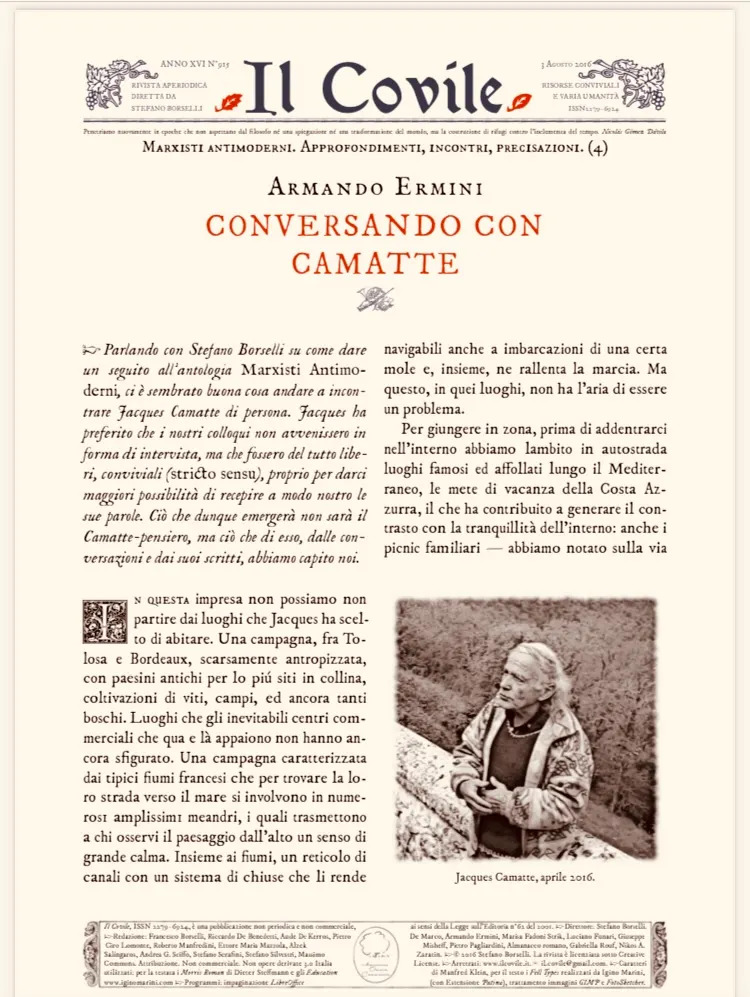
Jacques Camatte’s work, which was regularly added to, can be found on the website he ran to preserve his writings, Revue Invariance (for working hyperlinks in footnotes, see the footnotes laid out at the end). Born in 1935, he was a radical Marxist theoretician in European left-communist circles during the fifties and sixties, mentored by Amadeo Bordiga. However, the events around 1968, particularly in France, caused him to shed his left-communist affiliations. So much so, in fact, that he collaborated with Jaca Books (a right-wing, traditionalist, Catholic publishing house in Italy) in the 1970s to have his pieces published, and for several years, until his death, he worked with Il Covile (another traditionalist Italian grouping on the far-right, which describes itself as ‘anti-modern Marxist’) to have his writings translated and archived. In 2019 he conducted a friendly interview with the French group Cercle Marx, who are far-right, red-brown confusionist, Marxists.2
Camatte’s involvement with publishers of the “extreme Catholic right” and the “reactionary far-right” (as he, himself, describes them) should not, however, be regarded as inconsistent or dubious on his part. Indeed, Camatte is quite open about his associations. Camatte is not demonstrating any kind of ‘betrayal’ in working with these groups since his project is to go beyond the left, and beyond all enmity. He is following the logic of Bordiga’s ‘anti-anti-fascism,’ which extends out, in Camatte’s perspective, to become a project for the complete salvation of ‘humanity.’

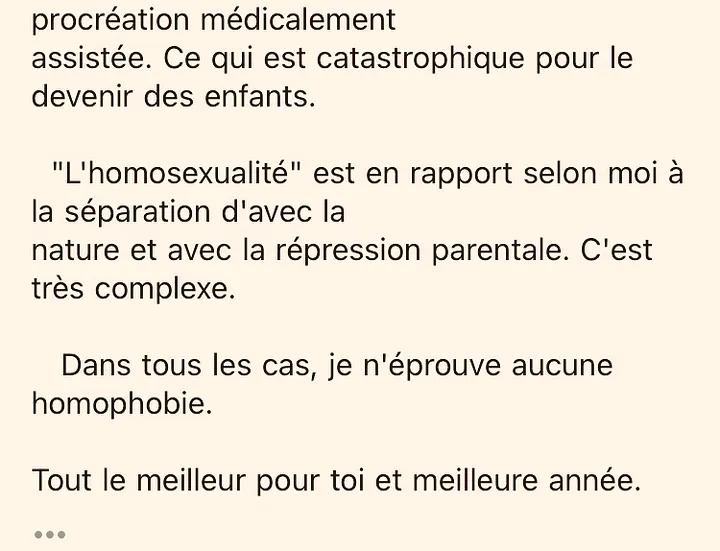
The above two images are screenshots from an email Jacques Camatte sent to me as I was realizing just how deep in this ‘mess’ Camatte was (Stefano Borselli runs the Il Covile website). Here is the text in English:
When Stefano contacted me, he told me about his background, that is, his transition from the far left to the reactionary far right. He offered to translate my texts and put them on his website. I accepted.
In the 1970s, a Catholic far-right publishing house, Jaca Book, published two books.
Regarding homosexuality, I wrote Love or Sexual Combination. Rather than homosexuality, we should talk about homoeroticism because two women or two men can never produce a child. This is now possible through medically assisted procreation. This is catastrophic for the future of children.
“Homosexuality,” in my opinion, is related to separation from nature and parental repression. It’s very complex.
At any rate, I don’t feel any homophobia.
All the best to you and a happy new year.
It is, therefore, fairly obvious why and how Camatte became a kind of poster-boy for some traditionalist reactionaries in France and Italy. But my argument is that the shadow of Camatte is one that haunts the horizon of any leftist ‘revolutionary’ who espouses an ‘anti-modernity’ perspective, in whatever degree, or who tends toward Bordiga’s anti-antifascism (which was a foundational element in Camatte’s perspective), or who claims to be ‘anti-leftist’ from an ultra- or far-left position (for example, anarchists).
Camatte’s anti-gender ideology and paternalistic misogyny can be traced back to the male-supremacist theses of Jacob Bachofen (who was, amusingly, literally adored3 by Walter Benjamin), which are explored by Cynthia Eller in the book, Gentlemen and Amazons: The myth of matriarchal prehistory, 1861–1900.4
My contention, here, and in other texts I have written on the politics of Camatte and the ultra-left milieu that surrounds him, is that the original positions, which he has inherited from Bordiga, and which also find expression in much of the ultra-left, and in the development of the ultra-left into an ‘anti-political,’ or ‘anti-left Marxist,’ milieu, have borne a misunderstanding of social relations in capitalist society that have led to key and significant elements of the ultra-left slipping into — or towards — the arms of not only the reactionary far-right, but also conservative Christianity. Furthermore, this kernel of ‘traditionalism,’ or ‘reaction,’ begins in our modern era with the work of Karl Marx himself. I do not really discuss this here, but an indication of how ‘resistance’ to the modern world has formed itself, and how it has led to the reactions of Nazism, the Taliban, and even covid-skepticism, can be sensed if one wonders just how close Marx’s conception of ‘species-being’ is to Martin Heidegger’s concept of ‘being-with.’
The second point of interest is just how Camatte’s Marxian logic finds itself aligning, or at least ‘falling-in-with,’ with the traditionalism of the extreme right. If this is the case — and it is — then it is not good enough to simply say that Camatte was a bit ‘out there’ if one generally agrees with his Bordigian perspectives on modern capitalism, as several key figures in the English-speaking ‘ultra-left do. The question that must be explored — because, if nothing else, Camatte was rigorously consistent — is, has Camatte been subject to some kind of deep theoretical and practical mistake at the beginning of his political and philosophical trajectory? If so, then perhaps so too have also the entire ultra-left and the whole school of Continental Philosophy (the Frankfurt School, Socialisme ou Barbarie, to the Situationist International, to Endnotes, to Marcuse, Baudrillard, Deleuze, to Agamben — although Agamben’s ‘mistake’ is really a deliberate Heideggerian trojan horse for reactionary spirituality)? Indeed, it can be argued that the ‘mistake’ begins with Marx himself, and specifically the failure of Marx to understand his own position within the millenarian tradition that repeatedly, inevitably, sets itself against the State and for the (re)creation of a ‘garden of Eden.’
For explanation, see my essay, ‘Prophecy in the Revolutionary Tradition.’
Like much of the left after 1968, Camatte decided that humanity was now caught in an impasse. There could no longer be any overthrowing of the bourgeoisie by the proletariat because all of humanity had now become ‘domesticated’ by capital. Therefore, any organized revolt against capital now only helped it develop. His proposal is that instead of fighting capital — a strategy that, if ‘successful,’ only returns capital to us in a stronger form — we must, somehow, abandon it. The taking leave of this capitalist world entails recreating connections with the natural world… it does not mean going to war against capital in order to topple it.5
The abandonment of ‘this world’6 and all it stands for, including the human enmity7 for all things (other animals, other things, other humans) — something that has become embedded in the modern human psyche and which causes us to repeatedly create situations of ‘battle’ or discontinuity — will, he argues, begin a process that leads to the formation of a genuinely human community, one that is continuous with nature and itself. It will transform Homo sapiens (literal meaning: ‘wise man’) into a new species: Homo Gemeinwesen. This process, Camatte insists, is immanent to our current condition and is perpetually re-emerging. Indeed, Camatte views himself as a kind of vessel for the emergence of the new human: “it is not I who creates ex-nihilo, rather it is through me that a certain humanity establishes itself. I want to bear witness to this. I am, if you want, like a prophet.”8
Camatte takes the term Gemeinwesen from Marx. Gemeinwesen translates as ‘community’ but Marx insists that the true essence of individual humans is their immutable existence as social beings, and this confers another significance to the word. As he wrote, following Feuerbach9 : “The individual is the social being.”10 Gemein translates as ‘common,’ and wesen as ‘being,’ or ‘essence’. So, it can also be read as ‘common essence,’ or ‘common being’ and it is via these avenues that Camatte uses the term Gemeinwesen to mean the true human community, or the immediate, or unmediated community… in other words, the true goal of communism as envisaged by Marx.
Marx writes:
“This communism is humanism as a perfect naturalism and naturalism as a perfect humanism [it is important to recognize that Marx understands that this can only be achieved through empiricism, or ‘the scientific method’11 ]. It is the genuine dissolution of the conflict between man [sic] and nature, and between man and man, the true resolution of the conflict between existence and being, between reification and identity, between freedom and necessity, between individual and species. Communism is the riddle of history solved, and it knows itself to be this solution.”12
Marx asserts that, “The human being is the true community of humankind.13 Camatte has utilized this particular phrase throughout his work as a touchstone for his ideas (although, as he wrote in 2010,14 he has tried to mitigate the anthropocentric and humanist connotations associated with the term ‘human being’ by stressing that it is the particular species’ ‘life form,’ or the individual itself, that is, at one and the same time, the true community of humankind).
To better understand this phrase — which is another version of ‘the individual is the social being’ — it is useful to know that Marx is here using it in the context of revolts against “dehumanized life”15 — whether they be in France in 1789, or across the USA in 2020. He is arguing that such revolts against things as they are, constitute a deep psychological attempt by people to reconnect to the original human community that most of us lost long generations ago. They are attempting to reverse the conditions of their lives, which are marked by an ever-increasing separation from a human life, from human nature, from themselves, in fact. These regular expressions of discontent and revolt occur because humans are separated from the community that enables them to be fully, or properly human. The discontent of even one small district — “because it starts from the standpoint of the single, real individual” — is enough, he asserts, to expose the tragedy of our separation from the communal essence of human nature. Camatte clarifies the nature of these kinds of revolts by stating that such “rebellion is largely a rebellion of bodies;” they are, “an act of understanding that takes place not only on an intellectual level, but also sensorially.”16
Indeed, Camatte used the original longer quote containing these ideas (from The Economic and Philosophical Manuscripts of 1844, and which is interpreted in the above paragraph) in a leaflet distributed during the French strikes in May 1968.17
But maybe I am being too kind to Camatte here? The particular “humanity” that Camatte sees himself as an expression of is perhaps much simpler than I have made it out to be. Maybe, like his friend Armando Ermini, he just wants to see ‘traditional males’ and ‘traditional females’ reassert their proper place in the scheme of things?
What Marx is arguing, and what Camatte pursues in his own theory, is that humanity has lost its own community. The community of humans has been replaced, for example, with the community of money, or the community of capital and, because of this, humans have become wretched and lost, and not even properly human… and they sense this loss. Camatte argues that the loss was initiated when humans first began to separate themselves from nature, millennia ago. From that time, they have become increasingly detached from the world and from themselves — since their own nature is as a social being — and this has led to an incessant wandering.
The concept of a ‘wandering’ humanity was explored by Emil Cioran in 1949, in Précis de Décomposition18 (A Short History of Decay). What Marx refers to as a sense within the species of the loss of community, Cioran refers to as nostalgia, by which he means a yearning for a place and a home, a ‘homesickness.’ Cioran writes:
Since Adam all the endeavor of mankind [sic, et al] has been to modify the man. […] While all beings have their place in nature, man remains a metaphysically wandering19 creature, lost in Life, peculiar in Creation. No one has found a valid goal for history, but everyone has proposed one, and in the abundance of such a plethora of disparate and fanciful goals the idea of purpose is cancelled out and vanishes like a ridiculous product of the mind.”
Cioran asks how humanity can find a compromise between the unremitting, interior longing, or nostalgia — he uses the words, “Sehnsucht, yearning, saudade” — for a home, or a place, and the rootless, peripatetic condition of our existence. His answer is that there is no compromise: there is no remedy for the affliction:
“On the one hand we have the yearning to be immersed in the indivisibility of the heart and hearth, while on the other we absorb space in a never-satiated hunger. And the space we consume offers no limits since it only generates new wanderings, though the goal recedes ever further as we move forward. […] There is no solution to the tension between the Heimat [home/homeland] and the Infinite: it is to be rooted and uprooted at one and the same time.”
While, probably unknowingly, echoing Marx, Cioran also prefigures Camatte’s depiction of the trauma — “the founding trauma of discontinuity”20 — embedded in the human psyche when they separated from, or became discontinuous with, nature, when he writes, certainly continuing to channel Heidegger:
“To be torn from the earth, enduring in exile, cut off from one’s immediate roots… is to yearn for a rehabilitation with the originary source, to yearn for a return to the time before the rupture of separation.”
Camatte has expanded and re-articulated this notion of separation and wandering. By ‘wandering’ Camatte insists that, since their separation from nature, humans have felt the need to justify their existence: they are constantly searching for a meaning to their lives and a purpose for their existence. For Camatte, the dilemma revolves around the centuries-old question of whether humans are part of nature or outside of it. The ‘wandering,’ as both Cioran and Camatte affirm, is an expression of the profound identity crisis that afflicts the species: if humans are part of nature then how are they part of it, and if they are above or beyond nature then where exactly is humanity located? (The content of wandering, by-the-way, can be understood, in Camattian terms, effectively, as history.)
Whereas Cioran sees no hope of an escape from the current human condition, Camatte, now having abandoned his Marxist and ‘revolutionary’ credentials, sees the possibility of the emergence of a new type of human being. Camatte envisages that Homo Gemeinwesen will be “the successor species to Homo sapiens. It will be in continuity with nature and the cosmos. Its processual knowledge [its becoming or, perhaps crudely, its consciousness], will not have a justificatory function, as it will operate solely within the dynamics of enjoyment.”21
In ‘The Wandering of Humanity’ (1973), Camatte goes into a little more detail as to what the new society of the Homo Gemeinwesen will look like, although, since he hadn’t properly formulated the concept of the Homo Gemeinwesen at that time, he simply refers to the new society as ‘communism’:
Communism puts an end to castes, classes, and the division of labor (onto which was grafted the movement of value, which in turn animates and exalts this division). Communism is, first of all, union. It is not domination of nature but reconciliation, and thus regeneration of nature: human beings no longer treat nature simply as an object for their development, as a useful thing, but as a subject (not in the philosophic sense) not separate from them, if only because nature is in them. The naturalization of man [sic] and the humanization of nature (Marx) are realized; the dialectic of subject and object ends. What follows is the destruction of urbanization and the formation of a multitude of communities distributed over the earth. […] Only a communal (communitarian) mode of life can allow the human being to rule his reproduction, to limit the (at present mad) growth of population without resorting to despicable practices (such as destroying men and women).”
He continues…
It is obvious that this cannot be a return to the type of nomadism practised by our distant ancestors who were gatherers. Men and women will acquire a new mode of being beyond nomadism and sedentarism. Sedentary lives compounded by corporeal inactivity are the root cause of almost all the somatic and psychological illnesses of present-day human beings. An active and unfixed life will cure all these problems without medicine or psychiatry.”22
(The concept of ‘wandering’ — and ‘alienation’ ?— may also be usefully explored in the context of the ‘zeitgeist’ of the kind of antisemitism that has developed in Europe over the last 250 years. It is interesting to read about the Conservative Revolution in Germany, and ‘the wandering Jew’, and to reflect on unrepentant Nazi, Martin Heidegger’s disdain for the “rootlessness” that the Jewish people expressed, and their crucial role, as he insisted, in building the ‘modernity’ he wished that the Nazis had terminated.)
Writing on the pandemic in 2020 it is clear that Camatte sees this process of leaving the world of capital and arriving at the destination of a new species — the Homo Gemeinwesen, or the true human community, as involving a reduction in population, but over thousands of years. He writes: “From the moment we start the inversion, it will take us a few thousand years for the number of human beings to begin to fluctuate between 250 and 500 million.”23 So, one should not make the mistake of thinking that Camatte is proposing any kind of ‘forced’ population reduction.
It is also useful to be reminded that he is not proposing any kind of confrontation with the world as it is. He explicitly states that constructing an ‘enmity’ to capital in order to topple it will merely make it stronger. This was the conception he formed on reflection of the events around 1968: “The more we fight against capital, the more we strengthen it.”24
So, the key is to begin, somehow, to create new ways of living: “The problem is to create other lives.”25 Indeed, Camatte appears to find interesting any new social experiments that indicate a different way to live, or which contain a refusal of aspects of this society, such as the hippie movement,26 or alternative agricultural methods,27 although he is, of course, aware how these movements can become re-incorporated into capital. But there is also an urgency attached to this abandonment of things as they are, since the choice is now hurtling toward that between “communism or the destruction of the human species.”28 And these refusals or revolts are always susceptible to recuperation by capital: “Capital can still profit from the creativity of human beings, regenerating and resubstantializing itself by plundering their imaginations.”29
The impulse to begin a regeneration of community and nature is not a simple or straightforward one for Camatte though. As it is not a ‘political’ alternative, it is not a toppling of the old regime and a replacement with a new one, it is not a revolution as commonly understood. More recently, Camatte uses the term ‘inversion’30 to describe the leaving of this world. This concept is not meant to imply a simple reversal of things as they are, nor does it mean a return to a time prior to our ‘dehumanization’. It is the accessing of the seed of ‘naturalness’ inside us, which has long been repressed and concealed, and helping it to germinate. In this way, the new species of Homo Gemeinwesen will begin to emerge. One can see how this idea is closely linked to the way Marx described the essence of revolt above, but in Camatte’s conception all ‘politics’ is removed. As Camatte insists: “Inversion is not a strategy, it is totally outside of politics, which is the dynamic of organizing people, of controlling them. We must abandon everything that is part of its world.”31 But this ‘naturalness’, for Camatte, is also founded within an opposition to gender theory, gender equality, and feminism. His ‘inversion’ is a call for ‘traditionalism’ to reassert itself.
A Millenarian Residue?
Jacques Camatte has come from the modern revolutionary tradition encompassed by Marxism that Yuri Slezkine describes, in his monumental work, The House of Government,32 as millenarian. Millenarianism, which can be religious or secular, is the belief that human society is in need of a great transformation and that after this transformation people will live in peace and harmony. It is the eternal recurring impulse of those who live within exploitative and hierarchical societies, by which is meant, of course, a State.
The conditions of life within a State — work, exploitation, hierarchy, ennui, poverty, wealth, despair — are the causes of millenarianism and, as the anthropologist Pierre Clastres has suggested with the social movement of the karai prophets in the Amazon, even the threat of a burgeoning State can produce millenarianism.33
Very significantly, Clastres further suggests that the karai millenarians — who “mobilized” more than 10,000 people to migrate toward the Land Without Evil, in the direction of the setting sun — accomplished “that impossible thing in primitive society: to unify, in the religious migration, the multifarious variety of the tribes. They managed to carry out the whole [unifying] program of the chiefs with a single stroke.”34 Clastres’ startling and profound observation is that millenarianism — the revolutionary overthrow, or escaping, of existing conditions — contrary to what it pretends to be, is actually the most efficient way to homogenize people, to unify them for a cause external to themselves. Revolutionaries then, and one can glean it from history if one looks properly, are the State-builders par excellence. ‘The state’, and civilization itself, is a compulsively colonizing and centripetal phenomenon.
Millenarianism, therefore, is a recurring response, in various forms, to the State, which is a society that is deeply unsatisfactory. When historian Christopher Hill assessed contemporary historical analysis in 1972, in The World Turned Upside Down: Radical Ideas During the English Revolution, he wrote that: “we now see millenarianism as a natural and rational product of the assumptions of this society.” Millenarianism — another term for ‘revolutionism’ — is then, objectively, a function of the State. Millenarianism also, invariably, has some kind of relationship to the idea of a ‘fall from grace,’ or a loss of naturalness and community… and so one can see that the millenarian impulse comes from the same standpoint as that of those whom Marx describes above as rebelling — because they sense that they are dehumanized or, at least, bereft of the community that makes them human. We all contain the germ of millenarianism inside us, it is a facet of our response to an unsatisfactory life… Albert Camus, in The Rebel, advises us not to “unleash” it.35
Perhaps the first evidence of millenarianism we have in history is from Iran with the arrival of Zoroaster, some three thousand years ago. As Karl Jaspers argued, this era in the development of civilization — which he termed ‘the axial age’ — was one of flux and uncertainty, in which there was a proliferation of radical thinking and the expression of discontent. Slezkine writes:
“Zoroaster made history — literally as well as figuratively — by prophesying the absolute end of the world. There was going to be one final battle between the forces of light and darkness and one last judgement of all human beings who had ever lived — and there would be nothing but an all-encompassing, everlasting perfection: no hunger. No thirst, no disagreement, no childbirth, and no death. The hero would defeat the serpent one last time; chaos would be vanquished for good; only the good would remain — forever” (Slezkine: 76–77).
“Millenarianism,” Slezkine affirms, “is the vengeful fantasy of the disposed, the hope for a great awakening” (Slezkine: 99). This vengeful fantasy, of course, is entirely understandable, and probably inevitable, and therefore impossible to prevent from returning in new forms… but the problem with it is that it never leads to peace on earth, and usually makes things far worse. Slezkine continues the history:
“Most millenarian sects died as sects. Some survived as sects, but stopped being millenarian. Some remained millenarian until the end because the end came before they had a chance to create stable states. Christianity survived as a sect, stopped being millenarian, and was adopted by Babylon as an official creed. The Hebrews and Mormons survived their trek through the desert and traded milk and honey for stable states before being absorbed into larger empires. The Muslims created their own large empires bound by routinized millenarianism and threatened by repeated ‘fundamentalist’ reformations. The Münster Anabaptists and the Jacobins took over existing polities and reformed them in the image of future perfection before losing out to more moderate reformers. Only the Bolsheviks destroyed ‘the prison of the peoples,’ vanquished the ‘appeasers,’ outlawed traditional marriage, banned private property, and found themselves firmly in charge of Babylon while still expecting the millennium in their lifetimes. Never before had an apocalyptic sect succeeded in taking control of an existing heathen empire (unless one counts the Safavids, whose millennial agenda seems to have been much less radical). It was as if the Fifth Monarchists had won the English Civil War, ‘reformed all places and all callings,’ contemplated an island overgrown with plants that the heavenly father had not planted, and stood poised to pull up every one of them, ‘root and branch, every plant, and every whit of every plant.’36 The fact that Russia was not an island made the challenge all the more formidable” (Slezkine: 180).
All serious movements that seek to radically alter, abolish, or escape State societies are millenarian movements. Millenarianism is a product of the critique of the State in which the masses are perceived to be the dupes of evil. The remedy necessitates the sweeping away of all the mechanisms of evil — the laws, the norms, the traditions — along with all those who, through pure malice, weakness, or sloth, facilitate or maintain the evil. Only the good in heart — that is, the most loyal to the cause — will arrive safely at the other side of the revolution.
But less dramatic versions of millenarianism also exist: some religious sects insist on simply waiting — and being ready — for the apocalypse, which will be delivered when God decides. This strategy mirrors the belief of far-left, or ultra-left revolutionaries, or anarchists, who wait in readiness — remaining close to ‘the cause’ and engaging others, perhaps to convince them — for the confluence of events that will give them the opportunity to become the midwives of communism.
This strategy of far-left communist groups is (equivocally) endorsed by, for example, the Camatte-admiring group Endnotes,37 in 2019, who describe the apparent, but false — as they regard it — choice for contemporary ultra-left, far-left communist, or left-communists, etc.,38 as being between “‘revolutionary intervention’ or attentism (wait-and-see-ism).” That is, “there is either a revolutionary communist way of relating to struggles or one should not be involved at all.” They solve the false choice by referring back to Marx and Engels’ notion of communism as ‘the real movement’39 and stating that, “it is not we but class struggle that produces theory [understanding].” But Endnotes do not seem to recognize that there is no such thing as being able to ‘not be involved at all.’ Even the dead are involved in our present life, as Marx noted: “Le mort saisit le vif!” (The dead seize the living!)40
In practice, of course, both quietist millenarians and non-party, anti-‘political,’ or anti-vanguard revolutionaries (like Endnotes) are always involved in events whether it be in preparing themselves by learning how to be closer to God, or by getting closer in understanding to, as Marx put it, ‘the real [concrete] movement [becoming] that abolishes the current conditions’41 — or in simply attempting to attract others to one’s point of view in order to increase the number of the blessed… so that at the appointed hour — when either God appears in His fury, or the Proletariat rise in Theirs — there will be enough believers to get those who are worthy to the other side.
I should note that, as one half of the producers of the book — or “archaeological artefact,”42 — Nihilist Communism, I too have been millenarian. Our advice to those who, like us (we called ourselves Monsieur Dupont), wanted the great transformation that will bring peace and harmony but saw its arrival as coming from the class struggle and the intervention of ‘revolutionaries,’ rather than God, was to: “be ready for a long wait, to have no great expectations, to be ready for failure, and to keep going for decades.”43
Compare this last instruction, or appeal, with the Parable of the Sower, from The King James Bible: “Now the parable is this: The seed is the word of God… [and it is deemed to have fallen on good ground when those that hear the word] keep it, and bring forth fruit with patience.” Or this from the Book of Revelation (Apokálypsi), in which God writes letters to ‘seven churches’ through visions given to a prophet, probably in 95CE: “I know thy works, and thy labor, and thy patience… And [how thou] hast borne, and hast patience, and for my name’s sake hast labored, and hast not fainted.” Perhaps the unconscious repeating of such a directive, almost 2000 years later, is an example of eternal recurrence…
The State — or that which oppresses us, whatever it is — will always be critiqued. The State necessarily, or naturally, creates the conditions for this critique, and, therefore, millenarians — that is, revolutionaries — are functions of the State. They do not appear where there is no State. They do not appear in non-State societies. But, counter-intuitively, the critique of the State or ‘present conditions’ is not harmful to the State (though it may prove so for particular elements in the State hierarchy). In fact, it is necessary to its objective development, as recorded examples beginning with the English Civil War at least, attest.
Wherever there has been a revolution the State has become stronger, and the exploitation of the working classes has been escalated, become more brutal, and made more efficient, for a short time at least. The English and French Revolutions enabled the institutional ascendency of the bourgeoisie: the new ruling class, as well as the new middle class, the bureaucrats. Both revolutions enabled both countries to maintain and expand their position as a world power. The Russian Revolution is easily recognizable, ultimately, as the revolution of the children of the emergent middle-classes — the bureaucrats — and they introduced industrialization at an unprecedented speed and on an unprecedented scale.44 The Chinese Communists also introduced industrial capitalism at breakneck speed — don’t be deceived by the fact that they called themselves ‘communist.’ The same can be said for those ‘developing’ countries, such as Cuba, where industrialism was introduced to a rural region under the banner of communism or socialism. Revolutionaries then, in the grander scheme, are not counter-functions of the State and capital, they are just functions — they aid the development of the economy and the control of the laboring classes.
Camatte, observing the history of the twentieth century, discovered that in this period the nature of capitalism changed so that, as noted above, ‘the more we fight against capital, the more we strengthen it,’ but one could also have made that observation from all the revolutions in the capitalist era, beginning with the English one. So perhaps it is more correct, or at least universal, to say: the more we fight against the State, the more we strengthen it. Of course, in our era there is no clear dividing line between State and economy — or State and capital, indeed, in capitalism the State found its perfect marriage — and the all-consuming, global, and ubiquitous nature of our economic system means that the imagining of a State existing in the world that is not capitalist constitutes a laughable and ridiculous whimsy.
Camatte has certainly tried, consciously or otherwise, to shy away from the millenarian bases of his original political adherences. This is demonstrated by his absolute refusal to be part of any ‘organization,’ and his insistence that what he is now arguing for is not a politics of any kind. Yet still, in his vision of the arrival of a new human species he fulfils the millenarian criterion: millenarianism, which can be religious or secular, is the belief that human society is in need of a great transformation and that after this transformation people will live in peace and harmony. And he still engages his vision with people, he still produces texts, and informs others of a better way to think.45 His millenarianism though, like that of Endnotes, as well as Monsieur Dupont, is effectively a quietist one.46
A Contradiction?
Camatte argues that the class struggle is long finished because, as those involved in the ‘revolutionary’ events around WW1 demonstrated, the only thing the working class is now able to achieve is not communism but self-managed capitalism, since its aims are ‘full employment and self-management.’47 Therefore, he is claiming that any revolutionary struggle against capital that is based on the (now-defunct-as-a-potential-creator-of-communism) working class will only return capital to us, after the glorious deception of the revolutionary moment, in a stronger and more vicious form.
But it is worse than this, in Camatte’s conception. Just as there is no genuine working class anymore — it has been absorbed into capital — there are no classes at all, society is no longer organized on the basis of a living social relationship (bad though it was)… capital has ‘run away’ from the control of the bourgeoisie and is now operating as an autonomous system. All humans, are now capitalized, that is, they are all hanging desperately off the coat-tails of the “automated monster”48 of capital that proceeds — robot-like, or zombie-like (because it is a dead thing, it is no longer a social relation) — on its own course.
How to stop the monster? Camatte has already discounted opposing it, since that will just strengthen it — because in our opposition we are acting within its terrain, that is, on its own terms. Camatte therefore argues that to stop the monster we have to abandon it, and not in an organized political way — because that would be an immediate creation of an opposition: an enmity. We all have to begin abandoning ‘this world as it is,’ somehow organically, by choosing to live different lives. If we do this then not only will zombie-capital die of starvation, but after a few thousand years the new species will have fully emerged, and humans will live in community with nature and themselves. Reaffirming, of course, the holy “man-woman dyad”.
But if people are already capitalized (Camatte describes it as their madness), meaning that if they fight the system they only bring it back stronger, then would not that also imply that if they left the system they would just take their capitalist brains with them, even though, like the oppositionists, they do not intend to?
Is it not the case that every escape from capital or the State, or things as they are, every sect, or movement — from the Vikings who escaped the burgeoning power of Harald Finehair’s expanding kingdom by settling in Iceland, to the tragedy of Jonestown — that has gone somewhere else to found a new world has just brought the sickness with them?
The problem is centered on whether one can will a genuine change in one’s life, as an individual or as a group. If one is willing the change then it is logical to assume that the imagining of the change emerges from the very circumstances of the thing one is opposing — the desired change is bound by the parameters of the original thing one is trying to escape. We are social beings, we are socially constructed, we can only see the world through our own perspective, though we can recognize that there may be other perspectives.
Time
It is useful here, in order to explain what I mean, to think about how the concept of time is perceived in two different eras: the modern era (capitalism), and the European Middle Ages (feudalism).
We can, for example, understand when someone tells us that medieval peasants lived by a cyclical calendar derived from agrarian existence but, despite this, we are unable to view time as a rotation because we cannot look up from this page and comfortably accept, or throw out the notion, that time is not linear. As historian A. J. Gurevich writes of the transition from feudal to urban capitalist conceptions of time: “The alienation of time from its concrete content raised the possibility of viewing it as a pure categorical form, as duration unburdened by matter.”49 It was the success of the modern economy, which needed coordination to operate efficiently, that changed our conception of time. It was the introduction of supply chains, distribution, and factory work, culminating in railway timetables, that led to the abandonment of any sense that time was ‘cyclical,’ ‘seasonal,’ or connected to the earth. This linear expression of time is now hard-wired into our brains because it reflects our everyday existence, therefore this interpretation of time also affects how we act in the world. How we are created is how we create.
We cannot see through the eyes of a person inhabiting a different mode of living. Our consciousness is determined by the daily life we live, and the principles and values generated by and acting upon this actual daily existence. Once a society is established, then that society becomes an organic whole, a mode of living (not necessarily an ‘economy’). A twenty-first century Parisian can as little decide to understand time as cyclical as a medieval European peasant could decide to understand time as a separate linear category of the universe.
One can also see how change in oneself is often impossible through simple willing. Genuine, grief, over the death of a loved one, for example, cannot just be wished away, it slowly lessens over time, or is forgotten in other pursuits (as long as those pursuits are not taken up specifically to forget about one’s grief, in which case the pursuit itself is a constant reminder). Therefore, it would be true to say that the solution to disabling grief does not come from our thinking about it and putting it into perspective, but from time. Genuine changes — or solutions — are always delivered to us on levels other than our conscious willing.
In an articulation, or extension, of Marx’s historical materialist proposition — “People make their own history, but they do not make it freely, and not in circumstances of their choosing, but under circumstances that are proximate, pre-existing, and handed-down”50 — the Marxist scholar Ernest Mandel formulated the term parametric determinism. This is a useful concept to utilize when thinking about the limits of our possible understandings of other eras, or other cultures… or other animals. He argues:
“Most, if not all, historical crises have several possible outcomes, not innumerable fortuitous or arbitrary ones; that is why we use the expression ‘parametric determinism’ indicating several possibilities within a given set of parameters.”51
We could substitute the words ‘historical crises’ with ‘situations,’ or even ‘imaginings.’ The point being that we are products of the society we are born into. We cannot simply will ourselves to be the products or functions (or reproducers) of another society (for example, ‘a truly communist’ society), no matter how close we feel to understanding the particular social organization we are observing or considering. Radical changes in society — such as the transition from feudalism to capitalism — do not happen via human will, they happen on other levels. The revolutions that made capitalism official — such as the English, French, and Russian — were the institutionalizing, or ratifying, of an economic force that had already achieved actual predominance. Of course, Camatte does stipulate that the emergence of the new human being will take thousands of years and perhaps, therefore, he is recognizing the problem involved in changing one’s perspective or changing one’s entire way of living. And perhaps he is arguing that if we just make certain changes now — changes that are connected to the ‘naturalness’ that still lingers inside us — then we will set ourselves on the way to becoming the new species… I am not so certain in my ‘resistance’ to Camatte’s particular ideas here, and am reminded of Voltaire’s solution in Candide, which I will come to below.
In the end, there is still a ‘problem’ in Camatte’s urging of us to leave this world… the logic of his writings compel us to wonder how, in ‘leaving the world’, we will not just take the world with us. If we can’t fight it without making it stronger, then maybe we can’t leave it without making it stronger either. Capital is, after all, the recuperator par excellence.
The Already Existing Human Community
Camatte proposes that all rebellion that is linked to a yearning for human community, that is, those rebellions, or movements, that called for ‘universal brotherhood [sic]’ or mutual aid in the past, for example — since these calls are a connection to the lost Gemeinwesen — are beginnings of the inversion: the process of regaining a true human community. The problem, for Camatte, is that capital has developed so much that most of these beginnings are now completely useless if they exist as organized political projects. For such beginnings — as we have seen with the mutual aid and solidarity in the recent events around covid-19 and the Black Lives Matter movement — to be effective and unrecuperable they must, according to Camatte, develop into situations where ordinary people no longer appeal to or confront the system in order to change it. For Camatte, people must instead start living different lives, lives that embrace these human values. Inversion can only be begun52 when there is no feeling of enmity, and when there is no feeling that some ideological prop, such as ‘the working class,’ or ‘justice,’ is needed to justify one’s actions. If we dispense with the damaging notions and images of enemy and friend — for example, the bosses and the working class — we can get on with trying to live. Camatte’s hope is that there will be a mass abandonment of our current way of living when people realize the madness they have had to endure. Camatte may have seen the covid-denialists as people who sensed the ‘madness’, in the same way as he thought Holocaust-deniers such as Robert Faurisson pointed to reality…
As already noted, Camatte predicts that the new human species will take thousands of years to come fully into being. To assist with the emergence of the new being Camatte suggests a number of practical measures that need to be somehow implemented as soon as possible. In Emergence and Dissolution, Camatte lists some of these changes, which include: “The immediate cessation of the construction of roads, highways, airfields, ports, and cities;” the abolition of tourism, “the most elaborate form of the destruction of men, women and nature;” and the abolition of sport, “an absurd activity, a theatrical form of capitalist competition, and a fundamental support for advertising.”53
When one reads Camatte’s ‘list of demands’ from this 1989 article it is difficult not perceive them as potentially authoritarian measures to be put in place for the good of the planet, and in a footnote added in 2008 Camatte notes this: “It would have been better to have [only] written ‘cessation,’ because ‘prohibition’ inevitably evokes and calls for repression.” Still, one has to wonder how we can stop things like construction projects, tourism, and sport without either becoming part of a government, or without fighting against these phenomena. Unless all the construction workers, tourists and sports fans stay at home to tend their vegetable gardens and allotments, and don’t turn on their televisions… causing those industries to collapse.
There is a strangely powerful allure in this vision of a mass of humanity just ‘leaving the world’ to tend their own gardens, a phenomenon that would, of course, require a collective effort, or communal cooperation. Maybe the essence of the beginning of Camatte’s ‘inversion’ — as a ‘leaving of this world’ — can be understood in practical terms by reference to Candide’s advice at the end of Voltaire’s novel of the same name (by-the-way, Camatte was horrified that I had compared him to Voltaire)— which is that while we can wonder about the world all we like, the most useful thing is to ‘cultivate one’s own garden.’ Candide says this after he and his ‘petite société’ have withdrawn from worldly pursuits and are concentrating on sustaining themselves by their own means, learning all sorts of skills, and being useful to one another. As one of them remarks: “Let us work without calculation (travaillons sans raisonner), for that is the only way to make life bearable.” If one decides to follow Camatte, is one also following Candide? With the difference that Candide did not profess to be “like a prophet,” or engage enthusiastically with the far-right to put forward his views.
Returning to the notion that it will take thousands of years for this new communal species of human being to grow to maturity, one must perhaps — despite Camatte’s indicating that the species will form a true human community — sense that we cannot really know what this new community will truly be like. I think Camatte would agree with this. The new community — the new species — he predicts is something impossible to describe beyond partial indications, and this has profound implications once one remembers the societies of ‘tribes’ around the world who have little or no contact with the global economy: it is impossible for us to fully understand these peoples either. These are the societies that, as Pierre Clastres has shown, are ‘against the State.’54
Camatte does refer to the work of Pierre Clastres a couple of times, but only briefly. In The Integrated Revolution (1978),55 Camatte appears to recognize the centrifugal social organization of ‘primitive’ (non-State) societies, described by Clastres, as valuable in resisting the threat of homogeneity and the loss of diversity between communities — which is carried out through ‘violence,’ or ‘war’ — but he does not think that this is an appropriate strategy ‘for us’ since society has already been homogenized and any recourse to a diversity-amplifying violence would simply be a “blind” violence without any proper context. It is unfortunate that Camatte only considers Clastres’ observations and theories as a tool for rectifying the ills of civilized society, therefore rejecting them quickly, rather than exploring them further. Clastres himself never suggested that the social organization of the non-State societies he encountered in the Amazon should be taken up by radicals in civilization. He merely noted that ‘the savages’ had resisted the State — somehow — for a long time, and that they effectively represented the last real humans.
What might one learn — using a Camattian lens — from the ethnography of those peoples who live beyond the State?
Clastres suggests that the goal of these societies is not ‘peace and harmony,’ it is not unification. The ‘community’ that exists within groups and between groups is operational on different levels to the ones we might understand. Their ‘enemies’ are closer to them than our ‘friends’ ever will be, enmity is bound up in their conception of the relations with themselves, and others, even the dead.56 This is one indication of the problem in Camatte’s defining of what a true human community will look like… he cannot know. The foundation of his notions of true human community come from the Enlightenment and the ideas of democracy. He is the inheritor of the ideas of Spinoza and Marx, who reflected the radical implications of the Enlightenment, a phenomenon that itself reflected the growth of capitalism as a form of society. ‘The savages,’ as Clastres has observed, do not want peace. Peace, since the establishment of the first State, has always been the prize of slaves. As subjects of a State this is, naturally, what both Camatte and I want too. But one should keep this aim for oneself, and not bring it to non-State peoples.
The other thing one might discover, if we extend Camatte’s, or Cioran’s, analysis — which concludes that humans are discontinuous with nature and therefore psychologically traumatized, and now even obsolete — to the ‘uncontacted tribes,’ is that there are two types of ‘human being’ on the planet… but only one type can truly call itself ‘human.’
The Second Type
The ‘human beings’ who cannot truly call themselves human, according to Camatte, include myself and all the others who are products and functions — not of the earth from which we originate — but of the economy we know as capitalism… whether they reap the benefits of the demented ‘wealth’ that capitalism generates, or whether they struggle to survive in the depths of the madness that is the flipside of the madness of progress and technological advance. I agree whole-heartedly with Camatte here, these so-called humans (you and I) are fictions, or creations — or the hollowed-out drones — of an uncontrollable and autonomous economy that has severed all their links — beyond romantic fancies and false claims — to other animals and the earth itself.57
How did this human come into existence? Since I am talking about the kind of human who lives in a State I must then ask why and how the State emerged. There is a lot of mystification from all sectors of the political and academic spectrum on this but, as I have attempted to demonstrate elsewhere, while we cannot know the specific circumstances by which original — ‘pristine,’ they are called — States came about, we can understand why: the State is a managerial solution for the problem of a population that has become too large for the maintenance of the old ways of living.
Most narratives of the emergence of the State begin with the rise of a chief who bullies people, which leads to a Royal Family, which leads to a retinue that eventually forms a bureaucracy. It is this bureaucracy that then wields the real power. The bureaucracy spreads out over the land and becomes a kind of closed proto-democracy. Eventually there are so many people helping to run the State directly through supervisory — the nascent ‘middle class’ — and entrepreneurial means that it becomes clear to them that the real power is in their hands and that they should have that power recognized. They begin a movement based on the new circumstances. Oliver Cromwell was landed gentry. Gerrard Winstanley — the leader of the Diggers, the far left of the revolutionists of the ‘English Civil War’ — was a middle-class businessman. Robespierre was a lawyer. Lenin was famously middle-class. Castro was born into a prosperous farming family and studied law at university. Guevara was a doctor. The workers and peasants get behind them because they also like this new ‘democratic’ idea and because they need some improvement in their lives — in fact, of course, the vocational revolutionaries can only appear, and fulfil their function, if the workers and peasants are already at some level of revolt. Then there is a revolution (we are not talking about ‘revolts’ here), sometimes it is bloody. The new leaders realize that the workers and peasants had a slightly different idea about how things should proceed and begin a clampdown. Often the first leaders of the revolution are kicked out, and new people, with a more reasonable agenda step in.
I agree with the whole of this narrative except for the very first part. My research into how peoples prior to the rise of a State (including present-day ‘uncontacted tribes’) organized themselves socially shows how one of the priorities was to keep group numbers small, and if numbers did start to escalate these groups would ‘fission’ — they split. Robin Dunbar has famously done work on optimal group sizes and he argues that for humans to operate successfully without coercion they must be able to have regular face-to-face interactions — everyone must know everyone else. Once the group becomes too numerous for everyone to know each other it becomes necessary for laws to be laid down.
My research58 suggests that the key element in the emergence of a new State — Mesopotamia, the Indus, Mesoamerica, etc — was not agriculture or alluvial valleys but the fact there was a rise in the population and for some unknowable reason the group was unable to split.
The classic narrative for the rise of a chiefdom/State is that a rapacious thug organizes a group and takes over the tribe. But the anthropological record suggests that humans were able to resist vainglorious thugs for thousands of years. And how come there are ‘egalitarian’ tribes outside of States right now? There must be something else. Many anthropologists and historians suggest that advances in technology — for example, irrigation — led the way for numbers to rise and for people to become enslaved. But how come modern ‘uncontacted tribes’ haven’t invented modern farming techniques, increased their numbers and set up a ruthless dictatorship to serve under? Are they just stupid?
The reason powerful Chiefs emerged was because the populace reluctantly agreed that the new circumstances demanded a new way of organizing things. Everyone did not know everyone else anymore and so people could get away with things, cliques could form, ‘crimes’ could be committed. Laws had to be made and people had to follow them — but the people who didn’t like the laws just ignored them. Finally, and this probably happened very quickly, a charismatic person seized the chance for self-aggrandizement… and in the end the populace agreed. A strong leader backed up by thugs would at least keep some peace.
Of course, the power would usually go to the Chief’s head and atrocities would be normalized, and if the people weren’t totally downtrodden they might support a rival Chief’s bid to topple the present one… and so history was written… right up to Representative Democracy.
The State itself is neither evil nor good, it is a managerial solution to the problem of a large population. Imagine the scene, two people sitting under a rockface discussing the future: “Yeah, Enki and his gang reckon they can sort out all the problems as long as everyone does what he says and gives him a tribute by sending daughters and sons to work for him, and building him a really good place to sleep in. The whole place will be a lot easier to live in, less chaos, but we’ll have to stay where we are and work harder to make sure he gets enough recompense for his trouble. We don’t want him to put his thugs on us, but it will be good if he sorts out those lazy thieving bastards who live up by the chickpea bushes…”
The State is often viewed as an obstacle to the ideals of peace and love — and communism — but maybe there is no escaping an authoritarian State when there are so many people jammed together? Perhaps this is one of the many lessons of the Russian Revolution? (Anyone who suggests here that perhaps the way to peace, love, and communism is therefore to reduce the human population is — apart from articulating real evil — missing the point that as functions of capitalism they would merely be recreating capitalism in a new situation, just as the Bolsheviks did in 1918.)
Jean-Jacques Rousseau opined for the freedom had before the advent of the State and civilization, but he recognized that living in a society where everyone — no matter their place in the hierarchy — was dependent upon everyone else meant that humans could not go back.59
He decided that we had to make the best of a bad job,60 and this was the message in his book ‘Of the Social Contract.’ Rousseau’s book, of course, was used by the Jacobins to justify their Parisian dictatorship in 1793–4, but as David Wootton writes in his introduction to Rousseau’s Basic Political Writings: “Robespierre and the Jacobins admired him greatly, but they misunderstood him profoundly (their Rousseau was invented to serve their own purposes).”61 Rousseau’s practical and humane — and anti-millenarian — approach to being trapped, in what might be ironically termed, a less-than-satisfactory society has been echoed much later by writers who have witnessed or considered the millenarian outcomes of the Russian Revolution, such as Albert Camus.
In 1951, arguing in favour of rebellion — that is, an opposition to all forms of dictatorship — as opposed to revolution, he writes, “Instead of killing and dying in order to produce the being that we are not, we have to live and let live in order to create what we are.” He continues:
“The revolutionary is simultaneously a rebel or he [sic] is not a revolutionary, but a policeman, or a bureaucrat, who turns against rebellion. But if he is a rebel he ends by taking sides against the revolution. So much so that there is absolutely no progress from one attitude to the other, but co-existence and endlessly increasing contradiction. Every revolutionary ends by becoming either an oppressor or a heretic. In the purely historical universe that they have chosen, rebellion and revolution end in the same dilemma: either police rule or insanity.”62
Vasily Grossman, writing about Soviet Collectivization and the Terror Famine in the Ukraine in 1932–3 through the character Anna Sergeyevna, in Everything Flows:
“When I look back now, I see the liquidation of the kulaks63 very differently. I’m no longer under a spell… ‘They’re not human beings, they’re kulak trash!’ — that’s what I heard again and again, that’s what everyone kept repeating. And when I think about it all now, I wonder who first talked about kulak trash. Lenin? Was it really Lenin? How the kulaks suffered. In order to kill them, it was necessary to declare that kulaks are not human beings. Just as the Germans said that Yids [sic] are not human beings. That’s what Lenin and Stalin said too: The kulaks are not human beings. I can see now that we are all human beings.”64
The First Type
The other type of human is the one that still lives in the forests, in the hills, or on the plains, avoiding the advances of civilization. But their existence is precarious and is becoming more fragile with each passing day. These peoples are the last humans.
We cannot know who these peoples really are because to go to them is to bring all our psychological and biological sicknesses to them. But what we can know, from the literature of anthropologists (and we have enough of that — there is no need for any other budding student of anthropology or professor of ‘the exotic’ to invade the space of these peoples), is that these peoples do not work; they do not have an economy; they do not have hierarchies; they do not have social control as we know it;65 they do not have money; they do not have history, but they do have collective memory; they do not seek to conquer the world; they do not have books; they do not destroy nature; they do not treat each other with disrespect; they do not treat other animals with disrespect; they live for enjoyment…
On the Homo Gemeinwesen, the ‘successor species to Homo sapiens,’ Camatte writes, as noted above:
“It will be in continuity with nature and the cosmos. Its processual knowledge [its becoming or, crudely, its consciousness], will not have a justificatory function, as it will operate solely within the dynamics of enjoyment. […] It is obvious that this cannot be a return to the type of nomadism66 practised by our distant ancestors who were gatherers. Men and women will acquire a new mode of being beyond nomadism and sedentarism. Sedentary lives compounded by corporeal inactivity are the root cause of almost all the somatic and psychological illnesses of present-day human beings. An active and unfixed life will cure all these problems without medicine or psychiatry.”
Camatte’s description is worth quoting because it describes communities that already exist, present-day uncontacted tribes — these peoples are already here. They live alongside us.
The quote from Marx used at the beginning of this text is also usefully repeated here — “The less you are, the less you express your own life — the more you have, the more pronounced is your alienated life, the greater is the aggregate of your alienated being” — because the list above of what non-State peoples have can only be written by civilized people like ourselves as what they, in the main, do not have. This is an indication of how separate we are from them in all respects.
The uncontacted and Indigenous peoples (who are defended by the organization Survival International) are the last humans. They are the revolution that has always been here. They have had no ‘fall from grace’ in the way we have. They have not embarked on a relentless wandering — or history — that has brought the world to the point of complete ecological collapse. They do not live in drudgery and empty despair; they have not had their spirit and humanity hollowed out of them.
As for us, we are trapped in a world that can never be made perfect because it will always need to be managed. And maybe we don’t really have much control over what we do, over the choices we can make… since we have no control over who we are. Perhaps the best one can do ‘politically’ is to keep trying to oppose injustice, and oppression, to keep resisting dictatorship, even though it will inevitably keep returning. One could also try to help non-State peoples remain in their lands, separate from our world. As Camus advises… keep on pushing that rock back up the hill, no matter what.
Appendix 1
Those pesky Amazon feminists…
We should also bear in mind that Camatte was anti-feminist.
Judith Butler has observed that TERFs have found themselves aligned with the far-right. In the same way, Jacques Camatte finds himself on the same side as the far-right because of his fear that ‘the human species’ is being ‘fragmented’ and made ‘artificial.’
Camatte, like Walter Benjamin and Furio Jesi before him, share the view of ‘woman’ put forth by the ‘male supremacist’ Jakob Bachofen (Das Mutterrecht) and writes: “At the base of the salvation of humanity there is woman.” Benjamin, by-the-way, literally adored Bachofen… Of a photo of Bachofen, Benjamin wrote: “An almost maternal largesse, spreading over the whole physiognomy, gives it a perfect harmony,” and he considered Bachofen’s greatness to have emerged from “his veneration of the matriarchal spirit.”
But Camatte’s ‘ennobling’ of ‘woman’ ultimately serves the same function as it did Bachofen: “If Das Mutterrecht is ‘a paean to the marvel of women,’ as one of Bachofen’s later reviewers claim, it is also a slap in the face” (Cynthia Eller, Gentlemen and Amazons, 2011).
Camatte argues that in the ‘hunter-gatherer’ phase (his view of ‘primitive peoples’ is that they are/were ‘fearful’ and ‘cave-man’ like) the sexes became segregated, but “with the invention of agriculture woman regains an essential importance.” This importance was diminished, however, by a later segregation that was built around “the invention of the kitchen.”
The influence of the revolution of agriculture, for Camatte, is directly from Bachofen. Eller writes: “agriculture [for Bachofen] stands for the type of procreation that matriarchy initiates: no longer randomly sowing his seed in the swamp of communally owned women, man now [Bachofen writes:] ‘opens the woman’s womb, lays his seed for the purpose of generation… [and harvests] the child from the maternal garden’… woman as earth, man as seed… The earth gives birth, and women give birth” (Eller reiterates).
Similarly, David Cayley quotes Ivan Illich’s epiphany: “On the icebox door two pictures were pasted. One was the blue planet and one was the fertilized egg. Two circles of roughly the same size, one bluish, the other one pink. One of the students said to me, ‘These are our doorways to the understanding of life’.”
For Bachofen Amazonism was initially a positive response to male lust, but it descended into producing “man-hating, man-killing, war-like virgins” so it was good they were defeated and succumbed again to male charms and superiority, thereby restoring the correct balance.
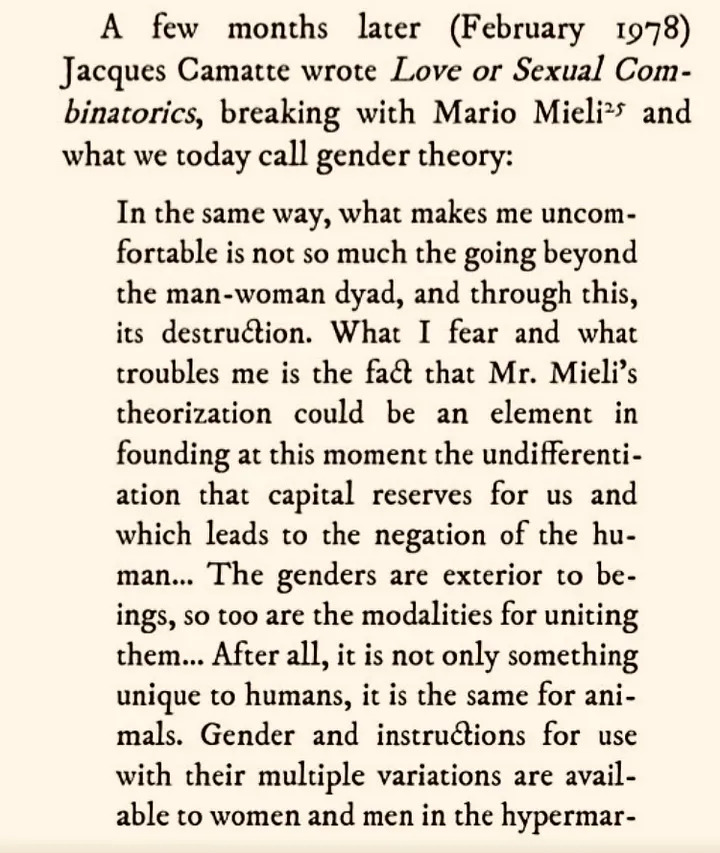
Camatte views the possible trajectory of feminism in the same way: “With feminism we see another manifestation of the Amazons,” which further presages the “risk of fragmentation” of ‘the species’ (Amour ou combinatoire sexuelle).
But, for Camatte, the most serious danger to ‘the species’/humanity is not diversity or segregation of the sexes in different cultural, or modern, situations, it is “the danger of the destruction of the species through homogenization, that is, by the loss of all diversity.”
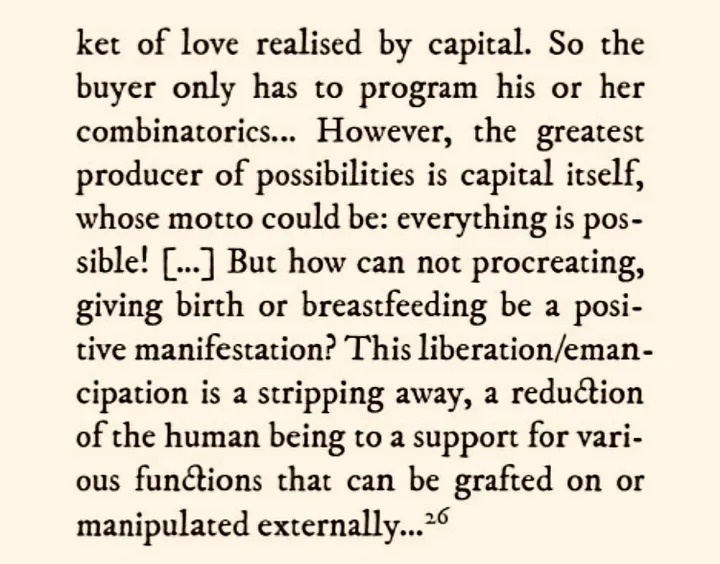
For Camatte, the diversification of sexual modes (an aspect of ‘wandering’) is immediately recuperated by capital and used as another tool of homogenization, or undifferentiation. He writes: “Sexes and modes of use, with their multiple variations, are available to women and men at the hypermarket of love that capital establishes. The buyer only has to configure his or her combinatorial.”
The making of the possibility of any sexual combination, for Camatte, is not only a disaster for the species in terms of further distancing it from ‘nature,’ it becomes another way for capital to reduce humans to a single undifferentiated function of capital itself.
If one reads Amour ou combinatoire sexuelle it becomes clear that, for Camatte, it is OK for women to love women and men to love men, but this should not be referred to as ‘sexual,’ because activities that do not produce children are not sexual.
The problem, for Camatte, is that the gaining of ‘homosexual’ rights (“It follows that I think that capital may very well come to accept homosexuality,” 1978) has helped the emergence of phenomena he regards as deleterious for both children and the future of the species, that is, the ability to produce children via medical intervention/assistance and surrogacy.
So, to resist the further artificialization of humanity one should oppose proposals to establish rights for others to live in the same way as ‘normal heterosexual’ couples, that is, getting married, or having children… just like the extreme right-wing traditionalists do…
(Donald Trump on gay marriage: “I have so many fabulous friends who happen to be gay, but I am a traditionalist,” NYT interview, May 2011.)
So, if there was a vote on, for example, ‘gay marriage,’ one would either vote against it or not vote at all. But abstaining would amount to a vote against… and so one would find oneself in the camp of the reactionaries, just as Camatte has done. In the same way, the TERFs, by their similar abstinence, as Butler notes, have found themselves in the camp of those on the right and extreme right who push their anti-gender ideology.
APPENDIX 2
As I wrote at the start, this essay is a jumble due to it being comprised of my knowledge of Camatte as it has developed. I hope, of course, that some of it is enlightening and useful to anyone who cares to read it. Camatte est mort, mais son fantôme pourrait persister… [Camatte is dead, but his ghost may linger…]
I have been aware of Jacques Camatte since the 1980s but, like many anarchists and ultra-leftists, I was not familiar with his work beyond a few phrases — for example: “The more we fight against capital, the more we strengthen it.” No doubt the Fredy and Lorraine Perlman translation of ‘The Wandering Of Humanity’ (1975), sealed his reputation in the English speaking world as a trustworthy source for analyses of capitalism and revolutionary strategy for many (ignoring the ‘anarcho-primitivist’ enthusiasm). Unfortunately, it seems that no one really undertook any serious exploration of his works and so Camatte became an enigmatic ‘poster-boy’ for many serious-minded revolutionaries. I, too, thought he must be OK, despite having read or understood very little of his work — in the day I never read The Wandering of Humanity, I have since discovered that it appears to contain several omissions and simplifications. But a few years ago I decided to have a deeper look at his writings as part of the ‘reversal of perspective’ (from ‘revolutionary’ to leftist) that I was going through. This was useful and eventually became the first version of the essay above. Then I came in contact with Jacques Camatte himself… and everything started to become startlingly clear.
My brief, accidental, involvement with Jacques Camatte and Il Covile occurred in 2020–21, after having been introduced to Il Covile by an ultra-leftist acquaintance (we have never met in person and no longer correspond) who had no idea the site was far-right. What ensued was, on the whole, fairly hilarious in its own small way. I did some translating of Camatte’s work into English. This was an interesting and addictive task though, eventually, Camatte neither liked my translations (I was informed that he has, historically, been very harsh on all his translators — from Perlman to David Brown—and he does not approve of any of the prior English translations) nor the article I wrote concerning his notion of Gemeinwesen (the first version of the essay above). I then heard, from Ill Will Editions (who I also, wrongly, thought were not dodgy) funnily enough, that Il Covile was a far-right site (despite its former connection with Lotta Continua, which was all I had been aware of). I investigated, and it was true. (It is somewhat nauseating that Ill Will Editions never makes any mention of Camatte’s long history of collaboration with the extreme right, and that they continue, along with Endnotes, Cured Quail, and others, to revere him and his works. I repeatedly asked Ill Will Editions to remove the two articles I wrote for their website, but to no avail, and they blocked me on Twitter hahaha… when I asked Stefano Borselli to remove my translations from Il Covile he did so at once…)
I contacted Camatte directly and he was, of course — because he is/was neither naïve nor dishonest — fully aware and open about it, and he told me (see the email screenshot in the main piece, above) about his former association with Jaca Book, beginning in the early 1970s. It is important to understand, here, that Camatte has absolutely no problem with this, since he views the ‘left’ and the ‘right’ as being equally in error (this is the basis of the ‘anti-political’ stance, but it is interesting that it does seem to facilitate, here and elsewhere, strong connections with the right against the left) and he does not in any manner try to hide his associations. I also communicated with Il Covile concerning my ‘discovery’ of their ‘politics.’ After a brief exchange, with both Camatte and Il Covile, centering mainly around ‘gay marriage’ and movements for equality (although the association of Il Covile with fascists was enough for me in regard to them) I ceased all communication with both parties, requesting that my name and translations be removed from Il Covile.
One of the things that connects Camatte and Il Covile (which describes itself as “anti-modern Marxist’) is a tendency toward ‘traditionalism,’ though Camatte might refute this term and describe his own stance as something like ‘an opposition to artificiality.’ One of Camatte’s key texts in this regard is Amour ou combinatoire sexuelle. If one reads this, along with other instances where Camatte writes about ‘artificiality’ and the role of ‘woman’ it becomes clear that one of the reasons a far-right Catholic group would like Camatte is because he is against things like gay marriage since it leads to things like artificial insemination and surrogacy. He insists, however, that he is not homophobic by any means (“It’s complicated,” he says), and one must take him at his word… but what this means in practise, or in the eyes of others who wish to achieve greater equality in our society, is another matter.
Both Camatte and the far-right, then, wish to slow down or reverse certain tendencies within modern society. Camatte’s insistence that we should resist all artificiality and begin to, as it were, ‘find our place in the world’ (or begin to stop “wandering”) folds in perfectly with Heidegger’s vision67 (who was disappointed that the Nazi’s didn’t go far enough) and the traditionalist yearnings of the far-right. But it is important to remind oneself that the complaint against ‘modernity’ is made by the whole of the Frankfurt school and Michel Foucault, thus feeding into the phenomenon of Continental Philosophy as well as into the tendency of the ‘ultraleft’ that began after WWII with Socialisme ou Barbarie, going to Debord and beyond. As I indicate elsewhere, it is now apparent to me that the complaint against ‘modernity,’ from wherever it emerges, tends to become fodder for ideologues of reaction. Perhaps the contemporary case of Aleksandr Dugin, who has drawn much of his thinking from continental philosophy as well as from Jean Baudrillard and Guy Debord, is a case in point. The question for us all is: how to explore and analyze the deleterious effects of technological and social ‘progress’ without writing tracts that can be agreed with, and utilized by, reactionaries on the far-right.
Perhaps we should reassess our relationship to ‘modernity’ and the possibility that we can make a ‘revolution’, in the effort to avoid being sucked into the pit of ‘traditionalism’ and reaction. Maybe we should reassess our relationship to ‘the left’… and re-engage with much greater vigor? If we want to be effective in the world then it might be better to follow the Rousseau who said that we are stuck in civilization and there is no going back, and the Camus who said that we should rebel but not try to make a revolution.
Footnote:
1 Of Heidegger, Camatte says: “It’s complicated. To see what there is of interest, of importance in Heidegger, you have to really mine his thought to the end, it’s complicated.” From Interview with Jacques Camatte (2019).

- 1Economic-Philosophical Manuscripts, 1844. All translations by author, unless indicated by a footnote reference.
- 2Until the 1980s Jaca Book was the publishing house for the reactionary ‘Communion and Liberation’ movement — Comunione e Liberazione (CL). In 1975 the Red Brigades described CL as “a clerical-fascist campaign unleashed by the Vatican against the danger of communism.” Camatte had Capitalism and Communism in Russia published by Jaca Book in 1974, and Towards the Human Community in 1978. I must point out again that Camatte is quite open about this, like his current work with Il Covile, it is by no means a secret (Jaca Book — look under C). The interview with Cercle Marx is here (transcription: http://libcom.org/library/interview-jacques-camatte-2019). Cercle Marx appear to be ‘red-brown confusionists’ and are linked with the far-right figure, Francis Cousin, who refers to himself as such (for a little history: http://www.liberation.fr/debats/2019/01/16/le-confusionnisme-est-il-le-nouveau-rouge-brun_1703403/; and here: http://paris-luttes.info/une-analyse-critique-des-theories-14329?lang=fr). The Libcom site describes Cercle Marx as “a racist pseudo-Debordist/Bordigist group”… yet still hosts Camatte’s work…
- 3Of a photograph of Bachofen, Benjamin wrote: “An almost maternal largesse, spreading over the whole physiognomy, gives it a perfect harmony,” and he considered Bachofen’s greatness to have emerged from “his veneration of the matriarchal spirit.”
- 4See Cynthia Eller, Gentlemen and Amazons: The Myth of Matriarchal Prehistory, 1861–1900, 2011, UCP.
- 5Camatte’s notion of ‘domestication’ under capital has been a popular trope of ‘anti-capitalists’ for nearly fifty years, but it isn’t really any more interesting or informative than this from Nietzsche: “The meaning of all culture is simply to breed a tame and civilized animal, a domestic animal…” (The Genealogy of Morality)
- 6See: This World We Must Leave, 1974.
- 7 See Inimitié et extinction, 2019.
- 8‘Extrait de lettre,’ 1978, in Articles d’Invariance serie I, Revue Invariance (R.I.). I cannot now find this note on Camatte’s website, which was part of a letter he sent to someone, he included it in a footnote to one of the articles, and dated it 1978. It is possible that Camatte saw my use of the quote and deleted it.
- 9Feuerbach, L. 2012, The Fiery Brook: Selected Writings, Zawar Hanfi (ed. and trans.), Verso, London, P98.
- 10Economic and Philosophical Manuscripts 1844.
- 11See The German Ideology, Part 1, A, and Engels on Ludwig Feuerbach, Part 4. Both on Marxists Internet Archive.
- 12“Dieser Kommunismus ist als vollendeter Naturalismus = Humanismus, als vollendeter Humanismus = Naturalismus, er ist die Wahrhafte Auflösung des Widerstreites zwischen dem Menschen mit der Natur und mit dem Menschen, die wahre Auflösung des Streits zwischen Existenz und Wesen, zwischen Vergegenständlichung und Selbstbestätigung, zwischen Freiheit und Notwendigkeit, zwischen Individuum und Gattung. Er ist das aufgelöste Rätsel der Geschichte und weiß sich als diese Lösung.” From: Ökonomisch-philosophische Manuskripte aus dem Jahre 1844
- 13‘Critical marginal notes to the article: The King of Prussia and Social Reform. From a Prussian,’ Vorwärts! 60, 1844. (mlwerke, from where I accessed the quote appears to be undergoing maintenance or has been taken off the Internet completely.)
- 14https://revueinvariance.pagesperso-orange.fr/glosesprussien.html
- 15See fn10 above.
- 16Camatte, Errance de l’humanité (The Wandering of Humanity), RI, 1973.
- 17Camatte, À propos de la Semaine rouge (About the Red Week), 23 May 1968, RI.
- 18Emil Cioran, 1949, Précis de Décomposition, Éditions Gallimard (1978), Paris. Translations by Hauer. All quotes used are easily locatable in the book, in French or English, so I have refrained from adding even more footnotes.
- 19Cioran uses the word ‘divagante’ here, which is best translated as wandering, or straying. Elsewhere he uses the term divagation in a variety of contexts, all of which also translate as wandering, straying, rambling, etc. Divagation is also a word used in English, meaning digression, detour, tangent, etc. Camatte prefers the word, errance, which means wandering also, but can also mean vagrancy. Camatte does use the word divagation as the title for one text, (Divagation, 2010) in which he states that he is using it because of its old meaning: errer ça et là, ‘to wander here and there.’ [Later note: I have since discovered that the concept of wandering was used by many in the early 20th century to describe ‘the predicament of humanity,’ including Martin Heidegger, who wrote of ‘not being at home in the world.’ Camatte has also read Heidegger, of whom he says: “To see what there is of interest, of importance in Heidegger, you have to really mine his thought to the end, it’s complicated,” see Interview with J. Camatte, by the fascists, Cercle Marx, on Libcom]
- 20Camatte, Surgissement de l’ontose, 2001, RI.
- 21Camatte, Point de Départ, 2003.
- 22The Wandering of Humanity, in This World We Must Leave and Other Essays (1995), Alex Trotter (ed.), Fredy Perlman and Friends (trans.), Autonomedia, New York. Quotes are from P66 and 67 respectively. The ignorance regarding ‘our distant ancestors’ in this last insight should not obscure the profound implications of the rest of the thesis.
- 23Camatte, footnote 14, in Instauration du risque d’extinction, 2020, RI.
- 24Camatte, Mai-Juin 1968: Le dévoilement, 1977, RI.
- 25Wandering of Humanity, 56.
- 26Ibid., 168.
- 27Camatte: “The disappearance of agriculture will probably take centuries,” Inversion et Dévoilement, 2012, RI.
- 28Ibid., 34
- 29Ibid., 63.
- 30Inversion et Dévoilement, 2012, RI.
- 31Interview with Camatte, ‘Inversion is not a strategy,’ May, 2020.
- 32Yuri Slezkine, 2017, The House of Government, Princeton University Press.
- 33Pierre Clastres, 1981, Archeology of Violence, Jeanine Herman (trans.), Semiotext (2010), P160–162.
- 34Pierre Clastres, 1974, Society Against the State, Robert Hurley and Abe Stein (trans.), Zone Books (2013), Brooklyn, P217–8.
- 35Albert Camus, The Rebel, (1951), Anthony Bower (trans.), Penguin, 1982, P265.
- 36Slezkine, Ibid., P180. Quotes are from Thomas Case, in addresses to the House of Commons, 1641. See also House of Government, p122. See also Bernard Capp, The Fifth Monarchy Men: A Study in Seventeenth-Century English Millenarianism, Faber and Faber, 1972/2011.
- 37Endnotes is a group that has existed since 2005, with a prehistory (to 1992, in a UK group called Aufheben), which has become, as they write in their ‘about themselves’, “increasingly international.” In their agonising over who they are and how they relate to “the class struggle” in the article We Unhappy Few, they have decided that they are theoreticians of current conditions and their abolition (not recruiters to a cause), and that the group should last “only so long as they feel they are contributing something useful” (P53). But how are they to know if they are contributing something ‘useful,’ even if it is just ‘a feeling,’ and useful to whom? What do they mean by ‘useful’? Are things only ‘important’ if they have ‘a use’? Their quietist millenarianism, though they insist they have never been a sect “in the normal sense,” (P21) is explained in this sentence: “A purpose that we have found that takes our interest[,] indeed to which we have found ourselves driven[,] is communist theory, the thinking about capitalism and its overcoming” (P53). This is the waiting, in studious and steadfast readiness, for the arrival of ‘God.’
Non-hyperlinked quotes from ‘We Unhappy Few,’ the first (unsigned — perhaps ‘group editorial’?) article, in Endnotes #5: ‘The Passions and the Interests,’ 2019, UK/USA. The essay is in the link to the pdf above.
- 38It is always difficult to make this kind of list for readers who may not already be ‘in the know’ as to the milieu I am referring to, which includes anarchists, councilists, left-councilists, situationists, Bordigists, and the libertarian left as well. The easiest way to imagine this milieu is to think of everyone that Lenin was attacking in his work of 1920, ‘Left Wing’ Communism: An Infantile Disorder.
- 39One must understand the notion of ‘the real movement’ in the context of Marx and Engels’ whole-hearted support for ‘the scientific method,’ which is how they developed their notion of the dialectic as the driving force in ‘history.’ A famous line from Marx is rarely understood: “Philosophers have hitherto only interpreted the world in various ways; the point is to change it.” This line was never a simple urging of philosophers to ‘get active’ for the good of things, it meant that philosophers had to abandon the world of ‘universal absolutes’ (think Plato’s ‘theory of Forms’) and work within the social and environmental processes that were actually in existence. If they did this, Marx believed, they would no longer be ‘idle philosophers,’ they would be scientists — in Marx’s era it was the scientists who were seen to be changing the world, and proletarians and philosophers would be able to do likewise if they became ‘scientists’ too or, more precisely, dialecticians of the materialist conception of history (historical materialism). See, for example, Engels’ Ludwig Feuerbach and the End of Classical German Philosophy, Part 4: Marx, from the paragraph beginning: “But what is true of nature…”
- 40Marx, K. 1867, Capital Volume 1, Penguin Books, 1976, P91.
- 41There are several references to ‘the real movement’ in We Unhappy Few. The quote from Marx is usually translated as something like: “the real movement which will abolish the present state of things,’ and is used frequently in the literature of ‘communization’ theory. The whole sentence from Marx is “Communism is for us the real movement which will abolish the present conditions.” Since the early 1970s the line, starting at ‘the real movement…,’ has become something of a magical incantation for left communists. The notion of ‘the real movement’ was referred to, but not referenced, in Eclipse and Re-Emergence of the Communist Movement, by the ultra-leftists, Gilles Dauvé (Jean Barrot) and François Martin, and it was here that the notion of communization first appeared. In 2000, Dauvé indicated that communization theory emerged from the Situationist International’s ‘critique of separation’ (see ‘Back to the SI’ on Troploin). Amusingly, in 1983, Camatte described ‘Dauvé and his companions’ as “the living dead” (see La Mort Potentielle du Capital, RI) in response to their criticism of Camatte’s ‘optimism’ (see La Banquise #1, available at archivesautonomies.org).
- 42Preface to second edition of Nihilist Communism: A Critique of Optimism — the religious dogma that states there will be an ultimate triumph of good over evil — In the Far Left, Ardent Press, 2009, p ix.
- 43Ibid., 101. It should also be noted that M. Dupont, the collective name for the two people who produced NC, was never ‘a group.’ The book was assembled from correspondence between us (and with others who were generally hostile to us), it was an expression of a friendship, a kind of romance, now lost in time, especially so since the other Dupont has since had a ‘theological turn’ and become a peddler of far-right propaganda in a possibly confused, but certainly very odd, attempt to use the tools of ‘neo-reaction’ for the sake of ‘communism’ (see the self-reverential and Agamben-inspired text, I am not Chuang, by Frère Dupont.)
- 44See, Fascism is not a Pathology, elsewhere on my Medium account.
- 45It would seem that many of us, I include myself here, have an inbuilt urge to endlessly proselytise. Emil Cioran writes, in A Short History of Decay, that people “are the chatterboxes of the universe” and that many insist on speaking for others… they use the word ‘we, for example,’ to describe what they themselves think. Anyone, he continues, “who speaks in the name of others is an imposter.” But we can temper our proselytism by refusing the diktats of serious, political, or academic prose by writing I instead of we.
- 46Although those around Endnotes, from behind their academic parapets, do also seem keen on a degree of boy’s own activity. Monsieur Dupont/Frère Dupont, Agamben, Camatte, Endnotes, etc, are poles of attraction, or rivals, in the big-tent of millenarian communism. The Endnotes pole is the boys dream of “hijacking trucks” (see J. Bernes, Endnotes 5), the MD/FD pole is the narcissistic lament of ‘failure.’ Meanwhile, Agamben flirts with Diego Fusaro, and Camatte holds hands with with Cercle Marx.
- 47Camatte, Contre la domestication, 1973, RI.
- 48Camatte, La Mort Potentielle du Capital, RI.
- 49A.J. Gurevich, Categories of Medieval Culture, G.L. Campbell (trans), Routledge, 1985, p150.
- 50Marx, The 18th Brumaire of Louis Bonaparte, 1852.
- 51Ernest Mandel, How To Make No Sense of Marx, 1989, at Marxists’ Internet Archive.
- 52Camatte, Il divenire all’inversione, 2017, RI.
- 53Camatte, Émergence et Dissolution, 1989, RI.
- 54For a detailed exploration of Clastres’ thought see The Freedom of Things.
- 55Camatte, La révolution intègre, 1978, RI.
- 56For a detailed review of the anthropological literature, see the section, “Enemy Relations,” in The Freedom of Things.
- 57Much of this and the next section is taken from the article, The Last Humans.
- 58See The Freedom of Things.
- 59For a detailed discussion see The Freedom of Things.
- 60See Rousseau’s Discourse on Inequality, for his analysis of civilization as a society of centripetal dependence, from which we cannot escape. Discussed in The Freedom of Things.
- 61D. Wootton, Introduction, Basic Political Writings, J-J Rousseau, 2011, Hackett, p ix.
- 62Quotes are from pages 215 and 218 respectively, from The Rebel by Albert Camus, Anthony Bower (trans.), Penguin, 1982.
- 63The kulaks were portrayed by the Bolsheviks as ‘rich’ peasants who were in the way of the socialisation of the land but, in reality, they were simply all peasants. The peasantry — and the relationship between the land and the city — has been a perennial problem for revolutionaries, as Marx wrote in 1875: “The peasant exists on a mass scale as a private land proprietor, where he even forms a more-or-less considerable majority as in all the countries of the West European continent, where he has not disappeared and been replaced by agricultural laborers, as in England — the following will take place: either the peasants will start to create obstacles and bring about the fall of any worker revolution, as he has done before in France, or else the proletariat (for the peasant proprietor does not belong to the proletariat; even when his situation places him in it, he thinks that he doesn’t belong to it) must, as the government, take steps as a result of which the situation of the peasant will directly improve and which will therefore bring him over to the side of the revolution.” (quote is from The Marx and Engels Reader, 1978, Robert Tucker, but can also be found at marxists.org.)
The group, Théorie Communiste (Roland Simon) who are close to the group Endnotes, wrote in 2011: “The essential question which we will have to solve is to understand how we extend communism… how we integrate agriculture so as not to have to exchange with farmers” Communization and its Discontents, B. Noys, p58.
Maxim Gorky is reported as having once said: “You’ll pardon my saying so, but the peasant is not yet human… He’s our enemy, our enemy” (Lynne Viola, The Unknown Gulag, 2009, OUP).
- 64Vasily Grossman, Everything Flows, Robert and Elizabeth Chandler with Anna Aslanyan (trans.), Vintage, 2011, P128–9.
- 65The notion of ‘reverse-dominance hierarchy,’ for example, as expounded by Christopher Boehm, is contested in The Freedom of Things. There is also an in-depth examination of ‘the feud’ in non-State societies that shows why this phenomenon is/was cannot be fully understood as a ‘simplistic’ exercise in ‘social control.’
- 66While ‘hunter-gatherers (my, less pejorative, term is wild-fooders — see The Freedom of Things) were certainly not sedentary by our standards they also were not nomadic in the way this term is generally understood.
- 67Like so many on the 'anti-political' spectrum, Camatte is effectively against any movement for equality, and this is another way such ideology feeds into far-right discourse.



Comments
working link (possibly):…
working link (possibly):
https://medium.com/@contrahistorical/jacques-camatte-is-dead-32da46a02c8e
I've managed to add the…
I've managed to add the whole text here, but the formatting needs some attention....
Thanks, Fozzie, for doing…
Thanks, Fozzie, for doing all this, and putting in the short Libcom intro. All the best.
Now formatted with inline…
Now formatted with inline endnotes. Endnote 3 is a new addition, from:
"(who was, amusingly, literally adored3 by Walter Benjamin)"
- "adored" was weirdly hyperlinked to the endnote text in the original.
The final endnote is also new for the same reason.
The Libcom site describes…
Yeah, I've come across several eyebrow raising texts by camatte and other's in his orbit on here without the usual disclaimers. Though to avoid bashing the site I notice that most of the uploaders e.g. Radical Reprints who added that interview are usual regular (or were regular) contributors, and given how big and active uploading still is its possible they don't know about the context or the contents of most of these.
It also doesn't help that the few times labels and commentary are added to these texts the cheerleading squad crawled out the wood work.
This obliviousness or just not giving a shit over some really blatant reactionary ideology seems pretty common amongst the crowd that orbits end notes et al.
"So, if there was a vote on,…
"So, if there was a vote on, for example, ‘gay marriage,’ one would either vote against it or not vote at all. But abstaining would amount to a vote against… and so one would find oneself in the camp of the reactionaries, just as Camatte has done. In the same way, the TERFs, by their similar abstinence, as Butler notes, have found themselves in the camp of those on the right and extreme right who push their anti-gender ideology."
This statement represents my problem with the article, which contains a misunderstanding of Marxist and ultra-left politics. Firstly, gay marriage itself is a bourgeois and reformist conception, a vote that allows more people to participate in the bourgeois structure of marriage will not result in gay liberation, and an abstention from such a vote is not a homophobic thing, if one is against bourgeois structures within society itself, the coneption of marriage and recognises the problems with reformist struggles. Minorities will never achieve true freedom under capitalist rule. Additionally, TERFs do not abstain from feminism, but rather they are the natural evolution of the bourgeois and interclassist elements within the feminist movement which form up its majority - conflating anti-gender ideology and anti-ideology is simply ridiculous.
While there are useful critiscms to made around certain communization and Italian groups allying with neo-strasserist elements and regardless of how one feels around the strange politics of the various International Communist Parties, reintegrating with the "left" is a horrible idea. The "left" or rather the left wing of capital will never form a proletarian movement itself, but rather ally with "progressive" elements of the bourgeoisie and the "left" we see today is incredibly reactionary, justifying oppression against certain races in the case of modern-day Marxist-Leninists and the justification of electralism and reformism from social democrats and the bourgeois elements within the anarchist movements, the left will never represent the proletariat in any capacity, they will instead advocate for the bourgeoisie that they consider the "lesser evil".
In regards to Camatte himself, while he is not much more than an oddity he does represent a troubiling tendency for some ultra-left groups to ignore the politics of certain groups, and he does represent the trajectory of the thought of leftist academics who rallied to the 1968 movement which could not have been considered a revolutionary situation. While the trajectory of the tendencies that would be considered Bordigist were collapsing and splintering into different factions around the end of the 20th century, Camatte was absorbed with primitivist ideas and rejected Marxism. Finally, I think conflating Marx's concept of the species-being with that of philosophers such as Heidegger is bizarre, this text is too sympathetic to academic philosophy in my opinion.
"So, if there was a vote on,…
"So, if there was a vote on, for example, ‘gay marriage,’ one would either vote against it or not vote at all. But abstaining would amount to a vote against… and so one would find oneself in the camp of the reactionaries, just as Camatte has done. In the same way, the TERFs, by their similar abstinence, as Butler notes, have found themselves in the camp of those on the right and extreme right who push their anti-gender ideology."
This statement represents my problem with the article, which contains a misunderstanding of Marxist and ultra-left politics. Firstly, gay marriage itself is a bourgeois and reformist conception, a vote that allows more people to participate in the bourgeois structure of marriage will not result in gay liberation, and an abstention from such a vote is not a homophobic thing, if one is against bourgeois structures within society itself, the coneption of marriage and the problems with reformist struggles. Minorities will never achieve true freedom under capitalist rule. Additionally, TERFs do not abstain from feminism, but rather they are the natural evolution of the bourgeois and interclassist elements within the feminist movement which form up its majority - conflating anti-gender ideology and anti-ideology is simply ridiculous.
While there are useful critiscms to made around certain communization and Italian groups allying with neo-strasserist elements and regardless of how one feels around the strange politics of the various International Communist Parties, reintegrating with the "left" is a horrible idea. The "left" or rather the left wing of capital will never form a proletarian movement itself, but rather ally with "progressive" elements of the bourgeoisie and the "left" we see today is incredibly reactionary, justifying oppression against certain races in the case of modern-day Marxist-Leninists and the justification of electralism and reformism from social democrats and the bourgeois elements within the anarchist movements, the left will never represent the proletariat in any capacity, they will instead advocate for the bourgeoisie that they consider the "lesser evil".
In regards to Camatte himself, while he is not much more than an oddity he does represent a troubiling tendency for some ultra-left groups to ignore the politics of certain groups, and he does represent the trajectory of the thought of leftist academics who rallied to the 1968 movement which could not have been considered a revolutionary situation. While the trajectory of the tendencies that would be considered Bordigist were collapsing and splintering into different factions around the end of the 20th century, Camatte was absorbed with primitivist ideas and rejected Marxism. Finally, I think conflating Marx's concept of the species-being with that of philosophers such as Heidegger is bizarre, this text is too sympathetic to academic philosophy in my opinion.
Sorry, I'm unfamiliar with…
Sorry, I'm unfamiliar with this site's interface, how do you delete a comment?