
The Brand New Bulletin of CLASS WAR #17

Let’s Turn Capitalist War & Peace into World Social Revolution!
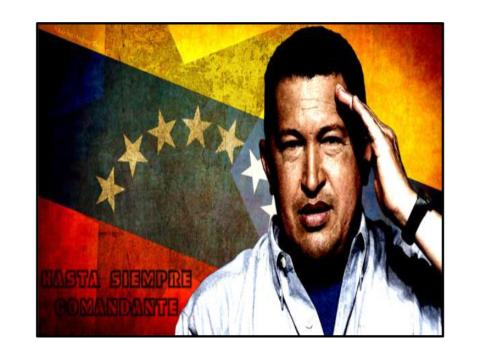
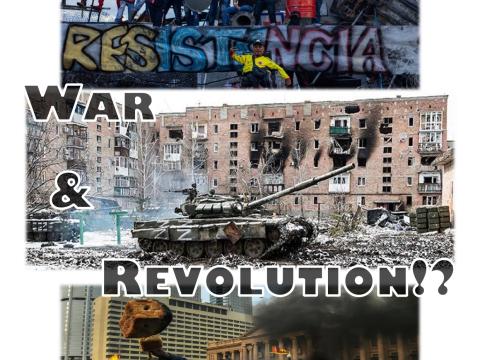
“The year 2026 is off to a roaring start!”, as we wrote at the very beginning of this year, at the time of the US military intervention in Venezuela. Taking advantage of this umpteenth episode of warmongering process, we recalled that for years, we and other communist minorities have been asserting that the world is on a determined course toward generalized world war, which all the bourgeois gangsters who exploit us see as the solution to the (economic, social, political…) crisis inherent to the capitalist mode of production and accumulation. And the war in the Ukraine will not prove us wrong. Nor will the killings in the Gaza Strip. Nor even the recent events in Venezuela… And today, barely two months later, we can add Iran to this grim list!!!
Overall, what we see is a worldwide militarization of society, both physically and mentally, a widespread rearmament, a development of warmongering propaganda, and designation of an “enemy” (always the bourgeois camp on the other side) and therefore also a crackdown on the proletariat and its attempts to defend its own interests as an exploited (and therefore revolutionary!) class, both its immediate and historical interests.
And once again, we are witnessing the same crude campaigns to rally the proletariat behind flags that are not its own: we are being asked to choose between the plague and the cholera, to choose one bourgeois camp over another, a “lesser evil” over a “worse” one… Either the camp of “imperialism” or the camp of “anti-imperialism,” knowing that the latter is also just imperialism, that of the “opposing” camp! There was a time when we were asked to defend the Vietnamese or Palestinian or Chilean “people” against “Yankee imperialism.” And after just yesterday, that is to say two months ago, all the factions of international leftism were ordering us to defend (more or less) “the homeland and socialism” in the Bolivarian style… today we are supposed to “play another round” by taking up the cause against “American-Israeli aggression” in Iran, considered as the regional hub of the “axis of resistance”!!!
Faced with this antagonistic situation, we can only affirm once again that the proletariat does not have, has never had, and will never have a homeland to defend, that socialism or communism or anarchy, in short, a classless, stateless, moneyless, propertyless society, without exploitation… will not be built by defending one so-called progressive (or “anti-imperialist”) bourgeois faction against another so-called conservative or reactionary (or imperialist) bourgeois faction. Neither Trump nor Maduro! Neither Putin nor Zelensky! Neither Netanyahu nor Khamenei! Neither the USA nor Venezuela! Neither Russia nor the Ukraine! Neither Israel nor Iran nor Palestine! Neither Tsahal nor Artesh! Neither the left nor the right!
And even if it “shocks” some people, we are not afraid to say loud and clear: Neither ISIS nor Rojava! Not that we equate these two entities, but both are products and agents of Capital. One through its “theocratic dictatorship” constituted and self-proclaimed as the “Islamic State”; and the other through its equally democratic dictatorship, which in no way affects private property or value, and which, beyond a predominant and ostentatiously assembly-based fashion, nonetheless develops all aspects of the State (the “proto-State” of Rojava, as some claim!). And the latter is obviously ready to engage in all possible and imaginable compromises and alliances with all possible bourgeois factions, with the possible exception of ISIS!!!
Neither the proletariat struggling in Venezuela for decades now (let’s remember the Caracazo in 1989 and its 3,000 dead), nor the struggling proletariat in Iran (which has led at least five major uprisings in the last eight years, with perhaps 30,000 victims in the most recent one in January 2026!) need American intervention to get rid of its own bourgeoisie, its own exploiters: the “Bolibourgeoisie” in Venezuela, the “Mullah’s regime” in Iran. And our struggling class does not need any kind of pseudo “international solidarity” which consists precisely in defending one local faction of the world bourgeoisie against another. Our only response is class against class, internationalist solidarity with all sectors of the proletariat struggling against their own bourgeoisie: internationalist solidarity with the proletarians struggling in Venezuela against the Bolivarian bourgeoisie, internationalist solidarity with the proletarians struggling in Iran against the bourgeoisie of the Mullahs, internationalist solidarity with the proletarians struggling in Palestine against the bourgeoisie of the PA and Hamas, internationalist solidarity with the proletarians struggling in Rojava against the national-social-liberationist bourgeoisie…
Faced with the determined course towards generalized world war that our enemies, all our enemies, are preparing for us, the proletariat has only one response to assert in letters of fire on the stage of human prehistory: Revolutionary defeatism against all bourgeois camps! Let’s transform capitalist war and peace into world social revolution!
A few weeks before the violent events in Iran, important uprisings of our class shook the world of value and commodity: it was last September in Indonesia, Nepal, Madagascar, the Philippines, Ecuador, Peru, and Morocco… And if these uprisings cannot strictly speaking be described as a social revolution, we nevertheless wish to come back to this issue, albeit belatedly, in the following pages and highlight their strengths and weaknesses as lessons for future uprisings…
Indonesia, Nepal, Madagascar, Philippines, Ecuador, Peru, Morocco, ad infinitum…
We have never been bombarded so much with all the nauseating subcategories of tainted sociology, serving the dominant social order, the order of capital and business, to make us mistake bladders for lanterns and failing to grasp the community of interests that bind us to our proletarian sisters and brothers struggling all over the world.
We have already been force-fed with journalistic labels, each time a spark of social war enlightens our dreary everyday life: “dropouts”, “outcasts”, “unemployed”, “precarious workers”, “students”, “youngsters”, “workers”, “peasants”, “city dwellers”, “suburbanites”, “underprivileged”, “poor”… ad nauseam, culminating in “the people”, these are the labels that are forcibly applied to proletarians in struggle in order to hide, conceal, obscure, camouflage, mask… the identity of centuries-old exploitation suffered by our class, the class of those dispossessed of the means of production, of existence and of life – the proletariat. And this goes beyond local and historical specificities, which may, if not differentiate us in terms of relative misery, at least distinguish us in terms of the absolute misery we experience on a daily basis: that is to say, our ability in terms of solvency to participate to a greater or lesser extent in the wonderful world of producing, buying and selling rotten commodities – in short in the enlarged reproduction of the capitalist nightmare.
Today, or since recently, the entire scope of proletarian struggles against the permanent deterioration of our miserable living (survival) conditions has been ignominiously covered by the chic and flashy, deceptive and artificial, fallacious and treacherous veil of the so-called Generation Z – “Gen Z” as it’s said by the whole compliant media. As if only youngsters of 20 to 25 could still take to the streets and overturn everything, as if homo democraticus, domesticated for centuries, were not a timeless giant with feet of clay, as if the defining characteristic of an exploited class, across all generations, were not precisely to be revolutionary and to mobilize all the energy at its disposal, to develop all its forces of self-organization and subversion, to make all audacities possible… and moreover nowadays fueled by the vivifying rage of large sections of the proletarian youth, consumed by a lack of prospects and a future blocked by capitalist catastrophe…
In just a few weeks, no fewer than seven major uprisings have broken out all over the world: Indonesia, Nepal, Madagascar, Philippines, Ecuador, Peru, and Morocco. And when we say “major”, we are not referring, of course, to the importance of the tasks of widespread upheaval and the reversal of the status quo, the present state of things and therefore of the praxis, which the proletariat is historically determined to undertake. If we describe these uprisings as “major”, it is primarily because of the intensity of the attacks carried out by our class, as well as the circumstantial rupture of social peace, unfortunately still prevailing too widely everywhere…
Without wishing to talk about a temporal shift, and certainly not about a “new period” (as it’s becoming increasingly trendy!), in the age-old confrontation between both classes with immediate and historical interests that are not only fundamentally different but viscerally antagonistic, it must nevertheless be noted and emphasized that the tempo of proletarian uprisings all over the world of value is experiencing a serious acceleration. This in itself is nothing new: the significant wave of struggles that swept across the capitalist hell in 2018-19 had already spread like wildfire… Algeria, Chile, Ecuador, France, Hong Kong, Iraq, Iran, Lebanon, Sudan… After the halt caused by the counterinsurgency management of Covid by all Nation-States around the world, the resurgence of the struggles was not long in coming, fueled by frontal attacks on our class under the pretext of the energy crisis caused by the war in Ukraine, which resulted in soaring prices, waves of layoffs, etc.
And now that we are witnessing (still too powerless as we are for the time being) the rise of militarization in society, the exorbitant spending on armaments, and, generally, the accelerated development of the course towards generalized and global war, conceived by the capitalist class and the impersonal managers of the World Order (both “old” and “new”!) as “the solution” to all problems of valorization and its inherent tendency of the rate of profit to fall, the old mole seems to want to reappear, our class is initiating the struggle once again and raising its head…
Because under the black sun of capital (a blazing sun, and even a leaden sky, could we say, made of lead and shrapnel!), our only prospect, for us proletarians, is the struggle: struggle not for some reforms of this society of war, misery, and death (which would once again spell our doom!), but for its total and definitive eradication…
And this time again, as it has always been the case throughout the turbulent history of class struggles, the very latest protests began under various specific pretexts: housing allowances that parliamentarians award themselves (in Indonesia), the banning of several social networks and, more generally, endemic “corruption” and “nepotism” (in Nepal), power cuts and water shortages (in Madagascar), pension reform (in Peru), the failure of the healthcare system (in Morocco), etc.
All these circumstantial factors are merely the sparks that set “the prairie on fire”, while the very foundation of all these uprisings is the ongoing deterioration – everywhere! – of our working and living conditions… it is the social dictatorship of value, profit, and capitalist social relations. All these demonstrations of anger, violence, and virulent exasperation of our class are not isolated national episodes, but local expressions and materializations of the same global rejection, the same ongoing refusal in motion of present state of things. And everywhere – whether they like it or not, professional activists self-proclaiming to be the “vanguard” of the proletariat and advocating the “centrality” of Europe and North America in the class struggle cannot ignore it! –, everywhere from Indonesia to Nepal, from Madagascar to the Philippines, from Ecuador and Peru to Morocco… it is large sections of the proletariat (urban and rural) who are taking to the streets and who, here, are massively and collectively looting temples dedicated to the God-Commodity and are partially re-appropriating the social wealth produced by our class, and there, are destroying and burning down bourgeois parliaments, the headquarters of political parties, and the rich mansions of politicians and capitalists, as well as the rat holes of their armed militias…
We will not dwell here on the precise sequence of all these events, although it is the life and energy of our class that tears away the filthy veil of oppression, in default of tackling head-on the very sources of exploitation. But we would nevertheless like to highlight some of the most powerful moments that have been engraved in letters of fire in our collective consciousness and historical memory. And this, contrary to – and we openly claim this! – the insipid logorrhea spread in their rags by all the Euro-centrists who rave about the umpteenth “strike” in a particular sector (among postal workers, for example, or teachers…), as long as it happens “here” and not “there,” in “the central countries” and not in the “peripheries” of capital… Humanity won’t be happy till the last capitalist is hung with the guts of the last Euro-centrist!
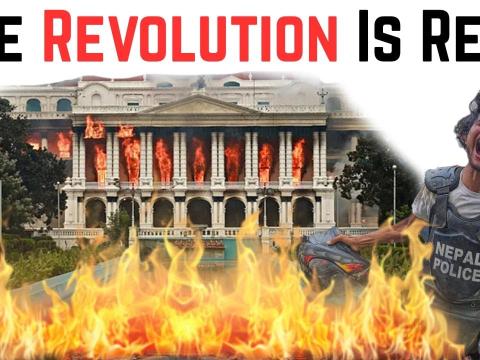
We therefore simply wish to highlight the incredible and vital violence expressed by our class in struggle: in Nepal, for example, the proletariat did not hesitate to set fire to the bourgeois parliament, the Supreme Court buildings, and many other palaces. The salvation rage of our class comrades has gone way beyond the reformist framework of protest to the point where the self-proclaimed “organizers” of the movement have to admit that they’ve been “overwhelmed”!!! This rage also manifested itself in a high level of red terror when well-known class enemies, politicians, bourgeois, were the targets of actual lynching scenes and a highly discriminatory “manhunt” in the streets, the countryside… and even in the rivers!
It is also worth noting, among other examples, an expression of proletarian associationism, as manifested in Nepal, through the voice of the “Safal Workers’ Street Committee,” which states:
“We are a group of independent Marxists who have long rejected all the Parties, for being Communist in name only.
We remain first and foremost a Street Committee, which was formed to organize the Defense of the Working Class.
We were born out of necessity, as the Communist Parties abandoned the Working Class, when it needed leadership the most.
Our task now is to split the Working Class from the Democratic Parties of the Middle Class. To prevent the reproduction of Bourgeois Democracy.
We are still organizing and call on all like-minded Communists and allies to form Committees of their own and join us in a Worker’s Front.”
On the other hand, it should be noted (a phenomenon that does not seem to have occurred in countries other than Madagascar) that major discord openly appeared within the Malagasy army when soldiers mutinied (as they had already done during the struggles of 2009) to protest against the repression of demonstrations: “Refuse to be paid to shoot our friends, our brothers and our sisters. […] No longer obey orders from your superiors. Point your weapons at those who order you to shoot your brothers in arms because they are not the ones who will take care of our families if we ever die.”
The refusal of certain sectors of the police to shoot at their class brothers and sisters is always a crucial moment in the confrontation between the proletariat and the State. Indeed, the co-opting of proletarians into the repression forces is the cornerstone of bourgeois domination. Class struggles in Bolivia in 2003 were a noteworthy example of this contradiction, when large sectors of the police defected and went over “with arms and baggage” to the side of the struggling proletariat, assaulting barracks, emptying arsenals, and confronting elite units as the last bastions of a central sector of the State.
Unfortunately, in Madagascar, as often in other struggles, the limitations and weaknesses of the movement neutralized the subversive force of this explicit refusal of the soldiers to shoot and take part to the repression, transforming it into an implicit support for “democratic change.”
Unfortunately, it seems that the mutiny failed to develop or boost the momentum, with all the consequences that it implies, of these initial manifestations of revolutionary defeatism. Faced with this situation, which shows how much the capitalist order fears a power vacuum, the game of “democratic alternation” prevailed due to its ultimate effectiveness in crushing the movement, an effectiveness far superior to anything the State had attempted to do up to that point during the course of the struggle.
We can only see in the strong limits of proletarian associationism one of the major weaknesses that will prove fatal to the powerful episodes of radical revolt against the system as a whole, whether in Madagascar or Nepal, Indonesia or Morocco, etc. These revolts manifested themselves through riots, looting, and highly targeted attacks, but do not seem to have made sufficient qualitative leaps in terms of coordination and organization, in order to stir up unrest among the most hesitant sectors of the proletariat.
During these few weeks of intense struggle (and the embers still seem smoldering enough to reignite the fire at the slightest opportunity, here or elsewhere), the major part of the proletariat has not broken with the democratic, legalistic, reformist illusions that attribute the origin of all evils to the policies of a President-in-Office, “corrupt” politicians (and they are obviously corrupt!), parliamentary institutions and others, “disconnected” from the reality of our daily survival as proletarians, etc. Although sectors of the proletariat in struggle, through their denunciations and actions, put forward the capitalist origin of their present social suffering, the revolt failed to clearly express its rupture with democratic and citizen submission, nor did it spread sufficiently in time (despite the relentless crescendo of the conflagration!) and in space (despite the resounding echo that each “local” struggle produces on the capacity to struggle of proletarians in neighboring countries, and even in other geographical areas), what obviously over and over again constitutes one of the major problems of proletarian struggles around the world.
It is also worth touching on the issue of flags, particularly the one that was flying during the struggles categorized as those of the “Gen Z”. Let us consider, for example, the viral spread of certain collective gestures that developed in Indonesia and very quickly spread to Nepal, the Philippines, Madagascar, Morocco, Ecuador, and Peru… and which materialized, among other things, through the repetition of the same gesture: raising a “pirate flag” inspired by a Japanese manga that is very popular in “the popular culture”, and which in fact served as a (indeed simplistic but nonetheless) creative response to the Indonesian president’s call for citizens to wave the national flag before the country’s independence day.
Of course, we would all have preferred that the proletarians, who take to the streets and ransack the symbols of their daily misery, raise instead the red and/or black flag of anarchy and/or communism, the flag of the party of subversion and the revolutionary proletariat – although in Indonesia, the black flag of anarchy was also waved in many scenes of clashes! But just as social revolution is not a question of a formal party, a political party (in the strict sense of the term), a party self-proclaimed “vanguard of the proletariat”, the revolution is also not a question of a formal flag. It should be noted, however, that in the manga at issue, the “pirate flag” is raised several times as a declaration of war against “the World Government”. In this sense, the Indonesian government was not wrong to describe it as an act of disobedience and treason against the homeland, because that is indeed the case: it is active desertion, a symbol that more or less represents the promise of a revolution, a revolution that knows neither States nor borders…
On the terrain of class struggle, the material reality is highly complex: proletarians – young, very young, or even not so young; men, women, “urbanites,” and even “peasants” – express a healthy, vigorous, and immeasurable hatred. But unfortunately, they have not yet established an organizational structure up to the stakes of the struggle – a structure capable of steering the entire process toward its goals. These are the recurring limitations in the history of all our struggles: the weakening of the organized forces of our class inevitably leads to the co-optation of revolutionary potential by external and/or internal powers that exploit it for capitalist and imperialist ends to renew their social dictatorship.
To overcome the spontaneity, limitations, and contradictions of the current uprisings and thus transform them into dynamic forces for the eradication of capitalist social relations, it is necessary to organize and strengthen proletarian associationism, the constitution of the proletariat as a class and as the historical party of the world communist revolution:
“When we speak of a party, we are not, of course, referring to the infamous mafias and cliques that bear that name, but rather to the historical party of the revolution, which cannot be the work of any particular group or set of groups, but only of the proletarian class itself, constituted as an autonomous social organism. We are far from believing that the current weaknesses of the class can be artificially remedied by a revolutionary vanguard that injects consciousness from outside. On the contrary, we recognize ourselves as part of the diffuse party of subversion within capitalist society, and our reflection as a contribution, modest without doubt, to the constitution of the proletarian class as a historical party.”
“Revolutionary theory, the perspective of the historical party of the revolution, has a titanic task today: to produce the revolutionary synthesis of our era before the degradation of terrestrial conditions imposes – to an even greater extent than at present – catastrophic scenarios for the whole of the species. The threat of an arms race between the central powers of global capitalism, ecological crisis, and revolts on different continents are, so far, the trend for our immediate future.”
[Quotes from La democracia es el orden del capital / Democracy is the Order of Capital / 2020]
In this new issue of our aperiodical bulletin, through the following articles, we are doing our part to contribute to the development and strengthening of our international and internationalist proletarian community of struggle. We have compiled four articles here that analyze and/or highlight the importance of our class’s current struggles. These articles come from militant structures active across three continents!
This material reality also transcends the bourgeois separations between the “central countries” of capitalism and “peripheral countries”… To paraphrase Marx, who at the end of his life challenged the dominant, Eurocentric conception of revolution, we might evoke “the possibility of revolution beginning first in peripheral countries, which are less industrialized, where capitalist productive forces are still limited and ‘archaic’ social forms persist, before reaching the center.” And the numerous explosions of proletarian anger across the world in recent years and decades do not contradict us. On the contrary, they encourage us to grasp the fact that our class is organizing itself and is the bearer of humanity’s determination even in the “less developed” places – according to the disgusting criteria of bourgeois political economy!
Same Exploitation, Same Actions!
The Bad Days Will End!
CONTENT:
Some Thoughts on the Role of Uprisings in our Time
Questions for the 2025 National Strike in Ecuador
Gen Z Storms Marineford!
Indonesia, for the Maximal Program!
Neither Tsahal Nor Artesh
We Support Our Troops… When They Shoot Their Officers!
PDF: http://www.autistici.org/tridnivalka/wp-content/uploads/class_war_17-2025-en.pdf



Comments