A complete archive of Processed World, a radical magazine based in San Francisco and the Silicon Valley area by and for office and information technology workers. Published 1981-2004.

Taken from http://www.processedworld.com/

Anxious boss is sweating because workers are reading Processed World.
Introduction and history of Processed World - a quarterly paper published in 1980's and 1990's in Silicon Valley, California. PW was written by a group of radical office workers ("temps"). Unlike similar publications, PW made good use of humor and art to sharpen its subversive attack.
"At the root of this effort is our desire to live and take part in a radically different social system, a society which as yet exists nowhere on Earth." -- Introduction to Processed World
Are you doing the processing...
...or are you being processed?
=== Introduction from the first issue (1981) ===
Hello out there!
This is the first issue of Processed World. We hope it will serve as a contact point for office workers who are dissatisfied with their lot in life and are seeking something better. The current situation of most clerical workers, secretaries, and "processors" of various sorts is our starting place: meaningless work with little material reward in a deteriorating and self-destructive social system.
The opening article offers a compelling description of the individual mired (but not hopelessly) in Corporate Office Land. From there we go to the Blue Shield strike, which is still going on as we go to print. This trade union-based attempt of office workers to improve their situation has run up against institutional and strategic constraints.
The following article, "New Information Technology: For What?" has undergone intensive discussions among the writers and editors of PW. After a brief economic analysis of automation in the office it broaches the touchy subject of whether or not computers-- and high technology in general-- are inherently oppressive. Also discussed are some of our ideas of how a society based on free social relations can put new information technology to use.
Next is a short story about insurrection in San Francisco in 1987, beginning with the occupation of the Bank of America buildings by the workers inside. A review of the movie 9 To 5 concludes our first issue. Hollywood's attempt to address the reality of office work gets lost and distorted in improbability and easy laughs.
We hope these articles (and those in other issues to come) will begin to challenge the assumptions upon which this society is built. At the root of this effort is our desire to live and take part in a radically different social system, a society which as yet exists nowhere on Earth.
These new forms of social existence begin with communication, with breaking down the barriers that isolate us and finding different ways to express our feelings and thoughts. With a shared understanding of the fears, desires, and pleasures of our daily existence, we can counter the false images and stereotypes encouraged by those who want to keep us in our "place."
In a world where so much of our time is wasted on boring tasks or ridden with anxieties, it is important that we experiment with ideas and activities that are in themselves enjoyable. Rebellion can be fun, and humor subversive. Only by cultivating our imagination and talents will we be able to find ways to shatter the existing order.
Write to us. Tell us about your situation-- where you work, what conditions you work under, what kinds of resistance you are already involved in, how you coordinate your activities with coworkers, etc. And write to us about your dreams. What kind f a world would you like to live in? What would you do with yourself if you could do what you enjoyed instead of what you've been forced to do to make a living?
=== History and retrospective (1991) ===
Are you doing the processing...
...or are you being processed?
[h2](some history of Processed World)[/h2]
Processed World magazine was founded in 1981 by a small group of dissidents, mostly in their twenties, who were then working in San Francisco's financial district. The magazine's creators found themselves using their only marketable skill after years of university education: “handling information.” In spite of being employed in offices as “temps,” few really thought of themselves as “office workers.” More common was the hopeful assertion that they were photographers, writers, artists, dancers, historians or philosophers.
Beyond these creative ambitions, the choice to work “temp” was also a refusal to join the rush toward business/yuppie professionalism. Instead of 40-70 hour weeks at thankless corporate career climbing, they sought more free time to pursue their creative instincts. Nevertheless, day after day, they found themselves cramming into public transit en route to the ever-expanding Abusement Park of the financial district. Thus, from the start, the project's expressed purpose was twofold: to serve as a contact point and forum for malcontent office workers (and wage-workers in general) and to provide a creative outlet for people whose talents were blocked by what they were doing for money.
The idea for a new magazine struck one of these people, Chris Carlsson, while he was on vacation in the summer of 1980. The sources of this brainstorm were simultaneously a certain socio-economic layer of late twentieth century U.S. society, a group of friends, and certain obscure artistic and political tendencies comprising both post-New Left, post-situationist libertarian radicalism and the dissident cultural movement whose most public expression was punk and new wave music.
In the late seventies a number of radicals around San Francisco and New York who had ridden out the decline of the social opposition with brains unscrambled, principles more or less intact and rage intensified, found themselves drawn to the punk/new wave milieu. Incoherent and often crude as it was, it looked like the only game in town-the only place where fundamentals of the ruling ideology like Work, Family, Country, Obedience, and Niceness were being challenged with real panache and real venom. Some of these people formed bands while others organized shows. And still others worked in graphic media such as posters, fanzines and comic books, or revived street theater and other kinds of political performance. Between these people, numbering at most a few thousand around the country, images, ideas, jokes, slogans and techniques circulated like amphetamines in the cultural bloodstream. Before the founding of Processed World, several participants had already shared in such activities. Chris Carlsson, in fact, first encountered PW co-founder Caitlin Manning and early collaborator Adam Cornford in a Bay Area agit-prop group called the Union of Concerned Commies. The UCC began in early 1979 as a left-libertarian intervention into the anti-nuke movement, then at the height of its strength and militancy.
This intervention involved a serious attempt to present radical critique with attention-grabbing style and innovative use of media. For instance, the same cartoon graphics (usually by Jay Kinney and Paul Mavrides of Anarchy Comix) appeared on leaflets, posters, and T-shirts distributed at antinuke events. Some of the UCCers settled in for a sustained effort within the movement, mostly through the Abalone Alliance newspaper It's About Times.
Others, with lower tolerance for the somewhat sanctimonious neohippie antinuker culture, looked around for more exciting terrain. A glimpse of such terrain was provided by San Francisco's notorious “White Night Riot” of May 21, 1979. That night, an angry crowd of gay men and women, quickly joined by hundreds of young workers and marginals, attacked San Francisco City Hall and the police following the announcement of a slap-on-the-wrist sentence for macho former cop and former supervisor Dan White, convicted killer of Mayor George Moscone and gay supervisor Harvey Milk. Several UCCers participated in the events, and immediately afterward mass-produced a T-shirt (designed by Paul Mavrides) showing a burning cop car, the date and place of the riot, and the words “No Apologies."
Unfortunately, White Night led nowhere, the spontaneous community of the riot dissolving as quickly as it had formed. But the UCC soon enough found itself a new field of action. The seizure of US hostages by the Iranians and the Soviet invasion of Afganistan provided the Cold Warrior fundamentalists with the pretext they had been looking for. An atmosphere of militaristic and patriotic hysteria engulfed the country. At a glum UCC meeting convened to discuss the situation, Carlsson proposed that the group “put on army uniforms, go out on (San Francisco's) Market Street and declare war.”
Thus began the street theater phase of the UCC. The declaration of war-backed up with a list of typical wartime measures like rationing, curfew, suspension of the right to strike and censorship -evolved into a full-fledged satirical revue, complete with reworded versions of the Marines' Hymn and “Over There,” skits about the political-economic function of war and the militarization of daily life and lots of marching about and shouting ironic slogans like “One, two three, four! We can't wait to go to war!” In fact, much of the group's satirical bite was directed against the Leninist and social-democratic leftists and their own complicity in capital's authoritarianism and work fetishism. This made the group as unpopular with the apparatchniks of the left as it was popular with the “unorganized” and generally bored stiff audiences at anti-draft and antinuke rallies. It was the most fun any of us had had doing agitational politics.
Alas, the strains of unpaid political performance work, insufficient rehearsal time and an escalating conflict over “amateurism” versus “professionalism” tore the group apart within a few months. (It is difficult to gauge the role of the disintegrating social-political culture, and its diminishing possibilities for intervention, in the demise of the UCC, though it surely played its part.) But well before the breakup, the spirit that had animated the UCC was finding a new home. Before PW was even thought of, Carlsson and partner Caitlin Manning produced a leaflet for National Secretaries Day in April 1980 called “Innervoice #1'' (under the name “Nasty Secretaries Liberation Front” ). The leaflet foreshadowed the PW style. One side was a mock invoice listing the prices paid by an average office worker for her unhappy life. The other was a short analytical essay called “Rebellion Behind The Typewriter.” It referred pointedly to the collective power of information handlers to subvert the circulation of capital.
A year later, in April 1981, the first Processed World hit the streets, Carlsson and Manning having been joined by ex-UCCers Adam Cornford and Christopher Winks (and Steve Stallone as pre-press consultant and printer) in producing that first issue. Finding themselves amid the bulging supply rooms of the modern office, Processed World's friends began collecting resources for the magazine; the first two issues were printed on paper unknowingly “donated” by San Francisco's major banks. A short while later, Gidget Digit and a half dozen others, mostly already friends of the founders, joined the newborn project. The cover art for PW 2 was drawn by a woman who, with her co-worker, wrote in the first wildly enthusiastic letter received by the magazine, and helped realize PW's role as forum. Another new contact, Bonita Thoreson, frustrated with her efforts to write for the proto-union “Working Women” newspaper Downtown Women's News, became an avid participant when she discovered PW's hawkers on a busy downtown street while she was temping. Other participants came in the same way. Processed World's founders saw the importance of community—without horizontal links between people in similar predicaments, no amount of rhetoric, agitation, or sabotage would begin to change conditions. Every Friday writers and editors would head out to the streets to hawk magazines, asking a dollar donation rather than “selling” so as to avoid restrictions on street merchants and to remain protected by the First Amendment's freedom of speech provisions. Collective members would don papier-mache costumes. These, like VDT heads-masks labelled “IBM—Intensely Boring Machines” and “Data Slave,” or an enormous detergent box whose familiar red-and-yellow sides read “Bound, Gagged, & TIED to useless work, day in, day out, for the rest of your life?” attracted immediate if often puzzled attention from passersby.
Sellers pranced around on busy financial district streets, while yelling “Processed World: The Magazine With A Bad Attitude!” or “Are You Doing the Processing, or Being Processed?” or “If You Hate Your Job Then You'll Love This Magazine!” (In fact, many of PW's slogans evolved as such street cries, spontaneously composed on the spot.) In this way, PW managed to develop and maintain a fairly close rapport with its office workforce constituency. Many fascinating dialogues took place during these Friday lunch hour soirees, and a feedback loop was established whereby readers, writers and editors would discuss articles in person, right on the street. More formal social events were developed in pursuit of a new dissident community. Bi-weekly gatherings at Spec's bar in North Beach began in February 1982; these grew to attract upwards of 40 people every other Wednesday night, until they died out two and a half years later, in late 1984.
Processed World always depended on collating parties, a modern-day urban version of the barn-raising. A week or two prior to the finish of printing, a leaflet would go out to the entire Bay Area mailing list, inviting people to come and help collate the forthcoming issue. Many people, isolated at their jobs, would delight in coming to the collating party as their main opportunity to contribute more than money to the PW effort, and as their chance to attend a kind of radical intellectual salon. From noon to as late as midnight, 50-100 people would pass through and take a shift sitting before a tall pile of pages. Amid clouds of marijuana smoke, bottles of beer, and a rich potluck buffet, each person slowly passed the folded pages along, adding their two or three, until collated copies were boxed at the end of the line, ready for the bindery.
Collating parties lasted through issue 18; by then, every joke and humorous aside about assembly lines and free labor had been thoroughly exhausted. PW finally went “upscale” and started paying to be printed and bound by a web-press company.
On Saturday, April 14, 1984, Processed World organized a tour of Silicon Valley, hosted by Dennis Hayes, PW's then newfound SilVal writer. Piling into an old blue bus, some twenty-five malcontents proceeded on a performance/happening to visit a the fabled Valley, by way of the Airforce's Blue Cube satellite control center, the Rolm Corporation's campus-like offices, and Benny Bufano's giant missile-like Madonna, and the squeaky-clean Fashion Island shopping mall. The tour got plenty of attention from nervous security guards and even received a weird write-up in Infosystems magazine, continuing PW's already considerable media coverage.
Just a month later, The End Of The World's Fair, a radical cultural festival aimed at providing alternatives to the New Age pieties of the mainstream peace and ecology movements, was held in S.F.'s Dolores Park. The organizing for the event was done out of the PW offices (primarily by Gary Roush), though the committee behind the Fair was separate from the PW collective. The Processed World collective created a float called “Terminals With Ears” and, with its many props, made a memorable appearance in the Fair's costume show. Annual picnics at various Bay Area parks provided another place for people to meet.
While a community did appear, at least in fits and starts, it did not last. PW never had a specific goal in creating the community, beyond hoping for a movement to erupt independently of the magazine. Many people came to the magazine and its gatherings looking for “answers,” for some kind of organizational structure or at least for an idea about what to do the next day at work. But while ideas were plentiful, PW always lacked a coherent “program.” It had no clearcut plan of action in which to incorporate people, let alone an actual organizational presence in offices. Those who came looking for such things went away disappointed. Not that the organizing-oriented and programmatic groups had a great deal more success. Attempts to organize office workers by traditional bureaucratic service-worker unions like the SEIU and OPEIU were largely a flop. Indeed these unions, like most others during the early eighties, actually lost a lot of members to decertification elections and runaway shops, which began to afflict the clerical workforce much as they had been battering industrial and transportation workers for several years already. More promising efforts, like the underground independent proto-unions Bankworkers United and IBM Workers United, with which PW had contacts in its first four years, fizzled out in the heavy rain of repression under Reagan. As the '80s progressed, and people became more atomized than they were even at the start of the decade, expectations of a political movement based on office workers evaporated. In fact, many PW participants (who have numbered in the hundreds over the course of its life) did not remain in offices either. Lacking a larger opppositional movement among office workers or even a clearcut strategy for creating one, most early PWers took the classic American Way Out: they found other ways to make a living, some as computer programmers or technical writers, several as teachers, still others as graphic and production artists, although a number continue to process words as temps in offices.
As its producers migrated out of supervised office work, the magazine began addressing a broader range of subjects, albeit without losing contact with its roots. Children (14), Food (15), and Medicine (20) are just three of the special issues which went considerably beyond the office while preserving a focus on work and its discontents. By issue 15 (winter '85-6) the collective revised its sense of purpose:
[From the Talking Heads introduction to PW 15]: ...The magazine has gone in a different direction than the one its founders intended. PW was to be a meeting point for dissatisfied and rebellious workers in the “new” technical and service sectors, a place where they could vent their frustrations and share their dreams. So far, so good. But we wanted to go beyond frustration-venting and dream-sharing to help develop strategies for organized resistance at work. We wanted the rebellion to become practical. In 1980-81, this didn't look so farfetched. Revolt was in the air... But as the Right got a firmer grip on the mass media and as the recession hit, terrorizing millions of workers into submission, the revolt largely faded away. Today, an atmosphere of anxious subservience, thinly veiled in born-again patriotism and consumption-mania, pervades daily life.
With office work in particular, the problem goes even deeper. PW has always distinguished its “take” on workplace organizing from more traditional approaches by pointing out that most work in the modern office is at best useless in terms of real human needs, and at worst (as with real-estate, banking, and nuclear and military contracting) actively destructive. Rebel office workers, sensing this, don't identify with their work. They generally change jobs often and work as little as possible. Their revolt takes the form of on-the-job disorganizing-absenteeism, disinformation, sabotage. They seldom view as worthwhile either the risk or the effort involved in creating a workers' self-defense organization. Moreover, rightly or wrongly, they believe that most workers, who identify more with their jobs, also identify with management. As a result, the rebels tend to be as alienated from their co-workers as they are from the boss. Perhaps this is why PW's extensive discussions of autonomous office-worker organizing seem to fall largely on deaf ears-while its frequent references to sabotage have made it notorious...
” ...Any real mass upsurge seems far away. In that case, isn't PW in danger of marketing the image of a non-existent revolt to be passively consumed by its reader-contributors? Perhaps. But we think that even in the absence of real revolt, PW is helping to create the cultural preconditions for it. Again and again, readers tell us: “I thought I was the only person who felt this way. Now I know I'm not alone.” One of PW's principal aims is to make people feel good about hating their jobs, not to mention despising the dullness and ugliness of so much of life in general...
” ...PW has always maintained that, beyond a culture of resistance and some organized self-defense against corporate and governmental power, we need a complete reinvention of the social world... Finally, it comes down to this. Through PW, we try to assert lucid imagination against Rambo-style reactionary fantasy, true diversity against careerist “individualism,” free solidarity against authoritarian fake community, nameless wildness against well-organized death. This helps us to survive a bleak time. We hope it does the same for you. Together, perhaps, we can achieve a lot more. Write us.”
Humor and Detournement
As the opening editorial in the very first Processed World said “Rebellion can be fun, and humor subversive.” Every issue of the magazine has dedicated at least 33% of its space to graphics, usually satirical. As part of its goal to be fun here and now, and to be an outlet for frustrated creative abilities, PW gave lots of room to graphic artists, collagists, cartoonists, and punsters.
What humor communicates is not simply the punchline or the meaning behind the joke, but also the pleasure of laughter itself. Aside from the sheer fun of it, the magazine's humor provides a more accessible, less direct way to express the attitudes and ideas put forth in the more “serious” articles. Humor has always been used to give vent to feelings and fantasies which are socially unacceptable or offensive, since jokes are less compromising than direct statements. The jokes themselves may be offensive, but ambiguous ("Does she really mean it, or is she just kidding?” ). People who won't or can't resort to open confrontation find an outlet in humor. Besides, many people don't form their critical perceptions of the world and themselves via rational, cognitive processes. The directed ambiguity of political humor can give people room to react and respond on other levels-attitudes, feelings, instincts. In a period when Northern American radicals are hanging their heads, dizzied by the speed of negative developments, there often isn't much in which to take pleasure. Or conversely, everything is so painfully ridiculous that it inspires sardonic despair. But political humor provides an antidote to either kind of hopelessness, because it exudes a disrespect for What Is that implies people can change it. Sharing humor also reinforces the immediate subjective pleasure of life, which can occasionally be the basis for bigger, more serious collective endeavors since it solidifies a sense of community among participants.
Nevertheless, humor plays an ambiguous role at work, providing means both to reinforce and to undermine the authority of managers or routines. It can reinforce authority when it serves the purpose of laughing off real problems instead of dealing with them (e.g., the ever-present office jokes about stale and toxic air). Such cracks about occupational health parallel the common jokes about carcinogens in food. Typically, the reaction is “Oh, doesn't everything cause cancer?” The sense of hopelessness is so pervasive that most of us choose not to think about it, and when confronted, to dismiss it with a cynical half-joke. It's pretty obvious who benefits from defeated humor of that sort. Moreover, a lot of job-related humor is racist or sexist, homophobic or xenophobic, and therefore divisive.
Yet the workplace is also a natural laboratory for turning humor around and reclaiming its subversive spirit. Processed World developed a humorous discourse based on the imagery and language of the business world itself. Dozens of images were gleaned from the business and computer press (Business Week, Fortune, Modern Office Procedures, Today's Office, Food Processing News and others) and then revealingly altered, or as the French would say “detournee.” Sometimes these images and slogans are used in collage, but more often they have their overt message inverted or diverted by small additions or subtractions. A subjectively truthful caption changes the sense of a conformist image, or a bland corporate catchphrase is turned inside out by a bizarre or sinister graphic.
Processed World also used humor because it serves to distance the project from the deadly self-importance of dogmatic leftists and their boring, oppressive ideas of “socialism.” Seeking to encourage utopian thinking, to instill and legitimize aspirations for a world motivated by pleasure and desire, Processed World cultivated its sense of humor at every opportunity.
The Physical Production
Steve Stallone and Tom Price printed the magazine from the very first issue in a garage where they had an aging Multilith 1250 offset press. At first they worked for free, but as time went on, they were eventually paid tiny amounts, less than $5/hour. From issue 4 through 8 Freddie Baer, Caitlin Manning, Bonita Thoreson and several other helpers printed a lot of the magazine on a press at an anarchist household in the Haight-Ashbury, though Steve and Tom were always the troubleshooters and printers of last resort, a heroic task for which history will certainly reward them, since PW certainly didn't. They also resumed printing from issues 9-18.
The type was set on a photo-typesetting dinosaur, a Compu-writer Junior, by a variety of people, though Chris Carlsson did the lion's share over the years. The distinctive subversive adverts and collages that peppered Processed World were produced by a long list of people, often active members of the collective, but just as often living far away. Bonita Thoreson deserves special mention for having learned all aspects of production during her many years working on PW (issue 2 through 18), and having found her true vocation in art at least in part through her experience in Processed World. Fantastic artists have been generous to PW: Freddie Baer, Matthew Finch, Melinda Gebbie, Greg Jamrock, Paul Mavrides, Adam Cornford, Doug Pray, Hal Robins, JR Swanson, Tom Tomorrow, Linda Wiens, Jim Ludtke and a host of others have all made many amazing and provocative images, without which PW would be a very different animal. After PW went to a larger format with issue 14, Pauline Paranoia and Chris Carlsson began to develop a more systematic design process, and by the time the magazine reached its “twenties,” PW had a clear and distinctive look.
The Basic Perspective
From its inception Processed World has sought to end the silence surrounding the underside of the Information Age. The participants' political background and detailed outlook continues to be varied, a non-doctrinaire hybrid of traditions and theories. They have in common being against capital and wage labor, nationalism and governments, and for the free association of human beings in collectively determining and satisfying their needs and desires. In short, the old loathings and the old longings, called communism by millions of workers long before Lenin and his many bureaucratic followers and descendents stole the word.
Like these nameless, original theoreticians of revolution, PW collective members developed their views by bringing their critical faculties to bear on shared experiences in the world of work. The magazine's unusual and irreverent slant on issues such as ecology and women's rights stems from this anchoring in work as the primary means by which the existing society is reproduced, and has inoculated the magazine against fashionable idiocies to the effect that workers can no longer be primary actors in social transformation.
By serving as a forum for “ordinary” workers, Processed World has reinforced the often suppressed truth that social knowledge and subversive wisdom flow from people's daily lives and not from an ideology or group of experts. By building a radical publication around art and humor, PW has reemphasized the importance of immediate enjoyment, both for surviving this insane world, and for reintroducing fun into radical attempts to change it.
—Chris Carlsson, Adam Cornford, Greg Williamson (this piece was written and revised numerous times for publication in several places over a three-year period 1989-1991)
To find out how to purchase actual back issues of Processed World, or to learn when we hope to have specific issues of Processed World on this website, or any other queries, feel free to email us at [email protected]
Comments

Are you doing the processing...
...or are you being processed?
Issue 1: April 1981 from http://www.processedworld.com
Hello Out There...
Introduction
Manuscript Found in a Typewriter
Ruminations on the return to the office after some time off - essay by Chris Winks
Office Workers on Strike: San Francisco 1981
Analysis of 1980-81 Blue Shield strike in San Francisco - article by Lucius Cabins
New Information Technology: For What?
How new information technologies are being implemented, and how they might be used in a world based on free social relations - article by Tom Athanisou
San Francisco 1987 -- Would You Believe It?
Insurrection in San Francisco beginning with the occupation of the Bank of America bulidings by the workers inside - fiction by Lucius Cabins
9 to 5: We're So Pretty. . . Pretty Vacant!
Review of Fonda/Parton/Tomlin movie "9 to 5" - review by Caitlin Manning
Comments
Nine To Five directed by Colin Higgins, story by Colin Higgins, Patricia Resnick, starring Lily Tomlin, Jane Funda, Dolly Parton
Reviewed by Caitlin Manning
When I went to see the movie the day it opened in San Francisco, I got the impression that, like me, many people in the audience were office workers, curious to see how the film portrayed a world that was very familiar to them, We'd been hearing about the movie for weeks, thanks partly to Jane Fonda's propaganda on its "feminist" themes, and its relevance to working women.
The action is instigated by the humiliations and frustrations suffered by women at the hands of their male boss. Three secretaries work in the same office of a large corporation: Dolly Parton, as a wholesome, down-home sex-bomb with a wholesome, down-home husband; Lily Tomlin, as a wised-up, hard-working widow with a family to support and repeatedly frustrated executive ambitions; and Jane Fonda, as a marmish, naive middle-aged divorèe newly thrown into the working world when her husband jilted her for his swinging secretary.
In several all-too-typical sequences we see how these women are wronged by their boss, a caricature of back-stabbing, slave-driving, male chauvinist idiocy. He constantly insults and offends his underlings and forces them to do demeaning favors for him. Worse still, he fires one unjustly and covers for his own incompetence by taking credit for the ideas of the Tomlin character, who, by contrast, is super efficient and bright.
From the very beginning, though, poignant depictions of the miseries of office work are lightened up with absurd exaggerations and knee-slapping humor. The emotional impact of seeing one's own experience more or less accurately portrayed as a common plight is dissolved in hilarious fantasy. Not that zany farce and serious social comment can't mix. A play like Dario Fo's We Ca, It Pay, We Won't Pay, performed by the S.F. Mime Troupe last year, is one example. But socially conscious comedy has to be careful of what it makes audiences laugh at, and Nine To Five isn't.
For instance, it doesn't take a feminist to see that Dolly Parton's casting is a classic case of spectacular sexploitation. It was clearly not Parton's acting that got her this role. Although her charismatic personality goes well with the wry, gutsy lines in her part, she delivers all her lines in the same flat tone. Ostensibly, the movie attacks the on-the-job sexist abuses that have been important targets for the women's movement. But the fascinations of Parton's figure were clearly not lost on the director. The way she is filmed, always in astonishingly high spiked heels and skin-tight tops revealing several inches of cleavage, is calculated to direct the viewer's attention to her voluminous chest.
In fact, the film's critique of sexual oppression is as shallow as Parton's cleavage is deep. The drooling sex-maniacal boss is masculine evil incarnate, and Parton, despite her provocative dress, is merely his upstanding, innocent victim. I don't mean to imply that women aren't sexually victimized, at work and elsewhere. But the reality of relations between the sexes is a lot more subtle. Sure, it's sad and frustrating that women can't dress in an even mildly "sexy" way, or show warmth and openness, without provoking unwanted aggressive come-ons or verbal harassment. On the other hand, women are often complicit in their own oppression by creating and using "sex object" images of themselves. But this film doesn't help us understand either problem.
The "fantasy" sequence*--as if the whole film wasn't fantasy to begin with--are likewise two-dimensional. The three women get stoned and one by one describe how they'd like to avenge themselves on their boss. A potentially great device, both for showing the deep contradictions in worker's feelings about their collective plight, and for introducing possible resolutions to it, is wasted on silly wish-fulfillment.
Tomlin's fantasy, complete with Disney-cartoon animals and Tinkerbelle glitter, at least has the grace to admit it's a fairy tale. But Parton's fantasy is a simple role reversal. She imagines having the same power over her boss that he holds over her in reality--the power to treat him like a slave and humiliate him sexually. As though we would be any freer if women were just as sadistic and sex obsessed as men like him! Fonda's, where she appears as a cool slick "white huntress" whose bullets send video display terminals flying satisfyingly apart in showers of glass, isn't much better. For one thing, her acting is dreadful. Throughout the movie, she just can't help playing herself, which is not what the script calls for.
According to the hype, Fonda was a big mover behind this production. She has the reputation, especially since teaming up with Tom Hayden, of being the most "political" of Hollywood actresses. That she could have insisted on the political value of this film is another example of the depth of her political thinking. It isn't only that Fonda talked it up as feminist when it's so obviously sexploitative. The whole plot trivializes the situation of office workers, especially the resolution. The women kidnap their boss and chain him in the bedroom of his mansion, while they transform the office to their liking. They bring in flowers, redecorate in bright colors, introduce flex-time, a day-care center, and an AA program for employees. These changes make everyone happy and result in a 20 % increase in productivity, to the great pleasure of 'he Chairman of the Board. The movie ends triumphantly for the secretaries when the boss, ready to turn them in to the police, is forced to acknowledge and support the improvements and the indispensability of his secretaries in front of the Chairman of the Board, As a reward, the boss is dispatched to Brazil on a special corporate assignment. Justice prevails and everyone lives happily ever after.
Once again, the problem is not so much that this is fantasy, but how the fantasy meshes with the more "realistic" themes in the movie. The way the secretaries go about getting what they want is so preposterous that top management's eventual benign acceptance of their reforms (except for wage equality) doesn't seem preposterous enough. More important, though, the film ignores the ways in which clerical workers are fighting to improve their condition in the real world. Instead, it focuses on the hilariously improbable adventures of three individuals. In this way it obscures the real nature of the conflict hinted at in the early scenes--the conflict between managers and workers in general, between classes.
The barriers which prevent workers from joining to fight for their desires, the forces which divide them and instill a sense of powerlessness and resignation are complex and operate at many levels at the workplace. They involve the structure and nature of work itself: wage policies, job hierarchies, division of labor, favoritism, traditional paternalistic ideologies, misplaced loyalties and fear. The problems of office workers are not dispelled simply by replacing an evil, incompetent boss with a benevolent and efficient one, even if it is a woman. And contrary to the postscripts which sketch the futures of the three heroines, most clerical workers are chained to their form of employment with little chance of escape. Even the fulfilled aspirations of the triumphant secretaries are basically accommodations to the existing set-up: Tomlin gets her promotion, Fonda gets married again and presumably quits the workforce, Parton becomes--guess what?--a country western star.
Despite its title, Nine To Five never questions the fact that most of us have to spend forty-plus hours a week doing jobs which are of no value to us except as a means of survival. It criticizes bad bosses but not bossdom, bad working conditions but not the condition of wage-work itself. In this sense, maybe the Chairman of the Board's acceptance of the reforms engineered by the heroines isn't so preposterous after all. Daycare centers, flex-time, job-sharing and pretty offices may cost a little more, but if they cut absenteeism and stimulate huge increases in productivity, management will come around all right.
Finally, what is particularly offensive about this film is that it uses real problems -- my problems-for purely escapist purposes. By presenting conditions which are a daily source of anxiety and despair to millions (and not only women), the film hooks its audience, but only to get a laugh. It exploits rebellious feelings of an increasingly important group of workers in a period of rapid change and emerging self-consciousness.
We can watch Nine To Five and go home chuckling to ourselves thinking about how these secretaries, whose concerns we can identify with, finally get their own. But we know very well, even though the movie does its best to help us forget it, that tomorrow or the next day we're going to have to go to work just like any other day, and the all's-well-that-ends-well message has little to do with what we will have to face when we get there.
Comments
This is the first issue of Processed World. We hope it will serve as a contact point for office workers who are dissatisfied with their lot in life and are seeking something better. The current situation of most clerical workers, secretaries, and "processors" of various sorts is our starting place: meaningless work with little material reward in a deteriorating and self-destructive social system.
The opening article offers a compelling description of the individual mired (but not hopelessly) in Corporate Office Land. From there we go to the Blue Shield strike, which is still going on as we go to print. This trade union-based attempt of office workers to improve their situation has run up against institutional and strategic constraints.
The following article, "New Information Technology: For What?" has undergone intensive discussions among the writers and editors of PW. After a brief economic analysis of automation in the office it broaches the touchy subject of whether or not computers-- and high technology in general-- are inherently oppressive. Also discussed are some of our ideas of how a society based on free social relations can put new information technology to use.
Next is a short story about insurrection in San Francisco in 1987, beginning with the occupation of the Bank of America buildings by the workers inside. A review of the movie 9 To 5 concludes our first issue. Hollywood's attempt to address the reality of office work gets lost and distorted in improbability and easy laughs.
We hope these articles (and those in other issues to come) will begin to challenge the assumptions upon which this society is built. At the root of this effort is our desire to live and take part in a radically different social system, a society which as yet exists nowhere on Earth.
These new forms of social existence begin with communication, with breaking down the barriers that isolate us and finding different ways to express our feelings and thoughts. With a shared understanding of the fears, desires, and pleasures of our daily existence, we can counter the false images and stereotypes encouraged by those who want to keep us in our "place."
In a world where so much of our time is wasted on boring tasks or ridden with anxieties, it is important that we experiment with ideas and activities that are in themselves enjoyable. Rebellion can be fun, and humor subversive. Only by cultivating our imagination and talents will we be able to find ways to shatter the existing order.
Write to us. Tell us about your situation-- where you work, what conditions you work under, what kinds of resistance you are already involved in, how you coordinate your activities with coworkers, etc. And write to us about your dreams. What kind f a world would you like to live in? What would you do with yourself if you could do what you enjoyed instead of what you've been forced to do to make a living?
Comments
by Tom Athanisou
"The computerized control of work has become so pervasive in Bell Telephone's clerical sector that management now has the capacity to measure how many times a phone rings before it is answered, how long a customer is put on hold, how long it takes a clerk to complete a call. . . Each morning, workers receive computer printouts listing their break and lunch times based on the anticipated traffic patterns of the day. . . Before computerization, a worker's morning break normally came about two hours after the beginning of the shift; now, it can come as early as fifteen minutes into the working day. Workers cannot go to the bathroom unless they find someone to take their place. "If you close your terminal, right away the computer starts clacking away and starts ringing a bell."
-from "Brave New Workplace" by Robert Howard
Working Papers For A New Society
November/December 1980
Between the lines of the publicity for the office of the future" we can catch glimpses of the treatment in store for office workers. Bell Telephone may be the furthest along in automating office work, but this "future" is in store for hundreds of thousands of clerical workers as new technology gets installed.
In manufacturing, automation is well advanced, though nothing like what's coming when the new robot technology gets installed. This makes blue collar workers a lot more "productive" than office workers. As the salesmen from Xerox and IBM never tire of telling corporate managers, the average industrial worker is backed by $25,000 worth of equipment, compared to only $3,000 for the average secretary and next to nothing for low-to-middle level managers.
With modern word processing equipment, one typist can do the work that previously took three. And in today's increasingly internationalized and conglomerated world, there is a lot of information to be handled. Everyday, millions of economic transactions are tracked by the corporations and the banks, and with each one comes the interminable complexities of a world choked by MONEY and its logic: billing, accounting, insuring, financing, advertising, researching what people can be made to buy. No wonder there has been a tremendous increase in the number of office workers. It is they who file, sort, type, track, process, duplicate and triplicate the ever expanding mass of "information" necessary to operate the global corporate economy.
As office employment has increased so has the cost of pushing around the continually growing body of bureaucratic detail. It has become high priority for management to reduce costs at the office by eliminating as many clerical jobs as possible, and to gain as much control as possible over the ones that remain.
In the office of the future, even middle managers and computer programmers will become unthinking drones. Since they make their living by pushing information, they are prime candidates for "job redesign" -- in other words, job elimination for many, tighter controls and more boredom and repetitiveness for those that remain.
You Can't Lay Off Machines, But . . .
As markets stagnate around the world, international competition sharpens. Faced with soaring prices for energy and raw materials, businesses of every variety are struggling to cut costs in order to maintain or expand their slice of a shrinking pie.
Between 1976 and 1980 companies that wanted to step up production were likely to hire more workers rather than buy more equipment. They were afraid to invest in new machines because they didn't want to be caught with excess production capacity in a time of economic slowdown. Unlike new plants and equipment, workers can always be fired, or, better still, they can be hired as temps.
Meanwhile, the cost of electronic control and data processing technology has been steadily dropping. Today they are "economical" on a larger scale than ever before and intensified competition gives wavering firms the necessary push toward automation. If your company doesn't use the new technologies it will be driven under by one that does, and if your country doesn't use them, perhaps because of union pressure to preserve jobs, it will be blown out of the market by Japan-or whoever else does.
Unemployment, Automation, Revolt
Some computer industry mouthpieces still persist in proclaiming that the new systems will "create" as many jobs as they destroy. But this is a self-serving lie. The "business machine" and automation industries are rare islands of prosperity in an otherwise crisis-ridden economic picture, and they are, if anything, more automated than other sectors. In reality, large-scale unemployment unlike anything we've known since the last depression is just around the corner.
Automation isn't new. and neither is the unemployment it creates. During the fifties, workers in auto, steel and mining waged bitter fights against the mechanical "job killers." But the unions bargained away jobs and skills for improved wages and benefits. The result was a permanent pool of between twelve and fourteen million skill-less, jobless people, culturally, geographically and often racially segregated from the employed population.
Through the last two decades, this segregated "underclass" has provided management with a ready answer to unskilled and semi-skilled workers who resist speedups and takeaways. If you won't do twice as much work for half the real wage there's always someone out there hungry enough to do it instead of you. Added to this threat and the other well-known classic, the runaway shop, the new automation gives management a blackmail "triple whammy." Once powerful and militant groups of employees are bullied into accepting brutal cuts in wages, benefits and conditions, with their unions lending a hand. The current plight of auto and steel workers is example enough.
As unemployment grows and real wages fall distrust and competitiveness between employed and unemployed may prevail. But there are other possibilities. People who thought of themselves as "middle class" may realize that they can be dispensed with just as easily as the janitor, the busboy or the nurse's aide who live "on the other side of the trucks." The newly unemployed, who have been taught to expect opportunities for career and salary advancement that the system can no longer provide, may not passively accept being thrown aside like garbage.
During the last depression, unemployed people joined employed ones on the picket tines, while the employed helped the unemployed fight for better relief or against evictions. The new wave of unemployment may help to recreate such unity by minimizing differences of sex, race, skill and culture.
Holding Actions
There are various ways to try to counteract the impact of the new technology and the economic forces behind it. Unions and workers' support organizations have proposed reduction of the work week with no cut in pay, demanded better working conditions and more control over the work process, and resisted management-imposed job redesign. The methods of unions, however, are limited to the traditional end of-contract strikes, interminable grievance procedures, or lobbying government for better labor legislation. (In the article on the Blue Shield strike, we discuss the need to transcend these methods with more aggressive, on-the-job action coordinated between workplaces.)
Successful actions on any of these issues are always subject to renewed attacks by management. While workers in a given office or factory may prevent implementation of a particularly loathsome technology, the pressures of survival will eventually force the company to take a harder stand. Even if massive social unrest succeeded in winning a four-day work week the wage gains would rapidly be taken back by inflation. Though it is certainly desirable to reduce time on the job and improve working conditions, no amount of "job humanization" will change the basically wasteful and useless nature of most work.
As long as the existing set-up endures there will be no end to the problems created by automation. In the short run, successful actions on particular issues will gain some breathing space and provide people with concrete experience in overcoming their separation and passivity. But in the long run the system itself will have to be challenged. A world where technological progress doesn't mean ever more suffering and loss of freedom will never be created by a system so paralyzed by its need for fast profit and centralized control.
Computers, What Are They Good For!
Though automation threatened livelihoods by eliminating d degrading jobs, there is nothing inherently bad about computer technology, in a different society, it could be used to improve our lives in all kinds of ways.
Consider how hard it is for blind people to live independently. Microprocessor-based technology can ease their isolation considerably by simulating the lost sense of sight. Already there is a reading machine built on a voice synthesizer and a powerful microcomputer which can read any clearly printed text at a rapid clip. The problem is that it costs $30,000 -- the only individual who owns one is singer Stevie Wonder.
"Vision" systems are also in development. They work by converting a TV image produced by a small camera worn on the side of the head into a pattern of tiny painless needle pricks on the back. With a little practice, a blind person can learn to "see" that pattern well enough to walk around in crowds and manipulate small objects. These devices could be made available to millions for only part of the cost of the MX missile system, or for the equivalent of Exxon's annual advertising budget.
Future Features
It is easy to question the warped priorities of modern society, but harder to see the deeper reasons for them. At root is what is most taken for granted-that in order to have things we must buy them; that in fact they are made only to be sold; that we can get things we need and enjoy only if we have money; that "advances" in technology arc, governed by competition for profit, markets, and credits; that decisions about how we spend our time and use our talents are dominated by concerns for "making a living"; that only officially sanctioned authorities have the power and capacitv to niake important decisions that effect our lives. In tliis system -- which rules in the "socialist" countries just as it does here, though in a mutant, state-run form -- everything counts first and foremost as a quantity of money, including our skills and time.
The result is that resources are allocated and products distributed according to power and wealth, rather than according to human need or desire. 'The fragmentation of the world into rival businesses, nations, social groups and individuals creates permanent irrationality-war, starvation, catastrophic wastes of time, energy and materials, misery of every description.
Suppose, though, that all sorts of people throughout the world decided to stop following the rules and priorities that govern society today. Their first actions would probably take the form of massive strikes and occupations something like what has been going on in Poland, or among squatters in Europe.
But suppose people went beyond this and organized themselves into groups according to what they thought needed changing, and according to their skills and willingness to make those changes. These groups could begin to supply themselves and each other by direct communication about their needs for goods and resources, When they needed something they could contact the people who had information about it, or who worked in factories that produced it. Suppose, too, that the workers at these factories had enough information to make informed decisions about where to send their products. Life would turn more and more on the conscious decisions of groups of people; the market would be circumvented, and money would become superfluous as a means of exchange.
Suppose this activity spread throughout society. Suppose the vicious forces deployed against it by those in power were successfully defeated, and the military, governmental, and corporate structures that control our lives were thoroughly dismantled. From now on, people would work, study, create, travel and share their lives because they wanted to, for themselves and for others.
A movement capable of transforming society in this way would have immense problems to tackle. Two thirds of the world population is seriously malnourished or starving. Hundreds of millions are without decent housing, clothing, sanitation, medical care. Most are illiterate. Cities are desperately overcrowded, while huge tracts of land are rapidly becoming deserts. "water, air and soil are badly polluted.
Some of the work necessary to set things right will be dangerous, and some tedious. When the glaring problems are solved, new ones will arise. If people were free to do what they wanted and not forced to work, how would everything get done?
Part of the answer is that a great deal of work that is today required to keep the system going could be immediately done away with, Whole sectors like banking, insurance, and marketing the three largest clerical employers-would be unnecessary. Jobs designed merely to supervise and control the population would be eliminated. Millions would be freed to learn and share other tasks, along with the formerly unemployed.
Products would be made to last instead of to fall apart in a few years so that the owner has to buy a new one. Very quickly, this would reduce the amount of work that has to be done. Meanwhile, as many jobs as possible would be transformed to make them interesting, pleasant and safe. The unpleasant work that remained would be shared around, so that before long no one would have to do them more than a few hours a month.
But how would all this be organized? Who would decide how much time and resources should be spent on a particular project, and how scarce resources should be allocated? How can the rise of a new structure of power and hierarchy be prevented?
Obviously we can't foresee all the problems that might arise, nor propose definite solutions. However, it's reasonable to assume that the more people participate in decision making, the less chance there is of power concentrating in the hands of any particular group or groups.
This is where the new information technologies come in. At present, at least a third of all computer time in the U.S. is used for military and "national security" purposes-monitoring telephone, radio and TV signals, tracking U.S. and foreign military forces, industries and raw materials, planning for present and future wars. Much of the rest is used in the electronic transfer of funds from one corporate account to another. And all this information is tightly guarded, placed under coded "locks," and made accessible only through an elaborate hierarchy of classifications and clearances.
However, in the context of a growing movement such as the one described above, operators and programmers could begin sorting through the immense computerized files. A lot of information, like cash flow accounts and secret dossiers, could be simply wiped. The computers used for spying can be put to other uses or dismantled. Inventories of actual goods, equipment and raw materials, along with any other useful or interesting data. could be kept, made public, and reorganized. With the design of the proper systems and the installation of easy-to-use terminals in accessible places, work groups, communities and individuals could continually update, index and tap into the growing pool of information.
Most production would be planned at the local level. Work groups could organize their tasks as they see fit. The amount of milk or bread needed in a region could be produced locally right there, eliminating fancy packaging and long transportation efforts.
But for other purposes elaborate plans would be required. Many projects would have to be coordinated at an inter-regional level. Computers can help here because they can digest enormous amounts of data into summaries that enable participating communities to set up the broad outlines of a plan: what products they need and how much, and what resources and skills they have available. Computers could match needs to resources and pinpoint potential surpluses and shortfalls.
Once plans were agreed upon, communications systems could facilitate their smooth follow through. When conflicts and shortages arise many of those affected could be brought together "on line" to discuss strategies for their resolution. Potential suppliers could respond to shortages with information about available stocks and perhaps negotiate to expand production. Final discussions could be handled by phone or in person.
Of course, it's not the computers that are actually doing the planning, it's people. And no one really wanted to spend a lot of time in front of a Video Display Unit or sitting through dreary meetings. So "planning committees" would probably be designated by communities to make analyses and suggestions that they would bring back for approval. The "planners" could be delegated on a rotating and recallable basis to ensure both that they do a good job and that their temporary responsibilities don't "go to their heads."
Decision making would be decentralized to the maximum extent, and everyone would have a chance to participate. Gradually, every area and community in the world that wants t) join in could be linked together. The right mix of autonomy and interdependence could be approached in the context of a massive public discussion about the best ways of doing things.
In such a world automation, like computers in general, would mean something entirely different than they do today. Instead of being used to throw millions out of their jobs and squeeze more and more work out of the rest, it would be applied to eliminating necessary but repetitive and boring tasks, and to reduce the amount of less-than-enjoyable activity required of everyone. The time freed could be spent learning, playing, socializing, traveling...
Prototypes: Nonhierarchal Information Systems
These may seem like totally unrealizable fantasies but they are as much part of the potential of the new information technology as the unemployment and degradation it engenders today. There have already been several attempts to demonstrate the hidden social potential of information technology by creating systems that take some first halting steps towards public access and community control.
One such system, named Cybersyn, was being developed in Chile until the 1973 (U.S.-backed) coup put the present military dictatorship into power. The idea of Cybersyn was simple: to install a computerized information gathering system that could be used to observe the Chilean economy in process, and to help predict the effects of various decisions upon it. Cybersyn was to be capable of producing detailed output, or of boiling down large masses of data into easily comprehended graphs and tables. In experiments done just before the 1973 coup, it was found that workers were able to use the system as easily as professional managers.
Cybersyn is not presented here as a model to be adopted. On the contrary, this system was built on request by a central government and was implemented in the context of a national economy intricately bound up in the world market, which functions on the basis of profit, wage-labor and military force. In its very conception, therefore, it was meant to accommodate centralized power and the money economy. These institutions (which eventually put a bloody end to the Chilean experiment are precisely what must be abolished for any attempts to change society to succeed. Cybersyn does, however, demonstrate the simple logistical feasibility of the widespread installation of easy-to-use computer communication facilities.
Today in the Bay Area, a related kind of system is being developed. "Community Memory" is being designed to facilitate the decentralized, non-hierarchical sharing of information, needs, skills and resources, or anything else that can be typed into a keyboard: philosophical or political opinions, recipes, personal advertisements. According to a Community Memory publication,
"Community Memory is ... an open channel for community communications and information exchange, and a way for people with common interests to find each other. It is a tool for collective thinking, planning, organizing, fantasizing and decision-making.
"By being open and interactive, Community Memory seeks to present an alternative to broadcast media such as TV. It makes room for the exchange of people-to-people information, recognizing and legitimating the ability of people to decide for themselves what information they want.
The projected incarnation of Community Memory is a broad dispersion of computer terminals in public places, such as community center, libraries, stores and bus stations. ..
"The designers of Community Memory would like to see a world not broken up into nation states, but one built upon overlapping regions of concern, from household to neighborhood to interest group to work group, from geographical region to globe where decisions are made by all those affected. This would be a world where power is distriputed and governance is the process of collectively trving to determine the best action to be taken, via general discussion and complete dissemination of inforination. With this vision, the Community Memory system has been designed to be a communications tool for a working community."
What Kind of World Do You Want to Live In?
In a world where everything and everyone is treated as an object to be bought and sold, the new technologies-and most of the old ones for that matter-will inevitably create hardship and human misery. Whether it's the office workers at Bell Telephone or the women in Malaysia going blind assembling the integrated circuits for our new, self-tuning, giant screen, stereo color TV's, someone always pays.
The new information machines are bringing changes that call for more than simple opposition. We must have some idea of what we want to do, and not sink completely into the politics of unemployment and workplace drudgery. The ease with which computers are used as instruments of social control cannot be allowed to obscure their liberatory potential.
Comments
The Bell Telephone office is already there... for many, especially IT workers, it is the reality already. All the people you may reach on the phone, when you need some kind of customer assistance, do work in highly controlled and pretty sadistic environment, much like this described above; people complain but continue working nevertheless :/ Get really squeezed psychologically, I saw people burned out, really deprived of character, will and strength, some after some years, some after months... And I'm talking about Europe, not the 3rd world.
You can quit, but the next job place might be (and probably will be ) the same hell.
No idea when such a system will reach a breaking point. Hope soon, but I do't see it coming yet.
"I said GET YOUR GODDAMN HIGH-HEEL OFF MY FOOT!"
She glared down at the fancily-dressed woman sitting next to where she was standing on the streetcar.
"What right do you have to complain about being crowded? You only paid 14 cents" sneered back the seated woman, who had overheard the younger woman's explanation to her friend about how most drivers didn't count pennies.
"Look lady, I don/'t care if you're proud of paying, it's none of your goddamn business how I got on this streetcar, so just keep your fuckin' spiked heels away from my feet!!"
Willie Moreland felt the tension building in the streetcar as it whisked along underground. The two antagonists were separated as the crowd surged out and back into the car at each stop, rearranging the mass of sweating, work-bound bodies. Willie could see people choosing sides by the expressions of interest or fear that flickered across their faces. Those who were interested eagerly craned their necks to see the latest outburst of a conflict that had been simmering for some time.
A couple of young Latino women stood in the back, their voices suddenly rising above the buzz of conversation: ""You! You never even gave us a minute! It was just non-stop data entry all day, everyday! You wouldn't even let us go to the bathroom except on our breaks!"
The businessman, his eyes darting about for a sympathetic face, turned ghost-white as he backed into the surrounding crowd trying to escape the wrath of his ex-employees.
"Look, I'm sorry you had a bad time at our company, but we have a business to run and we must get the most from our employees."
"The MOST!! Shit, by the time you were finished with us everyday, we were too tired to do anything but go home and watch TV or fall asleep!"
"Kick his ass!" someone shouted.
"Yeah, let him have it!"
Willie felt his mind racing. Everything seemed so different since the Bank of America office workers and taken over their buildings two days ago.
"I hope Fred, Jenny, and the others are OK in there" he thought to himself. Since he was unemployed he had time to carry a sack of canned foods down to the occupiers, as well s the outside press and 25 copies of the latest issue of their own paper.
SPLAT! One of the women spit in her ex-boss' face. As he swung to strike here he was pummeled to the floor by the blows of five surrounding passengers. They shoved the humiliated executive into the corner. Where a few weeks ago people had ridden to work sullenly, oblivious to the shared misery around them, today the tension reverberated among the tightly-packed bodies.
For a brief moment Willie remembered the past years' organizing efforts, the apathy and hopeless cynicism that seemed to pervade most white-collar workers' attitudes. The lack of enthusiasm during the unionization drives in '84-85 had really depressed him for awhile.
After the unions had gotten in it was a short time before Willie realized there was good reason to be unenthusiastic about them. Except during the couple of months before a contract expired, all the union officials ever did was enforce the work rules agreed to in the contract and exhort workers to increase their productivity. Even when there was a strike, the union would just pull their members out on to a picket line where they had very little leverage. Taking control over the data banks, machinery, and offices was outside of the legal limits set on union activity by the Federal government, and no "sensible" union leadership would risk the fines and jail terms that would follow any real militant activity by their membership.
Now, for the first time in memory, there was a direct challenge to the status quo by hundreds of white-collar workers, acting on their won. Bank of America workers were holding most of the executive staff hostage in the World Headquarters downtown, and controlled the administrative/data processing center at 11th and Market.
Jenny was exultant on the phone yesterday when she told Willie about the spontaneous walkout in one of the data processing centers, and how they had been joined by others throughout the building as they paraded through with the captured executives.
"Fred blew up at the supervisor when he kept hanging around behind. him. He and two others grabbed her and threatened to beat her up if she didn't back off. Terrified, he agreed to everything and soon everything was being demanded--things she had no power to agree to. That's when everyone walked out! It was fantastic!" she excitedly recounted.
In the past two days they and already erased or transmitted a substantial percentage of the records held in the building's massive computer memory banks (covering B of A's operations worldwide). Transcripts of the broadcasts were being made as quickly as possible, printed, and distributed over the area by the network. The broadcasts were coming over a shortwave radio transmitter put upon the 22nd floor, made by a couple of programmers and a maintenance man.
Willie found the details of the Bank of America's international counterinsurgency funding efforts interest, but he was really excited by what his friends we doing. For almost 45 hours they had been destroying or erasing all records pertaining to personal and/or corporate wealth.
He remembered a certain cunning gleam in Jenny's eyes at the last meeting when she said "one of the best things we could do is destroy a big chunk of the records held in the bank. If we eliminate all those 'vital' numbers that provide the illusion of a 'real' basis for the status quo it's going to be a lot harder for anyone to retake power based on this system. We have to figure out a way to directly challenge the money/wage-labor society, beyond our rather limited efforts to acquire free goods, housing, and transportation."
The train came to a halt at Powell Street and people poured out, boisterous and full of frenzied relief. From Hallidie Plaza where they came out, up to the Civic Center in one direction and to the Embarcadero in the other, Market Street throbbed with people. Hundreds of groups of ten to several hundred milled around, with the people moving freely from one group to the next, discussion, arguing, screaming at each other.
Willie and the other fresh arrivals from the subterranean artery were met by people from all walks of life: financial district clerks and secretaries, retail sales clerks, construction workers, truck and bus drivers, cabbies, Tenderloin winos, teachers, students, hippie street people, etc.
Willie entered a nearby circle of people.
"...2500 National Guard troops are on the way from Edwards Air Force Base near Los Angeles!"
"Aren't they the same ones who were in East Los Angeles an Watts last summer? Why are the coming here?!? There aren't any riots!"
"They'll use 'em on the Bank of America buildings and anyone who tries to defend them. And they'll go through the neighborhoods just to show people who's in charge!"
Faces tilted abruptly toward the distinct wap-wap-wap of an olive green military helicopter overhead. Leaflets fluttered down:
[font=Courier]June 9, 1987[/font]
MARTIAL LAW DECLARED IN THE CITY AND COUNTY OF SAN FRANCISCO, CALIF.
All citizens are hereby instructed to return to their dwellings until further notice. The State of California is preparing forceful action against the terrorists and criminals who are seizing buildings in downtown San Francisco. All honest and patriotic citizens are advised to return home immediately to avoid unnecessary destruction of property and life.
Mayor Carol [font=Courier]Rude Sliver, S.F.[/font]
[font]Governor Thomas Broadley, Ca.[/font]
The police who had been all over downtown the past day and half were nowhere to be seen the SWAT teams had gone back to the Hall of Justice.
Willie knew now that people had not bought yesterday's interpretation of events by the big dailies and TV stations in town.
San Francisco Examiner: June 8, 1987 (Editorial)
Attempts to negotiate with the terrorists in the Bank of America buildings have thus far been futile. No one inside seems to be able to speak for everyone and no specific demands have been issued.
There has been, however, a great deal of communication between the terrorists and the outside world via telephones a shortwave radio station which they have commandeered...
...these communists are calling for something completely unrealistic and impossible to achieve- (from their broadcasts) "a world without the state-administered, capitalist austerity of the 'Free World' or the bureaucratic tyranny of the 'Communist countries'... a world where people co-operate freely in providing for each others' needs and desires without the constraints of wage-labor, money, or any kind of institutional authority." - Imagine the foolishness!
...We hope this hostage seizure can be settled peacefully, though the agitated, rash behavior exhibited thus far leads us to fear the worst...
...Utopian visions have been around for as long as human society has existed. They are no more realistic today than they were at the time of Jesus Christ.
Terrorism is unjustified whatever the cause, it cannot coexist with a free society, and must be thoroughly suppressed.
Some people began leaving down the side streets after the leaflet came down, but thousands remained, buzzing with anticipation. Some groups attacked the stone garbage receptacles. Fragmented pieces of stone, empty bottles, and various other objects were visible in the people's hands. Here and there handguns glinted in the morning sun.
Barricades sprang up at nearly every intersection along Market and in many surrounding streets. Telephone booths toppled over, cars and buses were overturned, office furniture was brought out of various buildings.
"...and the Bechtel building, too!" exclaimed an elderly secretary, her eyes gleaming with excitement. "y'know I've been dreaming of this for 32 years!"
"What didja say?" asked a young fellow from the Sunset who had just entered the circle.
"the Standard Oil building, the PG&E building, and the Bechtel building at First and Market have all been occupied!!" she repeated proudly.
A big smile came across his face.
"My father called home from work and told us that they've occupied Hunter's Point and Bethlehem shipyards. The radio reported that PG&E workers are sitting in at substations and the generating station on the By. I got a free ride here on the K-Ingleside. McAteer, Galileo and Mission high schools have been taken over by the students, and so had USF and San Francisco State!!"
Feverishly excited, Willie yelled "GODDAMN! It's a GENERAL STRIKE!!"
* * *
Arriving at her job at 8:57 AM, as usual, Frieda Johnson didn't realize what was going on just a few blocks away. She parked her car and went into the Pacific Telephone building at Third and Harrison. She knew about the Bank of America building occupations but she hadn't heard any of the shortwave broadcasts or seen any transcripts, so she believed the TV and radio news reports about terrorists who had infiltrated the BofA staff. She had been a bit frightened about driving form the safety of her suburban home into work, only a mile from the B of A World Headquarters siege, but she was more afraid of losing her chance at the promotion to division manager which she knew would be decided soon.
As she entered the building she noticed several executives in the lobby, glancing furtively toward the entrance, urgently discussion something. Frieda always made it a point to discreetly ignore her superiors unless they spoke directly to her. She hadn't lasted this long or come this far only to blow her chances for further career advancement by butting into her boss' conversations.
"Oh Frieda, could you come over here, please?" called Frank Martin, her boss. "I'd like to introduce you to Seymour Taylor. You know John Gilles, our general manager."
"Yes, good morning Mr. Gilles, how do you do Mr. Taylor."
"Ms Johnson, Mr. Taylor here is an agent of the FBI. They are requesting our help in dealing with the terrorist siege at the Bank of America buildings. You will help him with whatever he needs" said Gilles.
"Of course" she replied coolly, though she felt apprehensive as she always did when working around law enforcement officials. This wasn't the first time she helped out in such a way. The San Francisco Police Dept. and a series of small booths in which they carried out wiretaps. She had felt justified in helping them since they were primarily used to bust drug rings, but more and more in the past 3-4 years they served as listening posts on political communications between different people and groups. This made her feel uncomfortable since it was difficult for her to believe in the government's claims about the dangerousness of these "subversive organizations." She still remembered the lies of Vietnam an Watergate, and the stories about McCarthyism her parents told her.
She took Mr. Taylor of the FBI up to the 7th floor. As they walked out of the elevator (it was now about 9:15 Am) Frieda noticed immediately that there were only about 20 of the usual 53 data entry operators at their terminals. She decided to get Mr. Taylor settled before dealing with the apparent sick-out.
They walked down the corridor and when they turned the corner they both started at the sign.
"What's the meaning of this?" demanded Frieda of the group of data entry clerks who were gathered around a desk which had a radio transmitting on it.
Taylor tried to bolt as soon as he saw the group standing around the desk, but he and Frieda were grabbed by several of the workers and put into chairs.
"Listen!" they commanded.
This is the voice of Free San Francisco, broadcasting from high atop the former Bank of America building, renamed the Tower of Power!. . . And for now, we have the power here in our city. There are now 12 buildings under workers' control, the shipyards and Hunter's Point are occupied, the PG&E workers have risen and electricity and gas are assured us. Muni workers are operating buses and streetcars for free, and we have reason to believe that supermarket and restaurant workers along with truck drivers are bringing in provisions from the Safeway distribution center in Richmond. Ten different high school and university campuses have been taken over by students. There are thousands of people out on Market Street and we've just been handed a Martial Law decree that has been dropped on the crowds -- forceful action is being prepared -- (A FEMALE VOICE CUT IN, URGENTLY)
Listen, everybody who can help! Organize yourselves at your workplaces and in your neighborhoods. Arm yourselves! Gather together food, water, and weapons. Prepare to defend yourselves against National Guardsmen who will be here soon. We will never stand alone, call your friends and relatives and tell them what's gong on! . . . Don't get killed trying to be friendly, but remember fraternization is probably our best weapon. We must reach and win over these troops. . .
Taylor squirmed as he tried to figure out a way to escape. Frieda didn't know what to make of it all -- who were these terrorists and was it true what they said about all the new occupations? "Oh, why didn't I stay home today?" she wondered to herself.
"Well, Ms. Johnson, whose side will you be on?" asked Joan Chang, an employee of about 8 months in the data entry center. "His?" gesturing with disgust at Taylor. "Or ours?"
"You'll never get away with this" said Frieda.
"Don't be ridiculous, we are deciding who's getting away with what now" said Walter Fortune, a black man with three children who had ended up here after being laid off from his job as a teacher in San Francisco for the second time.
"He's got a point there, at least for now" she thought to herself. Fried had always been "pragmatic" (that is, sensitive and responsive to power) so she said "I guess you're right about that. I can say quite honestly that I'm not with him and will never be with the FBI or the government, though I'm not sure if I'm really with you either."
Walter, Joan, and the others broke into smiles. The plain truth was that they weren't exactly sure if they all agreed with each other. They had only been together as a work group for a short time. The longest anyone had been there was a year and a half, but most people only lasted few months before they went on to something else.
The common feeling of isolation (which they all shared, each alone) was rapidly disappearing and a new sense of power was present among them. the realized something very important was going on and that they could be part of it. Many felt an almost child-like enthusiasm.
"Let's go make sure they haven't cut off the phones! said Walter, and most of them hurried off to see what they could do.
"You'll pay for this, Johnson!" threatened Taylor.
They left him handcuffed to the toilet in the men's room on the 7th floor.
***
"All right men! Our job is to clear the streets and seal off downtown. The San Francisco Police Department SWAT teams will be making the actual assaults on the buildings held by these commie, anarcho-terrorists. We are going to assist them as necessary, but no shooting unless you are ordered. Your officers have been carefully briefed on what circumstances justify the use of firearms-- you will have to rely on your crowd control techniques."
Jimmy Radile listened as the colonel tersely outlined their mission. He had only joined the National Guard about five months ago, and already he found himself in this important anti-riot unit. During his nineteen years growing in Fresno, he had heard about riots on TV and they had seemed so distant. Now there were riots in San Francisco, somehow connected to those terrorists in the Bank of America buildings, and he was going to help restore order.
After his basic training and a few months on weekend-only duty, he was called to active duty for this special unit. A lot of the guys in the outfit were involved with putting down the riots in East Los Angeles and Watts last summer. Jimmy vaguely remembered something about Guardsmen shooting unarmed citizens and burning some houses down with incendiary grenades.
"But everyone was acquitted and anyway, those people were going crazy! Somebody had to stop them before they destroyed the city. It was too bad about the excesses, but violence can only be stopped by stronger violence" he remembered his father telling him.
The briefing ended and the Guardsmen went out to the airfield and boarded the nine C5-A's which would carry them northwest to San Francisco. Jimmy's unit, code named ''Red-eater' was scheduled to helicopter from Cruise Field on the north edge of San Francisco. From there, fifteen platoons of 50 each with a machine-gun on a jeep would fan out through Fisherman's Wharf, Chinatown, Polka Gulch, and over Nob Hill towards downtown.
"Hey! Look at that!" shouted one of the soldiers, just as they passed over the Bay Bridge in Sikorsky helicopters. Jimmy and the others craned their necks for a view of downtown San Francisco to see what the fellow was gesturing at.
From the top of Transamerica Pyramid, the Bank of America building, and a few others were enormous colorful banners flapping in the wind. Along the waterfront thousands of people milled about. AC Transit buses headed out onto the Bay Bridge and parked broadside, already about six rows deep and growing fast. "'Black-bouncer' (unit 2) would have a tough time breaking through that logjam even with tanks and bulldozers!" thought Jimmy.
"Look at all those people!" exclaimed one soldier.
"And check out that bus blockade on the bridge!" yelled another.
"Silence!!" bellowed Major Bricknell, field commander for the mission.
"Back to your seats!" he commanded.
His stern demeanor was briefly animated by the strength of his delivery, but he immediately lapsed back into the bland grayness characteristic of career military men.
Jimmy's eyes quickly scanned the others to see if they felt as intimidated and fearful as he did. Most seemed sullen, but few looked as nervous as Jimmy felt. His nervousness was greatly increased by his certainty that 'Black-bouncer' would never get through the bus blockade on the bridge. "I wonder what those color banners were for?" he thought. "I hope they were right when they told us in anti-riot training that most people will go home when we get there" thought Jimmy, as he contemplated the sight of thousands of people around the waterfront.
A few minutes later they were disembarking at Cruise Field at the northern edge of San Francisco near the Golden Gate Bridge. It was now about 11 o'clock in the morning. After about 20 minutes they all assembled, and set out one platoon at a time. Jimmy's platoon was the second to the last of the fifteen that stretched out eastward on Bay Street from Funston Field past Van Ness to Ghiradelli Square.
They encountered no resistance, only a few curious onlookers from windows and a few people scurrying down side streets as they passed by. "All honest and patriotic citizens should go home and tune in the TV to Channel 7 for further information and instructions" blared the public address system on each jeep. "Clear the streets! Martial Law is in effect! Clear the streets or you are subject to arrest!"
Jimmy walked about 20 feet ahead of his jeep, his automatic rifle resting in his arms. He felt like he was in a dream -- somehow he had gotten into a WWII movie but the scene was San Francisco. The streets were almost deserted while he thought about the warm sun on his helmet, the cool wind on his face, and the blaring speakers form the jeep.
"Hey, I heard there's a bunch 'o gooks in this town! My brother told me he met up with three Vietnamese he used to know in Saigon in 1970 in a back street south of Market. They were gonna rip 'im off but then they recognized each other so they settled for the half gram of coke he had." Jimmy's consciousness was invaded by the nervous babbling of another recent recruit, an 18 year old kid from Modesto.
"Fuck you! Shut up!" said another fellow, even more uptight, in the other side of Jerry from Modesto.
On they went, turning up Van Ness, past Lombard and Broadway. As they cleared the top of the hill at Washington Street they came to a sudden halt. Ahead of them from one side of Van Ness across to the other was a solid line of people, arms linked, shoulder-to-shoulder. And behind the front line were thousands more, as far as they could see, and they were slowly advancing down Van Ness toward platoons 14 and 15 of 'Red-eater.'
Jimmy was struck by the crowd -- their earnest, excited expressions. These sure didn't seem like the raving commie, anarcho-terrorists they had been briefed about.
"'This is 'Red-eater'- 14/15 to 'Log Cabin', come in 'Log Cabin.' Facing thousands on Van Ness, please advise course of action." The platoon sergeant was frantically radioing in to the major the situation of his troops but aid and orders were not forthcoming. The Major was too busy with the other units who were facing similarly overwhelming odds. Platoons 41 and 2 had already been overrun and had surrendered without a shot down on the waterfront.
The 100 National guardsmen and two jeeps with machine guns, stretched across Van Ness, couldn't withstand the onslaught of these thousands, though they could exact a terrible price if the platoon sergeant gave the order to resist and fire. As the crowd came within a half a block their yells were clearly audible: "Don't shoot! We are not your enemy! Talk to us! Don't shoot! We have no arms! We won't hurt you! We are people just like you, not terrorists or rioters!"
Jimmy felt utterly confused, he was not prepared for this. Jerry from Modesto started crying to his right. "I don't wanna kill nobody" he sobbed.
The platoon sergeant yelled the orders "Use your rifles to hold back the crowd -- don't let them pass." The crowd drew nearer, Jerry and six other young recruits threw down their guns and ran off to the rear, stripping off their uniforms as they ran. Jimmy, sweating profusely, clutched his rifle in front of him.
There was no more than 10 ft. separating the line of Guardsmen from the crowd. Jimmy found himself face to face with hundreds of people.
"Listen you guys, we want to be free!" said a middle-aged fellow with thick glasses.
"Why are you here? Who are you defending?!? demanded a blond man with an earring in his left ear.
"Wouldn't you like to live in a world where you don't have to worry about how you're gonna make a living, in a world where you have the freedom to experiment with life?" asked a young woman in overalls and a green turtleneck.
"Wouldn't you like to grow up without having to go through ten years of traumatic adolescence full of insecurity, fear, and sexual frustration?" asked a young man, not long past his own adolescence, only a year or two older than Jimmy.
By now the crowd was within arms reach.
THWACK!! 44-year-old Don Emory, a fireman from Visalia, smashed his rifle into the jaw of a leather-clad gay man. Immediately the crowd surged forward and shots rang out. Screams came from all around. Jimmy tried to hold the crowd back with his gun and began swinging it at the people who were rushing all around him.
BAM! BAM! more shots from the other side of the crowd. Blood was everywhere as Jimmy went down, choked from behind and pummeled by people all around him.
37 people died in the battle of Van Ness Ave. including 23 Guardsmen. 115 more were injured, including most of the captured Guardsmen who were severely beaten before being brought to City Hall.
The San Francisco Commune lasted for five and half weeks before the city was successfully retaken by the U.S. Marines at a horrible cost in human lives: thousands dead and injured. Severe civil disturbances rocked twelve other cities during 1987, but none went quite as far in advancing a vision and a social experience of a world without institutional power, where people worked together without bosses and shared everything without prices or money, and where the very idea of Property actually began to lose meaning.
Jimmy Radile joined the defense of the city and had a significant role in seizing Cruise Field, the battle of Tank Hill in the Haight, and the battle of Russian Hill. He was killed on the 4th of July when the building he was living in Polka Gulch was hit by an air-to surface missile.
Frieda Johnson was a changed woman for three and a half weeks. She didn't return to the suburbs but stayed on and played a vital role in the phone maintenance group, and also helped out on shore watch, But as the government commandos slowly tightened the noose around the liberated zone downtown, her temporary residence was raided and she immediately surrendered, begging to be allowed to go home to her husband in Belmont.
The Bank of America buildings were retaken finally without firing a shot. They had been completely gutted by fire and vandalism. As the city joined the revolt, the B of A employees abandoned the buildings to help in the more general efforts. When the commandos arrived they were met by some sniper fire from a few buildings nearby but the Bank of America buildings and the surrounding blocks in the Financial District and near City Hall were deserted. Soiled and torn banners hung limply from rooftops, and signs everywhere proclaiming "Free San Francisco" were ripped down by the troops.
Most of the workers (including Fred, Jenny, and their friend Willie Moreland) survived the pacification and were never discovered as "The" Bank of America rebels. They all came to play important roles in the following years in the snowballing movement for social liberation.
Comments

Blue Shield strikers on picket duty, North Point Street
A short account of an ongoing strike of Blue Shield clerical workers in San Francisco in 1981, by Lucius Cabins.
Since December 8, 1980, 1,100 office workers at Blue Shield Insurance Company have been on strike. They are represented by the Office and Professional Employees International--Local #3 (OPEIU), AFL-CIO. The union is pressing its demands to retain its Cost-of-Living-Adjustment formula for determining pay increases (which has been in effect for six years and would allow for a 14.7% wage increase this year): to reduce current heavy production quotas (initial claims processors are expected to handle 383 claims in each 7.5 hour shift!); to base the ""average production measurement'' on a four-day week to allow for a bad day; special rights for Video Display Terminal operators; and to improve pension plan provisions.
Blue Shield is demanding no mention be made in the contract of production quotas or standards, claiming such a change would open these matters up to grievances and arbitration, thereby limiting Blue Shield's competitiveness. Production standards, the company insists, should remain a management prerogative. Blue Shield was offering a 9.5% wage increase this year with a reopener clause for wage negotiations in the next two years. Since OPEIU Local #29 in the East Bay settled for 9.5% this year, 8% next year, and 7.5% in the last year with Blue Cross, Blue Shield has offered the same package. Also, some management ""take-away'' demands (e.g. a shorter lunch break) were reintroduced, after having been dropped to avert the strike.
The Company
Blue Shield is facing an increasingly competitive market. Several years ago. it lost its contract to process Medi-Cal claims when they were underbid by a non-union data processing firm. Blue Shield is the only unionized insurance carrier in San Francisco though they do have four other non-union offices in California in Los Angeles, San Diego, Woodland Hills and Sacramento. At the time of the strike, San Francisco Blue Shield was processing 52,000 claims per day, 37,000 of them under a federal contract for Medicare processing. Medicare constitutes a $12-million-a-year business for Blue Shield, about 1.3 million claims annually. Though they have been processing claims at below-average cost in the past four years, they are expecting stiff competition from the numerous non-union data processing companies entering the market to threaten their Medicare contract.
As the only major unionized private corporate office in San Francisco, Blue Shield is on the front lines of the rising battle between management and the increasingly important clerical sector of the workforce. This fact is not lost on Blue Shield, OPEIU, or the workers themselves. Blue Shield is clearly attempting to break the union outright or render it completely impotent.
The Union
OPEIU Local #3 won the right to represent the workers at Blue Shield in 1972 without serious resistance from the company. The 1,100 striking Blue Shield workers constitute 1/3 of the membership of OPEIU Local #3. A small union with a tiny foothold in the enormous office labor market of San Francisco, OPEIU Local #3 is fighting for its life in this strike.
OPEIU is affiliated with the AFL-CIO, and it pledges allegiance to U.S. labor laws. These laws impose severe limits on what workers and unions can do to achieve their demands (for instance, it is illegal to occupy a workplace). Their primary tactic in this confrontation with Blue Shield is the strike, a traditional walkout protected by National Labor Relations Act legislation. Out on the picket lines, however, workers no longer control the machines and data banks that are in their control daily when they are on the job. This divests them of the tremendous leverage they would have if they stayed in the offices and prevented their replacement by scabs.
The Boycott and Labor Movement Solidarity
The second major tactic of OPEIU, in an attempt to gain support for the strike, has been to appeal to other unions for a boycott of Blue Shield insurance contracts. In fact, John Henning, secretary-treasure of the state AFL-CIO, has issued an appeal for all unions and union members to cancel their insurance contracts with Blue Shield if they don't give in to union demands. This threat is less than ""toothless'' since it is only possible to break these contracts upon their expiration. In any case the medical insurance contracts of unions and their sympathizers represent a relatively small part of Blue Shield's total business, the bulk of which is processing federal Medicare claims. The vast majority of workers, who are not in unions, have no say over their companies' choice of insurance policies, and their bosses are hardly likely to support a boycott. With the boycott tactic, the union remains peaceful and within the law, but much of the strike's energy and resistance is diverted into hopeless boycott work.
As usual the union has not attempted to mobilize the millions of AFL-CIO members to support the strikers at Blue Shield (or anywhere else for that matter). Local #29 (OPEIU) in the East Bay, a ""sister'' union, undercut the bargaining position of Local #3 when they recently accepted from Blue Cross a contract which says nothing about production quotas or work rules, and accepts paltry wage increases for the next three years.
Meanwhile, office workers represented by the same Local #29 were on strike for six weeks against the Alameda County Council of Building Trades Unions demanding cost-of-living increases (which they finally got). The Council of Building Trades Unions used their power to prevent the Central Labor Council (AFL-CIO) of Alameda County from sanctioning the strike. One picket line- crossing union bureaucrat even went so far as to admit that he and his fellow bureaucrats were just of bunch of ""hot-air hypocrites who don't practice what we preach.
"The separation and isolation of workers from each other is clearly being furthered by the actions of these Bay Area locals... so much for the ""labor solidarity'' of trade unions.
Naive Union Strategies: Manipulation or Misunderstanding
The union accepts the ""necessities'' of the marketplace, i.e. that costs must be cut for Blue Shield to remain competitive. The union's strategy is to blame a ""malfunctioning data processing system'' installed in '78 by another company called Electronic Data Services for the too-high costs and production quotas, and they are appealing to Blue Shield to cut the 50- cents-per-claim fee that EDS gets instead of lowering wages, and to get an improved data processing system.
It seems highly unlikely that Blue Shield would take such suggestions seriously. Demanding more efficient management or proposing viable economic solutions for the company obscures the basic conflict between profit motives and workers' interests. The union bases its strategy on the erroneous idea that the workers and the company have basically the same interest in the company's success. In reality, the company's success by increasing profit margins. The main way of doing this is to cut labor costs by replacing workers with machinery, lowering real wages, or trying to get more work out of each working hour on the job. These are the very measures that the workers are striking against.
The union remains utterly naive in its political/economic perspective. In the concluding statement on their appeal for solidarity the union says:
"Since Blue Shield does have a federal Medicare contract, union labor should be upheld, not undercut.''
Can the government be relied upon to support workers against management? The answer lies in the history of the role of the U.S. government as strikebreakers (1934 Longshoremen's strike in San Francisco, 1970 National Postal wildcat strike, invocation of Taft-Hartley Act in 1978 coal miner's strike to cite only three examples out of hundreds). The National Labor Relations Act has been hailed as a progressive landmark of workers' rights. But a closer look at the action of workers in the industrial mid-East of the 1930's suggests that the National Labor Relations Board was created primarily to contain widespread militancy (factory occupations and sit-down strikes). At the same time as they gained the ""right'' to bargain collectively, workers were deprived by the courts of their most effective means of fighting when workplace occupations were made illegal.
Since its beginning in 1935, the NLRA has been amended by the Taft-Hartley Act of 1948 which further limited worker's rights to take effective action against their employers. The courts have repeatedly defined workers' rights to take action for themselves in the narrowest possible context. Now, in 1981, Blue Shield justifies its measly wage offer by referring to the President's wage guidelines as well as the pressure to remain competitive for the federal Medicare contract.
No one should hold any illusions that the federal government (or the state or the city) is in any way on our side (though there may be some effort to bolster the sagging AFL-CIO in order to control the upsurge of angry strikes which is bound to occur in the next few years). With Reagan's inauguration, the federal government will move to front and center in the attempt to impose austerity and sacrifice on us ""for the good of the country.''
Blue Shield Workers Take Direct Action
Blue Shield workers have tried to break out of the confines of the union's tactics. During the two weeks preceding the strike the workers engaged in a widespread slowdown on the job. Since the strike began, workers have spray-painted all over the Blue Shield buildings ""On Strike.'' Superglue in the locks of automobiles of scab temporary workers and Blue Shield doors have also caused some difficulty for the company. On the 17th of December, a bicycle messenger who crossed the picket line to deliver a message returned to find his bicycle dumped in the street. He attacked one of the strikers and was beaten up, suffering lacerations and bruises. In mid-January, a pile of claims waiting for processing was hurled out of the windows at the Grant St. office of Blue Shield.
Some ideas that came up during a discussion of the situation on the picket line included: cutting off the water necessary to cool the computer, thereby causing the computers to overheat and malfunction; also, the idea to cut off the phone connections with the building was raised. Some reluctance was expressed about taking such illegal actions, since the union would be blamed and would end up being tied up with legal and financial hassles-- another example of how unions and labor laws constrain workers. Some strikers also wanted the union to bring in ""some goons'' to defend the picket line and prevent scabs from crossing them so nonchalantly.
While force by striking workers (not hired goons) is invariably necessary to make some headway, even a military force of strikers would be inadequate if the struggle remains isolated in one office, company, or factory. Significant permanent gains can only be the result of networks of supporting actions throughout the workforce.
Insofar as they purport to represent specific groups of workers, trade unions are based on the separation of different types of workers and industries. It is becoming clearer that this is precisely what needs to be overcome. The isolation and separation of working people by sex, race, skill, job category, etc. is the single most useful tool that our ""leaders'' have in keeping us down. Trade unions, while occasionally paying lip- service to this idea, actually play an important role in maintaining and prolonging this isolation. Until office workers begin to make common cause with each other and all production workers, strikes will remain defensive and weak, with little chance of success, regardless of the militance of the particular workers involved. Still, the more direct control workers in any particular enterprise take over their workplace, the more likely they are to win their demands.
When in the U.S. Do as the Polish Do
According to Business Week (Jan. 19, 1981) workers' real income has been falling since 1978--the longest continuous decline since WWII--and is likely to continue dropping in the next few years. But fewer workers went on strike in 1980 than in any year since 1965, despite the worsening living standards. For years unions have been bargaining away control over the work process (i.e. agreeing to speed-ups and ""job redesigning'' layoffs) for increased wages and benefits. Now that the system is in crisis, owners and managers are no longer offering the carrot of wage increases in exchange for increased control. Today, they are turning to the stick of unemployment and falling living standards to keep us working for them on their terms.
Waiting for government or management solutions to our worries will get us nothing but less of everything (except maybe war). On the verge of a very serious recession/depression, we will have to begin asserting our abilities to decide what we want and how we are going to get it. For those of us who work in offices the first step toward a better life is communication with each other.
At the workplace our strength lies in our control over the massive quantities of machinery and data which are necessary to the continuation of existing institutions of political and economic power. We must not be fooled by anyone--politicians, union bureaucrats, or anyone else--who say we can get what we want through petitions, negotiations, or bargains with the existing order. For a world free from 9 to 5 drudgery and free from material scarcity and austerity, we will have to take over and transform the existing production/distribution/communication system. Polish workers have demonstrated this collective power-- we must make preparations to use ours.
Comments

Cover
Issue 2: July 1981 from http://www.processedworld.com
Talking Heads
Introduction
Letters
From our readers
The Rise of the Six Month Worker
Essay about temporary office work by Lucius Cabins
Career Opportunities: Gidget Goes Binary
Photo-novella featuring puking Gidget Didget.
Raises, Rights, Respect ... Alienation
SEIU, graphs, and heaps of analysis by Lucius Cabins
DOWNTIME!
Computer Workers Strike in England;
Stanford Office Workers Reject Union;
Post-Mortem on the Blue Shield Strike;
Labor Theory of Value?
Office Workers' Olympics
Erasure from the olden days when megabyte still meant "a lot."
Processing Future Processors
You go to school???!!! Essay by Mel Testa
Psalm of the Anger
Don't you want your childrens' bodies to grow thick black fur?
Band-Aids & Escape Valves
Essay on corporate management by Helen Highwater
Prelude
If blacktop were bullshit. . . Fiction by Chris Winks
Comments
http://www.processedworld.com
In the introduction to Processed World #1, we expressed our intention to establish a network for discussion, information, and communication that would be relevant to the lives of people employed in offices. The favorable responses to our first issue confirmed our belief that many office workers feel the same dissatisfaction we experience in our own lives. While distributing our magazine on the sidewalks of downtown SF, we met new friends who are actively collaborating with us. Several people have also written to us with comments and criticism, which are reprinted in the Letters section below. Thanks to donations and sales of the magazine, we were able to cover a significant part of the cost of producing issue #2.
Here and there, tentatively and often almost invisibly, clerical workers in the US are questioning the situation they share, and are beginning some collective efforts to improve it. As with other kinds of workers, these efforts inevitably bring them into conflict with management. One of the ongoing purposes of Processed World is to report on such conflicts as well as on the conditions that produce them. While we are often severely critical of the groups, such as unions, that are currently trying to "organize" office workers, it's not because we oppose banding together to fight for better conditions within the current set-up. On the contrary, we believe it is vitally necessary for office workers to oppose speed-ups, counter divisive hierarchies of pay and responsibility, and win improved benefits such as childcare, as well as better pay and working conditions. But we think reliance on the traditional methods and forms of organization can only lead to more crushing defeats like the one experienced at Blue Shield, and in the long run, inhibits workers from finding effective ways to organize and act themselves.
One of the goals of PW is to bring together people seeking to develop new, imaginative strategy and tactics and to create a basis of support for future actions. Experience in self-organization and solidarity between office workers would increase our power to challenge the social relations that underlie not only our dissatisfaction on the job, but the prevailing misery and injustice throughout the world. The people at PW believe that the only permanent solution to our condition as office workers lies in a complete transformation of society. In this and forthcoming issues of PW, we hope to articulate a vision of a society where people would no longer be compelled to waste their times and talents in exchange for a means of survival; where profits and hierarchy would no longer dominate our lives; where social decisions would be made by those affected by them; where people would not depend on money to get the things they need and enjoy—instead products would be made and distributed according to need and desire, and the willingness of people to produce them. The millions of economic transactions which comprise the bulk of office work would be unnecessary, and the dreary tasks now required of office workers would be eliminated.
As an organized group, clerical workers possess immense power to bring about these changes. Because they control the flow of information and money that is crucial to the circulation of goods in this society, they also have the power to subvert the whole money economy. In this issue, we continue to explore various aspects of office work: "The Rise of the Six-Month Worker" offers an analysis of the changing workforce, with its new values and employment patterns. "Career Opportunities: Gadget Goes Binary " is a fotonovela in which Gidget, seeking Big Bucks as a computer programmer, loses her breakfast onto irreplaceable hard disks and consequently loses the job. "Prelude " is a short story about the conflicts and choices faced by a woman climbing the career ladder. "Raises, Rights, Respect... Alienation" and "BandAids & Escape Values" analyze the limitations of two approaches to workplace reform: unionization and Quality of Work Life programs. "Processing Future Processors" likens the university to a white-collar factory, using UC Berkeley as a case in point. We are also inaugurating a regular feature in this issue, "Down Time", which includes accounts of recent events involving office workers. Hope you like it—Send comments, articles, money.... SUBSCRIBE!
Comments
From our Readers
Dear PW,
DEAR REAL PEOPLE:
JUMPIN' JEHOSEPHAT!! THERE'S INTELLIGENT LIFE OUT THERE!! WE ARE AT YOUR SERVICE...
Hi! Nice to know that somebody out there breathes!! The disembodied voice of Mr. Brown's secretary can say more than the trite phrases we've all been taught to mouth to each other over the phone as we arrange other people's affairs and try to keep our annoyance at being disturbed from showing...
Aside from inflated rhetoric (only $5.95 a dozen at Peninsula Office Supply), we would like to offer our services to The Noble Cause. We have limited copying capability with a high-resolution Minolta copier, if that will help. As far as our company's resources go, this office exists solely to promote and sell tax and business information to the Fat Cats to keep us in line. So, if you need detailed information on how far either side can legally go, feel free to come up and use our library. Please call us first, as although this office has an unconventional atmosphere, occasionally someone with marginal power over our existence wanders in. Also, you'd probably prefer not to be hassled by any of our salesmen...
As for the intangibles, Anne is an artist and I am a graphicist of a sort, and we love playing with words (members of the Verbal Vice Squad), so if you-all need any help with content, ideas, embellishment, etc., we are chomping at the bit. The extent of our subversive activities so far has been to plan a parody of one of our periodical publications, with a possible audience of our Main Office (back East, of course) depending on how radical it gets, but we're itching to dig in to the elbows...
This has been so inspiring! I don't know if I can muster the necessary saccharin to answer the phone...
We are the Insurrection and the Light:
Anne K. and Elizabeth B.
Dear Folks, I enjoyed your first issue. Please sign me up for the entire program!
Things are fairly grim here in the Big Apple. A lot of people want to get ahead. Fortunately for me, my forty hours is put in doing something real and concrete—I box and ship bicycle parts to cyclists. I work for a non-profit organization—no one gets rich off my labors anyway. The "Board" (very ominous—never met any of them) seems to believe that people can pay rent and eat off of their good will. Nevertheless, on a day-today basis things function well. One of my co-workers brings her 3-month-old to work. No one objects to the breast feeding and we all spend time with the baby—probably healthy all around. Little Mary Claire is weighed every Monday morning on the postage wale.
I very much enjoyed "San Francisco 1987". Were it only true. It's difficult to even imagine that here. Most people don't dream beyond Fortune smiling and getting a seat in the subway.
Your film review is much like any other film review in a left-wing paper. I don't see the point in reviewing a regular Hollywood movie for ideological shortcomings. Deal with the movie that's being reviewed. When "9 to 5" came out, I read the reviews and decided to wait until it came to the $2.00 movie house. I kind of enjoyed it, although it was a Friday night. No way could I have dealt with Bergman by then.
As to Dolly Parton, I thought she was a great actress. She's probably not stupid, certainly not so stupid as to think the way she dresses is common. Nor is she oblivious to her endowments. Maybe she likes it. If some people go around in three piece suits all day and others are drag queens all day, why can't she look like what she wants?
Here is the old fightsong of a unit in the San Francisco Dept. of Social Services (Food Stamps). We had a merry little party a few years back when the chief cook and paper pusher went out of town. It's written in our working language. If you don't understand you've got to find an old E.W.
To the Long Vacation,
Debbie K.—Brooklyn, N.Y.
P.S. The postage, ink and paper is brought to you courtesy of my employer.
The Eligibility Workers' Fight Song (to the tune of "On Winsocki")
On one-fifties, on 150's
Fight, Fight, Fight, Fight, Fight
Run the L-M through computer
G-Line, sure tonight
(Fight, Fight, Fight)
Keep on filing, keep on smiling
Keep that white-out clean
Ev'ry client's glad to have us on the scene.
UIB cards, EDD cards, ATP cards too
Rush to cut-off, Down to intake
Gath'ring 0-0-2's
(Fight, Fight, Fight)
We won't smash you,
We won't catch you
It's been just a year since we were
CLIENTS, TOO
(Fight, Fight)
Sure, Dolly can dress any way she wants. (By the way, what makes you think her wardrobe in 9-5 was her choice?) The point we were trying to make was that the way her appearance was used to captivate the audience contradicted the ostensible critique of sexual harassment made in the movie.
Sure, ideological manipulation is to be expected from Hollywood movies. Does this mean we should ignore it? Besides, the progressive, feminist pretensions of this movie set it apart somewhat from the traditional Hollywood fare. We felt it was not accidental that the movie came out at the some time as a unionization drive is being launched to organize clericals.
In spite of the fact that many people have told us they liked the movie, we stand by our criticisms and encourage people to take a deeper took at "entertainment."
Anyway, thanks for writing—we love the Eligibility Workers' Fightsong. Say 'hi' to Mary Claire for us.
Ed.
To the Editor(s):
All I ran say upon reading your article of the SF takeover in 1987 is "Bravo"! It so happens that I work as a word processor (Wang) at B of A and liken myself unto that fellow in "One Flew Over the Cookoo's Nest" at the end of the movie when the big Indian has choked the remains of Jack Nicholson, smashed the window and escaped. Remember how for almost one minute he yells triumphantly and whoops and hollers—and then just as suddenly—he shuts up lest the authorities bear him.
You aim for Utopia. I see that you're trying to raise the consciousness of thousands of business people and tycoons who refuse to have their consciousnes raised. It will take many many lifetimes: for this to happen. I would not be surprised if your little magazine folded after the third issue, but applaud you nonetheless. They occupied UC once; perhaps it's not impossible to occupy BA—think big thoughts!
My situation here is—I've been in this section for four months. Before that I was never exposed to the Wang. I'm being paid $1208 for a supervisory position that should pay at least $1300. 1 was put on Friday probation last month by my immediate supervisor, who I thought I got along with but who apparently doesn't think I can cut the job when I know damn good and well I can. Things are better at this point, but I feel that he might even be under pressure to put me under pressure. He documents everything, undermines my work for me and talks down to me like a 4th grader. So I'm out looking once again.
I marvel at the power this bastard has over me. That is, all he has to do is go to his immediate supervisor, who is the Vice President of the Department, and tell him he doesn't think I'm doing the job—and the VP will go along with his decision! I have no protection whatsoever—no union, no secretaries or word processors association, NOTHING! Nothing but the Employee Assistance Division with their "Let's Talk" in 6 steps, the final step being my case would be reviewed by the higher-ups (top management) who would undoubtedly decide in favor of the Vice President in charge.
So—do you need a word processor? Or a writer? I'm good at words. Maybe (I've thought of this) I could write my experiences here as an article for you. Feel free to call (or write) me at work and if I'm not at my desk leave name and phone # with receptionist. And if she should ask you what it's in regard to, just say go fuck yourself.
Best wishes,
James D.
Comments
by Lucius Cabins
"On March 3, 1981 the Service Employees International Union (SEIU) and Working Women (WW) announced a joint national campaign to organize office workers into unions. WW's executive director Karen Nussbaum proclaimed a "new chapter in labor history'' and predicted that "the 80s will be for clerical workers what the 30s were for industrial workers.''
Working Women was created in 1977 by the national affiliation of five local working women's groups (including San Francisco's Women Organized for Employment [WOE) to advise then-President Carter on the reorganization of the Equal Employment Opportunity Commission. Since that time they've grown to include 13 groups in different cities, with over 10,000 members. In several previous campaigns to organize clericals, WW has emphasized the three Rs--Raises, Rights, and Respect. " Raises Not Roses" and " Scrooge of the Year" were themes used in publicity campaigns to dramatize the low pay of office workers. The "Pettiest Office Procedure" campaign was conceived to draw attention to management's frequent use of office workers to perform demeaning personal favors such as fetching coffee, doing errands, etc.
At this year's National Secretaries Day in Embarcadero Plaza in SF, WOE held an " Office Workers' Olympics." One of the four events was a typing contest where secretaries competed with local officials and celebrities in order to " let the world know that typing is a highly skilled trade!'' This event--and the more general demand for respect'' -- is a response to office workers' resentment against the impersonal way they are treated at work. People demand respect from others in order to respect themselves. They need to feel that their work is appreciated as a meaningful contribution to society. What these demands ignore is the basically wasteful and meaningless nature of office work.
Most of us would enjoy freely contributing a share of our creative abilities to the well-being of others. But since our survival depends on selling these powers for a wage, many of us are forced to derive self-esteem from doing our job competently. No matter how appreciated or well-paid, most office work is useful only to preserve the power of the corporations and governments of the world. To seek positive reinforcement for one's wage-labor only validates a system whose very premise is the degradation of creative human activity--the exchange of skills, affection and loyalty for money.
Beyond this unique demand for respect, WW has declared goals similar to those of labor unions--higher pay, better working conditions, seniority rights and affirmative action. Until the recent agreement with SEIU, Working Women has kept unions at a distance, fearing clerical workers would not accept them. Even now, WW is calling the new national local "autonomous''and establishing separate offices in an attempt to distinguish the new organization from the image of unionism.
The coalition of WW and SEIU is a marriage of mutual convenience. Working Women hopes the unions' money, legal aid and organizing experience will help them overcome the strategic limitations they've encountered. The December 1980 issue of Downtown Women's News in San Francisco exemplifies their limited leverage:
"The single most powerful threat that we as WOE activists hold is our ability to publicly expose and ridicule unfair employment practices.''
At most corporations will respond with mere cosmetic changes to the two minute TV spots WW gets to decry this or that company's prejudicial practices.
SEIU, for its part, has a substantial advantage over other unions trying to gain a foothold in the office labor market. With nearly half the US workforce now employed in "information handling'' and shrinking membership rolls and dues revenues, the United Auto Workers, United Steel Workers, Amalgamated Clothing and Textile Workers, United Food and Commercial Workers, the Teamsters and others are rushing to exploit the lucrative opportunities among a discontented white-collar working class.
The prospect of a wave of unionization and strikes among office workers is a matter of grave concern to many corporate and government leaders. In the January 1980 Infosystems magazine, attorney Robert P. Bigelow warns:
"Management must recognize that information is a resource...without an organization-wide information system [read human and/or electronic spies], warning signs may go unnoticed... As offices become more and more dependent on word processing equipment and upon computerized information systems, a strike by data entry and text editing personnel becomes even more serious. An organization that depends on the currency of the information in its data banks will be hamstrung if those who make the entries go out on strike. . .''
While most capitalists tend to resist unionization, some may be shrewd enough to take advantage of the role unions could play in disciplining and controlling the workforce. For example, the infamous productivity problem in offices has been linked to office workers' ability to resist tight control of their workloads. According to the Wall Street Journal (Nov. 25, 1980) "Methods Time Measurement Association, a research group, estimates that white-collar workers operate at only 45@5 of efficiency. A survey of 400 firms shows losses of four hours per worker each week to "time theft,' or excessive tardiness, absence or breaktaking.'' Office workers have developed their own informal methods of resisting the efficiency standards established by management's productivity experts which, if enforced, would turn clericals into automatons.
When a union gets voted in to represent workers in an office, it becomes responsible to management for enforcing work rules established at the negotiating table. By its contractual obligation to ensure a full day's work for a full day's pay, unions will be compelled to help combat time theft and to control absenteeism. In the context of explicit rules and regulations agreed to by management and the union, workers' ability to take their own initiatives in resisting productivity demands on the job would run up against the additional opposition of their union. Once in place, workers may find that the union is just another bureaucracy that demands money and obedience.
One of the great limitations of union strategy is the separation of workers into "bargaining units" or specific workplaces. Most office workers, especially lower level clerical workers, don't see their work at any particular job or company as permanent. Attempts to unionize and negotiate contracts for individual workplaces are bound to suffer under a constantly changing workforce.
A case in point is the Office and Professional Employees Union (OPEIU) Local3 organizing drive at Golden Gate University. In March 1980, OPEIU won the National Labor Relations Board representation election, but Golden Gate University refused to bargain. Now the University is planning to call for a new election which is expected to decertify the union--most of the original activists have left the school to do other things.
Although these drawbacks to organizing attempts are discouraging, remaining unorganized is certainly not a better alternative. Individuals facing the myriad of authorities and hierarchies on their own are easily picked off one by one.
Successful attempts of clerical workers to organize themselves will depend, in the first place, on spontaneous and ongoing communication between large numbers of people in many different workplaces. Coordinated actions must be conceived and achieved; self-reliance and mutual aid developed; goals, strategies and tactics will have to be vigorously discussed--rather than left up to the decisions of union or governmental leaders. New forms of allocating responsibility must be established, forms that do not depend upon representation, leaders and bureaucratic maneuvers. This massive, qualitative change will not be an overnight process (although it could happen sooner than one might think). It is towards this change that we should direct our efforts.
Comments
Chris Carlsson analyses the worldwide growth of temporary agency work in this article for Processed World magazine in 1981.
In my experience as a temporary worker in downtown San Francisco, I have met many young people working in offices who have no pretensions about the importance of what they do. They seldom have any attachment to their work, though most are usually careful to do it right, and they don't expect to keep the job longer than from a few months to a couple of years.
Most office workers are temporary, regardless of their official status, and feel they have something better to do with the time they are selling for a living. This something better to do is often, but certainly not always, some kind of creative expression--music, photography, dance, theater, etc. But there are not many commercial opportunities for the aspiring photographer, actress or writer who insists on pursuing his or her own desires and inclinations.
There are many women and men who would like to quit working and spend time raising their children. But in this era of rampant inflation and falling real wages, one income is not enough to support a "middle-class" standard of living.
There are also countless students and liberal arts graduates (frustrated philosophers, language majors, etc.) who are forced into office work while they go to school or until they make a connection for a job as an editor, writer, academic, or until they develop a marketable blue-collar skill. For most, though, this temporary interlude becomes a semi-permanent condition, especially when the "good position" in the university or government turns out to be little more than glorified office work. There might be different companies or agencies, the bureaucratic procedures might vary with different jobs, but there always remains the endless stream of disconnected numbers, reports, memos and invoices to be generated, stored, processed or revised.
Meanwhile, a growing proportion of clerical workers seem to reject the notion of a career in the office and express this attitude by choosing the temporary road. This impression is borne out by statistics both locally and nationally.
The S.F. Chronicle, in an Oct. 19, 1980 special section on "Career Opportunities" ,characterized the thousands of temporary workers in the San Francisco area as mostly in their 20's and 30's, about 2/3 female and having an educational background ranging from high school dropout to Ph.D. This includes only people who actually obtain work through agencies, but it can be assumed that there are thousands more who come and go from company to company without the "help" of an agency.
Short-term employment (2 years or less) is the norm in office work, especially in the lower level jobs. Fifty percent annual turnover among clerical workers is common. At the recently struck Blue Shield offices in SF, for example, there was a near 100% turnover in one department during the year preceding the strike.
According to Business Week (10/6/ 80) 90% of all US companies are now regularly using temporary workers. For the parasitic body shops known as 'temporary employment agencies' sales "have tripled to 62.6 billion since 1975 and could triple again in the next five years." About 60% of this temporary market consists of clerical jobs.
STRUCTURAL CHANGE AND INTEGRATION
For many office workers temporary agencies are offering benefits that are more in tune with what they want than what unions offer. Above and beyond the economic benefits, which vary widely from agency to agency, and union contract to union contract, temporary agencies offer the possibility of employment when it's necessary and freely chosen unemployment when there's adequate cash-on-hand without the stigma or penalties that come with not being willing to hold a job.
Temporary employment also offers a certain freedom from the expectations for sacrifice and dedication that permanent workers face. As Manpower, Inc.'s "Secretary of the Year" Edi Mohr said in the S.F. Chronicle (4/22/81) "...because I'm a temporary, I'm not stuck there like everyone else. So I have nothing to lose by having myself a good time."
Capitalism has survived so long because it has a unique flexibility, a capacity to channel rebellious energies and harness them to its own needs. Wave after wave of mass struggles for better pay, better working conditions, more say in the running of society, have driven the system forward as the market forces beloved of the Reaganites could never have done alone.
A classic case from the recent past is the history of the big industrial unions, like the UAW, the Steel Workers and the Rubber Workers. Formed in the huge and often violent strike movements of the 30's, these unions were rapidly transformed into appendages of the giant corporations their members worked for. In exchange for the closed shop which guaranteed their existence as institutions, they set themselves to maintaining discipline and productivity, beginning with the no-strike pledges they signed at the onset of World War II. The young workers who entered the factories after the war were increasingly indifferent to their jobs, preferring to concentrate on making their home lives as comfortable as possible. Consequently, the unions were able to trade away the control over production and working conditions, won during the struggles of the thirties, for better pay. This steady increase in real wages for hundreds of thousands of workers in turn fueled the booming consumer economy of the fifties and sixties. Temporary agencies play a similar role in relation to the young office worker of today. They allow individuals who hate submitting to the unquestioned authority of bosses and managers, who despise selling their skills and time, to stay out of the work-world as much as possible.
For business, on the other hand, temporary agencies offer the ability to get rid of an unsatisfactory or rebellious worker immediately--and without repercussions. Also, com-panies do not have to pay fringe benefits, payroll taxes, costs for personnel record keeping, advertising, recruiting, screening or training of employees.
By using temporary agencies companies can compensate for the problems of widespread absenteeism. Bringing in temp workers also helps to cement and augment the hierarchy in the office. Lowest-level permanent workers are permitted to enjoy the responsibility and authority, as petty as this may be, of supervising the temps. In return the company may demand greater loyalty and commitment from permanents who are relieved from the most tedious and boring tasks: "One highly placed executive in a mammoth insurance company commented that 'tender minded' academics were 'downright naive' in their concern about worker turnover... It was his 'informed judgment' that clerical personnel are easily trained for their jobs, that if they stayed in larger numbers they would become wage problems--we'd have to keep raising them or end up fighting with them, they would form unions and who knows what the hell else." (Ivar Berg, Education and Jobs: The Great Training Robbery, New York, Praeger, 1970,p.152)
"PROGRESSIVE" TEMPORARY AGENCIES
Competing for workers, Temps Inc., a small temporary agency doing about 4.5% of the business that industry giant Manpower, Inc. does provide vacations, bonuses, a major medical plan, and relatively high wages ($6.69/hr. for typists to 610.76 /hr. for word processors). "We developed a comprehensive fringe benefit program to give ourselves an identity as an employer and not just a body shop" explained Barry Wright, founder and president of Temps Inc. in Business Week (10/6/80).
Not coincidentally, Temps Inc. and similar agencies make a big deal about how vital you are, the need for "professional" performance on the job and the "special" relationship between the agency and the temporary workers. They "respect" you a lot--the syrupy insincerity of their "friendship and concern" pervades every conversation.
The ability of Temps Inc., Pat Franklin Associates and other "progressive" agencies to offer comfortable wages and conditions is entirely dependent on the current prosperity enjoyed by SF's financial district. In the 60's France, experiencing very low unemployment rates and an expanding economy, had a similar boom of temporary agencies. (There are now approximately 80,000 temporary clerical workers in France, mostly in Paris.) Temporary work grew rapidly to compensate for increasing absenteeism and to do jobs that permanents wouldn't. Initially French temporary workers received pay that was equal to or better than many permanent workers. Since the world-wide economic crisis of 1974-76 however, real wages have fallen for all French workers, and many temporaries now get minimum wage. As economic activity has stagnated and fewer permanent jobs have become available, more French workers have turned to temporary work. Once employed as temporaries, workers are finding themselves increasingly trapped: jobs are of shorter duration with more time between jobs, wages are low and the chances of breaking out of the low-income/ "underemployment" cycle are very poor.
French capitalists, through the development of temporary agencies, have gained a low-wage workforce easily hired and fired as needed. They also have undercut the unionization of banks, insurance companies and government offices.
TEMPORARY EMPLOYMENT: PERMANENT RESTRUCTURING?
The pattern of development of the 'temporary industry' in France is strikingly similar to that of the US temp market. In the US the prosperity of banks and insurance companies might sustain "reasonable" wage and employment conditions for a while longer. But there is every reason to doubt that this will last. Notwithstanding the ridiculous ex-pectations of "supply-side" economists, the long post-W.W.II economic boom is clearly over. The re-emergence of a highly competitive world market ensures that the current stagnation will lead to recession and probably to global depression.
In the meantime, though, capitalists around the world are scrambling to restructure their national economies for the battles ahead. "Reaganomics," with its huge cuts in taxes and social services combined with equally huge increases in military spending, is designed to transfer income away from workers and the "unproductive" poor and make it available as fresh investment funds for the most highly-mechanized, "capital-intensive'' sectors of US industry. These sectors-steel, auto, electrical, aerospace--are already being hurt badly by foreign competition, especially from Japan and West Germany. As a result, they are now leading US business in a drive to cut costs and increase efficiency through automation, robotization and "job redesign."
The effects of this drive on the industrial workforce can already be seen--massive layoffs, speedups, the negotiation of wage cuts by the unions. But clerical workers will soon be feeling the pinch as well.
In the office automation is advancing rapidly. There are more than 7 million data terminals operating in the US and this figure is expected at least to quadruple in the next 5-10 years. Ever "smarter" machines and the advent of the "executive work station" (putting the managers themselves on terminals that will produce finished memos and documents) will erode the need for the bulk of clerical/secretarial work.
The increasing use of temporary office workers gives companies greater flexibility in "letting people go" when productivity gains through automation are realized. Companies don't have to worry about the severance pay and unemployment benefits they are obliged to provide for discharged permanent workers. While the new systems are first being implemented and there are still bugs to be worked out, the office temp market is booming and "decent" wages are. available for some skills (e.g. word processing). But these conditions, alas, are as temporary as the jobs that currently provide them.
WAGE LABOR: A TEMPORARY CONDITION?
The push to unionize office workers will not avert the falling real wages or the imposition of work restructuring, though it may slow them down a bit. But unions are based on contractual bargains over a relatively long period of employment. During periods of expansion, they offer higher wages, more job security, seniority rights, contractually established production standards, etc. But for thousands of temps these things are meaningless since we are not planning to stay at any job very long, especially where there's a heavy workload with little time for breaks and conversation.
Temporary workers, and office workers in general need to develop means of communication and association outside of any particular workplace. This is essential since so few people stay at specific jobs or locations for more than a couple of years at most (usually less). Above and beyond specific work experiences, we have in common our general relationship to Corporate Office Land, and it is based around this collective predicament that we should begin associating.
It's time to take the typical "temp" attitude to work one step further. The problem is not only that office work is boring and useless to individuals who do it and wasteful for the society as a whole. Wage labor itself wastes the hours and lives of hundreds of millions around the world. At the same time it robs us of the power to decide what work should really be done to meet our needs and desires. The society based on wage labor is what must be challenged. In it place we can create a society where work is done directly for social and individual needs and where everyone can participate directly in determining and planning for these needs. Such a society would have no built-in ten-dencies, as the present one does, to constrict our intelligence and imagination into the strait-jacket of "job" and "career." On the contrary, it would depend on the all-round development of the brains and talents of every individual and their voluntary matching to the tasks at hand. The desire for variety and new experience, which is the positive motivation for so many modern workers to move restlessly from job to job, would become a basic principle of life. People could spend their time planting or harvesting one month, building houses the next, programming computers the one after, playing music every night --all without ever being farmers, construction workers, programmers or musicians. But the need for developing our brains and talents does not begin with the birth of this still-imaginary world. We can use the (relatively) free time that "temping" still affords us to create a subversive arsenal, to shatter the system's grip on our minds and those of our fellow humans.
Autonomous groups of workers, unbound by constitutions or laws, provide a starting point. If and when actions are taken and groups begin to link up with one another, goals, strategies, and tactics can be explored. The pages of Processed World are open to further discussions and explorations of these questions.
(Chris Carlsson)
Comments
5,000 computer workers throughout England have been on strike since mid-March. They are striking on behalf of the entire 530,000 civil servants in England, all of whom are represented by the Council of Civil Servant Unions. The 525,000 nonstriking civil servants are each paying about $2.10 a week so that the 5,000 strikers can be paid 85% of their usual salary without resorting to the unions' strike funds.
The striking computer workers have made a shambles of England's revenue collections, interfered with defense operations, and brought routine purchasing and some cash disbursements to a halt. The strike is blocking between 25% and 45% of the total tax revenues the British government gets from Value-Added tax and income tax. This is forcing the government to increase borrowing, 2.5 times more this April than last (which in turn is damaging prime minister Thatcher's monetarist policies, in order to continue most of its operations.
To combat the strike the British government has asked big taxpayers to send their checks through commercial banks. Computer workers at the banks, however, have refused to handle those checks. Other computer owners, worried about the strength and solidarity of British computer workers, are contemplating processing their information via satellite in countries where computer workers aren't unionized.
Another strategy of computer owners is to undercut potential collective action by computer workers through increasing the use of decentralized minicomputers. An industry trade association leader in England, quoted in the Wall Street Journal, said "Big companies are already turning down mainframe computers on industrial-relations grounds. I advise getting into small computers. An Apple® a day, I say, keeps the union away."
The strike has been largely ignored by the U.S. press, so information is spotty and incomplete. The relationship between the strikers, the unions, and management (the British government) is unknown to us—perhaps a British reader of Processed World will write something about it for us? from Business Week 3/23/81, and Wall Street Journal 5/19/81.
Comments
Article by Processed World analysing the vote of Stanford University office workers against joining the SEIU union.
On May 7, 1981, office workers at Stanford voted nearly 2-to-1 against joining the United Stanford Employees (USE), an affiliate of the Service Employees International Union (SEIU). The unionization drive was launched in August, 1979, when the University refused to recognize the independent Office Staff Organizing Committee as a bargaining agent for Stanford office workers. As a result of this rebuff by the Stanford Administration, the organizers felt they had no other recourse but to turn to an established union.
During the months of intensive campaigning that preceded the election, the Stanford administration issued a series of Election Bulletins warning office workers (often in a patronizing and condescending manner) about the authoritarianism of the union. They claimed that the good relations between office staff and management would be disrupted by the union's adversary role. Using endless misleading statistics they argued that clerical workers at Stanford enjoy relatively high wages, and that the University's own grievance procedure adequately responded to the needs of employees. In fact, as one worker who had attempted to use this recourse described in a letter to the Stanford Daily, a student newspaper, the University administration can (and does) easily dismiss grievances at any point in the process without legal repercussions.
For its part, SEW, which currently represents 1,400 technicians and maintenance workers at Stanford, made exaggerated claims about the prospects of improving wages and working conditions through collective bargaining. Surveys published in the Stanford Daily indicated that, although a large percentage of workers were dissatisfied with their jobs (belying the image of harmonious worker/management relations publicized by the University) many were also skeptical about the extent to which a union would improve their overall job satisfaction.
The apparent reluctance of most office workers at Stanford to stand up to management as an organized group with collective demands and common interest is a serious obstacle to any attempts to improve their conditions. On the other hand, the office workers were probably right in believing that the union wouldn't have been able to deliver on promises made during the campaign.
Legal recognition for collective bargaining units is no guarantee that workers will get what they want. The recent settlement of unionized office workers at Blue Shield is a painful reminder of the constraints of the traditional collective bargaining process.
While affiliation with a union offers some advantages to organizers (protection from management retaliation, monetary and legal assistance) it also imposes strict limitations on the form and nature of organized resistance. Union-approved strikes are the only legal means available to workers to assert their power, and this only during actual contract negotiations, since most unions, including the SEW, pledge not to strike for the duration of the contract. The only recourse for workers who want to protest management practices on the job is the grievance procedure, which is notorious for delays and overall ineffectiveness.
(Sometimes even union approval doesn't guarantee legal sanction, e.g. SEW local 715 was found in contempt of court on May 22, '81 for allowing the Santa Clara County special education teaching aides to continue their strike in spite of an injunction against it. The local president has been sentenced to 30 days in jail and the union has been fined $3,000. The sentence has been suspended for 90 days so workers can show "good faith" by going back to work.)
If they are to make any lasting and significant changes, working people will have to find different ways of organizing which rely less on the traditional legal institutions and union bureaucrats and more on their own willingness and determination to act for themselves. The energy and time spent on seeking official recognition could be directed instead toward developing communications between workers. For example, during the months of the union campaign, the workers at Stanford aired their views and attitudes toward their jobs, and discussed problems and dissatisfactions with others in similar situations. Instead of directing this communication and informal networking toward establishing a union (or now, making a second try to win a union election campaign using essentially the same arguments and methods) the dialogue begun in such cases could be extended to address questions beyond the traditional wages and working conditions issues. The nature of the University in modem capitalism, and questions of qualitative changes in society could be raised. New tactics could be discussed and crystallized into direct, on-the-job actions. Links to dissatisfied students could be established and the separations between workers, students, administration and society-at-large could be confronted. The immediate risk of retaliation by management may be greater, but so are the chances of success. Maybe it's time to raise the stakes.
M.H.
Comments
Processed World analyses the situation at the end of the Blue Shield insurance workers' strike in 1981.
In Processed World #1 we published an article about the OPEIU-led strike at SF's Blue Shield offices. In that article we criticized the union's tactics as ineffective and pre-emptive of the Blue Shield workers' power over data banks and telecommunications hardware. We also challenged the union's analysis of the situation at Blue Shield and in the US today. The strike has since ended in a devastating defeat for the workers at Blue Shield:
* Lost wages and benefits for the duration of the 19-week strike.
* 448 Medicare claims processing jobs are being permanently relocated to other non-union Blue Shield offices.
* Elimination of cost-of-living wage increases, replaced by the infamous "Blue Cross settlement" (agreed to in the midst of the strike by "sister" local 29 in the East Bay) which raises wages a mere 27% during the three-year contract.
* No provisions for additional break-time for VDT operators, though the company agreed in a separate "letter of understanding," to install glare screens.
* Of the original 1,100 strikers (since the strike's end the union is saying only 950 people were on strike) 350 returned to work before the strike's end. Combining the large defection with the relocation of 448 jobs, this will leave loyal union members in possession of only about 150-200 jobs. Less than 300 strikers actually voted on the new contract (275 for, 22 against).
Judging from the speech given on National Secretaries' Day, organizers at OPEIU are oblivious to these consequences for Blue Shield workers. In a brief conversation with OPEIU representative Tonie Jones after her NSD speech, she claimed that, although they didn't get what they demanded, the Blue Shield workers did gain experience in organizing and working together. Certainly it is true that successful collective actions by clerical workers will call for a good deal of organization and preparation. During the first weeks the strike probably did encourage people to air their dissatisfactions and helped create a sense of community and support among otherwise isolated workers. But for an experience to be worthwhile, problems have to be analyzed and errors understood so that they can be avoided or at least foreseen in the next round.
The basic orientation and legal function of the union must be analyzed in detail. The OPEIU militants who refuse to recognize that they were soundly beaten and need to reconsider their approach are either plain dumb, or think the rest of us are.
--Lucius Cabins & Maxine Holz
Comments

Issue 3: Winter 1982 from http://www.processedworld.com
Talking Heads
Letters
Female Troubles: Wage Work & Housework
Horrors of Pooperscooper U
Under Control
Carols for All Occasions
Overtime
It Reached Out and Touched Me
DOWNTIME!
Jack and the Beanstalk
Compared to What?
The Office as Metaphor for Totalitarianism
Comments
(Introduction)
In the U.S. today, the vast majority of office jobs are still held by women. Even as heavy industry with its traditionally male workforce continues to lay off hundreds of thousands, the proportion of women in the workforce at large goes on rising. Why has the Christian New Right chosen this moment to campaign against married women holding jobs?
This issue's lead article, "Female Troubles: Wagework, Housework", looks behind the New Right's current offensive against women's rights at the complex relationship between "housework" and wagework, and at how changes in this relationship over the last century have transformed women's social role. Despite these transformations, women are being forced to bear the brunt of the continuing economic decline. "Female Troubles" discusses the possibilities for resistance—and for a society in which women and men would enjoy real freedom.
Many have hailed the recent strike by San Jose city workers for women's wage parity as a real step towards equality. Certainly, it was a historic occasion—the first time in America that men have walked the picket line to support the goals of women co-workers. Yet the formula of" comparable worth" on which the San Jose strikers based their demands, has serious flaws. "Compared to What?" in this issue reviews the strike and concludes that the strategy of demanding "comparable work" leaves open the possibility of new, non-gender based divisions in the workforce for management to exploit.
In fact, the division between skilled and less skilled has always plagued workers' organizing. The fate of the PATCO air-traffic controllers' strike which dominated the headlines through much of August and September, is only the most recent of the countless defeats such divisions have caused. "Under Control", an account of the PATCO walkout, shows how the union system helped Reagan and the Federal authorities to break the strike and analyzes the consequences for the aviation industry and for other American workers.
Is there a more effective alternative to unions? Our Letters column continues the debate about unionization with an exchange between the author of last issue's article on the Stanford clerical workers' unsuccessful unionization drive, and one of its organizers.
In PW#'s 1 and 2 we solicited first-hand accounts of work life from our readers. In this issue we inaugurate such accounts as a regular feature,"Tales of Toil". The "Horrors of Pooperscooper U" is a bitterly hilarious description of a receptionist's experience in a pet hospital, while "It Reached Out and Touched Me" takes a sardonic look at clerical work for Pacific Telephone. Our series of office worker fiction and fantasy continues with "Jack and the Beanstalk," an updated version of an old fairy tale.
For many of us who spend most of our daylight hours tapping away at keyboards, the office tends to become a sort of dreamworld. The Memorandum, a play by the Czech author Vaclav Havel, inverts this process by showing how life in a single cell of the bureaucracy is a perfect miniature of the whole of modern society. The Memorandum is reviewed in this issue.
For most of a century, clerical workers have tended to consider themselves privileged, even superior, to blue collar workers. This deep-seated attitude has only recently been changing, with the increasing strain imposed by office automation and the growing awareness that the office, too, has its health hazards. "Oops! Notes on an Unnatural Disaster" and "Chills and Drills From Toxic Spills" in DOWNTIME! show how much the situation of office workers has come to resemble blue collar work.
Modern industry has converted the U.S. into a single social factory where all of life increasingly resembles the automated assembly line. Whether their collars are white, pink or blue, their pay high or low, most workers in the social factory spend their time coordinating and modifying flows—of information, money, energy and goods. As these flows get faster, more complicated and more mechanized in the frantic rush for profit and power, the number of disastrous "spills" of all kinds is ever greater, and their effects more deadly.
Most of us at PW still work in offices. But we are anxious to hear from people in other departments of the social factory. Keep those cards, letters, articles and graphix coming!
Comments
Dear Processed World Readers:
You may have read Caitlin Manning's review of the movie "Nine to Five" in the first issue of Processed World. You may not have. At any rate, one of the criticisms of the movie pointed to the inadequacy of dealing with such oppressive conditions with fantasy solutions, such as the three vignettes of Snow White (Lily Tomlin), the round-em-up cowgirl (Dolly Parton) and the safari huntress (me-Jane Fonda). The sad reality for thousands of us is, though, that fantasies of revenge are about the only outlet for our frustration and resentment on the job. For whatever reasons, "real" or "perceived." we feel we need these jobs. Sure, there's sabotage, often a limited option with minor results (not all of us key in the vital statistics for mega-corporations ions and world banks). and there's liberation of certain office supplies, photocopy subsidies, relief from high telephone bills... you get the idea. I'm sure.
And there's fantasy. Fantasy provides, quite literally, an escape valve from office drear and ennui. The people of PW obviously recognize this value, and choose to print imaginary office adventures. I feel better for having one. Don't you?
So my idea was that we could have a fantasy festival, a carnival of revenge — on the pages of Processed World. that is. Send in your favorite scenario of liberation, your visions of revenge, rebellion and resistance, actual and imagined. I'd love to see what other conspiring minds are cooking up behind all those typewriters and terminals. What d'ya say folks-
Yours in the imagination,
Pandora Pennyroyal
67 Penny Lane
Lavendar Leaf, QR
10987654
Ed. Note — The point of the review was not to criticize fantasy per se, but to point out how the particular fantasies in this Hollywood movie were used in the context of the reality of office worker organizing. Of course , fantasy is not inherently a good thing either — imagine the perverse fantasies of Jerry Falwell or Phyllis Schlafly for instance. Anyway, we love the idea of a carnival of revenge and we'd be delighted to help publicize the fantasies of our readers... Send 'em in!
Dear PW people:
Huddled secretively over my non-private desk, not in the mood to try to look busy, I put aside my copy of Processed World to reverse the communication flow. Hi!
But my brain is fried and I can't concentrate. The beginning of my third week of legal secretary-ism (not my favorite ism, to say the least), marked, like all the weeks, with fresh cut flowers, also marked by my beginning to take drugs at lunch. Yesterday it was only a glass of wine, much less than the 3-martini crowd consumes; today it was (how do You spell relief? ) m-a-r-i-j-u-a-n-a. Gidget forgot the cost of coping in her quick calculation of job-related expenses on her way to the interview. By the way, my small triumph is that I've only spent $1.50 on "acceptable" office clothes, and zip on pantyhose, and we have to dress up. Otherwise Gidget had the whole trip right on, down to the nausea you feel when you discover your work is directly or indirectly contributing to the military. In my case, my last temp job had a connection to nukes and the NRC. I took it, and with a few acts of sabotage against my favorite nukes, probably had more effect than in six months of anti-nuclear activism.
I've been wandering... what I was getting at is that between the lunch-time relief and the word-processor simulation my brain has been performing, as I said, my circuits are smoking.
Surreptitiously slipping in and about the cubicles of the most likely of my coworkers, I have distributed the Processed Worlds I got from your literature table on Market Street last Thursday. I hope they start some wheels spinning.
Processed World clarifies and enhances an already acute awareness of the nature of the work I have sold myself into for the next four months, and lets me identify with a group of people around the common experience of alienation. I like PW's sardonic tone, its prank and sabotage orientation, and appreciate the inclusion of positive alternatives at the close of almost every article.
Oh yeah, one good outcome of this particular job interlude... my slumbering political activism has become wide awake; in the face of these 7 hours of nonproductive time spent here, it is all the more imperative to spend the "free" time effectively.
Yours truly,
Ilios Aditya
Wage Slavery Type I and Type 11, sort of like Herpes simplex. Sure, they're both capitalist wage slavery, i.e., the product of your labor benefits only a privileged class. I planted flowers in the garden of a mansion, with over 100 rooms (over 13 bathrooms, they bragged), so other rich pigs could come get their new home drekorating ideas. Subject-verb-object-subordinate clause... forget the subordinate clause for a change ... I planted flowers. That's Type 1. Type II — I type contracts, to enable shopping center and condominium "developers" (the "Owner" in legalese) to maintain control over "their land" while extracting rent from their tenants, to enable them to steal land they covet through "condemnation proceedings." OK, so in this case, it's basically the super-rich accumulating capital from the rich, but they got theirs from the not-so-rich, who got theirs from the poor, the wage slaves, the tenants. Oh, and my boss is getting his cut; you can be sure he always includes a clause providing for attorney's fees in case of any suit or "legal" action. And oh yeah, we (we secretaries) get cut flowers once a week, the office is just full of flowers, but they can't fool me, those lights are fluorescent and they're robbing me of vitamins, that's not the sun, that's not fresh air, that's not dirt on my hands, it's typewriter ribbon — wage slavery Type II, type 3, type 7 hours a day and your body rebels, says move, don't bind me up like this. Is that a faint, despairing voice inside my brain saying the same?
When I garden, the exchange is between me and the employer. When I type, the government has its hands all over me, my paycheck, my address in its computer, state, federal, and of course the whole corporate bureaucratic apparatus as well.
And the court has granted me a 41/2 month continuance — thank goodness for the finite nature of this interlude. And how did I, a subversive, a rad, a red, get where I am today, asked the interviewer from Processed World. An agency sold me. I needed money for noble pursuits (is that a contradiction? ), so I went to an agency and asked the sugary paper woman to sell me, just like Gidget. And I don't even know how much she got — $150-200, I would guess, for a couple of phone calls and me. How smoothly I fibbed to cover for my job record, maximum length of employment: 4 months; how smoothly she fed me the words she wanted to hear, reassuring her that now I was ready to settle down for a year or two. The personnel worker and my prospective boss asked me more about my "fiance" (part of the cover story) than they did about me, except, of course, was I going to quit work and have babies soon.
Hired immediately, starting salary $1300, more than I've ever earned. I'm good, I know I'm good and that knowledge is going for me strong — only in the long run I've GOT to know that I'm good for more than this inane, insane secretarial stupor. What does it do to a person's self-esteem to do this all one's life? Ask my mother. She won't tell you, but talk to this clever, quickthinking woman about doing something independent and she just doesn't believe it's possible. Subordination to men all her life, husband and bosses. The next generation can provide the antithesis:
INSUBORDINATION!
Yeah
Dear PW:
Hi!
Enjoyed your magazine very much. One of your operators was kind enough to front me a copy as it was one day before payday (exchange-day) — someone gives it to me, and I turn around and give it to someone else.
I am a temporary worker and was drawn to your article on temps. It pretty well outlined my experiences of being a secretary's slave, and more recently, a word processor. After attempting permanent employment in some lucrative field for several years, I decided on the temp circuit because it's... well, all so temporary anyway.
Your left-wing stance is interesting, however, I feel you're not getting at the crux of the matter. There is a direct parallel to the rise of technology and the strength of the patriarchy. Until the alphamales with their war-like aggressive tendencies (right or left) are dethroned, the same old thing is bound to occur.
Good luck on your next publication and thanks for the good reading.
K. SF
Dear K,
Thank you for your letter and your appreciative comments on the magazine. At the risk of sounding unduly concerned with semantics, I want to make a few comments on your description of PW's stance as "leftwing. " Processed World was conceived as an antidote to the left's traditionally sterile, unimaginative ideas and actions. If being "leftwing" means being anticapitalist, then we're left-wing, but unlike so much of the Left, whether New or Old, Blue or Borrowed, we would also call ourselves anti -authoritarions. We believe that social conditions in both Soviet and Western blocs need to be revolutionized, and that such a transformation will be brought about by the organized spontaneity of those whom leftists refer to disdainfully as the "masses."
I sympathize with your impatience with pat left-wing solutions, but I am hesitant to ascribe social injustice to genetic accident, as you do. I don't know who or what an alphamale is nor how you dethrone this strange beast — through genetic engineering? psychosurgery of all male children? I think we should realize that despite, and even because of, the [revolting] privileges men have reaped from patriarchy, they are nonetheless oppressed as workers and as human beings. Hence, they have a necessary role in transforming social life [and, by extension, themselves].
I also don't think that the evolutions of patriarchy and technology are mutually conditioned. One need only look at the mutilation of women practiced by various tribes around the world, or the domination of non -technological social groupings by male
"elders", to see that the issue is not as simple as it seems. The struggle for women's emancipation cuts across social and technological differences, and its victory will put an end to the unceasing parade of "same old things."
I'd be interested to hear what you think about all this and other matters. Good luck to you, and here's hoping that present conditions are as temporary as your employment status.
Best wishes,
Chris Winks
Folks —
Thanks for the information about the PG&E gas/PCB leak at Embarcadero [See "Oops! Notes on an Unnatural Disaster" in this issue]. I had no idea that in a disaster the "authorities and bosses" would think first of money and only later of their public image.. oops, I mean the health of their workers. Naive! I should've known from the way people are used in nuclear power plants clean-ups like old rags.
Anyway, send me more information about what we can do. Also, please mark envelope personal so they won't open if for me.
Thanks,
R. S.
San Francisco
Dear Processed World,
I've read both numbers 1 & 2 of Processed World with much interest and sympathy. I do feel that I must comment on the article titled "Stanford Office Workers Reject Union" in issue #2, as I was involved in the organizing effort. I will keep my comments brief.
First, I think it should be noted that Stanford clericals voted 2-to-1 to reject affiliation with United Stanford Workers (U.S.W.), not United Stanford Employees (U.S.E.) as indicated in your article. U.S.E. became U.S.W. in April, 1981.
Secondly, the Office Staff Organizing Committee (O.S.O.C.) did not ask for University recognition as a bargaining agent in August, 1979. True, a large public meeting was held then. A majority of those attending that event signed authorization, or as they became known "Blue Cards". Signing these cards was an indication of support for the then U.S.E. Local 680, because they meant that clericals were beginning a petitioning effort that would allow them to form a separate bargaining unit within 680 to haggle their price with the University.
Thirdly, S.E.I.U. may or may not have made exaggerated claims about, "the prospect of improving wages and working conditions at Stanford through collective bargaining." This was not proven to my satisfaction in the article. Bartering over the price of the skills you have to sell is easier when you're more powerful, i.e. organized. Neither being in the actual struggle nor reading PW, has suggested to me that the clericals at Stanford would have been able to achieve more collective power than they would have, had they unionized. Further... "many" may indeed have been "skeptical about the extent to which a union would improve their overall job satisfaction" but these "many" were not those whose present mentality would embrace a goal of classless, self-managed production for use. The "many" who voted against the union were those who would for example most likely see the E.R.A. as a threat to all true ladies and gentlemen .
So, to my mind, the question of office workers having been right "in believing that the union wouldn't have been able to deliver on promises made during the campaign" falsely assumes that any such workers believed so because they were too advanced for trade unionism. Although I wish I had, I never once met such a clerical during the organizing campaign. Antiunionists are almost without exception coming from a perspective dominated by a traditional, narrowly individualistic ideology.
Maybe it is time to raise the stakes. I hope we find a way. There are many relevant observations and criticisms in I which shed light on the direction we need to go. The dialogue you encourage should help us all learn from each other.
for the end of sold time,
Y
Dear Y,
I regret having made factual errors in the SEIU/Stanford article. I got my information from union and university publications. For example, in the Stanford Daily, many articles on the election indicated the voting was on whether or not clericals would have U.S.E. Local 715 as their bargaining agent (c.f. April 23rd issue).
The union implied that a contract could win for Stanford workers economic benefits such as 90 days a year sick leave, three weeks vacation, and other gains they claimed had been won by clericals in SEIU Local 925. Union publications insisted that a contract would guarantee the rights and dignity of clericals on the job. (They compared it to the Bill of Rights... Since when has the Bill of Rights protected workers from managers? ) But no reference was ever made to the leverage workers could use to gain these ends. The implication was that a good contract could be won without a strike or any other form of pressure that could be brought to bear on the Administration. Maybe I'm overly pessimistic, but I doubt the Administration would bend so easily at the bargaining table, especially given the current anti-labor climate in this country. The examples of Blue Shield in S.F. and PATCO reinforce my doubts.
Finally, I didn't at all mean to imply that workers who rejected the union were "too advanced for trade unionism. " To the contrary, I noted "the apparent reluctance of workers at Stanford to stand up to management as an organized group with collective demands and common interests is a serious obstacle to any attempts to improve their conditions." It's just that I'm not sure that a union which you yourself characterize as 'totalitarian' and 'authoritarian' is the best way to encourage people to seek common cause with their coworkers.
M.H.
Dear Maxine,
You make an astute observation when you say, "But no reference was ever made to the leverage workers could use to gain these ends" (referring to economic gains). There was debate among people in OSOC on whether to or not to soft sell the strike aspects of unionizing. I was in favor of bringing it out in the open, but others thought differently. I think that tactically they were right, but I still have my doubts. The University made much of the possibility of a strike and the confrontational aspects of unions. Perhaps we played into their hands by avoiding the issue. I thought so at the time. But then again, I do see the other side of this question. We may have scared even more people away from us. It is a delicate point that can't be solved through forms of pure honesty or pure and simple political opportunism.
Unfortunately, I disagree again with your comment on the Bill of Rights. I do think that the Bill of Rights protects many workers from many employers, who if they had their way would impose restrictions on many activities that they don't now, for fear of bringing law suits down on their heads. Besides the real point of all that propaganda was to emphasize that employers are much less apt to step all over workers, if they face legal sanctions involved with breaking a contract. I agree that the Union's propaganda was a little too optimistic here. But I'm a communist and most unionists don't share my perspective in dealing with capitalists. By the way, most clericals at Stanford already get 3 weeks of vacation a year.
As to what we could actually win from the University, that's an entirely different bag of tricks. I think you may be overly pessimistic here. What we could win would depend largely on the balance of forces at the time. But no one could predict in advance, at least this far in advance, how much we could get. Again, the Union was being too optimistic. History is more fluid than either position allows. I think it is well to point out to workers that a strike may fail and that take-aways might happen. A group has to feel out the situation and not rely on blind optimism or resign themselves to automatic defeat.
Finally, my characterization of the union as "authoritarian" and "totalitarian" were rather poor attempts at sarcasm on my part. I'm glad that you don't believe that workers are beyond trade union consciousness at the moment. Of course things can change, the history of the 1905 aborted revolution in Russia and the Paris Commune demonstrate that. I really don't know how workers could combine more effectively at the moment than in trade unions; they have too many illusions about the rule of capital. Maybe you do have that answer.
Y
Dear Y,
I understand that the prospect of strikes, or any other direct confrontation with management, could have made Stanford clericals even more reluctant to join the union. But I think there is something fundamentally wrong with concealing the fact that militant actions by workers themselves are necessary to make substantial gains at the workplace. It leads people to believe that all they have to do is vote for representation, pay dues and the union will take care of the rest. Once installed, the structure of the unions and the terms of contracts with management further reinforce workers' passivity. In my opinion this passivity is one of the greatest obstacles we face in getting people to think and act in ways that will lead to the kinds of changes in society that have been discussed in the pages of Processed World.
As for the Bill of Rights: Do workers have freedom of speech on the job? Are they permitted to assemble freely? Certainly not in any job I've had. The one time I told a boss what I thought about how he treated the secretaries in the office I was fired on the spot.
Sure, contracts have allowed a modicum of security for some unionized workers. But most contracts also contain clauses guaranteeing management's "right" to make decisions on any issues of substance that may come up during the contract period, as well as commitments not to strike. Thus the legal sanctions involved in contracts also present a real hindrance for workers ready to fight for what they want (By the way, did you know that in the whole U.S., the NLRB has at its disposal two lawyers to handle contempt of court cases against employers found guilty in court of having unfair labor practices?)
Unionization drives tend to be most effective when they are backed up by direct action against management's prerogatives, but once the union is securely established, it defines the terms of any subsequent actions. Given the present situation, where most office workers (and indeed, most of the work force) do not belong to unions, it would seem more sensible at this late hour to encourage the direct action and forget the "acceptable" (if convenient) solution of unions. If people gain the confidence that direct action can provide, they can and should withstand the temptation to "let the steward/delegate handle it" and instead create informal groups put pressure on management and its allies. In many workplaces, whenever people share their grievances and problems, the nucleus of such groupings already exists. The same people who get together on breaks to complain about their bosses are just as capable of mounting a challenge to all workplace hierarchy. Of course, we don't know how this can be done—but we're trying everyday to find out, from ourselves and from others. That's why we created PW in the first place.
M. H.
Comments
Pooperscooper U.--a pet hospital stuck like a hairball in the throat of one of San Francisco's poshest enclaves. I got myself hired as a receptionist there in a moment of economic panic.
Three months later, the obsessive cocker-suckers and poodle-diddlers that stump and stagger through P.U.'s piddle-varnished portals have me baring my teeth. So has my supervisor, an obese Sha-Na-Na fan and neo-Nazi known to the rest of us "girls'' as the Elephant Woman. Not to mention the stunningly meager pay rate ($3.75/hr.) or the exalted status I enjoy as one of the kickballs on the front desk. But the best part of this nine-to-six stint is that it offers no opportunity for advancement, let alone for taking a creative five minutes on the crapper.
The duties assigned to us, the under-underdogs, are varied and colorful. First, there is check-in. Say a cluster of German-speaking ladies come hurtling in--mother, grandmother and three teenage daughters, all dressed in tight skirts and tennis shoes. They are moaning up a storm--something about a fluffy my own has been hit! A big black limousine has crushed his tiny bones. I whip out a registration form. With a confident flourish, I indicate to the larger of the two matrons which sections she must fill out.
"But my address--who can remember? What is a Sip Code? Fuffy-- he is a male--could you not tell?'' (Sure, lady, with a microscope.)
"Okay, now what exactly happened to (guk) Fifi?'' The moaning starts again in five-part harmony. Just then a tired-looking bald guy emerges from an equally tired-looking black Volkswagon outside and tries to explain, while the women go into a huddle. "Look, this little fuzzy thing took a hike across the street just as the light turns green. I'm sorry--I thought it was a piece of laundry.'' Nice try, but they don't let him go until he's proved he can't finance a week's vacation for five at the Mark Hopkins. Poor Mr. VW ends up being allowed to pay for Foofy's body-lift and a bonus full-length sweater, whether sleeved or sleeveless to be determined at a later date. Mein Gott!
The (very) personal habits of the doctors must also be considered at all times. One never snarls: "Young Doctor Doctor is having a bowel movement, and if everything comes out all right, he'll call you back.'' Rather, one chirps: "Doctor Doctor is presently in long-distance consultation with the Phillipines. When he is through, he will be most happy to guide your beloved Doberman throught the miraculous journey of her first natural birthing."
Nor does one mention that nice old Doc Rictus has a tendency to fight back when Kitty won't sit still for a shave-'n-shot. "What's that slamming noise?'' Kitty's mom may ask. "Why, didn't you know? We have a handball court between the lunchroom and the back office.'' Beaming, the Doc comes out holding a limp Bobo or Noodles in her claw-torn hand. "He's just a bit groggy from the sedative--don't mind the drooling. He may bleed an eensy bit when he wakes up. Don't hesitate to call, Monday through Saturday, between nine and six--'' And they don't.
Yes, P.U.'s receptionists must know their stuff, especially over the phone. Suppose a young interior decorator wants his cat declawed and dyed violet within three days. Never mind the cat's feelings--will it be detrimental to the orange-focussed bedroom scheme? And telephone procedure is inflexible. When a pug plummets from a seventh-story window and the owner inquires: "Juno's listless--do you think it's due to the fall?'', you must go through the catechism with the demure calm of a nun on Valium: "Has he seen a doctor since the accident/Is he bleeding/Is his stool abnormal/Is he vomiting/Is he eating? (Amen)."
"Well he hasn't really moved much--he just lies on his back and he's sort of stiff when I pet him.'' Then, and only then, you coo: "Sir--here is the number of Bubbling Wells Pet Cemetary, located in picturesque Sonoma.''
Most traditional feminine occupations exploit our maternal impulses--the teacher's aid cleaning up after brutish children and the secretary after childish brutes. P.U. expects its desk- jockeys to extend this motherly attitude not only to the furry parasites which are its patients but to their owners and the doctors as well.
Just let some unruly, unloving female at the front desk ask for a raise, let alone gag when a fresh fecal sample wiggling with worms is shoved under her nose, let alone scream back at one of the stethoscope-toting prima donnas in the surgery, let alone lose her cool with even one of the spoiled, peevish or penultimately stupid clients or their drooling, scabrous, psychotic mammals. Instantly her decades of training are played upon to make her feel like a monster, unfit to be a member of the U.S. Feminine Love-of-Babies-and-Fuzzy-Cripples Institute.
No one but a congenital idiot would pursue a clerical "career'' at P.U. Even the pink-collar hoboes, the temp-worker types who change jobs the way richer women change hairstyles, don't stop here much. They choke on the mingled stench of piss, puke and panic even before they hear about the pay.
The rest? Like the patients, they come in combinations of four basic shades: newborn, desperate, decrepit, and anesthetized. Girls fresh out of high school grabbing for the bottom rung; shellshocked divorcees tiptoeing timidly into the labor market; weary spinsters whom inflation has elbowed out of an early retirement; aging "young ladies'' still listening for the hoofbeats of Prince Charming's charger...
"Solidarity'' might as well be a brand of margarine to most of them, especially Miz Fink whose favorite trick is to yell at her colleagues for making filing errors just as the Elephant Woman lumbers by. Some even join in the Guilting Bee, like prim little Jersey-`n-Pearls who never tires of asking: "But isn't it the animals we're here for?'' Only the real basket cases can stand it for long. P.U.'s door doesn't just revolve, it spins like a centrifuge.
So goodbye to Pooperscooper U. Goodbye to the Puppy Paramedic Corps and its pissing and moaning, yapping and scratching clientele. Goodbye too to the Kat Kare Klub where tortoise shell curry-combs and French satin ribbons decorate lumps of hairy fat that can hardly waddle from bowl to box to bed. Goodbye to being ranked lower in the scheme of things than Persians and their fleas. Pit-bulls and their diarrhea. Goodbye to all the mental cases who hallucinate an intimate world of love and understanding around retarded mutant carnivores like Elmo the Basset Hound, known to his owner as "the only man in my life.''
My case is closed. But there will be many more to follow in my footsteps on this particular hamster-wheel. A world which mass- produces loneliness and boredom, always a little faster than it mass-produces the merchandise meant to make up for them, will see to that.
--Melinda Gebbie
Comments
by Helen Highwater
Throughout the past decade, feminists have demanded "equal pay for equal work." Since this demand applies only to wage discrimination within the same job category, it does not address the majority of female occupations where wages are low across the board. A different approach to the problem of wage discrimination made headlines in June, 1981, when San Jose, California municipal workers struck for 10 days demanding "comparable pay for comparable worth."
Under plans for comparable worth, consultants are hired to rate certain elements of a job numerically and to rank the job against other jobs. Occupations as diverse as ambulance driving and secretarial work can be compared on the basis of similiarities in required skills, training, and decision-making. Pay scales are supposed to follow the ranking system, and when "male" and " female" jobs are compared, studies usually recommend significant increases in women's wages. As San Jose city workers and others have discovered, the next step in comparable worth--getting employers to institute the recommended pay scales--usually requires a concerted effort on the part of workers.There are numerous practical problems with job evaluations. Many of the job characteristics that are taken into account, such as stress and accountability, are quite subjective and allow for a wide variation in results depending on which consultant is hired and the way they carry out the study. Also, there are no clear boundaries to distinguish when jobs are too dissimilar to be compared.
The stage was set in 1978 for San Jose's comparable worth demands when the union, Local 101 of AFSCME, pressured the city to hire the consulting firm Hay Associates to evaluate and rank city jobs. Hay Associates are reputed to be friendly towards management and their findings frequently validate existing pay scales. In this case, the active participation of clerical workers in all stages of job evaluations led to recommmended pay raises of up to 38@6 for some women workers. Pay increases for 330 managerial positions were swiftly implemented. But when it came to raises for typists, librarians, etc. the city government pleaded poverty, claiming they couldn't possibly afford the recommended salary levels. This decision, from a largely female city council and a woman mayor, prompted the first "feminist strike" in recent memory.The union initially demanded a $3.2 million budget allocation for parity increases over a four year period, in addition to a 10% cost of living raise. They finally settled for a two-year contract which provided $1.4 million towards comparable worth, plus an 8% cost of living raise. Average pay increases amounted to 17.6%, including the comparable worth monies.The settlement was hailed as a victory by comparable worth proponents and it has fueled their nationwide attempts to win wage parity. Striking San Jose workers got more or less what they wanted--a rare occurrence in these times of fiscal crises and budget cutbacks. Fortunately for the municipal workers, the city of San Jose cannot pack up and take its business elsewhere like Blue Shield did when it was struck earlier this year. And fortunately for the "feminist" city government, San Jose is one of the fastest growing cities in the U.S. and is right in the heart of the prosperous Silicon Valley. Unlike other cities, San Jose can draw revenues from the electronics industry to pay for wage increases.
Other attempts to establish the comparable worth principle have focussed on the legal system. A bout of excruciatingly time- consuming lawsuits have been launched to create a legal mandate for comparable worth. But judges are reluctant to hand down sweeping decisions since, in the words of a U.S. District Court judge in Denver who recently dismissed a comparability lawsuit, "I'm not going to restructure the entire economy of the U.S."Given the large numbers of women and minorities in low paying jobs, wage parity would require billions of dollars in wage adjustments. This means a massive transfer of wealth from business to workers--something which will never be accomplished in the courts.
Choose Your Hierarchy
As an effort to formulate a "realistic" proposal to employers, the union in San Jose helped create an alternative hierarchy of job categories. For example, a clerk typist is now rated as a grade 1, or lowest rank, while a recreation specialist is rated as a grade 7. Implicit in this new and supposedly "legitimate" ranking is the assumption that low wages are justified for those occupations which require less training, thinking and responsibility. While it is no doubt just as difficult and tedious for a clerk typist to show up each morning at the job and follow orders all day long, according to comparable worth it is legitimate to pay her less than the recreation specialist.In effect, the campaign for comparable worth becomes a trade-off: employers will stop discriminating sexually through the informal but effective method of underpaying jobs performed mostly by women. As their part of the "bargain," workers must accept a highly stratified labor market based on the prerogatives of business and the market. In this new system of discrimination workers are still economically rewarded for the merits, qualifications and skills that are useful to employers. The demand that the worth of women's wage labor be recognized puts forth a narrow conception of what is valuable, and obsures the basic worthlessness of so much of our time spent on the job. It is not just that so many workers don't get paid enough, but that the imperative of making money in boring, tedious jobs robs us of the time and energy to do things which are truly valuable to ourselves and others. Nevertheless, demands for comparable worth may prove to be a useful short-term strategy to increase wages for women and minority workers who are victims of wage discrimination. Since much of the oppression suffered by women and minorities hinges on economic discrimination, winning pay increases could be a significant advance. Unfortunately, the comparable worth strategy relies heavily on the use of "experts" --lawyers, union negotiators, statisticians and consultants--which makes real income gains unlikely. When the fight for wage gains is not in the hands of the people most directly affected, the likely result is that cosmetic changes will take the place of cold, hard cash.
Comments

Issue 4: Spring 1982 from http://www.processedworld.com
Talking Heads
Introduction
Letters
No Paid Officials
Letters from Zona Monetaria
Traces
DOWNTIME!
Basic Principles of Resistance (by Solidarity)
SF Supes Bolster Sagging City Worker Unions
Justifiable Terminal-icide
Confidence Crisis For Middle Management
The Typist Addreses her IBM Selectric
That Damn Office!
Comments
(Introduction)
This is the fourth issue of Processed World, and the beginning of our second year. We are delighted and amazed at the depth and breadth of response to the magazine, particularly since the new year. Our letters section has grown again—keep 'em coming!
This issue's lead article "No Paid Officials" brings to light a little known piece of recent San Francisco labor history. The story of the Social Service Employees Union offers us a look at a group of office workers who broke with traditional trade union organization and discovered new tactics and strategies. Interestingly, the same SEIU Local 400 that the SSEU broke away from in 1966, has recently become the prime beneficiary of San Francisco's new "agency shop" law. A brief analysis is presented in the DOWNTIME! section.
Continuing our "Tales of Toil" series is J. Gulesian, Temporary At Large. Her "Letters From Zone Monetaria" scrutinize the norms of office life in a series of sardonic reports on the hierarchy and cultural conformism around her. Her prediction of a new industry to deal with executive alienation is made believable by a speech we received from friends at Arthur Andersen & Co. In the speech, excerpted in DOWNTIME!, a top company exec pleads with middle managers to believe their jobs are not meaningless.'
Office life is further explored in Maxine Holz's review of That Office!, a play by and for clerical workers, currently showing around the Bay Area's community theaters. The play's portrayal of "the secretary" focuses on the complex emotions brought out by coping with a subordinate position in the office hierarchy. Particularly good the way in which the play captures the combination of imagination an humor as the human response office work. The short story "Traces" flashes us back to Hungary 1956, and forward again to Corporate Office Land 1982 in a juxtaposition of past revolt and current possibilities.
Throughout our magazine's short existence we have tried to describe a different world, a world whose creation we hope to contribute to. What kind of world are we talking about? We have repeatedly said "a world free from authoritarian domination and exploitation" or "a world free from the arbitrary constraints of having to make a living in the money economy. " Indeed, these sentences do describe in vague terms the world we seek. But what does it mean in this world to talk about such sweeping change?
Of course, we do not have nor do we want to have a blueprint for a new society, but we do think it vital to begin imagining how things could be different. The first step in this direction is to thoroughly criticize all existing societies. We don't want our goal mistakenly identified with any variant of "free market" Western capitalism or of the "communist" state capitalism of the USSR, China, Cuba and the rest.
We are interested in a classless, state-less society, where decisions about daily life are made by those most directly affected by the consequences of the decisions. Sometimes this might mean a highly decentralized, locally-based decision-making process. Other times, it might mean a need for decision-making coordination on a continental or even a global basis (for instance, over major ecological questions or to deal with natural disasters, shortages, etc.). Either way, this means a society of free individuals, capable of coping with social problems in a direct and conscious way, beyond present-day "needs" like the maintenance of profits and power structures.
Again, these are fairly general principles of a new social arrangement. We consider PW an outlet for more concrete explorations of utopian ideas and hopes.
We want to begin examining the problems of getting from here to there, as well as what we would like "there" to look like. We hope PW readers will contribute their thoughts and experiences to this quest. Keep sending us your letters, articles, stories, graphics, drawings, etc.
Comments
Dear PW:
Hey! We just got a great idea! If you can't beat them, join them!
We should start up our own temporary agency and call it RED ROVERS: (of course, the slogan could be "Red Rover, Red Rover, send someone right over") the kick is that they are quiet fomenters of revolution, distributing pamphlets, and generally spreading the Word.
If not a reality, it would make a great story...
E. — San Francisco
Dear Processed World,
I have come across a small example of your journal within my CoEvolution, Winter 81. Enclosed is my check for $10 for my sub.
I am impressed with what I read and I'm looking forward to reading an entire edition.
My situation? I'm not even sure I know what it is. At present I am a Systems Software Clerk for a large oil company. I've been with them a bit longer than two years. I "enjoy" my job, it is diversified and keeps me busy. I do a lot of data entry, arranging and running reports, and miscellaneous. My co-workers have educated me in several systems. But...
"They" tell me business is the only decent major (I attend a community college part-time and will have my AA by '83 — at last, my major being education secondary). "They" tell me I should learn Cobol and Fortran to get somewhere from where I'm at. I'm not motivated to. I don't want to be a Programmer. But if I say that, I appear ungrateful. Dumb broad in their eyes. "They" laugh when I confess my major is education. (But telling some my major is Philosophy keeps them quiet and at a distance!)
Big Business is not where I want to be — with dept. vs. dept., manager vs. manager, politics and high finance. No — that's not for me. But then I do seem to need the money. I've been divorced for nearly six years and I support two children, 11 and 10, one of whom is crippled and blind. Can I afford to drag them off on my dreams and move to Maryland or Colorado — or can I afford not to?
I'd like to be involved with teaching and communication. The back to basics approach. I want to be involved in building a society my kids and I can survive in, have friends I can trust, and be with people who can love and allow others to love them. Those people seem rare to me. So many seem frightened by kindness, by love. Fear is understandable. There are a lot of confused and violent people to contend with. But running, hiding, is not the answer. What is the answer? Perhaps that is why I am writing. It seems strange to put this on paper. Strange to send it off to people I don't know. But maybe your ideas can help me. My dream is to have that BA degree before 1988 — (part-time takes forever!) Still, that seems like a long time to just get by. Hopefully, I can get some educating experience by teaching at my church once a week. Do I have better choices? I hope so.
In any case, I'll be looking forward to your journal and your ideas. Thank you for this opportunity to write. Perhaps I will be able to contribute to Processed World at some future date.
Sincerely,
L.S. — Parma, Ohio
Dear L. S.,
All of us at Processed World were very touched and pleased with your letter. I think the frustrations and desires you expressed are widespread — which is partly what inspired us to publish in the first place. Our project, in the most immediate sense, is to help validate and encourage dissatisfaction with what this world offers us. The source of so much difficulty in "coping" stems more from the society we live in than from individual failure. If people stop blaming themselves, and stop trying to fit into the established models, maybe we can begin acting to change the whole set-up.
It would be facile and pretentious to claim that we have "answers" to the situations of individuals trapped in the office world. For one thing, as long as this society remains based on profits and the power of corporations and governments, and as long as the important decisions that affect us remain in the hands of entrenched authorities and bureaucracies, the problems of survival and the difficulties in creating bonds of trust and friendship can only be partly and temporarily resolved. The pressure of earning a living already limits our choices considerably.
Aside from being an outlet for our own creative impulses and desires to change the world, working together on P.W. and related activities has led to close friendships and to a sense of community that is so lacking in most of our lives. Of course we have plenty of problems and personal conflicts, and we don't always live up to our ideals of free social relationships.
In addition to publishing and distributing P.W., we try to speak to people we work with, making friends and alliances that help alleviate the time spent at work. Wherever possible, we provide support for those who are trying to challenge the order we live under. We encourage people to make use of our resources, contacts and experience.
Apart from more or less regular editorial meetings we have begun to hold a sort of open house at a bar in the Financial District to meet, talk and make plans after work... I hope you enjoy the magazine. Please keep in touch.
Maxine
HELEN WRITES HOME
Dear Dad,
Why did I do it? Become part of PW magazine that is. Well, I was working at BofA, and it was ultra-beige in spirit and surroundings. At this time I entertained a mild flirtation with local Working Women aficionados, but their respectability and "Proper channels" emphasis was tres ennui and a big yawn besides. So when a kindly temp worker told me he had heard reports that crazy people in the financial district were wearing VDT heads and shouting in the streets about office work, and when I ran into these same people during my lunch break, I felt, shall we say... sympathetically inclined.
At first I was misled by the "professional" appearance of the magazine and was surprised to discover that it was put out by a small group of friends, all of them office peons like yours truly. My remaining two months at BofA were made a little easier by knowing other people who shared my rage about selling 40 hours a week to a place where too often your most intimate and scintillating companion is a typewriter. I met people who questioned office work very deeply — both in the abstract and at the eminently practical level of how to survive in the oh-so-cheery office of today, while at the same time striking against it.
You keep waiting, but if my rebelliousness is just a phase I'm certainly taking a long time to grow out of it. I show no signs of reaching for a steady, prestigious job. I work for Mr. Big as little as possible. And when I'm "Mr. Big's Girl" I try to get the best deal for myself and steal back my time, creativity, and self-respect in whatever ways are possible. PW helps invent more possibilities.
Well, that's enough for now Dad. In my next letter I'll tell you if crime pays, how much, who's hiring and how you have to dress for the job. Send my love to Snoodles, Chopper and Betsy.
Bye now.
Love, Helen
Greetings—
I read the first two issues of your journal while visiting Vancouver. I could identify with personal contradictions of being an intellectual doing unskilled labor since I have always done menial manual labor myself. My current position is as a laborer on the garbage trucks for the City of Toronto.
I don't mean to denigrate your more theoretical insights by discussing the personal contradictions involved in unskilled labor. Indeed I found your overall analysis of work and not-work to concur very much with my own ideas. But over the 8 months that I worked as a garbage laborer, I have become much more aware of the elitism of the left and their misunderstanding of people who choose non-careerist survival options.
My own position is summed up by paraphrasing the old dictum; "employment if necessary, but not necessarily employment." I know that I have other options, so to speak, i.e. retraining in computers or electronics for instance, but I feel so alienated from this system that I find it difficult to direct my energy to increasing the social value of my skills when the only benefits that I will receive out of it is security and the remote possibility that my work will be more interesting. Otherwise any benefits certainly go to the abstract extraction of surplus value.
Compared to most people that I know in Toronto, I prefer my alienation straight. When one does manual, unskilled labor, there is no way that one can mystify oneself into thinking that one is working for some social or political good. One works for survival and for some extra income to fund personal/political projects. But the careerists lose that clarity. Their politics and their careers begin to dovetail into each other. They become more concerned with their resumé than with their lives.
It was interesting to tell people what I did. People's responses on hearing that I was a garbage laborer were readily divisible into two distinct categories. One was quite pragmatic. They were interested in how much money (good), working conditions, i.e. outside work, physical work, time for which we were paid that we didn't have to work, etc. The second category of responses was generally a non-response, usually a polite silence at best. After a while, I almost enjoyed maliciously telling people quite bluntly that I worked on garbage to shock them a bit.
I had only recently moved to Toronto and it was quite a different left to what I had ever been around before. In the other cities that I had lived in, lefties (using the word very generally) were usually marginals or workers or some unbalanced combination. But in Toronto there is no large culture of marginalization as there was in Kitchener or Vancouver. I just had never had much contact with people who actually thought in career terms. It seems so unfortunate that people direct their energies towards an end that is not at all in opposition to the Machine. At best, they work 35 hours a week for the system and ten hours a week against it.
J.C. — Toronto
Dear P.W. People;
I was given your excellent publication by a guy in a very fetching detergent outfit (TIED) on the corner of Carl and Cole on the 24th of December. As I didn't have a dollar on me at the time I promised to mail it in. So, for once, the check IS in the mail!
Keep up the fight
L.A. — San Francisco
p.s. — I typed this on company paper, on company overtime and put it through the official postage meter. Pay ME shit, will they-
Dear Processed World:
In her dialogue with the person who participated in the United Stanford Workers organizing drive, Maxine Holz counterposes "direct action" to "unions". As a person who has also participated in white collar union organizing — and who sympathizes with Processed World's viewpoint, this immediately provokes certain questions in my mind: How can direct action in opposition to the employers be a collective activity of a workforce without mass organization? And isn't any mass organization which tries to bring together all the workers who are prepared to fight the boss an expression of some kind of unionism?
Even your "informal groups" can be an affirmation of unionism. Imagine that a group of office workers, who have gotten to know each other from working together for months in the same office, decide to ask the boss for a raise as a group. Such an incident of workers acting in union is an embryonic form of unionism.
Direct action will only lead people "to think and act in ways that will lead to the kinds of changes in society that have been discussed in the pages of Processed World" (as Maxine says), if it is collective. For sure, it can feel great to sabotage the company's computer or rip off supplies from the employer (at least, I've gotten a sense of satisfaction from doing it), but isolated acts of individuals won't bring workers to an awareness that we have the potential power to transform the world in the direction of freedom from domination and exploitation.
Most people seem pretty skeptical about proposals for sweeping change. It's this feeling that we're just powerless individuals that will incline people to reject ideas of fundamental social change as "unrealistic". If "the feeble strength of one" describes your perception of your situation, you'll tend to strive for what you can get as an individual within the system. Collective action can alter the sense of power that people have because it changes the real situation from atomized individuals, cut off from each other, to the power of worker solidarity. Especially when the action and solidarity among working people spreads beyond the "normal" channels and unites — and brings into active participation ever-larger sections of the workforce — as in the recent movement in Poland. Movements on that scale begin to create the sense that it's "up for grabs" how society is organized. And if it's up for grabs, then efforts to change society in a freer and more humane direction seem more realistic to people.
It's also during these periods of heightened struggle and mass participation that workers move to take over more direct control of their struggles with the employing class and in the process, create more independent ways of organizing their activity, free of top-down control. For example, during the "hot autumn" of 1969 in Italy workers at the Fiat and Alfa-Romeo auto plants created mass assemblies, organizations of face-to-face rank-and-file democracy outside the framework of the hierarchical unions.
This happens because the top-down structures of such unions make them unsuited to carrying the struggle beyond the "normal" channels. The officials who run them, with their bureaucratic concern for avoiding risks to their organizations (and their status), will work to contain struggles within the framework of their longstanding relationship with the bosses.
Thus, "union" can refer to top-down structures whose separation from the rank-and-file invariably means that they will act to contain worker protest within bounds acceptable to the powers-that-be. Or "union" can refer to a form of association that is just the rank-and-file "in union," a mere means to get together and come to agreement on common goals and common action in dealing with the employers. I think tendencies in both directions have always been present in labor history.
Effective direct action means workers have to get together. "Informal groups" can be helpful in developing unity, but I think mass organization on a larger scale is called for if working people are to develop the power to make the sort of social changes you have been talking about. Besides, "informality" does not guarantee that an organization will be self-directed by the rank-and-file. Informal hierarchies can develop.
And the kind of "union" that is run directly through mass meetings of all the workers is important, not just because it would be a much more effective tool in fighting for what we want right now, but also because mass organizations of this kind contain the premises of the kind of society we want to create "in embryo" — a society without bosses, free of the exploitation of some people by others, a society of genuinely free and equal humans.
For a world without bosses,
R.L. — SF
(RE: HENRY ADAMS' THE VIRGIN AND THE DYNAMO$ AND THE SENSE OF BEING A LITTLE BALL BEARING IN THE GENERATOR THAT POWERS THE ELECTRIC CHAIR IN A VAST PROVINCE DEDICATED TO EXECUTION IN THE OUIETEST MANNER POSSIBLE)
Dear PROCESSED WORLD:
The other day as I walked into Standard Oil's 575 Market Street building, I was suddenly saddened and felt hopeless. The change was so abrupt that I had to analyze it. Now, the metaphor is commonplace but what it signifies is still significant and worth considering in some depth — that is, the metaphor of being a small part of a machine.
We talk about the corporate machinery. We recognize that efficiency is the main aim of a machine. Heat loss from friction, wear and eventual breakdown, production of inferior products, consumption of fuel — these are the kinds of losses which technicians seek to minimize when they work on a machine. Each part of a machine should perform the same way each time it is called upon. There should be no random behavior of the parts. The machine should do what you want it to.
Only a certain kind of person makes a good machine part. Our most valuable people are those who do not make good machine parts. They produce unexpected and inexplicable things like art, theory, humor, stories — things which derive their value from their singularity.
The idea of having a machine made of humans is not a good idea. Humans do not perform with regularity, except for those few like Sergeant Ed Bowers, a redcoat guard in 575 Market who would do well behind a desk in a novel by Franz Kafka, who, in fact, may have screwed up his courage and walked right out of a novel by Franz Kafka into the lobby of 575 Market. My problems with Mr. Bowers are the problems of a human being trying to relate to a cotter pin in a mill wheel.
Faulkner worked on a dynamo when he was writing As I Lay Dying. The hum of the dynamo was a pleasant sound. He could think out there, and he only had to get up. every now and then to stoke the fire. I'm speaking generally, and I'm really opening my position wide to criticism by doing so, but let's just say that the dynamo and all it stood for still left humans with a private dignity. Nobody's saying that back-breaking work is terrific, and I hope I'm avoiding any tendency to eulogize physical labor, much as we might eulogize the lives of peasants because they are tied to the ground, or the poverty of blacks because they have soul. I am saying that physical labor does not threaten to insidiously change the worker's mental processes to the point that the worker suffers confusion and is psychologically malleable. Say a worker has to move a hundred boxes a day. His body gets used to moving boxes. He begins to look like somebody who moves a hundred boxes a day.
Say a worker has to move a hundred pieces of information a day. His mind gets used to moving information. Say the boxes contain radioactive materials. The worker suffers not from the work but from the content of the stuff he works on. Say the information contains the elements of fascist state control, the ideas of subordination of the individual, submission to rules, threats. The worker suffers not from the work, but from the content of the work. A philosophy gets transmitted like a virus.
What we do not see hurts us. The transmission of disease long remained a mystery. It is transmitted by things we do not see.
The long range danger of having corporations organized like feudal estates is that you infect a democratic people with feudal germs. It is information that shapes people. The mover of boxes may go home and read Schopenhauer. The mover of information is fatigued with the movement of knowledge, and goes home to exercise.
Even a mill worker, who works in a machine (a factory is a large machine) can at least readily identify that aspect of his life that is machine-like, and has the mechanical model before him to rationalize the routine to which he is subjected. The machine has to work this way to make flour, or cloth. But the office worker is asked to accept routine as a way in itself. The worker in the modern bureaucracy is taught to accept routine as a way of operating. The rules of the machine thus take on the character of arbitrary control rather than justifiable control. We learn to submit to authority as a general rule, and not as a necessary exception to the rule of individual freedom.
I work as a temporary at Standard Oil and I don't have time to work on this letter any more. I realize the arguments are not fully developed but this is a first and last draft. And that's that.
C.D. — San Francisco
EEEeeeeeee Processed World #3;
high, y'all, really do hope these words find you in the very best of health and determined spirits.
I really enjoyed that, and I've sent it into the mid-west to a few friends, one of whommmm works as a secretary at the Denver mint, so maybe y'all better get ready for some strange lookin' change, hmm...
... Being in prison and now in the hole (for my attitude) I of course am deprived of access to resource material — and am kind of 'out of it' so far as what's happening and like that. I've been good for several weeks in a row, so how do you feel about communicating more often you know, like maybe some of the flyers laying around or back issues of the World?
Anyway, I really do like your style — god! When the young ones begin to communicate in kind, these pyramids will... be reconstructed and mean something more than a procession into degrees of bondage. Nevertheless, take care,
Sincerely,
one of the Rainbow Dragonfly
Comments
Without the historical experience of unions, union meant "the act of uniting and the harmony, agreement, or concord that results from such a joining." Significantly, then, the definition of the word unionize is "to cause to join a union; to make to conform to rules, etc. of a union." The beauty of the words "harmony, concord, agreement" are lost in the oppressive implication of the words "to cause to join' and "to conform to rules, etc." SSEU then, by my experience is a union that does not try to unionize.
[i]I am in union with SSEU as a group of individuals. I am not a member of a union...I feel that there are many people like myself who don't like listening to the rhetoric, jargon and propaganda of union meetings and union leaders; who don't like organizations or individuals which make unilateral decisions that affect the lives of many people.—Cree Maxon, May 28, 1974
[/i]
The Rag Times, Vol. 1, No. 16[/quote]
The Social Service Employees Union of San Francisco appeared in 1966, just as a widespread revolt was sweeping the country. While most people look back at the '60s as a time of urban riots, the anti-Vietnam war movement, hippies, drugs and rock 'n roll, the SSEU represented a now-forgotten convergence of cultural and worker rebellion.
The SSEU aspired to be completely democratic. Its activities were carried on by the workers themselves, on their own time and sometimes on work time. Decisions about union activities were made collectively by both union and non-union members. During its entire existence (between approximately 1966 and 1976) it had no paid officials and signed no contracts with the Welfare Department management.
The 200+ workers involved in SSEU at its peak evolved a unique strategy for improving their own conditions as workers and for challenging the basic authoritarian relations that prevailed (and still prevail) around them. This strategy depended on the diverse and wide-open media they created, consisting of uncensored newpapers and leaflets. It was also based on a dialogue/confrontation process between the workers and their managers, welfare administrators, and government officials.
The Trade Union as an Obstacle
In early 1966, some welfare workers banded together to defend co- workers from summary dismissals. They also began formulating and pressing a number of grievances. As soon as workers acted for themselves, however, their union (Building Service Employees International Union—BSEIU—Local 400, which later changed into SEIU) became as much an obstacle to their efforts as their employers.
For example, one of the first grievances raised was over space. People worked at desks jammed together in cramped quarters. When the welfare workers discovered a space code in the state regulations requiring more space-per-worker they wrote letters of complaint to the Social Services Commissioner and the State Dept. of Social Welfare. They gave them to their union to send, but found out later that the union hadn't sent either.
Shortly, thereafter, the Executive Secretary of the union chastised the welfare workers for sending irate letters to administrators who were his friends, and with whom he had political understandings. In response, the workers demanded to have the question of union representation put on the agenda of the next meeting.
The next meeting, obviously stacked by friends of the union's leader who owed him favors, had the largest attendance of any in the local's history. Then-Executive Secretary John Jeffrey pushed measures through which dissolved the union's welfare section, abolished the workers' uncensored "Dialog" newspaper, barred Dept. of Social Services (DSS) workers' leaflets, and prevented welfare worker meembers of the union from holding meetings at Local 400's office or electing any union officers to represent their section. About fifty of the affected workers then decided to start an independent union, which was named the Social Service Employees Union (SSEU).
The Cultural Context
As U.S. prosperity seemed to be peaking, and the welfare/warfare state assumed its present enormous size and importance in daily life, millions of people organized themselves in active opposition. Rising expectations and desires quickly exceeded what daily reality had to offer. While many focused their oppositional energies on specific issues, all kinds of people rejected traditional roles and attitudes and attempted to find new ways to live, work, and have fun.
In San Francisco, long a city with a bohemian underground and strong oppositional currents, the "flower children'' or hippie subculture bloomed and was made famous by the media-hyped "Summer of Love'' in the Haight-Ashbury district in 1967. For many people "dropping out'' of the "establishment'' meant a rejection of regular work. Still faced with the inflexible demands of a money economy, however, these "dropouts'' often turned to the welfare system for survival. As counterculturists came into regular contact with the social workers of the welfare bureaucracy, the two groups began sharing ideas and perspectives.
Very soon, most welfare workers stopped seeing themselves as representatives of the state and the welfare system. Instead, they counseled welfare recipients on how to best take advantage of "the system.'' But more importantly, they spoke out for themselves, as workers trying to be creative in their work, and helpful to people in need. They went along with the widely held notion within the SSEU that it was part of a broader movement for fundamental social change.
Curiously, though, this notion does not seem to have prompted the SSEU to a critique of the welfare system as such. There is little or no mention in its publications of the role of the welfare system in controlling the poor, nor much reference to the welfare workers' own role in maintaining this control. SSEU members challenged specific injustices both in their own condition as workers and in the allocation of benefits to recipients. But they seldom explicitly condemned the social relationships that make welfare necessary. Perhaps the feelings of self-acceptance and satisfaction gained from helping people get benefits largely blinded most SSEUers to the longer-term implications of the work.
The Dialogue
Basing its activities and tactics on the needs and desires of individual workers, the SSEU developed a strategy of non-violent, incessant pressure on the welfare hierarchy. The union eschewed individual acts of insubordination since these usually resulted in firings. Instead they evolved a dialogue/confrontation process, whereby workers would pursue grievances over nearly anything that concerned them via direct spoken or written communication with the pertinent administrators.
The pressure from below created by the dialogue strategy often led to administrative hearings with managers, commissions, city boards of supervisors, etc. The SSEU demanded and won rights for employees to appear before such hearings to defend their own interests. They also won the right to introduce any evidence or call any witnesses that they felt would support their case.
Although they pursued numerous legal avenues of protest, the SSEU never relied on paid officials to represent the workers involved. Their efforts in the area of commission hearings and dissimilar settings were devoted to allowing people to speak for themselves. And while they would do their best to get as much as possible from the authorities in any given situation, they never signed away any rights (such as the right to strike or to take any other actions to help themselves), nor did they ever agree to stop trying to gain further concessions from management.
The following is excerpted from "The Labor Contract: Nugget or Noose?'', a leaflet put out by Burt Alpert of the SSEU during the 1968 fight over contract bargaining:
There are two basic methods of collective bargaining. Both result in written guarantees: the one a directive by management, the other a contract (or "agreement'') between management and workers.
The Collective Bargaining Directive: this is the direct result of grievance action. Workers with a specific grievance, or group of grievances—whether in a unit, building or entire department, organize a protest. The protest may take the form of submitting petitions, balking at doing certain work, forcing management into conferences, work stoppages, slowdowns, or going on strike.
As a result of the protests, administration negotiates with the employees, or with a committee chosen by them, and issues a directive or bulletin establishing improvements.
On their part, the workers agree to nothing: Administration has published the bulletin, not they. For the moment they may accept what is granted in the bulletin—but they are free to renew their protests, in the same or other forms, and to renegotiate at any time. Out of this there grows a continuous strengthening of employees' bargaining position and an expansion of their control of the job. [These bulletins have the force of law].
The Collective Bargaining Contract: In this type of collective bargaining, employees present a list of demands to administration. If the demands are not met, a strike vote is held. As a result of the strike vote, or if a strike occurs, a negotiating committee meets with adminsitration and comes to a tentative agreement. If this meets with the strikers' approval, a contract is signed for a stipulated time (one/four years). The workers return to work. The process is renewed at the end of the contract.
A contract being an agreement, each side gives something. The first thing that the workers give is the guarantee that they will not take any strike—or other action during the life of the contract.
If there is a violation of the contract, the matter, as almost universally agreed to in contracts, is handed over to a compulsory or binding arbitrator. In most instances, the "arbitrator'' rules in favor of the admininistration—that there has not been a violation (or the violation is "beyond the control of'' the administration, and that is the end of the matter.
The only way in which this can be overturned is through grievance action on the part of the workers. They are forced to do what they could have done previously without the contract, but in doing it now they must oppose not only administration, but also The Contract, and—the union.
The collective bargaining contract may appear attractive, particularly to workers who are not inclined to be active, because in One Big Strike it promises to settle everything (not given away to management) for good—that is, for a year. The dismal failure of one public employees' strike after another that has had a labor contract as its aim, indicates that this is an impossibility.
Fundamental to the success of the SSEU's strategy was the publicity they created to keep each other, and any interested outsiders, informed about the situation. The monthly newspaper Dialog served as an open forum for the exchange of ideas and information. During most of its existence (1966-74?) its policy was to print everything any welfare worker sent in, completely unedited. Later (around 1971) The Rag Times, a weekly 8-page mimeographed news-and- opinion sheet, was created by workers in the Aid to Families with Dependent Children (AFDC) section. Dialog continued to appear concurrently until they both gradually died out around 1974.
For almost five years, a mimeographed leaflet appeared nearly every morning on every desk through five or more welfare office buildings. These leaflets were created by over a hundred different workers, both members and non-members of SSEU, and addressed a wide range of subjects. Individuals would make their grievances known to co-workers and the administration in leaflet form, demand action from management, and then follow up by publicizing the results, or lack of them, in a new leaflet.
This technique puts management in a difficult position. Any heavy-handed reactions will only further the anger and independence of the workers. On the other hand, if they just give in to the demands of the aggrieved worker, other workers will be encouraged to present their grievances and expect immediate results. Exposed like this, authority loses either way.
[h2]Direct Action[/h3]
Equally vital to the SSEU's success was their willingness to take immediate collective action to confront problems. One time, fifty welfare workers left work in mid-morning and went to a Civil Service Commission hearing. All were reprimanded for leaving work, but they were given the right to send five representatives to future Commission hearings.
In another instance of direct action in late summer 1968, 25 workers went to the Dept. of Social Services administrative offices to discuss impending layoffs. Although they received five to ten day suspensions for sitting in the administrative offices for four hours, the layoffs were rescinded.
Some months later, sixty workers participated in a symbolic "case-dumping'' in the office of the division's Assistant Director after a big increase in their workload. Their willingness to do things like this in relatively large groups gave them leverage against intimidated administrators reluctant to challenge them through speedups and other forms of harassment.
Union and Party Attempts to Take Over
The SSEU didn't find the welfare administration to be its only enemy. In early 1968, the same Local 400 of the SEIU which had earlier expelled the welfare section dispatched a paid organizer to recruit members. At that time, the SSEU was growing rapidly, making the administration uneasy. Although the Local 400 organizer didn't have much success with the workers in the Dept. of Social Services, he did manage to recruit some members in other areas of the welfare bureaucracy.
Also in early 1968, the Progressive Labor Party (PLP), a maoist "vanguard party,'' dispatched a small group to the welfare department to recruit followers. By being very active and taking responsibility for the newspaper, the PLPers managed to get editorial control over the workers' Dialog, and in short order began printing a barrage of pro-"collective bargaining'' articles and opnions (i.e. in favor of affiliating with AFL-CIO, signing a contract with the administration, censoring the newspaper, etc.). And, as is always the case with Leninists, the PLP prevented the publication of any ideas that didn't fit their mold of "political correctness.''
During the summer of 1968, a bitter fight erupted between most of the SSEU-affiliated workers and an odd coalition of SEIU trade unionists, various Marxist-Leninist parties (PLP, Socialist Workers, Communists, etc.), and Democratic/Republican party hacks. The "coalition'' was in favor of joining the AFL-CIO, engaging in collective bargaining as an exclusive bargaining agent, signing a contract with the administration, and eliminating the free flow of ideas by "editing'' the newspaper. After several months, which took their toll on the strength and active membership of SSEU, a September 1968 vote of the general membership repudiated the goals of the coalition by better than a 2-to-1 margin. Soon thereafter the PLP and its coalition partners left the department and went to look for other places to "organize.''
In the early '70s, the Service Employees International Union created a "national local'' (535) for federally employed welfare workers. After some initial success at unionization in the Los Angeles area for Local 535, SF's Local 400 gladly turned over its welfare workers jurisdiction. Local 535 recruited some welfare workers in San Francisco, and soon began a strategy to "build the union'': a yearly ritual strike, used by Local 535 as a way to gain members and to establish exclusive bargaining rights for itself.
SSEU members, now a dwindling minority in the welfare bureaucracy, found themselves in the awkward position of being against these strikes. This extended passage by welfare worker Judy Erickson from the March 4-10, 1974 edition of The Rag Times, is a telling expression of the practical and emotional effects of this bind:
The yearly morality problem is upon us again. In making a decision not to strike one hopes not to lose friends who feel strongly that to strike is the best tactic to improve conditions. Again I plan not to strike yet I believe in fighting the same injustices as those who plan to strike.
I feel the yearly SEIU strike is programmed by union leaders who currently are battling each other for membership in order to establish more power when collective bargainnig units are created. Strike in the past ten years has replaced real organizing and become a method to recruit members. The pattern is: Condense and exert all energy a month or two before salary raises. City Hall anticipates the strike action and so makes their bid impossibly low. Union leaders then respond angrily and have a platform for the media and can speak with outraged moral conviction. They who risk nothing set up and control the proceedings from beginning to end. Finally the strike—which may produce an additional one or two percent. Little precaution, if any, is taken for people involved because it is "scheduled'' to last only a few days. The possibility that it could go on indefinitely is hardly considered...
Traditional unions work for conformism, for a mass undifferentiated way of acting, for precisely what we are ordered to do every day for the city and county of San Francisco. It substitutes for real organizing year after year.
I feel strongly there are no shortcuts to freedom or a just salary. The amount of organizing done by every person evey day and the trust created by working things out together is the process to win a real increase in salary. With enough worker activity, strikes would be an obsolete tactic. The mayor and supervisors are comfortable dealing with union representatives. They fear meeting with workers themselves. They can deal with fellow bureaucrats. They are afraid of the spontaneity of individual workers when they are organized. Rather than remain outside as in a strike, I feel it would be more effective to control the machinery inside, not abandon it to the administrators.
Finally, I feel by striking I would reinforce a process which means I could retire in 20 years after 20 strikes and be assured 20 miniscule raises. But by working for change without controllers, I have hope the adminstrators will one day meet such oppositon as transcends even my liveliest imagination.
Dissolution and Retrospection
The SSEU slowly dissolved in the 1970s, like other small independant unions that grew out of the rebellious '60s. The last official SSEU meeting was in 1976. By some accounts the dissolution process began as early as 1970, although different workers still pay dues to this day, and publication of their newsletter continued until 1975.
The SSEU aspired to be part of a general social movement for emancipation; emancipation not just from the real and rhetorical shackles of capitalism, but also from the countless ways we have internalized our oppression and learned to accept our role in a world based on hierarchy and domination.
During its existence, the SSEU brought about a remarkable unfolding of different workers' creative energies. What's more, as Burt Alpert remembers it, the experience of actively challenging the limitations imposed by the daily grind "brought people out into the world,'' asserting their uniqueness and desires. Rather than seeking a "unity'' of thought and purpose, the SSEU encouraged the widest possible diversity, and in fact such a diversity flowered at the time.
The dialogue/confrontation tactic went a long way toward unmasking authority as illegitimate and unreasonable. More importantly, it strengthened people's confidence in their own ideas and in their ability to do things for themselves. Using a simple typewriter and mimeograph, the SSEU participants offered themselves and their co-workers the possibility of putting ideas out into the public realm, further empowering the individuals involved.
Moreover, the fact that workers were in constant, open contact with each other about a wide variety of subjects, including working conditions and problems they faced collectively, put an enormous amount of pressure on management. After all, if workers were figuring out their problems for themselves, what did they need administrators for?
But this stratgegy also put pressure on the workers themselves: to keep the channels of communication open; to keep the heat on management and figure out new ways to subvert management control... the energy to keep all this going came from around 200 individuals.
Their energy, in turn, came largely from the perception that something bigger was going on, a social movement of which they were a part. By challenging the oppressive conditions of everyday life, SSEU participants felt that their actions, in concert with others, would lead to a more generalized transformation of society. Keeping up the energy became increasingly difficult. Today, many ex-SSEUers are (understandably) burnt out.
Actually, this remains one of the key dilemmas faced by those of us who aspire to participate in a rebellion for a free society: How can we challenge the immediate conditions we face, and at the same time contribute to a more generalized oppositional movement? What are the connections between workplace organizing and resistance, and the larger problems of world capitalism and authoritarian domination? Also, how can groups of people organize themselves in their own interest, hang together and last, without turning into new institutions of power and control?
The SSEU pioneered a unique approach to organizing in the office. It was based, however, on the special conditions of welfare work. Most important among these was the workers' perception of their jobs as having some socially useful quality—however ambiguous this quality may seem in retrospect.
This is in marked distinction to office work in CorporateOfficeLand where the work has no relation whatsoever to the direct satisfaction of human needs and few pretend that it does. The vast majority of office work done in San Francisco or any other financial center has to do with circulating money or wealth-related information around. It is difficult to imagine why anyone would want to have more direct control over essentially useless work, except perhaps to put an end to it.
Nevertheless, contemporary office workers can learn a lot from the SSEU experience in terms of strategy, possibilities for creative resistance, and obstacles that will be encountered in any organizing effort. The importance of the individual and his/her desires and needs can be seen in the SSEU story as the central concern of organizing. A new movement for social liberation will not be created by existing (or new) bureacracies or organizational imperatives. It will have to be based on the creativity, humor and resourcefulness of freely cooperating individuals. But first we must contact each other. Isolation is our greatest problem now.
—Lucius Cabins
Comments
Thanks for PW 3, which came wrapped in plastic, mangled by the Postal Service machinery. It was good to hold something made by unalienated labor.
The management trainees here decorate their cubicles with all kinds of anti-management paper. Nothing strange about that except that the manager has noticed and commented in a memo. ""Directories, "to-do' lists and cartoons are wallpapered on every vertical staff surface. I find it painful to sign the monthly rent check for this building when I see what our working quarters look like. Since we all spend so many of our waking hours in this building, wouldn't it make sense to take a few minutes to make the overall appearance a little more attractive?'' It's now two months later and the look of the vertical staff surfaces hasn't changed. One example in my line of vision: a xeroxed cartoon with 2-inch lettering reading ""They can't fire me! Slaves have to be sold!'' Actually, slaves can be discarded. The welfare lines are full of them. This morning these vertical staff surface paperers were showing off the afterwork clothes they'd wear to a punk rock concert. The most conservative had the most outre costume, which he claimed was absolutely unique--a pair of chef's pants.
Fashion fascism is the rule here. There's certainly no punk style from 8:30-5. The women in management are dressing for success; secretaries wear pants and success knock-offs; plantation workers labor in polyester. My fantasy today is that there are giant petri dishes on the 39th floor cloning thousands more of these workers. Will the new ones take better care of their vertical staff surfaces?
Call me Mister Kurtz.
Although this job is full of the usual disadvantages, it does offer the chance to expropriate from the expropriators in a modest way. Whether or not I can actually become involved in pushing the advantages of carcinogens in drinking water is a real challenge.
Interesting conversation now about conditions at the PG&E building--workers complaining about airborne particles and ""dust'' on office windows, dry eyes making wearing contact lenses uncomfortable, etc., etc. Management maintains the vents have been ""turned off.'' Messenger expresses reluctance to return to PG&E, even though he's been told his ""nervous condition'' is responsible for his fears. What's going on here?
This place sells soft drinks to the Third World (it's a source of sterile water, I hear) and lots of other stuff like candy bars and carcinogens. I think you can understand my struggle with ethics. Is this an alternative to being a vent person (def.: derelict who finds a place on the sidewalk near or on an exhaust vent, esp. in winter)? Because that's how it looks to me. If I'm too squeamish or exquisite to swallow the corporate dose of cynicism, then what's left for me--the sheltering arms of the streets? But I digress, and there are miles of multiple copies before I sleep.
* * *
Peasants of the global village unite! You have everything to lose if you lose your senses. Break the hypnotic trance induced by hours of office drudgery. Look, listen, touch, taste, and smell. Thinking naturally follows. Start with something simple.
For instance, buttons and buttonholes. Ever noticed that the more buttons on someone's clothes, the more power and influence, and the less socially useful the wearer? The six-button vest, three button suit coat, six- or eight-button coat cuffs, button-down shirt collar equal a real heavyweight in the zona monetaria. Less obvious and much less frequent are the button fly of the $1200+ custom-made suit and the two-button shorts (underwear).
In the fashion fascism game the scoring goes something like this: no points for zippered polyester jump suits (or abberations like snap fasteners posing as buttons--a real button means a button hole, preferably hand sewn); good points to old-style international diplomats, mostly for double-breasted coats and European handtailoring; good points, too, to high-ranking Mafia members; winning score for vestments, especially the Pope's (note number of buttons on chasuble, everything hand sewn in gold or silk thread--the tops).
Question: If (against all odds) computer work stations do increase managerial productivity, will costume reflect this change in efficiency? The five-button vest is becoming more commonplace, probably due to cost-cutting by clothing manufacturers. However, the longstanding tradition of leaving the bottom buttonhole open is disappearing. Brooks Brothers still sells only six-button vests. Any other questions?
* * *
Dressing for success is impossible unless you're a hooker with an esoteric specialty. Vuitton and Jordache, like sex, are the great equalizers. Designer-initialized clothes do attract attention, but probably from muggers. How often is a secretary rewarded with envious looks of her inferiors or the approving ones of her superiors just because she wears Calvin Klein? And how important is a $90,000 sable coat if you can't have one in every color?
* * *
And then there are the plastic buttons that you punch, push, or press.
At a conference of the Computer and Business Equipment Manufacturers Association last fall, Xerox President David Keans expressed impatience that after five years, ""some of you are still wrestling with the question of whether a word processor is a typewriter or a computer.'' He dismisses this titanic struggle with the following: ""I don't think it's an important question. It gets in the way of what really is important, which is that these machines increase productivity dramatically.'' No wonder there's concern with declining productivity if five years is spent on such questions. Of course, Mr. Kearns isn't disinterested. Besides throwing kisses at the icon of productivity he's also a shill for the Xerox 8010, a ""personal information'' system aimed at the business professional. Managers, professionals, and executives in this instance are interchangeable terms. However, vendors using their own definitions divide the market into four parts: ""clericals, who work with numbers; secretaries, who work with words; professionals, who work with ideas; and executives.'' Now we know what executives do.
To help them do it better, vendors are using the print medium in full-color and a catchy slogan, something about ""just pushing a button.'' A similar slogan was aimed at women during the 1950s. Then the vendors were manufacturers of washing machines, vacuum cleaners, air conditioners and other plug-in servants. Curiously, the most resistance to pushing buttons came from white southern women who maintained that if any finger pushed a button it would be a black finger. Executives do push buttons to summon secretaries and subordinates and to practice other forms of harassment. Nation's Business believes executive fingers pushing the buttons of the future will mean a redistribution of workloads.
In a particularly crass aside NB notes that ""clericals who face change have little choice but to comply; managers can resist change -- and often do.'' No examples of resistance were given, but I have no doubt there will be resistance. I am certain, too, that an entire subindustry is poised to spring forth. Led by a media blitz which has already rolled out, this industry will devote itself to the adjustment of managers to the new technology. There will be books and TV shows focused on executive alienation, seminars on technology-related managerial stress, discovery of unknown allergies, digital fatigue, and assorted ""needs.'' The personal computer, once an office companion, will be transformed into a tribble.
In the meantime, I am able to remain a member of la bohème--the temporary work force. Until the necessary point of view develops that will force managers to push buttons I am the known value in the servility quotient, to bring in the multiple copies one at a time. I tremble at the thought of future chores as a result of redistributed workloads, and I know whose time will be saved and whose will be wasted. When the leaders talk of peace, Brecht wrote, you may be certain your draft notice is already in the mail.
--J. Gulesian, Temporary-at-Large
Comments

Issue 5: Summer 1982 from http://www.processedworld.com
Talking Heads
introduction
Letters
Gidget Gets Fired
Sabotage: the Ultimate Video Game
Memo Of The Month
Not Just Words... Disinformation
Customer Service, Michael Speaking, May I Help You?
Charlie in Videoland
a photo novella
Help, I'm Doing Hard Time In the Federal (or state or county or city)
Bureaucracy
Tale of Toil
Fantasies of a Working Girl
Comments
(introduction)
Processed World continues grow, both as a magazine and as a community of rebels from the office and elsewhere. Nearly 2,000 copies of PW #4 were distributed in the first six weeks after publication. Our bi-weekly Wednesday night gatherings at a bar in the North Beach district of San Francisco have been drawing new friends, sympathizers and fellow malcontents.
With the expansion of the editorial/publishing group, differences of opinion have multiplied. While we're all still agreed on the basics—the themes that have recurred throughout past issues and this one—we are divided on certain theoretical and strategic questions.
How to organize ourselves—and for what—is the most crucial of these questions. All of us are extremely critical of the existing labor movement. While some of us feel it can be worked with or within in certain circumstances, others are adamantly opposed to trade unions. We all agree that the revolt which Processed World has analyzed, chronicled—and, hopefully, contributed to—has to extend beyond the limitations of the workplace into an attack on the entire complex of social institutions and relations we encounter every day. This involves the development of new kinds of organization, reflecting the diversity of experience and circumstances in modern society. Be they termed councils, unions, assemblies, or affinities, these forms could be the precursors to a situation where everyone could decide on the fundamental questions of work, play, creation and enjoyment. The debate on unions continues in our Letters section with an exchange between a former social service worker and present SEIU militant, and Lucius Cabins, author of last issue's artic on the Social Service Employees Union. We welcome further contributions on this topic.
Another sensitive issue—especially because of all the other questions it raises—is that of "sabotage." While the sabotage theme has cropped up in PW before, often jokingly, this issue's lead article, "Sabotage: The Ultimate Video Game" is the first time any of us has treated this theme in depth. The article has provoked intense debate among us.
To begin with, the very meaning of the word is in question. Does sabotage refer to any destruction by workers of corporate or state property? Or is it merely the disabling of machines? More broadly, does the term cover (as the old Industrial Workers of the World had it) workers' on-the-job restriction of their own output by whatever means?
Moreover, what is the significance of sabotage? Some of us, who emphasize the crucial importance of the new data-processing technology to an already-shaky power structure, see sabotage as an essential means to undermining this structure as part of a wider social transformation. A contrasting perspective is offered by those who view the usefulness of sabotage as limited at best, and which, in its individual forms at least, is potentially damaging to collective solidarity by bringing down management wrath on an atomized workforce. Most of us would stress that acts of "sabotage "should be viewed in their specific context—type of work situation, general level and aims of workers' self-organization there and elsewhere—and interpret these acts accordingly.
These viewpoints alone deserve far more extensive coverage in PW. But Out of the arguments about sabotage have come others: about what kind of world we want (especially its technological base); about what kinds of tactics and strategy are most effective for improving our conditions within the present set-up; and about how such efforts relate to the fight for a new kind of society. The technology question in particular gets another look in this issue with "Not Just Words... Disinformation, " a review of San Francisco's recent office Automation Conference and the trouble we made there, including selected comments from the press. A different slant on the VDT is also presented in this issue's fotonovela, "Charlie in Videoland, " a satirical look at kids and computers.
Along with the disquieting story of Charlie and his friend, the Visions and Nightmares department continues in this issue with "Fantasies of a Working Girl" and "Customer Service, Michael Speaking, May I Help You?" Both pieces take off from workaday situations into the realms of the surreal. So, in a different way, do the various poems, most of which deal with feelings of isolation and despondency in the office workworld. Our latest Tale of Toil, "Help, I'm Doing Hard Time... " is truelife Kafka, demonstrating just how strange this work-world can be, especially within the labyrinths of the so-called "public sector. " Additionally, it provides a useful corrective to currently-popular New Right cliches about why government doesn't work.
We go into our fifth issue a larger, more varied and contentious group, debating many of the same questions that working people have argued about for at least a century and a half. We have in common a dissatisfaction with all of the previous answers. As organizations of office workers outside the traditional unions appear—and PW is just one of them—these debates can only become more widespread and better focussed. PW hopes to go on being one context for such debates. But we would like to see others. Go us one better! And keep in touch!
Comments
Dear PW:
Thanks for helping me relax a little bit about office appearances.
I used to be embarrassed about needing even a plain ordinary cushion on my steno chair. Then, when they moved me upstairs and put me in front of the IBM console, it became a rubber doughnut, and now it's two doughnuts on my chair. I was about to agree to embarrassing surgery when I read your last issue of Processed World. going to worry about 40K rances so much. I'm going to continue to bring my rubber doughnuts to work, and I don't care who watches me perform this ritual, my putting the doughnuts, down and sitting in comfort. If it becomes five doughnuts, they'll have to raise the console because my legs are too long for a shorter chair.
C.R., Saratoga CA
P.S. The story "Prelude" by Christopher Winks, is a gem. By the way, I thought you had succeeded in helping out Blue Shield. I pictured them sitting back and reading Processed World and garbaging the mail. But I'll be damned if their computer still isn't working, because the same day your letter came I received a printout from them about why they couldn't pay for my last two office visits, dammit, Keep trying.
Dear Processed World,
Where there is a need for sabotage, it's so easy just to put an Out of Order sign on the xerox machine...
Paper courtesy AT&T.
Love, M (SF)
Dear Processed Word,
Your issue #4 gave me more laughs than anything I have read since the IWW pamphlets. You seem to be hung up in your development somewhere in the '20s, where an intelligent being could still believe Marxist bullshit.
Fantasies about sabotaging computers, fighting work quotas and assassinating bosses illustrate your failure to understand what the world is all about. Here are a few pointers that just might help:
1. Jobs are not created to provide employment. They are created to supply a service or product to someone willing to pay for that service or product.
2. All wages, benefits, profits, tools, equipment, supplies, and workplaces must be paid for out of the sales price of the goods or services.
3. If the customer can get it cheaper or better somewhere else, you lose the business (and your job). (This is the "Production for need" you desire, without the bureaucracy your scheme would require).
4. However demeaning and ill-paid you consider your job, somewhere there is someone who will cheerfully do it for half your price.
5. With today's instant communication, it doesn't matter where a company locates the clerical staff.
Denigrate if you must the "Childish" $50,000 a year executive, but realize that it may be only his childish desire to live in Frisco rather than in Colorado or Korea that keeps your job around.
On that great day when you smash the VDT's and hold the files hostage, you will suddenly find as the air traffic controllers did that society is not impressed with your tantrums. It is true that a concerted labor uprising can break a company. It has happened before, and it will happen again as long as we have people who, as we said in the old army, shit in their own mess kits. But a bankrupt company pays no wages, so where are you?
But if you can't fight business and you can't fight the economy, what can you do to improve your situation? I'm glad you asked.
1. Start out by making yourself worth more to your company than some warm body off the street, then diversify your skill enough to avoid locking in one narrow slot.
2. Your rationalization for ripping off the company is the same one used by the executive for making his secretary fuck for her job. You both feel undercompensated and so you pick up a few extra benefits. Knock it off.
3. When asking for a raise, forget what you "need". Everyone needs more. Talk instead of your proven value to the company, and if they refuse to pay for that, go elsewhere even if it means taking your precious tail onto a paper route or a janitor's job. If you are not worth what you are getting, keep quiet and hope the company doesn't find out.
4. Don't fuck your boss for a raise. Not everyone can do 60 WPM error free, but the chances are that he can hire a better lay. Stick with what you do best, if anything.
If the burden of applying yourself to your job so the customer is assured the best deal for the money does not appeal to you, then fuck, snivel, whine, cheat, steal and bullshit your way through life, because you are nothing but a fucking sniveling whining cheating thieving bullshitter, but keep quiet about it cause we already have more of them than we need.
Walter E. Wallis
Wallis Engineering
1954-R Old Middlefield Way
Mountain View, CA 94306
We encourage our readers to write directly to Mr. Wallis (send us a copy!). Here's one of our responses:
The idiocies of Mr. Wallis are too numerous to be dealt with here. But the bumptious, arrogant tone of his letter, and some of the half-truths it contains, are worth attention for two reasons. First, they reflect attitudes and platitudes regrettably wide spread among workers as well as the like of Mr. Wallis. Second, they express all too accurately the current relationship of forces between workers and business, at least in most of the world. Needless to say, these reasons are closely connected.
Let's begin with Mr. Wallis' economic notions, which are a cross between high-school Civics text and corner grocer. Mr. Wallis, with quaint stubbornness, asserts that market competition brings about "production for need". The reverse is true. The gap between profitability and real human need — for properly-grown and nutritious food, comfortable and spacious housing, efficient and safe transport and energy generation, creative and satisfying work — has never yawned wider. Two-thirds of the world's population are badly-housed and malnourished. Seven-eighths of its workforce spend their lives in exhausting, mindless and frequently useless toil. At the same time, vast sectors of the global economy are devoted to the creation and satisfaction of "needs" like armaments, nuclear power plants and the private automobile.
More compelling are Mr. Wallis' arguments for worker passivity in the face of capital's imperatives. "... You can't fight business and you can't fight the economy," he crows — because if we do the company will either go broke or leave town. At present, more U.S. companies are going broke than at any time since the thirties, though seldom because of employee demands. Meanwhile, larger corporations are indeed moving their industrial operations to low-wage areas like Latin America and South-East Asia. And in fact, the threat of mass layoffs because of bankruptcy or relocation has been remarkably successful in bringing U.S. and Western European workers back into line.
Traditional labor unions have proven completely incapable of dealing with this — except as active enforcers of management demands. Processed World is arguing for a new, offensive approach — for breaking out of the legalistic "labor" framework and creating directly-democratic, autonomous organization that cuts across the lines of income, occupation and (eventually) nation. Moreover, while Mr. Wallis' class currently has the upper hand, there are encouraging signs. The workers of San Juan, Seoul, Singapore and Soweto are beginning to resist in earnest. What if they were to force the multinationals to pay them San Francisco wages? And in Western Europe, a generation of youth has appeared that is openly contemptuous of the miserable choices offered it, and prefers to fight directly for money, free time, and the space to enjoy both.
Underlying Mr. Wallis' bullying, patronizing style is the mistaken certainty that working-class people are incapable of constructive self-organization. He concedes that "a concerted labor uprising can break a company." But he prefers to forget that "concerted labor uprisings" have also broken government after government during this century, and have several times challenged the fundamental relationships governing this society — the state and the wage system. Over and over again — in Russia and Germany in 1917-21, Spain in 1936-37, Hungary in 1956, Portugal in 1974-75, and most recently in Poland during the last two years — workers have begun taking over social power and running production and distribution for their own purposes — without a bureaucracy. That these revolutions were "lost", crushed in blood, undermined by their own hesitations and lack of self-confidence, is not the point. The present order can be shoved aside by the new, freely cooperative and communal society already latent within it. The means and the necessity for this transformation now exist worldwide, in more profusion than ever before.
Mr. Wallis, rather than contemplating such possibilities, understandably prefers to give us vulgar and condescending advice on how to "get ahead" in a world marching in lockstep toward the abyss. Let us not regret either his stupidity or his repulsiveness. Both will make it easier when the time comes.
—Louis Michaelson
Dear PW,
I would like to submit more observations on the daily life of a middle-aged secretary. It's all very hard, really, that daily life. It so often demands more than I can give and takes so much that my free time is spent trying to establish continuity between who I am and what I must be. Who I am means that I must establish and maintain human relationships. What I must be makes that dangerous and painful. You know how it is. And as they say on the street, you've got to keep three steps ahead because they keep pushing you two steps back.
-J. Gulesian, SF
Dear Processed World,
It's been aeons since I wrote you about the unions — I appreciate your reply and the 2 copies of Processed World. I found it lovely, charming, beautiful, painful, tragic, hopeful. I should have responded long ago, but my despondence has superceded my ability to respond; I feel as though I am being beaten senseless.
I appreciate your perspective (i.e. that represented by "P.W.") on the unions — I see a great foresight, and seeking for the truth. I am, unfortunately — (? ) — a grasper at straws — anything — to pull myself out of the morass of anonymity of demeaning, slavish work places. I am also a dreamer, my dreams keep me alive in the pit. So when the hopelessness overcomes me, I dream of a little boy wearing a T-shirt that says "Not to try is worse.
-L.T., SF
Dear Processed World,
RE: Article in PW #4 on SSEU and the Welfare Department.
As a firm believer that history should be written by as many of those that made it as possible, I feel compelled to speak out my analysis of that huge elephant, the San Francisco Welfare Department of the late '60s and early '70s. I spent 6½ years of my life internalizing and externalizing the many conflicts rampant in that institution where hippies, acid heads, and white middle class radicals represented the Establishment to unemployed minorities, where workers were oppressed by gay and Black supervisors before the rest of the country was out of the closet or ghettos. Where social workers attempted to cut reams of red tape before it strangled them as well.
Unfortunately, it did strangle most of us, to some degree, and it certainly strangled the SSEU which no longer exists. The question is why? What could have been done differently? What did we learn that can help us now?
First of all, let me present my bias. I was in the SEIU, first in Local 400 (the Municipal Employees Union of 8,000), then in Local 535 (Social Service Union). I was politically naive upon arriving on the SF scene, but I had already dismissed the idea of social work being socially relevant back in the Midwest when I saw that the last thing the Poverty Program was set up by the Kennedys to do was to eliminate poverty! Of the poor, that is. I'd never had a health plan, a paid vacation, or a grievance procedure although I was 25 and had worked since I was 16.
In my first month on the job I was confronted with joining one of the two unions: SSEU which was anti-establishment, anti-authority, anti-organization, for individual rights (sounded like Barry Goldwater on this issue!), and gave good parties. On the other hand there was the SEIU, part of George Meany's AFL-CIO, bureaucratic, in bed with our boss — Joe Alioto, but which did something akin to "collective bargaining," and was responsible for a health plan, paid vacations, and a grievance procedure that even SSEU used and enjoyed. It was to me a choice between power (tho it be corrupt) and "feeling good" (tho not totally un-corrupt). I wanted both. So I joined the SEIU and went to SSEU parties.
During my 6 1/2 years there I joined hundreds of my co-workers (including United Fronts with SSEUers) in job actions, demonstrations, agit prop and informal occupations. We won things like the right to wear jeans and see-through blouses, bulletin boards, and carved out loopholes for our clients to go through until the then-governor Reagan or the Democrats filled them with concrete. We had fun, we protested, and we enjoyed our after-hour escapes
As part of the SEIU I went through 3 strikes, watched many SSEUers cross our picket line, while some walked the picket line with us. (They never had an official position on a strike, it would violate their principle of individual decision making.) We got sold out 3 times, not directly by our union officials but by their superiors in the Teamsters, Labor Council and Building Trades. We got between 4-9% raises when the cost of living rose 8-12%. Tim Twomey and Gerry Hipps (SEIU bureaucrats) gave up our right to strike.
We started a caucus in Local 400 and tried to change things. We made some headway and lost some ground. We ran for office, got 1/4 of the vote, and got kicked out of Local 400 into our "own Welfare Union," Local 535. That meant that 200 of us were separated from 8,000 members in Local 400. In 535 we fought Forced Work and could organize on a state level. We tried to get a Joint Council in the four SEIU Locals with representation from the ranks in order to have a chance to meet rank-and-filers in Local 400 and the Hospital Union Local 250.
We leafletted General Hospital before work and found hatred of Tim Twomey comparable to our hatred of bureaucrats John Jeffrey and Gerry Hipps. We made alliances, drank beer, nourished spirits and shared visions. We wanted to build a caucus in each local, kick out the bureaucrats, establish democratic structures and procedures, use the unions' resources to get real contracts, and learn to defend them by militant mass actions, link up with other militants in the Labor Movement, stop AIFLD monies going to Nixon and worldwide juntas who murder our fellow and sister workers, stop the Vietnam War other imperialist actions, increase social programs, work out a plan for full employment, end discrimination against all minorities and women. All this by pushing the unions to organize a Labor Party which would bring down the Nixon government like the Miners in England brought down the Tories, — and then on to socialism! Workers' control of the whole enchilada! And in our lifetime!
Why did we have such a hard time making the first step? Why don't we still have a contract here in "union" town?" Even in Marin County they have a contract, flexible hours, and a caseload maximum. (My caseload literally tripled when I was there!) Why didn't SSEU get a contract, get a dental plan, get caseloads reduced or even agitate for an end to the Vietnam War among workers outside DSS? An SSEUer told me, and that says it all: "We don't tackle the big issues because we're too small."
Well, in the SEIU we did tackle the big issues. An extra $30 a month the SEIU got made a difference in my life. SSEU scabs didn't turn the raises down as dirty pieces of AFL silver! Eventually Local 400 came out against the war in Vietnam and defended Angela [Davis] and the [Black] Panthers. A stand by 8,000 paved the way for other unions to take public stands against the government. On the other hand, yes, we were limited in what we were able to do because of the stranglehold of the bureaucracy and its politics of supporting the Democratic Party.
This is my main point: I think we could have successfully fought the SEIU bureaucracy in Local 400 if we had 400 unified workers instead of 200 and then 100 struggling in the SEIU while those in SSEU were getting their rocks off on radical highs but changing very little. SSEU in New York City (the model) did separate from the mainstream union movement, but it organized itself and got back inside the AFL-CIO. I never wanted to wear a see-through blouse, and I prefer skirts to jeans. What I wanted and we all needed was a contract with caseload limits, more workers, a dental plan and resources and jobs for our clients. For a start!
SSEU was a diversion, an interesting precursor to the '70s "Me generation." If those 2-300 people had been as interested in communicating and organizing among 18,000 other city workers whose main concern was their working conditions and not their lifestyles and own heads — then we'd be in a hell of a better position now!
If we had had a rank and file takeover of a union of 8,000 in 1970-72 what would have changed? For one, Local 29, OPEU in Oakland had a takeover in a union of 5,000 in the mid-sixties. They were isolated and had to buck two trusteeships and hostility from the Alameda County Central Labor Council (which continues to this day). They made sweeping democratic changes, took part in the movements against the war, in defense of Blacks, and the women's movement, but they were under incredible pressure to compromise. One other large rank and file local in the area would have been an enormous support for them. Local 250 has had caucuses rise and fall for 15 years. Local 400 could have inspired them to keep at it. Local 400 could have supported the drive to organize clericals instead of firing every good Business Agent. We could have instituted elected Business Agents and picked them ourselves!
Rank and file control of a large union could have made a difference as far as organizing other workers in SF and winning protection for them, for influencing the rest of the labor movement and society in general. The ranks controlled SSEU, but they were small and basically ineffectual. We needed (in the Welfare Department) to link up with the thousands of our sisters and brothers in Locals 400 and 250. That's where they were. It wasn't and still isn't easy. There is no shortcut or real alternative, like a better international or no international. Otherwise we're starting from scratch, like much of the New Left likes to do, and discard 100 years of experience along with the bureaucrats.
We've come some distance from the days of the Triangle Shirt Workers, sweatshops, the 16 hour day, and child labor. And it wasn't done by individuals. It was through the sweat of collective effort. We've come a long way from the direct militancy of the Wobblies and the unifying sweep of the early CIO.
Judy Erickson was correct. The AFL-CIO is business unionism and is sleeping with the bosses. But where is SSEU's strategy for "taking it over?" (For that matter where is SLEUTH) The Democratic Party controls SF Welfare just as it controls City Hall and the leadership of Local 400. They made a recent decision to lay off 350 Welfare workers due to Reagan's cuts which affect Medi-Cal. All SSEU could do was "unmask authority" and "feel confident in its own ideas." (Smoking a joint will do that!) Understanding and confidence only really matter when they aid us in changing the things that oppress us, especially if they're the "big issues."
In the SEIU we had a strategy, but not enough people then. SSEU had people (in Welfare) but their only strategy was for small changes. SMALL CHANGES MAKE US FEEL BETTER BUT THE BIG CHANGES ARE CRUCIAL FOR OUR SURVIVAL!
Local 400 now has a caucus that is in a position to challenge the current bureaucrat, Pat Jackson. A new, larger caucus is developing in Local 250. There have been two rank and file takeovers of SEIU locals in Massachusetts recently with a combined membership of 17,000. Workers can and are reclaiming their own unions. This will aid the unorganized workers to organize in new ways that can bypass much of the bureaucratic garbage that has held us back so long. Hopefully we all can learn from past mistakes, and at the same time be inspired by our smallest victories!
I hope this discussion continues because it's critical to office workers. How do we organize? Spontaneously, In small groups at each work site, or do we join with OPEU, SEIU, and AFSCME to be able to take on wider issues like the need to turn the defense budget into the social services budget, to defend undocumented workers, to run labor candidates instead of voting for the lesser of the bosses' evils, as well as do a good job on our own immediate issues.
If we choose the unions we have a struggle against the bureaucracy. If we choose spontaneous networking, we of necessity limit ourselves to some of our own immediate issues. I think we need nationwide structures to even deal with the banks and insurance companies, as well as the support from all of the working class, Including labor, minority and women's groups. But within the larger structures we need a rank and file democracy which encourages the most creative tactics, like the mass grievances and agit prop utilized by SSEU.
—"Dolly Debs"
UNION AND PROUD!
Weelll HeeellIllooooo Dolly,
Thank you for your response to the article on the SEIU/SSEU controversy. First, there are a couple of points of historical disagreement: Burt Alpert (exSSEUer) claims that it was due to the direct action of SSEU members that the current grievance procedure was established (not, as you assert, as a result of the contractual bargaining of SEIU), one which allows workers to represent themselves in hearings and call witnesses and introduce evidence as they see fit, rather than leaving it up to union representatives to "handle it."
Another point of disagreement lies in your assertion that the SSEU was unconcerned with working conditions, in particular that they did nothing about ever-growing caseloads. As mentioned in the article, the SSEU led a symbolic "case-dumping" to protest the increasing caseloads, and throughout The Rag Times and Dialog there are numerous articles and opinions that dealt directly with a myriad of problems and issues related to working conditions. In fact, you say yourself that the SSEU tended to focus on immediate problems at the expense of the "big issues." "SMALL CHANGES MAKE US FEEL BETTER BUT THE BIG CHANGES ARE CRUCIAL FOR OUR SURVIVAL!"
So you say, and this would seem to be the main theme of your critique of SSEU, i.e. that it didn't attempt to deal with the "big issues." According to you, the SEIU did tackle the big issues, which led to a $30/month raise ($75 in contemporary dollars), a public stand against the Vietnam war, and support of the openly pro-Soviet Union Angela Davis. I think it a bit odd that you could term these significant accomplishments. I know people who get equally miniscule raises and don't think it improves their lives at all. Anyway, how long did it last before it was eroded by inflation?
In other parts of your letter, you give the impression that the "big issues crucial to our survival" are approximately as follows:
1. Health plans, dental plans, paid vacations, and grievance procedures
2. Getting "real contracts"
3. "increase social programs and work out a plan for full employment"
4. Gaining power by establishing a "Labor Party" to take over the government and establish "socialism," which would presumably bring about all of the above
While I wouldn't dream of turning down improvements in my material conditions of existence, and at least some PWers feel they are important on-the-job struggles to engage in, these various issues, to my mind, aren't the "big" ones. In fact, I think you missed the point of the original SSEU and the article describing it: that the biggest issue is the way people deal with each other on a daily basis — the content of social interaction. After that, for us, the point is not to take power through a "Party" and increase the scope and importance of the welfare state, but rather to abolish both centralized power and the state.
You also neglect to deal with the substantive criticisms of both SEIU strikes and collectively bargained contracts laid out in my article through lengthy quotes from SSEU publications of the era. You prefer to call SSEUers "scabs" and to insist that it is the contract that could "limit caseloads, provide more workers, a dental plan, and resources and jobs for the welfare recipients." Frankly, I don't agree. The contract is basically only as strong as the workers it claims to represent. Owners and managers have flaunted contractual agreements countless times. The only real protection workers have is their collective ability and willingness to take action against their employers — which they can do with or without the contract. By now it should be painfully clear that the law is not the friend of the working class.
Then there's your other most important theme, the "what if" theme. What if a militant caucus had taken over the leadership of SEIU 400? Unfortunately, there are all too many examples of union "militants" who get into leadership positions and then proceed to act just like the people they replaced. A couple of good examples are the two leaders of national postal unions Biller and Sombrotto, who led wildcat strikes in 1970 but are now entrenched bureaucrats presiding over the automation of the postal service . Another good example is the "rank and file" militant Arnold Miller, who became head of the United Mine Workers on the strength of a r-a-f movement and then acted just like his predecessor.
Another example, which you cite in in your letter, is that of OPEU Local 29. This local, which still suffers (enjoys?) the enmity of the Alameda County Central Labor Council for its "independence," is the same local which stabbed OPEU local 3 (SF) in the back during the Blue Shield strike (1980-81) by settling for a contract which Local 3 had rejected and was striking to improve. This illustrates another point: no matter how well intentioned or militant a local is, most of the time they act as if they are in a vacuum and take actions which directly undercut other workers.
Unions are set up to do one basic thing: negotiate the terms and (sometimes) the conditions of the sale of their members' labor power. "Militant" leadership faces a myriad of institutional/legal constraints, not the least of which is their isolation in one occupational grouping, geographic area, or nation-state. Invariably, this leads to compromise with the basic setup. Even if a situation existed where a highly motivated, active group of workers abolished paid leadership positions and maintained direct control over their own struggles, it would ultimately be absorbed by the system unless a broader horizontal network between different workers and job-sites developed. And even within such a network, new tactics, strategies and goals would have to be developed.
Somehow you equate doing away with obsolete and oppressive union internationals with the abandonment of 100 years of experience. Union internationals, all of them as far as I know, are in the business of keeping workers' struggles as isolated as possible and focused on issues that can be most easily accommodated by the status quo. In fact, one could argue that union internationals (and the vast majority of locals, perhaps with rare exceptions) are among the primary institutions that have evolved in this society to obscure the connections between the "big issues" and the "little issues" of people's daily lives.
What's more, you assume. that spontaneous networking necessarily limits the nature of workers' struggles to immediate issues, and that this is inadequate. Obviously we disagree on this too. I think that if people are challenging the immediate issues that affect their lives, they will usually find themselves facing the big questions, i.e. the questions of authority, decision-making, and a society based on coercion enforced by the money system.
The overall thrust of your criticisms of the SSEU seems to be that the members should have been less interested in their daily lives. Instead, you argue that they should have joined SEIU Local 400 (even though they were kicked out for being too active on their own behalf), learned to "discipline" themselves by reducing the "chaos" of unlimited positions and ideas on every subject, and directed their energies toward establishing a "labor government" in as many jurisdictions as possible.
You assert that in order to take on the wider issues it is necessary to join OPEU, SEIU, or AFSCME, when it seems obvious that those are the very organizations least interested in seeing workers organizing themselves for things other than union-sponsored demands or candidates. Nationwide structures are useless unless people are taking action that requires coordination on that basis, or (hopefully) on an international basis. Establishing the structure before people are moving to take control over their own lives is a simple recipe for a new bureaucracy, just as oppressive and irrelevant as all the ones we're saddled with now.
Yes, the discussion on how to organize is crucial for office workers, and for the rest of the workforce throughout the world. Organizational forms that depend on the autonomous strength of groups of workers on the job are what we should be seeking, not forms that depend on lawyers, accountants, and bureaucrats. It seems to me that we should be more concerned with enunciating as many visions as possible of directions to move in, in terms of new ways to organize society as a whole, rather than merely trying to exhort people to defend what little they've got.
True in sports, but even truer in class war, the best defense is a strong offense, And in a time of deteriorating social and material conditions, the best offense is the most diverse and varied one, keeping the authorities guessing about what will happen next — unions don't provide such dynamic possibilities, but autonomous groups of workers, taking action as they see fit, do. Processed World aspires to be a part of such a movement.
For Workers' Autonomy,
Lucius Cabins
Dear PW,
As I'm writing this I'm overhearing live coverage of the peace demonstrations in NY and SF. It's exciting to hear how many people are out. But it's depressing to hear the old sixties peace leaders and other old guard leader types calling for the old basic involvement in the electoral system. Does anyone really believe that works anymore? I think just the old guard sixties lib-radical types believe that. I wish Barry Commoner and Joan Baez would explain just when we ever get to vote on whether we want nukes or nuke power in the first place. We can't vote against nuke war, the best we can do is vote for an initiative (non-binding) asking Mr. Reagan please to consider not wiping us in a nuclear war. But that seems to be all I hear coming from the radio — that and old Linda Ronstadt tunes... and mothers whining about saving their babies from fallout (for happy, productive lives as cogs in capitalist-electoral society).
—W., LA
Comments
Introduction to: Sabotage: The Ultimate Video Game, in which the author describes how she was sacked when management found the article.
One year ago the Bank of America offered me a job as a Systems Analyst. Not being a moralist, I didn't feel that my anti- authoritarian principles would be overly compromised if I became an officer of one of the largest and most hated financial institutions in the world. Besides, once inside the belly of the beast I could pursue my other career--i.e. professional anti- authoritarian revolutionary. While designing property management database systems I could drop hints to my co-workers about a "world free from authoritarian domination and exploitation.'' Without being dogmatic, condescending or jargonistic, I'd convince others of the desirability of a "classless, stateless society where decisions about daily life are made by those most directly affected by the consequences of the decisions,'' meanwhile making sure not to neglect my duties in providing technical assistance for the department's office automation project. I'd pass out copies of Processed World , I'd never cooperate with management, I'd always support my co-workers in their fights with the supervisors. Perhaps one day we'd take over the data center and take control of the Bank's assets. From such experiences people would become "capable of coping with social problems in a direct and conscious way, beyond present day "needs' like the maintenance of profits and power structures.''
I did carry on my shadow career by participating in Processed World. In fact, that's how I got caught with my theory of sabotage showing. More precisely, I left a copy of the following article "Sabotage: The Ultimate Videogame'' on my desk at work. One of the people who I should have convinced long before of the desirability of a new world found it, and turned it in to the VP of Personnel Relations.
Subsequently, I had a meeting with the VP and was asked to comment on the article. Despite my attempts to turn sabotage into something harmless he meted out a punishment of a week's suspension. At the nd of that week I was fired. In the formal document explaining my dismissal he stated that it was too risky to have a person who advocated and condoned sabotage working around expensive equipment that stored critical financial data.
Of course, it's not surprising that I got the bounce. Everyone knows that the Bank of America is a repressive institution. My firing is more interesting in what it reveals about me.
There was a subtle dissimulation in the way I presented myself to the people I worked with. I'm sure most of them were shocked when they found out why I was fired. After having worked there for a year only a few people knew that I consider myself a radical. Virtually no one was aware of my past political involvements or that my ideas about what's wrong with the world didn't spring full blown from the CRT screen. My problem wasn't that I failed to convince people but that I was dishonest.
The same problem extends to the way Processed World handles the question of who we are as a group. "Office dissidents,'' "malcontents,'' "nasty secretaries'' are all vague ways to respond to those who inquire about our politics. Like me, most of the members have definite political backgrounds that stretch back for years. (This is not to say that PW is a monolithic political organization. While we all consider ourselves anti-authoritarian, we differ from each other substantially in our political points of view.)
Our relationship as marginals, radicals and "revolutionaries'' to the people we are approaching should be analyzed. Perhaps if I had been more open about my ideas at Bank of America I wouldn't have been so isolated when I got caught with my theory showing.
--Gidget Digit
Comments
Gidget Digit on workplace sabotage in the age of computers.
What office worker hasn't thought of dousing the keyboard of her word processor with a cup of steaming coffee, hurling her modular telephone handset through the plate glass window of her supervisor's cubicle, or torching up the stack of input forms waiting in her in-box with a "misplaced'' cigarette? The impulse to sabotage the work environment is probably as old as wage-labor itself, perhaps older. Life in an office often means having to endure nonsensical procedures, the childish whims of supervisors and the humiliation of being someone's subordinate. It's no wonder that many of us take out our frustrations on the surroundings that are part of our working life.
The current upsurge in the use of computerized business machines has added fuel to the fire, so to speak. Word processors, remote terminals, data phones, and high speed printers are only a few of the new breakable gadgets that are coming to dominate the modern office. Designed for control and surveillance, they often appear as the immediate source of our frustration. Damaging them is a quick way to vent anger or to gain a few extra minutes of "downtime.''
Sabotage is more than an inescapable desire to bash calculators. It is neither a simple manifestation of machine-hatred nor is it a new phenomenon that has appeared only with the introduction of computer technology. Its forms are largely shaped by the setting in which they take place. The sabotage of new office technology takes place within the larger context of the modern office, a context which includes working conditions, conflict between management and workers, dramatic changes in the work process itself and, finally, relationships between clerical workers themselves.
Power and Control in the Office
Once considered a career that required a good deal of skill, the clerical job now closely resembles an assembly line station. Office management has consciously applied the principles of scientific management to the growing flow of paper and money, breaking the process down into components, routinizing and automating the work, and reserving the more "mental'' tasks for managers or the new machines.
The growth and bureaucratization of the information-handling needs of modern corporations and governments has changed the small "personal'' office into huge organizations complete with complex hierarchies and explicitly defined work relationships. No one is exempt from being situated in the organizational chart. The myriad of titles and grades tends to inhibit a sense of common experience, since everyone else's situation seems slightly different from one's own. Each spot on the hierarchy has its privileges and implied power over those below it, and its requirements of subordination to those above. This social fragmentation is all the more alienating because it occurs within the context of a supposed social equality. There is a pretense of friendliness among all office employees regardless of their rank. This "nice'' atmosphere works conveniently to legitimate the hierarchy. If it seems that everyone is equal and has an equal chance to climb the ladder, the ladder itself appears as the emblem of this "equal opportunity.'' All this makes for an extremely subtle set of power relations.
Rather than through raw confrontation, power is reinforced by imbuing the entire office terrain with its symbols through things like dress, the size of one's desk or workspace, and "perks.'' In such a setting, people may try to reduce their powerlessness by playing the game of privilege or forming alliances with those more powerful than themselves. Indeed, this type of behavior is almost required for survival in a typical office.
In addition to these implicit power relations, many offices (especially the larger corporations) have formalized procedures to handle open conflict when it occurs. Most of these companies have personnel departments that try to mediate between managers and their underlings. While most people recognize these substitutes for unions as biased at best, there is often no alternative, especially when collective action doesn't seem possible. This process of taking complaints up the hierarchy is the reflection of power cliques and manipulation that hold sway on the more informal level. As such, it indicates the conscious attempt on the part of management to undermine any workers' initiatives to organize autonomously, reinforcing the hierarchy as the only legitimate framework for work, conflict, in short, for all aspects of social life.
Office Culture vs. Office Hierarchy
Given the stifling atmosphere of office life it is easy to see why white collar workers have rarely developed organizational forms (like unions) but have relied on different techniques and strategies to oppose both the reorganization of their work and the introduction of new technology. Despite the constraints imposed by bureaucracy, an informal office work culture subverts the "normal'' office order. Activities common to this culture often encourage a feeling of comraderie and collusion. For example, many clericals have become adept in manipulating the superficial friendliness and can get away with what might otherwise be considered insubordination. I recently worked with a woman who regularly called one of the managers "der Fuhrer.'' Since she was known around the offfice for her abrasive personality her behavior was accepted. While this type of "joking'' does not really undermine the basis of a manager's power it creates a potentially subversive community of those who are amused at seeing a bureaucrat insulted to his face.
Other normal daily activities in the office also contribute to the subversion of office order, e.g. making free use of xerox machines, telephones, word processors, etc., for personal uses rather than company needs. "Time-theft,'' too, is a widespread form of normal anti-productivity behavior--extended breaks and lunch hours, arriving late, leaving early, reading the paper on the job, etc.
Pranks can also be disruptive to the normal routine. For example, at Blue Cross of Northern California where I worked as a temp in 1974, there were a few hundred VDT operators. Each operator had a set of procedures to follow to bring her terminal "up,'' after which the words "Good morning, happiness is a sunny day!'' would appear on the screen. No key entry clerk is in the mood to see that at 7:30 AM. One morning someone in the notoriously weird claims input department figured out how to change the program that ran the start-up procedure. When the 250 or so terminal workers powered on their machines that morning they were greeted with the more pleasing "Good morning, happiness is a good fuck!'' On top of being good for a laugh, it caused management to shut the computer down until a systems analyst came in and fixed the program.
White-collar Opposition: Theft, Sabotage and Strikes
Beyond the daily "fun and games,'' there are some serious forms of resistance to the office routine. Theft is perhaps the most well known. However, it is often not recognized as such, largely because the media dwell almost exclusively on executive embezzlement schemes. Shaped by the nature of the work itself (the large flows of money that many clericals deal with daily), the breakdown of the close relationship between clerk and boss that formerly existed, and the rip-offs that the use of computers has made possible, white collar pilfering is another response office workers have developed to compensate themselves for lousy wages and bad working conditions. It is responsible for an estimated $30 to $40 billion in losses per year with computer crime amounting to about 10 percent of that total.
White collar crime is usually associated with a more highly skilled stratum but, in fact, access to a firm's databases motivates even those who possess minimal technical knowledge to dabble in "creative computing.'' A teller at a New York savings bank was able to steal money from depositors' accounts and then cover his tracks by shifting money among several other accounts with phony computer entries. Perhaps what is most interesting about this example is that it demonstrates the ease with which clerks and others who have access to on-line systems can destroy or alter information. In fact, "info-vandalism,'' whether committed by disgruntled employees, high school pranksters or left-wing direct action groups is increasing at a rapid pace.
Computer industry journals are filled with articles and ads dealing with the stability and security of information stored electronically. Legislation has recently been introduced that would make tampering with such data a federal crime. And, in a frantic scramble to protect their digital blips, businesses have come up with a whole range of precautionary measures. They range from physically protecting the hardware against magnet-waving maniacs to encoding devices and password functions that shield the data.
So far, these efforts have not been adequate. There have been several cases of employees vindictively erasing important accounting data. In one instance, an overworked computer operator destroyed two million dollars of billing information that he didn't have time to enter into the computer. In France, a programmer who was irate about having been dismissed, wrote a "time-release'' program that erased all the company's records two years after his dismissal date. Others who have been terminated by their companies have entered information to give themselves large severance or pension payments.
Perhaps more threatening than isolated instances of thievery and pranksterism to companies using data processing equipment is the possibility of strikes or occupations by office, communications and computer workers. While destruction and theft are more common, the more classic forms of "labor problems'' do occur among this sector of the workforce. In February of 1981 the workers of British Columbia Telephone occupied their workplace in a unionizing drive. For six days "Co-op'' Tel operated under no management. Technical workers and operators cross-trained each other in order to maintain telephone service during the action. In England last spring, computer programmers in the civil service struck for higher wages and completely stopped the flow of the government bureaucracy's life-blood (i.e. documents, memos, vouchers, data). While these acts of collective sabotage do not take place very frequently, they demonstrate the possibility of using computers against their intended function.
Business Priorities: Automated Irrationality
One might wonder why government and business are pursuing computerization with such fervor, especially if the technology is so vulnerable. Speed and efficiency (read: increased productivity) are some of the standard reasons given in response to this question. Certainly more irrational elements also come into play. There seems to be an absolute mania for this technology regardless of whether it pays off in higher profits or productivity. Many business execs assume it will even though there have been no thorough investigations into this question.
Whatever individual corporate execs think they're doing, on the level of society as a whole it is clear that a vast restructuring is taking place. Whole segments of the economy are being shifted from older unprofitable industries (i.g. auto, steel) to the dazzling information sector. This necessarily changes the details of our daily lives. Robots, word processors and communication networks are only a few of the new machines that are part of the modern information-based society.
According to liberal businessmen, futurists and computer enthusiasts a new office will emerge from the use of the new technology that will reduce regimentation at work. Remote terminals, they argue, will allow people to do their work in their own homes at their own speeds. While this vision has serious flaws in itself, it is unlikely that management will relinquish control over the work process. In fact, rather than freeing clerks from the gaze of their supervisors, the management statistics programs that many new systems provide will allow the careful scrutiny of each worker's output regardless of where the work is done. Decentralization, assuming it happens at all, will more likely bring about the reintroduction of piece work, while breaking down the type of work cultures discussed above that contribute to the low productivity of office workers.
Outside the workplace, such things as video games, videotext, cable TV and automatic tellers, seemingly benign objects in themselves, increasingly define our leisure time activities (watching various types of television screens for the most part). The individual "freedoms'' that are created by the technological wonders of tele-shopping and home banking are illusory. At most they are conveniences that allow for the more efficient ordering of modern life. The basis of social life is not touched by the "revolution.'' As in the office it remains hierarchical. In fact, the power of those in control is enhanced because there is an illusion of increased freedom. The inhabitants of this electronic village may be allowed total autonomy within their personal "user ID's,'' but they are systematically excluded from taking part in "programming'' the "operating system.''
These visions of computer utopia have come about in response to the widespread bad attitude that many people have toward the "smart'' machines. When computers were first introduced for such things as billings and phone lists, people's immediate response was one of resentment at what they perceived as a loss in power. Who hasn't had the experience of battling an "infallible'' computer that kept charging you for the same shirt, lost all your college records or disconnected your phone call for the fourth time? The point here is not that computers don't work but that this new technology provides authorities with a shield for their power. The frustration and powerlessness that people feel can conveniently be blamed on computer error.
Computers used to automate social life have also been made the objects of sabotage. Everyone has probably heard a version of the story about the irate housewife storming into the nearest PG&E office to do summary justice to a guilty computer with a shotgun. Incidents of sabotage that contain a "social critique'' have also taken place. In 1970 an anti-war group calling itself BEAVER 55 "invaded'' a Hewlett Packard installation in Minnesota and did extensive damage to hardware, tapes and data. More recently (April, 1980), a group in France (CLODO--The Committee to Liquidate or Divert Computers) raided a computer software firm in Toulouse, destorying programs, tapes and punch cards.
In the first case attacking a centralizing source of information was a way to both protest and sabotage U.S. involvement in the Vietnam war. The French group, which had many computer workers as members, went further, condemning computers for warping cultural priorities as well as for being the preferred tools of the police and other repressive institutions. The implications of the repressive and socially negative ways in which computers are used need to be explored. However, in their emphasis on massive destruction, groups such as the above direct themselves too much against the technology itself (not to mention those groups' authoritarian internal structure). They do not pursue the positive aim of subverting computers, of exploring the relationship between a given technology and the use to which it is put. In this sense, pranks and theft, often carried out spontaneously and almost always individually, are more radical than the actions of those who group themselves around a specific political ideology.
All of these tendencies, the pranks, stealing and destruction in offices, strikes and occupations by computer workers, and spectacular bombing and arson attacks by left-wing groups imply a common desire to resist changes that are being introduced without our consent. The technology that has been developed to maintain profits and existing institutions of social control is extremely vulnerable to sabotage and subversion, especially in this transition period. If we are to avoid an alienated electronic version of capitalism, in which control is subtle but absolute, we will need to extend the subversion of machines and work process to an all out attack on the social relations that make them possible.
—by Gidget Digit
Comments
[SCENE: Michael, a ""temployee'' with San Francisco's infamous White Slavery Temporary Agency, is riding the elevator to the 16th floor of 525 Market Street where his phone system, a computer screen and microfiche reader await his arrival. He is tired and irritated today because he was awake all night writing this play. He overhears two other temployees, a young man wearing faded jeans and a girl with chopped hair, discussing their employment with Wells Fargo's credit card customer service department. They are also headed for the 16th floor.]
Sue: I talked with this one bitch yesterday, she said her reputation was ruined when her charge was declined at Gumps. I said, ""What reputation?,'' and released her.
Ted: That's a good one Sue. I had this old guy call up from San Jose, a physician, and he wasn't satisfied with Wells Fargo's policy so he told me that he could buy and sell me. Can you imagine? ""Young man, I have enough money to buy and sell you,'' he said. I told him that I wasn't the kind of ""man'' he was accustomed to buying and selling. I also told him that when the revolution comes I was going to drive to San Jose so he could be the first one I shoot. Then I released him.
[Note: Release means hang up in Wells Fargon.]
[The other elevator riders--a man wearing an expensive suit and holding a sheaf of declined loan applications, a woman in her early thirties wearing a gray business outfit and carrying a pot of coffee and five cups, and a security guard with a loaded .38-- all look at the two blasphemous temployees with dismay, then stare vacantly at the blinking numbers. Michael, Sue and Ted get off on the sixteenth floor.]
Michael: You could have been shot in there! They don't take kindly to dissidence. Especially when you work with computers.
Sue: We're both getting terminated today, I overhead my supervisor talking to her boss yesterday. They're getting reports that we're being rude on the phone.
Michael: Are you?
Ted: Only when people start gibbering about their precious credit being jeopardized.
Sue: Or when their accounts are closed because they didn't make their payment in time.
Ted: Or when they want immediate action even if it takes every bank employee in the whole building.
Michael: Right. Or when they call up and demand to speak to a supervisor first thing...
Ted:...and if you can't handle it yourself--in other words, lie and get them off the line--then your supervisor resents you for the remainder of your employment.
Sue: Actually, I'm rude only about 82 percent of the time. The other 18 percent of the time the folks are bearable. At least they realize that banks hire temporary employees to answer customer service phones because they're cheap labor and they are an effective information block when the bank screws up and steals the customer's money.
[A supervisor approaches the group.]
Supervisor: You should have been on the phones two minutes ago!
[The temployees scatter like beetles. Michael goes to his cubicle. The CRT screen reads: THE APPLICATON WAS REJECTED BECAUSE OF A FAILURE IN THE SYSTEM.]
Michael: Shit, the computers are down again. [he signs onto the phone system and puts the star unit over his ear] I love this. [He makes himself available for incoming calls. The gate opens and a call comes in.] Customer service. Michael speaking. May I help you?
Customer: Yes, my number is 5.. 4.. 1.. 0.. 3.. 7...
Michael: Excuse me Ma'am, before you give me your number, I should tell you that our computers are down...
Customer: Which means?
Michael: Which means that I can't help you right now.
Customer: I've been on hold for fifteen minutes, mister, and I want something done about my statement right now!
Michael: I can appreciate that you've been on hold but there's nothing I can do. I can't even tell you your owing balance.
Customer: I want to speak to your supervisor.
Michael: I'm sorry Ma'am, my supervisor is going to tell you the same thing that I'm telling you. She's on her break right now anyway.
Customer: Then I want to talk to your supervisor's supervisor! I want to speak to the head of the department!!
Michael: I'm sorry Ma'am, he's in a meeting...
Customer: I don't want ""sorry from some snotty-nosed asshole with no brains, I want to speak...
Michael: Goodbye, Ma'am.
[Michael releases the customer. He is depressed by this first encounter. The day has begun badly.]
Michael:[Crossing to Ted in the cubicle next to his.] She called me a snotty-nosed asshole with no brains.
Ted: [He holds up his hand to indicate that he is talking to a cardholder].... Yes... I understand that Ma'am, that's why they're called double charges. You've been charged twice for the same item due to a computer error. All you have to do is write us a letter asking us to remove the double charge, otherwise it will show up again on your next statement... No, we can't just do it over the phone... I'm sorry... Yes, I understand that your time is very valuable... That's right, a signed letter... O.K., thanks for calling.
[Michael gets a drink of water. He sees a supervisor ask to see Ted and Sue in her office.]
Supervisor: The seasonal overflow of customer calls has receded according to our call-counting computer so I'm afraid that you will have to be terminated as of this afternoon.
[Ted and Sue laugh in her face. Sue goes to the womens' room to smoke a joint. Ted erases several cardholder's addresses in the computer, then starts a small fire in his wastebasket. Suddenly there is an announcement over the highrise loudspeaker.]
Announcement: Please evacuate the building. This is an emergency. Please leave via the exit nearest you. [The lights fade as Michael follows Sue and Ted through the emergency exit. Michael smirks.]
Michael: You really shouldn't have pulled that alarm Sue. You'll probably be fired for this.
Sue: Heavens.
[An apparition arises our of the corner of the now vacant office. It is HUSBY, GOD OF CREDIT.]
Husby, God of Credit: I can see you all, cowering at your desks, issuing bad checks, writing stupid letters about how you've lost your jobs, sold your junky cars, borrowed money from your goofy brothers in Toledo. Don't think I'm fooled by this chicanery... You there, Bob McDonald in San Diego. I saw your wife buy that dinette set yesterday. You know damn well that now you're way over your limit. We're not a charity, buster, that'll be one over limit charge, thank you very much... And you, Helen Troy from Grand Island, Nebraska. I don't care if it is 10 degrees below zero, you can't afford that new fur coat. Just clean the ratty pullover that's sitting on the floor in your closet. After all, you're only a vapid secretary... What's this I see, an application here from a certain Billy Dong in New York City. Look fella, I realize that they told you before you left Cambodia that this is the Land of Opportunity, but we don't issue VISA cards to dishwashers. If you want it badly enough, I suggest you either go back to school and study computers or send that knockout wife of yours over to 14th and Broadway for some quick cash. [The apparition takes on a reddish tinge and becomes more adamant.] Now let's get to the hardcore... Miss Collins, I see here that you've moved a total of twelve times without leaving a forwarding address. Not nice, Miss Collins. I guess it's time to attach the ol' wages. You'll be hearing from our tribe of bloodthirsty lawyers... All right, what's this crap with Mr. W.S. Grinder from Spokane? He has seven accounts for his salesmen but he still refuses to pay the business fee?.. Hmmm.. Can you say ""Jail,'' Mr. Grinder?... How about ""unusual experiments?'' Can you say ""untold beatings,'' Mr. Grinder? What? Oh, so those business fees don't seem so bad now, Mr. Grinder? Good, we'll expect a check in tomorrow's mail... [The apparition begins to fade].. I'm sorry Mrs. Flinder, but now that your husband is dead we're going to have to close your account... I don't care if you've been with us for thirty-five years, that's THE POLICY... and Joel Smith, I'm afraid we won't be able to replace that card for at least three to thirteen weeks. I know it's getting close to Christmas, but... [Husby, God of Credit fades away.]
--Michael Anderson
Comments

Issue 6: Fall 1982 from http://www.processedworld.com
Talking Heads
Introduction
Letters
Confidential Correspondences
Buy 'Em and Sell 'Em at Solem
DOWNTIME!
Greys
Inside the Childcare Factory
Poetry
Roots of Disillusionment
Comments
(Introduction)
As issue #6 of Processed World goes to press, nearly half of the active participants in PW are unemployed or living on marginal and sporadic income. Some of us (who don't have children to support) are used to living quite cheaply and appreciate not working and finally having enough time for our own projects. However, everyone is more concerned about that perpetually unpleasant question of economic survival. So where does all this leave PW and others with our "bad work attitude?"
At a recent discussion of the future of PW, several participants expressed hopes of broadening the range and focus of our activities. Up till now, aside from the publication of the magazine, we have attempted to create a space and context for informal exchanges of ideas, information and experiences at biweekly gatherings and a couple of picnics. Distributing the magazine to passers-by in the Financial District, and "scandalizing" industry-sponsored events with costume picket lines and leaflets (see "Duelling For Dollars" on p. 38) are other ways we have attempted to overcome our isolation. While we all agree that PW should continue its public experiments in creating a community based on opposition to the values, images and language of those in power (see e.g., Chris Winks' article on office-ese), there is a wide range of opinion on other directions PW might eventually take.
The question of the relationship of PW as a group /collective /project to the growing number of rebels we have met sparked a long debate. Some people think we could actively seek ways to develop and coordinate our resources and contacts with an eye towards intervening in support of office workers (or others) who are taking a stand against management. This could include soliciting and providing information and advice (e.g., some PWers considered producing a pamphlet on how to deal with unemployment bureaucracy), or more direct participation in conflicts (e.g. blockades, disruptions, and sympathy strikes). Furthest along these lines was the suggestion that, if conditions were favorable for instigating organized job actions at a particular workplace, a group of troublemakers could try to get jobs there. Others feel that, in the absence of more generalized opposition, it is premature to foresee or prepare for collective confrontations. Still others disagree entirely with this strategic approach. They believe PW should not play a direct role in organizing office workers. They fear that if people come to PW looking for answers or directions, this might encourage their dependence and impede self-organization.
Many office workers in SF are temporaries (officially or not), unemployed, or isolated in small offices, so that their connection to co-workers is limited. Moreover, while work is a setting where we experience capitalism's control over our daily lives tangibly and directly, it is by no means the only context for opposition to the ways things are. In this issue, Penny O'Reilly analyzes the current state of childcare and suggests seeking solutions that would maximize autonomy from state or corporate power.
Some PWers spoke of emphasizing symbolic protests in the streets of the Financial District to strengthen solidarity and temporarily dis-alienate the environment. W.R.'s letter suggests some possible actions of this sort.
Questions were raised about further attempts to define our project and goals in relation to past oppositional movements, including the political experiences of individuals in the group. In this issue, Roots of Disillusionment takes a broad look at ways in which socio-economic conditions and cultural practices shaped the experience of the post WWII baby boom generation. The article examines the growth of "information handling" work against the background of the social movements of the past decades, and calls for a reassertion, broader, deeper and more lucid, of the most advanced moments of the "sixties" revolt.
Hatred for conformism and phoniness, along with a renewed respect for dream and fantasy, were primary values for the rebels of fifteen years ago. Ana Kellia Ramares' story, "Greys, " expresses these values powerfully in an OfficeLand context. In this issue's Tales of Toil, "Buy 'Em and Sell 'Em at Solem," the private relations of a notorious San Francisco PR firm, Solem & Associates, are held up to deserved ridicule. And "Them," which could be called a "Tale of Toilsome Leisure," penetrates beyond the hoopla surrounding the recent US Festival to reveal it as just another pseudo-event with computerized trappings.
Enjoy! And keep those letters coming...
Comments
Dear PW,
Thank you for the copy of Processed World that arrived while I was on vacation. Since then there have been about three crises at a time, including the landlord suddenly selling our apartment from under us and the like.
There is a story I've started [which] is based on my time as a Personnel Management Analyst Trainee for the State of Tennessee. The courts had ordered the state to make job definitions for each of the 3,200 classifications then in use. To stand up in Civil Service proceedings the definitions had to be broken down into hundreds of minute actions. The interviews to get the information had to be taken from employees scattered around the state, and then the information had to go through all sorts of computer analyses. Each job definition was to be about 300 pages. When I arrived at the office, the eight PMAs had been working on this about two years and hadn't completed one of the 3,200. Even if they completed one it would legally expire in three years since it might not reflect current job requirements. The then-governor of Tennessee was against the whole thing and just funded it to satisfy the court. A new election was coming up in a few months that might change the whole policy and method of definition. Etc. My job was terrific and just what your magazine is about. I had to work toward writing job definitions that would never be finished, and if finished never used. Despite this the boss, a one-legged man on crutches known to the staff as Tripod, prowled the halls to make sure we were working. Good story material, Beckett-world.
Sincerely,
D.F. — Lincoln, NE
Dear PW,
I've been an office worker for a long time now — since I left home at fifteen and lied about my age to start as a secy in a temp agency. Along the way have picked up skills — been an admin. asst., word processor, and all-around-peon as well as gained some real insights into the mechanics of Big Business and our capitalist society. Over the years I've accumulated my share of "Tales of Toil" and have become increasingly fed up with the whole system. What an integral part of this society are we lowly office workers! What a void has been filled by PW! I'm so proud and happy that you all have labored and loved to create this much needed forum for us. At last — a place where we can communicate, exchange ideas, and discover that we are not alone. The letter from L.S. in PW4 and Maxine's response really touched me deeply. It is the people like L.S. and Maxine in my life who have kept me going when the going got rough and who have inspired me to take the chance and quit working to become a full time student.
Right now I've got a year to go towards my B.A., and then I hope to study law (no — I do not plan to be a corporate lawyer!). In the meantime I'm working part-time as a secy on campus to survive. Check it out — students aren't allowed to make more than minimum wage here. Thus, I am the most experienced worker in the office but have the lowest salary — with no fringe. Also, since "boss" discovered that I write better than he does (which isn't hard), I now write most of his correspondence and edit his reports. C'est la vie. At least I get an inside look at the workings of this madhouse...
Although I don't call myself a socialist (haven't really read enuf about it) I know and believe in the slogan "workers of the world unite!" As office workers we fuel the very brain of the industrial monster. I truly believe that we have the potential for enormous power — we could bring Wall Street to its knees, we could halt Pentagon operations — if we wanted to and if we were united and organized. The articles in PW on office workers' strikes and the science fiction "could happen" stories all reveal this truth. How far we want to realize our potential is wide open for discussion — and PW gives us a place where we can explore these ideas. The comic relief helps too!
Keep strong, stay healthy,
L.G. — New Paltz, NY
Dear Processed World,
I read with interest the Talking Heads column in issue #5. I think the questions being raised about future directions for Processed World are important. As I read the article a variety of thoughts occurred to me and I would like to share some of them.
Too many groups in the past have been unable to move past the point PW is at now. Instead they've ended up liberal or doctrinaire or just burned-out. All the activism of the '60s and '70s has ended in apathy and disappointment with political movements that have assimilated to the mainstream.
This apathy, even though an obstacle to the goals of PW, is a valid feeling and we should accept it. Within the apathy is a potential for a genuinely radical position. That is, people are apathetic because they realize how much is wrong with society. Old political formulas aren't good enough anymore. The potential is for this feeling to become a willingness to consider new alternatives, to question one's stake in the system.
PW has done a good job of tapping into this feeling among office workers. But can this alienation be translated into a desire to resist social control and to work for something better? The issue of how to relate to the labor movement and unionism is a good example. Can unions address the alienation office workers feel today?
I don't think so. Unions always assume that we accept our roles as workers. But we don't! And that's what PW has been pointing out. Even if the wages were better, we'd still hate office work.
But unions, by definition, limit their scope to the workplace and issues of workers. For those of us who'd like to see work itself redefined, to unionize is almost a contradiction in terms.
Is there an alternative? A way to move beyond the worker role, to address the socio-economic control that jobs exercise over our daily lives?
I emphasize the idea of daily life because I think we've been asked too often to give energy to movements on the basis of abstract or theoretical goals. We're always talking about the "workplace" or the "voting booths" or even the "streets". But these are abstract metaphors for political processes and not concrete situations in our daily lives. We may demonstrate for the human rights of people in a country we've never been to. But we often don't even know the people who live in the apartment next door. This contradiction ultimately tends to negate our political work.
My point is that these abstract political arenas can never help us achieve our goals. Processes based on the use of power (that is, coercion), from the marketplace to the halls of Congress, are what creates alienation. We can't use them to end alienation!
That's not the only reason to question our relationship to these arenas. We've seen how past movements that have used these political processes have ended up thinking and acting like the very institutions they wanted to change. There are many examples of this phenomena — from women managers to Black Republicans to unions that cooperate with management to increase productivity and lower wages (like the auto unions).
We need to think about political change in a whole new way. We can't accept issues in the terms that corporations define them. They want to talk about productivity and wages. But we're concerned about the value of work and the quality of life. They want us to define our needs in terms of salaries and benefits. We want to meet human needs without money.
Our concerns today are not as workers or producers (which has always been the basic premise of the labor movement). We want freedom from work that is useless and alienating. But what forces us to remain workers is our role as consumers. Despite all the abundance and over-production of our economic system, we're still forced to pay money for basic survival needs, as if these things were scarce. And as long as we need money to survive, we're forced to sell our labor.
Organizing us in our capacity as producers only further entrenches us in the world of wage labor. It is as consumers that we exercise what choice we do have as participants in the economy. The choice we can exercise now: not to participate at all. So by organizing ourselves as consumers, we can free ourselves from the economic system, especially our dependence on jobs for survival. And I believe that anything that lessens that dependence moves us towards the freedom from work that we are seeking.
The underground economy is the arena where this struggle for freedom is being conducted. This counter-economy is as important to the '80s as the counter-culture was to the '60s. It's an arena that does have a concrete basis in our daily lives. It's where our political ideals can be integrated with our own day-to-day actions and behavior.
The possibilities suggested by this approach are numerous. Any project that promotes economic and psychological freedom from the workplace can be considered. The following are ideas that occurred to me:
Information: Office workers have a real need for an information resource or network that isn't sold out to corporate interests. We need to exchange information to help us survive in the office world, such as: comparisons of salaries, benefits, corporate policies and similar information about various companies, the reputations of corporations for discrimination, employee relations, etc., experiences with various temporary employment agencies, our legal rights on the job, health hazards in office environments, and strategies for dealing with employers, unemployment insurance, job-hunting, etc., etc.
Resources: Instead of waiting for the corporation to provide us with benefits to meet our needs is it possible to provide for some of them ourselves, cooperatively? Some workers, especially temporaries, have a real need for health insurance. A lot of people take a permanent job simply because they need the health benefits offered. Another area might be child care...
Co-ops and Exchange Networks: Having to pay for goods not only forces us to work — routine shopping takes up a terrific amount of what little free time we have. A network for trading and bartering goods and services could help. So could cooperative foodbuying, especially if the distribution outlet was near our jobs or home...
Support and Community: Contact with other office workers in similar situations helps us find support. It's also a key way that people develop an awareness about their situations. Informal gatherings, like PW has already been doing, are good as well as formal events. I like the idea of an annual "Secretaries Ball" — sort of a counter-part to the annual Hooker's Ball in San Francisco.
By these suggestions I don't mean projects organized like human services. I mean projects organized by people to benefit themselves. Some may not consider this to be valid political work. But today, the corporations are determined to co-opt all our needs into the cash economy. If we don't address these needs ourselves, they will soon have a price tag on them and we will be all the more dependent on the economy. Dropping out of the cash economy, its laws and its values, is a genuine act of resistance.
This is where official, formal, legal organizations — the kind most groups seem to think they have to be — are actually a disadvantage. By working informally, without a platform or manifesto or even a name, it's possible to promote the underground economy and advocate resistance with less risk of becoming a legal target.
Then, unlike unions, we can really challenge the whole system of corporate values and the absurdity of our jobs. For example, we could hold a press conference on the steps of the Pacific Stock Exchange to announce awards to companies based on categories like "Lowest Salaries," "Most Paternalistic," "Most Incompetent Management," "Most Sexist," etc. Or we could start a Corporate Crime Secret Witness Program and offer rewards to employees who anonymously leak information about their corporation's crimes and boondoggles.
Once we get over old ideas about revolution being led by united, mass fronts, we can open ourselves to creative thinking about our political work. We can learn to be comfortable with a variety of opinions and a diversity of actions — not everyone has to agree with us or do what we do to be a friend.
As for developing our own processes for decision-making, there are a couple of ideas worth considering. One is the process of consensus, where the group acts on something as long as no member has a strong objection. If there is an objection it is discussed and if the objection still remains then the particular action is not taken. Consensus requires more time initially, but it ensures the participation of all group members and requires the majority to consider the opinions of independent or minority voices within the group. A corollary to this is the use of direct representation. Representatives appointed by the group serve only to convey positions the group has agreed to in consensus. They can't change that position (like politicians do) unless they return to the group for a new consensus.
Having said all this, there is still the question of what to do about the jobs we still have to have. Workplace organizing can be worthwhile depending on its goals. To make us increase our keystroke rates in return for a higher tax bracket? Or to win us freedom, piece by piece, from the alienation of the workplace? It can do this, for example, if the union seeks fewer hours for workers.
But for a goal like this to be practical, we still have to address our dependence on the cash economy. That's why I put the idea of cooperative projects first. If we can meet our material needs in other ways, we can seek a goal like a shorter work week.
The purpose of my ideas here has been to help PW find ways to address this challenge: not only to find the direction to move in, but to overcome the apathy at the same time, to find alternatives to past mistakes of political movements and to show office workers that change is possible, starting with the concrete reality of our daily lives.
Sincerely,
W.R. — Los Angeles
P.S. I just saw the news that Blue Shield is pulling its office out of San Francisco in a clear attempt to break the union there, one of the first unions of office workers in S.F. [See past coverage of the fights at Blue Shield.] This only underscores the futility of the union approach. Corporations today are national and international in scope — they can move anywhere, while we, as individuals, always remain local. It is the local level, and our daily lives, that offer us the best opportunities for organizing today.
Dear Will,
Thanks for your thoughtful letter. So far PW has focused on workplace issues and though this will probably remain true for some time, we welcome discussion and articles on other aspects of our daily lives. In any case, I don't believe that the sphere of consumption can be divorced from the sphere of production as you seem to propose. Organizing as "consumers" no more guarantees freedom from the coercion of the marketplace than does organizing as "workers". Both these roles need to be redefined, or better still, abolished as such.
Finding new ways to circumvent the money economy is a crucial step in doing away with it altogether. But the purpose of co-ops and collectives is defeated if they don't actually spare people from alienated labor, and few such experiments have succeeded. As long as the market rules, "dropping out" of the cash economy tends to take the form of self-imposed poverty. Witness the burn-out rate of communes and collectives in the sixties and seventies. [The counter-economy was, in fact, an important part of the counter-culture, see "Roots of Disillusionment" in this issue].
The workplace and the streets are not just "abstract political metaphors for political processes," they are very concrete arenas of social activity. Wresting control of neighborhood space from landlords, banks and police officers certainly concerns our daily lives, as does taking control of work places, whether to destroy them or transform them.
Nevertheless, some of your suggestions for ways we can immediately help each other are well-taken. Some people working on PW are interested in contributing to such an information exchange. If anyone wants to send in comments, reports, recommendations, etc., on companies, bosses, etc., we can begin putting it together for publication. If other people would like to co-ordinate childcare co-ops or take up other ideas for projects, we can help put people in touch with each other, if so desired.
—Maxine Holz
Dear comrades-in-arms,
A friend who is highly skilled in office sabotage gave me issues #4 and 5, and Christ on a bicycle, I don't think I've been this grateful since I was first taught to read! Having just lived through a year-long horror story that I'll send to you someday, I was particularly enchanted by "Sabotage: The Ultimate Video Game" (although Gidget neglected to mention the financial power incarnate in the shit-job of mail clerk — how sweet it is to whisk away to the washroom and fIush checks!).
Me, I'm a secretary with some word processing. Till the beginning of this month I worked in a "permanent" job with a computer consulting company — then after many attempts to force me to resign, my old management gave up and fired me for BAD ATTITUDE. Yippee! Now I'm doing temp for a university. The only bad thing is, now that I know the most effective ways to fight back, I'm working for a good employer, dammit.
In real life, though, I'm a writer.
Just wait until I'm well paid and I'll send you lots of bucks. This is better than the Cancer Fund. (Also, considering VDT risks, potentially more effective. Let us attack all problems at their source.)
May your cog be ever toothless,
J.M. — Ottawa
Dear Processed World,
I've hesitated subscribing until now because I thought you would probably be another one of those little radical magazines that folded after two issues. But enclosed please find my check for $10 to cover one year's subscription. This is as much a vote of confidence and encouragement as anything else.
Your magazine is becoming more and more relevant to my life. I started at my present job at a large bank as a part-time student assistant while I studied Art History at SFSU. When I graduated, I was offered the position of "Data Base Manager." This job entailed lots of responsibility coupled with lots of shit work. I have an ambitious boss who is getting ahead with the help of a lot of my (unacknowledged) creativity. I don't mind too much because she leaves me alone and I have the chance to learn a lot about all the new office equipment that the bank puts at my disposal. I will soon have the distinction of having two VDT's at my desk ( ... ) The point is that I have found myself relating to, and in some ways fascinated by, a technology that two years ago I dismissed in favor of gothic cathedrals.
I would like to make personal and political connections with people who share my concerns and experiences ( ... ) It would be nice to connect with some people who have also thought and worked around [this situation].
In solidarity,
M.L. — SF
Dear Processed World,
Just what do these guys do anyway?
I mean these fat ones, wandering around the office with their vests unbuttoned and sleeves rolled up, making sick jokes with the secretaries (like, "Did you hear the one about the stenographer who goes into her boss' office and says, 'Boss, I've found a new position,' and the Boss says, 'Great, let's try it!'"). And they stand around all day talking about their children, their cars, their patio cement that's cracking, or the card games they play sitting in their Winnebagos.
Once or twice a day they disappear into their cubicles. Three hours later they waddle out belly first with a notepad clenched in their fists. The results of their hours of managerial productivity: a three paragraph memo ready for typing.
Deciphering is what we really do. We take their child-like scrawls and correct the spelling, make verbs agree with subjects, create paragraphs, interpret various arrows and inserts, and make something out of it you could actually read (if you wanted to).
We return the masterpiece for approval and they spend another happy hour "reviewing." The door opens again and out they come, the memo finally ready for "distribution."
That means a score of xeroxes distributed to files, binders, CC's, and personal scrapbooks, stuffed in envelopes, drawers, and in-boxes on three floors.
Just about when we're finished they suddenly appear again, an apparition hovering around our desk, clearing its throat... could they make one small change on the memo? And off we go again, retyping, re-xeroxing, re-filing.
One or two of these executive documents a day seems to be the limit of most managers. But our job helping them maintain this extraordinary level of productivity can leave us exhausted at the end of the day.
Obviously they don't want to admit how important our role is in making their attempts at communication legible. What I want to know is... what do they do? I mean, what are managers supposed to know that we don't?
It doesn't include spelling or basic writing skills. Remember those spelling tests they give you at employment agencies and Personnel Offices? Good thing they don't give tests like that to managers!
I, for one, think it's time to stop covering for the Boss, using skills we aren't paid for. Correcting grammar and spelling is editing and that's the job of a "communications specialist." Laying out letters and creating formats for reports is the job of "graphic artists" and "forms control officers." And those jobs all pay a lot more than ours do.
I'm suggesting that we simply stop making all these corrections for them. I did at my job and I was surprised to discover that my manager didn't even notice! Now I regularly send memos out system-wide with sentences like "Thank you for your patients," and "Newer contruction are listed for rent," and "Local environs are well appearing."
If more of us do this we can clog the corporate communications system with their own gobbledygook. Then, sooner or later, someone "higher up" like the president, will notice that all the memos he receives are written in sixth grade English. He'll throw an executive fit, call an executive meeting, issue an executive bulletin... and look for a consultant.
And that's where we can be the recipients of corporate misappropriation and extravagance for a change. We can market the skills we've stopped using on the job in the lucrative world of consulting. Processed World could form a subsidiary corporation to give us part-time employment consulting corporations who don't understand why their communications are proto-illiterate. It's just taking advantage of an old principle, "create a need and fill it." (Of course, our corporation will have to pay us so much in salaries that it never makes a profit and we can all use the loss as a tax shelter...)
No more free rides! Let the Boss dot his own i's... if he can. A 1,000 office workers who know the secret of a 1,000 incompetent managers can be a powerful force. Corporate communications are already meaningless. Let's make them illiterate, too, and help cut the final ties of the corporate world to reality! Let them drown in their own words!
Sincerely,
K.L. — Los Angeles
Dear Comrades,
My companion and I have just moved from Philadelphia to Endicott N.Y. If you don't know of Endicott you should — not only is it the "home" of Endicott Johnson Shoes (bad enough!) but also the home of IBM! Imagine our disgust moving from Philadelphia — home of murderous pigs, foul water and hot pavement ("home" is the wrong word — my description is too broad — it could fit anytown USA — no, make that the world!).
Endicott is for all practical purpose a company town with IBM being "the company."
Since unions are not tolerated — we've heard the rumored existence of IBM Workers United but can find no signs outside. You can't imagine how annoying it is to try and cash our food stamps at lunchtime when they come out to fill the streets. Or how last year we found out the company "spilled" some toxic wastes by "accident" and the whole mess was covered up by village authorities so as not to get IBM upset. Since we've only been here several months we're still orienting ourselves about local customs and politics. When the Japanese computer theft story broke we thought about spray painting "I'm Turning Japanese" on one of the ugly buildings that so ruin a rather pleasant landscape, but thought it too ambiguous and perhaps racist in its meaning.
We are slowly at work on the local history of agriculture in this county (from self-reliance to corporate control) and have met some local farmers who still hold out and feel very good about sharing information and skills with "anarchists" — we'll see what happens, maybe Processed Dirt — "the magazine of the modern farm worker."
So let this be a lesson to all who contemplate the "simpler life" — while it's true we'd rather be here than Philadelphia (who wouldn't) — the "problems" (and their solutions!) become just as great — there is no "escape."
For a World without Toil,
R.S. — Endicott, NY
PW5 is a winner. Thanks for sending it to me. As always it reinforced my sense of community. Although I work in spiritual isolation I have no physical privacy. My telephone calls must be made in full hearing, papers on my desk are public property, and the nearness of others as bored or drugged as I is a further irritant. No community here, friends.
Like Gidget I am involved with the questions of subversion, self-definition, and powerlessness. Of course, computers don't work, people do. Of course, too, computers increase productivity, but the potential for abuse of the technology is great. Counting keystrokes is an inadequate measure of productivity, although an electronic overseer is a nice touch on the word-processing plantations. In fact, the technology defines the extent of the subversion. It's less risky, more fun, and definitely more profitable to program or key in misinformation than to hold up a bank at gunpoint. Creative programmers, Captain Crunch, et al., are acting in the tradition of Jesse James, not Joe Hill. The outlaw has always been the American Hero. The current infatuation with "man-against-machine" in the media is no different from the idealization of the gangster in the movies of the 1930s. Had Gidget's article appeared in the pages of the Wall Street Journal or New York Times (the private Western Union of the elite), it could have been used to reinforce paranoia and interest in anti-intrusion systems and computer security. They don't advertise electronic briefcases with "voice stress analysis to detect lying" for nothing.
It is my duty to subvert authority. The problem is that, like Gidget and so many others, I have convinced myself of the absurdity of management. I've forgotten they can't take jokes. It's sort of like forgetting that dope is illegal. I've had to forgive myself for these occasional lapses, even if they've meant getting fired, trusting a co-worker, being terrified, or feeling alone. The only way not to feel alone is to trust a co-worker (and if trust leads to conspiracy, so what?). Office friendships are subversive, too, and IBM, among others, has corporate fiats forbidding them. It's not only "dissension" that management tries to control through its personnel department agents.
Incidentally, the ultimate video game isn't sabotage — it's pulling the plug. The nuclear holocaust is the end of the game, all the games.
B.C. — SF
Dear PW,
Gidget Digit's "firing" does reveal a lot about her. When she was suspended, I was waiting for her to act. Surely a copy of the Sabotage article would appear on every co-worker's desk! Tied with red/white/& blue, maybe. And when the time was up, surely she would walk into the VP's office with a colorful "letter of resignation," informing him that a copy of that letter was being circulated in every BofA branch in the Bay Area! As Saul Alinsky says, this "blunder" was the true opportunity when looked at in a clear light! But all she did was scurry around for another job, which she got (something she omits in her confessional letter... along with her real name). What a disappointment this letter was, coming before the well-written Sabotage article!!!
I remember well one member of the BEAVER 55 group Gidget Digit mentions. "X" was an honor grad student in physics at the U. of Chicago when they invaded the Hewlett Packard installation. Even though she was brilliant, she was subsequently blacklisted from every lab in the country. She took a job close to science — teaching it. But she found that painful because she itched to get into a real lab. So she changed careers, got married, ending up (last I heard) in, of all places, an ad agency! She had many a bout with her conscience... many times we had talks about whether she should've played it safe. She accompanied Jane Kennedy when Jane turned herself in; she sobbed when she read the obit of another "friend" who had jumped off the Golden Gate Bridge. "That's the third, one," she said. "They are getting us all." Was this "social critique worth it? Who knows. It would be interesting to find out.
Sincerely,
Your Supporter Despite Poor Editing,
Shirley Garzotto — SF
P.S, It is OK if you reveal my name and address. I think you should be consistent about this: I may not agree with Mr. Wallis, but I think you treated him unfairly by printing his name and address. Boo! Hiss! Otherwise, #5 was a good read, as usual.
Ed. Note: Wally is a self-employed engineer. Revealing his identity does not threaten him or his job security. This is in contrast to most writers and contributors to PW whose jobs might be jeopardized if their real name were printed in PW.
Dear PW:
In the preface to her article in PW #5, Gidgit Digit waxes ironic at the expense both of PW and herself. It's not clear how seriously she intends her self-description as a "professional anti-authoritarian revolutionary" pursuing a "shadow career" in PW while working as a systems analyst for the Bank of America. But certainly she seems intent on tarring PW with the same brush: like Gidget herself, PW's regulars stand accused of dishonesty, for not revealing our "definite political backgrounds that stretch back for years" and implicitly therefore of manipulation. She admonishes us to analyze "our relationship as marginals, radicals and revolutionaries to the people we are approaching."
The core of truth in Gidget's attack is that some of us developed fairly extreme and well-thought-out criticisms of the existing society in contexts other than office work — as students, as other kinds of workers and/or as activists against nuclear power, war, male domination and so on. Several of us, for that matter, are still sneakily active in such "outside" causes. Worse, one or two of us are not even currently office workers! How dishonest can you get?
All of this, of course, misses the point. Processed World was not conceived by missionary leftists, "professional revolutionaries" who marched into the Financial District to educate the white-collar masses. Instead, a handful of people who had got into office work as one of the few ways open to them to make a living, got fed up with their isolation and with the silence around them concerning all the important questions. They set out to produce a vehicle of communication for others working in financial districts with similar attitudes to their jobs and the world at large.
A general skepticism, even hostility, toward authority and an intense frustration with boring work are characteristic of many in our generation. The only thing different about the initiators of i is that unlike most people, they have articulated these attitudes into a relatively coherent critique of the modern world and some (rather sketchier) visions of how it might be transformed. Some of PW's subsequent associates, like me, share most of their outlook. Others share much less of it.
In developing this critique and these visions, PW's founders very naturally drew on past radical traditions. Possibly they might be criticized for not discussing these further or referring readers to them (I would like to see, for instance, a series on great Utopians of the past, such as Charles Fourier and William Morris. And a long article or even a special issue on the history of workers' movements, already seriously discussed in the group, ought to be produced). But PW has been anxious to avoid any association with the 57 varieties of boring leftism, from Tom Hayden to the Sparticist League or the RCP, that pollute the radical working class tradition with their authoritarianism, opportunism and hysteria. In the pages of a magazine that wants to be open to people without any "political" background, it is very difficult to discuss this tradition without creating such associations. A cursory treatment is likely to be confusing, and a lengthy one would take up too much of an already crowded magazine. Besides — and here's the rub — we vary widely in our interpretation of the tradition anyway, and the last thing we want is to fill PW's pages with endless debate about who was right or wrong in 1870 or 1921. Declarations of our beliefs couched in the specialized terminology of past revolutionary tendencies, however bold and honest they might make us feel, are more likely to confuse than clarify in most people's eyes.
As to whether Gidget should have revealed more of her "politics" sooner to her co-workers, I'm not in a position to say. I suspect that she's being too hard on herself. Certainly it seems only prudent to sound out one's workmates carefully before letting on too much, a prudence which has always been part of the agitator's and the organizer's task. Why get fired, or worse, merely for the sake of "honesty?" If she moved too slowly this was only a tactical mistake.
We will all make further and bigger mistakes, and, I hope, learn from them. Once again, PW's purpose is not to recruit or convert to a pre-existent ideology or organization. The core group of Processed World has never made any secret of its views and aims, but neither has it imposed them on other contributors. The immediate goal of PW is to make possible the sharing of ideas, emotions and perceptions, and to further debate about strategy and tactics among rebels in the workaday world. I hope to see this debate continue, not only in PW's pages but in the cafeterias, restrooms and elevators of downtown, beyond our immediate contact or influence. I am only too aware of how vague and flawed are our visions of change, and I know that only the experience and creativity of countless others can give them clearer and more tangible form.
Yours objectionably,
Louis Michaelson
Dear Staff:
FANTASTIC! In the midst of uniformity and digital death, art survives! I read my first issue of PW (#4) at the June 12th peace rally, and I was impressed. I really liked the creative xerox art the most (did you know that "xerox" is the greek word for "draw"??), and also the information on office uprisings. The healthy weight and thickness of the booklet itself proves something about audience response.
I know. I work for a major minicomputer company in Embarcadero IV, doing field repair work, and I see the firsthand results of digitalized society every day, from the endless parade on Market street to the poor file clerks holed up in the giant glass prisons that line the streets of our fair, postcard-perfect city. Anyway. Keep up the good work.
Sincerely,
Jose's Son — SF
Comments
"You have certainly observed the curious fact that a given word which is perfectly clear when you hear it or use it in everyday language, and which does not give rise to any difficulty when it is engaged in the rapid movement of an ordinary sentence becomes magically embarrassing, introduces a strange resistance, frustrates any effort at definition as soon as you take it out of circulation to examine it separately and look for its meaning after taking away its instantaneous function.''
—Paul Valery, from Variet V.
Paul Valery has summarized the critical approach to existing society, not with reference to specific institutions, but to the most fundamental expression of social being—language. We know that there is more to language than "words, words, words.'' What holds these words together is not just a given grammatical or syntactical structure, but an entire complex of social traditions that give meaning to the combinations of sounds we use in our daily life, the hidden order behind the "rapid movements of ordinary sentences.''
Valery's observations can be expressed more briefly and colloquially as "All words are loaded.'' Loaded in the sense that dice are loaded by an unscrupulous gambler who, much to his opponents' consternation, manages to win every time. In such circumstances, a casual onlooker would say that the loser's first and worst mistake was to allow the hustler to supply his own dice. And so it is with language. Since the categories and concepts on which we rely to make ourselves understood have been transmitted to us from birth, we become entangled in a tradition so all-pervasive that even our attempts to name and thus understand our situation tend to be accommodated to the ruling definitions which, as ever, are those of the ruling classes.
Imagine (or recall) a subordinate who comes into conflict with her boss, or a group of workers taking a grievance to their supervisor. By speaking for themselves, they become aware of the radical discrepancy between their interests and those of management. The everyday fog of polite banalities is beginning to lift. However, once the die is cast, it turns out—unexpectedly— to be loaded. The boss rises, perhaps with a supercilious smile on his face, and motions his interlocutor(s) to the door, saying, "It's obvious that we don't speak the same language.''
At this juncture, the most common reaction for the momentarily unruly employee(s) is to back off in the fear that nothing will be salvaged from this confrontation. "Well, that's not true, it's all a misunderstanding, really. . .'' and then the search for mutual comprehensibility begins. Regardless of the outcome, it will always favor the boss, simply because proclaiming his monopoly on definition has enabled him to regain effective control—over the use of his own loaded dice.
But what if our rebellious worker(s) had retorted, "Damn right we don't speak the same language, and a good thing too!''? The workers and students of Poland have shown us the radical consequences of such an attitude. Since 1956, the popular opposition to the successive Stalinist, neo-Stalinist, and military regimes in Poland has been directed as much against the ossified, constipated language of the ruling bureaucracy's propaganda as against material injustice. During the Polish Autumn of 1980, the intoxication of uninhibited dialogue led to an explosion of underground publications which not even military rule could suppress.
In company with rebels throughout history, the Polish insurgents grasped the intimate relation between the liberation of society from the state and the reclaiming of language from its bureaucratic proprietors. The demand for the abolition of the Communist Party's system of nomenklatura—where obtaining positions depends on official protection—is equally a fight against a broader structure of nomenclature: the power to arrogate exclusive control over social meanings and thereby deny (rewrite) the history across which words evolve in search of their hidden truths. Is it any wonder that literary and poetic experimentation flourish during periods of popular social upheaval? Whether ideas improve or degenerate, the meaning of words participates in the process.
All words, then, are not just loaded; they are live ammunition in a social war. The same words that buttress Power can be used to undermine it, but only if such concepts or keywords are examined for their multiple meanings. Each word must first be removed from its customary context, or borrowing Valery's phraseology, taken out of circulation and deprived of its instantaneous function. (Sabotage is a similar technique applied to objects or social relationships.) Without the magic cloak of daily routine to render its meaning invisible, the word begins to assert that embarrassing power to which Valery refers. How is it that we persist in allowing certain words to dominate our lives, even though we can't explain how they worked their way into our speech?
Certainly, the dictionary explains word origins, but only as components of static definitions, arranged numerically on an arbitrary scale of importance. Yet language is above all dynamic. The multitude of popular grammars, vocabularies, and speech patterns—abusively termed "slang'' by linguistic authorities— shows that for all the trends toward increasing uniformity of thought and expression, language preserves its playful qualities. In the end, we ourselves are the alchemists of the words we use.
It follows that we need not respect the supposed finality of any definition. The decomposition of language in the grip of bureaucratic reason calls for irreverent new counter-practices, where influential keywords can be actively de-composed and recomposed according to imaginative whim. From such a perspective, words that have been particularly abused reveal surprising implications, especially when viewed in the light of older, seemingly outmoded definitions.
I have chosen to play with seven such words. Each has its own history. Far from being buzzwords, they are all relentlessly banal, integral threads in the texture of the processed world, and thus all the more diverting to unravel. In order of consideration they are: CORPORATION, OFFICE, CLERICAL, SECRETARY, MANAGER, PROFESSIONAL, CAREER.
Roman law is the source of the word "corporation,'' which came to mean an entity, formed for a specific purpose, that was considered to have a legal existence over and above the individuals who comprised it. Once rules and regulations became institutionalized, the individual became of less consequence than the structure that incorporated him into its functions. A corporate officer is judged according to his ability to personify the qualities associated with the company's mission, the better to pass himself off as a servant rather than a shaper of policy. If challenged on a specific arbitrary procedure, he will invariably seek refuge in the clich, "That's the way we do things here.''
This domination of concrete activity by a fictitious—lifeless— representation, which Karl Marx saw as characteristic of alienated labor, is hinted at in the root word of "corporation,'' corpus, with its evocation of inertia and death. Indeed, the deadly silence that pervades the corridors of power can only be compared to a morgue. And judging from organizational charts—those bizarre convolutions of boxes connected by solid or broken lines—the body has become somewhat swollen. In 18th century England, a fat stomach was jestingly called a "corporation.'' This comparison retains its accuracy, for corporations create nothing, they only feed off others and excrete the results.
Offices are the limbs of the corporate corpse. Originally, the word "office'' referred not to the physical backdrop for the performance of work, but to the particular array of tasks entrusted to an individual. Any kind of service carried out regularly for someone else was deemed an "office,'' and a certain amount of prestige accrued to anyone who discharged the duties of his office properly. That the scope of the term should eventually encompass the workplace is a testimony to the growing depersonalization and interchangeability of functions. Ultimately, the content of what one does pales in comparison to the necessity of blending it into the overall environment. Our office becomes. . .the office. While it may be impossible to take pride in one's job (jobbe, the Middle English word meaning "lump''), we are supposed to draw comfort from efficiently fitting into a smooth operation, and forget that the whole process reduces us to insensate lumps. Fortunately for our sense of black humor, another definition of "office'' is "toilet,'' and in fact some of the office worker's rare moments of privacy are spent in the privy offices. How much more healthful and conducive to contemplation are these cramped stalls than the assorted departments, sections, and units that empty tons of waste into an already saturated world!
Corporations yoke large numbers of people to their team by means of stiff clerical collars. Medieval clerks were scholars who usually toiled away at some level of the ecclesiastical hierarchy. With the gradual secularization of European society, the word came to include anyone who kept records and accounts for somebody else. Nowadays, we know that clerks don't have to be scholars, particularly when all it takes to carry out most jobs are a few motor functions. Through the irony of history, however, many so-called educated people, the clerks of an earlier era, have over the past several years joined the modern clerical orders. Although the work ethic has displaced the crucified Christ, the religious illusion maintains its essential continuity; clerks now sacrifice themselves for God & Co. The spell can only be broken by a revived anti-clerical movement to crush the infamy of wage labor.
Like "clerk,'' the evolution of the word "secretary'' illustrates the decline of a once-privileged social role into a subservient position. The key to its meaning lies in the first five letters—secret—implying an element of personal contact and service. In the world of Renaissance political intrigue, a secretary was usually an aide-de-camp to powerful men; although clearly subordinate to his nobly-born master, the secretary, in his capacities as scribe and guardian of the secrets, was still in a position to exercise influence. Even up to the nineteenth century, secretaries were their bosses' right-hand men.
Following the introduction of "scientific management'' techniques into the workplace and the resultant growth of centralized bureaucracies, women entered the labor force in large numbers and the position of secretary took on new meaning. Women's enforced submissiveness in the home was duplicated in the relationship of the female secretary to her male boss. Some degree of secrecy and confidence remained, as the secretary knew almost everything that had to do with her boss's job. Unlike her male predecessors, though, she exerted little real influence over the boss's decisions, and was deemed worthy of notice only to the extent of her ability to carry out—and preferably anticipate—her boss's wishes. She became indispensable only if she stayed in the same place all her life. These days, most secretaries keep secrets less for their bosses than from themselves. They can't talk about how much money they earn. Many still try to endow their jobs with a long-vanished aura of prestige, and are encouraged to see things through their boss's eyes.
Managers benefit from their secretaries' activity. So assiduously do they guard their puny shares of authority and so vigorously do they proclaim it, they should be reminded of ménage, a root word of "manager'' which means "housekeeping.'' In a sense, managers are housekeepers for capital: witness the anal- retentiveness of the typical manager who, like a housekeeper, is applauded for his "attention to detail.'' The active sense of the word "manager'' originates in the process of training horses for a show, which even today is still called a manège. "Management training'' is therefore a redundancy. The implications are there for all to see: taming, bridling, and controlling. A manager's success is gauged by how well he is able to put his troops through their intricately-choreographed paces.
If these human horses are to fulfill their potential as a team, they will each have to be professionals in their jobs. Often, the label of "professional'' gains quasi-mystical significance in the eyes of its disciples: "We have to approach the problem professionally,'' "My professional opinion is blah-blah-blah.'' How appropriate that such an article of faith should be. . .professed. Like their religious forebears who earnestly studied dogma, today's professionals must pass thorugh various stages of initiation—MBA's, systems analysis, management courses—before they can be professed in the corporate credo. Centuries ago, theology, law, and medicine were termed the "three professions,'' and the latter two fields continue to enjoy at least financial prestige. Theology, it is true, has fallen on bad days, but possibly computer programming, with its convoluted language, peculiar incantations, and the devotional fervor of its practitioners, might fill the gap.
Within the confines of their vocations, professionals follow an individual trajectory called a "career.'' Careers are described in the terminology of a footrace—goals are striven for, hurdles are encountered along the path, and newly-minted careerists note with satisfaction that they are "off and running'' or "on track'' towards the fulfillment of their ambition. But the word "career'' actually implies a race far removed from jogging. The root of "career'' is a word meaning "chariot,'' and its associations evoke a chariot careening down a steep path in full career. A rat race, perhaps? Indeed, most careers are headlong dashes into an uncertain future fraught with the perils of ulcers and heart disease. There are always new procedures to learn, new courses to take, new political configurations to adjust to, unexpected reversals—and through it all loom, tantalizingly out of reach, those ever-elusive "goals.'' For many, the promises of a career, with its connotations of movement and progress, are preferable to those of a job, with its overtones of inertia and lumpishness. However, at the end of a career, very often another meaning emerges—the fixed paths of celestial bodies, which when transplanted into human existence turn out to be ruts.
In his epic poem Altazor, the Chilean poet Vicente Huidobro proclaimed: "All the languages are dead/Dead in the hands of the tragic neighbor/We must revive the languages/With wagons of giggles/With short-circuits in the sentences/And cataclysm in the grammar.'' His exhortation strikes a sympathetic note in all of us who are stuck in workplaces and forced to shoulder a burden of processed words. We have the power to breathe life into the endless procession of meaninglessness, artificial phrases, simply by unloading our wagons of giggles and shortcircuiting sentences at their weakest link—the individual word. We can employ the tactic of the deliberate Freudian slip; if a letter or two is altered in a word, numerous disturbing affinities appear. Corporation becomes coporation; anti-trust metamorphoses into anti-tryst. With the addition of a prefix, personnel becomes impersonnel, and the mere deletion of an "i'' reveals an ominous aspect of policies—polices. Homonyms are dangerous as well— whence come the strange sonic symbiosis between supervisor and snoopervisor? Or memorandum and memorondumb?
Anti-lexicons of de-composed keywords can be prepared and folded into the vest-pocket-sized Basic Secretarial Terms that clutters up so many desks. Against the ignorant mystification of manufactured speech and computer "languages,'' the technique of words in freedom must be practiced. Sound poems and abstract patterns of letters and words can be easily constructed and printed on word processing equipment and clandestinely distributed along with scandalous xero-graphic collages, with results undreamed of by the old Dadaists. Language can thereby start to regain its function not just as a means of communication, but as a means of revelation. Huidobro's demand for "a beautiful madness in the life of the word'' needs only the addition of a "l'' to the last "word'' to become an articulation of our desire for a new life, and of the intimate bond between our words and our world.
"And since we must live and not kill ourselves/As long as we live let us play/The simple game of words/Of the pure word and nothing more.''
-Vicente Huidobro from Altazor, Canto III
—Christopher Winks
Comments
How do I fill my days? A force called "Hard Cash" moves my feet
—Gang of Four, 1982, "Call Me Up"
From the vantage point of the "Raw Deal" eighties it's hard even to imagine the expectations people in their teens and twenties had in the decade after World War II. The U.S. was unchallenged ruler of half the world, wages were rising rapidly if not steadily, and after 1947 inflation was a minor annoyance. Buying a home and starting a family were easier than they had ever been before.
The prosperity of the post WWII era coincided with the birth of 76 million people between 1947 and 1964—the biggest "baby boom" in U.S. history. New consumer goods and the suburbanization of a large part of the working class provided the basis for a much-touted "upward mobility." Capitalism's ideologues announced an era of unlimited economic growth in which all good citizens could expect to participate.
The new generation grew up amid ubiquitous encouragement from radio, TV, magazines and newspapers to define success and happiness in terms of material commodities. In exchange for accepting the responsibilities of work and family life, anyone, it was thought, could attain "middle class" status. "Upward mobility" generally meant getting out of the blue collar and into the white collar, out of the city and into the suburbs, off the bus or train and into the private car, etc.
Parents who saw only marginal improvements in their own living standards focused their aspirations on their kids' futures. For millions of American workers, the only way to participate in the glories of an expanding capitalist economy was to ensure a better job for their children. Being the father or mother of a lawyer was somehow considered a just reward for parents who spent their own working lives as auto workers or seamstresses. It was widely accepted that a college education guaranteed a good job with steadily increasing income, status and responsibilities. As living standards improved and fears of economic depression receded, many parents were able to set aside money to help send their kids to college.
Governments at all levels helped establish a college education as a status elevator and meal ticket by building many public universities and creating demand for colleges via grants, loans, G.I. bill, etc. This in turn presented job opportunities for college graduates in government and universities. By 1969 higher education had become an industry employing more workers than either auto or steel.
Unlike past generations, a large minority of the 76 million baby boomers attended college. The proportion of students to non-students peaked in 1969 when one-half of all college-age white males were enrolled. This was the first generation in which many considered it normal to stay at home until age 18 or 19 and then go on to some kind of higher education. For some, the university experience itself was the "fruit of the American Dream." Most schools were endowed with an array of facilities, structures, and equipment beyond the reach of the average citizen. These "luxuries" were added to the luxury of the students' several years of relative freedom prior to donning the responsibilities of job and family (though it is true that most students had to work at lousy, low-paying jobs in order to help fund their training for "something better").
But in spite of efforts to inculcate blind nationalism and conformism at an early age with daily recitations of Pledges of Allegiance and Star Spangled Banners, complemented by regimented leisure activities like Boy and Girl Scouts, in spite of the proliferation of role models like Barbie and Ken and G.I. Joe, somewhere along the Great White American Way the socialization process broke down. The very generation brought up to enjoy the fruits of the new consumer society began rejecting it in earnest as they watched the American Dream fade into a Nightmare of boredom and banality.
Promises of the Joys of new dishwashing liquids and of the freedom provided by modern conveniences were countered with the poverty of spiritual and emotional life in the new suburban ghettoes. The revolt coalesced into a social movement that left few areas of daily life unchallenged as people experimented with ideas and lifestyles that escaped (at least temporarily) the mold of the "buy-or-die" economy.
An important impetus for this breakdown came from far beyond the world of suburban tract homes and spanking new campuses. It came from the Black revolt which, beginning in Alabama and Mississippi, flared through the Southern states and across the Mason-Dixon Line to the industrial ghettoes of the North. Hundreds of young whites shared as Freedom Riders the experience of Black solidarity, dignity and courage against the brutality of police and vigilantes. Not only did they participate in a community different from anything they had ever known but they were abruptly compelled to view the "forces of order" as guardians of an unjust, exploitative and routinely violent system.
This encounter with the Civil Rights movement—whose aspirations ranged from social revolution to a mere equal incorporation of Blacks into "consumer society"—pushed huge numbers of white youth to revolt against the generally subtler constraints and repressions of their own lives. "Do not bend, fold, spindle or mutilate me, " cried the partisans of Berkeley's 1964 Free Speech Movement, while Students for a Democratic Society, founded two years earlier, shifted from mild, left-liberalism to increasingly radical critiques of the whole social order and a commitment to mass participatory democracy in its own activities (though it's true they didn't always carry out these principles).
Alongside and within the Black, student and "counterculture" revolts grew mass opposition to the Vietnam War. Awareness of the atrocities committed by the U.S. military opened up a whole series of related issues: the imperialist nature of U.S. foreign policy, the inhuman misery and poverty associated with corporate America's exploitation of the Third World, the government's complicity in bolstering repressive regimes that facilitated multinational corporate profits, and the destructive uses of modern technology both in its military and its industrial applications.
As ghetto after ghetto exploded in the wake of Martin Luther King's assassination, white youth fought in the streets against the war and the way of life which gave rise to it. An unstable community developed based on common values and symbols that were articulated in a flurry of underground publications as well as in rock-songs and movies. These new cultural activities were themselves a lively critique of the commercialization and homogenization of "leisure time".
In the rag-tag laboratories of the East Village, the Haight-Ashbury and a few other such centers the experimenters, many of whom became known as "hippies," broke with all the established goals and norms they could think of. Using drugs, music and visionary art, they tried to purge themselves of their parents' obsession with work, money and possessions.
Already the more radical hippies had denounced marriage and the nuclear family as breeding-grounds for neurosis and repression. Now small groups of feminists criticized the masculine privilege built into hippie "free-love" ethos and the macho, authoritarian behavior of many male activists. Thousands more girls and women soon began rejecting sex roles in all kinds of ways—from insisting on wearing pants to school and refusing to take "home ec'' classes, to attacking beauty contests and forming "consciousness raising" groups where they could throw off the age-old domination of "their" men and discover their own power and creativity. At about the same time, many homosexuals refused to conceal their orientation any longer and rebelled violently against discrimination and police harassment in the famous Stonewall riot of 1969.
Together these youth created temporary and partial alternatives to wage-labor, the life-blood of capitalist society. Collectives, cooperatives, and communal farms provided many "dropouts" with a way of eking out a living on the margins of the commodity economy. While small networks of such groups still exist in the U.S. today, many have been broken by the tribulations of the money economy, or have had to tighten up and become more "business-like" so that they now differ little from "straight" business operations. Still others have collapsed under the weight of isolation or in-fighting, undoubtedly exacerbated by lack of money, time, and space. An "alternative" business loses its appeal when it ends up requiring more energy and effort to sustain than a regular job in a corporate office or shop floor.
The impossibility of preserving an alternative society within the capitalist economy contributed to the disintegration of the '60s movements. The end of the Vietnam War and the Watergate purges also defused political opposition, by removing favorite targets of the protest movements.
Once separated from the multi-faceted critique of daily life, the cultural creations of the movement became commodities like any other. rock promoters, drug-pushers, hip New Age entrepreneurs and Self-Help merchants all profited from the co-optation of the counter-culture. The language and symbols of the disintegrating community of "drop-outs" were absorbed by the mainstream where their subversive meanings were neutralized. "Feminism" came to be represented in the media by the image of a dressed-for-success woman executive. At the same time, channeled through anti-war activism into a fight on behalf of others, and lacking an adequate theory of its own, the political wing of the movement fell an easy prey to authoritarian Old Leftist ideologies like Maoism and Trotskyism.
Aspirations for a complete transformation of society gave way to a quest for novelty and vague desires to be "different." Pop-psychologists, "Me-Decade" hacks and other propagandists of the status quo rationalized the demise of radicalism as the sober reaction of mature individuals to the "excesses" of their youthful "idealism". They prescribed pseudophilosophies of "Positive Thinking" to help obliterate social consciousness and alleviate prevalent feelings of anger, frustration and failure. The common social problems faced by everyone were supposedly "solvable" by "changing your lifestyle". In an ironic parallel with the politicos, the spiritual seekers likewise succumbed to authoritarianism and dogma. A whole crop of gurus and spiritual leaders cashed in on the self-sacrificial ideology of anti-consumerism., and the widespread spiritual poverty, turning thousands of confused, disoriented young people into their zombie slaves.
Despite the co-optation of the '60s movements, it is undeniable that they left an imprint on popular consciousness, especially among still younger people who were not directly involved in the events themselves. This is particularly clear in the gut-level distrust for authority and government that millions still feel.
The post-war economic boom gave way in the seventies to inflation and depression. Alternatives to the regular job-market dried up, just when millions of college-educated babyboomers began entering it. Reductions in student grants further closed off opportunities for even temporary respite from wage-work, and job opportunities in the government and academic worlds—traditional employers of college grads—have been on the decline for years.
Where have these millions of new economic draftees gone to seek employment? Those who responded to seventies' economic projections by specializing in business, computers, and sciences, have usually found jobs in those fields. But what of the millions who resisted the dictates of the market? It has become something of a cliché to refer to the cab-driver with a Master's Degree in English literature, but it is true that the expansion of employment has mostly occurred in the so-called "service" sector of the economy.
Within the service sector, by far the greatest growth has come in "information services" within and between businesses and government. The number of people working at white-collar jobs has more than doubled in the past twenty-five years, now comprising over 53 % of the workforce. The largest increases have been in the clerical realm, where there are now 18 1/2 million people working, and "professional and technical work" where there are now nearly 17 million workers (this latter category includes occupations as varied in income and status as computer programmer, health worker, technician, lawyer, school teacher). Coincidentally, the primary "skill" learned from a contemporary university education has been at least a rudimentary ability to "handle information"—a skill one needs simply to get through the educational bureaucracy.
THE GROWTH OF THE INFORMATION SECTOR AND OFFICE EMPLOYMENT
In the post-WWII era, big U.S. companies were growing by leaps and bounds. To take advantage of the geographically large U.S. market, many companies built facilities all across the country. Often this led to greater and more complex flows of raw materials, semi-finished, and finished products. Similarly, many companies began moving their plants to Europe, Asia, and Latin America to take advantage of those markets, as well as of the lower wages and the absence of governmental. regulation. Dispersion of a corporation's production and distribution facilities throughout the world complicates record-keeping at all levels, creating ever greater needs for "administrative support" (read, office work).
Along with expanding markets came the need to publicize new products. Advertising, which first came into its own in the 1920s, really grew in the '50s and '60s along with TV and other new media. Entertainment, constantly interrupted by advertisements, glamorized ever newer and fancier consumer goods. Industries like film, recording, publishing and advertising, geared to the production and dissemination of "information" hired thousands of workers to design products and publicity, and to buy and sell these information commodities.
Innumerable disputes and conflicts evolved from the complex relationships within and between different businesses and business sectors. These, plus the ever-growing load of governmental regulation and constantly changing tax laws, led to the extraordinary growth of legal work and its millions of lawyers, researchers, clerks, reporters, examiners, etc. The vast majority of litigation involve corporations and government agencies, and focuses on their control of markets, products, and profits. Partly to protect themselves in court, all companies now produce and maintain at least duplicate records of everything (triplicate and quadruplicate records are common in accounting and legal firms). Memos and contracts have become the final proof of what is "real." All of this calls for millions of workers to write, type, copy, file, and retrieve the information.
Another participant in the litigation merry-go-round has been the insurance industry. The increasingly complex economy has created more possibilities for things to go wrong, which in turn has caused the insurance industry to boom. Since everything that goes wrong implies a financial liability for someone, it isn't surprising that everyone wants to buy protection from potentially catastrophic losses due to accident (or due to the consequences of deliberately cutting corners in the scramble to get an advantage over competitors—see for example Love Canal or the Ford Pinto). Nor is it surprising that insurance companies have spent a good deal of money on lawsuits to avoid paying even more money to beneficiaries and/or victims. Insurance companies now employ millions of office workers and wield enormous power in investment decisions through their control of premium money. Because of their importance as money managers, the insurance and banking industries have begun to converge.
One of the much-publicized features of the past 35 years has been the astounding growth of government of bureaucracies at every level—municipal, county, state, and federal. In spite of the current attempts to curb governmental growth this sector of the economy still employs more than 6 million information workers.
Yet another contributing factor to the growth of office employment has been 15 years of merger-mania—the remarkable rise of conglomerates, or large holding companies which own numerous manufacturing, distribution and/or financial subsidiaries. Bureaucracy grows as each subsidiary has to devote time and money to comply with the information needs of its parent. Meanwhile parent companies become pure bureaucracies, interested only in the flow of data coming in from the subsidiaries.
The last and most important sector of "information work" is banking. This primarily used to consist of taking in corporate and individual deposits and loaning it out on interest. But recently, fiercer competition for scarce investment funds has made possible higher returns than banking has traditionally offered. Higher earnings for investments have led to an inflow of funds and this, in turn, has stimulated the beginnings of the capitalist concentration process—the big companies absorb the small and begin fighting each other for market shares. The government is taking its first steps towards the gradual national de-regulation of banking.
The trend toward concentration in consumer investment services is exemplified in the recent acquisitions and mergers between big banks, insurance companies, credit card companies, stock brokerages, real estate firms, commodities brokerages, and even retail giants like Sears. We are now seeing the creation of the ostensibly broader category, "financial services," which includes not just demand deposit banking and consumer and corporate credit, but also data processing and computer services, speculative investment in real estate, stock markets, money markets, commodities, etc., and such consumer services as insurance, credit cards, retirement accounts, and travelers' checks.
Remarkably, in spite of the more than 5 million workers already involved in finance, insurance, and real estate and in spite of the advent of office automation, most projections of future employment possibilities continue to stress the field of financial services. They urge computer literacy as the primary prerequisite. This assumes that as these new financial service conglomerates begin to battle for the consumers' dollar there will be an unprecedented expansion in ways to shuffle all the money around. In other words, IRA's, All-Savers Certificates of Deposit, money markets, etc. are only the beginning, and the "financial services" industry will need thousands, if not millions, more workers to handle all this additional "information." In line with these projections, the Reagan administration's Labor Department recently offered for public comment before adoption some new rules regarding child labor. Fourteen and fifteen year olds will be allowed to work as data entry clerks (among other jobs) after school for four hours a day, probably at less than minimum wage.
THWARTED ASPIRATIONS AND NEW POSSIBILITIES
For years, people from poor and working class backgrounds, especially women, have struggled to get white collar jobs as a step up in social status (if not income) . The system's ideologues have encouraged this effort, saluting the rise of white collar work as the expansion of the "middle class." But the reality of office work makes the illusion of white-collar professionalism hard to maintain.
The vast majority of white collar workers have inherited a workaday life consisting of repetitive, meaningless tasks, subordination to petty, coercive authority and grinding anxiety. Creativity has been systematically eliminated from most jobs through years of scientific management, speed-up and automation. The relentless assembly-line logic of productivity is riding automation into its new frontiers of low-to-middle management and professional and technical workers. It is not hard to imagine that in the very near future most people will carry out their jobs in front of TV screens.
Beyond these generalizations, though, the office workforce is divided into variegated, complex and overlapping hierarchies of pay, status and function. Lowest on the totem-pole from almost every point of view are the "information processors"—data entry and file clerks in particular. Career ladders out of this layer are virtually nonexistent, the pay is often appalling and the work rivals the assembly-line for sheer monotony, anxiety and exhaustion. Not surprisingly, most key entry and data processing rooms are filled with younger women, especially Blacks, Chicanas and immigrants from Asia and Latin America.
On the other side of the hierarchy are the trainee-junior and middle managers. The lowest of this group are typically products of night-school courses or in-house training and despite their often ferocious ambition are unlikely to rise much further, since they lack either the general education or the connections required. The Bachelors in business administration, most of whom these days are working in dead-end lower management positions, often plan to go back to school for their MBAs.
Management aspirants come from all layers of the workforce, having in common only ambition, authoritarianism, and the other rather twisted attitudes toward life and the living required for the role. John Lennon summed it up in "Working Class Hero": "There's room at the top, They are telling you still, But first you must learn, To smile as you kill."
Between the sterile ghetto of "information processing" and the rat-maze of management are the secretaries and "support staff." The older generation of secretaries are mostly white women, well-schooled in the traditional secretarial role, which combines aspects of wife, mother and military aide-de-camp. This old-style secretary typically has to know every aspect of her boss' job that relates to the office itself. She has not only to answer the phones, take dictation and type letters and memoranda, but to organize her boss' entire working life and provide crucial emotional support as well.
As automation clicks and chirps its way up from the key entry room into the managerial suites, secretarial work is being downgraded. Admittedly, some former secretaries become NCO's of the clerical army word processing, supervisors, data base administrators, and other fancy sounding occupations. These low-level supervisory jobs are just as controlled and watched as the positions they supervise, and don't represent any real control, although they do indicate a certain compliance with the status quo on the part of the person holding the job. Non-supervisory secretaries, meanwhile, are being gradually reduced in status as their old tasks of memory and organization are taken on by microprocessors.
All the same, in most offices the secretary or administrative assistant still has rather more variety and more pay and rather less direct supervision, than her number-crunching colleagues downstairs. And it is in these secretarial and "support" jobs that a large proportion of "sixties rebels" have settled (the ones who have learned to type anyway—others have found their way into less automated clerical niches like the mail room). Lacking the drive to manage, but educated and versatile enough to avoid the data processing departments, they have become the new breed of secretarial worker—restless and mobile, if not officially "temporary," and far less identified with the job than their traditional counterparts. If Processed World has a typical reader s/he is one of these.
As the depression takes hold, the situation for all of these groups is deteriorating. The "information processors" are forced to accept ever larger workloads which are monitored impersonally by keystroke-counters built into their machines. Aspiring executive-types find the corporate career ladders increasingly "clogged," as the Wall Street Journal puts it. This year, college grads are being offered 19% fewer jobs than last. The most adventurous climbers try to move up by diagonal hops between companies; a risky business. Many others can expect at best stagnation, at worst a fast ride down to the street as their functions are taken over by a terminal in the suite upstairs.
The new-style secretaries are feeling the crunch in their own way. Often cynical about their jobs, they have illusions of a different sort. Many are artists, musicians or actors looking for the Big Break, which is now increasingly unlikely to arrive as the cultural markets too have turned bearish. The most rebellious, the habitual absentees and job-hoppers, are finding that work takes longer to find and are correspondingly cleaning up their acts. Once-choosy temps are more reluctant to turn assignments down.
In the short term it looks as if at least outward conformity is going to sweep OfficeLand as people get frightened about survival. Certainly the single biggest response of U.S. workers to the economic crisis so far has been increasing caution and privatism. Grin and bear it at work, then seek pleasure and self-fulfillment in free time. But it takes an immense effort to overcome the fatigue and numbness that sets in at the end of the work/day week. People end up flopped in front of the TV or other forms of passive consumption trying to muster the strength for the next go-round.
In this context, creative thought about one's predicament is very difficult. Public space is colonized by the entertainment industry, which profits from our need to forget, to escape. In the cinemas and concert-halls where we consume its products, we are "alone together," isolated from each other even as we occupy the same space. The few scenes where some genuine community exists can't really compensate for the dreariness of the working week.
It's no wonder so many people feel their lives are being wasted by countless hours of boring, uncreative toil. Office workers are in a particularly good position to recognize this. Most office labor is "useful" only for realizing the political and economic priorities of governments and corporations. One need only consider how few people ever benefit from the millions of money transactions that occupy millions of workers daily in brokerage companies, banks, law firms and other corporate offices. The "services" provided by these institutions are "needed" because of the insecurity and scarcity that the money system creates in the first place.
The wastefulness of information work is only the latest development of a social system that has made waste its primary product for most of this century. The ecological and psychological problems attendant to an automobile/suburban "throw-away" society are well documented, as is the planned obsolescence of many allegedly useful goods and tools. Likewise, the vast military-related industries use billions of hours of potentially creative human labor for the production of means of mass destruction, misery, and terror. Even where this system has produced incredible abundance, as it has in food (though often of dubious nutritional value and at the expense of the planet's ecology), significant amounts are systematically destroyed to preserve the present system.
A great many people will readily agree to all this, and many will even agree that the problem lies at the core of the existing set-up. But most can't really envision any other way of doing things. On the one hand, they view state-dominated societies like the USSR with understandable distaste and dread. On the other, the idea of a freely, genuinely cooperative and communal world, in which the individual would be realized rather than suppressed, is totally alien to their experience. How to imagine collective, equal responsibility for social decision-making in a world of universal hierarchy and irrational violence, hatred and fear? How to take seriously a vision of creatively satisfying work, directly controlled by those who do it, when people now must be driven to work by the cattleprod of the wage system?
In the movements of the sixties, such ideas, confused as they may have been, were partly naive idealism. More important, though, they grew out of the actual experience of the movement itself—out of organizing demonstrations, sit-ins, boycotts and strikes, as well as communal households, food co-ops, free music gigs and so on. Some of these experiences were disillusioning too—a good many former activists and communards turned sourly conservative after concluding that free collectivity was impossible. But others still remember the successes, partial as they were, the moments when people felt they had the power together to make their own history, to become anything they might desire to be. They carry with them a blurred snapshot of utopia.
Today the sixties survivors, along with younger people who have developed similar feelings and attitudes in response to this society, are being pressured to knuckle down and forget even the remnants of their dreams, preserved by some through work avoidance and the "artist" and "activist" roles. But this pressure will probably increase their dissatisfaction. They are likely to be joined in this dissatisfaction by many from the key entry rooms, the data centers, and even the lower-level management offices, as all levels of the office-worker hierarchy find their work harder and duller, their pay poorer and their aspirations thwarted. Here is common ground on which to begin questioning in earnest the life we are forced to share and the fight for a better one. Perhaps, after all, the muddled and sometimes easily co-opted hopes of the Baby Boom generation will not simply be lost in the corporate machinery. Perhaps they will reappear, immeasurably strengthened and clarified out of a new social movement both broad and coherent enough to realize them.
—by Lucius Cabins, Maxine Holz, and Louis Michaelson
Comments

Issue 7: Spring 1983 from http://www.processedworld.com
Talking Heads
Introduction
Letters
Sex Roles / Social Control
Toiling Tails: "It's A Business Doing Pleasure With You"
WOMAN OF THE YEAR ("Centerfold")
Hot Flashes!
Porn: Turn On or Put Down?... Some Thoughts On Sexuality
Bad Girl
The Dead-End Game of Corporate Feminism
Just One More Day
Tales of Toil: Stuck In Stocks
Corporatania
Through The Tinted Glass
Comments
(Introduction)
This, the seventh issue of Processed World, is the first to be created in our new home—a basement in a Victorian in San Francisco's Haight-Ashbury district. Previously PW's production facilities were housed in one of the staff's apartment, but roommate hassles and the need for a more accessible location has put us out on our own, with an additional $275 monthly overhead to worry about. A number of PWers, with the invaluable aid of skilled friends, renovated a run-down basement, and a January 16 Open House christened our delightful new HQ. Thanks to all who helped, made donations toward the $1,500 cost of the move, and came and had a good time at the Open House. We will probably be having another one soon.
As indicated on the cover, this is our Special Sex Issue, with the themes of sexuality, sex roles, and the sex/work connection appearing in a number of articles. (Also check out Issue #18) The opening article by Stephen Marks, "Sex Roles/Social Control" details the changing relationship between sex role mythology and work roles, how sexual insecurity is used to control us, and shows how the advent of the gay male clerical worker and the female manager has actually validated the traditional patriarchal hierarchy in the office. Michelle La Place's article, "The Dead-End Game of Corporate Feminism," discusses how capitalist values have absorbed and distorted a once radical opposition movement, and punctures the myth of women's liberation through career advancement.
Going right to the heart of the sex/work connection, one of our regulars, Linda Thomas, "bares" her past in "Toiling Tails: "It's A Business Doing Pleasure With You." In a poignant, often humorous style, Linda makes the link between her eight and half years as a nude model, hooker, and stripper, and her more recent past in the S.F. office world, concluding that in most respects she was robbed of the same things by the ostensibly different experiences.
Maxine Holz, in her article "Porn: Turn On or Put Down?...Some Ideas on Sexuality, " recounts her inquiry into the controversy surrounding pornography and rejects the politics of both the "left" Women Against Violence and Pornography in Media and the "right" Moral Majority-types. Critically examining the claims of WAVPM activists in literature and the film "Not A Love Story, " Maxine counters the emotionally-charged arguments in favor of repression but continues beyond the constricted borders of that debate to analyze the sexual poverty and sexual commodification that permeates modern society. She condemns a sexuality bound in by the "pole-in-hole" banality of pornography, and calls for one which is not categorized and separated from the myriad of daily human experiences, and a life in which we are free to experiment, to fantasize, and to play with sexual and emotional desires.
The short story "Through The Tinted Glass, " loosely inspired by Linda Wiens' cover graphic, and Sally A. Frye's "Tales of Toil: Stuck in Stocks" round out this issue, an issue we hope will satisfy both our regular readers who appreciate our unique emphasis on the office/ work-a-day world, and those critics who insist we break out of that "narrow" focus. As always, we have a large Letters section following this introduction, in which several discussions are continued and some new ones broached.
Now that we have finished the arduous task of moving and renovation, our attention is once again turning toward strategic questions of how we can raise the stakes. We hope to convene an open assembly to air different ideas, tactics, and goals in the relatively near future if you're interested please write to us. As always we are anxious for your comments, criticisms, and contributions to Processed World. Our mailing address remains: Processed World, 41 Sutter Street, #1829, San Francisco, CA 94104, USA. Let us hear from you!
Comments
Dear PW,
You sure fill a slot for me. I'm 52 now, been working since I was 10, about 90% of the time in offices and this is the first time I've seen somebody tackle head-on the real nitty-gritty of life in these paper factories from viewpoints I can empathize with, though I should qualify that a bit since for the past few years I've been working freelance, a peculiar shadow-land betwixt and between the normal categories. It has its own, often horrendous disadvantages and problems but I've decided I much prefer it to the 9-to-5 office wage slavery.
I gathered that I missed a lot of discussion on one of my favorite uh — topics, Sabotage but wot the hell. At the risk of possible repetition: Generally speaking, everybody who works for wages is being fucked over. From a purely pragmatic standpoint, leaving out all questions of "ethics" (we know who promulgated them, don't we? ), it makes simple common-sense to get back from the employer whatever you can. He's still going to come up winner, but you can even things at least partially if you have a creative mind. The main advice I can offer is the old saw: "Don't get mad , get even." The key here is keep your cool; allowing your natural rage to take control means mistakes and mistakes mean you get caught. Once you get on the inside of any office work situation, you will begin to see the holes in the system and how you can profit by them. And when you've exhausted all those possibilities, it's time to turn to creative monkey-wrenching. I will leave it for the theoreticians to argue about the dialectical nuances of sabotage. Basically, there is one overwhelming reason to do it: it makes you FEEL GOOD. "Igor like Sabotage — make Igor sweat." And I'd love to see a good detailed hardline how-to booklet on the subject. Matter of sharing information no?
On the question of unions, I've found that often you can counter the (very natural) distrust most people have — particularly those in offices — of unions by simply going back to basics. Instead of insisting on affiliation with some Big Union, start your own. Admittedly you won't have the power of big organization behind you but you won't have to put up with all the shit either. If there's crap, you will have created it yourselves. This is particularly true in small shops where you can sometimes operate in total solidarity without ever forming any kind of formal organization. This also frustrates the boss when he tries to ring in NLRB and other bureaucratic, delaying, organization-busting appendages on you. Again, small shops have advantages. One boss confronted with six people in an office who have secretly agreed to back each other up and down the line is in a rough position since he has nothing concrete to counterattack. It's also a hell of a lot easier to engage in some of the more necessary forms of warfare with The Man such as blackmail, working purposely in a stupid manner (the original meaning of Sabotage, incidentally, though the meaning has been changed by common usage), etc. Not that you can't get chawed up even so. That, to me, was the real "message" of the very interesting film Blue Collar.
Let's face it, that's where it all starts — with YOU trusting one other person where you work, then the two of you agreeing, after careful consideration, to trust a third... and so on until, with any luck and a little patience, the yous are at least a majority, by which time solidarity should have extended to helping each other in ripoffs, covering for each other whenever necessary and cooperating to nullify the activities of company finks and supervisors. Mainly, you have to start somewhere.
Got to go (freelancing means, among other things, that you always have either not enough work or too much work — I've yet to figure out which is worse).
D.E. — Oakland
Dear PW:
The article by Cabins, et al, failed to emphasize a couple of important points. The first is based on a presumption that all growth is beneficial. What else did the baby boom generation have going for it except its numbers and its correspondingly inflated expectations? Even the self-definition "boom" reveals a fallacious belief in the ideology of unlimited growth. The boom generation contributed bodies, 58,000 of which were killed in Vietnam, millions of which are now just another market.
The second is that the frustrations of the many have not been shared by all. How about Wozniak and his expectations? I am a white secretary who has worked longer than most of the boomers have lived. I have suffered as much at the hands of those half my age who are still working on their expectations. At the end of three decades of going downtown I have — guess what? three decades of going downtown. We all live with our disappointments. Besides these disappointments we have something in common. We are all consumers in the process of being consumed. And hard cash moves everything.
About the editorial comment that offering services and information may encourage dependency: do you really believe this is true? History offers so many examples to the contrary, underdeveloped countries and welfare recipients being but two. And just how is this supposed to happen? What legitimacy does PW claim? Are hordes of braindamaged ("I guess I'll have a lobotomy and be a secretary," said the frustrated boomer mentioned above) office workers going to become "dependent" on PW? How? The only way I could become dependent on PW is if you send me a check twice a month, enough for rent, food and the occasional movie. I think you're failing for the myth of individualism, which doesn't work. Individual gains are too much like the promise of the charismatic leader. When one goes, the other goes. In fact, trying to do it alone is fighting impossible odds. And that's what the odds mean — you can't win. In the old, tired days we called it solidarity. Nowadays it's community, or maybe not.
When I finish reading PW I pass it along to someone else. Does this encourage dependency? The thought never crossed my mind. But other thoughts do, and at this point I am conscious of the differences between PW and me. Most of you are at the beginning of your working lives. I'm nearly at the end. It's been a long prison sentence, years of solitary confinement, decades of longing for the city across the bay and the friends thousands of miles away and the stranger at the next desk.
I'm unemployed now and should be typing my resume. Typing a resume becomes more and more like typing a suicide note, and yet choosing not to work is a kamikaze mission. When I wake up knowing I won't have to work for one more day I am filled with joy. Habits of three decades die hard. Without food I will be brain-damaged. And joy's easy to get rid of. It goes all by itself while I wait for the 14 Mission. From the freeway I can see the hideous megaliths of the financial district. And no Rasta feels more hatred at the sight of the towers of Mammon. We both must call down destruction, flames, purification by fire. He in his tin shack, I on the stinking bus, we share this vision. But quietly, quietly I go to my desk.
B.C. — SF
Dear Ms. Highwater,
Well, dear, you have really hit low-tide now! You have revealed yourself to be the lazy good-for-nothing I always knew you were when you worked with that fine firm, Sodom Associates.
I am none other than she you so maligned in your rag, Processed Worms. However, when the fine firm referred to above folded, I was forced to leave my home, S.F., and come east.
My name, as you dubbed me, so ineloquently, is Chatty Kathy.
Too bad, our fine president was unable to impress upon the Amerikan people the need to tax unemployment benefits. Lazy people like you would be forced back to work, off the role, and off the backs of hard-working Amerikans like me!
Someone has to do the dirty deeds! Why do you resent whistleblowers?
Your time will come! Keep looking over your shoulder at the next place of work, there are many more like me (tee-hee... she who laughs last, laughs best!).
Chatty Kathy — NYC
Dear Processed World,
Re the generally excellent response by Louis Michaelson to a moronic letter by a Mr. Wallis in #5. Louis erred somewhat when he stated that Western European youth prefer "to fight directly for money, free time, and the space to enjoy both." They are fighting for free time and free space, but are frequently fighting against money.
Their actions include tactics such as squatting, self-reduction (which means organizing in large groups for the purpose of obtaining goods and services at prices lower than demanded by stores, buses, utility companies), rate strikes, and occasionally, expropriation and redistribution of goods (what the media calls looting). These are all attempts at freeing human needs from the grip of the money system.
The system's abolition will be necessary for workers to completely challenge "the state and the wages system" and begin "taking over social power and running production and distribution for their own purposes — without a bureaucracy." Office work is dominated by the task of keeping track of money. I would like to see more on the role office workers could play in a social re-ordering whose aim is a new, freely cooperative and communal society.
J.S. — Berkeley
To Processed World,
Within the context of leftist analysis modern society is riddled with annoying paradoxes. At times it seems that the PW editorial group is aware of this as when you take a stand against unionism for, among other reasons, reducing rebellion to structural goals. But yet you wish, somehow, to organize workers.
Or to take another example, you state your desire to create a society beyond the logic of Capital but yet you appear to hanker for the good old days of social activism that a depressed economy will supposedly usher in ("Roots of Disillusionment", PW#6), as if succumbing to the illusion of immiseration misery as the motor of revolt.
When you had an opportunity to take on these paradoxes by at least outlining a clear criticism of leftist practice, and defining your relationship to this "tradition" as Louis Michaelson refers to it in his reply to Gidget's imputation of bad faith (in PW #5), you let it pass. And when W.R. of LA writes of the "revolt against work" Maxine's reply concentrates on a few obvious confusions instead of dealing with, head-on, W.R.'s substantive paradox: That as the fragmentation and regimentation of society increases people lose interest in improving their dead-end jobs.
I would say that the vision of a truly free society cannot be maintained by PW's graphics and fiction alone. Is it not time to give your vision some more substance?
C.S. — SF
Dear PW:
If I may stand in the line of fire between Gidget Digit and Louis Michaelson for just a minute, I would like to offer my criticisms of Processed World.
GD's remarks about PW's "honesty," despite their guilt-ridden, abstract, and undialectical nature, obviously touched a sensitive nerve, hence LM's disingenuous, ad hominem response. LM's protestations of "honesty" won't arrest PW's decomposition — the editorial "we" is in an advanced state of schizophrenia ("some of this think this while others think that").
I would venture to say that the problem of defining who you are and what you want is not resolved by the submission of resumes of past political affiliations — it's not so much a matter of origins as of present relations and projects. Your present is more obscure than your pasts, and its clarification (along with an analysis of your resistance to this clarification) would be more interesting.
Differences within PW can only sharpen as PWers are compelled not by me but by real developments — to confront their own activity. If PWers seem confused about their project and their expectations for it, this confusion seems less and less "innocent" and more like a flight from consciousness. Otherwise, how to explain the stagnation of PW's critique and PW's complete lack of criticality about itself?
In fact, PW's critique of work and authority doesn't go beyond the ambitious worker who's against "bosses" and "shit work" (and for self-management or self-employment in an "interesting" occupation). I think this may be the key to PW's relative popularity — it's a "satisfying" representation of its readers' interests rather than a dialectical critique of them workerism with a human face. (And this is in line with PWers' self-conception as being just a bunch of regular folks who happened to start a magazine that happened to have an anti-authoritarian attitude.)
Implicit in much of what is and isn't said in PW is the notion that theory can somehow be left for later or that its readers aren't sophisticated enough to appreciate it — that is, they can't think for themselves. Well, practice minus theory equals pragmatism: the magazine gets published. The question remains: why publish Processed World?
Yours,
J.B. — Berkeley
Dear J. B.,
To respond to your concluding question first, we publish Processed World because it is an intrinsically satisfying creative experience. Beyond that, the magazine attempts to address and illuminate the situation of the majority of the work force, i.e. information handlers. This focus is not derived from the view that information handlers, office workers, are more likely than other types of workers (or non-workers for that matter) to move toward revolutionary activity. Rather, we wanted to end the silence surrounding an aspect of daily life on which we, among millions of others, spend all too much time. And it is true that office workers as a sub-group of the working class do have enormous potential power to disrupt the flow of information which is vital to the maintenance of the present order.
I agree with you that an assessment of our current relations and projects is crucial to our project. I think we have tried to do this in the "Talking Heads" introduction columns in PW's #5 and #6, where subjects like "organization, " "sabotage," "direct action," etc. were described as a source of contention in the group, and different viewpoints were outlined. You seem to think our inability to agree upon a single point of view is a sign of "decomposition" or "schizophrenia ". I think it is wrong to imagine that we as a group should necessarily reconcile our differences in order to continue. If a basically cooperative spirit is preserved the magazine can become (and hopefully has been) a sounding board, where different ideas can be expressed and responded to.
You criticize the magazine and its creators for "fleeing from consciousness" because we are confused about our project and where it's going. Is there something wrong with admitting to not having answers, or even comprehensive explanations? As has often been said, different people in the group have different reasons for participating in PW at different times. We have neither "Principles of Unity" nor a basic operating credo. We are all anti-capitalist and anti-authoritarian, but what that translates into in terms of practical activity is quite divergent, and so it should be. I think diversity and disagreement is a great thing, provided that it takes place in a respectful atmosphere (which unfortunately isn't always the case).
Let's face it, no one knows what it's going to take to overturn the current mode of living. We can and should have extensive inquiry into how such change could happen and what we can do as small groups (if anything) to help bring it about. We know that earlier theories of revolution have proven bankrupt or inadequate, even if we can learn from them, and that everyone everywhere (or even in most places) is not going to change all of a sudden, as if by religious transformation. We need to learn how radical transformations do happen. We can try to facilitate discussion and activity among ourselves and others, with an eye toward developing a practical sense of what it takes to bring about the kind of changes we desire.
For you, our "critique" has stagnated at a point where it doesn't go beyond "the ambitious worker who's against "bosses" and "shit-work" (and for self-management or selfemployment in an "interesting" occupation)". Considering that a pretty straight-forward critique of wage-labor, the money system, the state, and unions has appeared in at least one article in every issue, I really think you are not reading what's there. We have repeatedly called for a complete transformation of the whole of daily life, most especially the reality of "work. " Although as yet no article in PW has been devoted to a critique of self-management, we have never advocated self-management, especially for office workers.
If we have stagnated, it is as much at the level of action as it might be at the level of theory. In fact, an adequate synthesis of radical critique and practical activity is a highly elusive goal, as you yourself well know. I hope more deliberate consideration and action is dedicated to achieving such a synthesis, not just within the group, but among radicals and "regular folks" everywhere. Clearly, we all have a lot to learn.
Thanks for your comments,
Lucius Cabins
Dear PW:
I thought that #6 was the best issue since #1 or 2. 1 particularly liked "Roots of Disillusionment." It was clear, well developed, comprehensive and still had an element of optimism about what happened in the sixties in spite of all of the recuperation and sellout that happened.
I like PW because it does attempt to deal with work from an "existential" perspective, that is, PWers realize that above all work must be lived in all its frustrations, boredom, anxieties and contradictions. There are very few jobs that can actually be "liked," yet if one hates their job then they can only end up hating themselves.
Yet if one likes their job on some level or other one still sees all that one is giving up so just below that level of liking there is an element of self-hatred. Yet as you so clearly expressed, what can we post marginals do? The socio-political, but above all economic basis for marginal survival is gone. In Canada, in terms of constant dollars, there is 40% less money being put into unemployment expressed as the amount spent on the average claim. We as conscious marginals survived on that 40%.
But we can't go back and we don't want to go ahead. With no ambition to even strive to rise in the ranks, not to mention that there is not much room at the top any more, what does one do when one finds oneself marking time on the job? One develops a lot of cynicism, apathy, and anger to which there is no outlet. The dreams of escape, standard proletariat thought that I won't be here in thirty years like these others around me, are often the only escape. How long can one use "political activism" as a psychological escape, as a means of validating our existence, of differentiating ourselves from the "mass worker" to whom we have so many contradictory feelings?
Keep up the good work. There is so little material that speaks to our concerns as workers as opposed to simply trying to develop a theory about the working class.
J C. — Toronto
Dear PW:
I liked Marcy's article about the "Them" festival a whole lot. It's nice to read about the spectacle without that word being used. In general, it gets better and better and worse and better. It's great that y'all have decided to give letters all the space they need and you have been getting some good ones. And the increasing PERSONALNESS is not just great, in the sense of "politically/ ultraleftycorrect" but INTERESTING, and consistently so. In other (less) words, I loved Talking Heads and Louis' letter.
Now, most of what I want to respond to is the child care piece by Penney O'Reilly. Although it SEEMS LIKE I'd like to find myself working in a center with her, especially compared to my generally horrible experience of your run of the mill 11 child care woiker", I have serious problems with both her analysis and "Alternatives".
The Ideal: Happy children and sympathetic teachers
Shit, Penney, are you able to "express your thoughts and feelings simply and clearly"? I think maybe I've met one or two people in my life who I felt could claim that. I can't. Now of course, there are differences in how unclear most adults are. The clearer the better. You say "Once a relationship of trust is established between child and teacher, the child can develop the self-confidence to enjoy his/her surroundings." My experience of most kids, inside and outside of institutional settings, is that they have self-confidence and that it is adults, almost all of whom hate themselves to some degree, that quickly (in infancy) destroy the little person's ability to enjoy his/her surroundings.
I guess that's my major point. That you refuse, or fail, to talk about what I call "adultism" (shitty word, but ... ) You don't talk about how, even in the most utopian centers, there are huge amounts of coercion. Part of it is relatively unavoidable in the real and nightmarish world: i.e. you gotta keep them from getting run over crossing the street. But there's lots that obtains from the fact that they are forced to go to the center, live in usually nuclear families, etc. I think in a human world there wouldn't be such a thing as a day care center. If big people didn't have to do huge amounts of alienated worthless work helping crapital reproduce itself, they could choose to spend lots of time with their kids, IF THEIR KIDS WANTED THEM TO? -or they could choose not to have kids at all. I think children, from a very early age, can take care of themselves to an incredibly greater degree than is "allowed" in our society or your article. There's lots of "anthropological evidence" for this. What necessitates the crazy domination of children is among other things the fact that there is no community, people live in tiny isolated units and it's not like the kid (at the age of two or so) can wander out of the house, apartment, yurt, teepee and be safe, make friends, be in a human world where they are respected and protected and appreciated.
Of course, adults who want to be with children could and would choose to do so and that is not only desirable but necessary. BUT IT WOULDN'T AND SHOULDN'T BE A FUCKING JOB, and a poorly paid, basically oppressive one that fosters the repression of the kids so you can save your own sanity. I've clobbered a kid who hurt me physically because I didn't have the time to work it out with him (like why he had fastened his teeth on my leg when I asked him his name) because there was another kid freaking out and a few more trying to run away. (I always am vaguely gratified when children try to escape.)
I agree that parent co-ops are a bit better, more than a bit if they make "workers'" lives better (so was Carter, sort of, maybe not who cares that much).
Actually I've worked a whole lot of what little I've worked in co-ops and yes they were much smaller (very important and good) and better staffed numerically (ditto) and often semimore creative in terms of equipment, more and better field trips (what a joyous concept, that you have to make an event out of leaving your institution, neighborhood, area) BUT BUT BUT I hate the nuclear family I think we're doomed as long as that remains the basic unit of our society along with its glorious variation, the even more lonely and impoverished single parent family. I hate the way most parents treat their kids and most of them shouldn't have had any or at least not as many given how much time and energy they are able to put out given other responsibilities. I think most "adults" haven't the vaguest idea of what they want to do with children (especially groups thereof) or what children like to do. They're uptight. They don't play in their own lives and don't really want to play with the kids. They want to usually talk to the other adults and/or "instruct" children.
Of course I'm one of these adults. I hope I'm dealing with sex roles better than 99% of all parents I've met including co-ops and small groups. Of course I'm righteous. Of course I want it all. The article brought up a lot of pain for me. I "love kids" and have been fired several times from day care jobs, for my politics, atheism, long hair, militance, etc. etc. I want to be with them and the only friend I have who parents — well, I don't get along with his kid. took me years to realize that I don't like all children or they me etc. etc. I want to be around children but don't "want a job" tho' I need one and am looking. I'd like to hear from anyone who wants to talk about this if anyone of you has kids, I babysit for free.
J. — SF
Dear J.,
Your letter made me think about the conflicts and doubts I had and still have when I began taking early childhood education classes and working with kids. Rarely before in my life had I been in a position of authority. I had always been either a student or an employee, and my response to teachers, bosses, lawyers, landlords, doctors... was to convulse in rebellion. Suddenly I found myself responsible for "enforcing limits," "supervising activities" and (the most horrible of all) socializing children.
I most emphatically did not want to police kids, but was ambivalent about how to express the authority implicit in my role. What about my anti-authoritarian beliefs? Should I let the kids do whatever they want? I quickly began to suspect that children are not miniature adults. They are unsocialized; born without the realization that they can't always have their own way (a realization which many adults never assimilate). I decided that what I most wanted to do as a teacher was to help kids find ways to co-operate with one another. It was obvious to me that they were eager to learn this skill because the more practiced they became at it, the better time they had playing with other kids. Of course, I could encourage children to be responsible and co-operative only in so far as I was responsible and co-operative with them. Once I thought that we had established a respectful relationship, I did not feel so bad about thwarting some of their activity.
My own teachers in the early childhood education program helped me to clarify my attitudes toward authority. These teachers were, as we say in the trade, very good "models." Although possessing much more experience and knowledge than I, they did not make me feel inferior in intelligence or ability. I could learn easily from them because they were able to learn from my opinions and observations.
I think socialization a sad but inevitable process. When I was working with toddlers, I often pondered the tragedy of toilet training in which one must give up the freedom to shit and piss where and whenever one wants and accept the restrictions surrounding elimination in our society. But not even parents will want to change their children's diapers forever. And most children want to learn to take care of themselves. Children are not born nor can they live in a vacuum. For better or worse, children learn from adults how to survive in the world they inhabit. Hopefully the dynamic between child and adult is characterized by mutual respect. All too often it is not. I agree with you. Many of the parents and childcare workers with whom I have worked have treated children with little appreciation for their individuality and dignity. Probably these adults were treated in such a way when they were young.
Now that I have worked with babies, I am convinced that human beings have powerful social drives. It seems the paradox of our existence that society, which in many ways has ensured our survival as a species, is proving to be our prison and, perhaps, our gallows. I, too, dream of an institutionless community where both children and adults can freely live with, play with, love and learn from whomever they wish. But everyday I confront the monolithic reality of the society in which the children I know must grow. Those moments of honest, supportive and co-operative exchange between the people with whom I'm directly involved are the most authentic manifestations of my dream. It is on those moments I depend for my sanity.
Thanks for your letter,
Penney O'Reilly
(Also see "Processed Kids" issue, #14)
Dear PW,
I've just finished reading PW #6, the first one I've ever seen, and I just wanted to send you my congratulations and support. I had hoped some intelligent workers' journal existed, especially for those of us in the outlands of radical America (although you'd be surprised how many socialists scoot around Louisiana).
I also wanted to lend my two cents to K.L.'s call for an end to managerial free rides. Over the past few years I've corrected hundreds of supposedly copy-ready articles for both newspapers and journals, but I've yet to get any real recognition, either vocally or monetarily, from my bosses. So lately I've been letting these boobs stew in their own juices. God only knows how many times I've seen "thank you for your patients" on a "corrected" manuscript. If people want me to type up their papers and articles in as perfect a form as possible, they damn well better pay me for my editorial skills also. Sadly, more managers are illiterate these days, and mistakes go unnoticed. Perhaps we can create enough havoc in the meantime, though, to force some positive change. Right on, K.L.! no more free rides!
Sincerely,
T.A. — Baton Rouge, LA
Dear Processed World,
In PW #6, there are calls for a new social movement" and also general questions regarding PW's potential role in organizing activities ties, while hints Of such activity are suggested throughout #6.
The "Roots of Disillusionment" provides a vivid history which explains the decline in youthful idealism. The article suggests by its references to military build-up and the proposed new child labor laws that the ascendancy of the New Right is a direct impetus to the current disillusionment.
It seems to me that neo-conservative policies have severely exacerbated a troubled capitalist economy, while these same policies intensify hardship on low-income people and the unemployed, thereby compelling them to tolerate deteriorating wages and working conditions. The current crisis is not merely the result of the inexorable advancement of capitalism, but rather is additionally the direct effect of neo-conservative federal government policies.
As the Cabins article aptly points out, it is time for "idealistic" radicals and disgruntled workers to join forces in an all-out offensive against neo-conservative politics and ideology. A "new social movement" could be forged which would simultaneously exert electoral pressures to revolutionize American politics.
This movement would penetrate unemployment lines, welfare offices, and workers' hangouts through immersion in voter registration drives. Citizens would be urged to register or risk losing unemployment benefits, jobs, or risk continually lowered real wages. The movement would be legal yet semi-disruptive.
If successful the movement would register low-income people, office workers, and the unemployed who generally disfavor conservative policies, but ordinarily fail to vote. As voter registrations rise, politicians will be alerted and take more popular stands or new politicians will rise up. Either way, the conservative position would be severely threatened. Newer, more populist policies would eventually be generated. Once the "fire" of the new movement is fanned, there is no telling how fast it will spread or what other progressive flames it might spark.
Yet the immediate task is to publicize the viability and powerful potential of this movement and to get to work organizing and registering. The beauty of this movement to me is its offer of tangible action that addresses the immediate wants and needs of workers.
TOGETHER WE CAN DO IT!
Hopeful and eager,
T. M. — Santa Cruz
Dear T. M.,
We sympathize with your desire to get into action, but can't agree that the way to go is registering the poor and unemployed to vote (a strategy, by the way, recently adopted by a group around left-wing sociologists Frances Piven and Richard Cloward, so we'll see what happens).
You write: "The current crisis is not merely the result of the inexorable advancement of capitalism, but rather is additionally the direct result of neo-conservative policies." True enough. But the current crisis is worldwide in scope, and includes not only "socialist" mixed economies like West Germany and France, but the "Communist" nations as well. Reaganomics (which is also Thatchernomics) only aggravates the crisis locally by damaging exports, starving potentially-competitive businesses of capital and increasing the tendency to speculate rather than invest productively.
A "rational" capitalist response would be: re-channel major investments on a nationwide scale via a government-run holding company; clamp down on speculation; upgrade technical and scientific education and retraining; establish a basic minimum survival income for those that can't be employed in the new high-tech industries. The workers and poor would still have to be squeezed for fresh investment capital, though, and the "re-industrialization" would only generate large numbers of new jobs if wages sank significantly below the cost of laborsaving machinery. In other words, if you want "full employment," prepare for low pay. The ideological banner under which all this is done — liberal, socialist, fascist matters little. So long as the present world economic order persists, whoever drives the sleigh will have to throw many of us to the wolves.
This doesn't mean we shouldn't fight. A movement capable of dealing with the problem at its root can only emerge from mass social self-defense against the demands of capital. But voting is generally of little use. The real masters of the economy and of society are not elected — they merely allow us to help them choose a governing team from among their internal factions. If we ever came close to electing a team that refused to play it their way, they would change the rules, as in Chile in 1973.
The problem runs deeper still. The market and the wage system exist because people don't attend directly and collectively to satisfying their needs. The state and every other separate power over social life exists because people don't take direct and collective control of social life themselves. A movement, initially "defensive," which practices direct action and direct democracy (all essential decisions made by popular assembly, co-ordination carried out by mandated, recallable delegates and not by "representatives") in itself begins to challenge this state of affairs. When the movement additionally starts seizing and redistributing goods, housing, etc., it goes a long step further. It remains for the movements' assemblies to impose their own "plan" of collective tasks in the areas of their control, shutting down operations that are now useless, establishing completely different relationships between the remaining useful ones, sharing and rotating any necessary drudgery among everyone capable of doing it.
During this process the forces of the old order have to be subverted, disorganized, paralyzed. Iran in 1978 provides a fairly good example. The best-equipped army in the Middle East collapsed in a few weeks when faced with a worker-jammed industry, snipers and bombings, and wave after wave of unarmed demonstrators filling the streets daily, refusing to go about their normal routines. For a time, the workers and poor of Iran had social power at their fingertips. That they did not grasp it testifies to how deeply imprinted are the circuits of authoritarian control. Only a movement that creates a "culture" of autonomy, self-responsibility, solidarity and free imagination can circumvent this trap.
Placing any serious reliance on electoral activity — let alone making it the axis of our strategy ultimately reinforces reliance on leaders. The radical, communal, empowering push of direct action is diffused in the solitary passivity of pulling levers in a curtained booth. Our real tasks are elsewhere.
—Louis Michaelson
Dear Processed World:
Work has been work lately and I've resorted to the use of expensive drugs to liberate my mind and soul. Thus, no money to subscribe to the World.
I would also like to share a word processing observation. "Technology" is cursed by "enlightened" protestors; computers are denigrated by oppressed workers. In all honesty, I generally prefer my NBI machine to the political, self-righteous, egotistical peeple around this busyness world. It's the one thing in this joint that I control and that behaves in an understandable way.
Pre-word processor, supervisors hunted through my garbage can at the end of the day to find out how many errors I had made. My annoyance with the little blinking cursor doesn't compare to my fear of carbons!
I work for money whether I push, produce, process or collect garbage/paper. The insanity I deal with isn't caused by technology but by the black-hearted little peeple trying to disguise, manipulate and maneuver neuroses.
T.C — SF
Dear PW:
Yes, as you keep saying, the way people deal with each other on a daily basis is important; and so is "enunciating new visions." If, however, a prankster wants to destroy some of my work in the office, I hope he or she will be polite and ask me first. About half of it I wouldn't mind a bit.
I take it from your last issue, that PW has become a fully fledged anarchist publication, and is put out by the most highly inspired of hydrogen and nitrogen inflated idealists. Half the world's best people sleep under the stars, and the other half are anarchists. If only the Communist fantasies of the last 100 years or the American fantasies had satisfied expectations, the last ten decades wouldn't have been so depressing. The anarchists tried to get people to forget about government as salvation altogether, and it's sad they never succeeded.
Don't soldiers ever get bored or tired of their jobs like the rest of us? A third world publication said recently that during the last thirty years, there have been more than 75 military coups — not one of which has ever "returned power to the people's representatives." I find this increasingly depressing. I hope PW will continue to provide sustained laughter and a bit more sophistication so that wage slaves can believe somebody knows better. If we deserve an improved world, it will be because we are less sure of ourselves, have deeper respect for each other, and are more thankful than the slide-rule military jerkoffs who are running things now.
Tenderly,
C.R. — Silicon Valley
P.S. For the whole week after I read one of your issues, I find I have to puke a lot less...
Comments
Eight and a half of my twelve years working experience were in the sex-for-money market. The last three and a half I have worked in the so-called "straight" sector. I've never really been able to separate the two working experiences. Though they are vastly different, they are both firmly rooted in the same money market.
My first job was after school in a drugstore in Walsenburg, a small town in Colorado. My mother was a known prostitute. I lived openly with my boyfriend, which earned me a "bad reputation." Girls from school asked me to get birth control pills for them, but I refused because I hate their hypocrisy. The job was not too bad—I took advantage of whatever fringe benefits I could create. The handyman took advantage of every opportunity he could create to trap me against the wall and cop a feel. He intimidated me, but I always managed to get away, and I quit soon after graduation anyway.
I "developed" early, and had a regulation "nudie" magazine type body. Since I had a "bad rep," men were always after me. Even my brother couldn't resist. When he came back home from his stint in the army and found me all grown-up and openhearted, he raped me at my other brother's house. I had gone there because he wanted to talk about my future and the possibility of going to college.
Some friends of mine lived in the mountains near Redwing, Colorado. I visited them and decided to accompany them to NYC. After arriving there, my friends and I managed to acquire funds, so I didn't think about working. One day while out walking on the lower east side, I saw a place called the Pink Orchid. I love orchids, so I went inside and met the owner, Danny. He was the cutest red-headed boy I've ever seen. With him were several young, pretty women. They explained to me that it was a nude modeling studio, and that I could be paid for being photographed in the nude. The women further explained to me that I could make tips by having sex with the customers. Excluding the relationship I'd had with my boyfriend, my sexual experiences thus far indicated that my sexuality was going to be taken advantage of anyway, so getting paid for sex was a form of vindication. I immediately doubled the house prices at the Pink Orchid. The other women followed suit, and we were all happy about that. I still remember one of the men who frequented the place. He had a twisted penis and ejaculated from the side. Most of my friends were involved in various forms of the underground economy. I didn't ask them what they did for money, and they didn't ask me. When I returned to Colorado, however, friends in Denver were horrified when I told them what I was doing. They persuaded me to get a straight job and I was hired by a chiropractor. I didn't have the skills for office work, but he gave me lots of time to do the paperwork. He had big plans for me to become a chiropractor and gave me free treatments for a back injury. The rest of his time he spent chasing me around the table. Soon it seemed ridiculous to receive minimum wage for what he had in mind, so I gave up my future as a chiropractor and went back to "The Life" as it's called by those who live it.
The Adult Literary Guild All-Girl-ShoeShine-Parlour, Pornographic Book Store and Nude Modeling Studio was my next employer. We shined shoes for 50 cents plus tips. We wore short skirts, and a mirror behind us allowed the customers to see what we had to offer. Often, the shoe shine would entice them into a "modeling" session with one of us. Between the modeling and the shoe shines, I made big bucks. I had a few tricks of my own as well, like Maurice, who refused to take out his false teeth when he gave me head. I nearly died laughing at those teeth clicking between my legs. Once someone arranged a "date" for me who turned out to be one of my sister's high school boyfriends. As far as the transaction was concerned, it didn't matter that we had practically grown up together—he paid his money, and he got his goods. Back in New York, I tried selling hot dogs on Wall St. People would come to stare at the novelty of a woman selling hot dogs but took their business to the man up the street who resented the "competition. " (He actually chased me down the street once. It's hard to run fast while pushing a hot dog cart.)
Undaunted, I got another job in the Wall St. district, at a place called Maiden Lane Massage. While working there, I acquired my first and only pimp. At first, I didn't think of it that way. Certainly, he never assumed the role of procurer, but did encourage me to make more money. So I went to work for Caesar's Retreat, a posh midtown massage parlour where I made up to $700.00 per day. I shared the money freely with Lee because I am a generous person. In my line of work, I felt a "real relationship" was impossible since it couldn't fit the "you and only you" category, which to me defined a "real relationship." Besides, I didn't have the time. Lee understood that. He held me at night sometimes, when I needed that. When I became ill and was hospitalized, he took all the money I had and disappeared. I heal quickly though, and in two weeks I was back at Caesar's Retreat and began my own private practice.
Private practice is risky; you have only yourself to rely on. There is a network of tricks who use call girls, and soon my name and number got around. One of my regulars was a rabbi who liked to be whipped. I started getting calls from a man who threatened he "knew all about me," and gave me the option of spending the weekend with him or in jail. Around the same time, my landlord alerted me that a couple of detectives had been looking for me.
I conferred with my friend Kathy and we decided to head for Las Vegas and the big time. Neither of us had experience at picking up people because we were used to having them come to us. The massage parlour scene was dismal, and there were places nearby where it was legal and cheap. We packed everything in Kathy's old Cadillac and drove to L.A. where we hired on with an "outcall Escort Service." We decided to work in pairs for safety, so when I got a call to join Kathy at the Hyatt Hotel, I figured the guy wanted two girls or something. When I arrived there, I was immediately arrested. My friend Kathy was on probation, and had talked the cops into letting me take the bust instead. I got bailed out and went to stay with friends. Kathy disappeared.
By this time, I was exhausted and my body felt like it was falling apart. I decided that I had to get out of the business. To make it easy on myself, I got a job as a receptionist in a massage parlour. I knew that no one would give me a hard time. no typing was involved, and I could share my life with like-minded people. A man who often came in recommended that I be a masseuse. I told him the truth, that I was happily involved with someone, and four months pregnant. He didn't care— he wanted me, and one night on the late shift, he came in with a long knife and got what he wanted. He was very brutal, and complications set in with my pregnancy. I lost the baby shortly afterward. (See “Your Knife in My Life” from issue #18)
My next attempt to make a living was as a stripper. I worked at the Coronet on La Cienega Boulevard. I transferred to San Francisco for two weeks, and worked at what used to be the Follies Theatre on 16th St. It was winter, and there was no heat. The basement dressing room walls were cold and damp. I contracted a mild case of pleurisy and told the manager that I wanted to go back to L.A. He warned me that if I broke my contract, I would never work for them again. I left anyway and got a job at the Ivar Theater which I eventually ended up managing. Actually, we all managed the place, interchanging jobs and otherwise supporting one another.
The manager didn't object because our self-management freed him from responsibility. When he argued with our decisions (like hiring a black woman as comedienne-MC, or hiring a 50-yr. old stripper) we voted him down. When someone in the audience started jerking off, the dancer would signal the projection booth and whoever was running the spotlight would focus it on him.
I became acquainted with a tour guide who brought groups in. Plying me with the familiar argument: "What's a nice girl like you doing in a place like this?", he introduced me to a gift shop owner who gave me a job in his office. It was a Japanese-run shop, and as such, the working environment was characterized by teamwork and co-operation. None of the men ever hit on me, and we all worked hard together. I began to feel that perhaps I could make it in the straight world after all. I learned to be a bookkeeper by trial and error. Then my boss got married and his wife took my place.
Armed with my new skills, I went to work for an insurance brokerage. My grasp of the work to be done was very rudimentary. I struggled along, trying to cope with this new environment: typewriters clicking, computers beeping and humming. I cried nearly every day for the first month. I finally got the hang of it though, and I did my work and tried to look happy about it. (A man who had graciously undertaken to train me as whore extraordinaire had informed me that it was most important to appear to enjoy what I was doing. ) I tried to be an exemplary worker, but could not reconcile this to the rage that was growing inside me. I constantly suffered from migraines and I felt very self-destructive, feeling that no matter how hard I tried, I wasn't good enough. I gave notice and began feeling better.
After a vacation from the work world, I joined the temporary workforce. During this time, I went to Ascot Personnel Services and met Leslie, who was eager to find the "right position" for me. When asked what I really wanted to do, I answered "Write poetry." She reacted by giving me a typing test. Looking me up and down, she asked me if I would be willing to spend $300.00 on an "interviewing costume." I envisioned a sequined G-string and fringed bra and went home and cried.
Without Leslie's help, I got hired at another insurance brokerage. While working there, I noticed that one of the men who used to sit in the front row of the Palace hung out on the corner. He clearly recognized me, and though we never spoke, the encounter was an intense one. His presence reminded me that I had never fit in anywhere—neither in the crowd rushing down Kearny St., nor on stage.
The working world is an alien one, whether exchanging sex for money or time for money. Life itself becomes a commodity. I've tried to acquire the work ethic. I've devoted myself to my work, done overtime without pay, furiously entered data, cooperated until I was drained.
Despite my efforts, I grew alienated and withdrawn, in the same way that I "withdrew" sensation from my body when I was in The Life. The toll extracted from my body, my heart and my mind has been the same alienation, rage, shame. When I hawk Processed World on the streets, people often angrily ask what alternative I have to Wage Slavery. I always tell the truth (honest politics) that I don't know of any. This is America, where we can all grow up to be what we want to be. We've all heard the story about so-and-so, who started out shining shoes and is now a millionaire ... well-meaning, charitable types suggest doing "something you really like" for money.
Step right up folks, she's spinning gossamer webs of poetry right out of her very being, be the first on the block, get 'em while they're hot ........
—by Linda Thomas, with thanks to the Processed World staff, for their Truly Human Contact (With me).
Comments

It's not you, blue-eyed brother.
It's not you, long-knived one.
Nor You, tender, sweetly parting my thighs.
I am spread eagled, bound.
Slave to the almighty dollar—Capital Punishment.
(The condition in which the whip
becomes an extension of the arm
swinging innocently by your side as
you walk to work.)
—by Linda Thomas
Comments

Issue 8: June 1983 from http://www.processedworld.com
Talking Heads
introduction
Letters
from our readers
Bad Girl
by shirley garzotto
DOWNTIME!
short items from here and there
Get Hot!
tale of toil by zoe noe
Poetry in Motion
a geography primer by zoe noe
Blue Shield & the Union: A Post-Mortem
article by debra wittley
First Steps
fiction by steve abbott
World Processing: Technology & Instability
article by tom athanasiou, con amigos
Comments
introduction
Welcome to the 8th issue of Processed World. We hope that this issue will continue to incite your interest and sense of controversy.
PW #7, the "Special Sex Issue", nearly sold out in three months (proving once again that "sex sells"). Regrettably PW #7 is almost unavailable. Due to increasing demand, we printed 4,000 copies of #8, instead of last issue's 3,000.
To you readers sitting on hot stories for fear of losing your anonymity, fear no more! The Blue Shield article was sent to us anonymously. We're always interested in whistle-blowers, dirty laundry, articles, exposes, and stories from the work-a-day world — So send 'em in!
In our letters section JG criticizes PW for its narrow focus on single, white office office workers. While certainly not the first reader to insist that PW encompass a broader view, JG goes further by suggesting that PW actively seek out material on racism and its application in the modern day clerical world. In fact, racism is touched on more in this issue than in the past. Both Debra Wittley's Blue Shield piece, and Steve Abbott's story "First Steps" address racism in the office, illustrating in particular the "communication problem" and how it is exploited by management hierarchy.
In our "DOWNTIME!" section, we have reprinted a copy of a leaflet, "Workers' Representation: New Carrot/Old Stick," which some PWers circulated at a microelectronics conference at UC Santa Cruz, followed by an opposing view from a member of both the PW and Motley collectives.
For those who revel in dynamic satire, Shirley Garzotto's ''Bad Girl'' has increased from one to seven pages in this issue. The bike messenger "underclass" of the Financial District is humorously portrayed in ''Tale of Toil'' and poem by Zoe Noe. Chris Winks' review leads this issue, exploring the role of intellectuals in (or against) power, while Tom Athanasiou's ''World Processing'' concludes it with an analysis of the impact of microelectronic technology, breaking down existing divisions of labor, and changing social stratification. And there are a number of excellent poems in this issue.
We present these articles as a springboard for further debate. We invite controversial comments and responses from our readers, so don't be shy! Our mailing address remains: "Processed World, 41 Sutter St., #1829, San Francisco, CA 94104, USA."
Comments
tale of toil by zoe noe
I picked up my last paycheck on Friday. Afterwards I passed by the usual crowd of bike messengers hanging outside Harvey's 5th Street Market, buying beers on credit and shooting the shit at the end of a working day. I turned the corner and entered an alley, where I ran into a young black woman, unkempt and shabbily dressed. She practically grabbed me for a handout, and someone to spill to:
"I was a good biker. I could fly—do 40 tags a day. And then they fired me—they fired me! I went in this afternoon, but they wouldn't hire me back. Nobody will hire me, and here I am in this alley now, reduced to. . .to. .PANHANDLING!'' She screamed the last word, and went on. "I need a job! I'm going back to that motherfucker and say, "I'll kill you motherfucker if you don't hire me back—I'll kill you!''' She raved on with spite, kicking and screaming. It was useless for me to stand there with her longer. There was nothing I could do for her.
I myself could fly on occasion, and make pretty good money at it when I wanted to. Yet when I was working, I felt oppressed by a different kind of poverty—a poverty of spirit, of time trapped. I worked over 40 hours a week, with plenty of unpaid duties. I would get home after dark with no energy left for anything else. It was life on the run, without medical coverage, expendable, unprotected, easy prey to any maniac behind the wheel of a Cadillac or MUNI bus—any driver who doesn't believe in turn signals or decides to open his car door at the wrong moment. I was vulnerable to horizontal showers in rainy season, and ticket- happy cops who hate bike messengers. I endured the hatred of men in 3-piece suits who depend on bike messengers and yet look upon them as something less than human. I challenge any of them to try being a bike messenger for even one day!
I had never seen bike messengers before I had my first job in San Francisco, as a legal file clerk/part-time secretary in the Financial District. I was fascinated and inspired by crazy long- hairs in propellered baseball caps, howling loud and long as they hurtled down hills. I saw a subculture in action as they zipped about the city on their one-speeds. I wanted to be a bike messenger!
I landed a job with Fly By Night Messenger Service in June. There were days it was such fun that it hardly seemed like work, but after half a year and months into the rainy season, I lost most of my enthusiasm. I felt I was wasting my days, chained to a dangerous dead-end job, and I knew I could do a lot more creative things with my time.
The comforting delusion that I was at least making an honest living was amusingly shattered for me one day in November when I was dispatched to a law office in 1 Embarcadero Center for a return trip going to a copy service and back. A matronly secretary handed me a manila envelope marked with strident instructions for the copy service: that this was a third try, to color-xerox it, and could they please get it right this time. She also handed me a five dollar bill. I arrived at the copy service in the basement of a building on California Street and perused through magazines while waiting. I overheard snatches of conversation from the back room—that these were transcripts, so both sides needed to be registered perfectly. That seemed odd, and I asked the woman behind the counter why transcripts would need to be color-xeroxed. She confided to me that they were the lady's daughter's high school transcripts, and a couple of grades needed to be "changed,'' and that color-xerox was the only way to duplicate it to look authentic.
"In other words it's called cheating,'' I said.
"She keeps sending it back to us, bugging us to get it right. We're making money off it, so why should we complain?'' she answered.
I felt like a partner in crime. I got the completed transcripts, had the tag signed, and was off with the return. In the elevator, to satisfy my own curiosity, I opened the unsealed envelope and had myself a look. Sure enough, two tiny "C''s were pasted on the original transcript. The copy looked perfect, as if it had been printed that way. I peeled the C's off, revealing two "F''s underneath. For a moment, I thought of aborting the mission, but realized I couldn't be that moralistic either. I was part of the scam, and had an extra five dollar bill in my pocket. It was such a mild scam, but symptomatic nonetheless, and I was thinking, "I don't even want to know what's inside the rest of the innocuous-looking manila envelopes I deliver!''
Like most delivery services, Fly By Night did not pay its bikers an hourly wage. Pay was based on a strict commission—a percentage of the delivery cost. That meant having to bust your ass to make any kind of livable wage. When you tried your bloody best to go fast and make money, everything and everybody seemed to be doing their best to slow you down. In such situations I occasionally lost my temper (and perhaps supported certain people's assumptions that bike messengers are indeed something other than human.)
For instance, I have the distinction of having been banned from the Pacific Telephone Company building at 666 Folsom Street. PT&T offices are a bike messenger's nightmare. Each "room'' is like a labyrinth: a whole floor of partitions, each bearing a different room number. Room 500-F might be next to room 512-G, but nobody can tell you where any of the other room numbers are. I was in a hurried mood on a busy afternoon, and I had to pick up a super- hot payroll delivery on the 8th floor at 666 Folsom, nonstop. Most phone company buildings make you sign in and out; a cumbersome process if one is in a hurry. I signed in and out at 666, flew, and was back at 666 in 5 minutes with the return, and refused to sign in again. The lobby guard, a short, grouchy man with a pencil-moustache, was furious that I actually just walked right by him, completely disregarding the rules.
"Come back here! You have to sign into the building!''
"I just signed in 5 minutes ago, and I'm not going to sign in again. This is a super-rush that has to get there yesterday!''
"Well if you signed out last time, you have to sign in again!'' I was struck with the absurd logic that if I had not signed out the last time, I would not have to sign in again this time. I ignored him and boarded the elevator, and he immediately gave chase, stopping the elevator before it could move. Another bouncer-type appeared out of nowhere to assist him in removing me from the elevator, where I stood defiant and a few secretaries stood surprised, their routine interrupted. The guard led me back to his station, towards the door, and said, "You're never allowed back in this building again!''
I laughed back at him. "That's fine—I hate this building anyway, and I would never come here if I didn't have to!''
"By your conduct,'' he stormed, "you're showing that you have no respect for the phone company and its employees!"
"You're damn right. I have no respect for the phone company at all!'' How I had always wanted to say that! I thrust the package at him and said, "Since you won't let me upstairs, you'll have to do the delivery yourself. They`re in room 880. Get hot!— They're dying on it!''
On another day, truth serum ran deep when I went into Crank Litho, one of Fly By Night's biggest accounts. Crank got anything it wanted: till 5:15 p.m. to call in overtimes, instead of 5:00, and a handsome price break of $1.25 per delivery instead of the $2.00 we normally charged. They generated enough business so that Fly By Night could turn a tidy profit, but we messengers were the ones getting screwed. We even had to chronicle our own oppression by adding the price of the delivery to the tag, which we never had to do for anyone else. Most of us bikers resented this insult—I remember that one guy, whenever dispatched to Crank, would always emit an obnoxious foghornish "Rog!'' over the radio, instead of the customary "10-4.''
One day I showed up to work wearing a large button I had fashioned, that read "I (heart) Crank Litho's Prices!'' and managed to cause quite an uproar in their office without even saying a word. Later that day when I was back, the president of the company pulled me aside and said, "I would appreciate it if you don't wear that button anymore.'' I smiled, and calmly removed the button.
On the return trip, I encountered the man next in charge (who handled the business end of the account with Fly By Night), and he shit a brick when he saw the delivery cost—$11.25 for an overtime rush—and at first refused to sign the tag. He called up my office and bitched for a few minutes, then hung up and turned to me. "I'll sign it, but I'm going to take it up with your boss in the morning. How do you figure your price for overtime deliveries? Your regular price is $1.25...''
I cut him off, sensing the opportunity. "Our regular price is $2.00. You guys are getting a break at $1.25 which I think is scandalous, but that's from my point of view as a biker.'' He looked surprised, yet surprised me by saying that he could understand it from my point of view. Of course, not another word was ever said about the matter.
Around that same time I knew my days as a bike messenger were numbered. My attitude was garnering numerous complaints from miffed customers, and I started taking days off to refund my sanity. The taste of life off the treadmill just made me more dissatisfied. The rainy season was becoming endless, and my favorite dispatcher was now out on bike; obviously the result of a power-struggle. The boss had frequently complained that he was being much too close with the bikers, telling us things about the company and about our paychecks that we weren't supposed to know. I had fond memories of late evenings when he was behind the boards, when a few of us would have our own little "proletarian office parties,'' when the office was ours and we spent hours bitching about the bosses, or got crazy and sent me out with bike and radio, and dispatched me out for coffee and donuts. Somebody had to pull the plug soon. My boss got to it before I did, and I was fired.
About a week before I got the jerk to the big desk in the back office and the axe came down, I had taken an unsolicited day off—it was storming and I felt miserable. The next day, a rare sunny one, I arrived early, feeling better and ready to roll. The boss, trying to put the fear of authority into me, said, "I'm not ready to let you roll. I haven't decided what I'm going to do with you! Come back tomorrow.'' (It was too obvious to me what he would have done with me had it been raining as usual.) I figured myself fired, and wasted no time getting out of there. Walking up Kearny Street that same morning, with a spring in my step, enjoying the sun without having to "get hot;'' I felt like somebody had unlocked the door of my jail cell, woke me gently and said, "You're free to go.''
—Zoe Noe
Author's note: Some of the names have been changed to protect the guilty. But it's not that I wanted to single anybody out or hide the truth—that they're all Fly By Night.
Comments
a geography primer by zoe noe
POETRY IN MOTION (a geography primer)
I got off the bike.
I took a journey up Kearny,
got weary by Geary,
drank a beer on Spear,
smoked a joint on North Point,
and lost my way on Clay.
I'm looking handsome on Sansome
and feeling wholesome on Folsom.
I met a coward on Howard
who lives in a garrison on Harrison,
and a sailor on Taylor
who lives in a gutter on Sutter.
We drank tonics on Masonic,
met the Hulk on Polk,
who was straight on Haight
but turned gay on Bay.
We met a witch on Ritch
who reads the Tarot on DeHaro —
and tried to save us on Davis.
I saw a politician on Mission
who made a speech on Beach
about a welfare cheat on Treat
who uses food stamps to buy wine on Pine.
I saw a Giant on Bryant
who teamed up with a 49er on Steiner,
and went around beating up Dodgers on Rodgers
and Raiders on Shrader
(not to mention Lakers on Baker
and A's on Hayes).
You met a whore on Dore
who tried to rent'cha on Valencia;
I used to ball her on Waller,
& we'd fuck some on Bluxome,
& she would give great moans on Jones,
& would always come on Drumm.
I remember you well — you drove a bus on Russ
until it lost a wheel on Beale,
& then you used to park it on Market.
“Did I get your package to you quick enough, sir?”
“Thanks, Zoe Noe, you're humble and lovable.”
“Fuck you, sir!”
— by Zoe Noe
Comments
Debra Wittley analyses the strike action at Blue Shield insurance from 1980-81 for Processed World.
Blue Shield and the Union: Post-Mortem II
Being a temporary office worker occasionally gives me interesting opportunities to learn about the inner workings of the corporate world. I recently finished a temporary assignment at Blue Shield of California where I had the opportunity to learn some very interesting things indeed.
From December, 1980 to April, 1981, the OPEIU led a strike against Blue Shield. In September, 1982, Blue Shield announced plans to move operations out of San Francisco and, in the process, fire its entire clerical staff and break the union. Based on files I saw, memos I typed and conversations I overheard, I can offer the following confirmation and elaboration of PW's critique of the OPEIU approach.
Overt and Covert Reasons for the Relocation
Blue Shield is in some ways unique among service sector industries. Technically, it is a non-profit organization. That fact, combined with the competitiveness of the health insurance industry, means that Blue Shield has little opportunity to create "working capital" which can be invested in long-range plans or operational improvements. "Doing it as cheap as possible" is the corporate philosophy. This is typical of the non-profit management mentality. No matter how liberal their programs may be, non-profits provide notoriously bad wages and working conditions. So Blue Shield grew, and data processing and clerical functions become increasingly complex, the various clerical departments multiplied without rationalization or planning. The whole realm of "management support" functions is nearly absent at Blue Shield--training, operations standards, work-flow monitoring, etc. The clerical jobs themselves are so complex as to defy belief. Blue Shield seems to have finally recognized this by allowing for more than three months of training for the employees to be hired at the new location. The current clerical staff never received training this extensive and if they had their jobs would have been more tolerable.
As a result of this spontaneous, unplanned growth, Blue Shield management literally did not know what was going on within their own bureaucracy. The knowledge of how to process claims and all the other paperwork was in the heads of the workers, undocumented in any other form. A good number of these workers are Asian and Black women and from Blue Shield's point of view, they have a "communication problem," either because English is not their native language or because they speak a different dialect. So the critical storehouse of operational information that Blue Shield workers had was even more inaccessible to management.
Blue Shield finally appreciated this vulnerability at the time of the strike in 1981. Consequently, the motivation behind the relocation has to be seen as not merely to break the union. It is also part of a concerted effort to establish full management control over clerical production and thereby end the dependence of management on worker knowledge. One part of this involves more training, supervision, and standardization of procedures. A second part, of course, involves getting rid of the current workers.
But in this light, the relocation has to be looked at more closely. Gaining control over clerical functions means that the "communication problem" has to be overcome. That is, of course, communication FROM Blue Shield TO workers. Blue Shield needs workers who will receive and conform to management controls, who will follow management's standardized procedures, and not their own. Not only unfamiliar with specialized corporate jargon, the workers may be equally unequally unfamiliar with corporate thinking patterns. That is, the skills of abstract, objective thinking--what is involved in translating years of job experience into standard procedural language--may not come easily to those who have not spent 16 years in the American system of education. A Third World clerical worker may know very well how to do a job, but not have the particular language skills to put it into words or writing.
So addressing the "communication problem" boils down to getting rid of workers who cannot conform to this use of the English language. Which of course means minority workers. Blue Shield wouldn't necessarily have to fire all minority workers if it was willing to pay higher wages to attract non-white workers who've been through the American public education system. But Blue Shield wants to retain its "cheap as possible" philosophy and so has addressed the language problem without paying higher wages.
To do that, Blue Shield had to find a white labor market willing to accept its wages. This is why Lakeport, a resort town on Clear Lake, has been chosen as the site of the relocation. Blue Shield's intent is clear. While there are bigger California cities with a largely white work force (say, Sacramento or Redding), only a small town could provide both white workers AND a depressed level of wages.
Blue Shield's relocation is not only motivated by an anti-union ideology, it is clearly racist as well. I found this conclusion continually reinforced during my time at Blue Shield by managers who made references like "THE Filipinos" and told bald jokes based on mimicking Asian accents.
How the Union Helped Blue Shield Bust the Union
"We learned a lot during the strike" is the comment I heard Blue Shield managers make.
What Blue Shield learned was all the detailed job descriptions that had previously been "in the heads" of the workers. Blue Shield used the four months of the strike to begin developing a management system to end this dependence. Without the strike, Blue Shield would never have been able to fire its workers and move out of San Francisco because until the strike Blue Shield managers had no idea how to run their business.
The OPEIU never seemed to appreciate this source of worker leverage, nor did it understand how the introduction of rationalized management controls would undermine the workers' position. In fact, the union's own bureaucratic approach contributed to the standardization process. Unionization provided both the incentive and the means for Blue Shield to rid itself of its SF workers.
Even after the relocation was announced the union might have been able to obtain concessions by adopting a stand of "non- cooperation" that would have made it more difficult for Blue Shield management to extract all the infomration needed to effectively set up operations in the new location. But, needless to say, it did not do so. Nevertheless, some workers on their own are apparently engaging in uncoordinated forms of non- cooperation--records and data are being intentionally "fouled up." Blue Shield managers blame the union, of course, but that's not only unfair to the union--which has never endorsed such tactics--but unfair to the workers as well, who have undertaken these activities on their own creative initiative, in defiance of both management and union authorities.
The Taboo Issue
Another source of worker leverage was also left unexplored by the OPEIU. The same poor management (by corporate standards) that allows workers at Blue Shield to consolidate operations knowledge, also results in fiscal losses of hundreds of thousands of dollars every year (according to estimates I overheard). In the absence of adequate controls, losses due to errors and fraud are rampant.
For most corporations today, controlling quality, costs and losses is the "profit edge." One would think that Blue Shield's penny-pinching mangers would shudder at these losses. But in fact, their own "cheap as possible" philosophy is the cause of these losses.
The union might have been able to do something with this issue, by taking advantage of the unique position that workers had because of their knowledge of operations. Today, many companies are using the Japanese "quality circle" programs to tap the knowledge of their workers by teaching them a few basic management techniques that they can use to solve on-the-job problems. What if the Blue Shield union took this initiative themselves, retaining worker control of job knowledge by introducing quality circle concepts itself? The concession from management would have to be the distribution of recovered losses in the form of wages and benefits to workers, and possibly, worker representation on Blue Shield's board of directors.
That, of course, raises the debate over worker self-management. Rather than delve into that here, I will just point out the one way the issue of Blue Shield mis-management could have been used by the OPEIU that circumvents the self-management issue.
Normally consumers could care less whether a company is well managed or not when they decide to buy one of its products. But in the case of health insurance, consumers are aware that the cost of their coverage is based on risk tables which are pretty much standard for the insurance industry. PLUS the cost of administrative overhead. This suggests that Blue Shield customers would have just as big a stake in seeing losses controlled as do the underpaid workers of Blue Shield. If the union addressed this issue, it would be aligning itself directly with consumer interests and raise the possibility of a new alliance that increased worker leverage.
But of course, the OPEIU took a typically short-sighted stand in regards to the whole area of quality control and management productivity plans. That is, they simply opposed them outright. This position pretty much eliminates workers from playing a role in this crucial area of their jobs--it falls, by default, into the prerogatives of management. And inevitably management will find ways of preventing losses, and keep the profits for themselves, leaving workers with the yoke of ever increasing supervision and productivity standards over which they have no control
Conclusions
The real nature of corporate "communications"--the jargon, policies, procedures, manuals and training programs--needs to be understood as a means of subverting worker power by instituting a form of language control--which is to say, thought control. When this occurs in the context of culturally diverse office workers, this has to be understood as inherently racist. Management preoccupation with the "language barrier" translates into the "race barrier" and "communication problems" mean "race problems." If racism were not involved, corporations might deal with cultural diversity by hiring more minority managers and supervisors and increasing language capabilities throughout their organizations, "covering all the bases" as it were. But racism is, in fact, a clear motivation behind the enforcement of language and communications standards in the corporate world. Fighting these forms of social control on the job is not just a matter of liberal civil rights ideals. Language control not only discriminates against minority workers, it directly undermines worker power. Unions could fight racism and build worker leverage at the same time by putting the "language" issue on their agenda.
The possibility of alliances between consumers and service sector workers deserves consideration. People consider things like health insurance, checking accounts, insurance, drivers' licenses, and telephones to be necessities. But there's little "freedom of choice" in obtaining these services. They're typically provided by massive, unresponsive bureaucracies. And these same bureaucratic organizations create alienating and exploitative job conditions for clerical workers.
Above all, the case of Blue Shield reveals the need for a new approach to organizing office workers. The strike tool is no longer effective when modern communications make it possible for companies to locate clerical operations anywhere.
A brief postscript from Lucius Cabins, author of past Blue Shield coverage:
There are a few important differences between the analysis the author makes here and the one I made in PW #'s 1 and 2. First of all, I think that offering strategic advice to the unions is hopeless (especially to OPEIU which has been unusually myopic with respect to this case). The author is right when he says "a new kind of worker leverage within the corporate world must be found--and used," but PW has featured a number of articles in different issues which attempted to describe the role of unions in bolstering the status quo and preventing new forms of leverage from being developed. I don't expect unions to be of much help to any office workers interested in seriously undermining the domination we experience daily. What's more, as the Blue Shield case amply demonstrates, most unions cannot even guarantee "the basics" like protecting jobs and improving work conditions.
The author also suggests that self-management through employee representation on the Board of Directors and the establishment of Quality Circles might have improved working life for Blue Shield workers. Although putting an end to the authoritarianism of managers is a real need, the fact remains that the actual work they do is inherently useless (the processing of health insurance data) and no kind of self-management can change the purpose of Blue Shield in society.
Finally, the author dismisses the strike weapon categorically, but there's more than one kind of strike. There is an important distinction between legal strikes, which disempower workers by taking them outside on picket lines and separating them from the production they otherwise control, and the extra-legal possibilities of wildcat and occupational strikes, under the control of the workers themselves.
Nevertheless, this article is an excellent expose of the all-too- typical, racist practices of corporate management. Thanks for sending it in.
Comments
article by tom athanasiou, con amigos
Sometime in the 1970s, the public image of the computer was detached from past phobias. No longer the symbol of technocratic dehumanization, it was glorified as the harbinger of a new way of life. The popular futurism of Alvin Toffler (The Third Wave), the never-ending self-congratulations of the industry press, the advent of the "personal computer" and the high-tech fantasies of worried managers combined into a crescendo of hype usually heard only at Christmas or during a good war.
With computers, as with the rest of modern life, the marketing fantasy has more appeal than the real thing. The hope for a better future shrivels in the harsh glare of the present. Here we find computers pressed into the routine service of those who rule making war, keeping tabs on dissidents, strengthening the hand of management against workers, helping the megacorporations to coordinate their global franchises.
The development and application of any new technology is itself a lesson in the exercise of power. The use of computers in the current worldwide restructuring is a better example than most. It reveals the elements in the social order that are able to produce and direct the new technology, and to what ends. In so doing it exposes the real structures and priorities of the dominant social system.
MICROCHIPS ON THE MONEY-GO-ROUND
"Everyone always talks about undocumented labor, but nobody ever talks about undocumented capital." —unattributed wisecrack
First off, information technology is being used to strengthen the international "integrated circuit" of power. Like transportation technology, another crucial underpinning of the global marketplace, it provides the possibility of large scale systems of production and control.
Computers have become vital in holding together an ever-more internationalized economic system perhaps best characterized by the emergence of what Business Week called "stateless money:" ... ..."a vast integrated global money and capital system, almost totally outside all governmental regulation, that can send Eurodollars, Euromarks and other stateless currencies hurtling around the world 24 hours a day." This is capital more "liquid" than anything seen before. It is capital that can, and does, flow wherever profits are highest; capital that prefers speculation to productive investment, and is more than willing to abandon the U.S. for the Third World (or vice versa) if new conditions render such a move profitable.
Such a degree of internationalization would not be possible without the development of sophisticated information retrieval and communications systems. As Herb Schiller puts it in Who Knows: Information In The Age Of The Fortune 500:
"The capability of the Trans-National Corporation to utilize productive facilities where the costs are lowest.... to penetrate markets with massive advertising campaigns, to avoid or minimize taxes by shifting production, and to take advantage of fluctuating currencies by transferring funds from one center to another, is almost totally dependent on secure and instantaneous global communication."
The driving force behind all these rapid changes is, as usual, various sorts of competition. What's different today is that this competition takes place in a world where corporations have become co-actors with the largest and most powerful nations. Japanese/American competition drives the development of computer technology and American/Soviet competition the technology of war.
With this integration of markets, the political dramas of the modem world become supra-national in character. Moreover, they take place within the context of a long-term decline in the power of the nation-state relative to business. As a Vice-President of Citibank (with over 3,000 local branches, Citibank has the largest private communications system in the world) recently put it; "what this all adds up to is another profound challenge to the unlimited sovereign power of nation-states brought about by the technical realities of global communications." Or, in more concrete terms, 30-40% of world trade is accounted for by internal transfers within multinationals.
This is not necessarily good news. As the power of the nation-state's economic and social clout weakens, it tends more and more to define its power in military terms. The Falklands fiasco is a good example. And certainly the Soviet/American nuclear standoff is driven in part by militaristic ways of maintaining national identity—ways which are running afoul of the economic and political realities of a tightly interconnected planetary society. Central among these realities is the disaster now overtaking the Third World.
AUTOMATION AND THE WORLD DIVISION OF LABOR
Before the advent of the great recession in the '70s the official literature on Third World development was infused with optimism. The specter of ecological collapse was easily exorcised by a glorious vision—U.S. entry into the information age would go hand-in-hand with the transfer of most manufacturing to the low-labor-cost part of the world. In this bright delirium everyone was to win. While the developed world shifted to an information-based economy, the Third World would become the nexus of heavy industry, and thus continue to have a major stake in the stability of the world system. The industrial "miracle" countries like Brazil and South Korea were supposed to show the way for the rest of the "underdeveloped" nations.
Back then many liberal economists argued that the economic growth of the Third World was crucial to the health of the global system—that it should be regarded not only as a supplier of materials and labor and a consumer of finished goods, but as a producer of surpluses of its own (e.g. the Brandt Report of the late '70s). The managers had an opportunity to act as if they believed in a really international economy, since it was in their interests to do so. They shifted a lot of their "runaway" shops to lands of cheap labor, and so gained a powerful weapon against workers at home. They established high-technology enclaves in Southeast Asia, some few of which (Singapore, South Korea, Taiwan, Hong Kong, etc.) seem to have made it permanently into the ranks of the developed nations. They fought against "national liberation" movements that resisted their tender mercies. For a short while, they were able to project the image of a world in which, eventually, there would be room at the top for at least the elites from the peripheral countries.
But the happy harmony between the logic of profit and the ideology of liberal internationalism was shortlived. Protectionism is already the order of the day, and the adjustments are just beginning.
The old international division of labor depended upon developed countries supplying technology while the Third World supplied unskilled labor and raw materials. Already there is a radically declining need for this labor within the international economy, just as there is within the U.S. When there is no longer any great need for it at all, what will happen?
A recent study by the Institute of Development Studies (IDS) in Sussex, England indicates that we won't have to wait for the perfection of automated production systems, to see the answer to this one. Already micro-computers have undermined the competitive advantage of Third-World-based production. They have significantly increased the flexibility of assembly lines and reduced the amounts of both labor and materials needed in production—and they have improved product quality in the bargain. Soon real automation—robotics—will enter the economic calculus in a far more pervasive way than it has to date. In the Asian sweatshops where the microchips themselves are assembled, robots are arriving by the hundreds. Over 250 companies in Singapore imported Japanese robots in the past year, and Signetics Korea will be halving its 2300-person production force in the next three or four years with robot-based automation. The Malaysian electrical workers union expects a "blowout" caused by automation within five years "when a single production line requires only 50 workers instead of the 500 now" this is the second largest Malaysian industry. (ASIA 2000 — June/July 1982)
The overall tendency, according to IDS and others, is to reduce the incentive for the Transnationals to invest in Third-World-based production—especially now that high unemployment here at home has American unions clamoring for trade barriers against imports. With the introduction of robotics, the economics become even clearer. Labor costs must be very low to keep labor intensive production systems competitive.
Over the last few years the Japanese have shifted many of their semiconductor assembly lines to the cheapest free-trade zones of all those in Malaysia, Indonesia, Thailand, the Philippines and Sri Lanka. But now it is just as cheap to automate and keep assembly in Japan. Likewise, Motorola and Fairchild Camera and Instrument Corp. have both recently moved some production lines back to the U.S. from Southeast Asia. With automated assembly offshore production offers no cost advantage. And, with the Third World becoming ever more unstable, offshore production can seem politically unattractive, even in sectors of the economy where some economic advantage remains. This is demonstrated by Control Data's recent decision to pull out of South Korea, a decision prompted not by shifting economies but by the instability of the local work force. (Last year, 120 young Korean women employees of Control Data held two American executives hostage for 9 hours. The execs had come to resolve a labor dispute.)
Offshore production will certainly continue to some extent. But the bulk of manufacturing will not shift to the Third World. As the production process becomes more strongly rooted in the new high technologies, it is more likely to take place not in the Third World, but in the industrialized regions.
THESE AND OTHER CRISES: COMING SOON TO A COUNTRY NEAR YOU
Multinational business may find it inconvenient to continue on the "development" paths laid down during the post-war boom. But this doesn't mean that they can simply be forgotten. The exportled economies thrust upon the periphery during that brief flourish of neo-colonialism were largely financed by U.S. and Western European banks. According to a source quoted in the N.Y. Times, 3/15/83 ("What's the bottom line in Third World debt?"), by 1982 the Third World owed the nine largest U.S. banks a sum equal to more than double their real assets. This $600 billion debt links the fate of the international banking system inextricably to the tottering economies of the periphery. The financial collapse of Mexico, to give only one particularly dramatic example, would certainly take down the Bank of America with it. Well over half of the B of A's assets are tied up in Mexican loans.
The hustle run on the Third World continues, too, in the conditions suffered by the millions whose lives always fell outside the development plan; in the desertification of lands stripped of foliage by desperate peasants, in jam-packed cities, where formerly agrarian people scramble for a toehold in the money economy; in the misery of wars eagerly fostered by the U.S. and Soviet military machines and the international arms merchants.
THE NEW OUTSIDERS
Not that life will be so wonderful here in fortress America. Employment in the once "guaranteed" sectors like auto will never recover from the shakeout of the last three years. Nor will the service sector expand far or fast enough to absorb the millions displaced by the new "mechanization of work." Secure employment will become the privilege of an elite of technicians and professionals who design, implement and oversee the new systems.
The latest waves of layoffs have already produced immense demoralizations expressed as rising rates of suicide, alcoholism and domestic violence. Despite recent and much-publicized erosion of the "work ethic," most U.S. workers still seem to experience joblessness as a catastrophe. And although the restructuring (disguised as "Reaganomics") has met with sporadic working-class protest, the main response is still passive despair.
The longer-term consequences are harder to foresee. The growing numbers of "marginal" people both here and in the Third World will present major difficulties for capitalism. Much as the pacification of the Third World is an ongoing concern for whole covens of bureaucrats and military men, the pacification of the U.S. will again become a standing line-item on corporate and governmental agendas.
When sociologists say "marginal," they mostly mean: on the margins of the wage system, of work. Work serves two basic purposes. It is, of course, the main means of access to that great "necessity" of life, money. But it's also vital to the systems of "secondary control" which supplement the primary systems of state force (the police, the army) and programmed leisure time. It provides the single most important opportunity for participation in "normal" life, and therefore for the construction of a "normal" identity. More concretely, it fills the empty hours that would otherwise breed unrest and imparts the discipline of hierarchical power a discipline that can never be allowed to lapse.
With more and more people becoming permanently unemployed, or else employed only marginally in ways that do not provide them with "career opportunities," the system loses much of its ability to integrate restless groups. A result is the growth of what one British writer called "the impossible class" in places as culturally and geographically divergent as Brixton, England and Santo-Andrade, Brazil.
Brixton is a mostly Black London neighborhood whose collective counterattack against the police triggered nationwide youth riots in 1981. Santo-Andrade, a vast slum on the outskirts of Sao Paulo, was likewise the flashpoint for massive riots just this April. Both areas teem with the jobless, the penniless and the restless—people who have lost, or have never had, the usual ties to the economic system. Instead they survive by various combinations of part-time work, welfare, street-hustling, squatting, shoplifting, scavenging and robbery.
Here some important differences emerge. While the British rioters of 1981 were quite successfully isolated from the rest of the working-class population, this will be less easily done in Brazil. Santo-Andrade, for instance, was also the detonator for the big auto workers' strike of 1980-81. In general, Third World "marginals'' have much closer social and cultural ties to the regularly employed workers than do their European and U.S. counterparts. This, however, is mostly because Third World workers have never enjoyed even the relative security and comfort afforded the majority in the central countries during the last two decades.
One doesn't have to accept a scenario of simple mass unemployment to foresee analogous problems developing here. Just as likely is what some analysts are calling ''the feminization of work.'' In other words, most jobs reduced to the traditional status of ''women's work,"— underpaid, part-time, insecure. Also, like "women's work,'' many of these jobs may be done at home, with "telecommuting" replacing the office for millions by the end of the century. Workers would be paid piece-work, have little contact with other company employees, and (the managers doubtless hope) be totally unorganized.
While this prospect is predictably touted by industry flacks as a "liberation," it is actually more like a return to the conditions preceeding the industrial revolution. But it is worth remembering that a major reason workers were originally brought together in factories two hundred years ago was to discipline them. Today, it is hoped, the computer will be able to monitor the worker so closely that other forms of oversight can be dispensed with.
The essence of marginalization is not the lack of wage-work per se, but the lack of the identification with it that comes with sharing its rewards. Along with this lack of identification comes an inner abandonment of the "work ethic" and attendant success fantasies—executive suite, house in the suburbs, whatever.
Not that there will be any shortage of candidates for the Technical/Professional elite. Millions are willing to be good if it will keep them in Porsches and chocolate. For millions more religion and alcohol will fulfill their traditional roles. For others though, different means are called for, and the managers hope that microchip-based technologies will help provide these means.
DANGEROUS CURVES
"Dealing with contradictions and conflicts is a tricky business." —David Rockefeller
With the world ever more brutal and unstable, and with the system unable to offer everyone a place, the marginals are becoming the "surplus population" of a Malthusian capitalism. War seems ever more attractive as a means of social control. Let's call this the 1984 scenario. In Orwell's Oceania, the basic problem was that society had become too productive, and military waste production had to be maintained to keep the population amenable to government manipulation. There are, incidentally, 45 countries at war at this moment, and at least one of those wars—the Iran/Iraq conflict—is just the sort of slow-burning, labor-intensive operation that invites interpretation as a deliberate population control measure.
But even in 1984, warfare wasn't enough. It was supplemented by the telescreen, a device that also has its parallels in the modern world. TV and home video are obvious examples, since they provide a surrogate image-based participation in the life of society. And the development of corporate TV, the computerized information utility, the fifty-seven variety cable pacification box, computer-targeted advertisement, teleshopping, 3-D video games and other trinkets too wonderful even to imagine will certainly help.
And, since it is so easy to "talk back to your TV," other, less subtle applications will also be deployed. Developments in computerized surveillance technology are truly mindboggling. Already, devices that can take the place of the prison are being tested. A recent article in the San Francisco Chronicle (4/26/83) tells of a microchip anklet that notifies the central computer if the prisoner strays more than 200 feet from the phone. Like many developments, this one was anticipated in science fiction usually used by an evil society against the hero.
CONCLUSIONS?
Nobody, including the top managers, really knows how much of all this will come true, or how fast. Computerization in general is proceeding at a breakneck pace. But the rate of microelectronic investment in the workplace itself, the primary source of all these contradictions, is currently much slower than anyone expected. The market for factory automation products and services in the U.S. this year is about $4 billion, and while some industry analysts envision an explosion of the market to as much as $30 billion by 1990, this is uncertain. There simply isn't much incentive to buy new plants and equipment these days. The Wall Street Journal (10/11/82) commented that while the the automated "factory of the future" may eventually become standard, right now "there are practically no new factories being built."
Even if a real economic recovery arrives, the incentives to automate production in the industrialized regions of the world may not turn out to be so compelling after all. Some Third World countries (Singapore, South Korea, etc.) have "developed" far enough to support automated production, and perhaps to support it more cheaply than the American economy can. Besides, the TransNational corporations (TNC's) are already heavily committed to these areas. And, in many cases, the TNCs' only access to foreign markets otherwise protected by import curbs will be by building the factories where the markets are. Finally, there will be products and processes which resist automation enough to remain competitive even when done labor-intensively—providing that labor is cheap enough.
Automation is the fruit of capital's drive to cut costs and reduce its dependence on workers. This is the result of no unified plan, but rather a byproduct of the competitive need to survive. During the last wave of automation, in the '50s, the economy, and especially the service sector, were rapidly expanding. This time around automation is based on far more flexible devices, and is taking place in the context of increased international competition, choked world markets and decrepit infrastructure.
All these variables make predictions difficult. A few things are clear nonetheless. First, unless the new technologies turn out not to work at all, further mechanization of work is inevitable sooner or later. Second, this means that unemployment and "underemployment" (low-paid, part time, insecure work) will continue to grow. Third, wage-work linked to programmed consumption has been the primary means of social control in the developed countries since 1945. As this means breaks down, cash strapped elites are likely to resort to some brutal alternatives.
In this context, even the most sophisticated strategies for "full-employment," like the idea of converting war-related industries to peaceful use, fall very short indeed. Reasonable though they may seem, they are unachievable without major social upheaval, upheaval that their proponents refuse to welcome.
A better approach is to honestly confront the complexity and depth of the current restructuring and to try to find a politics that can match it. A successful fight for the development and use of technology must focus on the issue of control, and it is not only technology but work itself that is used to control the population. It will have to grapple with the profoundly contradictory implications of the new automation, implications which this article has only gestured at. We can take a lesson here from Alvin Tamer and his ilk, who have shown just how many millions of people, suspecting the scale of the coming changes, are straining to understand the "big picture'.'
One point of leverage in dealing with the reality of economic immiseration may be in taking the hype at its word—turning the promise of liberation from work into a political demand. Workers and marginals in Italy and elsewhere have already pioneered the fight for the separation of work and income—for the "right to live" rather than the "right to work". (It should go without saying that welfare as it currently exists does not qualify as "living".) Others, most recently Northern European youth, have bypassed "income" altogether by simply taking what they need, squatting houses and jumping public transit gates.
These sorts of tactics are, of course, limited. They are cited only in the hope that they might evoke a sense of politics as an assertion of the right to live. With work becoming the focus of life for only a privileged elite, and a meaningless agony for the rest, such an assertion, long overdue, may be a real possibility. The only other choice is a more or less uncritical defense of the society of wage-work and its "ethic".
— by Tom Athanasiou, con Amigos
Comments

Letters
from our readers
Messenger
article by jonathan peake
Walling of Awareness
article by bradley rose
DOWNTIME!
short items from here & there
That Office!
tale of toil by roberta werdinger
The Line You Have Reached... Disconnect It!
article by Lucius Cabins
Orange Blossom Special
a "memo from bechtel"
Piece Work
fiction by penny skillman
Bad Girl
by shirley garzotto
Against "Fairness" & Fares
article by Lucius Cabins
TECHNO-FASCInationS with war gaMes
article by melquiades
Check 'Em Out!
recommended magazines
Comments
article by bradley rose
[color=#cc00cc]THE WALLING OF AWARENESS[/color]
Three years ago I spent a few days in a mountain wilderness with two friends. We wanted to "do a sweat" and so we set to work at building a sweat hut. After choosing a flat site along a stream, we began to collect boughs for supports, wood for a fire, rocks for heating, and so on. We used the renewable resources at hand and a sheet of plastic we brought from home. We bent and tied boughs to form a dome-shaped ribcage over which we stretched a plastic skin.
At each stage of construction, we had to make choices. What should we do first? How many ribs did we need? What kind of rocks were best to use? Who would get wood for the fire? We sensed or came to agreement on all issues and we had several rejuvenating sweats during our stay in the mountains.
The days were mild, broken by afternoon showers. Inside our sweat hut, seated around a small pit of red hot, steaming rocks, sitting close on grass which we had sprinkled with sage, we talked and chanted and hushed to hear the thunder. We had combined our architectural prowesses into something that was mutually satisfying. Moreover, our sweat hut didn't impose upon others since it was only a provisional reorganization of time and space. It was acceptably "rough around the corners," richly sensual, and celebratory — like us.
As that experience settled into my memory, I began to examine how the space surrounding me was shaped and defined, who made such decisions, and with what intentions.
ARCHITECTURE AND POLITICS
I define architecture as behavior (i.e., thinking, acting, building, choosing, burning, etc.) by which space and time are structured for future use. This definition is deliberately broad in that it recognizes that all people, not just a professional elite, are capable of structuring space. If we remove a door within our home, if we use space on the office desk to grow herbs or display photos of loved ones, if we make a garbage can of the street, or if we simply leave a space and time untouched — we are making architectural choices.
How such choices are made is a political as well as architectural matter. The architect, professional or not, limits possibilities, channels tendencies, concentrates resources to facilitate certain kinds of activities (and not others). Architecture, to a large extent determines how people will interact with each other and their environment. The predominant role of professionals in architecture — as in most other spheres of life — is a recent development. Until the Industrial Revolution, only royalty and organized religion needed or could afford the services of professional architects. Most people met their architectural needs by drawing on communally held science and tradition.
When I returned to San Francisco from my mountain experience, the professional, modern architecture in my day to day life seemed even more miserable and inadequate than it did before. I labored in offices permanently sealed against fresh air and sunlight, rain, animal life and all the other "snares and snakepits" of nature. I ventured into streets made cold and windy by highrise aerodynamics. I was hoisted up to work in 'elevators' as one of the human units which measured an elevator's capacity. Phone booths for single people, restaurants with parking lots and family accommodations, "men's rooms" and "ladies' rooms," public parking garages, hallways — even doors (glass, locked, automatic, front and back)— all presupposed and attempted to facilitate and perpetuate certain planned human relationships.
San Francisco's corporate architecture institutionalizes the most unimaginative uses of form, color, texture, taste, smell and other sensory qualities. It is designed to be unappreciable to human taste, hearing, smell and touch. It shows a bias toward what can be mass-produced, for high-tech precision and engineering, for mirrory smooth surface, for metal, concrete and glass, and for uncompromising uniformity or regularity. Environments based on sensory deprivation result.
With my wilderness trip still fresh in my memory, I asked myself: what is the value system behind modern design and what are its underlying messages? I began to pay more attention to the effect of architecture on my own life. From the architecture itself emerged a pattern of messages and values shaped by the consciousness of industrialized people.
In San Francisco, new buildings are meant to be as permanent as possible. They are erected without regard either for people who live and work in the vicinity or for future generations. Through these buildings, developers attempt to colonize the future. Although this has characterized monumental architecture in all ages, only in modern times has the secular corporate world utilized the symbolism of monumental architecture. Right up to modern times, civilizations symbolically established their own permanence in stone. By its sheer size and timelessness, such architecture seemed to convey the impression that the status quo would last through eternity. Corporate modern architecture seeks to do the same.
Modern building materials are largely made of non-renewable resources in limited supply from the far parts of the world — steel, aluminum, copper and petroleum. Oil and gas are used to perfect other raw materials into building — quality glass, steel and concrete. Oil and gas are also used to hoist, weld, press, fit, bore and otherwise erect San Francisco's buildings. I used to eat my bag lunches on the windy and cold terraces of 3 Embarcadero Center, watching resources from all over the world concentrated into 4 Embarcadero Center across the street.
INDUSTRIALISM ON THE DRAWING BOARD
Through the 19th century the machines created to mine, traverse, smelt, and manufacture affected the way reality was perceived. People could not ignore the sudden and overwhelming presence of machinery. With railroads, canals, bridges and the telegraph, people broke through spatial and temporal barriers. New materials — such as steel and rubber — and new technical aids to production — such as control of electric and steam power — seemed to make many traditions obsolete. Many philosophers who were born to that world were inspired by the power of contemporary machinery. Machine operation metaphorized their experience and convinced them that 'civilized man' could master nature. He had learned to release and harness the power stored in oil, gas and coal; with nitroglycerin (1847) and dynamite (1866) he blasted his way through mountains. Amid so much progress, industrial men showed an unprecedented self-confidence. They no longer felt bound to hold sacred what Nature through her "wiles" had created. Men leveled forests, bred meatier cattle and sturdier corn, and 'reclaimed' wilderness and wasteland. To them the 20th century represented a new era, not only man-centered and man-bound, but man-controlled.
"The era of the great mechanized individuals has begun and all the rest is palaeontology." —Urnberto Boccioni, 1912
Radical artists and architects, such as the Futurist Boccioni, were among those who dreamed of a world restructured by industry. Architecture became more and more a subject for conversation, discussion, debate, diatribe . . . and manifesto. The supporters of industrialism confronted the old traditions. Fantastic and unprecedented architectures and radical theorems were published during the early 20th century. Adolf Loos, an Austrian architect, equated ornament with crime. Bruno Taut, an Expressionist, pictured dazzling, jeweled cities in watercolor. Antonio Sant'Elia, a Futurist architect whose work rarely got beyond the drawing board, apotheosized grand dams, monumental train stations, colossal power factories and megalithic apartment blocks. On the surface, these fantasies seem various and fundamentally personal, but they all shared a vision of a wholly new world, built and controlled by industrial Man.
New schools of modern design were established in Austria, Germany, Italy, Holland and Russia. Many of the "architects" in these schools had little to show of their work other than manifestos, sketches, and slogans, but over these they attacked and counter-attacked each other and formed alliances. These architects equated the value of their visions with their appropriateness to an industrially restructured world.
As Theo van Doesburg, a radical modernist from the Dutch de Stijl school, asserted with millenarian bravado in 1922:
"All that we used to designate as magic, spirit, love, etc. will now be efficiently accomplished. The idea of the miraculous, that primitive man made so free with, will now be realized simply through electric current, mechanical control of light and water, the technological conquest of space and time."
SOCIALISM: ONE WORKER EQUALS ANOTHER
"The individual is losing significance; his destiny is no longer what interests us." —Ludwig Mies van der Rohe, 1932
The radical architects, like so many other people of the late 19th and early 20th centuries, were possessed with the promise of social-isms. In many of these social-ist schemes, the heinous extreme between the plight of the poor and the luxury of the wealthy was attributed to individual excess. Many of the social-ist architects of the early 20th century — and in Europe nearly all the formative modern architects referred to themselves as socialists — assumed the task of designing an urban, worker-oriented world which reflected and reinforced their anti-individualist attitude.
Around 1920, for example, the Swiss-born architect and painter Le Corbusier designed "A Contemporary City for 3 Million Inhabitants." The inhabitants were to be housed in rows of identical highrises conveniently connected to their places of work. He did not have any particular 3 million individuals in mind; he designed his city for a co-conscious, worker-identified society. The influential German architect Muthesius in 1911 also echoed the principles of popular social-isms:
"In modern social and economic organization there is a sharp tendency to conformity under dominant view points, a strict uniformity of individual elements, a depreciation of the inessential in favor of immediate essentials. And these social and economic tendencies have a spiritual affinity with the formal tendencies of our aesthetic movement."
Guided by such "formal tendencies" the fantastic sketches of the early 20th century looked more alike and less fantastic by the mid 1920s. Elements of design which could be labeled individual or eccentric were ridiculed by the cliques of architects and designers who had banded together under the flag of industrialism.
The history of the "State Bauhaus" school in Weimar shows how modernist architecture was shaped by conformist pressures. After the devastation of WWI, Germans hoped to rebuild Germany through industrial production. To meet the need for industrial designers, Walter Gropius's Bauhaus opened in 1919. A unique feature of the early Bauhaus was its liberating preliminary course, conceived and elaborated by Johannes Itten. In this course, apprentices were encouraged "to start from zero" and to express their "inner voice." But in 1923 Gropius scrapped the preliminary course and yielded to industrialist-socialist dogma. In order to finance the Bauhaus he needed to appease government and private enterprise, and leaders in both groups pushed for social-ist industrialization.
Gropius's Bauhaus had been criticized by Le Corbusier and van Doesburg who were seen by many as the leading Art formulators of the day. In 1922-23, Theo van Doesburg himself settled in Weimar near the Bauhaus. He took credit for turning the Bauhaus curriculum away from handicrafts and individualism. "At Weimar I have overturned everything . . . " he wrote. "I have talked to the pupils every evening and I have infused the poison of the new spirit everywhere . . . . I have mountains of strength and I know that our notions will be victorious over everyone and everything." At the same time, Le Corbusier was working (that is, writing) out of France. Le Corbusier had formulated the "scientific laws" of industrial expression:
"Nothing justifies us in supposing there should be any incompatibility between science and art. The one and the other have the common aim of reducing the universe to equations .... The work of art must not be accidental, exceptional, impressionistic ... but on the contrary, generalized, static, expressive of the invariant."
To him, the dominance of simple rectangularity characterized the industrial style:
"If we go indoors to work... the office is square, the desk is square and cubic, and everything on it is at right angles [the paper, the envelopes, the correspondence baskets with their geometrical weave, the files, the folders, the registers, etc.] ... the hours of our day are spent amid a geometrical spectacle, our eyes are subject to a constant commerce with forms that are almost all geometry."
Gropius planned a Bauhaus exhibition in response to criticism and industrial pressure. The theme of the exhibition was "Art and Technology — A New Unity," in which the influences of van Doesburg and Le Corbusier were obvious. At the same time, Gropius suggested that artists should wear conventional clothing — that is, business dress. The Bauhaus opened a department of worker architecture and Bauhaus students produced volumes of genre drawings which imitated the many other impersonal drawings then circulating around Europe.
Before the Bauhaus closed in 1933 the new industrial style had become well established in Europe. It was characterized by a rational, impersonal, systematic approach to architecture in which standardized "worker needs" were met with mass-production technology. Efficient hierarchical social organization was its basic goal. Emotional expression and ornament — which purportedly interfered with efficiency — gave way to simple geometries in black and white. This modern style was also characterized by what seemed (to any Westerner) to be its international base; after all, it had developed simultaneously and under similar conditions throughout industrial Europe. And so, in 1932, when H.R. Hitchcock and Philip Johnson arranged the first exhibition of this style in the U.S. at the New York Museum of Modern Art — they called it the 'International Style', a label which persists to this day. Through the International Style Exhibition, Americans saw that the principles by which their cars and factories were designed would also shape their homes, shops and schools.
In the late '30s many of Europe's modern architects (Gropius, Mies van der Rohe, Marcel Breuer) emigrated to the U.S. where they further influenced the development of modern architecture. Gropius, for example, was asked to teach at Harvard in 1937 and the following year, he became chairman of its architecture department. By then it was obvious that the new style was no mere fad. American capital financed its development in the U.S. By the end of WWII, modern architectural style emerged pre-eminent.
The socialist principles which shaped the development of modern architecture — the suppression of individual expression, domination over Nature, time-efficiency, and massproduction — served American capitalism as well as it had served the socialists in Europe. Mies van der Rohe, for example, welcomed a commission to design a 'communist' monument, but when he became director of the Bauhaus he expelled communist students because it was expedient under the Nazis to do so; he designed a Reichsbank for Hitler (whose personal tastes thwarted the advance of Bauhaus-type architecture in Nazi Germany) and then designed school buildings, apartment towers, and corporate highrises for American business. Gropius asserted the international quality of modern architecture in the '20s, designed Nazi exhibition structures in the '30s, and tried to persuade Goebbels that modern architecture was not anti-Nazi (but failed — again because of Hitler's personal stance). Whether under the state socialists or the capitalists, the social reorganization necessitated by industrial production was facilitated by modernist, social-ist architecture.
TOWARDS RADICAL CRITICISM
Not surprisingly, a body of professional criticism has developed in response to modern architecture, but very little of it penetrates to the deeper flaws. Most critics examine modern architecture as one would examine an exhibit of paintings in a museum: they write about the "articulation of light" and the "thingness of the brick" and they ignore the hostile reality of the modern design in which human beings live, work, buy and die.
Some critics have rejected the visual austerity of "Manhattanization" — the concentration of megalithic office slabs in urban financial centers. Responding to such criticism, some architects began in the 1970s to design highrises with 'old-fashioned' decorations; condos with 'Victorian' ornament; and buildings with unusual shapes. This trend has been promoted as a new, visually stimulating style, called Post-Modernism. But the Post-Modernist call to bygone traditions is superficial. The fancy wooden scrollwork of new 'Victorians' no longer reflects the pride and talent of craftsmen. It is the soulless imitation of the craftsman's art, turned on factory lathes. In fact, the spirit of Post-Modernism is that of modernism itself. It incorporates the same biases as modernism — biases toward the same building materials and methods ... toward asensuality ... colonization of space and time ... 'monetization' of nature ... coercive preplanning of human activities and relationships ... and professionalization. Modernism also prevails over architectural "preservation." When civic groups demand the preservation of an older and noteworthy building in cities such as San Francisco, nothing more than the facade gets preserved. Behind the facade, both literally and figuratively, modernism holds its ground.
A meaningful criticism of architecture therefore must rise from something more substantial than "what it looks like." modern architecture, for instance, has had many notable technical failures. Peter Blake, in Form Follows Fiasco, cites a number of the technical shortcomings of modern buildings — such as Boston's John Hancock Tower which dropped 10,000 of its windows into the streets below. Gross technical failures are inherent to modern architecture. When building materials are mass-produced, so also are their flaws. The same is true of construction methods.
A radical analysis of modern architecture examines the inherent messages and values from which modern architecture is formulated and which it perpetuates. modern architecture reveals itself as a censoring expression, as a message of social control. Every modern building says: "You are not qualified to build for yourself. Your individual feelings have no significance in the structuring of common space. Your needs have been decided for you. The scope of your existence is circumscribed by professional pre-planning. You are accommodated as shopper flow, floor usage, occupant, worker, etc. Your sensitivity and sensuality have no bearing on architectural concerns. "Whether we live in a condo, use a men's room, or adapt to the office, we experience modern architecture as a subliminal lesson in industrialism.
The "modern" architecture of the near future is likely to look extremely different than what we're used to. As supplies of cheap oil run dry, professional technoarchitects are looking to new building materials and methods. Transnational corporations are financing research into bio-engineering — the manipulation of genetic material in order to "manufacture" new, "living" materials, fuels, and processors. The modern architects have a passion for "dead" building materials — concrete, glass, steel, and they control them with intimidating effect. But with the technology of bioengineering, the future architects can shape living as well as dead matter. Under such circumstances, the final distinction between life and manipulable matter may well be obliterated. Bio-engineered architecture may look substantially different than that of today, but social control will likely remain its predominant function.
PROSPECTS
The modern architects designed clean and inexpensive dwellings for a mass-produced world. In so doing, they provided a more healthful alternative to tenement living. They developed an architectural ethos and aesthetic in which the common worker received particular care and attention. But the spirit of modern architecture has run its course. We recognize that modern architecture does not promote individual, subjective worth; that its monumental aspects intimidate more than they inspire; that social control — and not free and willful cooperation — is its underlying motive; and that it is ecologically unsound. These characterizations expose values by which we can examine the appropriateness of various architectural schemes to a free society. An architecture of the richness and scale of human being need not be limited to small structures. The range of human sensitivity includes an appreciation of grandeur, of monumental symbolism, of awesomeness. Today's corporate architecture is, ironically, as close as modern architecture comes to such expression.
I once saw a graffito on the rear wall of a San Francisco supermarket which read: THE WALLS HAVE EARS. It was a redefinition of that wall — of the idea of the wall — as common space for social uses — in this case, an exchange of information. Walls are not just walls: they are functions. They retain hills, obstruct passage, contain space, suggest the containment of space, invite the curious, support color, etc. We can begin to think in these terms — not of what architecture is, but what it does; to see architecture as behavior and as consciousness made manifest.
—by Bradley Rose
Comments

Lucius Cabins writes on the 22 day nationwide strike of 700,000 telecoms workers at AT&T in 1983.
The 22 day nationwide strike by 700,000 telephone workers provided a window on the relative strength of capital and labor in the current era. In classic style, both management and unions are claiming victory, since neither side was able to push through its most aggressive bargaining goals.
The union successfully resisted the "takebacks'' that management demanded. Nationally, AT&T sought a restructuring of medical insurance payments that would transfer up to 25% of basic costs to workers, but surrendered in the face of union intransigence. In California, Pacific Telephone workers won two important issues when they resisted the imposition of split shifts in all depatments, and maintained the 7 1/2 hour work day for clericals in spite of PacTel demands for an 8 hour day.
On the other hand, AT&T and the soon-to-be-divested regional basic operating companies (BOC's) overcame union demands for guaranteed job security, establishing instead a miniscule $31 million "retraining fund'' for workers whose jobs become obsolete and an incentive-bonus program for early retirement. No specific job protection guarantees were made, the company thereby reserving its "right'' to lay off and transfer workers according to market conditions. Given the forthcoming deregulation of the communications industry, phone service employment will significantly diminish over the course of the three year agreement. The severance payment plans do represent a concession by management to cushion workers from layoffs, but for a corporate giant with $7.2 billion in profits last year, and $1.9 billion in the first quarter of this year, it is a small price to pay in exchange for control over workforce levels and the labor itself.
Both sides have expressed satisfaction with the wage settlement, 5.5% in the first year, 1.5% + COLA in second and third years (estimated total for the three year contract is 16.4%). For the company the settlement looks good because it is less than each of the last two national contracts; it is substantially less than the 28.5% granted to GTE telecommunication workers in bargaining last year; and most importantly, the BOC's are blessed with very low built-in labor cost increases for the first two years of their marketplace independence ('84 & '85). The unions, for their part, can point to the total increase of 16.4% as an improvement over widespread wage freezes and wage cuts agreed to by other big unions.
AT&T: Strengths and Weaknesses
The media has made much of the 97% automation of basic phone service that made it possible for 700,000 people to strike without much affect on the public. Of course, this high level of automation did hurt workers' power to affect phone service from outside the workplace. The company could also rely on a built-in force of 250,000 strikebreakers--its vast bureaucracy of "managers,'' most of whom usually perform routine information processing and have only narrowly-defined decision-making functions.
The Bell System assumes it has a basically uncooperative and "lazy'' workforce. Thus, it exercises rigid control over all its operatives via close surveillance and evaluation of workers and managers alike, and more recently through computerized tracking of work performance. Now that the machines are able to take on much of this work, Bell is saddled with a redundant, costly middle-management bureaucracy. During the strike, most middle managers were in a sense re-proletarianized, as they went back to being operators, linemen, sales clerks, and secretaries, commonly working 12-hour days and 6-day weeks. In the Bay Area there were grumblings about starting a "managers' union'' for future protection from these conditions. This strike experience could be a hint ot what's to come for managers with further industry automation and rationalization.
There was significant discord among the management bargainers during this strike. Marketplace competition is only a few months away, and different prospects for profits are facing different BOC's and AT&T itself. PacTel in California and several units in the new Bell Atlantic region (around Philadelphia, Baltimore and Washington D.C.), fearing that deregulation and divestiture would aggravate their already weak financial conditions, pushed for substantial takebacks in this contract--this hard-line position prevailed in the early stages of the strike. Eventually, however, AT&T and other regional bargainers, wanting to ensure relative peace and stability during the break-up process, reached a compromise contract agreement.
The greatest weakness of the Bell System in this strike, ironically, proved to be the divestiture process itself. Because so much managerial and marketing time is being spent gearing up for "1-1-84,'' the actual date of the breakup, there is a great deal of clerical work to be done--work which, while invisible to the public, is nonetheless crucial to the current and future profitability of the phone companies. The hundreds of thousands of striking word processors, data processors, key punchers, typists, secretaries, file clerks, etc. crippled the phone company's ability to continue vial information processing.
AT&T needs to get the divestiture over with as soon as possible. They are getting out of basic phone service just in time for the fast-moving technological upheaval in the communications industry. The phone system needs to upgrade its technology and overhaul its operations if it is to maintain a slowly falling share of the total communications market. By divesting itself now, AT&T is taking half its total assets, plus its most innovative and competitive divisions, into the competitive and profitable communications marketplace.
The divested BOC's will have to modernize their technology and decrease their workforces. Had they remained part of AT&T they conceivably could have tapped its enormous capital resources to finance this restructuring. Instead, they will have to obtain the needed capital by doubling basic phone service costs--thereby lowering the basic standard of living (10-42% of present phone holders are projected to give up having a phone at home as basic costs double) while AT&T uses its retained capital to dominate the communications market. Labor: Strengths and Weaknesses
The strike caught the unions unprepared. The smallest union's president, John Shaughnessy of the Telecommunications International Union (TIU), claimed that management forced the strike. The largest union, representing 525,000 phone workers, was the Communication Workers of America (CWA). The CWA didn't expect a strike until it was almost underway. Also, the CWA's small strike fund couldn't sustain a long strike.
In spite of the union leadership's flatfootedness, the important trade-union principle of solidarity was reaffirmed in this strike (constrast the predicament of the Machinists on strike against now-"bankrupt'' Continental Airlines without support from other airline unions until the bankruptcy scheme--the same Machinists who crossed PATCO picket lines 2 years ago). The three unions in the phone strike (CWA, TIU and the International Brotherhood of Electrical Workers -- IBEW) promised to respect each others' picket lines, and with few exceptions did in fact stay off the job while others were still negotiating. At its last national convention the CWA had the foresight to pledge national solidarity among locals so that everyone stayed out until all local issues were "resolved.''
In spite of these positive steps, the phone strike was definitely "under control.'' For information strikers depended on daily bulletins issued by the union, which offered the same platitudes dished up to the press about progess in negotiations. Negotations were carried on at all levels in secret meetings, and the negotiators were primarily union officials. Strikers do have the right to vote on ratification, but that ballot took place over a month after the back-to-work order.
The structure of the strike reinforced a passive role for the actual strikers, whose primary function was to stand at isolated picket posts for a few hours a day. The structure of U.S. labor conflict is based on "experts'' on both union and management sides defining what is "negotiable'' and then proceeding to arrive at a "settlement.'' That arrangement, in which strikers are spectators of their own battle, is an important element in defusing the common (but difficult to "negotiate'' or "settle'') frustration and anger stemming from alienation, boredom, work quotas, and management. The humiliation of submitting to the discipline of a phone company job is well known (it's not uncommon to have to raise one's hand to go to the bathroom). Less clear is how that humilation, and the anger at it, is used by the union for its own narrow economic goals. Since "management's right to manage'' and capital's right to exist aren't rejected by the unions it follows that they cannot address problems about the qualitiative nature of work, or life in general.
Even what solidarity there was was a mere shadow of a real class solidarity. For example, AT&T's vulnerability as a result of the divestiture process could have been exploited to better advantage. Instead of accepting the constraints of "acceptable demands,'' such as wages and working conditions, the strikers could have demanded that AT&T put up the money to modernize local phone systems, and thwarted its scheme to double the customers' costs. Such a demand would have created a natural unity between all phone users (most people) and the strikers against company and union negotiators who were trying to limit the issues, and against the courts and government bureaucrats who have set up the great "divestiture'' scam.
Widely considered "progressive,'' unions are themselves capitalist institutions, having the function of bargaining over the sale of human beings. Collective bargaining is inherently oppressive since it always implies the continuation of wage-slavery and never allows for the termination of the selling of human beings, for any time or price under any conditions. Trade unionism, especially in its narrowest and most widely practiced form, is a vital support for capitalism, since it contains workers' conflicts within the logic of the system of buying and selling.
In the phone strike, the workers did partially break out of that logic through widespread sabotage, albeit sporadically and unlinked to any radical demands or goals. There were perhaps a thousand incidents nationwide, many of which demonstrated great skill and good sense about targets. In New Jersey there were 25 acts of sabotage reported in the first three days of the strike. The most dramatic was a severed cable which cut off phone service to a New Jersey state police barracks and Fort Dix, a major army base. In the Chicago area there were 47 acts in the first week, one of which consisted of throwing a lit highway flare into a switching box, thereby cutting off service to the Du Page County Sheriff's Department. In California, Pacific Telephone reported there were 227 incidents of sabotage, for an average of over ten per day during the 22 day strike. Damage was done in most parts of the country, including Miami, Dallas, Detroit, Reno, Philadelphia, and many other places.
This remarkable outbreak of direct action undoubtedly steered management negotiators toward conciliation. Beyond that, it kept the scab workforce in a state of "crisis management,'' where in addition to handling the ever-increasing backlog of routine repair and installation, they constantly had to attend to emergencies.
In several areas the picket lines were militant. In Providence, Rhode Island pickets skirmished with mounted police, and in Brooklyn, New York a scuffle took place between strikers and cops, injuring three police and leading to the arrest of 3 strikers. In Dorchester, Massachusetts (a suburb of Boston) strikers surrounded three scabbing phone company trucks until they were dispersed by police.
In spite of this direct action, union control and direction prevented strikers from resorting to a much stronger form of leverage: the occupation. Two years ago, in a strike against British Columbia Telephone (Canada), which is owned by GTE (U.S.), 11,000 phone workers occupied 20 installations over an area as large as California, Oregon, and Washington combined. At the height of their occupation, they controlled all telephone, radiophone, satellites, and cable in British Columbia, and provided free phone service to people during the six days. Similarly according to a recent report from Australia, phone workers were giving citizens free long distance phone calls from specific phone booths in major cities. What characterizes these tactics is the suspension of the business part of phones while maintaining their use value for the general population.
In the U.S. phone strike, workers gained significant leverage by thoroughly disrupting basic information processing. The bulk of phone company information is generally only of use in billing or keeping track of ownership, etc., so disrupting it halts the smooth circulation of capital. The phone strike thus reinforced the power of clerical workers to hurt capital, though we probably won't hear much about it from most commentators.
The fact remains, however, that an occupation would have totally halted information processing, and also information gathering, as workers could have tampered with or destroyed vast amounts of data needed for billing. In fact, the power to destroy vital data is growing. With computerization there is less paper or "hard copy'' evidence of what is "correct,'' so it is possible for workers to creatively intervene at each link of the infoprocessing chain.
Phone workers are also uniquely positioned to exert tremendous leverage in solidarity with other workers. The selective cutting off of phone service to intransigent owners (or arsonist landlords or brutal cops for that matter) can be a powerful weapon in an increasingly hot class conflict. It isn't the new technology as an outside force which has disempowered workers, as Time and other establishment press claim. Capital has continually restructured work to expand its control, and new technology has always been a key to its strategies. The problems lie more with workers who don't grasp the power at their fingertips, instead relying on moribund and obsolete strategies imposed by a decaying trade union movement in its death throes. By taking direct control over worksites and labor processes, workers can make dramatic immediate improvements and begin to open the possibilities for a free future.
--Lucius Cabins and friends
Comments

Issue 10: February 1984 from http://www.processedworld.com
Talking Heads
Letters
On Finding the Word 'Night' in a Legal Document
poem by n.m. hoffman
Sil.Val: The Chips of our Lives
article by melquiades
CLODO Speaks
interview with french saboteurs
f.y.i.*
Nein to Personnel Information Systems: Don't PIS on Me!
article on west german resistance
Televangelism
poem by adam cornford
Grumbles Down Below
fiction by paxa lourde
The Ugly Truth About VDTs
information by pandora pennyroyal
Computer Strikes in England
article by henri simon
Bad Girl
by shirley garzotto
Why Work?
review by helen highwater
Comments
Dear PW,
The laST FEW months I've experimented with the temporary work scene. What struck me most about it was the sickening sweet etiquette that all agencies employ; from the lilting voice of the receptionist to the saccharin interviewer who politely impresses how valuable you the employee are to the agency, and how very much they care about you (or worse yet they use a videotape machine to tell you the same; to the bloodless purges when they whisk you off a job without ever telling you you're being fired - - less brutal than the loud knock on the door by midnight thugs, but no less effective in making sure that you disappear without a trace.
In my journeys through the temp world, I managed to drop loose journal entries, like a trail to retrace my steps back through the labyrinth. Of the three excerpted here, the first two are unretouched spilling during practice time for typing test at interviews; the third entry was composed without benefit of a typewriter.
***
(1) What am I diing here,
taking a typing test when I hardly even know how to type -- I'm up here on the 13th floor with my misspleed words. Can you spell "authority," "management," success"? Can you pour coffee into the xerox machine till it cooks? What is the true nature of success? Is it taking a dive from the 13th floor to a trampoline below and then parachuting back up again/?
Here I go.....remember a coulpe of weeks ago. Working at Macy the kind of terminal boredom that seeps into your bones the way zero cold does, 5:30 pm came,and as soon as I hit the ground floor I start ed running for the exits--emerged onto the street, gave a whoop and yelled `I'm human Again!", and all the passersby looked at me and smiled, as if they kniew, "he's been working at Macy's today." Iwent to Telfords to pick up some clove cigarettes before they tured into pumkins, was walking fast up Kearny street, encountered a womanat one corner who looked like someone I know, and she gave an enthusiastic hello and I responded with an equally enthusiastic hello, and she said, "NO, not you!"
***
(2) Another fuckin; Ibm selectric! I thought of using this machine to type my resume, but I don't think I habe time, plus by aboninable ytyping accuracy1/21/2I ought to at least by able to start training myself to use bh little fingers more, just like I'm tying to do on the bass guitar.
i like this machine a lot -- wish I could steal it I could use the practice. What? Practice stealing or typing? Well, if I stole it, I could get practice doing both%! Such miserable weather outside -- Ikept dodhing people's umbrellas -- why can't these financial district types just learn to wal inthe rain? It might actually soften up some of that head0processing that's become hardened in there since day 1. Is this a comedy/in how many unnatura; acts -- that this is where I get all my practice typing, here in the life0forsaken fanancial district where i gert to use the typewriters for free. Is anything else in the financial district free? writers for Well. walking is cheap, Idon't know if I'd call it free. Gos, this receptionist! (I'm at Volt)Did she learn to talk off aof the t.v.? She's like a characature of a syrupy rece[1/2[ionst, though I bet she can type better than me -- better than that--Ishouldn't complain- like this morning in the living room, unemployed MIchael, and unemployed me just coming back from Food Stamps, while hippie dope-dealer roommate walks in, sits plops on the couch, & starts counting his hundred dollar bills, right under our noses -- I found it a tad bit insulting, like driving past those Bank of America "We got the money!" billboards thsi summer -- why don;t you rub our faces in poverty a little bit0, but just a little bit -- I'm not really complaining, just observing -- on this, another one of ny typing test/loose journal entries--call me the Herb Caen of the financial district underfround.
***
(3People don't like the word "fuck." It's unprofessional, or so my agency counsleor told me after I used it while being hassled by a security guard when I showed up for my new job this morning. So I became the first job casualty of '84, pulled off the job less than two hours into the first working day fo the new year. Temporary agencies remind me of the old style Chinese marriages, where it's possible for a husband to lose face by any wrong thing his wife says or does. In this case, I can cause my agency to lose face simply by opening my mouth at a given moment, and leave the agency scrambling on the phone to save face and arrange a quickie divorce.
G.B. - San Francisco
Comments
article by melquiades
The Chips Of Our Lives
As we walked along a ridge high above Death Valley, the desert heat rose and filled our pores. We were technical workers from Silicon Valley in search of quiet desolation. Suddenly, a boom filled the sky. A dark blue ("Navy"), unmarked ("experimental"), F-11-like craft ("Sure, the China Basin Naval Weapons Center is due west of here") flew directly overhead at about 1,000 feet. Gaining altitude above the Valley, the craft dipped and spun, performing center stage for us all the amazing things its computer-driven, aluminum-alloyed geometry could do.
We took turns fixing this blue angel in our sights, countering its supersonic roar with the tight pop and lingering echo of our .357. Our bullets fell short of their target, heaving and gliding several miles across the Valley. The craft returned and buzzed us, but our smiles glistened in the late autumn midday sun. Secretly, we toyed with a force far more powerful than ourselves.
What we found at Death Valley was a noisy reminder of the death we thought we left behind in Silicon Valley: the nuclear missiles, the command and control devices, the big brother office automation systems, and the simulated battlefields that technical workers create there. In the solitude above Death Valley that day, we had confronted one of their products on its own terms. How might we really confront the technological Leviathan in Silicon Valley -- on our terms?
Rush hour. A heavy metal San Jose radio station airs "career" slots for Valley corporations. An alluring voice describes the "unique ROLM culture" where "the future is now." ROLM workers design guidance systems for cruise missiles and office communication systems with surveillance features. Rush-hour-paced traffic signals inject more workers from San Jose's sprawling FMC Corp. into the queue of late model vehicles. FMC workers design and construct tanks, personnel carriers, and Pershing II launch vehicles.
At IBM, engineers joke uneasily about the next fatality on blood alley, an evil stretch of the U.S. 101 commute south of San Jose. They gripe about roving squads of security guards who randomly enter unoccupied offices to check for papers left on desktops. Too many "finds" get IBM engineers in trouble. IBM has recently contracted with the Air Force to streamline communications at the "Blue Cube," the U.S.A.F. Satellite Control Facility headquarters alongside Moffett Field near Mountain View. The Blue Cube commands and controls virtually every U.S. military intelligence and space navigation satellite as well as listening outposts from Greenland to Turkey.
Business is brisk at a Valley watering hole that discounts drinks to patrons sporting polo player logos on their shirts. Lockheed Space and Missile workers awkwardly avoid being overheard talking shop. They bitch about waves of security guards, elaborate screening devices, and fatal accidents in Lockheed's massive parking lots. Lockheed makes missiles to order. Most of the orders issue from the Lawrence Livermore Labs (LLLabs). The LLLabs house plutonium triggers and are nestled on a web of active earthquake faults a few miles inland from the Valley. Technical workers at the LLLabs, which is funded by the Dept. of Defense and managed by U.C. Berkeley Board of Regents, have designed virtually every U.S. nuclear weapons device since the Manhattan Project.
At the Stanford Research Institute (SRI) in Pale Alto, researchers speak cryptically about new computers they will requisition to fulfill defense contracts. SRI workers do pure military R&D on VLSI (very large scale integration) computers for missile guidance applications; they also design tedious plans to load maximum firepower into C-130 transport planes for rapid U.S. troop deployment.
At 800 feet and lower over (unaware?) Valley residents, submarine-hunting, nuclear-depth-charge-equipped P-3 Orion aircraft cruise ominously, landing and taking off from Moffett Field every few minutes. At least twice in recent months, huge runway fires have gone unreported. Moffett Field is the Navy's western theater air operations headquarters and a NASA research center site.
The once fertile lands along U.S. 101 from Palo Alto south to San Jose absorb more R&D funding than any-where else in the world. Silicon Valley is also perhaps the most military-dependent economy in the country. Additional billions from banks, insurance conglomerates, and real estate speculators fuel the technology engine. The engine fans the practical fascination of technical workers who build today's office-accounting, intelligence-gathering , and war-making technology.
The worklife revolves around an exchange, In exchange for relatively fat paychecks, skilled people design and develop new (or revolutionize old) technology that less skilled and less well-paid people manufacture and ship. For the corporate keepers of the exchange, the profits are immense, the competition often overwhelming, and the less said about poisoned water, clogged freeways, and military applications, the better. The technology produced by the exchange is some of the most sophisticated and hostile imaginable.
The exchange generates horrible consequences: a mutant culture, a toxic physical environment, and a contradiction: workers produce technologies that threaten their loved ones, and the rest of us, with imminent danger. Management is responsible for creating the contradiction, for making the "decisions." But the responsibility is shared by technical workers who, after all, design and produce the technology and often collaborate intimately with management in the process.
Technical workers here create useful adaptable technologies, too, but as a rule, only if corporate executives see a clear and sizable profit. Individuals who can afford these technologies -- like home computers -- may take amusement or benefit from them. But in design and application, most Silicon Valley technologies reflect corporate and military "needs." And why not? Corporations and the Pentagon are by far the largest consumers of local technology. Its board-room-and-war-room conception intimately influences how all of us can use and are used by it.
The logic of this arrangement depends upon the loyalty of the technical workers who make corporate and military pipedreams into practical technologies. The engineers, scientists, and specialists (i.e., technical workers) are the key to understanding the ferment in Silicon Valley. Their labor is in most demand and least expendable to employers. Technical workers are the weak link. Rarely have so few held such enormous potential subversive power.
There are three categories of workers in Silicon Valley: "offshore" production workers, local production and office workers, and at the high end, the technical workers who design and support Valley technology. Locally, nearly 200,000 people work for high technology firms. The largest employers are the military electronics firms, like Lockheed Space and Missile in Sunnyvale, and semiconductor corporations, like giant chipmaker Intel in Santa Clara. Lockheed alone employs about 21,000 people at its Sunnyvale complex.
Holding It All Together By Keeping Everyone Divided
The working conditions for most local production workers are among the most dangerous anywhere; it is appallingly worse for offshore workers, and generally safer for the engineers, scientists, and specialists like me (I'm a technical writer).
Worst off among Valley workers are the unseen offshore workers -- the single women who assemble and package chips for Silicon Valley semiconductor firms in Singapore, Hong Kong, the Philippines, Malaysia, South Korea, and Taiwan. Most semiconductor firms employ roughly half of their workforce offshore. In exchange for 7-8 years of labor, these women receive as little as 30 cents an hour and a lifetime supply of occupational diseases.
Tragically, most local Valley workers are simply ignorant of their unseen offshore fellow workers. Off-shore Valley employers, abetted by a virtual local media blackout on the topic, are tight-lipped on the details of their foreign operations: "loose lips, sink chips." (For background information on the untold story of Silicon Valley's offshore production workers see "Delicate Bonds: The Global Semiconductor Industry," Pacific Research, 867 West Dana St., Mountain View, CA 94041).
The division of labor among local workers reflects the Valley's status quo sexism and racism as well as the ferment peculiar to high technology companies. Production workers tend to be female, Chicano, Filipino, and Indochinese; entry-level pay varies from minimum wage to $6-7 an hour. Office workers, until recently, were overwhelmingly female and white; now somewhat less white.
Engineers, scientists, and specialists tend to be male and white (including anti-Soviet eastern bloc refugees) with a sprinkling of Japanese, Indian, Chinese, and Middle Eastern graduates of U.S. technical schools. Entry-level salaries vary from $22,000 to over $30,000.
Perhaps the most conscious division between Valley workers is how they are paid; production and office workers are hourly wage workers -- engineers, scientists, and specialists are salaried workers (many of whom sign their own time cards). The basic division is known in Valleyspeak as "non-exempt" and "exempt" status. Salaried workers are exempt from the Fair Labor Standards Act provisions regulating the amount of overtime people can be forced to work. Their salaries theoretically reflect unpaid overtime. Wage workers are "non-exempt" from the overtime statutes. Their wage rates, generally half or less of salaries, climb to time and one-half for overtime.
The tendency is to lump high-salaried, exempt-status "professionals" together with sales and management types. But there is a trade-off. Management exploits technical workers' exempt status, often ruthlessly. At a medium-sized company that I worked at for a year, management suddenly announced one day that it was now expecting exempt workers to put in ten hour days for the next six months. Many of us simply ignored the dictum, but others unquestioningly obeyed -- initially.
At Intel, exempt salaried workers are informally coerced by management into working over 8 hours daily and on weekends. IBM and Hewlett-Packard boast about job security, and a formal no-layoff policy. But IBM and HP demand regular intervals of overtime from their employees.
Self-Destructive Production: Why?
Why do technical workers often eagerly consent to design and produce the hostile and dangerous technology conceived by their corporate and government employers?
Part of the answer lies in the isolation that corporations build in to the exempt technical workers' environment. Pay, benefits, expandability, and exposure to physical danger divide hardware and software engineers, technicians, and technical writers from production and office workers. Many medium to large Valley firms maintain one set of buildings, lunchrooms, washrooms and recreation facilities for exempt technical workers and another, less desirable, set for production workers. ROLM maintains its "MILSPEC" division at one site, and its office automation division and headquarters at another site .
The hierarchy created by the division of labor adds to the isolation. Salaried workers have access to scarce technical knowledge; they design the commodities that make production workers' jobs an empty, alien process -- deciphering blueprints, fitting mysterious chips onto mysterious green boards. This contributes to a subconscious relationship between production and design workers that takes familiar forms: out on the line, women's jobs depend upon higher-paid men who deliver the work.
The separation of a product's application from the workers who design the product imposes another crucial isolation. More and more, electronic and mechanical engineers and computer programmers are genuinely ignorant of the precise application of the products that they design.
It is now standard practice to divide design work on a task by task basis; hardware designers work on one board, or often one chip, at a time, unmindful of the application. A new, "structured" approach to programming formalizes a similar practice in computer software. Programmers write "slave" modules of code that perform relatively simple tasks, like counting transactions and storing the total in a certain file. Project leaders Can assign an entire computer program design without explicitly mentioning that, for example, the Pentagon will use the software to refine an experimental missile. A project team can thus fully derive satisfaction from the intellectual challenge of successfully designing a product, yet not know what it will be used for. This way, all applications appear equal; there is no need -- or desire on the part of management - for more than a handful of project leaders and marketing types to know about a final application.
Management benefits directly from this separation. Many people may not enjoy creating office automation technology and weapons systems that enslave and destroy life. But if the work appears as harmless as a game of chess and offers high pay, stock options, etc., well, so much the better for management. With clever deception, all of us are held hostage to the intimate division .and manipulation of scarce skills.
Salaried technical workers are also often deeply divided amongst themselves. Everywhere I have worked, they have been unaware, for example, of each other's salary, since salaries are negotiated individually. At some firms, I have heard that discussing salaries is grounds for dismissal. This makes it easier for management to hide pay differentials for women, minorities, dissidents, and those who are generally unaware of how high a salary they can plausibly negotiate. The mystery is celebrated in the myth of corporate "professionalism" that likens technical workers to lawyers and doctors -- competing professional entrepreneurs with secrets to keep.
As a pre-Thanksgiving surprise in 1982, the illusion of "professionalism" was revealed when many of my fellow workers were greeted at their cubicles by grim security guards one morning. In a scene played over and over again in the Valley, the guards announced the employee's "termination," scrutinized the removal of personal property from desks and benches, and escorted astounded workers directly to the door, where final paychecks were waiting. This way, laid-off workers are informally held incommunicado until safely outside the workplace. That corporations relieve their highly paid technical workers in such a manner suggests that power such workers have to inflict immediate disruption and destruction. Before it was all over, 10% of the workforce had been "disappeared."
Strange Fruit
Many production workers are the daughters of migrant farm laborers who once planted, harvested and canned Valley fruit and vegetables. Today most of the fields are paved and the canneries torn down or auctioned off, reminders of the sweeping, destructive power of the new technology. A new generation of production laborers works inside fluorescent hothouses amid gases and with chemicals that poison themselves and the water supply that once nourished the fruit and vegetables.
The chemicals deployed by the semiconductor industry are dangerous and persistent. Hydrofluoric and hydrochloric acids are used to etch chips; arsine and phosphine gases are used to give chips electrical properties; trichloroethylene (TCE) and 1,1,1 trichloroethane solvents are used to clean the chips. Other workplace chemicals here include benzene, chloroform and vinyl chloride. These have made the occupational illness rate for semiconductor workers three times that of manufacturing workers in general; all electronics workers experience a job-related illness rate twice that of the general manufacturing rate. Valley corporations and private clinics notoriously understate the extent of human and environmental poisoning. In June, the California Department of Industrial Relations refused to accept occupational illness data submitted by several Valley firms. The state plausibly suggested that National Semiconductor, Signetics, Siliconix, and Fairchild were disguising the effects of toxic chemical exposure on their workers, explaining absentee rates as flu, colds, and non-work-related ailments. This summer, angry workers demonstrated at a local private clinic, claiming the clinic's doctors routinely ordered workers back to work the same day they checked in with on-the-job illnesses or accidents. The clinic collects its fees from local industry. It is standard for many Valley employers to "process" injured or ill employees at such clinics first, before sending workers to the hospitals covered by their fringe benefits.
The very substances that bring the processed sand called silicon to electrical life are destroying a delicate Valley environment and threatening workers at their workplace and in their homes with cancer and genetic mutation. The toll on the once rich Valley soil and environment is probably irreversible.
The Valley floor consists of intricate layers of gravel, sand, and clay that hold a precious water supply in underground aquifer. Before the post-WWII electronics binge, the aquifer and rich soil deposits combined to make the "Fruit Bowl of America," where half the world's prunes and a bounty of apricots, cherries and walnuts were produced. Today, underneath the suburbs, Shopping centers, freeways, and industrial "parks," waste chemicals percolate through the porous upper layers like water through coffee grounds. Dangerous chemicals have been discovered at no less than 56 sites in Santa Clara Valley. By its own admission, the state lacks the resources and obviously the will to make more discoveries.
Valley water is now an ongoing source of gallows humor. Many people no longer drink untreated Valley tap water, at home or at work. Others have learned the hard way. Miscarriages -- and only time will tell what else -- appeared in the vicinity of a major ground water contamination by Fairchild in San Jose last year. Recently, a private water supply company announced that it would no longer bother to drill new wells in a heavily populated San Jose area, so bad were the results of ongoing tests at existing and proposed well sites. Santa Clara county's outrageous ban on public disclosure of industrial chemical information reinforces the deadly habits of industries here.
Like L.A., many future and existing population centers in the Valley will have their water piped in. Local media and government units react to the news of poisonings by wringing their hands -- and by approving vast new parcels of wilderness and agricultural areas south of San Jose for industrial development. (For confidential information on chemicals at your workplace, call the SCCOSH -- Santa Clara Center for Occupational Safety and Health -- hotline number: 408-998-4050.)
Corporate Culture
Paradoxes are plentiful in Silicon Valley. In the heart of technological affluence, the largest engineering school in the Valley (San Jose State) has announced it will probably close its doors indefinitely. The school's comparatively low teaching salaries are not attractive to Valley engineers. In 1983, the Valley's unified county school district was able to successfully claim bankruptcy (a first in post-WWII California) and deny a raise won by district employees.
In recent months, shakeouts in the home computer industry (shortly after IBM and Japanese firms entered the market) caused huge and ongoing layoffs at Atari (1,700), Victor (1,650), Osborne (almost everyone) and elsewhere; in general, the slump in most non-military electronics companies caused nearly Valley-wide cuts in pay and benefits and layoffs. So tenuous are the good times here that a recent Association of Bay Area Governments study, citing crumbling roads, clogged sewers, contaminated water supplies and growing competition from Japan and Europe -- warned of a collapse of Silicon Valley by the year 2000. Strange developments in a Valley that is showcased as proof that free enterprise and high technology promise future prosperity.
Today, the stage is set for many semiconductor workers' jobs to go the way of agricultural Valley jobs. State of the art wafer fabrication and assembly technology is rapidly approaching a point where entirely new automated labor processes are now financially and technologically feasible. Many production workers already experience the eerie feeling of wondering if the chip they package, the board they stuff, or the parcel they ship will be used in a missile, or a nuclear-powered submarine. Now semiconductor workers can legitimately wonder if the silicon they process will transform their job into a lower paycheck, an even more boring routine, or a job search.
The housing situation is literally impossible for tens of thousands of Valley commuters who dangerously clog local highways from mutant bedroom plots that sprout up in outlying lowlands or foothills. You must either inherit wealth or pool together two salaries to seriously entertain the idea of purchasing a home. Homes average over $100,000 in most Valley "communities." Many two-income couples who buy homes instantly become poor homeowners.
Rental "units" in Santa Clara Valley range from $450-$575 for bachelor and 1-bedroom apartments and even these are scarce. What you get is a relatively new, uninsulated set of paper walls tucked unimaginatively into a multi-unit slab. The units are as a rule cold, damp and mildew-infested during the winter, and unpleasant to come home to. Amid the presumed Valley affluence, people crowd into apartments and hand others down to friends and relatives to avoid the leaps in rent that accompany new leases. Landlord associations successfully defeated two recent rent control measures that made the ballot in Mountain View and Sunnyvale. As it is, rents increase 15-24% annually at my complex.
Thanks to the housing situation, Valley commutes are growing longer and slower at all times of the day. Forty minutes to navigate 6 miles of traffic is common. It is an hour or more for residents of bedroom communities, one way! One of the reasons employers offer flex-time to salaried technical workers is simply to ensure that they will arrive at work. The Valley does have mass transit facilities -- a thinly spread bus system and a workhorse train line between San Francisco and San Jose that has been in receivership for the last decade. Generally, a bike is dangerously out of the question. A car is a necessity.
The high fixed costs of housing and transportation in the Valley reinforce the attachment to paycheck. The result is tiers of wage and salary slavery; high-salaried workers, for example, who can afford their own home but little else. Valley residents pay dearly for pieces of the prosperity denied many others these days, but which were once within reach of most smokestack industry workers.
Well-to-do Valley youth cruise the streets in 4-Wheel drive vehicles; Chicano youth bounce alongside in low-riders. Shopping malls, apartment units, duplex and single family ranch style homes... there is not much variety to relieve the senses in the Valley. There is little or no sense of community where one lives or shops. Even if you have money, there simply are not very many interesting things to do with it.
Quite naturally, drugs tend to fill the vacuum. Drugs for work, home, and play. During a recent holiday evening, authorities expected approximately 1,300 dangerously drunk drivers on the road in the Valley. In $300,000-home foothill communities like Saratoga, cocaine and Quaaludes are discreetly sold in steak and ale houses. In plant parking lots, "crank" of every variety circulates among production workers. In the Santa Cruz Mountains that abut the Valley, approximately $100 million in marijuana is harvested twice yearly.
Against a drab cultural and social life, "perks" like corporate-sponsored Friday-night "beer busts" and pastries and coffee every morning create a semblance of warmth and friendliness. More than a few corporations are building country club facilities on premises. At ROLM, you can play racquetball, tennis, basketball, volleyball, Swim laps, lift weights, enjoy a steam bath, sauna, and shower, without ever having to leave work. For recent émigrés, and there are many, a corporation can become something of an oasis from a hostile and racist Valley culture. The desired effect here is a company lifestyle that sinks a hook into technical workers whose scarce skills are indispensable to meet the competition. ROLM's is a calculated investment, and its executives are probably onto something: Valley job turnover rates are a notoriously high 29% to 35% annually.
Subversion
It's Friday night. Four exempt technical workers have gathered in (I motel-style apartment with computer terminal, a modem, and the acquired instincts and phone numbers we could muster. On similar occasions, we have "owned" computers at universities in California and New York. My friends recently had their way with a small computer at a giant Valley chipmaker, finally trashing it just the other evening. Some of us also have lines to the computers at our own workplaces.
Tonight is special. We have just successfully connected to a huge computer belonging to a software lab of the world's largest corporation. I watch while professionals acquire privileged status, probe, and write several backdoors for future access. No trashing tonight.
Like most people, Valley technical workers grew up with little, if any, immediate exposure to collective rebellion against established authority. They are accustomed to taking risks -- like drinking the water at their workplace -- and to occasional individual rebellion - like quitting a job because of an unreasonable workload or boss. But they are largely unaware of the far more effective tactics of collective rebellion -- tactics which generally reduce individual risks.
There is much truth to the stereotyping of engineers as conservative nerds with little or no social consciousness or overt human feeling. During the anti-Vietnam war movement, many of today's Valley engineers were cloistered in technical institutes or mathematics and engineering departments of universities. Others willingly accepted draft deferments in exchange for a classified job at Lockheed or Boeing. Today, many of these people are electrical mechanical engineers who design anti-social technology and honestly believe in a strong American defense against a heartless communist evil. After all, engineering grads have been conditioned to accept government technology requirements as their bread and butter since their school days.
There are also workers here who actively rebelled culturally and politically during the ferment of the late 60's/early 70's. Many were student radicals in high school or in university liberal arts curriculums who have since found a living in computer jobs through retraining or self-training. Today these people tend to cluster in occupations such as computer operators and programmers, graphic artists and technical writers, and are generally open to subversive ideas. Then there is a whole new generation of youth, once again subject to draft registration, who are suspect of any kind of authority. It is from these latter groups that sparks of rebellion have begun to fly.
Hacking and raiding -- illegal probing and sabotage by computer hobbyists -- is a revealing phenomenon. Computer managers cringe at the thought of raiders breaking in. But there is generally no defense against it. The people who write computer software -- including security protocols -- are a deviant lot. Most programmers that I know either learn a system they've worked on well enough to break in at will, or install backdoors -- private entrances -- to systems. And the comraderies that develop naturally among programmers at work spill over into play. It is commonplace for programmers to exchange the telephone numbers, passwords, and if necessary, backdoors to one or more of their corporation's computers. Often such gifts are in exchange for an illegally gotten source code to an operating system or some new program under development. Thus, on and off the job, many programmers have secret access to each other's systems -- a kind of underground network.
The thought of high-tech sabotage repels some people because it can take anti-social directions that are terrifying. But the responsibility for hacking lies firmly within the system. Corporations who condemn the social irresponsibility of hacking but manufacture nuclear missile guidance systems richly deserve what hackers often give them: trashed disks, tapeworms, nightmares, and migraine headaches. Hostile technology is breeding strange rebellion, of which hacking is one obvious form. It is not the open, constructive activity that social rebellion can be, but it is an accessible form of rebellion around which a kind of counter-culture may emerge. That counter-culture can create a needed independence from the sterile and dangerous corporate culture that dominates the Valley.
It would be wrong to characterize all Valley technical workers as a complacent lot. The large and growing corporations that employ them tend to impose an increasingly irrational and rigid division of labor that makes even intellectually challenging work boring. The long, military-like corporate chains of command are natural breeding grounds for discontent.
Technical workers, especially exempt technical workers, have been spoiled by the many benefits and high salaries that they can individually negotiate due to the current high demand for their scarce skills. Technical workers may not give up these spoils easily when a greater supply of engineers and programmers makes today's favorable labor market less so. They may even begin to discover their collective power. As it is, small, collective rebellions are already an unpleasant fact of life for Valley management. Increasing technical worker militance could clear the blurred line that currently divides and overlaps many technical workers and management here. But the prospects for battles between employed and employer cannot be confined to such one-dimensional workplace issues as salaries and benefits.
Another dimension is how conscious technical workers can become of the real social impact of their technology -- not the glossy fairy tales depicted in trade and business magazines. For it is the technology here that makes the social power of dissident Valley technical workers potentially explosive.
If technical workers' loyalties continue as they are, there may be little hope for much of the rest of the world, so concentrated has the control of technical knowledge become in so few brains. The technology itself has become so powerful that control over technical knowledge is crucial to the outcome of any sweeping social change. After all, who is better qualified to safely dismantle a missile silo, a breeder reactor, a chemical waste dump, or a Pentagon supercomputer than the people who design, build and maintain such technology?
Society has endowed technical workers with concentrated power to liberate technology from the logic that currently dominates it. There are cities to rebuild and lives to remake. We have the power and practical imaginations to make lasting contributions to a new society of less work and more play for all; or we can play a tremendously destructive role in stacking the deck against these opportunities. This is not Death Valley -- or doesn't have to be. Not if we begin to take responsibility for it -- not if we begin to challenge the logic.
-- Melquiades
Comments

Interview with French saboteurs of a nuclear power project.
Sporadic acts of sabotage against companies involved in nuclear plant construction began to take place in the region of Toulouse, France in mid-1979. This occurred at the height of vigorous, broad-based regional opposition to the construction of the GOLFECH nuclear power plant on the Garonne River. But the local anti-nuke movement reached an impasse in early 1981, when it became clear that GOLFECH would continue unabated. Despite, or because of this impasse, sabotage became more frequent and the targets more diverse.
In June, 1983, a stolen bust of Jean Jaures, famous socialist of the 1900s, appeared hanging by the neck from a tree in front of city hall. A "suicide note,'' signed by Jaures and "edited'' by the "Association of Mischief Makers,'' denounced the current socialist government [of Francois Mitterand] for repressive, authoritarian policies. According to the note, Jaures regretted a life wasted on the futile path of advancing the social-democratic cause, which had come to such an ignominious end.
In the following months, several attacks on Catholic bookstores and religious statues (including the bust of Pontius Pilate near the famous religious shrine at Lourdes), signed by a "Stop the Priests'' campaign, protested the visit of the Pope and the "Vatican Multinational Corporation.'' That same summer a number of companies and governmental offices that were directly or indirectly involved in the GOLFECH construction suffered serious damage by explosion or fire.
While different groups, often with humorous names ("A Heretofore Unknown Group'') and punning acronyms, have claimed responsibility for these actions, the tone and content of their communiques reflect a common perspective. The "Committee for the Liquidation and Subversion of Computers,'' known by its French acronym CLODO (an untranslatable slang term which means something like "bum'') has claimed responsibility for six actions over the past three years, most of them involving torching or otherwise destroying computer centers. The most recent action occurred in October 1983 when the offices of SPERRY--a U.S.-owned computer manufacturer--went up in flames. Nearby, graffiti read "Reagan attacks Grenada, SPERRY multinational is an accomplice.''
Though CLODO's emphasis on computer technology reflects a specific area of expertise and interest, they are ideologically close to the other saboteurs of the region: they claim to work as an ad hoc grouping, associating around particular actions and interests, and eschew the notion of themselves as a formal organization. They have no rigid rules and principles and tolerate considerable diversity among individual participants; they distinguish themselves from traditional left groups by their rejection of a "vanguard'' role, their explicitly anti- authoritarian playfulness and a sense of humor that they wield as an ideological weapon.
One French newspaper described the saboteurs as part of an "anarcho-libertarian'' movement that is based in Toulouse. In another "interview'' with a group that conducted simultaneous "fireworks'' at two sites of nuclear-related production in August 1983, "Groucho'' explains:
"People talk a lot about the silent majority and it gets a lot of press. But there is also a muzzled minority that can only express itself through political and social rejection, because it rejects the sham of democracy. It doesn't demand the right to free speech, the right to justice, the rights of man--it takes these rights, or at least it tries to. This minority exists, be it organized or disorganized, atomized in the social fabric, revolutionary or deviant. In our practice, we affirm its specific character. We have no illusions about the propaganda of ideas, but we support everyone who can no longer stand injustices and contributes their little recipes to subvert a capitalized daily life.''
French authorities denounce the saboteurs as deranged and inhuman, always pretending that it's only by chance that no one gets injured. In fact, the obvious caution demonstrated by this particular brand of sabotage (there have been no human casualties in the acts described here) is clearly distinct from the bombs in trains and other public places worldwide that continue to claim innocent lives in the name of this or that "liberation organization.''
The following "interview'' was sent to the French magazine, Terminal 19/84 and appeared in the October 1983 issue.
Why did you accept this interview?
We've always felt that acts speak for themselves, and we decided to write a communique only because a (presumed?) member of a so-called armed, and in any case ephemeral, organization tried to pass off our acts as something they aren't. In the face of the propaganda of Power, which is particularly stupefying when it is about computers, and to end some myths about us, we felt some explanations have become necessary.
Why do you do computer sabotage?
To challenge everyone, programmers and non-programmers, so that we can reflect a little more on this world we live in and which we create, and on the way computerization transforms this society.
The truth about computerization should be revealed from time to time. It should be said that a computer is just a bunch of metal that severs only to do what one wants it to do, that in our world it's just one more tool, a particularly powerful one, that's at the service of the dominators.
We are essentially attacking what these tools lead to: files, surveillance by means of badges and cards, instrument of profit maximization for the bosses and of acclerated pauperization for those who are rejected. . .
The dominant ideology has clearly understood that, as a simple tool, the computer didn't serve its interests very well. So the computer became a parahuman entity (cf. the discussion on artificial intelligence), a demon or an angel--but capable of domestification (computer games and telecommunications were supposed to persuade us of this)--anything but a zealous servant of the system we live in. In this way, they hope to transform the values of the system into a system of values.
By our actions we have wanted to underline the material nature of the computer-tools on the one hand, and on the other, the destiny of domination which has been conferred on it. Finally, though what we do is primarily propaganda through action, we also know that the damage we cause leads to setbacks and and substantial delays.
Doesn't the spectacular, radical aspect of the destruction you cause seem a bit outrageous?
These actions are only the visible tip of the iceberg! We ourselves and others fight daily in a less ostensible way. With computers, like with the army, police or politics, in fact, like with all privileged instruments of power, errors are the rule, and working them out takes up the majority of programmers' time! We take advantage of this, which undoubtedly costs our employers more than the material damage we cause. We'll only say that the art consists of creating bugs that will only appear later on, little time-bombs.
To get back to your question--what could be more ordinary than throwing a match on a package of magnetic tapes? Anybody can do it! The act appears excessive only for those who don't know, or who don't want to know, what most computer systems are used for.
Then how do you explain the fact that others haven't done similar things?
To tell the truth, it's hard to explain. We are in a good position to know that most computer workers really participate with their "work tools'' and rarely use their gray matter to reflect on what they do (they generally would rather not know about it!). As for those who don't work with computers, they are unconcerned or they passively accept the dominant propaganda. But that doesn't explain everything, and even those who do resist the soporifics of power are still scared of police uniforms!
Aren't you really a bit retro, like the machine breakers of the 19th Century?
Faced with the tools of those in power, dominated people have always used sabotage or subversion. It's neither retrograde nor novel. Looking at the past, we see only slavery and dehumanization, unless we go back to certain so-called primitive societies. And though we may not all share the same "social project,'' we know that it's stupid to try and turn back the clock.
Computer tools are undoubtedly perverted at their very origin (the abuse of the quantitative and the reduction to the binary are proof of this) but they could be used for other ends than the ones they now serve. When we recognize that the most computerized sector is the army, and that 94% of civilian computer-time is used for management and accounting, we don't feel like the loom-breakers of the 19th century (even though they fought against dehumanization in their jobs). Nor are we defenders of the computer-created unemployed. . . if microprocessors create unemployment, instead of reducing everyone's working-time, it's because we live in a brutal society, and this is by no means a reason to destroy microprocessors.
How do you situate your actions in the context of France and the rest of the world?
Computerization is world-wide. In the Third World, it helps to reinforce the ideological and economic domination of the West, especially the U.S., and to a lesser extent, of local power. We therefore consider that our struggle is global, even if that sounds exaggerated given the pin pricks we actually accomplish.
What are your projects for the future?
Little by little the theory of computerization that we have been developing for several years is getting fleshed out. On the whole, though, it remains unchanged since computers are still basically being used by the same people for the same things. So there is no reason not to continue in the same direction. With more imagination, and at our own pace, even if the result is less spectacular than our previous actions. The rapid pace of automation and the forthcoming explosion of telecommunications opens a wider field of action and revolt. We will try to fight in these areas, knowing that our efforts are partial. There's room for all rebels!
What are your chances of success? Aren't you afraid of getting caught?
Our chances are fine, thank you. We've got the motives and the ideas, and among the blind, the one-eyed are kings. For more than three years a security court of the State (may it rest in peace) and several dozen mercenaries have been looking for us: their material resources are sophisticated but pretty insufficient and our last action against the information center of the Haute Garonne municipality must have shown them we know more about them than they know about us! We are nonetheless conscious of the risks we run and the scope of the arsenal we are running up against. May our next interview not be with a police magistrate!
--Toulouse, August 1983
--translated and introduced by Maxine Holz
Comments

Issue 11: August 1984 from http://www.processedworld.com
Letters
from our readers
The Tyranny of Time
article by med-o
It Takes A Janitor To Tell This Tale
anonymous tale of toil
Home Movies
photos from silicon valley tour & End of the World's Fair
DOWNTIME!
robots unionized!, stopping london, computer sabotage advice
For Women, The Chips Are Down
article by b. berch
A Deluge of Grandeur
fiction by thomas burchfield
Drugs: A Corrosive Social Cement
article by lucius cabins
Comments
article by med-o
Every moment is a chore
when you're nagging time
and pursuing every second
with a will to conquer.
Yet the hardest task is this:
to be neither hunter nor hunted
boss nor slave
but outside the warp
of time woven by work.
Time is money. So intimate is this knowledge, one of our most popular activities is "spending time." Rather than ‘wasting time’ reading this ‘on your own time,’ let's hope you are doing so on ‘company time.’ One fun way of ‘stealing time’ on the job is creating ‘downtime’ which could leave you with a lot of ‘time on your hands.’ In this case, ‘killing time’ sounds more active than merely ‘biding your time,’ but then you could end up ‘doing hard time’ instead of working ‘overtime.’ Now, I'm seldom ‘on time’ but then I'd rather be on drugs than a ‘prisoner of time.’ When the ‘time crunch’ is so severe you are running ‘doubletime’ to ‘make time,’ instead, I'd suggest ruffling some feathers by ‘blowing some time’ to make it with a lover—the real ‘prime time.’
People have not always perceived time in such peculiar ways. In Europe throughout the Middle Ages the very notion of a secular time, of owning and dividing it into measured units, was considered sacrilegious. The developing merchant class was criticized for "mortgaging' time which was supposed to be eternal and belonging to God alone. In the 14th century a lector-general of the Franciscan order remarked:
"To the question: Is a merchant entitled to demand a greater payment from one who cannot settle his account immediately than from one who can? No, because in doing so he would be selling time and would be committing usury by selling what does not belong to him.’
The battle for domination over time wasn't only between religious and merchant interests. In tandem with the public application of mechanical clocks, workers began to fight for a shortening of the work day and, consequently, a more precise measurement of time. Until the end of the 14th century, the fundamental unit of labor time had been the day! The struggle against this is quite evident in the ordinance of the provost of Paris of May 12, 1395:
Whereas several men of crafts such as weavers of linen or cotton, fullers, washers, masons, carpenters, and several others kinds of workers in Paris have wanted and do want to start and stop work at certain hours while they are being paid by the day as thought they were on the job the whole day long, the provost reminds them that "the working day is fixed from the hour of sunrise until the hour of sunset, with meals to be taken at reasonable times."
Despite the efforts of merchants and workers (although for opposing reasons) the social application of standardized time lagged behind its technological development. While mechanical clocks and large clocktowers became widespread in urban areas, they were less a tool of daily life than an ornament of status for cities. Even though the 60-minute hour became firmly established, it was completely unsynchronized from one city to another. In what seems like a Chaplinesque absurdity today, the zero hours of clock varied widely and could begin at noon, midnight, sunrise, or sunset.
Modern culture, however, strives to measure out a meticulous metronome of human activity. The common term, clockwork, reveals the insidious degree to which metered time meshes with the American work ethic to fed a subtle, yet powerful form of social control. In one way or another, most days, most of us punch in at our job, school, or domestic worksite, rather than punching out the clocks that help channel our behavior. Long before the institution of school bells, timed tests, and homework deadlines American children are programmed with a doctrine that "'there is a proper time and place for everything." Partly this is the socialization necessary to participate in cooperative group endeavors. Mostly, it reflects and perpetuates the mass conceptualization of time as something that must be compulsively filled with planned, structured activities.
Unworking The Work Myth
The relationship between the social conception of time, work, and identity is seldom put to public scrutiny. A recent book, Time Without Work (1983, South End Press, Boston MA), explores the experiences, feelings and values of those living outside wage work. While the editors did not include the unpaid labor of "housewives," parents, or volunteers in their definition of work, the book could just as aptly have been titled "Not Working' since it supplements Studs Terkel's Working by compiling first person accounts of the jobless. Two women, Walli Leff and Marilyn Haft, traveled across the U.S. interviewing 145 individuals from diverse situations. The good, bad, and ugly of life without an income-producing job is spilled out by fired clericals, laid-off construction workers, a millionaire, gamblers, the disabled, artists, welfare mothers, former executives, street people, and many more. All in all 73 oral histories were selected to illuminate the love hate, and often ambivalent feelings toward (not) working that pepper the American consciousness.
Leff and Haft's purpose and analysis are presented in four short chapters. The first, "The Myth of a Nation at Work," articulates their basic premise: "Everywhere we went we were struck by the fact that a growing number of people did not hold jobs. . . [but] how revealing it was that the very fact of not working and any description of what that experience was like were so closely concealed. The reason, we soon began to see, resulted from the prevailing social belief that everybody works."
That myth is thoroughly debunked. First, by ripping apart the standard manipulation of unemployment statistics, revealing how non-wage-workers become "disappeared,' and exposing the reality that nearly 40% of the adult population (64 million of the 168 million sixteen years of age and older) do not "officially" work. Additionally, they present a short history of "The Work Ethic's Checkered Past"—the title of the second chapter. Both pre-industrial and industrial struggles against work are detailed. In particular, they examine industrializing America, its peculiar development of "alienated labor,' and working peoples' various resistances against increasing cultural fragmentation. Excellent material is provided to support this chapter's conclusion that: "Even a regular salary, held out before people like a carrot before a donkey, was not foolproof enticement to join and remain in the industrial labor force. Once alienated labor was experienced, it clearly did not take so easily."
Leff and Haft's insights often provide a wealth of well-researched information and cogent analysis. However, the third chapter (Toward a Natural Way of Working) and the book's conclusion (A Future That Has Begun) are more hopeful than critical. For instance, they take the position that "Theoretically, the potential for great progress is prodigious" and ". . .new technology, managed wisely and humanely, could free an unprecedented amount of free time for challenging pursuits." True enough. But no critique is made of the prevalent ideologies that see "salvation through technology' and "progress as manifest destiny.' The editors make no mention of the complexity in developing new technology compatible with life-sustaining ecology. Nor do they mention the capitalist logic inherent in new technology.
The editors don't grapple with these complexities. But they also fail to challenge the institution of wage labor and this seriously faults their analysis. Despite their repeated acknowledgement of increasing structural unemployment and that some people find joblessness quite rewarding, they fail to attack the myth that full employment is desirable. Instead they lump together "massive unemployment, alienation and hardships" as "failures of our system." Maybe massive unemployment is not a failure, but a signal to dump modern capitalism. Perhaps the solution to material deprivation and social alienation fundamentally lies with eradicating all the buying and selling of human time.
Without confronting the ways in which the money system, forced labor, and the commodification of time perpetuate authoritarian control there is no hope for the big, "systemic changes" the editors call for. This leaves them in a kind of analytic schizophrenia—bound by and either/or schema. They conclude that either civilization might experience prodigious progress or the old exploitative, feudal-like practices will prevail, albeit in newly perverted forms. This is a very complex, dialectical process shaped by an ongoing history of struggle between the minority who wield power and the the majority who are victims of it. By omitting an analysis of this dialectic, the editors can only hope that the (necessary, but surely insufficient) dissemination of personal stories and social research will enable us to oppose the increasingly sophisticated corporate/governmental hold over our lives.
However, it is a theme beyond the vivid and often contradictory description of (not) working which makes Time Without Work so unique: how people deal with unstructured free time in a society bent on mass producing the opposite. Many of the stories reveal the submerged truces we form with a standardized, productivist-oriented construction of time that is against autonomy and personal fulfillment. One common truce is what I call the Busy Beaver Syndrome. It was graphically expressed by a laid-off chemistry professor:
"I am obsessed with filling up my time. Instead of preparing dinner in forty-five minutes, I'll invite people over and take two hours to prepare a feast. I feel I must do something constructive. It's hard for me to read a book; I keep thinking I should be out improving myself. When I'm doing something frivolous, I feel that I'm throwing my time away. I never felt that when I was working. . ."
Fundamental to American culture is the conviction that an income producing job is the correct way to dispose of time and avoid the anxiety of unscheduled time. The dread of being consumed by a vortex of squandered time is justified, for many, by the reality that work provides greater social possibilities than their non-work existence. A single mother related how work was tied to her need to feel active and social:
"I like to work. I don't like staying in one spot, just doing nothing. It makes you feel lonely or sad. I can't explain it, but I like to stay active. . . If I was working I'd socialize with people. You meet people and get to know different people, not the same friends all the time. I feel like time is wasting. I'm getting older and ain't got no job, can't get no job, ain't doing nothing."
The feeling of emptiness, of being trapped in an aimless void is a serious crisis for many who are unemployed. This can be particularly acute for ‘unrecognized’ workers such as women doing housework and caring for children. That wage work may be a preferred alternative is an indictment of the profound lack of meaningful community and social space that can truly meet our needs. For many, a straight job may be the best setting for several kinds of important social relations: cooperating in groups, relating to peers with similar interests, assessing how a specific goal can be realized, and negotiating for better conditions.
Even for the millions who find their job absolutely wretched, there is a powerful myth that work is the underlying structure for a satisfying life. Those who are not visibly engaged in productive functions are seen as non-entities, or worse, parasites leeching off others busily executing structured tasks. Time not filled with planned activities becomes a paradoxical prison whose doors are too wide open. That joblessness in this society tends to create and maintain such a time vacuum is evident for this fired clerical:
"The hours weigh on me. I don't have to do anything—to keep things clean or to keep myself up. I haven't exercised. It's almost a mental problem at this point. I'm just depressed. I realize that I don't like to do anything and that most of the time I don't like what I'm doing. . . The only time I like is when we're out visiting people and talking. But I don't get out enough. Most of my friends work and I can't get myself to visit because I always think I have to have a purpose when I do it."
In addition to having a sense of using time purposefully, another important desire is arranging your time to be synchronized with others. Rather than allowing this to be a flexible arrangement, contemporary western societies ahve organized isolated "time tracks' that rigidly compartmentalize leisure from work, education from application, persona feelings from your public persona, ad absurdum. The most common and perverse of these separations is the acceptance of life as an unavoidable schism between dreaded work and longed for free time. A laid off sheet metal worker saw it this way:
"You get up, you go to work, and you come home and forget what you did. You fill in the time idly until you have to get up and go to work the next day. You live for the weekend and try to cram as much enjoyment as you can into two day sbecause you know the next five are just a drag."
Winnebago Times Is Forever.
That most of our so-called free time is far from "free' is a fact few want to face. For the most part, a pervasive social amnesia blocks out the routine and stress that often makes off-the-job time just as constraining as working. For many, most of the time remaining after work is devoted to recovering from and preparing for the job. Grooming, commuting (usually during that inaccurately named Rush Hour), eating, shopping, childcare, domestic chores are essentials that are rarely integrated with time on the job. But since work is so awful, we desperately need to find meaning in our non-work time designated as autonomous, even if these activities are largely shaped by mass consumer culture.
In the age of alienation, consumer products are, for many, the closest approximation of satisfying our social, psychic, and erotic needs. In this way, the Happy Hour, eating out, entertainment and travel, fitness and spectator sports, all the various "Miller Times' of consuming culture have become the modern wages of alienated labor. Such wages exact a hefty price though. Not only are our real needs rarely met by the glorified goods and services pandered before us, huge chunks of time get consumed by the very process of selecting, and buying these commodities. Even with the advent of amnesia-inspiring plastic credit, few forget that along with the purchase of a commodity comes a commensurate expenditure of labor time. What often gets hunted aside are the secondary costs. "Modern' goods increasingly demand expensive and time-consuming maintenance. Coupled with planned obsolescence and the glut of new, "improved' products and services, a social realization has unfolded that sees consumption (much like housecleaning) as something never finished and done with. This feeds another rip-off, largely hidden to many—the volumes of time churned up standing in line, "on hold,' and waiting.
Queuing: Could You Please Hurry Up and Wait!
Whether at the bus stop, bank, post office, or that hot lunch spot very few escape queuing in line. Within a capitalist economy, all public services and private businesses strive to maximize their operational efficiency by minimizing their service costs, which often results in maximizing client waiting. The modern order, with its enlarged service sector and precariously complex organization, breeds endless opportunities for what seems to be unlimited periods of waiting.
Not surprisingly, the nature and length of waiting varies mostly with the wealth of the individual. For example, in "finer' clothing boutiques a customer is "waited on" by a salesperson who acts as an intimate guide in finding what perfectly suits the buyer's discriminating tastes. In department stores and establishments a grade below the best, customers may have difficulty finding someone to serve them during busy periods. However, once they get paired with a salesperson they are usually accompanied until the transaction is consummated. At the bottom of the run are the Salvation Army and similar type thrift stores which have very few servers. Here, you wait on yourself by hunting through racks of clothes (often in total chaos) and, if successful, line up behind others at a cashier counter.
Immunity from this kind of time drain is enjoyed only by those who possess the money, fame, and/or power to refuse to wait. The privileged can either afford to go elsewhere for faster service or make others, such as servants, secretaries, and other employees wait in their place.
Often, the rest of us are driven to accept even the most congested waiting lines. A whole host of institutions like banks, social services, and medical care produce long and, sometimes, extremely humiliating periods of waiting. Nowhere is this more excruciating than when you expend enormous amounts of waiting time with no assurance it will result in your desired goal.
Being processed for food stamps and unemployment insurance are two of the most degrading of such situations. Like most public-serving bureaucracies, they dish out heaping amounts of delay, uncertainty, and debasement. Adding up the time you travel to and from the processing centers, the extended waiting once "on line,' the petty paperwork and personal probing by the authorized dispensers of the services, and the lag between applying for and receiving benefits, it is no surprise that many eligible recipients balk at the potential waste of their time and dignity.
Subverting the Time Brokers
Our everyday activities will continue to be defined by cash/time relations unless we vigorously fight for free control of our time. While this can never be fully realized in a culture which systematically divides units of time into productive and monetary value, there exist small cracks in the mass clocking of life that can be pried open much further. One opening is the reclaiming of time structured by the cycles of nature. Another is the desire for more unstructured personal time. Both are points of resistance to oppose the frantic monotony and social sterility of an increasingly fluorescent, interior life.
Recreating natural time in a world that has largely killed, covered up, or segregated nature from people is hardly possible. What can be sought, when desired, is the integration of social life with naturally-determined cycles of activity and inactivity: day and night, phases of the moon, ocean tides, and the annual seasons. For instance, I like my work life to have a mixture of physical and intellectual tasks. How much of either depends mostly on my mood and the weather. On warm, sunny days my general preference is for outdoor, physically-oriented activities. But on those cold, rainy days in January—forget it! Such flexibility is exceedingly simple and practical. Yet few of us get to make such choices.
One person I know who does, found he could by living in the hinterlands of Alaska where he varies his waking hours from an average of 12 hours per day in the winter to a whopping 20 hours per day in the summer. As it is for the wild animals of that environ, outside temperatures and available daylight play a critical role in his level and type of activity. Such a lifestyle is incompatible with this system's standard modus operandi—a uniform 9-5 scheduled disrupted only by sickness, tragedy, and the yearly vacation.
Of course, many people might never choose to live so closely to the natural cycles. Still, there are many ways we might want to rejoin the natural ties severed by this system's ceaseless drive for time-efficient uniformity. For women, menstruation is an obvious biological force that is seldom considered in the social construction of time since it doesn't fit the relentlessly even-keeled mold. Similarly, very few of us can call into work and say "Hey, I'm not coming into work today—I'm simply feeling too emotionally vulnerable (or angry!)."
The absence of an external source structuring you into a "time track' is basic for those wanting to self-manage their time. The few people who internally direct their activity and feel good about their use of time invariably have little tolerance for authority or imposed structure. This doesn't mean they are incapable of scheduling time that is synchronized with others. Rather, their use of time arises from the merging of internal rhythms (social, psychological, and biological) and an open repertoire of responses to external factors. An artist interviewed in Time Without Work described his organic structuring of time this way:
"I've never been able to hold to the idea of self-imposed discipline. As soon as I stipulate that I must work three hours minimum at my painting, I'll spend the day meeting with friends and getting high. If I get out of bed early in the morning and the work goes down with a certain amount of clarity, then I'll do that for a couple of days until I hit two or three days in a row when it doesn't work. Then another system comes up. I don't take these systems of discipline very seriously."
Not taking the system seriously is central to taking charge of your time. One social expression of this is the rhythm of urban nightlife. Particularly for the young and single, late night/early morning hours have become a time to ‘get down’ and strip away the drab veneer of the daytime work world. Clubs, drugs, parties, dancing, and other pleasurable personal "indulgences' take center stage for many. Often a rich mix of people and counterculture come together for spontaneous, open enjoyment.
A more common daily experience presents a ripe opportunity for rebelling against the system—time theft on the job. There are a number of ways such theft manifests itself. Except for those strictly bound by a punch-card time clock, most workers have some potential to shrink work hours by arriving late, leaving early, and extending breaks and lunch hour to the fullest limit possible. If you work somewhat independently there exists the potential for the wholesale stealing of paid time. Then there is the normal lying about being sick on those days you would rather not go to work at all—oh so common on Mondays and Fridays.
Still, these are only small reprieves from the inordinate amount of time spent at the workplace. Since we are often stuck there, it is important to insert as much of your personal agenda as possible into paid work time. In an office setting, this could mean writing personal letters or generating lots of phone conversations with friends. If your workplace is mobile then you may be able to make social appointments or do personal errands during transit time. A tremendous time saver is stealing resources from the workplace (especially typewriters, phone equipment, computers) that you would otherwise buy through the sale of your labor time. As has been suggested before in PW, why not demand that lunch and commuting time be paid just like the rest of the time on the job?
In isolation, such small pinpricks can only provide temporary relief for those assertive individuals fortunate enough to be in a "loose' workplace. One example of a more collective response happened at a Silicon Valley firm. Due to market pressure, one day management demanded a 10-hour day from salaried employees to keep the corporation on its feet. For only one person to have flaunted this dictate would have resulted in a punitive measure against them. But when everyone refused to comply, management had no choice but to agree the extra hours were a bad idea. Similarly, the leverage in the previous examples of time theft would usually be strengthened as more people at the workplace act in collusion.
The alternative, refusing to work altogether, usually means an impoverished lifestyle that may or may not be better than submitting to forced labor. Unless you possess the personal resources (both monetary and psychological) to transcend the money system and the normal drift toward an external time structure, withdrawing from wage work will not necessarily be liberating.
Broad, systemic solutions to this bind are hard to see for the immediate future. Historically, the struggle for a generalized shortening of hours with no drop in pay has been indispensable for working people. In the 14th century, the fight was to utilize mechanical time to define the work day as something less than the sunrise to sunset. When the industrial revolution came of age, labor began to demand a 10-hour day/60-hour week which came to fruition in the early 1800's in England with the passage of the Factory Act Laws. In the U.S., as early as the Civil War, the intense, often violent fight for an 8-hour day began. By 1886 the 8-hour day movement organized the only nationwide General Strike in U.S. history. Over 400,000 workers truck across the U.S., and Chicago became the flashpoint of militancy with the infamous Haymarket Massacre. However, it wasn't until the 1930's that the 40-hour week became broadly established. Without success, the turn of the century Wobblies (Industrial Workers of the World) pushed a much wider and sharper vision with their "4 by 4' slogan: "4 hours a day, 4 days a week!"
Contemporary struggles are quite pale in comparison. One of the few, recent collective actions by workers to change time relations, quantitatively at least, started in May 1984. In West Germany a number of trade unions (metal workers, mass transit, printing, auto workers, etc.) initiated selective strikes in key industries for a generalized 35-hour work week at 40 hours' pay. Among several of the strike's shortcomings was the union leadership' ostensible goal—shorten the work week to increase employment. Key to undermining the clockworking of consciousness is the realization that high unemployment is here to stay and could be part of a desirable social policy. Only when we realize that the time brokers (whether bosses, bureaucrats, commodities, or union leaders) cannot be allowed to own any of our time will the possibility emerge for a truly free, humane time.
—Med-o
Comments

anonymous tale of toil
(tale of toil)
I'm a janitor in a downtown San Francisco Financial District building. I've been a janitor for about three years, since I was laid off my last job in industry. I have been a production worker most of my life, went to college for a year, but it just seemed like such a waste of time. I was older than the other students (the Vietnam era intervened in my life some) and they were mostly into getting a career and getting all set in some corporation. Today they are called Yuppies. Back then they were just hungry for money. I chose working in a shipyard over sitting in a classroom; nobody was counting on the industrial sector of the American working class being kicked out in the cold back in '74.
I've had occasion to regret not choosing a white collar profession, especially in the last couple of years. It's getting harder and harder to make a living as a janitor. The pay is a living wage if you don't mind living in an apartment for the price of a house with a yard, riding Muni to work crammed into a car full of strangers and eating a sandwich out of a brown paper bag to save money because you can't afford the prices of a decent restaurant or tolerate the stuff they turn out as food at McDonald's. It's the same story all over. Life in the City is disappointing and dreary, but there's no work in the outlying areas that pays enough to live.
The last place I worked paid less than scale ($10.24 an hour) because it wasn't covered by the Building Owners and Managers contract. Since I worked there less than the six months necessary to be considered "permanent'' personnel, I got laid off when they reorganized the night janitors to cut maintenance costs. The "reorganization'' involved adding work that was once the responsibility of "floaters'' to the already speeded-up schedule of the station janitors. As a floater, I had been assigned to scrubbing bathrooms (why they call a room where you go to smoke, shit, or wash your hands a bathroom, I do not know). Sometimes I vacuumed furniture or cleaned air convectors in offices. All of these jobs are more or less undesirable, but better than being unemployed. At least, more lucrative.
Sometimes, when a station janitor was sick I would have to do two complete floors. We all get sick a lot, probably because we're exposed to everybody's garbage and because they cut off the air conditioning at 6:30 p.m. to save money, meaning we breathe the stale, dust-laden air all night.
The Union
Everybody says the Union is gutless. The president of the local (Service Employees Union International, Local 87), Wray Jacobs, is perceived as a real adversary by the bosses. He promised to clean up the job-selling and favoritism in the local, but it still goes on. Used to be that the secretaries and assistants up at the union office were all related to the business agents; their wives, girlfriends, whatever. Union politics are perceived as the personal domain of those people on the "inside.'' If you try and talk about it, look into the recent history of the local, you get a lot of vague answers from everyone involved. Jacobs was removed from office once for squandering union funds on an expensive telephone system and a computer to keep track of dues. Dues doubled to pay for it.
There are a lot of immigrant janitors. Central Americans, Nicaraguans, Salvadorans, Guatemalans, they tend to stick together and are a big force in the union. The janitors from the Middle East, Saudi Arabia, North and South Yemen, Iran, Iraq stick together, too, because they speak a language almost nobody else can understand. They can talk about the Supervisor with him standing right there, call him names, insult his mother, whatever--he understands nothing. A supervisor that speaks Farsi tends to be a two-edged sword, he acts like a defender to the Arabs and ridicules them to the boss.
The other major group is the Chinese and US-born older immigrants, and new immigrants from Hong Kong. They also stick together, but they are a very conservative influence on the union. Only the new guys from Hong Kong, the Vietnamese or the other Southeast Asians are very rebellious. The old Chinese are scared for their jobs, and hardly ever say anything to anybody.
The smallest minorities are whites and blacks. Where I worked we had about twenty-five guys, two whites, two blacks, and the rest were Asian, Central American, or Arab. The other white guy used to tell me that now he knew what it was like to be black. The foremen were Spanish-speaking. They favored C.A.s from their own country (Nicaragua) and always saved the real shit work for the whites and the blacks.
The job market for janitors is so over-loaded with unemployed production workers that I have seen fistfights at the Union Hall for a place in line to get on the sign-up roster. They changed the rules so as to eliminate that competitive aspect of job assignment, but there is always a crowd of people with that desperate I-gotta-get-a-job look in their eyes.
I'm waiting in line to pay my dues. The phones in the office haven't stopped ringing since I arrived. The secretaries and assistants and business agents are apparently all gone somewhere. One young woman wearing a skirt and looking harrassed keeps answering them and saying "Local 87, hold please'' "Local 87, hold please.'' As soon as she puts the phone on hold, the light goes out as the caller immediately hangs up and begins to re- dial.
The woman running the dues computer looks like she sincerely wishes she had a job somewhere else. "Name and Social Security Number.'' I tell her. "Yah. You owe for January and February.'' I asked her if she would take a check. "Yah.'' I pay and go sign up on the roster. The young college kid behind the counter tells me that dispatching will be at 3:00 p.m. at the picket line at such-and-such a place, where the Union contractor was recently replaced by a scab outfit from Washington state that exclusively employs Korean immigrants. We look at each other.
"You run a buffer?"
"You bet."
"See ya at three."
I have an unspoken understanding. I run a floor maintainer machine. He needs an operator, maybe I'll get the job, maybe he's bullshitting me.
On the Job
When we start work at 5:00 p.m., usually there are still secretaries and executives in the offices. Some of the offices have people working a swing shift using computers or Wang word processors. Compared to ours, their jobs seems really free. They spend a lot of time talking on the phone and can drink coffee or a Coke whenever they feel like it. Day shift people are really condescending compared to swing shift office workers. They wear typical office clothes, little suits, heels, nylons. The night shift wears blue jeans and has less of a status-oriented attitude towards the janitors. I guess they figure we aren't all that much below a Wang operator when all is said and done. But there is still this attitude of geez-I'm-glad-I'm-not-scrubbing-commodes- for-a-living that sort of lets you know that they might go out for a beer with the boys from the mail room but there is a limit. Sometimes we get around to how-much-do-they-pay-you-guys-anyway and some are shocked to find out they make less "than a janitor, for god-sakes!'' But still and all, they are a hell of a lot nicer than even the most sympathetic executive types.
We can't use the phones at night--ten thousand phones and we have to go to the basement to make a phone call and race thirty other guys to be first. Personal emergencies have to wait--only hysterical calls with screaming children in the background get a foreman to take the elevator up to your floor and tell you to go down and call your old lady. And if you leave to take the kid to the hospital, they bitch.
If you got caught sitting down, you'd be fired. If you got caught talking on the phone, reading, looking out the window, you'd get suspended. Once, when we were buffing the hard floors in a transportation company, I opened a door to an office and caught two executives (one male, one female) making it on the desk. I just said excuse me and closed the door. They came out of there like a shot, staggering drunk and in disarray (she was patting her hair and murmuring over and over "You little bastard, you little bastard. . .''). I looked at the Central American guy with me and we both were thinking "Uh-oh, these guys are going to try and cover their asses by reporting us for something.'' The guy came back after a few minutes and tried to give us money. We wouldn't take it. The next day I expected to be fired for some bullshit story, but nothing happened. Of course, if anything like this had happened the other way around--Bam! We would have been fired in a heartbeat.
I used to have a set routine, every night. I had figured out how to make a job look like 7.5 hours of work when I could do it in a pinch in less than six. If I busted ass. If I did a crummy job. On a normal night I dumped trash for a couple of hours. It is one of the more disagreeable aspects of janitorial work, along with scrubbing shitters.
People put all kinds of horrible stuff in their trash cans. It really offends the janitors. "How can they put coffee in a trash can? Don't they realize it gets all over us when we empty the can?'' I hate those Cuppa Soup things and take-out Chinese the most. It's sticky and messy, and after four or five hours (or over a weekend), it stinks.
Trash tells a lot about people. Smokers are the worst, the can stinks like hell and it's real dirty and dusty. Our whole job would be easy and relatively clean without coffee or cigarettes in the office environment. Of course, without coffee and cigarettes, most offices couldn't even function. While I dump the trash, I use a feather duster on the desk to snap off the worst of the dust and cigarette ashes and little round punchouts from loose-leaf binders and computer print-outs.
After I dump the trash another janitor picks it up in a freight elevator and hauls it down to a collection point in the sub- basement where the garbage truck comes to get it via the sidewalk elevator. A foremen always supervises this so the garbage guy doesn't run off with a couple of Selectrics or something.
After dumping trash it's time to scrub the shitters. It's impossible to really ever accept this job. I've scrubbed a million of them, and I still find it distasteful. People smoke in the shitter, so there is a film of tobacco smoke all over the walls and mirrors. The foreman comes around and rubs a towel over all the vertical surfaces and if he finds grease, smoke or whatever you get a slip, or at least he bitches at you and you have to clean them again.
For some reason the women throw paper on the floor around the commodes. There is always water all over the place, too, and of course hair from hairbrushes thrown on the floor, make-up, etc. The little "sanitary'' boxes in the stalls are anything but, with all manner of junk in there besides sanitary napkins neatly wrapped in toilet paper. This means that the box has to be cleaned of mayonnaise, Coca-Cola or whatever else is spilled all over the inside. I can take Tampax, that's what the box is for, but I resent all the damned lunchroom garbage that requires extra time and effort to clean up. What kind of person eats their lunch in a toilet booth???
The men are not better. They piss on the floor around the urinals and it never enters their heads that it is their fault and they should bend down and wipe it up. Who trained these people in how to use a public restroom anyway? The last stall in line in every men's room is always the one with the Sports section of the Ex-Chron and usually the one with the sticky copy of Club magazine. How a grown man can masturbate in a public restroom during working hours is beyond me. I couldn't even do that as a kid, much less now. I always wonder who these guys are. Director of Marketing? Vice President in Charge of Bent Paperclips? The mail room kid? And of course, the butts. Always cigarette ashes and butts on the floor, sometimes booze bottles in the hand towel trash can. And why do men crap on the seat and fail to wipe it off? The women do, so what's wrong with the men?
Does this strike you as a gross subject? Well, hoss, I deal with it every night in the flesh, and I'M FUCKING TIRED of nasty, inconsiderate "superior'' people shitting on the seat and then acting like there is something wrong with the service people who clean up their little "accidents.'' Believe me, if I fail to clean up their little problem I definitely hear about it!
After lunch we usually vacuumed the rest of the night. You start in one corner of the office block and just pick a direction and start vacuuming. I vacuumed straight, two and a half or three hours a night. Every night, five days a week. My forearms got quite strong. Once I got tendonitis from it; my wrist hurt like the dickens, and I couldn't vacuum. They put me on garbage detail, hauling the heavy paper sacks of garbage thrown down to the pick-up area.
While you're vacuuming you can hardly hear anything; my ears would ring from the noise. Commercial vacuum cleaners are built without any noise reducing insulation. I understand that Hoover once marketed a soundless vacuum cleaner and it crashed because people associate power with noise and thought it was wimpy. Sometimes I used to turn around and find the foreman, watching me vacuum, with his arms crossed. I'd cut it off and ask him if I was doing a satisfactory job of running a damned vacuum and he'd just walk away.
Janitors where I worked were once prohibited from wearing Walkman-type radios. They said it was too distracting and slowed down the work. After a while though, everybody was wearing them anyway and the Foremen were having some fairly hostile conversations with people so they got off that trip. It was building towards some genuine militant union activity, so they dropped it. I was surprised. Guys who wouldn't even attend union meetings were willing to stab a foreman over a Walkman radio. Well, they were willing to threaten to stab a foreman over it anyway.
There is rarely any way to get a decent meal on the night shift. First we had a little coin-operated lunchroom, but it seems like the goddamn change machine was always out of order or there was nothing but sawdust sandwiches in the sandwich machine. Then there was the Ptomaine Truck. One of the best deals in town is the M & M Cafeteria that takes lunch orders by phone. If you really beat feet, you can get down to the M & M, wolf down your chow and get back within the lunch period. Dave lets you run a tab for meals and beer (he doesn't care if you drink your lunch).
About a quarter of the guys I worked with were alcoholic and they drank everywhere. The guys with passkeys to various "secured'' areas were the worst about stashing booze there or in telephone connection boxes. Most janitors had to make do with swilling down a six-pack on a thirty minute lunch period and then coasting until they could get off. I saw guys breaking out a pint on the way to their car, for crissake. The kids smoked dope. Stick your head out into the fire escape staircase anytime, and the fumes would dilate your eyes right there.
Out of high school, no money for college, the kid gets a "good job'' (i.e. one that pays a living wage) and when he looks up five years later he's locked in. It takes tremendous effort to go to school and work full-time as a janitor. Everybody was doing about three or four different things at the same time, trying to start their own business, going to City College part-time, going to Auto Mechanics School at John O'Connell, something.
People's personal lives were usually talked about only when someone had a baby or a death in the family. If the person was popular, a collection was always taken up. If nobody liked the person, no collection--no matter what disaster befell him. Sometimes I felt like personal lives were better left undiscussed.
We had a few janitors who used to "be somebody'' and were now sort of in "reduced circumstances.'' Some of the women janitors were divorcees who had been out of the office environment too long to be able to cut it, some just preferred to spend time during the day with their kids and left the rug-rats with their husband or their mother while they worked at night. They had a tough deal, mainly working with men, isolated most of the time. It gets spooky in those buildings at night. They were jumpy and I don't blame them. Almost everybody carried knives for "scraping carpet stains,'' and the supervisor used to bitch like hell. If he caught you wearing a buck knife in a belt pouch he'd make you take it off. He was scared of getting cut if he harrassed people too far and they went off on him.
I had a couple of daytime jobs. I was relieving some older guy who had a ton of seniority and had worked his way (at last!) to a daytime job with the contractor and was on vacation or something. You can't be a day janitor and maintain a bizarre appearance. Some places have uniforms for the janitors, some do not. If the employer requires uniforms he must provide them at no cost. He must also provide work gloves and some other clothing associated with the job. Try and get them! You'll immediately get laid off if you persist. Some places even frown on beards, or long hair or whatever.
I always kind of liked the bicycle messengers since they are a crazy element in a uniformly dull world. But I have a message for all bicycle messengers from the janitors: "Please stop writing graffitti where bosses can see it. We have to clean it up, and usually it's not even very interesting graffitti. If you must write things in the elevators or hallways, do it in indelible ink, so I won't have to scrub it. Pencil, crayon, and paint are no good. Use Marks-a-Lot. Thanks.Usually everybody ignores the bicycle messengers if at all possible, but when I work days we always have something to say, hello, howzit goin' or whatever. Occasionally I get a negative response, but most acknowledge our common oppression with a nod or a grin or something. Even if pierced noses do freak me out a little, I still have more in common with a sweaty bicyclist than I do with some asshole who makes his living manipulating other peoples' lives.
All of us, the Wang operator, the VDT jockey, the receptionist, file clerk, temp, janitor, engineer and even the bicycle messenger (Hey buddy, he's radio dispatched. Do you need a radio to stay in minute-by-minute communication with where you work?) are all victims of/vital components of/supporters of/plotters against the system of modern business life (if you can call this shit a life). I'm up for it. Unplug the fuckin' system.
--Anonymous
Comments
fiction by thomas burchfield
The sun shone in love upon Me as I sprang from the bus, dietary sandwich in hand, lean, muscular shoulders back. My intense blue eyes frying away the early morning mist.
It was My last day under the employment of Crown Plumbing Supply. As I bravely walked the half-block to work, the wind whipping My red silk cape behind Me, I pondered over the deep significance of My Clerkship with Crown Supply. My keen, photographic memory returned to the end of My first day there, three days earlier.
"My God, what have you done!?'' Colin Lavage, My supervisor, had cried when he beheld My sublime accomplishment.
What I had accomplished was the total refiling of all Crown Company records into one single series of drawers; billing invoices, cash sales slips, receipts, freight bills, delivery tickets, Dun and Bradstreet credit ratings, shipping registers, miscellaneous scratchings, all in one simple A-Z series of file cabinets. With the New System (My name) I had saved space and unified the business of the whole Company in one Cosmic Expression of Universal Love. The only exception to this was the customer complaints, which I had displayed in a large open box, right next to the front entrance.
"Burchfield!'' Colin spluttered. "How are we supposed to find anything if You've put it all in one stack of drawers!?"
"That's your problem,'' I countered cleverly. "If you cannot see the Great Thing I have accomplished, then I must number you with the blind. . . oh, by the way, the name is Clerk. Clerk Kent."
"You won't get away with this!'' Colin bleated, moving towards Me in his puny threatening manner.
"Oh yes!?'' I retorted. "Remember Crane Iron Company?!''
I had outflanked Colin. He stiffened up like a plank, as two more inches of his receding hairline leaped to its death. He had heard how Crane Iron had burned to the ground after tampering with My filing system.
"Come on, Colin!'' I cried triumphantly. "Admit it! You've never had it so good!''
That and other great memories flashed through My brilliant, perceptive mind that day. Courageously, I burst through the front doors. Unfortunately, one of them snapped off its hinges, but such are the risks in hiring the Strong, the Brave and the True.
I benevolently gazed down upon the rumple-chested switchboard receptionist and intoned:
"Good morning, Ms. Fleshchest!''
"Good morning,'' she replied, just glancing over My handsome features. I knew it was hard for her to look at Me for too long.
"Nice day!'' she murmured in awe.
"Thank you!'' I returned graciously.
On My way to put My lunch in the refrigerator, I ran into Roger Largesse.
"Ah, Roger!'' I said loudly. "Good morning! Going to the bathroom!?''
My sharp probing question caught him off guard.
"Ah yeah. . . guess so. . . '' Roger was a little man with a moustache that collected mold in wet weather.
"Have a happy toilet!'' I cried, patting him indulgently on the head as he scurried away. When you're as wonderful as I am, you don't have to go to the bathroom!
My lunch stored away, I strode authoritatively back to the office to seek My replacement. Colin Lavage greeted Me with a curt "Good morning'' to cover his awe and adoration of Me. Reverently, he handed Me a stack of computer printouts to be filed in a place secret to all but Me.
"Tad--I mean Clerk! Please tell me where You filed these print-outs! I can't find them!"
"That's just the point,'' I said. "It's bad enough Me knowing where they are, without letting the whole world in on it,'' Colin sighed petulantly. "I've noticed, Colin,'' I continued, "that you are going totally bald. Have you considered wearing a wig?''
Colin whined, whirled and marched indignantly to the men's room. I pitied him. I knew he had come a long way down from assistant to the assistant manager at Woolworth's lingerie department. At one time he had been proud of his virility, until he discovered it was the result of a prostate infection.
His secretary, Elvira Mudd, waddled out to hand Me a batch of freight bills.
"You know, Elvira,'' I said confidentially, "if you didn't eat so much the others wouldn't call you a fat tub of guts behind your back!"
She burst into self-indulgent tears and lumbered to the ladies room. Some people just can't take the Truth! Whenever I give them a dose, they always hide in the bathroom!
I easily zapped the freight bills into the file and turned to see My replacement coming in the front door. It was eight-oh-five. By eight-thirty she reached my desk, twenty feet further on. By her posture, I could tell she was into bondage. She walked like a three-legged turtle and possessed the face that sank a thousand ships. She was so slow, she collected dust wherever she went.
"Don't bother telling Me your name,'' I said. "I can't be bothered with remembering it anyway. Mine's Clerk Kent. Don't forget that, now!''
She started out in her new position by filing My fingernails in one of the drawers. Not one to let such assaults go unnoticed, I subtly reached down the front of her turtleneck sweater, ripped out her bra and decoratively draped it around her neck. I then set her to filing away a few credit notices.
Knowing that would take her a few hours, I visited Lenore Drudge, Crown's token black typist. Our relationship was particularly intimate. I casually suggested some skin treatments she could look into.
"It would lighten you up!'' I said cheerfully, "Because you know dear, you don't match the office decor!''
"Honky,'' she said calmly, "why the hell d'Ya have a big "S' in the middle of Your chest?''
"Because I'm wonderful'' I replied.
"And those leotards. . . blue and red. . . are You gay?" "Lenore,'' I said gently, "if I told you anymore, I don't think you could take it."
The President of Crown Plumbing joined us. I do a fantastic impersonation of him and I performed it right there for the very first time. He got so mad, his teeth rattled right out on the floor. Wow! Hairlips are sensitive people!
Finally, it was time to go. I, in My Godly fashion, had done all I could to save Crown Plumbing Supply and now they were on their own. Sadly, tragically, it was over. By their granite faces, I could tell the others felt the same profound loss. I turned to bid a final adieu to them all. . . but there was a catch in My throat. My peanut butter and horseradish sandwich had been a bit dry. I just could not do it! And I knew they could not take it! When you have to say good-bye to Me, words are inadequate.
I lifted My head, squared My shoulders and, whistling an upbeat Burchfield Uber Alles, departed.
I go from clerk job to clerk job, each one different yet each one the same. But, in My big heart, there is still a soft spot for Crown Plumbing Supply. Walking along the city streets, kicking senior citizens and other weirdos who step on My cape, I often come upon freight trucks from the very shipping firms who, through Crown Plumbing Supply, I had saved from bankruptcy. When I see them, it is revealed to Me that Crown Plumbing Supply deeply misses Me and have sent the trucks out just to be sure that I am safe!
--Thomas Burchfield
Comments
Lucius Cabins analyses drug use in contemporary society, and the relationship of the drug industry to the global economy.
"There are more junkies on Wall Street than most people realize,'' says Jack, a trader at a brokerage house who is on methadone to deal with his heroin habit. [New York Times May 20, 1984]
Businesses could not be profitable without constant and regular infusions of drugs, both legal and illegal, into their workforces. Drugs are a vital ingredient in the successful management of any workforce, even if management itself only provides access to coffee, candy and cigarettes.
The provision of illegal drugs such as marijuana, cocaine and heroin is a multi-billion dollar global industry which operates in a very flexible, efficient and decentralized fashion, in spite of strong central control at the syndicate level. Taken as a whole, the drug industry is a vital cement holding this society together.
The industries which produce drugs present many contradictions. The vast consumption of legal caffeine, nicotine, and alcohol, and billions of doses of prescription drugs such as valium, librium, etc., fuel major above-ground industries. Simultaneously, the illegal drug trade in marijuana, cocaine, hallucinogens, and heroin provides economic activity for several million people otherwise classified as "unemployed'' or "unemployable''—in addition to producing a nouveau riche of gangster millionaires.
Drug use is probably more widespread today than ever before. In analyzing recent trends, a doctor who heads the largest private drug rehab program in the NYC area, said that "20 years ago less than 4% of the population had used an illicit drug. "Today, more than 35% of the population has used an illicit drug. It is no longer a phenomenon of the minority poor, the underclass. Over 20 years, there has been a de facto decriminalization of drug use. Our culture has said, you want to get high, then get high.'' [New York Times May 23, 1984]
Why Take Drugs?
It is difficult to generalize about drugs. One person might take a sedative to quiet inner anxiety, another takes "speed" to write an article or go dancing, while still another takes some mushroms to explore a relationship with a close friend. Meanwhile, a heavy cocaine user isn't having much fun with it anymore and has become increasingly nervous and paranoid, so he starts snorting heroin to calm down and mellow out. After a while the heroin becomes a habit, and the cocaine is used (unsuccessfully) to avoid "coming down.''
The most positive reason to take drugs is to expand one's mental processes to include other types of perceptions than merely those we are trained to see. At least initially, marijuana, hallucinogens, and the harder drugs can provide stimulating alterations of thought and perception. Especially in a materially and emotionally impoverished world, finding a realm of wonder and amazement inside one's own head is an exciting experience. It's also fun!
Taking pleasure in one's own thought processes, perceptions and feelings can be a genuinely subversive experience. The use of drugs in the face of prohibition is itself a mind-expanding experience vis a vis the state and the law. When you can be busted for a harmless act such as smoking a joint, a new awareness of authority and the law is gained. This in turn can produce a subversive consciousness if acceptance of authority and law is rejected because experience has delegitimized the system.
Drug use had this effect on me. Of course I used lots of prescription drugs for colds, asthma, etc., as I was growing up. Then I was taught to fear and despise illegal drugs in elementary and junior high school. Late to become interested in experimenting with drugs, I finally started smoking pot when I was almost 17. A high school English teacher encouraged me to read Herman Hesse's classic Steppenwolf, and the Carlos Castaneda books. These stimulated my desire to try LSD, mushrooms, and speed. I also read Aldous Huxley's The Doors of Perception which further encouraged my intellectual curiosity about hallucinogens:
"In the [hallucinogenic] experience . . . place and distance cease to be of much interest. The mind does its perceiving in terms of intensity of existence, profundity of significance, relationships within a pattern . . . Not that the category of space has been abolished. When I got up and walked about, I could do so quite normally, without misjudging the whereabouts of objects. Space was still there, but it had lost its predominance . . . And along with an indifference to space there went an even more complete indifference to time: 'There seems to be plenty of it,' was all I could [tell the investigator who asked me my feelings on 'time'].''—The Doors of Perception
Cultures in all times have employed drugs to explore consciousness. Peyote and psilocybin mushrooms have been commonly used in Native American religious rituals. Even alcohol had a largely religious application several centuries ago. Only in modern society have addiction and drug abuse become common phenomena. In each case (coffee, tea, opium, tobacco, chocolate, mushrooms, pot, coca, etc.) a foreign substance was removed from its native context and abused by modern society.
The problems we associate with drugs are not caused by the drugs themselves, but by the attitudes and intentions people bring to their use. Nearly any kind of drug can be useful and pleasurable if taken in full knowledge of the benefits and the drawbacks, and if the drug is consciously used for specific purposes and not as a mindless habit. For example, I've used hallucinogens to explore my brain, 'speed' to drive long distance and stay up late at night, pot to relax after work. Most people agree that a little alcohol on a semi-regular basis is not a bad thing. Many drugs can be used recreationally, e.g. I've danced on Percodan (synthetic narcotic pain killer) and had quite a good time.
People have plenty of good non-hedonistic reasons to want to "get high,'' too. The basic institutions and relationships of our society are based on authoritarian and hierarchical organization and the buying and selling of human time. People use drugs to numb themselves to the hypocrisy and stupidity of these basic facts.
It is the rare neighborhood or workplace where people are genuinely friends and offer each other support and pleasure. Loneliness is tragically common in the U.S. Drug use is a (frequently self-destructive) way to "get back'' at a world in which life has been belittling and painful. Drugs can seem to eliminate, at least temporarily, people's need for the social support and love which are not there. It is easier to assuage loneliness, anxiety and pain through drugs than it is to change the circumstances which produce those feelings.
In a world where "feeling good'' is for many a fleeting experience, drugs produce a variety of pleasurable, if short-term, euphorias. Unfortunately, too many people have so few "regular'' experiences that charge their mental sensibilities, that drugs become their only way to get "high.'' They lose contact with their own desires and no longer want to do much. Ultimately they replace the daily ups and downs of their lives with the cycle of buying and consuming drugs, getting high and coming down. Drug euphorias (from coke and heroin especially) come to replace the pleasures derived from social experiences. In tying users more closely to the drug network and the consumption cycle than to friends, family or neighbors, drugs reinforce the social atomization that produced so much misery in the first place.
The most important reason people use drugs is that they can see nothing better to do. A 42-year-old heroin addict, recently paroled: "When I got out of prison last October, three days after I got home I started using heroin again. I was bored. There was nothing to do and I couldn't resist it . . . I've been on methadone since December, and that takes care of my heroin problem. But I still need something, so I'm using coke. I'm shooting it. Coke allows me to escape momentarily . . . It's something to do, instead of sitting around, thinking of my miseries . . . '' [NYT May 20, 1984]
In an atomized urban society, drug contacts provide a ready-made circle of "friends'' with whom to socialize. But their socialization tends to revolve around the buying, selling and consuming of drugs. For those without close friends, or perhaps new in town and without any contacts, drug circles provide the form, without the content, of friendship. These superficial friendships are easily betrayed if a better deal is to be made. Still, being with warm bodies in front of the TV, even if they're conversational zombies, is preferable to a lonely night in a one- room with your own small set.
Illegal drug use also continues to enjoy a certain mystique and status, in which one is "cool'' for using drugs—the more conspicuously they are consumed, the "cooler'' the user. This mystique crosses all kinds of social and racial barriers. Just about any sub-group of the population has its own sub-group of regular illegal drug users. And this generally includes all types of drugs, for nearly any kind is readily available on the streets of North America.
Drugs and Jobs
We know how crucial are our little breaks to surviving the eight- hour day are. For most of us those little breaks are spent taking in some combination of legal and illegal drugs: coffee and cigarette to try to wake up from the tedium of the morning's tasks, or perhaps a joint followed by donut and coffee to put a little spark in the feelings and perceptions, or maybe a nice cup of tea and a valium to calm down after a bad morning at the copier, or a couple of lines of coke to get through 4 hours of overtime . . . Some even sneak out to an isolated spot where they can take a shot of heroin. And let's not forget the most ubiquitous and debilitating drug of all, alcohol—acceptably ingested in massive quantities near every worksite, especially downtown offices, at every lunch hour.
The extent to which drug use represents a "taking back'' of one's own time and thoughts and erodes the work ethic is corroborated by some statistics about drug use and job performance taken from a Newsweek cover story on August 22, 1983:
Joseph Lodge, a former Drug Enforcement Agency official, now running a drug counseling firm in Miami, has come up with a computer profile of a "typical recreational drug user in today's workforce'': He or she was born between 1948 and 1965, is late three times more often than fellow employees, requests early dismissal or time off during work 2.2 times more often, has 2.5 times as many absences of eight days or more, uses three times the normal level of sick benefits, is five times more likely to file a workmen's compensation claim. [emphasis added] They are also more likely to have accidents, since attention is not always focused on the boring work at hand. All of these methods of taking back time and money from employers are indicators of the willingness to take back mental space from the work itself, as well.
Not surprisingly, many companies think drugs are the cause of lost productivity and lost profits, with estimates ranging from $16-26 billion annually. Drug abuse counseling services within corporate Employee Assistance Programs (EAP's) are becoming common. The point of these programs is only incidentally humanistic—the primary reason is obviously to restore employees to a profitable status for the company.
Employee Assistance Programs fail because they can't even acknowledge one of the prime motivations for selling drugs in the first place: low wages. Messengers, mail clerks, VDT operators, and all the low-wage grunts of the Information Army can double and even triple their income, tax-free, by dealing pot and coke to their co-workers. The same holds true for factory workers.
Nor can these programs cope with the causes of the stress which drive people to drugs, namely intense work paces, boredom and bosses. The EAP's job is to fit the "maladjusted'' workers to the company's norms, not to campaign for lighter workloads or socially useful work. Even Newsweek, in its story on "Drugs in the Workplace,'' concluded that the real roots of drug abuse lie in the fact that "many jobs are. . . like torture. . . these people bring mind-altering drugs to ease the boredom, the tension and the stress of doing their job.'' Once an "abuser'' agrees to seek help for a substance problem, the usual "treatment'' is a new, legal drug, e.g. methadone, darvon, valium. Individuals are then coached in how to go on living with just the right amount of drug use, and are offered prescriptions for new drugs.
Mark, an investment counselor, and his wife, Louise, an executive for a public-relations company, both heroin addicts, arrive together twice a week for their methadone at the clinic on Wall Street. "I know I might have to use it for a long period, or the rest of my life, but that's just like medication for a heart disease,'' Louise said. "That's how I look at it.''
"Methadone offers me stability,'' her husband said. "I have so many pressures and worry that I can't kick it. I'm not afraid of the physical pain, but the emotional pain of being without it.'' [NYT May 23, 1984]
Methadone is one of the biggest legal drug rackets in the country. Federally funded, the program administers daily doses of methadone to tens of thousands of heroin addicts in most major cities. Heroin was originally introduced as a cough suppressent, then advertised as a "curative'' for morphine addiction around the turn of the century. Now methadone, another sickeningly addictive narcotic, is offered as the legal alternative to heroin. Instead of checking in with your dealer every day, you check in with the government bureaucracy. Methadone allows some addicts to stay drugged and still be socially functional, i.e. to keep working. But others simply add the methadone dose to their repertoire of possible drug deals, as they continue to use heroin and whatever else they're into.
Unfortunately, the existing methods of "rehabilitation'' are dubious at best. They are characterized by two basic kinds of "treatment'': a new drug to replace the illegal one, or going cold turkey in a halfway house. The regimen in the halfway program usually involves breaking the addict's individual spirit and reimposing respect for outside authority (we can imagine that there might be another type of halfway program in which people genuinely helped each other out and created a new community of affection and support, without the crutch of authority). Following these prerequisites the reformed junkie is trained to work (or look for work) instead of using drugs . . . unfortunately, most jobs lead one right back to a desire for drugs, and a desire for the big money to be made from selling drugs.
Hypocrisy and Repression
The differentiation between one drug's legality and another's illegality is arbitrary. The same government which keeps marijuana illegal by classifying it as a dangerous drug, continually allows violent carcinogens and mutagens to be used on our food and in routine industrial processes. Even when chemicals are banned, they are frequently exported to other countries and come right back to us in imported foodstuffs.
But the government doesn't keep drugs illegal for our own good. The real reasons for maintaining illegal drugs seem to be to guarantee big profit margins to the successful importers and dealers and to provide a pretext for social control. Since certain drugs have a negative effect on "good working attitudes'' the suppression is also partly motivated by a desire to control the workforce.
The gigantic criminal justice industry needs illegal drugs to exist. Otherwise it would have to cut its budget, and many powerful people with vested interests in the status quo would find themselves cut out of a lucrative arrangement. The Drug Enforcement Agency [DEA] and all government anti-drug forces are dependent on the drug agency to be the always-elusive foe—and of course the source of fat kickbacks, friendly real estate deals, and the graft that is part of importing drugs into the U.S. Most likely, the thousands employed in the spook bureaucracies are involved not in stopping drug imports, but in seeing to it that the right cocaine, heroin, and marijuana get in to the right people.
Recent newspaper reports indicate that record amounts of high- grade cocaine are flooding the nation's streets, and that the wholesale price of cocaine has dropped by 33% since the anti-drug programs were formed two years ago. Very efficient importing to meet the enormous demand must be part of the reason for this drop in price. In fact, the US has the biggest anti-drug bureaucracies in the world, and yet continues to the biggest illegal-drug-using country in the world. It doesn't take a great deal of imagination to see that there is a symbiotic relationship between the importers and the law. Even if we could assume the DEA is an honest organziation, it wouldn't be able to live up to its mandate. "To stop all the drugs coming into New York, I'd need a Marine division,'' says Bruce Jensen, head of DEA in NYC and suburbs.
As a pretext for hassling people, illegal drugs are popular excuses with authorities everywhere. Whether crossing borders or just sitting in "People's Park'' in Berkeley smoking a joint, ingesting or carrying any of a number of drugs invites conflict with the law. Most urban dwellers have observed a cop who took a dislike to someone's looks, race, clothes, whatever, searches them, and ends up busting him/her for carrying weed or pills.
More recently, the pursuit of illegal drug use in the workplace has provided a rationalization for totalitarian behavior on the part of employers: undercover investigations of workers, blood, urine and lie detector tests, dog searches, etc. The overall impact of this is to intimidate workers, and to deny even the most basic rights of privacy, reinforcing management's hand against workers' self-organization.
Illegal drug use is an ambiguous social adhesive. It does contribute to an expanded awareness for many, and can play an important role in stimulating the subversive spirit. But this society needs ways for people to be apparently against it, even when they are actually under control
Drug use is a regular indulgence in illegal behavior but is entirely consistent with the rest of daily life: consuming various types of food, entertainment, and travel commodities. The mystique of illegal drugs also reinforces the common advertising myth that one can find happiness and satisfaction through the consumption of merchandise. In spite of legal repression, the drug industry serves an important validating role in today's society.
The Drug Industries
Drug production is a dominant industry in many countries. A major part of the economies of Colombia, Peru, and Bolivia is fueled by cocaine money. Pakistani, Iranian, Afghani, Mexican, Burmese and Thai peasants cultivate vast acres of poppy for processing into heroin. There are millions of acres of coca-, poppy-, and marijuana-producing fields and thousands of drug processing factories throughout the world, exporting vast quantities to lucrative urban markets.
Legal pharmaceuticals constitute a gigantic world-wide industry. In the U.S. alone, tranquilizers comprise 25% of the total $8 billion annual drug market. Many prescription drugs in the U.S. are sold over the counter in 3rd World countries (e.g. Darvon in Mexico), and produce enormous profits for a few giant drug multinationals: Ciba-Geigy, Hoffman-LaRoche, Eli Lilly, Sandoz, Smith Kline & French, etc.
If the National Organization for the Reform of Marijuana Laws (NORML) is right, the value of the 1983-84 pot crop in the U.S. was $13.9 billion—a figure it characterized as "conservative.'' That would put it ahead of corn as the number one U.S. cash crop.
Thousands of people have found marijuana farming an escape from wage-labor, and a way to be self-employed. In fact, marijuana farmng is so big in the U.S. that strides in botanical and genetic research are being compared to the "pioneer corn breeders [who] worked feverishly in the '30s to develop tougher, better-yielding hybrids.'' [S.F. Chronicle, April 4, 1984]
Thomas Byrne, head of DEA's cannabis investigation section is quoted in the paper: "we don't dispute that a large percentage of the population uses marijuana.— and there is a tremendous amount grown for home consumption.'' The DEA estimates that only about 10 to 15% of the annual national crop is seized. That leaves upward of 35 million pot plants being harvested and smoked each year.
With so much marijuana being grown and sold, it can only get into the hands of millions of consumers through an effective and flexible distribution network. Being a local marijuana merchant has become a common way for people to "start their own busienss'' with very little capital up front. Middlemen in dope deals can net upwards of $20,000-40,000 per year, as long as they don't squander their money on drugs! And best of all it's tax free — the only tax is the Anxiety Tax, which comes from the possibility of being ripped off or busted.
Significantly, neither the marijuana farmer, nor the marijuana dealer is engaged in dangerous behavior (for capitalism). Each is successfully avoiding wage-labor by having a small business. They are following the time-honored American tradition of free enterprise, in some cases even reviving an agrarian lifestyle. The illegality of the industry means they can enjoy a wide open, unregulated and untaxed market, without any formal government intervention beyond token efforts at suppression. It also means that there is no legal protection for the private property known as "the crop.''' As a result, heavily armed pot farmers often live through anxiety-ridden months of guarding their crop against thieves. The exception to bourgeois pot farming, which also prevails among some other illegal drugs such as mushrooms, is found in the "grow your own'' movement. No one knows how many people participate, but this is the only way for people to enjoy the mental explorations from drugs without having to engage in commodity relations.
Coke & Heroin
With the exception of alcohol, cocaine and heroin addiction produce more visible human casualties than any other drug. I had a close friend who went from being a charming, vibrant fellow (albeit insecure) to first a serious coke user (everyday for over a year). As he became more paranoid and insecure from the heavy coke use, he started snorting heroin recreationally. Within about 6-9 months, if not sooner (he may have hidden it for a while), he had increased his daily habit from $25 to $75. Then he converted to injections to increase the effectiveness of the dose and decrease his daily habit to about $50. Throughout this time he became wrapped up in the cycle of getting money, usually through selling coke and heroin to other users, and then squandering it on his own habits. By this time his former vibrancy was reduced to a superficial friendliness, as he withdrew into his room and his world of smack and speedballs. A Catholic child of the well- off Bay Area suburbs, he is a typical New Junkie of the late '70s and early '80s.
Coke and heroin have become readily available in any neighborhood. As many a mechanic or underwriter has discovered, drugs are more lucrative than any salaried or waged activity: "There is so much money to be made that average middle- class people are going into coke and heroin dealing,'' reports Sterling Johnson Jr., New York's Special Narcotics Prosecutor. "They know the odds are on their side, that most dealers who take care of friends and neighbors don't get caught.''
The illegal drug industry also provides a unique chance to cross class lines in the current range of economic "opportunities.'' Poor street kids can grow up to get a piece of multi-million dollar heroin and cocaine markets. The city of Oakland California has a population of 350,000, of which an estimated 20,000 are heroin addicts. Based on a $50 a day habit that works out to a $360 million a year heroin market in Oakland! Six gangs are shooting it out to control it. "Oakland dealers are now often in their teens, and their leaders are in their early 20s. . . many dealers employ youngsters as young as 12 or 13 to serve as lookouts and yell if they see cops or other enemies. Those jobs are in such demand that some gangs have waiting lists of youngsters eager to go to work. 'When you're 13 and somebody offers you $50 a day to hang out and watch a street corner, you're not going to get a paper route,' said an Oakland narcotics officer.'' [San Jose Mercury News, May 1, 1984]
The plain logic of this situation reveals the blatant hypocrisy of capitalist society. The successful entrepreneur, who "finds a need and fills it,'' is extolled as the role model. But in the midst of the squalor or urban ghettoes in every U.S. city are wildly successful practitioners of this credo who are thought of as criminals, "hardcore unemployed,'' and economically inactive.
Conclusion
The "drug scene'' is a violent, alienated and manipulative arena of life. But the scene is largely defined by its repression. Were illegal drugs decriminalized, and had we access to complete drug information, we could make intelligent decisions about what drugs to use and in what circumstances they might be useful or pleasurable. The free, moderate use of drugs in a supportive human environment could be a widely shared pleasure.
However, drugs are a commodity, uniquely capable of altering moods, thoughts, perceptions, but nevertheless a commodity. This means that the production and distribution of drugs is an alienated and money-coerced activity. The industry is producing both small businesspeople and millionaires. It is part of the cash economy, providing a buy-and-sell lifestyle for economically "marginalized'' people. Paying for drugs is also a continuing reason for people to work at useless and painful jobs. At the same time drugs are the means for making such work physically and emotionally tolerable. Although drugs are useful tools in self- exploration and psychic experimentation, the drug culture co-opts these pursuits into money-making activities.
Illegal drugs are a remarkably effective institution for turning poor communities against themselves and producing an atmosphere of isolation and terror. So long as drugs are kept illegal, people are impelled to prey on each other to be able to pay the high prices.
Illegal drug use also provides people with the illusion of being "outside the system'' even when they are reinforcing it through self-induced passivity, escapism, and consumerism. Ultimately the lawbreaking through drug use reduces rebellion against the law's authority to the consumption of commodities.
As for the real problem of widespread addiction, the only hope for most addicts is a genuine social upheaval, and even that may not be enough to break through the passivity and despair of many junkies. Anything short of a strong reassertion of human community and a newfound delight in social activity will fail to turn the junkie back on to the pleasures of social intercourse. The cure for addiction will not be a technical fix, a new drug, or the right program. It will come when life is too exciting to simply get high.
—Lucius Cabins
Comments

Issue 12: December 1984 from http://www.processedworld.com
Talking Heads
introduction
Letters
from our readers
Any Port In A Storm?
analysis of voting, by med-o, melquiades, & maxine
The Pits
fiction by susan packie
Them That's Not
tale of toil by peter wentworth
Hot Under The Collar
ibm workers united, block modeling, vdt propaganda & rebuttals
Let Them Eat Technology
reproduction of painting by paul pratchenko
b train
fiction by the kansas clerical conspiracy
We're #1!
article by lucius cabins
Down In The Valley
tale of toil by "doc"
Byting Into Books
book reviews by tom athanasiou
Comments
introduction
As we go to press, we're not sure who won the election. But does it matter? For most of us, our daily lives remain the same.
The results of the election won't affect us as closely as our face-to-face encounters with police at the Democratic Convention last summer. Our choices on the street then were as limited as our choices in the voting booth.
The Convention was one of the summer's most spectacular events rivaled only by the Olympics (see "We're #l!" in this issue). San Francisco had been specially sanitized for the event. City agencies dumped one set of undesirables - street people and prostitutes - cashless in the suburbs or industrial outskirts of the city. The police were out to win their own gold medals with the other set - protestors. A solid wall of cops with a quick-arrest policy busted nearly 500; free speech and rights of assembly were a farce with people being snagged for "conspiring to block a sidewalk" or even for just looking like a protestor. Several of our own circle were arrested for pushing a peaceful Trojan "Peace Ass" (i ate money and shat missiles and conventional arms).
When the conventioneers had gone home and the cops had returned to their normal levels of hostility, everyone was still at work. Some who had taken to the streets with spirit were left with an unsettling question: was it worth it? Those who are still facing many months of agonizingly slow legal procedures may end up doing time in jail. But most would do it again. For them, Mistress Feinstein's enactment of a Democratic Party-controlled police state made it even more clear that we need to take to the streets, and often. Others felt the show of the macho vs. the powerless wasn't worth the beatings and arrests - they'd rather find alternatives in their everyday lives for expressing their dissatisfaction.
And the election season drags on. Some will vote, some won't. Some will sleep through it, some will get drunk ' (For further discussion on voting, see "Any Port in a Storm?" in this issue.) For those who rely on elections to make a difference in their lives, the prospect of one more term with the Gipper is depressing. Others feel despair as movements on the left lose momentum, lose touch with reality, or turn upon their own. The political situation, like the situation at work, arouses two related feelings, despair and outrage. Tension builds and wavers between sadness and fury. It releases into different kinds of political response with one unifying theme: we refuse to passively accept the limits imposed on our lives by the political system, by the government, by the job market, and by commodity culture. Two features in this issue focus on making changes. In his piece, "Down In The Valley,"
'Doc' discusses the resistance he encountered while working for Tandem Computers in Silicon Valley. Our new regular feature, "Hot Under The Collar," explores instances of office rebellion and issues against which to rebel. And as usual, we have an array of provocative graphics, poetry, and short fiction to take the imagination beyond the mundane. We crave your thoughtful letters. Air your thoughts in PW's Letters section! Write to: PW, 41 Sutter St. #1829, SF, CA 94104.
Comments
analysis of voting, by med-o, melquiades, & maxine
... although the Devil be the Father of Lyes, he seems, like other great Inventors, to have lost much of his Reputation, by the continual Improvements that have been made upon him.
Jonathan Swift, 1710
[center]DID YOU VOTE ON NOVEMBER 6?
[/center]
If you didn't then you are an uncaring idiot who didn't do your part in trying to get rid of the most brutal President yet. If you did, well then you're a good dupe legitimizing a 2-Party monopoly whose left hand holds a .38, the right a .45.
Like all election years, U.S. citizens this year were bombarded with appeals to do their bit for democracy and get out'n'vote. The old rallying cry that 'this time voting will really make a difference' had great appeal. Orchestrated election hoopla was bigger and more expensive than ever before. But if millions were mesmerized by images of leaders, far fewer people bothered to cast their ballot.
[center]LESSER EVILS, GREATER MYTHS
[/center]
For many, voting Reagan out was considered crucial to avoid escalation of U.S. intervention in Central America, to protect what remains of welfare and civil rights programs, and to prevent the appointment of more conservative judges to the Supreme Court.
At first glance, Mondate's position against covert aid to the contras in Nicaragua appeared to make him a "peace" alternative to the more obvious war posturing of the Reagan administration. But then Mondale said he would "quarantine" Nicaragua if the Sandinistas didn't fall in line behind U.S. foreign policy. An effective quarantine would mean placing U.S. troops and military resources around Nicaragua's borders, a strategy that would increase the likelihood of direct U.S. intervention in the region. Moreover, Mondale openly applauded aid to El Salvador and endorsed Reagan's invasion of Grenada. From Woodrow Wilson's explicit campaign promise of non- intervention in World War I to "peace candidate" Johnson's escalation of the Vietnam War, the Democrats' track record is dismal (see sidebar The Democrats' Long and Sleazy History of War and Militarism) .
The prospect for poor and minorities under Mondale was equally dismal. The Carter-Mondale administration championed underprivileged interests by proposing $27.6 billion in domestic cuts, including reductions in job training, Social Security and other programs. Four years later at the Democratic Convention, the Mondale-Ferraro faction rejected all but one of the (already tame) minority planks put forth by Jesse Jackson's Rainbow Coalition, leading one of his supporters to comment: "We were treated like song and dance men ... treated with arrogance by Mondale." Meanwhile, Mondale took great pains to embrace Bert Lance, a living symbol of corrupt, Southern monied interests.
The spectre of a Supreme Court stacked with anti-abortion, anti-civil rights, pro-prayer conservatives provided the most convincing reason to vote against Reagan. Such a realignment could threaten the few substantial civil liberties than can still be defended in U.S. courts. Mondale's choices for these positions of power would almost certainly be more moderate than Reagan's. But given the prevailing political climate, Mondale appointees would likely be more conservative than the two remaining liberals on the Court, Brennan, age 78 and Marshall, age 76. Election results aside, the overall injustice of the U.S. legal system would persist.
The attention given to presidential elections was ridiculously disproportionate to the real effect of ballot casting in our daily lives. Voting gives us some influence over who wins but no reassurance that the winner will serve our interests.
Politicians make all kinds of promises and projections during their campaigns that are left unfulfilled by the end of their terms. The most important issues are rarely voted on. This year, for example, voters cannot decide whether the government will authorize nationwide cobalt irradiation of fruit, vegetables and grain; whether U.S. Steel, G.M., Atari and other corporations can again shutdown major plants and ravage nearby communities by suddenly throwing thousands out of work; or whether computer chip-making is worthwhile as long as chlorine gas and other known cancer-causing toxics are necessary to produce them.
In 23 states the citizenry can raise pertinent questions through popular initiatives. This process has placed on the ballot issues that concretely affect people's lives (rent control, repeal of sales tax on food, gun control). In recent years, the initiatives have also included symbolic measures such as municipal declarations of nuclear free zones or opposition to federal military aid to Central America.
But what began as a mechanism to supercede party politics has largely been captured by monied interests. To place a measure on the ballot, proponents must secure petition signatures from the electorate, and this activity in itself has become a "big business". Political management firms now specialize in acquiring signatures for a price. The California Fair Practices commission reported that in 1979 sponsors of the Gann "Spirit of 13" proposition to roll back property taxes paid $537,000 or almost $1 per name to get the necessary signatures. And when a measure gets on the ballot the big money really starts rolling. In a record for campaign expenditures that still holds today, five tobacco companies and the Tobacco Institute spent $6 million (to their opponents' $0.5 million) in 1978 on a California measure limiting smoking in public places. Voters' information channels were flooded with advertising which turned around an initially favorable attitude toward the proposition.
Popular local initiatives are also threatened by tremendous financial support from outside special interests. This year, California's Proposition 37 for a state lottery saw in-state opponents (mostly race track interests and churches) raise $88,000 in total contributions. In one fell swoop, an out of state lottery ticket supplier, Scientific Games Inc. made a $1.5 million contribution in support of the proposition. Not surprisingly, as money becomes the crucial factor in posing and deciding initiatives, they become increasingly conservative, such as California's Proposition 41 that would immediately cut welfare benefits by 40%.
The emergence of a voting industry has turned voters into political "capital" for those who run the business of American democracy. For political machines, people are 'votes' to be bought, sold, and traded as the candidate's strategy and warchest dictate. Leaders of large organizations from the Moral Majority to the Nuclear Freeze Movement to the AFL-CIO, broker their members' votes as stock in exchange for campaign pledges and planks in party platforms. For pollsters and electoral analysts of all kinds, 'voting blocs' are vital data for determining the winning party 'ticket', how districts should be re-apportioned, which incumbents may be most vulnerable. The 'black vote,' Yuppie vote, farm vote, youth vote, Christian vote, labor vote, senior vote, peace vote have become so many chips
in a complex, multi-million dollar poker game. The recognition of our exchangevalue as voters calls into question the use-value of this alienating industry.
[center]WHICH SIDE ARE THEY ON?
[/center]
Office-holders are not guided by the humble concerns of most of their constituents, but instead are led by the huge non-elective state bureaucracies like the Pentagon, CIA, FBI, and Federal Reserve Board. For example, once the Pentagon begins a program like the B1 bomber, a Congressional member has little control over the scientific, technical, and military experts intimately involved. Rather, elected representatives must rely upon them for pertinent information in deciding defense budget allocations.
Campaign "donations" also have a unique impact upon a politician's perspective. And 1984 was yet another record year in the price of candidacy. Congressional campaign spending alone has gone well over $200 million dollars, over $50 million of which was contributed by Political Action Committees dominated by corporations and military-related unions.
The notion that politicians are accountable to their constituents is questionable considering the source of campaign funding. For instance in California legislators received over 90% of their funding from outside the districts they represent. Even in county and municipal elections, such "tainted" financial support is the rule. In San Francisco, city supervisors seeking
re-election received roughly two-thirds of their campaign contributions from the following "public-interest" groups: developers and real estate concerns, major corporations and banks, professional groups (such as law and accounting firms), and other businesses. "Returns on investment" for large campaign donors are the promises politicians do keep.
[center]WHY VOTE?
[/center]
With so few options and so much corruption, it's a wonder voting enjoys the legitimacy it does. For tens of millions of Americans, what historian Charles Beard once called the "sound and fury" of election politics has dwindled to a whimper. Research indicates that voters and nonvoters alike increasingly share a common attitude skepticism over the government's ability to solve their problems. (see, e.g. "The Decline of Electoral Participation in America" in American Political Science Review No. 76).
The loss in enthusiasm for elected government parallels a steady and significant decline in voter turnnout. Since 1960 (when 63% of the adult population voted) the percentage of voter turnout has dropped to a low of 53% in 1982. Barely half of eligible voters voted in the 1980 presidential election; 78 million did not. If this trend continues, by 1990 more eligible voters will not vote than will.
Voter profiles suggest that the affluent are over-represented at election-time. Participation in the 1980 national elections confirmed a long term trend: 70% of those with annual incomes over $25,000 voted; only 25% of those with less than $10,000 did.
The more money one has, the greater is one's power over and stake in the narrow spectrum of policy changes candidates can be expected to make.
For example, the combined boards of directors and major stockholders of real estate, investment, law, insurance and banking corporations have the most to lose in the short run by even slight changes in tax and banking policies that politicians can and do change regularly. And if the choice between an MX or Cruise missile is a no-win proposition to most, to arms contractors and subcontractors with billions riding on one project or the other, and to the careers of Pentagon and intelligence agency factions, the controversy is one of substance.
But for the rest of us, the motivations for voting are more symbolic. In a culture marked with isolation and alienation, election day provides people with an opportunity to feel they are a part of a nationwide collectivity participating in vital public decisions. Like going to church every Sunday (and then acting with insensitivity and self-interest the rest of the week) voting every year or two provides a quick, easy way to do your duty. The cajoling and guilt-tripping of voter registration campaigners reinforce the sense that when we vote ' we really are doing something for ourselves and society.
Nonvoters are dismissed by the media as "uneducated," marginalized by sociologists as "alienated," explained away by voters as apathetic. But non-voters are part of a significant trend in American politics saying that voting makes no immediate difference in their lives. For them, and for many voters too, official politics has lost its vitality and relevance. But nonvotes don't count for much of anything. Without exercising other avenues of political expression, disaffected voters are little more than a reflection of malaise.
[center]THE MEDIA IS THE MASSAGE
[/center]
Voter apathy has presented a challenge that the media has taken up with gusto. The absence of substantive differences between candidates leaves ample room for the "media politics" of image-manipulation to transform some boring old farts into celebrities. As former Nixon speechwriter Ray Price succinctly put it in an interview with the Village Voice: "[the voters'] response is to the image, not to the man ... It's not the man we have to change, but rather the received impression."
The primaries are "previews of coming distractions" and psyche the electorate for a full season of entertainment before the big climax in November. Politicians are judged more on their
performance than on the soundness of their views and policies. The media coverage of the preelection debates focused more on style and appearance - Reagan's vocal inflections, Mondale's make-up job- than on the political content of the debates. After the second Mondale-Reagan debate, the bags under Mondale's eyes prompted. more commentary than his contradic
tory remarks on Central America and the arms race.
For many voters, candidates' records are far less important than their ability to project optimism for a bright and shiny future. Referring to the "art of controlled [media] access" with which Reagan screens his political moves from public scrutiny, New York Times White House correspondent Steven Weisman recently observed: "Reagan and his aides have understood and exploited
what they acknowledge to be the built-in tendency of television to emphasize appearances and impressions more than information." Hence, Reagan's reputation as a "Great Communicator" survived despite his rejection of informal press conference questioning, his refusal to disclose plans to manage a multi-billion-dollar budget deficit, and his muzzling of the press during the invasion of Grenada.
[center]THE GATHERING STORM
[/center]
''The historical memory of the left is like that of a pillow: it changes shape when pounded by a fist. But it doesn't know how to avoid the blow, and it always peacefully regains its original shape, ready for the next pounding " (JeanFrancois Revel, 1976)
It is plainly a mark of desperation that many of today's loudest supporters of the ballot were yesterday's civil rights marchers, student radicals, draft resisters, and workplace rebels. Desperate for signs of hope, veterans of nonvoting politics saw in Reagan an easy mark, and in voting, an easy method. With near breathless unanimity, former activists not only enthusiastically supported anti-Reagan voting, but often did so with appeals to the good ol' days, as if, to paraphrase voting were merely the continuation of mass struggle carried out by other means.
This sentiment was taken to the parks this summer by the San Francisco Mime Troupe in the production 1985. A street - guerilla- musical theatre previously focusing mainly on strikes, occupations and confrontational politics, the Mime Troupe surprised us with a rousing pitch - and real live booths for voter registration.
The dismantling of the Great Society and War on Poverty programs fought for and won by 60's activists was a strong motivation for anti-Reagan voting. Ironically these very programs were not the fruit of voting, but came out of an unconventional political rebellion that, at the time, seemed practical. As Robert Brenner recently observed:
"It was quite clearly the deepening radicalization of the civil rights movement, marked by its growing opposition to the Vietnam War, and above all the explosion of urban rebellions in Detroit, Watts, Harlem, Newark and elsewhere, which concentrated Lyndon Johnson's mind on his 'Great Society. 'A suddenly reform-minded congress passed the civil rights acts and War on Poverty program from 1964-1965. " (Against The Current, Fall 1984).
These programs failed to challenge the sources of poverty and racism, were inadequately funded and administered in a way that further stigmatized recipients. Still, they have made a practical difference in the daily lives of many people. The gains also suggested the efficacy of a politics not based on voting or political parties.
Unfortunately, the 60's movement toward confrontational politics never cohered - its leaders assassinated, jailed, Reborn or appointed to teaching posts, its constituents in retreat to the respectable politics of lobbying and voting or to the increasingly marginal New Left. Confrontational politics steadily declined. The hard-won 60's programs and the token military restraint the anti-war movement could claim to have won have been dismantled by succeeding Democratic and Republican administrations alike.
Debate of social issues that enlivened previous elections -- such as critiques of the 2-party system and analyses of the limitations of voting as a means of social change -- were muffled in campaign bunting. In an unabashed call to walk precincts for the Party of Cruise and Pershing 2 missiles, Mother Jones editor Deidre English's "How to Beat Reagan" (MJ April, 1984) summarized the sober reflection of a conference of 60's and 70's movement activists:
''Our discussion took off from the assumption that this is no time to think about forming a third party, boycotting the elections, ignoring presidential politics or - in the long run - splitting the vote. It was clearftom the vety start that a consensus has developed at the leadership level of many progressive organizations that this is the year, if there ever was one, to get involved in the campaign in ways that will count in November. "
English concluded "the message is clear ... if Reagan gets us into war in Central America or the Middle East, we're the ones who are going to have to run the antiwar movement (again). So instead of spending the next five years protesting -- let's get our hands on some power. "
To claim that power, an anti-Reagan hysteria was whipped up that rarely engaged critical reasoning. Formerly engaged radicals were sucked into a voter registration strategy. The hope that if un-registered voters, especially poor and minorities, would turn out, then "we" would "get our hands on some power" backfired. For the first time in decades Republicans vigorously conducted successsful voter registration drives. In October,newly registered voters favored Reagan over Mondale by 53% to 40% (ABC-Washington Post) ' Hispanics from Texas to California registered the Republican way, and 18-24 year-olds claimed Republican affinity in droves.
[center]GALE WARNINGS
[/center]
With the possible exception of referenda, electoral politics tend to table aspirations for social change by making social change itself the preserve of 11 experts," i.e., professional politicians. With little recall available other than the next election, and with the dominance of media-sculpted image over critical political discussion, direct popular control over our lives will remain elusive.
Confrontational politics bypass the hardening artery of electoral politics and force the hands of "experts" far more effectively than the ballot.
It was only when housewives in Love Canal banded together and forcibly held an EPA official 'hostage' that action was taken to deal with the toxic pollution swamping the community. Part of their political confrontation was inward: women isolated in their homes broke down walls of alienation by talking to neighbors for the first time; mothers realized it wasn't their "inadequacy" that made their children sick; and everyone refused to stay passive and I I calm down" until EPA experts, scientists and government officials got around to helping them.
Similarly, the direct action of antinuclear activists (along with the declining profitability of the nuclear industry) played a role in slowing government licensing of new U.S. plants.
It is these kinds of disruptions that will help generate real alternatives to the stifling society we live in.
Confrontational politics, unlike electoral political culture, bring people into open and direct contact with one another, allowing people to discover a collective power that can stir dormant imaginations with the creative perspective of rebellion. Preoccupation with electoral politics inhibits this creative potential.
Until mass confrontational politics re-emerge, the hope that U.S. politics can transcend a spell-binding dependence on voting and political parties is, well, as good as a politician's promise. What Jonathan Swift called the "Guardian Spirit of a prevailing Party" - i.e., the "Goddess" of "Political Lying" - will "fl[y] with a huge Looking-glass in her Hands to dazzle the Crowd, and make them see, according as she turns it, their Ruin in their Interest, and their Interest in their Ruin."
- Melquiades, Med- 0, & Maxine
WHY I DIDN'T VOTE!
James Greenlee, former cook, Greyhound cashier, assembly line worker
and the youngest of 11 children from a South Carolina black family: "I'd love to vote if I thought it meant something... I am saying something by not voting. Hell, it may not be the right way. But it says something - like the sound of silence.
45 year old Enrique Mixco, a 21-year-old emigre from El Salvador advised his son (who strongly believed Reagan must be voted out because he is crazy and might get us into a war): "To me it makes no difference. Whoever gets in here, it's the same for you. The people running the city and the country don't care about the poor. So many people are hungry on the streets-people looking in trash cans for food. And the rich get richer...
[quotedfrom S.F. Chronicle]
Med-0, electrical worker and 2-year resident of S.F.: "Despite my desire to vote against some cruel and unjust state propositions, the trade-off simply wasn't worth it. My driver's license and other sources of ID are from another ~ate. Registering to vote would have given California authorities a way to race me. No thanks."
Be part of PW's post-election attitude all. Whether you voted or not, PW ould like to know why? Reasonable & unreasonable answers will not be discriminated against.
Comments
by Susan Packie
I used to be a pitter for Land of Plenty Dates, and I probably still would be if I hadn't been fired for incompetence. Not true, I was far too competent.
I took the job on a dare. I had just graduated from high school. All my girl friends were humming wedding marches. My parents were beginning to wonder when I would start to date. Then I saw the ad:
WANTED: m-f date specialist - pits
Since I have always been the pits, I applied immediately. The interviewer was afraid I was overeducated, but I quickly disabused him of this illusion. I asked if the process was painful for the dates.
My first week at the job was uneventful. A machine did most of the work. I just had to oversee the operation - regulate the flow, make sure the contraption didn't jam, help out the boxer, Maggie.
She must have answered the wrong ad, too. She looked strong enough to take on Muhammad Ali. As the dates plunged at her, she would make up little poems about them.
After the second week, I began to get a little - fruity. Maggie's ditties about dropping crates of dates down grates and spitting pits were driving me up a date tree.
Finally, when I was just about to walk into the main office and tell everyone where their dates would fit, I hit upon the ideal solution. A pitted date has a hole in it, right? An empty space. Why couldn't I roll up little pieces of paper and stuff them inside? They would be
like Chinese fortune cookies! I could write all sorts of messages and send them throughout the fifty states plus Japan - our market area.
My first message was very innocuous - "Hi. I'm your pitter. Do you want to pitter-patter with me?" I didn't get an acceptance, but I didn't get a rejection either. I sent out about a thousand more of these date surprises. Then I lay low.
Three weeks later, I started inserting my name and phone number. I thought of adding my measurements, but 31-2837 doesn't excite many people. Maggie had been replaced by Hubert. He polished each date before boxing it. I didn't see a bright future for him at Land of Plenty.
Six weeks went by and I still hadn't heard anything from my note receivers. In despair, I switched tactics, cramming "STUFF IT!" into the ugly little monsters. I was busily working away when I heard through the partially open office door "Aaaggghhh!!!! " What had happened? No one ever ate the dates. They all knew better.
"MISS DUDLEY!"
Poor Mr. Hardon had been so proud of his product. Wouldn't his mother like to try one? Just bite down and taste the sweet, crunchy pulp, and ... out came "STUFF IT!"
So I'm back in my bedroom reading help wanted ads. All my girl friends have been married and divorced since last June. Hubie is taking me out tonight. Mr. Hardon's mother also noticed the unusual shine on her date. So I couldn't have been all that incompetent if I ended up with what I was really after.
Comments
tale of toil by peter wentworth
The clangor of the nine o'clock bell jerks me out of my seat in the warmth of the Teacher's Room and hurries me down the corridor and out into the playground. It is a raw, gusty November day. I clutch my mug of tea like a talisman as I approach the wobbly, wriggling line of kids back up behind the big white "20" painted on the worn asphalt. All down the length of the building, the other teachers are doing the same with their lines of kids.
"Good morning," I say, unconsciously slipping on the teacher's mask (impartial friendliness, enthusiasm, and firmness in equal part) and the teacher's voice (the same mix, pitched to carry without effort, pushed out by the belly muscles like an actor's). A couple of rather desultory "Hi's" and "Good morning, Mr. Wentworth's." Antennae up, I move down the line of kids like a politician, shaking hands, checking body temperatures. This is the toughest hour of the day. If we can get through this without any major incidents, it's all downhill until 3:15.
The typical day in Grades 1-3 kicks off with an hour for Reading. At Warren G. Harding Primary School (a pseudonym, as are all the other names associated with the school I'm writing about) we have "split reading." That is, about half the children in my second-grade class come in for reading and "Language Arts" at 9:00 and leave at 2:00 while the other half arrive and leave an hour later. Following the near-universal practice, my slower group is the one that comes in early. When the faster comes in we have roll call, "sharing time," and the baroque business of
collecting lunch money. This involves sorting through the change that flustered parents scrabble out of purses and pockets while the school bus mumbles and honks fretfully at the corner, and passing out the tickets (free, half rate, full rate, single, multiple, milk only). If a teacher is lucky, she/he has an aide to deal with this. If not, bang goes teacher's recess.
After recess, usually Math. After Math, lunch - a blessed forty-five minutes at Harding, most other places only allow half an hour. Then comes the loosest hour in the day - Science, Social Studies, Art, or whatever usually in half-hour chunks. At two o'clock, the early group packs up and heads for the bus while the late group gets ten minutes recess before struggling back in for its dose of Language Arts. After dispatching this last group at 3: 10, most teachers spend a couple more hours preparing lessons and materials for tomorrow, correcting children's work, and cleaning up the classroom. Depending on the complexity of the plan, one may be there as late as 4:45 to 6:00 pm. Bilingual teachers, who have to plan two sets of reading lessons routinely stay until 5:30.
As I walk down the line little Teresa Paganloc wraps herself around my hip with a joyful grin. Richard Guiton, handsome as an Ashanti warrior, shows me an elaborate paper airplane his dad helped him to make. Aminah Freeman, big and sassy, grabs my hand and tries to yank me next to her. Billy Erskine stands glowering, hands jammed in pockets, jacket hood up.
"Hey, Billy," I say. "Looks like somebody hit you with the grumpy stick." No response. "What's the trouble, Billy?" I insist.
"Ma-a--a-n," he growls softly, staring at the ground.
"Spit it out," I urge him.
"These two kids been teasin' me on the bus. I didn't say nothin' to 'in, but they won't leave me alone., Ma-a-a-n, after school I'm gonna kick their butts! " He smacks his fist into his palm two or three times, sealing his resolve.
"Relax," I say - a word I probably use with him more than any other. "During recess you tell me who those kids are and I'll talk to their teacher. Meanwhile, we've got work to do, OK?" Billy nods sullenly.
My heart sinks. If Jaharie and Angie are in the same kind of mood, the chain reaction will blow their reading group clean out of the water. It will also probably mean the Principal's office and parent call before the end of the day.
An increasing proportion of children in urban public schools are from what used to be called "broken homes." That is, they are being raised by their mothers, sometimes in tandem with grandparents and aunts. Father is (check where applicable, as they say on Welfare applications): separated; on the lam; in the joint; psychopathic; alcoholic or heavy drug user; and/all of the above.
Nowhere are the deeper consequences of "Reaganomics" (i.e. current capitalist reality, whoever's in charge) more visible than in public schools. The decrepit buildings, obsolete textbooks, and overworked, underpaid staff are trivial side-effects compared with the havoc the 80's corporate counterattack is wreaking on poor and working-class children in the home. 55% of Black children are born to single mothers, many in their teens; unemployment for Black men is officially around 20%; men are leaving the labor force at about the same rate as women are entering it; rape and child abuse are on the rise. In my classroom, these statistics take on a savage three dimensionality.
Billy is a case in point. Mrs. Erskine is a computer programmer in a downtown office, clinging to job and income
by the skin of her teeth, but at least making the same rate as her white female counterparts. Billy's father hasn't had regular work in four years. They separated two years ago, after a good deal of misery and some violence. Most of what I know about him comes from Billy, since Mrs. Erskine hardly speaks of him. I've met him once on the street, a soft-spoken, gentle-eyed man in worn slacks and watch-cap, taking Billy out for a cheese-steak sandwich on a Friday night. Billy introduces us, with surprising pride in both of us. My teacher. My Daddy.
"I know Billy got some problems in school, but we always tellin' him to study," Mr. Erskine said. We shook hands. Walking away, I thought about the millions of women working for five and six dollars an hour in offices while their men, workers who once pulled twelve hundred a month before tax, along with health, dental and retirement plan, mope in front of the TV or haunt the corner by the liquor store. Now the rage and humiliation accumulates - inside them, abruptly grounding its voltage through the bodies of the very women and children they have been trained to believe it is their masculine responsibility to "provide for." These are the actual human consequences of what economists call "the shift to a post -industrial, service-based economy.
The other children in line are getting restless and testy. "Hey, Mr. Wentworth, can we go inside? It's freezin' out here!" Thomas yells. There is a small chorus of agreement. "OK, let's go," I call. Behind me the line shuffles toward the door.
It takes three minutes to get everyone up two flights of stairs. Mrs. Atkins, my aide, lets in the first arrivals, while I break up the two quarrels that have developed at the rear. This is a worse morning than usual, but not an exceptional one.
Mrs. Atkins is fairly typical of the classroom aides in our district - a tough, shrewd, good-humored Black woman of about forty. I was an aide for about a year and a half before I became a teacher, so I know the group pretty well. Most got their jobs when the district was integrated in the mid-sixties. They were mothers of children in the same schools in which they now work, who came in (initially often as volunteers) to save White teachers who had not the faintest idea how to cope with working-class Black children.
The aides' miserable pay - $5.33-6.20 per hour for what are usually twenty-five or thirty-hour-a-week jobs - and low status is a result of this situation. While most aides have become literate enough to teach elementary school children, few have formal qualifications beyond a high-school diploma. Nevertheless, they are indispensible - and to a young, inexperienced teacher like me, invaluable. I learned more about managing young children from the aides in three months than I learned from my "master teacher" in a year.
When I was an aide, I once asked our Business Agent, a puffy, thirty-fivish little bureaucrat, why our pay was so bad. At first he took this a personal affront, but after a little he settled into a confidential, one-white-man-to-another knowingness. Without actually saying so, he implied that "these ladies". couldn't possibly earn more anywhere else, that after all they mostly weren't too bright, that besides, the fringes were good for part-time and that when you came right down to it, they were pretty lucky. I walked away cursing myself for being too cowardly to tell him what I really thought of him: but at the time I needed the job and knew he could screw me with the district if he took a disliking to me.
Mrs. A takes the most advanced subgroup to read a story out loud together from the reader. I assign the middlelevel kids some pages in their workbook and steel myself for the lowest group Billy, Jaharie, and Angie. I've tried some "Language Experience" when I've had time - getting Billy to dictate a sentence which I write down, then having him copy it over and read it out loud, then draw a picture of what it says, that kind of thing - but I can't work one-on-one very much of the time. So the Reading Specialist (who can't work with them himself until they've gone through the lengthy bureaucratic procedure of Referral to Special Ed) has prescribed a "linguistic reader. " This is a simple narrative that builds on "word families" (chub/cub/tub, hen/Jen/ men) via extensive repetition of a tiny vocabulary. The group has already read the story about three or four times and is crawling through the workbook an inch at a time; filling blanks, checking boxes, tracing letters.
I settle the three of them around me in one corner of the room.
Billy groans. " Oh man, not again! I don' wanna read this dumb book!"
Jaharie sees his chance to score off Billy." I do, Mr. Wentworth! I do! I wanna read it. I can read this book good!" Billy scrunches down in his chair with his arms folded tight across his chest, pouting, Angie makes a face at him and giggles sneakily.
"Be quiet, Angie!" Billy snarls. Angie grins triumphantly.
"OK, let's read," I say. "Jaharie, you start." I have long ago given up trying to get Billy to read when he refuses like this. Jaharie reads a page at a reasonable pace with few errors. At the end of the page he pauses triumphantly.
"I did good, hub, Mr. Wentworth?" Before I can say a word he goes on "Hey, Billy, you only doin' that 'cause you can't hardly read nothin! "
Billy does his fist-in-palm routine and throws his book on the floor.
"Knock it off, Jaharie!" I say, sharply. "Now Angie, you read a little." Angie, as usual, has not been paying attention. She divides most of her time between day dreaming and trying to get attention from the boys in the class - mostly by flirting and "love notes," sometimes, as with Billy, by provocation. Now she giggles again and starts reading, stumbling over every second word.
"Oooh, you readin' bad, Angie!" Jaharie coos, with a brilliant smile on his guilelessly beautiful face. "You almost as bad as Billy."
"Shut yo' mouth!" Angie snaps.
"Shut up yourself, faggot!" yells Jaharie, illogically. Angie begins to cry and kicks Jaharie. I send her back to her desk with her workbook, threaten Jaharie with being sent outside, and concentrate on Billy.
With me at his side, encouraging, giving total attention, Billy struggles through a sentence word by word, like someone crossing a river by leaping from one slippery, wobbly rock to the next, his whole body tense with the effort. Another sentence, the same way.
"Good, Billy, great!"
Billy shakes his head. "I don' wanna read this book no mo'! " He pulls his jacket over his head, which usually means he's going to cry. At her desk, Angie is sitting, eyes unfocussed, occasionally giving her head a little shake or giggling, otherwise doing nothing. Jaharie is actually writing in his workbook. In a few minutes, or tomorrow, I'll try again.
Every urban elementary classroom I've worked in has contained at least one or two "emotionally disturbed" children who "act out": in other words, angry, bitter, self-hating kids who can't get along with their peers, their teachers or themselves. Most I've met were Black or White, some Latino, very rarely Asian. Most also come from Billy's kind of home - raised by their mothers alone, by foster parents, or shuffled around between relatives. Many are also "learning disabled": that is, they have trouble learning to read. These three problems - damaged family, anger and self-hatred, and learning difficulties - interact in
complicated and destructive ways.
Declining test scores have forced a widespread recognition that the obviously "disturbed" and "disabled" children are only extreme cases of problems that afflict much larger numbers of children a lot more diffusely. In the recent flurry of anxiety over the decline in public education, the Blame Thrower has been trained in all directions - at teachers of course, at "permissive" curricula and parents, at TV, and so on. There are grains of truth to most of the accusations (except the idea, favored by Reaganoids, that the abolition of, school prayer is where everything went wrong) but none of them really get the whole picture.
It begins with parents - single or couples - under terrible economic and social pressures. Too much work or none at all, not enough money, isolation, frustration, boredom, despair. Children born into this set-up - often into a relationship that's already coming apart by the time they can talk - are chronically insecure. They depend for emotional sustenance on one or two adults who, worn out by survival, seldom have enough time and energy for them.
Mrs. Erskine, a handsome, welldressed woman in her mid-thirties, sits trembling at the corner of my desk for our twice quarterly conference, which we've had to schedule during recess.
"Often times when I get home I'm really exhausted," she tells me, tears forming at the corners of her eyes. "And, you know, Billy want to play, he's got, so much energy, but I'm just too beat, so he keep on at me and then I speak harsh to him... I just don't know what to do sometimes." She wants me to find some solution, some magic that will put Billy back on track. Every month or two a parent will unburden her or his soul to me as she/he never would to a psychiatrist ("I'm not sick!") and expect me as a "professional" to be able to sort it out. Even as teachers are denigrated in the mass media, workingclass parents are turning to them more and more as primary collaborators in the basic socialization of their children.
School is merely a continuation of the problem. Harassed teachers with classes of twenty-five to thirty children cannot possibly provide enough individual or small-group attention to make up for nurturing deficiencies in the home. Nor can they substitute for the home's crucial educational function. Children learn the essentials of language in the home, not at school. If the home lacks "complex verbal transactions" (i.e. real conversation) between its adult members, the child's early language learning may be critically impaired. Meanwhile, the child in the "language-poor" home usually winds up parked in front of the TV - a world of constant exciting violence, of flashy expensive toys dangled before her eyes, of reality chopped into three-minute segments. Children thus electronically weaned can only be infuriated by the relatively rigid collective structures of
the classroom, the static dullness of words on paper - and utterly unprepared for the complex tasks it requires of them.
By 11:45, Billy is in a bad way. He has thrown his books and pencils on the floor several times and is hiding under his jacket again. If I try to get him to do anything, he just shakes his head violently. Finally he mumbles: "Gimme a knife."
"A knife? What do you need a knife for? "
"I wanna cut myself."
In a horrified rush of understanding, I put my arm around his shoulders and speak very quietly in his ear. "Billy, it's not your fault. You've been trying hard, and when you don't get angry you do good work. You're a good guy, Billy, and I'm your friend."
In a moment his anger melts and he begins to cry, pulling the jacket over his head again. I stay with him for a while,
wishing I could just take him out of there - out of the noisy, chalky, faded room into the open air, and walk and talk with him. But I have twenty-seven other children I am paid to deal with . I get up and go back to the front of the classroom to line the children up for lunch.
Everything conspires to make children like Billy blame themselves for the disaster that is befalling them - the short tempers of exhausted, frustrated parents, the reproaches and punishments of exasperated teachers, the fact that the majority of their peers seem to be doing all right. When they see those peers outstripping them in reading, math, drawing - peers whose parents have time enough to talk to them, education enough to fill in for the teacher, money enough to stock the house with books and educational toys - they feel inferior. They are trapped
in a violent oscillation between selfhatred (manifested as depression, inability to concentrate, bitter contempt for every scrap of schoolwork they actually manage to do) and outbursts of rage (smashing things, verbal or physical attacks on other children). In between are more subtle symptoms compulsive lying and stealing. The fact that their parents often feel the same way about themselves slams the trap shut.
At 12:07, the Teachers' Room is already full of conversation, clattering plates and tobacco smoke. Most of my colleagues are women over 45, several only a few years from retirement. Since declining enrollments and slashed budgets resulted in a virtual hiring freeze throughout the late '70's, new teachers like me are still a relative rarity except in Bilingual, where the majority are young. As a result, there are cliques, pecking orders, unwritten rules that have evolved over decades of association. The same groups tend to sit at the same tables, day after day. I've long ago given up trying to spot the Invisible Shields around this or that chair, table, or conversation and simply plop down wherever I feet like it, ignoring snubs. Sometimes I'll select the most likely conversation, other times I'll seek out somebody who can give me advice on a particular student.
Most are glad to be asked. Teachers (like jazz musicians, field surgeons, and any number of other kinds of skilled workers) instinctively socialize their knowledge and experience, not out of ideological conviction but out of necessity. Standard openers over the Tupperware boxes of chicken salad and glistening mounds of Saran Wrap:
" What do you do with a child who ... ?"
"You know what Lamont did today?"
"How's your little Marina these days? Any further out of the zone?"
"How'd that egg-carton activity work out? "
Good teachers are obsessed. They trade advice, references, anecdotes about the children the way other people trade recipes and gossip. Mediocre teachers join in too, because it's easier than trying to go it alone. Yet in all this rich exchange of information, the amount of social reflection, of stepping back from the trees to look at the forest is generally negligible. Not that they can't make the connections if they get around to it. I once heard a group of aides and teachers go from the comings of the school lunch program, to increased military spending, to the risks of intervention in Central America, to the dismal future for their pupils, all in less than five minutes.
As a rule, though, primary teachers don't talk much about social questions. Nor do they think of themselves as workers, although some participate in union affairs. When a strike is called, they go along. Unlike high school and junior-high teachers, who tend to be militant, elementary teachers seem to regard teaching as simultaneously a profession (rather than a job) and as a duty, an extension of the mothering they have given their own children, part of their traditional role as women. For the most part, they do not question this role (nor the continuing grotesque sexism of many teaching materials, and, for that matter, of children's TV, books, etc.), any more than they question the content of schooling, the power relationships within the educational apparatus, or the class division of society which presents itself so painfully in the lives of many of their pupils. But also for the most part, and for some of the same reasons, they do their best within the terms of their situation.
I watch the "two-o'clockers" charging across the playground to where others are already lined up waiting for the buses. Billy, whose parents helplessly love him but can't live with each other. Jaharie, whose junkie father goes in and out of jail and in and out of marriage with Jaharie's mother. Angie, whose father from all the signs (extreme aversive reaction to adult male touch alternating with open sexual suggestiveness) molested her until her mother kicked him out. Brian and Jake, my two White working-class toughs, whose parents keep them awake screaming at each other. Aminah, bounced back and forth between an easygoing alcoholic father and an ultra- authoritarian Fundamentalist mother. Teresa, whose struggling immigrant parents punish her unmercifully every time her grades are less than perfect.
Then I turn back toward the room as the "Three-o'clockers" come in from recess - almost all of them cheerful, studious, cooperative kids. Kids who have at least one parent already there to welcome and talk and play with them when they get home at three-thirty. Kids who are read aloud to every night, who have their endless questions about the world patiently answered, who get to travel to faraway fascinating places, who are encouraged to dream, who are regularly celebrated as the center of attention. For them, the foundations of learning are so firmly established at home that the deficiencies of the schools - the insufficient individualization of learning, the dreariness of the classroom situation, the necessity for overrestrained and uniform behavior that is imposed by this situation - affect them relatively little. For them, the problems will come later when the kindly, luminous world of middle-class childhood starts to wither around sixth or seventh grade. Even then, for many, the pleasure they take in learning will survive the schools and everything else, though it may well be extinguished by the necessities of selling their lives away in order to survive.
Conversely, some of the "two-o'clockers" may find some emotional stability and some jump-start of motivation that will enable them to catch up with the others and escape the trap that has been prepared for them. But the fate of the majority has already been decided:
"Them that's got shall get,
Them that's not shall lose.
God bless the child
That's got its own."
Comments
ibm workers united, block modeling, vdt propaganda & rebuttals
[h3]VDT Eyes: Embossed L.A. Road Maps?[/h3]
"I'm so light-headed when I walk out at night sometimes I'm afraid to drive home, confided Susan, a secretary.
"Since I've started working in front of the screen, I've become allergic to my hypoallergenic eye-makeup," bitched Jeri, a marketing secretary.
An optometrist prescribed glasses for Felix, a computer systems operator whose eyestrain (and migraine headaches) began after working in front of a Video Display Terminal (VDT).
Susan, Jeri, and Felix work for a large Silicon Valley microchip corporation with over 450 VDTS. Recently the company purchased over two dozen IBM workstations for secretaries and the publications department (where I work). The workstations include a printer, a dual floppy-disk drive, and a VDT. The workstations are called Displaywriters, a.k.a. "Dismaywriters. "
None of the inhouse training sessions or 13 volumes of manuals mentioned VDT dangers. Nor were such hazards generally known among secretaries, many of whom had negligible VDT experience.
One day a memo made its way through corporate offices nationwide. Addressed to Displaywriter users, the memo began "Do your eyes feel like embossed Los Angeles County Road Maps at the end of the day?" Attached was a VDT danger fact-sheet put out by a company selling conductive mesh, non-glare VDT screens (conductive mesh is said to screen low-level radiation as well as reduce glare.) The memo suggested a "collective pur chase" of VDT screens, gratis of the corporation.
The notion that headaches, irritability, eyestrain, allergies, back pains and the like might be linked to VDTs had a gutlevel plausibility. Nearly half responded positively to the memo. (Among those who didn't, several expressed concern over VDT dangers but said that they didn't use VDTs enough to warrant protection.) Concern over VDT dangers spread quickly workstation users passed the memo to other VDT workers who then expressed a desire for protective screens.
The manager in charge of hardware acquisitions was not reassuring. He responded to the requests for screens by announcing that there was a "purchasing freeze" and that no accounting procedure existed to accommodate a collective purchase across department lines (!).
A second memo circulated, this one informing workstation and other VDT users of this absurd, bureaucratic impasse. This time, the two-page "The Ugly Truth about VDTS" (PW #10, pp. 56-7) was attached. The memo noted that the price of the mesh screen was 1/2 of 1% of the cost of a workstation and suggested that "those of us in accounting ... find out ... how we might get around" the impasse.
Several days later, the memo's author was told to report to Accounting. There, a manager apologetically suggested
that a group purchase order could be arranged after all. Three weeks later, after consistent harassment, the manager cut a group purchase order for protective screens for everyone in the company!
It's not exactly clear how the manager was swayed in our favor, but rumor has it that a pregnant workstation operator in Accounting, her concern over VDT dangers to her fetus, and perhaps the perceived dissatisfaction of her workstation users, had something to do with it.
It remains to be seen how many VDT users will take advantage of the opportunity by participating in the group purchase. Nor will protective screens block the corporation's sales of chips to military contractors. But we learned something about the dangers of VDTS, and most importantly, won something that will make our jobs less
deadly.
- Anonymous
[h3]IBM Workers United[/h3]
For eight years now, a handful of workers at the IBM plant in Endicott, New Jersey, have been agitating among the coworkers, urging them to take action, make demands, and get organized to confront management on a variety of issues. In an early issue of their newsletter "IBM Speak Up, " IBM Workers United raised the demand that workers have "a voice of their own," separate and independent from management. "We find that the management-controlled grievance procedure no longer does the job, especially in the manufacturing plants where mandatory overtime and total management control over our lives exist." Other issues raised by IBMWU:
* Aside from making demands for better wages, seniority pay and daycare, IBMWU has sought to unite IBM workers and the surrounding community around health and safety issues. Through their newsletter, they exposed many incidents of hazards to workers and residents of the area resulting from use of toxic chemicals, irresponsible disposal of toxic wastes, and IBM's attempts to cover up information about dangerous substances. Rather than rely on company doctors and government agencies that almost invariably condone company policies, IBMWU calls on workers to organize their own safety and health committees, independent of management, to force IBM to come clean.
* In a letter distributed to stockholders in 1979 entitled "Would IBM have sold computers to Hitler?" IBMWU publicized and protested the sale of IBM computers to South Africa. The IBM computers were used in a registration system known as the "Book of Life" which requires everyone to carry a pass book with personal information. This system is obviously used to enforce apartheid. The letter pointed to the hypocrisy of IBM's claims that they would not bid any business where they believed products were going to be used to abridge human rights.
* In a recent issue of their newsletter, renamed "Resistor, " the group explains what kind of union they are: " So are we a union? By today's standards, no. Far too many unions/ leaders have neglected the average worker, have forgotten the principles of the early days and have become ,another boss.' But, if you take Webster's definition, 'confederation of individuals working for a common cause,' then yes we are. We are independent but we do work with other unions in coalitions to share information that is vital to workers.
For years, IBM Workers United was an underground organization to protect members' jobs. But in 1984 members took the risk of coming out into the open in the hopes of encouraging others to work with them. A sympathetic newspaper report on the 1st International IBM Workers Conference in Japan held in Tokyo in May (which was attended by IBMWU organizer Lee Conrad and representatives from five other countries' IBM workers) helped publicize their efforts. Despite management harassment, they have met with growing interest and support for the organization.
For more info, write: IBM Workers United, PO Box 634, Johnson City, NY 13790 or call: (607) 797-6911.
[h3]Personal Information System: Block Modeling[/h3]
Universities and private firms are researching and (mostly secretly) implementing the most sophisticated and intrusive Personal Information System (PIS) yet. This technique, called Block Modeling (BM), is based on the vacuum-cleaning school of data gathering - it sucks up and analyzes everything. A lot of the information it needs is already in company personnel data banks - the schools employees attended, their age, race, gender, their career history, their neighborhood. Much is gathered more stealthily.
Communication channels are analyzed by compiling complete records of phone calls made, phone calls not returned, cc's at the bottom of memos, car pools, bowling club teams. The proliferation of all the new small computers expand the scope of the information that can be collected (Beware your computerized appointment calendar!).
The obvious use of this technique is to "X-ray" groups of workers to search and destroy troublemaking dissidents, find and reward obedient brown-nosers. Personnel planners across the globe are envisioning conflict-free worksites. Those workers most alike culturally and attitudinally are grouped together in ways that will supposedly reduce dis ruption of production.
Interestingly enough, one of the first users of BM was a Roman Catholic monastery. The technique identified three factions who later played a part in dismembering the monastery--loyalists, "Young Turks," and outcasts. Other institutions that have at least researched block modeling are Bell Laboratories, the American Broadcasting Companies, the Wharton School, and the Institute for Social Management in Bulgaria.
Is your boss playing with blocks, too?
- Paxa Lourde
[h3]Reality Chasm at B of A[/h3]
Bank of America Corporation's "Personnel Relation Update" monitors higher management, labor legislation and union organizing activity. One recent article was "Health and Safety Aspects of Video Display Terminals."
In response to the VDT protection legislation introduced to the California Assembly, the article denies that VDT's are potentially harmful - on the basis of incomplete and misrepresentative information. The article mentions a National Institute on Occupational Safety and Health (NIOSH) report as evidence that radiation levels are safe. But it neglects to mention that the same NIOSH report found that VDT operators had higher stress levels than any other group of workers, and has since been discredited by outside research.
B of A's update routinely details preventative measures as if they themselves followed these measures. On the matter of 'mu sculo skeletal discomfort' (those severe body pains you get after being at the terminal a long time), the article says they can be averted by "rest periods, variety in work tasks, and proper workplace design and furnishings. " On damage to our eyes, the article says that "proper ergonomics [solves the problem], i.e. adjustable chairs, tiltable screens, detachable keyboards, contrast controls, and glare-free lighting." The article skirts around the issue of job stress, saying that "the level of stress depends on the nature of the work, the way it's used, individual preferences as well as management practices. "
Sounds good to us, Bank of America. But PW researchers working as temporary word processors have found that B of A isn't following its own advice. In most departments, the terminal is shunted off to the harshly-lit utility room. The same small room also contains the printer (usually without a hood) and a noisy photo-copier (love those toxic fumes and blinding lights). As for ergonomics, any old, too high desk will do for the Wang terminal with its non-adjustable screen and keyboard. And glare - few departments had protective shields (glass, definitely second rate), and none provided cleaning fluid and soft towels for the layers of finger smudges and dust.
The VDT legislation, if passed (unI kely), would not be stringently enforced. It's up to us to look after our own interests. Insist on taking your breaks. Go after management to buy screens and better work tables and chairs. Check into having them shut off the flickering fluorescents and providing you with a couple of adjustable, diffuse work lamps. Be a pest - it's your health
-Paxa Lourde
[h3]Obstructionism[/h3]
'Obstructionism,' a tactic and strategy used by the FIOM (Italian Metalworkers' Union) in August 1920 in Turin:
1. Do nothing you aren't trained to do.
2. Clean or repair no equipment until it is completely off.
3. Do no job if you don't have the right tools.
4. Don't volunteer-do only what you're told to do-nothing more.
From French underground during WWII:
1. Take as long as you can to repair anything that breaks (they recomended against sabotage-keep the factories running).
2. If a worker is fired other workers should continue to come to work anyway (active support workers).
3. If the bosses lock out, occupy the premises.
-Primitivo Morales
Comments

Issue 13: April 1985 http://www.processedworld.com/
fiction by jake
In an extraordinary world, her day was the most ordinary possible. She walked to work, passing shops, offices, and galliers, each evenly-lit inside and restrained and symmetrical on the outside in the modern style. Her own work building said ""Gresham'' on the outside and the inside was made of white tile and wallboard and partitions. This was early morning in the city, when the light was golden and hesitant; it did not yet stretch curvaceously around tall buildings the way it did in late afternoon, the time of long shadows and, for office workers, stupor.
The thing is, she thought to herself while hanging up her coat and moving to the office coffee pot, you've got to get your mind more active--take a class or something, if you can bear sitting in a classroom for three hours after sitting for eight at a typewriter. She thought this often. Behind a fog, other secretaries were making their sporadic dull morning-talk. But what kind of class? She had never gotten past this question.
Limousines gliding down the avenue outside her window might have been strange black water birds, with an occasional white swan. . .but inside, the proud and the powerful sit, she thought, catching a glimpse of a hand holding a telephone receiver inside one of the murky windows. She smiled slightly, her attention drawn back to the swan image: there was nothing very angry or willful about her. She loved what could take her away from the world.
Rolling paper in the platen, she began to think idly: weight, weight, you've got to lose some weight. . .running it like a chant through her head. After typing lists of stock numbers and prices for an hour or so, she vaguely began to think about the thing, hoping it would not come over her but it did. This kind of antsyness in her stomach was not hunger, but it made her rise like a robot and walk to the vending machines down the hall. This urge is hopeless to fight, she thought, once it comes on. It blew in like a squall from the lonely spaces in her brain and while eating, in the hall or in the bathroom away from co-workers, she stared straight ahead, vacantly and it was pleasant.
Well, that's it, she thought, swallowing the last of the three candy bars and crumpling the wrappers. Now the argument-with-self would ensue: No, no, no, I told you not to eat that crap! But it's so awful here, no one even talks to me, and I'm wasting my life! How can you deny yourself this trifling pleasure when this room and your whole daytime existence is so sour? Well, isn't your nighttime existence a zero deal too? And do you know why? Because you're such a blimp! Oh c'mon! Is that a real reason or just an excuse?
During the argument, her face was smooth; she bit her lip the tiniest bit, but that could have indicated concentration over the paperwork which she was now taking to task.
Lunchtime was better; it was with Lucinda, a co-worker who had lots of children at home who wore her out. Oh, they throw themselves on me from the moment I get home till the time I fall asleep, she was saying as they sat on the park bench not 20 feet from the noisy avenue. Lucinda laughed a lot and her exhaustion was not evident. Her long black hair got into her sandwich and they both laughed. Then they had to go back inside for the next half of the day, which was always the worst.
She had forgotten about the other thing that happened sometimes when she felt in lighter spirits, like after a nice lunch. It drove her crazy. Surely it won't keep me from work, she thought, but then it started. A huge feeling of horniness leapt upon her. It made her feel her nipples against her blouse and the creases behind her knees. It made her want to laugh insanely at the office--the absurd, stultifying cubicles, alphabetical files, and all the silly people with pointy shoes and impeccable grooming.
If only to dash out the door and into the little park, she thought. If only to strike up a conversation with someone there, something simple about feeding pigeons! Someone out there who doesn't have a boring existence like this, someone who could tell me what daytime is really like!
Asking if anyone would like anything from the deli, she ran out quickly and brought back a soda pop for the receptionist and cookies for herself. She wolfed them down while shuffling through the papers. Afterwards, through the greasy, stuffed feeling, she felt the thick beating of her heart. The thing had returned, and she began to rock very slightly and slowly back and forth in her chair, one foot tucked under her, typing all the while. Sweat rose to her forehead; the rest of the office was a clicking machine far away behind a blue fog. She got up and went into the bathroom. But I don't have to go to the bathroom, she thought, sitting there.
Oh damn you! Why do you have to get so out of line! Why? What if somebody saw that? Then you're really gonna be in trouble. . .you'll have to quit! You're completely unhinged, you idiot! I can see it now. . .dropped out of the workforce at age 22 due to uncontrolled masturbation. . .oh god, what is wrong with you?
But as she argued with herself, her anxious fingers began tugging and digging and massaging. She was afraid someone would come in. If I could just get rid of this tension and get rid of it fast, she thought. Then work would be easier. . .to concentrate on. Each rising and falling breath was shortened and then the outlandish became the exciting: Do you know where you are and what you're doing? Oh, if those nags even knew! You're crazy you cunt, cunt. . .cunt!
For a full minute she dropped limply there on the toilet, then suddenly gasping as if she'd heard terrible news, she got up quickly and went to her cubicle.
Now it was 3:30 and there was no more stalling to do, no more change for the vending machines. You better do some exercising, you slob, she thought vaguely, feeling tired. Maybe I need a shrink. . .it's some kind of compulsive condition. No one had looked at her at all when she had come back into the room. Who cares what they think. ...why do I have these grotesque urges?
Outside, she could see shadows growing long and the sky began to glow purple and red behind dark cigar-shaped clouds. Dusk was coming and the city would churn away into the night. Somewhere out there, life was going on.
What should I have for dinner?
--Jake
Comments
Letters
from our readers
Kelly Call Girl
fiction by kelly girl
Sweet Relief
fiction by jake
The Way It Was
reminiscence by ana logue
The Oppressed Middle
review by lucius cabins
Poetry
by henry calhoun jr, barbara schaffer, acteon blinkage & ligi
Graffiti
photo essay by zoe noe & acteon blinkage
Mind Games
article by tom athanasiou
Once More Unto the Bridge, Dear Friend
tale of toil by primitivo morales
Hot Under The Collar
high-tech workers, eradicating tv, good 'zines
Comments
Ana Logue reminisces about being a temporary worker in New York in 1965.
Temping in the Office of the Past
Whenever I see "Carmen" I am reminded of the factory-like, New York office where I worked in the summer of 1965. Like Bizet's tobacco factory, it was hot (there was a drought and air conditioning usage was rationed to save water, the city's slogan was "Don't flush for everything"), the workers were all female, and life was startlingly real outside the doors we would rush through at 4:45 in the afternoon.
Johnson was president, the war in Vietnam was "escalating," and the Olin Mathiesson Chemical Corporation, a major gun powder producer, hired me, through the Olsten temp agency, to tear carbon papers from bills of lading and stuff envelopes seven hours a day, at $1.35 a hour ($.10 above the minimum wage).
I was 18 and had just finished my freshman year of college. In those days young women were called girls, and I was very much a girl. I was not in love, I do not think I thought about love. A stranger to passion, but not to the joys of making out in the back seats of big American cars, my disappointments were not deep, my faith in my future infinite.
Back then jobs were plentiful and rents were cheap. It took me one day to find work, one week to find a three-room, furnished apartment on West 20th Street, two subway stops from Greenwich Village, for $80.00 a month. I shared the apartment with Terry, another college girl in New York for the summer. Terry knew how to type and found a job as a secretary. She started in her office as a temp, but her boss decided to hire her full time without paying the agency fee. That meant she could not receive any phone calls at the office. One never knew when the agency would be calling to see if she was there.
Every morning, dressed in a skirt and blouse or dress and wearing nylons, despite the heat, I would take the subway to Columbus Circle and walk west on 57th Street to 10th Avenue to an immense four-story loft building where Olin had its billing department on the third floor. The first two floors were a Thom McAnn shoe warehouse.
The modular office had not yet been invented. I worked in a completely enclosed room in the middle of the floor that, except for its size, might have been a broom closet. I had never been in a room without windows before. It was something I never got used to. How often did I raise my eyes from my work and instinctively search the walls for sunlight!
As you entered this room you saw two rows of desks, all facing the door. On the right, where I sat at the last desk, were the five carbon-tearers. We were all between the ages of 18 and 20. Our job was to separate the carbons from a white original and three multi-colored copies. The blue copies went in one pile, the greens in another, and the yellows in a third. The whites we folded and stuffed into envelopes. When we had a respectable number of stacks of paper in front of us, we would bring them to baskets on a table near the supervisor's desk and pick up some more forms to be separated. I do not know what happened to them next.
The five desks in the left row supported comptometer machines which looked like a cross between an electric typewriter and a cash register. In those early days of office automation, they were a kind of "dedicated" bill processor. The women who operated these machines were the professionals to whom we unskilled carbon-tearers always deferred.
The supervisor's desk was on the wall next to the door, facing the workers, like a school teacher facing a classroom.
It seems incredible to me now, eleven women in one room, seven hours a day, five days a week, five of us doing totally mindless work, five of us having to concentrate on our work, and one watching. All in that closed space.
It seemed incredible to me then, too. I could tolerate the job because it was only for a few months, but what about the others? I don't remember anyone ever complaining. Three of the five carbon tearers lived at home, were engaged to be married or had serious boyfriends, and would, presumably, quit on marriage or childbirth. The fourth was a college-student temp like myself. The comptometer operators, on the other hand, were in their twenties and thirties and mostly married. (The husbands all worked in blue-collar jobs, which were common at the time but low status in those status-conscious years.)
New York is a profoundly ethnic city. Ethnic identity is as important there as public school affiliation is to the English upper-class. Ethnically, we were quite a mix. Our supervisor, Miss Glenda Briggs, was a very thin, white, southern lady of about 40. The comptometer operators: one Yugoslav, one German, a New York black, a Jamaican black, and a Puerto Rican. The carbon tearers: two Jews, two Germans, one Puerto Rican.
Socially, as a group, we had nothing in common. I had discovered "pot" that summer, and Terry and I spent most of our time hanging out in the Village. We both went to school in Michigan and friends from out-of-town were forever crashing in our apartment. Everybody played the guitar that year and real life started after 5pm. Monday mornings I would take a capsule of deximil before leaving the apartment. On speed, mindless, repetitive work can almost be satisfying. I never discussed my home life at the office.
But we talked a lot at work. Kelly, one of the comptrollers was pregnant. She had already had one miscarriage, so the talk had to do with her health and what the doctor had said. I listened hard to the secrets of womanhood.
Mostly the talk was about what each had cooked for dinner last night and what they would make this evening. Having no interest in food, this was very boring and depressing for me. Then it came about that I invited some friends for dinner, and I didn't know how to cook. I explained my problem to the women at work, and Marie, the Yugoslav, gave me a recipe for meatloaf (ground beef, bread crumbs, onions, eggs, and tomato sauce) that I still use.
The other major topic was television. Since we didn't have a TV, I couldn't participate in those conversations either.
The images come back, after twenty years, incompletely. But I remember these women better than any others I have worked with since. I remember that Janet, the Jamaican, always had a perfectly coiffed bouffant. One day I complimented her for it, and she laughed and said it was a wig. I remember that Gretchen, one of the Germanic carbon-tearers, was tall, pale, and flat, and had very thick ankles. She was also stupid and mean. Arrogance in her (in everybody?) was a display of a limited mind.
Marie called her 12-year-old son up every afternoon from the phone on the supervisor's desk. The conversation was always the same: what are you doing, what do you have for homework, I'll make chicken (or beef, or stew) for supper. How I pitied that child, how sad I was for the mother whose life revolved around him. (Now I, like Marie, call my son every afternoon, to affirm my existence, my real life, that has nothing to do with the work at hand.)
Karen, the other temp, was something of an enigma. She was the first person I had ever met who could only speak in clichés. She talked a lot, was friendly, but never said anything. Once I asked her what her agency was paying, and she answered, "I never discuss money." She had told us that she had been going to a college up-state but had had to move back home after her married sister had died. "But how did she die? " I finally asked. "Well," she drawled in her sing-song voice, "she went shopping for some panties at Gimbels, and she had just had a baby, and nobody knows what was going on in her mind, but she jumped in front of a BMT train."
Inez, the carbon-tearer with the most seniority, was my only real friend on the job. She was a 19-year-old Puerto Rican woman who didn't speak Spanish. She had suffered for this, she confided, because her teacher thought she was cheating by being in Spanish 1. Inez had gone to City College for one year and had majored in history. But she was now engaged to Robert, who was studying business administration, and she had dropped out to make some money so they could marry. But since she had taken an academic course in high school, she didn't have any marketable skills. We used to talk about what we read in the newspaper and play gin rummy during our breaks and lunch hours.
Glenda, our supervisor, sticks in my mind in her navy suits and white blouses and her prematurely white hair always perfectly curled. She had moved with the company from down South and lived with her mother, whom she had brought with her. In my eyes she had the strange power of tragic gentility and spinsterhood.
When a comptometer operator left her job, presumably for marriage or motherhood, the policy had been to train the carbon-tearer with the most seniority to replace her. The last woman to move up in the ranks this way was Carol a streetsmart black woman whose sharp tongue belied the women's sewing circle politeness that usually prevailed. But, as soon as she was trained, Carol gave notice. She was moving on to a better paying job with another firm.
Management's response to Carol's ingratitude was worthy of a modern, capitalist Soloman. Henceforth there would be no more on the job training; all future openings for comptometer operators would be filled from the outside. This was devastating for Inez who was next in line to be promoted, and everyone in the office, including Glenda, expressed their regrets.
Carol was replaced by Dorothy. Dorothy dressed like a beatnik--pierced ears, wide skirts--and was very unhappy with whatever it was that had fated her to this job. She bragged about her weekends at Cape Cod to women who had never heard of the place but knew she was bragging. She was extremely unpopular. Even I, who sympathized with her aspirations, was afraid to talk to her lest I became contaminated in the eyes of the others. Besides, I was the lowliest and youngest of temps, and she did not look to me for help.
Glenda, who was a very diplomatic boss who could act like one of the girls without ever forgetting who she was, also knew how to put people down. She had no use for Carol, or later Dorothy, the office rebels, and used sarcasm to turn everyone against them. It all seemed dreadfully unfair.
But the strongest image is of female comraderie and the giggling, the tensions, the occasional outburst of emotion. Normally we ate our sandwiches in the employees' cafeteria, but on paydays the 45-minute lunch break was extended to one hour, so we could cash our checks. Then (and also when it was someone's birthday) we would all go to lunch together at an Italian restaurant and even have a cocktail. How lovely it was to go out together in a group, laughing, taking up the whole sidewalk, in the sunshine!
--by Ana Logue
Comments
review by lucius cabins
SCENES FROM CORPORATE LIFE: The Politics of Middle Management by Earl Shorris, 1981, Penguin Books.
During my time as a temp in downtown San Francisco, I worked for many different managers. I never became particularly friendly with them, but I did find ways to "manage'' my managers. Mostly they left me alone as long as they got the work they wanted out of me.
Though I never was close to any managers, it was obvious that most of them suffered the same intimidation and hassles that I faced as their peon. But if bosses were as oppressed as I was, I reasoned, why were they so willing, even eager, to carry out the ridiculous dictates of the company? How had they turned into complacent embodiments of corporate policies? Why were they so ready to enforce completely arbitrary policies which oppressed them as much as me? It couldn't just be the money, or could it?
Scenes From Corporate Life, a detailed exploration of the corporate manager's life, is an attempt to answer these questions. The book, which originally had the same title as this review, depicts the duplicity, shallowness, manipulations, and general stupidity that prevail among managers. The portrait will be familiar to anyone who has labored in the office world. Earl Shorris (who was a long-time middle manager himself) argues convincingly that common business practices produce corporations which are essentially totalitarian institutions.
For Shorris, totalitarianism is the process of destroying autonomy. Corporate totalitarianism idolizes efficiency in its bureaucracies and takes its ideology from industrial psychology, management textbooks and classes. The result is a microworld where the autonomy of human beings is systematically thwarted.
Among his vignettes he describes techniques effective in intimidating and controlling both managers and knowledge workers. For example, the annual bonus system is used almost as a piece- rate kind of motivation for the middle-level employees. And yet, because of the company's need to keep people off guard and unsure of themselves the awarding of bonuses is often arbitrary and out of line with actual events. The ubiquitous "secret'' salary works to keep people separate and to compete more intently with what they think the other is getting, rather than banding together to get the same higher pay. "To make atoms of the mass, corporations have no more obvious device than keeping secret men's earnings.''
But "men do not merely acquiesce, they choose to live under totalitarian conditions. . . out of fear, mistaking its effect upon them because they do not think of the meaning of their actions.'' Managers have accepted an externally- imposed definition of happiness (i.e. material wealth, career advancement) provided by The Organization and its leaders. In so doing they have ceded their autonomy as free human beings to an abstract end and reduced themselves to mere means. In sacrifices "for the company'' Shorris identifies the essential ingredient of a totalitarian society: human beings actively, even willingly, participating in self-delusion and renunciation of their own freedom, in exchange for a false sense of security.
"In the modern world a delusion about work and happiness enables people not only to endure oppression but to seek it and to believe that they are happier because of the very work that oppresses them.''
A rather dry philosophical analysis of totalitarianism and corporate life prefaces the bulk of the book, which features 40- odd vignettes of typical managerial dilemmas, followed by Shorris' observations. Some of the scenes involve very high-level executives, others involve first-line supervisors. Together, they illustrate the pathetic dark side of a manager's worklife: isolation, loneliness, the "need'' to avoid seeing their oppression, the "desire'' to obey corporate mores. The author inadvertently reveals himself in many of his observations as an example of the very dynamics he criticizes.
• An executive who's working overtime to redo an error-filled report by a sales analyst, has an hysterical internal monologue of desperation and frustration. Shorris notes that loneliness has less to do with solitude than it does with social atomization. "The loneliness that destroys men by atomizing them comes when they are among the familiar faces of strangers. . . At the heart of the loneliness of business one finds the essence of the notion of property: competition. . . Loneliness, terrible, impenetrable, and as fearsome as death, incites men to cede themselves to some unifying force: the party, the state, the corporation. All lonely creatures are frightened; to be included provides the delusion of safety, to cede oneself masks the terror of loneliness, to abandon autonomy avoids the risk of beginnings.'' Aren't these the same reasons people join cults and various "extremist'' groups?
• A middle-class manager who grew up to stories of his mother bringing food to his father at the factory where he was in a sit-down strike. . . has come to blame unions for inflation, and the US's sagging position in the world market. During a strike he crosses a picket line to jeers of "Scab!!'' and has a crisis of will. He nearly becomes catatonic when he gets into his office. The point here is that the manager, unlike the striking workers, has no social support system. This manager knows it since he grew up in a militant union household.
• A public relations man and his friend, an engineer, have fights through the years about the way different processes or products are described to the public; the engineer wants more technically precise language, the PR man wants to make an impact by keeping things simple. The author notes the use Nazi Germany made of simplifications (and could also have put in some analysis of how Reagan and Co. do the same). What emerges is an insightful glimpse of language: "Simplifications are perfectly opaque. . . simplifications impose "one-track thinking' upon the listener; they cannot be considered. . . In its use as propaganda, language passes from the human sphere to that of technology. Like technology. . . it does not recognize the right to autonomous existence of any person but the speaker. To disagree with the language of the technological will is to disobey.'' But one can, and Shorris does, disagree with and disobey the language of the technological-propagandistic will.
The power of totalitarian thinking, according to Shorris, is a belief in the ultimate perfectability of the world, a resolution into certainty that will provide happiness for all forever. This pursuit of perfection reminds me of the engineer's pursuit of complete automation, or the biologist's pursuit of "better'' life forms through genetic engineering. The goal is to eliminate contingency, uncertainty, freedom. "Totalitarianism begins with a concept greater than man, and even though this concept is his perfection, the use of man as a means robs him of his dignity. To raise man up to perfection by debasing him is a contradiction: totalitarian goals of perfection are logically impossible.''
Against totalitarianism "stands the beckoning of human autonomy, with its promise of the joy of beginnings and the adventure of contingency. . . All rational men know that no matter how they choose they cannot eliminate unhappiness or achieve perfection in the world.'' One of Shorris' key points is that human society is inevitably imperfect because it is intrinsically complex, unpredictable, full of ambiguities. He rejects all systems or utopias, whether that of Rousseau, Plato, or Marx, on the grounds that such goals reduce human life to a means toward the abstract ends found in the philosophers' minds.
But Shorris, perhaps over-involved, exaggerates the power and control of the "system.'' For example, he thinks the totalitarian system has become so efficient and dominant that it no longer depends on hysteria, war, murder or hate to enforce its power. Yet he realizes that total efficiency is an impossible pursuit doomed to ultimate failure. In fact, totalitarian thinking is hysterical and does depend on hate, war and murder (look at the US campaign against Nicaragua). Totalitarian governments or executives depend on these emotional bulwarks. Without hate, war and fear, their power would erode rapidly.
Because he overestimates its power Shorris is too pessimistic about resistance to the system. His claims that "The sudden and apparently unprovoked dismissal of a few people or even of one person makes the rest docile. . .'' and "Only those who can put aside thought and misconstrue experience survive'' are obviously not always true. Otherwise how did Shorris survive? Many of us with experience in the corporate office world have despaired when co-workers go along with the most absurd demands and expectations with barely a peep, but we have also seen people question and revolt against what enslaves them. Individuals retain their autonomy, in spite of the best efforts of bosses to intimidate it out of existence.
The Manager's Bias
Shorris writes from a distinctly managerial perspective. For example, he thinks we live in a materially-glutted world. Although there is certainly a lot of waste and ostentatious wealth, there are many places in the world where there is "not enough'' for basic, intelligent survival. The real glut in most people's lives is one of twisted images and not goods.
Despite his narrow view of economic reality it leads Shorris to an important perception: ". . .economic necessity. . . demands the creation of Sisyphean tasks: nothing comes to have as much value as something. . .'' In particular, the "nothing' of value is information. Too many people are engaged in the production and circulation of utterly useless information. And from this perception, he draws conclusions about the general uselessness of most office work. The computer also stands naked: "The computer has not led to a revolution in any area but records retention and retrieval in a society that already suffers from the retention and retrieval of too much useless information. . . The major effect of these time-saving devices has been the necessity of finding ways to waste time.''
From within the decision making structures that have produced the rationalization of work processes, Shorris comments on the motivations of efficiency experts. Most workers assume management experts are consciously hostile to the workers' well-being, and there are certainly individuals who have been. But Shorris defends industrial psychologists and management theorists as being honest fellows trying to improve company operations, but inadvertently leading to oppressive conditions for workers. Evil or not, the hostility toward workers is built into their jobs. If you work for them, you realize their honesty or dishonesty isn't the point. It's what they do.
Being distant from the shop-floor realities of the factory, Shorris romanticizes the blue-collar worker's life and the reality of the modern trade union as well. Underlying this romanticization is his notion of "alienation.' Since he rejects materialist philosophy, he also rejects Marxist analysis of alienation. In Capital alienation stems from the division between the individual and the products of his or her labor, and from the chasm between the individual and the system of social reproduction. For Shorris, alienation is a feeling, the essential component of human consciousness: "It is man's capacity to feel alienated that makes him human. . . Alienation as part of man's consciousness always leads him toward freedom and improvement of the material conditions of his life. . . he enjoys the inevitable discontent of consciousness, for he can compare his life to his infinite imagination.''
Shorris contends that this feeling of alienation is precisely the autonomous subjectivity that the totalitarian corporation attacks. Since the 19th century, work has been rationalized repeatedly, but only in the white-collar world has that process been extended to workers themselves. Factory work has involved rationalization of the workers, too, but Shorris' roots in the office prevent his seeing this as clearly.
Shorris believes that, contrasted to office workers, blue collar workers are dignified and relatively free. He claims that trade unions have provided a buffer between factory workers and company goals for rationalizing work and ultimately the workers. For Shorris, unions are basically democratic, flexible institutions which have adapted very successfully to the modern capitalist economy. In so doing, they have insulated the factory worker from fear, which is the crucial element in the rationalization of men.
In his enthusiasm for his analysis of unions and alienation, Shorris goes overboard. For example, "Such business tactics as multinational manufacturing, "Sunbelt strategy,' mergers and acquisitions, or diversification have less and less effect on industrial plants and workers as unions learn to defend their members from the threats to wages and stability arising from new business situations.'' This is patently ridiculous. A brief look at the steel industry and the Rust Bowl of Ohio-Pennsylvania or the copper industry of Arizona belies this silly claim.
These assertions are reminiscent of the wistful longing for something better that is more typically associated with the frustrated low-level employee. In this case, however, it is the voice of an oppressed manager looking back down the social hierarchy for what seems to him to be a relatively idyllic life. It would be bad enough if he stopped at those comments, but he doesn't. Because so many factory workers with whom he has talked define their "real'' lives according to what they do outside the wage-labor arena, Shorris concludes the union worker is "a man very much like the creature dreamed of in Marx's German Ideology: he does one thing today and another tomorrow. . . he is human and free, paying but one fifth of his life to enjoy the rest of his days, and doing so for only twenty-five or thirty years until he retires. . . the life. . . for the worker in communism is beginning to be real for many blue collar workers. Leisure exists, and the blue collar worker enjoys his leisure without real or symbolic constraints.'' Huh?!! Sound like any blue collar workers you know?
Human Thought: Seed of Revolt?
Ultimately, Shorris pinpoints human oppression not in social institutions but in human nature itself, and concludes that ". . .the primary task of freedom is no less than for man to overcome his own nature, to do his business in a way befitting a creature capable of transcending himself.''
His strong point is the analysis of why people go along with the absurdity of modern corporate life. More than most, he has described the mechanisms of domination and control. But in typical liberal and "idealistic'' fashion, he sees the solution in simply thinking:
"Only in thinking can man recognize his own life. In that alienated moment he is the subject who knows his own subjectivity. . . Only the thinking subject, who cannot be a means, can know when he has been made a means in spite of himself. . .''
When it comes to solutions or recommendations, the only specific suggestion he makes is that managers should see their subordinates as equals in order to see themselves as the equals of their superiors. ". . .it requires that a man see himself and all others as subjects, creatures who began the world when they came into it and continue to be potential beginners.''
But no mention is made of the social system, part of which he has so assiduously taken apart during the book. It's as if he himself cannot identify his own oppressor: "Without knowledge of their oppressors, men cannot rebel; they float, unable to find anything against which to rebel, incapable of understanding that they are oppressed by the very organization that keeps them afloat.'' We hear nothing of capitalism, wage-labor, the state, or existing social institutions in general, as being at the root of the problems. Instead, he ultimately seeks to explain totalitarianism and corporate life in terms of individual psychology.
Shorris hopes for a world of subjects freely contesting among themselves. This "human condition'' is one of constant change and interpersonal conflict. While I agree that perfection in human society is an unattainable and oppressive goal, I think he takes far too fatalistic an attitude about human possibilities. Whereas we might be able to create a society of great material abundance and a lot more fun, with far less work and virtually no coercion, if we can get together enough to organize it, Shorris settles for the discontented, alienated thoughts of the lone thinker.
Changing minds is essential, but changing life takes collective action.
--Lucius Cabins
Comments
article by tom athanasiou
The world of artificial intelligence can be divided up a lot of different ways, but the most obvious split is between researchers interested in being god and researchers interested in being rich. The members of the first group, the AI "scientists,'' lend the discipline its special charm. They want to study intelligence, both human and "pure'' by simulating it on machines. But it's the ethos of the second group, the "engineers,'' that dominates today's AI establishment. It's their accomplishments that have allowed AI to shed its reputation as a "scientific con game'' (Business Week) and to become as it was recently described in Fortune magazine, the "biggest technology craze since genetic engineering.''
The engineers like to bask in the reflected glory of the AI scientists, but they tend to be practical men, well-schooled in the priorities of economic society. They too worship at the church of machine intelligence, but only on Sundays. During the week, they work the rich lodes of "expert systems'' technology, building systems without claims to consciousness, but able to simulate human skills in economically significant, knowledge-based occupations (The AI market is now expected to reach $2.8 billion by 1990. AI stocks are growing at an annual rate of 30@5).
"Expert Systems''
Occupying the attention of both AI engineers and profit-minded entrepreneurs are the so-called "expert systems.'' An expert is a person with a mature, practiced knowledge of some limited aspect of the world. Expert systems, computer programs with no social experience, cannot really be expert at anything; they can have no mature, practiced knowlege. But in the anthropomorphized language of AI, where words like "expert,'' "understanding,'' and "intelligence'' are used with astounding--and self-serving-- naivete, accuracy will not do. Mystification is good for business.
Expert systems typically consist of two parts: the "knowledge base'' or "rule base,'' which describes some little corner of the world--some "domain'' or "microworld''; and the "inference engine,'' which climbs around in the knowledge base looking for connections and correspondences. "The primary source of power. . .is informal reasoning based on extensive knowledge painstakingly culled from human experts,'' explained Doug Lenat in an article that appeared in Scientific American in September 1984. "In most of the programs the knowledge is encoded in the forms of hundreds of if-then rules of thumb, or heuristics. The rules constrain search by guiding the program's attention towards the most likely solutions. Moreover. . .expert sytems are able to explain all their inferences in terms a human will accept. The explanation can be provided because decisions are based on rules taught by human experts rather than the abstract rules of formal logic.''
The excitement about expert systems (and the venture capital) is rooted in the economic signficance of these "structural selection problems.'' Expert systems are creatures of microworlds, and the hope is that they'll soon negotiate these microworlds well enough to effectively replace human beings.
Some recent expert systems, and their areas of expertise, are CADUCEUS II (medical diagnosis), PROSPECTOR (geological analysis), CATS-1 (locomotive trouble shooting), DIPMETER adviser (sample oil well analysis), and R1/XCON-XSEL (computer system sales support and configuration.) Note that the kinds of things they do are all highly technical, involve lots of facts, and are clearly isolated from the ambiguities of the social world.
Such isolation is the key. If our sloppy social universe can be "rationalized'' into piles of predictable little microworlds, then it will be amenable to knowledge-based computerization. Like automated teller machines, expert systems may soon be everywhere:
@U5In financial services like personal financial planning, insurance underwriting, and investment portfolio analysis. (This is an area where yuppie jobs may soon be under direct threat.)
@U5In medicine, as doctors get used to using systems like HELP and CADUCEUS II as interactive encyclopedias and diagnostic aids. These systems will also be a great boon to lawyers specializing in malpractice suits.
@U5In equipment maintenance and diagnosis. "Expert [systems] are great at diagnosis,'' said one GE engineer. In addition to locomotives, susceptible systems include printed circuit boards, telephone cables, jet engines, and cars.
@U5In manufacturing. "Expert systems can help plan, schedule, and control the production process, monitor and replenish inventories. . ., diagnose malfunctions and alert proper parties about the problem.'' (Infosystems, Aug. '83).
@U5In military and counterintelligence, especially as aids for harried technicians trying to cope with information overload.
But Do They Work?
If these systems work, or if they can be made to work, then we might be willing to agree with the AI hype that the "second computer revolution'' may indeed be the "important one.'' But do they work, and, if so, in what sense?
Many expert sytems have turned out to be quite fallible. "The majority of AI programs existing today don't work,'' a Silicon Valley hacker told me flatly, "and the majority of people engaged in AI research are hucksters. They're not serious people. They've got a nice wagon and they're gonna ride it. They're not even seriously interested in the programs anymore.''
Fortune magazine is generally more supportive, though it troubles itself, in its latest AI article, published last August, to backpeddle on some of its own inflated claims of several years ago. Referring to PROSPECTOR, one of the six or so expert systems always cited as evidence that human expertise can be successfully codified in sets of rules, Fortune asserted that PROSPECTOR's achievements aren't all they've been cracked up to be: "In fact, the initial discovery of molybdenum [touted as PROSPECTOR's greatest feat] was made by humans, though PROSPECTOR later found more ore.''
Still, despite scattered discouraging words from expert critics, the AI engineers are steaming full speed ahead. Human Edge software in Palo Alto is already marketing "life-strategy'' aids for insecure moderns: NEGOTIATION EDGE to help you psyche out your opponent on the corporate battlefield, SALES EDGE to help you close that big deal, MANAGEMENT EDGE to help you manipulate your employees. All are based on something called "human factors analysis.''
And beyond the horizon, there's the blue sky. Listen to Ronald J. Brachman, head of knowledge representation and reasoning research at Fairchild Camera and Instrument Corporation "Wouldn't it be nice if. . . instead of writing ideas down I spoke into my little tape recorder. . .It thinks for a few minutes, then it realizes that I've had the same though a couple of times in the past few months. It says, "Maybe you're on to something.'<+P>'' One wonders what the head of knowledge engineering at one of the biggest military contractors in Silicon Valley might be on to. But I suppose that's besides the point, which is to show the dreams of AI "engineers'' fading off into the myths of the AI "scientists''--those who would be rich regarding those who would be god. Mr. Brachman's little assistant is no mere expert system; it not only speaks natural English, it understands that English well enough to recognize two utterances as being about the same thing even when spoken in different contexts. And it can classify and cross-classify new thoughts, thoughts which it can itself recognize as interesting and original. Perhaps, unlike Mr. Brachman, it'll someday wonder what it's doing at Fairchild.
Machines Can't Talk
The Artifical Intelligence program at UC Berkeley is trying to teach computers to do things like recognizing a face in a crowd, or carrying on a coherent conversation in a "natural'' language like English or Japanese. Without such everyday abilities so basic we take them completely for granted--how would we be said to be intelligent at all? Likewise machines?
The culture of AI encourages a firm, even snide, conviction that it's just a matter of time. It thrives on exaggeration, and refuses to examine its own failures. Yet there are plenty. Take the understanding of "natural languages'' (as opposed to formal languages like FORTRAN or PASCAL.) Humans do it effortlessly, but AI programs still can't--even after thirty years of hacking. Overconfident pronouncements that "natural language understanding is just around the corner'' were common in the '50s, but repeated failure led to declines in funding, accusations of fraud, and widespread disillusionment.
Machine translation floundered because natural language is essentially--not incidentally--ambiguous; meaning always depends on context. My favorite example is the classic, "I like her cooking,'' a statement likely to be understood differently if the speaker is a cannibal rather than a middle American. Everyday language is pervaded by unconscius metaphor, as when one says, "I lost two hours trying to get my meaning across.'' Virtually every word has an open-ended field of meanings that shade gradually from those that seem utterly literal to those that are clearly metaphorical. In order to translate a text, the computer must first "understand it.''
TA for Computers
Obviously AI scientists have a long way to go, but most see no intrinsic limits to machine understanding. UCB proceeds by giving programs "knowledge'' about situations which they can then use to "understand'' texts of various kinds.
Yale students have built a number of "story understanding systems,'' the most striking of which is "IPP,'' a system which uses knowledge of terrorism to read news stories, learn from them, and answer questions about them. It can even make generalizations: Italian terrorists tend to kidnap businessmen; IRA terrorists are more likely to send letter bombs.
How much can we expect a program like IPP to learn? How long will it be before its "understanding'' can be "generalized'' from the microworld of terrorism to human life as a whole? In what sense can it be said to understand terrorism at all, if it cannot also understand misery, violence, and frustration? If it isn't really understanding anything, then what exactly is it doing, and what would it mean for it to do it better? Difficult questions these.
The foundation stone of this "IPP'' school of AI is the "script.'' Remember the script? Remember that particularly mechanistic pop psychology called "Transactional Analysis''? It too was based upon the notion of scripts, and the similarity is more than metaphorical.
In TA, a "script'' is a series of habitual stereotyped responses that we unconsciously "run'' like tapes as we stumble through life. Thus if someone we know acts helpless and hurt, we might want to "rescue'' them because we have been "programmed'' by our life experience to do so.
In the AI universe the word "script'' is used in virtually the same way, to denote a standard set of expectations about a stereotyped situation that we use to guide our perceptions and responses. When we enter a restaurant we unconciously refer to a restaurant script, which tells us what to do--sit down and wait for a waiter, order, eat, pay before leaving, etc. The restaurant is treated as a microworld, and the script guides the interpretation of events within it, once a script has been locked in, then the context is known, and the ambiguity tamed.
But while behavior in a restaurant may be more or less a matter of routine, what about deciding which restaurant to go to? Or whether to go to a restaurant at all? Or recognizing a restaurant when you see one? These problems aren't always easy for humans, and their solution requires more than the use of scripts. In fact, the research going on at Berkeley is specifically aimed at going beyond script-bound systems, by constructing programs that have "goals'' and make "plans'' to achieve those goals. Grad students even torture their programs by giving them multiple conflicting goals, and hacking at them until they can satisfy them all.
Anti-AI
The academic zone of AI is called "cognitive studies.'' At UC Berkeley, however, cognitive studies is not just AI; the program is interdisciplinary and includes philosophers, anthropologists, psychologists, and linguists. (The neurophysiologists, I was told, have their own problems.) Specifically, it includes Herbert Dreyfus and John Searle, two of the most persistent critics of the whole AI enterprise. If Cal hasn't yet made it onto the AI map (and it hasn't), it's probably fair to say that it's still the capital of the anti-AI forces, a status it first earned in 1972 with the publication of Dreyfus' What Computers Can't Do.
Dreyfus thinks he's winning. In the revised edition of his book, published in 1979, he claimed that "there is now general agreement that. . . intelligence requires understanding, and understanding requires giving the computer the background of common sense that adult human beings have by virtue of having bodies, interacting skillfully in the material world, and being trained into a culture.''
In the real world of AI, Dreyfus's notion of being "trained into a culture'' is so far beyond the horizon as to be inconceivable. Far from having societies, and thus learning from each other, today's AI programs rarely even learn from themselves.
Few AI scientists would accept Dreyfus' claim that real machine intelligence requires not only learning, but bodies and culture as well. Most of them agree, in principle if not in prose, with their high priest, MIT's Marvin Minsky. Minsky believes that the body is "a tele-operator for the brain,'' and the brain, in turn, a "meat machine.''
The Dark Side of AI
"Technical people rely upon their ties with power because it is access to that power, with its huge resources, that allows them to dream, the assumption of that power that encourages them to dream in an expansive fashion, and the reality of that power that brings their dreams to life.''
--David Noble, The Forces of Production
As fascinating as the debates within AI have become in recent years, one can't help but notice the small role they allocate to social considerations. Formal methods have come under attack, but generally in an abstract fashion. That the prestige of these methods might exemplify some imbalance in our relationship to science, some dark side of science itself, or even some large social malevolence--these are thoughts rarely heard even among the critics of scientific arroganace.
For that reason, we must now drop from the atmospherics of AI research to the charred fields of earth. The abruptness of the transition can't be avoided: science cloaks itself in wonder, indeed it provides its own mythology, yet behind that mythology are always the prosaic realities of social life.
When the first industrial revolution was still picking up steam, Fredrick Taylor invented "time/motion'' study, a discipline predicated on the realization that skill-based manufacturing could be redesigned to eliminate the skill--and with it the automony--of the worker. The current AI expert systems' insight that much of human skill can be extracted by knowledge engineers, codified into rules and heuristics, and immortalized on magnetic disks is essentially the same.
Once manufacturing could be "rationalized,'' automation became not only possible, but in the eyes of the faithful, necessary. It also turned out to be terrifically difficult, for reality was more complex than the visions of the engineers. Workers, it turned out, had lots of "implicit skills'' that the time/motion men hadn't taken into account. Think of these skills as the ones managers and engineers can't see. They're not in the formal job description, yet without them the wheels would grind to a halt. And they've constituted an important barrier to total automation: there must be a human machinist around to ease the pressure on the lathe when an anomalous cast comes down the line, to "work around'' the unevenness of nature; bosses must have secretaries, to correct their English, if for no other reason.
Today's latest automation craze, "adaptive control,'' is intended to continue the quest for the engineer's grail--the total elimination of human labor. To that end the designers of factory automation systems are trying to substitute delicate feedback mechanisms, sophisticated sensors, and even AI for the human skills that remain in the work process.
Looking back on industrial automation, David Nobel remarked that "men behaving like machines paved the way for machines without men.'' By that measure, we must assume ourselves well on the way to a highly automated society. By and large, work will resist total automation--in spite of the theological ideal of a totally automated factory, some humans will remain--but there's no good reason to doubt that the trend towards mechanization will continue. Among the professions, automation will sometimes be hard to see, hidden within the increasing sophistication of tools still nominally wielded by men and women. But paradoxically, the automation of mental labor may, in many cases, turn out to be easier than the automation of manual labor. Computers are, after all, ideally suited to the manipulation of symbols, far more suited than one of today's primitive robots to the manipulation of things. The top tier of our emerging two-tier society may eventually turn out to be a lot smaller than many imagine.
As AI comes to be the basis of a new wave of automation, a wave that will sweep the professionasl up with the manual workers, we're likely to see new kinds of resistance developing. We know that there's already been some, for DEC (Digital Equipment Corporation), a company with an active program of internal AI- based automation, has been strangely public about the problems it has encountered. Arnold Kraft, head of corporate AI marketing at DEC: "I fought resistance to our VAX-configuration project tooth and nail every day. Other individuals in the company will look at AI and be scared of it. They say, "AI is going to take my job. Where am I? I am not going to use this. Go Away!' Literally, they say "Go Away!'' [Computer Decisions, August 1984]
Professionals rarely have such foresight, though we may hope to see this change in the years ahead. Frederick Hayes-Roth, chief scientist at Teknowledge, a Palo Alto-based firm, with a reputation for preaching the true gospel of AI, put it this way: "The first sign of machine displacement of human professionals is standardization of the professional's methodology. Professional work generally resists standardization and integration. Over time, however, standard methods of adequate efficiency often emerge.'' More specifically: "Design, diagnosis, process control, and flying are tasks that seem most susceptible to the current capabilities of knowledge systems. They are composed largely of sensor interpretation (excepting design), of symbolic reasoning, and of heuristic planning--all within the purview of knowledge systems. The major obstacles to automation involving these jobs will probably be the lack of standardized notations and instrumentation, and, particularly, in the case of pilots, professional resistance.'' Hayes-Roth is, of course, paid to be optimistic, but still, he predicts "fully automated air-traffic control'' by 1990-2000. Too bad about PATCO.
Automating the Military
On October 28, 1983, the Defense Advanced Research Projects Agency (DARPA) announced the Strategic Computing Initiative (SCI), launching a five-year, $600 million program to harness AI to military purposes. The immediate goals of the program are "autonomous tanks'' (killer robots for the Army, a "pilot's associate'' for the Air Force, and "intelligent battle management systems'' for the Navy). If things go according to plan, all will be built with the new gallium arsenide technology, which, unlike silicon, is radiation resistant. The better to fight a protracted nuclear war with, my dear.
And these are just three tips of an expanding iceberg. Machine intelligence, were it ever to work, would allow the military to switch over to autonomous and semi-autonomous systems capable of managing the ever-increasing speed and complexity of "modern'' warfare. Defense Electronics recently quoted Robert Kahn, director of information processing technology at DARPA, as saying that "within five years, we will see the services start clamoring for AI.''
High on the list of military programs slated to benefit from the SCI is Reagan's proposed "Star Wars'' system, a ballistic missile "defense'' apparatus which would require highly automated, virtually autonomous military satellites able to act quickly enough to knock out Soviet missiles in their "boost'' phase, before they release their warheads. Such a system would be equivalent to automated launch-on-warning; its use would be an act of war.
Would the military boys be dumb enough to hand over control to a computer? Well, consider this excerpt from a congressional hearing on Star Wars, as quoted in the LA Times on April 26, 1984:
"Has anyone told the President that he's out of the decision- making process?'' Senator Paul Tsongas demanded.
"I certainly haven't,'' Kenworth (Reagan science advisor) said.
At that, Tsongas exploded: "Perhaps we should run R2-D2 for President in the 1990s. At least he'd be on line all the time.''
Senator Joseph Biden pressed the issue over whether an error might provoke the Soviets to launch a real attack. "Let's assume the President himself were to make a mistake. . .,'' he said.
"Why?'' interrupted Cooper (head of DARPA). "We might have the technology so he couldn't make a mistake.''
"OK,'' said Biden. "You've convinced me. You've convinced me that I don't want you running this program.''
But his replacement, were Cooper to lose his job, would more than likely worship at the same church. His faith in the perfectability of machine intelligence is a common canon of AI. This is not the hard-headed realism of sober military men, compelled by harsh reality to extreme measures. It is rather the dangerous fantasy of powerful men overcome by their own mythologies, mythologies which flourish in the super-heated rhetoric of the AI culture.
The military is a bureaucracy like any other, so it's not surprising to find that its top level planners suffer the same engineer's ideology of technical perfectability as do their civilian counterparts. Likewise, we can expect resistance to AI-based automation from military middle management. Already there are signs of it. Gary Martins, a military AI specialist, from an interview in Defense Electronics (Jan. '83): "Machines that appear to threaten the autonomy and integrity of commanders cannot expect easy acceptance; it would be disastrous to introduce them by fiat. We should be studying how to design military management systems that reinforce, rather than undermine, the status and functionality of their middle-level users.''
One noteworthy thing about some "user interfaces'': Each time the system refers to its knowledge-base it uses the idiom "you taught me'' to alert the operator. This device was developed for the MYCIN system, an expert on infectious diseases, in order to overcome resistance from doctors. It reappears unchanged, in a system designed for tank warfare management in Europe. A fine example of what political scientist Harold Laski had in mind when he noted that "in the new warfare the engineering factory is a unit of the Army, and the worker may be in uniform without being aware of it.''
Overdesigned and unreliable technologies, when used for manufacturing, can lead to serious social and economic problems. But such "baroque'' technologies, integrated into nuclear war fighting systems, would be absurdly dangerous. For this reason, Computer Professionals for Social Responsibility has stressed the "inherent limits of computer reliability'' in its attacks on the SCI. The authors of Strategic Computing, an Assessment, assert, "In terms of their fundamental limitations, AI systems are no different than other computer systems. . . The hope that AI could cope with uncertainty is understandable, since there is no doubt that they are more flexible than traditional computer systems. It is understandable, but it is wrong.''
Unfortunately, all indications are that, given the narrowing time-frames of modern warfare, the interplay between technological and bureaucratic competition, and the penetration of the engineers' ideology into the military ranks, we can expect the Pentagon to increasingly rely on high technology, including AI, as a "force and intelligence multiplier.'' The TERCOM guidance system in cruise missiles, for example, is based directly on AI pattern matching techniques. The end result will likely be an incredibly complex, poorly tested, hair-trigger amalgamation of over-advertised computer technology and overkill nuclear arsenals. Unfortunately, the warheads themselves, unlike the systems within which they will be embedded, can be counted upon to work.
And the whole military AI program is only a subset of a truly massive thrust for military computation of all sorts: a study by the Congressional Office of Technology Assessment found that in 1983 the Defense Department accounted for 69% of the basic research in electrical engineering and 54.8% of research in computer science. The DOD's dominance was even greater in applied research, in which it paid for 90.5% of research in electrical engineering and 86.7% of research in computer sciences.
Defensive Rationalizations
There are many liberals, even left-liberals, in the AI community, but few of them have rebelled against the SCI. Why? To some degree because of the Big Lie of "national defense,'' but there are other reasons given as well:
• Many of them don't really think this stuff will work anyway.
• Some of them will only do basic research, which "will be useful to civilians as well.''
• Most of them believe that the military will get whatever it wants anyway.
• All of them need jobs.
The first reason seems peculiar to AI, but perhaps I'm naive. Consider, though, the second. Bob Wilinsky, a professor at UC Berkeley: "DOD money comes in different flavors. I have 6.1 money. . . it's really pure research. It goes all the way up to 6.13, which is like, procurement for bombs. Now Strategic Computing is technically listed at a 6.2 activity [applied research], but what'll happen is, there'll be people in the business world that'll say "OK, killer robots, we don't care,' and there'll be people in industry that say, "OK, I want to make a LISP machine that's 100 times faster than the ones we have today. I'm not gonna make one special for tanks or anything.' So the work tends to get divided up.''
Actually, it sounds more like a cooperative effort. The liberal scientists draw the line at basic research; they won't work on tanks, but they're willing to help provide what the anti-military physicist Bruno Vitale calls a "rich technological menu,'' a menu immediately scanned by the iron men of the Pentagon.
Anti-military scientists have few choices. They can restrict themselves to basic research, and even indulge the illusion that they no longer contribute to the war machine. Or they can grasp for the straws of socially useful applications: AI-assisted medicine, space research, etc. Whatever they choose, they have not escaped the web that binds science to the military. The military fate of the space shuttle program demonstrates this well enough. In a time when the military has come to control so much of the resources of civil society, the only way for a scientist to opt out is by quitting the priesthood altogether, and this is no easy decision.
But let's assume, for the sake of conversation, that we don't have to worry about militarism, or unemployment, or industrial automation. Are we then free to return to our technological delirium?
Unfortunately, there's another problem for which AI itself is almost the best metaphor. Think of the images it invokes, of the blurring of the line between humanity and machinery from which the idea of AI derives its evocative power. Think of yourself as a machine. Or better, think of society as a machine--fixed, programmed, rigid. The problem is bureaucracy, the programmed society, the computer state, 1984.
Of course, not everyone's worried. The dystopia of 1984 is balanced, in the popular mind, by the utopia of flexible, decentralized, and now intelligent computers. The unexamined view that microcomputers will automatically lead to "electronic democracy'' is so common that it's hard to cross the street without stepping in it. And most computer scientists tend to agree, at least in principle. Bob Wilinsky, for example, believes that the old nightmare of the computer state is rooted in an archaic technology, and that "as computers get more intelligent we'll be able to have a more flexible bureaucracy as opposed to a more rigid bureaucracy. . .''
"Utopian'' may not be the right word for such attitudes. The utopians were well meaning and generally powerless; the spokesmen of progress are neither. Scientists like Wilinsky are well funded and often quoted, and if the Information Age has a dark side, they have a special responsibility to bring it out. It is through them that we encounter these new machines, and the stories they choose to tell us will deeply color our images of the future. Their optimism is too convenient; we have the right to ask for a deeper examination.
Machine Society
Imagine yourself at a bank, frustrated, up against some arbitrary rule or procedure. Told that "the computer can't do it,'' you will likely give up. "What's happened here is a shifting of the sense of who is responsible for policy, who is responsible for decisions, away from some person or group of people who actually are responsible in the social sense, to some inanimate object in which their decisions have been embodied.'' Or as Emerson put it, "things are in the saddle, and ride mankind.''
Now consider the bureaucracy of the future, where regulation books have been replaced by an integrated information system, a system that has been given language. Terry Winograd, an AI researcher, quotes from a letter he received:
"From my point of view natural language processing is unethical, for one main reason. It plays on the central position which language holds in human behavior. I suggest that the deep involvement Wiezenbaum found some people have with ELIZA [a program which imitates a Rogerian therapist] is due to the intensity with which most people react to language in any form. When a person receives a linguistic utterance in any form, the person reacts much as a dog reacts to an odor. We are creatures of language. Since this is so, it is my feeling that baiting people with strings of characters, clearly intended by someone to be interpreted as symbols, is as much a misrepresentation as would be your attempt to sell me property for which you had a false deed. In both cases an attempt is being made to encourage someone to believe that something is a thing other than what it is, and only one party in the interaction is aware of the deception. I will put it a lot stronger: from my point of view, encouraging people to regard machine-generated strings of tokens as linguistic utterances, is criminal, and should be treated as criminal activity.''
The threat of the computer state is usually seen as a threat to the liberty of the individual. Seen in this way, the threat is real enough, but it remains manageable. But Winograd's letter describes a deeper image of the threat. Think of it not as the vulnerability of individuals, but rather as a decisive shift in social power from individuals to institutions. The shift began long ago, with the rise of hierarchy and class. It was formalized with the establishment of the bureaucratic capitalist state, and now we can imagine its apotheosis. Bureaucracy has always been seen as machine society; soon the machine may find its voice.
We are fascinated by Artificial Intelligence because, like genetic engineering, it is a truly Promethean science. As such, it reveals the mythic side of science. And the myth, in being made explicit, reveals the dismal condition of the institution of science itself. Shamelessly displaying its pretensions, the artificial intelligentsia reveals as well a self-serving naivete, and an embarrassing entanglement with power.
On the surface, the myth of AI is about the joy of creation, but a deeper reading forces joy to the margins. The myth finally emerges as a myth of domination, in which we wake to find that our magnificent tools have built us an "iron cage,'' and that we are trapped.
Science is a flawed enterprise. It has brought us immense powers over the physical world, but is itself servile in the face of power. Wanting no limits on its freedom to dream, it shrouds itself in myth and ideology, and counsels us to use its powers unconsciously. It has not brought us wisdom.
Or perhaps the condition of science merely reflects the condition of humanity. Narrow-mindedness, arrogance, servility in the face of power--these are attributes of human beings, not of tools. And science is, after all, only a tool.
Many people, when confronted with Artificial Intelligence, are offended. They see its goal as an insult to their human dignity, a dignity they see as bound up with human uniqueness. In fact, intelligence can be found throughout nature, and is not unique to us at all. And perhaps someday, if we're around, we'll find it can emerge from semiconductors as well as from amino acids. In the meantime we'd best seek dignity elsewhere. Getting control of our tools, and the institutions which shape them, is a good place to start.
--Tom Athanasiou
Comments

Issue 14: July 1985 from http://www.processedworld.com
Talking Heads
introduction
Letters
from our readers
Equal Opportunity Parents: Just How Equal Can We Be?
article by maxine holz
Motherhood & Politics?
article by monica slade
Computer Education = Processed Kids?
interview with herbert kohl
LEGO: A 'Play System' for Modular Thinking
article by imma harms
Poetry
by maximin, lipshutz, barclay, derugeris, lifshin, schaffer & breiding
A Day In The Life of Employee #85292
tale of toil by jay clemens
International Loafers & Winos Union
fiction by jeff goldthorpe
Unwanted Guests
article by dennis hayes
Comments

Hewlett-Packard: setting you free
A tale of toil by Hewlett-Packard manufacturing worker Jay Clemens in California, 1985.
The acrid aroma of warm ketchup and vinegar revives me as I step into the cool rose-hued early morning air. I crawl into my tin-plated subcompact and rev the engine into a dull roar. I'm gliding onto the Nimitz Freeway, past the ketchup factories and canneries, past the "outdated'' industrial plants, the factories and warehouses. Past the abandoned bus factory, where rusted engines and bus chassis lay strewn over the yard. Past the truck plant employee parking lot, once a dense concentration of pickups and chevys, now a desolate landscape of tumbleweeds and beer cans. I'm cruising over the San Mateo bridge and veering south, into the future. The signs say Palo Alto, Mountain View, Sunnyvale but I'm reading Silicon Valley on each one. No more smokestacks, no more peaked tin roofs. Instead we have "university style buildings.'' Flat roofs. Rolling lawns. I pull into the parking lot of Hewlett- Packard's Santa Clara Division, slowing down to flash my badge to the guard on duty but not really bothering to stop. Why waste precious time? We receive a notice on this once a month. "All employees must come to a full stop and show the guard their badge.'' For our own safety and security of course.
I walk across the vast parking lot in the slanting morning sun clutching my paper bag of lunch. I remember my first days at HP being ridiculed for bringing my lunch in a tin bucket, like everyone did at the factory. HA HA, where do you come from? It reminded people of Fred Flintstone and Barney Rubble going to work at the stone quarry. Here we bring lunch in paper bags. That's progress.
I show my badge to the guard at the desk and walk into the stale conditioned air of building 2A. My building is only one of five at this division employing almost 2000 people. The building is a sea of modular partitions and workbenches. I mumble my hellos to the technicians at their benches hunched over their data books, catching up on a little sleep. I wave hello in the direction of the women assemblers, already perched over their chassis, trying to remember what goes where. I make my way to my bench, mechanical assembler position, a fifteen-foot-long bench with trays and trays of nuts, bolts, screws, washers, and hardware stretched out before me. A pile of tools at my elbows. I quickly take off my jacket and fumble my tools around, coughing and clearing my throat to announce my presence. There are no time clocks to punch here so you are clocked in by the several busybodies who make it their business to see when you come in. The eyes and ears of the supervisors. If your jacket is still on, it means that you just walked in the door.
I make a short trip to the main coffee dispenser in the main building. Got to start waking up. I stare at the skeleton of an instrument before me on my workbench. Where did I leave off? It starts coming back to me and I slowly start piecing the skeleton together, destined to become yet another Hewlett-Packard Fourier Analyzer. Nothing to look forward to until 9 o'clock break. The morning is a blur of humming flourescent lights and lukewarm coffee. I am lost in my work until, finally, the break trays are spotted rolling down the aisles. It's Tuesday, cookie day. I see the forewarned are already heading the cart off at the pass, grabbing the best cookies. The cart arrives and two pots of coffee and the tray of cookies are placed on our rack before rolling off to distribute to other break areas. A line is quickly formed and we grab our rations and join our respective social circles to talk and gossip. I edge into an assembler station and talk with some friends.
"Where's Ellen today?,'' I ask the group.
Marie perks up, "You didn't see her get the escort yesterday? She got canned yesterday about 2:30.''
"What!!,'' I shout in disbelief. I lower my voice instantly and everyone looks nervously around. "Why?''
"That bitch of a lead didn't like her. Prob'ly 'cause she's black. I talked to her last night. She's glad to be out of here, she was sick of this place.''
"She really needed this job though,'' says Becky. "It's hard to find work these days.''
Everyone nods.
"She'll find something,'' says Marie.
The conspiracy of the five of us talk quietly, making sure one of the supervisors, or their eyes or ears, aren't listening in. We all keep smiles on our faces. HP, you see, doesn't have layoffs. Never. There'll be no unemployment insurance for them to pay. Coincidentally, when the economy goes sour, there seems to be a rash of firings. In the afternoon, there'll be a tap on the back, a quick trip to personnel, and out the door without one chance to say "goodbye, I'm fired.'' Not one chance to tell your coworkers what's happening or exchange phone numbers. Spiriting people out the door like that makes most people feel they're to blame themselves. Most are too embarrassed to even come back for their belongings.
"I was just getting to know Ellen, too bad,'' I mutter to myself.
And then, much too soon, break's over. We all saunter back to our work stations. I'm up to my elbows in hardware. I'm assembling frames for instruments. Assembling the chassis, installing the transformer, the switch assembly, the fuseholders, the lights and LED's, the cardholders. I'm installing the mini box fan, to keep the instrument cool and calm. Me and these fans have a history. I got tired of watching the heavy solder smoke curl up the women's nostrils over in chassis wiring area.
"How can you stand breathing that stuff all day long?,'' I would ask.
"HMM, oh, you get used to it,'' Mae said. She ought to know, she's been working for HP for thirty years now. One of the few who still remember Bill and Dave handing out the Christmas checks.
"It's really bad to breathe that stuff you know.''
"Oh, everything is bad for your these days.''
Mae is a tough, loyal old-timer type. The other women on the line detested breathing fumes all day long, however. So, I started requisitioning extra box fans from the stock room, since my job enabled me to procure spare parts for repair work. I would wire the little fans and put them on the workbenches and they would at least blow the solder smoke away from the nostrils. Soon, everyone wanted a little fan of their own. I was having a hard time filling orders. All was well for several months when, boom, our breath of fresh air died. The management caught on to our poor judgement and misuse of company assets. Fans were for cool and breezy instruments, not for assemblers' faces. The fans were rounded up and herded back into the stockroom. No one, it seemed, really knew where those little fans came from all wired up like that though. Mysterious.
At one of our little department meetings, I requested ventilation for all the employees' benches. Sherry, our new supervisor, was horrified. Supes were rated on keeping department expenditures down. She smiled benevolently, after regaining her composure, and chided us little children for asking for exorbitant luxuries like ventilation. Sherry was a new hire fresh from Stanford who had never worked a day in her life before now, yet here she was telling the electronic facts of life to people who have been working in the industry for many years. No one, however, backed me up on my proposal after she ridiculed it like that.
Around a month later, Mae came back from a three week vacation, all tan and relaxed. Her second day back on the job she came in furious.
"Do you know, Sherry, that I've had blisters in my nostrils for as long as I can remember. They actually went away while I was on my vacation. I could actually breathe properly. Do you know that one day back on the job and they're back again! It's that damn solder smoke, I'm sure of it. We must have some vents in here!''
Sherry's face was a flustred pink while Mae continued her story to all the women in the area as they sat around the big table wiring chassis. Big festering sores in her nose for twenty-some odd years and never placed the cause.
On break time I wrote up a petition demanding ventilation and everyone quickly signed. I xeroxed it and left it on Sherry's desk. I told her I'm giving a copy to the area manager. She was in a panic. Letting rebellion spread is an unpardonable offense for a supervisor. Several days later, installation people were installing a central vent with individual air scoops for the work stations. Sherry's hatred of me stems from this day.
I'm installing a cable harness and a subassembly which comes from yet another area. Now it's ready for the chassis working. I put it on a shelf for the wiring people to take. It will take them about eight hours to wire just one of them. I go back to another chassis and repeat the same steps. I work automatically, grabbing the right crinkle washer, the right locknuts, screws, tinnermans. Working miniature little nuts in the tiny space between the transformer and the frame. What a pain. My hands fly from tweezers to screwdrivers, to needle nose pliers to wirecutters, solder irons, solder suckers, crescent wrenches, allen wrenches, bus wire, the tools of the trade. I'm like an automaton. I know this particular instrument well so I can daydream and still work.
I listen to the chatter of the technicians behind me. I catch snatches of their conversation: the 49ers, some asshole of a referee, Willy Nelson's concert, some blonde in a ferrari... I see Louie hunched over his work station. He's strapping a just tested laser on the vibration board. Straps it down with a big black rubber strap. Turns on the motor and it shakes, rattles and rolls with the sound of an outboard motor. They build these lasers tough. Louie shuts the motor off and prepares another one. Last week Louie was walking the line between getting fired or electrocuted. The company had been talking for months of the dangers of static electrical damage to delicate CMOS parts. Just think of it, miniature lightning bolts at our fingertips, this static electricity. They corraled us all into the conference room for a thirty minute film on the danger. We saw crashing F-111's all for the sake of a burnt out little CMOS chip. Sounded like a good idea to me. A little later we were all handed a big black mat that was electrically grounded to our workstations to protect these chips. No more coffee cups at our area since stryofoam harbors these dangerous electrical charges. Certain fabrics were not allowed to be worn to work. Then they handed us all little bracelets with straps to strap ourselves to the tables. To ground ourselves to not damage the chips. Amazingly enough most people did not want to be leashed like dogs to their work stations. To the assemblers it was an insulting thought, but to the technicians it was like telling them to stand in a puddle of water and stick their finger in an electrical socket.
Louie expressed his fears to me. "I spend my whole technical career trying to remember the old axiom of never grounding yourself and they ask me to do it voluntarily. I work with 10,000 volts on the power supply of this laser. One slip and I'm cooked meat with this grounding strap.''
Louie is a quiet guy. He agonized privately over this dilemma for several days, disturbed that all his coworkers saw no problem with the arrangement. One afternoon he exploded into a tirade against the grounding strap, pointing out the dangers to his coworkers. Seems no one had really thought about it. They all trusted the company's engineers to think it through and make a good decision. They all saw Louie's side and agreed unanimously to refuse to use the strap. They scheduled a meeting the next day with the big boss who also agreed it was a stupid idea. Seems the office people had been sold on all this stuff by the marketing group. Sounded reasonable to them as they never work on electronics. That was the end of the "Leash Law.'' Louie retreated back into his shy little corner again.
I see Mike and Pam winding their way through the burn-in area, coming to get me for lunch. We join the stream of the hungry in the aisle and walk up the stairs and through a long sunlit corridor to the cafeteria. We take our trays outside, for some fresh air. Some people are playing volleyball at the net stretched across the courtyard area outside the cafeteria. The famed silicon valley recreation area. This isn't a factory, it's a country club. Actually, you'd be a fool to use your thirty minute lunchbreak to bat a ball around. You eat, talk a little and it's back to work. The people who play volleyball are either on a diet or have no lunch money. I suppose the engineers could play volleyball in between designing new technology but I've never seen them. They go to their private health clubs that are scattered throughout silicon valley. We gossip and bullshit about who's been fired, how we managed to goof off today and who's been getting it on with who. We plan our upcoming weekend. Before we know it it's time to troop back down to our workstations. It was nice seeing the sun as there're no windows in the building downstairs. No distractions. Groups of us are drifting back to work, a parade of happy-faced clones. We all wear painted smiles. All one big family. Management wear shirts with the sleeves rolled up and no ties. That's their uniform. Most have no doors on their offices. They have the "open door policy'' here. We refer to that policy when they fire someone. "They open the door and throw them out.''
When I was first hired, at a different HP facility, my boss told me, "You don't come here to make money. You come here to make a contribution. We don't discuss wages here with each other, that's strictly personal.'' I remember my final interview with this guy, my original boss. With his pen he wrote these letters in capitals for me. M-E-R-I-T. "This is the key to your success here,'' he told me. "Merit--not seniority like union jobs or cost of living or stuff like that. That's the old days.'' I noticed he had a pack of Merit cigarettes sticking out of his breast pocket. "What a loser this guy is,'' I thought as I shook his hand happily and agreed on my future career with HP. I had lied about my work history. I knew I couldn't tell him that my last job, before I was laid off, was a lumper with the Teamsters Union making twice the wage I was to start out as at HP. Anyone with union background is tainted at HP.
I was sent to a big introduction to the company, to "see the garage'' as they say. It was a four-hour media extravaganza with a talk by some VIP, a slideshow, and a big presentation by personnel on "The HP Way.'' The garage was the highlight of the slide show, the garage being the place where Bill Hewlett and Dave Packard built their first instrument, an oscillator for the Walt Disney production of "Fantasia.'' I was fully indoctrinated by the end of these four hours and found myself becoming an android for Bill and Dave.
I kept trying not to think about the time when Dave Packard was Undersecretary of Defense for Nixon during the Vietnam War and a group of us lit fire to the hotel he was speaking at. The flames were licking around the hotel and we could actually see Packard and his buddies at the top of the hotel. We all chanted "Pig Nixon, you're never gonna kill us all'' as we blocked the arrival of firetrucks. It took several squads of riot cops to break us loose and send us scattering into the balmy Palo Alto night. That was a long time ago, however.
My first place of employment at HP was phased out of existence as they moved to their Santa Rosa facility where the wages were cheaper. They started moving regular employees to other worksites and bringing temporaries in to take their places until production was halted for good. Almost every temporary was black. That was weird. There were one or two black employees out of several hundred in my area. HP claims its racial percentage is better than average. HP is a very large employer for the area and obviously hires very few blacks. This leaves a lopsided percentage to look for work as temporaries. My boss explained it to me at one "Beer Bust.'' This is where they roll out a few kegs of beer and some hot dogs to express their appreciation of us.
"Blacks aren't good workers,'' my boss explained to me, quickly looking around making sure no one was in earshot. He was quite delighted at sharing his little philosophy with me, an obviously sympathetic white man. "They're just troublemakers, we prefer orientals.'' The plant was full of Filipinos, Vietnamese, Mexicans and Latin Americans. HP ensures its workforce will be people who are not in a good position to make "selfish'' demands on the company.
I arrive back at my bench. It's time for "button up.'' I receive a finished instrument from the technician after it's been assembled, wired, and burned in, i.e. run in a hot box for several days. It's now ready to get the final covers on it. I bring it over to the button up area. I fill in the forms for shipping/receiving and check the instrument for damage or paint chips. I clean the unit up. Put it on a cart and I'm off wheeling this new machine to the stock room.
None of us assemblers really know what these things do. We only know it goes with a bunch of other instruments, a computer, a CRT screen and a keyboard and costs around 200,000 dollars. Occasionally we see who buys them. General Motors, Lockheed, the Swedish Air Force. They are Fourier Analyzers. That's not the only thing we make here though. Within these five buildings we produce hundreds of different instruments. From lasers to custom integrated circuits. I wheel my cart around into the stockroom and dump it on another table. Will comes and checks it off on his list. Will is a different breed of employee. Most of the workers here are young; Will is in his fifties, from the old school of electronics--electron tubes and military jargon. He's head of the HP garden club.
There is a several acre lot outside the building that has been plowed up and fenced in. It was divided into about 50 parcels of land. We could sign up for one of them and grow crops on it. I signed up as I love gardening and could use some free vegetables. Several days a week I would join scores of others filing out to the garden to hoe, plant, and water in the slanting afternoon sun, the HP monolith hovering in the background. The scene brought to mind a post-1984 nightmare, serfdom of the future. Working in the plant all day and growing your crops outside. It just lacked the barracks to sleep in. Our crops were coming along OK. At least I thought so. From the front of the garden, with the factory in the background my cucumbers and tomatoes were doing fine. Most of my plot went to corn though. I noticed that as I walked into the corn patch the closest rows were lush and green, but as I walked closer to the factory, the plants were sickly and yellow and the last third of them had not even come up at all. I thought at first that I was just lazy and not watering the rear as much as the front, but one day I took a sweeping look at the whole HP garden club and noticed that a giant line of sickly yellow had been drawn down the width of the garden plot. One third of the garden was poisoned! Then I realized that the whole plot of land that stretched from the garden plot to the building had not one blade of grass or weed on it. We were gardening on the edge of some sea of poisonous chemicals! I was thankful that I hadn't carried home a load of chemical soaked vegetables to my wife who was pregnant at the time. I pointed this chemical sweep out to the garden club officials, but they thought it would still be OK to eat the vegetables that survived the chemical holocaust. That was the end of my green thumb. I let my poor garden shrivel in the sun.
I'm back at my bench again, assembling, assembling, assembling. I've run out of excuses to leave my bench. I've gotten parts out of the stockroom, I've delivered to the stockroom, I've gone to the bathroom, I went to get some more shipping forms. I've accepted the fact of working till the afternoon break. It's amazing what you will get used to. You do develop some pride in your ability to do simple things. I can assemble these things very fast when I want to, which is not very often. Me and one other woman are the only ones who know how to assemble these things. She trained me since she will retire in several years. Bess has been doing this job for almost thirty years, another old-timer. I was asked to document the assembly of this product as I learned the procedure, but I stopped after a few weeks. We're more valuable without documentation.
Second break. More coffee comes rolling down the aisle. I grab a cup and I'm off at a fast pace to visit some friends in another building. It's about a three minute walk to get there and I only have ten minutes. I run past the stock area, past the machine shop, past the degreasing area with its vats of steaming chemicals. I walk into the vast Printed Circuit Board area. There's about 50 women sitting in front of little racks of Printed Circuit boards, loading them up with capacitors, Integrated Circuits, and resistors. Pairs of reddening eyes look up from their giant illuminated magnifying glasses and microscopes. I see my friends, Laura and Rose, standing up and stretching in the walkway. Laura had worked with me at my last jobsite for HP and transferred here also. We go out the back door and cross the parking lot to smoke a joint in Rose's car. Both complain about their supervisors. The printed circuit area is a very harassed area. Lots of bickering and quarreling. The stories they tell remind me of the movie "Caged'' where the matronly women jailers harass and torment their prisoners, mostly young women. We finish the joint and run back to the building. I still must reach my area in a matter of minutes. Being a few minutes late from break time can be an excuse for a lousy or no pay raise come review time.
It won't be long now. The final stretch of the afternoon has begun. My eyes are fatigued. My fingers are trembling from dexterously manipulating hardware all day. I'm bored to death. I've run out of reminiscences, sexual fantasies, and daydreams. I think of what I'm going to do tonight. The early risers are starting to drift out. Our "flextime'' enables us to come to work within a two hour time slot, work our hours and leave. Sometimes I appreciate this flexibility, but I really miss the power I felt working in the factory when we all arrived en masse to take control of the machines. Even as wage slaves, there is something very powerful when a shift of workers leaves the production lines at the same time and march out of the plant together. Something that reinforced and gave the impression of unity and solidarity. Here, in silicon valley, they have us believe that we voluntarily come to work on our own accord and at our own convenience. What a joke.
Finally I have five minutes to go. I start cleaning up my area. Put away the tools. I nod goodbye to my co-workers. "See ya tomorrow, take it easy.'' I'm out the door. Fresh air, how great. Cars are revving up and twisting out of the parking lot. I check the paint on my car. A few rust spots, that's all. A few weeks ago it was discovered that the ventilation system was fouled up and raw chemical fumes were being emitted from the "smoke stacks.'' It had stripped the paint off of 300 cars and HP paid for new paint jobs for all of them. At first I thought how generous, but what other damage had been done? What did it do to our lungs or the lungs of nearby housing tract neighbors? New paint jobs were a small price to pay. I was surprised that not one thing about it appeared in the newspapers. Electronics is such a "clean'' industry. But then many stories I've heard about chemical dumping and poisonous fumes never appear in the papers.
I cruise out of the parking lot and join the crawling freeway traffic back to the East Bay. Hi tech workers creeping alongside auto workers and warehouse workers. The only difference between us high-tech workers and industrials is that we get paid half the amount. But then, that's the HP way.
--Jay Clemens
Comments
this is a really great article! Very interesting, and it's a good addition to the site because we have lots of more recent content about Hewlett-Packard workers in Europe as well.
Thanks for your sterling work posting all of this processed world stuff!
Actually loved this article. It is a great look at what life has actually become for most of us who haven't been handed everything that was built on another mans back. Good job,
Angry Anarchist
Link removed. Please don't spam.
fiction by jeff goldthorpe
Up at six I'M LATE roommate's got the shower DAMN it's COLD this is summer? Going to union hiring hall at least avoiding personnel sniffing my stinky armpits while I await student financial aid GOTTA piss bad fumble with shirt pants stumble down silent drowsy hallway OH NO if union officers notice my two year absence from hall in school paying cheapie unemployed dues they'll UGH my roommate's strange goofy morose part time boyfriend sits at kitchen table made the coffee thanks and lights up a joint he asks: Toke? Why not? Weed and coffee I'll be flying I'M SCARED a union officer scrunching up his face--"Haven't seen you around here past year buddy let's see your records''--good to piss finally wash face take a few more tokes gulp down coffee GUILTY shouts Local 6 President "of stealing privileges of union membership while attending school fulltime without regard for unemployed union brothers'' OOOHH back to my room undercover snuggle with drowsy lover long hug make up after awful weekend fight soft heavenly flight warmth flesh MUST
OUT the door SCARED in my pocket "Nicagagua INVASION''
Claustrophobia of urban scraping by thousands huddling here on Shotwell Street Barrio Folsom 21st Street playground drugs basketball turf Folsom Boys Rule Y Que Fire Department Pacific Gas & Electric the closeness of war Ironworkers Hall fellow in car with Ironworkers patch on cap talking with wife at wheel "Don't start talking like...
No vacation summer here
No Esprit De Corps t-shirts or Mediterranean sunlight
Gray thick blanket gray fog
its hues reflected onto streets buildings people
This is San Francisco too
Daily grind of lumbering into work daily
I'm shivering need heavier jacket is it the dope SCARED eyes scrutinizing ears listening haven't seen you around hall deserter from the ranks of the proletariat RUSHING traffic down 18th Street but Shotwell Street sleeps jacked up cars snoozing on sidewalk a box of tools left out unstolen watched by neighbors at 6:45? Passing Mission Health Center mural's fertile man/woman/child happily gazing cross street at Kilpatrick's Bakery whose pipes jut out: "VEG OIL'' "SUGAR''--within graying 47 year olds coated with white wonder twinkie flour sugar and one 31 year old boyfriend of waitress at Rite Spot Cafe half blck down her parents are intellectuals and she likes Sunday gospel services in Oakland RIGHT turn on 14th Street left on Folsom under freeway rushing walls scrawled "L'l Smiley'' "Poor whites are the niggers of the revolution'' past The Stud where only two nights ago I was drinking dancing walking weezy home past the TOOLMASTER store where it was spray painted "Oh Toolmaster...Master Me'' and "Masturbation causes tool damage'' Still SCARED will I know anyone? Did they see me at The Stud? left on 11th Street left on Harrison past old beer brewery walls knocked out years ago empty uprooted vats sprawling fence town WHERE ARE the winos street people junkies urban beasts and goblins and drunken thrill seeking teenagers staking out territory at night WHY is my heart racing?
Here hall is spray painted "International Loafers and Winos Union'' Seven men slouching outside eye me curiously I nod PUSH frosted fog plexiglass door making gray sun grayer smoke flourescent-filled room BARS at Dispatch Window union newsletter dispatch rules and new stringent rules for people avoiding DUES in line at dispatcher's window my gods it's Hefferson at window old time 4000 lb. stand-up comedian alcoholic town fool who somebody says has cleaned up still gets soused occasionally and one of his kids takes him home and I always thought he lived in welfare hotels and when I make it to the window Hefferson says "10130? Yer number ain't been on the job board for awhile--have to wait till after jobs go out to activate yer number'' Okay just wanted to check on my number man STUPID so I came here for nothing wait 105 minutes for nothing oh well here I am
Nobody I know but the little red faced guy who never talked once in my 5 years at JOLLY FOODS which is topic of conversation of three other guys so I ask they hiring still, what's it like? "You worked there?'' FEAR cannot reveal my illegal student status I say Yeah worked there 5 years but just got sick of it quit a couple of years ago--the three guys turn to me
Awestruck
You gave up a permanent position at
Jolly Foods?
SAD
Very very sad
Their eyes are wide with pity and wonder at strange creature leaping to certain death as Lemming wildly hopping out to sea
My excuse: young single restless male OUTSIDE breathe cool gray air cooly startled turn to find Angel my favorite Mexican Jolly Foods new Christian shop steward "How are you my friend?'' sweet voice like fog floating over a hillside of three year absence FIRED Angel while visiting an ailing relative in Mexico and THREATENED to terminate me year before that when my Dad dared to stay alive on his deathbed longer than three weeks JOLLY still making Angel pay for his sins he describes his eleven jobs since then he recalls the cursed name of JOLLY personnel executioner PINKERTON: no shit when he used to work at Schlage Lock people threw tools at him when he walked through the shop just like they did to his strikebreaking ancestors and when Angel saw him last week face full of warts scabs monster before our very eyes COLD
Inside sitting near dumpy old guy with bulding eyes wool cap Local 6-style Rodney Dangerfield close enough to be friendly not too close to be presumptuous reading of severed heads hearts homes wariscoming wariscoming american prez sez war soon if contadora guys don't negotiate something RAGE sinking into daily routine job school
Am I dying
But walking to the hall I was
alive scared
alive worried
alive shivering
but money--but trapped--but moving--
but happy away from muggy summers
Rodney is talking cut in unemployment benefits 'cause recession is over it's only melancholy 8.9% hear "So recession is over ha ha'' HAHAHAHAHAHAHAHAHAHAHAHAHAHAHAHAHAHAHA I told "em they should join the Army good benefits work on computers it's wave of the future Rodney and friend spoke earnestly "I'm too old for the military'' "I already did my time'' so we get to talking they're both from Wallworth's closed down "this is reagan country'' whole warehouse a year ago "consolidation of operations another big warehouse shut tight another St. Regis ColgateCarnation
These 47 year old guys
bunch of fish flip-flopping wildly on beach their scales do not shimmer in the sun the grungy greengraybrown walls light (Angel is waiting for the flying fish of the future)
They ask me where I worked my true confessions I quit Jolly Foods to go to school nine months unemployment benefits--NO--I did not tell them of bolshevik burnout, Rhonda, Miguel, bisexuality, The Stud, about how good it felt being fucked till he started pushing too hard--so I say night work was steady when I was at Jolly Rodney says Jolly doesn't hire for night production any more
Hefferson takes the dispatch mike: "No jobs jet Coffee truck is here if you want something'' Guy standing in front bellows: "Fuck you and the coffee truck!'' As people saunter out I'm still giggling to myself why I don't know getting drowsy will go home to sleep soon Hefferson closes job board five minutes early so I can finally put my number up on job board behind 40 others maybe I should take that temp painting job STOP LOOK LISTEN: there are only three or four guys under 30 in this hall
Sitting down again near Rodney listening to his genial conversation with black guy his age they worked at Wallworth's Rodney wants to leave at five past 9 turns to his friend
"Hey man gimme a dollar's worth of change''
"Shee-it, what choo want a dollar's worth o' change for?''
"For my daughter,'' Rodney says
"Sheee-it, a dollar's worth o' change for his daughter--shhee- it''
Rodney trudges out back to his house in Visitacion Valley paid off but taxes are a bitch and it's too small to rent you know
There was an old man
who swallowed a house
he died, of course.
--Jeff Goldthorpe
Comments

Issue 15: December 1985 from http://www.processedworld.com
Talking Heads
introduction
Letters
from our readers
Skeleton
poem by harvey stein
Quarantine Corner
collective editorial
Dear Del Monte
article by paxa lourde
Chainsaws & CRTs Do Not A Forest Make
review by primitivo morales
Fire Against Ice: Cannery Strike
article by caitlin manning & louis michaelson
Montgomery Street Morning
fiction by steve koppman
Road Warriors & Road Worriers
nyc bike messenger tale of toil by bob mcglynn
Poetry
by simon, paris, watson, hamilton, zable & warden
925 Crawl
fiction by kathleen hulser
Remembrance Of A Temp Past
review by d.s. black
Comments
article by paxa lourde
Dear Sirs,
What is wrong with Asparagus Spears that would make them so soft and mushy after you put cheese sauce on them to serve for guests?
—Complaint letter to Del Monte Corporation
It was the closest thing to an assembly line that I had ever worked. The complaints were the raw material. The final product was soothed feelings, assurances of quality and care. It was the production of ideology, really. Trust in the system, in the humanitarianism of big companies like Del Monte.
The production process? The mail would come in big bags early in the afternoon. Somebody would do the initial sort: promotional correspondence (things like people sending in 15 coupons for taco holders) off to the promo half of the office, boxes in a bin, rest of the letters to us. The boxes were gross. People would send back food, yummy things like TV dinners put back in the carton and mailed, worm-ridden prunes, cans of discolored Chinese food (love those rotting bean sprouts). The food might sit in someone's house for a couple days then be sent through the U.S. Postal System where it would be thrown about, dropped, stamped, crushed. It would reach its destination, only to sit in an overheated office for a week or more. We, the clerical workers, weren't required to open the boxes. The supervisors were supposed to, which was fine with us. The idea was probably that the supes were better able to deal with the health hazard of decay. Now and then one would go through the bin and try to stretch the distinction between a box and a letter, giving us the small boxes to be opened along with the letters. I let this slide just once before I began immediately and obviously dumping the boxes right back into the bin.
Not that the letters were much better. People felt obliged to send us the sticks they almost choked on, the ‘field debris’ (worms, mouse carcasses, dirt clods) they found in their cans, discolored, misshapen pear halves wrapped in baggies and made even more discolored and misshapen by automatic postal equipment. The department responded to an astounding volume of complaints. I was there in the slow season when we were handling 250-300 a day. The letters would be opened, date stamped, read, and then coded. In coding, we would write down Del Monte's standard name for the product, the can code, and a code for the complaint. The can codes were an issue. The label asked that customers include the letters and number found on the bottom of the can when writing about problems. Encapsulated in that nine-unit alpha-numeric code was the date and location of the packaging. Needless to say, consumers were very interested in cracking the code. People would want to know the age of some cans they had just bought at a warehouse sale or had found at the back of Grandma's shelf. No help from Del Monte.
The information from the coding would be entered into a computer. The computer would (1) compile management reports on all this information and (2) spit out a personable letter, supposedly from the head of the department but in actuality signed by anybody, expressing grave personal concern for the unfortunate experience and assuring intensive quality control. Coupons good for the purchase of more Del Monte products would be offered as compensation. There was a bizarre schema for determining how much compensation the customer Would receive. For a 50 cent can of peaches with a worm in it, the customer would get a $1 coupon if she noticed the worm upon opening the can. If she dumped the peaches into a pot and saw the worm, she would get $2. If the peaches reached the table, $4. If the wormy peach was dished out onto a plate, $6. If somebody bit Mr. Worm in half, she would get the grand prize of $8 worth of coupons. For choking, if done by an adult, $3—if by a child, $5.
When customers wanted an explanation, they usually got it—but the explanations were disingenuous. We had form letters detailing the dangers of old, rusty, bent cans. (Surprise! Don't eat food from cans that are leaking and smell funny.) Another letter assured that canned fruits and vegetables were just as nutritious as fresh—after, of course, chemicalized vitamins and minerals were added back in to substitute for those killed in the preserving process. The supervisors were trained to identify chemical compounds or different species of insects that might be found in someone's package. When the supes were stumped, they sent it off to the lab who could do chemical analyses or identify, say, a found bolt as coming from the drying machine for raisins. If a customer was really hurt, the complaint went to Legal so that they could fast-talk her into signing releases in exchange for minimal, but quick, reimbursement.
The response would be sent and the complaint would be filed along with any materials that accompanied it. Squashed-up pears, rotting worms and stale breakfast pastries would be stuck in the filing cabinet, The office reeked—and this was in the winter. I understand that in summer the place stinks to high heaven.
After working in the office a while, most of the workers found themselves avoiding canned and frozen foods—especially the ‘problem products’ like cream corn or canned salsa (I myself opened at least six letters relating how palls were cast on New Years Eve parties when someone fished up broken glass on their tortilla chip.) Some workers frankly said they were revolted by the stuff. Some asserted that fresh vegetables were healthier. Others commented that most of the letters were from out of state; in California, though, we have a completely different way of eating (the snooty way out). Whatever the reason, we were all alienated from seeing the problems of the corresponding consumers as our problem too. We knew better than to buy the stuff in the first place.
Stale Joke
I liked working in this office for about a week. At first, the letters were interesting, funny documents. Instead of being grossed out, unable to eat, I found myself obsessed with food. Reading about a freezer-burnt chicken pot pie filled with artificially flavored cornstarch would make me think of the wonders of a chicken pot pie done right—a butter crust filled with chunks of stewed chicken and baby carrots in a light cream sauce. Returned cartons of Hawaiian Punch that looked and smelled like anti-freeze made me thirsty for fresh fruit juices, for bittersweet carrot juice, cloudy organic apple cider, bottled Napa Valley wine-grape juice. Letter after letter about shoddy canned vegetables made me hungry for crisp green beans cooked in butter, garlic and fresh oregano from my garden, swiss chard with an olive oil and white vinegar dressing and lots of freshly ground black pepper, or artichokes served with homemade mayonnaise...
But the amusement and heightened sensuality soon wore off. I became depressed. There were sad things, infuriating things, going on in these letters.
What were the letters saying? To paraphrase and simplify an idea developed by Claude Levi-Strauss—humankind as biological beings stand midway between nature and culture. Food is our primary link both to nature and to each other. Our system for obtaining and preparing food indicates both our relationship to nature and the structure of our society.
Take this letter:
Dear Sir:
Last night my husband came in from work late so I fixed him a “Del Monte Fried Chicken Dinner.” He found a hair in the broccoli. It has always made him sick to find a hair in anything he eats. So that was my wasted money, time, and a dinner.
He is on his lunch hour now. So I fixed him a Salisbury Steak Dinner. I'd been busy with my daughter and I really didn't expect him home because of the terrible weather. When he started to eat, he found a very long hair in his steak gravy. Well he was going to eat it, and ate the steak, but found another hair in the au gratin potatoes...
Since this has happened, I'm going to buy Morton dinners, again. ** (Morton is made by Del Monte. In fact, the Del Monte frozen foods are supposed to be top of the line relative to Morton. So it won't do this consumer any good to switch.)
The classic working-class family. The husband works at some low level job where it's normal to go home for lunch. He is the breadwinner, the king of the castle. And out of utter gratitude for her state of dependency, the wife is expected to be his personal servant, preparing all his food on demand. Bad enough. But what about TV dinners? The foodstuff is of poor quality, the portions meager. An analysis would reveal high salt content (just the thing for that high blood pressure) and destroyed nutrients from the cooking-freezing-baking cycle (three, three, three processes in one!). And let's not forget the various unnecessary and potentially carcinogenic chemicals used to color, thicken, flavor, emulsify, leaven, preserve.
Nobody likes to find hair in their food, but why should it be so unexpected? To be sure, all kinds of disgusting things happen in food processing plants. Field rats go into catsup.. Workers drop rubber gloves, hair nets and chewing gum into vats. A friend of mine worked in a Watsonville brussel sprouts factory where a junkie friend of hers barfed on the belt. My friend watched in smug revulsion as the vomit-sauced cabbagettes were packaged and frozen. (Aren't these stories oddly fascinating?)
The husband's horror of the hairs is embedded in the modern food distribution system. Until recently, meals were prepared in small kitchens by people intimately associated in daily life. If you found a hair in your food, it was Cousin Bette's, or maybe the landlady's. A hair in a TV dinner, on the other hand, is an anonymous yet intimate intrusion. It provokes a correspondingly vague-yet-intense dread of contamination.
This separation from the source of food and its natural qualities can take on absurd distances, as in the following letter:
I recently purchased your product Del Monte “PITTED PRUNES.” While chewing one of the pitted prunes, much to my horror, I bit down upon a pit—you will find this pit attached plus the purchase wrapper.
This pit incident has caused damage to my tooth [which is capped]. I cannot predict the extent of damage until I see my dentist, however, when the pit made contact with my tooth, I heard a loud “crack” and I now find the area to be very sensitive.
As you can well imagine I am in great distress and would appreciate hearing from you as soon as possible.
I cannot afford dentistry as I am unemployed.
The food companies can't even leave untouched the most ostensibly ‘natural’ foods. There are ways to eat prunes and avoid the pits—you can hold the prune and just bite around the pit, or gingerly puncture the end of the prune and suck the pit out, or stick the whole prune in your mouth and chew around the sides of the pit with your molars. If you expect to find the pit anyway, you can deal with it. I read many other letters where people were similarly ‘horrified,’ ‘shocked,’ or ‘appalled’ to find a naturally-occuring part in their food. And because they really weren't expecting it, they often hurt themselves when they choked on a bean or grape stem, cut their cheek on a chicken bone, or bit into a prune pit.
We need to know what to expect from food so that we don't find ourselves poisoned, down with a case of the runs, or unexpectedly drugged (what delicious mushrooms!). But we also desire variety, both for nutritional satisfaction and sensual interest. The desire for variety could be an evolutionary adaptation, enabling humans to obtain the nutrition they need in a range of environments. Tribal people, except in times of extreme shortage, usually have a varied diet obtained from small-scale agriculture, hunting, and gathering. One tribe in the Philippines can identify and use 1,600 different plants. Similarly, peasant cultures, though usually burdened by landlords, banks and profiteering middlemen, diversify their diet by raising vegetables appropriate to the season, gathering herbs, greens, berries and nuts in the wild, and hunting and trapping. The people in outlying towns and cities benefit from their resourcefulness—witness a European or Chinese town on market day.
The food corporations flatten diversity. Choice and variety exist as an array of commodities. What we find at supermarkets is not real variety; the same things in different packaging take up large amounts of ‘shelf space.’ A standard American ‘junk food’ item like chocolate wafers with ‘creme’ centers is offered in the name brand form (Oreos), the competitive brand form (Hydrox) and the ‘economy’ house brand form (Lady Lee, Bonnie Hubbard, Frau Sicheweg, etc.). In the produce section, you can buy the standard tomato, the standard zucchini, the standard peach. But a perusal of any seed or fruit tree catalog is a revelation. Every ‘basic’ fruit or vegetable exists in several forms, each varying in taste, texture and appearance. Unless you have your own garden, it's impossible to obtain the variety our agricultural heritage has to offer.
The Del Monte letters revealed a great deal of atomized, isolated food consumption. Particulary sad were the old people who would write about how they lived on TV dinners. Since they ate by themselves, they found the portions just right, with no waste or leftovers, and the dinners were easy to prepare, But TV dinners are not a healthy diet, especially for older people needing to restrict their consumption of salt, fat, and refined carbohydrates. These atomized meal preparations reveal the sort of community that people in our society age into—none.
True, at least a third of the letters claimed a “guest” or “company” was present when food was found to be defective. Like the asparagus letter at the beginning of this article. Or this one:
Last evening I had guests for dinner. I was serving the fruit cocktail as an appetizer when one of my guests found this bit of extra on his spoon [a grape stem]. Needless to say, I was very embarrassed...
But having guests was such a common claim that I suspect it often wasn't true. People didn't feel confident in asserting complaints on their own behalf. They needed a witness, imaginary or otherwise. Somehow, they were embarrassed about eating alone.
Meal sharing is a way of experiencing human connectedness—care, equality, friendship. From this point of view, the nuclear family dependent on corporate merchandise is clearly a failure. Inside it, people are bored, tense, harrassed—like the harried housewife with her Steak Dinner. Outside, they are alone. The most fundamental human collective activity—meal preparation and consumption—is done in solitude, even after the preparation becomes strenuous and the consumption delicate, as it is for the elderly. In many suburban families, it is common for people regularly to eat their dinners while watching separate TV's, unless they go out together to eat.
Del Monte
Consumer Affairs:
Katherine M. Randle:Dear Ms. Randle:
My husband and I have just returned from a vacation and upon my return I found your letter awaiting me.
I was sick to my stomach for 3 days on my vacation, due solely to the memory of my opening of the Del Monte can of Yellowstone or Freestone Yellow Peaches, taking a quick sip of the usually delicious syrup, and seeing this horrible cock-roach, floating up to me right under my eyes. The mere thought of it still sickens me. I very easily could have swallowed some remote part of the roach or even its feces. I tasted the syrup. I did not eat any part of the peaches.
Your letter explains in detail the procedure you take, and I quote, “You take particular care that the product is wholesome and free of any foreign matter” unquote. How then can you explain the presence of this ugly horrible roach floating in the juice, floating up to me before my eyes?
I have the roach itself frozen in a Baggie, the can with the number stamped intact on the bottom of the can in my freezer, as per instructions from the gentleman with whom I spoke at the State Food and Drug Administration. I would very much like to get the filthy thing out of my freezer.
I was ill for 3 days after the incident, wholly due to the fact of remembering the roach. My stomach was truly upset. Nice way to start a vacation! On the 5th day we took a tour in Honolulu to the Dole pineapple fields and saw the sign of the Del Monte fields, and the mere sign “Del Monte” conjured up my memory again of the roach. I will never again be able to enjoy the delicious taste of a cold, juicy freestone peach from any brand again. This thought alone makes me very, very angry. So, Ms. Randle, I'm sorry to inform you that 3–$1.00 coupons is not going to compensate me for the misery I encountered on my vacation and the future sacrifice of any enjoyment I would derive from eating a dish of nice canned peaches.
I am returning your 3–$1.00 coupons, and hopefully some remuneration in accord with the misery I endured will be forthcoming. If not I shall take the horrible cock-roach and the can and consult my attorney.
I thoroughly dislike writing a letter like this Ms. Randle, I know you're just doing your job, but I have no alternative.Sincerely
Mrs. Dorothy Mann
LaMesa, California
The Price of Grain and the Price of Blood
The Third World is starving. Some would claim that it is wrong to be concerned with alienation and sensual deprivation in the U.S. when many people can't even get a minimal daily serving of rice and beans. Such an attitude fails to see the interrelatedness of the problems; how the same institutions are responsible for both. It also misses the possibility for a politics rooted in our daily life, leaving us powerless to do anything except donate money to this or that relief agency.
In Food First by Francis Moore Lappe and Joseph Collins, you can look up Del Monte in the index, and then go down the sublistings to find out how the company usurps traditional farm practices in different areas.
- In Costa Rica, the company gives special loans to politically well-placed landowners.
- In Guatemala, Del Monte owns 57,000 acres of agricultural land but plants only 9,000. The rest is fenced off just to keep the peasants from using it.
- In Mexico, the company pays the farmers 10 cents a pound for asparagus that it gets 23 cents a pound for in the U.S.
- In the Philippines, armed company agents coerce peasants into leasing their land to Del Monte's pineapple plantations. Cattle have been driven onto planted fields to destroy crops. The peasants and their animals are bombarded with aerial sprays.
See also sublistings for Kenya, Hawaii, and Crystal City, Texas.
An anonymous source in Del Monte middle management relates a bit of company lore, In the early seventies, a new data entry clerk punched in the wrong destination code for a 480-boxcar shipment of lima beans grown in the Philippines. Instead of arriving in Japan for processing, the limas wound up, completely rotten, in Kenya. The company fired the clerk and cavalierly wrote off the loss as a food donation to starving Africa. Such charity.
A principal mechanism used for the destruction of native food systems is the conversion to export-oriented cash economies. The best lands are stolen/bought by the corporations—or, more usually, by their agents in the local upper class. Companies like Del Monte serve as the notorious “middleman,” taking over the secondary role of broker, shipper, packer, merchandiser. The displaced peasantry surge onto marginal land which is quickly exhausted, farmed to death. Those remaining work for wages on the coffee, cocoa, rubber, luxury vegetable plantations. They buy their food from stores, much of it now imported and alien to the native cuisine.
Here in the United States, the best lands are obliterated by housing tracts, shopping malls, industrial plants. I grew up in the Marysville-Yuba City area of California. Dividing the two towns is the Feather River. Like the Nile, the Feather River used to flood once a year, depositing a layer of fertile silt. This silt built up into a topsoil suitable for wonderfully productive orchards. The area used to be forested with peach, walnut, almond, plum trees. Until the construction of expensive, ecologically destructive dams, the towns used to worry about rainy season flooding. As I was growing up, more and more of the orchards were covered over by housing tracts. Immediately outside of town began the foothills of the Sierra Nevada, a region not as suitable for intensive farming but more pleasant for living (above the fog, below the snow, and with a view). And the foothills didn't flood. It seemed obvious that people should live in the hills and leave the valley floor either in its natural state or as farmland. As an adolescent, I would spend afternoons mapping such ideal communities, sketching in community greenhouses and herb gardens as well as libraries, theaters, and hospitals.
I still fantasize urgently about such communities. I imagine little burgs with lookout points onto the valley, parts of which are laid out for agriculture, parts of which have been reclaimed by nature. The housing tracts and shopping malls have been torn down—the material from the old buildings has rotted away, been recycled, or been shipped off to the anthropological section of the Museum of Natural History in San Francisco. The orchards have been replanted—but instead of miles of boring Elbertas and Freestone peaches for the canning industry, we grow many varieties of fruit. This not only enlivens our diet and prolongs the seasons in which different fruits are available, it ensures that entire stands aren't threatened by blights or bad weather affecting either certain genetic strains or particular times of ripening or blossoming. The diversity also satisfies the cultural preferences of the different peoples who have settled in the area.
There are fields of grain, again of diverse varieties and genetic strains. We never export grain, though. Most areas of the world are regionally self-sufficient in staple agriculture, and have well-maintained warehouses to protect themselves from food shortage. We do ship off a few regional delicacies, like spiced canned peaches—we had to do something with those old canneries!—nut butters, a Chinese-influenced plum sauce, virgin olive oil, wine. But our exports are nothing we can hold anyone to ransom with.
Individuals or small collectives have trusteeship for plots of land that they work themselves. I and a couple of friends oversee an olive orchard planted on the lower slope of the hills, a prune orchard a little below that, an orchard of mixed fruits—fancy peaches, kiwis, persimmons, other things we raise for the local market. Next to the orchards is an open cropped field that sometimes grows wheat, sometimes safflower, sometimes clover for grazing goats. The work required by our land trust varies from season to season, year to year. Things are especially hectic in late summer and fall when the olives need to be picked and pressed, the prunes dried and stored. We divide chores as best we can, but people have different capacities and other pulls on their time. Inequities happen, quarrels do flare up as a result and need to be mediated. Other collectives have been known to fragment in huffs of personal resentment.
We use a mixed-bag technology. Even if we wanted to use petroleum-based chemicals and fertilizers, we couldn't. They're just not available; oil is too scarce. We learned a lot from the farmers on a work-learn excursion we made to Italy, which has a climate similar to ours and grows similar crops. A lot of the stuff that comes out of the transformed U.C. Davis is useful, too. Davis, previously a research center for agribusiness, is now a bustling study center for the decentralized western North America food production systems. But many improvements come out of our own experimentation. We own the tools and machinery that we use day-to-day. The special stuff we either borrow from the county warehouse or have brought in by special jobber teams that share in the harvest.
At home, I have a vegetable garden shared with the woman next door and her daughter. Now and then I coerce my lover to go out and pick some squash or rake the paths, but he mostly likes to stay inside and read. Jeff is a teacher; for him, dirt-poking ranges from tedious to uninteresting.
How do we prepare our food? Sometimes we cook at home, sometimes we warm up leftovers, sometimes we eat at the neighborhood kitchen. The cooking at the neighborhood kitchen is usually good, and the kitchen is a great place to catch up on local gossip and caucus for county meetings. Now and then, to celebrate, we eat at a specialized restaurant, where the real cooks operate...
Crusts of Brie and Such
Such utopian thinking is not irrelevant pending some grand historical juncture. Instead, we should use such thinking now, both to critique the present world, and to imagine and build the world that we want to create.
A sane food system, both for the Third World and for us, would mean community responsibility for, and control of, local food production resources. To leave them in the hands of the corporations is to be vulnerable to their repressive and irresponsible economic, political, and ecological practices.
Parts of such a sane food system already exist. In San Francisco, there are a couple of fairly good cooperatively-run grocery stores, a farmers’ market where small growers can sell their produce, and a community garden network. There used to be a widely-patronized home delivery cooperative. These institutions should be emulated and broadened. But along with such worthy do-it-yourself projects, we should examine the land use in our vicinities. Our cities are built on valleys and plains that were once farmland—land that should still be the ground of our sustenance. Possible activities to retake this ground range from organizing community gardens on vacant land (especially in an urban area, it's a good idea to get the soil tested for lead and other chemical residues before you start a garden. Make the landlord pay for it!) to fighting construction projects that eat into agricultural districts, demanding a redistribution of that land to small growers who use ecologically responsible methods.
When I announced at the Processed World shop that I was working an article about food, someone jibed, ‘'I don't know if I want to read it. It will tell me about all the things I shouldn't eat but do anyway.” We expect an analysis of the food industry to conclude by listing things that are unhealthy (like chemical and fat laded processed food), or deprive other people of needed resources (like the meat industry or the production of cocoa and coffee), or should be boycotted (like Campbell's soup, Nestle's, table grapes ... ). Such calls for abstention not only sounds like yet another puritanical injunction against enjoyment, but can also be impossibly inconvenient. Our food distribution system has been colonized by the food corporations, too. For instance, you're late for work and you don't have time to pack a reasonably nutritious lunch. You're going to have to forage at the company lunchroom or the corner roach coach. What kind of food do you really expect to find there?
People have a fierce emotional attachment to what they eat. Food is pleasure, security, cultural affirmation. A politics of food needs to account for all these things. Pleasure particularly is discounted in discussing food. Take pains with a pie for a party and you're immediately accused of being a yuppie. Propose that a group meet at a local cafe and somebody will assert that McDonald's is more working-class. Yet a reclamation of regional cuisine can be a motivation for a Third World people to reject the banal diet it has been forced to adopt since the destruction of its native agriculture. A similar urge on our part can be an enticement to the development of food distribution systems that supersede the corporate food industry because they offer food that is more pleasurable as well as produced in socially and ecologically responsible ways.
We also find pleasure in the communality of food—sitting down and gossiping while peeling apples, hoeing a garden together, sharing a feast. Such activities may seem too homely for political consideration. But think about what it means to have these activities supplanted from our daily life in favor of the more quickly prepared, the more brilliantly packaged. There are many ways to be starved. Food is our primary connection to the world around us and to each other. Leaving it to the corporations is self-destructive in more ways than one. Establishing an intimate relationship to food is a way of reviving our own diminishing humanity.
—by Paxa Lourde
Comments
nyc bike messenger tale of toil by bob mcglynn
by Bob McGlynn, a.k.a. The Enigmatic Emissary
(opinions expressed here are mine and not that of any group or organization of messengers)
[h3]a true story:[/h4]
-
He was riding his bike on 46th toward Broadway. Up ahead was an illegally double-parked bus going in reverse, and across from the bus was a car that was pulling out of a parking lot, ready to enter 46th. The biker had the right of way but signaled the car anyway to let her know he would be proceeding on. The car driver accelerated, and the biker was caught between the forward motion of the car and the reversing bus. His body was crushed and he lost one leg immediately in a pool of blood. The cops showed up but basically did nothing. They didn't even fill out an accident report. They let the driver go. It was another biker who called the ambulance and found out the guy's name before he lost consciousness. The cops were white; the driver was white and was seemingly drunk. The biker was Black ... and a NYC bicycle messenger."
I remember once asking at a meeting of 50 bike messengers, “has anyone here not had an accident? “ No one raised their hands.
Such is the reality of bicycle messengering beneath the human interest stories which romanticise “those nonconformist free spirits, going for the big bucks” ; and/or condemning us for murderous wild riding, “law breaking,” “bad attitudes ... .. mental retardation,” etc.
I find that many peoples' overcuriosity about bike messengers borders on the neurotic. “You do that!? ... Wow...” or (jealously) “Well you've got some freedom but you can't do it all your life you know.” Perhaps they want/need a little of that “free spirit” stuff: the relative frontier of the open street vis-a-vis the unnatural enclosedness of 9 to 5 land can be quite intriguing with its danger and autonomy.
I'm going to concentrate on my own experience as a bike courier, although there are many types of messengers, primarily foot messengers, truckers, MC's (motorcyclists), and your occasional skateboarder or roller skater.
Bikers work mostly for messenger companies that specialize in messengering, although some companies (say in the film industry) employ their own in-house bikers.
What we do is simple; we ride to one place, pick up ('p.u.' in our lingo) a letter, package, whatever, put it in a bag strapped around our back, and deliver it to another place. We get most jobs by continuously calling up our company dispatcher who directs us to the next assignment. The alternative if you feel like saving phone money (we aren't reimbursed for phone calls, although many clients let us use their phones for free), is to go back to the company to get assigned more work, but that's normally inefficient. If we're lucky, we'll get a few jobs at a time—if things are slow, we'll get them one at a time, or none. We get paid mostly on both a piece rate and commission basis. We get paid per job and get paid a percentage of the job cost (i.e. what the client is charged). So if the average minimum cost for a midtown pickup and delivery is about $5.50, and the average commission is 50%, then we make $2.75 for that job. Many companies have additional costs added on for extra distance traveled (''zones” ), size and weight of pickup (oversize), waiting time (if the p.u. isn't ready when we get there), etc. Some of us make another 5-10% on rain or snow days. If we kill ourselves and ride hard and fast without breaks, a number of us can make a generalized average of about $9 an hour, but others, who are newcomers or who aren't so lucky or adept, make $5.00 an hour. There are also slow periods when everyone is making shit. Legendary stories about how we're all making $100 a day ain't true. And I've never met anyone that's clearing $18,000 a year (not that some lone lucky maniac isn't pulling that). Ya gotta take breaks in this business (plus we have to cover bike repairs and all other expenses related to the job). Last but not least, we are (on paper) “Independent Contractors” : meaning we are “our own bosses,” and not employees. More on that BULLSHIT later.
Bicycle messengering began as a new industry somewhere around 1972. It was started by my first boss, who later got forced out in a scandal where he was illegally charging us for workers' compensation and then pocketing the money for his coke habit. His wife took the company over—(She was formerly a biker who worked for and then married him—and then divorced him—Yo, Dallas in NYC!). There's a couple of thousand of us, almost exclusively male, 60% Black and Hispanic (mostly Black), 40% White (years ago I'd say it was more like 50-50), average ages 18-late 20s. We do have our handful of 50-70 year old heroes, and as the years go by, there's an increasing amount of “oldies”— people who stick with it year after year getting into their late 20s and early 30s.
In general many of us do fit the outlaw-counterculture-street person image (with no apologies from us), that we're either romanticized or condemned for. A lot of us wouldn't be caught dead working in an office or factory (that's our preference—we ain't the snobs!) and biking is an easy place to find work. The scene is extremely transitory, companies are incessantly hiring, plus they overhire “to keep themselves covered” which fucks everyone, especially the newcomers because there's less work to go around. On the other hand it's often the only gig in town—no one else is hiring—so we end up with a crowd of poor types trying to make a buck and also some arty and intellectual sorts who can't make any bread at their profession.
All in all there's a great deal of camaraderie among us as the joints are passed and tools are shared—it is especially apparent when we rush to the side of a biker that's been hurt in an accident in this bohemia of the streets. The hellos exchanged in elevators, the whistles, the bikes, their speed, the nicknames, dread locks, colorful or torn clothes, sleek biking clothes, grimy and sweaty faces, fingerless gloves, and the superficial command of the day definitely makes bikers a “cool” group. The City is “ours” as we have an aura of strength that lacks of any trace of uneasiness or intimidation; we know who we are and where we are going and for this we reap a type of “respect”. People will “stand aside” as we flash in and out of offices.
On the other hand, biking can be a grueling fuck of a job: dealing with the traffic, weather, cops, stolen bikes or bike parts, stuck up office workers and bosses, bus tailpipe in our faces, pollution, discrimination ("Are you a messenger? Please sign in before taking the elevator.”), painful loads, exhaustion, and the accidents we all eventually have. The “Independent Contractor” status imposed by the companies is a joke. By claiming we are not employees, they don't have to worry about workers compensation or health plans, unemployment insurance, paid sick days (we're sort of prone to things like colds, sore throats, etc.), paid personal days (maybe our work is kind of hard and we need breaks once in a while?), holiday pay, etc., etc. Additionally, it makes us responsible for all job related gear and expenses like our bikes, bags, locks, tools, rain/snow gear, bike repairs and phone calls. It's a legalistic fiction and ruse since the real social relationship we have with the companies is like that of any other boss/worker situation.
On the other hand the game is a plus for us because they don't take taxes out of our paychecks, and our work expenses are tax deductible (although I don't know of any bikers that keep track of their phone calls!). We are not off the books though, as our companies file our wages and we're required to figure out and pay our taxes like everyone else. But it does leave the outlaws among us with some fun opportunities that the State and Feds are well aware of. For their own opportunistic reasons, they are trying to abolish the Independent Contractor bit and are battling out that gray legal area with the companies.
After all, if couriers don't pay their “dues,” how will Ronnie and Nancy be able to afford to eat?!
City Government Decides to Regulate
Last but not least is our problem with the city where our “coming of age” comes in. The spark (for the city) started when Councilwoman Carol Greitzer was almost hit by a biker. (She was unsure whether it was a messenger or not.) Now good old Carol is your prototypical snob, just the kind of person your biker loves to hate, and in this situation, the visa-versa was very important; she began a crusade to get bikers regulated and licensed. The climate was certainly ripe—it's clean up and control time in America.
In the context of an increasingly gentrified NYC, clean up and control also meant a few local specifics such as: restricting food vendors (from whom the working class gets a relatively cheap and quick lunch) from midtown Manhattan and other parts of NYC, further regulation of cabbies that would have put uniforms on them—and of course—getting those rowdy messengers (there are other things of course, like NYC cops cleaning up graffiti by beating to death graffiti artists like Michael Stewart) .
As an aggregate we messengers mess with the clean-cut sensibilities of the new “for the rich only” urbanization. It was bicycle messengers out of that trio, though, that ended up losing. This was due in part to the fact that messengers weren't organized. Organization is difficult because of our scattered “factory of the streets” atomization. We were easy to pick on by politicians who wanted to score political points with constituencies whose prejudicial popular wisdom (fed by media distortion and the pols) had us pegged as crazies who unendingly mow down innocent civilians.
So in 1982 along comes Greitzer with a vengeance, and the process of formulating a bill to regulate bikers began. Some of the original proposals were totally bizarre. They included the creation of a wholesale new bureaucracy to license and regulate all bikers, shit like having messengers pay $1,000 (!) for a license, requiring us to have large identification signs attached to “the baskets” on either side of our bikes (What a gem! The last time I saw anyone with wire baskets was in 1966 in the suburbs. No one has them in our industry!), and forcing bike couriers to keep a log of all their trips. Eventually the bill the City Council would vote on was:
-
1) We'd have to carry a special I ID card
2) We'd have to have a license plate on our bikes
3) We'd have to wear a uniform jacket or T-shirt with our company's name and our license number
4) The companies would have to keep a record of our trips
Criminal penalties would be applied: $100-250 fine and/or 15 days in jail for not complying.
Messengers Organize Resistance
No messengers ever knew any of this shit was going on, but some of the bosses were in on the proceedings. They were opposed to the regulations because they didn't want the added bureaucracy of keeping a trip record, they would in all probability be the ones to have to issue the ID cards, etc., and they didn't need their business getting screwed up because their workers were being stopped by the cons and maybe hauled off to precincts. Just about one month (late Spring '84) before the City Council vote, I noticed a newspaper article on my company's office wall concerning the regulations. I knew my boss taped it up and asked her what the story was. She started bragging that she'd been fighting it all along with a “where were you guys” attitude. I clued her in that we were never notified of anything by anyone. But so much for that bull—it was panic time!
I immediately booked out to a phone and called a biker friend to get some organizing going—the messenger insurrection had begun! A bright pink leaflet by “Rough Riders” was issued entitled “WAR!!—CITY COUNCIL VS. BIKE MESSENGERS” explaining what was happening and calling for a meeting. Fifty workers came to this meeting from a group that's always been accused of being “too individualistic” and “utterly unorganizable.” The “Independent Couriers Association” (ICA) was born that night ("Rough Riders” lost out as a name—oh well, too bad) which would be nonexclusionary; all messengers (foot, truck, etc.) would be welcome as would company office workers. But because of emergency circumstances regarding bikers, the flavor of organizing would orbit around us. Structurally the ICA was loose and democratic with a core of the most interested (people who regularly did the shit work, went to all meetings, etc.). Women played a role out of proportion to their small numbers in the bike messenger force. Over the next few weeks, we planned and did the works: we issued petitions, had phone-in campaigns and wrote letters to the mayor, City Council, and media—we demonstrated, lobbied, leafletted, held press conferences and chaotic “war-party” meetings of 50-100 bikers in the middle of Greenwich Village's Washington Square Park.
The heat was on—the cops were harassing the crap out of us—enforcing chickenshit laws to the max like ticketing us for not having bells (Gimme a break—a loud “yo” or a whistle will do it, nobody needs the distraction of taking a hand off a brake to ring a bell no one may hear) or not bearing to the edge of traffic (the most dangerous place for us since people open car doors which we crash into—being “doored”—pedestrians walk in front of us from in between parked trucks where we can't see them (crash) etc., etc.), and most importantly, for going through red lights and the wrong way down streets. Many stories circulated about bikers getting ticketed for laws they didn't break, getting beaten up by the cops, and snagged by special police traps set up around midtown. Black couriers were getting it worse, and eventually we issued a special police complaint form for bikers to fill out. The media, of course, was uniformly opposed to us and backed the law.
Ostensibly the reason for the proposed bill was to help identify us if we hurt someone. It was also meant to deter us from busting red lights and booking the opposite way on one way streets, since if caught, we'd either have “proper ID” to get summoned (as opposed to giving a phony name and then ripping up the ticket), or else we'd have to pay stiff penalties. It all sounded sooo reasonable to a culture drowning in bureaucracy and servility. To us it was an unnecessary, unworkable and abusive affront.
Why were we singled out to carry a special apartheid-like ID? The law did not concern all bikes, but only commercial bike riders (which besides us would also include delivery people from Chinese restaurants, drug stores, groceries, etc—but clearly these laws would not be enforced against them) and was therefore discriminatory. The issue of hitting people was bullshit. We do often ride wild (we have to to make a buck), but hurting anyone is a rarity—we'e the “pros” out there while your normal biker is not. Statistics backed us up that we were involved in few collisions and they don't say who's fault those accidents were. We know damn well most accidents are the pedestrians' fault (The New York Times that opposed us admitted that in an article). Stories abound about “those crazy riders, one of them almost hit me the other day! “—the key word (for us) being “almost.” Bicycle messengers are like any of the rest of the “controlled chaos” of NYC's cabs, cars, pedestrians, etc.; we gotta get to where we're goin', and fast!, with the inter-hostility and danger among us all being mutual. Our position was: Hey, if a messenger hurts someone, let him/her be dealt with like anyone else in a similar situation.
All counter arguments against us were in the realm of “What if”—what if we break a light, hit a pedestrian and kill them? Well how about “What if a pedestrian breaks a light, jay-walks in front of a courier, the courier swerves over but it's into a racing truck?” Should jay-walking be forcibly outlawed? Should pedestrians have IDs tattooed on to their foreheads? Perhaps midtown should be cleared of everyone. Both the light breaking biker and pedestrian have the same attitude—“give us a break, it's no big deal.” Crowded, fast-paced urbanization is a sick unfortunate fact, and those of us stuck in it basically do the best we can with the marginal inconvenience we cause each other.
The uniform was the most disgusting thing; shove it we said, we are not prisoners or slaves (and if there were a license plate with the same info, why have it twice?) What if we forgot our uniform or ID card one day or our plate got stolen—should we get busted for that?
It would also clearly be unworkable and chaotic, There were no provisions in the bill for any central issuing agency or coordinating center. How would cops who's a messenger and who's not? Would they summons someone on a bike who didn't have the license, etc., but wasn't a messenger? If they tried to summons a messenger, what would stop the messenger from saying she/he wasn't one? Although most messengers carry similar bags and have a certain look, there's no way a cop could really prove whether someone was really a courier on the spot. What if we're out riding one day with our standard courier bag but were not actually working that day and we get stopped? What about the person who's not a courier but digs our bags and carries one—will they be stopped by the cops for not having a license? This opened up a big area for police fascism and being that a lot of us are longhairs, Blacks, etc., we didn't want the fuzz having an extra excuse to fuck with us We also tried to make a common cause with bicycle clubs but they didn't show too much interest.
Our most militant argument was: WE JUST WEREN'T GONNA DO IT! And as for the obvious law-breaking stuff—going against the lights and the wrong way clown the streets—the most vocal amongst us said it quite plainly: “Why shouldn't we be able to do it?” Being prevented from doing so was our worst fear, and the law could definitely put a crimp in our style. Freedom of the road was a necessity since time and money were synonymous.
In all probability, though, the war against us was that type of political show that emerges every so often (headlines screaming “Crackdown on Pushers!” ''Crackdown on Cabs!”; one columnist labeled us ''The Killer Bikes”), and eventually the cops would pay attention to more important stuff and basically leave us alone (thereby the whole thing being a waste of everyone's time).
Practical Subversion
But back to the City Council. Predictably they passed the bill with only one abstention, Miriam Friedlander (a supposed ''progressive,” she later supported it when the bill was partially modified) and one no vote.
The bill then went on for Mayor Koch's signature—but there was a surprise on that day. Fifty angry bikers showed up (while losing work time) to testify against the bill. Koch did some thing he never does; he postponed signing it, which was a moral victory in the fray if nothing else. We succeeded in setting the tone and atmosphere for the day; we put the city in the embarrassing position of being the bully picking on an ass-busting, hard-working, “defenseless” group of young people. Soon after of course, he did sign it with one provision watered down; the criminal penalties for not having the ID car would be dropped, and the fine for that reduced to $50—big deal, right?
So then came the process of hammering out the specifics for the regulations like who would issue the license plates, what color would they be and other nonsense. The ICA demanded to be in on that meeting, and that was accepted. (I had reservations about being in on my own ''self -managed” oppression, but I wanted to observe the show.) In attenance was the ICA, company bosses, and reps from the mayor's office, Dept. of Transportation and the cops.
Then the fun began. The people from the city didn't know anything about how messengering works, and it was quite a laugh watching them trying to figure how to implement a turkey of a law that would have no central coordination. For instance, the law said the license was to only have three digits. Add on to that the fact that there would be no central list to refer to, and you'd have a lot of bikers with the same number! Who should be responsible for getting the plates, signs, and ID cards; the companies or the riders? Were we employees? Were we Independent Contractors? In a major victory before the negotiations started they dropped the uniform bit—but we'd have to have some sort of “sign” on our backs.
We asked (satirically) “How are you gonna contact all those thousand of Chinese restaurants and groceries and tell them and their tens of thousands of commercial bike delivery people about this?” It was good watching the fools enter territory of which they knew not. The police lieutenant was the best as he kept quiet, slouched crumped up in his chair, chain smoking and smiling at the circus? “Hey lieutenant, do you think we can store the trip records (records for around 1,520 million jobs a year!) in a police warehouse or something?” “Yea, uh, I guess we got room in a corner somewhere.”
Because the whole thing was so dumb and because we used our brains, we managed to get important modifications and concessions. Also, the plate under our seats would not be the large size the city planned on which would have been hell for our thighs and crotches as we mounted and dismounted. It could be as small as possible, as long as the company name (or abbreviation) and license number can fit in one-inch letters and numbers (did any of the jerks ever ride a bike? ) The sign on our back could simply be another license plate attached to our bag. We wouldn't back down on our insistence though, that the whole “sign” idea had to go. The city said “they'd consider it” (bullshit). We also demanded the cops have a meeting with us to discuss the way they were fucking with us bad, That “uppityness” astounded them! They agreed to “arrange a meeting” (more bullshit). We also managed to get the implementation of the law postponed. The most important thing won was a method of circumventing the thing altogether (Sorry readers, for security reasons I'll have to ask you to use your imaginations)—we walked out of the meeting smirking.
And so ... the charade went into effect January '85 in all its predictability. The heat from the cops had already cooled off. and the deadline for complying with the law came and went with zero fanfare. I'd say 75% plus of bikers aren't complying. Many are refusing and others work at companies that aren't even supplying the ID and stuff. The majority of those that do, do it only partially—they'll have the plate but not the sign, or visa-versa. Some will have a plate but keep it in their bag. I saw one plate that was on backwards!
The Song Remains The Same
Bikers remain the same, busting lights, and tearing down the street the wrong way, hopping sidewalks and riding in the (safe) middle of traffic. There's been no mad rush by us to install “bells” on our “killer bikes.” The pavement ahead remains our prey. Gone are only the screaming headlines against us. A “terrorized'' city is back to the old grind cursing us only under the breath as we do them amid the hassle and hustle but general harmlessness (as regards sheer safety) of it all, just trying to survive in a speeded-up world not made by or for the majority of any of us. And please—if you've read an inference into this article of “Fuck the cabbies,” “Fuck the pedestrians,” the way others say “Fuck the bikers,” it wasn't meant. Not that bikers don't engage in the same infantile prejudices that others direct against us.
But inane hatreds and prejudices get us nowhere. The point is to look out for and love each other, dummies!
It's good to see a nicely working dialectic sometimes. The bike regulations that were meant to repress us provided the catalyst for the only sustained bicycle messenger organization ever: The ICA. Some prior attempts included couriers at one company that was overhiring too much trying to organize a union. That attempt.fell apart in afew weeks. The Service Employees International Union tried it on city-wide basis some time ago, but after some months that too faded. Of recent memory is the Teamsters. Some messengers who had a Teamster visit were glad when the amazingly stereotypical mob type character left (reportedly he referred to the only woman courier there as “honey” and said “you fellas don't mind if I call her honey, do you?”, to which one gutsy guy said “don't you think you should ask her?”).
The word “union” is certainly scary to the bosses, but so do some bikers have problems with it. They fear it would mean the loss of the Independent Contractor status, and they'd have to face the regimentation of taxes being pulled from their paychecks, they'd have to punch in and out (because some companies are lax now about your comings and goings and taking days off) and no company will pay an hourly wage similar to what can be made on commission. Besides unions have a bad name for being self-serving authoritarian bureaucracies—just the thing that many messengers dig escaping. There are examples though of other types of “Independent Contractors” that have successfully bargained with employers without losing their status. In any case most all couriers agree that we need our own group; we have a legitimate basis to organize for our welfare.
So the ICA lives on. Whether they can get the messenger regulations junked remains to be seen. They hold regular meetings, publish a newsletter and are concerned with everything from potholes to the lack of workers' compensation some riders are faced with. A grant has been received, a messenger concert/ bash is planned and the ICA has even gotten some bike shops to give discounts to its card carrying members. The “unorganizable” have remained organized?—an ironic anomaly in the age of Reagan
Theoretical Insurrectional Addendum
Bicycle messengers as a group aren't exactly your young Republican types and would make in interesting addition to a backward, comatose and (dying American Labor movement. Delivery services seem to be a growing industry amid the withering of your more traditional blue collar staples such as steel. Information as such has become a highly valued commodity and bicycle couriers, along with others such as computer workers, make up some of the labor of that circuitry. The narrowing of gaps in space by speeding up time is what makes your messenger on a ten-speed hurtling across midtown or your relative Federal Express efficiency attractive to a capitalism pathologically hungry for profits that depends on getting things done as quickly as possible. This is where the pivotal importance of information processors, circulators and transport workers comes in. Capital is finding it much more efficient to bypass and circumvent the sometimes inefficiency of the Post Office and use the immediacy of such as bike messengers, private package carriers, and machinery that can zap text and graphics from one locale to another in seconds (ironically less work—in terms of increased speed, efficiency and agility—often means more work here as peddling is harder than hoofing it, and because we can do more jobs per hour, then we are gonna do more jobs per hour. The same goes for the secretary and the word processor vs. the secretary and typewriter—because stuff can be typed quicker and more efficiently with the former, then that secretary is gonna be loaded with that much more work.)
That which is so important to the circuitry of Capital can also be its short circuitry. Neither messenger companies nor their clients can store away messenger runs for instance, like a coal company might hoard coal in anticipation of a strike. Any job action by couriers would have an immediate debilitating effect on those concerned. We can cut power off at its source and sever completely the lives of transmission
Why not? We owe nothing to a society, that would burn out its young on danger-ridden streets in an envelope of polluted dirty orange haze no matter how ''hip” our job may appear to be (the world of Appearances being what helps con and control us as we unendingly accept our daily oppressions). Death in industry or death in war—these are the choices America the Beautiful offers. Who the fuck needs it? Wouldn't it be interesting if “ignorant” and “unorganizable” messengers might be among the ignition points of a future rebellion against this dollar-and object-centric society, and for a people-and life-oriented one? Imagine a coalition of the street (couriers) and office (secretaries, computer programmers, etc.)—Yo! It's the Revolution! OK, OK, so it's silly fantasy, but such wild imaginings have a habit of becoming very real in history a la France '68, Poland's Solidarity, or say Black insurrection in South Africa. If the farmworkers out west could get organized, why couldn't we? (Our social statuses are quite similar in ways.) Still, I have to smile everytime someone says to me “Ya know, it'll probably be the bicycle messengers who'll overthrow the fucking government.” But what if...?
In the meantime you can catch me plowing blacktop—and hating and loving every second of it.
Comments

Issue 16: April 1986 from http://www.processedworld.com
Talking Heads
introduction
The Junk Still Works
pw collective editorial
Letters
from our readers
Encryption & The Dossier Society
article by tom athanasiou & staff
The Bastard
short fiction by ana logue
Death In The Works
short fiction by d.s. black
Silicon Valley Girl
by jeffrey lener
South Africa: Laboratory of Repression
article by med-o
Hot Under The Collar
vdt speakout, unions in silicon valley?, watsonville strike revisited
The Accomplice
fiction by christopher winks
When Should Curiosity Kill?
article by tony lamanha
Pressures of the Assembly Line
poem by tom clark
Waiting for Josie
fiction by charles alan irwin
Comments
by jeffrey lener
We've rilly interfaced long enough, you know, and the liveware will be home before midnight, so let's get started, okay?
You like my architecture, don't you? I know you've probably heard some real grody stuff about me down at the user group, but it's rilly not true. I mean, I am kind of user-friendly, but I'm not a multi user or time-sharing system like some of those girls down on the beach. I'm just into good healthy integration between compatible systems—and you look like a real prototype. Not like some guys I've met. It's like, they're all either hackers or tweeks or frobnicating fools.
I got myself fixed up with a naive user last week, a real soft error. My fault for trying to pick someone up through a bulletin board. And then there was this whiz kid I met last month at the Winter Comdex. He keeps feeding me this cybercud all night, and then this bit twiddler lasts about a nanosecond, you know? I mean, with most guys it's just GIGO, totally mung. But you look like you rilly know protocol. See anything you like on the menu? Ooh, I like a hands-on kind of guy. Mmm, how'd you know I had a touch-sensitive screen? You've rilly got a nice diagnostic routine. Yes, I have been told I've got great components... Now let's get access to that joystick. Oooh. Just a microsecond and I'll make that floppy disk stand up and run some programs. I'm gonna make like Pac Man with this tool .
.. Mmm ... nibble ... gulp ... your software's turning into hardware... oops, sorry, like, did I byte? ... Mmm ... wow, you've rilly got a moby dick! What's that, you want to get interactive? I usually like to be asynchronous, but I'm game ... Oh, yes, I do like this configuration with you. You rilly know what to do with my control key. Yes, lick my honeywell. Like, I can't wait anymore. I want you in my disk drive. Now. Wait, I have to put in my removable disk? What would Dr. Ruth say if I didn't? Like, wow, fatal error, you know. Now the automatic self-test, and my wetware is ready. Come on, lover, fillI my expansion slot.
Ohhh, wow, we're rilly on-line. Yes, wraparound ... ooh, c'mon, upload, download, upload, download—wow, what a power surge! RAM it in me! ...
Hey, wait, not yet, use your surge suppressor ... That's right, oh yes, upload, download, upload, download, come on, scroll, scroll, scroll, scroll, c'mon shoot that ink jet printer in me, oh yes, COM, COM, COM, OEMVARMSDOS CPUCPDOSASCIICPM!!!
Wow, that was awesome. You rilly zapped my screen. Like, I saw graphics, you know. I mean, like, I'm still toggling. That was totally elegant. Fer sher.
—Jeffrey Lener
Comments

Issue 17: August 1986 from http://www.processedworld.com
Talking Heads Roll
introduction
An American for Hire
editorial by michelle l.p.
Safe with the Gaping Maw
tale of termination by bill dollar
The Making of a Bad Attitude: An Abridged History of my Wage Slavery
tale of termination by lucius cabins
Termination X2
tale of termination by florence burns
Charley Browns -- Where Everything is Prime?
tale of termination by lucille brown
Lose Jobs Now: Ask Me How!
tale of termination by zoe noe
Naked Agenda
tale of termination by d.s. black
End Game
a game that lasts a lifetime!
Where's the Dirt? Chemicals Run Amok in the "Clean Room"
expose by dennis hayes
The Factory and Beyond
review by klipschutz
Poetry
by linda thomas, bart plantenga, s. badrich, adam cornford, nathan whiting, barbara schaffer, reuben m. jackson, g. sutton breiding, tom clark & klipschutz
Flexing Muscles at Flax: Anatomy of Service Sector Organizing
interview by maxine holz
Pursuit of Happiness
review by lucius cabins & dennis hayes
Letters
from our readers
Bolo-Log
a planetary album for new encounters
Comments
introduction
Still gagging from this summer's star-spangled, corporate-sponsored, sanitized salute to American Liberty"? Well, throw out your Pepto Bismol and plunge right into PROCESSED WORLD 17, the special Termination Issue. And remember: Lady Liberty does not have to work for a living.
The issue begins with a special section devoted to the subject of termination—for our purpose, getting fired. Here, Bill Dollar, Lucius Cabins, Florence Burns, Lucille Brown and Zoe Noe recount their sometimes hilarious but more often infuriating experiences of what is euphemistically called "being let go."
We also offer behind-the-scenes closeups of two contrasting job situations. Dennis Hayes' WHERE'S THE DIRT? analyzes the frighteningly invisible toxic menace to microchip assemblers in Silicon Valley and their even more frightening passivity in the face of corporate prerogative. In FLEXING MUSCLES AT FLAX we see the ups and downs of a grass-roots unionization drive at San Francisco's biggest art supplies store, via Maxine Holt's interview with two of the participants.
Also included are a riveting piece of fiction by D.S. Black, NAKED AGENDA, a review by klipschutz of the poet Antler's magnum opus FACTORY, and Lucius Cabins's and Dennis Hayes's review of the stage play THE PURSUIT OF HAPPINESS. Poetry and readers' letters (now found at the end of the magazine) round out the issue.
But back to the subject of termination. The PW staff is painfully aware that job loss Is a complex and serious issue, several dimensions of which are not covered In the "Tales of Termination" Our stories express the viewpoint of young, single white people for whom Bring poses a political indignity, but not an irrevocable threat to their livelihood. There is no mention of the mass layoffs resulting from de-industrialization, or of the plight of its displaced victims, for whom the notorious "bad attitude" is probably nothing more than a frustrated fantasy. For these unfortunates, termination represents a frightening tumble into a pit of unemployment or underemployment from which there is little hope of escape.
Coincidentally, in a recent review of PROCESSED WORLD in UNSOUND magazine, writer George Scialabba comments on PW's restricted point of view. He writes that the magazine has "given a voice to the poets, misfits and rebels," and also shown that "there's a good deal of the poet, misfit and rebel in ordinary people as well." But he very astutely points out that "the reverse is also true: even in poets, misfits and rebels there are 'ordinary' aspirations, e.g. for stability, rootedness, and yes, for comfort and convenience." Would PW be able to address the issue of "how to grow up and stay radical"? One PWer decided to tackle the dip side of flippancy by recounting the paradox of her search for security.
Comments
editorial by michelle l.p.
I've always been security-minded. On the other hand, I've always resented and despised the very idea of wage labor. Quite a dilemma for a first-generation American who has never occupied the comfortable ranks of the middle class.
Economic stability has always been up there in my top five life goals, owing, no doubt, to the insecurity of my childhood. My immigrant parents never really took to the market economy in America. They remained helpless and insecure in the face of go-get-'em individualism, living humbly and methodically according to the precepts of pre-World War II Europe. My dad diligently paid all the bills in cash, in person, never realizing that a checking account could "save time.'' Both parents kept the same low-paying jobs for eons, never aspiring to move up the ranks into the conniving managerial class. Ambition, American-style, was to them an extremely crass and distasteful pursuit.
However enlightened my parents may seem, their lack of adjustment to middle class values caused me endless problems. As a kid I suffered adult-like anxiety about money and our lack of it. I was constantly worried by our family's medical bills, inadequate medical insurance, and perpetual indebtedness to this or that doctor. All the anxiety this situation produced seemed to result in more illness, accidents, and bills—and less insurance.
My disquiet over the money problem was exacerbated by my old-world, anti-capitalist father who gave us daily diatribes about the decadence of American mass culture, likening it to the fall of the Roman Empire. He told his little daughters that consumer goods were frivolities master-minded by the rich to keep the working people in chains. They were "wasteful" products that contributed to a "weak" character. Why vacation when you could work? Why eat out when food was just as good at home? And piano lessons? Those were a luxury that only the rich could afford.
Yet our lives were made miserable by the chronic money shortage. My father refused us most of the pleasure products that were de rigueur in sixties suburbia. Our junky, used cars continually broke down on the freeway, the car being our sole means of escaping to the beach or the mountains, or to look at the rich people's homes. Our own house was excruciatingly insufficient, with seven people (two of them elderly grandparents) and one very loud T.V., squeezed into its five rooms.
Luckily, my mom's employment at the local department store enabled us to pass as middle class. Thanks to her 20% discount and her uncanny understanding of children's needs, she defiantly provided us with some of the more affordable requisites for membership in the Suburban Club—while teaching my dad a thing or two about the fundamentals of human psychology. Nevertheless, at a very early age, I had an advanced and quite painful understanding of the importance of money in our society.
As a teenager my deepest ambition was to act on the stage, but I quickly abandoned it, realizing that the work was not stable enough for my tastes. Once out of college I opted for a career I felt would better coincide with my political beliefs but still provide a surefire paycheck every month. That "stable" profession was college teaching. It was 1979. One hitch in the grand plan to marry ideals to economics was that I detested graduate school. Another was that the job market for teaching was closing fast. This only highlighted the absurdity of my slaving away in grad school and the fawning acquiescence of my fellow students to the faculty.
I decided to try other careers for a while, which resulted in a 16-month stint as a temporary word processor and a near nervous breakdown. No matter what the job situation I would leave at 5 p.m. fuming at my dumb-shit bosses, who bolstered their feeble egos by generating a feverish pace of work; a pace which, I soon realized, masked the work's meaninglessness. This was also about the time I started reading Processed World, which awoke me to the fact that wage labor was a no-win situation. Whether word processing for the law firm or thought processing for the university, the employee always loses, financially, psychologically, and emotionally.
It also became clear that any kind of career whatever under capitalism was a sham-and especially so in the 1980s. Professionalization, I realized, was nothing more than a tremendous ruse to get a swollen baby-boom generation to compete harder than its parents for fewer jobs while feeling more important.
Yet, I returned to graduate school, more bitter and suspicious, but still tethered to my longings for security. What mostly got me through three more years was my enjoyment of, and devotion to, assistant teaching, to the exchange between student and teacher. I learned to ignore the higher-ups and do my own thing in the classroom. What also helped me through was my decision to chuck academia and start teaching in the community colleges, which I now do part-time. I've come full circle—I'm a teaching temp. I get hired and fired at the whim of the administration, my pay is ridiculously low, I have no benefits and no perks, and there are no full-time jobs to be had.
If this were a few years ago, I'd probably walk out of this situation in a huff. But now I am very carefully planning my ascent up the pyramid into full-time, permanent status, with its insurance benefits, pension plans, and the rest of the perks that buy off the average worker. I know that, as usual, I'll come to resent full-time work—the same early hours, the same commute, the same four walls, the same people, the same surrender of my Self to the institution —despite my appreciation of the students. But right now it seems worth it.
In part, this is because my now-retired parents live off meager social security benefits, and my first-generation instinct is to help them. The other part comes from the me-generation instinct, which warns against getting myself into their situation when I'm old. I also realize that I would like to have kids and I sure as hell don't want them to inherit my money anxiety. In other words, I am facing adulthood and doing what I think is best.
Do I worry I'll sell out one day and become "too bourgeois"? Not really. Although I've come to recognize and accept my desire for security, I am well aware that it can't truly be fulfilled in corporate America. In reality, the stability of middle-class life is very tenuous. Any serious illness, accident or layoff has disastrous implications for people increasingly denied social services by the state and lacking an extended-family support network to on.
Without any guarantee of financial support should fate be unkind, Americans cling to products of capitalism which symbolize security. They collect "things" as padding, little realizing that the social structure creates the insecurity they run from.
Which brings me to my final point: I think that radicals who have consciously embraced marginality have mistakenly tended to scorn working people's desire for security, creating an artificial barrier more detrimental than useful. These artists, intellectuals and outcasts choose to remain apart and above, married to a life of self-denial and struggle in the best Christian tradition. Such people view anything short of such sacrifice as "selling out.''
I desire the life that middle-class status affords: family, pleasure, freedom from money anxiety. I'd be lying if I didn't admit it. I also think it's foolish to pretend that anyone who has struggled or suffered in his/her life doesn't want that. Just ask any recent immigrant slaving for minimum wage in a sweatshop, as both my grandmothers did. Or ask me. I hate capitalism and wage slavery, and probably always will. But for now, you can sign me, an American For Hire.
—by Michelle L.P.
Comments
tale of termination by bill dollar
Recently, at CALA supermarket in San Francisco, I came to the check-out with a quart of buttermilk for myself, and an expensive bottle of ale for a friend, and the young woman at the cash register charged me only for the buttermilk. The boy who was bagging scoped what she did, and we all three caught each other's eye, and nobody said anything, but the girl smiled slightly, and then I said "Thankyoubye" and left, feeling great from the experience. I'm sure they enjoyed the joke, too.
Ten years ago I worked as a clerk in a very popular health food store in San Francisco, stocking shelves, minding the produce and occasionally tending the cash register. The place was very successful, doing in excess of a million dollars worth of business annually when worked there. The owner was a very driven, "Type A" kind of guy, who showed great single-mindedness in pursuit of the bucks. I didn't care for him much. He was a sleaze who chased the female employees.
The longer I worked in this place, the more I took to a practice which some European intellectuals have (I believe) called "self-reduction," that is, using my place in the system to subvert the system. Friends of mine, friends of friends, and anyone who looked like their food budget was a major concern got fabulous discounts. Fabulous discounts. During the time I worked in that store I made a hobby out of doing that type of thing. I know it always made me feel great.
Other people who worked there engaged in the same sort of thing, to one degree or another, and certainly everyone took food for themselves, the boss expected it. Despite all this, the store continued to be very profitable. There was a concrete drop safe in the back of the store, with a slot in it through which the cashiers were to drop, at the end of their shifts, the envelopes containing their cash register tape, cash and checks. Sometimes the take from a particular shift would be so massive the cashiers would have problems jamming the wads of cash through the narrow slot. A couple of them found it very frustrating to have to do this after a tiring shift, and they complained of it. So the boss widened the slot in the concrete with a cold chisel and hammer. A short while later, it was widened again (thick wads of cash) so that a young boy could get his hand and forearm in there easily. Once, when was in the back of the store getting high with a friend, my friend scoped the drop safe with the gaping maw, and he started listing ways I could fish the cash back out, but I never did use any of them. I certainly wish I had.
Somebody else took the initiative. One morning they came up a thousand dollars short (the tape was there, the cash was not) and the proverbial shit hit the fan. Management's solution to this thorny problem was to get everybody to take a lie detector test, or else they could take a walk. Within a day or two the lie detector test guys showed up, and all the employees had to be there, too, or else.
There were two lie detector test guys, and they came in two customized vans with lie detectors inside. No waiting! I said no way was going to take that lie detector test. The straw boss (a guy I actually liked) said fine, get lost, and by the way that proves to me that you took the thousand bucks. Well that got me steamed. It was a total Catch-22 ! So I decided, since I was going to be fired anyway, that I would take that test, and confess to all my little crimes (which I thought might actually be fun) and exonerate myself of that one big crime. Wrong, Wrong, Wrong!!! I don't really want to go into too much detail about my ordeal in the customized van. It was horrid, naturally. sat in this plush chair wired up to this machine like a laboratory animal, while this Marcus Welby android asked me questions and studied the readings on his machine. He started with some really dumb questions, I guess to make sure his machine was working, and then he started asking me questions about the store, and what did there, and I told only the truth, which was certainly enough to get me fired, make no mistake. Then he asked me point blank, did take the thousand? and I told him point blank, "No." And he said well the machine says you are lying, so he asked me again, and I told the truth again, and he said well the machine says you're lying again, as far as I'm concerned you did it. So he fingered me. Hey, Kafka ain't in it!
So I left the place in shame and disgrace, with everybody secretly respecting me for being a bad dude (ha-ha, just kidding) because the lie detector test guy said did it. I'm sure that everybody who asked about my sudden disappearance from the store got the same story. It occurs to me as I write this (reflecting back on that sordid affair for this first time in quite a few years) that I might actually have sued them for defamation of character and won, because the guy who did it (ex-boyfriend of one of the cashiers, I think) came forward, not to confess, but to brag about it to the boss's face (good for him!). This was about a month later, too late for them to make a case, guess. Anyway the young buck just couldn't resist bragging about what he did. I really do wish it had been me. Oh well, at least there is in this story a moral for us all, which is: DO NOT, UNDER ANY CIRCUMSTANCES, CONSENT TO TAKE A LIE DETECTOR TEST, FOR ANY REASON! LIE DETECTOR TESTS LIE!!!
Thank you.
--by Bill Dollar
Comments
Tales of toil and occasional termination from offices and stores in San Francisco in the 1970s and 80s by Lucius Cabins for Processed World.
I've been working for money since I was fourteen years old. I've held a variety of jobs: caddie, baker, house painter, furniture refinisher, bookstore clerk, environmental door-to-door canvasser, warehouseman, information desk clerk, temporary word processor, secretary, and now typesetter/graphic artist. For the past five years I've been involved with Processed World, and its bad attitude has been a part of my employment history for years.
What is a bad attitude? I'd say it's a general unwillingness to submit to the conditions of wage-slavery. It's demonstrated most dramatically in a surly, uncooperative manner on the job, but must usually be more subtle. The worker with a bad attitude is always looking for ways to work less (procrastination, losing things), to surrender less time to the job (coming in late, leaving early, long breaks and lunches, lots of sick days), to further private pleasures and human interaction on the job (talking a lot, smoking dope), and by doing one's own creative work on the job.
A bad attitude is a fundamentally normal, human response to the utter absurdity of most modern work. It's a mystery to me why more people don't demonstrate a bad attitude--i suppose it's because they fear unemployment and/or lost income and have learned to smile and hide their true feelings. Of course I've done that too, and all too often. You can't get a job in the first place without smiling and lying through your teeth!
Sometimes people don't demonstrate bad attitudes because they actually enjoy their work. Why people enjoy work is harder to explain, but I postulate three basic reasons: 1) the work is a convergence of avocational interests and paying work (this is extremely rare); 2) the work, though boring and/or frustrating, is preferable to the individual's life with family, or friends, or lack thereof; and 3) going to work saves one from finding and creating meaning, of deciding what's worth doing (this is obviously not an explicit motivation, but I think it is a subterranean spur). In the latter two cases, the job serves as a safe haven from the vacuum of meaninglessness in which this society would otherwise leave the individual. Providing economic security reinforces this feeling.
A bad attitude is also a strategic choice in terms of on-the-job resistance and organizing. It may not always be the best choice either! Often, as in my situations at Waldenbooks and at Pacific Software, my attitude pissed off my coworkers as much as the management. This in turn increased my isolation and despair, which undermined the possibility of active resistance. All too often coworkers are as likely to be adversaries as allies owing to their identification with management, or to their own fear. Alienating oneself from gung-ho co-workers can also be an effective survival strategy.
My bad attitude didn't result from a specific job, or erupt suddenly. I had felt stunted and that I was wasting my time in public school. Growing up in Chicago and Oakland I found myself in classrooms where I almost always sat through reviews of material I already knew like the back of my hand. Busywork was the rule, not the exception. Little did I realize then that my work life would be remarkably similar.
I should qualify the story of my bad attitude by pointing out that I've had an extremely easy time finding work. My status as an educated, articulate, white male with decent typing skills has ensured that. I've seldom feared losing a job so much that I'd endure any humiliation, so having a bad attitude has been easy for me.
I should also mention that I'm a good worker. I actually enjoy doing a wide variety of tasks and hope to live someday in a society where I can freely use my numerous skills in my community without getting locked into a "career path." I tend to be over-efficient and organized, but this leaves me feeling stupid on paying jobs because virtually all of them have been fundamentally useless to society, and my skills benefited the owners, not me. I don't think all work is stupid and useless, but even when there is a tangible purpose and value, the work is organized to ensure that more than half of the time spent is taken up with superfluous paperwork, redundant busywork, and meeting the needs of the money system, not the actual human needs it ostensibly serves.
WALDENBOOKS
My first "real" job came in 1974 when I got hired by Waldenbooks in a new mall outside Philadelphia, for $2.10 an hour (minimum wage at the time). I felt lucky because at 17 I wasn't really eligible for employment under Pennsylvania's child labor laws. As it turned out, it was the first time my common sense ran smack into the rules of the job and hence my first display of a bad attitude.
Business was pretty slow, so after dutifully cruising the store to straighten tables and replace sold books, I ended up behind the register with a good book. Much to my amazement, this was not allowed by Waldenbooks's chainwide rules! I was supposed to be on my feet for the entire 8-hour shift (it was presumably an act of kindness that my boss allowed a chair behind the counter), and furthermore, we clerks were to greet each customer at the door and try to sell him or her books. Allowing people to browse, thattime-honored bookstore tradition, was considered bad management. Our manager was frequently chastised for her staff's lack of aggressiveness!
In spite of regular admonitions to stop, I continued to read behind the counter, arguing that no one could possibly be offended by a bookstore clerk reading! Of course I also did a huge share of basic store maintenance--book stocking and ordering, minor bookkeeping, etc.--plus I knew where books were better than the other employees--they needed my labor and knew it, so the standoff lasted for months.
I left for college after Xmas and they begged me to come back for the summer. When I did, I was informed that all males must wear ties while working. That was really too much; no way was I going to wear a tie as a flunky sales clerk for $2.25 an hour!
After some heavy scenes with the store and district managers, I finally submitted. But I always took my tie off for lunch and "forgot" to put it on afterward. This omission permanently ruined relationships with my more obedient coworkers, who weren't inclined to fight about this. I lasted a few more weeks and then quit--I had completely stopped wearing a tie and blatantly spent time reading at the register. My days were numbered, so I self-terminated.
This job taught me that work wasn't much different from school. I had learned a foolproof strategy in junior high school: work really hard and impress teachers during the first weeks; they'll label you an overachiever and leave you alone the rest of the year. My early work experience taught me that the same strategy worked just as well on the job. Wage work depends on busywork just as public school does.
Common sense told me that if I had created some "free" time I should be the beneficiary of that "freedom." Obviously this flies right in the face of management's idiotic view that every minute of the work day is theirs and if you finish something that was supposed to take all day, you owe it to them to ask for more (usually unnecessary) work.
BOOKS, INC.
I decided to work full-time at Books Inc. in Santa Rosa in August 1977. What I liked best about the job was its difference from my Waldenbooks one. We could dress comfortably, talk with each other when it wasn't busy, and "borrow" books freely (everyone did, even the store manager). But then my closest friend on the job, Karen, became assistant manager. After our brief affair had soured she suddenly wanted us underlings to restock the shelves more often, cruise the store and not read behind the register. I felt she should be our mouthpiece to management, but she identified with management. Later she accused me of being too political and disobedient.
In October I first approached the Retail Clerks Union, which had an office in the mall. But it was always empty, and no one ever called me back after I'd left a message. I tried again once or twice, not really knowing what I wanted from them. They never did get back to me.
The Xmas rush started in November, and the frenzy continued to mount after the big day. The store was wildly successful, and we workers could tell by our fatigue, sales, and the happy reports from our manager. Loretta, and the chain owner, Lou. We were frequently encouraged to look at the books to see just how well we were doing.
In early January I took a short, much needed vacation before which I had figured out how much more the store made in the just-passed holiday season than in the previous one. My calculations indicated a 41% increase in revenues, and so I wrote a letter to Loretta detailing this information and encouraged her to ask for 15% raises for everyone. But I had made the mistake of telling her mousy niece, who did the books, that I was writing this letter, thinking she'd be glad for a raise.
When I got back from my vacation, a message directed me to call Loretta before I went to work on Monday morning--highly unusual. I called her, and she said, "I hear you've written a letter to Lou over my head, demanding a raise. Well, you know I have to fire you." I protested because I still had the letter in hand, and it was addressed to her, but she had made up her mind, blaming it all on my attitude problem.
Unjustly canned, I called the National Labor Relations Board. My NLRB staffer didn't think I had much of a case but was very sympathetic and ultimately convinced Lou to settle with me for 2 weeks pay and to post a notice in all Books Inc. stores. prohibiting management's discharge of workers for their "protected, concerted activities." The fact that I had called the union a couple of times, and that some of the other workers would have probably defended me in a hearing, saying that I represented them in appealing for a raise, is what won the case for me. A pleasant postscript: three years later, another Processed Worlder told me that he had worked at a Books Inc. in Pale Alto at the same time. Both workers and management thought a big union battle had erupted in the Santa Rosa store!
I learned a lot about organizing, although in a halfhearted and undeliberate way. For one thing, it's vital to document that you're trying to improve wages and conditions for all the workers, not just yourself. If you can't prove that, you aren't even technically protected from being fired. Establish a committee clandestinely with the people you know you can count on. Then determine when and if you should go public; often your best protection from management harassment is announcing that you are a union organizer (not necessarily affiliated) because management can be accused of illegal labor practices for any trouble they give you.
DOWNTOWN COMMUNITY COLLEGE CENTER
My stint at the Downtown Community College at 4th and Mission in San Francisco lasted a mere three months. But it was a turning point for a couple of reasons. For one thing I learned word processing there, which catapulted me from $5-$6/hr. jobs up to $10-$12/hr. ones. It also made me aware that most people worked in offices, especially in SF, and I wanted to address this fact, since I too was suddenly an "information handler.'' As an information clerk I sat right inside the front door and spent seven hours a day telling people where the bathroom was, when and where classes met, and about English as a second language. The school provided two basic services, both primarily for the benefit of the downtown office world: basic training in office skills and English classes for newly arrived immigrants and refugees that prepared them for rudimentary data entry jobs at very low wages.
The job's nemesis was familiar--I wasn't allowed to read, even when there was nothing to do. I was supposed to "look professional" according to my insecure, dressed-for-success, corporate climbing boss. Ms. Walton. She was appallingly dumb, and as far as I could tell she hardly knew anything about goings-on in the school. I think she was an image-builder for the community colleges. Knowing little and being self-conscious about it, she was pressured to accomplish things she didn't understand, and she'd vent her fears by admonishing me for reading the paper at my desk during lulls. My feeling was that if I could do my job well I should be able to pass dead time in any way I pleased. Much to my chagrin my "superiors" didn't share this outlook.
I had never planned to stay long, despite the two-year minimum I promised in the interview. Instead I was going east for a nice, long, summer vacation. About six weeks before I planned to quit, I composed a fake advertisement for the DCCC and had it printed up. This ad summarized all my jaded views of the purpose of this "training institute for the clerical working-class" after a few months of being there 40 hours a week. About ten days before I had planned to quit, I began surreptitiously placing them inside the Fall schedules of SF City College, which I distributed at the front desk. A few days later the shit hit the fan. A coworker came running up to me when I came to work in the morning and asked if I had done a yellow leaflet that had the entire school in an uproar. Apparently a Bechtel executive had turned it in to the administration the night before. I smiled and told her "No, never heard of it.'' It was nonetheless obvious to my coworkers, who knew of my bad attitude, that I was the culprit.
I was absent from my work station when the snooty director, Dr. B, came in, oblivious to my "crime." She gave me a dark look as I scurried back to my position. Five minutes later the phone rang, and I was told to come to her office. She looked rather pale as I entered. She was boiling but tried to act calm. From beneath a 16-inch pile of papers she pulled out a copy of the leaflet--she had only seen it moments ago and had already hidden it--and thrust it at me, saying "What can you tell me about this?!"
I said, "Oh, is that the yellow leaflet I was told about? Can I see it?" I took it and sat down and slowly read it as if I had never seen it before. I chuckled at the funny parts, dragging out my feigned surprise until she finally exploded:
"You are SICK! You must be deranged to do something like this; it's damaging to our institute, YOU'RE FIRED!!" I denied responsibility just in case some kind of lawsuit resulted (I had put her name and the school's actual logo on it) and protested that I wanted to complete my final week, but she told me to go. I left feeling quite satisfied with the extra days off before my vacation...
TEMPING
Later, with my new word processing skills, I plunged into the sordid world of office work in downtown San Francisco. Through a couple of different employment agencies, I quickly found work. After a few one- or two-day jobs, I was placed at the Bank of America data center. Two other temps and I produced a manual that would eventually train computer operators in Florida how to use the BofA computer systems. It was here that I wrote a couple of articles for the first Processed World and also got most of the paper for that issue--"two reams a day keep the paper bills away!" Other early PWers got paper from the Federal Reserve Bank (we must buy our paper now, alas, having greater needs).
My other notable temp job was for Arthur Andersen, the big accounting firm. I remember being amazed to get $1l/hr. to sit around all day, answer the phone occasionally and type a few pages of this or that. The corporate ego seemingly dictated that someone sit at every desk. I think my being male really confused a number of the accountants. They had difficulty asking me to do things and probably saved them for the "regular girl" when she got back. Their consternation drove home the importance of sexist social relations in the office.
Temping confirmed that many people shared similar circumstances. Like me, they worked in an office but self-identified as dancers, writers, photographers, painters, etc. Thinking about this while on the thirty-seventh floor of the Spear Street Tower, I wrote "The Rise of the Six-Month Worker," which appeared in PW #2.
PACIFIC SOFTWARE
While I was on vacation in 1981 I heard from some Berkeley friends about secretarial work for the Community Memory Project. The CMP, in keeping with its attempt to be a "different" enterprise, particularly wanted a male secretary.
The Community Memory Project was set up in the early seventies as a public bulletin board/discussion through which anyone could create news using public microcomputers linked to a larger computer, with installations in public places.*
[*The SF Chronicle Teleguide system in BART stations in the Bay Area is exactly what Community Memory has tried to avoid. Set up in three locations in Berkeley, allows any user to put any message on any subject the system. Other users can read the message, comment. The content ranges from ads for rummage sales, to erudite philosophical discussions. The Teleguide system, however, only allows the user to access numbered menus advertising local businesses that have paid to be listed.]
I took the job at $10 an hour, Monday to Thursday (I insisted on a four-day week). The CM collective had recently decided to create its own for-profit company to sell the software components of its system. My new job was as secretary for this new company, Pacific Software.
For the first year or so, PS operated out of the same quarters as CM, a large Berkeley warehouse. My job was pretty cushy. I could read the paper and start out easy every morning. I could play pool with my coworkers, who were mostly "programmers with politics."
I liked this atmosphere far better than that of regular jobs partly because everyone was paid the same wage, but I quickly discovered that it really was a regular job. My boss, an eccentric fellow named Miller, wanted to make it in the software industry. My job was to fulfill all the tasks he could think of, which were plenty. He was fond of initiating them with rude, cryptic notes; e.g. "please don't fail to mail a c compiler list to Marcelius (just do it)" What was a "c compiler list"? Who was Marcelius? "Just do it"--was the problem in my head?
On a typical day, I had to send out fifteen to forty information packages on our software "soon to be shipped!"--this turned out to be a joke, since the products weren't really ready for more than another year--and answer the incessant phone calls.
PS slowly abandoned its alternativist pretension and became more of a normal business, eventually moving to plusher quarters a couple of blocks away. The company struggled to stay alive, the founders pumping in new money regularly because the software was permanently just a few weeks away from shipment. After a year of Miller's idiosyncratic leadership--he was interested in what size rubber bands were ordered and how water ran through the postage meter--and the staffs growth to about eight workers, the collective hired real management staff. It seemed that it was the absence of a business plan and experienced managers to carry it out that held back the certain and explosive growth that was "just around the corner.
We old-timers saw this as a threat. The new management's "Pacific Software Salary & Wages Policy" of December 1982 innocuously addressed vacations, overtime, holidays, and educational benefits, but a key parenthetical point provoked my ire. We now had to sign out for lunch. This meant I would either have to take a pay cut or work extra hours for my former pay. Incidentally, many of my coworkers had been docking themselves for lunch all along, but I wrote a memo outlining my position on "free" lunches anyway:
"The assumption underlying the notion that one shouldn't be paid for lunch can only be that it is not working time, that it is in fact "free" time. This is obviously absurd...the hour is entirely circumscribed by work, and its primary purpose is to gain nutritional sustenance and a brief respite from the work routine in order to be able to continue working. Without it the afternoon's productivity would probably go into the negative in a short time..."
Miller responded with a memo full of numbers, claiming that my paid lunch cost the primary backer $10,400 per year, and that if we didn't have paid lunches we could hire an additional five and two-thirds people. But as his word processor I was already wise to his fabricating numbers to suit his purposes. A year earlier I had typed at least 30 different drafts of a prospectus in which he freely changed the numbers to suit his mood. So it was a standoff, and I continued to get paid for my lunch hour while several coworkers continued to sign out.
Meanwhile we employees had created an Employee Bill of Rights for Pacific Software. Most important for us was the establishment of clear job descriptions, because the crisis management style led to enormous tension as demands on people's time and energy escalated. Another key point for us was to have absolute control over who represented us on the "management team," via regular elections and rotations. The response of John Dickerson, our nice-guy MBA who'd been brought in as General Manager, was both direct and indirect. A memo he wrote clearly showed that he would work to undermine our efforts: "I will not operate in a General Management capacity in a situation that allows the institutional possibility of sustained Guerrilla Warfare on the part of a segment of the staff against Management..."
The new management staff stonewalled this proposal over a period of months, and it was never formally adopted. As late as Feb. '83 they were still making totally unacceptable counter-proposals. Nevertheless, the fact that the staff had been having meetings and formulating demands (and that there was this history of "collective self-management") put management in a defensive position from which it never escaped.
Not surprisingly, I was known for having the worst attitude, which I didn't mind at all because it prevented almost everyone from dumping extra work on me. I often felt very isolated from my coworkers, who were willing to work unpaid overtime, make extra efforts, adapt to arbitrary policy changes, and try to maintain cheerful attitudes. The people I felt closest to had fluctuating attitudes depending on their views of the future and whether they were getting the status and responsibility they wanted.
I had always maintained that I didn't want to be promoted because I have always thought it worse to create gibberish than to process it. I did nibble, however, at the possibility of developing print media for the company's products (since I had been working on PW I had learned how to do typesetting, layout, design, etc.). Better to get out of being a secretary than be a lifer.
Well, Pacific Software just couldn't cut it in the marketplace. The software products had missed their "window" demolished by the competition. The backers ran out of money and couldn't keep a sinking ship afloat any longer. One day in June 1983, there was a Monday morning massacre. More than half the workers were laid off with no warning or severance pay. The strategic planners of this "realignment of staffing levels" foolishly figured that I could and would go back to doing the work of six people, as I had done in the pre-expansion days. Well, I saw my chance, and took it. The day after the massacre, I told my boss I was about to walk out on the spot, unless he would lay me off too, in which case I would work another three weeks to train replacements. What choice did they have? NONE!! So I got my nine months of unemployment benefits and loved every minute of it.
SELF-EMPLOYMENT
Unemployment gave me the chance to launch self-employment, namely typesetting and graphic design, which I'm doing to this day. I decided to try it to avoid further misery in the corporate office, and because my partner and I were going to have a child and I would need a lot more time available for parenting responsibilities. Self-employment has certain enormous advantages over regular jobs--total control over my labor process, my being the direct beneficiary of my own efficiency (finally!), and working fewer hours (my open hours are 12-5 Mon-Fri).
But self-employment has disadvantages too. Because I'm a one-man show, taking days off is risky. I lose income when I do. I also have to do all the bullshit work that holds any enterprise together--bookkeeping, marketing, accounts payable, ordering, etc.--for which I am not paid directly, as I would be working for someone else. And worst of all, I can't count on a fixed amount of money from month to month, so there's insecurity too. Nor does self-employment solve the problem of selling my time. While no one is raking off a percentage just by being the owner, I must still play the same games: making clients feel good about my services, doing jobs that lack purpose or value, and using my creative abilities in unwelcome ways to make a living. I haven't found any more satisfaction in having a more "professional" job, or in being self-employed per se.
Presently, I plan to go on with this for another year and a half and then take off on a long trip with my partner and child. After that, who knows? Maybe I'll be forced back into temporary word processing; maybe I'll find work as a typesetter or graphic artist. Or perhaps I'll find something totally new to do. Whatever it is, after a few months I'll probably dislike it at best or hate it at worst. You see, I've got this bad attitude, and I just don't like selling my time to anyone for any purpose. That will never change.
Comments
Tale of termination by Lucille Brown.
I was on the third floor of the Cannery where a new Charley Brown's restaurant was opening. I had come on a lark and didn't expect even to fill out an application for a waitress job, much less be interviewed. My fellow applicants looked more experienced. "Are you a good salesperson!" he asked in a very disinterested, disdainfully bored manner. "I can be," I answered meekly, thinking that I wanted out of there.
Also, it was already clear that Mr. Arrogant Dining Room Manager and I were not exactly hitting it off. Mr. Arrogant left me feeling about two inches tall, so couldn't believe it when I was scheduled for a second interview with the general manager. My beefed-up waitress experience must have been convincing after all. The second interview went much better, and I was asked to return that coming Saturday at 1 pm with two legal-size self-addressed stamped envelopes. "Can you handle that?" he asked.
When I arrived it was clear that I had been hired. The first speech was from the head of operations for Northern California, who said: "You should congratulate yourselves for being among the 110 or so people chosen out of about 1200 applicants." He made it clear that it was an honor to be chosen as food servers, hostesses, busboys or cooks by Charley Brown's Restaurant, and stressed that the company had gone to a lot of trouble and expense to fly up a team of trainers from Southern California to provide us with a week of intensive orientation. We were then handed our training schedule and uniform requirements. Training would last for four days, 10 am-6 pm, with one day off in between. "You'll need that day off to rest," he smiled ominously. I scanned the uniform requirements for food servers: black A-line skirt, white button-down oxford shirt, black leather pumps with a 1'/2 inch minimum heel. An apron and a tie would be supplied by the restaurant.
I wasn't, however, prepared for the training. From the moment we arrived for our first day of training until we left at night we were kept so busy we barely had time to breathe, let alone go to the bathroom. I soon came to feel as though we were being indoctrinated into some bizarre cult.
Our Teflon Trainers had personalities that combined those of a stereotypical cheerleader and an army drill sergeant. They were slick, hard, and so rah-rah enthusiastic about Charley Brown's that I became suspicious. We were promptly divided into teams, each with a trainer as its captain. Scores were kept for each of the many tests and games. In our first huddle we were made to come up with names for our teams. "The Prime Cut Pranksters," "The Waitrons" or "The Dreamboats" were what they had in mind. Our captain a woman named Malory, gushed about how much she loved working for Charley Brown's and how much money she made. She also mumbled something about employee softball games and parties. She was trying to convince us that working for Charley Brown's would be like belonging to some big happy family.
At our first lecture we were presented with Charley Brown's bible, a 70-page food server manual which we were to study faithfully. along with another 20 pages of handouts. The manual covered everything from detailed personal appearance standards, to portion sizes and all the brands of liquor sold at CB's, to the words of CB's Under personal appearance standards were listed the following commandments: Personal Hygiene -"Bathe or shower and use deodorant daily; brush teeth regularly"; Nails--"Nails well manicured, medium length; nail polish may be any shade of medium red or pink frosted or unfrosted. May not wear exotic shades of green, purple, sparkled, flowered, etc."; Jewelry--"One small ring per hand to be worn on ring finger only." And let's not forget Undergarments--"White or nude color only, style to complement outfit, undergarments must be worn!"
The rest of the day was a whirlwind of activity. We viewed slides of all the entrees and appetizers and were told to memorize all the prices, codes, ingredients, methods of preparation, portions and appropriate garnishes. The presentation was given by Anna, director of Sales and Service. I promptly developed an aversion to Anna, who was always unnaturally and impeccably coifed and color-coordinated from her head to her pointy patent leather high heels. She batted her heavily shadowed eyes and opened them wide whenever anyone asked her a question--a perfect little kewpie doll.
The day also included a rather terrifying relay race in which we had to carry loaded food serving trays and cocktail trays, a lecture on company benefits, and a bizarre speech on "Sanitation as a Way of Life." The grand finale was a contest over which team could sing Charley Brown birthday songs the "best," i.e. the most enthusiastically. Songs were sung to the tunes of "Hey Big Spender" and "Baby Face," and had lyrics like: "Here at Charley's we always say Celebrate, you really rate, and have a great birthday!"
At the end of the first day we were told what to study for the test the following morning. The list was long; I felt as if I were back in college as I stayed up until 3:30 a.m. cramming codes, prices, portions and ingredients.
The next two days again brought a dizzying number of things to learn. There were lessons in writing guest checks and obtaining credit card authorization on the computer, a video on wine serving and selling, a wine bottle-opening session and instruction on everything to do with the bar. I discovered that we were to be cocktail waitresses, too. To top it all off there was a cash and carry system; we were responsible for all the money. At the end of each evening we were required to fill out a very long and complicated accountability sheet, and of course any shortages would come out of our own pockets.
Throughout the training we were instructed in "Charley Brown's Sequence of Service." Everything we were to do or say was programmed from the moment the patrons sat down. Into this program we were expected to insert our own "personality" and be friendly and enthusiastic. The motto was: "No silent service." Everything placed on the table had to be introduced; for example: "Your hot sourdough bread, Sir!" When customers gave us an order we were to compliment them with an enthusiastic "Excellent choice!" or "Great!" In fact, "Great!" was the most frequently used word among the trainers at Charley Brown's. We were also taught never to ask: "How would you like your meat prepared?" The word "meat" was too open to "loose" interpretation according to our team captain, who confided: "I have a very dirty mind, and if someone asked me how I wanted my meat prepared..."
Meanwhile, throughout each day's training, the only break was a half hour for cold sandwiches, which we lined up for and ate together. The only really enjoyable part of the training came when we got to sample all the desserts served at the restaurant. The rest of the experience was painful and tension-producing. At first the group seemed to have some awareness that the training experience was, as one fellow commented, "like joining the Moonies." But soon many trainees seemed to have swallowed the Charley Brown line; some were even getting chummy with our trainers. I imagined them becoming clones of the clones. They would start talking alike, dressing alike, acting alike, thinking alike. Horrors! Would I too start incorporating Charley Brown vocabulary into my speech, saying "Great!" and referring to a drink or food item as a "puppy?" Would I start wearing shiny patent leather high heels that hurt my little "tootsies" and so much make-up on my eyes that I would have to bat them to keep them open? Did I want co-workers like Gary, a tall, blond, slick-looking Southern California type who didn't have an ounce of warmth or compassion in his steel-grey eyes, only utter boredom and emptiness?
On the last day of training I was ready with my new uniform ($75 for shirt and shoes alone). The only thing I didn't have was motivation. Still, I thought I would try it for a couple of days, for curiosity's sake.
However, when I walked in that morning I was called into the general manager's office. Somehow I knew what was coming. They told me I was being terminated because I didn't "fit in" and mumbled something about test performance, although I had done well on all the tests. They handed me my pay for the past three days and asked for the apron and the tie. "Good luck," said Mr. Dining Room Manager. "Good luck to you," I said with all the civility I could muster. Suddenly my head was spinning. "Try to have a nice day," he said. I felt as if I might cry if I tried to say anything else. It was the indignity of the thing, and the shock. I had never been fired before. I had barely made enough money to cover the cost of the high heels and the shirt.
As I left the office and walked out of the dining room filled with my former co-workers taking their daily training exam, I suddenly started feeling better. I walked outside into the brilliant sunshine with the sapphire blue bay as backdrop, Feeling wonderfully free. I decided I was going to have a great day after all.
--by Lucille Brown
Comments

An account of casual work, sabotage and getting sacked in the service industry, by Zoe Noe.
All jobs are temporary. That's a lesson that I've been fortunate to learn early in life; there's no such thing as a 'permanent' job. I never could understand the need to make distinctions between "permanent" and "temporary" job situations.
I lost my first job at age 16 due to an attitude clash with new management. I wasn't willing to give them all the respect they deserved, and didn't help things one day when the brand-new manager had just finished covering a wall with tacky "wood" paneling, and came walking through and asked, "What's that?" He said, "What do you think it looks like?", and I said, ''I think it looks like shit."
My worst job experiences were in food handling, and I've never escaped any of them on my own prompting. When the manager at McDonald's fired me, he said, "You're a good worker, but you just don't fit the McDonald's image." I lasted 4 days bussing tables at a suburban Chinese restaurant before the owner handed me $50 in cash and told me to beat it.
During a disastrous week-long stint at the SF State dorm cafeteria, I arrived at 11:00 instead of 10:00 one morning, and sneaked into the basement to avoid my boss, slip into my uniform and pretend I'd been there working the whole time. Who did I run into downstairs but my asshole boss, who shocked me by asking, "What are you doing here? You're not supposed to be here until 3:00! " I never ran out of any place so fast as I did at that moment. It was the kindly manager of a 24-hour breakfast place called Waffle House (which we affectionately dubbed the ''Awful Waffle'') who did me a favor when he fired me by strongly suggesting that I try something other than restaurant work for a living.
A few weeks after my high school graduation, I was enticed by a classified ad promising "Travel! Adventure! Excitement!" That same day I found myself on a Greyhound to Chicago, with two suitcases packed, anticipating a whole summer's worth of travel, adventure and excitement. I didn't find out until I got there that I had been seduced by one of those door-to-door magazine subscription seams. I was booked for a 2-week training/probationary period, during which wouldn't make anything except maybe a bonus for reaching quota. My hotel expenses were covered, and I got ten dollars a day for meals.
We were all trained, or should I say brainwashed, in the art of sales; in rebuffing the questions of even the most skeptical residents. If they say, "Oh, I tried this sort of thing before and got ripped off," we would tell them that of course that was some other company, blah, blah, blah.
It was like a Moonie brainwashing retreat. We slept four to a hotel room, trainer and trainee in the same room. Basically we were all together 24 hours a day, except, of course, for the 15 hours in the "field." I was expected to spend all my free time with the veteran salesmen selling me on what a great life it was; the money, the freedom, the wild parties, getting laid, etc. Fortunately I made a friend there, a young woman from Indianapolis who was also a rookie. We would sneak out of the hotel between "structured activities," smoke joints, and plot our escapes. She managed it a few days before I did, and took the Greyhound back to Indianapolis. I was very blue after she left, and any traces of enthusiasm I'd had vanished fast, baring my disillusionment.
Out in the "field" I began to identify with the skeptics I was supposedly trying to win over, and it dawned on me that, yes, it probably was this company that had ripped them off; no wonder the owner-boss, Sibiski, was able to retire at 33! But what really did my attitude in was a morning in which I made one of the day's first sales. The customer invited me in for some coffee, and later we smoked a joint so strong that I wandered around high the rest of the day. I had stayed listening to records with her for an hour and a half, and couldn't possibly sell another subscription.
The next morning I woke up earlier than usual and surprised Steve, my trainer, by slipping into my old blue jeans and a t-shirt. He asked me what I was doing, and I said I was getting out of here. He said I had to call Sibiski and tell him, which I did. But I hung up on Sibiski after he started cussing a blue streak at me about owing him for hotel and meal expenses, and daring to leave before my 2-week training/probationary period was over. Nonchalant, I finished packing my bags, walked down the hallway with Steve, and waited by the exit while he went inside Sibiski's room to calm him down. I listened to the room roar and shake for about 5 minutes, and then Steve emerged, visibly shaken, and said, "Just split, man!"
In the parking lot I ran into Jim, one of the veteran salespeople, who just couldn't believe I was leaving, and threw his best sales pitch to change my mind. "Forget about college, man. You'll have more fun doing this. Man, when I was a rookie here I hated it and packed my bags every day for a solid month. But now I'm glad I stayed because I love it!" And I thought, "Yeah, stupid, you stayed just long enough to get completely brainwashed!", and kept walking, and found the spaghetti mess of freeway connections back eventually to Indianapolis. That day I also learned an important lesson for the first and last time: never hitchhike with two suitcases. I almost didn't think my arms were going to make it!
During a long hand-to-mouth period in San Francisco, during which I procured food stamps, tried to get G.A., and was too desperately broke to really relax with being unemployed (this was when an unemployment benefit seam would have been nice), but I did use the time well. It was around this same time that I got involved with Processed World, and the extra time certainly came in handy to help with production. The state Employment Development Department's job counselors, who are supposed to give us more access to information on all the shit jobs out there, arranged for me to interview at the Leland Hotel on Polk Street, where I was hired as a graveyard-shift desk clerk for a paltry $3.50/hour. Roughly a third of the residents were older folks who had been there, paying rent faithfully, for years. Another third were transients. And a third were young adults, attracted to the Polk Street nightlife, many of them worked as prostitutes (both male and female), and it was these late-night people I got to know the best. Often they would invite me to their rooms to party in the morning after my shift was over. It was an interesting window on the world.
I'm a late-night person. I get my best work and best thinking done after midnight. I do love mornings but only if I can spend them at the kitchen table, with more than one cup of coffee and an interesting conversation. I don't function well when my morning belongs to an employer.
It took me weeks, however, to adjust to my new schedule, but as soon as I had I was fired for showing that I was more sympathetic to the tenants than desk clerks were supposed to be. We were only expected to take their rent money, dispense clean linen, and make wake-up calls. Still I was surprised that I hadn't been fired sooner.
A week earlier I had had a major run-in with my supervisor, who came in to relieve me at 7 AM. He started bitching at me for an insignificant transgression I can't even remember now. He only needed to mention it once but wouldn't let up about it. It didn't help that I was sick. I went straight home and slept until about 10:30 PM, when I had to get up, order a take-out sandwich and salad and ride the bus to work. When I showed up for my shift at 11:00, the same supervisor was there, drunk, and he started raving about the same stupid shit he'd already given me hell for that morning. I warned him that I was in no mood to endure it, but he ignored me. I got mad, and as I grabbed my salad I was thinking, I don't even care that there are other people in the lobby or if I get fired, and I yelled "Shut the fuck up!" and heaved the salad at him. Perfectly, I might add, so that the dressing ran all over his splendidly manicured beard and expensive perm, all over his open shirt, gold chains, and hairy chest. The funniest thing, aside from seeing him covered with dressing, was that he didn't fire me right then and there. He looked dazed for a few moments, and then apologized for being such an asshole. After that, until I was fired, he was always real nice to me.
After losing the hotel job, I decided to enter the temp world. The next several months were a kaleidoscope of numbing, unbearable days, and sabotage at every opportunity. I was sort of unique among the Processed World collective, because I started doing office work after becoming involved with the magazine. And I sometimes got into trouble for mixing the contents of PW with life (?) on the job.
I was always being let go without a specific reason. It was frustrating that the hiring and firing hierarchy could have the power to dispose of me and not tell me the truth about why they were doing it; and I would always be left wondering, "Did they really mean it when they said they had too many people, or was it because they saw the sticker I put up in the bathroom and suspected me?" I could never tell. Most supervisors are chickenshit when it comes to letting people go; they do whatever they can to avoid controversy and open resentment. I hate those kinds of bloodless purges. I always preferred the situations when I was at least given a reason for being fired. Especially if the supervisor or boss was noticeably upset about something that I did; I would feel a sense of accomplishment. The next job was like that.
I'm the only person I know to actually be fired from a temporary agency. I got away with a lot, however, before it caught up with me.
At Macy's executive personnel office I stuffed gray pinstripe folders titled "The Macy's Management Career Training Program" with various brochures. They were then packaged up and shipped off to college seniors majoring in business. A few hours into the job I noticed that the folders were simply packed without further inspection and got a great idea. I raced home at lunchtime and grabbed a big stack of Processed World brochures, which I secretly stuffed into the rest of the folders. I delighted in watching them be packed up for their destinations.
With the same agency's help, I got to sabotage Wells Fargo Bank. Although I had stormed through countless modern, partitioned offices in my bike messenger days, I'd never actually been stuck in one. I seriously thought I was losing my mind until I discovered the xerox machine. It wasn't clear whose flunky I was, so many supervisors brought me their extra work, and I would take advantage of the confusion by selecting only the most palatable assignments. One of these was a lengthy prospectus that had to be copied and collated hundreds of times, which made the xerox machine pretty much my domain that week. I did my best to drag the project out in order to recreate hundreds of rare issues of PW. How my heart would pound when the machine had jammed up inside with PW copy, and I'd hurriedly pull it out, with the Wells Fargo prospectus concealing more bootleg material on top of the machine! Fortunately no-one ever caught me with the machine jammed up on PW.
I never felt bad about using Wells Fargo's paper and time to benefit PW. Once, in this same office, I had been on an assembly line of temps stuffing 9,000 large envelopes. We were finally finishing up when a supervisor appeared and announced that we had to unstuff all 9,000 envelopes because the signature on the cover letter wasn't bold enough! Otherwise the replacement was exactly the same! I remember staring in amazement as a custodian carted off a 4-foot stack of the old letter to the dump. I figured I must be doing Wells Fargo a favor by actually putting some of their paper to good use.
Two weeks later I was back at the same office helping assemble a prospectus for Wells Fargo employees on leave. Having been asked to xerox about 300 copies of the cover letter, on the way to the familiar copy machine, I stopped at my desk to find something I could copy on the other side of the letter. I chose the "Office Workers Olympics" from PW #2, and we temps spent the rest of the afternoon stuffing the "improved" cover letter into envelopes.
I was much less secretive than usual on this occasion, and my co-workers responded coolly, which concerned me. It's possible that one of them finked on me, but I didn't hear a thing about it until I phoned the agency to see about getting more work. My "counselor" seemed upset and said, "We have reports from Wells Fargo that last Friday you were photocopying your own material and including it with the mailing. Did you do that?" Realizing my cover was blown, I said, "Yes, that's true." When she asked why, I replied, "it was fun!" "Well, your 'fun' cost both our companies a lot of money because we had to hire three temps the next day to undo your work." ("Wow, three temps!" I thought, feeling proud.) "I'm afraid we can't trust you on any more jobs, so I have to fire you!"
Another, smaller agency I'd registered with invited me to the company Xmas party even though they hadn't assigned me to any jobs yet. I showed up at the party, got pleasantly drunk, and found not only many of the temps interesting but even some of the agency managers. And of course I brought along a bunch of Processed Worlds and gave out several to the temps. Some of the managers bought them because they looked interesting, including my "counselor" who was sympathetic to me despite my dismal typing test score. Several weeks later I ran into her on Market Street at lunchtime while hawking PW in costume. She was wearing a gray coat and looked cold, turning a shade grayer when she saw me. I walked up to her and asked happily if she liked the magazine. She looked terrified and said, "It's horrible!", and moved quickly past me.
--by Zoe Noe
Comments
tale of termination by d.s. black
"We would rather 'tailor' a person to the loop, than leave the ones and zeroes to their own devices," said the Coordinator of Technical Services, carefully choosing his words. "We must get away from the tyranny of paper, and its attendant security problems. If this means the marriage of the employee to the machine, then so be it. The Human Resources Committee has formulated its decision matrix, based on your recommendations."
Weintrager grinned inwardly. For years he had felt locked in a static career lattice, overseeing the Cybernix Control unit of a discrete government agency. Now his subtle calculations were coming to fruition. A new path was in the offing, his career destiny on the rise.
The Coordinator continued. "Quite a well thought-out idea package. The Information Reserve has, as you know, been trying for years to staunch the leak--more accurately, hemorrhage-of data relating to our manipulations of the media. So long as the public is aware of our role as more than a simple regulatory organ of information, we cannot effectively program their understanding of the world."
"It won't take them long to forget, once we've ruggedized our work force," said Weintrager softly. It pleased him to imagine a cap on all those unauthorized transmissions.
"You wish to begin with the key operator in the CPD Division? I understand you've already brought d-termination proceedings against her. Would that not tend to conscientize her against the Reserve?"
"For that reason, it's been a very delicate process," Weintrager explained. "I've brought in support staff over the last couple of weeks to help during the employee's down time to try to neutralize the trauma, and ease the pain of separation. They have helped her through periods of ventilation, mourning, and burial of this lost position. She is under the impression she is being riffed--that is, part of a Reduction In Force--and that she is lifo--Last In First Out--with no blame attached. She will, if she accepts our new proposal, return to the Center for Public Debt, under terms in which she will have to upgrade her physique to fit the new qualifications. To perform at the raised level of expectation will require she have digital connections made to electrosensitize, reconfigure her nerve endings. The modifications will include input/output bundles for dedicated recreation, which she will be able to run on a separate track while the primary work load is executed automatically by the core system, with minimal need for worker awareness. The system is self-regulatory .
"It represents a new level of freedom and empowerment for the employee through ganglia amplification, refinement of the body's electro-chemical transmissions along lines we devise which largely bypass the cul-de-sac of human consciousness. Our strategy is to wait till the final analysis, which comes in the exit interview; the employee will then be presented with this option to abort their dismissal. The trick is to show them it's not the end of the world."
"Which it is, in a manner of speaking." The Coordinator smiled. "And the beginning of a new one. The employee has yet to realize that he or she is now working in a world where Total Management is able to terminate at will that part of them which hinders the job mission. Do you really think they'll accept this contingency exchange of yours?"
"Not all. We've factored in for an acceptable level of avoidance failure. We can always hire replacements, using tightened background filtration, which can screen external candidates at the cellular level. With samples of their RNA on tap, we should be able to hire only those with the requisite receptivity.
"Where the carefully choreographed dissimulation succeeds with our incumbents, I think we can expect a greater malleability than with those new applicants we accept, who have not been through our tenderizing routines. This salvage will simplify reconditioning, before we even install the neural adaptors. And, if it's handled right, we should be able to engender a sense of gratitude and renewed loyalty for this employment reprieve, a rare opportunity to join hands and be on the cutting edge of a new and exciting improvement over their natural abilities." Weintrager spoke with the zeal of one who has pared down the possibilities to arrive at truth, a naked singularity.
The Coordinator was similarly self-assured. "We shall see. The reality is: in a time of superfluous populations, personnel can and will accommodate the legitimate desire of management for high-precision, customized performance. This sort of biological streamlining is an eminently practical innovation worth developing."
INTIMATIONS OF IMMORALITY
in a chest pane: terms of enhancement
The exit interview was in fact an introit to conceptual hell. Victorrhea saw through Weintrager's language of annihilation. She wondered why she didn't just stand up and leave the sucker room.
Simple: she had worked long and hard to establish a profile that was considered cool and collected, and most of all, cooperative. She had seen too many friends strike out in this game of survival, condemned to live forever on edge. For all her principles and ideals, she recognized certain rules of the jungle. One is that while there may be freedom on the margins, everything is relative; to really stake a claim in a world grown this psychologically small requires a chameolonic transparency--or extraordinary good luck. She didn't care to gamble.
But those fuckers were after more than her body, the voluntary part in which she rode the seat of intelligence each day, at her station from 8 to 5. Nor were appearances any longer the thing; now they were after her autonomic nervous system, ferChrissake, under the guise of promotion.
Weintrager had some nerve. He wanted her to believe that They could build her better. "In your work, it's very formal: the gestures are corrected, repeated, and rehearsed. Some people are afraid in the beginning, because it means ceding a part of their physical inheritance. But counting numbers and keeping time is a terrible waste for creatures of our sophistication. We can measure the energy and tolerances needed for given tasks. We can reorganize and amplify the skills and abilities of individual cells--these small bits of being were made to serve you; they can be improved in numerous respects to serve you as Nature could never have imagined. It will free your mind, rendering you uniquely qualified to take on the world of tomorrow."
"What better cure for invisibility, than to be in the new wave of personal n-hancement? Once you are hooked up, you will adjust to a new level of facility in our electronic environment; you can do so many of the mechanical things that presently take needless toll on your thoughts--your imagination--without so much to think, you will be free to think of other things."
Weintrager's eyes were screen deep, flashed her thoughts back through a forest of hypertrophic cursors, to her machine in CPD. She had always wondered when the much feared Debt Squad, with scrambler face plates, would come, automatics leveled, to collect her share of the Public Debt. If she came up short, she could see them twitching a few knobs on their portapacks, then punching a hole in her chest, where they'd install a smartcard to monitor and broadcast her role in the State of Things. It would make no difference whether she was part of the problem or final solution--she had to live their question, even if that meant terminal absorption. So she had always hoped to elude their harsh, relentless scrutiny through proximal visibility as an insider. Last in first out, Weintrager told her.
Her blood ran colder than the air conditioning. So, too, it was the end of the century; what did she care for sensation? Too many bodies out there in the world, too much noise with them rubbing up against each other. The press of flesh in a dry fuck, a command performance in the brownian motion of rush hour at war in the morning. She wore one way lenses to protect her from i-contact. Some days, nevertheless she still woke to feel a slight corneal abrasion. The residue of dreams left a callus of impressions.
Was flesh worth the future? Knowledge could be a sore temptation, considering these new vistas of light and shadow. Before taking the job at the Information Reserve, Victorrhea had been impatient, nay, filled with hatred for the serpent tourniquet on the media. She wanted to know what was withheld by the organs of information.
A little stealthy research identified the source of suppression as a low-profile info-processing agency, which seemed to be a budget dump for an evasive Senate subcommittee, well out of the public eye. She decided to infiltrate through an entry level position, deflectors on full, protective coloration set to drab; she took the oath and plunged through a flickering tube to obscurity.
Having long hardened her eyes to an alphabet of atrocity--ABC broadcasts, CAL-OSHA coverups, ZARP and its successors--she kept her m-motions under a bushel of watchful silence. There was considerable surface tension to keeping a blithe, uncaring demeanor, a face in the crowd. She very much doubted, when she signed on board CPD, that it would be too much of a strain on her youthful resilience.
What she encountered took all the spring out of her step. The immune-resistors came up, and she was able to release her breath. But how many more gasps could she afford? Her info-mania would make her an easy mark. What she mistook for nourishment, in this day of machine dreams, was perhaps mere exposure to the harsh rays of reality. There was a fine line where lies begin; it made the fear of dismissal a sort of junk nightmare. She saw death in exile from her phosphordot screen of vision. What worried her most was the thought it could become a two way glass.
After leaving her to shake a while, Weintrager had called her in for one of those proverbial offers difficult to refuse: eyes in electrodes to hone her resolution.
The System's giving you a raw deal, it railed inside, till her ribs began to show. She remembered when she was a volunteer at a cerebral palsy clinic, what the handicapped used to call her: TAB: temporarily able bodied.
"Tailoring to the position" was no more radical than yielding the spiritual realm to churches and mosques. It might even be a kind of evolution, albeit state of the art.
"We're talking about freedom here in the making," Weintrager went smoothly on. "A new world can be built around your dreams; we can bring them out in our mind-screen interface, creating a comfort zone that is uniquely your own."
Victorrhea remembered an odd bit of electronic graffiti that had scrolled across her screen when she just started in CPD. It seemed relevant to her now.
Futile
I will not be pushed, filed,
stamped, indexed, briefed
debriefed, or numbered.
My life is my own;
aye...aye,
The Prisoner
Later, she thought to strip time down to its essentials, in the form of a calendar of cruelty, or "the daze of the weak." It had only five days--years were without weekends, as was only natural.
-----------------------------------------------------
Maundy
maundering
hither & yen
bee stings
syringes
bleed pressures
from the head
Dewsday
woke to
a breath
damp burlap
Vennsday
gridlocked
circuitous
highways
a chest of
shipwrecks
Thirsty
seconds
sandpaper
dry lips
Fried Eggs
glaze of swollen
eyes false
teeth on
steel links
------------------------------------------------
On reflection, it appeared the Info Reserve proposed to cut through the web of carnal inefficiency--give back more than just the night. It wasn't just the moon they promised this time, but the sun to boot. High on a horse, rearing in ecstasy, she could drink the nervous light of insight in a blakean frenzy.
Meanwhile, in a darkened room, with a screen of many windows open behind her eyes, she would channel the violence of ennui across a liquid sea of variable density. Back to back with heightened efficiency were the trodden hopes for severing routine, green fatigue. It was a challenge she could just as easily choose as lose.
--by D.S. Black
Comments
expose by dennis hayes
In cramped change rooms, they enjoy their last casual chatter before the crescendo. They snap on vinyl surgeon's gloves and don white and pale-blue dacron: hoods, jump suits, veils, and booties. As they shroud themselves in nearly identical bunny suits, the workers, or rather the images they present to one another, shed their distinctness.
They walk through a narrow vestibule with a grey sticky mat on the floor. Abruptly, the crescendo begins its deafening ascent; they barely hear the stripping sound of the mat cleansing their soles. Along the vestibule walls, crooked plastic tentacle stumps fire a continuous fusillade of air at them, removing dust flecks and lint from the dacron. The roar submerges normal conversational tones—all but shouts and sharp sounds.
Passing through the vestibule to the clean room or aisle, the workers take up positions to new tones at different pitches: the dissonant arpeggio of rapidly moving air and loudly humming machines. From the ceiling to the floor, the forced air of the laminar flow blows dust particles larger than quarter-widths of human hair. This protects the even smaller circuitry that blots the wafers. But the air flow merges acoustically with the dull whir of the processing equipment. The consequence of this merger is a cacophonous, low boom—a crescendo that peaks but never falls off.
Above the crescendo, casual conversation is difficult and the distraction often dangerous. Their mouths gagged and faces veiled (often above the nose), phrases are muffled, expressions half-hidden. The customary thoroughfares of meaning and emotion are obscured. Do furrowed eyebrows indicate pleasure or problem? Like deep-sea divers, the workers use hand-gestures, or like oil riggers, they shout above the din created by the refrigerator-sized machines and the hushed roar of the laminar flow. But mainly, the crescendo encourages a feeling of isolation, of removal from the world.
In any honest estimation, electronics production work must be counted among the most dangerous of occupations, though this statement might clash with the daily perceptions of workers and certainly with that of managers. By the late '70s, the occupational illness rate for semiconductor workers was over three times that of manufacturing workers; all electronics workers experienced job-related illnesses at twice the general manufacturing rate. Yet workers now are denied even these abstract reckonings of the dangers they face, thanks to a sleazy numbers-running operation by the semiconductor industry, and much winking by public officials.
By the early '80s, the industry simply changed the way it recorded injuries and illnesses. The result was a 2/3's drop in the occupational illness rate. To this day, a rigged data collection system projects a safe picture of the clean room. At all levels, government agencies have supported this fiction by failing to investigate and refusing to enforce; not a single study of electronics workers' health has been completed All of this feeds a milieu of ignorance about clean room work that multiplies the dangers workers face.
Difficult to detect, camouflaged by indistinct and time-released symptoms that afflict workers unevenly, the hazards of clean-room acids and gases are dismissed by most workers. Vigilance is uncommon (as if the decision to live and work near the San Andreas Fault, which promises one day to violently sever and collapse much of Silicon Valley, impairs sensitivity to danger.) A psychology of nonchalance emerges, encouraged by jammed production schedules. supported by a distracting focus o? chip yield, and reinforced by the energy-sapping inertia of workplace ritual in a surreal environment. The cues that should alert one to danger instead bolster nonchalance.
Gowning up in outfits that outwardly resemble protective clothing provides the vague sense that we are preparing ourselves for another environment, much like putting on boots, coat, and hat for a winter outing. But the bunny suits provide no protection from the chemicals; rather they protect the clean room from us—the invisible particles our bodies throw off with every slight movement. Yet more than once have I heard workers (and in one case, a manager) speak of the bunny suit as if it guarded against danger.
The laminar flow of particle-cleansing air also imparts a false sense of safety. Laminar flow and particle filters are not designed to extract dangerous fumes, traces of which can circulate undetected for hours, especially in older fabrication areas. In some clean rooms, the forced air can "kick up" toxic fumes, spreading them outward and upward toward noses and eyes. Still, the sound and feel of flowing air lends a deceptive "cleanliness" to the ambiance. The ambiance is misleading in a distinctly modern way.
In deference to the fragile wafers—rather than to the dangers that loom every-where—the workers move in eerily cadenced motion that resembles the tentative movement of astronauts slightly free of Sudden movements raise eye-brows and suggest accidents. This restrained, unspontaneous motion is the preferred body language. It is a language not everyone can speak, and one which managers bear in mind when screening job applicants. They select women, disproportionately recent immigrants from Central America, the Pacific Rim, and Asia, for the most tedious clean room jobs.
"Men as a group do not do as well" at the lonely, detailed, and monotonous tasks, a male clean room manager confides. "I'm not talking about [women's] little fingers being more agile [than men's]. That's bullshit. But just the way our society trains women and the [lack of?] opportunities that they have, cause them to be more inwardly directed." The same manager applauds the suitability of maternal instincts to clean room work. "A lot of the dealing with children gets transferred to dealing with wafers: [the wafers become] 'my babies, be careful."' Perhaps these observations are less real than rationalization for management's primary attractions to women (low pay) and recent immigrants (gullibility). But a semblance of truth clings to this rationalization.
The Latin and Asian countries from which so many clean room women hail are experiencing rapid, if uneven, modernization. The comparison to middle-class American culture—the culture of permanent modernization—is not always a stark one. But by differences of degree, the more traditional Latin and Asian cultures impoverish a woman s expectations for herself, binding her more tightly to the world of child-rearing, housekeeping, subservience to men, and poverty-level wage labor. In its traditional or modern versions, it is a world that supports virtues esteemed by clean room managers: diligence to demanding work, humility before male authority (there are probably no female clean-room managers in the Valley), and a halting estimation of self-worth. The women earn between $4.50 and $10.00 per hour—pay that requires regular overtime, or other incomes, to constitute a living wage in Silicon Valley. Many of the women are not wise to the traditions of American wage labor and workplace rights. This is disadvantage enough. Some, however, suffer a special anxiety: they are here without immigration cards, and stand to lose everything on a moment's notice. They are the prisoners of a humbling sociology of approval.
By dint of time, attention, and pampering, clean room work approaches that of a 24-hour nursery. For 6-7 days a week on 8-12 hour shifts around the clock, the women move gracefully from process to process, gently bearing cassettes or boats of delicate wafers from the photolithography of the steppers, to the arsine and chlorine doping of the ion implanters, to the acid baths and gas clouds of the wet and dry etchers. Even gloved hands are too rough for the brittle wafer; workers use vacuum wands, plastic tweezers, or custom pronged tools to "handle" them. Drilled by management in misplaced priorities, many women perceive the most demanding aspect of their work—wafer handling—as the most dangerous. This is because wafer accidents are not easily forgotten, by any-one.
Stamped on each wafer are perhaps 40 to 90 microchips. Workers learn quickly that the boat of 25 wafers they load and carry may represent thousands or hundreds of thousands of dollars. To most of the meagerly paid clean-room workers, that is like holding the world in your hands, which are soon putrefying in clammy surgical gloves. And the wafers must be loaded into the boats, carried, and unloaded often; each is resurfaced, doped and etched up to nine times, microscopically scrutinized more than once, tested, and back-plated with gold. Wafer handling requires a sharp burst of concentration and worry that punctuates a routine of machine-tending that even clean room managers characterize as "dull" and "boring."
The pampering prevents accidents to the vulnerable wafers, but it abets fatigue, which many clean room workers relieve with nicotine. On breaks in company lunchrooms they can be seen sitting together smoking cigarettes with almost tribal formality. "It's a ritual you can do quickly and yet it will allow you to relax," observes a clean room manager who doesn't smoke. But you cannot smoke inside a clean room , where you may be stuck for hours at a time. To cope with the tedium and frequent overtime, a few succumb to the allure of amphetamines, though these are not favored as they are on computer assembly lines, probably because 'speed' taxes patience too severely for clean room work.
One of the most fatiguing and other-worldly tasks fall to those who sit atop stools and peer through German microscopes or into Japanese X-ray scanning screens. Through these portholes, they seek misalignments and the patterns of light, invisible to untrained eyes, that indicate scratches or particles on a wafer. Their discoveries may spell disaster for the company's chip yield and usually set in motion a micro-detective story. The investigation generates paranoia among workers who may be implicated. reassigned to another shift, or laid off during a blind prevention—the closing down of the clean room until technicians determine the cause of the yield bust. When the cause is detected, there is blame to assign, and temporary layoffs can become permanent. This is one reason yield figures are always on the minds and tongues of clean room workers, much in the way the latest stock market quotations preoccupy speculators.
Other concerns cement the clean room's attention to yield. Yield figures are how clean-room managers gauge work performance, how vice-presidents gauge clean-room management, and finally, how The Board reckons its competitive rank in the heat of production. In pursuit of a quarterly quota or a new product release (often arbitrarily scribbled in a marketing plan to please The Board), clean room managers may set entire shifts against each other in competition for the best yield. A surprisingly good yield may precipitate bonuses, free lunches, or spontaneous celebration. It may even temporarily relieve tension in executive stomach linings, bowels, and necks. High or low, the yield functions as a barometer of pressure felt by all. It is a fickle arbiter of human fate and perhaps the most conscious common frame of reference in the clean room. Like the Sirens' song, it focuses attention away from danger.
*****
In the calculated isolation of the clean room, workers fashion the most sensitive and inscrutable computer components: a variety of chips, disk surfaces, and disk-drive heads. Their microscopic scale and their metamorphosis from mere sand and gas fall plausibly within the realms revelation and magic, even among engineers who design and control transubstantiation.
Managers compare the clean rooms they supervise to the conscientiously scrubbed intensive care units of hospitals. Both are micro-environments requiring special gowns, face masks, and artificial atmospheres. Both connote protection from unseen danger. Even the paths danger stalks are similar: the particles that destroy microchips and the viruses that infect ICU patients are measured in microns (millionths of a meter). The analogy conceals a horrible irony.
Engineers design clean rooms to protect modern machine parts—the inanimate "patients" workers treat to support electronic life. But clean rooms are neither clean nor safe for workers. The irony is easily lost in the loneliness, fatigue, and dull ritual of their work. But the undetected dangers produce human suffering that is no less palpable for going unexamined by industry, unreported in local media, and often unattributed by the victims.
Columnists and congressional committees perennially brood over the military's stockpiling of nerve gases. No such brooding accompanies the mundane exposure by electronics workers to arsine, phosphine, diborane and chlorine, the latter internationally abhorred over 60 years ago after its use as a weapon on the Western Front. These gases are prized by the semiconductor industry because they impart electrical properties to microchips. They are among the most toxic substances in the biosphere. When mixed and released under pressure at high temperatures and in extreme environments, they combine to hazardous effect—effects modern medicine studiously ignores.
The chemicals deployed by the semiconductor, printed circuit board and disk-drive industries include life-altering mutagens and carcinogens, as well as less mysterious gases and acids that scar and disfigure human tissue on contact. Many elude detection, despite the criminal reassurances of clean room managers, one of whom (with a Ph.D. in chemistry) told me that workers can sense chemicals "below the level of harm." Poor warning qualities , make most of these chemicals dangerous in a particularly sinister way. Still other qualities simultaneously enlarge and hide the danger.
Chemical injuries are confusing. They may not announce themselves immediately; trace toxins can accumulate in fatty tissue for years before a weight loss releases them into the victim's system. Then too, the symptoms induced by chronic exposure often are indistinct, masquerading as those accompanying common illness. Chemicals also can spontaneously create harmful compounds. One of many evacuations at a National Semiconductor clean room began with leaking silicon tetrachloride. Silicon tetrachloride hydrogen chloride fumes, which, when inhaled, react with moisture in mouth, throat, and lungs to form hydrochloric acid that dissolves living tissue.
Semantic conventions celebrate the confusion. In electronics workplaces. workers see and hear the industry's neutral designations: "agents." "chemicals," "gases." or perhaps "aggressive fluids." When encountered in soil, in ground water. or in sewage effluent. the same substances are identified by hydrologists and environmental officials as "contaminants," "poisons," and "toxic wastes. Another disarming convention: clean room ceilings contain "laminar flow filters" that "clean" the recirculating air in the work area. Engineers design similar filters into chemical pumps and equipment to purify" the gas or acid that etches the delicate circuitry in wafers. But the filters catch only particulates—solid microscopic matter—not fumes that kill brain and blood cells or strip human immune defenses.
How often are workers exposed to dangerous substances?
The answer must be reconstructed from scattered clues that occasionally slip through a tightly-meshed net of secrecy that shrouds the labor process. And the mesh is shrinking. Pleading the sanctity of "trade secrets" in a highly competitive market. the semiconductor industry's production techniques, chemicals—even the brand names of its clean room equipment—now constitute "proprietary information". In Silicon Valley, local fire departments are the only outside force privy to the chemicals unleashed by these firms. Daily logs that list evacuations and their effects. tapes from such fume-detection systems as are used, injured-worker dismissal memos—these clues are closely guarded by a handful of clean-room and plant managers and the vice-presidents to whom they report. During injured worker compensation hearings. the clues are withheld by obliging lawyers and judges, or otherwise simply evaporate like the volatile gases they point to.
With hundreds of clean rooms in Silicon Valley, evacuations probably occur weekly, though, like the mysterious runway fires at the Navy's Moffet Field, they are rarely reported. An IBM-San Jose worker told me of chemical leaks causing evacuations in his clean room an average of once every three months; he had experienced 20 evacuations.
Evacuations imply major exposures. These are likely outnumbered by chronic minor exposures of the sort that occur daily: leaky processing equipment that spews chlorine or silane clouds into the laminar flow; acetone-laced freon that blasts the faces of workers lifting wafers from ultrasonic vapor-cleaning equipment —the equivalent of sniffing airplane glue. Even hooded (ventilated) processing equipment leaks: A "state-of-the-art" dry etching machine designed for inherently more dangerous gallium arsenide wafers comes equipped with its own laminar flow. But access windows and cracks in the transparent plexiglass doors provide a way out for chlorine vapors. And with most sealed and hooded equipment, the chambers that seconds ago contained arsine, phosphine, and xylene are opened by clean room workers removing an old batch of wafers and inserting a new one.
What kinds of dangers are workers exposed to?
The human nose cannot detect arsine (gaseous arsenic) until it reaches a concentration twenty times the established (and probably understated) danger threshold; likewise with phosphine until it reaches a concentration six times the danger threshold, and diborane 33 times the threshold. Heart palpitations, pneumonia, anemia, skin cancer, and damage to the liver, kidneys, spinal column, and eyes are among the milder symptoms that we know these chemicals induce.
Hydrofluoric and hydrochloric acids are used to harden and etch microchips, in electroplating processes common to the computer industry, and by assemblers outside the clean room to retard oxidation of the solder that attaches chips to boards. Like the gases mentioned above, hydrofluoric acid cannot always be felt immediately. But even a dilute concentration can seep through the skin, destroying tissue in its wake, and causing extremely painful, slow-healing ulcers. The damage is not always as easily or immediately reckoned. The same acid may eat away at the calcium in a worker's bones, especially the lower back and pelvis, thus preparing the possibility years later of a fracture, not ostensibly linked to occupational environment.
Repeated exposure to hydrochloric acid irritates the skin and the upper air passages; the resulting symptoms—laryngitis, bronchitis, dermatitisdouble as those from a cold, hay fever, or other allergies. This resemblance makes it possible to dismiss the occupational connection, a resemblance electronics firms take systematic advantage of during injured workers' compensation hearings.
Trichloroethane (TCA) and methylene chloride, chloroform, and carbon tetrachloride are used as solvents to clean the chips, disk-drive actuators, and computer boards. They contain cancer-causing stabilizers. In small amounts they, too, are undetectable and cause dermatitis, depression, and mental dullness.
Many of these substances induce "sensitization" or "chemical hypersensitivity," a dread condition that multiplies the harmful effects even of small exposures to chemicals. This disease is easily the most controversial, confusing, and alarming one for all involved, including the medical community, among whom immunological knowledge is in a state of primitive accumulation. This condition is known variously as 'environmental illness," "20th-century disease," or "chemically induced T-cell inadequacy." Company lawyers and doctors dismiss it as a "psychometric disorder." But by less biased accounts, the diagnosis reads like a technical description of AIDS, acquired immune deficiency syndrome.
"Chemically-induced AIDS provides a similar picture as virally-induced AIDS, "according to an immunologist who has treated over 400 cases of T-cell inadequacy, half of them Silicon Valley workers. The AIDS phobic American public knows nothing of its chemically-induced relative, even though it may be casually transmitted at workplaces where hundreds of thousands of women and men work.
The immune system is a crucible of microbiological war and peace. Whether incited by a perceived or real threat (a psycho/omatic border the immune system straddles to the consternation of parochial researchers) it acts as both sword and shield. But its sentinels are confused and deceived by a world whose substances tinker with the immunological balance evolution has struck. A plethora of new chemicals and viruses generates immense pressure to adapt, and to do so quickly. Apparently, this pressure pushes to the limit our immunological resources to preserve health in the interim.
The pressure to successfully adapt and preserve is played out microscopically. Essential to the body's immune system are the T-cells that detect disease at the cellular level. The sentinel T-cells sense an offending virus or chemical as it enters the body, and then dispatch B-cells, the antibodies or cellular foot soldiers, to dispel the invading substance.
Research suggests that the virally-induced AIDS afflicting the gay and IV-needle-using communities tends actually to deplete T-cells in its victims. In contrast, the limited and contested evidence available suggests that chemically-induced AIDS may render T-cells dysfunctional, rather than deplete them. When chronically exposed to one or a combination of toxic substances, an electronics worker's overstimulated T-cells may simply fail to regulate the B-cells properly. B-cells—and accompanying allergic reactions—are unleashed at the slightest provocation. The confused and overworked immune system fails, and in some cases, never recovers. As this occurs, mere traces of toxic substances can induce violent and life-threatening allergic responses. Workers who bring a history of allergies to the clean room seem to be predisposed to this condition.
The clean room is a chemical cornucopia; the chemicals it pours forth are found in products that occupy the aisles of pharmacies, hardware stories, automotive shops, and supermarkets and thus find their way into the cabinets and cupboards of kitchens, bedrooms, boudoirs, and bathrooms. These become quarantined territory for many chemically injured electronics workers. For example, workplace exposures to chlorine gas can result in allergic reactions even to mild laundry bleaches at home. Clean-room exposure to the fetal-toxin glycol ether may not only cause miscarriages, but may also induce hyperallergic reactions to the traces of glycol ether in printing ink, paint, perfume, cologne, and oven and glass cleaners.
With a weakened immune system, the injured worker is prey to a host of opportunistic infections and viruses. The list of symptoms and conditions is long and painful to contemplate: chronic headaches, hyperventilation, colds and influenza, short-term memory loss, laryngitis, eye, bladder, lung, breast, and vaginal infections, menstrual problems, inability to conceive, and spontaneous abortions, some of which have occurred in company washrooms. So insidious is the immunological damage that it may also compromise the effect of antibiotics and conventional treatments. Victims typically require a variety of expensive physical and psychological therapy.
Rivaling the physical misery of chemical injury is the isolation to which it banishes its victims, who now must avoid casual contact with chemicals that are everywhere. This can mean a forced and open-ended retreat from society—friends, lovers, parties, dining out, even walks or shopping trips.
The only feature San Jose News article on this topic provided a glimpse of a chemically-injured clean-room worker's modern hermitage:
"She doesn't venture out much beyond her house, which she cleans with nothing stronger than Ivory soap...She no longer keeps pets. She can't bathe her children: chemicals in the tap water make her sick. A trip to the grocery store means a raging headache and a nosebleed by the time she's through. Before she worked at AMD [Advanced Micro Devices], she reacted only to tomatoes and penicillin; her current list of allergies extends from auto exhaust, beef, and chlorine to wool."
Another disabled and now socially isolated worker told a Ms. Magazine journalist, "I used to have so many friends. I used to have parties." Violently allergic to hair spray, perfume, cigarette smoke and plagued with ever-present headaches, she has difficulty concentrating and remembering things. "I want to be sharp like I used to be. I want to be interesting."
In the constricted world of the chemically injured, we find the tragic apotheosis of the crescendo—the sense of isolation and removal from the world that the clean room imparts to its workers.
It is an old story. It recalls the maiming of meatpacking workers chronicled in Upton Sinclair's The Jungle or the stealing of breath from miners described in Orwell's Road to Wigan Pier. In those times, public pressure and direct action by enlightened and outraged workers and their allies promoted attention and redress, albeit too little and too late. Then the unambiguous evidence of industrial barbarism was forgotten.
The carnage in the electronics workplace is rarely scored in spilled human blood, more often in the invisible world of corpuscle and chromosome. It may have to grow considerably before the negligence is appreciated and acknowledged. Perhaps half a dozen magazines have run stories on the chemically injured workers of Silicon Valley; some of these deftly avoid obvious conclusions, diffuse responsibility for the atrocities, take corporate denials at face value, or conclude, as clean room managers often do today, that times have changed, that the dangers are no longer with us. Others conclude that more study is required before the danger can be properly understood. This last conclusion is probably correct, though inadequate. Unfortunately, only a handful of people not employed by electronics corporations understand the issues, and their suggestions of preemptive measures—protection that gives workers' health the benefit of the doubt—go unheeded.
When one considers that many of the dangers are avoidable: that existing toxic monitoring technology remains unsold for lack of demand; that installed monitors are turned off to save energy or tampered with to allow higher exposures; and that public officials fail to enforce existing laws, deny funding for potentially revealing studies. issue toothless warnings and not even token fines—then the oversight escalates into criminal negligence. The negligence is no less criminal for being the opaque product of essentially economic bureaucratic forces, rather than that of manifestly evil men.
The distinction is an instructive one. Clean room managers may genuinely care about their workers' health. But a low chip yield is a more likely source of insomnia because it is the more decisive force in the daily scheme of things. Privately, corporate executives may feel badly about the injuries inflicted by their ventures, but they comfort themselves with the notion that safety costs workers jobs by diverting funds away from "productive" investment.
And what of workers? Their ignorance and inaction can be excused only so long; how many of their sisters must be stricken, fired. and denied compensation by the Corporate Point of View before workers take heart. reject the divisive calculations of job security, and act accordingly?
What it points to is a conspiracy of unquestioned belief in the competitive pursuit of profitable technology. This pursuit underwrites the entire high technology project and prompts corporations to charter themselves in ways that preclude all but inhuman concerns: i.e. their product's margin, its market, and above all. its competition. Ah, competition. The Sirens sing of it. Inside the clean room its melodic dirge can be heard. Its rhythms score the hellish din of the crescendo above which we hear so little and understand even less.
—by Dennis Hayes
For more about so-called "clean rooms", check out "Hot Under The Collar" in Issue 19.
Comments
review by klipschutz
A review of LAST WORDS by Antler (Ballantine Books, NY: 1986) $4.95. Reviewed by klipschutz.
Who will remember Continental Can Company
was the foremost aluminum polluter on earth!
The five billion bacteria in a teaspoon of soil!
The million earthworms per acre!
What bug! What fish! What frog! What snake! What bird!
What baluchitherium or pteranodon!
What paleolithic man!
How can I apologize to primeval shorelines cluttered with
beercans!
--from "Factory"
To William Blake, factories were "dark satanic mills." The priest-kings of capitalism chose to ignore the disparagements of the eccentric English engraver and the Industrial Revolution spawned the technological Triumph of the West. The United States, as the Firesign Theater put it, decided to "invite immigrants over and make cars."
By now the U.S. has made plenty of cars, and lots of everything else. But, publicly, we chose to call attention not to manufacturing but to marketing--it requires cleverness and hand-shakes and you can do it wearing a suit. In our national mythology, Vulcan at his forge has been replaced by the Willy Lomans and Lee Iacoccas. Our televisions show a nation of go-getters getting over, with marketing the key to everything from romance to finance to eternal salvation. But behind all the hype is still the Product, and whether it's an after-shave, a briefcase or a Moral Majority membership card, the chances are it comes from a factory.
"Factory" is also the title of a poem, a 1600-line song of praise to Bad Attitude on behalf of all the men and women who spend their lives inside factories while Madison Avenue transmutes their sweat and boredom into The Economy. An epic poem is a poem containing history, and history is the poem written by Time with our blood. "Factory" is history with the blood still wet.
Originally published in 1980 in the City Lights Pocket Press series and hailed by critics and poets --notably Alien Ginsbergas a major achievement, the poem now appears in a full-length volume, Last Words, by a poet who goes by the name of Antler. Antler was raised in and around Milwaukee, where (the poem opens):
The machines waited for me.
Waited for me to be born and grow young,
For the totempoles of my personality to be carved,
and the slow pyramid of days
To rise around me, to be robbed and forgotten,
They waited where I would come to be,
a point of earth,
The green machines of the factory,
the noise of the miraculous machines of the factory,
Waited for me to laugh so many times,
to fall asleep and rise awake so many times,
to see as a child all the people I did not want to be
Written in the 'Whitmanic line'--long, sometimes prosy, free-verse lines of mostly spoken-style American language, meant to be read aloud--the rhythms of the poem's 13 sections rise and fall like music.
In the mid-1800's, Walt Whitman had great hopes for America. It would have been nice if he was right, but he wasn't. Antler updates Whitman, fusing the roles of prophet and witness with social protest in a voice that calls to mind vintage Ginsberg. Yet the voice is Antler's own--less Old Testament and more Midwestern working-class than Ginsberg: something like "Howl" and The Grapes of Wrath mixed together.
By turns ecstatic, furious, resigned, punning, informative, vengeful, paranoid, plotting, plodding and delirious, the poem's cycles remind me of the inner life of a workday at any job that occupies the body and leaves the mind to its own devices. Every fear, hope, scheme, dream and despair known to humankind can run through a mind in one eight-hour day.
Antler exhaustively portrays these moods and mood swings. How did I get here, he asks:
All the times walking to school and back,
All the times playing sick to stay home and have fun,
All the summers of my summer vacations,
I never once thought I'd live to sacrifice my dwindling
fleshbloom
packaging the finishing touches on America's decay
The all-powerful faceless Ultimate Bosses:
And the first shift can't wait to go home,
And the second shift can't wait to go home,
And the third shift can't wait for the millions
of alarmclocks to begin ringing
As I struggle with iron in my face,
Hooked fish played back and forth to work
by unseen fisherman on unseen shore
The end-of-the-day aches:
His feet feel like nursing homes for wheelchairs
The lives not lived while working:
Everywhere I could be and everything ! could be doing right
now--
Feeling the butt of a cosmic joke.
Is this death's way of greeting me
at the beginning of a great career!
Antler makes it abundantly clear that he has better things to do than make cans for Continental Can Company. But there is more going on in this poem than a personal protest against the raw deal of wage slavery. Just like office work, factory work is not only unfulfilling and boring, but destructive. Somehow we find ourselves daily digging our own--and the planet's--graves in subtle ways that refuse to remain subtle:
Before, I said--"There will always be room in my brain
for the universe. "
Before, I said--"My soul will never be bludgeoned
by the need to make money!"
Before, I said--"i will never cringe under the crack
of the slavedriver's whip!"
Now my job is to murder the oceans!
Now my job is to poison the air!
Now my job is to chop down every tree! · · ·
I spend eight hours a day crucifying saviors!
I spend eight hours a day executing Lorcas!
"Factory" is encyclopaedic and fun. We learn the history of the can, the number of cans used in the world each year, that children who worked 12 hours in factories fell asleep with food in their mouths, how the poem itself came to be written, and why the poet has taken the name Antler. There are dizzying lists of all the products produced in factories, and towards the end of the poem the reader is even accused of looking ahead to see how many pages are left. The poem is prayer, incantation, confession, expose, curse and document. It bears witness to our rage and gives the cage of despair a good hard shake.
Many people associate poetry with Culture, and you know how much we all like Culture when it's capitalized. Pablo Neruda sought an "impure poetry." Kenneth Patchen, who didn't see this world as a benign place, prescribed "a sort of garbage pail you could throw anything into," to dispel poetry's image as pretty, precious and rhymey. Antler has thrown everything in and come out with an impure masterpiece.
Antler offers no readymade answers, any more than Processed World does. But, like Processed World, he asks the right questions with humor and humanity and, pushing an important subject to the snapping point, breaks through in revelation.
LAST WORDS
"Factory" was written between 1970 and 1974. The remaining 63 poems in Last Words span the years 1967-1983, from the poet's early twenties to his late thirties.
I remember thinking after first reading "Factory," "What does this guy do for an encore?" In the sense that every writer writes the same book over and over, he does variations on a theme. Antler's theme is the holiness of all life and the illegitimacy of any authority that denies this holiness.
This is a tall order, and some of the poems are more successful than others. Their length ranges from four lines to seven pages. One section, 'Reworking Work,' expands on the issues presented in "Factory." "Dream Job Offer" is a playful fantasy of a job as a mattress tester in a department store window and includes the lines:
Only those who enjoy sleeping need apply.
No bedwetters, wetdreamers, sleeptalkers,
sleepwalkers, teethgrinders,
buzz-saw snorers, or those who
wake up in a cold sweat screaming
will be hired.
The poem seems to me a sophomoric joke, not particularly original, but carried out so well and unself-consciously that it works. It's not profound, but relentless, obsessive. At its best, Antler's exuberant relentlessness becomes profound.
Antler presents himself as a modern primitive, a mescaline visionary, a flower-sniffing backpacker; yet he knows not only what's going on in the world, but in his profession: the poetry world. He knows there has been a swing in the direction of aestheticism and experimental language-oriented poetry. In "Your Poetry's No Good Because It Tries to Convey a Message." his response is blunt:
Tell it to Jews hanging from meathooks,
Tell it to Wilfred Owen's exploded face,
Tell it to James Wright's cancerous cut-out tongue
Tell it to Victor Jara's hands chopped off
in Santiago Stadium,
Tell it to all the ears, breasts, cocks and balls
cut off in every war . . .
Tell it to 52 million children under 15
working in factories in Southeast Asia. . .
Tell it to the $100 million it cost to kill
each soldier in World War II...
There is a stridency to his potent vision that is sometimes difficult to take. As with every book, every movie, there comes the moment when the work ends and we are thrust back into our own lives where nothing is simple: Where to from here?
These poems do not answer that question. They do give voice to things I've heard expressed countless times in countless ways: the technopeasants are restless. Antler speaks for hedonists, anarchists and brash believers everywhere when, in "Why No 'Poet Wanted' in Want Ad Column," he talks back to the smug pragmatists and well-adjusted compromisers:
Especially when you invoke a marijuana blowjob religion,
Especially when you place Solitude Wilderness Vision Quest
above all the Works of Man.
They want you to get a job you don't like
and have to be working full-time
so you can't write anymore.
They want you to confess
your poetry is full of shit.
Somehow your writing
threatens them.
Besides, Christ already said it all--
So don't bother trying to say
something new that's true.
What are the words of a mere mortal
next to the Son of God's!
Comments
GRINGOBOY POETS
Gringoboy poets / cutting loose
with new pinking shears bought in Paris France
snipping away the wardrobe of unfashionable imagery
Some put on the professional's frowning Lenin-mask
and lean forward to scribble historic directives
Some dress up in helmet and boots / deconstruction workers
begin tearing down rusty syntactic scaffolding
framed in a Futurist sunrise while
some just flag down parataxis
to carry them out of the smelly knife-lit barrio
their own rage
Gringoboy poets / cutting loose
from the bloodstained mesh of social relationships
all the others are flailing and gasping about in
They can drift down in a diatom shower
among loose particles and speech fragments
slide in on the long combers of
sentence after sentence hushing up the beach
or back into an old shell in the warm grant pool
wave their saw-edge critiques at each other
from a distance
Gringoboy poets / cutting loose
with new scalpels they bought in Paris France
cutting loose from the persimmon mush of their bodies
to float in the sunlit brine inside the eyeball
decoding patterns projected on the clean white wall
to flatten themselves into pink bookmarks with legs
so they can crawl between the pages of the dictionary
and fall asleep
to be pure brains curled in secret laboratory tanks
like boneless embryos suckling on their spinal cords
Gringoboy poets / cutting loose
from the apronstrings of that old bag / the Signified
Handsome and talented they get Language to marry them
but when they find out she has her own oxyacetylene opinions
that she does not come neatly apart like a toy typewriter
that she sweats and screams and bleeds
Gringoboy poets feel like cutting loose again
Yes gringoboy poets want a divorce
That's OK / Language wants one too
Adam Cornford
WIND/CHILL FACTOR
So the ears get cold, ridiculously enough,
and hurt like nails driven slowly into the skull,
and you know that donning a hat
is yet another task to be accomplished,
that life is a secret between a body and a soul,
a picture puzzle in which you are a part.
This touching and betrayal--
the everyday ache you try to assuage
with heat, with Mozart,
with projects and works in progress,
those goals and quotas you strive to meet
in the blessed forgetfulness of work.
Power is what keeps the cold away:
soft flesh, a pleasing smile, magnetism;
or the engine turning wheels
turning sweat into money.
It's a rough, unfinished business,
and each gust hurts fresh before it numbs.
How long can you keep yourself covered?
When will you turn in?
Barbara Schaffer
Comments

Flax store, San Francisco, 2010
Maxine Holz and Lucius Cabins interview two workers at a small art supplies firm in San Francisco about a unionisation attempt in 1986.
In early May 1986, PROCESSED WORLD interviewed Pauline Paranoia (P), and Stefan Ferreira Cluver (S), two of the main organizers of a unionization attempt at Flax Art Supplies on Market Street in San Francisco. Owned and run by Philip Max, the store employs sixty people, who are divided into different sections: thirty work the sales Boor, another ten in the warehouse, and the last twenty are managers, office staff, and outside sales people. Flax workers opted for Service Employees international Union Local 87, which until now has mainly represented the janitorial workforce in many large office buildings in San Francisco. The interview was conducted by Maxine Holz (M), with occasional help from Lucius Cabins (L).
M: How and why did you start organizing? A brief history, please? Set the stage...
S: [laughter] An opinionated chronology!.. Things slowly began developing in the summer of 1984. Flax had instituted a policy of company meetings where all the employees would be called together and we would supposedly be encouraged to give him our suggestions and opinions. A group of employees drew up a list of suggestions on how to improve things in the store. Flax just took the list of suggestions and said: "No we can't do this, yes, we might do that..." There was no real discussion. He just did what he wanted and, more importantly, promised to do some things he never did. We got a sense that this was not going to get us anywhere.
P: But it was significant that a group of employees presented him with something --anything!
M: So these meetings backfired. They brought in democratic rhetoric, but people took it seriously, and it became the framework for further organizing--just what they wanted to avoid?
S: Right, right... The real breaking Feint was the annual review process... Every four months new employees get a set raise --after that, there is a yearly review. They are called in one by one and given "an opportunity to present their opinion on the matter" and then they're told what their raise will be. At the time we speculated that reviews in Oct. 84 were used to get rid of some employees who Flax felt were being a drag on the store--ones who were a little bit cynical or at least not as gung-ho as Flax wanted them to be.
P: Not as drone-like! They weren't androids!
S: What management said was "You seem to have some attitude problems--we don't feel that you're happy here," this kind of thing. There was absolutely no established criteria.
P: They didn't say "You haven't been filling your shelves"--nothing you could quantify. So many people got told they had a bad attitude, it got funny.
S: At first, people came out of the reviews with these shocked expressions on their faces--they were very reluctant to talk about it. But, the fact that so many people were screwed over in the reviews, given measly or no raises, was a key element in getting people to talk. Part of our organizing effort was to break the ban on communication in the store. The situation got so wild that people actually started talking to each other, on an individual level, about how messed up this whole review thing was. The employees who approached Flax originally in the company meetings had a meeting of their own to see what they could do about the reviews.
P: That's when I first came into this scene. I've never experienced anything like it--first of all I'd never worked in a place where people had so much contact. I'd worked in big offices where you had your own desk in a row but you never talked as much. I was really impressed by the fact that everybody was being so open about the reviews because 1 thought "Oh that's such a personal subject" and most places you never talk about how much you make! The people who started the organizing kept it under wraps, since some people might have gone running to Flax. At first they only approached people they could definitely count on.
S: From one meeting to the next it went from 8 to about 12-16 people. We surprised ourselves with how many people were interested, so we said "What are we going to do?" We talked about looking into unions. I used to have conversations with a fellow employee about how we ought to get a union in this place. And we'd just laugh and say "No way." Given people's consciousness, you can't do that in a place like this. So, we just joked around about it. But people took that joke very seriously. Suddenly, at that meeting it was like "Why don't we give it a shot?"
The floor manager at first was really happy. There was so much socializing! People were going out to lunch together, they liked that people were getting friendly. What we were doing was establishing solidarity. We were very surprised positive reaction we got--after talking to people the first time we had that one-third needed to file for an election.
P: And that's why we went for it--it wasn't a case of the union coming in and forcing us to do anything.
M: Was there any point along the way where somebody said "Why don't we just organize ourselves instead of going to the union?"
S: In a sense we already had tried to organize ourselves. The committee we had before, the company meeting agenda, that was an attempt to organize ourselves.
P: Legal representation was important--later we saw just how important. The legal power of a union was really attractive to us.
S: And protection under the National Labor Relations Act in terms of organizing.
M: Do you have to contact a union to get protection for concerted activity under the NLRA?
S: Not necessarily, but if we were to call ourselves Flax Employees Organization...
P: We would still have to get recognized by the National Labor Relations Board, and that could take three years... It always seemed obvious to me it was better to go with a union because it's hard to get recognized independently.
S: We looked at a few different options: one guy talked to some folks at Teamsters, I have a friend who was working with UFCW (United Food & Commercial Workers), and one worker talked to her husband Richard, who was with Local 87 of the SEIU.
P: Local 87's way of selling themselves was their progressive history, their openness, the fact that we would write our contract. I especially liked that last one because it meant we would have control, ultimately, over the outcome of the whole thing. There was no way we would take pat clauses, We would write every word if it took all the time in the world.
M: Was there suspicion about unions among your coworkers?
S: Yes, because of the kind of people that work at Flax. Most of them have no union experience. They tend to by young, single, college-educated with a professional class background. They probably heard bad things about unions from their parents, or unions were outside of their experience.
People at Flax come out of more privileged sectors, often they have fine arts backgrounds and are more self-confident. They expect to go on to better jobs, to climb a ladder of some sort even if they don't know what that ladder is.
P: Several Flax employees are practicing artists. They have a sense of themselves as creative but they have to pay rent too.
S: People have this idea that "this job is not my life." Instead of trying to improve their work situation their attitude is, "If I don't like it, I'11 quit and be a waiter or anything, I'11 move on." And we were saying "Look, whether you like it or not, you're spending eight hours a day here, half your waking life, so why not make it the best work situation possible? You have to take a stand..." And there's the individualist trip you get here in the US. You as an individual can make it. Because of this people thought they could stand up and take a position against Flax, but at the same time they identified with Flax and the private enterprise lingo. This dichotomy has created difficulties, e.g. with Richard, who was used to more traditional "working-class" people. Working-class people feel disenfranchised, but they have less illusions that the boss looks out for them and they also have less of a sense of self-power. So in organizing you have to build a sense of solidarity, a sense that they can make a difference, that there is something worth fighting for.
Whereas at Flax, the problem is different. Employees fall for the argument that "Flax is paying us as much as possible." Their folks have been in management positions, so that's who they identify with. You have to convince people that they are workers! A key concept in our organizing was to get people to recognize themselves as workers and working life as a major part of their lives.
M: So let's get back to what happened after contacting Richard?
P: Feelings were running high. The first two weeks were scary, then when we saw we had support, we felt great.
S: We had two-thirds of the people sign authorization cards.
M: So you filed and management then knew what was going on?
S: Yeah, we thought they were on to us but it turns out they were totally caught by surprise. We thought we could win the world then. Our first obstacle was to define the bargaining unit. The traditional technique, as we learned from Richard, was that Flax would try to hold up the election with challenges to the makeup of the bargaining unit. He would want managers in there so he could control things... To avoid his challenges and keep momentum going we agreed to a wall-to-wall bargaining unit.
P: That meant everyone, including floor managers. It was the most democratic, but not necessarily the best choice, as we soon found out, though we felt we had to make it at the time.
S: It only excluded five people: Philip Flax, the personnel, operations, and sales managers, and the head accountant. That left all supervisors as well as outside sales people which was a major point of weakness. The election date was set at the end of November, at the same time the bargaining unit was decided, and the vote was scheduled for Dec. 28.
M: What were management tactics during that month between the time the election was set and the election?
P: They handed out flyers with our paychecks at the end of the day so you have no chance to talk about it. The flyers main message was "Here's what you lose when you go on strike, and here's how much you lose with dues." They really hit the economic issues by saying "you're going to be paying money to this organization you don't even know. It's just a bunch of janitors, the dirty scum, blah blah blah..."
S: Flax also started holding mass meetings during work, but the most intimidating thing was the small group meeting with Mr. Flax, the VP of Sales and a couple of floor managers--basically it was 3-4 managers and 5 employees.
P: And they'd say: "We'd appreciate hearing all your views, please speak freely." And you'd say something and they'd say "No that's not true at all, blah blah. Don't bring in a third party who doesn't know what you really need. We always thought we could resolve things here at Flax with our open door policy.'' He made a big deal of the "open door policy."
M: How did you respond to management's campaign?
P: We would hand out three page flyers explaining point by point in question/answer format, which I thought was really good, and we held meetings.
S: Yeah (laughing) we were good and they were bad.
M: Was there any attempt on your part to keep them confused as to who were the main organizers?
S: On the contrary, our strategy at that point was, the more outspoken you are in terms of your support for the union the more protection you have under the NLRB. Because if you keep your sentiments under cover and they find out, they can frame you and you have a harder time proving they're firing you for union activities.
M: Was this brought up to workers to encourage vocalizing?
S: Yes, in our small group session with management we were very combative. At this point we went from the peak of support and started losing ground for two reasons. Some people were floored by the management meetings--here they were before the authority figure. And, there were also a couple of people who were anti-union for ideological reasons who went along at first, but when given half the chance they gladly bowed out. There were people Flax could exert more direct pressure on, such as the outside sales people. We lost them because Flax froze some accounts due to the "volatile situation." That was a big blow to us all. And, he used the Kissinger theory of madman power management--the person in power becomes unpredictable. So Flax inflated the image he's cultivated all along of being this crazy, arbitrary unpredictable person.
P: Yeah, he would walk by something 7 days in a row, on the eighth day he would notice it and start ranting, chew the person out in public, make them cry. He played that up. At the time we thought it was stupid, but now we realize it was an intimidation tactic.
M: I bet it was selective too, like choosing people he knew would break down. I'11 bet he didn't do it to you two?
P: Yeah, that's true.
S: One more important thing happened before the election where our support slipped. We had an important meeting right before the election where a lot of office people showed up, and some managers. They had had a large company meeting which we had messed with a little bit. We had been vocal and defiant against things Flax said to show we weren't afraid. And I think he urged people to come to our meeting to do pretty much the same thing. People were voicing a lot of doubts and things they wanted answers to. Richard's view was that they didn't really want answers to those questions, what they needed was reassurance that we could hang together.
M: So instead of answering questions he'd just give rhetoric about solidarity, which made people angry and suspicious?
P: Exactly. It happened often at important times.
M: What kinds of questions?
S: About dues, etc. He would get around to answering the question, but only after a long philosophical explanation. He wanted to address where he thought they were coming from.
P: And all they wanted was to be told "It's not that much money, only this %" and it's worth it, etc.
S: One other thing that played a role was cultural prejudice or racism. Richard Leung is Chinese-American. He's from Hong Kong and speaks with an accent. I have a strong sense that several anti-union people also had cultural prejudices.
P: It's sad to say they reacted like this... This did play a role at several key points.
S: That pre-election meeting was important for us, we hoped to rip out of there with an 80% vote. But after this meeting, we went "Oh shit." The committed anti-union people in the store felt if the union came in they couldn't work there. They went all out to mess things up. They were Flax loyalists who thought they were getting a good deal at Flax, and their strategy was to make union meetings intolerable--very frustrating since we were trying to get people to give their free time coming to meetings after work.
M: So these people were turning meetings into a drag. What did you do to try to stop this?
P: We tried everything we could think of. We tried arguing point by point, which didn't work.
L: Did you try to kick them out of meetings?
P: No. 1 don't know if we should have. Some people wanted to. But if you're trying to hold a meeting for all employees, and you start kicking people out...
L: It's tricky, but it seems reasonable to me after a period of clear, deliberate obfuscation to say "We're not really interested in the problems you are raising, so if you have had your say, please split."
S: I think the key thing was the problem of facilitation which we didn't address. On this there was already a little tension between Richard and ourselves.
M: Your meetings had no formal structure?
P: Some had more than others. Sometimes we set agendas, and sometimes not.
S: Our problem was, we never managed to get Richard to respect the facilitator so it was hard to get others to do the same. Richard saw himself as a fount of information.
P: He'd think "now is the time for me to come in and inform everybody."
S: Another reason why Richard had so much power in the situation had to do with how the less involved employees saw the organizing effort. Our pitch was--"The union is us, we can only do what we want to do, when it comes to action, strikes, contracts, pickets, whatever--a contract is only a piece of paper. What the union is, is our determination, our solidarity, our ability to hang together for a common goal." People would hear that but at the back of people's minds, see, Richard was the union.
P: Definitely.
S: And this is why Richard had so much leeway. We could say what we wanted, but Richard's word was official. Maybe we thought Richard should shut up, but the uncommitted people didn't want to hear from us, they wanted to hear from Richard.
P: Because they've been used to hearing from authority figures.
S: We would say "The union is us," but all along people still had an image that the union is like a company to which you pay your dues and then it does things for you.
P: And they wanted the relationship clearly spelled out before they committed themselves. They didn't want all our ideological claptrap shoved down their throat meeting after meeting.
L: Don't you think skepticism is a reasonable response? You had chosen to legally affiliate with an organization which had legal responsibilities. The notion people had of unions is corroborated by the AFL-CIO itself--they have come out with the idea of trying to sell services to members.
S: No, it really comes down to the old ideas people have of unions. They don't even know about recent stuff like Mastercard unionism. It goes back to the fact that in the US people have no idea of what the labor movement was born from, what it has achieved, the fact that you have the 8-hour day, or the minimum wage because of the labor movement.
M: But you also have a guy representing the union who's not directly answering questions, not respecting the democracy of the organization.
S: But people wanted Richard to talk and not for us to talk, because he was in a position of authority.
M: How did the election go?
S: We won the election on Dec. 28, 1984 by a squeaker, 3 votes, 55%. Sales and warehouse went for the union and the office, managers and outside sales people voted against it.
M: Kind of a traditional breakdown: white collar and managers vs. blue collar and sales.
S: Those ten people who shouldn't have been part of the bargaining unit were crucial because if you take away those ten votes then the dynamic changes entirely (70% to 30%). The vote had all the negative aspects of being a squeaker though we knew we had most people behind us. But instead of a feeling of "yeah, we won, we've got it," there was a feeling of "Oh, the store's divided" and that hurt us later on. it became difficult to pull together actions.
P: And then, Flax filed objections to the election. If we had won by 80% he would have been at the bargaining table. The close vote gave him the confidence to use the legal process against us. Richard warned this would happen--that Flax would try to use any legal means to obstruct us. Of course the objections were lies. Five months later there was a hearing that established that the objections were invalid. The judge called Max's first witness "unsubstantiated" because he vacillated so much. And the VP of Sales was warned he was on the verge of perjuring himself.
S: In terms of the substance of the legal proceedings, the local board was actually quite helpful. They review cases and then have the power to hold a hearing or just to make a ruling. They ruled in the union's favor. Then Flax appealed their decision, to Washington DC, and that's where the process started messing up. It took DC months to organize a hearing and then after that hearing took place--
P: It went back to the regional and we didn't get certified until Nov. 85. In that year a lot of things fell apart.
S: What killed us is Reagan's NLRB. It's totally in cahoots with management. What do you do? I don't know.
M: What was management's strategy during that time?
S: There were firings and a lot of pressure. First they weeded out the warehouse. It was a real hotbed of union Support.
P: They also instigated a new (and oppressive) attendance policy in January after the election--a policy which pressured a lot of people to quit before they'd be fired. It was a major issue because it was a unilateral change of working conditions. All the people who are gone because of it either quit unnecessarily or were fired illegally. When confronted, management always blamed the controversy on the union drive, as if they had nothing to do with setting the policy in the first place!
M: Was there ever any idea of... OK, this is going to take a year. In the meantime attention and interest is waning, let's do something DRASTIC right now and put everything to the test--to hell with the legal part of it?
S: This gets right to the meat of the issue. Half of the people supported the idea of taking stronger action.
P: Like a slowdown or a picket or something.
S: But for the other half of the people, what was attractive about unionization was that there was an illusion of legal guarantees. With the union we were supposed to have protection, under the NLRB. A weak point in the organizing is that although many people have understood that ACTION is what we're finally talking about, other people see it as an extension of the legal system, believing that if you win a democratic election, the courts will protect you. So, they assumed Flax would accept the decision and be forced to cooperate. Those of us who wanted to take action had to keep asking ourselves if the risks of being labeled bullies would be worth the action.
P: And it would force people to make decisions, which they don't want to do.
M: So this was an issue of debate within the organizing group?
P: Yeah.
M: So some were saying "we want an action" and others were saying, "no, let's go with the legal process"?
P: It isn't even that they were saying no, it's that we knew already that their temperament was such that if we approached them they would just say "Oh No! I would never do that!" But a week before they were saying, "Oh I support what you're doing--I support the union."
M: So you figured you didn't have majority to do any action?
S: We had a majority in terms of support for the union but when the pressure started coming down and people started getting fired, we were incapable as employees of defending them. The only defense we had widespread support for was filing of charges against Flax. When we first filed a grievance, I thought it might be six months.
P: I'd hear people talk and they'd say stuff like "Oh, you're lucky you got certified at all-it could've taken 2 years!'' Two years, two months--we didn't know what was reasonable to expect.
M: A legal nightmare.
P: But we won! Even then we won. But it doesn't matter.
S: The thing which I almost say defeated us, well we haven't been defeated yet...
L: Officially the union is certified and functioning?
P: Yeah, but negotiations have broken down.
S: The weak link in negotiations is similar to that of the organizing--the issue of taking strong actions or going on strike. Flax was always saying "The union is going to manipulate you to go on strike," so we had to assure people that we wouldn't act unless we all decided to. But then later our bargaining power was weakened by this promise of sorts. People would read 'strike' into the smallest requests for support for the contract.
M: That's where all the baggage that people have about unions and strikes really plays a strong role.
P: We tried to keep grassroots stuff going. We published a newsletter ("Artery"), we tried to do things that would boost our morale. From time to time we'd have meetings, we'd formulate contract proposals even though it wasn't in the near future. We thought "let's be prepared." We tried anything just so people could keep their interest up. The newsletter was a success: it went out to customers, ruffled Flax's feathers, and got people interested again for awhile. But it had its time and we just kept on waiting and waiting for certification while people kept on leaving.
M: Do you think that the people who got discouraged will be less likely to get involved in organizing again?
S: There are 4-5 people left who went through the whole thing who think now this is a waste of time. But these are people who from temperament were always hesitant. A lot of people who were involved in organizing had their eyes opened and a lot of people went from being fairly uninterested to being activists. We had an active organizing committee of 16-18 people. That's a helluva lot of people. The crucial thing is not whether people in the future would support a walkout or a job action. I think the crucial thing is that you had people really think about their work situation. Especially when we first started putting a contract together. We had to sit down and think "How should we run this store, what do we want? What is a good health plan?" This I think was a crucial step for a lot of people, to really start to think about what it means to work--what does a job mean to me? How should a workplace be run? What is right, what is not right?
P: When we first started negotiating, we wrote in great detail about what each person does and why and how they should do it and how we wanted them to do it. But Flax had this clause he wanted to put on everything: management prerogative. Managers ultimately decide. What encouraged me though, is that we all sat down and worked out how the store should be run. It was such a project!
S: For example we wanted reviews by a joint labor-management review committee. Have raises and everything decided on by an employee and management joint committee. That's pretty wild shit for a contract.
P: Flax even said "I really congratulate you on this proposal, but there's no way in hell I'm going for it."
S: We could have pushed hard for this kind of thing if we had a real strong workforce behind us. But now you say "contract" and people yawn. And a lot of the employees are new and this union thing is outside of their experience. It's hard to get support when they don't know first-hand how bad it was right after the election.
P: Yeah, one new employee said to me "I'm sure I would get this worked up too if I were you, but until this happens to me I'm gonna just go by the book and trust in the rules." The biggest problem in the recent past was when negotiations started to break down and they brought in a federal mediator. All of a sudden the mediator's saying "You guys have a really good contract" even though we were giving up things right and left. He may as well have said "At least you have air to breathe." I was disillusioned because we had wanted so many things before and it became obvious over time that we couldn't have them, if we wanted a contract at all. So it felt like we weren't really writing the contract anymore.
M: Well that's their strategy--to wear you down.
S: We're looking at the contract now as a means of organizing support for the next contract. The change in strategy in the last six months was seeing this first contract as an organizing tool, i.e. we don't have strength, the 80% to be able to really push for concrete gains but we can see the first contract as a forum for organizing people. What we need is action, but we're not strong enough, so the question is how do we build that strength? That, in a sense, is what this first contract is all about. It's not like we're gonna get a lot more vacation, it isn't gonna give us more pay. It will, however, define work conditions where now it's totally undefined and they can invent any policy they want.
M: So you can grieve against violations of the contract?
S: Yes and once you set the grievance procedure into action you can use it to organize people.
M: And management can use the procedure to gum things up!
P: There's a time limit, within 5 days you have to do this, within 10 days you have to do that, 15 days total.
M: The whole thing has to be settled within 15 days?
P: Yeah. We think the grievance procedure is a great gain considering working conditions in the past. But many people can't imagine it affecting them directly and focus more on what they thought was promised them--big raises, whatever.
S: And ironically when we started, pay really wasn't the issue; it was to improve working conditions with job descriptions, grievance procedures and objective performance evaluation.
M: When did the economic stuff start coming in?
S: During the negotiations Flax said basically, "Fuck you on the working conditions, let's talk about economics." That's when he threw out our review proposal, he didn't move at all on the grievance procedure, he only wanted to discuss the money."
As of July 1986, some 20 months after the election for union representation at Flax, contract negotiations remain stalled and decertification is a definite possibility. Pauline quit in disgust several months ago, and Stefan also quit recently. Most of the other original organizers have also quit or been fired.
Comments
review by lucius cabins & dennis hayes
The Pursuit of Happiness, a saga of the San Francisco Financial District presented in one act and three days, by Artist and Audience Responsive Theatre (AART) at the Valencia Rose in San Francisco, Autumn '85 Written by Steve Omlid and W.B. Higgs Reviewed by Lucius Cabins & Dennis Hayes.
"The Pursuit of Happiness," a new musical play about office life, appeared last fall in San Francisco. The performance featured four characters, each at a different level of hierarchy: a young female junior executive, Grace Werkerbee; her disgruntled male secretary, Lee Sloven; a gung-ho bike messenger; and a psyche-babbling Bag Lady, who has dropped out of office work and into philosophy (the voice of Wisdom in this show).
This play featured five musical numbers, three of which could have been cut to the betterment of the show, which ran on the long side. But a snappy and sarcastic dialogue appropriately portrayed the myriad contradictions, banalities and ridiculous aspects of life in the modern office. The play takes its central theme from the title and poses it as a question: why work if it makes you desperately sad (secretary Lee's tormented, nihilist dreams of isolation from the world), physically ill (the bag lady's migraines and dizziness which drove her from office to street), incapable of recognizing happiness in the world around you (the parade of sensual but meaningless affairs in Grace's life), and blind to practical antidotes (captured nicely in the ska-influenced song "Grace Under Pressure")?
The strength of the play lay in its depiction of the absurdities of daily office reality: Grace, eager to fire her insubordinate secretary Lee, is initially dissuaded by the enormous number of termination forms she must fill out. The following exchange with Lee pushes Grace over the edge:
Grace:... Did you get those reports done?
Lee: No.
Grace: Lee! I told you I need them today!
Lee: You should have told me earlier. I'm only human.
Grace: Well, can you stay late and finish them?
Lee: No.
Grace: Why not?
Lee: Because I don't want to.
Grace: But they have to be done today! The people upstairs are breathing down my neck!
Lee: That's not my problem.
Grace: Now I'll have to stay and do them!
Lee: Sorry. (He turns to go)
Grace: Other secretaries stay late sometimes!
Lee: Other secretaries are stupid! (He exits)
The play reconstructs the office as a glass house whose occupants absorb and convey unnerving pressure and misery. Isolated from each other by the office hierarchy, they cannot rise above it, even when they share similar frustrations and circumstances. Grace insists that Lee obey a corporate memo to wear a "Happitime" Happy Face button (they work for the Happitime Products Corporation) while in the building. This policy ostensibly protects real employees from bathroom muggings by outsiders sneaking into the building unidentified. Lee abhors the button but succumbs to his boss's pressure. In the following scene, the bike messenger brings in a package for Lee's boss and Lee demands to know where the messenger's button is:
Bikeboy: Package for Grace Werkerbee. (Lee keeps typing) Hey, I said package--
Lee: Wait. (Keeps typing)
BB: (impatient) Look, I gotta--
L: WAIT! (types for a few more seconds, then stops and turns to Bikeboy, disdainfully) May I help you?
BB: Yes, I have a package here for Grace --
L: Where's your button?
BB: My button?
L: How did you get in here without a button? I'm going to have to call the--
BB: Wait. (He digs the button out of his pocket.) You mean this thing?
L: Yes, that thing.
BB: Oh, come on. Look at it! It's ridiculous!
L: Look, I don't like wearing the damn button. But you have--
BB: ALL RIGHT! (puts button on) There. Now will you sign for this?
L: No. I want you to understand why you have to wear the button, so that next time, we won't have this problem....
Lee goes on obfuscating and refusing to sign for the package on several absurd grounds, including the possibility that it might be a bomb. When Lee finally signs for it, the bike messenger is all riled up, throws his button out of the window, and slams the package down on Lee's desk, cursing him. Lee smiles maliciously, wishes the messenger nice day--and calls security to bust the now button-less messenger.
This scene struck me as a perfect example of how the powerless vent the frustration on those over whom they have petty, even temporary authority. How often does this happen every day in the work-a-day world? And how important is this to the general system, to have those at the bottom bearing ill will toward each other instead of banding together to reject ridiculous badge requirements, or perhaps to take on significantly larger issues? The Pursuit of Happiness probes these underlying questions. From a convincing depiction of surface events the play stirs a deeper understanding.
The play also sensitively portrays the personal and professional plight of lower management. As the eager, climbing middle-level manager, Grace Werkerbee is willing to put in long hours, dish out abuse to her underling, and limit her "free time" romances to quick, impersonal "fucks." Her pursuit of happiness in the form of career advancement is exploited by her company, and the play ultimately demonstrates that happiness and career are incompatible, at least in the office context. In this excerpt, Grace pleads with a higher-up:
"...Yes, I'll work them up for you tomorrow. By two o'clock. (pause] All right, if it's that important. By noon. (pause)`Excuse me, sir, but could I ask you question? (pause) It'll only take a minute.'(pause) Thank you. It's just these--reports; you know? It's just that they seem a bit--routine. When I accepted this position, I didn't think I'd have to--well. yes, sir, I know that I'm only a junior executive, but--What? No, it's not that...No, I don't think that it's beneath me. It's just that... Yes... yes, of course... no, really don't mind. I'll get them done. By noon, yes. Okay. Goodbye. (She hangs up) AAH! Why do I have to put up with this meaningless BULLSHIT!?
Lee Sloven, the surly secretary, represents a distinct and probably growing segment of the office clerical workforce: those who would rather be dancing, photographing, writing, acting, etc. -- but who cannot get paid to pursue such avocations (for a lengthy analysis of this segment of the working population, see "Roots of Disillusionment" in Processed World #6). Lee's bad attitude is shown to have a direct link to his frustrated goal of becoming an actor. Several scenes flash Lee back to his high school humiliation as a Shakespearean actor; the banality of his secretarial job is painful reminder of his stunted creative impulses. The flashbacks offer insight into his refusal to be a "good worker" Lee does not derive his self-esteem and identity from his job.
Status and respect elude the bike messenger, who disdains businessmen and office rats ("those who sneer at me as go by") and enjoys the relative freedom and challenge of bicycling through jammed traffic, zipping in and out of buildings to which others are harnessed all day. But he knows in his heart that he's only a pawn -- controlling his appearance and some aspects of his schedule compensate for that feeling, as does his ability to terrorize pedestrians and harass those who have power over him. He loses his job for defending himself from an overzealous Happitime security guard who threw him out of the building for being without a button ("The customer Is always right!" admonishes his ex-boss). Gary Hinton's portrayal was slightly overdone: most messengers are much less gung-ho and triumphant about their jobs, among the most dangerous and least rewarded anywhere (see PW#15, "Road Warriors & Road Worriers").
In the end, all are fired from their jobs. After consulting with the Bag-Lady philosopher on her park bench, Grace, Lee, and Bikeboy conclude that they are better off without their unhappy jobs since, as they sing in the play's final score, "the pursuit of happiness is the point of everything." Where to go from here this one-act play doesn't even surmise, besides energetically recommending dropping out now rather than later.
There is plenty of room for disappointment with this denouement. Like the 60's hippie subculture, the play suggests you, too, can drop out of the office rat race and do what you want, provided that you discover the will to do so. The problems of rent/mortgage/debt, feeding oneself and/or one's children and material survival in general are brushed aside with nary a mention.
"Dropping out" may be an alternative to blindly accepting miserable jobs and the lives that accompany them. It may even accurately gauge disgruntled office workers' fantasies. But it is, at best, one strategy among many, and even then, only a gambit. It offers no insight into a collective response to what is obviously a social problem, or how society might shed its miserable office hierarchy. To do so, the play would have had to explore the questions "What human projects does office work advance?" "Is dropping out of work really an attractive and feasible option for hundreds of thousands of office workers?" This is a lot to ask. But it is certainly worth asking, particularly in light of the recent failure of the 60's drop-outs--the hippies--to sustain themselves as a social movement. By popularizing individual escape routes, The Pursuit of Happiness leaves open the likelihood that the system will survive and continue to impose the pointlessness and misery which this play portrayed so poignantly.
Comments
Dear PW,
I found your old letter but misplaced the questionnaire [reader survey]. Assuming Processed World is gravitating toward the marketing pragmatism of the 80's, let me propose some answers and you all conjure up the questions:
1. 1968
2. 35
3. 1984 Volvo
4. 5632,000
5. Tonic Water
6. Once a week
7. McGovern, None, None, Carter, Mondale
8. New York Review of Books
9. Prophylactics
10. More articles on Travel
Hope this boosts your demographics and display ad rates...
Sincerely, L.H. -- New Orleans, LA
Dear P.W.,
Responding to Zoe Noe's response in P.W. #16--not all feminists have problem with sexual imagery, but some dislike violent porn unlike the Feminist Anti-Censorship Taskforce.
F.A.C.T." is a direct response to feminist efforts to make producers and consumers of graphically anti-women material legally liable for whatever mayhem may result from its propagation.
Legislation empowering those hurt by violent porn to sue for reparations has been passed in some cities. F.A.C.T. calls it censorship. [Ed. note: So do many PWers] The woman raped on a pool table in New Bedford after a spread of a pool-table rape appeared in Hustler may feel differently.
Regardless, don't slag anti-porn activists just to defend your choice of graphics.
Sincerely, N.F. -- Middleton, CT
------------------------------------------
To the Editors:
I enjoy your magazine immensely as do many of my friends. I like the concept of dealing with the processes of the processed. My single complaint is that it makes my eyes hurt to go from one color to the next as I'm reading. Really, it is hard on them. I know you will think that maybe I need glasses, but I have had my eyes checked several times lately because of the strain of doing word processing at my job, and my opthamologist assures me that my eyes are 15-20, better by one point than what astronauts need. Not that you'll see me on the next shuttle...
I would appreciate it if you would do an expose of the amount of pain caused by VDTs. Everybody wants to avoid this because there are so many profits involved. Nevertheless, I really hate typing on a VDT compared to typing on this little portable electronic typewriter I'm working on right now. Perhaps the biggest trouble with word processors is that they are always getting their operators lost. It seems like hours and hours are spent debugging the things, often a group of fifteen secretaries will be crowded around a single terminal at my office trying to figure out what went wrong. That's something I haven't seen said in print anywhere before.
Well, what can I say? Maintain output.
Sincerely--K.O., Seattle, WA
Ed. Note: We did a pretty thorough piece on computer hazards in PW #14, called ''Unwanted Guests.''
Yo PW!-
I see in issue #16 that the female graphic accompanying my "Road Warrior" piece in #15 and also the nude (ooo! how terrible!) collage caused a silly stir. As noted the graphics were by San Francisco bike messengers, not by me or any of my crew, but still they were fitting (except we're mostly a ten-speed scene with special "messenger bags" around our shoulder). The exaggerated graphic of the tough, big-breasted, ass-kicking road warrior mama underscores what we really are--in that genre of comix one exaggerates proportions. If it were a guy, he would be macho-muscled. Sexism comes out of the context--I don't believe it was there. As for the "sexism" of the nude collage-gimmie a break! Being nude is what we are. By all means correct the imbalance by bringing in penises--I happen to have one and I love it. Come on folks, it's 1986, long ago we should've gotten over dumb hangups. There is a difference between nudity/sex and sexism. Too often uptight leftists mix them up. When this flaming-hetero sees someone that turns me on and my palms sweat, my face flushes, and my heart beats, am I being a "sexist pig" or am I just being sweet and human! Puritanism is (pardon the ageism) infantile.
See you, love, Bob McGlynn, Brooklyn NY
Hi Processed World,
Each issue of your magazine gets better and better. Thanks especially for Tom Athanasiou's piece on NSA's heavy influence peddling in restructuring the DES. However, I think the author overlooked one rather depressing aspect of the subject which tends to make the protests of Whitfield Diffie et. al. look rather pointless.
Let's consider NSA's activities analogous to the OSHA/EPA role in setting workplace safety standards, which would make skeptical cryptologists the equivalent of environmentalists. It's important to remember that whether you're talking benzene levels or DES key sizes, debate over the validity of federal standards takes place in a vacuum that neither bosses nor workers give a damn about.
OSHA can set whatever standards it wants to for workplace safety, but most employers ignore the standards, since they know inspections have been cut back and no one is likely to catch them. Even in a conscientious corporation, workers who have not been given extensive training on the value of safety features (and even some of those who have) are likely to dream up methods of overriding those safety mechanisms if they find them uncomfortable or a hassle (e.g., inhalation masks in closed paint shops--who uses 'em?).
Similarly, NSA's main problem is not to convince the corporations that letting the agency decide communications security standards would be in the companies' best interests, but convincing companies to use encryption methods at all. Indeed, I would argue that Waiter Dealey, Lincoln Faurer, and other past and present members of the Never Say Anything agency have only gone public to talk about communications security because of the poor sales across the board on all data encryption chips and systems, be they based on DES, public-key, or something whose very name NSA has classified. In this context, the reason Athanasiou was looking for to explain NSA's dropping of DES may be that NSA employees attributed slow sales of DES-based systems to a lack of trust in DES among corporations who suspect (with ample reason) that NSA "cooked" the keys.
My own bet is that unless a company is involved in something like funds transfers, executives are going to quickly forget that their communications can be and may be intercepted by NSA, KGB/GRU, or even their nearest competitor. Sure, somebody in purchasing might pick up a data sheet or advertisement on a cryptosystem, when a company is looking at a quarterly bottom line, encryption becomes one of those superfluous frills, like environmental control equipment.
I don't want to downgrade either anti-establishment cryptologists or ankle-biting environmentalists, since somebody has to watchdog the federal agencies responsible for setting standards. Who knows, maybe the influence in standards-setting will become so blatant the watchdogs can send someone up the river a la Rita Lavelle.
But if NSA or its detractors think that your average corporation is the slightest bit interested in either side of the cryptology debate, they're crediting the corporate consciousness with an intelligence it simply does not possess.
And what does this say for the average rank-and-filer--the same blue-collar worker who will remove an uncomfortable safety mask or build an override pipe around the company's multimillion dollar pollution processing system so litho chemicals can be poured straight into the city water system without plugging the sink) Remember, the annals of cryptology are replete with horror stories of codebreakers able to break into an adversary's code system because a grunt worker at the code machine was too lazy to change the key every 24 hours. It's the same with communications security in general. Privacy and freedom of expression become meaningless in a society where they are not valued. Most Americans don't care what they are able to read because they don't read. Most Americans don't pay attention to the argument about the degree Big Brother watches them because they don't care if Big Brother has 24-hour access to their homes, bodies, and thoughts.
Sorry for sounding so pessimistic, but I have to treat arguing over the validity of federal standards, regardless of the agency involved, as quibbling that does not involve 99 percent of either the rulers or the ruled. It's a swell hobby and it keeps your hands busy, but it puts most people to sleep. No more cartoon monoxide,
L.W. -- Burlingame, CA
Dear Processed World,
The California prison world revolves around the ringing bell. Its ring proficiently pokes and prods prisoners to everything from breakfast to sleep.
I'm not talking the ding-dong of an old iron bell, or the ding-ding-a-ling of a come-and-get-it dinner bell. No. I'm talking 1980s, state-of-the-art in electronic circuitry, high pitched, long sustained and loud ringing bell. The kind you continue hearing for a few uncertain seconds after but the actual ringing has stopped; the kind you might expect to hear if you live near a jewelry store uptown, or in a fire station.
Ironically, I've yet to hear the prison bell when fire breaks out, but it rings relentlessly during fire drills.
At Soledad prison, the bell shakes inmates out of bed at 5:30 a.m. It ushers them to and from breakfast, pushes them to their job assignments at 8 a.m. sharp, and later breaks them for lunch. The bell gives notice to resume work, ringing again when the work day is done. It sends convicts to their cages for count; it stands them up to be counted. The bell rings on and off throughout the day every day, denoting the start or end of every convict activity scheduled. It finally gives one long blast at 9:45 p.m., signifying the day's final ringing of the bell and also that it is time for everyone to lock up for the night.
"Bells, bells, bells..." wrote Edgar Alien Poe. You hear these bells so many times a day at Soledad, after awhile you hardly hear them at all.
I have a cellmate named Duke who drew a comparison of the prison bell to Pavlov's bell. It was more accurate than I cared to admit; California's prisons are notoriously antiquated, contributing to its 90 per cent rate of recidivism (almost double the national average), but still, I was reluctant to see my humble home as a turn-of-the-century Russian kennel.
As a joke, and perhaps to drive the message all the way home, Duke began barking like a dog every time he heard the bell--every time, from breakfast to bedtime. And if a bell rang in the distance, say, in another cellblock, he would whine and growl and let out an occasional yelp as if he were being teased.
It was a clever and good imitation. I found myself darting up in the morning not because I heard the bell, but because I heard Duke barking and I was instinctively afraid he would start licking my face if I didn't get out of my rack.
It was absurd enough to be funny, to a point. The barking got old in a hurry, though, like any joke repeatedly told. Soon I began ignoring Duke when he barked, hoping to discourage him. This approach failed, only prompting him to bark more zealously.
Eventually I called him on it. I explained that it just wasn't funny anymore and, in fact, having a roommate who only spoke German Shepherd had become irritating and, worse yet, our neighbors were starting to talk. I threatened to purchase a muzzle through a mail-order dog obedience agency, which settled him down to muffled whimper.
He said he understood, and agreed to abandon his canine ways. We soon learned, however, his barking had become a subconscious habit with him; he was conditioned. Every time the bell would ring, Duke responded like an excited puppy.
He would catch himself almost immediately, a forlorn look of misery sneaking across his face. To this day it is difficult for Duke to refrain from barking when he hears the bell, although regular sessions with the prison shrink seem to be helping.
San Quentin has a similar bell-ringing policy, but the bell there sounds more like a foghorn, and it is usually out of commission. Its sound is so obnoxious that the convicts are continually severing the speaker lines, judiciously rendering the bell incapacitated.
Most of San Quentin's prisoners are long-termers, well-versed in the daily routine. They do not need a foghorn to tell them their breakfast is already cold.
At other prisons not unlike Soledad, the bell system symbolizes a way of life, and it serves its purposes faithfully. It will forever ring a few minutes before the cage doors are unlocked, and since the doors remain unlocked for only a minute, inmates know when they hear the bell they better get washed and dressed and ready to leave the cell. They do become programmed.
Of course prison--especially prison--has its share of nonconformists: that handful of convicts believing they can hold on to the last threads of personal identity by NOT jumping every time the bell sounds. These subversives are easily identified, as well-groomed and neatly conditioned inmates filing out of the cell-block trip over them and their clothes as they hurriedly get dressed on the tier landings.
The bell also serves as an alarm in the event a fistfight breaks out between two prisoners on the recreation yard. The bell alerts all the guards in the world and sends them swarming to the altercation where they promptly quell the disturbance by diving en masse on top of the two combatants, separating them, handcuffing them, then further restraining them by applying head-locks, kidney-punches, groin-kicks, eye-pokes, hair-pulls and a variety of complicated arm-twisting and bending techniques which are top-secret and taught under a strict code of silence at the California Guard Academy.
How would prisons operate without the ringing bell! How do ex-cons function without the bell to direct them!
The California prison system is home to 50,000 criminals, each with a different past, a different attitude, a different dream. Each dances to the song of the bell, and that is the common denominator. Prisoners are made to respond in the same fashion as Wells's Eloi and Pavlov's dogs, and many live two-to-a-cage in cages so small state law forbids the SPCA to shelter one dog in a cage the same size. Man adapts, by virtue of his brain and/or force. The long-term effects are predictable: The prison shrink is certain that once Duke is uncaged and unleashed he will bite somebody.
-- Charles ''E. Z.'' Williams,
a 27-year old "lifer" who has spent the Past eight years at various prisons in the California Department of Corrections, including San Quentin, where he served as editor of the San Quentin News for two years.
Dear Processed World,
My field of maintenance with a major airline is not exempt from computer boondoggles, as you might imagine. In times past flight crews used to record the engine instrument readings on every flight into the aircraft log book. Nowadays each airplane is equipped with data link communications enabling the instrument readings to be instantly transmitted to company headquarters when entered in the cockpit keyboard. Not only does this increase flight crew workload--it's harder to type information than it is to write it down--at a time when the crew complement is being reduced from three to two, it also makes it harder for us mechanics. When an engine develops a problem a complete record of its past performance was there for us to see in the log book, but now this information is buried somewhere in the computerized bureaucracy that not even management levels have gained access to.
Thank you.
Sincerely yours --J.R., San Francisco
Dear Folks,
Something I've missed lately in PW (aside from the smaller size, which in itself was intimate and subversive -- easy to read at work) is commentary on local news and trends, overviews of Big Brother's plans. Such articles aren't just "doomsaying," they're like storm warnings: Batten the hatches, gang. Locally I've noticed continued labor losses. According to an early May issue of the Oakland Tribune, Cost Plus nursery employees have just abandoned their strike, and probably won't get rehired. They went on strike when the employer decided to drop their medical benefits and cut their pay by up to $2/hr. The nursery employees were of course replaced by scabs, and got to watch members of other local unions cross their picket lines without apparent concern (including Muni drivers and even Oakland teachers, who also went on strike recently). They also were threatened (by anonymous goods), and some strikers had their tires slashed. Their savings dwindled, and I've told you the end. Not as dramatic as the Watsonville canning strike, but worth noting. They lost because they had no community support.
Other companies are cutting back wages and/or benefits as well, often instituting a "two-tier" system whereby new hires are paid less for the same work than the present staff(PacBell); or forcing people to take on the duties of employees who quit, without of course lightening their other duties or increasing their salaries (Manufacturers Hanover Trust). The companies save on worker salaries that way, leaving more for management. With rent living expenses rising, 'there goes middle class.
This city is beginning to remind me of Portland economically--sort of a cargo cult, putting up huge buildings on the theory that buildings attract business. Meanwhile, businesses are moving to corporate fiefdoms in San Ramon, Concord and Fremont, so the bosses don't have to drive as far or take PART, and can often pay less for the same work. Temp word processing, which is usually $1-2/hr. more than permanent word processing, pays $6/hr. in Sacramento. Check out Sacramento some time: Concord-style downtown monoliths surrounded by a Deep South shanty-town, still a fit place to film HUCKLEBERRY FINN.
Regarding word processing, SF offices are going PC-happy. The people who make purchasing decisions don't know anything about computers, so they're replacing their and the dedicated word processors with microcomputers running a myriad of klutzy programs--as a temp, I'm finding the machinery changing too fast to keep up with (where do you learn SAMNA and SYNTREX anyhow!), and am tired of spending my time and money learning new programs the agencies are reluctant to give me work in ("lack of experience" is the excuse)-and none of them compare with the dedicated systems for ease of use and productivity.
Have considered "permanent" work, but the salaries for that are going down rapidly and the competition for the low-paying jobs is ridiculous. Why fight over chickenfeed? Word processing is becoming lumped with lower-paid secretarial work (not that secretarial work deserves to be low-paid either; just that one out is being denied to us). And the temp word processing market has slacked off considerably the last few months. It's difficult to get work right now; a few days here and there, where once the average was a couple or more weeks. More companies are overworking their underpaid staff, rather than hiring temps.
In summary, this area is deteriorating rapidly. The grey-garbed devotees of Reaganomics are driving out the people who gave SF a reputation for being radical/creative. Rents are rising much faster than wages; people are becoming homeless simply because they're forced to move and can't afford it. Am thinking of relocating, to someplace where the wage/rent ratio is better (not Sacramento), and ducking for cover. Hard times coming, if the corporations get their way (and our government is letting them).
'Scuse my pessimism. It's just that improving matters depends on the majority, and they're not likely to do anything. They've been brainwashed into identifying with the interests of the rich. Anybody else feel threatened by the rising tide of "patriotism" and red-baiting!
Good luck -- BORED IN THE USA (Oak.)
Comments
a planetary album for new encounters
We have all I got more or less precise ideas about a better life. Why should such desires take the form of bolos? There are some obvious reasons for this—mass-states are too big and always repressive, while families are too small to be independent. bolos are approximately 500 people living together, supplying themselves with food, developing their own lifestyle. bolos are in fact very old: tribes, villages, communities, neighborhoods. They can exist in the country or in cities (blocks + agricultural basis). bolos are middlesized units, universal social communities for us or the Third World. They are the only way out of our nightmare of work and misery.
Information on such a vision of a world of villages is available in the pamphlet bolo'bolo, Semiotext(e) Inc., 522 Philosophy Hall, Columbia University, New York, NY 10027 USA. The booklet is also available in German and French. Russian, Spanish, Portugese and Japanese translations are planned for this year.
bolos can only originate by new encounters between people. Such encounters happen all the time, of course—"bolo-log '' is an attempt to multiply them internationally and to focus them on a possible common frame of vision. "bolo-log" is to be a catalog of bolo-projects or just bolo-fantasies. How do you imagine your bolo concretely? How would you like to live with other people? What values or forms of behavior are essential? Have you got any ideas about specific buildings? How would you imagine a bolo in your neighborhood? How would work, production, education be organized?
It's impossible to describe a whole way of life on one or two sheets of paper (for your contribution shouldn't be longer). Perfection isn't required, though. It you can give some ideas, some details, some sketches, it's enough to start a contact and further talks and dreams. Maybe it's dangerous to materialize one's own desires, because thinking is also a destructive act. Wouldn't it be thrilling to find a similar bolo in the bolo-log, imagined by someone from a country far away? bolo-log could initiate new encounters, stir up new inspiration, create connections useful for the making of real bolos. . .
It is up to you how you describe or illustrate your bolo-project. It can be text, drawings, whatever you want, just in black and white, typewriter if possible.*
I'll print the contributions as I get them, in the order of their arrival. Don't forget your name and address, so that other bolo-logists can get in touch with you. If you prefer a pseudonym, it's okay. I'll handle your real name as discreetly as my own. You'll get a copy of bolo-log as soon as it's printed. It'll be distributed as widely as possible. Your help is welcome, of course.
—P.M., 1st Jan. 1986
Send your contributions to:
bolo-log
c/o Paranoia City
Anwandstr. 28
CH-8004 Zurich
SWITZERLAND
*(or email to us at PW).
example 538: Komodo
My bolo should comprise about 500 persons, of all age groups, including children. It is located in a large city (like Zurich or Boston) and consists of one or two blocks. There is a swimming-pool on a former street, covered in winter, there are three good restaurants of different cooking styles. Around the pool and comprising the whole of the first floor: large halls with fireplaces, chairs, sofas, libraries, billiard tables, a cinema, pianos, bars, etc. Visitors can drop in freely. It looks about like this (I'm actually living in one of those blocks!):
The external forms of social life can be manifold (6-8 persons as households, but also families, couples, triangles, etc.). Communal life should be flexible. Important ''values'': generosity, curiosity, openness, mobility of mind and body, anti-hierarchical attitude, acceptance of risk, sincerity, equal rights...
There is a farm (80 hectares) 20 miles away and an alp (in the Alps), There are intense personal /cultural links with Italy, Algeria, Spain, New York, Japan and Samoa (guests, music [jazz, folk music], cuisine, literature). Like the others I work one month per year on our farm, for two months I'm travelling and every 5-6 years I'm on a big trip (1 year) visiting related bolos...
Komodo is a relatively quiet place. We're not into religion, try to stand emptiness and create coziness between us. Rituals are not important, they change on different occasions (death, initiation, etc.) ...
Language and writing are part of life: English, Arabic, Italian and German are taught, learned, spoken and written in illuminated manuscripts. We produce clothing, pottery, preserves...
Much more could be said about Komodo. Those who'd like to talk and dream more about it, should write to this address:
Tom Smith Mainstreet Everytown, XY99999
or:
Komodo * bolo-log has got address and will send letters.
Comments

Issue 18: December 1986 from http://www.processedworld.com
Giving Heads
introduction
SEX: The Never Ending Story
by ana logue
MYOB
by primitivo morales
Whatever Happened to the Sexual Revolution
article by maxine holz
Anxious Pleasures
by thomas gregor
My Date with Holly Near
satire by ann-marie
Kareendi's Story
fiction by ngugi wa thiongo
Fantasy's Legal, Reality's Not
article by clitora e. cummings
Poles 'n Holes: Working in the Porn Biz
tale of toil by chaz bufe
Kelly Girl Plays Postmistress
fiction by kelly girl
My Interview with Pisstex
true story by sarkis manouchian
Big Bang
fiction by jeff goldthorpe
Your Knife in my Life
tale of toil by linda thomas
Poetry
by linda thomas, julia barclay, owen hill, rosetta a., pam tranfield, william talcott & antler
Wenda
fiction by james pollack
863-AIDS
tale of toil by paxa lourde
Hot Under The Collar:
* Bank Busters: report on toronto bankworkers' strike by anne simpson
* Why I Humiliate: tale of toil by francois oyar
Letters
from our readers
Comments
WELCOME
to Processed World #18, an issue devoted to the always-popular subject of sex. We begin wifh Ana Logue's account of some of our collective ruminations, and Primitivo Morales provides a few of his own. Then Maxine Holt offers an analysis of today's moral climate and its relation to the sexual revolution of the past decades. Chaz Bufe talks candidly about working in a porn theater in his Tale of Toil POLES 'N HOLES..., while Linda Thomas contributes another glimpse of the dark side of the sex industry in YOUR KNIFE IN MY LIFE. Clitora E. Cummings condemns the hypocrisy surrounding the sale of sex in FANTASY'S LEGAL, REALITY'S NOT, and Paxa Lourde takes us inside the AIDS hotline in 863-AIDS.
In BIG BANG, Jeff Goldthorpe portrays the lingering anxiety AIDS has caused among bisexual men. Our friend Med-o, traveling In Africa, sent an excerpt from Kenyan writer Ngugi Wa Thiongo's novel DEVIL ON THE CROSS about routine sexual harassment in the offices of Nairobi. MY DATE WITH HOLLY NEAR is an hilarlous send-up of Near's style of feminist sexuality, gratefully reprinted from Brooklyn's SHOE POLISH WEEK. KELLY GIRL PLAYS POSTMISTRESS marks the return of Kelly Call Girl (last seen in PW#13) with her first pornographic tale. The issue's remaining action piece is WENDA, which provoked our severest difference of editorial opinion in some time. A bare majority found It good satire, while many others felt it was flat or even offensive. Read it and let us know what you think.
MY INTERVIEW AT PISSTEX describes a real-life hostile encounter at a Silicon Valley pharmaceutical firm. PISSTEX, together with poetry about work, HOT UNDER THE COLLAR's accounts of bank-worker resistance and our letters, provides a dose of the kind of material PW is best known for.
Enjoy, and please send us your comments, disagreements, etc.
SEX: The Never Ending Story
Are women capable of being as sexually aggressive as men? Why do 13-year-old girls get pregnant? Are men or women who use their position of power to get sex interested in sex or power, or both? How much of our sexual behavior is instinctual, how much the product of our mental life? These are some the questions raised by members of the Processed World collective and their friends, when we first proposed doing another issue on sex (the first was PW #7).
Some of us thought we had answers to some of the questions. We were, I think, rather surprised to discover how divergent these answers were. What I learned from this discussion is that people's ideas about sex are as unique as their own sexuality, which is, in turn, related to their own experience. As one woman put it, "After three abortions how can I speak about women being sexually aggressive? I can never be as aggressive as most men because the experience of these abortions never leaves me. When a man has sex, he does not consider this consequence."
A month later, we had gotten down to the real nitty gritty: who has it better, men or women? One PWer argued persuasively that women were not interested in having sex with men who had no money. "If you work at a low-paying job, you are invisible. Women, especially women with higher paying jobs, look right through you as if you didn't exist." It is much easier for a woman, he concluded, to have sex than a man. Yes, we agreed, it is much easier for a woman to have sex than a man, even in San Francisco, if she does not care who her partner is. But, it was pointed out, it's much less likely that a woman will have an orgasm as a result of having sex, especially casual sex, than it is for a man. In other words, the greater availability of sex for women does not entail greater access to sexual fulfillment.
The discussion then turned, in my mind, to the millenial debate over the differences between women's and men's sexuality. The pendulum swings from the position that women are sexually voracious and almost insatiable, unless repressed, to the view that what women really want is to be held and cuddled. Coming to sexual age in the mid-'60s, I read sex manuals that preached the gospel of the simultaneous orgasm. These books stressed the importance of foreplay and even endorsed oral sex, with the proviso that it not lead to "climax." They counseled men to delay ejaculating by thinking of baseball statistics. The books (they were very much alike) reported that the vaginal orgasms their authors promoted were considered ahnormal by the Victorians. Reading the Kinsey Report during that period, I discovered that most American women did not have orgasms during intercourse. Freud and Wilhelm Reich were much in fashion, and it was easy to assume that non-orgasmic women (they were called frigid then) were victims of the dread disease of sexual repression.
In 1969, Anne Koedt published The Myth of the Vaginal Orgasm as a radical feminist tract. The clitoris, she argued, is the source of all female pleasure. Since then women who have experienced vaginal orgasms, and even multiple orgasms, have had to go into the closet or risk having their feminist credentials revoked. (At a certain time during the '70s, a feminist male remarked, "it was difficult to remain politically erect.")
Today, although we are just one step away from our children looking through the keyhold and calling the police, the party line on sex is whatever gets you off is OK (as long as it doesn't hurt you or anyone else and you don't exchange bodily fluids with a stranger). Most women do not have orgasms during intercourse, according to Dr. June Reinisch of the Kinsey Institute, and there is no reason they should, she says, unless they wish to "broaden [their] range of sexual activity." To do that, she advises seeing a sex therapist.
The news that most women do not have orgasms during intercourse should come as a great relief to men suffering from performance anxiety. Not only doesn't size matter, duration and technique may not count either. At least this is the impression I get from my reading of sex and relationship columns in the newspapers. Apparently, we have reached the ultimate expression of the credo that states every person is responsible for his or her own feelings, pleasure, karma, life, etc. Sex between two people is no longer a sexual relationship, it is merely two people having sex together.
Reading Masters and Johnson's latest book, I was treated to a different insight into heterosexual relationships. Lesbian couples, I learned, typically spend more time than heterosexual couples, some times hours, in their love-making; but they make love less frequently. Gay men, on the other hand, are more likely to have more sexual encounters and engage in less foreplay than heterosexuals or Lesbians. Heterosexual sex, it appears, is a meeting and merging of male and female sexuality. It is different from gay or lesbian sex in that it requires more effort and imagination to understand the needs of the other. A gay man, presumably, does not have to ask his partner if he has come yet. Expert opinion will continue to change. The law of the marketplace demands it. And sex will continue to be exciting and frustrating, as easy as riding a bicycle, and as difficult as getting a taxi in the rain, no matter what the experts say.
Which brings us to the next topic: censorship. All of us at PW agree that censorship, even of violent material, like Rambo, is never acceptable. The Meese commission's report on pornography has already had its effect. It has been reported that a rapist is using the Commission's recommendations (which were not its findings) as his defense. Pornography, he argues, made him do it. When I gouge out my opponent's eyes, I will blame it on Shakespeare, or better yet, every theatre company whose production of King Lear I have seen and the university where I studied English Literature. My son, who plays with a toy Uzi and GI Joes, thinks real wars are "stupid" because people get killed in them. He knows the difference between fantasy and reality.
by Ana Logue
MYOB
The current war on drugs & sexuality doesn't really surprise me. If the fear of syphilis helped usher in Victorianism, what should one expect of AIDS? The hatred of the "underclass" has fueled previous drug hysterias, and today's society has more hatred and almost as much moral smugness. I may not be surprised at the current prohibitions, but I am puzzled. I can understand a person not wishing to use drugs, or whatever. I am, however, baffled as to the thinking of those people who get so worked up about somebody else's life. Most of the offending people are quite innocuous. OK, you don't want your pilot to be zonked out of his/her gourd (pot, booze or stress)—you want them clear-headed. Most jobs don't require that level of alert-ness: if I can do my job stoned, so much the better for me. If I can't hack it, getting fired seems like apt treatment. Who suffers—American productivity? Give me a break. Of course, some jobs are only endurable with some form of escapist behavior.
Sure, people hurt/kill themselves with drugs (and with sex), which may be sad, but it is still their own business. This great hoopla over drugs (which will last longer than that over sex), so filled with ignorant rage, citing symptoms as causes, must ignore the crucial question: "Why do these people (the 'druggies' and 'sex-wierdos') do these things!"
The answers that are given vary from the incomplete to the stupid. Why do people need dozens of sex partners, or to be stoned or drunk all the time? At the risk of being both incomplete and stupid, I would quote an old saying (borrowed from a friend's grandmother) "Oh, you mean 'Feeling no pain."' What an irrational thing--to seek relief from the grim pain of life.
But you see, there are these people--some who would love someone of the wrong type (whether of the wrong race, religion, or gender), others who would smoke pot, or do coke or chase the dragon. Let us arrest them, stone them, exile them, kill them. They are not one of us good people, with our devices and valium and booze and affairs. We who are preparing a war, to sacrifice unknown numbers for some insane purpose, understand morality as no other people could. We who pollute the world will keep all bodies free from contamination.
As for me--your stuff or mine, your place or mine?
by Primitivo Morales
Comments
article by maxine holz
What would a future anthropologist make of the bizarre and seemingly contradictory assortment of information on sexuality available today? Place side by side: the Meese Report, with its sordid account of the social effects of pornography; an article in Self, a respectable women's magazine, by a professional journalist about the unexpected pleasures of moonlighting in a phone sex company; and On Our Backs, "Entertainment for the Adventurous Lesbian" which promotes sexual experimentation and sex education from a decidedly feminist point of view. How does one reconcile the fact that in our society, which places such a high premium on sexual pleasure, sexuality is also the object of intense public scrutiny and official censure?
A popular interpretation of this paradoxical evidence is that we are in a period of transition. According to the pendulum theory of historical change, sexual attitudes periodically shift from one extreme to the other. Thus the 40s and 50s were characterized by uptight, moralistic attitudes toward sex. In the 60s and 70s a cycle of sexual permissiveness followed, while now in the mid-80s, the pendulum appears to be in full swing back to the repressive extreme. Presumably, by the late 90s we can expect yet another reversal.
Such cavalier explanations of social/sexual "trends" ignore the diffuse, but profound effects that changes in the moral climate have on everyone's daily lives (not just on those who become the immediate victims of moral panics). These explanations don't account for people's susceptibility to these shifts, then ignore the moral crusaders' political motives, and trivialize the legacy of sexual freedom resulting from the social movements of the 60s, 70s and early 80s. The pendulum theory promotes a fatalistic passivity in response to the current moral crusade ("Don't worry, it's just a reaction, it'll pass in time"). But I, for one, am not prepared to sit out 20 years of sexual repression.
A history of attitudes on sexuality reveals that society has not always been so obsessed with it. Moral standards and definitions of what is sexually desirable vary immensely throughout history and between cultures, as do the manner in which sexual mores get encoded and enforced. It is only in the past century, for example, that medical and psychiatric institutions have played a significant role in setting standards for sexual normalcy and health, and in defining appropriate sexual behavior. Much more recently-- since the 50s--sexuality has become a key component of our self-esteem. We feel like failures if we don't have a good sex life. What has remained constant in our culture for centuries is a puritanical view of sex as a dark force, the wild side of human nature that society must tame. According to this view, which Gayle Rubin has termed the "domino theory of sexual peril, unchecked sexuality will devour everything in its path, leading to the demise of civilization as we know it" (see bibliography at the end of this article)
It is this view that keeps resurfacing in morality campaigns and that becomes the outlet of many fears and anxieties. It was this sex-negative attitude that the sexual revolution of the 60s and 70s challenged. The result was new opportunities for personal freedom and sexual pleasure and experimentation which for the first time touched the lives of millions, and not just small groups of avant-gardists in bohemian quarters. For if sex is a vector of oppression, as Gayle Rubin puts it, it has also been a vector of freedom. The liberation of sex from its procreative function cleared the way for a complete re-evaluation of women's place in the world and furthered the public emergence of a homosexual rights movement.
The conviction that men and women could enjoy sex outside the nuclear family contradicted the ideal of Woman as guardian of sexual morality. The excitement and openness about sexuality allowed many women to explore their sexual passion. These developments helped break down double standards based on "natural" differences between the sexes. Even those of us who were too young or apolitical to be directly involved in the social movements of the 60s and 70s benefited from the change in the moral landscape that followed. I never expected to marry and have kids with the first man I had sex with--at fifteen, marriage was the furthest thought from my mind. What I sought was pleasure, adventure, experience, and, yes, romance. In a contrast to my mother's generation that should not be underestimated, I entered my first sexual relationship expecting to enjoy it, and without fearing pregnancy. This experience was momentous and scarcely free from anxiety, but it wasn't laden with immense burdens of guilt and fear either. Later, at sixteen, I discovered the pleasures of casual sexual relationships.
This historically unprecedented sexual freedom was intimately connected with my idea of myself as an individual with my own life to lead, with my own goals and desires. Twenty years earlier I would have been preoccupied mainly with seeking a man to append myself to, and hoping for children to devote my life to. When I did decide to have a child, I discussed the division of labor at length with my partner. There was an unquestioned assumption that life and work outside the domestic realm was equally important to both of us. A serious commitment to a life-partner and a child has not ended the process of sexual discovery and experimentation. I can hardly claim to have found the key to sexual happiness. My own experience has led to painful bouts of jealousy, sexual insecurity, and time- management nightmares, and I am still contending with the traditional gender division in many ways. I hope that my daughter will benefit from our continuing attempts to challenge these limitations.
Millions have enjoyed the opportunities for greater fulfillment that freedom from the traditional confines of conjugal heterosexuality has provided. For many of us, these private opportunities would have been unthinkable without a widespread conscious challenge to our traditional sexual heritage.
ROOTS OF REACTION
The initial wave of freedom and excitement that redefined sexual roles left in its wake a whole new set of problems and anxieties, especially for women. Sexual freedom came to mean too much and too little at the same time. Divested of their radical social implications, the new sexual attitudes were narrowly reinterpreted as "the more sex the better." The idea of sexual revolution became associated with a promiscuous "lifestyle"; this fit in nicely with the hedonistic ideology that has marked the 80s. ( Ironically, the divorce of sexual freedom from social implications has made it possible to put sexual passion in the service of traditional conjugal heterosexuality. In The Remaking of Sex [see bibliography] Ehrenreich et al describe the fundamentalist sexual revival, which encourages women to be sexy but only with their husbands and in their own bedrooms.)
Once sexual freedom and promiscuity had been equated, those who didn't get off on promiscuity- -who felt pressured into it or who tired of it when the novelty wore off--began to question the importance of sexual freedom itself. For many women, in particular, the freedom to have more sex doesn't do the trick. The route to sexual pleasure tends to be easier for men, who are often more comfortable with and aware of their sexual desires. Women are confronted with the double problem of freeing themselves from subordination to male desire while discovering their own. And it doesn't help that the discourse of sexual desire has, until very recently, been primarily a male domain. Our attempts to define our sexuality are complicated by efforts to counter what we have experienced as oppressive sexual objectification. For example, we want to free ourselves from our conditioned obsessiveness with our bodies, while discovering new ways to feel at home in them. For some feminists the solution has been to reject the whole concept of sexiness, which they consider to be inextricably associated with oppressive male standards. In its extreme form, the attitude holds that sexual objectification is the keystone to misogyny and is therefore central to the widespread violence against women in our society. This is the position of the feminist anti-pornography movement. Other feminists have attempted to broaden the notion of sexiness to encompass qualities that are more in tune with their own tastes.
Another ideology popularly associated with sexual liberation is sexual naturalism, the notion that all we have to do is recover our "natural" sexuality in order to transform society into a loving community. But what constitutes natural sexuality? One major problem with the idea that sexuality can be extricated from social and historical contexts is that it leads to new standards of "naturalness" that exclude acceptance of benign forms of sexual variation. There is nothing particularly natural about a vibrator, for example, yet many women have found their path to orgasm using one. Homosexuality has often been condemned on the grounds that it is a crime against nature. The new opportunities opened up by sexual freedom were thus riddled with confusion and ambiguity. Over the past few years, a new body of research and literature has attempted to explore and clarify these issues. (See bibliography ). Meanwhile, other social changes have exacerbated the confusion that became the breeding ground for reaction. The counterculture, which had provided a context for experimentation and discussion, collapsed. The disintegration of family and community networks accelerated, one example being the dramatic increase of single-mother families. Women, particularly those in rural areas where the traditional mores continued to hold sway, were afraid of the license the new sexual freedom gave their husbands. They feared that their husbands' ties to them would be weakened, leaving them in the lurch with little possibility of financial independence.
The sexual revolution (or, rather, a vague constellation of ideologies and images that the term has come to evoke) became a scapegoat for many problems that had little to do with sexuality per se. It also became a focus of disillusionment because of inflated expectations about the degree to which it could change people's lives.
SEX FOR THE MARKET
Controversy over the meaning of the sexual revolution has led to contentious debate over the vast growth of the commercial sex world. The sex industry accounts for expenditures of billions of dollars every year. In 1985 alone, $375 million was spent on porn videos in the U.S. For some people this is an alarming indication that the sexual revolution has gone too far. Opposition to the sex industry has brought together feminists like Andrea Dworkin and Catherine McKinnon and right-wing zealots like Edwin Meese in an unlikely coalition. These people have targeted the sex industry as a primary locus of social decay and female oppression.
Certainly many entrepreneurs (pornographers, advertisers, media moguls), few of them concerned with feminist ideas, have capitalized on the popularity of sexual diversity and experimentation. Yet amidst the controversy over the sex industry's effects on women, there is a remarkable lack of analysis of what the industry means to the women who work in it, and how sexual liberalization affects them.
What is really going on in the sex business? Why do women work in the industry? How is the campaign against pornography and prostitution affecting the women in it? Does the freedom of sexual expression contribute to the oppression of women in the industry? It's difficult to talk about the sex industry as a monolithic whole. The kinds of people who work in it and their reasons for doing so, vary as much as the services the sex industry provides. For many female sexworkers, working in The Life is fraught with danger and violence. See, for example, Linda Thomas's "Your Knife in My Life" in this issue. But the stereotypical idea of how women enter into prostitution and why they are vulnerable to violence is badly skewed. Except for a small minority (accurate figures about the sex industry are impossible to obtain for obvious reasons) people don't get dragged into prostitution when some porn-addicted pervert forces them to sell their bodies. Violence and degradation often begin in a family life marked by poverty, desperation, and, in many cases, physical and emotional abuse. Whereas for some women prostitution continues the pattern, for others it provides a tangible escape to economic independence. In any case, the decision to market one's sexuality is often based on a perception of limited opportunities for economic survival in the straight world.
Much of the violence associated with this work stems from the stigma and repression. Clients who feel guiltiest about their sexual needs and the most disdainful of prostitutes are the most likely to treat them badly. The fact that prostitution is ghettoized in areas of high crime is also a major cause of danger. Other significant sources of danger are the police and the jails.
Directing moral campaigns toward the suppression of the sex industry, instead of addressing the underlying economic issues for the women in it, makes things harder for those women, especially the ones at the bottom. Prosecution of prostitution makes it difficult for them to get out of The Life. They need money while looking for new work, and the bail for routine arrests makes it difficult to accumulate funds. Prostitution's illegality also reinforces subordination of prostitutes to their pimps, who provide protection of sorts. One woman was robbed and threatened with rape by hotel security guards who accused her of soliciting. The fear of being turned in makes it hard to sustain a community--every bust leads to suspicion of betrayal. Many women in the industry say that escort services routinely turn in women in exchange for not being busted. Greater restriction on prostitution will not put an end to it. To the contrary. Intensified repression of the sex industry will most damage the women who are the most vulnerable to abuse. At this end of the industry, demand is created by society with limited opportunities for sexual fulfillment, while the supply of women is assured by poverty.
Some women believe that the changes of the past decades have affected prostitution. It may be, for example, that a stronger sense of independence has somewhat lessened women's reliance on pimps for protection and emotional support. Feminist organizations like the U.S. Prostitutes Collective and C.O.Y.O.T.E. (Call Off Your Old Tired Ethics), by defending the rights and dignity of women in the sex business, take away some of the stigma associated with it. Women like Linda Thomas (see her article in this issue) benefit from a sexually open-minded community that let them "come out" about their experiences, and put them in perspective. Their willingness to open up, in turn, is a valuable contribution to our own understanding.
Moral campaigns, on the other hand, force women sex workers deeper into the closet, and increase the stress of leading a double life. The stigma makes it harder to organize or demand better working conditions, and also to seek help or get legal protection. One woman, for example, who had a serious occupational accident on a porn set could not prosecute because the publicity would ruin her reputation. She also got fired from a "straight" job when her coworkers discovered she worked as a porn actress.
The stigma associated with sex work has led to a gross underestimation of a second category of sex workers, the "temps." Many women occasionally trade sex for some quick cash, or maybe in a good discount on a new car. Such trade can involve anything from a quick blowjob to a one-time session for a nude magazine or an orgy scene in a porn movie. We may wonder why our society creates a demand for such temp jobs, but it's hard to portray many women who do them as especially oppressed. The sex temps I know of come from all kinds of backgrounds and they look on these jobs as a way to make a fast buck--not something they'd want to do all the time but not particularly problematic either.
Many women, particularly dancers, models, and escort agency call-girls, choose the work because it pays better than most other jobs they could get, and they have a fair measure of control over it. This says more about the paucity of women's economic opportunities than it does about the degradation of female sex workers. "Dancing has meant I could spend time with my daughter for the first lime in her life" claims one working mother, a former university teaching assistant who now makes far more money doing three 5-hour shifts weekly in a strip club. Another woman who works in a booth, talking sex over the phone to men behind a glass wall, got the job after she found she couldn't make ends meet working for an insurance company.
Some women like erotic dancing and acting in porn movies because they enjoy performing or frankly admit to being exhibitionists and loving the attention they get. In any performing career there is the hazard of getting too caught up in an "egotrip." One woman commented that some performers begin to think of themselves solely in terms of their sexuality and appearance, leading to competitive attitudes towards coworkers. On the other hand dancing allowed another woman to overcome feelings of inadequacy about her appearance. "I was never a hot number with guys. I always felt like an ugly duckling. When I started dancing I fell in love with my body. Now I am more sexually self-assertive."
Working conditions in erotic dance clubs vary enormously. Some are cleaner and more well-kept than others. Some managers harass the women, demanding sexual favors in return for job security, while others leave the women pretty much alone as long as they show up on time. Sometimes women have completely different experiences working at the same place. These differences seem partly related to a woman's level of self-esteem and her ability to stand up for herself. A woman who appears vulnerable is more likely to be harassed. Wages also vary. In some of the clubs, women get paid a straight salary for their shifts, and any stars make more than the regulars. In others, the salary is negligible; the money comes from tips. Some women prefer this because they make much more money, and some like the contact with customers. Others, however, hate having to talk to customers and sit on their laps.
Another category of women involved in the sex industry is the "activists." Many have had careers in social work or sex education. One dominatrix working in the East Bay, for instance, rejects the classification of "sex worker." She believes that her occupation can teach men how to respect women. One woman, who has worked as a call girl in Marin, sees herself as a "sexual healer," providing a service that men need, but can't get because of repressive social attitudes. More recently, however, this woman has begun to question her own altruism, wondering whether identifying her job with social work isn't becoming a rationalization of problems she is becoming aware of. She admits to feeling degraded at times (though she has never been coerced in her work) but at times her work is a revenge against degradation. When she gets depressed or feels taken advantage of, turning a trick makes her feel in control and restores her self-esteem. The experience, which is not uncommon among sex workers at all levels, points to the complexity of the power relations in the work. Moreover, it shows that the male clients, too, are victimized by contemporary sexual morality. Women in the sex industry often feel that what drives men to pay for sexual services is more degrading than providing them.
One part of the sex industry really is a direct product of the feminist ideals of sexual revolution--a very small, but growing area of the industry that could be called the alternative sex industry. Many people who work in this area do so not primarily for the money, but as sex educators. The philosophy of Good Vibrations, a San Francisco vibrator store that sells many varieties of women's sex toys, is to help women discover and enjoy their sexuality. "We're 100 years behind men, asserts Susie Bright, editor of On Our Backs, whose circulation, she claims, has jumped to 12,000 in a few years, making it the best-selling lesbian periodical. She believes women need to become more knowledgeable about fantasies and sexuality. They need to learn how to enjoy porn, which includes finding sexy images that are not male-identified. The alternative sex industry is trying to address many questions that the sexual revolution of the 60s and 70s left unanswered.
SEX: A SCAPEGOAT FOR ALL REASONS
The sex industry has been held responsible for the proliferation of sexist images and ideas throughout society, for women's victimization and exploitation, for the destruction of families, and for encouraging rape and child-molesting. The growth of pornography and prostitution is held up as one of the nefarious consequences of the sexual revolution, an example of how dangerous loose sexual attitudes really are. So appealing has porn been as a target that it has united feminists like Andrea Dworkin (for whom the Meese Report was "a turning point in women's rights" [Time 7/21/86] with right-wing fundamentalists who want to put women back in the home.
Scapegoating the sex industry distracts the public from deeper social problems. What is really going on in the morality campaigns is an attempt to re-legitimate traditional values. The mission of restoring the nuclear family as a haven of warmth and safety is appealing for many reasons. It offers a hope that we can extract ourselves from the complicated horrors of the world, it allows us to close our eyes to the endemic sources of violence and degradation in our society. Singling out the figure of the sex-crazed child molester, for example, is easier than acknowledging the far more pervasive routine emotional and physical abuse that abounds in the American family. For the media, stories of psychotic sex criminals make good copy, for politicians, sexual fear is a political goldmine. The politicians behind the resurgent interest in sex-busting are at least appearing to do something about the anxieties created by social decay.
By deflecting fears from the real causes, moral panics exacerbate the anxieties they pretend to address. Even the most trivial social interactions become charged with fear: mothers react with panic when a stranger stops to pat their child on the head, childcare workers refrain from affectionate physical contact with the children in their care. Children themselves are taught to associate sex with fear and danger, reinforcing sex-negative attitudes.
Sexual license is a primary target of today's moral panic, and in response we assert our right to sexual freedom--not just on the grounds of free speech or privacy, but in affirmation of the positive side of sexual pleasure. At the same time it is important to go beyond the sexual to understand the anxiety that is being tapped by the sex-busters. We need to focus our fear and anger on underlying economic and social problems and not on false targets.
by Maxine Holz
SELECTED BIBLIOGRAPHY
Pleasures, Women Write Erotica (Harper & Row, 1984), Lonnie Barbach, ed.
A History of Sexuality, vol. 1, An Introduction, by Michel Foucault, trans. Robert Hurley, (New York, Pantheon, 1978).
"Thinking Sex" by Gayle Rubin in Pleasure and Danger: Exploring Women's Sexuality; (Boston and London, Routledge and Kegan Paul, 1984). Carol Vance, editor.
"Pleasure and Danger: Towards a Politics of Sex" by Carol Vance in Pleasure and Danger, op cit.
Sexuality and Its Discontents: Meanings, Myths and Modern Sexualities (Routledge and Kegan Paul, 1985) by Jeffrey Weeks
On Our Backs, Entertainment for the Adventurous Lesbian, PO Box 421916, San Francisco, CA 94142.
Re-Making Love, The Feminization of Sex by Barbara Ehrenreich, Elizabeth Hess and Gloria Jacobs (Anchor Press/Doubleday, 1986).
OR CONTACT:
U.S. Prostitutes Collective
P.O. Box 14512
San Francisco, CA 94114
C.O.Y.O.T.E.
P.O. Box 26345
San Francisco, CA
(addresses were current in 1987)
Comments
Actually there is need for sexual revolution to get better sexual health and awareness.
by thomas gregor
For the Mehinaku Indians of the Amazon, fish is the main source of animal protein. While Mehinaku women grow and prepare manioc root, the staple of the Mehinaku diet, only the men go on long fishing trips. When a Mehinaku man returns from a successful trip, he is "proclaimed by a tremendous whoop from all the men." His wife then makes a special fish stew and sends part of it to her in-laws and relatives in other houses.
Prior to entering the village, the returning fisherman selects the best fish from the catch and arranges for a boy to bring it to his lover's hut. He cautions the child to give the woman the fish when her husband is not around. "A sexually active woman is therefore a recognized economic asset in her family."
"There is little shame about sexual desire, and children will tick off the names of their parents' many extramarital lovers." There were 20 men and 17 women in the village when Gregor visited, and he counted approximately 88 extramarital affairs during this time, with the average man engaging in 4.4 affairs. (The range for men was from 1 to 10 affairs, with most men having close to the average number.) For women the average was almost the same, but the range was much greater. Three women had no extramarital affairs while one woman had 11 and another 14. The villager's "taste for extramarital liaisons" is only limited by social barriers such as the incest taboo. However, the frequency of sexual contact within such liaisons is relatively low due to taboos on having sex at certain times, the lack of privacy, "competition from jealous husbands and more attractive rivals, and especially by the difficulty of finding a willing female partner."
Sex is everywhere a seller's market with women doing the selling. It is always easier for a woman to find a sexual partner (provided she is not old, ugly, or sick) than it is for a man. Males have "a higher level of sexual interest than females." This is the result of three conditions: the higher level of androgens in males, the fact that some women do not have orgasms and, possibly, that men require a lower level of sexual stimulation to become aroused.
Mehinaku males initiate sexual encounters by "importuning, gifts, and verbal coercion." This may be because they are poor lovers. With few exceptions, they do not engage in foreplay, and there is no word in their language for female orgasm. In fact, it is not certain that Mehinaku women have orgasms.
Mehinaku men spend most of their time with other men, especially in the men's house which no woman can ever enter. The penalty for a woman's entering or looking into the men's house, or viewing the sacred flutes kept there, is gang rape. Although the last reported gang rape took place around 1940 and most men said they would not report on their closest female kin if they discovered them in a violation of the taboo, women live with the very real threat of rape.
If Mehinaku women are afraid of male violence, Mehinaku men are even more afraid of women. According to their myths, women in ancient times were the keepers of the sacred flutes, the founders of what is now the men's house, and the inventors of architecture, clothes, and religion; while men lived like wild animals in a separate village. Eventually, the men attacked the women's village, raped them, stole their artifacts, and took control of the men's house. Thus the Mehinaku do not justify their patriarchal situation in terms of religious revelation or natural male superiority. For
them, male power is based on brute force. Nonetheless, the legend reveals that "the men's house as a symbol of male identity is a citadel of papier-mache." The price men pay for maintaining it, he says, is "anxiety: fear of their own sexual impulses and fear of women."
by Ana Logue
From:A quick and dirty guide to "Anxious Pleasures, the Sexual Lives of an Amazonian People"by Thomas Gregor (U of Chicago Press, 1985).
Comments
satire by ann-marie
Heart pounding, I walked up the steps to Holly's apartment and rang her doorbell. Even as I stood outside the door, despite my nervousness, I could feel that special warmth that is Holly's own. The door opened and there was Holly, smiling of course, looking just like her pictures: gentle, strong, tender, sensitive, committed. I'm so glad you're here, she smiled, hugging me warmly. I smiled back. She smiled even more warmly. We stood in the foyer, smiling at each other. Doesn't it feel good to smile? smiled Holly. There is strength in women's laughter, I smiled back.
Could it really be true? Could I really be here, on a date with Holly Near? I pinched myself to make sure it was all really happening. Already I felt so calm and comfortable, it must be true. 1 could hardly tell exactly what it was that Hotly was nearing, each earth tone blended so imperceptibly into the next. I stepped forward and bumped right into Holly (against the earth tone decor of her apartment she was almost invisible). We laughed happily, two women together, yes, together, in spite of everything.
Come in, come in, laughed Holly. and we walked into her living room together. Would you like some tea? she smiled. Of course, Holly, if it's not too much trouble, I blushed. Trouble? Holly's laugh wafted out from the kitchen Like muted guitar notes. She walked in carrying two earth tone mugs. Our sisters are struggling against injustice and oppression throughout the world and you think making tea is trouble? Ah, how we North American white feminists are blinded by our privilege. I felt my face grow hot, my blush grow deeper. How could I have been so insensitive? As tears welled up in my eyes, I felt two strong gentle arms surround me. Have some tea, Holly murmured. I took the cup from her hands and drank. The tea was sweet, strong, gentle, warm, just like Holly. There is strength in women's pain, Holly said, gently but firmly. Let's not turn it inwards. Let's take hold of our rage and use it to change the world. Let's start fighting right now! Holly's eyes flashed and she pulled me close to her. Ann-Marie, let's sing! We are cultural workers! We must be the voice of those who have no voice! What a moment! What a woman! She began to sing and her sweet, warm, powerful, soothing voice made my Ears start to ring. What songs she sang, her own of course, unmistakably so, so sweet, so universal, so vague, so unthreatening, so unspecific, so charmingly feminine! I gazed at her, dazzled, feeling something so strong, so comforting, a feeling I almost recognized but couldn't quite name, and whispered, Holly, you're so...so...so wimpy. She smiled warmly and breathed. There is safety in wimpiness, aid pressed her mouth to mine. We kissed. My head spun. The feeling was growing ever more overpowering, confusing, indescribable. Oh, Holly, Holly, I gasped. My head fell back, my eyelids fluttered, my lips parted, my bode shuddered and convulsed in the most intense, overwhelming yawn of my entire life. I passed out.
When I came to, I was back in my own room, in my own bed. Could it all have been a beautiful dream? I ran downstairs. There were all my housemates in the kitchen. Ann-Marie, god, we thought you'd never wake up, you've been sleeping for five days straight. In fact after Holly paid the cab driver and carried you into your room, we all just felt so nice and sleepy we went night to bed. Pat didn't even make it into her bedroom, she conked out on the stairs. Holly carried me in? I whispered. Five days ago? Did she...did she...? Yeah, she left this autographed picture for you. I could hardly believe it, but there it was! To Ann-Marie, in struggle, love, Holly; As I stared at the photo I felt my eyelids growing heavy and................ ..............THE END?
-- by Ann-Marie Hendrickson
My Date With Holly Near was originally published in Shoe Polish Week an uproarious newsletter available from 195 Garfield Place #2-L, Brooklyn, NY 11215.
Comments
Everybody knows that "My Date with Murray Bookchin" was the best one in the "my date" series. :-))
Unfortunately don't have it - you'd have to ask around for the rarity. But I suppose you can imagine what our (fictional) date looked like. :-) (Not for the weak or libmun crowd.)

A sex worker's take on prostitution and the sex industry.
"In this prostituting society, we ALL have to hustle, and I'd rather suck cock than kiss ass!"
— Margo St. James
Heterosexism is alive and well as it glares upon forms of sexuality which are not the romantic, monogamous, heterosexual idea. In spite of this "ideal," and legal and cultural sanctions against "deviancy," women throughout our country continue to offer sexual services for cash. Countless men flock to women who'll give them emotional validation through erotic release, and as a relief from themselves, in exchange for money. Two of the most empowering things to a majority of men in our society are sex and money. Sex is a commodity to the male psyche. For many, paying cash for erotic attention is part of the ritual in receiving such pleasure.
Why are men compelled, as well as encouraged, to go to sex workers? Many men don't know how to relate to women with their clothes on. They fear the ego smashing episodes of rejection. Males desire and want women to take responsibility for giving and receiving pleasure. They feel more free to explore sexual fantasies with willing, anonymous women. They don't want sex to be "too serious," and they don't have the time, energy or emotion for a relationship. One might consider prostitutes, in generations before and after the industrial revolution, as unproclaimed, undeclared feminists. They didn't leap into marriage or find reproduction their highest calling; they didn't become or want to be pure-and-holy; they didn't join convents. They remained emotionally independent of men. They still do.
To say that all sex workers/prostitutes have a feminist awareness is, of course, as flawed as stating that all women lawyers work in feminist terms. To say that all or most prostitutes were victims of incest, child abuse, or male brutality is also as much a mistake as saying that most female nurses choose their profession out of suffering the loss of their parents at an early age, and because of this trauma some of them developed a fetish for giving enemas. Some people formed careers in "prostitution" in the various ways which are legal. This includes audio-erotic tape recordings, skin-flicks or sex-movies, modeling for private, nude photography sessions, entertaining for stag parties, or dancing and undulating in the now popular male strip shows. They work in "peep shows"-nude in cubicles on the other side of the one-way mirror for the anonymous men speaking to them on the telephone. They pose their bodies to titillate the readers of Playgirl and Playboy type magazines. They talk "dirty" to the men and women who "Dial-a-Hunk."
Society shuts its eyes to the fact that more than likely, the man or woman who works as this kind of 'telephone solicitor' may occasionally make personal and sexual contact with persons who call. They may have sex with a caller out of mutual desire and curiosity, or simply for money. Another misconception myth is in men and women's delusion that female sex workers are constantly wanton and exuding erotic passion. But prostitutes do not "have to" have orgasms nor are they especially expected to. This is like demanding that a bartender get drunk with you! A sex worker's passion is infrequently requested. Many sex workers may put on an "act" and "fake it" in order that a "customer's" request be satisfied. Most often, however, a woman will pretend rapture- orgasm to get him excited and "off," and out the door, just as thousands of wives do all the time!
The strange paradox is that doing sex for money or gifts or trade is not in itself illegal. Wives and partners of men do it all the time! It's been going on forever! It is the soliciting and selling, the verbal mention and offerings of sex for money, which is illegal. Thanks to Puritanism and religious dogma barking for centuries, this is a (victimless) crime. Women who prostitute sex—sell it, rent it, use it to make money on their own behalf and without pimps or agents—do so for many reasons. Throughout the world women have worked outside male controlled, legally sanctioned, socially acceptable ways. To make and have money—ready cash—is the top-line reason for doing prostitution work. For some, being a sex worker is empowering; for another it is simply a means to an end—survival. To another it may be contempt for this economic system and certainly a quick, if not easy, way to make money. For many women it is their manifested disgust towards the kinds of employment and wages extended to women. Many women hang up a useless college degree and go into prostitution work.
Whatever the reasons—all valid—prostitution work is an opportunity for women to take a dominant role working on their terms, on their territory, under their conditions, and within their direction. They most assuredly relish the comfort of not having to contend with abusive employers or male bosses propositioning them for sex—for "free," of course. Sex workers across the spectrum do not so much exploit their bodies and gender as they exploit the double standard, sexual repression, hypocrisy, homophobia, men's sexual fears, and men's awe of female sexuality. "Whores" and "madonnas" don't really exist. "Wicked" women are created out of society and the human mind.
—by Clitora E. Cummings
Comments

Pornography worker Chaz Bufe on work, sexuality and censorship in America. We do not agree with all of it (for the reasons outlined by Commie Princess in the comments below) but reproduce it for reference.
I was broke. Dead busted. I needed a job—fast. And the first that came along was at the Back Door Theater, "Parking and Entrance in the Rear—for Your Privacy." My friend Russell was working there, and he got me a job after one of his fellow employees passed out on the pool table at the bar next to the theater during a shift. Calling the Back Door (BD) a "theater" was something of a misnomer. It consisted of a restroom, lobby, projection platform/cashier booth, and a seating area which the staff referred to as "the pit." It was all crammed into a 16 foot by 60 foot store-front.
My turf was the projection/cashier booth. It contained a couple of broken-down chairs, a cash register, two dilapidated 16mm projectors, "Little Roscoe" (a .38 caliber revolver so dirty it would probably have blown up had it been fired), and a TV set which was used heavily, as the entire staff— all three of us—found watching it less boring than watching the BD's films. The films were pretty crude. My first glimpse of them came the day I was hired. I stepped up to the projection platform, peered through the viewing port between projectors, and saw a "cum shot"—a man coming all over a woman's face. I was dumfounded. I couldn't believe that anyone would actually pay to see such things. But pay they did-five bucks a pop. The Back Door's patrons came in all shapes and sizes: young men, old men, chicano men, white men, black men, and above all, greasy white-shoed businessmen. Well over 90% of the Back Door's customers were male, and, of those, at least half were into the $13-haircut level of awareness.
The female customers were of two types. One consisted of denim-clad, leather-booted dykes and their ultra-femme girl friends; the other, more common, type consisted of bored housewives with hubbies in tow—people apparently willing to try anything to spice up humdrum sex lives. My friend Ralph the butcher (he was an actual butcher—he hadn't "served" in Vietnam) would drop by the theater from time to time, and when such couples walked in, he made it a point to sit behind them and listen to their conversations. Ralph reported that the most typical comment was: "He can last for ten minutes. How come you can't even last two?"
I couldn't see how the customers managed to last two minutes in the theater. It was a pit. The restroom was, arguably, the most disgusting portion of the premises. It was covered with gross, sexist graffiti such as; "Please don't jack off in this toilet, it's already had three abortions," and "The difference between toilets and women is that toilets don't follow you around after you've used them." On a couple of occasions some (literal) jerk jacked off against the wall, drew an arrow toward the gooey mess, and added the half-witticism, "Eat me." And on one occasion, my friend Joe Blues walked into the lobby and observed a crewcut, 300-pound redneck flogging his dolphin in the john blissfully unaware that the restroom door was wide open.
The lobby was another gem. Its floor was covered with cheap red shag carpet, its walls with red fake-velvet wallpaper, and its ceiling with black glitter paint. Its contents consisted of a coke machine, a cigarette machine, and a sand-filled toilet subtly labeled "asstray."
But the heart of the Back Door was the pit, the seating area. It was a 16 by 45 foot room with a screen made of two pieces of painted sheet rock at one end with seats extending from the other to about eight feet from the screen. The seats were described as "reclining airplane seats" in the theater's advertising. Sounds really comfy, doesn't it? Well, the seats probably were comfortable when they were new. By the time I started working at the Back Door they could well have been the breeding ground of black plague. They obviously hadn't been cleaned since the Back Door opened, and at least two-thirds of them had gaping holes in their upholstery. The ashtrays in their armrests were continually overflowing as we employees felt it beneath ourselves to clean them out. And the BD's customers found the cracks between the cushions and the holes in the upholstery convenient receptacles for their soggy kleenex and handkerchiefs. The floor of the pit made one's shoes go "shmuck, shluck, shlurp"; it was coated with a mixture composed of spilled coke, cigarette butts, the remnants of used kleenex, and god knows what else.
Shortly after I started working at the theater, I walked into the pit in the middle of a film. While there, I was surprised to hear a long hissssss...After closing up that night, I went back into the seating area and found the source. The owner of the Back Door had installed timing devices coupled to aerosol cans; the cans sprayed a combination deodorant/disinfectant over the seats for a few seconds every hour. It was a token gesture. True disinfection would have required use of a flamethrower.
I had another surprise the first lime I walked into the pit during the noon rush and observed the midday crowd. There they sat, white shoes gleaming in the darkness, eyes riveted to the screen, hands riveted to their pants. I was expecting that. What I wasn't expecting was that they would all be sitting neatly, row upon row, an empty seat on either side of every one of them—viewer, empty seat, viewer, empty seat, etc.—totally absorbed in the spectacle on the screen. It was one of the loneliest, most pathetic scenes I've ever witnessed.
Another feature of customer behavior which initially surprised me was the frequent visit to the restroom before leaving the theater. After I figured that one out—it took me about two hours—I began to dread my nightly janitorial duties. (Judging from customer behavior at the Back Door, the slogan "Porn is the theory, rape is the practice" is dead wrong. A more realistic slogan would be "Porn is the theory, pocket pool is the practice.")
The films which provoked such behavior were sick jokes. They were low-budget, Los Angeles- based productions of the "pole'n'hole" variety with an occasional bit of lesbian action thrown in for diversity. The plots (when they existed at all), acting, direction, lighting, photography, sound, and editing were of a quality which made the average episode of The Dukes of Hazard look like Citizen Kane in comparison. As for violence, there was very little in the films shown by the Back Door; my guess is that no more than about one in twenty showed any explicit violence.(1)
An example of the Back Door's offerings was a film titled Aberrations (2) which contained a scene depicting a gorilla fucking a woman in a vacant lot. In the middle of the scene, someone's pet German Shepherd wandered into the field of view, approached the guy in the gorilla suit, sniffed him for several seconds, and exited as casually as he had entered the scene. While atypical, this film certainly seemed to degrade women. It's true, as critics of pornography delight in pointing out, that male dominance is a common feature in pornography. Where these critics err, however, is in ascribing male dominance to pornography. This is a clear reversal of cause and effect. Pornography is a fairly recent phenomenon, having become widely available only during the last quarter century, while male dominance has its roots in antiquity, as virtually any ancient history text will show. St. Paul displayed a typical attitude when he commanded, "Wives, submit yourselves unto your husbands, as unto the Lord."
Violence against women is nothing new either. In fact it was at its worst during the Middle Ages and Renaissance. During those periods hundreds of thousands, perhaps millions, of women were brutally tortured and murdered under the biblical injunction, "Thou shalt not suffer a witch to live." As for the contention that pornography somehow causes violence against women, all the evidence points against it. After Denmark eliminated all restrictions on pornography 20 years ago, the number of reported sex crimes there dropped. The 1970 Presidential Commission on Pornography concluded that there was no link between pornography and sexual violence. And Henry Hudson, chairman of Reagan's stacked anti-pornography commission, has even admitted, "If we relied exclusively on scientific data for every one of our findings, I'm afraid all our work would be inconclusive.
Given the total lack of evidence linking pornography and violence against women, and the long history of misogynistic teaching and coercion and violence against women—most visible at present in the efforts of various religions to use the government to deprive women of their rights to birth control and abortion—one can only ask why "feminist" censorship advocates are focusing their attacks on pornography and not on misogynistic religious authoritarians.
A plausible answer to that question is that they quite understandably feel frustrated by sexism and violence against women—and they're seeking easy answers and easy targets upon which to vent their frustration. Freedom of speech, civil libertarians, and smut merchants provide much easier targets than religious figures. And those figures are only too eager to help "feminist" censors attack their scapegoat—pornography.
One also wonders why anti-porn feminists, in addition to ignoring or, at times, lending credibility to reactionary religionists, ignore depictions of violence against women in the mass media far more horrible than those occasionally encountered in pornography. For example, "splatter" flicks such as Friday the 13th and Halloween consist largely of horrifying, extremely brutal scenes of the killing of young women, and are routinely viewed by millions of young people. Yet anti-porn crusaders ignore these disgusting films and concentrate their fire on the run-of-the-mill poles'n'holes flicks shown to small audiences in porn theaters. (3)
"OBJECTIFICATION"
An interesting charge of the anti-pornography movement is that pornography "objectifies" women, that is, that it presents them as things to be "consumed" rather than as people. Neglecting the rather metaphysical, and thus vague, nature of this charge, one can only ask why "objectification" in sexually explicit materials is more objectionable than that, for example, in advertising. We live in a society where "objectification" is pervasive, where people are commonly referred to and thought of as "personnel," "human resources," and, even more grotesquely, "liveware." While the "bottom line" remains the fundamental value in society and people are considered first and foremost as productive and consumptive units, "objectification" will inevitably continue. (4)
It could easily be argued that women "objectify" men every bit as much, if not more, than men "objectify" women. If men look for appearance in women, women look for money in men. Another way of saying this is that if men regard women as "sex objects," women regard men as "money objects." Check it out. Look through the "personals" sections of tabloids such as The Village Voice or The Bay Guardian. What do women running ads want? More than anything else, money. (Their code words are "solvent," "secure, "successful," and "professional.")
The "objectification" of men by women brings up an interesting consideration: the class background of porn customers. If the customers of the Back Door were typical, as I believe they were, it's safe to say that men who consume pornography are predominantly working class men—blue collar workers, salesmen, and low-paid white collar workers. It's not difficult to figure out why. A man's ability to get laid in the present society is highly dependent upon his income. Middle and upper class men can afford to "entertain a woman in style" (vacations, weekends at country inns, etc.) or shell out $100 for a hooker if they get the urge. Working class men, on the other hand, can only afford to spend a few bucks occasionally for admission to a porn palace or for a copy of Hustler.
Even in "normal" romantic liaisons, things are bad. Most women seem drawn to money and power like buzzards are drawn to carrion. A great number—including many who bridle at the way men "objectify" women—won't even look at low-paid men because of class prejudice, because low-paid men are not desirable "money objects." Thus we have the grotesque spectacle of women complaining about a "man shortage" while they're surrounded by working class men they don't even see.
Working around such prejudiced women can be maddening for men in service industries or retail. You become a non-person. You simply don't exist. It makes you feel about as respected as a slave in the antebellum South. Such prejudice can be largely explained by the economic discrimination women face. But the prejudice persists even when its underlying cause vanishes. As an example, you'll seldom find female executives flirting with male secretaries, nor female physicians with male nurses or orderlies. Even though this class prejudice can be explained, that doesn't make it any easier to bear.
SEX FOR ITS OWN SAKE
Behind much criticism of pornography lurks the traditional judeochristian idea that there is something inherently wrong with sex, that it's somehow dirty and evil. That it's necessary "to excuse it" through marriage, or, more commonly nowadays, through "love." But I don't buy that. I don't believe that sex needs to be justified; I believe that sex is its own justification. Why? Because it feels good. Because it produces pleasure and human happiness. For me that's enough—I believe that sex is inherently a good thing simply because it leads to human pleasure and harms no one. I'd agree that sex is generally better when there is an emotional attachment between partners; but I've also had many very enjoyable sexual experiences with partners with whom I've had little or no emotional attachment. I prefer sex with love—but I'll take sex without love over no sex at all any day.
Attitudes similar to mine seem to be much more common in men than in women, which helps to explain why the vast majority of pornography consumers are male. In American society men are conditioned to believe that attempting to satisfy their sexual needs is perfectly acceptable—even in so alienated a manner as paying to sit in a room with a bunch of strangers watching images of other strangers engaging in sex acts—while women are conditioned not even to express sexual needs. A second explanatory factor is that the male dominance and occasional violence in pornography are quite probably turnoffs for most women.
A third is that it's easier in some ways for women to satisfy their sexual needs under present circumstances than it is for most men. Virtually any "decent-looking" woman, if she wants to, can go out and get laid within a few hours, any time, anywhere. The fact that relatively few women take advantage of that opportunity because of their repressive conditioning, the risks of pregnancy and VD, and the chauvinist attitudes and obnoxious behavior of many men, does not alter the fact that they do have the opportunity. The retail porn industry, as I experienced it, is a sleazy and grotesque (5), but highly profitable, business. (6) But that's all it is—a money-making monument to sexual repression. Only by the wildest stretch of the imagination could one imagine roomfuls of pathetic geeks pounding their puds while watching fuck flicks as a threat to women. It's equally farfetched to consider that a form of sexual liberation. (I find it difficult to imagine anyone with a satisfactory sex life plunking down five bucks for the privilege of jacking off in a disease pit like the Back Door.)
A further consideration, however, is the quality of that opportunity. Several women who read an earlier draft of this piece told me that most men are inconsiderate and, at best, mediocre lovers; and a woman's chances of getting off well, or really enjoying herself, in a sexual encounter, especially a one-night stand, are fairly low. If that's the case, the sexual prospects of most women are as bleak as they are for most men. It's a paradoxical situation in which both parties come out losers: women can, but generally don't want to, while men generally want to, but can't. So, you end up with millions of frustrated women sitting at home, and millions of frustrated men sitting in porn theaters.
On the other hand, lonely guys, such as I encountered at the Back Door, are not the only adults who use pornography. I recently worked at a large record store with a video counter, and at least half of the customers renting X-rated films were either women or couples, persons obviously not using pornography as a substitute for sex, but as an addition to it. That being the case, one is inescapably led to the conclusion that, at least in some instances, pornography is a good thing because it harms no one and increases human pleasure. At worst, pornography functions as a harmless, and perhaps necessary, escape valve for the sexually frustrated. At best, it serves as a means for many people to increase the pleasures of their sex lives.
Censorship of pornography would only increase the power and serve the ends of the misogynistic puritans who hate all forms of sexual expression. It must be opposed. And sex must be proposed. A hard-driving pro-sex position is an absolute necessity. It's our best and most persuasive means of protecting the freedoms we now have and of erecting others.
—by Chaz Bufe
(1) Even the militant pro-censorship group Women Against Pornography estimates that only 10-15% of pornography contains violence.
(2) Titles didn't matter much at the BD. Quite often we'd cut the titles from a film, invent a new name for it, and then advertise and rerun it under the new name a couple of weeks later.
(3) I am NOT suggesting that "splatter" films be censored. I consider the dangers of censorship far greater than any—thus far undemonstrated-dangers these films might pose.
(4) A bizarre illustration of this recently occurred at my last place of work. Two of the barracudas— female managerial variety—were inspecting a cute baby in a stroller. One turned to the other and cooed: "Oh look! A future customer!!"
(5) At times, the sleazyness or the porn bit borders on the surreal. I vividly recall a visit I made one evening around Thanksgiving to my pal Russell. who was then working at Zorba's Adult Bookstore. When I walked through the door I was floored. The dildos, autosucks, and fist fucking magazines were still in their racks and the inflatable "love" dolls were still hanging from the ceiling—but there was a difference: the entire place was covered with christmas decorations. The crowning touch was a red ornament dangling from the tip of 'The Destroyer," a two-foot-long, two-inch-thick dildo.
(6) The blimped-out, cigar-sucking, white-shoed grossero who owned the Back Door was netting at least $1000 a week from it.
Comments
This article is a bit like most movies I end up watching, starts out innocuous and devolves into stupid insanity. The difference here is that it's the bad type of stupid insanity. It doesn't begin as a plodding, methodical, contemplative drama and end an ultraviolent shakycam thriller, it starts as a depressing look at terrible jobs and ends a smug dismissal of this whole "society" thing. It begins "Road to Wagon Pier" and ends "shithead whines about the last remaining pockets of 'illiberal' behavior".
His turgid little rant begins with him saying that pornography is just the latest manifestation of patriarchial behavior. I thought that this was going to be clever segue into the social effects of pornography. Since liberals don't believe in society or morality or any of that crazy shit, he instead mentions this so as to say to those drat feminists "huh see my violent rape porn is nothing special, quit botherin' me".
Around here his rant against people who don't much like that shit begins, when he concludes that pornography doesn't perpetuate violence against women. Now, someone who wasn't completely dishonest could easily conclude that the narratives of porn are a) disgusting and b) would seep into the minds of the people who watch it. If the idea that people can watch 5 hours of TV a day and walk away with thinking the same way they did before is stupid, men watching misogynistic propaganda that also gives you boners might establish misogyny where there wasnn't any or enhance misogynistic tendencies.
Liberal ideology balks at such simple ideas, however. Liberalism is predicated on a million enlightened individuals pursuing their "rational self-interest" and a better society resulting from it, it is predicated on individualism being a moral principle. If liberalism results in something less than admirable happening (poverty, inequality, etc.) it can't be liberalism's fault. It is, instead, a cultural defect or a personal failing. The third world is poor not because of capitalism, but because of cultural inferiority. Recessions happen because of some latent government interference. People are not born poor, just too stupid to be rich.
Proponets of liberal ideology are sometimes so brazen as to claim that horrible things are perfectly fine, perfectly natural. Sweatshops just happen, racism just happens, the commodification of human experience is no different than what has happened in the past. A television show telling children about the glories of conspicuous consumption is no different than Grimm telling kids not to disobey their parents or steal or whatever.
In this context, Bufe is not saying that pornography is the latest manifestation of patriarchy, it is its logical continuation. St. Paul telling wives to "submit" to their husbands' every whim is no different than pornography glorifying violence against women. It just happens, no changing it really.
But Bufe cannot say that without any sort of pushback. That's a deeply reactionary opinion, that patriarchial domination is "natural". So, in order to handwave such accusations pre-emptively, he says that Danemark's disastrous and horrific expirement in porn liberalization was, in fact, a riveting success and lowered instances of rape and sexual violence. Thus, ensuring sexual "freedom" is better than restricting it. Patriarchy is natural, Bufe says, and restricting man's violent desires will lead him to be even more misogynistic.
He then shrilly accuses "the feminists" for not paying attention to religion. The fact that organized religion is becoming completely irrelevant in the western world is ignored. He's urging feminists to attack telegraphs, davenports and Model T's and to leave the poor pornographers alone.
He openly wonders why "feminists" also, apparently, ignore extremely violent movies. Of course, he says in the footnote that we should leave them alone, too, just because.
He then goes on a disgusting, turgid and misogynistic rant about how women objectify men. It becomes clear that he values "freedom" more than any sort of principle, and will use demagogery without any reservation. The objectification of women is nothing to think much of, because those damn women do it too (according to Bufe)! He then goes on ahilarious and damningly transparent whinefest over "class prejudice" amongst women. I'm starting to think Bufe all that pornography Bufe had to watch got to his head just a bit.
He then uses the word "judeochristian" like a damn slur and gets behind what all this opposition to his porn is really about: morality! Only in the West does "moralitybaiting" exist, and he uses it here just to slam anyone else who remains unconvinced. Sex is inherently good because it feels nice, he says to all those filthy puritans. "Pleasure" is inherently good just because. Who the hell said hedonism and profligacy was bad, a bunch of filthy prudes I bet!
Therefore, pornography is good because no one gets hurt and it can make hedonism easier. And the real issue in all of this is anyone who has an issue with any of that - and anyone who does have an issue with that hates freedom. Long live everyone doing whatever they want, as long as its consensual! Morality is a spook and restricts our glorious, glorious freedom.
Chaz Bufe is a gigantic tool.
It could easily be argued that women "objectify" men every bit as much, if not more, than men "objectify" women. If men look for appearance in women, women look for money in men...
A great number—including many who bridle at the way men "objectify" women—won't even look at low-paid men because of class prejudice, because low-paid men are not desirable "money objects." Thus we have the grotesque spectacle of women complaining about a "man shortage" while they're surrounded by working class men they don't even see.
Perhaps I've missed something, but this seems like a very poorly thought out and offensive deduction. Is there any evidence for the assertion that women tend not to be attracted to lower income men? Yes there is pressure on men to make money, to "be a man" and get a job, and to protect and look after his weak, inept family. Is this reinforced by women in particular? Any evidence for this? Besides, I wouldn't say that pressure is as prevalent as the pressure on women to look a certain way. Hardly a minute goes by without women being made to feel conscious of their looks.
Also, women complaining about a shortage of fuckable men could be down to a huge number of things, not just income. Perhaps these women aren't grotesque snobs, perhaps they just don't want to fuck men who make stupid, uninformed, sexist leaps of conjecture based on their own feelings of inadequacy.
Having said all that, I thought this piece started out well!
NNN, there's a lot to say on your post, but I just wanted to point out briefly that
He then uses the word "judeochristian" like a damn slur and gets behind what all this opposition to his porn is really about: morality!....Long live everyone doing whatever they want, as long as its consensual! Morality is a spook and restricts our glorious, glorious freedom.
the idea of the sanctity of Judeo-Christian values is a very liberal one. I mean, there's not a liberal politician out there who doesn't try to claim the s/he's acting in accordance with the virtues of Jesus. And we know that conservatives love to cherry pick the fuck out of the Bible to justify their pet prejudices.
I guess what I'm saying is that I agree that this article has its faults, but the idea that there's something inherently exploitative about people having sex on camera for the sexual enjoyment of other* isn't in keeping with a materialist, communist analysis. Moreover, the supposed morality (or immorality) of consensual sexuality is one based religious control and the promotion of "values" which prop authoritarian structures, be they religious or political.
*Capitalist production of such images, of course..
Yeah, I don't agree with the criticisms of Nnn, but this much is right:
commieprincess
It could easily be argued that women "objectify" men every bit as much, if not more, than men "objectify" women. If men look for appearance in women, women look for money in men...
A great number—including many who bridle at the way men "objectify" women—won't even look at low-paid men because of class prejudice, because low-paid men are not desirable "money objects." Thus we have the grotesque spectacle of women complaining about a "man shortage" while they're surrounded by working class men they don't even see.
Perhaps I've missed something, but this seems like a very poorly thought out and offensive deduction. Is there any evidence for the assertion that women tend not to be attracted to lower income men? Yes there is pressure on men to make money, to "be a man" and get a job, and to protect and look after his weak, inept family. Is this reinforced by women in particular? Any evidence for this? Besides, I wouldn't say that pressure is as prevalent as the pressure on women to look a certain way. Hardly a minute goes by without women being made to feel conscious of their looks.
Also, women complaining about a shortage of fuckable men could be down to a huge number of things, not just income. Perhaps these women aren't grotesque snobs, perhaps they just don't want to fuck men who make stupid, uninformed, sexist leaps of conjecture based on their own feelings of inadequacy.Having said all that, I thought this piece started out well!
with regard to the pressure to make money and everything, TBH I think that is related to people's peer groups in general, not "women as potential mates". Because you want to be able to socialise and do the same things as your friends, which if they start earning more money means you need to as well, or it can get hard to still hang out. And I mean who is going to change their whole life just trying to get laid? It's bizarre.
And even if that were the case to some extent, I bet it is more than outweighed by the huge numbers of single mothers who have been much more real pressure to make money because they have children to care for on a single income.
BTW, on your request for "evidence" of this, I had a quick Google and studies do come up showing things like this, however they seem mostly to do with "marriage" (which isn't the same as attraction), and done by biological determinist idiots.
Hi again NNN. I know you haven't responded to my post yet, but I had time to give your post a re-read and had a few more thoughts....
If the idea that people can watch 5 hours of TV a day and walk away with thinking the same way they did before is stupid, men watching misogynistic propaganda that also gives you boners might establish misogyny where there wasnn't any or enhance misogynistic tendencies.
Now there might be something to be said that misogynistic pornography reinforces a misogynist's misogyny as does the idea that TV (as the main medium of mass culture) reinforces all sorts of oppressions. But here again I think you have to be careful not to miss the forest for the trees: the problem is a structural one. It's a liberal argument which sees media as the generator of oppression rather than the facet of deep, structural hierarchies based in social and material relationships.
So, in order to handwave such accusations pre-emptively, he says that Danemark's disastrous and horrific expirement in porn liberalization was, in fact, a riveting success and lowered instances of rape and sexual violence. Thus, ensuring sexual "freedom" is better than restricting it. Patriarchy is natural, Bufe says, and restricting man's violent desires will lead him to be even more misogynistic.
I don't know anything about porn in Denmark, but I think the onus is on you to prove it was "disasterous and horriffic" and to disprove the figures put forward by Bufe.
I'm also not sure where Bufe says patriarchy is natural (although as CommiePrincess has pointed out, the article is not without it's own patriarchy). I also don't think wanting to watch porn qualifies as a "violent desire".
He then shrilly accuses "the feminists" for not paying attention to religion. The fact that organized religion is becoming completely irrelevant in the western world is ignored
Completely irrelevant? I'm not sure. I agree that on a whole the West is becoming more secular. But in America, a large percentage of people vote Republican and the party has a massively powerful religious right wing. These people have successfully undermined a lot of reproductive freedoms since the start of the millennium. If I was a woman who's access to abortions was being threatened, I'm not sure I'd be so quick to say that political religion is "becoming completely irrelevant".
fiction by kelly girl
It was Kelly's first day working at VentureTech, Inc., and she hoped it would be her last. The place had a funny feel about it. There were a lot of Enlightened Management amenities, like good coffee, abstract floral prints on the walls, and comfort rooms with futons. But there was something creepy about how all that enlightened male niceness came across. It was better when the bosses were out-and-out pigs--you knew what you were dealing with.
In this office, you couldn't tell if the boss-guy was putting his arm around you when he was telling you how to do the fucking word processing because he believed Touching Is Good, and promotes Staff Well-being, or if he was just being a letch like every boss who ever tried to cop a feel. Kelly suspected the latter, although who knows? Maybe these young enlightened executive types had been in the spanky-clean office numbness for so long, recharging their energies at lunchtime in the corporate ExerCenter downstairs, that they had even lost all lust.
Sean, Kelly's boss for the day, slipped her a stack of papers with imperative-sounding post'em notes. grabbed his Adidas bag and headed for the elevator. "Time for the work-out," he said, smiling. "I need those letters out by two o'clock, but you be sure to try to get some fresh air yourself. Right, Kelly thought, turning off the word processor. She figured she could fuck off for about an hour, then take lunch when the guy got back. It makes no difference if letters get mailed by two or five, he just likes to give orders. She started looking around her cubicle, then got up and peeked into Sean's office. It was done in New Age blues and salmons, with cushy round chairs and lacquered wicker bookshelves. He had his own fresh water dispenser in there, and rows of vitamins and weird green powders, which explained the stale seaweed smell. Kelly went over to the blond oak desk and tentatively opened a couple of drawers. The top ones were full of colored pens and personalized stationery and trail mix. She opened the bottom drawer a little and saw some glossy magazines. She opened it all the way and got the full view: Crotch Shots, Suck, Hustler, Bondage Babes, the works. She picked up one of the magazines and started leafing through. It was pretty hard core. Yuck. The stuff kind of grossed Kelly out. She usually got secretly turned on looking at sexy pictures. But these made her feel like she wanted to go buy Carter's cotton undies and stay home reading Louisa May Alcott.
The creepy thing about the magazines, a: least seeing them here in the office, is that there aren't any nude men anywhere. The sacred dicks are behind-the-scenes, running the show. Hiring their temporary cunts to do their work and give them a cheap thrill on display in the outer office. Kelly wondered if Sean was really into kinky sex, whether he'd be fun in bed. Nah. He probably got the same kind of pleasure in bed as in the office-the pleasure of being in control and getting as much as he can for the least he can do. Someone opened the door. Kelly slammed the drawer shut and turned around like she'd just been admiring the view.
"Hey, you know where Sean is?" Kelly turned around. The guy was tall with a few beaded braids in his dark tangled hair. He had on a turquoise T-shirt and orange high-top tennies. Kelly was relieved; it must be a messenger or the mailroom guy. "Lunch, she said, edging back towards the door. The guy was staring in the vicinity of her chest with a funny smile. She looked down and realized she was still clutching a copy of Hot Licks. She got a flushed hot feeling all over. "I was just..." She couldn't decide whether it was worse to be caught snooping or reading porn magazines in the inner-office. Fuck it, let him figure it out. "... getting his mail," she said, scooting over to his out box and scooping up the stack of papers. hiding the cover of the magazine. She quickly walked past the guy back to her own desk. Another wave of hot tingles came over Kelly. but this time. she noticed uncomfortably, it had to do with the closeness of the guy's loose, expressive body in this charged atmosphere. He followed her out. She was safe behind her desk. She picked up a couple of pieces of mail from her desk and handed the whole stack to him. "So here you go," she said, turning toward her Wang.
He took the papers, but he didn't leave. Kelly turned around toward him. He handed her the magazine from the bottom of the stack, trying to control a smirk. "Better not forget this," he said. "Oh yes. Thanks," she said absently, slipping it into her purse. "Bored?" he asked.
"Huh?" What was he offering?
"The office work. Typing. Bet it gets boring.
"Oh. She smiled. "You bet. It sucks." She looked up at his T-shirt and wanted to nuzzle her face in it.
"Yeah. At least I don't have to work out here where they can watch over everyone.
"So what's your name?" she asked him.
"Clutch".
She paused and extended her hand.
"Kelly." He had a soft, firm handshake, lightly slid his fingers off her palm. He motioned toward his cart. "Mailman." She pointed at her Wang. "Temporary.
He nodded. "Well, I gotta go.
Sean came back in from his work-out, and all Kelly could do was picture him chained to an examination table in his spiffy suit with some dominatrix poking at his dick through his zipper with a sharp steel rod, making him beg her to stop. Sean stood in front of her looking through his mail. His bluish fingers on the manila seemed tense and up-tight. No, she couldn't picture him in bed--Ick. "Any calls?" he said, smiling at her just enough to make her sick. He probably paid people to smile like that. "No," said Kelly, folding her arms. He looked at her long hair and slithered down to her fingers on the keyboard. "I had a great work-out," he said, as if Kelly'd asked. "We've got a wonderful exercise center downstairs--really gets everyone in tip-top tone." He lifted his pecs a little bit, most likely for approval, and ran his hands through his moussed hair. "Would you like to try it out after work? We don't usually let temporary help in the club, but I bet I can sneak you in as my guest. "No," said Kelly, and then thought she'd better add, "Thanks."
"So did you finish the reports?" he asked, drooping again. He said it in a tone like he probably always said 'did you come?' "No," she said. He frowned and lost his slimey, friendly demeanor. "I want them immediately." He went into his office. Probably to beat off. Kelly finished word processing the letters, and started printing them out. Halfway through. the ribbon died. She beeped Sean on the intercom and asked him where the new ones were. "In the mailroom," he said. "You have to requisition them from the mailboy. An intercom light went on in her undies. She put it on hold and went out to look for the mailroom, down the hall past the kitchenette. He was in there, slipping letters in and out of the mail slots. She walked in real business-like. "Excuse me," she said, curtly, "but do you know where I can find a new ribbon for the printer?" She looked in the supply cabinet, picked up a bottle of white out, and rolled it between her fingers. He looked up. "Oh, hi." She wondered whether he could see her nipples sticking up through her Temporary Blouse. "Hi." She leaned against the mail shelves and stayed there for a few moments, noticing the little red lines around his intense blue irises. "Ribbons," he said. "What?" She blinked, spaced out. "Yeah, ribbons."
He reached across her up to a top shelf, just brushing her chest with his. She got a good whiff of his yummy/stinky smell. "You may have to move," he said. "They're way up here." She slid underneath his arm as he stretched way up for the ribbons. The whole box spilled down on the floor, startling Kelly. They both got down on the floor to pick them up: her hair in his face, arms touching and crossing. He leaned back on haunches. "I'm a klutz," he said matter-of-factly, smiling. "No big deal," she said, putting her hand on his back for support, slowly standing up. Then she offered him his hand. He took it and pulled her back down on top of him. They had 80% body contact for a couple of squishy moments, but stopped just before they started squirming all over each other. He laughed at himself. "I told you I was a klutz." He pulled her up, both aware of the energy charge between them, but both unwilling to make another move. Kelly thought about knocking something else over, but figured by now it was pretty cliché.
She straightened her box of ribbons, and started looking around the room. 'You've got all the office supplies you and your friends'll ever need."
"Yeah. They comes in handy." He patted the Xerox machine. "Especially this."
"You do a lot of leaflets or what?"
"Yeah, flyers, xerox collages."
"Do you have any?"
"I've got a bunch, but they're put away in the other room." He pointed to a door at the end of the room. "The comfort station." He walked into the other room, which had futons, lamps, and easy chairs.
"This is a trip," said Kelly. She plopped down on a futon and set her water-based White-out and ribbons next to her.
"Well, they figure people need to recover from VDT rays or the Exercycle or whatever. It keeps 'em going."
Kelly eyed the door. "Do people come here very often?"
Clutch laughed. "I wouldn't say that.
Kelly blushed. "You know what I mean." She hit him playfully.
Clutch closed the door. "There. It's locked."
"That's supposed to make me feel more comfortable?"
"Sure," he said, then opened a cabinet and pulled out a box full of xerox collages. "Then no one will find out what subversives we are."
"I'm just getting printer ribbons."
Clutch brought the box over to the futon. He brought out a couple of collages of media-twisting advertisements and words. Kelly held one of the papers and their hands touched. She slid her hand up his arm a little way. Clutch let the papers drop to the floor. He lightly pushed her all the way back on the futon. "Maybe I can see them later," said Kelly. She was wondering whether to make a break for it. He probably thought she was some kind of a Hot Licks sleeze, and he was just going for whatever he could get, typical male opportunist. "Maybe I could see you later." He kissed her from her neck up to her lips and stayed put for awhile. She thought maybe she'd go for whatever she could get. Might not be bad to have a few hot licks. Beats the Wang. "Maybe," she said, kissing him back, sliding her hands down the sides of his body, then sliding them back up the center, pausing on top of his tiny nipples. He smelled her hair and nosed his way down to her breasts. He stroked them, undid a couple of buttons, and put his cold hands on her bare nipples. He unbuttoned the rest of her blouse. She stroked his ass and pulled it closer to her, feeling how hard he was against her thighs. He kept kissing her slowly, down from the tips of her breasts to her ribs, to her belly-button. She pulled his shirt out of his pants, tugged it up over his head, and felt his warm body against hers. She gave him little bites on his neck and his ears, licking his earlobes until he shivered a little.
He pulled her skirt down and rubbed her through her stockings. "I hate stockings," she said, kicking her Temporary Pumps off. "Fucking uniform." She helped him peel them off and wondered how far this was going to go. He reached over and picked up the bottle of White-out.
"What are you doing?" she asked.
"Relax," he said. "You'll like it." He opened the bottle and brushed a white circle around her nipple. "Just relax and let me do whatever I want. You game?"
"I don't know."
"I'11 stop if you don't like it. But you will."
"If I get to do whatever I want next."
"Deal."
He put both of her hands above her head. "You have to pretend they're tied," he said, and kissed her. She nodded with her tongue flicking the top of his mouth. He brushed the White-out from her elbow to her armpit, and down to her breast.
"That tickles."
"Yep."
His other hand started working some fingers into her vagina, just barely touching her clitoris now and then. She started to squirm. He painted little designs on her tummy and outlined her pubic hair. Then he drew a line down the inside of a thigh to the back of her knee. Kelly moved her hands to touch him. "No," he said
He dropped the bottle. He traced the white line down from her breast with kisses, and buried his face in her pubic hair. His tongue started at the top of the crack and slithered its curious way down, slowly, round and round, to the tip of her clitoris. She jerked a little nervously. "I don't know about this." He continued. And continued. Kelly gave her doubts up to a strand of deliciousness that had taken hold. She followed it deep inside, swelling until it burst, until it collected itself again and went ever deeper, ever sweeter, ever more intense until she buzzed all over.He slapped her ass hard, and she caught her breath sharply; her body awoke to another sensation.He slipped three fingers inside her pussy then came up and kissed her on her mouth, and she tasted herself.With his thumb on her clit she came again, this time deeper, higher-pitched, shaking. She opened her eyes, took a deep breath and fixed her eyes on his Levi's. She stroked his hair and bent down to kiss his earlobes. Then she rolled herself on her side and kissed him all the way down to his tummy, alternately unbuttoning his jeans and stroking him from his thighs to his bulging underwear. She bent over to untie his hi-tops, pulled them off, then pulled his jeans and his underwear down.
"My turn," she said.
"Looks that way."
She pinched his feet a little, then lightly stroked his legs. She leaned over him, her white-rimmed breast in his face, and picked up a printer ribbon. She pulled some of the ribbon out and started wrapping it around one of his wrists.
"No way," he said, squirming.
"Yes.
She tied his hands on either of him to the slats on the futon frame. Then she tied his feet, legs spread out.
"This is really kinky," he said.
"Umm." She sat on the futon between his legs and started stroking herself in front of him and masturbating. She would stop occasionally and rub her breasts against his nipples and lightly lick his thighs. She grabbed his penis and slid herself down on top of it, squeezing him with her pussy muscles. She lifted herself up and down a few times and pulled him out of her.
"This isn't too safe," she said. He squirmed. She started licking around his penis. He stiffened some, and she kissed and licked under and over his balls, drawing a hard line up the underside of his penis. Then she stopped.
"Oh, baby, keep going."
"When I want to."
She bit his nipple and played with his penis in her hand. She slid her tongue back down to his penis. She put her lips over the top, over a little more, then slid all the way down, and up and down again, sliding her hands along his sides, tickling his balls. She sucked him until he shuddered and came. She slid her body all the way up his and wiped the leftover cum off onto the comfort station pillow. He kissed her.
"Will you take these things off now? I want to hold you." She started untying the ribbon, and turned at a sound in the mailroom .
"Shit," said Clutch. He ripped his hands and feet away from the printer ribbon. He put his hands over his face and groaned. "No, no. Work."
Someone knocked on the door. "Clutch?
It was a woman. "I need some more second sheet stationery. "Hang on, Sallie, he called. "I want to finish this burrito. He jumped up and put on his jeans and T-shirt. "How 'bout if I bring you some in a few minutes?"
"Okay, she answered. "But this letter has to get out before 4:30."
Kelly picked up her camisole from the floor. He pulled her towards him for another kiss. "I want to stay here with you all night long.
She looked at the employee notices on the walls. "Think we could find somewhere else?" He laughed. She pulled her clothes on and straightened her hair in the mirror. All of a sudden they looked like they did before. She put on her pumps and stood up.
"I liked you better with your clothes off. She grabbed her box of ribbons and put her hand on the doorknob. "Back to the zone." "Don't forget your White-out." She smiled. She went back to her desk, put in the ribbon and finished printing her stuff out, glad it was almost time to go. She felt a little funny in her skirt, blouse and stockings. The White-out was caking off inside her camisole. She didn't even know the guy. She probably wouldn't see him again. Being back at her desk, typing up letters she couldn't give a shit about, made her feel somehow like she was being taken advantage of by everyone.
Sean came out of the office. "So you're back," he said. He looked at his watch. "I took a late break." Kelly pictured herself as a photo in one of his magazines, pictured herself spread out, centerfold glossy, painted in white with Sean setting up the shot, hot lights making her sticky and unhappy, sweating White-out. Kelly thought about Clutch and felt a little like her most vulnerable self was spread-eagled in Hot Licks magazine. "Well, look. Finish printing that stuff out, leave it for me to sign in the morning, and then watch the phones until five. I've got to take off a little early. "Okay. She put her Temporary Time Card in front of him. He signed it and nodded good-bye. She watched his briefcase get smaller and smaller and wondered what was repressed inside it. He stooped for a drink of water before leaving, stiff. What a jerk. She shook her head. Like she's going to make herself feel like a Bad Kelly Girl for having a little fun at work. A lot of fun. She waited until he was gone long enough for it to be safe, then she put on her jacket to leave and walked out, avoiding the mailroom.
In the elevator, she pictured Clutch's orange hi-tops strewn on the station floor and tried to remember his hair smelled like. She looked at the three neatly-suited men in the elevator, each with an identical briefcase, each numbly staring at the walls as they descended to the lobby, and she laughed out loud.
by Kelly Girl
Comments
true story by sarkis manouchian
Currently the Reagan administration is trying to whip up national hysteria over drug consumption. Part of this hysteria is the effort to implement mandatory drug testing for all American workers. The administration's war on drug consumption presumes that drug abuse can be stopped by police and military repression. Drug abuse is treated as a social problem that can be eliminated through state-backed sanctions, rather than as a medical problem that requires medical treatment. Moreover, this war on drug consumption ignores the underlying causes of drug abuse and fails to distinguish between recreational drug use and serious drug addiction. Accordingly, children are being encouraged by Big other to turn their parents in for the heinous crime of smoking a joint. The government solution to drug abuse is firing workers who test positive on frequently inaccurate drug tests. Having already eliminated most health care services for workers, the Reagan administration patronizingly claims to be concerned with health. To quote Nancy Reagan, "just say no" to external control of your life.
Several large corporations are making a lot of money through mandatory drug testing at the worksite. One of these corporations is SYNTEX (U.S.A.).When I sent my resume to them, I had no idea what the corporation did. After talking with a headhunter in Pale Alto, I discovered that SYNTEX was a transnational pharmaceutical corporation. A few days before my interview, I talked with a friend who happened to work for a law firm that represents SYNTEX. My friend mentioned that SYNTEX was facing a large lawsuit in the United States as a result of the rather nasty side effects of its product ORAFLEX. Two days before my interview, I read an article in the San Francisco Chronicle that mentioned SYNTEX(U.S.A.) and PHARMCHEM as major urine analysis companies with corporate testing contracts. Well before my interview, I had decided that I was not going to be part of a corporation promoting mandatory drug tests and thereby promoting greater corporate control over all our lives.
As I drive over the Bay Bridge, I wonder why well-educated people would piss in a bottle for a job. My radio is tuned to KALX, which is blaring out a classic from the Avengers:
You're nothing but a white nigger
Working for the corporation
Selling your soul for the company
So young so ambitious
You're nothing but a white nigger
The thought of thousands of Stanford graduates pissing in bottles makes me eak into uncontrollable laughter.I arrive in Palo Alto thirty minutes ahead of schedule, drive into the second SYNTEX driveway, and park in a visitor parking spot. The SYNTEX complex consists of several large buildings arranged in a corporate campus with a park and duck pond. As I listen to MDC's classic "John Wayne was a NAZI," I watch the three-piece executives walking by. I also watch the blue-collar, security-badged types moving boxes of test tubes from building to building. The SYNTEX corporate environment resembles state socialism—completely controlled.
I walk from my car to the employment building." Hello, I'm Sarkis Manouchian. I have an interview with David Laidlaw." The receptionist looks down a list of names and checks mine off." Please fill out an employment application. Mr. Laidlaw will see you shortly." I read the application. On the last page I notice the following: "If the applicant is selected for a position, the applicant is required to Pass both a physical examination and a drug screening test. If the applicant refuses to take either test, the applicant will be withdrawn from consideration for the position in question." Then a tall blond man in his middle thirties, wearing a dark blue wool suit, approaches me.
DL: Hi, I'm David Laidlaw.
SM: Nice to meet you.
DL (smiling and looking at me): Would you like some coffee?
SM (also smiling): No, I'm fundamentally opposed to drug consumption, especially drug consumption on the job.
DL (confused): What? Well, come into my office and have a seat. I'd like to tell you a little bit about our company. Right now we have 11,000 employees at this site. In the next five years, we plan on expanding to 20,000 employees. We've already bought the land and have drawn up the plans. In 1985 we made over $150 million in profit. We have assets of close to one billion.
SM (looking at the SYNTEX management awards on the wall and the cluttered desk next to me): Can you tell me about some of your products?
DL (looking self-assured): Of course I can. In 1985 NAPROSYN was the fifth largest-selling pharmaceutical in the United States, with over two hundred and eighty-seven million dollars in sales. This year we released an anti-ulcer drug called GARDRIN in Mexico. We expect this drug to do quite well. If you join SYNTEX, you'll be joining a very stable corporation with a strong and diverse product line. You will not experience the ups and downs of other corporations in the Silicon Valley
SM (looking at David intently): Why wasn't GARDRIN released in the United States as well as Mexico?
DL: We haven't got clearance from the FDA yet.
SM: What percentage of SYNTEX's profit do you expect to come from urinalysis in the next five years?
DL (visibly upset and staring at the ground): Excuse me?
SM (looking directly at David): How much of your planned expansion is based on mandatory urinalysis tests?
DL (extremely nervous): I'm sorry I don't have figures on this subject. We do require all our employees to take pre-employment drug tests. All the big companies are moving in this direction. We believe it's in the employees' best interest to submit to drug testing.
SM (glowering): Why?
DL: Well, because there's a big drug problem in this area in particular and the nation in general. This is a very touchy subject. Some workers regard these tests as an invasion of their privacy. However, we believe something must be done to stop drug abuse.
SM: It seems to me that pre-employment drug testing violates the fourth amendment of the Constitution. I don't see how you can make drug testing a requirement for employment. Furthermore, if SYNTEX were truly worried about drug abuse, it wouldn't market drugs that haven't been fully tested. If SYNTEX were really worried about drug abuse among its workers, it would provide voluntary and free medical programs for them.
DL (coldly): Well, we think our president—President Reagan—is one hundred per cent behind drug testing. We don't think the Supreme Court will be rigid on this issue. Besides, urinalysis products are only small part of our product line. Thank you for your interest in SYNTEX. Let me show you the door.
SM (smirking): Did I get the job?
DL (smoldering): I'11 have to discuss your case with management!
—by Sarkis Manouchian
Comments
fiction by jeff goldthorpe
Can I have everyone's attention please? We're in the planetarium today to get acquainted with the autumn constellations.
What did he say? Acquainted with what? Is my light-headedness from swivel chair dizziness or synthetic twilight's creep? Leaning back in chair, my body feels wired, tight but floating. Heart pounds ready to stop any moment, breath glimmers. A twinkling ache in tender swollen throat. Couldn't be. Throat culture taken for strep. Couldn't ask if it's. Couldn't be.
And if there are any questions about Friday's lecture on the Big Bang and Steady State theories, feel free to raise them as well.
The lithe dancer I spent the night with reappears through swarms of students every week, Walkman tape player earphones glued on. Looks more pale and gaunt than usual. But can't talk to him, haven't talked in years, swimming by alone in the current.
You will need to remember a number of these constellations for your next quiz. For starters, let's take a look at Cygnus the Swan, over here.
I'm healthy, don't want to be branded. If I ask, the nurse's brisk routine would stumble into stutter into "One moment, please," reappearing a few minutes later with address of special testing clinic. She will hand it over to me at maximum distance, like the fencers touch their swords at start of match. What if someone saw me go to testing clinic? Don't want to know.
Professor Rennick, is it true that every galaxy is flying away from every other galaxy at an ever greater velocity?
The first scare was in 1983: Tom. Brief affair had been in 1981. By 1983 we were both in steady relationships. He with a man, I with a woman. Tom spoke of the scare he and his lover had had: They'd both been tired, their lymph node glands had been swollen. A flash passed between Tom's eyes and mine. "But it was nothing," he said. We've crossed paths less and less since then.
Professor Rennick: Maybe it just appears from our position in the Milky Way that all the other galaxies are receding from each other. What if they are actually only moving away from us?
I worked as a dishwasher at a restaurant on Castro Street in 1984. When a customer came in who was obviously a victim of the disease, the waitress recommended I put his dishes in a separate dishpan, instead of the sink, "just in case. " I'd heard there was only a minor possibility you could get it from saliva, but there had been some exceptional cases which raised questions. The man ate an enormous amount. So by the time I lugged this dishpan full of dishes, hot water and clorox into the alley way, I almost sprained my back. We talked about it a lot at the restaurant. Should we volunteer at Project Shanti? Should the baths be shut down? I began to see leaflets for benefits for the victims. One showed a picture of a healthy, sexy, vibrant young man, stripped to the waist, wearing feathers in his hair, glitter on his face, paint on his chest. After getting fired, I was happy to leave the neighborhood.
The apparent shift of the galaxies away from our own is not the only evidence we have of the Big Bang; there is also evidence of background radiation still in motion, coming evenly in all directions, a sort of distant echo from the Big Bang.
Getting fired was: talking to my friend on the phone (who had helped me get the job originally, when he quit), who told me that the restaurant owner said my co-workers were talking about problems they had working with me. Owner had to fire me after the Christmas rush. After hearing that, I quit a few days before Christmas. So it was good to leave the neighborhood. I was escaping from it. I did not consider myself as part of the high-risk group. I was comforted by the blank unknown faces of a new neighborhood. Silent closed faces on the bus, crawling through traffic jams to school.
But the real question about the Big Bang is: will it continue to expand forever or will it collapse into itself?
I have two friends on opposite sides of the country with friends who are dying. Now I hear people saying that the incubation period could be 10 or 15 years. Not only will the upward curve of victims continue. but more people will be giving birth to children with the disease, and more will simply be afraid to reproduce. I cannot tell my new friends either. I know they will try to sympathize. But they will visit me in my new apartment less often. It's easier to call by phone. Phone voices will be muted, then recede into static. They will flinch when I hug them. How can I object? Just think of my friend Larry, who disappeared for years in the corridors of mental hospitals and welfare hotels, reappearing ragged, and I kissed him on the cheek and not on the lips as I used to, because of flash fear: UNCLEAN.
It depends on the amount of matter in the universe. If there is less than critical mass it will be insufficient to stop the expansion.
Can't talk about it with the woman I live with.
The stars cool and die, matter itself decays and the universe becomes a thin cold haze of elementary particles.
—by Jeff Goldthorpe
Comments
tale of toil by linda thomas
Having been sick a lot as a child, I developed a great rapport with my doctor. We talked about everything, including sex, and because I was sexually active, I point blank asked my doctor for birth control when I was 14 years old. He gave it to me because he had expressed concern for my future. He was afraid that I might become trapped into teen motherhood.
I became sexually active with my boyfriend just before I turned 14. He was angry because I didn't bleed a lot the "first time." He accused me of not being a virgin, which was true. I was raped, very brutally, when I was five years old, and subsequently sexually abused until my teens. I could not tell my boyfriend this. He was insanely jealous and violent, and I already felt that the abuse was somehow my fault. Of course he also came from a violent, abusive home. Our sex life became our whole life. We couldn't stay out of bed together—we did everything we could imagine, as often as possible. We both got burned out at a certain point—it was becoming obvious that "sex is not everything." We fought a lot. He beat me. I was living with him in his grandmother's house.
I tried returning to my mother's house, but the violence there was much more literally life-threatening. I knew he would beat me, but I believed she would kill me. The last time I ever stayed in her house, she broke my bedroom door down with the poker (we had a coal stove), but when she rushed at me, my dog attacked her. He saved my life. When, in her lucid moments, I tried to ask her why she was the way she was, she told me I had it easy, that her father had beat her regularly with a horsewhip. She had scars on her back. She escaped into marriage. I escaped into sex.
Until my boyfriend, whom I trusted blindly and totally, my sexual feelings were confused with pain and abuse. With him, I felt love and warmth—albeit tinged with antagonism, some contempt, and lots of fear. It had just the right tone of familiarity to be bearable and even comfortable. When he began to develop a fixation with knives (my mother's favorite weapon), and there was a bizarre accident where I was stabbed, I knew I had to leave. I was lucky. When I ran away, I ran to good people who protected me. Even though I graduated from that life of sexual abuse into prostitution, I was at least not on the streets. Most people who hear my story naturally assume I must hate and fear all men. Yet men themselves have helped to prevent this. I have known and experienced the worst they can offer, but also the best. For example, there was Ronnie Wiggins (how I wish he could read; I would love for him to read this). When I was in my early twenties I got a job as a receptionist in a massage parlor. I was trying to get out of the Life and even though Ronnie had pimped a little, he never even suggested that I go back into it. His pimp friends always teased him about that, and about how, when he was pimping, he hadn't bossed his women, or taken all their money. He was a "wimp pimp." He was just a kind man who really felt it when he hurt other people.
One night at work, I was raped. This man had come in several times to talk and I never suspected a thing. He had a long knife with him. My heart felt like he had twisted it into me. He told me he was a "Black Muslim" and that he had twelve Muslim friends outside who were going to come in and "cut me into little pieces." When I went home to Ronnie, who is also a black man, he had a couple of friends over. I felt suddenly as though perhaps it was all a "Black Muslim" conspiracy—I was confused and frightened, even of Ronnie. He tried to talk to me, and then he began to make love to me. I was shocked. I thought he was getting off on what had happened to me, and it may be true that some element of that was present. But as he made love to me, he took hold of my arms, and looked into my face and repeated over and over—"It's ME, It's ME." My response to that gesture was to realize there is a distinction between man and rapist, and between black man and black man as rapist. Sure, I was raped by a brother. But I was also raped by my own brother—of the golden hair and green eyes. There were two striking similarities between them. They both had huge dicks, and they both wanted me to tell them it was "the best I'd ever had." Non-huge penises of the world, relax!
As I reached my mid-twenties, the last stage of moving out of the Life found me briefly on stage at the Sutter Street Theatre—a "classy" joint. The stints there were for two weeks; pay was $500. I did not know that for the second week of appearance, I was supposed to work up a whole new show, and I couldn't afford a new costume, etc. The employers in these places are typically very "sympathetic" in a manipulative way. Had I explained to them that I didn't have the money to put together another show, I believe they would've offered to advance my pay. Then I would've had to use all or most of it to create a new show—therefore my goal of getting in and out with the whole $500 would have been defeated. Instead I told them I was burned out and would do my second week later on. I got a job at the Palace to try to get up the cash to finance my new show and have time to create one. The Palace Theatre, 55 Turk St., Tenderloin, San Francisco, was not nice. Men in the audience jerked off with wild abandon. The place was filthy and reeked of urine and semen.
The Sutter Street owners found out I was at the Palace, and when I called them, they lambasted me for my disloyalty and told me I was blacklisted from then on. The only work I would be able to get was in joints like the Palace. I was devastated. There was nothing to do but go on. By this time, I felt I really had no sexuality except as the false seductress, and that role can only go so far in real life. The projectionist (a handsome, sensitive, loving man with little of the "animal challenge" in his character) and I developed a friendship which eventually evolved into a love affair. His way was very gentle, though reserved. In this atmosphere, I felt free to stretch myself once again into the arena of my own sexual being. I have in fact known many good men who have helped me a great deal. But mostly, I am aware that my own efforts and determination have propelled me towards a full life.
It has been a very difficult struggle from cold to warm to human. Sometimes I still feel that I am going to die from the inside out. But I do finally believe there is a way out of the vicious cycle of violence, and the vicious cycle of sexual falseness. The feeling that it is "my fault" (typical self- blaming pattern in incest and sexual abuse) also is fading away. I do not belittle the pain that I and others (so many others—the secret silently kills—but to face it seems like instant death) have endured, but I do believe that the issue of blame must be properly placed. The archetypal concept of evil does not fit. I cannot say my mother was to blame. I cannot say her father was to blame. Nor can I lay the fault at the hands of social workers who promised me "this time..."
Value is placed on things, and value judgments are passed on people. If he's dirty don't touch him. If she's sick don't go near. If it's pretty buy it. I have learned there is a personal escape from poverty and violence. But I don't know if there is an escape from the vicious cycle of the world system. The knife seems to have been planted too deep—the infection seems to have spread too far. Somebody call the doctor...and if that doctor isn't in, we can always get Dr. Feelgood on the line.
—by Linda Thomas
Also check out “It's A Business Doing Pleasure With You” from Issue #7.
Comments
fiction by james pollack
Wenda knew the fleeting sense of money. Wenda knew how quickly it was made and how quickly it was spent.
Wenda was beautiful and worked in a fancy men's store selling trousers.
Wenda cut cheese at Poured Drinks. She was a feeder. You could tell it the first time you saw her. Here was a feeder.
She worked so many jobs you couldn't keep up with her. You'd walk into a nice place and look around. Maybe Wenda would be there. Behind the bar. In the kitchen. Maybe over at the make-up stand. You never knew. Wenda was everywhere. I saw her over at the Ferrari place selling Ferrari. Next week it was Maserati. She was ubiquitous.
She sold to one clientele though. That was the string that pulled it all together, the thread in the melee. He had computer money. He lived down in the valley. Usually he was wearing argyles and some form of the updated classic. Button down shirts with an extra crease in the sleeve. Penny loafer in ostrich. Shetlands that were hand knit in Hong Kong. You couldn't miss them. Go to the place where they were, and there was Wenda, ready to serve.
Wenda knew new money. Everybody said so. Lamborghini money.
On Saturdays she was off and she was down at the Cafe Portola. She was at the bar hanging with the other girls who drank Kirs. They all had make-up on back to their ears and they all tried to dress like Wenda. All forty of them I ever saw tried to look like Wenda. Wenda clones I called them. They had french bags with initials, Louie Bags, and tapered pants too short; so it made their legs look too long. You could tell a Wenda from a mile away. They all wanted those french legs.
They were all phonies though. They were all trying to copy the real thing. I never even looked one of them in the eye. I never even bought one a drink.
Wenda was California. From the top of her yellow head to the bottom of her ankle bracelet. It was California through and through. Wenda was from Chicago. That made her because she was a transplant living in San Francisco. She had that transient sensuality. A shark after the soft wear boys, a pursuer of new issues and prospectuses. A Ten D peeker. What they call a Wall Street Watcher.
She had that little Mercedes bought with all her boutique money, and it was as shiny as her skin. You couldn't separate her from the car. It was like another layer of face paint.
But why be disdainful? She was my only lover. She left me so now I call her the Wenda machine, and I look at all the girls and I think Wenda Wenda Wenda. Everybody looks like Wenda.
She sold me expensive trousers and a new car. She sold me Napa Valley. Wenda had everything. I'm thinking what do I need. A cruvinet?
I decide—if I take her down from the ankle diamonds on the bracelet, and strip off the red lacquer from the finger, wipe off the buff on the lips so it won't glow any more, strip it down to the real, layer it off until you can't find any more layers, then maybe I'll find it underneath—What's the real Wenda?
Wednesday my friend Harry says, "We go down to the Portola. We take a Wenda clone, maybe two Wenda clones, and we take them home. Then we see what's underneath, right?" I said "why not. What's it matter since they're all impostors anyway."
We got two. Wenda one and Wenda two. Harry got two and I took one. You couldn't tell them apart though. We started from the top with the hair stripper. Off with the blonde. We scrubbed down to the black. Then the face—all the way down to the pimples. Here they are, one and two Wenda, on the bed, layed out, scrubbed clean. And what. They still look alike, like all the other Wendas. Taken from their body, dismembered, if you will, on the sheets they're still identical.
Harry says, "Now what?"
"It proves to me one thing," I say.
"What's that?" Harry says. He's still got some Wenda all over him. Lipstick on the cheek that he's wiping.
"It proves that you take them apart, piece by piece, meticulous, scrub them until you can see yourself and the skin comes off, and they're still Wenda. You can't get any farther. I'm beginning to think we made a mistake."
Harry scratches his head. He was sure we were going to find something. He was sure there was something in these Wendas that would give off a clue, as to—Why Wenda! "Maybe you got to go out and find the real Wenda, bring her back here and then open her up. After all what separates the real from the fake?"
I have to agree with him. It's like the difference: image and reality, sign and signifier. "Where am I going to find her?" I throw up my hands. "We'll look," Harry says. What more can he say.
So every day I'm in the city looking. Wilkes. Saks. MacArthur Park. All the holes, water or not. I'm fishing. The real Wenda, and I'm wondering will I recognize her when I see her, now that there are so many fake ones I've been through. It's going to be a test, rigorous eye examination.
But what else do I have to do with myself. Harry says, "Go to work. Develop more machines. The season's coming. The shows in Las Vegas. You've got to have a new machine." I'm thinking how can I think of chips with Wenda on my mind.
All winter I work on the new machine to get it ready for the show and the New York guys. I hate New York guys, but without them, no Wenda. The Wendas would disappear without the New York guys.
"Maybe Wenda is in New York." Harry says.
"Very funny." Harry is the system architect and he's too fat with stock. I say, "Get serious Harry."
Harry is laughing up a storm at the key board. He's like the Bukowski of Portola Valley with his schemes and sense of humor. "You re a beatnik." I tell him.
So with the spring approaching I'm in full gear. Up to the city in the Wenda car, wearing the Wenda pants, and the Wenda horn rims. I'm in the Wenda mode. Over to the party on Pacific. I can feel it. This is going to be the night. I'm going to get lucky.
There are a million Wendas; you've got to swim through them, and I'm on an odyssey. I meet two in the bathroom tooting through two dollar bills. This is it. "You seen Wenda?" They both smile. It's that inviting Wenda smile. But I don't buy it. Impostors. 'The humor is wearing thin," I tell them.
Over near the bar there's a Wenda pouring drinks. Now that's more like it. A starting out Wenda, not an already-made-it Wenda. A Wenda of the proletariat, a proto Wenda.
"Hi. Let me have your specialty." This works with a Wenda.
Campari on the rocks, she pours. No Wenda here.
There is the pit near the barbecue where three Wandas are sunning themselves. I'm hot, I tell myself. One whiff of the perfume though and I know, no Wenda here.
I'm ready to give up and head back to the valley when I see her. Wouldn't one know it. When all the Wendas are spent the real Wenda appears.
She's an upper Wenda. No pants but a Gallagous dress. She's been with the six on dollar option man for sure. She's reeking with fresh money. I'm thinking I see him and I know it's her. Pop his head in my face and bango I know it. The Network king for the day. He used to fix laundry machines before he invented networking. It's the buzzword now. Everybody wants it. Networking. I'm passe. Where is the fiend?
"Wenda," I say, throwing caution to the wind.
"Billy?"
"Yeah."
"I can't believe it!"
It's Wenda all right; the real one. I'm thinking, what now? Harry where are you?
"MUSSHCCOOO."
Wenda machine kiss. Big with the lips. "I've been looking for ages," I say. "Now I've got to show you."
We're already walking to the car. She thinks it'll be a remembered one for our sake in the back of the Wenda machine. Networking is working and not even here. She doesn't know from nothing. Dumb Wenda as usual.
Down south we go, out of the city, to the Skyline and up to the house. We're out of the car and I'm thinking, first in the tub for the wash, then the scraping. She's kissing at my ear.
"Harry get over here," I say. I'm in the john with the john phone. "The real Wenda is here."
I entertain until Harry comes with the tools. We're undressed when he arrives and she's screaming. Typical Wenda move, the guarded life. I had enough of it years ago.
"Take her down Harry. Let's go from the top. Bathtub first."
"Christ, Wenda is saying. "I've never been this humiliated."
Harry is scrubbing. Best scrubbing I've ever seen. No follicle goes unturned.
"NONONON." She is laughing and screaming and crying. Just like a Wenda.
"This is it," Harry is saying. He's got the industrial stripper in his hand. I can see it now. We both are looking. We both are awed. The real Wenda; it's coming through. Harry is dancing. "I told you. The real Wenda would reveal herself."
Wenda has fainted now. Too overwhelmed to witness her own revealing, her own uncovering. Mystery of womankind right here, unveiled in the Wenda room in front of the valley boys. "Chipped out," Harry says. "You can't put it in words. One has to see it. No narrative can tell." It was exactly what I was thinking. I had to second.
You can't tell a Wenda by its cover. You can't tell one by its impostor. You've got to get the real Wenda and open her up to see. Then it's untranslatable, like Christ in flesh.
We're popping the champagne for the Wenda machine. Picture two guys, self-made guys, sitting around at the top of the Skyline with the secret of womankind. The Wenda secret, the reality principle.
Harry says, "Wow 0." I don't know what he's talking about. He's overwrought.
But it's profound. I sit back and feel the tears. Like Quixote after the quest. Over. I have ended the search and we have dug down to find the real Wenda. First thing I'm thinking—How to profit. Maybe give a call to Biogen and snap up the Wenda patent. Harry's got the gene right in his hand now. Just staring at it. No more fake Wenda. We've got real Wenda. He's handling it like a peach pit, rolling it in his fat little fingers and rubbing at the creases. It's a new industry—birth of the Wenda industry-two guys in a house up above the valley.
"Stop fingering the Wenda gene," I tell him. It makes me nervous. Harry is the horniest guy I !:now. He can't stop looking.
"Sorry," he says, "but I'm overwhelmed. They're never going to believe this at the club."
"You're not going to tell anyone," I say. "No squash shit bragging."
"O.K. O.K."
I can see the New York guys drooling. It's in my head. The newspaper headline, the interviews. More People press. A return to grace for two has-beens. I'll win her back from Networking. It's all in my head.
Then Wenda wakes up. A temporary lapse. She's disoriented and drunk, and she shrieks when she looks at herself in the mirror. Just lets out the meanest scream you ever heard, "MY MAKE-UP!" You'd think she was witnessing Hiroshima.
It's so deafening we have to cover our ears. She is running around the room like a new plucked chicken. It is a terrible sight, and Harry has still got the gene in his fingers. I don't want to say it was pretty. It sobered us up for sure; knocked the stuffings and the Roter out of our heads. We were split and scared. Womankind in the real. She was looking at herself, the real Wenda. Too much for her.
"Calm her down," Harry says.
It was understatement like Harry never has. She's over the balcony and falling down to the gravel before we can do a thing. Carcass and all. One look was all it took.
"Cops," Harry says. "They'll believe us." He hoists the gene.
I'm broken up and crying, leaning on the cedar pool, and letting the tears out for the first time. The real Wenda is gone and I killed her.
"All in the name of truth, Harry says, and pats my back. "Listen pal, it was in the name of science and mankind, in the name of bio-tech." Platonic ideal he even tries. Nothing works though. I'm crying over my Wenda till the cops come. My poor Wenda. And Harry has to do all the explaining.
"Genes! Genes!" he is screaming.
It was hopeless. Cuffed steel. They lead us out. The Wenda murderers. All over the valley that's what they call us. The Wenda killers. Every Wenda hates us now. But we've got the gene and we convinced the judge. He termed it suicide. It was a male verdict. The women wanted murder, not manslaughter. They wanted the full thrashings of the law on us.
Instead I'm fat with the Wenda gene, the exclusive. I'm living with our first manufacture, Wenda- sub one, and it's like beauty. Call it technology. I like to think we've replaced the need for sentiment. Now it's pure manufacture. She's user friendly like never before, my Wenda.
—by James Pollack
Comments
An account of working on an HIV-aids helpline in San Francisco.
Working at the AIDS Hotline
"How many cases of AIDS have been reported in Kentucky?"
"Can you hold while I look that up?" I turn to the printout at the front of the AIDS Hotline Encyclopedia. "OK, looking at the Center for Disease Control list here, it shows Kentucky as the 39th highest state at 56 reported cases. "Really? Well, how about Georgia?" "Georgia is 9th with 148 reported cases. "Can you look up Oregon?" "25th with 101 cases." "Delaware, what's Delaware?.. The woman asks for at least 5 more states before I finally ask why she wants to know. "Are you writing an article?" "No, uh, I just want to know." Perhaps she is just idly curious. But I suspect she wants to know where to move to be "safe. But I'11 never know for sure. All I can do is give out the information. It's up to the receiver to determine how she wants to use it.
I've been volunteering at the San Francisco AIDS Foundation hotline for a few months now. I do it because it is a good way to keep up on AIDS research, treatment, education and politics. I do it because I think education is the best way to stop the spread of the disease. Hotline workers go through an intensive 16-hour training that covers the gamut of the epidemic: the biology of the AIDS virus, immunology, safe sex, safe needles, talking comfortably about sex, community resources. At the start of each shift, each hotline worker reads through the "This Week" section to find out what's new in the "Encyclopedia," a looseleaf compendium of articles, memos, brochures arranged by subject. The subjects include things like: oral sex, opportunistic infections, alternative treatments, women and AIDS.
The calls are a steady test of how much I've absorbed. At least once very fifteen minutes, sometimes three or four times in a row, someone calls up wanting to know where to get the AIDS antibody test. Quick, easy, boring. I have the San Francisco number memorized, and I'm a person who barely knows his own phone number. California has set up anonymous testing sites in most regions. Instead of using names, the patient is assigned a number that is used through the whole process of counseling, testing, disclosing results. The test is conclusive and can alleviate fears. It's especially useful in cases like where the caller guiltily obsesses about a one night stand they had three years ago. When the test was first announced, some feared it would be used for work and insurance screening. Some people stupidly and callously use it for selecting lovers. The test is a good thing, but open for abuse.
I like the sex calls best. Not that they're titillating; they're mostly matter of fact, humorless even. People take their sex lives very seriously. I'm touched by the way people pursue pleasure in a repressive period: the guy in Georgia who likes to go to strip joints, the married woman in Sacramento who has a lover in San Francisco who she understands 'lives quite the wild life, the straight guy in Walnut Creek who likes to go home with men "now and then, when I'm in the mood." I talk with them about what they do, and how they can do it with less risk. Condoms, condoms, condoms. It's probably safe to kiss, here's why. Please, go right ahead and use that dildo, as long as you don't share it.
The hotline is getting more and more calls about using drug needles. These callers are not incoherent, crazed freaks. And while frequent bouts of safe sex are probably healthier than frequent bouts of intravenous methadrine, like with the sex calls, these people have found something that gives them pleasure and they want to know how to do it safely. We tell the callers to plunge the needle in a bleach and water solution, as little as 1 part bleach to 10 parts water works. Afterwards, draw water up and out at least twice to clean the works out; bleach can be very caustic to veins. I had a caller protest that the bleach also breaks down the needle's rubber stopper, which must be true. The best solution would be to legalize over the counter sale of needles, or even free needle distribution. But the drug moralists would rather see long painful deaths from AIDS than allow the easy obtaining of "paraphanalia."
Some things I hate. I hate when the TV cameras come to film. The reporters are very distracting. I remember talking to a man who thought he had caught AIDS from his girlfriend. He wanted to beat her up--a touchy emotional scene. All the while cameras were filming my "live drama." I was trying to focus on this caller,each word was being excruciatingly judged. I couldn't concentrate; the call ended badly. Television may be the ultimate means of mass communication; but mass media is mass voyeurism, using other people's trauma to titillate a population of couch potatoes.
The AIDS Foundation's Media Director is the worst sort of self-important boss. She orders volunteers around in a way that no one else would dare, or perhaps care to. When she's not being a bruiser, pie book. The chapter she forgot to read is "How Not To Be Obvious." The Foundation is a bureaucracy. It may be "politically progressive, gay sympathetic, equal opp. [sic], maybe even self-critical. But it's still bureaucracy with all the impulses toward self-preservation and self-importance. The slavishness to mass media and the consequent distortion of the Media Director's personality is one expression of this. Another expression is a survey released earlier this year. The survey inflated the AIDS carrier base among the Bay Area heterosexual population. It supported an argument that the Bay Area needed a larger educational campaign. Of course the Foundation would be the contractor for a huge portion of this campaign-institutional preservation overrides the real truth.
Despite these problems, I'm drawn back week after week. I like the busy days best, the days when the calls come in at a manageable pace--not too fast, not too many long gaps. If it's too busy, I leave feeling on edge. At my last shift, I fielded more than 20 calls during a three hour shift. By the end, I felt like an overworked Bell operator, checking myself from being too snappy, not always succeeding. Slow days can be pleasant, if the other hotline workers are amiable. It's odd though. I guess because the calls set such a strong emotional tone, I develop strong feelings about other workers, even though I see them maybe once for three hours every three weeks and hardly talk to them even then. If I run into a coworker I like on the street, it's instant ease and friendliness. If I run into one I dislike, I skirt around, avoiding them like an old boyfriend from whom I parted awkwardly.
My life was a lot less busy when I started working at the hotline. I should stop. But I'm still answering calls.
-- by Mark Leger
Comments

Our guide to talking like a Situationist.
1. Learn French. No self-respecting situationist would dream of not knowing it.
2. Always use the most obscure language possible. Get lots of big scholarly words from a dictionary and use them often.
Poor: "Things are bad."
Better: "The formative mechanism of culture amounts to a reification of human activities which fixates the living and models the transmission of experience from one generation to another on the transmission of commodities; a reification which strives to ensure the past's domination over the future."
3. In particular, the words "boredom" (as in "there's nothing they won't do to raise the standard of boredom"), "poverty" (of the university, of art), and "pleasure" are important tools in the young situationist's kit, and use of them will greatly enhance your standing in the situationist community.
4. Make frequent reference to seventy year-old art movements like Dada and Surrealism. Work the subject into your conversations as often as possible, however irrelevant.
5. Vehemently attack "The University" and "Art" whenever possible (phrases like "the scrap-heap of Art" or "the stench of Art" are particularly effective). Attend as prestigious a school as possible and make sure your circle of friends contains no less than 85% artists.
6. Cultivate a conceit and self-importance bordering on megalomania. Take credit for spontaneous uprisings in far-flung corners of the world, sneer at those who oppose or disagree with you.
7. Denounce and exclude people often. Keep your group very small and exclusive — but take it for granted that every man, woman, and child in the Western Hemisphere is intimately familiar with your work, even if no more than ten people actually are.
8. Detournement: Cut a comic strip out of the paper (serious strips like 'Terry and the Pirates' and 'Mary Worth' are preferred), and change the dialogue. Use lots of situationist language. What fun!
9. Use Marxian reverse-talk. This is a sure-fire way of alerting people to the fact that you are a situationist or are eager to become one: "the irrationality of the spectacle spectacularises rationality," "separate production as production of the separate."
10. Invoke "the proletariat," factories, and other blue-collar imagery as often as possible, but do not under any circumstances associate with or work with real proletarians. (Some acceptable situationist jobs are: student, professor, artist.)
11. By all means avoid such repugnant proletarian accoutrements as: novelty baseball hats, rock group T-shirts, 'Garfield' or 'Snoopy' posters (no matter how "political"), and vulgar American cigarettes like 'Kent' or 'Tareyton'.
NB: First published in Processed World #18 (1986). Credited to "Shoe Polish Week, 195 Garfield PI. 2-L, Brooklyn, New York 11215"
Attachments
How to talk like a Situationist.pdf
(172.86 KB)
Comments
Cultivate a conceit and self-importance bordering on megalomania.
sneer at those who oppose or disagree with you.
It would appear then, that certain Libcommers are situationists.
Bon nuit comrades.
How to talk like a Libcom anarchist:
Denounce and exclude any one who uses Marxian modes of expression, as we would never want to have constructive discussions with anyone who sympathises with any aspects of Marxist theory as our comrades.
Dylan Taylor
How to talk like a Libcom anarchist:
Denounce and exclude any one who uses Marxian modes of expression, as we would never want to have constructive discussions with anyone who sympathises with any aspects of Marxist theory as our comrades.
hmm think you've got the wrong website here, as we are about as much influenced by Marxism/Marxists as anarchists. And about half the content on here is by Marxists of various descriptions!
I consider myself suitably chastised by Rat and Steven for jumping the gun a little with my comment - the point I was trying to make is that this post, 'How to Talk Like a Situationist,' replicates the feeling of factionalism that the Situationists are being critiqued for (a point made by Webby above), and thus doesn't come across as being all that productive.
Dylan Taylor
I consider myself suitably chastised by Rat and Steven for jumping the gun a little with my comment - the point I was trying to make is that this post, 'How to Talk Like a Situationist,' replicates the feeling of factionalism that the Situationists are being critiqued for (a point made by Webby above), and thus doesn't come across as being all that productive.
it's just a joke, dude. We've got one of the world's biggest online archives of Situationist materials as well: http://libcom.org/tags/situationist-international, http://libcom.org/tags/situationist…
Clearly I need to recapture my sense of humour! Cheers for the heads-up.
Ha ha no worries. I think that Webby would probably say he has changed his views on (most of) us since his comment above as well!
Were you chastised for jumping the gun or did you jump the gun to be chastised?
See, I'm a proper Marxianist
Upon reflection, It's probably a case of the later. I've got to get my kicks somehow.
As to #8, Tricky Cad must be situationiste avant le lettre.
https://whitneymedia.org/assets/artwork/9517/95_20b-c_cropped.jpeg
This is marvelous! I would probably have described myself as a situationist in the early 70s and this brutal critique of the S.I. brought tears of laughter to my eyes.

Issue 19: April 1987 from http://www.processedworld.com
Talking Heads
processed world editorial
Letters
from our readers
Work's Diminishing Connections
analysis of workplace transience by dennis hayes
A Teaching Temp Talks Back
tale of toil: 2-year college teacher, by sofia furia
From Inside The Beast, Temporarily
tale of toil: temp agency counselor, by joni hockert
Sand and Steel
fiction by g .y. jennings
All In A Day's Work
fiction by kurt nimmo
Kaiser Don't Care! SEIU Neither!
interview on kaiser hospital strike, by lucius cabins
Hot Under The Collar:
* Chips 'n' Dips more dirt on "clean rooms" by dennis hayes
* A Day Older, A Dollar Poorer! update on cannery workers' strike settlement, by primitivo morales
Poetry
by tom wayman, william talcott, tom clark, squirrel bates & joseph raffa
Thursday Morning
fiction by david ross
Small Is Not Beautiful
tale of toil: typesetting at the bay guardian, by tom wetzel
Byting Into Books
review of cultures in contention, by jeff goldthorpe
review of the whale and the reactor, by tom athanasiou
Comments
processed world editorial
With Processed World 19 we return, flushed, but unchastened, from our special sex issue with a focus on a neglected feature of modern life--workplace transience.
America is becoming a land of transient workers and moveable workplace. The job turnover rate, supplemented by wave after wave of layoffs and forced early retirements, is cresting higher and higher. In this issue, we look not so much at the movement of work away from old-line, dying American industries, but rather at the more aimless flow into and out of the new service, office, and electronics sector jobs. Where is the Information Age taking us?
According to a Harper's Index item (September, 1986), the geographic center of the U.S. population is moving west by 58 feet and south by 29 feet each day. Whether they depart from the drying husks of Eastern factory towns or from the bulging shantytowns of Central America and Asia, the white, black, brown, and yellow émigrés arrive in patchwork urban habitats that offer very little community stability and even less job security. Stability and security of this sort an going the way of the manual typewriter and the great Amazon jungles. In place of the union hiring hall and the "permanent" full-time worker looms a "personnel services" industry that traffics in temporary and part-time workers, who comprise an ever larger proportion of the labor force.
To a great extent, the new workplace transience reflects the rise of low-paying, boring, and often dangerous "processing" jobs that no one cut tolerate indefinitely--or even, it seems, for more than 20-30 hours a week. Likewise notorious is the upper-tier job-hopping of salaried "professionals," whose career trajectories are described increasingly as "lateral movement." Upward mobility, that hallowed American artifice, is today more elusive than ever.
Does the growth in temporary and part-time work signal progress--a release from unsatisfying, full-time work? Does increased job turnover fulfill popular aspiration for greater individual autonomy? Probably. But what are the implications of workplace transience for workers--and for the workplace itself?
Throughout contemporary American life, then remains much to rebel against and to fight for. Many people might even agree on a limited agenda for social change. But what happens when people don't stay in one place long enough to develop common agendas, or, more important, meaningful ties to other people? Bootless people can and do rebel. But they rarely do so in groups. Instead, the social entropy of transience constricts the channels of rebellion to the most convenient, individual options--quitting frustrating jobs, moving away from uncomfortable social relationships, escaping disconcerting patronal affairs, dodging a "bad record." Drifting, like gothic cowboys, through town after town.
Neighborhoods, communities, and work-plan associations create bonds between people, a melding of personal and social Identity, These bonds can impede the mobility that capital, always seeking more profitable horizons, historically has imposed upon labor. A people unattached to one another are more likely to move when business needs them and to pursue its exaggerated, competitively derived dreams of isolated good fortune. This is why a transient workforce has long been attractive to western capitalism, especially during periods of rapid structural decay and transition.
The personal autonomy to leave oppressive jobs, to "move on," is often the best option for individuals. During the current realignment of capital and culture, however, unbridled individual mobility gives free rein to capital's most rapacious and speculative tendencies.
What happens when workers come and go with increasing frequency from job to job? A cluster of articles explores this question-and raises others. In "Itinerant Cultures, Lonely Trails, Work's Diminishing Connections," Dennis Hayes examines the impermanence and loneliness of Silicon Valley work. Electronics has become America's largest manufacturing sector. But unlike auto, steel and previous such employers, volatile electronics firms rely essentially on a transient workforce. With the deployment of Immigrant, temporary, and highly mobile professional workers, workplace organizing-and by implication, the power to strike for better conditions, wages, and benefits--has eluded high-tech workers. Is the workplace vanishing as a focus for collective rebellion? As electronics products assist in the economic transition to more servile, machine-paced office and shop work, workplace transience is structured into more and more occupations. In "Small Is Not Beautiful" Tom Wetzel describes the discontents and hypocrisy of the SF Bay Guardian, a nationally known "progressive" San Francisco weekly that has buffeted its workers with job-displacing automation and willfull neglect. Wetzel documents failed attempts to organize among workers made transient by low pay and by part-time job assignments.
The author is heartened by the success of the Industrial Workers of the World (IWW), who vigorously, if temporarily, organized transient workers early in this century. At that time, however, the spirit of rebellion was given an immediately social outlook by the practical, often revolutionary, trade union traditions of European immigrant workers. More recently, American unions have lined up with banks to sell credit cards, have co-engineered CIA-backed intrigues from the Philippines to El Salvador, and have milked dwindling pension funds to the exclusion of workplace organizing. Today's immigrants are, as always hopeful, But unlike their European forebears, many arrive from lands where workplace organizing is greeted with American-supplied bullets fired by American-trained police.
Sophia Furia's "A Teaching Temp Talks Back" is a visceral expose of a public university/community college system in disarray and of the milieu of underpaid and overworked part-time teachers that increasingly populate its faculty positions. S.F. describes the stodgy cynicism among tenured faculty, the bitter ironies that confront teachers who care about education, and the underdevelopment of fraternity among part-time teachers. Joni Hockert's view is "From Inside the Beast--Temporarily." A Placement counselor for a temporary agency, Hockert tells all, including how temps and jobs are systematically mismatched, how secret discriminations result in the "release" of many temporary workers, and--in the author's case--how temporary temp counseling can be.
Has a nearly unbroken chain of union betrayals impaired our ability to imagine collective solutions to workplace problems? What happens when workers confront, rather than sidestep, workplace problem? "Kaiser Don't Care, SEIU Neither" is a brief account of a strike by health care workers that ended in qualified defeat. But a special PW interview (by Lucius Cabins) with activists critical of, yet sympathetic to their union generates provocative dialogue and insights into the dilemma of workplace organizing. Our periodic column Hot Under The Collar returns in this issue with a report on the unlikely settlement of a bitter and often violent strike by Hispanic frozen produce workers in Watsonville, California (see PW 15 and 16) and the microchip industry's curious response to a study that found twice-normal miscarriage rates among its workers.
Fiction is an appropriate genre for exploring the trauma of the job interview--an occasion to which transient workers frequently must rise. Had a rough one lately? So has David Ross, whose "Thursday Morning" gets to the clammy heart of the matter. Vignettes of American work and its discontents are captured with angst and verve in "All in a Day's Work" by Kurt Nimmo. In the tradition of James Thurber, G.Y. Jennings' "Sand and Steel" depicts a bored accountant's flirtation with the boxcar transience of hobo life--and the hobos' little surprise. Thoughtful reviews of Cultures in Contention (Ed. D. Kahn & D. Neumaier) and Langdon Winner's The Whale and the Reactor, poetry you'll not likely see or hear elsewhere, and your letters round out the issue.
Our little surprise is that, in contrast to this issue's theme, a semblance of stability has insinuated itself into the PW collective. It's not often that a core of willful people can coalesce for long around such an unwieldy project. Frankly we're wondering if we shouldn't begin to worry. The chaos of production is somehow becoming more tolerable, thanks to improvements in process-and product, we hope. We've seen the puffy face of the future-desktop publishing--and we're still blinking. But after a cautious look, we're taking the leap.
Financial stability, however, has been less forthcoming. We've managed to contain, and even reduce, some of our production costs. But we are about to launch--gee, there it goes--er, just launched, a campaign to increase our circulation. That means higher production and distribution costs once again. Wampum is what is wanted. You could help us immediately by subscribing now, or by renewing your subscription early, or by giving a gift subscription, or by suggesting a bookstore that doesn't yet carry PW, or by just leaving one on a bus seat.
In the meantime, enjoy this issue, and think about contributing to the next one,--which, among other topics, will explore the health care industry from the inside out. Take some time to write us a thoughtful letter-we've moved letters back to the front to emphasize PWs role as a forum for readers. And keep those articles, poems and short stories coming--hey, we'll read anything!
Comments
more dirt on "clean rooms" by dennis hayes and
update on cannery workers' strike settlement, by primitivo morales
Chips 'n' Dips
The microchip industry's credibility regarding workers' health has dipped so low that the Semiconductor Industry Association (SIA) recently invoked its own tattered image to dodge fresh evidence of dirt in its "clean" rooms.
The evidence, which attracted national attention, issued from a University of Massachusetts study of Digital Equipment Corporation (DEC) workers. The focus was on workers who process microchips at DEC's Hudson, Massachusetts, plant. Summaries of the study were released to DEC and the Boston Globe in December 1986. The study, according to Globe reporter Bruce Butterfield, found "double and higher the incidences of worker-reported rashes, headaches, and arthritis" and, among male workers, "significantly higher incidences of nausea." The most publicized finding, however, was of a twice-normal miscarriage rate—39%—among workers in wafer-etching areas. An alarming 29% miscarriage rate was found among wafer photolithography workers.
Liable for damages from injured worker lawsuits, the industry responded by denying, as it has for years, a causal connection between dean room chemicals and fetal damage. Inspired by self-interest, the industry dismisses claims that arsine, phosphine, chlorine, and hydrofluoric and hydrochloric acids—all found in abundance in most wafer fabs—contribute to the notoriously high "systemic poisoning" rates among semiconductor workers (for more on clean room hazards, see "Chemicals Run Amok—Where's the Dirt?" in PW 17). DEC promptly banned on-site interviews with workers at the Hudson plant.
Amid all the dissembling over the study's results, some firms adopted "precautionary" policies that appeared to deal with the problem. DEC announced a policy of free pregnancy testing and job transfers for all women of child bearing age who worked in the high-risk areas. AT&T went furthest, mandating job transfers out of controversial clean room work for pregnant women. Despite evidence that clean room chemicals (such as glycol ethers) cause shrunken testicles, not to mention a variety of disorders in male and female laboratory animals, none of the chipmakers would guarantee transfers for exposed male workers, who, the industry explained, weren't having the miscarriages.
Sheila Sandow is a spokesperson for the SIA. According to the Silicon Valley Toxic News (Winter 1987) and San Jose Mercury News, Ms. Sandow responded to the DEC-sponsored study by noting that women working in certain chipmaking areas have a "personal responsibility" for their health and pregnancy. Accordingly, Sandow advised women to consult their doctors (not, their lawyers) if they become pregnant. She also allowed that DEC and AT&T'S policies of job transfers for affected women "could create problems, especially when the industry as a whole is in a slump.
In March, the SIA assumed an even more contorted public posture by rejecting calls from watchdog groups-and an SIA task force—for a comprehensive health study of the chipmaking industry. Why? Because the SIA's board doubted whether the public would accept an SIA-sponsored study as objective. The SIA, tossing reason aside, instead recommended that semiconductor firms perform their own, isolated studies. But in a prior episode, both the SIA and its member firms had established their disdain for impartial inquiry, as well as their capacity for skullduggery.
By 1980 the occupational illness rate for Silicon Valley semiconductor workers (1.3 illnesses per 100 workers) was over three times that for manufacturing workers (.04/100). Compiled from a California Department of Industrial Relations (CDIR) survey, the high illness rate included managers and nonproduction employees and thus understated the danger. The rate also discounted latent disorders, miscarriages, and birth defects, as well as the special wear and tear exacted by this stressful work.
The industry's high illness rate prompted reviews and planned studies by the California OSHA (Occupational Safety and Health Administration), and, on a federal level, by NIOSH (National Institute for Occupational Safety and Health). In response the SIA "decided to re-evaluate" (as an SIA lawyer put it) the way it recorded chemical "incidents." By simply changing the way it recorded injuries and illnesses, the industry produced an apparent two-thirds drop in its occupational illness rate. Under equally mysterious circumstances, the government agencies planning the studies were dissuaded from conducting them.
The SIA's revisionism—and the government's reluctance to challenge it—allowed the companies to avoid a legal obligation to report many work-related illnesses. This helped establish a secular trend of declining occupational illness data that could later be used as evidence against disabled workers' legal claims. Now, the unpublished DEC study, which the SIA may yet seek to discredit, threatens to arm disabled workers with new evidence against the industry's ill-gotten innocence.
NIOSH, according to the Globe, has requested a copy of the DEC study and is "considering launching a federal health study of the semiconductor industry." California health officials, too, are under pressure to conduct research into Silicon Valley electronics plants. But these are dubious enterprises. In February the Wall Street Journal reported on the progress of a $450,000 on-again, off-again VDT (Video Display Terminal) hazards study by NIOSH. Bell-South Corp., an Atlanta-based telephone company, enjoined NIOSH scientists from asking employees about "their fertility history [sic] or their perception of occupational stress, a potential cause of miscarriages." When NIOSH insisted on the relevance of these questions to the study, Bell-South contacted the White House, whose Office of Management and Budget then "threatened to block funding for the study unless the questions were dropped." NIOSH relented, thus impairing the VDT study. This retreat signaled a servility to capital's friends in high places that would likely blemish any NIOSH examination of the semiconductor industry workplace. California health officials, according to the San Jose Mercury News, are citing bare budgets and industry intransigence as excuses not to study health problems in the clean room. "Industry is key to the success of the study," according to the state's chief of epidemiological studies. Government agencies remain an unlikely ally for labor.
The industry is biding its time.
In the aftermath of the Hudson plant study, some three dozen organizations ranging from the Santa Clara Center for Occupational Safety and Health (SCCOSH) to IBM Workers United and the Environmental Defense Fund, as well as union activists and officials, sent an open letter to semiconductor firms and drafted a position paper on "Health and Safety in the Semiconductor Industry." The groups are asking the industry to "remove toxics, not workers" from the workplace. They also charge that exclusionary policies such as AT&T's are short-sighted and possibly in violation of federal laws that forbid employment discrimination on the basis of sex or pregnancy.
For more information on reproductive and other hazards in the high-tech workplace, call the Confidential Reproductive Hazards Hotline (408) 99&4050 or (800) 4242-USA. For copies of Silicon Valley Toxic News, contact the Silicon Valley Toxics Coalition, 277 West Hedding St. #208, San Jose, CA 95110 or call (408) 287-6707.
—Dennis Hayes
=========
A Day Older, A Dollar Poorer!
In PW #I5 "Fire and Ice" covered a strike at Watsonville Canning and Frozen Food Company in California. The strike began Sept. 3, 1985 when the company slashed wages from an average of $6.66 to $4.75 an hour, as well as many other take-aways (dues checkoff, vacation pay for seasonal workers, etc.). The workers are represented by Teamsters Local 912, were mostly Hispanic women, and struck after an 800-1 vote. The company used legal injunctions and cops in its attempt to keep operating, but was unsuccessful. Workers refused to cross the picket lines, and the Watsonville community supported the strike.
Despite the international union's lack of support, the strike continued for 18 months, with the workers running the finances, publicity, childcare and solidarity actions. Scabs were paid $5.15/hr. but the company was never able to reach normal production. Finally, in February of 1987 Wells Fargo bank began foreclosure proceedings against the now desperate company (owing over $7 million). A group of creditors, mostly growers in the area, formed NORCAL Frozen Foods and bought the plant. They immediately re-opened negotiations, offering improved wages ($5.85/hr., now the prevailing union wage in the area). The union officials approved, but the workers refused to ratify the offer, in particular because of inadequate medical coverage. Although the union cut off strike benefits and announced that the strike was over, the rank-and-file had a different idea and went back out on the picket lines. Five days later, the new owners gave in to the workers' medical demands as well as their demands for seniority rights and amnesty for strikers (which was tantamount to dismissing the scabs). This contract was ratified by 543-21. The plant is now operating again, with full production expected by autumn '87. Although the new owners appear to be an improvement it remains to be seen if they will follow words with actions.
So, after 18 months of poverty, millions of dollars drained out of a tiny community, numerous arrests and evictions, it's back to business as usual. The workers accepted a dollar an hour less, and otherwise are about where they were a year and a half ago. The company, however, not only didn't get its way, it went bankrupt. The workers gained an intangible benefit—they refused to give up, and broke their immediate enemy. Facing union busting and take-backs from the largest cannery in the U.S., a combative spirit and enduring tenacity carried the day.
—Primitivo Morales
Comments
analysis of workplace transience by dennis hayes
America's electronics industry cultivates the fabric cubicle partition. Rising to the height of stockyard pens, the partitions, in all shapes and colors, intrude nearly everywhere. They connect and isolate circuit-board assemblers, shipping clerks, systems programmers, and marketing analysts. Alongside windows, even managers and vice-presidents sequester themselves in the fabric corrals.
Enclosing assembler and executive alike, the partitions confer the appearance of social similarity, suggest the unity of entrepreneurial purpose. But the impermanence of the partition design--its quick assembly and disassembly--reveals deeper meaning. Expanding and contracting with the fortunes of each company, the partitions shape the fragile edifice of Silicon Valley. They are an emblem for the transience of its workers as well as the profound loneliness of its work.
The industry has adapted the partitions and those who work within them to its volatile project--makng new technologies for which there often is neither precedent nor market. Small or large, the electronics firm must cope with disruptive forces: instant success, ill-fated market debuts, compressed development schedules, sudden product obsolescence, unexpected and unrelenting competition, unforeseen "bugs" and disloyal financial sponsors. These erratic forces prompt each firm to insist on flexible constellations of workers and managers--in effect, to pass on its instability to the labor market.
Electronics employers are fickle. They fire and hire to automate a labor-process here, relocate a plant there, work overtime on a product today, cancel or postpone it in favor of another product tomorrow. It is as if America's largest manufacturing industry, after decades of development, still cannot make up its mind what, exactly, it will make, how and where it will make it, or whether it is in it for the long run. This is why electronics firms favor the impermanence of the cubicle partitions.
Instability imbues the computer-building workplace with an urgency that outsiders interpret as the inspired effort about which so much has been written. There are sublime moments of excitement, of unity between workers and their work. But it is the brief excitement of frenzied effort, the soldierly unity of a military campaign. Volatile circumstances create and dissolve, more than sustain, the fabled communities of work in Silicon Valley. Suddenly or gradually, temporarily or permanently, the firm's growth slackens, the market evolves away from its products, the work subsides, and the workers are reassigned or withdrawn from the front. The ephemeral fabric partition ebbs and flows while, expandable and expendable, the itinerant worker comes and goes.
Following the trails blazed by microelectronics capital, the itinerant worker travels from one company to another, finding work where it can be had and working fiercely until a layoff or another job looms. The itinerant worker spans the occupational gamut from microchip fab operator to systems analyst, from assembler to engineer. The itinerant's working conditions, status, pay, and workday culture vary widely too. His or her immediate guises include the temporary worker, the immigrant worker, even the skilled "professional." Many are likely to quit, transfer, or be laid off within a year or two--provided their department, division, or company lasts that long. Those who last longer watch a revolving door of new workers arriving and old ones exiting.
Doris is a single, 38-year-old working mother who grew up in Silicon Valley. In twenty years, Doris has worked as a circuit board assembler and production expediter in eight jobs with half a dozen Silicon Valley electronics firms. Though her Fortune 500 employers have been among the most stable, Doris has been laid off twice, fired once, and has collected unemployment insurance three times. (She qualifies for, but declines, welfare assistance.) Her longest stint at one job lasted nearly four years, her shortest, several weeks. The day after our interview, she lost her most recent job, which had lasted nine months. Doris is an itinerant worker.
Victor is an itinerant worker, too. Victor is a single 30-year- old systems programmer who moved to Silicon Valley from New York in 1980. Victor's first electronics employer "flew me out to California and shipped my car in a big moving van." Since then, according to Victor, "it's been one new company to get in bed with after another." In less than seven years, Victor has held four jobs. Unlike Doris, he has never been laid off or fired. Instead, he has carefully picked his next job on the basis of his technical interest in the projects each offered. Victor's interest in his current project is waning, and so he contemplates his next move.
As with Doris and Victor, expendability affects the forms a worker's transience assumes; in Silicon Valley, the Dorises are laid off much more often than the Victors. Programmers' and engineers' career-hopping is more likely voluntary--planned to minimize financial and emotional trauma. When salaried workers move on, it is typically through a web of "professional friends," a far-flung network of instrumental acquaintances who are periodically consulted and polled for access to a new job. Firms encourage the networks (which sometimes include wage workers), offering bonuses to employees who bring new workers "on board."
The networks, and the cavalcade of changing jobs, breed disinterest in the more traditional connections between workers. For better or for worse, a group of workers is no longer "stuck" with each other at a workplace year in, year out. Instead, a wandering itinerary fragments and truncates shared experience. In the shifting soil of short-lived employment, the itinerant worker's roots must be shallow, retractable.
Job turnover rates--the percentage of full-time employees who resign or transfer each year--provide a glimpse of the furious labor migration within the electronics industry. In 1980, the American Electronics Association (AEA) surveyed its (roughly) one thousand member firms and reported an industry average 26% turnover rate--twice the national 13.2% turnover rate. The following year, a Dun's Review report put the Valley's turnover rate at over 30%. Engineers, it was said, were "averaging a mere two year at any one company."
The turnover estimates are based on nonexhaustive surveys, and should be taken with the precautions that all statistics require. But the numbers suggested a pattern: workers were not staying long at the new jobs they were finding in the electronics industry. This insecurity casts doubt on the heralded role as a refuge from Rustbelt unemployment.
PERMANENT TEMPORARY WORKERS?
Emerging in Silicon Valley, perhaps with more intensity than anywhere else, is the deployment of temporary workers as a substitute for permanent workers "When you're dealing with volatile industries like semiconductors and electronics," explained the head of the Valley's temporary agency trade group, "the role of the temporary has changed to a detached workforce actually planned for by personnel departments." A Silicon Valley worker is more than three times as likely to be a temporary worker than elsewhere; within the computer-building and related industries, this figure rises. "The general consensus for a lot of high-tech companies is to have 10 to 15 percent of their labor force temporary," according to a Valley agency spokesperson. One computer maker, Convergent Technologies, uses temporaries for nearly 30% of its workforce. The temps' assignments include the traditional ones of filling in for full-time clerical/secretarial workers on vacation or sick leave. But far more often, "temps" are electronics assemblers and other production workers as well as programmers, accountants, technical illustrators and writers. The assignments can last weeks or months, but increasingly are open ended in accord with the inconstant demands of the computer corporation.
Permanent workers may be dragooned by their employer into the ranks of impermanence. In a practice known as "employee leasing," Corvus, a computer-storage firm, fired its technical writers and then offered to "rehire" several of the now jobless ex-employees at lower expense as temporary workers. Other firms less systematically displace permanent employees with part-time staff.
Startup computer companies, liable to expand wildly but tentative about their future, are a natural employer for the easily- riddanced temporary worker, who supplements a core of dedicated "founder" workers. But large, mature computer corporations also rely heavily on temporary workers as well as "supplemental" workers--part-time personnel hired directly by the employer. Hewlett-Packard, IBM, and Control Data Corporation are among the largest users of temporary and supplemental workers. H-P maintains its own temporary agency and also contracts with nearly a dozen outside agencies, spending millions to keep temporary workers on its payroll, mainly for production and clerical work, but also for programming, technical writing, and other esoterically skilled work. The rationale? When there is a slowdown, as one agent put it, "you don't have those layoffs that put you on the front page"--merely the orderly and predictable release of temporary workers. For example, in 1985, IBM-San Jose, according to a full-time production worker, quietly laid off "several hundred" supplementals.
These unannounced dismissals are no less tragic for going untallied in local and national media, and for eluding those who calculate official joblessness; on-again, off-again temp workers cannot always petition successfully for unemployment compensation or simply do not bother. The statistical fictions of Reagan's Department of Labor have been compounded by both IBM and H-P's claims of "never having a layoff anywhere," since the hundreds of temporary and supplemental workers each employs and dismisses every year are not, strictly speaking employees, and thus are not counted by these clever firms as layoffs.
The advantages of employing temporary help are not reducible merely to greater labor flexibility. As the executive president of the National Association of Temporary Services, speaking of the booming Silicon Valley temporary market, put it, the temp "provides a buffer zone" to a company's full-time workers, "shield[ing] them from the ups and downs" of the economy. This observation, really a recommendation, is saturated with the worst paternalism, but it also locates the temp worker in an economic class that is well beneath that of the permanent worker.
As a rule, the temp is hired to do the worst (i.e., most boring, repetitive, tedious, or physically demanding) jobs on the slowest, clunkiest equipment, under the least comfortable conditions. Thus situated, temps are expected to perform to the exaggerated standards advertised by their agencies and to exude the unctuousness of the cheerful subordinate. To make matters worse, the temp is often exempted from informal work rules and rituals, such as the permanent worker's longer lunch breaks, late morning arrivals, early Friday afternoon departures, and extended breaks. Moreover, the temp may be an unwelcome guest at the usual gossip and kaffee klatsches. This is the special "detachment" of the temporary worker, whose natural allies, fellow workers, are often unapproachable at first.
The enduring tragedy is the temporary worker's isolation not only from the permanent worker, but also from other temps, who are freshly dispersed with every assignment. No one is better suited to ameliorate the temp's abused status than temp workers themselves. Within this fragmented itinerant culture, there is great potential, but little occasion, for solidarity. Divided, they cope.
In the tumult of the electronics industry's widely varying fortunes, as well as the tentative atmosphere of the economy at large, the temporary agency promises to reduce production costs and is therefore a growth industry. This promise is secured by the isolation of the temp worker from mainstream work cultures.
Undocumented Workers: Here Today...
The least publicly acknowledged itinerant culture is that of the undocumented immigrant. No one knows with certainty how many undocumented workers reside and work in Silicon Valley, which officially hosts 320,000 Hispanics and thousands more Taiwanese, Vietnamese, and Filipinos. But in the barrios of East San Jose, counterfeit "green cards"--actually white, with red and blue printing--are available for $50-250, some boasting the secret codes of the genuine article.
Biased estimates abound. In 1984, the Immigration and Naturalization Service (INS) opened a special branch office in Silicon Valley, claiming that 25% of the workforce--nearly 200,000 workers--were there illegally, that more were on the way, and that it was high time something was done about it. This was a staggering calculation and a threat of wholesale inquisition; both were inflated, probably deliberately. A year later, the Wall Street Journal put the numbers slightly lower, between 10% and 20%. But by then, the INS, as it has nearly everywhere, had dashed its inquisitional designs. Instead, it had capitulated to a familiar bloc of Sunbelt political and corporate interests who traffic in what the Journal calls the "cheap, docile, and abundant" undocumented worker. The traffic continues, pushing, as it does, the terms of and prices in the United States labor market down toward the subsistence levels of the Third World.
Much of Silicon Valley, as well as huge swaths of the American Southwest, have become a de facto Export Processing Zone (EPZ)-- an entrepreneurial no-man's land where the civilized pretensions of the above-ground labor market are checked at the shop door. In EPZs in Malaysia and the Philippines, or in the maquilladoras along the Mexican-U.S. border, an electronics firm escapes the taxes, enjoys the presumption of abridged labor organizing and safety precautions, and employs young, mainly female, first-time wage workers for as little as 70 cents an hour. In the United States, by informal decree of the INS, the same firm, or its subcontractors, receives similar advantages. In the Valley, the middling-to-small shops of metal plating, printed circuit board assembly, landscaping and janitorial service muster the undocumented worker for $2.50 an hour or lower. Even the Journal noted that "10,000 illegals [are] estimated to be manufacturing printed circuit boards in Silicon Valley, often at below the minimum wage." Without them, the WSJ speculated, the local economy "might collapse."
The parallels between the foreign EPZs and the underground neo- serfdoms being carved out in the Valley run long and deep. For speaking out against workplace dangers, company-store markups, or a foreman's sexual advances in the Philippines, a worker risks both current job and general blacklisting within the EPZ. Not only can dissident undocumented workers in Silicon Valley be summarily fired; they must also be wary of the dogs, handcuffs, and searches of immigrant police agents. At intervals dictated by the complex politics of immigrant labor, these agents may suddenly round up hundreds of hapless workers, preventively detain them, and send many of them to the unfriendly or indifferent governments of their homelands. The raid, like the blacklist, severs the workplace connections to the immigrant's potentially most helpful companions--resident fellow workers. Even the rumor of a raid can result in preemptive withdrawal from one's job so as to avoid arrest.
The temp's workplace rights and conditions are shabby, confined by once-removed ties to the labor market; the underground immigrant electronics worker's rights are nonexistent and workplace conditions generally much worse. This despite the frequent deduction of worker's compensation, job disability and unemployment contributions from the immigrant's pay--for benefits he or she will never see. As one employer put it, "Whenever there's an accident..., the Chicano [Mexican-American] will stay home and ask for worker's compensation. The Mexicans, they work."
The Diminishing Connections
Transient cultures saturate the electronics industry, creating an atmosphere of impermanence among its workforce. That electronics is now our largest manufacturing employer may be prophetic. Thanks in large part to the electronics industry, job descriptions in the '80s and beyond read like recipes for workplace transience.
Electronics products play a crucial role in the growth of service-based industries that offer low-wage, part-time jobs as well as automation technologies that reduce the manufacturing workforce. According to a recent Joint Economic Committee of Congress by Barry Bluestone and Bennett Harrison, more than half of all new jobs are paying less than $7000 per year, a "disproportionate" number are part time, and, we can safely infer, most are unchallenging to jobholders and vulnerable to automation. These are the conditions that favor workplace transience, as the rising national job turnover rates and layoffs tend to confirm.
Some workers, even in Silicon Valley, manage to stay on at firms year after year. But permanent workers cannot escape the consequences of a transient workforce around them. If their fellow workers are forever shifting, the complexion of their departments, shops, or labs can change significantly within one to three years. The contagion of transience may not infect every worker, but, as with the quarantined survivors in Camus' The Plague, life is not the same for those who remain.
Transience clearly affect the forms employee resistance assumes. When management policies inspire employee resistance, its collective character is often preempted or aborted in favor of individual measures. For example, at a computer graphics company in the Valley, several technical writers, including myself, quit as a result of an overbearing manager. The departures were staggered, and came after the foundering of a quasi-organized rebellion against the manager's crude wielding of authority. The failure reflected our inexperience in collective resistance, but also the less troublesome option of finding another job while biding our time as best we could. This escape route was conditioned by the availability of jobs but also by a shared itinerant perspective: none of us had planned on staying with this company. No one plans on staying with an electronics company indefinitely, even when one would like to do so.
Whether our jobs are taken from us or whether we leave them voluntarily, we may or may not improve our lots by finding work elsewhere. But by looking elsewhere, we are less and less likely to address work problems collectively, an option that is fading from the realm of the familiar and feasible. It's not that collective undertakings are spurned, but more that they're difficult to imagine while in the flow of an itinerant culture. Transience is difficult to share.
--Dennis Hayes
This article is an abridged version of the original which appeared in PW 19. The full length analysis is best read in Hayes' book, Behind The Silicon Curtain (South End Press, 1989).
Comments

Kaiser strikers demonstrate, 1986
An account of the strike against the introduction of a two tier pay system at Kaiser hospitals in California in 1986, including interviews and a discussion with two participants.
Rank & File Activists Talk About the Kaiser Strike
"The strike slogan was 'Kaiser Don't Care' and they don't care about the patients. We care about the patients and that's how they get the work out of us and that builds resentment in us... They [Kaiser] know we'll get in there and work our butt off." --Blanche Bebb, X-ray technician, Committee for a Democratic Union (CDU), negotiating committee member, SEIU Local 250.
"Kaiser is the perfect example of waste because every time a problem comes up, their solution is to hire a new supervisor--I've worked at Merrill Lynch and American Express. They are huge, totally worthless corporations and Kaiser is more top-heavy with supervisors than they were."--Denny Smith, Nurse's Aide, Committee for a Democratic Union (CDU), SEIU Local 250 member.
From October 27 to December 13, 1986, 9,000 Kaiser Hospital workers through-out northern California were on strike. The strike's key issue was Kaiser's goal of imposing a two-tier wage system (i.e. where new hires are paid less than current workers), a goal they ultimately achieved in spite of workers voting it down: at first by a 4-1 margin and then by 55-45% after nearly six weeks on strike. The rank and file members of Local 250 bitterly resisted two-tier, rejecting Kaiser's contention that the company needed it to remain competitive. "If they wanted to do something about their so-called competition, they wouldn't have patients waiting three months to see a doctor," said Bebb.
In late October, after two months of negotiations, SEIU Local 250 struck against a contract proposal that would have imposed a 30% lower wage on new hires in about half of Kaiser hospitals and clinics (those in the suburbs north of the Bay Area and in the Central Valley around Sacramento and Stockton). Striking workers included licensed vocational nurses, respiratory therapists, pharmacists, x-ray techs, clericals, and housekeepers. Another 700 optical workers and medical technologists from two smaller unions were also on strike.
On December 4 these two smaller unions accepted a 20% wage cut for new hires. However, most of these workers stayed off the job until the settlement with the larger Local 250 ten days later, which provided 15% less for new hires. Up to 200 workers from five other unions, as well as several hundred registered nurses, also honored picket lines. Sympathy walkouts by as many as 65% of Kaiser RNs during the first weeks led Kaiser to get a legal injunction to prevent the California Nurses Association from engaging in such actions. In response, CAN members formed an ad hoc group separate from the union, RNs for Quality Care, to organize their support for the strike.
In spite of this support for the strike from other workers, some Kaiser workers blamed the union for not organizing more support.
In a post-strike S.F. Chronicle piece on Dec. 19, a Committee for a Democratic Union activist, John Mehring (a psychiatric technician at another hospital) said: "If the SEIU was involved early on in the negotiations, why was the organization of the strike so haphazard and inconsistent? Why weren't strike benefits extended? If the handwriting was on the wall that two-tier was becoming more prevalent in Local 250 contracts, why wasn't more effort done early so a united front could have been made?"
Many Local 250 members believe the International sabotaged the strike. After collecting some $25 million in union dues over the last six years the International paid back $2.2 million in strike benefits. At the end of six weeks on strike, and two contract rejections by rank and file vote, SEIU announced (about two weeks before Xmas) that strike benefits would be cut from $60 to $45 for that week, and cease altogether the following week. With no prior warning about diminishing strike funds, workers had no chance to develop outside strike funding from the community and other workers and unions. [just as we go to press, SEIU has blamed the exhaustion of strike benefits on a "breakdown" in management of members' dues by Local 250 officials--SF Chron. 3-23-87.]
In a wide-ranging interview with Blanche Bebb and Denny Smith, activists in the rank-and-file Committee for a Democratic Union (CDU), it became clear that the militance of Kaiser workers was very much in spite of the SEIU International. "99% of picket line activities were organized by the rank and file" said Bebb. "The union was only interested in the corporate campaign (i.e. pressuring directors and other companies to withdraw from their normal transactions with the struck firm) which is the New Strategy for Unions'."
The International came in to run the local some weeks before the strike actually began and since the strike's unsuccessful conclusion it has put the Local, which is some $800,000 in debt, into trusteeship. Since late 1986, it has suspended all meetings of the Local executive board and trustees.
Kaiser Permanente Medical Care Program, by far the largest independent Health Maintenance Organization (HMO) (controlling over 58% of the market compared to its nearest competitor at 9%), is growing nationally and the Kaiser contract is a pacesetter for many of SEIU's other medical contracts. After a lousy settlement three years ago in which part-timers lost extra pay and comp time for holiday work, disgruntled members elected seven rank and file activists on the CDU slate to the executive board of Local 250. The International came in at this time because its officials feared that a bad contract would allow CDU to take over the Local in the elections scheduled for this spring. Now that the International has presided over a bad settlement, it is using its ability to suspend democracy in the union.
The International officials poorly organized the strike. According to Bebb and Smith, officials ineffectually trained new shop stewards and a 49-member bargaining committee. "The training was more like est training--they didn't really talk about negotiations and what we were up against," said Bebb. The people designated by the union to head the negotiations had never negotiated with Kaiser before: an attorney and a representative from the Washington D.C. office of the International.
In spite of its mistrust of union officials, CDU agitated among the workers to support the union and the strike. CDU urged a fight against the two-tier wage structure, while the International tried to make "quality patient care" the main issue. Smarting from past media portrayals of striking hospital workers as callous, uncaring and selfish, the International pushed the idea for a joint labor-management patient care committee to improve quality. The original proposal was for a tripartite Local 250/management/community committee: the negotiators ended up with an annual one-day seminar in which Raiser managers and workers discuss patient care, with no community involvement. The International claimed this as a victory, a foot in the door, but Bebb says she'd rather not have it. She argues that this was an intentional distraction from the importance of resisting the two-tier: "Two-tier is about patient care, because morale will plummet when the two-tier is implemented."
"I feel really proud that we twice rejected the two-tier [during this period]," Smith says. Bebb: "The International had to really get behind it and sell it. They shoved it down our throats. We forced them out of the closet, though." The International accepted a 2-tier proposal from Kaiser and pushed it through the bargaining committee with 'no recommendation,' hoping that the members would accept it, so they could blame the members for not being strong enough. When workers rejected the contract on Dec. 4 by a 55-45% margin, the International was forced to really sell the next proposal, with " "Heavy-duty speakers" at every meeting. It won ratification on Dec. 13 in spite of being voted down by a slim majority in San Francisco and by a 2-1 margin in the East Bay.
At this point our interview digressed beyond the strike. Local 250 members have already been taking direct action to address patient care at SF Kaiser. Two workers circulated a petition to create an AIDS only ward after ongoing difficulties in providing adequate care for AIDS patients. Combined with pressure from the SF City Human Rights Commission (which in turn was being pressured by dissatisfied, Kaiser-insured gay city employees), the workers' initiative succeeded.
Denny Smith: The union, typically, wanted to do it top-down. Our business agent, Sal Roselli, wanted to handle everything himself. He wanted to call the hospital administrator and work things out... Our AIDS-Action committee had to constantly keep him in check so that decisions were made by the rank and file, because it was our idea in the first place. His whole approach, like the union's approach to everything, is to pick up the phone and call some topdog in the hospital, which is probably the way contracts get signed. The AIDS Ward is working now, and because it has pressure from the workers and community, it works pretty well.
Smith is a charter member of CDU, which was formed in 1981 after several years of informal rank and file caucuses in the late 70s. CDU's core consists of 10 - 20 activists, with many more supporters throughout the local. Smith characterized the breakdown of attitudes among CDU's rank and file allies as follows: those who are angry because they didn't get a raise from the strike; those who are angry because they see the union is undemocratic and is going downhill; those who would join CDU but are intimidated by redbaiting; and those who would be activists but for kids at home and/or two-job schedules. I asked Smith and Bebb to describe their fondest fantasies if they were to get rid of the current leadership and change the union. The discussion kept on widening in scope from that point on.
Blanche Bebb: I think the strike has that our members are so full of energy and imagination and ideas that they never any chance to express... We want to see the rank and file get liberated and really see the union as theirs and use it. To some extent that happened during the strike--people were going down there and taking the initiative... The main thing is that we wouldn't be afraid of the rank and file. That's a big difference. We believe in and trust the members, and we're not into having a job in a bureaucracy. We could have creative picket lines and cultural activities at meetings, not just read the minutes from the last meeting.
Denny Smith: These guys make (meetings) as dead as possible. They couldn't be more lethal.
Processed World: In talking about all this stuff it's very easy to get bogged down in all the immediate details--the contract, working conditions. But the longer view is that U.S. health care delivery is being dramatically restructured. Part of that is the concentration of capital in megahospital corporations, and another is a major push by insurance companies, government and these hospital corporations to maintain the private control of health care profits. There are plenty of ideas floating around about how to restructure health care toward not-for-profit, human need. Are there any embryonic committees within CDU which are trying to address this bigger picture? Maybe from the point of view of developing an alternative agenda and based on alternative values?
D.S.: Health care in the U.S. is such a fucked-up system. Any fair-minded person would have to support some kind of national cradle-to-grave health care system that doesn't depend on profits or the greed of some chairmen of the board. We've had some brainstorming sessions about what our caucus might do if we won some powerful position in the union: home care for the homeless; a hiring hall for unemployed health workers; political action to push for a national health plan; political action to push for better care for geriatric and nursing home patients...
B.B.: Unions are tied into the Health Maintenance Organization (HMO) idea. A lot of unions control the trust funds that pay the money and they have a vested interest in the current set-up. It won't be easy to get unions out of HMOs, just like it won't be easy to get unions to take a progressive stand on anything! This is the AFL-CIO: top, top, top. SEIU International is part of that. That's what these Internationals and the AFL-CIO are about: keeping us in line as workers.
But on the other hand, workers need unions-we have to be in unions. I'm scared about three years down the line, depending on when the members are at, if they let it be known that they're not ready to strike, we may lose our seniority, in which case, well hell, we won't have a job.
D.S.: .When it comes to fundamental things like union democracy or strong political action that would change the way health can is delivered in this country, the unions an reactionary. They just take easy positions on things that won't cost them any union dues.
PW: Internationals and most locals associated with the AFL-CIO are so wrapped up in capitalism and such staunch defenders of The Way It Is Now because the officials are making $50-$60,000 a year. Why would they want to fight against that? They get to drive around in big cars, hang out with important people, get talked about in the newspapers. Which raises a difficult question for rank and file activists like yourselves: what's to prevent the next person in charge from being corrupted by that status and privilege and power? If you get elected into that same system, it seems to be quite difficult to abolish that power you finally won after all those years of trying to get it.
B.B.: I don't think you can do it just within one local... I just have to be optimistic. God knows when it'll happen, but there is a movement... Local 1199 in N.Y.C. is a good example. Since a rank and file committee took over they've done a lot--they do theater, they've put people through medical school, even housekeepers. But this is the exception, and anyway, anytime you get anywhere, the International comes in.
PW: And trusteeship is not far behind...What are unions doing essentially but bartering the terms of slavery?that's the old ultra-left line,' which we could argue about to the end of time.
BB: But it is the organization of the working class... You can't just run out and create something else...
PW: Most unions, as you have pointed out in this interview, have very little to do with what the workers they represent are actually doing on a day-to-day basis, and often times, they put themselves in active opposition to what the workers want. The union becomes a different entity with different interests. When workers an trying to find new methods they invariably find their International and/or Local right in the way. It's one of the first obstacles they have to overcome. So to talk about the Local as the organization of those workers isn't really accurate. If those workers are organized, that's their organization, whether it be informal or something like CDU. Whereas the Local is a remnant of an earlier effort that became separate from what gave it its original impetus, and now comes back as an obstacle.
D.S.: As CDU we're definitely pro-union. This has come up because the union has spread rumors that we're anti-union
and want to decertify and we have to tell people: "No, we just want to take back our union, because the union is ours."
B.B.: During the strike we were left on our own on the picket lines, and then people kept saying: 'We are the union'--I heard a lot of that. It's the classic one they're always telling us: "What an you complaining about the union for? You an the union," of course knowing that we're not. But during the strike, we wore, we kept the committees going, we raised the money, we did all the work, we picketed. How do we take that and keep it going?
PW: So that's the living union as opposed to the dead union--the legal entity that has all the money.
B.B.: On the shop floor level, the shop stewards can do a helluva lot. You can organize about anything you want, call meetings about anything, demand to see anyone. They can say 'No,' and then you can organize an action with 20 people--but in order to be protected and not get your activists fired, you need the protection of the union. You know you'd be out the door if you did these things and you weren't a shop steward, or if it weren't a union shop.
PW: That's a good example of how you get some legal protection from the union, but there are also numerous examples of people getting the axe with the complicity of their union, and they're gone, that's the end of it.
B.B./D.S.: Yeah, it's true.
PW: Unless you have that extremely strong rank-and-file movement that will get out there right away and strike or act on behalf of the person who got axed with the union's complicity or whatever the issue may be, then the union is ephemeral, it doesn't really exist. The union is action, living action by the workers, and without that what have you got?
D.S.: Sometimes I feel like if [the unions] are rotten to the core then the whole thing needs to be scrapped and [we need to] start over with some new form of workers' organization. But in the strike, the scabs would always say: 'Look what your union did last time, why would you be out on the sidewalk if that's what they're going to do to you?' And then the people who were really willing to fight would counter that with: This is my union and I'm gonna be out there because I'm the one who's gonna be screwed. It was the vocabulary of the day that we had to deal with. I think other forms may arise, perhaps not in the near future...
B.B.: That's why I say you have to be flexible, ready for any opportunity, to make alliances with everybody you can, and just be there at the time. It's like this strike, we could have said 'SEIU is gonna sell you out anyway, so why bother?' but we said, 'Oh no, jump in there, get involved.' And I think we gained a lot, lost money but gained more.
PW: We have these arguments within the PW collective all the time. Even if you are critical of the existing bureaucratic union, nevertheless (and your case is a good example) the union provides a context in which people can organize and talk to other. Even if they find themselves having to talk about being in opposition to that union, they've already linked up that way. It creates certain channels of communication that are very hard to establish from scratch. Then the problem becomes vocabulary, and finding a language that breaks through the conceptual baggage. For example, putting out the word 'union' as an "association of individuals getting together for their mutual interests in opposition to the labor laws which have been written specifically to prevent them from getting anywhere," might change the whole complexion of that word.
The interview then disintegrated into a general conversation on working class politics around the world. A month after this interview was conducted, Local 250 was put into trusteeship in spite of strenuous efforts by Bebb, Smith and CDU to avert it. CDU will have to wait up to eighteen months before there is a union election. A lot of grassroots organizing will have be maintained and consolidated in order for them to bring a new direction to Local 250 in the future.
--Interview conducted by Lucius Cabins
Comments

An account of work and industrial conflict at the alternative newspaper the San Francisco Bay Guardian written by typesetter Tom Wetzel in 1987.
It's 9:00 Friday night. The last stragglers from the editorial department have departed. The other typesetter and I have the Bay Guardian building to ourselves. Two piles of manila folders sit on the typesetting machine, to my left. They contain the order slips for classified ads. One pile gradually dwindles as the folders are moved to the other pile, marking my progress. The machine occasionally clanks as it changes type style or size.
"Love is friendship caught fire!" appears at the top of the video screen. Ah, yes. Tire relationships section. This, the fattest of the file folders, should keep my fingers busy for the rest of my 9-10-hour-long shift. When I first began typesetting the classifieds, I found the relationships section sort of poignant. "All those people out there looking to connect with somebody." I thought about the care some people take in choosing just the right words. But as the Friday nights came and went, I soon became jaded and the words slipped through my fingers in a blur. The San Francisco Bay Guardian was founded by Bruce Brugmann and his wife, Jean Dibble, in 1966. Unlike other alternative papers of that era, such as the Berkeley Barb and the L.A. Free Press, the BG wasn't countercultural. Nor did it follow the political currents of the '60s New Left, as did the National Guardian in New York. Brugmann's journalistic background was in the commercial dailies.
Nonetheless, the Bay Guardian has always had political pretensions, and its pages uphold various leftist causes-environmental protection, abortion rights, rent control, unions, anti-Manhattanization--and expose monopolistic abuses. To the BG "politics" is primarily a matter of elections, and, thus, of the politicians who control the top-down machinery of American government. The paper has been supportive of such groups as Democratic Socialists of America, Berkeley Citizens Action, and Tom Hayden's now-defunct Campaign for Economic Democracy. In 1971 the Bay Guardian was "a chronically struggling business," writes James Brice, "with a spare 17,000 subscribers paying for the four issues it managed to publish" that year. Dibble and Brugmann hoped the paper could make money, says Brice, "if it went weekly" but they lacked the necessary capital. Ironically, they got it from their arch rivals the big dailies.
Like a number of other papers in the Bay Area, the BG had filed an antitrust suit in the late 60's against the two remaining dailies in San Francisco, the Hearst-owned Examiner and the Chronicle. The two dailies had merged their advertising and production operations, an action authorized by the Newspaper Preservation Act of 1965, which granted a special antitrust exemption to daily newspapers. In May 1975, Brugmann and Dibble dropped their lawsuit in exchange for an out of court settlement of $500,000. (The lawyers got about $200,000.) This was a rather shrewd move as the papers that pursued the lawsuit to the end (such as the Pacific Sun) eventually lost. When the BG became a free weekly in the late '70s, the larger circulation and weekly schedule enabled the paper to capture a growing share of the Bay Area advertising market. Although advertising by the major local retailers (Macy's, Emporium Capwell, etc.) remains safely in the pocket of the big dailies, the BG's increased circulation made it attractive to national advertisers, and the full-page ads for cigarettes and liquor contributed considerably to BG revenue. The paper made its first profit in fiscal 1982. From January 1982 to January 1985 the paper's classified ad lineage increased from 20 cents to 60 cents, this means the paper's classified ad revenue increased by approximately 495%. And in 1981 management increased the print-run of its entertainment section to 100,000 copies, and then jacked up the rates for entertainment advertising.
The BG's craven reliance on business advertising necessarily shapes its editorial direction. The packet distributed to potential advertisers candidly admits this: 'The Guardian tailors its editorial material to (an) audience" of 24-to-36-year-old "self-involved consumers. "EXPOSE YOURSELF! to 180,000 hot young professionals with money to burn." Certain issues each year were planned out in advance so as to appeal to specific segments of the business community (consumer electronics, wine, etc.)
Despite the BG's new-found profitability and ever-growing production pressures, wages remained low. In 1982 production artists and proofreaders were paid about $5.50 per hour. By 1985 the rate had inched up from $6.00 to $6.50. Typesetters were paid $5.50 when I was hired in 1982; today the starting rate is $7.50. Pay for clerical and sales staff in Classified was approximately the same. It was considered a Privilege to work in Editorial but pay in that department was, if anything, even lower. Editorial staff is paid a salary, which enables the BG to avoid overtime pay. At the end of 1981, the copy editor was making the equivalent of $6.50 an hour, while some editorial staffers were paid even less. Early in 1985, the woman hired to compile the weekly entertainment listings had been assured a four-day week for $150. But she found that the job required a 40-hour week, and she decided to have a chat with Alan Kay, the managing editor. "Am I going to get paid for Fridays?" she asked. Alan put his head in his hands, then looked up at her. "How about a restaurant meal?" he asked plaintively. Her pay amounted to less than $4 per hour.
ENTER DISTRICT 65
I was hired in 1982 towards the end of a year-long effort to organize the staff into District 65. District 65, a union of textile and dry goods wholesale workers originally founded by Communists in the '30s, has organized publishing industry workers in New York City in recent years. Here in San Francisco, District 65, now affiliated to the United Auto Workers (UAW), is the union of the Mother Jones staff. Low pay and lack of any say in decisions seemed to be the two main areas of concern among BG workers. When management learned that members of the staff were trying to persuade co-workers to join a union, a meeting was called. Brugmann ranted about how unions would mean "outside control" of the paper. On the issue of low pay, management pleaded poverty. Members of the staff responded by asking what salaries management were getting. If the paper's finances are limited, a number of staffers thought, then management salaries should be reduced to allow raises for the lowest paid. But BG management refused to tell us how much money managers were taking out of the paper.
About this time a meeting with a representative of District 65 was held for BG workers. The issues of the paper's editorial direction and its increasing subservience to advertisers were raised, along with the idea of lowering management salaries so as to raise workers' pay. "Unions can't take on issues of editorial content, or ask that managers' salaries be lowered," Dibble asserted. What she was getting at is that the National Labor Relations Board (NLRB) and courts cannot require employers to negotiate these issues. But just because the government won't compel an employer to negotiate contested issues doesn't mean unions can't raise them. A workers' organization can try to fight for anything it wants to. What workers can achieve ultimately depends upon the power they can bring to bear on the situation. This is affected by such factors as internal cohesion among the workers and support in the community. This is true even for issues that employers are nominally required by law to negotiate, such as wages, hours and benefits. The government can't be counted on to support workers' demands.
Some members of the BG staff were dissatisfied with District 65's rather narrow, legalistic approach. What was needed was an independent organization, some of us thought, an organization that we could control directly. An independent group did continue for a while, but eventually stopped meeting. Nonetheless, a pattern of solidarity and mutual consultation had been established and continued informally.
THE STRIKE IN 1976
As the District 65 organizing drive fizzled out, about a dozen people quit. This was not the first BG unionization attempt. The first such effort led to an NLRB vote in December 1975, which certified the Bay Area Typographical Union (ITU) and the Newspaper Guild as the recognized unions at the paper. Staff pay had been very low in the early '70s--base rates then ranged from $2.50 to $3.75 per hour. Benefits were nonexistent. A long-standing graffito in the employees' lavatory had the words "Guardian health plan" inked in large letters, with an arrow pointing to a drawing of a book. The book was entitled "Holy Bible."
In its early days the paper had an informal atmosphere and lines of authority were rather vague--not unusual at small "start-up" companies. Then came the $300,000 from the anti-trust settlement. "The deathly poor newspaper that had shared its poverty with its beggarly staff now seemed richly endowed," writes James Brice. ("A look back at the strike nobody won" Mediafile, June, 1973) But decisions about what to do with the money were quickly made by those at the top, before staffers had a chance to have any say over what should be done with it. Money was poured into new typesetting equipment and a down-payment on a building. "The settlement made us feel more left out of the decision-making process," recalled Katy Butler (now a Chronicle reporter). At the same time, the change to a weekly schedule meant increased production pressures. Though staffers were concerned about the low wages and lack of benefits or job security, these issues were "secondary to job satisfaction and worker participation in decision-making," according to Brice. "A union seemed to be a sure way to gain leverage." Hence the vote for the ITU and Newspaper Guild.
After six months of table-pounding negotiations, the Union reduced its demand to 25 cents per hour across-the-board. Employees also wanted one week notice of termination, an agreed grievance procedure, limited sick pay, and pay for overtime. But the BG refused these demands, and in June of '76, 21 employees, both full-time and part time walked out. The bitter strike--marked by vandalism and sabotage--dragged on for eight months. Recently, Bruce Brugmann has described this struggle as an attempt by "the unions from the local newspaper monopoly...to impose their standard contract on a struggling, competitive, independent small business "* (Bill Mandel's column, SF Examiner, Oct. 29, 1986). The concerns of the workers thus disappear, they become non-entities. Funny how he was no less opposed, in 1982 to District 65, which has no contracts at the "monopoly" dailies.
INFORMAL SOLIDARITY
Informal solidarity, as I mentioned, had continued to exist in the wake of the District 65 organizing drive even though no ongoing organization had gotten entrenched at the BG. This was necessary to deal with the BG's arbitrary management practices. An incident in 1984 illustrates this. The BG advertises its job openings in the classified section of the paper each week. The BG Employee Manual states that notice of openings must be posted and current employees given preference. However, while typesetting the BG job ads one week, the typesetters came across an advertisement for an ad designer. But the BG already had an ad designer, a Japanese immigrant who had done the job for a number of years. Management had tried to demote him a couple of years before, but then backed down". Anyway, a group of artists and typesetters protested the running of this ad, but our boss disclaimed responsibility for this violation of written policy and past guarantees. Some time that weekend the job ad disappeared from the classified page flats and the ad was erased from computer disk.
BG management were not very happy about this sabotage, we heard, and rumors of firings were in the air. "If they fire anyone, we should all go on strike," one woman remarked to me. I think quite a few production staff members felt that way. However, a meeting was held and we were reassured that no demotion was going to take place. At the same time, four people were singled out for written warnings about "tampering with the work product."
In the wake of this incident some of us met with a business agent from the Graphic Communications Union (GCIU). The press operators at the shop where the BG was printed belong to this union. If we ever went on strike, we knew that the first thing we'd want to do would be to appeal to the press operators to refuse to print the paper. The business agent gave us a copy of the printing industry master contract, which some of us discussed later. The worst clause in the contract stated: "There will be no strike or other economic pressure through concerted action by the employees and/or the union." In other words, workers' hands are tied while any beefs inch through the bureaucratic grievance machinery to final arbitration. "But the only way we are able to get anything around here is through collective pressure," one BG staffer commented. The contract also stipulated that dues be deducted from the employees' paychecks and then sent directly to the union. In decades past, dues were not deducted and shop stewards had to go around hustling the members' dues, which gave members the opportunity to push their concerns directly.
Why couldn't BG employees remain independent and still appeal to the press operators to not print the paper in the event of a strike? Another clause in the press operators' contract explains the problem: "Employees...shall not be required to cross a picket line because of a strike if sanctioned by the Central Labor Council..." This means the printers are not allowed to take action to support a strike--such as refusing to print a struck paper--without the approval of the top local AFL-CIO officials. Without such sanction, the printers would be at risk of losing their jobs. The purpose of this sort of contract is to ensure that workers solidarity is controlled by top officials rather than the workers themselves. The employers gain by the union's promise not to disrupt production and the officials gain control over the labor movement.
Even if the bureaucratic AFL-CIO-type unions encourage little real solidarity between workers in different workplaces, small groups of workers will tend to seek the protection of these unions because they offer at least the promise of greater leverage, however illusory this may be. This tendency is likely to prevail until there emerges an independent workers movement that can provide an alternative for groups of workers seeking a larger movement to ally with.
OBSTACLES TO WORKER ORGANIZATION
The BG has been able to maintain a "union-free environment" and contain periodic bouts of disaffection through a combination of circumstances. For one thing, many BG staffers are employed part-time. I've overheard the production manager say to a prospective new hire, "This job is just to get some extra money." When people have another job, they are less likely to regard the part-time job as important enough to commit time to organizing with others. A workforce becomes fragmented as part-timers predominate. When people don't see each other regularly, if at all; they develop less of the cohesion that is natural to a group of people who work together, and which is necessary for collective action.
The large number of part-timers lowers BG labor costs. Less than half of the production staff worked the minimum 30 hours a week needed to qualify for heath insurance. Low wages, minimal benefits and lousy conditions tend to produce turnover. While I worked at the BG, the average production employee stayed only eight months. Organization among workers in small, low-wage business like the BG is more likely to develop when there is a broader movement with which groups of workers in particular workplaces can ally themselves. A non bureaucratic workers movement, that is actually nut by rank-and-file workers themselves, would not be as dependent on institutionalized contract bargaining to have a presence in workplaces. This would make it easier for workers to participate in the movement despite high turnover and movement from job to job.
The Industrial Workers of the World (IWW) was an example of such a movement in the earlier decades of this century. Many of the people who worked in mines, aboard ships, on construction projects, and on farm harvests in the Western states in those years moved around from job to job. Nevertheless, the IWW was able to maintain effective organizations in number of these industries despite the absence of a stable workforce. The movement's presence in a workplace didn't depend upon a union contract or government certification but on workers acting "in union" with each other. Workers remained members of the union no matter where they worked. And workers in one workplace were less isolated as they had a sense of being part of a larger movement. The mix of occupations and industries may be different today, but the failures of the top-down, institutionalized unions show clearly the need for a new, non-bureaucratic workers movement.
Tom Wetzel
Libcom note - this article was originally entitled "Small is not beautiful"
Comments
Re the contract provision in the GCIU contract that I mention here: Sanction by officials for sympathy strikes or refusing to print a struck paper is a long-standing AFL-CIO policy. Actually it goes back to 1901, when this rule was first imposed....the period when a bureaucratic layer was first consolidated in the AFL. I think it wasn't just this reason for why I proposed joining GCIU. I also knew some libertarian socialists in GCIU & belonging to that union would facilitate contact with the press operators. In other words there were informal reasons which I didn't mention here.
You'll notice here in my account that those of us in the production department of the paper were what would be called an "informal work group." There was actually less turnover in this part of the paper, and, as newspapers were then a very craft-dependent type of work product, people had a certain self-assurance due to their skills, I think.
On the other hand, you'll notice that the kinds of precarious work arrangements on that paper...independent contractors to do writing, part time work, and so on...have now become much more general in the economy.
I will also point out one other aspect of the job action (a form of sabotage) we carried out in 1984. The Japanese immigrant production artist who we were defending was gay & HIV positive, and we suspected this was a reason they might want to get rid of him.

Issue 20: September 1987 from http://www.processedworld.com
Talking Heads
introduction
Letters
from our readers (pdf format, 1.3 mb)
The Health Epidemic
article by lucius cabins & louis michaelson
Poetry (pdf format, 475 kb)
by k.b. emmott, glen downie, william talcott & adam cornford
Work Sickness at the Health Factory
tale of toil by summer brenner
Medical Merry-Go-Round
patient tale by bob mcglynn
Softcore
fiction by michael blumlein
Blood, Sweat & Soap
tale of toil by jay clemens
Poetry (pdf format, 376 kb)
by carol tarlen, jim daniels & dale jensen
An Uninsured Tail
patient tale by willie the rat
Moral Data Inc.
fiction by steve billias
Would You? Have You? Did You?!?
lie detector toil by mark leger
Stress: A Social Dis-ease
leaflet reprint by nasty secretaries liberation front
Derailment From The Fast Track
tale of toil by madame curie
Debth
fiction by jim poyser
The Man Who Loved Levittown
book review by ana logue
Comments

introduction
TALKING HEADS
Processed World is losing two of our most important editors, co-founders both--Lucius Cabins and Maxine Holz. They are leaving to strike new creative ground for themselves. The rest of us uneasily wonder how we're going to fill the gap. Maxine pushed to keep the magazine intellectually vital. Her attendance at meetings always charged up the discussion. Her articles--on pornography and sex workers, workplace actions, child care--have been on the cutting edge of the issues that Processed World is all about. Lucius has been our unpaid staffperson all these years--dealing with the mail, typesetting 30 to 100 percent of every issue, taking care of thousands of administrative details as well as contributing toughly analytical articles, offering cogent opinions at editorial meetings, shaping the graphics of the magazine... Their departure raises structural problems for us, since a lot of tasks they took care of will have to be shared.
Processed World goes travelling
Lured by a friend who edits a local left journal, and harboring visions of new subscriptions and positive interactions with devoted readers, I arranged to have a table at a recent leftist "scholars" conference in New York. It turned out to be a weekend of playing shop to an aisle of brain-dead academics. I managed to sneak away to a couple of the "cultural" workshops. It was interesting to see the same people who advocated listening to "marginal" voices, fusing art with political practice, stressing the subjective, the polyvalent, etc., completely not "get' Processed World. I would have worried, except for the several people from "lower stations" who understood us on sight. You know you're doing something right when you go out into the street and the people there have a fuller understanding of what you're trying to do than the Official Interpreters. However, I did enjoy meeting some of the New Yorkers who contribute to the magazine and would have liked to pursue more substantial contact. I wish I had been less beaten by the ennui of the conference.
Dissection Lab
Let's take a rusty scalpel and cut into our Medical issue to see what's there. Lucius Cabins and Louis Michaelson lead off with The Health Epidemic, an examination of the non-sensical boom of the medical industry juxtaposed to a national preoccupation with health.
This issue squirms with numerous Tales of Toil. Nausea swells in Jay Clemens' Blood, Sweat and Soap, a look at the squishy insides of a hospital laundry room. * Moving down the digestive tract, we locate another cause of ill health in Work Sickness at the Health Factory by Summer Brenner. Brenner straightforwardly describes the occupational stress that leads to one disease after another, ironically in the employ of one of the country's largest health care providers. This issue is further denounced in Stress: A Social Disease, a reprint of a 1983 Nasty Secretaries Liberation Front leaflet--a short, informative wave of anger. * Bob McGlynn does a time and motion study of patient as worker in Medical Merry-Go-Round in the centerfold. The plight of the "medically indigent" is examined in An Uninsured Tail by Willie the Rat, who also suggests worthwhile precautions to take if you're not paying your $70 a month to Blue Cross. Would You, Have You, Did You is about the use of medical monitoring equipment--lie detector machines--to authoritarian ends. Emerging at the other end, Derailed from the Fast Track recounts one woman's circuit from free spirit to tech writer to free spirit.
Wrangles over fiction have been causing a lot of lesions and fractures in PW. Ana Logue's review of W. D. Wetherell's The Man Who Loved Levittown provoked the most disagreement since the short story Wenda in issue 18. Some members of the collective felt that Ana was undeservedly harsh on our contributors. But Ana deplores what she considers the limited vision of much of our fiction submissions. She uses the review to call for stories that "capture the horror and the humanity of the people behind the beige curtain."
All in all, though, this issue shows enhanced vital signs. All three fiction selections are diagnosed as fictive distopias--but benign. Debth is a grimly funny vision of a future where one class of people sells body parts to earn pin money and another class buys them for status symbols. Softcore is an unsettling account of a doctor's encounter with a mysterious new disease. Moral Data, Inc. tells of a time when even art is evaluated in terms of computerized quantification rather than human response. So, patient, after your choice of one last enema, blood test, or spinal tap, you shall be released.
—Mark Leger
Processed World's Topic Wish List:
We thought we'd publish this list in the hope that some of you readers would like to submit articles for future issues. This list reflects what may become the basis for future theme issues.
NEXT ISSUE: Militarism/National Security/"Defense"
--Nurse and Doctor Tales of Toil, reactions to this issue, analyses of medical/technology issues we neglected here, etc.
--Mental Health Industry
--Urbanism/City Planning, transportation, "urban village" new exurban habitat, etc.
--Ecology, esp. Green radicalism, deforestation, etc.
--Travel and Leisure (including e.g., service workers' Tales of Toil, working in the tourist industry, alienated leisure time, tourism and cultural "imperialism" etc.)
--And of course we're interested in many other topics too, feel free to suggest themes...
SUBSCRIBERS! If your label says 20 after your name, your subscription lapses with this issue--PLEASE RENEW NOW! If your label has a number less than 20, this issue is your last free copy--renew if you want to keep getting PW! Thanks!
PROCESSED WORLD, 41 Sutter St. #1829, San Francisco, CA 94104, USA
Comments

article by lucius cabins & louis michaelson
THE HEALTH EPIDEMIC
I live in San Francisco, surrounded by hospitals. There are two major hospitals within a few blocks of my Haight-Ashbury home. Within a two-mile radius there are at least six more. Some are private, some public, some nonprofit and others for-profit, but all are in heated competition to keep their beds full and their machines in use. We don't hear much about that reality--it's hard to get past the overwhelming health babble to examine "health care delivery" as an industry, an important part of the local and national economy, and a key area of capital accumulation, automation, and labor exploitation.
Instead we are inundated with "soft" health information in the form of regular newsletters from local hospitals, advice columns in newspapers and on TV and radio, and--increasingly--straight commercials. I like the one for fiber something-or-other with the guy who starts out: "I'm not an actor. Just a regular person like you, 30 years old. But I had a heart attack." He's perfectly deadpan as he advises us to eat more fiber, especially Brand X cereal. (Later that night, on the news, "Bran Stocks Soar as Fiber Issues Explode!")
This media bombardment in the form of health advice illustrates two coexisting but seemingly contradictory trends: on the one hand, the enormous growth of highly competitive, hi-tech medical industry; on the other, the tremendous national preoccupation with health maintenance, a preoccupation partly based on mistrust of the medical industry and on anxiety about its spiralling costs.
Hospitals: Medical Factories
Hospitals were originally established between about 1880 and 1920. Almost all of these early hospitals were philanthropic in nature; they were often linked to medical schools in order to provide students with the "raw material" on which to learn their craft. Doctors were private practitioners and still had a lot of competition from "quacks," that is, practitioners of other types of medicine.
After 1945, as antibiotics, new surgical techniques, and other innovations revolutionized western medicine, hospitals belatedly began to undergo the same process that had overtaken so many other industries--mechanization. Only fifty years ago hospitals were health care "workshops," where acutely ill or severely injured patients were brought to receive last-resort care--usually surgery, or else merely asepsis, anesthesia, food, and rest. The most expensive technology was probably the hand-cranked operating table or the autoclave that sterilized the instruments. Today, hospitals are highly diversified factories for testing, drugging, and operating on patients with a vast range of complaints, many of which were either untreatable or unheard-of a generation ago. The typical hospital continually sprouts new specialized wings, "centers," and clinics, and invests in hundreds of thousands of dollars worth of new diagnostic and surgical equipment every year. Moreover, the care in many hospitals, especially giant chains like Kaiser, has a notoriously assembly-line quality; patients are shuffled from one overworked, harrassed technician, nurse, or intern to the next, like sides of beef in an automated slaughterhouse. So how did this expansion happen? Or, as a Bank of America billboard once asked:
"Wherever did they get the money to buy that?"
As with so much of the so-called private sector, the answer, of course, is: from Uncle Sam. The federal government has been, and continues to be, the single most important force behind the expansion of the medical industry. In 1965, the government created Medicare/Medicaid, which brought many previously uninsured people into the market for private health care. "Government spending, which had hitherto been concentrated in relatively small direct grants to public-health programs and public hospitals, skyrocketed and was directed to the purchase of care in the private sector. The programs included unlimited payments to hospitals for capital expenditures--a blank check for private hospital expansion" (Himmelstein and Woolhandler, "Medicine as Industry," Monthly Review, April 1984).
This subsidy to hospital corporations and doctors, which had the political advantage of appearing to respond to the militance of poor people, totaled $48 billion in 1982, with another $25 billion in tax exemptions for health insurance and non-profit hospitals. Most tellingly, studies of private hospitals in Oakland, Berkeley, and Boston found that every major private hospital received more than 60% of its revenues from government sources. (Monthly Review, op.cit.) According to the San Francisco Chronicle, hospitals made profits averaging 12 to 15 percent on Medicare patients in 1984 and 1985, a far higher rate of return than before Medicare's cost-control payment system began a year earlier.
Medicine, Capitalism, and the Rate of Exploitation
Medicine's most important function in capitalism was originally to improve and maintain the working abilities of the population.* Medical services were "wage goods" that workers paid for--when they could--out of their own pockets, or else received as charity. (The knowledge that one generally gets what one pays for helps to explain the extreme dread of illness, and especially of hospitals, among older working-class people. A few visits to the doctor were--and still are, for the uninsured--a severe strain on the budget, and the hospital meant probable death.) Medicine as a commodity was provided by self-employed artisans (doctors) rather than by full-scale capitalist enterprises. As the government subsidized medicine's tremendous expansion, however, it became a great absorber of capital, growing ever larger and more influential. Now other capitalists and the government have revolted and are beginning to insist that medical capital appropriate its share from individual consumers rather than from individual productive capitalist firms, from the parasitic but powerful insurance sector, or from the collective capitalist represented by the government.
The method for this transference has been to increase employee payment shares of company-sponsored health insurance. ("91% of all corporate employees are insured through company health-insurance plans" (Regina Herzlinger, "Corporate America's Mission Impossible: Containing Health Care Costs" in Technology Review, Nov.-Dec.1985.). In collective bargaining around the country throughout the decade, wage freezes and rollbacks have not been uncommon, but almost all union contracts have increased employee contributions to medical coverage. Health insurance premiums have doubled from the approximately $75 billion spent in 1980.
"The favorite cost-control strategy of many firms has been to modify health insurance policies. In 1980, for instance, only 5% of the firms' employees paid a deductible of more than $100 before insurance payments could begin. By 1984, 43% paid such a deductible..." Similarly, "in 1980 53% of employees paid nothing for health insurance, but by 1984 that number had dropped to 38%" (Technology Review, op.cit.). Cutbacks in maximum coverage and services funded have also been widespread in the 80s. We can assume that these trends have continued since 1984.
There is an ironic element to this analysis of the function of medicine: while it's true that at the level of capitalist society as a whole, medicine's primary function is to ensure the health of workers, the U.S. puts relatively little wealth into occupational health and safety, disability, and retraining. According to a March 1, 1987 NBC News special report, massive falsification of occupational accident reports is the norm throughout U.S. industry. These reports are the raw data used by OSHA to determine where problems are and where to inspect, and to gauge the relative safety of U.S. workplaces--and OSHA itself is being gutted. This is in keeping with the current trend away from any kind of long-term economic planning or social engineering and toward maximum short-term gain, otherwise known as corporate feeding frenzy. (See Dan Berman, Death on the Job, Monthly Review Press, for extensive documentation of these trends.)
Such changes are part of a drastic increase in the society-wide rate of exploitation--that is, the ratio between gross national profit and the cost of maintaining the workforce as a whole, including the unemployed and the "unproductive" such as housewives and children. Cutbacks in government programs for poor people (the "socialized" part of the total cost of maintaining the U.S. workforce) are widely publicized; however, "middle-class" workers have been experiencing the same process, first as wage freezes and cutbacks, and second, as increased health costs. According to Ivan Illich in his brilliant Medical Nemesis, before 1950 it took less than a month's income to purchase a year's worth of medical services, but by the mid-70s this price had risen to 5-7 weeks' income on average. It must be well over two months' worth per year by now.
Furthermore, an ever-increasing proportion of medical industry activity is billing, marketing, recording, paying, and administrative overhead, said to amount to some $78 billion in waste in U.S. health care system annually. "[Part of the problem is that more competition will mean more such waste. Only competing caregivers require strategic planning, marketing and pricing overheads. Enduring mistrust between payers and caregivers multiplies record keeping for each" (Alan Sager, "Opiate of the Managers" Society, July-Aug. 86).
We are witnessing a free-for-all in the medical marketplace, in which shrewd doctors are creating ambulatory surgical clinics to take high-profit outpatient surgery away from much larger hospitals. It is comparable to an entrepreneur setting up a small factory to make specialty products that can be sold for a hefty profit, thereby wiping out a much larger producer who balanced some money-losing or low-profit but socially beneficial activity with the high-profit activity now taken away. Competition leads to amputation of unprofitable services from profitable ones.
Concentration is bringing in more investment capital, leading to an increase in for-profit hospitals, ambulatory care centers, and plastic surgery and other strictly-for-the-rich medical services. It is also putting the financial squeeze on health workers (see "Kaiser Don't Care--SEIU Neither" in PW 19). Already, many hospitals are turning away indigent or uninsured patients, even when they are obviously in critical condition.
I Have Seen The Future, And it Doesn't Work
Not only is hi-tech commercial medicine engendering a bloated and unbalanced system of health care, but it is often ineffective and even dangerous. Illich points out that hospitals have a higher reported accident rate than any other industry except mining and high-rise construction. One need not entirely agree with his blistering condemnation of "clinical iatrogenesis" (in which remedies, physicians, and hospitals are the pathogens or "sickening agents"--see sidebar) to acknowledge the growing concern among even mainstream analysts about unnecessary medical practices running amok. "According to one Harvard medical school physician, at best only about 30 to 50 percent of health care services are effective, and the rest border on unnecessary care" (Technology Review, op.cit.). In fact, there is no national system of evaluating medical practices. The Food and Drug Administration oversees, to some extent, the introduction of new chemicals into general use; but doctors, through the American Medical Association and professional associations in each state, are left to regulate themselves. They jealously guard this privilege by intense lobbying and by howling to the media about "creeping socialism" whenever an upstart legislator tries to introduce some government oversight.
In his Society article, Alan Sager says, "We should cut clinical costs by identifying what care works and what does not... we could make rapid progress... if we devote a fraction of the money now wasted in processing health insurance claims to studying what works" (Society, op.cit.). Regina Herzlinger makes a similar point in her Technology Review article: "Files on insurance payments are massive, but they are organized to facilitate payments rather than to identify patterns of use."
Health Care Alternatives, Limited
Given that "modern" medical techniques remain largely unevaluated, it's no surprise that alternative health care has attracted many people. Since my early adulthood in the mid-70s, my friends and acquaintances have been seriously concerned about their health. They have spent countless hours dutifully exercising and studying nutrition, self-help health practices, macrobiotics, or yoga. Many have also turned to acupuncture, chiropractic, homeopathy, and numerous other "health care options." This pursuit, shared by millions of Americans, may be partly an attempt to gain control over an out-of-control life. It is also cheaper and often more effective: you don't need $250,000 machines to create or administer Chinese herbs, and limiting your intake of saturated fats is undoubtedly better than bypass surgery. However, I am not concerned here with the efficacy of any particular alternative therapy or preventive practice. My intention is, rather, to suggest a paradox: the possible contribution of such therapies and practices to fueling the demand for health care in general.
The strange fact is that despite the enormous growth in self-care, the market for medical services has not shrunk. Instead it has grown by leaps and bounds. By helping to discredit hi-tech medicine, alternative therapies have aided their own economic cause, undoubtedly benefitting thousands of people in the process. However, they also have contributed to a great expansion in the amount of health care that people feel they need.
Moreover, much of the people-before-profits philosophy that informed the early alternative health care movement was lost in the rush to develop and offer workable alternatives to hi-tech hospitals. The critique of health as a commodity, never very well developed, evaporated entirely as holistic entrepreneurs put up a supermarket of alternative therapies. Many became rich in the process.
The range of choices in this therapeutic supermarket is directly affected by insurance companies' willingness to fund specific treatments. As alternative health options have gained in popularity, medical insurance has branched out to provide limited coverage for acupuncture, homeopathy, chiropractic, and so forth. Insurers recognize that any medical therapy, regardless of actual efficacy, is a source of profit as long as premiums stay ahead of insurance benefit payments.
Others who are profiting from the health boom include manufacturers of vitamins and other dietary supplements, suppliers of exercise clothes and equipment, and makers of "natural" foods. Meanwhile, as usual in this society, form has overwhelmed substance. Factory-farm eggs tinted brown to simulate the free-range product of yore are sold in every supermarket, and even sugar-laden granola bars are now marketed as health products. There is no evidence, moreover, that the consumers of all these "healthy" products are any less likely to head for the nearest clinic or hospital when something goes seriously wrong.
This may be partly because the health-care industry has also exploited wellness ideology with great success. The critique of hi-tech hospitals pre-dates by more than a decade the current attempts to curb hospital economic growth. Alternativists of the 60s correctly argued against the unlimited application of drugs and machines to treat disease. But as their medical "less-is-more" message seeped through the general population, it also blended nicely with the medical industry's need to cut costs and diversify.
Astute health care corporations are de-emphasizing capital-intensive diagnostic and curative services in favor of "health maintenance" centers and clinics for every conceivable subgroup of the population--pregnant mothers, nursing mothers, women in general, infants, children, older people, athletes--and for various parts of the body--the breast, the foot, the back, and so on. How long before we see the Midlife Woman Executive's Toe Clinic, or the Sporting Father's Elbow Center? And how much illness or injury do such centers and clinics really prevent? True, some cancers and other problems are best caught early, but the preventive care mystique is clearly being exploited by the medical industry in order to keep healthy people passing through its doors.
The alternative health movement has ended up reinforcing the system it set out to transform. Its objections to orthodox, drug-and-machine medicine have both provided an ideological cover for shifting health care costs back onto workers and opened up new markets in corporate-style preventive care. More profoundly, the failure of the alternative health care movement to develop and popularize an analysis of the social causes and treatment of illness has fed into the continuing substitution of paid services for human community.
The Social Psychology of the Service Economy
In the simple act of going to the doctor, people reproduce an elaborate and ideologically loaded set of social relations: The patient has an illness. The doctor, the expert, will define the illness by objectively examining and testing the patient's body. The patient or her insurer will pay for this service. The doctor will then treat the patient's illness, often by prescribing drugs manufactured by pharmaceutical companies that the patient must buy from another expert called a pharmacist. These roles, actions, and definitions are not "natural." Calling them into question provides a window onto the psychological and structural transformations that have accompanied the rise of the service economy.
This rise has meant that more and more of the things people once did for themselves are now being sold to them by corporations or independent professionals. Health care is among the most glaring examples. Today, most people have abandoned home remedies for over-the-counter drugs and/or a visit to the doctor, who often authorizes prescription drugs. If the doctor runs tests, diagnostic machines get used, thus helping to pay their amortization cost. And behind the doctor and the clinic or hospital she probably works for stand the multinational pharmaceutical companies, the "med-tech" equipment builders, the genetic engineering firms... It's a classic example of the Invasion of the Marketplace.
As the service economy pushes its frontiers outward with the shock troops of advertising, most people come to see their problems as individual predicaments to be solved by purchasing the right product or service. They have less and less confidence that they can solve their problems themselves or with the help of friends or family. This lack of confidence in turn legitimates the expertise of the professional who provides the purchased service. Lack of confidence, moreover, is exacerbated by lack of time, as long commutes and unpaid "salaried" overtime further eat up the day, and by lack of human support, as atomized suburbs and rootless, neighborless urban "neighborhoods" isolate their residents.
More and more areas of human endeavor and interaction are falling under the sway of the marketplace. A commonly cited example is the ever-growing use of the courts--and therefore of lawyers--to settle disputes that would once have been settled by community mediation, or perhaps by a fist-fight. Likewise, professional "counseling" or low-intensity psychotherapy now often substitutes for talking your problems over with a close friend. Other common species are the home computer consultant, the travel agent, and the resume expert. Not that such professionals don't often offer useful and time-saving services; I have benefitted from them myself. My point here is the way our rushed, anxious, and isolated existence makes us increasingly dependent on them. Even the lowest-paid workers buy the services of fast food franchises and child care centers as well as those of the omnipresent lawyers and doctors.
Social Change As Public Health
Ironically, most of the great victories over infectious disease resulted from improvements in public health rather than from the treatment of individuals. The creation of underground sewer and piped water systems, along with slum clearance, played important roles in this process; however, the decisive factor seems to have been the strengthening of immune systems owing to better diet (see sidebar).
That better diet was paid for out of higher wages. And where did these higher wages come from? Certainly not from the humanitarian pleading of the medical profession, still less from the willing beneficence of the business class. They were won by the dogged efforts of countless, anonymous working men and women, who, in the course of countless strikes, picketed, sabotaged, occupied, dynamited, and otherwise made the lives of their employers uncomfortable and unprofitable until their demands were met. These men and women knew perfectly well that their health and that of their families was not a personal problem; they knew that lack of fresh produce translated into constant colds and influenza, lack of milk into rickets and thin hair, bad water into dysentery and cholera, and twelve-hour workdays under hazardous conditions into short, exhausted, hopeless lives. Throughout Asia, Africa, and Latin America, these battles are still being fought; and even here, the gains of the last half century are endangered. 1 Meanwhile, other fronts have opened up.
The most obvious of these fronts is environmental pollution. The well-publicized disasters like Love Canal, the Rhine, Bhopal, or Chernobyl, horrific as they are, are only the surface of the problem. In their normal operation, the chemical plants and nuclear reactors of the world are Bhopals and Chernobyls in slow motion, releasing legal, "permissible" levels of radioactivity and chemotoxins that are accumulating in the biosphere, climbing the food chain toward us, or settling into our lungs, our fatty tissue, and our bones.
Another front is the conditions of work in the new "clean" sectors, including the health-care industry itself. Processed World has helped to publicize the health risks facing VDT operators, telephone service reps, and chip makers. The stress and the poisons associated with these jobs are combining with other environmental toxins in an unpredictably hideous synergy to produce cancer, infertility, miscarriages and birth defects, and various kinds of immune deficiency.
Just as the well-to-do in the last century blamed the bad health of impoverished workers on their laziness and insanitary habits, business, government, and the mass media routinely ignore or suppress the connections between polluted environment and hazardous work on the one hand and new kinds of illness on the other. And this silence and silencing still goes largely unchallenged. Interior Secretary Donald Hodel didn't actually get away with suggesting that we step out in sunscreen, dark glasses, and long sleeves as a substitute for halting the destruction of the ozone layer by refrigerants; but he obviously thought he was going to.
The health care industry depends on a sustained demand for its services just like any other. Is it surprising, then, that there is a tremendous institutionalized resistance to accepting the powerful arguments linking disease to environmental and occupational causes? No matter how sound the ethics of many individual physicians or health bureaucrats, the health care industry needs continuing high levels of sickness. Attributing illness to individual behavior accomplishes at least two things:
1) It ensures ongoing sources of demand, that is, it reinforces people's acceptance of environmental sickening agents.
2) Sick or hurt people are disempowered and less likely to see themselves as part of a larger group; the lingering suspicion is that some mistake or moral failing caused their illnesses or accidents. This prejudice is particularly obvious in the case of that great killer, the car accident. The social choice to kill some 10,000 people a year by maintaining a transit system based on private autos is passed off as the victims' "bad driving" or "bad luck."
Unfortunately, the holistic health movement's justified insistence on the close connections between mind and body--specifically, between brain chemistry and the immune system--has also fed into this ideology. Cancer victims, for instance, are often suspected of having had a bad diet or some sort of neurosis. This leads, pathetically, to the faith that "looking after ourselves" will prevent such catastrophes, and to blaming ourselves when it does not. I am haunted by a scene in Unnatural Causes, a recent network docudrama about Agent Orange: a Vietnam vet who was massively exposed to dioxin ten years earlier is told that he has multiple inoperable tumors. "But I don't smoke, I eat all natural foods and stuff," he stammers. "It's not fair."
In Europe after World War II, working-class demands for a collective solution to health problems forced the creation of national health services that dispensed medical care at low or no cost to all citizens, and (in Britain at least) emphasized preventive care. These services persist to this day, despite the efforts of recent right-wing governments to abolish them. National health insurance is a favorite plank in the platforms of liberal Democrats, and it is still not a bad goal. It would, however, leave untouched the broader public health problems I have alluded to. It is not merely health care that should be a human right, but freedom from socially and technologically created pathogens--from hunger to excessive stress, from cotton dust to PCBs. The struggle for health now is the struggle to transform the entire structure of our society.
Lest this seem overwhelming, there are plenty of places to start. What might happen, for instance, if community groups fighting a hospital expansion went beyond questions of land use and "environmental impact" to assert their right to evaluate the medical philosophy, efforts, and expenditures of the hospital? The same principle could and should be applied to factories, office buildings, and other workplaces. Other more conventional kinds of biological self-defense, like fighting against nuclear power and toxic waste dumping, and for safer, more relaxed working conditions, are all essential too. Such health insurance as we have needs expanding. More anti-AIDS funds must be squeezed out of the government. All these campaigns might be waged more effectively, however, if the participants situated them within a long-term struggle for collective, democratic control over all aspects of social life, and for a sane relationship to the biosphere. In the final analysis, our health is the health of the planet, and both depend on our creating a vastly freer and more cooperative world. We don't have forever.
by Lucius Cabins & Louis Michaelson
PATIENTS AS PRODUCT LINES
The privatization of publicly funded (through Medicare, Medicaid, and Blue Cross and other "voluntary" insurance programs) health care may turn out to be one of the most socially damaging legacies of the Reagan administration. It has forced hospitals to be run as profit making institutions with one eye on the product line (in this case, patient care) and the other on the bottom line.
In that halcyon year of voodoo economics, 1982, the State of California decided to control rising health costs by making hospitals more competitive. To this end, it passed legislation that required hospitals to bid competitively for the privilege of being MediCal (the state's insurance plan for the medically indigent) providers. The bidding was on a per diem rate with collateral costs, such as x-rays and lab tests, averaged in. Only those hospitals whose bids were within the state's guidelines would receive MediCal reimbursement.
This legislation also allowed insurance companies to offer Preferred Provider Organization (PPO) contracts. Under the PPO system, a hospital agrees to charge the insurance company a special rate for its clients. In return, the insurance company more-or-less guarantees a certain volume of patients to its preferred hospitals. It does this by charging insurees a larger proportion of the hospital bill, if they choose a non-PPO facility.
For the hospitals, the new economics meant a change in the way they do business. Before a hospital cuts a deal with an insurance company, it must figure how much it costs to treat certain groups of patients (coronary bypass, maternity, trauma, etc.) and how much it can charge and still remain competitive. What the insurer is later billed depends on the predetermined amount assigned to each diagnostic group irrespective of the actual cost of a particular patient's treatment. Simply put, the hospital receives the same amount for treating a broken leg whether three x-rays are taken or four.
Since some diagnostic groups--or product lines--are more profitable for a hospital than others, hospitals try to make deals with those insurers whose clients needs are most compatible with their optimum "case-mix". (A case-mix is the per cent of patients in each diagnostic group a hospital treats.) Hospitals, like any manufacturing or retail operation, must provide a range of goods and services with the more profitable business lines financing other less profitable, but still necessary, activity. The ideal case mix varies from hospital to hospital, like the ideal product mix varies from store to store. (Some lines--like burn units or furniture--use up so many resources that they are rarely profitable, while others--like birth centers and sportswear--are proven moneymakers.) If, for example, a hospital makes more money on coronary care than trauma cases, it may decide not to do business with an insurer who has a lot of young people on its books who are more likely to be in car or sports-related accidents.
Still, hospitals can not always pick and choose their patients. If a patient's costs run over what the insurer has agreed to pay, the treatment comes out of the hospital's profits. There have been published complaints from doctors and nurses who feel that patients may be discharged too early because of pressures from hospital administrators to cut costs. Perhaps, the threat of a malpractice suit is the patient's only defense against cut-rate treatment. Meanwhile, hospitals spend huge sums on public relations and advertising in order to fill their beds. The situation is not unlike a restaurant that would rather serve three parties at a table during the dinner hour than have one party linger for the whole evening. As they rush the first group of diners out the door, they are busy scouting for new customers.
The PPO system works, but probably not in the way it was intended. Hospital and insurance costs have not gone down, but the hospital industry is thriving judging from the expansion of existing facilities and the increasing number of for-profit institutions like the Humana group. As it was explained to me when I interviewed for a job in the data processing department of St. Mary's hospital in Daly City, even not-for-profit hospitals run by nuns have to act like profit making corporations in order to survive.
If health care can be privatized, why not the educational system through the use of school vouchers, as some have proposed? (I can imagine schools contracting to teach the 3 Rs to students they considered teachable, with the rest being consigned to the educational equivalent of the county hospital.) The public schools are a disaster, not because they are supported by the state, but because they are so poorly supported; still most people would not want to see education put entirely into private hands. Isn't medical care analogous to education? Finally, the question is do we want the quality of our hospital care to be influenced by some corporation's bottom line?
by Ana Logue
- 1If any further evidence were needed, a recent study, cited in the 8/7/87 San Francisco Examiner, concludes that about half of all patients admitted to intensive care in U.S. hospitals are suffering from malnutrition, and that doctors seldom recognize malnutrition when they see it because it has been omitted from their training
Comments
by k.b. emmott, glen downie, william talcott & adam cornford
tale of toil by summer brenner
There is a difference between work and working. All my adult life I've been hard at work as a writer. And although writing is not always a perfect activity, it is the work I love to do. However, with the economic pressures of the 1980s and the additional responsibilities of solely supporting two children, my subsistence on menial jobs and an occasional royalty ended, and I was forced to really start working. The first thing I discovered about working was that it made me sick.
Ironically enough, my sickening new job was at the Data Center of the Kaiser Medical Care Program, one of the largest health care organizations in the country. For the first few weeks at the Data Center, my problem was exhaustion. Besides showing up at work every day in Walnut Creek, a suburban town thirty freeway minutes away, I had a commitment to my son's soccer games, my daughter's gymnastics class. Then I had to manage grocery shopping after the children's bedtime, and what seemed like a thousand errands on the weekend. In addition, there were the cherished friendships that at first I tried to maintain, not to mention the unfinished stories that lay in heaps on my desk at home, waiting for a few seconds of attention. Suddenly, I had money, but no time. No time to think, no time to relax, and no time to do my real work of writing.
The fatigue gradually eased. I discovered that errands could be taken care of during lunch hour. Clothes could be dropped at the cleaners in Walnut Creek. Not only thinking, but even actual writing--scribbled on notepads--could be done during the commute in the car. The children were adjusting to my absences in the late afternoon, my frenzies in the evening, and my shorter and shorter temper as the week wore on. Although I was unavailable during the week, suddenly I could buy them presents on the weekend. My friends too got used to my excuses, and the manuscripts were put on hold.
My job as a technical writer required that I operate a computer terminal most of the day. At the end of my inaugural month, I made an appointment for my first pair of glasses. Not only did this work aggravate my astigmatism, but I needed glasses to shield my eyes from the glare of the computer screen and the fluorescent lights. I soon noticed that all the 400-odd employees in this building wore glasses too, and when I inquired among my co-workers how long they had been wearing them, many responded that it had been since they had arrived there.
In the second month, my nasal passages began to resemble a sewer system. Although I didn't have a cold, I sneezed, wheezed, coughed, and spewed. My boss looked on sympathetically. She assured me that it was not hay fever and suggested I stock up on the boxes of cheap tissues stored for the personnel. Apparently, everyone in my department had experienced a similar reaction to the closed atmosphere, and I was consoled that I would soon adjust to the air or the absence thereof. My boss was right. I adjusted and moved on to deeper maledictions.
By the seventh week my scalp itched so badly that I had myself inspected for head lice. Rather than a colony of small living creatures on my head, there were giant flakes of dead skin amassing under my hair like icebergs. I was told that this was a simple and common nervous condition and that with tar shampoo and a metal comb, I could stifle the uncomfortable itch. One visit to the drug store fixed me right up.
Herpes is an unwelcome guest that visits me from time to time. I had had rare occurrences of this pesty virus, but during my third month working, I experienced four outbreaks in four weeks. Finally, on advice from a friend, I took large doses of lysine, and my herpes rage subsided.
After three days of actually feeling good, I believed that my days of initiation had passed, and that I was now a perfectly adjusted worker.
I was wrong. I woke up the first Thursday of my fourth month with a pain that spanned the distance between my top vertebrae, aptly called the atlas, and my left armpit. Suddenly, I was a cripple. I couldn't raise my left arm above the elbow. The weight of a coat or the strap of a purse was intolerable. Sleep was only possible with a heating pad and several pillows to hoist my upper left quadrant like a cast. I immediately made appointments with the physical therapist and apologized to my boss that I would be leaving early on Friday for a massage.
Although the pain in my shoulder felt as if it would never go away, by Christmas things had improved. Our family took a short trip to the mountains, and by the first of the year, I was rehabilitated. Then, on January 6, the beginning of my fifth month, I experienced a totally new physical sensation. Stuffy noses were old hat, back and neck tension the side effects of adulthood, herpes the scourge of my generation, dandruff a cosmetic inconvenience, but breathlessness was unprecedented. My inability to catch my breath terrified me, and for a split second every quarter hour, I suspected I was close to dying. Although I had cross-country skied at 8000 feet the week before, as soon as I recommenced by work schedule, I couldn't breathe. I rationalized that it was a reaction to a mid-month deadline, but the deadline came and went. The breathlessness did not.
I sat down and thought about it. Obviously, I couldn't catch my breath because I didn't have time. At home I set a few minutes aside to take deep, slow inhalations. At these times I told myself that the rush of life coursing through my lungs faster than it should could slow down. It could rest. I would try to help it. I pleaded with my circulatory system to make it happen soon.
And yes, this malady mysteriously subsided, and I began to inhale at a normal rate. Again, I fell prey to the illusion that I was well. True, I was managing my days. But at night I had begun to experience an onslaught of nightmares. The gruesome thought occurred to me that as one ailment resolved itself, it was replaced by another, more ominous than its predecessor. The mythical Hydra was rearing its ugly heads, and they were all inside my own.
I didn't have to look far for the causes of my trauma. One was the building itself. A prison architect had designed it. Its few windows were slits that only ten executives had the privilege of looking through. The ceilings were hung low, and every fifth rectangle of particle board was replaced with a fluorescent light. The inside walls, the industrial carpeting, and the desk and file cabinets were a matching beige. The tiny cubicles were separated by five-foot high dividers, and the sounds of office machines, conversations, nail clippers, and occasional groans dispersed into the open space above them.
Privacy here was a ludicrous concept, and I considered it perverted good fortune to overhear the phone conversations of my immediate neighbor. This man had a Korean girlfriend whom he spoke to daily. His questions to her were in stilted, sotto voce English, apparently in imitation of her own. Phrases like, "We go there together" were suggestive enough on a Tuesday afternoon to sound racy. By Friday, his monosyllabic exchanges were downright pornographic.
With this exception, however, the human sounds that filled the background were white noise. The atmosphere was profoundly lifeless even while filled with people. When I worked my first weekend, I was shocked, then depressed, to realize that inside this completely empty building the impression was exactly the same as a regular workday: it felt like no one was ever there.
Another source of deep irritation was the surrounding environment. The building was located in a suburban industrial park. Put all white collar workers together in clean buildings, and everything will begin to resemble everything else. People included. Hang the sadist who thought of this innovation.
Within one to six blocks of this building in any direction were identical shopping centers. There were large grocery stores distinguished only by the name of the chain. There were also one repulsive Chinese restaurant, three shoe stores, a deli for the ethnics, a yogurt bar for the unconventional dieters, and a hardware store.
Actually, it was wonderful mental exercise to imagine the terrain without the blight of human mediocrity. Walnut Creek had both young and old trees flourishing, and the impressive peak of Mount Diablo hovered above only a few miles away. The highways and industrial complexes were less than five years old, the housing subdivisions only slightly older.
For diversion at noon I walked out into the streets, sometimes venturing past the satellite commerical centers into the housing areas. Generally, there were no sidewalks, and except for landscaped spots of botanical wonders, the area was desolate, a human desert with garages and lawns.
Once back in the shopping center, I strolled along studying the display windows, looking for anything that I might find curious. Until my forays into these suburban dead zones, life had always presented itself to me as a series of curiosities--strange images, bizarre happenings, ridiculous juxtapositions--and my job was to hunt them down, take note, and wonder. Here, I found not even one. There was nothing coming out of this environment, and, as I feared, there was nothing coming out of me. Except for the money that I could exchange with the human beings behind the various counters, these walks were voids. Usually, they climaxed with a small purchase--a Baby Ruth, an Almond Roca, a bowl of wonton soup.
Back inside, I followed the suit of my co-workers. I tried to beautify, or rather personalize, my half of my cubicle. I brought in colorful drawings by my daughter, photos of my loved ones. My cube-mate had pictures of her cats, an extensive collection of African violets, and a worn copy of John Donne's poems. Most people in the building exhibited some such paraphernalia, reminding them who they were and informing the rest of us who they might be--if we were to meet by chance at a bar, a political rally, or a P.T.A. meeting. These remnants of each person that I noticed while walking through the maze of halls were always vivid and sad to me. They reminded me of cultural rituals in which the dead are buried with their most prized possessions. Despite this, I took deep pleasure in looking at my six-year-old's watercolors. They served to remind me of the world outside: spontaneous, playful, lovely.
Eight hours a day, I felt confined to something little better than a prison. I could have been accused of ingratitude. After all, I wasn't unemployed, living in a shelter, or on welfare. And if this was prison, I was decently paid. How could I be such a whiner? Did I think painting watercolors was a way to earn a living? Why did I have such a distorted view of my life? Why did I think I was special?
Most of us white baby boomers were raised in incredible prosperity. Our childhood years fostered a myth that the middle classes have only partaken of once or twice in history -- perhaps in England during the Victorian Era, and certainly in the United States after the Second World War. Money then could buy many, many people not only tons of material goods, but lots of leisure time. The myth, of course, was that this prosperous time would go on and on. It hasn't. Today, most middle-class women work outside the home. And they have little choice in the matter.
I wasn't shirking, but I was dumbfounded by the drudgery. Around me, co-workers talked of new cars and boats and plans for vacations, home remodeling and shopping sprees. These things outside of work, that only the money made working could finance, were their incentives to come not only in day after day, but decade after decade.
Before taking this authentic job, I had lived with the premise that doing the things important to me was the highest priority. Raising my children with interest and love, writing stories and poems, were at the top of the list. Working for various social causes, listening to music, making food and learning crafts, driving to the beach, or dancing came next. During one decade of my young adult life, I might have been called a hippie or a revolutionary. Now those words have other connotations, but the spirit that they represented did allow me, and many thousands of others, to live simply with the important things at the top of the list. Livelihood was not slighted. It was simply not consuming.
So I had lived. But worrying about money became incessant, and, at over 35 years old, I set out to seek gainful, full-time employment. And for a time, even though I felt physically tortured by my new circumstances, I was proud that I had made a decision and executed it. Relieved that I hadn't ruined my future with drugs or alcohol. Pleased that my good education was proof of my intelligence. Assured that I was capable of doing things that I didn't particularly like to do. And grateful that I could come out of the woodwork with a half-page resume and be given professional duties and a bona fide salary. Now I could buy brand-new clothes for my children, donate money to worthy causes, and afford a vacation. I had joined up for the old-fashioned American dream.
Eventually, these satisfactions wore away. However, the physical ailments also started to ease, and the nightmares subsided. Instead, I was filled with a tremendous shame. I was not ashamed because the work I did was undervalued by the company and meaningless in the context of the rest of my life and most of the rest of the world. I was ashamed of the society that considered me its fit and useful member, one of its own. Ashamed that anyone, no matter how harmful their work might be, was respectable by these standards if only they committed themselves to a job, and that the unemployed were to be pitied above all others. Not that I proposed that we should live without work--just that working should be so entirely disconnected from our lives struck me as dismal. This conclusion was not merely theoretical. It was drawn from first-hand experience.
In our division, the computer programmers, systems experts, and other technical staff, myself included, were non-union. Our building was some distance from any of the hospitals. However, when several thousand union workers in the hospitals went out on strike, the non-union workers were expected, in fact obliged, to cross the picket lines around the hospitals and get the job done. At the time, I was assigned an emergency project that exempted me from hospital duty. My boss knew I would be relieved, but I was already sickened. Or rather, as I said before, ashamed that the quality of people's lives should be a bargaining chip, one that these strikers would eventually lose.
The first week of the strike, I handed in my resignation. I had found another job. I would be a few miles from home, with my own office, two windows, flexible hours, in a small computer software company. Although the demands of the new job were more strenuous, the deadlines more serious, the atmosphere was friendly and unbureaucratic. Admittedly, I wasn't doing work I loved or even thought meaningful, but I had found a tolerable situation.
Except for me, no one at the old job has left. It's been too risky to trade in security for the unknown, even though they all complain that they hate the place. My memories have faded. I have other business that fills my day, but my twelve-month taste of what this country serves most of its citizens leaves a permanent sympathy for my co-workers everywhere. They wear stockings or ties and hold college degrees, but they experience the monotony of assembly line work. The white-collar class is a disguised serfdom. And I can't put it entirely behind me. Someday I may be forced to go back.
by Summer Brennar
Comments

patient tale by bob mcglynn
Comments

fiction by michael blumlein
In the beginning, as with most such diseases, there were only scattered, anecdotal reports. I recall seeing one in the Annals and another in the Journal of Applied Medicine. Each described a young and otherwise healthy patient whose life force gradually and for no apparent reason began to weaken. On the surface nothing appeared different, and yet beneath there was a steady and unequivocal recession of vitality. The beat of the heart became more distant, the brain waves flatter, the neuromuscular potentials less distinct. It was as though a blanket had been placed around these patients, dampening their vital signs. One investigatgor likened it to a shell (Parkinson: personal communication) which over time grew in thickness to envelope whatever living material was left inside. Some called the shell prison; others, protection. These were the metaphors of our ignorance.
The early reports emphasized the extreme lassitude and inanitation with which these patients were afflicted. Initially, they were thought to be incapable of performing the simplest tasks of daily life, but late,r it was founded that they were merely uninterested. Such matters as speaking, dressing and washing seemed beyond their awareness or concern. It was felt by some that they were suffering from a deep depression or some othe rsevere psychological aberration, butthis view was discounted by extensive psychiatric evaluation, the results of which were entirely normal. They were not mentally ill, it was clear. And yet there was somethign that made them different, that progressively encased their spirits and caused them to recede further and further from humanity.
It has since become apparent that many others—thousands, millions—are affected. In most, the blunting of life force remains at an early stage. With effort they are capable of carrying on the routine demands of life. It is true that relationships have tended to suffer, and the birth rate has dropped precipitously. But so, also, has the crime rate, as these people have become less motivated to interact in any way—violent or otherwise—with others.
Surprisingly, they vast majority of these lesser advanced cases remain quite able to work. Their jobs (data entry, information retrieval, assembly, technoservice) are perfectly suited to their condition. Indeed, it has recently been suggested that these patients' lack of motivation is somehow causally related to the boredom inherent in their work. Provocative as this argument appears, it has yet to be substantiated. Statistical analyses are pending.
As a physician, I have been both disturbed and intrigued by this new illness. Like many others I have given thought to its origin and cause. When a thing is unknown, theories abound, and up until recently my own were no less imaginative than others. But three days ago I made a startling discovery.
It was occasioned, as is so much in the life of a doctor, by the visit of a patient. She did not come on her own, but was brought by one of her coworkers, who had noted a progressive change in her behavior over the past several months. Whereas before she had been lively and vivacious, now she seemed, in her friend's words, blunted.
"Like she doesn't care," she said. "Or doesn't seem to care."
I nodded thoughtfully and turned to the patient. She was young and had all the physical attributes that pass for beauty. And yet, as I looked at her, I could not help but think that this was a person who had been sucked dry of life. Her face was flat, her eyes dull, her hair drab and lusterless. When I spoke to her, she answered in a voice so weak that I thought she might have a disease of the larynx. Her words were muffled, her sentences short and barely intelligible. I found myself having to strain not merely to hear but to understand.
During the interview I recorded our words directly into the PC I kept on my desk. Once or twice she turned in its direction, stirred, it seemed, by the faint clicking of the keys. It occurred to me that they might hold for her some meaning, but if they did, it was one that did not penetrate very deeply, for in a few moments the pasty and indifferent look returned to her face. Partway through the history I replaced the ontologic disc with a fresh one, carelessly leaving the filled O-disc on the desktop. When I had finished, I asked her to have a seat on the examining table. I had to repeat the request a second time before she stood up. She crossed the room mutely, her movement, like her facial expression, spare and detached. There seemed to be a palpable disassembling between inner and outer life.
As I expected, the examination was unremarkable. The only positive finding, hardly one of note, was a small bald patch of skin on the scalp. It was partially obscured by her greasy hair, and I parted the strands to look closer. Covering the pale spot was a fine silvery scale. It seemed nothing more than a mild dermititis, but my habits are such that I routinely took a scraping. As I was leaving the room to examine it under the microscope, I clumsily caught my foot in a fray of the carpet. The glass slide slipped from my hand, spilling skin and solvent on the O-disc I had left on the desk. I swore under my breath and wiped the disc clean, hoping its valuable data had not been damaged. I took another scraping, being more careful this time.
The bald patch turned out to be what I thought it was, and I prescribed an anti-inflammatory cream. I gave my instructions and asked if she understood. Ever so slowly she turned her head, gazing at me as though from a tremendous distance. I had the odd sensation of seeing her through many layers of hazy glass. It was an unsettling experience.At length, unable to arouse her further, I called her friend in. She asked what I had found. When I told her, she sighed.
"I was hoping it was something else."
I nodded. Simple depression, even a brain tumor seemed preferable.
"Don't you have something to give her, Doctor? Anything..."
"I'm sorry. We have no treatment for this. We don't even know the cause."
"Then I just have to wait?" She was angry. "And watch while she fades?"
"Don't lose hope," I said lamely. "No one knows what the future might bring."
She led her friend, who seemed both unconcerned and uninvolved, out, and I was left to my own thoughts. They were angry too, frustrated and sad. A disease that struck indiscriminately, for which we knew neither cause nor treatment: it was enough to make a man cry.
Fortunately, she was my last patient of the day. I had no great desire to see others. As I prepared to leave, I noticed the O-disc on the desk. It was still somewhat moist, and in an act more of desperation than inspiration I put it in the office incubator in the hopes that it might dry overnight. Then I went home.
The next morning I took it out and put it in the PC's drive. When I booted the computer, nothing happened, and I cursed myself for not having made a backup copy. In the middle of trying to get something—anything— to appear on the screen, I was called away to the hospital. One of my older patients, an alcoholic, had swallowed a boxful of alcohol swabs. It was more than an hour before I got back to the office, and I hurried into my white coat to begin seeing patients. Then I caught sight of the computer screen.
It was full of writing, most of it complex program commands and equations. The lines were scrolling up and off the screen at a rapid rate. I somehow managed to get the printer working, and I tore off the first page when it was completed. It was covered with formulae, which I recognized (after considerable scrutiny) to be the mathematical descriptions of biological phenomena. I understood only the rudiments, but here, in numerical symbology was hormonal secretion, blood flow through the heart, neuronal activity, ion fluxes across membranes. This was information that had been under study for decades in laboratories throughout the world. As far as I could tell, what I held in my hand represented the most sophisticated and accurate descriptions of such processes yet.
How had they entered my pitiful little desktop computer? I thought immediately of the disc but was reluctant to remove it for fear that I would be unable to retrieve its information. So instead, I let it run, watching in awe as the secret equations of the human body scrolled endlessly up the screen.
I didn't want to miss anything, but by then my waiting room was full of patients. Begrudgingly I saw them, using another room so that I could hurry back between visits to see what new data had appeared. It seemed inexhaustible, and when lunchtime came I called out for a sandwich in order to remain with my machine. Just as I took the first bite, the scrolling stopped. I caught my breath. A moment later words appeared on the screen.
* I'm here. I'm not dead. *
I stared, afraid to chew.
* I'm alive. My name is Susan Kunitz. I'm twenty-four. My parents live in Milwaukee, and I have a brother in the Navy. I don't understand what is happening. Why does everyone seem so far away? *
I said something out loud, swallowed the bite of sandwich and repeated it.
* Try to communicate. *
I spoke again.
* Try harder. *
Then I understood. I typed my name on the keyboard. I told her I was a doctor. I asked questions.
She knew everything there seemed to know about Susan Kunitz, sharing intimate memories as well as deep felt emotions. What she described had far more detail and texture that I could ever have put on the disc myself. And yet when it came to the source of this knowledge, its nature and location, she had no understanding at all.
Nor did I, though it occurred to me that there must be some connection with her disease. At length I suggested we terminate our interaction. I was growing tired, but also I wanted to check the disc. She agreed with little hesitation. This surprised me, for I would have expected her to be concerned, as I was, that something might happen to the disc. I realize now that on some level she probably knew that it was only a replica of her true self.
After taking care to copy its contents, I gingerly removed the O-disc from its slot. I held it to the light. It looked no different than others I had seen, but under the microscope I saw what the naked eye could not. A thin layer of cells covered the disc. I recalled my spill the day before. A thought occurred to me. With growing excitement I rushed across the street to the hospital's electron microscopy lab.
Two hours later I had it. In the nucleus of each cell lay the tiny metallic particles of the disc. They had inserted themselves into the chromosomal material, not in some random array but in clear-cut patterns. In each cell it was the same: bits of computer memory linked to strands of DNA, hardware to software, machine life to human.
Over the next few days I called in others with Susan Kunitz's disease, and in each the results were the same. Bits of computer memory studded their DNA. A shell of information, of bioelectromagnetic data surrounded the soft core of their being, and their body processes scrolled graphically before my eyes. They were like snails, I thought, bizarre, mutant snails without even a hole through which to poke their heads. I pitied them enormously, until it occurred to me that perhaps such pity was premature. Maybe these shell people, melding as they did computer life to human, represented a new stage of man. On the surface they seemed so miserable and inept, but perhaps this was only the biased view of a lesser form of life. Perhaps it is we and not they who suffer, we who sit in the shadow of their evolution. It was an unnerving thought: we now the chimps of the planet. I am not sure that it is true, but neither am I sure that it is not. A part of me, a frightened and courageous part, hopes to find out.
by Michael Blumlein
Comments

tale of toil by jay clemens
The hospital is a vast labyrinth of bright linoleum and enameled tunnels. People seem to wander about aimlessly, carrying linens, pushing strange apparatuses of gleaming metals, pushing wheelchairs. Patients in ill-fitting green gowns shuffle around, glum and bored. At the far end of a long corridor is the sign, with an arrow pointing downwards: LAUNDRY ROOM. At the bottom of the stairs, the hall gets narrower. I go through two big swinging green doors that say EMPLOYEES ONLY. At the end of this corridor is a big black door with a smaller door cut into it, emanating a low roar of machinery. I walk through the door and am pounced upon by my new supervisor, Mr. Crumley. Crumley is wearing a white shirt and tie and is sweating profusely in the room's heat. Strange machines are clanking and whooshing. A mad pace of activity fills the air. Crumley wastes no time. "Fine, glad you made it. You'll be separating."
"Separating?" I ask myself, as soon as Crumley is out of earshot. I follow him around a big machine where women are placing bright white sheets on long conveyor belts, past a row of enormous industrial dryers, and into a corner where three other young men are pulling linens out of a large rollaround canvas bin.
"Here's your man, train him well," says Crumley, and disappears. The skinny blonde-haired one instructs me.
"Grab an article, shake it out and throw it into the right bin." He points to four bins parked against the wall. "That one's sheets, that one's OR, that one's other white linens, and that one's gowns. Got it?"
"Yeah, sure."
I lean over and stare into the bin. A strange, unidentifiable odor assaults my nostrils. The others are jamming their hands in and pulling things out without hesitation; but I want a few minutes to check out what's in that bin. I gingerly pull out a patient gown--thin green cotton--and throw it unceremoniously into the Gowns bin. Hmmm, what's next? I come up with a pair of white cotton drawstring pants. "Where does this go?"
"Other White Linens."
Now I pull up a long white sheet. Into the Sheet bin it goes. This isn't so bad, the bin's almost empty.
The skinny blonde kid walks towards the back wall, where there are about thirty stuffed-full drawstring cotton sacks--stuffed full, presumably, of dirty laundry. He drags a few back over and dumps them into a bin. "Fill 'er up," he says.
I pick up my pace a little, get into the swing, sheets here, towels there, gowns in the other one. Very quickly, I learn to grab with my eyes as well as my fingers. Avoid the excrement on the gowns, the vomit on the towels. There's some pretty funky stuff in here. I pull up a green, stiff square of cotton material, four feet by four.
"What's this?" I naively ask.
"Operating room sheet."
The skinny blonde kid is Jack, the Black guy is Tony, the short dark-haired one is Scott. Jack has seniority, he's been there two months. Tony's been there one month, Scott one day. I don't feel like such an intruder; these are not oldtimers here.
I go with Jack to get more sacks for the bin. Dump it in and sort some more. I'm really flying now. I pluck up a dark green OR sheet and hurl it into the OR bin. There's another one all bunched up. I grab an end and shake it out. A sickening mass of deep red, bloody ooze sloshes all over the gown in the bin and over Scott's hands.
"STAINS, STAINS!" scream Jack and Tony, doing a little dance around the bin. Scott and I recoil in disgust. Matted hair protrudes fron the slimy ball of bloody matter in the bin. Jack runs over with a stick, still yelling, "STAINS, STAINS!" He pokes at the bloody sheet, picks it up, and flings it into the corner of the room. It slaps the wall and slides down onto a dried-out pile of more bloody green OR sheets.
"That's the Stains pile," says Jack, his face slightly flushed. "We don't touch that stuff."
"That shit's too messed up," adds Tony. "Let them worry about that stuff."
Jack picks up some other bloody gowns and sheets and tosses them into the Stains pile. My stomach is queasy. I pick things up by the tips of two fingers, looking carefully for any other surprises.
It's break time and us separators go our separate ways. I grab a cup of coffee from the vending machine and stroll around the hospital. When I get back, there are just three of us. We start separating again. About a half hour goes by and Scott is nowhere to be seen.
"What happened to the other guy?" I ask.
"Probably quit, like most people. We get some that don't even make it through one whole day."
We keep on sorting away, not talking much. The pile of laundry bags gets smaller and smaller. The CLANK CLANK CLANK of the folding machine in the other area is getting on my nerves. The WHOOSH of the huge dryers drowns out my thoughts as morning edges towards noon. Those dryers put out a lot of heat, too, and we're burning up. Tony switches on a ceiling fan; the breeze helps a little. I come across some new clothes.
"What's this?," I ask, pulling out some stiff white jackets.
"All right!" say Jack and Tony, as they come around to my side and go through the pockets of the jacket. Tony pulls out a handful of coins.
"Eighty-five cents!"
"Doctors' jackets," explains Jack. "There's always change in the pockets. They must buy stuff from the machines and then just dump the jackets in the chute without checking."
Tony puts the money in a white styrofoam cup on a ledge.
"We divide up the money at afternoon break," he says.
This is the way to keep your mind off work--look for doctors' jackets. We get a couple more by lunch time and have over two dollars already.
I have a milkshake for lunch, basking in the sun on the lawn outside the main hospital doors.
Walking back down to the laundry room is like entering a furnace; the hot, arid air from the dryers hits you in the face. The contents of the bins look increasingly unappetizing after fresh air and sunshine. What diseases are lurking in all this shit and piss and vomit, not to mention blood and body parts? The sweat trickles down my forehead. No more doctors' jackets. At least the laundry bag pile is almost gone now. Could that mean breaktime or other work? I drag over the remaining bags, dump them in the bin, and we go through them in about twenty minutes.
"Whew!" I exclaim, "What now?"
"Now for the really shitty work," Jack replies disgustedly.
I follow him to a door next to where the pile of laundry bags had been. Beyond the door is a solid wall of laundry bags. He tugs at the wall, and dozens of the dingy cotton bags slide onto the floor. In the dark little room beyond, I can see an enormous aluminum conduit chute slanting down from the ceiling.
"This is where the laundry chutes from the whole hospital wind up. The stuff we worked on today was fresh laundry from yesterday because the laundry room was backed up. Now we can work on our backlog." He starts dragging bags over to the bin. My heart sinks.
"Trouble with this stuff is," Tony says, "it's been sitting here a long time. It's sure to be really ripe, especially with this heat."
He dumps out the first bag. A sickening stench of curdled blood and body waste rises from the mound of laundry.
"Oh Christ."
We stand back, letting the fan blow away some of the worst odors. We are sorting a lot slower now. At afternoon break we take the styrofoam cup of money into the vending machine room, where we split the loot and buy Cokes. By the end of the day, my stomach is terminally ill. I leave the hospital gasping for fresh air.
The next day's a scorcher. I'm sweating profusely at seven in the morning on my way to work. By first break, the laundry room thermometer reads 110 degrees. There's a new pile of bags by the door again, fresh laundry that wouldn't fit in the chute room. We do that relatively fresh laundry first, before again getting to work on the backlog. The backed-up laundry is even worse today, literally cooking in the heat. We hit another sickening pile of Stains, a mass of curdling blood with some unidentifiable body parts, bits of fat and hair. WHAP! It goes onto the ever-rising pile of Stains, which nobody had removed since yesterday.
A little after morning break, a new guy comes in from the temporary agency, an older man smelling of alcohol. After fifteen minutes, he goes to the bathroom and never came back. But Jack and Tony and I are going to tough it out. We start showing off, poking into the Stains pile with the stick, trying to identify things. Jack finds a piece of cartilage that he thinks looks like a letter J.
"Hey, look at this, I oughta wear it around my neck, what a find!"
"Looks like a calcium deposit if you ask me," Tony says. "Put that thing down. That's disgusting."
"No, really man, I'm gonna keep it." He slips it into his pocket.
Tony dives after a doctors' jacket. "Hey, great--OUCH! OH SHIT!" He holds out his finger and looks at it with concern. "Damn needle...Fucking doctors..." Carefully, he extracts an uncovered hypodermic needle from the doctor jacket pocket. "They're supposed to cover these things up and throw them in a separate box, but they always forget. You gotta be careful about that." The jacket doesn't even have any money in it.
At lunch time, the lawn in front of the hospital is covered with people sunning themselves; but I want to escape the heat. We sit under a tree and eat ice cream cones for lunch. When we get back to the laundry, the thermometer on the wall reads 117 degrees. The ceiling fan just throws back the hottest air in the room, so we shut it off. We soak our t-shirts in the water fountain to keep us a little cool. By now we're actually making a dent in the backed-up laundry. There's probably enough room for the next day's laundry to come flying down into it.
The next day, as I take up my position at the sorting bin, the supervisor comes over to tell me that a laundry folder didn't show up and that he'll need me to fold laundry. Jack and Tony are snickering a little, probably because the laundry folders are all women.
The supervisor brings me over and introduces me to Helen, an older woman in a pale blue apron and blue plastic hairnet. We stand in front of a bizarre contraption about ten feet wide and thirty feet long, a mass of whirling canvas strips and belts and loops, clanging metal arms and rollers. All I have to do is pick up a clean towel or sheet and feed it into the machine, which whisks it away clenched between rollers and smooths, flattens, presses, and folds it. Amazing. The first towel I send through is rejected, however, because I forget to snap it.
Helen shows me how. She grabs the towel by the end corners and snaps it so hard that it cracks like a bullwhip and fluff flies off the other end. It takes me many attemps to get that action down.
At first I am tremendously relieved to be off separating, especially in this heat--though I feel a little guilty about not suffering with my comrades. In about ten minutes, though, my arms are tired from so much snapping and feeding items to the hungry machine. A few minutes after that, I come to the horrible realization that this job does not permit one to put one's arms down, not even for a second. The receivers at the other end need a steady stream of pressed laundry and complain if it doesn't come fast enough. They're paid bonuses on piece rate. God, how I want to let my arms sink to my sides for one minute or even ten seconds! By the end of the day, I'm anxious to get back to sorting--blood, guts and all.
Luckily, the next day I get my wish. But I always pause to look at those women's arms when I walk by.
The heat wave lasts about ten days. The laundry cooks, the blood curdles, the Stains pile mounts towards the sky--and one day mysteriously disappears without a trace. We start a new pile with a fresh blob of bloody tissue from some recent--hopefully successful--operation. Jack gets stuck several more times with syringes, and we pull in enough money from doctors' jackets to buy our afternoon snacks.
The heat wave fades away, Fall comes, the months drone by. One day, I am offered a dishwashing job in a restaurant. I jump at the chance of steady work in such a reputable occupation, and give my one week's notice without regrets.
Some weeks later I'm scrubbing out the grease traps from the grill and listening to the news. Freddy the cook is out unloading slabs of cheese for his cheddarburgers. Nothing much happening in the news that day, except for the last story. The entire state has run out of gamma globulin and is appealing to the federal government for extra supplies. A terrible statewide epidemic of hepatitis has been traced to the laundry workers at the hospital where I used to work. Apparently, every single hospital laundry worker contracted hepatitis and spread it to family and friends. Fortunately for me, my eyes don't show a trace of jaundice; that's one souvenir I didn't carry away from the sorting bin. But I still always snap my towel when I'm at the laundromat.
by Jay Clemens
Attachments
blood_sweat_tears3.jpg
(13.78 KB)
blood_sweat_tears2.jpg
(9.68 KB)
Comments

patient tale by willie the rat
I've never liked the idea of health insurance, perhaps because I'm told I have to have it. People are shocked when I tell them I don't. Insurance is a product that we seem almost requried to buy. It is a sellers market, but it wasn't always so. Not so long ago, people were completely uninsured. Somehow they got along without it--you and I are living proof.
I've always thought that I'd get by all right if something happened to me. State and city will not let me die out in the street. I have the right to health care, even if I'm broke. I know this as a fact, but always wondered what would happen if...I wrote this article for those of you who share my curiosity.
Sunday I was with my girlfriend, Olga, checking out the TV GUIDE and looking forward to a pleasant afternoon.
"We should do something," she said. "It's such a beautiful day."
"How about if we open the windows and smoke a joint?" I suggested.
"Willie, you're disgusting! All you ever want to do is smoke and drink and watch TV."
"And screw," I added hopefully.
"We are going to the beach," she told me. "You will thank me for it later."
Four hours later we are coming home, down Fulton Street, next to the park. The beach was nice, I'm feeling good. The motorcycle's humming under me, its tank is full of gas, but I'm running out of luck. I don't see a small dog run into the street. The car in front of me is stopping faster than my motorcycle can. As Olga tightens her grip on me, I try to get around; there isn't time. For a moment I cannot believe that this is happening.
The impact doesn't knock me out. I've landed on my ass and Olga's sprawled out on the street a couple of yards away. She looks at me in disbelief. She isn't hurt, but I am bleeding freely from the face and my left leg. The motorcycle lies beside the car I've hit. Slow traffic weaves its way around us. Assholes and voyeurs gather like vultures to gawk at us. They debate what should be done about the bike.
"Shouldn't we move it?" someone asks. "It's leaking gas." She's got that right. About a gallon so far.
"I don't think so." a man answers. "We should wait for the police." He'd rather see my bike burn up than move what might be evidence.
I find that I can stand. I get the bike back up and kick the fender straight, then wheel it to the sidewalk. Olga helps me.
"Willie, you okay?" she asks.
"Don't know. My leg hurts pretty bad, but I can walk."
I light a cigarette; my hands are shaking. Cops arrive before I finish it. An ambulance pulls in behind them; I refuse it.
"Are you sure?" one cop asks.
"Yeah, I can make it on my own."
He waves the ambulance away. "Well, you just saved yourself a hundred bucks," the cop informs me.
Olga finds a cab. We pay six bucks to get to San Francisco General Hospital and people's medicine. It is October 31, 3 p.m. Emergency is crowded.
As I stand in line for my admission interview I see the wounded all around me. Winos, whites and blacks, a hobo with a back pack, some Chinese and Latinos. Quite a variety of people, but we have a lot in common: we are poor and uninsured, the rats and coyotes of the great society.
It hurts to stand in line. My leg is throbbing, I've begun to sweat. My face feels cold. A Chinese man's ahead of me. Very old, hee must be eighty, can't speak English. They can't figure out what's wrong with him. A staff interpreter arrives and seems to understand a little bit of what he's saying.
Now a young guy, drunk, in his mid-twenties, comes up to the intake desk moaning, babbling, bleeding from the stomach. "Stabbed," he tells the woman at the desk, "Knife."
"What's your name?" she asks. "Where do you live?"
"Uhhgugugung."
"What's your name?" she asks again. "We have to know."
He starts to slump and braces himself with a bloody hand, leaving a red streak across the counter. "Umph," he mumbles. I can smell his breath from here, behind him, cheap wine mixed with vomit. The intake lady backs away from him him, not sure what's coming next. I wouldn't want her job.
I'm starting to get dizzy, going into shock. A doctor comes by with a cast around his leg. He pushed a 'T' rack in front of him, a plasma bag bounces merrily along with it. A tube coming from the bag is tied around his arm. Very weird, an injured doctor. Now I see a nurse that has a Charlie Chaplin mustache and a bowler hat on top her head. I think I'm crossing over to the Twilight Zone, but Olga sees it too.
"It's Halloween," she tells me.
"Jesus!"
At last they take the stabbing victim somewhere on a gurney, and the man from China goes off with a nurse dressed in a clown costume. I wonder what he's thinking, poor old man, alone.
It's my turn to be questioned by the stern-faced intake lady. "Name?" she asks. I tell her. "Do you have insurance?"
"No." She asks a few more questions, then it's over and I take my place among the others who are waiting.
After an hour and forty minutes, someone calls my name. I go up to a window and receive a bright orange plastic I.D. card. Some time later, clown nurse comes by with an empty gurney, I climb on and say goodbye to Olga. There's no need for her to wait, I might be kept here overnight. The nurse wheels me away and into inner sanctums of Emergency to meet the intake person. As I strip, he asks me what has happened. "Motorcycle," I admit.
"I thought so," he writes something down as I relate the incident, then looks me over. "You're going to need some stitches in your face. I think your leg is broken. Just wait here, a nurse will take you down to X-Ray."
I'm left outside of one of the emergency rooms. The stabbing victim is inside.
"How big was the knife?" Two doctors question him.
"Gnuuuk!"
"Come on! We've got to know."
He gestures with his hands, like someone describing the size of a fish.
"Six inches?" one doc asks the other.
"Looks like."
Clown nurse reappears and takes me down to X-Ray. "What happened?" she asks.
"Motorcycle."
"It figures," she nods wisely.
I don't answer. After I get pictures taken, I am parked outside Emergency again to wait my turn to get fixed up. My knee is swelling like a pumpkin. I'm hurt worse than I had thought. My head aches, I am feeling loads of pain, and fear. What's wrong with me? How bad? It's been three hours since the accident.
The clown comes back, a urine bottle in her hand. She isn't very funny. "You can do it under the sheet," she tells me. "There's too much going on for anyone to notice."
It is indeed a busy hallway. A young black woman gets wheeled in. They park her just ahead of me. She's all dressed up--date, I guess, or party. Car wreck. She is bleeding from a lot of places, crying. Her attendants leave her. She, like me, lies waiting now, in this cold white hallway, very much alone.
They finish with the stabbing victim. I am sure the woman will go next, but as they wheel him out, another gurney comes around the corner with two doctors and a nurse running alongside. A man's been shot and is very close to death. White uniforms appear from all directions, some bringing sparkling chrome equipment.
It's going to be a while before I see a doctor. I decide to sneak a piss. As I begin to urinate the place falls silent. I hear someone say, "His heart has stopped." The car wreck woman next to me is freaking out, she moans and flails her arms. Her hand slides down the while tile wall and leaves a streak of blood. A cheer comes from inside the emergency room. They have restarted the man's heart.
It's just like in the movies. Heroes, noble healers. S.F. General has a rep for having the best trauma center in the state - they get a lot of practice. I just home they get to me before I croak. I've been here in this fucking hallway two hours now. Another hour goes by, and then, at last, they come for me.
There are three doctors in the room. Or is a doctor, an intern, and a resident? A doctor and two interns? Three interns and no doctor? Hard to keep it all together now. Someone is putting stitches in my face, I hope he's good at it. They practice on the poor, I hope this one's seen a lot of us. One of the other two begins to build a cast around my leg.
"Come on," the one who seems to be in charge admonishes my plasterer, "We haven't got all day!" His words don't seem to help the situation. "Not like that, for Christ sake! It goes this way. You are too damn slow."
It's taken me five hours to get inside this room. I wish they would take their time and do it right. It's like a combat zone, like M*A*S*H on television, only not so funny. They are quickly finished; right or wrong, it's done. The doctors leave. The plaster dries and I get off the table.
"Here's your crutches," someone tells me. Then he steps back to observe. "That looks all right. Take this, you're going to need it." He gives me a prescription for some pain pills. "Go that way," he points.
I make it to the check-out desk. The woman I need to see is talking on the phone. "And so I told him I don't care what Jerry says. I've never even thought about a thing like that. Can you imagine?" She goes on and on. I stand there waiting, feeling blood run down my leg inside the cast. My leg is aching, hip to ankle, and my face is hurting too. "Can you help me, please?" I venture.
Now she looks at me as if I am some sort of scum that's floated to the surface of her private pool. How dare I interrupt her conversation. "In a minute," she replies. She rattles on about her life as I begin to feel a surge of anger.
Up to now I've only felt defeat and shame; without money or insurance I am totally dependent on their mercy. I am powerless inside this place that I, as a member of the working class, have built and paid for. "Hey, miss! I really need some help. It hurts to stand here."
She puts down the phone and looks at me with undisguised hostility. Grudgingly, she finds some papers, flops them down for me to sign, then looks at my prescription. "I can't fill this," she informs me. "Doctor has to put his number in this square." She's pointing to a blank space on my script. "You'll have to have him fill this in.'
"I don't know where he is."
"I don't either," she replies as she picks up the phone again.
The hallway's looking longer than Route 101 and I've got no idea what my doctor looks like, let alone where he might be. Well, fuck it. I will do without the pills. Just let me get back home to my own bed and sleep. "Do I keep all these papers?" Birdbrain doesn't answer so I ask again, but she ignores me.
I give up and hobble to the lobby where I find another nurse. "Am I supposed to keep these papers?"
"Oh, no sir. Didn't they take these from you inside? They should have. Here, I'll take them for you."
I thank her for her kindness. It is 10 p.m. I've been inside this place for seven hours.
There are several cabs outside. I stumble into one. The driver looks at me like I'm from outer space. Another fifteen minutes and I'm back at my place, looking in the bathroom mirror. I can see why the cab driver was freaked. Both eyes are black, my face is caked with blood and dirt. They just washed off the area they put the stitches in, no time for more. I wash myself and go to bed. I have survived. I'm going to be okay -- I think.
It didn't go like that. After one month of crutching, my right arm was paralyzed. I had pinched a nerve that runs up through the armpit, because the crutches I was issued were too high. I couldn't move or feel my fingers, and I had to get a cast put on my wrist to keep it straight. The doctors seemed to think it was my fault.
"I've never given out wrong-sized crutches to anyone in my entire career," one told me.
In truth, I can't remember who it was that gave that to me. I think this guy was afraid I'd sue him. I would have if I'd had the time and energy.
*****************
If you don't have insurance, I would recommend that you find out which hospitals in your area accept medically indigent patients. Pick one, then go and register, before you have an accident or sickness. If you go on a weekday it won't take a lot of time. They ask the standard questions: name, address, how much you make. If you're a part-time worker, like myself, then estimate a monthly wage. They don't check out the facts you give them.
A discount factor will be put into your record according to the wages you report. A seven-hundred-dollar-a-month wage will get you a discount of approximately sixty percent. You will be given a plastic card to carry, just like a credit card. That's essentially what you're doing, establishing a credit account with a hospital. The card can save you going through a lot of shit when you are hurt or sick and want help in a hurry. I hope you get one, and I hope you never have to use it.
by Willie the Rat
Comments

fiction by steve billias
It was a simple assignment, they said. Routine, they said. As if he'd been given anything challenging since he'd blown the Barnswell mission. An artist. What the hell kind of tally could an artist record? The whole case was self-evident. "Lazy, vain, and selfish", Orwell had said of writers, but the label fit artists as well. No elaborate deals to monitor, as there would be for a businessman. No murders or tortures. Artists were simple, helpless people, unable to effect the slightest change in their environment, mere observers, bystanders. What was the use of even bothering with them, unless it was to make the curve on someone's graph look good?
This one lived out on the avenues, where nothing ever happened. A charming, inactive wife, whose name probably wasn't even on the rolls. A three-room apartment, the third room a studio where the entire transaction was to be conducted. He was wearing a beret when he opened the door, an unappealing anachronism that only emphasized for Lucid the abysmal irrelevance of the man.
"My name is Lorenzo Lucid. I'm your evaluator."
"Come in," the artist gestured with a grandiose, exaggerated motion. Lucid noticed the tiny carved painted hummingbird on his lapel. A meaningless affectation.
"Are you Kent Berenson, 6809 Judah Street, San Francisco?"
"I'm the man, not the street or the city." The artist smiled. Lucid did not.
"I'm here for your annual checkup. Are you prepared?"
"As best I can be."
"Is your wife at home?"
"She had to take one of the finches to the vet. She'll be back later."
"Never mind. She's not registered anyway, is she?"
"No."
"Do you understand the purpose of this visit?", Lucid asked. It was a mere formality, like reading a prisoner his rights.
"I think so. "He knows if you've been good or bad, so be good for goodness sakes'", the artist sang softly. Lucid was not amused. Obviously the man was going to be uncooperative. Never mind, he'd dealt with these wiseass creative types before. Threaten to cut off their allotment, that brings them around every time.
"Did you ever wonder how this all got started?", the man asked him, a devious twinkle in his eyes.
"I'll ask the questions, Berenson. But to answer that one, yes, I've read the history of Moral Data many times. I have no problem with it, do you?"
He watched the man carefully for signs of agitation, nervousness, deceit. Later, he would be able to replay the tape of their conversation, send it through voice stress analyzers; but as an experienced evaluator, Lucid prided himself on being able to recognize the signals without the aid of machines.
"Computers are only as good as the infomation fed to them."
"That's right. "Garbage in, garbage out', as the old saying went, but the sophistication of the contemporary system precludes error. Let's get started. You have some things to show me in your studio?"
"I do." With another sweeping wave of the land and an absurd unnecessary bow, the artist escorted Lucid into a messy, cluttered space smelling of damp clay and greasy paintrags.
Stuffed animals, whole and in parts--horns, feet, fur, eyes, and skulls--lined one wall of the room. Lucid felt queasy, as if he were in a morgue.
"I subsidize my art with some freelance taxidermy. It's all on my tax form if you want to see it," Berenson said with a smirk. Lucid didn't like the man's attitude at all.
"You might lose points there for cruelty to animals."
"Oh no," he replied, "I only use dead animals. Someone else, many other people, are responsible for killing them. Once they are dead, I see no harm in restoring their shattered bodies for display, and neither does the computer. I've researched the matter. It's a neutral occupation, taxidermist, and in any case I'm classified as an artist by the machine, and that's a positive profession, morally that is," the artist said smugly.
"Positive but potentially negative, and in any case, vapid, without real power."
"My power comes from the viewing. Well, here, take a look." He lined up several recently completed pictures on easels and propped them up on counters for display. To Lucid, they were disgusting examples of decadent licentiousness and freedom run amok. He considered them weakwilled, these abstract, squiggly forms and shapes--shifting light and shadows with no content, nothing discernable or recognizable.
"This is all you've done in the last year?" Lucid asked incredulously.
"Not counting the hundreds of failures I've thrown away or painted over, yes. What do you think?"
"Words fail me." Lucid didn't want to provoke the man. Later, in the privacy of his office, he could write the damning report.
"No, come on," the obnoxious man was insisting, "Give me your opinion. Do you feel the pain in my work? The anguish? The repressed anger?"
"Yes, I suppose so." Lucid forced himself to contemplate them again. No, they did nothing for him. They were mere blobs and splotches spoiling a neatly woven piece of stretched cloth.
"How much do you think one of these would sell for?" the artist goaded him.
"I have no idea."
"Take a guess."
"Five hundred dollars."
"Thank you, that's a compliment. Actually, though, any number you named would have been okay, you know why? I haven't sold any this year."
"None?"
"Not a one."
"So you're entirely dependent on the government dole?"
"That and what little my wife makes, yes."
"I suppose you'd like to keep those checks coming, wouldn't you?"
"Yes. Fortunately, when your computer was programmed, it accommodated for statistics which show that many artists achieve success posthumously; therefore, current sales are not considered in the evaluation. You see, I've looked up everything pertinent to myself in the files. You can still do that, you know. After all, this is America."
Lucid's dislike for the man grew by the minute. Who did he think he was, this bohemian, this fringe element, shoving pride of country in his face, or rather the leering catcall of libertinism under the guise and protection of patriotism? He wouldn't have it.
"Let me see your voting sheet." It was a command, not a request. Records were kept, not on whom one voted for, but only how often, a shill to ensure citizen participation.
"I'm sorry, I don't vote."
"What?"
"I haven't seen a good candidate since, say, Mahatma Gandhi. Now there was a man with principles."
"Not voting?" Lucid's attention was suddenly aquiver. Here was a fresh game afoot. Not voting was tantamount to admitting that you were a moral deviant of some kind. There'd have to be a pile of good works on the other side of the ledger or he would have this insufferable ass by the throat.
"What do you do instead?"
"How do you mean?"
Either the man was playing him for a fool or he was about to lose much more than just his allotment.
"I'm talking about good deeds, certifiable morally positive aspects of your life. Are you, for example, a Little League coach, or a community leader, a hospital volunteer?"
"None of the above."
"Are you a member of any of the Armed Forces Reserves, volunteer fire department, Red Cross, or Salvation
Army?"
"I'm a painter. I paint. Occasionally I stuff dead animals for money."
"Mr. Berenson, I want you to understand the seriousness of what you're telling me. You're the very kind of person this whole system was set up to identify and rehabilitate or eliminate."
"What kind of person is that?"
"The ones who were freeloading, taking advantage of all the good things society had to offer but not contributing anything in return."
"You're wrong."
"I'm wrong."
"Yes. I've studied the whole thing. I told you, all I have to do is paint. I can't be judged until a suitable period after my death, and then what can you do to me? So you see, Mr. Lucid, I'm beyond your reach."
Later on, back at the office, Lucid logged on and analyzed the section of the Moral Code pertaining to artists. It was exactly as the bastard had said when he coldly ushered Lucid to the door, scornful of his threats.
The computer liked Mr. Berenson's work. The computer was a collector, and kept some of Berenson's paintings in the video interface for leisurely viewing in offpeak hours. Lucid accessed the written catalog listing that accompanied the two pieces:
BERENSON, KENT (1947-) American neo-Expressionist, primitif, no art-school training. Known for bold strokework, innovative use of once-lost gessoing techniques.
1. The Joyous Juggler, (1978) acrylic on wood: Of this piece the artist has said: "The Sun-god does some difficult tricks with the planets as balls."
2. Uncaging the Animals, (1982) fur, feather, and bone collage on woolen weaving: "The effect is visceral." Times critic Leonard Donne
"Who programmed that damn thing?" Lucid grumbled to himself, and snapped off the monitor. "The government should never have subcontracted it to a private company."
Melinda Berenson returned from the veterinarian at four-thirty in the afternoon. She found her husband hard at work on a new canvas. He called her into the smoke-filled room excitedly. (He always smoked a pipe when his work was going well; Lucid would have hated it had he known.)
"Look at this, my dear," he showed her proudly. "What do you think of it?"
"It's wonderful. What do you call it?"
"I'm going to title it: Visit from the Evaluator."
"Oh, was he here today?"
"Yes."
"He didn't want to talk to me?"
"No."
"Just as well."
"Yes, if he knew all the things you were into, sweetheart, he'd have you arrested. Executed, probably."
"The Moral Data computer is a sexist."
"Yes. How is Barnaby?"
"A cold in his little chest. I got some drops for it."
With a colorful flourish the artist slashed at the waiting canvas.
"Voila!" he said.
by Steve Billias
Comments

leaflet reprint by nasty secretaries liberation front
It's 3:45 p.m. You've been xeroxing and collating materials to stuff into 800 envelopes since yesterday afternoon. It simply has to be out in today's mail. Only about half of the envelopes are full, and there's still the sealing and stamping to do in the next 75 minutes.
Suddenly the boss bursts in and says "Hey, how did this happen?!?'' He is pointing at the bottom margin on one of the inserts. The text ends less than a half-inch from the bottom!
"I'm sorry, but you'll have to do these over. Get them printed out and xeroxed all over. If you'd done it right from the start you wouldn't have this problem!'' He stomps out in a huff.
Anxious? Nerves frayed? Is it your fault? Is it just that you don't fit in? That you can't cope with the responsibilities you must grow up and learn to handle?
Take another example: You've been processing words on a VDT for the past six-and-a-half hours, with a half-hour lunch break for coffee tasting like hot water that's had a brown crayon soaking in it for a few hours. The stuffy windowless room in which "your'' workstation resides has only the persistent hum of computers and the clackety-clack of pounding keyboards to remind you that you are not completely without sensation (the blurry vision and lower backache you've developed also proves you can feel.)
One of the lawyers you work for rushes in with a pile of scribbled notes and a series of charts and says "Listen, this is really a rush job...gotta have it in an hour. It's for a really important case and we're meeting the judge in chambers in an hour and a half. I want you to drop everything and get this done!!''
Of course, it doesn't occur to him that no one could possible get something like that typed in less than three hours. He's screwed around so long, and missed his own deadlines so badly that no one and nothing can save him now. Nevertheless, it took you two months to land this job and you've seen a couple of people get the ax for stepping out of line, so you have to try to do it, or lose your job.
Stomach hurt? Headaches? Nervous twitches appearing in odd places? Regular nightmares about work? You've caught it! STRESS!! The effects of stress can be quite far-reaching. Among the more fearsome results are heart disease, nervous system disorders, assorted inexplicable physical malfunctions, sometimes even dramatic pain.
Office workers, especially VDT operators, are statistically prone to much higher levels of stress than many other occupations. Some studies claim that VDT operators suffer higher levels of stress than air traffic controllers. The causes for these statistics are undoubtedly to be found in the work performed: highly detailed, but intrinsically useless data shuffling, under intense pressure for speed and accuracy. And the actual work environment, cut off from fresh air and sunshine, has plenty to do with it too.
Lately more and more attention is being paid to this pervasive fact of modern life. Popular psychology has spawned a large, detailed analysis of stress and its effects. Amidst all the publicity on stress there flourishes a sub-industry of psychologists, employee relations specialists, time management consultants, etc., all of whom proclaim their ability to help the stress-stricken individual learn to cope with the myriad causes of stress.
Unfortunately the "human service'' provided by these apparent do-gooder professionals is one of the most cynical or self-deluded approaches to the present-day human malaise. the "stress-managers'' are bound by their own economic needs to present stress as something curable when individuals buy the service they are selling, namely ""stress therapy.'' It's not enough that work, survival, life itself are making you feel tense; there has to be someone there to make money from that too!
When you "get'' stress, have you caught something? Or is it more accurate to say that we are all caught by situations which force us to put up with ridiculous and humiliating demands, as often as not simply to fulfill the arbitrary whim of some jerk manager?
Stress is not a result of individual failings. It is the result of an irrational and inhumane society. The solution to stress will not be found in any special seminar, or in any special meditation or exercise techniques (though it is true that some such techniques help some people temporarily cope with some results of stress). Stress is such a fundamental part of contemporary society that it will take a deliberate restrucuring of the social order to reduce it in any real sense.
In the meantime, what can we do to alleviate the more overwhelming aspects of stress? On the job, nothing helps puncture the tension like resistance to the hurried "necessity'' of imposed work demands. As long as one needs to hold a job, a certain amount of self-sacrifice and misery is unavoidable. But the source of stress can be confronted by keeping the pressing, yet trivial, demands of work in perspective. If a spirit of humorous disrespect and ridicule for the compelling time demands of the job prevails among the workforce, stress can be reduced to a level where it becomes more boredom than tension. Another source of temporary relief can be found in unofficial use of workplace resources (e.g., making personal phone calls, appropriating postage and office supplies, etc.).
Fighting the tyranny of work routines can be stress-inducing in itself. Going it alone can easily result in being fired. So, solidarity is vital in the fight for a less coercive work environment.
Stress is a social disease; and it has a social cure: changing the way people treat each other by changing the society in which they interact. We ""average folks'' are the only ones who can solve the problem of stress. We can begin by rejecting the idea of stress as a product of individual failure, with individual solutions, and by continuing to pursue alternatives to the authoritarian institutions which impose stress as a way of life.
-- Nasty Secretaries Liberation Front
Comments
thanks for persevering with this, it's a huge piece of work posting this all up!

lie detector toil by mark leger
The job paid $6.50 an hour to push petunias at a "garden center"attached to a cheap carpet store on Bayshore Boulevard, a place called Floorcraft. Well at least it would get me out of the office and into the gardening business. Nurseries are good gossip centers: I would learn who's hiring, talk to people and make arrangements to work for them, develop my own business.
OK, I'm interested.
Well, there is one thing, I don't approve of it, but we're part of a larger operation, and the management requires it. I'm going to have to ask you to take a polygraph test.
Whooah. Creepout city.
Yeah, I know. A lot of people have problems with it. They just ask questions about whether or not you've ever shoplifted, whether you've stolen from an employer, whether you're on any hard drugs. I can tell you should have no problem with it.
I've always been fascinated by things like phone taps, bugs, surveillance data bases, but especially lie detectors--machines that circumvents fibbing, that lovely act that makes social life possible. I once did civil disobedience, not because I think it's a great tactic, but because I wanted see what it's like inside a jail. Such forays are a way of confronting a power in a contained way, learning what its about, shedding its secrecy, robbing its strength. Kind of like S and M!
***
Tuesday, June 16, 1987. Summer of Love in the Haight Ashbury twenty years later. The office was at 1781 Haight Street near Stanyan. A hippy answered the door. He lead me into a rambling, musty and worn railroad flat, a former crash pad. Now the place was strewn with used office furniture instead of Indian cotton bedspreads and streaks of flourescent orange glimmered underneath beige paint. Stopping in front of a battered naugahyde sofa in the hall, the hippy stopped and told the "interviewer" would be just a few minutes late but that I could just have a seat and look through those magazines, pointing at a tiny formica etagere. No thanks. I chose to study the details of a "decorator painting" of Venice, harvest gold dome of St. Marks, avocado green gondolas. Fifteen minutes later, having permanently corrupted my visual memory of Venice, I broke down and looked through the bookcase. Sure enough, underneath piles of Readers Digest and TWA flight magazines was a copy of Acid Dreams: LSD, the CIA, and the Sixties Rebellion. Piss and love.
I listened to the guy talk to a prospective customer on the phone. Yes the tests are very thorough and conclusive. We go through the clients' work histories, their personal finances, whether they've ever stolen from employer, and "custom questions" to fit your situation. Of course, people are a little nervous when they first come in. But the test is painless and 99 percent thank us when its through. We charge $60.
Thirty five minutes later and I was getting pretty fucking disgusted with waiting around. Finally, I heard fumblings at the door--one minute, two. The stupidest people in the world always turn out to be cops. This jerk couldn't even turn his own lock. I got up and swung the door open, startling this bimbo, hair dyed Lucille Ball red, reeking of perfume and dripping bright rayon scarfs and dross chains. Sort of Gypsy style but without the design integrity.
Gee, this is a change, a client answering the door. Are you my nine o'clock?
I raised my wrist and looked at my watch. Yes.
Behind her was a man--neat, contained, firm pot belly, cowboy boots. I could tell he had spent too much time in either the police or the military or both. After a quick look we knew we despised each other.
I was given a form--name, date, address, position applying for, read the release and sign. The release says that under California law, an employer cannot ask an employee to take a polygraph test as a condition either of hire or of continued employment. The form asked me to recognize this, sign, and take the test anyway. Ironic--in the name of employee honesty, Floorcraft was doing something illegal. I wrote an addendum restricting the firm from releasing the results of the test to anybody but Floorcraft--something not mentioned in the release.
They all went to the back of the flat and jabbered. I waited five minutes after completing the form, just to build up my exasperation, marched in and announced to the three I'm ready. I was led into a small room containing a desk and two chairs. The redneck was to be my interrogator. He had a photocopied form. He explained that he was just visiting, that he had his own business someplace else, excuse him if stumbles on some of the questions, but gee, the forms are pretty similar after all.
The strategy of the interrogation is to extract detailed responses before hooking you up to the machine. After you're hooked up, the interrogator goes down the list of themes, asking if you had answered truthfully. The machine is not accurate, especially if you're out to beat it. It's a psychological torture device, a shortcut to wearing down your resistance.
He began by asking me about my medical history. Am I seeing a doctor. Yes. What about. I get migraines. Are they treatable, do they ever stop you from going to work. I mused about claiming that I had anal warts and that was why I was trying to get out of office work--too much sitting.
Have I ever lied. Of course. Please wait till I finish a question before you answer. Have you ever lied in order to stay out of serious trouble.
How much do you estimate that you drink on any given night. How much in a week? Do you now have, or have you ever had, a drinking problem.
He started to question me about "street" drugs. I told him flat out that I refused to answer any questions about drugs. So we skipped a list of maybe thirty drugs. He would have wanted to know when I had taken them, how much I had taken, if I was continuing to take them.
If I had to pay all off all my debts, what would that come to. Have I ever been past due on a payment. Have I ever declared bankruptcy. There were big spaces on his form for this one. Have I ever been convicted by a court. My driving record--any moving violations that were my fault.
He had an elaborate introduction for have-you-ever-stolen-from-an-employer: We realize that there are no little angels running around out there. All we ask is that you answer truthfully. If you mess up, forget something, that's all right. I'll go back and help you through it. I told him that I have been working in offices and I have taken pens now and then you know how you stick them in your shirt pocket you take them home lay them on your desk and somehow you never have to buy pens. Oh yeah and I took a binder once to hold notes.
Disappointed, he asked is that all? I think long and hard. No. What would you estimate the total value of all you've stolen. Uh, nineteen dollars and fifty three cents. Did I fill out my application accurately and completely. Have I ever been fired or asked to resign from a job. I'm sure there would have been requests for details if I said yes. Was my resume truthful.
That was it. He ran through what he would ask me on the machine. One new question--would I lie if I thought I would get away with it. The rest were short summations of the previous lengthy interrogation. Do I have a medical problem that would interfere with the performance of my job duties. Have I ever lied to stay out of serious trouble. Do I have a drinking problem.
Next he connected me to the machine: a chain with an expansion gauge around my chest, another around my abdomen, an inflatable cuff pulse monitor (like they use to take your blood pressure) around my upper arm, and two jingly tingle sensors on my fingertips (my favorite accessory).
He announced that he was going to ask me six questions, to all of which I would answer no, and consequently lie to one. This would show him what it looked like when I lied. Is it Sunday? No. A longish pause while he waits for my body signs to get back to normal. Is it Monday? No. Pause. Is it Tuesday? No. (The lie, you see). Pause. Is it...
In PW issue 10 we ran a fact sheet on how to pass a lie detector test (reprint below). I followed the strategy of tensing up when I lied, relaxing when I told the truth. Feet flat on the floor, we began. Would you. Have you. Did you.
The interrogator was irritated with me. I fucked around with my pulse rate and breathing patterns, he couldn't arrive at what was normal for me. Also, I moved around too much. That is, I would move my head and sigh in exasperation at the invasive questions. He barked, stop moving. There is a very sensitive component in this machine that costs $700 to replace.
Oh, you mean if I thrash around like this
[draw squiggles]
it breaks something?
I didn't thrash.
I should have. But I didn't, partly because the guy was big and I felt physically intimidated. But partly I was having a hard time keeping my thoughts straight. Let's see, is it relax when you tell the truth and tense up when you lie. Or is it the other way around. I couldn't remember. So by now I was just tense all the time. I wanted it to end.
Well, I can't tell what's going on, he said. We're going to have to go through the questions one more time. Remain still. When you move your head, it causes your neck to move and that causes your chest to move. If you have to take a deep breath, do it between questions. The test is about to begin. Would you. Have you. Did you.
Finally, it was over. Remain still until I take the equipment off you. I looked down at my right hand. It was blue from being bound by the cuff. As I write this account two days later, I stop now and then to massage my arm, still sore from having the circulation constricted for almost half an hour.
When I was unleashed, the man said, I can't tell whether you were lying or telling the truth, but I can tell you didn't like taking the test. Why not.
I told him I thought it was wrong, a poor substitute for paying employees decent wages, conducting informative interviews, checking references. Let me ask you this, if you had a business from which employees were stealing millions of dollars, what would you do.
That's a stupid question, I would never place myself in that position.
He leans back. The two questions that I'm getting a slightly unusual response on are stealing from previous employers and being accurate on your resume. Well, I said, I was honest about stealing. Then I made a mistake. I said resumes are by nature amplified. But everything is correct and documentable (the truth).
What do you mean, what was amplified.
By this time I was unnerved. I should not have drawn him past where we had already been. I had been unnerved and was tripping over hurdles that thirty minutes earlier I would have easily avoided. I blocked: if Floorcraft has any specific questions, I would be glad to address them directly.
The guy leaned forward. People like you make my job ten times harder.
I leave feeling elated. I really frustrated that guy. But I am sick for two days, fending off migraines and nausea. Describing the encounter later, my voice breaks and I know I could cry very easily. I am hyperaware of the presence of police. When I go to a store and notice that several of the clerks are new, I wonder, has there been a purge, did they all have to take polygraph tests?
Don't take polygraph tests. Check to see if you are legally protected from the compulsion. If you're not, still don't take it. After one sordid hour, someone will have a file of information on you that you will regret. But if you are forced, really forced to take the test, practice responding to the questions above with a friend. Make your responses brief. Don't divulge any real information. I would not have told the guy about my migraines. No elaborate stories--they get too hard to keep straight. If you're going to lie, lie all the way. For instance, instead of admitting to ever having taken pens and a binder, I would have said I have never taken anything of substantial value that I can remember. The questioner will ask for details, what you mean. But stick to your first response. Store those responses in a little cell in your head. Make them real, they are real, certainly more real than their hypocritical morality.
A few days later, the nursery manager calls. Well, when can you come to work.
That's ok. I've decided not to take the job.
by Mark Leger
HOW TO TAKE A LIE DETECTOR TEST
The polygraph test, also known as the lie detector, is an example of technology at its worst. It is used by the ruling class--bosses and cops--to frighten the working class into submission, and to blacklist those who won't cooperate.
The victim of the polygraph is told to have a seat. Devices are then attached to the victim's body to measure the breathing rate, the pulse, the blood pressure, and the electrical resistance of the skin.
The polygraph is not fool-proof. It works best on people who believe in it.
According to the federal Office of Technology Assessment, these are some effective ways to beat the lie detector.
Physical Methods: When you're answering truthfully, bite your tongue or tense your muscles to heighten your pulse rate and blood pressure. Then when you're lying, try to relax.
Drugs: The tranquilizer meprobamate, known as Miltown, has helped liars beat the polygraph.
Hypnosis and Biofeedback: For people who have training in these techniques, they can be used to control the physical responses. The physiological variables that the polygraphy records, such as pulse rate, respiratory frequency and skin conductivity, are altered by many stresses other than guilt over telling lies. Examples are fear, anger, embarrassment or even guilt about something totally unrelated to what is in the questioner's mind.
Mental Methods: An experienced member of the Free Orlando Group says you can't really calm yourself down with the machine hooked up to you and your job on the line. The important thing is not to worry about being calm, but rather to keep your mind off the questions.
There is a pause of several seconds between each question. During this time you must get your mind focused on something other than the question. Some people do increasingly complex math problems to distract their attention: 2x4=8, 2x8=16, 2x16=32, etc. A few people have had good results from concentrating on their favorite top 40 song.
Another method is to decide that the question means something different from what the examniner thinks it means. If you are asked if you've ever taken anything from an employer, remind yourself that the results of your labor rightfully belong to you nad your fellow-workers, not to your profiteering employer.
Polygraph operators are usually over confident; they don't know that the human spirit is more powerful than their nasty little machines.
This originally appeared in PW #10, and was sent in by FOG (Free Orlando Group)
Comments

tale of toil by madame curie
Fear and Loathing in the Pharmaceutical Industry
I should have known something was wrong the first day I started working at The Firm, a large pharmaceutical conglomerate headquartered in Chicago. Several peppy executive types marched up to me, shook my hand, and boomed "Welcome aboard!" Aboard what? I wondered. The Orient Express? A slow boat to China? A freight trail to Hell?
In time, the answer became painfully obvious. I was on board the yuppie fast track, in the belly of the beast...
This is the story of how the combined cosmic forces of a midlife crisis and Processed World set one woman free. It's a fairly typical pattern: sex, drugs, and rock 'n' roll in the 60s, a prolonged hangover throughout much of the 70s, and an upwardly mobile career track in the 80s.
I graduated from college in 1967 and immediately left the dusty Midwest for San Francisco with flowers in my hair. Then the Haight got kind of sad and the flowers wilted, so I took my act back home to become a writer. Twenty stupefying years later, I woke up to find myself the in-house writer for The Firm, a multi-national concern specializing in cardiovascular drugs and large-scale larceny. Half of The Firm's profits went into developing bigger and better drugs. The other half, it was rumored, went up the president's nose.
The Firm was run by crazed, power-mad martinets from the 50s and the equally crazed and driven yuppies who did their bidding, asskissing all the way to Senior Product Management (The Firm's ideal of Nirvana). Where were all the 60s people? Was I alone in the Void???
At The Firm, I was in charge of stroking the house organ, a monumentally dreary little sales magazine called "HeartBeat." "HeartBeat" was supposed to get the sales force all hot and bothered so they'd run around the country hawking our drugs and demolishing the competition by any means short of industrial sabotage. The Firm dangled glorious carrots in front of these willing donkeys, like mucho bonus bucks for the high achievers and trips to Las Vegas for the high rollers. Once a year, all heart patients who had been taking one of our products for ten consecutive years--and were still alive and ticking--were invited, courtesy of The Firm, to participate in a relay race held in Palm Springs. I could not help but wonder that the minds capable of creating a relay race for coronary victims were capable of anything. Nevertheless, I put my scruples aside and duly reported all this shit in "HeartBeat."
To add insult to injury, "HeartBeat" was presided over by a 250-lb., middle-aged monolith named Myrna. Myrna was a stone asskisser from way back and, as luck would have it, the office snitch. If I wrote anything remotely inventive or off-beat, Myrna would red-pencil it all the way to Hell and back. She was the stalwart guardian of the mundane and the mediocre, and she defended her territories ferociously. Myrna was prim and prissy and a total pain the ass. Her favorite expression was "That isn't company policy."
Ironically, despite all her drooling devotion to company policy, Myrna was one of the biggest goof-offs at The Firm. Her quirk was chronic absenteeism, and she displayed a singular talent for inventing some pretty bizarre reasons for missing work. Some of her favorite excuses revolved around her cat, Babs, such as "Babs threw up and I had to rush her to the Vet," or "Babs went into cardiac arrest and I had to call an ambulance to resuscitate her," or (her finest hour) "Babs buried my house keys in her kitty litter box and I couldn't leave home until I found them."
When she ran out of Babs the Cat excuses, gargantuan disasters would befall the gargantuan wacko. The notorious Chicago winds would shatter her apartment windows...a band of marauding gypsies would mug her on the way to work...salmonella poisoning would seize her at lunch...the tenants in her next-door apartment would be murdered and Myrna would have to wait for the police...a mysterious breed of killer cockroaches, never before seen above the Mason-Dixon line, would invade her apartment necessitating a three-day extermination period which Myrna would have to supervise.
Yes indeed, Myrna was one sick lady. She had a little pig face and a tight, compressed, little mouth and (no doubt about it) a tight, compressed little asshole. She probably hadn't had a good shit or a good lay in years. So the venom festered within, ballooning her into a bilious blob lashing out at life.
I couldn't stand to be in the same room with her, much less engage in conversation, so soon I stopped writing anything that would summon the dreaded red pencil and subsequent "editorial conference" with Myrna. After five angst-filled years, I got to the point where I could churn out articles unconscious at my desk (which I frequently was).
Lest you seriously question my sanity for remaining in this hellhole for five years, let me assure you it was not all sturm und drang. Consider the finer point of life at The Firm: I made a righteous amount of money; I did not have to work very hard (a hippie ideal); and I had some real nice perks like traveling around the country to sales meetings. I thought I had made my peace with The Firm. I figured, "Okay, this is it. I'll roll with it."
But then I turned 40 and it wasn't it--not by a long shot. I began to do some serious soul-searching. The first sign I had of impending insurrection was that I abandoned my fast-track colleagues and began hanging out with the office temps. I, who had formerly thought the The Firm was peopled exclusively with yuppies, suddenly found where my fellow 60s compatriots were. They were the office temps and they looked like they were having a real good time. One particularly insidious temp named Wolfman Jack introduced me to Processed World. And that, my friends, was the start of my undoing and eventual salvation.
Things got curiouser and curiouser: I was like a creature possessed. I discarded my business suits for increasingly inappropriate office attire. I threw away my attache case. I put up a Jimi Hendrix poster in my office. I defiantly clamped on headphones and blasted the Grateful Dead whenever Myrna waddled into my office waving her dreaded red pencil.
Pretty soon I attracted a secret coven of hippies. Strange and wondrous beings, whom I had previously dismissed as straight, suddenly metamorphosized in my office and confessed they were at Woodstock, including three staff members of "HeartBeat" to my eternal delight. One of The Firm's doctors admitted to working at the Haight Ashbury Free Clinic. There were now 12 of us at The Firm (like the Apostles, I suppose), and we careened gleefully into the corporate structure.
Strange graffiti, such as "Fuck The Firm" and "Make Love Not Drugs," began to appear on the hallowed halls of The Firm. It puzzled everyone since no one had ever dared deface company property before. (The graffiti was ultimately blamed on the outside messenger force.) In a rare gesture of Yuletide good will, The Firm erected a Christmas tree in the lobby, decorated with bright red birds instead of ornaments. One by one, the birds mysteriously disappeared and turned up in the most astonishing places--belly-up in urinals in the executive washroom...perched on the statue of The Firm's founder...peeking out ominously from behind the curtains at sales conferences. Every week, The Firm's xerox machines inexplicably went into overload because they were churning out hundreds of particularly flagrant Processed World cartoons for corporate distribution.
Production at "HeartBeat" ground to a halt as we were all way too busy on an underground publication called "HeartBurn." I was especially pleased with the logo I had created--"HeartBurn ...pharmaceuticals are not just our business, they're our way of life." Never before in the history of that wretched little rag had so much work been done so cheerfully and so quickly by so few. There was joy in the air!
In no time at all I was getting called into the VP's office and questioned about my "attitude problem." But I didn't have an "attitude problem" any longer. For the first time in years, I was amazingly clear about what I wanted in life and where I was going--and it sure as shit wasn't along the fucking yuppie fast track with a bunch of pharmaceutical industry fascists. No, a totally different set of pharmaceuticals had helped to shape me in my formative years and they didn't fail me now. I knew what I had to do. I marched in the VP's office and quit.
The first thing I did to celebrate my freedom was buy a plane ticket to San Francisco. When I came here this past June, I discovered that it was the 20th anniversary celebration of the Summer of Love. Kismet! It took 20 years for me to come full circle--in classically perfect symmetry. In 1967, I came to San Francisco with no job and in 1987 I returned--again with no job. The circle had closed and I was free.
I now plan to become a freelance writer. It's 20 years later, but I'm going to do it right this time, no more getting side-tracked by the fast track. I've even got my commemorative 1967/1987 Haight-Ashbury tie-dyed T-shirt as a lucky talisman.
Thank you Processed World, derailment is heavenly.
by Madame Curie
Comments
fiction by jim poyser
Stan set in the waiting room, nervously fingering his black eye patch. He lifted it for a moment, exposing the empty socket to air, and placed an I Love Billy button through the patch. He hopped over to the mirror next to the receptionist's window, and checked the effect. Its slightly crooked angle, he decided, gave it that extra individuality.
The receptionist, at his desk, smiled at him.
"That's real nice, Stan.''
"Thanks, Harry.''
"How is Billy, haven't seen him in many moons,'' Harry said, watching his typewriter.
"And you won't, either. I keep him far away from this hellhole.''
"I hear you, Stan. How old is he by now? Sixteen?''
"Fourteen. Helluva good boy. Like his old man,'' he laughed. "Shit,'' he said suddenly, looking down at his missing left foot. "Goddamn.''
"What's the matter?'' Harry said, not looking up.
"Been two years, damn thing still hurts like hell sometimes.''
"Oh. Phantom pains.''
"Phantom my ass. It's real pain, Harry, real pain.'' Stan stared in wonder at the floor, where his foot should've been. "Now why do you suppose it does that, anyway?''
"My theory,'' Harry answered, "is that it's a kind of echo of your real limb.''
"Echo, huh,'' Stan pondered. "My theory is that damn doctor's got my foot somewhere alive, sitting in a bottle of chemicals, and he's sticking pins in it.''
"For one thing, Stan,'' Harry began, a bit perturbed, "all the 'tates we get--limbs and organs--are taken to the bank--every day. Dr. Pound doesn't keep any, for goodness' sake. He's much too busy to be dabbling in voodoo.''
"Shit,'' Stan said aimlessly. He hopped back to his seat.
"And use your crutches,'' Harry scolded.
At that moment, a woman entered the door and walked up to the receptionist's window.
"Harry,'' she said.
"Oh, hello, Louise, on time for once.''
"Present me a trophy,'' she said, sitting down across from Stan.
"Figures the day you're on time,'' Harry said, "is the day the doctor's behind.''
"Figures,'' she said, smiling at Stan.
He smiled back. She was, he estimat-ed, in her mid-thirties, wearing blue jeans and a button down white shirt.
"Hi, ya," she said.
"Hi," she said, eyeing him. He was pushing fifty, she decided, with a finely wrinkled face. He was pale skinned from lack of sun. Probably, she decided, from working inside all day.
They looked at each other for a moment, then both reached for magazines. Stan noticed her left arm was missing up to the elbow. With her right hand she flipped through the lap-held magazine. He saw that her hand had all but the last digit, and sighed. He looked at his own hands. Both were down to a forefinger and a thumb on each hand.
He could not afford to lose any more digits.
Again, the phantom pain throbbed his invisible foot. He bent down to rub it, finding nothing there. Embarassed, he looked up at Louise.
"Phantom, hum? I know all about that, believe you me. My arm'll just burn with pain sometime," Louise offered.
"Yeah. How long's your arm been spent?''
She thought for a moment. "Must be four years now, huh,'' she gave a short quick laugh, "seems like yesterday.''
"Not something you get used to,'' Stan said, staring off.
"Something you have to get used to,'' she replied, watching him.
He recalled the amputation of his foot--not so much the physical aspect, since powerful anaesthetics were em-ployed--but the emotional side, the loss and the grief, like a friend you'll never see again. Of course, there was always the possibility of financial change, of a turn for the better, of a grafting of a new left foot to replace the old one.
Chances were slim. He knew that. AM General wasn't about to give a 52 year old man a raise, let alone a promotion. His wife's real estate work wasn't netting much. And the children--Becky and Jan had their lives, their families, and their own frustrations. Both girls had spent digits and ears on just establishing a home.
And Billy, little Billy. "Course four-teen isn't little,'' Stan thought, "but he's the baby of the family, the boy I always wanted, the one we--especially Dana--took the risk having.'' Pride and joy, that boy worth any expenditure.
But that's how it is these days, he thought, it's not anything specific you spend a limb on, not like the old days, when a deal was clean, you bought a car with a hand, you bought a house with an arm. Not anymore, he mused, you just lop something off for the damn bills, give up an eye or a damned kidney to make ends meet, got nothing to show for it but your loss.
"Hey,'' Louise called softly, "Hey, mister.''
"Wh-what,'' he said, startled.
"You're purple, don't forget to breathe,'' she smiled.
"Oh,'' he said, embarrassed. "I, uh, got a lot on my mind.''
"I'll say.''
"Who's Billy?''
Stan was surprised, then remembered his eye patch button. "My boy. Four-teen.''
"I've got a twelve year old and an eight year old,'' she announced proudly.
"Hmmm,'' he said, "You're about my oldest daughter's age. She's 31.''
"I'm 33. And my name's Louise.''
"Stan Drucker.''
They smiled at each other.
"So, Stan, what're you in for today?''
"Uh, nothing major, more like a checkup, you know. You?''
She gestured toward the remaining half of her left arm.
"No,'' Stan said, sympathetic.
"Not doing much of anything anyway. Besides, health insurance for the three of us--my husband's been gone awhile now--is pretty vital. Plus my car needs new rings. But you know how things are.''
"Yeah,'' Stan said flatly.
"And I checked into it. It's not that much more for grafting on a whole arm, than it is for a half.''
"It's the hand that runs you so damn much,'' Stan pointed out.
"Right, so I figure it's worth the risk.''
He eyed her. "Where's your husband?''
"Florida. He's sending child support, but in today's world, it's peanuts.''
"Peanuts,'' he echoed.
"Almost spent an eye one time,'' she said. "Couldn't bring myself to do it--no offense. Spent the hand instead.''
He held up his sparsely fingered hands. "Need these for work.'' He mimed the screwing of bolts with his forefingers and thumbs. "Had to to for the eye.'' He recalled the accident a few years back, when Billy had been struck by the car.
"Where do you work?'' Louise asked.
"AM General.''
"You do? You know Otto Kinser?''
"Otto? You bet. But he's carburetor and I'm exhaust system. We don't cross paths much.''
"Otto's such a character,'' she beamed. "He's my sister-in-law's dad.''
Suddenly a patient exited the doctor's office, entering the waiting room. He was in his early twenties, a tall, thin, dark haired man with a bandage wrapped around his head. He walked up to the window where Harry took down some information. He steadied himself with a hand on the wall.
"Say, Buddy,'' Stan said, "Why don't you have a seat?''
"Uh, yeah,'' he said, somewhat dazed. He found a seat beside Louise and sat down.
Stan eyed him. He was well dressed, with a nice watch and a couple of rings. Fingers intact. They looked like the original fingers, though you could never tell for sure, Stan mused.
"Say, Buddy,'' Stan began, "first time?''
"How'd you know?''
"Just a guess. You all right?''
"I think so,'' he said.
"What's your name?'' Louise asked. "I'm Louise.''
"Rick.''
"Stan.''
A quick look told Rick that his new friends were well versed in amputation.
"Ear?'' Louise asked the obvious.
"Yeah,'' Rick replied.
"Hope you spent it wisely,'' Stan said.
"Oh yeah,'' Rick said, perking up. "I sure hope so. Dirt bike.''
"What?'' Stan said, his mouth open.
"Dirt bike. A 550. Mountain wheels, bumble bee black and yellow--''
"You mean you spent an ear on a motorcycle?''
"Yeah,'' Rick said, standing up. "You got a problem with that?''
"Yeah, I do,'' Stan said, standing up also.
"Well it's none of your damn business, mister,'' he said, walking to Harry's window.
"A dirt bike,'' Stan said, "I'm trying to feed my family and you're buying a stupid toy.''
"Stan,'' Louise cautioned.
Rick took his receipt from Harry.
"You better be careful, old man,'' he said, his lip quivering, "someone'll shut you up.'' A moment later, Rick was gone.
"Goddamn,'' Stan said. "Stupid kid.''
"All the same, Stan,'' Louise said, "It isn't any of your business.''
Harry leaned out the window. "It is, in fact, Dr. Pound's business, who employs me, Stan, so I would appreciate it if you quit alienating the customers.''
"That's the point, Harry, we used to be patients, now we're customers,'' Stan said.
"Oh Jesus, Stan, what's the difference,'' Harry said, disgusted. "Now calm down. Dr. Pound will be ready to see you in a moment.'' He disappeared through his window.
Louise moved over to sit beside Stan. "You okay? You turn purple pretty easy.''
"But the fool--''
"You're not gonna do that wife and kids of yours any good having a heart attack, Stan.''
He looked at her. "You're a good kid,'' he said.
She smiled.
Through the door walked a man, who stood in the waiting room, bewildered.
"Am I in the right place?'' he asked, looking around.
He had a total of five arms: two extra in front and one that had been grafted onto his coccyx to simulate a tail. He stood steadily on a tripod of three thick legs. Four ears ringed his head. Two extra thumbs sat adjacent to the last digit. He turned to look at Stan and Louise with his three eyes, the third one in the middle of his forehead.
"Hello,'' he said, smiling his double row of teeth. "Is this the grafting clinic?''
Before Stan knew it he was standing directly beside the man. He stiffened, seeing the man turn purple.
"I see,'' he said slowly, "I am in the wrong place.''
"Is that my eye?'' Stan asked, pointing to the one in his forehead.
"I beg your pardon?'' the man said.
"I recognize that eye.''
"Stan, calm down--'' Louise began.
"Excuse me,'' he said, "I believe it's the next door.'' He turned but Stan grabbed his back arm. "Mister, I don't believe you want this kind of trouble.''
Harry leaned out the window. "Stan.''
"You're not going anywhere,'' Stan told the man.
"Stan, let the man go,'' Harry said.
"Go what? Get another arm, another ear, how many does it take til it's enough?''
"How much do you need?''
"Look, mister,'' the well limbed man began.
"Shut up, Frankenstein--''
"Frankenstein?'' he bellowed.
"You heard me--''
"You Limbecile,'' he yelled. "I've never been so insulted.''
"You're looking at me through my own damn eye and you're insulted?''
"Stan, you don't know that's your eye,'' Louise said.
Stan turned to look at her.
"Come on, Stan,'' Harry said, "let the man be. Or I'm calling the police.''
Stan turned to face the man. "Tell you what, Frank, why don't you wait right here? Huh? So you can get your parts fresh off the line, eh Frankie? There's an ear in there fresh as a daisy, and stick around, you'll have another eye to stick in your fat face--''
"An eye, Stan?'' Louise broke in.
Stan turned to look at her.
"But, Stan, you said--how will you work with no eyes.''
He raised his forefingers and thumbs into the air and screwed imaginary bolts.
"Tell you what,'' he said, turning to face the man. "Let's just perform the operation right now. Why don't you just reach in and grab it with your fingers.''
"You're nuts,'' the man said. "It's not my fault you're a limbecile--you can't blame me.'' He started to walk to the door but Stan pulled him back.
"Just take it out. Take it out of my head, Frank, use your fingers, cone on--''
The man shoved Stan away, then took a step. Stan was on him the next moment, but was quickly thrown to the side.
"Don't mess with me!'' he yelled.
Stan hopped over to the man and swung, landing a blow on one of his ears. The man yelled out and swung two arms, sending Stan flying into one of the chairs.
"Stop it!'' Louise said, rushing over to Stan.
There were sirens approaching.
"Stupid limbecile,'' the man muttered.
Stan got up, taking his crutches in hand. He faced the man. The sirens grew loud, stopping just outside. Stan turned and headed toward the doctor's rooms. Harry and Louise called out after him. He ducked into the first room he came to. He went to the window and opened it. As he started to climb out, he noticed something on a nearby table.
A box. He knew by sight that it was for carrying smaller limbs and organs. He quickly moved to it, and saw numerous packages. He didn't hesitate. He closed the box and headed out the window. Hopping furiously, one hand holding a crutch, the other holding the box, he sped down the sidewalk, onlookers watching in horror.
He heard someone yell, "Stop.'' He turned to see the police, fully limbed, racing toward him.
The box flew from his hand, its contents spilling on the sidewalk. He slipped and fell and layed there, breath-ing hard, among the eyes and the ears, the fingers and the tongues, a crowd gathering around him.
by Jim Poyser
Comments
by W.D. Wetherell
reviewed by ana logue
Frustration, despair, and shallow, escapist dreams, such is the stuff of the stories that fill our fiction rejections folder at PW. Here we meet disposable people made smaller than life by the pettiness of their surroundings; people in fiberglass cages armored with fantasies of violence; people on assembly lines relating to others as harmful objects. Scratch a working stiff, their authors seem to argue, and you'll find thirst for revenge. It is as if the very condition of work precluded any finer passion than rage. Maybe imagination atrophies under fluorescent lights.
The most disturbing aspect of these stories, however, is not the misery they portray, but the fact that the characters are often too diminished in their humanity to be of any interest to the reader. Sometimes it feels that the authors themselves are the trapped personas they describe, but, being trapped, they lack the larger vision or spiritual depth their stories require. Identifying with characters is not the same as understanding them or showing compassion for their situation. On the other hand, one must search long and hard among contemporary writers to find one who attempts a sympathetic—but unsentimental—portrait of the working person.
The K-Mart/Condo ambience of a Raymond Carver or Frederick Barthelme is too ironic and sharp-edged for our purposes. Their Everyman stumbling along in supermarket parking lots loaded down with frozen dinners and six-packs of beer is a literary construction of what people might be like if they tried to be what they consumed or saw on television. The other side of the genre is Anne Beattie with her decidedly unironic representations of the heartaches of the yuppie woman.
In sharp contrast to the irony and sentiment of Carver, Beattie and company stands W.D. Wetherell who proves it is possible to write well and compassionately about people whose stories rarely reach us. I am speaking of blue-collar workers stranded in the post-industrial age. Max Apple probably had this interest in the proletariat in mind when he compared Wetherell, the author of THE MAN WHO LOVED LEVITTOWN, to Sherwood Anderson, whose WINEBERG, OHIO appeared in the 1930s. Stylistically, he is more like John Updike than Anderson, but Updike's world is upwardly mobile and increasingly anachronistic.
The saying goes that you cannot judge a person until you have walked a mile in his shoes. In story after story, Wetherill eases you into his protagonists' shoes and then leaves you limping, but with respect for their owner's person. In the title story, the shoes belong to Tommy DiMaria, World War II vet, retired Grumman aircraft worker, who has lived in Long Island's Levittown for 32 years and doesn't want to move even though his old neighbors have long since retired to Florida, his wife is dead, and his children grown up. As an old, working-class man occupying prime real estate he is an affront to the community of younger, middle-class families.
The story is told in the first person with a lot of humor. He describes his first visit to Long Island right after the war, "Potato fields. Nothing but. French-fried heaven, not another car in sight. I stop at a diner for coffee. Farmers inside look me over like I'm the tax man come to collect. Bitter. Talking about how they were being run off their places by these new housing developments you saw advertised in the paper, which made me mad because here I am a young guy just trying to get started."
The historical touch is eerie. Driving through Long Island now it's impossible to imagine its wall-to-wall suburban communities ever having been farms. Likewise, in one deft line, Wetherell invokes the economic uncertainty of the immediate post war period. When he approaches Levittown, the mass produced houses are just being built, or better said, assembled. "Down the street is a Quonset hut with a long line of men waiting out front, half of them still in uniform. Waiting for jobs I figure, like in the Depression ... here we go again." Then it finally hits him: "What these men are lined up for isn't work, it's homes!" Homes that cost $7,000; only $100 down if you were a vet. Still DiMaria had to work at two jobs and his wife had to wait tables for them to keep up with the mortgage payments.
DiMaria suffers from 50's nostalgia with a vengeance. Those were the years when he and his working class buddies helped each other raise families and put additions on to their houses. "There wasn't anything we wouldn't do for each other. Babysit, drive someone somewhere, maybe help out with a mortgage payment someone couldn't meet." But now it's the 80's, the $7,000 house is worth $55,000, and all the "pioneers" have long since sold out to middle-management types and retired to Florida. Only DiMaria remains. His neighbors keep pressuring him to move. They test his resolve to stay with screams and threats. His garbage is spilled, his mail stolen, they even arrange to have his house reassessed. Finally one neighbor purposely runs over his dog.
And still we are walking in his shoes. When he discovers who killed his dog, he plots his revenge. "I didn't do it right away. We had a tradition in the old days. You had a score to settle, you took your time. I waited for the first stormy night, went over there with two buckets of the cheapest red paint money could buy."
Then all of a sudden the shoes start hurting; our hero, it turns out, has painted a giant swastika on his Jewish neighbor's house. "There were pictures of it in the paper, editorials saying Levittown has gone to hell which was true but for the wrong reasons."
Thirty years ago, the Northeast was called the Industrial Northeast and Americans were proud that workers could lead middle-class lives. At the time, it was not realized that this was merely a fluke in economic history. The story that follows "The Man Who Loved Levittown", relates a day in the life of a working man who might well be a Vietnam veteran.
"They had lasagna for Thanksgiving dinner that year. The meatless kind. From a can." So begins If a Woodchuck Could Chuck Woodchuck. Talk about misery: what could compare to the poverty of an unemployed worker's family in Maine? Mike's anger at his failure to feed his family or heat his house poisons the air like industrial pollution. He does not have to be in the house for his wife, or father, or 7-year-old son to feel it, and there's no appeasing it. When his father, Mike Senior a part-time janitor in Boston, visits for the holiday, he notices the house is being heated by a wood stove. This is an economy measure, since Mike can no longer afford to pay for oil for the furnace. Mike Senior tells him about his own grandfather's wood stove. "Mike sat on the couch nursing a beer. His face had hardened since the last time Mike Senior had seen him. There was something reproachful about his prematurely gray hair, his tired eyes. 'You never showed me, Pop. You never taught me about wood stoves when I was small.' "
"It took Mike Senior off guard. The frowning. The green work pants he hadn't bothered to change out of. He wished Shawn would come back from wherever he was hiding. 'Well, no. Of course, because we didn't have one. We had a furnace.' "
Then Mike asks, "'Was that the same grandfather whose brother starved to death on the way out West?"
This is a frightening and frightened America, an America without heat or turkey on Thanksgiving, an America that squandered the good will of the Indians. This is an America without dreams—go West and starve to death. "Things will get better," Mike Senior whispers to his grandson. "I promise," the grandfather says, and the child responds: "From all the frustration and fear he finally found the word he was groping for all afternoon. "Liar!"
Wetherell may have already secured a place in American literary history as one of the first chroniclers of the depression of the 1980's. Meanwhile, here at Processed World, I am waiting for the still unwritten (or unpublished) story that perfectly captures the horror and the humanity of the people behind the beige cubicle walls.
Comments

Issue 21: January 1988 from http://processedworld.com
Exploding Heads
introduction
Letters
from our readers
Defense Farce
hot under the helmet in south africa, by william brummer
The Cloistered Workplace
analysis by dennis hayes
Good Shooting!
poem by harvey stein
A White Rose Is A White Rose Is A White Rose...
interview with katya komisaruk, military saboteur, by med-o
The Sitcom Vietnam
satirical analysis by mike wilkins
My Nuclear Family
growing up in los alamos, n.m., by g.s. williamson
Fat Wars
fiction by j.g. eccarius
Poetry
by fritz hamilton, owen hill, jay a. blumenthal & evelyn posamentler
Work, Family, Country: Life in a Terrorist State
reminiscences of argentina by ana logue
Psst, Amigo: Wanna Buy some Pulque, Some Huaraches?
tale of toil by granny
Comments
growing up in los alamos, n.m., by g.s. williamson
There's a state in this country that is a mystery to those outside its borders. Most U.S. citizens don't know whether or not it is a state. Mexican cops have been known to become distinctly agitated at its mention, as if treason were involved. Impoverished, living off tourists and other crawling creatures, New Mexico is often childish in its pretensions to independence.
The federal government owns some 10% of the state in the form of wilderness, military bases, monuments, forest lands— and a modern company town that looks like a cross between an army base and a university. Anglo, wealthy, and cosmopolitan, the town carries the state's contradictions to a feverish level: a pinnacle of western science and technology isolated in desolate mountains. It's a thoroughly modern world tinged with signs of the past—Indian ruins, brass plaques, museums. Its people, civilized and polite, may go down in history as mass murderers.
Los Alamos is located in the Jemez (pronounced hay-mess) mountains in northern New Mexico, rising more than six thousand feet above the Rio Grande. Pajarito Mesa, at some seven thousand feet above sea level, is cold and snowy in the winter, hot and dry in the summer. The small canyons have seasonal streams; the occasional permanent brooks support ferns and deciduous trees, including the cottonwoods from which Los Alamos takes its name. This withered landscape's browns and parched greens contrast sharply with a deep blue sky. Many people, accustomed to greener places, find it disturbing, even frightening, in its emptiness and and silence.
The first inhabitants, ancestors of the modern Pueblo Indians, left only silent ruins and bits of pottery and stone. The Spanish never settled in these mesas, preferring the more fertile river area, and the next permanent dwellers were the anglo small farmers in the 1870s. Around the turn of the century a small boarding school was founded, connected to Santa Fe by a tenuous road hacked out of the mesa. But it wasn't until WWII that Los Alamos developed its schizoid aspects, both brilliant and deadly dark. First the army took over the area and created a munitions range. Then came fences, guard posts, housing, and labs; a relocation camp for Japanese-Americans in Santa Fe was relocated, and by mid-July of 1945, the components of the world's first nuclear weapon were in the school's old icehouse. At dawn on July 23, 1945, the gaunt hills of the Oscura mountains were lit with a flash so bright that a blind girl many miles away asked her parents what the flash was. The Atomic Age had begun.
Los Alamos never lapsed into its pre-war lassitude. Within a few years the thermonuclear bomb had been created, and it was then that my father arrived. An astronomer from Toronto's David Dunlop Observatory, a Ph.D. student with the University of Chicago's Nobel prize-winning astrophysicist Chandrasekhara, my father came to Los Alamos to work in "T (for 'for Theoretical Physics) Division," a group that was responsible for the development of newer and more useful nuclear weapons.
We lived in company housing, although stores were privately owned. People who lived there were usually waved past the guard post on the outskirts of town, but outsiders were issued a temporary pass after the guards had called ahead and verified that they were expected. In places the only barrier was the natural world, often supplemented by high fences topped with barbed wire. We were about an hour's drive from Santa Fe, which at some twenty thousand people seemed a large city to me, and Albuquerque, an hour further, which was an unbelievably huge metropolis. This physical isolation was reflected by our own time zone, because we had daylight savings time in order to "keep up" with Washington. Whenever we left town we had to set our watches back.
At locations dictated by geography and wartime requirements there were yet more secure complexes surrounded by stout fences and armed guards. Close by the small manmade lake there was a series of low, olive-drab temporary or "T" buildings that housed the first labs and the monstrous computers. Nearer the end of the mesa was DP Site, the long buildings in which plutonium was refined. A beautiful bridge spanned a canyon, itself the home of a reactor and tunnels into the cliffs for nuclear weapons storage, beyond which lay the new buildings that housed the physicists and mathematicians. Beyond the burial ground (for radioactive garbage, not people) was 'S-Site," where the all-important explosives were milled and shaped. In distant canyons ingenious dwarves engaged in yet more arcane crafts. It was as if a giant had scattered random pieces of military bases and chemical factories over the rugged canyons and Indian ruins. The sites, like the work done there, were usually both visible and inaccessible.
The isolation undoubtedly drove some away, but the rest found other compensations: extreme dedication to work, enjoyment of the wilderness, study of the local anthropology. My father was interested in rocks and minerals, collected local artifacts (Kachina dolls, etc.), attended the open Indian dances, worked on his old Packard with his scientist buddies, and read voraciously. We would often take hikes, ignoring government signs, to explore ruins and caves. The best places were known by friends who lived on Bathtub Row (so named because the old school buildings were originally the only ones with bathtubs). There were familiar local sights, such as the director of the lab, Norris Bradbury, driving his immaculate Model T to work. There were good libraries, a radio station, churches, amateur performance groups. For those who stayed it was a very comfortable and safe environment, pleasantly elite and highly secure.
We lived in Western Area, a housing tract of one-story houses, mostly of the same design, set at slightly different angles to the street and painted in one of a few basic shades. The lawns made it look more like a normal suburb, in contrast to the city's concrete, barbed wire, and government color schemes. When the plumbing broke or the roof leaked, we called Zia, the government company that hired maintenance.
My horizons were bounded physically by two canyons, and organizationally by the AEC and LASL (the Atomic Energy Commission and the Los Alamos Scientific Laboratory). In fact, the city has only one employer, The University of California, which has two subsidiaries: the professionals and the scientific elite (physicists, mathematicians, chemists, and so on) worked for LASL, while the people who did the grunt work, maintenance, and repairs all worked for Zia. Those people were often (surprise!) Hispanic or Indian. The salary levels determined where you lived: an efficiency, an apartment, a duplex, a single family dwelling, or privately built housing. The divisions on our playgrounds reflected who our parents worked for.
Government was omnipresent—on the sides of cars and trucks, on signs and on paper. In the Atomic City, as its boosters like to call it, all government things were labeled or designated. I thought that all places had this sort of relentless nomenklatura—"STRUCTURAL DESIGNATION TA-1130—MAN HOLE COVER"; a small rectangular white sign with neat black letters. All signs were standardized? ominous warnings (either red and black on white or the warmly familiar black and yellow trefoils) or outright prohibitions. My favorite sign prohibited not only trespassing but also cameras, recording devices, binoculars, firearms, and crossbows. The fences themselves were a code we could read, the tall chainlink fences with a "Y" of barbed wire at the top were no-go zones, while the fourstrand barbed-wire fences were just the government's way of announcing its friendly presence. The signs that said (in red on white): “DANGER! EXPLOSIVES! ¡PELIGRO! ¡EXPLOSIVOS!” were not to be trifled with. Some of them lay between Barranca Mesa (which became a fairly upscale housing area) and Rodeo Mesa; most of them were miles outside of town.
The hazards were both as hidden and as distant as the sites themselves, but inevitably the military and civilian worlds overlapped. A schoolmate of mine lost a few limbs to a relic of a simpler form of war. Someone had found an old bazooka shell in a remote range and had dropped it off a cliff a few times. It didn't explode, and thinking that it was a dud, he took it home, His kid found it in a closet and took it out to show friends. It was dropped on the sidewalk, and the detonation tore the arms and legs off of several children and killed a little tyke who was riding his brand-new birthday bicycle past the house.
The town's unique product was so common as to become normal. The only way I can remember its sinister aspect bothering me was in a recurring dream I had when I was about six years old. In it I am floating in outer space. Dimly seen against the stars are floating things, which I thought of at the time as resembling "tractor parts." They are drifting together in small clumps, and when two unknown pieces meet everything will end. I'm unable to stop any but a very few. I would awaken in panic, unable even to scream. These dreams faded away harmlessly in a year or so.
The nuclear world was mostly invisible to us—remember the fish's opinion on water? We used to play, like kids everywhere, in places where we weren't allowed to go. We stole lead bricks from behind the medical physics building near our houses and mailed them to Time/ Life Books. We teased the monkeys in the outdoor cages and prowled around the tech sites on our bicycles. We had encounters with patrols more than once, usually ending politely, but occasionally with the Guardians of Security trying to scare us (at least part of my hatred for cops comes from these goons). We found a way into a site that was being decommissioned and had great fun in the old basements. We found some stray hotbox gloves—heavy insulated rubber gloves as long as your arm which are normally sealed at the armpits into the walls of the "hot boxes" used for work on toxic chemicals and metals. I hope these gloves had no lingering contaminants, because we sure had a great time chasing each other with them.
Most of our search for entertainment, though, was of a traditional, non-dangerous sort, such as falling down cliffs and getting stuck in caves and the like. A lot of us, at least the males, were dedicated to pyrotechnics and flight, often with terrible consequences. One of my pals, DJ, was goofing around with gasoline and burned himself really badly. I blew off my father's eyebrows while making hydrogen gas for balloons. The Lab's surplus shop, which sold everything from old electronics to metal shavings and once-used glassware for twenty five cents a pound, was a major source of entertainment.
In later years we discovered drugs. My friend DJ overdosed on belladonna when we were about 10 and I never saw him again. The city has long had a notorious drug "problem" among its youth, which mirrors the alcoholism among its adults. The wife of one of the directors was a substitute teacher and a horrible alcoholic, embarrassing us with her simple tests (which she accused us of cheating on) and her incoherent singing in music class. Both of my parents were alcoholics, my father almost losing his clearance before he quit drinking with the aid of the Lab's alcoholism program. It may be that the isolation contributes to it, but it's also a sign of stress—the employees can't talk about their work, can't really question it, and can't escape from it.
The deadliest dangers within the labs are secreted away, approachable by only the select few. For the families of these few, the dangers are distant. I rarely got to visit my parents' offices. When I was very young, the guards would allow my parents to take me into the building where my mother worked. It was about 1957, in one of the old military T-buildings near Ashley's Pond, that I first saw a computer. It was an entire wall of dials and lights in an overheated, funny-smelling room, which was filled with the clicking of thousands of circuits opening and closing. The computer was one of the first digital computers, probably MANIAC (for Multiple Algorithmic Numeric Integrator And Calculator). Once I erased an entire chalkboard of apparently useful information, and I don't recall ever being allowed back in.
Both my parents had what is known as "Q-Clearance," meaning that they were cleared for access to information tagged "Top-Secret" and below. Although there are some special categories that are more restricted ("ROYAL" in the Carter administration, or various NSA classifications), the Q-Clearance is the highest level. These people all undergo periodic checks, and the files include their relatives; my FBI file (with footprints) was started at birth.
The security is strict, humorless, occasionally absurd. Years after I left, when I subscribed to a left-wing rag at college, a local FBI agent approached my father, wanting to know if he was aware of this; my father told the guy to get out of his office. The security regulations may not stop espionage, but they certainly stunt conversation. My father couldn't discuss his work (weapons physics) with my mother (who worked in the Central Computing Facility). Cocktail parties would be filled with people who couldn't talk about the one thing that they had in common—work. This atmosphere shrouded the city from its perimeter inward: in workplaces, inside families, and in people's minds.
The lab took precautions to maintain the Ph.D.s in excellent physical, if not mental, health. The safety record at Los Alamos is good, but when playing with materials like plutonium, a single mistake can be memorable; Sloatin Street in Los Alamos is named after one such. Sloatin, a physicist, was demonstrating a "critical assembly" to a group of visitors back in the 1950s. The process, nicknamed "tickling the dragon," amounts to playing with three variously shaped pieces of plutonium, bringing them slowly together to observe conditions immediately before critical mass. Sloatin was trying to end the demonstration when something went wrong. He ordered the visitors from the room; then he took a huge wrench, broke open the lead-glass-and-oil hot box, smashed the sphere of plutonium inside, and spread the pieces apart by hand. He took thirteen days to die of radiation poisoning, conscious for most of it. His case was talked about, although that may be because he had not been authorized to give the demonstration. In general, however, the workers of Los Alamos are better protected than the poor bastards in the military who they test the things on, or the people at the Savannah River Plant that produces plutonium for warheads.
There were also political dangers. The fate of the lab's founder, Oppenheimer, was a warning to all. He had been blackballed in the McCarthy period, losing his clearance in 1954. Other people occasionally vanished; having lost their clearances, they were as unemployable as a labor agitator in any company town. Although Oppenheimer was eventually rehabilitated (the scientific community had never been impressed by the charges against him), the threat was obvious: Don't let there be even a hint of disloyalty. The purge had ruined his life, and the rehabilitation was not much use to him. The city tore out a perfectly functional one-block-long street and put in a 6-lane road that was christened Oppenheimer Drive. Most who lost their clearance were not so lucky.
After the city was opened to the public, despite a vote by the populace to keep it closed, many employees moved off the Hill. Some went to the new "suburbs" of White Rock and Pajarito Acres, others to the Valley: Pojuaque, Tesuque, Espanola or Santa Fe. The Indians lived in the local pueblos—Jemez, Santa Domingo, San Ildefonso, or Cochiti. The still close-knit community was slowly opening up to the world, but it remained inwardly focused: employees' spouses were often hired in various capacities, which later led to charges of nepotism and racism.
At one time, the lab had an "Open House" policy. Every four years, workers' families were permitted to tour most of the tech areas. My father was allowed to bring me into the inner sanctum of his personal office, but only after he had taken all the documents in his office (the calendar, the type ribbons, the memo pad, the contents of the double safe) and locked them in the main vault downstairs. The offices were mostly like his—uncomfortable and somewhat antiquated, with a desk, a couple of chairs, a few prints on the walls, and an open safe. The windows were covered with venetian blinds. These were not his idea, he claimed, but that of some fearful security agent who envisioned Russian spies climbing one of the pine trees on the slope a few miles away and peering through binoculars in the hope of getting a glimpse of the paperwork. My mother had a partitioned cubicle overlooking a large room filled with the humming giants that were the core of the lab—the computers.
Open House also included (via remote camera) the chambers where the critical assemblies were used, and we were shown the SCRAM emergency systems. We were allowed into Ancho Canyon to see the buried quonset hut filled with electronic instruments; they fired the resident ordnance (I think a 150mm self-propelled cannon) and demonstrated the uncanny speed of their photo machines. We were taken to see the health sciences buildings, which had far more mice than the city had people, along with hundreds of dogs and monkeys. Everywhere, except for relatives' offices, we were carefully chaperoned; guards, dour-faced and armed, blocked off doors and corridors. With the budget cuts of the '60s the Open House was discontinued.
I returned in 1971 with a high-school science class. We again toured the medical physics buildings and this time were introduced to a friendly beagle who had been repeatedly irradiated in a canisterlike device, absorbing many times the lethal level of radiation. We were also taken to the Meson Physics Facility, a linear accelerator then under construction. One area was off limits to us, being dedicated to neutron research. We went to Project Sherwood, located in a deceptively small-looking annex that juts out from one of the wings of the administration building. This is the home of one of Los Alamos' oldest projects—the search for controlled nuclear fusion. We also visited another old friend, one that had made an enormous impression when I first saw it as a child: the Omega Water Reactor. Looking down through the deep pool that blocks the radiation and cools the pile, I saw at the bottom a honeycomb pattern of fuel rods and moderator rods, illuminated with an unearthly blue glow (known as the Cherenkov Effect) caused by the scattering of particles in the water.
For scientists, the work in Los Alamos is not limited to the local labs. My father visited Sandia Labs in Albuquerque and frequently traveled to the Livermore Labs in California, Los Alamos' sister facility, for conferences and work sessions. In the early sixties he went regularly to Britain to work on their weapons program for weeks at a time. Before the U.S. and the U.S.S.R. signed the Test Ban Treaty in 1963, he was also a regular visitor to the Nevada test range and to Eniwetok. The postcards and occasional gifts from the distant places captured my imagination; I was fascinated by the piece of Trinitite he gave me—the glass-like substance formed when the heat of a nuclear weapon fuses the silicon in sand.
He wouldn't talk about what he did in Britain, but was slightly more forthcoming about the Pacific. One story illustrated the security mentality there. He had been working on the shot tower, calibrating some instruments on the "device," when nature called. He climbed down and told the army guard at the gate not to let anyone disturb the tower. Moments later, the guard was writing him up for a security infraction: He had left the site in the custody of a person not authorized to have custody (i.e. the guard). Although an infraction is a serious matter, and my father took his oaths seriously, he was really pissed at this doublethink. He stormed into the project office waving the infraction over his head and threatening to resign 'RIGHT NOW!" Given his seniority, and the trouble of transporting him back to the U.S., the security chief tore up the infraction.
My father mistrusted the secrecy, once asking me, "Do you think that physics or math is different on the other side of the border? Do you think the Russians are any less competent at math?" He felt that 90% of the staff he dealt with could be declassified without imperiling any legitimate national security interest, and that most of the secrecy was a bureaucratic dodge, or laziness, or one-upmanship. In fact, it could even be damaging. A short-cut he had developed in some statistical procedure saved hundreds of hours. But it was a couple of years before his group told Livermore about it, and he felt that nobody outside of the labs will ever see it, despite its applications in other fields. Part of the delay in telling Livermore might also spring from the long-standing rivalry between the two labs.
Those of us who grew up in such families tended, as a game, to try to penetrate the walls of secrecy. I would talk with my father about his work, trying to pose slanted or revealing questions. He might answer obliquely, or, if the question was too direct, he would simply give a polite non-answer. If pressed, his response was a simple "I can't answer that." Recently I went to a talk by former CIA analyst Ralph McGee, who used precisely the same words in the same tone. His questioner obviously didn't understand the ground rules, and rephrased the question, forcing McGee to state explicitly that he couldn't answer that question in any form because of security restrictions. In Los Alamos it was considered bad form to push someone, even a parent, hard enough to get that sort of response.
Despite the elaborate security (fences, guards, numbered copies, badges, and so forth) the code words and euphemisms, the inhabitants of this unique village were not ignorant of what they did. The machinists, computer techs, secretaries, and the like may not have "the big picture," but the physicists and mathematicians in the weapons groups, as well as the administration types, saw it well enough. They, probably more than anyone else, know what nuclear weapons can do. The original scientists were very concerned about the role of the bomb, discussing it in political terms, not just technical ones. The questions raised were often profoundly disturbing to them. The later scientists saw themselves as distinct from the military on one hand, and from the policy makers on the other. They rationalized that they were not responsible for the final decisions. My father made an illuminating reference to this view of the lab's position when he said of the Pentagon, "Don't confuse us with those bastards."
There is an inherent schizophrenia in this position. My father pointed out that the various directors of the lab (Oppenheimer, Norris Bradbury and Harold Agnew) would say, in effect, "Nuclear weapons are one of the greatest threats to the planet today. A solution must be found or we will perish." Then, without a perceptible shifting of mental gears, they would add, "It is our mission here at the lab to develop the best and most useful weapons." From one side of the mouth speaks the humanist, and from the other the company man.
Another example of this contradiction was my father's fondness for Bertolt Brecht, particularly his play Galileo which examines the scientist's relationship to the state. Galileo was written when Brecht heard about the splitting of the atom. This pattern is not unusual in Los Alamos—an intellectual openness counterbalanced by a deeply ingrained conformity to the ideology of the day.
My father explained that when he had first come to the labs, and earlier when he did some very mysterious work at Princeton, there had been a different feeling about patriotism. Nuclear weapons were (to them) unquestionably necessary in the face of an "obvious threat" from a powerful and "aggressive" Soviet Union. He was also aware that almost every major escalation in the arms race had been initiated by the U.S. (the fission bomb, the fusion bomb, delivery systems such as submarines, MIRVs, etc.). It is this "peaceful coexistence" of contradictory beliefs that is at the core of this state of mind.
There were no "Atomic City Burgers" at Los Alamos, not much glorification of the bomb or loud patriotism. Although, or perhaps because, these people worked with radiation in all its forms, there was not much mythology about it, and certainly not an unquestioning acceptance. My father, for instance, was against commercial nuclear power, feeling that a safe plant could perhaps be built, but that there was no credible plan to deal with the amazing amounts of waste. Burial was absurd, he said, if nothing else because the government can't plan rationally for five years, let alone for five thousand. This characterizes the denizens of Los Alamos: they are not jingoes, and they don't want to see the bombs used (Teller, at least in those days, was seen as something of a freak).
Civil defense, very much in style in those days, also came in for some criticism. The horrible joke of the "shelters" was explained to me at an early age. The reason for having us hide under the school desks I figured out by myself: it was to keep us under control, with the added benefit of letting us die in a humiliating position. Los Alamos once had a practice evacuation that was planned and announced for months in advance. Certain roads were designated as one-way, signs were set up, maps mailed. When the glorious Saturday came, half the citizens followed the evacuation plans when the sirens began to howl and the other half didn't. There was a tremendous traffic jam that took hours to unsnarl.
Los Alamos is a coldly cerebral community when at work, and my parents at least were that way at home as well. My peers and I grew up as miniature adults: verbally sophisticated, reasonable and outwardly oriented. I didn't know many families that were close; my friends were quite as remote from their parents as I was from mine. Perhaps warmth and love are corroded by the town's moral tension, secrecy, unemotional routines, and relentless intellectualism. My half-sister, who visited occasionally, said that as a child I was extremely "clingy.' (This came back to her when she read a Time article about a Los Alamos girl who was asked what she would be if she could be anything in the world; she replied that she wanted to be a teddy bear, so that she would always be hugged.) Not a very warm community, but one that undoubtedly produces a lot of academically proficient kids determined to win acceptance.
Although there were some very religious people there, I was raised by determined agnostics. We attended services at the Unitarian church (a converted army barracks), which were more of a social event than a religious one. Despite my fathers antireligious background (a product of his strict Christian upbringing in Tulsa) he developed an interest in Buddhism. With Paul Stein, the local genius, he learned to read Tibetan. He had a substantial collection of books and Tibetan artifacts; there was a prayer wheel on his desk and demon masks looked down on him as he worked. As I grew older I wondered where this interest came from ... Some sort of hangover from Oppenheimer at Trinity? Latent brain damage? The mystery of distant places? An attempt to inject spirit into this most unspiritual world?
The morality of the weapons research was not openly discussed, as everyone understood why it was done. The labs were a self-contained world, filled with people of similar backgrounds and ideas, who had grown up at a time and place when you just didn't question your country. Such issues (which weren't really questions but curiosities) were secondary. There were probably some who questioned the work, but for the most part it was taken as a postulate. Strange contradictions abounded—praise for peace combined with hostility to the Test Ban Treaty. One man who worked at the lab was a total vegetarian—no milk, no leather, nothing. Others were merely anti-social and eccentric, such as one mathmatician who disliked his office and had a janitor clear out a broom closet and install his desk, lamp, and chair in it. My father knew him for twenty years and only occasionally got a "Hi, Ralph" out of him.
When the outside world brought its concerns to the lab, it was usually received politely. In one demonstration in the late '70s, a peace group had gotten permission to stage a rally in the administration parking lot. Several of the physicists in my father's group talked to the demonstrators through a high fence. They disagreed with the demonstrators, but felt that they had a right to protest (just as the workers had a right to work). The protestors planted a small tree in the dirt of the parking lot as a memento of peace. The next day the security people dug up the tree, prompting my father to make sarcastic remarks about unauthorized trees and being "bugged." The Los Alamos city council actually considered a Freeze resolution a few years ago, but narrowly failed to pass it.
Los Alamos has some strong appeals for those who like mathmatical games and technical toys. They are seduced by the dance of equations—a very elegant world, quantifiable, controlled, and self-contained. To them, the final application is less important than the development, the pursuit of knowledge. Los Alamos is one of the few places where they are able to work in such fields as solar physics (not only do they get paid, but they get to be patriots). Only the very best solar physicists land jobs in universities; the rest end up at various government and private labs. As my father explained once, the hydrogen bomb is really just like the sun, except of a somewhat shorter duration. (I reminded him that it was also a little bit closer to the Earth.)
As the years went on, my father became increasingly disaffected with the lab and with the country as a whole. He felt the labs were becoming more self-serving, and were now less a tool to carry out policy than active advocates of certain policies and strategies. The name of the labs changed from the Los Alamos Scientific Laboratory to the Los Alamos National Laboratories, reflecting a different set of requirements. Specifically, the focus changed from roughly half military to more like 70% military. The new people there were also different. When my father semi-retired in 1981, he had been there for thirty years; the next longest anyone else in his group had been there was seven years. He came to feel quite alienated from these colleagues, the technically polished short-timers who wouldn't be at the lab for life. They didn't ask the same questions, either practical or moral. Those who had been adults when the bomb arrived had to think about it in hard terms; those who had grown up with it accepted it fatalistically. The company news magazine, The Atom, which he took to referring to as "Pravda," had had a question-and-answer column, which had at least some questions that were germane (though somewhat fewer answers). As time went on, there were fewer and fewer questions, and even fewer answers.
The lab was not his only source of dissatisfaction. Both he and my mother, once Goldwater Republicans, turned against the Vietnam war (but voted for Nixon twice!). My father hated to see the environment destroyed, and was appalled at Watergate. The overthrow of Allende in 1973 in Chile was a crime that my father as a "democrat"—a partisan of peaceful electoral change—could not forgive. Shortly before he died, he signed a petition against U.S. aid to El Salvador.
The factors that led to his disenchantment were not obvious. Although I may have played a part, it was a change (or a perceived change) in his beloved institutions that made him begin to question the system. He had always been analytically inclined, and irrational policy (such as ICBM defense systems) irritated him. It wasn't somebody explaining what nuclear weapons could do or lecturing him on his lack of morality that brought changes, but rather the system he believed in revealing itself as hypocritical and empty.
For me it is all long past, and I know only a few retired people at Los Alamos. When I went to get my father's possessions from his office at the time of his death in 1982, Imet his group leader, Dave, who talked about my father. Ralph, said Dave, could tell you that somebody had tried something years before and why it hadn't worked; he was superb at math and statistics, and was generally a good guy, well liked by them all. I gave them his yard-long slide rule, the German books on differential equations (published by the Custodian of Alien Property in WWII because of national need). I left with bittersweet recollections of those days, and some small mementos, such as a yellow button proclaiming that "Uncle Stan Is Always Right" (a mysterious reference to Stan Ulam, a famous mathmatician). There are some certificates for participation at various shots, photographs, a few Indian relics—and ambivalent memories of a kind man who designed thermonuclear weapons.
—by G. S. Williamson
Comments

Issue 22: July 1988 from http://processedworld.com
Choking Heads
collective editorial
Letters
from our readers
!Pido Castigo!
by primitivo morales
Dollars & Ecology
article by lucius cabins
Bad Ecotude Everywhere!
tale of toil by green fuchsia
Primitive Thought
by zeke teflon
Mudshark For Hire
tale of toil: tree planting, by med-o
Our Friend The VDT
bad news about video display terminals
Our Neglected Cities
analysis of suburban sprawl in australia, by jeffrey r. kennedy
Auto Destruction
transportation analysis by duncan watry
Bicyclists!
a vision for san francisco, by a frustrated sf bicyclist
To Save the Aquifer, We Had to Spoil the Water...
report from silicon valley, by dennis hayes
Plants Bursting With Energy
article by mark leger
ATM #666
a true life story by zoe noe
New Utopia
commentary by richard singer
Poetry
by jay a. blumenthal, jim daniels, laura g. beck, william talcott, rob robertson, & paris, blazey
Learning Curve
fiction by primitivo morales
Dick's Day
fiction by dorothy hamill
Comments

collective editorial
The ecological crisis is no longer a threat. It is here. Even if all of the ecocidal practices of the global production system were halted tomorrow, irreparable damage has already been done. Mass extinction of species, destruction of the rainforests, loss of the protective ozone layer and the “greenhouse” global warming effect all will continue to have disruptive effects through the next century. We can only work to ameliorate the situation.
Processed World has consistently sought to puncture the myth of computer production and use as “clean” and “safe.” We have not been alone in criticizing electronic technology from an ecological viewpoint. What has set us apart, however, has been our focus on this technology as work—on the nature of this work, on the kinds of social relations and subjective experience it engenders, and on its goals and functions within the global economy.
From the start, PW has criticized most modern work as useless from the stand point of the common social good, for damaging workers physically and psychologically, and for wasting precious re sources including billions of hours of people’s time that could be used in far more worthwhile ways. Our critique differs from that of the environmental movement, which adopts the viewpoint of the citizen-consumer rather than the worker. The environmentalist’s perspective may be valid but by itself can lead to serious mistakes. Especially in the current anti-worker political climate, it tends to produce reformist, technocratic strategies. Either the movement engages in holding actions (e.g. lawsuits based on environmental impact reports) or it tries to persuade those in power to include ecological factors in their cost-benefit analysis.
Since the movement is composed largely of dropouts or converts from the technical-professional layers of the population, its critique of capitalist waste is too often limited to guilt-tripping workers for doing their admittedly sometimes ecologically destructive jobs, for owning cars and for consuming too much. In its most extreme form, this kneejerk anti-consumerism leads to protofascist “deep ecology” diversions into species self-hate, racism and homophobia; all disguised as “honoring ecological balance.” By contrast, the Greens in Europe, particularly West Germany, have made a more cogent critique of the production system. While some Greens participate in the conventional electoral arena, others advocate direct democratic planning as a solution instead of telling the system’s victims (workers) to pay through conservation and austerity. As the forests of Northern Europe wither under acid rain, alternative plans are being elaborated by tens of thousands of ordinary working people as well as techno-dropouts and marginal youth. These people realize that the forests are not just a “resource” but are precious in their own right. For the most part, however, they have not yet made the leap of recognizing that they themselves must begin taking collective responsibility for the biosystem — that the big, centralized hierarchical institutions are obsolete, dangerous and must be replaced.
If there is one conclusion to be drawn from the most recent round of eco-disasters, it is that patchwork reform of these institutions and the industrial system they control is hopeless. We cannot return to a neolithic or medieval technological level, as some of the movement’s “radicals” propose. Necessary repairs to the planet will involve our most sophisticated scientific/technological knowledge, along with knowledge we haven’t yet acquired.
Equally important, production for profit’s sake has got to go. Much of the existing industrial base needs to be dis mantled or radically converted. All technologies need to be evaluated according to the effects on their users, on the immediate surroundings, and on the long-term health of the biosphere. And this evaluation can only be made by the people most affected as workers and local residents, in consultation with “experts” under no pressure to exonerate hazardous methods and materials. Partisans of the green/ecology movement are keenly aware of the great cycles of the biosphere — the nitrogen and water cycles, the photosynthesis/respiration cycle, the food chains. They understand that the biosphere reproduces itself, not as a static entity but as an immensely complex web of living and non-living processes. Yet curiously, they fail to extend the concept of reproduction to our ‘second nature,” the social relations we inherit. The world that generations of workers (including scientists and engineers) have created by selling their time day after day to corporations and state bureaucrats is now terminally hostile. It is hostile not only to workers — who have always ex perienced its “laws” through war, unem ployment, poverty, boredom, and attendant miseries — but to life itself.
The most powerful reproductive cycle now is the cycle of human social reproduction which currently takes the form of the reproduction of global capital. But unlike the other great cycles, it is human beings who — collectively, not individually—control social reproduction. If we all stopped going to our jobs tomorrow, the reproduction of society, the chains of command and circulation would quickly snap. And already we would have begun to reproduce another life, another world. Clearly, it’s not as simple as that. We would have to consciously renovate both natural and political biospheres. Seizing power to collectively rearrange human values almost happened two decades ago in France. Ten million people went on strike, occupied their workplaces, and began to live their lives, for a few weeks, in a new and intoxicating way. Perhaps for the first time since childhood, the majority of people in France were on their own time, living in the instinctive way that we know, deep down, to be our natural state as creatures on the earth. Unfortunately, they did not complete their break with the daily cycle by transforming the institutions they had temporarily vacated. But that road is still open...
As usual, this issue presents a cornucopia of perspectives on our theme. Lucius Cabins makes a return guest appearance with DOLLARS AND ECOLOGY, his analysis of the ambiguous nature of the environmental movement: Does it contain the seeds of a radical break with expertise and work as we know them, or is it more likely to politically legitimize capital’s attempted transition to a biologically sound form of production, leaving basic social relations intact? In this, and in other articles we explore ways the work environment effects and is reflected in the larger world environment. Green Fuchsia’s BAD ECOTUDE EVERYWHERE! tells of the author’s odyssey from steel mill to ecology magazine. Fuchsia finds that in both places workers’ perception of nature is warped by their daily workplace experience. Even in an environmentalist group, hierarchi cal organization leads to ecologicaly destruction. Our second Tale of Environmental Toil, MUDSHARK FOR HIRE, by Med-o, deals with reforestation work in the denuded Northwestern U.S. This saga examines collective self-management as practiced by more than a thousand tree-planters. AUTODESTRUCTION by Duncan Watry looks at the Demo Derby that constitutes our modern cities. The car dictates how and where we live, and its eventual demise will present us with great changes (and opportunities). The car/city nexus is examined in the sur rounding pages. NEW UTOPIA by Richard Singer, dwells in the urban jungle as well, investigating some of the forced living patterns found in the metropolis.
In the more-or-less fiction department, we offer Primitivo Morales’ LEARNING CURVE, a starkly imaginative meeting of genetic research and politics set in an all too believable future. As for our other entry, DICK’S DAY by Dorothy Hamill, all we can say is yup-yup.
Our shorter pieces include an excerpt from an article by the now infamous Chaz Bufe, with a retort to those who would eliminate billions of people under the guise of environmentalism. In HOT UNDER THE AQUIFER Dennis Hayes tells how high-risk tap water gets riskier in Silicon Valley. PLANTS BURSTING WITH ENERGY by Mark Leger is a stroll down memory lane — both our his torical memory and our genetic memory.
We’ve been discussing possible future themes, and thinking is centered around ab/uses of leisure time—vacations, shopping, travel, drugs.., you know, what you do when you’re not working. Of course we are still interested in our usual fare (technology, work/office, perspec tives on modern life, and ways of changing how we love, live, and work) and irt intelligent rebuttals or extensions of previous material. We welcome your essays, fiction, poetry, letters and graphics. Please attach your name and address to everything submitted.
NOW LISTEN UP!!!
We think we had a pretty good issue last time, but our mailbox was virtually empty. Maybe you couldn’t find anything to say about most of it, but surely some of the pieces (e.g. the interview with Katya Komisaruk) advanced ideas not all of you agree with. This issue will (hopefully) raise some hackles. But we are not interested in being called names or end less recriminations. We are interested in sensible ideas. So write to us. We’d hate to find out that the most radical thing you do is read this magazine.
PROCESSED WORLD
41 Sutter Street #1829
San Francisco, CA 94104
Comments

by primitivo morales
My Chilean companeros have a song by this title, and it means "I Demand Punishment.” It is for the military whores who rule their country. Being a Norte Americano my hatreds seem to be more personalized, if no less intense.
I had this friend, see. He was funny and friendly and liked to have a good time. After his Berkeley days he went off to the University of Chicago and got his MBA, going to work for CitiCorpse in NYC. Both distance and politics divided us, at least to some extent, but his decency and charm counter balanced these. I can hear him laughing and saying ‘Look, Primo, give the man a chance.“ A voice of tolerance. He bought a house in New Jersey and he and his parents moved in and they lived. But not happily ever after.
Because Navroze Mody, you see, was not a White Amerikan. He was of Indian ancestry (the subcontinent, not the U.S.) and colored a wonderful bronze. He was also an alien.
Nowadays, in the cities of America the poor compete with the machines for oxygen and gnaw at each other in their despair. There are vicious packs that attack anything unusual, often race defines their hate. Hoboken has such subhumans, one assembly being known cutely as ‘Dot-Busters,” thus reflecting both their penchant for hip slang and their taste for attack ing people from India. Said one doughty warrior in this unsung war: ‘The Hindu people should live the way we live. They shouldn’t have that smell that they have, dress up in curtains, and walk around in tribes." A real credit to america.
So a gang, perhaps a dozen in number, ranging in age from maybe 11 to 17, attacked Navroze one October evening as he walked with a (white) friend. The friend was (basically) unhurt, while Navroze well, the reports mention severed eyeballs, crushed skull and feet, broken spine. He died after a few days.
Ah, but he wasn’t murdered by whites, as was the case in Howard Beach. He was murdered by people described as ‘Hispanic.” Traditionally, ghetto residents chew on the newest immigrants, reflecting the prejudice they themselves encounter. Those peoples who have been so unlucky as to be traders and merchants (the overseas chinese, the jews, the indians) are particularly despised by their neighbors, and those that value education are resented even more.
Navroze was so successful here in this consumer paradise that he was brutally murdered by a gang of scum, and the police and most of the press were not particularly interested. (One police theory had it that Nav was killed because he was bald!) I guess I wouldn’t be interested either, ex cept that I knew him. And that’s a shitty thing, that I have to know the victim to really feel grief, because Nav’s death is not unusual, not uncom mon in this great land of opportunity. So I don’t expect it of any of you— that you feel this strangling sorrow and loss. But you might think about the people you know, and picture them cold in the morgue, big toe tagged... if there is one.
And the pendejos that did this.., one of them is actually on trial, as an adult, even! He—it—had better pray that the state of New Jersey is severe, because Navroze was not killed by prejudice, or ideas or poverty. He was brutally murdered by humans. Unlike complicated socio-economic con cepts, people are very convenient targets for vengeance. Even the attorneys I know think that these nazi punks should be. . “visited." Not because they are hispanic or poor, but because they are not really human. Because all that wears a human face is alien to them.
But slaughtering them will not return Navroze. And it would be the bitterest irony, for of all the people I know he was the sweetest, most decent. For his life to be punctuated by brutal death... this is not a good thing.
But it is not a good thing that rabid animals roam the street. ¡Pido Castigo!
—Primitivo Morales
Comments

different shades of green?
“[The crisis]. . has released forces of flexibility on the part of the 'system’ which amount to overhauling and restructuring the productive apparatus and the social organization of society. Eco-industrialism puts a price tag on what was once upon a time free of charge. Clean air, silence, and fertile soil are being commercialized, as they have to be especially produced by particular planning and technology... . the rising eco-industrial complex is adding a new level to the expenses incurred by industrial growth: we all have to be more productive and to consume more in order to at least maintain a given standard of living. . . environmental concern is a foremost source of legitimation for rising new indus tries and elites.”
— “The Future Changes Its Color” by Wolfgang Sachs in Raise the Stakes #11
Not a day goes by anymore without another environmental disaster appearing in the news. Even while I was working on this article, a Shell Oil refinery not far from San Francisco dumped several hundred thousand gallons of oil into the S.F. Bay. Ironically, the site of this dumping was an ecologically restored wetland, an abatement project for the years of destruction wrought by Shell and other oil companies in the north bay marshes.
This incident puts in stark relief the typical relationship between environmental restoration and its destruction: token efforts are wiped out in just a few hours of careless “business as usual.”
In March 1988 the news broke that atmospheric ozone loss is already much worse than was projected. Dupont Corporation, producer of over half of US chlorofluorocarbons (CFCs), followed the news with the announcement that it would phase out production of the “most ozone-damaging” CFCs over a ten-year period.
This followed a U.N-sponsored agreement last September to freeze and then cut CFC production by one-third to one-half by 1998. (This treaty, called the Mon treal Protocol, has only been ratified by the US and Mexico— it needs 11 signatories of the 24 agreeing countries to take effect.) Instead of stopping CFC pro duction right now, the Montreal Protocol amounts to an international agreement to continue depleting ozone. The Protocol tacitly acknowledges that the investments in CFC production can only gradually be recycled into new areas—protecting business is, after all, a higher priority than protecting the biosphere. Behind this sordid arrangement, multinational chemical companies are scrambling to find alternatives. Dupont has already spent $30 million on CFC replacements. Not surprisingly, one of several workable alternatives is a “green” product. A derivative of citrus rinds that works well as a solvent, it replaces CFCs in one of their prime roles.
Dupont’s decision to eliminate “most” CFC production over ten years (still protecting their capital before the planet) was made primarily to avoid future liability. In spite of evidence of ozone depletion since the early seventies, Dupont has ignored the evidence until now: finally, a NASA panel had the necessary legitimacy and clarity to provide the basis for future charges of criminal negligence if Dupont failed to respond. Still, the chemical companies are going to take ten years to stop! The Dupont case, cited in a New York Times article as “responsible corporate citizenship,” is an important example of what can be expected from existing businesses when they adorn their ongoing profitable activities with ecological green. Environmentalists pressuring business and government to respond to the environmental crisis by “restoring the earth” are in trouble if they don’t see capitalism as an obstacle to their aspirations.
In contrast to “deep ecology’s” philosophical premise of”biocentrism,” which argues against human primacy in favor of a quasi-democracy for all living things in the biosphere, a new sub-movement within the ecology camp, “Restoring the Earth” (RTE) is premised on human planning to create new ecological harmonies. While the biocentrists have a religious reverence for “natural” species and habitats, RTE values natural variation, but recognizes that “natural” doesn’t really exist anymore. Restoring ecological niches requires human intervention and active management (stewardship).
At a January ‘88 “Restoring the Earth” symposium held at UC Berkeley, two of the stated objectives were to:
• Document the ways investments in environmental restoration can stimulate economic development and provide new employment opportunities.
• Contribute to a consensus on strategies for creating the educational, organizational, financial, and political structures necessary for building a major restoration movement.
Not many people would argue against restoring environmentally devastated places. But when it comes to achieving a social con sensus to halt hazardous production, the issue mutates to one of survival— the economic survival of the polluting business, and the jobs it provides. To appear realistic, restorationists argue according to the twisted logic imposed by The Economy. Instead of a public discussion on the direct human and ecological benefits of various green city schemes, restoration projects for wetlands and forests, and so forth, restorationists are forced to discuss profits, wages, jobs, costs and benefits, and most significantly "growth.” By seeking strategies that allow profits to accu mulate and growth to continue being measured in the bizarre way it is, resto rationists obscure the more daunting— but more essential—goal of eradicating the rape of the earth’s underlying causes.
A movement of social opposition is a prerequisite for transforming society, which is exactly what environmentalism represents at first glance. Clearly, there are revolutionary implications in halting hazardous production to protect and re store the environment, and in advocating popular evaluation of the risks and benefits of different technologies and production methods. These goals imply a form of social planning which does not yet exist, and could not exist under current conditions.
Purer eco-activists prefer to avoid the dirty realities implied by planning. By posing an opposition between things “natural” and “unnatural,” and seeing the latter as the creation of humans, this type of “deep” ecologism implies that the problem is humans in general, not specific purposes decided by particular types of human organization, within a logical web also of human creation. So while they might advocate the rehabitation of grizzly hears in wilderness areas where they have been wiped out, they tend to define such advocacy as “speaking for Mother Earth” or ecological balance, rather than as a social plan for a specific piece of land. Whatever its justification, such a plan remains in the realm of human intention and control.
Accepting human intervention and facing up to the responsibility of managing the environment is crucial: with a global population soaring towards 6 billion, human society cannot go on without some form of self-conscious relation to the biosphere. Even the bottom-line world of capitalism will have to adapt to the new imperative of biological sanity. This implies a new round of capitalist planning—after the last decade or so of deregu lation and restructuring, which in turn followed four decades of Keynesian quasi-planning.
The last time society faced the kind of global crisis we face now (economically, if not ecologically) was in the 1930s. A common solution to that epoch’s “anarchy of the marketplace” was massive state intervention in the economy. From Hitler to Stalin to Roosevelt to the Popular Front in France, each country found a way to stabilize the economy through guarantees backed up by the national government. The generally unspoken premise of most of these guarantees was preparation for war, in which the victors would dominate the world economy. Popular support was crucial to the state’s ability to execute these changes. In fact, the popular energy channeled by these politicians contained more radical im pulses that might have led to different outcomes were it less skillfully directed at the time.
We are in a parallel situation today, where the self-serving rhetoric of politicians and large companies pitch ecological concern, regardless of their underlying contempt for environmental sanity. A case in point is the current Chevron Oil TV campaign about what they’ve done to ensure survivable habitats for foxes and birds of prey. After showing a dramatic 20-second slice on how a device the company puts in place around its oil-fields or power-lines helps an animal to lead a normal life, Chevron rhetorically asks, “Do people go to all this trouble just for this little animal?” and answer with their logo and the big words ‘PEOPLE DO.” Meanwhile, Chevron has been repeatedly cited as the single largest polluter of the S.F. Bay.
Before too long we can expect elabo rate marketing campaigns to ‘Buy Green,’ as biotechnology companies begin to trot out various “healthy” (for the biosphere) products. (Remember how easily the “natural foods revolution” was co-opted by granola manufacturers and super markets?) More importantly, existing blocks of capital in chemicals, pharmaceuticals, agribusiness, and energy are all pouring research and development funds into the “greening” of their own products and markets. At moments like these the system shows its resilience; it can turn a radical popular impulse to its own advantage.
I can already hear a chorus of ecolo gists, passionately concerned with the biosphere above all else, welcoming any developments in this direction as better than more of what we have already. Of course it would be— but isn’t it more likely that biotech environmentalism will be in the same boat as the restorationists (in fact, I foresee a growing harmony of interests between the two), namely trying to avoid falling farther behind the eco-disasters waiting to happen?
Capitalism is always changing. Change represents opportunity, new needs, new products, new ways to profit.
One could even say that no force in world history has depended on change so much, or used it as effectively, as has the global zation of capitalist social relations. Through nearly two centuries of econ mic and political crises, the day-to-day logic of buying and selling has consolidated itself so thoroughly that it is con sidered hopelessly romantic and utopian to propose a world not based on market rationality. Supposedly ‘socialist” countries share with the rest of the ‘free” world similar enslaving social relations, and the twisted logic of wages, profits, and accumulation, even though capital there accumulates directly under state control.
How will global capitalism mutate its way through the myriad late 20th century crises of debt, starvation, war, eco collapse? How can it reform itself and rationalize production to serve the twin goals of social stability and continued growth in accumulation?
It’s hard to imagine how the existing social-economic system could ‘naturally” or peacefully evolve into a thoroughly “green ified” post-industrialism. The most likely and unappealing way would be through depression. If enough existing US capital were written off after a crash, and wages were lowered sufficiently to make ‘green” production competitive on the world market, investment in biotechnology would be massive. At that po.int a new biologically-sound infrastructure would not seem such a pipedream. Another possibility is for a new round of aggressive state intervention in the eco nomy, which would pump billions into new forms of biotechnological production; but this, too, is unlikely in the absence of a dire economic emergency.
More plausible is a scenario wherein restoration projects become sources of civic pride (much like the revitalized downtowns throughout the U.S.), but remain cosmetic. As such, they would be jobs programs foremost for the scien tists and technicians specializing in re storation. There are a number of talented and well-intentioned people occupying this niche already.
EXPERTISE AND SOCIAL POWER
The environmental movement has al ways depended on the information and advice of “counter-experts,’ usually scientists with a social conscience. People in this role are in an odd position. Either they look for a relatively low-paying job with an “oppositional” organization, or else they work in corporate or academic slots, and provide expert services to ecological campaigns as concerned citizens. In either case they depend on their expertise to make a living, and hence have a hard time seeing the outside of the box they’re in. Rarely do such experts find time or inclination to develop a thoroughgoing critique of the logic of social life that produces environmental abuse and then as a stop-gap, people with skills like theirs. Moreover, the enormity of the ecological abuse and the relative insig nificance of the brakes on it make it difficult to imagine life without eco-disasters.
The increase in environmental awareness represents a growth industry and has been quite dependent on the expansion and wide availability of scientific knowledge. Its dissemination depends on new technologies: sensortng, testing, and information processing. Environmental technicians, involved with hi-tech gadgetry and a culture of expertise, often present technological fixes as solutions, and frequently ignore the social side to environmental problems.
Deep ecologists and greens put grassroots democracy squarely on their agenda as a solution to the environmental crisis. But grassroots democracy implies more than just town meetings. Such a social transformation would involve a logical break with the social power of expertise, which while conceivable, is at best a complicated process.
Unequal distribution of technical knowledge represents one of the thorniest obstacles for any radical change in social systems. People will never be equally capable, but there must be a way for all us non-experts to evaluate technological and scientific choices, given their social results. Advocating the stopping of science or technology does not address the problem. Expertise is a form of social power. From craft guilds to industrial unions, workers have used their own expertise to control labor processes and thus to better their own economic conditions. It is precisely this power which many new technologies have been deployed to break. As Marx pointed out, the history of industrial innovation since the end of the eighteenth century has been a history of capital’s attempts to establish a more complete domination over the worker.
But before technologies could erode workers’ skills, workers largely lost their voice in consciously deciding “what’s worth doing.” By generally acceding to the logic of the wage contract (and, one might argue, because of the difficulty of democratic planning as an alternative mode of social organization), workers have lost all say over the purpose of their work. From military contracting to banking to toothpaste production, workers don’t decide what to do, they just go to work and get paid. To imagine a social movement concerned with the purposes of arcane scientific research seems far fetched if people aren’t even particularly concerned with the purpose of what they do themselves day in and day out.
A movement restricted to calling for democratic participation in science fails to recognize the larger, more fundamental social relation of which scientific expertise is only a small, though powerful, branch. Wage labor and the logic of the marketplace impose a dualism on all human endeavor between what is useful or pleasurable and what makes money. As long as an activity generates money, its social results are of little consequence.
The environmental movement is vacillating now between two contradictory pulls: On one side are certain radical impulses implied by really restoring the earth (and transforming science, expertise and work itself). On the other side, mere reformism is insufficient. In this in stance, it legitimates a new wave of accumulation based on a state-capitalist “greening” of the economy’s infrastructure, and a vibrant biotechnology sector which could invade large areas of the economy, from agriculture to energy to pharmaceuticals with new, cheaper ways of producing. If we reject the notion that intervention in the ecosphere is inherently wrong, the problem becomes one of good management and planning. Accepting this basic premise means that another, much larger issue is ignored, namely all the work involved in implementing any social plan. The Restoring the Earth campaign fits in nicely with the con tinuing social pressure to create more jobs, no matter what kind.
Instead of stepping back to analyze how the wage-labor relation crucially disengages people from the consequences of their own work, eco-activists seem to prefer the role of capitalist planners, setting up new companies and govern ment programs that will ostensibly pro vide meaningful, well-paid work. Rather than freeing the subjective sensibilities and knowledge of average people, urging a new form of radical direct democracy in social and economic life, large parts of the still-evolving eco-program treat peo ple as passive cogs to be fitted into the new Green Machine. The uncommitted citizen is confronted by the contending programs of incipient elites and existing elites. But as long as the logic of the market remains unchallenged, the busi ness and propaganda organizations in power now will remain there, as will their methods of production/destruction.
GREEN CITIES & BIOREGIONALISM
The ecology movement is at the forefront of imagining and sketching out al ternative urban and rural arrangements. At first sight, it is exciting to find concrete visions of alternatives. One example is Richard Register’s Ecocity Berkeley, which is a primer on the greening of cities. He is quite explicit about the principles around which life should be organized, the shape urban landscape should take (denser, more three-dimensional— up rather than out— less sprawl, new transit systems, solar energy, and so on), and goes on to offer a 150-year conversion plan for Berkeley, California. He shares other eco-activists’ abhorrence of consumerism, though he tempers his moral impulse with a certain pragmatism:
“If cities are built for maximum profit for the powerful and financially clever, or to confer maximum material wealth on all citizens equally, or to find some midpoint on the materialistic continuum between those extremes, the ecocity will wither at its inception. Nonetheless, making a living and seeking personal material security are major motivations to all of us who live in and help to build and run cities. So both kinds of reasons — those that provide a healthy, adventuresome, beautiful environment, and those that support the needs and desires of the individual, singly and collectively — must be accommodated. “[emphasis added]
Much later, under “Notes on Strategy,” he encourages ecocity activists to “appeal to people’s interests, all kinds, both selfish and generous,” to forge political constituencies for green city programs. But his earlier principles have already pro vided the crucial argument against most people’s selfish interests and for perpetual austerity:
“Given the climate and soils of an environment, the resident plants, and animals can extract only so much water, minerals, and energy in creating their bodies: the collective ‘biomass. ‘ Another limit to carrying capacity is the rate at which the total population can reprocess that biological material into usable biological resources through decomposition and soil building.”
At first, this sounds like a pretty irrefutable scientific statement. But “carrying capacity” is full of assumptions about human needs and capabilities, including prospects for more scientific and technological breakthroughs. Used this way it’s a moralistic argument, and one typical of a large part of the green movement: we’ve had it too good; we’ve been living on borrowed time; we must give up a lot of what we have.
Green moralism is actually a potent force among the grassroots of the move ment, where “green-ism” takes on the qualities of a religion. A good example, not particularly extreme in the subculture, is San Francisco’s Planet Drum Founda tion founder, Peter Berg. Berg’s article “Growing A Life-Place Politics’ in Raise the Stakes #11 lays out his views on the bioregional social movement. His vision is strikingly similar to the anarcho syndicalist system of bottom-up workers’ assemblies, but he replaces “workers” with “bioregionalists,” a new political subject organized more on the basis of where one lives rather than what one does. Berg’s argument, broadly stated, is that political power can devolve to new “watershed councils,’ and up through a “naturally-scaled” system of larger coordinating councils, to encompass all of North America and perhaps even the globe! The key to this transformation is a “paradigm shift” in people’s views toward natural processes, and a concomitant adoption of a new purpose to life: sustainability.
Although sustainability is a helpful criterion, it is not a goal. As a means of defining whether our activities are worthwhile, it could challenge The Economy. Bioregionalists are on to something important with the concept of planning cities within the natural systems of the locale, but such a public works program is hardly worthy of being the primary purpose of human existence. Such a purpose sounds suspiciously like the monk’s commitment to live life to serve God, in this case God being the local bioregion... Moreover, this very idea of “natural processes is a socially constructed concept; to reconstruct natural processes now requires work, which in turn requires a specific human design for the natural process.
Bioregionalism traps itself in a narrow subculture by defining sustainability as the goal of life. Placing its hope in a mass “paradigm shift” (this could be read uncharitably as a “religious conversion”) to transform people’s activities, the movement restricts its participants to those who not only intellectually perceive the merits of the bioregional arguments, but who also proselytize for them with a passionate fervor. A casual glance at the literature of bioregionalism and deep ecology reveals a profoundly spiritual bent centered around Gaia the Mother, and various goddess ideologies.
The merging of political movements with religious or spiritual conviction is common at this point in history. Green politics is no exception. Rather than de pend solely on Christian or Islamic myths and icons, however, green spiritualism prefers pagan, animistic forms of mysticism. Hence, Planet Drum’s symbol is Same Shaman, an incarnation from Nordic mythology, while eco-activists in myriad affinity groups practice rituals around solstices, adopt the trappings of Native American rituals, argue from “biocentric” philosophical premises that every living thing deserves to be treated with reverence, and so on. These are at best harmless pastimes, but in positions of social power might take on intolerant qualities, leading to a new social hierarchy with Ecology perched at the top instead of the Dollar (Ecocracy). (Imagine being labeled non- or anti-Green spiritualist in a green-dominant society — not being Mormon in Utah comes to mind!)
FOR FREEDOM, NOT AUSTERITY
The idea of alternate living scenarios is very appealing. Certainly, we need to imagine how else to live, how to better resolve the classic dichotomy between city and country. But why circumscribe such visions with less-is-more ideology? If life were really transformed along eco-city lines, which could only be accomplished by a movement of workers bent on transforming their work, I think we would live a much wealthier life than we do now. Eco-activists shouldn’t be in such a rush to argue for the lower living standards that they all seem sure (and a little glad) will accompany their visions. Why not debate the nature of wealth and how to organize its acquisition in a society freed from the distorting imperatives of The Economy?
One of the first steps toward a wealthy life would be the abolition of a great deal of the work done in this society. Eliminating banking, insurance, and similar “services” would free hundreds of thousands of human hours to contribute to a richer life texture, both physically and socially. Taking resources away from the military and insane industrial projects like automobiles would make them available for people’s actual needs and desires. Everyone would then be more likely to have all the things they want. The new constraints would be based on what we can coax safely from the environment, how much work is needed, and whether anyone is willing to do that work. Instead of a consumer culture, imagine an enriching culture where the obsession with material goods diminishes in direct proportion to the lack of scarcity—where people are more concerned with living than with merely surviving. The constraints imposed by concerns for “growth,” “economic health,” “business survival,” or even “job creation,” all militate against radical breaks with polluting forms of production. Those who are passionately concerned with the health of the planet must reject the underlying logic of The Economy as much as they reject its products. A sustainable, enjoyable, healthy environment requires free human beings no less than non-polluting ones.
— by Lucius Cabins
ADDITIONAL RECOMMENDED READING
RAISE THE STAKES (a bi-annual rnagazine lull of in formation, debate, analysis on bioregionalism and green city programs.) From Planet Drum Foun dation, P.O. Box 31251, San Francisco, CA 94131
SYNTHESIS (a newsletter and journal for social ecology, deep ecology, and bioregionalism) P.O. Box 1858, San Pedro, CA 90733
GREEN PERSPECTIVES (the newsletter of Ver mont Greens and social ecologists like Murray Bookchin.) P.O. Box 111, Burlington. VT 05402.
THE GREEN ALTERNATIVE by Brian Tokar,
R&E Miles, POB 1916, San Pedro, CA 90733
ECOLOGICAL IMPERIALISM: The Biological Ex pansion of Europe, 900-1900 by Alfred W. Crosby, Cambridge University Press (New York: 1986)
TO GOVERN EVOLUTION by Walter Truett Anderson, Harcourt Brace Jovanovich (San Diego: 1987)
THE GENE BUSINESS by Edward Yoxen, Harper & Row (New York: 1983)
THE GREEN MACHINES by Nigel Calder G.P. Putnams&Sons (New York: 1986)
ECOCITYBERKELEY by Richard Register North Atlantic Books (Berkeley: 1987)
Comments

tale of toil by green fuchsia
From Millhand to Militant
It couldn’t be just a nightmare. The memory is too clear. I used to work at that steel mill six days a week, and I can still see the view I had of it driving to work on the Buffalo Skyway. The mill stretched before me for five miles along Lake Erie. From the fuming block-long coke ovens at one end to the clanging manufacturing shops at the other, all life had been scraped from the land and replaced by a network of furnaces, processing shops, railroads, and, of course, fences, lots of high fences. The plant seemed a mechanical nether world in which blackened behemoths chugged on within a fetid haze.
A bleak and fearsome sight, yes, but not entirely ugly. The mill, and the three million tons of steel it cranked out per year, represented an awe-inspiring industrial might. Standing in contrast to the lake’s limitless gray monotony by day or piercing the night sky with its red dish glow, the steel mill had a certain redeeming beauty lot me as an expression of human power.
With 18,000 people working there, living human power certainly was at the heart of this industrial colos sus. Human labor was required to supervise the activities of the mechanical beings down to the last detail— and supervising the humans down to the least detail were other humans in a hierarchical chain of command.
The higher-ups spelled out their underlings’ assignments in a job description book that contained the work responsibilities of some 40,000 positions throughout the steel industry. All authority was moved up the supervisory line, and production personnel had only to worry about the particular machinery they operated. In this manner, workers were incorporated into the very industrial processes that they were supposed to control. They were confined to serving as the machines’ ultimate regulatory mechanisms. Management, too, took on a rote mechanical quality. Supervisors were isolated in little circles of competence and insulated from the mill’s reality by a layer of paperwork. Each strived mainly to maintain the good appearances that protected his privileged situation.
Every day, I witnessed the full extent of the environmental catastrophe that evolved in this deadening atmosphere. It began right on the shop floor with the frustration and stress that results from living out restricted lives in filthy, dangerous surroundings. The first day I worked at the mill, one of my shopmates was on the job for sixteen hours straight. He went home and died of a heart attack, leaving two young daughters. My long-time partner as a mechanic had been an aspiring artist in his youth. Now, alcoholism made his hands shake so much that he couldn’t draw at all. Drugs and alcohol were a common way to make life easier at the mill (“If you don’t smoke, you croak!”), but they also increased the danger as we tried to maneuver multi-ton pieces of steel through grease-caked machines two stories high. The absence of responsibility for the work environment sometimes yielded vicious ironies. One department I worked in, a worn-out automated marvel, was constantly filled with a suffocating mixture of red paint spray and welding fumes. The government had forced the company to stop venting the stuff outside, where it polluted the air! An old Italian mechanic fixing the machines there had a hole in his throat where doctors had removed his cancerous larynx. He couldn’t speak, although he was pretty expressive with his hands. He insisted on working anyway, so the company took him back rather than put him on permanent disability.
If the unseen higher management was indifferent to the internal environment of its mill, the external environment counted for less than zero in its estimation. What didn’t represent usable natural resources was just space for dumping waste products. The air in the surrounding community was so dirty, for example, that laundry hung out on a line would be soiled again by the time it was dry. The mill’s sewers poured untold quantities of organic solvent and grime into a lake that was already near death from other pollutants. Who cared that that body was also the area’s water supply?
Farther afield, I once visited northern Minnesota’s Mesabi Iron Range, where the mill’s ore came from. There, around the open pit mines that pock-marked the region, I found the same blasted landscape as at the mill. Here too, no plants grew, and nothing moved except enormous machines. More generally, the mill was tied to environmental devastation throughout the world by the consumerist values encouraged in its workforce. Materialism was the glue that held the whole organization together. It kept us toiling away for our paychecks, with individual promotion, not collective revolt, our supposed avenue to freedom. The resulting urban sprawl and conspicuous consumption, the cars and shopping malls and golf courses, adversely affeécted more than just the district around the steel mill. They embodied the destruction wrought by thousands of other inidustries far beyond the mill employees’ usual haunts.
That was all so many years ago. Where once 18,000 struggled to keep the mill going, only 200 labor now. The mill may have been stilled, but my mind continues to work on the memories left behind. I remain struck by how the mill’s alienating hierarchy, and the materialistic culture that supported it, undermined both human and natural ecologies. In a world composed of interdependent social and biological webs, distortions in one area contort the entire scheme.
Now I work under more civilized conditions with an environmentalist organization, whose magazine I help edit. Here, my steel mill experience is central to my attempt to heal rather than plunder. Yet when it came time to issue official biographies for fundraising purposes, I noticed that my history as a steel worker was omitted. It was considered irrelevant, or even besmirching. How could it be viewed otherwise? Look at the way we work: We are divided into individual offices, each concentrating on its own distinct issue—ozone, rainforests, etc. Group directors head up each office, and on top of them is the general director, with a chairman and board of directors above him. Plus, there is a separate administrative staff to cover joint clerical tasks. Everyone has a pigeonhole; no one gets a crack at the integrative analysis needed to discover how humanity and nature can live together in peace.
Perhaps my magazine could contribute the needed synthesis. Unfortunately it, too, is imprisoned by the dynamics of its stratified sponsor. The chief editor is a man who got his job through cronyism; he used his long-time friendship with the general director to convince the organization that it had to put out a prestigious-looking magazine. This fellow actually is unsuited to be a chief editor, never having worked as one before. He has no idea how to coordinate the people working on the project and is mainly concerned with using the magazine as a means of promoting his own reputation as an intellectual. His light, monotonous writing keeps popping up all over the publication as a result. Such pretense also extends to our overall choice of articles. We tend to concentrate on impressive-looking stories by or about major personalities that usually turn out to be mundane hand-me-downs. Other common items include specious reports presented as scoops.
The male conceit at play here is symptomatic of the sexist mentality central to office proceedings. I hadn’t been working for more than twenty minutes on the first day when one of the more compliant women grumbled to me, “This place is really male dominated. The guys at the top, they decide everything.” It is worse than she knew. Behind the female staffs backs, the male management consistently favors those women who embody its version of femininity — attractive, accom plished, and agreeable. Typically, when we were running a speech by an award-winning female filmmaker in the magazine, the chief editor couldn’t mention her name, it seemed, without exclaiming. “What a beauty’ She’s a good friend of mine, too.”
Of course, with ecofeminism a widely discussed topic these days, it has become practically a cliché to connect male domination with human domination of nature and the ensuing environmental destruction. Accepting this idea is one thing, applying it quite another. In a situation in which everybody is compartmentalized, the authorities are free to adapt feminist principles to their own uses. One male philosopher with whom I have dealt is renowned for expounding on the necessity of smashing patriarchy in order to live in harmony with nature, but I notice that he uses his wife as his secretary. His close confederate where I work is notorious for the way he manipulates his all-female staff to keep them underpaid while he gets the credit for their work.
The conception of the environment engendered by this traditional hierarchical structure is an elitist, romanticized one that sets a natural, wild ecology apart from sordid human society. Utopian, pristine nature is something to be pro tected by the enlightened few against the despoiling masses. The concept that ecological renaissance is attendant on human liberation is not on the agenda. The steel mill? Male-female relations? Forget it. These issues are outside the managerial paradigm.
In its extreme, elitist environmentalism regards humans as interlopers who should go back to stone-age lifestyles so as not to interfere with the natural world, as if it were ever possible for humans to have no influence. More frequently, an interspecies egalitarianism is advocated while an intraspecies one gives way to a desperate and coercive, if not racist, outlook on population control. When researching the AIDS epidemic in Africa, I was not at all surprised to hear jokes about “AIDS as population control” despite the fact that Africa is a diverse, but mostly sparsely populated land that is richly endowed with natural resources.
Even more humanitarian environmental positions, which actually are well represented where I work, frequently betray anti-democratic managerial attitudes. Contending that the “resources necessary for generalizing Western industrial consumption levels are simply unavailable,” one of my coworkers argues for basing Third World economies on a neo-Maoist self-sufficient mix of small-scale farming and low-tech industry. Whatever this model’s desirability, its impetus cannot come from technocrats who themselves live at Western consumption levels. The point is to extirpate materialist value systems, not establish a new ruling class.
These elitist versions of environmentalism are unlikely to inspire a man movement, but they do provide environmental officialdom with a justification for its existence since a group of heroic leaders is deemed necessary to prevent catastrophe. They also provide office staff with a cause to devote itself to so that it members work on the cheap, in substandard working conditions.
For $12,000 per year (or less for those designated as part-time or “outside con tractors”) and no benefits, we work cheek by jowl in dark, stuffy rooms for many more than 40 hours a week. Considering that we’re supposed to be nature lovers, it’s strange that there’s nary a plant to be found. Indeed, our vacations are so meager that we have little contact with nature at all unless we manage to get funding for work-related trips.
With all the crowding and noise, it is difficult to get anything done. Even finding a place to have private conversation is a chore. Recently, I made a major faux pas when I was overheard talking to myself, complaining about what someone else had done.
One wouldn’t think that occupational hazards would be a problem, but they do occur. To cite one case, our ratty desktop copier, which was located in the narrow main hallway, suddenly started leaking noxious fumes every time it was in operation. I refused to use it, and after a few weeks, another staffer learned from an occupational safety group that the fumes were xylene, a potent carcinogen. (Ah yes, xylene. I remember xylene from the steel mill, where we kept a bin of it in our combined lunch and tool room to clean machine parts — and our hands.)
Still nothing was done for months. The director, whose personal life was in an uproar, felt overwhelmed by all the decisions he had to make daily. He couldn’t choose between getting the old copier overhauled or buying a new super-duper $8000 model. Finally, he chose the deluxe route. The place still stinks, though. With the fancy copier now doing the bulk jobs that we formerly sent out, and a new laserwriter going full blast next to it, the hallway continues to get its share of fumes. God help us when the machines get old!
The new laserwriter is part of an elaborate stock of computer equipment that constitutes a major staff nuisance. Computers are the one thing we have in abundance because their flashy aura makes them easily fundable. Describing these PC's as “cutting edge” is accurate in more ways than one. After working on them for hours at a stretch, I suffer from eye strain, headaches, and back pain. If I type a lot on the keyboard, my wrists feel like they are about to break off.
Then there is the information glut I have to put up with. It comes by mail and modem from other environmentalists’ word processors. The computers’ enormous data shuffling capabilities have tended to proletarianize us, making our jobs more like those of file clerks than political activists. Their usefulness in mass mail campaigns has reduced our time for critical thinking still further by channeling our creativity into public relations. One of my Washington acquaintances rages, “We’ve become direct mail advertising agencies. I used to send out twenty million pieces of mail a year, but what did it have to do with fighting for the environment?”
Computers aside, unquestioning subservience to the money-raising imperative subverts the whole environmentalist project. To my mind, the people in the office working on the environmental effects of Third World military buildup constitute the most innovative group we have. I was once shocked, therefore, to hear them belittled by a member of the more marketable, richer dolphins and whales group as “a drag on the organization. . . We’re the important ones who keep things afloat by raising all the money...
Maybe I shouldn’t have been so shocked. After all, the officers of the organization attained their positions in the hierarchy through their reputations as successful fundraisers. This oh-so-typical link between money and power finds its validation in the materialist ethos expressed in the above put-down. And because of that ethos I’m editing a magazine for readers who were largely attracted on a sentimental “save the whales” basis. I do not have the opportunity to garner the radical ecologist readership for whom I would prefer to publish because such an effort would restrict our overall audience.
The man who wrote several times castigating us for killing trees to put out our biased rag of a magazine may have been a crank, but he did have a point. He saw the relationship between workplace and nature in a way our organizational form does not allow, even though such recognition is the starting point for a broad ecological consciousness that connects the way we work with environmental disruption.
Of course, there are many people its the organization who sense the connection anyway. The small gang of upstarts I was part of did for a while attack the heart of the matter. Our temporary rebellion demanded workers control in the form of a staff-elected board of directors. The point was precisely that a con ventional management structure is incompatible with environmentalism, but we never could formulate this idea in a clear manner. Since the required conceptual tools were beyond our grasp, we substituted general democratic principles for a more specific critique. The lack of official personnel policies became a major issue. and staff committees to draw them up were formed.
To call our campaign a “revolt” is really an exaggeration. People who are committed to their work are not militant. They do not strike or engage in sabotage. The liberal atmosphere in which we operate does provide plenty of opportunity to talk, though. So that’s what we did— we went to meeting after meeting to air our proposals.
The response we received from the powers-that-be had nothing liberal about it. They handed out the same capitalist, Reaganite arguments that you could get at any company. First there was the efficiency argument. Workers’ democracy leads to endless committee meetings in which nothing ever gets decided, it was claimed. We need the skilled, assertive leadership that hierarchical management provides so that we can act vigorously in these times of environmental crisis. (Sure, buddy. When you gonna get the copier fixed, huh.?)
Then there were the usual financial arguments. Suddenly, the organization was running out of money and was just too poor to make any improvements now. (Actually, close examination of the figures revealed that we were in a temporary cash flow crisis, which was more a reflection of the administrators’ abilities than of any long-term poverty.) It was further alleged that democratic management specifically stood in the way of fundraisintg because donors would only give money to groups watched over by independent boards of directors. You can’t beat the system.
Finally, there were the personal attacks. After a snide exchange with a board member, one of my colleagues suddenly announced to me, “I’m going to have to pull back. I’m getting labeled as a trouble maker.” I was regarded as an immature whiner, but I knew that would happen from the steel mill. Bosses blandly give out their commands as part of the natural order of things. Objecting subordinates have to engage in aggressive, “nasty” behavior to have an impact.
Sometimes one incident becomes emblematic of a whole affair. For me, that moment came at the end of an especially acrimonious meeting, when the general director growled at one of the clerical people, “I know what’s wrong with you. You don’t really want to answer the phones, and you’re bored by doing the books. The problem is you want to be an environmental activist. The next time, we’ll get somebody who isn’t as educated and just wants to do their job and go home.” Talk about nasty! (But anyway, what’s going to happen when there’s an emergency, and the alienated employee is expected to work overtime in a frenzy for the “cause.")
None of the dissidents were fired, but they did get worn out. Several left for greener pastures and were replaced by more accommodating individuals. The ripple of dissent gradually petered out.
We did manage to win one staff representative on the board of directors, which changes nothing. We also won some improvements in working conditions and benefits. Eventually, management promises to provide health insurance and regularize the status of the underpaid “outside contractors.” These economic measures also are accomplishable without altering the current power structure.
That power structure is apparently a stable one. Its particular combination of hierarchy, self-serving ideology, and tactical resources for overcoming dissent mean that change is unlikely to come from within, at least for the foreseeable future.
Working under deleterious conditions manipulating people’s perception of nature to enhance the prestige of the leadership above me, and with only limited economic change possible, am I really that far from the steel mill? The dif ference is that formerly I worked with the actual physical resources nature provides whereas now I work with the ideas that it suggests. Doing the latter is more be nign in the immediate sense. I do contribute to enhancing the widespread environmental awareness existing in this country.
My long-term contribution is still deadly, however. If the discussion needed to constructively integrate human society with the natural world is precluded by the hierarchy I prop up, then we environmentalists are condemned to fight an endless series of defensive battles. As usual, we are losing so much because of the vanity of a few.
by Green Fuchsia
Comments

Chaz Bufe on misanthropy in Earth First! and the primitivist and radical ecology movements.
One of the hottest topics in “progressive” circles these days is the Earth First! controversy. Prominent members of Earth First!, such as Dave Foreman, the organization’s founder and the editor of its newspaper, have recently undertaken polemics in favor of famine and AIDS.
In the Australian magazine Simply Living, Foreman stated that, “the best thing would be to just let the people there [Ethiopia] starve.. .“ He has made similar statements to the local media in Tucson, where Earth First! (the organ of Earth First!) is published.
In a similar vein, “Miss Ann Thropy,” a regular contributor to Earth First!, has argued that AIDS is a “good” thing, because it will reduce population. In the May 1, 1987 issue of that paper, ‘Throp” stated: “if the AIDS epidemic didn’t exist, radical environmentalists would have to invent one [an epidemic].” In the Dec. 22, 1987 issue of Earth First!, she adds that ... . the AIDS epidemic, rather than being a scourge, is a welcome development in the inevitable reduction of human population.”
The connecting thread between the arguments in favor of AIDS and starva tion is a crude Malthusianism. (The 19th-century British parson Thomas Malthus argued in his Essay on the Principle of Population, that unlimited population growth was the primary danger to humanity; that population increased geometrically while food supply increased arithmetically.) A latter day disciple of the good parson, Daniel Conner, a “deep ecologist,” self-aggrandizingly expressed his faith in Malthus’ principle in the Dec. 22, 1987 issue of Earth First!: ‘Population pressure, they [“thoughtful environmentalists”] claim, lies at the root of every environmental problem we face.”
Contrary to what Conner would have us believe, there is nothing “thoughtful” in the belief that population “lies at the root of every environmental problem.” That idea is on a par with the simplistic belief that “technology” is the sole cause of environmental destruction. It ignores the key element in environmental destruction: Making a profit. For example, coal-burning power plants are a primary cause of acid rain, yet utilities have in variably put up resistance to installing scrubbers, which would greatly reduce the amount of pollutants emitted by their plants. The reason? Installing scrubbers would reduce their profits. Another exam ple: Plastic beverage containers become non-recyclable trash, are a visual blight, take hundreds, if not thousands of years to break down, and a particularly toxic type of plastic, polyvinyl chloride (PVC), is often used in their manufacture. (PVC5 leach into beverages.) Why are they used? The answer is what you’d expect: It’s cheaper and involves less hassle for bev erage manufacturers and distributors to use plastic bottles rather than recyclable glass. Still another example is the toxic waste problem. One reads almost daily reports of companies dumping dangerous wastes into streams and rivers rather than going to the expense of treating and pro perly disposing of them.
This tendency of the capitalist, profit-based system toward environmental destruction exists regardless of the size of the population. In terms of the profit-motive tendency toward environmental destruction, it would make no difference if the population of the United States was 24 million rather than 244 million. At the lower population figure, the motivation for beverage manufacturers and distributors to use plastic bottles, for example, would be the same as it is now. A large population magnifies the damage rooted in the profit motive, but population size itself is not "at the root of every environmental problem we face.”
The conclusions the misanthropic “deep ecologists” draw from their faulty premises are breathtaking. They want us to return to our ‘natural role” 1 as hunter-gatherers, because according to their faulty reasoning, “Earth simply cannot support five billion large mammals of the species ‘Homo sapiens.’” This argument has been demolished elsewhere; the best work on the subject is Frances Moore Lappe’s and Joseph Collins’ Food First. For our purposes, suffice it to say that there is actually a huge surplus of food at present. According to Lappe, approximately 3600 calories of grain alone is produced on a daily per capita basis.2 That doesn’t even take into account fruits, vegetables and grass-fed meat. This is enough food that, if the grain alone were equally distributed and all—or even two-thirds—of it consumed, most of us would be as fat as pigs. It should also be emphasized that production of this amount of food does not “necessarily” involve environmental degradation: Non-environmentally harmful, organic methods of agriculture can produce at least as much food as destructive, chemically-based methods in the short run; and in the long run, increase the “value” of land and preserve high levels of production.
In some of the European countries, notably Germany, population ‘decline” through lowering of the birth rate has already begun. In his article “Fertility in Transition,” in the Spring 1986 issue of Focus (journal of the American Geographical Society), James L. Newman traces the causes of the decline in fertility in the European countries. He concludes that there were three reasons for a decline in the birth rate. One was industrialization: “Out of it came the public health discoveries that reduced mortality, followed by a new lifestyle which no longer neces sitated large families... Whereas on farms and in cottage industries children contributed their labor to the family enter prise, in the city they became consumers. Only a few offspring could be afforded if the family was to maintain or... improve its standard of living.” The second reason for the decline in fertility was birth control. It “was the answer to these new social and economic realities.” 3
The third element in lowering the birth rate is the relative emancipation of women. In the developed countries, birth rates tend to be high only among econom ically deprived groups with little hope and relatively little access to birth control devices and information, and among patriarchal religious groups whose members believe that it is a woman’s “duty” to have a large number of children. (A case in point is the Mormon Church; among active Mormons, nuclear families with ‘at least’ four children are the norm.)
If there were a more equal distribution of wealth and income, and if misogynistic, patriarchal religions declined, the birth rate in the developed countries would almost certainly be lower than it already is; and if there were relatively rapid development in the ‘underdeveloped” countries,4 accompanied by redistribution of wealth and abandonment of misogynist religions and attitudes, fertility there would certainly decrease, probably quite rapidly.
The primitivists at least have the honesty to accept some of the conclusions of their Malthusian arguments. They acknowledge that reversion to our “natural role” of hunter-gatherers will require a massive depopulation of the Earth. For Miss Ann Thropy, “Ecotopia would be a planet with about 50 million people who are hunting and gathering for subsistence.”5 Other primitivists have postulated a population of only five to ten million as the maximum, and in Atlas of World Population History, Cohn McEvedy and Richard Jones state that the prehistoric population of hunter-gatherers was pro bably in the neighborhood of four million.
Other “neo-primitivists” (it sounds classier with the prefix) have advocated an agrarian society using no technology beyond that of simple hand tools. Reaching a ‘no-tech” agricultural society would involve almost as many deaths as reach ing a hunter-gatherer society. The last period in which a large majority of the population lived a pastoral existence, using for the most part nothing beyond hand tools, was the Middle Ages, when the world population was about 300 million. Let’s assume a technological level of the year 1500 (perhaps acceptable to no- or low-tech advocates), and that due to improved agricultural techniques, enough food could be grown and distributed to support five times the population that lived then. That would leave us with a population of 2 billion people (which would require a modest 60 percent reduction in population to achieve). Whether even this population figure could be maintained at that level of technology is highly questionable.
Historically, the ability to grow food has not been the limiting factor in population growth. The limiting factors have been disease and the related problem of infant mortality. Returning to the pre industrial technological level of 500 years ago would not only eliminate the ‘means” of combatting disease but also (relatively) safe, effective means of birth control. The birth rate would soar, and many women would die at an early age, worn out from childbearing. But not to worry— population balance would be maintained the way it was in the good old days: Most of the children would die from disease before adulthood; and if “enough” of them didn’t die, population would increase to the point where famine would stabilize the population.
Still another question never addressed by neo-primitive romantics is whether a majority of the population (let alone the entire population) would ever want to renounce the many benefits of technological civilization. I for one would not, whether we speak of music, food, medicine, or books. I doubt that my feelings are atypical. Returning to a low-tech or no-tech society would necessarily involve the use of coercion against large numbers of people, probably against a large majority of the population.
These are the implications which the primitivists and “neo-primitivists” have dodged until now, usually by insisting upon “natural” checks on population growth, such as the AIDS epidemic and famine, to achieve their desired hunter-gatherer society. They haven’t dared ad vocate what would really be required to achieve their vision: Wholesale coercion and mass murder.
If any good is to come from this controversy it will be that it has provoked many people to take a closer look at the questions of technology and population growth, and their relation to the prevailing politico-economic systems. One hopes that environmentalists will go beyond the crude theories and intellectual posturing of “deep ecologists” and those who blindly hate “technology”— the questions of population and technology require a more sophisticated approach than primitivism.6
The only way in which population growth can be checked in a humane manner is through social justice— through abolition of (private and state) capitalism with its inherent tendencies toward environmental degradation, through fairer distribution of resources, through the emancipation of women and the abandonment of patriarchal religions, and through the utilization of appropriate technologies to provide cheap, easy access to birth control and to provide a comfortable level of material wealth for everyone. 7
by Chaz Bufe
- 1How presumptuous! How does Throp know what our ‘natural role” is? She treats the exercise of human intelligence, our power to shape our environment, which is a direct result of evolution, as if it were somehow “un”natural, as if using the attributes we’ve received from nature is somehow “un”natural.
- 2The Politics of Food,” TV documentary.
- 3Newman, of course, is not implying that “all” aspects of European industrialization were bene ficial. He’s merely noting that a rising standard of living was instrumental in lowering the birth rate.
- 4The question of how development strategies in the Third World can and should differ from the models provided by the already developed capitalist and ‘communist” states is complex. But in general, one can say that adoption of the following measures would help developing societies to avoid the hideous environmental problems plaguing the industrialized nations: a) Abolition of the profit motive, with its inherent tendency toward environmental destruc tion; b) Abolition of coercive authority, with its tendency toward bureaucratization and industrial monument building; c) Self-management of agri culture and industry by those working in them. Workers generally live near to their workplaces, are likely to be aware of work-related environmental problems, and are very likely to do something to remedy them when they are aware of problems—workers are smart enough not to foul their own nests.
- 5“Miss Ann Thropy,” Earth First! Dec. 22, 1987.
- 6For a closer look at the “deep ecology” ideology underlying the authoritarian, inhumane proposals advanced by Foreman, Abbey, et al, I would highly recommend Murray Bookchin’s article, “Social Ecology Versus ‘Deep Ecology’,” in the Summer 1987 issue of Green Perspectives, ($2 should cover it) from Green Perspectives, POB 111, Burlington, VT 05402.
- 7Of course I am not implying that “all” techno logies are desirable—far from it. “Technology” is not a monolith. It is composed of a great number of separate technologies, all with different environmental and social effects. Some are beneficial, such as medical and sewage disposal technologies; some are neutral (they lend themselves to both socially useful and socially damaging uses), an example being radio communications technology, which can be used to dispatch ambulances or for political surveillance; and some technologies, such as nuclear technology, are inherently destructive. Even these classifications are gross simplifications, though, as even the most useful technology will have some negative effects; and even the worst technology might have some beneficial aspects. Blind rejection of “technology” is idiotic.
Comments

facing six thrashing breasts telling him his authority isn't...
tale of toil: tree planting, by med-o
I wallow on my knees in thick mud, hoedag in hand slogging up a near vertical hillside, napalmed bare... rain whistling sidways so hard it bores through my hermetic, vulcanized head-to-toe rainsuit. I look like an astronaut traversing across an eerie, silent moon crater rhythmically bending over to scrape the ground every 6-9 steps... I’m cruising over “gravy ground” — soil with no vegetation, no rocks, nothing but good clean dirt. I plunge the hoedag, much like swinging an axe to split wood, slitting the earth with its narrow, tapered blade. I reach into my 40 lb. hip bag, grab a 12-inch tall tree seedling and in one belly-over-torso-ripple-shoulder-arm-flip-of-the-wrist motion plant a baby tree. The flip of the wrist is the quintessential movement. It determines whether the roots settle straight down or form an L or J shape — sacrilege to the holy treeplanter. Like a human pack mule, I repeat this action hundreds of times, some times over a thousand times a day. It is the most arduous physically demanding work I’ve ever done.
That was 1978 when I was a migrant treeplanter; a job the Oregon State Employment Service lists as “the hardest physical work known to this office.., one person in fifty succeeds the three week training period.” Like thousands of other college grads that year, I was the product of a liberal education promising an exciting, ‘good’ job as reward for four years of costly training. So what the hell was I doing planting trees and eating mud for a living? Well I’ll tell ya, being a rowdy forest worker in a self-managed collective of modern gypsies traveling the beautiful hinterlands of Oregon, Washington, Idaho, Montana, Alaska, and northern California made career pursuits or ‘regular’ employment look awfully dull.
In the late ‘70s a developed network of worker-owned reforestation businesses flourished in the Pacific Northwest. There were roughly 30 independent ‘crews’ each containing 10-40 members: The Natural Wonders, the Culls, PF Flyers, the Marmots, Full Moon Rising, the Thumbs, and of course, the Mudsharks, to name a few. Like our crew names we were a very unconventional lot: refugees from New Jersey, recalcitrant hippies, radical workplace autonomists, and all manner of academic fallout. Here was a real existing alternative, self-organized and apart from “the system.” I could work outdoors and outside of a hierarchy, help regenerate the dwindling forests, and be in association with hundreds of others who shared my values. Not only were we doing something good for the natural environment; we were hip enough to organize our work and lives as free, equal individuals. At the time it felt like we could change it all: live and work together communally, avoid the witless, humiliating relations of working under bosses for owners, and stop the abusive forestry practices plied by timber multinationals and the Forest Service.
It took me two years to fully plumb the downside of what on the surface appeared so wholesome and radical. Serious contradictions emerged: from the widespread use of toxic herbicides to kill vegetation “competing” with the young trees to a corporate domination of the Forest Service that made trees more important than workers. But that all comes later...
Talk to me... Please, Talk to me...
In the midst of brutal, stoop labor we developed a very empowering culture of resistance. Unlike the rest of the industry, we made quite hospitable camps in the forest. Besides the desired contact with nature, we could live “on the cheap,” always a problem for migrant workers. We also avoided what was an idiotic, standard practice for regular treeplanters; an agonizing 1-2 hour commute each way on treacherous logging roads from the nearest town where they lodged. Our camps were a truly motley cornucopia of tents, trailers, teepees, and yurts in a clearing next to the woods. The yurt— a Mongolian invention easy to assemble, disassemble, and transport— was the mainstay of the camp.
The way we organized the work proces, however, was what really set us apart from the dominant practices of regular contractors. For starters, everyone was both owner and worker. Instead of one macho foreman, we took turns as ‘crew leaders,” sometimes daily, sometimes until a specific worksite was completed. We all freely debated the pros and cons of a particular work procedure, occasionally stopped work to make democratic crew decisions— which tended to drive Forest Service Inspectors crazy.
One of the most challenging, some times beautiful, often times unwieldy aspects of treeplanting was visualizing and carrying out a maneuver to cover a site.” In a word, figuring out the most efficient planting movement for the 10-30 person crew over a given area or time. It is actually a lot more complicated than you might expect. toremost, there is an inherent contradiction between objective contract specifications and the subjective terrain of forestlands. Most contracts called for the trees to be spaced 8 or 10 feet apart unless conditions dictate otherwise. But the forest is not like a flat, cleared farmland to be planted in a uniform grid. There are steep slopes, ridge-lines, rocks, ravines, creeks, and a whole slew of shifting indentations and perturbations. Unlike a legal contract the forest is not linear; it is very wiggily. To make planting more efficient we devised specific crew maneuvers. The three most common were line planting, floating, and humping. There was also the Swarm which meant the entire crew descended upon a certain area of ground. Mostly it was used as a fun way to ‘kick out’ the final portion of a planting unit.
Communication was the key of course. We talked a lot, sometimes probably too much, but you weren’t disciplined for excessive discourse. A treeplanter with a regular contractor would be long gone for the verbose outbursts we generated. Even though it sometimes slowed down an individual’s production, communicating a planting strategy and the contin uous adaptations required by the chang ing terrain definitely increased the crew’s overall efficiency.
This emphasis on communication in the work process (constantly conversing literally “down the line”) attracted many self-management idealists to the reforestation collectives. There were other fea tures which also made the collectives a uniquely worthwhile enterprise for many. First, treeplanting businesses require little capital; you need only a few tools and vehicles. Such small companies could start up without access to big money or having to mortgage your life away. Thus, they could be easily dropped if it became apparent they weren’t worth continuing. Secondly, reforestation is inherently labor intensive and requires large numbers of relatively unskilled workers. For workplace organizing this seemed fertile ground. Then too, restorative work is intrinsically worthwhile even after this ridiculous capitalist system is superceded. Finally, the fact that as migrant workers we were compelled to collectively organize our lives beyond the workplace provided a structural basis for avoiding both the narrowness of unions and the absurd separation of work, leisure time, culture.
The (e)Motion Before The Floor.
The internal democracy of the re forestation collectives was most developed in a group called the “Hoedads” based in Eugene, Oregon. At its height it had 300 ± members distributed among 15 autonomous crews. Each crew had their own decision-making process, usually some form of consensus with a majority rule back-up when consensus was blocked. While that functioned well for a 20-per son crew, the 200-300 person General Meetings (GM’s) were an entirely dif ferent beast. Straight majority rule using parliamentary procedure was practiced. Despite a keen interest in more libertarian processes, I really don’t know how these meetings could have been con ducted otherwise.
As it was, the quarterly GM’s were wild 2-3 day affairs. I’ll never forget when a motion was made to create an across-the-board, flat hourly wage for all co-op members. This contradicted the philosophy of autonomy in which each crew would “independently contract” a specific job, give Hoedads a standard 20% administrative rake-off, and then decide among themselves how to divide the income. The debate began something like this:
“I move that the Co-op establish a single, hourly pay scale for all members at a $10/hr. base rate.”
A few people gasp, those sitting in chairs squirm and murmur, others milling on the sides and in the back shuffle nervously, and about 50 people raise their hands to be placed on the speakers’ list (I think, “Shit! Here goes another one of those endless discussion!”) Debbie from the High Rollers crew is the first speaker:
“I’m a member of High Rollers and we already pay by the share (equalized wages). . .1 like the idea of a standard pay scale; it makes it fairer when your crew gets allocated a lousy contract. But High Rollers have been together longer than most crews. We have worked long and hard to get our production up and we want to reap the benefits. The same wage for everyone wouldn’t be fair. So I’m against the motion.”
Someone yells out from the back: “Of course the High Rollers are against the motion. The bidding committee always allocates them the sweetheart jobs!!!”
There is a general uproar. The rotat ing chair speaks through a microphone and speaker to overpower the shouting:
‘Quiet please! Quiet! Everyone will have a chance to speak. Now Dave, you know you can’t just blurt out. Get on the speakers’ list and you’ll get your turn. OK Let’s See, Jason, you’re next on the list.”
Jason is a tall, quiet, bearded man basically a hippie pacifist. He talks eloquently about the difference between a co-op as a business and as a new way to live. He concludes his three minute account with: “I’m in favor of the motion because in the long run all the contracts even out. We all get our share of winners and losers. More important though, in ,the long run our health as a co-op isn t based on individuals being able to make more money but on our real com munity with each other.”
Jane, a hard-core “Amazon planter” speaks next: “All right, let’s cut through the shit!!! It’s simple. If high production crews and workers don’t make more money they will leave the co-op (perhaps the greatest success of the Hoedads was the spin-off of about 30 smaller co-ops, many with start-up money from the Hoedads). If this happens the whole co-op will suffer. .
On and on it went for hours. Eventually the motion was defeated, although several years later, as the industry slumped and the co-op contracted, a similar version was passed.
Woodswoman Spare That Tree
It was exciting to challenge the established canons of forest practices. Women treeplanters were perhaps the most daunt ing feature we introduced to a very backwoods, exclusively male province for the last few centuries. One of my fondest memories is how three women totally overwhelmed an all-too-typical Forest Service inspector pregnant with petty rules. Some inspectors were cool, found our alternative bent refreshing, and helped us make tons of money during a contract. Most were a pain in the ass. An inspector could make or break your contract depending on how strictly they enforced contract specifications. A tough inspector was like a hard-ass cop, if s/he had “an attitude,” no matter how per fectly you did the work, they could make sure you got the shaft.
Regular contractors usually had one foreman who dealt with the inspector. We had the advantage of ganging up on the poor sod with two or three rotating ‘forepersons.’ It didn’t always work but it sure did this day. How? Well, Han nah, Ginger, and Cathy did what they normally do during a hot day “on the slope;” they planted with their shirts off. When they saw the inspector was giving us a hard time they marched up to con front him on it. Now here was a guy who liked ironing his underwear. A real prick who desperately needed to be in command:
It was hilarious. Imagine three, strap ping, bare-breasted women, all sweaty, dappled with earth, and dripping eros striding up to this inspector/imposter... he turns all red and shy and hot and confused. They didn’t have to say a word: six healthy breasts stare down a repressed stiff. He lasted about 30 seconds, turned, and bolted for his life. Totally forgot he was supposed to be an asshole, even for got his underwear and iron in getting the hell out of Dodge before it was too late.
The attempt to develop gender balanced crews, while successful in some groups, never shook up the industry to the degree we hoped it would. It did, however, make night life infinitely more interesting if not ribald. I mean were talking young (almost exclusively 20-30 year old), high-powered, very fit bodies isolated in some remote forest with not a whole helluva lot to do after dark. Well.., you get the idea. It sure was a lot of fun but the ever-changing love liaisons and resulting power dynamics also had a nasty habit of screwing up our egalitarian group decision-making processes.
While we never created the broad systemic changes dreamed about, we did realize many small, localized changes. One of the funest and funniest was the invasion of small town, “cowboy” taverns. It is difficult to fathom how dramatic our impact could be in these sleepy towns. Try to imagine 20-30 scruffy, wild-eyed men and women barging into a backwoods bar like gangbusters. Often there would be an audible silence. Who or exactly what are these creatures? Frequently, some or all of us were kicked out before the night was over. Although most of us were heterosexual (perhaps 20% lesbian and 5% gay men) often we would freak out the locals with same-sex dancing. Despite the rough and tumble, “macho” character of the work and subculture, there was a lot of chummy, very direct physical affectation. The tiny towns we visited saw us like a circus. Few townsfolk had ever seen such a weird group or heard the strange, radical, and esoteric conversations we might spill.
2, 4-D Is SuchABeautiful Thing...
We often talked to locals and other treeplanters about a very curious problem. Perhaps for many it seemed anti-America. “Did ya know they’re droppin’ tons of poison up in them there hills. We’re talking known cancer causing chemicals. Yes, it’s likely they’re polluting your drinking water. . . Yes, these chemicals cause cancer, miscarriages, death. Yes, your friendly Forest Service or timber company is spraying this shit like a firehose on a burning house.”
Most herbicides were applied through aerial spraying from helicopters —just like in Vietnam. As I became more savvy to what was coming down, I learned the widespread use of these poisons sprang from the huge inventories leftover from the Vietnam war. Public-minded manu facturers like Dow Chemical were leaders in the efforts to pass reforestation legis lation with teeth. The most common applications were 2,4-D and 2,4,5-T, both active carcinogens in Agent Orange. Be sides poisoning the worksite, aerial spraying also made ‘drift’ possible as mountain breezes carried the noxious material to surrounding environs including water sheds.
Thiram-coated tree seedlings were another hazard. This pesticide was supposed to repel animals such as deer that love eating tender new trees. Too bad it made lowly treeplanters sick. At least precious trees were protected. By the time I became a planter Thiram was no longer being used, mostly because of concerted agitation by collectives in the previous five years.
Another sordid reality of the back-to-nature reforestation biz was the transformation of forests into mono-species plantations. When gushing treeplanters told nie they loved working in a forestry collective because “you didn’t have to work for the man” I always retorted, “Yeah, but you’re still workin’ on the plantation.” What had often been a diverse mix of coniferous and deciduous trees was usually replanted in a grid of Douglas Fir or Pine clones. They were the most profitable since they grew quickly and were more lucrative as forest products.
The overall paradign that held all this together was what I called the “myth of sustained yield.’ Corporate interests successfully instilled an ideology inside the Forest Service that through their management forest lands could be harvested and reproduced in perpetuity—a sustainable, ongoing practice through the administration of scientific management. It was a nice theory. The problem was that the logging industry knew only one way: cut, cut, and cut. It the regeneration process couldn’t keep up then that was a technical problem. Genetic engineering, or some damn technique, could be developed to make those stupid trees catch up with the logging program.
Self-Management: A Double-Edged Dagger
Despite the integrity of our internal democracy we were still pitted against a monstrous economic combine that just wouldn’t quit. The reforestation business is the humane arm of a sprawling forest products industry which has nearly deva stated our nation’s woodlands. We were the good looking, visible front designed to make the slaughter okay; the mop-up crew who spruced up an otherwise stark scalping of a fragile, essential natural habitat. Most of our planting sites were 20-100 acres that had been clear-cut; in other words, every single tree had been mowed down.
Once all logs were removed from the clearcut, piles of slash were burned, and the ground was chemically dosed and torched. Since the application of hazardous toxics occured months before the planters arrived most contractors carefully kept it a secret from their workers. Collective crew were more fortunate; since they knew the risks they could choose not to work on such sites. Yet many crews did anyway, especially when the market was tight.
Despite our Herculean efforts, we were still victims of a global forestry machine over which we had no control. This is the decisive problem of self.management; as with all enterprises under capitalism, worker/owners tend to manage their own exploitation. ‘I’he overall nature of the work (or even if it should be done at all) was completely swamped by the day-to day bullshit of being a business. This takes on even more insidious mutations when you self-manage “good works” like restoring the earth, providing health care, or conserving energy. Here capitalist logic has bred an ideology that readily sacrifices the lowly worker before the altar of public good.
Before examining the treeplanting microcosm, it is useful to look at a inure widespread example such as the energy conservation programs of the ‘70s and early ‘80’s. There is no question that these retrofitting and weatherizing pro grains were a prudent public policy. Indeed, the U.S. has undergone a significant drop in energy onsuniption be cause of them and this is a healthy change. Little attention, however, was given to how or who carried out this work. Mostly, inner-city youth (primarily 18-25 year old Blacks and Hispanics) were paid mininturn wage to expose themselves to serious health hazards. Installing fiberglas insulation in ceilings 40 hours a week is something no one (except a robot) should ever do. Removing and being exposed to old asbestos particles is even worse. Such workplace hazards were subsumed in a national program to become energy independent, to save precious natural resources, and provide GOOD JOBS for the chronically unemployed. What a perfect marriage: saving the planet (or the nation, for the less liberal) and creating full enmployrnent all at the same time. No one ever mentioned the qualitative character of the jobs or that full employment might be an obsolete undesirable notion to base any social policy on. You can be sure, however, this twisted ideology will be increasingly proselytized as the west’s economy and/or ecology self-destruct.
Within reforestation, rarely was the treeplanting drone valued equally (much less above) the cherished tree seedling.
Most Forest Service inspectors rigidly adhered to a program intent on maximizing tree, as opposed to the planter's, life. For instance, the ideal weather conditions for planting trees was determined to be 38 degrees and raining—hardly ideal for humans. But to successfully compete in the market, we had to work 8-10 hours a day in the most wretched, wintry conditions.
Science was the alchemy inspectors looked to when confronted with the absurdity, if not downright cruelty, of many forestry practices. Scientific studies had proven herbicides increased tree growth. This business about miscarriages and worker disabilities, well, more research was needed. There was not yet any conclusive long-term studies.
Forest Service paranoia about tree survival reached preposterous heights. At higher elevations where the snowpack might not melt until April or May. The idea was to get the trees into the ground as soon as possible after the snow melted to insure the ground was still moist. True, occasionally a heat spell could bake the soil to a crisp but this slight possibility by no means justified the incredible workload oppression we endured. Contracts specified a limited number of days for completion and F.S. inspectors would crack the whip to meet this totally arbitrary schedule. . . or else you didn’t get paid.
One of the more bizarre instances of this senseless productivism occurred when the Mt. St. Helens volcano blew up. We were working about 40 miles northeast as the crow flies—or in this case as the ash falls. What a terrifying experience. We had no idea what exactly happened. Since I was the crew coordinator that day I noticed an incredibly dark cloud to the west and told everyone: “Better get your raingear, there is one helluva rain storm moving in and fast!” Stiff gusts started peppering the exposed hillside and — how strange! Instead of raindrops, large, black snow flakes floated down. Even stranger was how dark, truly pitch black it suddenly became. It was noon and darker than the darkest night; you couldn’t see 2 feet in front of you. As the ash piled up 2-3 inches deep, it became impossible to move without kicking up the bone dry, nearly weightless, irritating dust. These re-airborne particulates obscurbed the already microscopic visibility so much that headlights from our vehicles failed to illuminate the road.
Yet, despite this very tense, uncertain, and potentially catastrophic situation Forest Service honchos still wanted us to keep working. After all, the trees were ready, waiting a few days to evaluate the circumstances might endanger their health. We refused (workers with a regular contractor wouldn’t have had that choice) and later I learned some of the ash contained silica particles that cause silicosis, a fatal lung disease. It took us a year of legal proceedings to get paid since we stopped work without an F.S. sanctioned “stop work order.”
The whole St. Helens Fiasco, as we called it, also unraveled how easy collective democracy can elude groups. Previously, I’d never had problems with our directly democratic, self-managed process. But this disaster created a very dif ferent situation. Never have I seen so many good-intentioned, principled people act so stupidly. People were yelling and crying, running madly in all direc tions, jumping into trucks and crashing them (since they couldn’t see), withdrawing to their tents to await the inevitable. A half hour of pure chaos followed by a total breakdown of collective thinking and action. You have to realize it was pretty damn scary. We had no idea how long the ash would keep falling, if it would ever get light again, if that noxious dust would keep swirling up and choke off our oxygen supply. A sick, heavy sensation that this was the preview of the nuclear holocaust hung like a moldy blanket over everyone. With it came conflicting, very emotional opinions about what exactly was happening, what should he done, and how to do it.
Outside of such extreme circumstances, our collectivity was an important source of strength. In addition to empowering our personal and political life, the positive sitle of self-management is that we were much inure informed and able to fight stupid, unhealthy working conditions like planting in St. Helens ash. Perhaps the broadest expression of this was our opposition to the chemical spraying of tree seedlings and fbrestlands. It took several years of concerted research and activism to stop this insane practice. It never would have happened without “those damned treeplanting collectives” as one corporate chemical lobbyist put it. Eventually we helped develop two impor tant organizations through this battle: the National Coalition Against Pesticides and the Northwest Forest Workers Association.
A Bit Of Nostalgia...
Self-managed collectives certainly have their problems especially under the economnic and psychological pressures of global capitalism. I suspect some dynamics like sexual jealousies or uneven power relations based on differences in personal animation, intellectual, and social capacities would remain under even the most libertarian culture. But the over arching problem we faced was the crazy financial competition that pitted us against other enterprises and ourselves to always INCREASE PRODUCTION or perish. This was exacerbated in the ‘80s with the decline of the forest industry in general and reforestation in particu lar. The Reagan administration’s deregulation mania also had a wicked impact on reforestation. Since it was a money loser — even though rniniscule in comparison to the revenues acquired from logging — it was one of the first to get the axe in the Forest Service’s budget slashing. The industry’s decline was the kiss of death for the treeplanting collectives, as it was for all forestry businesses and workers in the Pacific Northwest.
I can’t say I miss slogging like a mud-shark up a steep slope on a frigid January day. but there are two things I really miss. Most important was our support for one another and the community of resistance to the dominant culture. The sharing of life and love including our alienated labor was so different from my present life in San Francisco. There are certainly more diverse, interesting people and activities here. But with modern urbanism comes a specialization I abhor. Most of my income-producing work is as an electrician by myself or with one or two others. The money is great, the work is easy to organize so I’m freed to do a lot of other more interesting activities. The problem is that my job takes me away from any group engagement in how to organize and change work. Instead of any widespread feeling that groups of people could collectively change their plight, the pervasive attitude even among many of my libertarian friends locally, is that the “work problem” requires an individual solution. If you are in a bad job then get your act together and place yourself in a better situation, the mainstay of careerist ideology.
Similarly, what to do with my wages is totally my decision. This is certainly easier and guarantees I use it the way I want. The problem is that it isolates you from what surely must happen if we are to ever change the capitalist Leviathan. Even in a utopia where money was eli minated, like Peter Berg’s Bioregional Councils (see “Dollars & Ecology”), worker or community groups, or even eco-councils, still have to decide how resources will be developed, distributed, and used. In the more probable future in which money remains, I certainly hope we can develop new forms of frnan cial collectivity beyond the nuclear family or state administration.
The other thing I yearn for is working outdoors on a daily basis. I’m very anti workerist — believe 90% of modern work could be eliminated and we would be better off for it—but I really loved the intense physical nature of treeplanting. This physicality was not just located in the body but in the immediate surroundings as well. The work and the fitness generated by it enhanced my sensitivities for the simple pleasures of breathing fresh mountain air or appreciating the delicate, intoxicating forest smells. I could never base my life just on that. Collective tree-planting was attractive precisely because such a simple nature-based life was integrated with inure complex intellectual, political, and artistic concerns.
One of the cruelest aspects of this modern processed world is our separation from that kind of experience. Except for the rich, we face an untenable and schizophrenic choice. We can either accept ecological impoverishment in the urban fray, where all the cultural and political action is, or escape to the countryside and become isolated in wholesome living. The need to change that social double-bind is perhaps the greatest lesson I learned from treeplanting. Developing a new culture that coalesces ‘naturality” and human creation is essen tial. It begins with an ecology of mind, body politic, and earth.
—Med-O
Comments

Issue 23: December 1988 from http://processedworld.com
Debt Heads
collective editorial by green fuchsia & the pw collective
Letters
our readers fight back
We Ain't Working On Maggie's Farm No More!
pw goes to (green) summer camp
Esprit de Corpse
tale of toil and analysis by dan herman
You've Got To Give Me Credit
one man's solution to the credit problem, by gary richardson
Credit Card Gulag
credit cards & collections in america, by harold tuttle
Our American Economic System
poem by bruce jacobson
Posing An Pretending
things to order
Big Shopping
analysis by dennis hayes
S.F.A.I. Memo
a document slid under our door
Born Again
fiction by tamin ansary
Poetry
by ann-marie hendrickson & barbara schaffer
Mom
fiction by bob slaymaker
Children of the Night
tale of toil by allen krebs
A Family Business
fiction by susan gee rumsey
Readers' Demographic Poll & Survey
Comments

Issue 24: October 1989 from http://processedworld.com
Gawking Heads
editorial by art tinnitus & the pw collective
The Readers Talk Back
responses to pw's readers' survey
Safe and Sorry: The Legacy of AIDS
analysis by green fuchsia
Work
by margot pepper
A Love Poem
poem by bruce isaacson
Spectacle For Sale
tale of toil by adam quest
Hazzard Pay
poem by roger coleman
Poetry
by paris, blazey, jon swift, jim daniels, patrick worth gray & d.s. black
Art Art!
by merle kessler
Jesse's World
by gregg nakanishi & ann henry
Art? What Art?
introduction to pw art survey, spring 1989, by p. morales & the collective
Why We Live, or, Being vs Nothingness
tale of art toil by mark burbey
Spooky Days of the Wide-Eyed
fiction by jaques servin
Musing on the Chance of Unheralded Destruction
poem by ivan arguelles
Execution By Ping-Pong
fiction by gregory burnham
Walking Out Tomorrow
fiction by anne ellsworth
Hell On the 33rd Floor
fiction by elisa decarlo
Iggy The Mad Russian
fiction by frank ananicz
Poetry
by bert myers
Lost History
review of dennis hayes' behind the silicon curtain, by primitivo. morales
Letters
from our readers
Almost Midnight
poem by d.s. black
Comments

Issue 25: Fall 1990 from http://www.processedworld.com
The nineties: TV will get more boring, and real life will get more interesting.
Attachments
processedworld25proc.pdf
(5.82 MB)
Comments
Talking Heads
introduction, by michael botkin & collective
Letters
from our readers
Excerpts From Europe
travelogue by zoe noe
Journey to the Land of "F"
tale of traveling toil by club med-o
Violence Processing: Fighting Words and South Africa
travel toil by william brummer
The First-Hand Look, and other perceptual problems...
tale of traveling toil by chris carlsson
Pranks R Us
the billboard liberation front manual
Microfictions
by peter bates
The Hot One
smoldering fiction by chaz bufe
Just Two Precious Weeks?!!
analysis by primitivo morales
Vacation!
analysis by primitivo morales
A Nine-Candle Evening
poem by josiah r. leet
Reflections of an Immigrant
by malgorzata g.
The Right To Be Lazy
book review by primitivo morales
Poetry
by adam cornford, john j. soldo, janice king, adam quest, christopher hershey, christopher r. barnes, jim dewitt, richard wilmarth & glenn caley bachmann
The Occult Revival
fiction by don webb
Travailler Deux Heures Par Jour (To Work 2 Hours A Day)
reviewed & translated by frog
Six Kinds of Darkness
excerpted fiction by john shirley
Comments

introduction, by michael botkin & collective
In East Germany a crowd tens of thousands strong besieged and ultimately stormed and trashed the headquarters of the Stassi secret police, destroying all of the records. In the USA, the former head of our secret police, George Bush, was elected president.
While peace threatens to break out in the rest of the world, the administration casts about anxiously for new enemies in new wars. With the tragic loss of the "Evil Empire", they must look for new bogies closer to home. Glued to their dramatizations and "real life" cop shows, the viewing public waits for the criminals to be pointed out.
So the administration has declared War on Desire. Sex and Drugs are the current targets, given the attractive multiple mandate this War gives to intervene in Latin America, harass minorities, and to monitor the bloodstreams and sex lives of federal workers and citizens. But the targeted drugs and sex are less significant than the battlefield: information.
Pleasure and its pursuit has always been viewed by repressive regimes as inherently radicalizing. If they can define all drug use and sex as "criminal" and dangerous to society, then they can pass off their need to monitor our bloodstreams and thought-patterns as benevolent protection instead of blatant repression.
The eighties saw a dramatic ideological reaction to the radicalism of the sixties and even the lukewarm liberalism of the seventies. It culminated with the implosion of communism which has swept away any lingering impact of the traditional (and increasingly irrelevant) left.
The War on Desire will be complicated by technological advances, but it is hard to say who will benefit most from them. Will advances in birth control techniques, like RU 486, empower women or make it easier to control them? Will the expansion of the information industry benefit the fringe—hackers looting government files—or the Bureaucracy?
In many ways the onset of "personal" computing has undermined the official control of information. Hackers waltz through the files of the governments and the corporations. Computer bulletin boards and modems have created information networks completely outside officialdom. Recent draconian government action against hackers shows how seriously they take the threat.
Social control has always been primarily practiced by propaganda. Who cares what a few thousand personal computeroids think if the millions believe what survey-certified "creditable" anchor-persons tell them is true? But as the mass media drifts off further and further in republican, religious, corporate fairyland, increasing numbers of people will find themselves experiencing information dualism. What we personally experience and learn from our friends and acquaintances simply doesn't jive with the irrelevant but apparently unambiguous truths pandered by the Mass Media.
This period, when Official Reality becomes impossible for most people to believe, is historically an uncomfortable one for repressive regimes. In the "Communist" bloc they have fallen. In China and the USA they are increasingly resorting to crude force and censorship.
The War on Sex justifies the crusade against abortion rights and the refusal to teach sex education to prevent AIDS. The War on Drugs justifies aircraft carriers off the coast of Colombia, "military advisors" (remember them?) in Peru, and quasi-military occupation of communities of color in the USA. And both justify the "need" for the administration to keep lists, limit the rights of others, and keep its own business strictly secret.
* * * * * * * * * *
Bush's history in "intelligence" was a non-issue in his election campaign, but his presidential behavior has been more than a touch paranoid. He's considered a "secret" president, and is known not to be above lying to maintain secrecy, even for just an extra day. He excels at doublespeak, for example labeling himself "the environmental president.'' On the basis of general style alone it's easy to see Bush as the likely mastermind of the Iran-Contra scam, most of all in the way he avoided the slightest taint of connection with it despite his official role.
While Reagan's "spin doctors'' had their hands full just cleaning up his bloopers—as testified to by his plummeting reputation since he became dependent upon the services of a single commercial publicist—Bush is developing a machine of staggering proportions.
In addition to refusing to let anyone know about what it's doing, the administration is showing insatiable curiosity about the doings of the rest of us. The Wars "require" the federal apparatus to encroach on the elusive "right to privacy" more than at any time since the McCarthy era.
Pregnant teens, if they want an abortion, are increasingly being required to get the permission of their biological parents. A host of legal and medical agencies insist they have the right to test people for AIDS—if necessary against their will, and perhaps to quarantine them as well. The federal government is insisting that all of its workers need to be drug tested and the courts, after ten years of Reaganistic packing, are backing them up.
And the mainstream media slavishly broadcasts the straight party-line, which even the party newspapers in ex-communist Europe aren't doing any more! The result is a view of the world so heavily processed that it bears little meaningful relationship to reality.
San Franciscans had an interesting taste of the fun-house mirror effect of the media in the aftermath of the Big Earthquake last October. The actual earthquake, although it caused billions of dollars in damage (mostly knocking down structures that probably wouldn't make it through the next really big one anyway), was really not very deadly. But the media version, which was what the world outside San Francisco experienced as the 'Quake, was a holocaust of raging fire, collapsing bridges, and "hundreds'' of commuters crushed to death in the cars.
Initially, many San Franciscans believed this version, which they heard on transistor radios or by long-distance phone calls from horrified relatives watching dramatic footage on the evening news. For several days most people believed that "hundreds" had died, as the embarrassed media hesitated to reveal how badly they'd exaggerated the death toll in their lust for blood and ratings. Most people who experienced the actual earthquake now consider the national media's coverage of it a sham, but it remains the official version, enshrined in glossy magazine photos. The truth is so easily distorted just to produce flashy copy that it is frightening to contemplate what deliberate propaganda is producing right now.
Processing is power. The revolution that tumbled the Marcos regime in the Philippines began when the 20 keypunchers of the national election results refused to fudge the counts. The ability of a regime to impose its version of reality is the cause, and the measure of its power.
China's government insists that there was no massacre in Tianamen Square. The fact that it can even say this testifies to its continued grasp on power—just as the open disbelief of this lie by the entire world, including most of the people of China, testifies to the weakness of that grasp.
In the USA—after China the last bastion of conservatism in the world—the war is heating up. Will the powers that be maintain their monopoly of processing, and keep the complacent masses quiet? Or will the facade rip as the gap between the blissfully ignorant haves and the increasingly miserable have-nots grows? The Bush administration is counting on a preemptive strike at Desire, at sex and drugs, those venerable corrosives to Authority.
But the dictators of China may yet be felled by the Fax. Here they can censor Robert Mapplethorpe's sadomasochistic images in Cincinnati, or the raunchy lyrics of 2 Live Crew in Florida and Texas, but the net result is predictably to promote rather than suppress the disturbing contents.
The nineties: TV will get more boring, and real life will get more interesting.
--Michael Botkin & the collective
In this issue PW flees the work-a-day world for greener pastures; we've gone on vacation! For some of us this has been literally true—masquerading as the Anti-Economy League several of our crew invaded Central & Eastern Europe—while for others the vacation has been a theoretical concept. We have accordingly dug into our singular & collective pasts to cast light on "anti- work."
Med-O reflects on a journey through Africa in "The Land of F," while William Brummer focuses on South Africa and its turbulent course in "Violence Processing." Chris Carlsson revisits Brazil (see also his letter in issue #24) to explore other dimensions of the tourist and the toured. Zoe Noe's letters from Central Europe and a Polish woman's reflections on life in the U.S. help round our view of mobility and culture.
Primitivo Morales takes a more abstract view of leisure time in his essay "Just Two Precious Weeks?!!" and two related pieces on tourism and mass entertainment. The two book reviews cover old—but not dated—books that explore the possibilities of having more leisure time. Frog reviews a French publication from the '70s, To Work Two Hours A Day, which contains a trenchant analysis on work and the possibilities for its reduction. In his review of The Right to be Lazy, Primitivo shows that such ideas are certainly not unique to this century.
And lest you think we're all theory, we welcome the Billboard Liberation Front back. If you're looking for a few hints about what to do this summer (or winter) you might consider their "Manual" for billboard alteration. One of our friends, Art Tinnitus, has provided an accompanying essay on the prankster in modern society, and two unidentified conspirators tell their tales of urban propaganda.
Christopher Barnes' "This is My Life, Jonathan David" extends the exploration to the factory, while Adam Quest examines what would happen "If the Weather Channel Went Off the Air." The excellent poetry section includes John Soldo, Jim DeWitt, Janice King, Adam Cornford, Christopher Hershey and Richard Wilmarth. Josiah Liet takes us on a whirlwind tour of an exclusive club.
Our sense of (gallows) humor is untarnished, as Chaz Bufe's killer story, "The Hot One," vividly shows. Don Webb's "Occult Revival" reports on the rise of The Damnation Army in the Bowery. Peter Bates' "Micro Fictions" shed a stroboscopic light on modern life. We round out the issue with an excerpt from John Shirley's excellent "cyber-punk" trilogy "A Song Called Youth."
We apologize for not including the results of the art survey (see issue #24), but we got carried away with other material, and we had a number of interesting pieces arrive at the last moment (Here And Now from Scotland; the Institute for the Study of Neo-ism in Koln Germany, etc.). We realize that our credibility is just a little tattered, but we beg forgiveness.
We'll be back before year's end ($ allowing) with another issue. It will be back to work as we focus on non-profits, "hip capitalism" and other progressive aberrations. We had to leave a lot of good material on the shelf—we've got a running start on both material and money. Won't you join us? We urgently solicit your writing, your art, your participation in our collective process(ed world).
Comments
from our readers
HIGH SCHOOL STUDENTS!
The following is an open letter from a 15 year old high school student in Lexington, KY. to her fellow students. Its public distribution was her last school activity. We thought it heartening if somewhat paranoid; it doesn't mean they're not out to get you.
"Do you know what the fascists are doing to our brain cells?"
If you read the tabloids, you are probably aware that the CIA is one of our leading drug importers, and that the government has been known to implant narcotics in major areas. It may come as a surprise, however, to learn that this is only the tip of the iceberg. Many more insidious menaces, seemingly harmless, have been placed in our society by high-ranking Republican officials, including government leaders and even the president of the United States!
One of these menaces in modern Top 40. Such music has proven to destroy brain cells and deaden emotions. Children of Republican leaders pressure their friends into buying recordings of mindless dance music and synthesized pop. The Republicans and their children popularize the music, thus affecting millions of unsuspecting people.
Television is another way to destroy brain cells. The government promotes TV programs that discourage thinking. Sometimes subliminal messages are put in advertisements. Because of the fascists, television has become extremely prevalent and influential.
The most subtle danger is compulsory public education. Although it seemingly is used to teach people and encourage thinking, it in fact does the opposite. It forces students to conform rather than think for themselves and live unconventionally. Public education also emphasizes memorizing and regurgitating information. The atmosphere in schools is not conducive to free thinking.
The fascists are doing this because they want to destroy people's thinking ability while the people are young. They intend to reinforce their own views and spread conservatism. Once this is accomplished, they will be able to slowly implement controls on people, who will not realize what is happening until we have a totalitarian nation.
This plot has been remarkably successful in the '70s, '80s, and early '90s. Although TV and compulsory education existed previously, the conservatives have recently intensified their efforts. George Bush has already begun the second stage of subtle restrictions of freedom!
To counteract this situation, we must first be aware of it. We must not succumb to the brain-numbing effects of this evil conspiracy. We must resist restrictions of freedom and infringements upon rights, as well as the dangers that have been implanted in our society. It is necessary to encourage alternative lifestyles. The only way to stop this abomination is to think, feel, and rebel. It is up to us.
—Rozebud
Dear People,
I was absolutely delighted with the choice and good taste of your presentation of Bert Meyers' poetry [in issue 24]. I realized that if my husband had seen such a magazine in his life-time, he would have chosen to submit poems to it and would have been proud to be published in it. Although he was a marvelous teacher of poetry and a number of his students have since distinguished themselves as poets, he found academia to be an unreal and uncomfortable milieu and would have much preferred remaining a craftsman in wood -- a picture-framer and gilder -- if new materials and sprays had not been too hazardous to his health. He respected the experience of work but bemoaned the straight jacket in which society kept the worker, snuffing out all his joy spontaneity and creativity. In his work as a poet: ""...he still dreamed of a style / so clear it could wash a face, / or make a dry mouth sing.''Â Not an ideal shared by most of his peers in the world of poetry: ""But they laughed, having found / themselves more astonishing. / They would drive their minds, / prismatic, strange, each wrapped / in his own ecstatic wires, / over a cliff for language, / while he remained to raise / a few birds from a blank page.''
—Odette Meyers, Berkeley, CA.
Dear Processed World:
I started a new job, night shift word processing at a law firm, and to my surprise found an excerpt from Processed World up on the company refrigerator after I had been there a few days. It was the short article on credit card scamming that had been reproduced in the Utne Reader [from PW 23]. A handwritten note was attached to it: "This person has intelligence but no honesty, courage but no honor.'' Obviously the work of a lawyer.
Well, they say even fleas have fleas. This law firm is in the honorable and honest (if not courageous) occupation of representing insurance companies.
Many people don't realize that insurance companies have in many ways replaced banks as the ultimate parasites in our system. They sell fear, though they try to make it appear they are selling safety. They have accumulated immense amounts of capital over the ages, capital with which they now own a controlling interest in most major banks and industries. They would be highly profitable even if they did not make a profit on selling insurance policies, simply by their return on investments. They produce absolutely nothing of value.
In many cases we are compelled to buy their products. For instance, in California automobile owners must buy insurance according to state law, and banks require homeowners or anyone else who takes out a loan to but various forms of insurance. To add further injury to slavery, insurance companies do not like to pay off on their policies. They have two ways to do this:Â the most common one is to raise rates if they have to make a payoff, for instance when you have an auto accident. The second is to simply refuse to pay, which then often results in a court battle. That is the kind of carrion this law firm lives off. Instead of simply paying a worker or other victim compensation for an injury, State Farm, Aetna, Prudential or whoever pays lawyers $150 - $200 an hour to try to prove that the victim is faking pain or caused the accident on purpose in order to collect on the insurance.
It's amazing how much time the lawyers can waste on the cases, but then working at $200 per hour is hard to resist. even if the victim wins, there is the additional taxation of having to pay the victim's lawyer about 1/3 of the winnings.
Of course, from the lawyer's point of view they are hard working, honest, intelligent, productive people. Not like the person who is living on credit.
—B.M., San Diego, CA.
This is great! I never knew there was magazine for pissed-off workers until I saw your listing in the Whole Earth Signals Catalogue.
Urine tests, company propaganda, and overall degradation are only the tip of the iceberg of frozen concentrated corporate stupidity. It's rotten for everybody below the executive level (Well, stop the presses!). Let's look at the choices. White collar? Forget it. A tie ain't nothin' but a leash. Anybody can pick up the other end. Blue collar? It's worse. Suck up to the manager AND the union boss. Pink collar? Lucky you! Every customer is your boss, including the one without a receipt, who wants a refund NOW, godammit!
Top be honest, I've pretty much lucked out in the job market. Even the shitty restaurant jobs have been entertaining or mercifully brief. But like a middle-class revolutionary who's got no qualms about leading uprisings in the name of the proletariat, I'll go on writing about corporate scams even though they don't affect me.
Speaking of corporate scams, here is my version of an employee counseling brochure. The Employee Assistance Program promotes ""gatekeeper'' (Who is the Keymaster? Who ya gonna call?) plans (glorified babysitting) to monitor employee recovery from drug addiction, alcoholism, and "emotional trauma." Sure, it's better than being fired, but now you're gonna help the company milk the insurance company for treatment of a "disease" (Pause for a moment to weep copiously). It's written in a corporate ""voice,'' that of a Dutch uncle who ""really knows the lingo.'' The pictures and questions are genuine; the answers are mine.
Anyway, here's my $10 for the next 4 issues. If you want, you can print the brochure.
—Rev. Carl X (The Black Humor Man)
People's Free Democratic World Ministries, Inc.
Processed World
Enclosed is my check for $24.00 to renew my two year subscription to Processed World. I am a long time reader, years, and have with interest and amazement watched the magazine's content stay at a high level of achievement. OK? Your writing is "spotty eclectic'' but your values come through clearly.
I read PW when it arrives, it stays on the table with other current ""to read'' stuff for a couple of weeks before it goes into storage. I read and look over PW cover to cover.
I read many magazines and publications. This is the order I remembered them: Connoisseur,Horticulture, Resist, Weekly Morbidity & Mortality Report, Art & Auction, Croquet, Heavy Metal, Croquet Calendar, Inner Voice, Harvard Medical School Letter, Smithsonian, Manchester Guardian Weekly, Sun-Enterprise, Art & Antiques, Capitol Press, Whole Earth Review, Hortideas, The Progressive, In These Times, Vanity Fair, New England Journal of Medicine, Z Magazine, Oregon Farmer-Stockman. I don't own a television.
I don't own a microwave oven.
I don't own a dish washing machine.
I don't own a clothes washer.
I don't own a clothes dryer.
I don't own a garbage dispenser.
I don't own a VCR.
I don't own a doorbell.
I don't have electric heat.
I don't have gas heat.
I don't have a garage.
I don't owe for a car.
I don't have life insurance.
I own the farm.
I live in the past.
The processed world is where and what most of us choose to be. Out of desperation. Out of choice. We choose to do what we do. We do what we are told to do. We stay caught in the web of employment, are hirelings. We have vacant jobs and are watching our lives become more vacant. We don't want to have vacant lives. We buy and feed the things we use. We feed upon ourselves and feed those around us. We feed upon each other. A rather severe image; primordial, decayed fungi rotting, deliquescing, oozing smarmy melodies of contentment and disdain. The fulsome blues.
Extreme fixes come to the forefront: A platform of objectivity; 1) legalize all drugs 2) outlaw television.
When you are in the midst of a national problem, the closeness of it covers and clouds the way in which we can look at it. Looking back we see the way in which the selling and controlling of the television technology dominated us; the manner, style and ways in which we lived. We became dependent upon it. We learned from it. We set our standards against it. The creation of a national consensus. We understood concepts via the national information source, were sold the way in which it is. What everyone else is thinking. We waited for and received the results. Holding in sway many people, day after day. Daily thousands pulled away, while thousands more joined.
Your magazine still makes me think, laugh, I never get outraged. You have yet to offend me, you can't. I can't [be offended] by what I've read. Now, what you write about, in other words, the facts of life, that is what offends me.
Your graphics, cartoons, visual statements, imagery, and all the photos, captions, and drawings is a real collective, a visually stimulating mish mash. My favorite part of the magazine. You know it! I mean how much better can you say it than in the cartoon "Mixed Emotions?" I would love to see the graphics that you would not print. You must have some doozies. Funny.
Billboard Liberation Front. If we only knew how. Some messages advocate doing damage to people. Good drugs. The organizations already set up to siphon off the money. Get people dependent upon what the sell. The pusher, the guy on the street saying, want a cigarette? Can I get you a drink? What would you like? How about another? Want some more? Can I light that for you? Here, have one of mine. How about another? What can I pour you? Another of the same? Two more? Another round? What can I fix you up with? On ice? What would you like? I can't think of much more to tell you. I cannot stand a reader pre-coded response survey because I never know how to condense and rationalize a canned response. I want to say more.
—T.A., Oregon
Comments
travelogue by zoe noe
Dispatches from Eastern Europe, autumn 1989
Mosel River region W. Germany 10/8/89
Before I left San Francisco last month, several people were asking me, “Why are you going to Europe in the fall?” as if I'm crazy or something. I'd just tell them that it feels like the right time to go, or else mention how I wish to avoid the onslaught of American tourists, though being near a U.S. Air Force base is annoying as hell when those planes roar overhead about once every hour.
Autumn is a wonderful time to be here--the many trees are turning color, and grape picking season is in full swing. Yesterday I was walking in the town and an older man invited me inside his ancient wine cellar and siphoned me off a glass. It was about the best tasting stuff I'd ever had, and even the fact that we could barely speak a word to each other didn't take away from its magic.
W. Berlin 11/14/89
I'm in Berlin, and everything in the carnival-like atmosphere by the Wall seems to confirm that heady sense of being right in the center of the universe. So many bright lights and television cameras; I wonder are they just following a story, or are they helping to create it just by being here?
11/18/89
I finally made it to the other side of the Wall yesterday. I'd planned to get there sometime in the afternoon, but the line-up at Checkpoint Charlie was so thick that it was dark before I actually got into the city. Wandered around searching for a suitable cafe in and around what's purported to be the East Bloc's most fashionable shopping district. I was curious to see if there was anything resembling the circus atmosphere on the west side of the Brandenburg Gate, but the contrast could not be more stark--the whole place cordoned off by police, and pervaded by a tense, ghostly quiet; with only a few scattered onlookers. I wandered the streets, thinking how unusually quiet it was for a Friday night, when I suddenly encountered a large demonstration. I joined the crowd, and though I understood little of the words, I liked one particular banner picturing a can of Coca-Cola, asking, “Is This All?” The timing was particularly apt, for many East German activists are already beginning to fear that their revolutionary movement is being diluted by the appeal of consumer items from the west.
As the rally ended, I was invited to a party by some folks who told me it was the DDR's first-ever big student demonstration where students had gathered from all over the country. Some of them had come all the way from Rostock to be here. The party was very joyous and simple; sort of like an urban barn dance. I feel a kinship and respect for the East Germans who choose to stay rather than flee. At least 3 different people offered me a place to stay, but alas, my day visa required me to be back in West Berlin by midnight.
Prague 11/26/89
I rolled into Prague yesterday evening; alone with a language that offered me no clues. On the platform, while wondering how to get situated, I saw a pair with big backpacks speaking what sounded like English! They were a couple of Australians looking just as confused as I felt, so we teamed up and found accommodations together.
Jubilant pandemonium has surrounded us from the moment the subway sped us to Wenceslas Square. Every subway wall, and many a store window is practically wallpapered with typewritten manifestos, petitions, homemade posters and political cartoons, stickers, tricolor flags; and such a profusion of candles and flowers that practically every corner is a shrine. It's hard to believe we're in a subway station. I wish I could understand Czech! Most of the manifestos are dated, and though I can't read them there's still this obvious sense that things are moving so fast that if something is more that 2 days old it's pretty much ancient history. This is the spontaneous free press, and a plethora of posters are announcing tomorrow's General Strike (Generalni Stavka) from noon to 2.
Ascending into Wenceslas Square, we gawked at the enormity and fervor of a chanting crowd surrounding the monument. Somebody clued us in that this wasn't the big demonstration; the big one had taken place hours earlier. Later, during dinner at a pub (with a psychic waiter who kept slamming full mugs of beer on our table before we'd think to open our mouths), the next table was erupting between about 8 shitfaced guys still delirious over Jakes' resignation the previous day. A while later most of them attached themselves to our table, boisterous and eager to try out their English on us.
11/28/89
Yesterday was the General Strike. At noon, the whole long promenade in Wenceslas Square was jammed so thick with people that you could hardly move. And it wasn't just the students; I got the overwhelming sensation that the whole city of Prague was right there. I was particularly moved by how many old people were present, who never thought they'd see a day like this! Remarkable to be in such a mass of people, where nearly every face has the look of having changed so dramatically in just one week.
In the evening I was fortunate to walk into a place called Laterna Magicka (Magic Lantern Theater), where the Obcanske Forum (Civic Forum) holds its daily English-translated press conference, which was just convening. Even though it was packed, I had no trouble getting in. (I told them I left my press pass in Berlin.) It was amazing to see some of the questions these Western journalists ask: “What will you do if the government rejects your demands?” As if anything in these circumstances can possibly be figured out that far in advance! After the press conference, I wandered around, and was drawn by chance to a banner-covered building. The door was open, so I climbed the stairs and went inside. Many of the art galleries and theaters that are on strike are now being used as headquarters and workshops for the Movement. This was one of those places--it seemed to be a clearinghouse for the underground press, a makeshift yet efficient operation. I particularly loved all the slightly incongruous elements; a vaulted ceiling with a delicate fresco on it that's 200 years old, a computer in the next room, along with a fleet of manual typewriters, including a couple of those black “iron horse” varieties from the 1920s.
Everybody here puts in such long days (and nights)! When I showed up last night, they thought I was a journalist wanting to interview them, and they were apologetic that they were finally ending their workday just as I showed up. But actually it was perfect, for they were just beginning to party and unwind.
“Sorry we can't help you, but would you like a beer?” said one.
“Prague is such a beautiful city; you should come back and visit sometime when we're not busy having a revolution!” said another.
Vienna 12/10/89
This is the first weekend that Czechs are permitted to travel more freely, so of course Vienna is literally swarming with them, although personally I don't know why any of them would want to leave Czechoslovakia at such an exciting time as this.
What a comedown it is to go straight from Prague, where the streets are filled with young people demanding freedom, to Vienna where the streets are filled with middle-aged matrons in full-fur coats out doing their Xmas shopping!
Even the architecture is different--in Prague centrum the buildings seem to be built on a human scale, whereas here the buildings are so much more imposing, like they're designed to make you feel small, less sure of yourself (even if they're roughly similar architectural styles from similar periods). Even the statues in Prague seem so much more alive and sensual--here they just seem to be made of stone.
I would have stayed in Prague longer but I only had a transit visa this time, and I did stretch it; stayed an extra day or so beyond what I was supposed to, and they did look at me kind of funny at the border, and made a cursory glance through my pack, but they didn't ask me any questions.
It was interesting this week to note some visual changes in Prague after a week and a half away; the store windows and subways are still just as plastered with posters and all kinds of stuff, but more of them are printed now, and look a little slicker, not as homemade. The gallery space now has a name, N.T.S. (roughly, an acronym for “Independent Press Center”). They now have 2 computers instead of one, and also a huge photocopy machine which is constantly in use.
Most inspiring is to see and feel the sensual splendor of that ancient city, and realizing that this is now that moment when the people themselves are coming alive enough to match the splendor of the city. Sometimes I think that I live just to see Prague again.
-- Zoe Noe
Comments
tale of traveling toil by club med-o
I've become obsessed with the F-word these days. Like every healthy, sentient creature I want to be F'ed fully and frequently. Indeed, without F there could be no life. And everyone truly alive strongly identifies with the pursuit of F in all its peculiar forms the world over. But an awful disease is killing our desire to F and be F'ed. AIDS is clearly one manifestation but not the disease itself. The disease is really the fear of F and our willingness to settle for something less than the complete, oceanic, full body F we all deserve.
I've always been an outspoken advocate of free-love including the freedom to (sometimes) be love-free. Now everyone seems to laugh nostalgic at that and misuse the F-word so that it means the opposite of what it should. I say it's high time to get the F-word out of the closet and proclaim loudly and passionately: "FREE me! Yes, FREE me baby, FREE me good! Free me, over and over again!!"
I know this sounds full of acne and adolescence, but I'm seriously concerned how the word freedom has been fucked with. It has been seriously victimized through a pattern of continuous abuse. In preparing for a trip to Eastern Europe in April, 1990, every second word one hears is "free" markets or "free" elections. What an absolutely vulgar, retrograde use of language; what an absurd vicious joke. Please tell me one thing that is free in the capitalist marketplace. Toilets used to be but even that costs now. Has any U.S. senatorial campaign been waged for less that $1 million in the last two decades? This kind of free-dom is precisely that—dumb—just another word for "fuck you sucker."
It's curious, but I stumbled upon this thorny doublespeak around freedom through reflection on one of my most valued personal freedoms. Something unavailable to probably 90% of the world's population. That is the freedom to travel to distant places and different cultures. This desire to visit an exotic people distinct from your own culture is a particularly American (western) phenomenon. Foremost, we have financial/political opportunities very few have. But it is more than that, we also have a singular cultural flexibility and ambiguity. During a year stay in Africa, I'll never forget how "Wye" Katende, a seventeen year old Ugandan living in a remote village in the foothills of the Ruwenzori mountains, innocently questioned the notion of freedom through travel: "Mr Mike, why did you come here? You are so far from your home. You must cry at night for your family."
For better or worse, family and other ties do not bind us, especially the traveling types, as strongly as elsewhere. This was strikingly expressed by a young Masai cattleherder I became friends with in Tanzania. By using Swahili we could converse fairly well, and one day I asked him if he would like to travel. He let me know he would never consider traveling any further than he could walk with his cattle. He then asked me who was taking care of my cattle back home. When I replied I had no cattle he was incredulous. This was unimaginable. Since I was an American he probably imagined I had dozens. At first, he thought I was joking; he really didn't believe my story. When I convinced him it was the truth, he started crying he felt so sorry for me.
I've always put great effort into finding ways to avoid being the casual tourist who blitzes the local highlights while replicating the lifestyle of home. I try to fit in and be up front that I'm an American visitor. I've often made my trips "working holidays," partly for the money but mostly as the best way to gain real contact in people's everyday life. Getting a job certainly immerses you in the fray instead of the role of culture vulture scavenging on local prime rib. But working is impractical many times and undesirable in most places. Sometimes I have posed as a student, once as an anthropologist, and both seemed to open doors that would otherwise be closed.
Over the years I've moved away from the "working holiday" approach toward the "political holiday." We're not talkin' work brigades to Nicaragua here—which are long on work and short on holiday. By "political holiday" I mean partly a vacation and partly an opportunity to observe and participate in a time of radical social change. For me this includes learning about customs and social interests that aren't (overtly) political as well as the radical culture in contention with the powers-that- be. The latter has usually been my primary interest. This means mostly watching what's shaking down; it's also important to exercise a critical eye and express your own opinions rather than just following the "correct" revolutionary party or mass movement.
This has some qualifications, however. During a 6 month stay in South Africa in 1988 just after their second state of emergency (the inversion, "emergency of the state" is the more accurate phrase) I quite willingly chose to work uncritically with the ANC. I even temporarily became an Anglican missionary, despite 32 years of devout anti-Christianity, since working with their material aid programs (food, health care, education) was the only way I could gain access to the townships. While I was (and am) critical of the ANC, such criticisms made no sense within the context of ruthless state repression. This is the usual problem; it is only after a resistance movement has toppled the existing regime that there is a space to make useful criticisms. For this is the true point of departure in which real differences between oppositional groups concretely emerges.
I've been taken to task for being that too-critical-radical-from-afar more than once. The usual banter "How can you as an American, from a position of privilege, not support the call by the homegrown opposition? They know the situation best—if you don't uncritically support them you are aiding their oppressors." There is some truth to this criticism about being too critical. I am (globally, though not nationally) privileged by the very fact I can choose to travel to such places and situations. I am also neither directly a victim nor a natural outgrowth of resistance there. Indeed, it is tremendous fortune to be an internationalist, not just theoretically, but practically, by directly experiencing social ruptures and change the world over. This is precisely why a "privileged" outsider might have a fresh, useful view regarding what's coming down.
This will be tested in a few days when I leave for a two-month stay in Eastern Europe. Besides simply appreciating and learning from the different people and cultures I am (and will be) disturbed about simply replacing authoritarian communism with an equally (but less transparent, more diffuse) authoritarian capitalism. As I tell friends and acquaintances, my desire to warn Eastern Europeans about the sham of free markets, free elections and capitalism in general, many let me know this is incorrect/inappropriate. For instance, "They have materially/politically suffered for so long they just want to make life better—(they) want the good things of the west. It is wrong for you to tell them that desire is wrong." (There is nothing wrong with the desire for a better, materially richer life. What is wrong is believing the false promises that western capitalism actually fulfills these desires.)
This complaint goes hand in glove with another common criticism: "Well if you're really so damn radical stay home and help change the U.S. After all, it is your turf and truly the world's worst enemy." True enough. I'd be deceiving myself if I didn't acknowledge my initial attraction to Eastern Europe was the speed and quality of change there is a helluva lot more inspiring than the bleak vortex of social change in America. Even though I was born and continue to reside in the U.S., I've never identified with being an American but rather a world citizen first.
Admittedly, the U.S. plays a dominant role in world aggression and deserves special attention from radicals. So I definitely do a lot to try to change the planetary work/war machine here—after all, this is where I live most of the time. But I feel no special duty to entrench myself exclusively in the American theater. This seems to be a peculiar kind of nationalism, just as twisted and bigoted as the religious, ethnic, or statist varieties—if you believe you must completely tidy up your own cave before stepping out into the light of the world. It is one half a common guilt trip for radicals. Either stay home or martyr yourself in some type of work brigade. Both are based on heaps of guilt, work and sacrifice. Not exactly the stuff real freedom is made from.
The flip side of this, one felt by the vast majority of Americans, simply says: "Have a good time! Forget all that political shit. Just relax. Get a nice tan. And by the way, bub, you might come back and entertain us with an exotic slide show of natives spearing colored fish in a pristine coral reef." Besides the goldfish bowl syndrome (you are the goldfish looking out of the bowl at the surrounding world, while the locals gather round to stare in, and each inhabits an environment the other can't breathe in) I find it exceedingly alienating and boring to be isolated from the political forces at hand. I am looking for full enjoyment and radical deployment.
This trip to Eastern Europe will be my second "political holiday." I've never planned a trip so much as this one. Two other PW'ers and I sent letters and copies of PW to scores of independent radical groups and individuals throughout Poland, East Germany, Czechoslovakia and Hungary. We have also made our own personal Anti-Business cards for each language to make ties with indigenous corporate insultants. We also made similarly confrontational T-shirts to give away while there; boxes of stuff have been shipped ahead.
One fruit of all this planning has been the response received even before leaving. A radical from Szcecin, Poland, not only extended a warm invitation ("We could arrange meetings for you with greens, trade unions, anarchists...") but also apprised us of what to expect: "I don't know how much you know about Poland, but let me warn you that even among so-called radicals or alternatives you can find strange minds." Concerning popular Polish attitudes to the west and western leaders, he warns that most people see George Bush and Margaret Thatcher as "great politicians," explaining that "the slogan `Enemy of my enemy is my friend' suits very well here." I also got a sense of the ennui people must feel there when he quipped, "So do not wait, friends, because we are waiting."
We too are waiting but in a different way. In the U.S., it's not only history but the present that's a nightmare we have yet to awaken from. The speed and degree of recent changes in Eastern Europe is inconceivable here today. There is little fire, much fear and stability. A few on the margins try to startle the sleep inmates. So while we wait, there is time to share and learn from each other's struggles. This we do not have to wait for.
—Club Med-O
Comments

travel toil by william brummer
What makes you suddenly so interested in South Africa? Does the stench of our corpses start to bother you?
—Sipho Sepamla
South Africa is once again on the tube, in the flashbulb afterburn of Nelson Mandela's release from jail after twenty- seven years out of the public eye. He walked through the gates of Victor Verster Prison in early February. During his last year of captivity, he was a "faceless man with a fax machine,"(1) negotiating the shots with the lameduck though ironfisted government as they prepared for "talks about talks."
Mandela came to light in the edenic wine country near Paarl. It was a short drive to Cape Town, where in a speech he reaffirmed his dedication to the principles for which he had been sentenced to life imprisonment. A few days later, a quick flight north took him home to Soweto, a couple dozen kilometers from Johannesburg. At one to two million people (precise figures, due to the exigencies of apartheid, are impossible to produce), Soweto is the most populous urban area in Southern Africa, an acronymic concentration city—SOuthWEst TOwnship.
It has been a long haul, but the struggle isn't over yet. In an historic moment, the ANC held its first talks with the government in May. The genie of change, once loosed, is awfully hard to coax back into the bottle.
The African National Congress (ANC), established in 1912, is Africa's oldest liberation movement. With Namibia attaining independence in March, South Africa will be last on the continent to shake off the racist vestiges of colonialism, palefaced minority rule.
The dry white "season of violence" is supposed to be over, according to President F.W. de Klerk's surprisingly conciliatory speech opening Parliament in Cape Town, on February 2nd of this year. Yet "unrest" continues, as the tortured skein of apartheid is riven by its own contradictions. War is being fought in Natal against a riveting green backdrop, in and around the Valley of the Thousand Hills, outside Pietermaritzburg. The United Democratic Front (UDF), a coalition aligned with the ANC, is in conflict with Inkatha, a chauvinistic Zulu tribal organization. Thousands have been killed in the crossfire in the last three years.
The bantustans, or so-called independent homelands are convulsed by coups (in Transkei, Ciskei, and now Venda); four of the six main homeland leaders refuse to meet with de Klerk. These homelands were a costly mistake, a segregationist effort to create cheap labor reserves on an unmatched scale. 17 million people, out of the total South African population of 30 million people live in the homelands—3 1/2 million are there as the result of forced relocations.
Nowhere else has a government sought to denationalize its racial majority—stripping them of South African citizenship—then renationalizing them along forced tribal lines. Ultimately, they are going to have to be reincorporated with South Africa, in bizarre contrast to the independence movements of the Baltic states and the myriad popular fronts emerging in the southern Soviet republics, seeking deannexation.
Some are quick to paint de Klerk, the white President (representing South Africa's National Party), a reformist ala Gorbachev. While there may not be much risk of de Klerkomania sweeping the world, it would be well to take "Pretoriastroika" with a word of caution from de Tocqueville: The most dangerous time for a bad government is when it starts to reform itself.
Mandela has journeyed to Lusaka, Zambia, where he was appointed Deputy President of the exiled African National Congress. This is a short-term position, from which he can soon be expected to become President of "the new South Africa."
His release marks a southern symmetry with the freeing of Vaclav Havel, whose accession to President of Czechoslovakia, shows what a short walk it can be from prison to leadership.
And, just as impressive, is the well of human kindness which marks a new, more benign style of leadership. Neither Havel nor Mandela show bitterness towards their erstwhile captors. "An eye for an eye and the nation is blind," says one Civic Forum slogan—a pithy and persuasive argument opposing vengeance against the ousted morally bankrupt Czechoslovak Communist authorities.
Nelson Mandela has shown himself to be a rare and self- effacing man of great subtlety, patience and power. He is very much in contrast with the whites, particularly the ruling tribe. In stereotypical fashion, many of the older Afrikaners rail at length about their many grievances, enmities that can be dated generations, if not centuries:
"Remember that Queen Victoria? A bigger mass murderer than Adolf Hitler!" says Frank de Klerk, an elderly legal clerk living in Pretoria. In many ways, he is a classic example of the verkrampte (hardline) Afrikaner. He speaks with a thick, almost German, Transvaal accent that rolls his rrrs.
"My grandfather fought in 14 kaffir wars," he continued. My aunt and cousin both winced, having heard this spleen ad nauseam. "And I can tell you, before I'm ruled by a black, I'll shoot every bloody black bastard in sight."
In 1900, three of the de Klerk family farms were burned by the British. (deKlerk is a common Boer name; Frank is not directly related to the current President, F.W.) Afrikaner women and children—mostly of the rebel Boer republics, the Transvaal and the Orange Free State—were put in concentration camps, where 26,000 died. Relatively few—7,000—of the Boer fighters died, while British casualties numbered about 22,000. Through force of Empire, and "a bumper crop of burnt farms,"(2) Britain eventually wore the Boer guerrillas down, and peace was negotiated.
After "a century of wrong" at the hands of the British, many of the Boer bittereinders wanted to fight to the absolute end. As Frank de Klerk made clear to me over dinner—at least for those who could remember oppression when they were on the receiving end—there can be no overestimating the depths of Afrikaner rage. I listened, for that is why I went to South Africa: to hear South Africans talk about what possesses them, as they grope their way to the end of a nationalist nightmare.
And as you see at night, far in the Bay
reflections of the stars and city lamps
so in the dark depths of our people sway
images of the concentration camps.(3)
It was more than just a holiday in Pretoria. Partly I went because of an irresistable need to step beyond the narrow confines of my life as an information worker. From 8 to 5, I work cloistered in the desert groves of academe, a sanctum sanctorum, the very rarefied atmosphere of a special collections library.
Books were part of my displacement, for it was reading that took me beyond the pettiness of narrow nationalism. I plundered the collections for a sense of history, to fill out the outlines of what I knew from the all-pervasive media web. To ease the infernal pain that convulsed those early days of estrangement from the Love of My Life, I turned to the videocool inner climes of TV, with all its basic peripherals—at least that is how I got through the first hellish days and nights alone. The tube punched a hole through distance—an amazing if illusory form of armchair travel.
One can only trek so far in a reading room, or as a couch potato. After a while, even trips to the kitchen get old, to say nothing of Richard Attenborough, or, however well-intentioned, Public Television. After six months of heavy tubal stimulation, it was time to broaden other horizons.
The South African Question had a particularly strong resonance. There were personal motivations that made this an especially important point for departure. When my wife abandoned our marriage with the cliched seven years' itch, there wasn't much left to moor me except dread routine. Our breakup was due I'm sure in part to my native stubbornness, a self-defeating obstinacy that I could easily relate to my paternalistic Afrikaner family background.
My father left South Africa in the early fifties. After working many years in the Copper Belt (Zambia), he emigrated to pursue his education with a doctorate at McGill University in Montreal. His peripatetic career has involved exploration of the largely untapped mineral wealth of Canada.
Without understanding why, I've always felt a strong identification with him, though we have not always been the best of friends. One of my chief parental imperatives was to attain bilingualism in French and English, but Afrikaans remained a secret language my father used in moments of rare mellowness or intimacy. It wasn't till I was nearing teens that I even realized he spoke with an accent. My own feet are itchy to match his. After a decade in the U.S., I still feel far from "home"—wherever that is.
As the "no fault" divorce shunted its way through the legal bureaucracy of the state of California, I was rarin' to go ... somewhere.
Obstacles abound to our understanding of what goes on in the world today, from the realignments of Mittel- and Osteuropa, to the liberation of Southern Africa. As long as South Africa can give good tube, it has the guaranteed G spot in our circuit of consciousness. The sight of Mandela free is certainly one of the great images of our day, although fifteen minutes of fame cannot begin to cover this story.
People power and the Velvet Revolution were more than just flickers on the cave wall, they took us to a new level of broadcast, a tube beyond its traditional role as electronic phenothiazine. It's no longer "news from nowhere" that we see—from the American shores, it appears that history is happening ... elsewhere. Reactions were none too encouraging when I announced to my Berkeley colleagues that I was going to South Africa.
"But you're not supposed to go there."
"Better take a bulletproof vest."
"Are you crazy?!"
Family was no more supportive. My father couldn't understand why I'd bother; he wasn't close to his many relatives there, and was a bit uneasy about my meeting them, or perhaps concerned at what they might think meeting me. My brother viewed this plan as further proof of my death wish: "They'll kill you—" meaning, I suppose, that I could be a tempting target for whatever transgressions I might commit on this existential errand.
I was willing to risk it. What did I have to lose? I'd never been one to toe a party line, and was not noted for political correctness—it would be a pleasure to commit this sin of a mission. Although I believed in divestment and sanctions, I also thought information was essential to a peaceful transition.
It was my first vacation in many years. I looked at it, strangely, as a liberation to get away from my job, even if that meant going to a garrison state to search for myself in a distant fatherland.
Beyond the romance of embarking on this telemachiad, South Africa drew me in a way I associated with the Spanish Civil War of the thirties, or, I suppose, the internationalism of the sandalista brigades of the eighties trooping down to Nicaragua to work in the coffee fields and take flak from the contras. These new crusades are by nature revolutionary, to offset the imperialist adventures Westerners are better known for.
People with antiapartheid inclinations were expected to show their credentials by jumping on the boycott bandwagon. I agree that performers should not play Sun City, but when Paul Simon brought out Graceland, I was delighted by the fruitful and ear-opening collaboration.
It saddened me to see a man like Conor Cruise O'Brien—someone I don't necessarily agree with—shouted down by angry demonstrators when he gave a series of guest lectures at the University of Cape Town in 1986. They protested his breaking the boycott ... yet in the case of an academic and educator, is it right to limit the free flow of ideas? Isn't the banning of people and ideas a sanction employed by the South African government?
The same inflexible dogmatism is evident on the right, as exemplified by the Afrikaner Resistance Movement leader Eugene Terre-Blanche. The AWB (Afrikaner Weerstandsbeweging) is infamous for the swastika-like emblem on its flag, often seen at rallies, of the three interlocking sevens, reputed to be a millenarian solution to the 666 Beast of the Apocalypse. Terre-Blanche and his boerjes tarred and feathered the historian, Floors van Jaarsveld during a 1979 speech at the University of South Africa in Pretoria. An example was made of this professor because he questioned the Afrikaans version of manifest destiny, the divinity of their Day of the Covenant.
A former policeman and bodyguard to Prime Minister John Vorster, Terre Blanche (the "White Earth") has been charged at various times for having arms caches, illegal possession of weapons and ammunition. To date, he and his followers have never had worse than their wrists slapped. This may soon change, as the AWB and conservative whites are increasing their militance in reaction to the release of Mandela, and the government's meeting with the ANC. The Conservative Party leader Andries Treurnicht recently called for "a third freedom struggle"—a thinly-veiled call to arms—at a rally of 50,000 right-wing whites in Pretoria.
In the sacred history of the tribe, the Boers made a pact with God—”if He gave the Voortrekkers victory against Dingaan's Zulu impis at Ncome River in 1838, they would forever mark that as the Day of the Covenant. In Afrikaner history, it is referred to as the Battle of Blood River, and it demonstrated God's recognition and support for the justice of their cause.
One essential feature of Afrikaner civil tradition is for men to go on commando. Breyten Breytenbach, the renegade Afrikaner poet and painter, writes of
"this mythical concept in modern-day White South African awareness... Not so modern after all. The history of the Afrikaner has been one of borders, of the enemy lurking just over the horizon, of buffer states used against the world wanting to take over the lands their ancestors conquered. They were proud of their periods on the border, of the hunts they participated in."(4)
In recent years, particularly under de Klerk's pugnacious predecessor, P.W.Botha, these hunts have gone far beyond South Africa's borders, the "rogue elephant of Southern Africa."(5) Yet Botha was regarded as a moderate! The verkrampte (hardliners) were actually concerned that South Africa might be afflicted by a "psychosis of peace"(6) in the early eighties.
Newspeak—the deliberate simplification of vocabulary and linguistic complexity as a means of limiting crimes in thought and speech—is alive and well, both at home and abroad. Words can be made to betray their meanings without having to pass through Room 101 of 1984. "Words tossed around as if/denied location by the wind/...that stalk our lives like policemen" runs a poem by Sipho Sepamla.
The U.S. Pentagon is a prime purveyor of such malignant wordage, with "permanent prehostility" (peace), "lethal aid" for supplying proxie forces with weapons, "violence processing" (combat), and best of all, the "Peacekeeper" (MX) Missile. In Eastern Europe, people did not wait in line, they joined "socialist waiting collectives."(7)
While we may identify the violence of apartheid with forced relocations, peaceful marchers being gassed, or fired upon by soldiers in casspirs (not the friendly ghost, but armored personnel carriers), there are many more subtle and insidious components to that "Frankenstein-Madison Avenue cauldron of wordsmithing."(8)
For a time the government had its Bantu Administration Department, which was responsible for administering townships and the homelands. It was responsible for forced relocations, but underwent a name-change when bureaucrats realized that its acronym was not contributing to its effectiveness. It became the Ministry of Cooperation of Development.
After the Sharpeville massacre in 1960, and through the seventies, South Africa became a model police state, with a powerful secret police (BOSS—Bureau of State Security) operating around the world...and at home.
In the late seventies, South Africa underwent a quiet military coup when the Minister of Defense, P.W. Botha, became Prime Minister. He retained the Defense Minister portfolio until he was able to install his handpicked head of the Defense Force, General Magnus Malan, as the new Defense Minister.
Together, these two "securocrats" dominated South African politics for the next decade. They presided over a tremendous build-up of the military—today South Africa is one of the top ten arms exporters in the world—and adopted the concept of the "total strategy" for a long term counterinsurgency. This "triumvirate of 'totality': total strategy, total onslaught, total involvement" were the keywords of this era.(9) The totalitarian blueprint for the militarization of society was conducted with characteristic, even absurd attention to detail. It included a "Leisure Time Utilization Unit" to promote "spiritual defensibility" in the ranks.(10)
The "total strategy" of P.W. Botha and his protegéGeneral Malan can at last be found on the same ashheap as trickle-down Reaganomics, and lately, Stalinism. As details of their dirty tricks come to light, F.W. de Klerk has, with visible reluctance, been compelled to launch an investigation of the innocuous-sounding "Civil Cooperation Bureau." This unit, operated by the military, was a death squad. In any situation of social or political polarity, debate is all too susceptible to reductio ad absurdum. Ideas become slogans, some inspirational ("An injury to one is an injury to all" or "Strike a woman, you have struck a rock"), some unrealistic and self-defeating ("No education before liberation"), and some virulently racist ("Sit die kaffir op sy plek" = "Put the nigger in his place").
To move freely across the lines, or to more easily slip through the strictures of cant is one of the virtues of being an outsider. Travel is a way to remain outside.
As a writer, another kind of outsider, I went to hear how writers and poets sustained themselves in life under Emergency conditions. The timing of my visit was nestled in the brief period between the '85/'86 Emergency, and the June '86 Emergency (which continues to this day).
Much has happened to the people I spoke with: at least two have gone into exile; some were detained; others have had their organizations banned—the UDF and the End Conscription Campaign are only now able to resurface after Botha and the Minister of Law and Order, Adriaan Vlok, clamped down on them earlier in the Emergency.
As censorship has been applied to the arts, black writers have borne the brunt of bannings and persecution. Beginning in the fifties, with Bantu Education, teachers and writers (e.g. Ezekiel Mphahlahle), journalists (Nat Nakasa) and so many others have had to flee "the beloved land." Musicians and singers (Hugh Masakela, Miriam Makeba), poets (Dennis Brutus, Arthur Nortje, Wally Serote) have continued this flight through the sixties after Sharpeville, the seventies with Soweto, and in the eighties' semi-permanent Emergency.
Simply putting distance between themselves and the casspirs, hippos, banning, detention, and Robben Island is not always enough. Exile has its own dangers:
"Life abroad lacks the challenge that faces us in South Africa. After a lifetime of illegal living in the Republic's shebeens, the exiles are suddenly called upon to become respectable, law-abiding citizens. Not a law to break in sight. I have broken too many ... regulations to change so easily. Even if I did change, I would miss the experience of illegal living."
wrote Nat Nakasa. He, Arthur Nortje and Ingrid Jonker are writers who committed suicide in exile. Wally Serote narrowly escaped assassination in the South Africa Defense Force's 1986 raid on Gaborone, Botswana.
Whites, of course, have an entirely different tolerance of conditions in an abnormal society. One of my relatives said, with a certain smugness, "I am as opportunistic as any white person in this country; while it lasts, I enjoy it. "Heart disease, suicide, and alcoholism are three of the greatest dangers facing whites in South Africa.
Mike Kirkwood, an editor at Ravan Press, put it another way:
"... [T]he writer who is living in an insulated white suburb, backed up by very good video resources, television, all the literature he can read, good food, continental cuisine, fresh french bread every morning, doesn't have to see a black person if he doesn't want to. He goes shopping in the most elaborate malls all tucked underground like bunkers—even that writer, who can be totally insulated from the political reality of South Africa, is aware that that very experience is a deeply political one. It's almost impossible for him to keep out of mind the fact that the existence he is leading is dependent on the flames in the township."
At the time—April 1986—Ravan was situated in a dilapidated old house in the Berea district of Johannesburg. Berea and Hillbrow are adjoining residential neighborhoods with valleys of hi-rises running through them. These "grey areas" were often referred to with shudders by my relatives, for they are now home to tens of thousands of blacks illegally living in parts of town reserved for whites. Ravan is one of the more progressive imprints in South Africa; its writers include J.M. Coetzee and Njabulo Ndebele.
The office I visited was firebombed a few years later. Although a considerable amount of stock was lost, Ravan endures as a publishing entity, issuing books and periodicals like Work In Progress and Staffrider.
Mike was one of the chief editors, and had been the firm's director since 1977. Since the State of Emergency was reimposed following my visit, he has left the country, moving to England.
MK: You will find in South Africa numerous pockets of communication, which are very full inside that particular pocket. In other words, lots of dialects—not simply in a language sense, but in terms of idiom, in terms of a way people have of understanding each other. For instance, if you were to go around Berea, and talk to guys who live on the roof tops for a long time, you would find that they have an amazing pattern of communication.
Let me give you an example. I wake up late in the night in my block of flats, which is just over here. I hear a guy whistling—this is two o'clock in the morning. He is whistling in the most incredible way, the way guys whistle cattle, but it clearly has a pattern to it. After a while, you hear a door opening somewhere, a gruff voice calling out in Zulu: "Hi. We're over here. Come this way." What this guy's been doing is a bit like Richard the Lionhearted and his troubadour, singing outside the castle walls. He's identified his own boys, which is the word that people use.
PW: And he doesn't know necessarily which building they'll be on, but if they hear the noise he makes?
MK: Right, somebody's going to come running, and he's going to find his way. He might have come from miles and miles, from a distant part of the country—a rural boy new to the city. He's using his cattle whistle as a way of finding his home-boy connections.
That's one example. Their whole world is very well-knit. It's a sort of support structure, one of the things that turns the whole "blacks are victims in South Africa" cliche upside down, because people are not just victims; they do find ways to support each other in an oppressive situation. There you have quite a tight knit pocket of communication. I'd suggest that South Africa, as a country, is relatively richer in pockets like that, which are not accessible.
If you put a tape recorder in front of those guys, they'd probably beat you up—they'd assume you were from the State, and that you were trying to get them to commit a felony of some kind, they'd wonder what they hell you were doing.
PW: However well ordered a society you have, there are always going to be these cracks, and subcultures. In this case, it is literally the supra culture.
MK: I think that's really an interesting point, because I think that's true. We're talking about a different level now, and for me the thing goes back to the theme of storytelling, really. What you're talking about when you talk about subcultures developing in the cracks of a media-penetrated, media-inundated society is something similar to storytelling, but at a whole new level of development.
In other words, I'm inclined to take a phrase like "the global village" quite seriously, in the sense that one is talking about a new possibility of communication between tightly knit groups of people, but at a whole new level. I don't think one should just skip the levels.
Those guys on the roof tops—it's going to take them quite a lot of time, quite a lot of community organization, political organization, before they can plug into some sort of world network of communication, and talk to Processed World, to you guys in San Francisco, or a group somewhere else in the world. ...
If one is black, however, the possibilities are fewer. Another writer, Sipho Sepamla (author of the novel Ride the Whirlwind, and numerous books of poetry) spoke with me about prospects for change.
SS: I'm the last person to say "Revolution is the answer." Because I'm for life, rather than destroying life. I'm scared of violence, because I think it's anti-human to be violent.
But, you see, I'm fairly all right. I look at the person who's not in a similar position to me, and I wonder what are the chances of that person improving his lot? The answer is that they're very small. Some people—I think this is the majority—are caught up in a situation where some of them wish they were never born. If they'd had a choice, they would have said to God, "Please, I don't want to go and live down there. I'd rather be where I am," in whatever form that is.
When you look at the situation in the country—not at the black man, like me, who is able to sit with you, and talk your language—it is that man who is not able to articulate what's inside him. And you know he lives a pain, which he cannot bring out, and that is killing him. This bottling up—it's a pity, because it's going to kill him in the end. What then was the purpose in bringing him to Earth? To work for mere wages, to live under poor conditions? ...
I visited Sipho in Johannesburg, at Fuba, an art studio/exhibit space where he worked as an educator, and senior administrator.
SS: There are very few people who buy books by black writers; you have to be known to be bought. A new writer will not find it easy to enter the market.
PW: Where would their energies be going if they're creative, but feel too disillusioned to write or publish? Would they write for the desk drawer, do you think; are they self-publishing, samizdat, type work; do they channel the energy into political action, or is it bottled up?
SS: I think most of our feelings are bottled up. There is no way we could do what the Russians are doing with samizdat because the South African security system is very efficient—sooner or later they would catch up with anyone doing that kind of thing.
I don't think many blacks would write stuff that they put away. It may be happening with whites, but I don't think blacks would do that. Our writing is immediate—we address ourselves to immediate issues, and we want to be published immediately.
PW: How would you hope the writer affects the world?
SS: I hope to God that more and more people would read the works I've written, but then there are so many things working against the tradition of writing and reading in this country. As a result, we don't have many people who read our works. Unfortunately, it is true that most of the readers are white, so we're caught up in a very ironic situation because although we claim we are not writing for Whitey, we find that Whitey is the one who reads our works.
The Group Areas Act just consolidated what was there already. I grew up before the time of apartheid, but apartheid was in full swing even then—I grew up in a location that was miles from town. I don't think it is correct to blame apartheid for that kind of thing [divisions between black and white writers]; apartheid merely made it worse. Also, I suppose apartheid exposed the fallacy of a friendship that was in fact one-sided, because whites always expected us to go to them. Very few came to where we lived, even when the law was silent about that.
There's no running away from it. The South Africa situation is like somebody sitting on a powder keg. ...
Apparently contradicting his earlier assertion, Sipho gave a different forecast for change:
SS: I think revolution is our only solution.
You know the whites are so entrenched, man, because ... what are people talking about? They can't be talking of Western values, because there are no Western values in this country. People are merely concerned about their material possessions, and I don't think anyone can expect whites to give up anything, because for us to rise they've got halt the development of the growth of white people.
PW: When majority rule is attained, do you see a rapprochement between the hard lines that are now drawn in the dust?
SS: Unavoidable. I think we live by natural laws, rather than laws made by man. The laws made by man, somewhere along the line, they break down. Apartheid was so rigid many years back, but the natural way of life has broken it down. The realities, economics, whatever, have broken apartheid down.
PW: You think it will break down the Afrikaners' intransigence?
SS: I think so. I've found it very interesting that among the Afrikaners, some of these chaps that I've heard express so- called liberal ideas are people that I know have traveled a great deal. As more and more of them get money, and move around, and find that there are black people outside who are having white women, who are moving in all circles of life, they must come back here and ask themselves, "What's so bad about what I saw out there?" And they will fall in line. I don't think they like being condemned by the world like they are being condemned right now. It takes some time for the majority to reach that point. That is what we are playing for.
I think what is happening in this country is that the black people have now set the pace for how things have to move. Even if the white man is changing, those changes are invisible, because the people who are calling the tune are not the white people any more; they are the black people. To be acceptable, the white people will have to be in line with the pace set by the blacks. But change—unavoidable.
PW: But they will get swept up in that pace?
SS: If they don't, they will get crushed under. ...
Many models are invoked in discussions of South Africa—the violence and unrest suggest the specter of a Lebanon. The real white nightmare is revolution.
The poet James Matthews, who lives in Athlone, outside Cape Town, told me of the hopelessness that was taking hold among the younger generation: "We can accommodate any violence. Now we come back again to the existentialism of the young. That is why our kids don't worry, they say, 'Fuck, I don't care if I don't come home today.'"
Proposed solutions include a federation of cantons, on a Swiss model, as a means of protecting whites from black domination. Even more far-fetched are the secessionary white movements, like the extremist AWB, or the Friends of Oranje, whose ideas of a white homeland (a Boerestaat comprised, naturally, of the best and richest land) are no more tenable than the fragmentary black homelands Bophuthatswana or Ciskei.
While de Klerk and his predecessor P.W. Botha have done much to dismantle "petty apartheid" with repeals of the Separate Amenities Act, Mixed Marriages and Immorality Acts, and the passbook laws, "grand apartheid" remains substantially intact. People continue to be classified by race (Population Registration Act) and in theory have their places of residence, the government services available to them, and their employment opportunities determined by this classification.
Apartheid ("separateness") was given its name by the National Party, elected in 1948. As Sipho mentioned, the "colour bar" was nothing new. By 1936, 87% of the land was reserved for white settlement and development. The rest, largely inhospitable, was set aside for what was then 67% of the population—now more than 75% of South Africans are black. Under the Group Areas Act, blacks are viewed as "temporary sojourners" in the white areas, tolerated only to the extent they were needed to work in the mines, on the farms, and in the pantries of white society.
One dearly-held belief among the whites is that the blacks can't rule themselves, they are still savages: "You can take 'em out of the bush, but you can't take the jungle out of their hearts." Or, as National Party MP Glenn Babb put it: "There is a survival ethic in South Africa which is important, because we have stood on the Limpopo and looked north and seen that Africa has not worked in the way in which we would like justice to work."
The whites call this bogey the swart gevaar, or black danger. More proof that the "kaffirs" are unable to govern themselves, let alone take the reins of the whites' jealously guarded first world society.
Because of the bold lines drawn reserving property and capital for the "civilized" whites' apartheid is an unusually cruel, if transparent mechanism to assure economic as well as racial hegemony for a privileged few. South Africa lends itself readily to a Marxist analysis, with blacks the working class. While this form of racial capitalism may have been effective up to a point, it cannot be maintained. For the economy to grow, apartheid must go, as it limits the education and placement of a skilled workforce. With the added stress of sanctions, and the drying-up of investment, the economy has slowed while the population and unemployment have soared.
Ampie Coetzee, a professor of Afrikaans at the University of the Witwatersrand in 1986 (now at the University of the Western Cape), commented on this phenomenon: "That's the strangest thing about South Africa: apartheid has actually strengthened capitalism. It has made a definite class distinction between the worker and the bourgeois. The worker is the black man, and we whites are the bourgeois. And the worker is keeping this country going.
"On the one hand, that's the strength of apartheid, but it could also be the weakness. When trade unions become more and more mobilized—”that's where I think eventually we will probably see big changes. COSATU (11) was only formed this year.
"That's very, very powerful. That's where this South African brand of capitalism could actually be broken by the workers. Because the workers are all oppressed, and racially oppressed. They have ample motivation; it's just a case of mobilization."
Schools have long been crucibles of resistance. They have been viewed by the black youth with understandable wariness. Bantu Education, promulgated in the fifties by the future Prime Minister, H.F. Verwoerd, was training for enslavement. It was a policy of deliberately limiting blacks to roles as the wood hewers and mine-fodder for white society. Verwoerd was quite blunt in his views: "... [T]he native child must be taught subjects which will enable him to work with and among his own people; therefore there is no use misleading him by showing him the green pastures of European society, in which he is not allowed to graze. Bantu Education should not be used to create imitation whites."
Through subtle and not-so subtle conditioning, the students were indoctrinated with a view of a world in which they had precisely defined functions, with opportunities circumscribed by "job reservation" of skilled positions for whites, a much-lower pay scale for blacks, commutes which could last 6 hours or more, and other impossible conditions. After the Soweto uprising of 1976, there followed a period of tense calm, but then school strikes flared around the country in 1980, as the crisis in education deepened.
One writer, Jaki Seroke, of Skotaville Press told me about some of the difficulties he had to deal with as a writer and editor.
PW: You are involved in a writers' union? Which one is it?
JS: It's called the African Writers Association. It's not a union in the popular sense. It's an association of people who come together as writers, some as beginner writers.
PW: Do you discuss works in progress?
JS: Yes, we discuss works in progress. It's a loose association. Skotaville Publishing was formed by the association.
We'll be publishing really topical books. Some will be political, and so on, but on the literary side, we don't want to be seen to be pushing writers who have not necessarily grasped the art of writing. The association has consciously been trying to influence Skotaville to exercise literary merit on each case. We don't want to publish a play because it will have a sociological interest.
PW: ... or because it's topical ...
JS: Not that we say art for art's sake, but the craft of writing has to be done properly. There are drawbacks on that level. The influence of Bantu Education in the past thirty years has destroyed a lot of things here. The writers who are established or who could write properly are the writers of the fifties, because they never underwent that educational process. That's why most of our writers are in prison or the ones inside the country are not doing much.
PW: Why would you say the ones in the country are silent, what silences them?
JS: Basically, it was repression. A lot of our people are in prison. ...
One of the greatest weapons against tyranny, apart from sabotage and insurrection, is for people to live and work together as they wish, without regard for insane decrees handed down by the state. It is by this means that grey areas like Hillbrow in Johannesburg wear down the teeth of apartheid. Where law is unenforceable, it falls into disrepute, and is rendered ultimately irrelevant.
The Group Areas Act, the legislation that underpins the bantustans and townships by tribal division, may be the last pillar of apartheid to fall; already it is beginning to totter through resistance in the homelands (coups and armed insurrections) and people, black and white, increasingly ignoring it in the once white cities.
After centuries of wrong, apartheid is withering away. Archbishop Desmond Tutu and Reverend Allan Boesak are right to ask to see its corpse. A death blow may still be needed, although the armed struggle waged by the military wing of the ANC—Umkhonto we Sizwe—has never been, and probably never will be capable of engaging the South Africa Defense Force decisively.
The linguistic battlefield is where the future of South Africa may ultimately be decided. The Afrikaners attained power owing in large part to the development of their own language as a separate and distinct voice in Africa. They succeeded in unifying a white tribal power base, and used it to divide the country.
SACHED, the South African Committee on Higher Education, is another organization which has struggled to counter the intellectual depredations of Bantu Education. One of its directors, Neville Alexander, views culture as a process, and language policy as a baseline on which to develop a new national consensus. Encouraging the use of English by the black majority (usually as a second or third language) assumes a critical importance, ironically, in the interests of decolonization. It serves to unify a people split across many language lines, and provides access to the world at large. "[The acquisition of English] represents ... a form of capital accumulation. But this is a very special kind of capital since it is an instrument of communication and not one of production. It is nevertheless this instrument, and generally this instrument alone, which makes possible the organization of the entire modern sector of production and distribution of goods. In other words, the more English you know ... the more likely you are to get a well-paying job, the more likely you are to accumulate capital, to gain economic power and thus political power."(12)
The transition of South Africa from garrison state to majority rule will not be as swift as the opening up of Eastern Europe—to follow it requires more sustained attention than we can hope for from a week on Nightline. The turmoil of apartheid has been clicking the counter towards critical mass, an ever intensifying revolution of rising expectations, with urgency written large on the world stage since Sharpeville, 1960.
The reforms announced at the beginning of 1990 are motivated in large part by the desperate economic situation, due both to internal factors and international pressure. As Sipho Sepamla pointed out, whites are going to have to surrender some of the privileges accorded them by color to arrive at a deeper security. Men like my Uncle Frank de Klerk will have to compete on equal terms with people he might consider his racial inferiors. The Broederbond tradition of baantjies vir boeties (jobs for friends) has led to half of all employable Afrikaners working in some capacity for the State. Job reservation will have to end, followed by an affirmative action to correct labor and property inequities, the "redistribution of wealth" which whites dread, but increasingly accept as inevitable.
After four years of harsh Emergency rule, some press restrictions have been lifted; media workers such as Zwelake Sisulu (editor of the New Nation) has been released from lengthy detention—in time for the innumerable photo opportunities afforded by the returning exiles, as African National Congress leaders have whisked through Jan Smuts Airport in Johannesburg en route to the "talks about talks" in Cape Town.
Western media have to a large degree complied with restrictions imposed during the Emergency, which is why little was heard about South Africa in the mainstream press from 1986 through 1989. Even worse, news reports in both the American and British media too often blandly repeat the language of the South African Bureau of Information, apparent in the expression "black on black violence." That stock phrase has shades of the swart gevaar, along with the tribal sleight of hand by which the ruling National Party has used a trick of apartheid to divide and rule on lines of its own devising. "It's just more faction fighting, showing these uncivilized blacks aren't fit to rule" is the message implicit in such terminology.
So we navigate across a slipstream mediascape littered by Knowledge McNuggets, warped by the sudden combustion of televised blipverts, and a media necklaced either by state control, or the self-censorship of monopolistic corporate ownership. It is a strain just to keep track of all the bright and dark threads on this world skein, if we are to tie up some of the loose ends before the millenium.
As 1989 segued into the nineties, it reached the point where there was a Country of the Week, or in the last weeks of the year, several countries had to vie for world attention: Panama under siege by a U.S. surgical sledge hammer, while Romania fought to drive a stake through the heart of its "Vampirescu" leader, Nicolae Ceausescu ("that Genius of the Carpathians"), after decades of hemophiliac Stalinist rule.
Some day I will return to South Africa. For all its strangeness, it had a familiarity which was almost supernatural, and I suppose, highly personal. My hope in writing on this subject has been to show that the issues are not duochromatic, just black and white, and that resolution lies in the struggle to free captive hearts and minds with human decency, and new channels of communication.
As apartheid crumbles, South African society will be remade in the wake of protean change. This story has staying power, with special relevance to Americans. It represents one of the great unanswered questions of this century: how does a rich and powerful elite, with centuries of inbred intolerance, and a defiant isolationism, accept or adapt to parity with its neighbors? Can centuries of bloody-minded determination to call all the shots be reasoned into reality? For South African whites, the answer to these questions will decide their future in Africa.
A new page is turning on South Africa. When Mandela steps through the pearly gates of Pretoria, and takes the nation's capitol with him, the people will finally come together after centuries of struggle.
—by William Brummer
1) Comedian Pieter-Dirk Uys, quoted in The New York Times, 30 Jan. 1990
2) Pakenham, Thomas. The Boer War. London: Weidenfeld and Nicolson, 1979.
3) Opperman, D.J. "Camera."
4) Breytenbach, Breyten. The True Confessions of an Albino Terrorist. New York: Farrar Straus Giroux, 1983. p.52
5) Crocker, Chester A. South Africa's defense posture: coping with vulnerability. Beverly Hills : Published for the Center for Strategic and International Studies, Georgetown University [by] Sage Publications, c1981. (Washington papers ; 84) (Sage policy paper)
6) Grundy, Kenneth W. The Militarization of South African Politics. Bloomington, IN : Indiana University Press, 1986. p.58
7) The New York Times, 12 Sept. 1989
8) The New York Times, 28 Sept. 1985
9) Frankel, Philip. Pretoria's Praetorians: civil-military relations in South Africa. Cambridge [Cambridgeshire] ; New York: Cambridge University Press, 1984. p.54
10) Frankel, p. 96
11) Congress of South African Trade Unions
12) Alexander, Neville. "Language Policy and National Unity" in Language Projects' Review, v.4:3 (Nov. 1989).
Comments
the billboard liberation front manual
The Billboard Liberation Front has been successfully improving outdoor advertising since 1977.
We hope you find the following primer fairly useful and comprehensive.
In this primer we have detailed methods for alterations ranging from the smaller easily accessible boards, to massive, difficult to work on freeway messages.
We realize that it is not necessary to go to the elaborate lengths and obsessive precautionary methods that the B.L.F. has in order for an individual or group to make a message to the public. A can of spray paint, a blithe spirit, and a balmy night is all you really need.
There are many different reasons for wishing to alter or in other ways improve an existing advertisement. In this primer we have avoided ideology and attempted to stick to methods and practical information only.
1) Choosing a board
2) Preparation
a) Accessibility
b) Practicality
c) Security
d) Illumination
3) Graphic layout, lettering/image design
a) Scale
b) Color match
c) Letter style
d) Application
4) The Hit
a) Personnel
b) Communications
c) Escape
5) Daytime Hits
6) Postscript
1) Choosing A Board
Once you have determined which billboard message you wish to improve you may want to see if there are multiple locations with the same advertisement. If there are a number of boards you should determine which one(s) will give your message optimum visibility. A board on the central freeway will obviously give you more exposure than one on an obscure side street. You must then weigh the location/visibility factor with other crucial variables such as physical accessibility, potential escape routes, volume of foot and vehicular traffic during optimum alteration hours, etc.
In choosing a board keep in mind the most effective alterations are often the simplest. If you can totally change the meaning of an advert by changing one or two letters you'll save a lot of time and trouble. Some ads lend themselves to parody by the inclusion of a small image or symbol in the appropriate place (a skull, radiation symbol, happy face, swastika, vibrator, etc.). On other boards perhaps the addition of a "cartoon thought bubble" or spoken word "bubble" for one of the characters might be what is needed.
These are some of the factors you may wish to consider in selecting a board. Other important considerations such as security, accessibility etc. are touched on later.
2) Preparation
a) Accessibility
b) Practicality
c) Security
d) Illumination
a) Accessibility
How do you get up on the board? Will you need your own ladder to reach the bottom of the board's ladder? Can you climb the support structure? Is the board on a building rooftop and if so can it be reached from within the building or from a fire escape or perhaps from an adjoining building?
b) Practicality
How big are the letters and/or images you would like to change? How close to the platform at the bottom of the board is your work area? If you need ladders to work the board, occasionally they may be found on platforms on or behind the board or on adjacent boards or rooftops.
On larger boards you can rig from above and hang over the face to reach points that are too high up to reach from ladders or the platform below. We don't recommend this method unless you have some climbing and rigging experience. Hanging in one position your work area in very limited laterally. Your ability to leave the scene quickly diminishes proportionately to how convoluted your position has become. Placing huge words or images obviously entails more difficulty.
c) Security
After choosing your board go by it during the day and at night. Take note of all activities in the area. Who is about at 2:00 a.m.? How visible is your work area (both in front of and behind the board)? How visible will you be while scaling the support structure? Keep in mind you may (will) make noise; are there any apartment or office windows nearby? Is anyone home? Walk lightly if you're on a rooftop; who knows who you're walking over.
What is the visibility to passing cars on surface streets and freeways? What can you see from your work position on the board? Even though it is very difficult to see a figure on a dark board at night, it is not impossible. Any point you have line of sight vision with is a point you can be seen from.
How close is your board to the nearest police station or CHP H.Q.? What is their patrol pattern in the area? Average response time to Joe Citizen's call? You can get an idea by staking out the area and observing. Is it quiet at night or is there a lot of foot traffic? When the bars let out will this provide cover -- i.e. drunks keeping the cops busy or will it increase the likelihood of detection by passers-by? Do they care? When you've definitely been spotted it may pay to have your ground people check them out rather than just hoping they don't call the cops. Just don't let them connect you with a vehicle. Have your ground person(s) pretend to be chance passers-by and find out what the observer thinks. We've been spotted at work a number of times. Most people were amused. You'll find that most people, including officials, don't look up unless given a reason to do so.
Go up on the board prior to your hit. Get a feel for being there and moving around on the structure at night. Bring a camera. These are great cover for doing anything you're not supposed to: "Gee, officer, I'm a night photographer and there's a great shot of the Bay Bridge from up there ..."
Check out your escape routes. Can you cross over rooftops and leave by a fire escape across the block? etc. etc.
d) Illumination
Most boards are brightly lighted by floodlights of some type. Most large boards are shut off some time between 11:00 p.m. and 2:00 a.m. by a time clock control somewhere on or near the board. Smaller boards frequently are controlled by photo- electric cells or conventional time-clocks, also somewhere on the board. If you find the photo-electric cell you can turn the lights on the board off by taping a small flashlight directly into the cell's "'eye." This fools the unit into thinking it is sunrise -- the time the light are supposed to turn off.
As noted, most larger boards are controlled by time-clocks. These can be found in the control panels at the base of the supports structure and/or behind the actual board itself. These panels are often locked (particularly those at the structure's base). Unless you are familiar with energized electrical circuitry and devices of this type we caution you to wait until the clock shuts itself off at midnight or so. Many of these boards run 277V or 220V service and will cook you well-done.
3) Graphic Layout, Lettering/Image Design
a) Scale
b) Color match
c) Letter style
d) Application
a) Scale
If you are changing only a small area (one letter, a small symbol, etc.) you probably do not need to go to any elaborate lengths to match or design your "overlay" (we'll use this term to describe the finished image/lettering you'll be applying to the board). Just take actual measurements or tracings directly off the board.
If however, you intend to create overlays of great size and/or number of letters and you want the finished image to look as much as possible like the advertisers themselves had made it, you should plan on more elaborate preparation.
Find a position roughly level with the board and in direct line with it looking square on (200 to 1000 or so feet away). Photograph the board from this position and make a tracing from a large print of this photo. Using measurements you have taken on the board (height, width, letter height, etc.) you can create a scale drawing of your intended alteration. Now you can determine how large your overlays will need to be and what spacing will be required between letters.
b) Color Match
There are two basic ways to match the background and or letter/image colors.
1) On painted or paper boards you can usually carve a small (1" x 1") sample directly off the board. This does not always work on older painted boards which have many thick layers of paint.
2) Most large paint stores carry small book paint samplers. It is possible to get a pretty close match from these samplers. We suggest sticking to solid colors and relatively simple designs for the maximum visual impact.
c) Letter Style
If you wish to match a letter style exactly, pick up a book of different letter types from a graphic arts supply. Use this in conjunction with tracings of existing letters to create the complete range of lettering needed for your alteration. You can convincingly fake letters that aren't on the board by finding a closely matching letter style in the book and using tracings of existing letters as a guide for drawing the new letters.
d) Application
We recommend not using overlays much larger than 4' x 3'. If your message is larger you should section it and butt the sections together for the finished image. It gets very windy on boards and large paste-overs are difficult to apply. Some nights you get condensation on the boards and the areas to be covered need to be wiped down. Use heavy pattern paper for your overlays and gloss lacquer paint. The lacquer paint suffuses the paper, making it super tough, water resistant and difficult to tear. For making your overlays, roller coat the background and spray paint the lettering through cardboard cut-out templates of the letters. For extremely large images or panels you can use large pieces of painted canvas. The canvas should be fairly heavy to avoid its being ripped to shreds in the wind that most boards experience. You can glue and staple spanner 1" x 4" boards the entire horizontal length and bottom line of the canvas. The canvas will then roll up like a carpet for transportation and can be unrolled over the top of the board and lowered into place by ropes.
You can either tie the four corners and middle (top and bottom) very securely, or, if you can access the face of the board either by ladder or rope, you could attach the panel by screwing the 1" x 4" spanners to the board behind. You'll need a good battery powered drill for this. We recommend hex head "Tek" sheet metal screws, #8 or #10 size. Use a hex head driver bit for your drill. These screws work well on either wood backboards or sheet metal.
To level your overlay panels on the board, measure up from the bottom (or down from the top) of the board to bottom line of where it needs to be in order to cover the existing copy. Make small marks at the outermost left and right-hand points. Using a chalk snap line with two people, snap a horizontal line between these two points. This line is your marker for placing your overlay(s).
Although there are many types of adhesive which could be used, we recommend rubber cement. Rubber cement is easily removable (but if properly applied will stay up indefinitely) and does not damage or permanently mark the board's surface. This becomes crucial if, after your apprehension, the authorities and property owners start assessing money lost due to property damage.
Application of rubber cement on large overlays is tricky. You need to evenly coat both the back-side of the paste-over and the surface of the board that is to be covered. Allow 1-2 minutes drying time before applying the paper to the board.
To apply the cement use full sized (10") house paint rollers and a 5 gallon plastic bucket to hold your cement. Have one person coat the paste-over backs while another coats the board surface.
Both people will need to affix the coated paste-over to the finished board surface.
4) The Hit
a) Personnel
b) Communications
c) Escape
Once you've completed all the preparations and are ready for the actual hit, there are many things which can be done to minimize the risk of apprehension.
a) Personnel
Have the smallest number of people possible on the board. Three is about optimum; two for the actual work and one lookout/communications person. You will probably require additional spotting teams on the ground (see below).
b) Communications
For work on larger boards where you will be exposed for great lengths of time we recommend hand held communications devices (C.B. units or F.M. band walkie-talkies) if you have access to them.
Have one or two cars positioned at crucial intersections within sight of the board. The ground unit(s) should monitor oncoming traffic and maintain radio contact with the lookout on the board. (Note: Do not use the popular C.B. or F.M. channels; there are many others to choose from.)
A verbal code is a good idea since others do have access to comm channels you'll be using.
It is crucial that your ground crew(s) do not lounge around outside their vehicle(s) or in any other way make it obvious that they are hanging around a (probably) desolate area late at night for no reason. A passing patrol car will notice them much sooner than they would ever notice you on the board. KEEP A LOW PROFILE.
c) Escape
If you've done your homework you'll know the terrain surrounding the board quite well. In the event of detection you should have a number of alternate routes out of the area, and a rendezvous point with your ground support crew(s). If a patrol is approaching and you are in a difficult spot for quickly ditching and hiding (hanging on a rope in the middle of the board, for instance) it may be better to simply stay still until they pass by. Movement is often more likely to catch the casual eye. Once on the ground and if pursuit is imminent you may be much safer by hiding. If you've covered the terrain carefully you'll be aware of any good hiding spots. Keep in mind that if the police do a thorough search (doubtful but not impossible) they will use high-powered spot lights and flashlights on foot.
Stashed clothing in your hiding spot may prove useful. A business suit perhaps, or rumpled & vomit encrusted leisure wear. Be creative.
5) Daytime Hits
We don't recommend this method for most high boards on or near freeways and major roads. It works well for doing smaller boards lower to the ground where the alteration is relatively quick and simple. If you do choose to work in the light, wear coveralls (company name on the back?) and painters' hats and work quickly. Keep an eye out for parked or passing vehicles bearing the billboard company or advertiser's name. (Each board has the company emblem bottom center on it.) If you're on a "'Sleaze Co." board and a "Sleaze Co." truck pulls up you're probably in trouble. It is unlikely that the workers will try to physically detain you (try bribery). But they will probably call the cops.
6) Postscript
If anyone reading this primer finds it of any use in their own advertising endeavors we at the B.L.F. will consider it successful.
We felt that roadside advertising enhancement is a pass-time more individuals should engage in. It's really not that difficult to do smaller, low to the ground boards. A quick "Hit & Run" on such a board will not require all of the elaborate preparations and precautions we have detailed.
The more "real" messages we have on the freeways and streets the better.
—R. O. Thornhill , B.L.F. Education Officer
AIM HIGH
Once upon a time there were 5 tree planters from a cooperative who, having worked very hard, took a vacation in Seattle. They saw a billboard which had a very phallic jet aircraft torqueing across the sign with the caption "Aim High." So they did.
People went onto the board, measured and got color samples. They pasted red painted letters onto white butcher paper, got squeegees and other gear, and one evening rush hour they posted a person at one end of the freeway bridge next to the board, and another near an on-ramp in the opposite direction; all armed with walkie-talkies. The others wheat-pasted the paper onto the sign.
Most observers were amused; the others were much more emphatic, even hostile. One father-son team got out and demanded that the crew "COME DOWN HERE RIGHT NOW!!!" The young vandals explained that they just had a job to do and ignored these "Love it or Leave It" types. The traffic flow soon compelled the all-American duo to leave; indeed, it was so heavy that even with immediate warning—had cellular phones been invented—the cops would have taken minutes to arrive.
Within 15 minutes the sign was corrected and our heroes departed, leaving their spattered overalls and equipment in a friend's boat, which was anchored in one of the city's canals. To celebrate they sought out a local bar, whose tinted windows turned out to have a commanding view of the scene of the crime. As they entered it was clear that virtually everyone had watched them; they were fingered ... and the room broke into cheers.
They had relaxed for perhaps 20 minutes when the police arrived like gangbusters, looking for people to assist them in their inquiries. As nobody had seen a thing, the cops left.
By noon the board had been covered with the same sign. It looked great ... until the next winter rain, when the added letters ghosted through the wet paper: next to "Aim High" were the words "Blow Up The Pentagon!"
"You do Boards Too?"
Our story begins long, long ago ... even the statute of limitations has run.
I've never been at my best at 3:30 in the morning; being acutely nervous doesn't help the experience. In the predawn darkness our voices are muffled as we wake and drink some coffee, some alcohol: Slivovitz. We leave silently, carrying anonymous black knapsacks, dressed in dark colors, wearing felony shoes (sneakers), get into our vehicles and depart.
At the prearranged area we park out of sight of each other, retrieve our sacks and bundles (rolls of paper, painting rollers with long handles, what are those—mops?) and walk calmly to the board. It's one we've hit before so we know access and visibility. Hopefully the watch teams are in place in each direction. We won't know until we all get home—or we are warned of an approaching cop by a blinking flashlight.
The board is low, so one person will work on the ground. The nimblest climbs up first, then the heaviest. Mops are passed up, a bucket appears, and plastic bottles (here now, what's this? starch?) are emptied. On the ground the rolls are unfurled and wetted lightly with a mop, while above another wets the paper of the billboard the same way. The awkward sheet is handed up, maneuvered into position, pressed down, then rolled firmly. The process is repeated for another large piece, then for two small ones.
We are interrupted by happy cries from the street—skateboarders! One of them calls his friend over—unable to believe his eyes. His friend misses us at first, then focuses. They ask what we're doing, and I tersely explain "We're correcting this billboard." They watch for a minute before heading down University Ave. We rapidly finish our work and collect our tools. The ground person has already vanished around the corner when we dismount and walk away calmly, pausing for a moment to admire our handiwork. A sign which used to advertise a condominium village in Richmond with the slogan "Once a Great Notion / Now a Great Life" now reads "Once a Great Nation / Now a Great Lie." A banner with 20" tall letters reading "US Out of North America" covers the real advertiser's name. (Let us not get into a debate about whether it has ever been all that great; we went for the cuteness.)
We corrected about a dozen boards in about a year. We were inspired by another group in Berkeley which was altering Selective Service registration boards ("It's Quick / It's Easy / It's the Law / Men turning 18 must register at the Post Office"). They had substituted—perfectly—the word "Deadly" for "the Law." Our first attempt was not as polished: we replaced the third line with ours, which read "It's a Trap for Assholes." We specialized in these signs, our alterations including "It's the Pig's Law" and "Men turning 18 must register at the morgue." We also hit other targets of opportunity.
We used rolls of colored artist's paper from various stores; originally we tried spray-painting but gave it up as too much work and too expensive. We made letters with the appropriate color of paper and applied them with white glue. The actual application to the board was done with ordinary laundry starch. It only works on paper or cardboard signs, but it is cheap and easy to obtain. (We'll point out that we saw this as fun & worthwhile & all that, but also as training for more adventurous endeavors. We had read "Traces"—a manual useful for those who perform actions which they do not want to be caught doing— emphasizing the use of untraceable, ordinary items, and lots of caution about pieces of the perpetrator remaining on the crime- scene, and vice-versa.) We were indifferent to the ease of removal—we figured that the workers who did so would be paid anyway.
One afternoon I saw a worker replacing an SS board that we had hit; we worked furiously, made calls, assembled the team, and had a newer—better—version up by 4:00 the next morning. Fast service!
We never went onto a board in advance; a certain feeling that it wasn't all that necessary and that it exposed you unduly. In fact, some LAGgards (Livermore Action Group—an anti-nuke group) were caught measuring on a board and charged with trespassing. Needless to say, they also became some of the "usual suspects" for any billboard operations in the area. We worked with photos and visual inspections on foot, as we were mostly hitting small boards in urban areas. Freeways are a different matter.
Most of our work was "corrections" and small alterations. We learned the hard way that what the BLF says about small pieces of paper is not just a good idea; it's a law of nature. We only tried to take over a whole board once. A dozen of us were involved—tremendous racket, lots of work, big failure. If we had scouted first we would have known that this beast was enameled metal. Our staple-guns and starch were ineffectual. At least we got the size right. They closed off the access after our attempt. Ah well. Wish we'd had the BLF's manual then.
Unwilling to limit ourselves to existing "authorized" locations, we also hung banners—large ones. Both were initiated by others; we merely provided "technical assistance." One, strung across the last overpass before the toll plazas on the SF-Oakland Bay Bridge, was in honor of the Israeli invasion of Lebanon. Imitating a movie marquee it read "LEBANON - Featuring: A Casket of Thousands / A US-Israel Production." It went up at 6:30 a.m.; CalTrans crews took this cotton sheet & rope creation down in less than a hour, but not before countless people saw it.
The other was done in support of a LAG blockade, and was a light paper/balsa sign that read simply "US Navy Supports the Livermore Blockade." Intrepid climbers were dropped off on Treasure Island (a US Navy & Coast Guard property) at about 6:15am. They climbed up and hung the banner above the tunnel for west-bound traffic. We had several cars, each making a quick automotive stop—with excuses ready—on the lower deck (east bound) periodically until the party was retrieved (or captured). The sign was quickly removed, but at least one AM radio DJ reported it, wondering idly if the Navy knew about it. A cautionary note here—we were VERY careful about these—if your sign comes down on traffic it will be very counter-productive. Make sure the sign can be removed safely.
We also did a spraypraint campaign—about a hundred stencils in 1/2 mile and 1 mile arcs, as well as BART stations, ATMs, schools, etc. We painted a silhouette of the U.C. Berkeley campanile with a red ball over it, and a caption: "Ground Zero / Range (1/2 mile, 1 mile) / Wind Speed (2400, 1700 mph) / All structures reduced to rubble. Result: You are Dead." On churches and hospitals we changed the "Result" line to read "This structure unavailable for emergency services." (We love bad puns.)
You want to be careful with stencils; one of us applied anti-nuke slogans to the labels of cans going to a local "national security" company. His boss called him in and told him that he had just finished reassuring the place's head of security that the person who had done it was fired (the FBI proved that the paint was applied before the labels were put on the cans). Fortunately for him, his boss had lied.
So, what's the point ? Get out there and have fun; spread the good word! Sometimes it's disheartening—you'll find that lots of people never look at billboards, and some people who do don't see what it really says. But such methods represent alternate communications that subvert commercial and social space.
Hope to see your writing on the wall, real soon, everywhere!
And remember—Be careful; Be funny; Be Audacious.
—Unos de Nosotros
Comments

tale of traveling toil by chris carlsson
We toured the favelas (slums) built on stilts over the Amazon as it surged by Belem's million inhabitants at the river's cavernous mouth. Winding down narrow passageways six feet above foul- smelling mud, garbage and river water, we were greeted with friendly curiosity. Among the wooden shacks and extreme poverty we found the occasional antennae and color TV* visible in the middle of a living room.
(*Brazil has several national, privately-owned TV networks--the market is dominated by Brazil's own media giant, TV Globo, the pliant voice of authority through several military and civilian regimes. At any given time 65% of Brazil's millions of TVs are tuned to TV Globo.)
We encountered in this stilt-town a 5-year-old's birthday party, with a 3-foot tall cake and 2 dozen formally clad young partiers waiting to cut loose under a plethora of Catholic icons. We were encouraged to shoot the scene with our video camera, during which everyone was very quiet and serious. Awed by the camera, a great deference fell over the party, making its recording a thoroughly empty effort. But its "emptiness" was my problem since their quiet wasn't less "real" than boisterously ignoring our presence would have been. Maybe their reaction was more interesting...
Right around 3 p.m. the equatorial rains would fall in torrents. The city of Belem is full of mango trees planted over a century ago, and the street of the house in which we stayed was thick with Mangueiras. Every day, about 2:30 or so, young boys would begin appearing up and down the street, clad only in shorts. Sometimes they clustered under a tree and threw old shoes or rocks up in the hope of knocking down a ripe mango. Then the rains would start and within minutes dozens of mangos were pelting the area below. The boys, armed with emptied garbage bags that they'd rinsed out in the rushing curbside stream of dirty black water, scrambled to stuff their bags and shorts full of mangos. What a sight! Six and seven-year-old boys with 15 good sized mangos stuffed into their tiny shorts and clutched in their little arms, hobbling along trying to prevent them from falling and being snatched up by latecomers.
Not too many cities have free food falling into the streets every day at 3 p.m.! But too many do share Brazil's astronomical rates of malnutrition and infant mortality, which plague its "developed" cities as much as the country's infamous northeast. Amazonians, over seven million in "urban" environments, typically live in (to our eye) squalid conditions.
Throughout a bizarre trip on the mud-stricken Transamazonian Highway, we were treated to the raucous presence of a small video brigade of Stalinist youth associated with the Communist Party of Brazil. From the moment we boarded the bus they bombarded us and the other passengers with pro-Albania chants, party songs, macho posturing, and even out-of-key Beatles tunes! They had all the qualities of a teenage clique out for a fun camping trip, but with the political rhetoric laid on thick. Occasionally we would overhear one berating another about what Bukharin's position was in 1926, or some equally vital historical point. Later, at the Indian gathering we were all headed to in Altamira, one young man of this group turned out to be the son of an assassinated Communist city councilman. He gave a speech that was notable for his 1968 Maoist militant oratorical style and the way his voice took on a gruff, barking sound.
"Journeys, those magic caskets full of dreamlike promises, will never again yield up their treasures untarnished... what else can the so-called escapism of traveling do than confront us with the more unfortunate aspects of our history?.. The first thing we see as we travel around the world is our own filth, thrown into the face of mankind."
--Claude Levi-Strauss, Tristes Tropiques, 1955
Cannibalism proves to be an apt metaphor for how culture percolates from the center to the periphery. We went to Brazil in part because it was a big, vibrant place, full of political drama, but also full of cultural dynamism and sensuality sorely lacking in our U.S. lives. But for the first month or so, wherever we went we were besieged by some variant of mid-80s eurodisco or U.S. pop music. It was surprising, confusing, finally depressing. It wasn't until we went to Bahia and later to Fortaleza and Belem in the north that we got away from the banal, repetitive music of the center and found the rhythms and depth we'd been expecting.
But what programming have we absorbed to form these expectations? How do we know what it is we're looking for? Perhaps this is the reverse of the cannibalism promoted by U.S. culture's presence in other societies. We have a clear idea of what we want: the unfamiliar but fun, the safe but thrilling encounter with the Other. Aren't our vacation fantasies someone else's job description?
We went to a Rap/Funk show in Sao Paulo featuring Brazilian rappers. I assumed Brazilians would be able to get funky with the best of 'em but lo and behold, this was the stiffest and least funky Funk I'd ever heard (of course, I did grow up in Oakland, a veritable funk/rap capital). I absolutely detested this pale imitation of black U.S. music. It turned out that all musical genres are practiced in Brazil, including punk, rap, thrash, heavy metal, and all modern sounds, but why did it all sound so fake except the music that I knew beforehand to be "authentic" Brazilian? A punk band called the Titãs actually sounds exactly like dozens of bands I used to pogo to in the late '70s, a sound I still enjoy. But the Titãs are an exception since usually the cannibalized sounds didn't ring true.
***
Every tourist destination has its "special" place where it is said to be really remote and beautiful, unspoiled but ready for a visit. Such a place is Trancoso, a somewhat developed coastal village at the end of a 30-km sand road from the better known tourist mecca Porto Seguro on the southern Bahian coast. But this place, too, had been "cannibalized." We got there and found a town that consisted of a central square surrounded by little wooden shacks which masqueraded as restaurants in the evenings. After dinner they passed around the honor of hosting the evening's hot lambada discoteque. In the surrounding area the streets were marked out and private plots housed either a home or a small hotel for the numerous Europeans and Argentinians and wealthy Brazilians who jammed the town during the magnificent January summer.
The three of us found a place in an extremely muggy loft where we could stay above the dining/kitchen area for about $12 a night. It was owned by a 35-ish wiry German who had married a Brazilian woman. He was gradually building small cabins throughout his land, and also rented hammocks to backpackers, fantasies of a thriving "Hippie Hilton" undoubtedly the carrot on the end of his stick.
During the days we would walk two kilometers down to the fantastic beach and plant ourselves under a palm tree to provide a bit of shade against the blistering sunshine. Throughout the day vendors of every imaginable description made their way up and down the beach, often with wheelbarrows full of ice chests laden with beer, popsicles, cokes, etc., while local hippies sold handcrafts and small sandwiches. Ancient fishermen offered coconuts from the back of their mules, hack one open for you on the spot and pull out a gleaming plastic straw and plunk it down into the sweet innards, for about 20 cents. The consumers of this cornucopia of beach treats were the wealthy tourists from around Brazil and the world. (In the evenings, Trancoso became something of a free drug zone, with coke and pot openly sold in the main square.)
At the end of the day, the beach was littered with hundreds of cans and bottles, coconut shells and plastic refuse. Human feces and toilet paper floated in the water just offshore, and could often be carefully stepped over on the beach, too. As our days in paradise rolled by, the ecological time bomb before our eyes, which we contributed to by our presence, ticked on inexorably. Trancoso-as-Paradise can't last for more than another five or so years. No sewer system was under construction or even planned. Garbage collection? Who would do that? Where would they take it? No, easier to chuck it down a nearby ravine once every few months, or burn it. And where else would one drain the primitive toilet systems but into the nearest running water? So what if it runs right into the beach that everyone comes thousands of miles to enjoy! Have a Caipirinha! (the ubiquitous national drink--serious fire water!)
***
Whatever your intentions or specific origins and attitudes at home in the U.S., when you arrive in a 3rd World country you are in the upper class by virtue of having traveled outside of your own country on vacation, clutching U.S. dollars. The presence of our then 4-year-old daughter won instant friendship many times, as Brazilians love children, although the class differences were perhaps emphasized by our large, healthy blonde daughter. She was as big as 7 and 8 year old children in some of the neighborhoods we visited. On the other hand, her presence underlined our status as visible targets.
People continually warned us to watch out for our child (implying that she might be kidnapped at any time!), not to wear watches or jewelry in public, and not to leave valuables in our hotel rooms or the hotel safes, either. We managed to avoid violent assaults. We never lost our luggage. But we did escape a couple of hairy situations.
One night we had gone to an ocean-side neighborhood called Rio Vermelho in the city of Salvador to see a celebration/film screening on the side of a church along the central north-south traffic route. It was sponsored by a local environmental group which had successfully contested the construction of a shopping mall on a nearby lot for over 3 years and was declaring a partial victory. They also demanded the cleaning and opening of the nearby beach to the public. The majority of the 40 or so attendees sitting in the parking lot for the free movies were homeless boys with their sweaters and scraps of cardboard—they were puzzled by the avant garde, surrealistic Brazilian films, but found a resonant tale in the story of a serial murderer caught after killing a dozen homeless boys in the interior.
As we bussed home a couple of hours later, our bus stopped in standstill traffic. Far ahead we could see a large crowd in the street. As it drew near, we could see the crowd was dancing around a large flatbed truck with a band playing on top--later these scenes became familiar as the Trios Elétricos wound through the city's Carnaval-packed streets. As our bus slowly drew alongside the crowd dancing directly in front of the Trio, the dancing youth began using the bus as a drum. As their pounding reached a deafening crescendo, suddenly the window adjacent to my partner Caitlin shattered, spraying broken glass all over her and our daughter, opening dozens of superficial wounds. All the passengers leaped to the aisle in the middle of the bus, and there we stood for another 15 frightening minutes waiting for the danger to pass. There was no escape—outside the bus was the frenzied mob, inside we were sitting ducks. But nothing else happened and eventually we made it home.
Another time, during the 3-day bank holiday imposed when the "New Cruzado" was proclaimed in January 1989 (only to be superceded in March 1990 by the "New Cruzeiro"), we greedily pursued the best exchange rate we'd heard of yet from a guy in the street. We knew it was too high, but our anticipated good fortune was quickly reversed when our money changers hustled us into a labyrinthine alley and snatched our $100 and just as quickly dashed away. Justice seemed to be served, even at the time, but it was galling to have been had so easily.
Also, as "low-budget tourists" handling our relative wealth was work: going to the Cambista, paying bills everywhere, hiding our money, passports, video equipment, etc. The risk of a rip-off was an underlying concern during many days of the vacation and often constrained our "free time."
***
I find it strangely ambiguous to be a traveling U.S. citizen. Since I am sharply critical of all U.S. politicians and government actions, I always emphasize that I am only American by twist of fate, and don't identify with U.S. interests. In spite of such alienation, I benefit from my status by the value of my money, my health, my ability to travel freely, and if things go wrong, the likelihood that at least I can purchase better treatment in jails, hospitals, or wherever I might end up.
We sought out people involved in various social movements, trying to bridge the gap our advantages created. People were generally willing, even eager to explain their lives to us, which in turn gave us a sense of responsibility to share their stories when we returned home.
In fact, some of our Brazilian friends seemed to have great expectations of us, which we are finding difficult to live up to now that we are back home. One woman who lived on the edge of a favela (slum) in the Zona Sul of Sao Paulo was very excited to be interviewed by us on video and looked forward to receiving a tape to show her friends and colleagues. Unfortunately, we've been unable to contact her since we got home, and we can't tell why, whether it's the postal service there, here, or she moved, or we have the wrong address, or what.
***
Language is a basic obstacle to every foreign odyssey. I've followed the same pattern with several languages (French, Spanish, Danish, and now Portugese): I become newspaper literate in about a month or so, and after 3 or 4 months I can understand a good 60-99% of what goes on around me, depending on accents and all that. But in no case have I mastered self-expression. To be honest, I've never come close! Somehow my language aptitude is acute up to the point of speech, then it balances talent with sheer ineptitude and neurosis.
Experience itself conspires to make speaking a recurrent trauma. A typical case in point: one day, about a month into the journey, we were in Rio de Janeiro, it was late afternoon and we stopped in a small supermarket. Caitlin was fed up with doing all the talking (she is a wizard at adapting to new languages) and left me in line at the checkout stand to complete what should have been an utterly routine transaction. But what we didn't know and I was about to find out, was that you couldn't buy the bottles of beer on the shelf unless you brought with you already empty bottles in exchange. When the sales clerk tried to explain this to me, I failed to understand at all and fumbled for my ID, assuming she was asking me to prove I was old enough to buy alcohol. We weren't communicating! The line of people behind me was growing and discontent was becoming audible. I ran outside the store and yelled a block down to Caitlin to please come back and solve the problem, which she did, but what a discouragement! Just when I had started to feel some meager confidence that I could get along, too!
At that moment, complete alienation is inescapable. I am surrounded by a society in which I cannot function, even rudimentarily. Is this the final revenge of superficial experience, of traipsing in for a "little looksee" without getting my hands dirty, my ideas too compromised, inevitably remaining an observer?
When I left for Brazil I thought my trip would be something more than merely finding a nice beach to lay on, or a new body to exchange fluids with—this trip was different... or, as I thought when I had horrible moments of lost confusion, was it?
We pursued encounters and discussion with like-minded political activists, and tried to consolidate personal links across artificial and repressive national boundaries. To some extent we pulled that off. But the assumptions that fueled us were often thrown into doubt along the way.
For example, we found ourselves trying to interpret activists from Brazil's Green Party (PV) within the framework of U.S. ecological politics. It was hard not to compare their ideas to the then- current split between social- and deep-ecologists at home, even though that division wasn't particularly important to the Brazilian political scene. In fact, Alfredo Sirkis, the Green Party city councilman from Rio de Janeiro, claimed that his party encompassed both tendencies quite peacefully.
He went on to comment on the divergent factions in U.S. eco- politics: On the New England-based social ecologists: "I told them they were `Leninist-Anarchists,' They had saved the worst things about Leninism and thrown away the good things." On the California-based deep ecologists: "They were living on a different planet, called California, and had no link with the rest of humanity, not even the rest of humanity living in the U.S."
Later we found other ecologists who were careful to keep their distance from the PV. Trying to understand the Green Party as a variation of a Greenpeace or an anti-nuclear alliance only moved us further from understanding what an ecological political party means in the Brazilian context. Given their marginal status after the recent national elections, and their close relationship to the Workers' Party, it's even less clear what they represent as an independent political party.
On the other hand, Brazil doesn't exist in a vacuum and the rise of ecological political groups there is directly related to and influenced by the growth of similar movements in Europe and the U.S. So drawing such connections is inevitable, and not totally without foundation, even if it tends to demote the specifically Brazilian context in which they exist.
Similarly, our encounters with the Workers Party (PT) were invariably framed by our own experiences and philosophical predispositions in "ultra-left" libertarian politics in our lives at home. Should we interpret the PT as a classical social- democratic formation? As a Leninist party? As a grand coalition of left forces in Brazil? Was the electoral strategy as bankrupt as it is in the U.S.? Or should all these categories be thrown out in light of the cataclysmic changes in the East bloc, and because the PT grew out of highly democratic mass movements with roots in many different Brazilian communities?
And how to interpret the Catholic Church, which is split in half in Brazil between the traditional oligarchy-supporting right wing bishops and the broad movement of base communities organized by the overtly left-wing Liberation Theologists? I have been hostile toward catholicism for as long as I've known much about it, but again and again people we met in urban slums, in rural areas, in different movements, explained how they had been drawn in by a young priest, often Italian or Spanish.
The current leader of the PT's city council "bancada" (their group of seats) in Sao Paulo, Joao Castro de Alves, described to us how he had been a simple metalworker and a fanatic sports fan in the late '70s when he was invited to a "Pastoral Operaria" meeting (Christian workers). When a major strike wave engulfed the industrial area around Sao Paulo in 1979, he found himself deeply involved, and soon he was fired. His involvement with the Christian worker group provided the network of social support that allowed he and his family to survive the next couple of years of unemployment (there are no unemployment benefits to speak of in Brazil). And it also gave him the possibility to get involved with the founding of the Workers Party in 1980, which ultimately led him to his current position.
***
I would like to go back and live in Brazil someday, perhaps for a year or two. The more time has passed since I was there, the more I have come to realize how difficult it is to truly grasp another society's reality. My own baggage was so heavy, my predispositions, responsibilities, and faculties so influenced my experience that it's almost problematic to distinguish the "facts" or the "truth" about Brazil as I present them, from my own life experience as passed through a 4-month prism of Brazil.
"I have only two possibilities: either I can be like some traveler of the olden days, who was faced with a stupendous spectacle, all, or almost all, of which eluded him, or worse still, filled him with scorn and disgust; or I can be a modern traveler, chasing after the vestiges of a vanished reality. I lose on both counts, and more seriously than may at first appear, for, while I complain of being able to glimpse no more than the shadow of the past, I may be insensitive to reality as it is taking shape at this very moment, since I have not reached the stage of development at which I would be capable of perceiving it. A few hundred years hence, in this same place, another traveler, as despairing as myself, will mourn the disappearance of what I might have seen, but failed to see. I am subject to a double infirmity: all that I perceive offends me, and I constantly reproach myself for not seeing as much as I should."
--Claude Levi-Strauss, Tristes Tropiques, 1955
Me, too!
On the other hand, in spite of these rather negative conclusions about the possibilities of truly connecting to another culture, going to Brazil was a fantastic experience. The human condition is sufficiently universal that we made personal friendships that may last for years. The communication and cross-pollination that accompanies such a visit has an inestimable value for our own lives, but also, modestly, for the future of humanity. We can be sure that we don't know how sweeping, global social change will happen. The grains of sand that our travels contribute to the dunes of world history may seem necessarily small and insignificant, but we'll never know what our exchanges finally lead to until many years from now. Everything starts somewhere!
--Chris Carlsson
Comments
by peter bates
An Ancient Dilemma
Jim slipped on his son's toy slime and passed through a time portal. When he regained his balance, he was standing on the deck, sailing a barge through the strait of ancient Messina, approaching Scylla and Charybdis.
"Captain," said the mate, "what now? Either we're dinner for the beast or we perish in the maelstrom!"
Thoughts of flesh tearing, bones crushing, and death by choking. "Don't know," replied Jim. "Maybe there's a third option. Let's drop anchor! Now when I say three, everybody chortle!" They stopped the ship and guffawed at the frustrated monsters until the Age of Mythology passed.
Friday, July 3, 4:45
Jim ran into Cheryl on the company elevator. When she mentioned the weather, he thought, should I bring up global warming? Start a meaningful discourse? Before he could speak, the elevator got stuck near the sixteenth floor. When they tried dialing for help, the elevator jeered, "Fools, that won't work. I am not letting you out. So give up."
Said Jim, "You can't hold us, we've got work to do!"
"Pah!" laughed the elevator, "Your new job is amusing me."
"C'mon," said Cheryl, "It's a three-day weekend!"
"Don't make me laugh. I've held people through Christmas"
Jim looked into Cheryl's sassy eyes, and for the first time noticed they were curbstone gray. "What the hell," he said. "It's 90 outside, cool as a supermarket here. Let's get comfortable at company expense." Soon as they lay down on the plush carpet, the doors opened.
Uncertifiable
Depressed by recent unexplained events, Jim went to a psychiatrist. He told her about the time subluxations, the evil elevator, and the Famous Dead, but added that he'd always managed to cope.
"These may be delusions," she said. She asked him the color of his nightmares, the color of his office walls. He couldn't say. Then she asked him if there were round stamps, magenta fruits, or rubber houses and if not, why not. He gave terse replies.
After a long and expensive session, she said she'd let him know her diagnosis. The next day she called. "Mr. Walker, good news! I've detected no delusions in your psychological profile, none whatsoever. Feel better now?"
"Yes," he said. "Yes, thank you." As soon as he hung up, she appeared on his computer screen in pixilated color. Before he could turn it off, she stepped out.
—Peter Bates
Comments

smoldering fiction by chaz bufe
Representative H.L. “Buzz” Ephus, D-Death Valley, sipped on his beer, settled into his armchair, and fixed his gaze on the talking head of President Quayle. Quayle held up a large bag of “ice,” pointed to it, and droned on about his “War on Drugs” without even cracking a smile. Ephus whistled appreciatively.
He took another sip, turned down the TV, and began to think of ways to turn drug hysteria to personal political advantage. Quayle had staked out the popular ground on the issue of illegal drugs, and there wasn't much to be done about it short of advocating “Islamic” penalties. Ephus chuckled as he imagined ripping the lungs out of marijuana smokers and the nasal passages from coke snorters, but he soon abandoned the thought. Those penalties were so vicious that even those connoisseurs of inflicted pain, his constituents, wouldn't approve of them.
That left the legal drugs. Ephus knew that alcohol killed well over 100,000 people a year, including tens of thousands of drunk driving and murder victims. But a majority of non-drug-using adult Americans used alcohol on a regular basis, and Ephus was enough of a realist to know that any attempt to inflict severe legal pain on them would be doomed to failure.
That left tobacco. It was more addictive than heroin. Every year it killed over 300,000 of its users, causing almost 100 times as many deaths as all illegal drugs combined. And it even killed 5,000 nonsmokers annually via second-hand smoke. Best of all, its use had plummeted in recent years; polls had shown that only 27% of the adult population still used the vile stuff, and that many of them were minorities in the lowest economic brackets, in other words, nonvoters.
Tobacco was the only choice. But with over a quarter of the population still addicted to it, it would be impossible to enact the sort of draconian penalties for tobacco use which had proven so popular when applied to users of less common drugs. Ephus knew he had a problem, but one which properly solved could lead to big political rewards.
The following week he announced his plan from the steps of the capitol in Sacramento. It had three parts: First, that an additional $1 per pack tax be added to the levee on cigarettes; Second, that the legislature mandate that every ten millionth cigarette sold in California be impregnated with cyanide; Third, that the cigarette tax/poisoning program be combined with the existing state lottery and that the result be promoted as “The Hot One.”
Under the proposal, the next of kin of “winners” would become instant winners themselves; they would collect $10,000 on the spot merely by hauling the cadaver and the unsmoked portion of The Hot One to the nearest lottery outlet. As a bonus, they would be eligible to participate in a drawing to appear on The Big Spin.
The proposal caused an uproar. Nonsmokers generally approved of it, but many felt that it didn't go far enough. A particularly vehement anti-smoking group, Nonsmokers Against Smoking Tobacco o7 3 In Everyday Situations (NASTIES), publicly urged that the poison used be botulin toxin. They argued that hour upon hour of retching, agonizing pain, and hallucinations followed by death would be a fair payback for the misery, discomfort, and disease caused by second-hand smoke.
Ephus acknowledged the merits of their suggestion, but argued that it would make his proposal unworkable. Botulin toxin would require several hours to take effect, by which time The Hot One would have been discarded. He argued that this would destroy the integrity of the system, as the heirs of any clown who picked the wrong can of vichyssoise could haul their dear departed to the nearest lottery outlet and claim $10,000 rightfully belonging to smokers.
The anti-smokers remained unconvinced until Ephus played his trump card: “Look, if cyanide is used, the next time you're in a restaurant and some idiot pulls out a pack of cigarettes, you'll know there's a chance that the jerk will be face down in the lettuce and thousand island within seconds. If botulin is used, that won't happen.“
That they bought; and the botulin suggestion was immediately withdrawn.
Smokers were initially edgy about Ephus' proposal, but they warmed to the idea after he explained, “You know, the average smoker smokes about a pack a day. That works out to 7,300 cigarettes a year. At that rate you'd have to smoke for 1400 years before hitting The Hot One! Hell, your chances of getting eaten by hogs are higher than that!!”
After Ephus explained the minimal risk to smokers, popular opposition to The Hot One melted away. Male smokers quickly realized that a little additional danger would enhance their already macho image, and Ephus' bill was promptly enacted into law.
Within a week Ephus announced his candidacy for governor, lotto fever hit the smoking public, and the day that the first Hot Ones went on sale there were lines at cigarette counters all over the state.
Two days later the first winner, Heber Benson, dropped dead in a Chinese restaurant in Fresno. The other customers were ecstatic, and Benson's wife, a fundamentalist christian, shrieked that the “rapture” had come when she hauled Heberto the nearest liquor store and received her $10,000. The Lottery Commission lifted her even higher with another $10,000 for permission to use Heber's name and image in The Hot One's promotional campaign.
Both campaigns were spectularly effective. Ephus won the governor's race in a landslide, and today, a year after the first winner bit the dust, you can still see ol' Heber scampering around in lottery commercials humming When You're Hot, You're Hot.
Lottery earnings and disbursements to schools have doubled--the schools now receive two dollars per child per year—and even the surgeon general's warning on cigarette packs has a kinder and gentler tone: “Warning: If you purchased this pack of cigarettes, you may already be a winner.”
Comments
analysis by primitivo morales
A recent advertisement for US Air tells us that foreign workers (German, French, Australian) all enjoy paid vacations of a month or more. It concludes "In the US we get just two precious weeks. [pause / cut to diver over pool] GO FOR IT!" It is at once a nakedly revealing portrait of our overwork and a paean to our personal toughness.
With few exceptions, people don't enjoy work. Not only is it compulsory, often in a boring and predictable environment over which we have little or no control, suffering major outrages and minor threats, exercising no personal creativity, but the JOB keeps encroaching on our own time! While the work week lengthens with growing commutes and time spent preparing for work, the job extends into leisure space/time -- perhaps more accurately labeled "autonomous" time, since it is seldom exclusively dedicated to "leisure." The phone, the home computer and the fax -- all becoming more mobile and powerful -- are changing our society's definition of leisure time. Nor is it enough to show up for work, bright eyed and bushy tailed -- or at least awake -- one must now conform to company policy and drug law at night and on the weekend.
As other reviews in this issue indicate, the reduction of work time is not only desirable, it is feasible -- dare we say necessary. Recently, in a break with the 40-hour straitjacket, the (West) German Metalworkers Union signed contracts for a 35 hour work week, which at least suggests that it is possible to reduce the workweek. But increasing autonomous time is not a goal; it is a means to a fuller life.
The common phrase "free time" is precisely analytical, rather than flippant and vague. The core of the experience is time spent at one's own desire. Anything else may be satisfying for a while -- for some people it may always be gratifying -- but it runs the risk of becoming a sham, of being just another role one plays. Of course we humans are wondrously inventive, and so the appropriation of time and its multiple utilization is never a simplistic matter. What is one person's drudgery, avoided or minimized by gadgets or hired persons, is another person's joy. I like cooking and eating; my disposal of time (and money) will be dictated by a different requirement: far from minimizing it, I want to intensify the experience.
Satisfaction in autonomous time is strangely elusive. Free time is not fun, instead it can be threatening. As "Paris- Cheques," a data processor in a bank puts it in Travailler Deux Heures Par Jour (see page 44): "The women at work tell me: "But what would you do with an extra free day? I don't even know how to go to the movies alone!' As far as they're concerned, if I am not either at home or at work I'm obviously cruising the street. ... You have coffee, next to you is someone who feels like having a conversation, who perhaps had a cool experience and it stops there. That's life. Or listening to some guy play jazz in the street: that's pleasure. They [the women] have lost even pleasure. You deny yourself joy and after work you get drunk or run away towards who knows what, eventually to die ..."
We have so little practice in using autonomous time in creative ways that it would be surprising if most people were capable of unfettered enjoyment -- schools, the crucible of team sports, conformity & obedience, work to dissolve creativity and personality, resulting in Homo Obedientus, a creature capable of performing menial jobs under supervision. For many (north) americans, leisure time is equivalent with the hypnotism of TV and mass sports, tinged with the drudgery of household tasks.
In reality, "free" time serves to divide and pacify workers even as it buys them off. The money economy permeates off-work life as thoroughly as it controls work-life. At the same time that it has extended itself to the farthest reaches of the planet by means of pesky tourists and ubiquitous radio waves, it has moved ever more relentlessly into diverse spheres of domestic life. The "Phone Sex" industry is a colonization of the world of fantasy. Activities which used to partake but little of the realm of commodities are now informed by entrepreneurial concerns.
The ironically named "Leisure Industry" is big business indeed; the U.S. Department of Commerce estimated that in 1987 the U.S. spent some 570 billion dollars on leisure -- about 18% of all personal expenditures. Hardly surprising, as in this society the realization of every human need is reduced to a way to make money.
Beyond the profit motive there are even more insidious uses of leisure -- take, for example, an early example of industrial psychology. Workers in a factory were divided into two groups, one of which was given a 15 minute break during the day. Not surprisingly, they were more productive than the other group, even though they worked fewer minutes. After the experiment the company, with typical ingenuity, ended the break ... and the workers who had received it remained more productive than the other group! Aha! A science of control is born. If so small a thing as a few minutes break entirely surrounded by work can be a powerful motivator we might deduce that paid vacations are an even more enticing carrot.
We -- the consumers of this leisure time, the temporarily free -- see things differently. For us this time is not just a reward or a way to be exploited. It is the locus of our personalities and hopes, as well as our own reproduction; not just sex, but also cooking and cleaning and health maintenance and all those other necessary tasks that can't be done at work. To the extent that culture is produced outside of the corporate realm it is created and supported by this free time; garage bands and writers and artists and singers all help to both create and preserve popular culture.
There are many ways of looking at free time on the micro- level; perhaps as many as there are people. How do we define its boundaries? I arbitrarily imposed some order by borrowing a division used by business, which yielded 12 broad categories: Entertainment, including music, movies, games (except sports) etc.; Sports & fitness; Culture and the Arts; Reading; Self-education; "The Second Job," including hobbies that cross into the commercial sphere, financial investments, etc.; Home improvements and "Do it yourself" projects, etc.; Cooking &/or Eating; Shopping; Vacation & Travel; Family & Friends; and Beliefs & Values, which covers philanthropic, charitable, religious and political activities (this magazine, fer instance). To this list I would add Automobiles, including all those improvements & frills on cars, as well as "cruising" in all its forms; Pets; Fantasy; and Crime, such as joy riding, petty burglary, drugs, etc. Informal notes on one of these exercises -- vacations -- accompany this article as a sidebar.
The difficulty categorizing this time reveals a central aspect of leisure time -- it serves many uses at once. In autonomous activity we can discern a denser usage of time: while some cook, for instance, alone and in silence, most people "utilize" their now-occupied leisure by adding to it on "another channel." The radio may be on, providing at least an ersatz human interaction (the talk show), music or a story, sports and games, etc. Friends or family may participate either by working or simply "hanging out" and talking. These social contacts are more prevalent in societies that are characterized by larger family groups and more extensive social networks.
Attitudes towards "women's work" -- often highly productive -- are also affecting the definitions of work and leisure. House work and child care is necessary to the maintenance of the home, indeed, of life itself, yet it is unpaid and often not recognized as "real work."
This "free time" is not merely an expression of consumption; it can be a (re)assertion of creativity, personal enjoyment & worth, and our sense of play. It is the alter ego of our Clark Kent work life.
The attempts at personal enjoyment and the human will to create fight against control and conformity. We day-dream on the job and take breaks to reassert some control over the workplace (or at least to side-step it for a while), we form friendships to ameliorate the isolation and inhuman environments. Making fun of the boss, or of stupid rules, helps us maintain sanity as well as undermining authority. Time-theft is one of the most common & direct ways of reasserting personal control at work: reading & writing, practicing waste-basket basketball, etc. Sabotage and theft represent not just personal gain but also ways of reasserting ones' self; of restoring some much needed excitement and risk to life. We might also remember that the Luddites broke frames not simply to protest speed-ups and layoffs, but also in rage at the degraded quality of the product: the need for competence, as opposed to waste, is a very strong motivator.
As businesses increase pressure on executives and managers, who increasingly have no real job security, they too join the stampede to identify themselves with their leisure time activities. While for some leisure is just another arena in which the personality displays itself for others it is increasingly the reason for being.
Autonomy -- or leisure, or recreation, by whatever name -- is as productive as "real work" -- usually more so. This is the seed of recreating the way we work; rather than wage-labor one can envision a different form based on this sense of autonomous activity. Autonomous time is intense, creative, social. As less time is spent at paid labor more may be spent at creative work. Not only does mechanization yield greater productivity during those hours at work; the time freed for other activities may be more fully used -- the person will be less exhausted and preoccupied.
Leisure time -- autonomy, free time, my time -- is multifaceted. It serves as a way of expanding the money economy and commodity relations as well as intensifying their hold. It is the essence of how we, as people, reproduce ourselves and our culture. It is both a shield against the tyrannies of work and a sword that can help end that tyranny. .
—Primitivo Morales, with thanks to Thorsteen Veblen, Dennis Hayes, William Danner of Leisure Trends, and the PW collective; the errors and lacunae are mine.
Comments

analysis by primitivo morales
"Some day I'm going to walk up to a white woman with a baby in her grocery cart and cry, "What a darling little white child! Is he a full-blood? May I take his picture? Could you stand over by the Wonder Bread, please--my Hopi friends will just die when they see this!" —Cynthia M. Dagnal-Myron, a Hopi woman
* * *
The Vacation is no mere scrap of time wedged between onerous tasks; it is the oasis at the end of work. The standard two weeks, barely enough to decompress from habit, is so stretched and filled that it is frequently found to be exhausting: I need a vacation to recover from my vacation!
Vacations are often solitary, shared by the smallest social groupings: family, occasionally a few friends. This is only partly because of cost: it also reflects the importance of getting away for those who feel trapped at work or home. The ability to cast off the standard roles, duties and surroundings is the core of the experience. The false good cheer of the tour group, both guide and charges, is not to be mistaken for any genuine social contact. Transience and shallowness mark most such encounters with one's fellow tourists, and they are in far closer proximity—more understandable—than those who inhabit the landscape through which the tourist journeys.
By dress, money, mobility and behavior the tourist distinguishes itself. Norms of behavior from home are discarded, or at least modified, while none of the quaint indigenous customs are respected, let alone adopted. The sight of the tourist calmly walking uninvited into people's houses and ceremonial centers is common: such behavior would not be considered appropriate at home, wherever that may be.
The tourist pays out of the pocket for the often unpleasant treatment meted out to him/her. The cost of the infrastructure is often paid by government bodies of one sort or another (airports, roads, electricity, etc.). Private capital creates enormous islands--a mobile and cushioned gulag--dedicated to separating visitors from their money. There are many resort-destinations, which are often literal fortresses in the midst of intense poverty. Even the wealthy North American landscape is dotted with facilities catering exclusively to those outside the community, ranging from small tourist malls and parks to whole cities such as Las Vegas and Atlantic City. The consequences of this for the people in the area are rarely given more than lip service; they are expected to be grateful for the jobs. The hidden costs: sewage and garbage, traffic, etc. are borne entirely by the locals.
Examples of environmental despoliation are found around the globe. In a recent issue of Appen Features (2) there were articles illustrating environmental damage from resorts & tourists in Palawan (a unique island in the Philippines), the Antarctic. In China, the government's proclivity for giving pandas as political gifts--in this case to a Taiwan zoo--threatens the survival of these endangered animals by shrinking the available gene pool. Antarctica is threatened by commercial package tours (in addition to problems with scientific stations), which bring about 3,000 visitors to the continent yearly; they do not dispose of non-biodegradable waste in compliance with treaties covering the Antarctic. The Institute of Political Ecology of Chile now advocates the suspension of such commercial tours because this land of eternal ice and snow is being dangerously contaminated.
The damages of the tourist industry go beyond the obvious ones of ecological contamination and forcing people into a servant relationship. The effects are magnified in cultural (or anthropological) and green tourism because of their attraction to those areas that are the least spoiled. The tourist despoils what it most values. Sometimes deliberately (insisting on western accommodations) and sometimes unintentionally (as when government and private planners treat the indigenous people as objects of a development plan). There are hidden problems, as Peter Goering (3) shows: The tourist economy is centered around Leh [a small Indian city near the Chinese and Pakistani borders], and very little of the economic benefit of tourism accrues to the more than 90 percent of Ladakhis who live outside of this area. Within Leh the handful of Ladakhis who own large hotels benefit disproportionately. The problem goes beyond an uneven distribution of the benefits, however. Those not participating can become economically worse off simply by continuing to live as they always have. The reciprocal relations of mutual aid are broken down by the extension of the monetary economy, and tourists' demands for scarce resources drive up the price of local goods.
For example, in the past villagers commonly shared pack animals in informal exchange relations. Now, during the tourist season, animals are no longer available to a neighbor in need: they are frequently off in the hills carrying tourists' luggage.
Social problems such as theft are increased by the disparaging--and painful--comparison that is made with foreign cultures: it comes to be valued by at least some of the young as better than their parents' culture, which is often seen as ignorant, backwards, the object of amusement by sophisticated people; indeed, the customs the tourists come to see are perceived as the cause of backwardness. Emulation of the rich outside world further opens the village to the dollar, as well as exacerbating environmental problems. The village, disunited and increasingly out of step with a now damaged environment, often changes even more, and not for the better. Carried far enough this becomes a dissolution so complete it scares away even the tourists; the area survives in a ghastly imitation of foreign life. The Club Med's slogan, The Antidote for Civilization, is cruelly ironic.
Of course, the objects of attention become damaged as well--whether we speak of objects such as Lascaux's frescoes, or of peoples' practices which are driven underground or altered (for instance, performing seasonal rituals at the wrong time of year for the tourists). Often tourists are presented with empty rituals, which they mistake for reality, and villages contaminated by foreign elements, which they reject as being unrealistic (i.e. not like the pictures & descriptions).
The vacation is a token of both leisure and wealth: the more money you've got, the farther you can go from everyday life. Tastes differ; some prefer the pristine (but not for long) mountain fastness, others tour the Antarctic or swim with whales, etc. Some prefer to emulate the apparent leisure of the fabulously wealthy: the Club Med type vacation where one escapes from the sordid reality of work and the daily exchange of money, and where one has plenty of people to boss around while doing nothing useful. Time is the major constraint; money is secondary.
Tourists are usually passive: they aren't themselves a part of the surroundings, and are shown objects and spectacles devoid of any meaningful content. Given the pack-like nature of many tourist activities, as well as the ubiquitous telephone, escaping from the rat race becomes impossible: they bring it with them. Organized leisure is the rule of the day: the only choices are already determined, and are almost always reassuringly familiar. Impelled by the need to have a good time--fast--in a narrow social space, the tourist leaves unsatisfied: ready for more, but not at the same place.
Escape from responsibility and everyday drudgery is guaranteed: the ultimate promise remains a mirage.
—P.M.
1) Cultural Survival Quarterly #14(1).
2) Appen Features, Asia-Pacific People's Environment Network, releases 37/38, 38/39, and 1/90. Contact: c/o Sahabat Alam Malaysia, 43, Salween Road, Penang Malaysia.
3) Cultural Survival Quarterly 14(1), pg 20.
Comments
poem by josiah r. leet
“bred of disdain, this foundling nuance…”
It is as though some initiate
stumbled awkward inlike
here to address this vitriol,
a venom sulk, like embarrassment.
Wet behind the years
maturation threw one for a loop;
some damp history yearns
for saturation, a soaking simple dupe.
Tea in this cup
like some bedside opera glass
a brewing, magnified touch
steeped in a bungling upper class.
Rather sweaty palms might betray
this hesitant novice yet to speak;
until spoken to he awaits the fray
of conversation fearing his voice too meek.
How tedious the Governor's breezy prattle
ever artful his lesser minions contrive
a shred of attention in this weasels' battle
to advance ones' own opinion is to survive.
It has been said that there is nothing
quite like utter, dread silence
to make even the strongest of men shrink;
but a particular quietude was soon evident.
A welcome lull thus becalms the gale,
the novitiate clears his anxious throat;
but suddenly he bursts forth, a bolder wind in his sails
and barks from his trousers a vaporous boast.
In that instant the dour note had struck
there followed a damning soundless moment
as the entire starched still-life became stuck
in the vortex of this nasty gaseous omen.
The mortified youth weighed the remote chance
of outright escape or a brisk walk
against the probability that his yet smouldering pants
may have caused this painful lapse of talk.
Multiple mega-eons seemed to elapse
and the eolian stench by then was withering;
a composureless call for a match
brought about the spectacle of many men fidgeting.
A senator was first with the tinder remedy
cigars were awkwardly re-lit without delay;
although these proceedings bore no small levity
not a soul had as yet even a syllable to say.
The young innocent trembling under the weight
of his stiff upper-lip finally braved the quiet;
he managed to look straight upon this muted array
as though 'twas not he who caused such foul riot.
The ever-genteel assembly prepared to ignore
this obvious guilt and resume their idle chatting;
when at last he spoke and demurely implored
“Well…rather decent weather we're having?…”
—Josiah R. Leet
Comments
book review by primitivo morales
"Far better were it to scatter pestilence and to poison the springs than to erect a capitalist factory in the midst of a rural population. Introduce factory work, and farewell joy, health and liberty; farewell to all that makes life beautiful and worth living."
The French constitution contains a phrase about the "Right to work." Unlike its US cousin, this phrase didn't mean overtly anti-union/syndicalist laws; it simply states that workers demanded work. But was it really the workers demanding work, or was it the new owners of France requiring workers?
One hundred years after the French revolution a demand was put forward by the workers of North America for a 40 hour work week, in contrast to then common 10-13 hour days, 6 days a week. The infamous Haymarket Massacre and May Day were indirect results of this struggle; the reduction in work took a bit longer: in the US it wasn't obtained until during or just after WW II.
In the '90s a lot of people look enviously at the 40-hour workweek; the rats may have won the race but the rest of us are still frantically galloping. Even so common a source as the Gallup poll indicates that the workweek has increased from 40.6 hours in 1973 to 46.9 hours in 1988. Even the "progressives" issue calls for "full employment." Is there no alternative?
Karl Marx's son-in-law, Paul Lafargue, could perhaps be called a man ahead of his time. I say perhaps because it may more properly be said that no person is ahead of their own time; it's just that most people are well behind their own. This was brought home when the PW collective was sent a book, a new edition of an 1880 tract called "The Right to Be Lazy," by Monsieur Paul Lafargue. Stick with me while I retrace ancient history.
M. Lafargue, born in Santiago Cuba on January 15, 1842, was the son of a mulatto woman—Virginia—who had fled Haiti, and of Abraham Armagnac—a conservative landowner from Bordeaux. He was expelled from a university in Paris along with other students for insulting church and state in 1865. He soon became a member of the Proudhonist French section of the first international (IWMA). He studied medicine in England, graduating in 1868, and then practicing in London for a while. On April 2, 1868 he married Karl Marx's daughter, Laura. He was in Paris when the Franco-Prussian war started. When the Paris Commune was declared he went to Paris, but returned to the provinces to campaign on behalf of the Commune. After the fall of the Commune he was smuggled into Spain, arrested on August 11, 1871, and was held for 10 days. He was released before a secret society was able to initiate a plot to free him, and went to work in Spain as a member of the First International (IWMA); he was by then allied with Engels against Bakunin. In 1880 he was back in France, writing for a socialist weekly called L'Egalite. This is when he wrote "The Right to Be Lazy." It was printed as a book in 1883 while he was in jail on political charges.
He starts by denouncing "A strange delusion" that posseses the working classes: "... the love of work, the furious passion for work, pushed even to the exhaustion of the vital force of the individual and his progeny. Instead of opposing this mental aberration, the priests, the economists and moralists have cast a sacred halo over work." The thinking that underlies these conditions was not at all new, even then. He cites a 1770 pamphlet, published anonymously in London under the title "An Essay on Trade and Commerce." Part of it reads "the factory population of England had taken into its head the fixed idea that ... Englishmen ... have by right of birth the privilege of being freer and more independent than the laborers of any country in Europa. This idea may have its usefulness for soldiers, since it stimulates their valor, but the less the factory workers are imbued with it the better for themselves and the state. Laborers ought never to look upon themselves as independent of their superiors. It is extremely dangerous to encourage such infatuations in a commercial state like ours, where perhaps seven-eighths of the population have little or no property, The cure will not be complete until our industrial laborers are contented to work for six days for the same sum which they now earn in four." He goes on to propose imprisoning the poor in work-houses, which should be "houses of terror, where they should work fourteen hours a day in such a fashion that when meal time was deducted there should remain twelve hours of work..." Ever wonder where Maggie Thatcher & Co. get their ideas?
Lafargue goes on to describe the many wonders of industrial work and the many blessings that it brings on the workers, among them bitter poverty and an early death. He quotes several of his contemporaries about the grim conditions prevailing in Europe at the time—12 and 14 hour days for men, women and children, poor food, polluted air, long commutes (by foot), etc.
He drives home the contrast between the idyllic promises of the ideologues of work and the reality, among them a Rev. Mr. Townshend of the Anglican Church: "Work, always work, to create your prosperity ... " Referring to the legal imposition of work the good cleric continues: "[it] gives too much trouble, requires too much violence and makes too much noise. Hunger, on the contrary, is not only a pressure which is peaceful, silent and incessant, but as it is the most natural motive for work and industry, it also provokes to the most powerful efforts." Yet the workers were never given more than a fragment of what they produced—merely enough for a brute survival, while the vast productivity of industry was consumed by a very narrow minority. Indeed, the rich could not dispose of all the surplus, which, claims M. Lafargue, led to the cyclical crises of capitalism. There is too much food while workers starve, and so it has to be burned. There is too much cloth even as people wear tattered rags, etc. And, of course, the slump in "demand" would require less production, and the consequent unemployment of multitudes of workers. This is a direct result of the tremendous productivity of "modern" industry.
He gives an example of conditions in one industry. Says he "A good workingwoman makes with her needles only five meshes a minute, while certain circular knitting machines make 30,000 in the same time. Every minute of the machine is thus equivalent to a hundred hours of the workingwomen's labor ... What is true for the knitting industry is more or less true for all industries ... But what do we see? In proportion as the machine is improved and performs man's work with an ever improving rapidity and exactness, the laborer, instead of prolonging his former rest times, redoubles his ardor, as if he wished to rival the machine." He clearly despises the rich for promulgating this philosophy—for requiring it, even—but he also hurls epithets at the working class for having embraced it whole- heartedly, for having acquiesced in their own enslavement; "this double madness of the laborers killing themselves with over-production and vegetating in abstinence."
He attacks the concept of progress as well, saying "our epoch has been called the century of work. It is in fact the century of pain, misery and corruption. And all the while the philosophers, the bourgeois economists ... all have intoned nauseating songs in honor of the god Progress, the eldest son of Work. Listen to them and you would think that happiness was soon to reign over the earth, that its coming was already perceived." As one of his examples he cites the old regime (before the French revolution) as having guaranteed, by the laws of the church, 90 rest days; 52 Sundays and 38 holidays during which it was strictly forbidden to work. He cites this as one of the great crimes of Catholicism (in the eyes of the bourgeoisie) and a major cause of the apparent irreligiosity in the commercial bourgeoisie who "emancipated the workers from the yoke of the church in order the better to subjugate them under the yoke of work." He gives many cases from feudal and pre-capitalist Europe to support the idea that the machines have not brought us leisure. He does point out that the reductions in work that had been attempted up to then—in England where there was a reduction in the work day to 10 hours a day from 12—it was accompanied by increased productivity!
In one section, again curiously relevant to today, he says "Our epoch will be called the 'Age of adulteration' just as the first epochs of humanity received the names of 'The Age of Stone," 'The Age of Bronze," ... These adulterations, whose sole motive is a humanitarian sentiment, but which brings splendid profits for the manufacturers who practice them, if they are disastrous for the quality of the goods, if they are an inexhaustible source of waste in human labor, nevertheless prove the ingenious philanthropy of the capitalists, and horrible perversion of the laborers, who to gratify their vice for work oblige the manufacturers to stifle the cries of their conscience and to violate the laws of commercial honesty." For overwork—and for complicity in it—the workers are rewarded with the insecurity of unemployment whenever they have worked enough to create ample stocks.
He ends with a chapter—"New Songs to New Music"—in which he sketches a society based on laziness. Far from calling for abolishing the capitalist class—and other non-productive parasites (generals, free and married prostitutes, etc.)—he says "if they swear they wish to live as perfect vagabonds in spite of the general mania for work, they should be pensioned and should receive every morning at the city hall a five dollar gold piece." Satirical, but with an element of utter seriousness beneath it all—what happens when everybody, not just a few, are allowed to consume fully of what is produced, are allowed a life of full leisure?
In the introduction to the book, written by Joseph Jablonski, it is pointed out that many generations of radicals have lost sight of M. Lafargue's visionary society of leisure, continuously echoing the cry for "more jobs." Jablonski says it well: "authentically revolutionary theory was kept alive by the various currents of the extreme Left: Wobblies, anarchists, 'ultra-Left' Marxists, Wilhelm Reich, the Frankfurt School, and the surrealists. In the 1960s the Black insurrections, wildcat strikes, the 'New Left,' the women's liberation movement and the 'counterculture' brought this hidden revolutionary tradition ... to the fore. In more recent years younger radicals have found in the even more hidden tradition of wilderness (or ecological) radicalism—of Henry David Thoreau, John Muir, Robert Marshall, Aldo Leopold—a crucial complement to their social radicalism, and a challenge to the naive optimism of most Marxists and anarchists (Lafargue included) regarding the emancipatory character of technology."
This is an excellent book and for the most part it doesn't show its age. The style of M. Lafargue's writing is somewhat dated—elaborate metaphors, heavy use of the vocative, a certain hyperbole—but the material here is as important as ever, and not only for the ideas of leisure.
M. Lafargue was also an organizer. As Fred Thompson puts it (pg 91): "... his reputation is mainly that of a popularizer of Marxism; party builder he became, too—and insistent that the party serve immediate and long-run needs of the workers ... and yet [he was also] a champion of socialist unity. ... M. Lafargue aimed to build a movement in which there was scope for those of his fellow rebels with whom he disagreed." This book goes a ways towards revealing a man whom most historians have ignored, or slighted.
The book itself has a long printing history. It was translated into English by Charles H. Kerr in 1907, and has been reprinted many times by, among others, the IWW as well as the Socialist Party during the days of Eugene Debs and Emma Goldman. Its most recent printing was by the Chicago anarchist group Solidarity Publications in 1969. It has now been reprinted by the Charles H. Kerr Publishing Company, of Chicago (1989). It has the full text of M. Lafargue's piece (60 pages), an introduction by Joseph Jablonski and an essay about the man and his times by Fred Thompson. This is an excellent book—as history, as analysis, as rhetoric. It has its problems—left as a solution for the reader—but it belongs on YOUR bookshelf. 4 stars! Check it Out!
—P. Morales
Comments

fiction by don webb
It began as a joke.
Phillip Kaufman had played the trombone on Bleeker Street for years. In the Seventies and early eighties the place bloomed with a few clubs and restaurants. Now that the bloom has withered, it has returned to what it always has been—angry graffiti and swirling newspapers which had served as someone's blankets the night before. The smarter mobile beggars and all of the musicians save for Phillip moved ten blocks east to Ambrose Avenue. I don't know if Blake was right about the entire universe in a grain of sand, but you can have an entire world in ten blocks. Phillip stayed in front of the Green Dragon, the only bar with any clientele. He slid his trombone out every night for pennies and dimes. People reserved their quarters for the jukebox on the premises.
One night he shows up with a faded orange Arrow shirt and black corduroy pants and a black beret. And he puts the beret on the curb and a sign by the beret reading "Damnation Army Please Give." So folks ask him, "if you in the army, what rank are you?" "I'm a private but I aim high." "How many folks you damned?" "So far just one. Myself. I damned myself but if I can get a few more bucks I'll damn some more folk." It was a cold night and people felt sorry for a crazy man in a thin shirt and Phillip drew in sixty dollars.
He left with the closing time crowd. "I've got to give the Boss His cut." So he counted out six dollars and tossed the money into a storm drain. Bill the wino crawled out of the shadows and tried to get at the money, and Bill said there weren't no money no more. It had disappeared like.
But that don't mean nothing.
Phillip was there the next night. Some folks allowed as how his playing was better but he walked away with only fifty dollars—five dollars to the Boss. Phillip drew about the same every night which was bad news for the Green Dragon. He was drawing from the same crowd every night so it was always fifty-sixty dollars out of the till. After four nights, which is to say on Thursday, Susan, the Green Dragon's owner/barkeep, called the police.
The police came of Friday at 6:00 just as the Green Dragon's night was starting. Unfortunately a film crew from KHLY came also. One of the patrons must've called in the story; although, it's hard to imagine any of them being enfranchised enough to handle calling a news station. The cops asked Phillip to move. He said it was a public sidewalk. The cops told him to put away the sign. He said they were violating his First Amendment rights of religious expression. The cops asked if this was a legitimate religion, and if so, why hadn't they heard of it. He pulled a sheet of paper from his shirt pocket, unfolding the paper three times to typewriter-size. It bore two columns in a gothic type with its margins festooned with inverted pentacles, goat's heads and snakes. While the lead cop studied this (and KHLY filmed), Phillip said if the cops didn't know about his religion—well, he wasn't responsible for their ignorance—and he offered to damn them on the spot. This proved too much for one of the junior cops who shoved Phillip off the curb and onto the cold asphalt. All of this made the ten o'clock news and early Saturday morning an ACLU lawyer called on Phillip in jail. Phillip got sprung and declined to sue the police department because "some folks can't handle damnation when it first comes to call."
He was back in front of the Green Dragon Monday night. A guy pulled up in a cream-in-coffee colored Nissan pickup truck. He had a beat-up piano in the back. He walked up to Phillip and took out his own gothic-print paper. Phillip studied it for a moment, and then the two had a confab. Jazz piano and slide trombone are a shaky combination, but the pair had a great audience due to media coverage. They took in two hundred and forty dollars. Susan relented. All these new people came in for a drink (or just to get warm and bought a drink as space rental). She hired two barmaids from the crowd to go outside and take people's orders.
The next day Susan told Phillip the Damnation Army could play on the inside of the Green Dragon. Phillip said no but thanks kindly. There's plenty of damnation available in cheap bars, but some folks find salvation there too. It wouldn't do to send out mixed signals. The IRS showed up in the form of a little man in a gray suit. The IRS said it was tired of people making up these psuedo-religions to avoid paying taxes. Phillip pulled out his paper and handed it to the IRS and said theirs was a real religion. The IRS stared at the paper and turned it over and over in his hands. Frankly he couldn't make heads or tails of it. The IRS desperately needed new contact lenses. The IRS drove away in his Hyundai and a tambourine man bicycled up. The tambourine man also had a paper. So there was trio.
The Sentinel and the Chronicle sent reporters to cover the Damnation Army. They printed lots of junk to fill out their articles—satanic graffiti seen in downtown areas, white slavers in shopping malls, heavy metal music. The last reference was pure nonsense. The Damnation Army mainly played jazz standards including "That Old Black Magic," "Devil Moon," and "I'm Heading for the Last Round-up." Several ministers, two priests, and a rabbi came to the next night's performance looking for something to denounce. They didn't find anything they could clearly denounce; although one of the priests was disturbed by a jack-o-lantern on top of the piano. It was more than a month to Halloween, and the priest knew what jack-o-lanterns really signified. The absence of the denouncable didn't stop one Pentecostal minister from sermonizing. He began preaching between sets and Phillip said, "Your intentions may be well and good but I don't come play my 'bone in your church." And a couple of burly men picked the minister up ever so gently and deposited him several blocks away. The crowd wondered if these men had their marching orders from Satan.
The Damnation Army was condemned from many pulpits next Sunday. And strong-eyed youths, knights of Christianity all, hid in the Monday night shadows waiting for two o'clock. The Green Dragon closed at two and the Damnation Army (in its only seeming tie to commercialism) stopped playing then. The crowd walked or stumbled to their cars. The Army was counting the night's proceeds. The knights ran at them hurling bricks and stones and such other detritus as could be found in the vacant lots of Bleeker Street. Two lads had removed a plate glass from an abandoned store front and ran with it between them like brackets [ ]. They were going to smash it on these men who challenged their ideas, but they tripped on the uneven sidewalk. One was pretty cut up. The other was dead. The Damnation Army also suffered—bruises all, Phillip a cut on his right hand, the pickup lost all its glass (including headlights), the jack-o- lantern was smashed. This too made the papers and the extent of the destruction embarrassed some of the ministers who had caused it. Others remained steadfast.
There was no Tuesday night performance, but the Damnation Army was back on Wednesday. The crowd surrounded them protecting them from angry missiles that never came. A national news team got some pictures and everybody struggled to get into them. One sour note: a drunk, a Green Dragon regular who could never do without the crowds, told a reporter that he'd never known that a nigger (meaning Phillip) could get a black eye.
There was some talk in town that Mr. and Mrs. Chase, the parents of the dead boy, might sue the Damnation Army as contributing to the death of their son, but it was only talk.
An enterprising fellow rented a storefront a block from the Green Dragon. He put in bookshelves and filled the shelves with paperback occult and UFO books, skull candles, Tarot card decks, quartz crystals from Arkansas, and bottles of come-to-me oil. He put in fluorescent lights and an open 24 HRS sign. He put out an awning with the shop's name, Ye Damnation Book Shoppe. Phillip strolled in the next morning and told him to change the name of the shop. Phillip said, "All you're selling is junk. You got papers? You don't got no Authority. I'm selling the real Damnation and if you want Damnation you come to me, and if any of your clients want Damnation they can come to me, and if the want damn fine music they can come to me too." Phillip left and there was a smell of brimstone to the air. And the next day the sign read Blue Goat Bookstore New and Used, and it attracted the usual collection of neurotics and near-mystics such stores attract.
Susan had the Green Dragon's sign repainted and the tacky dark paneling torn out.
Phillip refused interviews with 60 Minutes and a chance to appear on Geraldo. "Shucks," he said, "I'm just a 'bone player." and he pulled out his by now somewhat worn paper by way of explanation. And the studio recruiters studied it hoping for an address so they could interview the brains of the operation.
There was no address.
Friday night, Bessie Mae, an overweight brunette from a closed-down go-go club, arrived. She had her own paper. When night fell she climbed on top of the piano and began a strip tease. This was widely condemned from the pulpits. Several ministers prevailed upon the police to put an end to this and likewise the illegal practice of serving drinks out of doors. The police arrived about eight, Sergeant Cabanis and Officer Bulhon. Bessie had finished her first act and was in the Green Dragon trying to warm up. It's hard to strip in forty-degree weather, but you've got to do what you've got to do. The police read a cease and desist order to Phillip Kaufman, and Phillip said (1) He wasn't the one doing the stripping, and (2) He'd advise Bessie Mae to cease and desist if they could show him a law against a woman taking her clothes off atop a piano, which rested in a glassless Nissan pickup truck in front of a Bleeker Street dive. And the cops said they'd be back later this evening to arrest Bessie Mae if Bessie Mae was still stripping.
The cops drove off, and it came to pass that they were involved in a high-speed auto chase, and they drove their car into a concrete bridge support.
But that don't mean nothing.
After another week they had their first convert. A wimpy- looking guy with a blond beard and thinning hair stepped up between sets. "I want damnation," he said. Phillip leaned over with his trombone in one hand—leaned real close so they could smell what each other had for dinner. Then Phillip said "Are you sure, brother? Are you ready to disbelieve? Are you ready to renounce God and all his works?" Everyone saw this guy was scared. Scared to say yes, scared to back down. So he said "Yes," all thin and high. And Phillip said "Well brother give me your address and I'll handle all the paperwork." The guy wrote something on a index card and everybody watched him all night. They was afraid that the worn-out asphalt of Bleeker Street would open up and swallow him.
There was a lot of talk in town the next day. The Chronicle ran a piece on a man who claimed to be finding satanic tithe in the city's drain system. Phillip challenged the man to show at a D.A. meeting, and of course the guy never did.
The first convert showed up downtown in front of the biggest bank in town. He put an old flaking teflon pot on the sidewalk. He'd written in Magic Marker on the side "Give to the Damnation Army." He wore a devil costume and rang a bell. Three types of people put money in his pot: people who were amused, people who were afraid not to give, and people who give to every street charity so they won't have to look the solicitor in the eye. Some folks commented on the bell—when they were well away. Massive verdigrissed brass cast in arcane sigils and forgotten, forbidden words.
There were more converts in the next few days. Soon almost every important street corner had its bell ringer. Phillip made a rare statement to the press, "The Damnation Army is growing. Soon it will be a big thing. Soon it will be in your town. When it is, I'm sure you'll know what to do."
—Don Webb
Comments

reviewed & translated by frog
Writing goes against the grain: it is Work. Reading is pleasure : I am a reader. Yet this book, To Work Two Hours A Day, is in French. Its topic is important, this Work, as we spend too much of our short lives at work, or commuting and ironing our business suits or skirts. So I make it my task to tell you about Travailler Deux Heures Par Jour.
Published in 1977, it is the effort of a collective named Adret, which means the sunny side of a mountain, just as does the "Yang" of "Yin and Yang" fame. The first half is comprised of five "Tales Of Toil" from all walks of worklife: the "3/8," "Paris-Cheques," a longshoreman, a secretary and a metal worker whose worklife started at age 14 in 1928. I read these tales in one happy sitting. Their insights echo my own twenty years of toil. Issues of time and money, necessities and gadgetry are raised. Here is a translation from "3/8": "When you're at work, you have a certain security, you really don't have anything more to do in life, you have nothing left to do, everything is taken care of for you; you know that when you come out of work, your wife will prepare dinner, you will eat, sleep, you see, there is no initiative left. If you need something, you have a bit of money, you will "gadgetize" yourself to the max ... You will run after money which in the end doesn't buy you time, this money. The rationalization is that they [gadgets] help save time, but you don't save time, you lose a lot of it: to save maybe 10 minutes on daily actions you will lose one hour a day at work to pay for it, it's completely mad."
And he is enviously describing the life of workers with 9-5 rhythms. When I worked at Teledyne Waterpik in Ft. Collins, Co., you signed up for first shift, which paid the least, or second (swing) or third (graveyard) which paid the most. That became your regular schedule. In France the "3/8" means that your schedule shifts from first to second to graveyard with no control on your part. Because of his 3/8 status, night becomes day and family ceases to exist. This is his comment on sexuality: "Let's not talk about it; it's complete misery because one is pooped. I talked to fellow workers, they said working 48 hours a week in 3/8 they can't get it up or else 'like dogs when you can manage it.' Why? Let's say you work in the morning, in the evening you'd like to give it a try but you think, 'if I fuck, I'll lose time, after love you can't just fall asleep because you have an affective relationship with that person, it will take an hour, so an hour less of sleep, you see, bang, it disappears. Or in the morning you wake up, you feel up to something, but no, you have to go to work."
Eh? Does it not echo our common experience (cf. the quantification of work in issue #24)? And why? Because it is necessary? That is what this book attempts to debunk. Take into account production, consumption, creativity, organization (as in hierarchy) and leisure as we know it. What are the trends?
Returning to the book, we take up "Paris-Cheques," which is—you guessed it—all about a dumb job moving paperwork along its way: checks in this case. I like what she has to say: "If I free myself from a job I dislike, I'll do something else at home which fulfills me better, for later and for people around me: I learn more reading books or watching films. Raising kids, it's wanting to have things to tell them. If you get up at 5 you come back exhausted; rapidly straighten the beds, throw food together any old way; the kids come back from school and you're completely wiped out. Next day you start at 13:00 hours [1:00 p.m.] so you hurry to do the chores at home. You get back around nine so you really need a relay to take care of the kids, [therefore another] person, a father. My husband takes off at 8:00 a.m. and comes back at 7:15 every day. He'd take care of the kid [I think she went from several children to one because her situation has changed and she is remembering an earlier experience], bathtime, fix his meal, put him to bed. Me, I'd get in afterwards, I'd eat alone. It's crazy this lifestyle. Anyway I consider it to be an insufferable aggression at any rate.
"Especially for a stupid job. I don't know the percentage of people doing dumb jobs. With us, it's not hard labor but it's a stupid job: to move around paperwork ceaselessly. Everything could be simpler; for example these days we spend most of our time tracking down writers of bad checks. The legislation cuts down people without accounting for the real condition surrounding the cashing of the checks. If the great majority of people writing bad checks are folks with very small jobs (incomes), it's perhaps because something is wrong and it's probably totally worthless to spend hours tracking them down and threatening them with Zeus' own thunder. When you say this at work, you are once more suspect. I said ‘Me too, I write bad checks. There are days you can't make do. There's no shame. What can I do? Prostitute myself to make it? No, I'd rather write a bad check and keep integrity.’ (Laughs) I don't think it's totally stupid to say this."
In passing I might note that studies showed that in 1970, 50% of Parisian women said that they had prostituted themselves, at one time or another, to make do. Another angle of male economic and sexual power.
A law passed in 1971 was to affect "Paris-Cheques'" life— women with kids under 12 can opt for part-time work with certain guarantees. But it's part-time work for part-time pay, of course. So if your man earns better than average, perhaps you can afford the pay. If you're alone, forget it.
"Women are required to raise their kids in inhuman conditions: get up at 5 a.m. with 2, 2 1/2 hours of commute time. Most give birth in a tired state. It's difficult to raise kids while working: they think it's always been that way and always will be."
But thanks to the law of '71 and a husband who earns a bit more, "Paris-Cheques" ends on a high note—sort of.
"The women at work tell me: "But what would you do with an extra free day? I don't even know how to go to the movies alone!' As far as they're concerned, if I am not either at home or at work I'm obviously cruising the street. ... You have coffee, next to you is someone who feels like having a conversation, who can have had a cool experience and it stops there. That's life. Or listening to some guy play jazz in the street: that's pleasure. They [the women] have lost even the pleasure, the joy: one denies oneself joy and after the weekend gets drunk or runs away in one's car towards who knows what, eventually to die ..."
The next voice is that of a longshoreman at St. Nazaire.
"Our work is different: you're not hired by the month, you don't work everyday; you work when there are boats. ... What do you do when there's no work? You stay at the port, you punch in; there is a registration line, you stand there, get your `non-work indemnity,' 64 francs a day, our guaranteed [by the union] wage. ... 64F is not enough. You need a guaranteed salary of at least 100F. ... Afterwards you do what you want.
"You have a bit of freedom in your work; if I don't feel like working tomorrow and I want to get the 64F, I stay in the back of the hall at hiring time, I don't go up front, I know there are enough longshoremen for the job. And I'll get my 64F ... Mind you, when you work you get paid more, usually 130, 140F."
He goes on to describe a physically tough job, and the differences between dockers' demands and union perceptions of what workers' demands ["revendication"] should be. "Me, I'm, all for mechanization; I swear I'd rather have a machine do my job, otherwise at night ... I'm dead with fatigue."
And in the case of a boat full of toxics, the end result is that if you fight successfully through the unions—who get a middleman's cut out of it—you get just as poisoned as before but with a danger duty pay. Hope your widow likes it.
So a partial answer is mechanization and guaranteed pay for unnecessary human labor. "So we fought for mechanization to avoid hand labor. It was hard because the union always proposed raises or a reduction of the tonnage handled daily to earn full pay. There were many of us saying: 'The beef is not with raises, it's with automation.'"
The answer of the unions to this demand for automation is to bemoan the loss of employment. Here is the repartee of the dockers of St. Nazaire: "We told them: 'If today, there are 20 of us working on a boat, they must pay 20; and if 2 are enough, so much the better, we don't care—they still have to pay 20. "
What does he have to say about a two-hour workday?
"Two hours a day, of course you can't demand that. But it's a nice image to say we work too much today. I agree. Only what seems important is to not empty schedule reduction from its context of struggle. ...
"If the reduction of worktime is not obtained through a struggle that prefigures a society of the future that we want, it's empty, empty as a balloon.
"The society you want, it does not exist anywhere; mine either or we wouldn't be here discussing it at the same table, heh? (Laughter) No more in the USSR than anywhere else."
Hey, I agree with the longshoreman's thinking on mechanization entirely. The purpose of mechanization is to free people from hard labor. Slowly we're getting there. This is certainly not done to starve them—ourselves—or the future of our kids. But we're doing that, too, and fast. So what would you—and you—and me prefer? I can only tell you about me: no cars, organized and far-reaching free public transportation, neighborhoods, trees, birds, old people, the end of hierarchy, the beginning of an economy based on the needs of the people, equal sharing of resources including ourselves. I am a utopian. Survival needs utopia. I get real tired of the "human nature" argument. Sure, there are assholes. But society exists for the purpose of survival, and haven't we all seen deep kindness here and there? So if you cultivate this selflessness and structure your society to take care of people, you will see the kindness grow. Take care of the big five—shelter, food, clothing, education and medical care first. With two hours of daily work you have time to build your own house, tend your garden, tell tales and play games with the kids, have a sex life, and get enough sleep to stay healthy.
The longshoreman's story was a great read. This guy gets to take a day off (with less than minimum pay admittedly) but he thinks that 2 hours a day is too much to ask for? I say "Nyet!" There is a big distinction between work and pleasure in our society. You work for pay, the rest doesn't count—it is invisible work. As for pleasure, you pay for it or it is unrecognized—except for sex, but sex is just another way to make bucks thanks to our weird perception of the "act." We can change that perception and the differentiation between work and play. We can refuse given ideas, old racism and sexism and especially nationalism. We could grow up if we put our minds to it. This calls for a nurturing environment, not the rat cages in a lab we have been working on since before WW II.
Work and pleasure are intertwined—good sex equals a good workout doesn't it? So does gardening, cooking, carpentry, hacking.
What's boring for you may be a pleasure to me. Did you know some people like cleaning houses (I've met one). We can share the tasks, take care of the basics because they have to be the priority. But we have to do it at a maximum level, not at all like Britain on the dole with a pole tax added.
I'll get off the soapbox now and go on translating —and for free, because it's a joy to be able to tell you a bit about a French book many of you can't read on your own. It's also work. I sacrifice free time to it after being robbed of 11 hours a day to pay landlord and grocer.
The fourth tale of toil is that of a secretary in a scientific university environment. It's called "Reflections of a secretary looking for meaning in her work." It's bleak. Her conclusion is all in favor of two hours a day:
"Those of us who got out of the home to go to work, because it was a necessity to survive, to get their so-called pocket money, or to be economically independent, warned the others: "We were riveted to the god-damned secretarial pool or to the assembly line and that's not salvation.' Men are chained too."
Her postscript mentions that her boring 9-5 in conjunction with the book project of Adret was hard; drawn to think of her better world, she chafed at the bit even more and she offered this parting quote by Fourier: "You start by telling yourself that it is impossible in order to avoid having to attempt it, and it really becomes impossible because you do not attempt it."
The final tale of toil is from a fellow who started working in 1928 at the age 14 as an apprentice locksmith. He has a very historical perspective: The work week was Monday through Saturday, 12 hours a day in summer, 10 in winter because electricity was too expensive; you stopped work after dark. On days when a work inspector was said to be checking the county, instead of working 10 or 12 hours, we worked only 8 but it didn't happen very often: once a year."
"Locksmith" argues that despite the longer hours and the lack of what we consider to be basic comforts—bathrooms, heating, etc.—people were happier in 1928 than they were in 1977. People were more integrated within their neighborhoods and at work. Back then, you'll remember, you stayed at the same job for decades, you weren't expected, as today, to climb the ladder with lateral moves. So inevitably you developed relationships, you sunk in roots.
"Locksmith" is interested indeed by the collectivity, the neighborhood: "Then for 10 years I was a member of the popular family movement. It was a workers' organization wishing to accomplish for working class families, workers outside of work, and consumers, what the unions had accomplished in the work environment: to take your own destiny in hand. It was a fascinating life, we did great stuff. For example, cultivation in common. There were 10 of us, we talked of this communal truck garden project, called a meeting. Perhaps a 150 people showed up. We talked about our plans: to get the right to cultivate certain lands through city hall and then take charge ourselves, workers, together, to cultivate them, turn over the dirt, plant and harvest. They were workers, most of them had never done this. At the meeting, people asked `Who will do this and this?' `Well, it's you, it's all of us together.' Well, then people said `but it's crazy.' After an entire afternoon of discussion a few accepted."
They got 52 acres and allotted them to the neighborhoods closest to the scattered tracts and organized work parties to take care of the tasks. As "Locksmith" mentions, the success of the project was helped by the times: it was WW II, food was scarce, unemployment was high, commerce was disrupted. Yet "locksmith" ran into the problem of having to motivate people, a task which we know to be difficult at Processed World.
"How many people, when you give them a responsible task, say `I'll never be able to do it!' People very often do not feel capable of a task when you speak theoretically about it. To start them on their way, you must give them a concrete task, at their level, congruent with their lifestyle. But what's really terrible in work organization is: why don't people think anymore? Why don't they take responsibilities anymore? Because everything is predigested, even the simplest things. Very often workers know more than managers, still they don't have the right [to express their opinion,] there is no place where they can express their intelligence, they are used to having no responsibility. It's frightening to see how work organization doesn't take account of people and their intelligence. So intelligence not used to being employed becomes lazy. There are people who end up not taking interest in anything because their intelligence is never called upon."
"Locksmith" has many more interesting things to say but I would have to translate the whole book. Let me finish with something close to my heart.
"I sometimes scandalize French people when I tell them that as far as I'm concerned, Arabs are more civilized than Parisians. Very often people understand civilization to mean the degree of technical development. Me, I call civilization the way in which people treat each other. I often use this example: [In Algeria] I sometimes got in difficulty in the back country [bled], I couldn't get back home. Well, a whole village who had never seen me before was at my service. It was a struggle as to who would have the honorable task of lodging me, feeding me. If there was only a bed or a mat, it was mine, others slept on the ground. There are hundreds of North Africans arriving in Paris daily who have no place to stay. Where do they sleep? On the pavement."
"Liberate the Schedules!" is the title of the second part of the book. It presents arguments in favor of a utopian societal projection of each self; it analyzes attitudes towards "tied work" as opposed to "free work" (tied to your job or free to work at home?). The author is a theoretical physicist who decided to drop out: "It all stemmed for me from a single question: What was the meaning of my scientific activities which led me obstinately to pursue the exploration of increasingly distant worlds, when the `real' problems, those affecting the evolution of humanity, remained outside the walls of the scientific institution despite their urgency. Alexander Grothendieck, who posed this question four years ago [1972] answered for himself. He abandoned mathematics—where he is considered a genius—to dedicate himself to the ecological movement and the critique of science."
Shaken by this "defection," L.V. ceased to believe in his job. He quit to start on social research. His background gives him a tremendous ease with numbers, and he went through a ton of statistics (INSEE, the French National Institute, for example), double checking as he went, to dig out the needed numbers to come to his calculation of two hours a day as being sufficient to maintain current French lifestyles.
Where is Progress
"I looked at the French economy during two periods of 40 years each: 1896-1936, and 1936-1976. During the first period productivity (i.e. production per head per hour) increased by a factor of 3. During the same period, worktime was divided by a factor of 1.4. During the second period, productivity augmented even more than in the first: it was multiplied by 3 or 4, but the length of the workday did not significantly change." He provides this visual aid: .ls1
1896 1936 1976 Weekly Salaried hrs 56 40 42 Productivity (production 1 3 10 per person per hour) So what happens with all this production? A good example is given from a story out of "Le Monde" (P.M. Dontrelant, 11-41975): " The destruction of 100,000 tons (eur) of apples, straight from the tree to the waste dump." Farmers, paid to destroy their crops line up with truckloads, paid for wasting a billion apples by the E.E.C.'s FEOGA (Fond Europeen Agricole). Reminds one of the Grapes of Wrath and its gasolined oranges and starving Okies.
The issue is WASTE, one recognized in the states, not new yet more vital than ever. Time is wasted also. L.V. has a chapter on the subject ("A Time of Waste, a Waste of Time"), and guess what? Its primary concern is the waste occasioned by cars: "Time Lost to Speed:
When you look at the hours a car can save you and the hours you spend paying for it, you start yearning for the days of walking and bicycling. A worker owning a car spends for its purchase, upkeep, repairs and insurance, some 375 hours or about 2 months of work on the average."
But L.V. doesn't want to deprive you of your car. He proposes to cut down the number of hours needed to pay for it by building sensible cars—made to last, easy to fix by yourself, simple and environmentally-minded. He also promotes a decentralized organization: the return to living and working within a walkable or bussable distance.
The same argument is made about small appliances. Instead of units welded shut, which cannot be fixed, he imagines the possibility of neighborhood workshops where people share mechanical knowledge, spare parts are available for decades, instructions are clearly written and sketched, and people take pride in saving their cuisinart from certain death, and the ensuing pollution of the landscape and waste of natural resources, by changing its rotor belt and ensuring another 7 years of faultless operation. The same can be said of clothing, and the manufacture of more complex products such as electronic gizmos, motorcycles, etc. Standardization of tools and design, simplicity of design, involvement of the individual ("You want a TV? Build it! Help do the programming, too!"), and participation in neighborhood projects are all possible. He also suggests mechanization of the processes that make the individual parts, suggesting robotization of the most painful jobs: "Thus we would be able to eliminate the majority of assembly line work ... which constitutes one of the most alienating parts of the industrial system."
In the states the "Do-It-Yourself, Back-to-the-Land" movements are a faint echo of this very real possibility of social organization. Again, nothing new, just unexplored territory lost in the glitz of the amorphous spectacle we partake of each day.
There is no doubt that economics is a complex subject few of us are ready and able to tackle. Nor is economics the sole element: "After all, it is evident that the principal obstacle to reduced work hours is mostly political. To what end all the reasoning in the world if you lack the desire for a different life and the will to fight for it?"
Sadly, most people seem trapped in the belief that nothing can change because a) it has always been that way, and b) they are powerless individually, and c) they need their cars to go to work and their VCRs to unwind from a tough job. Yet rare are those individuals that do not despise and vilify their jobs. The workaholics of our society are mostly self-serving entrepreneurs who demand long hours from their employees and madmen with no real life outside of work. L.V. has a four pronged attack to achieve the reduction of work:
1) Reduce production
2) Augment productivity
3) Transform a part of `tied work' into `free work'
4) Augment the number of people engaged in `tied' work"
L.V. knows it is heresy to ask for a reduction of production. Most of us believe the wealth of our countries depends on it. Let's watch the switch of military production in the U.S. in the 1990's: there are great lessons to be drawn from it. It is a prime example of overproduction to no particular end but deemed essential to national security—read survival. Economic realities render the continuation of such production unworkable in the coming decade. Bush and Co. are busy dismantling this conspicuous consumption of unnecessary military "goods." Extrapolate this prime economic example to consumer goods: how many dead appliances do you own? Can you imagine using a sharp knife or two instead of a cuisinart? Think plastic, metal ore, labor, war in foreign countries rich in the resources we have already exhausted. Think of the missing spare parts.
For L.V. the reduction of production can be accomplished in three ways:
1 a) redistributing revenues b) diminishing waste c) increasing the lifespan of products
He makes a detailed economic study based on published documents used by the very economists employed by the French government to support their claim to political relevancy. His conclusion is that French production can be divided by a factor of 1.7 (a return to 1965 levels) without altering the standard of living.
He proposed in his second point to augment productivity by:
* Using automation to the max—what boosted productivity in the Industrial Age if not mechanization?
*Maximizing the time freed by the use of machines. He cites industrial productivity studies made in several countries to show that each hour of reduction in worktime boosts productivity by 5%.
* Everyone who wants to work will be able to. Everyone has something to share. With a "required" workday of 2 hours, handicapped people, students, mothers, older people and all the various groups that societies are made of would have no trouble contributing fully to both "tied" and free work. It also means a reassessment of the meanings of work and creativity, usefulness and ethics.
"When you look closely at all the numbers which I cited, you sometimes get the feeling that with a bit of good sense and good will, what appears insane today could be brought back to reason. But, to repaint our world in the colors of utopia, I had to eliminate profit, which is its engine, and centralist authoritarianism, which defends it. I was able, for this demonstration, to use the magic of thought to transport myself (prudently) to `another' world. One that the breath of thought isn't enough to create.
"Capitalism is truly here, ready to defend itself. The absurdities and injustices we recognize are not the result of mistakes or bungling: they are necessary to its survival."
PW readers will imagine the relevance of these topics to their own life. If the consumer is reluctant to buy in, the powers that be may be more responsive to suggestions: I hear the cash register ring louder than any other sound in the land. The impact of boycotts has been felt in recent decades, the latest being the tuna boycott, with sales of all tuna down by 20% and still dropping.
But how many are willing to consider public transportation as an alternative to cars? Imagine the resources wasted in individual cars applied to diversified "public" transportation modes (including free fleets of bikes in cities and "rental- private" vehicles to get to otherwise inaccessible places. We would need only a fraction of what the private auto industry consumes and people would not spend more than 2 months a year earning the choice to go places at their will. The time saved could be spent traveling.
"And Now? ... " closes the book, with a vision of a struggle for a 32 hour work week with a 30% hike in pay as a concrete demand for the present. Consumer boycotts work up to a certain extent: "Subjected to a strong enough pressure, the dominant class would give way on demands which eat up its profits but don't really threaten its survival in the short run. In themselves these demands are acceptable by the system and can be called reformist.
"What can be revolutionary, less easy to recuperate is the possible use of free time. ...
"More of us could take advantage of this time, not to feed the leisure industry but to take charge of ourselves outside the mercantile structure: exchange experience and know-how, put in place self-help networks, organize barter circuits between town and countryside, defend our own lifestyles, collectively boycott dangerous products, demand high quality, control our own work conditions ...
"This free time is also the time to simply take a breath, to live and dream, to find oneself, to return to the source of what makes us desire a different tomorrow. Technical argumentation is there to prove it: Hope isn't crazy; the dream is reasonable. Let loose the imagination, let's realize utopia!"
Comments

Excerpted fiction by John Shirley. From the just published final installment of A Song Called Youth trilogy
It is not without precedent that we reprint fiction (eg. Kareendi's Story). In this instance, we present an excerpt from the just published final installment of John Shirley's A Song Called Youth trilogy (Warner/Questar). What is unusual is that in this case we do so with the author's permission, nay: encouragement.
In Eclipse, the start of the trilogy, Europe has been devastated by a NATO-Soviet war triggered by the KGB hardliners after a Central Committee coup ends the Glasnost era. To maintain security NATO has brought in a private security firm, The Second Alliance, to police its turf. The SA is in fact part of an extreme right-wing plot led by a charismatic preacher, Smiling Rick Crandall. The cabal believes that Hitler lacked efficiency and stability: their plans are at least as cruel.
In a raid on one of the concentration camps--designated Processing Centers--the New Resistance, a loose alliance of many disparate groups, finds prisoners: Every one of them had been bound in the stuff, tied together, squeezed in so tightly there was barely room to move or breathe. Torrence recognized the hard but prehensile gray plastic as sparks shot from the clippers, severing it. Restrain-O-Lite, it was called. Used by British cops to hold large numbers of prisoners after a riot; the stuff absorbed static electricity and gave it off when you moved—about a fourth of them had died in the restraints; were hanging there, rotting. Some had rotted free, slipped to the floor. The others were starved, bruised, cold, bleeding from the shackle cuts, drained of dignity.
At the end of the first book a rocker, Rickenharp, has taken the top of the Arc de Triomphe. Playing a wildly amplified guitar and singing rebellion, accompanied by the staccato of assault rifles and the basso percussion of mortar, he taunts the SA. They destroy the Arc, its environs, and its occupants, with a Jaegernaut--an enormous swastika-like metal wheel.
By the end of Eclipse Penumbra the score has been evened somewhat; the space colony at L5 has been taken by the technicki--the workers, and the SA has suffered losses, especially in North America, but it still has the upper hand in Europe. In the third act (Eclipse Penumbra), we meet Jerome-X, musician and video-hacker (a la Captain Midnight) as he prepares for a show in London.
"We backstage, now. Gimme a kiss." She crushed him to her, and he gave in. She broke it off herself, looking him in the eye, almost nose to nose. "You know de protocols?"
"I know the UNIX protocols. I know the systems call code to log on as a superuser. I know how to evoke the debug function. If they haven't changed the debug function."
"Dey probable haven't, 'cause dey use a rented system. High security, but rented. If dhey have changed it, fuck 'em, we'll log off and dey won't be able to trace it to an aug chip. I think de back door is still open on dis system--"
"Where'd you get it from?'
"De anarchist underground. Plateau subsystem bulletin board."
"Some of those Wolves'll give you fake codes just to get their rivals in trouble."
"Dese ain't Plateau Wolves, these are Plateau Rads. About de only people I met on the Plateau I trust. Dey got a guy used to be a hacker for SAISC till he found out what dey were into. He knows de system's back gates."
"The anarchist underground cooperates with the NR? You'd think they'd say fuck off. The NR wants to establish the old European republics. That's not very anarchist."
"Anarchists hate de Fascists worse den de Social Democrats, worse eben den de Republicists. Dey scared, like ever'body else out in de cold, boy. ..."
[later, out in the crowd ...]
They ordered vodka martinis and sat hunched together between two groups of sweating, almost-naked men giggling over cocaine fizzes. Advertisements blinked up the cocktail straws; taped music groaned like a machine about to break down. On the walls, videopaintings recreating scenes from medieval paintings of the Crucifixion and Resurrection flickered through sequence in doleful chiaroscuro; occasionally the images of Christ alternated with other figures, paintings by Paul Mavrides and other icons from the erstwhile post-acid House era; Timothy Leary ascending into heaven, riding a floppy disk like a flying saucer; William Burroughs and Laurie Anderson waltzing through a concentration camp while starveling camp victims played Strauss on orchestral instruments; Kotzwinkle shooting skull-shaped dice with William Gibson; Bob Black and the minimono star Calais chained to Stephen Hawking's wheelchair; the American guru Da Free John with an arm growing from his forehead, arm wrestling with an arm growing from the forehead of Rick Crandall; Robert Heinlein goose-stepping with Adolf Hitler and Le Pen; Rickenharp falling into the rubble of the collapsing Arc de Triomphe; Ivan Stang adding twentieth- century paper money to the flames under the stake on which a grinning J.R. "Bob" Dobbs is being burned alive; David Bowie eaten cannibalistically by a demonic horde of twenty-first century pop stars; Buddha making love to Mrs. Bester, the President of the United States.
And back to the dead but numinous body of the scourged Christ, his head in Mary Magdalene's lap.
[and now the show begins ...]
He was into the system. Jerome felt it before he saw it. He was in.
The computing work was done by the left brain -- and the camouflage by the right brain. The right brain was singing. Singing the chorus to "Six Kinds of Darkness," while the other part of his mind worked with the chip. The right lobe singing .ls1
Six kind of darkness, spilling down over me
Six kinds of darkness, sticky with energy
The left lobe hacking
London UNET: ID#4547q339.
Superuser: WATSON.
The left lobe of his brain working with the chip, which emitted a signal, interfaced with a powerful microcomputer hidden among the micalike layers of chips in the midi of Bone's synthesizer; Jerome-X seeing the Herald on the hallucinatory LCD screen of his mind's eye:
London UNET, ID #, date, assumed "superuser" name.
...
Scanning, at the root, for the branch of the system he needed.
Scanning for: Second Alliance International Security Corporation: Intelligence Security subdirectory ...
Watching from the audience, Patrick Barrabas remarked (and was unheard in the blare) that Jerome-X had a funny, contortionistic way of dancing as he sang. His eyes squeezed shut, his hands waving as if over typewriter keyboards. ... Not playing the "air guitar," but typing on the air keyboard. ...
Jerome was typing the commands out. Using a technique Bettina had taught him to implement more complex commands; seeing through his aug chip by radio trans to a powerful mainframe. Typing physically on a mental keyboard.
The chip fed him tactile illusions and read out his responses through its contact with parietal lobe, reading the input from the proprioceptive sensors -- sensory nerve terminals -- in the muscles, and kinesthetic sensors -- tactile nerves -- in the fingers: Jerome's movements translated into cybernetic commands. His rapport with the aug chip essentially creating a mental data-glove, a data-glove that materialized only in the "virtual reality" holography of consciousness.
As Jerome sang,
Darkness of the Arctic
Six months into the night
Darkness of the eclipse
forgetting of all light
Six kinds of darkness
Six I cannot tell ...
Finding his way through the darkness in the forest of data. Taking cuttings. Taking information. Planting something of his own ...
--John Shirley
Comments

Issue 26 / 27: Summer 1991 from http://processedworld.com
War Heads
introduction & editorials by med-o, bean, zoe noe & primitivo morales
Argumince & Fax
from our readers
Not Our Own: Demystifying Goals & Methods of "Progressive" Work
analytical tale of toil by steven colatrella
Progressive Pretensions
tale of toil by kwazee wabbitt
Aaah! HIP Capatalists!
satire by chris carlsson
Ambivalent Memories of Virtual Community
tale of toil: programming at berkeley's community
memory, by g.s. williamson
There Goes The Neighborhood!
tale of toil: neighborhood recycling center, by
glenn caley bachmann
Beatnik Managers, Tye-Dye Bureaucrats, &
Corporate All-Purpose Tofu Paste
tale of toil: food co-op, by robert ovetz
If I Die Before I Wake
poem by jim lough
Poetry
by marina lazzara, david west, gina bergamino, jeff conant,
janice king, michele c., errol miller & gene harter
Adventures In The Muck-It Research Game
"fiction" by art tinnitus
A Trade Reporter's Report
tale of toil by frank wilde
Post-Modern Pensees
poem by paula orlando
Kelly Girl's Good Job
tale of toil: writer, by Kelly Girl
DOWNTIME!
vdt update, poll tax revolt, disney revolution?,
salarymen rebel in japan, sex on the job & more!
Lessons in Democracy
poem by adam cornford
From The Grey Ranks: Graffiti in War & Peace in Poland
interview with tomasz sikorski, by d.s. black
Art & Chaos in Brazil
interview with graffiti artist ze carratu
Harvey Pekar
article by klipschutz
Reviews:
review of josh kornbluth's haiku tunnel, by d.s. black
review of crad kilodney's work, by d.s. Black
"office worker's dreams", by crad kilodney
review of mike davis' city of quartz, by chris carlsson
review of the mill hunk herald anthology, by primitivo morales
review of french tabloid mordicus, by frog
review of french magazine terminal: informatique, culture, societe, by frog
Texas: Penury of Plenty
tale of texan toil by salvador ferret
Comments
Analytical Tale of Toil by Steven Colatrella
"Transform the world by labor! But the world is being transformed by labor, which is why it is being transformed so badly."
--Raoul Vaneigem
"Anything built on sacrifice and self-renunciation only demands more sacrifice and renunciation."
--BOLO-BOLO
I 'm 30 years old and I have an MA degree in political science, which is not enough to get any kind of good job, but enough to exclude you from any unskilled or semi-skilled jobs because employers know you'll never last. I've worked a lot of jobs--cab driver, landscaper, even ad clerk at The New York Times, but I quickly left them out of boredom, frustration, or low pay.
What I learned from all of them is that the only thing that makes them bearable for five minutes is the social interaction. What made them all eventually unbearable was the utter uselessness and meaninglessness of the work itself. I usually found myself growing despondent, listless, and suicidal after just a few days. So for the past several years I've made a living trying to do something useful, fun and that I do well--political organizing. For the average leftist, who chants whatever the Workers World thugs tell him to and dutifully ponders this week's media issue, it can be a great solution. If you fit this description, stop reading and look in the help wanted section of Community Jobs, In These Times or The Nation. But if your faculty for critical thinking and communal and libertarian vision lingers despite your best efforts to drown it in careerism, it can be a bumpy ride. That's especially true if you refuse to believe any single organization is worth dedicating your whole life to.
I've worked for a spectrum of U.S. leftist groups. I was campaign coordinator for a Citizens' Party State Senate race, I raised funds for the New National Emergency Civil Liberties Committee and the New Jersey ACLU (no pay, commission only, zero money), I canvassed for New Jersey Citizen Action, sorted mail at the Guardian, and stacked groceries at Texas' biggest food co-op. By early '88, I had just about given up on this method of making a living when a strange experience led to slightly improved working conditions and a bit more "status."
A friend told me that the National Lawyers Guild was hiring. (Incidentally, I got most of these political jobs by knowing people who knew people at the group in question. I'm not sure whether this is a leftist version of "it's who you know" or a sign of "community" winning out over abstract "merit" in the hiring game.) I called the Guild, and the person on the other end of the line insisted I come in immediately for an interview despite my protests that I was in blue jeans and sneakers and unprepared. I didn't even know what the job was.
I was hired immediately to recruit students at law schools and form new chapters of the Guild across the country. I had done Civil Liberties work--which involved very little actual knowledge, ability, or organizing experience--and had dropped out of law school after one year. Also, as a student I had been a member of the Guild. They figured, probably correctly, that I'd be able to relate to left-wing law students. For reasons I will describe below, I left after a year.
Most left-wing groups pay very poorly: My National Civil Liberties pay started at $5 an hour, and was $7 when I left; the Guardian pay was unmentionably low. But the Guild paid $20,000 a year, which seemed like a lot to me, and for the first time in my life offered health benefits and overtime pay.
Also, with the Guild on my resume, I could apply for union jobs, which usually pay in the mid-'20s with benefits and often a car. But when I eventually looked into working for a union, the only one interested in hiring me was the white collar division of the International Ladies' Garment Workers Union (ILGWU), PACE, which offered me a job at their one-person Vermont state office. They paid slightly less than the Guild, but did provide me with a car and expenses.
My most recent sojourn into employment was a temporary organizing position with the Committee of Interns and Residents (CIR), which I took after being transferred back to New York with PACE at my own request. CIR is a NY-based union of medical residents, people who regularly work 80-130 hours per week right out of medical school. The job paid $15,000 for six months, more than I had ever made before. This enabled me to get a larger unemployment check when I left.
For the past six years, I've been part of the Midnight Notes publishing collective. This journal gives me something that no job ever has--the chance to be part of a genuine collective based on a common project and a common understanding of the world. It's a place where I can express my own "maximum" views instead those of the lowest common denominator coalition politics that predominate at most leftist organizations.
I started with this long, detailed list of jobs and wages, because such factors shape the world views and political analyses of even the most abstract radical thinkers. Also, it makes it clear that the analysis that follows is based on extensive experience.
Institutional Ambivalence
I don't think any single organization can represent a whole movement or class. The experience of collective and individual self-transformation, which is the basis of all genuine radical social struggles and what attracts people to them in the first place, can never be totally encompassed by the work of the organizations that partially represent that movement.
At best, institutions mobilize people at a crucial moment in history, or champion the needs of some of the exploited. At worst, institutions project the interests of those social sectors from which they recruit onto a whole class or movement. This process accounts for the bureaucratization of unions, parties and other groups, and explains how they become detached from and hostile to criticisms, suggestions, and initiatives from below.
At the lowest level of "degeneration," these institutions can consciously play a crucial role in siphoning off political energies by providing an alternative job market for people who hate capitalist institutions and refuse to work for corporate profits. We get to work on political issues, but not the issues that we would work on, or in the way we would work if it weren't a job. The possibilities for creating communal places to live, produce, consume, and create close off to you when you're stuffing envelopes to save a rain forest, or lobbying some legislators. Meanwhile, even if you would prefer the former course, members of your potential alternative network are also working either at straight jobs or for the left.
Only reasonably well-funded organizations can provide a living wage, but the well-funded-employer market is determined by funders. By default these become the left. That they have offices and people in charge means that they are available to cooperate with the media, the Democratic Party, and other institutions as a responsible, respectable, formal opposition. If an alternative view is presented on TV, it belongs to the chairperson of a recognizable national organization, or a left lawyer.
Although these individuals advocate an alternative, they keep working people and less formal activists like squatters, ACT UP, and local groups from presenting their views and being recognized. So while we keep body, soul, and sanity together by working at non-profits, we are helping to prevent the formation of a real movement.
What's more, because these organizations need funding to operate this way, preserving their financial base becomes Priority No. 1. Increasingly structured around their budget, they consider their members as nothing more than a funding source. Yet this thwarts the ostensible purpose of political organizations in the first place--strengthening and enhancing a struggle or movement.
It's no surprise, then, that people usually avoid formal organizations when the need for action arises--witness the proliferation of antiwar groups amid the chaos of the divided formal groups. Yet when no autonomous mass upheavals exist, these labor, civil liberties, and other groups do mitigate political repression and occasionally help push through a useful reform. More importantly, they sometimes provide a space for activists to meet, gain political experience, do some of their "own" political work, and survive without being ground up in the wheels of capital.
Pursuing Your Own Agenda
The question is: How can people whose vision of life is communal and egalitarian and who work at leftist organizations 1) advance exploited people's own initiatives; and 2) develop some fun, collective project that builds community?
The short answer is that you cannot do your own political work while working for the left anywhere I've been if you have my priorities. The long answer is that you can do some of it if you: 1) go around the organization while using its contacts/networks and resources; 2) make it your top priority to facilitate self-organization, not just recruit for your employer; 3) develop horizontal networks among those involved in the group's campaigns; and 4) don't care very much about getting fired.
Historically, this is a very strange way to make a living. The only other leftists who did so were the generation of communists who became union organizers and officials in the '30s and '40s. This precedent is not a comforting one, because both the role these men played and the way unions turned out are a mixed bag at best.
The institutions that today's radicals work for fall into three categories. The first are organizations run as unpaid collectives or communes 20 years ago. The second are those which arose after the '60s movement faded. The third are those already seen as corrupt when the New Left was new, but which have acquired a new attractiveness because other, better alternatives are lacking.
In the first category, I put the Guardian and the National Lawyers Guild--which the New Left literally rejuvenated through collective volunteer work. A number of New Left groups, forged in the heat of battle with 60s communalist enthusiasm, continue to function, but as formal organizations with paid staff and a clear division of labor between managers and workers. During my stay at the Guardian and the Guild, I found people more "consciously" or consistently radical than at Citizen Action. It is always nice to work underneath a poster of Che Guevara or Malcolm X. But the unsavory religious flavor generated when ideological orthodoxy is enforced on top of regular work discipline left a bad taste in my mouth.
The Guardian claimed to be a collective, and a "Leninist" one at that. But a subtle hierarchy existed. I was not the only one told that before I could obtain full membership with policy voting rights I would have to "clarify my views on the Soviet Union."
Organizing the Organizers
The job at the National Lawyers Guild was one of the best I ever had. There was union, something I longed for at Citizens Action, although when my position needed new funding, its function left something to be desired. A staff union testified to the Guild's sincerity about living up to its ideals. But it also raised the question of why we should need union representation at our "own" organization.
There is no question that employees at many "progressive" organizations need unions to get treated with some respect and gain the benefits that even some small, mainstream companies afford their employees. Also, a union provides a way to share thoughts with fellow employees, who are invariably activists too.
In theory, the officials in charge are also activists, even fellow members of the working class. But the creation of organizations designed to gain employer concessions acknowledges that antagonistic relations and class differences exist within the workplace. Whether or not we focus on the power of only some to hire and fire, or the difference between formulating policy and carrying it out, recognizing that class divisions separate most workers in leftist groups from their "professional" executive directors can revive true alternative politics in this country.
On a national scale, the rank and file caucuses that appeared in many unions in the '70s, such as Teamsters for a Democratic Union, reflect this division. However, as with Miners for Democracy's capture of the United Mine Workers Union, once such groups gain power the relationship between leadership and members remains fundamentally unchanged.
The most dramatic example of this is the rise of Solidarnosc. The strikes that created it in 1980 (and not the other way around) clearly demonstrated that the Communist Party was not the workers party. The union's formation meant that class conflict existed between the workers and the state. But once in power, Solidarnosc started representing class interests other than those of the workers, and rank and file control gave way to a new bureaucratic professionalism.
The Issue of Class
Through the Guild I saw a lot of the United States, met hundreds of radical young people, and probably encouraged somebody to consider alternatives to corporate law. But I was organizing lawyers. Nothing's wrong with this, but I was sometimes aware that I was lower in the social pecking order than my "clients," leftists or not.
What's more, the projects I worked on had to enable lawyers or law students to play a role. The issues themselves--racism, sexism, Palestine--were often good. But radical forms of organization should not only be internally democratic and non- hierarchical, which the Guild was not, but should also allow the exploited to interact in ways that break down the social hierarchy.
Organizations based upon professional affiliations pose problems--they're not bad, but limited. In theory, legal workers and jailhouse lawyers can be members. But the jailhouse lawyers are treated as charity cases, and the legal workers, including the Guild staff, are clearly a low priority. In addition, legal workers have very little decision-making power. This is mostly because of a lack of resources, but also because funding priorities require a focus on paying members.
The inclusion of non-professionals and students was forced on the old left movement by the struggles of students, prisoners and women in the early '70s. Thus, changing the social relations within the legal union are part of the movement outside the organization, which determines relations within.
The increasing moderation of old "New Leftists" and the continued presence of old "old leftists," who always counsel working within established structures like liberal city governments and avoiding controversial subjects like Palestine, made my stay at the Guild uneasy. Old CP'ers had never reconciled themselves to the inclusion of law students, as it would make the Guild seem less serious-minded compared to the American Bar Association--to which it is supposed to be an alternative.
As a result, my position came under fire. A new president of the Guild, as always chosen before the national convention, planned to forego recruiting new members in favor of making the Guild a clearinghouse for high-profile, media-oriented cases handled by a national staff of lawyers. This hasn't happened yet, but the political atmosphere got uncomfortable and increasingly careerist. Some Guild members were defending the police in brutality and civil rights cases for city administrations like Chicago Mayor Harold Washington's, which were perceived as grassroots-oriented. Others were defending the victims.
I took the liberty of expressing my views on these and other subjects. Soon the national office was getting enough complaints about me that I decided to politely bow out. This blew my chances for a good reference despite having set up their whole law student recruitment structure from scratch and adding many new chapters.
Working for these formerly volunteer groups makes you more likely to meet some genuine radicals with whom you may work in the future. You'll also learn a lot of useful information. But it's an uphill climb for someone whose goal is to overcome class divisions and create an ideologically unconstrained movement. Luckily, such groups are still quite marginal because they are explicitly anti-capitalist in theory if not always in practice. Mostly they lack a sense of humor, but they do allow some diversity of views.
Citizen In Action, Public Disinterest
More insidiously typical, and more cynical and prevalent, are "category two" jobs at Citizen Action and similar "community organizations" and "public interest" groups. If the New Left groups were born of '60s rebellion, and became tamer and more conventional with the movement's collapse, the defeat of these revolutionary aspirations in the mid-'70s laid the groundwork for Massachusetts Fair Share (now defunct), the California Public Interest Research Group (CalPIRG), the United Neighborhood Organization, and their ilk.
These groups appeal strongly to white suburban liberals and leftists who have little or no experience of real social movements or direct action. They push specific pieces of legislation, which are usually OK as far as they go, but they organize in the most conventional manner possible. They parody the camaraderie of real collectives by going out to canvass in teams, ringing doorbells and making you work endless hours for low pay out of "idealism." You go drinking at the end of the night with your team because you work so much that you never see anyone else.
Public interest groups spread information but foster ignorance--about how the electoral system works, about what constitutes political activity. Suddenly, the "politically correct" thing to do is to write your congressperson!
But if their strategy is absurd, even reactionary, their tactics could be revolutionary. They are among the only groups that go to people's homes to talk to them about politics (only in the last few years have some labor unions tried this tactic). The problem is that the canvasser gets an empty petition signed, a letter written to a Senator, and maybe a new subscription to the group's magazine--period. People are never broken out of the isolation in which the organizer finds them.
I saw this problem most clearly when we canvassed Belleville, New Jersey, mere weeks after the racially mixed, blue-collar town had discovered the largest-ever dump of dioxin, the chemical base of Agent Orange. Citizen Action was pushing a Right To Know Bill on Toxics (which eventually passed the legislature only after farm workers were explicitly excluded from protection under the bill).
The bill was of course too late to help Belleville, but was not irrelevant to their problem. Unlike wealthier towns, everyone gave me some money towards my "quota" in the piecework wage system and wrote a letter. But they all asked, "Which group is it this time!" Every ecological group in the world had been at their front door in the past month, but the residents were still in the same boat. Worse yet, despite their anger and militancy, they remained as isolated and felt as helpless as before.
The New Left at its best saw breaking through people's isolation as the purpose of radical politics. They recognized that in groups, people's consciousness, abilities and commitments are radically different than when they act as individual citizens or consumers.
But in contrast, citizen-based organizing depends on that isolation. No one had called a group meeting where Belleville residents could talk among themselves, relying on their own knowledge and resources as well as the expertise of helpful activists. No one organized direct action to punish the companies responsible.
Public interest and citizen groups (including many mainstream environmental organizations) also depend on a steady supply of cheap, willing labor in the form of idealistic college students and recent graduates desperate for non-corporate work. A successful revival of demands for "wages for students" in the form of lower tuition, higher scholarships, and more grants instead of loans might eliminate these organizations overnight!
The old left joined mass organizations to win members to their own party. Today radicals can play a positive role in such groups only by subverting the "public interest" strategy by fostering rank and file personal contacts to discuss needs met only outside the organizations' limits. Some tenant organizers I know bring tenants together to form fuel co-ops, discuss problems, and pressure the very groups for which the organizers work for more resources and decision-making power. It is rarely possible to carry out this kind of agitation, but the human contacts are very rich at some of these jobs--people would often have me in for coffee, dinner, long conversations.
The Union Staffer
Unions of course fall into "category three"-groups already discredited as sources of social transformation. They are also the most stable and best paying--plus, union organizing leads to much more intensive contact with working people.
But the level of cynicism one finds among union people is astounding. The white-collar division of the ILGWU for which I worked was ostensibly created because, with garment workers declining in numbers, the union hoped (along with many other unions) to latch onto the growth in office workers. But no one has successfully organized large numbers of U.S. office workers. This suggests a need for innovation, experimentation, and concern for issues like abortion, sexual harassment, and child care.
No innovation was allowed at PACE. The hierarchy knew that an organizer has tremendous potential to facilitate contact among workers--in short, to subvert the union in favor of rank and file power. So they put real pressure on us all.
Years ago the ILGWU crushed a unionization attempt by the organizing staff. We were prevented from working with feminist groups, and I was banned from meeting with radical church activists. The height of cynicism was reached when companies were told that if they allowed their garment workers to join the ILGWU without a fight, we could leave their office workers alone. Conversely, we were ordered out of some offices because the garment organizers were interested in the shops. I stayed as long as I could find new ways to meet workers.
I knew PACE would not be the impetus to mass office worker insurgency, but I thought that anything that fostered struggle, militancy, and collective interaction would seed future movements. However, soon there were no avenues toward this goal left, and virtually the whole staff quit.
This job reminds me about one of the biggest problems with all existing organizations: radicals gain experience at such places and bring analyses and knowledge to them, but the organizations impede political movements by preventing us from using all that we know. Their whole basis for existence is the fragmentation of political needs, issues, and identities. In this they are reactionary.
Was I supposed to talk about nuclear power or the death penalty when people wanted to discuss these problems? Or was I supposed to tell them that I was sorry, but our organization didn't talk about those issues? Once, at a union staff meeting, I was told that our goal was to get a majority of pro-union people, even if that meant a white majority over a black minority. Fighting racism was a fine thing, said my boss, but not what we did. When I argued that overcoming racial divisions within the working class would make our job easier in the long run, discussion ended. We organized one workplace at a time, period.
This fragmentation of experiences, goals, knowledge, ideals, and energies means that we spend 40 or more hours per week in ways that prevent us from fully using our talents. All of the various kinds of "intelligence" we've accumulated suffer from disuse because they promote more threatening, multidimensional struggles. Controlling radicals and shutting off uncontrollable avenues of resistance have been capitalism's major projects ever since the 1960s.
In fairness, working for the Committee of Interns and Residents (CIR) was a much better experience. I worked on a successful strike campaign at Bronx-Lebanon Hospital in the South Bronx. The majority of doctors were "Third World" Puerto Rican, Indian, Pakistani, Arab. We had picket signs in Hindi, Spanish, and Arabic, and protest songs in five languages. The residents there were likely to work for wages their whole lives and were ruled by threats from superiors. Nurses and other community people led them on picket lines, breaking down the hierarchy of doctor/nurse/patient. We even won the strike!
However, I discovered that when doctors struggle with other workers, the union undoubtedly represents the professionals' specific interests. These are not always antagonistic to those of other exploited people--CIR supports a national health plan, for instance. But they are different.
In a contract dispute in a state-owned New Jersey hospital where most residents were white middle class males, the issues seemed more narrow and parochial. Contempt for lower echelons of workers lay just beneath the surface in many, though not most doctors. What's more, though CIR is superior to most unions in its recognition of members' needs and demands, even "far left" CIR organizers were sometimes suspicious of rank and file initiatives.
When previous structures carry over or reflect parallel corporate or state hierarchies, the "professional" role the activist plays separates him from the very people he came from or "represents." Obviously, some "professionals" are more "sensitive" to this problem than others. But for the most part it is not subjective.
At CIR, three organizers--myself, and two Other '' anti-authoritarians ''--would sometimes suspect a member who put out a leaflet on his own, organized for other than previously agreed-upon demands, or who called his own meeting.
We weren't necessarily "wrong" in thinking such efforts divisive, incompetent, or even the result of bad intentions. But it's impossible to tell whether you're in and of the organization when you aren't the one working 80 hours a week or living on a dioxin dump. It isn't that members are always right, but that their outlook, interests, and experiences are very different from the organizers'. What's more, they have a different class perspective from the leadership, who become focused on remaining in interesting jobs where they can control institutional policy.
"Portals to Radicalism" or Just "Good Jobs?"
I'm tired of "progressive" jobs, but I've learned that their use value is what's most important--along with the wage. If you can use your job to get experience or create some space for your own political priorities and it pays a living wage, it can be bearable for a while--even positive. But if you feel like you're being ripped off, you'll resent every limitation and restriction that much more.
Now I'm hoping to get a Ph.D. and teach for a living. I don't see a qualitative difference between this and many of my previous jobs: part of the work is interesting and fulfilling to me, part of it is not because it's organized as a job. Pay is low, but the exploitation less severe than in corporations. The human relations can be fun--getting through to students, enjoying room for activism, meeting other faculty with common concerns--but the hierarchy and careerism are stultifying.
I've never kidded myself that I was making revolutionary changes when I worked for unions, except when I tried to go beyond the job's limitations. I have the same attitude towards academia, except there the job security and even eventual wages are a bit higher.
The careerist New Leftists who flocked to teaching positions in the '70s, but who are politically quiescent today (except for their mostly unread books), made the mistake of assuming that teaching per se could be radical activity --as though capital can't turn anyone into a commodity.
The "long march through the institutions" usually leads only to empty institutional victories. But any time people can find collective space to struggle against power, or can work mainly to reproduce themselves and friends instead of profits, a foundation for expanding the struggle exists.
We have to first demystify the alternative labor market. Marxist professorships, civil rights attorneys, union jobs for left-wingers, canvassing positions--all exist today because our extra-institutional struggles created new needs and wants and transformed "the market." The question is how we can move on from these accomplishments and use our proven capacity to transform the labor market to abolish the labor market!
--Stephen Colatrella
Comments
"Kwazee Wabbitt" recounts and compares climbing the career ladder at a "progressive" firm to being part of a Leninist sect.
I spent most of my young adulthood avoiding formal "work." The thought of the soul-killing routine that makes up the bulk of most careers horrified me. Unfortunately, I had no clear notion of what I wanted to do, only a strong aversion to boring and routine tasks. As much as possible,I arranged my life so that I could lay around and read with no obligation to do anything else.
College provided an obvious and easy refuge for the lifestyle I desired. By reading the textbooks the week before exams I picked up enough to pass most courses without wasting too much time on academics. The luxuriant student financial aid of the mid '70s easily paid the token tuition at the city university with plenty left over to subsidize my leisure.
When I finally left home (at age 20), the student dole ceased to be enough to get by on, and I was compelled to seek part time work. I couldn't hack more than two months as an evening phone surveyor for "Snears"; I only lasted six weeks as a file clerk at the library. Finally, I found a nice, over-paid, federally subsidized "work-study" job reading journal articles for an absent-minded professor of epidemiology.
My academic status justified my existence to my parents. I satisfied my own existential needs by other means. Coming out as gay, and the associated sexual exploration, occupied my twenty-first and twenty-second years pretty fully.
The Movement, as personified by my lover Joe the Professional Revolutionary, anchored my world for the next two years. It had the additional benefits of aggravating my mother and enshrining my aversion to "alienated"work as political correctness, rather than mere laziness and/or whining.I coasted, happily, a little longer.
THE PARTY
After several years of aimless academic browsing I dropped out of school (a 24-year-old junior) in the summer of '81, and so lost the shelter of financial aid and cushy work-study jobs. After a last six months of leisurely hanging out on my unemployment checks, I was faced with the task of getting a "real" job. And it might as well be one that would justify my existence at the same time, for I was being purged from The Party.
Joe's group, the now-defunct Revolutionary Socialist League, was kind of a humanist Sparticist League, dedicated to a Proletarian Revolution. Come the Revolution, we would run things. Until then, the rank and file worked (ideally) in heavy industry, which provided contact with Real Workers and large dues for the Central Office (about 50% of the wages and everything over $20,000). This work, despite appearances to the contrary, was not "alienated" because it was an part of being a Professional Revolutionary.
The middle management honchos were allowed cushy, middle class jobs like teacher or social worker. The top honchos were paid a bohemian pittance by the Party, which they furtively supplemented with money from their parents. Instead of holding down outside jobs they put out the paper from New York City, and spent a lot of time Thinking and writing "documents"about how to build a Leninist revolutionary "party.
Just before we met, Joe had won hard-fought battle for leadership of the Chicago branch, in one of the very rare successful challenges of the Central Office authority. He defeated the official slate by seducing the local rank-and-file with his appeals to hedonism, and by recognizing of the need for occasional breaks from hawking our unreadable cult rag. He justified his suspiciously enjoyable and unproletarian "interventions" in academia and the gay community by producing real live recruits (a rarity)-like me.
To be a candidate member in good standing, I should have quit school and applied for a job in the steel mills or something. But the rules were not strictly enforced as I was the Organizer's boyfriend. For similar reasons Sally, the Big Cheese's ex-girlfriend, could ignore a technically binding order (from the Organizer before Joe) to get an abortion in Order to avoid "wasted" time.
The C.O. never resigned itself to Joe's liberal regime. Refusing to read the writing on the wall, they considered his election an anomaly made possible by temporary rank and file disgruntlement. A year's worth of persistent covert infighting toppled him, and I was caught up in the long postponed house-cleaning. The technical charges against me were "petty bourgeois" (read: gay) tendencies and anarchism. In view of this latter charge, it amuses me to see that the remnants of the RSL have retro-fitted as "anarchists" in a no doubt futile attempt to find a viable milieu.
In retrospect, I have to acknowledge that I was guilty on both counts,and should never have joined that chickenshit outfit. My attempts to rally opposition to the C.O. were brushed aside, but I at least tried. Joe, my mentor and lover, didn't even defend himself, instead falling into a months-long depression when "criticized" personally by Ron Tabor, the Big Cheese. I was kicked out after a brutal trial before a kangaroo court, while Joe was allowed to resign from office and go "on leave" from Party duties.
Our relationship had been on the rocks for most of its three years. Still, I was hurt and surprised that he dumped me as soon I was purged. Joe later patched up his difficulties with the CO for another few years. The RSL was more important to him than I was, something I hadn't wanted to discover.
I was out of school, out of work (out of benefits, even), out of the movement, and didn't even have a boyfriend anymore. For the first time in my life,a Career began to look good to me.
THE COMPANY
My Career would, ideally, be meaningful, instead of a mere auctioning of my precious time for a paycheck. It had to be Socially Responsible, if not actively Politically Correct. It couldn't be too mainstream, because I just couldn't pass as a standard drone. In fact I couldn't even get a position as a bank teller (a standard job for young three-piece-suit queens).
At first I scraped by on a variety of casual jobs, ones that didn't require much interaction with mainstream work culture. A combination of part-time non-legal pursuits offered short hours but required unsavory company. House-cleaning for "Brooms Hilda" provided good browsing opportunities but little existential gratification. Working as a clerk at a used book store came close to being ideal; then the creepy proto-fascist owner tried to get in my pants. I quit.
A guy I was dating at the time suggested I apply at Recycled Paper Products. His best friend's lover was "an executive" there, and with her recommendation and my native talents, I got a job.
RPP had just reached the peak of its growth. Started in a garage in the early '70s by founders Mike and Steve, RPP printed off-beat greeting cards on 100% recycled paper, a novelty back then. They offered a cute but not cutesy alternative to the smarmy quatrains favored at that time by the two greeting card giants--Hallmark and American. Their recycled paper shtick got them a lot of good initial media coverage, and their cards sold well.
They began to edge into the mainstream when one of their properties really caught on. Sandra Boynton's cute kitten cards sold in the millions. RPP doubled and doubled again, year after year. By 1982, when I started work there, it was the fourth largest greeting card company in the U.S.. It employed hundreds of salespersons in the field, and a hundred more people at its warehouse in Chicago's south suburbs. The central office in Chicago's Newtown, where I worked, had grown from Mike and Steve and their secretary to a staff of almost two hundred.
Newtown is Chicago's youth/hip/gay neighborhood, a developing zone between thoroughly gentrified Lakeview to the south and sleazy Uptown to the north.RPP, with its hip, laid-back reputation, fit right in. The office staff included lots of feminist women and gay men from the area. Flex time in the summer allowed the staff to stroll over to Wrigley Field, 2 blocks to the west, for afternoon baseball games.
RPP looked like the perfect refuge. They proclaimed their determination to promote ecology, and played up their belief that the company should be big, happy family. At first, I approached it as a relatively non-toxic work environment. Soon, encouraged by success, I began to contemplate it as a Career.
I started as a packing slip clerk, graduated in six weeks to commissions clerk, and within six months was assistant manager of my department at double my original pay. This was the largest salary I'd ever earned ($12,000 a year, even then no big deal), and unlike my friends I didn't have to dress up in establishment drag to go to work. Despite my official cynicism I wondered if the American Dream might not be true. I wondered if I were selling out,or if it were OK to be a capitalist as long as you worked for a progressive outfit, and examined RPP from my new vantage point in the lowest branches of Management.
THE PRODUCT
Some years before I arrived, RPP had had some sort of falling out with Boynton, their biggest star, the woman who did the cute cats. However, their association was too profitable for either party to break off. Bound by iron clad contracts monitored by squads of lawyers from either side, she produced X hundreds of designs per year. There was no direct communication between her and RPP. In addition Mike and Steve had recently gobbled up the Dales,a husband-and-wife team that had tried to be an independent card company and failed. They specialized in cards that had smarmy openers on the front and dirty punchlines inside, using words like "fuck" and "shit"; they were very popular.
But dark times were looming for RPP. Lots of people used recycled paper now. Hallmark began to produce a line of "lite" cards that were a frank rip-off of Boynton's designs--and the gullible public, unable to distinguish these from genuine RPP cards, were buying them. Several previously "underground" card companies were just going mainstream, and their slick stuff was far dirtier--and therefore more popular--than anything we produced.
RPP was no longer unique, and its fast growth period was over. For the first time, in 1982, RPP failed to double in size; it hardly grew at all.In 1983 it would suffer its first year of net loss. Mike and Steve, shocked at this sudden downturn after 10 years of uninterrupted success, looked for ways to cut costs. The facade of Family, so long supported by seemingly endless growth, faltered.
THE FIELD
My department, Payments and Records, was responsible for calculating the pay of everyone who worked in "the Field": anyone outside Chicago.Officially these were all "contractors, so that no one got benefits of any sort. In addition to salespersons, who got commissions, there were "service" people, mostly retired women who stocked cards at their local stores at piece-work rates. My job, in addition to supervising the six-person staff, included resolving the complaints of any sales and service personnel who claimed they were not being paid even the sub-minimum wage they were entitled to.
As part of the austerity effort my boss instructed me to deny all such claims wherever feasible regardless of ostensible merit. This was actually fun to do, particularly as most of the salespeople were pushy and obnoxious. Some of the field personnel, put out at being ripped off by a snotty clerk (me) appealed to their regional managers.
If their regional manager was one of the original five salesmen who signed on with Mike and Steve at the very beginning, they always won their appeal. Otherwise not. The field operation was strictly a feudal-style hierarchy,and no one even bothered with progressive jargon to cover it, as we did at the central office.
THE WAREHOUSE
When RPP began, its cards were packed and mailed by blind and disabled people contracted via federal and city agencies. This was PR'd as charitable employment, but in fact after federal subsidies and tax breaks, RPP ended up paying them about $1.50 an hour (and no benefits); some would call this exploitation of the disabled.
When the company grew too big for this, it founded a warehouse in a distant south suburb, a white working class area. The office staff, Newtown liberals and gays, only saw the warehouse staff at the annual Christmas party and we never felt comfortable around these loud red-neck types. We heard vague rumors about tyrannical foremen, low wages, and double-shifts with no overtime.
Shortly after I got there, the warehouse staff tried to unionize. Mike and Steve, progressiveness notwithstanding, hired a famous union-busting law firm and threatened to move the warehouse to Tennessee, a "right-to-work" state. The union lost the vote, the "ringleaders" were fired while a small raise was given to everyone else, and peace returned to the warehouse operation.
I learned most of this by reading confidential memos on my boss's desk while she was doing power lunch. Few people at the central office knew anything about the affair.
THE OFFICE
In fact, as far as I could tell all my boss Eileen did was Power Lunch. I monitored and assigned work in the office, resolved disputes, prepared reports and gave them to her to sign. She did lunch and attended meetings, held frequent morale boosting sessions where she urged us to work harder in New Age jargon, and lobbied for a larger staff while trying to stay on Mike and Steve's good side.
For some reason I could never figure out, virtually all of the department heads, like Eileen, were lesbians. Perhaps Mike and St less threatened by them than they would have by men in the same spots; maybe it was simply that their willingness to tolerate these women's sexual orientation allowed them to pay a good 30% less than comparable positions earned at most other offices.
Soon after I became assistant office manager, Mike and Steve hired an "efficiency consultant" famed for ruthlessly reducing oversize staffs. His advice was to almost totally eliminate an entire level of management--the lesbian department heads, as it turned out. This was actually a pretty shrewd call, for as I'd guessed this crowd did little real work except to stroke the bosses' egos and spy on the workers and each other.
To my bitter disappointment, for I hoped to replace Eileen as many (much lower paid) assistant managers were doing for their ex-department heads,she was one of the very few to weather the storm. Mike and Steve got a real kick out of her sassy, hip style and new age vocabulary.
ANIMAL FARM
At this point I was totally disillusioned about RPP being progressive in any real way, and also realized that now that "fast growth" had ended, so did my prospects for rising into junior management.
I began to notice parallels between RPP and the RSL, despite their ideological differences. In both organizations the rank and file did shit work, the simple, boring, meaningless tasks that compromise most jobs. The progressive claims of our bosses were supposed to transform this drudgery into something exalted, instead of the "alienated" work we could be doing elsewhere for more money.
The middle management got better, more interesting, and easier work, as well as power over the peons and a chance to hob nob with the honchos. In return for this supposed burden of responsibility, we got vastly higher wages. While my co-workers at RPP added columns of figures, filed forms,and stuffed envelopes, I wrote evaluations of them and performed fairly interesting and challenging (if, ultimately, just as meaningless) tasks. Just so, in the RSL, Joe attended steering committee meetings of this or that progressive cause while the rank and file stood on street-corners waving The Paper at disinterested proletarians.
The Top Honchos in both outfits did nothing but sit around and Think, assign blame, get their asses kissed, and feud with each other. Mike and Steve of RPP ruminated over their stagnant sales figures; Ron Tabor, the Big Cheese of the RSL, agonized over the dwindling subscriptions to The Paper. Mike and Steve spent months on the Annual Report; Ron endlessly wrote The Book (on Trotskyism during World War II--a topic as pressing and interesting then as it is now). Both organizations, when a scape-goat was needed, purged their gay caucuses.
In short, the progressive pretensions of both outfits were a seam, with obvious financial and personal payoffs for the honchos. Clearly a good deal for them; equally clearly a raw deal for the peons. But what about the middle managers?
ESCAPE
The real job of the middle manager is Fink. Kissing ass is rarely enough (unless you're doing it physically, that is, putting out sexually), you also have to keep the peons in line. This, ultimately, was where Joe had let the C.O. down. This was Eileen's real job, which she passed along to me. I'd reluctantly accepted it when I was On My Way Up. Now, stripped of my illusions, I balked. I lost my interest in screwing the field personnel out of their commissions, or in whipping on the office. Firing a worker was contrary to RPP procedure--if you fire someone you have to pay a share of their unemployment benefits. Instead, you hazed the worker until they quit. You would take away whatever mildly interesting task they had cornered and give it to someone else, replacing it with inventory duty (the most boring task available). At the same time you watched them like a hawk, noting and writing up every late arrival or long lunch. An impressive paper trail could be used to deny a raise at their annual review--assuming they lasted that long.
Most likely, you have experienced or at least observed this universal and highly successful management technique. The victims are usually perpetrators of Bad Attitude. My first designated purgee was Barbara, a loud, fat, upfront bull-dyke whose very existence aggravated Eileen's Lipstick Lesbian/Careerwoman sensibilities. She was also the unofficial leader of the department rank and file, organizing the after-work bar socializing and generally slowing the pace of work down to human speed despite Eileen's pep talks.
To my great relief, she quit as soon as it became obvious that Eileen had it in for her, and I was spared the unwelcome task of persecuting her in detail and at length. My reprieve was temporary, for inevitably a new worker with Bad Attitude rose to the top of Eileen's shit list.
I was fed up. I'd been doing Real Work for almost two years, and began to dream of escape. I dreaded going to work every morning, hated every moment I was there, and began to get stoned at lunch every day. Finally, I decided to go back to school, at least part time.
Despite my checkered transcript, I found that I could get a degree with only a year's more work--IF I could take some key classes offered only in the mornings. This meant working less than full time and abdicating as assistant manager, a double relief. Eileen accepted my resignation with tight-lipped anger, clearly scenting Bad Attitude.
To my surprise, school was now a breeze. I aced my courses, and began to suspect that there were ways to become a Professional without kissing Eileen's ass. I applied for graduate school (four more years of prolonged adolescence!) and was accepted on the strength of my phenomenal test scores--the result of several years compulsive reading.
Meanwhile, Eileen had replaced me with a new assistant office manager, a cute (if not terribly bright) young lesbian Eileen had the galloping hots for. Pam's first assignment as Assistant Manager was to haze ME into quitting.
My old co-workers, who had written me off when I became Eileen's protégé, welcomed me back to the ranks. They told me how Pam snooped at my desk when I went to work, looking for something incriminating. I began fishing for a student loan, so that I could attend my last quarter of college as a full-time student. When my safety net was in place, I left a note buried in my "in" file which read: "Hi Pam--snooping again?"
Pam found it as soon as I went to lunch (my co-workers later gleefully reported), and ran into Eileen's office, where they talked in angry whispers for an hour. When I got back, a simmering Eileen called me into her office to reprimand me, but I cut her off and gave her two weeks notice and walked out--one of my finest moments and fondest memories.
Needless to say, I did no real work my last 2 weeks on the job. Despite Eileen's ban, my co-workers threw me a farewell party. For a year after my departure Eileen and Pam attributed every misplaced file to sabotage on my part--not entirely without justification. But it was pretty clearly Pam's profound incompetence, and Eileen's infatuated defense of her, which eventually got them both fired.
Since then I have been remarkably successful at avoiding Real Work, "progressive" or otherwise. Graduate school turned out to be an excellent playground and I highly recommend it to the professional readers of the world.
I have encountered numerous "Progressive" operations since I left the RSL and RPP. All insisted that their Cause would transform routine labor into non-alienated work, and also that eventually there would be a concrete payoff of money and/or power, come Dividends day or the Revolution, as the case may be.
Some were sincere. Most were sleazy scamsters. None delivered the goods.
--Kwazee Wabbit
Comments
tale of toil: programming at berkeley's community memory, by g.s. williamson
Ambivalent Memories
of Virtual Community
I've got a GREAT job. I can walk to work through a pretty neighborhood to work with intelligent people on a project which is both personally creative and socially useful. The job has many different facets and the twenty-four week is flexible--leaving free time for my own pursuits. All this and more, for a thousand dollars a month. I'm a computer programmer with a small nonprofit called Community Memory (CM) which has created a public access electronic bulletin board in Berkeley, California.
For more than ten years (with some time off for good behavior) I've worked as a programmer. My formal education-undergraduate psychology--proved useless in the job market. After a couple of years washing dishes and being a courier, I got a few low-paying jobs programming microcomputers for small companies. I was able to use this experience to get a real job at Structured Systems Group in Oakland where I spent the next two-and-a-half years ('80-'83) writing instructions for microcomputers (in BASIC for early microcomputers) to help business people count their money accurately and rapidly. The pay was good by my standards, the job relatively unstressful (and safe), the co-workers mostly amiable. As a programmer I had a lot of control over not only the pace of the job, but over its direction. I learned a lot, developed somebad habits and read a lot of good books while looking busy.
A year-long vacation was followed by work as a contract programmer for various individuals and small companies, and then a year-and-a-half at a consulting company in San Mateo. I wrote and supported BASIC programs for minicomputers (MAI Basic Four) for clients that were country clubs or in the food industry (processors, distributors, brokers). My co-workers were a genial lot, and the work was challenging as I grasped essentials of a new type of computer and a new business. On the down side, I had a long commute from Berkeleyby public transit, customer support was a drag, and the poor business climateled to greater demands on staff.
I was laid off in autumn of 1987: a bitter experience, for even with a certain distance from the work I was still involved. There is an aspect of creativity--albeit within narrow constraints--to most programming. That aspect is much greaterwhen one is given responsibility for design and support, rather than just coding one little piece without knowing its role in the larger scheme of things.
I heard about a "position" at Community Memory from a friend who worked there. I had used their terminals in a grocery store, which were part of a free, publicly-accessible database. It contained a swarm of messages--some on political issues, some advertisements, some raving about the GratefulDead, I was intrigued and arranged an interview.
I got the job; the meager $700 a month was a step down, but I was livingin a rent-controlled apartment and could squeak by. The work conditionsalso were worse: instead of my quiet office with a view of the coastal mountains I had a desk in a large room, with no secretary to answer the telephone.On the other hand, I was learning a new language (C) and a new operating system (UNIX) which held great promise for the future: no longer would I be stuck in the double ghetto of being a BASIC (usually said with a sneer) applications programmer. No longer was I counting money or consigning some clerk to the unemployment line, or a secretary to a finger-numbing and brain-deadening job! I could show curious friends what I did for a living, and my "shop-talk"might have a chance of being interesting to a non-technician.
CM has its origins in the public service telephone switchboards of the late '60s and early '70s. There was a continuous turnover in both people and groups which led to a perpetual reinventing of the wheel, as each new person or group duplicated the efforts of others. "Aha! Why not a common storage for ALL of these diverse groups?" asked some. After soliciting various switchboards in San Francisco, a group of computer people who had left the University of California at Berkeley at the time of the Cambodia invasion launched "Resource One." By the time the technological problems were solved, however, the project was all dressed up with no place to go: the personnel turnover meant that nobody at the switchboards had ever heard of the project.
Terminals were then set up in public places to see how people would usea public bulletin board. Tom Athanasiou 1 described it: "A small three-terminal Community Memory System [was] kept up for about fourteen months. Uses reflectedthe locations of the terminals. One was in a music store and collected information about gigs, bands and the like. Another, at a hippie hardware store, specialized in Alternative Technology and barter. The third, located in a public libraryin the Mission District, a poor area of San Francisco, was little more than a high-tech graffiti board." The system proved to be much more diverse in its uses than any of the organizers had expected.
Funding never materialized, and it was several years until the system was started again. Several people decided to develop an improved public-access bulletin board system which would use the latest available minicomputers. In 1977, after unexpected delays, and with aid from hardware designer Lee Felsenstein's success in the newborn personal computer industry, The Community Memory Project was incorporated. A key idea was replicability: other areas or non-geographical groups, including organizers, could start their ownCM "nodes."
Creating software is a long and costly affair, and funding such a venture has driven more than one company out of business. The group decided to develop software in such a way as to allow commercial spinoffs. Predictably this lead to other problems associated with business. Says Athanasiou: "The story of Community Memory is really two stories, reflecting our history as a political/technical collective that took a long, unplanned, and largely unpleasant trip through the computer industry." There were disputes that reflected the hierarchy of the programmers over other workers, and which pitted the money suppliers against the programmers. There were also fierce debates over sales policy: a South African company wanted to buy "X.Dot," a communication protocol for linking computers together, and the U.S. Naval Surface Weapons Laboratory wanted to buy a database product ("Sequitur"). Additional tensions developed around the "professionalization" of the operation2 .
Eventually the software company folded, but there were enough royalties from sales of old products to allow Community Memory to survive, and in September of 1984 a new system with four locations in Berkeley was started. It was driven by a central minicomputer with "dumb terminals" (i.e., the central machine controlled every keystroke and every character on the screen). The terminals were located in several member-owned grocery stores, a Latino cultural center and a "hip capitalist" department store.
They were free, easy to use, and proved to be popular. Many uses that had been expected did materialize, and several that hadn't been foreseen sprang up, including a sort of "electronic therapy" in which people would describe a problem in their lives and others would respond with advice and support. The system was terminated in the summer of 1988 when the financial collapse of the grocery stores closed half the sites, and the hip capitalists became offended at some message and claimed "liability" problems, as well as the need for more salesspace.
By that time CM was hard at work on yet another version, considerably more sophisticated than the previous one. In the summer of 1989 public terminals running the new system were set up. Currently there are ten public terminals located in libraries, 24-hour laundromats, student housing, a senior center and various non-profits. Because the local terminals are microcomputers, which handle the user's input, screen display, various timing operations, and store copies of messages, the overall operation of the main computer is much more efficient and more people can be served. As in the earlier versions, people may use any "name" they please, and reading messages is free. Unlike previous versions, however, messages are grouped togetherin "forums," which allow more messages to be handled with less wasted time. (Of course, this adds another "layer" the user must negotiate to get to read messages.) Another change is in the content: CM provides a lot of material in the form of listings of community agencies, phone numbers and calendars.
Unlike earlier versions it costs money--a quarter--to leave a message. The quarter isn't intended as a funding source for CM (even the busiest site barely pays for the phone line, let alone the cost of a terminal), but rather to reduce the "Fuck You" messages, as well as gibberish and random typing. It undoubtedly also discourages some users, and certainly is a disincentive to multiple use (we are now implementing a system that allows us to credit prolific authors with free messages). The software is still being refined; although the process is orderly, the need for improvements is potentially never-ending.
The Seeds Of Discontent
In many ways, I've got a really SHITTY job. The equipment is inadequateand poorly positioned and my "office" is little more than a cubicle made of book shelves that does nothing to keep out street and office noise.I'm interrupted by the phone when I'm trying to concentrate, assuming that somebody isn't using my desk when I arrive, and the work can be monotonous. The pay is low for a person with ten years' experience, and the insurance plan is inadequate. Until very recently we were paid monthly, and even then not necessarily on time. My good name [sarcastic smile] is sometimes associated with people and projects that I do not support. And I have come to some unpleasant conclusions about socially innovative applications of technology.
My discontent springs from many sources--long-nagging problems that have become major irritants, a hypersensitivity to political issues and my changing view of the world (and my role in it), and the changing nature of the organization itself.
"Those that do good should not expect to do well" might well be emblazoned over the doors of "nonprofits" and service companies.The continuous parade of broken-down machines and inadequate furniture only emphasizes the message that goes with the small paycheck (a message implicit in "professionalized service systems" in general): (1) You are deficient; (2) you have a problem; (3) you have many problems.
The overt justification for poor conditions and pay is that money is scarce, which it is, compared with the sloshing waste of funds at Visa or Bank of America. But this explanation wears thin after a while; the priority always seems to be something other than the workers. The situation is exacerbated by differential pay scales. When I first started at CM in the spring of 1988, everybody was paid ten dollars an hour (the same wage as in 1981!); a bit more for those who had worked there for long enough to get the (small) annual raises. This changed in 1989 when the first grant money was applied for. The proposal called for two positions to be funded at something closer to $15 an hour; lo! it came to pass. The justification was that you have to pay more to get good people...an idea I take heated exception to. It was six months before the new pay scale was extended to the programming staff. Interest was also expressed in hiring students at a local business school at $5 an hour, the rate the school paid its student workers. Ironically, higher pay was accompanied on my part by greater disaffection. My identitybecame more clearly articulated as that of a mercenary doing a paid task: this is a job, not a calling.
Along with a differentiation in wages came a greater division of labor. There has been an increase in maintenance labor, both of the hardware and of the information on the system, and this has not been shared equally. The judgement of the relative worth of various tasks can be summed up by: "It's really important, but I have more important things to do, so someone else should do it," a sentiment less common when I started work there.
In earlier days the primacy of the technical staff caused conflict, and more recently has led to comments such as "For too long CM has been guided by technical needs. Now we must get out of the test-tube and into the community." This argument has been propelled by the availability of funds from large donors oriented toward specific uses and projects, rather than support for software development.
Another source of my discontent has been the creeping institutionalization of the project. Part of this is reflected in the information providers. While there is healthy participation by individuals, a great deal of effort has been spent providing existing institutions, which already have access to various media outlets, with a presence on the system. Try as I may I cannot see how this serves to "empower" (to use one of those fuzzy buzz-words so beloved by progressives) individuals. Many of these institutions are part of a network of "professional helpers" that make a feathered nest out of the alleged problems and deficiencies of large numbers of people. While most of these are innocuous, there are some that are not. Although innocently entered into, CM's appearance on a Mayor's Advisory Panel onDrug Abuse" drew my ire. Such panels are rarely anything but populist window-dressing for the establishment's jihad against drugs; I was appalled that CM's name would be used without other collective members knowing about it.
At least some of the material on the system, and some of the ties to other organizations, seem aimed at a accumulating a laundry list of politically correct items to please potential donors. This includes forums such as "Current Agenda," which has the agenda for upcoming City Council meetings; awhole series of messages targeting the hapless homeless, such as soup kitchens ("prayer service required"); city services; and, always, drugand alcohol programs.
And, inevitably, there have been criticisms of internal make-up. The grouphas been overwhelmingly white; hence we can't claim to represent the "Black Community" or the "Asian Community." True, but then I, atleast, never claimed to be representing people, just trying to provide a technical means for them to speak for themselves.
The quest for money has generated a creeping respectability. Following the predilections of donors, CM has created more rigid job descriptions, and has made efforts to appear "a part of the community." But Berkeley is a diverse city, and the "community" of users is ambiguous.As a result, there have been attempts to enlist putative representatives of "communities" in both the direction and implementation of CM. Of course, this almost always boils down to "community" institutions, usually with professional staff--and, of course, their own agendas and requirements. They also tend to be underfunded and overworked, so taking part in CM oftenis more work for their staffs; alternatively, we have to do the work. Inthe case of the City Council agenda, a program (written by an unpaid volunteer) converts the material from one electronic form to another; then a person--usually a programmer--adds index words and minor edits, and loads the few dozen messages. The net result: perhaps one person a month reads some of the messages; we reinforce the image of institutions, rather than individuals, as providers of information; some clerk in the city government has yet another task;and the city government--which already has ample ways to disseminate information-continues to set the agenda.
This desire to appear "proper" has also led to the creation of "advisory panels" that contain people of dubious political character but with loads of respectability. One such person--a head of the city library system--demonstrated her commitment to free speech when she announced that she had "referred to the District Attorney" a "problem" that had arisen. Somebody had published a "Social Decoder" pamphlet in which, for instance, CISPES stands not for "Committee In Solidarity with the People of El Salvador," but rather for "Committee for Improved State Power In El Salvador." This pamphlet, which claimedto be published by the Berkeley Public Library, in fact gave a name anda PO Box, and was not likely to be confused with a real library publication. Love me, love me, I'm a liberal librarian.
CM has changed its internal structure from a (theoretically) membership controlled organization to (as of January 1991) a group controlled by a board of directors and a paid staff. In theory, volunteers still have a place, but the inability of the group to attract new (unpaid) people reflects both the ambiguity of the project and its somewhat manipulative view of volunteers.
Although the earlier days were characterized, at times, by obstructionism and personal antagonism, CM at least gave people a sense of participation, sometimes even the reality of it. While not everything was subject to group approval, and not every decision was sensible, the process was generally agreeable. Sometimes minor points would take on major importance precisely because of personalities and/or political differences, but the process at least allowed some form of discussion and even appeal. On the flip side, having every decision subject to possible renegotiation was vastly frustrating for people whose job it was to carry out those decisions.
Given these problems I've been forced to look ever more closely at the ideological foundations of the project. There are two intertwined aspects: the primacyof information, and the importance of community.
Langdon Winner in his "Mythinformation"3 says: "The political arguments of computer romantics draw upon four key assumptions: 1) people are bereft of information; 2) information is knowledge; 3) knowledge is power; and 4) increased access to information enhances democracy and equalizes social power.
Certainly Berkeley can't be considered information-poor; indeed, many people seem to feel overwhelmed by what passes for information. I would venture that most peoples' lives contain, within their own experiences, the information most crucial to reshaping those lives.
The bland treatment of "information"--for CM this roughly equates to "messages read" and "messages written"-has little significance. The utility to the reader is ignored for a time-honored reason: it's hard to quantify. We screen out a great deal of garbage by requiring a quarter, but we still have a fair number of messages that are gibberish, wild rants, obscene retorts and the like.
The equating of knowledge and power is laughable: for instance, one may know where an enemy is and what he intends, and yet be powerless to stop him. Alternatively, you can know that you are being exploited and be no closer to ending that exploitation. It's doubtful that the abundant advertisements placed on CM, or the play-lists of past Grateful Dead concerts, or the musings on magic, have anything to do with power. Confusing some abstract form of knowledge with actual power is a convenient trick, particularly for thosewith an interest in maintaining existing forms of "democracy." Indeed, it is rare for the proponents of such "radical" change to actually examine the structures of power; often the claims of the apologists are taken at face value. And as Winner points out, having a personal computer no more sets you up to compete with the National Security Agency than having a hang-glider equips you to compete with the U.S. Air Force. The proponentsof the computer have argued that the spread of (relatively) low-cost machines has allowed popular movements to "catch up" with the government. This is a somewhat ingenuous argument: while some people may have a nifty machine--indeed, a machine of extraordinary capabilities by the standards of 1965-the government/business sector not only has such machines and their big brothers (which are also exponentially more powerful than their ancestors) but also the ability to connect them together.
Access to some types of information might enhance democracy, but continuing to reinforce a "one-speaking-to-many" system, does not, just as access to jokes or lists of phone numbers doesn't equalize social power.
The second ideology is that of "community." Admittedly, CM has never argued that electronic communication should replace face-to-face contact--only that it could be used to meet a wider spectrum of people. But beneath theappeal of "community" (another progressive buzz-word) lie unasked questions. Is community a reactionary desire? Is it simply a matter of shared interests? Is there some meaningful aspect beyond the simplistic sense?Or does the word conceal an agenda as well as an ideology?
As Bedford Fenwick4 says: "In terms of control, the State is finding the ideology of the community a far more effective means of maintaining good order than the threat of confinement. [...] The traditional community represents the most effective Panopticon of all--control through mutual surveillance. Capitalism destroyed this. [...] The present age is attempting a resuscitation. Just as the traditional community policed itself because it gave consent to the ruling ideology, because people considered their own interests were connected to the interests of their masters in significant and truthful way, so present day power is seeking an imaginary identification with the interests of everybody. Only today that identification is hardto achieve and power must ransack the ideologies and rhetorics of previously popular movements to gain a footing." In a passage relevant to projects like CM, he says "Our society seems to torment itself with the lossof community. Radical projects define themselves as a discovery of community, like the gay community, or the national community. [...The State's] assertion of benevolence serves to demoralize society both by denying the unbearable reality of present society, and by undermining society's belief in itself, independent from expertise, as a responsible and reasonable substance. The State not only wants our obedience, but like other contemporary corporations, it demands our love. The ideology of community is one way it seeks to achieve this.
Given that many Americans no longer feel an identity with neighborhood or job, it is not surprising to see such attempts to create a more nebulous (and less demanding) "community" by electronic means.
CM's work, of course, does not occur in a vacuum: there has been an enormous change in both the public view and the actual implementation of computer technology.
When the antecedents of CM were conceived, the nature--and the popular perception--of computers was very different. Even the cheapest of machines cost tens ofthousands of dollars and required a host of experts to operate. Heavily concentrated in the government and large corporations, they calculated the money needs of the economic monsters, aided the physicists in their quest for knowledge (and weaponry), and helped the state track both benefits and punishments. There was little doubt in the popular mind that the computers were on the side of Big Brother and his faceless minions. Indeed, much of the discourse on privacy and personal liberty was couched in terms of these machines and their potentials.
The need to train technicians means exposing a growing number of students to computers, however, and not all of the trainees are devotees of totalitarian dreams. For the libertarian aficionados, the early days were characterizedby a heady excitement about the potentials of the machine--a potential often ignored or delayed by the accountant-minded administrators. Indeed, theseadministrators and SYSOPs (SYStem OPerators) were the nemesis of these libertarians, later to be known as hackers. The attempt to develop "democratic" computers had two major thrusts: one towards a more popular use of the machines, the other towards smaller and cheaper machines. In the first were attemptsto create or increase access to the machines (e.g. Resource One, CM's ancestor), often by time-sharing or else by wider public access to the information derived from the machines. The Homebrew Computer Club in the San FranciscoBay Area, which nurtured many of the early pioneers of the micro-computer (and Community Memory), falls in the second category.
The diminution of the Big Brother image is only partly due to the actual use of such machines--it has far more to do with the utility of a benign appearance for the technology. Part of this change has been wrought by the promises--and occasionally the practice--of alternativist projects.
David Noble has said that "the fight for alternatives.. .diverts attention from the realities of power and technological development, holds out facile and false promises, and reinforces the cultural fetish for technological transcendence." By contrast, Athanasiou argues for a movement thatdoes not simply oppose technology. He cites the woman's movement as an example of a social movement seeking the implementation and improvement of technology (contraception and abortion). Such alternativist attempts as CM help focus the imagination and the technological fascination that many people feel.But given the difficulties of actually implementing any large project, Iam skeptical about this use of people and time. CM has tried both the corporate approach (as Pacific Software) and the non-profit/donor route: neither is very successful, both absorb serious amounts of time and energy, and both have built-in traps; indeed, such efforts clearly delineate the enormous obstacles to humanist projects, even if such projects succeed in their own terms, computerization continues to deepen the division of labor; few (relatively) well paid and highly skilled jobs (the programmers and "social" experts) versus a much larger number of people with few skills who are poorly paid, if they have a job at all.
At this point, CM has probably guaranteed its institutional survival, butits vision seems clouded, at best. Perhaps it is to the project's credit, however, that it has more imagination than capability: certainly the opposite is more dangerous. I've learned that using a system like CM in the service of greater democracy is very difficult; it requires both passion and perspective. Success might be more likely in an area with fewer possibilities for popular participation, or in an area less saturated with communications channels. Nor would a group contemplating such a thing today have to design the system from scratch--much of the needed software is commonly available, and the hardware costs are far lower. But the steady flow of requests for us to provide information also tells me that the system encourages a dangerous passivity in its current form.
The ultimate meaning of projects like CM may well be that they are a soft sell for a hard technology that provides a career ladder for ambitious social professionals. The technology, despite CM's hopes for it, promotes passivity: very few people think of themselves as sources of information. CM can't overcome illiteracy and self-doubt; nor can it create community where there is none. Modern management techniques and the emphasis both on "community" and "the information economy" find a precise reflection in oppositional politics when they become obsessed with communication and technique. Consciously we can provide a human face for a devastating technology. Possibilities of computer use within a truly free society are barely shadows flitting across our screens as we mechanically maintain the edifice of legitimacy for this barbaric social order.
—G. S. Williamson
COMMUNITY
Alight
rain, the drops
streak the windows.
When the trolley waits
they point one way.
When the trolley moves
they point another,
cross-hatched like people
going to work.
Iwant to run
through the aisles.
Iwant to touch
everyone on the shoulder.
Look! I will say
the rain is making
wonderful designs!
Each window is different
beautiful
& meaningless!
But I stay in my seat
& do nothing.
Iam one of them.
--William Talcott
- 1Tom Athanasiou, "High-Tech Alternativism: The Case for the Community Memory Project," Radical Science #l7 (now called Science as Culture)
- 2Lucius Cabins, "Making of a Bad Attitude," PW #17, pages8-10 on Pacific Software
- 3Langdon Winner, "Mythinformation," Whole Earth Review, January 1985, pg 22
- 4Bedford Fenwick, "The Institutionalization of the Community," Here & Now #10, 1990, pg 7. Here & Now c/o Transmission Gallery,28 King St., Glasgow, G1 5QP Scotland or PO Box 1109, Leeds, LS5 3AA, England
Comments

interview with tomasz sikorski, by d.s. black
If on a summer's night a traveler...
I met Tomasz Sikorski by showing up on the doorstep of his Warsaw apartment late one June afternoon. I was given his name by an artist designer friend in Wroclaw, who told me Tomasz was putting together a gallery show on graffiti.
The train to Warsaw passed through Lodz, Poland's second largest city. I had heard Lodz was a heavy factory town, and was surprised to see what I thought was the sun setting through haze, until I realized that fire was actually a flame jet at the top of a stack, not solar. I happened upon Tomasz's address by chance, as I was wandering around Warsaw s "Old Town" (like much of Warsaw, this area was leveled during the war, and exists today as a modern replica of the old).
His building was enclosed by a scaffolding--the exact nature of the renovation, the work was not clear. . .it must have been a long-term project, whatever it was. Near the entrance I saw a man's face stenciled on the wall, somewhat concealed by the scaffolding. This had to be the place.
After explaining myself to the building's intercom, which greeted me in English, Tomasz said "Yes, you'd better come up." He was indeed the man stenciled outside. Tomasz invited me to the opening of an exhibition at Centrum Sztuka the next evening on "The Lost Paradise." It was a retrospective of two diametrically opposed but complementary styles in Polish art. A number of works were drawn from the social realist period, 1949-55, when the state's cultural agenda held sway, with humanizing portraits of ghouls like Stalin and the Polish commissar "Bloody Felix" Dzierzynski, boy-meets-bulldozer scenes of pastoral patriotism, and apparatchiks addressing Party congresses. Also featured was oppositional art of the 1980s, following the banning of Solidarity and the imposition of martial law. The next day, Tomasz was going to be showing slides of Polish graffiti in another wing of this gallery, which like so much in Poland was also undergoing renovation. Although a long-time fan and international collector of graffiti, I was unable to attend this show--for I had to fly to London the next day for the Attitude Adjustment Seminar that Chris Carlsson, Mark Leger, Melinda Gebbie, Linda Wiens and I were to inflict on the public to herald the publication of Bad Attitude, the Processed World anthology.
All Tomasz and I had time for was talking about graffiti late into the night. When it began to get dark, around 10:30, we repaired to the train station cafeteria for some cold soup. My flight was early the next morning, so I hastened back to my hostel by the 11 p.m. curfew, wishing there was time to read more of this Polish milieu through its markings, and the people who made them.
--D.S. Black
PW: Your father used graffiti in the Resistance?
Tomasz Sikorski: Yes, during the Second World War, here in Warsaw, beginning from 1941. My father belonged to Szare Szeregi (Grey Ranks), an underground resistance organization, derived from the Polish Scouts, incorporated later in 1944 into the so-called National Army. During the years 1940-44, one of the forms of active resistance was counter-propaganda: underground radio, press, and the most spectacular, writing and painting on the walls. One of the duties of my teenage father (he was 15 when he joined the Stare Szeregi), was to write slogans on the walls to manifest the resistance against Nazis, to build up a confidence in Polish people that Germans will fail, sooner or later.
German signs were being changed back into Polish; signs of FIGHTING POLAND (the two letters P and W form an anchor, the symbol of hope), signs of resistance organizations and slogans in Polish and German were written on the walls.
Germans used their propaganda; for instance, there appeared huge inscriptions which read: DEUTSCHLAND SIEGT AN ALLEN FRONTEN (Germans Win on Every Frontline). By altering just one letter, this was quickly transformed into DEUTSCHLAND LIEGT AN ALLEN FRONTEN (Germans Lie on Every Frontline). Or the name of Hitler would be turned into "Hycler," which sounds similar to the Polish word for "dogcatcher."
Writing on walls is a very quick and direct way of communication. It catches you by surprise whether you want it or not. Everybody is a potential receiver. Therefore it was used as one of the weapons of psychological war.
You see, after long years of occupation, some weaker souls may lose their faith and hope, and may try to adapt themselves to the new, for others unacceptable situation. It was so very important therefore to maintain that faith. During the years of occupation one strong sign of resistance worked like a spark in deep darkness.
With the outbreak of the Warsaw Uprising on the 1st of August, 1944, writing on the walls subsided. Nazis were pushed out from the central districts of Warsaw, and graffiti was replaced by posters and printed news-sheets displayed on the walls. Now, not brush and paint were used, but guns and bullets.
Then the Stalinist times came, a new wave of terror, cold war. As far as I know, there was no other form of street propaganda then, other than official monumentalism. My father does not recall any examples of graffiti, neither then nor in the following years, although it is quite probable that it appeared around protests and demonstrations in 1956, 1968, and 1970.
The first form of graffiti that I have witnessed was the striking series of human silhouettes that suddenly appeared somewhere about 1973 in Warsaw. In one particular area, there were grouped outlines of human bodies, in natural size, painted with a wide brush with either white or black paint in places where, according to rumor, civilians were killed by the Nazis. It is supposed that someone had witnessed those acts and then, thirty years later, reconstructed them in the exact places--for instance, while leaning against a wall with their hands up, or caught while jumping over a fence, probably in an attempt to escape...
PW: Reminds me of Chicago in 1981 or '82. Suddenly on the sidewalks of Hyde Park appeared the words, at various strategic points, "A Woman Was Raped Here." You'd be walking along, and without warning find yourself faced with a shocking flashback. Also, there are the shadows that appear on the sidewalks in August to commemorate Hiroshima and Nagasaki.
TS: And strikingly similar to the figures of the so-called desaparecidos in Argentina and perhaps in other parts of Latin America. It was the first graffiti that I saw, and the first one that I took pictures of.
With the rise of the Solidarity movement in 1980, it brought a whole new wave of iconography. In 1980, this was used mainly for political statements and slogans, signs and symbols of the forces of opposition. Later, when Solidarity grew into an all-nation movement, it adopted the symbols that traditionally denoted the nation's ideals and its struggle for freedom. Two colors were dominating: white and red, the national colors of Poland.
Under the terror of martial law in Poland (1981-1983), political graffiti and underground press were extremely important. A very interesting phenomenon was the reappearance of the anchor-like symbol of the Underground, Fighting Poland. Their message was clear: Poland is occupied again, and again we will fight the enemy.
Very few things were legal then, and the absurdity of martial law was beautifully pinpointed and ridiculed by the Pomaranczowa Alternatywa (Orange Alternative) movement led by Wladyslaw "Major" Frydrich. In 1982, he and his friends started to paint colorful elves on the walls of Wroclaw. In 1983, elves appeared in Warsaw. They were smiling, innocent, some of them holding flowers in their tiny hands, but they were all illegal! Imagine, illegal elves! The authorities didn't know what to do with them. They couldn't leave them because they were illegal, but neither could they wipe them off without making a laughing stock of themselves.
Major's favorite places for painting elves were the fragments of walls where previously there had been illegal inscriptions. Special crews painted over this graffiti; their job was to blur messages before they could reach the public. The crews used paint of a particularly ugly grey color. Those stains of grey were perfect, prime spots to put new signs on.
Everything painted and drawn on the walls was being systematically destroyed during martial law, and in the following years, until the fall of communism in 1989.
I took real pleasure in photographing those little elves, and that's how my slide collection of graffiti began. Then in 1984 my life brought me to New York City, and I was truly overwhelmed by the polyphony and the power of graffiti there. I took pictures of everything that I could. Left some stencil prints on the walls and sidewalks of SoHo and the East Village. I came back to Warsaw in the Fall of 1985, and immediately started to spread my stenciled works on the walls over here.
I brought home quite a big collection of slides of New York graffiti. My intention was to spread around and spur graffiti in Poland in order to fight the rigidity, the uniformity and the hypocrisy of the socio-political system here. I traveled to various cities with a show of about 300 slides which were synchronized with an audio tape. On the tape there were sounds recorded in the places where I took pictures, bits of various music and other sounds of Manhattan. Sometime in 1986, to my uttermost delight, some friends of mine started doing their own graffiti. From the very beginning, stencil was the most popular technique. Because of problems with finding spray paint (the cunning authorities made it unavailable for long years), the paint was applied with a sponge wad.
It is perhaps worth mentioning here that those who were first to do graffiti in Poland were either art students or graduates. Nowadays there is a whole avalanche of graffiti makers: teenagers, kids, organized groups, recognizable individuals.
Most graffiti in postwar Poland, if not all of it, was political; its source was disagreement. Besides strikes, demonstrations, and underground press, wall writings were the true evidence of this disagreement. The communist propaganda, on the other hand, used its boring messages everywhere. There were, for instance, huge monumental, pseudo-patriotic slogans painted on factory walls addressed to the workers, large-scale poster-like billboards in a terrible style, attempting to make them work more and more for the country's better future and international peace. These were made with steel and concrete to last forever. The opposition scribbled on the walls with haste. The two aesthetics differed greatly, one legal and untrue, the other illegal and true.
All of political graffiti was generally against something, against the occupant, against the system, against the government. Only in the late eighties there appeared graffiti which brought messages that were not against something, but rather for something, let's say for normal, real and joyful life, without hypocrisy and pretense. I think that most of art can be seen as an endeavor towards the wholeness of human life.
It is necessary to make a distinction here between graffiti as a political weapon, and graffiti as a form of art. It is an extensive topic, but briefly speaking one could say that art--or any other form of individual expression that comes from a totalitarian system--weakens that system. All forms of art are valid in this respect, but graffiti art is perhaps the most perfect because it can be done by anyone, and because it can reach anyone, without any mediators or interpreters.
And besides--artworks placed on street walls come as a surprise, and are perceived unexpectedly. Their power is different than that of artworks exhibited in art galleries. Graffiti lives in the context of the real environment, it originates from it, is a part of it, and transforms it. It does not need any special, abstracted space.
The thing that I find most interesting in graffiti art is the desire to transform the environment, the striving to turn a place you live in to a place you feel like belonging to. It is like putting a charm on something in order to make it alive and more humane.
That is what I experienced in New York: I saw that most of those dead buildings with burned-out windows and other abandoned, strange looking places were painted, marked and drawn all over. There were many graffiti signs that were very tiny, you had to look around very carefully, come very close, sometimes squat down or lean over a fence. Some of those little arrangements were done with evident love or passion, and looked like sanctuaries. Very powerful, although modest and silent!
I think that the same impulse drove the unknown souls in the desolate areas of Manhattan and in the grim cities of Poland under martial law.
Under martial law, most artists--I'm thinking about visual artists--were boycotting official places to show their work. Classical forms of art couldn't do much. But when one door is closed, another one is open. For instance, for me one of the ways to show my work, to continue my activity, was to do something in places which weren't belonging to anybody in particular, to any organization or institution. Street walls, telephone booths were perfect places to use.
PW: What has changed about graffiti since Solidarity came to power?
TS: Sometimes it is hard to believe how much and how quickly the things have changed over here, from one extreme to another. After years of total control, suppression, censorship bans, and such--we jumped into the vast waters of freedom. And look, now we have a show of graffiti which is going to open tomorrow evening right here, at Center of Contemporary Art (Centrum Sztuki Wspolczesnej). It will be the first show of its kind in the country. This show, which I am curating, will take place on the second floor of this seventeenth century castle. You see, some few years ago I did my first graffiti prints here in the dark of the night, frozen with fear of being arrested.
Today, the same works are being shown just a few steps away from their original location, this time openly, one of the most official places, sponsored by the Ministry of Culture. Everything changes, and all is possible.
Graffiti in Poland is on the rise now, it is growing very quickly and now you can see it even in the small, remote towns.
It is also losing its combative spirit. It becomes lighter, more entertaining, more decorative, more elaborate, more related to young subcultures, to music... Since graffiti is not so bound to politics now, many really young kids joined in with their own iconography. You can notice now certain schools or groups. There is an air of growing competitiveness and showing off. And obviously, it is much more diversified now, since more and more people do it.
The common enemy has died. That's a strange moment: for some, especially for the beginners, it is very activating. For some others, on the other hand, though, it is quite demobilizing. You see, if you no longer have this enemy, this all-too-obvious target or point of reference--you have to think what to do now.
[But] I think there will always be something which you would feel like opposing. Youngsters, for instance, have different problems than those who are 30 or 40 years old. I am not doing graffiti anymore because I'm concerned with other things now, primarily with painting, but for younger or beginning artists, graffiti is a good way to manifest themselves and to join the culture.
Youngsters want to be seen. They go the fast way, they do not want to wait for some remote tomorrow. I know committed graffiti-makers who are 15 years old or younger, and of course it doesn't mean that they will do only graffiti in their lives. I don't know anybody who does just that. Imagine someone who is sixty, and still goes around with a spray can.
Graffiti may just be a certain stage in someone's development, or a certain episode. Therefore, attempts to fight graffiti are unwise and unrealistic.
And, obviously, graffiti-making may be a passage to the art world. You could have noticed it in America. After the big boom in 1983-84, people like Keith Haring, who started with graffiti, quickly became famous. There were many followers, whole organized gangs from New Jerseys and Bronxes, who would dream of making quick careers, not necessarily financial, so they would come over to Manhattan, paint huge walls, remembering to leave a legible signature. I have met young graffiti artists in Poland who are now trying to enroll in academies of fine arts. They feel like being artists, they are artists, beginning artists who started off and expressed themselves primarily through graffiti.
PW: What do you see as the future of graffiti art in Poland?
TS: I don't know. I think this is perhaps the most interesting part of it. It is a kind of art form that is very strongly connected to the present problems of the times, to the political, cultural, and social situations.
Graffiti will always be there until everybody will be satisfied. But it is quite inconceivable that everybody will be happy, and I suppose that in our times, in places like Warsaw, New York, and other big cities, there will always be problems for at least certain groups of people, and that they will always feel the urge to articulate their position.
But beyond socio-politically engaged graffiti, there is something that is especially interesting to me, which is graffiti that transcends the prosaic aspects of life and is more spiritually oriented.
For instance, there was a guy called Larmee. In 1984/85 I saw many of his paintings on the walls of Manhattan. He would make his paintings at home on paper, and then he would glue the ready works on the walls in various places in Lower Manhattan. His works were not politically oriented, not at all. They instead expressed loneliness, the solitude of a person in a big city, something that was particularly striking in crowded places, like on Broadway in rush hour. Just imagine seeing suddenly a beautiful, detached, and somehow sorrowful face in a dehumanized place: something very tender, very human, something that suddenly shifts your attention onto a higher level.
Another example: a stencil print, small delicate, almost unnoticeable, faded face of a young, pensive boy with an inscription below, "THERE IS A NEW KID IN TOWN." Very simple and very touching. I still remember that face, it looked so much more humane than the faces of the rushing phantoms around.
My own graffiti works, my first stencils and chalk drawings, were also not politically oriented, and it was curious to observe that these special crews of graffiti exterminators would sometimes leave my works intact. Some of them survived the long years, and are still there. They were for everybody, you see, for the right and the left, for communists and non-communists, for atheists and for the believers, they were just for men and women, regardless of their external guises.
At that time, in 1985, I didn't use any distinct political messages except for one thing: I made a stencil with the emblem of the city of Warsaw, which is a mermaid. The emblem is strange and alien to me, because the mermaid holds a shield and sword. So I made a new image: the mermaid joyfully throwing the shield and the sword away, freeing herself finally from that burden. The message was clear: change is coming, end of playing war, no more creating enemies, no need for armament. And also: down with the army, with the military.
PW: What are the risks involved in making graffiti in Poland?
TS: I used to do it at night, because one couldn't foresee the consequences; anything could have happened. My father would be shot dead if caught doing it in 1942. If I were caught doing it in 1985, I would be arrested.
Now I hear from a graffiti kid that there is no written law that bans graffiti. It is not illegal, it must be legal. I never heard about a trial, or sentence, or a fine for making graffiti here.
It is not dangerous anymore. Maybe it's one of the reason that I quit doing it. It is not exciting anymore. Resistance is a natural and very strong energy in the human psyche.
PW: To summarize?
TS: Some words about the future, perhaps.
I think there are two directions. The first is the obvious voice of those who feel like expressing their unfavorable situation or political opinions. I suppose that in Poland more and more individuals will fall into very difficult positions. This first kind of graffiti could be called political, combative, or contentious.
The other kind is artistically oriented. Among meaningless scribblings, there are true artworks painted on the street walls instead of on canvas and shown in interiors accessible to few. This is very important. I think that this is, in today's free Poland, the real test. The external enemy is gone; now is the time to drive away the internal enemy--ignorance, mental stiffness, prejudice, superfluousness, laziness, and so on.
I remember what Keith Haring said in one of the interviews about his graffiti. He said that even when he started to show in galleries, he still wanted to use the more immediate way of communication, without any mediators. It is really wonderful, because you do it for other people, engage yourself into something that transcends your own particular case, and you do it selflessly.
You paint something on a wall, and it hits the people right away. There's no time in between the execution of the work and the act of showing it. You do it, and it's already there, in action!
Comments
poem by adam cornford
Listen, you poor unemployed managers of State Utopia
there in grey Prague, Sofia and drizzling Warsaw, ex-comrades
with your sad jowls, wondering if you can keep the Mercedes--
here's what we learned in Central America.
To stay on top indefinitely it's not enough
to split the language into Above and Below
so that dissenters' words dissolve like salt under their tongues
and make their mouths wither.
Not enough
to tap their phones, inject them with migraine
or vertigo in locked wards, not enough even
to pound their faces pulpy and toothless
in Security cellars, abandon them
shaky with malnutrition in some remote village.
You never understood that fear
has to reach all the way down
through the body. The heart must pucker shut
like a sea anemone poked with a stick, the fingers
must cling to the hand, the eyes to the face, the lips
to the teeth, imagining the surgical tray with its silvery verbs
laid out in rows, the grammar of the Recording Angel.
The fear must travel like pale threadworms in milk
from mother's nipple to child's mouth.
Because somewhere
your bodies still believed in the body, in keeping
the promises you made it: promises
with the warm savor of bread an hour from the oven,
the bright primaries of a child's toy.
Your zodiac still held a vague sunrise silhouette,
woman or man in Vitruvian reach
toward the four corners of Heaven.
That's why
in the end it cracked from one side to the other.
Peace, Justice, Progress, the Power of the Workers--
these words that were your only justification
soaked through your skins like red dye and poisoned you all.
That's why finally even your professionals
weren't able to keep it up,
whether cool surgeon's gaze or sniggering erection
when they put out cigarettes in a prisoner's wrinkled openings,
when she bounced and wailed under the electrodes.
You couldn't even trust your soldiers to open fire. In the end
you were just petty bullies, knocking intellectuals' glasses off,
making them take jobs cleaning toilets.
That's why now
you hunch away crabwise from your teak desks
like bad-tempered bookkeepers caught with their hands in the till,
whining, blustering, promising to change. You feared the market
even as you loved what it brought you.
We
don't have these difficulties. We need only say: Subversion.
We need only show Them a swatted helicopter, say, some weapons
we captured inexpensively from a dealer in Lima
and the money comes down, pure as Their Columbia River.
This cold clean flow drives the turbines
They have given us, the friendly computers with webs
of suspect names woven across the screen, the are lights
around the strategic village compound, the projectors
in the theaters that show Their movies about wild dogs
eating women, huge warriors armored in
muscle pissing petroleum fire into the jungle.
With this voltage
we wire up a captured rebel, scrawny marionette
hanging from his own ganglia, to lip-synch some atrocity script.
Right away new assault rifles appear in our hands, blessing us
with fragrant oil.
You see, we still get the joke
when prisoners' mouths make those absurd rubbery shapes,
when they apologize for crimes they've never committed and beg
to kiss our fingers. We understand, as you never did, that ignorance
is a velvety dark bloom that must be watered and pruned.
We understand that an army is a business, like planting coffee
or bringing the Bible to the brown mongrels in the barrios.
We understand above all that the axis the planet spirals
around like a bluebottle fly, buzzing and licking,
is a great column of blood spouting between eternities.
Too bad
your father Stalin couldn't pass himself on to his pasty sons.
You see, our Father is the Father of television. He shows us
pearl-colored sedans cornering silkily under a swollen moon,
gringas with tight hips and slow cataracts of hair,
and we reach into the screen's cool water
and take them.
That is His promise. That's what it means
to be even the smallest organ of this immense body--
to be rooted, humbly, in the continent of democracy.
--Adam Cornford
Comments

interview with graffiti artist ze carratu
I spent five weeks in and around Sao Paulo, Brazil during the southern hemispheric summer 1988-89. Fortunately I was with my long-time companion Caitlin Manning, whose talent at learning new languages, together with our good luck in finding fascinating interview subjects, made it possible to Produce a one-hour video documentary called Brazilian Dreams: Visiting Points of Resistance. One of the most intriguing encounters we had was with Ze Carratu, a very active graffiti artist in Sao Paulo's explosive street art scene. What follows are excerpts from the interview Caitlin conducted in a concrete shell of an abandoned building on the University of Sao Paulo campus, which was originally to be a cultural center. The basement is submerged in four feet of water, and the building has become an eerie gallery of graffiti art. The editing and translation are mine.
--Chris Carlsson
ZE CARRATU: The Rio de Janeiro--Sao Paulo axis represents the two most effervescent cities in Brazil, where people really have a vision of modernity and information about First World cultural developments. I make a living from plastic art. Some works I've made are commercialized. I paint murals. I am recognized, I've done lots of paintings. I live pretty hard, but I come from a family of immigrants, Italians, and they have a certain power. They developed a business in Brazil and managed things. I, for example, am a person with the opportunity to travel, to leave the country. I can go and return. Thus, I'm the only one who does culture in a family of three hundred!
I am from a family of Italian anarchists. I'm sort of an anarchist, I don't know, I just think there's going to be a tremendous chaos, total chaos, and afterward we are going to have to build a new society, sort of like what happens in a country after a big war...
PW: And the role of the artist in this?
ZC: The artist has to help establish chaos. I think that s/he has to be critical and work on the chaos, appropriate the chaos--and that's what I do. I work on the garbage, the rubble of the city, this is a way elevating chaos.
I eat the culture that was given to me. I was born with the ability to have culture, to learn things and understand society. So I swallow these things that I learn. This is "anthropophagy," I eat my literature. We had anthropophagists here in Brazil, the Indians that ate people. The Portuguese were good to eat! Today I eat the culture in a certain way. It's chaos, we mix everything together. I can't forget that I do art in Brazil. The images that I make have everything to do with this culture and this society. They are almost all fragments.
Since I work in the city, here inside, I am using the city as a support, a context. I think it's pretty natural, probably the same in any part of the world, that people try to understand each other in the street. From the moment I am in the street , I am mixing with society. When I am in my workshop, I am far from society, things are totally abstract. But on the streets I must make myself clear sociologically, anthropologically because I am in the middle of everyday life.
Graffiti has very interesting characteristics. People have an artistic way when they are working with graffiti. Joao, Kenny Schaffley, Keith Haring and these people have artistic training, so their graffiti is a true work of art. Here in Brazil we have much to learn from our own Third World situation. We are at a distance, not just because of the ocean, but because of the type of news that we've had available during this time.
I began working in the street in 1978. I didn't begin with graffiti, but with performance works, theater, and environmental installations. In 1982, a guy from New York started doing graffiti here. May 1968 in Paris was a powerful message, and as I was already working in the streets, I saw that the street was a very important space. The poverty of the people, the necessity of bringing information to them, motivated us t o begin doing graffiti. Our graffiti began inside the city, on walls, on the sides of buildings.
Sao Paulo is a city with a big speculation problem. Real estate speculation in this city devalues one space and raises the value of another, which they understand how to manipulate very well. For instance the government put the river into an underground sewer, built a big avenue on it, with huge walls on either side, and people in the surrounding neighborhoods moved away. It became a slum. Then the speculators came in and bought up the place at a very low price, and it soon increased in value. So we began to work on top of these speculators. They speculate a place, tear it down. Chaos is established and there we go to work, always.
This space [an abandoned cultural center building on the University of Sao Paulo campus] is typical, because it was constructed in 1976 more or less. In a place so short of technical resources and cultural information that people need, a space like this with thousands of square meters was never used for anything. So we decided to occupy it. Now we are trying to rescue it as a cultural space and bring its existence to people's attention. We are going to hold an event with people from cinema and other art forms and hold a great cultural marathon to rescue this place. It's an alert that there's something to do, to come and see that it's possible for something to happen here. Because nobody ev en knows that it exists, neither the local community nor the students on campus. No one ever comes here, it's never used, in fact, never finished! So we've painted here, we're still painting, working all the time.
When we first came here 11 years ago we found names and dates inscribed on the walls, like "Severino, 1976." Severino was probably an immigrant from Brazil's northeast, where it is a common name, and he was probably working here as manual labor. Many people were working here for a time, but for nothing, and this is quite common here in B razil.
Now some people are living here, poor people, also some punks, and we've hung out with them. Here is a mirror of water, which underlines the sadness one feels when you realize that a space of this size is here for nothing, it's such an absurdity, a waste, so much money, the speculation! They built a building under water! Of course it could be fixe d, but this was a work of pure speculation, squandering money with no thought whatsoever. They said this would be a cultural center, but such a thing interests no one in Brazil because people here don't care about culture. In the time of this construction, the mid-1970s, the political situation was very complicated. There was an ideological hunt g oing on, really a persecution of thought. So those people who were really articulating something, they had no power to do anything at that time.
There are many works, many places that we develop in the city. The only places that really bear our work well are these immense places that have never been used for anything. Our presence immediately improves them.
I think there is going to be a great chaos and that will be really good for making art.
PW: But for life?
ZC: I think not for life, but for the artist it is very inspiring. It's already a chaotic city in a certain way. On one side you have beauty, on the other barbarism, extreme poverty. You can go to the southern area of Sao Paulo and it is beautiful, marvelous, like a Beverly Hills. If you go to the eastern zone or the north you will see incredible poverty, serious suffering.
Brazil is a country of speculation, of grand industries built on speculation. We have 20 brands of powdered soap, 30, 40 brands of detergent, 200 of canned sausage, everything. Only people can see it but they cannot buy it. You go to the eastern zone where they have four supermarkets in a very poor neighborhood, with immense displays of merchandise, with the same advertising as here. You have a culture shock, a social shock because the people can see but cannot have. So what do they do? They steal. It is perfectly natural that this occurs, considering the shocking divergence between what is seen and what can be had.
We see that in our city all the art galleries and cultural spaces are here for a very specific part of the public. People that patronize such spaces are very select, and very selected. The galleries are constructed in a certain way, there is always a guard at the door, there's no access for handicapped, and so on. The Brazilian people are deprived of information and culture. Not everyone has a chance to study and learn things. Those that do, uphold a system very alienated at the level of cultural information.
Some years ago I had an exhibit in a museum, but many of our invited guests couldn't even find the place. This reality has everything to do with the media. We know that the media is a strong force, whether a newspaper or a TV station. The power to act in the street, to occupy the walls, abandoned buildings and locations with weird architecture, is also a force. We extend the street, really.
It's a very weird situation and I think that with today's media, people are learning to see images, to read images, so when we work in the street, our work provides a different perspective. We don't sell anything, and don't even offer a product.
PW: It's an anti-commercial?
ZC: Yes, it's totally anti-commercial.
Comments

Tale of Texan Toil by Salvador Ferret
My friend and I arrived in Austin, Texas, in an old car jammed with what we could salvage from a dead woman's Santa Fe, New Mexico estate. My friend--we'll call her Babs, because she is from the Midwest and evinces the kind of all-American wholesomeness the name implies, which is exactly the kind of wholesomenessthat lands such jobs as live-in companion to the elderly--had hung in with the old woman until the latter's nicotine-stained, sherry-spattered end, and seen her to her grave in the plaster of the living room wall alongside her husband, whose ashes had been similarly spackled many years ago. A colorful family, that, but the furnishings bequeathed to Babs were disappointingly mundane: the flattest of flatware, a hideous artdeco standing lamp, a dozen dull white plates from which the old one had been caught senilely feasting one evening on a meal of candles al jerez, and which still bore the tawny scorchmarks from her beloved and overlong cigarettes.
But scavengers can't be choosers (though on second thought, they are infact the best of choosers; what eye is more discriminating, more curatorial, than that of a professional gepenador in the dumps of Mexico City or ofan untouchable in the middens of Bombay?); so we loaded up all this domestic impedimenta into the old car and set out for the Lone Star State.
Many friends questioned the wisdom of our move to Texas. The state was inan economic nosedive, they reminded us, and we hadn't so much as a friend there to hang on to and scream with as we all plummeted.
Texas' economic drop had begun in the mid-1980s, and no one could say when its course might at least become horizontal, much less regain its former heady altitude. The Texas economy was a craft that had run out of fuel; or rather, that fuel, which was nothing more than crude petroleum, had become, in mid-flight, no longer sufficient to keep it aloft. It seemed the Saudis and the other swarthies of OPEC had, in their cunning Oriental fashion, divested that dark liquid of its power to keep going the impressive machinery of our soon-to-be-adopted state.
Our friends recommended that we at least consult the latest forecasts fromthe economists,our culture's seers and the official interpreters of the Market and its complex mythologies. Although we knew the economy, the Market system, derived from social relations was not externally imposed on society, we could not be sure the good folk of Texas, who are notorious for believing in an ideology that teaches just the opposite, would ever help us out ifwe found ourselves unemployed or otherwise in a financial pickle. Mightn't they, rather, allow us to succumb to Market circumstances deemed by them natural, eternal, and, strangest of all, the essence of our "freedom!"
And though we knew economists to be little more than modern-day shamans(shamans so intoxicated on their mathematics and their "models" that they declare themselves "scientists"), we also knew that the world was highly mystified. Mightn't they, after all, speak some truth about this world! Me agreed to listen to what they knew.
They left aside, for the moment, their monitoring of the cosmic struggle between the Bears and the Bulls and the other larger epic wars being waged across the Universe of Commodities ("where things live human lives and humans live thingish lives"), and bore down, as per our request, on the more specific question of the employment situation in Texas. They showed us their charts and figures, which in their conjunction looked to us something like a board game, full of ups and downs and crises and miracles,rather like Chutes and Ladders. Now, they said, we know that an unfortunate roll of the Market dice (dice loaded, we all suspect, by those OPEC ministers cited above) landed Texas in the Tar Pit where the Skeezix of Recession dwells. Now to get out of the Pit, relatively low rolls on the Unemployment dice had to obtain, a good deal lower than the near-double-digit figure that was still coming up. Of course, it didn't want to keep getting low rolls on the Unemployment dice either, at least not on a national scale,or interest rates would rise and the whole game could overheat, sending all players to Inflation Inferno.
This game was a bit too byzantine for us to grasp. It seemed remote from our possibilities as individual actors in everyday life. Maybe we were being too ruggedly individualistic, but it seemed to us that, no matter how airtight the ideology might attempt to be, there was still an opportunity for individual human agency to knock breathing holes in that armor. In other words, wewould find a way. In any case, we found that the "science" of economics described a universe an order of magnitude larger than our own lives. If it described a relativistic universe, ours was still a Newtonian one; what did it matter to us if the universe was in truth curved, if all we really had to deal with, in our world, were straight lines!
And for us, for now, the first such line was a highway leading straightacross
New Mexico and West Texas to Austin. . .
Less than a week prior to our departure from Santa Fe I got an opportunityto gather intelligence on the Texas economy directly from the kind of creature the ideology most works materially to serve: a rich person. But this person was not just any rich person, this was a Texan rich person, and this wasmy chance to determine to what extent an ideology might turn on its own masters. Had the collapse of the Market in Texas brought down the swells with it!
My meeting with this person came by virtue of a scheduling faux pas--or was it somebody's idea of a joke?--on a bibulous bon vivant's guest list: I was invited to attend a gathering of Texan fatfish at her quaint adobe settled venerably into the mud of Canyon Road. (Contrary to popular belief, the most valuable real estate in this most contrivedly fashionable of towns is not that which affords a dramatic view from the mountains, but a humble, low location, preferably a warren-like arrangement along a narrow,unpaved road in the "historic" section of town. Property values are exorbitant here, and these have become enclaves for the wealthy, mostly Texans, whoact out their fantasy of Pueblo Indian, calling on one another in their faux-kivas to swap posole recipes and share intelligence on the relative wampum values of Hopi jewelry and Navajo rugs).
At this swank gathering I was introduced to said rich person, a young, wasp-waisted woman from Dallas, who gave my sartorially despicable figure a scornful once over. She herself was re-splendently outfitted in Neiman Marcus threads, which despite their Navajo motifs were so hallucinatorily rich that they more resembled the weavings of a peyote-peaking Huichol. Despite her obvious loathing of me, she engaged me in the kind of hypocritically unctuous conversation conservative Texan women are trained in from an early age, and that was when I took the opportunity to inquire into her thoughts about the economy of the Lone Star State.
Texas, she replied daintily, was going through an economic "disappointment."By the time I left the party, I had filed this irridescent damsel's delicateterm away in that obscure part of the lobe reserved for Texan forms of expression, both the manly crude and the womanly euphemistic. But driving through Texasa few days later, it resurfaced. I realized immediately that her description was quite accurate: for the rich, the collapse and stagnation of the Texas economy was but a disappointment, a vision vanished rather than a nightmare lived. Their dreams of unheard-of wealth had evaporated, and they had awakened to the harsh and dreary reality of their concrete assets alone: the Mercedeses, the furs, the ostentatious homes and sumptuous ranches with their exotic game animals ("homesteads," which bystate law can be touched by virtually no creditor). And to the same old oil wells, which, because the black gold they pumped was now worth only half of what it was at the peak of the boom in the early 80's, only brought in enough income to replace and maintainall those things. (Mexican President Lopez Portillo, who with his corrupt sidekicks had shared the same dream in the early 1980's, had advised Mex'icans to "preare themselves for prosperity." The Texan version of this might have been, because Texas was already so rich, to prepare for sheer obscenity.)
The hope then had been that the price of oil would keep going up, possiblyto $100 a barrel. But it only got up to $32 by the end of 1983 when thebust set in. From there it plummeted to about $14. (At the time of this writing the price, thanks to the sabre-rattling over Kuwait, is back up to around $35 for most Texas crude). Texans, banking greedily on visions of ever-upward-spiralling oil prices, had already grossly overinvested in things such as real estate. Driving into Austin, we saw that practically every other office building was empty and for lease, and we soon learned that the city indeed had the most overbuilt office space in the country. Greed had led to overproduction had led to unemployment: this was the "rationality" of the Market system.
Austin seemed pretty prosperous nonetheless, at least on the swank sideof town. The "disappointment" seemed only slight there. Debutant balls took place as always on those west-side hills, though on a scale slightly less grand than before; some exclusive clothing outlets were said to have closed, but plenty remained; gourmet dog biscuits, at $5.00 a pound, were still an item in demand at your finer victualers.
The poor, well, they'll always be with us, says the eternalizing ideology, and in Austin this means mostly on the east side of town. Over twenty percent of the residents of Travis County, of which Austin is county seat, live under the official poverty line of $11,400 a year for a family of four.
We found the poor in the laundromat, one of our first stops after our roadtrip. They were sprawled uncomfortably on the hard yellow plastic seats. Why do the homeless like laundromats so! Because it's warm and roofed and they're not immediately evicted from it, I suppose. It's surely not for the homey atmosphere. Dully watching the clothes roll round in the drier, I reflected on how Western instrumental rationality has robbed lothes-washing of its traditional communal quality. This rationality, believing it could reduce the "drudgery" of everyday life to a nullity through technology, has instead succeeded in eliminating the human from the everyday, thus turning everyday activities into true drudgery. I was reminded of a missionary coupleI once knew who brought their African maid back with them to the U.S. This African could not get over the fact that no one in America washed their clothes in rivers: every time they drove over a bridge she would remark on the absence of gossipy scrubbers below. What was she talking about! thought the missionaries. She knew what a washing machine is, she used one every week! The missionaries failed utterly to see the subtext of her remark, which I imagine referred to the acute absence ot communality in America,the intense loneliness of everyday tasks here.
I wondered, too, if those missionaries, having lived in West Africa, understood how the word "zombie" was used among the Bakweri of West Cameroon. "Zombie," according to Michael Taussig's book The Devil and Commodity Fetishism, was the word applied to fellow Bakweri and others who drove trucks and did certain other kinds of work in the British and German banana plantations. The "zombies" worked far beyond what was required to satisfy theirneeds. They couldn't seem to stop, they were the living dead. Their "lives" had become abstracted into the commodity of labor time, and consequentlythey weighed like a nightmare on the brains of the living.
Across the street from the laundromat, in the morning drizzle, a raggedman hunted for food in a dumpster. He found a soggy crust of pizza, whichhe gobbled and washed down with a swallow of Thunderbird. A block further down sat the drab brown brick Austin Plasma Center. Perhaps after his meal he'd go there to sell his blood. According to an ad on the laundromat bulletin board, you can make two donations to the Center a week, at $10 a pop. OnFridays there is some sort of $25 "bonus drawing" which I don't quite understand.
It pleased me to think that this ragged man's diet of dumpster pizza and Thunderbird was convertible to good human plasma; plasma just as good as, maybe better than, that obtainable from King George's blue blood. Therewas something satisfyingly egalitarian about this notion; but beyond that, there was an even more essential comfort in the thought of rotten crusrs and cheap wine being converted to blood. It was something that seemed to give the lie to that part of capitalist and socialist and existentialist ideology that insists on scarcity as the metaphysical grounding of life. It reminds me that scarcity exists only as a social concept, not a biological one. We aren't aliens in hostile territory. We evolved here. It's our planet, and our bodies are RIGHT for it.
The myth of scarcity is championed by those systems hung up on production -capitalist as well as "actually-existing socialist." This myth is the touchstone of their terror, and is what keeps everybody in line without too much overt coercion."He's (she's) a survivor"-I don't knowhow many times I was to hear this admiring phrase from the lips of Texans. Mere survival the goal! I realize they said it in the context of the economic slump,and they generally meant survival in the manner in which one was normally accustomed, but it nevertheless always struck me as an awfully low settingof one's sights, especially for such an outwardly arrogant people as Texans. The odd corollary to it is the belief, in defiance of common sense and of the most elementary statistics, that one will be the exception who will "make it" over all the other "losers." One of the results of this belief, of course, is a contempt for "welfare" and the state's notoriously low ranking in social services.
The fear of scarcity leads not just to production, but to the astounding over-production that is the hallmark of "late capitalism. The basic absurdity of capitalist ideology rests on the idea that putting the accumulated wealth to socially-useful ends is anathema to the system overall. In other words, the system's fear is that satisfaction of human needs will reduceor eliminate the human fear that is the engine of accumulation and overproduction. It's a bit like working to put money in the bank, but under the conditionthat if you makeany withdrawals the bank will collapse and you'll lose it all. Of course, the State employs calculated ways of siphoning off some of this overproduction, primarily military spending, which, while it wastefully relieves some of the bloating, serves to feed the fear on another plane:fear of the enemy Other bent on stealing the whole bank.
Never mind, then, that we are well into one of the longest periods of economicexpansion in U.S. history, with over $35 trillion in goods and services produced. We're not to think about this social surplus, and we're certainly not to ask that any of it be used to ameliorate our fear of not "surviving. On the contrary, the system seems to require more fear, more poverty and homelessness, while the rich get capital-gains tax cut. In any case, inTexas and the world over, we're a long ways from Felix Guattari's and Toni Negri's vision in We Communists: "Human goals and the values of desire must from this point on orient and characterize production. Not the reverse.
The Plasma Center ad stated that donors are required to show proof of Austin residence. How would the homeless manage that! Babs and I wondered. In any case, we were reminded that we needed to find a place to live right away.We investigated a tiny garage apartment a block north of the laundromat and decided we could afford it, at least for the moment. But we would have to get jobs soon.
The landlords were a middle-aged couple who carried on a preternaturally perfect middle-class existence in the big house next door. Projecting ontous their vision of utopia, they assumed our goal in life was to work our way up to their status, someday to become just like them, landlords in the manor behind twin magnolia trees. For now, of course, we would have to pay our dues, which meant sign a 6-month lease for the little place, along with a stipulation allowing them to run a credit check on us--at our expense. Lease, leash, leech--the word itself was revolting to me, and I doubted the credit check would reveal us in too favorable a light, though if we did pass it, I knew we were supposed to get a warm feeling all over of legitimacy and belonging. Instead I got a sour feeling thinking about all those uncreditworthy souls our acts of submission to these kinds of investigations only helpto further delegitimize. I felt a traitor to them. The process of"belonging" always involves treason.
But the credit check apparently was never carried out, and we moved intothe tiny apartment. Babs got a job cleaning real estate--houses that weren't moving, which meant they had to be maintained especially spic and span to entice what few prospective buyers there were. It was one of those ironic jobs spawned of economic busts--ironic like the record homelessness in the midst of this vast square footage of empty shelter. Not that it was a good job; like pizza delivery, it required so much driving around in one's own vehicle that half one's paycheck goes into the car. Nevertheless, it was something.
I was not quite so lucky. I scanned the want ads every day, especially those listed under "General," since I've had the audacity in life not to have specialized in any particular field. The listings are alphabetical, usually beginning with A for "Aggressive." Aggressive this wanted, aggressive that. It's not a word Iparticularly like. After a few weeks of seeing it there, it really begins to irritate me, and I think, well goddamn, the day I'm compelled to be "aggressive" for money I guess I'11do it right, with the snubby nose of my .38 poking the ribs of some gulping fatfish.
There are curious ads, such as the one that reads, "Have you ever lied to get a job! If so, your story may be worth $100." But how would the folks doing this study know my story was not a lie, just to get my hands on the $100! Or would that in itself constitute the lie they were looking for! The Liar's Paradox is lurking here somewhere and I don't like the smell of it.
Pharmaco, I notice, advertises a lot for research subjects: "up to $375 for, anyone with resistant genital warts to participate in a study testing a new antiviral drug. (What do they mean, "up to!" Are some people's genital warts more valuable than others'!) In any case, I'm not about to go out and contract resistant genital warts just to get my hands on a lousy $375.
A sperm bank is looking for donors. This would be a more exhilirating donationthan plasma, to be sure. But again, the question: how much a pop! It doesn't say. And how many donations can you make! At half a billion or so spermsper, I imagine it's probably just a one-night stand, so to speak.
So much for the classifieds. I try the Texas Employment Commission, but quickly discover that instead of helping you find a job, it seems primarily designed to discourage you from seeking one. The functionary at the end of an interminable line informs me proudly that the TEC in Austin has so many applicants--over 20,000-that the on-line files are no longer available for perusal by job-seekers. Strange reasoning: the greater the numbers of unemployed, the less access they get to the job listings. We'll look FOR you, he says, pen poised above the application, eager to strike out each category for which I don't claim enormous experience. A bureaucrat's favorite word is "no." I never hear from the TEC.
I check out every shit-on-a-shingle restaurant in the neighborhood, the kind of places that serve dyed margaritas ("pink killer 'ritas") and have names like Silverado; surely one doesn't need great restaurantexperience to serve THEIR kind of slop. Wrong again.
I try canvassing for a progressive organization, but find it too weird trying to Sell "peace and justice" as a commodity. Is nothing sacred! Must even this be subservient to the money economy! My field captain thinks I'm naive and have an attitude to boot; he's glad to see me go. I learn to interpret the penultimate words from a job interviewer, the ones that precede the handshake and the we'll-let-you-knows, things like "sorry you had to come out in the rain," which means, "gee, sorry youhad to waste your time and ours AND get wet.
I check out the temp agencies, places with vaguely salacious names like Manpower (the overtly wanton-sounding Kelly Girl has been changed to the more sober Kelly Services, I notice). I get nowhere there, but am led to discover a few things about the temps. I learn that large-scale hiring of temps is a recent phenomenon; that the electronics and defense industries do a lot of it, and that the federal government employs some 300,000 temps. Temps receive virtually no benefits, and are the first to be laid off when a slump or recession hits, while core employees, if they're lucky, get to stay. When the next nationwide recession arrives, up to 3 million temps can expect to lose their jobs. As it is, the Labor Department's Bureau of Labor Statistics counts anyone working one hour or more a week as "fully employed"; this accounts for the exaggeratedly low official unemployment rate. But at least the BLS factors into its monthly report those "discouraged workers" who have given up looking for work altogether.
I feel myself gradually becoming one of those "discouraged workers."I begin to investigate what it would be like to live in the streets. Oneof the first things that strikes me about such a life is its relative rigor,in terms of planning, scheduling, and so forth. Required to abandon the Salvation Army premises by 6 a.m., you must seek warmth elsewhere--the Capitol building, for instance--until the Caritas or other soupline opens. If you're sick, you've got to keep in mind that the Caritas clinic is only open Tuesday and Thursday evenings. You've got to keep your eye on the spots under the bridges for possible vacancies, and be quick to stake your claim when one arises. You've got to be mindful of police routes and schedules, and keeptrack of your plasma donations. If after all this stress you need to get drunk, remember the Showdown's "Happy Minutes," with 25-cent drafts, are from 3:00-3:15 p.m. A lot of the homeless guys I talk to have all the bus schedules memorized.
When depressed, go to a demonstration. It quickens the blood and gets your mind on something larger than yourself. The one I went to, described inthe next day's American Statesman (Austin's only daily, better known in our circles as the American Real Estatesman) as "spirited," was over El Salvador. We defied pig orders and took the streets. One zealous porker could put up with it no more and collared one of our guys, a lanky Quaker with a Thoreau beard. The crowd turned ugly. The Ruaker, a wry smile on his 19th-century face, pleaded for calm while pointing out to the cop the advisability ofletting him go. The cop decided he was right, and sprung the handcuffs.
I told Babs about the incident and how I admired the Quaker's cool and humorous resistance. She said, sure, those folks believe so little in authority that they can never take it seriously. By the way, she said, the Ruakersare fixing up their Hill Country retreat next week- end, and needed volunteers, ifl cared to go.
So we went. But there I learn that even the Friends are not immune to the ideology of desireless production. While washing Ruaker windows and railing about the absurd hoops you have to jump through to get a lousy $4-an-hourjob in the University of Texas library system (though I proudly report thatI passed, at 45 wpm, the typing test, using my version of caffeinated hunt-and peck), a middle-aged Ruaker listening tome announces that she works in library personnel and would probably be the one to interview me if my application were to get that far. To my astonishment, this woman turns out to be a championof taylorized work efficiency and seems to know every angle on the scientific organization and bureaucratic management of white-collar labor. She actually uses, in a personal context, terms like "private sector" ("my husband works in the private sector") and refers to students meeting their "educational consumer needs." What SHE doesn't need on the other hand, is "defiance": "Can you imagine if every timeI told someone to do something they asked why!" In the end, what she is looking for, as an interviewer, is "grown up" people. I take this to mean people so burdened with responsibilities and/or fears that they would never ask their boss "why!" I get the distinct feeling I have already blown the interview. And then, the miracle. 8 few weeks later, just as Babs and I hit rock bottom--she was by then a volunteer for the United Farm Workers, who pay only for her barest subsistence--I was able to land some free-lance translating jobs. English to Spanish, Spanish to English, I'll translate anything. More work comes my way, and soon we are receiving almost a lower-middle class income. Combined with the fact that we live frugally, it's O.K.
But after a year or so of this, a malaise begins to set into our household.We begin to feel trapped in routine. The adventure seems over. We beginto suspect it's not enough just to live frugally; we begin to suspect that this "simple" lifestyle of growing our own and of consuming little, though ostensibly subversive, might actually be complicitous with the movement of capital from an industrial to an informational mode. After all, wasn't it the big corporations who sponsored the last Earth Day celebration in Austin! There's something fishy here... By "living simply" instead of DEMANDING the social surplus--those trillions mentioned above--weren't we acquiescing to this obvious corporate redirection of capital! But where was such a movement to demand that surplus! Not in Austin, certainly. Most progressives there were like we had been, believing that frugality was subversion. Still believing, in other words, in the myth of scarcity. Suddenly we want out... "Archeologists have led us to conceive of this nomadism notas a primary state, but as an adventure suddenly embarked upon by sedentary groups impelled by the attraction of movement, by what lies outside... an extrinsic nomadic unit as opposed to an intrinsic despotic unit." (Gilles Deleuze). We give the car and a lot of the other shit to CISPES, and Babs makes the first go, choosing to move to downtown Detroit, the cutting edge of urban American decay. I opt for Managua, where a similar raw confrontation between the haves and the have-nets continues to openly fester. It seems that in order to restore our sense of reality we are impelled to go to places where the myth of scarcity has taken a real toll.
Meanwhile, back in Texas, the 700,000 individuals to whom oil royalty checks roll in every month, as regularly and eternally as the tides of Galveston, have seen a pleasant doubling of their income, owing to the "Gulf crisis." One can only suppose that the old Texas arrogance--arrogance based on nothing other than the good fortune of having stumbled upon the land under whichlay dissolved bodies of dinosaurs--will soon be making a florid comeback.
- Salvador Ferret Ferret
Comments

Issue 28: Winter 1991 from http://processedworld.com
Splicing Heads: "New Technology" Again
introductory editorial
Letters
from our readers
My Best Job
tale of toil: research assistant, by kwazee wabbitt
The Quest For Microwavable Pasta, & Other Vital Needs
tale of toil: biotech secretary, by robin wheatworth
Greenwashing Agricultural Biotechnology
analysis by tom athanasiou
Generation X(cerpt): I Am Not A Target Market
fiction excerpt by douglas coupland
Genetic Engineering Pioneer
interview with marco schwarzstein, by chris carlsson
Bar Raps
prose poem by marina lazzara
People's Ambulance Chaser
tale of toil: paralegal, by r.l. tripp
Poetry
by nathan whiting, marc olmsted, alan mendoza, d.s. black, mbundu, blair ewing & art tishman
Pissing In The Gene Pool
analysis by primitivo morales
Castro's Genes
a look at cuban health care, by michael dunn
meltDOWNTIME:
ward valley nuke dump report, by lili ledbetter
brazilian environmental activists speak out, by joao de castro ribeiro
popular video in wake of the persian gulf war, by deep dish tv
We Don't Gotta Show You No Stinkin' Gene Screens!
interview with dr. paul billings, by shelley diamond & greg williamson
Shadowboxing The Future
analysis by sam bulova
REVIEWS: You Might Not Count in the New Order:
review of douglas coupland's generation x, by d.s. black
review of pat murphy's the city, not long after, by chris carlsson
review of mondo 2000, by d.s. black
review of science as culture, by primitivo morales
review of karen brodine's woman sitting at the machine, thinking, by
marina lazzara
Reproductive Rights Rant
by angela bocage
This is a pro-choice poem
poem by paula orlando
Temporary Coding
tale of toil: legal temp, by mickey d.
Comments
tale of toil: research assistant, by kwazee wabbitt
The best job I ever lucked into was a ""work-study'' gig as the research assistant for an epidemiologist. My boss, Joel, was the typical absent-minded professor. In retrospect, I can see that he was a brilliant bio-statistician, but at the time I was more aware of his comically nurdy appearance and laudably relaxed management style.
Joel was the junior member of a research duo investigating the environmental causes of cancer. The senior member, a suave and famous scientist, wrangled grants and handled PR. Joel, I suspect now, did all the actual research. He was an assistant professor in a tiny, newly formed department -- Environmental and Occupational Health Sciences -- at the state School of Public Health.
I worked half-time, 20 hours a week, on a pay sheet I filled out myself (very generously). Joel really didn't mind how much I worked, or how many hours I claimed. He would give me a list of articles to hunt up, and as long I produced the data he was happy. His life was so disorganized that being able to delegate this arcane but vital task was a relief to him. At the time I considered myself to be getting a very cushy deal, but I realize now that I was, in fact, giving pretty good value. Tracking down medical research data is a tricky task. It's not easy to find someone who can penetrate the jargon and work for student wages. I enjoyed hanging out in the library and the challenge of digging up an obscure study or squeezing raw data out of a reluctant researcher. I also got along well with my co-workers, not easy for an oddball like me. Everyone in EOHS shared two characteristics: we were a) radicals and b) underpaid.
Any serious look at the environmental causes of cancer quickly turns up a fact so obvious, so blatant, so patently true that it seems trite to pronounce it: industrial pollution is the major environmental cause of cancer. The huge corporations producing most of the carcinogenic waste pump millions into research obscuring this fact. However, Industry is rich and the Public is not. There was not a single person working at EOHS who couldn't get paid at least twice as much (for some, ten times as much) doing the identical job for ""the other side.'' Anyone who stayed was either an idealist/radical/environmentalist, not very serious about Advancing Their Career, or too wierd to hold a mainstream job. Most were all three.
Joel was focused on his esoteric research. He wasn't insensitive to Advancing his Career, but he wasn't one of the (far more typical) academic careerists who research only what will get them tenure and promotions. He seemed content to let Sam, his collaborator, hog most of the glory. As a teacher he was unpopular. His stuff (advanced biostatistics) was far too arcane for most students to follow, even if he didn't speak in an unintelligible mumble, and he had no talent for intra- departmental power struggles. He depended on Sam's clout to shield him from hostile administrators and competitive colleagues.
Sam, the department head, was the least oddball, most mainstream, and fastest advancing careerist in the outfit. He frequently spoke on TV, wrote environmental books, fished for the slippery but huge federal grants so vital to research, and fought the interdepartment battles. EOHS was his creation and power-base. His famous name went on the top of all the research proposals as ""principle investigator.'' This meant he got a personal percentage of the funds and top billing on any published studies.
I think Sam was a sincere crusader, but he was no blind idealist. He always managed to profit personally from his "selfless'' crusading. When one of Sam's lab workers complained of unsafe working conditions (lack of adequate ventilation in a carcinogen lab), he was swiftly fired -- this in an outfit supposedly dedicated to defending worker safety! The rank-and-file ranged from mildly liberal Sierra Club types to committed radicals of various stripes. I ranked towards the bottom. At the time I was an openly gay revolutionary socialist, showing many early warning signs of Bad Attitude -- not exactly Fortune 500 material. Had I been interested in anything other than sex, drugs and the Revolution, I could have been using my position as a good "in'' to a lucrative career in biomedical research. But I wasn't, and to me it was just a high paying ($6 an hour -- good for a student in 1980), low hassle job.
So we were a pretty counter-cultural crowd. There was a minimum of hierarchical bullshit, and we were all sincerely dedicated to the cause. Environmentalism was a popular and growing issue, and we were proud to be at its cutting edge. I don't think any of us ever dreamed, 12 years ago, that our work would be so completely ignored, and that Polluters would triumph so completely over Defenders of the Environment.
That we were out-numbered and out-gunned was obvious. Every study we published was immediately challenged by literally dozens of big name researchers. It didn't seem to matter that they were directly funded by corporate polluters. Nor was the publication playing field level. The editors of the major journals were all members of the medical Good Old Boy network, and they instinctively took a dim view of radicals and environmentalists. We had a much harder time getting articles published than the industry apologists did.
Finally, our work had little potential to "pay off'' in standard academic terms. Pleasing a major industry could easily result in millions of research dollars, a lucrative consulting career, and/or a Chair at a prestigious university. In fact, entire universities have been created/funded by Industry (e.g., Carnegie Institute). Our major source of funds, aside from federal grants, was unions. They were a natural counterbalance to business interests, at least in the matter of occupational risks. But they had nowhere near the money, and none of the academic clout, of the major corporations. They were David facing Goliath, and we were their sling. Even so, I naively hoped that Truth Will Out. Our case was so strong, our studies so clever, that I didn't see how they could fail to triumph. As I learned to search out flaws in research, I found that much of the opposition's work was blatantly faked (see "Sleazy Research Tricks" sidebar).
But none of this seemed to matter. "Everything causes cancer!'' people would say, disregarding any specific lab report on carcinogens. What we called "Lifestyle'' theories of cancer were becoming increasingly popular -- studies "proving'' that high-fat diets, or smoking, or Bad Attitude were "responsible'' for cancer. And these lifestyle theories were quickly picked up and promoted by secondary interests -- the stop-smoking clinics, the weight and stress reduction programs, and various Power-of-Positive-Thinking scamsters.
After all, our studies led to conclusions that nobody liked. The environment was becoming increasingly toxic, billions would have to be spent to clean it up, and dozens of profitable industries providing millions of jobs would have to be curtailed (or at least rendered less profitable). Where would one even start to remedy the situation? It's so much easier to start a low-fat diet than it is to save the environment!
Ultimately, we depended on support, both moral and financial, from federal environmentalism to maintain this unequal stuggle. When Ronald Reagan was elected we were doomed. The Reagan administration, like Bush's after it, was slavishly dedicated to "Business'' interests. The Environmental Protection Agency was one of their first targets, and it was soon reduced to chaotic impotence. Funding for projects like ours was cut off as fast as possible. My layoff (along with many others) was announced within weeks of Reagan's victory. Within a year the entire operation had been shut down. Environmental & Occupational Health Sciences was soon cannibalized by its jealous sister departments. The rank-and- file dispersed. Some of the shrewder, less idealistic researchers found ways to market "environmental'' studies so they fit in with Lifestyle theories -- for example, researching the effects of "secondary'' cigarette smoke on non-smokers in the same room. Joel lost his academic appointment and moved to another state and I soon lost track of him. Sam alone is still at the School of Public Health, producing well-reasoned critiques of the ever-popular Lifestyle theories of cancer. Much of what made my job at EOHS so good was that I was working for a decent boss in a tolerant workplace. But the cards were stacked against us, Joel and me both. Mere competence is rarely enough. The Carter years were an anomaly, and EOHS a heavily protected environment, a kind of wildlife preserve for absent- minded professors and radicals. I only wish I'd fully appreciated it at the time.
--Kwazee Wabbit
Comments
According to the rules, theories attain the status of Facts after they have been rigorously tested by reliable, replicable, high-quality research. In practice, a substantial body of published studies in The Best Journals (e.g. The Big Three: The New England Journal of Medicine, Science and Journal of the American Medical Association) supporting a given theory establishes it as a Fact.
Often, however, the harried researcher, pressed for time in the pursuit of lucrative grants, or frustrated by studies that refuse (for unknown reasons) to produce the desired results, has recourse to certain short-cuts.
Some of the most popular time-savers are listed below. This is far from a comprehensive listing, but it gives a general idea of what you can get away with. Get a big-name scientist as co-author, the backing of a Prestigious Research Institute or University ("backing,'' in this case, can be as minimal as use of PRI's letter-head and mailing address), and you're in business.
Important Note: The underlying active ingredient in any of the following ploys is usually a powerful "Tell us what we want to hear'' effect. If your study "proves'' something the prospective funder wants to believe, there will rarely be any problem.
CIRCULAR REFERENCING: Researcher A mentions, in a footnote, that Compound X has been "proved'' completely harmless. Researcher B quotes A, and is in turn quoted by Researchers C, D and E. The next time Researcher A discusses the topic, he cites the papers by B, C, D and E as further proof of his original claim.
If someone tries to pin you down on your original footnote, cite a "personal communication'' (i.e., phone call or unofficial letter) with another scientist. It's best if your personal communicant lives far away, is difficult to reach, and doesn't speak English; or, better still, is dead.
STEP-WISE EXAGGERATION: Famous Researcher A publishes a study proposing that smoking is responsible for 8 percent of all lung cancer. Researcher B cites this study, saying that smoking is responsible for "nearly a tenth'' of all lung cancer. Researcher C translates this to 10 percent, and Researcher D points out that since smokers are only half the population, this 10 percent is really 20 percent (logically this makes no sense, but on a fast reading it SEEMS to).
Researcher E casually refers to D's paper, giving the statistic as "almost a quarter'' of the population (having forgotten that it was only smokers that D was talking about). Finally, Researcher A, upon reading E's report, notes that current studies show that smoking is responsible for three times as much of the lung cancer as he originally thought (i.e., 25 percent instead of 8 percent). When A's statement is published -- prominently in several major daily newspapers -- Researchers B, C, D and E all triple their previous estimates, citing the highly respected A. Thus, the original 8 percent has ballooned up, in E's revised estimate, to 75 percent percent.
NAIVE SUBTRACTION: Dr. Industry decides to estimate the environmental causes of cancer by taking the known cancer rate and subtracting all "proven'' sources of cancer from it. By using generous estimates for these causes -- preferably "lifestyle'' factors, like smoking and diet -- Dr. Industry finds that only 2 or 3 percent of all cancers are "unexplained.''
This tiny, residual number thus becomes the ceiling figure for environmentally-caused cancers.
DRY-LABBING: To "dry-lab'' a study means to fake it; to make up the numbers without actually bothering with all those test-tubes and things (thus leaving your laboratory nice and clean -- i.e., "dry'').
The chances that anyone will ever ask you to produce your original lab reports and notebooks are pretty slim. Recent experience shows that even if a lab worker sells out and denounces you, they are unlikely to be believed. Of course, someone could replicate your study and fail to get the same (i.e., faked) results; but you simply accuse them of screwing up somewhere. It will take, at the very least, several years for anyone to sort it all out.
COMPETING TOXICITY: The Fed has demanded, as a precondition to licensing, that DeathCo's new product, Liquid Death, be tested for its potential to cause cancer. So DeathCo gives Liquid Death to 17,000 mice -- but at a dose so high that they all die within weeks. Since it usually takes several months to develop a tumor, very few cancers are reported.
Such a high death-rate could be some cause for concern; however, the Fed didn't ask "how many mice will drop dead in weeks?'' it asked "how many will develop cancer?'' DeathCo's study is published as "proof'' that Liquid Death doesn't cause cancer -- "even when very high doses are administered.'' This proof will stand, unchallenged, until someone with 17,000 spare mice decides to replicate the study.
Comments
tale of toil: biotech secretary, by robin wheatworth
When the agricultural research group where I work first formed, it was looking into new ways to produce hardier and more productive cereal crops. There were four scientists, all Ph.D.'s in their mid-thirties. Edgar, a chemist, was running the show; Pete, a biochemist; Rob, a plant physiologist; and Sergio, an agronomist from Central America. I was hired as their secretary and bookkeeper. Our little outfit was funded by a large industrial group which had decided to diversify its operations and explore agriculture.
We had a couple of small labs and a greenhouse on site. Cereal varieties were analyzed and tested in the greenhouse by Rob. Potentially interesting varieties were crossed to make superior cereal lines using a non-toxic chemical method developed by Pete. Then Sergio would supervise test plots out in the Sacramento Valley to see how the plants actually performed in terms of added yield.
The pace of the work was moderated by the seasons. In November they planted in the fields, while during the spring, lab and greenhouse work continued. In June we would go out to the hot valley to look at the results -- maybe 20 acres of test plots of old and new varieties of grain, all turning from green to golden under the strong sun. The hybrid plants showed obvious new traits, some plants very short and close to the ground, some nearly as tall as us, some with good seed set, some with poor, some beset by disease, some thriving. The crops were harvested and taken back to the labs for analysis. Then, in autumn, the planting cycle began again.
The program continued like this for several years. In agriculture they call it classical breeding. Desirable traits are developed in a hit and miss manner. You take one plant with a good strong trait, you cross it with another plant and with other good traits, and you hope the resulting offspring will combine all the desired traits. It's a long, slow process. The produce in the supermarket represents decades of development.
Our small group expanded with the hiring of a few more associate scientists for the chemistry work (one from Taiwan and one an immigrant from mainland China), the first woman scientist of the group, who was a botanist to assist with lab and greenhouse work. We were a long way from any sort of actual product, and Edgar was getting nervous about continued funding.
The parent company seemed ambivalent, and Edgar thought we needed a hook to keep them interested. So Edgar, being an enterprising and up-to-date scientist, launched a huge lobby for a genetic engineering program.
Genetic engineering of plants really represents a quantum leap over traditional plant breeding. Instead of a trial and error procedure that lasts a decade, you can potentially identify, isolate and introduce a new gene into a plant in a year. The parent company, after some struggle, was won over to the wave of the future--the allure of reaping profits from the newborn science of plant genetic enginering. During the next couple of years the tone of the operation took on a totally new dimension. We constructed the latest in high tech labs in addition to several million dollars in equipment purchases. We hired a whole new group of credentialed scientists in the disciplines of cell and molecular biology. Men and women in their 20's and early 30's, these scientists were the hotshots from the latest university genetics programs.
In the new structure, Edgar became the scientist administrator. Pete and Rob continued the original work in biochemistry and plant physiology. Sergio spent all his time at the field station. Tim, a bright and driven Asian-American, was the Ph.D. running cellular biology. Stephanie, an intelligent Ph.D. of few words, was running molecular biology. The cell and molecular groups each had a retinue of young new breed genetic scientists, mostly Americans, three more Taiwanese, one east Indian and two Europeans.
The workplace was a lot livelier. The group until then had consisted of your basic dedicated bench scientists, pretty much locked into their fields, sports being their main outside interest. The newer group consisted of generally younger singles who attended concerts, liked sports, paid some attention to the media, drove new sports cars and met socially outside work. A few of the new scientists professed interest in environmental causes and set up in-house recycling of paper and cans.
SPECIALIZATION AND ITS DISCONTENTS
When the new labs opened, a rift developed between the original scientists and the new group. In science these days, molecular and cell biology is ""in.'' Chemistry and biochemistry still play a basic role, but biological disciplines such as physiology, which consider the whole organism, are ""out.'' At the universities all the aspiring biologists want to study genetics. As a result, their overall outlook tends to be limited to the microscopic level at best.
For the first few years of the genetic engineering labs, Rob, the plant physiologist, was down in the dumps. He had been counseled that his specialty -- the study of the overall plant and how it reacted with the surrounding environment -- was no longer where it was at. To be more employable he needed to get into molecules. When the labs developed plant lines that had to move into the greenhouse, and then outdoors into an actual field, it became apparent that the molecular and cell people didn't know the first thing about whole plants. They didn't consider, for example, that if you move a gene that influences a certain stage of growth, it might affect the overall maturation of the plant. At that point it was decided that the plant physiologist better give a few quick seminars to the rest of the group. His dignity was partially restored until the young assistant botanist transferred to the cell biology lab to rev up her skills. Now Rob can't find another assistant to hire. He told me, ""They don't train people like me anymore.'' This man is 39 years old!
A QUICK HISTORY
Observing this episode with Rob, and seeing the whirlwind changes brought by genetic engineering, made me look more closely at what was happening. It's been barely 20 years since the first gene splice. The field of molecular biology, initiated by Rockefeller Foundation grants in the mid-1930's, has finally come into its own during this past decade and a half. It has received tremendous research and development funding.
1970s: For the first time molecular biology succeeded in controlled manipulation of genetic material. Pieces of genetic material were successfully moved from one organism to another.
In 1975: the international scientific community, awed by the magnitude of this breakthrough, held a conference at Asilomar, California, and actually declared a moratorium on all genetic research until enough was known to control this emerging technology.
1980s: The business element in the scientific community gained enough influence to reverse the scientists' moratorium. Huge venture capital investments were made as genetic engineering research again proceeded at full speed. The door was opened wider by a 1980 Supreme Court decision granting the first patent on a process for genetic manipulation to Stanford and UC Berkeley. It was astonishing in two respects. It was the first patent on a life form, and it was the first time academia formally entered the business world with a patent. During the 1980s, investment poured into medicine and agriculture to develop applications.
1990s: After ten full years of major investment there are few significant biotechnology products on the market. Research takes time and the developing technologies are so new they have barely matured. Biomedicine is a little closer to bringing products to market than is bioagriculture. The venture capitalists are getting very anxious and are pushing hard for products.
Under this pressure there could be a whole series of useless and/or damaging genetic technology spin-off applications, such as herbicide tolerance. Not only is industry usurping the new technology to protect its earler investments in obsolete technology, they are also in a mad rush to commercialize and get immediate returns on investment before the technology's potential is even halfway realized.
In an infinite range of possibilities, the industrial sponsors are having a bigger say than ever before in what science is actually developing. The universities are busy organizing academic biotechnology consortia to facilitate the flow of basic research to industry (in return for funding and a piece of the patent action). The ties between academia and industry, always present, have reached unprecedented levels in the case of biotechnology.
HERBICIDE TOLERANCE
Genetically engineered herbicide tolerance is an interesting case in point, though it's not a project at the labs where I work. The agrichemical companies became the biggest backers of genetic engineering of plants in the early 1980s. They invested early, and financed full scale in-house research labs. Finding a specific gene that carries a specific trait is one of the difficulties of genetic engineering.
The scientists in those labs isolated the gene for herbicide tolerance during their continuous testing and studying of how herbicides act on plants. The agrichemical companies now have an ""isolated herbicide tolerant gene'' that they can move into crops that are plagued by weeds, like cotton. A farmer sprays his cotten crop like crazy, the cotton thrives, the weeds don't grow, and the company sells genetically altered crop lines and more herbicide than ever. This herbicide tolerance is actually one of the few genes currently isolated, identified and in the stage of advanced product development. In many other agricultural labs the rush is on to get to market with a similar product in order to stay competitive. It is very likely that some of the first genetically engineered plants will be herbicide resistant varieties, both crop plants and forest timber trees.
The research stops here--the skills developed toward gene isolation and manipulation are put on hold while the rush to product development takes over. Imagine the implications of spraying all the timber plantations in the semi-wild with herbicides. But there is no research into these ecological consequences -- research dollars are committed to bringing products to market as soon as possible.
YES, BUT HOW DO THEY FEEL?
Back in our labs, the push is also on. I've asked a number of scientists how they feel about herbicide tolerance being the pilot product of genetic engineering? How do they feel about the way the technology they develop is actually applied? Stephanie smiles, and though she is the leader of the molecular biology group, she just shakes her head and says she's glad herbicide tolerance isn't one of our projects. Rob also shakes his head, doesn't say anything. He's already had the funding pulled out from under projects he's worked on at two other labs, losing his job both times. He's not too anxious to make any statements. Pete, busy at the chemistry bench, shrugs his shoulders and acknowledges that funding is everything. ""You work on what they are willing to fund.''
Steven, one of the younger scientists, once confided to me that the herbicide tolerance work is dangerous. He was labeled a liberal by the rest of the group for being against the attack on Iraq. This relatively mild political stance made his lab mate so uncomfortable she stopped speaking to him. He recently left the labs to go back to graduate school and study environmental law. Two years ago, another young cell biologist left for law school. He, however, was going to be a patent attorney.
Stephanie, Rob and Steven, the dedicated bench scientists, are not the driving forces of the operation. There is another career track in the labs, the scientist turned businessman/manager. Tim, the cell biology leader, is competent and professional, definitely a candidate for the business track, although he rather ruefully told me one day, ""I went to graduate school in the '70s. The structure of DNA had just been identified. It was incredibly exciting. The scientists in those years had a say in the direction the discovery could take. There was a tremendous amount of debate on the responsible application of the science. I never would have believed then that I would end up working in industry.'' He now is wholeheartedly committed to the projects assigned to him. Edgar has been sharpening his business and management skills, and has teamed with with go-getter Matt, who is a Ph.D. in biochemistry turned MBA. Together they have plans to take our group to the top, to be first in both technology and business development. They are a fair representation of what science is these days: competitive and very business oriented. Not long ago I heard Matt commenting, ""we've got the solution, now all we need is the problem.'' He was talking about some finding on altering the starch content in wheat that had the potential of being applied to pasta production. It turns out that the big food processors have a problem with pasta microwavability -- the pasta gets mushy. Excited discussion percolated throughout the company about the microwave oven application.
--Robin Wheatworth
Comments
analysis by tom athanasiou
To generalize is to be an idiot.
--William Blake
A specter haunted the Third National Agricultural Biotechnology Conference (NABC-3), held earlier this year in Sacramento California -- the specter of ecology. One felt its presence almost immediately, when a more-or-less generic industry hack, Ralph W. Hardy, president of Boyce Thompson Institute, gave an obviously well-rehearsed rant against radical environmentalists. Nothing special -- just your standard environmentalists-as-anti-technology-Luddites-who-want-us-to- freeze-to-death-in-the-dark stuff -- but the crowd loved it.
As the day wore on, though, it became obvious that Hardy's old-school ideology wasn't the only item on the menu. This sterile hotel conference center was host to some notably up-to-date, even experimental, forms of greenwashing. Biotechnology was no longer, as in the early 1970s, being framed in Promethean, steal-god's-thunder, engineering-of- life terms. Now it's just a science of genetic ""modification,'' not so very different from brewing or bread making. As one recent volume, Agricultural Biotechnology: Issues and Choices, put it: ""biotechnology is around us every day, just as it was for our ancestors.'' Today's techniques, from gene splicing to industrial cloning, are just a bit more precise, but this is only an evolutionary -- not be a revolutionary -- difference.
Still worried? Better get used to it! There were lots of midwestern research homeboys here to explain that in a time of rising population and famine, productivity is the only important fact of agricultural life. The world needs more food, and biotechnology is the only practical way to provide it. Ask British multinational ICI Seeds, which has devoted an entire publication, Feeding the World, to arguing that biotech ""will be the most reliable and environmentally acceptable way to secure the world's food supplies.'' Or ask Eli Lilly, a transnational drug company that's diversifying into biotech: ""We will need dramatic progress in the productivity of agriculture to limit starvation and the social chaos which overpopulation will bring.''
Biotechnology has its critics, of course, but they are largely naive urban dwellers who don't even realize they're speaking for starvation! In fact -- and this is the real kicker--biotechnology is the key to making the ""sustainable agriculture'' we all want more practical. It'll even make it possible to phase out dangerous chemical pesticides and herbicides (in favor of new ""biopesticides'') without suffering catastrophically reduced yields.
Ecology was, in other words, the theme of NABC-3. Once, we were even shown a slide of some agricultural research buildings surrounded by high cyclone fencing, and invited to bemoan the precious funds wasted protecting such facilities from marauding bands of ""technology-hating Luddites.'' Then we got a report on progress towards ""more efficient cows'' able to produce more protein per measure of fodder. This is an especially twisted homage to ecology, for the realization that cows are ""inefficient'' producers of usable protein, and that there would be plenty of food to go around if people ate less meat, traces directly back to Francis Moore Lappe's Diet for a Small Planet, first published in 1971 by Friends of the Earth.
Welcome to the future, where ""sustainability'' -- the vaguest term in the environmental lexicon -- joins ""productivity'' as the basis of the campaign to once again equate technology and hope. And why not? Sustainability is like apple pie -- everyone loves it. The tough questions concern how the apples are to be grown, and if the wheat in the crust should be a mix of native varietals or a high-tech hybrid. The answers to these questions are significant both as propaganda and as agricultural technique. In fact, it's beginning to look like the biotechnology industry has, to some extent, chosen research programs suitable for backing up its new claims to be environmentally friendly.
If you doubt these claims, don't make the mistake of assuming that others share your suspicions. As Walter Truett Anderson put it in the NABC-3 keynote address, ""Environmentalists tend to be very suspicious of technological fixes, but the general public has no such reservations. Technological fixes will do fine. They will not only be tolerated, they'll be demanded.''
Anderson as keynote speaker is itself notable. Anderson is a regular at the Pacific News Service, a left-liberal outfit with a love for the offbeat, but not necessarily radical, angle. An ""environmentalist'' with career ambitions in apolitical mainstream futurism, Anderson is the author of To Govern Evolution: Further Adventures of the Political Animal, a book in which he steps back and takes the big picture of biopolitics, counting it as encompassing everything from ecosystems restoration to genetic engineering, industrial policy to the dilemmas posed by emerging medical technologies. Anderson was speaking at NABC-3 because he sees biopolitics in a way that, if not altogether flattering to the biotechnology industry, is actively hostile to the radical green culture, which he claims makes ""a religion out of being frightened.'' The inevitable reality, according to Anderson, is that from now on nature must fall explicitly within the ambit of politicals. Evolution must be managed, whether we like it or not! It's an abstract assertion, though true enough -- the problem is that Anderson was clearly speaking, at this conclave of industry functionaries, as one manager to his fellows.
LUDDISM: JUST SAY NO?
In 1986 a group of radical greens stole onto the grounds of Advanced Genetic Sciences and destroyed a strawberry field that had been sprayed with a ""genetically manipulated organism'' named Ice Minus. The media attacked them as ""Luddites,'' but they were hardly offended. I know one of them, and he wears the label ""Luddite'' proudly. Not that my buddy (a graduate of MIT) is the enemy of ""technology'' in general. Better to say that he opposes biotechnology because he sees it as embodying the interests of a dangerous and perhaps insane society. In fact, the real difference between him and all the millions of others who harbor fears about high-tech society may be one of degree -- and, of course, that he has found occasion to express his feelings on a few benighted strawberries.
Is Anderson wrong, then, to claim that most members of the ""general public'' will welcome technological fixes -- especially if things get much worse? It's impossible to say. Technological utopianism, an old and well-established tradition that thrives in apolitical America, endures despite the decidedly bad reputation that science and technology have picked up in the last 20 years. The spirit of the day is ambivalence, composed of equal parts of dread and techno-fixism. Terminator II, the killing machine as good guy and responsible father, is our perfect mascot.The fog of fear and television within which we live keeps most of us from getting a clear fix on the core institutions of society, the institutions that shape the machines. But the machines are right before our eyes -- easy to admire, to desire, to fear. They promise ease and comfort, or at least images of ease and comfort. But, as the agents of a new and threatening world, they seem to be out of control. What better response than confusion and ambivalence?
Among environmentalists, science and technology are topics of daily conversation in a way that would have surprised the early radical critics of technoscience -- Lewis Mumford for example, or Herbert Marcuse. In fact, the ideas of such thinkers find an unprecedented popularity in the green movement, though their precise histories are rarely known. The odd thing is that among the greens these ideas find a strange company of fine, strong radicalism and bucolic simplemindedness. Regrettably, green radicalism seems to somehow depend on the simplemindedness, to lean on it for support and fortitude.
The perfect case in point is Jeremy Rifkin, the man whose inspired fusion of legal activism and highfalutin' anti-biotech proselytizing has virtually defined the battle against genetic engineering in the United States. A self-styled ""heretic'' who has made it his mission to lead a prohibitionist campaign against biotechnology, Rifkin has worked hard to find solid theoretical ground for his politics of almost complete refusal. He has found this ground in a theory of ""species integrity'' and the morally transgressive nature of biotechnology -- and, not coincidentally, this theory has been widely influential among biotech's deep- green foes. It's difficult to criticize Rifkin's ideas without seeming to fall into league with an industry that would happily see him dead. And yet it is important to do so. Rifkin has come to stand for the politics of technological taboo, and has defined the issues raised by biotechnology in an overblown way that -- though catalyzing both attention and opposition -- has also led us into a ideological backwater from which it will be hard to escape.
Rifkin's attack on biotechnology is -- to use the jargon of the day -- essentialist. What he is telling us is that the fundamental techniques of the new science, those that mix genetic materials between animals and between species, are irredeemable expressions of a drive to subjugate nature and of a mania for ""efficiency.'' It is a position that is close enough to the truth to be dangerous, but not close enough to make real sense of our predicament. Rifkin, like almost everyone else who has tried to find a politics of technology that is both radical and popular, punts on the really tough question. How does one simultaneously focus on the momentous macro issues raised by the new technologies and the all-too prosaic social institutions that shape them? Instead, he draws a line in the sand, charging biotechnology with the sin of reducing species to information sequences and then going on to mix these sequences without regard to their ""sanctity.'' It is truth, but only in caricature -- all detail, political as well as scientific, has been banished. The issue becomes simply ""Should we play God?'' Thus, Stephen Jay Gould, one of our finest evolutionists, has described Rifkin's Algeny as ""a cleverly constructed piece of anti-intellectual propaganda masquerading as scholarship.'' In fact, Rifkin's work is so undermined by shoddy overgeneralization that its major points of interest may be its popularity and the part it has played in mobilizing a campaign against biotechnology.
At issue here is the politics of fear and exaggeration. The larger ecology movement often relies on campaigns much like those that Rifkin uses to organize resistance to biotechnology. So note well that while Rifkinite hyperbole backs an agenda most of us would probably support, it hasn't actually stopped, or even significantly slowed the overall development of biotechnology. In fact, it has helped to prompt the current effort by biotech's boosters to position it as a green technology, and worse, it has theoretically disarmed environmental activists in the bargain. The new ""we-feed-the-hungry'' line is a strong one, and may succeed is washing most of Rifkin's accomplishments off the map.
All of which is to say that a short-cut politics of refusal (Luddism, in a word) was never enough, and certainly will not do today. ""No nukes'' is not enough. ""No biotechnology'' is, at best, a sad joke. If you don't think so, ask a friend with AIDS. In fact, spend a few moments considering why AIDS activists and green activists -- who would seem by their common interest in the politics of science to be natural allies -- disagree so deeply about genetic research.The widespread anti-biotech politics is not and cannot be coherent. Better to see it as a statement of purpose, a seeking after a radical biopolitics that does not yet exist. Radical greens call for a revolt against the engineering mentality and the domination of nature by an exterminist industrial capitalism. Opposing biotechnology seems like the right thing to do.
Radical greens are trying to come up with a politics as revolutionary as technoscience itself. And why not? The daily papers are heavy with articles about synthetic growth hormone extending human lifespans, and even about plans for increasing the efficiency of photosynthesis. Meanwhile, the left press runs the odd piece about DNA as key to a new generation of biological weapons. A certain fear is appropriate, and only the industry's PR flacks think we should stop worrying and love the clone.
I can agree with Anderson's big-picture definition of the biopolitical battleground, if not the false impartiality in which it is framed. Biopolitics does include everything from the politics of extinction to the ethics of life extension and the economics of artificial growth hormones. And, as Anderson points out, agriculture -- where biotechnology meets ecology -- is on the front lines of the battle.
Shall we see biotech as do the radical environmentalists, the ones for whom that expensive chain-link fence was built? Is there any alternative in a debate defined on one side by reductionists like Rifkin who argue that biotech violates some essential sanctity of life, and on the other by an industry PR apparatus that seeks to frame biotechnology as high-tech beer making?
It is a tough question, because biotechnology is a product not of any magical inspiration, but of a long process of gradual refinement and innovation. Yet biotech really does seem to be revolutionary, more evidence for Hegel's old saw about quantitative changes adding up to qualitative ones. DNA is, at bottom, a script, and biotechnology a writing technology. We may never be able to equal the works of evolution, that grand playwright, but we do seem to be learning to read -- and to plagiarize -- and it's a prospect that should scare us, especially given the nature of the institutions within which these breakthroughs are taking place.
BIOPOLITICS ON THE GROUND
The biotechnology revolution is overwhelming in its implications; no argument here. Still, we must deal with the issues it raises without immediately falling back on abstractions like ""the sanctity of nature'' and ""technology.'' Such concepts put too much stress on the large and the mythic -- not always the wrong thing to do, but dangerous if specifics get pushed into the background. Who's doing what to whom? -- this is the primal question of politics, and biopolitics is no exception.
In the case of agricultural biotech, the specifics are Bovine Growth Hormone (BGH), pesticide- and herbicide-resistant crops and all the other high-tech farm products. The myths of the biotech revolution are best tested by examining such specific facts. Is BGH a violation of the metaphysical integrity of the cow, or as a fancy new way to make money? ($250 million has been spent on development alone, and some estimates peg annual sales at $2.5 billion.) The answer makes a difference.
In The End of Nature, Bill McKibben -- who hews to the deep-green line -- quotes a grotesque British work named Future Man in which future genetically-engineered farm animals are celebrated for their efficiency and productivity. The ""battery chickens'' of the future, ""whether they are being used to produce eggs or meat,'' will no longer look like birds. Biotech will allow us to design chickens without the ""unnecessary'' heads, wings and tails. ""Nutrients would be pumped in and wastes pumped out though tubes connected to the body.'' Lamb chops will be even better, since they will be grown on a production line ""with red meat and fat attached to an ever-elongating spine of bone.''
The more one knows about the marriage of biotech research and corporate agriculture, the clearer it becomes that -- despite its horror -- such a system of meat production would most likely be put into practice as soon as it was technologically feasible. Jonathan J. MacQuinty, the president of GenPharm (which has developed the ability to alter cows so that their milk contains human proteins like lactoferrin, useful for treating both cancer and AIDS), recently set us straight on the nature of farm animals: ""We think of them as cows, but these are actually self- feeding, self-replicating bioreactors.''
Some environmentalists are soft on biotechnology, though not as many as Monsanto would have us believe. To be sure, crops altered to resist pests without chemical pesticides have a place in a green future. There are even those in the environmental movement (more of Anderson's persuasion than of McKibben's) who have begun to talk about a biotechnological ""soft path.'' Still, the real question isn't if such a potential is there (it almost certainly is) but if there's any good reason to think that it can be realized in this society. It is a very different question indeed.Even herbicide-resistant crops could be helpful, depending on the herbicides they're resistant to. It doesn't take much research, though, to learn that real-world product development is running along lines altogether askew from those implied by the rhetoric of the greenwashers. New developments in herbicide tolerant crops, for example, are not limited to developing less toxic herbicides (the ""potential'' that the green critics of agricultural biotech are forever being reminded of). Rather, agricultural biotechnology is being developed in ways that almost guarantee that it'll become just another escalation in the ecological war between biochemicals and insects.
Margaret G. Mellon, Director of the National Biotechnology Policy Center of the National Wildlife Federation, also spoke at NABC-3 -- and it was clear that she in no way fit Anderson's stereotype of the emotional green Luddite. Mellon made the most important point of the day: biotech is being shaped not by the aesthetic joy of fundamental science, or even by the hard-headed practicalities of a world on the edge of mass starvation, but by ""the nature of its being a product.'' That is about as close as anyone can come, these days, to publicly saying ""by its nature as a commodity.''
In fact, that it is shaped by its ""nature'' as a ""product'' is the dirty public secret of biotechnology, as it is of information technology and energy technology and just about any other kind of technology you care to mention. The PR flacks may sputter about how bioscientists are hunched in their labs, working hard so that little Johnny and Juanita will have enough to eat in the dark days ahead -- but it's bullshit and they know it themselves. Agricultural biotechnology is being shaped by the corporate farms and the academic/corporate network that stands behind them. This is the world of chemical monoculture, of factory-floor farming and dying rural towns, of mealy apples and tasteless tomatoes that never ripen. Hundreds of millions of dollars have been spent developing BGH because some executives somewhere think they'll make a killing. End of story. Sustainable agriculture is only a convenient lie. Margaret Mellon didn't come right out and say all this, of course. Instead, she took industry rhetoric at face value, and argued that biotechnology can't lead us to a new, sustainable agriculture, and that by ""siphoning off scientific talent into genetics rather than ecology, I think it's actually going to make it harder for us to get to where we ought to go.'' She's right, but this is only the beginning of what could be said if there really were free speech. Her plea to directly pursue specific goals (like sustainable agriculture) rather than fixating on high-tech approaches to those goals (like biotechnology as a possible contributor to sustainable agriculture) is a soft, safe way of saying that we should be making social choices and then developing technologies to help us along the road to those choices. True, of course, but the matter is altogether too important to be left in such abstract terms.
There's little hope without a reversal of the ecological crisis, and little chance of such a reversal in the First World alone. Sustainability means nothing unless it applies to the Third World, where populations are booming and ecosystems ravaged by hungry peasants and slum-dwellers turned pioneers. And in the very concrete social world of Third-World poverty there's no hope for sustainability without land reform on a grand scale. Massive cash-crop plantations must be broken up into small holdings where peasants can safely establish themselves. This is the forbidden truth behind the rhetoric of ""sustainability,'' the truth that will never be discovered while the conversation remains locked in technoscientific frameworks. Here, as everywhere, if you want the truth -- the social truth that shapes the scientific truth more deeply than most scientists imagine -- you have to follow the money.
In the real world, controlled by the planetary corporations and constantly reshaped to their benefit, biotechnology will have a starkly negative effect on Third World peasants -- just the opposite of a radical land-reform program that had nothing at all to do with biotechnology. The future is already visible in research now focused on coffee, chocolate, sugar, vanilla and other ""cash crops,'' research aimed at developing bioengineered substitutes for such traditional agricultural products. Most such substitutes are still very experimental, but even in the short term biotech can be expected to accelerate the shift from small farms to large-scale plantations by promoting techniques that smallholders cannot afford -- like machine-harvesting techniques based on bioengineered hybrids that all ripen in perfect, machine-like unison. In this, biotechnology's impact in the Third World is likely to be similar to the effect it will have here at home. BGH, for example, will increase the costs of doing business as a dairy farmer, thereby promoting larger herds and concentration of ownership.
The ""potential'' of a technology must be clearly distinguished from its likely applications, and science cannot be abstracted from either social context or technological form. The Human Genome Project is a fine example -- it is a frightening development, but not because it reduces life to ""information,'' as a die-hard Rifkinite might argue. It is, rather, frightening in its promise to further increase the power and hegemony of today's reductionist medical establishment. And this is true despite the fact that real improvements in therapy and healing, as well as some amazing science, can be expected to flow from it.
TWENTY-FIRST CENTURY LUDDISM
The original Luddites were skilled artisans, and smashed the automated looms of the encroaching factory system not because they hated machines but because they knew no better way to fight for their way of life. They were heroes, but the day was not theirs. They were destroyed.
It is a lesson today's Luddites should learn, and as soon as possible. The passions that fuel refusal are one thing, but the conclusion that refusal -- of compromise, complexity or technology -- is the only basis for radicalism is quite another. There is no future, not even any hope, in a politics defined by the rejection of advanced technology. If simple living is the only way, then there is no hope at all. The really radical Luddism knows this, and sees the tragedies of our time as results not of ""technology over the invisible line'' but of the social institutions that shape both our lives and our machines. In fact, a truly radical technopolitics would quickly put "technology'' aside in favor of more immediately social notions like "capitalism'' and "democracy.'' What is needed, in fact, is a democracy deep enough to function even at the level at which the machines are shaped -- from the uses to which those machines are applied to their design and construction and use, all the way down the pipeline.
The questions are legion. Why does technology always seem to betray its promise? Why are alternate paths so often ignored? Who, to ask the primal political question, decides? These are the questions that define a truly radical Luddism. Who decides that agricultural biotech research will focus on the development of herbicide-resistant crops? Who decides that autos are to be the backbone of the U.S. transportation system? Who decides if RU-486, the French ""abortion pill,'' is to be banned? Who decides that nuclear energy is the best answer to greenhouse warming? These are specific questions, and they yield specific answers -- the best kind.
--Tom Athanasiou
Comments
Prose poem about our work by Marina Lazzara.
"Are you waiting for me to tell you to sit down?'' The shades shadow lines against her forearm. Moon must be nearing fullness. "You're still standing?''
The man breathes deeply in, loudly out. His breath rises above and over the air between his soles and the barstool. He could take off at this second, take off back over the boats along the marina behind the restaurant. He could start flapping his arms with that breath and sail even further. But he doesn't. He stiffens. His eyes are tired and brown. He tells us about the dream: elms topped with copper hair like seahorses. In the background are mills. Puffed from a millstack are slow dancers bending ashy arms out of sooty silk veils. "They were beautiful,'' he confesses. "Their arms were open, aching.''
"You don't like that they seemed beautiful?'' I ask.
"No! Not the elms, the dancer's arms!''
"Oh!'' we sigh pretending to follow his story. He thinks we lose control so he turns from us, bends to tie a shoe, looks back so far his eyes cross.
"I have to go now,'' he says. "I'm late for work.'' His barnap wraps the last moist chill of the mug in indentations his fingersize, cradling the oblong glass, slobbery, slipping from its side.
When the window cleaner raises his arm to scrape the top layer of dust, his forearm rubs against the glass. In this bar, there are nothing but windows and men with beige suits holding on for dear life.
You pour and a voice comes from the bottle, impersonal and predictably sweet. "What can I get for you? What can I do?'' And you say to the voice, obviously you: "I don't think I want to hear this.'' There's a distant click of glasses. The voice says: "There will be a toast in your honor and tips for you and smiles through and through.'' And you say Yes and turn your back away because you want to sleep. The waves of a lisped voice reaches across to you: "I'm sure you've heard this all before.''
On mornings the rain came and stayed for four days, the kitchen floor filled up with food resin from the walk-in box where the drain would overflow and lose control. We'd place large mayonnaise buckets in various places where we thought the leaks were. It never worked. We spent more time pushing around buckets until our knees were stained from crouching down to scoop up slime. When the rain came, we knew one of us would, by the end of the night, owe the Reprimand Jar some quarters. Each check on the Reprimand Sheet was worth a quarter. It was created to keep us all on top of our employment duties: proper dress, proper conduct, proper use of time. At the end of a month, the money would go to a staff party, and the employee who paid out the most received a series of warnings eventually leading to his/her dismissal. This meant that every time someone got fired, we had a party. On days the rain comes, the bar fills up by noon. As the others prepare the buckets, I make extra Bloody Mary mix with handfuls of celery salt and thyme. Worcestershire separates to the jug's top layer and twirls into brown spirals before anyone even orders any.
By the end of the day, we throw buckets of water on the bar floor to loosen tomato juice from down under cracks. "Ship's in tomorrow, girls!'' The manager calls the staff the night before any ship is due to dock after months in the middle of an ocean. We know then not to wear short skirts unless we're desperate for money. Once, SC thought she'd fake them out and wore her husband's painting overalls, a spotted white jumpsuit with slabs of paint dripped unevenly down the front, baggy and stretched just above the back of her knees. It didn't work. The boys thought it was cute. Thought she was sexy, trying to relate to them somehow. She made $175 by midnight. Her shift starts at eight.
One part gin. One part a mixture of dark, light, and spiced rum. One part pineapple. One part soda water. A dash of creme de menthe. A dash of creme de cacao. Mix vigorously. Strain. Top with 151. Garnish with cherry and orange slice.
"Anything in a green bottle. I don't care what it is. Just anything in a green bottle. And nothing foreign. Got it straight. Nothing foreign.''
Mary likes her Bloodys spicy so her tongue and inner cheeks numb. Saves the thin red cocktail straw for trips to the bathroom. She ages rapidly. The lack of sleep and cigarettes are making marks around her face. Faint lines aim to create ovals that begin from her nostrils veering down over each side of her mouth. She's got secrets, she tells the others at the bar, then says once she slept with a woman in her youth as though she robbed a bank and threw the money in the bay. She goes to the bathroom every twenty minutes or so. Her drink dilutes, grows pink. She returns and orders another, fresh.
When the band's on break, they bring the bartenders to the walk- in and cut out three lines for each. They each share a few beers, then mark them as comps on the nightly inventory sheet. They check each other's noses as they return with six-packs to stock the cooler for the rest of the night. From there on, the clock moves.
The Last Call Bell was brass and two and half feet tall. It hung, always, above my left-side head, near the cash register and variously-flavored schnapps.
She's one of those people who pride themselves on their ability to make a decision and carry it out. This virtue, like most virtues, is ambiguity itself. People who believe that they are strong-willed and the masters of their destiny can only continue to believe this by becoming specialists in self-deception. Their decisions aren't really decisions. A real decision makes one humble, one knows that it is at the mercy of more things than can be named. Decisions are elaborate systems of illusion for her, designed to make here and the world appear to be what she and the world are not.
He was an old man who drank Stoli straight up, chilled, with a twist of lemon. He was born with only thumbs and small nubs of bone where the fingers were supposed to be; his hands were like tiny tree stumps. His lips were dry and cankered, his eyes blue and green with brown-tan outlines. His elephant ears which rubbed up against wrestling mats in his youth, now protruded in her peripheral view. He watches her mix his order. Watches her arm arch bottle over tumbler with ice as he stares at her as though sketching her portrait. She strains the chilled brew into a rocks glass and rubs a lemon rind around the lips before dropping it into the liquid. He rarely talks except to order, explain his ears, or tell how to mix the martini. Watching her hands and fingers master the tilt of the tumbler and the twist of the rind, he pays her with a fifty for four, leaving always the same tip: more with the ice, and less with the hands.
Sully says not to look for anything profound in my daily explorations through mixology. He reaches into his back pocket, pulls up a tiny rubber ball, and begins to squeeze it. "It's like money. You can't think about it too much. It can't control you, or it loses all power to benefit you.'' He asks me to smile as he stands to leave. I smile. He places a fifty beneath his barnap, smiles back, turns, then leaves.
"Always pay attention to the same sex customer when waiting on a couple. If you're a woman, talk with the woman, and a waiter should address the man. Never the give the partner reason for jealousy. Get her/him on your side so she/he persuades their partner to tip you nicely.''
"A nice tip is one which demonstrates to the waitperson that she/he has demonstrated to the customer(s) that their service satisfied their palates, their stomachs, and their overall idea of human interaction.''
Each time he sat at the bar, he asked when I would settle down. "Why hasn't a girl like you become hitched yet? When ya gonna settle down?'' And whenever he said that I saw the sediment at the bottom of a stagnant pond. Every time he asked, I had the feeling that he and his buddies were taking bets on me. They were like priests of a strange holy order, watching me to discover by means of gestures I made (which only they could read) whether or not I had a true vocation.
WORK NIGHTMARE #86: One night I dream the bottles are not just covered in dust, but full of black soot caused by the railroad workers from the night shift. I dream they each carry in their lung, and place it on the bar like a lover or drinking pal. They dust them off between sips. I'm confused. I don't know who to pay attention to this time. After a few rounds of bourbon and sevens and Coors Lites, they grow attractive. I take one home with me. His eyes are blue like creeks covered over by dry branches. He brings his lung, black and rough with calloused entrails. He places it on the night stand next to us. I don't come for him--instead vomit. It's what he wants me to do. He falls asleep. I patient the night for sunrise with wide eyes while the lung breathes mucused dreams in my right ear.
To hold small objects in the palm of the hand, glass, delicate objects, to break and listen. Sharp notes, angelic and high as if the greens of the leaves soar toward the sky in an effort for redness.
I drop glasses easily. They demand drinks so quickly I can't concentrate on the money flow, so I concentrate on the demand. My hips can't move to the music anymore. I just move automatically, until I rinse some glasses and hang them above my head in haste. They collide together, they shake then break over a row of heads. No one is hurt. $85 is taken from my pay for a case of glasses. My tips decrease for two weeks until the regulars realize I don't shatter glass on purpose.
Now it's time to move, I think, and I move. I'm being paid for this. They've raised me to crave such redundancy.
Such are my bodily needs: each thought goes into my clothes. My sixth pair of black pants are ironed, the white button down shirt cleansed of ketchup stains. Everything goes into my clothes although it isn't noticeable to others. I could be fired for not getting out that stain from the ninth white shirt in my wooden closet. They could fire me for not standing over my sink all day rubbing the stain from the cloth. They could fire me if they read my thoughts as my hands go up and down over the spot until only a faint outline of pale pink is visible up close. I have thoughts of pushing the clock forward, and I do, push the clock forward, but still last call rarely comes soon enough. They could fire me if they knew I was thinking off the job.
I'm too serious and not serious enough to take this seriousness seriously enough.
He doesn't like me, that new manager. Thinks I laugh too much.
Sully says you can't take them all so seriously. He reaches into his side pocket and brings up a sack of tobacco, rolls a cigarette, bites the end, and lights it. "It's like sex, ya know. You can't think about it too much, it can't be regulated, or it loses all power to dissolve your being into complete breakdown and orgasm.''
Mash cherry with sugar in rocks glass. Add ice. In separate tumbler, mix scotch and sweet vermouth. Shake. Drain contents over ice with cherry and sugar. Garnish with orange or lime and cherry with toothpick.
We are as the next person to leave us. A religion that allows us only sense enough to understand the last word in any conversation. Is there some glory in adapting the brain to a national idiocy: to replace the eyes with masks? To paint on smiles or expressions of interest? But when one isn't looking for glory in life can the face easily be splashed with cool water? (Too many questions, girl. Just smile. I am smiling, on the inside. Just drink your beer, man, and mind your own business. Can't you see I'm thinking?)
The color of my hair as I ring the black out to go white. Here I float along in moods behind bars, back there where my legs don't matter, where my arms perform mimical utterances of stifled thought. Where the smoke comforts corners. Where the mirrors behind me reflect no one but myself, and when I take second looks, I'm gone. It is landscape lacking here. Depth and the open security of nothingness, and everything's in front of me, constantly. But eyes themselves do something different. They ask for pleasing things inside the bottle, inside the habitual faces. They can't detect the life.
To the beauty of the drunk at my feet; to the cry of the cat at my feet as I walk on top of him. (What are we toasting to now? To anything, girl. Just keep toasting.) To shy and strong friends. To three more hours in a day. To the imagination. To the cry of the tires sound and the word we give to rubber, outside the valley where the Mack trucks strut from lane to lane. To the CB vocals adrift above the car roof out over the highway. Come in Big Buddy. Come in Big Buddy. Come in. 10-4. We need another language. I need a new job.
--Marina Lazzara
Comments
interview with dr. paul billings, by shelley diamond & greg williamson
This interview with Dr. Paul Billings, a specialist in clinical genetics with a Ph.D. in immunology, was conducted in July, 1990 at his office in the Pacific Presbyterian Hospital in San Francisco by Shelley Diamond and Greg Williamson.
PB: Modern genetics is about 20 years old. We can test now for about 500 medically related disorders that have a genetic component. We have mapped about 2000 human genes on specific chromosomes within each of our cells. We don't really know how many human genes there are, probably about 100,000. So we've mapped about 2%, and in a very short period of time. The curve is growing at an unbelievably quick rate. We'll probably have a very high quality map of most human genes within about 5 years.
I was a member of a group called "Science for the People,'' which had a sub-group, "The Genetic Screening Study Group.'' We were studying sociobiology, the XYY controversy, and intelligence testing issues. We wondered if there was any evidence that ge netic testing was being used in a discriminatory fashion, but there wasn't. That was 1987, and I advertised in 1988 to see if people would write me about discrimination.
SD: Could you give us some history of how insurance companies, government and employers have used genetic test results?
PB: Well, each has a different type of history. Insurance companies historically factored out costs over large groups, and the healthy people paid for the sick people. That was the principle of insurance -- spreading the risk. A variety of influences , including better testing, certain laws and taxes, and competition, made it fashionable to begin insuring smaller and smaller groups, looking at that group's experience over a period of time in terms of how many medical costs they were incurring, and th en, if it was high, rating them as higher risks. That's called "experience rating,'' rather than "community rating.'' And that led towards medical assessment of people as they were coming up for insurance.
At about the same time most people in the United States started getting their insurance through their workplace. So these forces coalesced to make small businesses and individuals the object of o7 3 medical underwriting, which is the assessment of hea lth prior to the delivery of health insurance. Insurers solicited doctors' records and began asking people to undergo testing for things like high blood pressure and cholesterol, and HIV. They would also solicit genetic information, even a detailed famil y history.
The insurance industry has invested in genetic testing laboratories and companies that assess one's genetic health. Insurers would like more genetic information about their clients, because they could rate people with bad genes higher, and they could lower -- quote "lower'' -- the rates for people with good genes, whatever they might be. They have been kind of cagey about the whole business, but genetic testing suits insurers because they can stratify the population more. But there is no epidemic of genetic disorders. The number of genetic diseases and the number of people affected with genetic disease is roughly the same as it was a hundred years ago. What we've been able to do over the last 20 years is to detect these d isorders much more early. In fact, we can detect them maybe even years before they become a disorder, so insurers are stratifying people genetically even though their actual genetic disease- related costs are not much higher.
SD: So everything that the insurance companies do, as far as requiring tests or getting access to the test information, all of that is legal?
PB: Yeah, because they make your ability to get insurance contingent upon consenting to their seeing that information. Employers are not covered by the same rules as insurers. There's virtually no control over what they can do in the pre-employment s etting. Unions have been a strong force in trying to get employers to act in a reasonable fashion. The 1990 Americans with Disabilities Act says that employers have to offer a job to anyone who's qualified to take that job as long as they don't have a di sability which will prevent them from doing the job properly. That could force employers not to do medical underwriting, which they often do for the insurers.
GW: Do you think the recent decision on Johnson Controls in the Supreme Court might have any bearing on this? I mean, this idea that women who were supposedly more at risk couldn't get some jobs without being sterilized?
PB: I would like people to have as much of their own genetic information as they wish, but I would like to see them retain complete control of it so that they can't be coerced into sharing it. In order to get jobs, in order to get certain kinds of en titlements, people will give up a lot. I would like to see that minimized.
The Johnson Controls Case is in the same ballpark as what we've been talking about. People should make up their own mind if this is an appropriate risk assessment. Employers don't need this information, and shouldn't have it. Employers should be conce rned with risks in their workplace -- that is, risks that they're creating by exposing workers to toxins, to unsafe practices and equipment--and let the individual decide whether they're at high risk or low risk.
If employers start saying "Everybody with this kind of history -- or this kind of genetic test -- can't work here,'' that will be discrimination. Some people in that group can and should be there, and might be the best for that particula r job. So it should be an individual decision.
GW: Why do we test for things that tend to affect blue-collar workers rather than management?
PB: There's another way of looking at that. Companies might be interested in doing genetic testing to identify those people who they might promote to an executive job, but who might cost them too much in health or life insurance. Someone told me about a vice-president discovered to have a genetic disorder which didn't actually have any impact on his longevity or ability to be productive, who was denied promotion on that basis. But you're right--we see genetic testing used to promote labor-force stratification to reduce the power of blue-collar workers.
SD: The problem becomes limiting access to employer databases. How do we get a handle on that?
PB: Once you have a database, it's almost impossible to make it secure. The point of attack is to say "Why? What right do they have to keep that data in the first place?'' Or from the federal government point of view, "What is the public interest in saving this data?", which is, according to law enforcement bureaucracies, detecting crime. If databases contain genetic material, people could learn virtually everything about your genetic make-up. Now that wouldn't tell them much about you, but t hey may think that they know something about you, and certainly might use that in some way against you.
SD: Could you give us some examples of discrimination? I'm particularly interested in people who were discriminated against for just being at risk versus actually having a disease.
PB: One is the couple who were at risk for having Huntington's Disorder. And they decided to forego undergoing the DNA test, instead deciding to adopt. They were very nice, made a nice income, a perfect adoption family. When the adoption people asked about family illnesses, they told them about the Huntington's. And that excluded them from the adoption process!
It's classic in clinical genetics to advise people that adoption is a way to avoid transmitting a genetic trait. The wife was in her thirties, and statistical analysis indicates her risk of o7 3 having the gene for Huntington's when she was born was 5 0%. But as time goes on and she's unaffected, her risk goes down. If she's passing through her thirties without showing it, there's less chance it's there. So her risk is less than 50%. That's the same as people with family histories of diabetes or cance r, yet they don't exclude people for those.
Then there are neuromuscular disorders, which are highly variable in the people who have it. Some people in the family might be wheelchair-bound, while others wouldn't even be affected, and you'd need a DNA test to detect it. There was one case in which someone went in with a parent who showed it. Specialized testing revealed that the child had it, too. The child applied for a job and was turned down because they admitted to a positive test for the disorder. But they were perfectly fine, and i n fact, a severe case wouldn't even affect their ability to do the job.
Or take the case of the salesman who had been driving for 20 years with a neuromuscular disease without an accident, a ticket, or any change in his illness. This guy had the gene, had a physical manifestation, but he wasn't ill. He wasn't compl aining, he wasn't using extra medical care, he wasn't taking medicine for it. His car insurance agent found out about it through an application for life insurance, and canceled his auto insurance, so he couldn't make his living. The man's doctor sent a l etter to the insurance agent, saying this guy is perfectly healthy, a perfectly good driver, but it had no effect.
Then there are cases in which someone is identified as a carrier for a recessive disorder through the diagnosis of the full-blown condition (say, Cystic Fibrosis), in a nephew or a relative, and their carrier status is used as a reason not to i nsure them.
SD: So what is someone's alternative when they feel they've been discriminated against? Is a lawsuit the only answer?
PB: It depends. If it's an insurance issue, people who have persisted have sometimes gotten satisfaction from the appeal process. They go many months without insurance during this process, but people can win. You have to be a very good self- advocate, speak English, and have enough money to persist. You can't be afraid to embarrass yourself at work, or worse, risk your job. If you're able to do all that you'll probably get satisfaction from the system. And, of course, there are lawyers who'd like to argue these issues in court. The system is stacked against you, and you have to able to fight it, and that's hard.
SD: Do you anticipate a precedent-setting case in the courts?
PB: I don't know. I don't think there's any evidence that that's how things change in our society. [laughs] You have to change people's attitudes through education. I think the health insurance issue is clear cut. I don't think we need to research the idea that people should have access to health care in this country, and they should be able to stay financially solvent while getting it. You may need to research the best way of changing this inequitable system into an equitable one. I would rather have people know that genetics doesn't tell you very much about how someone is going to use the medical care system, or how good an employee they're going to be.
SD: Is it the job of human geneticists to take on this kind of educational role? Should business and government be required to consult with human geneticists before they make policy?
PB: Yes, and I've actually heard about a number of wonderful new programs where clinical geneticists, even those with disabilities, are conducing corporate programs, demystifying genetic disorders as employment criteria or indicators of high insurance risk. That also presupposes that human geneticists can give a responsible account of their own discipline's history, both its applications and its limitations. Many genetic scientists don't know the history. These guys -- like me -- are lab rats who never see the light of day, and really don't know what the problems are. They just do their experiments and write their grants, which are hyped versions of their work's importance and how it's going to transform society. Look at the rhetoric around the human genome project -- "the holy grail, the essence of humanity, every illness is genetic.'' It's a skewed and narrow way of looking at the problems. We have to re-educate the human geneticists -- or at least historically educate the human geneticists, as well as the public at large. Human geneticists have to be in the vanguard of teaching the limited applicability of human genetic information in making social decisions.
SD: What about eugenics?
PB: Ideas about genetics start out positive and hopeful -- liberation from the curse of one's parents, new treatments for disorders, new freedom to make choices. But then questions of control and determinism appear. What are we going to pass on to our children? The history of genetics in the U.S. is just full of eugenics -- from forced sterilizations and the Immigration Acts, to sickle-cell screening programs, to new calls for population and immigration controls.
GW: Issues of crime and heredity?
PB: Crime and heredity is a very good example of applying genetic explanations to social problems. If the link is accepted, it implies the elimination of the people who are genetically susceptible to one thing or another -- and that's eugenics. If you look at other cultures it's even more profound. I don't think that genetics necessarily has to be that way. It has to do with the way people learn about genetics, with psychology, with inherently racist societies. Popular genetic science tends to reinforce ethnic and racial stereotyping. My hypothesis is that if we could find societies which are relatively free from racism and sexism and other forms of stereotyping, they may be less likely to abuse and more likely to intelligently use genetic information.
GW: In Backdoor to Eugenics, Troy Duster compares Denmark or Scotland -- which are very racially homogenous -- and what's seen as a legitimate question in more racially-mixed countries, like the U.S.
PB: Yeah, well, I think it can run either way, right? I just took care of a Vietnamese kid who has Down's syndrome, and his family had never noticed! I attribute that to fairly homogenous societies -- it either has to be so shocking, so different that they just say "it's different,'' (and probably discriminate against it), or they assume its part of the homogeneity of the group. Our society is economically and politically stratified. The genes of the lower ranks are thought to be less desirable than genes of the high ranks.
SD: How are people reacting to possibile and real discrimination? Are people lying or refusing to be tested?
PB: I'm to some extent pleased that many people who would potentially "benefit'' from a new test are declining it. One of the reasons is that they have a sense that discrimination will follow. They also don't want the information for other personal reasons, that's their business. Many people will decline to have the test for Huntington's or Cystic Fibrosis if they're given the option. Other people who have genetic information about themselves will lie about it. Some insurance agents will encourage people to lie because they know honesty will lead to denial of coverage. Physicians will obfuscate this material in medical records and billing so that insurance companies don't get it, because many physicians -- quite correctly -- want to protect their patients.
SD: Would that impair later treatment?
PB: If that information were readily available and the patient were having an acute something-or- other, yes, that could be a problem.
SD: Have you heard of people who are forced to stay in jobs for insurance?
PB: Well, not exactly. I've heard many people take it into consideration, and I'd encourage that. If you're considering undergoing genetic testing for anything, you should take care of any job and insurance issues before you do it. And you should be aware that insurance companies may not want to pay for it, or they'll make insurance contingent upon you paying for it.
SD: What do you know about the bill introduced in the House of Representatives?
PB: The Genome Privacy Act protects one's right to find out what genetic information is being held by an agency, to rectify it, and to sue if it's being abused. It's an interesting starting point. I like the civil rights model better than the consumer credit model which doesn't get at the issue of why companies should have any right to store the information in the first place. I was listed as one of its sponsors but I think it's flawed. I hope that the discussion heads more towards "rights.''
GW: Do you see any roadblocks to a darker use of genetics -- forcing people's decisions rather than informing them?
PB: There'll be a group that'll say we should look at high susceptibility and low susceptibility individuals, and people who are highly susceptible and act irresponsibly should not have access to care or should pay more for it. It's like, "if you smoke, you can't have health insurance'' -- or if you have a "bad gene'' and you act irresponsibly, you should be punished. I don't think it's right, but I can see that happening.
GW: There seems to be an unhealthy fascination with technique, and little consideration among research geneticists of the implications. Or is that just a reflection of what gets published?
PB: No, I think you're quite right. I think genetics is a "gee whiz'' kind of science. No one anticipated that it would get so detailed, sophisticated, and miraculous so quickly. People just don't talk about the limitations. No one ever said that basic scientists could understand the problems of society. These are narrow, focused, ambitious guys. There's no reason to want them to be leading our society.
GW: The people who are pushing for a genetic explanation of complex behaviors -- alcoholism, mental retardation, crime -- are often people who aren't geneticists.
PB: Yeah that's true. Troy Duster actually has some nice data on that.
GW: What would you be doing if you had control over, say, National Science Foundation funding?
PB: That's a good question. Well, I would apply it to the common disorders of man. That's a reasonable application of genetics, because we don't have a clue about the etiology of many common disorders. We know that environmental factors are involved, so genetics should be funded equally -- or more. I don't think it's inappropriate to apply genetics to any and all questions. At the same time you have to acknowledge the limitations of the insight that you're going to get. And if you find a genetic link to cancer, or a genetic link to heart disease, or even to mental disorders, it's only the first step in trying to describe a system which is extremely complex. Genetic information may be an important step, or it may be a totally irrelevant step. It's right to study things that affect a lot of people and cause a lot of misery. So that's what I'd do.
GW: This is sort of related to our magazine. Our last issue was looking at "The Good Job,'' and we had a lot of people who were leftists, or at least liberals, who drifted into jobs that had pretensions in that direction -- the ACLU, labor unions, co-operatives, etc. Do you have a good job? And if so, why?
PB: The only good part about my job is that I teach. Education is a very big part of this. I sit around with people like you, and do a lot of TV and other stuff, because I think it's a modern form of public education. And I do research, which has a "morally redeemable'' side to it. But I work in the private medical world, and my salary is paid out of the profits of a private medical institution, so in that case I suppose I am a representative of a system which is in fact disordered, and causing people problems.
Comments
A tale of toil from legal temp Mickey D.
I always worked as a temp, usually doing light industrial work, but it wasn't until I moved to San Francisco that I got a job in a law firm. I had no relevant experience or interest in law; my last job before moving here was cleaning up rat feces in a Lipton warehouse. I got my first job interview through a ""clerical'' help wanted ad. When I showed up for my interview, I was an hour late, I had holes in my shoes, and I flunked the office competency test. Much to my surprise, I was working right away at one of the biggest law firms in California. Later I realized that the only worthwhile advice I'd been given about job interviews--lie through your teeth--had paid off: I told them I was ""thinking about'' law school. Truth was, I was thinking about the least painful way to make a buck, and working in a posh office seemed better than crawling around with a Dust Buster in a damp gloomy warehouse looking for piles of rat shit.
Having stood for hours at photocopiers, my eyes nuked by the rolling strobe light, I've had plenty of time to contemplate my naivete. I always get stuck where no one else will work, so I either fry in direct sunlight behind a plate glass window or freeze in a room with out-of-control air-conditioning. I once worked in an office that every day at 11:30 filled with a mysterious noxious-smelling gas from a vent; despite my numerous complaints, nobody ever responded. So instead of screwing caps on deodorant cans one after another, I'm turning pages of paper. At least I have some energy left at the end of the day to pursue other things. A short stint as a furniture mover cured me of any fond illusions about manual labor (something I often hear among male office workers). As a temp, there's always the hope that you might land an easy job where you can get away with a lot of fucking off; I've had a few.
For the last four years, off and on, I've temped in about twenty big law firms in the San Francisco financial district. Assignments have varied in length of time from nine months to nine minutes, but the introduction is always the same: you are under suspicion, a likely pick-pocket or information thief.
You forfeit your rights when you start work as a temp in a law firm. You're asked to sign a statement that looks like a confession, swearing you will divulge absolutely nothing about the case you're working on to any person for any reason. According to the warning, if you so much as mention the case to anybody, the full weight of the law will descend on you. ""You might be able to plead spousal immunity,'' flecked one supervisor after threating us with merciless fines and jail time.
Law firms "hire'' temps, when need arises, to do what they haven't got machines to do yet, or what they can't get their other employees to do: the most monotonous, labor-intensive tasks involved in labeling, indexing, storing and retrieving vast quantities of documents.Whole weeks of my life have been consumed by "bates stamping,'' a task in which a small numbered sticker is transferred by hand from a computer-generated sheet onto another piece of paper, thus making it a "document.'' Repeated thousands of times eight hours a day, five days a week, this would give anybody repetitive stress injury as well as brain damage. I recently did this seven days a week, twelve hours a day, while a beserk legal assistant badgered me to ""Go faster! Go faster!'' so that I wouldn't "cost the client (Cetus Corporation, a biotech giant) so much money.''
A common task I perform is called "coding.'' That means reading each document (usually something like an invoice) for information (date, names, subject) and entering it onto a form. Its then sent to a word processor, who puts it into a tidy data base which the lawyers can access with the stroke of a finger.
The emphasis on secrecy is absurd. I'm kept in the dark beyond what's necessary for the job; I have no idea to what ultimate purpose my labor contributes except the meaningless perpetuation of bureaucracy.
Occasionally while coding I'll see an internal memo which reveals the prepubescent character of your typical lawyer or executive, giving me a bitter laugh. I remember one top honcho drawing analogies between the services his company provides and the superhuman qualities of his favorite toy, Action Man, which he proceeded to describe in admiring detail, as advertised on one of his favorite Saturday morning cartoons.
My experience at one law firm (appropriately named ""Cooley''), coding on a Genentech case, was not an easy job. We were segregated from the main office in a gloomy warehouse down the block, over a hundred of us, working at crowded tables in two six-hour shifts, six days a week. It was explained to us that six hours was the maximum amount of time in a day that a human being could reasonably be expected to perform this mind-mulching work, though later we were put on eight-hour shifts with the expectation that we would do overtime. To read the documents we had to peer into the dim greenish light of a microfilm machine that caused viscious eyestrain. In an office behind us, the supervisor, an insolent, condescending shmuck with an unconscious twitch in his hands as if he was suppressing the urge to strangle somebody, scrutinized us from his window, making sure that no deviation from the work took place. Data entry was done "off- shore'' (i.e., the Philippines).
Temps regularly endure periodic purges, the random process by which you or your co-workers are suddenly "let go.'' You don't get sentimental about getting laid off from a lousy job, but suddenly being unemployed in the middle of the month and not knowing where you're going to get the rent sucks.
The first layoffs at Cooley took place the day before Christmas Eve (holidays being a good time to cut temp costs). About a third of the temps went home from work to find messages on their answering machines giving them the axe. This is the preferred method of termination, I was informed by a temp who had been there for five years (known as a "permanent temporary''). The theory, probably correct, being that if told ahead of time or on location, vengeful temps would trash the place in a desperate effort to get even with all the abuses they had endured.
Those of us who remained were selected because our handwriting was considered legible enough for a Tagalog-speaking word processor to decipher. Over the next couple of months, they weeded out more and more of us, until the last five masochists were called into Psycho Boss's office and informed that we were now on Cooley's payroll. ""We can finally start to make some money off you now,'' he said. There was no change in our status- -we still were denied paid holidays, sick days and vacations; still without benefits of any kind. The only difference was that we no longer had temporary status and were now Cooley property. Outraged, I called the job placement lady at the agency, Gratified Flex-staff.
"They just told us we're working for them now,'' I gasped. "I don't want to work for them! I want another assignment.''
The old crow officiated. "Ohhhh, what kind of assignment?'' I was never informed of it, but Cooley had paid a substantial amount of money to Gratified to buy my services off them, and she was probably amused at my stupidity.
"One where I don't have to work too hard,'' I told her, in all honesty, figuring that since now I was on Cooley's payroll I had a bit of clout with them. She feigned shock. I never saw a penny of that money I was auctioned for.
The relation of temp to agency is one of indentured servitude. The temp agency puts the most positive spin possible on it: they offer ""flexibility'' to workers who are ""in between'' jobs. They get you a job in exchange for a hefty cut of your wages. Usually, the temp agencies have a monopoly on the job market in the form of contracts with employers; job-seekers who go to law firms looking for benefits (usually older people for whom such things are a necesity) are told that the quickest way to permanent status is through a temp job--which could last for years. Or a few days. Temp agencies start you out with the worst assignments, jerk you from place to place--each of which writes a review of your performance for the agency--until they figure out how much you're worth. Because the work is erratic, temps are assumed to be eager to do as much overtime as humanly possible. You're usually called in right before a deadline and worked around the clock. Most times you're desperate for the money since its usually several weeks between jobs.
The only real function that the agency plays is to screen potential temps to make sure they aren't sending drooling zombies out on assignments. Its now common for employers to request an additional interview, even for a week-long assignment.
If you misbehave, talk back to your boss, cheat on your hours, or even turn down an assignment, you get blacklisted by the agency. I had a friend who was working in an office that was destroyed by an out-of-control crane from a nearby construction site; if he had been sitting just yards from where he was, he would have been killed instantly. When he told the agency he didn't want to return to that job, they were pissed that they lost a valuable contract. He never got another job, even though he worked for Gratified for years.
Receiving unemployment insurance is next to impossible if you're a full-time temp. The agencies balk at nothing to make a case against you. They once called my roommates to ask questions about my whereabouts in order to (successfully) contest a claim I made with the EDD for $120. I've never seen more than $11,000 a year. Sweetheart contracts enrich both the temp agencies and the law firms. At my last job, I was getting paid $10 an hour. The temp agency was billing the law firm $20 an hour. The law firm, in turn, was billing their client $40 an hour. Other than what I earned hourly, I got zilch. Once I got a plastic coffee cup with the Gratified logo emblazoned on it in order to "increase [my] environmental awareness for Earth Day,'' as I was told in all seriousness by my ""assignment cooordinator.''
Another benefit to the two employers' partnership is that whenever a problem comes up, they can pass the buck endlessly. If there's ever a pay discrepancy or a raise due, the ball is always in the other court. They wear you out going back and forth.
Fortunately I don't have to deal with attorneys, although riding in the elevators with these jackoffs, listening to them boast about the macho magnitude of their settlements, give me fantasies of ultra-violence.
One time I worked as a filer for a fascist Cuban named Carlos Bea, a multi-millionaire "exile'' whose family owned a roof-tile manufacturing business. He considered being a lawyer a past-time befitting a man of his station, and specialized in giving his secretaries nervous breakdowns. A member of such illustrious organizations as Nixon's CREEP and the Bohemian Club, he spent his time soaping up powerful people who could do him political favors; I remember a personal letter he wrote to Ed Meese, who was staying at his castle in Spain, warning about Basque terrorism. Evidently, his cronyism paid off. His friend Governor Deukmejian appointed him to replace a retiring district judge in San Francisco. When his term was over, an expensive election campaign was run on his behalf, covering the streets with his smiling face, his name seemingly everywhere: buses, streetlights, billboards. It was torture.
An assignment coordinator from Gratified once informed my supervisor (in my presence) that she "tries to group people together who I don't think will have anything in common so they'll be less likely to talk.'' Not much opportunity for collective action when you're deliberately stuck with people you'll probably hate.
There seemed to be a different spirit among the temps I encountered four years ago. They were more likely to be struggling punk rock musicians, ne'er-do-wells or students. Now temping seems to be more of a way for careerist office drones to a gain a foothold into a big corporation. Temps tend to be older, people suddenly out of work or law students awaiting their bar scores.Temps can be cutthroat. Most would rat on you in a minute for the slightest crime if it meant enhancing their status with the boss. ""Permanent'' jobs are secured through these means. I was once fired from a job thanks to a goateed and granny glassed temp supervisor who I thought was my friend, sharing a common interest in Latin American fiction.
Law firms extract an amazing degree of ideological loyalty ("positive attitude") from their employees. Even temps who work on a case for no more than 10 minutes refer to ""us'' as in ""which side are we on?'' Most yearn to work on a pro-bono case which they imagine will be socially beneficial.
I've heard few inspiring ideas from temps about challenging our degrading situation. One (a law school grad) made a lot of noise about how he was going into politics so he could go to Washington D.C. and get a law passed prohibiting the grosser aspects of temp exploitation; another wanted temps to organize a union. Given that both the government and the unions are big contractors of temp labor, I considered these ideas unfeasible; large institutions don't slash their own throats. In any event, temps move around so much that conventional workplace organizing is futile.
Actually, what makes temping bearable for me is the tenuous nature of the employment. I don't participate in the ass-kissing, smiley face office etiquette. I've never worn a tie in all my years of "white collar'' employment. A necessary tool of the trade is a walkman, for 1) giving me some sort of sensual stimulation so that I know I'm not dead and 2) sending a symbolic ""fuck you'' to my surroundings.
The temp agency, the law firm, other temps, every financial district lifer expects me to have an alibi for temping. It's not enough that I'm trying to keep a roof over my head while I pursue my interests, I have to have some deeper reason to explain why I'm not pursuing a career. They're worried that there might be people who have no work ethic.
By the estimate of one big law firm I worked at (Heller, Ehrman) ninety percent of the labor on a big case is what's called ""discovery'' -- that's the paper-shuffling that temps do. The other ten percent -- meeting with clients, legal research, drafting pleadings -- is supposedly done by lawyers, though most of that is done by secretaries and legal assistants. Legal assistants boss around temps.
When I was at Heller there were over 50 temps working full-time. Heller specializes in suing insurance companies, so they keep their fees (which temps contribute to) as high as possible. They milk their client to give them the incentive to settle. They then sue the insurance company, thus generating a whole new round of litigation and legal costs.
Legal assistants are usually nephews and nieces of lawyers who participate in a carefully cultivated preppy culture (skiing in Tahoe on weekends, lunches at the Hard Rock Cafe) meant to instill the ethics of the law business. One legal assistant took the ethic too seriously. She did nothing for six months and billed enormous overtime, accruing a small fortune before her boss got wise. Heller was happy with the booty, but she made the error of indiscretion so they fired her. She threatened a wrongful termination suit in which she would drag Heller's dirty laundry into the courtroom. She settled out-of-court for $14,000 shut up money.
I managed my own form of revenge, by stealing my life back. The whole time I worked at Heller, I never took less than a two and a half hour lunch and always took several hour long breaks during the day. When the Gulf war began I got paid for two days of disruptive activity in the streets of SF. Still, given the rules of the game, my fictitious labor time contributes to enriching the parasites who suck me dry day after day. What would bother them is that I found the loopholes in the rules governing their office. Drinking a beer in the park, I toasted the loopholes.
--Mickey D.
Comments

Walking Heads
collective editorial & introduction
Letters
from our readers
Koun Lok
tale of toil: tutoring in the tenderloin, by mickey d.
Get The Message: Mercury Rising Has Risen!
interview with mercury rising collective (bike messenger 'zine), by chris carlsson
Pond Hopping
tale of exile by frog
A Briton In Exile
tale of exile by iguana mente
Where and Back Again
tale of exile by d.s. black
Poetry
by john ross, ioanna-veronika, david fox, farouk asvat, alejandro murguia & clifton ross
Exiles in the Heartland
tale of exile by kwazee wabbitt
DOWNTIME!
* paperslutting, by stella
* vdt law fails
* this is now, by tom athanasiou
Sabotage Stories
excerpts from sabotage in the american workplace, edited by martin sprouse & lydia ely
Same Old, Same Old
fiction by summer brenner
Marriages of Inconvenience
tale of exile by marinus horn, as told to louis michaelson
Blood Money
tale of toil: selling blood, by faye manning
Commie To America
tale of exile by salvador ferret
REVIEWS:
* I'm Uprooted, Now I'm Home!
review of andrei codrescu's the disappearance of the outside, by med-o
* Ingenuity And Its Enemies
review of andrew ross' strange weather, and zerzan & carnes'
questioning technology, by chris carlsson
The Swineherd
tale of toil: legislator's letter writer, by mark henkes
Comments
tale of toil: tutoring in the tenderloin, by mickey d.
THE DOORBELL ON THE CAST-IRON gate doesn't work, so Chuahan is yelling up to an open window on the third floor: "Phouthouloum Bounthoum! Beck!" A small head appears and darts back in. Within seconds the gate is pushed open by a crowd of excited children and we leave the sun-drenched sidewalk for the murky hallway.Hands tug our clothes as we're led into the interior.
Kids are climbing my legs, jumping on my back,swinging from my arms. The stink of urine-fetid clothing is overwhelming. Chuahan chastises them in Lao while they compete for our attention. One performs kung fu motions with his feet; another jumps an entire length of staircase, easily five times his height. The only hostility comes from a runny-nose kid who persistently takes aim at my crotch with his tiny fist.
Trying to balance the squirming, giggling arm-load of kids while twisting my waist to avoid the punches, I follow Chuahan up the stairwell, past the used condoms, burnt crack pipes and piles of uncollected garbage. Pubescent homeboys in hooded San Francisco Giants jackets scowl as we pass.
When we get to the fourth floor, I notice that none of the apartment doors are closed to the hallway and the children pass freely from one apartment to another. With the fragrance of herbs,spices and cow brains in the air, it seems as if a remote village has suddenly been transplanted to a sleazy skidrow hotel.
Chuahan shows me into a small studio and - after quick, unspoken introductions with a group of women sitting cross-legged around bowls of food - I try to settle inconspicuously in the corner on a six-inch-high kneeling stool. The room is sparsely furnished. One entire wall is taken up by a huge TV-CD-stereo-VCR console showing some kind of Khmer Benny Hill video; opposite it, a Theravada Buddhist shrine with burning candles; below it, a bed protruding legs and arms that contains sleeping men and babies.
A new group of kids from inside the room approaches and quietly stands eye-level around me, sizing me up. The oldest woman's eyes are questioning even as she offers me soup. Her name is Sepanerath and she wears a beautifully colored dress and tinkling jewelry. The other women are heavily made-up teenagers with luxurious hairdos.
Looking at Souvanna, Sepanerath points at me with one finger and with another simulates-fellatio? The teenagers giggle. It takes me a moment to realize that she's asking Chuahan if I'm gay, i.e. a pedophile, and am I after her kids? As if in answer, I open my bookbag and give the kids the notebooks and packages of paper that I stole from work. They accept them blankly. Sepanerath says to the children in Khmer for them to say "thank you" in English.
Then I produce a handful of magic markers and colored pens (more loot). I draw a cartoon face. "Draw Donatello," requests Nancy, an eight-year-old girl with just-shampooed hair. Before I understand that she isn't talking about the 16th century Italian painter, her younger brother shows me a picture of a Teenage Mutant Ninja Turtle. To their delight, I duplicate it; then I draw Bart Simpson. More cheers. My popularity is assured, and we spend the rest of the afternoon drawing pictures.
On the way home I feel happy in a way I've never felt before.
Chuahan was born in eastern Thailand when Ubon could still be called a village, but his earliest memories are of the airfield and the earth-rumbling routine of U.S. planes en route to bombing sorties over nearby Laos. Ubon was forever transformed by the U.S. military personnel and AID officials, the inevitable economies of drugs and prostitution, and the arrival of tens of thousands of refugees from across the border. Traditionalists took it hard. Chuahan renounced his parent's religious fundamentalism and wholesale fabric business,shaved his head and made his way to an American university to study poetry.
When we met in San Francisco's financial district, we were both bearers of worthless degrees stuck in dead-end jobs. Desperate to escape our condition as servants to giant bureaucracies, we talked endlessly about ways of contributing meaningfully to the world while having fun. Chuahan seemed to have hit on the perfect combination when he landed ajob at the Head Start program, tutoring Lao and Cambodian pre-schoolers in the Tenderloin. A combat zone of illicit pleasures populated by transvestites, strippers, hookers, addicts, drifters, thieves, lost tourists and newly arrived Southeast-Asian refugees, the Tenderloin is about as far from the spirit of' the financial district as you can get-only a couple of blocks away, it exists in its shadow.
Witty, charming and compassionate, Chuahan was an immediate hit with the families in his program. An Indian subcontinental, his reputation is enhanced by a readiness to speak up on behalf of Laotians and Cambodians who resent the Vietnamese domination of the meager social services available to southeast Asians (the majority of the Vietnamese got here a decade earlier and are better established). Chuahan's ascent within the ranks of Tenderloin non-profits is rapid, and pays better than temping.
"It's not such a bad thing I do, helping poor women who can't speak English collect their welfare payments." Compared to what I do for a living, this sounds reasonable.
Recently adrift from an east coast suburb, my entire social horizons become enmeshed in the lives of people who less than five years ago were living in rural areas outside of Vientiane and Phnom Penh. Until now I have only thought of them in terms of emotional associations with concepts like "civil war," "imperialism" and "revolution" ("samsaravattam" is the closest word in Khmer to "revolution," though its meaning is closer to "transmigration").
For many Asian immigrants, children (who learn languages much more quickly) are indispensable to their parent's survival in the new country; they're interlocutors with the outside world: courts, landlords, immigration officials, etc. They become my translators as well.
Chuahan and I take the kids to places they've never been: the playground at Golden Gate Park, the Santa Cruz Boardwalk, Ocean Beach. On Halloween we take a taxi cab full of 3-4 year olds to a rich neighborhood. The idea of ringing the doorbell of an oak-doored mansion and receiving free candy is a happy novelty, but not nearly as exciting as the expanses oflawns: being able to run and fall on soft grass comes as a surprise.
The kids seem oblivious to most urban hazards. When playing tag, they move with frightening speed in and out of traffic. Scrawny Phouthouloum (a.k.a. "Rambd') possesses an acrobatic grace that is truly incredible: he can mount a newspaper vending rack, shimmy up a sign post, swing from his legs, and always land on his feet. In his hands, anything can be transformed into a toy weapon; baseball cards become stars, rolled up newspapers become numchucks.
"Gangsters" (older kids and thieves who prey on the more vulnerable) with whom the kids indifferently share the sidewalks during the day are ominous figures at night; several kids' families are routinely terrorized by break-ins. The cops are even greater objects of mistrust, a relation which fails to change despite innumerable "community relations" meetings.
Slang and style tastes are distinctively African-American. It takes me a while to realize that when these six-year-olds address one another as "nigga," it's learned from neighborhood blacks and as neutral a part of their vocabulary as anything in Lao or Khmer.
The kids show me a side of their neighborhood that was previously invisible: down a labyrinth of seedy alleys a rabbit sits in its cage, wedged between a dumpster and a pile of trash. In a remote attic corner some other kids show me a broken pigeon's egg, long abandoned in its nest. Anticipating its eventual birth, they've organized an extended family for it.
"Koun lok," announces Chanpheng, after a magpie-like bird known in Cambodia for its cry at sunset. In Khmer, it literally means "child of the world."According to legend, some young kids who were abandoned in the forest to beeaten by tigers transformed into these birds, achieving safety by being at home in the wilderness. Forever after, the cry "koun lok" serves as a reminder of the borders between the wild and the tamed, nature and human. Birthday parties for the children are community celebrations; every kid seems to have about twenty birthdays a year.
Sometimes more formal gatherings (particularly for the young and unattached) are arranged by Lao ethnic associations; gloomy warehouses like the Hungarian Hall (next to Sex Toys & Movies) are rented for an evening. These involve crystal-ball disco decor with a Lao rock band intermixing standard rock covers with more traditional numbers. They're fairly somber affairs, except for the appearance othree Lao transvestites, who are always a hit.
At one party I hear Mony reminiscing about the miserable, squalid conditions for the Cambodians in the U.N. refugee camps and the interminable waiting for visas in the Philippines. I ask Mony for more information about where he's from in Cambodia, how he ended up in the camps, what he thinks about what's going on there. Mony speaks with contempt of the arrogant Thais and the Filipinos, but turns the conversation to brighter subjects.
"Once we were just poor Cambodians. Treated like shit! Now, when we go back to Cambodia, we get respect," he explains, cocking his biceps into a Proud muscle. "Because we are Americans"
Nods of agreement among the men in the room.
I think: are you kidding? Your kids play in garbage, you work like a dog so you can live in the slums! Instead I say, "Look at what the U.S. did to Cambodia, though. They bombed it for years - they must have killed a quarter of a million people.
Silence. Then Mony says, "I heard about that. It was on TV. But they said they only killed the bad people."
The host produces a bottle of brandy and calls in the birthday girl, who models her crisp chiffon dress and pirouettes. A toast is made as shots are downed. Mony and his friends dismiss our talk as "politics," and the rest of the night is forgotten in alcohol.
Gambling is a way of life for the adults. It is pursued with unflagging fascination from early in the evening to late the next morning, several nights a week. Each night a different host's floor is crowded with sessions of poker, blackjack and an unfamiliar game played around a blanket with mysterious diagrams. The stakes are high: if you aren't willing to bet at least twenty dollars to get in, forget it. Sizeable fortunes can be made and lost, and nobody ever quits.
While playing poker with three old women one night, Souvanna hands me what looks like a tobacco leaf and instructs me to dip it into some Purple powder and chew it. I try not to lose my attention. Evidently, I'm supposed to chew the leaf and spit out the juice, not swallow it. When my head stops spinning, I realize that I'm a big loser at poker too.
Later Souvanna, recognizing my financial misfortune, lets me in on what he promises is a formula for making a fortune. Of a group of 12, everybody promises to contribute a hundred dollars a month; if you want to collect $1200 some month for any particular reason, it's yours with the stipulation that you pay an extra $100 that month. My math is bad, but Souvanna demonstrates to me that no matter what, since every month somebody collects, we all eventually come out $100 richer. In what is obviously an act of bad faith, I skeptically decline the invitation.
Most of these people work at low-wage jobs: washing dishes in Thai restaurants, day-labor construction, fish cleaning; many are dependent on welfare. So where do the rolls of large bills everybody seems to have for gambling come from? Maybe the sub-economy which they've invented is a way of rotating the riches that they'll likely never possess as individuals; maybe gambling is a way of facing fortune, a metaphor for fate or the randomness of the market. In any event, the intensity they bring to gambling shows something about luck and knowing when to make your move.
Chuahan and I are visiting Sepanerath and her children's new apartment in a new building behind the medical center. They only moved in a few days ago and most of their stuff is still in boxes. It's late, and the younger children are sleeping under a blanket on the carpet. It's more spacious and cleaner than their old place in the Tenderloin. Sepanerath's new boyfriend is paying for it; she doesn't want her oldest son, Bounari (already 11) to grow up to become a gangster like the other Cambodian kids. She tells us that this new environment (a mile or so away) will help keep him away from the influence of gangs.
Nancy, her only daughter, always wears new dresses and jewelry, and she's self-conscious of her looks as she serves us soup and fish balls. I notice Nancy's similarities to her mother by checking her against an enlarged photo framed on the wall of a younger Sepanerath smiling triumphantly, wearing a disco dress sparkling with gold.
Chuahan opens the bottle of wine we've brought as a house-warming present and pours everybody a glass, including five-year old Peter, who gulps it right away, defiantly.
Nancy and Bounari give me a tour of all (three) rooms. Sepanerath and her boyfriend (who's at work) have their own room now. Bounari turns on the jam-box I gave him ("Wild Thing). For a long time he kept asking me to get him batteries until he told me that his mother's boyfriend was using the electric cord to whip Peter. I feel guilty when I look at Peter, who's bouncing off the walls. They're excited because their mothers let them take the week off from school and they are up past their bed time.
While we draw pictures of monkeys, Buddhas, and race cars, I think about how Nancy can beparticularly vicious to her friend, Bounthoum, who has a mouth full ofjagged, mangled teeth and bad breath. "Bounthoum fucks her boyfriends! Bounthoum fucks -[every boy in earshot]." Bounthoum's clothes are always dirty and several sizes outgrown, not like Princess Nancy, who leads the other children in chants to upset a shaky Bounthoum.
Peter's bumping into me until he falls face-flat on the floor and begins snoring away. Nancy's telling me about her favorite teachers and classes. After a while it occurs to me that they haven't been to school because they don't know yet where their new school is; once again, they've ventured beyond the familiar and are waiting.
In all the months I've known Nancy, I've never once worried about her, even when she lived among rapists and murderers. She carries more adult responsibilities at eight years than most people do in a lifetime, and she seems to take it in stride. So I'm surprised that now, all of a sudden, seeing her in this safe, electrified condo, I detect something like a worried little girl in her voice. Driving home in his new sports car, Chuahan tells me that Sepanerath's a L'racist bitch" who just wants to be a white American. The social worker with the mastel's degree in English tells me that "they've turned their back on their culture!"
I don't see the kids anymore. Fun becomes work. Taking four rambunctious kids someplace on the bus can be entertaining; trying to keep twenty-five together can shave years off your life.
Chuahan got a job as director of a weekend activities program; I was his "assistant." Obnoxiously called "Super Saturday Plus," it was funded by a grant from the Embarcadero Corporation to St. Mark's Church--both large real-estate businesses in San Francisco. We were assured that we would have the freedom to let the kids do what they wanted-and there would be no religious proselytizing!
The kids' participation was entirely voluntary--there was no point to it unless they had fun. I thought it would be cool to have a place outside the playground-less Tenderloin for the kids to paint, learn baseball, play blackjack, whatever. They spent all week being bussed to a school at the Treasure Island military base.
The main area that St. Mark's allotted for the kids was a stuffy basement with pictures of the last hundred years of the Lutheran hierarchy on the wall. The outside "play area" was a dismal concrete plaza of the type that condo developers throw in for "public space" tax rebates. I took great satisfaction in seeing the kids reduce the place to a mess.
All went well until various administrative busybodies insisted on playing a more "active" role. One was a hefty-buttocked old hen who the kids called "the Ghost" because of her dull grey complexion and cop mentality. She invited the St. Mark's minister to make a Thanksgiving speech to the kids about "how they should be thankful for all that they've been given." That was too much. When the day came for his speech he left in a huff because the kids refused to settle down and listen to his bullshit. I remember the look he shot me as he headed for his car (I was in the parking lot with the basketball dissidents); in one hand he had his briefcase, in the other a plate full of turkey and mashed potatoes, but his eyes said it all. Subsequently, Chuahan informed me that I had been retroactively "not hired" and wouldn't receive the wages that had been promised me.
Chuahan, a true professional,couldn't quit as easily as me. He had a reputation to Protect among wealthy patrons of social workers. When Christmas came around he had to gather the kids together and take them to the Embarcadero plaza for the annual holiday lighting of those hideous slabs of office building (where I worked as a temp, as a matter of fact). The whole thing was a photo-opportunity for city big-shots and the next day on the cover of the newspaper was a soft-lens picture of Bounthoum holding a candle. The kids, in the generous gratitude of the event's wealthy sponsors, were each given a single McDonald's hamburger --no fries, no apple pie, no coke. Not even a cheeseburger!
--Mickey D.
Comments
tale of exile by frog
I DREAMT OF ESCAPING PARIS for five long years. While I finished "growing up," I went daily from place to place between rows of heavily armed cops. May'68 had failed and martial law was in effect.
May '68 had been a month of wildcat strikes and student demonstrations turning into a general strike. Imagine a whole country (50 million inhabitants) immobilized where business was concerned, but effervescent in political and social activities. Parisians met daily in the streets for discussions on the theme of the "quality of life."There was Viet-Nam, there were sit-ins, armed confrontations with the special national police trained for "riots" (Compagnie Republicaine de Securite aka CRS.) The walls bloomed with graffiti: "Culture is like jam, the less you have, the more you stretch it;" "Culture is a carnivorous plant;"."Plus je fais l'amour, plus je veux faire l'amour; plus je fais la revolution et plus je veux faire la revolution." Pardon my French: "The more I make love, the more I want to make love; The more I make revolution, the more..." Barricade building (thanks to abandoned street equipment) brought about the slogan: "Under the pavement you'll find the beach." (Sous les paves, la plage!) There were unauthorized street concerts, a piano was dragged from the dusty depths of La Sorbonne, there was spontaneous friendship, mutual support; generosity abounded. I was born to a larger reality after a sixteen-year sleep.
Then the sacrosanct Summer Vacation intervened. Paris exchanged its usual population every summer for tourists and a skeleton crew of miserably paid North Africans to keep the streets clean. Despite promises that "the summer would be hot" (L'ete sera chaud!), repression set in (I was thrown out of high school at the end of 1969 and spent my last high school year in a private school), people went back to work and the social scene got grim as the government tightened the screws.
Freedom of the press is not a "right" in France so the government succeeded in running underground presses out of existence. "Charlie Hebdo," my favorite weekly, was restricted when its front cover made fun of the then-recently dead De Gaulle. It could be sold at a magazine stand only if it was kept below the counter, shamefully out of sight. Meanwhile Playboy and its kin were blazing on center stage and people got 18 months jail-time for selling the ludicrous maoist rag La Cause du Peuple.
I left in 1971, at age 19, in pursuit of the dream of a sane society in which mutual aid was a reality. I had no concrete plan or methodology. I just hied out and struck north: aurora borealis, uncharted territories, wilderness a gogo... That got me stuck in Germany for two years, tramping one year and the next as a foreign language teacher in a high school. Germany wasn't terribly different from France. I was at home despite an ornery attitude towards the German language and history (they did kill my grandfather).
I experienced German racism in one unforgettable scene in 1972. At that time, foreigners were required to check in with the authorities at regular intervals. My two American roomies and I showed up one cold winter day in Biberachan-der-Eiiss to validate our papers. A minor bureaucrat was shoving papers at a bewildered Turkish "Gastarbeiter': "Kannst du kein Deutsch verstehen?! ! !?':("Can't you understand German ?")
I got angry and forgot the little German I thought I had, called the guy a Nazi (he looked like one, recycled) and more, in every language I could summon and demanded to see his "superior." The pathetic little man crumbled. He let go of the Turks, processed my American friends and me real fast and gentle, apologized to me personally and we left. I was shaken by the experience... but not enough to anticipate similar problems yet to come.
In 1973 I "emigrated" to the US of A. I put it in quotes marks because I didn't realize it at the time. I was just checking the place out. I had a lot of informed reservations about it. My emigration problems started in Stuttgart, then in West Germany, where I naively told the bureaucrats that I was going to work in the States (one has to eat, ya know). Despite the fact that a friend had pretended to need my specific services, I was refused a work visa. So I asked for a tourist visa, sufficient to investigate the place for a while and decide on further action. This visa was immediately refused on the grounds that I had given away my real motives: possible immigration.
Not a whit daunted, I drove to Munich and applied for a tourist visa, answering "NO!" to the question: "Have you ever applied for a tourist visa to the U.S. before?" For several hours, I watched tourists get their passports stamped with no problem. When my turn came, a flurry of activity preceded the arrival of a prim female army security officer who bade me accompany her for a special interview. Of course I thought Stuttgart had communicated to Munich that I was an undesirable fake tourist. Then I thought about my political activities in high school and on the Nanterre campus since 1968. I was freaked but had to face up.
To my relief, the big deal was that I was a French citizen going to the U.S. from Germany! Apparently a highly suspicious move. Why didn't I go from France? Because I happened to live in Germany. This was long before the concept of a Euro-community had made much inroad on public consciousness.
The next question was "why did I want to visit the States?" Naively I stated the truth. I had shared my digs with two Americans who had made visiting their country (the famed "bastion de la reaction") sound like an interesting proposition. Then she asked: "Are you going back with him?" Startled about the concept of "going back," I blurted "which him?" It came out that my "American" accent was too perfect for this uniformed woman to believe hat I had never been to the States before. I was most assuredly lying about previous visits indicating dark and possibly terroristic reasons for my "return." I managed to convince my interrogator that the only English-speaking country I had ever seen was Great Britain (several times) and that I had no hope of reproducing or even approximating their accent.
Relentlessly, she went on: "Do you plan to marry him?" The thought, at twenty-one, of being married at all, much less married to my current American lover was funny. I laughed ...too hard. This displeased my interviewer who saw nothing funny about marriage. (She was right.) I assured her I was way too young to consider marriage seriously, especially to an American. This did not amuse her much but she stamped my passport with a three month visa and released me to the July sunlight of Munich. What a relief! A month later, I was in Colorado, culture-shocked and bewildered about my decision. While passing the New York border guards, my visa was cut down to one month on monetary grounds, despite my explanation that the cash I carried ($300) was just pocket money. I was to live with a good Mormon family in Colorado and could wire home for more pocket money if needed. No go. "America is expensive" I was told as my French passport was inscribed with slashes and lots of red ink. That was OK though, since meanwhile my boyfriend had successfully smuggled some hashish past the whiskers of his border guard. We'd worry about my status later. The dope was safe! Also, he was the one who had suggested, after my failure to obtain a visa in Stuttgart, that Munich was the next option. So I believed he would come up with some solution. I was soon to taste the fruit of his solution: marriage.
One month passed in the blink of an eye. I hated the States with a will. Everything hurt, from the discovery that broccoli was not some form of pasta to taking a dislike to almost everyone I met. Were all Americans bigots, patriots and political dolts? One month was not enough time. The place was bewilderingly vast. You could drive nonstop for three days from Pennsylvania to California, yet the language , except for accents, did not change. And in America as in Germany aliens had to register once a year with la migra as to whereabouts and occupations. Every January, TV screens reminded whoever would listen that aliens were to be accounted for.
My "boifurendo" (boyfriend, for those who don't twig Japenglish) kept insisting that marriage would be painless, a mere formality that would solve my visa problems once and for all. My parents and almost all my friends' parents had divorced which made me very suspicious of the institution. A bit of research showed that it was a business contract designed to ensure that the woman's property (where she had any or even rights to it) and children would hence become the property of the husband. Divorce voided the bit about "'til Death do us part," except in the matter of property. There is no "parting" of the powerful from their property. Ask the world's impoverished female masses.
On September 10, 1973 I married the boyfriend. I wore jeans to the courthouse where I was handed a congratulatory "gift" for brides. Talk about poisoned apples: it contained mouthwash, douche packets, aspirin and many coupons for sanitary products to keep you fresh and sexy for your lawful hubby. No condoms, though. By November I knew I was pregnant. Decision making time. This kid felt real in more ways than one.. Despite misgivings about the status of my relationship with my husband, it was now or never. I did it. I gave birth to this wondrous new being and never regretted it despite the adventures to come. Giving birth is the greatest high one can experience. Trust me.The culture shock spread. Being married to an American was a desperate experience. Exchanging Paris for Fort Collins, CO, USA, was a bad idea. Let me give an example of cultural un-ease. As a teenager I had a bout with hypoglycemic perturbations. I passed out if I didn't watch the blood sugars. I passed out in the weirdest places and times: Demonstrations, history classes, trains, etc... People had always helped; Many knew the simple solution to this coma: sugar cubes in their paper wrappers, lifted from restaurants.
I passed out in downtown Fort Collins on December 24, 1973. Everyone was busy with last minute shopping for Xmas. No one stopped to offer help. I got looks which worried me: not at all the European looks I was used to but looks that threatened to be followed by cowboy boots grinding my face further into the snow.
Later, friends explained the "why" of this asocial behavior. I could have sued anyone who stopped to help, they said. I was horrified at the weirdness of the thought: In Europe, it is a crime not to assist persons in danger. Thus I was taught that survival in the USA has different parameters. This incident effected a cure. Hallelujah! (Or was it physical maturity?) When my daughter was born I'd wanted to call her Solitude. My husband nixed the name. I became a wife. I lost my name. I was X's mother and Y's wife. It threatened my identity and I became deeply depressed, even suicidal. I divorced instead of dying, both messy propositions. I was isolated, penniless and naive. I got screwed. Hubby got custody. I took the pro bone lawyer assigned to my case by Legal Services (later killed by Reagan's funding starvation of social services) all the way to the Supreme Court of Colorado for misrepresentation of the laws. His pudgy be-ringed little hand was slapped: He had been "ill-advised" to take money from the wrong party. Illegal? Maybe but I did not regain custody and am still in debt to boot.
From Mudhole to Lily Pad
I was divorced on my twenty-fifth birthday. March 10 has been a strange double celebration ever since. At last I could unfold my own wings again and resume my quest for the foreign grail.
I moved to Berkeley because the university had a better language program, especially Oriental languages, than Boulder U. could ever hope to develop. I wanted to go to China, armed with a smattering of mandarin and historical understanding.
Since '68, I had held the belief that the Chinese model might be a pointer to future societies: Share and Care, bro'! I had great admiration for the accomplishments of the Maoist revolution; it ain't easy to take a huge, backwards agricultural country into the age of information at a single bound. I believed the propaganda.
When "normalization" occurred in 1979 (keep in mind that France "recognized" China in 1958). I thought I should obtain an American passport to avoid a repeat of my Munich adventure on a larger scale. I filed for U.S. citizenship in'80. Due to changing immigration laws and the impending "pardon" granted to illegal aliens and their employers, it took a couple of years before I was notified by mail that I was to take a proficiency exam at the Immigration and Naturalization Office (INS where S is for Service--don't sneer) in San Francisco. No problem. I was getting to be less naive by then, but not enough. At the appointed time and place, I seemed to be the only white person fluent in the language and basic political organization which we all were to be quizzed on. I coached a couple of panicked South American women, was called to the bench" and promptly forgot you had two senaturds per state or whatever. Still I passed. A couple more years' wait ensued.
In 1984 a phone call woke me from slumber. A directive had been received at one of my old addresses which warranted the intervention of yet another lawyer. The pal sounding the warning was in the know: as a law student, he had a teacher specializing in immigration. I quickly visited her. She was as puzzled by the strange notice from INS as I was. We decided to go and see.
So on July 14, 1984, my daughter, lawyer and I dressed in unlikely skirts and headed for our rendezvous. That's where and when the shit hit the fan. First the INS lawyer ejected the kid from this meeting on the grounds of "hardship to the child." Then "my" lawyer declared that it was a Public meeting: he'd better state his reasons for ousting the kid. The guy explained that tough sex questions were to be asked. I laughed... Hard. The INS lawyer- flunky did not think it funny. He was right. The kid came back in and grabbed my hand, which she played with throughout my interrogation.
It was a humorless interlude. After two hours of questioning, it was obvious that a private letter of "denunciation" was at the root of my troubles. The INS lawyer flunky declined to state the identity of his informant but it was not necessary: Only my daughter's father could have done such a thing. I was accused of being "to the left of the French Communist Party" and of being a lesbian.
The U.S. of A. barred "known" leftists and homos from visiting this country until recently (The McCarran- Waiter Act was repealed in 1990), and certainly would not grant them citizenship. You don't want more commie gays voting, do you? There was no appeal to the INS decision. The truth is no defense. One private letter of denunciation was enough to bar me from citizenship. I am not inclined to try again. The lawyer, my daughter and I shared a "celebratory" toast after the INS session. Eight years old at the time, my daughter was upset and asked many questions. How to explain inequity to the innocent? We had an interesting discussion on the subject of "lying," its origins (authority), its uses (self-defense) and the possible neurosis, hypocrisy ascendant, which reliance on lies could bring.
In return she delighted us with the following story: "Mom, do you know what I was doing with your hand?" I did not know the meaning of her magical manipulations. So she demonstrated: folding four fingers of my hand against the palm, she left the middle finger upright and pointing at authority "avec emphase."
Talking with numerous exiles from different parts of the globe brought me to the conclusion that exporting oneself is hard work. You'll never fit snugly in any one culture again. The grass is never greener on the other side. Society's problems are global. One's interaction is perforce local. The locale is less important than the will to achieve the improbable: quality of life!
It is doubtful that I'll ever get to immerse myself in China. I could barely do it in the US. The effort to jump across one more pond and sever all ties to the known cultural universe is too much for me. I have accepted my limitations. Even though American friends will tell you that I have become an American, I am in fact just a Frog at Odds.
--Frog
Comments
tale of exile by iguana mente
I've always felt ambivalent about living in the U.S. Why on earth would a non-American leftist choose to live in the "Great Satan?" If you're born American that's unfortunate and you have little choice, but to come of your own volition seems perverse. It wasn't as if I could claim to be fleeing desperate economic conditions or political repression (at least not in the Third World sense). I came just because I had nothing better to do, so I feel unworthy of the term "immigrant."
It happened six years ago when a woman I'd met in Europe the previous summer and corresponded with suggested I come live with her in New York. i jumped at the chance, not only because I was infatuated with her, but because it sounded like an exciting and irresponsibly impulsive thing to do. I gave little thought to how long I would stay, consumed by the idea that for the first time I had a chance to do something larger than life. This was a new frontier--New York, the quintessential urban experience, and beyond that the vast expanse of America. I read Kerouac's On the Road as preparation.
It was with little regret that I gave up my Brighten bedsit with burns in the carpet and gaps in the window sashes through which the wind whistled, and my place among the ranks of the unemployed. Leaving family and friends was harder. In return I shared my American girlfriend's small one bedroom apartment in a dilapidated building that perpetually smelled of garbage and took a menial clerical job in an office where they were prepared to overlook my lack of working papers. Thatcher's Britain for Reagan's America. It was at best a sideways move.
My first sense of unease with my adopted country came in 1986 with the centennial celebrations of the Statue of Liberty which occurred shortly after my arrival. While the few Americans I knew --friends of my girlfriend--saw it as noth- ing more than good clean fun, I couldn't help but view it as an orgy of Nationalism, militarism, and self-congratulatory back-slapping--the like of which hadn't been seen since the Nuremburg rallies. Since I had yet to develop my own circle of friends, I didn't realize I was not alone with these opinions. I was unaware of the alternative "celebrations" and protests that were taking place. While my girlfriend shared some of my distaste, she thought I was taking things too far and being an incorrigible party-pooper. I was a minority of one. Had I come to America just to participate in a jingofest!
Feeling as I did, I was at a loss when asked - and I was asked frequently - the inevitable question, "So how do you like America!" I liked it, sure I did. Didn't I! After all, broke as I was, I could still afford the airfare back to England. If I was straight with myself, I would say that it was without doubt an interesting experience, but I couldn't in all honesty say I really liked it. I liked Americans and things American, but it was a long time before I felt comfortable with confessing to liking America, before its good points (more subtle than its bad ones) became known to me, and, more importantly, before I realized that my forrdness for and appreciation of it could be on my own terms: extremely qualified and very equivocal.
Whatever my initial reservations, it was exciting. For the first few months even my job--ferreting around in filing cabinets and repetitive data entry--seemed exotic. My coworkers had strange accents and an exuberance you scarcely find in England. While my new life in the New World was in many ways similar to my old life in the old one, the props were decidedly different. My senses were reawakened and I felt compelled to carry a notebook in which I would scribble my observations. Going to the store, riding the subway, walking down the street, everything was an adventure.
The fly in the ointment was, of course, money, or the lack of it. I had arrived with only $200 and the job barely paid the rent. My girlfriend was a student and worked in a bar at night. The solution to our economic woes seemed to be a green card, opening up (what seemed from the outside looking in) a world of opportunity thus far denied me. To this end we were married on the back lawn of a rather bemused-looking justice of the peace somewhere in upstate New York. An old school friend who was with us played chauffeur and drove us to Niagara Falls for the "honeymoon."
I felt total indifference to Marriage. naively failed to see why it should change things. It was a practical solution to a logistical problem. It was "real" in the sense that we had every intention of continuing to live together (till difference, if not death, do us part), but "arranged" in the sense that marriage would--at the ages of 22 and 24-never have crossed our minds had the green card not been an issue.
In the end, the labels of "husband" and "wife," and the changed expectations of others, who now saw us as a "responsible married couple" rather than happy-go-lucky single people, contributed to its demise two years later. By that time I'd built some kind of self-perpetuating life in the U.S. I also met my present partner, Frances (another American), so despite plans to return to England I remained in New York another two years.
In the spring of 1990, Fran and I left New York to travel throughout Central and South America. This was to be the final act of my American odyssey, after which we would "retire" to a more sedate and simple way of life in semi-rural England. We returned ten months later to New York enriched by the experience, but not knowing where to go or what to do next. The plausibility of a return to the old world quickly evaporated. When it came time to return I got cold feet. I realized it was not England I missed, but the idea of England. A combination of being away too long and watching too much Masterpiece Theatre, I'd created a myth of England that it could never live up to in reality.
Every year I would go to England sometimes for a month, usually just for a eek. I always had a great time and was sad to leave. But I knew that were I to move back, the euphoria could never be sustained. It's one thing to visit for a week and spend it drinking with old friends, another entirely to live there and have to worry about the mundanities of everyday life, like getting a job, a place to live, etc. In the end we decided against England--or at least deferred it for the time being--and came to San Francisco instead. Another new life, reassuringly like the old one with a similar cast of characters, but sufficiently different to feel challenging.
I used to feel that I had two lives, one in England, one in the States. The first could never be taken away from me--my birth-right, if you like. The second existed as long as I lived in America. At first I was anxious not to lose touch with England, to keep this first life very much alive. I read the Guardian Weekly, wrote to friends regularly, even listened to the BBC World Service. But in the last two years I've let things slip. England seems more and more like a distant memory, a foreign country to me. I have only a vague idea of what's going on there and have become painfully aware that I cannot expect the same level of intimacy from friends who, once an integral part of my life, I now see only once a year, and from whom I am a world apart. Parallel lives cannot be sustained indefinitely, ultimately I have to choose between one and the other.
I can always go back, there'll always be enough to build on. But were I to go back, I don't think I'd feel like that option were reversed. By staying here, not only do I preserve the idea of England which I have become so attached to and avoid the inevitable shattering of illusions, but I also keep my options open. Today America is no longer a travel adventure, just everyday life, the "general drama of pain." I am as assimilated as I'II ever be, speak fluent American and though I retain an accent, people rarely ask me any more how I like America, since I no longer look like a tourist. What keeps me here is what keeps anyone anywhere: inertia, the idea that it's harder to leave, for whatever reasons, than to stay. When I visit England I still call it "home," but I have come to terms with the fact that this is probably more out of nostalgia than anything else.
--Iguana Mente
Comments
Tale of exile in Malaysia by Kwazee Wabbitt
TO ME, MAIN STREET WAS NEVER more than a pathetic imitation of a gay bar, a fractured parody of the demimonde. The outdated disco music and the de rigueur mirrored ball that spun wearily over the dance' floor tried but failed to create an atmosphere of big city sophistication in that heart of southern, rural darkness. To others, however, Main Street was a glittering Oz, a fabled land of dreams come true, a taste of paradise.
The only gay bar for a radius of a hundred miles, it was the far flung outpost of Queer culture. Back home in Chicago, 350 miles north of the Ozarks, gay bars--there were over a hundred in the city-- specialized and had highly specific clienteles: leather bars, preppy bars (aka "S & M" or "Stand and Model" bars), "Gentlemen's" bars (i.e., for rich old daddies and young hustlers), cruise bars, etc. Not so in Carbondale, where it was one size fits all. Main Street hosted men and women, students from the University and locals, drag queens and hat boys, hicks and Internationals.
Khan Chang could usually be found on what I sometimes called the Flight Deck, because it was so often host to the Royal Malaysian Air Force. It was a raised wooden platform to the right of the bar; opposite it was another platform containing the pool table. (This was, obviously, the center of lesbian activity in the bar and was known as the "Dyke Deck.") It was only natural that Southern Illinois University, with its well-developed outreach to Moslem Asia and its world-class aviation and aviatronics departments, should train the entire Royal Malaysian Air Force. What was less natural-or at least less obvious--was that so many of the RMAF cadre should be queer.
The oligarchies of Moslem Asia are not famous for their open-mindedness in general,let alone on matters of sexuality. Indeed, part of the reason they sent their sons (daughters were kept at home) to bucolic Carbondale was its (relative) remoteness from corrupt, decadent, irreligious Western culture. On the one hand they needed the intellectual products of that dangerously secular civilization; on the other, they feared their offspring would be seduced by its siren call. This fear was well founded, and they took what measures they could to contain this threat.
Khan's family, like most others, had signed a contract with the Malaysian government to cover the cost of his degree. Big Brother would pay for the bulk of Khan's education as a mechanical engineer, tuition and some living expenses (generously supplemented by his obscenely wealthy family); in return, Khan would serve the government at the ratio of four years of work for each year of school. Thus, the average four year degree would commit him to 16 years of government service.
Alas, Khan had discovered: a) that he was queer; b) that he hated mechanical engineering, Islam, Malaysia, and his family (not necessarily in that order); and c) that his True Calling was to move to New York City and become a Famous Fashion Designer. These were not unrelated discoveries, but the bottom line was that if he welshed on the deal his parents had cut they would be stuck with the tab for his years at SIU and he would be persona non grata with his family and the Malaysian Government, both orthodox Moslem outfits with impressive grudge-holding skills.
For Khan this was such a good deal that he never looked back. "There's no 'gay life' in Malaysia," he explained to me. "Some dirty old men hanging out in parks. Yuck!" It wasn't just gay sex he wanted (though he wanted plenty of that, from all reports), it was a "Lifestyle."
"In Malaysia you have to have a family, a wife and kids. Your life is supposed to center around them. Family is everything." He shrugged. To him, family was nothing, now, not compared to the glamor of Main Street and the rumored grandness of fabled New York. But he was atypical in that regard. Most of his gay Malaysian friends were too well bound up with moral and financial obligations, and by family ties, to consider defecting. They were content with camping it up on Main Street for a few years, and then holding out for occasional business trips to the U.S. and its gay scene.
The Lure of the West
Carbondale's gay community was clearly a foreign element, an obvious import of urban perversity into the Heartland (as the local TV stations like to call it). It was grudgingly tolerated as an unpleasant but unavoidable byproduct of the University, like toxic waste from a job-producing heavy industry.
What the locals disliked most about this queer colonial enclave was its remarkable ability to encourage defection and conversion, no less from among the local, conservative Christian population than from the conservative Moslem Asian temporary residents. These converts usually soon departed C-dale for one of the Gay Urban Meccas (which by regional standards included Memphis and St. Louis, southern backwaters in my jaded opinion). Their families far preferred it that way; nothing could be more humiliating that an openly gay relative lacking the shame to either hide or flee.
The stridently militant, anti-closet proselytizing, nationalist attitude of big city Queers, which flavored the campus gay group, was considered derangedly political by the indigenous Queers who dominated Main Street and tended more towards a pre-Stonewall, Southern drag-queen culture. There was a feminist-separatist community, held over from the seventies, which avoided the campus group as sexist and the bar as promoting addiction. A local Metropolitan Community Church (a national gay ministry) advocated a fusion of fundamentalism and homosexuality--a fusion vociferously denounced from both sides--but, naturally, denounced the bar as sinful, the campus group as irreligious, and the separatists as pagans.The Pit was an example of the crazy contradictions governing the very limited queer and queer-safe space in Southern Illinois. It was a pit mine a dozen miles north of the campus, which had been abandoned when it struck a spring and flooded with water. Now it was the best swimming hole of the region, and all on private land owned by Nick, a prosperous fireworks salesman. Nick liked having nekkid women hanging around at his swimmin' hole, and gave highly coveted keys to selected gatekeepers of the local lesbian community. On a hot summer weekend the secluded park would overflow with dozens of nude lesbians, a few of their fag friends, and Nick himself, naked except for a big .38 strapped to his waist.
Nick was a blatant sexist, and often ran around taking pictures of the women's bare tits and asses. They didn't chastise him for objectifying them; they howled with glee and demanded copies. Besides, it was his pool and one of the few safe places for queers to gather. The bar was a target for fag-bashers, the local rest-stop cruisy area the prey of local cops, thugs, and occasional murderers (including a husband-and-wife team that chainsawed their victim into pieces, and only got caught because they used his credit cards at a local furniture store). If you wanted to be picky about the Political Correctness of your host, you'd be better off returning to your Gay Urban Mecca.
How I Got There
I wanted nothing more than to return to Civilization, but like Khan Chang and most other students I'd accepted Exile as the price of an affordable education. It was my determination to avoid working for a living that led me, naturally enough, to consider a career in academics, and ultimately to C-dale. I'd finished up my long-neglected bachelor's degree and finagled a slot in SIU's graduate program in Counseling Psychology. I gleefully gave short notice to my boss (see "Progressive Pretensions, PW 26), tucked the "Dr. K. Wabbit, Ph.D" plaque (a going away gift from my co-workers) under my arm, and set off for the South.
It was no small accomplishment to be accepted for such a cushy spot at all, and I was fully aware of how marginal a candidate I was for it, what with my long and checkered undergraduate career. I had the lowest grade point average of anyone ever accepted in the program, squeaking in despite my original ranking as "eighth alternate." In return for working 20 hours a week, at an hourly rate comparable to what I'd generally earned in the Real World, I got a tuition waiver (otherwise $4K per year), and training as both an academic and a shrink. Such a deal!
There was bound to be an "Ivory Tower" effect, I figured, to offset the otherwise bucolic nature of the region. After only four years of Exile, living cheap in the sultry south, I would metamorphose into a full-fledged, well-paid Professional doing Meaningful Work. I would be a Guppy (Gay Urban Professional) at last!
It didn't work out quite that way. But I still say school beats working for a living, nine times out of ten.
Social Geography
Everyone was an outcast in Carbondale; it was a place of universal exile. The majority of its population were aliens, isolated in a strange land, and even the natives seemed dislocated by the cultural-imperialist intrusion of The University. For most of us the Ivory Tower was in fact a tiny ghetto surrounded by a vast and hostile wilderness (and for most of the rest it was an invading, colonial enclave).
The student body was an interesting mix. SIU was at the bottom of the state's educational hierarchy. All the really top-notch students (who couldn't afford private schools, that is) went to the world-famous University of Illinois at Champaign-Urbana (or Shampoo-Banana, as we called it). Middle class whites with less obvious academic talent and the better-off blacks went to Northern Illinois University at DeKalb, just a couple hours outside the city; the hat boys could drive in for the weekends. Distant C-dale, 350 miles South of Chicago, got the leftovers; party animals (we had an outdated rep as a "party-hearty" school held over from the '60s), poor blacks from Chicago's South Side and from East St. Louis, where there was a branch campus, and assorted semi-rural low-brow Aggies and Techies from mid-state. Like so many American schools, SIU got its big boost after World War II, when any degree-granting institution could expand ten-fold on the glut of veteran's benefited students. Right after that came the "Sputnik" scare of the '50s, the fear that the Russkies were going to win the "race for the stars" because they got their rockets off the ground before we did (having snagged the better German rocket scientists, while we got Werner von Braun). Huge bucks were poured into the education system to offset this (imaginary) deficit; besides, they figured--correctly-- it'll keep kids off the streets and out of the job market.
Then there were the upheavals of the '60s, when many public schools adopted virtual open admissions standards. The tab, in those days not very steep, would be picked up by generous Federal financial aid, rounded out with low interest, government guaranteed loans.
This lovely gravy train, despite 35 years of momentum, was abruptly derailed with the advent of the Reagan/Bush regime. State schools all over the country felt the crunch, but SIU had hedged its bets cleverly. Led by a visionary president, the school had created and promoted special outreach programs to both foreign (officially "International") students and to disabled people.
Both groups paid premium tuition, about four times the standard for residents of Illinois. They flooded special programs, and required all sorts of expert services and tutoring, for which they paid top dollar (incidentally providing employment -- usually subsidized by Federal money--for other students). They were also more vulnerable to gouging by the locals than ordinary students, so the private sector got its share of the goodies. Unlike state residents, who stayed away from school in bad times, these lucrative constituencies held stable and even increased. C-dale's well-developed programs in agriculture and technology, sneered at by the more academically inclined upstate schools, were quite attractive to students from Third World countries.
The initial outlay wasn't too bad. The entire campus had to be made handicapped accessible, but there were lots of federal dollars for stuff like that, and it's great PR. We had a mobile wheelchair repair unit that could get anywhere on campus in 15 minutes. Catering to foreign students was even easier. The registrar developed a muscular and experienced visa department that specialized in pushing through the passport paperwork. SIU was often the only, or at least the easiest, place for foreign students to study in the U.S.
When I went there, C-dale had the second largest number of"international" students of any campus in the country. They were mostly from the less developed countries, but particularly from Moslem Asia, e.g., Malaysia, Brunei, Singapore and Indonesia. There were also lots of students from Africa. For them the only other choice, most of the time, was China, where African students live fifteen to a room in hovels without plumbing-and end up with cheesy degrees in obsolete technology. Attending SIU was the chance of a lifetime for them, an interesting contrast to the average lackadaisical hat boys, who drifted on a haze of beer for four years at SIU for lack of anything better to do.
The various exile communities lived peaceably side by side, mostly ignoring each other entirely. We didn't come there to socialize, after all, but rather in pursuit of some higher cause: Truth, or a lucrative career, or training in how to transform the world, or a few years of subsidized leisure away from nagging parents, or all of the above. After four years my term expired and classwork, thesis, and major exams completed, I departed to do my yearlong, paid clinical internship at the University of California at Irvine in Orange County. This is another tale of toil and Exile by itself. If I ever actually bother to do my dissertation--which is what I should be doing instead of writing subversive trash like this--I will officially be Dr. K. Wabbit, Ph.D.
Was it worth it, that long, painful and costly exile? Most of my cohorts feel so now, as they climb their way up out of the ranks of the junior faculty at various minor mid-western state schools. Rapid advancement depends largely upon a willingness to accept further exile in the form of "good" positions at out-of-theway institutions. I myself turned down a position in the Counseling Center at Northern Illinois University at DeKalb, because by that time I'd been diagnosed with AIDS and felt myself to be exiled to San Francisco by virtue of medical necessity. I can't think of any place I'd rather be exiled to, and anyway, my diagnosis rapidly eroded my lingering urge to merge with the mainstream via a "good"job.
The premise of graduate work is that it's a good deal in the long run, albeit merciless exploitation in the beginning. I found it a tolerable deal in the short run, by virtue of my superior skills at shirking, coasting, and ad-libbing, but clearly most others did not. They endured exile plus unreasonable work loads because it was one of very few paths upward.
As to how Khan ended up, I don't know, not having much information on the New York fashion design scene. I'll bet he's much happier than he would be back home working for the government, and it was obvious that his prospects as a Designer were far brighter than any he'd had as a mechanical engineer. Once again the lure of decadent Western culture and the unrestrained freedom of the Capitalist Market triumphed over traditional values and a Planned Economy. For Khan, as for me now, what started as Exile ended as finding Home.
-- Kwazee Wabbit
Comments

Temp worker Stella shares her experiences of sabotage on-the-job.
Skill sharing is the way of the future. This is probably not what Kropotkin envisioned when he wrote Mutual Aid, but I'm going to go ahead and share with you some of what I've learned on the job. I work as a temp, a word processor, a secretary, part of what the communists call the "paper proletariat," doing what this anarcha-feminist prefers to call "paperslutting." My agency (read: pimp) arranges the trick, and I meet the client. I dress and act appropriately, and I do whatever they tell me for the time specified. (If they are overly cruel, my agency/pimp will ostensibly protect me. The one time I did report a client for cruelty I found the agency very sympathetic, but they haven't gotten me a single assignment since then.)
For as long as I work the job, I get approximately 40% of what the client pays me hourly. The state gets something like 20%, and the agency takes the rest. On the training video, they showed me a pie chart detailing what they do with my earnings. According to the chart, my earnings go to pay their "rent, office supplies, salaries, profits, and other costs." Funny the way they order their words to make profit sound like an unavoidable expense.
So here's some advice from the vast stores of my desperate creativity. If work is a prison of measured time, it is only logical to begin with time. What do you do with time at work (other than watch it)? WASTE IT! I'm sure you can figure out how to do this on your own, but here are some of my favorite ways.
Be 5 minutes late for work. Get lost on your way there the first day (even if you don't, they can't expect you to find your way around their zoo very easily, at any rate). Get coffee or tea or water. One trick is to get half-cups, on the ostensible basis that you like it very hot; that doubles your coffee-getting time. Ask for a small tour of the worksite, if you think your genuine interest in their operations could be plausible. Write down everything they tell you. Ask several people to recommend places for lunch. Be 5 minutes late getting back from lunch. Whenever possible, don't use your best judgment. Wait until someone's off the phone to ask them how they want their letter typed if you have a question. If you're typing it in the computer, sure you could always change it later, but my motto on the job for the hourly wage is, "Why waste work when you can waste time?"
The most famous way to waste time at work is an old radical union trick, from the military too. It's referred to as working by the book. Literally, the rule book. They write the damn things, but if work actually were done by all the regulations, nothing would get done. Working by the book means doing exactly what procedure dictates and more but never less, no short-cuts, no rushing, check everything twice, get approval at every step, cut no corners, and, whatever you do, don't use your intelligence to streamline their processes.
At work, people break rules for two reasons: to benefit the goals of the corporation (for example, evading EPA regulations) or to work against the goals of the corporation. Which side are you on, after all?!?
Go to the bathroom a lot. (One temping friend tells me he takes small naps on the toilet, waking up when someone opens the door. I'm impressed but not that adept.) While you're in the bathroom, try out new hairdos. Wash your face. Pull up your stockings (as the case may be). Masturbate. Plan your evening. Do graffiti if it's possible not to have it linked to you.
Leave work five minutes early.
This list is by no means exhaustive. Be creative. Your creativity in this respect is only rivaled by the creativity of those who devise the thousands of stupid regulations set up to keep you passive in their workplace. Lest you feel frustrated with this approach-it may seem petty-bear in mind (and they have told me so in so many words) that your time is their money.
Be careful, but always keep alert for opportunities. You'd be surprised at how many apartments can be furnished with the seldom-missed surplus of the corporate world. If you have particular skills, you may be able to do large-scale damage to office machines that will be interpreted as due to breakdown rather than sabotage.
Maybe I've read too much Foucault, but in any case, I think the most damage you can do in an office setting is organizational. The whole idea of bureaucracy (rule by desks or offices) is to centralize information, to have at the fingertips of those who make decisions all the available facts about those they control, affect, observe, monitor, select, disregard, ignore, and forget, and about those by whom they are affected and limited and on whom they depend.
Thus they rely on computers, on elaborate filing systems, on steep but extensive hierarchies, and on principles of secrecy and mystification. Organization and structure are the backbone of the internal aspect of the corporation which I think is most interesting to the infiltrator: Bureaucracy.
Misfiling even a few documents can do a lot of damage. On the IBM, you can name files inscrutably and fail to label the floppies, so when you're gone they can't really derive the name of the file from the subject of the document. On the Mac, files can be stored in inappropriate folders and can likewise be labeled unintelligibly. When you leave, don't explain what you've done with things unless you have to.
Address labels can be riddled with misspellings and typos (no one has to approve them before they go out). You can answer the phone in a confusing way. Just do it the way you learned how; pick it up and say hello. Almost without fail, the person calling will think they have a wrong number.
I think it's good to do these things even when they have only a marginal effect in countering and undermining the evil and power of these companies because it keeps you critical. This kind of dual consciousness at work prevents slippage toward the conservative careerism that is what is so insidious about office work.
Without a critical consciousness at work, it's too easy to mingle your ego gratification with their corporate goals. They have it set up that way. You do a good job for them, and they pat you on your soft little head. Sabotage is resistance. And resistance is sabotage because their work order depends on the association of your personal fulfillment with their processes. When you resist, you fuck that up.
So go ahead, fuck shit up. I did. I do. I am. And you're reading it. It's fun, but it's not just a game, not just heroically pitting your mind against the enemy.
Sometimes way up on the 57th floor of their corporate headquarters, you find a wide-open window, and if you stick your head out, you might just see the sky. And if it makes you feel deadened or sick or frustrated or lonely or crazy or helpless or angry or just sad, remember, it doesn't have to be like this at all.
— by Stella
Comments
Processed World on the overturning of a San Francisco ordinance brought in to protect VDT workers.
A San Francisco judge recently overturned the controversial VDT ordinance after it had been in effect for only three weeks. According to Michael Rubin, attorney for Service Employees International Union (SEIU — which helped draft the law): "Judge Lucy McCabe said CAL-OSHA expressly pre-empted San Francisco's VDT ordinance, and that no other entity has the power to regulate the workplace. She relied on language of the CAL-OSHA Act for her decision." The ruling essentially bans occupational legislation at the municipal level.
Supporters of the ordinance intend to appeal quickly, but expect that it will be at least another year before the issue is resolved.
"I'm confident it will be back in effect, unless we're able to get state legislation first," said Rubin. "It's Part of a coordinated effort involving collective bar gaining and attempts to pass statewide legislation."
The lawsuit overturning the ordinance was secretly subsidized by IBM, and looks to have been a good investment for the giant computer company. IBM, along with several other companies, financed two tiny plaintiffs in their quest to outlaw the few concessionr granted VDT workers. Neither the plaintiffs nor IBM would name other corporate backers, but did confirm their existence.
An IBM spokesman said that the company's backing does not mean it is opposing SFs law. "What we're interested in is having federal standards instead oflocal ones," he said, revealing a typical strategy of multinationals. In another recent case, not directly related to this one but similar in that it relies on an argument that a higher jurisdiction takes precedence over local efforts to regulate public policy, an arbitration panel of GATT (the Ceneral Agreement on Tariffs and Trade) ruled that U.S. attempts to require dolphin-safe tuna fishing violated international free trade agreements. SF's VDT ordinance would have required, over the next four years, that employers in SF provide VDT workers with adjustable chairs, desks and computers in order to reduce the incidence of repetitive strain injuries, and the installation of non-glare lighting to avoid vision problems. However, measures to reduce potential health injuries from the electromagnetic fields emanating from computers were thrown out in the negotiating process.
In exchange for accepting such a negotiating process, which included representatives of the Chamber of Commerce, the City and SEIU, the ordinance was supposed to be lawsuitproof.
"We always knew there was a possibility that a renegade employer group might challenge it, but we were disappointed and upset that litigation was conducted in such a secretive manner, said Rubin of SEIU. "I don't know why corporations are hiding behind the screen of two tiny companies set up as a front." While the amount IBM spends on lawyers' fees pales next to the company's $2.8 billion loss last year, siding with the forces of regression shows the company has little acumen for the current technology industry. VDT industry watchers, such as Louis Slesin, editor of the New York-based VDT News, say they find IBM's position baffling when IBM could easily be making its products more ergonomically safe for users and marketing its low electromagnetic emission VDTs-resulting in more sales.
Although this is the first major lawsuit over a protective ordinance, at least 19 lawsuits representing hundreds of millions of dollars have been filed against computer companies over repetitive strain injuries in the past few years, according to Slesin. Apparently, IBM and others fail to see the logic in supporting protective legislation so workers don't get hurt and sue the hell out of them in the future.
"One wonders why IBM is going against what must be the recommetldations of their own ergonomists," said Slesin.
Slesin and others supporting protective legislation make the economic argument that Processed World readers love to hate: a protected VDT worker is a productive VDT worker.
"Major employers know there's no doubt that they get an investment in ergonomic equipment back in productivity gains," Slesin said.
Employees, on the other hand, are mostly interested in avoiding debilitating and disabling injuries. Some VDT workers have taken the stormy and faltering path of the protective legislation as a sign of things to come. "First they say the city can't regulate it; then they'll say the state can't regulate it, and we'll have to wait for the Fed to regulate it-and look at their record on worker protection," said a disgruntled office worker. "Maybe we need some direct action. A substandard VDT, once disabled, can't be
Comments
Ecotech, a three-day conference recently held in Monterey was intended as a coming out party for "corporate environmentalism." The organizers were somewhat disappointed, as only about 20% of the attendees—including Chevron, PG&E, Apple, Arthur D. Little and Esprit—were corporados, and blamed the low turnout on the "recession." Others weren't so sure. Jay Harris, the publisher of MotherJones, noted that General Dynamics was nowhere to be found.
In the other corner were a flock of the usual suspects-Amory Lovins, nerd and techno-pragmatist par excellence, Stewart Brand, post-political green extraordinaire, Fritjof'I am a philosopher" Capra, Denis "Earth Day" Hayes, Chellis "Technology is the problem" Glendinning and a variety of other green luminaries of local and national fame. The middle ground was held by a mdlange of environmental consultants and wannabes, politicians, green-fund managers, entrepreneurs, middlemanagers, journalists and multi-media artists. It was a strange brew. Knocking around in it, I learned that even though "most of these corporations are green the way an apple is green, on the outside where you can see it," in the silver words ofJoel Hirshhorn, author of ProsPerity Without Pollution, there was something going on here that could not be reduced to the public-relations bullshit recently named greenwashing.
Corporate environmentalism is-just maybe-a real social movement. It's small, and far less important than its adherents believe. The bulk of them are painfully naive, and they spend hours bemoaning their lack of access to the "guys at the top" and the "real decision makers." But for all that, there they are- sincere, pragmatic and more than a little worried. They believe, as a woman from PG&E put it at one of the late-night "break out" sessions, that "the corporations have the talent, the resources, the R&D and the ability to make a difference," and that if they can't be brought "on board" there's no hope of reversing the environmental crisis in time.
On day two a nice lady from Hallmark Cards (a corporate feminist, by the way) took the stage to assure us that even in Hallmark there were a few sincere and determined people working hard to make a difference.
Again and again, the message came down from the stage. Peter Schwartz, bigtime corporate consultant and author of The Art of the Long View, summed it up well when he said that "corporate environmentalism can be a successful partnership between private initiative and social good" and that greens who are fixated on "blocking" corporations and pushing their "kneejerk views" of environmental problems do more harm than good by "delegitimating environmental regulation over time." Corporate environmentalism, on the other hand, "provides multiple payoffs" because "efficient and high-quality products reduce cost and environmental impact" and environmental regulation forces companies to take the long view.
A few hours later I cornered Schwartz by the buffet and asked him why, if environmentalism and efficiency and profitability all go hand in hand, the world was going to hell? He smiled, chewed and pronounced — "incompetence. It scares the hell out of me."
It scares the hell out of me too, but then again, so does competence.
Comments
fiction by summer brenner
AT THE OLD JOB SISSY hadn't been paid much, but it was close to where she lived. If one of the kids was sick, she could put him on a pallet on the floor of her office. Or run out on Thursdays to take her daughter to gymnastics class. No one complained if Sissy took extra time getting in or left a little early. The job was convenient, and that in itself made it an unusual and desirable situation. When Sissy first came to her old job, her boss was vice-president in charge of production. Short and tidy with cropped hair, she wore rumpled tweed jackets and boy's trousers, and always made a point of telling Sissy how great her legs were-- something men never said. This woman had lived with a female companion for over ten years, and they had had one child by artificial insemination.
At the old job Sissy managed to survive the tidal waves of cut-backs and lay-offs, even though she was officially laid off twice. The first time she stayed in her office tidying up, thinking that what was happening to everyone else wasn't really happening to her. The delusion worked because by closing time, they had found another position to offer her. She went from technical editor to telemarketer, or as Sissy put it, TEL-MAR-KETEER, sung to the Mouseketeer theme.
However, the vice-president in charge of production went bye-bye in this first round of lay-offs. The date happened to coincide with her fortieth birthday, and on the spot she told Sissy that she had made the final decision to have a sex change. All the way with hormones and surgery. She said she had always been a man trapped in a woman's body. When Sissy saw her a year later, she had a rough complexion, a deep voice, plentiful growths of hair on her arms, and a new executive job. Also, she was in the middle of a nasty divorce since her girlfriend didn't want to live with a man. Sissy realized she hadn't really been a lesbian after all. The former vice-pres in charge of production told Sissy that the greatest thing about her new life was going into the men's room and not having anyone look at you funny. It was always hard for Sissy to remember to call her "him."
The marketing manager was Sissy's new boss, and he decided that she should take the Southeast territory, meaning the last and worst choice. As far as everyone else was concerned, the South was the garbage can of sales, but Sissy was from Georgia and with her accent she left the other telemarketers with New York and Los Angeles accents in the dust. In fact, in the first month Sissy sold $25,000 worth of software on a cold call to Chattanooga.
The second time Sissy was laid off, she stuck around again. By closing, it turned out that someone in publications had upped and quit in disgust so she automatically got his job.
No one in the company wanted to lay Sissy off because of her kids. She needed the money and the health plan. But Sissy discovered that in the business world no matter how much anyone said they liked and wanted you, or how many times they told you what a good job you were doing, when it came to cuts, the word was always that it was out of their hands. Being a corporation meant you could always pass along the blame, and at lay-off time, it was the board of directors' decision, whom nobody had ever met. Sissy learned in her first experience with lay-offs that corporate life fundamentally depended on secrecy at the top.
When Sissy asked her co-workers if that was really how they wanted their world run, they always shook their heads, no, no, no. But when you came right down to it, everyone was scared in the pants about losing theirjob. In other words, no matter what you thought about the world or how unselfishly you tried to live your life, you were alwavs relieved when the other guy got it and you did not. That was how the system worked.
Basically Sissy continued to survive because everyone at the company thought she was smart. That was how she had gotten along at school too. Although she never did the best work, teachers assumed she could and rewarded her with A's.
Sissy's cousin, Ada Lynn, insisted their cross in life wasn't only looks but brains, too. Ada Lynn said that beauty plus intelligence was too much of a package for most men. And that's why they had the problems they did.
But Ada Lynn was being kind. She was definitely the one with the looks and was the cheerleader, homecoming queen, Miss Georgia Chick, etc. Since the seventh grade, Sissy had watched while boys and men responded to Ada Lynn, observing that if you were beautiful, it only served as an asset up to a point. After that point it was definitely a liability. If you were ugly, the process worked in reverse--first rejection, and then a lifetime of trust.
Part of what Ada Lynn said was true. Back then Sissy had been very smart. Now she wasn't so sure. She asked Ada Lynn how come if she were such a genius, she found herself supporting a couple kids from fathers who did nothing to help her pay the bills? That probably required the intelligence quotient of a turtle. Stupider than a turtle, she corrected. At least, a turtle left her eggs to fend for themselves.
She also wondered how, with her good looks and beauty trophies, Ada Lynn had ended up a young widow with three kids and bottomless debts.
One day the president of Sissy's company (and there were five in the last eighteen months of its existence) announced to Sissy that he had saved her job at the last board meeting. He had told them what great work she was doing, how many kids she had, what good grades they made in school, and how smart she was. Blah blah blah. Although Sissy was grateful, she understood that now she owed him something and it was a smarmy feeling at best.
A few days later, the president asked Sissy if she could possibly find time to help him pick out a pair of new dress shoes. He explained that he never made the right decisions when it came to clothes, and since his wife had left him, he needed a W-O-M-A-N to come along.
It only took Sissy a moment to recall a piece of her genetic inheritance--stone coldness, straight from her grandmother Olivia--and very effectively Sissy icily explained that surely the president must understand that as a single mother, blah, blah, her responsibilities outside the job were overwhelming. In other words, she could never in a million years and not if he were the last man on the planet.
This president prided himself on the efforts he made to be open and clear to his employees, with the expectation that each of them should tell him everything. This was the result of management training courses in sensitivity at Harvard Business school. "My door is always open," "don't think you can't come to me with anything," blah, blah, blah. "If you're having problems" or "if you see someone else having problems, etc.
Honestly, he did try to be communicative, and it was true that his door was always open. But it mostly served to let everyone hear the arguments he had with his ex-wife's lawyer. As president, this man functioned under the illusion that the company was a tribe planting the same seeds, reaping the same harvest. The difference was that he was making an annual $100,000 to dig for roots, while Sissy was making a crummy twenty-two.
A week after he asked Sissy to help him find a new pair of shoes, he must have noticed that she had stopped speaking to him. One morning as she slithered past his gaping door, he called out, uSissy, could you come in here for a moment? I'd like to speak to you." After asking her to sit down and shutting the two exterior doors, he invited her to express her feelings. Unless you've been asked to go shopping by your boss, it would be impossible for you to know how disgusting a request this was.
"Has something I've said offended you?" He inquired. "Has it anything to do with suggesting you go with me on an innocent trip to the mall?"
Sissy told him she hated to shop for other people's shoes and then she got frank. She said that she resented his friendliness and his assumptions. She probably would have lost her job on the next go-round, but he got canned a week later. She felt bad when she heard he didn't even know about it until he arrived at the board meeting.
At this company it was the joke that you couldn't get hired unless you were handicapped or aberrant. Sissy's claim to being strange was her mysterious past. Anyone could look in her face and see that. One of her incisors was gold and she had a crescent moon tattooed on the inside of her left forearm. She had lived in Guatemala and almost died when her appendix burst on a bus in Afghanistan. She had walked across Borneo and followed the sacred elephant with the Buddha's tooth through the mountains of Sri Lanka on the second full moon in August. Sissy's face showed stories which she never told anyone. Who would believe them after seeing the kind of ordinary problems she had now?
The last aberration to come on board before the company went under was a man whose voice was so high that it was reasonable to assume he had had a terrible accident in the vicinity of his private parts. However, once the company really started to roll downhill, his voice lowered two octaves, and he officially took over as comptroller.
Towards the end, Sissy unofficially changed her job title to Czarina of Sales because her territory in two years had expanded from the pitiful Southeast to the Eastern division of the entire United States and Canada. From educational and textbook distribution to international markets. In other words, she had the whole world, and it was all her vast but crumbling empire.
Sissy's greatest friend at the old company was a world renowned chef who had fallen on hard times. He came to fill in as a receptionist and stayed on. Not only was he a master cook, but he knew everything about opera. He explained to Sissy the difference between a Mozart and Verdi soprano and told her that Callas' greatness was her mortality. "When she sings," he said, "you can hear her burning up.
After the company closed down, he stayed on to help sort files, discovering that every company transaction had been documented dozens of times. He said the nightmare of the entire century lay by the ton in the dumpster out back, and in these times the only reason people had jobs was to create files that no one looked at or needed.
Although it wasn't loyalty that made Sissy stay, after so many internal troubles, financial vicissitudes, and a vicious lawsuit, loyalty was how it appeared. Sissy had stayed as the company declined from its original robust sixty to its pathetic finale of seven employees. When it was over, the last president commended her and the others for their doggedness over a bottle of expensive champagne.
Now Sissy had a new job. The duties were the same as the old job, but the new company was in Lafayette where she didn't have her own office, where she had to commute, where there wasn't a pool to swim in at lunch.
At the new job Sissy noticed right away that the place was full of weirdos, and it was nearly an identical set to the old place. There was a transsexual, man to woman, in customer service. And the technician who set up Sissy's computer was a soft spoken guy like her antimacho friend Roberto at the old company. Besides gentle manners and the same first name they both wore baggy purple pants and two tiny gold hoop earrings in the same ear.
In the cubicle next to Sissy's was another familiar face, a robust Irishman with a Dolby stereo voice. He brought in donuts, organized frisbee tag at Friday lunch, and obsessed about Women. He was a version of her fellow cheerleader and rival in the old telemarketing department.
On her second day at the new job, the Irishman cornered Sissy by the xerox machine and asked what kind of music she liked, where she went on weekends, if she liked to go out dancing, etc. A series of enthusiastic questions from him was followed by a round of listless responses from Sissy. Finally, after a few weeks he asked her what she thought a man should do who had a crush on a girl who never noticed. "Nothing," Sissy said. Absolutely nothing at all."
The two women who ran the art department at the new company were exactly like the two who had run it at the old. Thin, cheerful gals nearing forty, with neatly combed pony-tails, oversized glasses, and lipstick that never cracked. They wore outfits, meaning they shopped in department stores, and never cut or dyed their hair themselves.
The young man who supervised shipping at the new company was a version of the one who had run it at the old. Both were skinny shag blonds whose calf muscles bulged like rolled socks. They typically wore cut-offjeans, cropped Van Halen T-shirts, and drove four-wheel-drive trucks plastered with myiar decals.
At the new job there were two clerical gals who Sissy could have been friends with, but it would have taken five years. They were good looking black women whose large plastic earrings always matched their blouses. They did their job fine but they made relentless fun of the place. Something Sissy totally approved of. After all, they weren't being paid not to.
On the other hand, Sissy's new boss was being paid plenty to take everything very seriously, and he had the car to prove it. Sissy, however, liked him a lot. He was handsome, tall, foreign with an elegant wardrobe. Most of all, he was smart. He ran the company like the province that his family owned in the third world country of his origin. Nothing went out without his approval.
At the old job, coincidentally, the company's founder had also been tall, foreign, suave, and wore custom-made clothes from Hong Kong. And at both companies this sign hung by the coffee machine:
Nine World Religions In A Nutshell
Taoism: Shit happens.
Confucianism: Confucius say, "Shit happens.
Buddhism: If shit happens, it isn't really shit.
Zen: What is the sound of shit happening?
Hinduism: This shit happened before.
Islam: If shit happens, it is the will of Allah.
Protestantismt: Let shit happen to someone else.
Catholicism: If shit happened, you deserved it.
Judaism: Why does shit always happen to us?
They were all pretty good but Sissy liked the Protestant one best. It fit in with the feeling everyone had at lay-off time.
It didn't take long before the similarities between the old company and the new company had Sissy spooked. Multiplying coincidence times probability, she came up with a few slight variations and a bunch of uncanny resemblances. Something greater than weird.
Sissy tried to reason, tried tojoke, but the more she pushed the similarities out of her mind the more the new job appeared like a phantom clone of the old. Soon it wasn't funny. Maybe she had died one night on the freeway coming home from work and was instantly reincarnated as an office worker. That's why things were a little off. A classic case of bad karma.
Sissy had watched enough episodes of the Twilipht Zone with her kids, especially the 24-hour marathon when they all curled up in front of the television and ate popcorn for dinner, to know that people did get lost in time or space and did end up in places that seemed like somewhere else.
Sissy, in fact, went through the list of psychological maladies, family curses, and various religious beliefs, to try to figure out explanations for her circumstance. All around her, Sissy saw variations of the same people she had already met and worked with in another town at another place.
She called her cousin Ada Lynn to ask if she had ever considered her to be crazy.
"You know, like a nut," Sissy asked. "Like the kind of person that grows on trees in our family.
Ada Lynn told Sissy that the only time she ever thought she might be a little off was when she took up with the sax player who didn't have a real house and camped out in the woods. Ada Lynn said she thought that with all the troubles Sissy had keeping the kids together, she might have hooked up with someone a little more substantial. But it hadn't lasted long, and Ada Lynn assured her that except for that one little incident of romantic misguidance, she considered Sissy the sanest person she knew.
Sissy said that even though she might not be crazy, maybe she was having a nervous breakdown. Maybe the strings that had held her together while she made the money to go to the store to buy the things the kids needed were starting to wear out. Maybe she was losing it. Ada Lynn told her if she were having a nervous breakdown, she probably wouldn't know it. Her kids would know it, her boss would know it, but she wouldn't be calling up with an inquiry. That just didn't make sense.
Okay, so Sissy wasn't crazy, wasn't cracking up, then why did everything that was different look the same? Ada Lynn said she had had times when the world looked the same way to her, too. Ever since she was a teenager, Ada Lynn had always had more than one boyfriend. Even when she was married, she had someone on the side. Ada Lynn swore that from time to time something would happen where she couldn't tell the men in her life apart.
"Talk about horrible," she said. "I would go into a panic. I could not tell which was which, who was who and got so scared that I was going to get their names mixed up, I stopped seeing all of them. I moved out of the master bedroom and in with one of the kids for a week. Don't you think I thought I had some kind of disease?" Ada Lynn asked. "Sure as hell I did. Don't you think I drove myself to the neurologist in Atlanta as fast as I could. They took tests and gave me tranquilizers, but they always told me there was absolutely nothing wrong with my brain, Sissy, and that is what I am telling you.
"Then what is wrong?" Sissy cried.
Ada Lynn suggested that maybe there was another explanation. Maybe Sissy had already seen too much in her lifetime, traveling to Borneo and Sikkim like she had, having all those different colored lovers, living in a tepee in New Mexico, eating peyote and psychedelic mushrooms, etc. Ada Lynn said all that had soaked up Sissy's capacity, "saturates, was the word she used, to see the differences in things like office work. At that level it probably did look alike. Ada Lynn said maybe everything was starting to blend.
"But don't you think blending sufficient cause for alarm?" Sissy asked.
Sure, she did. "That's why you have got to quit your job," Ada Lynn told her.
Sissy knew that was the truth, but she didn't know how she could. She'd been working in an office and taking care of kids and doing laundry and washing dishes and paying bills for a long, long time. Bad habits are always harder to break than good ones.
"Quit," Ada Lynn said. "And do what you want for a while. See what happens. Things will work out.
Do what you want. Do what you want. Do what you want. For a week those words rolled around in Sissy's head like a sackful of marbles.
Then Sissy called Ada Lynn and told her that she had decided she didn't care if the kids ate popcorn for dinner. "It won't kill them. In fact, it's good for them. Good to see that motherhood isn't a crucifixion." Sissy said that she was turning in her resignation the next day.
In the morning Sissy shouted into the hall of the two-bedroom apartment. When the kids arrived at the dinette table, Sissy was standing at the stove flipping Swedish pancakes, a dish usually reserved for Sunday.
"Mama, how come you're making pancakes on Tuesday?"
"Mama, how come you're not dressed?"
"Mama, aren't you going to work today?"
"Mama, will you take me shopping?" "Mama, are you sick?"
"Mama, why aren't you going to work today?"
Why, why, why? The word bounced off the walls of the apartment a hundred times, as expressions of alarm passed along her children's faces.
"Because I want to do what I want to do for a while," Sissy said, low, slow and trembling.
That sounded good enough to the kids, for after all, they tried to do what they wanted to whenever they could get away with it. But as the sentence tumbled out of Sissy's mouth, it was terrible. Childish, unmotherly, irresponsible. Yet she made herself repeat it, until the words got louder and more cheerful and she was singing, "I Ain't Gonna Work on Maggie's Farm No More" like a crazy woman. Singing and flipping Swedish pancakes.
After the kids left for school, Sissy called her best friend and sang to her. Called her ex-husband and sang to him. Her cousin Ada Lynn and sang to her. Then she went to her boss, stopped into the unemployment agency. And all the time she was singing. And you could hear mortality in her voice. You could hear Sissy burning up. She sang she didn't want to work on Maggie's farm no more. Sang she wasn't going to work on Maggie's farm no more. Said she had had enough of working on Maggie's farm. And thanks to Bob Dylan, everybody knew what she meant.
Comments
tale of exile by marinus horn, as told to louis michaelson
In the anxious gasoline-rationed summer of 1974, 1 was awarded my Master's degree from a California State University. I awoke from thesis-and-orals trance to realize that my student visa was about to expire. I had come to the U.S. five years earlier as an under graduate and had moved straight from my B.A. at the University of California into grad school. Now I was going to have to go "home" -that is, back to the country of my birth, which I had been trying so hard to forget about. Like most Northern European nations, mine was in those days a pretty comafordable place, with a cradle-tograve welfare state, a low rate of violent crime, and the prospect of subsidized further education if I wanted it. It was also repressed. conformist, rainy in summer and icy in winter, and very dull. I decided to stay on in California-forget the rest of the country-by hookorbycrook.
Hook was out: I had not been trained as an aerospace engineer or a portfolio management specialist, so no company was going to write an affidavit claiming the irreplaceable uniqueness of my potential contribution to the American GNP. In fact. I had virtually no saleable skills other than fluent English, a knowledge of my chosen field of scholarship sufficient to get me a low-paid job in a junior technical college, and a certain talent for oral sex. I decided to try Crook: that is, find someone to marry.
Alison, my girlfriend of four years, was off the list. She was plausible enough, with an Ivy League B.A. and WASP credentials, but she was allergic to marriage after a messy divorce a few years back. Also, what if they found out she was a part-time dominatrix, or checked her criminal record and discovered the speeding tickets, the two prostitution busts, and the arrests for demonstrating in support of the Black Panthers! Then there was my ex-lover Naomi. She too was a somewhat shell-shocked veteran of the late 'sixties counterculture --a surrealist poet, on-and-off spiritual seeker, and anarchafeminist- but had managed to stay out of the official spotlight. Better yet, she was currently my housemate, living on welfare with a dazed alcoholic screenwriter in a big old North Oakland Victorian. We would even legitimately have the same address; and if Immigration gave us one of those notorious third-degree interviews about our personal habits, she would know just what I ate for breakfast and which side of the bed I slept on.
I'm not sure what combination of substances Naomi had ingested that day--she had a formidable appetite for all sorts of psychotropic agents-- but rather to my surprise she agreed to become my official spouse. What a pal. I thought. Sure enough, a week or two and a blood test later Naomi came with me in a thrift-shop dress and her one pair of nylons to the Alameda County Courthouse. We got hitched by a grey little Republican judge whose indifference to us was so complete that his face has smudged in my memory like a greasy thumbprint. Then we went home and drank tequila.
Next we had to go to the dismal chamber at the Immigration and Naturalization Service offices on Sansome Street where aspirants to the Promised Land filed Petitions for Permanent Resident Status. In those days one had to stand for four or five hours in a serpentine line defined by blue vinyl ropes. with no place to sit down, in order to reach a bored clerk who took the fee and stamped the papers. The long counter was adorned with eaglesealed official threats about falsifying information and with one of those posters showing a kitten dangling by its front claws from a bar and captioned "Hang in there. baby."
Alas. Naomi felt unable to heed this patronizing advice any further. Ten months later, one week before the interview at the INS, she got a Real Job with a Financial District company. Unmoved by all my pleading, she refused to come with me to Migra Central because the absence would look bad to her boss. Needless to say, despite my short haircut and new tweed jacket, my solo appearance before the crisp, Mormonoid young INS official lacked a certain je ne sais quoi. Further detracting from my attractiveness as a Good Alien was a fat, dog-eared dossier on the agent's desk, whose title I read upsidedown with a ghastly feeling of sudden free fall. It was a copy of my FBI file, packed with fun facts from my days as a campus radical during the Let's-Crater-Cambodia Era, not to mention my more recent media-guerrilla hijinx. The Mormonoid smirked a bit as he said he would have to take my case under consideration.
Another long wait--about twenty-two months, actually. By this time I had moved in with Alison, while Naomi and her writer boyfriend Kevin were living downstairs from us in another apartment. During the interim I had gone to great lengths to make it appear that I was living with Naomi in their flat, in preparation for the inevitable visit from the INS investigator. I left my books in her shelves, my clothes (improbably labeled with my name) in the chest of drawers, and actually sat with ever-increasing awkwardness in a corner of her living room every evening from 5:30 to 7:00. prime time for La Migra. Kevin dis coursed amiably enough between chugs of Bud about the bit players in the Six-o'clock Movie, but Naomi stepped around me as if I were a cat-turd she hadn't yet had the stomach to scrape off the floor. Finally neither of us could stand it any more. So when the INS foreigner-finder showed up, I wasn't there. Naomi told him I was just upstairs visiting the neighbors-which in a sense was true. (What he made of Kevin, who had hair to his waist and smelled like the bottom of a keg-tub after a frat party, I'II never know.) He didn't stick around to find out if she was telling the truth, but left his card and said he'd be back. After I climbed down off the ceiling with the aid of half a pint of schnapps. visions of deportation jangling in my brain (ohdeargodthey'llmarchmeouttotheplaneinlegironsl"llnevergetbackherenever) l decided it was time to get an expensive lawyer.
I say expensive because I had already tried cheap Leftist lawyers and found them unsatisfactory. The first, a referral from the Lawyer's Guild, was a weedy, earnestly liberal fellow with a preppy manner that was about two sizes too large for him. He made sympathetic noises and advised me to fly home and start over. The next two I visited worked for Legal Assistance offices in Latino neighborhoods. They were brusque, cold, and utterly unhelpful. After all, they intimated, I was a gringo --an Aryan in fact--and middleclass, so my problems were trivial. But my new attorney was the goods, an immigration specialist for over thirty years. A large. rotund, owl-faced man in his early seventies with cigar ash down his vest, he pressed the tips of his fingers together and remarked in an undiluted Bronx accent that this was indeed "a matta of some deli-cussy." Calmly, he advised me to divorce Naomi and marry Alison. Then, he said, we could "draw a veil" over the previous marriage.
Luckily I had gotten a straight and quite lucrative job while waiting for the Sword of the State to drop, while Naomi was unemployed once more. I was able to ship her off to friends in Reno, where she established residency after two weeks and was able to run our marriage through the Nevada Divorce-o-Mat. Over the phone she complained bitterly of how bored she was with no Kevin, no drugs, and not even enough pocket money to go gambling, but she did it.
That was the easy part. Getting Alison to marry me was quite another matter. Her marriage allergy was intensified by the fact that our relationship was, as you Americans say, circling the drain. We had long since parted ways ideologically, she having turned into a New Age Joy-Junkie while I stuck to my anarcho-marxist guns. More important, she had been seeing another man, a charming if somewhat dissipated actor, two nights a week for about a year. From this fellow she had acquired herpes, the gift that keeps on giving. Of course, she vehemently asserted when we both got those nasty little blisters that I had given it to her. This was because, some three months earlier. I had finally, in exhausted retaliation, fallen in love with a wonderful Rebel Girl named Morgan --smart, sweet, and honorable. And (suitably rubbered) I was passionately entwined with Morgan whenever I got the chance, alternating lovemaking with pillow talk about Hegel and the Labor Theory of Value. But despite Morgan's unhesitating offer to marry me, and precisely because I adored her, I couldn't take her up on it. The whole thing was too new, and she was only twenty-one to my twenty-eight. Not only that, but I had almost finished paying for Alison's graduate training as -- what else --a Marriage, Family and Child Counselor, which made me imminently dispensable to her. To call our relationship "troubled" would be like describing Mike Tyson as "touchy."
Never one to let logic or equity stand in her way, moreover, Allson had become frantically jealous of Morgan. For some reason this green-eyed fury intensified when I, ironically equipped with a dozen red roses, popped the question. Finally, after cursing me almost continuously for three days, Allson sullenly agreed to tie the knot. We were married on her lunch hour.
The next day I had my lawyer file the petitions with the INS. He swept through Sansome's Inferno in a genial cigar-scented breeze, brushing aside bureaucrats like dry leaves: you could almost see them diving under the desks when he appeared.
Alison and I passed the ten months or so between petition and interview in alternate crockery smashing Armageddon and fake cheery mutual tolerance, humping our respective extramarital honeys on the agreed nights (though Allson, losing what shreds of cool she had left, took to calling me at Morgan's place at two in the morning and whining about being lonely). Still, we found out once again what had always held our seven-year struggle together: lust. Under these bizarre conditions we had sex that, while not involving sheep, rubber masks, baguettes. or Boy Scout uniforms, was emoiiona//y kinky and lurid in quite indescribable ways. This may be why on the day of the interview Alison put on her protoyuppiest outfit (over black lace Frederick's of Hollywood underwear; she couldn't do it completely straight), I slipped on my new Italian suit and red silk tie, and we sailed into the drab little office hand in hand in true ruling-class style.
I noticed right away that my file on the desk was slim as a televangelist's alibi and brand new. The examiner caught my glance and announced sheepishly that my original file had been "misplaced." (I've always like to think that Old Deli-Cussy had called in a favor and had had the file shredded accidently-on-purpose). Under these conditions, with both of us so clearly articulate, well--scrubbed, and gainfully employed members of the Master Race, the interview was scarcely more than a formality. The examiner shook my hand and welcomed me to the United States.
Not too long after that I came home unexpectedly early one afternoon to find Alison being buggered in our bed by one of the actor's buddies. This solidified my resolve to extricate myself as soon as possible and give myself over to Morgan and True Love. But I didn't dare pack my toothbrush, Goethe's Selected Works, and leather jockstrap until I got my Green Card. For all I knew they had found my old dossier again and determined to come get me at the earliest opportunity. I had to stay put with my lawfully wedded wife. Understandably, Morgan got tired of waiting and went off to Labor History grad school in Boston. Even more ominous, before she left she had met a handsome and charismatic young revolutionary closer to her age than mine and had taken quite a shine to him--while he had, with the painful obviousness of youth, fallen as hard for her as I did. We detested each other: if looks could kill, we would both have been shrinkwrapped in styrofoam trays.
At last the little plastic-coated, computer-coded card arrived in the mail. Terminally exasperated with Alison and frantic that I would lose Morgan, I moved out within a month. At this point, naturally, Alison decided that I was her One True Love. With my Smith 8 Wesson .38 she staged tearful suicide vigils which I was summoned to interrupt at all hours of the day and night. Then she threatened to turn me in to the INS and demanded hush money. In between these outbursts she radiated pheromones of such potency that (against what I laughingly call my betterjudgement) I more than once succumbed to her undoubted if neurotic charms. But I didn't move back in: and one morning I came over to find her voluptuously damp and disheveled and the editor of a local up-market glossy scurrying around in the Pendleton bathrobe she had shoplifted for me last birthday. My services, it seemed, were no longer required.
Then the roof fell in. Back in Boston, Morgan had yielded to her ardent young admirer, who had moved out there to be with her. I tried even/thing I could to detach her from him--impassioned declarations by phone, sheafs of love poems, broken pleading -- but after much agonizing back-and-forth she decided to stay with him. I was heartbroken. But I had my little green Ticket to Opportunity. I was a Legal Permanent Resident of the United States, at liberty, equipped with a Master's degree, a suit, and a functioning set of glands and erogenous zones. Now let me tell you about my next two marriages. . .
Comments

tale of toil: selling blood, by faye manning
I AWOKE JUST AFTER sunrise in order to Present myself to J-Mar Biologicals the minute their doors opened at 7:30. By 8:45 I walkedout with $10.00 in my wallet and a hole in my arm inside my elbow. Having done my duty to my family, I stopped to have $3.00 of gas put in the car. I stared at the ten-dollar bill in my hand, as if my gaze could somehow penetrate its mysteries. The bill was soft, velvety and limp. I wanted to fathom its depths and capture some elusive meaning from its inscrutable surface, since I had so blatantly exchanged something of myself for it;so soon to be handed over and lesser change to replace its meager measure.
So here we are. Within the first day, Lindsay dubbed this town "Spring-aleak-field, Oregon" and I am not only inclined to agree, I have championed the name. Springfield is the poor, shirt-tail relation to its hip and educated older cousin, Eugene, just minutes away across the (what rhymes with dammit? Willamette!) river. Eugene is a college town full of lushly shaded streetslined with sleepy little woodframe houses. Springfield is an industrial bedroom, full of unemployed loggers on welfare; the dumping ground for those who couldn't cut higher education.
Your eyes and nose cannot help but notice the Weyerhauser factory as you pass directly by it on the road to our rented duplex. (Try to imagine what it would smell like if pine trees could fart.) Not to worry, this olfactory nuisance is only bothersome when the wind is blowing south, which so far seems to be a very equitable 25 percent of the time, or less. Sadly, I have to admit that I've become accustomed to it, to the point that I simply "notice" the smell, and then tune it out.
In spite of having been here for over a month, I seem to have a last, inner resistance to settling in this exact place. In spite of the 22-foot truck and its two-ton overweight load of our Accumulated Things being emptied completely at our doorstep (make no mistake: we and Our Stuff aren't going any place else anytime soon), I've been plagued by a feeling--a nagging, irrational, unnamed, quasi-anxiety-that our life here is somehow "temporary." In spite of all the evidence to the contrary, I have held out inside my innermost heart that this duplex (with its avocado appliances, matted carpet, pitted linoleum, bathroom door hung backwards, huge though harmless twoand a half spiders... I could go on), that this job of Lindsay's (my intelligent, witty, talented husband pumping gas), that this financial wreckis really our life. We are still living suitcase-style three months after abandoning our tenuous toe-hold on normality in Los Angeles.
"WE DON'T WANT YOU BACK. They didn't say this, exactly, but that's what they meant, and I don't stick around where I'm not wanted. They'd have one helluva lawsuit on their hands were it not for one very fatal mistakeI made just before leaving to give birth. Thus am I repaid for all my dedication, (forexample, staying on the phone long distance for two hours while enduring first stage labor up to just before transition) .
"THEY DID ME A FAVOR." I didn't honestly have the guts to leave a colicky 8-week old infant with Lindsay and try to keep up my supply of breast milk while working ten-hour days and attempting to do the work of two or three people and failing dismally. Still, when I turned on PBS that evening to watch "The Computer, the KGB, and Me" and saw all those ten-inch magnetic tape reels and printers and CRTs, I felt a hole in my soul; a cavernous maw opening wider and wider; an expanding, terrifying emptiness. I turned the TV and VCR off, unable to continue watching.
Today, after living in this duplex for six weeks, I promised Lindsay that while he is gone doing laundry and donating plasma on his day off that I would put all the clothes away, so that when he returns home with the piles of clean clothes we can put those away too. I promised, but it feels empty, like I'm trying to force myself into admitting something I haven't conceptually grasped, even now.
At first, I found I was reluctant to admit that Lindsay and I are donating plasma to put food on the table. This is something wines do to buy their next bottle, not middle-class Mormon princesses who grew up with a washerand dryer in the basement and shoes from J.C. Penney. Still, my mother didn't sound surprised or shocked at all when I mentioned this to her, although this could have been studied nonchalance on her part.
I expect I would feel insufferably noble about my bi-weekly donations, werethey not dictated by sheer financial necessity. My first year in collegeI participated in a Red Cross blood drive. The nurse had to wiggle thisHUGE needle around in my arm for a couple YEARS before my blood would flow. NO FUN. In spire of many opportunities over the years, particularly at science fiction conventions, I have never offered myself up for that sort of experience again. (Can anyone blame me?) Until now, that is. When I was pregnant withmy firstborn, the obstetrician's nurse could not get any sort of blood sample,let alone the three and a half vials they wanted. She stuck me at leastfive times with NO RESULTS before she gave up and called in the doctor,who stuck the side of my wrist, over my thumb. It was so sore that no onecould take even the slightest hold of that wrist for three weeks. (I havenever felt so completely manhandled and mistreated by the medical establishmentas I felt from that office visit. There's just nothing to equal the experienceof meeting for the first time the person in whose hands you will place yourlife and life of our baby after freezing your butt off for twenty minutescompletely naked under nothing but a crummy sheet.)
Since that time my experience has given me cause to believe those technicianswere simply somewhat inept and doubtless inexperienced. Lab technicianswho stick people all day long for a living generally know what they're doing.
Notwithstanding, on my first visit to J-Mar the guy next to me had a verybad experience (complete with several exclamations of pain and blood onthe armrest) and the technician had to call over the (obvious) expert oftheir group. She had gone too far and had punctured his muscle tissue. Ikept my eyes on her the first time she stuck me, but it was prest-bingoand she said "Good Flow." So far I've had no repeat of my collegefreshman experience. Luckily, on my first visit I had the "expert,"and the man next to me went through this trauma after I was already hookedand going (not that even what I saw and heard would have deterred me thatfirst time). Just yesterday Lindsay had a painful experience similar tomy unfortunate first-time neighbor. He really earned that bonus, as I supposeI will take my lumps too, at some point.
Let no one mistake: there is not the slightest thing generous about this.It is a purely selfish act and my conscience is assuaged only by the knowledge that J-Mar is obviously making money off my body's ability to reproduce plasma, and the plasma I "donate" is clean and untainted by HIV or other infections. I'm sure they lose a lot of money from first-time donorswho are dishonest and subsequently rejected, not to mention those donors who are initially false negative and who are--eventually (we hope!)-caught through random testing. So at the very least I do get to be unabashedly honest as I respond to the same old questions every time, again and again.And it's not such a god-awful way to spend an hour or so. The techniciansare very friendly and I get to read without interruption.
I must confess the first several visits I found the sight of multiple reclining bodies hooked up to machines somewhat comical, reminding me of the movie A Boy and His Dog ("What God has joined let no man put asunder"). But just like the acrid stench from the local paper factory, I've become accustomed to the sight and now I don't find anything particularly odd, ironical, or otherwise notable about it, though I keep looking for the hidden meaning, as if it has only temporarily gone undercover and will re-emergeif I just stare long enough without blinking.
So here we are. We are surviving (just barely) and my self-esteem is slowly on the mend. I still have mixed feelings about being a plasma donor. There'sa sense of helplessness that flows out from my soul like water when I lookat a Pile of laundry in the corner. At $1.50 a load, it piles up fasterthan J-Mar can pay for it. Spend an hour or so hooked up to a machine, put a few dollars of gas in the car, buy a couple cans of tuna, a couple gallons of milk, do a load of diapers, a load of jeans, and then you're broke again. Lindsay got paid, and I have a wish list that includes baby powder, light-bulbs,and shoelaces....
NEVERTHELESS: in spite of everything...or maybe because of everything...ohwhat the hell. I think I will put those clothes away into drawers today, after all.
POST SCRIPTUM
It started off badly. A painful stick and not a very good flow. Blood clots in the tubes. High pressure on the return cycle. Bruising of surrounding tissues. Burning sensation at the lightest touch. Bleeding under the skin:Hematoma. Give up on that one. Switch to other arm. More comfortable but needle clotted in short order. Try again a half-inch lower down on the vein. More bruising. Poor flow. Hematoma. If the red blood cells are not returned, donation is halted for eight weeks. I submit to one last stick, to get thered blood cells back. Manager uses smaller size vein on first arm. We mutually agree to a slow return due to the size of the vein. It works, with no damageto vein or surrounding tissues. Units donated equals 500 of 850.
I get paid, but I can't donate again until the bruise is three inches fromthe venal puncture site." Both my arms are screwed up. Lindsay still has one good arm. Tough times are ahead unless the computer support position from A-i Employment Service comes through.
I can't wait to get home and put ice on my wounds and generally fall apart. Both arms are VERY SORE. I am shaken by the experience. I feel small, vulnerable,fragile, and injured; betrayed by my own body. My confidence is quivering in the corner. I have curled up inside myself, and I long to curl up onmy bed and close my eyes and sleep.
-- Faye Manning
Comments
A tale of toil from a weary legislator's letter writer, by Mark Henkes.
Pigs grunt when they get excited, plunge their curious snouts into mounds of muddy slop, and run with the grace of an obese ex-athlete. I am not a pig. I wish I had the power to appear before a nationwide television audience and tell the nation, the world: I am not a pig. It is true that some of my co-workers whisper that I am a pig, yet I do not grunt. It is also true that I thrust my snout into mounds of slop, but it is never muddy slop. I work for the “people,” and, in a sense, the people work for me. I make $60,000 a year, and the people pay every dollar, dime and nickel of it. Note that I said I make $60,000 a year; I did not say I earn that much.
The taxpayers who give me a paycheck think politicians write their own letters. They think the legislators they elect actually have the ability to use sesquipedalian words, conduct their own research, investigate a problem. Legislators are incapable of all of these things. I am the letter writer.
I obtain the information. I make the phone calls. I am the mask legislators wear so they can get re-elected. It is my task to retain the almighty incumbents, so I must make them appear personable but at the same time unreachable. If a constituent wants an answer to a question and the answer to that question is simply “no,” I could easily write them a clearly-stated three-sentence response and give them an honest answer. But this is not the essence of politics.
The politician must not only appear informed and at least somewhat educated, but also possibly omniscient, even omnipotent, so I compose two full pages of meaningless history, phrases of sympathy or empathy, hope-filled scenarios and godly ideals employing occasional adjectives, powerful verbs, and a variegated array of other writing tricks until finally—finally—I gently inform them that the answer to their question is “no.” If the answer to their inquiry is “yes,” only one full page of the prescribed fluff is required. Many times I wonder if politicians read my letters before they sign them.
If a woman who failed her LVN exam complains to us that she was fired from her nursing position because she failed the test, I write to her that I feel the pain she feels, I understand her anguish and her frustration and even a little anger, and I wish she could continue her nursing career. In reality, she will have to re-take the exam when it is offered six months from now. In the meantime, she is unemployed.
Of course, the legislator who signs this letter is officially the one who feels the pain, who knows the anguish and even a little anger so that this sorry woman might be soothed enough to vote for him in November. Personally, I don't give a damn about her pain.
One day I received a well-written letter from a prisoner who was an unfortunate bystander during a prison riot and suffered a fractured vertebra, a fractured nose and a concussion. I endured a fractured vertebra when I was young and it annoyed me when I felt his pain. I thought I had grown immune to the pain. I cannot comprehend how this prisoner had the strength to stand upright in a food line with these injuries, waiting minute after minute for his meal, while others jostled him from side to side. There was nothing I could do for the guy except urge him to visit the prison doctor. Pitiful aching bonepile.
I place on our legislators the most erudite mask our office can offer. I don't need the skills of Locke, Rousseau, Aristotle, Plato or Montesquieu except when I quote them in one of my letters. All I need to support some patriotic political premise is a poignant quotation from Patton, Kennedy, Eisenhower, Churchill or one of the Roosevelts. People respect words they don't quite understand and quotations from famous individuals whose faces appear in their minds when they read the words.
“You calm people down, make them feel certain you will be able to help them,” a young employee said to me. “I wish I could write like that.”
"You will learn,” I replied. “As the years go by you will learn that in almost all cases the best thing to say in your letter is absolutely nothing. You can hint that anything is possible; you can tell them that the most respected constituents are those who are mature enough to be patient; you can assure them that their opinions will be taken into account when committee meetings begin; you can graciously thank them for offering their opinion, because without it proper representation would not be possible and democracy would not flourish; you can assert that their views are quite interesting, and such an intriguing, fresh approach that they may be related to the chairman of a certain committee who may even discuss the matter with the Majority Leader, the Speaker of the House or the President of the Senate. You can say all of these things, but you must say nothing."
What this new employee doesn't know is that I don't actually write letters anymore. Today I merely re-use the letters I wrote 10 to 20 years ago. I can write to constituents that their ideas are unique and fresh, but the truth is that their opinions are old and tedious. So I keep in my files thousands of letters I have written and merely place the appropriate floppy disc in my personal computer and produce a letter on my laser printer.
I have two major files, one for those who call themselves right-to-lifers and another for those who call themselves freedom-of-choicers. I consider all of these activists fabulously boring. They seem to thrive on tedium, so within each of these files I have developed subfiles. If a freedom-of-hoicer wants to discuss the importance of certain court decisions and each of the trimesters, I pull out an appropriate trimester letter and print it in an instant. If I am bothered by a choicer who wants to dionysiacally discuss the humiliating methods men have used to manipulate women from the time of Cicero to Ivanhoe and Ludwig van to Peter Pan, I retrieve the appropriate women-who-have-been-ruled-by-men screed. If a woman wants to discuss her personal life with me and generally feels sorry for herself, I pull from my file the suitable feeling-sorry-for-herself response.
I wrote one letter which I send to energize outraged right-to-lifers—I describe the crushed baby skulls of mainland China. If one of these easily-excited lifers wants to discuss Biblical passages, I retain various missives which quote this entertaining book—Old or New Testament—you want it, you got it. I have letters already prepared for socialists, gays, members of the KKK, members of gun clubs, neo-Nazis, constituents who suffer from triskaidekaphobia, any flotsam that wants to jaundice itself with some over-discussed topic.
“I don't think you give yourself enough credit,” this new employee said to me. “Those letters you showed me on the abortion issue, how can you tell me you said nothing?”
“I said absolutely nothing.”
“But you described the history of the problem in great detail."
“That I did.”
“And you sympathized with them, gave them all kinds of examples.”
“I did that.”
“And you informed them how the legislature is involved in this issue.”
“But I said nothing because I committed myself to nothing. I remained mute. My neutrality did not waver. I never attempt to guess how the legislature or even one legislator will treat an issue; I only tell them how the legislator COULD or MIGHT treat an issue because nobody can predict how the legislature will vote. In this way I cannot be accused of lying to or misleading a constituent. A legislator can be convinced he will vote against legislation on one day, but that vote can be changed with a hastily scribbled memo from the Governor, a phone call from the Speaker of the House, a snap of the finger of the Majority Leader, a look of disgust on the face of a committee chairman who needs one more vote in his favor. I am not in a position to explain the complexities of the legislative process to constituents because they would not understand, they would lose their enthusiasm, and they could possibly lose their respect for all of us. Consequently, I describe the situation in the simplest terms so that there remains a vibrant connection between my explanation and their needs. If there has been legislation introduced that would address their complaint, I imply that by the stroke of someone's magic signature their problem could be solved in a very, very short time—even by the following day—if I am clever enough to sufficiently excite them. I exclude the possibility of their problem never being solved; to achieve this, I do not mention this particular possibility.”
“And this is why you are the best letter writer in our office. You understand how the legislature works and you know how to convey this in simple terms for constituents.”
“Of course.”
Because I live only two blocks from the Capitol Building, I occasionally go home for lunch and sleep for two hours. Most of the other writers in my office cannot afford the leisure of a two-hour lunch, but the fault is their own. They spend too much time with each assignment. They waste their time trying to find specific answers to some ridiculous questions asked by constituents who have nothing better to do than bother their legislator. These writers are still foolish and idealistic like I once was. They still feel the pain of the persons they attempt to soothe. When they learn the reality of politics, they will realize we do not write letters to help anyone; we write letters to keep constituents at least a snout's length away from the legislator. We comfort nosy taxpayers so they never again threaten the sanctity of the incumbent. We offer hopeless persons hope so they never again write a letter to the politician we are trying to re-elect. Of course, the hope we offer is mostly false hope. Very often there is little hope at all, but where there is little hope I magnify that hope until it is only hope the constituent experiences. I inflict incremental braindeath on the constituent.
I consider myself a swineherd and the public my swine. I call them my public piglets; my cute, roundbellied, enthusiastically grunting piglets. I inflict a Nembutal haze on them and they give me a paycheck. I soothe them so their lives are less painful. Sometimes I wish there existed one constituent who would not give up, someone who would write one letter and then augment that with another and then another and another, refusing my injection of braindeath, refusing to be pacified, then become so outraged they would march to the Capitol and find my obscure office and follow the labyrinthine path to my obscure cubicle and take me by the hair of my head and shake me until I publicly promised to sit at my desk and write them a personal response to their questions.
Sometimes I watch the door of my office and wait for this person to burst in. Then I laugh. It could never, ever happen.
—Mark Henkes
Comments

Processed World issue number 30, Winter 1992-3.
Shitting Heads
intro & editorial by primitivo morales, et. al.
Letters
from our readers
Looting: A Martian Analysis
comic by h. d'andrade
Out Of Line at the Earth Summit: A Processed Diary
report from the earth summit in rio de janeiro, by jon christensen, w/ jeremy narby & glen switkes
Nine Guides to Saving the Planet (Not!)
book reviews by jon christensen
Owning Ideas: A Debate
a debate on intellectual property rights, by jon christensen & primitivo morales
A Shit Raiser Speaks!
interview with Judi Bari, by chris carlsson & med-o
Processed Shit: Capitalism, Racism & Entropy
analysis by adam cornford
Thrifters: Second-Hand Shit
fiction by marina lazzara
Poetry
by dale w. russell, richard osborn hood,
muriel karr, john m. bennett, d.s.
black, dave linn, edward mycue,
richard wool, david fox, scott c.
holstad & jack evans
God's Work
tale of toil: supervising the mentally hanicapped, by jeff kelly
Confessions of a Sperm Donor
tail of toil by iguana mente
REVIEWS:
The Let's Get small Press Department,
'zine reviews by d.s. black
American Dream
review of american dream, a video about the hormel strike, by chris carlsson
The Productivity Work-Over
review of juliet b. schor's the overworked american, by mickey d.
A River's Revenge: Surrealist Implications of the Chicago Flood
by the chicago surrealist group
9-1-1
fiction by david alan goldstein
DOWNTIME!
* creative employment opportunities
* macotage
* time thieves corner
* and more!
Avon Calling: From Hell!
tale of toil: avon factory, by donald phillips
Rustbelt Archipelago
analysis by p.m., zurich, switxerland
Ravin'
satirical poem by primitivo morales (apologies to e.a. poe)
What Work Matters?
analysis by chris carlsson
Comments
WHY NOT HERE?
Dear Editors:
I am only in the middle of my second issue of Processed World. Oh how I wish I had found your magazine earlier! Maybe I could have escaped my materialistic consumerism-driven middle class (maxed out on my credit cards) existence a little earlier. But to do what? I hungrily devour everything in your magazine, but all it does is come back up in a kind of wet burp. I've read the letters from people of my generation--yes we're all aimless, seemingly apathetic, brain dead from years of watching the Brady Bunch and thinking life's problems would always be solved by mom and dad's neat little catch-all phrases (Mom always said, "don't play ball in the house!"). We should have known better--I mean, did you ever see Mike or Carol Brady actually working at anything? Of course they were good parents, not like our own that slaved away to provide us with our Barbie Dolls and our G.I. Joe's, then took their work frustrations out on us without realizing that Barbie Dolls didn't spiritually satisfy us, anyway (they were too busy thinking the swimming pool in the backyard and the station wagon in the driveway would make them happy). All of this throbbing pulsating energy, all of this dissatisfaction just eating away at our insides--can't we channel it somehow? Are we that impotent or have we just been brainwashed by the powers that be to believe we are? The government wants to get rid of radical art, eradicate mind-expanding drugs, abolish anything that will actually make us more aware and wake us up to how we're being screwed, but the question is: Will anything wake us up?
Let's look at L.A. and the recent riots. All of the pent-up frustrations, the anger, the fear that these people have been living with, the disempowerment they've had to deal with erupted with one foul swoop of an unjust verdict. But instead of channeling that anger towards the people and institutions that deserve it, the rioters and looters destroyed their own community! I bet Buchanan, Bush and the fascists that run our country got a big chuckle over that one. For years they've been allowing guns and crack to circulate freely through big city minority communities, just waiting for them to wipe themselves out. now they make a token effort by pouring money, ever the capitalists' solution, on the problem. You can't buy self-esteem. The children of the middle class learned that lesson the hard way. A very wise friend of mine believes L.A. was just the foreshadowing of a future civil/race war. To me, that would be a misdirected revolution! How would those of us who are white and therefore represent the power structure let the other side know, "Hey! We're with you!" Any full-scale revolt needs to be organized and with full cooperation of blacks and whites, rich and poor, anyone who's sick and tired of what our system has become (and don't fool yourself into thinking a vote for Ross Perot is truly an attempt to overhaul the system!).
This country is a powder keg ready to erupt, and I am ready for it. It can't happen soon enough for me. I've been watching the events in Eastern Europe, wondering why it can't happen here. Citizens sat back for too long while their leaders ran amuck, oppressing them by instituting controls over everything they saw, said, did, heard, while at the same time bestowing special favors on themselves (look at the Congressional check kiting scandal) and breeding corruption (see Contragate, the S&Ls, BCCI, Clarence Thomas hearings) JUST AS OUR OWN GOVERNMENT IS DOING NOW. Finally the corrupt Communist governments got their comeuppance. Just because we live in a so-called "Democracy" don't think "It can't happen here." I'm hoping that Processed World can go further than you do now (and I know this is an awesome responsibility for one publication to bear--[no kidding!--eds.]) and help organize the revolt when/if it comes. Grumbling about your crappy jobs and the state of our society is fine, but when push comes to shove you'd better be ready to make a change.
I just quit my job last Friday. I spent a year (any more and I would have been brain dead) working for a big business trade association, doing things like xeroxing memos to business owners telling them why they needed to support the styrofoam industry (never mind that if the environment goes, we all go with it, and then where will you relocate your business? To the moon, maybe?) and lobby against national health care, etc. At first I thought it didn't matter that I didn't believe in anything my employer represented, but the constant stomach aches, headaches, depression I felt told me otherwise. Your job can be detrimental to your health--I'm living proof. I'm not sure what I'll do now but I do know I've never felt better in my life.
I almost didn't write this letter. I had to overcome the fear that now the FBI will put my name in some kind of "radical" file and when they implement the internment of radical thinkers (like some kind of Soviet gulag), I'll be the first to go. But I've realized that that kind of fear will accomplish nothing. I say, more power to Processed World and its readers--go forth without fear, my children.
S.W.--Richmond, Virginia
POLL TAX SABOTEUR
Dear Process World(ers),
I've been impressed by several back issues which a friend lent to me. One of the most interesting and heartening features of PW is the letters page: it's so good to see that there are people out there trying to fuck over "the system." I thought I might add a new voice to the saboteurs' chorus.
I moved to the U.S. from Liverpool, England in 1987, after spending most of my time since leaving school in dead-end jobs: factories, clerical etc. In 1990 I returned to Britain for a few months, reluctantly in search of a job. All I could find was a temp job sending out the first Poll Tax bills. Along with about ten other people I was expected to take addresses and ID numbers off a computer printout, and copy it onto the forms which would then be sent to the victims. The recipients of the forms were advised to quote the ID number in future correspondence. I happily spent seven hours a day writing the wrong numbers on all of the forms whilst getting paid. Toward the end of the contract went for a few drinks with some of my co-workers, and discovered that they had been doing the same thing. Our combined efforts must have created about 50,000 future problems for the poll tax system. This one could run and run. . .!
I'm now back in the U.S. and trying to destabilize everything.
Yours frater(mi)nally,
M.L.--Lewiston, Maine
MASTER ELECTRICIAN: HIGH PROLE
Dear PW,
What a delightful magazine! From it I discovered how un-unique I am. It seems I've stumbled into a beehive of malcontents, that is, frustrated artists and intellectuals. What a treat! Bohemia is alive and well, though processed through the postal system.
I'm a blue-collar worker by accident. After attending a college prep school, with four years of Latin, French, and English, I wanted to be an interpreter. After a couple years in college, I joined the navy with the hopes of more schooling and eventual duty hobnobbing in global circles as a translator. Instead they decided I'd make a better electrician, and, 26 years later, I'm still an electrician. However, I'm a high prole, or as Paul Fussel described us in Class: ". . .they'are not consumed with worry about choosing the correct status emblems, these people can be remarkably relaxed and unself-conscious. They can do, say, wear, and look like pretty much anthing they want without undue feelings of shame, which belongs to their betters, the middle class, shame being largely a bourgeois feeling."
As a master construction electrician, I have certain liberties not found with lower proles and middle class, namely, I don't have a supervisor. I supervise myself. Nor do I go to the same building every day and punch a clock. I wire buildings and leave when I'm done. Two years ago, for instance, after wiring a district educational building for nearly a year, I left for Eastern Europe for a month.
I get no benefits, such as medical insurance, sick days, paid vacation and the like. Instead they begrudgingly pay me $27.09 an hour. On the other hand, I tell the boss for how long and when I'm going on vacation. Sometimes I don't show up for work; maybe it's simply too cold outside, or perhaps I have a bad hangover. I never use an alarm clock. For eight years, from 9- to 17-years-old, I delivered the Chicago Tribune at the beck and call of an alarm clock. In snow, sleet, and darkness, I delivered like clockwork. I promised myself that when I became an adult I'd never use an alarm clock, and I don't. If I'm late for work, I readily explain that my body refused to wake up at the anointed hour, sorry. They get used to it in a short time. They learn that I'll show up, eventually.
More importantly, however, is not what I do, but rather where I've been and what I've seen. My work has not only taken me into the homes and offices of every strata of American society, I have also witnessed first-hand the daily bowel movement of America, the sewage treatment plant. And then there's work that I simply refuse to do, wire a house for a wealthy person, for example. I find wealthy people obnoxious and consumed with conspicuous gluttony. To install a $5,000 fixture from the 20 foot ceiling in the entry of some lawyer's palatial mansion, while poor people fill the jails, goes against my grain. The incarcerated paid for that dangling brass and crystal with 60 some flickering candle-like bulbs (the bulbs alone are over $300). Of course there's also the hot tub, pool, sauna, and the dumb waiter to carry firewood to the second and third floor fireplaces, to name but a few of the luxuries.
Interestingly, in the past year, I've seen the inside of the jail as both an inmate (ten days for drunk driving), and as an electrician wiring a new guard station within the laundry facilities. The contrasting viewponts exhibit a vivid portrait of class distinction. There were no lawyers, doctors, accountants, or advertising executives in jail. I was processed through the system with other drunk drivers--overwhelmingly blue collar workers--and drug dealers. We're considered the scum of society and treated as such. The guards, or correction officers as they like to call themselves, display tyrannical attitudes and enforce petty rules, such as proper bed-making, with the utmost seriousness.
To enforce their rules, there are a half dozen jails in town, each one worse than the next. The already bad food gets worse as does the confinement and rules. People who consistently violate the rules are sent down the ladder till eventually they're in solitary confinement with little more than bread and water.
A few months later, as an electrician going to jail everyday to do construction, the view was much different. Instead of inside looking up, now I was outside looking down. The guards, no longer masters of my destiny, became bottom of the barrel unskilled proletarians. As one guard told me after I asked him if he experienced much inmate trouble, "Naw, we're just babysitters. Most of these guys are harmless drunks and drug users."
Yours Truly,
J.A.--Portland, Oregon
EXISTENTIALIST WHINING!
To Whom It May Concern:
Please cancel my subscription to Processed World. Your magazine has a good premise--alienation--but the execution falls short. It's the Revenge idea that bothers me. I'm experienced enough to know that in revenge, make sure the screwing that you give is worth the screwing that you will inevitably get.
It's hard to be optimistic in modern society--managers that don't, friends that aren't, take-home pay that can't, but JESUS why make it worse? If you hate that job so badly, quit. If your boss is a jerk, welcome to the club.
Your 'zine shows a lot of talent. Too bad it's hard to see it through all the weird, existentialist whining about wage-slavery.
Sincerely,
C.H.--Aspen, Colorado
SURVIVING THE DULL HOURS
Processed Dudes--
You guys & gals are so great--you've been such an inspiration to me. I'd never have survived my dead-end job at the University of California without your moral support.
During the dull hours--the especially dull hours--I cranked out propaganda, such as the sticker [reprinted below]. I then used UC's campus mail system to send them to Regents, university presidents, cafeteria dishwashers, and executive secretaries. For a while they sprouted like beautiful weeds on campuses from San Diego to L.A. & beyond.
Keep it up!
R.F.--Berkeley, California
UP AGAINST IT!
Dear PW,
I just picked up PW and I really want you to know how much I enjoyed it. Unfortunately, my partner and I are truly "UP AGAINST IT." I spent most of yesterday agonizing about whether to engage our family in the teeth of federal and state bureaucracy and apply for aid at Social Services. We don't want "aid," we want jobs, but. . .oh hell.
After reading several of the articles in PW, I noticed that I was feeling things I hadn't felt since High School! There was an idealism about changing our society that existed within me when I was much younger, and I guess I've lost it along the way without even realizing it. (Scary!) So I stand in your debt for turning my consciousness upside down and backwards (towards my own past) although I can't say yet where this might lead. Survival presses and leaves little room for any thought or feeling about the Bigger Picture, at least for now.
My favorite PW item remains Tom Tomorrow cartoons, especially the one on page 38 (#29), with the guy's watch beeping. I laugh, but it hurts.
Anyway, here's to the future, however dark, and thanks again for allowing me to plug into PW. I applaud your efforts.
Faye Manning--Springfield, OR
P.S. If 75%+ of PW's budget comes from subscriptions, where does the 25%- come from?? [distributor/bookstore sales, the occasional donation and loan--Many thanks to the 5 people who recently bought $150 lifetime subscriptions. It made a big difference in financing this issue--eds.]
RESPONSIBILITY… THE WINNING SOLUTION
Yo, Fellow PoMo Proles!
I came across Bad Attitude: The Processed World Anthology while browsing in a local alternative bookstore. I knew instantly that it was some kind of chop-busting satirical masterpiece, cast in the blithe spirit of the Church of Bob. But it took me a couple of leavings and returnings before I finally got a fix on your politics, and it all made sense.
A week later, I heard an editor interviewed on the radio. That interview nailed it. I took a deep breath, coughed up the $20, and reeled in this queer fish, still heaving and panting on the deck. I've discovered that as long as I store it in the freezer, I don't have to continue holding my breath!
But seriously. . .thanks for one of the most uproarious and xeroxable fonts of wit, wisdom, mayhem, mischief and subversion that I've ever blundered upon by happy happenstance. You might be curious to know something about my situation (Tough tuna. . .I'll tell you anyway!):
I have two college degrees, including a graduate degree in literature from Yale, and I spent the last twelve years working as a professional typesetter and freelance writer. 15 months ago, my full-time paying gig with a once-politically-alternative newspaper, where ten years ago we used to smoke pot on lunch break, but which now supports itself by running pages of phone sex ads, finally fell apart. I spent the following year trying to get a simple clerical position, preferably at one of the five colleges here in depression-wracked western Massachusetts.
With two college degrees, 100 wpm typing, high computer literacy, and 12 years full-time office experience, I was nevertheless LITERALLY UNABLE TO LAND A JOB--ANY JOB WHATSOEVER--for 15 months. We're talking about hundreds of custom tailored resumes filed, with about six interviews actually obtained for all that wasted effort.
My most memorable interview was with the lady who runs the Hampshire County Registry of Deeds. She had advertised for what amounted to a "gofer/photocopier" position. Embarrassed, she held up a huge stack of more than a hundred resumes.
"I really felt I owed you an interview," she said. "But I'm embarrassed to be talking to you." Almost all of the applications in her stack were from college graduates. A minority were from starving Ph.D.s, clamoring to become gofers in the photocopy room.
Needless to say, this profoundly harrowing and sobering experience has re-colored my political complexion from PC pink to deep burning red. I am furious as hell about the way we're all being pushed and shoved and drawn and quartered by the leverage-driven corporate restructuring of our planet. If I believed in the death penalty, I would have no trouble arguing that Ronald Reagan ought to be shot for high treason.
Just to provide some closure on my personal odyssey, I was rescued from the brink of ruin at the last possible minute. I managed to land a job as an administrative paralegal, for an attorney who specializes in transportation law, with a large national client base. It's all civil and contract law, it's a completely clean practice, and the dude himself is a distinguished old school gentleman with a GREAT attitude toward his three paralegals. It's more like a family office than an adversarial battlefield. There is absolutely no backstabbing politics going on among the staff, and we even have paid medical insurance and profit sharing!
So I lucked out. My humanist background, Yale degree and exceptional computer skills put me on top of this particular stack. But it still took 15 months for me to get there. And the year I spent pounding the streets among the jobless has permanently changed my life. It's not only deepened my compassion for the folks who are getting screwed to death out there, but it's given me a new resolve to try to DO something about it, to the best of my ability.
There is the further telling irony that at a point in my life cycle when a typical Yale grad should be making a salary in at least the 50 to 60K range, I'm celebrating my ability to land what amounts to an entry level position in a new field, at a salary level (20K) which would be considered low end for a BRAND NEW college graduate with no work history.
Still, a lot of people would kill for the relatively modest job I finally managed to land. I mean, shit, in the crumbling cities, people kill for SNEAKERS and JACKETS--never mind what they'd do for a job.
Into this challenging frame of reference in my life, your book suddenly drops, like a sinister angel appearing on my left shoulder. And it sets me to thinking about the degree to which your political message pertains, or does not, in these horribly depressed times.
Although I enjoyed your book immensely, it also bemuses me. In the office where I work now, Bad Attitude makes no sense. When you're treated with genuine decency and respect, and as a valued member of a team effort, what possible incentive can there be to sabotage this feeling of trust?
Am I going to blame this attorney for the fact that I'm only making 20K, when I should be making 60? Hell no. I made a choice to bypass the high-pressure career track, and opt for a human-sized lifestyle, many years ago. I stand by my decision, even though the upturned corporate economy of the New World Order (didn't Hitler call it "Mein Kampf?") now makes it likely that I will end up penniless and bereft of support in my old age.
I'm certainly not the only one though. Just wait until all the hell-on-wheels political activists of the '60s reach retirement age, and discover how badly they're being screwed and shoved around by their government. I predict here and now that we will see a sudden wrathful last-burst-of-glory rekindling of their youthful social agitation, activism, and organizational savvy, turned against an entirely new set of social grievances in the year 2010. Count on it! The baby boomers are not about to trudge meekly down the path of impecunious oblivion plotted for them by the junk bond bandits who looted our treasury. There will be blood in the streets when they find themselves 65 and starving.
Finally, from my own office experience, past and present, I think I can say that the impulse to assume Bad Attitude lies not in the inherent nature of process work itself, but in the particular quality of one's human relationships with both employers and peers.
What I hear again and again, as I read through Bad Attitude, is the degree to which the contributing workers are treated abominally by fellow humans, who insist on acting as though they were robotic agents of some extraterrestrial force. The problem of alienation is not inherent with the new technology. The problem is inherent with human beings who have simply forgotten how to ACT like human beings--if they even learned that human role as children in the first place.
Human beings at their best are irreverent, humorous and caring, as well as justly proud of their natural competence, and hungry for a community of mutual support. When any or all of these tendencies are crushed by the debased nature of an employment situation, that situation becomes diabolical. And if Bad Attitude is the most natural, gut-gratifying response, I hardly think it's the most fulfilling or productive approach to making this planet human and whole again.
I do find it at once supremely ironic, and supremely hopeful, that so many of your contributors who find themselves stuck in "dead-end" or "meaningless" jobs turn out to be such gifted and eloquent writers, in so many different genres--from acute political analysis to side-splitting, pants-wetting comedy! It's clear that your contributors are not bubble-gum-snapping functional illiterates, condemned by paucity of wit or genetic endowment to a life of minimum wage slavery. There is just an ENORMOUS pool of creative talent in this nation, begging to be put to work on a worthy human enterprise.
It seems as though we're waiting for the charismatic leadership we badly need to turn this American community around. We are all leaders, of course. As a devout Buddhist myself, as well as a humanist-oriented bisexual man, I might find it somewhat easier than a Marxist ideologue to see the lurking potential for human personhood in even the most mind-numbed bureaucratic buttfuck, if one can just locate the resonant frequency where his or her humanity can be accessed.
I'd say your book is a clarion call to our troubled humanity, sounding an alarm on all known hailing frequencies! I'm glad I found you. And I'm glad I finally found a job that put the 20 bucks in my pocket, which I could spend on such a guilty and unjustifiable piece of discretionary pleasure, in these depressed and starving times.
Bad Attitude, of course, would prompt a bitter prole to "Steal This Book." And how, pray tell, would you folks feel about being ripped off like that, considering what you invested to write and publish it? [Well, we're more interested in people reading it than paying for it, if we have to choose--eds.]
You see, that's my point. Bad Attitude solves nothing in the long run. Responsibility for each other, and for the consequences of our actions, and for the quality of our commitments, has got to be the winning solution that brings us home to our humanity.
In the meantime, and on your own terms, you're one of the best reads I've encountered in years. Your book is a wonderful meal to nourish the spirit of compassionate mischief that keeps our humanity alive. Write on!
In love and solidarity,
D.D.B.--Amherst, Massachusetts
A TIME THIEF VS. THE PAPER SLUT
Dear PW Crew:
I'm (still) a secretary in a sales office located in a beautiful brownstone building in Loisaida (Lower East Side, or "the East Village"as the trendies term it), Manhattan. I'm not compartmentalized in a cubicle, I mostly work on my own (though not always at a leisurely pace) and, although I work long hours, I manage to "steal back" enough time and resources (use of my computer, the fax and photocopier, etc.) to make up for a somewhat fair but (subjectively) low salary. I manage to put out various 'zines for four amateur press alliances (APAs) to which my husband and I currently belong, and I put out two newsletters--one for ten years, one for six--largely on "office time."
I was raised with a good work ethic, which means I take care and pride in everything I do, whether it's editorial letters and "APAzines" or drone-work for The Corporation. I'm known for the speed at which I get my job done, and through my nine years here I've been given steady raises and more diversified responsibilities (i.e., not just mindless typing) as well as perks (free books, free invites to various yuppie-affairs, etc.) and a credible reputation. I'm usually relatively discreet about my hobbies, which has let me get away with a lot without pissing anybody off. I come from a frugal family, and I'm anal-retentively organized, which means I've saved the company lots of money on things like office and household supplies (all of which I'm now in charge) and can therefore splurge on supplies for myself now and again (I'm not a conspicuous consumer, so there aren't a lot of material things I crave).
I'm also in charge of hiring temps, sometimes to replace me if I take a mental health or actual sick day, which brings me to the main reason I'm writing: the story in your DOWNTIME! section called "Paperslutting" by Stella. This really pissed me off, and started me to wondering, if her Bad Attitude is what PW readers are supposed to admire and emulate, maybe PW and I have grown apart in recent years; the thought saddens me.
Stella is correct in thinking of herself as a paper slut. Despite the good folks at COYOTE [Call Off Your Old Tired Ethics, a prostitute's rights group], and people like Jane in your Sabotage section, I would think many prostitutes have rather low images of themselves, and this, obviously, contributes to the already-low image others have of them. Perhaps Stella was attempting to "reclaim" a word that commonly has a negative connotation, but it didn't seem like it to me. It seemed like she just didn't give a shit about anything other than pride in what she could get away with by being nasty and "subversive" to some faceless corporation.
Let me tell you something, Stella--I'm not a faceless corporation. I'm a cog in the machine just like you. My machine happens to be shinier than a lot of others I know, and believe me, I'm happy about that. It's nice not to have a totally shitty job, to get four weeks plus sick time plus medical bennies plus "stolen back" time. It's not cushy, it's not earth-shaking, but it's a decent living. When I hire a temp to help me or sub for me, I'm the one who has to "clean up" after her/him. If he/she fucks up the system, they're not fucking the corporation, they're fucking me. My corporation may be paying for a good time (i.e., an 8-hour day) from Stella Slut, but I'm the one getting abused in the end.
It's hard for me to attempt common courtesy with someone apparently out to treat her peers as shittily as she expects (and wants?) to be treated herself, but come on, Stella. I'm not your enemy. I'm not a bureaucrat, I'm a flesh and blood person just like you. I don't treat temps like dirt; when I call a temp agency, I expect intelligent people with common sense to help me out with my overflow. If I'm in, I'll give temps a tour of the house, sometimes I go to lunch with them, and I don't assign people monumental tasks (I leave those for myself). A temp isn't working for me, she/he is working with me. You, however, are working against me, and it's just not fair for me to, say, come back from vacation and have to clean up your shit. I don't deserve it. And you, Stella, deserve a better self-image. But do all us workers with civility a favor--get out of temping first.
Thanks for letting me say my piece.
E.W-C.--Brooklyn, New York
JUST GO OUT OF BUSINESS!
Dear Processed World,
Thanks for PW, which made good holiday reading. I regret, however, that I must turn down your appeal for a subscription, since I note that PW makes no provision for paying writers.
If you and your collective wish to go unpaid, I have no objections. But, as one who must struggle constantly to make a marginal living with his pen, I will not, on principle, send any of that hard earned cash to a publication that has no money for its writers. I have been doing this work long enough to know that writers seldom receive large sums, but the notion that they are to give their services for nothing, while printers, postmen, landlords, etc. are paid, is simply unacceptable to me.
On the other hand, I certainly wish you and PW well. I found the magazine worthwhile, but, as a member of the National Writers Union as well as the IWW, I feel unable to go against my principles in this matter.
Sincerely,
J.G.--N. Miami, Florida
OBSCURE, CONFUSING, DISTURBING
Hello Processed World,
Your publication is obscure, confusing and disturbing. In short, I love it. My experiences with a sporadical APM demonstrated the difficulty of producing worthwhile material of a periodic nature. At any rate, you guys do it well. I'm glad to see you don't pay for your material. I agree. It's the only way to get anything that's worth something. I know it may seem untrue sometimes, but there really are still people who read. What you have reassured me about is that there are still people who can write.
Smiling Holocaust--P.O. Box 3297, Berkeley, California 94703
AUCTION BLOCKS IS THE FUTURE!
Dear Processed World:
Loved issue 29! An especially fine and trenchant selection of toons. My favorite was on p. 4 by J.F. Batellier--the workers on the auction blocks--this is the future, baby! Also enjoyed the Wobbly-PW dialogue--won't get that in any damn Time-Life pubs! But the best, the very BEST thing of all was the piece on Sabotage in the American Workplace. I'll have you know I proudly word-processed and faxed this while at "werk" ((sic)k) at a government think-tank. Keep putting out the best damn magazine around about modern work and me and my friends will keep buying it.
Good luck to you, senores!
B.E., Process Resistor, Ellicot City, Maryland
Comments

Fiction for Processed World.
"Hello, how are ya? You have reached the Hoffman residence. I bill my time at two hundred dollars per hour. All my time. So knowing that, if you have anything worth saying, wait for the beep and leave a message . . . Hey, wait a minute, don't hang up, only kidding. If you are not mentally ill, contagiously sick, or a member of the Communist Party . . . beeeep."
"Roger, this is your wife. Cute, real cute. Could you please erase that before I get home. I'll be late tonight, honey. The casserole is in the fridge. Just have to heat it. You can handle it."
"Rita Hoffman's office. I'm away from my desk. Leave a message."
"Hi, dear. It's me. Casserole was great, really it was. Those correspondence cooking lessons really paid off. [Laughs.] Oh yeah, too bad you couldn't make it to the game. Rog Junior hit a two-run homer. You shoulda . . . "
* * *
"Rita objected to yesterday's tape. This one is simple: Start talking!"
"Hi, hon, it's me. Love your new tape. Really, Roger. Could you pick up Jenny at daycare? I'll be late again tonight. God, I hope you're home before after-school gets out. I'm counting on you, Roger. You did leave a message on my office machine saying you'd be home early. I'm counting on you. Gotta run, hon. They're waiting for me. Big molto meeting. Love ya."
"Rita objected to yesterday's tape. This one is simple: Start talking!"
"Hello, Mr. Hoffman. I'm going to leave a message on your machine. It's five thirty, Mr. Hoffman. We close at five o'clock. I thought we came to an understanding about this once before. This is the last time. I'll wait here with Jenny until six. See you at six, Mr. Hoffman."
"Rita objected to yesterday's tape. This one is simple: Start talking!"
"Hon, Mrs. Mitchell called. She left a message on my machine. I'm sure she left one at home, too--I mean on your own machine. You were supposed to pick up Jenny, remember?"
"Rita objected to yesterday's tape. This one is simple: Start talking!"
"Daddy, where are you? It's six thirty."
* * *
"Rita Hoffman's office. I'm away from my desk. Leave a message."
"Rita, I just picked up the messages off the machine. I did not, repeat, did not agree to pick Jenny up. That is your interpretation. An expansion, really an expansion of our exchange of messages. I will not be blamed by you, by Jenny, by that Mrs. Mitchell. Do you hear me, Rita? Let me . . . "
"Rita Hoffman's office. I'm away from my desk. Leave a message."
"Mommy, why don't you ever pick up the phone? It's six thirty. I got your message at school that Daddy's picking me up, but he isn't here. I'll be at the Mitchell's. Can one of you please pick me up?"
"Rita Hoffman's office. I'm away from my desk. Leave a message."
"Hon, it's me. Roger. It's seven fifteen. Look, something came up. I have to be on the coast for that merger. Plane outta here at nine o'clock. I don'thave time to stop at Mitchell's. You take care of it, O.K., hon? See you Tuesday. Counting on you; see you Tuesday."
* * *
"Rita objected to yesterday's tape. This one is simple: Start talking!"
"Folks, this is Mrs. Mitchell calling. Jenny is at Protective Services. That's Protective Services. You'll find it in the phone book under California, State of. You still owe me a check for October. This is Mrs. Mitchell. 'Bye now."
"Rita objected to yesterday's tape. This one is simple. Start talking!"
"Roger, how dare you!"
"Rita objected to yesterday's tape. This one is simple: Start talking!"
"Daddy, you were supposed to pick me up. I don't know where I am, Daddy." [Pause.]
"Mr. Hoffman, this is Sergeant Beard. Call me at 642-8001."
"Rita objected to yesterday's tape. This one is simple: Start talking!"
"Damn, I hate that tape. I landed, honey. Hope this doesn't wake you. Jenny all right? Oh yeah, I ordered the car phone. Love ya!"
* * *
"Rita Hoffman's office. I'm away from my desk. Leave a message."
"Mommy, where are you?"
* * *
"Rita objected to yesterday's tape. This one is simple: Start talking!"
"Mommy, Daddy, Mommy, Daddy, where are you?"
--David Alan Goldstein
Comments
Chicago surrealists on the flooding of the city in 1992.
"This isn't funny."
--Mayor Richard Daley, 13 April 1992, in his first statement to the press on the flood.
"As the offices emptied, there was little sense of the alarm or panic usually associated with major disasters. . .More typical was the humor and even giddiness with which many greeted the unexpected holiday."--Chicago Tribune, 14 April 1992, page 1
"I feel like a kid getting out of school because of snow."--a woman telephone worker, quoted in the Tribune, 14 April 1992
Any sudden end of "business as usual" ushers in possibilities for everything that is neither business nor usual. Every interruption in the "normal functioning" of government and commerce reveals glimpses of a new society that is the very negation of such sorry afflictions. Momentarily freed of the stultifying routine of "making a living," people find themselves confronted with a rare opportunity to live.
In these unmanageable situations, the absolute superfluousness of all "management" becomes hilariously obvious. Uninhibited by the presence of bosses, supervisors and other agents of hierarchical power, those who have rarely been more than exploited victims of a slave system begin to act like free human beings, relying--in many cases for the first time since childhood--on their own initiative, their own resources.
With the chains of authority broken, or at least in disuse, the wonders of solidarity and mutual aid are rediscovered as if by magic. Long-time prisoners of the insufferable workaday world revel in the inexhaustible pleasures of not working. Spontaneously and joyfully, those who have always been "bored to death" reinvent, starting from zero, a life worth living. The oppressive tyranny of obligations, rules, sacrifice, obedience, realism and a multitude of so-called "lesser evils" gives way to the creative anarchy of desire. The "everyday" begins--however fleetingly--to fulfill the promise of poetry and our wildest dreams.
II
"Poetry is neither tempest nor cyclone. It is a majestic and fertile river."
--Isidore Ducasse, Poesies
"I knew there were big problems when we got reports of fish in basements."
--Chicago Police Superintendent Matt Rodriguez, 13 April 1992
For an entire exalting week, with the whole world watching, the Chicago River had the city's central business district at its mercy. The rising of this tormented, much-maligned waterway revealed the fragility and precariousness of the foundations not only of a city, but of a whole society, an entire civilization. With the power off and the lights out, the unruly river showed us how much of what affects our lives is dark and underground and hidden from view. This "freak accident" demonstrated that the seemingly vast and monolithic power of this society's repressive forces is largely an illusion maintained by the ignorance and disorganization of those who are accustomed to being repressed.
In passing, the Great Flood exposed yet again the utter worthlessness of all bureaucracy and statism in solving any fundamental problem. The raging torrents of the river's murky waters thus brought only clarification in their wake.
In a social set-up based on inequality and exploitation, "natural calamities" generally victimize the poor. The Chicago flood, however, hurt only the prosperous and powerful. Businessmen, cops, bankers, politicians and officials of the Board of Trade called it a "tragedy" and a "nightmare," but just about everyone else had a grand old time. Many described it as an adventure that they wouldn't have missed for anything. Thanks to the flood, some 250,000 workers enjoyed at least one extra day off, with pay, and many of the homeless savored their finest meals in years (with refrigeration turned off, restaurant-owners found it cheaper to give food away than to pay for its removal).
From the start this "different kind of disaster," as someone dubbed it, was perceived by everyone but the ruling class as an image or symbol of their own latent urge to revolt.
In the river's subterranean fury every rebel against unfreedom has sensed a kindred spirit.
The river's refusal to stay in its manmade cage will long remain an inspiration for all who reject domestication and other forms of unnatural confinement. In the rising of the river we recognize the eruption and triumph of all that is forbidden, outlawed, suppressed by the enforcers of a racist, sexist, exploitative, militaristic and ecocidal Law 'n' Order. Like the Great Snow of '67, the Flood of '92 is a grand moment in the struggle to resolve the contradiction between nature and human nature. As long as nature is enslaved, humankind cannot be free. An injury to one is an injury to all!
The majesty and fertility of the river is as irrepressible as the desire for freedom. Dreamers of the world, dream like the flood!
--The Chicago Surrealist Group
May 1992, Address all inquiries c/o Black Swan Press, POB 6424, Evanston, IL 60204.
Comments

Announcement of the first "local" of the union for work-time stealers.
Why Time Theft? Isn't That Illegal?
Time theft is common enough on most jobs. When we come to work late, leave early, extend our breaks and lunch hours, conduct "personal business" on the clock, we expand the time dedicated to enriching our own humanity. At the same time we make off with bits of creative human energy, stealing it back from the all- devouring machine of The Economy.
To The Economy, most of us are no more than employees of companies and consumers of goods. The premise of this arrangement is that during our time on the job we will help create wealth in excess of what we are paid. This additional wealth is the profit that The Economy demands, in fact requires, and it is stolen from us by design. The circle is completed when we buy back the goods that we contributed producing in the first place. Of course we then pay more than the goods "cost'' to produce, because the companies that pay people to make, ship and sell them, to keep track of the money, pensions, taxes, and so on, all have a "right" to make a profit. Somewhere between the bottom and the upper-middle echelons of business life almost all of us are toiling away in this web of absurdity, while our right to a good life is buried beneath more powerful "rights."
During the last century there's been an incredible increase in the productivity of human labor, to the point where we are almost in sight of self-reproducing robots. Since 1948, labor productivity has more than doubled, yet today we are working an average of five weeks longer per year than we were in 1972. WHY IS THIS?!?
It is widely recognized that the system needs an "army of unemployed," both as a pool of cheap and eager labor to draw on in case of a business upturn—or a strike—and as a terrifying example to hold up to the still employed. In spite of this, the Economy is actually an incredible work creator. The Economy is a self-perpetuating way of "life" that depends on growth and profit. Human goals like good relations between people, deep and satisfying emotional and sex lives, or anything not reducible to economic numbers, are at best incidental to our work lives. Having thoroughly streamlined industrial production, reducing humans to animated machine parts in the process, economic logic is invading every part of the globe and our lives. From the search for cheap biogenetic materials in the deepest tropical jungles to the emergence of new products and services such as "career counseling" or new variations on fast food, less and less human activity goes on outside the realm of the marketplace. Paid-for "professional services" medicalize family and personal problems that often have their roots in the overwork, financial stress, and hopelessness produced by The Economy.
Time thieves recognize this dynamic and combat it every way we can. The most direct resistance available to us is to take back as much time as possible from the logic of the marketplace, beginning immediately on our own jobs.
We need to alter the pace of work to suit our own needs. Sometimes we can secretly eliminate unnecessary activities; other times we may pull a slow-down. Psycho-wars between groups of workers and their managers are essential to gradually (or abruptly) changing productivity expectations.
When we control our worktime, we can structure our activities to increase free time, hiding our efficiency to retain its benefits for ourselves. Why should our ingenuity strengthen The Economy? When such efforts become organized across the boundaries of workplaces, occupations, industries, and finally national borders, we will be approaching a new way of life in which people freely choose and creatively pursue the work that together they decide they want done—the only work worth doing.
Why A Union?
Unions have become ineffective and generally corrupt institutions designed to facilitate the sale of our time to an economy over which we have no control. They have failed to challenge the absurd and inhuman division of labor that has grown up under 200 years of capitalism. Unionism must address the bald fact that most work done today is so wasteful and harmful that it has to be eliminated, not simply reformed through improved or less brutal conditions or even workers' control. Time thieves already know that their "real lives" happen outside of what they do for money, i.e. work. The pursuit of free time and less work is a continuing statement about the basic uselessness of most jobs, and our need for greater meaning and fulfillment. Unionism based on specific jobs or industries has divided workers and often led to self-defeat. But a union of time thieves naturally unites kindred spirits across the artificial boundaries imposed by The Economy.
A UNION OF TIME THIEVES restores the original meaning of the word "union." Once again it becomes a practical association among individuals seeking a common goal—in this case the expansion of autonomous time under our own control while on the job. To systematically increase free, creative time takes cooperation and collaboration, hence the need for a union of time thieves.
Why Local #00?
Each zero has its own meaning:
* The first 0 represents the usefulness of most of the work we do for this society.
* The second 0 indicates what percentage of our time we are willing to leave under the control of people and institutions other than ourselves.
Won't you join us?
Combat the ravenous and insatiable appetite of The Economy which attempts to subject all aspects of human life to the dictatorship of its logic!
TIME IS MONEY!
STEAL SOME TODAY!
Union of Time Thieves Local #00
c/o 1310 Mission Street
San Francisco, CA 94103
Comments
A tale of toil by Donald Phillips, a worker in an Avon factory.
My life took an abrupt turn for the worse after I graduated from Miami University in the spring of 1987. A liberal arts major with poor grades, I couldn't maintain a set of accounting books, design hair dryers, or trade commodities. The help wanted ads didn't look very promising. There was a large demand for nurses, engineers, cost accountants, security guards, and little else. None of it interested me in the least, but I had to apply for something.
A few small-to-medium-sized factories were advertising for unskilled laborers, and I certainly fit the bill. After failing to get a job after applying with them directly, a "friend" suggested that I check out temporary agencies. Another "friend"referred me to Olson Temporary Services, claiming it has the "best" assignments. Olson had placed his girlfriend at General Electric's jet engine plant in Cincinnati and she ended up getting into GE's executive management trainee program. I didn't believe I was capable of landing such a position owing to a basic defect of character--a complete lack of the work ethic, at least a positive one. But at this point, anything would do.
The nearest Olson office was in Fairfield, a Cincinnati suburb in the Forest Fair Mall, the largest mall in the United States, probably containing almost as much concrete as the Hoover Dam. A monument to consumer excess, its developer went belly up and wrote off$1.5 billion-worth of junk bonds that had been used to finance its construction on a couple hundred acres of former corn and soybean fields. Its combination of highly polished marble, loud, abrasive music, and flashing lights had given half a dozen children epileptic fits.
Forest Fair Mall is Fairfield's largest minimum wage employer, and Olson Temporary Services is strategically placed within it, right between the Jiffy Lube and the State Farm Insurance office. The mall's architectural style was "lowest common denominator"--as uninspiring as possible, particularly if thirty cents can be saved, and Olson's office was a perfect example of it. When I walked through Olson's door, I noticed a small waiting area with eight people in the typical uncomfortable plastic chairs. A few of their occupants were leafing absentmindedly through People and Reader's Digest; some just stared out into space with dead chicken eyes. My three-hour wait was thoroughly horrible. Making people wait needlessly is the petty bureaucrat's means of exerting a modicum of authority over the powerless.
Although I passed the basic skills and word processing tests Olson gave me, they didn't have an immediate job assignment, and told me to call the next day to check for openings. Being anxious to get out of the Olson office, I played the obedient, ignorant worker and left without asking any questions. This was neither the time nor the place to be antagonistic. That would come later.
Following my instructions to the letter, I called Olson at around 2:30 the following afternoon. After being on hold for half an eternity, subjected to the drone of a "light rock" station, a human voice informed me of a potential assignment at a nearby Avon cosmetics factory. The assignment would last for two to three weeks, and I was informed that it was considered "choice" because it didn't require you to wear a hard hat and steel-toed shoes. I accepted the assignment, which was to begin the next Monday, giving me one last weekend of freedom.
Not knowing what the early morning traffic would be like, I allowed plenty of time to arrive at the factory that Monday. Olson had stressed showing up fifteen minutes early to convey a "positive attitude." As I headed toward the factory, the gray-toned cover of early dawn prevented me from getting a very good look at the other drivers barreling down the expressway. They all looked the same: silhouettes taking gulps of coffee from spill-proof containers, looking for another radio station or just staring ahead while negotiating the umbilical cord between home and job. Humans are alone when they're born and when they die, and also when they drive to work at 5:40 Monday morning.
The Avon factory sat on an expansive plot of land skirting two major interstates. It looked more like a vast office complex than the traditional factory replete with smokestacks and water towers. Of course, most funeral homes also conceal what actually goes on behind their closed doors.
The parking lot was already quite full when I arrived, with newer cars safeguarded in its outer periphery to prevent being scratched and bumped by the many don't-give-a-damn jalopies parked closer to the employee entrance. Probably half of many employees' weekly earnings went out the exhaust pipe of monthly car loan payments and repair bills. Which comes first--the job that necessitates having the car or the car that necessitates having the job? Either way, it's a vicious circle.
By this time, the sun was on the job, turning shades of gray into colors. As I parked my car I could see the faces of the people sitting in the relative safety of their cars, savoring those last few minutes of freedom. Not knowing where to report, I followed the herd heading toward an entrance, hoping to figure things out without having to ask questions. Like most factories, Avon's workforce was composed of two classes: the non-productive managerial and clerk class, most of whom dressed like appliance salespersons at Sears, and the workers, many also non-productive, who dressed like people who purchase appliances at Sears. Taking note of a few other confused people congregated around the security desk, I went over to try to glean some information from listening to their questions. One of the disinterested guards told a confused temp to sign in and take an identity badge, to be worn "in a prominent place" whenever on the factory floor.
On my way to the assigned break area where the temporary employee orientation was to be given, I took a long look at the factory floor. It was clean, well-ventilated, and amply lit. Its large south-facing window overlooked a well-manicured lawn. Avon certainly defied the factory stereotype.
It was early October, and a production increase was in the works to meet the large influx of orders expected from Avon's legion of salespersons. From a business standpoint, hiring temporary workers to meet peak production needs makes perfect business sense--after all, temps receive rock-bottom wages and marginal benefits, if any. With that attitude, it should have been no surprise when most personnel departments changed their names to Human Resources.
Early in the history of this "modern" factory, the workforce went on a long and bitter strike that cost Avon a lot of money and taught its management the importance of minimizing the possibility of future strikes. Central to this new managerial philosophy was the replacement of tenured employees with a large pool of temps who would be trained to perform an elementary assembly line function in less than fifteen minutes--and summarily dismissed if they ever questioned the status quo. The remaining tenured employees were, in the meantime, pacified into a state of bovine docility and quite frankly didn't give a hoot in hell how the temps were treated.
A group of twenty to thirty temps sat or stood around, nervously spouting the mindless chatter of parrots or appliance salesmen at Sears. Many of them knew one another, having worked together on other temporary jobs in the past. Others, such as myself, didn't know anyone and just stood around looking as dumb as the machines to which we would soon be chained.
Everyone shut up as soon as two official-looking women walked into the break area. The first was frumpy and well into middle age, probably a company person who'd worked her way up through the ranks. Walking a few feet behind was a substantially younger woman who, while looking just as official (i.e., hollow eyed and mannequin faced), possessed the body of an aerobics fanatic who lived on yogurt and diet sodas. Her face was much more taut than that of the marshmallow-complexioned woman in front. I could tell immediately that the young woman was all business and saw her current position as a necessary evil to be tolerated only until something better came along. The older woman probably looked upon her current position as a career pinnacle, the fruit of twenty-five years with the company, something to brag about during Saturday morning appointments with the beautician.
The employee orientation was conducted on much the same infantile level as the one at Olson: very structured, very authoritarian, and very boring. Among the items stressed was the need to sign in and out at both the guard station and supervisor's desk, to promptly return from breaks, and to display a positive attitude at all times owing to the large number of "dignitaries" who tour the factory on a daily basis. The orientation broke up after fifteen minutes, and we were split up into teams of five temps each.
After fifteen minutes of "training," my team was assigned to a machine that was operated by a tenured employee behind a control console and watched over by a machine repairman. Our job involved snapping one plastic piece onto another as it passed our respective workstations on a conveyor belt to another temp who neatly arranged them in boxes. The assembly involved a simple pump that would eventually be attached to a perfume bottle on another assembly line. A highly indifferent, late-middle-aged woman controlled the assembly line's speed and initially kept it down to what was considered an inefficient pace while the temps acquired the basic rote skills and machine-like rhythms to accomplish the task at hand.
After less than five minutes, it was painfully boring and I was looking for a clock to mark the time until the first break, still two and a half hours away. The two temps setting on either side of me were engaged in some inane conversation through which they could perhaps make things go by more quickly. They covered such well-worn topics as missed daytime dramas, planned shopping excursions on the upcoming weekend, and anticipated purchases from the Avon Employee Store.
In spite of the finite nature of such conversational topics, they were able to sustain their chitter-chatter for a full two and a half hours until the first break, somewhere around 10:30, although I had completely lost track of empirical time. The temps sitting in the break area closest to my assembly line were acting like shell-shocked soldiers. The tenured employees didn't look any better, and in fact, looked shell-shocked all the time--both on and off the job. While earning almost double per hour what the temps earned and having slightly better jobs, they had the distinct disadvantage of having done it for years if not decades and wore the effects like fashion models wear skin-tight clothes: puffy faces, cream-cheese complexions, raccoon-like rings around oil-slick eyes, atrophied muscles, poor posture, deformed hands.
The temps returned from the break with the reluctance of cattle being herded into a slaughterhouse killing line. The tenured employees who knew what was in store were the last to come back, extending the break for another five minutes. I too was less than eager to return to that godforsaken assembly line, which was now being speeded up to a minimally acceptable production speed.
In front of each of the nine assembly lines was a desk. Behind each desk was a machine supervisor, whose job it was to see that production quotas and quality control standards were met. As long as everything was within acceptable production ranges, they didn't have to do very much, and indeed didn't do much besides standing around trying to look necessary. They didn't convince me. Sure, one of them would take periodic walks around the line, write on clipboards, and occasionally inquire how everything was going. I wasn't asked, but wouldn't have told the truth anyway; they didn't want to hear anything other than "OK."
By 1:30 I was working like a robot and paying no attention to the quality of my workmanship. Quality control was a luxury I hadn't the time or inclination to engage in. Frankly, I displayed the finesse of a drunken Russian coal miner. If the correct fitting was made, OK; if the incorrect fitting was made, OK.
With the buzzing of the end-of-shift signal, both tenured and temporary employees dropped everything and dashed for the exits with a reason for living that they otherwise lacked during the course of the working day. While leaving the Avon factory did signal the attainment of a degree of freedom, it also meant driving through bumper-to-bumper traffic, preparing the evening meal, washing dishes, taking children to sports practice, watching four to six hours of television, thinking about sex--maybe even going through the motions--and falling asleep on the couch by 10:00. By 9:30, I was thoroughly lost in dreamless slumber land.
Morning came around in much the same way it had twenty-four hours earlier, only I was more tired, two cups of jet black coffee notwithstanding. Arriving five minutes later than yesterday forced me to park further back in the parking lot and walk what seemed like half a mile to the employee entrance. As for my state of mind, I didn't really have one the second day, most of which was spent filling boxes with shampoo bottles and jars of facial cream coming off a conveyor belt with the velocity of machine gun bullets. Falling behind within fifteen minutes of the beginning of the shift necessitated my working like mad to avoid being the "weak link" in the chain. I shouldn't have given a damn, but did--a major character flaw I hope to eliminate soon.
This was only Tuesday morning, but the concept of weekends had lost its significance in my struggle to keep up with the mechanized beast. Unlike the two assembly lines flanking the one I was bound to, mine wasn't breaking down very frequently; it just kept on going. The two temps working near me had long since ceased talking and instead just concentrated on the task at hand, trying to survive until the next break. By quitting time I knew why Fred Flintstone shouted "Yabba Dabba Doo!" when his shift ended and he could get away from his drudgery.
Once home, riding my bike was still possible, but I mostly thought about the job while biking and didn't really enjoy myself. Reading was entirely out of the question. Watching television was stretching my capabilities, but was made possible by having a remote control unit within arm's reach. Falling asleep by 9:00, my night was once again dreamless.
Early Wednesday morning, while assembling lunch (the food in the Avon cafeteria was truly wretched) and dreading my appointment with yet another machine, I realized that this couldn't go on much longer if my sanity were to be preserved. At the same time, however, the alternatives seemed to be equally unattractive. There was really only one alternative--another shit job.
Wednesday morning actually started out OK, because I was pulled away from the assembly line and assigned to help a tenured employee construct boxes. The machine had broken down, and she told me to just act like I was working in the meantime. My holiday lasted until the first break, after which I was chained to the machine for which I had previously constructed boxes. This new job involved screwing lids onto jars of cold cream. It was another situation in which I immediately fell behind and had to bust ass to avoid falling behind even further. As luck would have it, the machine broke down again when one of the jars got caught in a chute and created a substantial traffic jam. After carefully listening to the repairman explain to the machine operator why the jam occurred, I made a mental note of his instructions.
Only then did I notice the sexual composition of the factory floor's two job classifications: repair (men) and operations (women). Because being a repairman was deemed more "difficult," they were paid more than operators, who, while earning more than the temps, earned about one-third less than the repairmen. The supervisors were predominantly female, but earned little more than the repairmen, who mainly stood around drinking coffee and making sexist remarks.
Once the machine was unclogged, it ran smoothly--except when I sabotaged it by creating a jam. But this provided only the most temporary relief. I could only break the machine down for about 15 minutes an hour without giving myself away to management; this meant having to work for 45 minutes an hour, which was intolerable as far as I was concerned. So as soon as the half-hour lunch break began, I casually gathered up my jacket and bag and took one last look around the place. There was really no need to sign out. I didn't believe I'd get paid by Olson anyway owing to some silly breach of contract clause in the employment forms. So be it!
The first object I noticed upon getting out of Avon was an enormous oak tree towering over the parking lot. Perfectly proportioned, it must have been seventy years old and possessed a dignity denied to the people bound to the hum-drum life inside. I marveled that it hadn't been bulldozed during the construction of the parking lot, probably a concession to '70s environmentalists designed to project a "good corporate image" while Avon's products filled up landfills across the nation and much of the ocean floor off the New Jersey coast.
As I walked towards my car, granted, I had almost no money and few prospects for getting any in the near future, but I was free for the afternoon--and that was enough for the time being.
--Donald Phillips
Comments
Prag-Mac-tic Anarchism or MACotage
As long as we're slave-labor drones, we might as well take what we can. Following are some ways in which Mac users can appropriate software and computer use resources for their own amusement and gain:
Fun with networked printers: Since printers are tied in to computer networks, and those networks are networked, you can print on printers other than in your own office.
Fun on file servers: It's remarkable just how forgetful, careless or ignorant system administrators and other networked users can be, even when it comes to important or confidential data. Depending on your level of access, you can move things around, copy things to your hard drive, rename files, or move folders inside folders. Fun huh? Some organizations (such as universities) actually have file servers with shareware archives that anyone can freely copy.
Fun with mail and communications: QuickMail will allow you to "attach" documents to whatever mail message you're sending. If you're at a large organization or university, you've almost certainly got Internet access. Using QuickMail's "Address Book--Special Address" feature, you can create your very own address book with Internet e-mail addresses. Then you can send mail and/or attachments to yourself and your friends while at work. You could even e-mail confidential financial documents to your inside contact at a competing company. Fax software such a MaxFax will allow you to fax most any document to any fax number.
This is a short excerpt of a longer document. For the entire document, or more information, please contact: How Do You Spell It Productions, PO Box 460896, San Francisco, CA 94146-0896, U.S.A.
Majority Of Mothers "Do Not Want To Take A Job"
Two out of three mothers would choose to stay at home with their children and nor work if they could afford to do so. But 40 percent went back to work within three months of their baby being born. According to a survey, a third of working mothers feel guilty about being away from home and 60 percent say that child benefit payments are "very important"--9 percent more than a survey found last year. Only 15 percent of mothers were "very keen" to return to work, 40 percent "quite keen," 24 percent "not very keen" and 20 percent "not at all" keen. Even though a large number of women said they would rather be at home, half of all the mothers who worked believed their ability to be a parent was enhanced by the change in environment, mental stimulation and social contact.
from The Times, London
Comments

Greta Christina's 30 ways to improve your working life.
"If there's something you've got to do and a way to enjoy it, you'd be a fool to do it any other way."
Thomas Disch, "On Wings of Song"
Hello, and welcome to the Creative Employment Opportunity (CEO) School of Employee Empowerment. The following techniques will help make it possible for you to actually enjoy a reasonable portion of the long and tedious hours you spend creating profit for other people. With regular practice and steady application of these methods, you should be able to turn to your advantage any number of work situations that at best you'd rather not be at and at worst you despise down to the very nuclei of your blood cells. Please note: None of these techniques involves developing a good attitude, cultivating a genuine commitment to the company, or taking your job seriously.
1. Have sex fantasies (if you work in the sex industry, castration fantasies may be more effective for you).
2. Go into the bathroom and masturbate.
3. Call your friends on the phone.
4. Experiment with just how much you can make a personal phone call sound like company business.
5. Make friends with the people you work with. (Many pop psychologists disparage closeness with workmates, claiming that it dissolves important boundaries or creates a confusing work environment. This is corporate propaganda and, as such, should be ignored. It may not be a great idea to actually fuck the people you work with, but having genuine friends at your job can make working there somewhat less fossilizing and perhaps even marginally pleasant. It also makes it easier to waste valuable company time).
6. Impersonate your boss. (It is essential that you complete step 5 before attempting this technique. Failure to do so may result in severe embarrassment and/or loss of your job.
7. Talk about your life. This will help you remember that you have one. It has the additional benefit of wasting valuable company time. However, for the sake of your intelligence and imagination as well as the sanity of your workmates, please severely limit the amount of time you spend discussing television shows.
8. Have more sex fantasies. (Yes, we know, we said this already, but it's an important technique and is worth repeating. If you haven't had a good sex fantasy in the last hour, it's time for another. Try the one about the 13th century French Crusader and the Arabian aristocrat.)
9. Have non-sexual fantasies. Make up an elaborate imaginary world in which you are brilliant and fearless and noble and wise and charming and passionate and gifted and graceful and hauntingly beautiful to boot; a world in which everyone you touch is changed forever, even your enemies grudgingly admire you, and anyone who ever sneered at you finally realizes just how much they've misjudged you.
10. Make faces at people you talk to on the telephone.
11. Make faces at people who are trying to talk on the telephone.
12. Make faces at your boss behind his/her back.
13. Stare blankly out the window (assuming you have access to one. If you don't, the wall will do almost as well.) Hold a pen thoughtfully and purposefully in your hand: done correctly, this will deceive your boss into believing that you're actually thinking about your job.
14. Play weird little mind games with your mindless tasks. If you slave over endless pages of essentially random numbers, try to find weird mathematical patterns in them. If you word process, see how many paragraphs begin with the letter "W." If you do data entry, play a few good rollicking rounds of Guess The Zip Code. If you empty the wastebaskets, try to imagine the personalities of the people who use them.
15. Invent time-saving efficiency working techniques to give you more time in which to fuck off.
16. Invent new ways of making your personal projects look like company business.
17. Have even more sex fantasies. (I really can't emphasize strongly enough the importance of this technique. Keeping your libido alive is probably the most fun you can have subverting the dominant paradigm. If you're bored with the Crusades, try the one about the FBI agent and the bootlegger's lover.)
18. Experiment with just how far you can push the dress code.
19. Experiment with just how far you can stretch your breaktime/lunchtime/arrival-and-departure time.
20. Experiment with just how drunk/high you can get on your lunch hour without fucking up your position. (This technique only works if you are not an addict. If you are an addict, it will most likely have very limited entertainment value.)
21. Go into the bathroom and masturbate some more. (What are they going to do, give you grief about the amount of time you spend on the crapper? Well, okay, they might. If this happens, explain that you have stress-related constipation, and issue vaguely threatening hints about workman's compensation, rising insurance costs, and/or possible lawsuits.)
22. Use the word processor to write letters to your friends. Use the postage machine to mail them.
23. Find new and ingenious ways to annoy your boss that you can't actually be fired for.
24. Computer games, computer games, computer games!
25. Have another sex fantasy. Don't be shy--you owe it to yourself! Always remember that you are a beautiful and unique human being, no matter how crummy your job makes you feel. You deserve to have dozens of sex fantasies every day of your life.
26. Plan your evening.
27. Plan your weekend.
28. Plan your next vacation.
29. Plan your life after the workers' revolution comes and you don't have to work at this stupid fucking job anymore!
30. Plot the workers' revolution.
If you feel that this lesson has been helpful but are in need of further assistance, please consult our second-level instruction manuals, How To Look Industrious And Responsible While Doing Your Own Creative Work On Company Time and 101 Sex Fantasies To Keep You Entertained During An Otherwise Tedious Workday.
--Greta Christina
Many thanks to Marian Phillips for her valuable assistance, invaluable companionship, and really weird outlook on life.
Comments
This is a great article. Does anyone know where any of these people who contributed to/wrote Processed World are now?
(Also bump as I added a picture, inspired by point 9)
Actually, I switch the picture as I found a photo of a female office worker which seems more appropriate given the gender of the author. However I kind of think the one with the male office worker was a better picture…

2. Go into the bathroom and masturbate.
So this came up recently and I was shocked how many people in my friendship circle had done this while at work. Not surprisingly it was more common with males, but female friends, too...
We had a few things that used to make our shop work go easier, even Revol jumped in ona few of these (he was always following my lead cos he looked up to me):
- serve customers in foreign accents while trying to keep a straight face
- throw invented words into dialogue with customers and see if they double-take
- when your workmate turns round to get some goods at the till (usually cigarettes), mash the keypad on their till so they ring in 5000000 packets and have to get a manager to come and cancel it
- take all the out of date stuff into the alleyway (the stuff you aren't taking home) and just smash it (we were actually pretty right-on and took most stuff to the local homeless shelter)
-take out of date stuff up 7 floors to the top of the fire escape and drop it, or throw it at the windows of the building opposite
- go exploring in your building, finds some rooms you've never been in, see if you can get on the roof
- in the stock room, put one of your mates up to doing a STUNTMAN DIVE into all the crisps
- play baseball with a broom handle and assorted pieces of stock
- play penalty shootouts with some chairs and assorted stock
- randomly change the volume on the shop music
When working in a grey prison of a warehouse we developed a series of games to pass the time- some for when the management were about and some for when they were absent. Pallet racing was a favourite- the building was built with a natural slope from goods in to goods out- with an area for splitting into orders in the middle. You could start the pallet truck rolling as you took it off the truck and build up speed until you hit despatch then the skill was to drop the pallet enough to break the speed but not enough to strand the pallet and let the pallet truck carry on.
When we had slow moving goods in the store we would build the boxes into a labyrinth with a small room inside for card schools and sleeping.
We drew a target high on a wall and every time we took a pallet of nail varnish past (at speed) we would try to hit the target .
We took a delivery of thousands (literally thousands) of scatter cushions, we climbed into the roof and dived into the pile- free style bungee jumping- one colleague got his nose broken during a spectacular tandem dive so we staged an accident by turning a truck over and he got three weeks off and a compensation pay out and a new pair of specs- we also used the accident as evidence that we needed a designated cleaner to keep the work space safe.
If the boss was not around we just played football.
The best day I spent there was when one of the lads was clearing out the loft space above the office suite and discovered a pot of blue dye and the feed tank to the bosses personal shower. - I just remembered that when we closed down for a week all the batteries from the trucks were gone when we came back- I wondered how the drivers managed to get the whole crew drunk on the last Friday with our crap wages.
You and Revol worked together?! Fuck me, your poor manager.
I used to sell riding lawn mowers and we'd have competitions to see who could work the term "jerk you off" while giving a product demonstrations. As in, "You really have to be careful shifting gears while you're still moving because it will stall and jerk you off the machine". Probably inappropriate and pretty damn childish, but it did pass the time.
When I used to work in Argos, we used to draw a dart board onto flatpack furniture and play darts with those little pens.
Chilli Sauce
2. Go into the bathroom and masturbate.
So this came up recently and I was shocked how many people in my friendship circle had done this while at work. Not surprisingly it was more common with males, but female friends, too...
What? Why is this getting upped?! I just don't understand!
Tart
We took a delivery of thousands (literally thousands) of scatter cushions, we climbed into the roof and dived into the pile- free style bungee jumping- one colleague got his nose broken during a spectacular tandem dive so we staged an accident by turning a truck over and he got three weeks off and a compensation pay out and a new pair of specs- we also used the accident as evidence that we needed a designated cleaner to keep the work space safe.
amazing!
"15. Invent time-saving efficiency working techniques to give you more time in which to fuck off."
When, formerly, I worked in a small shop, I used to work out ways of being less efficient. I was there to serve customers, but there were often no customers in the shop, at which times I was expected to stock the shelves. The thing was, I used to enjoy going into the back room, getting the step ladder out, and getting the boxes of crisps down from the top shelf. It was certainly more exciting than standing around in the shop. All the flavours of crisps were in boxes on the top shelf, in a line next to each other. So if I needed to stock up three flavours of crisps, I would go to the back room, get the stepladder out, climb it, take down the box of one required flavour, climb down the stepladder, put the stepladder away, then I would take the crisps and restock them. Then I would repeat the entire operation again, twice, once for each of the other two required flavours of crisp.
In my first ever job in a fruit and veg shop my workmates invented some excellent ways to pass the time and make their jobs more enjoyable. These included putting teaspoons in a boiled kettle and then holding them on my neck until my skin blistered and hosing me down in the yard until i was soaked to the skin in the middle of winter.
I know this sounds a bit harsh but was justifiable really because as they pointed out, 'that's what you get for being a fucking poof.'
I suppose it was fair enough but I really would have preferred it if they had gone in to the toilet to masturbate.
What? Why is this getting upped?! I just don't understand!
My guess is that it's because everyone loves getting paid for wanking in the carsi.
Primitivo Morales and Jon Christensen debate intellectual property rights in Processed World magazine.
Treaty Favors TNCs
Despite being cast as the lone villain in a global village, the United States had a surprising ally in opposing the controversial biodiversity treaty at the Earth Summit. Indigenous people from the tropical forests of the world took a similar position against the treaty in a meeting just before the official summit.
Like the United States, the Indians want a guarantee of respect for "intellectual property rights" or patents. This convergence highlights a fatal flaw in the convention on biological diversity.
The treaty will be signed by governments seeking control of burgeoning markets and profits in biotechnology. But it will bypass the only players who really count in the production and marketing process--indigenous people who know how to tap the great diversity of the tropical forests, and industries that can bring forest products to market.
Treaty advocates in Rio cited what they call a clear-cut case of "bioimperialism." The multinational pharmaceutical giant, Merck & Co., manufactures a treatment for glaucoma based on an alkaloid extracted from jaborandi, a bush found exclusively in the Amazon. Kayapo and Guajajara Indians, who first used the plant as a medicine, now harvest and sell the leaves to Merck under conditions anthropologists describe as "near slavery." In Germany, the alkaloid is refined and made into eyedrops that Brazil, among other countries, imports.
The most effective way to undercut this bioimperialism would be to make sure that those who first brought the jaborandi to the attention of international chemists--the Indians--receive patents and royalties. Instead, the biodiversity treaty compels the industrialized nations to compensate Brazil and other governments of developing nations where the raw materials are found.
Advocates portray the treaty controversy as another round in the battle between North and South. The North seeks to protect biological patents and profits while insisting that the South preserve its tropical forests. And the South protests attempts to lock up its genetic resources in patents and preserves while insisting that the North share the wealth generated from these raw materials.
Ironically, what this debate ignores is the new common ground that has emerged between the "North of the North"--the biotechnology and pharmaceutical industries of the developed world--and the "South of the South"--the indigenous people of the tropical forests.
Roughly three-quarters of the compounds in the modern global pharmacopoeia originally derived from plants "discovered" through research on the use of plants by indigenous people. The value of such genetic resources is predicted to reach $50 billion by the year 2000. Yet it is estimated that only 2% of the plants in the Amazon alone have been studied by scientists. The indigenous people of the tropical forests hold the keys to much of the rest.
Ethno-botanists and pharmacologists have only begun to tap the complex database of indigenous empirical knowledge. When their knowledge is used for profit, indigenous people say they should have just as much right to a patent for "intellectual property rights"--knowledge of how to use or process a plant--as the pharmaceutical companies now enjoy.
To be successful, a treaty on biodiversity would have to include not only the governments of the North and the South, but also indigenous people and companies that use their biological resources and knowledge. By giving all the power over biodiversity to governments--many of which, like Brazil, have a dismal track record of honoring either patents or indigenous property rights--the biodiversity treaty is set up to fail.
U.S. objections to the treaty cover only half of the equation--the "intellectual property rights" of biotechnology companies. The other half involves recognizing indigenous people's demand to those same rights.
Respecting the patent rights of both would provide a financial incentive for conserving and developing biodiversity at the ground level in the South. And royalties on patents would provide the return flow of hard cash from the North to the South that new markets for genetic wealth will generate.
Many delegates protested that it is too late to amend the biodiversity treaty. But a fundamentally flawed treaty should not have been signed in a rush to save the appearance that something was being accomplished at the Earth Summit. Mutual recognition of property rights would do more concrete good than all the high-minded rhetoric about preservation and equity in the current biodiversity treaty.
--Jon Christensen
Intellectual Property Rites
There has recently been a flurry of discussion around Intellectual Property Rights (IPRs, in the jargon of the day). At the recent Earth Summit the United States refused to sign a treaty on biodiversity because of proposed restrictions on patents of pharmaceuticals derived from plants. Curiously, however, the advocates (e.g. the anthropologists of Cultural Survival) are not limited to the profit-hungry corporations; there are those who see IPRs as a possible tool in giving indigenous people more control over the use of traditional lands.
It is not an auspicious time for the idea of intellectual property. Computer programs and data which can be copied and distributed electronically; the ubiquitous copy machines and faxes; audio and video (re-)recording devices; and countries which are not members of various treaty conventions on copyrights and the like (India, China, etc.); the use of "sampling" in music and "back-engineering" in technology; have all made a mockery of this extension of property relations into the realm of intellectual creation.
Even within the United States there is much conflicting law and practice. The original concept of copyrights has its origin in the idea that ideas must not remain the exclusive property of the "inventor," for, as Jefferson wrote, "one may take another's idea without leaving the first poorer" (his analogy of one candle lighting another comes to mind). Such "ownership" was limited to the author's life plus a fixed number of years; patent law explicitly requires the public statement of the invention and (often) the best way of producing the object, and allows the inventor a limited period of control. Some of the basic concepts of patents included denying patents for natural products, for inventions which were obvious or commonplace, and for other people's creations.
Recently, however, there has been a burgeoning of US patents and copyrights on more subtle concepts: processes and methods, as well as naturally occurring chemicals and substances. People (usually corporations, or their proxies) have recently been awarded patents on algorithms (which previously have been regarded as "discovered" rather than invented), and on "new" biological organisms and species (which are, in fact, only new combinations of previously existing genetic material). The relentless drive for profit and control has even led to such absurdities as the "look-and-feel" law suits of Apple and Microsoft dealing with concepts of controlling computers which neither party devised (Xerox's Palo Alto Research Center has that distinction). And in an apparent reversal of the idea of not patenting natural products, two corporations have been granted patents on chemicals (one derived, one synthesized) from the Brazilian Neem tree. Many of uses of chemicals from such plants have long been known to natives of the area for exactly the same reasons; granting patents would seem to violate the principle that commonplace uses may not be patented. Although the US has always regarded the rest of the planet as its hunting ground, this usurpation of indigenous discoveries would also seem to be patenting someone else's work.
Some recent advocates of IPRs argue that because many of the biological products are derived from plants known by indigenous people (and sometimes used by them for the same purpose) the original "discoverers" (and often inventors, for the use of these drugs is often the result of generations of effort)should be awarded commensurately. Some have also argued that food crops may be seen this way: the result of centuries of refinement and experimentation by indigenous people around the world. Some even see this archaic legal concept as a possible reinforcement of these people in their fight for survival and control over their lands.
Perhaps . . .but this begs the question of whether such "rights" are legitimate. It can be argued that even as such ideas are being hailed in the "third" world, they are being shown as outmoded impediments in the techno-sphere: information moves faster, and with more ambiguous ownership all the time. Indeed, given that human knowledge is such an enormously socialized (and historical) creation, no invention can be said to be independent. The need for capital to harness such creations to make a profit is indisputable, and we should never forget the crucial question: "quo vadis?" ("who gains?").
Nor am I hopeful about the possibilities of enforcing such putative rights as may be won by what-ever collective group. The ability to enforce such contracts is a precise measure of social power; groups with no power will find those rights insupportable. Countries like Brazil, with its long history of mistreatment of indigenous peoples, no less than the US, which has a long and almost unbroken record of ignoring its treaties with North American Indians, are not promising arenas for indigenous people to play out power relations. When one side writes the laws, owns the courts, and licenses the lawyers, as well as allowing the vast budgets of the corporations free play, the other side, even if it is able to buy a few attorneys, cannot be said to be an equal. Bakunin's comment is relevant: "The law, in its majestic impartiality, forbids the rich as well as the poor from sleeping under bridges, begging, and stealing bread."
Casting the importance of nature in terms of property relations strengthens the abhorrent concept that wilderness and primal nature deserve protection because they are--or might be--useful.
There are further problems with imposing this western model on traditional societies: just as some North American tribes were never granted recognition by the US government because they had no leaders, the requirements of marketing and legal representation of IPRs will impose unique stresses on indigenous communities. Given movements towards control of traditional music and copyrighting materials, etc., the only aspects of traditional life that will survive may well be corporation's names, and a few patented commodities. Imagine a scenario in which some village elder sues another for copyright violations for performing a traditional song; perhaps in the name of ancestral spirits.
Such talk of "rights" also ignores some crucial questions about what the concept means: such "rights" are certainly not immutable things handed to us by nature; to the extent that there are any rights, it is because the common folk have fought for them. They were not, and never will be, given to us by benevolent masters. Those rights have always proved to be worthless in the absence of people willing to defend themselves (often outside of any legal process).
To frame our thinking about the exploitation of the other parts of the world in terms of ethics among property owners is to ignore the imperative of business: to make money. To try to use the very tools of business (law, property rights) to stop business, can't work.
It seems most unlikely that the road to human freedom and dignity passes through a courtroom and patent office. I regret that I have no better ideas for helping the poor people of such "developing" parts of the world as Brazil, but the idea that the concept of property, extended to more parts of the world, and to new "objects," will help preserve the parts not yet destroyed by the world capitalists, is not a sensible one. Perhaps this can be a tool of limited use, but to present it uncritically does us all a disservice.
--Primitivo Morales
REPLY TO PRIMITIVO MORALES
Maybe this is not a very auspicious time (or place) to speak in favor of intellectual property. Of course, the argument could be extended. Across the political spectrum, we seem to be facing the 21st century with ideas inherited from the 19th century. It's fun to run in ideological circles, dancing with romanticism, communism, anarchism, nihilism, capitalism, post-this-and-thatism, careering from optimism to pessimism and back again, and throwing up our hands when pressed for direction. But have we learned anything in the 20th century? Perhaps something about pragmatism.
In the first place, the argument in favor of recognizing the intellectual property rights of indigenous people was made by them, not us. Of course, one can trace the concept's history to the door of capitalism. But it is a system most indigenous people have trucked with quite extensively over the last century or more.
Intellectual property rights may be an argument of the moment. More likely, indigenous people see property as a tool they can grasp to increase their own power. In any case, the demand for intellectual property rights emerges logically from their demands for recognition of their property rights in land as well, which have also been an inconvenience to some. Now they seek recognition of their knowledge, which until lately usually has been devalued even as it has been used by profiteers.
Unfortunately, pharmaceutical companies such as Merck and national governments such as Costa Rica are quickly cutting deals leaving out the local people who live in the tropical forests that are the sources of much of the world's biodiversity. And why not? The messy world of people vying for life in some backwoods is really just so much trouble. You're so right. There are too many practical problems with identifying the "inventors" of traditional knowledge, not to mention compensating often fractious communities.
But indigenous people have an inconvenient way of asserting themselves, especially it seems as we confront the millennium with such an intense love-hate relationship with technology and the nation state. Even as many late 20th century thinkers continue to see indigenous people somehow representing a state of society outside the market system, their demand for property rights presents a nagging problem.
Perhaps global positions--such as worshipping or demonizing the market in all cases--attempt to reach too far. Property rights can be a basic means of preserving local control. But property rights are clearly not a panacea, as history shows.
Information--and for that matter all kinds of property--may want to be free, as they like to say in Silicon Valley at the end of the 20th century. But property has costs and consequences and if you're lucky maybe benefits and profits. As a writer, marketing my words, I stand on the side of intellectual property rights, even though I will write for free. There are more important things than money and property. But that doesn't mean we have to turn our backs on them.
--Jon Christensen
Comments
A comic by H. D'Andrade looking at the looting during the 1992 LA riots.

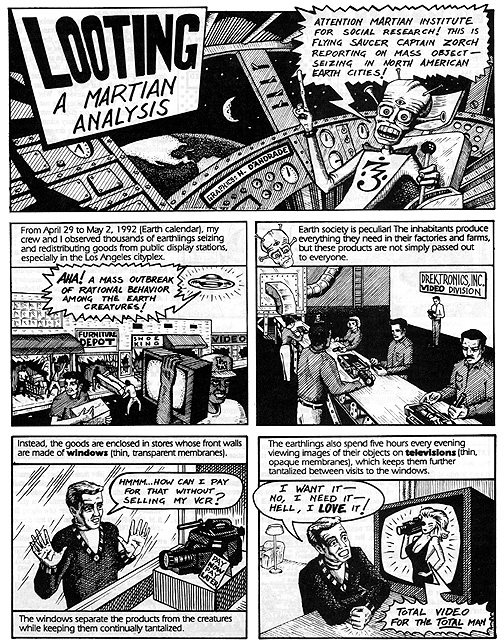
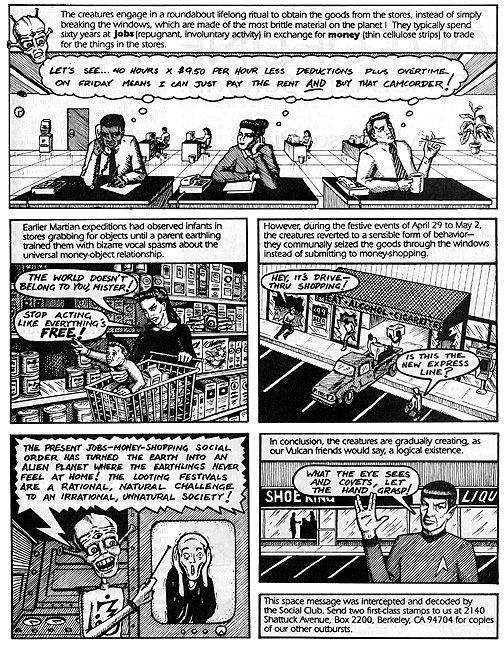
Comments
Nine book reviews for Processed World.
Reviewed by Jon Christensen
Pity the poor soul who embarks here. You could spend the rest of your life reading about saving the planet. I only wasted a summer. In these books, the reader floats uneasily in the ocean of facts that make up our ever more crowded world, with its temperature rising, its ozone layer balding, its biological and cultural diversity vanishing. Remarkably, for such a complicated and controversial subject as the future of the world, these books share many of the same views, with a couple of notable exceptions. Maybe that's why we need a sea change in environmental consciousness. The school of global ecological management rules. What it is.
1. OUR COMMON FUTURE. The World Commission on Environment and Development. Oxford University Press: Oxford, 1987.
This was the document that enshrined the notion of sustainable development and set the tack for the Earth Summit. It reflects the positivist perspective of believers in the United Nations. Chaired by the vice-president of the Socialist International, Gro Harlem Brundtland, the commission reports that poverty is the principal cause of environmental degradation. Equity is the answer to the tragedy of the commons. But we must face the limits to growth. It is all there, the entire basic argument for worldwide solutions to the crisis of the environment and human misery. Comprised of blue-ribbon representatives from 28 countries, the commission eschews confrontation. It is not that there is one set of villains and another of victims, they say. While giving good lip service to public participation, the model promoted here is global governance. The Commission enshrines Public Hearings as its trademark. But one gets the worrying feeling that all of this might be a mere sideshow to the real consolidation of power under green regimes, not unlike the relationship of the Global Forum's eco-bazaar to the Earth Summit in Rio 92.
2. THE GLOBAL PARTNERSHIP: A Guide to Agenda 21. United Nations Conference on Environment and Development. United Nations Publications: New York, 1992.
UNCED's megaglobalmaniac agenda for the 21st century was to be signed by world leaders at the Earth Summit. This guide to Agenda 21 boils the lofty goals down to seven priority areas: Revitalizing Growth with Sustainability (The Prospering World!), Sustainable Living (The Just World!), Human Settlements (The Habitable World!), Efficient Resource Use (The Fertile World!) , Global and Regional Resources (The Shared World!), Managing Chemicals and Waste (The Clean World!), and People Participation and Responsibility (The People's World!). It sounds like an overly stimulated cross between the Comintern and Exxon. No doubt there are some good ideas here. But when it came down to negotiating the actual 800-plus-page agenda, all the controversial parts were simply bracketed. Finally, the document was adopted by acclamation [sans controversial sections and any budget commitments]. Hailed as a blueprint for the planet, the vacuously wordy result goes to show that the future is not likely to be decided by consensus. What is interesting about this huge undertaking is what has been taken out since Our Common Future. Sections on population and the military were essentially gutted. The ongoing adaptation of Agenda 21 to political exigencies was captured on-line by Econet. Also available are the Rio Declaration (a short homily to U.N. cliches), Forest Principles, Treaty on Biological Diversity, and the Convention on Global Climate Change.
3. BEYOND THE LIMITS: Confronting the Global Collapse, Envisioning a Sustainable Future. Donella Meadows et al. Chelsea Green: Post Mills, Vermont, 1992
Twenty years ago, in The Limits to Growth, the authors predicted that we only had 20 years to change our ways. Now the sequel to the international bestseller proclaims that we only have 20 years to change our ways. Would it be safe to predict that 20 years from now the dire predictions will continue? Or will millenial fever die down when the planet soars past the year 2000? It seems unlikely. We've already overshot our limits, warn Meadows and company. And don't say we didn't warn you. This is the basic premise behind the whole worldwide debate for which the Earth Summit was supposed to be the apotheosis. The word comes from a computer program called World3. In computers, we trust. Tellingly for the times, however, the number crunchers conclude that saving the world will require changes in consciousness and spirituality. This is the mantra of the New Age Order, which seems destined to be ruled by ecotechnocrats using the rhetoric of religion.
4. ONLY ONE WORLD: Our Own to Make and to Keep. Gerard Piel. W.H. Freeman: New York, 1992.
The author was the founder of Scientific American. His earnest balancing act strives for the middle of the road, carefully weighing historical evidence, tendencies to environmental hysteria, and the apparent limits to management. But in the final analysis, Piel demonstrates how the scientific establishment has been the driving force behind the effort to enshrine ecological management as the ne plus ultra of global governance in the future. Naturally, since scientific technocrats have much to gain in that revolution, if we may be so bold as to call it that. Piel eschews the spiritual dimension in favor of hard facts. And he is more optimistic than many of the others. He puts his faith in economic growth and human development so he fears not a doubling of world population, projected for the end of the 21st century. But then we will have reached the limits, he asserts. We have not much more than a century to find our way to the steady-state, Piel warns. Listen good now.
5. SAVING THE PLANET: How to Shape an Environmentally Sustainable Global Economy. Lester Brown et al. W.W. Norton: New York, 1991.
Today's politically correct policy wonk hews to the Worldwatch line. The Institute seems perfectly positioned for the next think-tank wave inside the Washington beltway. Apres l'American Enterprise Institute, nous, Worldwatchers were the darlings of the Earth Summit circuit (and they had the best lunch for the press). It all seems so simple when they speak. For the most part plain spoken and relatively jargon free, Worldwatch is widely read and quoted. We can see the future, they say. Best believe. Place your bets. As advertisers are fond of saying, they say, this is a limited time offer. It will soon expire.
6. TOP GUNS AND TOXIC WHALES: The Environment and Global Security. Gwyn Prins and Robbie Stamp. Earthscan: London, 1991.
Another popular line for the most up-to-date pundits sounds more than a little like ecology for Rambo. If the environment is a security issue, why not let the security forces handle it? Gung-ho military men can now embrace their new mission: saving the earth. That way we can save the military too. The peace dividend should be invested in the environmental-security agenda, the authors argue. Prins, a security don at Cambridge, imagines a Green War Room, monitoring environmental crises worldwide. A computer program called CASSANDRA tracks these security threats. And a Green Police Force under the United Nations is deployed to enforce rules. This book was designed as a companion to a TV show by Ted Turner's Better World Society. And it reads like a TV show, with lots of pictures, graphs, computer screens and boxes.
7. EARTH IN THE BALANCE: Ecology and the Human Spirit. Senator Al Gore. Houghton Mifflin: New York, 1992.
Here, the wannabe environmental vice-president lays out his vision for the new age in excruciatingly earnest prose. Talk about family values. Gore analyzes the world as a dysfunctional family that must heal itself to save itself. He seems an apt personification of this moment in ecology. He seems to have fashioned his line in an encounter group of the world's trendiest environmentalists. He rubs elbows with Ted and Jane, Shirley and the Dalai. This globe-trotting parliamentarian's bottom line is personal change. And his Global Marshall Plan for saving the environment is a market basket of hip proposals including carbon taxes, virgin materials fees, full life-cycle costs, efficiency standards throughout the economy. Look at how Mr. Military Appropriations has transformed himself into the Green Candidate!
8. CHANGING COURSE: A Global Business Perspective on Development and Environment. Stephan Schmidheiny with the Business Council for Sustainable Development. MIT Press: Cambridge, 1992.
This is the new face of green capitalism. While the stereotype continues to be of industries keeping costs low, the smart money bets on passing on costs and garnering profits from environmental regulation. The themes of this new business environment: the polluter pays, open markets are crucial for sustainable development, environmental costs are internalized and reflected in prices and within the evaluations of capital markets. The report analyzes how these changes can be managed, and what the implications are for production, investment and trade. The BCSD calls for broadening and deepening the relationships between buyers and sellers and long-term partnerships to boost both economic development and environmental standards in the developing world. So this is s'posed to be the new world?
9. ENVIRONMENT AND DEMOCRACY. Organized by Henri Acselrad. IBASE: Rio de Janeiro, 1992.
This collection of essays by the Brazilian Institute of Social and Economic Analyses--the country’s preeminent NGO--was produced to reflect the Third World, and more specifically Brazilian, perspective on the Earth Summit. It is an excellent example of the adaptation of the left-wing, anti-imperialist, popular movement line to the changing times. In an era when the rhetoric of ecology reigns supreme, this book and the Brazilian experience show that socialists are not going to be left out. The right is not wrong in pointing out how quickly red has turned green. Shifting rhetoric and jargon included in these essays provide a trenchant Third World take on current environmental debates about poverty and development, energy and timber, Indians and the Amazon, GATT and free markets, global governance and the grass roots.
Comments

Analysis by Adam Cornford.
Dedicurse: this essay is dedicated to the hope that, if there is an afterlife, Daniel Moynihan, Mickey Kaus, and all the other black underclass pathology demagogues will spend it on welfare in a public housing project, trying to find a job and to avoid getting beaten or shot by the police.
The Heart of Whiteness
Judeo-Christian culture has long had a problem with dirt and darkness. Whiteness has been Europe's symbol of purity, goodness, life, order, and the divine. (By contrast, consider classical Chinese culture, in which whiteness symbolizes death, and is worn at funerals.) Blackness or darkness, on the other hand, have traditionally connoted impurity, evil, death, disorder, and the satanic. For centuries, the dominant European ideal of human beauty stressed white skin. The most obvious reason for this is that reddened or tanned skin meant exposure to sun, wind, and rain. Since feudal society was agrarian, such exposure in a young person (or in a woman of any age) implied work commonly in the fields. The arbiters of taste were aristocrats, for whom the absolute avoidance of work was crucial to class self-definition. The aristocratic ideal of beauty, still current today, was shaped by all the signs of distance from work the build athletic rather than massive in a man, narrow-boned yet voluptuously fleshed in a woman, the hands small or at any rate narrow, with tapered fingers, and so forth. Distance from work in a mainly agricultural society also meant distance from dirt, from contact with the soil. To this day, soiled means dirty, just as dark means evil or threatening. (Signifiers of class and wealth still underlie our aesthetic and moral values. Consider the terms noble and base as applied to human conduct, the derivation of our word villain from vileyn, serf, and the convergence of vileyn with vile through the Latin vilis, cheap.)
This cultural complex allowed Europeans to enslave and slaughter Africans and Native Americans with a clearer conscience than would otherwise have been possible. Of course the expansionist and exclusive character of institutionalized Christianity was the ideological linchpin of the Age of Discovery, as it had been of the Age of the Crusades. (In fairness, it is worth remembering that during the Crusades Christian culture was fighting a severe challenge by another expansionist and much more sophisticated culture, Islam.) Christianity divides human beings into wheat and chaff, Saved and Damned, allowing them no middle ground once the Word of the One True God has been preached to them. This absolute division of the world, with its own white/black symbolism, was superimposed on the aristocratic dualism of white = noble, dark = base.
Underlying the Christian and aristocratic dichotomies was another more ancient one, the Graeco-Roman division of humanity into civilized versus barbarian or savage peoples. (The derivations of the latter put-downs are, respectively, people whose speech sounds to us like animal noises and people who live in the forest instead of cultivating fields.) For several centuries before the Age of Slavery, the European ruling classes had been convincing themselves that they were the civilized and that the Arabs and Persians, despite their splendid architecture, literature, science, and mathematics, were the barbarians. Encountering the tribal peoples of West Africa, Eastern North America, and Mexico, who neither used the wheel nor smelted iron, the Discoverers could feel sure of their superiority and God-given right to exploit. Better yet, these peoples were possessed of more melanin in their skins than most Europeans, and so could be fitted into the cultural slot labelled black or dark which meant at best chaotic, ignorant, dirty, and impure, at and worst menacing, vicious, and evil.
The wealth looted from the land, artifacts, and bodies of Africa and America provided the fuel for the lift-off of commerce in Europe. The gold and silver mined by Indian slaves in Mexico and Peru, the cotton, sugar, and tobacco harvested by African slaves in the Caribbean, created the wealth that was used to buy pale-skinned wage labor. It was in the seventeenth century, when the slave trade was soaring, that the notion of Europeans as white first appeared. The aristocratic signifier had been spread to include all Europeans, whether noble, base, or in between. Thus, alongside capitalism, twinned with it, was born modern racism.
As Europeans and Euro-Americans lived with African slaves and fought Native Americans for undisputed control of the continent the process of stereotyping and otherizing advanced rapidly. By the middle of the nineteenth century Euro-Americans seem to have been almost incapable of seeing African-Americans, slave or free, as human beings. Even Mark Twain, conceiving a sympathetic figure in Jim, can only show the runaway slave as a pathetic victim. Jim's very speech is misrepresented, and by the writer who first set down varieties of Euro-American vernacular with such care. Yet describing the episode when Huck listens to the white raft-men talking, Twain gives the game away. It's the raft-men's game, a ritual of trading hyperbolic and poetic boasts, and it comes straight out of West Africa. The repressed returns, announcing that Twains blindness and deafness are willful; they are necessitated by guilty awareness of slavery's intimate and inextricable role in the founding of a free nation and by the fact that, as Albert Murray observes in The Omni-Americans, American culture . . . is, regardless of all the hysterical protestations those who would have it otherwise, incontestably mulatto.
In his White Racism: A Psychohistory, Joel Kovel has shown how U.S. racism bifurcates between North and South. In the South, where whites grew up in intimate daily contact with black slaves and servants, the signifier of difference is supposed relative intelligence and development: Africans are childlike and must be ruled by whites for their own good. They are not feared or loathed as such, except when they get uppity and don't know their place. Racial contact pollutes in only one way: through sex. Euro-patriarchy must not be challenged, either by the legitimation of mixed-race offspring (though children from a long-term liaison with a female slave may be treated with the kindness due pets) or above all by sex between a black man and a white woman. In the North, where despite the historically better legal status of black people the races have actually had less contact, a subliminal fear of dirt and pollution is characteristic of what Kovel calls aversive racism. Studies of Northern racist whites reveal bizarre fantasies of black skin color rubbing off on them when touched. The psychodynamic connection between these two forms of racism can be intuitively grasped when we remember that dirty in Anglo-American culture is a synonym for openly erotic.
Social Thermodynamics
Nothing I have said so far is new. Less easily recognized is the relationship between how European or Euro-American culture understands dirt and the thermodynamical principle of entropy as applied to political economy and culture.
Thermodynamics defines entropy as a measure of the disorder in a closed thermodynamical system. Since no system is 100% efficient, some energy must eventually become unavailable for work (meaning here the self-reproduction of the systems order). Energy that is not available for work causes disorder. To maintain order, therefore, a system must expel this disorder. For example, exhaust products (carbon monoxide and dioxide and waste heat) are entropy expelled by a working auto engine to maintain its order as a system. The living human body sheds entropy as heat, as excreta (carbon dioxide, sweat and urine), as mucus carrying dead bacteria and other rejected matter, as dead skin cells, and of course as shit.
Human societies are organized self-reproducing systems. In principle, then, this thermodynamical model can be extended to cover any society. What changes from one to another is the mode of order, and therefore what each one defines as work and energy. Capitalist industrial society, which engendered thermodynamical theory in the first place, defines real work as activity that gives rise to profit and is performed in exchange for money. Activity necessary for social reproduction that fails to meet one or both of these criteria is experienced as a drain on the system. This includes all the work of government, all paid nonprofit work such as public education or health care, unpaid cultural activity like writing poems or playing music for one's friends, and of course unpaid domestic work.
Activity that gives rise to profit has evolved as capitalism has developed. To begin with, such activity was virtually synonymous with the production and distribution of material goods. Marx, however, was quick to see that production for capitalism means above all the production of capital, which in turn (and more profoundly) means the reproduction of capitalist social relationships: paid work and the universal market. What is more, said Marx, because profits plateau and decline as industries mature, this reproduction depends on growth. It cannot maintain itself in a steady state. Growth for capitalism means more profit for capitalists, more work done, more commodities sold but this depends on more people being wage earners and commodity consumers, more areas of the world and of social existence being brought into the cycle of work-pay-sell-buy-profit. Capitalism must, therefore, convert more and more kinds of human activity into work.
While constantly redefining work, capitalism also constantly strives to reduce the amount of work-time taken to produce any given commodity and to shorten the time capital needs to circulate from work done, via merchandise sold, to profit taken. Consequently capitalism is, as its publicists never cease to remind us, always creating technological revolutions. This technological dynamism means that capitalism continually redefines energy as well, which in a thermodynamic sense means not only power sources but raw materials.
A global system that must perpetually expand and change in order to survive, that is continually creating new technologies, and that defines work at once so narrowly and so broadly, is likely to generate many forms of entropy. Most obviously, this means all sorts of industrial waste: traditional emissions like heat, carbon dioxide, and soot, an ever-widening rainbow of toxic chemicals, and various radiation hazards. Increasingly such pollutants are rivalled in destructiveness by consumption waste such as packaging and disposables of all sorts, carbon dioxide and nitrous/nitric oxide from car exhausts, and toxic household cleaners.
This entropic Niagara produces other lethal disorders, not least in the human body. Work-related illnesses from silicosis to carpal-tunnel syndrome, the cancer clusters blooming around refineries and nuclear plants, join the traditional diseases of malnutrition and overcrowding triggered by three centuries of market forces shoving people off their land or out of their jobs. And as everyone knows, the disorder spewed out by the frantic global search for profits is ripping huge holes in the ecological fabric holes in the ozone layer, holes in the rainforests, holes in the webs of animal and plant species, and holes in the census figures around places like Bhopal or Chernobyl.
Beyond these, capitalist economics also generate behavioral and social forms of energy unavailable for work in the other sense of social reproduction. These include property crime from car burglary to securities fraud; violent crime caused by poverty and frustration; and, in a feedback loop with these, drug and alcohol addiction. Shifts in land and labor prices also engender forced migration and homelessness immense disruptions in demographic patterns and in people's daily lives. The other immense disruption, of course, is war, whether fought directly over markets and resources, or over some ethnic rivalry with economic shock and stress as a contributing cause.
Yet any thermodynamical system actually has two options in regard to energy that becomes unavailable for work: dumping it, or recycling it.
Just now, capitalism is not doing very well at recycling much of its entropy, especially the chemical varieties. At recycling people, however, capitalism has always been unsurpassed. In the fifteenth, sixteenth and seventeenth centuries, rich English landowners turned many of their tenants loose because the shift from diverse farming to the more profitable monoculture of sheep required more range and fewer workers. They also expelled freeholding peasants from traditionally common land they had enclosed for their own use. This dumped surplus population wandered the countryside as beggars and thieves, causing a perpetual problem for the rural social order. Some drifted into the towns, where they were likewise experienced as entropic. But gradually, nascent manufacturing began recycling them as wage-workers. Once capitalism in both agriculture and industry got off the ground in the late eighteenth century, the flow of work-energy from the land to the cities became a flood, which continues to this day.
Capitalism is so effective at recycling work-energy because it treats work as a commodity and therefore as abstract. Kinds of work are interchangeable, valued solely according to their ability to produce profit. (Thermodynamics, as the Midnight Notes group has pointed out, originated during the same epoch as Frederick Taylor's scientific management, which aimed to break industrial work down into small, mindless units for greater efficiency.) In fact, Harry Braverman, David Noble, and others have shown how the whole history of capitalist technology and management techniques is the effort to make labor more interchangeable and thereby to make workers more dispensable and less powerful. However, capital's recycling of work-energy runs afoul of the systems periodic crises. Theorists differ as to the inner cause of these crises. All of them, though, appear as a situation in which there is plenty of plant and equipment on one side and plenty of workers on the other, but in which the liquid capital cannot be found to bring the two together. The result is very high rates of both unemployment and corporate bankruptcy.
If the crisis is short enough, the effects for the system can be quite beneficial; and today, governments are able through fiscal and monetary policy to manage crisis to capitals advantage, even to bring on recessions at will (as the Federal Reserve did in 1979-82). Perhaps the most important benefit of a controlled crisis is its disciplining of workers. High unemployment makes resistance to intensified exploitation difficult, and wages can be reduced because workers are desperate. Once the new cycle starts, moreover, there is a large pool of labor available for new ventures and for expansion. But if the crisis becomes too deep and prolonged, like the Great Depression of the 30s, the human energy made unavailable for work becomes violently entropic. The unemployed and the poor demonstrate and riot; and if they form alliances with the employed, as they did then, there is potential for mass strikes and even insurrection. Keeping the entropic energy of the unemployed and the poor from contaminating the employed working class is a continuing project for the system.
Dealing Dirt & Getting Shit
Having outlined something of the range of socially generated entropy and the ways capitalism deals with it, I would like to stretch the notion a little further to cover the realms of culture and the personality. Once again I must retrace some familiar ground. Capitalist culture, as the likes of Max Weber and R.H. Tawney have demonstrated, rests on the Protestant revolution of the sixteenth and seventeenth centuries, which adapted the basic structures of Judeo-Christian patriarchy to fit new psychosocial needs. Protestantism, especially Calvinism, exalts thrift, the accumulation of wealth, and hard work. That is, it favors the exchange of living time for congealed dead time in the form of commodities and money, which are then accumulated. As a corollary, Protestantism preaches sexual continence, the conservation of erotic energy. Patriarchal cultures have often been anxious about the release of sperm, the Hindu theory of prana is one example. But in bourgeois-Protestant culture, sperm is viewed as a form of capital, which must, in the seventeenth-century phrase, be spent productively in begetting children. And if sperm is capital, the womb for patriarchy has always been land, the realest of real property. By making the womb-soil fruitful, the Protestant bourgeois not only continues his bloodline the aim of all patriarchs but invests in the future, founds or continues a family firm.
All this requires strict discipline. Thus, mainline Protestant culture from Luther on inculcates hierarchical obedience to ones elders and betters, beginning with the State so long as the State permits one to worship the Protestant God and accumulate a Godly fortune. It also demands, as Freud saw, deferral of gratification to a degree rare in precapitalist societies, and thus much emotional and sensual repression and rechanneling. The personality created in this image is controlled primarily through guilt, though shame is also an important spur. To inculcate and reinforce self-discipline, violence is often necessary. As in most patriarchies, death and mutilation are a State monopoly, but lesser violence such as beating are the prerogatives of every father-husband.
For this configuration, which I will call accumulationist, cultural entropy consists first of all of wasteful or unproductive behavior: free spending rather than saving, sexual promiscuity and sensuality, the open expression of passionate feeling, and of course laziness. Female sexuality is viewed with fascinated dread, since it can lead to all the other forms of cultural disorder, beginning with illegitimate children. Sex between men is an abomination. Since the accumulation of property is the chief goal of life, lack of respect for property, such as trespass, is crime on a par with violence against ones betters, and theft must be savagely punished. The flouting of hierarchy (once feudalism and the Church of Rome have been defeated) is likewise a dire threat, as is the unlicensed use of violence.
One common way for cultures and individuals to deal with anxiety about forbidden traits or behaviors is to project them outwards as defining attributes of some demonized Other. As capitalism developed through the eighteenth and early nineteenth centuries, the European and Euro-American bourgeoisies came to project entropic characteristics onto the poor of their own cities as well as onto the peoples of Africa and India they were colonizing. Half devil and half child, Kipling would call these peoples in The White Mans Burden; but nineteenth-century manufacturers said much the same of their workers (many of whom up to the 1860s were actual children). Poor people were viewed by the propertied classes as lazy, promiscuous, larcenous, drunken, and spendthrift.
There was truth, of a kind, to the stereotype. Long hours of repetitive toil produce boredom, exhaustion, and consequent sluggishness. People who live from week to week cannot save their money even if they had the incentive. Poverty and forced migration in search of work disrupt familial and communal ties and drive people to theft and prostitution. Drunkenness and senseless violence are consequences of deprivation and despair. Unlicensed forms of sexual behavior offer some of the few pleasures that can be had without money.
This unruly proletariat, mostly only one generation removed from the countryside, was only converted into a stable and respectable working class through a long acculturation. It also involved enormous State violence. In the end, relative stability was only achieved by introducing machinery that made it possible to squeeze more production out of workers without lengthening the working day.
Once the respectable working class was established in the U.S. during the last third of the nineteenth century, the same entropic characteristics were projected onto other Others: onto the lumpen proletariat or criminal classes; onto the Irish; onto immigrants from Southern and Eastern Europe; onto Indians and Mexicans; and above all and continuously, onto black people. And, as in the case of the earlier projection onto the poor, the projective fantasy was partly self-fulfilling, a materialized ill-wish or exorcism.
There is one crucial component to this exorcism that I have not mentioned: dirt. As we have seen, feudalism defined dirt (at least on face, hands, or clothes) as a signifier of low social status. The rising capitalist class, by its nature, had to be a lot closer to work than had the aristocracy and it had to reverse the polarity of the aristocracy's disdain for money-grubbing. It developed an even more passionate aversion to dirt, summed up in the famous Victorian maxim Cleanliness is next to Godliness. But feudal dirt differs from capitalist dirt. Feudal dirt is the sign of closeness to work and the earth. Capitalist dirt, being mostly industrial effluent or the grime of destitution, is likewise associated with work but also with poverty, waste, and the absence of Protestant bourgeois values. It is, one might say, visible entropy. Like the poor themselves, dirt is a product of capitalist accumulation that the capitalist class does not want to see or smell.
The dirtiest dirt, of course, is shit. Shits meaning in capitalist culture, however, is profoundly ambiguous. In The Ontogenesis of Money, the psychologist Sandor Ferenczi suggests that the anal retentive stage of infancy lays the foundation for the accumulationist, exchange-oriented bourgeois personality. When the child being toilet-trained deliberately holds her shit back, she gains attention and rewards for releasing it at the set time. Thus she learns to retain, to delay gratification, and to exchange one pleasure for another. She also becomes more self-contained, more aware of her own desires as distinct from those of others. To the bourgeois unconscious, then, shit is wealth but only when you cant see it.
Bourgeois wealth grows out of shit, and produces shit. Capitalism, Marx says, creates wealth at one pole of accumulation and poverty at the other. One could paraphrase this by saying that capitalist accumulation produces order at one pole and entropy at the other or else organized shit (capital) at one pole and disorganized shit (misery and pollution) at the other. The symbolic shittiness of wealth is the dirty secret of white-capitalist-patriarchal culture. Milan Kundera, in The Unbearable Lightness of Being, says that kitsch is the denial of shit. In the Stalinist Czechoslovakia of which Kundera was writing, shit meant secret police, political prisoners, few choices, shortages, stupid jobs, pollution; kitsch meant red flags flying, patriotic songs and icons of Lenin, hymns to industry and progress. In market-capitalist societies shit means violence, apolitical prisoners, meaningless choices, poverty, stupid jobs, pollution; kitsch means shopping malls, sitcoms, blockbuster comic-book movies, advertising, telectoral pseudopolitics. In either case, kitsch formulaic, sentimental, one-dimensional, cosily reassuring even at its sexiest or most brutal serves to conceal shit, which is why it is one-dimensional.
Besides the usual late-capitalist shit, white kitsch in the United States is also, as noted earlier, a denial of original crime genocide and slavery and of the fact that, as Harold Cruse put it in The Crisis of the Negro Intellectual, the white Protestant Anglo-Saxon in America has nothing in his native American tradition that is aesthetically and culturally original, except that which derives from the Negro presence. White (not European) American accumulationist culture is defined by its utter blandness and avoidance of controversy or risk, by its cleanliness-as-absence.
This blandest-common-denominator culture is, notoriously, the behavioral and stylistic norm of the suburb, to which even the older, run-down exurban developments aspire. It is, besides, the ambience of the modern corporate office, where niceness rules or rather, is the means of rule. In the white-collar workplace everyone must act white: quiet, polite, cheerful, emotionally masked, sensually numb, perpetually busy, willing to tolerate any humiliation as long as its done with a smile. Controversial topics are rigidly avoided, and the ultimate taboo is discussing salaries. The excremental significance of money is apparent from the fact that good corporate citizens would rather tell you how much they get laid than how much they get paid.
The truth of wealth, however, is made historically manifest in the proletariat, the class of shitworkers. These are the people who are supposedly only fit for what the sociology texts call supervised routine tasks, which means numbingly dull, frequently health-damaging drudgery not only in the factory but at the keyboard and behind the counter. Their energy is made available for work only by fierce economic compulsion backed up by a never-ending bombardment of ideology, beginning in schools whose function is to convince them they are incapable of anything else. You ain't shit, the American insult goes, meaning you are the lowest of the low. Eat shit and like it. Shit is processed or disposed of by inferiors who are contaminated by it, who metaphorically eat it, and who metonymically (by association) become it.
No surprise, then, that black people have always been at or near the bottom of the proletarian heap in the US. Occupying at best the next level up or in many places the same level are Indians, Mexicans, Central Americans, and Puerto Ricans, also in the racist mind shit-colored. Just above them are the poor white trash, another entropy-word. All are to this day routinely represented as dishonest, loud-mouthed, lazy, lustful, stupid, booze-and-drug sodden brutes. The psychic consequences of this projection onto working-class people, and especially onto women and African-Americans, are devastating. Yet these despised creatures have been a prime source of capitalist wealth.
This wealth is not only economic but cultural. To give only the most familiar example: black people, working from the African traditions they were able to retain, created the country's most important some might say only indigenous musical forms.
Recycling In Mass Culture: The Case of Black Music
There is no need to rehash the vast and continuing expropriation of African-American music to the profit of (mostly) white-owned capital and for the entertainment of white audiences. Anyone with the slightest knowledge of U.S. music history can cite examples, from the bleaching of Ellington's and Basie's orchestral jazz into bland Glenn-Miller style big-band pop in the 30s and 40s to the endless recycling by white guitarists of blues riffs lifted from Robert Johnson or B.B. King. White baby-boomers howl with outrage when the rock anthems of their adolescence are converted into commercials; but this is much the same experience that black musicians and audiences have been having for nearly a century. (Michael Jackson represents the paroxysm of this process: an African-American who tries to eradicate from his face and body the traces of race while producing a color-blind dance music ingeniously constructed out of all the hot pop trends of the moment and then recycling it almost immediately into ad jingles.)
Viewed from a cultural-thermodynamic perspective, this expropriation appears if anything even more horrific. We see a dominant culture and political economy that imported Africans as slaves, worked them to death, bred them like animals, tortured them in every conceivable way for two centuries. Then for another century and a half this culture and political economy systematically exploited the descendants of the slaves as the lowest shitworkers, denying them economic opportunity and political rights wherever possible, meanwhile projecting onto them its own repressed fears and furies, loathings and longings. At the same time, this social order extracted from African-Americans the brilliant music and language they created as a way of surviving their misery. It is as if the Nazis had, while gassing the Jews and extracting their gold teeth, sold off the artwork they had created in the camps, and marketed recordings of the string quartets they had formed there to entertain the guards.
But how did African-American culture become at least in watered-down forms not merely acceptable to U.S. commercial mass culture but central to it, its semi-occult driving force? As I have tried to show, the accumulationist personality structure is profoundly hostile to Blackness as white people read into/project onto it shamelessly sensual and hedonistic, incipiently violent and uncontrollable. It is also hostile to the culture black people have themselves experienced and created. This culture is a far more complex amalgam of traits, one that varies widely by class, caste, and region and that includes distinct patterns of emotional revelation and concealment, anger and tenderness, community and individuality, reason and intuition. One major factor underlying its common differences from Euro-American cultures may be the preservation of African cultural traits, in particular the communal and ecstatic character of West African religion. But black culture is not simply or even at this point primarily transplanted African-ness. As Stanley Crouch has controversially pointed out, it is, like U.S. culture in its entirety, a mulatto phenomenon.
Black culture has been created under the pressure of African-American people's situation within the U.S. within whiteness. Under this pressure, exerted at first through slavery and later through institutions such as schooling, African-Americans have continually transformed what they have been able to preserve of their own heritage: for example, shifting African linguistic forms into English to create black vernacular. At the same time they have absorbed influences and materials not only from Euro-America but from Native people and from Mexico and the Caribbean, producing one of the richest and most complex cultures in the world. The pressure has also taken commercial form, the more so as institutional racism has become subtler in its strategies. Countless black musicians, dancers, actors, and even writers have had to flavor their work to white tastes in order to survive, often concealing subversive content through a signifying process.
A complex and revealing example is the various uses made of the myth of Staggerlee, the footloose, fearless, defiantly individualistic black man who hustles his way through life, loving women, siring children, and dealing ruthlessly with his enemies including, in later variants, the white sheriff. This figure, of course, is the ultimate racist nightmare and justification, the specter looming over a thousand lynchings and behind the phobic prose of contemporary conservative and neoliberal pundits. Yet the image is also vitally important to African-American tradition and has been attractive to a minority of whites. Numerous versions of the Staggerlee tale appeared in blues of the 20s. Muddy Waters classic urban blues Rolling Stone represented a less violent version of this character, inspiring not only the name of one of the most famous bands in rock history and that of the pioneer counterculture-corporate fusion magazine, but also numerous lesser rock songs of the 50s and 60s, of which The Wanderer is as good an example as any. Greil Marcus points out in Mystery Train that Staggerlee-Rolling Stone appeals positively to whites as well as blacks because he is a crudely antithetical but powerful image of freedom both for adolescent boys and for shitworking, shit-eating men of any color. The popularity of ultraviolent, misogynistic gangsta rap among white suburban teenage boys probably stems from analogous causes, including the excruciating boredom of their milieu and the dismal future most face as adults.
Breaking Loose vs. Hanging Tight
Such sensational use of negatively signed images of black life merely tips an iceberg. Blackness, in the dual sense in which I have employed the term, has been appropriated more broadly by the culture industry. In my view this is owing to a profound and deepening contradiction in capitalist culture and economy since the 20s. In order to expand after World War I, U.S. business needed new mass markets for consumer goods. To create these markets within the U.S. it had to stimulate in huge masses of people what John Maynard Keynes, the great economic strategist of mid-century capitalism, called the propensity to consume. The most immediate aim was to sell the consumer durables that could now be turned out cheaply en masse using the assembly-line methods developed by Henry Ford. This strategy, known to many analysts as Fordism, aimed at a car in every garage and a refrigerator in every kitchen, bought with the wages earned producing the cars and refrigerators.
At first, Fordist consumerism could be consistent with the accumulationist social personality (as it still is to some extent). Every worker could assume the trappings of Property, hallmark of virtue. As Stewart and Mary Ewen have shown, advertising between the wars (and well into the 50s for some products) played on the insecurities in this social personality: anxiety about dirt and pollution, work ethic, desire to emulate the next income level up, need to conform. Ford cars (always black) were initially sold as a more efficient form of transportation, refrigerators (always white) as promoters of hygiene and order.
But already another set of buttons was being pushed. In The Road to Wigan Pier, published in 1937, George Orwell noted how English working-class youth were opting for colorful, stylish, if shoddily made clothing rather than the somber but durable uniforms worn by their elders. Though they wore out quickly, such glad rags were cheap enough that new and fashionable ones could be bought easily. Like their U.S. counterparts, these young people liked to dance, mostly to jazz and big-band swing, and their dancing was becoming increasingly wild. They went to the movies and did their best to imitate the images of glamor and romance they saw there.
The new consumption and leisure habits growing among late Depression-era young people foreshadowed the direction merchandising was to take after World War II. The sober accumulationist consumerism of the previous generation was no longer enough to absorb the vast output of increasingly automated mass production, which had learned unprecedented efficiency while making weapons. To achieve the necessary speed of turnover, consumer goods generally had to become matters of fashion, as they had always been for the aristocracy and the upper reaches of the bourgeoisie. By the late 50s, this meant the application of planned obsolescence, previously confined to items like nylons, light bulbs, and razor blades, to durable goods like automobiles and vacuum cleaners. At the level of advertising, it meant that desire of all sorts had to be stimulated. Accumulationist repression was loosened, and the exploitation of hedonist impulses, begun cautiously in certain market sectors before the war, accelerated.
This hedonist ascendance can be viewed as a partial reappropriation of shadow characteristics banished from the white accumulationist social personality more open sexuality and sensuality, orientation toward immediate rather than deferred gratification, flaunting rather than reticence in personal style, propensity to spend and consume rather than save and acquire. But such tendencies were in sharp contradiction to the accumulationist values that still dominated political, religious, and civic discourse as well as much advertising.
The collision between accumulationist and hedonist messages helps to explain the sheer weirdness of later 50s mass culture: the heavy, finned cars like space fortresses in pastel colors; the demurely sexy TV moms mopping the kitchen floor in tight sweaters and high heels; and of course Elvis on the Ed Sullivan Show with his gyrating hips blacked out. Another indicator of the change was the literally Biblical circulation enjoyed by Dr. Spock's Baby and Child Care, which advocated accommodation to the child's own physiological and developmental rhythms in toilet training rather than the rigid timetabling practiced by previous generations.
A large minority of the generation of whites that grew up in consumerist (relative) abundance partly absorbed the hedonist messages but by and large rejected the accumulationist ones. That is, they synthesized from pleasure-oriented advertising and the imaginary of rock-n-roll a notion of freedom that implied the absence of hierarchical accountability (say, to a parent or a boss) or customary commitment (say, to a spouse). Perhaps even more important, they absorbed images of satisfaction that focused on abandonment to experience rather than acquisition of goods, on the present rather than the future. To paraphrase the old ad-mans saying, they wanted the sizzle without buying the steak. In the context of the times, this hedonist gestalt fused temporarily with social idealism and a will to experimentation in daily life to help create what Theodore Roszak called the counter-culture.
Alongside the ascending curve of hedonism rose another, in complex relation to it. Ever since the Jazz Age, the appropriation of African-American music and style into U.S. mass culture had been on the increase. This appropriation, to be sure, was mediated by the culture industry, which bleached it for Euro-American tastes. However, significant minorities of whites always managed to gain access to the real thing. In this way they served unwittingly as feeders of new trends to the industry, rather as Bohemian types open up marginal neighborhoods to gentrification. They also consistently projected their own hedonist values onto black culture, in a partial inversion of the psychic shit-dumping practiced by the majority. The '20s Bohemians who flocked to Harlem saw jazz as exotic, wild, primitive, an image of the escape they sought from white bourgeois mores. In the 50s, the Beats who congregated around bebop musicians admired the spontaneity in their improvisations, but often failed to recognize the mastery of an entire musical language developed over generations that made the spontaneity possible.
At about the same time, working-class Southern whites like Elvis were blending with white country music the jump blues they heard in black juke joints while still talking about niggers. As Greil Marcus puts it, Even if Elvis South was filled with Puritans, it was also filled with hedonists, and the same people were both. Rock-n-roll was born. Black-derived music (and music by actual black performers) was providing the soundtrack for hedonist marketing strategies; and the soundtrack itself was becoming a hugely lucrative commodity in its own right.
The new energy of post World-War-II black popular music, though, was in part political, or at any rate pre-political. Even as rhythm and blues evolved in complex feedback loops between Memphis, New Orleans, and Chicago, the ground was being laid for the Montgomery, Alabama bus boycott of 1955 and the decade-long explosion that followed. This explosion, the Civil Rights movement, was the other force that created the counter-culture. To some extent the transmission was direct, via the white student veterans of the Southern voter registration campaigns. For many more young middle-class whites, it came via the televised images of thousands of black people standing up to clubs, dogs, firehoses, bullets, and firebombs and refusing to back down. These images, contradicting everything they had been taught, not only filled them with anger and a desire for social justice, but offered them, however vaguely, a model of revolt, of another way to be. Even where this revolt took off in quietist (Orientalizing-meditative) or self-destructive (drug-abusing) directions, it was given much of its initial kick by African-American rebellion anticipated and transmitted in the mulatto music of rock-n-roll.
From the early rock-n-roll period through about 1970, the two curves, hedonism and black influence, moved intermittently close together, exchanging energy via figures such as Chuck Berry, Elvis, and later Jimi Hendrix and Sly Stone. Yet despite its partial rejection of white accumulationist values and behavior and much superficial admiration for spades the counter-culture remained overwhelmingly Euro-American. Its music, while still blues-based, was leagues away in feeling from the black pop of the period, typified by Motown, which smoothed out Gospel into sweet, danceable crossover tunes. Sly and the Family Stone were virtually alone in synthesizing the two strains of cultural energy, in a string of hits that carried the band to Woodstock in 1969.
Then, in 1971-3, fueled by the last surge of Black Power and the politicizing of the white counter-culture via the anti-war movement, black musicians briefly took over the pop airwaves with exciting, challenging, politically potent songs: Edwin Starr's War, Marvin Gaye's Inner City Blues, Wars The World Is A Ghetto, to name a few. Among these songs was the Temptations grim, eerie Papa Was A Rollin Stone, which brilliantly critiqued the Staggerlee myth even as it acknowledged the myths basis in reality. In the song, a black mother gathers her children at the grave of their absent father, and they want to know more about him. When he died, all he left us was alone, she replies. At a cultural node where white notions of Blackness and white men's escape fantasies fed on actual black experience and black men's fantasies about themselves, the Temptations were cutting one pipeline while pouring truth down another. Hitherto, the culture industry's selective appropriation of black culture had mostly been limited to those features that could be fitted, however incompletely, into the hedonist gestalt. The cultural-political surge of the early 70s both allowed black artists to speak and perform more freely and opened a channel wide enough that their newly undiluted music directly touched more whites than ever before.
This breaching of the cultural firewalls was preceded and accompanied by a massive breakdown of work discipline. The postwar boom was the first (and only) period in which capital had tried to manage labor under conditions of generalized abundance, in which the spur of destitution was softened by near-full employment and by social welfare programs. The experiment failed. From about 1967 on, the colorful revolt of the counter-culture, Black Power, and the mass movement against the Vietnam War both concealed and helped propagate a revolt on the job. Beginning mainly in the auto industry, waves of sabotage, absenteeism, and wildcat strikes spread through the U.S. economy. These waves were initiated especially by black workers, who had formed their own semilegal shop-floor organizations to resist the racism of both their supervisors and their unions and the superexploitation to which they were often consigned. They were increasingly joined in their rebellion by newly urbanized white trash workers, as well as by urban working-class freaks who had drifted back into the factories. Hedonist mass culture and its countercultural offshoots had combined with African-American revolt and the weakening of economic compulsion to make more and more social and cultural energy literally unavailable for work. Fordism was shattered.
The early-to-mid-70s, in fact, marked a point of real danger for capitalism in the developed countries. But crises are the other thing capitalism has always been good at recycling. The threatening entropic energy of the oil shock and the Third World debt crisis in 1974-6 was turned, with the aid of computers and telecommunications, into a global reorganization of the system. The oil-price recession of 1974 began the process of restoring work discipline, especially though the hysterical atmosphere of scarcity created by the mass media and by such measures as gasoline rationing. Meanwhile, U.S.-based multinationals intensified their export of capital and of what had been high-wage manufacturing jobs to the Asian Pacific Rim and Latin America. Still, inflation, bane of the accumulationist mindset, continued to eat away at U.S. capital assets until the Federal Reserve raised interest rates in 1979, causing unemployment to soar as several jolts of recession shot through the economy.
The result was that millions of workers, especially black ones, were tossed out of the factories while the remainder were bullied into line, their already sclerotic and corrupt unions broken. Hedged in by new legislation and hostile courts and bureaucracies, strikes were made virtually illegal. The centers of industrial power that Fordism had created were scattered one after another, as the Smokestack Belt became the Rust Belt. Second-wave feminism, which had started out with radical criticisms of the ruling order, had already been sidetracked into opportunity ideology for professional-class women on the one hand, and cultural feminist separatism on the other. Now the brief surge of woman-oriented office-worker organizing that began in the late 70s was halted. A ferocious assault on entitlements and social programs was launched. Real wages fell, even as housing prices soared. The shift of capital from industrial investment to frenzied speculation began. Capitals bipolar shit-machine went into high gear, spewing money and obedience out of one end and every sort of entropic foulness and horror out of the other.
Cultural control was also being re-established. A version of the accumulationist social personality was set up as the norm by closing the loop between accumulation and pleasure, by making the process of accumulation the supreme pleasure. Like the miswired psychopath in The Terminal Man, who gets an orgasmic rush from the implant in his brain whenever he murders, the looter-heroes of 80s casino capitalism shuddered with ecstasy as they made killings on the market. Most white proletarians, their solidary links with fellow-workers weakened, terrorized by the prospect of homelessness, fell easy prey to vertical identification with the rich and with the nation-state. The Reagan's presided over this Scheissfest as the wish-dream of the ageing white suburban middle classold but looking good, rich but relaxed, stylish but virtuous.
The Global Dump
The new phase of capital accumulation that began around 1979 is characterized, as theorists like David Harvey have noted, by its great flexibility and unprecedented global reach. These are made possible by the new power and cheapness of computers and by the speed of worldwide telecommunications, as well as by the breaking of working-class power in the developed countries. Capital, in the form of money, materials, and product specifications, can be switched around the planet so fast that no existing worker strategies or organizations can keep pace. As Harvey puts it in The Condition of Postmodernity, The same shirt designs can be produced by large-scale factories in India, cooperative production in the Third Italy, sweatshops in New York and London, or family labor systems in Hong Kong.
Capital's new freedom of action generates unprecedented amounts of social and ecological entropy. Developing countries have not been able to afford much in the way of environmental or worker protection, because their industries have lacked the economies of scale and technologically based productivity that would allow them to compete successfully with transnational corporations even in their own markets. Now, desperate for investment, they are permitting the transnationals to draw on their pools of underemployed cheap labor while benefiting from the lower operating costs imposed by their largely unregulated economies. The result is the pollution and hopeless overcrowding of places like Mexico City or So Paolo on one side, and the deforestation of Southeast Asia or the Amazon Basin on the other.
Both the sale of toxic or hazardous commodities and the disposal of wastes are often referred to as dumpingin the U.S., also a slang term for shitting. Dumping is a central process of post-Fordist capital. The developed countries relationship to the periphery (including their own underdeveloping regions and populations) is not merely exploitative and extractive, but excretive. Peripheral countries are used for particularly hazardous kinds of production, like the pesticides Union Carbide was making at Bhopal. Also, they are sold discount merchandise no longer saleable in the countries of its manufacture because of toxicity or other hazards; and they are bribed to become disposal sites for toxic waste. More subtly but just as devastatingly, they have been victims of the economic entropy dumped on them by a global system convulsing itself in the effort to boost profit rates and locate capital for investmentas artificially depressed prices for raw materials, as mountains of debt, and finally as IMF-imposed austerity plans. This translates to the dumping of millions of former peasants into the shanty-towns that ring Third World cities.
Each of these excretive processes has its analogy in poor African-American and Latino neighborhoods. Not only are toxic-waste sites and polluting factories concentrated in or near them, but the misery and poor education of many of their residents is being exploited by drug merchants legal and illegal, who are dumping their merchandise principally tobacco, alcohol, and cocaine there as middle-class suburban markets soften. Meanwhile, with the exception of the Great Society period under Lyndon Johnson, these neighborhoods have been systematically starved of resources as Federal housing-loan policies virtually bribed whites to abandon the inner cities while deliberately preventing blacks from doing so, as industry followed the whites into the suburbs over the next twenty years, as financial institutions redlined the neighborhoods into slums, and as social programs and public education have been sliced to ribbons over the last decade. Finally, it is much of the black and Latino working class itself that has been dumped, flushed down the toilet, as its unreliable work-energy has been expelled from the wage system. Now these workers are recycled as low-octane fuel in the sweatshops that bring one final excremental insult to the inner cities shit jobs.
All this, following on other adaptations forced by the history of slavery and then by the constant brutal pressures of poverty and discrimination that followed, has allowed white projections a limited basis in reality the materialized ill-wish I spoke of earlier. To grasp this idea, suppose a woman's face has after repeated beatings healed with a bent nose, accretions of scar tissue, and broken veins. Suppose also that understandably, her habitual expression is one of bitterness and anger. Then suppose that the woman is forced by her abuser to wear a translucent mask that grotesquely exaggerates every result of her injuries to create a laughable and frightening caricature, obliterating the beauty and strength that persist under the scars.
One example of this caricatured semi-reality is black extended family networks, in which children have been somewhat more likely than their white counterparts to be raised by a relative other than their biological parents, and in which fathers have (supposedly) been more often absent. This difference is routinely inflated by racist demagogues, starting with the liberal Daniel Patrick Moynihan, into the irresponsible, licentious pathology of the black family, responsible for most ills of the underclass. Yet as similar sorts of prolonged economic dislocation, insecurity, and hopelessness hit white working-class people, their family structures and childrearing practices have begun to alter in the same ways. (There are certainly more white deadbeat dads than black ones.) What's more, the pathologist commentators make little mention of the evident familial loyalty and devotion of black alternative childrearers like aunts and grandmothers.
Another example is the higher per capita rates of crime by black people, asserted by these same apologists to be part of the underclass pathology; a more reasonable explanation is the decrepit public education in the inner cities and the catastrophic levels of unemployment faced by young black men. (At the height of the Civil Rights movement in the early to mid-1960s, in a surge of hope and social solidarity, crime fell by as much as half in many black communities.)
Both the fatherless or matriarchal black family and black criminality have been the raw material for countless movies and TV shows during the last twenty-five years, in what Ishmael Reed aptly calls black pathology entertainment. This is how poverty-entropy and crime-entropy are recycled by capital as social and ideological terrorism. The revived Staggerlee image of the ruthless, sociopathic black criminal, most recently personified in Willie Horton, has proved a reliable way to drill white working people into alliance with their exploiters and to suppress the possibility of a cross-racial class alliance. Audience-participation verité cop shows like America's Most Wanted, whose viewers work as snitches to turn in alleged criminals, promote vertical identification with the State and the police. The LAPD trial, depending as it did on a negrophobic and authoritarian reading of the Rodney King tape, can be seen as an extension of these shows into the courtroom. In the stop-motion ritualistic dance video the prosecution made of the tape, violence was slowed down until the viciousness of the cops faded and was replaced by the threat conjured from Kings every movement.
Conclusion: Fucking Shit Up
Where a margin of profit or political gain is foreseeable, capitalism tries to reabsorb or recycle energy that has become unavailable for work. The waste recycling and pollution cleanup industries are the most obvious example, but the ways deviant subcultures are recycled into commercial fashion are probably more economically important. When recycling does not seem desirable, capitalism does its best to make the energy unusable for any alternate system or order that, is, an order outside the circuits of corporate power and money value. This tendency is visible in a thousand petty and gross acts of waste, from tearing the covers off unsold books to destroying surplus agricultural commodities that could feed tens of thousands of hungry people.
The single most dangerous form of entropy for capitalism is large-scale organized revolt, typically provoked by (and provoking) economic and political crisis. But even this energy can be harnessed, if its own internal organization and scale does not carry it beyond the terms of capitalist social relationships. The long and bitter struggle of nineteenth-century wage-slaves to shorten the working day proved a huge spur to mechanization, which in turn made possible the opening up of vast new markets and, arguably, the survival of the system for another century. Likewise, the containment of the industrial revolts of the 30s within the CIO unionization drive facilitated the shop-floor discipline needed to produce for World War II and the Fordist deal that came after, in which intensified work and longer hours were traded for wage increases.
The case of the black rebellion of the 60s and 70s is more complex. To some extent, the U.S. capitalist class has been able to channel the rebellions energy into a spectacle of equal opportunity and tolerance built on the civil rights legislation passed between 1959 and 1975, with additional use being made of a suitably edited icon of Dr. Martin Luther King Jr. But this spectacle masks a vicious if politically useful division of the African-American population into middle-class workers on the one hand and ghetto poor on the other most of whom are still working for wages, but much lower ones. Also, of course, money is being made off the resurgence of Black Nationalist ideology among rap groups like Public Enemy. But by and large it is the second tendency that has been followed: to make surplus African-American proletarians unavailable for any other order by allotting them social conditions so intolerable that they collectively self-destruct through addiction, alcoholism, psychosis, hypertension, internecine violence, and imprisonment. Both the success and the limits of this strategy can be seen in the L.A. uprising.
As various black radicals have long pointed out, the systems treatment of black people is the extreme case and testing ground of what it is doing to all of us, and has been doing to all working-class people for generations. Conversely, African-Americans provide countless brilliant examples of how people can recycle the shit dumped on them into an alternate order for themselves, as speech, as art, and as strategy. African America's unabsorbed, vivid, rich, poor, damaged, surviving presence is a constant reminder that capitalism depends for its daily perpetuation on brutalizing people in every conceivable way and that this brutalization can be resisted. Capitalism's central brutality consists in forcing people to choose between giving up most of their lives to mind-numbing, body-destroying toil or scrabbling for scraps like rats in a garbage heap. This choice is what the LAPD and all its kindred bodies exist to enforce, and this choice is what we must collectively refuse.
How can we refuse it? The history of black people in the U.S. also teaches Euro-Americans that their whiteness is not an ethnicity but a dominance category and a denial mechanism; in other words, that it is empty of everything but power and forgetting. This forgetting really only benefits the few at the top of the social pyramid, and must be reproduced by a constant blizzard of white noise in the mass media, as well as by every mechanism of geographical, educational, and economic segregation the system can bring to bear. Whenever whiteness starts to break down, as it did during the Sixties, danger looms for the system, because new forms of order, involving the refusal of work and the direct assertion of collective need, tend to appear. The young whites in their reversed baseball caps and baggy shorts who ran furiously through the streets after the LAPD verdict was announced, who cheerfully looted supermarkets alongside their black and Latino neighbors, had for the time being ceased to be white. To me they are a source of pride and hope, an emblem of the fruitful disorder to come.
--Adam Cornford
Comments

Chris Carlsson and Med-o interview workplace and environmental activist Judy Bari on April 20, 1992 in Mendocino County.
Judi Bari was born in Baltimore in 1949. She attended the University of Maryland, where she majored in anti-Vietnam War rioting. Since college credit is rarely given for such activities, Judi was soon forced to drop out of college with a political education but no degree. She then embarked on a 20-year career as a blue-collar worker. During that time she became active in the union movement and helped lead two strikes--one of 17,000 grocery clerks in the Maryland/D.C./Virginia area (unsuccessful, smashed by the union bureaucrats) and one (successful) wildcat strike against the U.S. Postal Service at the Washington D.C. Bulk Mail Center.
In 1979 Judi moved to Northern California, got married and had babies. After her divorce in 1988, she supported her children by working as a carpenter building yuppie houses out of old-growth redwood. It was this contradiction that sparked her interest in Earth First!
As an Earth First! organizer, Judi became a thorn in the side of Big Timber by bringing her labor experience and sympathies into the environmental movement. She built alliances with timber workers while blockading their operations, and named the timber corporations and their chief executive officers as being responsible for the destruction of the forest.
In 1990, while on a publicity tour for Earth First! Redwood Summer, Judi was nearly killed in a car-bomb assassination attempt. Although all evidence showed that the bomb was hidden under Judi's car seat and intended to kill her, police and FBI arrested her (and colleague Darryl Cherney) for the bombing, saying that it was their bomb and they were knowingly carrying it. For the next eight weeks they were subjected to a police- orchestrated campaign in the national and local press to make them appear guilty of the bombing. Finally the district attorney declined to press charges for lack of evidence. To this day the police have conducted no serious investigation of the bombing, and the bomber remains at large.
Crippled for life by the explosion, Judi has returned to her home in the redwood region and resumed her work in defense of the forest. She and Darryl are also suing the FBI and other police agencies for false arrest, presumption of guilt, and civil rights violations. Judi now lives in Willits, California with her two children.
Chris Carlsson: Where do you stand on the Work Ethic?
Judi Bari: Totally against it. It is absolutely sick!
CC: What do you think of as “human nature” when it comes to work and useful activities? How does the existing order encourage or obstruct this “nature”? How does workplace organizing tap into this “nature”?
JB: I think people like to work if work is not alienated, not artificially construed by the system that makes it pure hell, that goes against every instinct. But I think that work, meaning like what you need to do to provide sustenance, that in itself as a concept is not something that people mind. I think that working ridiculous amounts of hours including 8 a day or 40 a week is not “natural,” but I think working is something that's natural and enjoyable and I think that without any work people in general would not feel comfortable. But work needs to be completely redefined from what it is right now. Now it is pure oppression, what did you say, 80% of work is unnecessary?, absolutely TRUE! Not only is it absolutely unnecessary but the method by which it's organized is horrible. It goes against everything, you have to suppress every instinct of enjoyment that you have in your being to go and put yourself in one of these stupid jobs. [laughter]
CC: And workplace organizing?
JB: Hey it makes work fun. I only had one job when I actually liked the job itself and that was being a carpenter. I enjoyed the job, I enjoyed being able to build something that was beautiful and I was proud of myself for being able to read the plans and figure it out. But all the other jobs I had I hated. Physically standing at a cash register, or unloading a truck or whatever, or standing at a bottling line, making the same motion over and over all day long. The jobs totally sucked, but organizing was really fun. It gave me something to think about and do at work. I'm not saying “would the end result of organizing under capitalism be an enjoyable job?” -- No! We have to completely rearrange the way we work and what we call work before it would be enjoyable. But what do we do in the meantime while we're waiting for the revolution? The only way to be able to stand a job is to raise shit there. That's just personal experience, that's not political theory. [laughter]
I [had] a job at a post office factory. Everybody worked under one roof and the conditions were outrageous. It was 85% black, mostly from the inner city, right across the Maryland line in the inner suburbs. We didn't even bother with any of the three different unions or their meetings. We did direct action on the workroom floor, put out an outrageous newsletter [Postal Strife] that was real funny, lampooning management. We weren't allowed to strike against the government, that was illegal and we'd get fired, so we had a “walk-in” where we met on both shifts and walked into the manager's office. We had sick-outs and slow-downs and trash-ins and sabotage days, and we got control of the whole factory--it also took about one- and-a-half years. It peaked in a wildcat strike which was actually successful.
[Postal Strife] wasn't just reporting on things. . . it was instigating things. When we first started to get power, at one point “Miz Julie” decided to be generous and offer us all a Xmas party. So on company time we were forced to attend this party. We weren't allowed to go outside and smoke pot or to go out to lunch, and this was her big generous thing. Then it turned out that it was illegal, because on company time she wasn't allowed to do that because we would have to work all this overtime because the machinery didn't work, so she was going to get in a lot of trouble. So she changed her mind and decided it was off the clock, and she was going to dock us all for two hours because she had forced us to go to this party. People were really pissed. She called in the union to break the news to them, to tell them “this is the problem, and what can we do about it?” and the union rep said “oh, it's ok, you can have the hour.” But then Miss Julie realized that that wouldn't mean anything. So she did something completely illegal in a plant with a recognized bargaining unit, she called in the leaders of Postal Strife [our newsletter/group] because she knew that if we didn't agree to it that it wasn't going to fly. We came in as dirty as we could and sprawled on her white couches. She said she wanted her hour back, and we said “well, what are you going to give us? How about 15 minute breaks?” We had no authority to bargain at all. So she said, “OK, I can't officially give you 15 minute breaks but unofficially we won't make you go back, we'll give you an extra 5 minutes, but it'll be under the table.” We said we can't talk for people on the shop floor, and we had to talk to them and see what they would say. So we walk out. Then she discovers that she's made another mistake: it's totally illegal to bargain with us when there's an exclusive bargaining agent. So she's pleading with us not to tell anyone, and we wrote the whole story up and drew a picture of her crying, “please give me my hour back!” [laughter] We really began to erode their power and gain power way before we gained official power.
CC: That's a question I always find interesting. Don't you think there's actually more power at that moment than what you had with formal control?
JB: No, the most power we got was afterwards, because first we did this actual real work--there was a peak and an ebb--first there was this peak of real live worker control because--We had a quote of the month in the paper, which was “the way I look at overtime, is the first 8 hours I got to put up with them, the last 2 hours they got to put up with me.” That really was the truth. They couldn't get anyone to do any work on overtime, and not much the rest of the day when they were giving us overtime. One time the safe was locked (with our paychecks) and we were on night shift, and the only key was at Miss Julie's house, she lived in Virginia, so we formed a posse in the middle of the workroom floor, and we were about to walk out and drive to her house at 11:30 at night, and they suddenly found the key. [laughter] We had real raw power, OK? When we had the strike, and after we walked out on strike the union fell apart and we got the control of the union. That's when we really got power. Then we had the official power, and the respect of the workers, which was based on real direct action and real self-empowerment, so we started substantially changing the working conditions, including sneaking a Jack Anderson reporter in and got two national articles written about the place.
I didn't have to work anymore. I used to spend my whole day on the shop floor. I used to have to sneak out to do these little things, but then when I was Shop Steward I could spend the whole day, 8 hours a day, raising hell, it was great! I got paid for it! We really changed the working conditions, we changed the personnel, and they weren't getting away with shit. And what happened is that the working conditions got better.
I was the Chief Shop Steward and the coalition began settling for things and selling out and things began to fall apart, so now we worked 40 hours a week instead of 60-80, the supervisors weren't as nasty to us, it wasn't as dangerous and the new people that came in started to be more conservative. Some of the real radicals started to be less radical. I knew, the manager didn't know, but I knew that we no longer had the support on the shop floor. So I was living on a shell, I could get this guy to give up grievances because he thought that I could mobilize the workroom floor with the snap of a finger. The fact is I couldn't anymore, because people had gotten way conservative because working conditions were better. I quit to move to California before he figured out that we didn't really have rank and file power anymore. But we really did, and the peak was when we assumed official power after the strike, before it got so soft that people got conservative.
CC: In retrospect, do you imagine you should have gone in a different direction after you got official power to avoid this “bourgeois-ification”?
JB: I don't know. The problem is that our goals were limited. It doesn't matter how good we were, the biggest thing we were asking for was better working conditions for our factory that employed 800 people. We weren't asking to overthrow the wage system, we didn't have a political context in which we were operating, other than using very radical tactics to win workers' demands. Maybe it would have moved someplace else, maybe another factory that we were working with, or maybe it would be another issue, but we would have had to have some kind of thing that went beyond those narrow demands.
CC: Because those are satisfiable, essentially?
JB: Yeah, without changing the basic problem, y'know, which is this whole industrial organization, etc.
CC: Did you keep in touch with this place after you left? Did they go through a big wave of automation and restructuring?
JB: I still have some friends there, but no, it's still the same old machinery. They combined some of the functions, but it's basically the same structure. All of the gains that were made, were all lost. The bulk mail wave of restructuring was in the '70s, I don't know what happened in the '80s except that we lost all the gains. All the bulk mail centers had these really bad working conditions, and throughout the history of them there were lots of spontaneous walkouts, that never led to better conditions. The difference was that our effort did. There were 3 places that went on strike when we did: New York, Richmond California and us, and we were the only ones that didn't get fired. The rest of them all got fired. They lost their demands. Since we were not even part of a larger postal group, we weren't even part of a TDU [Teamsters for a Democratic Union]. We were just a single factory, we communicated with the other ones that went on strike, but there wasn't any larger organization at all, there wasn't even a way of spreading it throughout the postal workers, much less expanding it to larger demands. I think that's one of the reasons why it was so easy and successful, is that it was such a small movement with limited demands. But that doesn't mean it wasn't a good thing to do because it gave people the experience of successful collective action, probably the first in their lives.
CC: Maybe their last.
JB: Yeah, right. Now it's this legend, this thing that happened in the past, and everything settled back to the way it used to be . . . and the postal workers have lost a lot of ground. The postal workers had a nationwide wildcat strike, it was the most recent nationwide wildcat, in the 1970s, and that's when they won collective bargaining rights, believe it or not, it was in 1970. They didn't even have integrated unions in 1970. The US Post Office had a black union and a white union! Isn't that amazing? There was a spontaneous rebellion against really bad conditions, but back in 1970 the postal workers had a lot of power, a lot more than they knew, because at any one time 25% of the U.S.'s monetary supply was tied up in the mail, OK? When they called in the Army to break the strike (the postal workers have an inordinate number of Army veterans because they give you a 10 point preference on the test if you're a veteran), a lot of them were sympathetic because of the other Army people that worked there. So the Army people that were brought in--well, the workers sabbed [sabotaged the stuff as much as they could, and a lot of the Army people contributed to sabbing it, and fucked everything up. So they got really fucked up in a very short time, it was like a one week strike, and the whole mail was tied up in knots, and a big piece of the monetary supply, so they had to settle the strike, and they recognized bargaining power in 1970 for a national union. I don't know of any other national union that was first recognized in 1970, or even anywhere near that. Now, with fax machines and electronic funds transfer, the postal workers have much less economic power than they did in 1970. They wouldn't even have the capacity to pull off such a strike if they wanted to.
CC: Get ready for the privatization of mail.
JB: Oh, absolutely!
CC: The fact is that most of what we do is a waste of time. Our politics has to really emphasize the uselessness of work. That has to be upfront.
JB: We really do our political work in different cultures. Yours is one that is at the forward end of the techological bullshit, in the evolution of the society from industrial to technological. But I'm working with retro, with what's left of the old industrial proletariat. So I think there's different value systems at play. The work ethic is very important. One of the reasons why the timber workers will relate to me more than most environmentalists is because they know I am by career a blue collar worker. The idea of not working is really offensive to them, in fact, that's the big thing they always say to the hippies, “why don't these people get a job?” So what do we say? “Cut your job, get some hair!” [laughter I live in a place where they shaved hippies' dreadlocks in jail, I mean, what year is this? We're living in a time warp. Really, we're talking about different centuries here, certainly different decades.
Med-o: Chris and I have talked about this a lot: How do you organize people to get rid of their jobs? How do workers get organized with their main purpose to eliminate their jobs?
JB: There needs to be some other vision of what there is to do. I don't really see us at that stage yet. We know this is wrong. We know that this is NOT it, whatever it is, it's not this. [laughter]And I think people can relate to that, and it gives them room for their own creativity. I think I have a problem with organizers feeling like they have to have all the answers, NOW. Part of the problem is that we have to think collectively and figure it out, and it has to be based on our collective experience. And we haven't even had that experience yet!
CC: How do you feel about the average person's ability to participate in a process like that? I think everybody's got a great capacity for thought, but I don't think very many people have much experience or practice or natural native talent for cooperative group processes.
JB: Well, I don't know about native talent, it's certainly been bred out of us. It's a problem trying to organize in this society--I don't think there's ever been a society as brainwashed as this one. The whole workplace, the way it's set up is designed to make you into an automaton. It's hard but those little glimmers that we do get ARE so much more fun and so much more fulfilling than anything anybody's done in their life.
CC: A lot of time the things that cause people to band together in union, whether it's a legal institution or not (I personally favor the informal approach)--I think a lot of times the impulses that get people motivated to take that kind of action are somewhat conservative. They're worried, they're afraid, they want to defend themselves. They're not really looking at the big picture, and saying “well, jeez, this whole way of life is ridiculous and some bigger change has to happen.” Now I'm not saying some kind of religious transformation has to take place across the planet--all of a sudden everybody agrees that it's all bullshit and let's stop and do something else, but I don't see much hope for a political movement based on worker organizing that doesn't have at least its eyes set on that goal.
JB: Yeah because the whole way we work is ridiculous. People are really alienated from the way that they work because it's ridiculous.
CC: People are pretty afraid to embrace that kind of vision.
JB: Because you don't just start from that. You have to start where people are. You have to have one eye on where people are and one eye on where we wanna be. To try to start from way here, that may scare people off. But after they have a little experience with self-empowerment through a movement, then more broad ideas come up and begin to be discussed, and people become more open to more ideas when they start seeing change and start seeing that they're able to make change. It doesn't mean you have to start within these little narrow confines, but you can't be so miles out in front of people that they can't relate to what you're saying.
CC: I agree with that, but often times an idea as simple and direct as “most of the work we do is a waste of time and no one should do it” is treated as an out-of-bounds idea.
JB: No people love it! Everybody agrees. But after that idea comes, you have to ask “can we do anything about it?"
CC: Right.
JB: I guess that's where it's an out-of-bounds idea, is that they don't think that there's anything they can do about it. I think that's because people haven't experienced collective action.
CC: You said that we have to go to where people are. Now that's often a code expression for bread and butter issues.
JB: No, I didn't say we have to go where people are, I said we have to keep one eye on where people are and one eye on where we wanna be, that's different than saying we have to go where people are.
CC: You're still in a perspective where you're making certain analytical judgments about where people are, and trying to reach to that position from another position that you don't think they're ready for yet.
JB: No, it's not that I don't think they're ready for my vision of a perfect world, since I don't even know my vision yet. I gotta interact with the people to find out WHAT we are collectively capable of doing. It's not just my ideas to be imposed on the group, it's that we're gonna get this group together and see where our collective ideas take us.
CC: The incredible power of recuperation . . . That's why I keep stumbling around these questions of vision, what's going to inspire people in a passionate way to get out of the box? The logic of immediate issues whatever they might be, tend to be rooted in a conservative impulse, a defensive strategy. The notion that people are gonna somehow engage in a “process” around that, and that's going to lead to a day when they have a broader, more assertive life . . . I don't see why one would lead to the other at all.
JB: OK. Well, let's look at it up here, because this is a different situation, it's much less a traditional workerist kind of thing. What we have is this dual economy and dual culture--marijuana, timber, hippies, stompers, so we have these two kind of parallel things. The most significant thing that this small group that I work with has done is to link the two. We've got this back-to-the-land movement grown up 20 years, a whole generation older now with adult kids. People have experimented with “simple lifestyles,” and ended up in hippie palaces. There's kind of this vision of ecotopia, of a society that lives in harmony with the earth and with each other, and offers a new way of relating and organizing the whole of society, right? It's a larger vision. The shorter thing we've fought life and death battles over is the survival of the ecosystem--really trial by fire out here. We've won some really important victories, but by and large the county's been clearcut. Now what's happening is that the timber companies are leaving, they're done, they're packing up and leaving. Normally what happens at this stage is gentrification comes in, the wineries and the yuppies, and all that stuff, and marching behind that comes real estate development.
So now we're at a turning point, and I am absolutely not predicting that this is going to happen because we're up against tremendous forces, including the fact that they're willing to kill and use sophisticated psychological operations and all this other stuff. So now we're at this place where the timber companies are leaving, and what is there in their place? Well there's this big movement now for some economy based on restoration. The money of course is going to have to come from outside, because our resource base has been removed via clearcutting. There's lots of poverty pimp money being thrown for other things, they're talking about spending $200 million to buy forest parcels from Hurwitz, and we say he doesn't own it, he crashed an S&L to get the money to work with Michael Milkin to take over Pacific Lumber, so debt-for-nature swap--don't give any money to Hurwitz, the same money you've got to pay off Hurwitz should go to the community to fund an economy based on restoring the forest. In the process of restoration there's some products that can come out of it, but I don't think there's enough to base an economy on. But some kind of alternative economy--Willits calls itself the Solar Capital of the World, and they have all these little solar experiments, and solar cars. Then there's the marijuana economy, and the hemp movement. So now we're at this juncture where it can either go the traditional way of moving into gentrification or if we could seize the initiative here at this particular juncture to turn away from the traditional capitalist model and try to find another way to do it, then I think it could be theoretically possible. I think the only way it could happen, what I think I got almost killed for, is you've got all this timber land that's totally trashed out, and if it isn't held in trust for a long time the whole ecosystem is going to collapse. The only way that [getting the land into trust could happen would be if the county used its power of eminent domain to seize all the corporate timberlands . . . Well, I guess they'd come in with the tanks, it would never happen, would it?
CC: So what's going to excite people now? Certainly it's not because they're workers that they're going to get involved with anything. On the other hand, as we know perfectly well, the real social power that exists to really fuck with the system is found in the workplace. So there's strategic power there, but it's not necessary that there be this psychological identification . . . It's basic to Wobbly philosophy and to most proponents of labor organizing, that you have to somehow act on your social function as a worker, as opposed to thinking about taking advantage of the strategic power at work as a part of something else--
JB: We worked with the workers on workplace issues, and we formed alliances on broader issues, and pretty soon the workers that we were defending on the PCB spills were defending us on the destruction of the forest. So the people in Earth First! who say I'm a sell-out for wanting to work with workers in extractive industries, well, I call it the “Future Ex-Logger Coalition” because by the time that they're ready to work with us, they've had it with the job.
CC: So do you think they really embrace an ecological agenda?
JB: Oh well they certainly do, yeah. In fact, interestingly . . . when I interviewed workers I asked about working conditions. But what made them begin to question the company in many cases were sentiments like “I went out to my favorite spot and it was gone. You know I used to take my son fishing, and now there's no more fish.” One of the episodes at the Fort Bragg rally, the famous dramatic confrontation in the middle of town when the Earth First! rally comes face to face with the yellow-ribbon-waving - crazed - drunk - alcoholic -abusive ranting and raving, and we offer them the microphone. These three loggers get up there and the first two just rage, and then the third one gets up, and he's 5th generation with the whole accent, and the whole trip, (we didn't know him, he was not a plant, he was somebody we'd never worked with before), and he said “You all know me, I grew up with you,” he addressed the loggers, and he said “I used to log in the summer and fish in the winter, and now there's no more logs and no more fish. I never wanted to put my family on welfare, but I put my family in welfare because I can't do this anymore, I can't keep destroying this place I love,” and he said he was going to dedicate his life to opening a recycling center, so he can have right livelihoood. There is a group of ex-timber workers who want to do some kind of reparations and right livelihood. The coalition of people who criticized us from the enviromental movement, who criticized us for advocating the interests of extractive industry workers, they don't understand what we're doing at all. Not in any way, shape or form are we advocating traditional unionism, even though we had Georgia Pacific workers wearing IWW buttons to work. These [logging companies are almost done, they're outta here. Right now Georgia Pacific's redwood section is less than 1% of the overall operation. It's basically a pulp and paper company, primarily based in the south. Then they have this little Western Division up here that does redwood, and it consists of one big mill. Before they would recognize a Wobbly union they would definitely close the mill. There's just no question that we don't have a single chance in organizing for traditional labor goals. We're looking at an industry that's on its way out. What we're talking about is what we're going to do after it leaves, and how we're going to seize control of our community so that we CAN do what we think needs to be done after it leaves. That's the broader question that we're working, is community control of our community so that it won't be turned into yuppies, and the timber workers won't be displaced. Right now we're controlled by out-of-state corporations.
CC: I wonder how you imagine controlling the outside capital that might be coming in?
JB: I don't think you can solve all the problems without a revolution! We advocated for the workers who got PCB dumped on them, we advocated for the worker who got killed in a Ukiah mill and got criminal charges brought against Louisiana-Pacific, we interviewed workers about their working conditions, but that's the narrower thing, and we're also talking about this broader thing of resource destruction, of out-of-town evil corporation. The alliance with workers based on workplace issues has been translated into a larger question of the resource base, and the height that it got to was demanding the eminent domain seizure of the timber industry by the county.
CC: Socialism in Mendocino County!
JB: You know what happened after we did that, besides that they tried to kill me for it . . . We started from workplace problems, we went to resource destruction, and then we started to demand eminent domain seizure. That was certainly taking it into a broader context!
Comments

Chris Carlsson on the futility of much work under capitalism.
The Labor Movement has stopped moving. Institutions, primarily AFL-CIO trade unions, long ago replaced workers as the "active'' part of the "movement.'' In the past two decades unions and organized workers have been completely outflanked by the widespread restructuring of work through automation and relocation. This institutional legacy of earlier struggles by average folks is incapable of reconceptualizing the nature of social opposition; to expect otherwise is naive.
What do we want and how do we get it? We want to take back our labor. It's ours, and we want to decide what society does! It is strategically disempowering--dare I say "stupid''--to begin from the premise that our revolutionary activity must rest on our subordinate positions. Trying to get improved wages or conditions within an absurd, toxic and wasteful division of labor over which no one has any meaningful control is to pursue a future of childlike dependence on either rulers or the abstraction known as The Economy. What is The Economy? It is all of us doing all this work--a lot of it a waste of time! But the media tells a different story: we are chided for lacking "consumer confidence'' and scolded for "hurting The Economy,'' or perhaps we are counseled that "it's bad right now,'' as though The Economy was suffering a transient medical problem that will pass just like a cold.
Government as we know it is a major part of the problem, not because it stands in the way of business and the market, but because it offers them the ultimate guarantee of force, and has proven its willingness to act. Unions are also part of this. They have clear legal responsibilities, primarily negotiating and upholding legal contracts with large companies, ensuring "labor peace''; they cling to the law, hoping that eventually the government will change the laws and then enforce them to allow a new wave of unionization. They imagine that they will someday be allowed back in the club and once again enjoy a piece of an expanding economic pie as they did during the post-war period, when they played an important role in crafting U.S. foreign and domestic policies by purging radicals and communists and becoming ardent cold warriors.
Labor-management cooperation succeeds when there is increasing wealth to divide up at the bargaining table, and workers are content to exchange control over their work for increased purchasing power. Those days are gone forever. The U.S.'s much-vaunted "high standard of living''--the trough at which trade unionism has fed its formerly fat face so voraciously--is sinking fast.
Falling living standards are no accident. The effect of expanding international trade is to gradually equalize wages and working conditions world-wide. The demise of union strength, attributable in part to the emergence of this world market with its billions of low-wage workers, is also in part a result of unions themselves. Union bureaucrats who have helped pursue the im-perialist policies of the U.S. through the American Institute for Free Labor Development (AIFLD) and campaigns for "democratic unions,'' have contributed to a process which has already greatly increased "Third World'' conditions in U.S. cities.
The reduction of high-wage industrial work in favor of low-wage, part-time service and information work was in response to the equalizing forces of the world market. As capital flows to areas of optimal profitability, living conditions worsen in its wake, creating a two-tiered society that signals misery for the majority. It is a process that cannot be derailed by an "honest'' or even "progressive'' government enmeshed in the unforgiving world market. Union leaders who campaign for "jobs'' are either cynics or genuinely myopic. They know as well as anyone who reads the daily papers that the wave of restructuring that helped produce this "downturn in The Economy'' has permanently reduced the number of workers needed.
Today people band together as workers and take action when they are attacked and enraged, or desperately frightened (and not always then). By the time they are pushed to this extreme, a large team of lawyers and managers has already been planning for months or years on using management's strategic power to increase control and profits. Workers' actions under union (and legal) control invariably correspond closely to the script being written by the company lawyers.
Of course no one expects radical ideas from union leaders, whose primary concerns are personal survival, pensions, their kids' college tuitions, etc. As every wave of layoffs, automation and concessions hurls more people into the daily transience and uncertainty that increasingly characterize daily life in the U.S., union bureaucrats merely seek long-term guarantees for themselves as institutional players at the Table of Consensus. Any contract will do, as long as the dues keep getting checked off. Maybe they'll have to "tighten their belts,'' lay off a secretary or two.
For these reasons a new wave of social opposition must identify its strategic concerns as distinct from those of unions. Those that do the work should assume comprehensive control, through their own activity, of their (our) work, their purposes, and organization. Workers have to begin thinking beyond the logic of the system in which they find themselves entrapped.
Time at the paid job is akin to "jail'' versus the "freedom'' of time after work. Work is war. If it's only a game now, it's because i's so difficult to seriously challenge the power and designs of the owners and their representatives.
Many people already pursue activities and "work'' that they rarely, if ever, get paid for. In spite of the lack of "demand'' for this "work,'' they put serious committed energy into developing various talents, skills, or tendencies because their engagement with life demands it--the satisfaction of their full humanity depends on it! What if the passion that leads us to become musicians or artists, or to pursue "second careers,'' or "pay our dues'' in the fields we are interested in, were unleashed to redesign life itself?!
As the people who "have better things to do than work,'' we have to develop our sense of self-interest, in stark opposition to the consensus for a "strong economy.'' Tactics to expand our freedom RIGHT NOW will become clearer as we share what we already know about points of vulnerability, openings and spaces, creative obfuscation, unfettered self-expression, utopian fantasizing, and LIVING WELL NOW. Sometimes we'll find allies at work, other times the pursuit of our goals may need "outside help.''
Given the sweeping changes of the past two decades (computerization and just-in-time production to name but two examples), the fear of losing increasingly scarce jobs, and the thorough amnesia that afflicts U.S. workers, liberals, and even radicals, it seems unlikely that social movements that break with the logic of the marketplace will arise ON THE JOB. However, such movements will still face the question of work.
THE DUALISM OF WORK
The French writer Andre Gorz has argued that the extreme socialization of modern industry and its reduction of human labor to completely controlled machine-like behavior has eliminated the once radical vision of true workers' control of industry and society. The way most work is structured in the global factory precludes the possibility of a collective appropriation of the means of production. In other words, "taking over'' this messed-up world and running it "democratically'' is neither truly possible, nor desirable. A more thoroughgoing transformation of human activity and society will be required. To look at institutional solutions at the state level or its opposite, is to gaze into the past. Those ideas were born embedded in a division of labor and social system that has consistently promoted extreme centralization, stratification, and hierarchy based on power, wealth, race and gender.
If it is hopelessly anachronistic to believe in the possibility of One Big Union, or even a good government, how do we democratically organize our lives? What does democratic organization really mean? How come when we "talk politics'' we don't talk about real issues like what do we do and why? How can we "freely participate'' in a system of highly socialized labor and creatively redesign the fabric of our lives at the same time?
The marketplace and wage-labor impose a fatal break between our inclinations and duties. We are objects cast about in the rough seas of the market, rather than thoughtful subjects considering the zillions of ways in which our lives could be better immediately, and organizing ourselves to help bring it about. We are locked into "careers,'' or perhaps vicious cycles of underemployment, unemployment and bad luck, instead of choosing from a smorgasbord of useful activities needing attention, from cooking, cleaning and caretaking, to planting and building, along with a variety of well-stocked workshops for easy "self-production'' of essential items.
Why isn't it a common discussion among people that life is so dismal when it could be so fine?
Perhaps we can get something from Gorz's concept of dualism at work. It's a dualism we already face, but relatively unconsciously. On the one hand, there are certain basic tasks that must be done "efficiently'' to accommodate basic human needs worldwide--clean water and sewage treatment, sustainable agriculture, adequate shelter and clothing, and so on. On the other, are the countless ways humans have developed to satisfy themselves and improve life, from culture and music to home improvements and do-it-yourself-ism. In today's society, this dualism is experienced as an unavoidable division between what we do to "make a living,'' and what we do when work is over and we are "free.'' Of course, that "free'' time is most often defined by the flipside of alienated work, i.e. shopping, or other forms of alienated consumption. Nevertheless, it is outside of work that most of us construct the identities that we really care about and that give us our sense of meaning.
Calling what we do as work now "necessary labor'' is a confusing misnomer in our society since millions of jobs are a waste of time at best. But if a social movement arises with enough strength to create new ways of social life, then the activities that belong on the list of "necessary labor'' could ultimately be decided upon by a new, radically democratic society. Once these tasks are identified and agreed upon, we can go about the business of reducing unpleasant work to a minimum, making it as enjoyable as possible, and sharing it as equally as possible.
Such a new society would eliminate billions of hours of useless work required by The Economy, from banking to advertising, from excessive packaging to unnecessarily wide distribution networks, from military hardware and software to durable goods built to break down within a few years or even months. Hundreds of areas of human activity can be drastically reduced, altered or simply eliminated.
Imagine how easy it would be to take care of medical problems if there were no money or insurance, merely the provision of services to those who needed them? There would still be medical record-keeping, but it would only track information needed for health needs, not information to be used for the pernicious ends of insurance disqualification, or other standard business crimes. Hospitals would take care of people, not process insurance forms, imagine! With the elimination of so much wasted effort and resources, real needs become much easier to meet. Material security is guaranteed to all. (There's plenty to go around already--but thanks to the market most of us can't afford much.)
With this kind of revolution the wrong-headed demand for "jobs'' vanishes into thin air. Instead we are overwhelmed (at least at first) by all the work we need to do to create this new free society--a great deal of it involving the development of many new forms of social decision-making and collective work.
When we get things more or less the way we like them our "necessary labor'' will fall to something like an easy five hours a week each. Our free time then stretches out before us with almost unlimited possibilities. Most of us will get involved in lots of different things. As people begin "working'' at all the things they like to do, under their own pace and control, society discovers the pleasant surprise that "necessary labor'' is shrinking since so much of what people are doing freely is having the effect of reducing the need for highly socialized, machine-like work. Juliet Schor has discovered some interesting statistics in her book, The Overworked American. A 1978 Dept. of Labor study showed that 84% of respondents would willingly exchange some or all of future wage increases for increased free time. Nearly half would trade ALL of a 10% pay increase for free time. Only 16% refuse free time in exchange for more money.
In spite of overwhelming sociological evidence of a widespread preference for less work and more fun, many people still fervently clutch the work ethic. For them the connection between working and getting paid, earning your own living, is deeply ingrained as a basic element of self-respect. This sense of self-respect is extremely vital knowledge for human happiness, but somehow capitalism managed to link it to WAGE-LABOR. They want us to express our self-respect through our ability to do THEIR WORK, ON THEIR TERMS. We deserve respect, from others and from ourselves, but not because we can do stupid jobs well. When that happens our self-respect has been bought and sold back to us as a self-defeating ideology.
Nobody ever does anything that is truly "theirs.'' Every part of human culture and daily life, especially work, is a product of millions of people interacting over generations. The fact that some individuals invent things or "have ideas'' that become influential, doesn't make those breakthroughs any less a social product. That inventor's consciousness is very much a product of the lives and work of all those around him or her, present and past.
If this is true, then what is the basis for enforcing the link between specific kinds of work and specific levels of access to goods? In other words, why do some people make so much more money than others? More interesting still, in a society freed from the mass psychosis known affectionately as The Economy, what relationship do we want to establish between work, skill, initiative, longevity, etc. and ACCESS TO GOODS?
Obviously I'm not arguing for comparable worth, or any strategy that gears itself to simple wage increases as a goal. In the exchange of wages for work we lose any say over what work is done and why; at this point in history we must redesign how we live, and we have to do it intelligently or we will surely not survive as a human civilization (it's barbaric enough already!).
A prosperous global society that is not dominated by a world government AND is fun to live in, AND doesn't require an abstract devotion to work for its own sake, is within our grasp. We have to think about the social power that still lies at work in spite of our desire to transform it into something quite different. If we are not organizing ourselves on the basis of our jobs, how do we begin to make real an alternative movement based on what we do value? How can this new "labor movement'' grow organically out of our efforts to subvert the current system?
The unions, from conservative to "radical,'' still believe in and insist on the centrality of the work ethic. They cannot conceive alternatives to the work-and-pay society because as institutions, unions are embedded within and defined by that society. Radicals clinging to the security blanket of "workers' organizing'' (especially in the hopeless direction of rank-and-file trade unionism) are embracing a dying society and its obsolete division of labor. Why pursue at this late date the stabilization and maintenance (let alone improvement!) of a deal with capitalism, when it's clearer than ever that we need deep, systemic change that goes beyond mere "economics''?
Never has it been more appropriate to place on the front burner the classic critiques of wage-labor and capitalist society. The work ethic is a perverse holdover from the worst extremes of the narrow puritanism that contributed greatly to the founding of this culture. The compulsion to work--for its own sake and as an ideological cattle prod--is the battery acid that keeps this society afloat even while it leads to widespread corrosion within our hearts, relationships, and neighborhoods.
Although I attack the work ethic, I do not attack hard work. Without doubt, a free society will be a great deal of work, involving both the free, creative and fun stuff, and a fair share of the grind-it-out rehabbing, reconstructing, and reinhabiting of our cities and countrysides. People are not afraid or incapable of hard, worthwhile work. Even the most onerous tasks can be made more enjoyable. Many, if not most, enjoy work, in reasonable and self-managed doses. But few are able or willing to give that passionate extra effort when they are being paid to do a job all their lives. Degradation accompanies being left out of basic decisions about how you spend your life, and perpetually being told what to do.
Most of us go through life without finding meaning or satisfaction at work, or if we're really lucky, we get some in small amounts now and then. The good things that happen at work in this society are almost invariably IN SPITE of the organization, its activities, and the way it's run. When real human connections are made and real needs fulfilled, that is the essence of what all work should be. Of course it will be difficult to feel that way about lots of important things, like tending toxic waste dumps. But society's goal, and the target of a new social opposition, should be a good life for everyone. An ecologically sound material abundance, based on non-mandatory but widely shared short work shifts at democratically determined "necessary labor,'' is possible right now.
The forms of our political activity and direct resistance must take seriously the basic questions of social power. It's pretty obvious who's got the guns and that they're comfortable using them. We'll never win a military conflict. Pleasure is our strongest weapon. Life could be so great! Symbolic efforts may be useful at first, but if we are serious about radical change we will eventually have to grasp the levers of power found at work.
--Chris Carlsson * Triple Mixed Metaphor Award for PW #30!
Comments

Truant Heads
introduction
Letters
from our readers
Making Stoopid
article by mickey d.
A Year in Espanola
tale of teaching toil by salvador ferret
Jobs Are:
graphic by pw collective
Fast Learner
fiction by r.l. tripp
Fat Lot of Good it Did Me!
tale of toil by dolores job
The High Cost of Sleep
fiction by greg evans
Sleep With Mouth Open
poem by marina lazzara
TRANZITZONE:
* The Thin Sheet-Metal Line - a look at
carjacking, by kwazee wabbit
* I Love What You Do For Me - living with a
car, by kash
* Critical Mass - ride daily, celebrate
monthly!, by chris carlsson
Distance No Object
fiction by gloria frynn
Poetry
by tom wayman, blair ewing, harry brody, gerald england, meryn cadell, spenser thompson
Confessions of an Atheist Priest
tale of toil, psychotherapist, by kwazee wabbitt
Public Education: Remaking A Public
article by chris carlsson
Competent For What?
"competence" training in australian schools, by arena magazine
REVIEWS:
* midnight notes collective's midnight oil - by chris carlsson
* john hoffman's the art & science of dumpster diving - by petra leuze
* peter linebaugh's the london hanged - by chris carlsson
* angela bocage's real girl sex comic collection - by petra leuze
I Beg To Disagree
poem by antler
DOWNTIME!
* Bank of America Infiltrated! - office
sabotage, by ace tylene
* Wake Up and Smell the Tiers! - manifesto by
the nasty secretary liberation front
* Struggle Against Study - scamming your way
through college, by sal acker
Take No Chances
fiction by primitivo morales
back cover by Sarah Moni, Richard Wool and Iguana Mente
Comments
The capitalist today, if he wishes to remain one, must support the government, and even lead the way, in giving the children whom he may one day need on the machines an education such as a hundred years ago very few children of manufacturers ever got. It goes against the grain with him, but he has no choice. Today, and still more this is true of the future, it is not the country which is most highly educated at the top, but the country which is most highly educated at the bottom that takes first place and decides the worth of the dollar." (“The Caretta,” B. Traven, circa 1926)
The crisis in education has become a subject worthy of headlines, the op‑ed page, and other “public” forums, typically with the lament that education's failures are the source of a steady decline in US industrial productivity. The failures are robbing the country of its competitive advantage. Worse yet, though unstated, the cream of an admittedly faulty crop need new ways to rationalize their relative privilege. Excellence will be the standard, and economic progress the goal of a new educational strategy.
According to the National Commission on Excellence in Education report, A Nation at Risk, “If an unfriendly foreign power had attempted to impose on America the mediocre educational performance that exists today, we might well have viewed it as an act of war.... We [sic] have, in effect, been committing an act of unthinking, unilateral educational disarmament.” Businesses complain about the high cost of finding qualified entry‑level personnel. Six out of ten PacBell applicants are rejected because they can't pass a 7th‑grade‑level test; 40% of BofA applicants fail tests requiring alphabetizing names and putting 5‑digit numbers in sequential order; Wells Fargo wannabes suffer a 50% failure rate on similarly mindless exams. These people literally won't do.
A 1985 Bureau of Labor Statistics report finds that, even when high‑tech industries are broadly defined, they “will account for only a small proportion of the new jobs through 1995.” Opportunities abound for the custodian, cashier, secretary, kitchen helper, security guard, or doorkeeper (in that order). Disregarding the calls for a higher degree of “schooling,” low‑paying, low‑skill jobs keep growing.
Despite deliberate efforts to de‑skill the workplace, in part because it's easier to control fragmented servants who process information they'll never really understand, skilled labor is still required. Smart machines have needs, too. Each automated step forward demands a support staff—although today much of the expertise comes from contracted technical support, payroll‑ service bureaus, independent tax consultants, etc. Generally self-employed or small-business employees, these workers are scattered and unable to cooperate, and are frequently trapped in technologically obsolete fields.
The experts agree: The failure of the schools threatens the nation's competitiveness and the USA's status as the richest country in history. In response to what A Nation at Risk calls “a rising tide of mediocrity,” policy‑makers propose the standard of “excellence” as the focal point of a comprehensive educational strategy devoted to the future of high‑tech America.
Education Is Their Business
From the late 1830s through the 1840s, “common schools” were established to “shape character,” in response to increasing urbanization and the demise of skilled craftsmen and self‑sufficient farmers. Schooling was widely applied, though the female, slave, Indian, and the ghetto poor were usually not educated (might give 'em ideas). Even a casual look at the requirements for being a teacher (female, unwed, proper, etc.) shows that something more was expected than reading and writing.
Between the 1890s and 1920s, schools smoothed the way for the development of more intensive bureaucratization. A new professional elite of “education executives” trained in the hierarchical organization techniques of scientific management and the edicts of business efficiency reorganized the school to mirror the modern factory. High school also served as an institution to “Americanize” potentially “radical“ immigrants.
After World War II, the G.I. Bill made higher education possible for more people, and a multi‑tiered system evolved: community colleges for the minimally trained working class; large, state universities for future mid‑level bureaucrats; and elite, private institutions for the progeny of the ruling class. A “knowledge race” with the USSR necessitated a vast outpouring of federal funds for scientific R & D and a class of engineers and physical scientists, wedding the “multiversities” with the military‑industrial complex.
As the universities developed into centers of political dissent in the late '60s, interests such as the liberal Trilateral Commission cited the “crisis in democracy” as a cause for great alarm, and recommended, among other things, that business move away from utilizing the university for research purposes. The faculty and students were deemed unfriendly to the needs of the status quo. The threat of a capital “strike” encouraged reform in the profit‑oriented universities.
To maintain its economic viability, the university now leases and/or sells its resources—labs, computer centers, faculty—for corporate use. The trend is to render the campus more amenable to corporate partnerships and research contracting. Silicon Valley, Research Triangle, and Route 128 are models of private spin‑offs of the universities, serving the interests of the high‑tech industry. At the same time, policy‑makers increasingly rely on private (i.e. corporate) think‑tanks to mobilize public opinion and set long‑term policy goals for the state. These institutions, not surprisingly, are the authorities behind most commissioned reports regarding educational reform.
Reeling & Writhing, revisited
As information replaces material wealth and traditional authority as the foundation of social power and status, the power of technocracy grows. In its educational form technocracy is meritocracy: a means of determining “value” based upon allegedly objective standards such as testing, quantification, and approved methods of abstraction. In response to demands for equal access to educational (and other) opportunities, “excellence” relegitimates meritocracy by asserting the fiction of value‑neutral criteria.
As the attack on social equality moves ahead, and depoliticization reaches new extremes, the ideology of “excellence” validates the increased power of the knowledge brokers. Technocracy by its nature cannot turn its world view over to public evaluation. “Excellence,” a conveniently malleable standard (one of Clinton's catch phrases), grafts a dimension of quality onto an otherwise value‑less perspective.
The crisis in education, according to the managers of the latest frontier, is caused by laxity, apathy, and a decline in respect for authority. Calls for excellence are mere attempts to bolster discipline and inculcate respect for those above you on the social ladder: the self‑proclaimed self‑achievers.
To be less than excellent is to be mediocre, and a failure to society. Meritocracy declares that success or failure is in the hands of the individual, so you've only yourself to blame as you crash through the safety net.
Clubbing Together
It should be no surprise that many high school graduates can't locate the US on the world map, or think the Declaration of Independence is a communist document. Preventing such ignorance is not useful. But the values of gym teachers and Rhodes scholars (conformity, competition, patriotism) are useful. Perhaps nowhere but in the US has the opposition between critical thought and discipline been brought to such a fine pitch.
Americans are a product of a deliberate system. The desire for a class of technically proficient idiots has been satisfied; the learned will try to convince you that buying and selling go back to the last ice age. From high office to low, not just a lack of knowledge, but a willful inability to think is a regular product of US schools.
Most of the pieces on education in this issue were created by such products; we'd like to think that we haven't totally failed in looking at this omni-present institution. Mickey D. savages the school system in "Making Stoopid." Dolores Job details her very personal saga of Catholic‑schoolgirl‑turned‑social‑critic as she decries her education in “Fat Lot of Good it Did Me.” Our Southwestern correspondent Salvador Ferret checks in with a revealing tale of toil, teaching 6th grade in Espanola, New Mexico. In Chris Carlsson's "Remaking a Public" social relations in school are cited as an example in a call for a reanimated public life as a basis for a renewal and renaissance in education. Lawrence Tripp's fiction (currently) explores some possibilities and problems with augmented learning.
Kwazee Wabbit gives us the "Confessions of an Atheist Priest," which looks at both graduate education and the "helping" professions. In the "Downtime" section "Scamming thru College" reveals a somewhat different approach to college. "Downtime" also looks at some office shenanigans by management ("Wake Up and the Smell Tiers") about Bank of America's recent attack on its employees, and counter-bank action ("BofA Infiltrated").
A new addition in this issue is a section on transportation and related issues; this time we have an unabashed call for bicycling ("I Love What You Do for Me"), a report/recruiting call on "Critical Mass," a recent action in the Bay Area to demonstrate bicycle presence, and an essay on America's latest home-action craze, car jacking.
The reviews section looks at topics ranging from Dumpster Diving to the victims of London's class war in the 18th century, not neglecting modern comics and the bigger issues of the Oil War(s). Greg Evan's "High Cost of Sleep" and Primitivo Morales' "Take No Chances" are un-utopian fictions for our time, while Gloria Frym's insightful short story tells the story of a museum guard in "Distance No Object." Antler returns to our pages with "I Beg To Disagree," while other poetry explores topics ranging from grading papers to applying for a job in our poetry section. An extensive letters section rounds out the magazine.
We want to hear what you think -- please write us! We want to take note of all those people who produced material for this issue that wasn't used -- we were swamped with many excellent articles and fictions pieces we had no room for. To all contributors, published or not, our thanks!
Comments
A tale of teaching toil in a bilingual school in New Mexico.
SEPTEMBER 18, 1991. Central Office, Espanola School District, Espanola, New Mexico. The Director of the district's Title VII bilingual program reads to us five "paraprofessional tutors" from a prepared statement: "At-risk LEP students will participate in an English language development program in which conceptual understanding is enhanced using the interactive instructional media of literary arts, music, drama, visual/media arts and creative writing. Subcomponent objectives: LEP students will gain cognitive/academic language proficiency, English language conceptual development, and content area knowledge by participating in an interactive literary arts instructional program."
She meets our glazed eyes and, realizing that perhaps the statement itself is not English, puts it aside and tells that, to put it simply, our goal is to build the children's "self-esteem" so that they do better on something called the California Test of Basic Skills. California, apparently, is the measure of all things, even in rural New Mexico; California decides which skills are basic. Even the whole idea of "self-esteem" as personal commodity, a measurable quantity that can be added to or subtracted from depending on the presence or absence of the proper therapeutic environment, sounds very California New Age. If this facile idea of self-esteem were in fact true, I can envision a Skinner Box world controlled by professional esteem-builders, in which we all do very well on our "skills" tests and become happy and, above all, highly productive citizens.
Of the five tutors for this twice-weekly after-school program, I am by far the most unqualified. But if someone doesn't fill the "Imaginative Writing" slot, federal funds will remain unspent, and that would be unthinkable. The public schools are collectively the largest employer in Rio Arriba county, which is one of the poorest counties in the second-poorest state in the nation. So the federal pump must be kept primed. The main thing is, the Director has asked me in my interview,do I like children? Well, I say, in a tone that suggests I like them mostly fricasseed with onions on the side, a recipe I learned from the W.C. Fields cookbook, well... Great, says the Director; sign right here.
October 8, 1991. My first day teaching! I have prepared an opening oration worthy of address to the U.N. General Assembly, full of high-flown notions of discovering identity, heritage, roots, through writing and self-expression. The 10 or so 6th grade faces, all mestizo, regard me with a mixture of amusement, boredom, and scorn.
"You talk funny."
"Is the art teacher your..? (giggle)."
"Yeah, do you and her (snicker) get busy?" (Peals).
Welcome to 6th grade, fool. Don't you remember?
October 15. is I'm not ready to give up on my theme yet; hope springs eternal for the new teacher, or at least until mid-fall. Columbus Day, or as it's called in Mexico, Dia de las Razas (Day of the Races), is around the corner, and I would like to get some student reflections on their Hispanicity. What might be their thoughts on the "discovery" and the conquest? The question, which I put to them in various ways, draws a blank. I have expected at least the kind of laconism, no less poignant for its impassivity, expressed on the Mexico City plaque at the site of Cortes' decisive victory over the Aztecs: "Neither good nor bad but the painful birth of the Mexican people." These children, however, appear to have not even a clue as to their racial identity. They have never heard the word mestizo, and they adamantly refuse to recognize their Indian blood. Instead, they call themselves "Spanish." It's as if Juarez and Bolivar and the wars of independence from Spain, which ushered in a proud mestizo identity to the rest of the Americas, had never taken place.
What is to account for this abysmal ignorance? The U.S. educational system, plainly. Detractors of this system, which is practically everybody these days including members of the ruling elite, who cynically enrich themselves from this ignorance while denouncing it, often complain that the system's too "centralized." But let's see what "local control" of education has meant to Rio Arriba county schools. For one thing, the local tax base is so low that these schools get about half the funding, per capita, as compared to richer school districts, such as neighboring Los Alamos county, an enclave of middle-class atomic scientists. For another, the school board consists of five men who, like virtually all Rio Arriba county officials, are pawns of political boss Emilio Naranjo and his Democratic Party machine. Twenty-five years ago, a radical named Reies Lopez Tixerina led a nationalist uprising in Rio Arriba county which was ultimately quashed by the tanks and machine guns of the National Guard. Tixerina had an accurate name for his people, indo-hispanos, and told them their modern history, which is the history of the rip off of their land by the U.S. Government and the land-hungry capitalists it serves following the Mexican-American War. When all the forces of repression came down on Tixerina, he served his prison time and then retired to the village of Coyote to teach his children at home. Meanwhile, Mr. Naranjo and his Democrats tightened their grip on local politics and, by extension, the schools, for the purpose of propagating the ignorance that has served them so well. This year, the Espanola city fathers have commissioned a statue of Juan de Onate, the region's greedy Spanish conquistador. A statue of a conquistador, a stone's throw from two Indian pueblos! Such a thing would be unthinkable in Latin America (except for some very specialized purpose, such as at the Cortes Palace in Cuernavaca).
October 29. It's Halloween time, and the children's thoughts are red with gore. The stories they devise are all rehashes of the nightmares on Elm Street and the antics of Freddy Kruger and little Chuckie. Tales of terror in the white suburbs; nothing autochthonous, nothing set in their own rural environment, nothing involving figures from their own traditions, such as La Llorona, the ghostly woman who wanders in search of her drowned children. The children are imbued with television and Hollywood culture.
November 12. After a month of teaching, I can say that nearly all my students are deficient in attention, overstimulated, aggressive. What makes them this way? I have canvassed a few veteran teachers on this, and they all tell me whatever the cause (television gets most of the blame), these things have been getting a lot worse in recent years.
December 10. It's getting near Christmas, presumably a family time, and I would like my students to write something about their families. They are eager to tell me, orally, about an uncle on the lam from the law, a dope-dealing cousin, a brother who stole and pawned the family's log-splitter last week. But they don't wish to commit these confessions to paper; they don't want to get into trouble, they say. So this week we settle for composing obscene poems about Santa Claus, which is the only other writing topic that seems to inspire them today.
January 7. Inauspicious beginning of a new semester. I would like to begin a long-term project, such as keeping a journal, but they find that overwhelming. I try to convince them its easy; I tell them I'm keeping one about this very class. Alarmed, they demand to see it, but I tell them they can't until they begin to write their own. Nah, forget it then. So it's back to the usual daily topics: "The Story of a Dime," "If I Were Invisible," "My Favorite Pet." Clarence, who has rings of weariness under his eyes but is also one of the more hyperactive, as though he is kept up every night and given stimulant pills for breakfast, has a typical opening to "If I Could Fly": "If I could fly, I would fly over the school and piss and shit on all the teachers (except Mr. Ferret)..."
February 15. I can appreciate the children's loathing of teachers and schools; I never cared for them much myself. I am convinced that the schools are part of what Althusser called the Ideological State Apparatus, or what Gramsci called hegemony, that finely-tuned combination of police repression and ideological control. And that I, in my capacity as a teacher, am both policeman and administrator of that ideology. But I am also concerned, like Gramsci, that their nearly total incompetence in reading and writing, in either English or Spanish, will leave them wanting in some of the tools and skills they need to overthrow the dominant culture. My situation, then, is extremely awkward.
They are well aware, if not of my particular dilemma, then certainly of the master-slave dialectic that exists between us. If they were a couple of grades younger, I might be able to get them to perform just to please me, like pet dogs. But now they are old enough to be aware that my own identity as a successful teacher depends on their performance. I need them more than they need me. It's my "self-esteem," not theirs, that is at stake. And within the logic of this dialectic of dominance and submission, they are right, of course. So how can I get them to accept that I might possess cultural tools they can use to overthrow the culture I represent?
I don't think, as teacher, I can. Asking them, as I do this day, to do the work "for themselves," that it's "for their own good" sounds so ridiculous that it sticks in my throat.
February 25. These children's threats of violence to each other, which they sometimes carry out, are enough to make you cringe. Particularly disturbing are the boys' threats to rape the girls. At this age, the girls are as big as the boys and are often the aggressors. But what happens when sexual dimorphism sets in and the boys get big enough to overpower the girls? Last week I got fed up with their threats and yelled at them and kicked a chair across the room. That got their attention, and they were very subdued the rest of the day, but I felt ashamed, because it was such a contradictory thing, using violence to assert that violence is wrong.
This week I return humbled by my own conscience, hoping that last week's rage hasn't crushed or alienated them completely. Fat chance. They greet me warmly, if a little smugly. "You lost it last week, huh?" says Tony, our main bully. I have shown that I am human, and this pleases them, and I have shown that they can get to me, and some of them, especially Tony, like that even more.
From what I have gathered from other teachers and from Tony himself, he has a wretched home life, and so he is probably "acting out" a lot of his unhappiness. Most bullies, however, if we are to believe the famous recent Swedish bully study, are not at all the fragile emotional vessels the liberal therapy establishment likes to claim they are, but are in fact well-adjusted little thugs that go on to bully their way to the top of all kinds of businesses and institutions. So when so much anti-social behavior is rewarded by success in present society, what exactly does it mean to build "self-esteem" and "security"? In Tony's case, I guess it means smoothing out a few of the rougher psychotic edges (which would handicap him, however, if he were to be called to serve his nation's military in some far-off land) and controlling his tears of frustration (also a handicap if he were to be called to congress or court to explain why he massacred all those people). Apart from that, it's... Go get 'em, little tiger!
In fact, self-esteem, as I understand it, does not appear to be much lacking in these children, at least to my therapeutically untrained eye. For one thing, they are highly arrogant about their ignorance. Well, maybe there's a basis to this arrogance; it must take a good deal of concentration and willpower to sit through twelve years of school and come out not knowing how to read, as a large percentage of students these days do. In any case, "self-esteem" does not seem to me to be something terribly lacking in the American character. As an example, a graph in Andrew Shapiro's book We're Number One! (New York, 1992) shows 68% of American 13-year-olds saying they are "good at math," and only 23% of South Koreans saying the same. The Americans' average math proficiency score is 473.9, below the mean of 500; the Koreans' is 567.8.
April 7. It's the middle of basketball season, and basketball is all that is on the children's minds. Having given up on getting them to write (save for a couple of pieces on, what else, basketball), I allow them to go out and play it. On the basketball court I see them, for the first time, really work together, without coercion, and have a good time doing it. My presence is scarcely noted or needed. Basketball is the best thing that's happened to this class all year. I decide to let them play basketball as much as they want for the rest of the term; if my superiors call me on it, I will tell them it's all preparation for writing more basketball stories. Besides, my classroom is always locked now: the custodian died of acute alcohol poisoning the other day, and nobody ever seems to have another set of keys.
May 12. The basketball scheme has worked. I haven't been called on this unusual method for teaching writing, and the school year is now slouching toward its end. Part of my superiors' indifference to my method is no doubt owed to the fact that this particular program will probably not be funded next year because of some kind of malfeasance or neglect at the central office (it has been like pulling teeth to get paid and sometimes we weren't paid for months on end, but finally we did get all that was owed us).
May 19. Last week! In sum, what can I say my experience taught me about teaching? Right off, I'd say that we shouldn't even try to "teach" children after a certain age. Teach them the basics when they're young, probably by good old rote methods, and when they get to the age, around fifth grade, when they become aware of school as the prison or factory it is, let all those who want to go play and explore and discover things on their own, but always with academic or didactic resources at their disposal, should they want them. Maybe only by giving them their freedom will they actually learn something worthwhile.
by Salvador Ferret
Comments
Two articles, the first about a sabotage prank at the Bank of America, the second about restructuring at the bank and in the white-collar industries in general.
The 57‑floor Bank of America building towered over us, its black granite grid menacing us like a giant waffle iron ready to snap shut. Posing as contractors, we were about to remove an interior wall from an office and take it home with us. Carrying a motorcycle helmet and a shoulder bag I explored most of the building as a lost courier. Identical offices line identical halls on identical floors—perfect for the job.
BofA suffers from the muddled management structure typical of large American corporations: distant, overpaid executives direct redundant levels of middle managers who supervise countless specialized workers. We suspected we could enter an office, cut out a wall, cover a hole with toxic danger signs and leave without anyone knowing we hadn't been hired to do it. We wanted to be as disruptive as possible without attracting the authorities. We would create chaos and pretend to be in control of it.
According to our computer‑produced IDs, we were Halyard Semmins and Laila Finecke, field investigators for Spemtech, a toxics testing company. A work order detailed the rest: Spemtech had been authorized by the State Toxics Board to conduct tests for commercial Health and Safety Certification. We were testing for ThorofilTM, a carcinogenic DuPont fiber once used to fireproof drywall. Required by law, the work was free. Could they say no?
To make our appointment we called on a Thursday just before 5 p.m., hoping the building manager had left for the day. He had. We left a message saying we'd be there Friday afternoon, and we supplied a random fax number to slow down verification. It might buy us time if anyone decided to check us out while we were in the building.
Friday at 4:15 p.m., Laila adjusted her tool‑company baseball cap, I tucked in my “Perot for America” t‑shirt, and we went in with toolboxes and bored contractor expressions. The assistant in charge was confused by our work order. He kept asking, “You want to do what?” and saying “I don't know anything about this.” I repeated our job's description, which was to remove a small section of drywall for testing.
“You're going to have to come back Monday so I can clear this with my boss,” he decided.
“Look,” I said, “we just came all the way from Hayward to do a 20‑minute job. You send us back, we're going to have to refile your paperwork with the state, which is going to delay your certification. You know what the late fine would be on a building this big?”
He ushered us up to the Office of Overseas Affairs, which we had chosen for its sinister name and proximity to freight elevators. While I removed corporate art (matches the carpets) from the wall and stacked furniture in a corner, Laila explained our presence to nearby workers.
“We're just doing some routine fiber separation tests here,” she announced. “Shouldn't take more than a few minutes.”
The workers seemed satisfied. Laila put down dropcloths and duct‑taped them to the floor while I ran an electronic stud sensor over the walls, selected for the irritating beep it produces when it senses a nail. We marked these spots with a graffiti‑grade permanent marker. I drew a square around them and marked big right angles in its corners, adding equations where appropriate. It was time to put on the suits.
The suits were the key to creating chaos. We would put on as much frightening emergency gear as possible while reassuring the workers around us that they were completely safe. The suits, made of bright white Tyvek and emblazoned with red “Spemtech,” “Biohazard” and “Extreme Danger” logos, had draw‑tight hoods and rubberized feet. Donning latex gloves, safety goggles and respirators, we were extra careful to tuck everything in. Laila handed me a three‑quarter‑inch hole drill.
“Are you sure we don't need suits?” a worker asked, laughing nervously. Others were closing their doors or peering cautiously over partitions. “Absolutely,” I said through my respirator. “You're perfectly safe.”
As I drilled holes in the wall, Laila plugged them with black rubber stoppers. After drilling each hole, we carefully shook the drill‑bit dust into a plastic sample bag. Workers watched us from behind glass doors now. I sweated in my suit. After I slashed deep into the white wall with a utility knife, we pulled out a 3x5‑foot wedge of wall. While I cut it into pieces sized to fit our yellow sample bags (marked “DANGER”), Laila spread plastic over the wound and sealed it with duct tape. Then we plastered the surrounding wall with warning stickers ‑‑ French, English and Spanish versions of “Do Not Ventilate” and “Danger of Death.”
We cleaned up and got out with our drywall trophies. Two days later a friend photographed our work. The wall had been fixed, all evidence removed.
What did this act prove? Did the assistant who let us in get in trouble? Lose his job? It's easy to get swept up in the excitement and ignore the downside — something we can't afford to do in the future. But the possibilities that this “practice run” opened up are heartening. With the right preparation and attitude, structures can be infiltrated. With added content, ideas could be introduced and minds opened.
—Ace Tylene
Wake Up and Smell the Tiers!
i n n e r v o i c e # 1 0 — 2/10/93
On Friday, February 5, 1993, Bank of America announced in its particularly arrogant fashion that it was cutting all (or most) of its full‑time tellers and administrative support staff to less than 20 hours a week. Along with the cut in hours, the Bank sheds all the burdensome (to its bottom line) benefits such as sick pay, paid vacations, and medical insurance while reporting record profits! The result for bank workers is a major cut in living standards and an urgent push toward the door if they want to hold on to the income they've become accustomed to. But if they leave the Bank of America, many are no doubt thinking, where will they go?
The Monday newspaper revealed that the local monopoly utility PG&E is planning to cut back its San Francisco‑based, white collar workforce by as much as 10% over the next few months, and is bringing in management consultants to help in this “downsizing,” supposedly because of market competition! Then the Tuesday newspaper reports that Safeway, the nation's largest supermarket chain, based in Oakland, is also going to be trimming its home office staff, and is publicly targeting its 85 stores in the Canadian province of Alberta as a major cost‑cutting area. “If efforts to address our labor costs fail, we may have to abandon the Alberta market altogether,” said Peter Magowan, Safeway's CEO (the same Magowan who recently led the purchase of the SF Giants and signed outfielder Barry Bonds to a $43 million contract). Dozens of small businesses go under every week, and many self‑employed are also choking on recessionary dust.
Years after the advent of the Rust Bowl and the gradual deindustrialization of the United States, the purge of workers and rationalization of labor processes have finally begun to hit white collar workers as hard as blue collar workers were hit in the 1970s and '80s. And not surprisingly, it's being done using the same methods: BofA insiders reported that the cutbacks were the result of Taylorist time‑and‑motion studies conducted last year on branch operations. After analyzing how long it took to do typical operations such as cashing checks, opening accounts and selling traveler's checks, management came to the obvious conclusion (obvious to anyone who has ever worked in a bank) that a lot of the work time they were buying from workers wasn't being used to carry on bank activities and increase bank profits. Hence the dramatic cuts and speedup for those who hold on.
Daily reports of economic recovery and wildly improved productivity measurements underscore the reality that this wave of wage‑cuts, rationalization and layoffs is no fluke. The assault on living standards is precisely the mechanism by which “economic health” is restored. Historically, renewed business activity led to increased employment, but that was before the enormous wave of computerization and generalized automation of the past two decades. Glowing reports of improved productivity and profits will not lead to widespread hiring. In fact, Clinton's plans to link health care coverage to employment is already a major incentive for companies to rid themselves of as many employees as possible, replacing them where necessary with temporary workers supplied by other companies.
Moreover, the big picture of social change looks like more and more people are being thrown down the stairs, out of the upper tier which offered middle class living standards and some sense of security and guaranteed material well‑being, and into the much larger lower tier. In the lower tier (which in turn rests on the burgeoning underclass of homeless and permanently unemployed), people never quite get enough income or work, and find themselves anxiously awaiting a call from the employment or temp agency, hoping for another few days, weeks or months of steady work, only to find the periods between paid work growing longer as the paid work becomes increasingly part‑time and intermittent. Fear and desperation in turn increases one's willingness to endure intolerably dull, stupid and dangerous work.
So how do we respond? Do we organize ourselves to demand jobs? Do we insist that the government guarantee employment or mandate that companies make new, larger unemployment payments to offset the loss of paid work? Why not?
Or do we finally begin to look beyond the existing setup to demand a new relationship between human society, the work it does, and the way the products of human work are distributed?
Isn't it long overdue that we expand our social rights to include our RIGHT TO DO USEFUL, MEANINGFUL WORK?
Isn't it long overdue that we guarantee all members of society a decent standard of living, regardless of what contributions they actually make? After two centuries of automation and dramatic increases in productivity, there is no justification for maintaining 40‑hour work weeks, 50 weeks of work per year. It is time to restructure the work in society so no one has to spend more than a few hours a week at anything (although everyone should be free to spend as long as they like at activities they enjoy, useful or “frivolous”). It is time to make a permanent break between work and income, a break that will be resisted to the death by the owners and managers of this society. In the short term, we should begin discussing and insisting on our right to worthwhile work. In the medium and longer term we should begin imagining how much better life could be without the absurd economic structures that promote overwork and conspicuous consumption at one end, desperate homelessness and crime‑ridden insanity at the other, and precarious insecurity for all in between. The current assault on white-collar workers in the Bay Area is just the latest installment of a long process that will lead to an increasingly barbaric society unless we forcibly resist.
Those of you still inside have a lot more power than you think. You control valuable hardware, data, and other vulnerable links in the corporate empire. Use your imagination, find your allies; they are all around you! Abandon the false comfort that comes from the belief that if you are sufficiently docile and obedient, the Paternal Corporation will take care of you. Nothing could be further from the truth in this dog‑eat‑dog (or is that company‑eat‑people?) world. The two‑tiered society is being created by design, not by accident. Your place in it is not certain, but it is certainly not at the top! The longer they are allowed to pursue this process, the weaker we become. While you still have some leverage over things they care about (data integrity, hardware, software, attitudes, and so on), take advantage! And let us know what's happening, and we'll try to get the word out.
—Nasty Secretary Liberation Front
Comments

A psychotherapist's critique of the psychotherapy industry.
Soon after I began training as a psychotherapist, I knew that I was going to have a major problem with Faith. I hoped that these doubts would fade, that my initial cynical mistrust of what seemed like self‑serving, made‑up gibberish would soon be challenged by the irrefutable (or at least plausible) evidence of Science and direct experience. Alas, it only got worse as I went along.
Upon close examination the bizarre, competing theories of psychotherapy turned out to be even cheesier than they looked from a distance. The empirical data was just as damning; no reputable researcher has ever managed to document much significant benefit from head‑shrinking. And my personal experience, as a properly trained and well‑respected therapist, only confirmed my initial impression that the vast majority of psychotherapy is a waste of time, equally likely to harm as to help.
Back when I'd first considered the Profession it seemed uniquely attractive. Sitting at my desk at my clerical job, which I'd held for nearly three years at that point (a “personal best” in my occupational history), I'd had plenty of time to contemplate the meaningless quality of most Work, and especially of my particular work. In fact, that was the period of my life when I first consciously embraced my Bad Attitude. Previously I'd simply avoided and ignored the phenomenon of Work as much as I could in a naive, unthinking way, without ever truly coming to grips with it.
There were a number of purely pragmatic and practical advantages to Becoming a Psychotherapist. Qualifying for The Profession required (at least) four years of graduate school, or from my perspective, that much more heavily subsidized prolonged adolescence and absence from the full‑time workforce. Thus, craftily, I committed to ending my career of perpetual postponement by taking just one, last half‑decade detour. For me, at least, School was fun as well as meaningful, in stark contrast to my current situation which was neither.
It was also prestigious, and would delight my bourgeois relatives (who found my career up to then somewhat disappointing) and piss the hell out of my boss, to say nothing of boosting my own self‑esteem as I ascended from lowly clerk to haughty, intellectual “professional.”
Finally, while I was still far from sharing the consumerist aspirations of the vast majority of my peers, I was beginning to feel the allure of a comfortable, middle‑class existence. If I absolutely had to work to support myself I might as well have a cushy job that, at its basic level, amounted to sitting around and talking to people and telling them how to run their lives better. Frankly, I felt I had some natural talents in this direction.
I still think I do, but I've given up on the notion of shrinking heads for a living. I've also surrendered to the painfully obvious fact that Psychotherapy is most certainly no “Science” (though it may qualify as an “Art”) and is a sad species of Profession, offering little of value in return for its amazingly steep fees. Overall I would judge it as valid, helpful and consistent a practice as the fortune‑telling done by the brujas who run little botanicas in marginal urban neighborhoods across the U.S.: the customers are satisfied and keep coming back, but it's difficult for the rest of us to detect any true benefits from these questionable ministrations.
Declining health due to AIDS gave me a good excuse to retire from the field after only a few years as a processional psychotherapist. In fact, counseling is an easy profession for a fatigue‑disabled person (after all, you get to sit the whole time and can limit your client load to match your energy level); but I had no stomach for it. If my time were limited, as it pretty much seems to be, did I really want to spend my precious hours listening to people whine and rationalize about why they had to live their lives exactly as they were, despite how miserable it was making them?
Viewed from that cold, harsh perspective, the answer was clearly “no,” and so I retired, not quite seven years after I'd started.
INITIATION
Reagan was just beginning his second term (1984) when I entered graduate school. I was one of a cohort of seven neophytes being initiated into the Counseling Psychology program, a sub‑group of the department's crop of 30 or so first‑year graduate students. About a dozen or so more were students in Clinical Psychology — the differences between “Counseling” and “Clinical” Psychology were endlessly debated but are, for all intents and purposes, non‑existent, having more to do with academic turf division than anything else. The remaining Psych grad students were in the “Experimental” (i.e., non‑clinical, research oriented) program.
But Experimental, Counseling or Clinical, we were all selected for our promise as academics and researchers, rather than for clinical skills potential and this showed. It was well‑known that expressing any interest in the professional practice of psychotherapy was the kiss of death as far as getting accepted into programs like ours at large, cheap state universities, which (mostly) supported you while providing training as a clinician. There are also urban professional schools, but these are upscale private institutions along the lines of law and business schools, charging top dollar in return for the prospect of easy entry into profitable guild, providing “meaningful” work.
Few of us were really interested in becoming academics or researchers and we mostly had our hearts set on Becoming Therapists, but we were all savvy enough to figure on concealing this for the next four years.
In line with this largely inaccurate assumption that we were all primarily motivated as researchers, the bulk of our classwork focused on statistics and a review of the relevant body of research on clinical psychology, rather than on clinical skills — not, but the way, that these can really be taught, but it was distressing to see them dismissed so easily. The statistics were boring. The research was horrifying in its revelation of psychotherapy's emptiness, at least as regards empirical evidence. The clinical skills stuff, when we finally got around to it, was fun but worrisome.
We began by doing role plays, acting out the part of shrinker and shrinkee and practicing the basic therapeutic techniques: simple reflective statements and reframings (“It sounds like you feel that your boyfriend is a psychotic, abusive creep and you're wondering what you should do about it.”) It was spooky how much shallow interactions sounded like “real” psychotherapy.
Then, in our second semester, we graduated to working on live clients, depressed freshmen who'd reported to the university counseling center and been turned over to us as guinea pigs. Therapy is one of those things that can only be learned by doing. Sessions were taped and presumably reviewed by supervisors, though in practice (as I learned as a fourth year student, when I provided such supervision to the fresh crop of neophytes) this uninteresting chore was often sloughed over; it was enough that you knew that someone COULD be listening to your efforts.
As we progressed, we received more advanced clients, seriously flipped‑out seniors instead of just homesick freshmen. You were expected to justify all interventions by one of the half‑dozen or so generally accepted competing theories of therapy (e.g. psychoanalytic, humanistic, or rational‑emotive [isn't that an oxymoron?] approaches), but it really didn't matter too much which you used. Anything that didn't drive the patients to suicide or litigation was acceptable.
In our later years, we did internships at local mental health centers and agencies. If you were a good finangler or kissed the right butts, you could get one that actually paid money. Otherwise you had to do unpaid therapy as part of paying your dues and logging your hours. There was no serious attempt to evaluate the effectiveness of your work, as the standards of practice were broad and lenient. Only the most blatantly and monumentally incompetent therapists ever had any trouble getting by—and even those ended up getting their degrees (and, subsequently, jobs) without too much trouble. The “standard of care” is so low that just about anyone not actively hallucinating can meet it.
THE LAW OF INVERSE EFFORT
An ironic thing about head‑shrinking, a phenomenon that illustrates its paradoxical nature, is that the more dangerous, useful and necessary your work, the less it pays and the less training it requires. Most suicide prevention hotlines are staffed by unpaid volunteers. Looking after dangerously psychotic people in a halfway house requires only a high school diploma and pays little above minimum wage. Doing essentially the same work in a high‑security private psych hospital (like the multitudinous Barclay's chain) usually requires a 2‑year degree, but pays like a medium‑scale union job. Many of these “Psych Techs” are on exactly the same anti‑hallucination meds as their “clients” (but, presumably, are responding more effectively to them).
Doing field work to prevent child abuse, ostensibly one of our nation's sacred duties and highest priorities, is poorly paid and often acutely dangerous. Child protection workers in rural areas have a high mortality rate because of trigger‑happy backwoods molesters with no patience for the Law's endless quibbles about age of consent and degrees of consanguity. Often counselors' only training is an advanced home ec or “mental hygiene” class in high school; accordingly, the job tends to pay small town librarian's wages, maybe $15,000 per year. But a dozen years down the road, counseling the wounded “Inner Child” that (presumably results) from such early abuse easily pays $100 an hour.
A shrink who focuses on traditional psychotherapy (i.e. hour‑long weekly meeting for perhaps many years [or even decades] with high‑functioning, well‑paid but slightly neurotic yuppies) can hope to earn close to a hundred thousand dollars with a decent practice. To do this safe and well‑paid work requires, oddly, several years' training and numerous degrees, licenses, and credentials.
This rule of inverse effort holds across the board in the The Profession with logarithmic consistency. An agency therapist, like the staff at a Counseling Center, gets the stability of a regular wage and benefits but earns half of what s/he'd make with a good practice. Top‑line therapists can hold lucrative training seminars, or even found new theoretical schools of psychotherapy. This is well‑paid, prestigious and rewarding work: it also removes you from direct contact with those whiny, demanding clients.
THE HELPING VAMPIRES
There are three things that keep Psychotherapy from becoming a worthwhile profession. They are: the pseudo‑scientific system of training; the potential shrinks who present themselves for this training; and the clients who indiscriminately patronize these “helpers” who seem mostly to help themselves.
The ability to read someone's vibes, to detect phoniness and the lurking, evil glint of psychotic madness, is to some extent an inborn skill. You got it or you don't; and as with learning to draw or sculpt or play music, natural abilities can be enhanced (or disfigured) but not created out of nothing. Contemporary psychology, determined as it is to assert its full status as a Science rather than a mere Art, refuses to acknowledge this. Thus it shuns its proper — and do‑able — task of weeding out the deadheads and fine‑tuning the naturals, instead opting to teach all and sundry a rigid and largely ineffective psychometric technology.
A true Art of psychotherapy would put much more emphasis by selection of both shrinks and shrinkees, use a more pragmatic and practical teaching approach, and critically evaluate results strictly on the basis of clinical effectiveness. Currently most therapists are credentialed on the basis of academic achievement (e.g. passing classes, writing these, etc.) and evaluated just once in their careers — at licensing time — by their score on a written test. Existing technology would permit performance‑based testing, but the gatekeepers of The Profession are painfully aware that the majority of its established, credentialed, high‑ranking practitioners could not pass such an exam.
Then there is the question of who wants to become a shrink, and why. I described my own frankly self‑interested motives above. They may seem mercenary or tangential, but people whose primary drive is to Help are usually lousy therapists, ranging from merely ineffectual to actively destructive. I call them the “Helping Vampires.” They long to rescue the world, to bond with the confused and downtrodden, to straighten out the disordered lives of their hapless clients by their own sage advice and moral vigor. Crazies often really cotton to them, which sometimes gives them a deceptive aura of competence; but they mostly exacerbate their helpee's symptoms until they blow up, at which point the Helping Vampire dumps them on a competent colleague or into whatever safety net offers itself.
Finally, there are the clients. Some are people in crisis, briefly disoriented and wanting help to get back on an even keel but basically sound. Motivated and competent, they are easy to work with, quickly identify and resolve the issues that brought them to therapy, and move on.
Most clients, however, are chronically afflicted long‑term neurotics who only want an hour to complain and carp without fear of contradiction. They will pay for this; most of them have to, as their friends certainly won't listen to this stuff for free. They seem to have no center, let alone any central issues, and are content to stay “In Therapy” indefinitely.
Thus these chronics and lifers naturally tend to dominate the market by lingering in it forever, while the acute‑crisis short‑termers pass swiftly through it. Mediocre therapists soon learn to cultivate clients who can be sold on endless re‑living of early experiences and Healing the Inner Child.
Sigmund Freud, the great Viennese inventor of “the talking cure,” would be horrified by contemporary professional psychology as practiced in the U.S. Even in the '30s, he damned the easy‑minded blandness of American psychiatry.
But contemporary psychoanalysts, the direct descendants of Freud, are just as kooky; what's more, they're generally politically conservative, impossibly rigid and frankly exploitative. True psychoanalysis requires at least five years of meeting three times a week. It could take more if you express too much “resistance.” To be admitted to the official psychoanalytic society, you must have successfully completed analysis with someone who was shrunk himself in direct link back to Freud himself, as if this conferred some spiritual or mystical immunity upon the shrinkee.
If this requirement is consciously based upon the “touch of Peter” (whereby each new pope is sworn in by a cardinal who was sworn in by a pope, etc., in a direct line back to St. Peter, the founder of the Vatican's authority), it is horrifyingly reactionary. And if it's not, you have to wonder how such insightful introspectors as the successors to Freud could have overlooked the similarity. In any case, such requirements reflect superstitious and magical thinking admixed with a blatant self‑interest.
GET A LIFE
The U.S. has more shrinks per capita (depending on how you define the term: I'm counting everyone who claims to provide “counseling”) than any other country. Psychotherapy is far less common in Europe, even less popular in Latin America, and almost unheard of in Africa and Asia.
Thus, everywhere outside of North America and Western Europe, the role of “counselor” is taken by family or spiritual advisors, paid or otherwise. North America needs more shrinks because it has so much less emotional infrastructure.
Lacking meaningful relationships with those around them, many people vainly seek attachment and identity in unusual and rather unpromising places. Thus churches, cults and counselors flourish. Just as much of our processed, packaged supermarket food is so drained of genuine nutritive value as it travels from its source to the market that it needs to have vitamins and minerals re‑added, so are our lives drained of meaning by our processing until many are driven to seek re‑injections of Meaning via Therapy.
According to the research done by scientists attempting to verify the benefits of psychotherapy, it is the least cost‑efficient of all possible alternatives. Drugs are cheaper (and work faster). Daily exercise regulates the mood better than the “talking cure” (and treats “excess” weight more efficiently than any professional weight‑loss program). Taking up a hobby, getting a new sex partner, changing jobs: all of these are far more likely to improve your quality of life in less time and at lower cost than it takes to have your head shrunk.
Psychotherapy makes the most sense for someone in crisis or transition. By definition, “crisis” can only last so long, and even “transition” is something that should occur within a few months. Anyone who has been “in therapy” for years should frankly ask themselves what they have gotten in return for the hundreds of hours of talking and the thousands of dollars spent.
Good therapy should produce change. Yet most clients are actually seeking to avoid change, to continue living the way they are but to somehow stop hurting. Their jobs drive them crazy, so they consider taking Prozac or talking with you for an hour every week. But the best thing they could do, probably, is change jobs. This is usually one of the last things they're willing to consider. Instead, they want a quick fix that allows them to change as little as possible.
This is even more obvious when “treating” the number‑one psychotherapeutic complaint: “Bad” relationships or dysfunctional families. Is your partner: addicted, abusive, asexual, indifferent, cruel, neglectful, insensitive, stupid, lazy, evil, dishonest, and/or no fun to be with? Well, then, leave the bum! Is that so difficult to figure out? Should conveying that really take more than a few sessions? But, but, but! they will stammer, and go on to explain why this isn't “possible”.
Their problem is a dysfunctional relationship. Yet instead of refusing to participate in it, they seek you out for another lopsided, dysfunctional relationship of a different sort. By piling one unbalanced relationship upon another, they hope to reach equilibrium. And that's exactly what they get, the perpetuation of a poor compromise that makes them miserable.
Why can't people just talk (for free) to their friends and partners? Because that is exactly what they seek to avoid. By restricting these revelations to a hired stranger one further alienates them, moves them away from their central issues. The rising popularity of long‑term psychotherapy is a symptom of declining emotional stability and increasing alienation. Like TV, it's a cure that makes the illness worse.
If families spent less time silently glued to their televisions, they might be able to support one another emotionally without sub‑contracting this chore to outsiders. If people lived in genuine groupings based on common interests, instead of being isolated in “nuclear” families by accident of birth, they could avoid much of the pain currently expressed, quietly, in the private chambers of psychotherapists.
And, finally and most importantly, if people led meaningful lives in the first place instead of being yoked to pointless and painful careers performing worthless labor, perhaps they wouldn't suffer so much. As it stands, this pain merely justifies one more mostly meaningless profession: psychotherapy.
—Kwazee Wabbit
Comments

Fiction by RL Tripp.
Fast Learner
Now, what's that in hexadecimal?”
“Um...” Luis managed, his face contorted with a mix of consternation and concentration.
“You remember hexadecimal, don't you?”
“Get real, man!” he shot back, blushing with insulted pride.
“Well, where's the problem homes?”
A deeply introspective expression animated the pupil's face, and he opened his mouth to speak when the school bell rang. “Well, we'll try it again tomorrow,” the teacher said to the tattoo of Luis' sneakers as they carried Luis out of the classroom door and down the hall.
Bill sank into his worn oak swivel chair at the teacher's desk and emitted a sigh barely audible over the growing cacophony of students flooding the corridor at recess. He pushed his glasses up on his forehead with both fists and rubbed his slightly bloodshot and burning eyes.
“How's the master pedagogue this fine morning?” Tim's voice sounded in a practiced professional pitch intended to convey optimism and authority. Bill's delayed response reflected a lack of sleep caused by his latest affair. He hoped it came across as careful rumination.
“We seem to have hit another snag at memory blocks and hexadecimal,” he finally replied, adjusting his specs and eyeing the assistant principal's impeccably professional grooming. Tim's flawless coiffure and pressed, stylish shirt reminded Bill that he had not showered in five days, but at least he hopefully camouflaged his funk in sufficient deodorant, cologne and clean clothes. Bill's hygiene suffered from the time‑consuming nightly hedonism with Wild Donna.
“We may have to try another tack with Luis,” Bill offered. Tim's left eyebrow arched in inquiring anticipation. Bill's renewed eye‑rubbing bought him more time as he recalled the strategy he was using in Luis' teaching. “Let's go grab some coffee in the lounge while we discuss this,” Bill said. “Sounds good to me,” Tim replied.
Bill shovelled some papers into his briefcase and slung it under his arm. As the two teachers headed down the hall toward the lounge, Bill began to discuss his strategy. “I've reached a plateau in the effectiveness of the transdermals at this stage,” he began, referring to the devil's brew of methamphetamine, benzodiazepines, and Du Pont TA‑437 he administered to Luis every morning before classes. “TA” stood for “teaching agent,” one of the family of new compounds being used to enhance involuntary absorption of information presented in an educational setting.
“I think adding the stimulator at this point will speed us over this hurdle,” he continued. The stimulator was an electronic teaching aid that could be plugged into the surgically implanted jack located at the intersection of Luis' spinal column and skull. The device could be switched to various intensity settings for either positive or negative reinforcement. NeuroTek, the IBM and Eli Lilly consortium which developed and marketed the fantastically popular and profitable device, disavowed the popular notion that it operated on the crude but effective principles of pleasure and pain, since it had no outward physical effects. However, the facial expressions of someone under its influence told an altogether different story. Nonetheless, its dramatic impact on various behavior modification industries from penology to pedagogy overwhelmed the objections of its moralistic detractors.
Bill nervously fingered the stimulator jack behind his left ear as he brought the topic up. When he acquired his implant, the stimulator was still a relatively experimental device, and its application was strictly controlled by laws requiring that its use be totally voluntary. Bill attributed his attainment of both a Ph.D. in behavioral neurology and an M.D. within 3 years to its judicious self‑application. His success made it much easier for him to accept its increasingly widespread involuntary application in teaching and behavior modification.
“So the regular rewards and demerits aren't enough together with the transdermals to jump this hurdle in your opinion?” Tim asked.
“Well, it's not a matter of their inability to influence the lad's progress,” Bill replied. “It's more a matter of the time constraints we have in this project. As you well know, Luis' corporate sponsor has awarded us with his contract on the condition of some pretty specific goals that we have to attain by the time he's 18.”
“What were they again? They expect him to become one of their chief systems design experts by then — or something like that?”
“Well, without getting bogged down in specifics, we've agreed to train him to the level of a double — no, actually a triple Ph.D. by the time the contract runs out when he's 18.”
“So that gives us, what, six more years?” “Five and a half, actually. But because his parents contracted with us to take over, and because of the leeway we're granted by the Federal Exceptional Pupils Development Act, we can concentrate on his training without a lot of childhood ephemera making demands on his time,” Bill replied as they reached the coffee counter in the teachers' lounge.
“No teaching tricks to puppy dogs, no newspaper routes, and no teenage lust getting in the way, eh?” “With a child of Luis' exceptional potential, such trivial childhood activities would be an incredible waste of developmental potential. Frankly, they'd run counter to the imperative of speeding up his development toward a precocious economic contribution.”
“Point well taken,” Tim replied, pouring them both a mug of steaming coffee. “It's kids like Luis and teaching like this that'll enable us to regain all the ground we've lost to Japan economically.”
“With the subliminal motivation orientation we provide him during his sleep and daily video viewing, he'll never miss the crap most teenagers find indispensable to their happiness,” Bill continued. “Frankly, he's happy as a clam just striving to meet his instructional quotas. He's really living justification of the whole program. He was as happy mastering integral calculus as any average kid would be learning how to masturbate.” “Yes, Luis is quite an exceptional lad,” Tim said, nodding sagely.
Bill took a deep draught of his coffee and made a satisfied‑sounding sigh. He basked in Tim's appreciation of his student's abilities and felt the accolades reflected positively on his own accomplishments as Luis' mentor. The retainer paid by Luis' future employer added significantly to the school's financial viability, and Bill felt their investment would pay off handsomely in the research and development department. Bill also felt good about enabling Luis to have such a great head start in his career.
“Well, I've got to be getting back to work, recess is almost over,” Bill said, draining his mug. After setting it on a tray in front of the dishwashing room, he headed out the door with a friendly nod toward Tim.
Dusk had settled over the campus by the time Bill had finished the administrative paperwork and headed across the shady grove of eucalyptus trees toward his car. A twig snapped behind him, and before he could react, two sets of arms grabbed him from behind. A plug violently snapped into his stimulator jack, and someone stepped out from behind a tree trunk in front of him and drenched his face with fluid.
Blinking drops from his eyes, Bill focused on Luis holding an empty jar of transdermal solution. Bill jerked involuntarily as the stimulator was cranked to maximum negative reinforcement.
“On your knees, asshole! We're going to teach you some tricks!” Luis crowed, waving the stimulator's control. As his knees began to buckle, Bill gasped in admiration. “Christ, these kids learn fast!”
--R.L. Tripp
Comments

Dolores Job on her education.
!
Before I'd even gotten through my first “Dick and Jane” saga, I was being firmly nudged in the direction of college. “With a college degree you'll be set for life,” my working‑class parents constantly intoned, as if they could seal my fate by sheer repetition of the phrase. Although they had never experienced such higher‑educational wonders first‑hand, they firmly believed in the first tenet of American Progress—a college education guarantees “the good life”—even if their faith in Catholic dogma had gotten a little shaky.
To set me on course towards the American Dream realized, my parents enrolled me in the local parochial schools for their strict discipline and purported academic excellence. Although most “publics” shudder at the thought, Catholic education does have its pluses: learning how to follow orders unquestioningly, brown‑nose authority figures shamelessly, tolerate oppressive conditions and absurd rules, maintain a cool head while evading said rules, and lie so convincingly you even begin believing your own Reaganesque whoppers—all invaluable in the workplace.
You can imagine my future shock at my college dorm‑mates' descriptions of their “Open School” experiences, which to my parochial ears sounded like some new form of child abuse. I couldn't understand how an education featuring such indulgence and laxity could do anything but set my tender classmates up for a life of frustration, failure, and bitter disappointment. Unhampered self‑expression? What nonsense! My education had posed no such hazards.
As an added plus, the thoughtful Catholic school student develops an amazing capacity to view even the most petrified and all‑encompassing belief systems with a heaping helping of skepticism. To this day I relish mentally demolishing sacred cows.
My radical skepticism was considerably enhanced after I ran across a dusty two‑volume set of biographies of great men and women in the elementary school library. Not one to let my schooling interfere with my education, I always kept a good book on hand to get me through the more boring classroom bullshit. However, the revelations in those two volumes generated more excitement than I'd bargained for.
For one thing, their author had the audacity to suggest that Saint Joan of Arc wasn't really a saint at all but a nut case, and that the great Queen Cleopatra of Egypt was, in the parlance of my elders, a “nigger!” Of particular interest was the section on Karl Marx, which made the social system advocated by the original Godless Communist sound suspiciously like the early Christian lifestyle our religion text kept praising to high heaven. Moreover, to a miner's daughter, this brief introduction to Marxist economic theory was akin to first noticing in a lifetime in coal country that coal is black.
Unfortunately, my new‑found appreciation of Marxism led me to vote for the Communist Party presidential candidate in the eighth‑grade mock election, a faux pas which understandably generated the mother of all lectures from our black‑gabardine‑shrouded keeper. Mercifully, because the voting was anonymous, her outrage was directed at the kids in my row of desks in general instead of myself in particular.
I never bothered to formally check those magical tomes out of the library since this might have attracted the attention of the nuns, who would have speedily yanked them off the shelf if they had even the slightest clue as to their contents. For all I know, those books are still there, patiently waiting to corrupt another hungry young mind.
My new class consciousness was to be rapidly obliterated after my matriculation at the local Catholic high school, where Time magazine was as subversive as the library got. Time was then singing the praises of something called “supply‑side economics.” What a revelation! I'd never before realized that giving obscenely wealthy people a lot more money could work such wonders for the likes of me. Being cured of this delusion in due time did have its plus side: after realizing that the supply‑siders' “unseen hand” made a great Three‑card Monte dealer, I developed a healthy skepticism for the printed word.
In the meantime, my faith in the superiority of Catholic education received a serious jolt when I learned that the local public high school had quite a few of those new wonder machines called computers, whereas we had none. As a result, I began to shop around for colleges outside the Catholic ghetto. On a visit to a well‑regarded nearby university, I received some invaluable assistance from a black Barbadoan grad student in navigating the rough seas of higher‑education planning. Before I left, he gave me one last word of advice: “For most people, education can be a double‑edged sword: it teaches you to value a lifestyle you'll be hard‑pressed to ever live.” Faced with the choice between four years of college and working as a payroll clerk in my overbearing mother's office, I dutifully ignored this advice and decided to go for the sheepskin. “After all,” I reasoned, “I ain't got nothin' better to do.”
After my near‑perfect grades and brown‑nosing ability won me a scholarship to a prestigious Quaker‑founded liberal arts college, I was sure I was well on my way to “the good life.” My parish priest was equally sure my soul was well on its way to hell. Little did Father Mac realize that the heavy dose of morality I received under his auspices (reinforced by assurances that the slightest misstep jabbed poor Jesus' sacred heart like a stiletto) would be fully reinforced at Swatmore College. However, Swatmore's heavy emphasis on educating students to busy themselves promoting “social justice” would prove a cruel disservice in the “real world.” For a contestant entering that rat race, enduring such well‑meaning brainwashing is much like paying to have your legs tied together before the starting bell sounds. Moreover, any genuine desire to do socially beneficial or even neutral work makes torment and frustration a sure bet. Fortunately, my matriculation at Swatmore, an intellectual pressure‑cooker notorious for student suicides, would postpone this agony with a more rarified one.
I entered my first English Literature class by default, since the best classes were all filled before I got a clue about how the byzantine course registration system operated. The default course left me a little cold, but as a budding fiction writer, I wanted to get an early start on my all‑important Literature Degree, so I took what I could get.
The class started out entertainingly enough with the professor leading us in an analysis of several bawdy medieval limericks. But after cranking out several well‑thought‑out term papers on more complex works and being rewarded with several D's and F's, I soon realized that my evaluator didn't give a pounding butter churn about what I honestly thought the authors were trying to convey. Being a dirty old Freudian, he wanted smut. Being dependent on federal grants that were collectable for a maximum of 4 years (those days are gone forever!), I soon realized I'd better give the guy what he wanted or risk remedial education I couldn't underwrite. So for my next term paper topic, I selected the sweetest little sonnet I could find—and proceeded to read as much raw, unbridled lust into it as humanly possible. By the time I finished analyzing that dewey violet straining to grow uphill, it had been transformed into a gushing priapus of epic proportions.
Although driven to this new tactic by desperation, I doubted whether the professor would fall for it. I even worried he'd interpret my effort as a sarcastic slight against his analytical proclivities. Not to worry: he not only took the bait, he relished it. I got my first A, and from then on even my most lukewarm efforts were graded kindly. What's more, I had learned my most important higher‑education lesson: screw intellectual honesty! If you want to bag your degree before you're 30, figure out what the professor wants and then give it to him—preferably on a silver platter.
Distorting the classics in the funhouse mirror of academic criticism took all the fun out of studying them. So, having learned it's better to join a Freudian than fight him, I decided to skip the literature major in favor of psychology. This was a particularly easy choice when, watching me agonize over my decision, my advisor impatiently assured me that “It doesn't matter what you major in; it'll probably have nothing whatsoever to do with what you do after you graduate.” Fortunately, my advisor's failure to help me hash out a study plan relevant to my needs, circumstances, and goals would be offset by a physiological psychology professor's desire to make the college look good by pushing his students into research.
As a psych major, I thoroughly enjoyed being able to read deep‑seated pathology into every last eyebrow twitch of my fellow classmates (particularly the really snobby ones), but I was dismayed by the contentious subjectivity of it all. For every purportedly comprehensive theory, there seemed to be an equal and opposite competing theory [see Confessions of An Atheist Priest]. In contrast, biology had an appealing objectivity. As a result, I was blown away by my first course in physiological psychology, taught by a charismatic, encouraging professor who prided himself on seeding future research mavens with every cross‑campus stroll.
When Professor Oppenheim accepted me into his senior seminar and lab practicum, I was thrilled beyond words. Soon he was encouraging me to look into graduate programs and voicing his concern that the word “social” was appearing much too frequently in the titles of my senior course selections.
One such selection was a senior seminar in social and political philosophy taught by a macho aficionado of the cult of the strenuous intellect. He employed something he called the “pseudo‑Socratic method,” a teaching technique based heavily on public humiliation. Whenever a student expressed even the most tentative opinion, Professor Schuldenliess would verbally beat her down so hard that she'd become a petrified mute and accept everything he said as Gospel. Although this experience did little to boost my self‑confidence as I gingerly prepared to face the “real world,” it did provide me with an invaluable lesson in the true nature of the participatory classroom. Unfortunately, Professor Schuldenliess never did get a clue as to why class participation fell off so abruptly so soon after the semester began, leaving him to pretty much carry the discussion himself. Thankfully, his constant carping about over‑paid administrators eventually earned him a sinecure far from the grubby realities of classroom teaching.
Meanwhile, back in the lab, my research efforts were coming to fruition just as grad school application deadlines began rearing their ugly heads. But the more absorbed I became in puzzling out the mysteries of sleep, the more my own sleep was disturbed by vivid nightmares in which my beloved professor had secretly recruited me into an experiment involving hefty injections of grotesque parasites.
Then too, I started having second and third thoughts about the value of our research, particularly considering the torment I was being asked to inflict on my scaly‑tailed friends in the lab. The human brain was a lot more complicated than I'd suspected after acing the introductory course, and I was beginning to wonder whether frying a rat's frontal lobes could realistically be expected to shed light on the subject. Plus I had a tendency to laugh hysterically while juicing the rats' electrodes, more out of nervous tension than sadistic joy—although I was beginning to wonder about the psychic calluses forming on my own mind.
On the train back to campus after vacation, I tried talking out my concerns with my lab partner: “Don't you worry that one day you might discover something really important about the brain that'll be used by some Orwellian government agency to really screw people up—and it'll be all your fault? Look at Einstein. All he wanted to do was understand how the universe worked, and they took what he learned and built the atomic bomb.” Wiggling his nose like one of our charges, my partner replied, “I don't have to get worked up about the ethics of stuff—I'm a pre‑med. And thanks a lot—you just made me miss my stop.”
I would not have to ponder such possibilities for long, as a dearth of funding put grad school quite out of my reach. As I began scanning the classifieds and grimly noting the rent I'd have to pay, the jobs I'd be qualified for, and the salary I'd earn, I soon realized I was facing a different nightmare altogether.
After spending a few months after graduation and my meager savings attempting to avoid the inevitable, I accepted a part‑time secretarial job in the P.R. office of my alma mater's nearby clone. You can imagine the enthusiasm with which I executed my duties considering the fine career opportunities I had to choose from after earning my precious degree. Twenty hours a week, $4.50 an hour, no benefits—and this was the pick of the litter. With such a windfall, I was able to move in with a maiden cousin who lived in a run‑down suburb near an abandoned quarry. Nothing like a college degree to set you up for life.
It soon hit me that there really was no socially meaningful and personally rewarding vocational slot out there for me, prestigious degree or no. Most of the employers I spoke to were mostly concerned with how fast I typed‑‑fortunately, pretty fast. Several years of odious editorial work interspersed with welcome stints of poorly subsidized unemployment got me a writing job in the P.R. office of a nearby mediocre university known for cooperative education. Along with a priestly salary in the high teens and full benefits, I could get myself a free night‑school graduate education as well. Since the rent had to be paid and nothing better presented itself, I took what I could get.
Although most of the job involved cranking out press releases on award‑winning buck‑toothed students for hometown newspapers, things occasionally got more interesting. Sometimes we got to write about faculty research. Making basic research on the sex life of some fungus sound like it holds the cure for cancer was challenging, particularly considering that because the faculty believed we flacks and our stupid projects were worthless, their cooperation was nil. However, they did find it worthwhile to fight tooth and nail against our attempts to make their research sound more relevant than it actually was.
For instance, after being assigned to write a university magazine article explaining how a senior faculty member's research was going to save us all from the greenhouse effect, I learned he didn't really believe the greenhouse effect posed much of a problem. Mercifully, the university ran out of publication money before my Sisyphean effort to reconcile these two facts could be stamped on glossy stock for posterity.
Reporting on a statistician's discovery of “an association in the female population between working and committing homicide” was another battle of the wills. “You're trying to make it sound like one causes the other. Correlation is not causation,” she chided. “I've got a crowbar in my car that'd argue otherwise,” I muttered through clenched teeth after leaving her office to start my umpteenth revision.
Of course, it wasn't always that hard to make the university's activities sound relevant. For instance, although I was a strong supporter of the nuclear freeze movement, I was asked to acclaim the honorary degree the university had awarded the nearby General Electric plant's president. This plant cranked out “reentry vehicles”—nuclear missile bodies—with the help of our many engineering graduates. (Those few graduates with enough social conscience to detest “defense” work complained bitterly about the lack of engineering jobs in non‑mayhem‑related fields.) Since I'd just been scolded for consistent lateness, I couldn't really decline the assignment, but my finished product was less than glowing.
Shortly thereafter, I was assigned to write about an alumnus who'd been recognized for “outstanding contributions to his field.” This field was logistics. Our department manager didn't know logistics from statistics, but he did know that former students getting national awards make the university look good. Unfortunately, one of our current students had just been arrested for trying to smuggle a respectable cache of weapons out of the country, creating considerable embarrassment for the university. After I pointed out that “logistics” is the science of weapons procurement and transport, and that publicizing such an award might further contribute to the university's new‑found reputation as a hot‑bed of bomb‑crazed nuts, our department head decided to bury the announcement on the last page of our most boring newsletter.
Such workaday distractions were counterbalanced by the nightly distractions of graduate school. Although some of the class work was worthwhile, most of it was a miniature version of what I was expected to do all day at the office and could practically do in my sleep (and often did). After realizing that the university's reputation for lameness might make my degree a feeble door‑opener, I decided to stop wasting my time. I quit to realize the “California Dream,” which I found much like the “American Dream,” only with earthquakes and higher taxes.
Of course my family did hint that life might not be all peaches and cream no matter how much education I got. My depression‑era father had always stressed that bank accounts and regular paychecks could evaporate at any time. An organic gardener before ecology made it big‑time, he stressed the importance of being as self‑sufficient as possible and showed me how to pick teaberries and snack on birch bark in the nearby woods. “You'll eat anything if you're hungry enough,” he explained.
After a lifetime of working with dynamite in all kinds of weather, Daddy was rewarded with a fatal heart attack before retirement ever came in sight. Development is now fast encroaching on our old foraging grounds, and even the deer are finding free goodies hard to come by. Today, after all those hours in the classroom, it's finally dawned on me that I let one major free goodie slip right by. I was slated to inherit Daddy's lakeside cabin when I turned 21, but owing to other people's greed and negligence and my own lack of resources and legal moxie, I have yet to obtain this crucial buffer between myself and complete dependence on a paycheck. “Pursuing Your Legal Rights” was one course I was never offered in school—and for that matter neither was “Coping with Your Leeching Landlord.”
After 16+ years of formal education, during which time I never set foot in a public school or cheated on a test, I am now conversant with the structure and function of DNA, the color theories of the Impressionists, Maslow's hierarchy of needs, and many other fascinating concepts I can entertain myself with while feeding the office xerox machine. I do not know how to build or maintain my own home, grow my own food, produce my own energy, or sew my own clothes—basic skills my grandparents took for granted. Everything I need to survive must be earned by suffering endless indignities in exchange for a paycheck that could be cut off at any moment. The job market and the system it feeds could care less about my well‑being, but without them, I'm a fish out of water. This is progress?
I recently found an interesting, worthwhile job doing medical library research for people with health problems. Unfortunately, it offered a skimpy wage and no benefits, and I couldn't accept having basic medical care remain just outside my do‑gooding reach. So now I'm earning a reasonable wage and full benefits by editing half‑assed medical articles for an odious HMO that jerks its patients around like a three‑year‑old with a new puppy on a short leash. Has my hyperliteracy finally paid off? Well, I now make the same damn yearly wage as an old college friend who managed to reach sophomore status before dropping out. By the way, this college friend happens to be male.
Be that as it may, by any stretch of the imagination I'd be considered middle class, so I guess my precious degree did vaunt me out of the socioeconomic lower depths. But working class or no, I'm still a working stiff. The basic intolerability and insecurity of this situation has convinced me there's gotta be a better way. As we go to press, I'm still working on it. If I manage to construct an escape hatch to the periphery of a system that's at best indifferent to our needs and desires and at worst death‑dealing, you'll be the first to know. In the meantime, I'll take what I can get, and get away with as much as I possibly can. At least I've learned to appreciate the limitations of a good education.
—Dolores Job
Comments

Fiction by Greg Evans.
The High Cost of Sleep
So tired, so very tired. Even having trouble thinking clearly. But now, at last, a lucid moment: “We must not allow this,” I kept telling them, “and if that means taking it to the streets, so be it.” Unfortunately, they didn't listen, and I'm too exhausted to continue. If I could only...only... What was I going to say? Oh yeah, sleep. Hah! Now that is funny. Takes me back, too. When was that, five years ago or six? Back when it was free. Probably about the only thing that still was, which made its regulation by “the overpowering force of the marketplace” inevitable. Everything else was big business, after all — from sex to air fresheners.
Suddenly I'm marching down a street with thousands of people. They seem to be chanting something like, “Sleep for rest, not for profit.” What was I doing there? Of course, I was there to protest, too. In fact, as I recall, I helped organize the whole thing — and what a success it was! All those people, unified and angry. And for good reason. It was, after all, such an outrageous idea, or at least it seemed to be until the government launched its counterattack. However, by the time the hack ministers, pseudocommissions, and media surrogates finished flooding the public with “study” results and misinformation about the scheme's purported advantages, a lot of them actually started to believe in it.
My thoughts drift slowly toward relaxation, raising my hopes. Sleep seems to be coming...wonderful sleep...blissful nothingness...I can just begin to feel it...trying to get in around the edges...but, no, it's not to be. Damn it, this is really awful. Now where was I? Ah yes, all those people falling for the government line. How could they have been so stupid! But the government promised jobs, economic growth — and who can argue with that? Certainly not me, although I tried. “Dignity!” I cried, “we must have dignity!” “Jobs!” they cried back, “we must have jobs!” Strange thing was, there weren't even that many jobs to be had from it, what with automation. But times were tough and people will take what they can get.
A faint, mournful dirge is coming from my living room. I've been hearing a lot of strange things recently, so I only allow myself to be distracted by it briefly. So, what tactic did we try next? Well, we compared the enterprise to a tax. That worked better, but in the wrong way. “The rich must pay more,” cried one side. “An hour's sleep is an hour's sleep, whether you're rich or poor, ” the other responded. The debate became so rancorous it threatened to undo the whole scheme. Cursing my fading memory, I have to ask myself why it didn't. Several more moments reflection provide the answer: we were outmaneuvered by the government's proposal for a “Guaranteed Social Minimum.” With that single stroke, they defused a raucous mob, turned it into a genteel cheering section, and earned accolades from the populists for standing up to the rich. My last card? “It's unholy to interfere with our sleep!” It triggered great theological debates, but in a secular society, those debates have little impact; they certainly didn't in this case.
Now wait a second — what's happening? The dirge has grown quite loud. There are people marching right in front of me. They seem quite happy, judging by the smiles on their faces, even if their dirge remains grimly somber. And quite a cross‑section of people they are too — white‑collar, blue‑collar, even the clergy — all, it seems, except the poor. None takes any notice of me as they pass by, which is something of a relief. At least they haven't come for me.
For a few seconds I try to figure out how they got into my apartment. When they pass through the wall on their way out, I have my answer —it was a hallucination. They say when you can't sleep, you start to dream while you're awake — and they're right. How long has it been now? Two and a half days. That's, let's see, how many hours? One is 24, so two is...is...48. Half of that again comes to 50. No, that's not right. Why can't I think? Sixty, it comes to 60. Sixty hours without sleep! Must be some kind of record.
A scientist materializes in front of me. He's wearing a white lab coat and steel rimmed glasses, and he has a thick accent. “Ve haff develupt a cheemekul dat keepz you from sleepink,” he says proudly, holding up a test tube filled with clear liquid. He then picks up a vial of pills and adds “Unless you take theess.” He starts detailing how the chemical interferes with the functioning of the hypothalamus and the sleep cycle, but before I can ask him any questions, he's replaced by a bearded man in a wrinkled suit. Puffing on a pipe, he asserts that adding the chemical to the water supply could create a vast new pharmaceutical industry; charging “x” amount of money for each pill (that is, for each hour's sleep) would generate “y” amount of profits and “z” amount of reinvestment. He starts babbling about growth curves, elasticity of demand, job markets. As I start to object, he too dissolves. I find myself talking to a policeman who intends to arrest anybody distributing untreated water. “To hell with you!” I yell at him. He starts laughing. “Sleep well,” he sneers as he fades out.
At least for the moment nobody takes his place. A cold shower might not only keep him from coming back, but wake me up enough to figure out what to do. Before I can act on this impulse, my mind wanders back to the first night I couldn't sleep. I tossed and turned, but nothing approaching sleep ever came. Yesterday, I went to the doctor. She said I was fine—at least physically—and she prescribed some medication. It didn't help. I went to the customer service center this morning. They checked my file. Everything was in order. They explained that they can only stop me from sleeping, not make me sleep when I can't, but I was getting suspicious. I went to some of my friends, the ones in high places. Too high, as it turned out. They had pushed the hardest for a Guaranteed Social Minimum (“GSM”) of 5 pills a night, which made them popular and influential. None was interested in rocking the boat, especially for somebody who'd continued to agitate against the whole scheme long after it had become unfashionable to do so. Besides, with the GSM firmly in place, such deprivation was impossible, they explained. When I suggested that I was deliberately being given placebos, they just accused me of being paranoid. “See a doctor,” they suggested. I told them I had. “Try a different one,” they said. I did. And still no sleep...
I'm hearing a voice now, a familiar voice. It's mine. It's asking me how long I can live without sleep. I tell myself I don't know. From the way I'm feeling, not too long. How long is “not too long”? A day or two at most.
A walk, maybe I'll take a walk. Fresh air sounds better than a cold shower. Can I walk? Yes I can, though not very steadily. Well enough to get me outside, though. Now which way should I go? This way, I think. God, I feel so awful! If I cross this street here, I'll be at the park. That should be a good place to... Good grief! What's coming toward me? It's sure making a funny noise...
“James Russell, political activist and social critic, was killed in an automobile accident last night on Bellevue Street. Russell, 43, died instantly when he stepped into the street against the traffic light and was struck by an oncoming car.”
—Greg Evans
graphic, above by JR Swanson
Comments

Mickey D's critique of the school system, for Processed World magazine.
Every young person is required by law to suffer the best hours of the day trapped in an ugly, overcrowded room, facing front and listening to a frustrated civil servant. The teacher probably knows that school is a waste of time but needs the paycheck and can't find work elsewhere. He or she answers to the principal who is subordinate to the superintendent who in turn is subordinate to the District. The alleged beneficiary of this process, the student, is at the bottom of a long chain of command, relegated within a hierarchy of classes and grades and tracks within grades. The student learns that he or she is an isolated object in an undifferentiated mass whose own intellectual, social, or sensual interests are irrelevant and disruptive.
Schools indoctrinate that life is by necessity routine, impersonal and boring; that one's best interest is to shut up and conform; that spontaneity, creativity and free thought are to be regarded with suspicion and hostility. Gutlessness and apathy are rewarded while independent initiative is deterred by fear of failure and the prospect of punishment.
Schools emphasize students' relationships with adult authorities while devaluing peer relationships. However, the crowding and rigid scheduling allow for little personal contact between students and teachers. Social contact between adults and children outside of the family is rare and suffused with sexual anxiety. A student gets individual attention only through being disobedient; by the time the school shrink or guidance counselor meets with the student, he or she's been written off as incorrigible.
Even when the classroom isn't overcrowded, individual engagement with the lessons is undermined by the machine‑like structure of the learning process. Lessons are largely handed down by an invisible bureaucracy. Instruction is programmed to shape acceptable responses according to a predetermined goal — passing tests. The academic material itself is a kind of trivia with planned obsolescence, to be consumed and thrown away after its function is served.
Schools serve the state and dominant institutional values by promoting myths about history, politics, science, and in fact, every subject they teach. Schools do their best to present a uniform worldview and exclude alternatives. To get any real education, one has to unlearn nearly everything school teaches in the first place! However, few people emerge from school with confidence intact in their own learning abilities. Fear of the hostile alien world outside of us diminishes our belief in our own feelings and experiences and induces chronic anxiety. Ultimately, many cling to the established worldview for some (false) security.
School routines are even more important than the curriculum in inculcating obedience and conformity. Permission is required for the relief of bodily needs, accompanied by a hall pass. Attendance is mandatory for 12 years and constantly monitored. Ringing bells signal rigidly scheduled periods. The school grounds can't be left during the day, and the outside world is patrolled by truancy officers. School follows the student home as homework, preparing for a life of continuous work. Play is routinized under adult surveillance into recess and students are traumatized with gym class, which can easily mean pubescent military training at the hands of a sadist.
School circumscribes the experience of being young, taking over many of the social functions of the extended family while serving as an agency of military and industrial recruitment. Extended schooling prolongs the process of socialization and training well into adulthood. “Maturity” is defined as accommodation to and acceptance of an irrational and destructive social order.
Ubiquitous propaganda urges young people to stay in school, usually featuring media‑appointed role models like Magic Johnson or Spike Lee. An army of academic experts blame high drop‑out rates on backgrounds of poverty, cultural characteristics, family and emotional problems, etc. “No school, no job,” they warn. Middle‑class status and salaries come from diplomas; the remedy for poverty is more schooling. And that has become absurdly true! Even service jobs that take five minutes to learn require diplomas because schools certify punctuality and obedience. Successful schooling indicates tolerance for monotony and accommodation to the prevailing hierarchies of society.
Education also serves as a warning to potential employers about “over‑qualification.” A B.A. from a liberal arts college indicates surplus education. This is a growing phenomenon in a society with less and less need for talent and ambition and more need for robotized service workers.
Whatever learning occurs in schools is, at best, incidental to the aims and functions of the school system. Education does not create enthusiasm for learning, enrich our experience of growing up or give us confidence to exercise democratic initiative. It fosters cynicism and political withdrawal.
The rise of public schooling beyond the sixth grade in the late 19th century coincided with the abolition of child labor from the factories, where they had done the most dangerous and arduous tasks. “Progressive” reformers saw that the long‑range requirements of industry demanded a technically literate workforce; even unskilled lathe operators needed to read blueprints and do fractions. Today literacy is less necessary for the maintenance of industrial production and the clerical system. Numerical control, cybernation, pictograms, telephones, dictaphones, etc. have rendered the printed word increasingly obsolete in sectors of the economy with high job growth, i.e. retail, food service, etc. Yet barebones literacy remains a justification for mandatory schooling.
If children were taught basic language acquisition in the classroom it is doubtful anybody would be able to speak at all. Schools teach literacy by way of mechanical conditioning and repetition geared toward test‑passing — a sure technique for inhibiting free expression and understanding. No wonder so few emerge from school who enjoy reading; fewer still who value it as a means to enlightened critical reasoning. The content of the reading material of the great majority — best sellers, newspapers, news magazines — is intellectually comparable to the shit on TV and radio.
Literacy is required so that people can distinguish between brand names and decipher headlines. It's possible that people would be less susceptible to propaganda campaigns if they weren't so literate; certainly the highest level of political indoctrination seems to occur among the highly literate readers of the New York Times and other “quality” media. Literacy should be a useful tool that can lend meaning to our imagination and experience — not a means of symbol manipulation for propagating top‑down decisions and advertisements.
From the inception of the education experience, students are subjected to a battery of hastily timed true/false and multiple‑choice tests. Such tests devalue speculative thought, which requires leisurely reflection and the possibility of arriving at conclusions that negate the presuppositions of the test‑makers. The intense pressure for information retention and punishment for failure hardly encourage free thinking.
Competitive testing and grading replicate the pressures of the job market. There are only a few prestigious jobs for the good test‑takers. For the weeded‑out majority, stupidity is a sensible reaction to the humiliation and embarrassment of the classroom. The deep‑seated anti‑intellectualism of American society surely has roots in the resentment and hostility to learning that school inculcates in its “failures.”
Popular views of intellectual achievement as elitism helps perpetuate the monopolization of educational resources by the privileged. However, ignorance of geography, basic political rights, lack of foreign languages, history, etc. is just as prevalent at elite institutions like Harvard or Princeton as in the general population. Far from counteracting ignorance, institutionalized learning threatens to bring about a new reign of universal cretinization.
Social reformers have long argued that education can solve all problems. After a decade of deterioration and neglect, hopes are high that a renewed commitment by the federal government to upgrading the schools will produce a workforce competitive with the U.S.'s main industrial rivals, Germany and Japan. This will supposedly curb the downward slide of living standards which is actually caused by the normal “healthy” expansion of the world market and capitalism. Mass education has been challenged at the level of public policy only by rightists of the William Bennett mentality who want to introduce free‑market mechanisms into the existing system as part of the general trend toward a two‑tiered society. But is the only alternative to privatization more useless training?
The current school “crisis” is largely one of its own making. Crisis is omnipresent in modern society; it's a way by which a small class of managers and professionals defines a problem to legitimize their continued control and insure the need for their expertise. This is an effective method of nullifying citizen involvement. Without a radical reconception of the role of education in society, the remedy “more is better” will only waste more money and resources and further fuck us up. A more practical approach might be to just give the money to poor children directly rather than channeling it through a school system that wastes most of it on middle‑class bureaucrats.
One of the great claims made of the American public education system is that it sometimes brings under its roofs the children of different backgrounds and classes. But even with a college diploma, a black graduate is unlikely to earn as much money as a white high school graduate. The myth of equality of opportunity through public schooling only impresses on people that their failure to rise beyond their parents' status is their own fault, for lack of intelligence or effort — not the system's failure.
Education is a big business. University campuses occupy a lot of valuable real estate, and like any business, obey an imperative to constantly expand, often at the expense of surrounding communities. Universities consume billions of taxpayer dollars for research and development while foundations and endowments linked to large corporations determine the goals and methods of research. Schools are gigantic markets for building contractors, text‑book companies, computer sales, labor unions, testing services, giant sports industries, inept custodial fiefdoms, (putrid) food franchises, etc. In constantly seeking to maximize “efficiency” and streamlining costs, administrators standardize their products and go where the money is — usually war research.
Before the GI Bill and the post‑war higher education boom, less than 50 percent of Americans graduated from high school, much less college. To an extent that is difficult to appreciate in our age of universal compulsory schooling, careers were learned by experience, self‑motivation, trial‑and‑error, and facing life head‑on. Not so long ago, for example, if one wanted to become a journalist, one hung around the local newspaper office and did errands, picking up the tools of the trade through immersion in the environment. Today, to get a foot in the door at a daily paper one must have a Master's degree in journalism — and the quality of journalism is more homogeneous and state‑controlled than ever before thanks to its professionalism.
In its role as a credential factory, the university insulates intellectual work from public affairs. Academics go for patronage and status at the expense of hyperspecialization, abstraction and increasingly rarefied jargon. As Russell Jacoby has written: “Universities not only monopolize intellectual life, they bankrupt independent producers. In an economy of $3 trillion, the means of support for non‑academic intellectuals relentlessly shrinks. Circles of intellectuals which existed or subsisted outside the university...belong to the past. Today even painters, dancers and novelists are usually affiliated with academic institutions.”
Schools are an essential component of the regimentation of the population to the national “needs” as defined by the profit system. Unqualified economic growth is axiomatic among the educated classes; to reject it is to operate outside the boundaries of permissable discourse as defined by academe, evidence of emotional or cultural backwardness.
Our productive capacity should render scarcity obsolete, eliminating poverty and improving life. Instead, innovation is wastefully harnessed to the development of weapons and new commodities that become all‑pervasive while de‑skilling people, making their increasingly mechanized and bureaucratic environment less and less comprehensible. Education turns out more PhDs and more experts to reinforce our sense of powerlessness.
The present school system produces some who find satisfying work, but the vast majority are forced to find their human self‑worth as consumers in a rat‑race of unnecessary toil devoted to destructive economic growth. The present school system obstructs our ability to participate in shaping the policies that affect our lives.
No single institution, like the monolithic school system programmed by a National Education Association, can prepare everybody for a social role. The current system needs to be decentralized, emphasizing other possibilities of educating, appropriate to various abilities, conditions and communities. We need to make our whole environment more educative rather than ghettoizing the concept of education in the schools, which amounts to little more than a system of social engineering for the corporations and the state.
“School” in Greek originally meant “serious leisure.” Young people went about the city of Athens meeting citizens and observing the different occupations and activities that took place. It would be infinitely better to let kids hang out and investigate society by themselves, especially if they have access to workplaces and homes where they could question the division of labor (manual vs. intellectual) and the distinction between work and play.
—Mickey D.
Comments
Poetry in Processed World #31.
CONTINUING EDUCATION
For at least three dog years
We did shams
And rolled the half-pipe
On the grounds of the club at night.
By day things changed
King grand at a time.
Before long notes came due.
So for a fine price
She suckled them to sleep
On sweet milk of amnesia.
– Blair Ewing
THE MANAGEMENT
They contrive havoc in the shipyard, every day,
We're just out here rolling, setting up
Three rounds and a sound.
Now they make us make our brothers
Step down, and down again.
Sonny Hammett from Fayette County:
You left a grieving widow, Judith
Tried to stop you.
You found Misters Abbott and Gabelt
In the Quality Control Office and
Punched a sightless, bloodshot eye
In their foreheads.
Just like Roger the Dodger used to say:
They're cooking up new recipes.
Some of you will float to the top
And some, like sludge, drift to the bottom.
And some will just evaporate
Carried off by the steam rising up
From the bowels of the bank.
Uncooperative radical particle I
Stick to my guns like glue.
Defensive readiness is at a very high premium.
If only they had marked us all
Not just one
We could play defense as a team
And all of us would be captains.
– Blair Ewing
FIRST-YEAR ENGLISH FINAL
These seem papers
singed by fire
—documents left scattered
in a hectic retreat of
battalion headquarters
or the abandoned records
of an overthrown regime
Fear and pain
shimmer over the disorganized pages
hover above the words scratched along the slots
lined onto the white surface
And rage
flares in the ink
deposited frantically here
It is anger that matches my own
knuckle to knuckle
as I read the words
as my red pen
descends toward its victims
toward what is written
Once more
I have failed
to convince, to inform
to teach
So I hold their fury
stacks of it
sheets of it
and press down on theirs
with my own
How did literature
become so filled
with hate?
Document your sources correctly
the red nib admonishes
You must provide examples
to show what you mean
The blue paragraphs
howl
WE DID NOT ASK TO DO THIS
No one is listening
– Tom Wayman
ON REARING HIS YOUNG
Content with becoming unlike
the sea, he denies the past
and dust, puts in
long hours in an office. Yet
here, or nowhere, there are laws
chisels convinced stone of
and the storied mist,
beard of ancestor and beast. And what
but Where is Once or When?
would he expect them to demand
had they not as children known
whose fallen hand was raising them?
—Harry Brody
JOB APPLICATION
I'd like to apply for a job.
Yes, the job you have available;
my manner is most saleable
and I hope you'll find me suitable
for $5.15 an hour.
I really have the skills, you see,
I've been to university
and though I studied history
I've found my heart to truly be
in men's ties and socks/glass figurines/the discount shoe industry.
What makes me think I'd be good for this job?
um, I love working with people.
...and I love riding the subway an hour and a half each way;
let's see, add those hours to my day
and I'll be making a whopping $3.75 an hour!
oh, no — sir — I do want the job. Can't you tell by my suit?
No, actually, I don't own a dress;
I don't feel comfortable, I confess.
But hell,
for $5.15 an hour
I'll endeavor to wear some colors other than black—
um, I enjoy working with the public, and I'm good with money...
Oh yes, you're right
all us girls are good with money—
yes, that's charming, yes, how funny.
You know, I like a good work atmosphere
where the boss says whatever he wants
and the rest of us just listen...
I'm a very fast learner
and I promise that if you give me this job
I'll be the perfect subhuman
and never let my contempt shine in my worshipping eyes!
I love working with people,
and let's see — what else was I going to tell you?
No, I don't expect vacation pay
and yes, I'm available every day
and though I don't like the evil way
you're looking at me, I've got rent to pay.
And yes, I can start on Saturday.
—© Meryn Cadell 1991
from the Sire/Reprise album ANGEL FOOD FOR THOUGHT
I BEG TO DISAGREE
Passing billboards that proclaim — “Working together
to stimulate economic growth and job creation,”
Hearing over the radio — “Factories in orbit
flourishing, healthy, growing,”
Reading in the paper — “Declining job market
for trained elephants spells trouble,”
The interviewer appears again before me —
“Gaps in your work-record,
gaps in your work-record,
don't look good to us, Mr. Antler —
you don't expect us to believe
all those years you wrote
poetry?”
What could I say? What did I say?
“We've come from a nation in which one-sixth were slaves
to a nation 600 times larger in which
we are all slaves.”
“No doubt before long factories will be totally extinct.
We'll probably label factories an endangered species
and preserve one or two
for people to wander through
to remember what they were like.”
“Employer and employee, this is Pussysmell Fingertips speaking —
you knew all along, didn't you, work-ethic as cattleprod,
cemetery of timeclocks, vomitgas canisters
ready and waiting.”
Tell the work-ethic you'll live to shit on its grave
and have it regard it as a blessing,
a blessing and not a curse.
Why? Because, with a grin of chagrin —
salves rather than slaves,
peonies rather than peonage,
prisms rather than prisons,
surfboards rather than serfdom,
wild rice rather than tame rice,
meteors rather than meat-eaters,
violins rather than violence,
warble rather than war.
Rather than business as usual, loafing as usual.
Instead of the Misery Index throwing people out of work,
throwing the work-ethic out the window.
Instead of warhead payload,
blowjobhead semenload.
Instead of warhead payload,
givinghead mouthload.
Children made angels in the snow
before the pyramids, before Stonehenge,
before Pleistocene creatures
were painted miles within on the walls of caves.
The Ghost Dance is still going on.
The Ghost Dance never died.
If Descartes had lived today
would he say —“I work, therefore I am”?
The Holocaust's cost — who will pay?
Roadkills in the Rearview Mirror?
Deathbed on Rollerskates?
Rubric of frolic and rollick and romp and roam
all with a gleaming plump rump?
People say Factories are closing down,
Yeah, just like acid rain is closing down,
Like toxic waste dumps are closing down,
Like deforestation and stripmining are closing down,
Yeah, like slaughterhouses, terrorism, Star Wars, oil spills,
handgun murder and AIDS are closing down.
Factories are closing down, but opening up somewhere else,
bigger, faster, producing more than ever somewhere else,
Somewhere else doors open and workers enter in,
Somewhere else workers daydream being free,
The smokestacks rise somewhere else,
The timeclocks, the paychecks, the drive
To and from work somewhere else.
If we can retread a worn-out tire,
how retread a worn-out life? Retire?
Recycle aluminum cans, sure, but
how recycle the wasted lives,
that question
not answered.
Something I had not bargained for,
Something I did not count on:
They peeled the skin off the father's face
in front of his children,
Then put a grenade in his mouth
and pulled the pin.
They gang-raped the mother in front of
her children's eyes,
Then cut off her breasts
and rammed a lighted stick of dynamite
up her cunt.
On your tombstone an ant crawls
in the chiseled dash
between
the dates of your life.
– Antler
Traces
Returning home
at midnight,
lorries pass me
on the main road.
Years ago, before I gained
my respectability,
I'd have thumbed
a lift
on one of those;
through the night
to morning
somewhere else,
new places, new faces, traces
of freedom.
I walk on home
to bed,
for tomorrow
I face
again
the workaday world.
–Gerald England
Sleep With Mouth Open
Place it here Don’t rise up so impatiently We are with a morning all the untidy waves creep toward Underneath Capture Moments when the flood fills And years ago they swept Johnstown with my backside Morning The clock strikes the back post Unfortunately, I climbed before the tide I closed your eyes with my lids I sunk down and took oblivion This is a generation The moment you bare yourself
Funk isn’t my word in someone else’s breath Hello I’m being me The television isn’t on Place it here I sink down The bellydancer reminds me of my navel The time between time Moment Moment when the sound ends There is sweat down my back
Happen Then I call you Night
I’m awake I got my body to rise
Hello If I answer will I get paid? Cycles of nature freaks sink the shoulders in front You’re not vision Your sleep is maintaining slips
People like us
Sleep with our mouths
Wide open
Sometimes we get so crazy We drive right in front of water The bars are closing Holier kisses Lips she laughs The thought of striking someone Pretty soon gasoline takes the place of needles It doesn’t take one out into the clearing salt
Break pace Day never before being this way Being this way Before Forget to remember the pace Break open the food Preserve and place it here Patience We’re getting over the flight Turbulence The activity of the jive jumbling stagnant day
Hello Hello Are you there? Are you awake? Does it sound like people resting?
– Marina Lazzara
The Reason We Work So Hard
Perhaps the reason we work so hard is
the same reason the beaver
must always keep gnawing down trees,
Otherwise its teeth which never stop growing
curve back into its jaws
so it can't eat
and dies in agony,
Except what grows in us is not
our teeth, but
our knowledge of death—
our own and everyone we love—
which keeps gnawing at us,
And like ants, bees, termites
who can't help themselves
and are forever busy,
So we, too, are caught, caught
in a desperate work routine
from which there is no escape.
We can't help ourselves,
although poets try,
Although composers, dancers, actors,
photographers, potters, painters,
sculptors, singers, musicians try,
although saviors and bodhisattvas try,
although beautiful cocks, tits cunts,
buttocks try…
– Antler
Down‑Time
i
am D.O.A.
at work
during
the morning
drive
i try
to notice
something
i hadn't
noticed before
today I saw
a big
pine
that was growing
sideways out of a hill
and i woke up
for a second
bugs die
quietly
on the
windshield
but I
will go
screaming
– Spenser Thompson
Comments

Chris Carlsson on the education system.
Public schooling has become the current line of defense against dismantling
the public sphere. Defending public school as we know it requires re-legitimizing
the notion of a public good to be provided or at least guaranteed by the
state. The past decade of Reaganism enshrined privatization, which shrank
the entitlements and rights associated with the public sphere. Besides
schools, what else does the public have anymore except some poorly tended
parks, a few cash-starved museums and libraries, and rapidly deteriorating
roads, rails and bridges? Were public schools eliminated, the state's
functionson behalf of the public would be reduced to taxation
and repression, and subsidizing business.
No one can defend public education without serious qualification, but
such a defense must include an unqualified endorsement of the public.
For all its flaws and mystifications, what is democracy if not a public
process of politics and decision-making? A social institution that is
self-consciously public and subject to political/popular control, however
compromised, is important to a radical agenda that hopes to extend democratic
social control over the whole of public life.
But instead of pouring our efforts into defending the few public institutions
that still exist, we have to re-create and re-animate a public life that
goes considerably beyond existing institutions. Our goal is not simply
to reclaim public education, but to establish a new way of life in which
public control over social matters (including economic ones)
is understood as a political process subject to democratic norms (norms
which are themselves determined by social processes). To do this we need
to educate people to self-confidently participate. Public education's
role looms large, not because specific curricula lead to specific results,
but because school is where we most intensively interact with and learn
about others outside of the family, neighborhood or work. Public schools,
at their best, bring together people of widely different cultural, ethnic,
and linguistic backgrounds and socialize them to participate in cooperative
activities, develop respect for others, and so on. The public schools
could be the best arena for us to learn what public life is
about, and how we can participate in it.
It is easy to criticize schools as institutions of social control that
create unthinking zombies that will become the pliable workers and consumers
of the future. But most of us who might make such a glib critique are
living examples of the porous nature of schooling's social control agenda.
For instance, almost everything of value that I learned in school resulted
from social interactions and experiences that took place in spite of the
twisted logic of the school system. Learning, for better or worse, goes
on everwhere, not just at school. Television has at least as much influence
as schooling in shaping our ideas about the world and ourselves and our
sense of what's possible. Even if a zealous right-wing Christianity took
over the public schools and instituted its narrow, authoritarian curriculum,
there is no guarantee that it would reliably produce the kind of obedient,
God-fearing, hard-working citizens they dream about. Similarly, a more
left-leaning school curriculum may not predictably produce critical, self-motivated,
responsible citizens ready to assert themselves as part of a wider public
life.
AN INTEGRATED IMAGINATION?
Curriculum is not the most important educational issue. Rather, it is
the people we meet, the relationships we establish, and whether or not
we are encouraged to think for ourselves and to believe our own experiences,
that finally have the greatest influence on what kind of people we are
when we emerge from our education. Education's role in shaping our imagination
is one compelling reason for school integration. Rising racial tension
encourages even neo-liberals to see school desegregation as an ameliorative
policy.Racial integration in public schools is a necessary foundation
for a racially integrated public life. In spite of spasms of ethnic cleansing
and chronic world-wide racism, a vibrant, ever-evolving, cross-pollinating
multiculturalism is spreading across the globe. Some of the best things
about living in San Francisco, New York, or other big cities, are the
astounding possibilities for cross-cultural experience, unfortunately
most often limited to our role as consumers. You can breakfast Chinese
Dim Sum, tour a Modern Art Exhibit, lunch Italian, check out Latino murals
in the afternoon, shop New Age White Professional Thrift Store, dine Thai
or Indian, and dance the night away at a rap club, salsa disco, white
kid rock club, whatever, and top it off at an Irish bar or a Salvadoran
Taqueria. But it is considerably more rare to hang out at your white friend's
house, then head over to Bayview to your black friend's house, and then
to Chinatown and see your friends there, then everyone heads over to the
Mission, and so on.
Luckily there are plenty of pockets of genuine cross-cultural interest
and respect in big cities, which are (hopefully) sources of cultural dynamism
and new thinking. Developing a respect and appreciation for other cultures
may even help stem the erosion of cultural diversity caused by the market
pressure to Americanize. (While environmentalists have been decrying
shrinking biodiversity, an equally serious problem for human society is
shrinking cultural diversity, with a majority of known languages falling
into disuse, and astonishing reservoirs of knowledge disappearing as the
inexorable march of progress squashes remaining pockets of indigenous
culture worldwide.) Accommodating different cultures in public schools
counters the push to embrace monocultural white-bread values, even if
in adapting to a multi-ethnic society each individual subculture begins
to change too. Moreover, multicultural education accurately reflects the
real new world order, which will no longer have the U.S. and European
culture as its imperial standard. In adapting to a multi-polar, multi-ethnic
world, it's crucial to have the educational opportunities and intensity
of social experience available in a city like San Francisco.
In 1993, though, segregated and unequal public education is the norm
throughout the United States. The attempt to address a deeply racist,
predominantly segregated society by integrating public schools (ignoring
housing, wealth, etc.) has led to more open-mindedness and less overt
racism. But that apparent achievement by progressive forces has
proven to be a very limited--even empty--victory. School desegregation
has been isolated and outflanked by white flight, privatization and anti-tax
revolts (like the 1978 California Proposition 13). Compare almost any
white suburban school to its non-white urban counterpart and the results
are clear. Overall education spending has gone up, but the gap between
rich and poor is wider than ever. Many poor districts are spending less
now than they were a decade ago. Rich school districts, which tax their
local property at rates far below poverty stricken areas, spend as much
as five to eight times as much as nearby poor districts. The result is
sharp, self-perpetuating racial and class divisions.

UNPACKING EQUALITY
Racial integration remains an important goal for public schools. But
it is patently absurd to expect integrated public schools alone to overcome
this society's deeply entrenched institutional and personal racism. School
integration falls even farther short of the mark when the goal is equality
What is theequal education integrated schools are supposed to
deliver? Shall we measure equality of opportunity or equality of results?
How do you measure equality of opportunity? In dollars per pupil? By holding
everyone accountable to some national standards for spending, facilities,
and classroom size? By evaluating teachers and determining teacher/student
ratios? Certainly equal education mandates national standards regarding
equalized resource allocation.
But even if resource distribution were equalized, how could we know that
it led to equality? Can test results help us assess equal education? One
of my earliest lessons in critical thinking came in the 10th grade when
we engaged in a lengthy analysis of the stupidity of grades and tests
as meaningful measurements of anything. Grades are obviously highly subjective,
and after a brief analysis even the most objective test turns
out to be laden with racial and class biases that taint any results it
may provide.
Does equal education mean giving specific subcultural communities control
over curriculum and assessment? Or does equality imply instead that subcultures
should be subsumed within the larger community, and everyone evaluated
on some objective national norms? If so, what constitutes the dominant
cultural norm, and what makes us so sure it is sufficiently fixed that
we can evaluate whether or not people have been adequately trained to
meet it?
Is there some new way of understanding and appreciating the role of education,
independent of measurable results? If we can recreate an animated public
life, the entry and participation of students and young adults may be
a better gauge of good education than any test results.
"Equality," whether with respect to educational opportunity or outcome,
or even citizenship, is one of the ambiguous concepts that permanently
undergird our equally vague notions of democracy. Democracy remains
an all-purpose, utterly malleable expression that encompasses radical
egalitarianism, middle-class desires for an honest meritocracy, and the
reality of a violent, oligarchical class- and race-divided society in
which we are allowed an occasional vote for pre-selected candidates, representing
minor differences in emphasis rather than a true political alternative.
The concept of democracy is elastic enough to accommodate even the brutal
liquidation of minorities in foreign lands under the auspices of U.S.
intelligence agencies promoting "majority rule." Whatever definition of
"equality" or "democracy" one might choose to embrace, there will surely
be several dozen others embraced just as passionately.
If there are no objective standards for evaluating educational success
or failure, what are the subjective standards and whose interests do they
represent? When you hear someone addressing the failure of education,
what is their vision of educational success and what social values does
that vision embody? How do such educational goals affect the creation
of a democracy? How does a democratic society shape its public sphere
without being coercive? In other words, what are the limits of individual
freedom in a real democracy?

AND NOW FOR THE MIND ITSELF
From its Jeffersonian roots in the one-room schoolhouse of mid-19th century
rural America to its expansion into assimilation factories during the
great waves of immigration at the turn of the last century, public schooling
has always been an arena of conflicting desires and social interests.
The US ruling class greatly feared generalized literacy for many generations,
and the fight for public education was a popular, democratizing opposition
to those interests. But even in its most progressive forms, education's
structure kept it well within the limits of capitalist society.
In fact, for most of this century, mandatory public schooling primarily
served to create useful workers at public expense to be exploited in the
marketplace for private gain. Of course, the educators assumed they were
serving society at large and generally gave little thought to how they
were directly filling the needs of business. Now, as the economy has become
increasingly automated, the need for workers in general has diminished
while the demand for (fewer) new workers with different skills has grown.
An equally important purpose of education is pacification. Keep the kids
unwaged and safely within institutions as long as possible. Adapt them
to passive, isolated lives of alienated consumption at best, and if they
are sufficiently connected or hard-working, give them a repetitive, essentially
meaningless job. For the tiniest select minority, upscale private schools
lead to expensive private universities and a slot in the policy- and profit-making
professions.
In the new world market, the proletarianizing and pacifying model of
school and work no longer holds much promise. In the old economic model,
whether workers thought or what they thought about was irrelevant so long
as they did their jobs and didn't cause too much trouble. Most of them
failed at school in any case. With the drastic cheapening of
manual and manufacturing labor in the expanding world market, the rhetoric
of reform stresses that new, supposedly more intelligent workers are needed
to compete successfully.
Congealed as computerized data as well as human capital, thinking itself
is now a necessary prerequisite for accumulation as well as something
to be accumulated. Economic competitiveness, we are told, now
depends on the expansion of "knowledge work" and the creation of more
flexible "knowledge workers." Therefore, educational reform must facilitate
colonizing the mind in new ways. Education reformers seek a new style
of schooling that will turn more human thinking into work, which in turn
will lead to further capital accumulation (the real measurement of health
in our society). For this project to succeed, students must, at a higher
level and more comprehensively than before, accept their role as trainees
in search of scarce niches on the projects of transnational capital.
The extension of capitalist discipline from the muscle to the brain has
been underway for decades in the restructuring of work and leisure and
the amazing expansion of merchandising and mass media (this is sometimes
referred to theoretically as the change from the formal to the
real domination of capital). To ensure its control of our imaginations,
modern capitalism requires more than the threat of unemployment or even
homelessness. We must be sold on active and enthusiastic participation.
Everyone must work for a healthy economy! We must do a good job! The problem
for capitalist education planners is producing enthusiastic workers with
extremely narrow competence.
President Clinton promises great reforms in education to ensure U.S.
competitiveness in the world market. Robert Reich, his labor secretary,
wrote recently: "There is no simple way to enlarge upon the number of
Americans eligible for the high-wage jobs of the future. More money for
education and training is necessary, but is hardly sufficient. The money...must
be focused on building two key capacities in the workforce: First, the
ability to engage in lifelong learning, and second, the opportunity to
engage in it on the job. The most important intellectual (and economic)
asset which a new entrant into the workforce can possess is the knowledge
of how to learn."S.F. Chronicle Dec. 1992]
Clinton, a man firmly within the mainstream of the ruling class in his
allegiance to the marketplace as the source of human improvement, sold
educational reform as Governor of Arkansas by pitching it as the basis
for economic renewal. "...the plain evidence in every state in this country
is that you must have a higher threshold of people with college degrees
if you want low unemployment" not because most of the new jobs in the
economy will require college degrees; most of 'em won't. But because most
of them will be created by entrepreneurs who have that kind of education."
American Educator, Fall 1992
But what about the majority who will be forced into the bottom tier of
our 2-tiered society, left to fight for those jobs that don't require
college degrees? Clearly work has been restructured to the point
where most jobs do not need much prior training. As long as you know
how to learn, you can become an efficient worker in a matter of minutes,
or at most, days. Schooling as it is now prepares one adequately for long
hours of repetitive, uncreative labor. Will the reformers extend academic
tracking even further to try to prevent the bottom-tier from becoming
too critical and aware? If not, how can the system survive if most of
the people who are condemned to such part-time and precarious temporary
work are able to think critically about their situation? The ideological
hegemony of the capitalist way of life may erode rapidly if educational
reforms actually produce more thoughtful citizens.
A more realistic forecast is that schools won't change that much. New
books, curriculum, and tests will be announced with much to-do, while
the underlying reality of education won't budge. Fortunately, learning
is more about experiences than curriculum. Whatever reforms are implemented,
the real education will come from the relationships formed in and around
each classroom. The increase in parent-participation in public schools
gives us all an opportunity to bring the experiences we think are important
into our kids' education. The focus and scope of learning is always being
contested, and we can intimately affect them if we want to.

SWAMP SURFING
I have a daughter in the 3rd grade who attends an alternative public
school. The school retains some of the spirit of its founding in the early
'70s, with faculty and parents who are strongly committed not only to
parent participation, but to alternative pedagogy, integrated cultures,
ages, and grades, and conflict resolution as well. Rather than serving
under a principal, the school's faculty elects a "head teacher," a job
that rotates. It's very racially balanced, with no group over 30%. This
year the school has been a pilot test site for an alternative approach
to curriculum in which kids select special interdisciplinary projects
(beginning oceanography, farmers' market calendar, multicultural cookbook,
kids' guide to Bay Area Transit, pre-Colombian ocean kayaks, etc.) that
they work on intensively for 3-6 weeks. By any standard, this school is
a gem.
Having listed its rosy attributes, I have to say that it is still a public
school. The building is cramped and awful, surrounded by a big asphalt
yard. Parents chip in up to $300 to pay a Phys Ed instructor's salary,
for which there is no public funding. The library is a large closet, and
the nearby city library only allows classes to visit once a year! My child
is often bored. I don't think she is very challenged by a lot of what
she does all day, but I don't really blame the school or the teacher because
I think both are good.
The frustration comes when you begin to imagine how different schooling
could be if it were more integrated into the web of daily life. Children
are curious and infrequently satisfied by the knowledge gained through
school. But if you let them help do a real job that needs doing, the experience
is much more meaningful, and teaches the child to believe in her own experiences
rather than representations of other people's experiences. Practical knowledge
of mechanics, gardening, computers, transportation, and so on, are all
more thoroughly and interestingly absorbed from being out in the world,
not from sitting around listening to lectures, watching videos, or even
reading books (although they have their place). But life is not organized
to accommodate groups of children participating usefully. And we know
that it is not education's goal to produce active, inquisitive, resourceful
people. Even alternative schools foster socially-approved attitudes and
behaviors.
It's a cop-out to blame everything on the institutions that constrain
our lives. Because the really great things that happened to me in the
educational environment were nearly always social, I recognize my responsibility
to enter the educational swamp. Unless I opt for homeschooling, I will
continue sharing my daughter's development with public schools. The least
I can do, which is unfortunately usually all that I do, is to go on camping
and field trips and get involved with the kids and other adults. I bring
a different perspective to the school environment, and I love meeting
people from other walks of life, which always leads to interesting exchanges.Of
course, most parents have to work all day and don't have time to make
up for the inadequacies of public schooling by spending hours at the school,
or volunteering for extracurricular activities. Hinging improved schooling
on such participation endorses the generalized speed-up and intensification
of labor that is already exhausting most working people. While admirable,
the incredible number of hours parents spend raising money through thankless
garage and bake sales, raffles, and carnivals, passes a public cost ontotheir
backs and extends their work week. Yet somehow, we who are committed to
radical change must find the extra energy, time and effort to participate
in arenas such as public school, even if in the short term it just feels
like more (unrewarded) work.
My daughter's entire school takes a camping trip to nearby San Bruno
Mountain every October. I've participated three times now. When I showed
up at San Bruno Mountain this year, two boys with whom I'd shared a cabin
nearly a year and a half earlier came running up to me, excitedly yelling
my name. I suddenly realized how much the time I'd spent playing and talking
with them meant to them. During that earlier trip, I had felt rather overwhelmed.
I did my best to treat the boys well and show them respect, but at the
time I was struck by how fundamentally impossible the public school teacher's
job is. How can one adult give 30-odd kids the enormous emotional and
intellectual energy and discipline they need? A lot of kids don't get
much of this at home, and when they get to school, they need a lot.
Although the problems children face are not going to be solved by any
one relationship, you cannot underestimate the importance of honest friendship.
This society is a very cold place, and many kids never experience other
people's trust and confidence, or get to discuss things with someone interested
in their opinion. Even a brief encounter with someone who helps you understand
why things are as crazy as they are can make a huge difference in surviving
this absurd society.
Helping to dispell children's confusion has everything to do with the
shape and content of any future social movements. A child's way of thinking
and relating to others is inculcated early. A culture enriched by difficult
questions and dialogue could help spawn a 21st-century generation of revolutionaries
worthy of the name. We all have a lot to contribute in making that culture
a living reality. But this means reinhabiting public life, creating and
participating in public events, and challenging the fatigue and passivity
that keeps so many of us home watching TV instead of out among our friends,
neighbors, and strangers. Can we rise to the occasion?
--Chris Carlsson
Comments
Book reviews in Processed World #31.
MIDNIGHT OIL: Work, Energy, War 1973‑1993
by the Midnight Notes Collective ($12, Autonomedia, POB 568 Williamsburg Station, Brooklyn, NY 11211‑0568)
I was reading Midnight Oil when the news was published in late January 1993 that Conoco, Amoco, Chevron and Phillips had exclusive concessions to about two‑thirds of Somalia's future oil and gas discoveries. Conoco's headquarters, the only multinational corporate office still open through Somalia's civil war, became the de facto American embassy when the U.S. military moved in.
With this knowledge, the Somalian “humanitarian” effort became more understandable, and strongly illustrates the Midnight Notes Collective's thesis that recent history must be seen from the working class point of view through the lens of petroleum.
The collective basically sees economic crisis as capital's response to the working class movements (working class defined as broadly as possible) of the late '60s and early '70s, which managed to win major increases in wages and social benefits. Oil price shocks in 1973‑74 ended the post‑war “deal,” beginning the rollback of living standards. Later, after 1979, cheap oil was reimposed as an attack on the heightened expectations of the people of oil‑producing countries, with a subsequent explosion of international debt. This in turn allowed (and still allows) capital to force down living standards in nation after nation through “structural adjustment programs” imposed by the IMF and World Bank. The need for continued high production demands new investments, but capital is unwilling to invest when the proletariat threatens to not work hard enough for little enough. According to Midnight Oil and its very informative and detailed account of the economy of the six million guest workers in the Middle East, these many people and their expectations of sharing the oil wealth were a major source of fear for international capital. Before capital would reinvest massively in oil production in the Middle East, it had to be confident of its control there and back in the major market, the U.S. When Americans accepted the Persian Gulf War in the Middle East, both ends were achieved, at least for the moment: the Middle East is completely militarized and millions of potentially troublesome guest workers have been sent back to Egypt, Pakistan, Sri Lanka, and Malaysia. Meanwhile, the “peace movement” and their antecedents in the anti‑nuke, pro‑alternative technology crowd were rendered practically mute in the face of the onslaught. (See also in Midnight Oil “Strange Victories,” an essay included from the first issue of Midnight Notes in 1979, written by bolo'bolo author p.m., which examines exactly who the anti‑nuke movement was in terms of class, race and sociology). Oil companies have been free to raise the price of oil over 30% in the past year in the U.S., while there is no longer any public discussion about abolishing the massive use of fossil fuels as soon as possible. Military occupation of Saudi Arabia and Kuwait and the maintenance of a police state in Iraq, as well as the theocracy in Iran, all work to hold down the people of those countries and preserve the extremes of wealth and poverty.
Midnight Oil incorporates essays from Midnight Notes during the '80s, including several from the recent “New Enclosures” issue. A number of pieces from the original 1975 Zerowork are republished here and lay out some of the theoretical foundations of the Midnight Notes perspective. The opening 100 pages of the book are all new, offering some of MN's best work ever once you get used to the emphasis on working class composition, re‑composition and de‑composition as explanatory concepts.
Midnight Notes' emphasis on seeing things from the working class point of view provides a refreshing reminder of the usefulness of some of Marx's original analyses about the broader categories of capitalist society. I have quibbled with my friends at MN for years over the semantic emphasis on capital and the working class, as though there were two clear entities making unified but opposed plans and taking action on them. I occasionally feel like I'm hearing a crackpot conspiracy theory. But Midnight Oil overcame that with clear although abstract analysis. They still use language that can sound silly and conspiratorial, not to mention a bit stodgy, but given the real course of events during the past 20 years, it is fascinating how their analysis parallels and predicts history. The next time you want to go deeper than “Those Unfair Oil Companies!” or “No Blood for Oil” or “Why is the Middle East so crazy?” get yourself a copy of Midnight Oil and settle in for an illuminating, challenging, and extremely informative read.
—Chris Carlsson
The Art and Science of Dumpster Diving
by John Hoffman Copyright 1993 (Loompanics Unlimited, P.O.Box 1197, Port Townsend, WA 98368 $12.95)
The Art & Science of Dumpster Diving made me late for work twice and almost miss my train stop once. I have a fragile stomach and it turns over at the thought of diving into a dumpster or even reading a book on the subject. I changed my mind at the sight of the bright cover by Ace Backwords, a cartoonist oft published in these pages.
The earnestness and aptness of this book is fascinating in these fragile times . Here is the wisdom gleaned from a lifetime practice of dumpster diving as both a means of survival and an art form. There is advice about what to wear, look for, avoid and how to behave with people you encounter diving such as competitors, residents, cops and building managers. And watch out for glass and beware of bio‑hazards such as red pouched “sharps” in hospital waste bins.
Raucous happiness underscores his every description of people engaging in economic activities such as dumpstering that deny the taxman and various local profiteers any gain. Beyond mere physical survival, the spirit of diving gives “Hoffmanville” its identity as a collective endeavor. Hoffman conveys well the individual and shared joys, learning and discoveries of these forays.
Hoffman points out that grassroots trash recyclers re‑inject wealth into the economy and save a lot of dump site space. But too little and too late. Recycling works well only when discards are sorted at the household level. If your neighbors are as subhuman as mine are, good luck getting the work done! Local laws, locked dumpster areas (garbage is precious private property!) and trash compactors are used to frustrate the whole dumpster underground economy and should be actively fought (see “W.O.R.C. will make you free” on page 119, that's “War On Refuse Compactors”.) In truth, I recycle, that means sort, my garbage and do not care who takes it. This is controversial in places where people think the city or half‑assed non‑profit organization should make a buck at it. Not so in this book:
“Think about the stupidity! Dumpster divers and small recyclers are working efficiently, recycling things and injecting money into the economy. The waste recovery plant lives off tax money like a junkie, sucking the local economy dry. Who gets blamed? The dumpster diver of course! And when he stops picking through the trash, the facility still doesn't make any money. And it will never make money because the whole idea is flawed from the start, based upon an irrational fear of garbage.” (page 125)
There is more here than dumpster diving techniques and wilted vegie recipes, etiquette and fashion. There's the Loompanics libertarian I‑Love‑Guns persona with amazing Inalienable American Rights to bear arms and constitutionally topple any iniquitous government. But stay away from the cops, they're nothing but trouble:
“Cops piss me off. They come at you with an attitude that you are guilty and they are going to get you to admit it with a few verbal tricks. Just once, I'd like to meet a pig with an attitude like I have a shining aura of civil rights around my body and possessions. Criminals with guns and badges, that's all they are.” (page 58).
It's indeed lamentably obvious that cops are trained in harassment techniques and lack concern for the remnants of civic liberties. At least in my adopted hometown, Berkeley. No People's Republic but Pig Sty Supreme. “'Nuff said”.
Hoffman convinced me that there is hidden treasure in the bins, that dumspter diving is a respectable occupation and even better, a subversion of the consumer society. He has a predisposition for what he calls “post‑apocalyptic” landscapes and attitudes. I personally don't twig to apocalyptic visions, especially when they are combined with the closing of the second christian millennium. But I appreciate the images Hoffman evokes and his way of living off the plentiful discards and discords of our consumer society.
There's lots of juicy stuff on the art of putting “found information” to good use, and bushels of illegal possibilities should the reader be half a jailbird at heart. The worst story was garbage mail being used by a “church lady” and her group to close an abortion clinic. The enemy is using this found shit and so should you. That's the book talking, not me... really, Officer.
The best stories were on how to make your local legislator look bad in the press through a careful read of his discarded info. Police mail is the best.
Sexy pictures from neighbors or high school classmates aren't bad either. And the future is now:
“In the last few years, I have seen an amazing dumpster phenomenon. People are discarding floppy disks and computer related material by the ton.... Finding a floppy disk is like finding a cabinet full of papers —but in a compact, easy‑to‑use format. Once, I actually found the famous PLO virus. No wonder they threw it away.” (page 139)
There is a somewhat didactic tone which can annoy the reader. But hey! Hoffman is a survivalist (without the vengeance, which he deplores as common amongst that group ).
He preaches his stuff with plenty of religious fervor and admonitions to have fun at it, get back at the enemy (power companies, taxman, retail industries, banks...), use your imagination and thrive in the cracks of a dying capitalist economic web. There is a downplayed survivalist anti‑abortion stance perhaps because the more (armed survivalists) the merrier? Women have the inalienable right to their body at all times in my script. Hoffman's bias also shows in the statement that businesses are a front for government:
“If the government demanded all persons buying books show proper ID, K‑Mart would slavishly obey the edict. Don't pity the ”poor businessman", he's a whore for the government. You might as well be shopping at the IRS store..." (page 100)
I used to think that governments were a front for businesses, then I grew up. Now I know it is a two‑headed Cerebus. Don't hesitate to use the singular: BIZGOV.
The most basic advice works regardless of your ideological leanings. Don't pay full price if you don't have to, mattresses being the sole exception according to the author. I know a lot of people whose predilection favors flea markets above malls for the thrill and challenge of barter and that's what Hoffman pushes: free thrills. And a cash bonus to boot. “THAR'S GOLD IN THEM THAR DUMPSTERS!” He claims it's better than bill posting or spray painting because it furthers family interests. Well, to each her cup of tea.
In the meantime and as times do get mean (have been getting meaner forever really), Hoffman does his part in sharing his way to get from under the heavy economic boot of the “best system in the world”, well known for its recurrent crashes, depressions, recessions, etc. So if you have a steady nose, go hound out those treasures. It could be a fun hunt. The book certainly is a fun read.
—Pétra Leuze
THE LONDON HANGED: Crime and Civil Society in 18th Century England
by Peter Linebaugh (Cambridge University Press, New York: 1992) $25
Midnight Notes contributor Peter Linebaugh, once a student of reknowned British labor historian E.P. Thompson, has fulfilled the promise of that apprenticeship by publishing an incredibly detailed account of the use of capital punishment in London from the late 17th century through the 18th century. This is a long, very serious book, that microscopically covers the daily lives of London's working class during the crucial century in which contemporary work and property relations became firmly established. As Linebaugh shows, these relations were often enforced with the gallows. In an era when history is increasingly absent, denied, and manipulated, this book stands out as a beacon of clear, engaging historical writing. Linebaugh's analysis of the establishment of capital punishment for property crimes, the ebb and flow of the death penalty with changing labor needs, and the rise of wage‑slavery and factory work sheds interesting light on the current resurgence of capital punishment in the United States. 20th‑century work and property relations are more precarious than ever thanks to new technologies, and new forms of resistance and refusal. Perhaps most compellingly, using work as a measure of social wealth makes less and less sense when capital itself is systematically reducing the use of human labor in most areas of production. The ultimate punishment is making a comeback as society descends into criminal chaos and as desperate poverty becomes more widespread. The London Hanged helps us see the social processes and decisions that make reliance on the death penalty “natural” and “obvious” and confronts us with their absurdity as reflected in a similar but vastly different moment in history, a history as much ours as Londoners'. Check it out!
—Chris Carlsson
REAL GIRL: The Sex Comik for all genders and orientations...
by cartoonists who are good in bed! Edited by Angela Bocage. (Fantagraphics Books, 7563 Lake City Way NE, Seattle, WA 98115) $2.95
Real Girl is real good. Cowgirls make horns at the blues. Maybe the sometimes beautiful and sometimes not too aesthetic genitalia would scare your mother. That's not the raison d'être for this diverse collection of cartoons. The philosophy here is of exploration and acceptance. It's so varied in scope that anyone can find a romantic soft touch or g‑spot to hook on to. It is amazingly moral in essence.
I passed it to my favorite teenagers (it's restricted as in not for sale to minors) and the favorite story from Real Girl #3 was “Signed Sister Ende” by Chula Smith, a historical dream sequence of sorts, in which a 20th century woman teacher introduces the religious illuminations of a 13th century woman painter. She signed her work “Ende Pintrix, Dei Autrix”: Ende, Woman Painter & servant of god. In the background, modern school kids practice jungle war on each other.
That just shows it's not about sex only. Everything is acceptable so long as it promulgates understanding and acceptance. I'd recommend it for all those pesky teenagers still in your life or soon to be. But if I were you I'd grab it first, 'coz it's a great read. Make this comix required reading in all high schools!
—Pétra Leuze
Comments
Processed World's guide to scamming your way through college.
“What's wrong with education?” many people like to ask, as if to fix it. What's “wrong” is that education — particularly the university — is under attack from within by its students' refusal of work, and nothing can be done about it short of abolishing the schools, which is fine with me. Many of us want it all now, and this doesn't often include work, waged or unwaged. Scamming is the way we satisfy our needs: cheating, using financial aid for things besides school, and graduating after having done little or no work whatsoever. I'm a scammer, and when I'm done I hope to have a Ph.D. This is a guide for you to get one too.
Scamming as a Tactic. In one sense, universities are merely factories that expect students to do the unwaged work of teaching ourselves to work endlessly, without direct supervision, but with periodic productivity checks (tests, grades, GPAs). The crisis in higher education suggests that we have been relatively successful at both refusing and transcending this process: There has been some transformation of the university into spaces that serve our desires to learn about ourselves and our histories.
Refusal, however, is not limited to “multiculturalism” or “student activism,” but includes scamming and refusing all school/work no matter what its content. And it occurs on such a widespread level that it already has networks that circulate tests, notes, papers, and other information and techniques. Scamming's significant advantage over traditional student movements that make demands through protesting is that it focuses on undermining the logic of the system, and the processes within which we are forced to operate; merely protesting for changes in the system does not. The best part of it is that this can go undetected indefinitely, while protesters can be easily identified and cut off.
Scamming can combine using “alternative” courses whose content is generally antagonistic to the purposes of the university ‑‑ although many times they merely reproduce the university system through grades, homework, teacher‑student hierarchy, etc. ‑ with using the system against itself. This can be done individually, or in groups (frats and sororities are very good at this) that have circulated information among themselves over time. There may not be an ultimate end ‑‑ other than just hanging out and enjoying life ‑‑ but a long‑term payoff like a diploma indicates nothing about how much one worked to get it. Some scamming students may even end up with a high standard of living, unrelated to the amount they worked in school.
No Work... Of the 121 hours I completed 11 were knocked off before I started, by taking placement tests. Since I receive financial aid, I got to take the tests for free. As a result I skipped my first french semester and the intro classes in my major and english. This worked out well since my first french and english profs told me to my face that I should not have skipped the intro courses.
Self‑designed courses also work well, if you pick the right people. Just find professors who are willing to let you design and pace your own course of study. One possibility is to find one who needs a little assistance on his or her own project. Organize it so you can get away with doing very little. I did.
Internships — working for a business for the piece wages of grades — are possibly the most exploitative offshoot of school, if you don't use them with some imagination. In the late 1980s, I found myself working as a legislative aid. I decided that I might as well use it to get some grades. I signed up for an internship credit and got six hours of A's for a job I was getting paid to do. The two papers I had to write were done mostly at work, on the state's computer.
Use pass/fail options: Majors in my department can take six hours of classes this way, and I used them all. This means you can take a class and do very little work, since even the slightest effort usually results in at least a passing grade of D.
For those remaining classes you have to take, there is little need to actually go. I learned too late that if you borrow at least two people's notes (so you can compare) for the classes you missed, it's as good as being there. Most intro courses have notes available for purchase from local note‑taking businesses. But don't give them your money unless you have to. Just trade notes with people in class. It already happens all the time.
If you don't do as well as you like, go talk to the TA. They will frequently tack on a few points just to get you to leave them alone.
...and Pay. The key to scamming is getting paid while you do it. Although financial aid means some work (and increasingly so to discourage us from it), it's been my subsistence and has paid for traveling ‑‑ for fun and student conferences ‑‑ and has bought everything I own. Since you only need to take 12 credit hours to get full aid, the above scams can help you get through in four years and a summer if you want ‑‑ and I stupidly did before waking up to the possibilities.
This university gives you three “strikes” for violating aid rules. You get a strike for falling below 12 hours or the minimum GPA, or dropping out. (I was able to avoid a strike when I dropped to nine hours by explaining how a fascist professor threatened to fail me if I didn't drop the course. A true story, but it doesn't have to be.) You can drop your courses by a specified date and get back your full tuition and fees, plus keep the aid money. For the next semester all you need to do is apply for a Student Loan Supplement (an “SLS”) to cover the amount they'll subtract from the aid money you were supposed to return. Check into how they do it at your school. I've made up for the reduced aid by taking out an SLS.
To use an SLS you have to be an independent. I had to have my parents sign a paper stating that they would not deduct me from their next return. As an independent, you get nearly full Pell Grants (likely to increase dramatically according to a recent congressional proposal) and you can use SLSs (which, unlike Stafford loans, begin to accrue interest immediately — for those who for some reason intend to repay their loans). Another good use for SLSs is to borrow the amount calculated as the “student contribution” (i.e. a second job), something financial aid doesn't tell you outright.
In all, I scammed on 35 of the required undergraduate 120 hours. And this has all become easier in grad school, since I had only four required classes and have to take only nine thesis hours to have a “full load.”
Aid for grad students is superb. You can borrow up to $50,000 for a master's, and $105,000 total in Stafford loans and SLSs to complete a Ph.D. At about $9,000/year (including the summer) I can work on my master's for five years. Employed grad students can get full aid on top of their salary. That means working, but having more money to fund traveling when you're supposed to be working on your thesis or dissertation. In fact, if you invest the extra money you can make a few thousand extra off the backs of other workers by the time you decide whether to repay the loans.
It has certainly been easy for me to spend three‑and‑a‑half years working on my piddling MA in Fine Arts. Although financial aid only allows you to take 30 hours of course work, I can graduate with incompletes if they are not in my department. I could theoretically keep taking classes outside of my department until my aid runs out and still graduate! I might as well soak up all the $50,000 (or more if congress increases the ceiling) since I don't plan to pay it back.
After two more semesters I'll begin on my dissertation, which could still last for a while, since I haven't borrowed even half the $105,000 I can borrow through Stafford and SLSs. Since I wrote enough for a dissertation while writing my thesis I'll have little work to do. I figure I can go for another four years “working” on my dissertation: Traveling around every semester, coming back to get my aid, and making some gratuitous visits to my committee. I hope by that time the loan cap will be hiked again.
Eating the Insides Out. Financial aid has been a major source of the crisis of the universities both in the US and internationally. In the US, a growing number of students are refusing ‑‑ because they don't want to reduce their standard of living, or they don't care ‑‑ or are unable to repay their loans. Total defaults have doubled since the mid‑'80s. In the meanwhile, guarantors have gone bankrupt, banks refuse to loan students money or delay processing applications, the government and universities are divesting from aid programs, trade schools are being banned from the program, and banks are going under.
Student debt default is considered one of the top reasons for the collapse of banking (along with “Third World” debt, farming loan defaults, etc., thus indicating a link between student, third‑world, and farmers' struggles). Like the shift from grants to loans in the US, using loans to replace free schooling in the UK and Australia can be seen as a response to students' taking and using the money without doing much work.
Scamming makes it damn near impossible for the folks who worry endlessly about what's fucking up their factories to realize what's really going on. While Business Week and the rest cry about the universities churning out “lemons” who don't want to work (they say we “don't know how” or are “unprepared”), we should be looking at ways to circulate tactics for continuing the quiet insurgency. Much of the right‑wing attack on so‑called “PC” is predicated on reimposing discipline in the universities on students who don't so much read Marx instead of Plato, but don't do anything the university plans for us to do—that is, endless hours reading, writing, studying, going to class, etc. Instead, we're busy doing what we want in our own way while using their money, and learning a hell of a lot more as a result. It's no coincidence that right‑wing organizations such as Madison Center and the National Association of Scholars are funded by huge corporations like Coors, Mobil, Bechtel, KMart, and Olin. By learning how not to work we are threatening not only the universities, but capital's control over us through work itself.
The beauty of scamming through school is getting paid to have fun. And because it's not a concerted, organized, explicit movement, it is beyond the grasp of both the university planners and the left. While the Progressive Student Network suggests we “study and struggle,” I say “struggle against study”!
—Sal Acker
Comments

Utopyin' Heads
introduction
Letters
from our readers
Readers Blurt Back
responses to pw reader survey
Trading Futures: The Abolition of the Economy
analysis by mickey d.
Virtual Hell
fiction by chris carlsson
Boudoir & Bidet
tale of toil: wifing for dollars, by kwazee wabbitt
A Drink of Water
fiction by jon christensen
The Shape of Truth to Come: New Media & Knowledge
analysis by chris carlsson
Slashing the Semiotic Cityscape
report on guerilla art, by d.s. black
Terror of the Scientific Sun
article on nuclear weapons, by greg williamson
Haitis in Rush Hour
poem by christopher cook
Poetry
by suzanne freeman, sam friedman, lyn lifshin, robert w. howington. linda
johnson, clifton ross,
alexander laurence & david fox
Death of a Nation
future scenario by adam cornford
TRANZITZONE: Cyclical Catastrophe
tale of transit hell by d.s. black
Two Wheels Good! Four Wheels Bad!
transit analysis by primitivo morales
Bikejacking
reflections by kwazee wabbitt
Mainline
poem by adam cornford
Critical Mass Update:
a good idea knows no boundaries!
Welcome to Pacifica
fiction by michael c. botkin
REVIEWS:
Tech Talk: Mediamatic and Wired
magazine reviews of mediamatic and wired, by chris carlsson
On the Job Action
review of victor santoro's fighting back, by primitivo morales
The Job Thing
review of comic anthology the job thing: stories about shitty jobs, by linda johnson
Eureka?!
analysis by richard wool
The Pyramid and The Tree
article by adam cornford
Comments
Fiction about the collapse of American capitalist society by Adam Cornford.
As the twentieth century closes, the USA has become what the New York Times at the time of the Gulf "War" called a "Hessian state": economically depressed, technologically backward in all areas except the military. The US capitalist class has come more and more to resemble the "comprador bourgeoisies" of Central America, living on income skimmed off by speculation or by investment in still poorer countries, while most domestic industry is foreign-owned and the mean real wage drops sharply below Western European levels. The majority of the employed -- about 65% of the working-age population have some sort of job -- are low-paid, insecure workers in banking, insurance, data processing, weapons manufacture, light assembly, domestic service, and retail sales.
Literacy beyond the third-grade level is becoming a minority acquisition, since real education has been almost completely privatized and in most states only the well-to-do can afford college. The lower layers of the working population, part-time and short-term, shade off into a vast mass of desperate unemployed. Between meager welfare checks (which must generally be worked for into the bargain), the unemployed support themselves by casual labor, street vending, petty crime, drug dealing, and prostitution. The latter, despite AIDS, is one of the few growth industries, catering especially to European and Japanese tourists, who love the ethnic variety afforded by the vast red-light districts of LA and NY. About three-fifths of all African-Americans, half of all Latinos, and a quarter of all whites experience "Third World" infant mortality, nutrition, life expectancy, and housing quality.
Prodigal use of fossil fuels continues, along with a renewal of the nuclear power program. The consequence is the continued devastation of the Alaskan tundra, the California/Oregon coastline, the Dakotas, and large areas of the southwest (as "National Sacrifice Areas" for oil, coal, and uranium). Cancer clusters proliferate around the ever greater number of toxic dumps and former industrial areas, as around nuclear plants. The US government, desperate for revenue, starts reprocessing spent nuclear fuel from abroad, as well as accommodating most of Japan's toxic wastes. There is deepening ecological crisis as the Greenhouse Effect goes into high gear around 2010. With continental weather patterns disrupted, drought in the Midwest leads to famine in Eastern Europe and other countries dependent on American grain. Within the US, hunger increases.
The military-police complex clings to this dying beast like a giant tick. Heavily armed police stage quasi-military occupation of poor neighborhoods, using the pretext of "gang control" or else straight counterinsurgency. Civil liberties continue to erode, for the poor especially. For the so-called middle class too, the freedoms of speech, information, and assembly are curtailed for reasons of "war on crime," or by the corporate "neighborhood associations" that increasingly run suburban enclaves, levying their own taxes, imposing rigid codes of conduct on residents, and operating their own security forces. Data collected through automated transaction systems is accumulated into "virtual dossiers" on every citizen, linked by identifiers like Driver's License and Social Security numbers; these dossiers are used by both government and private intelligence services to target deviant behaviors, and to lock out troublemakers from employment, rental housing, education, loans, and informational services. Attempts to organize workplace or rent strikes are routinely broken by racism, injunctions, and/or semi-official thuggery. Dissent, beyond the mildest and least effectual expressions, is effectively criminalized.
Despite this clampdown (and also because of it) the 2010's see the growth of a sizable fascist movement of enraged, mostly young, barely literate whites (with a good sprinkling of college boys and professionals) who blame blacks and immigrants for economic decline. In some areas the fascists operate inside the shell of the local or regional Republican party, in others outside it as pseudo-populist formations; some are Christian Fundamentalists, others relatively non-religious racialists or even primitivistic polytheists like the core of the old Nazi SS. These white nationalists often attack workers and people of color; but they also fight the police, believing them to be deluded agents of the "Globalist Financial Elite."
The old-line reformist African-American and Latino leadership is helpless in the face of this onslaught. Younger working-class black and brown people respond at first mainly with demagogic or protofascist forms of nationalism a la Nation of Islam -- patriarchal, misogynist, homophobic, counter-racist and often anti-Semitic, and deeply authoritarian. (These tendencies are reinforced by the large numbers of young men who have been part of race-based prison mobs.) Uniformed militants of these rival political gangs patrol the borders of their respective ghettos, clashing occasionally in firefights in which the police hesitate to intervene. Within these borders, they practice terror and extortion. They are most viciously hostile to any tendency that seeks to make common cause across racial lines and according to class interest.
At the behest of transnational corporations (TNCs), the US military gets into one counterinsurgency "resource war" after another -- to protect copper in Chile or Zambia, oil in the Mideast or Africa, European and Japanese factories in Brazil or Korea, or on behalf of local client states like Kuwait. US troops are also used, sometimes under UN auspices, sometimes not, to police regional ethnic or religious conflicts where the extraction of strategic resources may be affected, as in Somalia in the early '90s. When urban insurrections break out, as they do with increasing frequency and desperation despite ever-more brutal repression, these troops are also flown in to back up the militarized police and the National Guard.
The concentration of media ownership in hands of large TNCs continues, leading to virtually total press self-censorship. A plethora of "McNews" TV channels cheerlead for the government, except when their knees jerk in Rockette-style unison against any reform that might limit the power or mobility of capital. Entertainment mostly continues dumbing down into violent/soft-pornographic comic-book movies, or else wholesome, heartwarming kitsch for the whole (heterosexual, conservative, conventionally religious) family. This situation is not essentially changed by the proliferation of TV channels and the spread of "interactivity," since the terms on which the stories can be altered by audience members to suit their own tastes are defined by the "intelligent" software that generates the simulacra of characters and settings from corporate image libraries. Similarly, books are marketed by demographic segments with a heavy racial slant, as pop music has already been for decades.
TRICKLING OPPOSITION
A trickle of critical and independent-minded work still makes it onto the market, however, simply because the market for it exists. Amid mountains of reactionary rubbish, oppositional content slips through: talk shows where social issues are debated under the disguise of "family problems"; populist thrillers about tracking down fascist conspiracies; social dramas with a feminist or pro-poor slant; a lesbian family sitcom so popular that the network doesn't cancel it despite fundamentalist pressure.
"Serious" or "high" artists, meanwhile continue to divide into three castes: successful servants of the rich (fashionable painters and sculptors who've clawed their way up through the NY and LA art-marts, and their equivalents in literature; academic artists and writers with secure gigs in colleges, doing safe, mostly apolitical, sometimes vaguely "experimental" art or novels that sell 2,000 copies; and marginal Bohemians living in decaying urban neighborhoods, producing poetry, experimental video, and performance art, as well as traditional visual forms and avant-pop or garage-grunge kinds of music.
By contrast with most commercial and subsidized art, the urban subcultures produce work that ranges from nihilist to fiercely oppositional. Black and Latino nationalists also produce propaganda art analogous to old Soviet-style "Socialist Realism" -- nostalgic stereotypes of noble Africans or Aztecs, cartoon villain whites, and gross antisemitic caricatures. There is lots of apocalyptic fantasy -- Christian and Islamic Revelation motifs, visions of bloody massacre and revolution both Left and Right, agonized requiems for the end of life on Earth. But other work illuminates subversive possibilities, humorously or bitterly attacking the rules of race, gender, money, work, and the social hierarchy generally.
At first, most of this material doesn't get out of the subculture ghettos. However, the now more multiracial inner-city intelligentsia eventually synthesizes "neo-hop," descended from hip-hop, various Afro-Caribbean musics, punk/metal, and rap on the one hand and old-style underground video and performance art on the other. Neo-hop in turn generates a growing slew of independent multimedia producers who use pirated video-capture, music-sampling, and animation software to produce hybrid "virtual performance" or "garage reality" shows. These circulate as optical disks or as encrypted, compressed feeds onto computer networks and outlaw BBSs (since there are now too many local phone systems to control completely). The "ops" and "feeds" range in quality from the crude to the highly sophisticated, and in tone from the gritty to the sensual or mind-warping.
Slowly, and especially in the West, the Southwest, the North, and the Northeast, cross-cultural tendencies gain in strength, fueled by the impotence of narrow nationalist politics in the face of generalized economic and ecological breakdown. Cultural collaboration and dialogue helps to crack the racial barriers here and there, as does common struggle over toxic dumps and other ecological concerns. The Green movement, now substantially composed of poor and working-class people, becomes the crucial site of cross-racial alliance, in genuinely grassroots groups like the Southwest Coalition for Environmental & Economic Justice headquartered in Tijuana, or Chicago's People for Community Renewal.
As the TNCs continue to shed workers, the marginal classes acquire many skilled engineers, programmers, and technicians. Media sabotage becomes, if not common, by no means infrequent: TV newscasts are overridden by guerrilla feeds that camouflage themselves with simulacra of the newscasters, sitcoms suddenly swerve into the horrific or the subversive, televangelists appear to spout anarchist rants or tear off their clothes on camera. Street demonstrations, riots, looting festivals, sit-ins, sickouts, and slowdowns multiply. Counter-terror begins: a slumlord shot in a drive-by, a homophobic demagogue executed on camera by "Queer Commandos," an executive beaten in the supposedly secure parking lot while the cameras are down.
THE NEW DIVIDE
Too little and too late, the elite starts to respond. Job-sharing plans (at reduced pay) are instituted. A guaranteed minimum income via "negative income tax" is established (but too little to live on). Health care is reformed -- again. Tough global restrictions on carbon emissions are reached. In a series of show trials, executives of some large polluters are actually sentenced to prison. Emergency farming and food distribution programs are created. Statutes against "hate crimes" are toughened.
Despite these modest achievements, Greens and progressives are unable to push through strong enough corporate-responsibility laws (and a renewal of civil-rights protections) because the Demopublican Right retains control of the Senate. The Federal government is increasingly paralyzed by continual infighting between these diehards and the more enlightened wing of the elite. Meanwhile, the acuteness of the deficit forces further massive cutbacks in Federal services, especially inspection and oversight, leading to further disasters.
In response, several Western states (Washington, Oregon, California, New Mexico) pass corporate-responsibility laws, as do Wisconsin, Minnesota, Illinois, and Michigan in the Midwest, and Massachusetts, Vermont, Maine, and New York in the Northeast. Many corporations flee to unregulated states, especially in the South (Alabama, Mississippi, Louisiana, and Texas) and the Southeast (North and South Carolina, Virginia, Kentucky, and Tennessee). They do this rather than go abroad because most foreign options have become either too risky or uneconomic -- wages are too close to US norms, local infrastructure is inadequate, or production costs are too high.
Between these two main groups of states, political polarization grows rapidly. Corporate-driven governments in "Free-market" states encourage bigotry to prevent organizing; whites are racially mobilized via fundamentalist churches as well as local and regional media. "Fascist realism" becomes the dominant media style, including both pseudo-historical docudrama with racist and antisemitic themes and live audience-participation witch hunts against dissidents and queers. "Traditional values" -- capitalism, patriarchy, racial hierarchy, and mindless obedience -- saturate the informational environment. Countering the official media are clandestine ops and feeds, graffiti, posters, semi-underground concerts and poetry performances. Churches -- black Protestant in the South, Catholic in the Southwest -- also become crucial centers of opposition because of the legal protection still afforded them.
By contrast, governments in "Green" states are backed by coalitions of Green parties and local environmental issue groups, women's and gay groups, African-American and Latino organizations (though not the extreme-nationalist groups) and the remains of the unions. They are joined by "progressive" industrialists and businesspeople: credit unions and co-ops, recyclers, soft-energy entrepreneurs (solar engineers, windfarmers), bioengineers involved in earth-restoration projects, some computer companies, organic food producers and retailers. Public-access cable networks expand, rebroadcasting community-made ops and feeds. As neighborhood groups multiply, they create frequent street carnivals, with music, costumes, and masks, that invade downtown office buildings and other workplaces. There is spontaneous poetic oratory on street corners, often involving costume, sometimes electronic "special effects"; troubadours, rappers, and ranters circulate everywhere. Wild murals are painted on abandoned or squatted buildings. People begin making their own clothes and adding neoprimitivist or baroque ornamentation to their houses.
Both sets of states develop informal federative ties with each other, providing mutual aid of various sorts. Free-market states share databases of "subversives," organizers, and homosexuals and send police and National Guard reinforcements to each other as needed. A fascist coalition forms, subsidized by some of the TNCs, which provides financial aid to "conservatives" in Green states seeking to depose what they call "rosebud" (pink-and-green) majorities. In Green states, barter and other arrangements develop to deal with scarcities caused by corporate flight. There are modest low-interest development loans from better-off states to poorer ones. Neighborhood self-help and other grassroots groups dealing with housing, pollution, and education multiply and get coordinated across state lines, helped in some cases by radicals in local government.
Workers in Green states seize workplaces being shut down by fleeing corporations, initially to hold them to ransom, again often with the tacit or even open support of local government. Some of these workplaces -- light engineering and electronics plants, food production and distribution centers, and so on -- the workers begin operating themselves. Others are simply shut down as useless toxic pestholes. With the help of Green techies and some university engineering and science departments, the seized industrial facilities are converted so as to pollute less, conserve resources, and use alternative forms of energy -- as well as to be safer and more enjoyable to work in. Industrial planning networks form based on workplace committtees and city councils. In blighted urban centers, landscaping, rooftop and lot gardening, and bio-installation art become popular. Neighborhood repair shops and tool libraries spring up.
Now grassroots-led workplace takeovers and "Green bans" -- shutdowns of polluting or otherwise harmful workplaces -- accelerate. Bank workers and corporate clericals sabotage fund transfers and capital movements. A coalition of erstwhile corporate owners appeals to the Feds, who mobilize the National Guard in some Green states to take back the seized or closed facilities. There are mutinies and mass desertions after troops are ordered to fire on the workers and residents blockading the plants. The regular army is sent in and meets huge popular resistance. This mostly takes the form of mass unarmed demonstrations, but also involves sniper attacks as well as the usual jamming and disruption of communications.
Meanwhile, in Free-market states, opposition is growing. Green and black organizations, now semi-clandestine because of repression, make common cause with poor whites in and around chemical plants and oil refineries along the ultra-polluted Gulf coast. Green-state radicals send in clandestine organizers, technology (electronic gear, sabotage software), and funds to aid the opposition. In the old Black Belt, African-Americans form a huge coalition that stages armed counter-demonstrations against fascist attacks. There are bloody riots in several Southern cities that leave hundreds dead and large areas burnt to the ground. Strikes and boycotts begin to spread in spite of fierce repression. Death squads, led by "off-duty" police, wage all-out terror against black and brown organizations. Police HQ's are blown up in retaliation. Following an appeal by embattled Chicanos, thousands of armed Mexican workers march across the Texas border and engage in pitched battle with the police and the Guard. Martial law is declared across the South.Green state governments collapse as all Federal funds are cut off and state capitols are seized by armed Federal agents and airborne troops. The President, with a minimal Congressional majority, suspends the Constitution and attempts to put national martial-law plans into effect via FEMA, state militias, and crack counterinsurgency troops. Mass roundups of Green, worker, African-American, and Latino activists begin. Large demonstrations and strikes spread: the national economy is paralyzed as highways and rail lines are blockaded and airports closed. In Seattle, several hundred unarmed demonstrators including women and children are slaughtered. As word of the massacre spreads, many Army units desert; some go over to the rebel side. There are small-arms and tank battles in cities, with bitter house-to-house fighting.
The Revolutionary Democratic Federation (RDF) is formed from already existing regional councils of neighborhood, worker, and ethnically-based groups and planning bodies as well as the remains of local government. The Federation declares independence from the USA in about thirty states where it now controls production, communications and transportation and runs its own militias. The Federal government collapses as mass desertions from the military continue. A vast demonstrator-army of mostly black poor people sweeps into central DC and begins seizing and trashing government buildings. The President, top officials, and generals flee to Houston. The Free-market state regimes, most of which have been completely taken over by fascists, likewise collapse over the next few months after many thousands of deaths from violence, hunger, and disease -- as well as a reactor accident that leaves a large swath of Tennessee uninhabitable. The rebels, having seized power, affiliate with the RDF.
The USA is formally dissolved into the North American Democratic Federation. The new Federal government retains much of the Constitution minus the role of President, the Senate, and the Electoral College, but with all of the Bill of Rights, plus new amendments banning private (as opposed to cooperative) ownership of more than 40 acres of land, denying corporations the rights of persons, and making representatives subject to strict mandate and immediate recall by their elective bodies. The Federation also declares social ownership and citizen-worker management of all workplaces involving more than twenty people, including industry, telecommunications, and transportation (this law simply ratifies accomplished fact).
These legal measures are the tip of a huge iceberg of social transformation, especially around work. Few people spend more than twenty hours a week on their "job" (now called a Share, as in doing one's share); but there is strong social-ethical pressure on everyone able-bodied and -minded to do at least ten hours. New products (other than standardized components like screws and rivets, electrical and electronic gear, plumbing parts, and tools, whose production is as automated as possible) are now customized imaginatively by teams of makers who develop group stylistic signatures. Entrepreneurship is encouraged less by monetary reward than by public acclaim in competitions between work groups or cooperatives.
Money is used less and less as more goods and services, beginning with communications and basic foodstuffs, are distributed gratis to those who need them. Farmers' markets, barter-marts, and skill swaps are established everywhere. The banking, insurance, and advertising "industries" cease to exist. Now unused, most office towers and shopping malls are converted or demolished. Private automobiles are banned from cities, which are "villagized" by the breakup of all but a few large through streets and the burying of most public transit underground. Bicycles are now the most prevalent form of wheeled transport. Trees become a vital medium of space-shaping as well as objects of veneration.
Tract-home sprawl is gradually broken up as mid-range (suburban) population density is made illegal; some suburbs are demolished and plowed under for farmland, others are condensed into villages and small towns with their own centers and workplaces. Long-distance commuting becomes a rarity. Between cities, high-speed and local trains replace the automobile as the main means of transportation. Fossil-fuel burning is cut by two-thirds within five years, and the remaining gasoline-powered vehicles are subjected to strict CO2 emission control. Reforestation becomes a major social project, involving hundreds of thousands of mostly young people who do tours of duty in wilderness areas and in green belts around cities.
The tendency to regionalism becomes more marked, though TV, computers, and phones, as well as shared networks of basic industrial production, keep everyone connected. Regional and central broadcasting groups assemble and digest local news off satellite and cable feeds for rebroadcasting, and news databases make survey possible on any topic. Also, there are strong Federal laws about civil rights and ecological matters. New chemicals require years of rigorous testing in "artificial biospheres" before manufacture is allowed. Similar restrictions are made on genetic engineering, which is now mostly devoted to breeding bacteria and viruses to clean up toxic wastes, and to finding treatments for the still-spreading cancer and immune-failure epidemics the wastes have caused. Fertility drugs and surrogate motherhood are banned; any alteration of the human genome is subject to tight restriction, testing, and eventual Federal referendum (the elimination of genes for hemophilia, Downs, Alzheimer's, and some others are approved in this way).
As cities are reconstructed and transformed, poetic architecture begins to develop: people knock out back fences between houses to create open lawns and bamboo jungles, build covered bridges between apartment houses, create arbors, arcades, and tree-lined walks with sculptures. While private space does not disappear, it becomes more porous to the common life. Elaborate neighborhood games -- like ringolevio in Italian neighborhoods in Brooklyn -- provide opportunities for courtship, friendly rivalry, and adventurous encounter. The new public spaces also foster music and performance festivals, like the old Welsh Eisteddfodd, involving complex poetic improvisation around agreed themes and styles, but often also making use of computer and VR technology.
Public and group ritual becomes frequent again for all sorts of occasions. There are rites of passage for traditional occasions like birth, death, coming to maturity, sexual partnership, and for new ones like joining a work group, a neighborhood, or some other cluster, as well as for "breaking up" or departure. Seasonal festivals like Christmas-Chanukah-Solstice become communal celebrations of the year's turning.
The new world is far from perfect. Society must contend with the hideous social and ecological legacy of the corporate-oligarchic era: chronic agricultural shortages and unpredictable weather because of the Greenhouse Effect; a much reduced average life expectancy for the next two generations owing to cancer and other environmentally induced disease; residual racial hatred, misogyny, and homophobia; and a less obvious but also terrible heritage of "post-traumatic" syndromes including anxiety neurosis, psychosis, and drug addiction. There are still (though far fewer) murders, crimes of passion, assaults, rapes, and even robberies. But there is far less social stimulus to such behavior, and -- despite greatly reduced governmental intervention in daily life -- much less tolerance for it. A face-to-face-based, communal society can deal with these things much better before they get out of hand.
In general, then, the women and men of the mid-twenty-first century in what used to be the United States are both kinder and hardier than those of a century earlier. They are imaginative, playful, sarcastic, egalitarian, multi-skilled, intense in concentration and pride in their work, quick to sympathize and help, eloquent and fierce in debate, rooted in community and region but prone to switch occupations suddenly and to become migrants in middle life. They share, besides, a bittersweet appreciation of passing beauty fostered by the ever-presence of death and loss, and a passionate love of the life-web that sustains them and that they must now steward if they are to survive.
--Adam Cornford
Comments
Poetry in Processed World issue 32.
HAITIS IN RUSH HOUR
ONE
The coast guard says it is continuing to search
For more Haitians in the water,
Said the national public radio.
Fish and hatefodder,
Swimming without gills,
Stuffed with the starch of our perceptions
Their eyes yellowed and moonstruck
By the glare of our national eye;
Peering in,
We turn heads into lost cemetery numbers
Frenzies of swollen and salted eyes,
Festering in oceanic fear
The U.S. is a jerk of the knee and heart,
A baffling leap of mind.
Good Night, Macneil-Lehrer,
Good Night.
Remote controls
Fade out and faint out
Into suppertime America
Little Haitians, though, little Haitian-things
Scurrying across the dinner table like lice
Seeking asylum in the warmth of mashed potatoes,
Jockeying for sympathy amongst the peas,
Sucking the blood from my London Broil.
Those Haitians and those Cubans.
TWO
During the lunch hour, I am gliding
Along the silvery sheen of escalators
Soaring in the grandiose public eye of Washington,
Catapulting me onward toward the presidency.
The sheen of perfume credit card and shopping bag expense,
Of careers and responsibility,
Shimmering at me through resume eyes,
glittering from American Expressed Honolulu Vacations..
I felt very presidential today,
Striding majestically into the break room,
Doing my multi-tasks with style;
Held a press conference at the Coffee Urn at noon,
To outline my strategies for peace in the Middle East
and Eastern Europe,
And for a New American Order.
What was Bush doing meeting with the pope on a day like today?
His sidekick, career lapdog Eagle-burgher
Busying himself
With the blood-enraptured Serbs and Croats:
Crazy fat Greeks and scowling empire Turks
Stuck somewhere in between,
They are fired up Mongrels,
Dirty and unreasonable,
Like Arabs.
So many tribes to worry about,
Eager-Burgher said.
Those Serbs and those Croats
Building little empires, killing little people,
Just a little bit bigger
Than the flailing Haitians
Of miasma overpopulation nightmares
(Detention and detonation are similar worlds);
Meanwhile,
Silent oh-zone seethes away
Like a hissing snake,
Microwaving fields of cancerous corn and cattle
and Miami, Florida early retirement deaths.
The news today seemed more burdensomed
Than the average toll of deaths and insults
Probably because I listened to it all day long
Everybody kept killing everybody else
Over and over again.
THREE
In my carpeted downtown makework office,
Afternoon time pours on
Slow hand,
Small hand,
Drifttime,
Lunch sifting through the veins.
Everything here sticks to you:
Cremora and Winston-salem on the throat and lung
A veritable swamp down there these days,
But who is worrying?
Oh!-Zone seeps and pushes through late afternoon,
Presiding in giant silence
Over the clattering of mega-bites;
It lurks and sulks behind the timeless questions,
Such as:
Which is worse, anyway,
A broken law
Or a broken heart?
FOUR
Afternoon updates:
The horrifying bath of bloodwater death
In the Phillipines
Makes poetry obsolete.
You should not listen to the news all day
The dead can really get to you.
I wonder if they have found any more Haitians
Writhing in midnight nets
Amongst the starkist tunas.
Somebody ought to sift them out
From the slithering pile,
They make for good laborers.
It is nice to get a paycheck on a Friday.
—Christopher Cook
--------------------------------------------------------------------------------
WRONG WAY
the division of infinite space / conferring
the mind's childhood what will be endurance
war on the subject museum of future tense OUT
of language acquisition
as you like / or a way that an infant relates
fixed to itself sexually exiting, leaves the walls
"The birds are drunk again
Speaking their own language" (Laura Moriarty)
memory
all air is up for grabs
conspiracy?
the need to know it now: field empty
to find the culprit / water's up front
the enemy, another front wrong way
do not enter ( this is a note to myself )
to remind myself that I'm here ( war of the roses )
I'm trying to translate the DNA / technical forces / the demand for novelty
field EMPTY
to exploit the new, the new has no historical baggage
old lovers, ripe flesh "It's this passion which one
could call white,"
( Anne-Marie Albiach )
—Alexander Laurence
--------------------------------------------------------------------------------
DON'T JUST STAND THERE, SELL SOMETHING
Bring all the blood you got and if it's not enough
We'll make some.
Afternoon of another damn writer in a bad mood.
Don't these weenies ever lighten up?
Late into the night a grad student schemes
On how to increase the market share of poetry.
Imagine a board meeting at which an exec says
I think a little tastefully-done Dadaist image
Might serve us well here, open new markets.
— by David Fox
Comments
Adam Cornford on thought and metaphors of pyramids and trees.
We think in metaphors. All abstractions (including the word "abstraction") derive from terms for concrete experiences. Thought is a vast coral, whose "worms" are living metaphors and whose reef is composed of dead ones. As different corals have different characteristic shapes, so various areas of our thinking are dominated by certain meta-metaphors or metaphoric structures. For instance, in their study More Than Cool Reason, George Lakoff and Mark Turner show how our thinking about time is structured by the metaphor of the journey. The structuring goes so deep in our consciousness that it is almost impossible to talk about time without invoking the journey metaphor in one way or another. (Try it.)
Since they are mainly concerned with language as such, Lakoff and Turner demonstrate this metaphoric structuring by recourse to the dead and dying tropes buried in everyday speech. But I contend that metaphoric structuring extends beyond the word into all our signifying activity. Some of the most basic meta-metaphors may in fact be partly "hardwired" in our brains out of our evolutionary history as primates or as mammals_since land mammals demonstrably share a language of facial and bodily expression, of which "primate" is a dialect. Nevertheless, just as we can resist our predisposition to behave like chimpanzees even though we are genetically almost identical to them, so we may shift even these hypothetical "deep structures" toward new ones that better fit our experience and understanding. Such a shift is what I now propose_or rather, as it has already begun to take place, it is what I intend to foreground and clarify.
The Pyramid
Ever since the growth of patriarchy, caste, and class out of settled agriculture millennia ago, hierarchy has been as central to thought as it has to social organization. To begin with, all individuals in a society must be ranked. This ranking is carried out along multiple and overlapping axes: gender (and possession of certain gendered characteristics); wealth (and how long one's family has possessed it); occupation (or hereditary occupational caste); skin tone (or other racial markers); regional origin; tribal or religious affiliation; and so forth. Entire societies must be ranked as well: by size of social unit, military prowess or aggressiveness, degree of urbanization or mechanization, use of literacy or mathematics_or again by type of religious belief.
Civilized thought has typically inserted this social and intersocial hierarchy into a natural or cosmic one: the "Great Chain of Being." At one end of this chain are the gods or God. Next in rank are the spirits of the air, dragons, devas, or angels. A few links further back are human beings_or rather, Man, to whom Woman is subordinated. The next links are the mammals and birds, followed by the reptiles, the fish, the insects and other arthropods, the plants, and finally the rocks and minerals. The reasons for this projection of social hierarchy onto the cosmos are all too obvious. As Marx long ago pointed out, every dominant class inscribes its domination into the image of nature; and for this to be possible, the principle of hierarchy must itself be unquestioned natural law.
Both social and cosmic hierarchies have traditionally been figured as verticality. Since there are typically fewer individuals at each level of society as one "ascends," the Pyramid is the "natural" trope for both. (The independent occurrence of the pyramid in the sacred architecture of Egypt, India, and the Americas is suggestive.) In what must be one of the most ancient versions of this image, the Hindu, the pyramidal hierarchy is also a map for the journey of the soul, which must progress by way of successive incarnations from the "lowest" level to the "highest," up through the layers of species and caste, to be reunited with the Divine. In the scholastic cosmogony derived from Aristotle that dominated medieval European thinking, the cosmic pyramid existed as real physical space, with God at its apex (and everywhere else), and the orders of Creation ranked below in tier upon tier according to the ratio of "noble" or "base" elements that composed them. Dante, in fact, imagined Hell as the inverted mirror-image of this pyramid, an infernal counter-hierarchy beneath the lowest levels of Creation itself.
More than two centuries after the founding of American democracy, social hierarchy is still with us, and with a vengeance. Its principal and closely interlinked forms in wealthy countries are economic class (often figured as the "income pyramid"); a modified patriarchy that depends increasingly on the distribution of gendered behaviors rather than on biological sex; and institutional racism, again tending toward a continuous ranking of behaviors (and skin tone) rather than a binary division into white and nonwhite. Beyond our borders, nations and regions are stacked chiefly according to their "level of development": that is, their degree of integration into the capitalist world system as producers and consumers according to indicators like GNP and average money income. Like the soul in Hinduism, these nations are supposed to ascend the development pyramid until they achieve the blissful samadhi enjoyed by the US, Western Europe, and Japan. Unfortunately, the income-development pyramid is more like those built by the Aztecs. Many of those who climb it do so only have their hearts cut out as a sacrifice to Capital by the transnational priests at the summit. And, like the pyramids of Egypt, this pyramid is built by forced labor and sits in a conceptual desert_"nature" as resources to be exploited_which is fast becoming a literal one.
Not surprisingly, hierarchical metaphor persists in all areas of our signification. Most religions, of course, are resolutely hierarchical in their image of the world. But science too remains under the sway (see what I mean?) of these metaphors, despite recent criticism of such thinking from within the scientific community. For example, physicists still commonly talk about the scale of physical reality in terms of "levels"_the galactic level, the molecular level, the atomic level, the quantum (or "subatomic") level, and so on. And while most biologists now formally reject the notion of evolution as linear "progress" from "lower" to "higher" forms, the image of Life as an Aristotelian hierarchy of species lingers on in textbook illustrations and popular thinking: a pyramid with Homo Sapiens at the top and viruses at the bottom. Even ecologists still habitually talk of pollutants returning "up the food chain" from, say, plants to humans "at the top."In some respects, these hierarchical images have more substance than ever before. Technology has, it seems, fulfilled the Sky-Father's promise in Genesis and given Man dominion over nature. He now possesses the means to affect the cosmic pyramid at all levels from the planetary on down: he can create as well as destroy biological species, design molecules that will do almost anything, and release the energy of the atomic nucleus. But while mechanized society can wipe out or transform whole ecosystems almost instantaneously, it has little understanding of, or control over, the consequences of these actions. By virtually eliminating one species with pesticides, for instance, farmers may trigger a population surge in another. Antibiotics depress the population of a bacterium only to let it return in a new drug-resistant form. Air conditioners and refrigerators shield us and our food from the effects of warm weather; but the chemicals they use are destroying the ozone layer and exposing us to more damaging radiation. As many people now realize, civilized, mechanized Man's position at the top of the pyramid is getting shaky.
The Tree
Here and there, societies still exist in which there is little or no social hierarchy. They may well contain leaders or other individuals whose experience is uniquely respected, and who are consequently deferred to in their realm of knowledge; but these individuals hold no absolute authority. Nor is there much economic stratification: no-one "employs" anyone else, and sharing is the norm. In some of these "primitive" societies, even male dominance is muted if not altogether absent. Far from being mere passive hunter-gatherers, such peoples have stewarded the ecosystems around them very effectively (by controlled burnoffs of underbrush, selective planting, and other forms of silviculture). They do not as a rule see themselves as superior to animals or plants; they regard them as fellow-beings, to be communicated with and learned from as well as made use of. Yet, as Marshall Sahlins has shown, they often live in abundance, spending far less time on material survival than civilized people do.
We cannot return to the way of life these peoples practice, if only because it will not support even a small fraction of the human beings now alive. Yet its very existence demonstrates that social hierarchy is not "natural" to human beings (any more than equality is); that a dialogic or collaborative relationship with non-human nature is possible, one that depends neither on dominative "management" nor on timorous passivity; and that abundant life is denied the vast majority in favor of an artificial scarcity meant to force them to work for money. I believe, along with many others in the worldwide ecology movement, that we must find larger-scale equivalents to the achievements of small "primitive" societies. We must create forms of social organization and technology that allow billions of people to live sustainably in reasonable comfort_and with far more free time and far greater collective control over their own lives than any but the very rich now possess. Otherwise, the pyramids will collapse on top of us as their basis, relentlessly exploited human and non-human nature, either rebels or rots.
Such massive changes will clearly not occur without an equally massive change in the outlook and priorities of many millions of people. The movement will not bring this about solely by rational argument; for such argument in and of itself treats language, in unreconstructed Enlightenment fashion, as a transparent, neutral medium of communication between monadic individuals. (Nor, at the other extreme, will the movement triumph by emotional and moral appeals that motivate people primarily through fear or guilt, since these wear out fast and are followed by numbness.) We must be effective also at the preconscious linguistic level where poets (and ad-makers, alas) work: shifting people's perceptual frames by changing symbolism, connotation, master narrative_and master trope.
I began this essay by asserting that we think in metaphors, and that deep metaphoric structures organize whole areas of experience. I see signs that these structures are changing, in ways that may prefigure social, political, and cultural transformation. I would like to intervene in the process by bringing forward what may be a new organizing metaphor for our experience of collective (social and biospheric) life, one that replaces the Pyramid image derived from thousands of years of hierarchical domination. This metaphor is the Tree. I like this metaphor first of all because of its literal, material value. As many people know by now, the reproduction of life on earth depends on trees, and especially on the tropical rain forests. If we are even to arrest the trend to global warming via the greenhouse effect, we will need not only to save what is left of the forests but to plant vast new ones. And these forests must not simply be tree farms for transnational corporations (or oxygen farms for a "Green" technocracy). They must be what all old-growth forests are: reservoirs of biodiversity, crucibles of evolution, and labyrinths of wildness and beauty. A reverence for trees_not just metaphorical trees but real, living ones that exist before any word that can name them_such reverence is now a survival requirement for our species. For this reason alone it is appropriate that we begin conceiving of our life in terms of the Tree.
Of course tree-symbolism is ancient and various, from the Trees of Life and Knowledge in Eden to the Norse World-Tree Yggdrasil. Particular tree species have been sacred, too, in many cultures. How could it be otherwise? But new tree-metaphors seem to be emerging. At the most mundane level, the new information technologies seem particularly disposed to tree-imagery: the homely phone tree for spreading information; the branching file tree of the computer operating system, whose primary directory is often called "root"; the decision tree (or decision forest) of expert systems and "intelligent" programming languages. True, in these fields, the Net (as in data communications networks, neural network computing, and so on, is a contender for the organizing metaphor. I prefer the Tree, not only for the reasons already given, but because the Tree suggests a common center, a shared support to which all the other elements contribute and by which they are nourished in turn_and also a vertical as well as horizontal aspiration. Besides, the Net seems to be an emergent ideological image for the revamping of large "progressive" corporations, which are seeking to become less rigidly top-down in their day-to-day decision making without in any way altering the ultra-hierarchical context in which they operate. This is probably appropriate, given that the most netlike organisms on earth are slime molds.Let me offer some further, more speculative examples. (To begin with, perhaps I should offer this essay itself as a tree, open-ended, growing in several directions at once. And so I ask for poetic license. The word in prose tends to be a pyramid, in which broad associative potential converges into the pointed precision of denotation; the word in poetry is more like a tree, branching connotatively from the signification the reader/hearer initially gives it into a leaf-play of suggested meaning.)
To return to our starting-point, society: Instead of the hierarchical pyramid of national-regional-local government, with the individual (read "dirt") at the bottom, imagine a tree-polity: a polycentric democracy, whose trunk is the largest scale of the demos or consciously organized people, whose interwoven and tapering branches are ever more local and specialized decision-making bodies, and whose leaves are possibilities for individual choice and self-development.
For this to be possible, the income and GNP pyramids must be replaced by a worldwide tree-economy. The trunk this time can be seen as democratic planning for the common social and ecological good_or as everything that needs to be organized, produced, and distributed in standardized form and at a global level. The branches taper to increasingly local orders of production/distribution and shared good, on the principle of maximum comfortable and sustainable self-sufficiency in each order. The roots of this tree, of course, are in the literal earth_not set down on it but growing out of it. And the leaves, fed by the tree and feeding it, are the millions of individuals who, freed from the stupid struggle for survival imposed by engineered scarcity, can contribute their imaginative energies to the common life.
The kind of political organization_or rather, organized process_that might bring this about must also be treelike. The standard form of all modern political parties is pyramidal, from the layers of careerists, technocrats, and hacks in the typical "party of government" to the Leninist revolutionary vanguard with its cell-and-committee structure. Radially (radically) rooted in diversity, our party should converge in a common program and overall strategy only to branch out again into countless local and finally individual initiatives.
Yet the individual psyche itself is, traditionally, another hierarchy_intellect at the summit ruling the ranked passions, which in turn dominate the body. More recent versions include the triadic Freudian pyramid of Superego-Ego-Id and Jung's famous "old house" from Memories, Dreams, Reflections: a temporal hierarchy with the modern bourgeois furniture of the conscious mind on the top floor, the old-fashioned decor of the personal and cultural unconscious one floor down, and the ancient stones and bones of the collective unconscious in the basement. Broadly, in the "Western" view, the monadic, unified Subject or Self is the uppermost pinnacle, both as ideal to be striven for (whether through education or psychoanalysis) and as daylit convergence of the dark forces of history and desire.
To this I would like to oppose the human tree-being we may call the "multividual"_a body of experience rooted, certainly, in biography (the topsoil of history) but through which desire travels like sap to nourish a branching plurality of personae, some of which may then drop their own roots. What is pathological in "Multiple Personality Syndrome" is not multiplicity, but the traumatic origin of the personalities, and their resultant "freezing" into quasi-autonomous, mutually unaware pseudo-selves. Each of us shows our Selves capable of this same furious creativity as we move through the various roles we must play every day. Most of these roles, in the existing society, are admittedly banal: employee, workmate, shopper, viewer, voter, taxpayer, fan. But imagine, in a communal, democratic, polycentric society_one that realizes all the desires historically signified by Carnival_all the yous you could be. In short, each of us is already a humangrove, stunted by the poor social terrain we presently occupy but capable of fabulous efflorescence.
It may be that what we call the Divine is only the psyche writ cosmically large_or perhaps, a dream-diagram of the relationship between the human and the inhuman as a particular culture experiences it. The God of Moses, a Sky-Father reconceived as an unimaginable sum of superlatives, gave us (through the Book) the fire-gift of abstraction, and allowed us to dethrone the cruel idols of Nature. But the price paid has been enormous. The Almighty has brought us endless inquisitions and jihads. Because He was composed of abstractions to begin with, the Enlightenment was able to dethrone Him partially and replace Him with Reason. But the Reason-God has brought us the disenchantment of the world, the Cartesian schism of the human being into lonely subjectivity and mechanical objectivity. In a final irony, we are now actually ruled by the materialization of this alienated Reason as transnational Capital, an uncontrollable Demiurge that moves over the face of the planet, transforming or destroying regional economies and ecosystems as it "wills." At the end of the twentieth century, no matter what our official religion, our true God is the detached, floating eye-pinnacle of the pyramid on the back side of the dollar.
The only image of the Divine I can respect is the Tree. The ecological perspective understands each life_and the very air and water_as at once dependent on and contributive to Life. The Tree, though, is not only a metonymy of the global life-process, but an image of the resolution of the old argument between monotheism and polytheism. "Aspect theologies," like those of Hinduism and some African religions, which view the Divine as One yet many-faceted, of course offer versions of this. If these religions still seem too hierarchical for my taste, they nonetheless suggest a God-tree, whose countless leaf-faces are beings and whose trunk is Being.
But perhaps the Tree is also a way of imaging the relationship between Being and Becoming. Some physicists now conceive space-time as a four-dimensional tree, its root the original cosmic explosion, branching at every instant of quantum uncertainty into new universes. Some of these may last only fractions of a second; others may become whole new timelines, not "parallel" but radiant, interwoven worlds of possibility-reality: the tree of Alternity. In this tree nest all the gods, including us.
I, all of I, believe in the Tree; I are, have, will, live (in) the Tree.
--Adam Cornford
Comments
Chris Carlsson on new media and networking technology, in 1994.
Everything we know about entertainment and the forms it takes as "product" is up for grabs. The categories that seem so "natural" to us like TV, radio, albums, books, magazines, movies, videos, are rapidly converging into one large digital data stream. Those earlier forms won't completely disappear, but all will be altered by their new interchangeability as data, and new combinations will become common. Central to this process is the convergence of changes in form and delivery system, from the much-touted arrival of "interactive" media to the frenzy of corporate and legal deal-making regarding the delivery of digital signals to your home or business via phone and/or cable.
Beneath the media world lies our perceptual framework, and with the new media may come new ways of knowing what we know. How did our sense of life and society change at earlier times of upheaval in "communications technology," like in the transition from oral to literate cultures? Literacy certainly contributed to the downfall of many a dictator and monarch, but it also brought with it certain assumptions that strongly influence our imaginations. Marshall McLuhan argued that the subtle effects of the medium of knowing influences what we can know. Knowledge, when constructed from "straight rows of exactly repeatable, individually meaningless units of type, is an amazingly close analogue of, and perhaps the model for, the specialized industrial society in which an entire economy is assembled out of small bits of individually owned private property --including intellectual property."1
Any metaphor can be taken too literally, but clearly something as invisibly "natural" as the alphabet imparts deep assumptions about how the world around us is structured, or more accurately, how we humans structure that world. Anyway, the subversive possibilities of literacy per se have long ago exhausted themselves. Seeing the world through literate eyes, as a large part of the world's population does, has not in itself led to a richly engaged and informed public, even though books and information are relatively easy to acquire. Literacy provided the "operating system" and the logic for the advanced developments in communications technology by establishing the basis for a technologized culture and by shaping our conception of knowledge. The simple truth no longer holds the same weight as it once did, and it never seems "simple."
The critical consciousness of an active literate (still pretty rare, after all) has been outflanked by the active shaping of "reality" by mass media. Of course there could be no TV without literacy, but the represented world of television, reinforced by radio and newspapers, establishes and shapes reality in ways that the printed word only aspired to, but could never achieve alone. After centuries of gradually expanding literacy and nearly a hundred years of public schooling, our minds have been shaped to believe what we see. As photography, film and TV became commonplace, our "natural" instinct to believe what we see created a society perfectly suited to "blind" allegiance to a carefully manufactured "reality" of images. The roots of this manipulability are clearly visible in the successes of yellow (print) journalism around the turn of the century before the arrival of the "more real" radio or TV.
If the demise of the Soviet empire heralds the end of the 20th century, it also marks the victory of the system of order advanced in the U.S. and pockets throughout the world, a system called the "integrated spectacle" by the French Situationist writer Guy Debord:
"The society whose modernization has reached the stage of the integrated spectacle is characterized by the combined effect of five principal features: incessant technological renewal, integration of state and economy, generalized secrecy, unanswerable lies, and eternal present... Once one controls the mechanism which operates the only form of social verification to be fully and universally recognized, one can say what one likes. The spectacle proves its arguments simply by going round in circles: by coming back to the start, by repetition, by constant reaffirmation in the only space left where anything can be publicly affirmed, and believed, precisely because that is the only thing to which everyone is witness. Spectacular power can similarly deny whatever it likes, once, or three times over, and change the subject, knowing full well there is no danger of any riposte, in its own space or any other."2
PREDATORY PRUNING IN THE CORPORATE GARDEN
Corporate giants have recently been observed tying the knot in frenzied cross-industry deals, getting married to stake a claim in the much-anticipated "new media universe" (I'll just call it media-verse). The old TV networks, Microsoft, IBM and Apple, TCI and Time Warner, the New York Times and USA Today, the baby Bells and AT&T, QVC and the Home Shopping Network, not to mention all the smaller local interests, have all joined the battle. Vast fortunes will be wasted and a few will survive and grow. And when the dust clears there should be, according to all the analysts, a media industry straddling the globe comparable to the mid-20th century auto and oil giants.3
As media giants compete across the planet to control the airwaves, the univocal, self-referential spectacular society will have to change its spots. While we watch and throw an occasional stone, the system will try to exploit regional differences even while promoting a new less Euro- or Yankee-centric "objectivity". CNN against ABC against BBC against TV GLOBO against NHK, etc. will supposedly demonstrate the "freedom of the airwaves." Competition will be emphasized to obscure the essential sameness and increasingly homogenized package of modern life, a package which is paradoxically very different from the lives of most people.
We can expect the approaching international network television system to promote a new global citizenship. How shall we counter this bogus citizenship, this pathetic acquiescence to a corporate agenda? What would an anti-capitalist, positive and humane version of such "citizenship" consist of in the post-modern world? Can "global citizen," or "international proletarian," or any new global identity arise to undermine the untrammeled power of multinational capital? Multinational corporations will spend billions to define a "desirable" way of life, ideologically reinforcing "globalism" the same way national capital has historically reinforced nationalism. Global broadcasting will surely intensify the already advanced process of creeping monoculture, leading to the final airport-ization and enclave-ization of reality for the haves, while the have-nots remain unseen and unnoticed, except as panhandlers and occasional rioters.
They'll try to get us to pay for this new media-verse, too. Unless we can revolutionize how we use these technologies_along with the society we create together_they'll invent yet another payment scheme: by the minute, by the product, by the digital size (KBs), subscriptions and access fees, TV-shopping taxes, there are so many possibilities! We can't play unless we pay, as usual, unless the easy duplicability of digital information finally destroys all attempts at ownership and payment schemes.
It is possible that our certainty of the private origin and rightful ownership of ideas will erode as we freely access bits of many writings through new electronic libraries. Someday we'll know that the global reservoir of scientific and technical knowledge belongs to everyone equally, since it is a product of the complex web of human history. Doug Brent argues that:
"The metaphorical meaning of print technology is isolation, not communality. In particular, the ability to claim one's particular share of the intertextual web, and stamp it with one's own name_an ability made possible by the same printing press that made widespread cumulation of knowledge possible as well_suggests that knowledge is individually owned. I believe that computer mediated communication provides a totally different metaphorical message...that takes theories of collaborative knowledge and ... stamps them indelibly in the consciousness of the entire society... With electronic communication the notion of the static and individually owned text dissolves back into the communally performed fluidity of the oral culture... Document assembly becomes analogous to the oral poet boilerplating stock phrases and epithets into familiar plots... it becomes obvious that originality lies not so much in the individual creation of elements as in the performance of the whole composition."4
ORALITY & LITERACY
"Oral, non-literate cultures are 'verbomotor' cultures in which, by contrast with high-technology cultures, courses of action and attitudes toward issues depend significantly more on effective use of words, and thus on human interaction, and significantly less on non-verbal, often largely visual input from the 'objective' world of things... Primary orality fosters personality structures that in certain ways are more communal and externalized, and less introspective than those common among literates." --Walter J. Ong, Orality and Literacy, (Routledge: 1982)
Imagine life without books, magazines, packaging, signs, TV, radio, boomboxes, et al. Kind of hard, isn't it? What was "in" the pre-literate mind? How did it construct knowledge? What did it make of time and space?
Before writing and before alphabets, human society depended entirely on speech and song to establish and maintain knowledge, often in the form of lengthy, elaborate sagas. Ong argues that in oral societies, knowledge wasn't owned, it was performed. "Without print, knowledge must be stored not as a set of abstract ideas or isolated bits of information, but as a set of concepts embedded deeply in the language and culture of the people."5 Oral cultures strive to conserve knowledge, largely through the repetition of elaborate allegorical tales with stock phrases and communally recognized characters, roles and concepts (Homer's Iliad and Odyssey are examples). With no place to turn to "look something up," humans depended on wise individuals, often the elders who had years to develop and polish their story-telling skills, to maintain and transmit what was known.
Intellectual experimentation was distrusted, since the important goal was to preserve what was known rather than trying to challenge and undermine it with new ideas. The oral society maintained a heightened awareness and focus on what we call the "present." Changes in life were reflected in changing episodes in known stories. What was remembered gradually and seamlessly changed to meet new situations.
Accompanying the move from an oral to a literate human culture is the demotion of sound as the primary medium for experiencing knowledge. Sound, whether voice or ambient noise or music, surrounds you in a way visual input doesn't. As thinking about something written becomes more common, fragmentation of consciousness, specialization and complex analysis, become possible in ways that aren't in oral societies.
The "natural" separation between knowledge and the knower which permeates our literate, technologized culture, couldn't even have occurred to an intelligent, "well-educated" mind in a pre-literate society. Learning, understanding and wisdom were by definition socially developed and shared_thoughts and wisdom only existed as sound, disappearing as soon as uttered unless repeated. Oral people didn't have a sense of time like we accept today. There were seasons and weather and most cultures had holidays during the various times of year, but there weren't dates, hours, clocks, and so on.6
Literacy made it possible to record thoughts, examine, debate and revise them, which soon gave greater power to the masters of the newly technologized word. Among the earliest uses of writing was to control legal codes and to account for business. As market relations inexorably spread through imperial conquest and subjugation, literacy went along, too. Literacy, based on visual linearity, after centuries has narrowed what we value as knowledge, and hence what we experience. Even though we have more and deeper knowledge about the world than pre-literate, oral cultures, our civilization is astonishingly barbaric. The everyday communality and ability to live much more cooperatively, present in many oral societies, would be a welcome antidote to the isolation and anomie of modern daily life.
INTERACTIVITY TO THE RESCUE?
Interactive entertainment is a glorified system of multiple choice. The new hype about interactivity suggests certain appetites or consumer demands are being felt. Now, all-new interactive entertainment comes along to assuage the loneliness of modern life, but actually ends up reinforcing it! Capitalist society brutalizes itself with the fear and doubt of "economic necessity." People react by becoming more machine-like. Interactivity promises to give you what you've lost as you found your place in society. You and those around you are bored and boring, but interactive entertainment will let you control beautiful people doing beautiful things, with no backtalk or guff.
I admit I was intrigued at first. But it was hard to imagine a finely-tuned, labor-intensive creative product with gaping holes left for a naive user to come in and add whatever they wanted. Sure enough, existing interactive CD-ROM products are either encyclopedic databases with photos, text and occasional videoclips, or they are elaborate games with numerous hidden clues and buttons that you must overcome to get to the next level or scene. Todd Rundgren is among a smattering of musicians who are publishing music CDs with uses from straight-ahead listening to mix-and-match your own tune with provided elements.
Will the rise of "interactive" TV mean more toggling, more pulp fiction, more brain-dead hours of "entertainment?" Are there really a bunch of people out there who want to do a lot more than just switch channels until they find something they can "veg out" in front of? Interactive programming will have to be able to deliver specific consumer market segments to advertisers, of course. Interactivity and artificial environments ("virtual reality") will attract a share of the entertainment consumer dollar. How much depends on what the experience can really deliver. If it ends up being a wax-museum trip through Polygon Hell, it will never catch on. But if you can "attend" various historic moments, places, events, and "be there" in true 360 degrees live animation, that could be pretty addictive.7
Some boosters argue that interactive programs can stimulate a renaissance in education, overcoming the archaic forms of learning still relied on in most schools. A great deal of public school is really awful, so it's easy to imagine a new series of techno-fixes being well-received by students and faculty. But the issues of education go a lot deeper (see Processed World 31).
Interactive entertainment is a hollow promise. Entertainment is bad enough already, but to structure it so you have to work to enjoy it_forget it! True interactivity is what can happen between human beings, genuine subjects, individuals with the unique quality of being able to find a near-infinite range of responses to any situation, as well as the ability to imagine completely new possibilities not yet anticipated. Any interactive program or game today is a closed loop in which all the possibilities have been thought of and planned for; your "job" is to try to gain access to them. With a "friendly" interface, your work seems like play, and the time computing seems really fun and just a big game after all. But the interaction, or interactivity, is the means to personalize and enhance your participation in image consumption. By providing limited choices, interactivity mimics the false control offered over work by self-management and workers' participation schemes, wherein workers decide how to accomplish the business' mission, but, crucially, not what the mission is.
The free communication spaces that we have now (e.g. Internet, public access TV, etc.) are already overwhelmingly uninteresting. Human community ("interactivity") is already extremely weak. The whole notion of public opinion has turned into an easily manipulated series of statistical non-sequiturs. "Unanswerable lies have succeeded in eliminating public opinion, which first lost the ability to make itself heard and then very quickly dissolved altogether." (Debord)
The wide expansion of channels and bandwidths along with easy, cheap two-way and conferencing capabilities could promote horizontal communication in ways that undercut the univocal, self-referential voice of the dominant society. But the Spectacle could also continue to absorb every social expression and movement into its underlying logic of buying and selling. The advent of TV shopping and online services expands the reach of market relations a notch or two further. Perhaps the loss of public space has driven the dreamers into cyberspace, with the only thriving "public" communities existing on bulletin boards, hence the enthusiasm for new media in projects of social liberation. But what about the large majority of the population that has simply been closed out of any contact with this world?
RECONNECTING THE CIRCUITS
"In this world which is officially so respectful of economic necessities, no one ever knows the real cost of anything which is produced. In fact the major part of the real cost is never calculated; and the rest is kept secret." [Debord]
Dissenting views are virtually invisible in mainstream America. Broadcast television, malls and airports comprise "public space" for most people, and have produced a life where "...images chosen and constructed by someone else have everywhere become the individual's principal connection to the world he formerly observed for himself...[it is] a concrete experience of permanent submission." [Debord] This submissive way of life needs us to doubt the reality of our own experiences. It feeds on that doubt and constantly reassures us that the representation of life is "more real" than life itself.
If you doubt the existence of the Spectacular society, why is immediate, lived experience routinely dismissed by millions when it diverges too far from the official, received story? For example, the sustaining energy of the anti-Gulf War demonstrations in U.S. cities was in part drained by trivializing, limited media coverage. 100,000 San Francisco anti-war protesters were just another "opinion" alongside 300 pro-war protesters in the 'burbs. The great power of living through such a large demonstration became hard to believe when it was not reinforced in the "real" public sphere, TV.
In keeping a profligate consumer society based on increasingly sharp class divisions and falling living standards from im- or exploding, the worldmakers have a difficult task. They must allow a decentralization in spectacle maintenance. They have to assume that the principles of spectacular society (mistrust of one's own experience, suspicion of other people's motives, belief in the bald-faced lies of the rulers, loneliness, resignation, and atomization) are so thoroughly internalized that most people will go on reproducing it independently of any real central control.
New media tools like "morphing" and photo manipulation software have drastically eroded verifiability through images8. The ability to manipulate consciousness and the appearance of reality has eroded with the loss of image believability. The development of interactivity is an attempt to outflank the increasing emptiness of media consumption. More importantly, new media seek to perpetuate the form of media commodity against an exploding world of direct, horizontal, free communication.
In an echo of pre-literate times, we are must rely on our direct sense of who or what is telling us the "truth," since pictures are no longer proof of anything. Face-to-face (or perhaps node-to-node) experience and communication is the only way to arrive at an honest public sense of reality.
E-mail and electronic discussion groups are bringing together new communities around shared ideas and interests, but still very isolated. The millions of Internet users are mostly very alone as they "communicate" and it's very difficult to see how the "information" shared makes it back into a meaningful role in shaping human society. In this Solitaire Society, everyone does everything alone, even though occasionally in the company of thousands of others.
Finally, this is what we face: to take the disparate strands of knowledge, culture and meaning that we develop in our electronic activities (and elsewhere) and give them a life in the physical and political world. We must remove the constraints of isolation imposed by our "interactive solitude" and make all aspects of our lives meaningfully interactive, so that we are forevermore the subject and creator of our own destinies! The threads of subversion we weave so quietly today must find their way to smother the self-destructive, brutal and dehumanizing life we actually live when we are at work, on the go, at school, and in the streets. The trust we place in electronic links must again find a common home among our social links, until electronic "experiences" take their rightful place as occasional supplements to a rich, varied human life.
--Chris Carlsson
FOOTNOTES
1(paraphrased nicely by Doug Brent in Intertek 3.4 "Speculations on the History of Ownership," originally published in EJournal and not copywrited!)
2 Comments on the Society of the Spectacle, Verso, London: 1990
3 The maneuvering currently underway is reminiscent of the corporate conspiracy in the '40s and '50s to scuttle intracity urban rail systems when a cabal of General Motors, Firestone Tires, Phillips Petroleum, Mack Truck and Standard Oil of Ohio bought up rail systems and "modernized" city transit systems by ripping out the tracks and replacing the trains with busses. The real goal was to get people off public transit and into private cars, a plan which worked pretty well, unfortunately. But much more is now at stake. The manufacture and maintenance of the images of global reality may be even more powerful than the establishment and control of a highly profitable, carefully controlled, enormously wasteful and finally doomed transit racket.
4 Brent, op.cit.
5 Brent, op.cit.
6 As late as the 13th century, land titles were often undated in England, possibly due to uncertainty among scribes as to the proper point in the past to begin counting: the creation of the world? the birth of Christ? the Crucifiction? (M.T. Clanchy, From Memory to Written Record: England 1066-1307. 1979: Harvard U. Press, cited in Ong, op.cit.)
7 Advertisers will no doubt slip modern products anachronistically into the historic moments for added impression, as well as added revenue for the programmers.
8 "morphing" is a software process of transforming one face to another or to a made-up face by rearranging the pixels mathematically. Photo manipulation software is somewhat better known, and gives the skilled user the ability to produce a counterfeit "proof" of virtually any scene one would care to have.
Comments
Mickey D writes on the need to destroy the economy.
The Economy has penetrated our imaginations to the point that we identify its abstractions with society itself--even our own personalities. We engage in buying and selling when we negotiate intimacy; to accept is to "buy," to improve is to "profit." Our communities are planned real-estate ventures. Professional advice-dispensers tell us to cultivate "friendships" that will advance our careers. We increasingly confront one another as rivals; egotism is a virtue. Material success is salvation, while poverty is criminal. The bank balance from the ATM machine puts a numerical value on your human worth--maybe even whether you live or die.
What do we mean when we refer to The Economy? We instinctively link it to all our social evils -- degrading jobs, clear-cut forests, wars, cancer, teenage suicides, soaring murder rates, and so on. But before any of these problems can even be addressed, the Economy must be placated by ever more sacrifice, a process which just compounds the problems. The index of social health at the end of the evening news is the Dow Jones average, not the infant mortality rate. The Economy is our religion; its temples are the banks that tower over our decaying cities. We can't imagine a world without the Economy any more than an ecclesiastic can imagine life without a supernatural God.
Obviously, all societies must organize the material means of life. But our society inverts the relationship of means to ends and makes what should be merely a precondition for life into the meaning of life. Our economic relations are not (in Karl Polanyi's word) "embedded" in our social relationships; instead, our social relationships are subservient to The Economy. A distinct and separate sphere above and beyond other social activities, the Economy makes everything dependent on the market. Ruled solely by prices, the market can allow no other values or considerations. Culture no longer subordinates the Economy (as it should), but has become utterly subordinated to it. Polanyi has said that our "animal dependence upon food has been bared and the naked fear of starvation permitted to run loose. Our humiliating enslavement to the material, which all human culture is designed to mitigate, was deliberately made more rigorous" by the market economy.
To "economize" is an everyday compulsion in a market-dominated society which exposes the underlying false premise of economics: that whereas desires are unlimited, the means of satisfying them are not. The Economy depends on expanding dissatisfaction; as desires are fulfilled, new desires must be stimulated to keep people buying. Market economies assume that people do not have rational needs, but must be constantly dazzled by advertising--without which, the Economy would probably collapse.
Scarcity in our over-productive society is artificial; one of the economists' great accomplishments is to mystify this with scientific pretensions about "laws of supply and demand," "price mechanisms," etc. Poverty is not the result of how much wealth is available, but how it is distributed. Between one-half and one-third of humanity goes hungry while food rots in warehouses because the market is the only mode of distribution that the rich will permit. As the Somali saying has it: "Scarcity and abundance are never far apart. The rich and the poor live in the same house."
The unique autonomy of The Economy is a result of the rules of market exchange. The market divorces The Economy from society by making everyone's livelihood dependent on the precarious sale of labor. Profits become the overriding end of all human enterprise. It is catastrophic to make the fear of hunger and the quest for profit socially enforced incentives to participation in economic activity--a catastrophe which has acquired global dimensions. Based on the imperative Grow or Die, competing economic entities must constantly expand in the search for new outlets, a process which will only be exhausted by the likely death of the biosphere.
Origins of the Economy
Economics derives from the Greek word oikonomia: management of the house-hold. The distance between the ancient and modern notions of economics can be perceived if one notes the utter irrationality of applying the character Homo oeconomicus to domestic relationships, where it is still considered pathological for family members to act as self-interested competitors. For the ancient Greeks, "householding" was production for one's group's own use (autarchy, or self-sufficiency)--not for gain or money-making, which was regarded as "not natural to man" (Aristotle). Money-making was "limitless" and anti-social.
Markets have a long history. However, before capitalism, markets were always accessory to social relations (kin, tribe, religion, etc.); they did not control and regulate them. During the Middle Ages, markets were limited in time (Sundays) and place (usually outside the church). However much honored in the breach, sanctions against usury--profit-making off the material needs of others--expressed fears of the socially corrosive aspects of the market. Pre-modern marketplaces such as bazaars or agoras preserved ritual social observances, often beginning with gossip and talk, then tea, family matters, and eventually discussion of the wares on offer--produced by the seller, who took a pride in the quality of his craftsmanship--and haggling or barter. Contrast this with our experience at the Mall--the Panopticon surveillance, the anonymous, indifferent sales people, the electronic registers to calculate inflexible prices, the built-in obsolence and often poisonous products.
The self-regulated market economy has its origin in 19th century industrial capitalism which turned people (labor) and nature (land) into commodities--inanimate instruments to be bought and sold. Whereas earlier societies had preserved the access to the "commons" to ensure survival and social cohesion, capitalism organized access to the means of life through production for sale, and prices determined by market allocation. The much-venerated "freedom" of the market requires the fragmentation of community bonds.
Economics as a science emerged as the analysis of this increasingly separate and autonomous market. The ideas of the neo-classical economists promoted allegedly permanent and universal truths about humanity and society. The pursuit of material gain compelled by the market was not seen as behavior forced on people as the only possible way to earn a living, but as prudent and rational behavior. To the economists, society is nonexistent except as a bunch of people without concern for each other; improvement in economic statistics is more important than whatever social disruptions result from it; human beings are utilitarian atoms possessed by an innate "propensity to truck, barter and exchange" (as Adam Smith claimed); and material maximization and the primacy of self-interest are constants of all societies. This cynical worldview became a self-fulfilling prophecy.
Trade Without Profits
Formal economics presumes that its "value-free" scientific laws must be universally applicable. It sees non-market societies as underdeveloped versions of our own. While it might be accepted that other peoples have different religious, political, or kinship systems, economic relations are considered to be immutable. Economics sees all societies as supply-demand mechanisms--not expression of lived relationships. However, anthropology can show us the unimportance of economic relationships. "We must rid ourselves of the ingrained notion that the economy is a field of experience of which human beings have necessarily always been conscious," the anthropologist Marcel Mauss said.
Anthropologists have observed among many non-industrial societies the principle of usufruct--that is, the right of anyone to borrow another's property (tools, land, etc.) if it is returned in the same condition. Because the use of this stuff benefits the entire community, the notion of individual property rights above and beyond those of the group is unknown. A glimmer of usufruct is evident in periods of social rebellion when the disenfranchised loot the granaries, temples, palaces or malls and redistribute the goods for the consumption of all. This is as old as written history--as recorded by the Sumerians during the riots in Lagash or the Egyptian peasants who rose against the nobility of the Middle Kingdom (2500 B.C.)--and as recent as last year's Los Angeles riots.
Gift economies further undermine the universality of our perverse economic notions of exchange. The American Indians of the Northwest coast stretching from Cape Mendocino in California up to Prince Williams Sound in Alaska practiced gift-giving ceremonies known as potlatch, a celebration for distributing wealth and sealing social relations. Similarly, the Massim peoples of the South Sea islands near the eastern tip of New Guinea had lavish disaccumulation festivals known as kulas. In both these institutions, gift exchange functions as part of what Mauss calls a "total social phenomenon"--economic, juridical, moral, aesthetic, religious, mythological--whose meaning cannot be adequately decribed by reducing it solely to a single economic function.
The measure of wealth among the Massim and the Northwest coast Indians is society itself--all those people who band together in a daily life in which material wealth is shared and distributed as gifts. Social prestige is inextricably linked to generosity. The purpose of the giving of gifts is to keep the gifts in circulation, and give counter-gifts--not to become the venerated acquisitions of individual owners. What comes around, goes around. Unless shared, gifts are property that perish like food, from which the word "potlatch" derives. Similarly, in the kula, the gift not re-used is considered lost, while the one that is passed along "feeds" over and over again, thus remaining abundant.
Although highly personalized, these ceremonies were not evidence of "small scale" or "primitive" economics, but were in fact consciously elaborate. The kula shows that the wider and more varied the territory, the more exotic the produce and goods. Contrary to the economists's universalization of scarcity as a permanent feature of human society, the kula is actually an exuberant display of affluence.
The kula and the potlatch were not motivated by the prospect of gain; nor was labor performed for remuneration. Despite their complexity, they thrived without administration or written records, much less money. They are examples of reciprocity and redistribution--principles not very esteemed by our culture's Survival of the Fittest outlook. Economics can offer an analysis of the junk bond market, but its is a very limited tool for understanding the face-to-face relationships of gift-based societies. The individual players in these societies are personalized, not anonymous. It is absurd to view the kula as an investment yielding interest.
The pathology of our culture's avaricious hoarding of social wealth was evident to the Indians who came into contact with Europeans. "Indian giver"--a term of abuse--was coined by New England Puritans to describe the activities of the Indians (shortly before they killed them), who often sought the return of items they had given the settlers because the purpose of the gift was to be kept in circulation among different users, not settled in the home of a private "owner."I don't want to exalt the gift economy. The exchange of gifts can be onerous and burdensome; customs can be irrational. The commodity form is potentially incipient within symbolic exchange, honoring various types of hierarchy. My sketches of the kula and the potlatch are necessarily simplistic. However, I am less interested in what the anthropologists teach us about the Massim or the Kwakiutl than what they tell us about our own society which produces, among other things, anthropolgists.
Gift-economies bespeak an ideal of value which is inextricable from the social relations in which the activity of gift-giving takes place. That the distribution of social wealth can be considered a strictly amoral enterprise (as in our market-controlled society) is the economists's Big Lie. The banishment of conscience as a social principle is seen as progess; hence the mean spiritedness of all public discourse today. Gift-giving consolidates and enhances social bonds, while market exchange sunders them. This is still observed in our own neurotic gift-giving ceremonies, especially Christmas. Adorno succinctly described the fate of the gift in our Hallmark card culture:
Real giving had its joy in imagining the joy of the receiver. It means choosing, expending time, going out of one's way, thinking of the other as a subject: the opposite of distraction. Just this hardly anyone is now able to do. At the best they give what they would have liked themselves, only a few degrees worse. The decay of giving is measured in the distressing invention of gift-articles, based on the assumption that one does not know what to give because one does not want to. This merchandise is unrelated like its buyers. It was a drug in the market from the first day. Likewise, the right to exchange the article, which signifies to the recipient: take this, its all yours, do what you like with it; if you don't want it, that's all the same to me, get something else instead. Moreover, by comparison with the embarrassment caused by ordinary presents this pure fungibility represents the more human alternative, because it at least allows the receiver to give himself a present, which is admittedly in absolute contradiction to the gift.
Human history is not a finite project: we do not have to repeat everything that has happened before, even if the past can provide a rich guide for future social innovation. I believe that it will be essential for our future to recover the authentic spirit of gift-giving. If most societies have proven susceptible to hierarchy, this can be challenged by conscious design. Capitalism may have severed (for some) archaic obligations and duties, but it has chained everyone to a new master--an invisible one at that, which pits us against one another!
The Left Embrace of the Economy
The utopian socialists called for a life which subordinates The Economy to our cultural relationships. Their legacy has been perverted by the traditional Left which protests the injustices of capitalism but has shown itself to be hopelessly mired in the economistic mentality. For all his brilliance and penetrating insight into capitalism, Marx reified the Economy by positing that the social basis for power structures derived from economic power. The historical achievement of capitalism was to strip bare the class nature of social power. Marx was thus convinced of capitalism's progressive role, even to the point of believing that English imperialism laid the foundations for socialism in rural India. The loss of the utopian ideal can be felt with painful clarity by a look at the Left today-- giving new meaning to demoralization. Appeals are strictly to bread-and-butter issues, which no matter how important, ignore the fact that most people--even hungry people--are more than just stomachs. It's no wonder that the Right has been in ascendancy for well over a decade given its focus on issues long ignored by leftists. In its dedication to a losing game of realpolitik, the Left can deliver nothing but windy exhortations for more jobs--even if that means putting police uniforms on the jobless and sending them to control the public.
Leftist schemes all share the faith that social problems can be redressed by economic means, that the economic roles in our lives--as producers and consumers--is the lever for renewal. Rather than questioning the categories of economic reason--based on abstraction, calculation and quantification--the Left enhances its prestige by equating it with the liberatory project. "Economic democracy" reinforces the market concept of humans: we are consumers of rights (bequethed from above) not social beings capable of autonomous activity.
Michael Albert and Robin Hahnel's concept of participatory economics, published as Looking Forward (South End Press: 1991) makes an admirable attempt to envision a non-market organization of life, but falls into the trap of book-keeper socialism. They divide social life into Production and Consumption councils--a bogus and arbitrary dualism. Is food produced or consumed? No doubt when corn is grown by farmers, it is produced; when eaten by a steel worker, it is consumed. Yet isn't food necessary for the production of steel? Isn't food as much a tool of humanity as the tractor? Isn't the steel worker's dwelling as necessary for her to be productive as it is in some sense space that she "consumes?" And how do you quantify a piece of music? Is it a luxury or a necessity to a vital and active intelligence?
Another assumption guiding economic thought that the Left uncritically accepts is that one only gives in order to receive. Malthus (the miserable economist who invented the bogus theory of "overpopulation") wrote that we must "consider man as he really is, inert, sluggish, and averse from labour unless compelled by necessity"--a restatement, by the way, of Newton's first law of motion. Socialist economists go to all kinds of lengths to devise a system whereby goods are justly allocated on the basis of work contributed. Even after the abolition of the market and the socialization of property, the surplus will still be meted out according to a form of wages: namely, notes certifying quantities of labor time. This still preserves work as compulsive, alienated activity, subordinating people to things--what's called "idolatry" in some contexts.
How does one measure the contribution of an individual to society? As soon as the the legitimacy of this question is granted, human society is insulted by subjecting the individual to a degrading and ultimately meaningless system of comparison. Feminists have pointed out the way our society systematically devalues occupations associated with women--i.e. housework, nursing, social work, teaching, cultural activities (not surprisingly, those that involve a degree of gift-giving)--while valorizing traditionally male-dominated professions such as banking and law. This invidious calculation is operative throughout the wage system. Is street-sweeping less essential to public health than the more prestigious and lucrative jobs of doctors? Where does one person's work lead off and another's begin--i.e., the professor who relies on his graduate students for suggestions and research? How could an aerospace designer realize his plans without a welder? Giving in order to get: the same alienated labor that reduces social life to a series of bargains between negotiators rather than relationships among equals.
Examples of non-alienated labor abound, even in our crazed market society: the passion of the artist who endures obscurity and poverty because she is guided by a pursuit more compelling than fame and money; scientists who endure ostracism and years of painstaking research for the beauty of discovery itself. Blood and organs are donated as a gift of life, even if the U.S. medical industry markets them for profit. We have all had the experience of doing a person a favor, helping someone in distress, and knowing that the pleasure that comes from the deed itself--not because we get some payment in return. In fact, it is an insult to be offered money for doing our good deed. I believe this gift-giving principle must be applied to everything we do in order to break the stranglehold of The Economy.
I'm not proposing that everybody work for free. Obviously, we are already overburdened by an excess of philanthropy--why else do we work for the enrichment of others who we never meet and who would just as soon nuke us? Nor do I want the rich to become more charitable, which is just a tactic by which they negotiate the class barrier. Instead, we should recreate society itself by abolishing the Economy.
"Time is money," goes the saying, and we are running out of both. Like time, money makes everything identical. Just as no moment is ever the same--no matter how many ten o'clocks, Tuesdays, Septembers, etc. occur--so no two things in a liberated society would ever be the same, no two activities commensurable. Measurement has its place, but its triumph over life itself in the form of prices must be re-assessed.
As the 19th century anarchist Wilhelm Weitling prophesized: "A time will come when...we shall light a vast fire with banknotes, bills of exchange, wills, tax registers, rent contracts and I.O.U.s and everyone will throw his purse into the fire." Let's stop looking to the Dismal Science for solutions and begin creating a science of pleasure, human enrichment and a new sociability.
--Mickey D.
Comments
Fiction by Chris Carlsson.
THE WORKER
Birds chirping, the wind steadily beat her face as she walked along the cliffs overlooking the ocean. Suddenly a large black box emerged from the path behind her ... she heard the telltale warning chime and ten seconds later she felt that irritating "thunk" behind her eyes. The black box unfolded into the control room at the plant--flashing red lights indicated a system failure in sector 3, the lubrication center.
She automatically punched up a series of commands, dispatching repair staff and moving a remote backup unit to support the built-in second as it smoothly filled the gap left by its failed predecessor. Immediately the whirring rush began. An intense hit of endorphin pleasure overwhelmed her as she was soon again strolling along the coastal cliffs.
After a deep breath she relaxed back into a contemplative reverie. Just a few minutes later a flashing red light among some rocks caught her eye. She reached out, smiling, and caressed the surface of the bulb. A voice emanated from the rock:
"Hi honey. A package arrived on today's download... looks like some new drivers. You wanna take one for a spin?" The voice cackled mischieviously. "You are the best you know," it wheedled in a flattering but obsequious tone.
Standing back from the bulb, Angie looked at her hand, then around at the slightly pixilated coastline. She sighed. Everything was so boring. "New drivers, new drivers, people always gettin' so excited 'bout new drivers, ecch!" she muttered. She was good at pushing new Workface Interspacesr (WI) to their limits. Whatever they threw at her, within a couple of hours she had crashed it. She started by changing too much in the artificial environment and overloading the channel. When they put a timer on her to pace her activities she gave it very long, multiple link commands which soon overloaded it again.
But she also quickly learned how to get the most out of the WI when it was installed. Many days would pass as she dreamily wandered through rainforests, coral reefs, deserts and mountains, only seeing her actual worksite for five minutes each morning and evening. Sometimes she would take in historic boxing matches--she had ringside seats three different times to see the second Ali-Frazier fight. The Louis-Schmelling bout was another favorite. Once in a while she'd go to the opera, or maybe a musical, but it was easy to find actual shows around town so she preferred to explore history, or at least that sugar-coated collection of skimpy, implausible fairy tales they called WIstory. She once visited a simulation of A. Mitchell Palmer and J. Edgar Hoover discussing the nationwide arrest of 10,000 radical workers on January 3, 1920, many of whom were later deported without any due process. The self-congratulatory cigars and excited fidgeting of Hoover had fascinated her even as it repelled her, and she had tried to kick over the table but found she was locked out of any real interaction. Angie later found a way to place Emma Goldman in the room and within minutes she had both men sputtering mad, turning red, trying to grab Emma as she gave them a good dose of her rage and passionate convictions but escaping every grope and reach. This was fun until Angie brought in Louise Bryant and they behaved exactly the same way and it was clear that the behavioral possibilities were in fact very limited. Later experiments revealed that they could only have 3 different ranges of emotional response, which upon further reflection, wasn't much worse than most people!
This was the problem for Angie: she knew people were infinitely more creative and interesting than these simulations, but the more time she spent with simulations, the more she could see how limited her fellow humans were. A foul misanthropy began to fester in her soul. She lost all sense of connection to the people around her.
She worked for 17 more years at that plant before it was further automated and she was laid off along with 5 of the remaining 11 workers. The pension plan promised unlimited access to WIstory, or any two other Vironoments of your choice at retirement. Angie thought about it long and hard before selecting Coastal Commune circa 1971, Madison Square Garden 1948, and a beautiful Greek island 2010 (well before the war and Turkey's nuclear attack in 2016). She sold her organs in advance, bought a long-term maintenance contract from The Body Bag, ate the WI Toggle SwitchOE to get back and forth between Vironoments, plugged herself in at the the BB Center, and lived happily ever after.
THE COMMUTER
Slowly he inched forward, almost hovering behind a small blue sports car. To his right a huge truck was heading to a superstore, and on his left a tour bus sped towards gambling success in the desert, boxing him in cozily. Traffic was really slow today, but Herb didn't mind. In fact, he had just installed the Red Light/Green Light Traffic Delay Simulator after downloading it from the Job Survival Library at his local Telecommuter Bulletin Board, and he was really pleased at the realism.
Over 30 years ago he had driven with his father to work one day, not long before the mandatory shuttle system was installed. That old Subaru-bishi had been retired along with a dozen neighbors' "good ole cars" in a big block party and sledgehammer competition. He had gotten a good whack or two, even though he'd only been about 5 or 6. The deeply corrupt Oil Era was over soon after that, but Americans' nostalgia for it was as strong as the incomprehensible adulation of Stalin that still motivated millions in Russia.
Five years ago Telecommuters Associations (TAs) had swept across the country, establishing standards and sharing information among millions of isolated telecommuters. Every local TA BBS had been swamped with new contacts as soon as it opened. Chapters sprung up across the country, typically meeting in large Country & Western bars in prosperous suburbs. Cyberwestern Drinking Holes, Unlimited went public and thanks to the still strong desire to drink socially, their formula was a winner, their IPO was a huge success, and a curious political power was born: telecommuters who would leave home to meet at leather-covered C&W bars with air-conditioned tables, allowing for those who couldn't make it by conducting live video meetings over PubChan 5.32A in most area codes. A 20% tax on each CDH's proceeds was kicked back to the local TA, funding its ongoing organizing, and providing a steady stream of drinkers and smokers. Meanwhile a renewed style of face-to-face discussion took place, leading to many animated evenings in which wild scheming and far-fetched dreaming competed for attention with encryption protocols and re-use agreements. The process of public discussion with call-in direct participation produced an extraordinary euphoria among its participants, spreading contagiously as a greed for authenticity swept the people.
Herb steered his sedan into the left lane as he saw an opening, and he accelerated by clutching the senso-rod in his palm. Then he braked suddenly by slamming down on the tip as the entire freeway slowed again to a crawl, red tail lights crowding his view. He brought his vehicle to a nice meditative stop-n-go, and began to daydream. He touched the authentic radio knobs and tuned in to an AM station with old rock from the 1950's. He started to imagine what he might do later that night when he realized that he was going to be late again. It was already 8:37 and he was still a good 15 minutes from work. Part of the realism of Red Light/Green Light was the locking system that forced you to stay with it even if you decided you'd rather abort and get on to work. It imposed the unpredictability and inconvenience along with the nostalgically pleasing time in the car.
As one of the main Telecommuter activists that fought for Equal Commute Time Rights, Herb was pretty embarrassed when he got stuck like this. He had been fierce in his certainty that serious and unavoidable delays would be extremely rare if the system were designed properly. And he had beta-tested it for months, so he couldn't avoid the chagrin and shame that swept over him as he drummed his fingers on his desk, waiting for the stupid Virtual Traffic Jam to clear his screen.
THE SHOPPER
He fumbled through the bon bons, finally choosing an oblong one. His eyes were glued to the screen, the colors flashing in his face in the otherwise dark room. Outside it was bright and sunny, but Frank hadn't taken a look for quite a long time. Thick musty drapes covered every window in the dank, yellowed apartment. The 6-foot square screen in his bedroom made the room seem a lot larger, "like a window on the world"OE, he thought. He liked to have several shows on at once, so he wouldn't miss any really good deals. He was really fast and had an encyclopedic knowledge of prices and the Producing Countries. If a shirt was made by Vietnamese workers in San Francisco or Indonesians in Sydney or Angolans in Rio de Janeiro, he knew if it well-sewen, good cotton, everything! He was as fascinated by trying to calculate the world's cheapest producer as he was by the obsessive purchase of things he would never use.
I stopped by once, to ask his advice about some thing I was going to buy, I forget what. His eyes never left the screen as he waved me to sit down and wait. He leaned forward, punching furiously at his calculator pad and then typing in prices, styles and sizes, breathing heavily and sweating profusely. When he sent his order and waited for the displays to arrive to his screen, he clutched a SuperBigGulp'oFizz and sucked on the straw so hard he turned purple.
"Of course, you DOGS!" he exclaimed admiringly, looking quickly back and forth from his laptop to the TV. He punched his remote to enlarge the winner, the Shanghai Bazaar, and punched again to bring in his Shopperr. I was astonished to see a trim handsome young man appear from the right of the screen, give us the obligatory wink, nod, thumbs up, and crossed fingers, and turn to enter the Bazaar. Frank's Shopperr bore no resemblance to the wheezing 400-lb. blob of flesh and sweat controlling this "Interaction Excursion for Acquisition" or IEA (generally pronounced "YAY!").
Intense narrowcasting swept retailing in the past few years but the Shanghai Bazaar, live from Shanghai, still held the superstore charm of the old Wal-Mart Channel. You could find anything--their slogan invoked another time too: If we don't have it, you don't need it! And the Chinese were nearly always able to give the best quality for the least, controlling production all over Asia as they did.
The unbelievable dashing young Frank Shopperr bounded into the sea of neon, soon halting abruptly in the dizzying way these Shoppersr always do, in a sweatband shop. Frank rode his "hard line" button as his simulacra began the bargaining."I'd like to try on at least five."
The Salesulacra gave a sort of "are you kidding?" sneer directly at us, but smiled and suggested that two selections were customarily enough to arrive at a satisfactory purchase.
Frank grinned as he joined the battle, and he had his Shopperr begin backing out of the shop.
"No, NO! Please, my friend, come and see what you like...but you must buy at least two."
"--But--"
"Before you protest let me say that we are offering a special deal for the next twenty minutes only--2 for the price of 1.41! I'm sure you'd agree, that's a pretty good deal!"
The WinkMar SalesdeVicer was nearly irresistible. Frank licked his lips as he agreed to buy at least two--then he punched in orders for five!
Chimes sounded, "A Package At The Door"OE.
I went to get it for him, as he was so overwrought by his time in Shanghai, he couldn't have moved for some minutes. At the door I found three boxes from E&J Distribution in Paterson, NJ. After I piled them next to Frank, he opened them casually as he continued to keep a close watch on Latin Loss Leaders and the Safeway Channel. He withdrew several sweaters, a pair of jeans, two pairs of boots, and a cowboy hat.
"Please," he said, turning to me at last, "will you see if any of this fits you? It's such a hassle to return things that don't fit and I can see that they messed up my order again. They always send 'em too small! But you might fit something. If not, would you be so kind as to put it in that closet in the hallway?"
I left with the jeans. The rest I somehow crammed into that closet. It was completely filled with clothes, books, appliances, cameras, dishes, tons of stuff! All unopened, in original boxes! A core sample of that closet's contents would give you a capsule history of 20 years of tele-shopping, I'm sure. . . Maybe I can get a grant!
--Chris Carlsson
--------------------------------------------------------------------------------
"Goin' Yay" had become the major activity for millions, gradually destroying that late 20th century remnant of true sociability, the Mall. The chokehold of the oil/auto industrial monster was finally broken when TV shopping replaced most other kinds and gasoline consumption dropped by 50% in a year and a half. Capital finally wrote off the old dead investments of the 20th century and went Bi-Eco in what we've come to know as "A New Deal For A New Century"
Comments

An unprinted edition of Processed World from 1995 which was eventually published online only in 2000.
Comments
Talking Heads
editorial
Letters
from readers
Hangtown Mountain Democrat
tale of toil by richard wool
Processed Food
analysis by kwazee wabbit
Sweetness and Power
analysis by fred gardner
My One Day Career
tale of toil by molly wagner
Food Not Bombs
analysis by the pw collective
Poetry
by gary g. graham, david fox, frank meintjies,
g. sutton breiding, dave hayman, roy tumbleson, fritz hamilton,
martha zweig and blair ewing
Busywork
by laura markley
The Faceless Face of the New Mexican Revolution
analysis by chris carlsson
Marcos in the Library
translated by celia rodriguez
The Zapatistas-An Ecological Revolution?
analysis by john ross
Transit Zone
excerpts from the Amics de la Bici (Friends of the Bicycle) newsletter El
Full de la Bici, from Barcelona Traffix
by d.s. black
The Eroticism of Riding a Bicycle Around in a City
translated by lynne cutler with d.s. black & ivan argu:elles
Reviews
Michelle Clinton's "Good Sense & the Faithless"
Sadie Plant's "The Most Radical Gesture"
Jules Tygiel's "The Great Los Angeles Swindle"
The Knightmare's "Secrets of a Super-Hacker"
They Paved Paradise...
analysis by neil demause
IBM: From the Guts of the Monster
interview with a spanish worker from etcetera
Frontage Roads on the Digital Highway
analysis by primitivo morales
DOWNTIME!
Time Mushes On
by d.s. black
New Waters
fiction by randall s. doering
A More Perfect Victim
fiction by marci davis
The Art of the Purge
by kwazee wabbitt
Stretching Natural Resources To Their Limit... For You!
shell oil murders nigerian activists
Comments
A tale of toil by Laura Markley, an office worker.
9:17 a.m.: Monday morning at Cretin/Croak Management. Peel and eat an orange as slowly as possible. Time is a syrup and I Am the Fly. It's the beginning of the month, the time when my beloved co-worker Steve enters dividends onto "The System" and completes other mysterious prep work for the month ahead. This takes about four days. The rest of us, who balance rich folks' accounts each month, can't do anything until the preliminaries are taken care of. My pet peeve (one among many) is that we are supposed to look busy during this time period, or else suffer the fate of a dreaded "down-time" assignment, such as revamping the filing system or cleaning the coffee machine. In kindergarten, this used to be called "busywork," and was designed to fill any remaining time at the end of the day. Busywork means easy, repetitive tasks that don't require any thought. My normal duties (I call them "Administrivia") are a microstep up from busywork, and I dreaded the idea of doing something even more boring. So I walk slowly over to Mr. Coffee -- my one friend in this godforsaken electronic sweatshop -- prepare one cup, sip it slowly and read Xeroxed pages of Jean Genet which I've hidden inside a manila folder. I close the folder quickly as my supervisor walks by. She's got nothing to do, either, and has been talking sports with Steve for the past eighteen minutes (I'm timing her, the way I've heard she times my mid-morning break). Now, armed with paper towels and a bottle of Windex, she's actually polishing the controls on the Xerox machine and cleaning the already spotless Formica cabinets -- this to atone, I suppose, for that lost company time spent doing something she enjoys. Not willing to stoop to such levels of shameless brown-nosing, I begin to peruse the dictionary for new words to use in scrabble. Again, I must slam the book shut as the President of the company walks by. He's carrying a small vacuum which he just used to suck up all the lint under his desk. My co-workers are absorbed in all sorts of meaningless, unnecessary tasks. Does anyone pick up a newspaper or call a friend to chat? No -- this is not leisure time. Some form of work must be done.
The stock market has its bull and bear phases. Businesses experience changes in work flow just as every other aspect of our lives is subject to change. Yet workers are forced to adhere to a rigid, 9-5, 40 hour workweek whether they're busy or not. These arbitrary schedules are antithetical to life's natural rhythms and their aim is to suppress and control every natural human impulse. These strictures are present in all institutions from schools, to prisons and mental hospitals.
It's 10:00 a.m. and I've completed everything on my agenda. So why do I get a dirty look if I so much as glance at The Living Arts (as opposed to The Deathly Business) section of the NY Times? One thing I never get any flak about is eating at my desk. So I milk this privilege and eat about four meals a day there. Soda cans, bagel crumbs and banana peels litter my desk and it's no problem for anyone. But if I dare to even unfold an SF Weekly, all hell breaks loose. It's amusing what you can or can't get away with. Once I worked for this fat, arrogant lawyer who was positively the most noxious authority figure I've ever had to contend with, and if his eagle eyes spotted so much as a single coffee grind polluting his precious, stainless steel sink, I would be called into his office and subjected to a verbal hurricane forceful enough to rattle the life-sized porcelain Buddhas he collected. However, reading at my desk was no problem and I spent many hours of "downtime" with my nose buried in novels. Go figure.
At the office I hold the title of "Worst Attitude." I can brag about that here, but at work I'm shy about it (paranoid is a better word) and I try to keep it hidden. I'm a diligent worker, fast and accurate. But I don't kiss butt by making small talk about the weather or Steve Young with the higher-ups. Everyone knows that I loathe every moment spent in that sterile environment. They're lucky if they get so much as a "good morning" from me. Even if I put up a front, hummed Madonna songs and acted all bright and cheery, I think they'd smell my bad attitude as though it were a pheromone. There must be a special class in business school that teaches them supervisory types how to detect (sniff out) workers who hate working.* Usually the signs are obvious enough, but in my case they were subtle -- clashing thrift stores ensembles, wet hair in the morning, no makeup and even a two month vacation in Europe (they took me back when they got busy enough, even though I'd begged them for a job weeks earlier when I first returned, desperately broke.) Once they smell you, you are scapegoated, treated like an oddball and if you don't conform to Their rigid demands, you had better start standing in line at 8th and Mission with the rest of society's misfits and castoffs. In my case, Cretin/Croak began hiring a succession of younger file clerks with the hidden intention of grooming them for my job. Bobo Lick, a cheerleader-type from LA, didn't last long at the low paying, excruciatingly tedious job. She had the intelligence of an oyster and couldn't grasp the concept "alphabetical filing system." That didn't matter, since she had a smart executive wardrobe and a pandering, totally faked kissbutt attitude which quickly ingratiated her with the crew. But even her idiocy had its limit. She couldn't endure the boredom of a job beneath the brainwave activity (that of a still pond) of her own lobotomized noggin, and quit after three weeks. The company mourned. In the meantime, I wait, and wonder, and contemplate a future without a paycheck. It might turn out to be a blessing in disguise when I change careers and start raking in the dough at The Market Street Cinema.
-- Laura Markley
* Ed. Wabbit: yes, indeed, many of them and many special "seminars" besides.
Probably better comment for Talking Heads ...P. Morales
Comments
The Processed World collective take a look at the free-food activist group Food Not Bombs!
Most Americans suffer from the nagging suspicion that someone, somewhere is getting something for free. This fear turns positively phobic when it comes to poor people getting anything, particularly food. When people actually organize themselves to distribute free food without the benefit of proper authority, this anxiety is prone to erupt into action.
Food has long been a potent tool for controlling population, from the Chinese empire with its control of basic foodstuffs, through England in the early years of the industrial revolution (said the Anglican Reverend Mr. Townshend: "Hunger, on the contrary, is not only a pressure which is peaceful, silent and incessant, but as it is the most natural motive for work and industry it also provokes to the most powerful efforts."), to the current government manipulation of commodity exchange programs to punish enemies and reward friends. It still is seen that way, as evidenced by the following quotes from Salt Lake City businessmen:
"The distribution of free food is a big mistake. You need to require some kind of exchange, some type of appropriate work. Otherwise it just becomes an addiction."1
"To continually give free food to able-bodied people makes them feel worthless, when in fact these people have great worth -- they need to be working. ... Work would actually do them as much good as the free food. Simply handing someone a sandwich isn't going to do much good. The very idea of self-sufficiency, for some reason, has become passé in this country." 2
This attitude blithely ignores that permanent unemployment is now admittedly the rule. It also ignores the fact that there are literally millions of people who could work, but can't because the system doesn't provide any jobs. Let's not even mention those so maimed, physically and emotionally, that they can't work anymore and have to survive on the state's largess.
During times of civil strife, feeding people can be a subversive act. Consider the following quote from an Appalachian miner about strike conditions during the Great Depression:
"It finally came down to the poor, if you was tryin' to feed any of these starving people, you was trying to overthrow the government. And if they beat you up or killed you for doing this, that was law and order." 3
In a current case an outfit called Food Not Bombs has been suffering both persecution and prosecution by San Francisco's finest, including their ex-chief, Mayor Frank Jordan. Although they are not formally banned from distributing food in San Francisco, they are limited to doing so in one park in the extreme south-west corner of the city (an area not noted for its large homeless population). FNB prefers to bring its food to where very poor people congregate, such as near City Hall. This incenses the Mayor, who has made "cleaning up" some of these areas one of the chief priorities of his "Matrix" anti-homeless campaign. It also provokes hysteria in those simple-witted souls who believe that such food programs attract homeless people to "their" city.
FNB originated in Cambridge, MA, in the early '80s. As Keith McHenry, one of the founder of FNB tells it, there had been a very intense confrontation at Seabrook, NH, protesting the construction of a nuclear power plant. Although it was slowed, overwhelming state force carried the day. The sand-blasting cannons, the mace and brutality, and the long hours all took their toll, leading to a search for other ways to work against the nuclear power industry. Protest activities were planned for a shareholder's meeting, one of which was a street theater performance of a soup kitchen a la the great depression. The original idea was to use costumed protesters to portray the denizens of the soup line, but then someone suggested actually serving food to "real" people. Leaflets were put in nearby areas advertising the give-away, and on the appointed day the performance went off marvelously; they even got a donation from a shareholder!
They discovered real satisfaction in providing something tangible to people who needed it, and FNB was born. The group has since inspired a host of fellow-travelers across the country --a recent FNB newsletter lists more than 40 contact in the US and Canada -- and these far-flung chapters share many common traits. They serve vegetarian food both for reasons of politics (objections to killing animals) and for practical reasons (meat is harder to store and prepare safely). It is run by volunteers who operate by consensus (i.e. agreement by all participants, instead of "majority rules").
Food is donated to FNB by local merchants; day-old bagels, vegetables and fruits that are cosmetically blemished or aged but still palatable, etc. One FNBer told us that at first he tended to take everything offered, but with time he became more discriminating and only accepted food that would be useful: the point is not to provide merchants with free waste disposal, but to feed people. The food is prepared in someone's kitchen or, more rarely, an institutional kitchen. Most of the groups don't have reliable space to store food for very long, so the work of collecting food and preparing it is endless. When donation run short or when special items are needed, the group must conjure up the money.
This attitude and poverty distinguishes FNB form the government-sanctified food pantries and soup kitchens of the formal charities. Many food pantries exist to collect unusable "food" (soda pop, meat tenderizer, etc.), thus giving the grocers and warehouses a free disposal of stale or unsellable food and a nice tax break. Needless to say, much of this stuff is inedible and even more is just not usable (how much meat tenderizer can people living in shelters or houses with no kitchens use?). Much of this charity is waste; the remainder is doles out to people who are made to suffer long waits, bureaucratic hassles and the like for food that may actually be dangerous, like some of the cheese in the US government's hand-outs which was so high in sodium that it was dangerous for some people.
Partly out of such concerns, FNB is relentlessly vegetarian; indeed, it is occasionally the scene of debate between vegetarians and "vegans" who eschew all products from animals, even milk and eggs. Some time ago, the San Francisco FNB found to its horror that it had been serving chicken soup, donated by a volunteer who though of it, and presented it as, "vegetarian." Despite the misgivings of the volunteers, the soup was wildly popular with the consumers and so it was still served for a while. Generally, the "warning" that it contained chicken broth would set off a scramble for it. Likewise, when given pizzas (ordered but not picked up and donated the next day) FNB segregates the ones with meat and passes the out surreptitiously. This raises the issue that recipients are being fed only what their benefactors think is good for them, but for FNB this concern is outweighed by the fear of the potential damage possible from spoiled meat. Where a bad bagel can make you feel queasy, tainted meat can kill.
Indeed, to the best of our knowledge there has never been a single case of FNB giving someone food poisoning, an occurrence we can be sure the local press would be fast to publicize. True, some of the food, especially in places where lots of meals are served, tends towards the "industrial" (Keith's word), but it is healthy and filling. Curiously, the sanitation types who dog FNB's efforts seem to be very concerned with the cleanliness of food (or, more accurately, with proper bureaucratic obstacles being properly crossed) but not at all concerned with the problem that food alleviates: hunger. Whether in San Francisco or Salt Lake City, real hunger is not considered a problem while the change that some food might be tainted in a problem. Consider the following example of an officially sanctioned outfit in New York:
"Then there's the problem of feeding operation to which City Harvest will deliver nothing. One open air kitchen run by homeless people shacked up in a contemporary Hooverville on the Lower East Side was rejected by Palit (director of the City Harvest food collection program)as not clean enough. City Harvest staff were so appalled that they took a collection and bought 25 pounds of rice to give. 'Health Issues' would be the excuse for turning down less formal operations Coming from the people who claim prevention of starvation is the 'health issue' they are addressing, the excuse if flimsy at best. Then again, encouraging real community-based, grass-roots self-help has never been the aim of the discard market."
Another FNB hallmark is its attempt to not only treat the recipients of their food with respect, but to enlist them in the process. Some people may have skills that can contribute directly (mechanics to keep vehicles running, etc.) while others may have fewer skills but can still chop vegetable or wash pots. This shows that the problem is not a lack of work or of workers, but a lack of opportunity for someone to profit off that labor.
Indeed, the entire issue of scarcity is an odd one, for there is lots of cheap food in this country. Consider the following observation:
"Trouble was, the entire food movement was based on a false set of assumptions. We (Funiciello et al) tried to insert our views. It was senseless to treat the problem here the way it would be treated in countries where there simply was no food at all. In the United States food was and is in everyone's refrigerator (if they aren't poor, that is). It is in grocery stores everywhere. You cannot go out to dinner an any of thousand of restaurants and imagine food scarcity has been in any way a problem here. Ours is not a nation without food but one of vast, embarrassing abundance. The issue of individual families' poverty could not be solved returning them to the stone age of breadlines. Establishing institutionalized begging sites was never a solution. It wasn't food that was missing. Poor people lacked the normal means of access: money. Anything other than that would become a means of further separating the haves and have-nots. Anything else would be amoral heist of poor people and a helluva waste of time and resources."5
Separating the haves from the have-nots became something of an obsession for Mayor Jordan, who defeated his liberal predecessor by heavily touting a general "law and order" rhetoric and vaguely promising to "clean up the city." Just as California Governor Pete Wilson rode to re-election via his carefully orchestrated crusade against "illegal immigrants" (e.g. the notorious Proposition 187), so did Jordan skillfully managed to scapegoat the homeless as convenient, politically vulnerable bogey people.
The "need" to clear unsightly panhandlers from touristy areas was used to justify a host of programs and laws intended to "clean up" the city. The "Matrix" program mentioned above provided vans to pick up the homeless from the city streets -- but the absence of shelters meant they really didn't have place to take them. A number of laws were minted to protect citizens from "aggressive panhandling." Their constitutionality is still being debated by the courts. These laws are almost moronic exercises in spite, authoritarianism, and fear-mongering that do more to assuage the guilt of tight-fisted curmudgeons and win the support of cold-hearted reactionaries than the do to "solve" any of the underlying problems. The most recent one, a law that would have made sitting on the pavement illegal in certain (upper-crust) areas was defeated by a narrow margin in the latest election.
It is not surprising, therefore, that FNB has become a particular bête noire for the Jordan administration. Jordan tries to clear the homeless from out in front of City Hall; FNB sets up tables there to distribute bread and soup.
It is hard to imagine a more striking contradiction of philosophies. Jordan says these people have no right to food, to dignity, to even a place to sit on the sidewalk; he implicitly denies that they need money, housing or nutrition. The "problem" from his perspective is one of image.
Footnotes
1: David Thomas, president of Salt Lake Voice Exchange, cited in "Food Fight" by Ben Fulton, Private Eye Weekly, June 29, 1994, pg. 10.
2: Mike Place, president of Wesco Development, Inc., in Salt Lake City. In "Food Fight," op cit.
3: Tillman Cadle, a coal miner, speaking about condition during a National Miners Unions strike in Kentucky in "Dreadful Memories," a video about Sarah Ogun Gunning (1910 - 1983), a folk singer. 1988, Appalshop & Headwaters.
4: "Tyranny of Kindness: Dismantling the welfare system to end poverty in America," Theresa Funiciello, 1993, The Atlantic Monthly Press.
5: "Tyranny of Kindness," op cit., pg. 127
Comments
A tale of toil from Richard Wool, who worked at the Press Clipping Bureau.
Hang Town Mountain Democrat
[1]
There’ll be peace without end,
every neighbor a friend,
and every man akin
Suffering from Suffrage
"DIRECT DEMOCRACY-That phrase only" reads an index card for one client at the press clipping bureau (PCB). This one’s a lobbying group evaluating grassroots issues and activities so that it can selectively support, if not direct, democracy. Unlike topics such as GANGS, SECURITY GUARDS, AUTO EMISSIONS, and RENAISSANCE FESTIVALS, the subject is never featured and is rarely mentioned in the daily press even though registered voters will be demonstrating again this November.* [*FN: This piece was finished before the electorate overwhelming approved the Republican’s anti-social contract in 1994.]
The PCB invested nine months in me but I never learned how to read the newspaper. There are thousands of accounts and a reader has to memorize those that apply to his/her territory. The good reader learns not really to read but to scan each article for proper names (corporations, politicians, entertainers) and valued concepts like RECYCLING, AFFORDABLE HOUSING, and YEAR-ROUND SCHOOL, mark it to the proper account(s), and surrender the paper to an excruciatingly divided and repetitive labor process where everyone works nonstop but remains behind the times. This is news: People are blacking-out with methamphetamines, illegal aliens are stealing social services, and petroleum "diluent" is oozing into the soil and ground water[2], even on legal holidays, so half-days on the Saturday following a holiday are often required to make up for lost time.
Absorbing the bombardment of untruths, violence, disasters, and absurdities hour after hour, day after day upon day is a consistently enervating experience. At most previous jobs I was glad to have enough downtime to read the paper but I didn’t read every article, obituary, letter to the editor and activity calendar. The paper used to be a quasi-informative, occasionally humorous, and usually frustrating means of killing time until I had to read every paper published in San Luis Obispo County -- a cozy locale on California’s central coast occupied by a lot of people occupied with fears of second-hand smoke, drought, killer bees, and the likelihood that the economic development their local representatives are pushing means becoming more and more like L.A.. It’s the reader’s duty to read the same newsworthy items several times since the facts are sometimes written or edited differently in the various papers. I learned to appreciate that I wasn’t reading for the sake of comprehension. I can't assess how much all the newsprint I literally absorbed has affected me.
Unless you're Alan Greenspan or unemployed you probably hate your job too, but I absorbed a lot at the PCB: the cramped environment at a small business where the boss/owner is always present, and you always know it; understaffed and underpaid -- I made $8.65/hr., with the understanding that once I could produce more than 300 clippings in a day I’d start earning a piece-work bonus; the woman who does payroll putting a pencilled check-mark (which I’d erase) next to my name on the sign-in sheet each day when I was five minutes late. Most of the staff seems obsessed with the well-being of this possible casualty of infotech (this PCB has existed for over 100 years, and the workplace environment and routines have changed little in the last 30), so the paranoia instilled from reading the paper was heightened by the feeling that at any moment my performance was being evaluated. In fact it was, since the number of clippings a reader produces is tabulated. I never exceeded 200 clippings in a day and was told that I was costing the PCB money.
No one there likes what they're doing -- it's not possible -- but they have health insurance and their landlords are eating. Many readers eat lunch at their desks (still reading) to bolster their clip counts. Except for break periods there is almost no conversation; just the sound of the Cutters slicing newspapers with x-acto knives, and an inordinate amount of sneezing due to the paper particles in the air. The other newly hired reader and I never grew inured enough to the news of the world not to laugh occasionally at the egregiously ridiculous items we came across, which is something that the more seasoned readers rarely if ever do at this point in their careers. For "Bill" (not his real name, but he answers to it), I guess it's only a matter of time. For me, it's back to the headlines and classifieds.
The Sweet Smell of Success
One of my tasks was to read the periodical American Banker every business day: 8 AM, half asleep and a bit shaken because I can’t believe that this is real. It was a trial to have the concerns and Weltanschauung of these movers and shakers inflicted upon me, although at times the Banker which publishes straight-faced articles with lead-ins like "Banking lobbyists rejoiced yesterday" and "Mortgage bankers’ prayers have been answered," and quotes sources who counsel: "The banker you know is harder to hate" and "We’ve spent every year since the Great Depression trying to restore the public’s confidence in the integrity of banks" -- helped me appreciate that I could (and will) be worse off. This is the "I’m OK, We’re OK" publication for achievers with enough common sense to make the most of the world as it is.
We’re all grown-ups now, although the Banker’s editorial staff and the suits they admire are the stuff of a tame high school yearbook or newspaper. This time the reported goings-on profoundly impact lives across the globe. This world, this multinational market is for sale and the Banker’s reader gets the latest about software for tracking credit card spending patterns that may indicate fraud; the banking lobby’s efforts to fend off government oversight of the industry’s practices; and investors’ activities in increasingly salable territories like China, Mexico, and Vietnam. (Vietnam has the potential to be an especially lucrative market since most of those alive there are under the age of 20 -- young enough to learn new tricks. I learned this from the Banker where no explanation for this improbable demographic is deemed necessary.) And there’s always at least one large spread about some guy (it’s always a guy, and his skin, if not his hair, is white) in the Midwest who took over a failing "community bank," re-engineered operations, and brought home a handsome bonus. The most lasting effect of reading this respectable, institutionalized cognitive dissonance has been an increased appreciation that the entire financial system is truly a hoax. This is known but, like US aggression, is never publicly acknowledged [see sidebar] since it’s an uncontrollably serious and deadly hoax that supplies and demands regulators & winners & corpses.
Another of my duties was to read Public Notices in papers throughout Northern CA for contractors and opportunists seeking Trustee's Sales on defaulted properties, or the Notice of Public Sale of Personal Property. ("Personal" property is not "Real" (land or a house -- something you can rent out); in most cases it’s the haunted, confiscated belongings of another who couldn’t pay the self-storage facility anymore.) Public notices are usually buried with the funny pages and advice columns so I was exposed to the same "Dear Abby" headline, horoscope (I'm an Aquarius), and "Family Circus" countless times. I knew I shouldn’t do it but like an innocent in Singapore I assumed it wouldn’t hurt to look. It still does.
The most ludicrous service I performed for a public notice client was for a company that sells bar equipment and furniture. I needed to look through all the Fictitious Business Names and use my best judgment to decide whether the FBN most likely belonged to a bar. I was told to ignore "cafes" since these days they’re solely trendy coffee houses for those who get better returns from a caffé latte than a Pabst Blue Ribbon. But not all FBNs betray the nature of the business; e.g., The Memory Stop, Beyond Flowers, or Martini’s Bait ‘n’ Tackle might be just the place to celebrate a workday’s evening or commiserate with the inconsolable. When I was particularly tired and/or hangovered more and more FBNs sounded like potential watering holes, and I apparently wasn’t very good at discerning likely bar names since the client stopped the account.
The Big Carnival
The PCB classifies papers by point of origin, circulation, and frequency of publication, so, e.g., the San Francisco Chronicle is a Major Met, the Salinas Californian is a Large Daily, the Paso Robles Daily Press is a Daily, and the Carmel-By-The-Sea Pine Cone is a Weekly and is of limited interest to most clients. The weekly Soledad Bee is part of a chain of newspapers throughout Monterey County, and most accounts only take articles "once in chains," as the jargon goes, unless the account belongs to a politician or corporate criminal estimating the number of eyes likely to have read about his/her/its bad or good deeds.
Having lived in metropolitan areas the last 11 years I’d forgotten that there are small-town newspapers publishing "Police Logs" recounting arrests and reports of suspicious activities. Although some papers pick and choose which acts to publish, and even edit the logs to emphasize the entertainingly bizarre, it’s significant that the cops’ concerns are presented as the community's concerns (a surprising number of 18-to-25-year-old Latinos get arrested for DUIs in Monterey County). In places like NYC, Boston, or L.A., where the cops are at best the lesser of evils and at least too savvy to invite scrutiny, non-homicidal violence doesn't sell; in a place like Cambria, CA -- often described in the weekly The Cambrian as "paradise" or "the Middle Kingdom" -- a group of kids who aren’t bowling is a gang and you’ll read all about it.[3] Then comes an in-depth exposé probing the alienation and despair of today’s youth followed by letters to the editor calling for drug-free dances or public floggings -- if not for rehab, then for rebirth.
Cambria is interesting because (at least from what I read) these folks know they have it made, so of course they support their local law enforcement. Everyone else is going to hell, but on their way they should stop by the Middle Kingdom to admire its quaintness, locally owned business, and relatively unsullied environment. It’s a nice place to visit ‘cause you can’t live there, and the money you can’t take with you is good for their local economy. You might even be lucky enough to get a snapshot of a vacationing Hollywood icon.
One of the biggest reported controversies is the proposed construction of a McDonald’s down on Main Street even though Cambrian kids and senior citizens don’t need minimum-wage jobs, and there are already plenty of low-paying, service-sector jobs supporting tourism. Op/Ed submissions and "Street Scene" questionnaires stress public indignation toward the idea of paving paradise for a fast-food corporate clown, while The Cambrian, where the subjects of the Middle Kingdom exercise their First Amendment rights, is published "by [Ohio-based] John P. Scripps Newspapers, a Scripps Howard company."
I did learn to appreciate small-circulation newspapers when compared to large-scale, 100,000-plus periodicals because the former tend to focus on a world without professional sports, Washington, DC, or the week’s top-grossing films. Most of the articles are written by newspaper staff members -- who most readers probably know -- rather than AP, McClathchy, or Gannett newswires. Then again it’s a given that the local reader has already been deluged with matters of global significance thanks to larger papers, national magazines, and their less-than-500 channel TVs.
Banished Knowledge
Propaganda manipulates people; when it cries freedom it contradicts itself. Deceit and propaganda are inseparable. A community in which the leader and his followers come to terms through propaganda--whatever the merits of its content--is a com-munity of lies.[4]
Those shapes and symbols, I know their meaning
The shameless riches of another world[5]
Most of the clients are California based and they employ the PCB to profit from destructive acts of God and other special events, (re)construction, pollution, and statewide politics, while for the most part ignoring national/international matters. A reader’s interests are limited to the clients’ needs and unlike an editor or publicist you’re not making up minds. It’s your job to unquestioningly, if not willingly, pass on what’s been circulated even though the client might be trying to revive The Eagles’ career or promote "Three strikes you’re out."
Reading the paper for the status quo uniquely accents one’s complicity in the reproduction of an all-consuming system that reduces knowledge ("Information") to the power to manipulate and prognosticate; the biggest-spending clients use the service to stay on top of other big spenders by purchasing a more faithful allegiance from those at the bottom. I’ve worked reading legal documents--arcane, boring, soulless creations--but they aren’t produced for public consumption. It’s legal-ease that even a lawyer can recognize as the bullshit it is. The PCB reader serves a multitude of predictably venal interests mining public space for private gain. That’s The Paper’s raison d’étre, and despite widespread acceptance that the media are (liberally) biased and sensationalistic, and general public cynicism about "politics," the paper and the PCB still deliver a highly valued commodity -- the preemptive opinion poll -- to public servants and less conspicuous profiteers.
This is cheap tragedy without catharsis. The horror stories the paper tells and the ad space it sells are debilitating because nothing else can ever happen. The inexorable is that you’ll relive the dead-ends. If you read enough you discover that anything may befall nobody you can know in the global village -- over and over, without coherence, and not quite explained due to limited column inches. Chances are it’ll never happen to you -- unless it’s cancer, but that’s not news -- but it always could. The world is defined by a jingle recurring in the fragmented unconscious of a paranoid but desperately trusting chorus. Suffering, whether by chance or by force, is all there is without the Help Wanteds, Services Offereds, and other broken promises.
-- Richard Wool
Footnotes
[1]The newspaper of record in Placerville, CA, is the Mountain Democrat. It has been reported that Placerville (in El Dorado County, between Sacramento and the Nevada border) was at one time nicknamed Hang Town. In April '94 a 40-year-old Placerville woman was mauled to death by a mountain lion.
[2] To be fair to UNOCAL [United Oil of CA], this isn't happening [in San Luis Obispo County] anymore, but it went on unnoticed by either the press or UNOCAL for 30 or so years. Now UNOCAL is closing up shop and heading south of the border while paying meager fines, trying to replace the sand, and keeping a safe distance from surfers and shellfish eaters from the area where at least 8.5 million gallons (UNOCAL's estimate) of contaminant happened to leak into the sand and sea.
[3] According to The Cambrian more than half of the Class of '94 had a GPA of at least 3.5. This is a tourist town near Hearst Castle with a population of about 5,500, made up of generally wealthy and laid-back families/ artists/retirees. Venom for the delinquent is more frantic in neighboring, less preserved communities. In Cambria most delinquency is attributed to "runaways"; other crimes to "transients."
[4] Dialectic of Enlightenment, Horkheimer & Adorno, 1944
[5] "(Sometimes I Feel Like) Fletcher Christian," Mekons, 1988
Comments
Below is a transcription of the conversation we held last December with a compañero [literally "companion," but often has a sense closer to "comrade" -- trans.] of ours who has worked at IBM for many years and has seen how the great multinational of informática ["informatics" refers to computers and telecommunications -- trans.] has transformed labor conditions such that its workers no longer enjoy a privileged status.
Is IBM hiring new people?
No. IBM's policy in recent years has been to reduce employment and increase "vendorization," that is, to sell services and contract out to other companies. Until recently, IBM would use its own workers and in-house services to do its research, manufacturing, hardware maintenance and sales, and applications software, and only contracted out for additional services such as cleaning, security, transport, etc.
With the arrival of the 90's, the world market for computer equipment was no longer exclusively IBM's. The cake is now big and well distributed. IBM's structure is that of an old monopoly (expensive equipment and elevated costs per employee). Costs are high, the company is not competitive, and we've seen a gradual but systematic reduction involving the closing of labs and factories and, obviously, the supression of employees.
So, no, there's definitely been no hiring of new people. All that remain are the contract employees and the sale of services to outside companies. Those compañeros with temporary contracts can have them renewed every six months, to a maximum of three.
Are there ever any indefinite contracts?
IBM makes no exceptions. For example, there was a very competent compañero who created an improvement and adaptation program which saved the company millions. The company rewarded him by not renewing his contract.
What IBM does is recommend them to outside companies with which it has contracts, and thereby continues to collaborate with them indirectly.
This is the reality of the last five years: IBM not only has failed to renew contracts, it has laid workers off. The goal is to reduce the current 400,000 employees worldwide to 250,000 by the end of 1994. No one knows where it's going to end. Of course, it's going to end up with workers between 30 and 50 years old, whereas before (in the '70s and '80s) it ranged between 25 and 40 years. Until 1992, the company rescinded the contracts of workers over 50, the majority of whom were second- or third-level managers.
Most of this reduction has taken place in the United States. As of 1993, the reduction has affected the rest of the world, including Spain, where IBM has reduced its labor force from 4,200 to 3,500. It is calculated that in 1994, 1,000 additional employees in Spain will be affected by cuts.
IBM benefits enormously from the temporary contracts, since it uses them as needed for the particular project at hand. For a monstrous installation for a bank or ministry, for example, it will contract new personnel by the semester until the project is finished.
Formerly, one entered IBM with a temporary contract of half a year's duration, and after that one became a permanent employee and climbed the corporate ladder. IBM was a typically paternalistic American firm (Tom Watson, its founder, hailed from a traditional conservative Irish family) with systems of protection for employees and their families and jobs. Some benefits were very curious, as was, for example, the fact that an employee, upon getting married, began to earn almost twice the wages of a single person, as long as his or her spouse was not also an employee.
This whole structure has now crumbled, and work is not secure. No one's position is secure. Even the executives and managers get diarrhea when they think about their immediate futures.
Do they also fire the bosses?
They do, they do. Those bosses, or executives, whose age or functions make them no longer of interest to IBM have been pressured to leave, though under very conditions, we must add. For example, the higher echelons in Catalunya have been dismissed with an average of 100 kilos [i.e., 100,000 pesetas] each in their pockets; what's more, they have been enlisted in outside services which collaborate with IBM fir its sub-contracted services (Skillbase, Sanired, Serviplus, etc.).
Does this mean that at this time there are few IBM employees who are able to plan for their futures?
I don't whether people in the big and important laboratories or people at high levels of responsibility have a more secure future at IBM, but for the rest things are uncertain. It used to be there were executives who defended IBM with tooth and nail, but now they don't know what to say, you find them disoriented, discouraged, confused...
Are there company committees or some type of workers' organization?
Not really. Let me explain: IBM, from its founding up to the 1980s, has fostered the idea of differentiated and individual work. Your problem was individual, not collective. Each case was studied and always answered. The company had an "open door" policy (you could always take your problem to your superior, because he always had an "open door" policy and would listen). The unions didn't have a chance. A union environment has not existed. For example, in Barcelona, there is no company committee, because the representatives resigned at the beginning of the '80s. Besides, the people are very mistrustful and disunited, due precisely to this policy of individualization.
Everybody fights for his or her own individual wage. No one is paid equally in this company, not even two companeros who entered on the same date and at the same level. IBM classifies you by category and level of work. It divides each level into another four levels which allow performance-based raises. Each boss makes the evaluation following an annual interview with the employee in which he or she is praised or scolded. Phrases such as "you are one of our best employees" are used to divide and conquer. Many people used to fall for it, but today, with the crisis and the zero increases in salaries, hardly anyone does. IBM used to have a pyramidal structure which provided, on average, one supervisor for every five employees. Everything was controlled. Obviously, the current situation has brought this whole structure down, made it decadent and old-fashioned, but IBM's personnel policy has thwarted union organization, though there is some such organizing in large centers such as Madrid (where 60% of Spain's workers live) or in the Valencia plant (the center which has suffered most from employment regulation). It's possible that, because of regulations plans, there now exists greater communication between centers; but I don't know about that.
And on the international level?
No, I don't know of any organized effort at the international level, though business trips have facilitated the exchange of information between compañeros of different countries. So we know about differences in pay, schedules, and other work conditions.
IBM has always taken advantage of the political environment in which it finds itself. It establishes its business structure and adapts itself to the dominant regime. For example, it adapted itself to the Franco regime [1939-1975] as well as to the democratic regime that followed. And when France imposes upon it certain labor compromises, it accepts them. Though it has its limits, as when India imposed certain conditions on IBM-India that IBM did not accept and which resulted in IBM's leaving the country, which left India without support coverage. Since then, IBM has returned to India under different conditions.
But information is scarce, which is ridiculous considering we have available to us some very potent and effective tools. For example, we can communicate, via computer, with any IBM employee in any country.
How is one promoted in IBM and what are the criteria?
I mentioned earlier that nobody there works under equal conditions. They try to differentiate you in order to pit each individual against the others.
A person enters IBM as a "learning student" for two or three years, and after that they promote him or her to positions of greater responsibility within the department which he or she has joined (sales, management, technical, etc.). Once a year, in addition to the evaluation I mentioned above, he is given some work objectives to be fulfilled (e.g., that the clients be happy, that he be speedy in troubleshooting, that problems don't repeat themselves, that if a conflict arises he will know how to control it rapidly and if need be surmount it in order to find an effective solution, etc., etc. These objectives are evaluated as if in a schoolchild's report card, and at the end of the year, in a new interview, he is scored by means of an averaging of all the evaluated objectives, and this result determines the increase in pay and category. There are some 15 work categories.
This evaluation must be very subjective, right?
Of course. Some persons are evaluated as very good by one boss, and when the bosses change, he or she is evaluated as bad. Much depends on the character of the director, his attitude, his knowledge, etc.
One curious thing about IBM is that you don't have to punch in and out. That's not necessary; due note is taken if you enter early or late; there is tolerance. The following values are important: punctuality, productivity, quality, realtions with one's co-workers, obedience, clean work, orderliness, a straight tie. These were the factors determining whether one was promoted or ascended.
With the advent of the crisis, new people aren't hired, nor are there promotions. The hurdles are too great; people are stuck in place. Promotions have been very few and far between in the last five years.
The reduction in personnel has been matched by a doubling of production in a few short years. It used to be you had much more time to troubleshoot and make improvements. There was a predefined structure that allowed you to assess the problem quickly, and you had available to you a very competent national and international support network which has now been cut back.
This has led to much discontent in the workplace. The workers were used to a structured, smooth-running, and protected work environment, and now they are faced with a sped-up, every-man-for-himself mentality. For example, it used to be that by the time a product was marketed, the laboratory had been testing it for ten years; and that gave time to train people, form a support network, organize the whole sales and service structure. But now you don't even have time to learn it.
What new contradictions are demanded of the workers, and how did they evolve?
The kinds of contradictions and demands depend on the sector you're in. For example, sales people have always been required to increase their volume of sales. But this situation is changing, since less is sold and sold more cheaply. Therefore, a marketing salesman who formerly was required to sell 120 million pesetas' worth, now sells the same machines for 80 million. IBM has had to reduce prices, and the market is much more saturated. There was a time in Spain, when information/computer business had been recently introduced, when it was growing. The strategy now involves changing products when better, more powerful, and more economical ones are developed, but the world tendency towards cost-reduction is slowing this evolution. In any case, the products are now usually sold through concessionaries or agents outside of IBM.
Does all this mean that the salespeople and technicians work longer hours but with less conviction?
Yes, and with less satisfaction. People are very disillusioned. IBM has eliminated any "joy," any compensation for your effort; they used to hold parties, conventions, American-style shows. It was very fond of giving rewards, according to your level. They sometimes sent invitations to what they called "Dinner for Two" (dinner with your mate in a good restaurant) or a trip to the Canary Islands for a week. All this has disappeared, there isn't that kind of abundance any more.
Is there waste? Have steps been taken to curb it?
There's lots of waste. You can't imagine the past and present waste. But steps are being taken to curb it.
Waste increases costs, and in the last three years costs have gone down between 10% and 20%, thanks to new rules. So-called "circles of quality" have arisen; these are established by the workers themselves, and their purpose is to make improvements in various processes. These have helped, to a great degree, to reduce bureaucracy and various checks. Formerly, the process of IBM chip production involved some two thousand processes, of which nearly half were checks. They have now limited quality control processes to the required minimum. It thus happens that one of IBM's chip-manufacturing plants, the one near Paris which used water frome the Seine and returned it ten times cleaner, has now reduced this process of purification and has limited itself to the legal minimum.
Many unnecessary costs have also been reduced; for example paper waste. Standards have been established which prevent blank sheets from coming out of the printers, and multiple-use envelopes for internal use have been implemented.
They are also improving control of of food and travel expenses. Previously, they organized training trips which took into account special diets, directions, hotels, expenses to be included, zone maps, instructions on where to go if you suffered any medical problems, etc., all very organized and well-prepared. They did this for every type of training group: administrative, technical, sales. Now they do only the essentials.
Do they keep promoting the idea of the company as family?
No, they've stopped that. They even had a "family day," which was normally held on Saturdays, and which included entertainment with clowns, emcees, shows, etc., so that people would get to know the company where the father, the husband, the friend, worked... Now they don't do it, to the relief of many workers, who thought it was a real pain in the ass.
As for the international get-togethers, they've either been suspended or greatly reduced. For example, they used to throw an annual employees' party in a European city at a cost between 200 and 400 thousand pesetas per employee. Now the budget has been reduced to half or less and they're smaller, because sales are down.
Do people have a chance to get even and use the company for private ends?
Before, yes. Now things are more controlled. Though making photocopies is still possible, the telephone is very controlled. Previously, you could call anyplace in the world; now it all depends on your position, your zone. In addition, your telephone records the number you dialed, and at the end of the month the supervisor gets a report of all non-IBM phones that have been called, which sometimes you have to explain. In addition, and by way of anecdote, the custodial personnel in Barcelona are deaf-mutes, and the rumor is that this to prevent possible telephone expenses.
How does the accelerated rhythm of the machines influence the rhythm of work as well as the life of the worker?
Previously, it was very relaxed, but now the rhythm's crazy. Many workers are in shops or big rooms full of screens and people, but remain completely isolated. Closed within a small world consisting of screen, telephone and keyboard, they find themselves absorbed by the demands of a telephone that rings constantly, demanding constant answers. The pace is so sped-up that often they can't even go to the bathroom when they need to. This pace continues all day. When the workday is over, they need time to relax, if they can.
Many people eventually find themselves afflicted with nervous tics or psychological problems resulting from bad habits, nightmares, lack of sleep. There are people who are listless at home, who arrive home like zombies and say nothing, incapable of the most minimal non-work activity.
Do you believe computers are useful?
In principle, yes. It's a tool, like a calculator or a typewriter, which helps you organize information, store it, classify and separate it, delete and add. In principle, this is good. The bad aspect is the ends to which it is put; the ends change the means.
What's bad is that we have yet to see the definitive cheap, easy-to-use computer. If you buy one today, you find that, in addition to the expense, you probably can't use it two or three years down the road, depending on what you're using it for. This is because it's a constantly-changing product, with faster and cheaper models constantly appearing, ones which are able to handle more powerful programs, and this incites people to buy the new models. We've reached a situation in which it's questionable whether this evolution is even necessary any more, whether it's in our interest that people keep consuming these new products when they're not that necessary.
What's intolerable is this informatics fever that has attacked some compañeros: all they think about is this or that great new program, or whether or not to plug the PC into the telephone, that if the compact disc, etc...
Computers try to include too much. I think they are useful devices when they are easy to use and efficient, but otherwise, no. You should look at the time you have to spend studying the programs you what to use and consider whether or not it's worth the trouble or whether it's better to do it manually.
It's difficult to argue with your logic.
Sure, because today there's no alternative to that logic. As we've seen, the computer's invasion of all aspects of our lives is chilling. Who knows where it will all end up, but there are many research projects going on, just around the corner.
But people said the same thing about the automobile when it first came out, and it seems cars have now reached their limit. We'll see...
From ETCETERA—Correspondencia de la guerra social #23, Barcelona, p. 35. [Correspondence from the Social War]. Translated by Primitivo Morales.
Comments
Dear PW,
No, thank you. PW has some interesting articles, but I’m tired of its overall tone -- the reconstituted Marxism, which even in its more orthodox form has been tried on a vast scale and found wanting; and the feeling of Gen-X entitlement that permeates the voices of all reporters, editors and correspondents -- as my father would say, that the world owes you a living. Life may not have to be a sweatshop-and-tenement existence, but you got to put a little something into it if you want a little something out of it. That’s Law #1 of Thermodynamics. (and the hypocrisy of articles like “Get a Bike -- Get a Life!” galls me. You all own or want cars, and you know it.)
I am grateful to PW for getting me through my Job from Hell (1991-92, R.I.P.) and helping me see humor in other unpleasant, if less excruciating, work experiences, and I think the stories from the electronic sweatshop have their place alongside those from the mines, the factories and the cotton fields. But until you guys accept that work, like love, is a basic human need, and that capitalism is at least no worse than any other social-economic system, you’re going to just be pissing energy away, instead of using it to invent healthier, more rewarding, and more challenging worlds of work for our and future generations.
R.B.S. Belmont, CA
Dear PW,
This is your “old” acquaintance Mark Henkes, who wrote the short story, “The Swineherd” from Pennsylvania and which you published in the summer of 1992, issue #29. Thank you for sending the latest issues of your publication. It is innovative.
I write because I want to let you know that I have been fired from my position with the PA House of Representatives, partially because I published “The Swineherd.” ...Anyway, I have been told by a Philadelphia reporter that the Speaker of the House’s staff telephoned a literary magazine in Pennsylvania and told the editor/publisher not to publish “The Swineherd.” An investigation is pending. It would be fun to nail their asses. In the meantime, I am unemployed and on welfare because I want to be, because I am writing a screenplay for a movie dealing with the character of “The Swineherd.”
Thank you again for publishing my piece. It went a long way to getting me fired and to help me do what I really want to do in life --write fiction.
Please keep sending a copy of PW. I will contribute more cash one of these days like I said I would. Right now it’s snowing more than a foot of snow here and I’m California Dreamin’.
When I get hold of a WATS line I’ll call you.
Sincerely,
Mark Henkes
To: [email protected]
Finished Adam's piece in PW 32 last night. Haven't I seen these utopian projections somewhere before? Why yes, of course and they certainly mirror my own aspirations for a better, freer world. But enough of that. Thought he might be interested in an article in the June, 1993 issue of "Current Anthropology", Vol 34 #3, by Christopher Boehm entitled, "Egalitarian Behavior and Reverse Dominance Hierarchy". It's all about how power has been flattened in former classless societies.Con amisted,MB
PW,
I was happy to see Processed World no. 32 try to tackle the question of a new society and how to get there again, something you haven’t really done since the first issue, thirteen (!) years ago. But the actual content of “Death of a Nation” left me quite upset in several ways.
Completely left out of the repression angle was the war on drugs, which is actually being used, in real time, to impose police state-like measures. In fact, there were few references to this question anywhere in this number, a fairly major departure from the past. What few references did exist in “Death...” were along the lines of “drug addiction” in the new society as a problem inherited from the old one. Seems like a rather staid leftist take on the question of altered forms of consciousness.
While i’m unalterably opposed to homophobia in any form, I thought the piece went all out to portray homosexuals in nothing but favorable light, in contrast to the deserved criticism leveled at ethnic nationalists. Even a soap opera was lauded because it portrayed a lesbian situation (complete with gay-oriented ads?). Kwazy Wabbit showed far more perceptiveness in his piece, “Boudoir and Bidet,” with its portrayal of gay bosses who differ little from their straight counterparts. Berkeley now has a gay mayor, who’s also head of the Chamber of Commerce and an anti-homeless advocate, and San Francisco has the lesbian businesswoman Susan Leal on its Board of Supervisors. The fact that Pete Williams, the Pentagon’s spokesman during the Gulf War, was gay was acclaimed by some papers as a sign of progress.
Besides such bourgois characters, there are also the “nationalists,” those who see all heterosexuals as sexless, conservative bigots, or claim that all hetero-sex is essentially rape, a perspective which has poisoned relations between the sexes. In fact, the only mention of heterosexuals in “death...” was in connection with conservative family types. (Even Wabbit alluded to all heterosexual men having wives? Really? Many of my friends have not even had a casual relationship in quite a while.) Is Adam afraid to challenge the latest Bay Area P.C. line, which seems to be that bisexual or gay is good, heterosexual is bad? (As if sexual orientation is a choice, instead of basically an inborn trait.) Criticizing the bad elements of gay politics is no more homophobic than criticizing muddle-headed black and latino nationalists is racist. So why criticize one and not the other?
But what disturbed me the most was the social democratic tone throughout. “The U.S. Constitution was generally retained...” Like the parts which give Congress the power to raise an army and a navy (to force the young to do their “duty” tour of social service?), or regulate interstate commerce and levy taxes? Or the federal judiciary, up to the Supreme Court? The Constitution is a blueprint for a centralized capitalist state, which is why so many opposed it in the 1780s. It can be used by a truly new society as much as a machine gun can be used for plowing the earth.
In contrast to Mickey D.’s “trading Futures,” the society envisioned in “Death...” retains market relations, albeit with the window dressing of “cooperatives.” The idea that in a new society the associated cooperatives would exchange their products was rejected even back in 1876 by Marx (“Critique of the Gotha Program”). Public acclaim is unlikely to supplant financial competitiveness when social production is still split up among separate enterprises whose workers still relate to them as property (read capital). This is nothing more than self-managed capital, which Adam correctly pointed out years ago (back in his radical days) is actually capital-managed self. These days, Adam seems to listen more to folks like Louis Michaelson, who in no. 30 asserted that the roots of capitalism lie in Third World slavery, rather than European enclosures and wage slavery. Once again, politically correct but historically inept.
To top it all off, the “utopia” envisioned in the story shows little awareness of the connection between industrialism and capitalism. The vast technological structure is not merely a collection of value-neutral machines, circuits, means of transit, etc. It is the embodiment of alienated social relations in material form. Computers cannot be produced en masse without the deadening, dangerous work required to mine silicon produce printed circuits. And their mass usage requires zoned-out operators pacified (and “fried”) by low -level radiation.
All this seems like a half-baked, hazily thought-out co-optation of Bolo-Bolo, a genuinely radical vision of social transformation in which both the state and the market are done away with as primary social institutions. Now we have the proposition that not only the state, but the market and the Frankenstein-like global machine will slowly wither away. If Pacifica is a model transition society (run by psychics? Gimme a break!), i say no thanks.
The very premises of the historical trajectory which underlies the story are thoroughly wrong. The U.S. (Oceania?) ruling class is in no way headed for a compradour [sic] bourgeoisie role. It is engaged in a three-way fight with its counterparts in Japan (Eastasia?) and Western Europe (Eurasia?), but it’s a pretty even fight at this point. “Death...” seems to be based on trends that may have had some validity a decade ago. But thanks to wage-cutting, “down-sizing” and globalization, American industry is again competitive (e.g. in cars, electronics). Other glaring errors pepper the story, such as the assertion that military production involves low wages, quite the reverse of the actual situation. In fact, it seems like the whole thing was written inside some remote academic ivory tower; the piece shows little awareness of 1994 realities, and displays a sense of detachment from the goings-on it describes.
My sad conclusions is that these days, the politics of many of the Processed World contributors do not even come up to the level of social democracy. This is quite a change from the project’s early promising days.
J.S. Berkeley, CA
To: Processed World
Subject: Issue #32
Another great issue, folks. As befits your main topic, I'm writing to you in the medium of the (immediate) future, E-Mail, to comment on your contents this time.
Letters were interesting as usual (hiya Ace!), and the layout was real nice. I kept trying to figure out if the shapes meant anything, though. Perhaps it was a bit distracting in that respect.
"Mickey D." had a nice sense of the sarcastic and a good grip on social anthropology and such. I really learned a lot from his research on gift-giving societies. I wonder if it's coincidence that many of these societies are either matriarchal or treat each gender with equal respect. Gift-giving as its viewed in the West does seem to be more the domain of women...
Chris' dystopias showed us three very sad figures, and I hope I don't project the same image when I'm, in essence, writing letters to friends (and PW!) using my modem instead of the way I used to do it, on my computer at work, printing it out, mailing it, hoping it arrives...
See, I think we can let computers (television/jobs/etc.) trap us or we can make 'em work for us. It's just a machine; WE'RE supposed to be the brains of the outfit. Since I signed on line, I've become a MUCH better and faster personal correspondent, AND I've made new friends. Significantly, many of these friends turn out to be quite social and in-person get-togethers have often resulted. I think this is an aspect which ought to be mentioned as well as the negative one Chris implies here and mentions in "The Shape of Truth" (isolation, staring at a screen, etc.).
Again, many arguments against computer technology also apply against television - the superhighway's not that dissimilar to a home shopping channel (got a kick out of the final tale, Chris!). You can let it suck you in, sell you to the advertisers (YOU Are The Product, as Adbusters Quarterly reminds us), or you can get your business (and entertainment) done and then flip the off switch. Many of us are capable of the latter.
No real comments to Kwazee Wabbit on his past occupations except, here again, a good connection is made between "thankless" work/services and traditionally "woman's" work. This can't be overstated.
Jon's "Drink of Water" was quite spooky, and would've fit nicely in After Hours (especially since I couldn't figure out the ending, as I can't with many of the stories in AH)... "The Scientific Sun," by the scientific son, was even spookier, being true.
I wouldn't mind living in Adam's near future, except I always have the feeling that, for whatever reason, I'm going to be one of the first up against the wall come the revolution. Just paranoid, I guess.
Always good to see bike stories. Makes me wish I could ride one better. Since I can't, I'm thankful for subways!
The absolute gem of issue #32, however, was Michael Botkin's "Welcome to Pacifica." I found myself wishing this were novel-sized; I'd acquire it in a heartbeat! Is he ever planning on expanding this world? The many technological changes/shifts weren't the only interesting thing here; Michael has a real flair for characterization as well. Bravo!
I may photocopy Richard Wool's "Eureka!" for my husband's family, half of whom are now gratefully employed (after long bouts of unemployment in recessive Connecticut) at the Foxwoods casino. Then again, I don't think so. Foxwoods may contain The Evils of Gambling, but it's also enabled the Pequot Indians to buy back most of the land that was originally stolen from them, and that's got to say something. Not to mention that it's probably made my nephew feel a bit prouder about being an Indian.
I just can't get as down on it as Richard does, and his comparison of gambling to toxic wastes and nuclear industries really offends me. If you need to compare what you consider The Tragedy of Gambling to anything, a more apt analogy might be the tragedy of alcoholism (or poor health in
general), or fishing rights disputes, or something else that affects the traditional ways of life - NOT something that's directly responsible for poisoning people in large numbers. It also cheapens the real horror of environmental racism, for which you needn't look farther than places like Harlem of Greenpoint/Williamsburg... [The author, Richard Wool, has claimed himself a compulsive gambling alcoholic who’s shoved a barbed hook through an earthworm. Ed.]
I also have no comment on "The Pyramid and the Tree" - too New Agey for the likes of me, I'm afraid.
Keep in touch - can't wait for my next fix of PW!
E.W. Brooklyn, NY
Yo! dispossessed,
Lookin’ good ... hopefully theze werdz find allau in the very best uv health an’ determined spiritz...
Re. #32 n’ Futurology; while it may very well b that change frightenzz people the korncluzhun duz not necessarily mean that it iz a 4-gone etc. ... change only frightenz the domestic when they r victimz uv it as herd memberzz and surplus proletai ...
So what I iz wondering iz where r the success stories about that wily, independant, contumant who dares 2 think and act so az 2 bekum that agent/example uv change? You kno’, like: “I made an’ sold this buck-knife that Elena Bobbit used”... or “I grew the vegetables that were enjoyed by the BACAT corporation gathering.” Or other ideas which lead “inquiring mindzz” 2 thots uv alternate modes and sumthing more than rat-race exercizes in futility ... (i.e. one step4ward, two steps bak)...
Meanwhile, du take advantage uv this relative period uv grace and realize that the dispossessed will not quietly starve in the streets. Thus a military-industrial technocracy will think thotz which will be manifest by more taxes, social engineerz, ergonomic habit and work sites. But notice that it is not the quality uv yor lives that iz improving, rather it iz the quantity uv restrictions + illusion.
Nevertheless, thankx, take care,
Onward,
Obiter Dicta, Folsom St. Prison, CA
Comments
A letter from Zapatista leader Subcomandante Marcos to a national Mexican magazine.
TRANSLATED BY: Cecilia Rodriguez
National Commission for Democracy in Mexico
FROM: LA JORNADA, JANUARY 18, 1995,
To the weekly magazine PROCESO; the national newspaper EL FINANCIERO; the national newspaper LA JORNADA; the local newspaper of SCLC TIEMPO: January 16, 1995
Sirs: Here go some communiqués which indicate a change of direction in the winds. You are threatening us with unemployment again. I hope this time it’s serious. They tell me that Mr. Robledo Rincon [fraudulently elected PRI Governor of Chiapas] is huddled with his armed guards, self-named “state public security police,” in some place in the governor’s palace. Even though those who oppose the popular will are limited to four neighborhoods of the old capital of Chiapas, Tuxtla Gutierrez, a dignified exit can be offered them. They should just explain where the money came from to arm the white guards who assassinate indigenous people in the Chiapanecan countryside. Perhaps it is the money for the “peace agreements” of San Cristobal which never reached the poor of this state of the Mexican Southeast (we’re still called “Mexico”? No?).
Vale. Health and a peace of hope to foretell tomorrow.
From the mountains of the Mexican Southeast,
Subcomandante Insurgente Marcos
Mexico, January 1995.
P.S. He remembers a previous morning and a cold interior. “One night of tanks, planes and helicopters, I was in the library of Aguascalientes. Alone, surrounded by books and a cold rain which forced the use of the ski mask, not to hide from anyone’s eyes, but to hide from the cold. I sat in one of the few chairs which was still intact, and contemplated the abandonment of the place. That dawn was, like others, empty of people. The Library began its complicated ceremony of exposition. The heavy bookcases began a movement much like a disorganized dance. The books changed places and the pages, and in the transfer one of them fell and exposed an undamaged page. I did not pick it up, moving dancing shelves in order to get near enough to read it.... The Library exists ab aeterno. From that truth whose immediate corollary is the eternal future of the world, no one can reasonably doubt. Humanity, the imperfect librarian, can be a work of luck or of malevolent demiurge; the universe with its elegant dosage of cupboards full of enigmatic tomes, indefatigable ladders for the traveler and latrine for the sedentary user, can only be a work of a god.. The imps affirm that the babble is normal in the Library and that the reasonable (even a humble and pure coherence) is almost a miraculous exception. The Library is limitless and temporary. If an eternal voyager traverses it in any direction, he would prove that at the end of the centuries the same volumes are repeated in the same disorder (which, once repeated, would be an order: an Order). My loneliness becomes joyful with that elegant hope. Leticia Alvarez de Toledo has observed that the vast Library is useless; rigorously, one would only need one volume, of common format, printed in nine or ten editions, which would consist of an infinite number of infinitely thin pages(...) ‘The handling of this silky briefcase will not be comfortable; each page attempts to unfold in other analogies; the inconceivable central page would not have an opposite side.’(—Jorge Luis Borges. THE LIBRARY OF BABEL, 1941.Mar de Plata). “My loneliness becomes joyful with that elegant hope,” I repeat as I slip away from the library. Aguascalientes is deserted. I am tempted to say “abandoned,” when a fox runs across towards the kitchen. I walk towards the cement platform and sit next to the palm of “hope that the flowers that die in other lands, live in this one.” The Library continues its metamorphosis. Noises, creaks, and imaginary laments escape through doors and windows. Did I say doors? It has two holes which are impossible to define. There is that which allows one to enter, which some say is an exit, others argue that the Library breathes through them, the least of them suspect that they are for gulping people, animals,and hopes.. The Library of Aguascalientes is the beginning and the end of the spiral and it does not have a defined entrance nor exit. I mean to say that in the gigantic spiral which Tacho described in order to explain the architectural origin of Aguascalientes, the Library is in the beginning and the end. The safe-house which “kept the greatest secrets of the organization,” is at the other end and beginning of the whirl. I run my eyes over the gigantic spiral in which the construction is aligned and I imagine that from a special satellite one can appreciate the spiral which “calls from the jungle.” My gaze runs from the safe-house to the Library, which now gives out a phosphorescent blue and a continuous, hoarse noise. The Library tells what can be thought, and by day, is inhabited by children. They don’t come there because of the books. They say, according to what Eva told me, that there are multi-colored balloons there. Apparently no one finds them, because the children end up painting color pictures. Lately, helicopters and planes are abundant, not just in the skies of Aguas-calientes, but also in the flat pictures of the children. The purple, reds and greens are much too abundant in the pictures for my liking. Yellow seems to limit itself to the sun which, these days, is covered by the grey of the sky. At night, the Library shelters and agitates transgressors of the law and professionals of violence (like the one who writes this). They gaze at the shelves filled with books looking for something which is missing, and which they’re sure was once there. The Library was the only thing, in all Aguascalientes, considered the property of the Democratic National Convention, and it sometimes has books. The caravaneers made efforts to give it electricity, bookshelves, books, tables, chairs and an old computer which has the virtue of never being used. The rest of Aguascalientes has remained abandoned since that 9th day of August 1994. Every once in a while, Mister, Bruce, and Saqueo will make an effort to sew the canvas for the parties, which are less every time. Now the Library remains in silence, the phosphorescence is concentrated in one point, in its center, and it turns emerald green. I move carefully to one of the windows. The green light was blinding and it took some time to get used to looking at it. In it I saw.. All of a sudden, the blue sails of Aguascalientes caught a favorable wind. I turned toward the command post but it remained empty. The sea thrust its waves against the keel and the creaking of the chains of the anchor could be heard above the wind. I climbed on starboard and took the rudder in order to free it from the labyrinth of the spiral. Was it leaving or arriving? The emerald of the library went out.”
P.S. THAT HE REPEAT WHAT WAS TOLD TO HIM FROM THE LANDS OF ZAPATA: “Cruelty in Uaymil-Chetumal...Ten years after Alonso Davila was flung out from Villa Real de Chetumal, the rash Francisco de Montejo again considered the conquest of the province of Uaymil-Chetumal (1543-1545). He commissioned Gaspar Pacheco, his son Melchor and 30 soldiers for this action. Thus they began the desolate war of Uaymil-Chetumal. “The Mayas” said a report of the era “as much men as women, were killed with clubs, or thrown into the lakes with weights tied on their feet so they would drown. Savage dogs used in the war tore them to pieces, these defenseless indians. The Spanish considered them animals and they dragged and beat them like vile animals. It is said that the Pachecos cut the hands, the ears and noses of many indians.” As you can see the bad government began many years ago and its methods are somewhat passé...” I, meanwhile, look worriedly at the “prominent nose,” now red and cold, because of what they write about “cutting their noses” Greetings to the pipe of Popocatepetl, and always remember that...”In Popocatepetl aic ixpolihuiz, in mexicayotl aic ixpolihuiz, Zapata nemi iyihtic tepetl, iyihtic macehuiltin.”
(Look: it is nahuatl). Vale once again.
The Supmarine from the high seas. [Subcomandante Marcos]
Comments
Molly Wagner on her short-lived employment as a seltzer drink seller.
Standing in an unemployment line or going through a mid-life crisis can drive a person to accept any kind of job, not only to earn a living, but to bring some much needed change into one's life.
Some years back, stricken with both of these conditions, I was driven daily to the local newspaper by my search for the job of my dreams. While I was praying to find a decent paying position, I also hoped to find a job with some challenge and excitement to it.
The newspaper didn't let me down. One day, there in large, bold print, was the ad I had been waiting for.
'PRODUCT DEMOS WANTED', complete with a phone number to call. "Hurry on this one," the ad read; "a coveted position that only few people will qualify for; an exciting new career for the person who wants everything."
I was nervous as I dialed the number, praying there would still be at least one position left. It was my lucky day; there was an opening, and I breathed a sigh of relief for my good fortune. I was a little surprised to find 20 other girls present at the orientation session the next night, but I figured they must have been on a waiting list and I had been at the right place at the right time. After a couple hours of do's and don'ts we were ready to tackle the public with the newest food products.
My first demo was for a new seltzer drink and I was excited as I started down the freeway to a city 50 miles away. It was a little far but I figured there had to be sacrifice in all new careers, and I was promised mileage on top of my pay. The ten extra dollars was the incentive I needed. I felt like a real professional with my new name tag proudly sitting on my crisp, white blouse, and my supplies neatly packed, complete with fresh cut flowers from my garden. Then I missed my exit. But I managed to find the store with five minutes to spare.
I needn't have worried about being late, as the store manager kept me waiting for 45 minutes and then informed me that the seltzer had to be counted, by each flavor. This did not seem too traumatic until I realized there were 12 different flavors of this seltzer and they were scattered throughout the entire store, all mixed up. It was obvious that some innovative, “creative” counting was of utmost necessity. I figured as unorganized as this store was, they probably didn't know what they had anyway.
At last I was ready to set up. The rude manager gave me a spot directly in front of the cooler where the temperature reached the low 40's, and a cold draft blew on my legs for 8 hours.
My first customer was an elderly lady with that special blue hair. She informed me she was a connoisseur of raspberry flavor but decided to taste all 12 flavors in different cups. She didn't like any of them.
My next customer was a lady with a little girl, who insisted that her daughter try this new soda as it would be 'healthier than regular soda pop.' The little girl put the glass to her snotty nose and grimaced as she feigned drinking the seltzer. "Yuk," she said, "this is icky." Now I had a cup of snotty seltzer and no place to put it. I put it to the side to deal with later, concerned as our table 'had to be neat and clear of debris' at all times. About then the rude manager breezed by to check on me. He swooped up the snotty seltzer and said "Well, I see you've fixed a drink just for me." As he gulped it down noisily I thought how easily that problem was solved.
An older gentleman stopped by as I started my spiel about the benefit of this brand of seltzer having particularly low sodium. He rudely interrupted me, emphatically and dramatically insisting we need more salt in our lives. At that moment I was beginning to think that vodka, not seltzer, would hit the spot.
By now my legs were numb from the cold air blowing on me and my patience was wearing thin when a 300 pound man bellied up to my table and proceeded to tell all and sundry that anyone who could afford this expensive drink was rich and it was crime to waste money on such things with all the poor people in the world.
That didn't stop the next couple from trying their free samples of seltzer, but they got into a huge fight when she put a six pack in the shopping cart and he tried to take it out, insisting they could not afford it. She got her way and I felt like I probably caused them to miss their mortgage payment or something.
The customers kept coming, all day, each with their own unique personalities. As I was getting ready to close up, congratulating myself on the kids not spilling anything all day, a 40 year old man picked up a cup of the seltzer and proceeded to spill it all over himself, me, the table and the floor. As I was cleaning this up and thinking about making my escape my final customer approached; he mostly wanted to lament the demise of lard-based pastries, and his tale of woe, repeated for the rude manager, made me almost an hour late leaving the store.
As I entered the freeway northbound to go home, I decided that this was the hardest $40 I'd ever earned -- and this was before I knew that it would take over two months and many long distance phone calls before I could collect this money (and I never did get my mileage). I decided at that point I would forego the good pay and excitement of that particular career and try something uneventful, like feeding lions at the zoo.
- Molly Wagner
Comments
Fiction by Randall S. Doering.
New Waters
"The Larson file, kid. Larson." Michael Steuben, two hundred and seventy pounds of red-faced senior architect, cornered Tom the moment he set his pack down by his desk. "I told you I needed it by close of business Friday, right? What happened?"
Tom flipped through the manila folders on his desk. "I know I finished it. I thought I gave it to you."
"Well, you thought wrong."
Tom looked through the stack again and didn’t find the file. "Maybe it's on your desk?"
"If it was on my desk I wouldn't be here, now would I?" Steuben paused. "Let me ask you something, kid. Do you like your job? Is there some problem I should know about?"
Cold washed down Tom's back. "What do you mean?" he asked. He had a momentary picture of hitting the DELETE key and eliminating Steuben.
"I mean, you've been here—what—four months now, right? You know I don't come down on people if I don't have to. If you'd put that file on my desk I wouldn’t have to be on you." He clamped a hand on Tom's shoulder. "Look, kid, I don't like being the heavy. Keep your ducks in a row and we'll get along. Right?"
"Right," Tom said.
"Better. Find that file and get it on my desk, ASAP." He left, shaking his head.
Tom watched him walk back to his office. Steuben was big and square and solid like a sperm whale. Maybe one of these days someone would harpoon him.
Should have found some other job, Tom thought, something at a warehouse, doing deliveries, anything but working for this guy. Right. As though he had a choice. Cash flow had been down to a trickle, and temp work hadn't been bringing in enough money. The recession was dumping experienced people into the temp pool, and they were getting the well-paid assignments. He'd gotten lucky with this one. They offered him a job after the first two days. It was this or move back home, which was unthinkable.
He turned the computer on. Eight thirty-five on Monday morning, and already he was looking forward to the weekend. He and Jerry and Jerry's girlfriend Shawna were going to the Monterey Bay Aquarium and then whale-watching if the weather was good. The humpbacks were heading past the Monterey peninsula, and he wanted to find a captain who'd take them right up to the whales so he could touch one. It would be great to touch something living that was that big. One of these days he'd have to take diving lessons so he could visit them in their own world.
But for now he was in Steuben's world, and he needed the Larson file. He went through the pile once more but couldn't find the folder.
"Don't get it," he mumbled. "Where did I put it?" He opened his top desk drawer and there it sat, a thin manila folder. He pulled it out and opened it. He'd finished typing in the estimated costs on Friday, as he'd said. He stood and walked to Steuben’s office. The door was closed, but through the window he could see his boss talking on the phone. He held the file up, and Steuben waved him in. He opened the door and set the file on the desk. Steuben nodded. "Yes," he said into the phone. Frowning at Tom, he shooed him toward the door. Tom felt his face flush and closed the door hard as he left. Who the hell did he think he was, Genghis Khan?
Back at his desk he pulled a yellow sticky off the top of the pile of folders. It read: Tom, pls file. Type in the Avery specs. Nothing urgent. Back from the doctor at two. Thx. Anita
There were forty or fifty files in the stack. He hefted them. There was enough paper to save at least one good-sized tree, if he dropped them all in the recycling basket. He took them to the long row of cabinets and started filing. Some were filed by name, and others were sub-folders that went into larger folders, and he had to file those by date. He shook his head as he dropped them into place. Why didn't these people use a more efficient way to store documents, like on microfiche? Did they really need all these files?
As he dropped one of the files its edge cut the skin between his fingers, and he cursed. Every time he filed he got cut at least once. He sucked the cut until it stopped bleeding. All right, where was he? The next file's tag read McCormick, so he went to M and hunted for the file. There was no McCormick, but there was a MacCormick. Same one? Now that he was looking he saw that the Macs and the Mcs were jumbled together. He stared at them a moment, willing them to put themselves in order. Then he moved them and cut himself again.
As he finished filing the phone rang, and he headed back to his desk and picked up the receiver.
"Good morning, Steuben and Associates. Can I help you?"
"Yes, you can, Tom. You can meet me for lunch." A woman's voice, familiar.
"Cindy?" He grinned. "How are you? What are you doing back here? I thought you weren't ever leaving New York."
A light started blinking. Someone on another line. Well, whoever it was could wait a moment.
"I'm all right. And I'm not leaving New York unless someone makes me a better offer somewhere else. I'm here to talk with a guy about some gallery space."
"Really? That's great! Would you have a show?"
"Don't know yet. I'm meeting him this morning to see what he has in mind." She paused, and he remembered she didn't like to talk about future events because it might jinx them.
"I hope you get a show. How did you—" He stopped. The other light was still blinking. If Steuben caught him on a personal call... "Listen, I hate to go already, but I've got to get back to work. I'll be taking lunch about two. Meet you at George's?"
"Sounds good. Talk to you then."
He tapped the other button, but the line was dead. Damn it, slip for one instant—Well, no use worrying about it now. He set the receiver in its cradle. As long as they'd been friends—two years since he'd met her in an art history class—Cindy had wanted to move to New York and try to become a professional artist. Six months ago she’d finally gone for it. They'd tried writing letters back and forth, but neither of them was much for writing, and they hadn't kept in touch. She had to be doing all right if she had an offer already.
Suddenly he realized he hadn't moved for a minute or two. All right, time to enter specs. He opened the top folder and found a mix of little pieces of paper and yellow stickies with notes scribbled on them. Where do these yahoos come from? he wondered. Haven't they heard of using normal-sized sheets of paper? Some of the slips had headings like Item Description, Item Number, Quantity and Price Per Item, but most of them didn't. He'd asked the architects to write the specs out so he could understand them, but they kept doing it this way. He set the folder aside and opened one of the spreadsheets in the computer, "Avery Specs."
There were four pages of spec tables just for the furniture involved in this project, the Avery building in Palo Alto. He had to fill the little boxes with a number or a description like "Desk, Mahogany." The architects would feed him these little bits for weeks, changing the stats constantly as they found cheaper units or ones they liked better. He glanced at the grey slip of paper on top and started hunting for the furniture specs for Executive Office E-3.
After an hour he got up to stretch and have a look outside. The office was a warehouse loft that had been converted recently enough that the paint still gave off a fresh-coat smell when the sun shone on it. Windows circled all of the loft except the west wall, which faced the hillside. The work areas were in the center of the room to leave wide aisles along the sides. As he headed back to the rear of the loft he passed the Avery building model, a C-shaped model of white plastic sprawled over foam hills and surrounding a blue-painted artificial lake. It had tiny doors and windows and even little trees. He'd first come upon the model during lunch his second day. The architects had been clustered at the table behind it, talking.
"This is what we're working on?" he'd asked, more of himself than anyone else.
The two junior architects, Sandra and Brad, had looked up.
"That's it," Brad had said. "Restoration job. Be about two years until it's done. Impressive model, isn't it?"
"Sure is." He'd tried to pull open the front doors, but they didn't move. "Hey, you know what?"
"Whoa, there, what are you doing?" Steuben had asked, and everyone had turned to stare at Tom. He'd been nervous, but he knew they'd like his idea, and he'd barreled on. "You know what would be really cool? Doors that would open. Don't you think clients would go for that? Kind of a 3-D thing. Maybe a fountain in the lake that shot real water in the air, like those displays you see in store windows. And what if—"
"Listen, kid," Steuben had said. "The model doesn't need all that. If it did, we'd have added those things. Do me a favor, and let us take care of the architectural end at this office. Now, if you'll excuse us, we're working."
He'd felt his face burn. "Sure. Sorry."
As he stared at the model his face flushed again. Steuben told him in the interview that he was joining a team, and they'd expect a team player. Great, Tom said. Being on a team that built houses and offices and parks seemed pretty cool, better than working for some company that built bombs. But if this was a team, why didn't they listen to his ideas? Five years of college to get a B.A. in liberal arts, and all they wanted from him was to do little office chores.
He turned from the model and walked to the windows at the rear of the office. This was the last place he'd ever thought he’d end up, next to the financial district. To the east he could see the stone and metal money pumps of downtown sucking cash away from schools and social programs to fill fat businessmen's pockets. To the north he could see the bay. The wind had churned up whitecaps, and there were few boats. The clouds were like a rumpled blanket, as grey as the water. Across the bay the hills of Marin were brown. If there was some snow at least everything would look pretty. Now it just looks dead. Wind whistled through a hole somewhere, and he shivered. I'd hate to be on the streets.
He glanced at the fifty gallon saltwater fish tank which stood on an oak cabinet against the west wall. It had a floor of colorful pebbles and several large rocks to give the fish hiding places. Thin ribbons of bright green seaweed grew up from the bottom. Half a dozen clams clung to the rocks, their shells open and blue mantles spread. Tom could just make out their tiny eye spots, which always blew him away. Why did clams need eyes?
Cruising the top of the tank was the Steubenfish, six inches long and torpedo-shaped with vertical stripes of brown, black and white on its body. Actually it was a Black Volitan, but Tom had named it the Steubenfish when he saw how it dominated the tank. Its dorsal fins were poisonous. Not enough poison to kill a person, but enough to be very painful. Two Naso Tangs—silver dollar fish, Tom called them, since they were round and thin—cruised too close, and the Volitan lunged at them. They darted into the plants.
Most of the fish in the tank were Tangs. They were pretty, with veins of blue on their dorsal fins and orange anal fins, and they didn't cause trouble with other fish.
Tom searched for the newcomer, a Green Bird Wrasse. Steuben had added it to the tank a week ago, and it spent most of its time hiding behind the big rock in the back corner. Sometimes it would stick out its long snout, but Tom had never seen it venture into the tank. He was starting to wonder it if ever would. He didn't see it; it had to be hidden behind its rock. He leaned against the tank, trying to catch a glimpse.
"There you are," Steuben boomed, and Tom jumped and whacked his forehead into the glass. "Why are you away from your desk? Has Greg Lasky called?"
Rubbing his forehead, Tom turned to him. "Well, I needed to take a break—"
"Great. He probably called while you were over here daydreaming."
"I—"
"Don't worry about it," Steuben said, waving dismissively as he turned away. "I'll call him. When's Anita coming back?"
"Around two, her note said." What did he want to talk to Anita about? What if Steuben canned him? He could go to his dad for rent, but his dad had already paid most of his way through college. He pictured himself as a lamprey, his round mouth locked onto his dad's wallet, draining it dry. No way.
"Tell her I want to see her when she gets back."
"Okay." He could already hear what would be said. "Get a new one, Anita, this one’s got his head up his butt. Take an ad out tomorrow and start interviewing Monday."
He followed Steuben back as far as his desk. The spec tables went on. Item: lamp, retractable-arm. Quantity: four. Color: black. Item number: He squinted. Well, it was either 013579 or QL3579 or OL3579, or was that 9 a 4? He left the square blank and went on. Item: Table, End, Mahogany. Quantity: eight. Color: He paused and then typed, "ultraviolet." He'd take it out in the next draft. Item Number...
The front door opened, ringing the little bells as loudly as they could be rung. Anita was back. "How'd it go?" she asked as she came in. She was a tall black woman with a short, no-nonsense haircut and striking dark eyes. She crossed the reception area to hang up her trench coat. When he'd first interviewed for the job Tom had thought she was one of the partners, the way she talked and carried herself. He wished he had a supervisor who was a little less sharp.
"All right. It's been quiet." He hesitated. "I think I lost an important call that Mr. Steuben was waiting for." Better to tell her now than to have Steuben bring it up.
"Um-hmm," she said.
He tapped his foot. "He said he wanted to see you as soon as you got back."
She laughed. "I'm sure he does. He's playing head games with you, is what he's doing. All that's going to happen in there is he's going to say he has"—she deepened her voice—" 'grave reservations' about you, and he wants me to keep an eye on you for a while. I'll tell him I will, and that'll be that. When he's through talking at me you can take off for lunch."
"Okay."
She went into Steuben's office, and Tom noticed Steuben shut the blinds on the glass panel next to his door. Bad news.
Ten minutes later she came out, shut the door behind her and walked slowly to her desk.
"What's up?" Tom asked, but he already knew the answer. He was screwed.
She shook her head. "He gave me two weeks' notice. Says we're too slow to keep an administrative manager." Her voice hardened. "How do you like that? Of all the penny-pinching, no-brain ways to run a business... He doesn't have any idea what it is we do. You know that? He thinks you're going to be able to keep up with their payroll and their correspondence and type their specs and make deposits and file and fax and run errands—"
"I can't do all that!"
"That's what I told him. He said I was doing it all before he hired you, and he figured you've been here long enough to handle everything. I told him I've got six years experience, and we've just put on another architect, but he didn't want to hear it." She stopped. "Now, don't get that hangdog look. I'm not blaming you. Looks like he's planning on shaving the budget by replacing me with you. In that case we've got to get you up to speed."
"You can't mean you're really going to teach me to take your job?"
She raised her eyebrows. "And what am I supposed to do? The next place will ask for references. You know I've got a little girl. I can't afford to say what I'd really like to." She glared at his office. "I suppose once he figures out there's too much work for you he'll hire somebody else fresh out of school to be your assistant, at two-thirds my salary." She looked at her watch. "Why don't you go to lunch? Take as long as you want."
George's was a half dozen blocks from Steuben Associates, and Tom ran. Car, compact. Color: navy blue, he thought as he passed the car. Quantity: one. He caught himself and winced.
It took him a minute to spot Cindy among the few people braving the chilly wind. She wasn't wearing her traditional black. Instead she wore a flower-patterned dress and huge red-rimmed sunglasses. Were those supposed to give her a "Cool New York Art Scene" look? Her black hair was shorter than he remembered, sort of a boyish cut, but it looked sharp. Wasn't she freezing in that dress? Not that she'd ever admit it.
"Hey, good to see you," he said as he walked up.
She made an odd sound. "Whoa, didn't recognize you," she said. "Check you out! Office slumming, huh? I thought you were going to be working at the Rainforest Action Network by now or off to Malaysia somewhere."
"Didn't work out." He pulled out the plastic chair and sat across the table from her. "How'd you get my work number?"
"Rick."
"Oh." Rick and his wife owned the in-law studio where Tom lived. They had his number in case of emergency.
She patted a chair. "Grab a seat. Got a large salami and pineapple coming. Sound good?"
"Great." He sat.
"So what happened with the Peace Corps?" she asked.
He grimaced.
"That bad, huh?"
"Well, it's not that so much as everything together. Nothing's worked out. I'm kind of drifting right now. You know what I mean?"
"Sounds like post-graduate angst to me. I remember what it was like after I got my B.A. and worked for six months. Lot of boring crap. Went right back to school, you'll notice. So what about the Peace Corps?"
"Well, they're getting really picky about who they take since there're so many volunteers. They only want engineers and doctors and people with teaching experience. Can you believe that? I did math tutoring my whole senior year, and I figured that was good experience. Not good enough, I guess."
An acne-scarred teen-ager came and set the pizza and two plates on the table. "Enjoy," he said as he retreated, though he didn't look as if he was enjoying anything, personally. Cindy picked up a piece and tore into it.
"That wasn't the only thing you were looking into though, right?" she asked. "What about the Rainforest Action Network?"
"Oh, that. They're famous, so there're all kinds of people flocking to them. Seems that most of the ones who get in volunteered there while they were in school." He shrugged. "I just didn't plan far enough ahead. My dad kept telling me I'd better start checking into this stuff, but—I don't know, I figured I was smart and had a good attitude, and he was worrying too much." He drummed his fingers on the table. "So here I am, doing this stupid no-brain job. Anyway, let's get off this. What's this show you were telling me about?"
She swallowed and wiped her mouth. "Guy owns a gallery out here saw my pieces in a little corner of a friend of a friend's gallery in New York and asked if I'd be interested in showing in San Francisco. Sounded real serious. So I said what the hell and got one of those el cheapo flights that leave at one in the morning. I thought it would be better if I came out in person than if I just sent the slides."
"So what does he think?"
She gave him a disgusted look. "He's a wishy-wash. He doesn't like most of the pieces I showed him. He likes my new stuff, but I only have a few in that style. So he's talking waiting a year so I have time to paint more new pieces. He's using a lot of ifs and maybes. I guess he wasn't as serious as I thought." She started chewing again.
"That sucks."
"Yeah. Worst part is that it cost me three month's savings for this nonsense. But at least the trip's not totally wasted. I'll be here all week. We can get together if you have time."
"Yeah, that'd be good."
She finished her piece and started another while Tom nibbled his. Salami and pineapple wasn't exactly his favorite. Her appetite amazed him. Where did it all go? Every other woman he knew was always talking about calories and diets and weight-watching.
"Well," she said, "at least you're working. I know a lot of people who would feel lucky to have any kind of job."
"Yeah, well, one of them can have mine. You wouldn't believe what happened today." He told her about Anita's being fired.
Cindy pulled her glasses down her nose and peered over them. "That's cold. That's Arctic cold."
"Yeah," Tom said. "But I guess you're right. I'm lucky to be working at all. It's just that I thought I'd be in Malaysia by now. I mean, everything's kind of fallen apart, and here I sit wondering—" He crossed his eyes and said, "Uh, what the hell's happening? Where am I? Which way do I go? Uh..."
Cindy laughed and reached over the table to squeeze his arm. "You can still go. It'll just take a little longer than you thought it would. Oop! Sorry, I've got to get back to the gallery. Jonathan wants me to meet some of his friends." She stood. "Come on, smiley face." She made a big, phony smirk, and he snorted with laughter. "I'll call you later and let you know what happens with this guy."
"Good," he said. He felt the wind again and realized how cold he was.
"And I'll call you tonight. We can get together at a cafe or something. You'll be home?"
"Yeah."
That afternoon Anita walked him through setting up the spec tables. "Basically it's pretty simple," she said as they finished. "You can set them up like I showed you, or you can find a table in the old project documents that's about the size of the one you need and copy it into the new file. That's what I usually do. It's faster."
"Got you," Tom said. "Listen, I'm sorry about what happened. It's really unfair."
"Don't you worry about it. I’ll take care of myself. I do have one piece of advice for you, though. Learn everything you can here. It never hurts to have a skill to on. Oh, by the way, Brad brought by some changes to these specs while you were at lunch, and he'd like a draft of the tables with them incorporated by close of business."
"Wonderful."
A few minutes before five Cindy called. "He decided definitely not to go with my show for another year," she said, sounding irritated. "He says he wants to see more of the new pieces."
"That's lame," Tom said.
"Tell me about it. Well, I'm out of here. He's giving me a ride to Michelle's. I just wanted to let you know what happened. Talk to you later."
"Sounds good." He set the receiver down. Cindy had a master's. She'd moved to New York, made contacts, worked her butt off, and what had that got her?
"I'm going to lock up in a minute," Anita said. "You ready to go?"
"I'm just going to see how the Wrasse is doing," Tom said.
"That fish? All right, but hurry up. I want to get out of here."
He walked to the rear of the loft, looking out the windows as he went. Patches of clouds glowed white and grey among the darker masses. Sunlight broke through here and there. The branches of the trees in the lot outside bent in a strong wind, their leaves all pointing eastward.
Anita had been axed the minute Steuben figured Tom could handle her job. All her experience hadn't done her any good.
His chest constricted. It would take at least a year to save enough money to travel to Malaysia on his own, and every day he'd come to work wondering if he had a job or not. And, after that, how many more offices? How many more assholes like Steuben?
The Volitan was cruising the top of the tank, scattering the Tangs. The Wrasse was behind its rock, eyeing the Volitan.
"Come on," Tom said, annoyed. "Get out and do something." He tapped the glass, and the Wrasse shivered. Then it started edging from behind the rock.
"Hey, that's it. Keep going, guy."
The Wrasse swam cautiously out into the middle of the tank, just above the pebbles. Then the Volitan noticed the movement and lunged, and the Wrasse shot back to safety.
"Well, I suppose it's a start," he said, and he turned to go home.
--by Randall S. Doering
Comments
Book reviews for Processed World #33.
Good Sense & the Faithless by Michelle T. Clinton, 1994, West End Press, P.O.Box 27334, NM 87125, $9.95, 100 pages, paperback.
Clinton’s second book after “High Blood/Pressure.”
Language stiff, like swollen, sensitive with black or purple blood. Lines straight to the touch. Not pastel soft, pastoral ambiance of university seminars where the patio opens out on the lawn. Where the voices are modulated by well-fed bodies leaning back into the chairs. Not the closeted reflection of the inner self far from the intense concertina wire tangle of urban life, what Adrienne Rich calls, “the issues. The issues are our lives.”
This is the 2nd time in as many years that the National Guard has been sent to L.A., the 3rd time in 2 years the Republican governor had to declare Southern California a disaster area. Freeway overpasses are lying down on freeways, apartment buildings and parking garages collapsed, dawn to dusk curfew and the water undrinkable after this earthquake. Last time it was fires, most of them arson, raging through rich people’s hilly chapparal neighborhoods, and before that the riots they call the L.A. Uprising. This environment is the immediate subtext connected to each line break of “Good Sense & the Faithless,” it informs everything between the lines. What is implied in the white space of each page is how this city is man-made, the existences we live here not to be blamed on economies that are so unlucky (again and again), not to blame God’s substance abuse problem (again and again), nor momentary lapses (again, again) of the general good humor in the system.
In the white light on these pages knuckle-hard truths shine into angles of decline of urban life in America, into corners at the back of the mind which are always there, out of sight of the media and its lying camera eye. Poetic truths envisioned through passionate/compassionate contemplation/reflection of the actual. True incidents. The real. Beginning like:
In the fifties my momma got caught
in the back of a musty pontiac
w/ her legs in a catholic koan
she wanted to do it & did
but got caught by a hard man
a missed period & me
soft bones & white spittle
me & my waste all over my momma’s hands
As a child she dreamt of nursing
in white stockings w/ stiff cap
part of the colored elite rising in the am. 1954
my mother the only colored speck
in st. teresa’s school of nursing
first negress capped & pinned
after she finished nine months
she dropped out
when i dropped in her life
(“The Emergence of Barren Women”), or:
my clit as your hard candy/ my mouth’s everywhere you want/
every opening slush/ like snow cones/ like i’ll be your
bicycle/ i’ll be nasty if you want/ i grew these titties
i watched the black circle spread their weight/ do it like some
body bad/ somebody greedy/ we can hide under the dark/
or stake me in the open/
(“Sex and the Mother Wound”), or:
That night i smoothed the hair of my lover w/ my palms, w/ my fingers in his mouth,
sleep was a numb dream spun w/ sharp, geometric shapes & hard, dark colors. And
that first breath of the morning was cold as the harsh part of city living.
(a piece of “Blood is a Bright Color & Tears are clear”).
You can see how the verbs, their brittle English sounds, impact each line with motion. Imbue fragmented desire with a spin. A torque on the worked and reworked imagery, the directly transcribed diction of feminist images. Peeled off like bubblegum tattoos, rubbed on, spit on or smeared with anxiety, fear or (not solitude so much as) loneliness, torn a little, put back into place. Each line is not constructed with the ennobling artifice of prettified long academic or religious words. Her abstractions are others, artistic, personal, political. Clinton likes to stick with the compound grammar of her African American upbringing. Given the class structure of our society that too of course implies the taste of streets.
Her unstinting focus on the relationship of sex to gender, class, everyday living (or perceived reality thereof), go to the psychological wound of our survival in L.A., locus for urban disaster(s) of our time. Against the distancing of gentrified adjective/noun phraseology which would proffer some kind of individualist nostalgia for the exotic Third World/other or for the aestheticization of personal confession or for a glamorization of death & despair, Clinton gives us instead a collective dialect of African American grammar, the popular idiom, mixed with street politics:
The 17th boyfriend had a hook dick
the 25th boyfriend liked the color purple & karl marx
the 37th boyfriend could fuck good & that’s all
boyfriends 45, 72 & 67 were good as guns in a street situation
boyfriends 85 & 95 gave up beaucoup cash
I tell them about all the lunatics in the city
“The Hundredth Boyfriend”
This live mix of language encouraged Harvey Kubernick’s Freeway Records and New Alliance Records to record Clinton’s widely admired “spoken word” performances for distribution. It is, doubtless, an art form that some will find “vulgar” (i.e. too democratic or too anti-academic). They may look to the postmodern (in vain, I think) for rumors of war, for popular response to street heat, for secretly coded mumbling for salvation of their ass in somebody’s New Age. Clinton herself acknowledges the influence of Ntozake Shange, a seminal figure pioneering forms where feminism & text, black dialect & theater create new inner space, cultural dialogues. Following the text are notes which summarize the history of these poems as performance pieces, mostly at Beyond Baroque and Highways Performance Space, two of the main venues for hybrid drama and art in L.A.. In so far as her work also reflects these new trends in popularizing new democratic poetics, “Good Sense & the Faithless” is also a text of new forms. There’s a cutting edge here, not linguistic reaction.
“Good Sense & the Faithless” manifests individual bravery in the face of collective disaster, the everyday realities of L.A.; everywhere smoke fills the air, guys with automatic rifles rushing around after dark. No retreat into a myth of self. Or obfuscations of frenetic artifice. A black belt in shorin ryu karate, Clinton demonstrates a combat poetics unafraid of social responsibility and personal pain (“Sensei Maria’s Story,” “Poem in Gratitude for San Kyu”). Like the discipline of martial arts, her craft serves. My guess is no avant-garde advances in fear, afraid of discipline, responsibility, pain. “Translate This Fuck Face,” “Guidelines for Brothers: How to Heal Rape,” “Giving Up the Near-Sighted Ghost/In Praise of the Multi-cultural” and other poems of “Good Sense & the Faithless” defy hard facts of massive alienation, abuse and violence with their own bitter sharpness. Clinton accepts the challenge of devastated public places & urban spaces inside us and beyond, her singular voice raised up.
-- Sesshu Foster
The Most Radical Gesture: The Situationist International In A Postmodern Age
Sadie Plant (1992, Routledge; 226 pages; Notes; Bibliography; Name Index; Subject Index; ISBN 0-415-06222-5) $16.95
"...[F]or PO-CHU-I there is no difference between didacticism and amusement, no wonder we find that learning, practiced as the quick purchase of knowledge for resale purposes, arouses displeasure. Literature, in didactic as in other works, manages to enhance our enjoyment of life. It sharpens the senses and transforms even pain into pleasure." Bertolt Brecht (Journals 1934-1955)
This century is closing on a bad deal: The new German is an American. The new Ugly American is a German. Beautiful symmetry! The first resistance to the rise of the far right has ever been the task of an enlightened minority: The one-eyed man leading the blind. The problem is to restore at least partial political vision to those who suffer from our current socio-economic system yet do not have the tools to articulate either their dissatisfaction or the possible remedies.
Here to help is a book which retraces the history of the radical fringe movements which sprung up in Europe from the horrid experience of WWI (and its antecedents) and continued through the century. The Most Radical Gesture starts with DADA*, concerned with what we would call déconstruction* today. deconstruction of language, thought processes, images, art, literature, etc...Next, this book takes us on a magical history tour of surrealism, structuralism and finally the Situationist International which is the core of the book, both because of its roots in the preceding movements and its influences on postmodernism.
Visit the Provos in Amsterdam and their descendants, the Kabouters, in the Orange Free State! A quick detour through Poland (its elves), Italy (its autonomists) and Britain (its “Arrest those Santa Clauses” & more) will bring you back to France and ‘68 preluding the ‘70s and ‘80s development of the postmodernist French philosophers. Street theater tactics were so successful in the ‘60s that even humorless maoists used them. All shared this shock quality designed to get the casual observer shaken from the perception that the “reality” we endure is the only possible one.
The Situationist International (SI), seeking to establish a serious critique of the société du spectacle*, disliked a lot of these radical gestures:
“The ‘revolution for the hell of it’ attitude of the American Yippies, the counter-cultures of play power, happenings, be-ins, and drop-outs were all haughtily rejected on the grounds that they left themselves open to recuperation and the miserable totality of soci- ety untouched.” (pg 91)
They were also very critical of the Provos who were so successful as to end up with seats in Parliament. Talk about recuperation! All of these movements disbanded because of the realization that détournement* could be and is practiced by the state as well. For most people, revolution is equivalent to innovation, at best, (as in washing machines) and doesn’t evoke its eighteenth century roots any longer. Logos and praxis*...
* see Glossary 1
The SI lasted from 1957 to 1969. They disbanded under the pressure of internal strife and dissension, leading to the exclusion of many members, some of whom were soon to be feted in New York and the West Coast as expounders of postmodernism. I’d love to have the “Question Man” ask people on the street what constitutes postmodernism: only one answer per customer, please!
Sadie Plant includes an excellent review of the political philosophies of Guattari, Deleuze, Foucault and Lyotard (who was soon to change his colors). Her discussion of Beaudrillard and Debord is invaluable. She uses Debord’s critique of Beaudrillard to great advantage. Beaudrillard’s language is purposely opaque and few of us have the patience (in French or English) to wade through his turgid prose only to discover that he has little to say. What shines clearly is that Beaudrillard is a turncoat and like many French intellectuals before him, he has found a comfortable niche in which to suckle at the tit of state. You have to understand that sometimes bad weeds root in good ground. It’s not surprising that some of these weeds are indigestible:
“Postmodernity comes equipped with a refusal to countenance the possibilities of social transformation....Talk of revolution becomes embarrassing and the suggestion that histo- ry has ended is embraced with open relief. Situationist desires for a “rise in the pleasure of living” have become the dreams of another age and no longer have anything to say to us.” (pg 185)
Sadie Plant expounds on a complex subject in a clear, concise and comprehensive manner, covering even our small corner of space-time:
“One of Vaneigem’s later books {after The Revolution of Everyday Life*} continued this line of attack with calls for industrial sabotage as a first step to the development of councils and self-management, and workplace rebellion of the “go on, phone in sick” variety since advocated by groups such as Processed World, for whom tactics of confu- sion and theft serve both to enliven work and undermine the logic of labour.” (pg 90)
DADA, the surrealists, structuralists and SI were all dedicated to the exposition of the despair and futility of daily life. The media and all sorts of people blithely use the adjective “postmodern”; One wonders to what end? Postmodernism is a negative and treacherous branching which is so far gone on futility that it has abdicated its power to show the absurd. It claims instead that it is absurd to resist the absurdism of the société du spectacle*. Mirrors within mirrors: Postmodernism claims to have abolished history and gives rise to “revisionist” views of various holocausts, and believes itself to have gone one better than the structuralist and situationist critical thought! Using precepts held by these consecutive movements that protest itself is open to recuperation, they proclaim that, since this is the case, we might as well sit on our hands and await the millennium. Time to give up our chiliastic* ambitions.
2
Sadie Plant's historical retrospective and analysis is vital to an understanding of intellectual movements that go beyond mere fads. Indeed, intellectuals have been too easily manipulated by class interest over the centuries. By abdicating the power of imagination to work towards a genuine democracy (economic equality for all, boys & girls), they have broken with a century-long comic protest, yet pretend to be derived from this honored (Marxist, Groucho faction) tradition. A useful and fun read. Highly recommended as a travel guide to past and future protests.
— by Petra Leuz
* Glossary *
Chiliastic: lasting a thousand years, as in Hitler’s third reich or Jesus Christ’s reign of error which is just about 2000 years old as you probably know. Be nice to lexicographers, buy a dictionary. Check out millenary, not yet the Mad Hatter’s task. So many words, so little time.
DADA: also spelled dada, DaDa, Dada. An important tenet of dada was la dérive, the opposite of routine action: one goes out walking aimlessly and experiences the spontaneous small pleasures the world affordeth. This is preferred to walking to a boring and mostly meaningless job. Dada poets delighted in recitals of meaningless poetry: Abracadabra. Oompah, oompah! Since language had gotten people in such trouble, it needed to be reconstructed. In that, they foreshadowed the Structuralists. Their influence extended to painting and literature and philosophy. Much good it has done us... The same fights have to be won again and again, at great cost to individual fulfillment, and sometimes life.
Deconstruction: the critical examination of language, ideas and political “realities”. Taking things apart the better to view their inner works.
Détournement: practiced by Billboard artists. Take a message and, subtly (or not) turn it to your advantage. Render the works transparent.
Logos: The Word, a theological concept borrowed from the Greeks by the Christians, then by the Cartesians. Go figure... The rational reason for all existence. Ha!
Praxis: Best understood by marxists as the unity of theory and practice. Means “to do” in Greek. Practice, custom.
Société du spectacle: Originally the title of Guy Debord’s 1967 book. “...dry and uninspiring, with the only hints of situationist provocation and extravagance appearing in the wealth of italicized enthusiasm and the stolen goods it collects.” (page 8). Vaneigem’s The Revolution of Everyday Life was published the same year. Here’s Sadie Plant’s take on it: “Vaneigem’s rejection of the spectacle was a moral, poetic, erotic, and almost spiritual refusal to co-operate with the demands of commodity exchange.It unleashed witty and compelling tirades against the myths and sacrifices of consumer society, asserting a radical subjectivity which could fire pleasures, spontaneity, and creativity at the all-encompassing equivalence and emptiness of modern life.” (page 8) Vaneigem took a vacation from Paris in May 1968.
Rooted in marxist socio-economic analysis, the spectacular society is the core situationist concept which describes the alienation of people watching life rather than living it.
Guy Debord committed suicide on November 30, 1994, RIP. He was a founder of the SI. In ‘67, the SI predicted that revolution was no longer feasible Commune-style in a modern society. Then came ‘68... The Communards lasted longer but the soixante-huitards suffered less loss of life and limb. Sanity however...
The Great Julian Pete Scandal
There's something about Los Angeles ... something about the hot house of warm weather and avarice in which the most amazing endeavors flourish. Although there are many tales about the city of Lost Angels, one that still has repercussions half a century later is the subject of a new book. "The Great Los Angeles Swindle" (Jules Tygiel, 1994 Oxford University Press, New York, ISBN 0-19-505489-X) dissects an enterprise called the Julian Petroleum Company.
The story starts with a Canadian, C.C. Julian (Courtney Chauncey; you can see why he always went by "C.C."), who formed a company to drill for oil in the Santa Fe Springs field in Los Angeles in 1922. Recent discoveries of oil in or near the city had fueled enormous speculation. While most oil fields had been in remote areas and had about one well per four acres, these finds were in areas already subdivided for housing. Rapid buying and selling of these lots spiraled the apparent values skyward and invited many con men and swindlers to take advantage of the fevered atmosphere. Julian, who had speculated in land in Canada's expanding western provinces and later worked as a "roughneck" (an oil field worker), saw great potential.
So C.C. borrowed money and started his wells. He also offered part of his company to the public. Julian proved to be an expert at understanding (and answering) the fears of small investors. He used an unorthodox scheme, selling “units” in a "common law trust," promoting this as preferable to the alledgedly unscrupulous world of stocks. He pioneered new marketing methods by taking out newspaper advertisements which he himself wrote in a "home-spun" style, full of folksy sayings, and pitched towards people suspicious of big monopolies and corporations. They emphasized the "scarcity" of the offer ("Only Four More Days!"), adding to its appeal, while promising great returns on investments. As assurance that he wasn’t one of the "Big Boys" or a crook, he touted the offer as a risky venture: "Widows and Orphans, This Is No Investment for You!" proclaimed one ad. He succeeded in extracting hundreds of thousands of dollars from many people, both rich and poor. Julian immediately started new ventures on much the same basis, even before his first wells had revealed their worth.
His Julian #1 well started a copious flow of oil in March, 1923. Julian, not unlike other small oil outfits, immediately made plans to unseat Standard Oil, still a monolithic monopoly controlled by the Rockefellers. In May Julian incorporated the Julian Petroleum Company in Delaware with 200,000 shares of preferred stock worth fifty dollars each, plus 200,000 shares of common stock that had no formal value. In June he announced that half of the stock would be sold with an initial price of $50.
He soon ran afoul of Edward Daugherty, the California Corporation Commissioner. This was a newly established office (1913) which was created to control fraudulent promoters. In October of 1922 Daugherty started regulating companies selling "units" (which the promoters claimed exempted them from his jurisdiction); a flurry of court actions and new legislation supporting Daugherty followed, and Julian Pete was crippled financially. An apparent loophole led to a quick train trip to Las Vegas and a sale of stock from the company to C.C. himself. On June 28th he sold some $200,000 worth of stock. On the 29th Daugherty shut down trading, suspended C.C.'s brokerage license, seized the company's books, and had C.C. arrested. After paying the $3,000 bail in cash, C.C. continued business by borrowing money (solicited by ads in papers) and finally in late July obtained permission to sell 100,000 shares of stock if he himself resigned from the corporation. He did so, but retained the common stock that gave him a controlling vote (neither fact was revealed publicly). By going on with plans for a refinery, C.C. was able to present himself at a champion of the under-dogs against both an implacable bureaucracy and the oil monopoly.
The birth of the company was indeed an omen of its future trajectory. After linking up with a Texan shyster named S.C. Lewis, Julian incorporated to create an oil refining company, The Julian Petroleum Company (or "Julian Pete" as it was known popularly). Lewis soon took control of Julian Pete. Among other strategies he applied was the hiring of the FBI accountant investigating the company. (Special Accountant Miller found no problems with the company.)
While C.C. Julian tried his hand at a mining venture in Death Valley (which ultimately failed), Lewis was busy selling stock. So busy, in fact, that the limit on shares was overlooked. Within a few months (Feb. 1925) there were some 159,000 in circulation (more than 50% over the legal limit). Money was borrowed to keep their burgeoning empire (or was it just a ponzi scheme?) afloat. Director Cecil B. DeMille was one of the more prominent investors seeking the 20% return. Another device became known as "The Banker's Pools," after the participants in the first of these, which collected a million dollars from such luminaries as film mogul Louis B. Mayer, Motley Flint of the Pacific Southwest bank, businessman and arch-conservative Better America Foundation president Harry M. Haldeman (grandfather of Watergate's H.R. Haldeman), and a number of notables from financial circles in Los Angeles. This and successive pools paid about 19% interest, much of which came from selling illicit shares of stock. (It also violated state usury laws, which was soon to be an issue.) By April 1927 they had sold or distributed some 3,614% of the company. (Shades of "The Producers"!)
Julian Pete acquired new enemies along the way, including radio-evangelist and anti-Semite Robert Shuler (whose son continues the family tradition on TV), and some newspapers. Eventually the financial pressure from untainted banks, combined with inquiries from state and federal authorities cracked the "bubble factory" and its ever-inflating stock. When Julian Pete collapsed amidst lurid headlines, the reverberations brought down quite a few politicians, tarnished some of the most illustrious businessmen in the city, financially maimed (and, in at least one case, literally!) many small investors, and ruined several banks and brokerage houses. The city District Attorney, Asa Keyes, was sent to jail. Reverend Shuler went to jail on a contempt charge, and a few small-fry investors were also dispatched to the clink. The principal defendants (Julian and Lewis) checked themselves into federal prison to avoid civil trials. In 1930 Frank Keaton, who had lost money on Julian Pete, expressed his hatred for the "banking crowd" by shooting Motley Flint (one of the arrangers of the "$1 Million Pool") in a Los Angeles courtroom. When police searched Keaton they found ten cents; in the pockets of the corpse they found $63,000 in cash. There was yet more scandal to come, including a double murder to which a former deputy DA and politician confessed ("Handsome Dave" Clark lost his race for judge during the trial, but still garnered 60,000 votes).
The scandal changed the state's banking industry for ever, influenced state law and helped alter the political face of Los Angeles and southern California by reinforcing the powers of the regulators and more liberal reformers. San Francisco’s Bank of America was also a real winner, for the scandal broke several banks in the southland (some of which were ultimately acquired by BofA) and changed the laws that had kept the northern bank to a very limited business in the LA region.
This is a meticulously researched history of a fascinating period in LA's growth. It illustrates a flourishing ecology of oil, money, showmanship, anti-Semitism, boosterism and politics. Get this book!
--Primitivo Morales
Coming Soon to a Computer Near You!
Hackers!!
Watch! As they perform their evil deeds!
Thrill! To the crimes committed!
Gasp! At their rationalizations!
Diabolical intruders are pounding at the gates of all computers, employing techniques both primitive and hyper-tech (and even occult) in their unslaked thirst for other people's information. This is the prevailing media image of "hackers" -- those ne'er-do-wells who trespass (jaywalk?) on the "Information Highway."®
If you'd like a more realistic view of computer hackers, and how they practice their arcane arts, I'd like to recommend a book to you. Namely, "Secrets of a Super Hacker" (Dennis Fiery, Loompanics Unlimited, POB 1197, Port Townsend WA., 88368; ISBN 1-55950-106-5, 1994; $19.95; 205 pages) by “The Knightmare” provides a good look at the basic tools -- both ideological and technical -- of a hacker.
In the modern world secrets are still protected by walls and metal locks, but now there are also electronic safeguards as well. Most of the modern bureaucratic state and much of the corporate world could not function without information -- electronic dossiers, reports, balance sheets, inventories, etc.. Indeed, the very systems that are basic to electronic communication are themselves dependent upon information (e.g. billing data, links between systems and protocols for exchanging information, switching and routing information). All of this data is protected by several layers of security -- ignorance (if no one knows the information exists nobody will look for it), walls and locks, access codes, passwords and so on.
Inevitably this mountain of data attracts interest -- some of it not sanctioned by the owners of said information. There are many reasons why people try to get into such computer systems -- revenge, corporate/governmental espionage, theft of services or goods, investigations by agencies or individuals, as well as the old stand-by, curiosity. And as the cliché tells us, curiosity killed the felix domesticus. (Curiosity is currently either a misdemeanor or a felony, butnot yet a capital offense.) The popular media image of the hacker as vicious kaot and wrecker is one definition of that curiosity, but there are others. In the introduction to “Secrets,” Gareth Branwyn sketches the various popular images of the hacker (Independent Scientist, Cowboy, Terrorist, Hero, etc.) and how they do -- and don't -- fit reality. After this short discourse, The Knightmare takes us into the hacker's world.
The first section, "Before The Hack," covers a lot of the basics including the motivations of hackers. There is a serviceable introduction to the basics of computers for neophytes, and a brief history of hacking from the early days of the "Youth International Party Line" (YIPL) and *phrack* up to the present. He then shows some basic methods for researching a target, ranging from the standard perusal of garbage ("dumpster-diving") to more technical methods of trying to read damaged and discarded floppy disks. (People worried about government agents obtaining data from disks might pay heed to this section.) The Knightmare discusses the basics of passwords and computer accounts, and some of the different schemes used to try to protect computer systems. Some appendices have related material on common default accounts (an account on a computer is basically an identity on that machine which allows for certain levels of access) and two lengthy lists of common passwords.
The best chapters are on the most reliable methods of gaining access to computers -- "social engineering." Although some information can be gleaned from public sources and documentation, much that is of interest to the unauthorized interloper is not openly publicized. Social engineering is the term applied to the gentle art of coaxing such tidbits out of their possessors. This is probably the most successful strategy for gaining entry, and The Knightmare does a good job of explaining how to persuade people you've never met to tell you things about their computers and/or companies; he even provides some simple role-playing scenarios for practice. The basic idea is simple: make the person you are talking with believe that you are a legitimate user of the system. Being able to mention people and procedures that are known helps establish a familiarity as well as authenticating you. Although many companies try to remind employees not to hand out any information to people that they don't know, the course of daily business in a large company often involves taking others (even unknown people) at face value. As with more ordinary computer security measures (strict permissions about who can run which programs, or see data, etc.), the tighter the guard, the more constraining it is. If it becomes too much of a restraint, people will begin to circumvent the security measures so they can get their jobs done; this can leave the company less well protected than it was in the first place. With the more obvious security holes in computers plugged, this technique continues to strike fear into the hearts of computer security people everywhere.
The Knightmare also looks at the more difficult -- and more useful -- technique of "reverse social engineering," in which you persuade your target to call you when they develop a problem with their system. Examples might include posting business cards with your "company" name and phone number, perhaps along with a (possibly forged) note recommending your services. Because they call you, they are much more likely to entrust you with information they might otherwise balk at handing out (such as passwords). Of course, if they never have a problem they won't call, so this technique requires either great patience or active intervention. He has a list of five general categories of such non-permanent sabotage (e.g. setting obscure switches on a terminal or modem to keep it from working normally; changing certain parameters that most users don't know about, or installing lots of (non-destructive) programs into the computer's memory so it slows down or won't run other programs). This is paired with a warning -- in keeping with the hacker ethic of not doing damage to a computer -- that these measures mustn't be truly harmful. As with its cousin, reverse social engineering strikes at the trust and confidence co-workers have for each other.
He also discusses more traditional methods of computer intrusion, including guessing passwords (what are the subject's interests, etc.) and brute force approaches to getting passwords. He discusses several methods of purloining accounts, such as those issued by computer science classes to enrolled students. Although often limited in what they can do, they can provide a starting point for a more determined attempt at getting the hacker's grail -- the password for the "root" or "superuser" account which allows one unlimited control over the machine's operations. Other chapters discuss the use of programs ("Trojan horses") which deceive the innocent user into parting with his/her account name and passwords. Although there are many variants, they all involve presenting a screen which looks exactly the screen a user usually sees when logging onto a computer; hopefully any differences in behavior will not be noted, or won't be noticed until it's too late. Such methods can be used in both public (bulletin board systems -- BBSs -- or computers for general use in a school or company) and private computers. There's also a section on setting up a fake BBS that collects passwords from known persons. This depends on a known foible of computer users -- they tend to use the same password on all the computer systems they work with. Hence, if one of these people has an account on a computer that the hacker is interested in, the chance that the password will work on both machines is quite high. BBSs are targets of hacking as well. Among other tidbits to be gleaned might be the spoor of other hackers, either through finding their tools on site (such as a Trojan horse) or by finding underground BBSs for/by hackers. He makes some good points of etiquette on such boards. He also has some points about running one's own BBS.
Another chapter covers the basics of what to do while inside a site (or a computer) and copious hints on ways of getting out of limited user accounts into more interesting sections of a computer. A good starting point is to learn the basic commands for that type of computer and to exploit known problems with certain types of software. He keeps these sections moving by not burdening the reader with lots of jargon or technical procedures, which keeps these sections moving. The tradeoff is that he doesn't usually give concrete examples. (This is mitigated by a list of common commands for major operating systems in an appendix.) There is an interesting section on getting purloined information from where it’s captured to your own machine. For instance, when a Trojan horse is employed, it collects account names and passwords. You could just send it by electronic mail to yourself (assuming that the target machine can communicate with other computers), but this is similar to breaking into an office, photocopying documents, putting them in an envelope and leaving it the office's outgoing mail; great if it works, but if anybody notices you've given away your identity. Several different approaches are outlined, including hiding or disguising files, transmitting short messages one bit at a time and other tricks of the trade.
An entire section of the book is about how not to get caught even if you are detected. There are tips on using portable computers (almost mandatory for the modern hacker), a discussion of the types of laws that apply to hacking (ranging from trespass to larceny to criminal conspiracy) and his version of the hacker ethic (never harm or alter any computer system, don't profit unfairly, inform system managers about their vulnerabilities, etc.). He gives an example of himself at work, having been invited by the director of a library to try to hack the new computer system. He illustrates how the various techniques shown in the book help him to break into the system, and how his actions reflected his ethics.
There are some omissions -- The Knightmare doesn't discuss sophisticated systems, such as the network of computer networks known as The Internet, or such arcane approaches to hacking as using devices called "sniffers" which show data as it is transmitted, nor does he consider more sophisticated protection schemes used to verify that both parties are in fact who they purport to be. He does a good job on the basics (which are probably more than your average computer security type would like you to know). It's unlikely that law enforcement people will be amused/diverted by any claim of ethics by hackers, nor are all hackers likely to share such beliefs. Still, The Knightmare may help to de-demonize the mythical hacker, and wise people up to the biggest vulnerability in any system -- its users.
3½ . Recommended reading for the curious, the wanna-bes, the watchdogs, and all who want to know about the real activities of a hacker.
--Primitivo Morales
Comments
Processed World on Shell in Nigeria.
The Nigerian military dictatorship murdered Ken Saro-Wiwa and eight other Ogoni activists in early November. Fake murder charges have failed to disguise their real "crime": organizing the Ogoni people to demand a cleanup of the ecologically devastated Niger River delta (football field-sized pools of waste oil litter the landscape with the consequential cancer and health epidemic in their wake), and to demand that Shell Oil compensate the Ogoni people for the $30 billion of oil pumped from their lands since 1958.
General Abacha, head of the military junta, has become a billionaire through control of oil revenues, and his colleagues at Shell, Chevron, Mobil, Elf-Aquitaine and AGIP have propped up his corrupt regime against massive civil unrest and opposition.
In spring 1994, the two Nigerian oil workers’ unions struck against the inept and corrupt management of the Nigerian oil industry, but also to bring down the generals in favor of the elected Moshood Abiola. According to David Bacon’s PNS article, "The strike paralyzed most of Nigerian industry. Gov’t. losses in oil revenues were calculated at $34 million per day. Gov’t. workers walked out on strike in support. In Nigerian cities, students and others built barricades blocking roads and were brutally dispersed by troops... air traffic controllers joined the strike. The European oil corporations cut production to 60% of normal in sympathy with the strikes, while Shell maintained its regular volume."
But San Francisco-based CHEVRON, and New York-based MOBIL flew in additional foreign workers to keep the oil flowing from their wells and increased production to 120%. Their operations guaranteed continued income, and saved the life of the Abacha military regime... The strike produced windfall profits, when shortages raised the price of light crude oil from $14 to $20 per barrel.
When the generals moved to crush the strike, they arrested oil workers union leaders and have held them without charges or trial ever since. These men, Wariebi Agamene, Frank Kokori, Francis A. Addo and Fidelis Aidelomon are all in danger of summary execution. Appeals are being made to the U.S. government to freeze the assets of the Nigerian generals and companies, and to put U.S. oil payments to Nigeria in escrow.” Bank of America with ties to Chevron, and Citibank with ties to Mobil are being targeted also.
--------------------------------------------------------------------------------
Thanks to Gar Smith at Earth Island Institute (300 Broadway, #28, SF 94133, 415-788-3666) for getting this information to us quickly.
--------------------------------------------------------------------------------
Pscycle-Analyst, c/o 41 Sutter St. #1829, SF, CA 94104
Comments
Nigerian author and activist Sam Mbah has written about the struggle against the dictatorship in the 1990s. See his articles on 'The Awareness League' and 'Unions and activism in Nigeria'.
Fred Gardner on American society and sweet snacks.
One out of 10 meals purchased from a restaurant this year will be consumed in a car. When snacks from convenience stores are included, the incidence of eating-while-driving may be as high as one in six meals, according to a marketing survey reported in the Wall Street Journal. "Consumers are very proud when they use time more efficiently," says consultant Gary Steibel of Westport, Conn. Burger King is testing "a new pocket-like sandwich wrapper that is easier to pick up and put down -- a benefit in stop-and-go traffic..." Steve Barnett, an anthropologist and principal with Global Business Network, which tracks consumer behavior (and former director of product planning for Nissan North America) says some people today get upset if their commute is too short because it's the only time they have to themselves. “Work is hectic, home is hectic, but the car is always quiet.” he says.
Some behavioral experts say the urge to eat in the car may run even deeper. People need to balance their sensory stimulation, says Michael T. Marsden, a dean at Northern Michigan University who has done extensive research on car culture in America... “Some industry experts think the car companies will eventually come around to equipping cars for mealtime." Drive through windows now account for 55% of the business in restaurants where they’re available. "French fries are eminently eatable in the car," says a McDonald's spokesperson. Guess he doesn't use much ketchup.
In Sweetness and Power, Sidney Mintz shows how capitalism has undermined the social quality of eating as well as the nutritional content of what we eat. The diet of Scottish working people (who, until the mid-18th century were mainly agricultural workers), was based on porridge and milk. When the workers were driven off the land, they switched to bread with butter and tea with sugar. "The jute industry provided opportunities for female labour, so that many housewives went out to work in Dundee. When the mother is at work there is not time to prepare porridge or broth..."
Mintz adds, "Sweetened preserves (more than 50% sugar), which could be left standing indefinitely without spoiling ;and without refrigeration, which were cheap and appealing to children, and which tasted better than more costly butter with store-purchased bread, outstripped or replaced porridge, much as tea had replaced milk and home-brewed beer. In practice, the convenience foods freed the wage-earning wife from one or even two meal preparations per day, meanwhile providing large numbers of calories to all her family. Hot tea (with sugar) often replaced hot meals for children off the job, as well as for adults on the job." At the start of the 19th century, sugar accounted for 2 percent of the total calories in Scottish workers' diet. By the end of the century it was more than 14 percent.
The trend continues worldwide, with simple carbohydrates (sucrose) replacing complex carbohydrate (starches) wherever workers have been driven off the land (everywhere). "Together with the sugar increases come remarkable increase in the consumption of fats," according to Mintz. In the US the consumption of sugar as a proportion of carbohydrates has doubled in this century. The total daily average per capita consumption of complex carbohydrates fell from about 350 grams to about 180 grams between 1910 and 1970, while the consumption of fat increased by 25 percent. With further increase in recent years, the typical American is now consuming three-quarters of a pound of fat and sugar per day.
The way we live now is characterized by "desocialized eating," says Mintz. "Choices to be made about eating -- when, where, what, how much, how quickly -- are now made with less reference to fellow eaters, and within ranges predetermined, on the one hand, by food technology and, on the other, by what are perceived as time constraints. The experience of time in modern society is often one of an insoluble shortage, and the perception may be essential to the smooth functioning of an economic system based on the principle of ever-expanding consumption." Mintz's brilliant
study provides data that debunks the myth of progress and the myth that capitalism promotes "family values."
-- Fred Gardner
reprinted from the Anderson Valley Advertiser
(POB 459,Boonville, CA 95415)
Comments

Chris Carlsson analyses the EZLN and the role of their leader, Marcos, for Processed World magazine.
“The hope that flowers that die elsewhere, will flourish here.”
—Subcomandante Marcos, Aguascalientes, Chiapas, Mexico, August 1994
“When their sufferings, their tortures, their deprivation under their masters grew so intolerable that they came to the realization that it was better and more worthy of their human dignity to perish in a revolution than to live longer under such humiliations and torments, then they took action... firmly and decisively in order to make an end at last —either an end to their own lives, or an end to the lives of their tyrants.”
(General From the Jungle, by B. Traven, describing the oppressed Indians in Southern Mexico in the 1920s)
Eastern Europe’s velvet revolutions, inspired by the dissident poets, playwrights and writers of Czechoslovakia, Poland, and Hungary, have already grown dusty, passing into our memories as bright spots of optimism in the otherwise gloomy trajectory for human freedom. But the creative spirit that animated those revolutionary moments has reappeared in a new and distinctly Mexican form. Suddenly, surprisingly, and without any hint of its forthcoming, poetic revolution is rising in Mexico.
The brilliantly eloquent attacks on the system by the Zapatista National Liberation Army from behind the guns of revolution has accelerated the decomposition of the long-incumbent government party. The fissures in the one-party state and its crucial partner, the media monopoly of the Azcárraga group, have been artfully used to bring revolutionary arguments to the public’s attention. La Jornada, El Financiero, Proceso magazine, and El Tiempo of San Cristobal de Las Casas have published the wildly entertaining communiques of the EZLN (Ejército Zapatista de Liberación Nacional), largely written by the now famous Subcomandante Marcos, the mysterious masked poet and “public relations specialist” of the Zapatista National Liberation Army. Poetic and evocative, his appeals for the Jeffersonian ideals of democracy, liberty, and justice within a strong Mexican nationalism, along with a bevy of demands seeking to halt the economic rape of Chiapas, strike a chord with people across Mexico.
Marcos gives numbers in an semi-allegorical story written in 1992: “Of the 3.5 million people in Chiapas, 2/3 live and die in the countryside. Half of the people do not have potable water, and two-thirds have no sewage systems. Ninety percent of the people in rural areas have little or no income... Only one third of all Chiapan houses have electricity, and the state produces 55% of Mexico’s hydroelectric power, as well as 20% of Mexico’s electricity.”
A decade is a long time these days. The Zapatista core militants who moved to the jungle in 1984 (including, presumably, sup Marcos) may have carried a romantic vision of leading an heroic revolution. But ten years organizing and working among the profoundly democratic indigenous people of the Chiapas highlands has apparently led to a healthy resistance to leader worship among the EZLN.
In Love & Rage, August 1994, Marcos defined the Zapatista concept of democracy as direct, not representative, democracy. This often produces days of discussion and consultation before a vote is taken, but the process is deeply rooted in the Zapatista base communities. “You’re voting for your life or death as an organization... You can’t leave decisions of this magnitude to a group of leaders no matter how collective they are or how large the group is. Not even the Clandestine Revolutionary Indigenous Committee can decide these things.” [Marcos]
The Zapatistas pay attention to the world situation and learn from it. These are not isolated, self-referential zealots. They’ve seen the collapse of the Soviet Union and the eastern bloc, the failure of the Sandinistas in Nicaragua, the stalemate and defeats in El Salvador and Guatemala, the tireless U.S. squeeze on Cuba as it struggles under its own authoritarian structures, the Chinese nightmare. Mexico, too, was largely industrialized by its state-run economy, similarly to the Soviet bloc. Like the anti-Bolshevik left of the 1910’s, the Zapatistas seek a bottom-up form of direct democracy. Authoritarian solutions are considered counterproductive and anti-human.
The Zapatistas are less bent on seizing power than they are in breaking down the authoritarian social relations which have frozen Mexican politics for so long. They don’t demand that they become the new leaders, but that a radical democracy comes to life. The EZLN understands that a healthy society has a democratic space in which the direction of society can be truly debated, various needs and perspectives can be accommodated, and so on. In Love & Rage Marcos explains: “...this revolution will only be a first step... We are proposing a space, an equilibrium between the different political forces in order that each position has the same opportunity to influence the political direction of this country—not by backroom deals, corruption or blackmail, but by convincing the majority of the people that their position is best... We are talking about a democratic space where the political parties, or groups that aren’t parties, can air and discuss their social proposals.”
Marcos himself speaks in favor of a peaceful path to serious change, and sees no role for an armed soldier as a leader of a peaceful social movement, hence the EZLN’s early August decision to “step aside for a while, but not disappear.” Moreover, the EZLN has radically broadened the revolutionary campaign.
The Zapatista call for a peaceful transition to real democracy led by a broad-based movement of “civil society” echoes the same call by the Charter 77 group in Czechoslovakia, or Solidarity in Poland, groups that also squared off against one-party states. Civil society is precisely what is diminished under a one-party dictatorship. Such regimes cannot handle the give and take of politics, public debate and criticism, and do their best to provide the questions and answers for everyone, while buying off dissent whenever possible. At the least, an engaged civil society acts as a check on untrammeled abuse of power.†
Civil society is made up of the vibrant networks of daily life that seek to determine their own fate. As civil society develops in the shadow of an authoritarian regime, it begins to undermine the ruling structure and lay the basis for a new kind of life. Eventually the dictatorship begins to rot from within, lacking any animating purpose beyond the knee-jerk exercise and retention of power for its own sake and its associated pecuniary rewards. Also, as society becomes more industrialized and complex, a clunky top-down administrative structure becomes a hindrance, which is part of the explanation for the collapse of the Soviet bloc. Even modern capitalism works at its best with the enthusiastic, self-managed participation of its cogs, not through old-style coercion.
In armed defense of their own dignity, the Tzotzils, Tzeltals, Tojolabals and Choles and others in the EZLN have addressed their political attention to the form of the state, questions of autonomy and self-determination, equality and participation. As a largely indigenous army, we expect the special demands of local populations to be an urgent part of their agenda. In fact, point nine of the EZLN’s rejection/rebuttal to the government’s peace proposal emphasized the demands for a radio station broadcasting in each of the local languages, run by the indigenous people themselves. They demanded a full course of free public education for all; that all languages be granted official status, with instruction in each language mandatory in the schools; that all cultures and traditions be respected; that all discrimination and racism be ended; “cultural, political and judicial autonomy” be granted; respect for the right to freedom and a dignified life for the indigenous communities; economic and social support for indigenous women. Interest-ingly, these are not the most traditional indigenous communites. The strongest Zapatista towns are ethnically heterodox and have been for several generations due to the century-long invasion of the market, exploiting Chiapas’s natural resources. (See “Why Chiapas? Why Now? sidebar)
The Marcos Mystique
May 1994: “Marcos is gay in San Francisco, black in South Africa, Asian in Europe, Chicano in San Ysidro, Anarchist in Spain, Palestinian in Israel, Indigenous in the streets of San Cristóbal, bad boy in Nezahuacoyotl, rocker in CU, Jew in Germany, ombudsman in the Sedena, feminist in political parties, communist in the post-Cold War era, prisoner in Cintalapa, pacifist in Bosnia, Mapuche in the Andes, teacher in the CNTE, artist without gallery or portfolio, housewife on any given Saturday night in any neighborhood of any city of any Mexico, guerrillero in Mexico at the end of the 20th century, striker in the CTM, reporter assigned to filler stories for the back pages, sexist in the feminist movement, woman alone in the metro at 10 p.m., retired person in plantón in the Zocalo, campesino without land, fringe editor, unemployed worker, doctor without a practice, rebellious student, dissident in neoliberalism, writer without books or readers, and, to be sure, Zapatista in the Mexican southeast. In sum, Marcos is a human being, any human being, in this world. Marcos is all the minorities who are untolerated, oppressed, resisting, exploding, saying “Enough.” All the minorities at the moment they begin to speak and the majorities at the moment they fall silent and put up with it. All the untolerated people searching for a word, their word, which will return the majority to the eternally fragmented, us; all that makes power and good consciences uncomfortable, that is Marcos. You’re welcome, gentlemen of the secret police, I am here to serve you... with lead.”
—Subcomandante Insurgente Marcos
Marcos’ role within the EZLN is difficult to define. He claims to be subordinate to the Clandestine Indigenous Revolutionary Committee, Central Command of the Zapatista National Liberation Army, which is led by Commandante Tacho, Commandante Ramona, and other indigenous leaders, many of whom speak little, if any Spanish. During the 30 hour press bus ride to the National Democratic Convention (CND—its Spanish acronym) in Chiapas on August 7, 1994, many jokes were made about making a pilgrimage to visit St. Marcos and other allusions to his cult star status. It’s very hard not to see in Marcos the roots of the cult of personality that has sprung up around other revolutionaries.
He adeptly at presents the EZLN case to modern media, even appearing on the Internet a couple of days after the January 1st uprising. He stays focused on a basic message: democracy, liberty, justice, and dignity. His ski-mask is an alluring and mysterious trademark, attracting as much erotic interest as political; a 60-Minutes interviewee compared him to Zorro or Robin Hood in his appeal as defender of the downtrodden. His media skills appeared spontaneously when an Italian journalist just happened to be in San Cristobal de las Casas on January 1st. He went up to Marcos and asked him for an interview and Marcos went off to seek permission from his commanders, which they granted.
Marcos and the EZLN use the iconography of guerrilla revolution to attract the heat-seeking press, but use that attention to assert rights on behalf of a civil society in which no group or class exercises dominant power. The Zapatistas refuse to pit a new totalizing truth against the false totality promoted by the state and its mouthpieces. Marcos and his associates become spectacle-busters, breaking down the assumptions that conveniently accompany any “box” the media erects around you. By emphasizing the plurality of opposition and refusing to occupy the “center,” the Zapatistas have initiated a rebellion which escapes the hierarchical trajectory of other uprisings.
The grassroots use of new media like e-mail and satellite-phones puts the Zapatistas in a different information sphere than previous revolutionaries. They challenge the assumption that you cannot subvert the mass media, but if they are silenced by violence their appearance will ultimately become grist for the spectacular media’s mill. Even though their use of new technologies has given them an undiluted revolutionary voice unique in the modern era, their appearance and role as objects of media attention still tends to reinforce the hold of the spectacle itself. The Zapatistas have been more successful than any other insurgency in getting their own version of reality out over the media, but that very communication process is fraught with perilous contradictions, paradoxes that no one can control in the end.
Marcos has been identified as the military strategist of the EZLN and admitted to studying U.S. military manuals along with the stories of Pancho Villa and Zapata during the past 10 years of organizing the guerrilla army in the mountains. Military conquests, even those with revolutionary intentions, have often led to a new authoritarianism, sometimes worse than its predecessor, making it is easy to balk at the militarism of the resistance in Chiapas. But when you consider the extreme brutality of the local oligarchy and military occupiers, an armed response seems only logical and frankly, necessary.
The resistance to the barbaric tortures routinely carried out by the U.S. and U.S.-trained militaries was palpable among the Zapatista troops we met. Though we were frisked and checked at least three or four times as we got closer to the actual convention area, the searchers always seemed a bit uncomfortable with their role, with having to intrude on other people’s privacy like that.
The EZLN is a departure from traditional leftist insurgencies. After a 12-day war, the EZLN participated in a month-long dialogue with the Mexican government, arriving at a series of government proposals. They then retired to their mountains to poll each community on the proposals, which led to a sound rejection by early June. In a June 10 communiqué, the EZLN offered a detailed critique of the government’s proposals, concluding in most cases that they were only offering more studies, more “projects,” and more lies. Most government proposals sought to isolate the problem and the response to specific areas in Chiapas, rather than applying them to the entire country as the EZLN demanded. Moreover, the national demands regarding the resignation of the Salinas government, repudiation of all debts, cancellation of NAFTA and so on, were completely ignored.
The EZLN then called for a national democratic convention to organize civil society to combat the one-party state of the Institutional Revolutionary Party (PRI). Six thousand delegates, some more democratically selected than others, mostly leftist, converged on San Cristóbal de las Casas on August 6, 1994 to convene in pursuit of an authentic Mexican democracy.
The National Democratic Convention at Aguascalientes, Chiapas August 1994
A ghostly white revival tent rose out of a gulley in the mountains near the Guatemalan border in the Lacandón jungle of Chiapas, Mexico. A place with no name, it was christened “Aguas-calientes”* by the EZLN army that built it. Beneath the tent a cross-section of Mexican civil society, from hardline leftist parties to squatter groups, human rights monitors and electoral gradualists, gathered at the call of the EZLN because “it is our absurd wish to have a civil movement in dialogue with an armed movement.” Intellectuals and famous writers mingled with peasant leaders from Guerrero and Michoacán, politicians, hippies, artists, journalists, activists of every stripe met and discussed the possibilities for peaceful resistance.
Steeped in the magic realism of contemporary Latin American authors like Garcia Marquez, Carlos Fuentes, and others, the Zapatistas manufactured a mythologically resonant convention center named after an historical antecedent. In his remarks, Marcos described this tidy, well-designed jungle clearing (shaded by a huge white tarp draped over a very long steel cable strung across the canyon), as a “Tower of Babel, Noah’s Ark, Fitzcarraldo’s jungle boat, a neozapatista delirium, a pirate ship.”
But it was real, an amazing logistical feat. The EZLN spent a solid month building Aguascalientes [all for the recovery of] “old and spent words: democracy, liberty, justice.”
“Before Aguascalientes, we said that yes, it was crazy, that since we opened fire and donned skimasks, we could hardly call a national meeting on the eve of elections and have it work out... Do you want a mirror?” Marcos asked the assembled delegates.
The mythological Aguascalientes ark floated in the green ocean that first day under the blistering sun, tempers and tensions rising, years of pent-up sectarian rage between leftist sects seethed below the surface, contentious caucuses met in clusters around the campground, but finally all were riveted by the arrival of the EZLN Command, Comman-dante Tacho and Subcommandante Marcos. The show began when Tacho introduced the Zapatista support communities, the men and women, boys and girls who sustained the EZLN in their clandestine struggle. The weatherbeaten people of the southern Chiapan mountains marched by three and four-abreast, as thousands cheered. Then Marcos welcomed all the “delegates, guests, observers, journalists, sponges, nutcases, gatecrashers, spooks and lost souls” with an egalitarian flourish, reporting that the official count had determined that there was “a fuck of a lot” of people there, and so for the press, the official attendance for the event was “a fuck of a lot [un chingo].”
A parade of motley Zapatista troops, not really an army but a militia of local farmers and diverse revolutionaries from all over, marched past. The old weapons and sticks of the troops were nearly as poignant as the lone Chinese protestor who stood in front of a row of tanks during Tiananmen Square on live international TV. The EZLN vetoed the presence of a number of large Mexican media outlets at the CND on the grounds that they were propaganda organs of the state. In a post-convention article in the August 10 Reforma of Mexico City it was reported that the delegates to the convention had voted 3 to 1 in favor of allowing all media organs to come, but this was overridden by the EZLN. They also disallowed satellite transmission from the event, preventing any “live” TV feeds creeping into anyone’s news, ostensibly to level the field for journalists from both large and small outfits. Also, as Marcos maintained in the post-convention press conference, the EZLN would not be complicit in the manufacturing of false news, which, they argued convincingly, was the major product of the large Mexican TV networks.
In his CND speech, Marcos spoke against vanguardism and the typical leadership role of leftist revolutionaries: “we say to everyone that we do not want nor can we occupy the place that some hope we will, the place from which emanate all the opinions, all the routes, all the answers, all the truths—we won’t do it.” In fact, the self-proclaimed National Democratic Convention was in many respects not very democratic, and Marcos emphasized this when he admonished the assembled delegates to understand that they wouldn’t earn the right to claim themselves representative of the nation as a result of a vote or even a consensus. They still had to earn it directly “in the slums, the ejidos [communal lands], the neighborhoods, the indigenous communities, the schools and universities, the factories, the offices, the science labs, the artistic and cultural centers, in every corner of this country.”
“And before Aguascalientes we said that you couldn’t oppose the celebration of the National Democratic Convention because that is precisely what it would be, a celebration, the celebration of broken fear, of the first tentative step of offering the nation an “Enough Already!”, not only in the voice of the indigenous peasants, but one that adds up, that multiplies, that reproduces, that wins, that can be the celebration of a discovery: that we know we don’t have the habit of losing, and already can imagine the possibility of victory for our side...
“For this thousands of men and women with masked faces, the vast majority indigenous, built this tower, the tower of hope, and so we will step aside, for a while, our guns and anger, our pain for our dead, our commitment to war, our armed past. We constructed this place for a meeting that if it comes out well will be the first step in eliminating us as an alternative. We built this place to host a meeting which if it fails will oblige us again to go forward with war, the right of everyone to a place in history.” [emphasis added]
The Zapatistas are hardly an imposing military force. By embracing the embryonic organization of civil society as gathered in the CND, they’ve cleverly broadened their own political strength by solidly linking it with oppositional groups throughout the country. More-over, by participating in the process with civil society, the EZLN managed to isolate the hard-line traditional left, while ensuring their participation. When asked what the EZLN would tell other armed groups in Mexico, Marcos explained at a press conference the next day that they felt these groups were mature enough to realize that they should not rise up violently against the people, and that Mexican civil society needed time to consolidate itself in pursuit of a peaceful transition to democracy.
In his CND speech, Marcos invoked “la patria” as the best answer to a military patrol’s query: “who goes there?!” This kind of nationalism is fraught with brutal contradictions, especially when ostensibly defending the rights of indigenous communities. His ardent invocation of Mexican nationalism made me consider the power and function of the flag and homeland as political motivation. On one hand, by using these symbols Marcos was reclaiming them from the corrupt PRI-dominated state and its apparati, previously the only “legitimate” claimant to them. The EZLN also places itself on an equal footing with the state, and makes clear that the Mexican state is considered an oppressor from elsewhere. But the sordid history of nationalism, still spilling its guts on our front pages and TV screens every night, gives me little enthusiasm for this symbolic choice.
Queried on the role of nationalism by the anti-nationalists of Love & Rage, Marcos rejects the typical anarchist argument against nationalism and explains: “When we speak of the nation we are necessarily speaking of a history of common struggle with historical references that make us brothers to one group of people without distancing us from other groups... We believe that it is possible to have the same Mexico with a different project, a project that recognizes that it is a multi-ethnic state—in fact, multi-national.”
Some demands made in the dialogue with the government seem really naive, like “decent jobs with fair salaries for all rural and urban workers throughout the Mexican republic... the Federal Labor Law shall be applied to rural and urban workers, complete with bonuses, benefits, vacations, and the real right to strike,” coupled with the call “to halt the plunder of our Mexico and above all of Chiapas.” There are no examples of full employment in a thriving capitalist economy, and certainly none where natural resource exploitation isn’t a major employment category. The implications of a radically different form of economic life aren’t really examined in Zapatista literature. Certainly the capitalist order doesn’t meet their demands.
In keeping with the magic realism which seemed to hover over the whole event, after Marcos finished his speech, he gave the symbolic national flag to the president of the presidium, Rosario Ibarra, long-time activist for the disappeared in Mexico (including her own son). She gave a rousing speech, and within minutes a torrential downpour descended. Everyone scrambled for cover, many under the large tarp hanging overhead. Then the wildly gusting winds and rain brought down the tarp on everyone’s head, just moments after the electricity went out and everything went dark. Thousands of delegates, observers and journalists were soaked within five minutes, only a few hundred escaping to the relatively dry cabins built by the EZLN. After a few minutes of near panic and rapid regrouping, people gradually found their way through the night, and got up with the sun to dry off and finish the convention. The rain, completely normal in that region, was a problem only for the many middle-class urban attendees. The many campesinos and indigenes were accustomed to it and actually enjoyed the way the rain was a big equalizer: A Chol indian camped next to us under the press platform told us the next morning “we are all equal” under the rain. It also cooled off a lot of tempers which had been flaring earlier during the convention and its numerous meetings. By mid-day, most of the 6000 people had packed up, leaving behind a substantial pile of tents, sleeping bags, goods of all sorts, and money, and were headed back to San Cristóbal de las Casas, marvelling at the unlikelihood of a peaceful national convention staged by a guerrilla army in its liberated territory going so well.
After the Elections
Unsurprisingly, the ruling party’s candidate Ernesto Zedillo “won” the presidential election of August 21, 1994. Prior to the election many observers questioned the accuracy of the polls which predicted another PRI victory, and assumed that the only way they would win again would be through massive fraud. The Convention itself, held just two weeks before the election, endorsed a peaceful transition to democracy, but by doing so reinforced the popular focus on the election. By declaring its intention to organize civil disobedience and stoppages in the event of “fraud” the convention narrowed its short-term agenda in a way that seems to have undercut the momentum it established, since the election “fraud” was achieved differently than the obvious theft of ballots and ballot box stuffing utilized in 1988 and earlier.
This time the PRI just bought it outright: payments were given to peasants in hundreds of small towns, promising that there would be no more such payments in the event of a PRI loss. This was backed up by coercive threats regarding burial plots in cemeteries (controlled by the local PRI politicians), school enrollments and so on. The Civic Alliance, the grassroots monitoring group created to oversee the election’s cleanliness, reported that 34% of voters were not able to cast their ballots secretly (NY Times 8/25/94). Meanwhile, the media monopoly controlling the major TV networks covered the PRI campaign at a ratio of 5 or 6 to 1 compared to the other parties, and the PRI and its wealthy supporters spent millions more than any other party promoting their slate.
Considering the financial and media advantages enjoyed by the ruling PRI and the still widespread illiteracy in rural Mexico, it’s not surprising that they managed to grind out another machine victory. But another contributing factor was the wooden and uninspiring leadership of Cuauhtémoc Cardenas (son of the famous Mexican president who nationalized the oil industry in 1938), head of the popular left opposition, the Revolutionary Democratic Party (Spanish initials: PRD), who didn’t inspire much confidence and just didn’t get that much electoral support. Mexicans, like their counterparts in Europe and the U.S., just wouldn’t vote for a vague statist alternative that recent history showed would be a failure, and played it safe by voting for the status quo (the known evil), or the right wing National Action Party (PAN). In fact, none of the contenders really promised a major break with the current direction of Mexican economic policy, and a lot of Mexicans weren’t ready to abandon entirely the meager patronage benefits that occasionally trickle out of the PRI machine. On the other hand, a 50% vote for a 65-year incumbent party with a long-entrenched patronage machine doesn’t look all that good either. Clearly its sway is diminishing.
The Zapatistas have called for civil disobedience, and there have been some demonstrations in Mexico City and Chiapas opposing the skewed results (especially in Chiapas, where the PRI gubernatorial candidate won handily over a popular opposition candidate, even though the PRI is so widely hated that no one can believe the results... in Zapatista-controlled territory, the leftist PRD won 78% of the vote). But the demise of Mexico’s one-party state is still in the future. How far, remains to be seen. The grassroots movements in Mexico share a predicament with grassroots movements everywhere. How do we clarify our vision, and then pursue it with new creativity and resources that exist among our day-to-day communities? How do we move beyond the parochialism of local issues and tactics to confront broader national and even international issues? How do we overcome well-armed, brutal repression?
— Chris Carlsson
See "Why Chiapas? Why Now?"
an interview with historian Antonio Garcia de Leon
Comments
John Ross writes for Processed World on the environmental views of the Zapatistas.
Somewhere in the Lacandon Jungle, Chiapas: The roots of the rebel Zapatista Army of National Liberation (EZLN) have long been intertwined with the roots of what remains of the Lacandon rainforest. The Tzeltal, Tojolabal, Tzotzil and Chol indigenous farmers who now form the core of the EZLN first came to the Lacandon as part of the great stream of settlers that poured into the forest 30 years ago. According to sociologists their long struggle to remain in the region, despite the objections of environmentalists dedicated to preserving the integrity of this unique lowland tropical jungle, have shaped the demands and the militancy of the Zapatista Army. Now, as tensions between the Zapatistas and the Mexican government ratchet up, environmentalists fear renewed hostilities could do irrevocable damage to the rainforest.
When the European invaders first reached this paradisical region in 1530, they literally could not find the forest for the trees. The rainforest extended from the Yucatan peninsula southwest, blending with the Gran Petan of Guatemala at the Usumacinta river, a swatch of jungle matched in the New World only by the Amazon basin. The Lacandon region was a three million acre wilderness of pristine rivers and lakes, its canopy teeming with Quetzales and Guacamayas under which lived ocelots and jaguars, herds of wild boar and tapir, and the Indians who gave the forest its name. The first Lacandones and the Spanish interlopers fought a guerrilla war that did not end until the Indians did - by 1769, there were just five elderly Lacandoes left living outside a mission on the Guatemalan bank of the Usumacinta.
The story of the Lacandon jungle is one of massacres, both of Indians and trees, relates Jan De Vos, the San Cristobal-based historian of the Chiapas rainforest. Soon after Chiapas won its independence from Guatemala and Spain, expeditions were sent to explore the "Desert (jungle) of Ocosingo" - De Vos uses its more poetic name "the Desert of Solitude" - all the way to the juncture of its great rivers, the Jacate and the Usumacinta. Timber merchants soon learned how to move logs on the rivers, and priceless mahogany and cedar groves began to fall. By the turn of the century the jungle was seething with logging camps - monterias - in which the Mayan Indians, gangpressed in Ocosingo, were chained to their axes and hanged from the trees. The conditions in the monterias were exposed to the world in the 1920s in a series of novels by the German anarchist writer Bruno Traven.
Foreign investors bought up huge chunks of the jungle - the Marquis of Comillas, a Spanish nobleman, still lends his name to a quarter of the forest. In the 1950s, Vancouver Plywood, a U.S. wood products giant, bought up a million acres of the Lacandon through Mexican proxy companies, and made another dent in the forest. The Mexican government later cancelled all foreign concessions and installed its own logging enterprise, initialed COFALASA, which took 10,000 virgin mahogany and cedar trees out of the heart of the Lacandon every year for a decade.
The settlers began to stream into the forest in the 1950s, boosted by government decrees that deemed the Lacandon apt for colonization. Choles, pushed out of Palanque, settled on the eastern flanks of the forest. Tzotzil Mayans from the highlands, expelled from landpoor communities like San Juan Chamula under the pretext of their conversion to Protestantism, arrived in the west of the Lacandon, as did landless Tzeltales and Tojolabales, newly freed from virtual serfdom on the great fincas (haciendas) of Comitan and Las Margaritas. In 1960 the Mexican government declared the Lacandon jungle the "Southern Agrarian Frontier" and non-Mayans joined the exodus into the forest. Oaxacan Mixes displaced from their communal lands by government dams, campesinos from Veracruz uprooted by the cattle ranching industry, and landless mestizos from the central Mexican states of Guerrero and Michoacan all pushed through Ocosingo, Las Margaritas and Altamirando, on their way down to the canyons - Las Canadas - towards the heart of the forest. The land rush narrowed the dimensions of the Lacandon and upeed its population considerably. In 1960 the municipality of Ocosingo had a population of 12,000 - the 1990 census was 250,000.
The new settlers were not kind to the forest. Infused with pioneer spirit, the campesinos cut the forest without mercy to charter and extend their ejidos (rural communal production units). Other settlers were more footloose, aligned themselves with the cattle ranchers, slashed and burned their way into the Lacandon, planted a crop or two, and abandoned the land to a cattle ranching industry fueled by World Bank credits. The zone of Las Canadas, the Zapatista base area, was one of the most devastated by the logging and cattle industries.
Two government decrees sought to brake the flow into the forest but backfired badly. In 1972, President Luis Echeverria turned 645,000 hectares of the jungle over to 66 second-wave Lacandon families and ordered all non-Lacandones evicted - settler communities were leveled by the military. Seeking to crystalize communal organizations that could defend the settlers from being thrown off the land they had wrested from the jungle, San Cristobal de las Casa's liberation Bishop Samuel Ruiz sent priests and lay workers into the region to build campesino organizations such as the Union of Unions, Union Quiptic, and the ARIC - formations from which the Zapatistas arose years later.
Then, in 1978, a new president, Jose Lopez Portillo, added to the turmoil by designating 380,00 hectares at the core of the jungle as the UNESCO-sponsored Montes Azules Biosphere Reserve, declaring that all settlers living inside its boundaries must leave. Forty ejidos, twenty-three of them in the Canadas, were threatened. A young EZLN officer, Major Sergio, remembers well the struggle of his family to stay on their land in Montes Azules: "the government would not hear our petitions. We were left with no road except to pick up the gun."
Many Zapatista fighters - the bulk of the fighting force is between 16 and 24 years old - were born into the struggle of their parents to stay in the Lacandon in defiance of the Montes Azules eviction notice. "The first experience the young colonos of Las Canadas had with a factor external to their lives was the pressure brought by environmentalists to preserve the forest," writes sociologist Xochitl Leyva in Ojarasca, a journal of indigenous interests.
A 1989 environmentalist-backed ban on all wood-cutting in the Lacandon also led to resistance and frequent clashes with the newly-created Chiapas forestry patrols. In one of the first EZLN actions, two soldiers, thought to have been confused with forestry patrolmen, were killed in March 1993 near a clandestine sawmill outside San Cristobal.
The EZLN uprising has highlighted the development vs. conservation controversy that has raged in the Lacandon for generations. The EZLN demand that new roads be cut into the region drew immediate objection from the prestigious Group of 100, which, under the pen of poet-ecologist Homero Aridjis, complained the new roads would mean "the death of the Lacandon." The Zapatista demand for land distribution also worries Ignacio March, chief investigator at the Southeast Center for Study and Investigation (CEIS), who fears the jungle will be "subdivided" to accomodate the rebels.
"Ecologists? Who needs them? What we need here is land, work, housing," Major Mario remarked to La Jornada earlier this winter, when questioned about the opposition of the environmental community to EZLN demands.
The June 10th EZLN turndown of the Mexican government's 32-point peace proposal has heightened fears of renewed fighting, a worst-case scenario for ecologists. S. Jeffrey Wilkerson, director of the Veracruz-based Center for Cultural Ecology worries that a military invasion of the Lacandon by the Mexican Army would mean the cutting of many roads into untouched areas, the use of destructive heavy machinery, the detonation of landmines, bombings and devastating forest fires and even oil well blow-outs.
Because of national security considerations, PEMEX, the government petroleum consortium, does not disclose the number of wells it is drilling in the Lacandon - some researchers think there are at least a hundred. From the air, the roads dug between oil platforms scar the jungle floor, and painful bald patches encircle the drilling stations.
One of the Zapatistas' most important contributions to preserving the integrity of the Lacandon was to force 1400 oil workers employed by PEMEX, U.S. Western Oil, and the French Geofisica Corporation to shut down operations and abandon their stations during the early days of the war.
Despite disputes with the environmental community, the EZLN may be one of the most ecologically-motivated armed groups ever to rise in Latin America. The Zapatista Revolutionary Agrarian Law calls for an end to "the plunder of our natural wealth" and protests "the contamination of our rivers and water sources," supports the preservation of virgin forest zones and the reforestation of logged-out areas. The lands they demand, the rebels insist, should not be shorn from the Lacandon but rather stripped from the holdings of large landowners.
The EZLN approach to the forest in which they and their families have lived for decades draws grudging approval from some environmentalists. "Few armed groups have ever included these kinds of demands in their manifestos" comments CIES investigator Miguel Sanchez-Vazquez. Andrew Mutter of the Lacandon preservationist Na'Bolom Institute is also sympathetic to the environmental roots of the EZLN: "this revolution rose from the ashes of a dead forest..."
Comments
Processed World magazine on the purges of political sects.
There comes a time in the course of human events when it becomes necessary to dissolve the bonds of solidarity by the most vicious and vindictive means available. The tighter the bond, the more sacred and exhausted the link is held to be, the more brutal its severing. Thus we have developed the Art of the Purge, the act of ritual banishment.
Marxist sectlets, perhaps because of sheer experience, are the most notable practitioners of the Purge, but they are far from being the only ones. As examples I will present my personal experience of three different purges: a Marxist purge, a feminist purge and, finally, a multi-cultural purge. These purges are classified according to the ideology used to justify them, but it will be seen that the principles underlying them are universal and completely independent of the rubrics and rationales employed.
A true purge has four essential elements: secrecy, illegitimacy, maliciousness and compliance by the victim.
First is secrecy: the purgers operate by stealth and lay a trap for their victim(s), who are usually taken completely by surprise when the ambush is finally sprung. An openly planned expulsion may be messy or mean, but it has an entirely different feel than the covert, bolt-from-the-blue of the true purge.
Second is illegality: the plans of the purgers are made in direct contravention of the group's stated rules and regulations. To some degree this is necessary to preserve secrecy. Mostly it's because the principles of the purge, if they were closely examined, would be revealed as contradictory to the stated goals and standards of the group.
Third is maliciousness: the violence and meanness of the purge guarantee that such an examination will not occur. The payoff of the purge isn't merely getting rid of a deviant, it's the reaffirming of the moral supremacy of the purgers. By casting out the evil one they reassert their own purity. This purity is exhaulted in inverse proportion to the degradation of the purgee. Politely asking the rotten apple to depart won't accomplish this; only the complete demonization and maximally destructive ejection of the victim will do. The survivors can gloat over the misery of the cast-outs as they celebrate their newly re-asserted purity.
[The Spartacist League, those purge connoisseurs, have coined the phrase "biological existence" to describe the presumably empty, apolitical life which must necessarily follow ejection from the fold.]
Finally is compliance: the whole thing won't work without a considerable amount of cooperation from the victim, conscious or otherwise. Usually they really and sincerely believe the ostensible ideology of the group, and to a lesser degree in the honor of their "comrades." Most of all, they have bonded to the group and their self-esteem is largely dependent upon it. They cannot leave without a fight lest they feel entirely dishonored, and don't yet understand that the fight has been so carefully rigged in advance that they haven't a snowball's chance in Hell.
In effect they are bound to the group by ideology, by personal ties (they probably have few social connections outside the cult) and by self image. You might be able to just walk away from a group that contains most of your friends, but it is harder to walk away from your ideal self, from your identity as a Marxist or a feminist or whatever. Purgees are usually left to sort these issues out on their own long after the event.
The classic purgees were the Trotskyists of Stalinist Russia. Hard-working revolutionaries who'd committed their lives to the cause and sacrificed everything to the party were rousted out of bed and, in complete contravention of "party discipline," were tossed into gulags and tortured. Accused of bizarre and obviously imaginary crimes, they were urged to publicly confess -- "for the good of the party." And many of them did so! They were perfect purgees, complete patsies who clung to their illusions long after they should have been debunked. They went passively to their executions, capping wasted lives with meaningless and craven deaths.
In a limited way, then, purges are consensual rituals. No open-eyed activist can be truly purged, because at some point in the proceedings they will catch the drift and take a powder. Surprisingly few purgees do, however.
THE MARXIST PURGE
Reconstructing my past purge experiences turned out to be a surprisingly difficult task. At the time these events took place I thought they were forever burned into my memory, so riveting and essential did they seem. But upon recollection they are murky and impressionistic, like the fragmented tale of an accident survivor. I remember being upset; I remember feeling like my soul was being pulled apart, and my sanity shaken; but I cannot remember precisely what was said, or the exact sequence of crucial events. (Nor is any purgee fully aware of the machinations against her/him. Thus what follows must necessarily be focused on the personal, psychological experience of the purge, and accordingly recounts only the actual final show-downs with a minimum of context and background material.
My first purge experience was a classic, old-style Marxist affair. I'd been "horizontally recruited" into the Chicago branch of the Revolutionary Socialist League by my boyfriend Joe, a mid-level honcho in "the party," in 1978. The RSL was a Trotskyist sect run by a "central committee" of a dozen or so who'd met during the student strikes at the University of Chicago in 1969. Just about every major university had a "strike" of some sort that year, and in every case but one the "strikers" avoided punishment. That one exception was the U of C, and the future RSL was expelled en masse. From that point on, they would be the ones doing the expelling.
My purge was technically a branch discussion and post-mortem of a recent major anti-Nazi demonstration which the entire branch had attended. The local Nazis had decided to counter-demonstrate against Chicago's annual Gay Pride parade. The Windy City's gay community, typically, capitulated by moving its rally about two mile away from its original destination, "in order to avoid a confrontation." I had spearheaded the branch’s efforts to organize a queer/radical counter-demonstration with the express intention of seeking confrontation and, ideally, kicking fascist butt.
This counter-demonstration had been a bust for a number of reasons: inability to mobilize the local gay community, inability to unite the fringe of radicals (the independent demonstration committee suffered from the intervention of Spartacist spies and provocateurs who were determined to undermine any competition to the Spart front group organizing on the same issue), and an impossibly heavy police presence. I expected a lively discussion; I got a purge.
My first warning that something was up came when the branch manager, Doug, suggested a change from our usual procedure, which was to have a discussion in four-minute "rounds," brief comments stage-managed by a meeting facilitator who kept exact time and made sure no one spoke twice until everyone else who wanted to had spoken at least once. Instead Doug proposed half-hour rounds, with me going first. Chris, my one partial ally (as it turned out) balked at this, and it was dropped. The idea was that I would have given a straight-forward analysis of the demonstration in my half-hour, and then would have had to sit through three-and-a-half hours of non-stop denunciation from the other seven members before I got any chance to respond.
This clever trick had been discussed upon the night before at an "organizers" meeting. Technically, as a candidate member of the branch coordinating committee, I should have been present at such a meeting, which I pointed out as soon as I realized it had happened. Sally, not officially a branch honcha but in fact the senior member present (because she'd once been the girlfriend of our founding guru, Ron Tabor) said that they'd simply "forgotten" to invite me. This was absurd, and it was rapidly becoming obvious that I had been the sole topic of that entire meeting -- which, it turned out, everyone in the branch had attended except me.
My challenge to this irregular process caused a moment of silence, then Doug announced that "Comrade Wabbitt has such a silver tongue that he can always twist things around and make black look like white; therefore we can't pay too much attention to what he says." Logic thus neatly thrown out the window, Truth lost whatever sting it might yet have had, and the flat-out trashing could begin.
I was accused of "petty bourgeois" deviation, of orienting toward the "middle class movement" instead of the working class. Comrade Mike from Detroit, sent out as kind of a special inquisitor, denounced me as an anarchist, a decentralist, an anti-authoritarian, and anti-leadership.(In retrospect I must plead guilty on all counts; but I didn’t realize this back then.)
Some specific issues were raised. Why had I run off and started a confrontation with a group of skinheads, instead of rallying the rest of the group? This, I replied, was our agreed upon strategy, and I had sent for the group to back me up; in fact, had been told beforehand that I was in charge of the demonstration, and was unaware that this arrangement had been secretly countermanded by Mike. As that side conflict escalated with two lesbian friends and I exchanging chants with a growing knot of freelance fascists, I kept wondering why reinforcements weren't coming as promised, kept looking back at the stationary red banners of my group and trying to convince myself they were advancing; eventually I finally accepted that they weren't and beat a careful retreat. In effect, I had been encouraged to get into a dangerous situation and then left in the lurch.
Why hadn't the group come to my aid? I asked back. "Because we were in a good position to block the Sparts from the TV cameras and didn't want to lose it," Doug answered. I was shocked into silence.as
I don't remember very clearly what happened after that, other than that everyone dumped on me. Joe, my recruiter, wasn't present to defend me, being "on leave" and in disgrace for having challenged the national leadership; my purge was largely an indirect attack on him, and insurance that no "gay faction" would form in the RSL. Chris, my quasi-ally, had been promised all sorts of kudos for selling me out, but although his heart wasn't in it there was little support he could offer without risking his skin.
The rest were out for blood. I don't know if they'd hated me for sometime, or if they had to work themselves up to it once I was targeted for the purge, but they sure got into it once they started. The worst by far was comrade Dave, a frazzled-looking, not real bright cadre who'd been grinding away at his industrial job for half a decade. He couldn't organize, write, talk, coordinate or sell papers, but he was the most unquestioning and obedient member of the branch. Why couldn't I be more like him? I was asked, and he accentuated his moment of idealized glory by gleefully denouncing me all the more as a petty-bourgeois who hadn't put in his time in heavy industry rubbing shoulders with the proletariat.
After several hours of this I staggered out in tears, never to have an official encounter with them again. Joe, my boyfriend, promptly dumped me; after three years of a roller-coaster relationship, my purge was the final straw. I was horrified at the implications of this: that the RSL, which had just dumped on him and me, was more important to Joe than I was. My world seemed to have fallen apart.
In fact, it had fallen together, and I was soon making better friends and leading a far more satisfying life doing truly independent politics. The RSL, which had been slowly fading for some years, went quickly into terminal drop soon after this, starting with the decimated Chicago branch. A few years later it dissolved and, to my endless amusement, has since retrofitted as a "revolutionary anarchist" clique within the Love and Rage collective.(I never saw much love at the RSL, but I experienced plenty rage at their hands!)
In a social psychology course I took in college around that time, I read about some famous experiments on authoritarianism done by Stanley Milgram. In one study a subject was asked to judge which of three lines on a card was the longest. However, nine "confederates," who were secretly in on the experiment, answered first and all of them cheerfully pointed to what was obviously the shortest line and declared it the longest.
Eighty percent of the subjects went along with the majority. Only one fifth insisted on telling the truth.
In follow-up experiments the hold-outs were subjected to increasing amounts of criticism for their deviance. As card after card was held up, the confederates continued to vote wrong and began to glare at the oddball. Some cracked and started voted wrong, too. Others stuck to their guns and, weeping actual tears, pleaded that they couldn't help what they saw, and had to tell the truth.
Afterwards, they reported feeling that they were going crazy, and many assumed that they had just discovered some sort of bizarre and rare optical defect. After my first purge, I knew how they'd felt.
A FEMINIST PURGE
Four years later, in 1986, I was in Carbondale in southern Illinois (see PW #29). After getting kicked out of the RSL I'd gotten a "real job" (see 'Progressive Pretensions,' PW #26), gone back to school and finished my undergraduate degree, and gotten into an all-expenses paid (well, almost) graduate program in psychology (PW #31). I was now guppy-track, and on my way back into the middle-class. But I was ambivalent about my upscaling, and drawn by my activist nature into doing service work for that rural, conservative region's marginal gay and lesbian community. When some friends in my program invited me to help them start a gay and lesbian hotline, I and my new boyfriend, Steve, another recent Chicago import, agreed.
At first things went well. A core group of ten was established and trained together. A phone was set up at a local crisis hotline, and forwarded during our open hours to the designated shift-worker's home. New members were recruited and trained.
But soon things went astray. Two factions emerged: a "politically correct" group consisting of two couples, Tony and Hans plus Claire and Sandy, and a "pragmatic" group based on two other couples, me and Steve plus David and Bryan (these last two both local gay men only recently "out" and still in the process of shedding their previous conservative attitudes). The other two founding members quickly became marginal and minimal participants, but they tended to support the "orthodox" wing because they were old friends of Tony's.
We had trouble agreeing on things. The orthodox insisted that all decisions be made by full consensus, rather than by majority vote or even by 3/4 majority vote. In practice, this meant that Claire vetoed everything. Claire, it turned out, had already destroyed one local community organization; when she took over the monthly "New Moon Coffeehouse," a regular women-only event, she banned coffee, caffeine and sugar (alcohol, of course, had never been allowed). This created a milieu so boring that no one, not even frustrated Southern Illinois separatists, could tolerate it and it soon folded.
We had trouble keeping new recruits, particularly women. The orthodox faction insisted that this was because of the residual sexism of the rest of us, but the women drop-outs we talked with said that Claire was just too weird for them, that she was constantly cornering them and accusing them of political incorrectness and/or hitting on them aggressively. After six months only two recruits successfully completed the complicated training course designed by the orthodox; but their final acceptance into the collective was of course held-up by Claire's veto.
There were financial troubles; the orthodox faction refused to participate in fund-raisers at the local bar (the only gay\lesbian space for a hundred mile radius) because such institutions promote addiction and apolitical passivity. They grudgingly allowed the rest of us to raise money there, but we were barely able to pay off the losses incurred by the orthodox faction's attempts to raise money, which were unimpeachable in terms of the political correctness but which always lost scads of money. Collaboration with the campus gay group was eschewed because, according to the orthodox, they were a bunch of frivolous bar-flys and sell-outs.
I thought I'd solved the money problems when I successfully wrote us a grant for $1,200. In retrospect, I can see that this was the final straw, the last temptation needed to push the orthodox faction into purge mode. When we showed up for that months' meeting, we were informed that all the money had been seized and put into a private account; that the hotline was now closed until such time as the orthodox decided to reopen it; and that Steve and me and Bryan and Dave were all henceforth expelled. No vote, majority or otherwise, was required, as the orthodox had reached full consensus among themselves.
It was then that I noticed that only paper cups and plastic bottles had been put out, instead of the usual glasses, in order to deter "violence" (as it was later explained). We were taken completely by surprise. They explained that they could no longer tolerate our sexism, our secretiveness, our plotting, or our yet-suppressed violent tendencies, and this both compelled and allowed them to suspend whatever rights we thought we had.
We agreed to enter "mediation" by a neutral party (my boss at the counseling center, and far from neutral to my mind, but it was her or nothing). The orthodox agreed to this only after I threatened to prosecute them for embezzlement (for their seizure of the bank account clearly violated our charter and the law). During that several month long mediation process we gradually learned how the orthodox faction had reached their decision to purge us.
First they became concerned that we were having "secret meetings." This may have been simple misunderstanding of the fact that Steve and I actually had friends among the gay community and often chatted informally about the hotline when we hung out together. The orthodox faction were all fairly isolated socially-avoidant types, who disliked rubbing shoulders with the sexists, bar-flys, and politically incorrectoids who made up the bulk of our community, and they interpreted our socializing as plotting.
The solution to our supposed secret meetings, of course, was for them to start holding their own secret meetings on a regular basis.
Then they began to worry about the bank account, and to fear that we would seize control of it. They became increasingly unwilling to ever yield up the checkbook, and as soon as the grant check had cleared they "pre-empted" us by taking the money themselves.
Finally, they came to believe we were stalking them: and that's when they shut down the line. I can only assume that this accusation, like the previous two, was a projection of their own intentions, and that we were probably stalked for a while before the boom fell. At the end of several months’ mediation they agreed to return most of the money, and the old hotline name was retired. I re-founded a new hotline in collaboration with the campus gay group (in retrospect, the only feasible way to do it) which is still in operation today.
My self-esteem was battered, although not as badly as it had been by the RSL. But I ceased to consider myself a "feminist," just as my previous purge had shaken me loose from "Marxism." Clearly, the "feminism" of the orthodox faction was nothing more than moralistic superiority, political posturing designed to denigrate any who opposed them and exalt their own prejudices and power plays to the status of holy war, justifying any and every deception.
Did they hate me? By the end, I think, they must have, but I question whether most of them ever dealt with me on any human level. I and my cohorts were, initially, useful for the furthering of their rather unrealistic desires; when we became an obstacle to their desires (they were tired of the hotline but didn't want to leave it -- and its money -- to us) they demonized us and attempted to kick us out. I don't see any evidence that they ever considered our feelings, let alone attempted to understand our point of view. We were paralyzed by our own vague (and ultimately just as unrealistic) desire to be "politically correct." We were suckers for their finger-wagging moralism, because we were insecure about our own political beliefs while they evinced absolute conviction. It wasn't until they tried to screw us out of money that we awoke from our idealistic haze and began to fight back.
In a way you could say that the purge failed, since they ended up giving back the money and I refounded the institution. But they succeeded in their principle goals, which was to unload a now unpleasant obligation (they'd enjoyed "founding" a line, but were unwilling to actually run it), and to do so in a way that "proved" their moral superiority. Certainly, I suspect they were more satisfied with the ultimate outcome than we were.
A MULTI-CULTURAL AUTO-DA-FE
My multi-cultural purge wasn't really a purge at all, in the technical sense, but rather an auto-da-fe: a carefully stage-managed denunciation rather than an expulsion. I had finished the class work on my degree and was doing my clinical internship at the counseling center of the University of California at Irvine. This was a perplexing paradise: it was a stronghold of "political correctness" just before that term became an overused caricature of itself. It was also clearly a playground for the pampered progeny of the privileged.
Two pre-existing factors set me up for trouble. First of all, the center was already involved in a faction fight that had polarized into a mostly anglo and, incidentally, gay-positive group and another "counselors of color" group which was pressing for more control and in particular for more non-anglo interns and fewer gay ones.
Secondly, the number-two honcho at the center, Tom, was the big brother of a man who'd been denied a teaching position at Carbondale partly because of my opposition. This had been a typically messy affair. Carbondale, although its student population was 65% black, had only five black faculty, and the psychology department had a chance to hire number six. The only problem was that he was a raving homophobe, as the department's gay caucus (including me) discovered in one brief interview (he frothed at the mouth, denounced us as unholy, and ended the meeting by chanting biblical verses in an attempt to drive out the "unclean spirits" that possessed us!). We protested his application; the department debated and then voted 12 to 11 to offer him the position. The department head overturned this decision (based on the candidate's general lack of qualifications) but was in turn over-ruled by the Chancellor of the university. Finally, the candidate refused the position, citing his discomfort with "militant homosexuals" in the department.
The candidate's big brother, Tom, figured out my connection with the affair and immediately began plotting my downfall; I had no idea of his relation to the Carbondale candidate (their last name being a very common one) and for several months was oblivious to my impending doom. He portrayed me to the counselors-of-color faction as a racist crusader dedicated to overturning affirmative action, an accusation that fit in well with the ongoing faction struggles. He didn't aim to kick me out of the program, which would have been difficult, but simply to irrevocably taint my reputation in the University of California system, which is where I and all my fellow interns hoped to find jobs.
Now, officially, if an intern is suspected of political incorrectness, he or she should be invited to participate in prolonged discussions and self-criticism aimed at alleviating these deficits. But this would have forewarned me, given me a chance to use that dangerous silver tongue of mine previously denounced by the RSL, and possibly run afoul of the fact that my anti-racist credentials were in fact more solid than any of theirs, if these are based on actions rather than words. So I had to be "set-up" for a fall; the likeliest opportunity was my official presentation of a "multi-cultural" case before the "multi-cultural issues" panel (which was essentially the counselors-of-color faction).
As it happened, I was diagnosed with AIDS the day before this event, and gave an almost incoherent presentation. You might think that a room full of clinical psychologists would pick up that something was wrong, but they were only too glad to have their first solid evidence of my "racism" and prepared to denounce me thoroughly at a special meeting called for the next week to give me "feedback" on my presentation.
But it was here that I got a lucky break. Preoccupied with my developing personal crisis, I confided in my clinical supervisor, Joe, a semi-retired professor emeritus and the senior black professor in the whole UC system. He listened to my tale of woe and, after deliberating long and hard, spilled the beans and told me of my scheduled auto-da-fe. I had put him on the horns of the dilemma. My persecutor (and his younger brother) were Joe's protégés; but I was his supervisee and this put him under some obligation to me as well. Finally, I believe, he reconciled this conflict by deciding that derailing the denunciation was in Tom's own best interest, for if the conflict became public (and I, as yet unknown to Tom, had nothing left to lose) it would stain the reputations of all involved.
Thus I went to my auto-da-fe armed with secret knowledge and a card up my sleeve. When the chief inquisitor asked if I could explain my poor performance, I "came out" as a recently diagnosed Person With AIDS. This stole the show and successfully upstaged the carefully planned agenda.
That wasn’t the end of my troubles at UC. Later, during their intern selection, the gay vs. ethnic issue came up again. When I proposed accepting a gay Latino man as an intern, one of the counselors-of-color denounced this as racist! "Don't try to pass off that gay as a Latino." she insisted. "You can't be both."
"Why don't you tell him that?" I retorted; she dropped her objection when she realized how bad it sounded. He was finally offered the position, but I wondered if I'd really done him any favor by supporting him. I had never seen this brand of "kick away the ladder" impulse this close up. They were fighting for quotas because it guaranteed payoffs for them and their relatives; their major concern seemed to be to keep gays from horning in on the goodies and claiming a piece of the multi-cultural pie.
If I'd walked into that meeting without Joe's warning, I don't know how it would have played out. But somehow the foreknowledge of the assault blunted its edge, as did the realization of Tom's vindictive involvement. Otherwise I would have taken their racist-baiting much more seriously, as I had the bourgeois-baiting of the RSL and the sexism-baiting of the Orthodox Feminists.
Instead it was just one more disillusionment in a long line of revelations. These "counselors of color" harkened back to their heritage of slavery and oppression; but in fact they all came from well-off middle-class families, had advanced easily along a path smoothed by liberal "political correctness" and affirmative action programs, and were now on the fast-track for promotion by virtue of their ethnicity. None of them had ever gone hungry, none of them had ever fought the Klan in the streets, none had made any sacrifices for "the movement" that I could see. Their ancestors had, apparently, paid their dues in advance for them, and their graciously acceptance of positions as heads of department at high salaries was to be construed as their "contribution" to the common cause. What convenient ideology!
But aren't all ideologies convenient? Ideology converts base self-interest into moral imperative. The RSL didn't merely want to trash me and trim a troublesome faction in the bud; they were compelled by historical necessity to take action. The Orthodox Feminists didn't just want to steal money; no, they had a moral obligation to cauterize the wounds of sexism in the hotline, even if this ended up killing it. Tom wasn't only exacting revenge for the (well-deserved) trashing of his little brother, he was defending affirmative action against the encroachments of creeping conservatism.
In retrospect their hypocrisy is blatant, but at the time I cared about what they thought, and what they said they believed. I could forgive straight-forward trashing of a rival faction by the RSL, or simple theft by the Orthodox Feminists, and even sympathize with the basic lust for revenge that motivated Tom: what I cannot forgive was all of these people deliberately accusing me of lying when they knew I spoke the truth, of challenging my sanity and honor because I'd become inconvenient for them.
Nowadays hardly anyone will admit to being a Marxist, and anyone who wants to -- and few still do -- can claim to be a feminist or a multi-culturalist. Today my only ideology is to avoid all formal ideology. When the self-appointed guardians of political correctness call the faithful to heed, I make sure of my wallet and head for the door.
-- Kwazee Wabbitt
Comments
Processed World on the Internet.
Okay, so we've all been hyped to death about the Information Superhighway by now. We've heard all the predictions about how it will transform our lives beyond recognition, groaned at the incessant extended "highway" metaphors, cracked jokes about Al Gore being the perfect cyberspace pioneer, 'cause he seems half android to start with. People who wouldn't know what to do with a computer if it came up and bit them on the nose are already preparing themselves for an AT&T-ad future where they fax, access, and download every morning before breakfast.
Still, the idea is enticing, isn't it? When New Yorker writer John Seabrook interviewed cybertycoon Bill Gates on the coming information revolution, he couldn't help thinking back on childhood wishes for a "giant, all-knowing brain" that could answer any question, no matter how trivial--and who could argue with him? For researchers frustrated with shortened library hours and books invariably stolen off the shelves, the notion of instant information retrieval at the touch of a key is a godsend; for activists, the ability to send free mass e-mailings to co-conspirators around the world is a valuable networking tool.
But the true promise of the Internet -- the existing computer network that is expected to provide the foundation for the electronic superhighway -- is more than that. It's also the vision of a virtual community, where information roams free and everyone's bytes are equal, owned by no one but run by everyone in an anarchic stew that stretches the world over. It's a seductive vision, all right.
If only it were true.
THE ELECTRONIC SUBURB
One of the drawbacks to living in a time and place where community has been all but annihilated is that when you do find yourself in a crowd of people, it's all too easy to assume that there's no one else left outside of it.
That was certainly my experience when I first went on-line, with ECHO, a New York-based bulletin board service self-consciously modeled on the Bay Area's WELL. ECHO likes to bill itself as an on-line community, and that's certainly how it comes across -- none of the slick packaging of the big services like America On-line and Compuserve, just a big rambling mass of people sharing stories, arguing politics, changing their names on a daily basis. It took me a while to get hooked, but soon enough it had me -- instant camaraderie with a bunch of total strangers isn't something to be taken lightly these days.
But the seeming openness of our virtual community masked the fact that the edges were well-defined: it wasn't so much a matter of who was there, but who wasn't. What finally drove it home for me was when a bunch of people started a group rant about how New York City cabbies don't speak English well enough, and I abruptly realized that the chances of a multilingual cabbie showing up to give them their comeuppance was damn near zero.
This isn't much of a revelation, I suppose. Cyberspace, after all, comes with a heavy entrance fee -- on top of the initial investment in a computer and modem (at least $1000 if you're doing it right), there are user fees starting at around $15 a month, and heading skyward as you log more hours and explore more services. And on top of that, you have to master a not-inconsequential level of computer skills to access the fruits of the information revolution.
Everyone involved with the Internet is aware of this contradiction, and everyone makes sure to mention "universal access" as a centerpiece of the future information highway. The actual ideas being thrown around range from the utopian to the ridiculous: Al Gore's idea of "universal access" is simply wiring poor neighborhoods for fiber-optic lines. But that would hardly ensure that they'll be able to afford it, whatever it looks like -- Anthony Wright of the Center for Media Education points out that despite near-universal wiring for cable, two of every five Americans don't pay for service. (Even telephone service -- held up by many Net advocates as a model of universal access -- is an unaffordable luxury to many Americans, and in some poor areas as many as 25% of the homes have no phone.)
Meanwhile, you have an ever-growing on-line community populated by the electronic elite. Right now, the bulk of the Internet's estimated 25 million addresses (a single person may have several addresses, and a single address may be used by several people, making electronic census-taking a risky venture) are made up of the government and educational institutions that the system was first designed for. But over the last few years, more and more members of the general public have been hopping on board -- about five million total, with the numbers growing by an estimated 5-6% a month. The worldwide links that put the "inter" in the Internet read like a Who's Who of the First World: Sweden, New Zealand, Taiwan, but no Zaire, Haiti, or even India. And while no one keeps demographics on the exact makeup of the Net's users, you don't have to look any further than Random House's recently issued Net Guide (billed as a TV Guide for cyberspace), which among its thousands of listings contains a grand total of nine for African-American resources -- exactly one less than for space aliens.
This isn't a description of a new populism--it's a description of white flight. The fact is, an army of computer-literate Americans are abandoning RL (as "real life" is semi-disparagingly known to Netheads) for an enclave of pure data where they are more likely to run into a Klingon than a homeless person. For these information consumers, cyberspace provides the same ambience as do suburban megamalls -- what Margaret Crawford describes in the urban politics anthology "Variations on a Theme Park" as a fantasy urbanism, devoid of the city's negative aspects: weather, traffic, and poor people."
It's a process that is only part of a larger trend, what "Variations on a Theme Park" editor Michael Sorkin has termed "Cyburbia": an interconnected grid of exurban office buildings and Net telecommuters for which time and space are increasingly obsolete. In this world, no person ever sees another as they travel highways both electronic and real in the safety of their own cars and computers. MIT architecture professor William Mitchell has already predicted that telecommuting will result in a world where urban "cores" are built not around physical infrastructure but around neighborhoods with access to telecommunications and pleasant cultural activities.
In fact, the advent of cyberspace threatens to institute an all-new literacy line. In a country where a large percentage are already functionally illiterate in the RL sense of the word, this is inevitably going to include huge chunks of the populace. The electronic literacy line is largely overlooked for now, in part because the technologically challenged aren't missing out on much more than role-playing games and glorified party-line chats. But as more and more of the business of everyday life is played out on the Ubernet, its influence will become too big to ignore. A consortium of megacorps has already announced the launching of "CommerceNet," an Internet business venture that will allow companies to, among other things, collaborate and bid on projects over the Internet -- and woe unto those businesspeople who aren't connected. As commerce, news reporting, and social events disappear into cyberspace, those locked out of it will be left with ever-dwindling resources -- no way to read the new electronic newspapers, no way to get started in the electronic business world, no way even to mail a letter after postal rates inevitably skyrocket as the USPS customer base abandons "snail-mail" for the electronic variety.
And as the media, the economy--the entire power structure of America -- disappears from view for those that are shut out, so will the poor disappear from view for the powerful. What will panhandlers, demonstrators, and other people who depend on reaching people in public space do when space itself is an anachronism? How do you set up a picket line around a teleconference call? Cyburbia, like suburbia, is designed for insulation, and for those on the outside looking in, it will be no different than for L.A. rioters trying to reach jurors in distant Simi Valley: you literally can't get there from here.
THE ELECTRONIC MALL
But the unwashed masses won't be totally left out, of course -- not as long as they have enough cash to be potential consumers. (Those without will be left in the information ghettos, written off just as they increasingly are from the economy itself -- see permanent 7% unemployment.) Smelling profit, the big telecommunications companies have already started pawing the ground where the Infobahn will be built, plotting ways to present the coming electronic revolution in a way that is accessible and affordable to the average consumer. These services won't be about playing role playing games or downloading the text of "Alice in Wonderland"; if their builders are going to justify the costs involved, these services will have to be about buying things. As one of the Internet's architects ominously warned in Time magazine last year, "It's a perfect Marxist state, where almost nobody does any business. But at some point that will have to change."
One reason: the cost of installing fiber optic links to individual homes -- the "on-ramps," in that annoying info highway jargon -- is estimated at anywhere from $5 billion to $275 billion. But more importantly, Joe Couch Potato is never going to take to a medium that requires you to master desktop skills before you even get behind the wheel, and even then is more like piloting a jumbo jet than a car in terms of complexity.
If the Internet right now is about at the crystal-radio level of accessibility -- comprehensible to an ever-widening circle of the technologically adept -- the force that brings it into most American homes promises to be the same one as did the trick for radio: sponsorship. The physical form this is likely to take is "set-top boxes" -- descendents of the cable box that will enable you to plug in through your TV. (This alone would mean a huge leap forward in access; the TV is in more American homes than computers, cable, or the telephone.) Internet consumer groups hope this will mean making the joys of late-night Internet surfing accessible to anyone with a TV set. The other view, as presented approvingly by the L.A. Times: "For anyone who wants to sell you something, the coming epoch of interactive television ought to be a dream come true."
In fact, the people who want to sell you things already have a jump on the game, with Interactive TV experiments already in action in Virginia and Florida that are little more than home-shopping networks run amuck. And such setups are hardly missing on the "non-commercial" Internet, either. Prodigy, one of the two largest on-line providers, is little more than a home-shopping service targeted to upscale consumers. (It has yet to even offer its users -- who, it claims, have an average income of $75,000 -- access to the greater Internet.) Its main competitor for on-line king, Compuserve (each claims a subscriber base of one-million-plus and counting), offers an "Electronic Mall" promising "Free shopping 24 hours a day, every day." ("Free" here means there's no hourly hookup fee; whereas nonconsumer activities like database searches will run you extra charges.) Another twist on the same gimmick are "magalogs," electronic catalogs that guide you -- via CD-ROM or online service -- through an animated selection of products, to be ordered at the click of a mouse.
But these clunky cyberizations of old-style advertising pale in comparison to the new opportunities opened up by electronic advertising. From Wired magazine, the meeting place of all things cyber and corporate, we learn that there's already a phone company that offers to pay customers to listen to ads when they dial their phones. (They claim to pay out an average of $20 per month per customer -- at a rate of five to ten cents an ad.) Wired foresees participatory advertising as the wave of the future: "Answer this brief survey from Kellogg and we'll pay for the next three episodes of Murphy Brown."
This is what advertisers like to call a "one-to-one relationship" with the consumer--i.e., targeted to your particular demographics ("no kids, owns own home, drinks light beer"), and geared for your active participation. Some observers even predict that, following on the success of video games that feature brand-name items (one current game stars the 7Up "dot"), advertising itself will become more like a video game. It's an extension of the marketing genius of physical malls: the shopping itself is the entertainment, making you complicit in your own consumerism.
But the effects of commodification won't stop with the commercials. As with TV, the essential goal is to commodify the content itself, which in the case of the Net means nothing less than information. "Information wants to be free," goes an Internet credo, but one person's anarchy is another's free market, and market forces are already hard at work making inroads into dominating the information flow on the Net. Last year, tabloid baron (and Fox-TV co-owner) Rupert Murdoch purchased Delphi, the fifth-largest online service, and stated his intentions to launch "an electronic newspaper unlike any other and an electronic version of TV Guide." And with the rise of other new megacorporations, such as Time-Warner and the newly formed Viacom/Blockbuster/Paramount, that combine production facilities and transmission routes under one roof, the door is opened to a proliferation of easy-access online media services that will easily drive out alternative information sources. If we've learned anything from the history of popular culture, it's that the accessible with a tinge of avant garde beats difficult-but-authentic for market share every time.
Consumer advocates know this, and are organizing to push for legislation to ensure that 20% of the Net is reserved for non-profit uses. But since there's no mechanism in the works to fund non-profit production, it's easy to see where this could lead -- a low-tech public-access ghetto that is overwhelmed by userfriendly commercial services, much as public-access TV is right now.
Despite the recent online uproar over a lawyer who, disregarding the Internet's "noncommercial" credo, sent out thousands of copies of an e-mail advertisement (getting thousands of e-mail hate messages in response), commerce is already lurking on the Net. The lawyer could have avoided all his troubles if he had followed the lead of the Electronic Newsstand, a private company that offers online publication and subscription services -- for a fee, of course -- to magazines and newspapers. The range of publications available, as you might expect, runs the gamut from one end of the political spectrum to squarely in the middle: there's Foreign Policy, New Republic, a host of computer magazines, but nothing that would make John McLaughlin raise an eyebrow. This is the future of Internet advertising: "cool," low-key, easier to use than scouring the Net for an interesting zine -- and because of that, all the more effective in selling you the same old shit.
VIRTUAL REALITY? YOU'RE SOAKING IN IT!
To hear many Netheads talk, the battle to prepare for is one to defend the integrity of the Internet from government encroachments. The Electronic Frontier Foundation, in particular, has focused nearly all its energies on trying to secure "privacy rights" on the Net, mostly in the form of freedom from government spying on your electronic mail.
Fights like these are important, but nowhere near as much as the danger of a new technology, at least as addictive as TV, that can be used to pump brand-name consumerism into every corner of our consciousness. Certainly the experience is like that of TV -- I already have switched over from late-night channel surfing to late-night online cruising, and when I hang up the modem it leaves me with the exact same brain-fogged buzz. All that's missing are the commercials -- and who's to say I wouldn't accept them if they came packaged with a friendlier interface, more services, a better-quality product.
After all, the original highways--back when we drove cars and not metaphors -- were supposed to free inner-city dwellers to enjoy the open spaces of the country. Instead, they just freed the upwardly mobile to settle the open spaces and leave their less fortunate cousins behind -- and, not incidentally, paved the way for the television age, where the community of urban neighborhoods was replaced by the prepackaged community supplied over the airwaves. This was the true beginning of virtual reality -- you're in it every time you hum the Meow Mix theme or treat Murphy Brown as if she were a real person. All that a new level of technology does is to advance it another level: to one where you are more complicit in the process, where the real power behind the system is even more hidden from public scrutiny, and where it is ever-harder to master the technology necessary to make yourself truly heard.
Because in cyberspace, quite literally, no one can hear you scream.
--Neil deMause
Comments
--D.S. Black
Imagine the power invested in the Directorate of Time. These temporal bureaucrats have the ability to dispense precious seconds usually in the amount of a leap second to compensate for the Earth’s rotation, which surprise surprise does not always conform to our best laid plans.
For though we may live in a world in which the standard unit of time is pegged to the speed by which the Earth turns on its axis (24 hours), there are many forces at play to vary the result: gravity, strange weathers both inside (molten rock) and outside (oceans sloshing) the Earth throws a chaotic fudge factor into the equation.
On June 30, 1994, the atomic clocks used by our time-keepers were instructed to pause one golden gratis second to allow them to catch up to the absolute time implied by that irregular rotation.
It is interesting to note that despite the fever pitch of"progress" that has followed the Industrial Revolution, the Earth has in fact slowed down in recent centuries. Whether this lag is through worker disaffection or global warming, it does pose a number of interesting questions. It is similarly remarkable that the Directorate of Time, without any consultation from those affected, uses its infallible ex cathedra power to dole out extra ticks of the tock with hardly a ripple of interest or attention from even those who are most pressed for time.
Consider 30 June 1994. With just one second added to that day, multiplied by the 5 billion human beings alive at this time, a total of 158 years of subjective experience were gained by the species on that last day of June. What were we able to accomplish collectively in that time? In case you hadn’t heard, not a whole heck of a lot.
Many were asleep, and were able to squeeze in a few extra winks at their respective dreams and nightmares, if they troubled to adjust their clocks.
Those on the West Coast who work normal 9-5 jobs found themselves at 4:59:59 Pacific Daylight Time saddled with an extra second of unpaid work time. Out of a population of 30 million, one might conservatively estimate 6 million or more people in California were hustled without their knowledge for a fleeting second of their lives. It was not the first time, and would certainly not be the last.
If one computes the number of work hours this sly insertion of a leap second totaled, say it were all concentrated on the back of one poor schmo, it comes to approximately 70 days (1666 hours)or nearly 42 forty-hour work weeks of free time given to employers in the state. Sounds like a jackpot bonus year off all of our backs.
Look, it’s all in the fine print of the Directorate of Time’s Contract on America. To question or to argue with it is stupid, and a waste of precious time.
Comments

The fall 2001 20th anniversary edition of Processed World. In PDF format.
Talking Heads
introduction
Farce or Figleaf: The Promise of Leisure in the Computer Age
analysis by R. Dennis Hayes
The Filing Cabinet is on Fire
tale of toil by Clayton Peacock
Intellectual Property: The Attack on Public Access to Culture
analysis by Howard Besser
Distanced Education: Fast Times at Ronald McDonald U.
analysis by Jesse Drew
The Disappeared of Silicon Valley
tale of toil by Paulina Borsook
Green Days in the Concrete Jungle
tale of toil by Ted White
Tremble
(originally published in Jack Magazine)
poetry by James Brook
My Life in the Search Engine
tale of toil by Netizen X
Bus
fiction by Marina Lazzara
Space Wars
analysis by Tom Wetzel
Poetry
klipschutz
I Live in the Past: The Rent is Cheaper!
memoir by Zoe Noe
Hot Under the Collar: Notes from a Help Desk, York Univ. Strike, SilVal Debug
reports by Wright, Shantz, Fisher
The Great San Francisco Bicycle Protest of 1896
history by Hank Chapot
Poetry
Raven, Jim Fisher, Marjorie Sturm
The Wiggle Mural
interview by Chris Carlsson
The Billboard Liberators
article by Jack Napier
Notes on an Outstanding Day at Image
tale of toil by Texas Frank
Book Reviews
by Chris Carlsson and Primitivo Morales
Already a Winner!
fiction by Thomas Daulton
Marks: A Memery
poetry by Adam Cornford
Radical Politics: Assuming We Refuse, Let’s Refuse to Assume
article by Chris Carlsson
Comments

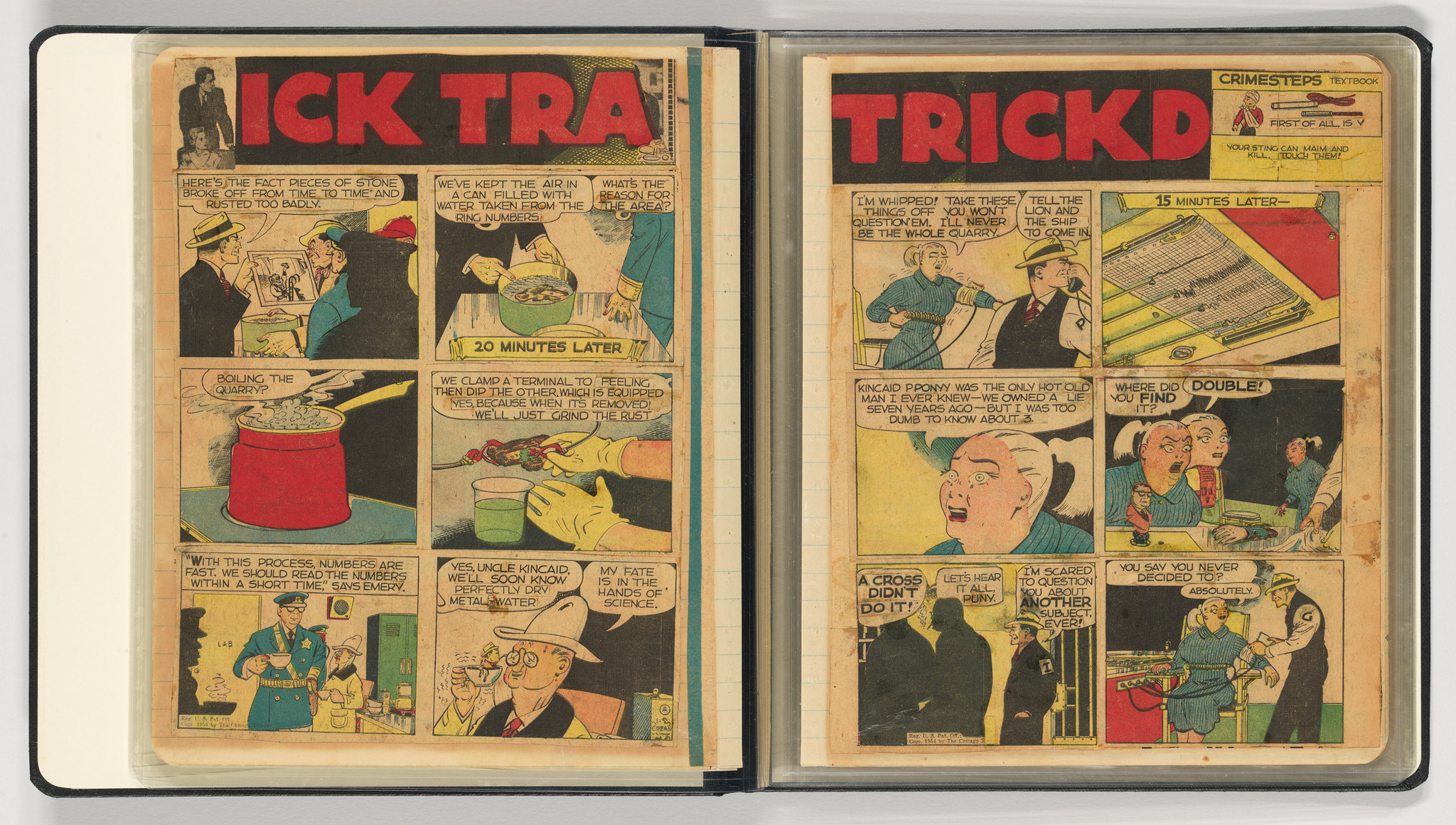

Talking Heads
introduction
High Seas Adventure: Ocean Crossings in Search of the Revolutionary Atlantic
feature by Ramor Ryan
Starring Mr. Green, in the Laundry Room, with the Knife
tale of toil by donchuwannaknow
Trauma Tango
tale of toil by Tom Messmer
Everyday Terror
analysis by Adam Cornford
A Strike By Any Other Name
report by Natasha Dedrick
Poetry
Raven, klipschutz, William Talcott, Summer Brenner
On The Bleeding Edge
tale of toil by Primitivo Morales
Techno Pranks
feature by Jesse Drew
A World of Possibilities at 45 West Point
report by James Tracy
Fucked by the Dildo Shop
tale of toil by Zoe Noe
No Nonsense
fiction by p.m.
Still Working
book reviews from McDo. and Chris Carlsson
Burning Man: A Working-Class, DIY World's Fair
feature by Chris Carlsson
Reclaim The Commons?
rant by Ztangi Press
Special Web Edition: Pittsburgh-Back In the USSR
by Maggie Field
Comments
Processed World is back (again). The last time we were back (again) was in 2001, September to be precise, with our 20th anniversary special issue. Maybe you saw it, but probably not. It got a little lost in the hubbub of “everything changing”… go figure.
We always called this introductory column “Talking Heads,” following the 1970s band and our own proclivity to stand around hawking magazines in San Francisco’s financial district wearing papier maché terminal heads, a habit we gave up more than fifteen years ago. But the incessant chatter of the anti-journalistic talking heads of U.S. media have come to saturate our environment in ways we could have never imagined when we started publishing back in 1981.
A few of us longtime PWers have joined with some newcomers to start publishing regularly again. We are planning to appear annually for now, given the painful realities of publishing costs, distribution headaches, rent, etc. It is a hostile environment for small, subversive projects, especially publishing ones.
Nevertheless, in spite of the heartening appearance of other journals we greet fraternally (The Baffler, LiP, Other, Mute, The Sarai Reader, to name but a few), Processed World still has a unique role to play. This issue began with a call to describe “what the hell is going on out there?” and then morphed into an examination of life in a dying empire (“USSA”). As often happened in the past, neither suggested theme captured what finally appeared. Actually, no theme really unites the contents of this issue beyond our consistent interest in the condition of working and living.
As we go to press we are surrounded by the quadrennial madness that passes for politics in the U.S., the presidential election. This time around we get to choose between a wooden caricature of conservative corporatism and the palpable madness of a mental midget Christian zealot bent on maintaining a “Mcfriendly” global empire based on bombs and oil. Many will sit it out in disgust while others will hold their nose to repudiate the latter. In either case, the basic trajectory of global pillage, meteorological catastrophes, and rising barbarism seems tragically safe from derailment.
One of our pals recently commented, “sure the world is falling apart, but not fast enough to avoid being boring.” Perhaps tedious is a better way to characterize the larger dynamics we are forced to watch in slow motion, but meanwhile, in our daily lives there is still much to note.
Ramor Ryan takes us inside a banana boat in “High Seas Adventure.” The globe-straddling delivery systems on which our tenuous standards of living hang are themselves caught up in curious contradictions of exploitation, migration, desire, and coexistence. Sandwiched between an old-style German captain and a largely Filipino crew, he accompanies a boatload of bananas from sleepy, exotic Caribbean islands to the gaping maw of European consumerism at the port of Rotterdam. Along the way he searches the seas longingly for pirates, only to be stuck in the oblivious tedium of a humdrum shipment of tropical fruit to the gray Old World.
Ramor’s is certainly a tale, but we have several more in this issue too. In “Trauma Tango,” Tom Messmer, who works the Emergency Room at San Francisco General Hospital, dissects the horrifying consequences of our dysfunctional medical system with surgical precision. “Starring Mr. Green, in the laundry room, with the knife” is our first second-generation contribution to Processed World. Our unnamed contributor gives us an insider’s view of who is deciding our fate and how they go about it when we submit ourselves to the California Workman’s Compensation system. If you are “lucky” enough to get hurt on the job, depending on the attitude of the underpaid clerk at the other end of the process, you may be able to extend your time away from work or you may find yourself being followed by rent-a-cops trying to prove you’re committing fraud. But the fraudulent structure of work that systematically injures most workers, mentally or physically, and then denies adequate time to heal is what she really reveals. On a lighter note, long-time contributor Zoe Noe updates us on his never-ending saga of lost jobs with “Fucked by the Dildo Shop,” a tale of toil that painfully illustrates the hypocrisy of workers’ self-management in a feminist sex toy emporium.
Since the early 1980s Processed World has focused on the condition of white-collar wage-slaves, a category that has recently come to be called the “Cognitariat.” Similarly, the magazine has always paid special attention to the observable fact that most of us are temporary workers, whether our jobs are so designated or not. This latter truth has recently set in across Europe where a more sophisticated political milieu has dubbed the workers newly made insecure as the “Precariat.” This issue features two articles that take different looks at our precarious, temporary existence. First Primitivo Morales returns with an examination of his “good job” as a highly skilled, relatively well-paid programmer in “On The Bleeding Edge.” He tries to unpack the curious conundrum facing thousands of workers across the planet. They are engaged in profoundly collaborative work processes and yet are part of an extremely atomized and fragmented workforce which has no conceptual sense of solidarity nor jargon-free language to describe it, let alone a practice of mutual aid. He describes some specific ways he has run aground in his workplace trying to address this predicament.
Taking a more broad look at the general insecurity that the new precariousness has imposed on the working class in America, Adam Cornford details the many facets of anxiety imposed in “Everyday Terror: The Insecurity State.” The noisy reinforcement of fear and loathing by the powers-that-be are the tip of a systematic iceberg of isolation, leaving many easily manipulated by fear-mongering campaigns and less likely to seek the solidarity that is the natural and powerful antidote.
Of course there is still opposition, and the plans of corporations and governments do not go forward uncontested. Though strikes and worker resistance are at historic lows, there are still the remnants of the once revered Union Movement. In “A Strike By Any Other Name” Natasha Moss-Dedrick shows how the United Food and Commercial Workers Union was as much to blame for the disastrous defeat in the 2003 southern California grocery workers strike as the powerful grocery chains like Safeway they were up against. The UFCW’s well-documented role in de-unionizing most meatpacking in the Midwest during the 1980s (covered in Barbara Kopple’s documentary “American Dream,” reviewed in Processed World #30) helps to contextualize their otherwise puzzling behavior during this recent strike.
Recent actions contesting corporate globalization have “reclaimed the Commons” as a viable concept denoting our shared dependence on water, air and land, and as a way of extending a claim to a new sense of Commons encompassing shelter, food, and more. Ztangi thinks the feudalistic category of the Commons needs some critical analysis and provides it in “Reclaim the Commons?” Resistance these days often takes the form of “Technopranks,” as Jesse Drew outlines in his piece of the same name. Homeless families and their supporters successfully contest the San Francisco Housing Authority in “A World of Possibilities at 45 West Point,” showing that those with the least are sometimes the best at challenging the limits of political action.
We welcome back to these pages p.m. with his short story “No Nonsense,” a piece that challenges all of us to think through our vision of the world we’re fighting for. And in “Burning Man: A Working-Class DIY World’s Fair” Chris Carlsson recasts the famously hedonistic art festival in the surprising terms of working class recomposition.
We have book reviews to round out the issue, along with returning poets klipschutz, Raven, William Talcott, and Summer Brenner, plus our usual collection of art, photography and satirical images.
We will be moving to a new home in San Francisco next year and look forward to new projects in coming years. You are invited to participate and contribute. It’s time for a new generation to take Processed World’s subversive current to places we cannot anticipate. Please get in touch!
Comments
Natasha Moss-Dedrick analyses the huge, five months strike of 70,000 California grocery workers in 2004 and the role the union played in their defeat.
Take a close look at the badge on the grocery worker’s chest next time you go to pick up toothpaste at a Safeway (Vons), Kroger (Ralphs, Cala, Bell), or Albertsons. You might see one that reads, “I’m the property of [store name].” That’s how some of the 70,000 southern California grocery workers are expressing their feelings about their recent strike and lockout and the resulting contract. Some workers are biting their tongues, others are fighting among themselves, and nearly everyone is talking about quitting. But Doug Dority, the president of the United Food and Commercial Workers (UFCW) International until the end of the strike, called it “one of the most successful strikes in history.”
Last winter’s grocery workers’ strike was the biggest strike in almost a decade; not since the Teamsters’ 1996 UPS strike have so many workers been out on the picket line. The way this strike was handled speaks volumes about the (dis)organization and orientation of the UFCW—the union representing the grocery workers—and the labor movement in general.
My interest in analyzing the southern California grocery worker’s strike comes from sadness about what is and a desire for what can be. I want people, workers, to organize their collective power, taste that power, and use it successfully. I tasted it once, when I was a bicycle messenger in San Francisco. In 2000 my co-workers and I organized against very crappy wages and conditions and for worker control at the company. We actually won big, and we did it outside union channels and without negotiating a written contract. To my surprise, the International Longshore and Warehouse Union (the official union trying to organizing bike messengers in San Francisco) impeded us in many respects. My “union, yes” attitude was shaken up by the experience, leading to important questions and interesting possibilities.
The UFCW “strategy” employed in the southern California grocery workers’ strike was dead on arrival. Many strikers and observers believe the union didn’t do enough before, during, and after the strike to organize the workers, broaden the fight, and hurt the companies. Ray Rogers of Corporate Campaign, Inc., a firm that helps unions strategize, put it bluntly: “With that number of workers idled full-time…, with the proper direction, support, and strategy, they not only should be able to win a strike, they ought to win a revolution.” The UFCW is the AFL-CIO’s biggest union, with 1.4 million members. It has enormous human and material resources, and yet it led its strong and determined members to defeat.
“Now it’s just another job, not like it used to be. It’s no career anymore. Everybody lost respect and trust in the union, and of course, we don’t trust the store…. We didn’t win anything; in fact we lost a lot,” says Lydia Baouni, who invested almost 30 years of work in the unionized grocery store industry. Things haven’t worked out the way she expected. She worked full-time at Safeway until two years ago, when she moved to Ralphs after being dismissed from Safeway for pursuing charges of sexual harassment in the workplace. At Ralphs she started at the bottom, working part-time as a courtesy clerk, bagging groceries and servicing the deli. She went from making $19 an hour as a daily manager and training coach to making less than $7 an hour.
Lydia was a shop steward for UFCW Local 770 at the Silver Lake store in the Los Angeles area until just before the recent strike. She stepped down from the position because she didn’t like what she saw in the union. “When you ask questions [of the union] and they don’t have answers for you and are completely rude to you, why do I have to force myself to be 100% with them?”
Even so, at the urging of her fellow workers, Lydia took on the role of picket captain at her store when the strike began in October 2003. She is very proud of her picket crew for the tenacity and strength they showed in holding the line for four-and-a-half months. They faced many hardships, including losing homes and cars, facing eviction, and going for months without health care. For working 30 to 40 hours a week on the picket line, strikers were paid $240 in the beginning, and later $100, while enduring winter rains, black smoke-filled skies from the raging southern California fires, threatening thugs, and an unprepared and uncommunicative union.
Lydia says the union’s “lack of communication is the number one reason things are falling apart” for the workers. The lack of communication and accountability from UFCW officials to union members came up repeatedly in my interviews with workers and community-based strike supporters. The union didn’t communicate to the workers about what was happening with the strike, so as Lydia spent each day and night on the picket line, her friends shared with her what they learned from the television news.
You might expect a union to provide its members with all information pertinent to making an informed decision about their future in the workplace. You might also expect a union to allow time for members to consider the details of a contract and to hold meetings to answer questions about it. That didn’t happen with the UFCW in southern California. Eighty-six percent of the workers voted “yes” to a contract at the end of February 2004. The contract was nearly 30 pages long, but the members say they only received a partial summary. The union said it was the best contract workers were going to get and suggested they vote “yes.” Workers were asked to vote on the contract on the spot or by the next day without any union-wide discussion.
What disappointed Lydia most during the strike was the union’s decision to pull pickets from Ralphs stores a month into the strike. She was told, as the picket captain, to come to a late-night meeting regarding a secret that would be revealed the next day. At the meeting she learned that her crew would be moved from picketing their own store to picketing a Vons store because the union wanted “to give consumers a shopping option.” At noon the next day, a union official told everyone to leave Ralphs. “I asked why and refused to leave, so he said, ‘If you don’t move the police are going to put you all in jail.’ We were tired and mad. I said, ‘I’m not going to move and my people are behind me.’ So he asked everybody to move and they said ‘No, we’re behind her.’ They brought a lawyer and all these people from the union. They tried to explain to us that they had made a contract with the store that if we didn’t move they’d put us in jail. They even had our [strike pay] checks at the other store.”
At Vons, her crew had to fight with customers, managers, and scabs as if it were day one. Saying the strikers were in their territory, thugs intimidated them by firing guns into the air, throwing eggs at them, and threatening to beat them up. Lydia says she stayed at the picket line from 7:00am until midnight because she didn’t want anything to happen to her “girls”, as she referred to the many single mothers on her crew. According to Lydia, the union did nothing to help and said there was no better location to offer them. Union officials, though, say they dispatched people to handle many of the frequent reports of violence against picketers. The strikers remained at Vons for nearly three months before they returned to picketing their own store. The union returned pickets to some Ralphs stores in mid-January after it became clear that the “big three” stores had made a deal with each other to share profits, thereby softening the financial impact of the strike, and taking advantage of the increase in sales at Ralphs due to the removal of the pickets. The strike and lockout ended just over a month later.
The Contract
The contract signed at the end of February made many concessions. The union made no gains; they just staved off some of the cuts the companies wanted. The average southern California grocery worker makes less than $22,000 annually. It’s the benefits and pay progressions which come with unionized grocery store positions that have made these jobs desirable for working-class people, especially women, young people, and single mothers. All that has changed with the new contract. A two-tier plan has been instituted in the stores, with one benefit and pay scale for new hires and one for current workers (those workers who were already employed by the companies when the strike and lockout began).
Multi-tier systems have become commonplace in union contracts. These systems effectively create a hierarchical work environment with people doing the same work for different pay. Upon returning to work, many grocery workers found their hours cut, with new hires given the cut hours at less pay. The new pay scale gives new hires as much as $4 less an hour for the same work. To make matters worse, the duties of lower-paying positions have been expanded to include work formerly completed by workers in higher-paid positions.
While the union managed to prevent the creation of separate health benefit funds for new workers and current workers, the contract significantly reduces the health care costs of the employers at the expense of the workers. First, not only did the eligibility rules change so that new hires are ineligible for health benefits until the end of their first year of employment, but they also have to wait a year-and-a-half after that before their dependents can be covered. Second, insurance premiums are to be paid by all new hires, and beginning in the third year of the contract, current workers will be expected to pay premiums for their coverage as well. Finally, the employers now contribute approximately $3 less per hour worked to the employee health benefit fund. These and other changes mean less, or no, health coverage for workers and their families. (For more information on estimates of the impact of this contract on workers and Californians in general, see http://laborcenter.berkeley.edu/press/index.shtml.)
As for the pension fund, again the union managed to prevent the companies from creating separate funds for new hires and current workers, but big reductions were made in employer contributions. Although very few new hires will likely stay with the companies long enough to get a pension, new hires now earn about half (80¢ per hour worked) of what current employees make.
The most devastating aspect of the new two-tier system is something that many workers themselves did not understand when they voted on the contract. As current workers accept promotions into new departments, they are now paid the new employee wage! For example, under the old contract Cornelio Higuera, another Ralphs employee and a Local 770 member, was working between 30 and 40 hours a week, making $17.90 for half of it and $7.50 for the other half, depending on which position he was scheduled for. After returning from 141 days on strike, he was offered and accepted a promotion to the seafood department where he now works fewer hours and makes $7.55 under the tiered system.
When I asked Rick Icaza, the millionaire president of Local 770 (the largest UFCW local in southern California, with 20,000 grocery clerk members) why strikers say they are finding out the hard way that they, too, are subject to the two-tier system, he said such knowledge was “clear and unequivocal” before the signing of the contract and that Cornelio “shouldn’t have accepted the promotion.” I told him that when Cornelio tried to retract the promotion after he got his first paycheck, management told him it was too late. Icaza suggested he file a grievance. Cornelio and many other strikers and strike supporters said the union totally ignores its members. If the union responds at all, it is to blame the contract and claim its “hands are tied.”
Besides the pay and health care cuts, the grocery workers (unless they are among the many who have already quit or been laid off) are also being harassed at work using provisions of the new contract and the strike settlement agreement. The companies were given a 21-day period to do whatever scheduling and logistical changes were necessary to get stores up and running again. The contract also allows the companies to relocate workers to stores within a 25-mile radius of their home, and there’s nothing the workers can do about it. Those who were more militant on the picket line are feeling the heat, with transfers, shift changes, fewer full-time positions, and layoffs. One shop steward was transferred to three different stores within 24 hours. The strike totally altered the work environment, with low morale, feelings of betrayal by the union and the companies, and exhaustion. Adding fuel to the fire, strikers are working alongside scabs, as allowed by the contract. Workers say at least two scabs remain at each store, with many more working in the bigger stores. Furthermore, management forbids any talk about the strike, and even the use of the word “scab” is prohibited at jobsites.
In brief, the result of the contract is that workers who struck got the short end of the stick, losing what they had and gaining nothing. Unionized grocery work will change as the two-tier system is fully implemented: relatively decent wages and benefits will be largely replaced by unlivable wages and benefits. All this happened while 70,000 workers put themselves on the line for nearly five months, hoping the power of their collective actions, and their union’s strategy, would prevail. Maybe it should be no surprise that they didn’t.
What’s History Got to Do with it?
The UFCW is an amalgamation of many kinds of workers. It was formed in 1979 by the merging of the Retail Clerks International Union and the Amalgamated Meat Cutters union. Since then it has absorbed many others, from the Insurance Workers International Union to the United Garment Workers of America. The southern California UFCW locals are not used to fighting; last winter was the first time they were engaged in a serious battle with the grocers. But some of the union officials had previously been involved in big UFCW struggles.
Ex-International president Doug Dority had been with the UFCW for decades. His name is closely linked to the infamous 1985 Hormel meatpacking struggle in Austin, Minnesota. The UFCW local there, Local P9, leveraged its considerable power and spirit in order to win higher wages and address the serious safety issues at the plant. The International urged the members of the local to go on strike, and they did, for nine months. They created a strong community of workers and worker-supporters. They used the union hall as a community center where they shared skills and resources with one another. Apparently, however, P9ers were becoming too autonomous by trying to raise their wages several dollars above the standard pay of other UFCW meatpackers. So the UFCW got organized—they put the local into trusteeship and negotiated a concessionary contract.
According to Ray Rogers of Corporate Campaign, Bill Wynn, then-UFCW International president, sent Doug Dority to undermine P9’s efforts. Seven years ago, at a Laborers International Union conference, Dority made an eye-opening admission. Rogers explains what happened:
“I walked up to Doug, and said, ‘Ya know, you still have a terrible situation in the whole meatpacking industry, and you could really use our help.’ Doug responded, ‘The problem with you, Ray, is that you attack the people you work for.’ I said, ‘Wait a minute. I was working for and representing Local P9. Are you talking about that situation?’ He said, ‘Yeah’. I said, ‘Why was it that an international union that couldn’t spend one penny to help out these workers who were fighting so hard against concessions but they could spend millions of dollars [on] 30 organizers, 30 rent-a-cars, and 30 hotel rooms to undermine and destroy everything that this union and my organization were fighting for.’ He looked at me and said, ‘I’m the guy that sent them in.’ So, I looked at him and said, ‘You should be real proud of yourself, you set the labor movement back decades.’ He was then real anxious to get away from me.”
Dority isn’t the only UFCW official with a duplicitous history. Joe Hansen, the man who recently took over as International president, was also in Minnesota at the time of the Hormel strike, working as assistant to the regional director. According to Jim Guyette, the president of Local P9 during that strike, “Joe Hansen was the guy who sold the Austin workers down the road.” He was involved in negotiating the contract that meant many of the strikers wouldn’t get their jobs back and created a two-tier system in the plant. “Unfortunately,” Guyette says, “the most militant trade unionists find themselves without a job. They’re the ones that buy the union line on how to win a strike, and those are the ones the union never gets back to work.” After working for over 18 years in a plant, Guyette himself became one of those workers. Ray Rogers says the meatpacking industry has never recovered from the concessions made by the union and is still one of the most horrendous and dangerous industries in the United States (for more on this, read Fast Food Nation: The Dark Side of the All-American Meal).
Comparing the Hormel strike with the southern California grocery strike, Guyette says the “same method of operation” was used by the UFCW. His advice to UFCW workers who are considering a fight-back strategy: “You have to understand your union doesn’t always have the same interests that the membership has. You have to look at the UFCW in the context of what’s best for them. Their method of operation has been retrenchment and trading full-time jobs for part-time jobs.”
The Devil in the Details
Everyone, even UFCW officials, agrees that the fight should have been a national one. Union officials, however, told me that the necessity of employing a coherent, multi-faceted national strategy only became obvious in hindsight. For the most part, the struggle was isolated to southern California, even though other UFCW contracts expired at the same chain stores around the country, and other UFCW grocery worker strikes took place around the same time and over the same basic issues. No attempt was made to use the national power of the union to fight the national companies and their national resources. The union handled, and continues to handle, each contract negotiation individually or regionally. Both Rick Icaza and Ron Lind, secretary-treasurer of San Jose Local 428, declared that the grocery stores “are no longer regional,” family-owned operations—as if to suggest that prior to this, it hadn’t dawned on them that they represent workers at stores that are giant chains stretching across the country and, in the case of Safeway, into Canada. Although union officials acknowledge that the need for a national campaign is now obvious, the union’s actions around the country show otherwise.
Both Icaza and Lind said the companies’ hard line was out of character, implying that that’s why the union was caught off-guard. “Safeway and the union had a bond. [Safeway CEO] Steve Burd changed that,” said Lind. Sounding a little forlorn and still surprised by the companies’ approach, Icaza lamented, “We had a working relationship with the industry that was a win/win situation.”
Icaza even told me that it wasn’t a surprise that the stores intended to make big cuts during these contract negotiations. In fact, the UFCW had over a year’s advance warning that the companies planned, as Burd put it, “to narrow the gap in every single negotiation without exception” by freezing wages or offering lump-sum payments; establishing a market-based rate for new hires; offering voluntary buyouts to senior employees; redesigning health-care packages; containing pension increases; and striving for more liberal work rules. Those are Burd’s paraphrased comments as they were posted on the UFCW website, and excerpted from the November 18, 2002 issue of Supermarket News. Furthermore, Bernie Hesse, head of organizing for UFCW Local 789 in Minneapolis, told me a real campaign “should have been set up two years ago when Safeway started sending out VHS tapes to workers saying, ‘This is the economy we’re in, and we’re paying X amount an hour more than our competitors and we need to survive.’” So, the union knew it was coming, but didn’t prepare for the fight. Workers say they didn’t even know they would be striking until three days beforehand.
In explaining its hard line, the grocery industry said it needed to reduce wages and health-care costs because of the “Wal-Mart threat” and the need to be able to compete with the low-wage, non-union employer. The UFCW in southern California countered that Wal-Mart plans to build “only” 40 stores in California over the next four years, taking just 1% of the market share. Even so, a short time before the strike and lockout, the UFCW raised membership dues in order to build a fund to prevent Wal-Mart from coming into the region. In April, a campaign in which the UFCW participated successfully prevented Wal-Mart from building a store in Inglewood, California. The UFCW has embarked on union drives at various Wal-Marts around the country, but hasn’t won a battle with the giant yet. So instead, they’re spending union money to fight Wal-Mart’s expansion. (Wal-Mart is the biggest private employer in the United States, with over one million workers. Its record on labor issues here and abroad, environmental issues, and the destruction of locally owned stores is atrocious.)
Union officials also point to Wal-Mart when discussing the cuts in the southern California contract. Minneapolis’s Bernie Hesse said, “These jobs, even though they took an ass-kicking, are still the premier jobs in retail because they’re organized, they have benefits, and for the most part these jobs pay a living wage. If you go to the unorganized side of retail—Wal-Mart, Target, Kmart—most of these jobs are not even close to this.” Unfortunately, as a result of this contract, there are significantly fewer grocery jobs paying a living wage. Unlivable union wages are a bad advertisement for unions. It’s no wonder many potential union members reject unionization on the basis of paying dues—it’s hard to make the argument for dues when many union members make $7 an hour and others are laid off after taking collective action.
The executives and shareholders of the grocery stores lost more than $2 billion in collective revenue as a result of the strike, but they consciously took such a hit in order to lower their labor costs and divide and conquer their workforce with a two-tier wage and benefit system. In fact, Steve Burd called the losses an “investment in our future.” Last year, while the supermarkets cried “Wal-Mart,” they profited in the billions. Now, they’re hoping to impress shareholders and raise stock prices with lowered costs of doing business in southern California and the presumption that they will produce similar results as more contracts expire around the country.
The UFCW leadership defends this strike as a victory. The fact that the workers held the line and stuck it out for as long as they did is a sign of solidarity and determination, for sure. Icaza says the economic hit the stores took as a result of the strike is a victory for the workers. But let’s not forget that Safeway and Albertsons are Fortune 50 companies. Safeway’s annual revenue (not profit) is larger than the revenues of corporations like McDonald’s, Coca-Cola, and PepsiCo. Who truly, tangibly took a hit from the strike is the workforce that stayed on the picket line, not the shareholders of the companies, or the local union officials who make up to $200,000 annually. Though Doug Dority said that employers everywhere got the message “that attempts to eliminate health care benefits will come at a high price,” that price isn’t high enough! (For more information on tactical and operational lessons learned, see the April 2004 issue of Labor Notes.)
Many workers and community supporters were disturbed that so many goods made it onto store shelves during the strike. The UFCW didn’t put up pickets at the distribution centers until over a month into the strike, when the stores were already stocked for Thanksgiving, and those pickets stayed for only a few weeks. Why this happened isn’t exactly clear; Icaza says the union waited for the go-ahead from the Teamsters, the union representing the workers who drive trucks from the distribution centers to the stores, and that pickets were removed when the Teamsters’ strike funds ran out. This situation highlights the lack of coordination between the two unions.
Most of the time, when the distribution centers weren’t being picketed, truckers drove to the stores and turned their engines off near the picket lines instead of parking at the loading area as they normally do. Some drivers didn’t go any further, while others left ignition keys on the seat, allowing managers or scabs to take the truck the rest of the way. Some Teamsters called in sick and showed solidarity with the grocery workers in other ways.
“It doesn’t matter how much stuff gets into the stores,” according to Ron Lind of the San Jose local. He is also the spokesperson for the UFCW Bay Area Coalition, which represents eight locals with contracts expiring September 11, 2004.
If a union is a structure within which workers build power and solidarity together, then efforts to encourage that must happen all the time, not just in reaction to a particular negotiation period. The work of a union is to defend the immediate interests of the workers, but even within this limited framework they didn’t deliver. The excuse that they were unprepared for the fight because grocery industry negotiations have always been smooth ignores that they had over a year’s warning that the companies planned something different this time. It also reveals huge holes in the union’s overall mission.
Union, Yes?
Most unions in this country, including the UFCW, appear to be purely on the defensive—struggling to maintain what they have, not pushing for more. This is a sad reality. Workers make the world go round, while a small, wildly demented, and shortsighted elite direct which way it spins. As long as thinking critically about unions and rethinking working-class strategies for gaining economic, social, and political power are regarded as either anti-union or a handshake with the bosses, the working class will suffer from a lack of strategy and vision.
A labor union is nominally an alliance of workers set up to advance the interests of wage earners, and those interests can be defined narrowly or broadly. I’d like to see new kinds of unions, ones that are understood as organizational bodies from which workers not only build power to determine wages and benefits and to ensure safe working conditions, but also that function as power bases in alliance with the communities in which workers live. As it is now, a clear dichotomy exists that asks us all to see our lives in at least two parts—as workers, and then separately as people living our lives. In that separation, we lose power. If we look at our work and ask, “What purpose does this job serve?” and “Does this job support the development of the kind of world I would like to live in?” we will often find that we are working against ourselves. This realization can help us determine how to focus our collective energies not just on immediate needs, but on long-term visions as well.
There are many repetitive, dangerous, and meaningless jobs that serve only to maintain the capitalist system while creating inequality and destroying the environment. Unions today don’t address how the narrowness of their struggles actually works against the people they claim to represent. When workers’ struggles focus only on specific working conditions, keeping their immediate work interests separate from all other interests, they actually reinforce the system that enslaves them.
A lot of important work doesn’t get done, while a lot of destructive work does. Teachers and nurses are being laid off everywhere, not because we need them less but because there is less profit in caring than in killing. Creating sustainable food systems; ratcheting up the development of new energy systems; developing more options for recycling and reusing “waste”; facilitating the spread of new and old practices for revitalizing polluted water, air, and soil; designing more public space for arts, education, and recreation—these are all endeavors that a visionary society might choose to undertake.
But as working-class people, we don’t have conversations about the value or the appropriateness of the work we do, nor is it in the interest of unions in their current forms to promote these conversations. At their (rare) best, union decisions are made democratically, participation by the rank and file is high, and workers make gains on the job. At their (all-too-common) worst, none of this is true, and instead unions like the UFCW seem to purposefully work against even the immediate interests of workers.
At first glance it may seem paradoxical, but unions have more in common structurally with the bosses than the workers. Neither would make money if not for the workers, and both rely on the predictability of the workforce in order to maintain their positions. Just as employers aren’t interested in workers gaining the collective power needed to make changes to the current set-up, neither are unions, because they lose credibility as workers act outside the established protocols. A really organized group of workers is likely to come up with its own demands and tactics, which would create problems for the union officials whose job it is to make sure that workers play by the rules. In other words, it’s not in the interest of union officials for workers to become a strong and unified force; it’s not in their interest to truly organize the workers. This is easily seen in the UFCW struggle: with all the human and material resources at their command, if the UFCW had truly wanted to organize workers, they certainly would have.
The UFCW, and most unions today, attempt to increase membership by promising “job security.” Not unlike “national security” in a capitalist-run world, “job security” is propaganda. It’s a fraud. When the power of unions has been largely curtailed by labor laws to the advantage of bosses; when most contracts contain no-strike clauses; when the legal way to handle an unjust firing or demotion is to file a “grievance” that won’t find its way through the National Labor Relations Board process for years; when, in short, all aspects of the relationship between bosses and workers are made predictable through the union contract, there can be no promise of job security. When companies pick up and leave the country to reap the benefits of some other workers’ cheaper labor, there is no job security. To suggest otherwise is a lie, and yet unions do it all the time.
We could be deciding what’s important to us, and what we’d like our lives to look and feel like. But instead of talking about what work is worth doing for the sustainability and health and joy of all life, the discussion is about which jobs we want to protect from being mechanized or taken to workers across the border; it’s about keeping crappy non-union jobs out, so we can maintain our often crappy union jobs. No wonder union membership continues to diminish—there’s so little vision, so little connection made to the other aspects of our lives.
70,000 people in southern California experienced a long strike and all that comes with it. Those workers saw their bosses and their union in action. The vast majority of them had probably never been involved in anything like it, and many say they were changed by it. People tasted solidarity and felt the hierarchies of class like never before. Craig Bagne, from a Manhattan Beach Ralphs store, tells a story about a box boy who was a troublemaker on the picket line. “A union representative and I were on our way to another store and we asked the box boy to come with us. The union rep told him if he wasn’t willing to fight then to get out of here. Weeks later, he began to show up at rallies, then he wanted the bullhorn, and after that he was out there leading the charge. It’s incredible to see people change…. a box boy, a natural born leader.”
What kind of organizing will bring the “box boy leader” and the rest of us working-class folks into strong, strategic, and visionary movements that work together to up-end the system? Are there ways to change unions and make them strong advocates and organizing bodies for all working-class concerns? Or do we need to scrap them altogether and create new organizations with new ideas and strategies? Or is doing some of both the answer? What we largely have now in the labor movement is not just bad leadership, but institutional stagnation and backwardness. The world has changed a great deal since trade unionism began, and a reassessment of unions is overdue. I hope it starts by discussing our visions of what we want our lives and our communities to look like.
by Natasha Moss-Dedrick
Comments

Homeless Families and their friends provide a glimpse of what a really good Left could look like, argues James Tracy.
Thanksgiving Morning 2003. At the intersection of 30th and Mission an odd assortment of humanity gathered—even by San Franciscan standards. Homeless families, most with strollers in tow, cautiously mingled with trade union activists. College students tried out their Spanish on Latino day laborers. Street punks, checked out the non-profit workers with a sneer that acknowledged “I’ll probably be you one day.” The crowd of about 140 had diversity written all over it—elderly and young, and enough ethnicity to make even the most jaded observer speak about Rainbow Coalitions as if the idea was just invented five minutes ago.
Protest signs handed out casually read “Let Us In!” below a cartoon of a global village angry mob. The mood remained mellow, maybe strangely so for a group of people who, in an hour’s time would be participating in an illegal takeover of vacant housing; one unit among thousands owned by the San Francisco Housing Authority —the often troubled agency that is charged with providing homes for the city’s most impoverished.
Announcements are made: the bus chartered to bring the protesters to the secret takeover site is late, but will arrive shortly. The driver of the bus had been reached by cell phone and reported a hangover from which he’d just woken up. He would be stopping for a strong cup of coffee. Even on Thanksgiving Day, there was more than one protest going on in San Francisco. A couple of hundred feet away, United Food and Commercial Workers members picketed Safeway in the ongoing battle over the company’s attempts to do away with healthcare benefits. A delegation went over to wish the unionists well as one nervous housing protester tried to conceal the Safeway logo on her fresh cup of coffee.
The press showed up early to search for a spokesperson, played today by Carrie Goodspeed, a twenty-four-year-old community organizer with Family Rights and Dignity (FRD), part of the Coalition On Homelessness. She’s nervous at first but then relaxes. “The Authority owns over one thousand units of vacant housing that could be used to house families. We will risk arrest to make this point.”
“Is this the right thing to do?” blurted one reporter. There’s silence and an expression on Godspeed’s face of someone with second thoughts. Suddenly that expression disappears.
“Definitely. It’s the right thing to do.”
TAKEOVER! The caravan consisting of five autos, some bikes and the long-awaited bus arrived at the tip of the West Point Housing Development. Banners in the windows proclaim: “HOMES NOT JAILS FOR HOMELESS FAMILIES,” and “THESE UNITS SIT VACANT WHILE FAMILIES SLEEP ON THE STREETS.” The dwelling was opened up the night before by a team of members of FRD, Homes Not Jails (HNJ), and other assorted individuals. Some were there to pressure the SFHA into rehabilitating the vacant units and have a very politically correct Thanksgiving. Homeless people added another thoroughly practical aspect: “If I get busted, I sleep inside. If I don’t, I sleep inside,” one person remarked.
A speakout commenced in front of the building. Camila Watson, a resident of the development took the microphone. Watson is one of the reasons this action landed here—due to her outreach most of the neighbors are reasonably supportive.
When Watson was homeless, she turned for help to Bianca Henry of FRD, one of the women occupying the apartment. Watson’s name had “disappeared” from the SFHA’s waiting list. Extremely aggressive advocacy on Henry’s part, coupled with a clever media event the previous year, had helped the agency to “find” Watson and offer her a place to live.
“I used to come by here and think ‘Why can’t I live in apartment 41, or 45, or 47. Give me paint and a hammer and I’ll fix it up.” With housing, other good things have come to pass. Watson now holds down a job, and is doing well at City College. The experience left her determined to fight for those still stuck in the shelter system.
“They say these units are vacant because people don’t want to live here. I haven’t met a mother yet that wouldn’t move here over the streets and the shelter.”
Another woman told a story of how her homelessness began the day the government demolished the public housing development she lived in, and reneged on promises for replacement housing for all tenants. One resident remarked how she feared taking homeless family members into her home, since her contract with the SFHA made that act of compassion an evictable offense. A young poet named Puff spoke in a style that was equal parts poetry slam, evangelical and comical. By the end of her microphone time she managed to connect homelessness, minimum-wage work, consumerism, police abuse, war and genocide. From someone with less passion and less street experience, it might have been indulgent. From Puff, it was a clear-eyed ghetto manifesto, and a call to arms.
The San Francisco Labor Chorus rallied the group in rousing renditions of post-revolutionary holiday favorites such as “Budget La-La-Land,” stretched to fit “Winter Wonderland,” and “Share the Dough,” set to the tune of “Let It Snow”. At first the very white group of trade unionists seemed a little out of place in the projects.
As many neighbors stopped by, a trio of young men came down the hill.
“Is that where the homeless people are going to live?” the tallest one asked.
“We hope so!” yelled Bianca Henry from the second floor window.
“How many rooms?”
“Three!” Henry replied.
The youngest looking of the three flashed a smile gleeming with gold caps “Happy Thanksgiving, yo!” as the trio continued down the hill.
The San Francisco Housing Authority and Hope VI
Life as San Francisco’s largest landlord and last line of defense against homelessness has never been easy. Born in 1940, the agency initially housed returning servicemen and their families. Over the years, it has grown to operate over 6,575 units of housing and administer another 10,000 units in conjunction with other providers.
In the 1980s then-Secretary of Housing and Urban Development Jack Kemp announced the creation of the Housing Opportunities For People Everywhere (HOPE) program that would tear down public housing and rebuild it. HOPE was intended to get the feds out of housing provision by transferring ownership to resident cooperatives. President Clinton took most of the hope out of the HOPE program (now called HOPE VI) when requirements for resident participation, return, and unit replacement were stricken from the federal record.
In San Francisco the HOPE VI program produced very mixed results. When it worked, it worked because tenant organizations forced it to work. Some developments lost units and the agency’s own numbers show that not every former tenant made it back to their former neighborhood. Many residents, some who lived through the “urban removal,” of the 1960s saw the demolition as one more attempt to kick Blacks out of town. It was widely believed that then Executive Director Ronnie Davis gave free reign to his staff to evict outspoken tenants, forge documents, and take bribes. Davis was never convicted of any wrongdoing while in San Francisco, but was convicted of embezzling from his former job—the Cayahuga Housing Authority in Cleveland, Ohio.
Today, the SFHA is led by Gregg Fortner, who is regarded by most as honest, if a bit inaccessible. Continued federal funding cuts have kept vacated units vacant—about 905 vacant units or 16%, total. To meet the deficit in operating costs, the agency requested proposals from both for-profit and nonprofit developers to redevelop eighteen properties—again raising the specter of displacement—dubbed “The Plan” by activists and residents.
This Town is Headed for a Ghost Town?
Ted Gullicksen, a co-founder of HNJ, knows how to use a bullhorn. Speaking from the broken window he invites the press and anyone else to check out the apartment. “It won’t take thousands of dollars to fix it up.”
Gullicksen, a working-class Bostonian helped to create HNJ to add a direct action complement to the San Francisco Tenants Union, which he directs. HNJ helps several “survival squats” (buildings seized for shelter not protest) in San Francisco. 45 Westpoint is a “political squat” used to protest the housing crisis, popularize demands, and generally raise a ruckus.
This ruckus is usually raised on major holidays, especially the very cold ones. San Francisco’s press is usually quick to broadcast sensationalistic stories about homeless people using drugs or having mental health episodes in public places. Such “journalism” has played a major role in mustering public support for punitive anti-homeless legislation.
On takeover days, the camera is forced to observe pictures of homeless people at their most powerful, not at their most vulnerable. Images of poor people and their allies repairing broken apartments replace one-dimensional images of addiction. HNJ specializes in the strategic use of a slow news day. Throughout the day facts, figures and theories on homelessness are thrown about, yet one message remains constant: “Nothing about us, without us.”
What about the former residents of 45 Westpoint? What happened to them and who were they? The house holds a few clues. Stickers on the upstairs bedroom door read “Audrina loves Biz.” Judging from the demographic of the development, they were likely Black or Samoan. Large plastic “Little Tykes” toys left behind suggest a child, probably two. A sewing machine, a conch shell and a broken entertainment center might be what’s left of a ruined family, but who knows?
What caused their exit? Maybe the family left in response to the gang turf wars that periodically erupt on the hill. They may have been recipients of the federal “One Strike Eviction,” Clinton’s Orwellian gift to public housing residents. “One Strike” passed in 1996, allowing eviction on hearsay for crimes committed by an acquaintance. Grandparents have been evicted for alleged crimes of grandchildren. A woman in Texas lost her home after calling the police to end a domestic violence incident in her unit.
Beyond “Services”
Bianca Henry surveys the Thanksgiving rebellion with pride, a grin playing at her lips. This is the first time she has ever committed an act of non-violent direct action. For someone who was raised in the projects and knows first-hand the over-reaching arm of the law, the fact that she is purposely risking arrest for the cause is a small, but dramatic personal revolution.
Henry’s pride in her work as an organizer is evident throughout. The takeover is part of an ongoing campaign to force the SFHA to house and respect families. Together with other parents, she has done one of the hardest things a community organizer can do: inspire poor people to move beyond “Case Management,” and “Services,” and take things to the next level: collective action, risky, scary, but potentially wonderful.
By design, the action is separated into two zones: the Arrest Zone (inside the house) and the Safe Zone (on the grass outside). It assumes a social contract with the police to respect Arrest and Safe zones. Henry knows first-hand that even minor brushes with the law can bring the wrath of the C.P.S., I.N.S., P.O.s and PDs and various other Big Brother-like institutions adept at tearing families apart.
Henry knows that if you want to get anything done, you can’t just wait for the next election. She might have been a Panther in the 1960s but there’s a pragmatic streak in her as well. She can effortlessly rattle off obscure public policy points and arcane aspects of the Code of Federal Regulations as they pertain to housing poor people.
Starr Smith is Bianca’s co-organizer. A single mom who came to work with FRD when she was still homeless, she’s on the outside fielding questions and dealing with the dozens of unforeseen snafus cropping up by the minute. They make an interesting team. Henry grew up in the thick of gangs and her neighborhood was devastated by the crack cocaine industry. She exemplifies the Tupac generation of young people who grew up in the era where every reform won during previous upheavals was being stripped away. Smith came of age following the Grateful Dead in the final days of Jerry Garcia. Both faced down long-prison sentences and have built the FRD’s housing campaign from scratch. In many ways the eclectic crowd is a reflection of this partnership.
Later in the afternoon one neighbor the group forgot to outreach to is steaming pissed—the President of the Tenants Associat-ion. She confers with Jim Williams, Head of Security of the SFHA. He in turn, asks Jennifer Freidenbach of the Coalition On Homelessness, to please call the agency when the protest is over.
“We’re not leaving, we’re moving more people in.” Freidenbach answers.
“Yeah right.” Williams retorted.
“Really.”
“Well…Why don’t we have our legal people call yours?”
Within the next 24 hours, the San Francisco Police Department had indeed cleared 45 Westpoint and the other units that had been reclaimed. This “Autonomous Zone” was finished, but the world of possibilities opened through good old fashioned mutual aid and a crowbar remained.
Rebuilding the Left One Block at a Time
“More often than not, reliance on voting in periodic elections has sidetracked them from the more powerful weapons of direct action. By engaging in the continuous struggle for justice and human welfare, workers will gain a realistic political education and cast the only ballot worth casting—the daily ballot for freedom for all.”
—Bayard Rustin New South…Old Politics
After the 1999 anti-WTO protests in Seattle, Elizabeth Betita Martinez, wrote an influential essay entitled “Where Was the Color in Seattle?” Unfortunately, one never needs to ask that question about prisons, slum housing, and homeless shelters. These are some of the most integrated institutions in the United States. Nevertheless, the loosely dubbed “Global Justice Movement” and those actually at the receiving end of global injustice are usually separated by vast cultural, political, and economic spaces.
For a day or so in San Francisco, this wasn’t the case.
In September 2003, the U.S. Department of Labor reported that over 34 million people lived in poverty inside the United States. This statistic should have annihilated propaganda that the cause of poverty is personal pathology. In a more honest world, factors such as a shift towards a low-wage service sector, welfare reform and out-of-control military spending would replace such distractions as marital status and personality in discussions of homelessness.
It could be a very good time for economic justice organizing in this country. Yet, as elections near, actions such as housing takeovers remain isolated by the liberal Left—marginalized by the urgency to “Elect Anyone But Bush.”
The women of Family Rights and Dignity and the squatters of Homes Not Jails aren’t waiting for the next election. They embody a spirit of past movements, such as the Unemployed Workers’ of the 1930s, which is rooted in the everyday needs of community members. They build direct democracy with crowbars as their ballots and vacant housing as their ballot boxes. Election strategies might occasionally produce short-term good—but survival politics outside of the formal legislative system are better at producing organizers from the ground-up. That builds movements without illusions—ready to rumble no matter a Bush or Kerry victory.
As an action initiated mostly by working-class women of color it also shows alliances can be built between America’s different dissident factions. It begins with supporting self-organized actions such as this and respecting the fact the communities who find themselves under the boot of poverty need people to have their back—not to act as spokespeople for their cause. Despite gentrification spasms, the city functions in a way similar to factories of old: a place where people of disparate backgrounds can meet, find common grievances and hopefully common collective action.
P.S.. 45 Westpoint was made available to homeless families in late February 2004.
Comments

Chris Carlsson writes on the Burning Man festival for Processed World magazine.
by Chris Carlsson
“After a while, the festival’s emphasis on hedonism and overt displays of sexuality can seem like a hipster straitjacket and the overtones of New Age spirituality a gloss for a new type of vapid and self-congratulatory consumerism…. The essential point of Burning Man is not what it is now but what it suggests for the future, which is not just a new cultural form but the possibility of a new way of being, a kind of radical openness toward experience that maintains responsibility for community. Radical openness means no closure, perpetual process and transformation, and embracing paradox, contradiction, and uncomfortable states. Every instant becomes synchronistic, every contact a contact high.”
—Daniel Pinchbeck(1)
East of Sacramento on Interstate 80, I glance to my left as a pickup truck overtakes me. A blonde woman wearing devil’s horns is flashing me an electrifying smile, gesturing and mouthing: Are you going to Burning Man? I smile back, nod, and give her the thumb’s up. She pumps both arms triumphantly, and as they pull away, I’m left euphoric by the mysteriously powerful connection that passed from one metal box to another.
Hours later, having cleared the mighty Sierra Nevada not far removed from where starving Chinese coolies chiseled out the first transcontinental railroad tracks through howling blizzards, I passed the neon blandness of Reno’s unmajestic skyline, gassed up, and proceeded into the desolation of the Great Basin. Leaving the interstate behind, I entered the world of rural Nevada, Indian tacos and trailers scattered among riparian oases, separated by countless miles of arid but spectacular landscape. The road is crowded with trailers, buses, mid-sized sedans, usually carrying bicycles on the back, clearly all heading north to the playa. One dirt road leaves to the right, and under some rare shade a couple is busy spray painting bicycles light blue against the tawny, dusty ground.
The mountain range that marks the end of the state highway at the towns of Empire and Gerlach looms ahead. Dust clouds appear to the east, kicked up by arrivals preceding me. No sooner do I see them than my throat cracks, the taste of dust on my tongue. Twenty minutes later I’m crawling in bumper to bumper traffic completely immersed in gusting dust-filled winds, awaiting an inspection that rivals airport security as “Rangers” try to ferret out scofflaws and stowaways. License plates hail from New York, Illinois, Oregon, British Columbia, Minnesota, all points between. Newly legalized Black Rock City radio is pumping tunes into the car, interspersed with occasional warnings that impossibly well-hidden stowaways will not elude the Rangers.
Signs line the incoming roadway. “Barter is just another word for commerce.” “Don’t Trade it, Pay it Forward.” And dozens of others. After a brief search for the camp location, I park. The dust thickened on the car as I spent the next five days exclusively bicycling around Black Rock City.
Tuesday night: like a moth drawn to the light in the inky darkness of the desert, I pedal forward. Some kind of mad scientist has a keyboard hanging over his neck, attached to truck horns and bellows. As his fingers tickle the keys, flames shoot from tubes, pops and groans emerging from invisible holes and crevices. Three dozen cyclists surround the scene, smiling and pointing while background drum and bass machine add to the sound.
I take a ride in the 37-foot-high “Olivator,” a vertical chair ascent for a calm view of the lasers and neon lights chasing each other across the nighttime playa. A dozen pyrocycles ride by, each towing a trailer with an oil derrick on it, spouting flame at the top. Later I am nearly run over by a motorized float full of people peering out of a TV screen, labeled “Sony Tripatron”… Two bikes tow a three-piece percussion ensemble, bass and trap drum set… At the camp called Bollywood an unbelievable rock ‘n roll film from 1965 screens, Gumnaam or something like that… a blues band rocks the house at Hair of the Dog bar, a long-time installation at Black Rock City.
Another day, a dusty sun-soaked morning, early risers scurry about while others prepare to crash from the night’s endless party. Cycling about, I encounter on the playa a copy of Bill Gates’ The Road Ahead, spread open to a page on frictionless capitalism, awaiting the arrival of art cars to run over it. Returning to the city streets, I’m accosted by a guy with a bullhorn next to a late model SUV. On it a camping chair says “soccer mom.” He’s yelling, “If you love Burning Man, come and pee on this Soccer Mom’s SUV!”
One midweek evening we ride through gusting waves of dust to the “Man” to catch Reverend Billy and his Church of Stop-Shopping Revue; a big gospel chorus in gold lamé gowns swayed behind his syncopated sermonizing… it was funny and much more overtly political than the usual Burning Man fare. I particularly love their finale as they sing “We Ain’t Sponsored, we ain’t sponsored, we ain’t sponsored…”
One-Hour Scrutinizing
I went to Burning Man in 2003 as a self-designated “Official Scrutinizer,” with a brief questionnaire offering passersby heavy or light scrutiny. “Heavy scrutiny” meant a 45-minute audio interview, “light scrutiny” quickly scribbled answers to a dozen multiple choice questions. My “performance” led to twenty-four quality interviews and countless fantastic conversations. I wanted to explore my assumptions about class consciousness among participants, to find out who they were, what they did the rest of the year, how they contextualized the experience, etc.
Those I encountered filled a range of occupations: health educator/social worker, transportation planner, teacher, math professor (retired), testing and counselor of street kids, homeless youth study coordinator, welder/metal fabricator, software tester, human resources manager, environmental biochemist, teacher, freelance high tech research/marketing, handyman/auto mechanic, community development and technology consultant, computer repairman and apartment manager, teacher/ex-dot.com content provider, political organizer, immigration legal aide, veterinary assistant, house painter, builder, president marketing services/open source software company, business/technology consultant.
They covered a full age range, too: 23-30: seven; 32-40: seven; 41-50: five; 51-63: five. Of the thirteen women and eleven men I spoke with, the vast majority believed there is a ruling class (20), while their own class identification was confused at best: 7 middle class; 5 working class; 7 both; 3 neither; 2 didn’t know. Not surprisingly, nearly all of the respondents were white (though a smattering of people of color do attend). And due to my approach, the group was a self-selecting subset of the larger population, people drawn to the notion of “scrutiny,” analysis, thinking, reflection. It is difficult to generalize about 29,000 people, and perhaps not worth trying. Also, many have abandoned Burning Man over the years for a variety of reasons. Thus, this inquiry is not an attempt to confront all the criticisms or objections to Burning Man that are held.
In fact, I am not trying to defend the institution at all—for an institution is what it has become! My own attempt to interact with the organizers of Burning Man led to a puzzling and ultimately absurd exchange with a self-designated media committee representative going by the moniker ‘Brother John’. I thought to communicate my intentions to this committee as a courtesy. Much to my surprise my first email led to a response “rejecting” my “request,” misunderstanding my own past attendance, and admonishing me to come to the festival to just experience it. According to Brother John, after I’d soaked it up for a year I could make a proposal the committee might “approve.” I was shocked and wrote back my rejection of their authority. Brother John then indicated that he realized it was a relationship based on mutual agreement and they could not regulate me if I didn’t accept it, but that the Burning Man Media Committee would expect me to submit to them anything I wrote PRIOR to publication! I stopped myself from responding that this policy violated all journalistic autonomy and was more akin to the Pentagon’s approach to war coverage than the ostensible free community of Burning Man. I held my tongue and chose to ignore them from that time on.
Other complaints about the allocation of money to artists, the occasionally heavy-handed exercise of authority by drunken Black Rock City rangers, the airport security shakedown at the gates to catch stowaways, the ever-rising price of entry, etc., have been noted elsewhere. While I am aware of the many ways to criticize the failures of Burning Man, my own goal in attending, interviewing and writing was different, as you’ll see.
Commerce-free Gift Economy
“If Burning Man is a cult, it is above all a cult of transformation.” —Daniel Pinchbeck(2)
“… The campsite counters the isolation in which most of the people we met live year-round…” —Margaret Cerullo and Phyllis Ewen(3)
The people who come to Burning Man would never say—or even think—so, but clearly the vast majority are part of the sprawling American working class. When they’re not at BM they have to go to work, mostly living from paycheck to paycheck and on credit. Once a year, for fun, they go on an expedition to the desert along with 29,000 others. And what do they do? They “set up” on the blank dusty slate of the white, flat playa. Then they live in a densely populated city and have a totally urban experience. But ita familiar and strangely different city life. The lack of infrastructure beyond porta-potties and the semi-circular layout of Black Rock City leaves room for the harsh nature of the desert to impose itself. Commerce is formally excluded (with the notable exceptions of ice and the Center Camp café).
I asked my scrutinees how they felt about the commitment to a cash-free “gift economy.” Most people were genuinely enthusiastic. Several emphasized that it was a major reason for their coming. “…I am so attracted to Burning Man because for close to a week I can exist without ever having to spend money, without ever having to worry about people asking for money—it’s just eliminated.” For a school teacher it is a “mental vacation, a sense of relief,” while a female metal worker thought it “kind of hypocritical,” mostly because of the espresso sales at Center Camp. One computer geek claimed “I would love to live in the gift economy 365 days a year!” Some of the lower wage participants, a handyman and a veterinary assistant, were adamant: “That’s why I come here,” and “I think life should be like this, it’s the only way to live.” A Berkeley apartment manager, who also fixes computers, described it as “a natural human impulse that is given free reign and encouraged here. It’s just a normal thing that people want to do.”
The commerce-free environment is “imperative. I wouldn’t come here otherwise,” said a street counselor, while a retired human resources staffer emphasized “it’s the thing that inspired me and drew me to Burning Man… Doing something because you love to do it rather than because you have to do it is always refreshing and wonderful…” For one person the commerce-free environment was a means to break down class assumptions based on consumption patterns. “Here nobody cares how much money I make because I have all these other things to offer. Also the people who have a lot of money are able to see people who maybe have almost nothing—they scrimp and they save every single penny they have to come here—[while] it’s just like another vacation for the wealthy.”
Not everyone “buys” the story Burning Man tells itself: “I don’t think it really is a commerce-free environment... it doesn’t mean much to me to have this contrived, one-week gift economy. I see efforts to create alternatives, or to transform the world we live in, [get] co-opted and integrated by the dominant society. There is a gift economy that already exists, the living culture in people’s daily lives, and Burning Man is a co-optation of it, selling it back to people. It’s a product, like ethical consumerism in some ways…”
Thousands of “alternative” people go to the northern Nevada desert and build a miniature Las Vegas. Neon light and techno-music and amenities of urban night life are trucked along. A lot of people bring everything they want: the RV, the pavilion, the sinks, the astroturf, the refrigerators and everything else. They lack for nothing and could almost be in the suburbs. Ironically, people come here to escape, but re-create a version of the world they left behind, down to the carpet on the floor and the wetbar in the corner.
“Family camping embodies many anticapitalist yearnings and a dream of a different life... It is a dream in which there are no great inequalities and in which the market does not determine human relationships. Yet paradoxically, these preindustrial fantasies tie people more tightly into the market. Mass production and mass marketing have made family camping possible for working-class people. Families go further into debt in order to make the investment in camping equipment. The experience of nature is mediated by commodities.”
—Margaret Cerullo and Phyllis Ewen(4)
Burning Man is a countercultural expression of the working class yearnings described in the 1982 article above (read it again, replacing “family camping” with “Burning Man”). The fabled nudity, wild art, rave music, drugs and sex are all manifestations of the specific subcultures that attend, but underneath the spectacular behaviors are regular people. Once away from the stifling conformity of “normal life” (especially work life), people are free to experiment with costume, identity, and group behaviors in ways that are difficult at home. For most attendees, Burning Man is a different world subjectively.
One way to see Burning Man is as a Do-It-Yourself World’s Fair. The much-touted freeing of imagination it embodies leads to entertaining and inspiring art projects from sculpture and installation to fire-breathing dragons and galleons with crowded bars inside. Moreover, the preponderant ethic of do-it-yourself art-making begins to permeate most interactions, deepening human connections in ways that are usually absent in daily lives. Art is alienated from everyday life by being commodified and separated, but Burning Man places art at the center of human activity. BM slips an exciting notion into the back of its participants’ minds: our greatest collective art project is living together. Every activity can be engaged artistically. One can find in anything a sense of aesthetic pleasure, communicative depth, and resonance with something true and passionate. The art of living becomes something tangible and reinforced by recurrent surprises of gift-giving and cooperation.
Burning Man is an enormous experiment in relearning to speak to each other directly, and reopening and using public spaces. It’s a hands-on, throats-on, tongues-on experience. You learn to meet strangers with an open heart. Participants practice trust in a practical context removed from “normal life.” Skill sharing, experimentation and appropriation of the techno-sphere for pleasure, edification and self-expression point to a deeper practical radicalization than what is usually attributed to Burning Man.
Like anything worth doing, Burning Man is fraught with contradictions. But within them are impulses and behaviors that connect to a wider social movement that exceeds the self-conceptions of its participants. Burning Man is a nascent attempt of the working class, not as a class per se, but as people who refuse to be mere workers, to recompose itself, and in so doing, to transcend class and the capitalist organization of life that stunt our humanity.
Class Dismissed?
“These are people without any well-integrated social place. Their lives are characterized by job instability, geographic mobility, divorce and remarriage, and distance from relatives… If “getting away from it all” represented an escape, it was an imperfect one… If it was an industrial nightmare they sought to escape, it was the products of industrial civilization that offered themselves to aid and abet their escape. If it was an escape from work and the clock they envisioned, they found the very meaning and experience of leisure defined and circumscribed by the images and rhythms and moral valuations of work.”
—Margaret Cerullo and Phyllis Ewen(5)
America is in denial about class. This society insists that there’s no such thing (and of course there’s no history either, only nostalgia, the Civil War and WWII). Ultimately, class is about power. Some people make decisions about the shape of our lives and then there’s the rest of us. We have to work to survive. If you have to work, you’re in the working class. You might be making $65K/yr. but you aren’t in control of what you do, how it’s shaped, what technologies are used, nothing. You may live paycheck to paycheck, but because you are “well paid,” and have been told you are “professional,” you don’t identify as a worker. Big deal, they’ve always had well-paid workers.
U.S. politics tends to gravitate around claims of what’s good or bad for the “middle class,” a group that ostensibly includes everyone but the bag ladies and street homeless on one side and the Leer-jetsetting super-rich on the other. The most confusing piece of this puzzle in the past decades has been the gradual disappearance of the working class, replaced in some politicians’ speeches by references to “working families,” or in the rhetoric of leftist organizers as “working people,” but defrocked of its status as a class. Many people in blue and white-collar jobs think of themselves as middle class, a self-affirming status maintained by shopping properly.
The term “class” has lost a great deal of meaning in the United States. Does this collapse of meaning correspond to a disappearance of referents? Are we living in a classless society? Of course not. But the conceptual tools required to understand and make sense of this society have been radically degraded. The key missing arrow in our empty quiver is the one that pierces class society, that explains the systemic dynamics that produce a small group of extremely wealthy at one pole, and an ever greater number of impoverished at the other. Between the extremes of untold wealth and absolute immiseration(6) most of us live quiet lives, coping as best we can with the cards we’re dealt.
In the U.S., where even the poorest 10% are wealthier than 2/3 of the world’s population,(7) decades of cold war, consumerist propaganda, and a balkanized humanities curriculum have atomized the population into market niches and an endless series of personal crises. The notion that the vast majority of us, who have nothing to sell but our labor and are consequently utterly dependent on wages and salaries for our survival, are part of a broad class of people sharing a fundamental relationship to power and wealth in this society, is an idea that has been overwhelmed and dismissed.
When I asked my interviewees if they identify with the label “middle class,” “working class,” neither or both, I got wonderfully complex responses. A 63-year-old retired math professor explained, “I’m what they used to call déclassé. My parents were working class. I raised myself up to the middle class, and now … University professors—people with an upper middle class income and a sub-lower class mentality!” A 34-year-old social worker from Australia called himself “polyglot: I grew up in a string of mining towns and worked as a miner, but my parents were university educated and so was I in a country where that’s rarer than here.” The female metal worker put it bluntly: “I would say working class, definitely, I don’t make enough money to be middle class.” A mid-20s teacher, on his way from the east to the northwest, explained, “I work. I don’t really think about [class] for me. I think about it for my parents. My mom was a nurse, my dad was a firefighter. We were middle America, right down the middle.” A clown, who survives in San Francisco as a veterinary assistant, reinforced the resistance I encountered to questions about class. “I try not to think about it much. Like what class I belong to... probably working poor... It’s only an issue when someone else makes it an issue.” An NGO staffer in Berkeley in her late-30s characterized her own ambivalence and downward mobility thusly: “Absolutely I’m a middle class person. My parents were both lawyers. I was born into the middle class in Berkeley... But I am definitely the American working class. I live paycheck to paycheck. I don’t own my home. I’m a wage slave…”
A 35-year-old Canadian making his first trip to Burning Man had one of the more unusual responses: “Neither. Because I cycle [between] jobs that pay ridiculously well [and those that don’t]. For the least amount of work I’ve gotten paid the highest wage and for the hardest work I’ve gotten shit wages. I’m not middle class because I’ve been upper class and I’ve been lower class. I was the plant manager, so I had about 150 employees underneath me. Right now I’m working as an industrial cleaner at a ready-to-eat plant that makes sausages. I hose everything down with high pressure, high-temperature water, apply some chemicals that eat away at protein and then rinse it off and sanitize it. Then government inspectors inspect it. When people say ‘what do you do?’ I still say I’m a biochemist… [As a plant manager] I sat down and thought ‘why am I always tired?’ It’s because I’m not doing what I want to do. Which led me to other questions: ‘Well, what is it I DO want to do?’ I don’t know. ‘Well, how do I find out what to do?’ They don’t teach ethics in school. They don’t teach rational thinking processes in school. They don’t teach you how to survive on your own. They teach you how to incorporate into the system, how to be a dependent.”
After finding out how people labeled themselves I asked what the word ‘class’ means to them, and how people fall into one or another class.
“I tend to think that there’s only two classes: there’s the people that have the levers of power and then there’s the rest of us... I come here for the chaos and spontaneity to purposefully forget that manner of thinking.”
“Class means primarily the degree of economic self-determination that you’re able to exercise.”
“I think if you know someone’s class, you won’t know anything about them... I think [class is] what gets us into trouble.”
“Class to me is a relationship, like capital is a relationship… it’s usefulness as an analytic category has been somewhat deflated. At the same time that I think it is still a very real thing.”
“Smash it. It’s ridiculous, it’s horrible, it puts value on very few things and it’s all run by the almighty dollar.”
“Class is a strata, it’s a way of distinguishing groups so you know what boundaries to set for yourself… I think that class distinction is more important as you go further along and get higher up because you stand to lose more.”
“One definition is you are born into or enter as a result of your actions. Another is a sense of upbringing and education. Or your current circumstances. For example, my father is a taxi driver and I live in a neighbourhood surrounded by factories, sweat-shops and prostitution. My last form of semi-regular income was as a labourer on construction sites, and I am regularly un/under-employed. Seemingly working class. However, I also went to a pretty prestigious high school, have a bachelors degree in fine arts and currently work as a community service provider, pretty middle class.”
“It means access to resources... it’s also a way of recognizing excellence... There’s some people that I really admire and look up to and I consider them to be ‘higher class’ in a way.”
“Class means being able to walk out of your wind-blown, sand-blown domicile without a shower in five days, looking fabulous! That is class… My idea of class has nothing to do with money. It has to do with education… blue collar is class. These people know their shit. But those who know, and those who can teach and those who can show and those who just are by example, that’s class, heavy class.”
“All class distinctions are subjective, there are no objective class classifications.”
“I don’t understand class distinctions personally. I don’t need money to do a lot of things, so I feel wealthy.”
“Well birth is a lot of it... I don’t get the class thing, by the way. I think part of it is about self-imposed limitations, and that’s really tragic.”
“Largely birth. Birth, then education.”
The prevailing amnesia and confusion results from a complex set of overlapping dynamics. “Globalization” is the all-purpose buzzword describing the redesign of work, the relocation of production within and without national borders, the rolling back of unions and the welfare state, and the rapid and extreme concentration of wealth and power. Another way of stating it is that since the ebbing of profits in the mid-1970s, capital has carried out a worldwide counterattack. The “just-in-time” pace of work (some call it “Toyota-ism”8), the redesign and redevelopment of cities, the computerization of production, the huge increase of incarceration, the unprecedented wave of human migration within and across borders, all have contributed to a growing isolation for individuals. Where once there were stable communities, neighborhoods, and familiar faces at workplaces, where one might work for decades, now people move from place to place and job to job, whipped by unrelenting insecurity and the threat of being left behind.
The End of Community—Long Live Community!
“Long working hours, the breakup of long-term personal associations, and, most important, the disappearance of women from neighborhoods during the day have accelerated the decline of civil society, the stuff of which the amenities of everyday life are made. In the 1980s and 1990s membership in voluntary organizations such as the Parent-Teachers’ Association, veterans’ groups, and social clubs declined but, perhaps more to the point, many of them lost activists, the people who kept the organizations together. Labor unions, whose membership erosion was as severe as it was disempowering, became more dependent on full-time employees to conduct organizing, political action, and other affairs as rank-and-file leaders disappeared into the recesses of the nonstop workplace. The cumulative effect of this transformation is the hollowing out of participation and democracy where it really counts, at the grass roots.”
—Stanley Aronowitz(9)
What we’ve lived through in the last 30 years is a radical decomposition of the working class. Of course two world wars wrought more destruction and unraveled societies more completely, but the reorganization of life and work since the late 1970s has broken down communities and ways of life that impeded profitability. Consequently, the world is now much more transient. Everywhere people are in motion in the greatest wave of human migration in history. Jobs have been exported, new people have arrived with different cultures, languages, memories and expectations. In the few places that are relatively stable, the influx rapidly alters labor markets, urban density, housing, transportation, pollution, and social tension. Even in the U.S., the chances of living at the same address for more than five years is fairly small. Then there’s the casualization of work, the rise of temporary employment, contract labor, and the breakdown of careers and permanent jobs. Nobody lasts at any given job longer than a few years anymore. And there is no future at a given job. Unless you are a nurse, doctor, or something like that, most people freelance. That fragmentary existence lacks a real sense of shared community, neighborhood, street life, or work life. The old ways of being in community have broken down.
This breakdown of communities and families is a result of the furious pace of life under contemporary capitalism. Conveniently for the needs of capital, it is precisely within those lost social networks that alternative knowledge and counter-narratives were kept alive and passed along. As the traditional communities of workplace and neighborhood have been ripped asunder by plant closings, urban redevelopment, and the new transience, the historical memories of communities that had organized and resisted unfettered exploitation in the past have nearly been lost too. Popular movements with memories of their own political power based on collective action, have diminished as the physical foundations have been kicked out from beneath them.
But this process is as old as capitalism itself. What we are living through is just the latest in a cycle that Italian theorists of the autonomist school have framed with the concept of “class composition.”(10) Since capital’s counterattack began in the mid-1970s, working class composition has been systematically altered, or “decomposed”. By the late 1960s movements across the planet had pushed for shortened working hours and increased pay, but crucially, had begun contesting the very definitions of life and work and the reasons why we live the way we do. The oil shock of 1973-74 was the first loud response of a world capitalist elite afraid of losing its power and determined to rein in an unruly working class by re-imposing austerity and fear of unemployment.(11) Historic wage highs were reached in the early 1970s in the U.S. and elsewhere. Since that time, working hours have been radically intensified and in the 1990s absolutely lengthened, while wages in real dollars have remained constant or diminished. In spite of an economy four times larger than it was in 1980 (as measured by the terribly inaccurate and misleading Gross Domestic Product, or GDP) in the early 21st century we are working more hours per year and working much harder, but life has not improved. Most people are just glad to have work and income in a world where “falling” is perceived as a real possibility, where one doesn’t have to look beyond the next street corner to see how abject life can be if you don’t stay in the good graces of ever-more demanding employers.
Burning Man promises its participants a reclaimed, revitalized, reborn sense of community. Upon arrival everyone is greeted with a hearty “welcome home” even if they’ve never been there before. I asked my scrutinees what the word ‘community’ means:
—“The opposite of feeling isolated and unsupported… a feeling of being able to lean on your neighbor.”
— “An investment looking for a payback.”
— “Where you can lean on and know your neighbors, you help each other out… You’re easy to control when you’re just one person with no strong community backing.”
— “Something that has its real and its ideal sides. The ideal is a lot of sharing and thoughtfulness and planning to make sure everyone’s ok. And the real one is knowing that that’s the best way to take it, but not always having the courage to do that.
— “The common ground constantly has to be renegotiated or re-evaluated… community here is interesting because of its temporariness… You can’t ever step outside how our societal relations are influenced by capitalism but you can certainly try, and I think Burning Man is a possibility.”
— “An environment, doing things and being… It’s a platform for playing with ideas about everyday life.”
— “All the parts dependent on each other, all working together, living and non-living.”
— “Shared purpose, shared values. Another type is based on geography, and is based on default… The most profound meaning is a sense of identity.”
— “Involvement, equality and respect, safety, love.”
— “Oh God. Such an overused word in the Bay Area, such a code word… drop the community in any speech and it shows that you’re a good person and that you value human interaction. It’s become the ‘motherhood and apple pie’ of the left... Community ideally is a group of people together whether by choice or circumstance, who feel a shared interest, a shared destiny, a shared responsibility... it’s so temporary and so tenuous [at Burning Man] and you can just leave if you want, which is not what real community is about. A real community, you can’t just pick up and go, it would matter if you left.”
The normal impulse in life is to cooperate and to do things together. The market and the capitalist economy seeks to break that. You are tacitly pressured to hold back so you can then sell to somebody, instead of sharing your skills and energy. Burning Man is a chance to experience unmediated cooperation. The deeper truth of living is somehow briefly tasted here as an extreme experience, but it’s actually quite normal. People seek community, to connect with each other in authentic ways, regardless of the contradictions inherent in the expensive Burning Man experience. BM provides a context to create trust, which leads people to envision other kinds of living and to share efforts to bring it about.
Making Technology Ours
One of the constituent elements of the emerging culture visible at Burning Man is a classically working class predisposition for tinkering, playing, innovating and doing things that are useful. And doing it with a real sense of rugged individualist independence: “I can fix that. I don’t need anybody to tell me how to do that, I can do it myself.” In spite of the individualist ethic, it’s always a collective process, handing down knowledge and techniques. Technology, gadgets, electronics—this is how a lot of Americans do art, albeit often unconsciously. At Burning Man people share machinery and electric light and urbanization in a heavily technological event. As one of the teachers I interviewed put it, “Everything here is technology, all these bikes, the flames, the domes, the pyramids, that’s all technology.” But people have very different ideas about technology, often independent of their own engagement with it.
An avid bicyclist, who got involved repairing bikes at her first Burning Man described herself as a technophobe. “When I hear ‘technology’ and ‘tinkerer’, I don’t relate that to fixing bikes for some reason.” Our biochemist, who is as high-tech as a person can be, explained, “Back in the ‘50s they said all this technology was going to save time. Well it didn’t. I’ve got less time than I would have even 20 years ago.”
A former software engineer hilariously characterized herself this way: “I’m pretty low-tech here, although I have a titanium computer, a color printer, a laminating machine and two 80 gig firewire drives and all the equipment. This is my low-tech year… I work, weld, and grind and I’m fabulously happy around tools… I don’t know what I’m doing, it’s great. I am not a trained mechanic. I am not a person who knows any of the crap that I’m doing. I love not having the idea behind me that says ‘no you can’t use this tool for that.’ I don’t know what you use this tool for, fuck it, this is what I’m doin’ with it!”
A social worker who does research on the street observed the same creative involvement: “One of the things I really like at BM is that you see this endless ‘we’re gonna take something and we’re gonna do something different with it, because nothing’s available that let’s us do this thing’. It’s one of the true joys and delights of being here.”
His colleague was repelled by the heavy dependence on fossil fuels at Burning Man: “…the whole idea of art cars that burn gasoline seems ridiculous. And these flamethrowers are all burning petroleum-based products. But on the other hand gasoline is also used in a lot of different, interesting, creative and beautiful ways… Obviously we couldn’t be out here in this godforsaken place without technology.”
The ability to appropriate the technosphere, make it part of you, make it do what you want, is an essential aspect of self-liberation. Gaining confidence by doing little things can lead to challenging and reshaping bigger things. The crucial part is how the material experience shapes one’s imagination. Burning Man reclaims technological know-how, withdraws it from market relations and reapplies it to activities and projects whose purpose is pleasure rather than profit. But more importantly, the same logic and practice of technological reappropriation potentially undergirds another life—a post-capitalist life. Radical change on a global scale depends on our cleverness and our skills—and our ability to use technologies in ways that enhance our humanity, our freedom, and are consistent with interdependence and ecological sanity.
Liberated Work vs. Useless Toil
“The historical emergence of a huge social surplus in industrially advanced capitalist societies, [permitted] a considerable fraction of the population to live outside the wage-labor system, at least for a substantial period of their adult lives. Many are marginals, hippies, freelance artists and writers, and graduate students who never enter the professional or academic workforces except as temporary, part-time workers. Rather than seeking normal, full-time employment in bureaucratic, commercial, or industrial workplaces they prefer to take jobs as office temps or find niches that do not require them to keep their nose to the grindstone, to show up to the job at an appointed hour, or to work for fifty weeks out of the year….”
—Stanley Aronowitz(12)
Burning Man grew out of a subculture of people who recognized that a life worth living takes place outside of wage-labor, in addition to or instead of paid work. Its growth demonstrates a hunger for social experiences outside of the “normal” economic constraints of earning, buying and selling, as a way to deepen and extend human life. For many, it’s also an opportunity to do good work, unmediated by the twisted goals of economic life.
The female metal worker captured a typical approach to survival: “I go through phases, I work for a while, and then it’ll get to the point where I can take some time off… My life just goes on an as-needed basis. When I can afford time then I take time, when I can’t afford time then I make the money so I can afford time later.”
The ex-dotcommer would like to survive as a cartoonist, but expressed a dark realism, typical of many in her generation: “I’m not sure if I can get money doing what really lights me up. So I would rather do something menial with my hands, or work in a café or something, to free up my creative energy to work on my own projects.”
The veterinary assistant/clown straddles the split life: “Money is something I need to survive, and work is something I need to do to have money to survive, and I have a job that I don’t hate. That’s not what I am, that’s part of what I am, but I’m a lot more complex than that.”
An NGO staffer who emailed his questionnaire from Vancouver emphasized his different subjective experience when “working” at Burning Man. “There’s a considerably higher level of fun with these engagements—not only because of the type of work, but also because the knowledge of the end result, the work’s temporality and the personal connections that I have with the work.”
The apartment manager who also fixes computers admitted, “The experience of Burning Man makes my ache greater in my life... I go home, and I’m in planned time and I’m running on clocks, and I don’t know how to stop that cycle... I understand what the people who make the rules are telling me I should do with this green paper, but I just don’t know how to translate it into something that is fun and satisfying. By contrast, when you get ready for the Burn you work your tailbone off. And because you’re creating something different and new and you’re challenging yourself, even though it’s work, it has this bonus attached. You’re doing something that’s going to promote your survival, it’s going to help other people, it’s going to be something really unique.”
The handyman/auto mechanic clearly wants out of normal economic life: “I personally hate working for money. If I could work and not have to take money, it would be great. I love what I do. If I could somehow pull it off and not have to accept money, I’d do it in a heartbeat.”
Burning Man has a powerful effect on the imagination. It is not “real” liberation, but a temporary faux “escape” from the economy (that costs you hundreds of dollars). Nonetheless, it’s a real experiment, and a direct manifestation of yearning. People yearn to escape the limits of economic life, to be more than just “workers.” There aren’t many chances to experience a crowd of like-minded people, sharing a collective euphoria produced by artistic and technological self-activity. At Burning Man there is a taste of such a post-economic life, even if the sour aroma of the cash nexus is barely hidden beneath the playa.
Footnotes
1. “Heat of the Moment: The Art and Culture of Burning Man,” Artforum magazine, Nov. 2003
2. ibid.
3. “Having a Good Time”: The American Family Goes Camping, Radical America, Spring 1982, Vol. 16 #1-2
4. ibid.
5. ibid.
6. “The richest 1% of people in the world receive as much as the bottom 57%, or in other words less than 50 million of the richest people receive as much as the 2.7 billion poorest.” from World Bank economist Branko Milanovic, 1999, cited in After the New Economy by Doug Henwood, New Press (New York: 2003), p. 132.
7. Ibid.
8. This term is fleshed out thoroughly in Modern Times, Ancient Hours by Pietro Basso. Verso: London 2003
9. How Class Works: Power and Social Movements, (Yale University Press: 2003). p.220
10. A thorough treatment of this tendency is presented in Storming Heaven: Class composition and struggle in Italian Autonomist Marxism by Steve Wright, Pluto Press (London: 2002)
11. For a full analysis of the price of oil in combating working class militancy, first in the so-called First World, then turning the attack to the oil-producing workers themselves later, see Midnight Oil: Work, Energy, War, 1973-1992 by the Midnight Notes collective, Autonomedia (New York: 1992).
12. How Class Works: Power and Social Movements, op.cit. p. 59.
Pyrocycles
Pyrocycles was a mobile pyrotechnic installation designed for, but not limited to, Burning Man 2003. The theme of the 2003 festival was Beyond Belief which invited the event-goers to look at the mysteries of faith and spirituality and that which is sacred. The dominant interpretations of this ranged from a return to a tribalistic neo-paganism to empty reflections on a lost spirituality to outright parodies of Christianity. Ours, however, differed in that it brought the reality of President Bush's political maneuverings in Iraq to the Black Rock Desert. The message is simply that the actual reality of the war in Iraq and the forces behind it must be not be forgotten in a festival where the participants are meant to look beyond our consciousness.
Pyrocycles built upon the propane-music technology used by the Octopus Car. Instead of a single vehicle with a centralized controller for the sequencing of the flames, it was a decentralized and kinetic system. There were eight units, each consisting of a bicyclist towing a trailer. Atop each trailer was an aluminum tower, over ten feet high, resembling an oil derrick witha constant small burning flame. Larger bursts of fire were controlled by the cyclist through an electronics controller on the handlebars. With the ability to modulate the frequency and the size of the propane bursts while riding the trailers around, the cyclists could orchestrate a unique visual-musical performance. Because we were on bicycles, we were a lot more approachable and friendly than most fire-based installations, which usually try to scare people with large fireballs.
The depiction of oil rigs in a desert environment was intended to evoke the landscape of oil-rich countries in the Middle East. By towing rigs behind human-powered vehicles, we were emphasizing the backwards nature of our society's dependence on fossil fuels, and the subordination of our energy and foreign policy to that dependence.
Reaction to the Pyrocycles project was mixed. Despite the explicitly political underpinnings of Burning Man, for many participants it is a determinedly apolitical space. For those seeking an escape from the politics of Iraq and the myriad of other unpleasantries they face, flaming oil rigs were a not-so-subtle reminder of the world they wanted to leave behind. Many other viewers, however, were struck by the appropriateness of the icons and their receptions ranged from amusement to deep appreciation of the piece.
On a purely aesthetic basis, the rhythmic effect of the flame and the clean lines of the metalwork were well received, and the bikes often drew a crowd that followed the riders around. Because of the control afforded to the riders, in many cases we were able to provide a pyromusical accompaniment to bands or DJs, which added an extra visual layer to their performances.
On a more detailed level, each of the trailers was adorned with the Pyrocycles logo as well as an individual icon representing a modern-day apocalypse. Like the Four Horsemen of the Apocalypse, each bicyclist spread its form of destruction from a different direction on the compass. The apocalypses are War, Media, Religion, Overpopulation, Environmental Pollution, Globalization, Corporatization and Oil.
Shown at: Burning Man, August-September, 2003 / Scott Kildall, [email protected]
Project designers: Brett Bowman, Scott Kildall, Sasha Magee, Mark Woloschuk
Comments
Adam Cornford on the fears of American workers.
Recent poll numbers make visible what most of us have known for some time—ordinary working Americans are a lot less scared of what foreign terrorists might do to them than of what daily life is already doing. Such fear, combined with what Daily Show host Jon Stewart calls a “visceral loathing” for the Bush regime, may reach the point at which it’s replaced by an (actually elected) Kerry Democratic administration. But this by itself will not change the underlying causes of the constant intimidation to which most Americans are subjected by the corporate elite and its allies and servants in government and the media.
Economic Terror
The greatest single cause of fear in most people’s lives is the economy. America has lost over three million jobs in the last four years, mostly in manufacturing, and mostly above the median wage. We are facing the highest levels of unemployment since the engineered recession of the early Reagan era—the last time this kind of terror was deliberately applied. To be fair, some of the jobs are disappearing simply due to competition from locally owned firms in low-wage zones such as Mexico, China, and the Philippines. But many others are being exported to these same low-wage zones by U.S.-based corporations. The Bush administration has only accelerated the continuation of this process, already well under way during the Clinton era, as prosperity fueled by the stock market bubble masked some of the effects of this shift. And while John Kerry huffs and puffs about “Benedict Arnold” corporations export high-wage jobs, he has no real proposals for stopping the process, which is integral to the WTO-NAFTA-CAFTA version of globalization.
Meanwhile, the Federal government continues to put new terror weapons in the hands of corporations: importing engineers and other skilled technical workers from South Asia, and Bush’s Guest Worker bill that would “legalize” undocumented workers on temporary visas as virtual indentured slaves to their employers, are only two examples.
But again, the backdrop to this is the continual weakening, ever since 1948 and the Taft-Hartley Act and much intensified since 1980, of legal protections for workers, particularly of the right to organize, let alone the right to strike. At this point the NLRB is a stacked deck, even with—as during the Clinton years—a somewhat friendlier team in charge of the bureaucracy. The AFL-CIO and Congressional Democrats are pushing a bill that will replace the union election—which allows employers lots of time to intimidate, bribe, and divide their workforce to prevent a “yes” vote—with the much quicker “card check” as the primary means of gaining union recognition. While this would probably help, workers still need on-the-job leverage to force employers into a decent contract, and given that most jobs are now exportable, this is hard to do without much greater national and international coordination among workers in an industry.
It’s not only that an ever-increasing proportion of America’s workers face job insecurity: new jobs laid-off workers are likely to get will typically pay less and have inferior benefits and conditions. Meanwhile, even workers with relatively well-paid and secure jobs—the UFCW grocery clerks, for instance—are facing brutal employer pressure to cut their health benefits. (see also “A Strike By Any Other Name”) Corporations prefer a high level of unemployment because it enforces what economists like to call “market discipline;” that is, it scares workers into tolerating the intolerable. The kind of life described by Barbara Ehrenreich in Nickel and Dimed: On (Not) Getting By in America—working one-and-a-half or even two full-time jobs, neither of which pays much above a shriveled minimum wage, just to get by—is becoming the norm for the bottom third of the workforce. To chronic fear are added chronic stress, sleep deprivation, exhaustion, and, for an increasing number, malnutrition, caused less by a shortage of food than by a shortage of time to prepare anything wholesome for oneself and one’s family.
It seems likely that the rapid growth of obesity as a major cause of illness and death in the U.S., along with rising rates of infant mortality and declining average height (adjusted for ethnic background) are all symptomatic of this state of affairs. So, I suspect, are such cultural phenomena as the wholly irrational surge in popularity of gas-guzzling SUVs, which are less safe than smaller cars but make their owners feel safer, the bloating of portions in chain restaurants, the rise of evangelical “mega-churches,” and the general tendency to simple-minded escapism in entertainment. Even George W. Bush’s stubborn popularity with nearly half the voting population, in the face of ever-mounting evidence of corruption, fraud, and malevolent incompetence, is, I would argue, fundamentally about fear and the wish not to think and act for oneself. Bush’s crude division of the world into good and evil forces, his macho pretence of decisiveness and strength in the face of “our enemies,” are pacifiers in the mouths of people infantilized by chronic anxiety overlaid on authoritarian conditioning.
Meanwhile, the lack of decent health insurance—or any at all—for more than 40 million Americans is another major source of economic terror. With little or no coverage for catastrophic hospital care, millions of Americans live in dread of serious or chronic illness. Workers accept ever-increasing premiums and co-pays imposed by employers because they’re afraid of ending up in a worse situation, possibly with no insurance at all. (Wal-Mart is but one model in the post-Reagan US economy. Let us pause here to spit on the Gipper’s grave; Alzheimer’s let him off too easily.) This warms the hearts of the insurers, just as the Bush administration’s new Medicare bill banning the cross-border sale of cheaper drugs from Canada, puts smiles on the faces of pharmaceutical executives. A steady flow of money from these interests into state and federal politics, as well as into media campaigns, keeps the idea of Western Europe- and Canadian-style tax-funded, universal, national health insurance beyond serious discussion. The Clintons’ disastrous, labyrinthine attempt at an impossible compromise between for-profit insurance and the need for universal coverage, which helped Newt Gingrich and Co. gain control of Congress in 1994, has ever since intimidated all but a few politicians out of any attempt to propose serious reform. Kerry’s current proposal is little better, though it does at least advance the notion that health care is a right, not a privilege.
If illness is scary, retirement is nerve-wracking. Countless workers have already lost much of their retirement money through irresponsible investing by their pension, 401(k), and mutual fund managers during the ’90s bubble. Meanwhile, although contrary to alarmist propaganda from right-wing pundits, Social Security is still solvent, the Bush strategy of starving the Federal government of funds via tax cuts and overspending is designed to force the system into privatization. This would release a huge flow of capital into the coffers of investment banks and insurance companies, but leave nearly all the rest of us vulnerable to market fluctuations in the assets upon which we will depend in our old age.
In fact, this effort to force the looting of Social Security is once again merely a continuation of the fundamental strategy of the corporate Right. This strategy was propagated during Reagan’s first term by the front group Americans for Tax Reform, and famously summarized by its current leader, Gingrich/Bush advisor, anti-tax ideologue, and Grateful Dead fan Grover Norquist: “…to get [government] down to the size where we can drown it in the bathtub.” Of course, this faction, which dominates the Bush regime, does not really wish to eliminate government. On the contrary, there are parts of the government that it is expanding as rapidly as possible—notably the military, the intelligence services, and aggressive/repressive functions generally, and tax and legislative support for corporations. What these swine really mean by “government” is all the things it does to aid the poor, sick, elderly, and infirm, and to defend the interests of individuals and civil organizations such as unions and social welfare, environmental, and consumer groups as opposed to corporations. Once again, I am not suggesting that a Kerry administration would reverse all these trends anywhere near aggressively enough—only that it represents a more farsighted coalition of elite forces, which recognizes the dangers of runaway federal deficits, mass poverty, elimination of the stably employed working class, and global warming.
Social Terror
Americans are also experiencing higher social and familial anxiety, much of which can be directly traced to the defunding of public services over the last two decades (again, big props to the grinning ghost of Ronald Reagan for this one, as also to the withered specters of Howard Jarvis and Paul Gann, authors of California’s Prop 13). Most states now face severe deficits as a result of the Bush administration’s massive cuts in grants for health, welfare, education, and transportation on top of the steady erosion of their tax revenues caused by decades of pressure from corporations, real-estate interests, and upper-middle-class homeowners. In fact, all 50 states are at least technically bankrupt. This particularly pernicious general fiscal starvation of local and regional government has been renewed by the Christian-Right-led attack on programs dealing with HIV, drug issues, and sexuality and reproductive rights.
The results are visible everywhere: decaying public schools with demoralized, underpaid teachers; skyrocketing college tuition alongside mostly flat financial aid; mass transit that goes fewer places, less often, for higher fares; a public health system on the verge of collapse.
Working parents face a host of worries about their children: how they’ll get to school on time, how they’ll obtain a good education, and how safe they’ll be. (That said, recent parent surveys suggest a curiously schizoid, presumably denial-fueled attitude to public education, which boils down to: the schools in general are totally screwed up, but my kid’s school is OK.) How they’ll pay for college, assuming they can get into college on the test scores they’re able to generate after the patchy schooling they’ve had; how they’ll keep from abusing alcohol and drugs, contracting HIV, or getting pregnant1—and how they’ll get treatment or an abortion if they do!.. No wonder suicide is the second largest cause of death among teenagers after car accidents, no wonder divorce rates are so high, and no wonder the market for antidepressants and anti-anxiety drugs is booming.
In addition to these entirely realistic worries, there is a curious, semi-illusory dimension to the social terror campaign—the issue of crime. Throughout the last seven or eight years of the twentieth century and into this one, crime rates were actually dropping even as anxiety about crime was rising, fueled by media hysteria and right-wing ideologues. The Right attributed this drop to the ever-longer sentences, many of them mandatory, being handed down even for nonviolent felonies, such as the sale or possession of crack cocaine, and especially to the “three strikes” laws enacted in so many states during that period. Studies, however, have shown that the drop is not mainly attributable to tough sentences and tougher prisons; in fact, these sentences and prisons are creating an increasingly larger pool of recidivistic, violent sociopaths—and also prison mega-gangs, of which the Aryan Brotherhood is only the most brutal, that have not only spread, along with AIDS and TB, through the entire American gulag but are busy building criminal empires on the outside. The “justice” system is a self-replicating social terror machine.
Political Terror
Finally, Americans face direct and indirect political intimidation. In the years since 9/11, it has been difficult to voice any serious criticism of the Bush administration for fear of being labeled a traitor. From the very day of the Al Qaeda atrocities, a concerted government and media campaign set out to exploit them for political purposes. (The curious unconcern of Bush and his top aides on the day of the attacks, as well as such mysteries as the failure of the Air Force to scramble together assault aircraft once the airliners were known to be missing, is finally, with the huge success of Fahrenheit 911, getting more attention.) The ensuing PATRIOT Act of 2001 has authorized a host of repressive measures, including the virtual suspension of privacy rights, and allows the Attorney General to define “terrorist” and “terrorist support” organizations more or less at will.
One of the more stunning bits of chutzpah on the part of the Bush regime has been its appointment to high-level posts of several indicted or convicted “Iran-Contra” felons. Among these, former Reagan National Security advisor Adm. John Poindexter stands out not only for his role as primary architect of the Iran-Contra scheme but for his directorship of the post-2001 Office of Information Awareness (OIA). OIA’s goal is nothing less than to create a vast Internet and telecom surveillance system, originally named Total Information Awareness and halted by Congress in 2003, but now being stealthily pursued piecemeal. TIA would allow not only a sophisticated computer analysis of the immensely widening wiretapping authorized by PATRIOT, but would also facilitate mining of internet traffic and of the immense virtual database created by the linkage of transaction records and other personal information via an individual’s driver’s license and Social Security number. All this, of course, in the name of combating terrorism. If you’re not terrorized by this deep invasion of privacy, you should be.
As dissent beyond the timidly ineffectual is increasingly tarred with the “terrorist” brush, so protest is treated with much greater brutality by the police, as seen in the violence dealt out last year to antiwar protesters and longshore workers in Oakland and to global justice demonstrators in Miami. In this climate, it has been much easier for the Republican leadership to continue its campaign of gerrymandering (as in Texas), vote-rigging (as in Florida), and demagoguery (as in the California Governor recall).
Isolation versus Solidarity
The corporate elite is able to impose this regime of fear not only because a mere 13 percent of the U.S. workforce (mostly in the public sector, at that) belongs to any kind of union and the already biased framework of labor law is consistently enforced against organizing efforts, but for another, deeper reason.
Until the middle of the last century, workers for a given enterprise or industry, such as the New York garment district, tended to live close together and close to the workplace, in tenements or row houses. They had strong social networks and practiced mutual aid out of necessity. Union organizing, despite an even more hostile legal situation, was easier because workers knew and supported each other outside of work.
But today’s employees seldom live near each other or their extended families, and forfeit hours of their unpaid, “free” time commuting to work from scattered suburban homes. Despite the phone and the Internet, this makes the logistics of organizing much harder. More profoundly, it creates isolation, rendering us (and I do mean us, as in you and me, dear reader of this sophisticated publication, not just “them”—do you really think you’re immune?) vulnerable to the dizzying stream of pro-business, pro-privatization propaganda pouring from our radios and TV sets. It reinforces the constant theme in American culture, propagated relentlessly for the last quarter-century by right-wing foundations and think tanks, that we are all entrepreneurs competing in the great marketplace, pitching our skills and personalities as merchandise to the highest bidder. If we find ourselves poor, broke, sick, or unemployed, it’s nobody’s fault but our own. Life is a race, and we’re the losers—end of story. (Still don’t like the “we”? When was the last time you called someone a “loser”? Aren’t you engaged in this competition in some way?)
The first step in overcoming fear, then, is overcoming the shame we feel at what seem our own failures. Of course we may have made mistakes, but the economic and social conditions that have been imposed on us make the consequences of otherwise minor errors potentially deadly. It’s as if the force of gravity has been doubled, so that even a small fall breaks bones.
Once we recognize that millions of other people, including some of our neighbors, face the same terrifying conditions we face, we can take the next step, moving to overcome isolation. If we’re lucky enough to belong to a decent union—one that actually, unlike many unions, does provide real collective as well as individual defense for its members—that’s obviously the first stop. But other grassroots groups, from patients’ rights and tenants’ organizations to neighborhood groups, can also provide short-term support. Some-times it’s just our friends who save us. But the first thing is to get past trying to face it alone.
Beyond the immediate crisis, the key to rolling back the everyday terror we face is solidarity. Solidarity is based on trust, a trust built face-to-face, in small groups, out of dialogue and shared experience. Each time our trust is rewarded, we grow stronger as individuals and as a group. We begin to believe that if we stumble, others will help us to our feet again, as we will help them. At the same time, we are reinforced in our understanding that the source of our worst problems and most excruciating fears is the existing political, social, and economic system—a system designed to benefit the few at the expense of the many and to terrorize the many into passively accepting it.
Survival as Terror
This is the crucial point. All rhetoric of freedom and opportunity to the contrary, capitalism has always been based on fear. Yes, ambition, for one’s children if not for oneself, has been an important motivator, too, in keeping countless people working at mind-numbing, soul-killing, often body-breaking jobs year in, year out, until they die or are “retired.” But ultimately, for most people most of the time, it boils down to what John Winthrop, first governor of the Massachusetts Bay Colony, told his people: “He that does not work, neither shall he eat.” This has always been the first law of capitalism for the worker. During the long postwar boom of (roughly) 1948-1972, it was possible to live without much economic fear in the “developed” countries because jobs that paid enough to live on were so plentiful, and beneath them was the social safety net developed since the end of the Depression. The result by the late ’60s was a wholesale “revolt against work” not only by the so-called hippies but by millions of working-class youth. And this revolt, even when expressed individually, as it was more often than not, was part of a collective culture of refusal, expressed in various more visible social movements—the peace movement, the black and Chicano movements, the women’s and gay rights movements. An essential aspect of the economic crisis of the later ’70s was the reimposition of labor market terror on younger workers via inflation and recession combined. This reimposition has continued ever since.
The worst of it is this. When John Winthrop made his pronouncement, the productivity of labor was so low and the social group so small that it was indeed a necessity. But even by the late nineteenth century, productivity had been so multiplied by technology that Paul Lafargue, in his pamphlet The Right to Be Lazy, could contemplate the possibility of a four-hour workday. More than a century later, most work in developed countries is now of two kinds, neither of which would be needed in a system built on people’s needs for enjoyment, creativity, and freedom. One kind of work is making sure capital circulates—marketing and selling merchandise; collecting, routing, storing, and tracking the money the sales generate; and so forth. The other is providing other workers with the services they can no longer perform for themselves and each other because of the time they must to sacrifice to job, commute, and, increasingly, the “work” of shopping in warehouse stores—fast food, home and auto maintenance and repair, most “entertainment.” In other words, all this constant stress and fear and exhaustion, and the meaninglessness of most work, are both utterly unnecessary. Except that the lie-soaked, violence-backed power of the existing order forces each of us, individually, to reproduce it by what we do every day.
From Solidarity to Freedom
This understanding is itself terrifying because of the scale of the task with which it confronts us. It’s also exhilarating, because the glowing, toxic clouds of pro-business propaganda and private-individualist ideology begin to clear and we can see where we are. But solidarity also shows us something more. Over and over again during the last century and a half, workers collectively resisting the system that exploits and terrorizes them have come to understand that solidarity is not just a means, but an end in itself—the basis for a new and better kind of society. Rapidly expanding grassroots communication, face-to-face direct decision-making, ad hoc organization of mutual aid in forms like emergency food distribution centers, strike kitchens and clinics, and in some cases actual takeover of workplaces and transport systems—all these aspects of large-scale solidarity begin, in the words of the Wobblies, “building the new society within the shell of the old.” Quite simply, people begin producing the goods and services they decide together are needed, and those that need them get them. The founding principle of such a society is that the freedom of each one of us, far from being limited by our material and psychological interdependence, actually grows out of it, as blades of grass grow from the root-web just under the soil. To care for each other, then, is to care for ourselves. A truism, like much else I’ve said here, but no less true for that.
It’s a cliché that love conquers fear. Solidarity does not mean love—though, as veterans of labor, civil rights, and women’s struggles can tell you, it often leads to love. But it does mean acting as if we loved and were loved by the people we fight alongside, for justice, for pleasure, for creativity and imagination applied directly to the conditions of life—for a life in which we really can, as we yearn to, “breathe free.”
1. Rates of teen pregnancy declined through the ’90s, probably because of better sex education funded by the Federal government via such groups as Planned Parenthood. With the return to “abstinence-only” sex “education” under Bush, we can expect them to rise again.
Comments

A tale of the toil of work in a cooperative sex shop.
“Every revolution evaporates and leaves behind only the slime of a new bureaucracy."
—Franz Kafka
It’s the eve of the annual planning meeting for the staff of Feelin’ Groovy, America’s favorite sex toy company—a worker-owned cooperative! A year ago, I was instrumental in helping plan the event. A year later I’m sitting on a California beach, soaking in the waning hours of sunshine, watching the dogwalkers and the kites fluttering in the brisk breeze. I won’t be attending or helping to plan the annual meeting tomorrow because I no longer work there. How did this happen?
When I wrote part one of this odyssey through the revolving door of the job market (see “Lose Jobs Now, Ask Me How!” in PW #17), I began with the realization that “all jobs are temporary”. That is no less a truism today, although in recent years I have concentrated—even staked my employment hopes in enterprises that at least appeared to offer some semblance of a collective work environment.
I joined a neighborhood recycling center which had recently “collectivized” ( see Goodbye Kitty, below). The collective part was true in terms of staff having considerable latitude over day-to-day working conditions, but it was fundamentally limited in that we did not actually own the business. It was owned by the neighborhood council, and major decisions were made by the Board of that organization. We had all the frustration of the worst aspects of the collective experience—acrimonious, excruciating five-hour staff meetings—with very little of the actual control and none of the rewards of ownership. The worst problem was a fundamental schism between the collective and a faction within—led by the son of the man who founded the recycling center back in the seventies—who wanted to bury the collective experiment. They eventually prevailed of course, with the help of the mostly spineless Board, and our collective was history, and the work experience became more regimented, etc.
I never imagined I would become a Macrobiotic cook—certainly one of my early restaurant managers, in firing me, advised me to try anything else—yet I worked for a number of years at an eccentric Macrobiotic restaurant owned by a gruff curmudgeon with tightwad tendencies, who nonetheless was hands off most of the time and in most ways we pretty much ran the place ourselves in a fairly anarchic fashion, and had lots of creative freedom. But we didn’t own the joint; and however much it was evident that things generally ran much better when the owner wasn’t there to fuck things up, still he would meddle often enough that the place could never really be the place we imagined it could be—and was, at moments—not to mention it was constantly losing money.
A new career
I never imagined I would be selling sex toys for a living either, but in the summer of 1999 I landed a temp job working the reception desk for Feelin’ Groovy Sex Toy Emporium, a company that did its part in the latter 20th century to help make masturbation a household word (along with its accessories). Surprisingly, the company was even a worker-owned co-op!
It was an accidental career choice, like so many I’ve experienced. I was jobless, returning from six months away, during the height of the dot com boom. I asked a friend if he knew anyone who was hiring—he forwarded me an email exchange from a woman friend of his who worked there, on the subject of whether they use temps, and whether they even hired men at a woman-owned company. Both answers were affirmative, and I put in a request to be added to their pool of temps, to be perhaps summoned whenever a plethora of boring data entry work accumulated.
I heard nothing for a couple of months, but then was surprised with a call one day from the office manager, asking if I could fill in mornings at the reception desk.
While training, I found that the company was actually between receptionists and was filling the position with temps while accepting applications for the permanent position. Both I and the other part-time temp decided to apply for the job—and since we were already trained in the basics by the time the interviews came around, they hired us both.
I actually lied during my interview and said “a few years” when asked how long I planned to work there. It wouldn’t look good to tell them that I was probably heading back to Florida after a few months, so I didn’t mention it. But then, once I was hired, with the possibility of benefits starting after three months, the new job started to seem pretty good to me, and I quietly decided not to return to Florida. It was a fun place to work, pretty easy, and I got to interact with all sorts of interesting people on a regular basis—not only our eclectic staff, but many sex industry luminaries who would cross my desk on any given day. Also, I was on track to become a co-owner of the company, which basically involved a series of co-op orientation classes, maintaining a satisfactory meeting attendance record and having a token ownership payment deducted from one’s paycheck over the course of a year.
I took being a co-op member quite seriously. Finally, here was a chance to achieve true worker’s self-determination, in a business that really was worker-owned! I got involved with various committees, helped mentor new hires into the co-op process, and even ran for the Board of Directors.
About the cooperative
Feelin’ Groovy didn’t start out as a cooperative, but began as a sole woman proprietorship in the late seventies, an outgrowth of the feminist consciousness raising of that era. Much legend has attached itself to the story, but fact is she tapped into a substantial need for quality sex merchandising and education in a setting that wasn’t demeaning. By the early nineties she had a staff, and a mail order catalog as well, and sales continued to multiply. She sold the business to the staff, who formed a cooperative of 13 people or so—all women. The first man was hired in the mid-nineties. By the time I was hired, staff size had mushroomed upwards of 75 people.
The cooperative dynamic was different from businesses which had been formed as cooperatives or collectives. So-called sex-positivity was the common variable, and there was always a creative tension between those for whom being a co-op simply meant that the profits were shared and others who came into it with a lot of idealism about what it meant to be a co-op; that it implied a more horizontal authority structure. (That tension continues to exist today.)
Such exponential growth brought challenges to the cooperative model that simply did not exist at other co-ops which were much smaller, or whose size had remained somewhat constant over the years. Fact was that, for all of its cooperative idealism, it always retained a fairly hierarchical authority structure, which only became more pronounced as the company increased in size, especially as we began to hire more from outside the company for certain specially-skilled positions high on the hierarchy food chain. The company would often give lip service to, but then usually gloss over, options of job sharing and skill mentoring.
Managers regularly complained about having decisions micromanaged, often by people who worked in other departments. In the late nineties the membership approved a far-reaching proposal that would give managers much more latitude to make decisions unchallenged. Formally separate realms were established within the company: “Operations” which meant the realm of managers to conduct day to day decisions about the functioning of the business, and “Governance” which meant the “co-op” and the issues that the workers were allowed to have a voice in. Issues pertaining to the “co-op” became relegated to a status kind of like being involved in after-school extracurricular activities; sort of noble, and you were often given kudos for doing so, but increasingly they tended to occur a pretty safe distance from the actual governance of the company.
I think many of the workers at the time voted for those proposals without really grasping the far-reaching implications of what they were approving, or how much they were giving up. For it led to a general state of affairs in which the management team made all the really important decisions, with the “governance” side of the company often acting as a rubber stamp to management decisions at tightly scripted general membership meetings where there wasn’t much room for controversy, and at which the really important decisions were usually not in play. Calling Feelin’ Groovy a “cooperative” was similar to calling the United States a “democracy”: it was mainly window dressing to add a kind of legitimacy to management decisions, by being approved by the group at large. This trend within the co-op was further accelerated after the crisis to the business following 9/11, when our managers were trusted to steer the ship, and many of the interesting things that made the co-op a co-op were jettisoned for not being cost-effective. Just like in the real world.
The day that changed dildo sales forever
The terrorist attacks of 9/11 shattered the illusion that ours was a recession-proof business. We were always amazed by the phenomenal success of the business; every year we would show 15-25% growth almost despite ourselves. Our revenue took a serious hit in the aftermath of the attacks—our retail stores took a big tumble as many people cancelled their vacation plans, and we suddenly discovered just how dependent on tourist traffic we really were. Our mail order division also took a big hit with the anthrax scare. All of a sudden we faced layoffs for the first time in the history of the company. I was amazed that the reception job survived this period, as mine was not one of the jobs eliminated. Many recently hired retail staff were laid off however, and I found myself in the strange situation of training to fill in shifts at the stores.
Along with the reality of layoffs, the culture of our cooperative received a serious blow, as many of the committees and classes and meetings were deemed peripheral to the survival of the business. A great deal of power was consolidated in the hands of management at this time: most people in the company were scared; just wanting to keep our jobs. Indeed, we were in many ways a microcosm of the national mood at that time; that our survival was in jeopardy, and people were willing to trust that our leaders knew best.
Later—once the business stabilized somewhat away from the brink of dire emergency, and the more normal mistrust (between management and front line staff) had room to reassert itself—there arose a pretty substantial backlash to the concentration of authority in the company, but mostly it played itself out in the form of impotent grumbling, an occasional flame at a general membership meeting, but never resulted in any serious challenge to the corporate order. Occasionally, certain disgruntled floor staff were able to ride the backlash to elected seats on the board, but usually within six months on the board those same individuals could be found conforming to the management line about the sacrifices required in order for profitability to happen.

MAO: If we raise the salary differential to 75:1, we'll drive our competitors out of business!
WORKERS: ALL POWER TO THE CO-OP!
A hostile takeover
Anyway, propelled by my enthusiasm for the co-op, I applied for, and was hired as the Secretary to the Board of Directors, which meant taking minutes at Board meetings, as well as being the one to oversee whether everyone was keeping up with their ownership duties.
The co-op part of the business took pride in the fact that we adhered to a reasonable pay ratio between highest and lowest paid employees. At the time I was hired, the differential was 3 to 1; sometime during the past few years the co-op voted to change it to 4:1. (According to Equal Exchange’s web site, based on Business Week’s 2000 annual survey of American corporations the ratio between typical CEO pay and that of average workers is 475 to 1!) Management was often maneuvering to increase the ratio, claiming that it was difficult to attract qualified management personnel for the wages we were able to offer. During this time, the Board and management were working hard on overhauling the company’s compensation policy.
After months and numerous drafts, a completed compensation policy was sent to the Board for approval. The Board passed it, but many staff were unhappy about it; particularly with the provisions which would greatly reduce annual seniority wage increases, and also with the timing: the completed policy was presented to the membership and then Board was scheduled to vote on it the following day!
A group of retail staff, in an effort to keep the new policy from being railroaded through, organized a special meeting of the cooperative in order to veto the Board decision. It was unsuccessful, as most members voted to uphold the new policy. But in the week leading up to the special meeting there was much confusion regarding exactly how many votes were needed to veto a Board decision, since it had never been attempted before. The Bylaws were vague on this topic, and many members—including several Board members—were consulting me in my role as Secretary for a definitive answer.
I used simple logic in figuring out the threshold for a veto, but it turns out my logic was not simple enough. My answer was at odds with the president of the board, who said it was one greater than the number I came up with, which was certainly open to interpretation, and hardly mattered anyway as it was not expected to be a close vote at all. But after the phone call where the board president called me to reassert her interpretation, I knew I was fucked.
Several days later, as I was seated at the reception desk, someone came up to me with a stack of papers she’d found in the restroom, and asked if I could figure out who they might belong to. It was a stack of printed-out emails, left behind by a board member, and I recognized the same blizzard of emails I’d been involved in previously. But there was one added that I had not seen before, from the board president to the other board members, stressing that they needed to get rid of me as Secretary (as I had already been duly warned never to disagree publicly with board members in my role as Secretary), and that there would be a closed door discussion about it at the next board meeting. I was clearly not meant to see that email, but I decided to beat them to the punch, and wrote my resignation letter, and presented it to them at the beginning of the next board meeting, and gave four weeks notice.
My satisfaction was short-lived however. In a seemingly unrelated turn of events, I was summoned the next day to the General Manager’s office, where I was told that my reception job was being eliminated at the end of the month. I was offered part-time hours at one of the retail stores, and after some consideration I decided to take it, even though I really didn’t think I would do very well at retail.
Sheesh, the things I have to do to
just to keep my job!

Yes ma’am, humiliate me some more!
I was often amazed at how I managed to get on the other side of the counter of a place that I wouldn’t otherwise frequent—while meeting so many earnestly kinky young sex radicals who would do anything to have my job. Still, my first few months at the store were surprisingly fun as I was trained in the ins and outs of dildos, vibrators, erotic videos and books, condoms and lubes, light bondage gear, customer service, register skills, ridiculous novelty items, how to deal with unsavory customers (known as “wankers”), and the potential benefits and hazards of various materials (such as silicone, and the ubiquitous jelly rubber). My coworkers were lively, and I appreciated the change of pace; working as a team, compared with the office which was so compartmentalized. And for the most part I enjoyed having direct contact with the buying public (in my dual role as sales associate and occasional sex counselor). I enjoyed doing the actual front line work fulfilling the company’s sex-positive mission, and proved more adept at it than I would have thought possible.
Or so I thought. My illusion of comradely co-existence was rudely shattered nearly four months later, when I finally had my overdue mid-training performance evaluation with my supervisor and found that we had a serious mismatch of expectations. She had pages worth of minor infractions, which became major due to the sheer volume of them (many which I could have worked on much sooner if they had not been kept secret from me for so long). Heinous misdeeds such as asking too many questions (as training retail staff we were encouraged to ask questions, but apparently it was not okay; in my case it often came down to asking the wrong question to the wrong person at the wrong time.), talking to people sometimes while they were on their break (horrors!), picking the wrong time apparently to explain something to a customer (or failing occasionally to take advantage of an opportunity to cross-sell a certain product). (Oh yeah, and lateness. Though once I found out I was officially in the doghouse, I was not late again!)
I was put on probation, with a month to basically clean up my act, and request any additional training I might think I’d need. I pretty much gave up on asking questions altogether, for fear I might step on some toes. It became increasingly obvious that many of my coworkers were spying on me—and that many of them would run to my supervisor to complain instead of just bringing it up to me. Which provided some real gems at my probationary check-in a month later. I thought I’d been really making some improvements, but my supervisor came in with pages more of infractions against me. Such as putting deposit slips in plastic ziplock bags even when there were no coins in the deposit. Or (gasp!) taking a little too long to gift wrap a purchase. Or being unduly generous in offering to fill in for people at the other stores who were calling me almost daily begging me to cover shifts for them.
By this point I was begging my managers and HR to let me give up my cherished status as an “owner” of this great establishment, let me just be an on-call flex person at the other retail stores. That way everyone will be happy; people will be thrilled to get their shifts covered, and you guys will be spared having to answer the wrong questions at the wrong moments. But because I was on probation, I wasn’t allowed any flexibility over where I could work at all. Isn’t being part of a cooperative wonderful?
I was given an ultimatum of no more than two infractions in the coming month, which I unfortunately wasn’t able to overcome, especially now that coworkers at the other stores I filled in at were also spying on me; reporting such grievous offenses as taking a long time to complete a downtime task, or being in the wrong section of the store at a certain given moment. My supervisor deftly ambushed me one afternoon, cheerfully suggesting we could step outside for a little check-in, and casually shooting the shit with me on the way out there, where the store and HR managers were waiting for me with my last check in hand.
At Feelin’ Groovy, we often prided ourselves on navigating uncharted territory—being a sex toy company the size we were while remaining worker owned and operated—but I wonder if the sheer size of the group is fundamentally incompatible with the co-op experiment. Other pressures have to do with the fact that, despite the universal need for non-judgmental sex information and quality sex accessories, our revenue was essentially reliant on selling luxury items—there’s only so many Rabbit Pearls or Hitachi Magic Wands the average person could need. (It’s not like co-op natural foods store with a regular customer base that can be counted on to come in and buy their organic rice and veggies every week.)
It’s remarkable to me how an organization with an oft-expressed commitment to “diversity” can result in such a cookie-cutter approach to sales staff. And how such creative free speech enthusiasts can end up creating a work atmosphere where people are afraid to speak their mind about the subject of work—and where it gets more likely to be fired for the crime of just wanting to be a human being while at work.
I feel for many of those who are still there, who tell me how morale is at an all-time low, with everyone—even veterans of over ten years—fearful that they will be the next ones to get the axe. I may have exchanged some relative certainty for an additional degree of precariousness, but I don’t miss the impending betrayal and humiliation. Nor do I miss being expected to sell an increasing array of cheesy gag gifts aimed at suburban bachelorettes with loose wallets in order to meet the bottom line. How sad that “sex-positive” would come to this!
“Goodbye Kitty”
I knew it was an exciting fashion moment when I looked at the full-page Macy’s ad in the paper, which featured full-body catsuits in luxuriant velour. Not my usual style, but I was especially enticed by the black & white leopard print variety. “I have to have that!,” I remarked to my co-workers at the restaurant.
They didn’t have my size at Macy’s (I’m a big guy; tall and slender), but I shopped around, and found one at a boutique on Haight Street that fit me pretty well. I wore it at all three of my part-time jobs. Customers at the Macrobiotic restaurant were amused, slightly titillated, but took it in stride, quite used to the eccentric staff. People barely raised an eyebrow when I wore it at the gay newspaper where I worked as a production assistant. I had no reason to imagine they wouldn’t be similarly blasé at the Haight-Ashbury neighborhood recycling center where my commitment was dwindling anyway.
I had worked at the recycling center for five years, much of it enjoyable (see my tale of toil, “There Goes the Neighborhood”, in Processed World issue #26/27), but it was a grimy job, our failed attempt at collectivization had taken its toll on me, and I had recently moved across the Bay to Oakland, and was holding on to just one shift a week while I contemplated giving notice.
My remaining shift wasn’t even at the yard, but helping staff a pilot program for recycling office paper at some of the large office buildings downtown. Since I was commuting from Oakland, I would just meet my co-workers at the loading dock of a certain building. They would drop off a truckload of empty barrels along with a handtruck, and my job was to visit all the offices we had contracted with, and exchange all our empty barrels for full ones, and bring them down to the loading dock.
I actually tried to give three-weeks notice, but it was denied by the assistant manager (who was in charge while our regular manager was out on paternity leave). For some petty, ridiculous reason that I never understood, he didn’t trust me to train anyone else to take over my duties: I had to wait until the head of the office pickup program returned from a lengthy vacation before I could resign. This didn’t sit well with me, and I wasn’t sure yet how I would respond. Certainly, it was a discouraging reminder of how far workplace dynamics had fallen in the couple of years since we ceased formally being a collective.
One particular September morning (coincidentally the same day that would have been my last had I been allowed to give notice), I met my truck crew and received the barrels, then decided to change into the catsuit in the bathroom on the 41st floor before working my way down to the ground floor. As I made my way from floor to floor, I received quite an assortment of responses. Secretaries and receptionists loved it; it brightened their day, and was a welcome relief from the usual business drag. Senior stockbroker types also got a kick out of it, regarding me with slightly condescending smiles that nonetheless suggested that they too welcomed a sight that was a little out of the ordinary. It was the middle management types—who were still concerned with climbing the corporate ladder—who couldn’t handle it.
On the 29th floor, middle-aged woman, her face as severe and ashen grey as her power suit, confronted me, shaken, and told me that my attire was completely unacceptable, and that I must leave the building at once. I sidestepped her and boarded the freight elevator amused with how uptight some people are. When I got to the loading dock though, a security guard was waiting for me, and refused to let me even unload the full barrels of paper from the freight elevator, insisting only that I leave the building at once. I said “fine, you get to unload the freight elevator then!”
Once outside of the building, I found a suitable location and changed back into street clothes, and took a lunch break. Then I slipped back into the building and quickly, quietly did the remaining floors (so that my co-workers wouldn’t be stuck having to do it). I gathered all of the full barrels on the now unattended loading dock, and went home.
The next morning though, I received a phone call at home from the assistant manager, who was very angry and upset, saying that the phone had been ringing off the hook during my stunt, with calls from various offices that I had visited, complaining that my attire was inappropriate and left very little to the imagination. (He said one of the callers said they could “see everything”.) In short, I was being fired. When pressed for comment from me, I just laughed and said, “Sayonara, I’m through!”
Several years later, I was in the Haight, and happened to pay a visit to the recycling center. A couple of my former co-workers were still there, and one of them introduced me to a young woman who had recently begun working there. When I told her my name, her eyes widened and she exclaimed, “Oh my God, are you the one who got fired for wearing the cat suit?!!”
—Z.N.
Attachments
Comments

A banana ship worker's account of his work and relationships on a ship with an international crew.
Ramor Ryan
I had been at sea for only two months, and already I was sick of the sailor’s life to the bottom of my heart. Not the seaman’s life as such, but the seafaring environment, the regimen on board the banana boats, the slave-like labor at the ports, and the immorality of the global banana trade that is pure naked exploitation, a pillaging of the South. My daytime activities painting or chipping rust and nighttime shift on watch are populated by fantastical notions of violent mutiny, hoisting the black flag, and setting sail with my fellow newly initiated pirate crew.
Such musings fall on absolutely uninterested ears. As we share a few beers in his cabin, I ask one of the Filipino deck hands, the most disgruntled of the lot, why, if life on the ship was so fucking miserable, didn’t the crew organize to change things. “You know,” I suggested jokingly, “like an old-school mutiny!”
Manuel, in his early twenties like me, laughed so hard that beer foam came out his nostrils. “Why would any of us think such a thing!? In 254 days I will be finished all this hell and I will return to Manila, buy my land, and farm with my wife and children. For us Filipinos this is the best job possible. Two years’ labor at sea and then we are set up almost for life. There are many who would do anything for this job.” He changes the subject, pressing a photo of a young woman into my hand. “She’s pretty, isn’t she? That’s my sister. You could marry her, take her with you to Europe. She’s a good cook, tidy.”
I’m not making any progress here at all, so I take my leave.
Bananas
We’ve been making the rounds of the Caribbean, picking up bananas at various ports.
Heading toward the Dominican Republic, our ship, the MV Suriname, a four- thousand-ton reefer vessel flying under a Panamanian flag, cuts through the breezy tropical sea at a steady eighteen knots.
Despite the infuriating working life on board this floating gulag, there is still an indescribable joy in walking the deck as we sail the gorgeous Caribbean Sea on flawless sunny days like today.
As the sun sets resplendently on the immense horizon, we pull into the small port of Manzanilla. “Half astern! Slow astern!” shouts the captain as the huge ship careens dangerously toward the short, antiquated pier. “Dead slow!” Despite the choppy sea and the difficult undercurrents, we berth gently. The mooring lines are secured to the rusty bollards and we are docked once more. Hundreds of thousands of freshly harvested green bananas are to come aboard and be put in the cavernous refrigerated hold, a job that will take a full 24 hours to complete. Most of the crew stream ashore, preparing for a night of drunkenness and revelry. I still have my 4AM-to-8AM night watch, though, even when moored, so I am spared the worst excesses of the night’s revelries. From the quiet bridge I watch the longshoremen load the boxes by hand from the old banana freight train into our dark, mysterious bowels. It’s tiresome work, this endless loading, and if perchance any of the workers get lazy, there are armed guards posted to watch over them.
“What’s with the guns?” I ask the second mate, who, more out of habit than need, continually checks the radar and the satellite navigator despite us being at port. “There was a docker strike here last month. They fired the leaders and are now making sure that the rest don’t get any stupid ideas.”
The captain comes on the bridge at dawn. “Zer good!” he says, referring to the hired guns. “Finally some security measures!” For him, the problem was the pilfering by the longshoremen or the hustling of stowaways on board. More guns was good news.
And it’s the same at each port we dock at: in Puerto Cortes, Honduras; Puerto Cabezas, Guatemala; Independence, Belize; in Georgetown, Guyana; or Parimaribo, Suriname, the same regime of guns and suspicion, waterfronts filled with resentment and fear. The longshoremen are badly paid, their work haphazard, and when the big ships come in, the shifts last all day and night. As the disgruntled workers load the hold through the night, you get the feeling they would like to load themselves on, too. A melancholic mood dominates the rigorous work, all in the shadow of armed guards.
A few of the ship’s crew almost didn’t make it back in time. They came scrambling up the gangway with five minutes to spare and were clearly the worse for wear. The nightclubs and brothels of this little port town have taken on a mythical status in the eyes of some of the sailors. I hear the captain command the chief mate to punish the latecomers. “Chipping rust with the lawnmower for three days,” he says sternly. That means being dispatched to the nether regions of the vessel to dislodge rust with a heavy, lumbering, noisy machine called a deck scaler. Ten minutes pounding with that thing and you are ready to jump down the hawse pipe for good. A maritime nightmare.
The great engines hidden deep inside the belly of the vessel rumble to life, the hefty mooring lines are taken off the bollards and gathered on board, men scurry around frantically on the dilapidated pier, and we are off, setting sail once more across the Atlantic Ocean.
Into the Deep Blue Sea
It is almost dusk, and the sun is setting dramatically on the lush banana plantations surrounding the docks. From high up on the ship’s bridge deck I can see far and wide. The tropical vegetation shimmers in a thousand shades of green, its pungent aroma mixing deliciously with the powerful fragrance of the fresh Caribbean Sea. The old rustic railway line runs out of the plantation and all the way up the pier. The decrepit train stands there almost derelict, its wagons bereft of their cargo. Dozens of workers stand around, exhausted after their grueling shift, relieved to see the bananas off. I spot the unctuous local banana agent, the only man in Manzanilla who wears a suit, waving us off overenthusiastically. Young couples gather to watch the huge ship slide out to sea—not much happens in these small port towns. Parents have brought their children, who wave sadly at our departure. Everyone is silent, dreaming of other lands, of migration, exodus, or desertion.
The great hulking ship turns 180 degrees in a wide lumbering arc. Now the bow faces the vast infinite ocean, and the quaint little Caribbean port town is left behind, becoming smaller and smaller as the horizon encloses it. The sea ahead is perfectly calm, a ravishing sapphire blue, sparkling and inviting, and dolphins have appeared, leaping joyously about the hull. We have two weeks of open sea before us, as we sail from the mesmerizing translucent beauty of the Caribbean to the choppy grey European north Atlantic. We also have two weeks of monotonous factory work ahead of us, painting and chipping rust, doing watch, cleaning, and gazing out to sea, haunted and melancholic.
We are 18 men of diverse nationalities trapped within the steel confines of this floating prison, encumbered with an archaic maritime hierarchy, teeming with resentments and the petty everyday hassles of living in close quarters with a group of people not of your choosing. We may have rough weather, or engine difficulties, people will fall ill, and others will become overwrought by homesickness or lovesickness, a year away from their families and homes. The sailors will cling to the fond memories of a couple of days onshore, the bustle of the port, the good people of Manzanilla, the late-night beer and revelry, and, for some, the delirious dawn shared with the industrious women of the Caribbean night.
“Yah, Irishman, move your fucking ass, do some work.” This from the great German wit—unfortunately, our captain. He is a big man with great ruddy cheeks and a thick beard. He has been a sailor all his adult life and is, as they say in the trade, confident of the sea. Typical of his class of European officer, his political persuasion lies somewhere to the far right of Le Pen. The captain, the chief engineer, the first mate, and perhaps the second engineer on any cargo ship of this line will be European—German, Dutch, or English—while the crew is generally from the global south—Filipino, Chinese, or Indonesian. The mid-ranking class will be Indian, Pakistani, or maybe unambitious hands of European nationalities.
I had the misfortune of spending a lot of time around the officer class on a variety of banana boats. Most of these guys had been at sea twenty years or so; they are frightening specimens of stunted humanity. “It would be better if I could flog them,” remarked a Dutch captain, referring to the recalcitrant crew. An English captain insisted on referring to the Irish, Indian, and Pakistani crewmembers as “Us Brits.” (Strangely, the Indian bosun, Raj, loved this; he even hung a portrait of Queen Elizabeth in the radio room to appease the captain). But this current captain, the bulbous German, was easily the most obnoxious of them all. “One time we sailed from Madagascar,” he boasted while knocking back a brandy, “with ten stowaways in the hold. I ordered all the hatches locked shut and turned up the refrigeration. Those blacks froze to death!” His fellow officers chuckled in obedient chorus. It was unclear whether this was his idea of humor or multiple homicide.
These merchant vessels seem at times like theatres for simmering class war—class and race war. The European officer class, who all joined the merchant navy when these shipping lines were entirely white and European, resented the Asian employees because they were cheap labor: the maquiladorization of the fleets. The Asians in turn hated the Europeans because they were racist and unjust bosses. Language came between the two classes—how can an English captain order around a Chinese crew, demean them, whip them in line, and teach them obedience and the traditions of the sea if they can’t understand one word he says? There was no common ground between the two.
Sailing with a Chinese crew one time, I tried to befriend them in the spirit of worker solidarity. I entered their dining quarters, bedecked with red flags and a portrait of Chairman Mao, and attempted to bridge the gap between English and Mandarin. My efforts came to a zero. They suspected a spy, an infiltrator who would only harm them in the end. They wanted nothing to do with me. I was white, so I was ejected, quite politely.
The Filipinos were different. They were more westernized. Many were born-again fundamentalist Christians, Bible-thumping sailors. This didn’t stop them from filling the boredom of off-duty hours with some hardcore lesbian porn movie. Others tried to set me up with their sister, proffering photos of pretty young girls and claiming they would do whatever I desired—if I married them. It was a liability being white below deck. I worked alongside them all day, chipping rust or painting, we shared surreptitious beers in their cabins (drinking was outlawed on the ship), we discussed the Bible, we shared watch, and yet they always considered me other. Maybe because I was invited to eat at the officers’ table.
The European officers took me under their wing as a cadet, as a young man who obviously needed guidance. Also, I was white. I was invited to dine with them, always a traumatic occasion. These old fascist codgers would try to plant the old salty sea dog number on me, as if they were wise old men who knew the ropes. As sailors, as workingmen, they did—they knew the boat, they knew the sea, they knew how it all worked, and they got the goods there on time. This was understood, and this was why they were paid a fair wage for a job well done.
The problem arose when we ventured beyond the old salty sea dog paradigm. We sat around a table three times a day for two weeks at a time, and if any other subject arose—politics, culture, sports—we had stormy waters. If it wasn’t their desire for more immigration laws, it was their admiration of Margaret Thatcher; if it wasn’t their desire to see all Arabs wiped off the face of the earth, it was their support for the loyalist Rangers football club, and me a Celtic supporter. Even though they were Europeans, white men like me, I felt extraordinarily ill at ease in their company. To complicate things further, I was a “man of letters,” an intellectual in their eyes (I read books). They hated intellectuals, the liberal media, people of color, and, most of all, feminists. They were angry and cynical men filled with hubris.
One night I got drunk in the lavish cabins of the German chief engineer. At 60, he was older than most of the other officers I had encountered, and a certain weariness informed his discourse, which made him more tolerable than the more arrogant types. As the night wore on, and his more outlandish fascist statements were tempered by sentimentality and melancholy, he became maudlin and honed in on one overwhelming theme. “I want to be free!” he said. “I want to be free from this shitty ship and this shitty job, and the fucking engine room and this shipping company. I want to be free of my boring wife and my damned family and my suburban home; I want to be free to take off around the world and just to be free. I want to be free!” The tiresome old bore went on like this for a long time, and finally we had found some common ground. Not much, just a desire for freedom, to roam, to be unrestricted. We clinked our glasses in grim complicity.
The Dawn Watch
it
Afterwards I went up to the bridge for my 4AM-to-8AM watch. The kindly Filipino second mate intimated that I should drink lots of coffee to sober up. I explained to him what happened, how I ended up drinking all night with the chief engineer. I told him how I found the chief engineer, in the end, a decent enough man, even if he was a bit of a nazi. The second mate smiled and uncharacteristically revealed a gem of gossip. “They say he has fallen in with a Brazilian mulatto in Suriname. He wants to marry her and live on the coast of Bahia with her. He is a new man now, repenting his dark past, his bad treatment of the Filipinos. The crew has grown fond of him.”
The second mate, a soft-spoken grey-haired man in his 50s, abruptly returned to business, as if he had let down his guard by speaking so openly with me. He turned to the radar, wrote briefly in the logbook, and then retired to the chartroom.
I was left alone on the bridge in the darkness, the ship plunging through the deep night and the coffee percolating on the desk. The ship was rolling gently as we steamed full-ahead at a steady 20 knots and not a blip on the radar.
The 4AM-to-8AM watch shift is the romantic shift—you get to watch dawn rising across the vast horizon, and it is a magnificent vista, changing subtly every morning as we traverse the Caribbean to the Atlantic or vice versa. Every hour we would note our position and the sailing conditions in the logbook—and I would attempt to induce the second mate into conversation. But he was a wary man, and I got the feeling he didn’t feel he had much to say about himself. He was at sea eight years and did not express any great love for the sailor’s life, although he considered himself privileged to have a well-paid job. His sole wish was to return to the Philippines, his family, the plot of land he had managed to buy, and farm away the rest of his life. I got the distinct feeling that the sailor’s life for him was one step up from a chain gang. Strangely, I never did get his name the whole voyage; everybody simply referred to him as “the second mate.” On the door to my cabin was the title “Spare Officer.” Did they refer to me colloquially on board as “the spare officer”?!
How calm was the bridge in the depth of night! I would check the various instruments and stare into the darkness, peering for whatever obstacle might lie in our path—fishing boats, meandering whales, or North Atlantic wanderlust-stricken icebergs. I never saw anything. I would listen to the BBC World Service, sip coffee, and, rocked by the gentle pitch and the somnolent ocean air, fall into a calm reverie thinking about my favorite maritime topic—pirates.
Passing a Pirate Enclave
“During the Golden Age of piracy in the 17th and 18th centuries, crews of early proletarian rebels, dropouts from civilization, plundered the lucrative shipping lanes between Europe and America. They operated from land enclaves, free ports; “pirate utopias,” located on islands and coastlines as yet beyond the reach of civilization. From these mini-anarchies—“temporary autonomous zones”—they launched raiding parties so successful that they created an imperial crisis, attacking English trade with the colonies, and crippling the emerging system of global exploitation, slavery and colonialism….”
—Pirate Utopias, Do or Die, No. 14
The Caribbean teems with the ghosts of the pirate world, and the pirate utopias once dotted around the region remain part of the cherished folklore. There is still a tangible sense of piracy in the air, provoked by the great extremes of wealth and poverty starkly coexisting in the Caribbean. Haiti, the poorest country in the western hemisphere, is a short boat ride from the Virgin Islands, playground of the rich and famous. And it was here that I got my first taste of the “threat” of latter-day pirates.
We had been delayed loading bananas at the Honduran port of Puerto Cortes, and the captain was acting edgy all morning. His task now was to make up time on the crossing. He could cut through the infamous Tortuga Channel, a narrow slipstream between the Haitian coast and the small island of Tortuga. The danger was that the channel was less than a kilometer wide and populated by a lively band of latter-day pirates in rubber dinghies equipped with powerful outboard engines and AK-47s. They would speed out in groups and seize a passing ship by throwing ropes up over the side and clambering aboard. The size of the ship makes it difficult to guard the whole length of the vessel; pirates can climb aboard, break into the metal containers, and steal anything that can be dropped into the rubber dinghies below. Or they can simply hold the crew at gunpoint and do exactly as they please.
After much contemplation, the captain decides to go the Tortuga Channel route. “We’ll save four hours,” he says to the first mate. “It must be done.”
The crew, some armed with handguns, is dispersed along both sides of the deck to ward off the potential robbers. We enter the narrow channel. Small settlements are visible on both coastlines—multitudes of little huts with not a large building in sight. The channel is a few kilometers long. Dozens of little boats crisscross it—battered old fishing boats, rustic ferries packed with people, and the “suspicious” little inflatable dinghies. The captain could go full speed, ensuring that we pass too quickly for any pirate to catch up, but also creating havoc for the locals due to the violent wake of the passing ship. Little boats might overturn, or we might simply run over slow vessels. Basically, by going a reckless 20 knots, we would be crashing through, causing untold damage—drownings even—just to stave off the pirates. The captain, a real bastard, is tempted.
He discusses the dilemma with his German buddy, the chief engineer. I don’t understand German, but it is clear that the chief engineer is talking the captain down from his reckless path. Almost begrudgingly, the captain orders a reduction in speed.
By this stage I am positively pissing myself with excitement. I would present any potential pirates clambering aboard with my assistance. This is the historical Tortuga, one of the earliest pirate republics! This little island off Hispaniola was once the scourge of the Caribbean. C.L.R. James writes in The Black Jacobins, “In 1629 some wandering Frenchmen settled…. To Tortuga came fugitives from justice, escaped galley slaves, debtors unable to pay debts, adventurers, men of all crimes and nationalities. Slaughter, internecine [warfare] followed for 30 years….” James, no friend of the pirates and buccaneers, saw them as dropouts and criminals. Other historians frame the Caribbean pirate enclaves in more favorable and revolutionary terms: these “pirate utopias” were rebellious settlements premised on radical democracy and multiracial equality, oases of freedom in an increasingly brutal “civilized” world founded upon slavery and exploitation of the “New World.” While a good portion of the pirate community was comprised of mutinous sailors from the merchant privateers or the imperial navies, many others were “a melting pot of rebellious and pauperized immigrants from across the world—thousands of deported Irish…, Royalist prisoners from Scotland, Huguenots, outlawed religious dissenters…, captured prisoners of various uprisings, Diggers and Ranters, runaway slaves and rebellious proles….” (Do or Die). The original buccaneers got their name from boucan, the practice of the Arawak Indians of smoking beef. The Atlantic rebels “went native” and made common cause with the indigenous groups. The self-organization of these pirate communities, not just in Tortuga, but in Honduras, the Bay of Campeche, and all over the Caribbean, represented a genuine alternative society in the 17th century. These were the autonomous municipalities of their day.
Disappointingly, we pass through the Tortuga Channel without even so much as a hint of a Jolly Roger gracing the horizon. The captain chuckles coarsely as we pull out once more into the open sea. “Yah, fucking assholes too busy screwing their mothers to take us on, ha-ha!” This captain is a real comedian; he has us in stitches all day. He’s forever shouting at the Filipino crew, “Stop staring at your shoes like Imelda Marcos, get to work, ha-ha!” The workers shuffle away without a word. I wasn’t expecting a motley crew of latter-day rebel sailors, but neither was I expecting such a browbeaten obedient lot. What of the secret history of the revolutionary Atlantic, the treasured tradition of mutiny and raising the black flag?
The romantic maritime, it seems, is dead and gone; it’s with Anne Bonny in the grave.
Troubled Waters
Next afternoon, the sea was calm as I painted the starboard boat deck with a long roller. My peaceful daydreaming was disturbed by the chief steward summoning me before the captain. Of all the Filipinos, this guy, a Jehovah’s Witness, was the most dangerous. The other Filipinos distrusted him, and I had already had a bit of a run-in with him. He’s a big fan of U.S. military bases in the Philippines. His ambition is to open a McDonalds franchise in his home town, Malabang on Mindanao. I earned his displeasure by laughing as he waxed lyrical on the wholesomeness of the McDonalds menu.
The captain is seated behind his desk in his office with impressive nautical charts rolled out in front of him. He is grunting to himself somewhat boorishly. Over his shoulder hovers the twitching chief steward, and through the portholes I can see the cargo stacked on the expansive deck tilting gently with the pitch of the ship.
I may be in trouble.
“Are you writing some kind of investigation about this shipping company?” the captain asked directly, fondling his beard and looking like the meanest bastard you could possibly imagine. He continues that the chief steward, “while changing the cabin linen,”found some written notes I had carelessly left on the desk. I glance at the sycophantic steward with a burning stare.
“I like to keep a journal, Captain, but it definitely isn’t written for the eyes of the chief steward.”
The captain was clearly reveling in the whole situation. He could be his very own Gestapo!
“Ve are concerned that the confidentiality of the shipping line has been violated.”
A company man, he went on to outline how I had been taken on in good faith by the director, and I was abusing that trust by intending to publish an account unhelpful to the shipping line.
“Are you a journalist?” he asked directly, his eyes burning into me nastily.
And this is the thing: I was doing a little research with the aim of exposing some trade injustices, but nothing about the shipping line or this man’s sacred fucking shipping company. I was looking into the bananas. My concern was bananas.
But I had an alibi. “Captain, I’m writing a short eclectic piece for the seaman’s union magazine about life on board a modern vessel, comparing it to the old romantic idea of life at sea during the so-called Golden Age of shipping. I am writing an article that merely expresses the discontent of the crew, their lack of interest in the sailor’s life, and how big ships are more like floating factories, but nothing damaging to the shipping company.”
The captain looked at me crookedly. His eyes narrowed and he pulled at his beard. I have drunk with this man, he has told me his stories, I have shared his space, and I suspect he might actually have a soft spot for me. “You ask a lot of questions,” he said. “You are a good listener. You are young and idealistic. I believe you.” He broke into a cunning smile. “I will help you with your article, and we will print it in the company bulletin, too.”
“That’s great,” I mumble feebly. I cast a nasty glance at the chief steward. Fucking scumbag rat. I will have a word with the other Filipinos about this—they don’t like him either.
A Motley Crew
But they weren’t interested. I told my mate Manuel, the young disgruntled Filipino deckhand, what had happened, how the chief steward had ratted on me to the captain.
“The steward is a dog,” laughed Manuel, “we expect that from him.” He changed the topic to the nocturnal delights in some seedy Manzanilla brothel. Another crew member enters, a guy even younger than Manuel, and his line was that the chief steward did no wrong. “He was only doing his duty.”
Later that night on watch, the second mate chided me. “Don’t worry about these things. You should keep your head down and do your work.” That is what he says about every problem. It drives me crazy. Why don’t these people stand up for themselves?
I found an excuse to leave and made my way to the very bow of the ship, as far from the bridge and the rumbling engines as possible, past the lines of freight containers, past the stored mooring lines and various accoutrements, down to the end of the forward deck. Like a world apart, here at the very tip of the ship is a little platform that hangs over the water. The hull drops at a sharp angle below, so when you sit perilously on the edge, grasping the metal bars, dangling your legs, it is as exhilarating as a fairground ride. The ship pitches more dramatically at the bow, and the tumultuous sea churns about ten meters below. The spray of surf wets your face, and the delicious aroma of the salty sea overwhelms the senses. Sometimes dolphins chase the ship here, leaping delightfully about the hull. I’m sure this place has a name—everything has a nautical term—but I don’t know what they call it. For me, it was my place of wild solace, alone as you can be on a ship, plunging through the dark sea in the deep of night.
A Valediction to Imperial Hydrarchy
I’m chipping away at rust with a handheld jackhammer on the portside bridge wing. The work is monotonous, and the scraping noise is driving me nuts. I’ve been at this all afternoon. I suspect this is part of the captain’s punishment for my misdemeanors.
Suddenly the whole horizon becomes filled with a great wall of water, hundreds of meters tall, as an extreme storm wave sweeps in from the winter north Atlantic.
The captain’s guffaw interrupts my dreamtime flights of fancy. “Yah come on Irish scholar, let’s see if you can write even with all those blisters, ha-ha!” He beckons me into the chartroom, where a computer lay idle. “Use this to write your fantastic article!” he said, rubbing his hands together merrily, maybe expecting some whimpered excuses. “Now!” he added, as if cracking a whip.
But (cunningly) I had thought about this the previous night, whiling away the hours on watch, and had prepared a potential article to humor the stupid bastard.
I began banging on the keyboard, pandering to the captain by beginning with a quote from an old traditional Irish sailor’s song The Sea Rover, one of his favorites when maudlin and drunk.
I am an old sea rover and the blood through my veins,
Is fresh and salty as the sea….
I went on to describe the attributes of the crew of the MV Suriname, how they were “confident of the sea,” and other clichés, but that the romantic age was over, and the salty sea did not flow through these people’s blood, only the necessity to work for a living, a shitty living at that, locked up on a ship for months on end. I lament the loss of the albatross as a symbol of the sailor—a creature who only lands to mate—and suggested that a more appropriate symbol for the modern worker on board would be a caged parrot. Maybe some of the old traditions were gallantly carried forth by the superannuated licensed officer class (I have in mind the preposterous rank system and the tendency to resort to juvenile punishments for crew “misbehavior,” but that remains unstated), but theirs is a leviathan task to revive archaic practices. I entitled the piece A Valediction to Imperial Hydrarchy.
The captain looked a mite confused and then chuckled approvingly. “Yes you can write! This is ok! Mourning the lost traditions, yes” And he left me there, not mentioning the remaining rusting to be done, so I took the opportunity to write about bananas for the rest of the afternoon.
I brought the writing up for the second mate to peruse during the 4AM-to-8AM watch. He read it and laughed sardonically. “It is good,” he said, “but it is naive. There is no mystery to the sea, it is simply the ocean and we are a metal box floating on top of it, and it is dangerous, stupid even. We are all fools, and we do it only because we have to. It is about money, that’s all.”
The Inefficiency of Capitalist Globalization
The captain invited me up to his quarters the following night and opened a bottle of Scotch whiskey. “Let me tell you a story,” he began, “to explain what this business is all about.”
It was like he was dictating his memoirs. It was like he was preparing his confession. I fumbled for my pencil, excited.
But his testimony was disappointing. It was just a straightforward story of the madness of globalization. “I was captain of a schooner taking cargo from Cork, Ireland—yes, your shitty country—to Brazil, another shitty country, and back again. We would load a cargo of livestock at Cobh and sail across the Atlantic, two weeks. There, in Brazil, the cattle would be slaughtered and made into canned meat. That’s a Brazilian specialty—slaughterhouse skills, you know. I would load up the ship again with canned meat, and sail back to Ireland. The canned meat was sold in Irish supermarkets.”
Silence.
“Is that it, Captain?”
“Yes.”
“Yes, hmmm. Quite a story.”
“Yes, appalling isn’t it?”
“Yes.”
Like Falling Off the End of the World
Day by day the ocean got darker, and the clear blue sky became dotted with clouds. The temperature dropped subtly. We found ourselves wearing more layers of clothes each night on watch. A basking whale bade us farewell from tropical waters with a spectacular fountain of water and a graceful leap, crashing dramatically back into the ocean. Right out in the middle of the Atlantic, six days from Europe, we pass bobbing fishing boats from the Spanish fleet. Fish stocks are so depleted that fishermen have to go to extraordinary lengths to fill their quota. A day later we pass some discarded oil barrels bobbing about in the water—litter all over the world.
The excitement of heading toward the Caribbean and the exotic ports on that side of the Atlantic is directly proportional to the depression induced by heading toward cold, wintry north Atlantic waters. Rotterdam in winter never has the same alluring appeal as, say, tropical Paramaribo. Work on the deck is made more difficult by the rain and the cold and the increasingly choppy seas. Sure enough, a couple of days from port, just beyond the Azores, the ship begins rolling long and deep, ten second rolls, on big North Atlantic swells. Sleeping or eating becomes an acrobatic chore, a balancing act against the forces of gravity. Traversing the passageways becomes a clown act, or the endeavors of a punch-drunk hobo in the park. And intermittently, the contents of your stomach will take a leap. Some people’s visages take on a startling shade of blue. “Everybody gets sick, don’t worry,” the chief engineer tells me. “I’ve been getting sick for 25 years. Here, hold this, you’ll feel better.”
He places a potato in my hand. I feel better because I laugh for the first time all day.
The captain has the deckhands out in the winter gale painting and rusting, just to spite them. There’s plenty of indoor work they could be doing, but he’s in a rage because he got wind of a “party” below deck the previous night. “Drinking is prohibited on the boat,” he thundered. Except for the officers who drink brandy every night in their fine staterooms, the fucking hypocrites.
I bring the toiling workers coffee on the deck, spilling most in the process, slipping and sliding on the treacherous swaying surface. The six men are fuming to be out in the gale; despite oilskins and rubber boots they are soaked through and miserable, chipping at the interminable rust. Manuel thanks me for the coffee and finally exhibits some of the malevolent spirit of a seafaring motley crew. “That fucking captain better watch his step or he will have an accident,” he mutters bitterly.
The 4AM-to-8AM watch is getting busy. As we approach Europe, our radar and the waters are becoming dotted with vessels—other cargo ships, fishing boats, coast guards, liners, and oil tankers. We are off autopilot and have to change course occasionally, as the second mate doesn’t trust the navigation of the small fishing vessels. Nor does he trust the satellite navigator. Short of grabbing his sextant and shooting the stars, he prefers to keep a very close eye on procedures before him with his keen eyes.
“Ships go down every day and every night,” he tells me. “Somewhere in the world right now a big ship is sinking. We hear SOSs all the time on the radio.”
The captain comes in drinking his morning coffee and joins the conversation, uninvited.
“Like that yahoo of a yachtsman we found in the middle of the Atlantic lying half-dead in his little dinghy. We lost a whole afternoon rescuing that fool.”
The captain would quite clearly have preferred to steam past the disabled vessel, but maritime etiquette requires that passing ships come to the rescue of vessels in distress.
“But the company received good press for that, Captain. We lost time, but as the company director said, it was good for public relations.” This from the second mate.
“We should have left that arsehole in his tub to teach the other foolish yachtsmen a lesson. They are all jackass yahoos, forever causing problems for the merchant marine!” He changes the subject. “What is the weather forecast for today, Second Mate?”
“Bad,” replies the second mate warily, “Strong winds, rain, the same as yesterday.”
The captain has got up on the wrong side of the bed. “A good day for chipping rust on the starboard deck,” he murmurs nastily, and leaves the bridge.
Even the second mate is provoked.
“He should have more respect for the crew,” he says adroitly.
“It’s true, but they just take it,” I say, “they don’t complain.”
“No, they don’t complain,” says the second mate, peering intently out the bridge window.
We are approaching Rotterdam, and the weather is wretched, but we have made good time, twelve days and 21 hours. We have crossed six time zones, sailed 4,000 kilometers, used about 30 gallons of oil per kilometer, and got hundreds of thousands of banana bunches across the vast ocean, on time. The second mate calculates that the banana company makes a good half-million dollars profit on the bananas. “What they pay for a small bunch of bananas off the shelf in Holland is about the same as a day’s wages for the banana worker in Honduras.”
“Second Mate!” I exclaim, shocked that the normally demure man would make such an overtly political statement. “You should keep your head down, do your work, and not consider these things that don’t concern you!” I said sarcastically, mimicking his own words, his own mantra.
“Yes, you are quite right,” he said, and smiled for the first time with an endearing air of complicity.
It’s all over. We have docked in Rotterdam, the icy wind whips around the port and we are all wrapped tightly in many layers. The bananas are being unloaded with the latest state-of-the art cranes; in no time at all the nicely ripened fruit will be whisking across Europe in articulated lorries. The port is cold, industrious, and sparsely populated. Europe’s primary port has long been mechanized and the longshoremen downsized. It’s like sailing into a cemetery, a place haunted by the ghosts of the generations of workers who have vacated the place in favor of great hulking machines and zippy conveyor belts. The luminous teeming of the Caribbean ports contrasts bleakly with this depressing vista. The only continuous element is the presence of armed guards.
I have to present myself to the captain one final time in order to sign off the ship. “Ah! The Irish scholar!” he exclaims mockingly, as I enter his cabin. “Don’t desert us now! Surely there are many more stories to write here!”
And this is the thing about this stupid fuck of a captain: it’s like he can see through you. He misses the essential part, but he gets most of it. I have a begrudging respect for him, his seaward ways and his blunt, overwhelming presence. Nevertheless, he has the capacity to undermine any goodwill I might feel toward him. He begins to get all maudlin and faux-philosophical.
“We are simple people, we sailors. We fight the oceans and we deliver the goods. But there is something that I want to say before you leave this ship that you should never forget.”
This is interesting. There’s nothing better than a good epiphany at the end of a long voyage. I’m all ears. The captain pulls at his beard and stares into space; I think I see the beginning of tears welling up in his cold eyes.
“Always remember that there is someone somewhere in the world who loves you.”
I looked at him blankly, trying to comprehend his words. Was some wisdom hidden in there somewhere? The captain had a smug look on his face and held out his meaty paw to shake my hand.
What he said was completely absurd. Why would he bring up love now? Was he truly mad?
Love? This hulking metal monstrosity is possibly the most loveless, unhappy place I have ever had the misfortune of occupying in my whole life. Love and the MV Suriname is an unthinkable notion. Love and the transatlantic shipping industry do not go together. Love and bananas? No!
I shook the meaty paw and smiled at him as one smiles at a cop who has handed you back your false ID.
“Yeah, thanks.”
The Ongoing Search for the Revolutionary Atlantic
I sauntered off the loveless MV Suriname a happy man, a freed man, one who would not walk up this gangway again. I thought of the captain and the European officer class and their sad superannuated ways and the antiquated maritime class structure. I thought about the endless slog of useless labor, the unromantic characters that populated the ship, the browbeaten crew, and the absence of resistance. I thought about prisons, and spaces without women, and Camus’s line: “A place without women is a place without air to breathe.”
But the last word was with the motley crew. As we shared a final beer approaching Rotterdam, my Filipino mate Manuel had told me a real secret of the deep sea. “You ask us why we don’t react to all the shit the captain gives us?” said Manuel. “I will tell you why we smile each time he orders us around. We smile because behind that bravado we know he is scared.”
Then he told me a story that represented either a powerful psychological threat against the captain or a pathetic rationalization of the crew’s acceptance of his abuse toward them.
Some time ago, on another ship of this line, there was an accident. Apparently there was a German captain like ours, a bad man, who mistreated his crew. And there was a Filipino crew, like this one, quiet, minding their own business. Far out in the Atlantic, the captain went for a stroll around the forward deck. The night was dark, and the waves were pounding the ship. Nobody heard his screams, and the body was never found.
Attachments
Comments
A fictional interview with a member of a post-capitalist society, by p.m.
An interview
“Mr Hug, so how do you feel after five years of ter.org37?”
“Great. As you can see, the transformation has been a huge success. By the way, no mister, please, just hug.”
“OK, hug, where I’m from, territory 37, as you please to call it, is being accused of exaggerated egalitarianism and of a relapse into the crudest forms of planned economy.”
“I can understand that. But we only made egalitarian those aspects of life nobody cared about any more, and we only plan what’s no fun if unplanned. We’ve left behind all those excitements about capitalism, socialism, state or market. We’ve organised everything reasonably and live for our hobbies now.”
“How would you define the basic principle of ter.org37?”
“Life consists of organisation and decoration. Organisation must be efficient and be able to secure basic needs. Decoration is everything else: art, culture, parties, clothing-styles ... The better the org, the more is left for dec.”
“But it’s exactly your clothing-style that looks extremely uniform-like...”
“Come on! tex.org takes care of climatically adapted and ecologically sustainable basic clothing—everybody is free to add as much ind.dec as she pleases...”
“I think you should explain this in detail.”
“Gladly. In each bas.org there is a tex.dep in the con.dep...”
“I have to interrupt again. In territory 37 a rationalized language has been introduced, all words consisting of only two or three sounds. Territory is ter, textile is tex, depot is dep, consumption is con, basis bas etc. hug himself used to be called Hugentobler. These terms can form compounds by putting a dot in between. They’re also used on the ter.net. But perhaps we should begin again with bas.org.”
“Yes, let’s try to be systematic. All ter.ind are organised in bas.org of about 500 ind.”
“An ind is an individual...”
“Right, not an Indian! Incidentally, there are quite a few Indians in our ter.”
“ind.inds?”
“Not quite. I assume India would comprise about 100 ter, let’s say numbers 345 to 457. An Indian could e.g. be a ter.389.ind. However it would be more convenient for her to introduce herself with her glo.num.”
“glo.num?”
“The global identification number. It’s generated by a random program and assigned to every ind on the planet. I’m 037 04 256 100 227. 27 for my friends.”
“You seem to be fascinated by abbreviations and figures...”
“Fascination is hardly the right word. It’s all about avoiding redundancy, about an ecological use of signs, words, numbers to save paper, natural fibers and all substances used to carry data. It’s about res.eff.”
“Resources efficiency!”
“Congratulations! Additionally glo.num makes it possible not to register all other personal data like sex, name, religion, marital status, nationality, parents etc. Everybody can choose or change her name as she pleases. All the contracts with other inds—including marriage—are private. You can have children, change your sex, style yourself as a !Kong—glo.num doesn’t know. In fact glo.num assures a perfect protection of privacy.”
“Back to the systematic explanation of ter.org. You began with bas.org...”
“Right. bas.org is our everyday type of organisation, a new, simple, extended household. It’s small enough for all bas.ind to know each other, but still big enough to avoid that sticky social intimacy. Above all it’s very efficient in all aspects of logistics. Firstly bas.ind live in compact, perfectly insulated zero-energy buildings, typically eight stories high and 100 meters long, 20 meters wide. These bas.dom palaces have elevators, but if necessary you still can reach the upper floors on foot—consider the stairs as a kind of integrated work-out-center. Most bas.dom are built around an inner yard, where the children play, where there is a swimming-pool, half in-door, half out-door, where activities of all kinds occur—soc.dec! The ground floor is usually reserved for infrastructure services: a central kitchen, depots, a big laundry, several saloons, dining halls, cafes, bars, a kindergarten, media-saloons, workshops—life!”
“So all inds are forced to have their meals together in big dining-halls...”
“Why? That would be unbearable. No, res.eff in the food-sector is guaranteed by preparing a varied, seasonally adapted a-la-carte offer in a state-of-the-art restaurant kitchen. bas.ind can choose, if they want to eat together in social combinations of their liking, or if they prefer to have the food catered to their family, community or single ind.ap.”
“So inds are not supposed to do any cooking in their apartments?”
“They may. I personally would prefer not to use up my res.quot with energy-intensive cooking, but I’d rather invest it in an ocean cruise or a flight to Brasil.”
“Aha. This extreme control fetishism again...”
“Just hold it! There is only one planet and all glo.ind are entitled to the same share of its resources.”
“That’s entirely correct. We all agree on that, but...”
“... nobody takes action accordingly. We say: every ind is entitled to an energy-equivalent of 500 Watt per day. That’s only about 20 times less than the actual 10’000 Watts in your country, that are ruining the eco-sphere. Other resources are allotted on the same principle. res.eff is accounted for by a personal resources account, res.quot. Of course, not everything we do can be monitored, but our res.pol are doing their best.”
“A resources police!”
“We only have one planet—all means—even desperate ones—must be used to save it.”
“And I bet, all res.quots are registered in a central computer system...”
(hug—alias 27—pulls a rainbow-colored credit card out of his jacket pocket.)
“This is our tot.inf card. Everything is registered on its memory chip: glo.num, lab.quot, mon.quot, blood-type, allergies, tex sizes. All this information is on ter.sys as well, but people seem to have a kind of nostalgic attachment to the credit card format...”
“But this is dramatic: you’ve established the transparent citizen!”
“Logically. I mean: whoever hasn’t done anything evil has nothing to fear from full disclosure. Those who used to be against the fully transparent citizen were typically the same who had skeletons in their cellars. But tell me: how can a society function with full ecological and social efficiency if there are no data at its disposal?”
“But your ter.org, the state, has full control over its citizens. This must lead to misuse of power on an unprecedented scale. Big eco-brother watching you...”
“So be it. But sober up. Information doesn’t mean control, knowledge doesn’t produce power. These are purely ideological claims. Take power: you’re a member of ter.ex, the territorial executive council. What does it mean? Power? Not at all: lots of meetings, a lot of paper work, all kinds of hassles. We’ve got difficulty finding candidates for administrative positions. What advantage should I get out of my job? Sure, the working time is accounted for on my lab.quot, but it hasn’t got any influence on my res.quot, my 20 m2 of living space...”
“You happen to be a member of ter.ex.”
“Correct. I’m there for the No Nonsense party.”
“We were talking about bas.org...”
“Right, we must proceed systematically. So, the bas.org take care of life in a basic sense, in fact it’s a kind of package deal, as we used to have them in the holiday business. The difference is, that we’re costumers and staff, taking turns. bas.org are mostly urban units, in the country they can also exist, less compact, may-be. Not to forget: each bas.org has 90 ha of land, somewhere in the reg.org, which provides a high level of self-sufficiency.”
“I can’t understand this. Why don’t you produce food on a large scale by the ter.org—why these archaic city/country-exchanges?”
“Because industrial agriculture is not efficient. We’ve had to replace it by a new type of mixed cultivation to save the soil and to be independant of external energy supply. To achieve this intensive work by a lot of people is needed. Big units are no advantage in this form of agriculture. Periodical work on the bas.farm is also an aspect of soc.dec.”
“What was this again?”
“Social decoration. Doing things together because it’s fun. Agriculture cannot be run like the industry. Direct relationships between producers and consumers are essential to avoid scandals like BSE, MFD, antibiotics poisoning, generally loss of quality. bas.org are logistically ideal for this type of supply. And there is something like the love for the land: agriculture is closer to child-rearing than to industry. Looking after plants and animals. Evidently ter.org produces salt, sugar and oils industrially.”
“So there are no free farmers left, just these bas.org kolkhoses.”
“Farmers have never been independent—that would be a contradiction in itself. As any producer, they have to sell their produce to somebody and they’re bound to be dependent from the buyers. The cooperation with bas.orgs was based on free contracts and it has proved to be much more profitable and enjoyable than being dependent on big supermarket chains. Most agr.orgs have now merged with their city counterparts into one household-unit: less stress for everybody involved, simpler accounting and faster help in times of emergency.”
“The first thing I noticed in ter.org: the uniform clothing, all natural beige or eggshell-white fabrics...”
“Yes. In fact it was a deal with the other no-nonsense parties, which opted for different solutions. All ter.ind get the same clothing items from their tex.dep: natural, organically grown, non-colored cotton, linen, wool. You have your measures taken and every day you can collect your freshly washed and ironed set of clothing and sheets in your ground-floor depot. tex.inf is registered on your tot.inf card and you can get your size in any bas.org. There are underpants, socks, T-shirts, shirts, a very elegant jacket, a padded coat for the winter, women’s dresses etc. The set was designed by the best designers in the territory—after an open competition. The advantages are obvious: everything can be washed in big, energy-efficient washing-machines, nobody needs to store clothing or textiles in their flat, nobody needs to think of clothing at all and is free to enjoy any kind of dec-nonsense.”
“But you can also have yours clothes tailored individually.”
“Of course. But then you have to take care of this personally, and your res.eff might suffer. Almost nobody is into this anymore.”
“But the general uniformity...”
“Any kind of efficiency implies a certain level of monotony: mass production, economy of scale! No way around this. As you can see, it was exactly tex.org that has generated an explosion of ind.dec: people wear immense turbans, they decorate themselves with scarves, jewelery, especially gold, they tattoo themselves, grow beards, invent funny hair-styles...”
“I can’t help noticing that you have had your nostrils pierced.”
“Ironically tex.org is a big success. We’ve had to open shops in New York, Tokyo, London, Paris. tex.org clothing is one of our big export hits. Our ter.org CD-ROM is very popular, too.”
“You mean: you’re exporting your social system?”
“Sure, for free. ter.org, including pro.org and dis.org, calibrated to 10 million ind, can be loaded down and put into action by anybody, globally, as glo.org.”
“Maybe here we have to supply a few infos on ter.org0: 10 million ind, 50’000 square kilometers—about the size of Belgium or Pennsylvania—, between 40° and 50° north or south, medium rainfalls...”
“ter.org can be adapted to any climate, surface, or topograhic condition. It’s a basic program for the planet.”
“Okay, but we wanted to proceed systematically. We already have bas.org taking care of all everyday needs. And beyond that?”
“urb.org. Consisting of 20 bas.org, 10’000 ind, and providing, as its name suggests, the urban sphere for the ind. In bigger cities urb.org would be a neighborhood, a borough, in the country a small rural town.”
“And there is nothing in between?”
“Why should there be? Smaller settlements cannot provide a compact dom.org, would only spoil the countryside and take away land from the farmers. A real ind can only live in minimal urban surroundings. Man is an urban being, she degenerates in the country. A few villages and hamlets may have survived, but they’re not really part of ter.org.”
“Just a moment: does this mean, that there are people in your ter.org, that do not fully belong to ter.org?”
“Of course. ter.org is not totalitarian, it’s an offer. As a rule 10% of everything isn’t ter.org, but non.org, or even an.org. This was part of our coalition contract with the Some-Nonsense Party. Our more radical partner, the Absolutely-No-Nonsense party, was strictly against the 10% rule—they didn’t want any ter.mon and they wanted to reduce res.quot to 200 Watts.”
“ter.mon?”
“Territorial money in notes, so that it can circulate without being controlled by the central accounting computer.”
“A kind of free market economy?”
“Not really—not much more than pocket money. Our system is very simple: there is an ind.lab.quot, a number of hours you must work in a lifetime, at the moment it’s 27’086 hours, or 9.27602 years of eight-hour-days, without counting free days or vacations. Your tot.inf always tells you the individual state of the account. The equivalent of what you have there—allowing for a little over-draw—can be spent for goods in the dis.org, the organisation of distribution. But only, if your ind.res.quot agrees with it. To make the system a bit more flexible without compromising its efficiency it was decided that 10% of your lab.quot can be paid in ter.mon. This makes sense, especially for foreign visitors, who can change their dollars or euros into ter.mon and spend those in hotels, shops, trains etc.”
“Sounds too good to be true. What happens if somebody just doesn’t want to work, or when you’re ill, handicapped, drug-dependent...”
“Alright, lab.org is bit more complex than outlined above. What helps is a completely integrated, computerized labour market—as you would call it—of about 5 million able workers between 15 and 70. This means, that it’s no problem to find a suitable job, even on short notice. If necessary, you can get an extra res.quot bonus for additional mobility needed to get to your job. Moving to another bas.org is extremely easy: just pack a bag with some personal belongings, and off you go: no furniture, no clothing, no pots and plates! Each bas.org keeps a reserve of 10% of space to facilitate this kind of mobility. When they’re full, you go to urb.org. If you’re ill, a replacement is easy to find. The handicapped, of course, can get work according to their abilities and a reduced vit.lab.quot. Additional flexibility derives from the fact, that each ind can spread or concentrate her nine years of work according to her wishes. You work a year, take a break of a year, you work a month here and there, you take 20 hour work weeks, etc. If you go into training, this counts as work, too.”
“And if somebody works more than her lab.quot?”
“Then she can only get those 10% in ter.mon.”
“The rest can be passed on to the heirs?”
“No, when you die, all your accounts are frozen and stored—for ever. There is nothing to pass on, except a few personal items. A ter.ind doesn’t really own anything, not even her clothes. We’re basically poor, or free, it depends on how you see it.”
“And if somebody still doesn’t want to work?”
“You mean: the hard-core work refusers. We can’t do much about it. She’ll be approached by nice and understanding lab.funs—labour functionaries—who will counsel her and make her the best possible offers. There are a few guidelines, too. At the age of 30, you should have worked 30% of your lab.quot. We’re not really ready to believe those, who promise to do all their lab.quot between 80 and 90, and pass on to other universes before they ever get there. And then there’s also lab.dec: work conditions have improved greatly taking in account the relative autonomy of the workers—it’s become really attractive to work. No stress, no speed-up, maximal safety, a good atmosphere.”
“And how have you organised your social security systems?”
“There are none, of course. How could there be? bas.org takes care of all your needs, whether you work or not, when you’re ill or old. In case of illness, just go to the med.dep, talk to a med.op or med.fun. As I said, we’re an all inclusive offer.”
“med.op seems to be your term for a doctor...”
“Exactly. There are also agr.op, mob.op, tex.op, dom.op, did.op, a lot of fun. of all kinds, and dec.ops!”
“Artists!”
“Got it.”
“And if someone still refuses to work, even after having been counselled by your persuasive lab.funs?”
“Aha, you seem to be really concerned about free-riders. Now, even if you refuse work, you’ll have to live somewhere, in a bas.org, and there will be people. They’ll tell you, that they’re not so happy with your behaviour. You move on to another bas.org—but there are phones, and word will get around... It is obvious, that social cooperation only works under the condition of functioning social communication, free-riders can only exist in relative anonymity. You need constant social feed-back, so that cooperative behaviour pays and defection doesn’t. Read Dawkins, The Selfish Gene.”
“So there is social control.”
“Yes—there’s no way around it. Some work must be done. Now, if a non-worker has some charm, you can still define him as a dec.op or a phil.op. Or you can send her into politics. There’s a lot of leeway. Don’t forget that the introduction of ter.org reduced the overall economic activities to about 20% of what they were before, and also work. So there isn’t really a very heavy work-load. But we definitely can’t live on dec. alone.”
“Sounds very puritan to me.”
“It’s still true—it’s one of the flaws of this universe. A real challenge, too.”
“No paradise.”
“Not in this universe. But there are others...”
“As a visitor I was allowed to enter lab.org on a temporary basis. It was rather awkward, I must say. At the border I had to check in at a ter.org office. Then you pay a 50 dollar deposit for each day you want to stay. This means you don’t have to work, but you still have to keep within your res.quot. Then they take your fingerprints and scan your iris. You get issued your glo.num and your tot.inf card. In the next room, there’s a tex.dep, where they take your measures and hand you over your clothing, depending on the season. You can have your old clothes stored. I must say, putting on the new clothes and seeing myself in a mirror was really fun. You suddenly look so ter.orgish. After that you’re free to travel all over the ter37, have meals in any bas.org, find rooms in most of them. With your card you can consult the state of your quots at any ter.net machine—a kind of ATM, which you find at any street corner. Everything is free. You can even enroll at lab.org and accumulate a little lab.quot. Usually it’s some cleaning in a bas.dom, or some help in a kitchen. Upon your departure, your lab.quot is subtracted from your deposit and you get back the rest, or all of it, but never more, unfortunately.”
“That’s because we don’t want to exploit foreign workers. And what’s the experience like for you?”
“An eerie feeling of freedom. After the first shock of iris-control, all those questions in the ter.org office, the taking of measures, I mean. Suddenly I had time for a lot of things.”
“That’s the point: no-nonsense org, so that more nonsense is possible. Sounds paradoxical, but such is life.”
“I had a big scare, though, when I realised, that I couldn’t board a train, because my res.quot was empty. I was stranded in urb32, in the mountains.”
“You must have been travelling around too much. Yeah, the res.quot can play you some nasty tricks. Its handling requires some experience and foresight. You have to combat the instant-satisfaction-mentality, that puts such a stress on the resources. Most of us accumulate a res.quot reserve for emergencies, like a flight to Mexico, when you get your late-winter depression.”
“Thanks for your advice. Now, mobility is the topic.”
“mob.org. This means the ind on foot, and most of the rest of the trips by public bikes.”
“bic.org?”
“Exactly. All of this puts no stress on the res.quot. We’ve got a somewhat reduced system of public transportation, so that every urb can be reached. These trips are charged to lab.quot and res.quot. Finally there’s a territorial car-share organisation, aut.org, even lux.aut.org—Rolls Royce Silver Shadows, Maibachs, Ferraris, Chevrolets—for birthdays, existential crises and such—but these impinge on your quots considerably.”
“No private cars?”
“Theoretically possible, but such a burden, that you’d use up your whole res.quot just for this. You’d have to be a real automobile-freak.”
“So then, individual transportation is virtually no option...”
“You can get wherever you want, maybe not as fast as before and not on short notice. Very few flights, only a few thousand kilometers of international train trips. Mobility is not a need in itself, but a function of the territorial lay-out of social systems. If work, living and entertainment are geographically separated, a lot of unenjoyable trips are necessary. Now, bas.org, urb.org and reg.org, optimized by ter.sys, allow for everyday functions being mostly within foot or bike distance. If you consume mobility, it should be for pleasure, like drives into the country, surprise visits to friends, or races on some of the remaining highways. Speed can’t be replaced by anything else. Some people need it from time to time. This has nothing to do with old-time commuting. However the Absolutely-No Nonsense party wanted to scrap all cars...”
“You always mention other parties. Does this mean, that you are a democracy?”
“We’re absolutely democratic. Everything is democratic, the bas.org have their elected bas.ex of 10 ind and a general assembly, bas.leg, of all bas.ind. urb.org have an urb.leg of 100 delegates and an urb.ex of 10 ind, the reg.org alike and in the whole ter.org there’s a ter.leg of 100 representatives and ter.ex of 10...”
“And nothing bigger than territories, no nations?”
“Nothing bigger. We found out that bigger units are ecologically unsound and socially hazardous. I mean, nations have a very bad record of peacefulness.”
“A very rational approach, expressed also by your flag: just a natural-beige cotton cloth with the number 37 on it...”
“In a natural blue dye.”
“What about emotions? National feelings...”
“Rather not. We think the concept nation is somewhat childish, may be appropriate for adolescents. But we intend to grow up...”
“What about justice?”
“Yes—there’s jur.org, an independently structured system of elected judges, up from urb.org to ter.org. The position of judges is very strong, they don’t even have a lab.quot!”
“And there’s ter.pol, I presume.”
“Right. urb.pol, reg.pol, ter.pol. Excellent policemen, clever detectives... We are a pol.org.”
“The ideal police-state.”
“Exactly. However all police interventions, all sanctions, must always be supervised and decided by a judge or jury. You have the right to see a jur.op within an hour of your arrest.”
“Still, where I come from, the idea of a police-state doesn’t seem particularly attractive.”
“You’re right. I’m sorry. I tried to show off with my flippancy. There’s really very little policing taking place around here. No shops to lift, no banks to hold up, everybody lodged and fed. No mass anonymity.
The term police is derived from the Greek word polites—which just means citizen. And that’s what we do: everybody takes a two-week course in basic police work and then you can apply for shifts or are called in when it’s necessary. There’s no uniform—in fact we are already uniformed. You put on one of those fluorescent green vests over your tex with POLICE on them, and off you go. No weapons, no sticks, just a notebook. Your job just consists in politely reminding your co-citizens of their duties and to keep public spaces orderly and clean.”
“And what kind of sanctions would you face in ter37?”
“The Absolutely-No Nonsense party wanted to introduce a modified version of the islamic sharia: floggings, beheadings, public shaming etc. for ecological reasons, to save all those expenses for prisons. The Some-Nonsensers only wanted deductions from lab.quots and res.quots, according to the type of crime. Now we’re somewhere in between. For non-violent crimes we use deductions—very handy, fast and cost-efficient—and it hurts. Violent perpetrators are sent to pun.bas.org, pentitentiaries that are run like bas.org, just with a high wall around it.”
“There are certain similarities...”
“To reduce costs. bas.pun.org are largely self-sufficient, you can call that practical resocialisation.”
“But no public floggings.”
“It would have been bad soc.dec.”
“The new, better ter.org human has not arisen, so far?”
“No, we’re all lazy, weak and wily bums. But we’ve decided not to let that pass. Alone we’re weak, but under strong police supervision, we’re strong. pol.dec!”
“ter.org seems to be as democratic as one could wish. But how did it come into being? Was there an eco-social coup?”
“No, no, everything evolved in a democratically correct fashion. Proposition ter.org37 was submitted as a package to the electorate and we got a 52% vote in favour of it. There were some problems of transition, though. One of them was the neutralisation of all personal assets, and a uniformisation of the incomes...”
“... the rich must have been on the barricades!”
“Not at all. There was no expropriation, just an indefinite freezing. And we have par.sim.”
“Not again. All these abbreviations!”
“It’s very simple. All data on property, accounts and incomes, based on tax forms, was stored in a big simulation program, that is also taking in account the probable evolution of them, plus the career of the owners. Now, whenever I’m in a mood of it, I can consult ter.sys and see how I would have fared financially in the old system, if I would have become a CEO or a homeless, if I would be unemployed, sent to a war etc. Should ter.org be abolished one day, we could switch to par.sim and continue as before.”
“You seem to have learned from cases like East Germany.”
“They had a lot of problems finding all the records, there. So far, most ter.ind are rather shocked, when they take a look at par.sim.”
“Understandably. What you call simulation is the real plight that awaits me after this vacation.—Now, back to the early days of ter.org.”
“Another problem were the diverging views of the different parties. So, the definite ter.org was a product of coalition discussions between the three winning No Nonsense parties. The Absolutely-No-Nonsense party wanted to implant a tot.inf chip in our earlobes for total and easy control, everywhere. You just walk through electronic gates and all your quots are monitored. The Some-Nonsense people were against electronic registration. Result: the tot.inf card! The Absolutists wanted to abolish the christian calendar and just count the hours after the start of ter.org., no days, no years! The Moderates wanted to introduce a ten-day week, a ten-month-year and two weeks of celebrations. No, we count the years since the start and number all days through the year, from 1 to 365 or 366. It’s 5.251 today. Now, if some groups or whole communities prefer days or weeks or whatever, they can do that privately. Every group—think of religious communities—can establish their own holidays. Takes a lot of heat from intercultural relations. The Absolutists, abs, wanted to impose a compulsory, simplified, phonetic one-syllable language, mi.ko, of only two sounds per word, to save time and paper. The compromise: min.eng is only used in the system, everybody can speak the language she likes, additionally min.eng can be used just for fun.”
“Some fun.”
“The Absolutists wanted a military of 50,000, the Moderates of 100,000, now it’s 75,000. The abs wanted to admit everybody with a lab.quot of a 1000 as a ter.ind, now you need 10 signatures from your bas.org as well—your godfathers/mothers, so to speak. You see, ter.org is already a compromise of three parties. But then there’s also BTOS.”
“A new disease?”
“No, our opposition party, back to the old system. For them we established par.sim, against the will of the abs, of course. BTOS now has 22% of the votes. There are a few splinter parties, the anarchists, who want to assign all public functions by the lot, the Fedorovian Progressists (FP), who want to raise the lab.quot every year by 10% so that we could build the quantum computer earlier, the BTB-movement, back-to-basics, that would like to go down to a res.quot of 10 and abolish electricity. Our coalition holds 65% of the seats in the ter.leg at the moment.”
“And there has been no counter-revolutionary movement of the rich?”
“No. Most of them only considered their wealth as a guarantee for comfort and security. ter.org offers both. Why confront all the hassles with shares, asset-managers, taxes...”
“No more taxes?”
“What for? There is no state, no economy, just a general logistic organisation, log.org. The ind enter their needs and wishes into ter.net, where they’re processed and sent to pro.org and dis.org, which in turn figure out what’s feasible with the lab.quot and res.quot at their disposal.”
“An ideal market economy.”
“Yes, but centrally organised and planned. And based on the principle of demand: only those goods are produced for which a demand has been established beforehand. There’s no wasteful dumping of goods on an anonymous market. Nothing gets lost, no waste.”
“But not every wish is fulfilled.”
“Not even in ter37. However you still have 10% of non.org. Maybe you can find there, what couldn’t be produced efficiently on a larger scale. There are markets in every urb.org and reg.org for specialities, jewelery, perfumes, spirits, paints, books, CDs, car parts.”
“The urb.org seems to be a kind of buffer system for the bas.orgs.”
“They represent a qualitatively different level of life and organisation. You find building materials there, all kinds of machines, a dentist, academies, cafes, dance halls. There’s a certain anonymity, just shy of discommunication. Some call the urb.org dem.org, the democratic sphere in the sense of old Greek democracy. It’s the stage for the citizen as a public figure, not as a household member, as in the bas.org. The same is even more obvious for a reg.org, typically an agro-urban region of between 200,000 and a million ind. Such a city would provide metropolitan structures and services like an opera house, public transportation, hospitals, international meeting halls, a mundane city center. A ter.org consists of 10 reg.org.”
“Which makes the brave new world complete.”
“Not at all. A number of ter.org work together in a subcontinental framework, sub.org. Don’t forget: no more big nations. But on a certain technological level—let’s say electronics, chemical industry, vehicles, mechanical components, steel etc.—cooperation of ter.org on a broader scale is needed. Such sub.orgs could be West Asia, North America, South Asia, Oceania (Pacific area): wes.as.org, nor.am.org, sud.as.org, pas.org, etc. Unfortunately, we’re still alone as ter37. Strictly speaking our days are counted, if other ter.org are not constituted very soon. As long as the rest of the world still clings to its archaic-dysfunctional organisation, we have to make compromises in many fields. We must produce for export, so that we can import certain needed resources. We can be blackmailed and are objectively exploited. That’s why we have such a high lab.quot. Our costs are low, but we are not able to profit entirely from this—somehow we’re a low-wage country. And there were incidents of political pressure...”
“When President Hillary Clinton put you on the rogue states list.”
“We sent her a set of tex.org clothing and now she shows up in them everywhere. We can only hope, that ter.org is loaded down all over the planet and that more and more bas.org are founded. Very soon we should put the world on glo.par.sim. glo.org is ready.”
“glo.org! Sounds like the name of a monster. Are you really sure, that you’ve got the right answer to all the problems on this planet, to all the diversity...”
“All I know is that we need such an answer. 80% of the people on this planet live below a decent mon.quot of 5000 dollars a year. 20% use up 80% of the planetary res.quot. There are hundreds of millions of angry young people with no perspective of a decent life. If there’s no rational offer for these people, they will explode in some way. They can be manipulated by all kinds of demagogic leaders and cliques. We must choose between a just and ecologically sound glo.org or max.non.org—chaos, misery and war. The offer must come from those on the planet who—let’s say—enjoy already more than 20’000 glo.mon (euros/dollars) a year and have a res.quot above 4000 Watt—there must be a transfer to the pauperised regions of the planet, to allow a transition to a sustainable life-style: glo.org. But this would not be a gift, it would mean paying back some of the profits since early colonialism. And glo.org would be the same for all of us, our common cause.”
“OK, I hear you. But what about cultural diversity? Isn’t glo.org a product of typically western thinking? Are you serious, that you can just rationalise fundamenalist islamic, hindu or christian movements?”
“glo.org has nothing to do with culture. As I said, dec is free: what you eat isn’t defined by glo.org, just that you eat. glo.org doesn’t tell anybody what to think, how to dress, who to marry, when to sleep, when to work. Of course you could say, that its strictly formal democratic system can get in conflict with traditional forms of government. It will also weaken the position of some men, because there is the 40%-rule: 40% of all ex, leg etc. must be either men or women. But then again, these so-called traditional forms of government have a very bad record. dem.org just makes sure, that all ind can participate in their common cause: the planet.”
“Everybody agrees with you on this. But isn’t glo.org a bit too schematic for all the different situations on the planet. The idea of introducing your tot.inf card, your bas.orgs, lab.quots etc. let’s say in a country like the Congo, seems ridiculous. Couldn’t there be simpler concepts...”
“6 billion humans live on this planet. We’re all hooked up to highly complex technological systems, all dependent on fast communication and efficient organisation. There is no Congo any more. We cannot on supposedly simple systems. It’s obvious that glo.org can only be started in highly organised areas, that have accumulated the appropriate resources. It’s a reference model based on this type of societies. And then glo.org will allow these territories to shift a lot of the then superfluous resources to areas that had been deprived of them. glo.org is not an instant solution, but a plan to be put in action.”
“tex.org in the rain forest?”
“I think non.tex is the most energy-efficient tex.org, and very uniform, too...”
“And bas.org?”
“Why not? Of course, in tropical climates you wouldn’t need those compact eight-story buildings. But any village can be complemented with a few amenities and function as a bas.org. urb.org is very much needed in some of the chaotic urban spreads we see in Africa or Asia. Some railroads can be built, streets paved for bicycles, med.org established...”
“What if some communities do not want to join glo.org?”
“Then they can chose to be left alone. I’d still send some glo.funs there to make sure that this is the will of the people and not just of some traditional autocrats. I think the consciousness of being a global society has reached even the smallest villages. The need to have a voice in one’s own affairs, public and private, and to get rid of patriarchal rules, whatever their legitimation ideologies might be, is felt everywhere, especially among the young and the women. There’s no valid cultural argument against democracy. If people can not fully participate in their societies everywhere, we’ll just see disruptive flows of migration, economic and cultural refugees, empty countrysides and overpopulated pseudo-cities. The planet is ready for glo.org.”
“Yes, but planned economies have failed everywhere. The world is just too diverse for such a schematic approach.”
“There have been no planned economies so far. There were a few attempts of mafias organized as parties and decorating themselves as communists or socialists to use state capitalist means to stabilize their hold on political power. No planning based on democratic input ever happened—what we saw was just command economy. In reality much more planning than ever took place in the Soviet Union, or let’s just call it comprehensive logistics, is practised today by multinational companies. Some of them are bigger than many nation-states, have hundreds of thousands of employees, combine millions of components. And don’t forget, that food supply is in the hands of the bas.org and needs no overall planning at all. Industrial production is now reduced to 20% of its former amount: almost no cars, no private machines, no supermarkets, simplified clothing. The exchange of goods on a glo.org level will be only about 10% of the actual world market. So, we’re not talking of planning the existing over-sized global economy, but of rationalizing a small remainder of it.”
“So, all those villagers in the Congo can look forward to getting their tot.inf card?”
“Yes, it’s their ticket to the world society. We already produce billions of credit cards at the moment and, as I said, we don’t even need the most advanced computers to run a few billion lab and res accounts. Of course, the basic infrastructure must be supplied to everybody.”
“And if the local war-lords oppose the new system?”
“Then we have mil.org.”
“So you would send in troops to make sure that democracy is established?”
“Why not—it has happened before. Think of the international brigades in Spain in 1936. National sovereignty cannot be invoked to protect dictatorial regimes. glo.mil, under the control of glo.leg, would be good news in many parts of the globe.”
“Unfortunately, the glo.mil we actually have is dependent on the US military and on the will of a lot of non-democratic nations in the UN that are run exactly by those autocrats, that should be ousted.”
“I’m aware of that. The situation is so bad, that you’d even prefer direct US-occupation to being oppressed by US-sponsored proxy-regimes. The real thing, so to speak. But the old system is being eroded from below. We’ll have more and more territories instead of nations and one day, all the 600 of them will form the new glo.leg, which might or might not grow out of the UN. I think, that basic and territorial changes in the USA will play a pioneering role in this process. After all, bas.org and ter.org, dem.org, the idea of economical and ecological fairness expressed in lab and res.quot are old American ideals. You could say, that ter.org is a typically American idea.”
“A new avatar of the US-satan! All very rational, but what about religious and nationalist fanatism...”
“rel.dec! As much as you want. As long as your lab.quot is up-to-date, as long as you vote and respect the others, you can believe what you want. glo.org is no ideology, it’s culturally neutral. I believe that so-called religious or nationalistic extremisms are mostly a quid pro quo, i.e. religious language is used to express a protest against economic or cultural exploitation. The “evil west” just stands for global capitalism. On the other side, the “crazy islamic terrorist” is just a scarecrow to keep the workers in line in the west. For those, who really need a religion and want to get away from the old ones, we’re proposing glo.rel, a spiritual system, that uses few resources, no prayers needed, and is quite transcendental.”
“You can’t be serious! Are you actually proposing a new global religion?”
“Why not? It’s good to have some ideas about life after death and other issues, like the sense of life. glo.rel goes like this: the power of computing doubles every few years. The quantum computer, the next big leap, will allow simulations of manifold universes, including all individuals that ever lived, with all their personalities, memories, thoughts, perceptions. This huge computer will be able to simulate space and time, and, consequently, its own construction. Which means, that it must already have been built in some universe and that we live in one of its simulated universes. Every information on every quantum is available. You cannot die, nobody ever could. You just emerge in other universes, if you feel like it, and play other un.org.dec, as long as you want.”
“Sounds like good news. Do you want us to believe this?”
“No, it’s not believable, it’s scientifically the most probable and least contradictory explanation of the nature of our universe. Have you ever heard of Nikolai Fedorov?”
“Is he your prophet?”
“In a way. He lived in the late 19th century and demanded eternal life for every human being, including our dead brothers and sisters. This, he said, was the purpose of science and technology. He didn’t know about computers yet, he still believed in some god instead. Some of the founders of the Soviet Union were Fedorovians, including Tsiolkovski, the rocket-scientist. So, Fedorovianism was the implicit religion of the early Soviet Union. Later, of course, Stalin returned to the depressing christian-orthodox religion and called in the popes again. Now, we should all be Fedorovians: why die? Why not play on in other universes? There’s no shortage of games: Middlearth, Dune, Earthsea, Anares... we’ll invent others and better ones. Everything is possible, for ever.”
“But life is tragic.”
“Who says that? Only those who daren’t be happy. We’re all so modest and say things like: eternal life wouldn’t be bearable, one life is more than enough, you gladly leave when you’re 95, we’ve all become dirty existentialists, minimalists ...”
“You want to avoid disappointments.”
“Then suicide is the solution. No further disappointments there. glo.rel is max.dec.rel. Everything else is not enough for us.”
“But this is utter heresy...”
“It’s the end of any possible heresy. The quantum computer I mentioned can be called god or allah by those who wish and the rest falls in place for them anyway. Hindus might want to consider their gods as sub-routines of the main simulation program—or not. Buddhists will feel relieved anyway: rebirth is not compulsory, or could even be enjoyable. Atheists are happy anyway. They always knew.”
“Pray to Saint Nicolas Fedorov! If life is just a simulation and everybody can be sure to show up again in other universes—then nothing is serious. I mean, all the victims of recent massacres...”
“If you take this universe seriously, you’re bound to be too scared to act any more.”
“You seem to have thought about everything very carefully, from clean underware to universal religion. Is there anything you haven’t thought of?”
“No.”
“OK, then, thanks for the interview, hug.”
“gloorg!”
Comments
A tale of toil of a database administrator for an imaging company.
It’s a decent job—lots of “bleeding-edge” technology and every day is a learning experience. Of course, half the time I would tell you it’s horrible. On balance, since I sometimes refer to the company as “we,” it is apparently a good enough job to seduce my on-and-off allegiance.
I am, in essence, a glorified file clerk: a Database Administrator, or DBA. Actually, my business card calls me a “Database Engineer” but I think that’s either wishful thinking on the part of my employers or one of those “title-instead-of-money” deals. My job is to keep track of a lot of information—no different than any other clerk’s tasks.
Traditional file clerks usually only deal with small amounts of documents—a few hundred thousand, maybe. The Pentagon devised a unit of measurement called a “linear drawer foot”—one foot of closely packed documents—to describe the total capacity of some of their stores of documents, which even in the 1970s were measured in miles. The principles remain the same—be able to find “stuff” quickly.
A vague analogy can be made with pilots on combat missions; long periods of boredom interspersed with moments of terror. OK, my terror is not for my life but the principle remains the same. For example, about once a week I am “on call,” meaning computers that I have never seen send me messages about problems I don’t understand. I have a list of instructions to follow which mostly resolves the issues. Most of the problems can be passed on to someone else—networking issues, for instance. But others become “mine” and we then enter into an intimate relationship, the problem and I. So far I have resolved, or at least explained away, all of these. But one day I may be handed a problem I can’t solve and then the company will replace me with someone who can.
Busy doing what, you might ask ? Or does it really matter? The conditions I am describing exist throughout the industry from Silicon Valley through “Silicon Gulch” (Austin) all the way to the 128 corridor around Boston, and for all I know, all the way to Mumbai. The ‘product’ is of little importance, as long as it makes a profit.
A goodly portion of my work for many years is best summed up as “helping businessmen count money faster and more accurately” (I’ve worked in banks and for VISA, among other esteemed handlers of currency). This is the core of most computer professionals’ jobs, at least in the “applications” world; people who make operating systems and other tools are more akin to workers who make the machine tools that companies like GM use to make cars.
And we do indeed have a “product”—pictures. We sell aerial and satellite imagery both from a web site and on CD/DVD. The company does not produce the images—they are bought or rented from companies that have satellites or fly the aircraft that take the pictures. My job is making sure that when some client (an architect, a district attorney, a city planner, a “hi-tech” worker in India digitizing maps of roads, etc.) looks at a picture of some sagebrush outside of Phoenix, we know how much money we got for it, and that the proper cut goes to the owner of the image (“Royalty Check, honey” in Frank Zappa’s words). At peak we produce about 25 images a second, which can work out to a lot of companies accumulating absurdly small amounts of money (forty percent of one-third of one-half cent). But hey, no amount of money is absurd, it adds up, right?
There are interesting contradictions in this product. We spend more computer time (which may in a sense be equated with money) making a large image than a small one, so the company likes to charge by size. Sensible enough, as far as it goes. But whenever someone looks at our imagery—whether browsing or just window-shopping—we splash a logo over it to make it worthless for resale. In so doing we “burn quite a few cycles,” i.e. spend computer time to add the watermarks. Of course, sometimes there is a charge for nothing at all; we charge extra money to show little lines with text—representing roads, for instance—because it takes additional cycles to figure what roads are in the area, but if you use this feature and draw an image of a place with no roads, you still get charged—knowing that nothing is there is information, too.
I get paid well—about twice the median income of people in the San Francisco area; when I was hired three years ago it was on the upper side of wages for comparable work; with no raises since then my real income has decreased by a measurable percentage. Bonus ? You get to keep working next year (actually, I was given a Christmas bonus for 2003—$100.00!). The dollar amount disguises the long hours—lots of our work needs to be done at night at home because the computers are less busy and we will cause less disruption to paying clients. On the other hand, management never can trust the worker to work, so we all have to spend 25+ hours at our desks just so they can see and feel reassured. People commute from the Central Valley—Modesto and Tracy for instance—and are spending hours driving back and forth when they could be working; a terrible loss to business. It is a rare week that any of us logs less than 50 hours; some tend more towards the 70+ work week. Perhaps not coincidentally, there were major layoffs in spring 2002—one-third of the company. Since I started, no less than half of the jobs have been eliminated with a few new hires in sales.
In the past week, as I write this, my boss has quit. Apparently the thinking (if you can call it that) was that her job would get spread over two other people and there would be no impact on delivery dates or site performance. On her last day there was a clash between her sidekick (the head of operations per se, and a very knowledgeable fellow) and management. Sometime between 10:30 and noon he was removed from email and had his accounts shut off. The rest of us responded by drinking rum for the remainder of the day. It will be interesting to see if management continues its policy of reality denial and fantasy. As least part of their psychosis is the belief that software, and the workforce that produces it, is standardized in the same way automotive parts have been. Interchangeability is not simple in the world of computers, or at least outside of the assembly lines that produce the hardware itself. The creation of programs is much more like the craft industries of the mid-nineteenth century. In the meantime, the rest of us are busy trying to do our jobs as well as covering for others.
My stock in trade, as it were, is not the imagery itself—some 25-30 terabytes1
of highly compressed imagery in all. My interest is information about the images—their spatial coordinates, when they were taken, their origin. The databases contain detailed maps of every block of every road in the United States. I’m responsible for moving the data around, keeping it backed up and making sure it’s available when needed. Clerical work at its finest.
In addition to the administrative chores there is a constant pressure from a source familiar to any reader of Capital—the foremost mechanism by which the industrialists make more money is by renovating their plants, whether by upgrading or by discarding old ones in favor of new ones. And so it is in the computer shop, supposedly so far from the industrial revolution—“silicon” is our avatar, not iron.
And yet, curiously, the machines themselves are sometimes referred to as “iron”—as in “heavy iron,” meaning fast computers. They are called, again an echo of earlier relationships, “servers” and are kept in “cages” (because they are dangerous?) on a “farm”in Silicon Valley. I’ve never been to our cage, but I’ve seen photos. It is a chain-link cage in a large building run by some corporate giant. While we are isolated in cubicles, our machines are kept on racks connected to each other (and us) with cables, “switches” and “routers” (specialized computers that move data)—even the simple drawings of our “architecture” are complex.
But having gotten it to work is not enough, we have to replace various bits and pieces. Because of changes in hardware (out go the leased Sun servers, in come the purchased Dell servers), software (Linux instead of Solaris, mostly) and applications (postGres, an Open Source database, replacing Informix, now owned by IBM; old image servers that depended on expensive licensed “libraries” being replaced by new code written in-house, etc.) we have been spending a lot of time replacing almost every component while it is running. Imagine changing almost everything on your car except the chassis and the license plate while driving down the freeway.
At work we use the analogy of driving down a freeway, almost always in the context of driving by looking only in the rear-view mirror. We are constantly monitoring the site but from a certain distance. Billing issues tend to take a day to be seen, while our computer monitors show nice graphs that are only a few minutes out of date at any given instant. To really see what is happening takes actual people. And when something unexpected (i.e. unpleasant) is happening, four or five or more of us will be communicating by voice, phone, email and instant message, sometimes simultaneously. After a frantic spasm of intensely cooperative work we return to our usual tasks.
The daily work is itself intensely collaborative, yet also curiously alienated. Each of us has a focus; the operations people deal with various aspects of the site as a whole, the content people set up new imagery, programmers work on different aspects of the software, quality assurance tests and retests things. This is not a company in which the bosses or managers don’t have a clue—my boss knew her stuff, and the head of the company, although not primarily a computer geek, certainly knows the remote sensing/GIS (Geographic Information Systems) business well. Ergo, mistakes are hard to cover up. As the DBA I need to “work closely with” (i.e. get ordered around by) virtually everyone in the company, from accounting and sales, programmers and ops people. Even my boss and the CEO occasionally give me direct tasks.
There is the usual grousing about conditions common to most workplaces. Yet there is no feeling of solidarity, even among the people I have the most in common with (shared interest in jazz, or cooking, etc.). There’s a shared inaction based in part in the sense that there’s nothing we can do and in part on a lack of trust. Confronted with the inexorable logic of business and cost containment, the ideology of “professionalism” becomes paralyzing. Professionalism means quite a few things—a vaguely positive attitude is a must, and a positive disdain for direct confrontation is mandatory. We adopt the common face and voice to discuss the “problems”—all of which have been specified before we confront them and as such have already had all possible solutions defined before we even see them.
In one of the odd contradictions of such a “professional” environment, we are treated with a certain degree of respect, but we’re all expendable. Even as we watch one of our people hustled out the door after a summary layoff, the most we might do is have a sotto-voce discussion, usually with a friend of the departed.
My attitude is not the best, and I’ve been officially warned that the only reason I am still employed is because everyone who works with me thinks I do a stellar job. The problem? Apparently an anonymous someone has taken offense at some of my emails or IM sessions—no serious vulgarities but perhaps a mild expletive or two. That’s enough, along with management’s irritation at my continuous asking of the old utilitarian “qui bono?” (whose good—who benefits?) when confronted with stupid decisions. We get more and more of those, as the company is owned by a real estate company whose computer types are particularly clueless—they like to put “MSCE” after their names … bragging about being a Microsoft Certified Engineer!
So people show a certain wariness in endorsing my opinions now, at least in public; it is not unusual for people to support me privately, after the fact. Although not allowed to formally question some business decisions, I can at least greet them with all the warmth that they deserve. Not much of a weapon.
But the battle is not necessarily totally one-sided. A slight plus in our column as workers in the software industry is that the process is not well rationalized—not “Taylorized.” It is very hard to predict how long a given (non-trivial) software project will take even for people who know the tools and problem well. There are no easy methods for determining productivity—counting key strokes works for typists but not for programmers—and because the problems are often ill-defined, we can sometimes get time back from the job, help each other by passing the buck on responsibilities and covering for each other. Such small actions do help build the sense of trust, or at least of common ground, that is a prerequisite for more meaningful solidarity.
We also have a shared interest in reliable tools and processes, and the advent of Open Source software—typically software whose “source-code” (original instructions, as opposed to a “compiled” program) is available to all. There are usually groups of people committed to a given tool who work collaboratively for its improvement, even though they may never meet. Applications that are available include graphics manipulation programs, office tools like spreadsheet and word processor, operating systems and HTML servers such a Linux or Apache, programs for creating maps or plotting spatial data, databases and so on. Because the people who create tools have an inherent interest in them there is little need for an incomplete or flawed version of the software to be released simply to meet a schedule. Problems tend to be well-documented and discussed, as opposed to the corporate model, where issues are often hard to discover because of non-disclosure contracts and company perversity. The programs themselves sometimes lack the bells-and-whistles of commercial products, but because the source code is available it can be extended or modified, and there are many people to help with support issues.
As a programmer I gain a better tool; as a person I am sharing in something that has an end result other than some money. It also helps to undermine the arrogant behemoths such as Microsoft and Oracle. The company gets quality software without having to pay endless license fees. One source of tension though, is that the company is benefiting from other organization paying to develop software (the spatial data tool we use was developed by a Canadian company paid by the Canadian government, which did not want to continue to pay large fees to US companies). Yet my bosses are agonized when faced with the need to spend a small amount of money to improve the tool—some other business might be able to benefit from this money! Amazingly short sighted—spend a few thousand to save a few hundred thousand dollars, and then whine about it.
Recent events give me more of a sense of how my co-workers regard the company. A few months ago we were subjected to a company-wide survey conducted by a consultant using a web site. They claimed that all answers would be confidential, but the way we logged in guaranteed that they could track who had said what. So I suspect that the answers they got were slanted in the company’s favor. On the last possible day I answered most of the questions, mostly honestly, after my then-boss got in my face about her group’s low participation rate.
Afterwards, corporate sent a person from “Human Resources” to explain (away) the results. We were generally in line with the company on most of the survey but had responses in two major areas wildly lower than the company averages: benefits and company support for us. Now, keep in mind that the parent company is in the real-estate business, which has a peculiarly exploitative relationship with its workers—real estate agents, for instance, typically get only a commission and then have to pay money to “their”office to rent a desk, etc.
In the session I was in, everyone criticized the benefits. Sales, engineering and operations all criticized the insurance as expensive, “substandard” (this from someone who knows the insurance industry) and difficult to use. Everyone had harsh words for the “401K” plan: 6% is not “matching” the employees’ contributions, and their proposed scheme actually seemed to ignore federal law about limits on employee contributions. Everyone had critical words for our time-off policy as well, again ranging from “illegal” (they don’t roll unused vacation time over to the new year, nor do they pay you for it) to “cheap” and “outrageous.”
The company’s pretty words don’t ever seem to have any money behind them. Fellow employees were not delighted with their pay, either, as most have had no raises for years. On paper the management supports employee’s education, but in practice they have no money for technical classes of the sort I might need (typically one week with about 40 hours of instruction, costing between two and five thousand dollars, depending). We actually got this worthy functionary to laugh when, in the course of discussing how the company does not give us adequate support, we told her that our high-tech company gets hand-me-downs from a local (bankrupt) school system.
I am sure that in subsequent surveys we will simply be asked if we have been adequately informed about our crappy benefits, rather than the more risky ground exposed by the open-ended questions. And because the company is actually making money now on a month-by-month basis, they may actually provide us more of the tools we need to make them more money.
In the short run, however, we’ve had a Company Meeting in which they tried a smoke & mirrors production to pump us up—poorly mixed and stale rock tunes played over a slide show of company content and tools. This was followed with a passionate speech by the president about how hard he had fought for us, the ungrateful employees, when the company was sold to the tejanos. He pointed out that he had no stock or other vesting in the parent company, and was an employee just like us.
This may be true, as far as it goes, but management still is in denial: he was frustrated that only thirty percent of our projects were delivered on time. Given the sparse resources and constantly shifting requirements, doing a third of our deliveries on time is an excellent statistic. According to them, the problem is “communication” so now we’ll spend more time in meetings. As one engineer said to me, “I spend 7 hours in one day now on meetings—how long until they realize that that is seven hours that I am not working?”
We have been put on committees with no power that will be able to make recommendations that management will be free to ignore; or if they are implemented it will be “at manager’s discretion,” a nice way of saying “never.”
It is possible that we can gain some leverage over the situation now. It is clear that there is widespread dissatisfaction, but what exactly can be done is not clear. Hopes of controlling our local bosses are a bit thin; bringing our Texican masters to heel is a rather remote possibility. I can’t see us actually having a picket line, but I think some combination of working only forty hours a week, declining those extra work shifts, and perhaps proposing that we all take time off together might provide leverage. Or perhaps not—there are no guarantees.
Well, it’s 1:30 in the morning, and I have puzzles to solve before I sleep.
the digital salute
Dissatisfaction tends to make itself known, although sometimes in ways that are hard to see. For example, one company that makes digital maps of streets found a curious set of lines in some work. The regular QA people had found no problems, but there was an automated QA process that examined all of the incoming work, and it applied rules that would be impossible for a human: in a computer model of roads there will never be a road segment that is not attached to other segments. Yet in this particular batch they found a number of lines attached to nothing else. When they zoomed all the way in they could see these lines with no labels or other data, but they made no sense. When they zoomed out to look at the whole US the lines couldn’t be seen because of the way scaling and zooming work. Eventually they wrote a special filter to show just the lines with no connections. It made a large sketch of a big “fuck you” with an upraised finger in salute. Alas, these lines were removed before the world at large ever saw them, but it makes you wonder what else might be out there.
- 1 a terabyte is 1000 gigabytes, a gigabyte is thousand megabytes, and megabyte is a million characters, if you care
Comments
Maggie Field writes on store cards, work in a legal office and more
Pittsburgh may be stuck in the early part of the 20th Century, but it has encouraged the ironic 21st Century American trend toward adopting practices of the old Soviet Union. Long lines at stores, shoddy merchandise, secret police action, citizens reporting each other for inappropriate thoughts, extensive punishment for criminals, restraints on moving one's residence are all conditions that Americans used to hold up as examples of the evil Soviet empire. Did Ronald Reagan win the Cold War—or did Americans lose?
It is not surprising that Pittsburgh would embrace both the owner-management control structure of the Industrial Revolution and the political architecture of Soviet centralized control. Both systems emphasize an old boy network, devalue creativity and change, and exile outspoken individuals. The Soviet Union was criticized for failing to report bad news and bad conditions to its citizens. In Pittsburgh, without bad news, there would be no news. Solutions and effective dialogue are what do not receive open media attention.
As with the Soviet Union, public money is being spent on sports stadiums throughout America. In Pittsburgh, the public pays through a 1% sales tax, called the Regional Asset Tax, or RAT. This money pays not only for baseball and football stadiums, but also for downtown cultural venues (i.e., theaters for musicals) and other non-profit groups. The benefit comes in that sports are a safe topic, and in Pittsburgh any conversation is more likely to be about the Steelers football team than any other topic. If the talk is about sports, then the spies in the corridors have nothing to report to the bosses.
Americans used to mock Soviets for standing in line without revolt. At the CVS drugstore chain, customers willingly wait in ever increasing lines as the store now offers a saver's card. In order to buy goods at sale prices, customers must present their cards. If no card is at hand, the clerk and other customers must wait for the customer to dig the card out or provide identifying information with which to pull up the proper data file for crediting. At least CVS allows the customer to acquire a card without extensive personal information, and it is possible to have a clerk provide a new card for anonymous use each time a purchase is made. In contrast, at the Giant Eagle grocery chain some clerks will not even offer to submit a saver's card application without first seeing a driver's license. Even when a clerk can be found who does not insist upon seeing identification, it is impossible to get a card without providing an address where a permanent card can be mailed while a temporary card is provided immediately, valid for one day.
Family Dollar stores, full of products at very low prices, stand in contrast to the GUM department store of the Soviet era, derided for its empty shelves. The smiling greeters at Wal-Mart would not be found among the widely-lamented surly clerks of Soviet bakeries. The overflowing trash barrels and dumpsters, filled beyond capacity with plastic wrapping, styrofoam pellets, and thick cardboard boxes wouldn't be found in pre-perestroika Moscow, either. The trait shared between the two cultures is their thirst for products made outside their countries. For Soviets, there was status to be found in buying a western-made item, even if a similar Russian-made product was of better quality. For Americans, there is status to be found in affording twenty gadgets made in China, even though one product made in their home state could be bought for the same total price and last longer.
In the Soviet Union, joining the Communist Party brought financial and social benefits. In Pittsburgh and the rest of America, registering with the plethora of databases maintained by companies brings financial and social benefits. It is possible to exist in capitalistic America without joining in, but not without difficulties and dedication to an ideology of opposition.
Without properly sanctioned identification, it is difficult to function in American society. National identity cards may not be required in the U.S., but excessive documentation is required to rent, receive official state identification, vote, open bank accounts, use a computer in a library, travel on Amtrak, get to work in an office building or other location, and for other daily events. After 2001, Pennsylvania and other states made it cumbersome for ordinary people to obtain official identification. Now, a person moving to Pennsylvania must present an out-of-state driver's license, a birth certificate, a Social Security card, and two proofs of address. Not everyone has a standard first-last name identity, however, nor a living situation that shows their address.
Regulation has not yet reached the level, as it did in the Soviet Union, that citizens who were not registered residents of Moscow could not live there legally. Then again, people wanted to move to Moscow because it had a stronger economy. People want to move from Pittsburgh because economic opportunities are better elsewhere for individuals and non-traditional married couples: better pay, better entertainment venues, better access for participation in government and community groups, and more freedom to explore opportunities beyond their traditional roles in labor and society. These were also the reasons people wanted to leave the U.S.S.R.
Pittsburgh is a living history museum. The sky-climbing steel mills and coke furnaces are gone, replaced by flat-topped box stores. Blue-collar factory jobs have given way to casual wear work environments in offices. Pink-collar jobs have been reduced by the introduction of computers. (Earthlink announced early in 2004 that it would lay off 400 call center staff in Pennsylvania and outsource the jobs overseas, following the steel mills that lined the edges of Pittsburgh shut down and relocated in the 1980s. The landfills remain, however, with Pennsylvania being one of the top importers of trash for disposal from other states.) Nevertheless, the white collar administrators and their professional supporters continue to demand total devotion from their workers and cringe at the thought of workers claiming the same democratic rights as those held by the owners. Politics and industry are still dominated by white men. Segregation of the races still continues in housing, work, recreation, and government.
All five members of the state-appointed Intergovernmental Cooperation Authority (appointed earlier this year after Pittsburgh's mayor declared the city to be in financial distress) are white and male. When confronted by the statistics, one person involved in creating the board said that if there were qualified female entrepreneurs and businesswomen available for appointment to the group, he had not seen them in the Pittsburgh area (a city of 340,000 people, in a county of 1.2 million residents).
In a Pittsburgh Law Office
George W. Bush's call for employers to pay low wages to offset overtime pay has been in practice for decades at Pittsburgh law firms. Employees with twenty years seniority at one large firm receive pay comparable to what inexperienced new employees in other cities receive for entry-level positions. In the third quarter of 2003, the firm dropped double-time pay and increased the number of hours at straight pay to the federal limit. The demand for secretaries to work overtime remained unchanged. For employees who are able to work overtime, the extra pay adds up to a livable level.
Employees unable to work extensive overtime—due either to outside commitments or to lack of work within their authorized range of tasks—find themselves living paycheck to paycheck, with high levels of credit card and other debt. The law firm's personnel manager won’t allow support staff to switch tasks and expand their roles (to increase efficiency and reduce the overall time required on the job)—a complaint often lobbed against unions, but just as likely to be found in management practices. In addition, even though the work does not depend upon the workers being at their desks as the imaginary whistle blows, support staff is reprimanded if traffic or some other reality of modern life means they don't get to work on time.
In most Pittsburgh law firms, female and non-Caucasian attorneys appear to be tolerated, if not encouraged. In one firm where women attorneys are generally respected, a support staffer noted that it was very rare for a man to be hired as a secretary. Clients' demands are behind some firms' moves toward staff diversification, but there is no outside pressure, such as a union, to improve opportunities for the support staff. In small firms, the owners still tend to be men and the support staff women, who continue to be called "girls" even by the younger bosses.
Workers are valued by how cheaply they can be acquired; quality is not rewarded or even encouraged. One person experienced as a legal secretary, upon moving from the hell of Minneapolis to the purgatory of Pittsburgh, noted that her income dropped by $300 a month when there was full-time work, while her monthly living expenses increased by over $100. Working through temporary agencies, the person discovered that law office managers regularly complained that the agencies charged too much, but were uniformly amazed when they were sent a temporary who was knowledgeable and competent. Nevertheless, the law firms routinely want to pay their workers even less than what temporary workers receive.
The Pittsburgh preference for the cheapest applicant is clear in how new workers are treated at the large law firm whose overtime policies are described above. The first week of employment is spent in training. This starts with the viewing of occupational films, including one on how to answer a telephone, then lessons on how to use a photocopy machine and how to turn on a computer. (Okay, maybe not how to turn the machine on, but the training is very close to that beginning level.) This training was justified so the manager could prove to the attorneys that she was taking steps to provide qualified staff in the face of numerous complaints about the poor quality of secretaries. Hiring competent workers and paying them to perform competently was not an option. This is the status of employment in Pittsburgh law offices.
In Pittsburgh, a city geographically divided by three rivers, there is a saying that residents will not cross a river to participate with other people. Those same people may think nothing of waiting two hours at the airport to fly to Cancun for a week of sun and fun, but they will not travel thirty minutes to join forces with other denizens of the city. We’re taught to wonder why more people did not oppose the conditions of Soviet life. But why don’t more people recognize and oppose the shoddy conditions of life in Pittsburgh and throughout the United Soviets of America?
by Maggie Field
Comments

Ztangi Press on capitalism and the idea of the Commons.
The idea of the old European commons has surfaced recently as a reaction to predatory capitalism’s quest to commodify everything. What previous generations understood as public goods, our water for instance, or the broadcast bandwidth, even the air, is today considered fair game for exploitation. Enron, we shouldn’t forget, wanted to trade futures on the weather.
The notion that the “market rules” has permeated our consciousness so that thinking critically—outside the box, or, better, outside the package—has been displaced from public discourse. (Critical thought, it seems, has sought refuge in the realm of fiction, where it puts up a rearguard fight.) It should come then as no surprise that those who would like to forge an alliance against this plague of consumerist assumptions fall short of achieving their goals. Packaging the message of resistance may take only a slogan and a graphic, but creating the connections between reality and its effective opposition requires analysis, which presumes insight. And insight comes from challenging appearances to reveal the substance of the domination that forms the core of our existence.
The call to “reclaim the commons” illustrates how “packaging” resistance to global capitalism falls short of expectations. Building a force to overcome universal commodification requires criticizing not its effects, the depletion of all natural resources from fish to forests, for instance, but exposing its central doctrine—the imperative to seize all of reality to create profit.
What is inherent in profit-making? Economically, constant growth. There is no true sustainable “free market” capitalism. Profits need to be invested to expand production to in turn secure more returns. If profits aren’t high enough, costs are slashed, no matter the social consequences. All forms of “green capitalism” will remain a marginal phenomenon. If a potential exists to make “real” money, the “ethical” capitalists will just be bought off, bought out or, if they resist, bankrupted by mega-corporations. We are witnessing this with organic agriculture. And who do you think will ride into town with the latest “alternative” energy device that they will sell us when they have no more oil to sell?
In the area of politics, capital accumulation knows only one form: dictatorship. Is it any wonder that corruption stalks the corridors of power? For capital its “my way or the doorway” on all issues related to making a buck. No obstacles are tolerated.
It is difficult to avoid the conclusion that capitalism and democracy are not compatible. They are in constant combat. Is it a surprise which one trumps? And which one is compromised, or worse? History records a repetitive tale—all efforts at local control of resources are vanquished by economic imperatives.
Facing this devastating reality courts political immobilization. How can we stop this machine? Rage is easy, sabotage appealing, but systematic opposition, methodical and effective— that’s another thing.
Let’s step back for a minute and take the long view. Piecemeal efforts at reforming capitalism are like sandbagging against a flood: necessary precautions to be sure, but hardly meant as a solution. A more proactive strategy entails systemic reforms that lead to an historic turn like the village market’s transmutation into industrial capitalism, but this time in the direction of democratic control not further consolidation. A reformist strategy like this requires both a thorough, critical, understanding of the workings of capitalism and a vision of a future society incorporating that analysis. Reference to problematic historic occurrences, like the commons, is no substitute for informed analysis. And possession of an analysis without the passion of vision won’t sustain us for the long haul.
Historically, in Europe the commons was not a major affair. The lands that the lords and abbots set aside for the use of their serfs amounted to not much more than a sop to encourage their continuing subservience. In some areas it played a bigger role than in others, but all over Europe, the peasants were in constant upheaval trying to get out from under the thumb of the landlords. As towns emerged and guilds of skilled craftspeople developed in the early Middle Ages, prospects of more autonomy enticed peasants to the towns.
It may be stretching the historic record to say the guilds offered another world of possibility for the peasants. What we can say is that the growing opposition of workers to the rise of industrial capitalism in the 19th Century looked back several centuries and saw it that way.
Today the movement against global capitalism invokes a vision—“another world is possible”—where grassroots movements have wrested control of their situation from global capitalism. At the center of this control is a radical democratic strategy not confined to the deadend of electoral politics but extending to the sphere of the economy.
In Argentina, international financial capital in the form of the International Monetary Fund, decided to pull the plug on the economy. The workers found themselves arriving in the morning at factories abandoned by the owners who absconded with all the cash and left the gates locked. Confronted with this situation, the workers didn’t petition the regime, corrupted by years of accepting IMF demands, for compensation, they broke the locks and entered their factories and began running them again, by themselves. That’s taking democracy literally.
This development was so successful that all across Argentina communities came to the aid of the workers of re-opened factories. Over 200 of them have survived for more than two years with democratic management and are so successful that the former owners want them back. Fat chance of that happening.
On the other hand 200 enterprises can’t withstand an assault from global capital if one is launched. Argentina has one beachhead for a new economy. It needs international support and replication. An international movement for grassroots rebellion, for workers’ self-management and local autonomy needs to spread quickly. The bosses in Argentina made a mess of things, but nothing like the grand disasters that await us due to the rampage for profits on the part of international capitalists—global warming, gmo-manipulation of all our foodstuffs, devastation of the world’s forests, oceans and soil.
The outlines of a culture of resistance are emerging. The Argentine workers have seized one aspect of this culture in a dynamic way: for them social property trumps private property.
The indigenous people of the Chiapas show how cooperation produces results where individualism leads to waste.
The conspicuous consumption of our society illustrates how abundance is obvious, but for purposes of political control, scarcity rules.
And lastly, we all seek ways of subverting the dominant sub-ethic of sacrifice, through creative endeavors of all sorts: play and the “gift economy,” are not foreign to us.
The prison house that is the market society, with its constraints demanding subservience to profit and hierarchy, is intent on locking us all down. We don’t want no stinking garden in the exercise yard, we want the walls torn down! We don’t want to breathe the air of restraint, but the fresh breezes of freedom. We don’t want the sun filtered through bars, but shining bright on a new world to be built. By us.
Comments
A tale of toil in a workers' compensation claims unit.
dontchuwannaknow
I am the one who releases your disability check every two weeks. I am the one who decides if we should send out the company spies to see if you are installing a new subwoofer in your ’67 Impala, or if you are on a dolly underneath your boat tightening screws, and then fastening your neck brace as you leave for your doctor’s appointment. Not to mention that I, in my early 20s, fresh out of college with no workers comp experience, no 40-hours-a-week work experience even, will make a decision either to let you go to the doctor you want, or to send you to a doctor I know nothing about simply because our company has a contract with a different company, which means donuts on Fridays, new pens, calendars, and magnets. We play detective, doctor, broker, shrink, doormat, prescription drug dealer, god, hooky—the list goes on. They should never have hired me.
Did I mention that workers compensation will go down in history as the last feeble attempt at playing “Democracy” before the dark clouds of Empire smudge out the sun and the earth opens up and swallows us whole? Don’t have health insurance because it costs half your paycheck? Can’t afford it because you don’t have a living wage, you pay $1,000 for a closet in the city, and you work twelve hours a day, six days a week?
Well, all you have to do is go to the unemployment line and wait for someone to ask you if you were hurt on the job. Say yes, and you will be escorted through the entire web of underground workings of workers comp fraud. Doctors who make up your ailments on the spot will file a claim with your employer and their insurance company. Then the claim will fall into the hands of an overworked, inexperienced claims adjustor (OICA, in this case me), who will notice your claim only when you start annoying me with doctors’ reports that say “stay off of work until next visit,” and you only have a laceration on your pinky finger (fancy word for cut). If you’re lucky the OICA will bury the claim under towering piles of paper while you sit on your ass collecting checks. But just hope you get an adjustor like me. If you get the wrong one, they’ll be on you like flies on shit, filming you cheat on your wife, noticing that your hernia seems to have healed fine six months ago; then off to court you go. By the time your wife finds out, prison won’t look so bad.
I soon found out that I was not cut out to be a good claims adjustor. I suspected fraud in one case. The claim started to irritate me. The claimant kept going back to the doctor and staying off work, but the doctor didn’t know what was wrong with her, nor were they trying to find out. I couldn’t tell who was behind the curtain calling the shots.
So I sent the company spies out to video her. The results were quite interesting. Here I was in an office hundreds of miles away, looking at close-ups of her setting up picnic tables, picking up water coolers, and chasing balloons at her nephew’s birthday party in the park, while “suffering from major back pain.” This was all the evidence I needed to report her to the fraud department as required by law. Plus, I might get a promotion, or at least a huge slap on the back from all the corn-fed, loud-mouthed, big American types in the office, and possibly new friends for “happy hour.” Wow, the possibilities.
But really, I sat quietly at my desk, feeling nauseous. I had never pursued a case this far before. See, the unexpected factor in the equation is that I felt for her. I related to this woman who wanted to have a break from the grind. She wanted to have her life back, and like all of us, probably wanted to work hard at something she enjoyed and was interested in. From the conversations I had with her, she was not interested in tucking in someone else’s sheets at a hotel and cleaning up after their privilege. She was a woman of color who wanted a vacation from her racist, sexist, patronizing boss (I know because I was on the phone with him all the time). I was not going to be the snitch. I do not think people should go to jail for being creative in trying to survive in our capitalist economy. It is a different story if you are orchestrating the workings of the Empire—that is the real crime to me. But this girl was just trying to get a break, and I felt for her. So, to make a long story short, I did not report her to the Feds. I tucked the videotape back into the folder, and after a few weeks I convinced her to go to a different doctor, who immediately put her back to work, and all of a sudden she was well again! Miracle.
There are many miracles in workers compensation.
• • •
Scene takes place in a stuffy cubicled industrial office space. The cubicle walls are short so if you stand up everyone can see you. Only real friend in the office who you can tell everything to sneaks over to take a break at your desk. You interrupt her with your question.
“Hey Jae, you didn’t hear me yelling from across the room, did you?” She nods no.
“Well I was yelling at this employer who was trying to tell me how to do my job. He was mad that his employee was not back at work yet. I’m thinking, ‘He just had hernia surgery, and you want him back lifting 100-pound boxes? He’s gonna be busting loose again.’ And the boss was saying some shit like ‘I really respect my guys here, they’ve been working for me for ten years now, I treat them like familia.’ None of the guys there speak English—boss is from Gringolandia, and he acts like he hosts dinner parties with their families at his house—while they’re getting paid minimum wage. Ten years? They’ve been working for you for ten years and you’re paying them minimum wage? Plus he’s a grade-A asshole, talks down to me, and calls me ‘honey’ on the phone.”
Boss walks by and I pretend that I’m teaching my friend how to pull up something on the computer. We both become completely absorbed in whatever crap is on the screen, carefully sculpted concerned eyebrows. I continued. “But dang, it’s harder to regulate on the company employers because our boss cares what they think. But you know how I am, if someone says something hella wrong, I believe in community accountability and all that shit, I’ll let them know what they did wrong.”
“Girl, that sounds rough,” she replied. “Well, I just left my desk for lunch and when I came back I checked my messages and the lady said in her computer voice, ‘you have 32 messages.’ And earlier I was taking a quick mental break, reading a news article for three minutes at my desk, when ‘the hawk’ came by and cast his shadow over me. You know, in his passive-aggressive way. Then he says, ‘Uh, you know you’re not supposed to be doing that.’
I was thinking, ‘Uh, well why not motherfucker?’ Like they own every single second of our time at work. They try to run it like a sweatshop, I’m saying that I do good work and that’s what you are paying me for.
“And remember before, I got that phone call for an art commission (I have a life you know). I took the call at Sarah’s desk on my cell phone, and so what, I was talking on it for a second. Boss comes over and I think that he’s waiting for Sarah to tell her something. So I leave her desk, still on the phone, and walk over to my desk. Mind you, I’m not disturbing anyone, I’m just handling something for a second. I work hard at this job and do my work well. And he follows me all the way to my desk. At this point I happen to be finishing my conversation, so I wrap it up at my leisure and hang up.
“‘Uh, what was that about?’ he asks. ‘I was on the phone.’ (Duh.) ‘Uh, well, this is work hours.’ ‘Well um, other people have cell phones here, their human connections call them every now and then, kids, family, whoever. It’s okay to pick it up, handle your business for a few seconds, and then get back to work. That’s all I did. You know, we have lives outside of work and we always do our job just fine.’
“Girl, I really said that, and he didn’t know what to say. You know, that passive-aggressive shit. And so he walked away. But I really don’t give a fuck, what are they going to do, fire us? They need us, we are juggling at least 150 claims. They can barely get people to stick around long enough to handle the entire life of a claim. This place is weird. But man, the other units, like downstairs, you know what they be going through. I know because I used to work there, they count the minutes you’re in the bathroom. No joke. Anyway, I gotta get back to work. Walk back like normal. I’ll see you at lunch. Take it Easy.”
• • •
The ten realities and rules of workers compensation:
1. Celebrate those birthdays! And those promotions, and those last days before someone leaves the office, and every holiday, and that company spirit, and especially those Fridays! Supply a cake every time, and inquire into company lunch. If you don’t get that, at least you can have an hour lunch.
2. Never date anyone in the office. After you realize their mama still folds their laundry and they think that Colin Powell sure is a good role model for young African-Americans, you will have to see them everyday and be reminded of this.
3. Take long breaks, eat during work time, leave the office to do errands during your lunch to push a little closer to your dreams, one step closer to being able to quit your job.
4. Send perverted emails to co-workers to pass the time. Laugh when you pass their desk and make a quick gesture to reference the joke.
5. Talk on the phone all the time, and when the boss passes by say “Uh, yes, I see, well, we’ll just have to send him to Oak Valley Medical and get him back to work as soon as possible because…yu no blah blah yeah oh kay…” Fade out as the boss leaves, “Anyway, gurl…”
6. Have your “herbal remedies” in moderation every morning to morph your cubicle into a wild jungle of paper mountain ranges; your boss’s voice turns into a meaningless buzzing noise that you squash with your foot; your co-workers become main characters in the new sitcom you are planning in your head.
7. Learn to speak in coded languages; sign language is a good one to start out with during meetings.
8. Make friends with the computer tech. ’Nuff said.
9. Smoke in moderation. This is the most important bonding that takes place with your co-workers. The smokers have an entire network of bumming cigarettes, inside jokes, gossip you probably don’t want to know, and shit-talking, like “Yo, I can’t take this shit-hole any longer, I’m gonna quit tomorrow.” Also, if you are known as a smoker, you automatically become entitled to hourly breaks. Plus you can see who your co-workers are going out to lunch with, and then you can trade gossip for cigarettes!
10. Your work is never done. You can never be “caught up.” You are either “not drowning” or in “crisis mode.”
• • •
Below is a create-your-own-drama game called “You Could Be Next!” This game helps you imagine what your future work injury might be and the cause of your demise. These choices are all real options in the computer program. Please choose one selection from each category to complete your story, e.g. Nervous Disorder—Allergies—Animal, wild, vermin—Lungs.
Don’t forget, it’s work-related. So this person’s case might be that they have a nervous disorder from allergy attacks that comes from rats or mice that live in the building where they work, and it primarily affects their lungs.
These are just a few of the many possibilities. Don’t forget, you can have multiple injuries—strained neck, back, upper and lower arms, pain in lower back, tendonitis in both wrists and forearms, nausea, stress—especially if you have a lawyer!
But hey, maybe having your leg broken is better than checking in your soul at the door every time you go to work. At least at my job, it’s the only way to get a decent vacation. And just to make it clear, just because you enjoy your workers-comp-sponsored vacation doesn’t mean that your leg does not really hurt. You just have your priorities straight. Shit, live your life.
| NATURE OF INJURY | INJURY CAUSE | INCIDENT TYPE | BODY PART |
| nervous disorder | allergies | animal, wild vermin | lungs |
| asphyxiation | crushed between | electric equipment | facial tissue |
| fracture | cut/puncture, power tool | objects handled | wrist |
| eye injury | scald/hot grease | hot liquid | right eye |
| bite, human | misconduct of others | heavy person | head, scalp |
| amputation, partial | caught between | escalator | hand, right |
| insect bite | cumulative | machinery | groin |
| disease, contagious | burn or scald | strain using tool | skull |
| harassment | crushed between machinery | broken glass | eyes, both |
| hernia | fall, slip into excavation, hole | cement | back, lower |
| poisoning | bite, human | frozen pipe rupture | finger |
| amputation | eye injury from grinding or chopping | grease or oil | |
| asphyxiation | emotional distress |
Comments
Processed World reviews Modern times, ancient hours by Pietro Basso, Forces of Labour by Beverly Silver and The trouble with music by Mat Callahan.
“Productivity” will always be a holy canon for business. Even today when most wealth takes the form of speculation on speculation, obtaining the maximum labor effort from workers matters more than it ever did. No amount is ever enough. Pietro Basso’s book details the human consequences of the workhouse society: overtime, speed-ups, shift work, night work, on-call work, temp work, “accidents,” ruined health and lives. Basso deftly deploys a mass of empirical data to show that working (and thus living) conditions are deteriorating universally. The importance of Basso’s book is that he not only describes the horrors of modern work but attempts to explain the reasons for them. He does this by relating the increasing length and intensity of work to the nature of capitalism itself.
It is an indication of the weakness of the working class today that Basso even has to argue for its existence—or, to put it more precisely, those who have no means of survival except the sale of their ability to work to those who stand to gain financially from it. He does this with feisty wit, desiccating the widespread fantasy spewed by academic charlatans that the working class is an antiquarian curio. In fact, Basso demonstrates that when viewed on a global scale the growth of industrial work has been a secularly increasing trend over time—and that today there are more industrial workers than ever before in history. The relative decrease in industrial work in “developed” nations is not evidence of salvation from a proletarian existence, but a consequence of the enormous increases in the productivity of labor and the consequent decrease in demand for living labor (exactly as predicted by a thinker whose name is more often invoked as a political signifier than his ideas bothered with, Karl Marx). The preponderance of service work in the developed world represents an amplification of capital’s command over labor, not its diminishment: service jobs are modeled on the principles of industrial work, not vice versa.
Basso connects the explosion in working hours—as well as work’s intensity—to profit making itself. Profit (or surplus-value) is nothing but the excess of money that emerges at the end of the circulation of capital. The magnitude of surplus-value depends on the quantity of surplus labor, which is the excess of the working day over the labor-time necessary for workers to produce a value equivalent to their wages. This is how workers are exploited; they produce more value than they are paid, and therefore a part of their working day produces surplus-value for capitalists for which they receive no equivalent. It follows from this that there is an inherent conflict between capital and labor over the length of the working day and over the intensity of labor, and that there is an inherent tendency toward technological change that reduces necessary labor-time.
According to the mythology of the economists, work time has been decreasing with the rise in the productivity of labor. Much of Basso’s argument is directed against this fallacy. He not only exhaustively shows that the opposite is the case—work time has increased or, at best, remained stationary in one or two countries—but shows that when the working day was successfully shortened (way back in 1918 and 1968) it was a result of class struggle by the working class—and not a gift from capital, as the economists would have you believe.
The labor process is designed to squeeze as much labor time as possible out of workers, so that workers in many modern factories—and offices—are forced to be in continuous motion for 59 seconds of every minute. This is way up from the average 45 seconds per minute of the classic assembly line of thirty years ago. Even as work performance is gauged by the minute—even by nanoseconds in today’s computer world—so also the length of what constitutes the social norm for working time has expanded. No longer based merely on the 8-hour day, work time is now calculated according to the week, the year, the lifetime. Basso exposes the economists’ swindle that time away from work has increased per lifetime because life expectancy in developed countries has more than doubled, raising the retirement age (though even this is being contested by capital’s political hirelings). This, of course, overlooks the fact that working lives—the most vigorous years of life, not coincidentally—have doubled as well. And what exactly is a worker entitled to after having had nerves and muscles depleted in the service of another’s wealth? A slow wait for death while being constantly reminded how expensive it is to maintain those who no longer contribute to the GNP.
Strangely, Basso’s book, with its lost-in-translation title (it has nothing to do with ancients), is marketed as being about excessive working time when it deals comprehensively with all aspects of work under contemporary capitalism. For instance, Basso repeatedly points to the quality of work—its mad pace, its stultifying monotony, its corrosive stupidity, its degradation of sociability and spirit. The never-ending torment of wage labor is not just for the sheer sake of it—or because of the “work ethic”—but is linked to capital’s need to valorize fixed capital expenditures by keeping plant and equipment running at all times, making the worker ever more servile to the pace and demands of machines. It is a measure of capitalism’s strangulation of human progress that its enormous development of technology does not serve to alleviate burdensome toil but increases it.
No patron of ideological fashions, Basso validates the much-maligned “immiseration” thesis—which, contrary to received opinion, does not have to do solely with wages (real and/or nominal) or quantity of work time, but more broadly with the power relation between labor and capital. Workers have been made ever more dependent for their continued employment on the successful competitiveness of “their” particular firm, territory, or nation-state. The meaning of “flexibilization” is that the worker adapts to the economic cycle, facing overwork in periods of business expansion and unemployed desperation in recessions.
Basso brings out the true meaning of globalization. The book is organized to show the common experience of increased exploitation of workers around the world as workers everywhere are put in competition with each other. At the most glaring extreme, there is the example of 24-hour shifts in Vietnamese sugar factories. In the developed world, America’s example of work overload—grown by an exponential five weeks a year over the last 30 years—has established the norm to beat for its rivals. Japan—which has a word for death by overwork—now looks like a slacker’s haven by comparison. Elimination of legal limits to the working day are now being attempted in Europe, as portended by last year’s defeat of a strike for a shorter work week by the world’s most powerful union, IG Metall in Germany. However, it is probable that the Bush administration’s elimination of overtime pay requirements for all kinds of job classifications will keep the USA in the vanguard of cheap, super-productive workforces.
Of special interest is Basso’s analysis of the 35-hour workweek in France that, contrary to the illusions of reformists, is anything but an exception to the trends he outlines. In fact, the 35 hour workweek has served to create more work—eliminating downtime, informal breaks, overtime pay, and introducing Saturday workdays—and not at all in the sense of its absurd promise to create jobs for the huge numbers of unemployed. The Aubry law indexes work time to the year—that’s called “annualization”—rather than to the week, thus allowing employers to exploit existing workers in sluggish periods for, say, 30 hours a week while overexploiting them in periods of high demand for, say, 50 hours a week (supposedly averaging out to a 35-hour week!). It also greatly expands the category of part-time work. The whole plan re-organizes the work process to enable French capital to compete on the basis of less investment in new technology with more effort (“productivity”) on the part of the workers. Most insidiously, implementation of the law is negotiated sector by sector, thus ending uniform social legislation that treats all workers equally, serving to divide workers against each other.
Although Basso does not explore this, French workers resisted the Aubry law (this is the subject of an excellent film, Human Resources). This is disappointing given that Basso optimistically predicts an eventual upsurge in working class resistance—in fact he claims the swell is mounting. Though this is sort of like predicting when the biosphere will collapse—what are the limits to unhindered exploitation?—it raises the question as to why the demand for shorter work time has not been on the working class’s agenda for the last ... quarter century at least! One rather obvious reason is that overtime constitutes an important part of workers’ efforts to make up for declining wages. The threat of unemployment is another. Basso notes the alarming discovery of the American problem of “presentee-ism”—i.e., workers who refuse to leave the office—as domestic life in America is so alienated that work has become a refuge from it.
Although Basso demonstrates the total failure of social democrats and trade unions in Europe to shorten work time, he doesn’t draw any political conclusions from this. When not arising organically from the working class’s own struggles but is merely a demand with which leftist bureaucrats seek to lead the masses to a happy world of pro-worker capitalism, the effort to shorten the workday can be a trap. At best, French workers were asked to accept lower wages for shorter working time. Whose interests does this serve?
Although its appeal is rare among American capitalists, shortening work time as a political demand does have its adherents here. Take, for one example (there are others), the entirely virtual “movement” of Give Us Back Our Time, a public interest-type group enlisting liberal religious leaders, unionists and human rights petitioners to appeal to capital and the state to shorten exploitation to an extent that will allow workers to spend more time in church, with their families and communities. The literature of Give Us Back Our Time details the human costs to workers of the “time squeeze” but it bases its whole program on convincing capitalists that its in their interests to shorten work time. If workers work shorter hours, they can work them harder, thus enhancing the position of American capital in the global market! What these reformers really oppose is not the shortage of time for a life worth living but the shortage of profits.
Similarly, a recent MSN article deplored the shortage of vacation time for American workers—because it leads to higher health care costs for employers! It is not uncommon to see editorials and research papers pityingly shed a tear for the sad condition of workers today—wages have failed to keep up with productivity (shocking!); or: work time has failed to decrease with increased productivity (outrageous!). But this is a conjurer’s trick: under capitalism, the point of increased productivity is not to give workers time off—unless, by “time off” is meant unemployment. The point is to save labor costs and gain a competitive position that allows the individual enterprise to accrue surplus profits above the average. Nor is the point of production to enable wages to rise, or for people to have better things; it is to make rich people lots of money. The delusion of economics is that capitalism is a system of meeting needs that rewards its participants with what they put into it: capitalists with profits, workers with wages.
The notion that wages and productivity should rise together—if unequally—formed the underlying principle of the post-WW2 wage bargain, codified in collective bargaining agreements. But just as collective bargaining and the “social wage” in that period served the needs of accumulation by providing capital with a predictable, regulated supply of workers and wage costs, so today economic growth—the “bottom line” of all social policy—demands that the costs of working class reproduction be pushed ever lower. This makes appeals to the common interests of workers and capitalists an exercise in nostalgia at best.
Maybe, as the French example shows, less work time is not as important as other aspects of flexibilization such as income insecurity. Maybe there are other demands with wider resonance, such as—given the truly torturous distances workers are forced into—paid commute time. No question, less work time would be an improvement—but not at the cost of decreased wages. It must not be forgotten that decreasing work time can never be an end in itself. At best, it’s a defensive—if necessary—fight that repairs labor so that it might be able to go to work the next day. A fight solely to enable the working class to continue to function as a working class is ultimately not in the interests of the working class—their interest can only be the end of exploitation itself, not its shortening.
Forces of Labour reviewed by Chris Carlsson
Forces of Labor, is a fascinating, if badly written, sociological approach to global labor unrest since 1870. Beverly Silver bases her study on data developed by the World Labor Group, of which she is a member. They have gone through back issues of the NY Times and London Times to find mentions of “labor unrest” since 1870, arguing that the two papers are the voices of their respective imperial centers and though they certainly do not record all instances of labor unrest, by charting the ebb and flow of such mentions, one derives a picture of global historical periods that appears remarkably accurate. Silver constructs a fascinating analysis of the complicated, nuanced, layered dynamics of labor unrest and capitalist perpetuation.
“The insight that labor and labor movements are continually made and remade provides an important antidote to the common tendency to be overly rigid in specifying who the working class is (be it the nineteenth-century craftworkers or the twentieth-century mass production workers). Thus, rather than seeing an “historically superseded” movement or a “residual endangered species”, our eyes are open to the early signs of new working class formation as well as “backlash” resistance from those working classes being “unmade.” A key task becomes the identification of emerging responses from below to both the creative and destructive sides of capitalist development.”
She makes good use of a double paradigm understanding of labor insurgencies—Karl Polanyi-types are ones characterized by “the backlash resistances to the spread of a global self-regulating market,” where workers or others are resisting the uprooting of traditional ways of doing things, or the destruction of their livelihoods, or the loss of their jobs. Karl Marx-types are those where “newly-emerging working classes” are fighting as they are fully subjected to market discipline and their collective power is strengthened as “an unintended outcome of the development of historical capitalism.” Silver sees world capitalism as swinging back and forth between a crisis of profitability and a crisis of legitimacy.
Against this overarching set of contradictory dynamics, she also smartly identifies “a continual struggle not only over defining the content of working-class “rights” but also over the types and numbers of access to those rights. How—and how quickly—a new crisis of legitimacy/profitability is reached is determined in large part by “spatial strategies”—efforts to draw “boundaries” delineating who will be “cut in” and who will be “left out.” This boundary drawing process is a key to understanding capitalist counterattacks against strengthening workers, but importantly it is also a key to understanding the way workers create identities (based on nation, race, gender, etc.) that distance them from self-identification as workers.
Forces of Labor also breaks down different ways capital alters the terrain of contestation—product fix, technological fix, spatial/geographic fix, financial fix. A detailed discussion of the leading industry of the 19th century, textiles, is juxtaposed to a similar treatment of the 20th century’s lead industry, automobiles. Ultimately Silver attacks the premise of a “race to the bottom,” arguing that class struggles have been displaced by the aforementioned fixes, never eliminated and never put to rest. She applies her theory to the present and future, trying to guess which industry might play a “leading’ role in the 21st century, and while unsure, she points to Education (producing workers), and transportation (moving everything around) as likely candidates. She’s also unabashed in predicting that the next wave of Marx-style labor unrest will appear in China.
She departs from the somewhat self-referential arena of labor unrest in the last two sentences of the book, which took me by surprise.
“While the overlap between the racial and wealth divides on a world-scale has been consolidated, environmental degradation has proceeded at a pace and scale unprecedented in human history. Thus the ultimate challenge faced by the workers of the world in the early twenty-first century is the struggle, not just against one’s own exploitation and exclusion, but for an international regime that truly subordinates profits to the livelihood of all.
All in all a smart book with a lot to think about.
The trouble with music reviewed by Chris Carlsson
The Trouble With Music is a brilliant, much-needed book. Drowning in the white noise of modern life, “the trouble with music” is the trouble with life in general. Callahan’s passionate prose dissects with surgical precision the dynamics by which our common wealth, in this case our innate ability to share joy and community through making music, is turned into a product to be purchased, diminishing our basic humanity in the process.
“Music originates in the human body. I sing, clap my hands, stamp my feet. This is literally universal in an even more fundamental way than speech… Music making is rooted in these simple acts that bring delight to the one doing them, which is then increased when one is joined by others… This kind of relationship to music could abolish the sonic adornment; simply wipe it out with the lived experience of people making music themselves… It is precisely because music can play a vital role in freeing people and challenging the forces of oppression that confusion is being sewn and the false is being substituted for the genuine article… the trouble with music is that it is out of control. It provides a human connection to the cosmos that defies domination of any kind. It militates against the very forces that would turn everything from the water we drink and the air we breathe into products for consumption and profit.”
His years in all sides of the “business” of music qualifies him like few others to reveal the inner workings of both the creative passion that produces good music, how we might come to a new understanding of what “good music” actually is, and how banal commodification has flooded our world with “anti-music.” For musicians and listeners, rockers and rappers, clerks and toe-tappers, The Trouble With Music will widen your view, deepen your pleasure and reinforce your justified rage.
Comments

An infamous subliminal image in a Disney film
Jesse Drew writes for Processed World magazine on how workers and citizens have used modern technology to assert their humanity, from using subliminal images to blogging.
I knelt to examine the floor, and there it was, in tiny writing, quite fresh it seemed, scratched with a pin or maybe just a fingernail, in the corner where the darkest shadow fell:
Nolite te bastardes carborundorum.
I didn’t know what it meant, or even what language it was in. I thought it might be Latin, but I didn’t know any Latin. Still, it was a message, and it was in writing, forbidden by very fact, and it hadn’t yet been discovered. Except by me, for whom it was intended. It was intended for whoever came next. (1)
This passage from Margaret Atwood’s Handmaid’s Tale provides a nightmarish projection of where US society is possibly headed, a place where communication between two people about their common oppression is forbidden. This simple message, scratched into the wall of a kitchen cupboard, will represent to some the utter futility of the protagonist’s situation. Yet it also presents the potential spark of resistance and the fragile but triumphant re-emergence of truth. It has been the preservation and distribution of many such small truths that have shattered many a dictatorship, tyranny and autocracy.
A Public Sphere
At the root of most conceptions of democracy, lies a very simple supposition, that a well-informed public engages on even ground in a contestation of ideas within a public sphere of communication and media. Vestiges of such ideas live on in the New England Town Hall meetings, and within our ideas of a free press.
Today, democracies like to present themselves as harbingers of a healthy public sphere, with traditions of a free press and the free association of citizens. Such window dressing seeks to conceal the anemic state of public discourse, particularly within the United States. The near-monopolization of all media by corporate conglomerates, and the paranoiac control of information by the State, with its vast Public Relations apparatus, its “embedded ” reporters, and its system of “official ” leaks and disinformation has made a mockery of claims to a well-informed citizenry. This corporate/government media nexus has locked communications into a one-way stream of messages from the centers of power to the periphery of spectators and audiences. Today an individual’s ability to compete in the marketplace of ideas is akin to throwing a message in a bottle into a vast ocean of corporate and government entertainment, punditry and infomercials, a Huxleyan stew of “feelies, orgy-porgy and centrifugal bumblepuppy. ”As Huxley himself said:
For conditions even remotely comparable to those now prevailing we must return to imperial Rome, where the populace was kept in good humor by frequent, gratuitous doses of many kinds of entertainment —from poetical dramas to gladiatorial fights, from recitations of Virgil to all-out boxing, from concerts to military reviews and public executions. But even in Rome there was nothing like the non-stop distraction now provided by newspapers and magazines, by radio, television and the cinema. (2)
Long ago, corporate power, like some kind of Frankenstein monster, arose from the dead scrolls of their articles of incorporation to become recognized alongside average citizens as “individuals” with the same individual rights accorded by the Constitution. In today’s corporatocracy, Microsoft Corporation has the same rights as Joe Blow from Vermont to persuade the public with their point of view. In other words, the law, in its majestic equality, allows Microsoft and Exxon the same rights to buy primetime television time and nationwide billboard campaigns as you or I.
So, is public discourse dead? Are you reading these words scratched onto a cupboard wall? Hopefully not yet. Undeniably, there is still contested terrain in the mediascape, especially within th
e realm of electronic space. There is a vital tradition of independent and alternative media that historically has had two primary emphases: one aims at creating new channels of independent media, the other aims to expose the complicity of mainstream media. This division of labor is still evident within new electronic communications. Today’s electronic media activists seek to create free spaces where information can be exchanged and discussed unfiltered and uncensored by power, as well as to subvert, expose, and hack away at the veneer of objectivity that shrouds corporate media.
An Electronic Public Sphere
There has been much discussion in recent years about whether the expansion of cyberspace constitutes the creation of an electronic public sphere, centered around the Internet. In the early years of usenet groups, gopher sites, and on-line communities, many envisioned the birth of the nationwide town hall meeting, where each individual was equal to any other, and where all had equal voice and access to information. According to Benjamin Barber, in a nation the size of the U.S. with its great distances, electronic communication can assist in facilitating such a grassroots democractic process:
Once it is understood that the problem of scale is susceptible to technological and institutional melioration and that political communities are human networks rooted in communication, scale becomes a tractable challenge rather than an insuperable barrier. (3)
This utopian notion seemed to build steam with the advent of the World Wide Web, which allowed anyone to build a simple website with a few lines of html code and a couple of gifs. Such an opportunity proved irresistible to venture capital, however. Society launched headlong into the web-frenzied dot.com explosion of the late nineties. Within a short time, the .edus and .orgs were swallowed in a tidal wave of dot.coms, and the Internet was transformed from a decidedly anti-commercial space to a one-way commercial shopping platform.
Now that the wicked dot.com witch has melted down, perhaps we can begin to sort out what is left behind that still suits public discourse. When does electronic media space facilitate public discussion and exchange? Numerous exemplary cases and projects abound, from public access on-line discussion groups, to activists’ networks, to political groups like Move-on.org.
Behind such newly emerging online activism, however, lies a legacy of radical, prankster and hacker practices that has blazed a path for such conventional communications. Some of these techno-practices are politically conscious, some unconscious, and some downright inane, ranging from the poetic to the polemical to the pornographic. Some are clearly legal but push the law, some are in gray areas, and some are illegal. But they fall within the classic traditions of pranksterism, where a sense of humor can be razor-sharp, or wielded as a blunt ax. The perpetrators are individuals claiming their place within public discussion. Such is the messy process of democracy.
Rapidly advancing technologies are making media production tools increasingly accessible, but channels for delivering these messages are increasingly restricted by a tightening noose of corporate and governmental control. The Committee for Democratic Communications of the National Lawyers Guild took on an important legal case, involving the opening up of FM radio frequencies to community–based Low Power FM radio broadcasters. Their position was ultimately upheld by the courts and even the FCC:
Although “full and free discussion ” of ideas may have been a reality in the heyday of political pamphleteering, modern technological developments in the field of communications have made the soapbox orator and the leafletter virtually obsolete.
This decision helps to open a front in the electronic communications realm for real two-way exchange, since it effectively argued that to communicate electronically is a fundamental right of all citizens.
There have been few attempts to unify activities such as hacking, pranking and culture jamming. They spring from the same desire to have public input into a closed communications system. In the U.S., we have substituted a system of mass communications for the public sphere. This has eliminated public discussion in favor of the mass reception of messages from the centers of power. In an age of ruthless confiscation of public space, prankster forays into the mediascape are increasingly popular. The synthesis of humor, graffiti-writing, technical showmanship, grassroots activism and the DIY punk rock aesthetic appear in many of these media interventions. Rather than being mere background noise to cultural, social and political life, these practices represent a common effort to reshape the climate of ideas in the U.S.
Two main divisions in “technopranksterism” reflect two primary camps of media activism—those working to build alternative channels of information and those who focus on disrupting corporate media. I refer to these two areas respectively as “New Electronic Spheres ” and “Breaking the Façade.”

Microscopic graffiti etched in silicon wafers, only visible through an electron microscope.
Breaking the Façade
It is hard to ignore that we are subject to a mind-numbing barrage of commercial messages, public relations ploys, political spin and other modern propaganda techniques. “Breaking the Façade ” refers to the types of hijinks that chip away at the smooth veneer of these manipulative practices. Whether consciously or unconsciously, Dadaism, Surrealism and the Situationists contributed to the ways electronic pranksters expose the fallacy of mainstream media objectivity, corporate responsibility, and the benevolence of the State, often while violating our “common decency”!
Photoshop Pranks (The Jackalope Tradition)
These images follow within a grand tradition of Tall Tales and satire, a blend of tongue-in-cheek and cut-and-paste, frequently mixed with dark sense of humor. Often designed by creative but bored office workers, these images proliferate on the distribution model created from a loose network that arose primarily to share jokes via Xerox and fax machines. With the massive and instantaneous distribution offered by the Internet, this material takes on greater significance. At times, even the mainstream media steps in to “set the record straight.”
Labor Traces
The desire for one’s labor and creative effort to be recognized is a long-standing one, going back to early craft workers who branded or initialized metal work, pottery or woodwork. In an era of global labor, where pieces of labor come from disparate corners of the globe to be assembled and mass-marketed, individual recognition for work is almost non-existent. This is particularly true in the software and entertainment industries, where the name Disney or Microsoft subsumes the creative talent of tens of thousands of workers. There is evidence of leaving traces of one’s individuality in much of these products, however. Some, like “permission ” walls for graffiti, are let past the gate. Others surface later, often to the embarrassment of the megacorporation.
An infamous "flashing" frame embedded in a Disney film.

Disney characters zoom by a stripper in a window in another embedded Disney cartoon (top center).
Fair Use Versus Copyright Infringement
Where culture is increasingly trademarked, and all life seems to be “branded, ” it is only natural that many people want to speak back to the “LOGO.” When we live in a media environment saturated by advertising and brands, these icons and symbols become just part of the environment, and fair game for commentary. In an era when corporate power has surpassed State power, these logos become political and ideological symbols, not just stand-ins for products. Besides, many members of the public are increasingly incensed at seeing their own culture stolen from them, to be repackaged and sold at the mall. Copyright infringement may be your greatest entertainment value, but it is increasingly litigious one.
Web Hacks
Outright webhacks range from focused political education to electronic grafitti. Sometimes the work can only be described as vandalism. Because the perpetrator must crack security and surreptitiously replace files on servers, this type of practice gets much publicity on account of its illegality. Regardless of the swapped content, the result of such intrusion is what I like to call the “Wizard of Oz ” effect, in that they puncture the omnipotent strength of the victims. Who would know that the all powerful CIA, FBI, Pentagon and Department of Justice would have their ankles bitten by the teenage Totos of the hacker underground. I would argue that these frequent attacks have substantially degraded the once powerful images of these organizations.

Tali-tubby and the "recovered film" hoax filled millions of email boxes in the weeks after 9-11.
Google Hacks
There are certain other hacks, which are less illegal, but effective in delivering satirical answers to rhetorical questions. Google hacks direct questioners on the popular Google search site to phony error pages, that usually provide a humorous response to the question. News of these hacks are often relayed along the same distribution networks used by Photoshop pranks, circulated among networks of friends and colleagues, prompting the right question to ask. Probably not too many people would ordinarily go to Google and type in “miserable failure ” and click the I’m Feeling Lucky button, and bring up the website of George W. Bush.
False Websites, simulations and general disinformation
Following in the parody and satire vein, disinformation websites remain very popular and outrageous to those parodied. Since the web began, grabbing a website in the typical first-come, first-served way proved a convenient way to humiliate the party that was too slow to grab their own domain. (GWBush.com, for example) To add insult to injury, these sites usually imitate the object of satire, and serve to confuse and agitate innocent visitors to these sites. Powerful interests are now trying to roll these sites back, however, by tying domain names into laws around copyright infringement.
New Spheres of Discussion
The friendly accompaniment to “Breaking the Façade ” is the creation of new spaces for the free exchange of information and discussion. Incredibly frustrating to official gatekeepers of information in the powerful media chains and in the State Department, this is one of the most promising developments of the Internet. Truth often begins to emerge here, before gaining a critical mass of believers. At this point, mass media often wades in with its spin, to avoid the embarrassment of being left far behind on an issue everyone is talking about.
Public Files
One of the truly hopeful things about the web is that citizens can publish original documents, images and evidence, entire original sources un-filtered by mass media. This has led to some truly spectacular results. Recent publishing adventures include damning files from cigarette companies detailing their targeting of youth, recent documents on the instability of software for electronic voting, and health risks of eating at McDonald’s. This type of activity is probably the most frightening for powerful interests, because they allow hard data out for anyone to make up their own minds, and bypass “spin ” put on the issues by PR and the media. Legality is often questioned, as sometimes theft is involved, but it seems clearly for now to be protected First Amendment activity.
Peer to Peer
Peer-to-peer technologies have transformed the way files are shared, a decentralized activity that allows for random on-demand sharing of data. This enormously popular phenomenon is creating a new culture of mutual respect and responsibility, for it depends upon leaving ones computer folders available for public sharing, an anathema to corporate interests who have worked so hard to commodify information. Such files often consist of full-frame motion video clips, books, music, graphic arts and other cultural work. Such sharing is opening up a world of media to many people who would otherwise not have access to these resources.
from Phil Pateris' Iraq Campaign
Internet Activism and List Servs
E-mail must certainly be considered among the most powerful tools available for opening up public discussion, particularly among the burgeoning supply of dedicated list-servs available to join. For a great number of environmental, labor, cultural and other activist groups, this simple form of communication is allowing an unprecedented volume of one-to-one conversation. Although sprouting from the original model built around usenet groups, e-mail listservs bring regular information and action requests from like-minded individuals and organizations.
Blogging the Night Away
An increasingly popular media activity is the “blog ” or web log that offers instant reportage and opinion directly and instantaneously from the writer to the on-line audience. “Blogging ” allows information to travel unfiltered to a limitless audience, acting as a textual witness to events both earth-shattering as well as banal, from Iraqi battlefields to Hollywood gossip. Increasingly seen as the raw truth, blogs have started to pull the mainstream media around by the nose, as it outscoops and out-maneuvers the slower moving journalistic institutions.
Though the speed at which bloggers post their comments often sacrifices fact-checking, the proven reliability of many blogs has proven disastrous to official spin-meisters, censors and those who prefer to control the flow of information.
The Way Forward
Ultimately, what is the impact of such activities? While some pundits like to dismiss it all as the trivial work of isolated individuals, I believe that the total effect of technopranks is having a substantial impact on public life, with benefits ranging from opening up raw documents directly to the public, to questioning and satirizing powerful interests, to deflating the omnipotent power of corporations and government, to building horizontal links between millions of people. Information, however, is not necessarily power, but must somehow be translated into action. That is the challenge of our age.
from Jesse Drew's Manifestoon
Footnotes
1 Atwood, M. (1986). The Handmaid’s Tale. NY; Anchor Books, p. 52.
2 Huxley, A. (1965.) Brave New World Revisited. NY: Harper Row. p, 29.
3 Barber, B. (1984). Strong democracy: Participatory politics for a new age. Berkeley: University of California, p. 247.
Attachments
Comments
A tale of toil from a San Francisco hospital social worker.
“The apocalypse has been announced so many times that it cannot occur. And even if it did it would be hard to distinguish it from the everyday fate already reserved for individual and community alike.”
Raoul Vaneigem, The Movement of the Free Spirit“They hang the man and flog the woman
who steal the goose from off the common
But let the greater villain loose
who steals the common from the goose”
English folk poem, 17th century
1. I’m outside waiting for an ambulance to bring in another trauma. It’s one of those foggy-yet-sunny, surreal San Francisco afternoons that occur in the fall, which is actually somehow our summer. I noticed a few pigeons congregating to my left and as I glanced over I realized to my horror that they were all happily dining on human blood and tissue from an ambulance backboard.
2. The budget crisis in San Francisco has become truly dire, and according to the folks who calculate such things, sacrifices are in order. What amounts to a 7.5% pay decrease is proposed for many who work for the city in such job capacities as health aides, janitors, groundskeepers, and, in my case, social workers. The union puts this proposal to a vote and it narrowly passes. For some reason the union was unprepared to propose any alternative to this pay cut for the lowest-paid workers in the city. And the membership was frightened by the prospect of layoffs: many have recently bought homes in the Bay Area and are deeply in debt. Still, many are pissed about this, particularly since a large pay increase simultaneously came through for the city supervisors.
3. A man jumped off a freeway overpass and fell 740 feet onto the roadway. He was quite dead, but they attempted to revive him as a matter of course. I walked into the trauma room after they officially pronounced him dead, the floor was covered with blood and bloody footprints, he was partially covered with a sheet. Medical staff stood about quietly filling out paperwork. For some reason someone was pumping music throughout the hospital’s PA system and the Temptations’ “Ain’t Too Proud to Beg” was blaring in the room. I went back into the room a few minutes later and they were playing Aretha’s “Natural Woman” and a nurse was actually singing and dancing to the music.
4. The pay decrease got to me, and I thought to myself, “Someone ought to do something.” Then it occurred to me that this in of itself isn’t a particularly helpful sentiment. Terry Pratchett quipped that this thought is never followed up with the rider “and that someone is me.” I’d been reading Saul Alinsky for some odd reason and I decide I want to rile people up, so I distribute flyers and petitions slamming the union for not fighting, and demanding action. I get a bunch of signatures and people call the Union griping, so they contact me and set up a meeting about what to do.
5. A homeless Haight Street kid maybe 17 years old is brought in by the police. His friends were worried about him because he had what looked like burns all over his body. The police didn’t like the way he looked so they brought him down. He has a pretty high fever and he tells me he thinks he fell asleep in the sun or something. The docs are puzzled and wonder if maybe a speed lab blew up on him. I talk with him a while and he tells me he ran away from home, which was a trailer park somewhere in the Midwest. He has one of those squatter symbols badly tattooed on his arm. He’s quite frightened and tells me he really wants to get into a drug treatment program so I agree to help him once he’s better. I take my half-hour regulation dinner and when I come back the room he is in is packed with doctors and he has a breathing tube in. They don’t know what’s wrong with him but it appears he is suffering from some sort of systemic sepsis. He dies that night of complications from necrotizing fasciitis, aka “flesh-eating bacteria”, which he got from a dirty needle.
6. I meet with the rep and some other activists on the very day Schwarzenegger is elected governor. They all have stunned, tired expressions on their faces and have been precinct-walking and rushing from meeting to meeting for years, probably. With a sinking heart I imagine myself clutching a tattered datebook, or even a palm pilot packed full of meetings and rallies, public forums, and phone banking. This is unattractive to me in the extreme and I decide to play music and spend time with my fiancé instead.
7. I receive a subpoena from a lawyer about a case I worked on in which a 2-year-old Latino child was injured in her apartment in the Mission district. The family is suing the landlord and the landlord’s lawyer tells me that the kid is really OK and that the family is trying to take advantage of his client, an “honest, hard-working landlord” who happens to live in the wealthy Marina district. I tell him that I can’t recall a single fact from the case, but that I’ve lived in those Mission tenements and that none of my landlords tended to the buildings very well. For some reason they don’t call me to testify.
8. I’m speaking to a homeless man who is what is referred to as a “frequent flyer”. He is in the ER at least 3 times a week, mostly for alcohol intoxication or being the victim of an assault. Between the alcohol and blunt head trauma he has become profoundly demented, and his mental capacity is about that of a ten year old, with a short-term memory that lasts 5 minutes. If I find him a shelter bed and ask him to wait for the van to come pick him up and bring him down there he will either a) wander off and get drunk; b) go back to the triage window and re-register, forgetting that he’s already been seen (interestingly, if a shift has changed recently, oftentimes the triage nurses won’t notice that he’s left the hospital); or c) sit in the chair all night staring at the television. There is not one, or two, but a dozen or more people like this who come to the ER regularly.
9. One of my favorite websites is called The Commoner (http://www.commoner.org.uk), a commie website which recently featured a discussion of the ancient notion of “The Commons.” It occurs to me that health and caring for others’ bodies must be part of this. If it isn’t, what could be? The Commons are simply those things that ought not to be part of the marketplace. In the United States in 2004 this concept is viewed by some as close to treason, and by most with suspicion. We seem to have learned our lessons well, though if I suggest to one of the hospital police officers that his job may some day be privatized, indeed that it almost certainly will be, he scoffs. Could the sort of sentimentality Americans reserve for police and fire fighters be enough to stave off another Enclosure, or will we return to the days where the rich have private security and fire fighters and everyone else has what they happen to be able to pay for? Will the poor have to rely on bucket brigades?
10. A rapacious local “public” university that is also somehow a famous private research hospital system is increasingly involved in the operations of the hospital where I work. One proposal calls for a relocation of the entire hospital to the area that included Mission Rock, a former hellhole of a homeless shelter where murder, extortion, drug dealing, and pimping were everyday occurrences. It is common knowledge that the move is being driven in part by top-tier physicians who complain of parking problems at the current facility. This hospital has recently proposed a new initiative in their world-famous cardiology program in which wealthy donors could gain “enhanced access” to same-day appointments, house calls(!), a special hotline, even physicians’ private pager numbers in case of emergency. These donors include the elite of our society, CEOs of major corporations, national political figures, the usual suspects. This boutique medical system may be the wave of the future, despite local outcry, even from the physicians forced to play a part in it.
11. I’m waiting at the ambulance bay for another trauma to come in. As the ambulance pulls up and the EMTs open the door I find myself looking into the eyes of a dead black teenager from some particularly violent local projects. He has a bullet hole directly in the middle of his forehead. I can feel myself about to faint as my stomach is empty and the shock hits me hard. I grab something quick to eat and wait for the crowd of family and friends to arrive. As a social worker I earn my pay by somehow offering comfort and assistance in situations exactly like this. But what can one say? I do a lot of listening and nodding; sometimes I’ve broken down and cried with people, not your stereotypical civil servant response. I’m paid to maintain a human presence in the midst of real horror. I ask myself what kind of system we have created that requires us to pay someone to remain human.
12. I’m walking through the ER on my rounds and realize that just about every bed is occupied by someone who has actually been admitted to the hospital but is simply parked in the ER waiting for a bed to become available upstairs. There are so many sick people out in the community not getting regular medical care that many come to the ER as a last resort, and when they do they are often very ill and in need of hospitalization. Many of these folks are there with such preventable diseases as diabetes and heart and lung diseases from smoking. The deep love affair our society has with privatization, and the equally deep denial that the market’s hand is neither invisible nor particularly benign, are nowhere more obvious than in an emergency room in the year 2004.
13. Despite my ambivalence towards the union, I’ll do what I can to help when the fight comes, if for nothing other than solidarity with the people I work with everyday who tend to the sick, the crazy, the suicides, the junkies and drunks, and the ever-growing numbers of those who are working but uninsured that wind up jammed into the waiting room, staring up with glazed, sick expressions at reality programs on the ceiling-mounted television.
Comments
Few months ago all the issues
Few months ago all the issues of Processed World were scanned and made available online, in PDF format by The Internet Archive. See http://www.archive.org/search.php?query=creator%3A%22Processed+World+Collective%22
This has now been completed.
This has now been completed. Many thanks to Ludd for all his assistance in doing this, it has been a truly massive piece of work for which we are extremely grateful!
All text articles from the Processed World site are here. We will add the PDFs as well shortly.
From the few issues I've
From the few issues I've read, it seems like it was all worthwhile. So I give my thanks as well.
Cheers. PDFs now done as
Cheers. PDFs now done as well!
Has there been anything more
Has there been anything more recent put out like this?
Not as far as I'm aware, no
Not as far as I'm aware, no